

imported>Ttttt321 mNo edit summary |
m improved information also and updated info per standard format |
||
| Line 1: | Line 1: | ||
{{Short description|Mosque in Srinagar, Jammu and Kashmir, India}} | |||
{{Use dmy dates|date=April 2018}} | {{Use dmy dates|date=April 2018}} | ||
{{Use Indian English|date=April 2018}} | {{Use Indian English|date=April 2018}} | ||
{{Infobox religious building | {{Infobox religious building | ||
| building_name = Khanqah-e- | | building_name = Khanqah-e-Moula | ||
| native_name = | | native_name = | ||
| image = | | image = Mausoleum of Shah e Hamadan 01.JPG | ||
| | | image_upright = 1.4 | ||
| alt = | | alt = | ||
| caption = The Khanqah on the banks of Jhelum | | caption = The Khanqah on the banks of [[Jhelum River]], in 2012 | ||
| map_type =India Jammu and Kashmir | | map_type = India Jammu and Kashmir | ||
| map_size = | | map_size = 250 | ||
| map_caption = | | map_relief = 1 | ||
| location = [[ | | map_caption = Location of the mosque in [[Jammu and Kashmir (union territory)|Jammu and Kashmir]] | ||
| geo = {{coord|34.091248|74.807771|display=inline,title}} | | location = [[Zaina Kadal]], [[Downtown Srinagar|Old Srinagar]], [[Srinagar District]], [[Kashmir Valley]], [[Jammu and Kashmir (union territory)|Jammu and Kashmir]] | ||
| religious_affiliation = [[Islam]] | | geo = {{coord|34.091248|74.807771|region:IN-JK_type:landmark|format=dms|display=inline,title}} | ||
| rite = | | religious_affiliation = [[Sunni Islam]] | ||
| rite = | |||
| country = [[India]] | | country = [[India]] | ||
| | | consecration_year = | ||
| | | status = [[Mosque]] | ||
| functional_status = Active | | functional_status = Active | ||
| heritage_designation = | | heritage_designation = | ||
| leadership = | | leadership = | ||
| patron = | | patron = | ||
| website | | website = | ||
| architect = | |||
| architect = | | architecture_type = {{nowrap|[[Mosque architecture]]}} | ||
| architecture_type = | | architecture_style = [[Kashmiri culture|Kashmiri]] | ||
| architecture_style = | | founded_by = [[Sikandar Butshikan|Sultan Sikandar]] | ||
| founded_by = | | funded_by = | ||
| funded_by = | | general_contractor = | ||
| general_contractor = | |||
| facade_direction = | | facade_direction = | ||
| groundbreaking = | | groundbreaking = | ||
| year_completed = 1395 CE | | year_completed = {{ubl|1395 [[Common Era|CE]] {{small|(first structure)}};|1732 CE {{small|(rebuilt)}}}} | ||
| construction_cost = | | construction_cost = | ||
| specifications = | | specifications = | ||
| capacity = | | capacity = | ||
| length = | | length = | ||
| width = | | width = | ||
| width_nave = | | width_nave = | ||
| height_max = | | height_max = {{cvt|38|m}} | ||
| dome_quantity = | | dome_quantity = | ||
| dome_height_outer = | | dome_height_outer = | ||
| dome_height_inner = | | dome_height_inner = | ||
| dome_dia_outer = | | dome_dia_outer = | ||
| dome_dia_inner = | | dome_dia_inner = | ||
| minaret_quantity = | | minaret_quantity = | ||
| minaret_height = | | minaret_height = | ||
| spire_quantity = | | spire_quantity = 1 (turret) | ||
| spire_height = | | spire_height = | ||
| materials = | | materials = | ||
| nrhp = | | nrhp = | ||
| added = | | added = | ||
| refnum = | | refnum = | ||
| designated = | | designated = | ||
| module = {{Infobox historic site | |||
| embed = yes | |||
| designation1 = MANI | designation1_offname = Khanqah of Shah Hamadan | designation1_type = | designation1_criteria = | designation1_date = | delisted1_date = | designation1_partof = | designation1_number = N-JK-37 | designation1_free1name = | designation1_free1value = | designation1_free2name = | designation1_free2value = | designation1_free3name = | designation1_free3value = }} | |||
}} | }} | ||
'''Khanqah-e-Moula''', | The '''Khanqah-e-Moula''', also known as '''Shah-e-Hamadan Masjid''' and the '''Khanqah''', is a [[Sunni Islam|Sunni]] [[mosque]] located in the [[Downtown Srinagar|Old City]] of [[Srinagar]], in the [[India|Indian]]-administered [[union territory]] of [[Jammu and Kashmir (union territory)|Jammu and Kashmir]]. Situated on the right bank of the river [[Jhelum]] between the Fateh Kadal and [[Zaina Kadal]] bridges, it was built in 1395 [[Common Era|CE]], and was commissioned by Sultan [[Sikandar Shah Miri|Sikandar]] in memory of [[Mir Sayyid Ali Hamadani]]. It is held to be the first ''[[khanqah]]'' — mosques associated with specific saints — in the [[Kashmir Valley]]. It is one of the best examples of Kashmiri wooden architecture, and is decorated with ''papier mache''.<ref>{{Cite web |url=https://www.orientalarchitecture.com/india/srinagar/khanqah.php |title=Asian Historical Architecture: A Photographic Survey |website=Asian Architecture}}</ref> The mosque structure is a [[Monuments of National Importance (India)|Monument of National Importance]].<ref name=":0">{{Cite web|url=http://asi.nic.in/asi_monu_alphalist_jk.asp|title=List of Ancient Monuments and Archaeological Sites and Remains Jammu & Kashmir |work=[[Archaeological Survey of India]] |date= |access-date=2016-11-18|archive-url=https://web.archive.org/web/20120507130954/http://asi.nic.in/asi_monu_alphalist_jk.asp|archive-date=2012-05-07|url-status=dead}}</ref> | ||
The mosque | |||
= | |||
== History == | |||
The mosque was commissioned by Sultan Sikandar Butshikan in 1395 CE in memory of the Islamic preacher Mir Sayyid Ali Hamadani, the central figure involved in the widespread conversion to Islam in Kashmir. Also known as ''Shah-e-Hamadan'' (the King of Hamadan), the preacher came to Kashmir from the city of [[Hamadan]], [[Persia]] in the 14th century. He is credited for the spread of Islam in Kashmir.<ref name=":0" /> | |||
In 1480, the shrine was destroyed in a fire. The then-ruler, Sultan Hassan Shah, expanded its premises and rebuilt it. In 1731 CE, the ''khanqah'' was again destroyed by fire and then rebuilt by Abdul Barkat Khan, the [[Mughal Kashmir|Mughal governor]]. On 15 November 2017, another fire broke out in the shrine which damaged the spire of the building. Fire tenders were brought on the scene and they managed to arrest the spread of the fire which prevented any further damage to the building.<ref>{{Cite news |url=https://indianexpress.com/article/india/khankah-e-moula-shrine-damaged-in-srinagar-fire-jammu-kashmir-downtown-4938501/ |title=Khankah-e-Moula shrine damaged in Srinagar fire |date=2017-11-15 |access-date=2019-05-05 |language=en-IN}}</ref> Restoration work was immediately started,<ref>{{Cite news |url=https://www.greaterkashmir.com/print/khanqah-fire-work-to-rebuild-damaged-spire-rooftop-begins/266504.html |title=Latest News From Kashmir, Breaking News, Current Headlines, Kashmir News Online {{!}} Greater Kashmir |access-date=2019-05-05 |language=en-US}}</ref> and on 30 March 2018, a refurbished crown was successfully installed on the spire of the shrine.<ref>{{Cite news |url=https://www.greaterkashmir.com/news/srinagar/khankah-e-maulla-gets-refurbished-crown/ |title=Khankah-e-Maulla gets refurbished crown |date=2018-03-31 |access-date=2019-05-05 |language=en-US}}</ref> In recent centuries, some have claimed it was built on top of the ruins of a Hindu Kali temple,<ref>{{cite web |date=30 September 2023 |title=Maa Kali's Abode at Srinagar Kashmir - Kashmir Rechords-Striking a Chord with Kashmir |url=https://kashmir-rechords.com/maa-kalis-abode-at-srinagar-kashmir}}</ref> although such claims have been thoroughly investigated and refuted.<ref>{{cite web |date=30 September 2023 |title=Maa Kali's Abode at Srinagar Kashmir - Kashmir Rechords-Striking a Chord with Kashmir |url=https://kashmir-rechords.com/maa-kalis-abode-at-srinagar-kashmir}}</ref> | |||
== | == Gallery == | ||
<gallery> | |||
Shah Hamadan Mosque, srinagar 1906.jpg|Sketch of the mosque, 1906 | |||
Khanqah, Srinagar, Jammu and Kashmir, India.jpg|The mosque's interior has intricate woodwork and is richly decorated with ''papier-maché'', seen above in 2007; the wooden structure makes it prone to fires, the latest such incident occurring in 2017 | |||
Kalleshwari Temple Srinagar.png|View of the Khanqah from the Jhelum river. On the bank saffron marks indicate the supposed existence of a Kali temple, although no conclusive evidence exists of the latter. | |||
</gallery> | |||
On | |||
== See also == | == See also == | ||
{{ | {{stack|{{portal|India|Islam}}}} | ||
* [[ | * [[Islam in India]] | ||
* [[ | * [[List of mosques in India]] | ||
* [[List of Monuments of National Importance in Jammu and Kashmir]] | |||
==References== | ==References== | ||
{{Reflist}} | {{Reflist}} | ||
== External links == | |||
{{Commons category-inline|Khanqah-e-Moula Mosque}} | |||
{{Mosques in India}} | {{Mosques in India}} | ||
[[Category:Buildings and structures in | [[Category:14th-century mosques in India]] | ||
[[Category:Mosques in | [[Category:Monuments of National Importance in Jammu and Kashmir]] | ||
[[Category:Mosque buildings with spires]] | |||
[[Category:Mosques in Srinagar]] | |||
[[Category:Sunni mosques in India]] | |||
[[Category:Buildings and structures completed in 1395]] | |||
[[Category:Religious buildings and structures completed in 1732]] | |||
[[Category:Mosques completed in the 1730s]] | |||
Latest revision as of 11:09, 18 January 2026
| Khanqah-e-Moula | |
|---|---|
| Religion | |
| Affiliation | Sunni Islam |
| Mosque | |
| Status | Active |
| Location | |
| Location | Zaina Kadal, Old Srinagar, Srinagar District, Kashmir Valley, Jammu and Kashmir |
| Country | India |
Location of the mosque in Jammu and Kashmir | |
| Coordinates | 34°05′28″N 74°48′28″E / 34.091248°N 74.807771°E |
| Architecture | |
| Type | Mosque architecture |
| Style | Kashmiri |
| Founder | Sultan Sikandar |
| Completed |
|
| Specifications | |
| Height (max) | 38 m (125 ft) |
| Spire | 1 (turret) |
| Lua error: bad argument #1 to 'mw.loadJsonData' ('Module:Designation/list' is not a valid JSON page). | |
Official name | Khanqah of Shah Hamadan |
| Reference no. | N-JK-37 |

The Khanqah-e-Moula, also known as Shah-e-Hamadan Masjid and the Khanqah, is a Sunni mosque located in the Old City of Srinagar, in the Indian-administered union territory of Jammu and Kashmir. Situated on the right bank of the river Jhelum between the Fateh Kadal and Zaina Kadal bridges, it was built in 1395 CE, and was commissioned by Sultan Sikandar in memory of Mir Sayyid Ali Hamadani. It is held to be the first khanqah — mosques associated with specific saints — in the Kashmir Valley. It is one of the best examples of Kashmiri wooden architecture, and is decorated with papier mache.[1] The mosque structure is a Monument of National Importance.[2]
History[edit | edit source]
The mosque was commissioned by Sultan Sikandar Butshikan in 1395 CE in memory of the Islamic preacher Mir Sayyid Ali Hamadani, the central figure involved in the widespread conversion to Islam in Kashmir. Also known as Shah-e-Hamadan (the King of Hamadan), the preacher came to Kashmir from the city of Hamadan, Persia in the 14th century. He is credited for the spread of Islam in Kashmir.[2]
In 1480, the shrine was destroyed in a fire. The then-ruler, Sultan Hassan Shah, expanded its premises and rebuilt it. In 1731 CE, the khanqah was again destroyed by fire and then rebuilt by Abdul Barkat Khan, the Mughal governor. On 15 November 2017, another fire broke out in the shrine which damaged the spire of the building. Fire tenders were brought on the scene and they managed to arrest the spread of the fire which prevented any further damage to the building.[3] Restoration work was immediately started,[4] and on 30 March 2018, a refurbished crown was successfully installed on the spire of the shrine.[5] In recent centuries, some have claimed it was built on top of the ruins of a Hindu Kali temple,[6] although such claims have been thoroughly investigated and refuted.[7]
Gallery[edit | edit source]
-
 Sketch of the mosque, 1906
 -
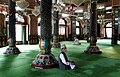 The mosque's interior has intricate woodwork and is richly decorated with papier-maché, seen above in 2007; the wooden structure makes it prone to fires, the latest such incident occurring in 2017
 -
 View of the Khanqah from the Jhelum river. On the bank saffron marks indicate the supposed existence of a Kali temple, although no conclusive evidence exists of the latter.


See also[edit | edit source]

- Islam in India
- List of mosques in India
- List of Monuments of National Importance in Jammu and Kashmir
References[edit | edit source]
- ↑ "Asian Historical Architecture: A Photographic Survey". Asian Architecture.
- ↑ 2.0 2.1 "List of Ancient Monuments and Archaeological Sites and Remains Jammu & Kashmir". Archaeological Survey of India. Archived from the original on 7 May 2012. Retrieved 18 November 2016.
- ↑ "Khankah-e-Moula shrine damaged in Srinagar fire". 15 November 2017. Retrieved 5 May 2019.
- ↑ "Latest News From Kashmir, Breaking News, Current Headlines, Kashmir News Online | Greater Kashmir". Retrieved 5 May 2019.
- ↑ "Khankah-e-Maulla gets refurbished crown". 31 March 2018. Retrieved 5 May 2019.
- ↑ "Maa Kali's Abode at Srinagar Kashmir - Kashmir Rechords-Striking a Chord with Kashmir". 30 September 2023.
- ↑ "Maa Kali's Abode at Srinagar Kashmir - Kashmir Rechords-Striking a Chord with Kashmir". 30 September 2023.
External links[edit | edit source]


- Pages using the JsonConfig extension
- 14th-century mosques in India
- Monuments of National Importance in Jammu and Kashmir
- Mosque buildings with spires
- Mosques in Srinagar
- Sunni mosques in India
- Buildings and structures completed in 1395
- Religious buildings and structures completed in 1732
- Mosques completed in the 1730s