




ImportMaster (talk | contribs) m robot: Creating new article from Special:WantedPages |
No edit summary |
||
| Line 1: | Line 1: | ||
{{Short description| | {{Short description|Medieval Hindu religious movement}} | ||
{{Use Indian English|date=August 2016}} | {{Use Indian English|date=August 2016}} | ||
{{Use dmy dates|date= | {{Use dmy dates|date=December 2021}} | ||
[[File:Meerabai (crop).jpg|thumb|[[Krishna]] has been a major part of the Bhakti movement. One of the key devotees was [[Meera]] (pictured).<ref name="smpandey">{{cite journal|author= SM Pandey |date= 1965 |title= Mīrābāī and Her Contributions to the Bhakti Movement |journal= History of Religions |volume= 5 |number= 1 |pages= 54–73|jstor= 1061803 |doi= 10.1086/462514 |s2cid= 162398500 }}</ref>]] | |||
{{Hinduism}} | {{Hinduism}} | ||
{{Hinduism in India}} | {{Hinduism in India}} | ||
{{Sikhism sidebar}} | {{Sikhism sidebar}} | ||
The '''Bhakti movement''' was a | The '''Bhakti movement''' was a significant religious movement in medieval [[Hinduism]]{{sfnp|Schomer|McLeod|1987|p=1}} that sought to bring religious reforms to all strata of society by adopting the method of [[Bhakti|devotion]] to achieve salvation.<ref name="cbseindiatoday">{{Cite web|url=https://www.indiatoday.in/education-today/gk-current-affairs/story/-crashcourse-cbse-class-12-history-bhakti-movement-s-emergence-and-influence-1438286-2019-01-24|title=CBSE Class 12 History #CrashCourse: Bhakti movement's emergence and influence|last1=India Today Web Desk New|date=January 24, 2019|website=India Today}}</ref> Originating in [[Tamilakam]] during the 6th century CE,{{sfn|Hawley|2015|p=87}}<ref>{{Cite book |last=Padmaja |first=T. |url=https://books.google.com/books?id=pzgaS1wRnl8C&dq=bhakti+movement+tamilakam&pg=RA1-PA37 |title=Temples of Kr̥ṣṇa in South India: History, Art, and Traditions in Tamil nāḍu |date=2002 |publisher=Abhinav |isbn=978-81-7017-398-4 |language=en}}</ref> it gained prominence through the poems and teachings of the Vaishnava [[Alvars]] and Shaiva [[Nayanars]] in [[Middle kingdoms of India#The Deccan plateau and South|early medieval South India]], before spreading northwards.{{sfnp|Schomer|McLeod|1987|p=1}} It swept over east and north India from the 15th century onwards, reaching its zenith between the 15th and 17th century CE.{{sfnp|Schomer|McLeod|1987|pp=1-2}} | ||
The Bhakti movement regionally developed around different gods and goddesses, some | The Bhakti movement regionally developed around different [[God in Hinduism|Hindu gods and goddesses]], and some sub-sects were [[Vaishnavism]] ([[Vishnu]]), [[Shaivism]] ([[Shiva]]), [[Shaktism]] ([[Shakti]] goddesses), and [[Smartism]].<ref>{{cite book |first=Lance |last=Nelson |year=2007 |title=An Introductory Dictionary of Theology and Religious Studies |editor1-first=Orlando O. |editor1-last=Espín |editor2-first=James B. |editor2-last=Nickoloff |publisher=Liturgical Press |isbn=978-0814658567 |pages=562–563}}</ref><ref>{{cite book |first=S. S. |last=Kumar |year=2010 |title=Bhakti – the Yoga of Love |publisher=LIT |location=Münster |isbn=978-3643501301 |pages=35–36}}</ref><ref name="donigerbrit">{{cite encyclopedia |first=Wendy |last=Doniger |year=2009 |url=http://www.britannica.com/EBchecked/topic/63933/bhakti |title=Bhakti |encyclopedia=Encyclopædia Britannica}}</ref><ref name="Surinder 1999">{{cite book|last1=Johar|first1=Surinder|title=Guru Gobind Singh: A Multi-faceted Personality|date=1999|publisher=MD Publications|isbn=978-8-175-33093-1|page=89}}</ref> The Bhakti movement preached using the local languages so that the message reached the masses. The movement was inspired by many poet-saints, who championed a wide range of philosophical positions ranging from [[theistic dualism]] of [[Dvaita]] to absolute [[monism]] of [[Advaita Vedanta]].{{sfnp|Schomer|McLeod|1987|p=2}}<ref name=novetzke>{{cite journal|author= Christian Novetzke |date= 2007 |title= Bhakti and Its Public |journal= International Journal of Hindu Studies |volume= 11 |number= 3 |pages= 255–272|jstor= 25691067 |doi= 10.1007/s11407-008-9049-9 |s2cid= 144065168 }}</ref> | ||
The movement has traditionally been considered an influential social reformation in Hinduism | The movement has traditionally been considered an influential social reformation in Hinduism, as it provided an individual-focused alternative path to spirituality, regardless of one's birth or gender.{{sfnp|Schomer|McLeod|1987|pp=1–2}} Contemporary scholars question whether the Bhakti movement was ever a reform or rebellion of any kind.{{sfnp|Pechilis Prentiss|2014|pages= 10-16}} They suggest that the Bhakti movement was a revival, reworking, and recontextualisation of ancient [[Vedic]] traditions.{{sfnp|Pechilis Prentiss|2014|pages= 15-16}} | ||
== Terminology == | == Terminology == | ||
The Sanskrit word ''bhakti'' is derived from the root {{transliteration|sa| | The Sanskrit word ''bhakti'' is derived from the root {{transliteration|sa|bhaj}}, which means "divide, share, partake, participate, to belong to".<ref name="Prentiss">{{cite book|last=Pechilis Prentiss|first=Karen|title=The Embodiment of Bhakti|publisher=Oxford University Press|location=US|year=1999|page=24|isbn=978-0-19-512813-0}}</ref><ref name="Werner">{{cite book|last=Werner|first=Karel|title=Love Divine: studies in bhakti and devotional mysticism|publisher=Routledge|year=1993|page=168|isbn=978-0-7007-0235-0}}</ref> The word also means "attachment, devotion to, fondness for, homage, faith or love, worship, piety to something as a spiritual, religious principle or means of salvation".<ref name=monier>[[Monier Monier-Williams]], ''Monier-Williams Sanskrit English Dictionary'', Motilal Banarsidass, page 743</ref><ref>[http://spokensanskrit.de/index.php?tinput=bhakti&direction=SE&script=HK&link=yes&beginning=0 bhakti] Sanskrit English Dictionary, University of Koeln, Germany</ref> | ||
Bhakti, in contrast, is spiritual, a love for and devotion towards religious concepts or principles, that engages both emotion and intellect.{{sfnp|Pechilis Prentiss|2014|pages= 19-21}} The connotation of love in this context is not one of uncritical emotion but committed engagement.{{sfnp|Pechilis Prentiss|2014|pages= 19-21}} The Bhakti movement in Hinduism refers to ideas and engagement that emerged in the medieval era on love and devotion to religious concepts built around one or more gods and goddesses. The Bhakti movement preached against the caste system and used local languages and so the message reached the masses. One who practices ''bhakti'' is called a ''bhakta''.{{sfnp|Pechilis Prentiss|2014|page=3}} | |||
== Textual roots == | == Textual roots == | ||
Ancient Indian texts, dated to | [[File:Nammazhwar.jpg|thumbnail|The [[Vaishnava|Vaishnavite Saint]] [[Nammalvar]]. He is one of the most prominent of the 12 [[Alvars]] of the [[Vaishnavism]] Bhakti movement.]] | ||
Ancient Indian texts, dated to the 1st millennium BCE, such as the ''Śvetāśvatara Upaniṣad'', the ''[[Katha Upanishad|Kaṭha Upaniṣad]]'', and the ''[[Bhagavad Gita]]'' mention Bhakti.<ref name=madeleine /> | |||
=== | === ''Śvetāśvatara Upaniṣad'' === | ||
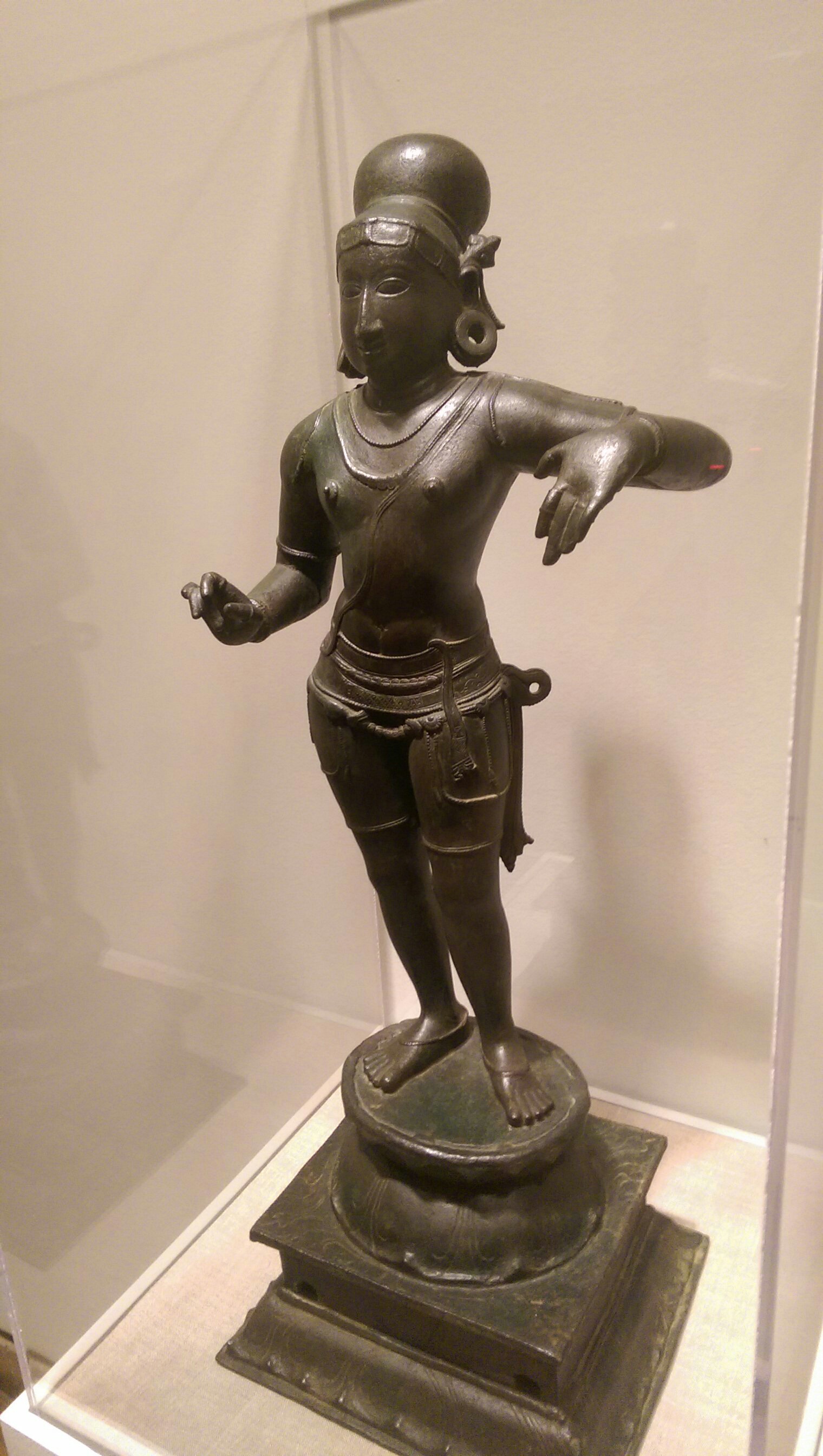
[[File: Shiva poet-saint devotee (2).jpg|thumb|A copper alloy sculpture of a Shiva Bhakti practitioner from [[Tamil Nadu]] (11th Century or later).]] | [[File: Shiva poet-saint devotee (2).jpg|thumb|A copper alloy sculpture of a Shiva Bhakti practitioner from [[Tamil Nadu]] (11th Century or later).]] | ||
The last of three epilogue verses of the | The last of three epilogue verses of the ''[[Śvetāśvatara Upaniṣad]]'', 6.23, uses the word [[Bhakti]] as follows, | ||
{{Blockquote| | {{Blockquote| | ||
| Line 32: | Line 31: | ||
तस्यैते कथिता ह्यर्थाः प्रकाशन्ते महात्मनः ॥ २३ ॥</nowiki><ref>[https://sa.wikisource.org/wiki/श्वेताश्वतरोपनिषद् Shvetashvatara Upanishad 6.23] Wikisource</ref> | तस्यैते कथिता ह्यर्थाः प्रकाशन्ते महात्मनः ॥ २३ ॥</nowiki><ref>[https://sa.wikisource.org/wiki/श्वेताश्वतरोपनिषद् Shvetashvatara Upanishad 6.23] Wikisource</ref> | ||
Who has highest Bhakti (love, devotion)<ref name=paulcarus>Paul Carus, {{Google books|96sLAAAAIAAJ|The Monist|PA514}}, pages 514-515</ref> of ''Deva'' (God), | |||
just like his ''Deva'', so for his ''Guru'' (teacher), | just like his ''Deva'', so for his ''Guru'' (teacher), | ||
To him who is high-minded, | To him who is high-minded, | ||
these teachings will be illuminating. | these teachings will be illuminating.<ref>Paul Deussen, ''Sixty Upanishads of the Veda, Volume 1'', Motilal Banarsidass, {{ISBN|978-8120814684}}, page 326</ref><ref>Max Muller, [https://archive.org/stream/upanishads02ml#page/266/mode/2up ''Shvetashvatara Upanishad''], The Upanishads, Part II, Oxford University Press, page 267</ref> | ||
</poem> | </poem> | ||
|[ | }} | ||
This verse is notable for the use of the word ''Bhakti'', and has been widely cited as among the earliest mentions of "the love of God".<ref name=paulcarus /><ref>WN Brown (1970), ''Man in the Universe: Some Continuities in Indian Thought'', University of California Press, {{ISBN|978-0520017498}}, pages 38-39</ref> Scholars have debated whether this phrase is authentic or later insertion into the Upanishad, and whether the terms "Bhakti" and "God" meant the same in this ancient text as they do in the medieval and modern era Bhakti traditions found in India.<ref name="maxmullerinto">Max Muller, [https://archive.org/stream/upanishads02ml#page/n33/mode/2up ''The Shvetashvatara Upanishad''], Oxford University Press, pages xxxii – xlii</ref><ref name=pauldeussenintro>Paul Deussen, ''Sixty Upanishads of the Veda, Volume 1'', Motilal Banarsidass, {{ISBN|978-8120814684}}, pages 301-304</ref> [[Max Muller]] states that the word ''Bhakti'' appears in only one verse of the epilogue at its end, may have been a later insertion and may not be theistic as the word was later used in much ''Sandilya Sutras''.<ref name=maxmullerbhakti>Max Muller, [https://archive.org/stream/upanishads02ml#page/n33/mode/2up ''The Shvetashvatara Upanishad''], Oxford University Press, pages xxxiv and xxxvii</ref> | |||
Grierson, as well as Carus, note that the first epilogue verse 6.21 is also notable for its use of the word ''Deva Prasada'' (देवप्रसाद, grace or gift of God), but add that ''Deva'' in the epilogue of the ''Śvetāśvatara Upaniṣad'' refers to "pantheistic Brahman" and the closing credit to sage ''Śvetāśvatara'' in verse 6.21 can mean "gift or grace of his Soul".<ref name="paulcarus" /> | |||
Doris Srinivasan states that the Upanishad is a treatise on theism, but it creatively embeds a variety of divine images, an inclusive language that allows "three Vedic definitions for a personal deity".<ref name="srinivasan">D Srinivasan (1997), ''Many Heads, Arms, and Eyes'', Brill, {{ISBN|978-9004107588}}, pages 96-97 and Chapter 9</ref> The Upanishad includes verses wherein God can be identified with the Supreme (Brahman-Atman, Self, Soul) in Vedanta monistic theosophy, verses that support the dualistic view of Samkhya doctrines, as well as the synthetic novelty of triple Brahman where a triune exists as the divine soul (Isvara, theistic God), individual soul (self) and nature (Prakrti, matter).<ref name="srinivasan" /><ref>{{cite journal|author= Lee Siegel |title= Commentary: Theism in Indian Thought |journal= Philosophy East and West |volume= 28 |number= 4 |date= October 1978 |pages= 419–423|jstor= 1398646 |doi= 10.2307/1398646 }}</ref> | |||
Tsuchida writes that the Upanishad syncretically combines monistic ideas of the [[Upanishads]] and the self-development ideas of [[Yoga]] with personification of the deity [[Rudra]].<ref>{{cite journal|author= R Tsuchida |date= 1985 |title= Some Remarks on the Text of the Svetasvatara-Upanisad |journal= Journal of Indian and Buddhist Studies (印度學佛教學研究) |volume= 34 |number= 1 |pages= 460–468 |quote="The Svetasvatara-Upanisad occupies a highly unique position among Vedic Upanisads as a testimony of the meditative and monistic Rudra-cult combined with Samkhya-Yoga doctrines."}}</ref> Hiriyanna interprets the text to be introducing "personal theism" in the form of Shiva Bhakti, with a shift to [[monotheism]] but in the henotheistic context where the individual is encouraged to discover his own definition and sense of God.<ref>M. Hiriyanna (2000), ''The Essentials of Indian Philosophy'', Motilal Banarsidass, {{ISBN|978-8120813304}}, pages 32-36</ref> | |||
=== Bhagavad Gita === | === ''Bhagavad Gita'' === | ||
The ''Bhagavad Gita'', a post-Vedic scripture composed in 5th to 2nd century BCE,{{sfnp|Fowler|2012|loc= see Foreword}} introduces ''bhakti marga'' (the path of faith/devotion) as one of three ways to spiritual freedom and release, the other two being ''[[karma yoga|karma marga]]'' (the path of works) and ''[[jnana yoga|jnana marga]]'' (the path of knowledge).<ref name="Minor">{{cite book|last=Minor|first=Robert Neil|title=Modern Indian Interpreters of the Bhagavadgita|publisher=SUNY Press|year=1986|page=3|isbn=978-0-88706-297-1|url=https://books.google.com/books?id=Ku2DGm20WWUC&pg=PA3}}</ref><ref>{{cite book|last=Glucklich|first=Ariel|title=The Strides of Vishnu|publisher=Oxford University Press|year=2008|page=104|isbn=978-0-19-531405-2|url=https://books.google.com/books?id=KtLScrjrWiAC&pg=PA104}}</ref> | {{Main|Bhagavad Gita}} | ||
The ''Bhagavad Gita'', a post-Vedic scripture composed in 5th to 2nd century BCE,{{sfnp|Fowler|2012|loc= see Foreword}} introduces ''bhakti marga'' (the path of faith/devotion) as one of three ways to spiritual freedom and release, the other two being ''[[karma yoga|karma marga]]'' (the path of works) and ''[[jnana yoga|jnana marga]]'' (the path of knowledge).<ref name="Minor">{{cite book|last=Minor|first=Robert Neil|title=Modern Indian Interpreters of the Bhagavadgita|publisher=SUNY Press|year=1986|page=3|isbn=978-0-88706-297-1|url=https://books.google.com/books?id=Ku2DGm20WWUC&pg=PA3}}</ref><ref>{{cite book|last=Glucklich|first=Ariel|title=The Strides of Vishnu|publisher=Oxford University Press|year=2008|page=104|isbn=978-0-19-531405-2|url=https://books.google.com/books?id=KtLScrjrWiAC&pg=PA104}}</ref> | |||
In verses 6.31 through 6.47 of the ''Bhagavad Gita'', [[Krishna]] describes bhakti yoga and loving devotion as one of the several paths to the highest spiritual attainments.<ref name="Jacobsen">{{cite book |editor-last=Jacobsen |editor-first=Knut A. | year = 2005 | title = Theory And Practice of Yoga: Essays in Honour of Gerald James Larson | page=351 | publisher = Brill Academic Publishers| isbn=90-04-14757-8}}</ref><ref name="chapple">Christopher Key Chapple (Editor) and Winthrop Sargeant (Translator), ''The Bhagavad Gita: Twenty-fifth–Anniversary Edition'', State University of New York Press, {{ISBN|978-1438428420}}, pages 302-303, 318</ref> | |||
=== ''Devi Mahatmya'' === | |||
{{Main|Devi Mahatmya}}The ''Devi Mahatmya'' embodies bhakti through three stories about the goddess Devi. In these narratives, devotion is vividly portrayed as the gods turn to Devi in times of crisis, emphasizing bhakti's central role in seeking divine aid and protection. The text prescribes rituals like recitation and worship to honor Devi, emphasizing that her ''Mahatmya'' should be recited "with bhakti" on specific days of each lunar fortnight and especially during the annual "great offering" (maha-puja) held in autumn, known today as [[Durga Puja|Durga puja]] (''Devi Mahatmya'' 12.4, 12.12).<ref>{{Cite book |last1=Mittal |first1=Sushil |url=https://books.google.com/books?id=da0FnwEACAAJ |title=The Hindu World |last2=Thursby |first2=Gene R. |date=2004 |publisher=Routledge |isbn=978-0-415-21527-5 |pages=190–192 |language=en}}</ref> | |||
== History == | == History == | ||
[[ | ===Initial development in Tamil lands=== | ||
The Bhakti movement originated in [[ | [[file:Kalamegaperumal1 (2).jpg|thumb|[[Nammalvar]] (c. 798 CE), one of the Tamil [[Alvars]] and author of the ''[[Tiruvaymoli]]'' and the ''[[Tiruviruttam]]'']] | ||
[[File:Thiruthalinathar Shiva temple, Tiruppathur Tamil Nadu - 04.jpg|thumb|Nayanars gallery at the Thiruthalinathar Shiva temple, Tiruppathur, a [[Shaiva Siddhanta]] temple. One important foundation of the Shaiva Siddhantha tradition is the Shaiva bhakti of the Nayanars.]] | |||
[[File:Andal-painting.jpg|thumb|Depiction of [[Andal]], a major poet of the Bhakti movement of [[Vaishnavism]]]] | |||
The Bhakti movement originated in [[Tamilakam]] during the seventh to eighth century CE, and remained influential in [[South India]] for some time. In the second millennium, a second wave of bhakti spread northwards through [[Karnataka]] (c. 12th century) and gained wide acceptance in fifteenth-century [[Assam]],<ref>{{Cite book|last=Neog|first=Maheswar|title=Early History of the [[Vaishnavism|Vaishnava]] Faith and Movement in Assam: Śaṅkaradeva and His Times|publisher=Motilal Banarsidass Publishers|year=1980}}</ref> [[Bengal]] and [[North India|northern India]].{{sfnp|Schomer|McLeod|1987|p=1}}<ref name=":0">Brockington, J. L. (1996). ''The Sacred Thread: Hinduism in Its Continuity and Diversity'', p. 130. Edinburgh University Press.</ref> | |||
According to Brockington, the initial [[Tamils|Tamil]] Bhakti movement was characterized by "a personal relationship between the deity and the devotee", and "fervent emotional experience in response to divine grace".<ref name=":0" /> The Bhakti movement in [[Tamil Nadu]] was composed of two main parallel groups: [[Shaivism|Shaivas]] (who also worshipped local deities like [[Shiva]] or his son [[Kartikeya|Murugan/Kartikeya]]) and [[Vaishnavism|Vaishnavas]] (who also worshipped local deities like [[Perumal (deity)|Tirumāl]]). The [[Vaishnavism|Vaishnava]] [[Alvars]] and Shaiva [[Nayanars]] lived between 5th and 9th century CE.<ref name="Embree">{{cite book |last=Embree |first=Ainslie Thomas |title=Sources of Indian Tradition |author2=Stephen N. Hay |author3=William Theodore De Bary |publisher=Columbia University Press |year=1988 |isbn=978-0-231-06651-8 |page=342 |author-link=Ainslie Embree}}</ref> They promoted love of a personal God first and foremost which is also expressed by love of one's fellow human beings. They also wrote and sang hymns of praise to their God, and came from numerous social classes, even [[shudra]]s.<ref>Brockington, J. L. (1996). ''The Sacred Thread: Hinduism in Its Continuity and Diversity'', pp. 130-33. Edinburgh University Press.</ref> These poet saints became the backbone of the [[Sri Vaishnavism|Sri Vaishnava]] and [[Shaiva Siddhanta]] traditions.<ref>Brockington, J. L. (1996). ''The Sacred Thread: Hinduism in Its Continuity and Diversity'', pp. 139-140. Edinburgh University Press.</ref> | |||
The Alvars, which literally means "those immersed in God", were Vaishnava poet-saints who sang praises of Vishnu as they traveled from one place to another.<ref name=olson /> They established temple sites such as [[Srirangam]], and spread ideas about [[Vaishnavism]]. Various poems were compiled as Alvar Arulicheyalgal or [[Divya Prabhandham|Divya Prabandham]], developed into an influential scripture for the Vaishnavas. The ''[[Bhagavata Purana]]'''s references to the South Indian Alvar saints, along with its emphasis on ''bhakti'', have led many scholars to give it South Indian origins though some scholars question whether that evidence excludes the possibility that Bhakti movement had parallel developments in other parts of India.<ref>{{cite book| last=Sheridan| first=Daniel| title= The Advaitic Theism of the Bhagavata Purana |publisher=South Asia Books |location=Columbia, Mo |year=1986 |isbn=81-208-0179-2}}</ref><ref>{{cite book | first=J. A. B. |last=van Buitenen | author-link=J. A. B. van Buitenen | chapter=The Archaism of the Bhāgavata Purāṇa |title=Encyclopedia Indica | year = 1996| editor=S.S. Shashi | isbn=978-81-7041-859-7 | pages=28–45 }}</ref> | |||
Like the Alvars, the Shaiva Nayanars were Bhakti poet saints. The ''[[Tirumurai]]'', a compilation of hymns on Shiva by sixty-three Nayanar poet-saints, developed into an influential scripture in Shaivism. The poets' itinerant lifestyle helped create temple and pilgrimage sites and spread spiritual ideas built around Shiva.<ref name=olson>{{cite book|last=Olson|first=Carl|title=The many colors of Hinduism: a thematic-historical introduction|publisher=[[Rutgers University Press]]|year=2007|page=231|isbn=978-0-8135-4068-9}}</ref> Early Tamil-Shiva Bhakti poets influenced Hindu texts that came to be revered all over India.{{sfnp|Pechilis Prentiss|2014|pages=17-18}} | |||
=== Spread throughout India in the 2nd millennium === | |||
[[file:Basava cropped.jpg|thumb|Statue of [[Basava]] (1131–1196), founder of [[Lingayatism]]]] | |||
[[file:Chaitanya sankirtan.jpg|thumb|Chaitanya Mahaprabhu leading the Vaishnavas in 'Nagar kirtan', devotional chanting and dancing, in the streets of [[Nabadwip]], [[Bengal]].]] | |||
The influence of the Tamil bhakti saints and those of later northern Bhakti leaders ultimately helped spread ''bhakti'' poetry and ideas throughout all the Indian subcontinent by the 18th century CE.<ref name="Embree" /><ref name="Flood">{{cite book |last=Flood |first=Gavin |url=https://archive.org/details/introductiontohi0000floo |title=An Introduction to Hinduism |publisher=Cambridge University Press |year=1996 |isbn=978-0-521-43878-0 |page=[https://archive.org/details/introductiontohi0000floo/page/131 131] |url-access=registration}}</ref> However, outside of the Tamil speaking regions, the Bhakti movement arrived much later, mostly in the second millennium. | |||
For example, in [[Kannada]]-speaking regions (roughly modern [[Karnataka]]), the Bhakti movement arrived in the 12th century, with the emergence of [[Basava]] and his Shaivite [[Lingayatism]], which were known for their total rejection of [[Caste system in India|caste distinctions]] and the authority of the [[Vedas]], their promotion of the religious equality of women, and their focus on worshipping a small [[lingam]], which they always carried around their necks, as opposed to images in temples run by elite priesthoods.<ref>Brockington, J. L. (1996). ''The Sacred Thread: Hinduism in Its Continuity and Diversity''. pp. 145–147. Edinburgh University Press.</ref> Another important Kannada figure in the Bhakti movement was [[Madhvacharya]] (c. 12–13th centuries), a great and prolific scholar of [[Vedanta]], who promoted the theology of dualism ([[Dvaita Vedanta]]).<ref>Brockington, J. L. (1996). ''The Sacred Thread: Hinduism in Its Continuity and Diversity''. p. 148. Edinburgh University Press.</ref> | |||
Similarly, the Bhakti movement in [[Odisha]] (known as Jñanamisrita bhakti or Dadhya Bhakti) also began in the 12th century. It included various scholars including [[Jayadeva]] (the 12th-century author of the ''[[Gita Govinda]]''), and it had become a mass movement by the 14th century.<ref>{{cite web |date=15 April 2018 |title=Pancha Sakhas of Medieval Odisha |url=https://www.historyofodisha.in/pancha-sakhas-of-medieval-odisha/ |access-date=2022-03-03 |website=History of Odisha}}</ref> Figures like [[Balarama Dasa]], [[Achyutananda]], [[Jasobanta Dasa]], [[Ananta Dasa]] and [[Jagannatha Dasa (Odia poet)|Jagannatha Dasa]] preached Bhakti through public [[Kirtan|sankirtans]] across Odisha. [[Jagannath]] was and remains the center of the Odisha Bhakti movement. | |||
The | The Bhakti movements also spread to the north later, particularly during the flowering of northern [[Bhakti yoga]] of the 15th and the 16th centuries. Perhaps the earliest of the northern bhakti figures was [[Nimbarkacharya|Nimbārkāchārya]] (c. 12th century), a Brahmin from [[Andhra Pradesh]] who moved to [[Vrindavan]]. He defended a similar theology to [[Ramanuja]], which he called [[Bhedabheda|Bhedābheda]] (difference and non-difference).<ref>Brockington, J. L. (1996). ''The Sacred Thread: Hinduism in Its Continuity and Diversity''. p. 151. Edinburgh University Press.</ref> Other important northern bhaktas include [[Namdev|Nāmdev]] (c. 1270–1350), [[Ramananda|Rāmānanda]], and [[Eknath]] (c. 1533–1599).<ref>Brockington, J. L. (1996). ''The Sacred Thread: Hinduism in Its Continuity and Diversity''. p. 152. Edinburgh University Press.</ref> | ||
Another important development was the rise of the [[Sant Mat]] movement, which drew from [[Nath]] tradition and Vaishnavism. Kabir was a saint known for Hindi poetry that expressed a rejection of external religion in favor of inner experience. After his death, his followers founded the [[Kabir panth]].<ref>Brockington, J. L. (1996). ''The Sacred Thread: Hinduism in Its Continuity and Diversity''. p. 157. Edinburgh University Press.</ref> A similar movement sharing the same Sant Mat Bhakti background that drew on both Hinduism and Islam, was founded by the [[Guru Nanak|Guru Nānak]] (1469–1539), the first Guru of [[Sikhism]].<ref>Brockington, J. L. (1996). ''The Sacred Thread: Hinduism in Its Continuity and Diversity''. p. 158. Edinburgh University Press.</ref> | |||
In [[Bengal]], the most famous composer of Vaishnava devotional songs was [[Chandidas|Candīdās]] (1339–1399).<ref name=":2">Brockington, J. L. (1996). ''The Sacred Thread: Hinduism in Its Continuity and Diversity''. pp. 162–165. Edinburgh University Press.</ref> He was celebrated in the popular Bengali [[Vaishnava-Sahajiya]] movement. One the most influential of the northern Hindu Bhakti traditions was the [[Krishnaism|Krishnaite]] [[Gaudiya Vaishnavism]] of [[Chaitanya Mahaprabhu]] (1486–1534) in Bengal. Chaitanya eventually came to be seen by the Bengali Vaishnavas as an [[avatar]]a of [[Krishna]] himself.<ref name=":2" /> Another important leader of northern Vaishnava Bhakti was [[Vallabha|Vallabhacharya Mahaprabhu]] (1479–1531 CE) who founded the [[Pushtimarg]] tradition in [[Braj|Braj (Vraja)]].<ref>Brockington, J. L. (1996). ''The Sacred Thread: Hinduism in Its Continuity and Diversity''. pp. 165–166. Edinburgh University Press.</ref> | |||
Some scholars state that the Bhakti movement's rapid spread in India in the 2nd millennium was in part a response to the arrival of [[Islam]]<ref>The earliest arrival dates are contested by scholars. They range from the 7th to 9th century, with Muslim traders settling in coastal regions of the Indian subcontinent, to Muslims seeking asylum in Tamil Nadu, to Muslim raids in northwestern India by [[Muhammad bin Qasim]]. See: | |||
* {{cite book |first=Annemarie |last=Schimmel |year=1997 |title=Islam in the Indian subcontinent |publisher=Brill Academic |isbn=978-9004061170 |pages=3–7}} | |||
* {{cite book |first=Andre |last=Wink |year=2004 |title=Al-Hind: the Making of the Indo-Islamic World |publisher=Brill Academic |isbn=90-04-09249-8}}</ref> and subsequent Islamic rule in India and Hindu-Muslim conflicts.<ref name="donigerbrit" /><ref name="Surinder 1999"/><ref name=karen>{{cite encyclopedia |first=Karen |last=Pechelis |year=2011 |title=Bhakti Traditions |encyclopedia=The Continuum Companion to Hindu Studies |editor1-first=Jessica |editor1-last=Frazier |editor2-first=Gavin |editor2-last=Flood |publisher=Bloomsbury |isbn=978-0826499660 |pages=107–121}}</ref>{{sfnp|Hawley|2015|pages=39–61}} That view is contested by some scholars,{{sfnp|Hawley|2015|pages=39–61}} with [[Rekha Pande]] stating that singing ecstatic Bhakti hymns in local language had been a tradition in [[South India]] before [[Muhammad]] was born.<ref name=rekhapande /> According to Pande, the psychological impact of Muslim conquests may have initially contributed to community-style Bhakti by Hindus.<ref name=rekhapande>{{cite book |first=Rekha |last=Pande |year=2014 |title=Divine Sounds from the Heart—Singing Unfettered in their Own Voices |location=Cambridge, UK |publisher=Cambridge Scholars |isbn=978-1443825252 |page=25}}</ref> However, other scholars state that Muslim invasions, the conquests of Hindu Bhakti temples in South India and the seizure and the melting of musical instruments such as [[cymbals]] from local people were part responsible for the later relocation or demise of singing Bhakti traditions in the 18th century.<ref>{{cite book |first=Vasudha |last=Narayanan |year=1994 |title=The Vernacular Veda: Revelation, Recitation, and Ritual |publisher=University of South Carolina Press |isbn=978-0872499652 |page=84}}</ref> | |||
According to [[Wendy Doniger]], the nature of the Bhakti movement may have been affected by the daily practices to "surrender to God" of Islam when it arrived in India.<ref name="donigerbrit" /><ref name="Surinder 1999"/> In turn, that influenced devotional practices in Islam such as [[Sufism]],<ref>{{cite book|first=Gavin|last=Flood|author-link=Gavin Flood|title=The Blackwell companion to Hinduism|publisher=Wiley-Blackwell|year=2003|page=185|isbn=978-0-631-21535-6}}</ref> and other religions in India from the 15th century onwards, such as [[Sikhism]], [[Christianity]],<ref name="Neill 2002 412">{{cite book |first=Stephen |last=Neill |year=2002 |title=A history of Christianity in India, 1707–1858 |publisher=Cambridge University Press |isbn=978-0-521-89332-9 |page=412}}</ref> and [[Jainism]].<ref name="Kelting 2001 87">{{cite book |first=Mary |last=Kelting |year=2001 |title=Singing to the Jinas: Jain laywomen, Maṇḍaḷ singing, and the negotiations of Jain devotion |publisher=Oxford University Press |page=87 |isbn=978-0-19-514011-8}}</ref> | |||
Klaus Witz, in contrast, traces the history and nature of the Bhakti movement to the [[Upanishads|Upanishadic]] and the Vedanta foundations of Hinduism. He writes that in virtually every Bhakti movement poet, "the Upanishadic teachings form an all-pervasive substratum, if not a basis. We have here a state of affairs that has no parallel in the West. Supreme Wisdom, which can be taken as basically non-theistic and as an independent wisdom tradition (not dependent on the Vedas), appears fused with the highest level of [[bhakti]] and with the highest level of God-realization."<ref>{{cite book |first=Klaus G. |last=Witz |year=1998 |title=The Supreme Wisdom of the Upaniṣads: An Introduction |publisher=Motilal Banarsidass |isbn=978-8120815735 |page=10}}</ref> | |||
The writings of [[ | === Key figures === | ||
The Bhakti movement witnessed a surge in Hindu literature in regional languages, particularly in the form of devotional poems and music.{{sfnp|Pechilis Prentiss|2014|pages=26-32, 217-218}}<ref>Guy Beck (2011), ''Sonic Liturgy: Ritual and Music in Hindu Tradition'', The University of South Carolina Press, {{ISBN|978-1611170375}}, Chapters 3 and 4</ref><ref>David Kinsley (1979), ''The Divine Player: A Study of Kṛṣṇa Līlā'', Motilal Banarsidass, {{ISBN|978-0896840195}}, pages 190-204</ref> This literature includes the writings of the [[Alvars]] and [[Nayanars]], poems of [[Andal]],<ref name=richardgeorge /> [[Basava]],{{sfnp|Hawley|2015|pages=304-310}} [[Bhagat Pipa]],{{sfnp|Lorenzen|1995|pages=182-199}} [[Allama Prabhu]], [[Akka Mahadevi]], [[Vallabhacharya]], [[Vitthalanatha]]/[[Gusainji]], [[Kabir]], [[Guru Nanak]] (founder of [[Sikhism]]),{{sfnp|Hawley|2015|pages=304-310}} [[Tulsidas]], [[Nabha Dass]],<ref>{{Cite book|title=A dictionary of Indian literature |last=Mukherjee |first=Sujit |publisher=Orient Longman|year=1998 |isbn=81-250-1453-5 |location=Hyderabad |oclc=42718918}}</ref>, Ghananand,<ref name=richardgeorge /> [[Ramananda]] (founder of [[Ramanandi Sampradaya]]), Ravidass, [[Sripadaraja]], [[Vyasatirtha]], [[Purandara Dasa]], [[Kanakadasa]], [[Vijaya Dasa]], [[Six Goswamis of Vrindavana|Six Goswamis of Vrindavan]],<ref>Peasants and Monks in British India, University of California Press, {{ISBN|978-0520200616}}, pages 2–3, 53-81</ref> [[Raskhan]],<ref>Rupert Snell (1991), ''The Hindi Classical Tradition: A Braj Bhāṣā Reader'', Routledge, {{ISBN|978-0728601758}}, pages 39-40</ref> [[Ravidas]],{{sfnp|Hawley|2015|pages=304-310}} [[Jayadeva Goswami]],<ref name="richardgeorge" /> [[Namdev]],{{sfnp|Hawley|2015|pages=304-310}} [[Eknath]], [[Tukaram]], [[Mirabai]],<ref name=smpandey /> [[Ramprasad Sen]],<ref>Rachel McDermott (2001), ''Singing to the Goddess: Poems to Kālī and Umā from Bengal'', Oxford University Press, {{ISBN|978-0195134346}}, pages 8-9</ref> [[Sankardev]],<ref>Maheswar Neog (1995), ''Early History of the Vaiṣṇava Faith and Movement in Assam: Śaṅkaradeva and his times'', Motilal Banarsidass, {{ISBN|978-8120800076}}, pages 1-4</ref>,{{sfnp|Hawley|2015|pages=304-310}} [[Narsinh Mehta]],<ref>{{cite book|title=Learning History Civis Standard Seven|url=https://books.google.com/books?id=uZxdatjyWkEC&pg=PA29|publisher=Jeevandeep Prakashan Pvt Ltd|page=30|id=GGKEY:CYCRSZJDF4J}}</ref> [[Gangasati]]<ref name="Pande2010">{{cite book|author=Rekha Pande|title=Divine Sounds from the Heart—Singing Unfettered in their Own Voices: The Bhakti Movement and its Women Saints (12th to 17th Century)|url=https://books.google.com/books?id=mYEnBwAAQBAJ&pg=PA162|date=13 September 2010|publisher=Cambridge Scholars Publishing|isbn=978-1-4438-2525-2|pages=162–163}}</ref> and the teachings of saints like [[Chaitanya Mahaprabhu]].{{sfnp|Schomer|McLeod|1987}} | |||
The | The writings of [[Sankardev|Sankaradeva]] in [[Assam]], however, included an emphasis on the regional language and also led to the development of an artificial literary language called ''[[Brajavali dialect|Brajavali]]''.<ref>{{Cite journal|last1=Goswami|first1=Tridib K.|last2=Ashique|first2=Elahi|date=2019|title=Ankiya-bhaona of Sankaradeva and Madhavadeva performed in the Sattra Institutions of Assam: A study.|url=https://www.proquest.com/openview/6061ae46e2c3a2db33ba5fa8796cf138/1?pq-origsite=gscholar&cbl=2035015|journal=Deliberative Research|volume=42|issue=1|pages=21–24}}</ref> ''Brajavali'' is, to an extent, a combination of medieval [[Maithili language|Maithili]] and [[Assamese language|Assamese]].<ref>'The Brajabuli idiom developed in Orissa and Bengal also. But as Dr Sukumar Sen has pointed out "Assamese Brajabuli seems to have developed through direct connection with Mithila" (''A History of Brajabuli Literature'', Calcutta, 1931 p1). This artificial dialect had Maithili as its basis to which Assamese was added.' {{harv|Neog|1980|p=257f}}</ref><ref>{{harv|Neog|1980|p=246}}</ref> The language was easily understood by the local populace, in line with the Bhakti movement's call for inclusion, but also retained its literary style. A similar language, called ''[[Brajabuli]]'' was popularised by [[Vidyapati]],<ref name="Majumdar1960">{{cite book |editor1-last=Majumdar |editor1-first=Ramesh Chandra |editor1-link=R. C. Majumdar |editor2-last=Pusalker |editor2-first=A. D. |editor3-last=Majumdar |editor3-first=A. K. |date=1960 |title=[[The History and Culture of the Indian People]] |volume=VI: The Delhi Sultanate |location=Bombay |publisher=Bharatiya Vidya Bhavan |page=515 |quote="During the sixteenth century, a form of an artificial literary language became established ... It was the ''Brajabulī'' dialect ... ''Brajabulī'' is practically the Maithilī speech as current in Mithilā, modified in its forms to look like Bengali".}}</ref><ref name="Banglapedia-Brajabuli">{{cite book |last=Morshed |first=Abul Kalam Manjoor |year=2012 |chapter=Brajabuli |chapter-url=http://en.banglapedia.org/index.php?title=Brajabuli |editor1-last=Islam |editor1-first=Sirajul |editor1-link=Sirajul Islam |editor2-last=Jamal |editor2-first=Ahmed A. |title=Banglapedia: National Encyclopedia of Bangladesh |edition=Second |publisher=[[Asiatic Society of Bangladesh]]}}</ref> which was adopted by several writers in [[Odisha]]<ref>{{cite book |last1=Mansinha |first1=Mayadhar |title=History of Oriya literature |date=1962 |publisher=Sahitya Akademi |location=New Delhi |page=133 |url=https://drive.google.com/file/d/19WBHukqcz8XuXyGvjimYqt6sU1y5HEtZ/view}}</ref><ref name="Paniker1997">{{cite book |last=Paniker |first=K. Ayyappa |author-link=Ayyappa Paniker |date=1997 |title=Medieval Indian Literature: An Anthology |volume=One: Surveys and selections |url=https://books.google.com/books?id=KYLpvaKJIMEC&pg=PA287 |location=New Delhi |publisher=Sahitya Akademi |page=287 |isbn=978-81-260-0365-5}}</ref> in the medieval times, and in [[Bengal]] during its [[Bengali Renaissance|renaissance]].<ref name="Banglapedia-Vidyapati">{{cite book |last=Choudhury |first=Basanti |year=2012 |chapter=Vidyapati |chapter-url=http://en.banglapedia.org/index.php?title=Vidyapati |editor1-last=Islam |editor1-first=Sirajul |editor1-link=Sirajul Islam |editor2-last=Jamal |editor2-first=Ahmed A. |title=Banglapedia: National Encyclopedia of Bangladesh |edition=Second |publisher=[[Asiatic Society of Bangladesh]]}}</ref><ref name="Paniker1997"/> | ||
The Bhakti movement also witnessed several works getting translated into various Indian languages. [[Saundarya Lahari]] | The earliest writers from the 7th to 10th centuries, who are known to have influenced the movements driven by poet-saints, include [[Sambandar]], [[Tirunavukkarasar]], [[Sundarar]], [[Nammalvar]], [[Adi Shankara]], [[Manikkavacakar]] and [[Araiyar Sevai|Nathamuni]].<ref name="axelmichaels" /> Several 11th- and 12th-century writers developed different philosophies within the Vedanta school of Hinduism that were influential to the Bhakti tradition in [[medieval India]], and they include [[Ramanuja]], [[Madhvacharya|Madhva]], [[Vallabha Acharya|Vallabha]] and [[Nimbarka]].<ref name="richardgeorge">Richard Kieckhefer and George Bond (1990), ''Sainthood: Its Manifestations in World Religions,'' University of California Press, {{ISBN|978-0520071896}}, pages 116-122</ref><ref name="axelmichaels">Axel Michaels (2003), ''Hinduism: Past and Present'', Princeton University Press, {{ISBN|978-0691089539}}, pages 62-65</ref> These writers championed a spectrum of philosophical positions ranging from theistic dualism, qualified [[Nonduality (spirituality)|nondualism]] and absolute [[monism]].{{sfnp|Schomer|McLeod|1987|p=2}}<ref name="novetzke" /> | ||
The Bhakti movement also witnessed several works getting translated into various Indian languages. ''[[Saundarya Lahari]]'' was written in Sanskrit by [[Adi Shankara]] and was translated into [[Tamil language|Tamil]] in the 12th century by [[Virai Kaviraja Pandithar]], who titled the book ''Abhirami Paadal''.<ref name="Nagaswamy_Vol19">{{cite web | |||
| url = http://www.tamilartsacademy.com/journals/volume19/articles/article1.xml | | url = http://www.tamilartsacademy.com/journals/volume19/articles/article1.xml | ||
| title = Saundarya Lahari in Tamil (Volume 19) | | title = Saundarya Lahari in Tamil (Volume 19) | ||
| last = Nagaswamy | | last = Nagaswamy | ||
| first = R. | | first = R. | ||
| date = | | date = | ||
| website = | | website = | ||
| publisher = Tamil Arts Academy | | publisher = Tamil Arts Academy | ||
| access-date = 26 September 2020 | | access-date = 26 September 2020 | ||
| quote = }}</ref> Similarly, the first translation of the Ramayana into an Indo-Aryan language was by [[Madhava Kandali]], who translated it into Assamese as the | | quote = | ||
| archive-date = 10 February 2021 | |||
| archive-url = https://web.archive.org/web/20210210203812/http://tamilartsacademy.com/journals/volume19/articles/article1.xml | |||
| url-status = dead | |||
}}</ref> Similarly, the first translation of the Ramayana into an [[Indo-Aryan language]] was by [[Madhava Kandali]], who translated it into [[Assamese language|Assamese]] as the [[Saptakanda Ramayana]].<ref>{{Cite book|last1=Kandali|first1=Aditya Bihar|last2=Routray|first2=Aurobinda|last3=Basu|first3=Tapan Kumar|title=TENCON 2008 - 2008 IEEE Region 10 Conference |chapter=Emotion recognition from Assamese speeches using MFCC features and GMM classifier|date=November 2008|pages=1–5|publisher=IEEE|doi=10.1109/tencon.2008.4766487|isbn=9781424424085|s2cid=39558655}}</ref> | |||
[[Shandilya]] and [[Narada]] are credited with two Bhakti texts, ''Shandilya Bhakti Sutra'' and ''[[Narada Bhakti Sutra]]'', but both have been dated to the 12th century by modern scholars.<ref>{{cite book |last=De Bary |first=William Theodore |title=Sources of Indian Tradition |author2=Stephen N Hay |publisher=Motilal Banarsidass |year=1988 |isbn=978-81-208-0467-8 |page=330 |chapter=Hinduism |chapter-url=https://books.google.com/books?id=PqzFZNF2RxgC&pg=PA330}}</ref><ref>{{cite book |author=Swami Vivekananda |title=The indispensable Vivekananda |publisher=Orient Blackswan |year=2006 |isbn=978-81-7824-130-2 |editor=Amiya P Sen |page=212 |chapter=Bhakti Yoga |author-link=Swami Vivekananda |chapter-url=https://books.google.com/books?id=usBhrZcnJ78C&pg=PA212}}</ref> | |||
== Theology == | |||
The Bhakti movement of Hinduism saw two ways of imaging the nature of the divine ([[Brahman]]): ''Nirguna'' and ''Saguna''.{{sfnp|Pechilis Prentiss|2014|page=21}} ''Nirguna'' Brahman was the concept of the ultimate reality as formless and without attributes or quality.{{sfnp|Fowler|2012|pages= xxvii-xxxiv}} ''Saguna'' Brahman, in contrast, was envisioned and developed as with form, attributes and quality.{{sfnp|Fowler|2012|pages= xxvii-xxxiv}} | |||
Both views had parallels in the ancient pantheistic formless and theistic traditions, respectively, and are traceable to a dialogue in the ''[[Bhagavad Gita]]''.{{sfnp|Pechilis Prentiss|2014|page=21}}{{sfnp|Fowler|2012|pages= 207-211}} These two may be considered to be the same Brahman, as viewed from two perspectives: a formless mode focused on wisdom (''jñana'') and a form mode, focused on love.{{sfnp|Fowler|2012|pages= 207-211}} ''Nirguna'' Bhakti poetry is more focused on ''jñana'', and ''Saguna'' bhakti poetry focuses on love (''prema'').{{sfnp|Pechilis Prentiss|2014|page=21}} In Bhakti, the emphasis is reciprocal love and devotion in which the devotee loves God, and God loves the devotee.{{sfnp|Fowler|2012|pages= 207-211}} | |||
== Social | The concepts of ''Nirguna'' and ''Saguna Brahman'', which is at the root of Bhakti theology, underwent more profound developments with the ideas of the [[Vedanta]] schools, particularly those of [[Adi Shankara]]'s 8th-century ''[[Advaita Vedanta]]'' (absolute [[nondualism]] / [[monism]]), [[Ramanuja]]'s 12th-century [[Vishishtadvaita]] Vedanta (a qualified nondualism that posits unity and diversity), and [[Madhvacharya]]'s (c. 12th-13th century) [[Dvaita Vedanta]] (which posits a true dualism between God and the [[Ātman (Hinduism)|Ātman]]).{{sfnp|Fowler|2012|pages= xxvii-xxxiv}} | ||
According to David Lorenzen, the idea of bhakti for a ''Nirguna'' Brahman has been a baffling one to scholars since it offers "heart-felt devotion to a God without attributes, without even any definable personality".<ref name="davidlorenzenns" /> However, given the "mountains of ''Nirguni'' bhakti literature", Bhakti for ''Nirguna Brahman'' has been a part of the reality of the Hindu tradition along with the Bhakti for ''Saguna Brahman''.<ref name="davidlorenzenns">David Lorenzen (1996), ''Praises to a Formless God: Nirguni Texts from North India'', State University of New York Press, {{ISBN|978-0791428054}}, page 2</ref> Thus, these were two alternate ways of imagining God even in the Bhakti movement.{{sfnp|Pechilis Prentiss|2014|page=21}} | |||
The Nirguna and Saguna forms of Bhakti may be found in two 12th-century treatises on bhakti: the ''Sandilya Bhakti Sutra'' and ''Narada Bhakti Sutra''. ''Sandilya'' leans towards Nirguna Bhakti, and ''Narada'' leans towards Saguna Bhakti.<ref name=":1">Jessica Frazier and Gavin Flood (2011), ''The Continuum Companion to Hindu Studies'', Bloomsbury Academic, {{ISBN|978-0826499660}}, pages 113-115</ref> | |||
=== Salvation === | |||
According to J. L. Brockington, the Sri Vaishnavas had split into two subsects in the 14th century:<blockquote>the dispute was over the question of human effort versus divine grace in achieving salvation, a controversy often and not unreasonably compared to the Arminian and Calvinist standpoints within Protestantism. The Northern school held that the worshipper had to make some effort to win the grace of the Lord and emphasised the performance of karma, a position commonly summed up as being ‘on the analogy of the monkey and its young’, for as the monkey carries her young which cling to her body so Visnu saves the worship per who himself makes an effort. The Southern school held that the Lord’s grace itself conferred salvation, a position ‘on the analogy of the cat and its kittens’, for just as the cat picks up her kittens in her mouth and carries them off willy-nilly, so Visnu saves whom he wills, without effort on their part.<ref>Brockington, J. L. (1996). ''The Sacred Thread: Hinduism in Its Continuity and Diversity'', p. 139. Edinburgh University Press.</ref> </blockquote> | |||
== Social Impact == | |||
[[File:Dhekiakhowa Bornamghar.jpg|thumb|right|[[Dhekiakhowa Bornamghar]] at [[Jorhat]]. [[Namghar]]s are places of congregational worship and centres of local self-governance in [[Assam]], introduced by Bhakti saints such as [[Sankardev|Sankaradeva]], [[Madhavdev|Madhavadeva]] and [[Damodardev|Damodaradeva]]]] | [[File:Dhekiakhowa Bornamghar.jpg|thumb|right|[[Dhekiakhowa Bornamghar]] at [[Jorhat]]. [[Namghar]]s are places of congregational worship and centres of local self-governance in [[Assam]], introduced by Bhakti saints such as [[Sankardev|Sankaradeva]], [[Madhavdev|Madhavadeva]] and [[Damodardev|Damodaradeva]]]] | ||
The Bhakti movement led to devotional transformation of medieval Hindu society, | The Bhakti movement led to devotional transformation of medieval Hindu society, and Vedic rituals or alternatively [[sannyasa|ascetic]] monk-like lifestyle for [[moksha]] gave way to individualistic loving relationship with a personally defined god.{{sfnp|Schomer|McLeod|1987|pp=1-2}} Salvation, which had been considered attainable only by men of the [[Brahmin]], [[Kshatriya]] and [[Vaishya]] castes, became available to everyone.{{sfnp|Schomer|McLeod|1987|pp=1-2}} Most scholars state that Bhakti movement provided women and members of the [[Shudra]] and [[untouchability|untouchable]] communities an inclusive path to spiritual salvation.{{sfnp|Iwao|1988|pp=184-185|ps=}} Some scholars disagree that the Bhakti movement was premised on such social inequalities.<ref>{{cite journal|author= Peter van der Veer |date= 1987 |title= Taming the Ascetic: Devotionalism in a Hindu Monastic Order |journal= Man |series=New Series |volume= 22 |number= 4 |pages= 680–695|doi= 10.2307/2803358 |jstor= 2803358 }}</ref>{{sfnp|Hawley|2015|pages=338-339}} | ||
Poet-saints grew in popularity, and literature on devotional songs in regional languages became profuse.{{sfnp|Schomer|McLeod|1987|pp=1-2}} These poet-saints championed a wide range of philosophical positions within their society, ranging from the theistic dualism of [[Dvaita]] to the absolute [[monism]] of [[Advaita]] Vedanta.{{sfnp|Schomer|McLeod|1987|p=2}} Kabir, a poet-saint for example, wrote in | Poet-saints grew in popularity, and literature on devotional songs in regional languages became profuse.{{sfnp|Schomer|McLeod|1987|pp=1-2}} These poet-saints championed a wide range of philosophical positions within their society, ranging from the theistic dualism of [[Dvaita]] to the absolute [[monism]] of [[Advaita]] Vedanta.{{sfnp|Schomer|McLeod|1987|p=2}} Kabir, a poet-saint, for example, wrote in Upanishadic style, the state of knowing truth:{{sfnp|Schomer|McLeod|1987|pp=154-155}} | ||
{{Blockquote| | {{Blockquote| | ||
| Line 114: | Line 153: | ||
|[[Kabir]], Shabda 43|Translated by K Schomer and WH McLeod{{sfnp|Schomer|McLeod|1987|pp=154-155}}}} | |[[Kabir]], Shabda 43|Translated by K Schomer and WH McLeod{{sfnp|Schomer|McLeod|1987|pp=154-155}}}} | ||
The early 15th-century Bhakti poet-Sant Pipa stated | The early-15th-century Bhakti poet-Sant Pipa stated:<ref name=nirmal>Nirmal Dass (2000), ''Songs of the Saints from the Adi Granth'', State University of New York Press, {{ISBN|978-0791446836}}, pages 181-184</ref> | ||
{{Blockquote| | {{Blockquote| | ||
| Line 121: | Line 160: | ||
within the body all the Jangamas<ref>A term in Shaiva Hindu religiosity, referring to an individual who is always on the go, seeking, learning; See: Winnand Callewaert (2000), ''The Hagiographies of Anantadas: The Bhakti Poets of North India, Routledge'', {{ISBN|978-0700713318}}, page 292</ref> | within the body all the Jangamas<ref>A term in Shaiva Hindu religiosity, referring to an individual who is always on the go, seeking, learning; See: Winnand Callewaert (2000), ''The Hagiographies of Anantadas: The Bhakti Poets of North India, Routledge'', {{ISBN|978-0700713318}}, page 292</ref> | ||
within the body the incense, the lamps, and the food-offerings, | within the body the incense, the lamps, and the food-offerings, | ||
within the body the [[ | within the body the [[puja (Hinduism)|puja]]-leaves. | ||
After searching so many lands, | After searching so many lands, | ||
| Line 130: | Line 169: | ||
|[[Bhagat Pipa|Pīpā]], Gu dhanasari|Translated by Vaudeville<ref name= Winnand>Winnand Callewaert (2000), ''The Hagiographies of Anantadas: The Bhakti Poets of North India'', Routledge, {{ISBN|978-0700713318}}, page 292</ref>}} | |[[Bhagat Pipa|Pīpā]], Gu dhanasari|Translated by Vaudeville<ref name= Winnand>Winnand Callewaert (2000), ''The Hagiographies of Anantadas: The Bhakti Poets of North India'', Routledge, {{ISBN|978-0700713318}}, page 292</ref>}} | ||
The impact of the Bhakti movement in India was similar to that of the Protestant Reformation of Christianity in Europe.{{sfnp|Schomer|McLeod|1987|p=2}} It evoked shared religiosity, direct emotional and intellection of the divine | The Bhakti movement also led to the prominence of the concept of female devotion, poet-saints such as [[Andal]] coming to occupy the popular imagination of the common people along with her male counterparts. Andal went a step further by composing hymns in praise of God in vernacular Tamil, rather than Sanskrit, in verses known as the [[Nachiyar Thirumozhi|Nachiyar Tirumoli]], or the ''Woman's Sacred Verses'':<ref>{{Cite web |title=Andal-Nacciyar Tirumoli – Poetry Makes Worlds |url=https://archana.faculty.ucdavis.edu/translations/andal-nacciyar-tirumoli/ |access-date=2022-08-01 |language=en-US}}</ref> | ||
{{Blockquote|text=Clouds that spill lovely pearls | |||
what message has the dark-hued lord | |||
of Venkatam | |||
sent through you? | |||
The fire of desire has invaded my body | |||
I suffer. | |||
I lie awake here in the thick of night, | |||
a helpless target for the cool southern breeze.|author=[[Andal]]|title=Nachiyar Tirumoli|source=Verse 8.2}} | |||
The impact of the Bhakti movement in India was similar to that of the [[Protestant Reformation]] of Christianity in Europe.{{sfnp|Schomer|McLeod|1987|p=2}} It evoked shared religiosity, direct emotional and intellection of the divine and the pursuit of spiritual ideas without the overhead of institutional superstructures.{{sfnp|Hawley|2015|loc=pages 1-4 and Introduction chapter}} Practices emerged bringing new forms of spiritual leadership and social cohesion among the medieval Hindus such as community singing, the chanting together of deity names; festivals; pilgrimages; and rituals relating to [[Saivism]], [[Vaishnavism]] and [[Shaktism]].<ref name="Embree" /><ref>Karen Pechelis (2011), ''The Bloomsbury Companion to Hindu Studies'' (Editor: Jessica Frazier), Bloomsbury, {{ISBN|978-1472511515}}, pages 22-23, 107-118</ref> Many of these regional practices have survived into the modern era.{{sfnp|Schomer|McLeod|1987|pp=1-2}} | |||
=== ''Seva'', ''dāna'', and community kitchens === | === ''Seva'', ''dāna'', and community kitchens === | ||
{{main|Seva (Indian religions)|Dāna}} | {{main|Seva (Indian religions)|Dāna}} | ||
The Bhakti movement introduced new forms of voluntary social giving such as ''Seva'' (service, for example to a temple or ''guru'' school or community construction), ''dāna'' (charity), and community kitchens with free shared food.<ref>Jill Mordaunt et al, Thoughtful Fundraising: Concepts, Issues, and Perspectives, Routledge, {{ISBN|978-0415394284}}, pages 20-21</ref> Of community kitchen concepts, the vegetarian [[Langar (Sikhism)|Guru ka Langar]] introduced by [[Nanak]] became a well-established institution over time, | The Bhakti movement introduced new forms of voluntary social giving such as ''Seva'' (service, for example to a temple or ''guru'' school or community construction), ''dāna'' (charity), and community kitchens with free shared food.<ref>Jill Mordaunt et al, Thoughtful Fundraising: Concepts, Issues, and Perspectives, Routledge, {{ISBN|978-0415394284}}, pages 20-21</ref> Of community kitchen concepts, the vegetarian [[Langar (Sikhism)|Guru ka Langar]], which was introduced by [[Nanak]], became a well-established institution over time, started with northwest India, and expanded to everywhere Sikh communities are found.<ref>Gene Thursby (1992), ''The Sikhs'', Brill Academic, {{ISBN|978-9004095540}}, page 12</ref> Other saints such as [[Dadu Dayal]] championed the similar social movement, a community that believed in the concepts of [[ahimsa]] (non-violence) towards all living beings, social equality, a vegetarian kitchen and mutual social service.{{sfnp|Schomer|McLeod|1987|pp=181-189, 300}} Bhakti temples and [[matha]] (Hindu monasteries) of India adopted social functions such as relief to victims after a natural disaster, helping the poor and marginal farmers, providing community labor, feeding houses for the poor, free hostels for poor children and promoting folk culture.<ref>Helmut Anheier and Stefan Toepler (2009), ''International Encyclopedia of Civil Society'', Springer, {{ISBN|978-0387939940}}, page 1169</ref> | ||
== | == In other Indian religions == | ||
=== Jainism === | |||
Bhakti has been a prevalent practice in various Jaina sects in which learned [[Tirthankara]] (''Jina'') and human ''gurus'' are considered superior beings and venerated with offerings, songs and ''[[Arti (Hinduism)|Arti]]'' prayers.<ref name=johncort /> The Bhakti movement in later Hinduism and Jainism may share roots in ''vandal'' and ''puja'' concepts of the Jaina tradition.<ref name=johncort>John Cort, ''Jains in the World: Religious Values and Ideology in India'', Oxford University Press, ISBN, pages 64-68, 86-90, 100-112</ref> | |||
=== Buddhism === | |||
Medieval-era Bhakti traditions among non-theistic Indian traditions such as Buddhism and Jainism have been reported by scholars in which the devotion and prayer ceremonies were dedicated to an enlightened guru, primarily Buddha and Jina Mahavira, respectively, as well as others.<ref>Karen Pechelis (2011), ''The Bloomsbury Companion to Hindu Studies'' (Editor: Jessica Frazier), Bloomsbury, {{ISBN|978-1472511515}}, pages 109-112</ref> [[Karel Werner]] notes that ''Bhatti'' (Bhakti in Pali) has been a significant practice in [[Theravada]] Buddhism, and states that "there can be no doubt that deep devotion or ''bhakti / Bhatti'' does exist in Buddhism and that it had its beginnings in the earliest days".<ref>Karel Werner (1995), ''Love Divine: Studies in Bhakti and Devotional Mysticism'', Routledge, {{ISBN|978-0700702350}}, pages 45-46</ref> | |||
=== Sikhism === | |||
Some scholars say [[Sikhism]] is a part of the Bhakti tradition of India.<ref>W. Owen Cole and Piara Singh Sambhi (1997), ''A Popular Dictionary of Sikhism: Sikh Religion and Philosophy'', Routledge, {{ISBN|978-0700710485}}, page 22</ref>{{sfnp|Lorenzen|1995|pages= 1-3}} In Sikhism, "nirguni Bhakti" is emphasised: devotion to a divine without [[Gunas]] (qualities or form),{{sfnp|Lorenzen|1995|pages= 1-3}}<ref name="hardip">Hardip Syan (2014), in ''The Oxford Handbook of Sikh Studies'' (Editors: Pashaura Singh, Louis E. Fenech), Oxford University Press, {{ISBN|978-0199699308}}, page 178</ref><ref>A Mandair (2011), "Time and religion-making in modern Sikhism", in ''Time, History and the Religious Imaginary in South Asia'' (Editor: Anne Murphy), Routledge, {{ISBN|978-0415595971}}, page 188-190</ref> but it accepts both nirguni and saguni forms of the divine.<ref>Mahinder Gulati (2008), ''Comparative Religious and Philosophies: Anthropomorphism and Divinity'', Atlantic, {{ISBN|978-8126909025}}, page 305</ref> | |||
[[Guru | The ''[[Guru Granth Sahib]]'', the scripture of the Sikhs, contains the hymns of 6 (possibly 7 or 8) out of the 10 [[Sikh gurus]], 14 Hindu [[bhagats]] and one Muslim Bhagat.<ref>E Nesbitt (2014), in ''The Oxford Handbook of Sikh Studies'' (Editors: Pashaura Singh, Louis E. Fenech), Oxford University Press, {{ISBN|978-0199699308}}, pages 360-369</ref> Some of the bhagats whose hymns were included in the Guru Granth Sahib, were Bhakti poets who taught their ideas before the birth of [[Guru Nanak]], the first Sikh guru. The fourteen Hindu bhagats whose hymns were entered into the text were poet saints of the Bhakti movement, and included [[Namdev]], [[Bhagat Pipa|Pipa]], [[Ravidas]], [[Kabir]], [[Bhagat Beni|Beni]], [[Bhagat Bhikhan|Bhikhan]], [[Bhagat Dhanna|Dhanna]], [[Jayadeva]], [[Bhagat Parmanand|Parmanand]], [[Bhagat Sadhana|Sadhana]], [[Bhagat Sain|Sain]], [[Surdas]] and [[Trilochan]], and the one Muslim bhagat and Sufi saint [[Baba Farid]].<ref name="shapiro924">{{cite journal |last=Shapiro |first=Michael |year=2002 |title=Songs of the Saints from the Adi Granth |journal=Journal of the American Oriental Society |pages=924, 925 |doi=10.2307/3217680 |jstor=3217680}}</ref><ref>Mahinder Gulati (2008), ''Comparative Religious and Philosophies: Anthropomorphism and Divinity'', Atlantic, {{ISBN|978-8126909025}}, page 302;<br />HS Singha (2009), ''The Encyclopedia of Sikhism'', Hemkunt Press, {{ISBN|978-8170103011}}, page 8</ref><ref>{{cite book |last=Mann |first=Gurinder Singh |title=The Making of Sikh Scripture |publisher=Oxford University Press |year=2001 |isbn=978-0-19-513024-9 |location=United States |page=19}}</ref> | ||
Most of the 5,894 hymns in the Sikh scriptures came from the Sikh gurus, the rest from the Bhagats. The three highest contributions in the Sikh scripture of non-Sikh bhagats were from Bhagat Kabir (541 hymns), Bhagat Farid (134 hymns) and Bhagat Namdev (62 hymns).<ref>{{cite book |last1=Patro |first1=Santanu |title=A Guide to Religious Thought and Practices |date=2015 |publisher=Fortress Press |isbn=978-1-4514-9963-6 |edition=Fortress Press |location=Minneapolis |page=161}}</ref> | |||
Sikhism shared beliefs with the Bhakti movement,<ref name="David Lorenzen 1995 pages 1-2">{{harvp|Lorenzen|1995|pages=1-2}} Quote: "Historically, Sikh religion derives from this nirguni current of bhakti religion"</ref><ref name="Louis Fenech 2014 page 35">Louis Fenech (2014), in ''The Oxford Handbook of Sikh Studies'' (Editors: Pashaura Singh, Louis E. Fenech), Oxford University Press, {{ISBN|978-0199699308}}, page 35, Quote: "Technically this would place the Sikh community's origins at a much further remove than 1469, perhaps to the dawning of the Sant movement, which possesses clear affinities to Guru Nanak's thought sometime in the tenth century. The predominant ideology of the Sant ''parampara'' in turn corresponds in many respects to the much wider devotional Bhakti tradition in northern India."</ref><ref name="encyclobritannicasikh">[https://www.britannica.com/topic/Sikhism Sikhism], ''Encyclopædia Britannica'' (2014), Quote: "In its earliest stage Sikhism was clearly a movement within the Hindu tradition; Nanak has raised a Hindu and eventually, belonged to the Sant tradition of northern India,"</ref> and incorporated hymns from the Bhakti poet-saints, it was not simply an extension of the Bhakti movement.<ref name="Pruthi">{{cite book |author=Pruthi, R K |title=Sikhism and Indian Civilization |publisher=Discovery Publishing House |year=2004 |isbn=9788171418794 |location=New Delhi |pages=202–203}}</ref> For instance, it disagreed with some of the views of the Bhakti sants Kabir and Ravidas.<ref group="note">These views include Sikhs believing in achieving blissful mukhti while alive, Sikhs emphasizing the path of the householder, Sikh's disbelief in [[Ahinsa]], and the Sikhs afterlife aspect of{{clarification needed|date=September 2024}} merging with God rather than physical heaven.</ref><ref name="Pruthi" /> | |||
[[Guru Nanak]], the first Sikh Guru, shared some devotional ideas with the Bhakti movement but founded Sikhism, teaching the oneness of God beyond religious labels—he famously said, ‘There is no Hindu, there is no Muslim, only God’.<ref name="richard">{{cite journal |author=HL Richard |date=2007 |title=Religious Movements in Hindu Social Contexts: A Study of Paradigms for Contextual "Church" Development |url=http://ijfm.org/PDFs_IJFM/24_3_PDFs/139-145Richard.pdf |journal=International Journal of Frontier Missiology |volume=24 |page=144 |number=3}}</ref> He taught, states Jon Mayled, that the most important form of worship is Bhakti.<ref name="Mayled2002">{{cite book |author=Jon Mayled |url=https://archive.org/details/sikhism0000mayl_l1v5 |title=Sikhism |publisher=Heinemann |year=2002 |isbn=978-0-435-33627-1 |pages=[https://archive.org/details/sikhism0000mayl_l1v5/page/30 30]–31 |url-access=registration}}</ref> ''Nam-simran'' – the realisation of God – is an important Bhakti practice in Sikhism.<ref name="Dhillon1988">{{cite book |author=Dalbir Singh Dhillon |url=https://books.google.com/books?id=osnkLKPMWykC |title=Sikhism, Origin and Development |publisher=Atlantic Publishers |year=1988 |page=229}}</ref><ref>{{cite book |last1=Cave |first1=David |title=Religion and the Body: Modern Science and the Construction of Religious Meaning |last2=Norris |first2=Rebecca |date=2012 |publisher=BRILL Academic |isbn=978-9004221116 |page=239}}</ref><ref>{{cite book |author1=Anna S. King |url=https://books.google.com/books?id=WhgDL6SwGeQC |title=The Intimate Other: Love Divine in Indic Religions |author2=J. L. Brockington |publisher=Orient Blackswan |year=2005 |isbn=978-81-250-2801-7 |pages=322–323}}</ref> [[Guru Arjan]], in his ''Sukhmani Sahib'', recommended the true religion is one of loving devotion to God.<ref>{{cite book |author=Surinder S. Kohli |url=https://books.google.com/books?id=ED0syBKqafMC |title=The Sikh and Sikhism |publisher=Atlantic Publishers |year=1993 |isbn=81-7156-336-8 |pages=74–76}}</ref><ref>{{cite book |last1=Singh |first1=Nirmal |title=Searches in Sikhism |date=2008 |publisher=Hemkunt Press |isbn=978-81-7010-367-7 |edition=First |location=New Delhi |page=122}}</ref> The Sikh scripture Guru Granth Sahib includes suggestions for a Sikh to perform constant Bhakti.<ref name="Mayled2002" /><ref name="Jhutti-Johal2011">{{cite book |author=Jagbir Jhutti-Johal |url=https://books.google.com/books?id=91xotkSSyzUC |title=Sikhism Today |publisher=Bloomsbury Publishing |year=2011 |isbn=978-1-4411-8140-4 |page=92}}</ref>{{Refn|group=note|The Sikh scripture includes many verses on devotional worship. For example,<ref name=sggs305306>{{cite book| title=Sri Guru Granth Sahib| translator=Sant Singh Khalsa| year=2006| publisher=srigranth.org| pages=305–306 (Ang)| url=http://www.srigurugranth.org/0305.html| archive-date=21 August 2016| access-date=9 March 2016| archive-url=https://web.archive.org/web/20160821171802/http://www.srigurugranth.org/0305.html| url-status=dead}}</ref><br />They remain in ecstasy forever, day and night; O servant Nanak, they sing the Glorious Praises of the Lord, night and day. One who calls himself a Sikh of the Guru, the True Guru, shall rise in the early morning hours and meditate on the Lord's Name. Upon arising early in the morning, he is to bathe, and cleanse himself in the pool of nectar. Following the Instructions of the Guru, he is to chant the Name of the Lord, Har, Har. All sins, misdeeds and negativity shall be erased. (...)<br />– ''Sri Guru Granth Sahib'', 305(16)–306(2)<ref name=sggs305306 />}} The Bhakti themes in Sikhism also incorporate [[Shakti]] (power) ideas.<ref>{{cite journal |date=1985 |title=Sikh Cultural Center |journal=The Sikh Review |volume=33 |issue=373–384 |page=86}}</ref> | |||
Some Sikh sects outside Punjab, such as those found in [[Maharashtra]] and [[Bihar]], practice ''Arti'' with lamps in a [[gurdwara]].<ref>{{cite book |author1=Karen Pechilis |url=https://books.google.com/books?id=BsbfCgAAQBAJ&pg=PA243 |title=South Asian Religions: Tradition and Today |author2=Selva J. Raj |publisher=Routledge |year=2012 |isbn=978-1-136-16323-4 |page=243}}</ref><ref>{{cite book |author1=Pashaura Singh |url=https://books.google.com/books?id=4SLhLakpsNsC&pg=PA42 |title=Re-imagining South Asian Religions |author2=Michael Hawley |publisher=BRILL Academic |year=2012 |isbn=978-90-04-24236-4 |pages=42–43}}</ref> Arti and devotional prayer ceremonies are also found in Ravidassia sect<ref>{{cite book |author=Ronki Ram |url=https://books.google.com/books?id=--9WCgAAQBAJ&pg=PA380 |title=Routledge Handbook of Contemporary India |publisher=Routledge |year=2015 |isbn=978-1-317-40358-6 |editor=Knut A. Jacobsen |pages=379–380}}</ref><ref>{{cite book |author=Opinderjit Kaur Takhar |url=https://books.google.com/books?id=amluAAAAMAAJ |title=Sikh Identity: An Exploration of Groups Among Sikhs |publisher=Ashgate |year=2005 |isbn=978-0-7546-5202-1 |page=112}}</ref> | |||
== Debates in contemporary scholarship == | == Debates in contemporary scholarship == | ||
Contemporary scholars question whether the 19th- and early 20th-century theories about the Bhakti movement in India, its origin, nature | Contemporary scholars question whether the 19th- and early 20th-century theories about the Bhakti movement in India, its origin, nature and history are accurate. Pechilis in her book on the Bhakti movement, for example, states:{{sfnp|Pechilis Prentiss|2014|pages= 13-14}} | ||
{{Blockquote|Scholars writing on bhakti in the late nineteenth and early twentieth centuries were agreed that bhakti in India was preeminently a monotheistic reform movement. For these scholars, the inextricable connection between monotheism and reform has both theological and social significance in terms of the development of Indian culture. The orientalist images of bhakti were formulated in a context of discovery: a time of organized cultural contact, in which many agencies, including administrative, scholarly, and [[Proselytism|missionary]] – sometimes embodied in a single person – sought knowledge of India. Through the Indo-European language connection, early [[orientalism|orientalists]] believed that they were, in a sense, seeing their own ancestry in the antique texts and "antiquated" customs of Indian peoples. In this respect, certain scholars could identify with the monotheism of bhakti. Seen as a reform movement, bhakti presented a parallel to the orientalist agenda of intervention in the service of the empire. | {{Blockquote|Scholars writing on bhakti in the late nineteenth and early twentieth centuries were agreed that bhakti in India was preeminently a monotheistic reform movement. For these scholars, the inextricable connection between monotheism and reform has both theological and social significance in terms of the development of Indian culture. The orientalist images of bhakti were formulated in a context of discovery: a time of organized cultural contact, in which many agencies, including administrative, scholarly, and [[Proselytism|missionary]] – sometimes embodied in a single person – sought knowledge of India. Through the Indo-European language connection, early [[orientalism|orientalists]] believed that they were, in a sense, seeing their own ancestry in the antique texts and "antiquated" customs of Indian peoples. In this respect, certain scholars could identify with the monotheism of bhakti. Seen as a reform movement, bhakti presented a parallel to the orientalist agenda of intervention in the service of the empire. | ||
|Karen Pechilis|The Embodiment of Bhakti{{sfnp|Pechilis Prentiss|2014|pages= 13-14}}}} | |Karen Pechilis|The Embodiment of Bhakti{{sfnp|Pechilis Prentiss|2014|pages= 13-14}}}} | ||
[[Madeleine Biardeau]] states, | [[Madeleine Biardeau]] states, like Jeanine Miller, that the Bhakti movement was neither reform nor a sudden innovation but the continuation and expression of ideas to be found in [[Vedas]], Bhakti Marga teachings of the [[Bhagavad Gita]], the [[Katha Upanishad]] and the [[Shvetashvatara Upanishad]].<ref name=madeleine>Madeleine Biardeau (1994), ''Hinduism: The Anthropology of a Civilization'' (Original: French), Oxford University Press, {{ISBN|978-0195633894}} (English Translation by Richard Nice), pages 89-91</ref><ref>J Miller (1996), ''Does Bhakti appear in the Rgveda?: An enquiry into the background of the hymns'', {{ISBN|978-8172760656}}; see also J Miller (1995), in ''Love Divine: Studies in 'Bhakti and Devotional Mysticism'' (Editor: Karel Werner), Routledge, {{ISBN|978-0700702350}}, pages 5, 8-9, 11-32</ref> | ||
John Stratton Hawley describes recent scholarship | John Stratton Hawley describes recent scholarship that questions the old theory of the Bhakti movement's origin and story of art coming from the south and moving north". He states that the movement had multiple origins by mentioning [[Brindavan]] in [[North India]] as another centre.{{sfnp|Hawley|2015|page=10}} Hawley describes the controversy and disagreements between Indian scholars and quotes Hegde's concern of Bhakti movement being a reform a theory that has been supported by "cherry-picking particular songs from a large corpus of Bhakti literature". He states that if the entirety of the literature by any single author like ''[[Basava]]'' is considered along with its historical context, there is neither reform nor a need for reform.{{sfnp|Hawley|2015|pages=338-339}} | ||
[[Sheldon Pollock]] writes that the Bhakti movement was neither a rebellion against Brahmins and the upper castes nor a rebellion against | [[Sheldon Pollock]] writes that the Bhakti movement was neither a rebellion against Brahmins and the upper castes nor a rebellion against Sanskrit since many of the prominent thinkers and earliest champions of the Bhakti movement were Brahmins or from other upper castes. Also, early and later Bhakti poetry and other literature werre in Sanskrit.<ref>Sheldon Pollock (2009), ''The Language of the Gods in the World of Men'', University of California Press, {{ISBN|978-0520260030}}, pages 423-431</ref> Further, Pollock considers that evidence of Bhakti trends in ancient [[Southeast Asian]] Hinduism in the 1st millennium CE, such as those in [[Cambodia]] and [[Indonesia]], where the [[Vedic period]] was unknown, and upper-caste Tamil Hindu nobles and merchants introduced Bhakti ideas of Hinduism, suggest that the roots and the nature of the Bhakti movement were primarily spiritual and political quests, rather than the rebellion of some form.<ref>Sheldon Pollock (2009), ''The Language of the Gods in the World of Men'', University of California Press, {{ISBN|978-0520260030}}, pages 529-534</ref><ref>[[Keat Gin Ooi]] (2004), ''Southeast Asia: A Historical Encyclopedia'', {{ISBN|978-1576077702}}, page 587</ref> | ||
John Guy states that the evidence of Hindu temples and Chinese inscriptions from the 8th century CE about Tamil merchants | John Guy states that the evidence of Hindu temples and Chinese inscriptions from the 8th century CE about Tamil merchants presents Bhakti motifs in Chinese trading towns, particularly [[Quanzhou]]'s [[Kaiyuan Temple (Quanzhou)|Kaiyuan Temple]].<ref name=johnguy /> They show that Saivite, Vaishnavite and Hindu Brahmin monasteries revered Bhakti themes in China.<ref name=johnguy>John Guy (2001), ''The Emporium of the World: Maritime Quanzhou, 1000–1400'' (Editor: Angela Schottenhammer), Brill Academic, {{ISBN|978-9004117730}}, pages 283-299</ref> | ||
Scholars increasingly | Scholars increasingly drop, according to Karen Pechilis, the old premises and the language of "radical otherness, monotheism and reform of orthodoxy" for the Bhakti movement.{{sfnp|Pechilis Prentiss|2014|pages= 15-16}} Many scholars now characterise the emergence of Bhakti in medieval India as a revival, reworking and recontextualization of the central themes of Vedic traditions.{{sfnp|Pechilis Prentiss|2014|pages= 15-16}} | ||
== See also == | == See also == | ||
* [[Dasa Sahitya]] | |||
* [[ | |||
* [[Ekasarana Dharma]] | * [[Ekasarana Dharma]] | ||
* [[ | * [[Protestant work ethic]] | ||
* [[Puja (Hinduism)]] | * [[Puja (Hinduism)]] | ||
* [[Shaiva Siddhanta]] | * [[Shaiva Siddhanta]] | ||
== Notes == | == Notes == | ||
{{ | {{reflist|group=note}} | ||
{{notelist}} | |||
== References == | == References == | ||
{{Reflist}} | {{Reflist}} | ||
== Sources == | |||
{{refbegin}} | {{refbegin}} | ||
* {{cite book|first= Jeaneane D. |last= Fowler |date= 2012 |title= The Bhagavad Gita: A Text and Commentary for Students |publisher= Sussex Academic Press |isbn=978-1-84519-346-1 }} | * {{cite book|first= Jeaneane D. |last= Fowler |date= 2012 |title= The Bhagavad Gita: A Text and Commentary for Students |publisher= Sussex Academic Press |isbn=978-1-84519-346-1 }} | ||
* {{cite book|first= John |last= Hawley |date= 2015 |title= A Storm of Songs: India and the Idea of the Bhakti Movement |publisher= Harvard University Press |isbn=978-0-674-18746-7 }} | * {{cite book|first= John |last= Hawley |date= 2015 |title= A Storm of Songs: India and the Idea of the Bhakti Movement |publisher= Harvard University Press |isbn=978-0-674-18746-7 }} | ||
* {{cite journal |url= http://www.ic.nanzan-u.ac.jp/SHUBUNKEN/publications/jjrs/pdf/276.pdf |title= The Vithoba Faith of Maharashtra: The Vithoba Temple of Pandharpur and Its Mythological Structure | journal=Japanese Journal of Religious Studies |volume=15 |issue=2–3 |first=Shima |last=Iwao |date=June–September 1988 |publisher=Nanzan Institute for Religion and Culture |pages=183–197 |issn=0304-1042 |archive-url=https://web.archive.org/web/20090326062749/http://www.ic.nanzan-u.ac.jp/SHUBUNKEN/publications/jjrs/pdf/276.pdf |archive-date=2009-03-26}} | |||
* {{cite book|first= David |last= Lorenzen |date= 1995 |title= Bhakti Religion in North India: Community Identity and Political Action |publisher= State University of New York Press |isbn=978-0-7914-2025-6 }} | * {{cite book|first= David |last= Lorenzen |date= 1995 |title= Bhakti Religion in North India: Community Identity and Political Action |publisher= State University of New York Press |isbn=978-0-7914-2025-6 }} | ||
* {{cite book|first= Karen |last= Pechilis Prentiss |date= 2014 |title= The Embodiment of Bhakti |publisher= Oxford University Press |isbn=978-0-19-535190-3 }} | * {{cite book|first= Karen |last= Pechilis Prentiss |date= 2014 |title= The Embodiment of Bhakti |publisher= Oxford University Press |isbn=978-0-19-535190-3 }} | ||
| Line 202: | Line 247: | ||
{{refend}} | {{refend}} | ||
== Further reading == | ==Further reading== | ||
* | {{refbegin}} | ||
* John Hawley (1984), [https://www.jstor.org/stable/1463998 "The Music in Faith and Morality"], ''Journal of the American Academy of Religion'', Vol. 52, No. 2, pages 243–262 | |||
* John Hawley (1988), [https://www.jstor.org/stable/2056168 "Author and Authority in the Bhakti Poetry of North India"], ''The Journal of Asian Studies'', Vol. 47, No. 2, pages 269–290 | |||
* S. M. Pandey (1965), [https://www.jstor.org/stable/1061803 "Mīrābāī and Her Contributions to the Bhakti Movement"], ''History of Religions'', Vol. 5, No. 1, pages 54–73 | |||
* Karen Pechilis (2015), [http://referenceworks.brillonline.com/entries/brill-s-encyclopedia-of-hinduism/female-gurus-and-ascetics-BEHCOM_9000000239 "Female Gurus and Ascetics"], in ''Brill's Encyclopedia of Hinduism''. Edited by: [[Knut A. Jacobsen]] et al. (Requires subscription) | |||
* Vijay Pinch (May 2003), [https://www.jstor.org/stable/3600826 "Bhakti and the British Empire"], ''Past & Present'', No. 179, pages 159–196 | |||
* George Spencer (1970), [https://www.jstor.org/stable/3269705 "The Sacred Geography of the Tamil Shaivite Hymns"], ''Numen'', Vol. 17, Fasc. 3, pages 232–244 | |||
* Glenn Yocum (1973), [https://www.jstor.org/stable/1461384 "Shrines, Shamanism, and Love Poetry: Elements in the Emergence of Popular Tamil Bhakti"], ''Journal of the American Academy of Religion'', Vol. 41, No. 1, pages 3–17 | |||
{{refend}} | |||
== External links == | == External links == | ||
{{Commons category}} | {{Commons category}} | ||
{{Wikiquote}} | {{Wikiquote}} | ||
* [http://sites.fas.harvard.edu/~fc12/Bibliography/09_Bhakti_Bibliography.html Bhakti bibliography], Harvard University Archive (2001) | * [http://sites.fas.harvard.edu/~fc12/Bibliography/09_Bhakti_Bibliography.html Bhakti bibliography] {{Webarchive|url=https://web.archive.org/web/20160304123833/http://sites.fas.harvard.edu/~fc12/Bibliography/09_Bhakti_Bibliography.html |date=4 March 2016 }}, Harvard University Archive (2001) | ||
* [[Wikisource: The Complete Works of Swami Vivekananda/Volume 3/Bhakti-Yoga/Definition of Bhakti|Definition of Bhakti]], Swami Vivekananda, Wikisource | * [[Wikisource: The Complete Works of Swami Vivekananda/Volume 3/Bhakti-Yoga/Definition of Bhakti|Definition of Bhakti]], Swami Vivekananda, Wikisource | ||
[[Category:Bhakti movement| ]] | [[Category:Bhakti movement| ]] | ||
[[Category:Anti-caste movements]] | [[Category:Anti-caste movements]] | ||
[[Category:Hindu movements]] | [[Category:Hindu movements]] | ||
Latest revision as of 09:26, 27 March 2026
.jpg)
| Part of a series on |
| Hinduism |
|---|
 |


| Part of a series on |
| Sikhism |
|---|
 |
The Bhakti movement was a significant religious movement in medieval Hinduism[2] that sought to bring religious reforms to all strata of society by adopting the method of devotion to achieve salvation.[3] Originating in Tamilakam during the 6th century CE,[4][5] it gained prominence through the poems and teachings of the Vaishnava Alvars and Shaiva Nayanars in early medieval South India, before spreading northwards.[2] It swept over east and north India from the 15th century onwards, reaching its zenith between the 15th and 17th century CE.[6]
The Bhakti movement regionally developed around different Hindu gods and goddesses, and some sub-sects were Vaishnavism (Vishnu), Shaivism (Shiva), Shaktism (Shakti goddesses), and Smartism.[7][8][9][10] The Bhakti movement preached using the local languages so that the message reached the masses. The movement was inspired by many poet-saints, who championed a wide range of philosophical positions ranging from theistic dualism of Dvaita to absolute monism of Advaita Vedanta.[11][12]
The movement has traditionally been considered an influential social reformation in Hinduism, as it provided an individual-focused alternative path to spirituality, regardless of one's birth or gender.[13] Contemporary scholars question whether the Bhakti movement was ever a reform or rebellion of any kind.[14] They suggest that the Bhakti movement was a revival, reworking, and recontextualisation of ancient Vedic traditions.[15]
Terminology[edit | edit source]
The Sanskrit word bhakti is derived from the root bhaj, which means "divide, share, partake, participate, to belong to".[16][17] The word also means "attachment, devotion to, fondness for, homage, faith or love, worship, piety to something as a spiritual, religious principle or means of salvation".[18][19]
Bhakti, in contrast, is spiritual, a love for and devotion towards religious concepts or principles, that engages both emotion and intellect.[20] The connotation of love in this context is not one of uncritical emotion but committed engagement.[20] The Bhakti movement in Hinduism refers to ideas and engagement that emerged in the medieval era on love and devotion to religious concepts built around one or more gods and goddesses. The Bhakti movement preached against the caste system and used local languages and so the message reached the masses. One who practices bhakti is called a bhakta.[21]
Textual roots[edit | edit source]

Ancient Indian texts, dated to the 1st millennium BCE, such as the Śvetāśvatara Upaniṣad, the Kaṭha Upaniṣad, and the Bhagavad Gita mention Bhakti.[22]
Śvetāśvatara Upaniṣad[edit | edit source]
.jpg)
The last of three epilogue verses of the Śvetāśvatara Upaniṣad, 6.23, uses the word Bhakti as follows,
This verse is notable for the use of the word Bhakti, and has been widely cited as among the earliest mentions of "the love of God".[24][27] Scholars have debated whether this phrase is authentic or later insertion into the Upanishad, and whether the terms "Bhakti" and "God" meant the same in this ancient text as they do in the medieval and modern era Bhakti traditions found in India.[28][29] Max Muller states that the word Bhakti appears in only one verse of the epilogue at its end, may have been a later insertion and may not be theistic as the word was later used in much Sandilya Sutras.[30]
Grierson, as well as Carus, note that the first epilogue verse 6.21 is also notable for its use of the word Deva Prasada (देवप्रसाद, grace or gift of God), but add that Deva in the epilogue of the Śvetāśvatara Upaniṣad refers to "pantheistic Brahman" and the closing credit to sage Śvetāśvatara in verse 6.21 can mean "gift or grace of his Soul".[24]
Doris Srinivasan states that the Upanishad is a treatise on theism, but it creatively embeds a variety of divine images, an inclusive language that allows "three Vedic definitions for a personal deity".[31] The Upanishad includes verses wherein God can be identified with the Supreme (Brahman-Atman, Self, Soul) in Vedanta monistic theosophy, verses that support the dualistic view of Samkhya doctrines, as well as the synthetic novelty of triple Brahman where a triune exists as the divine soul (Isvara, theistic God), individual soul (self) and nature (Prakrti, matter).[31][32]
Tsuchida writes that the Upanishad syncretically combines monistic ideas of the Upanishads and the self-development ideas of Yoga with personification of the deity Rudra.[33] Hiriyanna interprets the text to be introducing "personal theism" in the form of Shiva Bhakti, with a shift to monotheism but in the henotheistic context where the individual is encouraged to discover his own definition and sense of God.[34]
Bhagavad Gita[edit | edit source]
The Bhagavad Gita, a post-Vedic scripture composed in 5th to 2nd century BCE,[35] introduces bhakti marga (the path of faith/devotion) as one of three ways to spiritual freedom and release, the other two being karma marga (the path of works) and jnana marga (the path of knowledge).[36][37]
In verses 6.31 through 6.47 of the Bhagavad Gita, Krishna describes bhakti yoga and loving devotion as one of the several paths to the highest spiritual attainments.[38][39]
Devi Mahatmya[edit | edit source]
The Devi Mahatmya embodies bhakti through three stories about the goddess Devi. In these narratives, devotion is vividly portrayed as the gods turn to Devi in times of crisis, emphasizing bhakti's central role in seeking divine aid and protection. The text prescribes rituals like recitation and worship to honor Devi, emphasizing that her Mahatmya should be recited "with bhakti" on specific days of each lunar fortnight and especially during the annual "great offering" (maha-puja) held in autumn, known today as Durga puja (Devi Mahatmya 12.4, 12.12).[40]
History[edit | edit source]
Initial development in Tamil lands[edit | edit source]
.jpg)


The Bhakti movement originated in Tamilakam during the seventh to eighth century CE, and remained influential in South India for some time. In the second millennium, a second wave of bhakti spread northwards through Karnataka (c. 12th century) and gained wide acceptance in fifteenth-century Assam,[41] Bengal and northern India.[2][42]
According to Brockington, the initial Tamil Bhakti movement was characterized by "a personal relationship between the deity and the devotee", and "fervent emotional experience in response to divine grace".[42] The Bhakti movement in Tamil Nadu was composed of two main parallel groups: Shaivas (who also worshipped local deities like Shiva or his son Murugan/Kartikeya) and Vaishnavas (who also worshipped local deities like Tirumāl). The Vaishnava Alvars and Shaiva Nayanars lived between 5th and 9th century CE.[43] They promoted love of a personal God first and foremost which is also expressed by love of one's fellow human beings. They also wrote and sang hymns of praise to their God, and came from numerous social classes, even shudras.[44] These poet saints became the backbone of the Sri Vaishnava and Shaiva Siddhanta traditions.[45]
The Alvars, which literally means "those immersed in God", were Vaishnava poet-saints who sang praises of Vishnu as they traveled from one place to another.[46] They established temple sites such as Srirangam, and spread ideas about Vaishnavism. Various poems were compiled as Alvar Arulicheyalgal or Divya Prabandham, developed into an influential scripture for the Vaishnavas. The Bhagavata Purana's references to the South Indian Alvar saints, along with its emphasis on bhakti, have led many scholars to give it South Indian origins though some scholars question whether that evidence excludes the possibility that Bhakti movement had parallel developments in other parts of India.[47][48]
Like the Alvars, the Shaiva Nayanars were Bhakti poet saints. The Tirumurai, a compilation of hymns on Shiva by sixty-three Nayanar poet-saints, developed into an influential scripture in Shaivism. The poets' itinerant lifestyle helped create temple and pilgrimage sites and spread spiritual ideas built around Shiva.[46] Early Tamil-Shiva Bhakti poets influenced Hindu texts that came to be revered all over India.[49]
Spread throughout India in the 2nd millennium[edit | edit source]


The influence of the Tamil bhakti saints and those of later northern Bhakti leaders ultimately helped spread bhakti poetry and ideas throughout all the Indian subcontinent by the 18th century CE.[43][50] However, outside of the Tamil speaking regions, the Bhakti movement arrived much later, mostly in the second millennium.
For example, in Kannada-speaking regions (roughly modern Karnataka), the Bhakti movement arrived in the 12th century, with the emergence of Basava and his Shaivite Lingayatism, which were known for their total rejection of caste distinctions and the authority of the Vedas, their promotion of the religious equality of women, and their focus on worshipping a small lingam, which they always carried around their necks, as opposed to images in temples run by elite priesthoods.[51] Another important Kannada figure in the Bhakti movement was Madhvacharya (c. 12–13th centuries), a great and prolific scholar of Vedanta, who promoted the theology of dualism (Dvaita Vedanta).[52]
Similarly, the Bhakti movement in Odisha (known as Jñanamisrita bhakti or Dadhya Bhakti) also began in the 12th century. It included various scholars including Jayadeva (the 12th-century author of the Gita Govinda), and it had become a mass movement by the 14th century.[53] Figures like Balarama Dasa, Achyutananda, Jasobanta Dasa, Ananta Dasa and Jagannatha Dasa preached Bhakti through public sankirtans across Odisha. Jagannath was and remains the center of the Odisha Bhakti movement.
The Bhakti movements also spread to the north later, particularly during the flowering of northern Bhakti yoga of the 15th and the 16th centuries. Perhaps the earliest of the northern bhakti figures was Nimbārkāchārya (c. 12th century), a Brahmin from Andhra Pradesh who moved to Vrindavan. He defended a similar theology to Ramanuja, which he called Bhedābheda (difference and non-difference).[54] Other important northern bhaktas include Nāmdev (c. 1270–1350), Rāmānanda, and Eknath (c. 1533–1599).[55]
Another important development was the rise of the Sant Mat movement, which drew from Nath tradition and Vaishnavism. Kabir was a saint known for Hindi poetry that expressed a rejection of external religion in favor of inner experience. After his death, his followers founded the Kabir panth.[56] A similar movement sharing the same Sant Mat Bhakti background that drew on both Hinduism and Islam, was founded by the Guru Nānak (1469–1539), the first Guru of Sikhism.[57]
In Bengal, the most famous composer of Vaishnava devotional songs was Candīdās (1339–1399).[58] He was celebrated in the popular Bengali Vaishnava-Sahajiya movement. One the most influential of the northern Hindu Bhakti traditions was the Krishnaite Gaudiya Vaishnavism of Chaitanya Mahaprabhu (1486–1534) in Bengal. Chaitanya eventually came to be seen by the Bengali Vaishnavas as an avatara of Krishna himself.[58] Another important leader of northern Vaishnava Bhakti was Vallabhacharya Mahaprabhu (1479–1531 CE) who founded the Pushtimarg tradition in Braj (Vraja).[59]
Some scholars state that the Bhakti movement's rapid spread in India in the 2nd millennium was in part a response to the arrival of Islam[60] and subsequent Islamic rule in India and Hindu-Muslim conflicts.[9][10][61][62] That view is contested by some scholars,[62] with Rekha Pande stating that singing ecstatic Bhakti hymns in local language had been a tradition in South India before Muhammad was born.[63] According to Pande, the psychological impact of Muslim conquests may have initially contributed to community-style Bhakti by Hindus.[63] However, other scholars state that Muslim invasions, the conquests of Hindu Bhakti temples in South India and the seizure and the melting of musical instruments such as cymbals from local people were part responsible for the later relocation or demise of singing Bhakti traditions in the 18th century.[64]
According to Wendy Doniger, the nature of the Bhakti movement may have been affected by the daily practices to "surrender to God" of Islam when it arrived in India.[9][10] In turn, that influenced devotional practices in Islam such as Sufism,[65] and other religions in India from the 15th century onwards, such as Sikhism, Christianity,[66] and Jainism.[67]
Klaus Witz, in contrast, traces the history and nature of the Bhakti movement to the Upanishadic and the Vedanta foundations of Hinduism. He writes that in virtually every Bhakti movement poet, "the Upanishadic teachings form an all-pervasive substratum, if not a basis. We have here a state of affairs that has no parallel in the West. Supreme Wisdom, which can be taken as basically non-theistic and as an independent wisdom tradition (not dependent on the Vedas), appears fused with the highest level of bhakti and with the highest level of God-realization."[68]
Key figures[edit | edit source]
The Bhakti movement witnessed a surge in Hindu literature in regional languages, particularly in the form of devotional poems and music.[69][70][71] This literature includes the writings of the Alvars and Nayanars, poems of Andal,[72] Basava,[73] Bhagat Pipa,[74] Allama Prabhu, Akka Mahadevi, Vallabhacharya, Vitthalanatha/Gusainji, Kabir, Guru Nanak (founder of Sikhism),[73] Tulsidas, Nabha Dass,[75], Ghananand,[72] Ramananda (founder of Ramanandi Sampradaya), Ravidass, Sripadaraja, Vyasatirtha, Purandara Dasa, Kanakadasa, Vijaya Dasa, Six Goswamis of Vrindavan,[76] Raskhan,[77] Ravidas,[73] Jayadeva Goswami,[72] Namdev,[73] Eknath, Tukaram, Mirabai,[1] Ramprasad Sen,[78] Sankardev,[79],[73] Narsinh Mehta,[80] Gangasati[81] and the teachings of saints like Chaitanya Mahaprabhu.[82]
The writings of Sankaradeva in Assam, however, included an emphasis on the regional language and also led to the development of an artificial literary language called Brajavali.[83] Brajavali is, to an extent, a combination of medieval Maithili and Assamese.[84][85] The language was easily understood by the local populace, in line with the Bhakti movement's call for inclusion, but also retained its literary style. A similar language, called Brajabuli was popularised by Vidyapati,[86][87] which was adopted by several writers in Odisha[88][89] in the medieval times, and in Bengal during its renaissance.[90][89]
The earliest writers from the 7th to 10th centuries, who are known to have influenced the movements driven by poet-saints, include Sambandar, Tirunavukkarasar, Sundarar, Nammalvar, Adi Shankara, Manikkavacakar and Nathamuni.[91] Several 11th- and 12th-century writers developed different philosophies within the Vedanta school of Hinduism that were influential to the Bhakti tradition in medieval India, and they include Ramanuja, Madhva, Vallabha and Nimbarka.[72][91] These writers championed a spectrum of philosophical positions ranging from theistic dualism, qualified nondualism and absolute monism.[11][12]
The Bhakti movement also witnessed several works getting translated into various Indian languages. Saundarya Lahari was written in Sanskrit by Adi Shankara and was translated into Tamil in the 12th century by Virai Kaviraja Pandithar, who titled the book Abhirami Paadal.[92] Similarly, the first translation of the Ramayana into an Indo-Aryan language was by Madhava Kandali, who translated it into Assamese as the Saptakanda Ramayana.[93]
Shandilya and Narada are credited with two Bhakti texts, Shandilya Bhakti Sutra and Narada Bhakti Sutra, but both have been dated to the 12th century by modern scholars.[94][95]
Theology[edit | edit source]
The Bhakti movement of Hinduism saw two ways of imaging the nature of the divine (Brahman): Nirguna and Saguna.[96] Nirguna Brahman was the concept of the ultimate reality as formless and without attributes or quality.[97] Saguna Brahman, in contrast, was envisioned and developed as with form, attributes and quality.[97]
Both views had parallels in the ancient pantheistic formless and theistic traditions, respectively, and are traceable to a dialogue in the Bhagavad Gita.[96][98] These two may be considered to be the same Brahman, as viewed from two perspectives: a formless mode focused on wisdom (jñana) and a form mode, focused on love.[98] Nirguna Bhakti poetry is more focused on jñana, and Saguna bhakti poetry focuses on love (prema).[96] In Bhakti, the emphasis is reciprocal love and devotion in which the devotee loves God, and God loves the devotee.[98]
The concepts of Nirguna and Saguna Brahman, which is at the root of Bhakti theology, underwent more profound developments with the ideas of the Vedanta schools, particularly those of Adi Shankara's 8th-century Advaita Vedanta (absolute nondualism / monism), Ramanuja's 12th-century Vishishtadvaita Vedanta (a qualified nondualism that posits unity and diversity), and Madhvacharya's (c. 12th-13th century) Dvaita Vedanta (which posits a true dualism between God and the Ātman).[97]
According to David Lorenzen, the idea of bhakti for a Nirguna Brahman has been a baffling one to scholars since it offers "heart-felt devotion to a God without attributes, without even any definable personality".[99] However, given the "mountains of Nirguni bhakti literature", Bhakti for Nirguna Brahman has been a part of the reality of the Hindu tradition along with the Bhakti for Saguna Brahman.[99] Thus, these were two alternate ways of imagining God even in the Bhakti movement.[96]
The Nirguna and Saguna forms of Bhakti may be found in two 12th-century treatises on bhakti: the Sandilya Bhakti Sutra and Narada Bhakti Sutra. Sandilya leans towards Nirguna Bhakti, and Narada leans towards Saguna Bhakti.[100]
Salvation[edit | edit source]
According to J. L. Brockington, the Sri Vaishnavas had split into two subsects in the 14th century:
the dispute was over the question of human effort versus divine grace in achieving salvation, a controversy often and not unreasonably compared to the Arminian and Calvinist standpoints within Protestantism. The Northern school held that the worshipper had to make some effort to win the grace of the Lord and emphasised the performance of karma, a position commonly summed up as being ‘on the analogy of the monkey and its young’, for as the monkey carries her young which cling to her body so Visnu saves the worship per who himself makes an effort. The Southern school held that the Lord’s grace itself conferred salvation, a position ‘on the analogy of the cat and its kittens’, for just as the cat picks up her kittens in her mouth and carries them off willy-nilly, so Visnu saves whom he wills, without effort on their part.[101]
Social Impact[edit | edit source]

The Bhakti movement led to devotional transformation of medieval Hindu society, and Vedic rituals or alternatively ascetic monk-like lifestyle for moksha gave way to individualistic loving relationship with a personally defined god.[6] Salvation, which had been considered attainable only by men of the Brahmin, Kshatriya and Vaishya castes, became available to everyone.[6] Most scholars state that Bhakti movement provided women and members of the Shudra and untouchable communities an inclusive path to spiritual salvation.[102] Some scholars disagree that the Bhakti movement was premised on such social inequalities.[103][104]
Poet-saints grew in popularity, and literature on devotional songs in regional languages became profuse.[6] These poet-saints championed a wide range of philosophical positions within their society, ranging from the theistic dualism of Dvaita to the absolute monism of Advaita Vedanta.[11] Kabir, a poet-saint, for example, wrote in Upanishadic style, the state of knowing truth:[105]
There's no creation or creator there,
no gross or fine, no wind or fire,
no sun, moon, earth, or water,
no radiant form, no time there,
no word, no flesh, no faith,
no cause and effect, nor any thought of the Veda,
no Hari or Brahma, no Shiva or Shakti,
no pilgrimage and no rituals,
no mother, father, or guru there...
The early-15th-century Bhakti poet-Sant Pipa stated:[106]
Within the body is the god, the temple,
within the body all the Jangamas[107]
within the body the incense, the lamps, and the food-offerings,
within the body the puja-leaves.
After searching so many lands,
I found the nine treasures within my body,
Now there will be no further going and coming,
I swear by Rama.
The Bhakti movement also led to the prominence of the concept of female devotion, poet-saints such as Andal coming to occupy the popular imagination of the common people along with her male counterparts. Andal went a step further by composing hymns in praise of God in vernacular Tamil, rather than Sanskrit, in verses known as the Nachiyar Tirumoli, or the Woman's Sacred Verses:[109]
Clouds that spill lovely pearls
what message has the dark-hued lord of Venkatam sent through you? The fire of desire has invaded my body I suffer. I lie awake here in the thick of night,
a helpless target for the cool southern breeze.
— Andal, Nachiyar Tirumoli, Verse 8.2
The impact of the Bhakti movement in India was similar to that of the Protestant Reformation of Christianity in Europe.[11] It evoked shared religiosity, direct emotional and intellection of the divine and the pursuit of spiritual ideas without the overhead of institutional superstructures.[110] Practices emerged bringing new forms of spiritual leadership and social cohesion among the medieval Hindus such as community singing, the chanting together of deity names; festivals; pilgrimages; and rituals relating to Saivism, Vaishnavism and Shaktism.[43][111] Many of these regional practices have survived into the modern era.[6]
Seva, dāna, and community kitchens[edit | edit source]
The Bhakti movement introduced new forms of voluntary social giving such as Seva (service, for example to a temple or guru school or community construction), dāna (charity), and community kitchens with free shared food.[112] Of community kitchen concepts, the vegetarian Guru ka Langar, which was introduced by Nanak, became a well-established institution over time, started with northwest India, and expanded to everywhere Sikh communities are found.[113] Other saints such as Dadu Dayal championed the similar social movement, a community that believed in the concepts of ahimsa (non-violence) towards all living beings, social equality, a vegetarian kitchen and mutual social service.[114] Bhakti temples and matha (Hindu monasteries) of India adopted social functions such as relief to victims after a natural disaster, helping the poor and marginal farmers, providing community labor, feeding houses for the poor, free hostels for poor children and promoting folk culture.[115]
In other Indian religions[edit | edit source]
Jainism[edit | edit source]
Bhakti has been a prevalent practice in various Jaina sects in which learned Tirthankara (Jina) and human gurus are considered superior beings and venerated with offerings, songs and Arti prayers.[116] The Bhakti movement in later Hinduism and Jainism may share roots in vandal and puja concepts of the Jaina tradition.[116]
Buddhism[edit | edit source]
Medieval-era Bhakti traditions among non-theistic Indian traditions such as Buddhism and Jainism have been reported by scholars in which the devotion and prayer ceremonies were dedicated to an enlightened guru, primarily Buddha and Jina Mahavira, respectively, as well as others.[117] Karel Werner notes that Bhatti (Bhakti in Pali) has been a significant practice in Theravada Buddhism, and states that "there can be no doubt that deep devotion or bhakti / Bhatti does exist in Buddhism and that it had its beginnings in the earliest days".[118]
Sikhism[edit | edit source]
Some scholars say Sikhism is a part of the Bhakti tradition of India.[119][120] In Sikhism, "nirguni Bhakti" is emphasised: devotion to a divine without Gunas (qualities or form),[120][121][122] but it accepts both nirguni and saguni forms of the divine.[123]
The Guru Granth Sahib, the scripture of the Sikhs, contains the hymns of 6 (possibly 7 or 8) out of the 10 Sikh gurus, 14 Hindu bhagats and one Muslim Bhagat.[124] Some of the bhagats whose hymns were included in the Guru Granth Sahib, were Bhakti poets who taught their ideas before the birth of Guru Nanak, the first Sikh guru. The fourteen Hindu bhagats whose hymns were entered into the text were poet saints of the Bhakti movement, and included Namdev, Pipa, Ravidas, Kabir, Beni, Bhikhan, Dhanna, Jayadeva, Parmanand, Sadhana, Sain, Surdas and Trilochan, and the one Muslim bhagat and Sufi saint Baba Farid.[125][126][127]
Most of the 5,894 hymns in the Sikh scriptures came from the Sikh gurus, the rest from the Bhagats. The three highest contributions in the Sikh scripture of non-Sikh bhagats were from Bhagat Kabir (541 hymns), Bhagat Farid (134 hymns) and Bhagat Namdev (62 hymns).[128]
Sikhism shared beliefs with the Bhakti movement,[129][130][131] and incorporated hymns from the Bhakti poet-saints, it was not simply an extension of the Bhakti movement.[132] For instance, it disagreed with some of the views of the Bhakti sants Kabir and Ravidas.[note 1][132]
Guru Nanak, the first Sikh Guru, shared some devotional ideas with the Bhakti movement but founded Sikhism, teaching the oneness of God beyond religious labels—he famously said, ‘There is no Hindu, there is no Muslim, only God’.[133] He taught, states Jon Mayled, that the most important form of worship is Bhakti.[134] Nam-simran – the realisation of God – is an important Bhakti practice in Sikhism.[135][136][137] Guru Arjan, in his Sukhmani Sahib, recommended the true religion is one of loving devotion to God.[138][139] The Sikh scripture Guru Granth Sahib includes suggestions for a Sikh to perform constant Bhakti.[134][140][note 2] The Bhakti themes in Sikhism also incorporate Shakti (power) ideas.[142]
Some Sikh sects outside Punjab, such as those found in Maharashtra and Bihar, practice Arti with lamps in a gurdwara.[143][144] Arti and devotional prayer ceremonies are also found in Ravidassia sect[145][146]
Debates in contemporary scholarship[edit | edit source]
Contemporary scholars question whether the 19th- and early 20th-century theories about the Bhakti movement in India, its origin, nature and history are accurate. Pechilis in her book on the Bhakti movement, for example, states:[147]
Scholars writing on bhakti in the late nineteenth and early twentieth centuries were agreed that bhakti in India was preeminently a monotheistic reform movement. For these scholars, the inextricable connection between monotheism and reform has both theological and social significance in terms of the development of Indian culture. The orientalist images of bhakti were formulated in a context of discovery: a time of organized cultural contact, in which many agencies, including administrative, scholarly, and missionary – sometimes embodied in a single person – sought knowledge of India. Through the Indo-European language connection, early orientalists believed that they were, in a sense, seeing their own ancestry in the antique texts and "antiquated" customs of Indian peoples. In this respect, certain scholars could identify with the monotheism of bhakti. Seen as a reform movement, bhakti presented a parallel to the orientalist agenda of intervention in the service of the empire.
— Karen Pechilis, The Embodiment of Bhakti[147]
Madeleine Biardeau states, like Jeanine Miller, that the Bhakti movement was neither reform nor a sudden innovation but the continuation and expression of ideas to be found in Vedas, Bhakti Marga teachings of the Bhagavad Gita, the Katha Upanishad and the Shvetashvatara Upanishad.[22][148]
John Stratton Hawley describes recent scholarship that questions the old theory of the Bhakti movement's origin and story of art coming from the south and moving north". He states that the movement had multiple origins by mentioning Brindavan in North India as another centre.[149] Hawley describes the controversy and disagreements between Indian scholars and quotes Hegde's concern of Bhakti movement being a reform a theory that has been supported by "cherry-picking particular songs from a large corpus of Bhakti literature". He states that if the entirety of the literature by any single author like Basava is considered along with its historical context, there is neither reform nor a need for reform.[104]
Sheldon Pollock writes that the Bhakti movement was neither a rebellion against Brahmins and the upper castes nor a rebellion against Sanskrit since many of the prominent thinkers and earliest champions of the Bhakti movement were Brahmins or from other upper castes. Also, early and later Bhakti poetry and other literature werre in Sanskrit.[150] Further, Pollock considers that evidence of Bhakti trends in ancient Southeast Asian Hinduism in the 1st millennium CE, such as those in Cambodia and Indonesia, where the Vedic period was unknown, and upper-caste Tamil Hindu nobles and merchants introduced Bhakti ideas of Hinduism, suggest that the roots and the nature of the Bhakti movement were primarily spiritual and political quests, rather than the rebellion of some form.[151][152]
John Guy states that the evidence of Hindu temples and Chinese inscriptions from the 8th century CE about Tamil merchants presents Bhakti motifs in Chinese trading towns, particularly Quanzhou's Kaiyuan Temple.[153] They show that Saivite, Vaishnavite and Hindu Brahmin monasteries revered Bhakti themes in China.[153]
Scholars increasingly drop, according to Karen Pechilis, the old premises and the language of "radical otherness, monotheism and reform of orthodoxy" for the Bhakti movement.[15] Many scholars now characterise the emergence of Bhakti in medieval India as a revival, reworking and recontextualization of the central themes of Vedic traditions.[15]
See also[edit | edit source]
Notes[edit | edit source]
- ↑ These views include Sikhs believing in achieving blissful mukhti while alive, Sikhs emphasizing the path of the householder, Sikh's disbelief in Ahinsa, and the Sikhs afterlife aspect of[clarification needed] merging with God rather than physical heaven.
- ↑ The Sikh scripture includes many verses on devotional worship. For example,[141]
They remain in ecstasy forever, day and night; O servant Nanak, they sing the Glorious Praises of the Lord, night and day. One who calls himself a Sikh of the Guru, the True Guru, shall rise in the early morning hours and meditate on the Lord's Name. Upon arising early in the morning, he is to bathe, and cleanse himself in the pool of nectar. Following the Instructions of the Guru, he is to chant the Name of the Lord, Har, Har. All sins, misdeeds and negativity shall be erased. (...)
– Sri Guru Granth Sahib, 305(16)–306(2)[141]
References[edit | edit source]
- ↑ 1.0 1.1 SM Pandey (1965). "Mīrābāī and Her Contributions to the Bhakti Movement". History of Religions. 5 (1): 54–73. doi:10.1086/462514. JSTOR 1061803. S2CID 162398500.
- ↑ 2.0 2.1 2.2 Schomer & McLeod (1987), p. 1.
- ↑ India Today Web Desk New (24 January 2019). "CBSE Class 12 History #CrashCourse: Bhakti movement's emergence and influence". India Today.
- ↑ Hawley 2015, p. 87.
- ↑ Padmaja, T. (2002). Temples of Kr̥ṣṇa in South India: History, Art, and Traditions in Tamil nāḍu. Abhinav. ISBN 978-81-7017-398-4.
- ↑ 6.0 6.1 6.2 6.3 6.4 Schomer & McLeod (1987), pp. 1-2.
- ↑ Nelson, Lance (2007). Espín, Orlando O.; Nickoloff, James B. (eds.). An Introductory Dictionary of Theology and Religious Studies. Liturgical Press. pp. 562–563. ISBN 978-0814658567.
- ↑ Kumar, S. S. (2010). Bhakti – the Yoga of Love. Münster: LIT. pp. 35–36. ISBN 978-3643501301.
- ↑ 9.0 9.1 9.2 Doniger, Wendy (2009). "Bhakti". Encyclopædia Britannica.
- ↑ 10.0 10.1 10.2 Johar, Surinder (1999). Guru Gobind Singh: A Multi-faceted Personality. MD Publications. p. 89. ISBN 978-8-175-33093-1.
- ↑ 11.0 11.1 11.2 11.3 Schomer & McLeod (1987), p. 2.
- ↑ 12.0 12.1 Christian Novetzke (2007). "Bhakti and Its Public". International Journal of Hindu Studies. 11 (3): 255–272. doi:10.1007/s11407-008-9049-9. JSTOR 25691067. S2CID 144065168.
- ↑ Schomer & McLeod (1987), pp. 1–2.
- ↑ Pechilis Prentiss (2014), pp. 10-16.
- ↑ 15.0 15.1 15.2 Pechilis Prentiss (2014), pp. 15-16.
- ↑ Pechilis Prentiss, Karen (1999). The Embodiment of Bhakti. US: Oxford University Press. p. 24. ISBN 978-0-19-512813-0.
- ↑ Werner, Karel (1993). Love Divine: studies in bhakti and devotional mysticism. Routledge. p. 168. ISBN 978-0-7007-0235-0.
- ↑ Monier Monier-Williams, Monier-Williams Sanskrit English Dictionary, Motilal Banarsidass, page 743
- ↑ bhakti Sanskrit English Dictionary, University of Koeln, Germany
- ↑ 20.0 20.1 Pechilis Prentiss (2014), pp. 19-21.
- ↑ Pechilis Prentiss (2014), p. 3.
- ↑ 22.0 22.1 Madeleine Biardeau (1994), Hinduism: The Anthropology of a Civilization (Original: French), Oxford University Press, ISBN 978-0195633894 (English Translation by Richard Nice), pages 89-91
- ↑ Shvetashvatara Upanishad 6.23 Wikisource
- ↑ 24.0 24.1 24.2 Paul Carus, The Monist at Google Books, pages 514-515
- ↑ Paul Deussen, Sixty Upanishads of the Veda, Volume 1, Motilal Banarsidass, ISBN 978-8120814684, page 326
- ↑ Max Muller, Shvetashvatara Upanishad, The Upanishads, Part II, Oxford University Press, page 267
- ↑ WN Brown (1970), Man in the Universe: Some Continuities in Indian Thought, University of California Press, ISBN 978-0520017498, pages 38-39
- ↑ Max Muller, The Shvetashvatara Upanishad, Oxford University Press, pages xxxii – xlii
- ↑ Paul Deussen, Sixty Upanishads of the Veda, Volume 1, Motilal Banarsidass, ISBN 978-8120814684, pages 301-304
- ↑ Max Muller, The Shvetashvatara Upanishad, Oxford University Press, pages xxxiv and xxxvii
- ↑ 31.0 31.1 D Srinivasan (1997), Many Heads, Arms, and Eyes, Brill, ISBN 978-9004107588, pages 96-97 and Chapter 9
- ↑ Lee Siegel (October 1978). "Commentary: Theism in Indian Thought". Philosophy East and West. 28 (4): 419–423. doi:10.2307/1398646. JSTOR 1398646.
- ↑ R Tsuchida (1985). "Some Remarks on the Text of the Svetasvatara-Upanisad". Journal of Indian and Buddhist Studies (印度學佛教學研究). 34 (1): 460–468.
The Svetasvatara-Upanisad occupies a highly unique position among Vedic Upanisads as a testimony of the meditative and monistic Rudra-cult combined with Samkhya-Yoga doctrines.
- ↑ M. Hiriyanna (2000), The Essentials of Indian Philosophy, Motilal Banarsidass, ISBN 978-8120813304, pages 32-36
- ↑ Fowler (2012), see Foreword.
- ↑ Minor, Robert Neil (1986). Modern Indian Interpreters of the Bhagavadgita. SUNY Press. p. 3. ISBN 978-0-88706-297-1.
- ↑ Glucklich, Ariel (2008). The Strides of Vishnu. Oxford University Press. p. 104. ISBN 978-0-19-531405-2.
- ↑ Jacobsen, Knut A., ed. (2005). Theory And Practice of Yoga: Essays in Honour of Gerald James Larson. Brill Academic Publishers. p. 351. ISBN 90-04-14757-8.
- ↑ Christopher Key Chapple (Editor) and Winthrop Sargeant (Translator), The Bhagavad Gita: Twenty-fifth–Anniversary Edition, State University of New York Press, ISBN 978-1438428420, pages 302-303, 318
- ↑ Mittal, Sushil; Thursby, Gene R. (2004). The Hindu World. Routledge. pp. 190–192. ISBN 978-0-415-21527-5.
- ↑ Neog, Maheswar (1980). Early History of the Vaishnava Faith and Movement in Assam: Śaṅkaradeva and His Times. Motilal Banarsidass Publishers.
- ↑ 42.0 42.1 Brockington, J. L. (1996). The Sacred Thread: Hinduism in Its Continuity and Diversity, p. 130. Edinburgh University Press.
- ↑ 43.0 43.1 43.2 Embree, Ainslie Thomas; Stephen N. Hay; William Theodore De Bary (1988). Sources of Indian Tradition. Columbia University Press. p. 342. ISBN 978-0-231-06651-8.
- ↑ Brockington, J. L. (1996). The Sacred Thread: Hinduism in Its Continuity and Diversity, pp. 130-33. Edinburgh University Press.
- ↑ Brockington, J. L. (1996). The Sacred Thread: Hinduism in Its Continuity and Diversity, pp. 139-140. Edinburgh University Press.
- ↑ 46.0 46.1 Olson, Carl (2007). The many colors of Hinduism: a thematic-historical introduction. Rutgers University Press. p. 231. ISBN 978-0-8135-4068-9.
- ↑ Sheridan, Daniel (1986). The Advaitic Theism of the Bhagavata Purana. Columbia, Mo: South Asia Books. ISBN 81-208-0179-2.
- ↑ van Buitenen, J. A. B. (1996). "The Archaism of the Bhāgavata Purāṇa". In S.S. Shashi (ed.). Encyclopedia Indica. pp. 28–45. ISBN 978-81-7041-859-7.
- ↑ Pechilis Prentiss (2014), pp. 17-18.
- ↑ Flood, Gavin (1996). An Introduction to Hinduism. Cambridge University Press. p. 131. ISBN 978-0-521-43878-0.
- ↑ Brockington, J. L. (1996). The Sacred Thread: Hinduism in Its Continuity and Diversity. pp. 145–147. Edinburgh University Press.
- ↑ Brockington, J. L. (1996). The Sacred Thread: Hinduism in Its Continuity and Diversity. p. 148. Edinburgh University Press.
- ↑ "Pancha Sakhas of Medieval Odisha". History of Odisha. 15 April 2018. Retrieved 3 March 2022.
- ↑ Brockington, J. L. (1996). The Sacred Thread: Hinduism in Its Continuity and Diversity. p. 151. Edinburgh University Press.
- ↑ Brockington, J. L. (1996). The Sacred Thread: Hinduism in Its Continuity and Diversity. p. 152. Edinburgh University Press.
- ↑ Brockington, J. L. (1996). The Sacred Thread: Hinduism in Its Continuity and Diversity. p. 157. Edinburgh University Press.
- ↑ Brockington, J. L. (1996). The Sacred Thread: Hinduism in Its Continuity and Diversity. p. 158. Edinburgh University Press.
- ↑ 58.0 58.1 Brockington, J. L. (1996). The Sacred Thread: Hinduism in Its Continuity and Diversity. pp. 162–165. Edinburgh University Press.
- ↑ Brockington, J. L. (1996). The Sacred Thread: Hinduism in Its Continuity and Diversity. pp. 165–166. Edinburgh University Press.
- ↑ The earliest arrival dates are contested by scholars. They range from the 7th to 9th century, with Muslim traders settling in coastal regions of the Indian subcontinent, to Muslims seeking asylum in Tamil Nadu, to Muslim raids in northwestern India by Muhammad bin Qasim. See:
- Schimmel, Annemarie (1997). Islam in the Indian subcontinent. Brill Academic. pp. 3–7. ISBN 978-9004061170.
- Wink, Andre (2004). Al-Hind: the Making of the Indo-Islamic World. Brill Academic. ISBN 90-04-09249-8.
- ↑ Pechelis, Karen (2011). "Bhakti Traditions". In Frazier, Jessica; Flood, Gavin (eds.). The Continuum Companion to Hindu Studies. Bloomsbury. pp. 107–121. ISBN 978-0826499660.
- ↑ 62.0 62.1 Hawley (2015), pp. 39–61.
- ↑ 63.0 63.1 Pande, Rekha (2014). Divine Sounds from the Heart—Singing Unfettered in their Own Voices. Cambridge, UK: Cambridge Scholars. p. 25. ISBN 978-1443825252.
- ↑ Narayanan, Vasudha (1994). The Vernacular Veda: Revelation, Recitation, and Ritual. University of South Carolina Press. p. 84. ISBN 978-0872499652.
- ↑ Flood, Gavin (2003). The Blackwell companion to Hinduism. Wiley-Blackwell. p. 185. ISBN 978-0-631-21535-6.
- ↑ Neill, Stephen (2002). A history of Christianity in India, 1707–1858. Cambridge University Press. p. 412. ISBN 978-0-521-89332-9.
- ↑ Kelting, Mary (2001). Singing to the Jinas: Jain laywomen, Maṇḍaḷ singing, and the negotiations of Jain devotion. Oxford University Press. p. 87. ISBN 978-0-19-514011-8.
- ↑ Witz, Klaus G. (1998). The Supreme Wisdom of the Upaniṣads: An Introduction. Motilal Banarsidass. p. 10. ISBN 978-8120815735.
- ↑ Pechilis Prentiss (2014), pp. 26-32, 217-218.
- ↑ Guy Beck (2011), Sonic Liturgy: Ritual and Music in Hindu Tradition, The University of South Carolina Press, ISBN 978-1611170375, Chapters 3 and 4
- ↑ David Kinsley (1979), The Divine Player: A Study of Kṛṣṇa Līlā, Motilal Banarsidass, ISBN 978-0896840195, pages 190-204
- ↑ 72.0 72.1 72.2 72.3 Richard Kieckhefer and George Bond (1990), Sainthood: Its Manifestations in World Religions, University of California Press, ISBN 978-0520071896, pages 116-122
- ↑ 73.0 73.1 73.2 73.3 73.4 Hawley (2015), pp. 304-310.
- ↑ Lorenzen (1995), pp. 182-199.
- ↑ Mukherjee, Sujit (1998). A dictionary of Indian literature. Hyderabad: Orient Longman. ISBN 81-250-1453-5. OCLC 42718918.
- ↑ Peasants and Monks in British India, University of California Press, ISBN 978-0520200616, pages 2–3, 53-81
- ↑ Rupert Snell (1991), The Hindi Classical Tradition: A Braj Bhāṣā Reader, Routledge, ISBN 978-0728601758, pages 39-40
- ↑ Rachel McDermott (2001), Singing to the Goddess: Poems to Kālī and Umā from Bengal, Oxford University Press, ISBN 978-0195134346, pages 8-9
- ↑ Maheswar Neog (1995), Early History of the Vaiṣṇava Faith and Movement in Assam: Śaṅkaradeva and his times, Motilal Banarsidass, ISBN 978-8120800076, pages 1-4
- ↑ Learning History Civis Standard Seven. Jeevandeep Prakashan Pvt Ltd. p. 30. GGKEY:CYCRSZJDF4J.
- ↑ Rekha Pande (13 September 2010). Divine Sounds from the Heart—Singing Unfettered in their Own Voices: The Bhakti Movement and its Women Saints (12th to 17th Century). Cambridge Scholars Publishing. pp. 162–163. ISBN 978-1-4438-2525-2.
- ↑ Schomer & McLeod (1987).
- ↑ Goswami, Tridib K.; Ashique, Elahi (2019). "Ankiya-bhaona of Sankaradeva and Madhavadeva performed in the Sattra Institutions of Assam: A study". Deliberative Research. 42 (1): 21–24.
- ↑ 'The Brajabuli idiom developed in Orissa and Bengal also. But as Dr Sukumar Sen has pointed out "Assamese Brajabuli seems to have developed through direct connection with Mithila" (A History of Brajabuli Literature, Calcutta, 1931 p1). This artificial dialect had Maithili as its basis to which Assamese was added.' (Neog 1980, p. 257f)
- ↑ (Neog 1980, p. 246)
- ↑ Majumdar, Ramesh Chandra; Pusalker, A. D.; Majumdar, A. K., eds. (1960). The History and Culture of the Indian People. Vol. VI: The Delhi Sultanate. Bombay: Bharatiya Vidya Bhavan. p. 515.
"During the sixteenth century, a form of an artificial literary language became established ... It was the Brajabulī dialect ... Brajabulī is practically the Maithilī speech as current in Mithilā, modified in its forms to look like Bengali".
- ↑ Morshed, Abul Kalam Manjoor (2012). "Brajabuli". In Islam, Sirajul; Jamal, Ahmed A. (eds.). Banglapedia: National Encyclopedia of Bangladesh (Second ed.). Asiatic Society of Bangladesh.
- ↑ Mansinha, Mayadhar (1962). History of Oriya literature. New Delhi: Sahitya Akademi. p. 133.
- ↑ 89.0 89.1 Paniker, K. Ayyappa (1997). Medieval Indian Literature: An Anthology. Vol. One: Surveys and selections. New Delhi: Sahitya Akademi. p. 287. ISBN 978-81-260-0365-5.
- ↑ Choudhury, Basanti (2012). "Vidyapati". In Islam, Sirajul; Jamal, Ahmed A. (eds.). Banglapedia: National Encyclopedia of Bangladesh (Second ed.). Asiatic Society of Bangladesh.
- ↑ 91.0 91.1 Axel Michaels (2003), Hinduism: Past and Present, Princeton University Press, ISBN 978-0691089539, pages 62-65
- ↑ Nagaswamy, R. "Saundarya Lahari in Tamil (Volume 19)". Tamil Arts Academy. Archived from the original on 10 February 2021. Retrieved 26 September 2020.
- ↑ Kandali, Aditya Bihar; Routray, Aurobinda; Basu, Tapan Kumar (November 2008). "Emotion recognition from Assamese speeches using MFCC features and GMM classifier". TENCON 2008 - 2008 IEEE Region 10 Conference. IEEE. pp. 1–5. doi:10.1109/tencon.2008.4766487. ISBN 9781424424085. S2CID 39558655.
- ↑ De Bary, William Theodore; Stephen N Hay (1988). "Hinduism". Sources of Indian Tradition. Motilal Banarsidass. p. 330. ISBN 978-81-208-0467-8.
- ↑ Swami Vivekananda (2006). "Bhakti Yoga". In Amiya P Sen (ed.). The indispensable Vivekananda. Orient Blackswan. p. 212. ISBN 978-81-7824-130-2.
- ↑ 96.0 96.1 96.2 96.3 Pechilis Prentiss (2014), p. 21.
- ↑ 97.0 97.1 97.2 Fowler (2012), pp. xxvii-xxxiv.
- ↑ 98.0 98.1 98.2 Fowler (2012), pp. 207-211.
- ↑ 99.0 99.1 David Lorenzen (1996), Praises to a Formless God: Nirguni Texts from North India, State University of New York Press, ISBN 978-0791428054, page 2
- ↑ Jessica Frazier and Gavin Flood (2011), The Continuum Companion to Hindu Studies, Bloomsbury Academic, ISBN 978-0826499660, pages 113-115
- ↑ Brockington, J. L. (1996). The Sacred Thread: Hinduism in Its Continuity and Diversity, p. 139. Edinburgh University Press.
- ↑ Iwao (1988), pp. 184-185
- ↑ Peter van der Veer (1987). "Taming the Ascetic: Devotionalism in a Hindu Monastic Order". Man. New Series. 22 (4): 680–695. doi:10.2307/2803358. JSTOR 2803358.
- ↑ 104.0 104.1 Hawley (2015), pp. 338-339.
- ↑ 105.0 105.1 Schomer & McLeod (1987), pp. 154-155.
- ↑ Nirmal Dass (2000), Songs of the Saints from the Adi Granth, State University of New York Press, ISBN 978-0791446836, pages 181-184
- ↑ A term in Shaiva Hindu religiosity, referring to an individual who is always on the go, seeking, learning; See: Winnand Callewaert (2000), The Hagiographies of Anantadas: The Bhakti Poets of North India, Routledge, ISBN 978-0700713318, page 292
- ↑ Winnand Callewaert (2000), The Hagiographies of Anantadas: The Bhakti Poets of North India, Routledge, ISBN 978-0700713318, page 292
- ↑ "Andal-Nacciyar Tirumoli – Poetry Makes Worlds". Retrieved 1 August 2022.
- ↑ Hawley (2015), pages 1-4 and Introduction chapter.
- ↑ Karen Pechelis (2011), The Bloomsbury Companion to Hindu Studies (Editor: Jessica Frazier), Bloomsbury, ISBN 978-1472511515, pages 22-23, 107-118
- ↑ Jill Mordaunt et al, Thoughtful Fundraising: Concepts, Issues, and Perspectives, Routledge, ISBN 978-0415394284, pages 20-21
- ↑ Gene Thursby (1992), The Sikhs, Brill Academic, ISBN 978-9004095540, page 12
- ↑ Schomer & McLeod (1987), pp. 181-189, 300.
- ↑ Helmut Anheier and Stefan Toepler (2009), International Encyclopedia of Civil Society, Springer, ISBN 978-0387939940, page 1169
- ↑ 116.0 116.1 John Cort, Jains in the World: Religious Values and Ideology in India, Oxford University Press, ISBN, pages 64-68, 86-90, 100-112
- ↑ Karen Pechelis (2011), The Bloomsbury Companion to Hindu Studies (Editor: Jessica Frazier), Bloomsbury, ISBN 978-1472511515, pages 109-112
- ↑ Karel Werner (1995), Love Divine: Studies in Bhakti and Devotional Mysticism, Routledge, ISBN 978-0700702350, pages 45-46
- ↑ W. Owen Cole and Piara Singh Sambhi (1997), A Popular Dictionary of Sikhism: Sikh Religion and Philosophy, Routledge, ISBN 978-0700710485, page 22
- ↑ 120.0 120.1 Lorenzen (1995), pp. 1-3.
- ↑ Hardip Syan (2014), in The Oxford Handbook of Sikh Studies (Editors: Pashaura Singh, Louis E. Fenech), Oxford University Press, ISBN 978-0199699308, page 178
- ↑ A Mandair (2011), "Time and religion-making in modern Sikhism", in Time, History and the Religious Imaginary in South Asia (Editor: Anne Murphy), Routledge, ISBN 978-0415595971, page 188-190
- ↑ Mahinder Gulati (2008), Comparative Religious and Philosophies: Anthropomorphism and Divinity, Atlantic, ISBN 978-8126909025, page 305
- ↑ E Nesbitt (2014), in The Oxford Handbook of Sikh Studies (Editors: Pashaura Singh, Louis E. Fenech), Oxford University Press, ISBN 978-0199699308, pages 360-369
- ↑ Shapiro, Michael (2002). "Songs of the Saints from the Adi Granth". Journal of the American Oriental Society: 924, 925. doi:10.2307/3217680. JSTOR 3217680.
- ↑ Mahinder Gulati (2008), Comparative Religious and Philosophies: Anthropomorphism and Divinity, Atlantic, ISBN 978-8126909025, page 302;
HS Singha (2009), The Encyclopedia of Sikhism, Hemkunt Press, ISBN 978-8170103011, page 8 - ↑ Mann, Gurinder Singh (2001). The Making of Sikh Scripture. United States: Oxford University Press. p. 19. ISBN 978-0-19-513024-9.
- ↑ Patro, Santanu (2015). A Guide to Religious Thought and Practices (Fortress Press ed.). Minneapolis: Fortress Press. p. 161. ISBN 978-1-4514-9963-6.
- ↑ Lorenzen (1995), pp. 1-2 Quote: "Historically, Sikh religion derives from this nirguni current of bhakti religion"
- ↑ Louis Fenech (2014), in The Oxford Handbook of Sikh Studies (Editors: Pashaura Singh, Louis E. Fenech), Oxford University Press, ISBN 978-0199699308, page 35, Quote: "Technically this would place the Sikh community's origins at a much further remove than 1469, perhaps to the dawning of the Sant movement, which possesses clear affinities to Guru Nanak's thought sometime in the tenth century. The predominant ideology of the Sant parampara in turn corresponds in many respects to the much wider devotional Bhakti tradition in northern India."
- ↑ Sikhism, Encyclopædia Britannica (2014), Quote: "In its earliest stage Sikhism was clearly a movement within the Hindu tradition; Nanak has raised a Hindu and eventually, belonged to the Sant tradition of northern India,"
- ↑ 132.0 132.1 Pruthi, R K (2004). Sikhism and Indian Civilization. New Delhi: Discovery Publishing House. pp. 202–203. ISBN 9788171418794.
- ↑ HL Richard (2007). "Religious Movements in Hindu Social Contexts: A Study of Paradigms for Contextual "Church" Development" (PDF). International Journal of Frontier Missiology. 24 (3): 144.
- ↑ 134.0 134.1 Jon Mayled (2002). Sikhism. Heinemann. pp. 30–31. ISBN 978-0-435-33627-1.
- ↑ Dalbir Singh Dhillon (1988). Sikhism, Origin and Development. Atlantic Publishers. p. 229.
- ↑ Cave, David; Norris, Rebecca (2012). Religion and the Body: Modern Science and the Construction of Religious Meaning. BRILL Academic. p. 239. ISBN 978-9004221116.
- ↑ Anna S. King; J. L. Brockington (2005). The Intimate Other: Love Divine in Indic Religions. Orient Blackswan. pp. 322–323. ISBN 978-81-250-2801-7.
- ↑ Surinder S. Kohli (1993). The Sikh and Sikhism. Atlantic Publishers. pp. 74–76. ISBN 81-7156-336-8.
- ↑ Singh, Nirmal (2008). Searches in Sikhism (First ed.). New Delhi: Hemkunt Press. p. 122. ISBN 978-81-7010-367-7.
- ↑ Jagbir Jhutti-Johal (2011). Sikhism Today. Bloomsbury Publishing. p. 92. ISBN 978-1-4411-8140-4.
- ↑ 141.0 141.1 Sri Guru Granth Sahib. Translated by Sant Singh Khalsa. srigranth.org. 2006. pp. 305–306 (Ang). Archived from the original on 21 August 2016. Retrieved 9 March 2016.
- ↑ "Sikh Cultural Center". The Sikh Review. 33 (373–384): 86. 1985.
- ↑ Karen Pechilis; Selva J. Raj (2012). South Asian Religions: Tradition and Today. Routledge. p. 243. ISBN 978-1-136-16323-4.
- ↑ Pashaura Singh; Michael Hawley (2012). Re-imagining South Asian Religions. BRILL Academic. pp. 42–43. ISBN 978-90-04-24236-4.
- ↑ Ronki Ram (2015). Knut A. Jacobsen (ed.). Routledge Handbook of Contemporary India. Routledge. pp. 379–380. ISBN 978-1-317-40358-6.
- ↑ Opinderjit Kaur Takhar (2005). Sikh Identity: An Exploration of Groups Among Sikhs. Ashgate. p. 112. ISBN 978-0-7546-5202-1.
- ↑ 147.0 147.1 Pechilis Prentiss (2014), pp. 13-14.
- ↑ J Miller (1996), Does Bhakti appear in the Rgveda?: An enquiry into the background of the hymns, ISBN 978-8172760656; see also J Miller (1995), in Love Divine: Studies in 'Bhakti and Devotional Mysticism (Editor: Karel Werner), Routledge, ISBN 978-0700702350, pages 5, 8-9, 11-32
- ↑ Hawley (2015), p. 10.
- ↑ Sheldon Pollock (2009), The Language of the Gods in the World of Men, University of California Press, ISBN 978-0520260030, pages 423-431
- ↑ Sheldon Pollock (2009), The Language of the Gods in the World of Men, University of California Press, ISBN 978-0520260030, pages 529-534
- ↑ Keat Gin Ooi (2004), Southeast Asia: A Historical Encyclopedia, ISBN 978-1576077702, page 587
- ↑ 153.0 153.1 John Guy (2001), The Emporium of the World: Maritime Quanzhou, 1000–1400 (Editor: Angela Schottenhammer), Brill Academic, ISBN 978-9004117730, pages 283-299
Sources[edit | edit source]
- Fowler, Jeaneane D. (2012). The Bhagavad Gita: A Text and Commentary for Students. Sussex Academic Press. ISBN 978-1-84519-346-1.
- Hawley, John (2015). A Storm of Songs: India and the Idea of the Bhakti Movement. Harvard University Press. ISBN 978-0-674-18746-7.
- Iwao, Shima (June–September 1988). "The Vithoba Faith of Maharashtra: The Vithoba Temple of Pandharpur and Its Mythological Structure" (PDF). Japanese Journal of Religious Studies. 15 (2–3). Nanzan Institute for Religion and Culture: 183–197. ISSN 0304-1042. Archived from the original (PDF) on 26 March 2009.
- Lorenzen, David (1995). Bhakti Religion in North India: Community Identity and Political Action. State University of New York Press. ISBN 978-0-7914-2025-6.
- Pechilis Prentiss, Karen (2014). The Embodiment of Bhakti. Oxford University Press. ISBN 978-0-19-535190-3.
- Schomer, Karine; McLeod, W. H., eds. (1987). The Sants: Studies in a Devotional Tradition of India. Motilal Banarsidass. ISBN 9788120802773.
Further reading[edit | edit source]
- John Hawley (1984), "The Music in Faith and Morality", Journal of the American Academy of Religion, Vol. 52, No. 2, pages 243–262
- John Hawley (1988), "Author and Authority in the Bhakti Poetry of North India", The Journal of Asian Studies, Vol. 47, No. 2, pages 269–290
- S. M. Pandey (1965), "Mīrābāī and Her Contributions to the Bhakti Movement", History of Religions, Vol. 5, No. 1, pages 54–73
- Karen Pechilis (2015), "Female Gurus and Ascetics", in Brill's Encyclopedia of Hinduism. Edited by: Knut A. Jacobsen et al. (Requires subscription)
- Vijay Pinch (May 2003), "Bhakti and the British Empire", Past & Present, No. 179, pages 159–196
- George Spencer (1970), "The Sacred Geography of the Tamil Shaivite Hymns", Numen, Vol. 17, Fasc. 3, pages 232–244
- Glenn Yocum (1973), "Shrines, Shamanism, and Love Poetry: Elements in the Emergence of Popular Tamil Bhakti", Journal of the American Academy of Religion, Vol. 41, No. 1, pages 3–17
External links[edit | edit source]
- Bhakti bibliography Archived 4 March 2016 at the Wayback Machine, Harvard University Archive (2001)
- Definition of Bhakti, Swami Vivekananda, Wikisource