m Removed empty portal template using script |
general fixed references per sources and updated info |
||
| Line 1: | Line 1: | ||
{{Short description|Largest religion in West Bengal}} | |||
<!---PLEASE NOTE BENGALI HINDUS ARE NOT AN ETHNIC GROUP, INFOBOX USED FOR DEMOGRAPHIC DATA---> | <!---PLEASE NOTE BENGALI HINDUS ARE NOT AN ETHNIC GROUP, INFOBOX USED FOR DEMOGRAPHIC DATA---> | ||
{{for-multi|Hinduism in East Bengal|Hinduism in Bangladesh|ethnic and main group|Bengali Hindus}} | |||
{{More citations needed|date=March 2023}} | |||
{{EngvarB|date=March 2015}} | {{EngvarB|date=March 2015}} | ||
{{Use dmy dates|date=March 2015}} | {{Use dmy dates|date=March 2015}} | ||
{{Infobox ethnic group | {{Infobox ethnic group | ||
| group = Hindus in West Bengal | | group = Hindus in West Bengal | ||
| flag = [[File:Bengali Swastika Symbol half.svg|60px]] | |||
| | | image = Dakshineswar.jpg | ||
| image_caption = [[Dakshineswar Kali Temple]] in [[Kolkata]] | |||
| pop = {{Circa}} '''64.4 million''' (2011 Census) {{Increase}} <br /> (70.5% of West Bengal's population) {{Decrease}}<br />{{Circa}} '''55 million''' [[Bengali Hindus]]<ref name="langcensus2011">{{cite web |title=Table C-16 – Population by Mother Tongue |url=https://www.censusindia.gov.in/2011census/C-16.html |website=www.censusindia.gov.in |publisher=Office of the Registrar General & Census Commissioner, India |access-date=18 September 2021 |archive-date=15 August 2018 |archive-url=https://web.archive.org/web/20180815035759/https://www.censusindia.gov.in/2011census/C-16.html |url-status=live}}</ref> | |||
| image = | |||
| image_caption = | |||
| pop = 70 | |||
| regions = Majority in all [[List of districts of West Bengal|districts]] except [[Murshidabad district|Murshidabad]], [[Uttar Dinajpur district|Uttar Dinajpur]] and [[Maldah district|Malda]]. | | regions = Majority in all [[List of districts of West Bengal|districts]] except [[Murshidabad district|Murshidabad]], [[Uttar Dinajpur district|Uttar Dinajpur]] and [[Maldah district|Malda]]. | ||
| langs = [[Bengali language|Bengali]] | | langs = '''Majority''': [[Bengali language|Bengali]]<br/>'''Minority''': [[Nepali language|Nepali]] and [[Hindi]] | ||
| religions = [[Hinduism]] and others | | religions = [[Hinduism]] and others | ||
| related_groups = | | related_groups = | ||
}} | }} | ||
'''[[Hinduism]]''' is the largest [[religious tradition]] in the [[India]]n state of [[West Bengal]] with approximately | {{Hinduism}} | ||
'''[[Hinduism]]''' is the largest [[religious tradition]] in the [[India]]n state of [[West Bengal]] with approximately 70.54% of the population identifying themselves as [[Hindus]] (as of 2011).<ref>{{Cite web|first=India|last=Census |date= August 24, 2022|url=https://www.indiacensus.net/states/west-bengal&lang=en|title= West Bengal Population|website=IndiaCensus.net}}</ref> The Hindus in West Bengal mostly belong to the [[Shaktism|Shakta]] (the [[Shaktism#Kalikula: family of Kali|Kalikula tradition]]), minority to [[Vaishnavism|Vaishnavite]] and a small community belong to [[Shaivism|Shaivite]] and other [[Hindu denominations|denominations]].<ref name="McDermott2005p826">{{cite encyclopedia |year=2005 |surname=McDermott |given=Rachel Fell |title=Bengali religions |encyclopedia=Encyclopedia of Religion: 15 Volume Set |editor-first=Lindsay |editor-last=Jones |edition=2nd |place=Detroit, Mi |publisher=MacMillan Reference USA |volume=2 |pages=824–832 |isbn=0-02-865735-7}} p. 826.</ref> The vast majority of Hindus in West Bengal are [[Bengali Hindus]] numbering around 55 million and comprising 60.2% of the state population of 91.35 million (2011)<ref>{{Cite web|first=Trevor|last=Zbonkak |date=December 14, 2021|url=https://theflatbkny.com/india/how-many-bengalis-are-there-in-west-bengal/|access-date=2022-07-20|title=How many Bengalis are there in West Bengal? | |||
|website=The Flat - Travel Q&A and Tips 2022}}</ref><ref name="Datta"/> but a notable section of non-[[Bengali Hindus]] also exist, particularly among [[Marwaris]], [[Biharis]], [[Odias]], [[Gurkha]]s, [[Sindhis]], [[Gujaratis]] and various tribal communities such as [[Koch Rajbongshi|Koch]], [[Santals]], [[Munda people|Munda]], [[Mech people]] and particularly [[Adivasi|Adivadis]] numbering around 9.4 million comprising rest 10.3% of the state population.<ref name=Datta>{{Cite web|first=Romita|last=Datta |date=November 13, 2020|url=https://www.indiatoday.in/magazine/nation/story/20201123-the-great-hindu-vote-trick-1740691-2020-11-13|access-date=2021-05-11|title=The great Hindu vote trick |website=India Today}}</ref><ref>{{Cite web |url=https://www.indiaonlinepages.com/population/west-bengal-population.html|title=Population of West Bengal-West Bengal Population 2021|access-date=2021-07-10|website=India Guide- Festivals, Culture, City Guide, Weddings, Population, Indianonlinepages.com}}</ref><ref>{{Cite web |url=https://www.nationalheraldindia.com/india/opinion-divided-on-most-non-bengali-voters-favouring-bjp-in-west-bengal|title=Opinion divided on most non-Bengali voters favouring BJP in West Bengal|access-date=2021-07-12}}</ref> | |||
Hinduism had existed in the region of [[Bengal]] before the 16th century BC and by the 3rd century, [[Buddhism]] and [[Jainism]] were popular too.<ref>{{cite book |last1=Sen |first1=Sukumar |title= Banga-Bhumika|trans-title=An Introduction to the History of Bengal |edition=1st |year=1999 |publisher= [[Paschimbanga Bangla Akademi]]|location=Kolkata |language=Bengali |isbn= 81-86908-97-8 |trans-chapter=The Religion |chapter=Dharme |pages= 104–05}}</ref> [[Gaur, West Bengal|Gaur]], the first sovereign Hindu kingdom in Bengal with its capital in [[Karnasubarna]] in modern-day [[Murshidabad district]], was set up by [[Shashanka]], a [[Shaivaite]] king who ruled approximately between 600 AD and 625 AD. The modern structure of Bengali Hindu society was developed during the rule of the [[Sena dynasty]] in the 12th century AD. West Bengal has been home to several famous religious teachers, including [[Sri Chaitanya]], [[Sri Ramakrishna]], [[Rammohan Roy]] | Hinduism had existed in the region of [[Bengal]] before the 16th century BC and by the 3rd century, [[Buddhism]] and [[Jainism]] were popular too.<ref>{{cite book |last1=Sen |first1=Sukumar |title= Banga-Bhumika|trans-title=An Introduction to the History of Bengal |edition=1st |year=1999 |publisher= [[Paschimbanga Bangla Akademi]]|location=Kolkata |language=Bengali |isbn= 81-86908-97-8 |trans-chapter=The Religion |chapter=Dharme |pages= 104–05}}</ref> [[Gaur, West Bengal|Gaur]], the first sovereign Hindu kingdom in Bengal with its capital in [[Karnasubarna]] in modern-day [[Murshidabad district]], was set up by [[Shashanka]], a [[Shaivaite]] king who ruled approximately between 600 AD and 625 AD. The modern structure of Bengali Hindu society was developed during the rule of the [[Sena dynasty]] in the 12th century AD. West Bengal has been home to several famous religious teachers, including [[Sri Chaitanya]], [[Sri Ramakrishna]], [[Rammohan Roy]] and [[Swami Vivekananda]]. | ||
==Culture== | ==Culture== | ||
| Line 27: | Line 28: | ||
Majority of Bengali Hindus follow [[Shaktism]] (the [[Shaktism#Kalikula: family of Kali|Kalikula tradition]]), minority—[[Vaishnavism]] ([[Gaudiya Vaishnavism]], [[Vaishnava-Sahajiya]], [[Baul]]s). Shaktas belong to the upper [[caste]]s as well as lowest castes and tribes, while the lower middle castes are Vaishnavas.<ref name="McDermott2005p826" /> | Majority of Bengali Hindus follow [[Shaktism]] (the [[Shaktism#Kalikula: family of Kali|Kalikula tradition]]), minority—[[Vaishnavism]] ([[Gaudiya Vaishnavism]], [[Vaishnava-Sahajiya]], [[Baul]]s). Shaktas belong to the upper [[caste]]s as well as lowest castes and tribes, while the lower middle castes are Vaishnavas.<ref name="McDermott2005p826" /> | ||
The main [[devi]]s of the Kalikula tradition are ''[[Kali]]'', ''[[Chandi]] | The main [[devi]]s of the Kalikula tradition are ''[[Kali]]'', ''[[Chandi]] which is another form of Durga'', ''[[Durga]]'', as well as regional goddesses such as ''[[Manasa]](also known as Bishhori)'', the snake goddesses, ''[[Shashthi]]'', the protectress of children, ''[[Shitala]]'', the smallpox goddess, and ''[[Umā]]'' (the Bengali name for [[Parvati]]).<ref name="McDermott2005p826" /> | ||
[[Jagadhatri]], [[Lakshmi]] and [[Saraswati]] | [[Jagadhatri]], [[Lakshmi]] and [[Saraswati]], [[Shiva]], [[Ganesha]], [[Vishwakarma]], [[Krishna]], [[Rama]], [[Jagannath]] and [[Vishnu]] are the other popular and widely worshipped [[Hindu deities]] in West Bengal. | ||
[[Durga Puja]] is the biggest and most important festival of the Hindus in West Bengal, as well as the most significant festival of the state in general. [[Kali Puja]] is the second major festival of the community and it corresponds to the pan-Indian festival of Diwali. Other major festivals include [[Kojagari Lakshmi Puja]], [[Dolyatra]], [[Jagaddhatri|Jagaddhatri Puja]], [[Rathayatra]], [[Saraswati Puja]], [[Poila Baishakh]], [[Vishwakarma Puja]], [[Gajan (festival)|Gajan]], [[Makar Sankranti|Poush Parban]] etc. | [[Durga Puja]] is the biggest and most important festival of the Hindus in West Bengal, as well as the most significant festival of the state in general. [[Kali Puja]] is the second major festival of the community and it corresponds to the pan-Indian festival of Diwali. Other major festivals include [[Kojagari Lakshmi Puja]], [[Dolyatra]], [[Jagaddhatri|Jagaddhatri Puja]], [[Rathayatra]], [[Saraswati Puja]], [[Poila Baishakh]], [[Vishwakarma Puja]], [[Gajan (festival)|Gajan]], [[Makar Sankranti|Poush Parban]] etc. | ||
| Line 35: | Line 36: | ||
===Festivals=== | ===Festivals=== | ||
[[File:Bakul Bagan Sarbojanin Arnab Dutta 2011.jpg|thumb|[[Durga Puja]], the biggest festival]] | [[File:Bakul Bagan Sarbojanin Arnab Dutta 2011.jpg|thumb|[[Durga Puja]], the biggest festival]] | ||
[[Bengali Hindus]] in [[West Bengal]] observe a number of festivals, hence the Bengali proverb ''Baro Mase Tero Parbon'' ({{ | [[Bengali Hindus]] in [[West Bengal]] observe a number of festivals, hence the Bengali proverb ''Baro Mase Tero Parbon'' ({{langx|bn|বারো মাসে তেরো পার্বণ|lit=twelve months thirteen festivities}}). Birth Anniversary of [[Rabindranath Tagore]] which is celebrated as one of the major festivals of the state, [[Rathyatra]] and [[Janmashtami]] before the commencement of the autumnal festival season which starts with [[Vishwakarma Puja]] on the last day of Bengali month of [[Bhadra (Hindu calendar)|Bhadra]] which is around the middle of September in the English calendar. The annual five-day [[Durga Puja]] is the biggest and most widely celebrated Hindu festival in West Bengal. Durga Puja is followed by [[Kojagari Lakshmi Puja]], [[Kali Puja]], [[Bhai phonta|Bhai Phonta]], [[Jagaddhatri|Jagaddhatri Puja]] and [[Kartikeya|Kartik Puja]]. On 1 January [[Kalpataru Day]] is observed as an auspicious day associated with Ramakrishna Paramhansa. The winter solstice is celebrated a [[Makar Sankranti|Paush Sankranti]] in mid January, followed by ''Netaji Jayanti'' or the birth anniversary of [[Netaji Subhas Chandra Bose]] and [[Saraswati Puja]]. The spring festival of Holi is celebrated in the form of [[Holi|Dolyatra]]. The year ends with [[Charak Puja]] and [[Gajan (festival)|Gajan]]. | ||
===Temples=== | ===Temples=== | ||
{{Main|List of Hindu temples in West Bengal}} | {{Main|List of Hindu temples in West Bengal}} | ||
<gallery widths="200"> | <gallery widths="200"> | ||
File:Kalighat temple.jpg|Kalighat Temple. | File:Kalighat temple.jpg|Kalighat Temple. | ||
File:Yogapith, Mayapur.jpg|The temple at [[Caitanya Mahaprabhu]]'s birthplace in Mayapur, Nadia established by [[Bhaktivinoda Thakur]] in 1880s | File:Yogapith, Mayapur.jpg|The temple at [[Caitanya Mahaprabhu]]'s birthplace in Mayapur, Nadia established by [[Bhaktivinoda Thakur]] in the 1880s. | ||
File:Hangseshwari temple.jpg|Hangseshwari and Vasudev temple at Hooghly district. | File:Hangseshwari temple.jpg|Hangseshwari and Vasudev temple at Hooghly district. | ||
File:Ramakrishna Belur Math, Howrah.jpg|Sri Ramakrishna Temple, Belur Math. | File:Ramakrishna Belur Math, Howrah.jpg|Sri Ramakrishna Temple, Belur Math. | ||
File:Rasmancha Arnab Dutta 2011.JPG|Rashmancha Temple, Bishnupur | |||
</gallery>Temple architecture in West Bengal architecture has assumed a unique identity and evolved into the [[Bengali architecture#West Bengal terra cotta temple architecture|Bengali terra cotta temple architecture]] which is also a very common style of Hindu temples in Bangladesh. Due to lack of suitable stone in the alluvial [[Gangetic]] delta, the temple makers had to resort to other materials instead of stone. This gave rise to using [[terra cotta]] as a medium for temple construction. Terra-cotta exteriors with rich carvings are a unique feature of Bengali temples. The town of [[Bishnupur, Bankura|Vishnupur]] in West Bengal is renowned for this type of architecture. Usually a part of the intended total motif was carved by hand on one side of a brick and then baked. While under construction, these carved bricks were arranged to make up the entire motif. | </gallery>Temple architecture in West Bengal architecture has assumed a unique identity and evolved into the [[Bengali architecture#West Bengal terra cotta temple architecture|Bengali terra cotta temple architecture]] which is also a very common style of Hindu temples in Bangladesh. Due to lack of suitable stone in the alluvial [[Gangetic]] delta, the temple makers had to resort to other materials instead of stone. This gave rise to using [[terra cotta]] as a medium for temple construction. Terra-cotta exteriors with rich carvings are a unique feature of Bengali temples. The town of [[Bishnupur, Bankura|Vishnupur]] in West Bengal is renowned for this type of architecture. Usually a part of the intended total motif was carved by hand on one side of a brick and then baked. While under construction, these carved bricks were arranged to make up the entire motif. | ||
The Bengali style of temple is not luxurious. Rather, most are modeled on simple thatched-roof earthen huts used as dwellings by commoners. This can be attributed to the popularity of [[bhakti]] | The Bengali style of temple is not luxurious. Rather, most are modeled on simple thatched-roof earthen huts used as dwellings by commoners. This can be attributed to the popularity of [[bhakti]] sects which taught people to view gods as close to themselves. Thus, various styles like ''[[do-chala]]'', ''[[Jor-bangla Style]]'', ''[[char-chala]]'', and ''[[aat-chala]]'' sprang up. However, there is also a popular style of building known as [[Navaratna]] (nine-towered) or Pancharatna (five-towered) in Bengal which is more luxurious than the Chala buildings. A typical example of Navaratna style is the [[Dakshineswar Kali Temple]]. The Shiva temples of rural Bengal has significantly impacted on the architectural style of [[Kalighat Temple]], one of the oldest Hindu temples of India. The famous [[Birla Mandir, Kolkata|Birla Temple]] of Kolkata, built in 1996, has a unique blend of temple architecture of Odisha with Rajasthani temple arts. The [[Mahakal Temple (Darjeeling)|Mahakal Temple]] in Darjeeling is a unique and important Hindu temple since 1782. | ||
==Demography== | ==Demography== | ||
Hindus constituted 78.45% of West Bengal's population way back in 1951. As per the 2011 census, 70.54% of the state's population is Hindu. There is sharp decline of 7.91% Hindu population in 6 decades.<ref>{{cite news | url=https://timesofindia.indiatimes.com/city/patna/decline-of-hindu-population-in-west-bengal-worries-rss/articleshow/57831904.cms | title=Decline of Hindu population in West Bengal worries RSS | newspaper=The Times of India | date=26 March 2017 }}</ref><ref>{{cite web | url=https://scroll.in/article/990780/bengal-election-how-bjp-and-tmc-are-using-old-census-data-to-fuel-identity-based-politics | title=Bengal election: How BJP and TMC are using old census data to fuel identity-based politics | date=29 March 2021 }}</ref> | |||
{| class="wikitable sortable" | |||
|+ Hindus in West Bengal by district (2011)<ref>[http://www.censusindia.gov.in/2011census/C-01/DDW19C-01%20MDDS.XLS Population by religious community: West Bengal]. 2011 Census of India.</ref> | |||
! # || District || Total population || Hindu population || % | |||
|- | |||
| 1 || [[North 24 Parganas district|North 24 Parganas]] || 10,009,781 || 7,352,769 || {{percentage bar|73.46|c=darkorange}} | |||
|- | |||
| 2 || [[Barddhaman district|Barddhaman]] || 7,717,563 || 6,008,472 || {{percentage bar|77.85|c=darkorange}} | |||
|- | |||
| 3 || [[South 24 Parganas district|South 24 Parganas]] || 8,161,961 || 5,155,545 || {{percentage bar|63.17|c=darkorange}} | |||
|- | |||
| 4 || [[Paschim Medinipur district|Paschim Medinipur]] || 5,913,457 || 5,056,953 || {{percentage bar|85.52|c=darkorange}} | |||
|- | |||
| 5 || [[Hooghly district|Hooghly]] || 5,519,145 || 4,574,569 || {{percentage bar|82.89|c=darkorange}} | |||
|- | |||
| 6 || [[Purba Medinipur district|Purba Medinipur]] || 5,095,875 || 4,343,972 || {{percentage bar|85.24|c=darkorange}} | |||
|- | |- | ||
| 7 || [[Nadia district|Nadia]] || 5,167,600 || 3,728,482 || {{percentage bar|72.15|c=darkorange}} | |||
|- | |- | ||
| | | 8 || [[Howrah district|Howrah]] || 4,850,029 || 3,535,844 || {{percentage bar|72.90|c=darkorange}} | ||
| | |||
| | |||
| | |||
|- | |- | ||
| | | 9 || [[Kolkata district|Kolkata]] || 4,496,694 || 3,440,290 || {{percentage bar|76.51|c=darkorange}} | ||
| | |||
| | |||
| | |||
|- | |- | ||
| | | 10 || [[Jalpaiguri district|Jalpaiguri]] || 3,872,846 || 3,156,781 || {{percentage bar|81.51|c=darkorange}} | ||
| | |||
| | |||
| | |||
|- | |- | ||
| | | 11 || [[Bankura district|Bankura]] || 3,596,674 || 3,033,581 || {{percentage bar|84.34|c=darkorange}} | ||
| | |||
| | |||
| | |||
|- | |- | ||
| | | 12 || [[Purulia district|Purulia]] || 2,930,115 || 2,373,120 || {{percentage bar|80.99|c=darkorange}} | ||
| | |||
| | |||
| | |||
|- | |- | ||
| | | 13 || [[Murshidabad district|Murshidabad]] || 7,103,807 || 2,359,061 || {{percentage bar|33.21|c=darkorange}} | ||
| | |||
| | |||
|- | |- | ||
| | | 14 || [[Birbhum district|Birbhum]] || 3,502,404 || 2,181,515 || {{percentage bar|62.29|c=darkorange}} | ||
| | |||
| | |||
| | |||
|- | |- | ||
| | | 15 || [[Cooch Behar district|Cooch Behar]] || 2,819,086 || 2,087,766 || {{percentage bar|74.06|c=darkorange}} | ||
| | |||
| | |||
| | |||
|- | |- | ||
| | | 16 || [[Maldah district|Maldah]] || 3,988,845 || 1,914,352 || {{percentage bar|47.99|c=darkorange}} | ||
| | |||
| | |||
| | |||
|- | |- | ||
| | | 17 || [[Uttar Dinajpur district|Uttar Dinajpur]] || 3,007,134 || 1,482,943 || {{percentage bar|49.31|c=darkorange}} | ||
| | |||
| | |||
| | |||
|- | |- | ||
| | | 18 || [[Darjeeling district|Darjeeling]] || 1,846,823 || 1,366,681 || {{percentage bar|74.00|c=darkorange}} | ||
| | |||
| | |||
| | |||
|- | |- | ||
| | | 19 || [[Dakshin Dinajpur district|Dakshin Dinajpur]] || 1,676,276 || 1,232,850 || {{percentage bar|73.55|c=darkorange}} | ||
| | |||
| | |||
| | |||
|- | |- | ||
| | ! || West Bengal (Total) || 91,276,115 || 64,385,546 || {{percentage bar|70.54|c=darkorange}} | ||
| | |||
| | |||
| | |||
|} | |} | ||
== | ===Population growth=== | ||
{{Historical populations | {{Historical populations | ||
|title = Decadal Hindu Population | |title = Decadal Hindu Population in West Bengal | ||
|type = | |type = | ||
|footnote = | |footnote = | ||
| Line 152: | Line 123: | ||
|2001 | 58,104,835 | |2001 | 58,104,835 | ||
|2011 | 64,385,546 | |2011 | 64,385,546 | ||
}} | }} | ||
'''Percentage of Hindus in West Bengal by decades'''<ref name="BPSR_2019">{{cite news |url=http://etheses.lse.ac.uk/2342/1/U615290.pdf |title=The Population Trajectories of Bangladesh and West Bengal During the Twentieth Century: A Comparative Study |author=Nahid Kamal}}</ref> | '''Percentage of Hindus in West Bengal by decades'''<ref name="BPSR_2019">{{cite news |url=http://etheses.lse.ac.uk/2342/1/U615290.pdf |title=The Population Trajectories of Bangladesh and West Bengal During the Twentieth Century: A Comparative Study |author=Nahid Kamal}}</ref> | ||
{| class="wikitable" | {| class="wikitable" | ||
| Line 220: | Line 189: | ||
| style="background: Red" | '''-2%''' | | style="background: Red" | '''-2%''' | ||
|- | |- | ||
|} | |} | ||
After the [[Partition of Bengal (1947)|partition of Bengal]], a large section of upper and middle class [[Bengali Hindus]], numbering 2,519,557, from [[East Pakistan]] (present-day Bangladesh) migrated across the border. They settled primarily in [[Kolkata]] and other district headquarter towns. These were especially in across the state but particularly in [[Nadia district|Nadia]], [[South 24 Parganas district|South 24 Parganas]], [[North 24 Parganas district|North 24 Parganas]], [[Howrah district|Howrah]], [[West Dinajpur district|West Dinajpur]] and [[Jalpaiguri District|Jalpaiguri]] etc. | |||
In 1971, during [[Bangladesh liberation war]] against [[Pakistan]], a large group of refugees numbering an estimated 7,235,916 have arrived from Bangladesh to India's West Bengal, Out of which nearly 80% of them are Bengali Hindus and after [[Independence of Bangladesh]], nearly 1,521,912 people belonging to Bengali Hindu refugees have decided to stay back in India particularly in West Bengal.<ref>{{Cite web|title=When Indira Gandhi said: Refugees of all religions must go back – Watch video|url=https://www.timesnownews.com/india/article/indira-gandhi-rahul-gandhi-rajiv-gandhi-east-pakistan-pakistan-assam-accord-national-register-of-citizens-congress-bharatiya-janata-party-tripura/264462|access-date=2021-02-09|website=www.timesnownews.com|language=en|archive-date=23 January 2021|archive-url=https://web.archive.org/web/20210123092721/https://www.timesnownews.com/india/article/indira-gandhi-rahul-gandhi-rajiv-gandhi-east-pakistan-pakistan-assam-accord-national-register-of-citizens-congress-bharatiya-janata-party-tripura/264462|url-status=dead}}</ref> | |||
The Hindu population in Western part of Bengal i.e West Bengal during first census of 1951 was around 19,462,706 and in 2011 census it had increased to 64,385,546. But the percentage of Hindu population in the state decreased from 78.45% in 1951 to 70.5% in 2011 Census. However, at 1947 just after the [[Partition of Bengal (1947)|partition of Bengal]], Hindus have formed nearly 79.2% of West Bengal population. | |||
|- | |||
| | |||
| | |||
| | |||
==Economy and business== | ==Economy and business== | ||
| Line 316: | Line 208: | ||
Noted West Bengali Hindu industrialists include: | Noted West Bengali Hindu industrialists include: | ||
*Gouri Sen | *[[Gouri Sen]] | ||
*Gourmohan Dutta of GD Pharmaceuticals-manufacturers | *[[Gourmohan Dutta]] of GD Pharmaceuticals-manufacturers | ||
*Hari Ghosh | *Hari Ghosh | ||
*Banamali Sarkar | *Banamali Sarkar | ||
*[[Gobindram Mitter]] | *[[Gobindram Mitter]] | ||
*[[Prasanna Coomar Tagore]] | *[[Prasanna Coomar Tagore]] | ||
*[[Ramanath Tagore]] | *[[Ramanath Tagore]] | ||
*[[Rajen Mookerjee]] | *[[Rajen Mookerjee]] | ||
*[[Rajat Kumar Gupta]] | *[[Rajat Kumar Gupta]] | ||
*[[Alamohan Das]] | |||
*[[Dwarkanath Tagore]] | |||
*[[Purnendu Chatterjee]] of The Chatterjee Group & [[Haldia Petrochemicals]] | *[[Purnendu Chatterjee]] of The Chatterjee Group & [[Haldia Petrochemicals]] | ||
*Prashant Mukherjee | *Prashant Mukherjee | ||
*[[Sadhan Dutt]] | *[[Sadhan Dutt]] | ||
*[[Subrata Roy]] of [[Sahara India Pariwar]] | |||
*[[Sanjit Biswas]] | |||
*[[Amar Gopal Bose]] of [[Bose Corporation]] | *[[Amar Gopal Bose]] of [[Bose Corporation]] | ||
*[[Aveek Sarkar]] | *[[Aveek Sarkar]] | ||
| Line 333: | Line 229: | ||
== See also == | == See also == | ||
* [[Hinduism in India]] | * [[Hinduism in India]] | ||
* [[Religion in West Bengal]] | |||
* [[Hinduism in Bangladesh|Hinduism in East Bengal]] | * [[Hinduism in Bangladesh|Hinduism in East Bengal]] | ||
* [[East Bengali refugees]] | * [[East Bengali refugees]] | ||
| Line 342: | Line 239: | ||
== Further links == | == Further links == | ||
* {{Cite book|last=Chatterjee|first=Chandra | * {{Cite book|last=Chatterjee|first=Chandra|title=Syama Prasad Mookerjee, the Hindu Dissent and the Partition of Bengal, 1932-1947|publisher=Manohar Publishers|year=2020f|isbn=9-781-000-16378-0|oclc=1158770381|ref={{SfnRef|Chaterjee|2020}}}} | ||
== External links == | == External links == | ||
| Line 348: | Line 245: | ||
* {{Citation|title=Religion share in West Bengal|url=https://www.census2011.in/data/religion/state/19-west-bengal.html|work=[[2011 Census of India]]|publisher=[[Government of India]]}} | * {{Citation|title=Religion share in West Bengal|url=https://www.census2011.in/data/religion/state/19-west-bengal.html|work=[[2011 Census of India]]|publisher=[[Government of India]]}} | ||
{{Hinduism in India}} | {{Hinduism in India by region}}{{Portal bar|India|Hinduism|Society|Religion}} | ||
[[Category:Hinduism in West Bengal| ]] | [[Category:Hinduism in West Bengal| ]] | ||
[[Category:Social groups of West Bengal]] | [[Category:Social groups of West Bengal]] | ||
[[Category:Ethnic groups in India]] | [[Category:Ethnic groups in India]] | ||
[[Category:Religion in West Bengal]] | [[Category:Religion in West Bengal]] | ||
Latest revision as of 21:51, 3 March 2026
 | This article needs additional citations for verification. (March 2023) |
 | |
 | |
| Total population | |
|---|---|
c. 64.4 million (2011 Census)  (70.5% of West Bengal's population)  c. 55 million Bengali Hindus[1] | |
| Regions with significant populations | |
| Majority in all districts except Murshidabad, Uttar Dinajpur and Malda. | |
| Languages | |
| Majority: Bengali Minority: Nepali and Hindi | |
| Religion | |
| Hinduism and others |
| Part of a series on |
| Hinduism |
|---|
 |


Hinduism is the largest religious tradition in the Indian state of West Bengal with approximately 70.54% of the population identifying themselves as Hindus (as of 2011).[2] The Hindus in West Bengal mostly belong to the Shakta (the Kalikula tradition), minority to Vaishnavite and a small community belong to Shaivite and other denominations.[3] The vast majority of Hindus in West Bengal are Bengali Hindus numbering around 55 million and comprising 60.2% of the state population of 91.35 million (2011)[4][5] but a notable section of non-Bengali Hindus also exist, particularly among Marwaris, Biharis, Odias, Gurkhas, Sindhis, Gujaratis and various tribal communities such as Koch, Santals, Munda, Mech people and particularly Adivadis numbering around 9.4 million comprising rest 10.3% of the state population.[5][6][7]
Hinduism had existed in the region of Bengal before the 16th century BC and by the 3rd century, Buddhism and Jainism were popular too.[8] Gaur, the first sovereign Hindu kingdom in Bengal with its capital in Karnasubarna in modern-day Murshidabad district, was set up by Shashanka, a Shaivaite king who ruled approximately between 600 AD and 625 AD. The modern structure of Bengali Hindu society was developed during the rule of the Sena dynasty in the 12th century AD. West Bengal has been home to several famous religious teachers, including Sri Chaitanya, Sri Ramakrishna, Rammohan Roy and Swami Vivekananda.
Culture[edit | edit source]
The language of the Hindus in West Bengal is Bengali. A large number of Hindu religious texts like biographies of Chaitanya Mahaprabhu, Mangal-kavyas, Bratakathas and Panchalis as well as dharmik writings of modern Bengali philosophers and saints have been produced in Bengali for many centuries.
Religion[edit | edit source]
Majority of Bengali Hindus follow Shaktism (the Kalikula tradition), minority—Vaishnavism (Gaudiya Vaishnavism, Vaishnava-Sahajiya, Bauls). Shaktas belong to the upper castes as well as lowest castes and tribes, while the lower middle castes are Vaishnavas.[3]
The main devis of the Kalikula tradition are Kali, Chandi which is another form of Durga, Durga, as well as regional goddesses such as Manasa(also known as Bishhori), the snake goddesses, Shashthi, the protectress of children, Shitala, the smallpox goddess, and Umā (the Bengali name for Parvati).[3]
Jagadhatri, Lakshmi and Saraswati, Shiva, Ganesha, Vishwakarma, Krishna, Rama, Jagannath and Vishnu are the other popular and widely worshipped Hindu deities in West Bengal.
Durga Puja is the biggest and most important festival of the Hindus in West Bengal, as well as the most significant festival of the state in general. Kali Puja is the second major festival of the community and it corresponds to the pan-Indian festival of Diwali. Other major festivals include Kojagari Lakshmi Puja, Dolyatra, Jagaddhatri Puja, Rathayatra, Saraswati Puja, Poila Baishakh, Vishwakarma Puja, Gajan, Poush Parban etc.
Festivals[edit | edit source]

Bengali Hindus in West Bengal observe a number of festivals, hence the Bengali proverb Baro Mase Tero Parbon (Script error: The function "langx" does not exist.). Birth Anniversary of Rabindranath Tagore which is celebrated as one of the major festivals of the state, Rathyatra and Janmashtami before the commencement of the autumnal festival season which starts with Vishwakarma Puja on the last day of Bengali month of Bhadra which is around the middle of September in the English calendar. The annual five-day Durga Puja is the biggest and most widely celebrated Hindu festival in West Bengal. Durga Puja is followed by Kojagari Lakshmi Puja, Kali Puja, Bhai Phonta, Jagaddhatri Puja and Kartik Puja. On 1 January Kalpataru Day is observed as an auspicious day associated with Ramakrishna Paramhansa. The winter solstice is celebrated a Paush Sankranti in mid January, followed by Netaji Jayanti or the birth anniversary of Netaji Subhas Chandra Bose and Saraswati Puja. The spring festival of Holi is celebrated in the form of Dolyatra. The year ends with Charak Puja and Gajan.
Temples[edit | edit source]
-
 Kalighat Temple.
 -
 The temple at Caitanya Mahaprabhu's birthplace in Mayapur, Nadia established by Bhaktivinoda Thakur in the 1880s.
 -
 Hangseshwari and Vasudev temple at Hooghly district.
 -
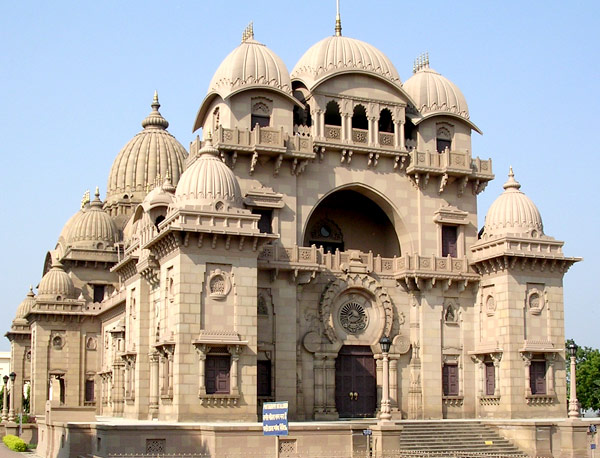 Sri Ramakrishna Temple, Belur Math.
 -
 Rashmancha Temple, Bishnupur


Temple architecture in West Bengal architecture has assumed a unique identity and evolved into the Bengali terra cotta temple architecture which is also a very common style of Hindu temples in Bangladesh. Due to lack of suitable stone in the alluvial Gangetic delta, the temple makers had to resort to other materials instead of stone. This gave rise to using terra cotta as a medium for temple construction. Terra-cotta exteriors with rich carvings are a unique feature of Bengali temples. The town of Vishnupur in West Bengal is renowned for this type of architecture. Usually a part of the intended total motif was carved by hand on one side of a brick and then baked. While under construction, these carved bricks were arranged to make up the entire motif.
The Bengali style of temple is not luxurious. Rather, most are modeled on simple thatched-roof earthen huts used as dwellings by commoners. This can be attributed to the popularity of bhakti sects which taught people to view gods as close to themselves. Thus, various styles like do-chala, Jor-bangla Style, char-chala, and aat-chala sprang up. However, there is also a popular style of building known as Navaratna (nine-towered) or Pancharatna (five-towered) in Bengal which is more luxurious than the Chala buildings. A typical example of Navaratna style is the Dakshineswar Kali Temple. The Shiva temples of rural Bengal has significantly impacted on the architectural style of Kalighat Temple, one of the oldest Hindu temples of India. The famous Birla Temple of Kolkata, built in 1996, has a unique blend of temple architecture of Odisha with Rajasthani temple arts. The Mahakal Temple in Darjeeling is a unique and important Hindu temple since 1782.
Demography[edit | edit source]
Hindus constituted 78.45% of West Bengal's population way back in 1951. As per the 2011 census, 70.54% of the state's population is Hindu. There is sharp decline of 7.91% Hindu population in 6 decades.[9][10]
| # | District | Total population | Hindu population | % |
|---|---|---|---|---|
| 1 | North 24 Parganas | 10,009,781 | 7,352,769 | 73.46% |
| 2 | Barddhaman | 7,717,563 | 6,008,472 | 77.85% |
| 3 | South 24 Parganas | 8,161,961 | 5,155,545 | 63.17% |
| 4 | Paschim Medinipur | 5,913,457 | 5,056,953 | 85.52% |
| 5 | Hooghly | 5,519,145 | 4,574,569 | 82.89% |
| 6 | Purba Medinipur | 5,095,875 | 4,343,972 | 85.24% |
| 7 | Nadia | 5,167,600 | 3,728,482 | 72.15% |
| 8 | Howrah | 4,850,029 | 3,535,844 | 72.90% |
| 9 | Kolkata | 4,496,694 | 3,440,290 | 76.51% |
| 10 | Jalpaiguri | 3,872,846 | 3,156,781 | 81.51% |
| 11 | Bankura | 3,596,674 | 3,033,581 | 84.34% |
| 12 | Purulia | 2,930,115 | 2,373,120 | 80.99% |
| 13 | Murshidabad | 7,103,807 | 2,359,061 | 33.21% |
| 14 | Birbhum | 3,502,404 | 2,181,515 | 62.29% |
| 15 | Cooch Behar | 2,819,086 | 2,087,766 | 74.06% |
| 16 | Maldah | 3,988,845 | 1,914,352 | 47.99% |
| 17 | Uttar Dinajpur | 3,007,134 | 1,482,943 | 49.31% |
| 18 | Darjeeling | 1,846,823 | 1,366,681 | 74.00% |
| 19 | Dakshin Dinajpur | 1,676,276 | 1,232,850 | 73.55% |
| West Bengal (Total) | 91,276,115 | 64,385,546 | 70.54% |
Population growth[edit | edit source]
| Year | Pop. | ±% |
|---|---|---|
| 1901 | 10,786,582 | — |
| 1911 | 11,231,845 | +4.1% |
| 1921 | 10,783,197 | −4.0% |
| 1931 | 11,855,510 | +9.9% |
| 1941 | 14,102,633 | +19.0% |
| 1951 | 20,698,627 | +46.8% |
| 1961 | 27,521,688 | +33.0% |
| 1971 | 34,607,685 | +25.7% |
| 1981 | 42,007,159 | +21.4% |
| 1991 | 50,850,000 | +21.1% |
| 2001 | 58,104,835 | +14.3% |
| 2011 | 64,385,546 | +10.8% |
| Source: [12] | ||
Percentage of Hindus in West Bengal by decades[12]
| Year | Percent | Decrease |
|---|---|---|
| 1901 | 70.8% | - |
| 1911 | 69.6% |
-1.2% |
| 1921 | 68.5% |
-1.1% |
| 1931 | 69.9% |
+1.4% |
| 1941 | 67% |
-2.9% |
| 1947 | 79.2% |
+12.2% |
| 1951 | 78.7% |
-0.5% |
| 1961 | 78.8% | +0.1% |
| 1971 | 78.1% | -0.7% |
| 1981 | 76.9% | -1.2% |
| 1991 | 74.7% | -2.2% |
| 2001 | 72.5% | -2.2% |
| 2011 | 70.5% | -2% |
After the partition of Bengal, a large section of upper and middle class Bengali Hindus, numbering 2,519,557, from East Pakistan (present-day Bangladesh) migrated across the border. They settled primarily in Kolkata and other district headquarter towns. These were especially in across the state but particularly in Nadia, South 24 Parganas, North 24 Parganas, Howrah, West Dinajpur and Jalpaiguri etc.
In 1971, during Bangladesh liberation war against Pakistan, a large group of refugees numbering an estimated 7,235,916 have arrived from Bangladesh to India's West Bengal, Out of which nearly 80% of them are Bengali Hindus and after Independence of Bangladesh, nearly 1,521,912 people belonging to Bengali Hindu refugees have decided to stay back in India particularly in West Bengal.[13] The Hindu population in Western part of Bengal i.e West Bengal during first census of 1951 was around 19,462,706 and in 2011 census it had increased to 64,385,546. But the percentage of Hindu population in the state decreased from 78.45% in 1951 to 70.5% in 2011 Census. However, at 1947 just after the partition of Bengal, Hindus have formed nearly 79.2% of West Bengal population.
Economy and business[edit | edit source]
Economic participation, work roles and distribution across professions for Bengali Hindus is similar to the wider population in the rural areas, where agriculture and related activities remain the primary occupation. In the urban areas, the largest segment of the Hindu population is engaged mostly as services professionals across sectors.
Historically, since the advent of Company rule in India, the upper-caste, landed Bengali Hindu gentry increasingly partnered with the East India Company to trade and supply goods such as silk, tea and jute to Europe. Subsequently, these families amassed massive wealth, increased their land holdings (Zamindaris) further. As the ruling elite of Kolkata, they established huge palaces and made the city a magnet for wealth. Businessmen like Dwarkanath Tagore and Raja Nabakrishna Deb are now recognized as some of India's earliest business tycoons in the modern era.
This continued to the 20th century when luminaries like Prafulla Chandra Ray established Bengal Chemicals and Pharmaceuticals, Rajendra Nath Mookerjee formed engineering firm Martin Burn and Surendra Mohan Bose created the Duckback brand during the Swadeshi movement, among many others.[14]
In India, after independence, large number of Bengali Hindus, both from West Bengal have also settled in the rest of India and abroad. The middle and upper middle class populations (who historically had levels of educational attainment) are now well entrenched in numerous professional fields like law, medicine, academics, engineering, journalism, liberal arts, corporates, banking, tax, etc. On the other hand, most of the rural and semi-rural population are now engaged in contractual agriculture, notably in Punjab and Haryana, construction in Kerala and Karnataka, logistics, manufacturing and small-scale businesses across the country.
Average literacy levels of Bengali Hindus remain higher than other communities in West Bengal. However, the opposite is true for the minority Hindu population in Bangladesh.
Noted West Bengali Hindu industrialists include:
- Gouri Sen
- Gourmohan Dutta of GD Pharmaceuticals-manufacturers
- Hari Ghosh
- Banamali Sarkar
- Gobindram Mitter
- Prasanna Coomar Tagore
- Ramanath Tagore
- Rajen Mookerjee
- Rajat Kumar Gupta
- Alamohan Das
- Dwarkanath Tagore
- Purnendu Chatterjee of The Chatterjee Group & Haldia Petrochemicals
- Prashant Mukherjee
- Sadhan Dutt
- Subrata Roy of Sahara India Pariwar
- Sanjit Biswas
- Amar Gopal Bose of Bose Corporation
- Aveek Sarkar
See also[edit | edit source]
- Hinduism in India
- Religion in West Bengal
- Hinduism in East Bengal
- East Bengali refugees
- Bengali Hindus.
References[edit | edit source]
- ↑ "Table C-16 – Population by Mother Tongue". www.censusindia.gov.in. Office of the Registrar General & Census Commissioner, India. Archived from the original on 15 August 2018. Retrieved 18 September 2021.
- ↑ Census, India (24 August 2022). "West Bengal Population". IndiaCensus.net.
- ↑ 3.0 3.1 3.2 McDermott, Rachel Fell (2005). "Bengali religions". In Jones, Lindsay (ed.). Encyclopedia of Religion: 15 Volume Set. Vol. 2 (2nd ed.). Detroit, Mi: MacMillan Reference USA. pp. 824–832. ISBN 0-02-865735-7. p. 826.
- ↑ Zbonkak, Trevor (14 December 2021). "How many Bengalis are there in West Bengal?". The Flat - Travel Q&A and Tips 2022. Retrieved 20 July 2022.
- ↑ 5.0 5.1 Datta, Romita (13 November 2020). "The great Hindu vote trick". India Today. Retrieved 11 May 2021.
- ↑ "Population of West Bengal-West Bengal Population 2021". India Guide- Festivals, Culture, City Guide, Weddings, Population, Indianonlinepages.com. Retrieved 10 July 2021.
- ↑ "Opinion divided on most non-Bengali voters favouring BJP in West Bengal". Retrieved 12 July 2021.
- ↑ Sen, Sukumar (1999). "Dharme" [The Religion]. Banga-Bhumika [An Introduction to the History of Bengal] (in Bengali) (1st ed.). Kolkata: Paschimbanga Bangla Akademi. pp. 104–05. ISBN 81-86908-97-8.
- ↑ "Decline of Hindu population in West Bengal worries RSS". The Times of India. 26 March 2017.
- ↑ "Bengal election: How BJP and TMC are using old census data to fuel identity-based politics". 29 March 2021.
- ↑ Population by religious community: West Bengal. 2011 Census of India.
- ↑ 12.0 12.1 Nahid Kamal. "The Population Trajectories of Bangladesh and West Bengal During the Twentieth Century: A Comparative Study" (PDF).
- ↑ "When Indira Gandhi said: Refugees of all religions must go back – Watch video". www.timesnownews.com. Archived from the original on 23 January 2021. Retrieved 9 February 2021.
- ↑ "Duckback-Surendra Mohan Bose who dared to challenge British monopoly of 100 years". getbengal.com. Retrieved 25 August 2020.
Further links[edit | edit source]
- Chatterjee, Chandra (2020f). Syama Prasad Mookerjee, the Hindu Dissent and the Partition of Bengal, 1932-1947. Manohar Publishers. ISBN 9-781-000-16378-0. OCLC 1158770381.