









Alicolours (talk | contribs) refine formatting per standard format and updated info |
|||
| Line 1: | Line 1: | ||
{{short description| | {{short description|None}} | ||
{{Punjabis}} | {{Punjabis}} | ||
'''Punjabi festivals''' are various festive celebrations observed by [[Punjabis]] in [[ | '''Punjabi festivals''' are various festive celebrations observed by the [[Punjabis]], originating in the [[Punjab|Punjab region]]. The Punjabis are religiously a diverse and that affects the festivals they observe. According to a 2007 estimate, a total of ~75% percent of the Punjabi population is [[Punjabi Muslims|Muslim]], accounting about 90 million people, with 97% of Punjabis who live in Pakistan following Islam, in contrast to the remaining 30 million Punjabi Sikhs and Hindus who predominantly live in India.<ref name="Harrison2007p132">{{cite book|author1=Wade Davis|author2=K. David Harrison|author3=Catherine Herbert Howell|title=Book of Peoples of the World: A Guide to Cultures|url=https://books.google.com/books?id=rkG8f2lyeUMC&pg=PA132|year=2007|publisher=National Geographic|isbn=978-1-4262-0238-4|pages=132–133}}</ref> | ||
The Punjabi Muslims typically observe the Islamic festivals, do not observe Hindu or Sikh religious festivals, and in Pakistan the official holidays recognize only the Islamic festivals.<ref name="Official Holidays 2016">[http://www.schools.punjab.gov.pk/system/files/Notification_2.pdf Official Holidays 2016], Government of Punjab – Pakistan (2016)</ref><ref name="kmc.gos.pk">[http://www.kmc.gos.pk/Contents.aspx?id=48 Official Holidays 2016] {{Webarchive|url=https://web.archive.org/web/20180901090935/http://kmc.gos.pk/Contents.aspx?id=48 |date=2018-09-01 }}, Karachi Metropolitan, Sindh, Pakistan</ref> The Punjabi Sikhs and Hindus typically do not observe these, and instead observe historic festivals such as [[Lohri]], [[Basant (festival)|Basant]] and [[Vaisakhi]] as seasonal festivals.<ref name="autogenerated5">[https://books.google.com/books?id=1O0eAQAAMAAJ | The Punjabi Muslims typically observe the Islamic festivals, do not observe Hindu or Sikh religious festivals, and in Pakistan the official holidays recognize only the Islamic festivals.<ref name="Official Holidays 2016">[http://www.schools.punjab.gov.pk/system/files/Notification_2.pdf Official Holidays 2016], Government of Punjab – Pakistan (2016)</ref><ref name="kmc.gos.pk">[http://www.kmc.gos.pk/Contents.aspx?id=48 Official Holidays 2016] {{Webarchive|url=https://web.archive.org/web/20180901090935/http://kmc.gos.pk/Contents.aspx?id=48 |date=2018-09-01 }}, Karachi Metropolitan, Sindh, Pakistan</ref> The Punjabi Sikhs and Hindus typically do not observe these, and instead observe historic festivals such as [[Lohri]], [[Basant (festival)|Basant]] and [[Vaisakhi]] as seasonal festivals.<ref name="autogenerated5">[https://books.google.com/books?id=1O0eAQAAMAAJ&q=makara Census of India, 1961: Punjab. Manage of Publications]</ref> The Sikh and Hindu festivals are regional official holidays in India, as are major Islamic festivals.<ref name="Official Holidays">[http://punjab.gov.in/list-of-holidays Official Holidays], Government of Punjab, India (2016)</ref> Other seasonal Punjabi festivals in India include Teejon ([[Teeyan]]) and [[Maghi]].<ref name="autogenerated5"/> Teeyan is also known as festival of women, as women enjoy it with their friends. On the day of maghi people fly kites and eat their traditional dish [[khichdi]]. | ||
The Punjabi Muslim festivals are set according to the lunar [[Islamic calendar]] (Hijri), and the date falls earlier by 10 to 13 days from year to year.<ref>{{cite book|author1=Jacqueline Suthren Hirst|author2=John Zavos|title=Religious Traditions in Modern South Asia|url=https://books.google.com/books?id=bBOpAgAAQBAJ |year=2013|publisher=Routledge|isbn=978-1-136-62668-5|page=274}};<br>[https://www.timeanddate.com/holidays/india/eid-ul-fitar Eid ul-Fitar], Ramzan Id/Eid-ul-Fitar in India, Festival Dates</ref> The Hindu and Sikh Punjabi seasonal festivals are set on specific dates of the luni-solar [[Bikrami calendar]] or [[Punjabi calendar]] and the date of the festival also typically varies in the [[Gregorian calendar]] but stays within the same two Gregorian months.<ref>{{cite book|author=Tej Bhatia|title=Punjabi|url=https://books.google.com/books?id=nTKBAAAAQBAJ&pg=PA209|year= 2013|publisher= Routledge|isbn=978-1-136-89460-2|pages=209–212}}</ref> | The Punjabi Muslim festivals are set according to the lunar [[Islamic calendar]] (Hijri), and the date falls earlier by 10 to 13 days from year to year.<ref>{{cite book|author1=Jacqueline Suthren Hirst|author2=John Zavos|title=Religious Traditions in Modern South Asia|url=https://books.google.com/books?id=bBOpAgAAQBAJ |year=2013|publisher=Routledge|isbn=978-1-136-62668-5|page=274}};<br>[https://www.timeanddate.com/holidays/india/eid-ul-fitar Eid ul-Fitar], Ramzan Id/Eid-ul-Fitar in India, Festival Dates</ref> The Hindu and Sikh Punjabi seasonal festivals are set on specific dates of the luni-solar [[Bikrami calendar]] or [[Punjabi calendar]] and the date of the festival also typically varies in the [[Gregorian calendar]] but stays within the same two Gregorian months.<ref>{{cite book|author=Tej Bhatia|title=Punjabi|url=https://books.google.com/books?id=nTKBAAAAQBAJ&pg=PA209|year= 2013|publisher= Routledge|isbn=978-1-136-89460-2|pages=209–212}}</ref> | ||
Some Punjabi Muslims participate in the traditional, seasonal festivals of the Punjab region: Baisakhi, Basant and to a minor scale Lohri, but this is controversial. Islamic clerics and some politicians have attempted to ban this participation because of the religious basis of the Punjabi festivals,<ref>[https://www.dawn.com/news/1315376 The ban on fun], IRFAN HUSAIN, Dawn, Feb 18, 2017</ref> and they being declared [[haram]] (forbidden in Islam).<ref>[http://www.tribuneindia.com/news/sunday-special/columns/the-barricaded-muslim-mind/286436.html The barricaded Muslim mind], Saba Naqvi (August 28, 2016), Quote: "Earlier, Muslim villagers would participate in | Some Punjabi Muslims participate in the traditional, seasonal festivals of the Punjab region: Baisakhi, Basant and to a minor scale Lohri, but this is controversial. Islamic clerics and some politicians have attempted to ban this participation because of the religious basis of the Punjabi festivals,<ref>[https://www.dawn.com/news/1315376 The ban on fun], IRFAN HUSAIN, Dawn, Feb 18, 2017</ref> and they being declared [[haram]] (forbidden in Islam).<ref>[http://www.tribuneindia.com/news/sunday-special/columns/the-barricaded-muslim-mind/286436.html The barricaded Muslim mind], Saba Naqvi (August 28, 2016), Quote: "Earlier, Muslim villagers would participate in 🕉️ festivals; now they think that would be haraam, so stay away. Visiting dargahs is also haraam"</ref> | ||
==Buddhist festivals== | ==Buddhist festivals== | ||
Punjabi Buddhists are a minority in [[Punjab, India]].<ref>Jain, Harish (2003) Punjab Hand Book: Population and Housing Census. Unistar Books.[https://books.google.com/books?id=4ZFiVQM-vw8C | Punjabi Buddhists are a minority in [[Punjab, India]].<ref>Jain, Harish (2003) Punjab Hand Book: Population and Housing Census. Unistar Books.[https://books.google.com/books?id=4ZFiVQM-vw8C&dq=buddhists+of+punjab&pg=PA19]</ref> In the Punjab province of Pakistan, the Buddhist population is negligible.<ref name="POPULATION BY RELIGION">[http://www.pbs.gov.pk/sites/default/files//tables/POPULATION%20BY%20RELIGION.pdf POPULATION BY RELIGION], Pakistan Bureau of Statistics</ref> | ||
Punjabi Buddhists celebrate festivals such as [[Vesak|Buddha Jayanti]].<ref>[https://books.google.com/books?id=9ABIAAAAMAAJ | Punjabi Buddhists celebrate festivals such as [[Vesak|Buddha Jayanti]].<ref>[https://books.google.com/books?id=9ABIAAAAMAAJ&q=festivals D. C. Ahir (1992) Dr. Ambedkar and Punjab. B.R. Publishing Corporation]</ref> | ||
==Christian Festivals== | ==Christian Festivals== | ||
{{multiple image | {{multiple image | ||
| align = right | | align = right | ||
| image1 = Church Vestry, Holy Trinity Church Murree.jpg | | image1 = Church Vestry, Holy Trinity Church Murree.jpg | ||
| width1 = 100 | | width1 = 100 | ||
| alt1 = | | alt1 = | ||
| caption1 = | | caption1 = | ||
| image2 = Sadhu Sunder Singh Memorial Church.jpg | | image2 = Sadhu Sunder Singh Memorial Church.jpg | ||
| width2 = 226 | | width2 = 226 | ||
| alt2 = | | alt2 = | ||
| caption2 = | | caption2 = | ||
| footer = Left: Church in Murree (Pakistan), Right: Chandigarh (India). | | footer = Left: Church in [[Murree]] ([[Pakistan]]), Right: [[Chandigarh]] ([[India]]). | ||
}} [[Christians]] are a minority in [[Pakistan]], constituting about 2.3% of its population in contrast to 97.2% Muslims.<ref name="POPULATION BY RELIGION"/> In Indian state of Punjab, Christians form about 1.1% of its total population, while the predominant majority of the population being Sikh and Hindus. Punjabi Christians celebrate [[Christmas]] to mark the birth of Jesus. In [[Punjab, Pakistan]], people stay up late singing Punjabi Christmas carol services.<ref>Sarfraz, Emanuel The Nation (25.12.2016) Understanding the changing face of Christmas | }} | ||
[[Christians]] are a minority in [[Pakistan]], constituting about 2.3% of its population in contrast to 97.2% Muslims.<ref name="POPULATION BY RELIGION"/> In Indian state of Punjab, Christians form about 1.1% of its total population, while the predominant majority of the population being Sikh and Hindus. Punjabi Christians celebrate [[Christmas]] to mark the birth of Jesus. In [[Punjab, Pakistan]], people stay up late singing Punjabi Christmas carol services.<ref>Sarfraz, Emanuel The Nation (25.12.2016) Understanding the changing face of Christmas | |||
[http://nation.com.pk/national/25-Dec-2016/understanding-the-changing-face-of-christmas].</ref> People attend churches in places such as [[Gurdaspur]], [[Amritsar]], [[Jalandhar]] and [[Hoshiarpur]] districts in [[Punjab, India]] that have a higher Christian population, to be part of Christmas celebrations.<ref>Hindustan Times (25.12.2015) Christmas celebrations held across Punjab, Haryana and Chandigarh [http://www.hindustantimes.com/punjab/christmas-celebrations-held-across-punjab-chandigarh/story-gakSO27TYKPEX5YeikJGhN.html]</ref> Christians also celebrate [[Easter]] by engaging in processions.<ref>[http://www.tribuneindia.com/news/chandigarh/community/cultural-fest-at-government-mohindra-college/389715.html The Tribune (10/04/2017)]</ref> | [http://nation.com.pk/national/25-Dec-2016/understanding-the-changing-face-of-christmas].</ref> People attend churches in places such as [[Gurdaspur]], [[Amritsar]], [[Jalandhar]] and [[Hoshiarpur]] districts in [[Punjab, India]] that have a higher Christian population, to be part of Christmas celebrations.<ref>Hindustan Times (25.12.2015) Christmas celebrations held across Punjab, Haryana and Chandigarh [http://www.hindustantimes.com/punjab/christmas-celebrations-held-across-punjab-chandigarh/story-gakSO27TYKPEX5YeikJGhN.html]</ref> Christians also celebrate [[Easter]] by engaging in processions.<ref>[http://www.tribuneindia.com/news/chandigarh/community/cultural-fest-at-government-mohindra-college/389715.html The Tribune (10/04/2017)]</ref> | ||
{{clear}} | {{clear}} | ||
| Line 38: | Line 40: | ||
===Raksha Bandhan=== | ===Raksha Bandhan=== | ||
'''Raksha Bandhan''', also '''Rakshabandhan''', or '''Rakhi''',<ref>{{Cite journal|last1=Setiajatnika|first1=Eka|last2=Iriani|first2=Kandis|date=2018-10-29|title=Pengaruh | '''Raksha Bandhan''', also '''Rakshabandhan''', or '''Rakhi''',<ref>{{Cite journal|last1=Setiajatnika|first1=Eka|last2=Iriani|first2=Kandis|date=2018-10-29|title=Pengaruh Return on Asset, Asset Growth, dan Debt to Equity Ratio terhadap Dividend Payout Ratio|journal=Jurnal Soshum Insentif|pages=22–34|doi=10.36787/jsi.v1i1.31|issn=2655-2698|doi-access=free}}</ref><ref name="McGregor1993">{{citation|last=McGregor|first=Ronald Stuart|author-link=R. S. McGregor|title=The Oxford Hindi-English Dictionary|url=https://books.google.com/books?id=hzMwAAAACAAJ&pg=PA849|year=1993|publisher=[[Oxford University Press]]|isbn=978-0-19-563846-2}} Quote: m Hindi ''rakśābandhan'' held on the full moon of the month of Savan, when sisters tie a talisman (rakhi q.v.) on the arm of their brothers and receive small gifts of money from them.</ref> is a popular, traditionally [[Hindus|Hindu]], annual rite, or ceremony, which is central to a festival of the same name, celebrated in India, Nepal and other parts of the [[Indian subcontinent]], and among people around the world influenced by Hindu culture. On this day, sisters of all ages tie a talisman, or [[amulet]], called the '''''rakhi''''', around the wrists of their brothers, symbolically protecting them, receiving a gift in return, and traditionally investing the brothers with a share of the responsibility of their potential care.<ref name="Agarwal1994a">{{citation|last=Agarwal|first=Bina|author-link=Bina Agarwal|title=A Field of One's Own: Gender and Land Rights in South Asia|url=https://books.google.com/books?id=Z3pdP30OnEUC&pg=PA264|year=1994|publisher=Cambridge University Press|isbn=978-0-521-42926-9|page=264}}</ref> | ||
Raksha Bandhan is observed on the last day of the [[Hindu calendar|Hindu lunar calendar]] month of [[Shraavana]], which typically falls in August. The expression "Raksha Bandhan," [[Sanskrit]], literally, "the bond of protection, obligation, or care, | Raksha Bandhan is observed on the last day of the [[Hindu calendar|Hindu lunar calendar]] month of [[Shraavana]], which typically falls in August. The expression "Raksha Bandhan," [[Sanskrit]], literally, "the bond of protection, obligation, or care", is now principally applied to this ritual. Until the mid-20th-century, the expression was more commonly applied to a similar ritual, also held on the same day, with precedence in ancient Hindu texts, in which a domestic priest ties amulets, charms, or threads on the wrists of his patrons, or changes their [[upanayana|sacred thread]], and receives gifts of money; in some places, this is still the case.<ref name="Berreman1963">{{citation|last=Berreman|first=Gerald Duane|title=Hindus of the Himalayas|url=https://books.google.com/books?id=0o91Qt_GAlEC&pg=PA390|year=1963|publisher=University of California Press|pages=390–|id=GGKEY:S0ZWW3DRS4S}} Quote: Rakri: On this date Brahmins go from house to house tying string bracelets (''rakrī'') on the wrists of household members. In return the Brahmins receive from an anna to a rupee from each household. ... This is supposed to be auspicious for the recipient. ... It has no connotation of brother-sister devotion as it does in some plains areas. It is readily identified with ''Raksha Bandhan''.</ref><ref name="Gnanambal1969-brahmans">{{citation|last=Gnanambal|first=K.|title=Festivals of India|url=https://books.google.com/books?id=xxTgAAAAMAAJ&pg=PA10|year=1969|publisher=Anthropological Survey of India, Government of India|page=10}} Quote: In North India, the festival is popularly called Raksha Bandhan ... On this day, sisters tie an amulet round the right wrists of brothers wishing them long life and prosperity. Family priests (Brahmans) make it an occasion to visit their clientele to get presents.</ref> In contrast, the sister-brother festival, with origins in folk culture, had names which varied with location, with some rendered as ''Saluno'',<ref name="MarriottBeals1955-Marriott-Saluno">{{citation|last=Marriott|first=McKim|editor=McKim Marriott |title=Village India: Studies in the Little Community|chapter-url=https://books.google.com/books?id=OOLZAAAAMAAJ&pg=198|year=1955|publisher=University of Chicago Press|pages=198–202|chapter=Little Communities in an Indigenous Civilization|isbn=9780226506432}}</ref><ref name="Wadley1994">{{citation|last=Wadley|first=Susan S.|title=Struggling with Destiny in Karimpur, 1925–1984|url=https://books.google.com/books?id=DMqw6JAmQQIC&pg=PA84|date=27 July 1994|publisher=University of California Press|isbn=978-0-520-91433-9|pages=84, 202}} Quote: (p 84) Potters: ... But because the festival of Saluno takes place during the monsoon when they can't make pots, they make pots in three batches ...</ref> ''Silono''<ref name="Lewis1965">{{citation|last=Lewis|first=Oscar|title=Village Life in Northern India: Studies in a Delhi Village|url=https://books.google.com/books?id=NpzZAAAAMAAJ&pg=PA208|year=1965|publisher=University of Illinois Press|page=208|isbn=9780598001207}}</ref> and ''Rakri''.<ref name="Berreman1963"/> A ritual associated with included the sisters placing shoots of barley behind the ears of their brothers.<ref name="MarriottBeals1955-Marriott-Saluno"/> | ||
Of special significance to married women, Raksha Bandhan is rooted in the practice of territorial or village [[exogamy]], in which a bride marries ''out'' of her natal village or town, and her parents, by custom, do not visit her in her married home.<ref name="Coleman2017">{{citation|last=Coleman|first=Leo|title=A Moral Technology: Electrification as Political Ritual in New Delhi|url=https://books.google.com/books?id=6YDTDgAAQBAJ&pg=PT127|year=2017|publisher=Cornell University Press|isbn=978-1-5017-0791-9|page=127}} Quote: Rakhi and its local performances in Kishan Garhi were part of a festival in which connections between out-marrying sisters and village-resident brothers were affirmed. In the "traditional" form of this rite, according to Marriott, sisters exchanged with their brothers to ensure their ability to have recourse—at a crisis, or during childbearing—to their natal village and their relatives there even after leaving for their husband's home. For their part, brothers engaging in these exchanges affirmed the otherwise hard-to-discern moral solidarity of the natal family, even after their sister's marriage.</ref> In rural north India, where village exogamy is strongly prevalent, large numbers of married Hindu women travel back to their parents' homes every year for the ceremony.<ref name="Goody1990-exogamy-natal-home">{{citation|last=Goody|first=Jack|author-link=Jack Goody|title=The Oriental, the Ancient and the Primitive: Systems of Marriage and the Family in the Pre-Industrial Societies of Eurasia|url=https://books.google.com/books?id=Tdgos7fWazIC&pg=PA222|year=1990|publisher=Cambridge University Press|isbn=978-0-521-36761-5|page=222}} Quote: "... the heavy emphasis placed on the continuing nature of brother-sister relations despite the fact that in the North marriage requires them to live in different villages. That relation is celebrated and epitomised in the annual ceremony of ''Rakśābandhan'' in northern and western India. ... The ceremony itself involves the visit of women to their brothers (that is, to the homes of their own fathers, their natal homes)</ref><ref name="Hess2015">{{citation|last=Hess|first=Linda|title=Bodies of Song: Kabir Oral Traditions and Performative Worlds in North India|url=https://books.google.com/books?id=ALoUDAAAQBAJ&pg=PA61|year=2015|publisher=Oxford University Press|isbn=978-0-19-937416-8|page=61}} Quote: "In August comes Raksha Bandhan, the festival celebrating the bonds between brothers and sisters. Married sisters return, if they can, to their natal villages to be with their brothers.</ref> Their brothers, who typically live with the parents or nearby, sometimes travel to their sisters' married home to escort them back. Many younger married women arrive a few weeks earlier at their natal homes and stay until the ceremony.<ref name="Wadley2005">{{citation|last=Wadley|first=Susan Snow|title=Essays on North Indian Folk Traditions|url=https://books.google.com/books?id=XuyTqD0Ybw4C&pg=PA66|year=2005|publisher=Orient Blackswan|isbn=978-81-8028-016-0|page=66}} Quote: In Savan, greenness abounds as the newly planted crops take root in the wet soil. It is a month of joy and gaiety, with swings hanging from tall trees. Girls and women swing high into the sky, singing their joy. The gaiety is all the more marked because women, especially the young ones, are expected to return to their natal homes for an annual visit during Savan.</ref> The brothers serve as lifelong intermediaries between their sisters' married and parental homes,<ref name="Gnanambal1969">{{citation|last=Gnanambal|first=K.|title=Festivals of India|url=https://books.google.com/books?id=xxTgAAAAMAAJ&pg=PA10|year=1969|publisher=Anthropological Survey of India, Government of India|page=10}}</ref> as well as potential stewards of their security. | Of special significance to married women, Raksha Bandhan is rooted in the practice of territorial or village [[exogamy]], in which a bride marries ''out'' of her natal village or town, and her parents, by custom, do not visit her in her married home.<ref name="Coleman2017">{{citation|last=Coleman|first=Leo|title=A Moral Technology: Electrification as Political Ritual in New Delhi|url=https://books.google.com/books?id=6YDTDgAAQBAJ&pg=PT127|year=2017|publisher=Cornell University Press|isbn=978-1-5017-0791-9|page=127}} Quote: Rakhi and its local performances in Kishan Garhi were part of a festival in which connections between out-marrying sisters and village-resident brothers were affirmed. In the "traditional" form of this rite, according to Marriott, sisters exchanged with their brothers to ensure their ability to have recourse—at a crisis, or during childbearing—to their natal village and their relatives there even after leaving for their husband's home. For their part, brothers engaging in these exchanges affirmed the otherwise hard-to-discern moral solidarity of the natal family, even after their sister's marriage.</ref> In rural north India, where village exogamy is strongly prevalent, large numbers of married Hindu women travel back to their parents' homes every year for the ceremony.<ref name="Goody1990-exogamy-natal-home">{{citation|last=Goody|first=Jack|author-link=Jack Goody|title=The Oriental, the Ancient and the Primitive: Systems of Marriage and the Family in the Pre-Industrial Societies of Eurasia|url=https://books.google.com/books?id=Tdgos7fWazIC&pg=PA222|year=1990|publisher=Cambridge University Press|isbn=978-0-521-36761-5|page=222}} Quote: "... the heavy emphasis placed on the continuing nature of brother-sister relations despite the fact that in the North marriage requires them to live in different villages. That relation is celebrated and epitomised in the annual ceremony of ''Rakśābandhan'' in northern and western India. ... The ceremony itself involves the visit of women to their brothers (that is, to the homes of their own fathers, their natal homes)</ref><ref name="Hess2015">{{citation|last=Hess|first=Linda|title=Bodies of Song: Kabir Oral Traditions and Performative Worlds in North India|url=https://books.google.com/books?id=ALoUDAAAQBAJ&pg=PA61|year=2015|publisher=Oxford University Press|isbn=978-0-19-937416-8|page=61}} Quote: "In August comes Raksha Bandhan, the festival celebrating the bonds between brothers and sisters. Married sisters return, if they can, to their natal villages to be with their brothers.</ref> Their brothers, who typically live with the parents or nearby, sometimes travel to their sisters' married home to escort them back. Many younger married women arrive a few weeks earlier at their natal homes and stay until the ceremony.<ref name="Wadley2005">{{citation|last=Wadley|first=Susan Snow|title=Essays on North Indian Folk Traditions|url=https://books.google.com/books?id=XuyTqD0Ybw4C&pg=PA66|year=2005|publisher=Orient Blackswan|isbn=978-81-8028-016-0|page=66}} Quote: In Savan, greenness abounds as the newly planted crops take root in the wet soil. It is a month of joy and gaiety, with swings hanging from tall trees. Girls and women swing high into the sky, singing their joy. The gaiety is all the more marked because women, especially the young ones, are expected to return to their natal homes for an annual visit during Savan.</ref> The brothers serve as lifelong intermediaries between their sisters' married and parental homes,<ref name="Gnanambal1969">{{citation|last=Gnanambal|first=K.|title=Festivals of India|url=https://books.google.com/books?id=xxTgAAAAMAAJ&pg=PA10|year=1969|publisher=Anthropological Survey of India, Government of India|page=10}}</ref> as well as potential stewards of their security. | ||
In urban India, where families are increasingly [[nuclear family|nuclear]], the festival has become more symbolic, but continues to be highly popular. The rituals associated with this festival have spread beyond their traditional regions and have been transformed through technology and migration,<ref name="Coleman2017-technology-migration">{{citation|last=Coleman|first=Leo|title=A Moral Technology: Electrification as Political Ritual in New Delhi|url=https://books.google.com/books?id=6YDTDgAAQBAJ&pg=PT148|year=2017|publisher=Cornell University Press|isbn=978-1-5017-0791-9|page=148}} Quote: In modern rakhi, technologically mediated and performed with manufactured charms, migrating men are the medium by which the village women interact, vertically, with the cosmopolitan center—the site of radio broadcasts, and the source of technological goods and national solidarity</ref> the movies,<ref name="Pandit 2003quote">{{citation|last=Pandit |first=Vaijayanti|title=Business @ Home|url=https://books.google.com/books?id=dSFDDAAAQBAJ&pg=PA234|year=2003|publisher=Vikas Publishing House|isbn=978-81-259-1218-7|page=234}} Quote: "Quote: Raksha Bandhan traditionally celebrated in North India has acquired greater importance due to Hindi films. Lightweight and decorative rakhis, which are easy to post, are needed in large quantities by the market to cater to brothers and sisters living in different parts of the country or abroad."</ref> social interaction,<ref name="Khandekar2003">{{citation|last=Khandekar|first=Renuka N.|title=Faith: filling the God-sized hole|url=https://books.google.com/books?id=DIgoAAAAYAAJ&pg=PA180|year=2003|publisher=Penguin Books|page=180|isbn=9780143028840}} Quote: "But since independence and the gradual opening up of Indian society, Raksha Bandhan as celebrated in North India has won the affection of many South Indian families. For this festival has the peculiar charm of renewing sibling bonds."</ref> and promotion by | In urban India, where families are increasingly [[nuclear family|nuclear]], the festival has become more symbolic, but continues to be highly popular. The rituals associated with this festival have spread beyond their traditional regions and have been transformed through technology and migration,<ref name="Coleman2017-technology-migration">{{citation|last=Coleman|first=Leo|title=A Moral Technology: Electrification as Political Ritual in New Delhi|url=https://books.google.com/books?id=6YDTDgAAQBAJ&pg=PT148|year=2017|publisher=Cornell University Press|isbn=978-1-5017-0791-9|page=148}} Quote: In modern rakhi, technologically mediated and performed with manufactured charms, migrating men are the medium by which the village women interact, vertically, with the cosmopolitan center—the site of radio broadcasts, and the source of technological goods and national solidarity</ref> the movies,<ref name="Pandit 2003quote">{{citation|last=Pandit |first=Vaijayanti|title=Business @ Home|url=https://books.google.com/books?id=dSFDDAAAQBAJ&pg=PA234|year=2003|publisher=Vikas Publishing House|isbn=978-81-259-1218-7|page=234}} Quote: "Quote: Raksha Bandhan traditionally celebrated in North India has acquired greater importance due to Hindi films. Lightweight and decorative rakhis, which are easy to post, are needed in large quantities by the market to cater to brothers and sisters living in different parts of the country or abroad."</ref> social interaction,<ref name="Khandekar2003">{{citation|last=Khandekar|first=Renuka N.|title=Faith: filling the God-sized hole|url=https://books.google.com/books?id=DIgoAAAAYAAJ&pg=PA180|year=2003|publisher=Penguin Books|page=180|isbn=9780143028840}} Quote: "But since independence and the gradual opening up of Indian society, Raksha Bandhan as celebrated in North India has won the affection of many South Indian families. For this festival has the peculiar charm of renewing sibling bonds."</ref> and promotion by Hinduism,<ref name="JoshySeethi2015">{{citation|last1=Joshy|first1=P. M.|last2=Seethi|first2=K. M.|title=State and Civil Society under Siege: Hindutva, Security and Militarism in India|url=https://books.google.com/books?id=RxuJCwAAQBAJ&pg=PT112|year=2015|publisher=Sage Publications|isbn=978-93-5150-383-5|page=112}} Quote: (p. 111) The RSS employs a cultural strategy to mobilise people through festivals. It observes six major festivals in a year. ... Till 20 years back, festivals like Raksha Bandhan were unknown to South Indians. Through [[Sangh Shakha|Shakha]]'s intense campaign, now they have become popular in the southern India. In colleges and schools tying 'Rakhi'—the thread that is used in the 'Raksha Bandhan'—has become a fashion and this has been popularised by the RSS and ABVP cadres.</ref><ref name="Jaffrelot1999">{{citation|last=Jaffrelot|first=Christophe|title=The Hindu Nationalist Movement and Indian Politics: 1925 to the 1990s : Strategies of Identity-building, Implantation and Mobilisation (with Special Reference to Central India)|url=https://books.google.com/books?id=iVsfVOTUnYEC&pg=PA39|year=1999|publisher=Penguin Books |isbn=978-0-14-024602-5|page=39}} Quote: This ceremony occurs in a cycle of six annual festivals which often coincides with those observed in Hindu society, and which Hedgewar inscribed in the ritual calendar of his movement: Varsha Pratipada (the Hindu new year), Shivajirajyarohonastava (the coronation of Shivaji), guru dakshina, Raksha Bandhan (a North Indian festival in which sisters tie ribbons round the wrists of their brothers to remind them of their duty as protectors, a ritual which the RSS has re-interpreted in such a way that the leader of the shakha ties a ribbon around the pole of the saffron flag, after which swayamsevaks carry out this ritual for one another as a mark of brotherhood), ....</ref> as well as by the nation state.<ref name="Coleman2017-nation-building">{{citation|last=Coleman|first=Leo|title=A Moral Technology: Electrification as Political Ritual in New Delhi|url=https://books.google.com/books?id=6YDTDgAAQBAJ&pg=PT148|year=2017|publisher=Cornell University Press|isbn=978-1-5017-0791-9|page=148}} Quote: ... as citizens become participants in the wider "new traditions" of the national state. Broadcast mantras become the emblems of a new level of state power and the means of the integration of villagers and city dwellers alike into a new community of citizens</ref> | ||
Among women and men who are not [[Consanguinity|blood relative]]s, there is also a transformed tradition of [[fictive kinship|voluntary kin]] relations, achieved through the tying of ''rakhi'' amulets, which have cut across caste and class lines,<ref name="HeitzmanWorden1996">{{citation|last1=Heitzman|first1=James|last2=Worden|first2=Robert L.|title=India: A Country Study|url=https://books.google.com/books?id=a5OFAAAAIAAJ&pg=PA246|year=1996|publisher=Federal Research Division, Library of Congress|isbn=978-0-8444-0833-0|page=246}}</ref> and Hindu and Muslim divisions.<ref name="MinesLamb2002">{{citation|last=Vanita|first=Ruth|editor=Diane P. Mines|editor2=Sarah Lamb|title=Everyday Life in South Asia|chapter-url=https://books.google.com/books?id=QFhYnt2rL6YC&pg=PA157|year=2002|publisher=Indiana University Press|isbn=978-0-253-34080-1|pages=[https://archive.org/details/everydaylifeinso0000unse/page/146 146–158, 157]|chapter=''Dosti'' and ''Tamanna'': Male-Male Love, Difference, and Normativity in Hindi Cinema|url=https://archive.org/details/everydaylifeinso0000unse/page/146}}</ref> In some communities or contexts, other figures, such as a matriarch, or a person in authority, can be included in the ceremony in ritual acknowledgement of their benefaction.<ref name="Chowdhry1994">{{citation|last=Chowdhry|first=Prem|title=The Veiled Women: Shifting Gender Equations in Rural Haryana|url=https://books.google.com/books?id=HUC3AAAAIAAJ&pg=PA312|year=1994|publisher=Oxford University Press|isbn=978-0-19-567038-7|pages=312–313}} Quote: The same symbolic protection is also requested from the high caste men by the low caste women in a work relationship situation. The ritual thread is offered, though not tied and higher caste men customarily give some money in return.</ref> | Among women and men who are not [[Consanguinity|blood relative]]s, there is also a transformed tradition of [[fictive kinship|voluntary kin]] relations, achieved through the tying of ''rakhi'' amulets, which have cut across caste and class lines,<ref name="HeitzmanWorden1996">{{citation|last1=Heitzman|first1=James|last2=Worden|first2=Robert L.|title=India: A Country Study|url=https://books.google.com/books?id=a5OFAAAAIAAJ&pg=PA246|year=1996|publisher=Federal Research Division, Library of Congress|isbn=978-0-8444-0833-0|page=246}}</ref> and Hindu and Muslim divisions.<ref name="MinesLamb2002">{{citation|last=Vanita|first=Ruth|editor=Diane P. Mines|editor2=Sarah Lamb|title=Everyday Life in South Asia|chapter-url=https://books.google.com/books?id=QFhYnt2rL6YC&pg=PA157|year=2002|publisher=Indiana University Press|isbn=978-0-253-34080-1|pages=[https://archive.org/details/everydaylifeinso0000unse/page/146 146–158, 157]|chapter=''Dosti'' and ''Tamanna'': Male-Male Love, Difference, and Normativity in Hindi Cinema|url=https://archive.org/details/everydaylifeinso0000unse/page/146}}</ref> In some communities or contexts, other figures, such as a matriarch, or a person in authority, can be included in the ceremony in ritual acknowledgement of their benefaction.<ref name="Chowdhry1994">{{citation|last=Chowdhry|first=Prem|title=The Veiled Women: Shifting Gender Equations in Rural Haryana|url=https://books.google.com/books?id=HUC3AAAAIAAJ&pg=PA312|year=1994|publisher=Oxford University Press|isbn=978-0-19-567038-7|pages=312–313}} Quote: The same symbolic protection is also requested from the high caste men by the low caste women in a work relationship situation. The ritual thread is offered, though not tied and higher caste men customarily give some money in return.</ref> | ||
| Line 52: | Line 54: | ||
[[Krishna Janmashtami]], also known simply as '''Janmashtami''' or '''Gokulashtami''', is an annual [[Hindu]] festival that celebrates the birth of [[Krishna]], the eighth [[avatar]] of [[Vishnu]].<ref name="Lochtefeld2002p314">{{harvnb|Lochtefeld |2002 |pages=[https://archive.org/details/illustratedencyc0000loch/page/314 314–315]}}</ref> It is observed according to the [[Hindu calendar|Hindu lunisolar calendar]], on the eighth day ([[Ashtami]]) of the [[Paksha#Krishna Paksha|Krishna Paksha]] (dark fortnight) in [[Shraavana]] or [[Bhadrapad]] (depending on whether the calendar chooses the new moon or full moon day as the last day of the month), which overlaps with August or September of the [[Gregorian calendar]].<ref name="Lochtefeld2002p314"/> | [[Krishna Janmashtami]], also known simply as '''Janmashtami''' or '''Gokulashtami''', is an annual [[Hindu]] festival that celebrates the birth of [[Krishna]], the eighth [[avatar]] of [[Vishnu]].<ref name="Lochtefeld2002p314">{{harvnb|Lochtefeld |2002 |pages=[https://archive.org/details/illustratedencyc0000loch/page/314 314–315]}}</ref> It is observed according to the [[Hindu calendar|Hindu lunisolar calendar]], on the eighth day ([[Ashtami]]) of the [[Paksha#Krishna Paksha|Krishna Paksha]] (dark fortnight) in [[Shraavana]] or [[Bhadrapad]] (depending on whether the calendar chooses the new moon or full moon day as the last day of the month), which overlaps with August or September of the [[Gregorian calendar]].<ref name="Lochtefeld2002p314"/> | ||
It is an important festival, particularly in the [[Vaishnavism]] tradition of Hinduism.<ref>{{cite book |author=J. Gordon Melton |title=Religious Celebrations: An Encyclopedia of Holidays, Festivals, Solemn Observances, and Spiritual Commemorations |url=https://books.google.com/books?id=KDU30Ae4S4cC&pg=PA396 |year=2011 |publisher=ABC-CLIO |isbn=978-1-59884-205-0 |page=396}}</ref> Dance-drama enactments of the life of Krishna according to the ''[[Bhagavata Purana]]'' (such as [[Rasa lila|Rasa Lila]] or Krishna Lila), devotional singing through the midnight when Krishna was born, fasting (''upavasa''), a night vigil (Ratri ''Jagaran''), and a festival (Mahotsav) on the following day are a part of the Janmashtami celebrations.<ref>{{cite book |author=Edwin Francis Bryant |title=Sri Krishna: A Sourcebook |url=https://books.google.com/books?id=0z02cZe8PU8C |year=2007 |publisher=Oxford University Press |isbn=978-0-19-803400-1 |pages=224–225, 538–539}}</ref> It is celebrated particularly in [[Mathura, Uttar Pradesh|Mathura]] and [[Brindavan|Vrindavan]], along with major Vaishnava and non-sectarian communities found in Manipur, Assam, Bihar, West Bengal, Odisha, Madhya Pradesh, Rajasthan, Gujarat, Maharashtra, Karnataka, Kerala, Tamil Nadu, Andhra Pradesh and all other states of India.<ref name="Lochtefeld2002p314" /><ref>{{cite web |title=In Pictures: People Celebrating Janmashtami in India |date=10 August 2012 |url=http://www.ibtimes.co.in/articles/372380/20120810/pictures-people-celebrating-janmashtami-india.htm |access-date=10 August 2012}}</ref> | It is an important festival, particularly in the [[Vaishnavism]] tradition of Hinduism.<ref>{{cite book |author=J. Gordon Melton |title=Religious Celebrations: An Encyclopedia of Holidays, Festivals, Solemn Observances, and Spiritual Commemorations |url=https://books.google.com/books?id=KDU30Ae4S4cC&pg=PA396 |year=2011 |publisher=ABC-CLIO |isbn=978-1-59884-205-0 |page=396}}</ref> Dance-drama enactments of the life of Krishna according to the ''[[Bhagavata Purana]]'' (such as [[Rasa lila|Rasa Lila]] or Krishna Lila), devotional singing through the midnight when Krishna was born, fasting (''upavasa''), a night vigil (Ratri ''Jagaran''), and a festival (Mahotsav) on the following day are a part of the Janmashtami celebrations.<ref>{{cite book |author=Edwin Francis Bryant |title=Sri Krishna: A Sourcebook |url=https://books.google.com/books?id=0z02cZe8PU8C |year=2007 |publisher=Oxford University Press |isbn=978-0-19-803400-1 |pages=224–225, 538–539}}</ref> It is celebrated particularly in [[Mathura, Uttar Pradesh|Mathura]] and [[Brindavan|Vrindavan]], along with major Vaishnava and non-sectarian communities found in Manipur, Assam, Bihar, West Bengal, Odisha, Madhya Pradesh, Rajasthan, Gujarat, Maharashtra, Karnataka, Kerala, Tamil Nadu, Andhra Pradesh and all other states of India.<ref name="Lochtefeld2002p314" /><ref>{{cite web |title=In Pictures: People Celebrating Janmashtami in India |website=[[International Business Times]] |date=10 August 2012 |url=http://www.ibtimes.co.in/articles/372380/20120810/pictures-people-celebrating-janmashtami-india.htm |access-date=10 August 2012}}</ref> | ||
Krishna Janmashtami is followed by the festival [[Nandotsav]], which celebrates the occasion when [[Nanda Baba]] distributed gifts to the community in honor of the birth.<ref>{{cite book |author=Cynthia Packert |year=2010 |title=The Art of Loving Krishna: Ornamentation and Devotion |url=https://books.google.com/books?id=Ebxa1F8zNT0C&pg=PG169 |publisher=Indiana University Press |page=169 |isbn=978-0-253-00462-8}}</ref> | Krishna Janmashtami is followed by the festival [[Nandotsav]], which celebrates the occasion when [[Nanda Baba]] distributed gifts to the community in honor of the birth.<ref>{{cite book |author=Cynthia Packert |year=2010 |title=The Art of Loving Krishna: Ornamentation and Devotion |url=https://books.google.com/books?id=Ebxa1F8zNT0C&pg=PG169 |publisher=Indiana University Press |page=169 |isbn=978-0-253-00462-8}}</ref> | ||
| Line 59: | Line 61: | ||
===Mahashivratri=== | ===Mahashivratri=== | ||
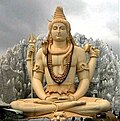
[[File:Murudeshwar Shiva.jpg|thumb|Murudeshwar Shiva]] | [[File:Murudeshwar Shiva.jpg|thumb|Murudeshwar Shiva]] | ||
''Maha Shivaratri'' is the great night of [[Shiva]], during which [[Shaivism|followers of Shiva]] observe religious [[fasting]] and the offering of [[Aegle marmelos|Bael]] (Bilva) leaves to Shiva. Mahashivaratri Festival or | ''Maha Shivaratri'' is the great night of [[Shiva]], during which [[Shaivism|followers of Shiva]] observe religious [[fasting]] and the offering of [[Aegle marmelos|Bael]] (Bilva) leaves to Shiva. Mahashivaratri Festival or 'The Night of Shiva' is celebrated with devotion and religious fervor in honor of Lord Shiva, one of the deities of Hindu Trinity. Shivaratri falls on the moonless 14th night of the new moon in [[Phalgun]] (February – March). Celebrating the festival of Shivaratri devotees observe day and night fast and perform ritual worship of Shiva Lingam to appease Lord Shiva. To mark the Shivratri festival, devotees wake up early and take a ritual bath, preferably in river Ganga. After wearing fresh new clothes devotees visit the nearest Shiva temple to give ritual bath to the Shiva Lingum with milk, honey, water etc. On Shivaratri, worship of Lord Shiva continues all through the day and night. Every three hours priests perform ritual pooja of Shivalingam by bathing it with milk, yoghurt, honey, ghee, sugar and water amidst the chanting of "Om Namah Shivaya' and ringing of temple bells. Jaagran (Nightlong vigil) is also observed in Shiva temples where large number of devotees spend the night singing hymns and devotional songs in praise of Lord Shiva. It is only on the following morning that devotee break their fast by partaking prasad offered to the deity.<ref>{{cite web|url=http://www.mahashivratri.org/mahashivaratri-festival.html |title=Mahashivaratri Festival : Festival of Shivratri, Mahashivratri Festival India – Mahashivaratri Festival 2019 |publisher=Mahashivratri.org |access-date=2018-04-22}}</ref> | ||
{{clear}} | {{clear}} | ||
| Line 65: | Line 67: | ||
{{Main|Holi}} | {{Main|Holi}} | ||
[[File:India - Color Powder stalls - 7242.jpg|thumb|left|India - Colour Powder stalls on Holi- 7242]] | [[File:India - Color Powder stalls - 7242.jpg|thumb|left|India - Colour Powder stalls on Holi- 7242]] | ||
[[Holi]] is the spring Hindu festival of colours which is celebrated by throwing colours on each other.<ref>{{cite book|author=McKim Marriott|editor=John Stratton Hawley and Vasudha Narayanan|title=The Life of Hinduism|url=https://books.google.com/books?id=9hairjdT-ekC|year=2006|publisher=University of California Press|isbn=978-0-520-24914-1|page=102}}</ref><ref>The New Oxford Dictionary of English (1998) {{ISBN|0-19-861263-X}} - p.874 "Holi /'həʊli:/ noun a Hindu spring festival ..."</ref> The festival is celebrated on the full moon day of [[Phalguna]] Month<ref name="Monier-Williams 1876">{{Cite book|last=Monier-Williams|first=Sir Monier|url=https://books.google.com/books?id=mKyjX_1Yv6gC&q=Holi+observed+on+full+moon&pg=PA328|title=Indian Wisdom Or Exemples of the Religions, Philosophical, and Ethical Doctrines of the Hindus: with a Brief History of the Chief Departments of Sanskrit Literature. 3. Ed|date=1876|publisher=Allen|language=en}}</ref> of [[Hindu calendar|Hindu Calendar]]. The festival is primarily celebrated by Hindus and Sikhs.<ref>Rait, S.K (2005) Sikh Women in England: Their Religious and Cultural Beliefs and Social Practices. Trentham Books. [https://books.google.com/books?id=hRfkTq1ykSIC | [[Holi]] is the spring Hindu festival of colours which is celebrated by throwing colours on each other.<ref>{{cite book|author=McKim Marriott|editor=John Stratton Hawley and Vasudha Narayanan|title=The Life of Hinduism|url=https://books.google.com/books?id=9hairjdT-ekC|year=2006|publisher=University of California Press|isbn=978-0-520-24914-1|page=102}}</ref><ref>The New Oxford Dictionary of English (1998) {{ISBN|0-19-861263-X}} - p.874 "Holi /'həʊli:/ noun a Hindu spring festival ..."</ref> The festival is celebrated on the full moon day of [[Phalguna]] Month<ref name="Monier-Williams 1876">{{Cite book|last=Monier-Williams|first=Sir Monier|url=https://books.google.com/books?id=mKyjX_1Yv6gC&q=Holi+observed+on+full+moon&pg=PA328|title=Indian Wisdom Or Exemples of the Religions, Philosophical, and Ethical Doctrines of the Hindus: with a Brief History of the Chief Departments of Sanskrit Literature. 3. Ed|date=1876|publisher=Allen|language=en}}</ref> of [[Hindu calendar|Hindu Calendar]]. The festival is primarily celebrated by Hindus and Sikhs.<ref>Rait, S.K (2005) Sikh Women in England: Their Religious and Cultural Beliefs and Social Practices. Trentham Books. [https://books.google.com/books?id=hRfkTq1ykSIC&dq=holi+sikh&pg=PA79]</ref> | ||
In the Indian state of [[Punjab, India|Punjab]], Holi is preceded by Holika Dahan the night before. On the day of Holi, people engage in throwing colours<ref>Parminder Singh Grover and Moga, Davinderjit Singh, Discover Punjab: Attractions of Punjab [https://books.google.com/books?id=Dy-pOAnlQL0C | In the Indian state of [[Punjab, India|Punjab]], Holi is preceded by Holika Dahan the night before. On the day of Holi, people engage in throwing colours<ref>Parminder Singh Grover and Moga, Davinderjit Singh, Discover Punjab: Attractions of Punjab [https://books.google.com/books?id=Dy-pOAnlQL0C&dq=punjab++holi&pg=PT180]</ref> on each other.<ref name="autogenerated3">Jasbir Singh Khurana, Punjabiyat: The Cultural Heritage and Ethos of the People of Punjab, Hemkunt Publishers (P) Ltd, {{ISBN|978-81-7010-395-0}}</ref> | ||
During Holi in [[Punjab, India|Punjab]], walls and courtyards of rural houses are enhanced with drawings and paintings similar to [[rangoli]] in South India, ''mandana'' in Rajasthan, and rural arts in other parts of India. This art is known as ''chowk-poorana'' or ''chowkpurana'' in Punjab and is given shape by the peasant women of the state. In courtyards, this art is drawn using a piece of cloth. The art includes drawing tree motifs, flowers, ferns, creepers, plants, peacocks, palanquins, geometric patterns along with vertical, horizontal and oblique lines. These arts add to the festive atmosphere.<ref>[http://www.deccanherald.com/content/362722/drawing-designs-walls.html Drawing Designs on Walls], Trisha Bhattacharya (13 October 2013), ''Deccan Herald''. Retrieved 7 January 2015</ref> | During Holi in [[Punjab, India|Punjab]], walls and courtyards of rural houses are enhanced with drawings and paintings similar to [[rangoli]] in South India, ''mandana'' in Rajasthan, and rural arts in other parts of India. This art is known as ''chowk-poorana'' or ''chowkpurana'' in Punjab and is given shape by the peasant women of the state. In courtyards, this art is drawn using a piece of cloth. The art includes drawing tree motifs, flowers, ferns, creepers, plants, peacocks, palanquins, geometric patterns along with vertical, horizontal and oblique lines. These arts add to the festive atmosphere.<ref>[http://www.deccanherald.com/content/362722/drawing-designs-walls.html Drawing Designs on Walls], Trisha Bhattacharya (13 October 2013), ''Deccan Herald''. Retrieved 7 January 2015</ref> | ||
| Line 75: | Line 77: | ||
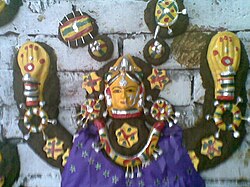
[[File:Sanjhi mata.jpg|thumb|right|Sanjhi mata]] | [[File:Sanjhi mata.jpg|thumb|right|Sanjhi mata]] | ||
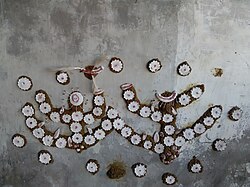
[[File:ਸਾਂਝੀ ਮਾਈ ਦੀ ਤਸਵੀਰ।.jpg|thumb|150px|left|Contemporary Sanjhi image in Punjab]] | [[File:ਸਾਂਝੀ ਮਾਈ ਦੀ ਤਸਵੀਰ।.jpg|thumb|150px|left|Contemporary Sanjhi image in Punjab]] | ||
Sanjhi is celebrated mainly by women and girls in parts of Delhi, Punjab, Haryana, and Uttar Pradesh.<ref>{{Cite web|url=https://www.indiatimes.com/news/india/here-s-the-story-of-sanjhi-a-forgotten-festival-and-delhi-s-own-version-of-durga-puja-330550.html|title=Here's The Story Of Sanjhi - A Forgotten Festival And Delhi's 'Own Version' Of Durga Puja|last=Dabas|first=Maninder|date=28 Sep 2017|website=India Times|archive-url=https://web.archive.org/web/20171124160730/https://www.indiatimes.com/news/india/here-s-the-story-of-sanjhi-a-forgotten-festival-and-delhi-s-own-version-of-durga-puja-330550.html|archive-date=24 November 2017|url-status=live|access-date=30 Sep 2018}}</ref> Sanjhi is the name of a mother goddess, after whom images are made of mud and molded into various shapes such as cosmic bodies or the face of the goddess, and they get different colors. The local potters make images of various body parts like her arms, legs, face decked with ornaments and weapons. These additions make the image look beautiful and gracious. The additions to the image this way depend upon the economic means of the family.<ref>{{Cite web|url=http://www.haryana-online.com/sanjhi.htm|title=Sanjhi|website=Haryana Online|archive-url=https://web.archive.org/web/20020628082857/http://www.haryana-online.com:80/sanjhi.htm|archive-date=28 June 2002|url-status= | Sanjhi is celebrated mainly by women and girls in parts of Delhi, Punjab, Haryana, and Uttar Pradesh.<ref>{{Cite web|url=https://www.indiatimes.com/news/india/here-s-the-story-of-sanjhi-a-forgotten-festival-and-delhi-s-own-version-of-durga-puja-330550.html|title=Here's The Story Of Sanjhi - A Forgotten Festival And Delhi's 'Own Version' Of Durga Puja|last=Dabas|first=Maninder|date=28 Sep 2017|website=India Times|archive-url=https://web.archive.org/web/20171124160730/https://www.indiatimes.com/news/india/here-s-the-story-of-sanjhi-a-forgotten-festival-and-delhi-s-own-version-of-durga-puja-330550.html|archive-date=24 November 2017|url-status=live|access-date=30 Sep 2018}}</ref> Sanjhi is the name of a mother goddess, after whom images are made of mud and molded into various shapes such as cosmic bodies or the face of the goddess, and they get different colors. The local potters make images of various body parts like her arms, legs, face decked with ornaments and weapons. These additions make the image look beautiful and gracious. The additions to the image this way depend upon the economic means of the family.<ref>{{Cite web|url=http://www.haryana-online.com/sanjhi.htm|title=Sanjhi|website=Haryana Online|archive-url=https://web.archive.org/web/20020628082857/http://www.haryana-online.com:80/sanjhi.htm|archive-date=28 June 2002|url-status=usurped|access-date=30 Sep 2018}}</ref> | ||
The image is designed on the first day of the nine days of [[Durga Puja]] or Navratri. Every day women from the neighborhood are invited for singing bhajans and performing aarti. The young girls also gather there and offer their adoration to the mother who is believed to get them suitable husbands. The aarti or the bhajans are chanted daily and some elderly woman guides others. It is usually an all females event. Sanjhi image is prepared on the wall by those families who seek fulfillment of their wishes termed mannat by Punjabis. Some people also seek her blessings for the marriage of their daughters. Kirtan is performed and the image is immersed in water on the last day. The Sanjhi festival ends with the immersion of Sanjhi on the day of [[Vijayadashami|Dussehra]].<ref>{{Cite web|url=http://www.tribuneindia.com/2003/20030924/punjab1.htm|title = The Tribune, Chandigarh, India - Punjab}}</ref> The girls offer prayers and food to the goddess every day. | The image is designed on the first day of the nine days of [[Durga Puja]] or Navratri. Every day women from the neighborhood are invited for singing bhajans and performing aarti. The young girls also gather there and offer their adoration to the mother who is believed to get them suitable husbands. The aarti or the bhajans are chanted daily and some elderly woman guides others. It is usually an all females event. Sanjhi image is prepared on the wall by those families who seek fulfillment of their wishes termed mannat by Punjabis. Some people also seek her blessings for the marriage of their daughters. Kirtan is performed and the image is immersed in water on the last day. The Sanjhi festival ends with the immersion of Sanjhi on the day of [[Vijayadashami|Dussehra]].<ref>{{Cite web|url=http://www.tribuneindia.com/2003/20030924/punjab1.htm|title = The Tribune, Chandigarh, India - Punjab}}</ref> The girls offer prayers and food to the goddess every day. | ||
| Line 88: | Line 90: | ||
Vaisakhi is a historical and religious festival in [[Hinduism]]. It is usually celebrated on 13 or 14 April every year.<ref>{{cite book|author=Harjinder Singh|title=Vaisakhi|url=https://books.google.com/books?id=bCReCAAAQBAJ&pg=PA2|publisher=Akaal Publishers|page=2}}</ref><ref name="Gupta2006p998">{{cite book|author1=K.R. Gupta|author2=Amita Gupta|title=Concise Encyclopaedia of India|url=https://books.google.com/books?id=9dNOT9iYxcMC&pg=PA998 |year=2006|publisher=Atlantic Publishers|isbn=978-81-269-0639-0|page=998}}</ref> For Hindus, the festival is their traditional solar new year, a harvest festival, an occasion to bath in sacred rivers such as Ganges, Jhelum, and Kaveri, visit temples, meet friends and take part in other festivities. In other parts of India, the Vaisakhi festival is known by various regional names.<ref name="Roy2005p479">{{cite book|url=https://books.google.com/books?id=IKqOUfqt4cIC&pg=PA479|title=Traditional Festivals: A Multicultural Encyclopedia|author=Christian Roy|publisher=ABC-CLIO|year=2005|isbn=978-1-57607-089-5|pages=479–480}}</ref> | Vaisakhi is a historical and religious festival in [[Hinduism]]. It is usually celebrated on 13 or 14 April every year.<ref>{{cite book|author=Harjinder Singh|title=Vaisakhi|url=https://books.google.com/books?id=bCReCAAAQBAJ&pg=PA2|publisher=Akaal Publishers|page=2}}</ref><ref name="Gupta2006p998">{{cite book|author1=K.R. Gupta|author2=Amita Gupta|title=Concise Encyclopaedia of India|url=https://books.google.com/books?id=9dNOT9iYxcMC&pg=PA998 |year=2006|publisher=Atlantic Publishers|isbn=978-81-269-0639-0|page=998}}</ref> For Hindus, the festival is their traditional solar new year, a harvest festival, an occasion to bath in sacred rivers such as Ganges, Jhelum, and Kaveri, visit temples, meet friends and take part in other festivities. In other parts of India, the Vaisakhi festival is known by various regional names.<ref name="Roy2005p479">{{cite book|url=https://books.google.com/books?id=IKqOUfqt4cIC&pg=PA479|title=Traditional Festivals: A Multicultural Encyclopedia|author=Christian Roy|publisher=ABC-CLIO|year=2005|isbn=978-1-57607-089-5|pages=479–480}}</ref> | ||
In [[Punjab Province (British India)|Undivided Punjab]], the Hindu Shrine of [[Katas Raj Temples|Katas Raj]] was known for its Vaisakhi fair.<ref>{{Cite book|url=https://books.google.com/books?id=pA8wAQAAIAAJ&q=Katas+Baisakh+fair|title=A Glossary of the Tribes and Castes of the Punjab and North-West Frontier Province|date=1999|publisher=Low Price Publications|isbn=978-81-7536-153-9|language=en}}</ref> It was attended by around 10,000 pilgrims who were mostly Hindus.<ref>{{Cite book|last=Nijjar|first=Bakhshish Singh|url=https://books.google.com/books?id=RESzeNDCEuIC&q=Katas+|title=Panjab Under the Later Mughals, 1707-1759|date=1972|publisher=New Academic Publishing Company|language=en}}</ref> Similarly, at the shrine of [[Bairagi (caste)|Bairagi]] Baba Ram Thaman, a Vaisakhi fair was held annually since 16th century CE which was attended by around 60,000 pilgrims and [[Bairagi (caste)|Bairagi]] saints from all over India used to throng the shrine.<ref>{{Cite book|url=https://books.google.com/books?id=VJwIAAAAQAAJ&q=Baisakhi+hindu+fair&pg=RA2-PA64|title=Gazetteer of the Ferozpur District: 1883|date=1883|language=en}}</ref><ref>{{Cite web|last=Khalid|first=Haroon|title=In defiance: Celebrating Baisakhi at a Hindu shrine in Pakistan|url=https://scroll.in/article/835897/in-defiance-celebrating-baisakhi-at-a-hindu-shrine-in-pakistan|access-date=2021-02-10|website=Scroll.in|language=en-US}}</ref> | In [[Punjab Province (British India)|Undivided Punjab]], the Hindu Shrine of [[Katas Raj Temples|Katas Raj]] was known for its Vaisakhi fair.<ref>{{Cite book|url=https://books.google.com/books?id=pA8wAQAAIAAJ&q=Katas+Baisakh+fair|title=A Glossary of the Tribes and Castes of the Punjab and North-West Frontier Province|date=1999|publisher=Low Price Publications|isbn=978-81-7536-153-9|language=en}}</ref> It was attended by around 10,000 pilgrims who were mostly Hindus.<ref>{{Cite book|last=Nijjar|first=Bakhshish Singh|url=https://books.google.com/books?id=RESzeNDCEuIC&q=Katas+|title=Panjab Under the Later Mughals, 1707-1759|date=1972|publisher=New Academic Publishing Company|language=en}}</ref> Similarly, at the shrine of [[Bairagi (caste)|Bairagi]] Baba Ram Thaman, a Vaisakhi fair was held annually since 16th century CE which was attended by around 60,000 pilgrims and [[Bairagi (caste)|Bairagi]] saints from all over India used to throng the shrine.<ref>{{Cite book|url=https://books.google.com/books?id=VJwIAAAAQAAJ&q=Baisakhi+hindu+fair&pg=RA2-PA64|title=Gazetteer of the Ferozpur District: 1883|date=1883|language=en}}</ref><ref>{{Cite web|last=Khalid|first=Haroon|title=In defiance: Celebrating Baisakhi at a Hindu shrine in Pakistan|url=https://scroll.in/article/835897/in-defiance-celebrating-baisakhi-at-a-hindu-shrine-in-pakistan|access-date=2021-02-10|website=Scroll.in|date=28 April 2017 |language=en-US}}</ref> | ||
The | The Vaisakhi fair is at [[Thakurdwara Bhagwan Narainji]] at Pandori Mahatan village in [[Gurdaspur district|Gurdaspur]] district of [[Punjab, India|Punjab]] where the fair lasts for three days from 1st [[Vaisakha]] to 3rd Vaisakha.<ref name="Darshan">{{Cite book|url=https://books.google.com/books?id=XG8mJN-CgwoC&q=Baisakhi+pandori&pg=RA7-PA28|title=Darshan|date=1982|publisher=Consulate-General of India|language=en}}</ref> The celebrations start in form of procession on morning of 1st Vaisakha, carrying ''Mahant'' in a palanquin by ''Brahmacharis'' and devotees. After that [[Navagraha|Navgraha]] [[Puja (Hinduism)|Puja]] is held and charities in money, grains and cows are done.<ref>{{Cite book|last=Punjab (India)|url=https://books.google.com/books?id=0KAKAQAAIAAJ&q=Baisakhi+pindori|title=Punjab District Gazetteers: Supplement|date=1992|publisher=Controller of Print. and Stationery|language=en}}</ref> At evening, [[Kirtan|Sankirtan]] is held in which ''Mahant'' delivers religious discourses and concludes it by distributing [[Prasāda|prasad]] of Patashas (candy drops). Pilgrims also take ritual bathings at sacred tank in the shrine.<ref>{{Cite book|last=Anand|first=R.L.|title=Fairs and Festivals, Part VII-B, Vol-XIII, Punjab, Census of India 1961|year=1962|pages=60}}</ref><ref name="Darshan"/> | ||
===Ram Navami=== | ===Ram Navami=== | ||
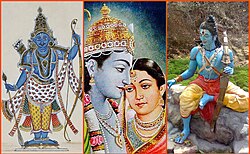
[[File:An image collage of Hindu deity Rama.jpg|thumb|left|An image collage of Hindu deity Rama]] | [[File:An image collage of Hindu deity Rama.jpg|thumb|left|An image collage of Hindu deity Rama]] | ||
''Rama Navami'' is the celebration of the birth of [[Rama]]. Rama Navami is the day on which Lord Rama, the seventh incarnation of Lord Vishnu, incarnated in human form in [[Ayodhya]]. He is the ardha ansh of Vishnu or has half the divinitive qualities of Lord Vishnu. The word | ''Rama Navami'' is the celebration of the birth of [[Rama]]. Rama Navami is the day on which Lord Rama, the seventh incarnation of Lord Vishnu, incarnated in human form in [[Ayodhya (Ramayana)|Ayodhya]]. He is the ardha ansh of Vishnu or has half the divinitive qualities of Lord Vishnu. The word "Rama" literally means one who is divinely blissful and who gives joy to others, and one in whom the sages rejoice. Ram Navami falls on the ninth day of the bright fortnight in Chaitra (April/May) and coincides with Vasant Navratri or Chait Durga Puja. Therefore, in some regions, the festival is spread over nine days. This day, marking the birthday of Lord Rama, is also observed as the marriage day of Rama and Sita and thus also referred to as Kalyanotsavam. In Ayodhya, the birthplace of Lord Rama, a huge fair is held with thousands of devotees gathering to celebrate this festival. The fair continues for two days, and rathyatras, carrying the Deities of Ram, his brother Laxman, His wife Sita, and His greatest devotee Mahavir Hanuman, are taken out from almost all Ram Temples. Hanuman is known for is his devotion to Rama, and his tales form an important part of the celebration. In Andhra Pradesh, Ram Navami is celebrated for 10 days from the Chaitra saptami to the Bahula Padyami in March/April. Temples re-enact the marriage of Lord Rama and Sita to commemorate this event, since this day is also the day they got married.<ref>{{cite web|url=http://www.hindupedia.com/en/Rama_Navami |title=Rama Navami – Hindupedia, the Hindu Encyclopedia |publisher=Hindupedia.com |access-date=2018-04-22}}</ref> | ||
{{clear}} | {{clear}} | ||
| Line 107: | Line 109: | ||
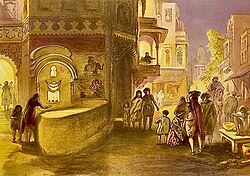
[[File:1867 CE chromolithograph, Diwali, feast of lamps, by William Simpson.jpg|thumb|William Simpson labelled his chromolithograph of 1867 CE as "Dewali, feast of lamps". It showed streets lit up at dusk, with a girl and her mother lighting a street corner lamp.<ref>{{cite book| title= India ancient and modern: a series of illustrations of the Country and people of India and adjacent territories. Executed in chromolithography from drawings by William Simpson|author1= John William Kaye|author2= William Simpson |year=1867| publisher= London Day and Son|page=50 |oclc= 162249047}}</ref>]] | [[File:1867 CE chromolithograph, Diwali, feast of lamps, by William Simpson.jpg|thumb|William Simpson labelled his chromolithograph of 1867 CE as "Dewali, feast of lamps". It showed streets lit up at dusk, with a girl and her mother lighting a street corner lamp.<ref>{{cite book| title= India ancient and modern: a series of illustrations of the Country and people of India and adjacent territories. Executed in chromolithography from drawings by William Simpson|author1= John William Kaye|author2= William Simpson |year=1867| publisher= London Day and Son|page=50 |oclc= 162249047}}</ref>]] | ||
[[Diwali]] festival usually lasts five days and is celebrated during the [[Hindu calendar|Hindu lunisolar]] month [[Kartika (month)|Kartika]] (between mid-October and mid-November).<ref name="OED-Diwali">''The New Oxford Dictionary of English'' (1998) {{ISBN|978-0-19-861263-6}} – p. 540 "'''Diwali''' /dɪwɑːli/ (also '''Diwali''') '''noun''' a Hindu festival with lights...".</ref><ref>[http://www.britannica.com/EBchecked/topic/166786/Diwali Diwali] ''Encyclopædia Britannica'' (2009)</ref><ref>{{Cite web|title=Diwali 2020 Date in India: When is Diwali in 2020?|url=https://indianexpress.com/article/lifestyle/life-style/diwali-2020-date-in-india-when-is-diwali-in-2020-7013223/|access-date=2020-11-13|website=The Indian Express|date=11 November 2020|language=en}}</ref> One of the most popular festivals of Hinduism, Diwali symbolizes the spiritual "victory of light over darkness, good over evil, and knowledge over ignorance".<ref name="Heiligman31">{{cite book|author1=Vasudha Narayanan|author2=Deborah Heiligman|title=Celebrate Diwali|url=https://books.google.com/books?id=rdTJJEQsDHoC&pg=PA31|year=2008|publisher=National Geographic Society|isbn=978-1-4263-0291-6|page=31|quote=All the stories associated with Deepavali, however, speak of the joy connected with the victory of light over darkness, knowledge over ignorance, and good over evil.}}</ref><ref name="htoday">{{cite book|author=Tina K Ramnarine|title=Musical Performance in the Diaspora|url=https://books.google.com/books?id=yTiPAQAAQBAJ&pg=PA78|year=2013|publisher=Routledge|isbn=978-1-317-96956-3|page=78|quote=Light, in the form of candles and lamps, is a crucial part of Diwali, representing the triumph of light over darkness, goodness over evil and hope for the future.}}</ref><ref name="ReferenceA">Jean Mead, ''How and why Do Hindus Celebrate Divali?'', {{ISBN|978-0-237-53412-7}}</ref>{{sfn|J Gordon Melton|2011|p=252}} The festival is widely associated with [[Lakshmi]], goddess of prosperity, with many other regional traditions connecting the holiday to [[Sita]] and [[Rama]], [[Vishnu]], [[Krishna]], [[Yama]], [[Yami]], [[Durga]], [[Kali]], [[Hanuman]], [[Ganesha]], [[Kubera]], [[Dhanvantari]], or [[Vishvakarman]]. Furthermore, it is, in some regions, a celebration of the day Lord [[Rama]] returned to his kingdom [[Ayodhya]] with his wife [[Sita]] and his brother [[Lakshmana]] after defeating [[Ravana]] in [[Lanka]] and serving 14 years of exile. | [[Diwali]] festival usually lasts five days and is celebrated during the [[Hindu calendar|Hindu lunisolar]] month [[Kartika (month)|Kartika]] (between mid-October and mid-November).<ref name="OED-Diwali">''The New Oxford Dictionary of English'' (1998) {{ISBN|978-0-19-861263-6}} – p. 540 "'''Diwali''' /dɪwɑːli/ (also '''Diwali''') '''noun''' a Hindu festival with lights...".</ref><ref>[http://www.britannica.com/EBchecked/topic/166786/Diwali Diwali] ''Encyclopædia Britannica'' (2009)</ref><ref>{{Cite web|title=Diwali 2020 Date in India: When is Diwali in 2020?|url=https://indianexpress.com/article/lifestyle/life-style/diwali-2020-date-in-india-when-is-diwali-in-2020-7013223/|access-date=2020-11-13|website=The Indian Express|date=11 November 2020|language=en}}</ref> One of the most popular festivals of Hinduism, Diwali symbolizes the spiritual "victory of light over darkness, good over evil, and knowledge over ignorance".<ref name="Heiligman31">{{cite book|author1=Vasudha Narayanan|author2=Deborah Heiligman|title=Celebrate Diwali|url=https://books.google.com/books?id=rdTJJEQsDHoC&pg=PA31|year=2008|publisher=National Geographic Society|isbn=978-1-4263-0291-6|page=31|quote=All the stories associated with Deepavali, however, speak of the joy connected with the victory of light over darkness, knowledge over ignorance, and good over evil.}}</ref><ref name="htoday">{{cite book|author=Tina K Ramnarine|title=Musical Performance in the Diaspora|url=https://books.google.com/books?id=yTiPAQAAQBAJ&pg=PA78|year=2013|publisher=Routledge|isbn=978-1-317-96956-3|page=78|quote=Light, in the form of candles and lamps, is a crucial part of Diwali, representing the triumph of light over darkness, goodness over evil and hope for the future.}}</ref><ref name="ReferenceA">Jean Mead, ''How and why Do Hindus Celebrate Divali?'', {{ISBN|978-0-237-53412-7}}</ref>{{sfn|J Gordon Melton|2011|p=252}} The festival is widely associated with [[Lakshmi]], goddess of prosperity, with many other regional traditions connecting the holiday to [[Sita]] and [[Rama]], [[Vishnu]], [[Krishna]], [[Yama]], [[Yami]], [[Durga]], [[Kali]], [[Hanuman]], [[Ganesha]], [[Kubera]], [[Dhanvantari]], or [[Vishvakarman]]. Furthermore, it is, in some regions, a celebration of the day Lord [[Rama]] returned to his kingdom [[Ayodhya (Ramayana)|Ayodhya]] with his wife [[Sita]] and his brother [[Lakshmana]] after defeating [[Ravana]] in [[Lanka]] and serving 14 years of exile. | ||
In the lead-up to Diwali, celebrants will prepare by cleaning, renovating, and decorating their homes and workplaces with ''[[Diya (lamp)|diyas]]'' (oil lamps) and ''[[rangoli]]s''.<ref name="Raat">{{cite book|url = https://books.google.com/books?id=6A9EZRQIT9kC&pg=PA109 |title = Meri Khoj Ek Bharat Ki|author=Pramodkumar|quote=It is extremely important to keep the house spotlessly clean and pure on Diwali. The goddess [[Lakshmi]] likes cleanliness, and she will visit the cleanest house first. Lamps are lit in the evening to welcome the goddess. They are believed to light up her path.|access-date = 26 October 2011|isbn = 978-1-4357-1240-9|date = 2008}}</ref> During Diwali, people wear their finest clothes, illuminate the interior and exterior of their homes with ''diyas'' and ''rangoli'', perform worship ceremonies of [[Lakshmi]], the goddess of prosperity and wealth,{{refn|group=note|Hindus of eastern and northeastern states of India associate the festival with the goddess [[Durga]], or her fierce avatar [[Kali]] ([[Shaktism]]).{{sfn|Laura Amazzone|2012|}} According to McDermott, this region also celebrated the Lakshmi puja historically, while the Kali puja tradition started in the colonial era and was particular prominent post-1920s.{{sfn|McDermott|2011|pp=183–188}}}} light fireworks, and partake in family feasts, where ''mithai'' ([[South Asian sweets|sweets]]) and gifts are shared. Diwali is also a major cultural event for the Hindu and [[Jainism|Jain]] diaspora from the Indian subcontinent.<ref name="wsj">[https://web.archive.org/web/20130421024513/http://blogs.wsj.com/indiarealtime/2010/08/23/india-journal-tis-the-season-to-be-shopping/ India Journal: | In the lead-up to Diwali, celebrants will prepare by cleaning, renovating, and decorating their homes and workplaces with ''[[Diya (lamp)|diyas]]'' (oil lamps) and ''[[rangoli]]s''.<ref name="Raat">{{cite book|url = https://books.google.com/books?id=6A9EZRQIT9kC&pg=PA109 |title = Meri Khoj Ek Bharat Ki|author=Pramodkumar|quote=It is extremely important to keep the house spotlessly clean and pure on Diwali. The goddess [[Lakshmi]] likes cleanliness, and she will visit the cleanest house first. Lamps are lit in the evening to welcome the goddess. They are believed to light up her path.|access-date = 26 October 2011|isbn = 978-1-4357-1240-9|date = 2008| publisher=Lulu.com }}</ref> During Diwali, people wear their finest clothes, illuminate the interior and exterior of their homes with ''diyas'' and ''rangoli'', perform worship ceremonies of [[Lakshmi]], the goddess of prosperity and wealth,{{refn|group=note|Hindus of eastern and northeastern states of India associate the festival with the goddess [[Durga]], or her fierce avatar [[Kali]] ([[Shaktism]]).{{sfn|Laura Amazzone|2012|}} According to McDermott, this region also celebrated the Lakshmi puja historically, while the Kali puja tradition started in the colonial era and was particular prominent post-1920s.{{sfn|McDermott|2011|pp=183–188}}}} light fireworks, and partake in family feasts, where ''mithai'' ([[South Asian sweets|sweets]]) and gifts are shared. Diwali is also a major cultural event for the Hindu and [[Jainism|Jain]] diaspora from the Indian subcontinent.<ref name="wsj">[https://web.archive.org/web/20130421024513/http://blogs.wsj.com/indiarealtime/2010/08/23/india-journal-tis-the-season-to-be-shopping/ India Journal: 'Tis the Season to be Shopping] Devita Saraf, The Wall Street Journal (August 2010)</ref>{{sfn|Henry Johnson|2007|pp=71–73}}{{sfn|Kelly|1988|pp=40–55}} | ||
The five-day long festival originated in the [[Indian subcontinent]] and is mentioned in early Sanskrit texts. Diwali is usually celebrated twenty days after the [[Navrati|Dashera]] (Dasara, Dasain) festival, with [[Dhanteras]], or the regional equivalent, marking the first day of the festival when celebrants prepare by cleaning their homes and making decorations on the floor, such as ''rangolis''.<ref>Karen Bellenir (1997). ''Religious Holidays and Calendars: An Encyclopedic Handbook'', 2nd Edition, {{ISBN|978-0-7808-0258-2}}, Omnigraphics</ref> The second day is [[Naraka Chaturdashi]]. The third day is the day of [[Lakshmi Puja]] and the darkest night of the traditional month. In some parts of India, the day after Lakshmi Puja is marked with the Govardhan Puja and [[Balipratipada]] (Padwa). Some Hindu communities mark the last day as [[Bhai Dooj]] or the regional equivalent, which is dedicated to the bond between sister and brother,<ref>{{cite book|author1=Rajat Gupta|author2=Nishant Singh|author3=Ishita Kirar|title=Hospitality & Tourism Management|url=https://books.google.com/books?id=DatDDAAAQBAJ&pg=PA84|publisher=Vikas |isbn=978-93-259-8244-4|page=84}}</ref> while other Hindu and Sikh craftsmen communities mark this day as [[Vishwakarma Puja]] and observe it by performing maintenance in their work spaces and offering prayers.<ref name="haar2009">{{cite book|author1=Kristen Haar|author2=Sewa Singh Kalsi|title=Sikhism|url=https://books.google.com/books?id=YOI1nB_zTyAC |year=2009|publisher=Infobase Publishing|isbn=978-1-4381-0647-2|pages=98–99}}</ref><ref>{{cite book|author=Shobhna Gupta|title=Festivals of India|url=https://books.google.com/books?id=g4TtrdejbTEC&pg=PA84 |year=2002|publisher=Har-Anand |isbn=978-81-241-0869-7|page=84}}</ref> | The five-day long festival originated in the [[Indian subcontinent]] and is mentioned in early Sanskrit texts. Diwali is usually celebrated twenty days after the [[Navrati|Dashera]] (Dasara, Dasain) festival, with [[Dhanteras]], or the regional equivalent, marking the first day of the festival when celebrants prepare by cleaning their homes and making decorations on the floor, such as ''rangolis''.<ref>Karen Bellenir (1997). ''Religious Holidays and Calendars: An Encyclopedic Handbook'', 2nd Edition, {{ISBN|978-0-7808-0258-2}}, Omnigraphics</ref> The second day is [[Naraka Chaturdashi]]. The third day is the day of [[Lakshmi Puja]] and the darkest night of the traditional month. In some parts of India, the day after Lakshmi Puja is marked with the Govardhan Puja and [[Balipratipada]] (Padwa). Some Hindu communities mark the last day as [[Bhai Dooj]] or the regional equivalent, which is dedicated to the bond between sister and brother,<ref>{{cite book|author1=Rajat Gupta|author2=Nishant Singh|author3=Ishita Kirar|title=Hospitality & Tourism Management|url=https://books.google.com/books?id=DatDDAAAQBAJ&pg=PA84|publisher=Vikas |isbn=978-93-259-8244-4|page=84}}</ref> while other Hindu and Sikh craftsmen communities mark this day as [[Vishwakarma Puja]] and observe it by performing maintenance in their work spaces and offering prayers.<ref name="haar2009">{{cite book|author1=Kristen Haar|author2=Sewa Singh Kalsi|title=Sikhism|url=https://books.google.com/books?id=YOI1nB_zTyAC |year=2009|publisher=Infobase Publishing|isbn=978-1-4381-0647-2|pages=98–99}}</ref><ref>{{cite book|author=Shobhna Gupta|title=Festivals of India|url=https://books.google.com/books?id=g4TtrdejbTEC&pg=PA84 |year=2002|publisher=Har-Anand |isbn=978-81-241-0869-7|page=84}}</ref> | ||
| Line 118: | Line 120: | ||
Karu-ay is the Punjabi name for the fast of [[Karva Chauth]].<ref name="autogenerated7">Alop ho riha Punjabi Visra by Harkesh Singh Kehal Unistar Publications PVT Ltd {{ISBN|81-7142-869-X}}</ref> This fast is primarily traditionally observed in the [[Punjab region]] but is also observed in parts of [[Uttar Pradesh]]<ref name="ref72zuyax">{{Citation | title=The nation, the state, and Indian identity | author=Madhusree Dutta, Neera Adarkar, Majlis Organization (Bombay) | year=1996 | publisher=Popular Prakashan, 1996 | isbn=978-81-85604-09-1 | url= https://books.google.com/books?id=clVkXbbcrhIC | quote=''... originally was practised by women in Punjab and parts of UP, is gaining tremendous popularity ... We found women of all classes and regional communities ... all said they too were observing the Karva Chauth Vrat for their husbands' longevity. All of them had dekha-dekhi (in imitation) followed a trend which made them feel special on this one day. Husbands paid them undivided attention and showered them with gifts. The women from the bastis go to beauty parlours to have their hair set and hands decorated with mehendi ''}}</ref> and [[Rajasthan]]. | Karu-ay is the Punjabi name for the fast of [[Karva Chauth]].<ref name="autogenerated7">Alop ho riha Punjabi Visra by Harkesh Singh Kehal Unistar Publications PVT Ltd {{ISBN|81-7142-869-X}}</ref> This fast is primarily traditionally observed in the [[Punjab region]] but is also observed in parts of [[Uttar Pradesh]]<ref name="ref72zuyax">{{Citation | title=The nation, the state, and Indian identity | author=Madhusree Dutta, Neera Adarkar, Majlis Organization (Bombay) | year=1996 | publisher=Popular Prakashan, 1996 | isbn=978-81-85604-09-1 | url= https://books.google.com/books?id=clVkXbbcrhIC | quote=''... originally was practised by women in Punjab and parts of UP, is gaining tremendous popularity ... We found women of all classes and regional communities ... all said they too were observing the Karva Chauth Vrat for their husbands' longevity. All of them had dekha-dekhi (in imitation) followed a trend which made them feel special on this one day. Husbands paid them undivided attention and showered them with gifts. The women from the bastis go to beauty parlours to have their hair set and hands decorated with mehendi ''}}</ref> and [[Rajasthan]]. | ||
Although the mode of performing the [[Karva Chauth]] fast requires the woman to see the | Although the mode of performing the [[Karva Chauth]] fast requires the woman to see the Moon through a sieve and then her husband's face through the same sieve before she eats, in the Punjabi Karu-ay da varat, traditionally a brother will collect his married sister who will keep the fast at her natal home.<ref name="autogenerated7"/> | ||
The women will eat sweet dishes before sunrise and will not eat throughout the day. Women also get dressed up in traditional attire and gather in the evening for hearing tales about the fast. The purpose of the fast is for the well being and longevity of husbands.<ref name="autogenerated7"/> | The women will eat sweet dishes before sunrise and will not eat throughout the day. Women also get dressed up in traditional attire and gather in the evening for hearing tales about the fast. The purpose of the fast is for the well-being and longevity of husbands.<ref name="autogenerated7"/> | ||
{{clear}} | {{clear}} | ||
====Jhakrya==== | ====Jhakrya==== | ||
[[File:Ahoy! Glory to Ahoi Mata.jpg|thumb|Ahoy! Glory to Ahoi Mata]] | [[File:Ahoy! Glory to Ahoi Mata.jpg|thumb|Ahoy! Glory to Ahoi Mata]] | ||
Jhakrya is a Punjabi fast which according to Kehal is observed by mothers for their sons' well being. However, Pritam (1996) believes the fast is kept by mothers for the welfare of their children.<ref>[https://books.google. | Jhakrya is a Punjabi fast which according to Kehal is observed by mothers for their sons' well-being. However, Pritam (1996) believes the fast is kept by mothers for the welfare of their children.<ref>[https://books.google.com/books?id=I8svAAAAMAAJ&q=%E0%A8%85%E0%A8%B9%E0%A9%8B%E0%A8%88+%E0%A8%B5%E0%A8%B0%E0%A8%A4 Pritam, Amrita. Dekhya Kabira (1996)]</ref> | ||
Jharkri is a clay pot in which dry sweet dishes are kept. Mothers are required to eat something sweet in the morning and then fast all day. Jhakrya fast is observed four days after [[Karva Chauth]] and is related to [[Ahoi Ashtami|Hoi Mata]]. A mother who keeps Jhakrya da varat for the first time will distribute the sweets kept in the Jhakri to her husband's clan. She will also give her mother-in-law a Punjabi suit. | Jharkri is a clay pot in which dry sweet dishes are kept. Mothers are required to eat something sweet in the morning and then fast all day. Jhakrya fast is observed four days after [[Karva Chauth]] and is related to [[Ahoi Ashtami|Hoi Mata]]. A mother who keeps Jhakrya da varat for the first time will distribute the sweets kept in the Jhakri to her husband's clan. She will also give her mother-in-law a Punjabi suit. | ||
On subsequent fasts, mothers will fill the Jhakri will water and jaggery and rice. When the moon rises, an offering is made to the stars and then the sons. Other food will also be given to the sons. Thereafter, mothers will eat something sweet | On subsequent fasts, mothers will fill the Jhakri will water and jaggery and rice. When the moon rises, an offering is made to the stars and then the sons. Other food will also be given to the sons. Thereafter, mothers will eat something sweet to break the fast.<ref>Alop ho riha Punjabi Visra by Harkesh Singh Kehal Bhag Dooja Unistar Publications PVT Ltd {{ISBN|978-93-5017-532-3}}</ref> | ||
[[Ahoi Ashtami]] is a [[Hindu festival]] celebrated about 8 days before Diwali on Krishna [[Paksha]] Ashtami. According to Purnimant calendar followed in North India, it falls during the month of [[Kartik (month)|Kartik]] and according to Amanta calendar followed in Gujarat, Maharashtra and other southern states, it falls during the month of [[Ashvin]]. However, it is just the name of the month which differs and the fasting of [https://www.kahanidinbhar.com/2020/04/ahoi-ashtami-vrat-katha-2020.html Ahoi Ashtami] is done on the same day. | [[Ahoi Ashtami]] is a [[Hindu festival]] celebrated about 8 days before Diwali on Krishna [[Paksha]] Ashtami. According to Purnimant calendar followed in North India, it falls during the month of [[Kartik (month)|Kartik]] and according to Amanta calendar followed in Gujarat, Maharashtra and other southern states, it falls during the month of [[Ashvin]]. However, it is just the name of the month which differs and the fasting of [https://www.kahanidinbhar.com/2020/04/ahoi-ashtami-vrat-katha-2020.html Ahoi Ashtami] is done on the same day. | ||
| Line 138: | Line 140: | ||
====Bhoogay==== | ====Bhoogay==== | ||
Bhoogay falls on the fourth day of the first half of the lunar month of Poh. The day is also called [[Sankashti Chaturthi|Sankat Chauth]].<ref>[https://books.google. | Bhoogay falls on the fourth day of the first half of the lunar month of Poh. The day is also called [[Sankashti Chaturthi|Sankat Chauth]].<ref>[https://books.google.com/books?id=ZadjAAAAMAAJ&q=%E0%A8%AD%E0%A9%81%E0%A9%B1%E0%A8%97%E0%A9%87+%E0%A8%B5%E0%A8%B0%E0%A8%A4 Khoja darapaṇa, Volume 22, Issue 1 1999]</ref> The fast is kept by sisters for the well-being of brothers during the Punjabi month of Poh (December–January). Sisters will break their fast by eating sweet balls made of sesame, jaggery and flour [[Pinni]].<ref name="autogenerated7"/> | ||
== Sikh Festivals == | == Sikh Festivals == | ||
{{Sikhism sidebar}}{{Main|List of Sikh festivals}} | |||
The following religious festivals are observed by Sikhs. | The following religious festivals are observed by Sikhs. | ||
=== Muktsar Mela === | === Muktsar Mela === | ||
[[File:Group of Nihang Singhs.jpg|thumb|200px|A group of [[Nihang]]s who are the chief guests at Maghi mela]] | [[File:Group of Nihang Singhs.jpg|thumb|200px|A group of [[Nihang]]s who are the chief guests at Maghi mela]]{{Main|Mela Maghi}} | ||
This festival commemorates the Battle of Muktsar where the Chalis Mukte or the forty beloved died. Guru Gobind Singh Ji commemorated the martyrs by holding a gathering and performing Kirtan. | This festival commemorates the Battle of Muktsar where the Chalis Mukte or the forty beloved died. Guru Gobind Singh Ji commemorated the martyrs by holding a gathering and performing Kirtan. | ||
| Line 157: | Line 159: | ||
Gobind Singh was the only son of [[Guru Tegh Bahadur]], the ninth [[Sikh guru]], and [[Mata Gujri]].<ref>{{Cite web|title=Happy Guru Gobind Singh Jayanti: Wishes, Pics, Facebook Messages To Share|url=https://www.ndtv.com/india-news/happy-guru-gobind-singh-jayanti-2021-wishes-messages-pics-sms-status-for-whatsapp-facebook-2355113|access-date=2021-01-20|website=NDTV.com}}</ref> He was born in [[Patna]] on 22 December 1666, [[Bihar]] in the [[Sodhi]] [[Khatri]] family <ref name=eos>{{cite web |url = http://www.learnpunjabi.org/eos/index.aspx | Gobind Singh was the only son of [[Guru Tegh Bahadur]], the ninth [[Sikh guru]], and [[Mata Gujri]].<ref>{{Cite web|title=Happy Guru Gobind Singh Jayanti: Wishes, Pics, Facebook Messages To Share|url=https://www.ndtv.com/india-news/happy-guru-gobind-singh-jayanti-2021-wishes-messages-pics-sms-status-for-whatsapp-facebook-2355113|access-date=2021-01-20|website=NDTV.com}}</ref> He was born in [[Patna]] on 22 December 1666, [[Bihar]] in the [[Sodhi]] [[Khatri]] family <ref name=eos>{{cite web |url = http://www.learnpunjabi.org/eos/index.aspx | ||
|title = SODHI |last1 = Vanjara Bedi | | |title = SODHI |last1 = Vanjara Bedi |first1 = S. S. |website = Encyclopaedia of Sikhism |publisher = Punjabi University Patiala |access-date = 20 August 2017 |url-status = live |archive-url = https://web.archive.org/web/20170729230458/http://www.learnpunjabi.org/eos/index.aspx |archive-date = 29 July 2017 |df = dmy-all}}</ref> while his father was visiting [[Bengal]] and [[Assam]].<ref name=eos/> His birth name was Gobind Rai, and a shrine named [[Takht Sri Patna Sahib|Takht Sri Patna Harimandar Sahib]] marks the site of the house where he was born and spent the first four years of his life.<ref name=eos/> In 1670, his family returned to Punjab, and in March 1672 they moved to Chakk Nanaki in the Himalayan foothills of north India, called the Sivalik range, where he was schooled.<ref name=eos/<ref name="BBC">{{cite web|url=https://www.bbc.co.uk/religion/religions/sikhism/people/gobindsingh.shtml|title=BBC Religions - Sikhism|publisher=BBC|date=26 October 2009|access-date=2011-07-30|url-status=live|archive-url=https://web.archive.org/web/20110123020041/http://www.bbc.co.uk/religion/religions/sikhism/people/gobindsingh.shtml|archive-date=23 January 2011|df=dmy-all}}</ref> | ||
{{clear}} | {{clear}} | ||
=== | === Hola Mohalla === | ||
{{Main|Hola Mohalla}} | |||
An annual festival of thousands held at Anandpur Sahib. It was started by [[Guru Gobind Singh]] as a gathering of Sikhs for military exercises and mock battles. The mock battles were followed by [[kirtan]] and valour poetry competitions. Today the [[Nihang]] Singhs carry on the martial tradition with mock battles and displays of swordsmanship and horse riding. There are also a number of darbars where kirtan is sung. It is celebrated by Sikhs across the world as 'Sikh Olympics' with events and competitions of [[swordsmanship]], horse riding, [[Gatka]] (Sikh martial arts), falconry and others by Nihang Singhs. | An annual festival of thousands held at Anandpur Sahib. It was started by [[Guru Gobind Singh]] as a gathering of Sikhs for military exercises and mock battles. The mock battles were followed by [[kirtan]] and valour poetry competitions. Today the [[Nihang]] Singhs carry on the martial tradition with mock battles and displays of swordsmanship and horse riding. There are also a number of darbars where kirtan is sung. It is celebrated by Sikhs across the world as 'Sikh Olympics' with events and competitions of [[swordsmanship]], horse riding, [[Gatka]] (Sikh martial arts), falconry and others by Nihang Singhs. | ||
=== Vaisakhi === | === Vaisakhi === | ||
{{Main|Vaisakhi}} | |||
In [[Punjab (India)|Punjab]] it is celebrated as the birth of the [[Khalsa]] brotherhood. It is celebrated at a large scale at [[Kesgarh Sahib]], [[Anandpur Sahib]]. In India, [[U.K.]], Canada, United States, and other Sikh populated areas, people come together for a public [[mela]] or [[parade]]. The main part of the mela is where a local Sikh Temple ([[Gurdwara]]) has a beautiful Sikh themed float on which the [[Guru Granth Sahib]] is located and every one offers their respect by bowing with much reverence and fervour. To mark the celebrations, [[Sikh]] devotees generally attend the [[Gurudwara]] before dawn with flowers and offerings in hands. Processions through towns are also common. Vaisakhi is the day on which the [[Khalsa]] was born and Sikhs were given a clear identity and a code of conduct to live by, led by the 10th [[Sikh Guru]], [[Guru Gobind Singh]] Ji, who baptized the first Sikhs using sweet nectar called Amrit. | In [[Punjab (India)|Punjab]] it is celebrated as the birth of the [[Khalsa]] brotherhood. It is celebrated at a large scale at [[Kesgarh Sahib]], [[Anandpur Sahib]]. In India, [[U.K.]], Canada, United States, and other Sikh populated areas, people come together for a public [[mela]] or [[parade]]. The main part of the mela is where a local Sikh Temple ([[Gurdwara]]) has a beautiful Sikh themed float on which the [[Guru Granth Sahib]] is located and every one offers their respect by bowing with much reverence and fervour. To mark the celebrations, [[Sikh]] devotees generally attend the [[Gurudwara]] before dawn with flowers and offerings in hands. Processions through towns are also common. Vaisakhi is the day on which the [[Khalsa]] was born and Sikhs were given a clear identity and a code of conduct to live by, led by the 10th [[Sikh Guru]], [[Guru Gobind Singh]] Ji, who baptized the first Sikhs using sweet nectar called Amrit. | ||
=== Martyrdom of Guru Arjan === | === Martyrdom of Guru Arjan === | ||
{{See also|Guru_Arjan#Death|Martyrdom in Sikhism}} | |||
The martyrdom anniversary of [[Guru Arjan]], the fifth Guru, falls in June, the hottest month in India. He was tortured to death under the orders of Mughal Emperor, Jahangir, on the complaint of a Hindu banker Chandu Lal, who bore a personal enmity with Guru, at [[Lahore]] on 25 May 1606. Celebrations consist of [[Kirtan]], Katha and Langar in the Gurdwara. Because of hot summer, chilled sweetened drink made from milk, sugar, essence and water is freely distributed in Gurdwaras and in neighborhoods to everybody irrespective of their religious belief as a sign and honour of the humble Guru who happily accepted his torture as a will of [[Waheguru]] and made no attempt to take any action. | The martyrdom anniversary of [[Guru Arjan]], the fifth Guru, falls in June, the hottest month in India. He was tortured to death under the orders of Mughal Emperor, Jahangir, on the complaint of a Hindu banker Chandu Lal, who bore a personal enmity with Guru, at [[Lahore]] on 25 May 1606. Celebrations consist of [[Kirtan]], Katha and Langar in the Gurdwara. Because of hot summer, chilled sweetened drink made from milk, sugar, essence and water is freely distributed in Gurdwaras and in neighborhoods to everybody irrespective of their religious belief as a sign and honour of the humble Guru who happily accepted his torture as a will of [[Waheguru]] and made no attempt to take any action. | ||
=== Guru Nanak Gurpurab === | === Guru Nanak Gurpurab === | ||
{{Main|Guru Nanak Gurpurab}} | |||
On this day Guru Nanak was born in Nanakana Sahib, now situated in Pakistan. Every year Sikhs celebrate this day with large-scale gatherings. Candles, divas and lights are lit in [[Gurdwara]]s, in the honour of Guru along with fireworks. The birthday celebration usually lasts three days. Generally two days before the birthday, [[Akhand Path]] (forty-eight-hour non-stop reading of Guru Granth Sahib) is held in the Gurdwara. One day before the birthday, a procession is organized which is led by the Panj Pyares (Five Beloved Ones) and the Palki (Palanquin) of Sri Guru Granth Sahib and followed by teams of [[Ragi (Sikhism)|Ragis]] singing hymns, brass bands playing different tunes and devotees singing the chorus. | On this day Guru Nanak was born in Nanakana Sahib, now situated in Pakistan. Every year Sikhs celebrate this day with large-scale gatherings. Candles, divas and lights are lit in [[Gurdwara]]s, in the honour of Guru along with fireworks. The birthday celebration usually lasts three days. Generally two days before the birthday, [[Akhand Path]] (forty-eight-hour non-stop reading of Guru Granth Sahib) is held in the Gurdwara. One day before the birthday, a procession is organized which is led by the Panj Pyares (Five Beloved Ones) and the Palki (Palanquin) of Sri Guru Granth Sahib and followed by teams of [[Ragi (Sikhism)|Ragis]] singing hymns, brass bands playing different tunes and devotees singing the chorus. | ||
=== Sipanji === | === Sipanji === | ||
{{See also|Saka Sirhind}} | |||
The Martyrdom of both the elder and younger Sahibzadas is a remembrance of the four young princes (sons of Guru Gobind Singh) who were martyred in late December. The two older sons, Sahibzade Ajit Singh and Jujhar Singh, were killed by Mughal soldiers during the battle of Chamkaur.{{citation needed|date=March 2021}} Both the younger sons Sahibzade Zorawar Singh and Fateh Singh, were executed after being captured. These Martyrs are observed 21 December and 26 December respectively. | The Martyrdom of both the elder and younger Sahibzadas is a remembrance of the four young princes (sons of Guru Gobind Singh) who were martyred in late December. The two older sons, Sahibzade Ajit Singh and Jujhar Singh, were killed by Mughal soldiers during the battle of Chamkaur.{{citation needed|date=March 2021}} Both the younger sons Sahibzade Zorawar Singh and Fateh Singh, were executed after being captured. These Martyrs are observed 21 December and 26 December respectively. | ||
===Bandi Chhor Divas=== | ===Bandi Chhor Divas=== | ||
[[File:Guru Hargobind is released from Gwalior Fort by Jahangir's order.jpg|thumb|Guru Hargobind Ji is released from Gwalior Fort on Jahangir's order]] | [[File:Guru Hargobind is released from Gwalior Fort by Jahangir's order.jpg|thumb|Guru Hargobind Ji is released from Gwalior Fort on Jahangir's order]]{{Main|Bandi Chhor Divas}} | ||
[[Bandi Chhor Divas]] was celebrated when Guru Hargobind sahib ji was released from Gwalior prison with 52 Hindu | [[Bandi Chhor Divas]] was celebrated when Guru Hargobind sahib ji was released from Gwalior prison with 52 [[Hindu king]]s and princes holding on to his robe or cape with 52 ropes.The guru let all 52 innocent rulers to safety without any signs of war or battle. In addition to ''Nagar keertan'' (a street procession) and an ''Akhand paath'' (a continuous reading of [[Guru Granth Sahib]]), Bandi Chhor (Shodh) Divas is celebrated with a fireworks display. The Sri Harmandir Sahib, as well as the whole complex, is festooned with thousands of shimmering lights. The gurdwara organizes continuous ''[[kirtan]]'' singing and special musicians. Sikhs consider this occasion as an important time to visit Gurdwaras and spend time with their families.<ref>{{cite book|author=Nikky-Guninder Kaur Singh|title=Sikhism: An Introduction|url=https://books.google.com/books?id=w8yWAwAAQBAJ&pg=PT86 |year=2011|publisher =I.B.Tauris|isbn =978-0-85773-549-2|page=86}}</ref> | ||
{{clear}} | {{clear}} | ||
== | ==Joint festivals== | ||
The following festivals are celebrated jointly by Hindus and Sikhs and members of other faiths as Punjabi seasonal/cultural celebrations. | The following festivals are celebrated jointly by Hindus, Muslims and Sikhs and members of other faiths as Punjabi seasonal/cultural celebrations. | ||
===Lohri=== | ===Lohri=== | ||
{{Main|Lohri}} | {{Main|Lohri}} | ||
[[Image:Solstice fire Montana.jpg|thumb|left|Lohri fire]] | [[Image:Solstice fire Montana.jpg|thumb|left|Lohri fire]] | ||
[[Lohri]] is a cultural festival but for some Hindus it is considered a religious festival in [[North West India]],<ref>{{Cite book|last=Dilagīra|first=Harajindara Siṅgha|url=https://books.google.com/books?id=mRpuAAAAMAAJ&q=Lohri+religious+Hindus|title=The Sikh Reference Book|date=1997|publisher=Sikh Educational Trust for Sikh University Centre, Denmark|isbn=978-0-9695964-2-4|language=en}}</ref> the religious part being offerings made to sacred fire, [[Agni]], lit on Lohri festival.<ref name="Singh 2009">{{Cite book|last=Singh|first=Sardar Harjeet|url=https://books.google.com/books?id=fleka3YEE8sC&q=Lohri+religious+part+fire&pg=PA262|title=Faith & Philosophy of Sikhism|date=2009|publisher=Gyan Publishing House|isbn=978-81-7835-721-8|language=en}}</ref> The offering consists of sesame, jaggery, peanuts and popcorns.<ref name="Singh 2009"/> Besides [[Punjabi Hindus]] and Sikhs, Lohri is also celebrated by [[Dogras]] and other people of [[Jammu Division|Jammu]],<ref>{{Cite book|last=Jeratha|first=Aśoka|url=https://books.google.com/books?id=ToONShWeEB0C&q=Lohri+Dogras&pg=PA53|title=Dogra Legends of Art & Culture|date=1998|publisher=Indus Publishing|isbn=978-81-7387-082-8|language=en}}</ref> people of [[Haryana]] and people from western and southern half of [[Himachal Pradesh]].<ref>{{Cite book|last=Śarmā|first=Baṃśī Rāma|url=https://books.google.com/books?id=iHjXAAAAMAAJ&q=Lohri+Himachal+pradesh|title=Gods of Himachal Pradesh|date=2007|publisher=Indus Publishing Company|isbn=978-81-7387-209-9|language=en}}</ref> According to Chauhan (1995), all Punjabis, including Sikhs, Muslims and Christians celebrate Lohri in [[Punjab, India]].<ref>Chauhan, Ramesh K. (1995) Punjab and the nationality question in India. Deep and Deep Publications [https://books.google.com/books?id=X2RuAAAAMAAJ | [[Lohri]] is a cultural festival but for some Hindus it is considered a religious festival in [[North West India]],<ref>{{Cite book|last=Dilagīra|first=Harajindara Siṅgha|url=https://books.google.com/books?id=mRpuAAAAMAAJ&q=Lohri+religious+Hindus|title=The Sikh Reference Book|date=1997|publisher=Sikh Educational Trust for Sikh University Centre, Denmark|isbn=978-0-9695964-2-4|language=en}}</ref> the religious part being offerings made to sacred fire, [[Agni]], lit on Lohri festival.<ref name="Singh 2009">{{Cite book|last=Singh|first=Sardar Harjeet|url=https://books.google.com/books?id=fleka3YEE8sC&q=Lohri+religious+part+fire&pg=PA262|title=Faith & Philosophy of Sikhism|date=2009|publisher=Gyan Publishing House|isbn=978-81-7835-721-8|language=en}}</ref> The offering consists of sesame, jaggery, peanuts and popcorns.<ref name="Singh 2009"/> Besides [[Punjabi Hindus]] and Sikhs, Lohri is also celebrated by [[Dogras]] and other people of [[Jammu Division|Jammu]],<ref>{{Cite book|last=Jeratha|first=Aśoka|url=https://books.google.com/books?id=ToONShWeEB0C&q=Lohri+Dogras&pg=PA53|title=Dogra Legends of Art & Culture|date=1998|publisher=Indus Publishing|isbn=978-81-7387-082-8|language=en}}</ref> people of [[Haryana]] and people from western and southern half of [[Himachal Pradesh]].<ref>{{Cite book|last=Śarmā|first=Baṃśī Rāma|url=https://books.google.com/books?id=iHjXAAAAMAAJ&q=Lohri+Himachal+pradesh|title=Gods of Himachal Pradesh|date=2007|publisher=Indus Publishing Company|isbn=978-81-7387-209-9|language=en}}</ref> According to Chauhan (1995), all Punjabis, including Sikhs, Muslims and Christians celebrate Lohri in [[Punjab, India]].<ref>Chauhan, Ramesh K. (1995) Punjab and the nationality question in India. Deep and Deep Publications [https://books.google.com/books?id=X2RuAAAAMAAJ&q=lohri]</ref> Lohri is celebrated on the last day of the month of Poh ([[Pausha]]).<ref>[https://books.google.com/books?id=vgixwfeCyDAC&dq=lohri+30+poh&pg=PA122 McLeod, W. H. (2009) The A to Z of Sikhism. Scarecrow Press]</ref> | ||
Many people believe the festival commemorates the passing of the [[winter solstice]].<ref>{{cite web|url=http://www.tribuneindia.com/1998/98jul19/science.htm|title=The Tribune...Science Tribune|access-date=12 January 2017}}</ref><ref>[http://www.tribuneindia.com/news/gyan-zone/festival-binge/28107.html The Tribune Festival binge: Amarjot Kaur 10 January 2015]</ref><ref>Celebrating with the Robin Hood of the Punjab and all his friends! Nottingham Post 13 01 2014 {{cite web |url=http://www.nottinghampost.com/Celebrating-Robin-Hood-Punjab-friends/story-20434739-detail/story.html |title= | Many people believe the festival commemorates the passing of the [[winter solstice]].<ref>{{cite web|url=http://www.tribuneindia.com/1998/98jul19/science.htm|title=The Tribune...Science Tribune|access-date=12 January 2017}}</ref><ref>[http://www.tribuneindia.com/news/gyan-zone/festival-binge/28107.html The Tribune Festival binge: Amarjot Kaur 10 January 2015]</ref><ref>Celebrating with the Robin Hood of the Punjab and all his friends! Nottingham Post 13 01 2014 {{cite web |url=http://www.nottinghampost.com/Celebrating-Robin-Hood-Punjab-friends/story-20434739-detail/story.html |title=Celebrating with the Robin Hood of the Punjab and all his friends! {{pipe}} Nottingham Post |access-date=2014-12-12 |url-status=dead |archive-url=https://web.archive.org/web/20141216093127/http://www.nottinghampost.com/Celebrating-Robin-Hood-Punjab-friends/story-20434739-detail/story.html |archive-date=2014-12-16 }}</ref> Lohri is observed the night before [[Makar Sankranti]], also known as [[Maghi]], and according to the solar part of the Lunisolar [[Punjabi calendar]] (variation of the [[Vikram Samvat|Bikrami calendar]]) and typically falls about the same date every year (January 13).<ref>{{cite book|author=Dr. H.S. Singha|title=Sikh Studies|url=https://books.google.com/books?id=nRodBu9seiIC&pg=PA101|year=2005|publisher=Hemkunt Press|isbn=978-81-7010-245-8|pages=101–102}}</ref> | ||
Lohri is an official gazetted holiday in the state of Punjab (India),<ref>[http://www.hindustantimes.com/punjab/punjab-notifies-gazetted-restricted-holidays-for-2016/story-IdSI5D43hsqiu8i98G1YWJ.html Punjab notifies gazetted, restricted holidays for 2016], The Hindustan Times (2016)</ref> but it is not a holiday in Punjab (Pakistan).<ref>[https://schools.punjab.gov.pk/system/files/PublicHolidays2017.pdf#overlay-context=holidays Public and Optional Holidays], Government of Punjab, Lahore, Pakistan (2017)</ref> It is, however, observed by Hindus, Sikhs, Muslims and Christians in Punjab, India and by some Punjabi Muslims, Hindus, Sikhs and Christians in [[Pakistan]] as well.<ref>[http://www.asianews.it/news-en/Punjab-celebrates-the-Lohri:-From-culture,-an-invitation-to-a-springtime-of-peace-and-unity-26972.html] Asian News Jan 2013: Lohri celebrated in Faisalabad, Punjab, Pakistan</ref> | Lohri is an official gazetted holiday in the state of Punjab (India),<ref>[http://www.hindustantimes.com/punjab/punjab-notifies-gazetted-restricted-holidays-for-2016/story-IdSI5D43hsqiu8i98G1YWJ.html Punjab notifies gazetted, restricted holidays for 2016], The Hindustan Times (2016)</ref> but it is not a holiday in Punjab (Pakistan).<ref>[https://schools.punjab.gov.pk/system/files/PublicHolidays2017.pdf#overlay-context=holidays Public and Optional Holidays], Government of Punjab, Lahore, Pakistan (2017)</ref> It is, however, observed by Hindus, Sikhs, Muslims and Christians in Punjab, India and by some Punjabi Muslims, Hindus, Sikhs and Christians in [[Pakistan]] as well.<ref>[http://www.asianews.it/news-en/Punjab-celebrates-the-Lohri:-From-culture,-an-invitation-to-a-springtime-of-peace-and-unity-26972.html] Asian News Jan 2013: Lohri celebrated in Faisalabad, Punjab, Pakistan</ref> | ||
| Line 195: | Line 202: | ||
===Maghi=== | ===Maghi=== | ||
{{Main|Maghi}} | {{Main|Maghi}} | ||
The festival marks the increase in daylight.<ref>Sundar mundarye ho by Assa Singh Ghuman Waris Shah Foundation ISBN B1-7856-043-7</ref> Maghi is celebrated by ritual bathing in holy water bodies and performing ''Daan'' (charity).<ref>{{Cite book|last=General|first=India Office of the Registrar|url=https://books.google.com/books?id=1O0eAQAAMAAJ&q=Maghi+|title=Census of India, 1961: Punjab|date=1962|publisher=Manager of Publications|language=en}}</ref><ref>{{Cite book|last=Gupta|first=Shakti M.|url=https://books.google.com/books?id=XQjgAAAAMAAJ&q=makar+sankranti+Bath+Charity|title=Festivals, Fairs, and Fasts of India|date=1991|publisher=Clarion Books|isbn=978-81-85120-23-2|language=en}}</ref> Hindus will visit the Mandir and bathe is rivers and Sikhs will observe the day by visiting the Gurdwara and also bathe in rivers and pools to mark [[Mela Maghi]]. Punjabis will consume [[Khichdi]] (Boiled Rice and Lentil mixture) and ''Rauh di kheer'' which is rice pudding cooked in sugarcane juice on this occasion. ''Rauh Di Kheer'' is prepared in the evening before Maghi and is kept to cool. It is served cold next morning on Maghi with red-chilly mixed curd.<ref>'Rauh di | The festival marks the increase in daylight.<ref>Sundar mundarye ho by Assa Singh Ghuman Waris Shah Foundation ISBN B1-7856-043-7</ref> Maghi is celebrated by ritual bathing in holy water bodies and performing ''Daan'' (charity).<ref>{{Cite book|last=General|first=India Office of the Registrar|url=https://books.google.com/books?id=1O0eAQAAMAAJ&q=Maghi+|title=Census of India, 1961: Punjab|date=1962|publisher=Manager of Publications|language=en}}</ref><ref>{{Cite book|last=Gupta|first=Shakti M.|url=https://books.google.com/books?id=XQjgAAAAMAAJ&q=makar+sankranti+Bath+Charity|title=Festivals, Fairs, and Fasts of India|date=1991|publisher=Clarion Books|isbn=978-81-85120-23-2|language=en}}</ref> Hindus will visit the Mandir and bathe is rivers and Sikhs will observe the day by visiting the Gurdwara and also bathe in rivers and pools to mark [[Mela Maghi]]. Punjabis will consume [[Khichdi]] (Boiled Rice and Lentil mixture) and ''Rauh di kheer'' which is rice pudding cooked in sugarcane juice on this occasion. ''Rauh Di Kheer'' is prepared in the evening before Maghi and is kept to cool. It is served cold next morning on Maghi with red-chilly mixed curd.<ref>'Rauh di kheer' is the people's favourite. (14.01.2017 )The Tribune. accessed 15.01.2017 [http://www.tribuneindia.com/news/amritsar/-rauh-di-kheer-is-the-people-s-favourite/350132.html]</ref> Fairs are held at many places on Maghi.<ref>Sekhon, Iqbal S. The Punjabis. 2. Religion, society and culture of the Punjabis. Cosmos (2000) [https://books.google.com/books?id=bU0wAQAAIAAJ&q=maghi+makar+sankranti+punjab]</ref> | ||
{{clear}} | {{clear}} | ||
===Basant Panchami=== | ===Basant Panchami=== | ||
{{Main|Basant | {{Main|Basant (festival)}} | ||
[[File:Kite fastival in gujarat.jpg|thumb|right|Kite flying on Basant]] | [[File:Kite fastival in gujarat.jpg|thumb|right|Kite flying on Basant]] | ||
[[Vasant Panchami|Basant Panchami]] is an ancient Hindu spring festival dedicated to god [[Kama]] as well as goddess [[Saraswati]].<ref name="Lochtefeld2002p741">{{harvnb|Lochtefeld|2002|pages=[https://archive.org/details/illustratedencyc0000loch/page/741 741]–742}}</ref> Its link with the Hindu god of love and its traditions have led some scholars to call it "a Hindu form of Valentine's Day".<ref>{{cite book|author=J. Gordon Melton|title=Religious Celebrations: An Encyclopedia of Holidays, Festivals, Solemn Observances, and Spiritual Commemorations |url=https://books.google.com/books?id=lD_2J7W_2hQC&pg=PA903 |year=2011|publisher=ABC-CLIO|isbn=978-1-59884-206-7|page= 903}}, Quote: "Vasant Panchami is a day to think about the person one loves, a spouse or special friend. In rural areas, people note that the crops are already in the field and rippening. It has in the modern world developed a reputation as a Hindu form of Valentine's Day."</ref><ref>ASPECTS OF PUNJABI CULTURE S. S. NARULA Published by PUNJABI UNIVERSITY, INDIA, 1991</ref> The traditional colour of the day is yellow and the dish of the day is saffron rice. People fly kites.<ref name="Lochtefeld2002p741"/><ref name= Nikky87>{{cite book|author=Nikky-Guninder Kaur Singh|title=Sikhism: An Introduction|url=https://books.google.com/books?id=w8yWAwAAQBAJ&pg=PT87|year=2011|publisher=I.B.Tauris|isbn=978-0-85773-549-2|page=87}}</ref> | [[Vasant Panchami|Basant Panchami]] is an ancient Hindu spring festival dedicated to god [[Kama]] as well as goddess [[Saraswati]].<ref name="Lochtefeld2002p741">{{harvnb|Lochtefeld|2002|pages=[https://archive.org/details/illustratedencyc0000loch/page/741 741]–742}}</ref> Its link with the Hindu god of love and its traditions have led some scholars to call it "a Hindu form of Valentine's Day".<ref>{{cite book|author=J. Gordon Melton|title=Religious Celebrations: An Encyclopedia of Holidays, Festivals, Solemn Observances, and Spiritual Commemorations |url=https://books.google.com/books?id=lD_2J7W_2hQC&pg=PA903 |year=2011|publisher=ABC-CLIO|isbn=978-1-59884-206-7|page= 903}}, Quote: "Vasant Panchami is a day to think about the person one loves, a spouse or special friend. In rural areas, people note that the crops are already in the field and rippening. It has in the modern world developed a reputation as a Hindu form of Valentine's Day."</ref><ref>ASPECTS OF PUNJABI CULTURE S. S. NARULA Published by PUNJABI UNIVERSITY, INDIA, 1991</ref> The traditional colour of the day is yellow and the dish of the day is saffron rice. People fly kites.<ref name="Lochtefeld2002p741"/><ref name= Nikky87>{{cite book|author=Nikky-Guninder Kaur Singh|title=Sikhism: An Introduction|url=https://books.google.com/books?id=w8yWAwAAQBAJ&pg=PT87|year=2011|publisher=I.B.Tauris|isbn=978-0-85773-549-2|page=87}}</ref> | ||
| Line 205: | Line 212: | ||
In [[North India]], and in the Punjab province of [[Pakistan]], Basant is celebrated as a spring festival of kites.<ref name="autogenerated4">The Sikh World: An Encyclopedia Survey of Sikh Religion and Culture: Ramesh Chander Dogra and Urmila Dogra; {{ISBN|81-7476-443-7}}</ref> The festival marks the commencement of the spring season. In the [[Punjab region]] (including the Punjab province of [[Pakistan]]), Basant Panchami has been a long established tradition of flying kites<ref>''Punjabiat: The Cultural Heritage and Ethos of the People of Punjab'': Jasbir Singh Khurana</ref> and holding fairs. | In [[North India]], and in the Punjab province of [[Pakistan]], Basant is celebrated as a spring festival of kites.<ref name="autogenerated4">The Sikh World: An Encyclopedia Survey of Sikh Religion and Culture: Ramesh Chander Dogra and Urmila Dogra; {{ISBN|81-7476-443-7}}</ref> The festival marks the commencement of the spring season. In the [[Punjab region]] (including the Punjab province of [[Pakistan]]), Basant Panchami has been a long established tradition of flying kites<ref>''Punjabiat: The Cultural Heritage and Ethos of the People of Punjab'': Jasbir Singh Khurana</ref> and holding fairs. | ||
Punjabi Muslims have treated parts of the festival as a cultural event. In Pakistan however kite flying has been banned starting in 2007 with officials stating that it uses dangerous, life-threatening substances on the strings.<ref>[http://www.pakistantoday.com.pk/2017/02/07/punjab-govt-says-no-to-basant-festival/ PT (07.02.2017) Punjab govt says | Punjabi Muslims have treated parts of the festival as a cultural event. In Pakistan however kite flying has been banned starting in 2007 with officials stating that it uses dangerous, life-threatening substances on the strings.<ref>[http://www.pakistantoday.com.pk/2017/02/07/punjab-govt-says-no-to-basant-festival/ PT (07.02.2017) Punjab govt says 'NO' to Basant festival]</ref> The festival ban was confirmed by the Pakistan Punjab state chief minister [[Shehbaz Sharif]] in 2017. According to some analysts, "the festival was banned due to pressure from hardline religious and extremist groups like the [[Hafiz Saeed]]-led Jamaat-ud Dawah, which claimed the festival had "Hindu origins" and was "un-Islamic".<ref>[http://www.hindustantimes.com/world-news/pakistan-s-punjab-govt-imposes-complete-ban-on-basant-festival/story-6DmkwFleJkkxxaoFCeb6IK.html Pakistan's Punjab govt imposes 'complete ban' on Basant festival], The Hindustan Times (Apr 03, 2017)</ref> | ||
===Vaisakhi=== | ===Vaisakhi=== | ||
| Line 212: | Line 219: | ||
[[File:Kothe-da-mela.jpg|thumb|Vaisakhi ''mela'']] | [[File:Kothe-da-mela.jpg|thumb|Vaisakhi ''mela'']] | ||
Vaisakhi is a religious festival of Sikhs. Vaisakhi marks the beginning of Sikh new year and the formation of the Khalsa.<ref name=senker10>{{cite book|author=Cath Senker|title=My Sikh Year|url=https://books.google.com/books?id=PsQozVTKW44C&pg=PA10|year=2007|publisher=The Rosen Publishing Group|isbn=978-1-4042-3733-9|page=10}}, Quote: "Vaisakhi is the most important mela. It marks the Sikh New Year. At Vaisakhi, Sikhs remember how their community, the Khalsa, first began."</ref><ref name="Jacobsen2008p192">{{cite book|author=Knut A. Jacobsen|title=South Asian Religions on Display: Religious Processions in South Asia and in the Diaspora |url=https://books.google.com/books?id=WT2odZ7_d7MC&pg=PA192 |year=2008|publisher=Routledge|isbn=978-1-134-07459-4|page=192}}, '''Quote:''' "Baisakhi is also a Hindu festival, but for the Sikhs, it celebrates the foundation of the Khalsa in 1699."</ref> Punjabi Muslims observe the new year according to the Islamic calendar. Vaisakhi is also a harvest festival for people of the [[Punjab region]].<ref>Bakshi, S. R. Sharma, Sita Ram (1998) Parkash Singh Badal: Chief Minister of Punjab [https://books.google. | Vaisakhi is a religious festival of Sikhs. Vaisakhi marks the beginning of Sikh new year and the formation of the Khalsa.<ref name=senker10>{{cite book|author=Cath Senker|title=My Sikh Year|url=https://books.google.com/books?id=PsQozVTKW44C&pg=PA10|year=2007|publisher=The Rosen Publishing Group|isbn=978-1-4042-3733-9|page=10}}, Quote: "Vaisakhi is the most important mela. It marks the Sikh New Year. At Vaisakhi, Sikhs remember how their community, the Khalsa, first began."</ref><ref name="Jacobsen2008p192">{{cite book|author=Knut A. Jacobsen|title=South Asian Religions on Display: Religious Processions in South Asia and in the Diaspora |url=https://books.google.com/books?id=WT2odZ7_d7MC&pg=PA192 |year=2008|publisher=Routledge|isbn=978-1-134-07459-4|page=192}}, '''Quote:''' "Baisakhi is also a Hindu festival, but for the Sikhs, it celebrates the foundation of the Khalsa in 1699."</ref> Punjabi Muslims observe the new year according to the Islamic calendar. Vaisakhi is also a harvest festival for people of the [[Punjab region]].<ref>Bakshi, S. R. Sharma, Sita Ram (1998) Parkash Singh Badal: Chief Minister of Punjab [https://books.google.com/books?id=cyebnJdCFlEC&q=baisakhi+punjabi+festival]</ref> The harvest festival is celebrated by Punjabi Sikhs and Hindus.<ref>Gupta, Surendra K. (1999) Indians in Thailand, Books India International [https://books.google.com/books?id=5rBuAAAAMAAJ&q=barley]</ref> In the Punjab, Vaisakhi marks the ripening of the [[rabi crop|rabi]] harvest.<ref>Dogra, Ramesh Chander and Dogra, Urmila (2003) Page 49 The Sikh World: An Encyclopedic Survey of Sikh Religion and Culture. UBS Publishers Distributors Pvt Ltd {{ISBN|81-7476-443-7}}</ref> | ||
Vaisakhi additionally marks the Punjabi new year.<ref>Sainik Samachar: The Pictorial Weekly of the Armed Forces, Volume 33 (1986) Director of Public Relations, Ministry of Defence, [https://books.google. | Vaisakhi additionally marks the Punjabi new year.<ref>Sainik Samachar: The Pictorial Weekly of the Armed Forces, Volume 33 (1986) Director of Public Relations, Ministry of Defence, [https://books.google.com/books?id=t1jfAAAAMAAJ&q=Punjabi+new+year]</ref> This day is observed as a thanksgiving day by farmers whereby farmers pay their tribute, thanking God for the abundant harvest and also praying for future prosperity.<ref>Dhillon, (2015) Janamsakhis: Ageless Stories, Timeless Values. Hay House [https://books.google.com/books?id=OXtVDgAAQBAJ&dq=punjabi+calendar&pg=PT197]</ref> Historically, during the early 20th century, Vaisakhi was a sacred day for Sikhs and Hindus and a secular festival for all Muslims and non-Muslims including Punjabi Christians.<ref>{{Cite web|url=https://books.google.com/books?id=tNAxAQAAIAAJ&q=turbaned+sikhs|title=Link: Indian Newsmagazine|date=13 April 1987|via=Google Books}}</ref> In modern times, sometimes Christians participate in Baisakhi celebrations along with Sikhs and Hindus.<ref>Nahar, Emanual (2007) Minority politics in India: role and impact of Christians in Punjab politics. Arun Pub. House. [https://books.google.com/books?id=vl9uAAAAMAAJ&q=baisakhi+]</ref> | ||
According to Aziz-ud-din Ahmed, [[Lahore]] used to have Baisakhi Mela after the harvesting of the wheat crop in April. However, adds Ahmed, the city started losing its cultural vibrancy in the 1970s after [[Muhammad Zia-ul-Haq|Zia-ul-Haq]] came to power, and in recent years "the [[Pakistan Muslim League (N)]] government in Punjab banned kite flying through an official edict more under the pressure of those who want a puritanical version of Islam to be practiced in the name of religion than anything else".<ref>[http://www.pakistantoday.com.pk/2015/02/21/cultural-decline-in-lahore/ Cultural Decline in Pakistan], Pakistan Today, Aziz-ud-din Ahmed (February 21, 2015)</ref> Unlike the Indian state of Punjab that recognizes the Vaisakhi Sikh festival as an official holiday,<ref name="Official Holidays"/> the festival is not an official holiday in Punjab or Sindh provinces of Pakistan where Islamic holidays are officially recognized instead.<ref name="Official Holidays 2016"/><ref name="kmc.gos.pk"/> However, On 8 April 2016, Punjabi Parchar at Alhamra (Lahore) organised a show called Visakhi mela, where the speakers pledged to "continue our struggle to keep the Punjabi culture alive" in Pakistan through events such as Visakhi Mela.<ref>Pakistan Today (8 April 2016) [http://www.pakistantoday.com.pk/2016/04/08/promoting-peace-with-punjabi-at-visakhi-mela/ Punjabi Parchar spreads colours of love at Visakhi Mela]</ref> Elsewhere Besakhi fairs or melas are held in various places including [[Eminabad]]<ref>[https://www.dawn.com/news/953015 A fair dedicated to animal lovers (20.04.2009) Dawn]</ref> and [[Dera Ghazi Khan]].<ref>Agnes Ziegler, Akhtar Mummunka (2006) The final Frontier: unique photographs of Pakistan. Sang-e-Meel Publications [https://books.google. | According to Aziz-ud-din Ahmed, [[Lahore]] used to have Baisakhi Mela after the harvesting of the wheat crop in April. However, adds Ahmed, the city started losing its cultural vibrancy in the 1970s after [[Muhammad Zia-ul-Haq|Zia-ul-Haq]] came to power, and in recent years "the [[Pakistan Muslim League (N)]] government in Punjab banned kite flying through an official edict more under the pressure of those who want a puritanical version of Islam to be practiced in the name of religion than anything else".<ref>[http://www.pakistantoday.com.pk/2015/02/21/cultural-decline-in-lahore/ Cultural Decline in Pakistan], Pakistan Today, Aziz-ud-din Ahmed (February 21, 2015)</ref> Unlike the Indian state of Punjab that recognizes the Vaisakhi Sikh festival as an official holiday,<ref name="Official Holidays"/> the festival is not an official holiday in Punjab or Sindh provinces of Pakistan where Islamic holidays are officially recognized instead.<ref name="Official Holidays 2016"/><ref name="kmc.gos.pk"/> However, On 8 April 2016, Punjabi Parchar at [[Alhamra Arts Council]] (Lahore) organised a show called Visakhi mela, where the speakers pledged to "continue our struggle to keep the Punjabi culture alive" in Pakistan through events such as Visakhi Mela.<ref>Pakistan Today (8 April 2016) [http://www.pakistantoday.com.pk/2016/04/08/promoting-peace-with-punjabi-at-visakhi-mela/ Punjabi Parchar spreads colours of love at Visakhi Mela]</ref> Elsewhere Besakhi fairs or melas are held in various places including [[Eminabad]]<ref>[https://www.dawn.com/news/953015 A fair dedicated to animal lovers (20.04.2009) Dawn]</ref> and [[Dera Ghazi Khan]].<ref>Agnes Ziegler, Akhtar Mummunka (2006) The final Frontier: unique photographs of Pakistan. Sang-e-Meel Publications [https://books.google.com/books?id=AhNuAAAAMAAJ&q=besakhi+mela+sakhi]</ref>{{refn|group=note|Security concerns are another reason for the lack of holding fairs which lead to the Baisakhi mela in [[Gujranwala]] to mark wheat harvesting being cancelled in 2015.<ref>Dunya New 14 April 2016: Gujranwala: Baisakhi festival cancelled due to security threats [http://dunyanews.tv/en/Pakistan/332199-Gujranwala-Baisakhi-festival-cancelled-due-to-sec]</ref> Despite the bomb blast at the Sakhi Sarwar sufi shrine in [[Dera Ghazi Khan]] in 2011,<ref>[https://www.bbc.co.uk/news/world-south-asia-12951923 BBC News (03 04 2011) Pakistan Sufi shrine suicide attack kills 41]</ref> the Baisakhi mela around the water channel near the shrine that continues until the wheat harvest was integrated with the annual [[Urs]] of the saint in 2012.<ref>Tariq Ismaeel (01.03. 2012)"Sakhi Sarwar: Thousands arrive for festival ahead of urs" The Express Tribune [https://tribune.com.pk/story/343647/sakhi-sarwar-thousands-arrive-for-festival-ahead-of-urs/]</ref>}} | ||
====Aawat pauni==== | ====Aawat pauni==== | ||
| Line 225: | Line 232: | ||
The harvest festival is also characterized by the folk dance, [[Bhangra (dance)|Bhangra]] which traditionally is a harvest dance. | The harvest festival is also characterized by the folk dance, [[Bhangra (dance)|Bhangra]] which traditionally is a harvest dance. | ||
Fairs or ''Melas'' (fair) are held in many parts of [[Punjab, India]] to mark the new year and the harvesting season. Vaisakhi fairs take place in various places, including [[Jammu]] | Fairs or ''Melas'' (fair) are held in many parts of [[Punjab, India]] to mark the new year and the harvesting season. Vaisakhi fairs take place in various places, including [[Jammu]] city, [[Kathua]], [[Udhampur]], [[Reasi]] and Samba,<ref>{{cite web|url=http://zeenews.india.com/news/jammu-and-kashmir/baisakhi-celebrated-with-fervour-gaiety-in-jk_1578749.html|title=Baisakhi celebrated with fervour, gaiety in J&K|date=14 April 2015|access-date=14 September 2016}}</ref> in the Pinjore complex near [[Chandigarh]],<ref>{{cite book|url=https://books.google.com/books?id=7d3rX5jr1WQC&q=haryana%20baisakhi|title=Tourism Management: Problems and Prospects|first=Bijender K.|last=Punia|date=1 January 1994|publisher=APH Publishing|isbn=9788170246435|access-date=14 September 2016|via=Google Books}}</ref> in [[Himachal Pradesh]] cities of Rewalsar, Shimla, Mandi and Prashar Lakes. | ||
{{clear}} | {{clear}} | ||
| Line 232: | Line 239: | ||
[[Teeyan]] welcomes the monsoon season and the festival officially starts of the day of [[Teej]] and last for 13 days. The seasonal festival involves women and girls dancing Gidha and visiting family. The festival is observed in [[Punjab, India]] as a cultural festival by all communities. | [[Teeyan]] welcomes the monsoon season and the festival officially starts of the day of [[Teej]] and last for 13 days. The seasonal festival involves women and girls dancing Gidha and visiting family. The festival is observed in [[Punjab, India]] as a cultural festival by all communities. | ||
The festival is celebrated during the monsoon season from the third day of the lunar month of [[Sawan]] on the bright half, up to the full moon of [[sawan]], by women. Married women go to their maternal house to participate in the festivities.<ref name="autogenerated2">Alop Ho Raha Punjabi Virsa: Harkesh Singh KehalUnistar Books PVT Ltd {{ISBN|81-7142-869-X}}</ref><ref>Shankarlal C. Bhatt (2006) Land and People of Indian States and Union Territories: In 36 Volumes. Punjab, Volume 22 [https://books.google.com/books?id=awketfu78rsC | The festival is celebrated during the monsoon season from the third day of the lunar month of [[Sawan]] on the bright half, up to the full moon of [[sawan]], by women. Married women go to their maternal house to participate in the festivities.<ref name="autogenerated2">Alop Ho Raha Punjabi Virsa: Harkesh Singh KehalUnistar Books PVT Ltd {{ISBN|81-7142-869-X}}</ref><ref>Shankarlal C. Bhatt (2006) Land and People of Indian States and Union Territories: In 36 Volumes. Punjab, Volume 22 [https://books.google.com/books?id=awketfu78rsC&dq=teeyan+punjab&pg=PA351]</ref> In the past, it was traditional for women to spend the whole month of [[Sawan]] with their parents.<ref name="autogenerated2"/><ref>Rainuka Dagar (2002) Identifying and Controlling Female Foeticide and Infanticide in Punjab [https://books.google.com/books?id=1QfaAAAAMAAJ&q=precaution]</ref> | ||
[[Teej]] is historically a Hindu festival, dedicated to Goddess [[Parvati]] and her union with Lord [[Shiva]], one observed in northern, western, central and Himalayan regions of the Indian subcontinent.<ref>{{cite book|author=J Mohapatra|title=Wellness In Indian Festivals & Rituals|date=December 2013|isbn=9781482816907|page=125}}</ref><ref>{{cite journal| author=Manju Bhatnagar| title=The Monsoon Festival Teej in Rajasthan| year=1988|volume=47|number=1| jstor=1178252| journal=Asian Folklore Studies|pages=63–72| doi=10.2307/1178252}}</ref> | [[Teej]] is historically a Hindu festival, dedicated to Goddess [[Parvati]] and her union with Lord [[Shiva]], one observed in northern, western, central and Himalayan regions of the Indian subcontinent.<ref>{{cite book|author=J Mohapatra|title=Wellness In Indian Festivals & Rituals|date=December 2013|isbn=9781482816907|page=125|publisher=Partridge }}</ref><ref>{{cite journal| author=Manju Bhatnagar| title=The Monsoon Festival Teej in Rajasthan| year=1988|volume=47|number=1| jstor=1178252| journal=Asian Folklore Studies|pages=63–72| doi=10.2307/1178252}}</ref> | ||
===Rakhri=== | ===Rakhri=== | ||
'''Rakhri''' or Rakhrhee ({{ | '''Rakhri''' or Rakhrhee ({{langx|pa|ਰੱਖੜੀ}}) is the Punjabi word for [[Raksha Bandhan|Rakhi]] and a festival observed by [[Hindus]] and Sikhs.<ref>Eleanor Nesbitt (2016) Sikhism: A Very Short Introduction. Oxford University Press [https://books.google.com/books?id=XebnCwAAQBAJ&dq=sikhs+raksha+bandhan&pg=PA6]</ref><ref>Marian de Souza, Gloria Durka, Kathleen Engebretson, Robert Jackson, Andrew McGrad (2007) International Handbook of the Religious, Moral and Spiritual Dimensions in Education. Springer [https://books.google.com/books?id=KbdDAAAAQBAJ&dq=punjab+christians+raksha+bandhan&pg=PA392]</ref><ref>[https://books.google.com/books?id=jHQMAQAAMAAJ&q=+raksha+bandhan People of India: A - G., Volume 4 (1998) Oxford Univ. Press]</ref> In the [[Punjab region]], the festival of [[Raksha Bandhan]] is celebrated as '''Rakhrhya''' ({{langx|pa|ਰੱਖੜੀਆ}}).<ref>{{Cite news|url=http://www.thehindu.com/features/metroplus/society/raksha-bandhan-is-here/article6295502.ece|title=Raksha bandhan is here!|date=2014-08-08|newspaper=The Hindu|language=en-IN|issn=0971-751X|access-date=2016-08-17}}</ref> Rakhrhya is observed on the same day of the lunar month of Sawan. It, like Raksha Bandhan, celebrates the relationship between brothers and sisters. Rakhri means "to protect" whereby a brother promises to look out for his sister and in return, a sister prays for the well-being of her brother. According to Fedorak (2006), the festival of Rakhri celebrates "the bonds between brothers and sisters".<ref>Fedorak, Shirley (2006) Windows on the World: Case Studies in Anthropology. Nelson. [https://books.google.com/books?id=O-OGFOi9ui8C&q=rakhri+punjab+parents]</ref> Married women often travel back to their natal homes for the occasion.<ref>Hess, Linda (2015) Bodies of Song: Kabir Oral Traditions and Performative Worlds in North India. Oxford University Press [https://books.google.com/books?id=ALoUDAAAQBAJ&q=natal&pg=PA61]</ref> | ||
A Rakhri can also be tied on a cousin or an unrelated man. If a woman ties a Rakhri on the wrist of an unrelated man, their relationship is treated as any other brother and sister relationship would be. The festival is a siblings-day comparable to Mother's day/Father's day/Grandparents day etc.<ref>{{Cite web|url=http://www.siblingsdayfoundation.org/articles|title=Articles - Siblings Day Foundation|access-date=2016-08-17}}</ref> | A Rakhri can also be tied on a cousin or an unrelated man. If a woman ties a Rakhri on the wrist of an unrelated man, their relationship is treated as any other brother and sister relationship would be. The festival is a siblings-day comparable to Mother's day/Father's day/Grandparents day etc.<ref>{{Cite web|url=http://www.siblingsdayfoundation.org/articles|title=Articles - Siblings Day Foundation|access-date=2016-08-17|archive-date=2016-06-17|archive-url=https://web.archive.org/web/20160617094715/http://www.siblingsdayfoundation.org/articles|url-status=dead}}</ref> | ||
A sister will tie the Rakhri on her brother's wrist and her brother will traditionally give his sister a gift in exchange. Another feature of the celebration is the consumption of sweets.<ref>[https://books.google. | A sister will tie the Rakhri on her brother's wrist and her brother will traditionally give his sister a gift in exchange. Another feature of the celebration is the consumption of sweets.<ref>[https://books.google.com/books?id=YOI1nB_zTyAC&dq=raksha+bandhan+sikh+women&pg=PA101 Kristen Haar, Sewa Singh Kalsi (2009) Sikhism]</ref> There is no special ceremony but a sister will sing folk songs<ref>Pande, Alka (1999) Folk Music & Musical Instruments of Punjab: From Mustard Fields to Disco Lights, Volume 1 [https://books.google.com/books?id=CgraAAAAMAAJ&q=rakhri++]</ref> and say something along the lines of: | ||
[[Punjabi language|Punjabi]]: | [[Punjabi language|Punjabi]]: | ||
| Line 278: | Line 284: | ||
{{clear}} | {{clear}} | ||
===Punjabi Culture Day=== | |||
{{Main|Punjabi Culture Day}} | |||
[[File:Culture of province punjab.jpg|thumb|right|Punjabi cultural celebration in [[Punjab, Pakistan]]]] | |||
Punjabi culture day is celebrated on 14 March all over Punjab for the celebration and demonstration of Punjabi culture by Punjabis and [[Punjabi diaspora]]. | |||
==Muslim festivals== | ==Muslim festivals== | ||
| Line 285: | Line 296: | ||
===Eid ul-Adha=== | ===Eid ul-Adha=== | ||
[[Eid ul-Adha]] is also known as Eid-ul-Azha. The festival is celebrated on the tenth day of the last Islamic month of | [[Eid ul-Adha]] is also known as Eid-ul-Azha. The festival is celebrated on the tenth day of the last Islamic month of Dhul-hijjah. Eid-ul-Azha occurs about two months after Eid-ul-Fitr. Eid-ul-Azha is celebrated to commemorate the occasion when the [[Abraham in Islam|Ibrahim]] ([[Abraham]]) was ready on God's command to sacrifice his son, Ismail, whom God then replaced Ismail with a goat. Muslims make pilgrimage ([[hajj]]) to [[Mecca]] during this time.<ref>Mohiuddin, Yasmeen Niaz (2007) Pakistan: A Global Studies Handbook. ABC-CLIO [https://books.google.com/books?id=OTMy0B9OZjAC&dq=eid+ul+azha&pg=PA296]</ref> | ||
Animal sacrifice is a tradition offered by Muslims on this day.<ref>[https://books.google.com/books?id=isDgI0-0Ip4C | Animal sacrifice is a tradition offered by Muslims on this day.<ref>[https://books.google.com/books?id=isDgI0-0Ip4C&q=sacrifice&pg=PA207 Leaman, Oliver (2006 The Qur'an: An Encyclopedia. Taylor & Francis]</ref> Special markets are set up to deal with the increase in demand of animals. Cattle markets are set up in places such as [[Multan]], ([[Punjab, Pakistan]])<ref>The Express Tribune (05.09.2015) Eid preparations: Eight Eid cattle markets to be set up in Multan [https://tribune.com.pk/story/950982/eid-preparations-eight-eid-cattle-markets-to-be-set-up-in-multan/]</ref> and goat markets in [[Ludhiana]],<ref>Sharma, Arjun (14.09.2015)Goat sellers go online ahead of Bakr-Eid, to affect direct retail The Hindustan Times [http://www.hindustantimes.com/punjab/goat-sellers-go-online-ahead-of-bakr-eid-to-affect-direct-retail/story-mImWf7I6lrNAWFns6tyUpM.html]</ref> ([[Punjab, India]]). The children celebrate Eid ul-Adha and Eid ul-Fitr with great pump and show and receive gifts and Eidi (money) from parents and others.<ref>1998 provincial census report of Punjab (2001) Population Census Organization [https://books.google.com/books?id=DHeFAAAAIAAJ&q=eidi++]</ref> | ||
{{clear}} | {{clear}} | ||
===Eid-ul-Fitr=== | ===Eid-ul-Fitr=== | ||
[[Eid al-Fitr]] takes place on the first day of the tenth month of the Islamic lunar calendar and celebrates the end of [[Ramadan]]. Ramadan is the time of fasting that continues throughout the ninth month.<ref>Barbara DuMoulin, Sylvia Sikundar (1998) Celebrating Our Cultures: Language Arts Activities for Classroom Teachers. Pembroke Publishers Limited [https://books.google.com/books?id=QysY7lNWnPkC | [[Eid al-Fitr]] takes place on the first day of the tenth month of the Islamic lunar calendar and celebrates the end of [[Ramadan]]. Ramadan is the time of fasting that continues throughout the ninth month.<ref>Barbara DuMoulin, Sylvia Sikundar (1998) Celebrating Our Cultures: Language Arts Activities for Classroom Teachers. Pembroke Publishers Limited [https://books.google.com/books?id=QysY7lNWnPkC&dq=Eid-ul-Fitr+end+of+ramadan&pg=PA27]</ref> On this day, after a month of fasting, Muslims express their joy and happiness by offering a congregational prayer in the mosques. Special celebration meals are served.<ref>Bhalla, Kartar Singh 2005) Let's Know Festivals of India. Star Publications [https://books.google.com/books?id=WORYY5Vl0ygC&dq=Eid-ul-Fitr+end+of+ramadan&pg=PP17]</ref> The festival is celebrated in [[Punjab, Pakistan]]. It is also celebrated in [[Malerkotla]] ([[Punjab, India]]) which has a sizable Muslim population where Sikhs and Hindus also participate in the observance.<ref>Kamal, Neel (01.09.2011) The Times of India. Eid celebrated with fervour in Malerkotla [http://timesofindia.indiatimes.com/india/Eid-celebrated-with-fervour-in-Malerkotla/articleshow/9817443.cms]</ref> | ||
===Eid-e-Milad-un-Nabi=== | ===Eid-e-Milad-un-Nabi=== | ||
[[File:International Mawlid Conference at Minar-e-Pakistan Lahore by Minhaj-ul-Quran1.jpg|thumb|left|International Mawlid Conference, [[Minar-e-Pakistan]], [[Lahore]], [[Pakistan]].]] | [[File:International Mawlid Conference at Minar-e-Pakistan Lahore by Minhaj-ul-Quran1.jpg|thumb|left|International Mawlid Conference, [[Minar-e-Pakistan]], [[Lahore]], [[Pakistan]].]] | ||
[[Mawlid|Eid-e-Milad-un- Nabi]] is an Islamic festival which is celebrated in honour of the birth-day of | [[Mawlid|Eid-e-Milad-un- Nabi]] is an Islamic festival which is celebrated in honour of the birth-day of Muhammad.<ref>[https://books.google.com/books?id=wuIcAAAAMAAJ&q=illuminations Guide to Lahore. Ferozsons]</ref> The festival is observed in the third month of the Islamic lunar calendar called Rabi'al-Awal.<ref>Edelstein, Sari (2011) Food, Cuisine, and Cultural Competency for Culinary, Hospitality, and Nutrition Professionals. Jones & Bartlett Learning. [https://books.google.com/books?id=lj0CeaIIETkC&dq=Eid-e-Milad-un-Nabi+punjab&pg=PA260]</ref> Various processions take place in [[Lahore]] to celebrate the festival.<ref>[http://nation.com.pk/lahore/25-Jan-2013/city-celebrates-eid-miladun-nabi The Nation. (25.01.2013) City celebrates Eid Miladun Nabi]</ref> According to Nestorovic (2016), hundreds of thousands of people gather at Minare-Pakistan, Lahore, between the intervening night of 11th and 12th Rabi' al-awwal of the Islamic calendar [http://www.eidmila-dunnabi.com/ Eid Milad Dun Nabi].<ref>Nestorović, Čedomir (2016) Islamic Marketing: Understanding the Socio-Economic, Cultural, and Politico-Legal Environment. Springer [https://books.google.com/books?id=LXJBDAAAQBAJ&q=Milad+nabi+&pg=PA215]</ref> The festival was declared a national holiday in Pakistan in 1949.<ref>Paracha, Nadeem. F. Dawn (02.02.2017) Pakistan: The lesser-known histories of an ancient land [https://www.dawn.com/news/1312059]</ref> | ||
People from various places in [[Punjab, Pakistan]] including [[Bahawalpur]], [[Faisalabad]], [[Multan]] and [[Sargodha]] participate in processions and engage in decorating Mosques, streets and houses with green flags and lights.<ref>The Express Tribune (16.02.2011) Eid-e-Milad-un-Nabi celebrations: What's new on the milad menu? [https://tribune.com.pk/story/119437/eid-e-milad-un-nabi-celebrations-whats-new-on-the-milad-menu/]</ref> According to Khalid, children, teenagers and young adults decorate their Pahari (mountain) of all sorts of toys, including cars, stereos, and numerous other commodities. Within various places of Lahore, there are numerous stalls. Before the festival became a celebratory day, people used to celebrate the day quietly. However, the first procession to mark the day was led from Delhi gate in Lahore in 1935. This tradition then became popular elsewhere.<ref>Khalid, Haroon (14.02.2011) Celebrating Eid Millad ul Nabi by Haroon Khalid. Lahorenama [https://lahorenama.wordpress.com/tag/eid-millad-un-nabi/]</ref> Processions are also taken out in [[Bathinda]] ([[Punjab, India]]).<ref>[http://www.tribuneindia.com/news/bathinda/milad-un-nabi-celebrated/174922.html The Tribune (25.12.2015) Milad-un-Nabi celebrated]</ref> | People from various places in [[Punjab, Pakistan]] including [[Bahawalpur]], [[Faisalabad]], [[Multan]] and [[Sargodha]] participate in processions and engage in decorating Mosques, streets and houses with green flags and lights.<ref>The Express Tribune (16.02.2011) Eid-e-Milad-un-Nabi celebrations: What's new on the milad menu? [https://tribune.com.pk/story/119437/eid-e-milad-un-nabi-celebrations-whats-new-on-the-milad-menu/]</ref> According to Khalid, children, teenagers and young adults decorate their Pahari (mountain) of all sorts of toys, including cars, stereos, and numerous other commodities. Within various places of Lahore, there are numerous stalls. Before the festival became a celebratory day, people used to celebrate the day quietly. However, the first procession to mark the day was led from Delhi gate in Lahore in 1935. This tradition then became popular elsewhere.<ref>Khalid, Haroon (14.02.2011) Celebrating Eid Millad ul Nabi by Haroon Khalid. Lahorenama [https://lahorenama.wordpress.com/tag/eid-millad-un-nabi/]</ref> Processions are also taken out in [[Bathinda]] ([[Punjab, India]]).<ref>[http://www.tribuneindia.com/news/bathinda/milad-un-nabi-celebrated/174922.html The Tribune (25.12.2015) Milad-un-Nabi celebrated]</ref> | ||
===Muharram=== | ===Muharram=== | ||
[[File:A street observation of Muharram in Lahore Pakistan.jpg|thumb|A street observation of Muharram in Lahore Pakistan]] | [[File:A street observation of Muharram in Lahore Pakistan.jpg|thumb|A street observation of Muharram in Lahore Pakistan]] | ||
Remembrance of [[Mourning of Muharram|Muharram]] is a set of rituals associated with [[Shia]],<ref name="Calmard 2">{{cite web|last1=Jean|first1=Calmard|title=AZĀDĀRĪ|url=http://www.iranicaonline.org/articles/azadari|website=iranicaonline|year=2011}}</ref> which takes place in [[Muharram]], the first month of the [[Islamic calendar]]. Many of the events associated with the ritual take place in congregation halls known as ''[[Hussainia]]''. The event marks the anniversary of the [[Battle of Karbala]] when Imam [[Hussein ibn Ali]], the grandson of [[Muhammad]], was killed by the forces of the second [[Umayyad Caliphate|Umayyad caliph]] [[Yazid I]] at [[Karbala]]. Family members, accompanying [[Hussein ibn Ali]], were killed or subjected to humiliation. The commemoration of the event during yearly mourning season, from first of [[Muharram]] to twentieth of [[Safar]] with [[Day of Ashura|Ashura]] comprising the focal date, serves to define [[Shia Islam|Shia]] communal identity.<ref>{{cite book|last1=Martín|first1=Richard C.|title=Encyclopedia of Islam & the Muslim World|date=2004|publisher=Macmillan Reference USA|page=488}}</ref> | Remembrance of [[Mourning of Muharram|Muharram]] is a set of rituals associated with [[Shia]],<ref name="Calmard 2">{{cite web|last1=Jean|first1=Calmard|title=AZĀDĀRĪ|url=http://www.iranicaonline.org/articles/azadari|website=iranicaonline|year=2011}}</ref> which takes place in [[Muharram]], the first month of the [[Islamic calendar]]. Many of the events associated with the ritual take place in congregation halls known as ''[[Hussainia]]''. The event marks the anniversary of the [[Battle of Karbala]] when Imam [[Hussein ibn Ali]], the grandson of [[Muhammad]], was killed by the forces of the second [[Umayyad Caliphate|Umayyad caliph]] [[Yazid I]] at [[Karbala]]. Family members, accompanying [[Hussein ibn Ali]], were killed or subjected to humiliation. The commemoration of the event during yearly mourning season, from first of [[Muharram]] to twentieth of [[Safar]] with [[Day of Ashura|Ashura]] comprising the focal date, serves to define [[Shia Islam|Shia]] communal identity.<ref>{{cite book|last1=Martín|first1=Richard C.|title=Encyclopedia of Islam & the Muslim World|date=2004|publisher=Macmillan Reference USA|page=488}}</ref> | ||
In Pakistani Punjab, Muharram is celebrated twice, once according to the Muslim year and again on the 10th of harh.<ref>Jacobsen, Knut A. (ed) (2008) South Asian Religions on Display: Religious Processions in South Asia and in the Diaspora. Routledge [https://books.google.com/books?id=WT2odZ7_d7MC | In Pakistani Punjab, Muharram is celebrated twice, once according to the Muslim year and again on the 10th of harh.<ref>Jacobsen, Knut A. (ed) (2008) South Asian Religions on Display: Religious Processions in South Asia and in the Diaspora. Routledge [https://books.google.com/books?id=WT2odZ7_d7MC&dq=punjabi+desi+hindu+calendar+pakistan&pg=PA107]</ref> | ||
====Processions==== | ====Processions==== | ||
[[File:Ashura in layyah.jpg|thumb|Ashura procession in [[Layyah]], [[Punjab, Pakistan]]]] | [[File:Ashura in layyah.jpg|thumb|Ashura procession in [[Layyah]], [[Punjab, Pakistan]]]] | ||
Traditionally, a white horse representing Ali's white Mule Duldul, is usually lead in the Muharram procession, as in [[Jhang]], Punjab, Pakistan.<ref>[https://books.google.com/books?id=r5cfAAAAIAAJ | Traditionally, a white horse representing Ali's white Mule Duldul, is usually lead in the Muharram procession, as in [[Jhang]], Punjab, Pakistan.<ref>[https://books.google.com/books?id=r5cfAAAAIAAJ&dq=muharram+punjab+jhang&pg=PA31 Schimmel, Annemarie (1982) Islam in India and Pakistan. BRILL]</ref> Zuljanah, Tazia and Alam processions are observed in many places in [[Punjab, Pakistan]] including [[Sialkot]], [[Gujranwala]], [[Bahawalnagar]], [[Sargodha]], [[Bahawalpur]].<ref>(26.10.2015) The Nation Punjab marks Ashura with fervour amid tight security. [http://nation.com.pk/national/26-Oct-2015/punjab-marks-ashura-with-fervour-amid-tight-security]</ref> and [[Lahore]]. | ||
=====Zuljana===== | =====Zuljana===== | ||
[[Zuljanah]] processions are held which involves taking a replica of a horse. The Zuljanah has two wings and the processions were introduced from Iran to Lahore during the 19th century.<ref>Knut A. Jacobsen (2008) South Asian Religions on Display: Religious Processions in South Asia and in the Diaspora. Routledge. | [[Zuljanah]] processions are held which involves taking a replica of a horse. The Zuljanah has two wings and the processions were introduced from Iran to Lahore during the 19th century.<ref>Knut A. Jacobsen (2008) South Asian Religions on Display: Religious Processions in South Asia and in the Diaspora. Routledge. | ||
[https://books.google.com/books?id=WT2odZ7_d7MC | [https://books.google.com/books?id=WT2odZ7_d7MC&dq=Zuljinnah+processions+punjab&pg=PA105]</ref> | ||
=====Tazia===== | =====Tazia===== | ||
[[File:Imambada .jpg|thumb|left|Tazia at Jama Masjid, Delhi]] | [[File:Imambada .jpg|thumb|left|Tazia at Jama Masjid, Delhi]] | ||
Shia [[Muslim]]s take out a [[ | Shia [[Muslim]]s take out a [[tazia]] procession on the [[day of Ashura]]. | ||
<ref name=reza89>{{cite book|author=Reza Masoudi Nejad | editor= Peter van der Veer|title=Handbook of Religion and the Asian City: Aspiration and Urbanization in the Twenty-First Century |url=https://books.google.com/books?id=_gtaCAAAQBAJ&pg=PA95 |year=2015|publisher=University of California Press|isbn=978-0-520-96108-1|pages=89–105}}</ref> A Tazia is traditionally a bamboo and paper model of Hussain's tomb at [[Karbala]], which is carried in procession by [[Shia]]s on the tenth day of the month of [[Muharram]].<ref>Proceedings, Volume 21 (1988) Punjab History Conference. Punjab University. [https://books.google.com/books?id=akZuAAAAMAAJ | <ref name=reza89>{{cite book|author=Reza Masoudi Nejad | editor= Peter van der Veer|title=Handbook of Religion and the Asian City: Aspiration and Urbanization in the Twenty-First Century |url=https://books.google.com/books?id=_gtaCAAAQBAJ&pg=PA95 |year=2015|publisher=University of California Press|isbn=978-0-520-96108-1|pages=89–105}}</ref> A Tazia is traditionally a bamboo and paper model of Hussain's tomb at [[Karbala]], which is carried in procession by [[Shia]]s on the tenth day of the month of [[Muharram]].<ref>Proceedings, Volume 21 (1988) Punjab History Conference. Punjab University. [https://books.google.com/books?id=akZuAAAAMAAJ&q=bamboo+]</ref> Moderns forms of Tazia can be more elaborate. Tazia processions in Punjab are historic and were observed during the Sikh and British period when the Tazia would be divided into many storeys, but not ordinarily more than three.<ref>Latif, Syad Muhammad (1892) Lahore: Its History, Architectural Remains and Antiquities: With an Account of its Modern Institutions, Inhabitants, Their, Customs. New Imperial Press.[https://archive.org/details/in.ernet.dli.2015.536426 <!-- quote=tazia. -->]</ref> | ||
Such processions take place in [[Lahore]] where mourners take to the streets to commemorate the sacrifices of Imam Hussain and his family in Karbala. Various stalls are set up offering milk, water and tea along the route of the processions. Some distribute juice packets, dry fruit, sweetmeats and food among mourners.<ref>The Express Tribune (12.10.2016) Annual commemoration: Mourners brace for Ashura amid tight security.[https://tribune.com.pk/story/1197556/annual-commemoration-mourners-brace-ashura-amid-tight-security/]</ref> Tazia processions can also be seen in [[Malerkotla]]<ref>Randhawa, Karenjot Bhangoo (2012) Civil Society in Malerkotla, Punjab: Fostering Resilience through Religio. Lexington Books [https://books.google.com/books?id=KAxJvWu1wUQC | Such processions take place in [[Lahore]] where mourners take to the streets to commemorate the sacrifices of Imam Hussain and his family in Karbala. Various stalls are set up offering milk, water and tea along the route of the processions. Some distribute juice packets, dry fruit, sweetmeats and food among mourners.<ref>The Express Tribune (12.10.2016) Annual commemoration: Mourners brace for Ashura amid tight security.[https://tribune.com.pk/story/1197556/annual-commemoration-mourners-brace-ashura-amid-tight-security/]</ref> Tazia processions can also be seen in [[Malerkotla]]<ref>Randhawa, Karenjot Bhangoo (2012) Civil Society in Malerkotla, Punjab: Fostering Resilience through Religio. Lexington Books [https://books.google.com/books?id=KAxJvWu1wUQC&dq=tazia+punjab+shia&pg=PA106]</ref> and [[Delhi]].<ref>[http://www.tribuneindia.com/news/delhi/muharram-observed-amid-tight-security/308846.html The Tribune (13.10.2016 ) Muharram observed amid tight security]</ref> | ||
=====Alam===== | =====Alam===== | ||
Alam processions take place in [[Punjab, Pakistan]] too.<ref>The International News (12.10.2016) Security tightened in City on Youm-e-Ashur | Alam processions take place in [[Punjab, Pakistan]] too.<ref>The International News (12.10.2016) Security tightened in City on Youm-e-Ashur | ||
[https://www.thenews.com.pk/print/156696-Security-tightened-in-City-on-Youm-e-Ashur]</ref> Alam is an elaborate, heavy battle standard, carried by a standard bearer, alam-dar, ahead of the procession. It represents Imam Hussain's standard and is revered as a sacred object.<ref>[https://books.google.com/books?id=XsWorLT4p3UC& | [https://www.thenews.com.pk/print/156696-Security-tightened-in-City-on-Youm-e-Ashur]</ref> Alam is an elaborate, heavy battle standard, carried by a standard bearer, alam-dar, ahead of the procession. It represents Imam Hussain's standard and is revered as a sacred object.<ref>[https://books.google.com/books?id=XsWorLT4p3UC&q=alam+&pg=PA297 Torab, Azam (2007) Performing Islam: Gender and Ritual in Islam. BRILL]</ref> | ||
==Local festivals== | ==Local festivals== | ||
| Line 335: | Line 341: | ||
===Mela Chiragan=== | ===Mela Chiragan=== | ||
Mela Chiraghan (Festival of Lights) is a three-day annual festival to mark the [[urs]] (death anniversary) of the [[Punjabi people|Punjabi]] [[Sufi]] poet and saint [[Shah Hussain]] ( | Mela Chiraghan (Festival of Lights) is a three-day annual festival to mark the [[urs]] (death anniversary) of the [[Punjabi people|Punjabi]] [[Sufi]] poet and saint [[Shah Hussain]] (1538–1599) who lived in Lahore in the 16th century. It takes place at the shrine of Shah Hussain in [[Baghbanpura]], on the outskirts of [[Lahore]], Pakistan, adjacent to the [[Shalimar Gardens (Lahore)|Shalimar Gardens]].<ref name=apna>http://apnaorg.com/articles/news-1/, An article on Mela Chiraghan on Academy of the Punjab in North America (APNA) website, Published 29 March 2005, Retrieved 19 Aug 2016</ref> | ||
===Rath Yatra Nabha=== | ===Rath Yatra Nabha=== | ||
[[File:Nabha Ratha Yatra.jpg|thumb|Nabha Ratha Yatra]] | [[File:Nabha Ratha Yatra.jpg|thumb|Nabha Ratha Yatra]] | ||
Rath Yatra Nabha, Ratha Jatra or Chariot Festival is a [[Hindu festival]] associated with the god [[Jagannath]] held at Mandir Thakur Shri Saty Narayan Ji in the [[Nabha]] City, state of [[Punjab, India|Punjab]], India. This annual festival is celebrated in the month of August or September. The festival is connected to Jagannath's visit to [[Nabha]] city.<ref>Singha, H.s (2000) The Encyclopedia of Sikhism (over 1000 Entries). Hemkunt Press. [https://books.google.com/books?id=gqIbJz7vMn0C | Rath Yatra Nabha, Ratha Jatra or Chariot Festival is a [[Hindu festival]] associated with the god [[Jagannath]] held at Mandir Thakur Shri Saty Narayan Ji in the [[Nabha]] City, state of [[Punjab, India|Punjab]], India. This annual festival is celebrated in the month of August or September. The festival is connected to Jagannath's visit to [[Nabha]] city.<ref>Singha, H.s (2000) The Encyclopedia of Sikhism (over 1000 Entries). Hemkunt Press. [https://books.google.com/books?id=gqIbJz7vMn0C&dq=hola+mohalla&pg=PA100]</ref> | ||
{{clear}} | {{clear}} | ||
==See also== | ==See also== | ||
* [[Punjabi culture]] | * [[Punjabi culture]] | ||
* [[Punjabi Culture Day]] | * [[Punjabi Culture Day]] | ||
* [[List of fairs and festivals in Punjab, India]] | |||
* [[Punjabi festivals (Pakistan)]] | |||
* [[Punjabi calendar]] | * [[Punjabi calendar]] | ||
* [[Livestock show]] | * [[Livestock show]] | ||
* [[Lohri]] | |||
* [[Vaisakhi]] | * [[Vaisakhi]] | ||
* [[Sikh Festivals|Sikh festivals]] | |||
* [[Folk practices in Punjab]] | |||
==Notes== | |||
{{reflist|group=note}} | |||
==References== | ==References== | ||
| Line 367: | Line 378: | ||
{{Commons category|Punjabi festivals}} | {{Commons category|Punjabi festivals}} | ||
{{Punjabi festivals}} | {{Punjabi festivals}} | ||
[[Category:Punjabi festivals| ]] | [[Category:Punjabi festivals| ]] | ||
[[Category:Festivals in Punjab, Pakistan]] | [[Category:Festivals in Punjab, Pakistan]] | ||
[[Category:Punjabi culture]] | [[Category:Punjabi culture]] | ||
[[Category:Punjab | [[Category:Punjab|Festivals]] | ||
[[Category:Lists of festivals by topic]] | [[Category:Lists of festivals by topic]] | ||
Latest revision as of 11:38, 22 March 2026
| Part of a series on |
| Punjabis |
|---|
 |
 Punjab portal |
Punjabi festivals are various festive celebrations observed by the Punjabis, originating in the Punjab region. The Punjabis are religiously a diverse and that affects the festivals they observe. According to a 2007 estimate, a total of ~75% percent of the Punjabi population is Muslim, accounting about 90 million people, with 97% of Punjabis who live in Pakistan following Islam, in contrast to the remaining 30 million Punjabi Sikhs and Hindus who predominantly live in India.[1]
The Punjabi Muslims typically observe the Islamic festivals, do not observe Hindu or Sikh religious festivals, and in Pakistan the official holidays recognize only the Islamic festivals.[2][3] The Punjabi Sikhs and Hindus typically do not observe these, and instead observe historic festivals such as Lohri, Basant and Vaisakhi as seasonal festivals.[4] The Sikh and Hindu festivals are regional official holidays in India, as are major Islamic festivals.[5] Other seasonal Punjabi festivals in India include Teejon (Teeyan) and Maghi.[4] Teeyan is also known as festival of women, as women enjoy it with their friends. On the day of maghi people fly kites and eat their traditional dish khichdi.
The Punjabi Muslim festivals are set according to the lunar Islamic calendar (Hijri), and the date falls earlier by 10 to 13 days from year to year.[6] The Hindu and Sikh Punjabi seasonal festivals are set on specific dates of the luni-solar Bikrami calendar or Punjabi calendar and the date of the festival also typically varies in the Gregorian calendar but stays within the same two Gregorian months.[7]
Some Punjabi Muslims participate in the traditional, seasonal festivals of the Punjab region: Baisakhi, Basant and to a minor scale Lohri, but this is controversial. Islamic clerics and some politicians have attempted to ban this participation because of the religious basis of the Punjabi festivals,[8] and they being declared haram (forbidden in Islam).[9]
Buddhist festivals[edit | edit source]
Punjabi Buddhists are a minority in Punjab, India.[10] In the Punjab province of Pakistan, the Buddhist population is negligible.[11]
Punjabi Buddhists celebrate festivals such as Buddha Jayanti.[12]
Christian Festivals[edit | edit source]


Christians are a minority in Pakistan, constituting about 2.3% of its population in contrast to 97.2% Muslims.[11] In Indian state of Punjab, Christians form about 1.1% of its total population, while the predominant majority of the population being Sikh and Hindus. Punjabi Christians celebrate Christmas to mark the birth of Jesus. In Punjab, Pakistan, people stay up late singing Punjabi Christmas carol services.[13] People attend churches in places such as Gurdaspur, Amritsar, Jalandhar and Hoshiarpur districts in Punjab, India that have a higher Christian population, to be part of Christmas celebrations.[14] Christians also celebrate Easter by engaging in processions.[15]
Hindu festivals[edit | edit source]
Punjabi Hindus celebrate a number of religious festivals.
Bavan Dvadasi[edit | edit source]
Bavan Dvadasi is a festival dedicated to the Hindu God Vamana. The festival is held during the lunar month of Bhadra. Singh writing for the Tribune in 2000 states that "Tipri, a local version of dandia of Gujarat and a characteristic of the Patiala and Ambala districts, is losing popularity. Its performances are now limited to the occasions of Bavan Dvadsi." According to Singh (2000) "Bavan Dvadsi is a local festival celebrated only in the Patiala and Ambala districts. Anywhere else, people are not aware of it. Now, tipri is performed during this festival only." Singh then states that Bavan Dvadsi "is to celebrate the victory of Lord Vishnu, who in the form of a dwarf, had tricked Raja Bali to grant him three wishes, before transforming into a giant to take the Earth, the sky and Bali's life". Tripri competitions are held during the festival. Dancers dance in pairs, striking the sticks and creating a rhythm whilst holding ropes.[16]
Raksha Bandhan[edit | edit source]
Raksha Bandhan, also Rakshabandhan, or Rakhi,[17][18] is a popular, traditionally Hindu, annual rite, or ceremony, which is central to a festival of the same name, celebrated in India, Nepal and other parts of the Indian subcontinent, and among people around the world influenced by Hindu culture. On this day, sisters of all ages tie a talisman, or amulet, called the rakhi, around the wrists of their brothers, symbolically protecting them, receiving a gift in return, and traditionally investing the brothers with a share of the responsibility of their potential care.[19]
Raksha Bandhan is observed on the last day of the Hindu lunar calendar month of Shraavana, which typically falls in August. The expression "Raksha Bandhan," Sanskrit, literally, "the bond of protection, obligation, or care", is now principally applied to this ritual. Until the mid-20th-century, the expression was more commonly applied to a similar ritual, also held on the same day, with precedence in ancient Hindu texts, in which a domestic priest ties amulets, charms, or threads on the wrists of his patrons, or changes their sacred thread, and receives gifts of money; in some places, this is still the case.[20][21] In contrast, the sister-brother festival, with origins in folk culture, had names which varied with location, with some rendered as Saluno,[22][23] Silono[24] and Rakri.[20] A ritual associated with included the sisters placing shoots of barley behind the ears of their brothers.[22]
Of special significance to married women, Raksha Bandhan is rooted in the practice of territorial or village exogamy, in which a bride marries out of her natal village or town, and her parents, by custom, do not visit her in her married home.[25] In rural north India, where village exogamy is strongly prevalent, large numbers of married Hindu women travel back to their parents' homes every year for the ceremony.[26][27] Their brothers, who typically live with the parents or nearby, sometimes travel to their sisters' married home to escort them back. Many younger married women arrive a few weeks earlier at their natal homes and stay until the ceremony.[28] The brothers serve as lifelong intermediaries between their sisters' married and parental homes,[29] as well as potential stewards of their security.
In urban India, where families are increasingly nuclear, the festival has become more symbolic, but continues to be highly popular. The rituals associated with this festival have spread beyond their traditional regions and have been transformed through technology and migration,[30] the movies,[31] social interaction,[32] and promotion by Hinduism,[33][34] as well as by the nation state.[35]
Among women and men who are not blood relatives, there is also a transformed tradition of voluntary kin relations, achieved through the tying of rakhi amulets, which have cut across caste and class lines,[36] and Hindu and Muslim divisions.[37] In some communities or contexts, other figures, such as a matriarch, or a person in authority, can be included in the ceremony in ritual acknowledgement of their benefaction.[38]
Krishna Janmashtami[edit | edit source]

Krishna Janmashtami, also known simply as Janmashtami or Gokulashtami, is an annual Hindu festival that celebrates the birth of Krishna, the eighth avatar of Vishnu.[39] It is observed according to the Hindu lunisolar calendar, on the eighth day (Ashtami) of the Krishna Paksha (dark fortnight) in Shraavana or Bhadrapad (depending on whether the calendar chooses the new moon or full moon day as the last day of the month), which overlaps with August or September of the Gregorian calendar.[39]
It is an important festival, particularly in the Vaishnavism tradition of Hinduism.[40] Dance-drama enactments of the life of Krishna according to the Bhagavata Purana (such as Rasa Lila or Krishna Lila), devotional singing through the midnight when Krishna was born, fasting (upavasa), a night vigil (Ratri Jagaran), and a festival (Mahotsav) on the following day are a part of the Janmashtami celebrations.[41] It is celebrated particularly in Mathura and Vrindavan, along with major Vaishnava and non-sectarian communities found in Manipur, Assam, Bihar, West Bengal, Odisha, Madhya Pradesh, Rajasthan, Gujarat, Maharashtra, Karnataka, Kerala, Tamil Nadu, Andhra Pradesh and all other states of India.[39][42]
Krishna Janmashtami is followed by the festival Nandotsav, which celebrates the occasion when Nanda Baba distributed gifts to the community in honor of the birth.[43]
Mahashivratri[edit | edit source]

Maha Shivaratri is the great night of Shiva, during which followers of Shiva observe religious fasting and the offering of Bael (Bilva) leaves to Shiva. Mahashivaratri Festival or 'The Night of Shiva' is celebrated with devotion and religious fervor in honor of Lord Shiva, one of the deities of Hindu Trinity. Shivaratri falls on the moonless 14th night of the new moon in Phalgun (February – March). Celebrating the festival of Shivaratri devotees observe day and night fast and perform ritual worship of Shiva Lingam to appease Lord Shiva. To mark the Shivratri festival, devotees wake up early and take a ritual bath, preferably in river Ganga. After wearing fresh new clothes devotees visit the nearest Shiva temple to give ritual bath to the Shiva Lingum with milk, honey, water etc. On Shivaratri, worship of Lord Shiva continues all through the day and night. Every three hours priests perform ritual pooja of Shivalingam by bathing it with milk, yoghurt, honey, ghee, sugar and water amidst the chanting of "Om Namah Shivaya' and ringing of temple bells. Jaagran (Nightlong vigil) is also observed in Shiva temples where large number of devotees spend the night singing hymns and devotional songs in praise of Lord Shiva. It is only on the following morning that devotee break their fast by partaking prasad offered to the deity.[44]
Holi[edit | edit source]

Holi is the spring Hindu festival of colours which is celebrated by throwing colours on each other.[45][46] The festival is celebrated on the full moon day of Phalguna Month[47] of Hindu Calendar. The festival is primarily celebrated by Hindus and Sikhs.[48]
In the Indian state of Punjab, Holi is preceded by Holika Dahan the night before. On the day of Holi, people engage in throwing colours[49] on each other.[50]
During Holi in Punjab, walls and courtyards of rural houses are enhanced with drawings and paintings similar to rangoli in South India, mandana in Rajasthan, and rural arts in other parts of India. This art is known as chowk-poorana or chowkpurana in Punjab and is given shape by the peasant women of the state. In courtyards, this art is drawn using a piece of cloth. The art includes drawing tree motifs, flowers, ferns, creepers, plants, peacocks, palanquins, geometric patterns along with vertical, horizontal and oblique lines. These arts add to the festive atmosphere.[51]
Sanjhi[edit | edit source]


Sanjhi is celebrated mainly by women and girls in parts of Delhi, Punjab, Haryana, and Uttar Pradesh.[52] Sanjhi is the name of a mother goddess, after whom images are made of mud and molded into various shapes such as cosmic bodies or the face of the goddess, and they get different colors. The local potters make images of various body parts like her arms, legs, face decked with ornaments and weapons. These additions make the image look beautiful and gracious. The additions to the image this way depend upon the economic means of the family.[53]
The image is designed on the first day of the nine days of Durga Puja or Navratri. Every day women from the neighborhood are invited for singing bhajans and performing aarti. The young girls also gather there and offer their adoration to the mother who is believed to get them suitable husbands. The aarti or the bhajans are chanted daily and some elderly woman guides others. It is usually an all females event. Sanjhi image is prepared on the wall by those families who seek fulfillment of their wishes termed mannat by Punjabis. Some people also seek her blessings for the marriage of their daughters. Kirtan is performed and the image is immersed in water on the last day. The Sanjhi festival ends with the immersion of Sanjhi on the day of Dussehra.[54] The girls offer prayers and food to the goddess every day.
Maghi[edit | edit source]
Maghi is the regional name of Makar Sankranti or Magh Sankranti[47] and marks beginning of Magha month of Hindu Calendar.[55] While Hindus gather near Mandirs.[56] The Magha Mela, according to Diana L. Eck – a professor at Harvard University specializing in Indology, is mentioned in the Hindu epic, the Mahabharata, thus placing this festival to be around 2,000 years old.[57] Many go to sacred rivers or lakes and bathe with thanksgiving to the sun.[57] Maghi happens to be the day when Bhishma, the octogenarian leader of Kauravas emacipated his soul from bondage of body, by conscious act of will after discoursing many days on mysteries of life and death.[58]
Vaisakhi[edit | edit source]
Vaisakhi, also pronounced as Baisakhi marks the beginning of Hindu solar New year.[59][60] Vaisakhi marks the first day of the month of Vaisakha and is usually celebrated on 13 or 14 April every year. This holiday also is known as Vaisakha Sankranti and celebrates the Solar new year, based on the Hindu Vikram Samvat calendar.
Vaisakhi is a historical and religious festival in Hinduism. It is usually celebrated on 13 or 14 April every year.[61][62] For Hindus, the festival is their traditional solar new year, a harvest festival, an occasion to bath in sacred rivers such as Ganges, Jhelum, and Kaveri, visit temples, meet friends and take part in other festivities. In other parts of India, the Vaisakhi festival is known by various regional names.[63]
In Undivided Punjab, the Hindu Shrine of Katas Raj was known for its Vaisakhi fair.[64] It was attended by around 10,000 pilgrims who were mostly Hindus.[65] Similarly, at the shrine of Bairagi Baba Ram Thaman, a Vaisakhi fair was held annually since 16th century CE which was attended by around 60,000 pilgrims and Bairagi saints from all over India used to throng the shrine.[66][67]
The Vaisakhi fair is at Thakurdwara Bhagwan Narainji at Pandori Mahatan village in Gurdaspur district of Punjab where the fair lasts for three days from 1st Vaisakha to 3rd Vaisakha.[68] The celebrations start in form of procession on morning of 1st Vaisakha, carrying Mahant in a palanquin by Brahmacharis and devotees. After that Navgraha Puja is held and charities in money, grains and cows are done.[69] At evening, Sankirtan is held in which Mahant delivers religious discourses and concludes it by distributing prasad of Patashas (candy drops). Pilgrims also take ritual bathings at sacred tank in the shrine.[70][68]
[edit | edit source]

Rama Navami is the celebration of the birth of Rama. Rama Navami is the day on which Lord Rama, the seventh incarnation of Lord Vishnu, incarnated in human form in Ayodhya. He is the ardha ansh of Vishnu or has half the divinitive qualities of Lord Vishnu. The word "Rama" literally means one who is divinely blissful and who gives joy to others, and one in whom the sages rejoice. Ram Navami falls on the ninth day of the bright fortnight in Chaitra (April/May) and coincides with Vasant Navratri or Chait Durga Puja. Therefore, in some regions, the festival is spread over nine days. This day, marking the birthday of Lord Rama, is also observed as the marriage day of Rama and Sita and thus also referred to as Kalyanotsavam. In Ayodhya, the birthplace of Lord Rama, a huge fair is held with thousands of devotees gathering to celebrate this festival. The fair continues for two days, and rathyatras, carrying the Deities of Ram, his brother Laxman, His wife Sita, and His greatest devotee Mahavir Hanuman, are taken out from almost all Ram Temples. Hanuman is known for is his devotion to Rama, and his tales form an important part of the celebration. In Andhra Pradesh, Ram Navami is celebrated for 10 days from the Chaitra saptami to the Bahula Padyami in March/April. Temples re-enact the marriage of Lord Rama and Sita to commemorate this event, since this day is also the day they got married.[71]
Dussehra[edit | edit source]

In most of northern and western India, Dasha-Hara (literally, "ten days") is celebrated in honour of Rama. Thousands of drama-dance-music plays based on the Ramayan and Ramcharitmanas (Ramlila) are performed at outdoor fairs across the land and in temporarily built staging grounds featuring effigies of the demons Ravan, Kumbhakarna and Meghanada. The effigies are burnt on bonfires in the evening of Vijayadashami-Dussehra.[72] While Dussehra is observed on the same day across India, the festivities leading to it vary. In many places, the "Rama Lila" or the brief version of the story of Rama, Sita and Lakshaman, is enacted over the 9 days before it, but in some cities, such as Varanasi, the entire story is freely acted out by performance-artists before the public every evening for a month.[73]
The performance arts tradition during the Dussehra festival was inscribed by UNESCO as one of the "Intangible Cultural Heritage of Humanity" in 2008.[74] The festivities, states UNESCO, include songs, narration, recital and dialogue based on the Hindu text Ramacharitmanas by Tulsidas. It is celebrated across northern India for Dussehra, but particularly in historically important Hindu cities of Ayodhya, Varanasi, Vrindavan, Almora, Satna and Madhubani.[74] The festival and dramatic enactment of the virtues versus vices filled story is organised by communities in hundreds of small villages and towns, attracting a mix of audiences from different social, gender and economic backgrounds. In many parts of India, the audience and villagers join in and participate spontaneously, helping the artists, others helping with stage setup, make-up, effigies, and lights.[74] These arts come to a close on the night of Dussehra, when the victory of Rama is celebrated by burning the effigies of evil Ravan and his colleagues.[75]
Diwali[edit | edit source]

Diwali festival usually lasts five days and is celebrated during the Hindu lunisolar month Kartika (between mid-October and mid-November).[77][78][79] One of the most popular festivals of Hinduism, Diwali symbolizes the spiritual "victory of light over darkness, good over evil, and knowledge over ignorance".[80][81][82][83] The festival is widely associated with Lakshmi, goddess of prosperity, with many other regional traditions connecting the holiday to Sita and Rama, Vishnu, Krishna, Yama, Yami, Durga, Kali, Hanuman, Ganesha, Kubera, Dhanvantari, or Vishvakarman. Furthermore, it is, in some regions, a celebration of the day Lord Rama returned to his kingdom Ayodhya with his wife Sita and his brother Lakshmana after defeating Ravana in Lanka and serving 14 years of exile.
In the lead-up to Diwali, celebrants will prepare by cleaning, renovating, and decorating their homes and workplaces with diyas (oil lamps) and rangolis.[84] During Diwali, people wear their finest clothes, illuminate the interior and exterior of their homes with diyas and rangoli, perform worship ceremonies of Lakshmi, the goddess of prosperity and wealth,[note 1] light fireworks, and partake in family feasts, where mithai (sweets) and gifts are shared. Diwali is also a major cultural event for the Hindu and Jain diaspora from the Indian subcontinent.[87][88][89]
The five-day long festival originated in the Indian subcontinent and is mentioned in early Sanskrit texts. Diwali is usually celebrated twenty days after the Dashera (Dasara, Dasain) festival, with Dhanteras, or the regional equivalent, marking the first day of the festival when celebrants prepare by cleaning their homes and making decorations on the floor, such as rangolis.[90] The second day is Naraka Chaturdashi. The third day is the day of Lakshmi Puja and the darkest night of the traditional month. In some parts of India, the day after Lakshmi Puja is marked with the Govardhan Puja and Balipratipada (Padwa). Some Hindu communities mark the last day as Bhai Dooj or the regional equivalent, which is dedicated to the bond between sister and brother,[91] while other Hindu and Sikh craftsmen communities mark this day as Vishwakarma Puja and observe it by performing maintenance in their work spaces and offering prayers.[92][93]
Fasts[edit | edit source]
Karwa chauth[edit | edit source]

Karu-ay is the Punjabi name for the fast of Karva Chauth.[94] This fast is primarily traditionally observed in the Punjab region but is also observed in parts of Uttar Pradesh[95] and Rajasthan.
Although the mode of performing the Karva Chauth fast requires the woman to see the Moon through a sieve and then her husband's face through the same sieve before she eats, in the Punjabi Karu-ay da varat, traditionally a brother will collect his married sister who will keep the fast at her natal home.[94]
The women will eat sweet dishes before sunrise and will not eat throughout the day. Women also get dressed up in traditional attire and gather in the evening for hearing tales about the fast. The purpose of the fast is for the well-being and longevity of husbands.[94]
Jhakrya[edit | edit source]

Jhakrya is a Punjabi fast which according to Kehal is observed by mothers for their sons' well-being. However, Pritam (1996) believes the fast is kept by mothers for the welfare of their children.[96]
Jharkri is a clay pot in which dry sweet dishes are kept. Mothers are required to eat something sweet in the morning and then fast all day. Jhakrya fast is observed four days after Karva Chauth and is related to Hoi Mata. A mother who keeps Jhakrya da varat for the first time will distribute the sweets kept in the Jhakri to her husband's clan. She will also give her mother-in-law a Punjabi suit.
On subsequent fasts, mothers will fill the Jhakri will water and jaggery and rice. When the moon rises, an offering is made to the stars and then the sons. Other food will also be given to the sons. Thereafter, mothers will eat something sweet to break the fast.[97]
Ahoi Ashtami is a Hindu festival celebrated about 8 days before Diwali on Krishna Paksha Ashtami. According to Purnimant calendar followed in North India, it falls during the month of Kartik and according to Amanta calendar followed in Gujarat, Maharashtra and other southern states, it falls during the month of Ashvin. However, it is just the name of the month which differs and the fasting of Ahoi Ashtami is done on the same day.
The fasting and puja on Ahoi Ashtami are dedicated to Mata Ahoi or Goddess Ahoi. She is worshiped by mothers for the well-being and long life of their children. This day is also known as Ahoi Aathe because fasting for Ahoi Ashtami is done during Ashtami Tithi which is the eighth day of the lunar month. Ahoi Mata is none other than Goddess Parvati.
Bhoogay[edit | edit source]
Bhoogay falls on the fourth day of the first half of the lunar month of Poh. The day is also called Sankat Chauth.[98] The fast is kept by sisters for the well-being of brothers during the Punjabi month of Poh (December–January). Sisters will break their fast by eating sweet balls made of sesame, jaggery and flour Pinni.[94]
Sikh Festivals[edit | edit source]
| Part of a series on |
| Sikhism |
|---|
 |
The following religious festivals are observed by Sikhs.
Muktsar Mela[edit | edit source]

This festival commemorates the Battle of Muktsar where the Chalis Mukte or the forty beloved died. Guru Gobind Singh Ji commemorated the martyrs by holding a gathering and performing Kirtan.
The Maghi fair is held to honour the memory of the forty Sikh warriors killed during the Battle of Muktsar in 1705. Muktsar, originally called Khidrana, was named as Muktsar ("the pool of liberation") following the battle. These forty Sikhs, led by their leader Mahan Singh, had formally deserted Sri Guru Gobind Singh in the need of hour, and signed a written memorandum to the effect.[99] When Mai Bhago, a valiant and upright lady, heard of this cowardly act, she scolded the Singh's and inspired them refresh with spirit of bravery for which Sikhs are known. Hence, the unit went back and joined the Guru who was already engaged in action at Khidrana. All forty of them attained martyrdom. The memorandum (bedawa) was torn-down by the Guru himself just before Mahan Singh died.
People gather from all over Punjab, even other parts of India to join the festival which is in fact spread over many days. Merchants display their wares for sale, which include from trinkets to high-end electronics, the weapons Nihangs bear and especially agricultural machinery (since most around are farmers). The country's biggest circuses, Apollo and Gemini, are there as a matter of rule, merry-go-rounds and giant wheels, and the famous Well of Death (trick motorcycling inside a consortium of wood planks) are there.
Parkash Utsav Dasveh Patshah[edit | edit source]

This festival's name, when translated, means the birth celebration of the 10th Divine Light, or Divine Knowledges. It commemorates the birth of Guru Gobind Singh, the tenth Sikh guru. The festival is one of the most widely celebrated event by Sikhs.
Gobind Singh was the only son of Guru Tegh Bahadur, the ninth Sikh guru, and Mata Gujri.[100] He was born in Patna on 22 December 1666, Bihar in the Sodhi Khatri family [101] while his father was visiting Bengal and Assam.[101] His birth name was Gobind Rai, and a shrine named Takht Sri Patna Harimandar Sahib marks the site of the house where he was born and spent the first four years of his life.[101] In 1670, his family returned to Punjab, and in March 1672 they moved to Chakk Nanaki in the Himalayan foothills of north India, called the Sivalik range, where he was schooled.[102]
Hola Mohalla[edit | edit source]
An annual festival of thousands held at Anandpur Sahib. It was started by Guru Gobind Singh as a gathering of Sikhs for military exercises and mock battles. The mock battles were followed by kirtan and valour poetry competitions. Today the Nihang Singhs carry on the martial tradition with mock battles and displays of swordsmanship and horse riding. There are also a number of darbars where kirtan is sung. It is celebrated by Sikhs across the world as 'Sikh Olympics' with events and competitions of swordsmanship, horse riding, Gatka (Sikh martial arts), falconry and others by Nihang Singhs.
Vaisakhi[edit | edit source]
In Punjab it is celebrated as the birth of the Khalsa brotherhood. It is celebrated at a large scale at Kesgarh Sahib, Anandpur Sahib. In India, U.K., Canada, United States, and other Sikh populated areas, people come together for a public mela or parade. The main part of the mela is where a local Sikh Temple (Gurdwara) has a beautiful Sikh themed float on which the Guru Granth Sahib is located and every one offers their respect by bowing with much reverence and fervour. To mark the celebrations, Sikh devotees generally attend the Gurudwara before dawn with flowers and offerings in hands. Processions through towns are also common. Vaisakhi is the day on which the Khalsa was born and Sikhs were given a clear identity and a code of conduct to live by, led by the 10th Sikh Guru, Guru Gobind Singh Ji, who baptized the first Sikhs using sweet nectar called Amrit.
Martyrdom of Guru Arjan[edit | edit source]
The martyrdom anniversary of Guru Arjan, the fifth Guru, falls in June, the hottest month in India. He was tortured to death under the orders of Mughal Emperor, Jahangir, on the complaint of a Hindu banker Chandu Lal, who bore a personal enmity with Guru, at Lahore on 25 May 1606. Celebrations consist of Kirtan, Katha and Langar in the Gurdwara. Because of hot summer, chilled sweetened drink made from milk, sugar, essence and water is freely distributed in Gurdwaras and in neighborhoods to everybody irrespective of their religious belief as a sign and honour of the humble Guru who happily accepted his torture as a will of Waheguru and made no attempt to take any action.
Guru Nanak Gurpurab[edit | edit source]
On this day Guru Nanak was born in Nanakana Sahib, now situated in Pakistan. Every year Sikhs celebrate this day with large-scale gatherings. Candles, divas and lights are lit in Gurdwaras, in the honour of Guru along with fireworks. The birthday celebration usually lasts three days. Generally two days before the birthday, Akhand Path (forty-eight-hour non-stop reading of Guru Granth Sahib) is held in the Gurdwara. One day before the birthday, a procession is organized which is led by the Panj Pyares (Five Beloved Ones) and the Palki (Palanquin) of Sri Guru Granth Sahib and followed by teams of Ragis singing hymns, brass bands playing different tunes and devotees singing the chorus.
Sipanji[edit | edit source]
The Martyrdom of both the elder and younger Sahibzadas is a remembrance of the four young princes (sons of Guru Gobind Singh) who were martyred in late December. The two older sons, Sahibzade Ajit Singh and Jujhar Singh, were killed by Mughal soldiers during the battle of Chamkaur.[citation needed] Both the younger sons Sahibzade Zorawar Singh and Fateh Singh, were executed after being captured. These Martyrs are observed 21 December and 26 December respectively.
Bandi Chhor Divas[edit | edit source]

Bandi Chhor Divas was celebrated when Guru Hargobind sahib ji was released from Gwalior prison with 52 Hindu kings and princes holding on to his robe or cape with 52 ropes.The guru let all 52 innocent rulers to safety without any signs of war or battle. In addition to Nagar keertan (a street procession) and an Akhand paath (a continuous reading of Guru Granth Sahib), Bandi Chhor (Shodh) Divas is celebrated with a fireworks display. The Sri Harmandir Sahib, as well as the whole complex, is festooned with thousands of shimmering lights. The gurdwara organizes continuous kirtan singing and special musicians. Sikhs consider this occasion as an important time to visit Gurdwaras and spend time with their families.[103]
Joint festivals[edit | edit source]
The following festivals are celebrated jointly by Hindus, Muslims and Sikhs and members of other faiths as Punjabi seasonal/cultural celebrations.
Lohri[edit | edit source]

Lohri is a cultural festival but for some Hindus it is considered a religious festival in North West India,[104] the religious part being offerings made to sacred fire, Agni, lit on Lohri festival.[105] The offering consists of sesame, jaggery, peanuts and popcorns.[105] Besides Punjabi Hindus and Sikhs, Lohri is also celebrated by Dogras and other people of Jammu,[106] people of Haryana and people from western and southern half of Himachal Pradesh.[107] According to Chauhan (1995), all Punjabis, including Sikhs, Muslims and Christians celebrate Lohri in Punjab, India.[108] Lohri is celebrated on the last day of the month of Poh (Pausha).[109]
Many people believe the festival commemorates the passing of the winter solstice.[110][111][112] Lohri is observed the night before Makar Sankranti, also known as Maghi, and according to the solar part of the Lunisolar Punjabi calendar (variation of the Bikrami calendar) and typically falls about the same date every year (January 13).[113]
Lohri is an official gazetted holiday in the state of Punjab (India),[114] but it is not a holiday in Punjab (Pakistan).[115] It is, however, observed by Hindus, Sikhs, Muslims and Christians in Punjab, India and by some Punjabi Muslims, Hindus, Sikhs and Christians in Pakistan as well.[116]
Maghi[edit | edit source]
The festival marks the increase in daylight.[117] Maghi is celebrated by ritual bathing in holy water bodies and performing Daan (charity).[118][119] Hindus will visit the Mandir and bathe is rivers and Sikhs will observe the day by visiting the Gurdwara and also bathe in rivers and pools to mark Mela Maghi. Punjabis will consume Khichdi (Boiled Rice and Lentil mixture) and Rauh di kheer which is rice pudding cooked in sugarcane juice on this occasion. Rauh Di Kheer is prepared in the evening before Maghi and is kept to cool. It is served cold next morning on Maghi with red-chilly mixed curd.[120] Fairs are held at many places on Maghi.[121]
Basant Panchami[edit | edit source]

Basant Panchami is an ancient Hindu spring festival dedicated to god Kama as well as goddess Saraswati.[122] Its link with the Hindu god of love and its traditions have led some scholars to call it "a Hindu form of Valentine's Day".[123][124] The traditional colour of the day is yellow and the dish of the day is saffron rice. People fly kites.[122][125]
In North India, and in the Punjab province of Pakistan, Basant is celebrated as a spring festival of kites.[126] The festival marks the commencement of the spring season. In the Punjab region (including the Punjab province of Pakistan), Basant Panchami has been a long established tradition of flying kites[127] and holding fairs.
Punjabi Muslims have treated parts of the festival as a cultural event. In Pakistan however kite flying has been banned starting in 2007 with officials stating that it uses dangerous, life-threatening substances on the strings.[128] The festival ban was confirmed by the Pakistan Punjab state chief minister Shehbaz Sharif in 2017. According to some analysts, "the festival was banned due to pressure from hardline religious and extremist groups like the Hafiz Saeed-led Jamaat-ud Dawah, which claimed the festival had "Hindu origins" and was "un-Islamic".[129]
Vaisakhi[edit | edit source]


Vaisakhi is a religious festival of Sikhs. Vaisakhi marks the beginning of Sikh new year and the formation of the Khalsa.[130][131] Punjabi Muslims observe the new year according to the Islamic calendar. Vaisakhi is also a harvest festival for people of the Punjab region.[132] The harvest festival is celebrated by Punjabi Sikhs and Hindus.[133] In the Punjab, Vaisakhi marks the ripening of the rabi harvest.[134]
Vaisakhi additionally marks the Punjabi new year.[135] This day is observed as a thanksgiving day by farmers whereby farmers pay their tribute, thanking God for the abundant harvest and also praying for future prosperity.[136] Historically, during the early 20th century, Vaisakhi was a sacred day for Sikhs and Hindus and a secular festival for all Muslims and non-Muslims including Punjabi Christians.[137] In modern times, sometimes Christians participate in Baisakhi celebrations along with Sikhs and Hindus.[138]
According to Aziz-ud-din Ahmed, Lahore used to have Baisakhi Mela after the harvesting of the wheat crop in April. However, adds Ahmed, the city started losing its cultural vibrancy in the 1970s after Zia-ul-Haq came to power, and in recent years "the Pakistan Muslim League (N) government in Punjab banned kite flying through an official edict more under the pressure of those who want a puritanical version of Islam to be practiced in the name of religion than anything else".[139] Unlike the Indian state of Punjab that recognizes the Vaisakhi Sikh festival as an official holiday,[5] the festival is not an official holiday in Punjab or Sindh provinces of Pakistan where Islamic holidays are officially recognized instead.[2][3] However, On 8 April 2016, Punjabi Parchar at Alhamra Arts Council (Lahore) organised a show called Visakhi mela, where the speakers pledged to "continue our struggle to keep the Punjabi culture alive" in Pakistan through events such as Visakhi Mela.[140] Elsewhere Besakhi fairs or melas are held in various places including Eminabad[141] and Dera Ghazi Khan.[142][note 2]
Aawat pauni[edit | edit source]

Aawat pauni is a tradition associated with harvesting, which involves people getting together to harvest the wheat. Drums are played while people work. At the end of the day, people sing dohay to the tunes of the drum.[146]
Fairs and dances[edit | edit source]
The harvest festival is also characterized by the folk dance, Bhangra which traditionally is a harvest dance.
Fairs or Melas (fair) are held in many parts of Punjab, India to mark the new year and the harvesting season. Vaisakhi fairs take place in various places, including Jammu city, Kathua, Udhampur, Reasi and Samba,[147] in the Pinjore complex near Chandigarh,[148] in Himachal Pradesh cities of Rewalsar, Shimla, Mandi and Prashar Lakes.
Teeyan[edit | edit source]
Teeyan welcomes the monsoon season and the festival officially starts of the day of Teej and last for 13 days. The seasonal festival involves women and girls dancing Gidha and visiting family. The festival is observed in Punjab, India as a cultural festival by all communities.
The festival is celebrated during the monsoon season from the third day of the lunar month of Sawan on the bright half, up to the full moon of sawan, by women. Married women go to their maternal house to participate in the festivities.[149][150] In the past, it was traditional for women to spend the whole month of Sawan with their parents.[149][151]
Teej is historically a Hindu festival, dedicated to Goddess Parvati and her union with Lord Shiva, one observed in northern, western, central and Himalayan regions of the Indian subcontinent.[152][153]
Rakhri[edit | edit source]
Rakhri or Rakhrhee (Punjabi: ਰੱਖੜੀ) is the Punjabi word for Rakhi and a festival observed by Hindus and Sikhs.[154][155][156] In the Punjab region, the festival of Raksha Bandhan is celebrated as Rakhrhya (Punjabi: ਰੱਖੜੀਆ).[157] Rakhrhya is observed on the same day of the lunar month of Sawan. It, like Raksha Bandhan, celebrates the relationship between brothers and sisters. Rakhri means "to protect" whereby a brother promises to look out for his sister and in return, a sister prays for the well-being of her brother. According to Fedorak (2006), the festival of Rakhri celebrates "the bonds between brothers and sisters".[158] Married women often travel back to their natal homes for the occasion.[159]
A Rakhri can also be tied on a cousin or an unrelated man. If a woman ties a Rakhri on the wrist of an unrelated man, their relationship is treated as any other brother and sister relationship would be. The festival is a siblings-day comparable to Mother's day/Father's day/Grandparents day etc.[160]
A sister will tie the Rakhri on her brother's wrist and her brother will traditionally give his sister a gift in exchange. Another feature of the celebration is the consumption of sweets.[161] There is no special ceremony but a sister will sing folk songs[162] and say something along the lines of:
ਸੂਰਜ ਛੱਡੀਆਂ ਰਿਸ਼ਮਾਂ
ਮੂਲੀ ਛੱਡਿਆਂ ਬੀਅ
ਭੈਣ ਨੇ ਬੰਨੀ ਰੱਖੜੀ
ਜੁਗ ਜੁਗ ਵੀਰਾ ਜੀਅ
[163]
Transliteration:
Suraj chhadya rishma
mooli chhadya bi
bhain ne banni rahkhree
jug jug veera ji
Punjabi Culture Day[edit | edit source]

Punjabi culture day is celebrated on 14 March all over Punjab for the celebration and demonstration of Punjabi culture by Punjabis and Punjabi diaspora.
Muslim festivals[edit | edit source]

The following religious festivals are observed by Punjabi Muslims.
Eid ul-Adha[edit | edit source]
Eid ul-Adha is also known as Eid-ul-Azha. The festival is celebrated on the tenth day of the last Islamic month of Dhul-hijjah. Eid-ul-Azha occurs about two months after Eid-ul-Fitr. Eid-ul-Azha is celebrated to commemorate the occasion when the Ibrahim (Abraham) was ready on God's command to sacrifice his son, Ismail, whom God then replaced Ismail with a goat. Muslims make pilgrimage (hajj) to Mecca during this time.[164]
Animal sacrifice is a tradition offered by Muslims on this day.[165] Special markets are set up to deal with the increase in demand of animals. Cattle markets are set up in places such as Multan, (Punjab, Pakistan)[166] and goat markets in Ludhiana,[167] (Punjab, India). The children celebrate Eid ul-Adha and Eid ul-Fitr with great pump and show and receive gifts and Eidi (money) from parents and others.[168]
Eid-ul-Fitr[edit | edit source]
Eid al-Fitr takes place on the first day of the tenth month of the Islamic lunar calendar and celebrates the end of Ramadan. Ramadan is the time of fasting that continues throughout the ninth month.[169] On this day, after a month of fasting, Muslims express their joy and happiness by offering a congregational prayer in the mosques. Special celebration meals are served.[170] The festival is celebrated in Punjab, Pakistan. It is also celebrated in Malerkotla (Punjab, India) which has a sizable Muslim population where Sikhs and Hindus also participate in the observance.[171]
Eid-e-Milad-un-Nabi[edit | edit source]

Eid-e-Milad-un- Nabi is an Islamic festival which is celebrated in honour of the birth-day of Muhammad.[172] The festival is observed in the third month of the Islamic lunar calendar called Rabi'al-Awal.[173] Various processions take place in Lahore to celebrate the festival.[174] According to Nestorovic (2016), hundreds of thousands of people gather at Minare-Pakistan, Lahore, between the intervening night of 11th and 12th Rabi' al-awwal of the Islamic calendar Eid Milad Dun Nabi.[175] The festival was declared a national holiday in Pakistan in 1949.[176]
People from various places in Punjab, Pakistan including Bahawalpur, Faisalabad, Multan and Sargodha participate in processions and engage in decorating Mosques, streets and houses with green flags and lights.[177] According to Khalid, children, teenagers and young adults decorate their Pahari (mountain) of all sorts of toys, including cars, stereos, and numerous other commodities. Within various places of Lahore, there are numerous stalls. Before the festival became a celebratory day, people used to celebrate the day quietly. However, the first procession to mark the day was led from Delhi gate in Lahore in 1935. This tradition then became popular elsewhere.[178] Processions are also taken out in Bathinda (Punjab, India).[179]
Muharram[edit | edit source]

Remembrance of Muharram is a set of rituals associated with Shia,[180] which takes place in Muharram, the first month of the Islamic calendar. Many of the events associated with the ritual take place in congregation halls known as Hussainia. The event marks the anniversary of the Battle of Karbala when Imam Hussein ibn Ali, the grandson of Muhammad, was killed by the forces of the second Umayyad caliph Yazid I at Karbala. Family members, accompanying Hussein ibn Ali, were killed or subjected to humiliation. The commemoration of the event during yearly mourning season, from first of Muharram to twentieth of Safar with Ashura comprising the focal date, serves to define Shia communal identity.[181]
In Pakistani Punjab, Muharram is celebrated twice, once according to the Muslim year and again on the 10th of harh.[182]
Processions[edit | edit source]

Traditionally, a white horse representing Ali's white Mule Duldul, is usually lead in the Muharram procession, as in Jhang, Punjab, Pakistan.[183] Zuljanah, Tazia and Alam processions are observed in many places in Punjab, Pakistan including Sialkot, Gujranwala, Bahawalnagar, Sargodha, Bahawalpur.[184] and Lahore.
Zuljana[edit | edit source]
Zuljanah processions are held which involves taking a replica of a horse. The Zuljanah has two wings and the processions were introduced from Iran to Lahore during the 19th century.[185]
Tazia[edit | edit source]

Shia Muslims take out a tazia procession on the day of Ashura. [186] A Tazia is traditionally a bamboo and paper model of Hussain's tomb at Karbala, which is carried in procession by Shias on the tenth day of the month of Muharram.[187] Moderns forms of Tazia can be more elaborate. Tazia processions in Punjab are historic and were observed during the Sikh and British period when the Tazia would be divided into many storeys, but not ordinarily more than three.[188] Such processions take place in Lahore where mourners take to the streets to commemorate the sacrifices of Imam Hussain and his family in Karbala. Various stalls are set up offering milk, water and tea along the route of the processions. Some distribute juice packets, dry fruit, sweetmeats and food among mourners.[189] Tazia processions can also be seen in Malerkotla[190] and Delhi.[191]
Alam[edit | edit source]
Alam processions take place in Punjab, Pakistan too.[192] Alam is an elaborate, heavy battle standard, carried by a standard bearer, alam-dar, ahead of the procession. It represents Imam Hussain's standard and is revered as a sacred object.[193]
Local festivals[edit | edit source]
Various local fairs and festivals are associated with particular shrines, temples and gurdwaras.
Mela Chiragan[edit | edit source]
Mela Chiraghan (Festival of Lights) is a three-day annual festival to mark the urs (death anniversary) of the Punjabi Sufi poet and saint Shah Hussain (1538–1599) who lived in Lahore in the 16th century. It takes place at the shrine of Shah Hussain in Baghbanpura, on the outskirts of Lahore, Pakistan, adjacent to the Shalimar Gardens.[194]
Rath Yatra Nabha[edit | edit source]

Rath Yatra Nabha, Ratha Jatra or Chariot Festival is a Hindu festival associated with the god Jagannath held at Mandir Thakur Shri Saty Narayan Ji in the Nabha City, state of Punjab, India. This annual festival is celebrated in the month of August or September. The festival is connected to Jagannath's visit to Nabha city.[195]
See also[edit | edit source]
- Punjabi culture
- Punjabi Culture Day
- List of fairs and festivals in Punjab, India
- Punjabi festivals (Pakistan)
- Punjabi calendar
- Livestock show
- Lohri
- Vaisakhi
- Sikh festivals
- Folk practices in Punjab
Notes[edit | edit source]
- ↑ Hindus of eastern and northeastern states of India associate the festival with the goddess Durga, or her fierce avatar Kali (Shaktism).[85] According to McDermott, this region also celebrated the Lakshmi puja historically, while the Kali puja tradition started in the colonial era and was particular prominent post-1920s.[86]
- ↑ Security concerns are another reason for the lack of holding fairs which lead to the Baisakhi mela in Gujranwala to mark wheat harvesting being cancelled in 2015.[143] Despite the bomb blast at the Sakhi Sarwar sufi shrine in Dera Ghazi Khan in 2011,[144] the Baisakhi mela around the water channel near the shrine that continues until the wheat harvest was integrated with the annual Urs of the saint in 2012.[145]
References[edit | edit source]
- ↑ Wade Davis; K. David Harrison; Catherine Herbert Howell (2007). Book of Peoples of the World: A Guide to Cultures. National Geographic. pp. 132–133. ISBN 978-1-4262-0238-4.
- ↑ 2.0 2.1 Official Holidays 2016, Government of Punjab – Pakistan (2016)
- ↑ 3.0 3.1 Official Holidays 2016 Archived 2018-09-01 at the Wayback Machine, Karachi Metropolitan, Sindh, Pakistan
- ↑ 4.0 4.1 Census of India, 1961: Punjab. Manage of Publications
- ↑ 5.0 5.1 Official Holidays, Government of Punjab, India (2016)
- ↑ Jacqueline Suthren Hirst; John Zavos (2013). Religious Traditions in Modern South Asia. Routledge. p. 274. ISBN 978-1-136-62668-5.;
Eid ul-Fitar, Ramzan Id/Eid-ul-Fitar in India, Festival Dates - ↑ Tej Bhatia (2013). Punjabi. Routledge. pp. 209–212. ISBN 978-1-136-89460-2.
- ↑ The ban on fun, IRFAN HUSAIN, Dawn, Feb 18, 2017
- ↑ The barricaded Muslim mind, Saba Naqvi (August 28, 2016), Quote: "Earlier, Muslim villagers would participate in 🕉️ festivals; now they think that would be haraam, so stay away. Visiting dargahs is also haraam"
- ↑ Jain, Harish (2003) Punjab Hand Book: Population and Housing Census. Unistar Books.[1]
- ↑ 11.0 11.1 POPULATION BY RELIGION, Pakistan Bureau of Statistics
- ↑ D. C. Ahir (1992) Dr. Ambedkar and Punjab. B.R. Publishing Corporation
- ↑ Sarfraz, Emanuel The Nation (25.12.2016) Understanding the changing face of Christmas [2].
- ↑ Hindustan Times (25.12.2015) Christmas celebrations held across Punjab, Haryana and Chandigarh [3]
- ↑ The Tribune (10/04/2017)
- ↑ Singh, Jangveer (10.09.2000) The Tribune: Tipri rhythms are fading out in region accessed 04.10.2019) [4]
- ↑ Setiajatnika, Eka; Iriani, Kandis (2018-10-29). "Pengaruh Return on Asset, Asset Growth, dan Debt to Equity Ratio terhadap Dividend Payout Ratio". Jurnal Soshum Insentif: 22–34. doi:10.36787/jsi.v1i1.31. ISSN 2655-2698.
- ↑ McGregor, Ronald Stuart (1993), The Oxford Hindi-English Dictionary, Oxford University Press, ISBN 978-0-19-563846-2 Quote: m Hindi rakśābandhan held on the full moon of the month of Savan, when sisters tie a talisman (rakhi q.v.) on the arm of their brothers and receive small gifts of money from them.
- ↑ Agarwal, Bina (1994), A Field of One's Own: Gender and Land Rights in South Asia, Cambridge University Press, p. 264, ISBN 978-0-521-42926-9
- ↑ 20.0 20.1 Berreman, Gerald Duane (1963), Hindus of the Himalayas, University of California Press, pp. 390–, GGKEY:S0ZWW3DRS4S Quote: Rakri: On this date Brahmins go from house to house tying string bracelets (rakrī) on the wrists of household members. In return the Brahmins receive from an anna to a rupee from each household. ... This is supposed to be auspicious for the recipient. ... It has no connotation of brother-sister devotion as it does in some plains areas. It is readily identified with Raksha Bandhan.
- ↑ Gnanambal, K. (1969), Festivals of India, Anthropological Survey of India, Government of India, p. 10 Quote: In North India, the festival is popularly called Raksha Bandhan ... On this day, sisters tie an amulet round the right wrists of brothers wishing them long life and prosperity. Family priests (Brahmans) make it an occasion to visit their clientele to get presents.
- ↑ 22.0 22.1 Marriott, McKim (1955), "Little Communities in an Indigenous Civilization", in McKim Marriott (ed.), Village India: Studies in the Little Community, University of Chicago Press, pp. 198–202, ISBN 9780226506432
- ↑ Wadley, Susan S. (27 July 1994), Struggling with Destiny in Karimpur, 1925–1984, University of California Press, pp. 84, 202, ISBN 978-0-520-91433-9 Quote: (p 84) Potters: ... But because the festival of Saluno takes place during the monsoon when they can't make pots, they make pots in three batches ...
- ↑ Lewis, Oscar (1965), Village Life in Northern India: Studies in a Delhi Village, University of Illinois Press, p. 208, ISBN 9780598001207
- ↑ Coleman, Leo (2017), A Moral Technology: Electrification as Political Ritual in New Delhi, Cornell University Press, p. 127, ISBN 978-1-5017-0791-9 Quote: Rakhi and its local performances in Kishan Garhi were part of a festival in which connections between out-marrying sisters and village-resident brothers were affirmed. In the "traditional" form of this rite, according to Marriott, sisters exchanged with their brothers to ensure their ability to have recourse—at a crisis, or during childbearing—to their natal village and their relatives there even after leaving for their husband's home. For their part, brothers engaging in these exchanges affirmed the otherwise hard-to-discern moral solidarity of the natal family, even after their sister's marriage.
- ↑ Goody, Jack (1990), The Oriental, the Ancient and the Primitive: Systems of Marriage and the Family in the Pre-Industrial Societies of Eurasia, Cambridge University Press, p. 222, ISBN 978-0-521-36761-5 Quote: "... the heavy emphasis placed on the continuing nature of brother-sister relations despite the fact that in the North marriage requires them to live in different villages. That relation is celebrated and epitomised in the annual ceremony of Rakśābandhan in northern and western India. ... The ceremony itself involves the visit of women to their brothers (that is, to the homes of their own fathers, their natal homes)
- ↑ Hess, Linda (2015), Bodies of Song: Kabir Oral Traditions and Performative Worlds in North India, Oxford University Press, p. 61, ISBN 978-0-19-937416-8 Quote: "In August comes Raksha Bandhan, the festival celebrating the bonds between brothers and sisters. Married sisters return, if they can, to their natal villages to be with their brothers.
- ↑ Wadley, Susan Snow (2005), Essays on North Indian Folk Traditions, Orient Blackswan, p. 66, ISBN 978-81-8028-016-0 Quote: In Savan, greenness abounds as the newly planted crops take root in the wet soil. It is a month of joy and gaiety, with swings hanging from tall trees. Girls and women swing high into the sky, singing their joy. The gaiety is all the more marked because women, especially the young ones, are expected to return to their natal homes for an annual visit during Savan.
- ↑ Gnanambal, K. (1969), Festivals of India, Anthropological Survey of India, Government of India, p. 10
- ↑ Coleman, Leo (2017), A Moral Technology: Electrification as Political Ritual in New Delhi, Cornell University Press, p. 148, ISBN 978-1-5017-0791-9 Quote: In modern rakhi, technologically mediated and performed with manufactured charms, migrating men are the medium by which the village women interact, vertically, with the cosmopolitan center—the site of radio broadcasts, and the source of technological goods and national solidarity
- ↑ Pandit, Vaijayanti (2003), Business @ Home, Vikas Publishing House, p. 234, ISBN 978-81-259-1218-7 Quote: "Quote: Raksha Bandhan traditionally celebrated in North India has acquired greater importance due to Hindi films. Lightweight and decorative rakhis, which are easy to post, are needed in large quantities by the market to cater to brothers and sisters living in different parts of the country or abroad."
- ↑ Khandekar, Renuka N. (2003), Faith: filling the God-sized hole, Penguin Books, p. 180, ISBN 9780143028840 Quote: "But since independence and the gradual opening up of Indian society, Raksha Bandhan as celebrated in North India has won the affection of many South Indian families. For this festival has the peculiar charm of renewing sibling bonds."
- ↑ Joshy, P. M.; Seethi, K. M. (2015), State and Civil Society under Siege: Hindutva, Security and Militarism in India, Sage Publications, p. 112, ISBN 978-93-5150-383-5 Quote: (p. 111) The RSS employs a cultural strategy to mobilise people through festivals. It observes six major festivals in a year. ... Till 20 years back, festivals like Raksha Bandhan were unknown to South Indians. Through Shakha's intense campaign, now they have become popular in the southern India. In colleges and schools tying 'Rakhi'—the thread that is used in the 'Raksha Bandhan'—has become a fashion and this has been popularised by the RSS and ABVP cadres.
- ↑ Jaffrelot, Christophe (1999), The Hindu Nationalist Movement and Indian Politics: 1925 to the 1990s : Strategies of Identity-building, Implantation and Mobilisation (with Special Reference to Central India), Penguin Books, p. 39, ISBN 978-0-14-024602-5 Quote: This ceremony occurs in a cycle of six annual festivals which often coincides with those observed in Hindu society, and which Hedgewar inscribed in the ritual calendar of his movement: Varsha Pratipada (the Hindu new year), Shivajirajyarohonastava (the coronation of Shivaji), guru dakshina, Raksha Bandhan (a North Indian festival in which sisters tie ribbons round the wrists of their brothers to remind them of their duty as protectors, a ritual which the RSS has re-interpreted in such a way that the leader of the shakha ties a ribbon around the pole of the saffron flag, after which swayamsevaks carry out this ritual for one another as a mark of brotherhood), ....
- ↑ Coleman, Leo (2017), A Moral Technology: Electrification as Political Ritual in New Delhi, Cornell University Press, p. 148, ISBN 978-1-5017-0791-9 Quote: ... as citizens become participants in the wider "new traditions" of the national state. Broadcast mantras become the emblems of a new level of state power and the means of the integration of villagers and city dwellers alike into a new community of citizens
- ↑ Heitzman, James; Worden, Robert L. (1996), India: A Country Study, Federal Research Division, Library of Congress, p. 246, ISBN 978-0-8444-0833-0
- ↑ Vanita, Ruth (2002), "Dosti and Tamanna: Male-Male Love, Difference, and Normativity in Hindi Cinema", in Diane P. Mines; Sarah Lamb (eds.), Everyday Life in South Asia, Indiana University Press, pp. 146–158, 157, ISBN 978-0-253-34080-1
- ↑ Chowdhry, Prem (1994), The Veiled Women: Shifting Gender Equations in Rural Haryana, Oxford University Press, pp. 312–313, ISBN 978-0-19-567038-7 Quote: The same symbolic protection is also requested from the high caste men by the low caste women in a work relationship situation. The ritual thread is offered, though not tied and higher caste men customarily give some money in return.
- ↑ 39.0 39.1 39.2 Lochtefeld 2002, pp. 314–315
- ↑ J. Gordon Melton (2011). Religious Celebrations: An Encyclopedia of Holidays, Festivals, Solemn Observances, and Spiritual Commemorations. ABC-CLIO. p. 396. ISBN 978-1-59884-205-0.
- ↑ Edwin Francis Bryant (2007). Sri Krishna: A Sourcebook. Oxford University Press. pp. 224–225, 538–539. ISBN 978-0-19-803400-1.
- ↑ "In Pictures: People Celebrating Janmashtami in India". International Business Times. 10 August 2012. Retrieved 10 August 2012.
- ↑ Cynthia Packert (2010). The Art of Loving Krishna: Ornamentation and Devotion. Indiana University Press. p. 169. ISBN 978-0-253-00462-8.
- ↑ "Mahashivaratri Festival : Festival of Shivratri, Mahashivratri Festival India – Mahashivaratri Festival 2019". Mahashivratri.org. Retrieved 2018-04-22.
- ↑ McKim Marriott (2006). John Stratton Hawley and Vasudha Narayanan (ed.). The Life of Hinduism. University of California Press. p. 102. ISBN 978-0-520-24914-1.
- ↑ The New Oxford Dictionary of English (1998) ISBN 0-19-861263-X - p.874 "Holi /'həʊli:/ noun a Hindu spring festival ..."
- ↑ 47.0 47.1 Monier-Williams, Sir Monier (1876). Indian Wisdom Or Exemples of the Religions, Philosophical, and Ethical Doctrines of the Hindus: with a Brief History of the Chief Departments of Sanskrit Literature. 3. Ed. Allen.
- ↑ Rait, S.K (2005) Sikh Women in England: Their Religious and Cultural Beliefs and Social Practices. Trentham Books. [5]
- ↑ Parminder Singh Grover and Moga, Davinderjit Singh, Discover Punjab: Attractions of Punjab [6]
- ↑ Jasbir Singh Khurana, Punjabiyat: The Cultural Heritage and Ethos of the People of Punjab, Hemkunt Publishers (P) Ltd, ISBN 978-81-7010-395-0
- ↑ Drawing Designs on Walls, Trisha Bhattacharya (13 October 2013), Deccan Herald. Retrieved 7 January 2015
- ↑ Dabas, Maninder (28 Sep 2017). "Here's The Story Of Sanjhi - A Forgotten Festival And Delhi's 'Own Version' Of Durga Puja". India Times. Archived from the original on 24 November 2017. Retrieved 30 Sep 2018.
- ↑ "Sanjhi". Haryana Online. Archived from the original on 28 June 2002. Retrieved 30 Sep 2018.
- ↑ "The Tribune, Chandigarh, India - Punjab".
- ↑ General, India Office of the Registrar (1962). Census of India, 1961: Punjab. Manager of Publications.
- ↑ J. Gordon Melton; Martin Baumann (2010). Religions of the World: A Comprehensive Encyclopedia of Beliefs and Practices, 2nd Edition. ABC-CLIO. p. 1769. ISBN 978-1-59884-204-3.
- ↑ 57.0 57.1 Diana L. Eck (2013). India: A Sacred Geography. Random House. pp. 152–154. ISBN 978-0-385-53192-4.
- ↑ General, India Office of the Registrar (1962). Census of India, 1961: Punjab. Manager of Publications.
- ↑ Rinehart, Robin; Rinehart, Robert (2004). Contemporary Hinduism: Ritual, Culture, and Practice. ABC-CLIO. ISBN 978-1-57607-905-8.
- ↑ Kelly, Aidan A.; Dresser, Peter D.; Ross, Linda M. (1993). Religious Holidays and Calendars: An Encyclopaedic Handbook. Omnigraphics, Incorporated. ISBN 978-1-55888-348-2.
- ↑ Harjinder Singh. Vaisakhi. Akaal Publishers. p. 2.
- ↑ K.R. Gupta; Amita Gupta (2006). Concise Encyclopaedia of India. Atlantic Publishers. p. 998. ISBN 978-81-269-0639-0.
- ↑ Christian Roy (2005). Traditional Festivals: A Multicultural Encyclopedia. ABC-CLIO. pp. 479–480. ISBN 978-1-57607-089-5.
- ↑ A Glossary of the Tribes and Castes of the Punjab and North-West Frontier Province. Low Price Publications. 1999. ISBN 978-81-7536-153-9.
- ↑ Nijjar, Bakhshish Singh (1972). Panjab Under the Later Mughals, 1707-1759. New Academic Publishing Company.
- ↑ Gazetteer of the Ferozpur District: 1883. 1883.
- ↑ Khalid, Haroon (28 April 2017). "In defiance: Celebrating Baisakhi at a Hindu shrine in Pakistan". Scroll.in. Retrieved 2021-02-10.
- ↑ 68.0 68.1 Darshan. Consulate-General of India. 1982.
- ↑ Punjab (India) (1992). Punjab District Gazetteers: Supplement. Controller of Print. and Stationery.
- ↑ Anand, R.L. (1962). Fairs and Festivals, Part VII-B, Vol-XIII, Punjab, Census of India 1961. p. 60.
- ↑ "Rama Navami – Hindupedia, the Hindu Encyclopedia". Hindupedia.com. Retrieved 2018-04-22.
- ↑ Encyclopedia Britannica Dussehra 2015.
- ↑ Lochtefeld 2002, pp. 212–213.
- ↑ 74.0 74.1 74.2 Ramlila, the traditional performance of the Ramayana, UNESCO
- ↑ Jones & Ryan 2006, pp. 308–309.
- ↑ John William Kaye; William Simpson (1867). India ancient and modern: a series of illustrations of the Country and people of India and adjacent territories. Executed in chromolithography from drawings by William Simpson. London Day and Son. p. 50. OCLC 162249047.
- ↑ The New Oxford Dictionary of English (1998) ISBN 978-0-19-861263-6 – p. 540 "Diwali /dɪwɑːli/ (also Diwali) noun a Hindu festival with lights...".
- ↑ Diwali Encyclopædia Britannica (2009)
- ↑ "Diwali 2020 Date in India: When is Diwali in 2020?". The Indian Express. 11 November 2020. Retrieved 2020-11-13.
- ↑ Vasudha Narayanan; Deborah Heiligman (2008). Celebrate Diwali. National Geographic Society. p. 31. ISBN 978-1-4263-0291-6.
All the stories associated with Deepavali, however, speak of the joy connected with the victory of light over darkness, knowledge over ignorance, and good over evil.
- ↑ Tina K Ramnarine (2013). Musical Performance in the Diaspora. Routledge. p. 78. ISBN 978-1-317-96956-3.
Light, in the form of candles and lamps, is a crucial part of Diwali, representing the triumph of light over darkness, goodness over evil and hope for the future.
- ↑ Jean Mead, How and why Do Hindus Celebrate Divali?, ISBN 978-0-237-53412-7
- ↑ J Gordon Melton 2011, p. 252.
- ↑ Pramodkumar (2008). Meri Khoj Ek Bharat Ki. Lulu.com. ISBN 978-1-4357-1240-9. Retrieved 26 October 2011.
It is extremely important to keep the house spotlessly clean and pure on Diwali. The goddess Lakshmi likes cleanliness, and she will visit the cleanest house first. Lamps are lit in the evening to welcome the goddess. They are believed to light up her path.
- ↑ Laura Amazzone 2012.
- ↑ McDermott 2011, pp. 183–188.
- ↑ India Journal: 'Tis the Season to be Shopping Devita Saraf, The Wall Street Journal (August 2010)
- ↑ Henry Johnson 2007, pp. 71–73.
- ↑ Kelly 1988, pp. 40–55.
- ↑ Karen Bellenir (1997). Religious Holidays and Calendars: An Encyclopedic Handbook, 2nd Edition, ISBN 978-0-7808-0258-2, Omnigraphics
- ↑ Rajat Gupta; Nishant Singh; Ishita Kirar. Hospitality & Tourism Management. Vikas. p. 84. ISBN 978-93-259-8244-4.
- ↑ Kristen Haar; Sewa Singh Kalsi (2009). Sikhism. Infobase Publishing. pp. 98–99. ISBN 978-1-4381-0647-2.
- ↑ Shobhna Gupta (2002). Festivals of India. Har-Anand. p. 84. ISBN 978-81-241-0869-7.
- ↑ 94.0 94.1 94.2 94.3 Alop ho riha Punjabi Visra by Harkesh Singh Kehal Unistar Publications PVT Ltd ISBN 81-7142-869-X
- ↑ Madhusree Dutta, Neera Adarkar, Majlis Organization (Bombay) (1996), The nation, the state, and Indian identity, Popular Prakashan, 1996, ISBN 978-81-85604-09-1,
... originally was practised by women in Punjab and parts of UP, is gaining tremendous popularity ... We found women of all classes and regional communities ... all said they too were observing the Karva Chauth Vrat for their husbands' longevity. All of them had dekha-dekhi (in imitation) followed a trend which made them feel special on this one day. Husbands paid them undivided attention and showered them with gifts. The women from the bastis go to beauty parlours to have their hair set and hands decorated with mehendi
{{citation}}: CS1 maint: multiple names: authors list (link) - ↑ Pritam, Amrita. Dekhya Kabira (1996)
- ↑ Alop ho riha Punjabi Visra by Harkesh Singh Kehal Bhag Dooja Unistar Publications PVT Ltd ISBN 978-93-5017-532-3
- ↑ Khoja darapaṇa, Volume 22, Issue 1 1999
- ↑ "Sikh History". Archived from the original on 20 March 2016. Retrieved 3 August 2010.
- ↑ "Happy Guru Gobind Singh Jayanti: Wishes, Pics, Facebook Messages To Share". NDTV.com. Retrieved 2021-01-20.
- ↑ 101.0 101.1 101.2 Vanjara Bedi, S. S. "SODHI". Encyclopaedia of Sikhism. Punjabi University Patiala. Archived from the original on 29 July 2017. Retrieved 20 August 2017.
- ↑ "BBC Religions - Sikhism". BBC. 26 October 2009. Archived from the original on 23 January 2011. Retrieved 30 July 2011.
- ↑ Nikky-Guninder Kaur Singh (2011). Sikhism: An Introduction. I.B.Tauris. p. 86. ISBN 978-0-85773-549-2.
- ↑ Dilagīra, Harajindara Siṅgha (1997). The Sikh Reference Book. Sikh Educational Trust for Sikh University Centre, Denmark. ISBN 978-0-9695964-2-4.
- ↑ 105.0 105.1 Singh, Sardar Harjeet (2009). Faith & Philosophy of Sikhism. Gyan Publishing House. ISBN 978-81-7835-721-8.
- ↑ Jeratha, Aśoka (1998). Dogra Legends of Art & Culture. Indus Publishing. ISBN 978-81-7387-082-8.
- ↑ Śarmā, Baṃśī Rāma (2007). Gods of Himachal Pradesh. Indus Publishing Company. ISBN 978-81-7387-209-9.
- ↑ Chauhan, Ramesh K. (1995) Punjab and the nationality question in India. Deep and Deep Publications [7]
- ↑ McLeod, W. H. (2009) The A to Z of Sikhism. Scarecrow Press
- ↑ "The Tribune...Science Tribune". Retrieved 12 January 2017.
- ↑ The Tribune Festival binge: Amarjot Kaur 10 January 2015
- ↑ Celebrating with the Robin Hood of the Punjab and all his friends! Nottingham Post 13 01 2014 "Celebrating with the Robin Hood of the Punjab and all his friends! | Nottingham Post". Archived from the original on 2014-12-16. Retrieved 2014-12-12.
- ↑ Dr. H.S. Singha (2005). Sikh Studies. Hemkunt Press. pp. 101–102. ISBN 978-81-7010-245-8.
- ↑ Punjab notifies gazetted, restricted holidays for 2016, The Hindustan Times (2016)
- ↑ Public and Optional Holidays, Government of Punjab, Lahore, Pakistan (2017)
- ↑ [8] Asian News Jan 2013: Lohri celebrated in Faisalabad, Punjab, Pakistan
- ↑ Sundar mundarye ho by Assa Singh Ghuman Waris Shah Foundation ISBN B1-7856-043-7
- ↑ General, India Office of the Registrar (1962). Census of India, 1961: Punjab. Manager of Publications.
- ↑ Gupta, Shakti M. (1991). Festivals, Fairs, and Fasts of India. Clarion Books. ISBN 978-81-85120-23-2.
- ↑ 'Rauh di kheer' is the people's favourite. (14.01.2017 )The Tribune. accessed 15.01.2017 [9]
- ↑ Sekhon, Iqbal S. The Punjabis. 2. Religion, society and culture of the Punjabis. Cosmos (2000) [10]
- ↑ 122.0 122.1 Lochtefeld 2002, pp. 741–742
- ↑ J. Gordon Melton (2011). Religious Celebrations: An Encyclopedia of Holidays, Festivals, Solemn Observances, and Spiritual Commemorations. ABC-CLIO. p. 903. ISBN 978-1-59884-206-7., Quote: "Vasant Panchami is a day to think about the person one loves, a spouse or special friend. In rural areas, people note that the crops are already in the field and rippening. It has in the modern world developed a reputation as a Hindu form of Valentine's Day."
- ↑ ASPECTS OF PUNJABI CULTURE S. S. NARULA Published by PUNJABI UNIVERSITY, INDIA, 1991
- ↑ Nikky-Guninder Kaur Singh (2011). Sikhism: An Introduction. I.B.Tauris. p. 87. ISBN 978-0-85773-549-2.
- ↑ The Sikh World: An Encyclopedia Survey of Sikh Religion and Culture: Ramesh Chander Dogra and Urmila Dogra; ISBN 81-7476-443-7
- ↑ Punjabiat: The Cultural Heritage and Ethos of the People of Punjab: Jasbir Singh Khurana
- ↑ PT (07.02.2017) Punjab govt says 'NO' to Basant festival
- ↑ Pakistan's Punjab govt imposes 'complete ban' on Basant festival, The Hindustan Times (Apr 03, 2017)
- ↑ Cath Senker (2007). My Sikh Year. The Rosen Publishing Group. p. 10. ISBN 978-1-4042-3733-9., Quote: "Vaisakhi is the most important mela. It marks the Sikh New Year. At Vaisakhi, Sikhs remember how their community, the Khalsa, first began."
- ↑ Knut A. Jacobsen (2008). South Asian Religions on Display: Religious Processions in South Asia and in the Diaspora. Routledge. p. 192. ISBN 978-1-134-07459-4., Quote: "Baisakhi is also a Hindu festival, but for the Sikhs, it celebrates the foundation of the Khalsa in 1699."
- ↑ Bakshi, S. R. Sharma, Sita Ram (1998) Parkash Singh Badal: Chief Minister of Punjab [11]
- ↑ Gupta, Surendra K. (1999) Indians in Thailand, Books India International [12]
- ↑ Dogra, Ramesh Chander and Dogra, Urmila (2003) Page 49 The Sikh World: An Encyclopedic Survey of Sikh Religion and Culture. UBS Publishers Distributors Pvt Ltd ISBN 81-7476-443-7
- ↑ Sainik Samachar: The Pictorial Weekly of the Armed Forces, Volume 33 (1986) Director of Public Relations, Ministry of Defence, [13]
- ↑ Dhillon, (2015) Janamsakhis: Ageless Stories, Timeless Values. Hay House [14]
- ↑ "Link: Indian Newsmagazine". 13 April 1987 – via Google Books.
- ↑ Nahar, Emanual (2007) Minority politics in India: role and impact of Christians in Punjab politics. Arun Pub. House. [15]
- ↑ Cultural Decline in Pakistan, Pakistan Today, Aziz-ud-din Ahmed (February 21, 2015)
- ↑ Pakistan Today (8 April 2016) Punjabi Parchar spreads colours of love at Visakhi Mela
- ↑ A fair dedicated to animal lovers (20.04.2009) Dawn
- ↑ Agnes Ziegler, Akhtar Mummunka (2006) The final Frontier: unique photographs of Pakistan. Sang-e-Meel Publications [16]
- ↑ Dunya New 14 April 2016: Gujranwala: Baisakhi festival cancelled due to security threats [17]
- ↑ BBC News (03 04 2011) Pakistan Sufi shrine suicide attack kills 41
- ↑ Tariq Ismaeel (01.03. 2012)"Sakhi Sarwar: Thousands arrive for festival ahead of urs" The Express Tribune [18]
- ↑ Dr Singh, Sadhu (2010) Punjabi Boli Di Virasat. Chetna Prakashan. ISBN 817883618-1
- ↑ "Baisakhi celebrated with fervour, gaiety in J&K". 14 April 2015. Retrieved 14 September 2016.
- ↑ Punia, Bijender K. (1 January 1994). Tourism Management: Problems and Prospects. APH Publishing. ISBN 9788170246435. Retrieved 14 September 2016 – via Google Books.
- ↑ 149.0 149.1 Alop Ho Raha Punjabi Virsa: Harkesh Singh KehalUnistar Books PVT Ltd ISBN 81-7142-869-X
- ↑ Shankarlal C. Bhatt (2006) Land and People of Indian States and Union Territories: In 36 Volumes. Punjab, Volume 22 [19]
- ↑ Rainuka Dagar (2002) Identifying and Controlling Female Foeticide and Infanticide in Punjab [20]
- ↑ J Mohapatra (December 2013). Wellness In Indian Festivals & Rituals. Partridge. p. 125. ISBN 9781482816907.
- ↑ Manju Bhatnagar (1988). "The Monsoon Festival Teej in Rajasthan". Asian Folklore Studies. 47 (1): 63–72. doi:10.2307/1178252. JSTOR 1178252.
- ↑ Eleanor Nesbitt (2016) Sikhism: A Very Short Introduction. Oxford University Press [21]
- ↑ Marian de Souza, Gloria Durka, Kathleen Engebretson, Robert Jackson, Andrew McGrad (2007) International Handbook of the Religious, Moral and Spiritual Dimensions in Education. Springer [22]
- ↑ People of India: A - G., Volume 4 (1998) Oxford Univ. Press
- ↑ "Raksha bandhan is here!". The Hindu. 2014-08-08. ISSN 0971-751X. Retrieved 2016-08-17.
- ↑ Fedorak, Shirley (2006) Windows on the World: Case Studies in Anthropology. Nelson. [23]
- ↑ Hess, Linda (2015) Bodies of Song: Kabir Oral Traditions and Performative Worlds in North India. Oxford University Press [24]
- ↑ "Articles - Siblings Day Foundation". Archived from the original on 2016-06-17. Retrieved 2016-08-17.
- ↑ Kristen Haar, Sewa Singh Kalsi (2009) Sikhism
- ↑ Pande, Alka (1999) Folk Music & Musical Instruments of Punjab: From Mustard Fields to Disco Lights, Volume 1 [25]
- ↑ Alop ho riha Punjabi virsa - bhag dooja by Harkesh Singh Kehal Unistar Book PVT Ltd ISBN 978-93-5017-532-3
- ↑ Mohiuddin, Yasmeen Niaz (2007) Pakistan: A Global Studies Handbook. ABC-CLIO [26]
- ↑ Leaman, Oliver (2006 The Qur'an: An Encyclopedia. Taylor & Francis
- ↑ The Express Tribune (05.09.2015) Eid preparations: Eight Eid cattle markets to be set up in Multan [27]
- ↑ Sharma, Arjun (14.09.2015)Goat sellers go online ahead of Bakr-Eid, to affect direct retail The Hindustan Times [28]
- ↑ 1998 provincial census report of Punjab (2001) Population Census Organization [29]
- ↑ Barbara DuMoulin, Sylvia Sikundar (1998) Celebrating Our Cultures: Language Arts Activities for Classroom Teachers. Pembroke Publishers Limited [30]
- ↑ Bhalla, Kartar Singh 2005) Let's Know Festivals of India. Star Publications [31]
- ↑ Kamal, Neel (01.09.2011) The Times of India. Eid celebrated with fervour in Malerkotla [32]
- ↑ Guide to Lahore. Ferozsons
- ↑ Edelstein, Sari (2011) Food, Cuisine, and Cultural Competency for Culinary, Hospitality, and Nutrition Professionals. Jones & Bartlett Learning. [33]
- ↑ The Nation. (25.01.2013) City celebrates Eid Miladun Nabi
- ↑ Nestorović, Čedomir (2016) Islamic Marketing: Understanding the Socio-Economic, Cultural, and Politico-Legal Environment. Springer [34]
- ↑ Paracha, Nadeem. F. Dawn (02.02.2017) Pakistan: The lesser-known histories of an ancient land [35]
- ↑ The Express Tribune (16.02.2011) Eid-e-Milad-un-Nabi celebrations: What's new on the milad menu? [36]
- ↑ Khalid, Haroon (14.02.2011) Celebrating Eid Millad ul Nabi by Haroon Khalid. Lahorenama [37]
- ↑ The Tribune (25.12.2015) Milad-un-Nabi celebrated
- ↑ Jean, Calmard (2011). "AZĀDĀRĪ". iranicaonline.
- ↑ Martín, Richard C. (2004). Encyclopedia of Islam & the Muslim World. Macmillan Reference USA. p. 488.
- ↑ Jacobsen, Knut A. (ed) (2008) South Asian Religions on Display: Religious Processions in South Asia and in the Diaspora. Routledge [38]
- ↑ Schimmel, Annemarie (1982) Islam in India and Pakistan. BRILL
- ↑ (26.10.2015) The Nation Punjab marks Ashura with fervour amid tight security. [39]
- ↑ Knut A. Jacobsen (2008) South Asian Religions on Display: Religious Processions in South Asia and in the Diaspora. Routledge. [40]
- ↑ Reza Masoudi Nejad (2015). Peter van der Veer (ed.). Handbook of Religion and the Asian City: Aspiration and Urbanization in the Twenty-First Century. University of California Press. pp. 89–105. ISBN 978-0-520-96108-1.
- ↑ Proceedings, Volume 21 (1988) Punjab History Conference. Punjab University. [41]
- ↑ Latif, Syad Muhammad (1892) Lahore: Its History, Architectural Remains and Antiquities: With an Account of its Modern Institutions, Inhabitants, Their, Customs. New Imperial Press.[42]
- ↑ The Express Tribune (12.10.2016) Annual commemoration: Mourners brace for Ashura amid tight security.[43]
- ↑ Randhawa, Karenjot Bhangoo (2012) Civil Society in Malerkotla, Punjab: Fostering Resilience through Religio. Lexington Books [44]
- ↑ The Tribune (13.10.2016 ) Muharram observed amid tight security
- ↑ The International News (12.10.2016) Security tightened in City on Youm-e-Ashur [45]
- ↑ Torab, Azam (2007) Performing Islam: Gender and Ritual in Islam. BRILL
- ↑ http://apnaorg.com/articles/news-1/, An article on Mela Chiraghan on Academy of the Punjab in North America (APNA) website, Published 29 March 2005, Retrieved 19 Aug 2016
- ↑ Singha, H.s (2000) The Encyclopedia of Sikhism (over 1000 Entries). Hemkunt Press. [46]
Sources cited[edit | edit source]
- Laura Amazzone (2012). Goddess Durga and Sacred Female Power. University Press of America. ISBN 978-0-7618-5314-5.
- Henry Johnson (2007). "'Happy Diwali!' Performance, Multicultural Soundscapes and Intervention in Aotearoa/New Zealand". Ethnomusicology Forum. 16 (1): 71–94. doi:10.1080/17411910701276526. JSTOR 20184577. S2CID 191322269.
- Jones, Constance; Ryan, James D. (2006). Encyclopedia of Hinduism. Infobase Publishing. ISBN 978-0-8160-7564-5.
- Kelly, John D. (1988). "From Holi to Diwali in Fiji: An Essay on Ritual and History". Man. 23 (1): 40–55. doi:10.2307/2803032. JSTOR 2803032.
- Lochtefeld, James G. (2002). The Illustrated Encyclopedia of Hinduism: A–M. The Rosen Publishing Group. ISBN 978-0823931798.
- McDermott, Rachel Fell (2011). Revelry, Rivalry, and Longing for the Goddesses of Bengal. Columbia University Press. ISBN 978-0-231-52787-3.
- J Gordon Melton (2011). Religious Celebrations: An Encyclopedia of Holidays Festivals Solemn Observances and Spiritual Commemorations. ABC-CLIO. ISBN 978-1-59884-205-0.
- "Dussehra – Hindu festival". Encyclopedia Britannica. 2014. Retrieved 21 February 2017.
Punjabi festivals and fairs | |
|---|---|
| Punjabi festivals | |
| Fairs and others | |
