




No edit summary |
AmiePesina (talk | contribs) m improve content to improve readability and corrected details |
||
| Line 7: | Line 7: | ||
| photo = | | photo = | ||
| photo_caption = | | photo_caption = | ||
| map = India | | map = Ladakh#India | ||
| map_relief = 0 | | map_relief = 0 | ||
| elevation_m = 5500 | | elevation_m = 5500 | ||
| elevation_ref = | | elevation_ref = | ||
| location = [[Ladakh]], [[India]] | | location = [[Leh district]], [[Ladakh]], [[India]] - [[Rutog County]], [[Tibet Autonomous Region]], [[China]] | ||
| range = [[Himalaya]], [[Ladakh Range]] | | range = [[Himalaya]], [[Ladakh Range]] | ||
| coordinates = {{coord|33.4188|78.8494||display=inline,title|format=dms}} | | coordinates = {{coord|33.4188|78.8494||display=inline,title|format=dms}} | ||
| Line 17: | Line 17: | ||
}} | }} | ||
'''Rezang La''' | '''Rezang La'''<ref name="GoI">[[iarchive:dli.pahar.3148/page/n1413|Note given by the Ministry of External Affairs, New Delhi, to the Embassy of China in India, 26 July 1963]]. "The location of Rezang La (E 78° 51' 10" N 33° 25' 30" [{{coord|33|25|30|N|78|51|10|E|display=inline|name=Rezang La (GoI)}}]) is well known... "</ref> (site of 1962 [[Sino-Indian War]]),<ref name=Panag/> '''Rechin La''', and '''Rezang La II''',<ref name="Sina" /> listed west to east, are mountain passes on the watershed ridge which lies east of Indian-administered [[Chushul Valley]] in [[Ladakh]] and west of Chinese-administered [[Spanggur Lake]] basin. [[China]] claims that the [[Line of Actual Control]] between the two countries passes along the top of this ridge, while India's LAC and border claim lines are further east. | ||
[ | |||
</ref> | |||
About 3 km southeast of Rechin La ({{coord|33.4144|78.8748|format=dms|display=inline|type:pass|name=Rèzàng Shānkǒu}}) is a pass leading to | About 3 km southeast of Rechin La ({{coord|33.4144|78.8748|format=dms|display=inline|type:pass|name=Rèzàng Shānkǒu}}) on the same ridge is a pass leading to an adjacent valley, which China recognizes as Rezang La ({{lang-zh|t=热藏山口|p=Rèzàng Shānkǒu}}) [labelled as the "Rezang La II" in some sources].<ref name=Sina> | ||
{{citation |title=Zhōng yìn tǎnkè yí zài bān gōng hú yǐ nán rè qīn shānkǒu duìzhì xiāngjù jǐn shǔ mǐ |script-title=zh:中印坦克疑在班公湖以南热钦山口对峙 相距仅数米 |trans-title=Chinese and Indian tanks are suspected to be facing off at Rechin Pass, south of Pangong Lake, just a few meters apart |newspaper=Sina Military News |date=11 January 2021 |url=https://mil.news.sina.com.cn/zhengming/2021-01-11/doc-iiznctkf1469296.shtml}} | {{citation |title=Zhōng yìn tǎnkè yí zài bān gōng hú yǐ nán rè qīn shānkǒu duìzhì xiāngjù jǐn shǔ mǐ |script-title=zh:中印坦克疑在班公湖以南热钦山口对峙 相距仅数米 |trans-title=Chinese and Indian tanks are suspected to be facing off at Rechin Pass, south of Pangong Lake, just a few meters apart |newspaper=Sina Military News |date=11 January 2021 |url=https://mil.news.sina.com.cn/zhengming/2021-01-11/doc-iiznctkf1469296.shtml}} | ||
</ref> | </ref> | ||
About 3 km northwest of Rechin La ({{coord|33.4440|78.8300|format=dms|display=inline|type:pass|name=Rezang La (1962)}}) is | About 3 km northwest of Rechin La ({{coord|33.4440|78.8300|format=dms|display=inline|type:pass|name=Rezang La (1962)}}) is a pass, [labelled as the "[Old] Rezang La", "Rezang La I" or "Rezang La (1962)" in some sources], that was the site of a [[Battle of Rezang La|major battle]] of the 1962 [[Sino-Indian War]].<ref name=Panag/> The "C" Company of India's [[Kumaon Regiment|13 Kumaon]] battalion under Major [[Shaitan Singh]], fought to the last man in an effort to block the Chinese PLA troops from crossing the ridge into the Chushul Valley. Indian sources state 120 men killed over 1500 PLA troops out of 3000. The battle was the last event of the Sino-Indian War, as the pass was the Chinese claim line and upon overrunning the ridge, a ceasefire was called.<ref name=":0" /> | ||
During the [[2020–2021 China–India skirmishes]], | During the [[2020–2021 China–India skirmishes]], wider Rezang La area was again the site of conflict between the two nations. | ||
== | ==Geography== | ||
[[File:Spanggur Lake basin (US AMS, 1954).jpg|thumb | {{see also | Tangtse#Geography | l1= Geography of Tangtse | Pangong_Tso#Geography | l2= Geography of Pangong Tso | Spanggur_Tso#Geography | l3= Geography of Spanggur Tso | Chushul#Geography | l4= Geography of Chushul }} | ||
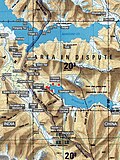
[[File:Spanggur Lake basin (US AMS, 1954).jpg|thumb|290px|Map-1: Spanggur Lake basin showing Rezang La and two "Rezang Lungpa" streams ([[Army Map Service|AMS]], 1954).]] | |||
[[File:Ladakh LAC Pangong Tso Spanggur Tso Landmarks.jpg|thumb|290px|Map-2: Rezang La, Rechin La, and two "Rezang Lungpa" streams leading to the Spanggur Lake.]] | |||
The | The watershed ridge (Map-1 and Map-2), a subrange of 60 km long [[Kailash Range]], is located on the LAC, west of [[Spanggur Tso]] and east of Chushul Valley. From west to east, has the following features: [[Spanggur Gap]] (4,900 m or 16,100 ft), [[Gurung Hill#1962|Magar Hill]], Mukhpari peak (5,545 m or 18,192 ft), Refan Pass (5,144 m or 16,877 ft), Rezang La (5,005 m or 16,420 ft), Rechin Top (5,204 m or 17,073 ft), Rechin La (5,005 m or 16,420 ft), Rezang La II (5,500 m or 18,045 ft). Refan Pass, Rezang La, and Rechin Top are served by the Indian patrol road from the Gualchung Barma campsite. Rechin La and Rezang La II are served by a separate Indian patrol road from the Tsaka La in the south. | ||
To the north of Rechin La along the LAC are various strategic hill peaks (Map-2), Mukhpari, Magar Hill, and north of Spanggur Gap is the [[Gurung Hill]]. To the south of Rezang La is [[Mount Sajum]]<!--NOTE: retain redlink to encourage article creation.--> (6,064 m or 19,895 ft).<ref name=Panag> | |||
Lt. Gen. [[H. S. Panag]], [https://theprint.in/opinion/india-sits-on-black-top-with-helmet-under-its-boots-a-1962-tactics-by-china-is-now-likely/498462/ India sits on Black Top with Helmet under its boots], ''The Print'', 9 September 2020. See "Map 1 – Kailash Range Chushul Sector". | |||
[[ | </ref> | ||
Rezang La and | The confusion about the "Rezang La" ("Rezang La I" or "Rezang La (1962)") and "Rezang La II" arose due to the old 1954 survey map (Map-1) of region by the American Army, which labeled two adjacent valleys leading to the Spanggur Lake as "Rezang Lungpa". The pass at the head of the western valley ({{Coord|33.4188|78.8494|name=Rechin La}}) at an elevation of {{cvt|16420|ft}} is labelled "Rezang La". The pass at the head of the eastern valley ({{Coord|33.3888|78.9290|name=Rezang La|notes=}}), unlabelled in the survey map [now labelled as the "Rezang La II" in some sources], is at a much higher elevation of {{cvt|20670|ft}}. The streams from these two passes (Map-1 and Map-2), which flow into Spanggur Tso, are both named as "Rezang Lungpa" on the American survey map. In 1963, the Government of India used the name "Rezang La" for pass marked on the American survey map, the one at the head of the western valley.<ref name=GoI/> References to "Rezang La" ["Rezang La I" or "Rezang La (1962)"] in the literature on 1962 [[Sino-Indian War]] in English language, refer to this pass. | ||
Chinese sources use the name "Rechin La" for another saddle between the western pass ["Rezang La", "Rezang La I" or "Rezang La (1962)"] and eastern pass ["Rezang La II"],<ref name="Sina" /> which has also been adopted by the Indian news media in 2020. | |||
The [[Chushul]] village | Rechin La as well as the present Rezang La are mountain passes on the ridge line adjoining the Chushul Valley, which China claims as its border. India's claimed border is further east, and it coincides with the border shown on most British and international maps prior to [[Partition of India|Indian independence]]. The [[Line of Actual Control]] (LAC) resulting from the 1962 [[Sino-Indian War]] coincides with the Chinese claim line in this region. The [[Chushul]] village is 27 km northwest of Rezang La. | ||
== Military operations== | ==Military operations== | ||
{{anchor | Battle }} | |||
{{see also|Galwan River#Sino-Indian_border_dispute|l1=Battle of Galwan|Dhan Singh Thapa#Battle_of_Pangong|l2=Battle of Pangong|Gurung Hill#1962|l3=Battle of Gurung Hill|Jaswant Singh Rawat#Nuranang|l4=Battle of Nuranang & Sela Pass}} | |||
===1962 battle of Rezang La=== | ===1962 battle of Rezang La=== | ||
{{ | {{main|Battle of Rezang La}} | ||
[[File:Shaitan Singh.jpg|thumb|right|A statue of Major Shaitan Singh in a central square of his native city of Jodhpur, Rajasthan, India.]] | |||
The company was led by Major [[Shaitan Singh]], who won | During the [[Sino-Indian War]] in 1962, Rechin La (then called Rezang La) was the site of the [[last stand]] of the Charlie "C" company <ref>{{cite book|title=Living Life Loving Life|author=Brig Chitranjan Sawant|date=2021|isbn= 9788184303995 |publisher= Prabhat Prakashan|pages= 150–151 |url=https://books.google.com/books?id=i7KaDAAAQBAJ&dq=13+kumaon+ahir+Living+Life+Loving+Life&pg=PA150}}</ref><ref>{{cite book |last1=Bisht |first1=Rachna |title=The Brave Param Vir Chakra Stories|date=2014 |publisher=Penguin Books Limited |isbn=9789351188056|page=all |url=https://books.google.com/books?id=rgEWBAAAQBAJ&dq=13+Kumaon+ahir&pg=PT94 |access-date=15 Aug 2014 |language=en}}</ref><ref>{{cite book |last1=Arora |first1=Dr. N. D. |title=Political Science for Civil Services Mains | ||
|date=2017 |publisher=McGraw-Hill Education|isbn=9789352604906|page=all |url=https://books.google.com/books?id=yM8mDwAAQBAJ&dq=13+Kumaon+ahir&pg=PT1990 |access-date=15 March 2017 |language=en}}</ref> of [[Kumaon Regiment|13 Kumaon]], consisting of 124 Indian soldiers.<ref>{{Cite web | url=https://penguin.co.in/book/the-battle-of-rezang-la/ | title=The Battle of Rezang la }}</ref><ref>{{Cite news | url=https://timesofindia.indiatimes.com/life-style/books/reviews/micro-review-the-battle-of-rezang-la-by-kulpreet-yadav/articleshow/89972077.cms | title=Micro review: 'The Battle of Rezang La' by Kulpreet Yadav | website=[[The Times of India]] }}</ref> According to the official Indian history of the war, the Rezang La picket of Charlie company was located at an elevation of {{convert|5500|m|ft}}, 11 km south of the [[Spanggur Gap]], on the same ridge line as Rezang La.{{sfn|Sinha|Athale|1992|p=334}} Rezang La had the drawback that an intervening feature blocked artillery operation, so that the Indian infantry had to do without artillery cover.<ref name="Guruswamy" /> | |||
The Indian side was led by Major [[Shaitan Singh]],<ref>{{Cite web |last=Raj |first=Neha |date=2023-12-01 |title=Remembering Major Shaitan Singh Bhati: The Hero of Rezang La |url=https://pune.news/trending/remembering-major-shaitan-singh-bhati-the-hero-of-rezang-la-96632/ |access-date=2023-12-02 |website=PUNE.NEWS |language=en-US}}</ref> who perished in battle and posthumously won India's highest military decoration, the [[Param Vir Chakra]], for his actions.<ref name="Remembering Rezang La heroes"> | |||
{{cite news |author=Press Information Bureau, Government of India | title=Remembering Rezang La heroes |date=7 January 2007 |newspaper=Sainik samachar |url=http://sainiksamachar.nic.in/englisharchives/2007/oct01-07/h4.htm}} | {{cite news |author=Press Information Bureau, Government of India | title=Remembering Rezang La heroes |date=7 January 2007 |newspaper=Sainik samachar |url=http://sainiksamachar.nic.in/englisharchives/2007/oct01-07/h4.htm}} | ||
</ref><ref name="Heroes of Rezang La"> | </ref><ref name="Heroes of Rezang La"> | ||
| Line 65: | Line 62: | ||
{{cite news |author=Mohan Guruswamy | title=Don't forget the heroes of Rezang La |date=20 November 2012 |newspaper=The Hindu |url=http://www.thehindu.com/opinion/lead/dont-forget-the-heroes-of-rezang-la/article4112584.ece}} | {{cite news |author=Mohan Guruswamy | title=Don't forget the heroes of Rezang La |date=20 November 2012 |newspaper=The Hindu |url=http://www.thehindu.com/opinion/lead/dont-forget-the-heroes-of-rezang-la/article4112584.ece}} | ||
</ref> | </ref> | ||
The Chinese employed [[Human wave attack|human wave]] tactics, sending up to eight waves against the Indian troop positions.<ref name="TOI">{{cite news |date=30 October 2022|title=Soldier who won respect of enemy; tale of Rezang La 1962 battle|url=https://timesofindia.indiatimes.com/city/lucknow/soldier-who-won-respect-from-enemy/articleshow/95174853.cms|newspaper=TOI| access-date= 5 October 2023}}</ref><ref name="Quint">{{cite news |date=21 November 2020|title=The 1962 War at Rezang La: A Story of Raw Courage and Spirit|url=https://www.thequint.com/opinion/india-china-war-1962-heroic-stories|newspaper=Quint| access-date= 5 October 2023}}</ref><ref name="Print">{{cite news |date=22 October 2022|title=Rezang La, 1962: When 120 Indian soldiers fought to the end & wiped out over 1,000 Chinese troops|url=https://theprint.in/world/rezang-la-1962-when-120-indian-soldiers-fought-to-the-end-wiped-out-over-1000-chinese-troops/1176198/|newspaper=Print| access-date= 5 October 2023}}</ref> Eventually, the Indian position was overrun, and Indian troops were forced to withdraw to high mountain positions. After the conclusion of battle, their valor was recognized by the Chinese, who had covered the bodies of the Indian soldiers with blankets and even placed bayonets over them so that the makeshift covers do not fly off. This mark of respect is exceptional and atypical of practices of that time.<ref name=":0">{{Cite web |date=2001-02-09 |title=BHARAT RAKSHAK MONITOR Volume 3(3) |url=http://www.bharat-rakshak.com/MONITOR/ISSUE3-3/lns.html |access-date=2024-08-02 |archive-url=https://web.archive.org/web/20010209084245/http://www.bharat-rakshak.com/MONITOR/ISSUE3-3/lns.html |archive-date=9 February 2001 }}</ref> | |||
{{cite news | | |||
</ref> | |||
=== | Both sides took overwhelming casualties, though both countries disagree over how many were killed. It is generally accepted 114 Indian soldiers out of a total of 120 lost their lives.<ref name="Official Page of Army"> | ||
{{cite news |author=Gen Dalbir Singh |date=20 November 2014 |title=Coas Paid Homage to Heroes of Battle of Rezangla |url=https://indianarmy.nic.in/Site/NewsDetail/frmNoticeDetails.aspx?ParentID=7/x1LDTCjEC27tHLLhKSLg==&MnId=7/x1LDTCjEC27tHLLhKSLg==&n=bniEtbbo9LN7kb4q3kupGg==&NewsID=YPthZ5C+a0gvZXWTGROrIw== |website=Indian Army}} | |||
</ref><ref name="The Indian Express">{{cite news |author=Shekhar Gupta |date=30 October 2012 |title='Nobody believed we had killed so many Chinese at Rezang La. Our commander called me crazy and warned that I could be court-martialled' |url=http://www.indianexpress.com/news/-nobody-believed-we-had-killed-so-many-chinese-at-rezang-la.-our-commander-called-me-crazy-and-warned-that-i-could-be-courtmartialled-/1023745/0 |newspaper=The Indian Express}}</ref> However, Indian sources claim upwards of 1,300 Chinese troops were killed in Rezang La alone, while Chinese sources claim only 722 died in the entire war. | |||
Upon successfully overrunning the mountain and reaching their claim line, the Chinese declared a ceasefire. Indian troops were ordered to withdraw from the area, marking the end of the war in Aksai Chin.<ref name=":0" /> | |||
== War memorials | ===2020 border standoff=== | ||
During the [[2020 China–India skirmishes|border standoff]] in the summer, the Indian Army deployed troops along the Line of Actual Control south of the [[Pangong Tso]], including at Rezang La and Rechin La. This was said to give them a commanding view of the Spanggur Gap and China's "Moldo sector" (the deployments around the [[Spanggur Lake]]).<ref>Manu Pubby, [https://economictimes.indiatimes.com/news/defence/chushul-tense-chinese-troops-within-firing-range-of-indian-soldiers/articleshow/77881760.cms Chushul tense: Chinese troops within firing range of Indian soldiers], The Economic Times, 1 September 2020.</ref> | |||
==War memorials == | |||
{{anchor | Rezang La war memorial | Rezangla war memorial | Rezang La War Memorial | Rezangla War Memorial }} | {{anchor | Rezang La war memorial | Rezangla war memorial | Rezang La War Memorial | Rezangla War Memorial }} | ||
=== Rezang La War Memorial at | === Battlefield tourism === | ||
Rezang La war memorial is part of the [[India–China border infrastructure#Tourism|Bharat Ranbhoomi Darshan]] initiative of the Indian Military which will boost border tourism, patriotism, local infrastructure and economy while reversing civilian outward migration from these remote locations, it entails 77 battleground war memorials in border area including the [[Battle of Longewala|Longewala War Memorial]], [[Battle of Longewala|Sadhewala War Memorial]],<ref name=bdp2>[https://www.indiatimes.com/news/here-is-the-story-of-tanot-mata-the-diety-who-protected-indian-soldiers-from-pakistani-bombs-at-longewala-in-1971-war-259867.html The Story Of Tanot Mata, The Deity Who Protected Our Soldiers From Pakistani Bombs In 1971 War], India Times, 16 Dec 2020.</ref> [[Siachen Base Camp (India)|Siachen base camp]], [[Kargil]], [[Galwan]], [[Pangong Tso]], [[Doklam]], [[Bum La]], [[Cho La (Sikkim and Tibet)|Cho La]], [[Kibithu]], etc.<ref name=bdp1>[https://www.indiatoday.in/india/story/battleground-tourism-india-indian-army-ministry-of-tourism-galwan-siachel-kargil-longewala-battle-2665110-2025-01-15. Add Galwan, Siachen to holiday plan. India is opening battle tourism bunker], India Today, 15 Jan 2025.</ref> | |||
=== Rezang La War Memorial === | |||
{{anchor | Chushul Rezang La war memorial | Rezang La war memorial at Chushul | Rezang La war memorial, Chushul }} | {{anchor | Chushul Rezang La war memorial | Rezang La war memorial at Chushul | Rezang La war memorial, Chushul }} | ||
The inscription on the War Memorial at [[Chushul]], [[Ladakh]] raised by the [[Indian Army]] in memory of the soldiers who died in the Battle of Rezang La, reads as below.<ref> | The inscription on the War Memorial at [[Chushul]], [[Ladakh]] raised by the [[Indian Army]] in memory of the soldiers who died in the Battle of Rezang La, reads as below.<ref> | ||
| Line 89: | Line 89: | ||
{{cite web |title=War Memorial of 13 Kumaon | {{cite web |title=War Memorial of 13 Kumaon | ||
|publisher=Bharat Rakshak |url=http://www.bharat-rakshak.com/LAND-FORCES/Army/Galleries/129-5/0521.jpg |url-status=dead |archive-url=https://web.archive.org/web/20140202144712/http://www.bharat-rakshak.com/LAND-FORCES/Army/Galleries/129-5/0521.jpg |archive-date=2 February 2014}} | |publisher=Bharat Rakshak |url=http://www.bharat-rakshak.com/LAND-FORCES/Army/Galleries/129-5/0521.jpg |url-status=dead |archive-url=https://web.archive.org/web/20140202144712/http://www.bharat-rakshak.com/LAND-FORCES/Army/Galleries/129-5/0521.jpg |archive-date=2 February 2014}} | ||
</ref> The first four lines are quoted from ''[[s:Horatius|Horatius]]'', a poem by | </ref> The first four lines are quoted from ''[[s:Horatius|Horatius]]'', a poem by [[Thomas Babington Macaulay]], member of the Governor-General of India's Supreme Council from 1834 to 1838<ref>{{cite web|url=http://www.gutenberg.org/files/847/847-h/847-h.htm|title=Lays of Ancient Rome|author= Thomas Babbington Macaulay|website=Gutenberg.org|access-date=2016-04-08}}</ref> | ||
[[File:Rezang La war memorial site.jpg|alt=Rezang La war memorial at Ahir Dham, Chushul, Ladakh, India|thumb|Rezang La war memorial at Ahir Dham, Chushul, Ladakh, India]] | |||
<blockquote><poem>How can a man die better, | [[File:Rezang La War Memorial Plaque.jpg|alt=Plaque at the Rezang La war memorial|thumb|Plaque at the Rezang La war memorial]]<blockquote><poem>How can a man die better, | ||
Than facing fearful odds, | Than facing fearful odds, | ||
For the ashes of his fathers, | For the ashes of his fathers, | ||
And temples of his gods. | And the temples of his gods. | ||
To the sacred memory of | To the sacred memory of | ||
the heroes of Rezang-La | the heroes of Rezang-La | ||
114 martyrs of 13 Kumaon | 114 martyrs of 13 Kumaon | ||
who fought | who fought | ||
to the last man last round | to the last man, last round | ||
against hordes of Chinese | against hordes of Chinese | ||
on | on | ||
| Line 107: | Line 107: | ||
</poem></blockquote> | </poem></blockquote> | ||
[[Major-General]] [[Ian Cardozo]] writes in his book '' | [[Major-General]] [[Ian Cardozo]] writes in his book ''Param Vir, Our Heroes in Battle'': {{blockquote|When Rezang La was later revisited, dead jawans were found in the trenches still holding on to their weapons... every single man of this company was found dead in his trench with several bullets or splinter wounds. The 2-inch mortar man died with a bomb still in his hand. The medical orderly had a syringe and a bandage in his hands when the Chinese bullet hit him... Of the thousand mortar bombs with the defenders, all but seven had been fired, and the rest were ready to be fired when the (mortar) section was overrun.}} | ||
General [[T.N. Raina]] lauded:<ref name="Tribune India"> | General [[T.N. Raina]] lauded:<ref name="Tribune India"> | ||
Atul Yadav, [http://www.tribuneindia.com/1999/99nov18/edit.htm Injustice to Ahir martyrs of 1962 war], Tribune India, 18 November 1999.</ref> {{blockquote|You rarely come across such example in the annals of world military history when braving such heavy odds, the men fought till the last bullet and the last man. Certainly, the Battle of Rezang La is such a shining example.}} | Atul Yadav, [http://www.tribuneindia.com/1999/99nov18/edit.htm "Injustice to Ahir martyrs of 1962 war"], ''Tribune India'', 18 November 1999.</ref> {{blockquote|You rarely come across such an example in the annals of world military history when braving such heavy odds, the men fought till the last bullet and the last man. Certainly, the Battle of Rezang La is such a shining example.}} | ||
=== Rezang La War Memorial at Rewari === | ===Rezang La War Memorial at Rewari=== | ||
{{anchor | Rewari Rezang La war memorial | Rezang La war memorial at Rewari | Rezang La war memorial, Rewari }} | {{anchor | Rewari Rezang La war memorial | Rezang La war memorial at Rewari | Rezang La war memorial, Rewari }} | ||
[[File:Capt. Ram Chander and Hav Nihal Singh, Sena medal.jpg|thumb]] | |||
General [[K S Thimayya]] wished for a memorial to be built in [[Haryana]] in the memory of soldiers who were mostly from this area. He felt generations to come would seek inspiration from the immense courage and valour of their forefathers.<ref name="Tribune India"/> Consequently, another Rezang La war memorial was constructed by ''Rezangla Shaurya Samiti'' inside Rezang La Park near [[Dharuhera]] Chowk in [[Rewari]] city. Annual memorial function is held by the Samiti in collaboration with district administration, the [[Kumaon Regiment]] and family members of those who died at Rezang La also participate. | |||
In every special and cultural event in Delhi-NCR and Rewari, the two "bravest soldiers", Capt. Ram Chander Singh and Hav Nihal Singh, Sena Medal, will be the chief guests as they tell the story of Rajangla. On 24 February 2023, they were the chief guests on Rao Bal Kishan Shaurya Diwas. They also unveiled the portrait of "Rao Bal Kishan".<ref>{{Cite web|url=https://www.bhaskar.com/local/haryana/rohtak/rewari/news/martyrs-day-of-veer-amar-shaheed-rao-balkishan-celebrated-in-nangal-pathani-128254998.html|title=नांगल पठानी में मनाया वीर अमर शहीद राव बालकिशन का शहीदी दिवस|access-date=14 March 2023}}</ref> | |||
==Transport== | |||
[[National Highway 3 (India)|National Highway 3]] is the closest NH for this location. One can reach to via Loma Bridge/Loma ITBP Check Post and Mahe Bridge. Both were built over the Indus River. Distance is 170 km. It meets to [[Miru, Ladakh|Miru]], where proposed [[Bhanupli–Leh line]] will connect. | |||
==See also== | ==See also== | ||
| Line 122: | Line 127: | ||
* [[Sino-Indian border dispute]] | * [[Sino-Indian border dispute]] | ||
* [[Gurung Hill]] | * [[Gurung Hill]] | ||
* [[Shaitan Singh]] | |||
==References== | ==References== | ||
| Line 133: | Line 139: | ||
* [http://www.rezanglass.com/ Rezangla Shaurya Samiti] | * [http://www.rezanglass.com/ Rezangla Shaurya Samiti] | ||
{{Mountain passes of China}} | |||
{{Mountain passes of India}} | {{Mountain passes of India}} | ||
{{Ladakh}} | {{Ladakh}} | ||
[[Category:Mountain passes of China]] | |||
[[Category:Mountain passes of Tibet]] | |||
[[Category:Mountain passes of Ladakh]] | [[Category:Mountain passes of Ladakh]] | ||
[[Category:Sino-Indian War]] | [[Category:Sino-Indian War]] | ||
[[Category:Borders of Ladakh]] | [[Category:Borders of Ladakh]] | ||
[[Category:Rutog County]] | [[Category:Rutog County]] | ||
Revision as of 21:44, 23 January 2026
| Rezang La | |
|---|---|
| Rechin La | |
<mapframe>: The JSON content is not valid GeoJSON+simplestyle. The list below shows all attempts to interpret it according to the JSON Schema. Not all are errors.
Interactive map of Rezang La | |
| Elevation | 5,500 m (18,000 ft) |
| Location | |
| Location | Leh district, Ladakh, India - Rutog County, Tibet Autonomous Region, China |
| Range | Himalaya, Ladakh Range |
| Coordinates | 33°25′08″N 78°50′58″E / 33.4188°N 78.8494°E |
Rezang La[1] (site of 1962 Sino-Indian War),[2] Rechin La, and Rezang La II,[3] listed west to east, are mountain passes on the watershed ridge which lies east of Indian-administered Chushul Valley in Ladakh and west of Chinese-administered Spanggur Lake basin. China claims that the Line of Actual Control between the two countries passes along the top of this ridge, while India's LAC and border claim lines are further east.
About 3 km southeast of Rechin La (33°24′52″N 78°52′29″E / 33.4144°N 78.8748°E) on the same ridge is a pass leading to an adjacent valley, which China recognizes as Rezang La (Chinese: 热藏山口; pinyin: Rèzàng Shānkǒu) [labelled as the "Rezang La II" in some sources].[3]
About 3 km northwest of Rechin La (33°26′38″N 78°49′48″E / 33.4440°N 78.8300°E) is a pass, [labelled as the "[Old] Rezang La", "Rezang La I" or "Rezang La (1962)" in some sources], that was the site of a major battle of the 1962 Sino-Indian War.[2] The "C" Company of India's 13 Kumaon battalion under Major Shaitan Singh, fought to the last man in an effort to block the Chinese PLA troops from crossing the ridge into the Chushul Valley. Indian sources state 120 men killed over 1500 PLA troops out of 3000. The battle was the last event of the Sino-Indian War, as the pass was the Chinese claim line and upon overrunning the ridge, a ceasefire was called.[4]
During the 2020–2021 China–India skirmishes, wider Rezang La area was again the site of conflict between the two nations.
Geography
.jpg)

The watershed ridge (Map-1 and Map-2), a subrange of 60 km long Kailash Range, is located on the LAC, west of Spanggur Tso and east of Chushul Valley. From west to east, has the following features: Spanggur Gap (4,900 m or 16,100 ft), Magar Hill, Mukhpari peak (5,545 m or 18,192 ft), Refan Pass (5,144 m or 16,877 ft), Rezang La (5,005 m or 16,420 ft), Rechin Top (5,204 m or 17,073 ft), Rechin La (5,005 m or 16,420 ft), Rezang La II (5,500 m or 18,045 ft). Refan Pass, Rezang La, and Rechin Top are served by the Indian patrol road from the Gualchung Barma campsite. Rechin La and Rezang La II are served by a separate Indian patrol road from the Tsaka La in the south.
To the north of Rechin La along the LAC are various strategic hill peaks (Map-2), Mukhpari, Magar Hill, and north of Spanggur Gap is the Gurung Hill. To the south of Rezang La is Mount Sajum (6,064 m or 19,895 ft).[2]
The confusion about the "Rezang La" ("Rezang La I" or "Rezang La (1962)") and "Rezang La II" arose due to the old 1954 survey map (Map-1) of region by the American Army, which labeled two adjacent valleys leading to the Spanggur Lake as "Rezang Lungpa". The pass at the head of the western valley (33°25′08″N 78°50′58″E / 33.4188°N 78.8494°E) at an elevation of 16,420 ft (5,000 m) is labelled "Rezang La". The pass at the head of the eastern valley (33°23′20″N 78°55′44″E / 33.3888°N 78.9290°E), unlabelled in the survey map [now labelled as the "Rezang La II" in some sources], is at a much higher elevation of 20,670 ft (6,300 m). The streams from these two passes (Map-1 and Map-2), which flow into Spanggur Tso, are both named as "Rezang Lungpa" on the American survey map. In 1963, the Government of India used the name "Rezang La" for pass marked on the American survey map, the one at the head of the western valley.[1] References to "Rezang La" ["Rezang La I" or "Rezang La (1962)"] in the literature on 1962 Sino-Indian War in English language, refer to this pass.
Chinese sources use the name "Rechin La" for another saddle between the western pass ["Rezang La", "Rezang La I" or "Rezang La (1962)"] and eastern pass ["Rezang La II"],[3] which has also been adopted by the Indian news media in 2020.
Rechin La as well as the present Rezang La are mountain passes on the ridge line adjoining the Chushul Valley, which China claims as its border. India's claimed border is further east, and it coincides with the border shown on most British and international maps prior to Indian independence. The Line of Actual Control (LAC) resulting from the 1962 Sino-Indian War coincides with the Chinese claim line in this region. The Chushul village is 27 km northwest of Rezang La.
Military operations
1962 battle of Rezang La

During the Sino-Indian War in 1962, Rechin La (then called Rezang La) was the site of the last stand of the Charlie "C" company [5][6][7] of 13 Kumaon, consisting of 124 Indian soldiers.[8][9] According to the official Indian history of the war, the Rezang La picket of Charlie company was located at an elevation of 5,500 metres (18,000 ft), 11 km south of the Spanggur Gap, on the same ridge line as Rezang La.[10] Rezang La had the drawback that an intervening feature blocked artillery operation, so that the Indian infantry had to do without artillery cover.[11] The Indian side was led by Major Shaitan Singh,[12] who perished in battle and posthumously won India's highest military decoration, the Param Vir Chakra, for his actions.[13][14][11]
The Chinese employed human wave tactics, sending up to eight waves against the Indian troop positions.[15][16][17] Eventually, the Indian position was overrun, and Indian troops were forced to withdraw to high mountain positions. After the conclusion of battle, their valor was recognized by the Chinese, who had covered the bodies of the Indian soldiers with blankets and even placed bayonets over them so that the makeshift covers do not fly off. This mark of respect is exceptional and atypical of practices of that time.[4]
Both sides took overwhelming casualties, though both countries disagree over how many were killed. It is generally accepted 114 Indian soldiers out of a total of 120 lost their lives.[18][19] However, Indian sources claim upwards of 1,300 Chinese troops were killed in Rezang La alone, while Chinese sources claim only 722 died in the entire war.
Upon successfully overrunning the mountain and reaching their claim line, the Chinese declared a ceasefire. Indian troops were ordered to withdraw from the area, marking the end of the war in Aksai Chin.[4]
2020 border standoff
During the border standoff in the summer, the Indian Army deployed troops along the Line of Actual Control south of the Pangong Tso, including at Rezang La and Rechin La. This was said to give them a commanding view of the Spanggur Gap and China's "Moldo sector" (the deployments around the Spanggur Lake).[20]
War memorials
Battlefield tourism
Rezang La war memorial is part of the Bharat Ranbhoomi Darshan initiative of the Indian Military which will boost border tourism, patriotism, local infrastructure and economy while reversing civilian outward migration from these remote locations, it entails 77 battleground war memorials in border area including the Longewala War Memorial, Sadhewala War Memorial,[21] Siachen base camp, Kargil, Galwan, Pangong Tso, Doklam, Bum La, Cho La, Kibithu, etc.[22]
Rezang La War Memorial
The inscription on the War Memorial at Chushul, Ladakh raised by the Indian Army in memory of the soldiers who died in the Battle of Rezang La, reads as below.[23][24] The first four lines are quoted from Horatius, a poem by Thomas Babington Macaulay, member of the Governor-General of India's Supreme Council from 1834 to 1838[25]


How can a man die better,
Than facing fearful odds,
For the ashes of his fathers,
And the temples of his gods.
To the sacred memory of
the heroes of Rezang-La
114 martyrs of 13 Kumaon
who fought
to the last man, last round
against hordes of Chinese
on
18 November 1962.
Built by all ranks
13th Battalion the Kumaon Regiment.
Major-General Ian Cardozo writes in his book Param Vir, Our Heroes in Battle:
When Rezang La was later revisited, dead jawans were found in the trenches still holding on to their weapons... every single man of this company was found dead in his trench with several bullets or splinter wounds. The 2-inch mortar man died with a bomb still in his hand. The medical orderly had a syringe and a bandage in his hands when the Chinese bullet hit him... Of the thousand mortar bombs with the defenders, all but seven had been fired, and the rest were ready to be fired when the (mortar) section was overrun.
General T.N. Raina lauded:[26]
You rarely come across such an example in the annals of world military history when braving such heavy odds, the men fought till the last bullet and the last man. Certainly, the Battle of Rezang La is such a shining example.
Rezang La War Memorial at Rewari

General K S Thimayya wished for a memorial to be built in Haryana in the memory of soldiers who were mostly from this area. He felt generations to come would seek inspiration from the immense courage and valour of their forefathers.[26] Consequently, another Rezang La war memorial was constructed by Rezangla Shaurya Samiti inside Rezang La Park near Dharuhera Chowk in Rewari city. Annual memorial function is held by the Samiti in collaboration with district administration, the Kumaon Regiment and family members of those who died at Rezang La also participate. In every special and cultural event in Delhi-NCR and Rewari, the two "bravest soldiers", Capt. Ram Chander Singh and Hav Nihal Singh, Sena Medal, will be the chief guests as they tell the story of Rajangla. On 24 February 2023, they were the chief guests on Rao Bal Kishan Shaurya Diwas. They also unveiled the portrait of "Rao Bal Kishan".[27]
Transport
National Highway 3 is the closest NH for this location. One can reach to via Loma Bridge/Loma ITBP Check Post and Mahe Bridge. Both were built over the Indus River. Distance is 170 km. It meets to Miru, where proposed Bhanupli–Leh line will connect.
See also
- Border Personnel Meeting point
- India-China Border Roads
- Sino-Indian border dispute
- Gurung Hill
- Shaitan Singh
References
- ↑ 1.0 1.1 Note given by the Ministry of External Affairs, New Delhi, to the Embassy of China in India, 26 July 1963. "The location of Rezang La (E 78° 51' 10" N 33° 25' 30" [33°25′30″N 78°51′10″E / 33.42500°N 78.85278°E]) is well known... "
- ↑ 2.0 2.1 2.2 Lt. Gen. H. S. Panag, India sits on Black Top with Helmet under its boots, The Print, 9 September 2020. See "Map 1 – Kailash Range Chushul Sector".
- ↑ 3.0 3.1 3.2 "Zhōng yìn tǎnkè yí zài bān gōng hú yǐ nán rè qīn shānkǒu duìzhì xiāngjù jǐn shǔ mǐ" 中印坦克疑在班公湖以南热钦山口对峙 相距仅数米 [Chinese and Indian tanks are suspected to be facing off at Rechin Pass, south of Pangong Lake, just a few meters apart], Sina Military News, 11 January 2021
- ↑ 4.0 4.1 4.2 "BHARAT RAKSHAK MONITOR Volume 3(3)". 9 February 2001. Archived from the original on 9 February 2001. Retrieved 2 August 2024.
- ↑ Brig Chitranjan Sawant (2021). Living Life Loving Life. Prabhat Prakashan. pp. 150–151. ISBN 9788184303995.
- ↑ Bisht, Rachna (2014). The Brave Param Vir Chakra Stories. Penguin Books Limited. p. all. ISBN 9789351188056. Retrieved 15 August 2014.
- ↑ Arora, Dr. N. D. (2017). Political Science for Civil Services Mains. McGraw-Hill Education. p. all. ISBN 9789352604906. Retrieved 15 March 2017.
- ↑ "The Battle of Rezang la".
- ↑ "Micro review: 'The Battle of Rezang La' by Kulpreet Yadav". The Times of India.
- ↑ Sinha & Athale 1992, p. 334.
- ↑ 11.0 11.1 Mohan Guruswamy (20 November 2012). "Don't forget the heroes of Rezang La". The Hindu.
- ↑ Raj, Neha (1 December 2023). "Remembering Major Shaitan Singh Bhati: The Hero of Rezang La". PUNE.NEWS. Retrieved 2 December 2023.
- ↑ Press Information Bureau, Government of India (7 January 2007). "Remembering Rezang La heroes". Sainik samachar.
- ↑ Col Dilbag Dabas (Retd) (15 December 2018). "Heroes of Rezang La 1962". The Tribune.
- ↑ "Soldier who won respect of enemy; tale of Rezang La 1962 battle". TOI. 30 October 2022. Retrieved 5 October 2023.
- ↑ "The 1962 War at Rezang La: A Story of Raw Courage and Spirit". Quint. 21 November 2020. Retrieved 5 October 2023.
- ↑ "Rezang La, 1962: When 120 Indian soldiers fought to the end & wiped out over 1,000 Chinese troops". Print. 22 October 2022. Retrieved 5 October 2023.
- ↑ Gen Dalbir Singh (20 November 2014). "Coas Paid Homage to Heroes of Battle of Rezangla". Indian Army.
- ↑ Shekhar Gupta (30 October 2012). "'Nobody believed we had killed so many Chinese at Rezang La. Our commander called me crazy and warned that I could be court-martialled'". The Indian Express.
- ↑ Manu Pubby, Chushul tense: Chinese troops within firing range of Indian soldiers, The Economic Times, 1 September 2020.
- ↑ The Story Of Tanot Mata, The Deity Who Protected Our Soldiers From Pakistani Bombs In 1971 War, India Times, 16 Dec 2020.
- ↑ Add Galwan, Siachen to holiday plan. India is opening battle tourism bunker, India Today, 15 Jan 2025.
- ↑ "Photograph of the memorial". bharat-rakshak.com. Archived from the original on 28 January 2014.
- ↑ "War Memorial of 13 Kumaon". Bharat Rakshak. Archived from the original on 2 February 2014.
- ↑ Thomas Babbington Macaulay. "Lays of Ancient Rome". Gutenberg.org. Retrieved 8 April 2016.
- ↑ 26.0 26.1 Atul Yadav, "Injustice to Ahir martyrs of 1962 war", Tribune India, 18 November 1999.
- ↑ "नांगल पठानी में मनाया वीर अमर शहीद राव बालकिशन का शहीदी दिवस". Retrieved 14 March 2023.
Bibliography
- Sinha, P.B.; Athale, A.A. (1992), History of the Conflict with China, 1962 (PDF), History Division, Ministry of Defence, Government of India
External links
Template:Mountain passes of China
| History |
| ||||||||||||||||||
|---|---|---|---|---|---|---|---|---|---|---|---|---|---|---|---|---|---|---|---|
| Administration | |||||||||||||||||||
| Geography |
| ||||||||||||||||||
| Human settlements | |||||||||||||||||||
| Culture |
| ||||||||||||||||||
| Tourism and wildlife |
| ||||||||||||||||||
| Transport |
| ||||||||||||||||||
| Infrastructure |
| ||||||||||||||||||
| See also |
| ||||||||||||||||||


