

m Removed empty portal template using script |
Shahidkumar (talk | contribs) slightly updated intro per sources and cleaned formatting |
||
| Line 1: | Line 1: | ||
{{Short description| | {{Short description|Chhatrapati of the Marathas from 1681 to 1689}} | ||
{{ | {{otheruses}} | ||
{{Use dmy dates|date= | {{pp-semi-indef|small=yes}} | ||
{{Pp-move|small=no}} | |||
{{Use dmy dates|date=September 2024}} | |||
{{use Indian English|date=February 2016}} | {{use Indian English|date=February 2016}} | ||
{{Infobox royalty | {{Infobox royalty | ||
| Line 7: | Line 9: | ||
| title = | | title = | ||
| image = Sambhaji painting late 17th century.png | | image = Sambhaji painting late 17th century.png | ||
| caption = | | caption = Portrait of Sambhaji, late 17th century. | ||
| succession = | | succession = [[Chhatrapati of the Marathas]] | ||
| reign = 16 January 1681 – 11 March 1689 | | reign = 16 January 1681 – 11 March 1689 | ||
| coronation = 20 July 1680, [[Panhala]] (symbolic)<br /> | | coronation = 20 July 1680, [[Panhala]] (symbolic)<br />16 January 1681, [[Raigad fort]] (official) | ||
| predecessor = [[Shivaji|Shivaji I]] | | predecessor = [[Shivaji|Shivaji I]] | ||
| successor = [[Rajaram I]] | | successor = [[Rajaram I]] | ||
| birth_date = {{Birth date|df=yes|1657|5|14}} | | birth_date = {{Birth date|df=yes|1657|5|14}} | ||
| birth_place = [[Purandar Fort]], [[ | | birth_place = [[Purandar Fort]], [[Ahmadnagar Subah]], [[Mughal Empire]] {{small|(present-day [[Pune district]], [[Maharashtra]], [[India]])}} | ||
| death_date = {{Death date and age|df=yes|1689|3|11|1657|5|14}} | | death_date = {{Death date and age|df=yes|1689|3|11|1657|5|14}} | ||
| death_place = [[Tulapur]], | | death_place = [[Tulapur]], Ahmadnagar Subah, Mughal Empire {{small|(present-day Pune district, Maharashtra, India)}} | ||
| death_cause = [[Execution of Sambhaji|Execution]] by [[decapitation]] | |||
| spouse = [[Yesubai Bhonsale|Yesubai]] | | spouse = [[Yesubai Bhonsale|Yesubai]] | ||
| issue = Bhavani Bai<br /> [[Shahu I]] | | issue = Bhavani Bai<br /> [[Shahu I]] | ||
| Line 28: | Line 31: | ||
*[[Ramchandra Pant Amatya]] | *[[Ramchandra Pant Amatya]] | ||
}} | }} | ||
| royal house = [[Bhonsle| | | royal house = [[Bhonsle dynasty|Bhonsale]] | ||
}} | }} | ||
'''Sambhaji''' ( | '''Sambhaji''' (Sambhajiraje Shivajiraje Bhonsle, {{IPA|mr|saːmˈbʱaːdʑiː ˈbʱos(ə)le}}; 14 May 1657 – 11 March 1689), also known as '''Shambhuraje''', ruled from 1681 to 1689 as the second king ([[Chhatrapati]]) of the [[Maratha Empire]], a prominent state in [[early modern India]]. He was the eldest son of [[Shivaji]], the founder of the Maratha Empire. | ||
At the age of nine, Sambhaji was taken as a [[Hostage#Historical hostage practices|political hostage]] of the [[Mughal Empire]], to guarantee his father's compliance with the [[Treaty of Purandar (1665)|treaty of Purandar]]. He later accompanied his father to [[Agra]] where both were placed under house arrest by the Mughal Emperor [[Aurangzeb]]; they subsequently escaped. He was later confined by his father at [[Panhala Fort]], with some theories suggesting that it was due to his addiction to "sensual pleasures" or for violating a [[Brahmin]] woman.<ref name="Sensual pleasures-1982-2003"> | |||
* {{cite book |last=Laine |first=James W. |author-link=James Laine |url=https://academic.oup.com/book/10230 |title=Shivaji: Hindu King in Islamic India |date=13 February 2003 |publisher=[[Oxford University Press]] |isbn=978-0-19-514126-9 |page=93 |chapter=Cracks in the Narrative |doi=10.1093/acprof:oso/9780195141269.003.0006 |quote=Besides the fact that Shivaji grew up apart from his father, we are also aware of his testy relationship with his oldest son Sambhaji, who deserted his father's cause for a time and allied with the Mughals, and is primarily remembered for his affronts to the chaste virtue of brahmin women, his drug use, and his association with Tantric priests of questionable integrity |chapter-url=https://academic.oup.com/book/10230/chapter/157915767}} | |||
* {{cite book |last=Richards |first=John F. |author-link=John F. Richards |url=https://books.google.com/books?id=HHyVh29gy4QC |title=The Mughal Empire |date=1993 |publisher=[[Cambridge University Press]] |isbn=978-0-521-56603-2 |page=215 |chapter=Maratha insurgency and Mughal conquest in the Deccan |quote=In December 1678, in disgrace for the rape of a respectable Brahmin woman, [he] escaped his father's surveillance and fled.}} | |||
* {{cite book |last=Mehta |first=Jaswant Lal |url=https://books.google.com/books?id=-TsMl0vSc0gC&pg=PA551 |title=Advanced Study in the History of Medieval India |publisher=Sterling Publishers Pvt. Ltd |year=1984 |isbn=978-81-207-1015-3 |pages=551 |quote=Though an excellent warrior, he became addicted to sensual pleasures on attaining maturity and displayed irresponsible conduct, unbecoming of a crown prince. What Salim had been to Akbar, Sambhaji was to his father Shivaji.}} | |||
</ref> He subsequently defected to the [[Mughal Empire]] and served under [[Diler Khan]] in the [[Battle of Bhupalgarh]] against his father. He ascended the throne following his father's death, with his rule being largely shaped by the ongoing wars between the Marathas and the Mughal Empire, as well as other neighbouring powers such as the [[Siddi|Siddi of Janjira]], the [[Kingdom of Mysore|Wadiyars of Mysore]] and the [[Portuguese Empire]] in [[Goa]]. | |||
Early in his rule, Marathas under Sambhaji attacked and disrupted supply lines and raided into the Mughal territory, although they were unsuccessful in taking over main forts. In 1683, Sambhaji executed 24 members of influential families including top government ministers after discovering a plot to poison him.<ref name="stewart2">{{cite book |last=Gordon |first=Stewart|authorlink=Stewart N. Gordon |url=https://archive.org/details/marathas160018180000gord/mode/2up |title=The Marathas 1600-1818 |date=1993 |publisher=[[Cambridge University Press]] |isbn=978-0-521-26883-7 |publication-place=Cambridge}}</ref>{{rp|106}} By 1685, Mughals had gradually pushed back Sambhaji's forces by taking over their strongholds. Desertions became common by the end of his reign, and he had alienated Maratha [[deshmukhs]] (land owners) by burning villages to deny supplies to the Portuguese. In 1689, he was captured by Mughal forces and [[Execution of Sambhaji|executed]]. His brother [[Rajaram I]] succeeded him as king and continued the [[Mughal–Maratha Wars]].<ref name="stewart2" />{{rp|80, 91–95}}<ref name="sen22">{{Cite book |last=Sen |first=Sailendra |title=A Textbook of Medieval Indian History |publisher=Primus Books |year=2013 |isbn=978-93-80607-34-4}}</ref>{{rp|199–200}} | |||
Sambhaji is viewed poorly by historians, who note that his personal problems—and war crimes committed by his soldiers—overshadowed his moderate military and administrative successes.<ref name="Sardesai1946">{{cite book |author-first=Govind Sakharam |author-last=Sardesai |author-link=Govind Sakharam Sardesai |url=https://archive.org/details/in.ernet.dli.2015.505237/page/n251/mode/2up |title=New History of the Marathas |publisher=Phoenix Publications |year=1946 |pages=294–316}}</ref> Maratha soldiers under Sambhaji's command during his campaigns committed atrocities against civilians including massacres and [[mass rape]].<ref name="Pissurlencar-1983">{{cite book |last=Pissurlencar |first=P. S. |url=https://archive.org/details/portuguese-mahratta-relations_202102 |title=Portuguese Mahratta Relations |publisher=Originally published in Marathi by University of Poona, English translation published by Maharashtra state board of literature and culture |year=1983 |publication-place=Poona, Bombay |page=89 |translator-last=Parvate |translator-first=T. V. |chapter=During Sambhaji's reign and after |quote="The Mahrattas resorted to plunder and arson, demolishing a number of Christian churches and the images therein, raping a number of Christian women. carrying off a number of men, women and children and presenting many of them to their soldiers." |orig-date=1967 |chapter-url=https://archive.org/details/portuguese-mahratta-relations_202102/page/76/mode/1up}}</ref><ref name="Sarkar-2007">{{cite book |last=Sarkar |first=Jadunath |title=Fall of the Mughal Empire |date=2007 |publisher=Orient Longman |isbn=978-81-250-3245-8 |volume=1 |publication-place=Hyderabad |page=[https://archive.org/details/in.ernet.dli.2015.43007/page/n78/mode/1up 54-55] |quote="The Maratha soldiers were notorious for their practice of gang-rape in invaded territories from a very early time. In 1688 when they invaded the Goa districts under the eyes of their king Shambhuji, they committed this kind of outrage" |orig-date=1932}}</ref> As a ruler, Sambhaji implemented drought relief measures and encouraged agricultural development while continuing his father's administrative systems. He was also a scholar who authored several works in Sanskrit and Hindustani, including the political treatise ''[[:mr:बुधभूषण|Budhbhushanam]]''. His torture and death at the hands of the Mughal Empire elevated him to the status of a [[martyr]]. He remains popular in modern India among many [[Hindutva|Hindu nationalists]]. | |||
== Early life == | == Early life == | ||
Sambhaji was born at [[Purandar fort]] to the [[Maratha (caste)|Maratha]] | Sambhaji was born at [[Purandar fort]] to the [[Maratha (caste)|Maratha]] Chhtrapati, [[Shivaji]], and his first wife, [[Sai Bhonsale|Saibai]], who died when he was two years old. He was then raised by his paternal grandmother [[Jijabai]].<ref name="Joshi1980" /> At the age of nine, Sambhaji was sent to live with Raja [[Jai Singh I]] of [[Amber (state)|Amber]] as a [[Hostage#Historical hostage practices|political hostage]] to ensure compliance with the [[Treaty of Purandar (1665)|Treaty of Purandar]] that Shivaji had signed with the Mughals on 11 June 1665. As a result of the treaty, Sambhaji became a Mughal [[mansabdar]].<ref name="Rana"/>{{rp|64}} He and his father Shivaji attended the Mughal emperor [[Aurangzeb]]'s court at [[Agra]] on 12 May 1666. Aurangzeb put both of them under house arrest but they escaped on 22 July 1666.<ref name="stewart2" />{{Rp|pages=74–78}} However, the two sides reconciled and had cordial relations during the period 1666–1670.{{cn|date=August 2025}} | ||
During the period between 1666 and 1668, Aurangzeb initially refused but later officially recognized the title of Raja that Shivaji assumed, on behalf of the Mughal Empire, after being pressed by [[Bahadur Shah I|Prince Mu'azzam]]. Aurangzeb looked upon the friendship of Prince Muazzam and Shivaji and Sambhaji with great suspicion.<ref name="Joshi1980" />{{rp|91–93}} By mediation of Muazzam, Sambhaji was also restored to the Mughal [[mansabdar]] rank of 5,000 cavalry. Shivaji then sent Sambhaji with general [[Prataprao Gujar]] to take service under [[Bahadur Shah I|Prince Mu'azzam]] who was the Mughal viceroy at Aurangabad with [[Diler Khan]] as his deputy. Sambhaji visited prince Muazzam at Aurangabad on 4 November 1667 and was then granted rights to territory in [[Berar sultanate|Berar]] on the pretext of revenue collection. After a short stay, Sambhaji returned to Rajgad while representative Maratha officers continued to stay in Aurangabad. In this period, the Marathas under Sambhaji fought alongside the Mughals under Muazzam against the [[Sultanate of Bijapur]].<ref name="Rana"/>{{rp|64}}<ref>{{cite book |last=Sarkar |first=Jadunath |author-link=Jadunath Sarkar |title=Shivaji and His Times |url=https://archive.org/details/shivajihistimes00sarkrich |edition=Second |publisher=Longmans, Green and Co. |location=London |year=1920 |orig-year=1919 |page=185}}</ref> | |||
=== Marriage === | === Marriage === | ||
Sambhaji was married to Jivubai in a marriage of political alliance and as per Maratha custom, she took the name [[Yesubai]]. Jivubai was the daughter of Pilaji Shirke, who had entered Shivaji's service following the defeat of [[Deshmukh]] Suryaji Surve who was his previous liege. This marriage thus gave Shivaji the access of the region of [[Konkan]] coastal belt.<ref name="Mehta2005">{{cite book |author=J. L. Mehta |title=Advanced Study in the History of Modern India: Volume One: 1707–1813 |url=https://books.google.com/books?id=d1wUgKKzawoC&pg=PA47 | Sambhaji was married to Jivubai in a marriage of political alliance and as per Maratha custom, she took the name [[Yesubai]]. Jivubai was the daughter of Pilaji Shirke, who had entered Shivaji's service following the defeat of [[Deshmukh]] Suryaji Surve who was his previous liege. This marriage thus gave Shivaji the access of the region of [[Konkan]] coastal belt.<ref name="Mehta2005">{{cite book |author-first=J. L. |author-last=Mehta |title=Advanced Study in the History of Modern India: Volume One: 1707–1813 |url=https://books.google.com/books?id=d1wUgKKzawoC&pg=PA47 |access-date=7 April 2016 |date=1 January 2005 |publisher=Sterling Publishers Pvt. Ltd |isbn=978-1-932705-54-6}}</ref>{{rp|4,47}}<ref name="Rana">{{cite book |last1=Rana |first1=Bhawan Singh |title=Chhatrapati Shivaji |date=2004 |publisher=Diamond Pocket Books |location=New Delhi |isbn=81-288-0826-5 |edition=1st |url=https://books.google.com/books?id=HsBPTc3hcekC&q=sambhaji+shivaji+diler+khan&pg=PA7 |access-date=26 July 2016}}</ref>{{rp|96–99}} Yesubai had two children, daughter Bhavani Bai and then a son named [[Shahu I]], who later became the Chhatrapati of the Maratha kingdom. According to ''[[Maasir-i-Alamgiri]]'', daughters of Sambhaji and his brother Rajaram were married to Mughal noblemen.<ref>{{cite book |author-link=James Laine |last=Laine |first=James W. |title=Shivaji: Hindu King in Islamic India |publisher=[[Oxford University Press]] |date=13 February 2003 |isbn=978-0-19-514126-9 |doi=10.1093/acprof:oso/9780195141269.003.0004 |page=48 |chapter=The Hindu Hero: Shivaji and the Saints, 1780–1810|chapter-url=https://academic.oup.com/book/10230/chapter/157914310|url=https://academic.oup.com/book/10230}}</ref> | ||
=== Arrest and defection to the Mughals === | === Arrest and defection to the Mughals === | ||
Sambhaji | The elder Shivaji imprisoned his son Sambhaji at [[Panhala Fort]] in 1678. Contemporary author [[Khafi Khan]] suggested that his imprisonment was for personal behavior including alleged irresponsibility and addiction to "sensual pleasures".<ref name="Mehta2005" /><ref name="Vatsal">{{cite book |last=Vatsal |first=Tulsi |url=https://books.google.com/books?id=kygKAQAAIAAJ |title=Indian political history, from the Marathas to modern times |publisher=Orient Longman |year=1982 |page=29}}</ref><ref name="Sardesai1946" />{{Rp|page=251}}Another theory suggests that Sambhaji was imprisoned at the Panhala because he "attempted to violate a Brahmin's wife".<ref name="Sensual pleasures-1982-2003" /><ref name="Saletore">{{cite book|author-first=Rajaram Narayan |author-last=Saletore|title=Sex in Indian Harem Life|url=https://books.google.com/books?id=4ikbAAAAYAAJ|year=1978|publisher=Orient Paperbacks|page=143|quote=During his life-time his son Sambhaji's conduct was a source of grief and vexation to him. When Sambhaji attempted to violate a Brahman's wife, Shivaji confined his son for a time in Panhala fort and, after his release, placed a strict watch over him.}}</ref><ref>{{cite book |first=Raghunath Vinayak |last=Herwadkar |title=A forgotten literature: foundations of Marathi chronicles |url=https://books.google.com/books?id=l8pHAAAAMAAJ |year=1994 |publisher=Popular Prakashan |isbn=978-81-7154-779-1 |page=52 |quote=He further adds that Sabhasad, the chronicler of Shivaji, may not be correct literally in this respect, but the implication therein appears to be probable. Jadunath Sarkar comments on this point: 'Shambuji (was) a grownup youth notorious for his violent temper and self-indulgent character. . .Shambuji's own conduct brought matters to a crisis. For having violated a beautiful Brahmin woman who was visiting the palace on a religious festival, the prince was removed to Parli (''Sajjangad'')}}</ref> After Shivaji returned from his Southern campaign, he stationed Sambhaji at [[Sajjangad]], hoping to improve the latter's attitude. Sambhaji, although he revered the [[Matha]] (Hindu monastics) and their practices, was not adept at following that disciplined routine. A liaison was already established between Sambhaji and [[Diler Khan]], now the sole person in charge of Mughal affairs in south Dakhan. On 13 December 1678, Sambhaji escaped with his wife and rejoined Diler Khan for a year, taking with him a small retinue and leaving Sajjangad with the aim of reaching Pedgaon, the Mughal cantonment. Following this, he was made a Mughal noble with the rank of [[Mansabdar|seven thousand zat]] and conferred with the title of ''Raja'' by Aurangzeb.<ref name="Richards 1993">{{cite book |last=Richards |first=John F. |title=The Mughal Empire |publisher=[[Cambridge University Press]] |author-link=John F. Richards |date=1993 |chapter-url=https://books.google.com/books?id=HHyVh29gy4QC&dq=john+richards+mughal+empire&pg=PR12|chapter= Maratha insurgency and Mughal conquest in the Deccan |isbn=978-0-521-56603-2 |page=}}</ref>{{rp|215}} He later [[Battle of Bhupalgarh|attacked the fort of Bhupalgad]], which was under Maratha control while serving the Mughals. After returning, he was put under house arrest{{By whom|date=February 2025}} at [[Panhala]].<ref name="Vatsal"/><ref name="Mehta2005" /><ref name="stewart2" />{{rp|80}} | ||
According to historian [[Stewart N. Gordon]], Shivaji did not want Sambhaji to succeed him. To this end, he devised a proposal to partition his kingdom between his two sons, with Sambhaji receiving the newly acquired regions of Karnatak and coastal Gingee, while Raja Ram was to be given the heartlands of Maharashtra.<ref name="stewart2" />{{rp|80,112}} Jadunath Sarkar states that Sambhaji, aggrieved by this, is said to have joined Diler Khan in dissent against his father following Khan's letters promising Sambhaji to reclaim his right with Mughal support if he joined him. However, Sambhaji later returned to the Maratha fold following Diler Khan's unscrupulous behavior. He further states that much of the primary historical sources regarding Sambhaji are disputable, as they were written by people hostile to him.<ref name="Sarkar">{{cite book |last1=Sarkar |first1=Jadunath |author-link=Jadunath Sarkar |title=HOUSE OF SHIVAJI (Studies and documents on Maratha History : Royal Period) |date=1955 |publisher=Orient Longman |location=New Delhi |pages=175–178 |edition=3rd |chapter-url=https://archive.org/details/dli.bengal.10689.12629/page/n186/mode/1up?view=theater |chapter=Shambhaji Rebelled Against His Father |url=https://archive.org/stream/dli.bengal.10689.12629/10689.12629_djvu.txt}}</ref> Gajanan Mehendale considers the reason for Sambhaji's estrangement from his father to be uncertain.<ref>{{Cite book |last=Mehendale |first=Gajanan Bhaskar |title=Shivaji His Life & Times |journal= |publisher=Param Mitra Publications |year=2011 |chapter=18: Last Triumph and Death |quote=None of these sources tells us the exact cause of the estrangement between father [Shivaji] and son [Sambhaji]. The Basatin-us Salatin says that Sambhaji's infatuation for a woman was the cause of the estrangement. But we have no definite evidence about this; all that we can say is that the generation gap is not a new invention. This would be especially pronounced when the father is as able and exacting as Shivaji.}}</ref> | |||
== Ancestry == | |||
{{ahnentafel|1. '''Sambhaji'''|2.[[Shivaji I]]|3.[[Sai Bhonsale]]|4.[[Shahaji]]|5.[[Jijabai]]|6.Mudhoji Rao Naik Nimbalkar|7.Reubai|8.[[Maloji]]|9. Uma Bai|10.[[Lakhuji Jadhav]]|11.Mahalsabai Jadhav|||collapsed=yes|align=center|boxstyle_1=background-color: #fcc;|boxstyle_2=background-color: #fb9;|boxstyle_3=background-color: #ffc;|boxstyle_4=background-color: #bfc;}} | |||
== Accession == | ==Accession== | ||
When Shivaji died in the first week of April 1680, Sambhaji was still held captive at Panhala fort. | When Shivaji died in the first week of April 1680, Sambhaji was still held captive at Panhala fort. Some of the influential sardars including ministers [[Annaji Datto Sachiv|Annaji Datto]] and other ministers conspired against Sambhaji, supported by [[Soyarabai]], to prevent Sambhaji from succeeding the throne.<ref name="Mehta2005"/>{{rp|48}} Shivaji's widow and Sambhaji's stepmother, Soyarabai after her husband's death installed the couple's ten-year-old son, Rajaram, on the throne on 21 April 1680.<ref name="stewart2" />{{rp|91}} Upon hearing this news, Sambhaji plotted his escape and took possession of the Panhala fort on 27 April after killing the fort commander. On 18 June, he acquired control of [[Raigad Fort|Raigad fort]]. Sambhaji formally ascended the throne on 20 July 1680. Rajaram, his wife Janki Bai and mother Soyarabai were imprisoned. Soon after Soyarabai and Annaji Datto hatched another plot against Sambhaji using the exiled Moghul prince Akbar. The prince informed Sambhaji of the plot who then executed Soyarabai, her kinsmen from the Shirke family and Annaji Datto on charges of conspiracy.<ref name="Mehta2005" />{{rp|48}}<ref name="M Tarabai"/><ref name="SharmaLāʼibrerī2004">{{cite book |first1=Sunita |last1=Sharma |author2=K̲h̲udā Bak̲h̲sh Oriyanṭal Pablik Lāʼibrerī |title=Veil, sceptre, and quill: profiles of eminent women, 16th- 18th centuries|url=https://books.google.com/books?id=Q2kaAAAAYAAJ |access-date=30 September 2012 |year=2004 |publisher=Khuda Bakhsh Oriental Public Library |page=139}} – ''By June 1680 three months after Shivaji's death Rajaram was made a prisoner in the fort of [[Raigad Fort|Raigad]]''.</ref> | ||
== Military expeditions and conflicts == | == Military expeditions and conflicts == | ||
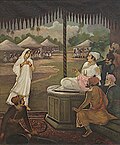
Shortly, following | [[File:Sambhaji_&_Kubkullus.jpg|thumb|Sambhaji meeting Kubkullus{{who2|date=February 2025}} at a military camp. 1921 painting by [[M. V. Dhurandhar]]]] | ||
Shortly, following his accession, Sambhaji began his military campaigns against neighbouring states. Sambhaji's attack on Burhanpur, and granting refuge to prince Akbar, Aurangzeb's fugitive son compelled the latter to move south with the Mughal army. | |||
=== Attack on Burhanpur === | === Attack on Burhanpur === | ||
{{Main|Sacking of Burhanpur (1681)}} | {{Main|Sacking of Burhanpur (1681)}} | ||
Bahadur Khan was in charge of the fort of Burhanpur who later entrusted Kakar Khan with the same. Kakar was performing the duty of collecting [[jizya]] tax from the Hindu citizens of Burhanpur. The Jizya was collected and stored at the Burhanpur fort. Sambhaji plundered and ravaged [[Burhanpur]] in 1680. His forces completely routed the [[Mughal Empire|Mughal]] garrison and punitively executed captives. The Marathas then looted the city and set its ports ablaze. Sambhaji then withdrew into [[Baglana]], evading the forces of Mughal commander Khan Jahan Bahadur.<ref name=" | Bahadur Khan was in charge of the fort of Burhanpur who later entrusted Kakar Khan with the same. Kakar was performing the duty of collecting [[jizya]] tax from the Hindu citizens of Burhanpur. The Jizya was collected and stored at the Burhanpur fort. Sambhaji plundered and ravaged [[Burhanpur]] in 1680. His forces completely routed the [[Mughal Empire|Mughal]] garrison and punitively executed captives. The Marathas then looted the city and set its ports ablaze. Sambhaji then withdrew into [[Baglana]], evading the forces of Mughal commander Khan Jahan Bahadur.<ref name="Richards 1993" />{{rp|218}} | ||
=== Mughal Empire === | === Mughal Empire === | ||
In 1681, Aurangzeb's fourth son [[ | In 1681, Aurangzeb's fourth son [[Muhammad Akbar (Mughal prince)|Muhammad Akbar]] left the Mughal court along with a few Muslim [[Mansabdar]] supporters and joined Muslim rebels in the Deccan.<ref>{{Cite web |date=2022-04-01 |title=On the history trail: Muhammad Akbar rebels against Aurangzeb and seeks refuge in Chhatrapati Sambhaji Maharaj |url=https://sahasa.in/2022/04/01/on-the-history-trail-muhammad-akbar-rebels-against-aurangzeb-and-seeks-refuge-in-chhatrapati-sambhaji-maharaj/ |access-date=2025-01-29 |language=en}}</ref> Aurangzeb in response moved his court south to [[Aurangabad]] and took over command of the Deccan campaign. The rebels were defeated and Akbar fled south to seek refuge with Sambhaji. Sambhaji's ministers including Annaji Datto, and other ministers took this opportunity and conspired again to enthrone Rajaram again. They signed a treasonable letter against Sambhaji in which they promised to join Akbar, to whom the letter was sent.<ref name="M Tarabai">{{Cite book |url=https://books.google.com/books?id=Eh1BAAAAMAAJ&q=annaji+datto+conspire+sambhaji |title=Maharani Tarabai of Kolhapur, c. 1675–1761 A.D. |last=Pāṭīla |first=Śālinī |date=1987 |publisher=S. Chand & Co. |isbn=978-81-219-0269-4}}</ref><ref name="Gokhale1978">{{Cite book |url=https://books.google.com/books?id=43gBAAAAMAAJ&q=annaji+datto+conspire+sambhaji |title=Chhatrapati Sambhaji |last=Gokhale |first=Kamal Shrikrishna |date=1978 |publisher=Navakamal Publications}}</ref> Akbar gave this letter to Sambhaji.<ref name="M Tarabai" /> Enraged, Sambhaji executed the conspirators on charges of treason.<ref name="Gokhale1978" /> | ||
For five years, Akbar stayed with Sambhaji, hoping that the latter would lend him men and money to strike and seize the Mughal throne for himself. Unfortunately for Sambhaji, giving asylum to Akbar did not bear fruit. Eventually, Sambhaji helped Akbar flee to [[Persia]]. On the other hand, Aurangzeb after coming to Deccan never returned to his capital in the north.<ref>{{cite book |title=The Great Moghuls |first1=Bamber |last1=Gascoigne |first2=Christina |last2=Gascoigne |author-link1=Bamber Gascoigne |publisher=Cape |year=1971 |pages=228–229 |isbn=978-0-224-00580-7 |url=https://books.google.com/books?id=-ryFAAAAIAAJ}}</ref><ref>{{cite book |last1=Kulkarni |first1=A. R. |title=The Marathas |date=2008 |publisher=Diamond Publications |location=Pune |isbn=978-81-8483-073-6 |edition=1st |url=https://books.google.com/books?id=N45LDwAAQBAJ}}</ref><ref>{{cite journal |last1=Kulkarni |first1=G. T. |title=Some Observations on the Medieval History of the Deccan |journal=Bulletin of the Deccan College Post-Graduate and Research Institute |date=1974 |volume=34 |issue=1/4 |pages=91–102 |url=http://www.jstor.org/stable/42931021 |issn=0045-9801}}</ref> | |||
==== Siege of Ramsej (1682) ==== | ==== Siege of Ramsej (1682) ==== | ||
{{Main|Siege of Ramsej}} | {{Main|Siege of Ramsej}} | ||
In 1682, the Mughals laid siege to the Maratha fort of [[Ramsej]], but after five months of failed attempts, including planting explosive mines and building wooden towers to gain the walls, the Mughal siege failed.<ref | In 1682, the Mughals laid siege to the Maratha fort of [[Ramsej]], but after five months of failed attempts, including planting explosive mines and building wooden towers to gain the walls, the Mughal siege failed.<ref name="Itihas" /> | ||
[[Aurangzeb]] tried attacking the Maratha Empire from all directions. He intended to use the Mughal numerical superiority to his advantage. Sambhaji had prepared well for the invasions and the Maratha forces promptly engaged the numerically strong Mughal army in several small battles using guerilla warfare tactics. However, Sambhaji and his generals attacked and defeated the Mughal generals whenever they got an opportunity to lure the Mughal generals into decisive battles in the Maratha stronghold territories. Sambhaji had devised a strategy of minimising the losses on his side. If there used to be an opportunity, then the Maratha army attacked decisively, however, if the Mughals were too strong in numbers then the Marathas used to retreat. This proved to be a very effective strategy as Aurangzeb's generals were not able to capture the Maratha territories for a period of three years.<ref name=" | [[Aurangzeb]] tried attacking the Maratha Empire from all directions. He intended to use the Mughal numerical superiority to his advantage. Sambhaji had prepared well for the invasions and the Maratha forces promptly engaged the numerically strong Mughal army in several small battles using guerilla warfare tactics. However, Sambhaji and his generals attacked and defeated the Mughal generals whenever they got an opportunity to lure the Mughal generals into decisive battles in the Maratha stronghold territories. Sambhaji had devised a strategy of minimising the losses on his side. If there used to be an opportunity, then the Maratha army attacked decisively, however, if the Mughals were too strong in numbers then the Marathas used to retreat. This proved to be a very effective strategy as Aurangzeb's generals were not able to capture the Maratha territories for a period of three years.<ref name="Itihas">{{cite book |title=Itihas |url=https://books.google.com/books?id=MApDAAAAYAAJ |access-date=3 August 2013 |year=1976 |publisher=Director of State Archives, Government of Andhra Pradesh. |pages=100–103}}</ref> | ||
==== Mughal invasions of Konkan (1684) ==== | ==== Mughal invasions of Konkan (1684) ==== | ||
| Line 67: | Line 89: | ||
=== Siddis of Janjira === | === Siddis of Janjira === | ||
{{Main|Siege of Janjira | {{Main|Siege of Janjira}} | ||
The Marathas under Shivaji came into conflict with the [[Siddi]]s, Muslims of [[Abyssinian people|Abyssinian]] descent settled in India, over the control of the Konkan coast. Shivaji was able to reduce their presence to the fortified island of [[ | The Marathas under Shivaji came into conflict with the [[Siddi]]s, Muslims of [[Abyssinian people|Abyssinian]] descent settled in India, over the control of the Konkan coast. Shivaji was able to reduce their presence to the [[Murud-Janjira|Janjira fort]], a fortified island of [[Murud, Raigad|murud]].{{Citation needed|date=February 2025}} Sambhaji continued the Maratha campaign against them, while at that time the [[Siddi]]s formed an alliance with the Mughals.<ref>{{cite journal |last1=Kumar |first1=Amarendra |title=Keigwin's Bombay (1683–84) and the Maratha-Siddi Naval Conflict |journal=Proceedings of the Indian History Congress |year=2014 |volume=75 |pages=320–324 |jstor=44158397}}</ref> At the start of 1682, a Maratha army later joined by Sambhaji personally, attacked the island for thirty days, doing heavy damage but failing to breach its defenses. Sambhaji then attempted a ruse, sending a party of his people to the Siddis, claiming to be defectors. They were allowed into the fort and planned to detonate the [[gunpowder magazine]] during a coming Maratha attack. However, one of the female defectors became involved with a Siddi man and he uncovered the plot, and the infiltrators were executed. The Maratha then attempted to build a stone [[causeway]] from the shore to the island, but were interrupted halfway through when the Mughal army moved to menace Raigad. Sambhaji returned to counter them and his remaining troops were unable to overcome the Janjira garrison and the Siddi fleet protecting it.<ref name="Ali1996">{{cite book |author-first=Shanti Sadiq |author-last=Ali |title=The African Dispersal in the Deccan: From Medieval to Modern Times |url=https://books.google.com/books?id=-3CPc22nMqIC&pg=PA171 |access-date=1 October 2012 |date=1 January 1996 |publisher=Orient Blackswan |isbn=978-81-250-0485-1 |pages=171–}}</ref> | ||
=== Portuguese and English === | === Portuguese and English === | ||
| Line 74: | Line 96: | ||
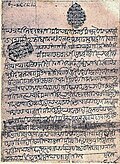
[[File:Chh. Sambhaji's WatanPatra.jpg|316x316px|thumb|''Watan Patra'' (grant document), by Chh. Sambhaji]]Having failed to take Janjira in 1682, Sambhaji sent a commander to seize the Portuguese coastal fort of [[Anjediva Island|Anjadiva]] instead. The Marathas seized the fort, seeking to turn it into a naval base, but in April 1682 were ejected from the fort by a detachment of 200 Portuguese. This incident led to a larger conflict between the two regional powers.<ref name="Ali1996" />{{rp|171}} | [[File:Chh. Sambhaji's WatanPatra.jpg|316x316px|thumb|''Watan Patra'' (grant document), by Chh. Sambhaji]]Having failed to take Janjira in 1682, Sambhaji sent a commander to seize the Portuguese coastal fort of [[Anjediva Island|Anjadiva]] instead. The Marathas seized the fort, seeking to turn it into a naval base, but in April 1682 were ejected from the fort by a detachment of 200 Portuguese. This incident led to a larger conflict between the two regional powers.<ref name="Ali1996" />{{rp|171}} | ||
The [[History of Goa#Portuguese conquest and colonisation|Portuguese colony of Goa]] at that time provided supplies to the Mughals, allowed them to use the Portuguese ports in India and pass through their territory | The [[History of Goa#Portuguese conquest and colonisation|Portuguese colony of Goa]] at that time provided supplies to the Mughals, allowed them to use the Portuguese ports in India and pass through their territory.<ref name="Ames2000">{{cite book |author-first=Glenn Joseph |author-last=Ames |title=Renascent Empire?: The House of Braganza and the Quest for Stability in Portuguese Monsoon Asia c. 1640–1683 |url=https://books.google.com/books?id=MfMNfsOMUHwC&pg=PA155 |year=2000 |publisher=[[Amsterdam University Press]] |isbn=978-90-5356-382-3 |pages=155–}}</ref> In order to deny this support to the Mughals, Sambhaji invaded the Portuguese territories of Bardez and Salcette with 20,000 Maratha soldiers. According to an account by Padre Francisco de Souza, Marathas looted, destroyed Churches and raped Christian women. After they had completed sacking, they carried off with themselves many men, women and children whom they later sold to Arabs and Dutch.<ref name="Pissurlencar-1983"/> Jadunath Sarkar notes that the Marathas were notorious for gang-raping women during invasions, including the invasion of Goa under Sambhaji. He elaborates on this by quoting a contemporary account of the event.<ref name="Sarkar-2007"/> | ||
{{Blockquote|These enemies were so barbarous that when a woman appeared very beautiful (lit., best) to them, five or six of them violated her by lying with that woman alone, Up to now nowhere else in India has such barbarity been seen, nor even among the Kafris (Negroes). For this reason, many women of Margaon ... threw themselves into pools, where they died of drowning. Others who bravely resisted the lewd intentions of some of the enemy soldiers, were killed with strokes of the broadsword, and of some others the breasts were cut off.}} The situation for the colonists became so dire that the Portuguese viceroy, [[Francisco de Távora, conde de Alvor]] went with his remaining supporters to the cathedral where the crypt of [[Francis Xavier|Saint Francis Xavier]] was kept, where they prayed for deliverance. The viceroy had the casket opened and gave the saint's body his baton, royal credentials and a letter asking the saint's support. Sambhaji's Goa campaign was checked by the arrival of the Mughal army and navy in January 1684, forcing him to withdraw.<ref name="Alden1996">{{cite book |author-first=Dauril |author-last=Alden |title=The Making of an Enterprise: The Society of Jesus in Portugal, Its Empire, and Beyond, 1540–1750 |url=https://books.google.com/books?id=7nVIBhrRb9AC&pg=PA202 |access-date=2 October 2012 |date=1 September 1996 |publisher=[[Stanford University Press]] |isbn=978-0-8047-2271-1 |pages=202–}}</ref> The sudden withdrawal of Sambhaji from Goa was cited as the result of a "miraculous intercession" by the saint.<ref>{{cite book |last=Rodrigues dos Santos |first=Joaquim |title=Architectures of Colonialism |chapter=(Re)Contextualizing Goencho Saib's Basilica: The Basilica of Bom Jesus in Goa as a Paradigm of Contested Transcultural Heritage |publisher=[[De Gruyter]] |date=2024-05-21 |isbn=978-3-0356-2670-4 |doi=10.1515/9783035626704-011 |doi-access=free |page=184}}</ref> | |||
Meanwhile, in 1684 Sambhaji signed a defensive treaty with the English at Bombay, realising his need for English arms and gunpowder, particularly as their lack of artillery and explosives impeded the Maratha's ability to lay siege to fortifications. Thus reinforced, Sambhaji proceeded to take [[Pratapgad]] and a series of forts along the [[Ghats]].<ref name=" | Meanwhile, in 1684 Sambhaji signed a defensive treaty with the English at Bombay, realising his need for English arms and gunpowder, particularly as their lack of artillery and explosives impeded the Maratha's ability to lay siege to fortifications. Thus reinforced, Sambhaji proceeded to take [[Pratapgad]] and a series of forts along the [[Ghats]].{{Which|date=February 2025}}<ref name="stewart2" />{{rp|91}} | ||
=== Mysore === | === Mysore === | ||
{{Main|Maratha-Mysore War (1682)}} | {{Main|Maratha-Mysore War (1682)}} | ||
Much like his father Shivaji's Karnataka campaign, Sambhaji attempted in 1681 to invade [[Mysore]], then a southern principality ruled by [[Wodeyar]] [[Chikkadevaraja]]. Sambhaji's large army was repelled,<ref name=" | Much like his father Shivaji's Karnataka campaign, Sambhaji attempted in 1681 to invade [[Mysore]], then a southern principality ruled by [[Wodeyar]] [[Chikkadevaraja]]. Sambhaji's large army was repelled,<ref name="stewart2" />{{rp|91–}} as had happened to Shivaji in 1675.<ref name="Chopra1992">{{cite book |author-first=Pran Nath |author-last=Chopra |title=Encyclopaedia of India: Karnataka |url=https://books.google.com/books?id=PfNtAAAAMAAJ |access-date=2 October 2012 |year=1992 |publisher=Rima Pub. House}}</ref> Chikkadevraja later made treaties and rendered tribute to the Maratha kingdom during the conflicts of 1682–1686. Chikkadevraja however began to draw close to the Mughal Emperor and ceased to follow his treaties with the Marathas. In response, Sambhaji invaded Mysore in 1686, accompanied by his Brahmin friend and poet [[Kavi Kalash]].<ref name="Muddhachari1969">{{cite book |first=B. |last=Muddhachari |title=The Mysore-Maratha relations in the 17th century |url=https://books.google.com/books?id=w1PRAAAAMAAJ |access-date=2 October 2012 |year=1969 |publisher=Prasārānga, University of Mysore |page=106}}</ref><ref name="SatyanarayanaMuseums1996">{{cite book |author1=A. Satyanarayana |author2=Karnataka (India). Directorate of Archaeology & Museums |title=History of the Wodeyars of Mysore, 1610–1748 |url=https://books.google.com/books?id=3jduAAAAMAAJ |access-date=2 October 2012 |year=1996 |publisher=Directorate of Archaeology and Museums |page=94}}</ref> | ||
== | ===Maratha Deshmukhs=== | ||
During his short reign, Sambhaji faced Mughal efforts to bring many Maratha Deshmukhs on their side, particularly after the demise of Bijapur and Golconda in 1686–87. Defections had become common by the end of his reign; according to Stewart Gordon, he had "badly alienated" deshmukh families by "burning villages to deny supplies to Goa" during the conflict with the Portuguese.<ref name="stewart2" />{{rp|94}} The Deshmukh families that joined the Mughal service during Sambhaji's reign were the [[Mane (clan)|Mane]], [[Shirke]], Jagdale, and Yadav. There were also cases like that of the [[Jedhe]] family where one brother joined Mughal service, and the other stayed loyal to Sambhaji.<ref name="stewart2" />{{rp|91}} | |||
[[ | |||
In | In 1683, Sambhaji learned from Prince Akbar that the faction opposing him was plotting to offer his kingdom to Akbar in exchange for his support against Sambhaji. Following this, Sambhaji tried and executed 24 members of influential families including top government ministers involved in the plot.<ref name="stewart2"/>{{rp|92,106}} | ||
Accounts of Sambhaji's confrontation with the Mughal ruler and following torture | == Capture, torture and execution == | ||
{{Main|Execution of Sambhaji}} | |||
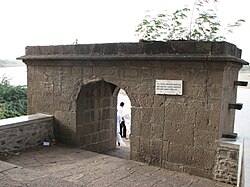
[[File:Tulapur arch.jpg|thumb|Stone arch at [[Tulapur]] confluence where Sambhaji was executed|228x228px]] | |||
In the 1687 [[Battle of Wai]], the key Maratha commander [[Hambirrao Mohite]] was killed and troops began to desert the Maratha armies. Sambhaji and 25 of his advisors were captured by the Mughal forces of [[Muqarrab Khan]] in a skirmish at [[Sangameshwar]] in February 1689. Sambhaji's positions were spied upon by the [[Maratha (caste)|Maratha]] officials close to him, who conveyed this information to [[Muqarrab Khan]]. Accounts of Sambhaji's confrontation with the Mughal ruler and his following torture and execution and the disposal of his body vary widely depending on the source, though all broadly agree that he was tortured and executed on the emperor's orders. The captured Sambhaji and [[Kavi Kalash]] were taken to the fort of [[Pedgaon, Ahmednagar|Bahadurgad at Pedgaon]] in-present-day Ahmednagar district, where Aurangzeb humiliated them by parading them wearing clown's clothes and they were subjected to insults by Mughal soldiers.<ref name="Mehta2005" />{{rp|50}} | |||
Accounts vary as to the reasons for what came next: Mughal accounts state that Sambhaji was asked to surrender his forts, treasures and names of Mughal collaborators with the Marathas and that he sealed his fate by insulting both the emperor and the Islamic prophet Muhammad during interrogation and was executed for having killed Muslims.<ref name="Richards 1993" />{{rp|223}} The [[ulema]] of the Mughal Empire sentenced Sambhaji to death on allegations of the atrocities his troops perpetrated against Muslims in Burhanpur, including plunder, killing, dishonour, and torture.<ref name="Richards 1993" />{{rp|217–223}} | |||
Aurangzeb ordered the torture and execution of Sambhaji and Kavi Kalash. According to [[Khafi Khan]] and Ishwar Das Nagar, Sambhaji and Kavi Kalash were blinded with red-hot irons first.<ref name="M Tarabai"/>{{rp|46–48}}<ref>{{Cite book |last=Sarkar |first=Jadunath |url=https://archive.org/details/aurangzeb-1-2-jadunath-sarkar/Aurangzeb-4%20%28Jadunath%20Sarkar%29/page/343/mode/1up?view=theater |title=History of Aurangzib |publisher=ORIENT LONGMAN LTD |year=1930 |edition=2 |volume=IV |pages=343 |language=English}}</ref> Both were executed by beheading on 11 March 1689 at [[Tulapur]] on the banks of the [[Bhima river]] near Pune.<ref name="Mehta2005" /><ref>{{Cite web |url=https://archive.org/stream/in.ernet.dli.2015.48871/201548871.MaasirAlamgiri#page/n205/mode/2up/search/quli |title=Maasir-1-Alamgiri |via=Internet Archive |access-date=14 May 2017}}</ref> Some accounts state that Sambhaji's body was cut into pieces and thrown into the river or that the body or portions were recaptured and cremated at the confluence of the rivers at Tulapur.<ref name="Gokhale1978"/>{{rp|23}} Other accounts state that Sambhaji's remains were fed to the dogs.<ref name="Mehta2005" />{{rp|50}} | |||
Maratha | == Succession == | ||
The Maratha Kingdom was put into disarray by Sambhaji's death and his younger half-brother [[Rajaram I]] assumed the throne. Rajaram shifted the Maratha capital far south to [[Gingee|Jinji]], while Maratha guerrilla fighters under [[Santaji Ghorpade]] and [[Dhanaji Jadhav]] continued to harass the Mughal army. A few days after Sambhaji's death, the capital [[Raigad Fort]] fell to the Mughals. Sambhaji's widow, Yesubai, son, [[Chhattrapati Shahu|Shahu]] and Shivaji's widow, [[Sakvarbai]] were captured; Sakvarbai died in Mughal captivity.<ref name="Mehta2005" />{{rp|47}} Shahu, who was seven years of age when captured, remained prisoner of the Mughals for 18 years from February 1689 until Mughal Emperor [[Aurangzeb]]'s death in 1707. Shahu was then set free by Emperor [[Muhammad Azam Shah]], son of Aurangzeb. After his release, Shahu had to fight a brief succession war with his aunt [[Tarabai]], Rajaram's widow who claimed the throne for her own son, Shivaji II.<ref>{{citation |first=Malgonkar |last=Manohar |title=The Sea Hawk: Life and Battles of Kanoji Angrey |year=1959 |page=63}}</ref><ref>{{cite book |author-first1=A. Vijaya |author-last1= Kumari |author-first2=Sepuri |author-last2=Bhaskar |title=Social change among Balijas: majority community of Andhra Pradesh |year=1998 |url=https://books.google.com/books?id=r-ffeWmj2JUC&pg=PA6 |publisher=MD |isbn=978-81-7533-072-6 |access-date=24 June 2011}}</ref><ref name="sen22"/>{{rp|201–202}} The Mughals kept Yesubai captive to ensure that Shahu adhered to the terms of his release. She was released in 1719 when the Marathas became strong under Shahu and Peshwa [[Balaji Vishwanath]].<ref>{{cite book |title=The Quarterly Review of Historical Studies |url=https://archive.org/details/dli.bengal.10689.13121 |year=1971 |publisher=Institute of Historical Studies.}}</ref> | |||
== Governance == | == Governance == | ||
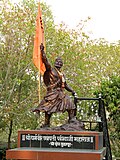
[[File:Vadhu Tulapur - Statue of Sambhaji Maharaja.JPG|thumb|Statue of Sambhaji at [[Tulapur]].|347x347px | [[File:Vadhu Tulapur - Statue of Sambhaji Maharaja.JPG|thumb|right|Statue of Sambhaji at [[Tulapur]].|347x347px]] | ||
Sambhaji inherited the governance system created by Shivaji. He continued with most of his father's policies. The administration of the state was managed by Sambhaji with the help of Chandogamatya and the council of eight ministers.<ref>{{Cite book |last=Kulkarni |first=A.R. |url=https://books.google.com/books?id=zJNirJVU9PUC&q=Maharashtra+Under+the+age+of+Shivaji |title=Maharashtra Under the Age of Shivaji : A Study in Economic History |publisher=Deshmukh & Co. Publishers |year=1969 |isbn=978-81-7434-089-4 |location=Pune |pages=3}}</ref> According to P. S. Joshi, Sambhaji was a good administrator who gave impartial justice to his subjects.<ref name="Joshi1980" />{{rp|285}} | |||
=== Measures against drought === | === Measures against drought === | ||
[[Maharashtra]] witnessed severe drought during the reign of Sambhaji (1684–88). Sambhaji had to take several administrative measures to tackle the situation. Sambhaji continued Shivaji's policies by helping poor farmers. Shankar Narayan Joshi has stated that his approach against famine was very constructive and he provided solutions to many complicated problems. His policies of water storage, irrigation and developing crop patterns exhibited his progressive policies.<ref name=" | [[Maharashtra]] witnessed severe drought during the reign of Sambhaji (1684–88). Sambhaji had to take several administrative measures to tackle the situation. Sambhaji continued Shivaji's policies by helping poor farmers. Shankar Narayan Joshi has stated that his approach against famine was very constructive and he provided solutions to many complicated problems. His policies of water storage, irrigation and developing crop patterns exhibited his progressive policies.<ref name="Sambhajikalin">{{Cite book |last=Joshi |first=Shankar Narayan |url=https://books.google.com/books?id=C7K8jwEACAAJ&q=Sambhaji%27s+correspondence |title=Sambhajikalin patrasarsangraha (shake1602- shake1610) |publisher=Bharata Itihasa Sanshodaka Mandala |year=2015 |location=Pune |pages=39}}</ref> | ||
Sambhaji provided grain seeds, exemptions in taxes, oxen for agricultural work and agricultural tools to the farmers in the drought situation. All these measures were implemented sincerely during the drought period.<ref name="Gokhale1978" /> | Sambhaji provided grain seeds, exemptions in taxes, oxen for agricultural work and agricultural tools to the farmers in the drought situation. All these measures were implemented sincerely during the drought period.<ref name="Gokhale1978" /> | ||
=== | === Agriculture === | ||
Sambhaji encouraged agricultural activity in the Maratha state. Agriculture was the backbone of the rural Maratha economy. He encouraged people to cultivate more land. The government of Sambhaji gave promises of safety to the Marathas who gained independence from the Mughals and asked them to carry out their previous work of cultivation in their territories. It also called back people who had absconded because of their inability to pay taxes and asked them to carry on their previous work of cultivation.<ref name="Sambhajikalin" /> Sambhaji tried to increase the revenue from agricultural activities. He also made efforts to cultivate more wasted or barren lands.<ref name="Gokhale1978" /> | |||
Sambhaji | Sambhaji, in his letter of 3 June 1684, directed his [[Peshwa|prime minister]] Nilkantha Moreshwar to bring the agricultural land of the villages confiscated by the government under cultivation which otherwise would have remained uncultivated. He also asked Hari Shivdev{{who2|date=February 2025}} to distribute fifty khandis{{clarify|date=February 2025}} of grain which were being sent to him from Sagargad among the cultivators.<ref name="Sambhajikalin" /> | ||
Sambhaji | === Religious policy === | ||
Sambhaji, his ministers and officers took keen interest in supporting the cultural and religious activity in the state. They honoured and encouraged learning by granting land, grains and money to scholars.<ref name="Joshi1980" /> | |||
Sambhaji | == Education and writings == | ||
Sambhaji was sophisticated, educated and well-versed in [[Sanskrit]] and [[Hindustani language|Hindustani]] in addition to Marathi. [[Keshav Pandit]], alias Keshav Bhatta of Shringarpur, was employed for his education; an erudite scholar, he composed ''Dandaniti'' on Maratha jurisprudence and later wrote a Sanskrit biography of Sanskrit biography of Sambhaji's brother and successor Rajaram, ''Rajaram Charitam''. In addition to law, he appears to have made Sambhaji familiar with much scholarship in Sanskrit.<ref name="Joshi1980">{{Cite book |url=https://books.google.com/books?id=9ngBAAAAMAAJ&q=Keshav+Pandit+Sambhaji |title=Chhatrapati Sambhaji, 1657–1689 A.D. |last=Joshi |first=Pandit Shankar |date=1980 |publisher=S. Chand}}</ref>{{rp|4–5}}<ref name="Budhabhusana of King Sambhu" />{{rp|n11}} | |||
== | Sambhaji composed several books during his lifetime, notably ''{{ill|Budhbhushanam|mr|बुधभूषण}}'' in Sanskrit and ''Nayikabhed'', ''Saatsatak'' and ''Nakhshikha'' in Hindustani.<ref name="Budhabhusana of King Sambhu">{{cite book |last1=Velankar |first1=H.D. |title=The Budhabhusana of King Sambhu |date=1926 |publisher=Bhandarkar Oriental Research Institute |url=https://archive.org/details/Budhbhushanam/mode/2up}}</ref>{{rp|n13}} In ''Budhbhushanam'', Sambhaji wrote poetry on politics, including dos and don'ts for a king and military tactics. The first few ''[[shloka]]s'' are praises for his grandfather Shahaji, whom he considers to be an incarnation of [[Indra]], and his father Shivaji, whom he considers to be an incarnation of [[Vishnu]].{{citation needed|date=February 2025}} | ||
== | == Legacy == | ||
During his life, Sambhaji was unable to accomplish much for his people. However, his death elevated him to the status of a martyr.<ref name="Mehta2005" />{{rp|50}} Sambhaji has been considered a dharmaveer (lit. protector of [[dharma]]) for his role in shepherding the young Maratha empire, although not all commentators agree on the designation, which implies a religious aspect to his life and governance.<ref name="Shivde">{{cite book |last1=Shivde |first1=Sadashiv |title=Jwaljwalantejas Sambhajiraja |publisher=Diamond Publications |location=Pune |page=378 |edition=1 |url=https://archive.org/details/jwala-jwalan-tejas-sambhajiraja/mode/2up}}</ref><ref>{{Cite news |date=2023-01-03 |title=Nothing wrong if people look at Sambhaji Maharaj's contribution in different ways: Sharad Pawar |url=https://www.hindustantimes.com/cities/pune-news/nothing-wrong-if-people-look-at-sambhaji-maharaj-s-contribution-in-different-ways-sharad-pawar-101672769799137.html |archive-url=https://web.archive.org/web/20230425034517/https://www.hindustantimes.com/cities/pune-news/nothing-wrong-if-people-look-at-sambhaji-maharaj-s-contribution-in-different-ways-sharad-pawar-101672769799137.html |archive-date=25 April 2023 |access-date=2025-02-24 |work=Hindustan Times |language=en-us |url-status=live }}</ref><ref name="Darbhamulla-2025">{{Cite news |last=Darbhamulla |first=Sruthi |date=2025-01-27 |title=Ahead of Vicky Kaushal's 'Chhaava', a look at the legend of Chhatrapati Sambhaji |url=https://www.thehindu.com/entertainment/movies/vicky-kaushal-chhaava-chhatrapati-sambhaji-biopic-maratha-shivaji/article69145689.ece |access-date=2025-02-24 |work=The Hindu |language=en-IN |issn=0971-751X}}</ref> Many statues of Sambhaji exist in India.<ref>{{Cite web |date=2024-12-14 |title=Sambhaji Maharaj Statue: A Tribute To The Maratha Warrior King - Desi Souls |url=https://desisouls.in/blog/sambhaji-maharaj-statue/ |access-date=2025-02-24 |language=en-US}}</ref><ref>{{Cite news |last= |first= |date=2025-01-05 |title=Sambhaji Maharaj statue unveiled in Belagavi amid opposition |url=https://www.thehindu.com/news/national/karnataka/sambhaji-maharaj-statue-inaugurated-in-belagavi-amid-opposition/article69065446.ece |access-date=2025-02-24 |work=The Hindu |language=en-IN |issn=0971-751X}}</ref><ref>{{Cite news |date=2025-01-08 |title=Official: Sambhaji Maharaj statue in Belagavi unveiled sans papers |url=https://www.hindustantimes.com/india-news/official-sambhaji-maharaj-statue-in-belagavi-unveiled-sans-papers-101736276671198.html |archive-url=https://web.archive.org/web/20250111042703/https://www.hindustantimes.com/india-news/official-sambhaji-maharaj-statue-in-belagavi-unveiled-sans-papers-101736276671198.html |archive-date=11 January 2025 |access-date=2025-02-24 |work=Hindustan Times |language=en-us |url-status=live }}</ref> Sambhaji is viewed positively by the modern Indian Hindu movement, as he is seen as emblematic of [[Hindavi Swarajya]] (Hindu self-rule).<ref>{{Cite news |date=2025-02-20 |title=Facts about Chhatrapati Shivaji Maharaj's son Sambhaji every kid should know |url=https://timesofindia.indiatimes.com/life-style/parenting/moments/chhaava-movie-facts-about-sambhaji-facts-about-chhatrapati-shivaji-maharajs-son-sambhaji-every-kid-should-know/articleshow/118321028.cms |access-date=2025-02-23 |work=The Times of India |issn=0971-8257}}</ref><ref>{{Cite web |date=2025-01-23 |title=Chhaava: Netizens slam historical distortion over omission of 'Hindavi Swarajya' and Sambhaji Maharaj's dance in trailer |url=https://www.bollywoodlife.com/news-gossip/vicky-kaushal-rashmika-mandanna-starrer-chhaava-faces-slamming-by-netizens-over-omission-of-hindavi-swarajya-and-sambhaji-maharajs-dance-in-trailer-3064649/ |access-date=2025-02-24 |website=Bollywood Life |language=en}}</ref> However, Hindu nationalist icons such as [[V. D. Savarkar]] and [[M. S. Golwalkar]] had a negative view of Sambhaji. Savarkar found Sambhaji to be "unfit to rule over the Maratha empire".<ref name="g643">{{cite web | last=Menon | first=Aditya | title=Chhaava: Why Savarkar & Golwalkar Criticised Chhatrapati Sambhaji Maharaj | website=TheQuint | date=2025-02-24 | url=https://www.thequint.com/news/politics/chhaava-vicky-kaushal-sambhaji-maharaj-hindutva-savarkar-golwalkar | access-date=2025-02-26}}</ref> | |||
''[[The Hindu]]'' assesses that "Sambhaji's fealty to the Hindu dharma in the face of certain death has earned him much admiration from Hindu nationalists. Some early Marathi writers, however, portrayed him as irresponsible and wayward. Yet others have held him up as a figure of unwavering valiance who inspired the Marathas in their fight against the Mughals."<ref name="Darbhamulla-2025" /> | |||
Sambhaji | == Historiography == | ||
Early historians had an overwhelmingly negative view of Sambhaji. The first author to write an extensive history of the Marathas was [[James Grant Duff]], whose 1826 work painted Sambhaji as a debauched and unfit ruler.<ref name="Pawar-2015">{{Cite journal |last=Pawar |first=Manjushri |date=July 2015 |title=Defamation of Chhatrapati Sambhaji in Marathi Literature |url=https://www.ycwm.ac.in/ycwarana/wp-content/uploads/2016/12/Vishwawarana_Journal_Final_29-7-2015.pdf |journal=[[Vishwawarana National Research Journal]] |volume=II |issue=2 |pages=27–33}}</ref><ref>{{Cite journal |last=Grewal |first=J. S. |date=1967 |title=James Grant Duff and the Marathas |url=https://www.jstor.org/stable/44155527 |journal=Proceedings of the Indian History Congress |volume=29 |pages=395–401 |jstor=44155527 |issn=2249-1937}}</ref> [[Mahadev Govind Ranade]], writing around 1900, came to a similar conclusion, writing that "It is useless to enter into a detailed account of Sambhaji's reign, for Sambhaji never can be said to have ruled the country."<ref name="Pawar-2015" /><ref>{{cite book |author=Ranade, Mahadev Govind |url=https://archive.org/details/risemarathapowe00bahagoog/page/n6 |title=Rise of the Maráthá Power |publisher=Punalekar & Co. |year=1900 |location=Bombay |ol=24128770M}}; reprinted in 1999 as {{ISBN|81-7117-181-8}}</ref> | |||
[[Govind Sakharam Sardesai]]'s 1946 work the ''New History of Marathas'' is the first modern treatment of Sambhaji's life. Sardesai's chapter on Sambhaji is entitled "Sambhaji the violent."<ref name="Sardesai1946" /> Sardesai describes Sambhaji both as a heroic leader in the war against the Mughals and "brave as a lion personally," but also as having "vicious and intemperate habits."<ref name="Sardesai1946" />{{Rp|page=308}} Sardesai also assesses that Sambhaji lacked his father's patience or foresight.<ref name="Sardesai1946" />{{Rp|page=308}} Sardesai assesses that Sambhaji's aborted attack against the Portuguese at Goa marked a turning point for Sambhaji's fortunes, after which the Marathas were increasingly on the defensive.<ref name="Sardesai1946" />{{Rp|page=307}} Sardesai concludes that whatever Sambhaji's strategic failings, which saw him abandoned by most of his allies, the nature of his death steeled the Maratha to avenge the death of their sovereign.<ref name="Sardesai1946" />{{Rp|page=316}} | |||
== | ==Biographies== | ||
Kavindra Paramanand Govind Newaskar of Poladpur composed ''Anupurana'', a partially-completed Sanskrit biography on the life of Sambhaji up to the birth of [[Shahu I]], as a sequel to his father's Sanskrit biography ''Shivabharata''. Hari Kavi, also known as Bhanubhatta, composed ''Haihayendra Charitra'' as well as its commentary, ''Shambu Vilasika'' on the orders of Sambhaji. Hari Kavi also authored ''Subhashitaharavalli'' and composed the Sanskrit biography ''Shambhuraja Charitra'' on Sambhaji's life and romance in 1684.<ref>{{cite book |title=Studies in Indian Cultural History |volume=2 |author-first=Parshuram Krishna |author-last=Gode |date=1960 |page=105 |url=https://books.google.com/books?id=WpotAAAAMAAJ&q=%22hari+kavi%22+sambhaji }} [https://ignca.gov.in/Asi_data/10427.pdf pdf]</ref><ref name="Budhabhusana of King Sambhu" />{{rp|n15}} | |||
== | == In fiction == | ||
{| class="wikitable" | |||
|+Films, plays and television shows based on Sambhaji's life | |||
! rowspan="2" |Year | |||
! rowspan="2" |Title | |||
! rowspan="2" |Studio(s) | |||
! rowspan="2" |Director | |||
! colspan="2" |Characters | |||
|- | |||
!Sambhaji | |||
!Yesubai | |||
|- | |||
|1925 | |||
|''[[Chhatrapati Sambhaji (1925 film)|Chhatrapati Sambhaji]]'' | |||
|United Pictures Syndicate | |||
|N.D. sarpotdar | |||
|Parshwanath Altekar | |||
|Zillu | |||
|- | |||
|1934<ref>{{Cite web |title=छत्रपती संभाजी |url=https://www.marathifilmdata.com/chitrapat/chatrapati-sambhaji/ |access-date=2024-12-28 |website=मराठी चित्रपट सूची |language=en-US}}</ref> | |||
|''[[Chhatrapati Sambhaji (1934 film)|Chhatrapati Sambhaji]]'' | |||
|Saraswati Cinestone | |||
|Parshwanath Altekar | |||
|[[Master Vithal]] | |||
|Vijayadevi | |||
|- | |||
|1962<ref>Karnad, G. (1995). Performance, meaning, and the materials of modern Indian theatre. New Theatre Quarterly, 11(44), 355-370.[https://www.cambridge.org/core/services/aop-cambridge-core/content/view/D1DB214C552C2A2DBBCBEBA6DCC98D7E/S0266464X00009337a.pdf/performance-meaning-and-the-materials-of-modern-indian-theatre.pdf]</ref> | |||
|''Raygadala Jevha Jaag Yete'' (Marathi play) | |||
| | |||
| | |||
|[[Kashinath Ghanekar]] | |||
| | |||
|- | |||
|2017–2020<ref>{{Cite news |date=2020-02-02 |title=Popular historical series 'Swarajyarakshak Sambhaji' to go off-air soon |url=https://timesofindia.indiatimes.com/tv/news/marathi/popular-historical-series-swarajyarakshak-sambhaji-to-go-off-air-soon/articleshow/73867591.cms |access-date=2024-12-28 |work=The Times of India |issn=0971-8257}}</ref> | |||
|''[[Swarajyarakshak Sambhaji]]'' | |||
|Jagadamb Creations | |||
|Vivek Deshpande<br>Kartik Rajaram Kendhe | |||
|[[Amol Kolhe]] | |||
|Prajakta Gaikwad | |||
|- | |||
|2024<ref>{{Cite web |last=More |first=Priya |date=2024-02-01 |title=Chhatrapati Sambhaji Movie: 'छत्रपती संभाजी' २ फेब्रुवारीला येणार भेटीला, 'या' ५ भाषांमध्ये होणार रिलीज |url=https://saamtv.esakal.com/entertainment/marathi-film-chhatrapati-sambhaji-movie-release-2-february-in-5-language-pvm91 |access-date=2024-12-28 |website=[[Saam TV]] |language=mr}}</ref> | |||
|''[[Chhatrapati Sambhaji (2024 film)|Chhatrapati Sambhaji]]'' | |||
|Perfect Plus Entertainment<br>FIF Production<br>AJ Media Corp. | |||
|Rakesh Subesingh Dulgaj | |||
|[[Shashank Udapurkar]] | |||
|Mohini Potdar | |||
|- | |||
|2024<ref>{{Cite web |last=Pokharkar |first=Manjiri |date=2024-02-17 |title=जय शिवराय! 'शिवरायांचा छावा'ने रिलीजच्या पहिल्या दिवशीच जमवला कोट्यवधींचा गल्ला |url=https://marathi.abplive.com/entertainment/bollywood/shivrayancha-chhava-box-office-collection-day-1-digpal-lanjekar-historical-marathi-movie-chhatrapati-sambhaji-maharaj-biopic-marathi-film-bollywood-entertainment-latest-update-marathi-news-1256956 |access-date=2024-12-28 |website=[[ABP Majha]] |language=mr}}</ref> | |||
|''[[Shivrayancha Chhava]]'' | |||
|Malhar Picture Company<br>Everest Entertainment | |||
|[[Digpal Lanjekar]] | |||
|[[Bhushan Patil]] | |||
|Trupti Toradmal | |||
|- | |||
|2024<ref>{{Cite web |date=2024-05-14 |title="धर्मरक्षक महावीर छत्रपती संभाजी महाराज" चित्रपट लवकरच येणार प्रेक्षकांच्या भेटीला! |trans-title=Chhatrapati Sambhaji maharaj Jayanti Dharmakshak Mahaveer Chhatrapati Sambhaji Maharaj movie is coming soon |url=https://www.marathijagran.com/entertainment/chhatrapati-sambhaji-maharaj-jayanti-dharmakshak-mahaveer-chhatrapati-sambhaji-maharaj-movie-is-coming-soon-21919 |access-date=2024-12-28 |website=Marathi Jagran |language=mr}}</ref> | |||
|''[[Dharmarakshak Mahaveer Chhatrapati Sambhaji Maharaj: Chapter 1]]'' | |||
|Urvita Productions | |||
|Tushar Shelar | |||
|[[Thakur Anoop Singh]] | |||
|[[Amruta Khanvilkar]] | |||
|- | |||
|2025<ref>{{Cite web |date=2024-09-19 |title=Director Laxman Utekar on Chhaava: Period dramas come with unique challenges |url=https://www.indiatoday.in/movies/bollywood/story/chhaava-director-laxman-utekar-vicky-kaushal-rashmika-mandanna-2602897-2024-09-19 |url-status=live |archive-url=https://web.archive.org/web/20250119092441/https://www.indiatoday.in/movies/bollywood/story/chhaava-director-laxman-utekar-vicky-kaushal-rashmika-mandanna-2602897-2024-09-19 |archive-date=19 January 2025 |access-date=2025-01-19 |website=India Today |language=en}}</ref><ref>{{Cite web |date=2024-11-27 |title=Vicky Kaushal, Rashmika Mandanna starrer Chhaava gets postponed; to release on February 14 |url=https://www.bollywoodhungama.com/news/bollywood/vicky-kaushal-rashmika-mandanna-starrer-chhaava-gets-postponed-release-february-14/ |access-date=2024-12-28 |website=[[Bollywood Hungama]] |language=en}}</ref> | |||
|''[[Chhaava]]'' | |||
|[[Maddock Films]] | |||
|[[Laxman Utekar]] | |||
|[[Vicky Kaushal]] | |||
|[[Rashmika Mandanna]] | |||
|} | |||
== See also == | == See also == | ||
| Line 158: | Line 232: | ||
== References == | == References == | ||
'''Notes''' | |||
{{notelist}} | |||
'''Citations''' | |||
{{reflist}} | {{reflist}} | ||
== External links == | == External links == | ||
* | * {{Commons category-inline|Sambhaji}} | ||
{{s-start}} | {{s-start}} | ||
{{S-hou|[[House of Bhonsle]] | 14 May |1657|11 March |1689|name=''' | {{S-hou|[[House of Bhonsle]] | 14 May |1657|11 March |1689|name='''Sambhaji'''}} | ||
{{S-reg}} | {{S-reg}} | ||
{{S-bef | {{S-bef | ||
| Line 177: | Line 254: | ||
}} | }} | ||
{{s-end}} | {{s-end}} | ||
{{Portal bar|Hinduism|History|Royalty|India}} | |||
{{Shivaji}} | {{Shivaji}} | ||
{{MarathaEmpire}} | {{MarathaEmpire}} | ||
{{Authority control}} | {{Authority control}} | ||
[[Category:1657 births]] | [[Category:1657 births]] | ||
[[Category:1689 deaths]] | [[Category:1689 deaths]] | ||
[[Category:17th-century Indian monarchs]] | [[Category:17th-century Indian monarchs]] | ||
[[Category:Hindu martyrs]] | [[Category:Hindu martyrs]] | ||
[[Category:Hindu monarchs]] | [[Category:Hindu monarchs]] | ||
[[Category: | [[Category:17th-century executions by the Mughal Empire]] | ||
[[Category:People from Maharashtra]] | [[Category:People from Maharashtra]] | ||
[[Category:Warriors | [[Category:Warriors from the Maratha Empire]] | ||
[[Category:People executed for refusing to convert to Islam]] | [[Category:People executed for refusing to convert to Islam]] | ||
[[Category:Executed monarchs]] | [[Category:Executed monarchs]] | ||
[[Category:Maratha | [[Category:Maratha kings]] | ||
Latest revision as of 06:47, 4 March 2026
| Sambhaji | |
|---|---|
 Portrait of Sambhaji, late 17th century. | |
| Chhatrapati of the Marathas | |
| Reign | 16 January 1681 – 11 March 1689 |
| Coronation | 20 July 1680, Panhala (symbolic) 16 January 1681, Raigad fort (official) |
| Predecessor | Shivaji I |
| Successor | Rajaram I |
| Peshwa | |
| Born | 14 May 1657 Purandar Fort, Ahmadnagar Subah, Mughal Empire (present-day Pune district, Maharashtra, India) |
| Died | 11 March 1689 (aged 31) Tulapur, Ahmadnagar Subah, Mughal Empire (present-day Pune district, Maharashtra, India) |
| Spouse | Yesubai |
| Issue | Bhavani Bai Shahu I |
| House | Bhonsale |
| Father | Shivaji I |
| Mother | Saibai |
| Religion | Hinduism |
Sambhaji (Sambhajiraje Shivajiraje Bhonsle, Marathi pronunciation: [saːmˈbʱaːdʑiː ˈbʱos(ə)le]; 14 May 1657 – 11 March 1689), also known as Shambhuraje, ruled from 1681 to 1689 as the second king (Chhatrapati) of the Maratha Empire, a prominent state in early modern India. He was the eldest son of Shivaji, the founder of the Maratha Empire.
At the age of nine, Sambhaji was taken as a political hostage of the Mughal Empire, to guarantee his father's compliance with the treaty of Purandar. He later accompanied his father to Agra where both were placed under house arrest by the Mughal Emperor Aurangzeb; they subsequently escaped. He was later confined by his father at Panhala Fort, with some theories suggesting that it was due to his addiction to "sensual pleasures" or for violating a Brahmin woman.[1] He subsequently defected to the Mughal Empire and served under Diler Khan in the Battle of Bhupalgarh against his father. He ascended the throne following his father's death, with his rule being largely shaped by the ongoing wars between the Marathas and the Mughal Empire, as well as other neighbouring powers such as the Siddi of Janjira, the Wadiyars of Mysore and the Portuguese Empire in Goa.
Early in his rule, Marathas under Sambhaji attacked and disrupted supply lines and raided into the Mughal territory, although they were unsuccessful in taking over main forts. In 1683, Sambhaji executed 24 members of influential families including top government ministers after discovering a plot to poison him.[2]:106 By 1685, Mughals had gradually pushed back Sambhaji's forces by taking over their strongholds. Desertions became common by the end of his reign, and he had alienated Maratha deshmukhs (land owners) by burning villages to deny supplies to the Portuguese. In 1689, he was captured by Mughal forces and executed. His brother Rajaram I succeeded him as king and continued the Mughal–Maratha Wars.[2]:80, 91–95[3]:199–200
Sambhaji is viewed poorly by historians, who note that his personal problems—and war crimes committed by his soldiers—overshadowed his moderate military and administrative successes.[4] Maratha soldiers under Sambhaji's command during his campaigns committed atrocities against civilians including massacres and mass rape.[5][6] As a ruler, Sambhaji implemented drought relief measures and encouraged agricultural development while continuing his father's administrative systems. He was also a scholar who authored several works in Sanskrit and Hindustani, including the political treatise Budhbhushanam. His torture and death at the hands of the Mughal Empire elevated him to the status of a martyr. He remains popular in modern India among many Hindu nationalists.
Early life[edit | edit source]
Sambhaji was born at Purandar fort to the Maratha Chhtrapati, Shivaji, and his first wife, Saibai, who died when he was two years old. He was then raised by his paternal grandmother Jijabai.[7] At the age of nine, Sambhaji was sent to live with Raja Jai Singh I of Amber as a political hostage to ensure compliance with the Treaty of Purandar that Shivaji had signed with the Mughals on 11 June 1665. As a result of the treaty, Sambhaji became a Mughal mansabdar.[8]:64 He and his father Shivaji attended the Mughal emperor Aurangzeb's court at Agra on 12 May 1666. Aurangzeb put both of them under house arrest but they escaped on 22 July 1666.[2](pp74–78) However, the two sides reconciled and had cordial relations during the period 1666–1670.[citation needed]
During the period between 1666 and 1668, Aurangzeb initially refused but later officially recognized the title of Raja that Shivaji assumed, on behalf of the Mughal Empire, after being pressed by Prince Mu'azzam. Aurangzeb looked upon the friendship of Prince Muazzam and Shivaji and Sambhaji with great suspicion.[7]:91–93 By mediation of Muazzam, Sambhaji was also restored to the Mughal mansabdar rank of 5,000 cavalry. Shivaji then sent Sambhaji with general Prataprao Gujar to take service under Prince Mu'azzam who was the Mughal viceroy at Aurangabad with Diler Khan as his deputy. Sambhaji visited prince Muazzam at Aurangabad on 4 November 1667 and was then granted rights to territory in Berar on the pretext of revenue collection. After a short stay, Sambhaji returned to Rajgad while representative Maratha officers continued to stay in Aurangabad. In this period, the Marathas under Sambhaji fought alongside the Mughals under Muazzam against the Sultanate of Bijapur.[8]:64[9]
Marriage[edit | edit source]
Sambhaji was married to Jivubai in a marriage of political alliance and as per Maratha custom, she took the name Yesubai. Jivubai was the daughter of Pilaji Shirke, who had entered Shivaji's service following the defeat of Deshmukh Suryaji Surve who was his previous liege. This marriage thus gave Shivaji the access of the region of Konkan coastal belt.[10]:4,47[8]:96–99 Yesubai had two children, daughter Bhavani Bai and then a son named Shahu I, who later became the Chhatrapati of the Maratha kingdom. According to Maasir-i-Alamgiri, daughters of Sambhaji and his brother Rajaram were married to Mughal noblemen.[11]
Arrest and defection to the Mughals[edit | edit source]
The elder Shivaji imprisoned his son Sambhaji at Panhala Fort in 1678. Contemporary author Khafi Khan suggested that his imprisonment was for personal behavior including alleged irresponsibility and addiction to "sensual pleasures".[10][12][4](p251)Another theory suggests that Sambhaji was imprisoned at the Panhala because he "attempted to violate a Brahmin's wife".[1][13][14] After Shivaji returned from his Southern campaign, he stationed Sambhaji at Sajjangad, hoping to improve the latter's attitude. Sambhaji, although he revered the Matha (Hindu monastics) and their practices, was not adept at following that disciplined routine. A liaison was already established between Sambhaji and Diler Khan, now the sole person in charge of Mughal affairs in south Dakhan. On 13 December 1678, Sambhaji escaped with his wife and rejoined Diler Khan for a year, taking with him a small retinue and leaving Sajjangad with the aim of reaching Pedgaon, the Mughal cantonment. Following this, he was made a Mughal noble with the rank of seven thousand zat and conferred with the title of Raja by Aurangzeb.[15]:215 He later attacked the fort of Bhupalgad, which was under Maratha control while serving the Mughals. After returning, he was put under house arrest[by whom?] at Panhala.[12][10][2]:80
According to historian Stewart N. Gordon, Shivaji did not want Sambhaji to succeed him. To this end, he devised a proposal to partition his kingdom between his two sons, with Sambhaji receiving the newly acquired regions of Karnatak and coastal Gingee, while Raja Ram was to be given the heartlands of Maharashtra.[2]:80,112 Jadunath Sarkar states that Sambhaji, aggrieved by this, is said to have joined Diler Khan in dissent against his father following Khan's letters promising Sambhaji to reclaim his right with Mughal support if he joined him. However, Sambhaji later returned to the Maratha fold following Diler Khan's unscrupulous behavior. He further states that much of the primary historical sources regarding Sambhaji are disputable, as they were written by people hostile to him.[16] Gajanan Mehendale considers the reason for Sambhaji's estrangement from his father to be uncertain.[17]
Ancestry[edit | edit source]
| Ancestors of Sambhaji | |||||||||||||||||||||||||||||||||||||||||||||||||||||||||||||||||||||||||||||||||||||||||||||||||||||||||||||||||||||||||||||||||||||||||||||||||||||||||||||||||||||||||||||||||||||||||||||||||||||||||||||||||||||||||||||||||||||||||||||||||||||||||||||||||||||||||
|---|---|---|---|---|---|---|---|---|---|---|---|---|---|---|---|---|---|---|---|---|---|---|---|---|---|---|---|---|---|---|---|---|---|---|---|---|---|---|---|---|---|---|---|---|---|---|---|---|---|---|---|---|---|---|---|---|---|---|---|---|---|---|---|---|---|---|---|---|---|---|---|---|---|---|---|---|---|---|---|---|---|---|---|---|---|---|---|---|---|---|---|---|---|---|---|---|---|---|---|---|---|---|---|---|---|---|---|---|---|---|---|---|---|---|---|---|---|---|---|---|---|---|---|---|---|---|---|---|---|---|---|---|---|---|---|---|---|---|---|---|---|---|---|---|---|---|---|---|---|---|---|---|---|---|---|---|---|---|---|---|---|---|---|---|---|---|---|---|---|---|---|---|---|---|---|---|---|---|---|---|---|---|---|---|---|---|---|---|---|---|---|---|---|---|---|---|---|---|---|---|---|---|---|---|---|---|---|---|---|---|---|---|---|---|---|---|---|---|---|---|---|---|---|---|---|---|---|---|---|---|---|---|---|---|---|---|---|---|---|---|---|---|---|---|---|---|---|---|---|---|---|---|---|---|---|---|---|---|---|---|---|---|---|---|---|
| |||||||||||||||||||||||||||||||||||||||||||||||||||||||||||||||||||||||||||||||||||||||||||||||||||||||||||||||||||||||||||||||||||||||||||||||||||||||||||||||||||||||||||||||||||||||||||||||||||||||||||||||||||||||||||||||||||||||||||||||||||||||||||||||||||||||||
Accession[edit | edit source]
When Shivaji died in the first week of April 1680, Sambhaji was still held captive at Panhala fort. Some of the influential sardars including ministers Annaji Datto and other ministers conspired against Sambhaji, supported by Soyarabai, to prevent Sambhaji from succeeding the throne.[10]:48 Shivaji's widow and Sambhaji's stepmother, Soyarabai after her husband's death installed the couple's ten-year-old son, Rajaram, on the throne on 21 April 1680.[2]:91 Upon hearing this news, Sambhaji plotted his escape and took possession of the Panhala fort on 27 April after killing the fort commander. On 18 June, he acquired control of Raigad fort. Sambhaji formally ascended the throne on 20 July 1680. Rajaram, his wife Janki Bai and mother Soyarabai were imprisoned. Soon after Soyarabai and Annaji Datto hatched another plot against Sambhaji using the exiled Moghul prince Akbar. The prince informed Sambhaji of the plot who then executed Soyarabai, her kinsmen from the Shirke family and Annaji Datto on charges of conspiracy.[10]:48[18][19]
Military expeditions and conflicts[edit | edit source]

Shortly, following his accession, Sambhaji began his military campaigns against neighbouring states. Sambhaji's attack on Burhanpur, and granting refuge to prince Akbar, Aurangzeb's fugitive son compelled the latter to move south with the Mughal army.
Attack on Burhanpur[edit | edit source]
Bahadur Khan was in charge of the fort of Burhanpur who later entrusted Kakar Khan with the same. Kakar was performing the duty of collecting jizya tax from the Hindu citizens of Burhanpur. The Jizya was collected and stored at the Burhanpur fort. Sambhaji plundered and ravaged Burhanpur in 1680. His forces completely routed the Mughal garrison and punitively executed captives. The Marathas then looted the city and set its ports ablaze. Sambhaji then withdrew into Baglana, evading the forces of Mughal commander Khan Jahan Bahadur.[15]:218
Mughal Empire[edit | edit source]
In 1681, Aurangzeb's fourth son Muhammad Akbar left the Mughal court along with a few Muslim Mansabdar supporters and joined Muslim rebels in the Deccan.[20] Aurangzeb in response moved his court south to Aurangabad and took over command of the Deccan campaign. The rebels were defeated and Akbar fled south to seek refuge with Sambhaji. Sambhaji's ministers including Annaji Datto, and other ministers took this opportunity and conspired again to enthrone Rajaram again. They signed a treasonable letter against Sambhaji in which they promised to join Akbar, to whom the letter was sent.[18][21] Akbar gave this letter to Sambhaji.[18] Enraged, Sambhaji executed the conspirators on charges of treason.[21]
For five years, Akbar stayed with Sambhaji, hoping that the latter would lend him men and money to strike and seize the Mughal throne for himself. Unfortunately for Sambhaji, giving asylum to Akbar did not bear fruit. Eventually, Sambhaji helped Akbar flee to Persia. On the other hand, Aurangzeb after coming to Deccan never returned to his capital in the north.[22][23][24]
Siege of Ramsej (1682)[edit | edit source]
In 1682, the Mughals laid siege to the Maratha fort of Ramsej, but after five months of failed attempts, including planting explosive mines and building wooden towers to gain the walls, the Mughal siege failed.[25]
Aurangzeb tried attacking the Maratha Empire from all directions. He intended to use the Mughal numerical superiority to his advantage. Sambhaji had prepared well for the invasions and the Maratha forces promptly engaged the numerically strong Mughal army in several small battles using guerilla warfare tactics. However, Sambhaji and his generals attacked and defeated the Mughal generals whenever they got an opportunity to lure the Mughal generals into decisive battles in the Maratha stronghold territories. Sambhaji had devised a strategy of minimising the losses on his side. If there used to be an opportunity, then the Maratha army attacked decisively, however, if the Mughals were too strong in numbers then the Marathas used to retreat. This proved to be a very effective strategy as Aurangzeb's generals were not able to capture the Maratha territories for a period of three years.[25]
Mughal invasions of Konkan (1684)[edit | edit source]
Aurangzeb then decided to attack the Maratha capital Raigad Fort directly from the North and the South directions. He made a pincer attempt to surround the Maratha Capital that led to Mughal invasions of Konkan (1684). The Mughals were badly defeated due to the Maratha strategy and the harsh climate of the region. These failures forced Aurangzeb to look away from the Maratha Empire and search for success against the Qutb Shahi dynasty and Adil Shahi dynasty. Under Sambhaji (1680–89) the Marathas ranged up and down western India.[26]
Siddis of Janjira[edit | edit source]
The Marathas under Shivaji came into conflict with the Siddis, Muslims of Abyssinian descent settled in India, over the control of the Konkan coast. Shivaji was able to reduce their presence to the Janjira fort, a fortified island of murud.[citation needed] Sambhaji continued the Maratha campaign against them, while at that time the Siddis formed an alliance with the Mughals.[27] At the start of 1682, a Maratha army later joined by Sambhaji personally, attacked the island for thirty days, doing heavy damage but failing to breach its defenses. Sambhaji then attempted a ruse, sending a party of his people to the Siddis, claiming to be defectors. They were allowed into the fort and planned to detonate the gunpowder magazine during a coming Maratha attack. However, one of the female defectors became involved with a Siddi man and he uncovered the plot, and the infiltrators were executed. The Maratha then attempted to build a stone causeway from the shore to the island, but were interrupted halfway through when the Mughal army moved to menace Raigad. Sambhaji returned to counter them and his remaining troops were unable to overcome the Janjira garrison and the Siddi fleet protecting it.[28]
Portuguese and English[edit | edit source]

Having failed to take Janjira in 1682, Sambhaji sent a commander to seize the Portuguese coastal fort of Anjadiva instead. The Marathas seized the fort, seeking to turn it into a naval base, but in April 1682 were ejected from the fort by a detachment of 200 Portuguese. This incident led to a larger conflict between the two regional powers.[28]:171
The Portuguese colony of Goa at that time provided supplies to the Mughals, allowed them to use the Portuguese ports in India and pass through their territory.[29] In order to deny this support to the Mughals, Sambhaji invaded the Portuguese territories of Bardez and Salcette with 20,000 Maratha soldiers. According to an account by Padre Francisco de Souza, Marathas looted, destroyed Churches and raped Christian women. After they had completed sacking, they carried off with themselves many men, women and children whom they later sold to Arabs and Dutch.[5] Jadunath Sarkar notes that the Marathas were notorious for gang-raping women during invasions, including the invasion of Goa under Sambhaji. He elaborates on this by quoting a contemporary account of the event.[6]
These enemies were so barbarous that when a woman appeared very beautiful (lit., best) to them, five or six of them violated her by lying with that woman alone, Up to now nowhere else in India has such barbarity been seen, nor even among the Kafris (Negroes). For this reason, many women of Margaon ... threw themselves into pools, where they died of drowning. Others who bravely resisted the lewd intentions of some of the enemy soldiers, were killed with strokes of the broadsword, and of some others the breasts were cut off.
The situation for the colonists became so dire that the Portuguese viceroy, Francisco de Távora, conde de Alvor went with his remaining supporters to the cathedral where the crypt of Saint Francis Xavier was kept, where they prayed for deliverance. The viceroy had the casket opened and gave the saint's body his baton, royal credentials and a letter asking the saint's support. Sambhaji's Goa campaign was checked by the arrival of the Mughal army and navy in January 1684, forcing him to withdraw.[30] The sudden withdrawal of Sambhaji from Goa was cited as the result of a "miraculous intercession" by the saint.[31]
Meanwhile, in 1684 Sambhaji signed a defensive treaty with the English at Bombay, realising his need for English arms and gunpowder, particularly as their lack of artillery and explosives impeded the Maratha's ability to lay siege to fortifications. Thus reinforced, Sambhaji proceeded to take Pratapgad and a series of forts along the Ghats.[which?][2]:91
Mysore[edit | edit source]
Much like his father Shivaji's Karnataka campaign, Sambhaji attempted in 1681 to invade Mysore, then a southern principality ruled by Wodeyar Chikkadevaraja. Sambhaji's large army was repelled,[2]:91– as had happened to Shivaji in 1675.[32] Chikkadevraja later made treaties and rendered tribute to the Maratha kingdom during the conflicts of 1682–1686. Chikkadevraja however began to draw close to the Mughal Emperor and ceased to follow his treaties with the Marathas. In response, Sambhaji invaded Mysore in 1686, accompanied by his Brahmin friend and poet Kavi Kalash.[33][34]
Maratha Deshmukhs[edit | edit source]
During his short reign, Sambhaji faced Mughal efforts to bring many Maratha Deshmukhs on their side, particularly after the demise of Bijapur and Golconda in 1686–87. Defections had become common by the end of his reign; according to Stewart Gordon, he had "badly alienated" deshmukh families by "burning villages to deny supplies to Goa" during the conflict with the Portuguese.[2]:94 The Deshmukh families that joined the Mughal service during Sambhaji's reign were the Mane, Shirke, Jagdale, and Yadav. There were also cases like that of the Jedhe family where one brother joined Mughal service, and the other stayed loyal to Sambhaji.[2]:91
In 1683, Sambhaji learned from Prince Akbar that the faction opposing him was plotting to offer his kingdom to Akbar in exchange for his support against Sambhaji. Following this, Sambhaji tried and executed 24 members of influential families including top government ministers involved in the plot.[2]:92,106
Capture, torture and execution[edit | edit source]

In the 1687 Battle of Wai, the key Maratha commander Hambirrao Mohite was killed and troops began to desert the Maratha armies. Sambhaji and 25 of his advisors were captured by the Mughal forces of Muqarrab Khan in a skirmish at Sangameshwar in February 1689. Sambhaji's positions were spied upon by the Maratha officials close to him, who conveyed this information to Muqarrab Khan. Accounts of Sambhaji's confrontation with the Mughal ruler and his following torture and execution and the disposal of his body vary widely depending on the source, though all broadly agree that he was tortured and executed on the emperor's orders. The captured Sambhaji and Kavi Kalash were taken to the fort of Bahadurgad at Pedgaon in-present-day Ahmednagar district, where Aurangzeb humiliated them by parading them wearing clown's clothes and they were subjected to insults by Mughal soldiers.[10]:50
Accounts vary as to the reasons for what came next: Mughal accounts state that Sambhaji was asked to surrender his forts, treasures and names of Mughal collaborators with the Marathas and that he sealed his fate by insulting both the emperor and the Islamic prophet Muhammad during interrogation and was executed for having killed Muslims.[15]:223 The ulema of the Mughal Empire sentenced Sambhaji to death on allegations of the atrocities his troops perpetrated against Muslims in Burhanpur, including plunder, killing, dishonour, and torture.[15]:217–223
Aurangzeb ordered the torture and execution of Sambhaji and Kavi Kalash. According to Khafi Khan and Ishwar Das Nagar, Sambhaji and Kavi Kalash were blinded with red-hot irons first.[18]:46–48[35] Both were executed by beheading on 11 March 1689 at Tulapur on the banks of the Bhima river near Pune.[10][36] Some accounts state that Sambhaji's body was cut into pieces and thrown into the river or that the body or portions were recaptured and cremated at the confluence of the rivers at Tulapur.[21]:23 Other accounts state that Sambhaji's remains were fed to the dogs.[10]:50
Succession[edit | edit source]
The Maratha Kingdom was put into disarray by Sambhaji's death and his younger half-brother Rajaram I assumed the throne. Rajaram shifted the Maratha capital far south to Jinji, while Maratha guerrilla fighters under Santaji Ghorpade and Dhanaji Jadhav continued to harass the Mughal army. A few days after Sambhaji's death, the capital Raigad Fort fell to the Mughals. Sambhaji's widow, Yesubai, son, Shahu and Shivaji's widow, Sakvarbai were captured; Sakvarbai died in Mughal captivity.[10]:47 Shahu, who was seven years of age when captured, remained prisoner of the Mughals for 18 years from February 1689 until Mughal Emperor Aurangzeb's death in 1707. Shahu was then set free by Emperor Muhammad Azam Shah, son of Aurangzeb. After his release, Shahu had to fight a brief succession war with his aunt Tarabai, Rajaram's widow who claimed the throne for her own son, Shivaji II.[37][38][3]:201–202 The Mughals kept Yesubai captive to ensure that Shahu adhered to the terms of his release. She was released in 1719 when the Marathas became strong under Shahu and Peshwa Balaji Vishwanath.[39]
Governance[edit | edit source]

Sambhaji inherited the governance system created by Shivaji. He continued with most of his father's policies. The administration of the state was managed by Sambhaji with the help of Chandogamatya and the council of eight ministers.[40] According to P. S. Joshi, Sambhaji was a good administrator who gave impartial justice to his subjects.[7]:285
Measures against drought[edit | edit source]
Maharashtra witnessed severe drought during the reign of Sambhaji (1684–88). Sambhaji had to take several administrative measures to tackle the situation. Sambhaji continued Shivaji's policies by helping poor farmers. Shankar Narayan Joshi has stated that his approach against famine was very constructive and he provided solutions to many complicated problems. His policies of water storage, irrigation and developing crop patterns exhibited his progressive policies.[41]
Sambhaji provided grain seeds, exemptions in taxes, oxen for agricultural work and agricultural tools to the farmers in the drought situation. All these measures were implemented sincerely during the drought period.[21]
Agriculture[edit | edit source]
Sambhaji encouraged agricultural activity in the Maratha state. Agriculture was the backbone of the rural Maratha economy. He encouraged people to cultivate more land. The government of Sambhaji gave promises of safety to the Marathas who gained independence from the Mughals and asked them to carry out their previous work of cultivation in their territories. It also called back people who had absconded because of their inability to pay taxes and asked them to carry on their previous work of cultivation.[41] Sambhaji tried to increase the revenue from agricultural activities. He also made efforts to cultivate more wasted or barren lands.[21]
Sambhaji, in his letter of 3 June 1684, directed his prime minister Nilkantha Moreshwar to bring the agricultural land of the villages confiscated by the government under cultivation which otherwise would have remained uncultivated. He also asked Hari ShivdevTemplate:Who2 to distribute fifty khandis[clarification needed] of grain which were being sent to him from Sagargad among the cultivators.[41]
Religious policy[edit | edit source]
Sambhaji, his ministers and officers took keen interest in supporting the cultural and religious activity in the state. They honoured and encouraged learning by granting land, grains and money to scholars.[7]
Education and writings[edit | edit source]
Sambhaji was sophisticated, educated and well-versed in Sanskrit and Hindustani in addition to Marathi. Keshav Pandit, alias Keshav Bhatta of Shringarpur, was employed for his education; an erudite scholar, he composed Dandaniti on Maratha jurisprudence and later wrote a Sanskrit biography of Sanskrit biography of Sambhaji's brother and successor Rajaram, Rajaram Charitam. In addition to law, he appears to have made Sambhaji familiar with much scholarship in Sanskrit.[7]:4–5[42]:n11
Sambhaji composed several books during his lifetime, notably Budhbhushanam in Sanskrit and Nayikabhed, Saatsatak and Nakhshikha in Hindustani.[42]:n13 In Budhbhushanam, Sambhaji wrote poetry on politics, including dos and don'ts for a king and military tactics. The first few shlokas are praises for his grandfather Shahaji, whom he considers to be an incarnation of Indra, and his father Shivaji, whom he considers to be an incarnation of Vishnu.[citation needed]
Legacy[edit | edit source]
During his life, Sambhaji was unable to accomplish much for his people. However, his death elevated him to the status of a martyr.[10]:50 Sambhaji has been considered a dharmaveer (lit. protector of dharma) for his role in shepherding the young Maratha empire, although not all commentators agree on the designation, which implies a religious aspect to his life and governance.[43][44][45] Many statues of Sambhaji exist in India.[46][47][48] Sambhaji is viewed positively by the modern Indian Hindu movement, as he is seen as emblematic of Hindavi Swarajya (Hindu self-rule).[49][50] However, Hindu nationalist icons such as V. D. Savarkar and M. S. Golwalkar had a negative view of Sambhaji. Savarkar found Sambhaji to be "unfit to rule over the Maratha empire".[51]
The Hindu assesses that "Sambhaji's fealty to the Hindu dharma in the face of certain death has earned him much admiration from Hindu nationalists. Some early Marathi writers, however, portrayed him as irresponsible and wayward. Yet others have held him up as a figure of unwavering valiance who inspired the Marathas in their fight against the Mughals."[45]
Historiography[edit | edit source]
Early historians had an overwhelmingly negative view of Sambhaji. The first author to write an extensive history of the Marathas was James Grant Duff, whose 1826 work painted Sambhaji as a debauched and unfit ruler.[52][53] Mahadev Govind Ranade, writing around 1900, came to a similar conclusion, writing that "It is useless to enter into a detailed account of Sambhaji's reign, for Sambhaji never can be said to have ruled the country."[52][54]
Govind Sakharam Sardesai's 1946 work the New History of Marathas is the first modern treatment of Sambhaji's life. Sardesai's chapter on Sambhaji is entitled "Sambhaji the violent."[4] Sardesai describes Sambhaji both as a heroic leader in the war against the Mughals and "brave as a lion personally," but also as having "vicious and intemperate habits."[4](p308) Sardesai also assesses that Sambhaji lacked his father's patience or foresight.[4](p308) Sardesai assesses that Sambhaji's aborted attack against the Portuguese at Goa marked a turning point for Sambhaji's fortunes, after which the Marathas were increasingly on the defensive.[4](p307) Sardesai concludes that whatever Sambhaji's strategic failings, which saw him abandoned by most of his allies, the nature of his death steeled the Maratha to avenge the death of their sovereign.[4](p316)
Biographies[edit | edit source]
Kavindra Paramanand Govind Newaskar of Poladpur composed Anupurana, a partially-completed Sanskrit biography on the life of Sambhaji up to the birth of Shahu I, as a sequel to his father's Sanskrit biography Shivabharata. Hari Kavi, also known as Bhanubhatta, composed Haihayendra Charitra as well as its commentary, Shambu Vilasika on the orders of Sambhaji. Hari Kavi also authored Subhashitaharavalli and composed the Sanskrit biography Shambhuraja Charitra on Sambhaji's life and romance in 1684.[55][42]:n15
In fiction[edit | edit source]
| Year | Title | Studio(s) | Director | Characters | |
|---|---|---|---|---|---|
| Sambhaji | Yesubai | ||||
| 1925 | Chhatrapati Sambhaji | United Pictures Syndicate | N.D. sarpotdar | Parshwanath Altekar | Zillu |
| 1934[56] | Chhatrapati Sambhaji | Saraswati Cinestone | Parshwanath Altekar | Master Vithal | Vijayadevi |
| 1962[57] | Raygadala Jevha Jaag Yete (Marathi play) | Kashinath Ghanekar | |||
| 2017–2020[58] | Swarajyarakshak Sambhaji | Jagadamb Creations | Vivek Deshpande Kartik Rajaram Kendhe |
Amol Kolhe | Prajakta Gaikwad |
| 2024[59] | Chhatrapati Sambhaji | Perfect Plus Entertainment FIF Production AJ Media Corp. |
Rakesh Subesingh Dulgaj | Shashank Udapurkar | Mohini Potdar |
| 2024[60] | Shivrayancha Chhava | Malhar Picture Company Everest Entertainment |
Digpal Lanjekar | Bhushan Patil | Trupti Toradmal |
| 2024[61] | Dharmarakshak Mahaveer Chhatrapati Sambhaji Maharaj: Chapter 1 | Urvita Productions | Tushar Shelar | Thakur Anoop Singh | Amruta Khanvilkar |
| 2025[62][63] | Chhaava | Maddock Films | Laxman Utekar | Vicky Kaushal | Rashmika Mandanna |
See also[edit | edit source]
- Bhosale family ancestry
- Maratha clan system
- Marathi people
References[edit | edit source]
Notes
Citations
- ↑ 1.0 1.1
- Laine, James W. (13 February 2003). "Cracks in the Narrative". Shivaji: Hindu King in Islamic India. Oxford University Press. p. 93. doi:10.1093/acprof:oso/9780195141269.003.0006. ISBN 978-0-19-514126-9.
Besides the fact that Shivaji grew up apart from his father, we are also aware of his testy relationship with his oldest son Sambhaji, who deserted his father's cause for a time and allied with the Mughals, and is primarily remembered for his affronts to the chaste virtue of brahmin women, his drug use, and his association with Tantric priests of questionable integrity
- Richards, John F. (1993). "Maratha insurgency and Mughal conquest in the Deccan". The Mughal Empire. Cambridge University Press. p. 215. ISBN 978-0-521-56603-2.
In December 1678, in disgrace for the rape of a respectable Brahmin woman, [he] escaped his father's surveillance and fled.
- Mehta, Jaswant Lal (1984). Advanced Study in the History of Medieval India. Sterling Publishers Pvt. Ltd. p. 551. ISBN 978-81-207-1015-3.
Though an excellent warrior, he became addicted to sensual pleasures on attaining maturity and displayed irresponsible conduct, unbecoming of a crown prince. What Salim had been to Akbar, Sambhaji was to his father Shivaji.
- Laine, James W. (13 February 2003). "Cracks in the Narrative". Shivaji: Hindu King in Islamic India. Oxford University Press. p. 93. doi:10.1093/acprof:oso/9780195141269.003.0006. ISBN 978-0-19-514126-9.
- ↑ 2.00 2.01 2.02 2.03 2.04 2.05 2.06 2.07 2.08 2.09 2.10 Gordon, Stewart (1993). The Marathas 1600-1818. Cambridge: Cambridge University Press. ISBN 978-0-521-26883-7.
- ↑ 3.0 3.1 Sen, Sailendra (2013). A Textbook of Medieval Indian History. Primus Books. ISBN 978-93-80607-34-4.
- ↑ 4.0 4.1 4.2 4.3 4.4 4.5 4.6 Sardesai, Govind Sakharam (1946). New History of the Marathas. Phoenix Publications. pp. 294–316.
- ↑ 5.0 5.1 Pissurlencar, P. S. (1983) [1967]. "During Sambhaji's reign and after". Portuguese Mahratta Relations. Translated by Parvate, T. V. Poona, Bombay: Originally published in Marathi by University of Poona, English translation published by Maharashtra state board of literature and culture. p. 89.
The Mahrattas resorted to plunder and arson, demolishing a number of Christian churches and the images therein, raping a number of Christian women. carrying off a number of men, women and children and presenting many of them to their soldiers.
- ↑ 6.0 6.1 Sarkar, Jadunath (2007) [1932]. Fall of the Mughal Empire. Vol. 1. Hyderabad: Orient Longman. p. 54-55. ISBN 978-81-250-3245-8.
The Maratha soldiers were notorious for their practice of gang-rape in invaded territories from a very early time. In 1688 when they invaded the Goa districts under the eyes of their king Shambhuji, they committed this kind of outrage
- ↑ 7.0 7.1 7.2 7.3 7.4 Joshi, Pandit Shankar (1980). Chhatrapati Sambhaji, 1657–1689 A.D. S. Chand.
- ↑ 8.0 8.1 8.2 Rana, Bhawan Singh (2004). Chhatrapati Shivaji (1st ed.). New Delhi: Diamond Pocket Books. ISBN 81-288-0826-5. Retrieved 26 July 2016.
- ↑ Sarkar, Jadunath (1920) [1919]. Shivaji and His Times (Second ed.). London: Longmans, Green and Co. p. 185.
- ↑ 10.00 10.01 10.02 10.03 10.04 10.05 10.06 10.07 10.08 10.09 Mehta, J. L. (1 January 2005). Advanced Study in the History of Modern India: Volume One: 1707–1813. Sterling Publishers Pvt. Ltd. ISBN 978-1-932705-54-6. Retrieved 7 April 2016.
- ↑ Laine, James W. (13 February 2003). "The Hindu Hero: Shivaji and the Saints, 1780–1810". Shivaji: Hindu King in Islamic India. Oxford University Press. p. 48. doi:10.1093/acprof:oso/9780195141269.003.0004. ISBN 978-0-19-514126-9.
- ↑ 12.0 12.1 Vatsal, Tulsi (1982). Indian political history, from the Marathas to modern times. Orient Longman. p. 29.
- ↑ Saletore, Rajaram Narayan (1978). Sex in Indian Harem Life. Orient Paperbacks. p. 143.
During his life-time his son Sambhaji's conduct was a source of grief and vexation to him. When Sambhaji attempted to violate a Brahman's wife, Shivaji confined his son for a time in Panhala fort and, after his release, placed a strict watch over him.
- ↑ Herwadkar, Raghunath Vinayak (1994). A forgotten literature: foundations of Marathi chronicles. Popular Prakashan. p. 52. ISBN 978-81-7154-779-1.
He further adds that Sabhasad, the chronicler of Shivaji, may not be correct literally in this respect, but the implication therein appears to be probable. Jadunath Sarkar comments on this point: 'Shambuji (was) a grownup youth notorious for his violent temper and self-indulgent character. . .Shambuji's own conduct brought matters to a crisis. For having violated a beautiful Brahmin woman who was visiting the palace on a religious festival, the prince was removed to Parli (Sajjangad)
- ↑ 15.0 15.1 15.2 15.3 Richards, John F. (1993). "Maratha insurgency and Mughal conquest in the Deccan". The Mughal Empire. Cambridge University Press. ISBN 978-0-521-56603-2.
- ↑ Sarkar, Jadunath (1955). "Shambhaji Rebelled Against His Father". HOUSE OF SHIVAJI (Studies and documents on Maratha History : Royal Period) (3rd ed.). New Delhi: Orient Longman. pp. 175–178.
- ↑ Mehendale, Gajanan Bhaskar (2011). "18: Last Triumph and Death". Shivaji His Life & Times. Param Mitra Publications.
None of these sources tells us the exact cause of the estrangement between father [Shivaji] and son [Sambhaji]. The Basatin-us Salatin says that Sambhaji's infatuation for a woman was the cause of the estrangement. But we have no definite evidence about this; all that we can say is that the generation gap is not a new invention. This would be especially pronounced when the father is as able and exacting as Shivaji.
- ↑ 18.0 18.1 18.2 18.3 Pāṭīla, Śālinī (1987). Maharani Tarabai of Kolhapur, c. 1675–1761 A.D. S. Chand & Co. ISBN 978-81-219-0269-4.
- ↑ Sharma, Sunita; K̲h̲udā Bak̲h̲sh Oriyanṭal Pablik Lāʼibrerī (2004). Veil, sceptre, and quill: profiles of eminent women, 16th- 18th centuries. Khuda Bakhsh Oriental Public Library. p. 139. Retrieved 30 September 2012. – By June 1680 three months after Shivaji's death Rajaram was made a prisoner in the fort of Raigad.
- ↑ "On the history trail: Muhammad Akbar rebels against Aurangzeb and seeks refuge in Chhatrapati Sambhaji Maharaj". 1 April 2022. Retrieved 29 January 2025.
- ↑ 21.0 21.1 21.2 21.3 21.4 Gokhale, Kamal Shrikrishna (1978). Chhatrapati Sambhaji. Navakamal Publications.
- ↑ Gascoigne, Bamber; Gascoigne, Christina (1971). The Great Moghuls. Cape. pp. 228–229. ISBN 978-0-224-00580-7.
- ↑ Kulkarni, A. R. (2008). The Marathas (1st ed.). Pune: Diamond Publications. ISBN 978-81-8483-073-6.
- ↑ Kulkarni, G. T. (1974). "Some Observations on the Medieval History of the Deccan". Bulletin of the Deccan College Post-Graduate and Research Institute. 34 (1/4): 91–102. ISSN 0045-9801.
- ↑ 25.0 25.1 Itihas. Director of State Archives, Government of Andhra Pradesh. 1976. pp. 100–103. Retrieved 3 August 2013.
- ↑ Gokhale, B. G. (1979). Surat in the Seventeenth Century A Study in Urban History of Pre-modern India. Mumbai: Popular Publications. p. 26. ISBN 978-81-7154-220-8.
- ↑ Kumar, Amarendra (2014). "Keigwin's Bombay (1683–84) and the Maratha-Siddi Naval Conflict". Proceedings of the Indian History Congress. 75: 320–324. JSTOR 44158397.
- ↑ 28.0 28.1 Ali, Shanti Sadiq (1 January 1996). The African Dispersal in the Deccan: From Medieval to Modern Times. Orient Blackswan. pp. 171–. ISBN 978-81-250-0485-1. Retrieved 1 October 2012.
- ↑ Ames, Glenn Joseph (2000). Renascent Empire?: The House of Braganza and the Quest for Stability in Portuguese Monsoon Asia c. 1640–1683. Amsterdam University Press. pp. 155–. ISBN 978-90-5356-382-3.
- ↑ Alden, Dauril (1 September 1996). The Making of an Enterprise: The Society of Jesus in Portugal, Its Empire, and Beyond, 1540–1750. Stanford University Press. pp. 202–. ISBN 978-0-8047-2271-1. Retrieved 2 October 2012.
- ↑ Rodrigues dos Santos, Joaquim (21 May 2024). "(Re)Contextualizing Goencho Saib's Basilica: The Basilica of Bom Jesus in Goa as a Paradigm of Contested Transcultural Heritage". Architectures of Colonialism. De Gruyter. p. 184. doi:10.1515/9783035626704-011. ISBN 978-3-0356-2670-4.
- ↑ Chopra, Pran Nath (1992). Encyclopaedia of India: Karnataka. Rima Pub. House. Retrieved 2 October 2012.
- ↑ Muddhachari, B. (1969). The Mysore-Maratha relations in the 17th century. Prasārānga, University of Mysore. p. 106. Retrieved 2 October 2012.
- ↑ A. Satyanarayana; Karnataka (India). Directorate of Archaeology & Museums (1996). History of the Wodeyars of Mysore, 1610–1748. Directorate of Archaeology and Museums. p. 94. Retrieved 2 October 2012.
- ↑ Sarkar, Jadunath (1930). History of Aurangzib. Vol. IV (2 ed.). ORIENT LONGMAN LTD. p. 343.
- ↑ "Maasir-1-Alamgiri". Retrieved 14 May 2017 – via Internet Archive.
- ↑ Manohar, Malgonkar (1959), The Sea Hawk: Life and Battles of Kanoji Angrey, p. 63
- ↑ Kumari, A. Vijaya; Bhaskar, Sepuri (1998). Social change among Balijas: majority community of Andhra Pradesh. MD. ISBN 978-81-7533-072-6. Retrieved 24 June 2011.
- ↑ The Quarterly Review of Historical Studies. Institute of Historical Studies. 1971.
- ↑ Kulkarni, A.R. (1969). Maharashtra Under the Age of Shivaji : A Study in Economic History. Pune: Deshmukh & Co. Publishers. p. 3. ISBN 978-81-7434-089-4.
- ↑ 41.0 41.1 41.2 Joshi, Shankar Narayan (2015). Sambhajikalin patrasarsangraha (shake1602- shake1610). Pune: Bharata Itihasa Sanshodaka Mandala. p. 39.
- ↑ 42.0 42.1 42.2 Velankar, H.D. (1926). The Budhabhusana of King Sambhu. Bhandarkar Oriental Research Institute.
- ↑ Shivde, Sadashiv. Jwaljwalantejas Sambhajiraja (1 ed.). Pune: Diamond Publications. p. 378.
- ↑ "Nothing wrong if people look at Sambhaji Maharaj's contribution in different ways: Sharad Pawar". Hindustan Times. 3 January 2023. Archived from the original on 25 April 2023. Retrieved 24 February 2025.
- ↑ 45.0 45.1 Darbhamulla, Sruthi (27 January 2025). "Ahead of Vicky Kaushal's 'Chhaava', a look at the legend of Chhatrapati Sambhaji". The Hindu. ISSN 0971-751X. Retrieved 24 February 2025.
- ↑ "Sambhaji Maharaj Statue: A Tribute To The Maratha Warrior King - Desi Souls". 14 December 2024. Retrieved 24 February 2025.
- ↑ "Sambhaji Maharaj statue unveiled in Belagavi amid opposition". The Hindu. 5 January 2025. ISSN 0971-751X. Retrieved 24 February 2025.
- ↑ "Official: Sambhaji Maharaj statue in Belagavi unveiled sans papers". Hindustan Times. 8 January 2025. Archived from the original on 11 January 2025. Retrieved 24 February 2025.
- ↑ "Facts about Chhatrapati Shivaji Maharaj's son Sambhaji every kid should know". The Times of India. 20 February 2025. ISSN 0971-8257. Retrieved 23 February 2025.
- ↑ "Chhaava: Netizens slam historical distortion over omission of 'Hindavi Swarajya' and Sambhaji Maharaj's dance in trailer". Bollywood Life. 23 January 2025. Retrieved 24 February 2025.
- ↑ Menon, Aditya (24 February 2025). "Chhaava: Why Savarkar & Golwalkar Criticised Chhatrapati Sambhaji Maharaj". TheQuint. Retrieved 26 February 2025.
- ↑ 52.0 52.1 Pawar, Manjushri (July 2015). "Defamation of Chhatrapati Sambhaji in Marathi Literature" (PDF). Vishwawarana National Research Journal. II (2): 27–33.
- ↑ Grewal, J. S. (1967). "James Grant Duff and the Marathas". Proceedings of the Indian History Congress. 29: 395–401. ISSN 2249-1937. JSTOR 44155527.
- ↑ Ranade, Mahadev Govind (1900). Rise of the Maráthá Power. Bombay: Punalekar & Co. OL 24128770M.; reprinted in 1999 as ISBN 81-7117-181-8
- ↑ Gode, Parshuram Krishna (1960). Studies in Indian Cultural History. Vol. 2. p. 105. pdf
- ↑ "छत्रपती संभाजी". मराठी चित्रपट सूची. Retrieved 28 December 2024.
- ↑ Karnad, G. (1995). Performance, meaning, and the materials of modern Indian theatre. New Theatre Quarterly, 11(44), 355-370.[1]
- ↑ "Popular historical series 'Swarajyarakshak Sambhaji' to go off-air soon". The Times of India. 2 February 2020. ISSN 0971-8257. Retrieved 28 December 2024.
- ↑ More, Priya (1 February 2024). "Chhatrapati Sambhaji Movie: 'छत्रपती संभाजी' २ फेब्रुवारीला येणार भेटीला, 'या' ५ भाषांमध्ये होणार रिलीज". Saam TV (in मराठी). Retrieved 28 December 2024.
- ↑ Pokharkar, Manjiri (17 February 2024). "जय शिवराय! 'शिवरायांचा छावा'ने रिलीजच्या पहिल्या दिवशीच जमवला कोट्यवधींचा गल्ला". ABP Majha (in मराठी). Retrieved 28 December 2024.
- ↑ ""धर्मरक्षक महावीर छत्रपती संभाजी महाराज" चित्रपट लवकरच येणार प्रेक्षकांच्या भेटीला!" [Chhatrapati Sambhaji maharaj Jayanti Dharmakshak Mahaveer Chhatrapati Sambhaji Maharaj movie is coming soon]. Marathi Jagran (in मराठी). 14 May 2024. Retrieved 28 December 2024.
- ↑ "Director Laxman Utekar on Chhaava: Period dramas come with unique challenges". India Today. 19 September 2024. Archived from the original on 19 January 2025. Retrieved 19 January 2025.
- ↑ "Vicky Kaushal, Rashmika Mandanna starrer Chhaava gets postponed; to release on February 14". Bollywood Hungama. 27 November 2024. Retrieved 28 December 2024.
External links[edit | edit source]
Sambhaji Born: 14 May 1657 Died: 11 March 1689
| ||
| Regnal titles | ||
|---|---|---|
| Preceded by Shivaji |
Chhatrapati of Maratha Empire 16 January 1681 – 11 March 1689 |
Succeeded by Rajaram I |


- Pages using the JsonConfig extension
- Pages with Marathi IPA
- 1657 births
- 1689 deaths
- 17th-century Indian monarchs
- Hindu martyrs
- Hindu monarchs
- 17th-century executions by the Mughal Empire
- People from Maharashtra
- Warriors from the Maratha Empire
- People executed for refusing to convert to Islam
- Executed monarchs
- Maratha kings