







WikiDwarfBOT (talk | contribs) Cleanup: Source modification. Information added. |
m cleanup section as per guidelines and added references as per guidelines |
||
| Line 1: | Line 1: | ||
{{Short description| | {{Short description|Sultan of Mysore from 1782 to 1799}} | ||
{{other uses|Tipu Sultan (disambiguation)|Tipu (disambiguation)}} | {{other uses|Tipu Sultan (disambiguation)|Tipu (disambiguation)}} | ||
{{pp-semi-indef|small=yes}} | |||
{{Use dmy dates|date=July 2024}} | |||
{{Use Indian English|date=March 2014}} | |||
{{Infobox royalty | |||
| name = Tipu Sultan | |||
| title = [[Padishah|Badshah]]<br />Nasīb-ud-Daulah<br />Amīr-e-Watan<br>Sher-e-Mysore | |||
| titletext = | |||
| image = TipuSultan1790.jpg | |||
| caption = Portrait {{circa|1790s}} | |||
| reign = {{Nowrap|10 December 1782 – 4 May 1799}} | |||
| reign-type = | |||
| coronation = 29 December 1782<br>[[Tipu Sultan Fort|Seringapatam Fort]] | |||
| cor-type = | |||
| predecessor = [[Hyder Ali]] | |||
| succession = [[List of Indian monarchs|Sultan of Mysore]] | |||
| successor = [[Krishnaraja Wodeyar III|Krishnaraja III]] <br/> <small> (as [[Maharaja of Mysore]]) </small> | |||
| pre-type = | |||
| regent = [[Purnaiah]] | |||
| reg-type = [[Dewan of Mysore|Dewan]] | |||
| consort = Ruqaiya Begum | |||
| spouse = {{Unbulleted list| | |||
|{{marriage|Ruqaya Banu Begum|1774}} | |||
|{{marriage|Khadija Zaman Begum|1796|1797|end=died}} | |||
}} | |||
| spouse-type = Wife | |||
| issue = [[Shezada Hyder Ali]]<br>[[Ghulam Muhammad Sultan Sahib]] | |||
| issue-link = Tipu Sultan#Family | |||
| dynasty = Khudadad | |||
| module = {{Infobox military person | embed=yes | |||
| branch = {{flagicon image|Flag of Mysore Hyder Ali & TipuSultan.png|border=}} [[Kingdom of Mysore|Mysore Army]] | |||
| allegiance = {{flagicon image|Flag of Mysore Hyder Ali & TipuSultan.png|border=}} [[Sultanate of Mysore]] | |||
| serviceyears = 1766–1799 | |||
| serviceyears_label = | |||
| rank = [[Sultan]]<br>[[Ispahsalar]]<br>[[Amir]] | |||
| unit = | |||
| commands = | |||
| battles_label = | |||
| battles = {{collapsible list|title = {{nobold|''See list''}}|{{tree list}} | |||
* [[First Anglo-Mysore War]] | |||
* [[First Anglo-Maratha War]] | |||
* [[Second Anglo-Mysore War]] | |||
** [[Battle of Pollilur (1780)|Pollilur (1780)]] | |||
** Annagudi (1782) | |||
** [[Siege of Bednore|Bednore (1783)]] | |||
**[[Siege of Mangalore|Mangalore (1783–84)]] | |||
*[[Maratha-Mysore War]] | |||
**Moti Talab (1771) | |||
**[[Second siege of Nargund|Nargund (1785)]] | |||
**[[Siege of Adoni|Adoni (1786)]] | |||
**[[Battle of Savanur|Savanur (1786)]] | |||
**[[Siege of Bahadur Benda|Bahadur Benda (1787)]] | |||
*[[Mysorean invasion of Malabar]] | |||
*[[Third Anglo-Mysore War]] | |||
**[[Battle of Nedumkotta|Nedumkotta (1789–90)]] | |||
**[[Siege of Bangalore|Bangalore (1791)]] | |||
**[[Battle of Arakere|Arakere (1791)]] | |||
**[[Siege of Coimbatore|Coimbatore (1791)]] | |||
**[[Siege of Nundydroog|Nundydroog (1791)]] | |||
**[[Siege of Savendroog|Savendroog (1791)]] | |||
**[[Siege of Seringapatam (1792)|Seringapatam (1792)]] | |||
*[[Fourth Anglo-Mysore War]] | |||
**[[Battle of Seedaseer|Seedaseer (1799)]] | |||
**[[Battle of Sultanpet Tope|Sultanpet Tope (1799)]] | |||
**[[Siege of Seringapatam (1799)|Seringapatam (1799)]]{{KIA}} | |||
{{ | {{tree list/end}} | ||
}} | |||
}} | |||
| name | | full name = Fateh Ali Sahab Tipu | ||
| era name = Mauludi | |||
| | | era dates = 10 March 1784 – 4 May 1799 | ||
| | | regnal name = Nawab Tipu Sultan Bahadur | ||
| posthumous name = Hazrat Ṭīpū Sultān Shahīd Raḥmatu -llāhi ʿAlayhū | |||
| | | father = [[Hyder Ali]] | ||
| mother = Fatima Fakhr-un-Nisa | |||
| signature = Official Seal of Tipu Sultan.png | |||
| | |||
| father | |||
| mother | |||
| signature | |||
| signature_type = [[Seal (emblem)|Seal]] | | signature_type = [[Seal (emblem)|Seal]] | ||
| religion | | religion = [[Islam]]{{Efn|Tipu was non-sectarian, frequently revering both the 3 caliphs and the 12 Imams, Tipu also attended and propagated Muharram mourning activities and there are many instances of Muharram activities being carried out in Srirangapatnam}}<ref>{{cite book |last1= H. Davis |first1= Richard |title=Lives of Indian Images | chapter= |year =1999 |publisher=Princeton University Press | location= Chichester, West Sussex, UK |isbn=0-691-00520-6 |page=149 | quote="Both Haidar 'Ali and Tipu Sultan were parvenu Sunni Muslim rulers..."}}</ref><ref>{{cite book |title=The Writing of the Nation by Its Elite: The Politics of Anglophone Indian Literature in the Global Age|year =2022 |publisher=Routledge |isbn=978-0-367-54129-3 |first=MK|last=Raghavendra| url=https://books.google.com/books?id=s_kvEAAAQBAJ&dq=Tipu+Sunni&pg=PT59}}</ref><ref>{{cite book |last1=Yazdani |first1=Kaveh |title=India, Modernity and the Great Divergence: Mysore and Gujarat (17th to 19th C.) | chapter= 2: Mysore |year =2017 |publisher=Brill |isbn=978-90-04-33078-8 |issn=1877-3206 |pages=312, 313 | doi=10.1163/9789004330795_004 | quote="After coming into power, Tipu ordered his ‘ulama’ to collect significant matters of Mohammadan law, especially those corresponding to the ''Hanafi'' School of thought. As a result, a Persian treatise on the important laws of Islam called ''Fiqh-i Mohammadi'' was written down. Indeed, the existing sources suggest that Tipu was in all likelihood a Sunni Muslim who belonged to the ''Hanafi'' School." }}</ref><ref>{{cite book |title=The Politics of Modern Indian Language Literature | chapter= 6: The Private as Public |year =2024 |publisher=Routledge |isbn=978-1-032-69578-5 | first=MK|last=Raghavendra| chapter-url=https://books.google.com/books?id=KO_1EAAAQBAJ&dq=tipu+Sultan+Sunni&pg=PT70}}</ref> | ||
| birth_name | | suc-type = | ||
| birth_date | | birth_name = Fateh Ali | ||
| birth_place | | birth_date = {{birth date|df=yes|1751|12|01}} | ||
| death_date | | birth_place = [[Devanahalli]], [[Kingdom of Mysore]] <br /> (present-day [[Karnataka]], [[India]]) | ||
| death_place | | death_date = {{death date and age|df=yes|1799|5|4|1751|12|01}} | ||
| burial_place = Srirangapatna | | death_place = [[Seringapatam]], [[Sultanate of Mysore]] <br /> (present-day Karnataka, India) | ||
| burial_date = 5 May 1799 | |||
| burial_place = [[Gumbaz, Srirangapatna]]<br>(present-day [[Mandya]], Karnataka)<br />{{coord|12|24|36|N|76|42|50|E|display=inline,title}} | |||
}} | }} | ||
'''Tipu Sultan''' (''Sultan Fateh Ali Sahab Tipu''; 1 December 1751 – 4 May 1799), commonly referred to as | '''Tipu Sultan''' ({{IPA|ur|ʈiːpuː sʊlt̪aːn|lang}}, {{IPA|kn|ʈipːu sult̪aːn|lang}}, ''Sultan Fateh Ali Sahab Tipu''; 1 December 1751 – 4 May 1799), commonly referred to as '''Sher-e-Mysore''' (Tiger of Mysore),<ref>{{cite journal|last=Cavendish|first=Richard|title=Tipu Sultan killed at Seringapatam|journal=History Today|date=4 May 1999|volume=49|issue=5 |url=http://www.historytoday.com/richard-cavendish/tipu-sultan-killed-seringapatam|access-date=13 December 2013}}</ref><ref>{{cite book | last=Brittlebank | first=Kate | title=Tiger: The Life of Tipu Sultan | publisher=Claritas Books | year=2022 | isbn=978-1-905837-87-8 | url=https://books.google.com/books?id=1F9jEAAAQBAJ | access-date=15 April 2024}} Quote=Aer he died, it became his epithet – 'the Tiger of Mysore' the British called him.</ref> was the [[List of Indian monarchs|Sultan of Mysore]] from 1782 until his death in 1799.<ref>{{cite book|title=India, Modernity and the Great Divergence |url= https://books.google.com/books?id=TdrzDQAAQBAJ&dq=Tipu+Sultan+indian+muslim+ruler&pg=PA318 |page=67 |first=Kaveh |last=Yazdani |date=2017 |publisher=Brill |isbn=9789004330795}}</ref> He was a pioneer of [[rocket artillery]].<ref>{{cite journal |last1=Colley |first1=Linda |title=Going Native, Telling Tales: Captivity, Collaborations and Empire |journal=Past & Present |date=2000 |issue=168 |page=190 |jstor=651308 |issn=0031-2746}}</ref>{{sfn|Dalrymple|2019|p=243}}<ref>{{cite web |last1=Jamil |first1=Arish |title=Why Mysore? The Idealistic and Materialistic Factors Behind Tipu Sultan's War Rocket Success |url=http://history.emory.edu/home/documents/endeavors/volume5/gunpowder-age-v-jamil.pdf |website=Emory Endeavors in World History – Volume 5 |publisher=Emory College of Arts and Science |access-date=21 May 2022}}</ref> He expanded the iron-cased [[Mysorean rockets]] and commissioned the military manual ''[[Fathul Mujahidin]]''. The [[economy]] of Mysore reached a zenith during his reign. He deployed rockets against advances of British forces and their allies during the [[Anglo-Mysore Wars]], including the [[Battle of Pollilur (1780)|Battle of Pollilur]] and [[Siege of Srirangapatna (1799)|Siege of Srirangapatna]].<ref name="Narasimha" /> | ||
Tipu Sultan and his father used their French-trained army in alliance with the French in their struggle with the British,{{sfn|Roy|2011|p=77}} and in Mysore's struggles with other surrounding powers: against the [[Maratha Empire|Marathas]], [[Sira, India|Sira]], and rulers of [[Malabar (Northern Kerala)|Malabar]], [[Kodagu district|Kodagu]], [[Keladi Nayaka Kingdom|Bednore]], [[Carnatic region|Carnatic]], and [[Travancore]]. Tipu | Tipu Sultan and his father [[Hyder Ali]] used their French-trained army in alliance with the French in their struggle with the British,{{sfn|Roy|2011|p=77}} and in Mysore's struggles with other surrounding powers: against the [[Maratha Empire|Marathas]], [[Sira, India|Sira]], and rulers of [[Malabar (Northern Kerala)|Malabar]], [[Kodagu district|Kodagu]], [[Keladi Nayaka Kingdom|Bednore]], [[Carnatic region|Carnatic]], and [[Travancore]]. Tipu became the ruler of Mysore upon his father's death from cancer in 1782 during the [[Second Anglo-Mysore War]]. He negotiated with the British in 1784 with the [[Treaty of Mangalore]] which ended the war in [[status quo ante bellum]]. | ||
Tipu's conflicts with his neighbours included the [[Maratha–Mysore War]], which ended with the signing of the [[Gajendragarh#Treaty of Gajendragad|Treaty of Gajendragad]].{{sfn|Hasan|2005|pp=105–107}} | Tipu's conflicts with his neighbours included the [[Maratha–Mysore War]], which ended with the signing of the [[Gajendragarh#Treaty of Gajendragad|Treaty of Gajendragad]].{{sfn|Hasan|2005|pp=105–107}} | ||
Tipu remained an | Tipu remained an enemy of the British [[East India Company]]. He initiated an [[Battle of the Nedumkotta|attack]] on British-allied Travancore in 1789. In the [[Third Anglo-Mysore War]], he was forced into the [[Treaty of Seringapatam]], losing a number of previously conquered territories, including Malabar and [[Mangalore]]. In the [[Fourth Anglo-Mysore War]], a combined force of British East India Company troops supported by the [[Maratha Confederacy|Marathas]] and the [[Nizam of Hyderabad]] defeated Tipu. He was killed on 4 May 1799 while [[Siege of Seringapatam (1799)|defending his stronghold of Seringapatam]]. | ||
Tipu also introduced administrative innovations during his rule, including a new coinage system and calendar,{{sfn|Hasan|2005|p=399}} and a new land revenue system, which initiated the growth of the [[Mysore silk]] industry.<ref name="Global Silk Industry">{{cite book |last=Datta |first=R.K. |url=https://books.google.com/books?id=A8U1lmEGEdgC |title=Global Silk Industry: A Complete Source Book |publisher=APH Publishing |year=2007 |isbn=978-81-313-0087-9 |page=17}}</ref> He is known for his patronage to [[Channapatna toys]].<ref name="Handmade"/> | |||
== Early years == | == Early years == | ||
[[File: | [[File:Birth place of Tipu Sultan , 01.jpg|thumb|Birth place of Tipu Sultan ]] | ||
===Childhood=== | ===Childhood=== | ||
Tipu Sultan was born in [[Devanahalli]], in present-day [[Bangalore Rural district]], about {{convert|33|km|0|abbr=on}} north of [[Bangalore]] on 1 December 1751.{{sfn|Hasan|2005|p=6}}<ref name="N18_20210719">{{Cite web|date=2021-07-19|title=Rewriting History: How I Discovered the True Birth Date of Tipu Sultan|url=https://www.news18.com/news/opinion/rewriting-history-how-i-discovered-the-true-birth-date-of-tipu-sultan-3980294.html|access-date=2021-07-22|website=News18 | Tipu Sultan was born in [[Devanahalli]], in present-day [[Bangalore Rural district]], about {{convert|33|km|0|abbr=on}} north of [[Bangalore]] on 1 December 1751.{{sfn|Hasan|2005|p=6}}<ref name="N18_20210719">{{Cite web|date=2021-07-19|title=Rewriting History: How I Discovered the True Birth Date of Tipu Sultan|url=https://www.news18.com/news/opinion/rewriting-history-how-i-discovered-the-true-birth-date-of-tipu-sultan-3980294.html|access-date=2021-07-22|website=News18}}</ref> He was named "Tipu Sultan" after the saint Tipu Mastan Aulia of [[Arcot, Vellore|Arcot]]. Being illiterate, Hyder was very particular in giving his eldest son a religious education and a very early exposure to military and political affairs. At age of 17 onwards Tipu was given charge of diplomatic and military missions and supported his father Hyder in his wars.<ref>{{cite news |title=The history of South India is relatively unknown: Rajmohan Gandhi |url=https://www.business-standard.com/article/news-ians/the-history-of-south-india-is-relatively-unknown-rajmohan-gandhi-118120900174_1.html |work=Business Standard India |date=9 December 2018}}</ref> | ||
Tipu's father, [[Hyder Ali]], was a military officer in service to the [[Kingdom of Mysore]] who had become the ''de facto'' ruler of Mysore in 1761 while his mother Fatima Fakhr-un-Nisa was the daughter of Mir Muin-ud-Din, the governor of the fort of [[Kadapa]]. Hyder Ali appointed able teachers to give Tipu an early education in subjects like [[Urdu]], Persian, Arabic, [[Kannada]], [[ | Tipu's father, [[Hyder Ali]], was a military officer in service to the [[Kingdom of Mysore]] who had become the ''de facto'' ruler of Mysore in 1761 while his mother Fatima Fakhr-un-Nisa was the daughter of Mir Muin-ud-Din, the governor of the fort of [[Kadapa]]. Hyder Ali appointed able teachers to give Tipu an early education in subjects like [[Urdu]], Persian, Arabic, [[Kannada]], [[Beary]], [[Quran]], [[fiqh|Islamic jurisprudence]], [[Equestrianism|riding]], shooting and fencing.{{sfn|Hasan|2005|p=6}}<ref name="AnwarH">{{cite book |last=Haroon |first=Anwar |title=Kingdom of Hyder Ali and Tipu Sultan |date=June 2013 |page=95 |publisher=Xlibris Corporation |isbn=9781483615349 |url=https://books.google.com/books?id=7y-KAwAAQBAJ&pg=PA95}}</ref>{{sfn|Wenger|2017|p=4}}<ref>{{cite web|title=The Sultan of Mysore – Tipu Sultan |url=https://www.karnataka.com/personalities/tipu-sultan/ |publisher=Karnataka.com |access-date=7 August 2019}}</ref> | ||
===Language=== | ===Language=== | ||
Tipu Sultan's mother tongue was [[Urdu]]. The French noted that "Their language is Moorish[Urdu] but they also speak Persian."<ref>{{Cite book |url= https://books.google.com/books?id=uF_SDwAAQBAJ&dq=moors+urdu&pg=PA31 |title= Muslims and Citizens:Islam, Politics, and the French Revolution| | Tipu Sultan's mother tongue was [[Urdu]]. The French noted that "Their language is Moorish[Urdu] but they also speak Persian."<ref>{{Cite book |url= https://books.google.com/books?id=uF_SDwAAQBAJ&dq=moors+urdu&pg=PA31 |title= Muslims and Citizens:Islam, Politics, and the French Revolution|first= Ian |last=Coller |date=2020 |page=31|publisher= Yale University Press|isbn= 9780300243369}}</ref> ''Moors'' at the time was a European designation for Urdu: "I have a deep knowledge [''je possède à fond''] of the common tongue of India, called ''Moors'' by the English, and ''Ourdouzebain'' by the natives of the land."<ref>{{cite book |url=https://books.google.com/books?id=71h7DgAAQBAJ&dq=follow+theme+in+their+conversation,+even+though+i+have+a+deep+knowledge+%5Bje+possede+a+fond%5D+of+the+common+tongue+of+India,+called+Moors+by+the+English,+and+Ourdouzebain+by+the+natives+of+the+land.&pg=PA259 |title= Europe's India: Words, People, Empires, 1500–1800 |first= Sanjay |last=Subrahmanyam |date= 2017|publisher= Harvard University Press |isbn= 9780674977556 }}</ref> | ||
'''Religion''' | |||
Tipu hailed from a religious family and used to perform his 5 daily prayers, he was also peer o murshid of popular saint [[Bande Nawaz]] also known as gesu daraz, prayers and celebration of [[Eid al-Fitr]] and [[Eid al-Adha]] were performed in kingdom along with celebration of [[Mawlid]], [[Ashura]] and [[Urs|Urs of sufi saints]] | |||
Tipu was also secular to allow and celebrate other religion festivals as well. | |||
== Early military service == | == Early military service == | ||
[[File:War coat of Tipu Sultan.jpg|left|thumb|War coat used by Tipu Sultan of Mysore.c. 1785-1790]] | [[File:War coat of Tipu Sultan.jpg|left|thumb|upright|War coat used by Tipu Sultan of Mysore.c. 1785-1790]] | ||
[[File:Flintlock Blunderbuss Tipoo Sahib Seringapatam 1793 1794.jpg|left|thumb|A [[flintlock]] [[blunderbuss]], built for Tipu Sultan in [[Srirangapatna]], 1793–94. Tipu Sultan used many Western craftsmen, and this gun reflects the most up-to-date technologies of the time.<ref name="Moma">Exhibition at the Metropolitan Museum of Art, New York.</ref>]] | [[File:Flintlock Blunderbuss Tipoo Sahib Seringapatam 1793 1794.jpg|left|thumb|A [[flintlock]] [[blunderbuss]], built for Tipu Sultan in [[Srirangapatna]], 1793–94. Tipu Sultan used many Western craftsmen, and this gun reflects the most up-to-date technologies of the time.<ref name="Moma">Exhibition at the Metropolitan Museum of Art, New York.</ref>]] | ||
=== Early Conflicts === | === Early Conflicts === | ||
Tipu Sultan was instructed in military tactics by French officers in the employment of his father. At age 15, he accompanied his father against the British in the [[First Mysore War]] in 1766. He commanded a corps of cavalry in the invasion of [[Carnatic region|Carnatic]] in 1767 at age 16. He also | Tipu Sultan was instructed in military tactics by French officers in the employment of his father. At age 15, he accompanied his father against the British in the [[First Anglo-Mysore War]] in 1766. He commanded a corps of cavalry in the invasion of [[Carnatic region|Carnatic]] in 1767 at age 16. He also took part in the [[First Anglo-Maratha War]] of 1775–1779.{{sfn|Chisholm|1911}} | ||
[[Alexander Beatson]], who published a volume on the [[Fourth Mysore War]] entitled ''View of the Origin and Conduct of the War with Tippoo Sultaun'', described Tipu Sultan as follows: "His stature was about five feet eight inches; he had a short neck, square shoulders, and was rather corpulent: his limbs were small, particularly his feet and hands; he had large full eyes, small arched eyebrows, and an aquiline nose; his complexion was fair, and the general expression of his countenance, not void of dignity".<ref name=Beatson1>{{cite book |last=Beatson |first=Alexander |year=1800 |title=A View of the Origin and Conduct of the War with Tippoo Sultaun |chapter-url=http://www.lib.mq.edu.au/digital/seringapatam/other/tipu.html |publisher=G. & W. Nichol |location=London |pages=ci–civ |chapter=Appendix No. XXXIII |url-status=dead |archive-url=https://web.archive.org/web/20130609104725/http://www.lib.mq.edu.au/digital/seringapatam/other/tipu.html |archive-date=9 June 2013}}</ref> | [[Alexander Beatson]], who published a volume on the [[Fourth Mysore War]] entitled ''View of the Origin and Conduct of the War with Tippoo Sultaun'', described Tipu Sultan as follows: "His stature was about five feet eight inches; he had a short neck, square shoulders, and was rather corpulent: his limbs were small, particularly his feet and hands; he had large full eyes, small arched eyebrows, and an aquiline nose; his complexion was fair, and the general expression of his countenance, not void of dignity".<ref name=Beatson1>{{cite book |last=Beatson |first=Alexander |year=1800 |title=A View of the Origin and Conduct of the War with Tippoo Sultaun |chapter-url=http://www.lib.mq.edu.au/digital/seringapatam/other/tipu.html |publisher=G. & W. Nichol |location=London |pages=ci–civ |chapter=Appendix No. XXXIII |url-status=dead |archive-url= https://web.archive.org/web/20130609104725/http://www.lib.mq.edu.au/digital/seringapatam/other/tipu.html |archive-date=9 June 2013}}</ref> | ||
===Second Anglo-Mysore War=== | ===Second Anglo-Mysore War=== | ||
{{main|Second Anglo-Mysore War | {{main|Second Anglo-Mysore War}} | ||
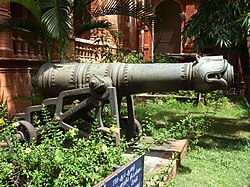
[[File:Tipu Sultan | [[File:Battle of pollilur.jpg|thumb|[[Mural]] of the [[Battle of Pollilur]] on the walls of Tipu's summer palace, painted to celebrate his triumph over the British]] [[File:Tipu Sultan%27s cannon.jpg|thumb|Very small Cannon used by Tipu Sultan's forces now in Government Museum (Egmore), Chennai]]In 1779, the British captured the French-controlled port of [[Mahé, India|Mahé]] which Tipu had placed under his protection, providing some troops for its defence. In response, Hyder launched an invasion of the Carnatic, with the aim of driving the British out of [[Madras]].<ref>{{cite book|title=A history of the British army, Volume 3|first=John William|last=Fortescue|url=https://books.google.com/books?id=1GlKAAAAYAAJ&q=cornwallis%20medows%20mysore&pg=PA546|publisher=Macmillan|year=1902|pages=431–432}}</ref> During this campaign in September 1780, Tipu Sultan was dispatched by Hyder Ali with 10,000 men and 18 guns to intercept [[William Baillie (East India Company officer)|Colonel William Baillie]] who was on his way to join Sir [[Hector Munro, 8th of Novar|Hector Munro]]. In the [[Battle of Pollilur]], Tipu defeated Baillie. Out of 360 Europeans, about 200 were captured alive, and the sepoys, who were about 3800 men, suffered very high casualties. Munro was moving south with a separate force to join Baillie, but on hearing the news of the defeat he retreated to Madras, abandoning his artillery in a water tank at [[Kanchipuram]].<ref>{{cite web|url=http://www.nationalgalleries.org/tipu/tipu311.htm|title=The Tiger and The Thistle – Tipu Sultan and the Scots in India|work=nationalgalleries.org|url-status=dead|archive-url=https://web.archive.org/web/20061111064154/http://www.nationalgalleries.org/tipu/tipu311.htm|archive-date=11 November 2006}}</ref> | ||
In | Tipu Sultan defeated Colonel Braithwaite at Annagudi near Tanjore on 18 February 1782. Braithwaite's forces, consisting of 100 Europeans, 300 cavalry, 1400 [[sepoy]]s and 10 field pieces, was the standard size of the colonial armies. Tipu Sultan seized all guns and took the detachment prisoner. In December 1781 Tipu Sultan seized Chittur from the British. Tipu Sultan had gained sufficient military experience by the time Hyder Ali died on Friday, 6 December 1782. Some historians put Hyder Ali's death at 2 or 3 days later or before due to the Hijri date being 1 [[Muharram]], 1197 as per some records in Persian (which can result in a difference of 1 to 3 days due to the Lunar Calendar). He became the ruler of Mysore on Sunday, 22 December 1782 (the inscriptions in some of Tipu's [[regalia]] show it as 20 [[Muharram]], 1197 [[Islamic calendar|Hijri]] Sunday) in a simple coronation ceremony. | ||
He subsequently worked on to check the advances of the British by making alliances with the [[Marathas]] and the [[Mughal Empire|Mughals]]. The Second Mysore War came to an end with the 1784 [[Treaty of Mangalore]].{{Clarify|date=January 2019}}<ref>{{Cite book|url=https://books.google.com/books?id=0Vs6AQAAMAAJ&q=treaty+of+mangalore&pg=PA139|title=The Parliamentary History of England from the Earliest Period to the Year 1803|date=1817|publisher=T.C. Hansard}}</ref> | |||
==Ruler of Mysore== | |||
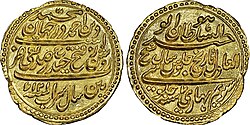
On 29 December 1782, Tipu Sultan crowned himself ''Badshah'' or Emperor of Mysore with the title Nawab Tipu Sultan Bahadur at age 32, and struck coinage.<ref name="Brittlebank 2022">{{cite book | last=Brittlebank | first=K. | title=Tiger: The Life of Tipu Sultan | publisher=Claritas Books | year=2022 | isbn=978-1-905837-87-8 | url=https://books.google.com/books?id=1F9jEAAAQBAJ | access-date=15 April 2024 }}</ref> | |||
===Conflicts with Maratha Confederacy=== | ===Conflicts with Maratha Confederacy=== | ||
{{See also|Battles involving the Maratha Empire#Conflict with the Kingdom of Mysore}} | {{See also|Battles involving the Maratha Empire#Conflict with the Kingdom of Mysore}} | ||
The [[Maratha Empire]] | [[File:Tipu Sultan seated on his throne.jpg|thumb|right|Tipu Sultan seated on his throne (1800), by [[Anna Tonelli]]]] | ||
[[File:Gardens Tipu Summer Palace Srirangapatna Jan24 A7C 08975.jpg|thumb|right|[[Daria Daulat Bagh|Tipu Sultan's Summer Palace]] at [[Srirangapatna]], Karnataka]] | |||
The [[Maratha Empire]] under its new [[Peshwa]] [[Madhavrao I]] regained most of Indian subcontinent, twice defeating Tipu's father in 1764 and then in 1767. In 1767 Maratha Peshwa Madhavrao defeated both Hyder Ali and Tipu Sultan and entered Srirangapatna, the capital of Mysore. Hyder Ali accepted the authority of Madhavrao who gave him the title of Nawab of Mysore.{{sfn|Roy|2011|p=72}} | |||
Subsequently, to escape the treaty, Tipu tried to take some Maratha forts in Southern India captured by in the previous war and also stopped the tribute to Marathas which was promised by Hyder Ali.<ref name='tipu 2'>{{Cite book|url=https://books.google.com/books?id=bxsa3jtHoCEC&q=tipu+48+lacs+maratha&pg=PA175|title=Battles of the Honourable East India Company: Making of the Raj|last=Naravane|first=M. S.|date=2006|publisher=APH Publishing|isbn=9788131300343}}</ref> This brought Tipu in direct conflict with the Marathas, leading to [[Maratha–Mysore War]]<ref name='tipu 2'/> | |||
Conflicts between Mysore (under Tipu) and Marathas: | Conflicts between Mysore (under Tipu) and Marathas: | ||
* [[Second siege of Nargund|Siege of Nargund]] during February 1785 won by Mysore | * [[Second siege of Nargund|Siege of Nargund]] during February 1785 won by Mysore | ||
| Line 92: | Line 149: | ||
* [[Battle of Savanur]] during October 1786 won by Mysore | * [[Battle of Savanur]] during October 1786 won by Mysore | ||
* [[Siege of Bahadur Benda]] during January 1787 won by Mysore | * [[Siege of Bahadur Benda]] during January 1787 won by Mysore | ||
Tipu would | Conflict ended with [[Gajendragarh#Treaty of Gajendragad|Treaty of Gajendragad]] in March 1787, as per which Tipu returned all the territory captured by [[Hyder Ali]] to [[Maratha Empire]].<ref name='tipu 2'/>{{sfn|Sen|1995|p=54}} Tipu would release Kalopant and return Adoni, Kittur, and Nargund to their previous rulers. Badami would be ceded to the Marathas and Tipu would also pay an annual tribute totaling 12 lakhs for an agreed period of 4 years to the Marathas. In return, Tipu Sultan would get all the region that he had captured during the war. This included Gajendragarh and Dharwar.{{sfn|Hasan|2005|p=105}}{{sfn|Sen|1995|p=59}} The Marathas in return agreed to recognize his authority and to address Tipu sultan as "Nabob Tipu Sultan Futteh Ally Khan".{{sfn|Sen|1995|p=59}} However the Marathas ultimately reneged on the treaty and in the [[Fourth Anglo-Mysore War]] the Marathas presented their support to the British East India Company which helped the British to take over Mysore in 1799.{{sfn|Moienuddin|2000}}{{page needed|date=December 2023}}{{sfnm|Hasan|2005|1p=105|Sen|1995|2p=59}} | ||
===The Invasion of Malabar(1766–1790)=== | ===The Invasion of Malabar (1766–1790)=== | ||
{{main|Mysorean invasion of Malabar}} | {{main|Mysorean invasion of Malabar}} | ||
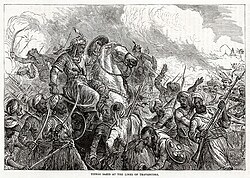
[[File:Tippoo Sahib at the lines of Travancore in the 1850s.jpg|thumb|200px|Tipu Sultan at the lines of [[Travancore]].]] | [[File:Tippoo Sahib at the lines of Travancore in the 1850s.jpg|thumb|200px|Tipu Sultan at the lines of [[Travancore]].]] | ||
In 1766 | In 1766 when he was 15 years old Tipu accompanied his father on an invasion of Malabar. After the incident- [[Siege of Tellicherry]] in [[Thalassery]] in North [[Malabar District|Malabar]],<ref>{{Cite book|url=https://archive.org/stream/dictionaryofindi00buckuoft#page/86/mode/1up|title=Dictionary of Indian biography|year=1906|publisher=London S. Sonnenschein}}</ref> Hyder Ali started losing his territories in Malabar. Tipu came from [[Mysore]] to reinstate the authority over Malabar. After the [[Battle of the Nedumkotta|Battle of the Nedumkotta (1789–90]]), due to the monsoon flood, the stiff resistance of the Travancore forces and news about the attack of British in [[Srirangapatnam]] he went back.<ref>{{cite web|url=http://www.karnataka.com/personalities/tipu-sultan/|title=Tipu Sultan – Personalities|work=Karnataka.com|date=10 November 2016}}</ref> | ||
===Third Anglo-Mysore War=== | ===Third Anglo-Mysore War=== | ||
{{main|Third Anglo-Mysore War}} | {{main|Third Anglo-Mysore War}} | ||
[[File:Tippu's cannon.jpg|thumb|left|Cannon used by Tipu Sultan's forces at the battle of [[Srirangapatna]] 1799]] [[File:Surrender of Tipu Sultan.jpg|thumb|General [[Charles Cornwallis, 1st Marquess Cornwallis|Lord Cornwallis]], receiving two of Tipu Sultan's sons as hostages in the year 1793.|left]] | |||
In | In 1789, Tipu Sultan disputed the acquisition by [[Dharma Raja of Travancore]] of two [[Dutch Republic|Dutch-held]] fortresses in [[Kingdom of Cochin|Cochin]]. In December 1789 he massed troops at [[Coimbatore]], and on 28 December [[Battle of the Nedumkotta|made an attack]] on the lines of Travancore, knowing that Travancore was (according to the [[Treaty of Mangalore]]) an ally of the [[British East India Company]].{{sfn|Wenger|2017|pp=11–}} On account of the staunch resistance by the Travancore army, Tipu was unable to break through the Tranvancore lines and the Maharajah of Travancore appealed to the East India Company for help. In response, [[Charles Cornwallis, 1st Marquess Cornwallis|Lord Cornwallis]] mobilised company and British military forces, and formed alliances with the Marathas and the Nizam of Hyderabad to oppose Tipu. In 1790 the company forces advanced, taking control of much of the Coimbatore district.{{sfn|Wenger|2017|pp=11–}} Tipu counter-attacked, regaining much of the territory, although the British continued to hold Coimbatore itself. He then descended into the Carnatic, eventually reaching [[Pondicherry (city)|Pondicherry]], where he attempted without success to draw the French into the conflict.{{sfn|Wenger|2017|pp=11–}} | ||
The 1792 campaign was a failure for Tipu. The allied army was well-supplied, and Tipu was unable to prevent the junction of forces from Bangalore and Bombay before Srirangapatna. | In 1791 his opponents advanced on all fronts, with the main British force under Cornwallis [[Siege of Bangalore|taking Bangalore]] and threatening Srirangapatna. Tipu harassed the British supply and communication and embarked on a "scorched earth" policy of denying local resources to the British.{{sfn|Wenger|2017|pp=11–}} In this last effort he was successful, as the lack of provisions forced Cornwallis to withdraw to Bangalore rather than attempt a siege of Srirangapatna. Following the withdrawal, Tipu sent forces to Coimbatore, which they retook [[Siege of Coimbatore|after a lengthy siege]].{{sfn|Wenger|2017|pp=11–}} | ||
The 1792 campaign was a failure for Tipu. The allied army was well-supplied, and Tipu was unable to prevent the junction of forces from Bangalore and Bombay before Srirangapatna.{{sfn|Wenger|2017|pp=11–}} After [[Siege of Seringapatam (1792)|about two weeks of siege]], Tipu opened negotiations for terms of surrender. In the [[Treaty of Seringapatam|ensuing treaty]], he was forced to cede half his territories to the allies,{{sfn|Chisholm|1911}} and deliver two of his sons as hostages until he paid in full three crores and thirty lakhs rupees fixed as war indemnity to the British for the campaign against him. He paid the amount in two instalments and got back his sons from Madras.{{sfn|Wenger|2017|pp=11–}} | |||
===Napoleon's attempt at a junction=== | ===Napoleon's attempt at a junction=== | ||
{{Main|Franco-Indian alliances}} | {{Main|Franco-Indian alliances}} | ||
In 1794, with the support of French Republican officers, Tipu allegedly helped found the [[Jacobin Club of Mysore]] for 'framing laws comfortable with the laws of the Republic'. He planted a Liberty Tree and declared himself Citizen Tipoo.<ref>{{cite book|last=Roychoudhury|first=Upendrakishore|title=White Mughals|url=https://books.google.com/books?id=H7BCr-QIWGIC&pg=PA101|date=April 2004|publisher=Penguin Books India|isbn=978-0-14-303046-1|page=101}}</ref> In a 2005 paper, historian Jean Boutier argued that the club's existence, and Tipu's involvement in it, was fabricated by the East India Company in order to justify British military intervention against Tipu.<ref>{{Cite journal|title=Les "lettres de créances" du corsaire Ripaud. Un "club jacobin" à Srirangapatnam (Inde), mai-juin 1797|journal=Les Indes Savantes|url=https://halshs.archives-ouvertes.fr/halshs-00007971/document?_x_tr_sl=fr&_x_tr_tl=en&_x_tr_hl=en&_x_tr_pto=nui,sc|last=Boutier|first=Jean|date=2005}}</ref> | |||
{{rquote|centre|Although I never supposed that he (''[[Napoleon]]'') possessed, allowing for some difference of education, the liberality of conduct and political views which were sometimes exhibited by old [[Hyder Ali]], yet I did think he might have shown the same resolved and dogged spirit of resolution which induced Tipu Sahib to die manfully upon the breach of his capital city with his sabre clenched in his hand.|Sir [[Walter Scott]], commenting on the abdication of [[Napoleon | One of the motivations of Napoleon's [[French campaign in Egypt and Syria|invasion of Egypt]] was to establish a junction with India against the British. Bonaparte wished to establish a French presence in the Middle East, with the ultimate dream of linking with Tippoo Sahib.<ref>{{Cite book|url=https://books.google.com/books?id=o4vrUbMK5eEC&pg=PA13|title=Tricolor and Crescent|isbn=9780275974701|year=2003|last1=Watson|first1=William E.|publisher=Greenwood Publishing }}</ref> Napoleon assured the [[French Directory]] that "as soon as he had conquered Egypt, he will establish relations with the Indian princes and, together with them, attack the English in their possessions."<ref name="books.google.com">{{Cite book|url=https://books.google.com/books?id=n5IOAAAAQAAJ&pg=PA12|title=Napoleon and Persia|isbn=9780934211581|date=January 1999|last1=Amini|first1=Iradj|publisher=Mage Publishers }}</ref> According to a 13 February 1798 report by [[Talleyrand]]: "Having occupied and fortified Egypt, we shall send a force of 15,000 men from [[Suez]] to India, to join the forces of Tipu-Sahib and drive away the English."<ref name="books.google.com"/> Napoleon was unsuccessful in this strategy, losing the [[Siege of Acre (1799)|Siege of Acre]] in 1799 and at the [[Battle of Abukir (1801)|Battle of Abukir]] in 1801.<ref name=karsh11>{{Cite book|url=https://books.google.com/books?id=UBilxxaKRKkC&pg=PA11|title=Empires of the Sand|isbn=9780674005419|year=2001|last1=Karsh|first1=Efraim|last2=Karsh|first2=Inari|publisher=Harvard University Press }}</ref> | ||
{{rquote|centre|Although I never supposed that he (''[[Napoleon]]'') possessed, allowing for some difference of education, the liberality of conduct and political views which were sometimes exhibited by old [[Hyder Ali]], yet I did think he might have shown the same resolved and dogged spirit of resolution which induced Tipu Sahib to die manfully upon the breach of his capital city with his sabre clenched in his hand.|Sir [[Walter Scott]], commenting on the abdication of [[Napoleon]] Bonaparte in 1814}} | |||
==Death== | ==Death== | ||
{{Further information|Fourth Anglo-Mysore War}} | {{Further information|Fourth Anglo-Mysore War}} | ||
[[File:Tipu Sultan, Indian warrior Emperor of Mysore.gif|left|thumb|upright=0.8|Tipu Sultan confronts his opponents during the [[Siege of Seringapatam (1799)|Siege of Srirangapatna.]]]] | |||
[[File:Tipu Sultan, Indian warrior Emperor of Mysore.gif|left|thumb|Tipu Sultan confronts his opponents during the [[Siege of Seringapatam (1799)|Siege of Srirangapatna.]]]] | [[Horatio Nelson]] defeated [[François-Paul Brueys D'Aigalliers]] at the [[Battle of the Nile]] in Egypt in 1798. Three armies marched into Mysore in 1799—one from [[Bombay]] and two British, one of which included Arthur Wellesley.<ref>{{cite web |last1=Francis |first1=P. Sempa |title=Wellington in India: A Great Commander in Embryo |website=thediplomat.com |url=https://thediplomat.com/2015/05/wellington-in-india-a-great-commander-in-embryo/ |access-date=16 September 2020}}</ref> They besieged the capital [[Srirangapatna]] in the [[Fourth Mysore War]].<ref>The Parliamentary Register; Or, History of the Proceedings and Debates of the [House of Lords and House of Commons]-J. Almon, 1793</ref> There were more than 60,000 soldiers of the British East India Company, approximately 4,000 Europeans and the rest Indians; while Tipu Sultan's forces numbered only around 30,000. The betrayal by Tipu Sultan's ministers in working with the British and weakening the walls to make an easy path for the British.<ref name="hindu"/><ref name="Sunderlal 2018 p. 364">{{cite book |last=Sunderlal |first=Pandit |title=How India Lost Her Freedom |publisher=SAGE Publications |year=2018 |isbn=978-93-5280-642-3 |url=https://books.google.com/books?id=E4lIDwAAQBAJ&pg=PA364 |access-date=20 January 2022 |page=364}}</ref> The death of Tipu Sultan led British General Harris to exclaim "Now India is ours."{{sfn|Moienuddin|2000}}{{page needed|date=December 2023}} | ||
[[Horatio Nelson]] defeated [[François-Paul Brueys D'Aigalliers]] at the [[Battle of the Nile]] in Egypt in 1798. Three armies marched into Mysore in 1799—one from [[Bombay]] and two British, one of which included Arthur Wellesley.<ref>{{cite web |last1=Francis |first1=P. Sempa |title=Wellington in India: A Great Commander in Embryo |url=https://thediplomat.com/2015/05/wellington-in-india-a-great-commander-in-embryo/ | |||
When the British [[Battle of Srirangapatna|broke through]] the city walls, French military advisers told Tipu Sultan<ref name="Tipu's french advisors">{{cite news |title=Tipu Sultan: Here're lesser known facts about 'Tiger of Mysore' |url=https://www.siasat.com/tipu-sultan-herere-lesser-known-facts-about-tiger-mysore-1715508/ |access-date=16 September 2020 |work=The Siasat Daily |date=2 November 2019}}</ref> to escape via secret passages and to fight the rest of the wars from other forts, but he refused.<ref>{{cite web |title=Tipu, the Citizen-Sultan and the Myth of a Jacobin Club in India |url=https://thewire.in/history/the-citizen-sultan-a-jacobin-club-in-india |website=The Wire}}</ref> | When the British [[Battle of Srirangapatna|broke through]] the city walls, French military advisers told Tipu Sultan<ref name="Tipu's french advisors">{{cite news |title=Tipu Sultan: Here're lesser known facts about 'Tiger of Mysore' |url=https://www.siasat.com/tipu-sultan-herere-lesser-known-facts-about-tiger-mysore-1715508/ |access-date=16 September 2020 |work=The Siasat Daily |date=2 November 2019}}</ref> to escape via secret passages and to fight the rest of the wars from other forts, but he refused.<ref>{{cite web |title=Tipu, the Citizen-Sultan and the Myth of a Jacobin Club in India |url=https://thewire.in/history/the-citizen-sultan-a-jacobin-club-in-india |website=The Wire}}</ref> Tipu famously said "Better to live one day as a tiger than a thousand years as a sheep".<ref>{{cite book |url=http://www.oxfordreference.com/view/10.1093/acref/9780199539536.001.0001/acref-9780199539536-e-156 |title=The Oxford Dictionary of Proverbs|edition=5 |access-date=14 February 2017|isbn=978-0-19-953953-6 |last1=Speake |first1=Jennifer |last2=Simpson |first2=John |date=23 October 2008 |publisher=Oxford University Press}}</ref> | ||
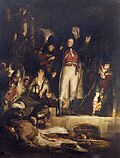
Tipu Sultan was killed at the Hoally (Diddy) Gateway, which was located {{convert|300|yd|m}} from the N.E. Angle of the Srirangapatna Fort.<ref>{{cite web|url=http://www.bl.uk/onlinegallery/onlineex/apac/other/019wdz000000138u00000000.html | [[File:Tipu death.jpg|thumb|right|''[[The Last Effort and Fall of Tippoo Sultaun]]'' by [[Henry Singleton (painter)|Henry Singleton]], c. 1800]] | ||
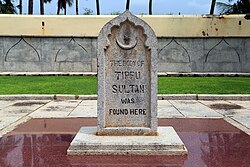
Tipu Sultan was killed at the Hoally (Diddy) Gateway, which was located {{convert|300|yd|m}} from the N.E. Angle of the Srirangapatna Fort.<ref>{{cite web|title=View of the Hoally Gateway, where Tipu Sultan was killed, Seringapatam (Mysore)|publisher=British Library Online Gallery |url=http://www.bl.uk/onlinegallery/onlineex/apac/other/019wdz000000138u00000000.html|access-date=14 June 2009}}</ref> He was buried the next afternoon at the [[Gumbaz, Seringapatam|Gumaz]], next to the grave of his father. Many members of the British East India Company believed that [[Nawab of Carnatic]] [[Umdat Ul-Umra]] secretly provided assistance to Tipu Sultan during the war and sought his deposition after 1799.{{Citation needed|date= April 2018}} These five men include Mir Sadiq, Purnaiya, two military commanders Saiyed Saheb and Qamaruddin, and Mir Nadim, commandant of the fort of Seringapatam. The episode of treachery as narrated by Hasan starts with the disobedience of Tipu's instructions.<ref>{{Cite web|title= A Revaluation of tales of concerning Tipu Sultan's defeat|url=https://dailytimes.com.pk/323998/a-re-evaluation-of-tales-of-betrayal-concerning-Tipu-Sultan's-defeat|first=Ayesha|last=Rafiq |date=20 November 2018|work=Daily Times|access-date=13 July 2022}}</ref> When he died there were jubilant celebrations in Britain, with authors, playwrights and painters creating works to celebrate it.<ref>{{cite web |url=https://scroll.in/article/812199/seven-things-you-may-not-have-known-about-tipu-sultan-indias-first-freedom-fighter |title=Seven things you may not have known about Tipu Sultan, India's first freedom fighter |last=Brittlebank |first=Kate |date=22 July 2016 |archive-date=19 March 2022 |publisher=Scroll.in |archive-url=https://web.archive.org/web/20220319184846/https://scroll.in/article/812199/seven-things-you-may-not-have-known-about-tipu-sultan-indias-first-freedom-fighter|url-status=live}}</ref> The death of Tipu Sultan was celebrated with declaration of public holiday in Britain.<ref name="te Deum">{{cite book |first= Anjali |last=Sengupta |date= 1984 |title= Cameos of Twelve European Women in India, 1757-1857 |publisher= Ṛddhi-India |pages= 11 |oclc= 13531696 |url= https://books.google.com/books?id=hHwtAAAAMAAJ&q=tipu+public+holiday}}</ref> | |||
== Administration == | == Administration == | ||
Tipu introduced a new calendar, new coinage, and seven new government departments, during his reign, and made military innovations in the use of rocketry. | Tipu introduced a new calendar, new coinage, and seven new government departments, during his reign, and made military innovations in the use of rocketry. | ||
===Mysorean rockets=== | ===Mysorean rockets=== | ||
{{main|Mysorean rockets}} | {{main|Mysorean rockets}} | ||
[[File:Indian soldier of Tipu Sultan's army.jpg|thumb|upright|A soldier from Tipu Sultan's army, using his [[rocket]] as a flagstaff.]] | |||
[[File:Congreve rockets.gif|thumb|Tipu Sultan organised his [[Rocket]] artillery brigades known as ''Cushoons'', Tipu Sultan expanded the number of servicemen in the various ''Cushoons'' from 1500 to almost 5000. The [[Mysorean rockets]] utilised by Tipu Sultan, were later updated by the British and successively employed during the [[Napoleonic Wars]].]] | [[File:Congreve rockets.gif|thumb|Tipu Sultan organised his [[Rocket]] artillery brigades known as ''Cushoons'', Tipu Sultan expanded the number of servicemen in the various ''Cushoons'' from 1500 to almost 5000. The [[Mysorean rockets]] utilised by Tipu Sultan, were later updated by the British and successively employed during the [[Napoleonic Wars]].]] | ||
Dr [[APJ Abdul Kalam]], the former [[President of India]], in his Tipu Sultan Shaheed Memorial Lecture in Bangalore (30 November 1991), called Tipu Sultan the innovator of the world's first war rocket. Two of these rockets, captured by the British at Srirangapatna, were displayed in the [[Firepower | Dr [[APJ Abdul Kalam]], the former [[President of India]], in his Tipu Sultan Shaheed Memorial Lecture in Bangalore (30 November 1991), called Tipu Sultan the innovator of the world's first war rocket. Two of these rockets, captured by the British at Srirangapatna, were displayed in the [[Firepower – The Royal Artillery Museum|Royal Artillery Museum]] in London. According to historian Dr [[Dulari Qureshi]] Tipu Sultan was a fierce warrior king and was so quick in his movement that it seemed to the enemy that he was fighting on many fronts at the same time.<ref name="hindu">{{cite news |url=http://www.hindu.com/mag/2010/11/07/stories/2010110750210500.htm |archive-url=https://web.archive.org/web/20131029152509/http://www.hindu.com/mag/2010/11/07/stories/2010110750210500.htm |url-status=dead |archive-date=29 October 2013 |title=Tipu's legend lives on |last1=Zachariah |first1=Mini Pant |newspaper=[[The Hindu]] |date=7 November 2010 |access-date=18 December 2013}}</ref> Tipu managed to subdue all the petty kingdoms in the south. He was also one of the few Indian rulers to have defeated British armies. | ||
Tipu Sultan's father had expanded on [[Mysorean rockets|Mysore's use of rocketry]], making critical innovations in the rockets themselves and the military logistics of their use. He deployed as many as 1,200 specialised troops in his army to operate rocket launchers. These men were skilled in operating the weapons and were trained to launch their rockets at an angle calculated from the diameter of the cylinder and the distance to the target. The rockets had twin side sharpened blades mounted on them, and when fired ''en masse'', spun and wreaked significant damage against a large army. Tipu greatly expanded the use of rockets after Hyder's death, deploying as many as 5,000 rocketeers at a time.<ref name="5000 rockets">{{cite news |title=Over 5,000 'war rockets' of Tipu Sultan unearthed |url=https://www.deccanherald.com/state/over-1000-war-rockets-tipu-684169.html |access-date=16 September 2020 |work=Deccan Herald |date=28 July 2018 | Tipu Sultan's father had expanded on [[Mysorean rockets|Mysore's use of rocketry]], making critical innovations in the rockets themselves and the military logistics of their use. He deployed as many as 1,200 specialised troops in his army to operate rocket launchers. These men were skilled in operating the weapons and were trained to launch their rockets at an angle calculated from the diameter of the cylinder and the distance to the target. The rockets had twin side sharpened blades mounted on them, and when fired ''en masse'', spun and wreaked significant damage against a large army. Tipu greatly expanded the use of rockets after Hyder's death, deploying as many as 5,000 rocketeers at a time.<ref name="5000 rockets">{{cite news |title=Over 5,000 'war rockets' of Tipu Sultan unearthed |url=https://www.deccanherald.com/state/over-1000-war-rockets-tipu-684169.html |access-date=16 September 2020 |work=Deccan Herald |date=28 July 2018}}</ref> The rockets deployed by Tipu during the [[Battle of Pollilur (1780)|Battle of Pollilur]] were much more advanced than those the British East India Company had previously seen, chiefly because of the use of iron tubes for holding the propellant; this enabled higher thrust and longer range for the missiles (up to 2 km range).<ref name="5000 rockets"/><ref name=Narasimha/> | ||
British accounts describe the use of the rockets during the third and fourth wars.<ref>{{cite web|url=https://indianexpress.com/article/research/how-the-mysorean-rocket-helped-tipu-sultans-military-might-gain-new-heights/|title=How the Mysorean rocket helped Tipu Sultan's military might gain new heights|date=5 August 2018}}</ref> During the climactic battle at Srirangapatna in 1799, British shells struck a magazine containing rockets, causing it to explode and send a towering cloud of black smoke with cascades of exploding white light rising up from the battlements. After Tipu's defeat in the fourth war the British captured a number of the Mysorean rockets. These became influential in British rocket development, inspiring the [[Congreve rocket]], which was soon put into use in the [[Napoleonic Wars]].<ref name=Narasimha>{{cite web |url=https://www.researchgate.net/publication/37179995 |url-status=dead |archive-url=https://web.archive.org/web/20110727034357/https://www.nal.res.in/pdf/pdfrocket.pdf |title=Rockets in Mysore and Britain, 1750–1850 A.D. |last=Narasimha |first=Roddam |date=27 July 2011 |archive-date=27 July 2011 |publisher=National Aeronautical Laboratory and Indian Institute of Science.}}</ref> | British accounts describe the use of the rockets during the third and fourth wars.<ref>{{cite web|url=https://indianexpress.com/article/research/how-the-mysorean-rocket-helped-tipu-sultans-military-might-gain-new-heights/|title=How the Mysorean rocket helped Tipu Sultan's military might gain new heights|date=5 August 2018}}</ref> During the climactic battle at Srirangapatna in 1799, British shells struck a magazine containing rockets, causing it to explode and send a towering cloud of black smoke with cascades of exploding white light rising up from the battlements. After Tipu's defeat in the fourth war the British captured a number of the Mysorean rockets. These became influential in British rocket development, inspiring the [[Congreve rocket]], which was soon put into use in the [[Napoleonic Wars]].<ref name=Narasimha>{{cite web |url=https://www.researchgate.net/publication/37179995 |url-status=dead |archive-url=https://web.archive.org/web/20110727034357/https://www.nal.res.in/pdf/pdfrocket.pdf |title=Rockets in Mysore and Britain, 1750–1850 A.D. |last=Narasimha |first=Roddam |date=27 July 2011 |archive-date=27 July 2011 |publisher=National Aeronautical Laboratory and Indian Institute of Science.}}</ref> | ||
| Line 151: | Line 209: | ||
===Army=== | ===Army=== | ||
Due to their perpetual battle engagements, Haidar and Tipu required a disciplined standing army. Thus, [[ | Due to their perpetual battle engagements, Haidar and Tipu required a disciplined standing army. Thus, [[Rajput]]s, Muslims and able tribal men were enrolled for full time service replacing the local militia called the ''Kandachar''<ref>{{cite book |first=Mysore Hatti |last=Gopal|date=1960|title=The Finances Of The Mysore State 1799 – 1831 |url=https://books.google.com/books?id=9UJKAAAAMAAJ&q=Kandachar+militia|publisher=Orient Longmans|page=255|quote=These were armed militia who served as police officers, helped in the collection of revenue and often garrisoned small forts . They resembled the sibundi in the Company ' s territories . In Mysore they were divided into the huzur kandachar or those who were in the capital and about the Maharaja, and the taluq kandachar or those in the taluqs, the latter being far more numerous than the former.}}</ref> force of agricultural origin which existed in the Mysore army earlier. The removal of the [[Vokkaliga]]s from the local militia which had taken part in wars for centuries and the imposition of higher taxes on them in place of their quit rent led indirectly to the implementation of [[Ryotwari]] system. Now the [[Ryot#Ryotwari system|Ryots]] could not rely upon slaves for their agricultural activities since their slaves were enrolled in the army in some places. Besides paying higher taxes they had to endure the additional responsibility of feeding the slaves and financing their marriages. This led to the weakening of the system of slavery in [[Mysore]].<ref>{{cite book |editor=R. Gopal|date=2010|title=Tipu Sultan: The Tiger of Mysore |url=https://books.google.com/books?id=tDT0UsWn7mUC&q=vokkaliga+kandachar|location=Mysore|publisher=Directorate of Archaeology and Museums, Government of Karnataka|page=279|oclc=813417527|quote=Since Haidar and Tipu were perpetually engaged in battles, they formed a disciplined standing army . Thus, instead of the local militia called the Kandachar force of agricultural origin which existed in the Mysore army earlier, Haidar and Tipu enrolled to their army forces the able tribal men, Muslims and Rajputs on full time service. In this way, Haidar and Tipu removed the Vokkaligas of the agricultural base from the local militia which took part in wars for centuries and in place of their quit rent, they imposed higher taxes and thus became indirectly responsible for implementation of Ryotwari system. The Ryots were not liberated from the shackles of Kandachar service; the slaves who were with them were enrolled in the army in some places. As a result, the Ryots removed from the military service could not even rely upon slaves for their agricultural activities. Hence these ryots had to endure the greater responsibility of feeding the slaves and of financing their marriages besides paying the higher taxes. So in the plains of Mysore the system of slavery was loosened.}}</ref> | ||
=== Economy === | === Economy === | ||
{{Main|Economy of the Kingdom of Mysore}} | {{Main|Economy of the Kingdom of Mysore}} | ||
{{Further|Mysore silk|Economic history of India}} | {{Further|Mysore silk|Economic history of India}} | ||
The peak of [[Economy of the Kingdom of Mysore|Mysore's economic power]] was under Tipu Sultan in the late 18th century. Along with his father Hyder Ali, he embarked on an ambitious program of economic development, aiming to increase the wealth and revenue of Mysore. | The peak of [[Economy of the Kingdom of Mysore|Mysore's economic power]] was under Tipu Sultan in the late 18th century. Along with his father Hyder Ali, he embarked on an ambitious program of economic development, aiming to increase the wealth and revenue of Mysore.{{sfn|Parthasarathi|2011|p=207}} Under his reign, Mysore overtook [[Bengal Subah]] as [[Economic history of India|India's dominant economic power]], with highly productive [[agriculture]] and [[textile manufacturing]].{{sfn|Parthasarathi|2011|pp=38, 271}} Mysore's average income was five times higher than [[subsistence]] level at the time.{{sfn|Parthasarathi|2011|p=45}} | ||
Tipu Sultan laid the foundation for the construction of the [[Kannambadi]] dam (present-day [[Krishna Raja Sagara]] or KRS dam) on the [[Kaveri]] river, as attested by an extant stone plaque bearing his name, but was unable to begin the construction.<ref>{{cite web|url=https://www.deccanchronicle.com/opinion/op-ed/040819/tiger-of-mysore-saviour-or-savage.html|title=Tiger of Mysore: Saviour or savage?|website=Deccan Chronicle | Tipu Sultan laid the foundation for the construction of the [[Kannambadi]] dam (present-day [[Krishna Raja Sagara]] or KRS dam) on the [[Kaveri]] river, as attested by an extant stone plaque bearing his name, but was unable to begin the construction.<ref>{{cite web|url=https://www.deccanchronicle.com/opinion/op-ed/040819/tiger-of-mysore-saviour-or-savage.html|title=Tiger of Mysore: Saviour or savage?|website=Deccan Chronicle|date=4 August 2019|access-date=22 September 2019}}</ref><ref>{{cite news|url=https://economictimes.indiatimes.com/industry/miscellaneous/how-tipu-sultan-was-the-original-tech-innovator/articleshow/61588682.cms|title=How Tipu Sultan was the original tech innovator|website=[[The Economic Times]]|date=10 November 2017|access-date=22 September 2019|last1=Shekhar|first1=Divya}}</ref> The dam was later built and opened in 1938. It is a major source of drinking water for the people of Mysore and Bangalore. | ||
The [[Mysore silk]] industry was first initiated during the reign of Tipu Sultan.<ref name="Hunter512">{{cite book |last1=Hunter |first1=William Wilson | The [[Mysore silk]] industry was first initiated during the reign of Tipu Sultan.<ref name="Hunter512">{{cite book |last1=Hunter |first1=William Wilson |title=The Indian empire : its peoples, history, and products |year=1886 |publisher=Trubner, London |page=512 |url=https://archive.org/details/indianempireitsp00huntrich/page/512/mode/1up?q=tipu |access-date=21 June 2020}}</ref> He sent an expert to [[Bengal Subah]] to study [[silk]] cultivation and processing, after which Mysore began developing polyvoltine silk.<ref name="Global Silk Industry"/> | ||
The greater prominence of the [[Channapatna toys]] can be traced to patronage from Tipu Sultan, the historic ruler of [[Mysore]], though these toys existed before this period historically given as gifts as part of [[Mysore Dasara|Dusshera]] celebrations. It is known that he was an ardent admirer of arts, and in particular of woodwork.<ref>Handmade in India: A Geographic Encyclopedia of Indian, Page 362, Aditi Ranjan, M. P. Ranjan (2009)</ref | The greater prominence of the [[Channapatna toys]] can be traced to patronage from Tipu Sultan, the historic ruler of [[Mysore]], though these toys existed before this period historically given as gifts as part of [[Mysore Dasara|Dusshera]] celebrations. It is known that he was an ardent admirer of arts, and in particular of woodwork.<ref name="Handmade">Handmade in India: A Geographic Encyclopedia of Indian, Page 362, Aditi Ranjan, M. P. Ranjan (2009)</ref> | ||
==== Road development ==== | ==== Road development ==== | ||
Tipu Sultan was considered as pioneer of road construction, especially in Malabar, as part of his campaigns, he connected most of the cities by roads.<ref name="Edgar185">{{cite book |last1=Edgar |first1=Thurston |title=The Madras presidency, with Mysore, Coorg and the associated states |publisher=Cambridge, University press | Tipu Sultan was considered as pioneer of road construction, especially in Malabar, as part of his campaigns, he connected most of the cities by roads.<ref name="Edgar185">{{cite book |last1=Edgar |first1=Thurston |title=The Madras presidency, with Mysore, Coorg and the associated states |publisher=Cambridge, University press |page=185 |url=https://archive.org/details/cu31924021471002/page/n200/mode/1up |access-date=9 May 2020}}</ref> | ||
===Foreign relations=== | ===Foreign relations=== | ||
[[File:Louis XVI Receives the Ambassadors of Tipu Sultan 1788 Voyer after Emile Wattier 19th century.jpg|thumb|[[Louis XVI]] receives the ambassadors of Tipu Sultan in 1788. Tipu Sultan is known to have sent many diplomatic missions to France, the [[Ottoman Empire]], [[Sultanate of Oman]], [[Zand dynasty]] and [[Durrani Empire]].<ref>{{cite web|author=B. Sheik Ali |date=August 1999 |title=The Vision and Mission of Tipu Sultan |work=Islamic Voice |url=http://www.islamicvoice.com/august.99/tippu.htm |access-date=16 August 2011 |url-status=dead |archive-date=5 October 2011|archive-url=https://web.archive.org/web/20111005002119/http://www.islamicvoice.com/august.99/tippu.htm}}</ref>]] | |||
;Mughal Empire | |||
Immediately after his coronation as ''Badshah'', Tipu Sultan sought the investiture of the Mughal emperor. He earned the title ''"Nasib-ud-Daula"'' with the heavy heart of those loyal to Shah Alam II. Tipu was a selfdeclared "[[Sultan]]" this fact drew towards him the hostility of [[Nizam Ali Khan]], the Nizam of Hyderabad, who clearly expressed his hostility by dissuading the Mughal emperor and laying claims on Mysore. Disheartened, Tipu Sultan began to establish contacts with other Muslim rulers of that period.<ref name="auto2">{{Cite book | url = https://books.google.com/books?id=s04pus5jBNwC&q=tipu+sultan+and+ottoman&pg=PA11 | title = Pan-Islamism: Indian Muslims, the Ottomans and Britain, 1877–1924 | isbn = 978-90-04-10632-1 | last1 = Özcan | first1 = Azmi | year = 1997}}</ref> | Both Hyder Ali and Tipu Sultan owed nominal allegiance to the [[Mughal Emperor]] [[Shah Alam II]]; both were described as [[Nabob]]s by the [[British East India Company]] in all existing treaties. But unlike the [[Nawab of Carnatic]], they did not acknowledge the overlordship of the [[Nizam of Hyderabad]].{{sfn|Brittlebank|1999|p={{page needed|date=September 2023}}}} | ||
Immediately after his coronation as ''Badshah'', Tipu Sultan sought the investiture of the Mughal emperor. He earned the title ''"Nasib-ud-Daula"'' with the heavy heart of those loyal to Shah Alam II. Tipu was a selfdeclared "[[Sultan]]" this fact drew towards him the hostility of [[Nizam Ali Khan]], the Nizam of Hyderabad, who clearly expressed his hostility by dissuading the Mughal emperor and laying claims on Mysore. Disheartened, Tipu Sultan began to establish contacts with other Muslim rulers of that period.<ref name="auto2">{{Cite book | url = https://books.google.com/books?id=s04pus5jBNwC&q=tipu+sultan+and+ottoman&pg=PA11 |title=Pan-Islamism: Indian Muslims, the Ottomans and Britain, 1877–1924 |isbn=978-90-04-10632-1 |last1=Özcan |first1=Azmi |year=1997| publisher=BRILL}}</ref> | |||
Tipu Sultan was the master of his own diplomacy with foreign nations, in his quest to rid India of the [[East India Company]] and to ensure the international strength of [[France]]. Like his father before him he fought battles on behalf of foreign nations which were not in the best interests of Shah Alam II. | Tipu Sultan was the master of his own diplomacy with foreign nations, in his quest to rid India of the [[East India Company]] and to ensure the international strength of [[France]]. Like his father before him he fought battles on behalf of foreign nations which were not in the best interests of Shah Alam II. | ||
After [[Ghulam Kadir|Ghulam Qadir]] had Shah Alam II blinded on 10 August 1788, Tipu Sultan is believed to have broken into tears.<ref>{{Cite book | After [[Ghulam Kadir|Ghulam Qadir]] had Shah Alam II blinded on 10 August 1788, Tipu Sultan is believed to have broken into tears.<ref>{{Cite book |quote=plight. |title=Secret correspondence of Tipu Sultan |publisher=Light and Life Publishers |last1=Kausar |first1=Kabir |year=1980 |url=https://archive.org/details/dli.bengal.10689.12717}}</ref>{{page needed|date=September 2022}} | ||
[[File:The storming of Seringapatam - John Vendramini, 1802 - BL P779.jpg|thumb|Tipu Sultan's forces during the [[Siege of Seringapatam (1799)|Siege of Srirangapatna]].]] | [[File:The storming of Seringapatam - John Vendramini, 1802 - BL P779.jpg|thumb|Tipu Sultan's forces during the [[Siege of Seringapatam (1799)|Siege of Srirangapatna]].]] | ||
| Line 200: | Line 261: | ||
; Persia and Oman | ; Persia and Oman | ||
Like his father before him, Tipu Sultan maintained friendly relations with [[Mohammad Ali Khan Zand|Mohammad Ali Khan]], ruler of the [[Zand | Like his father before him, Tipu Sultan maintained friendly relations with [[Mohammad Ali Khan Zand|Mohammad Ali Khan]], ruler of the [[Zand dynasty]] in [[Persia]]. Tipu Sultan also maintained correspondence with [[Hamad bin Said]], the ruler of the [[Sultanate of Oman]].<ref>{{Cite book |last1=Bhacker |first1=Mohmed Reda |url=https://books.google.com/books?id=QxtpQSa1DXgC&q=tipu+sultan+oman&pg=PA214 |title=Trade and Empire in Muscat and Zanzibar: The Roots of British Domination |isbn=978-0-415-07997-6 |year=1992| publisher=Routledge}}</ref> | ||
'' | ;Qing China | ||
Tipu's and Mysore's tryst with silk began in the early 1780s when he received an ambassador from the [[Qing dynasty|Qing dynasty-ruled China]] at his court. The ambassador presented him with a silk cloth. Tipu was said to be enchanted by the item to such an extent that he resolved to introduce its production in his kingdom. He sent a return journey to China, which returned after twelve years.<ref>{{Cite web |title=A sultan's silken dreams |url=https://www.downtoearth.org.in/news/economy/a-sultan-s-silken-dreams-51808 |access-date=2022-08-21 |website=downtoearth.org.in |date=18 November 2015 }}</ref> | |||
; France | ; France | ||
[[File:Louis-François Baron Lejeune 001.jpg|thumb|left|upright=1. | [[File:Louis-François Baron Lejeune 001.jpg|thumb|left|upright=1.35|In his attempts to junction with Tipu Sultan, [[Napoleon]] annexed [[Ottoman Egypt]] in the year 1798.]] | ||
Both Hyder Ali and Tipu sought an alliance with the French, the only European power still strong enough to challenge the British East India Company in the subcontinent. In 1782, Louis XVI concluded an alliance with the [[Peshwa]] [[Madhavrao II|Madhu Rao Narayan]]. This treaty enabled [[Marquis de Bussy-Castelnau|Bussy]] to move his troops to the [[Isle de France (Mauritius)|Isle de France]] (now [[Mauritius]]). In the same year, French Admiral [[Pierre André de Suffren de Saint Tropez|De Suffren]] ceremonially presented a portrait of Louis XVI to Haidar Ali and sought his alliance.<ref>{{cite web|url=http://www.tigerandthistle.net/tipu315.htm|title=Tipu Sultan and the Scots in India | Both Hyder Ali and Tipu sought an alliance with the French, the only European power still strong enough to challenge the British East India Company in the subcontinent. In 1782, Louis XVI concluded an alliance with the [[Peshwa]] [[Madhavrao II|Madhu Rao Narayan]]. This treaty enabled [[Marquis de Bussy-Castelnau|Bussy]] to move his troops to the [[Isle de France (Mauritius)|Isle de France]] (now [[Mauritius]]). In the same year, French Admiral [[Pierre André de Suffren de Saint Tropez|De Suffren]] ceremonially presented a portrait of Louis XVI to Haidar Ali and sought his alliance.<ref>{{cite web |url=http://www.tigerandthistle.net/tipu315.htm |title=Tipu Sultan and the Scots in India |archive-url=https://web.archive.org/web/20081121224521/http://www.tigerandthistle.net//tipu315.htm |archive-date=21 November 2008|url-status=dead |access-date=11 March 2017|website=The Tiger and The Thistle}}</ref> | ||
[[Napoleon]] conquered [[Egypt]] in an attempt to link with Tipu Sultan.{{citation needed|date=January 2018}} In February 1798, Napoleon wrote a letter to Tipu Sultan appreciating his efforts of resisting the British annexation and plans, but this letter never reached Tipu and was seized by a British spy in Muscat. The idea of a possible Tipu-Napoleon alliance alarmed the British Governor, General Sir [[Richard Wellesley, 1st Marquess Wellesley|Richard Wellesley]] (also known as Lord Wellesley), so much that he immediately started large scale preparations for a final battle against Tipu Sultan. | [[Napoleon]] conquered [[Egypt]] in an attempt to link with Tipu Sultan.{{citation needed|date=January 2018}} In February 1798, Napoleon wrote a letter to Tipu Sultan appreciating his efforts of resisting the British annexation and plans, but this letter never reached Tipu and was seized by a British spy in Muscat. The idea of a possible Tipu-Napoleon alliance alarmed the British Governor, General Sir [[Richard Wellesley, 1st Marquess Wellesley|Richard Wellesley]] (also known as Lord Wellesley), so much that he immediately started large scale preparations for a final battle against Tipu Sultan. | ||
| Line 215: | Line 277: | ||
===Social system=== | ===Social system=== | ||
====Judicial system==== | ====Judicial system==== | ||
Tipu Sultan appointed judges from both communities for Hindu and Muslim subjects. '''Qadi''' for Muslims and '''Pandit''' for Hindus in each province. Upper courts also had similar systems.<ref name="SocialScientist110">{{cite journal|last1=Panikkar|first1=K.N|date=1991|title=Men of Valour and Vision|journal=Social Scientist|volume=19|issue=8|page=110|doi=10.2307/3517708|jstor=3517708}}</ref> | Tipu Sultan appointed judges from both communities for Hindu and Muslim subjects. '''Qadi''' for Muslims and '''Pandit''' for Hindus in each province. Upper courts also had similar systems.<ref name="SocialScientist110">{{cite journal|last1=Panikkar|first1=K.N.|date=1991|title=Men of Valour and Vision|journal=Social Scientist|volume=19|issue=8|page=110|doi=10.2307/3517708|jstor=3517708}}</ref> | ||
====Moral Administration==== | ====Moral Administration==== | ||
Usage of liquor and prostitution were strictly prohibited in his administration. | Usage of liquor and prostitution were strictly prohibited in his administration.{{sfn|Sastri|1943|p=269}} Usage and agriculture of [[psychedelic]]s, such as [[Cannabis]], was also prohibited.<ref name="BSN211">{{cite book |last=Naik |first= B. Shreedhara |title=The society and politics in South Kanara 1500 A D to 1800 A D |page=211 |url=https://sg.inflibnet.ac.in/bitstream/10603/132248/13/13_chapter%205.pdf |access-date=7 September 2019}}</ref> | ||
Polyandry in Kerala was prohibited by Tipu Sultan. He passed a decree for all women to cover their breasts, which was not practised in Kerala in the previous era.<ref name="REMiller">{{cite book |last1=Miller |first1=Rolland E |title=Mappila Muslim Culture |date=27 April 2015 |page=34 |isbn=9781438456027 |url=https://books.google.com/books?id=XjSzCAAAQBAJ&q=history%20of%20india%2C%20miller&pg=PA34 |access-date=28 March 2020}}</ref | Polyandry in Kerala was prohibited by Tipu Sultan. He passed a decree for all women to cover their breasts, which was not practised in Kerala in the previous era.<ref name="REMiller">{{cite book |last1=Miller |first1=Rolland E. |title=Mappila Muslim Culture |date=27 April 2015 |page=34 |publisher=State University of New York Press |isbn=9781438456027 |url=https://books.google.com/books?id=XjSzCAAAQBAJ&q=history%20of%20india%2C%20miller&pg=PA34 |access-date=28 March 2020}}</ref>{{sfn|Sastri|1943|p=270}} | ||
===Religious policy=== | ===Religious policy=== | ||
On a personal level, Tipu was a devout Muslim, saying his prayers daily and paying special attention to mosques in the area.<ref>{{Cite journal |jstor = 4397149|title = Tipu Sultan: Giving 'The Devil' His Due|journal = Economic and Political Weekly|volume = 25|issue = 52|pages = 2835–2837|last1 = Yadav|first1 = Bhupendra|year = 1990}}</ref> Regular endowments were made during this period to about 156 Hindu temples,<ref name="chetty2">A. Subbaraya Chetty "Tipu's endowments to Hindus and Hindu institutions" in [[#Confronting|''Confronting Colonialism'']]</ref> including the famed [[Ranganathaswamy Temple, Srirangapatna|Ranganathaswami Temple]] at [[Srirangapatna]].<ref name="pande">{{cite book|title=Aurangzeb and Tipu Sultan: Evaluation of Their Religious Policies| | On a personal level, Tipu was a devout Muslim, saying his prayers daily and paying special attention to mosques in the area.<ref>{{Cite journal |jstor = 4397149|title = Tipu Sultan: Giving 'The Devil' His Due|journal = Economic and Political Weekly|volume = 25|issue = 52|pages = 2835–2837|last1 = Yadav|first1 = Bhupendra|year = 1990}}</ref> Regular endowments were made during this period to about 156 Hindu temples,<ref name="chetty2">A. Subbaraya Chetty "Tipu's endowments to Hindus and Hindu institutions" in [[#Confronting|''Confronting Colonialism'']]</ref> including the famed [[Ranganathaswamy Temple, Srirangapatna|Ranganathaswami Temple]] at [[Srirangapatna]].<ref name="pande">{{cite book|title=Aurangzeb and Tipu Sultan: Evaluation of Their Religious Policies|last=Pande |first=B. N. |publisher=[[University of Michigan]]|year=1996|url=https://books.google.com/books?id=FgbXAAAAMAAJ|isbn=9788185220383}}</ref> Many sources mention the appointment of Hindu officers in Tipu's administration{{sfn|Hasan|2005|pp=357–358}} and his land grants and endowments to Hindu temples,<ref name="padiga3">[[#Confronting|''Confronting Colonialism'']], p. 118</ref><ref name="A. Subbaraya Chetty 2002">A. Subbaraya Chetty, "Tipu's endowments to Hindus", pp. 111–115 in [[#Confronting|''Confronting Colonialism'']].</ref>{{sfn|Hasan|2005|p=360}} which are cited as evidence for his religious tolerance. | ||
His religious legacy has become a source of considerable controversy in India, with some groups (including Christians<ref>{{cite book|url=https://books.google.com/books?id=HMoP4lsmGXoC&pg=PA30|title=The Chaldean Syrian Church of the East|publisher=ISPCK|page=30|year=1983}}</ref> and even Muslims) proclaiming him a great warrior for the faith or ''Ghazi''{{sfn|Brittlebank|1999|pp=1-3}}<ref name="rpersecutor1">{{Cite book | last = Valath | first = V. V. K. | title = Keralathile Sthacharithrangal – Thrissur Jilla | year = 1981 | publisher = Kerala Sahithya Academy | language = ml | pages = 74–79}}</ref> for both religious and political reasons.<ref name="pande"/> Various sources describe the massacres,<ref>{{cite book|title=Tipu Sultan: Villain Or Hero? : an Anthology|url=https://books.google.com/books?id=bk5uAAAAMAAJ|year=1993|publisher=Voice of India|isbn=978-81-85990-08-8|last1=Goel|first1=Sita Ram}}</ref> imprisonment<ref name="acc">{{Citation | His religious legacy has become a source of considerable controversy in India, with some groups (including Christians<ref>{{cite book|url=https://books.google.com/books?id=HMoP4lsmGXoC&pg=PA30|title=The Chaldean Syrian Church of the East|publisher=ISPCK|page=30|year=1983}}</ref> and even Muslims) proclaiming him a great warrior for the faith or ''Ghazi''{{sfn|Brittlebank|1999|pp=1-3}}<ref name="rpersecutor1">{{Cite book | last = Valath | first = V. V. K. | title = Keralathile Sthacharithrangal – Thrissur Jilla | year = 1981 | publisher = Kerala Sahithya Academy | language = ml | pages = 74–79}}</ref> for both religious and political reasons.<ref name="pande"/> Various sources describe the massacres,<ref>{{cite book|title=Tipu Sultan: Villain Or Hero? : an Anthology|url=https://books.google.com/books?id=bk5uAAAAMAAJ|year=1993|publisher=Voice of India|isbn=978-81-85990-08-8|last1=Goel|first1=Sita Ram}}</ref> imprisonment<ref name="acc">{{Citation | ||
| Line 232: | Line 294: | ||
|year= 1999|page=76 | |year= 1999|page=76 | ||
|publisher= Church History Association of India | |publisher= Church History Association of India | ||
}}</ref> and forced conversion<ref name=cariappa>{{citation |last1=Cariappa |first1=M. P. |last2=Cariappa |first2=Ponnamma |title=The Coorgs and their Origins |publisher=Aakar Books |year=1981 |oclc=641505186|page=48}}</ref> of Hindus ([[Captivity of Kodavas at Seringapatam|Kodavas of Coorg]], [[Captivity of Nairs at Seringapatam|Nairs of Malabar]]) and Christians ([[Captivity of Mangalorean Catholics at Seringapatam|Catholics of Mangalore]]), the destruction of churches<ref name="Lobo2">[https://archive.today/ | }}</ref> and forced conversion<ref name=cariappa>{{citation |last1=Cariappa |first1=M. P. |last2=Cariappa |first2=Ponnamma |title=The Coorgs and their Origins |publisher=Aakar Books |year=1981 |oclc=641505186|page=48}}</ref> of Hindus ([[Captivity of Kodavas at Seringapatam|Kodavas of Coorg]], [[Captivity of Nairs at Seringapatam|Nairs of Malabar]]) and Christians ([[Captivity of Mangalorean Catholics at Seringapatam|Catholics of Mangalore]]), the destruction of churches<ref name="Lobo2">[https://archive.today/20140829175532/http://portal.kinnigoli.com/index.php?option=com_content&view=article&id=28:sarasvatis-chi. Sarasvati's Children] {{Webarchive|url=https://web.archive.org/web/20221206081443/https://archive.today/20140829175532/http://portal.kinnigoli.com/index.php?option=com_content&view=article&id=28:sarasvatis-chi. |date=6 December 2022 }}, Joe Lobo</ref> and temples, and the clamping down on Muslims ([[Malabar Muslims|Mappila of Kerala]], the [[Mahdavia]] Muslims, the [[Savanur State|rulers of Savanur]] and the people of [[Hyderabad State]]), which are sometimes cited as evidence for his intolerance. | ||
====British accounts==== | ====British accounts==== | ||
| Line 248: | Line 310: | ||
During the [[Maratha–Mysore War]] in 1791, a group of [[Maratha Empire|Maratha]] horsemen under Raghunath Rao Patwardhan raided the temple and ''matha'' of [[Sringeri]] ''[[Shankaracharya]]''. They wounded and killed many people, including Brahmins, plundered the monastery of all its valuable possessions, and desecrated the temple by displacing the image of goddess Sarada.{{sfn|Hasan|2005|pp=357–358}} | During the [[Maratha–Mysore War]] in 1791, a group of [[Maratha Empire|Maratha]] horsemen under Raghunath Rao Patwardhan raided the temple and ''matha'' of [[Sringeri]] ''[[Shankaracharya]]''. They wounded and killed many people, including Brahmins, plundered the monastery of all its valuable possessions, and desecrated the temple by displacing the image of goddess Sarada.{{sfn|Hasan|2005|pp=357–358}} | ||
The incumbent ''Shankaracharya'' petitioned Tipu Sultan for help. About 30 letters written in [[Kannada]], which were exchanged between Tipu Sultan's court and the [[Sringeri]] [[Shankaracharya]], were discovered in 1916 by the Director of Archaeology in [[Mysore]]. Tipu Sultan expressed his indignation and grief at the news of the raid:{{sfn|Hasan|2005|pp=357–358}}<ref>{{cite web|url=http://www.livemint.com/Leisure/bO9Ma9Sb2g4aUvIUT29fCP/Why-we-love-to-hate-Tipu-Sultan.html|title=Why we love to hate Tipu Sultan| | The incumbent ''Shankaracharya'' petitioned Tipu Sultan for help. About 30 letters written in [[Kannada]], which were exchanged between Tipu Sultan's court and the [[Sringeri]] [[Shankaracharya]], were discovered in 1916 by the Director of Archaeology in [[Mysore]]. Tipu Sultan expressed his indignation and grief at the news of the raid:{{sfn|Hasan|2005|pp=357–358}}<ref>{{cite web|url=http://www.livemint.com/Leisure/bO9Ma9Sb2g4aUvIUT29fCP/Why-we-love-to-hate-Tipu-Sultan.html|title=Why we love to hate Tipu Sultan|last=Sampath |first=Vikram |work=livemint.com|date=31 January 2014}}</ref> | ||
<blockquote>"People who have sinned against such a holy place are sure to suffer the consequences of their misdeeds at no distant date in this Kali age in accordance with the verse: "Hasadbhih kriyate karma rudadbhir-anubhuyate" (People do [evil] deeds smilingly but suffer the consequences crying)."<ref>''Annual Report of the Mysore Archaeological Department'' 1916 pp 10–11, 73–6</ref> </blockquote> | <blockquote>"People who have sinned against such a holy place are sure to suffer the consequences of their misdeeds at no distant date in this Kali age in accordance with the verse: "Hasadbhih kriyate karma rudadbhir-anubhuyate" (People do [evil] deeds smilingly but suffer the consequences crying)."<ref>''Annual Report of the Mysore Archaeological Department'' 1916 pp 10–11, 73–6</ref> </blockquote> | ||
| Line 254: | Line 316: | ||
He immediately ordered the Asaf of [[Bednur]] to supply the Swami with 200 ''rahati''s (''[[Travancore Fanam|fanam]]''s) in cash and other gifts and articles. Tipu Sultan's interest in the Sringeri temple continued for many years, and he was still writing to the Swami in the 1790s.{{sfn|Hasan|2005|p=359}} | He immediately ordered the Asaf of [[Bednur]] to supply the Swami with 200 ''rahati''s (''[[Travancore Fanam|fanam]]''s) in cash and other gifts and articles. Tipu Sultan's interest in the Sringeri temple continued for many years, and he was still writing to the Swami in the 1790s.{{sfn|Hasan|2005|p=359}} | ||
In light of this and other events, historian | In light of this and other events, historian Irfan Habib has described Tipu Sultan as a defender of the Hindu [[dharma]], who also patronised other temples including one at Melkote, for which he issued a Kannada decree that the Shrivaishnava invocatory verses there should be recited in the traditional form.<ref name='tipu defender of Hindu faith'>Saletare, B.A. "Tipu Sultan as Defender of the Hindu Dharma", pp. 116–8 in [[#Confronting|''Confronting Colonialism'']]</ref> The temple at Melkote still has gold and silver vessels with inscriptions indicating that they were presented by the Sultan. Tipu Sultan also presented four silver cups to the Lakshmikanta Temple at Kalale.<ref name='tipu defender of Hindu faith'/> Tipu Sultan does seem to have repossessed unauthorised grants of land made to [[Brahmin]]s and temples, but those which had proper ''sanads'' (certificates) were not. It was a normal practice for any ruler, Muslim or Hindu, on his accession or on the conquest of new territory. | ||
====Persecution of | ====Persecution of Hindus in Melkote ==== | ||
{{Main|Captivity of Kodavas at Seringapatam}}<!-- | |||
The battles between Kodavas and | Tipu killed 1200+ Iyengar Brahmins in Melkote, as part of his military campaign against the Wodeyars of Mysore and the Marathas. The Hindu Iyengar Brahmins, who were closely associated with the Sri Cheluvanarayana Swamy Temple in Melkote, were targeted during this attack. | ||
The town of Melkote in Karnataka has stopped celebrating Deepavali as a mark of mourning for the massacre of Hindu Iyengar Brahmins carried out by Tipu Sultan's forces.{{Citation needed|date=March 2026}} | |||
====Persecution of Kodavas outside Mysore==== | |||
{{Main|Captivity of Kodavas at Seringapatam}} | |||
<!-- | |||
The battles between Kodavas and Tipu Sultan is one of the most bitter rivalries in South India. There were repeated attempts to capture Kodagu by the sultan and his father [[Hyder Ali]] before him. The primary reason for Sultan's interest in Kodagu was that annexing Kodagu would provide access to Mangalore port. The Kodavas knew their lands and mountains very well which made them excellent at guerrilla warfare. Kodavas were outnumbered 3 to 1 in most of Tipu's attempts to annex Kodagu but they managed to beat back Tipu most of the times by drawing his army towards hilly regions of their land. On few occasions Tipu's army managed to reach Madikeri (Capital of Kodagu) but the Kodavas always ambushed the contingent left behind by Tipu. Kodavas refusal to bow to the sultan was primarily because throughout their history they enjoyed independence, though there were Rajahs ruling over them, governance of the land mainly rested with Kodavas. After capturing Kodagu on another occasion, Tipu proclaimed, "If you ever dare to ambush my men again, I will honor everyone of you with Islam", undeterred, the resilient Kodavas ambushed his men yet again and drove them back to Mysore. By now Tipu realised conventional warfare would never yield him Kodagu. He devised a plan to annex Kodagu by offering his friendship. His offer of friendship was welcomed by Kodavas as the battles with the Sultan over the years had cost them dearly. When Kodavas welcomed Sultan to their land in the name of friendship, the Sultan and his men attacked them and took thousands as prisoners. --> | |||
Tipu got Runmust Khan, the ''[[Kurnool|Nawab of Kurnool]]'', to launch a surprise attack upon the [[Kodava people|Kodavas]] who were besieged by the invading Muslim army. 500 were killed and over 40,000 Kodavas fled to the woods and concealed themselves in the mountains.{{sfn|Prabhu|1999|p=223}} Thousands of Kodavas were seized along with the Raja and held captive at Seringapatam.<ref name=cariappa/> | Tipu got Runmust Khan, the ''[[Kurnool|Nawab of Kurnool]]'', to launch a surprise attack upon the [[Kodava people|Kodavas]] who were besieged by the invading Muslim army. 500 were killed and over 40,000 Kodavas fled to the woods and concealed themselves in the mountains.{{sfn|Prabhu|1999|p=223}} Thousands of Kodavas were seized along with the Raja and held captive at Seringapatam.<ref name=cariappa/> | ||
| Line 275: | Line 345: | ||
==The coinage system== | ==The coinage system== | ||
[[File:Double paisa of Tipu Sultan.jpg|thumb|Among his many innovations, Tipu introduced new coin denominations and new coin types, including this | {{cleanup lang|section|date=July 2025}} | ||
[[File:Double paisa of Tipu Sultan.jpg|thumb|Among his many innovations, Tipu introduced new coin denominations and new coin types, including this copper double paisa weighing over 23 gm. The coin on the left also contains the emblem of the [[Kingdom of Mysore|Sultanate of Mysore]].]] | |||
[[File:Mysore AV Fanam. AM 1218 (AD 1790-1791). Tipu Sultan. vz - MA-Shops.jpg|thumb|A gold coin issued by the Kingdom of Mysore during the reign of the Tipu Sultan.]] | [[File:Mysore AV Fanam. AM 1218 (AD 1790-1791). Tipu Sultan. vz - MA-Shops.jpg|thumb|A gold coin issued by the Kingdom of Mysore during the reign of the Tipu Sultan.]] | ||
The coinage of Tipu Sultan is one of the most complex and fascinating series struck in India during the 18th century. Local South India coinage had been struck in the area that became [[Mysore]] since ancient times, with the first gold coinage introduced about the 11th century (the elephant [[Pagoda (coin)|pagoda]]), and other pagodas continuing through the following centuries. These [[Pagoda (coin)|pagoda]] were always in the South Indian style until the reign of [[Hyder Ali|Haidar Ali]] (1761–1782), who added pagodas with Persian legends, plus a few very rare gold mohurs and silver rupees, always in the name of the [[Mughal Empire|Mughal]] emperor [[Shah Alam II]] plus the Arabic letter "ح" as the first letter of his name. His successor, Tipu Sultan, continued to issue [[Pagoda (coin)|pagodas]], mohurs and [[rupee]]s, with legends that were completely new. As for copper, the new large [[paisa]] was commenced by Haidar Ali in AH1195, two years before his death, with the elephant on the obverse, the mint on the reverse, and was continued throughout the reign of Tipu Sultan, who added other denominations. Tipu Sultan introduced a set of new [[Persian language|Persian]] names for the various denominations, which appear on all of the gold and silver coins and on some of the copper. They were: | The coinage of Tipu Sultan is one of the most complex and fascinating series struck in India during the 18th century. Local South India coinage had been struck in the area that became [[Mysore]] since ancient times, with the first gold coinage introduced about the 11th century (the elephant [[Pagoda (coin)|pagoda]]), and other pagodas continuing through the following centuries. These [[Pagoda (coin)|pagoda]] were always in the South Indian style until the reign of [[Hyder Ali|Haidar Ali]] (1761–1782), who added pagodas with Persian legends, plus a few very rare gold mohurs and silver rupees, always in the name of the [[Mughal Empire|Mughal]] emperor [[Shah Alam II]] plus the Arabic letter "ح" as the first letter of his name. His successor, Tipu Sultan, continued to issue [[Pagoda (coin)|pagodas]], mohurs and [[rupee]]s, with legends that were completely new. As for copper, the new large [[paisa]] was commenced by Haidar Ali in AH1195, two years before his death, with the elephant on the obverse, the mint on the reverse, and was continued throughout the reign of Tipu Sultan, who added other denominations. Tipu Sultan introduced a set of new [[Persian language|Persian]] names for the various denominations, which appear on all of the gold and silver coins and on some of the copper. They were: | ||
| Line 291: | Line 362: | ||
At the beginning of his first year, Tipu Sultan abandoned the [[Islamic calendar|Hijri]] dating system and introduced the Mauludi system (from the Arabic word "walad ", which means "birth "), based on the [[Solar calendar|solar]] year and the birth year of Muhammad (actually 571 AD, but for some perplexing reason reckoned as 572 by Tipu Sultan for his staff). | At the beginning of his first year, Tipu Sultan abandoned the [[Islamic calendar|Hijri]] dating system and introduced the Mauludi system (from the Arabic word "walad ", which means "birth "), based on the [[Solar calendar|solar]] year and the birth year of Muhammad (actually 571 AD, but for some perplexing reason reckoned as 572 by Tipu Sultan for his staff). | ||
From the beginning of his reign, Tipu Sultan added the name of the Indian cyclic year on the large silver and gold coins, including this double-pagoda, together with his regnal year. Each of the names is Persian, though in several examples, the meaning of the names in India was different from the Iranian meaning (not indicated here). According to the Indian meanings, these are the cyclic years: Zaki "زکي" for cyclic 37, which corresponded to his year 1 ( "pure ") – Azâl "أزل" for 38 ( "[[eternity]] ", year 2) – Jalal "جَلال" for 39 ( "splendor ", year 3) – Dalv "دَلو" for 40 (the sign of [[Aquarius (constellation)|Aquarius]], year 4) – Shâ "شاه" for 41 ( "king ", year 5) – Sârâ "سارا" for 42 ( "fragrant ", year 6) – Sarâb "سراب" for 43 ( "[[mirage]] ", for year 7) – Shitâ "شتا" for 44 ( "winter ", year 8) – Zabarjad "زبرجد" for 45 ( "topaz ", year 9) – sahar "سَحَر" ( "[[dawn]] ", year 10) – Sâher "ساحِر" ( "magician ", year 11).<ref>{{cite web|url=https://www.coinarchives.com/w/lotviewer.php?LotID=3800760&AucID=3949&Lot=2596&Val=8b527bcdc15cad93b00771f495bbf0ca|title=CoinArchives.com Lot Viewer|website= | From the beginning of his reign, Tipu Sultan added the name of the Indian cyclic year on the large silver and gold coins, including this double-pagoda, together with his regnal year. Each of the names is Persian, though in several examples, the meaning of the names in India was different from the Iranian meaning (not indicated here). According to the Indian meanings, these are the cyclic years: Zaki "زکي" for cyclic 37, which corresponded to his year 1 ( "pure ") – Azâl "أزل" for 38 ( "[[eternity]] ", year 2) – Jalal "جَلال" for 39 ( "splendor ", year 3) – Dalv "دَلو" for 40 (the sign of [[Aquarius (constellation)|Aquarius]], year 4) – Shâ "شاه" for 41 ( "king ", year 5) – Sârâ "سارا" for 42 ( "fragrant ", year 6) – Sarâb "سراب" for 43 ( "[[mirage]] ", for year 7) – Shitâ "شتا" for 44 ( "winter ", year 8) – Zabarjad "زبرجد" for 45 ( "topaz ", year 9) – sahar "سَحَر" ( "[[dawn]] ", year 10) – Sâher "ساحِر" ( "magician ", year 11).<ref>{{cite web|url=https://www.coinarchives.com/w/lotviewer.php?LotID=3800760&AucID=3949&Lot=2596&Val=8b527bcdc15cad93b00771f495bbf0ca|title=CoinArchives.com Lot Viewer|website=coinarchives.com|access-date=17 April 2019}}</ref> | ||
==Assessment and legacy== | ==Assessment and legacy== | ||
[[File:Tipu Sultan, Death Place.jpg|thumb|The spot in [[Srirangapatna]] where Tipu's body was found|left]] | [[File:Tipu Sultan, Death Place.jpg|thumb|The spot in [[Srirangapatna]] where Tipu's body was found|left]] | ||
'''India''' | |||
The original copy of the [[Constitution of India]] bears a painting of Tipu Sultan.<ref>{{cite web |last=Ramdas |first=Inayat |date=27 January 2016 |title=Bet You Didn't Know All This About the Indian Constitution! |url=https://www.thequint.com/news/india/bet-you-didnt-know-all-this-about-the-indian-constitution |access-date=27 September 2020 |website=TheQuint}}</ref><ref>{{Cite book |url=https://www.loc.gov/resource/llscd.57026883/ |title=The Constitution of India |date=1950 |publisher=Photolithographed at the Survey of India Offices |editor-last=India |location=[Dehra Dun |language=english}}</ref> School and college textbooks in India officially recognize him as a "freedom-fighter" along with many other rulers of the 18th century who fought European powers.<ref name="textbooks">{{cite news |last1=Moudgal |first1=Sandeep |date=1 November 2019 |title=Tipu Sultan history lessons can't be erased, says textbook committee chairman |url=https://timesofindia.indiatimes.com/city/bengaluru/tipu-sultan-history-lessons-cant-be-erased-says-textbook-committee-chairman/articleshow/71845989.cms |work=The Times of India}}</ref> | |||
Assessments of Tipu Sultan have often been passionate and divided. Successive [[Indian National Congress]] governments have often celebrated Tipu Sultan's memory and monuments and relics of his rule while the [[Bharatiya Janata Party]] has been largely critical. | |||
In 2017 the 14th Indian president [[Ram Nath Kovind]] hailed Tipu Sultan in his address to the Karnataka Assembly on the occasion of the Diamond Jubilee celebrations of the state secretariat [[Vidhana Soudha]] saying "Tipu Sultan died a heroic death fighting the British. He was also a pioneer in the development and use of Mysore rockets in warfare. This technology was later adopted by the Europeans."<ref>{{Cite news|last=Aji|first=Sowmya|title=President Ram Nath Kovind hails Tipu Sultan, sparks war of words between Congress and BJP|work=The Economic Times|url=https://economictimes.indiatimes.com/news/politics-and-nation/president-ram-nath-kovind-hails-tipu-sultan-sparks-war-of-words-between-congress-and-bjp/articleshow/61226875.cms|date=26 October 2017}}</ref> | |||
Tipu Sultan has been admired by another Indian freedom fighter [[Subhas Chandra Bose]], the former President [[Ram Nath Kovind]],<ref>{{Cite web |last1=Kaggere |first1=Niranjan |title=President Ram Nath Kovind, not the Congress, spoke about Tipu Sultan's heroism |url=http://www.mumbaimirror.com/bangalore/cover-story/president-ram-nath-kovind-not-the-congress-spoke-about-tipu-sultans-heroism/articleshow/61252601.cms |access-date=2025-07-05 |website=Mumbai Mirror}}</ref> former President [[A. P. J. Abdul Kalam]], and former President [[K. R. Narayanan]].<ref>{{Cite web |last=Sahu |first=S. N. |date=2018-11-10 |title=BJP's opposition to Tipu an affront to Netaji and three Presidents |url=https://www.nationalheraldindia.com/opinion/bjps-opposition-to-tipu-an-affront-to-netaji-and-three-presidents |access-date=2025-07-05 |website=National Herald |language=en}}</ref> | |||
On 21 October 1943, [[Subhas Chandra Bose]] proclaimed the Provisional Government of [[Azad Hind]] (Free India), and the proclamation highlighted the "Warriors" Tipu and his father [[Hyder Ali]] for their names are "forever engraved in letters of gold."<ref>{{Cite web |title=Proclamation of the Provisional Government of Azad Hind or Free India |url=https://www.roots.gov.sg/Collection-Landing/listing/1278996 |access-date=2025-07-05 |website=www.roots.gov.sg |language=en}}</ref> | |||
'''Pakistan''' | |||
Tipu also patronised art forms such as [[Ganjifa]] cards, effectively saving this art form.<ref>{{Cite web|title= | In Pakistan, Tipu Sultan is a household name and symbolises courage and bravery. There is a ship (guided missile destroyer) of [[Pakistan Navy]] that is named after him and is called [[PNS Tippu Sultan (D-185)]]. | ||
Tipu Sultan is also admired as a hero in [[Pakistan]]. Former [[Prime Minister of Pakistan|Pakistani Prime Minister]] [[Imran Khan]] has said that he admires Tipu Sultan as a freedom fighter.<ref>{{cite news|title=Pakistan PM Imran pays tribute to Tipu Sultan on his death anniversary|url=https://www.thehindu.com/news/international/pakistan-pm-imran-pays-tribute-to-tipu-sultan-on-his-death-anniversary/article27039000.ece|work=The Hindu|date=5 May 2019}}</ref> He has admired Tipu on multiple occasions.<ref>{{Cite news |date=2024-11-26 |title=Imran Khan's desire for a 'crown of freedom like Tipu Sultan' costing bankrupt Pakistan about Rs 6,000 crore per day |url=https://economictimes.indiatimes.com/news/international/world-news/imran-khans-desire-for-a-crown-of-freedom-like-tipu-sultan-costing-bankrupt-pakistan-about-rs-6000-crore-per-day/articleshow/115688463.cms?from=mdr |access-date=2025-07-05 |work=The Economic Times |issn=0013-0389}}</ref> | |||
Former Prime Minister [[Benazir Bhutto]] said, "It is distressing to learn that some people believe that Tipu Sultan was anti-Hindu."<ref>{{Cite web |date=1990-03-15 |title='It is distressing to learn that some people believe that Tipu Sultan was anti-Hindu' |url=https://www.indiatoday.in/magazine/letters/story/19900315-it-is-distressing-to-learn-that-some-people-believe-that-tipu-sultan-was-anti-hindu-812402-1990-03-14 |access-date=2025-07-05 |website=India Today |language=en}}</ref> Her father, former Prime Minister [[Zulfikar Ali Bhutto]], was also an admirer of Tipu and in his library, he had kept Tipu Sultan's letters.<ref>{{Cite web |last=Bhutto |first=Fatima |date=2016-04-07 |title=Fatima Bhutto: My Grandfather's Library, Relic of a Freer Pakistan |url=https://lithub.com/fatima-bhutto-my-grandfathers-library-relic-of-a-freer-pakistan/ |access-date=2025-07-05 |website=Literary Hub |language=en-US}}</ref> | |||
In 2025, in the [[Parliament of Pakistan]], Minister [[Shahid Ahmed Khattak]], quoted Tipu Sultan in his criticism of the Prime Minister [[Shehbaz Sharif]].<ref>{{Cite web |date=2025-05-09 |title=Pakistan MP Lambasts 'Buzdil' Shehbaz Sharif: 'He Can't Even Take Modi's Name' {{!}} WATCH |url=https://www.timesnownews.com/world/asia/pakistan-mp-lambasts-buzdil-shehbaz-sharif-he-cant-even-take-modis-name-article-151598860 |access-date=2025-07-05 |website=Times Now |language=en}}</ref> | |||
'''Abroad''' | |||
In his sermon on 4 July 1800, John Russell, a [[Baptists|Baptist]] minister in [[Providence, Rhode Island|Providence]], told his congregation of Tipu’s death at the hands of British soldiers: ‘here the full heart must have vent… [Tipu Sultan] defended his power with a spirit which showed he deserved it. His death was worthy of a king.’<ref>{{Cite web |title=Why American revolutionaries admired the rebels of Mysore {{!}} Aeon Essays |url=https://aeon.co/essays/why-american-revolutionaries-admired-the-rebels-of-mysore |access-date=2025-07-05 |website=Aeon |language=en}}</ref> | |||
'''Art, media and culture''' | |||
Tipu also patronised art forms such as [[Ganjifa]] cards, effectively saving this art form.<ref>{{Cite web |title=Living Traditions Tribal and Folk Paintings of India |url=http://ccrt.addsofttech.com/wp-content/uploads/2021/05/Living-of-Tradition-Tribal-Painting.pdf |url-status=dead |archive-url=https://web.archive.org/web/20220216194731/http://ccrt.addsofttech.com/wp-content/uploads/2021/05/Living-of-Tradition-Tribal-Painting.pdf |archive-date=16 February 2022 |access-date=2022-02-16 |website=ccrt.addsofttech.com |publisher=Centre for Cultural Resources and Training}}</ref> Ganjifa card of Mysore have the GI Tag today.<ref>{{Cite web |title=Geographical Indications |url=https://search.ipindia.gov.in/GIRPublic/Application/Details/60}}</ref> | |||
Several TV series on Tipu Sultan have been released in India and Pakistan, such as: | |||
* ''[[Tipu Sultan: The Tiger Lord]]'', Pakistani television series about the sultan | |||
* ''[[The Dreams of Tipu Sultan]]'', Indian play about the sultan by Girish Karnad | |||
* ''[[The Sword of Tipu Sultan]]'', Indian television series about the sultan | |||
=== Sword and tiger === | === Sword and tiger === | ||
{{main|Tipu's Tiger}} | {{main|Tipu's Tiger}} | ||
[[File:Tipu Sultan's Tiger.JPG|thumb|right|[[Tipu's Tiger|Tipu Sultan's Tiger]]. [[Victoria and Albert Museum]], London]] | [[File:Tipu Sultan's Tiger.JPG|thumb|right|[[Tipu's Tiger|Tipu Sultan's Tiger]]. [[Victoria and Albert Museum]], London]] | ||
[[File:Inscribed Sword of Tipu Sultan.jpg|thumb|Sword of Tipu Sultan[[National Museum, New Delhi|National Museum]], [[New Delhi]]]] | [[File:Inscribed Sword of Tipu Sultan.jpg|thumb|Sword of Tipu Sultan. [[National Museum, New Delhi|National Museum]], [[New Delhi]]]] | ||
Tipu Sultan had lost his sword in a war with the [[Nair]]s of [[Travancore]] during the [[Battle of the Nedumkotta|Battle of the Nedumkotta (1789)]], in which he was forced to withdraw due to the severe joint attack from the Travancore army and British army.<ref>{{cite news|date=3 May 2011|title=The swords of Tipu Sultan|work=[[The Hindu]]|url=http://www.hindu.com/2011/05/03/stories/2011050362330300.htm | Tipu Sultan had lost his sword in a war with the [[Nair]]s of [[Travancore]] during the [[Battle of the Nedumkotta|Battle of the Nedumkotta (1789)]], in which he was forced to withdraw due to the severe joint attack from the Travancore army and British army.<ref>{{cite news|date=3 May 2011|title=The swords of Tipu Sultan|work=[[The Hindu]]|url=http://www.hindu.com/2011/05/03/stories/2011050362330300.htm|archive-url= https://web.archive.org/web/20110509010059/http://www.hindu.com/2011/05/03/stories/2011050362330300.htm |archive-date=9 May 2011|url-status=dead}}</ref> The [[Nair Brigade|Nair army]] under the leadership of [[Raja Kesavadas]] again defeated the army of Tipu near Aluva. The Maharaja, [[Dharma Raja]], gave the famous sword to the Nawab of [[Arcot]], from whom the sword was taken as a war trophy by the British after annexing Arcot and sent to London. The sword was on display at the Wallace Collection, No. 1 Manchester Square, London. | ||
Tipu was commonly known as the '''Tiger of Mysore''' and adopted this animal as the symbol (''bubri/babri'')<ref>{{cite web|date=17 August 2011|title=Tipu Sultan and the tiger motif|url=http://toshkhana.wordpress.com/2011/08/18/tipu-sultan-and-the-tiger-motif/|access-date=13 December 2013|work=The Seringapatnam Times|publisher=Toshkhana : wordpress}}</ref> of his rule.<ref name="ModernAsianStudies">{{Cite journal|last1=Brittlebank|first1=K.|year=1995|title=Sakti and Barakat: The ∀ Power of Tipu's Tiger. An Examination of the Tiger Emblem of Tipu Sultan of Mysore|journal=Modern Asian Studies|volume=29|issue=2|pages=257–269|doi=10.1017/S0026749X00012725|jstor=312813|s2cid=145790819}}</ref> It is said that Tipu Sultan was hunting in the forest with a French friend. They came face to face with a tiger there. The tiger first pounced on the French soldier and killed him. Tipu's gun did not work, and his dagger fell on the ground as the tiger jumped on him. He reached for the dagger, picked it up, and killed the tiger with it. That earned him the name "the Tiger of Mysore". {{citation needed|date=December 2020}} He even had French engineers build a mechanical tiger for his palace.<ref>{{cite book|last=James|first=Lawrence|url=https://books.google.com/books?id=xygrApPFw_4C&pg=PA67|title=Raj: The Making and Unmaking of British India|date=2000|publisher=MacMillan|isbn=978-0-312-26382-9|access-date=12 February 2010}}</ref> The device, known as [[Tipu's Tiger]], is on display in the [[Victoria and Albert Museum]], London.<ref>{{cite news | Tipu was commonly known as the '''Tiger of Mysore''' and adopted this animal as the symbol (''bubri/babri'')<ref>{{cite web|date=17 August 2011|title=Tipu Sultan and the tiger motif |url=http://toshkhana.wordpress.com/2011/08/18/tipu-sultan-and-the-tiger-motif/|access-date=13 December 2013|work=The Seringapatnam Times|publisher=Toshkhana : wordpress}}</ref> of his rule.<ref name="ModernAsianStudies">{{Cite journal|last1=Brittlebank|first1=K.|year=1995 |title=Sakti and Barakat: The ∀ Power of Tipu's Tiger. An Examination of the Tiger Emblem of Tipu Sultan of Mysore|journal=Modern Asian Studies|volume=29|issue=2|pages=257–269 |doi=10.1017/S0026749X00012725|jstor=312813 |s2cid=145790819 }}</ref> It is said that Tipu Sultan was hunting in the forest with a French friend. They came face to face with a tiger there. The tiger first pounced on the French soldier and killed him. Tipu's gun did not work, and his dagger fell on the ground as the tiger jumped on him. He reached for the dagger, picked it up, and killed the tiger with it. That earned him the name "the Tiger of Mysore". {{citation needed|date=December 2020}} He even had French engineers build a mechanical tiger for his palace.<ref>{{cite book|last=James |first=Lawrence|url=https://books.google.com/books?id=xygrApPFw_4C&pg=PA67 |title=Raj: The Making and Unmaking of British India|date=2000 |publisher=MacMillan|isbn=978-0-312-26382-9 |access-date=12 February 2010}}</ref> The device, known as [[Tipu's Tiger]], is on display in the [[Victoria and Albert Museum]], London.<ref>{{cite news|title=Tippoo's Tiger|date=11 April 2004 |publisher=Victoria & Albert Museum |url=http://www.vam.ac.uk/collections/asia/object_stories/Tippoo's_tiger/index.html |access-date=10 December 2006|url-status=dead|archive-url=https://web.archive.org/web/20060825074241/http://www.vam.ac.uk/collections/asia/object_stories/Tippoo's_tiger/index.html|archive-date=25 August 2006}}</ref> Not only did Tipu place relics of tigers around his palace and domain, but also had the emblem of a tiger on his banners and some arms and weapons. Sometimes this tiger was very ornate and had inscriptions within the drawing, alluding to Tipu's faith – Islam.<ref>{{cite web|title=Tiger Motif |publisher=Macquarie University Library |url=https://www.library.mq.edu.au/digital/seringapatam/images/tiger/|access-date=12 February 2010 |archive-date=4 March 2011|archive-url=https://web.archive.org/web/20110304051433/http://www.library.mq.edu.au/digital/seringapatam/images/tiger/|url-status=dead}}</ref> Historian [[Alexander Beatson]] reported that "in his palace was found a great variety of curious swords, daggers, fusils, pistols, and blunderbusses; some were of exquisite workmanship, mounted with gold, or silver, and beautifully inlaid and ornamented with tigers' heads and stripes, or with Persian and Arabic verses".<ref name="Beatson">{{cite book |last=Beatson|first=Alexander |year=1800 |url=http://www.lib.mq.edu.au/digital/seringapatam/other/tipu.html|title=A View of the Origin and Conduct of the War with Tippoo Sultaun |publisher=G. & W. Nichol|location=London |archive-url= https://web.archive.org/web/20130609104725/http://www.lib.mq.edu.au/digital/seringapatam/other/tipu.html |archive-date=9 June 2013|url-status=dead}}</ref> | ||
The last sword used by Tipu in his last [[Battle of Srirangapatna|battle, at Sri Rangapatnam]], and the ring worn by him were taken by the British forces as war trophies. | The last sword used by Tipu in his last [[Battle of Srirangapatna|battle, at Sri Rangapatnam]], and the ring worn by him were taken by the British forces as war trophies. They are kept on display at the [[British Museum]] London as gifts to the museum from Maj-Gen Augustus W.H. Meyrick and Nancy Dowager.<ref>{{cite web|title=Ring and sword of Tipu Sultan |url=https://www.britishmuseum.org/explore/highlights/highlight_objects/asia/r/ring_and_sword_of_tipu_sultan.aspx|access-date=13 December 2013 |work=Exploring the museum|publisher=The British Museum |archive-url=https://web.archive.org/web/20151019091134/http://www.britishmuseum.org/explore/highlights/highlight_objects/asia/r/ring_and_sword_of_tipu_sultan.aspx |archive-date=19 October 2015}}</ref> At an [[auction]] in London in April 2004, [[Vijay Mallya]] purchased a sword of Tipu Sultan and some other historical artefacts, and brought them back to India.<ref>{{cite news|last=Beary|first=Habib|date=7 April 2004|title=Tipu's sword back in Indian hands |url=https://news.bbc.co.uk/2/hi/south_asia/3609205.stm |publisher=BBC News}}</ref> | ||
In October 2013, another sword owned by Tipu Sultan and decorated with his ''babri'' (tiger stripe motif) surfaced and was auctioned by [[Sotheby's]].<ref>{{cite news|last=Sinha|first=Kounteya|date=4 October 2013|title=Another Tipu Sultan sword surfaces, to be auctioned|newspaper=[[The Times of India]]|url=http://articles.timesofindia.indiatimes.com/2013-10-04/uk/42716329_1_tipu-sultan-sword-dagger | In October 2013, another sword owned by Tipu Sultan and decorated with his ''babri'' (tiger stripe motif) surfaced and was auctioned by [[Sotheby's]].<ref>{{cite news|last=Sinha|first=Kounteya|date=4 October 2013|title=Another Tipu Sultan sword surfaces, to be auctioned|newspaper=[[The Times of India]] |url=http://articles.timesofindia.indiatimes.com/2013-10-04/uk/42716329_1_tipu-sultan-sword-dagger|access-date=13 December 2013|archive-url=https://web.archive.org/web/20131007080528/http://articles.timesofindia.indiatimes.com/2013-10-04/uk/42716329_1_tipu-sultan-sword-dagger |archive-date=7 October 2013|url-status=dead}}</ref> It was purchased for £98,500<ref>{{cite news|last=Nag|first=Ashoke |date=21 October 2013 |title=Tipu Sultan memorabilia goes under hammer at Sotheby's 'The Arts of Imperial India' auction |newspaper=The Economic Times|url=http://articles.economictimes.indiatimes.com/2013-10-21/news/43250493_1_mawludi-sayyid-ma-sum-auction-sales-middle-east|archive-url=https://web.archive.org/web/20150419023922/http://articles.economictimes.indiatimes.com/2013-10-21/news/43250493_1_mawludi-sayyid-ma-sum-auction-sales-middle-east|url-status=dead|archive-date=19 April 2015|access-date=13 December 2013}}</ref> by a telephone bidder. | ||
===Tipu Sultan Jayanti=== | ===Tipu Sultan Jayanti=== | ||
In 2015, the [[Government of Karnataka]], under the leadership of then Chief Minister [[Siddaramaiah]] from the [[Indian National Congress|Congress]] party, began to celebrate Tipu's birth anniversary as the "Tipu Sultan Jayanti".<ref name="dc:">{{cite web|date=30 July 2019|title=BJP govt orders cancellation of Tipu Sultan Jayanti|url=https://www.deccanherald.com/ | In 2015, the [[Government of Karnataka]], under the leadership of then Chief Minister [[Siddaramaiah]] from the [[Indian National Congress|Congress]] party, began to celebrate Tipu's birth anniversary as the "Tipu Sultan Jayanti".<ref name="dc:">{{cite web|date=30 July 2019|title=BJP govt orders cancellation of Tipu Sultan Jayanti |url=https://www.deccanherald.com/india/karnataka/bjp-govt-orders-cancellation-of-tipu-sultan-jayanti-750690.html |access-date=20 September 2019|work=Deccan Herald}}</ref> The Congress regime declared it as an annual event to be celebrated on 20 November.<ref>{{cite news |date=20 November 2019|title=Tipu Sultan Birth Anniversary: Life And Works of the 18th Century Ruler |publisher=NDTV|agency=NDTV |url=https://www.ndtv.com/india-news/tipu-sultan-birth-anniversary-tipu-jayanti-today-know-about-mysore-ruler-2135552|access-date=30 November 2019}}</ref> It was officially celebrated in Karnataka initially by the Minority Welfare department, and later by the Kannada & Culture department. However, on 29 July 2019, the next Chief Minister [[B. S. Yediyurappa]], who belongs to the [[Bharatiya Janata Party]] (BJP), ordered the celebrations cancelled, saying: "Legislators from [[Kodagu district|Kodagu]] had highlighted incidents of violence during Tipu Jayanti." | ||
However, on 29 July 2019, the next Chief Minister [[B. S. Yediyurappa]], who belongs to the [[Bharatiya Janata Party]] (BJP), ordered the celebrations cancelled, saying: "Legislators from [[Kodagu district|Kodagu]] had highlighted incidents of violence during Tipu Jayanti." | |||
Objecting against the cancellation of the celebrations, the previous Chief Minister Siddaramaiah said: "BJP has cancelled it because of their hatred towards minorities. | Objecting against the cancellation of the celebrations, the previous Chief Minister Siddaramaiah said: "BJP has cancelled it because of their hatred towards minorities. It's a big crime. He [Tipu] was a king of Mysore and fought against the British [as] a freedom fighter. It was during his time when the foundation was laid for the [[Krishna Raja Sagara]] dam. He also tried to improve industry, agriculture and trade". The previous year, not a single JD(S) leader, including the then chief minister HD Kumaraswamy, attended the event, turning it into a fiasco.<ref name="dc:" /> | ||
The [[Lok Sabha]] Congress leader, [[Mallikarjun Kharge]], also earlier criticized BJP and [[Rashtriya Swayamsevak Sangh|RSS]] for their opposition against holding the celebrations, and asked: "When RSS can celebrate [[Nathuram Godse]], can't we celebrate Tipu Sultan? | The [[Lok Sabha]] Congress leader, [[Mallikarjun Kharge]], also earlier criticized BJP and [[Rashtriya Swayamsevak Sangh|RSS]] for their opposition against holding the celebrations, and asked: "When RSS can celebrate [[Nathuram Godse]], can't we celebrate Tipu Sultan?"<ref>{{cite news|last1=Upadhya|first1=Harish |date=31 October 2016|title=Karnataka Prepares To Celebrate Tipu Sultan Jayanti, BJP Threatens Stir Karnataka|publisher=NDTV|agency=NDTV |url=http://www.ndtv.com/karnataka-news/karnataka-prepares-to-celebrate-tipu-sultan-jayanti-bjp-threatens-stir-1587064|access-date=5 November 2016}}</ref> | ||
===In fiction=== | ===In fiction=== | ||
* He has a role in [[G. A. Henty|G. A. Henty's]] 1896 book ''[[G. A. Henty#List of titles|The Tiger of Mysore]]'',<ref name="gutenberg">{{Cite book|url=http://www.gutenberg.org/files/18813/18813-h/18813-h.htm|title=The Project Gutenberg eBook of The Tiger of Mysore, by G. A. Henty|date=12 July 2006| | [[File:General Sir David Baird Discovering the Body of Sultan Tippoo Sahib.jpg|thumb|''[[Sir David Baird Discovering the Body of Sultan Tipoo Sahib]]'' by [[David Wilkie (artist)|David Wilkie]], 1839]] | ||
* He has a role in [[G. A. Henty|G. A. Henty's]] 1896 book ''[[G. A. Henty#List of titles|The Tiger of Mysore]]'',<ref name="gutenberg">{{Cite book|url=http://www.gutenberg.org/files/18813/18813-h/18813-h.htm |title=The Project Gutenberg eBook of The Tiger of Mysore, by G. A. Henty|date=12 July 2006 |via=Project Gutenberg}}</ref> and is also mentioned in Henty's 1902 ''[[G. A. Henty#List of titles|At the Point of the Bayonet]]'',<ref name="gutenberg" /> which deals with much of the same period. | |||
* In [[Jules Verne]]'s ''[[Mysterious Island]]'', [[Captain Nemo]] is described as Tipu's nephew. | * In [[Jules Verne]]'s ''[[Mysterious Island]]'', [[Captain Nemo]] is described as Tipu's nephew. | ||
*He was portrayed by [[Paidi Jairaj]] in the 1959 Indian historical drama film ''Tipu Sultan'', directed by Jagdish Gautam.<ref>{{cite web|title=Tipu Sultan (1959)|url=https://www2.bfi.org.uk/films-tv-people/4ce2b779b10ec|website=[[BFI]] | *He was portrayed by [[Paidi Jairaj]] in the 1959 Indian historical drama film ''Tipu Sultan'', directed by Jagdish Gautam.<ref>{{cite web|title=Tipu Sultan (1959)|url=https://www2.bfi.org.uk/films-tv-people/4ce2b779b10ec|website=[[BFI]]}}</ref> | ||
*''[[Bharat Ek Khoj]]'', a 1988 Indian television series based on [[Jawaharlal Nehru]]'s ''[[The Discovery of India]]'' which aired on [[DD National]], dedicated an episode to Tipu Sultan with [[Salim Ghouse]] portraying the king. | *''[[Bharat Ek Khoj]]'', a 1988 Indian television series based on [[Jawaharlal Nehru]]'s ''[[The Discovery of India]]'' which aired on [[DD National]], dedicated an episode to Tipu Sultan with [[Salim Ghouse]] portraying the king. | ||
* Tipu's life and adventures were the central theme of a short-running [[South Indian]] television series ''The Adventures of Tipu Sultan'', and of a more popular national television series ''[[The Sword of Tipu Sultan (TV serial)|The Sword of Tipu Sultan]]'' based on a historical novel by Bhagwan Gidwani.<ref name="pod">{{cite web| | * Tipu's life and adventures were the central theme of a short-running [[South Indian]] television series ''The Adventures of Tipu Sultan'', and of a more popular national television series ''[[The Sword of Tipu Sultan (TV serial)|The Sword of Tipu Sultan]]'' based on a historical novel by Bhagwan Gidwani.<ref name="pod">{{cite web|last=Swaminathan |first=Chitra|title=The return of the Sultan |url=http://www.hinduonnet.com/thehindu/mp/2006/05/20/stories/2006052000080200.htm|archive-url=https://web.archive.org/web/20090804095954/http://www.hinduonnet.com/thehindu/mp/2006/05/20/stories/2006052000080200.htm|url-status=dead |archive-date=4 August 2009|work=The Hindu |date=20 May 2006 |access-date=17 August 2007}}</ref><ref>{{Cite journal|last=Khosla|first=G. D.|date=1977 |title=Review of The Sword of Tipu Sultan |journal=India International Centre Quarterly |volume=4|issue=2 |pages=214–216|jstor=23001501 |issn=0376-9771}}</ref> | ||
*''[[The Dreams of Tipu Sultan]]'' is a 1997 play written in Kannada by Indian writer [[Girish Karnad]]. It follows the last days as well as the historic moments in the life of Tipu, through the eyes of an Indian court historian and a British Oriental scholar. | *''[[The Dreams of Tipu Sultan]]'' is a 1997 play written in Kannada by Indian writer [[Girish Karnad]]. It follows the last days as well as the historic moments in the life of Tipu, through the eyes of an Indian court historian and a British Oriental scholar. | ||
* ''[[Tipu Sultan: The Tiger Lord]]'' is a Pakistani television series that broadcast on [[Pakistan Television Corporation|PTV]] in 1997, deals with the life of Sultan. | * ''[[Tipu Sultan: The Tiger Lord]]'' is a Pakistani television series that broadcast on [[Pakistan Television Corporation|PTV]] in 1997, deals with the life of Sultan. | ||
| Line 336: | Line 436: | ||
* In ''The Surprising Adventures of Baron Munchausen'' by [[Rudolf Erich Raspe]], [[Baron Munchausen|Munchausen]] vanquishes Tipu near the end of the novel. | * In ''The Surprising Adventures of Baron Munchausen'' by [[Rudolf Erich Raspe]], [[Baron Munchausen|Munchausen]] vanquishes Tipu near the end of the novel. | ||
* ''[[Sharpe's Tiger (novel)|Sharpe's Tiger]]'' is a novel by [[Bernard Cornwell]] in which Napoleonic–era British soldier [[Richard Sharpe (fictional character)|Richard Sharpe]] fights at Seringapatam, later killing Tipu. | * ''[[Sharpe's Tiger (novel)|Sharpe's Tiger]]'' is a novel by [[Bernard Cornwell]] in which Napoleonic–era British soldier [[Richard Sharpe (fictional character)|Richard Sharpe]] fights at Seringapatam, later killing Tipu. | ||
* Tipu appears as a "Great Person" in the video games, [[Civilization Revolution|Sid Meier's Civilization: Revolution]] and [[Civilization IV|Sid Meier's Civilization IV]]. | * Tipu appears as a "Great Person" in the video games, ''[[Civilization Revolution|Sid Meier's Civilization: Revolution]]'' and ''[[Civilization IV|Sid Meier's Civilization IV]]''. | ||
* In his historical [[Konkani language|Konkani]]-language novels on the [[Captivity of Mangalorean Catholics at Seringapatam|Seringapatam captivity]] of Konkani Catholics by Indian littérateur [[V. J. P. Saldanha]], ''Belthangaddicho Balthazar'' (Balthazar of [[Belthangady]]), ''Devache Krupen'' (By the Grace of God), ''Sardarachi Sinol'' (The sign of the Knights) and ''Infernachi Daram'' (The gates of Hell), Tipu is portrayed as "cunning, haughty, hard-hearted, revengeful, yet full of self-control".<ref name="Saldanha">{{cite book|last=George|first=K. M.|url=https://books.google.com/books?id=m1R2Pa3f7r0C&pg=PA217|title=Modern Indian Literature, an Anthology: Surveys and poems|publisher=Sahitya Akademi|year=1992|isbn=978-81-7201-324-0|volume=2|page=217}}</ref> | * In his historical [[Konkani language|Konkani]]-language novels on the [[Captivity of Mangalorean Catholics at Seringapatam|Seringapatam captivity]] of Konkani Catholics by Indian littérateur [[V. J. P. Saldanha]], ''Belthangaddicho Balthazar'' (Balthazar of [[Belthangady]]), ''Devache Krupen'' (By the Grace of God), ''Sardarachi Sinol'' (The sign of the Knights) and ''Infernachi Daram'' (The gates of Hell), Tipu is portrayed as "cunning, haughty, hard-hearted, revengeful, yet full of self-control".<ref name="Saldanha">{{cite book|last=George|first=K. M.|url=https://books.google.com/books?id=m1R2Pa3f7r0C&pg=PA217|title=Modern Indian Literature, an Anthology: Surveys and poems|publisher=Sahitya Akademi|year=1992|isbn=978-81-7201-324-0|volume=2|page=217}}</ref> | ||
==Family== | ==Family== | ||
[[File:Gumbaz.jpg|thumb|right|The mausoleum housing Tipu's tomb is another example of [[Islamic architecture]]. Tipu's flag is in the foreground.]] | [[File:Gumbaz.jpg|thumb|right|The mausoleum housing Tipu Sultan's tomb is another example of [[Islamic architecture]].Tipu Sultan's flag is in the foreground.]] | ||
[[File:Tipu tomb.jpg|thumb|right|The tomb of Tipu Sultan at Srirangapatna. Tipu's tomb is adjacent to his mother's and father's graves.]] | [[File:Tipu tomb.jpg|thumb|right|The tomb of Tipu Sultan at Srirangapatna. Tipu's tomb is adjacent to his mother's and father's graves.]] | ||
Tipu had several wives.<ref>{{Cite journal |last=Howes |first=Jennifer |date=October 2021 |title=Tipu Sultan's female entourage under East India Company rule |url=https://www.cambridge.org/core/journals/journal-of-the-royal-asiatic-society/article/abs/tipu-sultans-female-entourage-under-east-india-company-rule/D60AA908187F73DCDBC3F2EDAA235CE5 |journal=Journal of the Royal Asiatic Society|volume=31 |issue=4 |pages=855–874 |doi=10.1017/S135618632000067X |s2cid=229455847 |issn=1356-1863|url-access=subscription }}</ref> His first wife was Sultan Begum Sahib also known as Padishah Begum.{{sfn|Hasan|2005|p=372}} She was the daughter of Imam Sahib Bakhshi Naita from Arcot,<ref name="d118">{{cite book | last=Brittlebank | first=K. | title=Tipu Sultan's Search for Legitimacy: Islam and Kingship in a Hindu Domain | publisher=Oxford University Press | year=1997 | isbn=978-0-19-563977-3 | page=23}}</ref> and sister of Ghulam Husain Khan, known as the Pondicherry Nawab, a descendant of Chanda Sahib.{{sfn|Hasan|2005|p=372}} They married in 1774.<ref name="c791">{{cite book | last=Brittlebank | first=K. | title=Tiger: The Life of Tipu Sultan | publisher=Claritas Books | year=2022 | isbn=978-1-905837-87-8 | page=51}}</ref> Another wife married at the same time was Ruqaya Banu Begum. She was the daughter of Lala Miyan Shaheed Charkoli,<ref name="u647">{{cite book | last=Mahmood | first=M.K. | title=Kingdom of Hyder Ali and Tipu Sultan: Sultanat E Khudadad | publisher=Xlibris US | year=2013 | isbn=978-1-4836-1536-3 | page=77}}</ref> and the sister of Sheikh Burhanuddin.<ref name="i329">{{cite book | last=Nadvī | first=M.I. | title=Tipu Sultan, a Life History | publisher=Institute of Objective Studies | year=2004 | page=216}}</ref> She died in February 1792 at the time of the siege of Seringapatam.<ref name="d118"/> Another wife was Khadija Zaman Begum. She was the daughter of Mir Sayyid Moinuddin Khan<ref name="i329"/> also known as Sayyid Sahib.<ref name="u252">{{cite book | last=Hoover | first=J.W. | title=Men Without Hats: Dialogue, Discipline, and Discontent in the Madras Army 1806-1807 | publisher=Manohar Publishers & Distributors | year=2007 | isbn=978-81-7304-725-1 | page=83}}</ref> They married in 1796. She died in childbirth in 1797.<ref name="c791"/> Another wife was Buranti Begum. She was the daughter of Mir Muhammad Pasand Beg, a nobleman from Delhi and her mother's father was Sayyid Muhammad Khan, once a ''subedar'' of Kashmir. Another wife was Roshani Begum. She was the mother of his eldest son Fath Haider.{{sfn|Hasan|2005|p=372}} | |||
His sons were [[Shezada Hyder Ali|Hyder Ali Khan Sultan]],<ref>{{cite news |title=Karunanidhi to release stamp on Vellore sepoy mutiny |url=https://www.thehindu.com/todays-paper/tp-national/tp-tamilnadu/karunanidhi-to-release-stamp-on-vellore-sepoy-mutiny/article3102882.ece |work=The Hindu |date=9 July 2006}}</ref> | |||
Muin-ud-din Sultan, Abdul Khaliq Sultan, Muiz-ud-din Sultan, Muhammad Subhan Sultan, Shukrullah Sultan, Ghulam Ahmad Sultan, [[Ghulam Muhammad Sultan Sahib|Ghulam Muhammad Sultan]], Sarwar-ud-din Sultan, Muhammad Yasin Sultan, Jamal-ud-din Sultan and Munir-ud-din Sultan. One of his daughters was married to Husain Ali Khan.{{sfn|Hasan|2005|p=372}} | |||
His sons were | |||
==Image gallery== | ==Image gallery== | ||
<gallery> | <gallery heights=150 widths=200> | ||
File:View of the Hoally Gateway, where Tipu Sultan was killed, Seringapatam (Mysore).jpg|A view of the Hoally Gateway, Srirangapatnam, where Tipu Sultan was killed, Seringapatam (Mysore), by Thomas Sydenham ( | File:View of the Hoally Gateway, where Tipu Sultan was killed, Seringapatam (Mysore) (cropped).jpg|A view of the Hoally Gateway, Srirangapatnam, where Tipu Sultan was killed, Seringapatam (Mysore), by Thomas Sydenham ({{circa|1799}}) | ||
File:Flintlock Blunderbuss Tipoo Sahib Seringapatam 1793 1794.jpg|A [[flintlock]] blunderbuss, made for | File:Flintlock Blunderbuss Tipoo Sahib Seringapatam 1793 1794.jpg|A [[flintlock]] blunderbuss, made for Tipu Sultan in [[Srirangapatna]]m in 1793–94. Tipu Sultan used many Western craftsmen, and this gun reflects the most up-to-date technologies of the time.<ref name="Moma" /> | ||
File:Tippu's cannon.jpg|Cannon used by | File:Tippu's cannon.jpg|Cannon used by Tipu Sultan in the battle of [[Srirangapatna]]m 1799 | ||
File:The tableau of Karnataka passes through the Rajpath during the full dress rehearsal for the Republic Day Parade-2014, in New Delhi on January 23, 2014.jpg|During the Republic Day Parade in 2014, in [[New Delhi]], the tableau of [[Karnataka]], highlighting ''"Tipu Sultan: The Tiger of Mysore,"'' made its way through the [[Rajpath]]. | |||
</gallery> | </gallery> | ||
==See also== | ==See also== | ||
{{Div col}} | {{Div col |colwidth=15em}} | ||
*[[Muslim warriors]] | *[[Muslim warriors]] | ||
*[[Mysore invasion of Kerala]] | *[[Mysore invasion of Kerala]] | ||
*[[PNS Tippu Sultan]] | *[[PNS Tippu Sultan]] | ||
*[[Tipu Sultan Mosque]] | *[[Tipu Sultan Mosque]] | ||
*[[The Sword of Tipu Sultan]] – an Indian TV series on Tipu Sultan | |||
*[[Tipu's Tiger]] | *[[Tipu's Tiger]] | ||
*''[[The Dreams of Tipu Sultan]]'' by [[Girish Karnad]] | *''[[The Dreams of Tipu Sultan]]'' by [[Girish Karnad]] | ||
*[[Mir Ghulam Ali]], an official and senior military commander | *[[Mir Ghulam Ali]], an official and senior military commander | ||
{{div col end}} | {{div col end}} | ||
==Notes== | |||
{{notelist}} | |||
==References== | ==References== | ||
{{Reflist | {{Reflist}} | ||
==Cited sources== | ==Cited sources== | ||
<!-- B --> | |||
* {{cite book |last= Brittlebank |first=Kate |year=1999 |title= Tipu Sultan's Search for Legitimacy |location=Delhi |publisher= Oxford University Press |isbn= 978-0-19-563977-3 |oclc= 246448596}} | * {{cite book |last= Brittlebank |first=Kate |year=1999 |title= Tipu Sultan's Search for Legitimacy |location=Delhi |publisher= Oxford University Press |isbn= 978-0-19-563977-3 |oclc= 246448596}} | ||
<!-- C --> | |||
* {{Cite EB1911|editor-last= Chisholm |editor-first= Hugh |date=1911 |wstitle= Tippoo Sahib |volume= 26 | page=1005}} | * {{Cite EB1911|editor-last= Chisholm |editor-first= Hugh |date=1911 |wstitle= Tippoo Sahib |volume= 26 | page=1005}} | ||
<!-- D --> | |||
* {{Cite book |last= Dalrymple |first= William |year= 2019 |title= The Anarchy: The Relentless Rise of the East India Company |location= New York |publisher= Bloomsbury publishing |type= Hardcover |isbn= 978-1-63557-395-4}} | * {{Cite book |last= Dalrymple |first= William |year= 2019 |title= The Anarchy: The Relentless Rise of the East India Company |location= New York |publisher= Bloomsbury publishing |type= Hardcover |isbn= 978-1-63557-395-4}} | ||
<!-- F --> | |||
* {{Cite book | |||
|last=Fernandes | |||
|first=Praxy | |||
|year=1969 | |||
|title=Storm over Seringapatam: the incredible story of Hyder Ali & Tippu Sultan | |||
|publisher=Thackers | |||
}}. | |||
<!-- H --> | |||
*{{cite book |ref=Confronting|editor-last=Habib|editor-first=Irfan |year= 2002|title=Confronting Colonialism: Resistance and Modernization Under Haider Ali and Tipu Sultan (Anthem South Asian Studies)|publisher= Anthem Press|isbn=1-84331-024-4}} | *{{cite book |ref=Confronting|editor-last=Habib|editor-first=Irfan |year= 2002|title=Confronting Colonialism: Resistance and Modernization Under Haider Ali and Tipu Sultan (Anthem South Asian Studies)|publisher= Anthem Press|isbn=1-84331-024-4}} | ||
*{{citation|url=https://books.google.com/books?id=hkbJ6xA1_jEC|title=History of Tipu Sultan|last=Hasan|first=Mohibbul|publisher=Aakar Books|year=2005|isbn=978-81-87879-57-2}} | *{{citation|url=https://books.google.com/books?id=hkbJ6xA1_jEC|title=History of Tipu Sultan|last=Hasan|first=Mohibbul|publisher=Aakar Books|year=2005|isbn=978-81-87879-57-2}} | ||
<!-- K --> | |||
* {{Cite book | |||
|last=Knight | |||
|first=Charles | |||
|year=1858 | |||
|title=The English cyclopædia: a new dictionary of universal knowledge, Volume 6 | |||
|url=https://archive.org/details/bub_gb_QuY-AAAAYAAJ_2 | |||
|publisher=Bradbury & Evans | |||
|access-date=28 November 2011}}. | |||
<!-- M --> | |||
* {{cite book |last=Moienuddin |first=Mohammad |url=https://books.google.com/books?id=tBFWAAAAYAAJ&q=exclaim |title=Sunset at Srirangapatam: After the Death of Tipu Sultan |publisher=Sangam Books |year=2000 |isbn=978-0-86311-850-0 |location=London |oclc=48995204}} | |||
<!-- P --> | |||
* {{Cite book | |||
|last=Palsokar | |||
|first=R. D. | |||
|year=1969 | |||
|title=Tipu Sultan | |||
|publisher=s.n | |||
}}. | |||
* {{Cite book | |||
|last=Punganuri | |||
|first=Ram Chandra Rao | |||
|year=1849 | |||
|title=Memoirs of Hyder and Tippoo: rulers of Seringapatam, written in the Mahratta language | |||
|url=https://books.google.com/books?id=_7QIAAAAQAAJ | |||
|publisher=Simkins & Co. | |||
|access-date=28 November 2011}}. | |||
* {{cite book |title=Why Europe Grew Rich and Asia Did Not: Global Economic Divergence, 1600–1850 |first=Prasannan |last=Parthasarathi |publisher=[[Cambridge University Press]] |year=2011 |isbn=978-1-139-49889-0 |url=https://books.google.com/books?id=1_YEcvo-jqcC}} | |||
*{{Cite book |last= Prabhu |first= Alan Machado |year= 1999 |title= Sarasvati's Children: A History of the Mangalorean Christians |publisher= I.J.A. Publications |isbn= 978-81-86778-25-8 }} | *{{Cite book |last= Prabhu |first= Alan Machado |year= 1999 |title= Sarasvati's Children: A History of the Mangalorean Christians |publisher= I.J.A. Publications |isbn= 978-81-86778-25-8 }} | ||
*{{Cite book |last= Roy |first= Kaushik |year= 2011 |title= War, Culture and Society in Early Modern South Asia, 1740–1849 |isbn= 978-1-136-79087-4 |url= https://books.google.com/books?id=zp0FbTniNaYC&pg=PA72}} | <!-- R --> | ||
*{{Cite book |last= Roy |first= Kaushik |year= 2011 |title= War, Culture and Society in Early Modern South Asia, 1740–1849 |publisher= Taylor & Francis |isbn= 978-1-136-79087-4 |url= https://books.google.com/books?id=zp0FbTniNaYC&pg=PA72}} | |||
<!-- S --> | |||
* {{cite book |last1=Sastri |first1=K.N.V. |title=Moral Laws under Tipu Sultan |date=1943 |publisher=Indian History Congress |url=https://archive.org/details/in.ernet.dli.2015.100038/page/n291 |access-date=25 August 2019}} | |||
* {{Cite book|url=https://books.google.com/books?id=Y-kanqrtVhYC |title=Anglo-Maratha Relations, 1785-96|last=Sen|first=Sailendra Nath |date=1995 |publisher=Popular Prakashan |isbn=9788171547890}} | |||
* {{Cite book | |||
|last=Sharma | |||
|first=Hari Dev | |||
|year=1991 | |||
|title=The real Tipu: a brief history of Tipu Sultan | |||
|publisher=Rishi Publications | |||
}}. | |||
<!-- W --> | |||
* {{cite book |last1=Wenger |first1=Estefania |title=Tipu Sultan: A Biography |date=March 2017 |isbn=9789386367440 |publisher=Vij Books India Private Limited |url=https://books.google.com/books?id=rQQ1DgAAQBAJ }} | |||
==Further reading== | ==Further reading== | ||
| Line 399: | Line 539: | ||
* {{citation |last=Balakrishna |first=Sandeep |title=Tipu Sultan, The Tyrant of Mysore |publisher=Rare Publications}} | * {{citation |last=Balakrishna |first=Sandeep |title=Tipu Sultan, The Tyrant of Mysore |publisher=Rare Publications}} | ||
* {{citation |last=Sen |first=Surendra Nath |title=Studies in Indian History |publisher=University of Calcutta |year=1930 |oclc=578119748}} | * {{citation |last=Sen |first=Surendra Nath |title=Studies in Indian History |publisher=University of Calcutta |year=1930 |oclc=578119748}} | ||
* {{citation |last=Subramanian |first=K. R |title=The Maratha Rajas of Tanjore |publisher=self-published |year=1928 |oclc=249773661}} | * {{citation |last=Subramanian |first=K. R. |title=The Maratha Rajas of Tanjore |publisher=self-published |year=1928 |oclc=249773661}} | ||
* {{citation |last=William |first=Logan |title=Malabar Manual |url=https://books.google.com/books?id=9mR2QXrVEJIC |year=1887 |isbn=978-81-206-0446-9}} | * {{citation |last=William |first=Logan |title=Malabar Manual |url=https://books.google.com/books?id=9mR2QXrVEJIC |year=1887 |publisher=Asian Educational Services |isbn=978-81-206-0446-9}} | ||
* {{citation |title=A Voyage to the East Indies |year=1777 |url=https://books.google.com/books?id=RrA2AAAAMAAJ |last1=Grose|first1=John Henry |last2=Charmichael | * {{citation |title=A Voyage to the East Indies |year=1777 |url=https://books.google.com/books?id=RrA2AAAAMAAJ |last1=Grose|first1=John Henry |last2=Charmichael}} | ||
* {{cite book|title=The last siege of Seringapatam|last=Thompson|first=Rev. E. W.|publisher=Wesleyan Mission|location=Mysore City|orig-year=1923|ref=fort|isbn=978-8120606029|year=1990}} | * {{cite book|title=The last siege of Seringapatam|last=Thompson|first=Rev. E. W.|publisher=Wesleyan Mission|location=Mysore City|orig-year=1923|ref=fort|isbn=978-8120606029|year=1990}} | ||
* Agha, Shamsu. ''Tipu Sultan", "Mirza Ghalib in London";, "Flight Delayed"'', Paperback, {{ISBN|0-901974-42-0}} | * Agha, Shamsu. ''Tipu Sultan", "Mirza Ghalib in London";, "Flight Delayed"'', Paperback, {{ISBN|0-901974-42-0}} | ||
| Line 416: | Line 556: | ||
* V.M. Korath, P. Parameswaran, Ravi Varma, Nandagopal R Menon, S.R. Goel & P.C.N. Raja: Tipu Sultan: Villain or hero? : an anthology. (1993). {{ISBN|9788185990088}} | * V.M. Korath, P. Parameswaran, Ravi Varma, Nandagopal R Menon, S.R. Goel & P.C.N. Raja: Tipu Sultan: Villain or hero? : an anthology. (1993). {{ISBN|9788185990088}} | ||
* Mohibbul Hasan. ''Tipu Sultan's Mission to Constantinople'', Aakar Books, {{ISBN|81-87879-56-4}} | * Mohibbul Hasan. ''Tipu Sultan's Mission to Constantinople'', Aakar Books, {{ISBN|81-87879-56-4}} | ||
* Pande, B. N. ''Aurangzeb and Tipu Sultan: Evaluation of their religious policies (IOS series)'', Institute of Objective Studies | * Pande, B. N. ''Aurangzeb and Tipu Sultan: Evaluation of their religious policies (IOS series)'', Institute of Objective Studies | ||
* Sil, Narasingha P. "Tipu Sultan: A Re-Vision," ''Calcutta Historical Journal' (2008) 28#1 pp 1–23. historiography | * Sil, Narasingha P. "Tipu Sultan: A Re-Vision," ''Calcutta Historical Journal'' (2008) 28#1 pp 1–23. historiography | ||
* Strandberg, Samuel. ''Tipu Sultan: The Tiger of Mysore: or, to fight against the odds'', AB Samuel Travel, {{ISBN|91-630-7333-1}} | * Strandberg, Samuel. ''Tipu Sultan: The Tiger of Mysore: or, to fight against the odds'', AB Samuel Travel, {{ISBN|91-630-7333-1}} | ||
* Taylor, George. ''Coins of Tipu Sultan'', Asian Educational Services, India, {{ISBN|81-206-0503-9}} | * Taylor, George. ''Coins of Tipu Sultan'', Asian Educational Services, India, {{ISBN|81-206-0503-9}} | ||
| Line 426: | Line 565: | ||
==External links== | ==External links== | ||
* | * {{Commons category-inline}} | ||
* [https://www.youtube.com/watch?v=RXM3vZhVhrs The Sword of Tipu Sultan – Volume 1] | |||
* [[:gutenberg:18813|The Tiger of Mysore]] – Dramatised account of the British campaign against Tipu Sultan by [[G. A. Henty]], from [[Project Gutenberg]] | * [[:gutenberg:18813|The Tiger of Mysore]] – Dramatised account of the British campaign against Tipu Sultan by [[G. A. Henty]], from [[Project Gutenberg]] | ||
* [http://cudl.lib.cam.ac.uk/view/MS-NN-00003-00075/ Illuminated Qurʾān from the library of Tippoo Ṣāḥib, Cambridge University Digital Library] | * [http://cudl.lib.cam.ac.uk/view/MS-NN-00003-00075/ Illuminated Qurʾān from the library of Tippoo Ṣāḥib, Cambridge University Digital Library] | ||
* [https://www.ndtv.com/india-news/tipu-sultans-gun-sword-discovered-in-attic-in-uk-2004365 UK Family Finds Tipu Sultan's Gun, Sword In Attic] | * [https://www.ndtv.com/india-news/tipu-sultans-gun-sword-discovered-in-attic-in-uk-2004365 UK Family Finds Tipu Sultan's Gun, Sword In Attic] | ||
* [https://www.antiquestradegazette.com/print-edition/2019/february/2377/news/collection-of-tipu-sultan-treasure-including-gold-encrusted-sword-offered-at-anthony-cribb-sale/ Tipu's Legacy | * [https://www.antiquestradegazette.com/print-edition/2019/february/2377/news/collection-of-tipu-sultan-treasure-including-gold-encrusted-sword-offered-at-anthony-cribb-sale/ Tipu's Legacy] | ||
{{Tipu Sultan}} | |||
{{Karnataka topics}} | {{Karnataka topics}} | ||
{{Authority control}} | {{Authority control}} | ||
| Line 439: | Line 580: | ||
[[Category:18th-century Indian Muslims]] | [[Category:18th-century Indian Muslims]] | ||
[[Category:Kings of Mysore]] | [[Category:Kings of Mysore]] | ||
[[Category:Indian Sunni Muslims]] | |||
[[Category:Military personnel from Karnataka]] | [[Category:Military personnel from Karnataka]] | ||
[[Category:Indian generals]] | [[Category:Indian generals]] | ||
[[Category: | [[Category:1751 births]] | ||
[[Category:1799 deaths]] | [[Category:1799 deaths]] | ||
[[Category:Mysorean invasion of Malabar]] | [[Category:Mysorean invasion of Malabar]] | ||
[[Category:Indian military writers]] | [[Category:Indian military writers]] | ||
[[Category:People | [[Category:People from the Kingdom of Mysore]] | ||
[[Category:Srirangapatna]] | [[Category:Srirangapatna]] | ||
[[Category:18th-century Indian monarchs]] | [[Category:18th-century Indian monarchs]] | ||
[[Category:People from Mandya district]] | [[Category:People from Mandya district]] | ||
[[Category:18th-century Indian writers]] | [[Category:18th-century Indian writers]] | ||
[[Category:Indian male writers]] | [[Category:Indian male non-fiction writers]] | ||
[[Category:Writers from Karnataka]] | [[Category:Writers from Karnataka]] | ||
[[Category:Indian royalty]] | [[Category:Indian royalty]] | ||
[[Category:Indian warriors]] | [[Category:Indian warriors]] | ||
[[Category:Monarchs killed in action]] | |||
[[Category:Cancelled invasions]] | |||
Latest revision as of 20:21, 29 March 2026
| Tipu Sultan | |||||||||||||||||
|---|---|---|---|---|---|---|---|---|---|---|---|---|---|---|---|---|---|
| Badshah Nasīb-ud-Daulah Amīr-e-Watan Sher-e-Mysore | |||||||||||||||||
 Portrait c. 1790s | |||||||||||||||||
| Sultan of Mysore | |||||||||||||||||
| Reign | 10 December 1782 – 4 May 1799 | ||||||||||||||||
| Coronation | 29 December 1782 Seringapatam Fort | ||||||||||||||||
| Predecessor | Hyder Ali | ||||||||||||||||
| Successor | Krishnaraja III (as Maharaja of Mysore) | ||||||||||||||||
| Dewan | Purnaiah | ||||||||||||||||
| Born | Fateh Ali 1 December 1751 Devanahalli, Kingdom of Mysore (present-day Karnataka, India) | ||||||||||||||||
| Died | 4 May 1799 (aged 47) Seringapatam, Sultanate of Mysore (present-day Karnataka, India) | ||||||||||||||||
| Burial | 5 May 1799 | ||||||||||||||||
| Wife |
| ||||||||||||||||
| Issue Detail | Shezada Hyder Ali Ghulam Muhammad Sultan Sahib | ||||||||||||||||
| |||||||||||||||||
| Dynasty | Khudadad | ||||||||||||||||
| Father | Hyder Ali | ||||||||||||||||
| Mother | Fatima Fakhr-un-Nisa | ||||||||||||||||
| Religion | Islam[lower-alpha 1][1][2][3][4] | ||||||||||||||||
| Seal |  | ||||||||||||||||
| Military career | |||||||||||||||||
| Allegiance |  Sultanate of Mysore Sultanate of Mysore | ||||||||||||||||
| Service/ | Mysore Army | ||||||||||||||||
| Years of service | 1766–1799 | ||||||||||||||||
| Rank | Sultan Ispahsalar Amir | ||||||||||||||||
| Battles/wars | See list
| ||||||||||||||||
Tipu Sultan (Urdu: [ʈiːpuː sʊlt̪aːn], Kannada: [ʈipːu sult̪aːn], Sultan Fateh Ali Sahab Tipu; 1 December 1751 – 4 May 1799), commonly referred to as Sher-e-Mysore (Tiger of Mysore),[5][6] was the Sultan of Mysore from 1782 until his death in 1799.[7] He was a pioneer of rocket artillery.[8][9][10] He expanded the iron-cased Mysorean rockets and commissioned the military manual Fathul Mujahidin. The economy of Mysore reached a zenith during his reign. He deployed rockets against advances of British forces and their allies during the Anglo-Mysore Wars, including the Battle of Pollilur and Siege of Srirangapatna.[11]
Tipu Sultan and his father Hyder Ali used their French-trained army in alliance with the French in their struggle with the British,[12] and in Mysore's struggles with other surrounding powers: against the Marathas, Sira, and rulers of Malabar, Kodagu, Bednore, Carnatic, and Travancore. Tipu became the ruler of Mysore upon his father's death from cancer in 1782 during the Second Anglo-Mysore War. He negotiated with the British in 1784 with the Treaty of Mangalore which ended the war in status quo ante bellum.
Tipu's conflicts with his neighbours included the Maratha–Mysore War, which ended with the signing of the Treaty of Gajendragad.[13]
Tipu remained an enemy of the British East India Company. He initiated an attack on British-allied Travancore in 1789. In the Third Anglo-Mysore War, he was forced into the Treaty of Seringapatam, losing a number of previously conquered territories, including Malabar and Mangalore. In the Fourth Anglo-Mysore War, a combined force of British East India Company troops supported by the Marathas and the Nizam of Hyderabad defeated Tipu. He was killed on 4 May 1799 while defending his stronghold of Seringapatam.
Tipu also introduced administrative innovations during his rule, including a new coinage system and calendar,[14] and a new land revenue system, which initiated the growth of the Mysore silk industry.[15] He is known for his patronage to Channapatna toys.[16]
Early years[edit | edit source]

Childhood[edit | edit source]
Tipu Sultan was born in Devanahalli, in present-day Bangalore Rural district, about 33 km (21 mi) north of Bangalore on 1 December 1751.[17][18] He was named "Tipu Sultan" after the saint Tipu Mastan Aulia of Arcot. Being illiterate, Hyder was very particular in giving his eldest son a religious education and a very early exposure to military and political affairs. At age of 17 onwards Tipu was given charge of diplomatic and military missions and supported his father Hyder in his wars.[19]
Tipu's father, Hyder Ali, was a military officer in service to the Kingdom of Mysore who had become the de facto ruler of Mysore in 1761 while his mother Fatima Fakhr-un-Nisa was the daughter of Mir Muin-ud-Din, the governor of the fort of Kadapa. Hyder Ali appointed able teachers to give Tipu an early education in subjects like Urdu, Persian, Arabic, Kannada, Beary, Quran, Islamic jurisprudence, riding, shooting and fencing.[17][20][21][22]
Language[edit | edit source]
Tipu Sultan's mother tongue was Urdu. The French noted that "Their language is Moorish[Urdu] but they also speak Persian."[23] Moors at the time was a European designation for Urdu: "I have a deep knowledge [je possède à fond] of the common tongue of India, called Moors by the English, and Ourdouzebain by the natives of the land."[24]
Religion
Tipu hailed from a religious family and used to perform his 5 daily prayers, he was also peer o murshid of popular saint Bande Nawaz also known as gesu daraz, prayers and celebration of Eid al-Fitr and Eid al-Adha were performed in kingdom along with celebration of Mawlid, Ashura and Urs of sufi saints
Tipu was also secular to allow and celebrate other religion festivals as well.
Early military service[edit | edit source]


Early Conflicts[edit | edit source]
Tipu Sultan was instructed in military tactics by French officers in the employment of his father. At age 15, he accompanied his father against the British in the First Anglo-Mysore War in 1766. He commanded a corps of cavalry in the invasion of Carnatic in 1767 at age 16. He also took part in the First Anglo-Maratha War of 1775–1779.[26]
Alexander Beatson, who published a volume on the Fourth Mysore War entitled View of the Origin and Conduct of the War with Tippoo Sultaun, described Tipu Sultan as follows: "His stature was about five feet eight inches; he had a short neck, square shoulders, and was rather corpulent: his limbs were small, particularly his feet and hands; he had large full eyes, small arched eyebrows, and an aquiline nose; his complexion was fair, and the general expression of his countenance, not void of dignity".[27]
Second Anglo-Mysore War[edit | edit source]


In 1779, the British captured the French-controlled port of Mahé which Tipu had placed under his protection, providing some troops for its defence. In response, Hyder launched an invasion of the Carnatic, with the aim of driving the British out of Madras.[28] During this campaign in September 1780, Tipu Sultan was dispatched by Hyder Ali with 10,000 men and 18 guns to intercept Colonel William Baillie who was on his way to join Sir Hector Munro. In the Battle of Pollilur, Tipu defeated Baillie. Out of 360 Europeans, about 200 were captured alive, and the sepoys, who were about 3800 men, suffered very high casualties. Munro was moving south with a separate force to join Baillie, but on hearing the news of the defeat he retreated to Madras, abandoning his artillery in a water tank at Kanchipuram.[29]
Tipu Sultan defeated Colonel Braithwaite at Annagudi near Tanjore on 18 February 1782. Braithwaite's forces, consisting of 100 Europeans, 300 cavalry, 1400 sepoys and 10 field pieces, was the standard size of the colonial armies. Tipu Sultan seized all guns and took the detachment prisoner. In December 1781 Tipu Sultan seized Chittur from the British. Tipu Sultan had gained sufficient military experience by the time Hyder Ali died on Friday, 6 December 1782. Some historians put Hyder Ali's death at 2 or 3 days later or before due to the Hijri date being 1 Muharram, 1197 as per some records in Persian (which can result in a difference of 1 to 3 days due to the Lunar Calendar). He became the ruler of Mysore on Sunday, 22 December 1782 (the inscriptions in some of Tipu's regalia show it as 20 Muharram, 1197 Hijri Sunday) in a simple coronation ceremony. He subsequently worked on to check the advances of the British by making alliances with the Marathas and the Mughals. The Second Mysore War came to an end with the 1784 Treaty of Mangalore.[clarification needed][30]
Ruler of Mysore[edit | edit source]
On 29 December 1782, Tipu Sultan crowned himself Badshah or Emperor of Mysore with the title Nawab Tipu Sultan Bahadur at age 32, and struck coinage.[31]
Conflicts with Maratha Confederacy[edit | edit source]


The Maratha Empire under its new Peshwa Madhavrao I regained most of Indian subcontinent, twice defeating Tipu's father in 1764 and then in 1767. In 1767 Maratha Peshwa Madhavrao defeated both Hyder Ali and Tipu Sultan and entered Srirangapatna, the capital of Mysore. Hyder Ali accepted the authority of Madhavrao who gave him the title of Nawab of Mysore.[32]
Subsequently, to escape the treaty, Tipu tried to take some Maratha forts in Southern India captured by in the previous war and also stopped the tribute to Marathas which was promised by Hyder Ali.[33] This brought Tipu in direct conflict with the Marathas, leading to Maratha–Mysore War[33] Conflicts between Mysore (under Tipu) and Marathas:
- Siege of Nargund during February 1785 won by Mysore
- Siege of Badami during May 1786 in which Mysore surrendered
- Siege of Adoni during June 1786 won by Mysore
- Battle of Gajendragad, June 1786 won by Marathas
- Battle of Savanur during October 1786 won by Mysore
- Siege of Bahadur Benda during January 1787 won by Mysore
Conflict ended with Treaty of Gajendragad in March 1787, as per which Tipu returned all the territory captured by Hyder Ali to Maratha Empire.[33][34] Tipu would release Kalopant and return Adoni, Kittur, and Nargund to their previous rulers. Badami would be ceded to the Marathas and Tipu would also pay an annual tribute totaling 12 lakhs for an agreed period of 4 years to the Marathas. In return, Tipu Sultan would get all the region that he had captured during the war. This included Gajendragarh and Dharwar.[35][36] The Marathas in return agreed to recognize his authority and to address Tipu sultan as "Nabob Tipu Sultan Futteh Ally Khan".[36] However the Marathas ultimately reneged on the treaty and in the Fourth Anglo-Mysore War the Marathas presented their support to the British East India Company which helped the British to take over Mysore in 1799.[37][page needed][38]
The Invasion of Malabar (1766–1790)[edit | edit source]

In 1766 when he was 15 years old Tipu accompanied his father on an invasion of Malabar. After the incident- Siege of Tellicherry in Thalassery in North Malabar,[39] Hyder Ali started losing his territories in Malabar. Tipu came from Mysore to reinstate the authority over Malabar. After the Battle of the Nedumkotta (1789–90), due to the monsoon flood, the stiff resistance of the Travancore forces and news about the attack of British in Srirangapatnam he went back.[40]
Third Anglo-Mysore War[edit | edit source]


In 1789, Tipu Sultan disputed the acquisition by Dharma Raja of Travancore of two Dutch-held fortresses in Cochin. In December 1789 he massed troops at Coimbatore, and on 28 December made an attack on the lines of Travancore, knowing that Travancore was (according to the Treaty of Mangalore) an ally of the British East India Company.[41] On account of the staunch resistance by the Travancore army, Tipu was unable to break through the Tranvancore lines and the Maharajah of Travancore appealed to the East India Company for help. In response, Lord Cornwallis mobilised company and British military forces, and formed alliances with the Marathas and the Nizam of Hyderabad to oppose Tipu. In 1790 the company forces advanced, taking control of much of the Coimbatore district.[41] Tipu counter-attacked, regaining much of the territory, although the British continued to hold Coimbatore itself. He then descended into the Carnatic, eventually reaching Pondicherry, where he attempted without success to draw the French into the conflict.[41]
In 1791 his opponents advanced on all fronts, with the main British force under Cornwallis taking Bangalore and threatening Srirangapatna. Tipu harassed the British supply and communication and embarked on a "scorched earth" policy of denying local resources to the British.[41] In this last effort he was successful, as the lack of provisions forced Cornwallis to withdraw to Bangalore rather than attempt a siege of Srirangapatna. Following the withdrawal, Tipu sent forces to Coimbatore, which they retook after a lengthy siege.[41]
The 1792 campaign was a failure for Tipu. The allied army was well-supplied, and Tipu was unable to prevent the junction of forces from Bangalore and Bombay before Srirangapatna.[41] After about two weeks of siege, Tipu opened negotiations for terms of surrender. In the ensuing treaty, he was forced to cede half his territories to the allies,[26] and deliver two of his sons as hostages until he paid in full three crores and thirty lakhs rupees fixed as war indemnity to the British for the campaign against him. He paid the amount in two instalments and got back his sons from Madras.[41]
Napoleon's attempt at a junction[edit | edit source]
In 1794, with the support of French Republican officers, Tipu allegedly helped found the Jacobin Club of Mysore for 'framing laws comfortable with the laws of the Republic'. He planted a Liberty Tree and declared himself Citizen Tipoo.[42] In a 2005 paper, historian Jean Boutier argued that the club's existence, and Tipu's involvement in it, was fabricated by the East India Company in order to justify British military intervention against Tipu.[43]
One of the motivations of Napoleon's invasion of Egypt was to establish a junction with India against the British. Bonaparte wished to establish a French presence in the Middle East, with the ultimate dream of linking with Tippoo Sahib.[44] Napoleon assured the French Directory that "as soon as he had conquered Egypt, he will establish relations with the Indian princes and, together with them, attack the English in their possessions."[45] According to a 13 February 1798 report by Talleyrand: "Having occupied and fortified Egypt, we shall send a force of 15,000 men from Suez to India, to join the forces of Tipu-Sahib and drive away the English."[45] Napoleon was unsuccessful in this strategy, losing the Siege of Acre in 1799 and at the Battle of Abukir in 1801.[46]
Although I never supposed that he (Napoleon) possessed, allowing for some difference of education, the liberality of conduct and political views which were sometimes exhibited by old Hyder Ali, yet I did think he might have shown the same resolved and dogged spirit of resolution which induced Tipu Sahib to die manfully upon the breach of his capital city with his sabre clenched in his hand.
— Sir Walter Scott, commenting on the abdication of Napoleon Bonaparte in 1814
Death[edit | edit source]

Horatio Nelson defeated François-Paul Brueys D'Aigalliers at the Battle of the Nile in Egypt in 1798. Three armies marched into Mysore in 1799—one from Bombay and two British, one of which included Arthur Wellesley.[47] They besieged the capital Srirangapatna in the Fourth Mysore War.[48] There were more than 60,000 soldiers of the British East India Company, approximately 4,000 Europeans and the rest Indians; while Tipu Sultan's forces numbered only around 30,000. The betrayal by Tipu Sultan's ministers in working with the British and weakening the walls to make an easy path for the British.[49][50] The death of Tipu Sultan led British General Harris to exclaim "Now India is ours."[37][page needed]
When the British broke through the city walls, French military advisers told Tipu Sultan[51] to escape via secret passages and to fight the rest of the wars from other forts, but he refused.[52] Tipu famously said "Better to live one day as a tiger than a thousand years as a sheep".[53]

Tipu Sultan was killed at the Hoally (Diddy) Gateway, which was located 300 yards (270 m) from the N.E. Angle of the Srirangapatna Fort.[54] He was buried the next afternoon at the Gumaz, next to the grave of his father. Many members of the British East India Company believed that Nawab of Carnatic Umdat Ul-Umra secretly provided assistance to Tipu Sultan during the war and sought his deposition after 1799.[citation needed] These five men include Mir Sadiq, Purnaiya, two military commanders Saiyed Saheb and Qamaruddin, and Mir Nadim, commandant of the fort of Seringapatam. The episode of treachery as narrated by Hasan starts with the disobedience of Tipu's instructions.[55] When he died there were jubilant celebrations in Britain, with authors, playwrights and painters creating works to celebrate it.[56] The death of Tipu Sultan was celebrated with declaration of public holiday in Britain.[57]
Administration[edit | edit source]
Tipu introduced a new calendar, new coinage, and seven new government departments, during his reign, and made military innovations in the use of rocketry.
Mysorean rockets[edit | edit source]


Dr APJ Abdul Kalam, the former President of India, in his Tipu Sultan Shaheed Memorial Lecture in Bangalore (30 November 1991), called Tipu Sultan the innovator of the world's first war rocket. Two of these rockets, captured by the British at Srirangapatna, were displayed in the Royal Artillery Museum in London. According to historian Dr Dulari Qureshi Tipu Sultan was a fierce warrior king and was so quick in his movement that it seemed to the enemy that he was fighting on many fronts at the same time.[49] Tipu managed to subdue all the petty kingdoms in the south. He was also one of the few Indian rulers to have defeated British armies.
Tipu Sultan's father had expanded on Mysore's use of rocketry, making critical innovations in the rockets themselves and the military logistics of their use. He deployed as many as 1,200 specialised troops in his army to operate rocket launchers. These men were skilled in operating the weapons and were trained to launch their rockets at an angle calculated from the diameter of the cylinder and the distance to the target. The rockets had twin side sharpened blades mounted on them, and when fired en masse, spun and wreaked significant damage against a large army. Tipu greatly expanded the use of rockets after Hyder's death, deploying as many as 5,000 rocketeers at a time.[58] The rockets deployed by Tipu during the Battle of Pollilur were much more advanced than those the British East India Company had previously seen, chiefly because of the use of iron tubes for holding the propellant; this enabled higher thrust and longer range for the missiles (up to 2 km range).[58][11]
British accounts describe the use of the rockets during the third and fourth wars.[59] During the climactic battle at Srirangapatna in 1799, British shells struck a magazine containing rockets, causing it to explode and send a towering cloud of black smoke with cascades of exploding white light rising up from the battlements. After Tipu's defeat in the fourth war the British captured a number of the Mysorean rockets. These became influential in British rocket development, inspiring the Congreve rocket, which was soon put into use in the Napoleonic Wars.[11]
[edit | edit source]
In 1786 Tipu Sultan, again following the lead of his father, decided to build a navy consisting of 20 battleships of 72 cannons and 20 frigates of 65 cannons. In the year 1790 he appointed Kamaluddin as his Mir Bahar and established massive dockyards at Jamalabad and Majidabad. Tipu Sultan's board of admiralty consisted of 11 commanders in service of a Mir Yam. A Mir Yam led 30 admirals and each one of them had two ships. Tipu Sultan ordered that the ships have copper-bottoms, an idea that increased the longevity of the ships and was introduced to Tipu by Admiral Suffren.[60]
Army[edit | edit source]
Due to their perpetual battle engagements, Haidar and Tipu required a disciplined standing army. Thus, Rajputs, Muslims and able tribal men were enrolled for full time service replacing the local militia called the Kandachar[61] force of agricultural origin which existed in the Mysore army earlier. The removal of the Vokkaligas from the local militia which had taken part in wars for centuries and the imposition of higher taxes on them in place of their quit rent led indirectly to the implementation of Ryotwari system. Now the Ryots could not rely upon slaves for their agricultural activities since their slaves were enrolled in the army in some places. Besides paying higher taxes they had to endure the additional responsibility of feeding the slaves and financing their marriages. This led to the weakening of the system of slavery in Mysore.[62]
Economy[edit | edit source]
The peak of Mysore's economic power was under Tipu Sultan in the late 18th century. Along with his father Hyder Ali, he embarked on an ambitious program of economic development, aiming to increase the wealth and revenue of Mysore.[63] Under his reign, Mysore overtook Bengal Subah as India's dominant economic power, with highly productive agriculture and textile manufacturing.[64] Mysore's average income was five times higher than subsistence level at the time.[65]
Tipu Sultan laid the foundation for the construction of the Kannambadi dam (present-day Krishna Raja Sagara or KRS dam) on the Kaveri river, as attested by an extant stone plaque bearing his name, but was unable to begin the construction.[66][67] The dam was later built and opened in 1938. It is a major source of drinking water for the people of Mysore and Bangalore.
The Mysore silk industry was first initiated during the reign of Tipu Sultan.[68] He sent an expert to Bengal Subah to study silk cultivation and processing, after which Mysore began developing polyvoltine silk.[15]
The greater prominence of the Channapatna toys can be traced to patronage from Tipu Sultan, the historic ruler of Mysore, though these toys existed before this period historically given as gifts as part of Dusshera celebrations. It is known that he was an ardent admirer of arts, and in particular of woodwork.[16]
Road development[edit | edit source]
Tipu Sultan was considered as pioneer of road construction, especially in Malabar, as part of his campaigns, he connected most of the cities by roads.[69]
Foreign relations[edit | edit source]

- Mughal Empire
Both Hyder Ali and Tipu Sultan owed nominal allegiance to the Mughal Emperor Shah Alam II; both were described as Nabobs by the British East India Company in all existing treaties. But unlike the Nawab of Carnatic, they did not acknowledge the overlordship of the Nizam of Hyderabad.[71]
Immediately after his coronation as Badshah, Tipu Sultan sought the investiture of the Mughal emperor. He earned the title "Nasib-ud-Daula" with the heavy heart of those loyal to Shah Alam II. Tipu was a selfdeclared "Sultan" this fact drew towards him the hostility of Nizam Ali Khan, the Nizam of Hyderabad, who clearly expressed his hostility by dissuading the Mughal emperor and laying claims on Mysore. Disheartened, Tipu Sultan began to establish contacts with other Muslim rulers of that period.[72]
Tipu Sultan was the master of his own diplomacy with foreign nations, in his quest to rid India of the East India Company and to ensure the international strength of France. Like his father before him he fought battles on behalf of foreign nations which were not in the best interests of Shah Alam II.
After Ghulam Qadir had Shah Alam II blinded on 10 August 1788, Tipu Sultan is believed to have broken into tears.[73][page needed]

After the Fall of Seringapatam in 1799, the blind emperor did remorse for Tipu, but maintained his confidence in the Nizam of Hyderabad, who had now made peace with the British.
- Afghanistan
After facing substantial threats from the Marathas, Tipu Sultan began to correspond with Zaman Shah Durrani, the ruler of the Afghan Durrani Empire, so they could defeat the British and Marathas. Initially, Zaman Shah agreed to help Tipu, but the Persian attack on Afghanistan's Western border diverted its forces, and hence no help could be provided to Tipu.
- Ottoman Empire
In 1787, Tipu Sultan sent an embassy to the Ottoman capital Constantinople, to the Ottoman Sultan Abdul Hamid I requesting urgent assistance against the British East India Company. Tipu Sultan requested the Ottoman Sultan to send him troops and military experts. Furthermore, Tipu Sultan also requested permission from the Ottomans to contribute to the maintenance of the Islamic shrines in Mecca, Medina, Najaf and Karbala.
However, the Ottomans were themselves in crisis and still recuperating from the devastating Austro-Ottoman War and a new conflict with the Russian Empire had begun, for which Ottoman Turkey needed British alliance to keep off the Russians, hence it could not risk being hostile to the British in the Indian theatre.
Due to the Ottoman inability to organise a fleet in the Indian Ocean, Tipu Sultan's ambassadors returned home only with gifts from their Ottoman brothers.
Nevertheless, Tipu Sultan's correspondence with the Ottoman Empire and particularly its new Sultan Selim III continued till his final battle in the year 1799.[72]
- Persia and Oman
Like his father before him, Tipu Sultan maintained friendly relations with Mohammad Ali Khan, ruler of the Zand dynasty in Persia. Tipu Sultan also maintained correspondence with Hamad bin Said, the ruler of the Sultanate of Oman.[74]
- Qing China
Tipu's and Mysore's tryst with silk began in the early 1780s when he received an ambassador from the Qing dynasty-ruled China at his court. The ambassador presented him with a silk cloth. Tipu was said to be enchanted by the item to such an extent that he resolved to introduce its production in his kingdom. He sent a return journey to China, which returned after twelve years.[75]
- France

Both Hyder Ali and Tipu sought an alliance with the French, the only European power still strong enough to challenge the British East India Company in the subcontinent. In 1782, Louis XVI concluded an alliance with the Peshwa Madhu Rao Narayan. This treaty enabled Bussy to move his troops to the Isle de France (now Mauritius). In the same year, French Admiral De Suffren ceremonially presented a portrait of Louis XVI to Haidar Ali and sought his alliance.[76]
Napoleon conquered Egypt in an attempt to link with Tipu Sultan.[citation needed] In February 1798, Napoleon wrote a letter to Tipu Sultan appreciating his efforts of resisting the British annexation and plans, but this letter never reached Tipu and was seized by a British spy in Muscat. The idea of a possible Tipu-Napoleon alliance alarmed the British Governor, General Sir Richard Wellesley (also known as Lord Wellesley), so much that he immediately started large scale preparations for a final battle against Tipu Sultan.
Social system[edit | edit source]
Judicial system[edit | edit source]
Tipu Sultan appointed judges from both communities for Hindu and Muslim subjects. Qadi for Muslims and Pandit for Hindus in each province. Upper courts also had similar systems.[77]
Moral Administration[edit | edit source]
Usage of liquor and prostitution were strictly prohibited in his administration.[78] Usage and agriculture of psychedelics, such as Cannabis, was also prohibited.[79]
Polyandry in Kerala was prohibited by Tipu Sultan. He passed a decree for all women to cover their breasts, which was not practised in Kerala in the previous era.[80][81]
Religious policy[edit | edit source]
On a personal level, Tipu was a devout Muslim, saying his prayers daily and paying special attention to mosques in the area.[82] Regular endowments were made during this period to about 156 Hindu temples,[83] including the famed Ranganathaswami Temple at Srirangapatna.[84] Many sources mention the appointment of Hindu officers in Tipu's administration[85] and his land grants and endowments to Hindu temples,[86][87][88] which are cited as evidence for his religious tolerance.
His religious legacy has become a source of considerable controversy in India, with some groups (including Christians[89] and even Muslims) proclaiming him a great warrior for the faith or Ghazi[90][91] for both religious and political reasons.[84] Various sources describe the massacres,[92] imprisonment[93] and forced conversion[94] of Hindus (Kodavas of Coorg, Nairs of Malabar) and Christians (Catholics of Mangalore), the destruction of churches[95] and temples, and the clamping down on Muslims (Mappila of Kerala, the Mahdavia Muslims, the rulers of Savanur and the people of Hyderabad State), which are sometimes cited as evidence for his intolerance.
British accounts[edit | edit source]
Historians such as Brittlebank, Hasan, Chetty, Habib, and Saletare, amongst others, argue that controversial stories of Tipu Sultan's religious persecution of Hindus and Christians are largely derived from the work of early British authors (who were very much against Tipu Sultan's independence and harboured prejudice against the Sultan) such as James Kirkpatrick[96] and Mark Wilks,[97] whom they do not consider to be entirely reliable and likely fabricated.[98] A. S. Chetty argues that Wilks' account in particular cannot be trusted.[99]
Irfan Habib and Mohibbul Hasan argue that these early British authors had a strong vested interest in presenting Tipu Sultan as a tyrant from whom the British had liberated Mysore.[98][100] This assessment is echoed by Brittlebank in her recent work where she writes that Wilks and Kirkpatrick must be used with particular care as both authors had taken part in the wars against Tipu Sultan and were closely connected to the administrations of Lord Cornwallis and Richard Wellesley, 1st Marquess Wellesley.[101]
Relations with Hindus[edit | edit source]
Tipu Sultan's treasurer was Krishna Rao, Shamaiya Iyengar was his Minister of Post and Police, his brother Ranga Iyengar was also an officer, and Purnaiya held the very important post of "Mir Asaf". Moolchand and Sujan Rai were his chief agents at the Mughal court, and his chief "Peshkar", Suba Rao, was also a Hindu.[85]
The Editor of Mysore Gazette reports of correspondence between his court and temples, and his having donated jewellery and deeded land grants to several temples, which he was compelled to for forming alliances with Hindu rulers. Between 1782 and 1799 Tipu Sultan issued 34 "Sanads" (deeds) of endowment to temples in his domain, while also presenting many of them with gifts of silver and gold plate.[88]
The Srikanteswara Temple in Nanjangud still possesses a jeweled cup presented by the Sultan.[87] He also gave a greenish linga; to Ranganatha temple at Srirangapatna, he donated seven silver cups and a silver camphor burner. This temple was hardly a stone's throw from his palace from where he would listen with equal respect to the ringing of temple bells and the muezzin's call from the mosque; to the Lakshmikanta Temple at Kalale he gifted four cups, a plate and Spitoon in silver.[86][88]
During the Maratha–Mysore War in 1791, a group of Maratha horsemen under Raghunath Rao Patwardhan raided the temple and matha of Sringeri Shankaracharya. They wounded and killed many people, including Brahmins, plundered the monastery of all its valuable possessions, and desecrated the temple by displacing the image of goddess Sarada.[85]
The incumbent Shankaracharya petitioned Tipu Sultan for help. About 30 letters written in Kannada, which were exchanged between Tipu Sultan's court and the Sringeri Shankaracharya, were discovered in 1916 by the Director of Archaeology in Mysore. Tipu Sultan expressed his indignation and grief at the news of the raid:[85][102]
"People who have sinned against such a holy place are sure to suffer the consequences of their misdeeds at no distant date in this Kali age in accordance with the verse: "Hasadbhih kriyate karma rudadbhir-anubhuyate" (People do [evil] deeds smilingly but suffer the consequences crying)."[103]
He immediately ordered the Asaf of Bednur to supply the Swami with 200 rahatis (fanams) in cash and other gifts and articles. Tipu Sultan's interest in the Sringeri temple continued for many years, and he was still writing to the Swami in the 1790s.[104]
In light of this and other events, historian Irfan Habib has described Tipu Sultan as a defender of the Hindu dharma, who also patronised other temples including one at Melkote, for which he issued a Kannada decree that the Shrivaishnava invocatory verses there should be recited in the traditional form.[105] The temple at Melkote still has gold and silver vessels with inscriptions indicating that they were presented by the Sultan. Tipu Sultan also presented four silver cups to the Lakshmikanta Temple at Kalale.[105] Tipu Sultan does seem to have repossessed unauthorised grants of land made to Brahmins and temples, but those which had proper sanads (certificates) were not. It was a normal practice for any ruler, Muslim or Hindu, on his accession or on the conquest of new territory.
Persecution of Hindus in Melkote[edit | edit source]
Tipu killed 1200+ Iyengar Brahmins in Melkote, as part of his military campaign against the Wodeyars of Mysore and the Marathas. The Hindu Iyengar Brahmins, who were closely associated with the Sri Cheluvanarayana Swamy Temple in Melkote, were targeted during this attack.
The town of Melkote in Karnataka has stopped celebrating Deepavali as a mark of mourning for the massacre of Hindu Iyengar Brahmins carried out by Tipu Sultan's forces.[citation needed]
Persecution of Kodavas outside Mysore[edit | edit source]
Tipu got Runmust Khan, the Nawab of Kurnool, to launch a surprise attack upon the Kodavas who were besieged by the invading Muslim army. 500 were killed and over 40,000 Kodavas fled to the woods and concealed themselves in the mountains.[106] Thousands of Kodavas were seized along with the Raja and held captive at Seringapatam.[94]
Mohibbul Hasan, Prof. Sheikh Ali, and other historians cast great doubt on the scale of the deportations and forced conversions in Coorg in particular. Hassan says that it is difficult to estimate the real number of Kodava captured by Tipu.[107]
In a letter to Runmust Khan, Tipu himself stated:[108]
"We proceeded with the utmost speed, and, at once, made prisoners of 40,000 occasion-seeking and sedition-exciting Kodavas, who alarmed at the approach of our victorious army, had slunk into woods, and concealed themselves in lofty mountains, inaccessible even to birds. Then carrying them away from their native country (the native place of sedition) we raised them to the honour of Islam, and incorporated them into our Ahmedy corps." [109]
The coinage system[edit | edit source]
 | This section should specify the language of its non-English content, using {{lang}}, {{transliteration}} for transliterated languages, and {{IPA}} for phonetic transcriptions, with an appropriate ISO 639 code. Bharatpedia's multilingual support templates may also be used. (July 2025) |

._Tipu_Sultan._vz_-_MA-Shops.jpg)
The coinage of Tipu Sultan is one of the most complex and fascinating series struck in India during the 18th century. Local South India coinage had been struck in the area that became Mysore since ancient times, with the first gold coinage introduced about the 11th century (the elephant pagoda), and other pagodas continuing through the following centuries. These pagoda were always in the South Indian style until the reign of Haidar Ali (1761–1782), who added pagodas with Persian legends, plus a few very rare gold mohurs and silver rupees, always in the name of the Mughal emperor Shah Alam II plus the Arabic letter "ح" as the first letter of his name. His successor, Tipu Sultan, continued to issue pagodas, mohurs and rupees, with legends that were completely new. As for copper, the new large paisa was commenced by Haidar Ali in AH1195, two years before his death, with the elephant on the obverse, the mint on the reverse, and was continued throughout the reign of Tipu Sultan, who added other denominations. Tipu Sultan introduced a set of new Persian names for the various denominations, which appear on all of the gold and silver coins and on some of the copper. They were:
Copper: Qutb "قطب" for the 1/8 paisa (Persian for the pole star) – Akhtar "اختر" for the 1/4 paisa (star) – Bahram "بهرام" for the 1/2 paisa (the planet Mars) – Zohra "زهره" for the paisa (the planet Venus) – either Othmani "عثمانی" for the double-paisa (the third caliph of the Rashidun) or Mushtari "مشتری" (the planet Jupiter).
Silver: Khizri "خضری" for the 1/32 rupee (Khizr the prophet) – Kazimi "کاظمی" for the 1/16 rupee (for Musa, the seventh Shi'ite Imam) – Ja'fari "جعفری" for the 1/8 rupee (Ja'far al-Sadiq, the sixth Shi'ite Imam) – Bâqiri "باقری" for the 1/4 rupee (Muhammad al-Baqir, the fifth Imam) – Abidi "عبیدی" for the 1/2 rupee (Ali Zain al-'Abidin, the fourth Imam) – Imami for the rupee (reference to the 12 Shi'ite Imams) – Haidari "حیدری" for the double-rupee (lion, for Ali b. Abi Talib, who was both the fourth caliph and the first Shi'ite Imam).
Gold: Faruqi "فاروقی" for the pagoda (Umar al-Faruq, the second caliph) – Sadîqi "صدیقی" for the double-pagoda (Abu Bakr al-Sadiq, the first caliph) – Ahmadi "احمدی" for the four-pagoda ( "most praised ", one of the name of the Islamic prophet Muhammad). During his first 4 years, the large gold coin was the mohur, with an average weight of about 10.95g (AH1197-1200), replaced with the four-pagoda of 13.74g with the calendar change to the Mauludi "مولودی" system (AM1215-1219).
Coinage dating system[edit | edit source]

The denomination does not appear on the Hijri dated gold coins, but was added on all the Mauludi dated pieces.
At the beginning of his first year, Tipu Sultan abandoned the Hijri dating system and introduced the Mauludi system (from the Arabic word "walad ", which means "birth "), based on the solar year and the birth year of Muhammad (actually 571 AD, but for some perplexing reason reckoned as 572 by Tipu Sultan for his staff).
From the beginning of his reign, Tipu Sultan added the name of the Indian cyclic year on the large silver and gold coins, including this double-pagoda, together with his regnal year. Each of the names is Persian, though in several examples, the meaning of the names in India was different from the Iranian meaning (not indicated here). According to the Indian meanings, these are the cyclic years: Zaki "زکي" for cyclic 37, which corresponded to his year 1 ( "pure ") – Azâl "أزل" for 38 ( "eternity ", year 2) – Jalal "جَلال" for 39 ( "splendor ", year 3) – Dalv "دَلو" for 40 (the sign of Aquarius, year 4) – Shâ "شاه" for 41 ( "king ", year 5) – Sârâ "سارا" for 42 ( "fragrant ", year 6) – Sarâb "سراب" for 43 ( "mirage ", for year 7) – Shitâ "شتا" for 44 ( "winter ", year 8) – Zabarjad "زبرجد" for 45 ( "topaz ", year 9) – sahar "سَحَر" ( "dawn ", year 10) – Sâher "ساحِر" ( "magician ", year 11).[110]
Assessment and legacy[edit | edit source]

India
The original copy of the Constitution of India bears a painting of Tipu Sultan.[111][112] School and college textbooks in India officially recognize him as a "freedom-fighter" along with many other rulers of the 18th century who fought European powers.[113]
Assessments of Tipu Sultan have often been passionate and divided. Successive Indian National Congress governments have often celebrated Tipu Sultan's memory and monuments and relics of his rule while the Bharatiya Janata Party has been largely critical.
In 2017 the 14th Indian president Ram Nath Kovind hailed Tipu Sultan in his address to the Karnataka Assembly on the occasion of the Diamond Jubilee celebrations of the state secretariat Vidhana Soudha saying "Tipu Sultan died a heroic death fighting the British. He was also a pioneer in the development and use of Mysore rockets in warfare. This technology was later adopted by the Europeans."[114]
Tipu Sultan has been admired by another Indian freedom fighter Subhas Chandra Bose, the former President Ram Nath Kovind,[115] former President A. P. J. Abdul Kalam, and former President K. R. Narayanan.[116]
On 21 October 1943, Subhas Chandra Bose proclaimed the Provisional Government of Azad Hind (Free India), and the proclamation highlighted the "Warriors" Tipu and his father Hyder Ali for their names are "forever engraved in letters of gold."[117]
Pakistan
In Pakistan, Tipu Sultan is a household name and symbolises courage and bravery. There is a ship (guided missile destroyer) of Pakistan Navy that is named after him and is called PNS Tippu Sultan (D-185).
Tipu Sultan is also admired as a hero in Pakistan. Former Pakistani Prime Minister Imran Khan has said that he admires Tipu Sultan as a freedom fighter.[118] He has admired Tipu on multiple occasions.[119]
Former Prime Minister Benazir Bhutto said, "It is distressing to learn that some people believe that Tipu Sultan was anti-Hindu."[120] Her father, former Prime Minister Zulfikar Ali Bhutto, was also an admirer of Tipu and in his library, he had kept Tipu Sultan's letters.[121]
In 2025, in the Parliament of Pakistan, Minister Shahid Ahmed Khattak, quoted Tipu Sultan in his criticism of the Prime Minister Shehbaz Sharif.[122]
Abroad
In his sermon on 4 July 1800, John Russell, a Baptist minister in Providence, told his congregation of Tipu’s death at the hands of British soldiers: ‘here the full heart must have vent… [Tipu Sultan] defended his power with a spirit which showed he deserved it. His death was worthy of a king.’[123]
Art, media and culture
Tipu also patronised art forms such as Ganjifa cards, effectively saving this art form.[124] Ganjifa card of Mysore have the GI Tag today.[125]
Several TV series on Tipu Sultan have been released in India and Pakistan, such as:
- Tipu Sultan: The Tiger Lord, Pakistani television series about the sultan
- The Dreams of Tipu Sultan, Indian play about the sultan by Girish Karnad
- The Sword of Tipu Sultan, Indian television series about the sultan
Sword and tiger[edit | edit source]


Tipu Sultan had lost his sword in a war with the Nairs of Travancore during the Battle of the Nedumkotta (1789), in which he was forced to withdraw due to the severe joint attack from the Travancore army and British army.[126] The Nair army under the leadership of Raja Kesavadas again defeated the army of Tipu near Aluva. The Maharaja, Dharma Raja, gave the famous sword to the Nawab of Arcot, from whom the sword was taken as a war trophy by the British after annexing Arcot and sent to London. The sword was on display at the Wallace Collection, No. 1 Manchester Square, London.
Tipu was commonly known as the Tiger of Mysore and adopted this animal as the symbol (bubri/babri)[127] of his rule.[128] It is said that Tipu Sultan was hunting in the forest with a French friend. They came face to face with a tiger there. The tiger first pounced on the French soldier and killed him. Tipu's gun did not work, and his dagger fell on the ground as the tiger jumped on him. He reached for the dagger, picked it up, and killed the tiger with it. That earned him the name "the Tiger of Mysore". [citation needed] He even had French engineers build a mechanical tiger for his palace.[129] The device, known as Tipu's Tiger, is on display in the Victoria and Albert Museum, London.[130] Not only did Tipu place relics of tigers around his palace and domain, but also had the emblem of a tiger on his banners and some arms and weapons. Sometimes this tiger was very ornate and had inscriptions within the drawing, alluding to Tipu's faith – Islam.[131] Historian Alexander Beatson reported that "in his palace was found a great variety of curious swords, daggers, fusils, pistols, and blunderbusses; some were of exquisite workmanship, mounted with gold, or silver, and beautifully inlaid and ornamented with tigers' heads and stripes, or with Persian and Arabic verses".[132]
The last sword used by Tipu in his last battle, at Sri Rangapatnam, and the ring worn by him were taken by the British forces as war trophies. They are kept on display at the British Museum London as gifts to the museum from Maj-Gen Augustus W.H. Meyrick and Nancy Dowager.[133] At an auction in London in April 2004, Vijay Mallya purchased a sword of Tipu Sultan and some other historical artefacts, and brought them back to India.[134]
In October 2013, another sword owned by Tipu Sultan and decorated with his babri (tiger stripe motif) surfaced and was auctioned by Sotheby's.[135] It was purchased for £98,500[136] by a telephone bidder.
Tipu Sultan Jayanti[edit | edit source]
In 2015, the Government of Karnataka, under the leadership of then Chief Minister Siddaramaiah from the Congress party, began to celebrate Tipu's birth anniversary as the "Tipu Sultan Jayanti".[137] The Congress regime declared it as an annual event to be celebrated on 20 November.[138] It was officially celebrated in Karnataka initially by the Minority Welfare department, and later by the Kannada & Culture department. However, on 29 July 2019, the next Chief Minister B. S. Yediyurappa, who belongs to the Bharatiya Janata Party (BJP), ordered the celebrations cancelled, saying: "Legislators from Kodagu had highlighted incidents of violence during Tipu Jayanti."
Objecting against the cancellation of the celebrations, the previous Chief Minister Siddaramaiah said: "BJP has cancelled it because of their hatred towards minorities. It's a big crime. He [Tipu] was a king of Mysore and fought against the British [as] a freedom fighter. It was during his time when the foundation was laid for the Krishna Raja Sagara dam. He also tried to improve industry, agriculture and trade". The previous year, not a single JD(S) leader, including the then chief minister HD Kumaraswamy, attended the event, turning it into a fiasco.[137]
The Lok Sabha Congress leader, Mallikarjun Kharge, also earlier criticized BJP and RSS for their opposition against holding the celebrations, and asked: "When RSS can celebrate Nathuram Godse, can't we celebrate Tipu Sultan?"[139]
In fiction[edit | edit source]

- He has a role in G. A. Henty's 1896 book The Tiger of Mysore,[140] and is also mentioned in Henty's 1902 At the Point of the Bayonet,[140] which deals with much of the same period.
- In Jules Verne's Mysterious Island, Captain Nemo is described as Tipu's nephew.
- He was portrayed by Paidi Jairaj in the 1959 Indian historical drama film Tipu Sultan, directed by Jagdish Gautam.[141]
- Bharat Ek Khoj, a 1988 Indian television series based on Jawaharlal Nehru's The Discovery of India which aired on DD National, dedicated an episode to Tipu Sultan with Salim Ghouse portraying the king.
- Tipu's life and adventures were the central theme of a short-running South Indian television series The Adventures of Tipu Sultan, and of a more popular national television series The Sword of Tipu Sultan based on a historical novel by Bhagwan Gidwani.[142][143]
- The Dreams of Tipu Sultan is a 1997 play written in Kannada by Indian writer Girish Karnad. It follows the last days as well as the historic moments in the life of Tipu, through the eyes of an Indian court historian and a British Oriental scholar.
- Tipu Sultan: The Tiger Lord is a Pakistani television series that broadcast on PTV in 1997, deals with the life of Sultan.
- Naseem Hijazi's novels Muazam Ali and Aur Talvar Ṭūṭ Gaye (And The Sword Broke) describe Tipu's wars.
- Wilkie Collins's novel The Moonstone contains an account of Tipu and the fall of Srirangapatna in the prologue.
- In The Surprising Adventures of Baron Munchausen by Rudolf Erich Raspe, Munchausen vanquishes Tipu near the end of the novel.
- Sharpe's Tiger is a novel by Bernard Cornwell in which Napoleonic–era British soldier Richard Sharpe fights at Seringapatam, later killing Tipu.
- Tipu appears as a "Great Person" in the video games, Sid Meier's Civilization: Revolution and Sid Meier's Civilization IV.
- In his historical Konkani-language novels on the Seringapatam captivity of Konkani Catholics by Indian littérateur V. J. P. Saldanha, Belthangaddicho Balthazar (Balthazar of Belthangady), Devache Krupen (By the Grace of God), Sardarachi Sinol (The sign of the Knights) and Infernachi Daram (The gates of Hell), Tipu is portrayed as "cunning, haughty, hard-hearted, revengeful, yet full of self-control".[144]
Family[edit | edit source]


Tipu had several wives.[145] His first wife was Sultan Begum Sahib also known as Padishah Begum.[146] She was the daughter of Imam Sahib Bakhshi Naita from Arcot,[147] and sister of Ghulam Husain Khan, known as the Pondicherry Nawab, a descendant of Chanda Sahib.[146] They married in 1774.[148] Another wife married at the same time was Ruqaya Banu Begum. She was the daughter of Lala Miyan Shaheed Charkoli,[149] and the sister of Sheikh Burhanuddin.[150] She died in February 1792 at the time of the siege of Seringapatam.[147] Another wife was Khadija Zaman Begum. She was the daughter of Mir Sayyid Moinuddin Khan[150] also known as Sayyid Sahib.[151] They married in 1796. She died in childbirth in 1797.[148] Another wife was Buranti Begum. She was the daughter of Mir Muhammad Pasand Beg, a nobleman from Delhi and her mother's father was Sayyid Muhammad Khan, once a subedar of Kashmir. Another wife was Roshani Begum. She was the mother of his eldest son Fath Haider.[146]
His sons were Hyder Ali Khan Sultan,[152] Muin-ud-din Sultan, Abdul Khaliq Sultan, Muiz-ud-din Sultan, Muhammad Subhan Sultan, Shukrullah Sultan, Ghulam Ahmad Sultan, Ghulam Muhammad Sultan, Sarwar-ud-din Sultan, Muhammad Yasin Sultan, Jamal-ud-din Sultan and Munir-ud-din Sultan. One of his daughters was married to Husain Ali Khan.[146]
Image gallery[edit | edit source]
-
 A view of the Hoally Gateway, Srirangapatnam, where Tipu Sultan was killed, Seringapatam (Mysore), by Thomas Sydenham (c. 1799)
 -
![A flintlock blunderbuss, made for Tipu Sultan in Srirangapatnam in 1793–94. Tipu Sultan used many Western craftsmen, and this gun reflects the most up-to-date technologies of the time.[25]](https://upload.wikimedia.org/wikipedia/commons/e/e1/Flintlock_Blunderbuss_Tipoo_Sahib_Seringapatam_1793_1794.jpg?utm_source=commons.wikimedia.org&utm_campaign=imageinfo&utm_content=original) A flintlock blunderbuss, made for Tipu Sultan in Srirangapatnam in 1793–94. Tipu Sultan used many Western craftsmen, and this gun reflects the most up-to-date technologies of the time.[25]
A flintlock blunderbuss, made for Tipu Sultan in Srirangapatnam in 1793–94. Tipu Sultan used many Western craftsmen, and this gun reflects the most up-to-date technologies of the time.[25] -
 Cannon used by Tipu Sultan in the battle of Srirangapatnam 1799
 -

_(cropped).jpg)

See also[edit | edit source]
- Muslim warriors
- Mysore invasion of Kerala
- PNS Tippu Sultan
- Tipu Sultan Mosque
- The Sword of Tipu Sultan – an Indian TV series on Tipu Sultan
- Tipu's Tiger
- The Dreams of Tipu Sultan by Girish Karnad
- Mir Ghulam Ali, an official and senior military commander
Notes[edit | edit source]
- ↑ Tipu was non-sectarian, frequently revering both the 3 caliphs and the 12 Imams, Tipu also attended and propagated Muharram mourning activities and there are many instances of Muharram activities being carried out in Srirangapatnam
References[edit | edit source]
- ↑ H. Davis, Richard (1999). Lives of Indian Images. Chichester, West Sussex, UK: Princeton University Press. p. 149. ISBN 0-691-00520-6.
Both Haidar 'Ali and Tipu Sultan were parvenu Sunni Muslim rulers...
- ↑ Raghavendra, MK (2022). The Writing of the Nation by Its Elite: The Politics of Anglophone Indian Literature in the Global Age. Routledge. ISBN 978-0-367-54129-3.
- ↑ Yazdani, Kaveh (2017). "2: Mysore". India, Modernity and the Great Divergence: Mysore and Gujarat (17th to 19th C.). Brill. pp. 312, 313. doi:10.1163/9789004330795_004. ISBN 978-90-04-33078-8. ISSN 1877-3206.
After coming into power, Tipu ordered his 'ulama' to collect significant matters of Mohammadan law, especially those corresponding to the Hanafi School of thought. As a result, a Persian treatise on the important laws of Islam called Fiqh-i Mohammadi was written down. Indeed, the existing sources suggest that Tipu was in all likelihood a Sunni Muslim who belonged to the Hanafi School.
- ↑ Raghavendra, MK (2024). "6: The Private as Public". The Politics of Modern Indian Language Literature. Routledge. ISBN 978-1-032-69578-5.
- ↑ Cavendish, Richard (4 May 1999). "Tipu Sultan killed at Seringapatam". History Today. 49 (5). Retrieved 13 December 2013.
- ↑ Brittlebank, Kate (2022). Tiger: The Life of Tipu Sultan. Claritas Books. ISBN 978-1-905837-87-8. Retrieved 15 April 2024. Quote=Aer he died, it became his epithet – 'the Tiger of Mysore' the British called him.
- ↑ Yazdani, Kaveh (2017). India, Modernity and the Great Divergence. Brill. p. 67. ISBN 9789004330795.
- ↑ Colley, Linda (2000). "Going Native, Telling Tales: Captivity, Collaborations and Empire". Past & Present (168): 190. ISSN 0031-2746. JSTOR 651308.
- ↑ Dalrymple 2019, p. 243.
- ↑ Jamil, Arish. "Why Mysore? The Idealistic and Materialistic Factors Behind Tipu Sultan's War Rocket Success" (PDF). Emory Endeavors in World History – Volume 5. Emory College of Arts and Science. Retrieved 21 May 2022.
- ↑ 11.0 11.1 11.2 Narasimha, Roddam (27 July 2011). "Rockets in Mysore and Britain, 1750–1850 A.D." (PDF). National Aeronautical Laboratory and Indian Institute of Science. Archived from the original on 27 July 2011.
- ↑ Roy 2011, p. 77.
- ↑ Hasan 2005, pp. 105–107.
- ↑ Hasan 2005, p. 399.
- ↑ 15.0 15.1 Datta, R.K. (2007). Global Silk Industry: A Complete Source Book. APH Publishing. p. 17. ISBN 978-81-313-0087-9.
- ↑ 16.0 16.1 Handmade in India: A Geographic Encyclopedia of Indian, Page 362, Aditi Ranjan, M. P. Ranjan (2009)
- ↑ 17.0 17.1 Hasan 2005, p. 6.
- ↑ "Rewriting History: How I Discovered the True Birth Date of Tipu Sultan". News18. 19 July 2021. Retrieved 22 July 2021.
- ↑ "The history of South India is relatively unknown: Rajmohan Gandhi". Business Standard India. 9 December 2018.
- ↑ Haroon, Anwar (June 2013). Kingdom of Hyder Ali and Tipu Sultan. Xlibris Corporation. p. 95. ISBN 9781483615349.
- ↑ Wenger 2017, p. 4.
- ↑ "The Sultan of Mysore – Tipu Sultan". Karnataka.com. Retrieved 7 August 2019.
- ↑ Coller, Ian (2020). Muslims and Citizens:Islam, Politics, and the French Revolution. Yale University Press. p. 31. ISBN 9780300243369.
- ↑ Subrahmanyam, Sanjay (2017). Europe's India: Words, People, Empires, 1500–1800. Harvard University Press. ISBN 9780674977556.
- ↑ 25.0 25.1 Exhibition at the Metropolitan Museum of Art, New York.
- ↑ 26.0 26.1 Chisholm 1911.
- ↑ Beatson, Alexander (1800). "Appendix No. XXXIII". A View of the Origin and Conduct of the War with Tippoo Sultaun. London: G. & W. Nichol. pp. ci–civ. Archived from the original on 9 June 2013.
- ↑ Fortescue, John William (1902). A history of the British army, Volume 3. Macmillan. pp. 431–432.
- ↑ "The Tiger and The Thistle – Tipu Sultan and the Scots in India". nationalgalleries.org. Archived from the original on 11 November 2006.
- ↑ The Parliamentary History of England from the Earliest Period to the Year 1803. T.C. Hansard. 1817.
- ↑ Brittlebank, K. (2022). Tiger: The Life of Tipu Sultan. Claritas Books. ISBN 978-1-905837-87-8. Retrieved 15 April 2024.
- ↑ Roy 2011, p. 72.
- ↑ 33.0 33.1 33.2 Naravane, M. S. (2006). Battles of the Honourable East India Company: Making of the Raj. APH Publishing. ISBN 9788131300343.
- ↑ Sen 1995, p. 54.
- ↑ Hasan 2005, p. 105.
- ↑ 36.0 36.1 Sen 1995, p. 59.
- ↑ 37.0 37.1 Moienuddin 2000.
- ↑ Hasan 2005, p. 105; Sen 1995, p. 59.
- ↑ Dictionary of Indian biography. London S. Sonnenschein. 1906.
- ↑ "Tipu Sultan – Personalities". Karnataka.com. 10 November 2016.
- ↑ 41.0 41.1 41.2 41.3 41.4 41.5 41.6 Wenger 2017, pp. 11–.
- ↑ Roychoudhury, Upendrakishore (April 2004). White Mughals. Penguin Books India. p. 101. ISBN 978-0-14-303046-1.
- ↑ Boutier, Jean (2005). "Les "lettres de créances" du corsaire Ripaud. Un "club jacobin" à Srirangapatnam (Inde), mai-juin 1797". Les Indes Savantes.
- ↑ Watson, William E. (2003). Tricolor and Crescent. Greenwood Publishing. ISBN 9780275974701.
- ↑ 45.0 45.1 Amini, Iradj (January 1999). Napoleon and Persia. Mage Publishers. ISBN 9780934211581.
- ↑ Karsh, Efraim; Karsh, Inari (2001). Empires of the Sand. Harvard University Press. ISBN 9780674005419.
- ↑ Francis, P. Sempa. "Wellington in India: A Great Commander in Embryo". thediplomat.com. Retrieved 16 September 2020.
- ↑ The Parliamentary Register; Or, History of the Proceedings and Debates of the [House of Lords and House of Commons]-J. Almon, 1793
- ↑ 49.0 49.1 Zachariah, Mini Pant (7 November 2010). "Tipu's legend lives on". The Hindu. Archived from the original on 29 October 2013. Retrieved 18 December 2013.
- ↑ Sunderlal, Pandit (2018). How India Lost Her Freedom. SAGE Publications. p. 364. ISBN 978-93-5280-642-3. Retrieved 20 January 2022.
- ↑ "Tipu Sultan: Here're lesser known facts about 'Tiger of Mysore'". The Siasat Daily. 2 November 2019. Retrieved 16 September 2020.
- ↑ "Tipu, the Citizen-Sultan and the Myth of a Jacobin Club in India". The Wire.
- ↑ Speake, Jennifer; Simpson, John (23 October 2008). The Oxford Dictionary of Proverbs (5 ed.). Oxford University Press. ISBN 978-0-19-953953-6. Retrieved 14 February 2017.
- ↑ "View of the Hoally Gateway, where Tipu Sultan was killed, Seringapatam (Mysore)". British Library Online Gallery. Retrieved 14 June 2009.
- ↑ Rafiq, Ayesha (20 November 2018). "A Revaluation of tales of concerning Tipu Sultan's defeat". Daily Times. Retrieved 13 July 2022.
- ↑ Brittlebank, Kate (22 July 2016). "Seven things you may not have known about Tipu Sultan, India's first freedom fighter". Scroll.in. Archived from the original on 19 March 2022.
- ↑ Sengupta, Anjali (1984). Cameos of Twelve European Women in India, 1757-1857. Ṛddhi-India. p. 11. OCLC 13531696.
- ↑ 58.0 58.1 "Over 5,000 'war rockets' of Tipu Sultan unearthed". Deccan Herald. 28 July 2018. Retrieved 16 September 2020.
- ↑ "How the Mysorean rocket helped Tipu Sultan's military might gain new heights". 5 August 2018.
- ↑ Roy 2011, p. 22.
- ↑ Gopal, Mysore Hatti (1960). The Finances Of The Mysore State 1799 – 1831. Orient Longmans. p. 255.
These were armed militia who served as police officers, helped in the collection of revenue and often garrisoned small forts . They resembled the sibundi in the Company ' s territories . In Mysore they were divided into the huzur kandachar or those who were in the capital and about the Maharaja, and the taluq kandachar or those in the taluqs, the latter being far more numerous than the former.
- ↑ R. Gopal, ed. (2010). Tipu Sultan: The Tiger of Mysore. Mysore: Directorate of Archaeology and Museums, Government of Karnataka. p. 279. OCLC 813417527.
Since Haidar and Tipu were perpetually engaged in battles, they formed a disciplined standing army . Thus, instead of the local militia called the Kandachar force of agricultural origin which existed in the Mysore army earlier, Haidar and Tipu enrolled to their army forces the able tribal men, Muslims and Rajputs on full time service. In this way, Haidar and Tipu removed the Vokkaligas of the agricultural base from the local militia which took part in wars for centuries and in place of their quit rent, they imposed higher taxes and thus became indirectly responsible for implementation of Ryotwari system. The Ryots were not liberated from the shackles of Kandachar service; the slaves who were with them were enrolled in the army in some places. As a result, the Ryots removed from the military service could not even rely upon slaves for their agricultural activities. Hence these ryots had to endure the greater responsibility of feeding the slaves and of financing their marriages besides paying the higher taxes. So in the plains of Mysore the system of slavery was loosened.
- ↑ Parthasarathi 2011, p. 207.
- ↑ Parthasarathi 2011, pp. 38, 271.
- ↑ Parthasarathi 2011, p. 45.
- ↑ "Tiger of Mysore: Saviour or savage?". Deccan Chronicle. 4 August 2019. Retrieved 22 September 2019.
- ↑ Shekhar, Divya (10 November 2017). "How Tipu Sultan was the original tech innovator". The Economic Times. Retrieved 22 September 2019.
- ↑ Hunter, William Wilson (1886). The Indian empire : its peoples, history, and products. Trubner, London. p. 512. Retrieved 21 June 2020.
- ↑ Edgar, Thurston. The Madras presidency, with Mysore, Coorg and the associated states. Cambridge, University press. p. 185. Retrieved 9 May 2020.
- ↑ B. Sheik Ali (August 1999). "The Vision and Mission of Tipu Sultan". Islamic Voice. Archived from the original on 5 October 2011. Retrieved 16 August 2011.
- ↑ Brittlebank 1999, p. [page needed].
- ↑ 72.0 72.1 Özcan, Azmi (1997). Pan-Islamism: Indian Muslims, the Ottomans and Britain, 1877–1924. BRILL. ISBN 978-90-04-10632-1.
- ↑ Kausar, Kabir (1980). Secret correspondence of Tipu Sultan. Light and Life Publishers.
plight.
- ↑ Bhacker, Mohmed Reda (1992). Trade and Empire in Muscat and Zanzibar: The Roots of British Domination. Routledge. ISBN 978-0-415-07997-6.
- ↑ "A sultan's silken dreams". downtoearth.org.in. 18 November 2015. Retrieved 21 August 2022.
- ↑ "Tipu Sultan and the Scots in India". The Tiger and The Thistle. Archived from the original on 21 November 2008. Retrieved 11 March 2017.
- ↑ Panikkar, K.N. (1991). "Men of Valour and Vision". Social Scientist. 19 (8): 110. doi:10.2307/3517708. JSTOR 3517708.
- ↑ Sastri 1943, p. 269.
- ↑ Naik, B. Shreedhara. The society and politics in South Kanara 1500 A D to 1800 A D (PDF). p. 211. Retrieved 7 September 2019.
- ↑ Miller, Rolland E. (27 April 2015). Mappila Muslim Culture. State University of New York Press. p. 34. ISBN 9781438456027. Retrieved 28 March 2020.
- ↑ Sastri 1943, p. 270.
- ↑ Yadav, Bhupendra (1990). "Tipu Sultan: Giving 'The Devil' His Due". Economic and Political Weekly. 25 (52): 2835–2837. JSTOR 4397149.
- ↑ A. Subbaraya Chetty "Tipu's endowments to Hindus and Hindu institutions" in Confronting Colonialism
- ↑ 84.0 84.1 Pande, B. N. (1996). Aurangzeb and Tipu Sultan: Evaluation of Their Religious Policies. University of Michigan. ISBN 9788185220383.
- ↑ 85.0 85.1 85.2 85.3 Hasan 2005, pp. 357–358.
- ↑ 86.0 86.1 Confronting Colonialism, p. 118
- ↑ 87.0 87.1 A. Subbaraya Chetty, "Tipu's endowments to Hindus", pp. 111–115 in Confronting Colonialism.
- ↑ 88.0 88.1 88.2 Hasan 2005, p. 360.
- ↑ The Chaldean Syrian Church of the East. ISPCK. 1983. p. 30.
- ↑ Brittlebank 1999, pp. 1-3.
- ↑ Valath, V. V. K. (1981). Keralathile Sthacharithrangal – Thrissur Jilla (in മലയാളം). Kerala Sahithya Academy. pp. 74–79.
- ↑ Goel, Sita Ram (1993). Tipu Sultan: Villain Or Hero? : an Anthology. Voice of India. ISBN 978-81-85990-08-8.
- ↑ Farias, Kranti K. (1999), The Christian Impact on South Kanara, Church History Association of India, p. 76
- ↑ 94.0 94.1 Cariappa, M. P.; Cariappa, Ponnamma (1981), The Coorgs and their Origins, Aakar Books, p. 48, OCLC 641505186
- ↑ Sarasvati's Children Archived 6 December 2022 at the Wayback Machine, Joe Lobo
- ↑ Kirkpatrick, W. (1811) Select Letters of Tipu Sultan, London
- ↑ Wilks, M. (1930) Report on the Interior Administration, Resources and Expenditure of the Government of Mysore under the System prescribed by the Order of the Governor-General in Council dated 4 September 1799, Bangalore 1864, and Historical Sketches of the South of India in an Attempt to Trace the History of Mysore, 2 vols, ed. M. Hammick, Mysore.
- ↑ 98.0 98.1 Habib, Irfan (2001). "War and Peace. Tipu Sultan's Account of the last Phase of the Second War with the English, 1783-4", p. 5 in State and Diplomacy Under Tipu Sultan: Documents and Essays, Manohar Publishers and Distributors, ISBN 81-85229-52-X
- ↑ A. Subbaraya Chetty "Tipu's endowments to Hindus and Hindu institutions", p. 111 in Confronting Colonialism
- ↑ Hasan 2005, p. 368.
- ↑ Brittlebank 1999, pp. 2–12.
- ↑ Sampath, Vikram (31 January 2014). "Why we love to hate Tipu Sultan". livemint.com.
- ↑ Annual Report of the Mysore Archaeological Department 1916 pp 10–11, 73–6
- ↑ Hasan 2005, p. 359.
- ↑ 105.0 105.1 Saletare, B.A. "Tipu Sultan as Defender of the Hindu Dharma", pp. 116–8 in Confronting Colonialism
- ↑ Prabhu 1999, p. 223.
- ↑ Hasan 2005, p. 79.
- ↑ Sen, Surendranath (1930). Studies in Indian history. University of Calcutta. p. 157.
- ↑ Sultan, Tipu (1811). Select letters of Tippoo Sultan to various public functionaries. London: Black. p. 228.
- ↑ "CoinArchives.com Lot Viewer". coinarchives.com. Retrieved 17 April 2019.
- ↑ Ramdas, Inayat (27 January 2016). "Bet You Didn't Know All This About the Indian Constitution!". TheQuint. Retrieved 27 September 2020.
- ↑ India, ed. (1950). The Constitution of India. [Dehra Dun: Photolithographed at the Survey of India Offices.
- ↑ Moudgal, Sandeep (1 November 2019). "Tipu Sultan history lessons can't be erased, says textbook committee chairman". The Times of India.
- ↑ Aji, Sowmya (26 October 2017). "President Ram Nath Kovind hails Tipu Sultan, sparks war of words between Congress and BJP". The Economic Times.
- ↑ Kaggere, Niranjan. "President Ram Nath Kovind, not the Congress, spoke about Tipu Sultan's heroism". Mumbai Mirror. Retrieved 5 July 2025.
- ↑ Sahu, S. N. (10 November 2018). "BJP's opposition to Tipu an affront to Netaji and three Presidents". National Herald. Retrieved 5 July 2025.
- ↑ "Proclamation of the Provisional Government of Azad Hind or Free India". www.roots.gov.sg. Retrieved 5 July 2025.
- ↑ "Pakistan PM Imran pays tribute to Tipu Sultan on his death anniversary". The Hindu. 5 May 2019.
- ↑ "Imran Khan's desire for a 'crown of freedom like Tipu Sultan' costing bankrupt Pakistan about Rs 6,000 crore per day". The Economic Times. 26 November 2024. ISSN 0013-0389. Retrieved 5 July 2025.
- ↑ "'It is distressing to learn that some people believe that Tipu Sultan was anti-Hindu'". India Today. 15 March 1990. Retrieved 5 July 2025.
- ↑ Bhutto, Fatima (7 April 2016). "Fatima Bhutto: My Grandfather's Library, Relic of a Freer Pakistan". Literary Hub. Retrieved 5 July 2025.
- ↑ "Pakistan MP Lambasts 'Buzdil' Shehbaz Sharif: 'He Can't Even Take Modi's Name' | WATCH". Times Now. 9 May 2025. Retrieved 5 July 2025.
- ↑ "Why American revolutionaries admired the rebels of Mysore | Aeon Essays". Aeon. Retrieved 5 July 2025.
- ↑ "Living Traditions Tribal and Folk Paintings of India" (PDF). ccrt.addsofttech.com. Centre for Cultural Resources and Training. Archived from the original (PDF) on 16 February 2022. Retrieved 16 February 2022.
- ↑ "Geographical Indications".
- ↑ "The swords of Tipu Sultan". The Hindu. 3 May 2011. Archived from the original on 9 May 2011.
- ↑ "Tipu Sultan and the tiger motif". The Seringapatnam Times. Toshkhana : wordpress. 17 August 2011. Retrieved 13 December 2013.
- ↑ Brittlebank, K. (1995). "Sakti and Barakat: The ∀ Power of Tipu's Tiger. An Examination of the Tiger Emblem of Tipu Sultan of Mysore". Modern Asian Studies. 29 (2): 257–269. doi:10.1017/S0026749X00012725. JSTOR 312813. S2CID 145790819.
- ↑ James, Lawrence (2000). Raj: The Making and Unmaking of British India. MacMillan. ISBN 978-0-312-26382-9. Retrieved 12 February 2010.
- ↑ "Tippoo's Tiger". Victoria & Albert Museum. 11 April 2004. Archived from the original on 25 August 2006. Retrieved 10 December 2006.
- ↑ "Tiger Motif". Macquarie University Library. Archived from the original on 4 March 2011. Retrieved 12 February 2010.
- ↑ Beatson, Alexander (1800). A View of the Origin and Conduct of the War with Tippoo Sultaun. London: G. & W. Nichol. Archived from the original on 9 June 2013.
- ↑ "Ring and sword of Tipu Sultan". Exploring the museum. The British Museum. Archived from the original on 19 October 2015. Retrieved 13 December 2013.
- ↑ Beary, Habib (7 April 2004). "Tipu's sword back in Indian hands". BBC News.
- ↑ Sinha, Kounteya (4 October 2013). "Another Tipu Sultan sword surfaces, to be auctioned". The Times of India. Archived from the original on 7 October 2013. Retrieved 13 December 2013.
- ↑ Nag, Ashoke (21 October 2013). "Tipu Sultan memorabilia goes under hammer at Sotheby's 'The Arts of Imperial India' auction". The Economic Times. Archived from the original on 19 April 2015. Retrieved 13 December 2013.
- ↑ 137.0 137.1 "BJP govt orders cancellation of Tipu Sultan Jayanti". Deccan Herald. 30 July 2019. Retrieved 20 September 2019.
- ↑ "Tipu Sultan Birth Anniversary: Life And Works of the 18th Century Ruler". NDTV. NDTV. 20 November 2019. Retrieved 30 November 2019.
- ↑ Upadhya, Harish (31 October 2016). "Karnataka Prepares To Celebrate Tipu Sultan Jayanti, BJP Threatens Stir Karnataka". NDTV. NDTV. Retrieved 5 November 2016.
- ↑ 140.0 140.1 The Project Gutenberg eBook of The Tiger of Mysore, by G. A. Henty. 12 July 2006 – via Project Gutenberg.
- ↑ "Tipu Sultan (1959)". BFI.
- ↑ Swaminathan, Chitra (20 May 2006). "The return of the Sultan". The Hindu. Archived from the original on 4 August 2009. Retrieved 17 August 2007.
- ↑ Khosla, G. D. (1977). "Review of The Sword of Tipu Sultan". India International Centre Quarterly. 4 (2): 214–216. ISSN 0376-9771. JSTOR 23001501.
- ↑ George, K. M. (1992). Modern Indian Literature, an Anthology: Surveys and poems. Vol. 2. Sahitya Akademi. p. 217. ISBN 978-81-7201-324-0.
- ↑ Howes, Jennifer (October 2021). "Tipu Sultan's female entourage under East India Company rule". Journal of the Royal Asiatic Society. 31 (4): 855–874. doi:10.1017/S135618632000067X. ISSN 1356-1863. S2CID 229455847.
- ↑ 146.0 146.1 146.2 146.3 Hasan 2005, p. 372.
- ↑ 147.0 147.1 Brittlebank, K. (1997). Tipu Sultan's Search for Legitimacy: Islam and Kingship in a Hindu Domain. Oxford University Press. p. 23. ISBN 978-0-19-563977-3.
- ↑ 148.0 148.1 Brittlebank, K. (2022). Tiger: The Life of Tipu Sultan. Claritas Books. p. 51. ISBN 978-1-905837-87-8.
- ↑ Mahmood, M.K. (2013). Kingdom of Hyder Ali and Tipu Sultan: Sultanat E Khudadad. Xlibris US. p. 77. ISBN 978-1-4836-1536-3.
- ↑ 150.0 150.1 Nadvī, M.I. (2004). Tipu Sultan, a Life History. Institute of Objective Studies. p. 216.
- ↑ Hoover, J.W. (2007). Men Without Hats: Dialogue, Discipline, and Discontent in the Madras Army 1806-1807. Manohar Publishers & Distributors. p. 83. ISBN 978-81-7304-725-1.
- ↑ "Karunanidhi to release stamp on Vellore sepoy mutiny". The Hindu. 9 July 2006.
Cited sources[edit | edit source]
- Brittlebank, Kate (1999). Tipu Sultan's Search for Legitimacy. Delhi: Oxford University Press. ISBN 978-0-19-563977-3. OCLC 246448596.
- Chisholm, Hugh, ed. (1911). . Encyclopædia Britannica. Vol. 26 (11th ed.). Cambridge University Press. p. 1005.
- Dalrymple, William (2019). The Anarchy: The Relentless Rise of the East India Company (Hardcover). New York: Bloomsbury publishing. ISBN 978-1-63557-395-4.
- Fernandes, Praxy (1969). Storm over Seringapatam: the incredible story of Hyder Ali & Tippu Sultan. Thackers..
- Habib, Irfan, ed. (2002). Confronting Colonialism: Resistance and Modernization Under Haider Ali and Tipu Sultan (Anthem South Asian Studies). Anthem Press. ISBN 1-84331-024-4.
- Hasan, Mohibbul (2005), History of Tipu Sultan, Aakar Books, ISBN 978-81-87879-57-2
- Knight, Charles (1858). The English cyclopædia: a new dictionary of universal knowledge, Volume 6. Bradbury & Evans. Retrieved 28 November 2011..
- Moienuddin, Mohammad (2000). Sunset at Srirangapatam: After the Death of Tipu Sultan. London: Sangam Books. ISBN 978-0-86311-850-0. OCLC 48995204.
- Palsokar, R. D. (1969). Tipu Sultan. s.n..
- Punganuri, Ram Chandra Rao (1849). Memoirs of Hyder and Tippoo: rulers of Seringapatam, written in the Mahratta language. Simkins & Co. Retrieved 28 November 2011..
- Parthasarathi, Prasannan (2011). Why Europe Grew Rich and Asia Did Not: Global Economic Divergence, 1600–1850. Cambridge University Press. ISBN 978-1-139-49889-0.
- Prabhu, Alan Machado (1999). Sarasvati's Children: A History of the Mangalorean Christians. I.J.A. Publications. ISBN 978-81-86778-25-8.
- Roy, Kaushik (2011). War, Culture and Society in Early Modern South Asia, 1740–1849. Taylor & Francis. ISBN 978-1-136-79087-4.
- Sastri, K.N.V. (1943). Moral Laws under Tipu Sultan. Indian History Congress. Retrieved 25 August 2019.
- Sen, Sailendra Nath (1995). Anglo-Maratha Relations, 1785-96. Popular Prakashan. ISBN 9788171547890.
- Sharma, Hari Dev (1991). The real Tipu: a brief history of Tipu Sultan. Rishi Publications..
- Wenger, Estefania (March 2017). Tipu Sultan: A Biography. Vij Books India Private Limited. ISBN 9789386367440.
Further reading[edit | edit source]
- Balakrishna, Sandeep, Tipu Sultan, The Tyrant of Mysore, Rare Publications
- Sen, Surendra Nath (1930), Studies in Indian History, University of Calcutta, OCLC 578119748
- Subramanian, K. R. (1928), The Maratha Rajas of Tanjore, self-published, OCLC 249773661
- William, Logan (1887), Malabar Manual, Asian Educational Services, ISBN 978-81-206-0446-9
- Grose, John Henry; Charmichael (1777), A Voyage to the East Indies
- Thompson, Rev. E. W. (1990) [1923]. The last siege of Seringapatam. Mysore City: Wesleyan Mission. ISBN 978-8120606029.
- Agha, Shamsu. Tipu Sultan", "Mirza Ghalib in London";, "Flight Delayed", Paperback, ISBN 0-901974-42-0
- Ali, B Sheik. Tipu Sultan, Nyasanal Buk Trast
- Amjad, Sayyid. 'Ali Ashahri, Savanih Tipu Sultan, Himaliyah Buk Ha®us
- Banglori, Mahmud Khan Mahmud. Sahifah-yi Tipu Sultan, Himālayah Pablishing Hā'ūs,
- Bhagwan, Gidwami S (1976). The Sword of Tipu Sultan: a historical novel about the life and legend of Tipu Sultan of India. Allied Publishers. OCLC 173807200. A fictionalised account of Tipu's life.
- Buddle, Anne. Tigers Round the Throne, Zamana Gallery, ISBN 1-869933-02-8
- Campbell, Richard Hamilton. Tippoo Sultan: The fall of Srirangapattana and the restoration of the Hindu raj, Govt. Press
- Chinnian, P. Tipu Sultan the Great, Siva Publications
- Hashimi, Sajjad. Tipu Sultan, Publisher: Maktabah-yi Urdu Da®ijast
- Home, Robert. Select Views in Mysore: The Country of Tipu Sultan from Drawings Taken on the Spot by Mr. Home, Asian Educational Services, India, ISBN 81-206-1512-3
- Kareem, C.K (1973). Kerala Under Haidar Ali and Tipu Sultan. Kerala History Association: distributors, Paico Pub. House.
- V.M. Korath, P. Parameswaran, Ravi Varma, Nandagopal R Menon, S.R. Goel & P.C.N. Raja: Tipu Sultan: Villain or hero? : an anthology. (1993). ISBN 9788185990088
- Mohibbul Hasan. Tipu Sultan's Mission to Constantinople, Aakar Books, ISBN 81-87879-56-4
- Pande, B. N. Aurangzeb and Tipu Sultan: Evaluation of their religious policies (IOS series), Institute of Objective Studies
- Sil, Narasingha P. "Tipu Sultan: A Re-Vision," Calcutta Historical Journal (2008) 28#1 pp 1–23. historiography
- Strandberg, Samuel. Tipu Sultan: The Tiger of Mysore: or, to fight against the odds, AB Samuel Travel, ISBN 91-630-7333-1
- Taylor, George. Coins of Tipu Sultan, Asian Educational Services, India, ISBN 81-206-0503-9
- Wigington, Robin. Firearms of Tipu Sultan, 1783–99, J. Taylor Book Ventures, ISBN 1-871224-13-6
- Ashfaq Ahmed Mathur – "SALTANATH-E-KHUDADAT" and a book by Allama Iqbal ahmed (RH) "Daana e Raaz Diyaar e Dakan mein"
External links[edit | edit source]
- The Sword of Tipu Sultan – Volume 1
- The Tiger of Mysore – Dramatised account of the British campaign against Tipu Sultan by G. A. Henty, from Project Gutenberg
- Illuminated Qurʾān from the library of Tippoo Ṣāḥib, Cambridge University Digital Library
- UK Family Finds Tipu Sultan's Gun, Sword In Attic
- Tipu's Legacy
.png)
- Pages using the JsonConfig extension
- Pages with Urdu IPA
- Pages with Kannada IPA
- Pages with non-English text lacking appropriate markup from July 2025
- Tipu Sultan
- 18th-century Indian Muslims
- Kings of Mysore
- Indian Sunni Muslims
- Military personnel from Karnataka
- Indian generals
- 1751 births
- 1799 deaths
- Mysorean invasion of Malabar
- Indian military writers
- People from the Kingdom of Mysore
- Srirangapatna
- 18th-century Indian monarchs
- People from Mandya district
- 18th-century Indian writers
- Indian male non-fiction writers
- Writers from Karnataka
- Indian royalty
- Indian warriors
- Monarchs killed in action
- Cancelled invasions