



ImportMaster (talk | contribs) robot: Import articles to fix broken redirects |
m Page refined with updated information |
||
| Line 1: | Line 1: | ||
{{Short description| | {{Short description|Indigenous community South Asia}} | ||
{{Use dmy dates|date= | {{Use dmy dates|date=December 2024}} | ||
{{Use Indian English|date= | {{Use Indian English|date=December 2024}} | ||
{{Redirect|Bagdi|caste in East India|Bagdi (caste)}} | |||
{{Infobox ethnic group | {{Infobox ethnic group | ||
| group = Bhil | | group = Bhil | ||
| native_name = | | native_name = | ||
| native_name_lang = | | native_name_lang = | ||
| image = | | image = Bhils1880s.jpg | ||
| caption = | | caption = Bhils of Sindh | ||
| | | total = 17 Million | ||
| total_ref = | |||
| total_year = [[2011 Census of India|2011]] | |||
| total_source = census | |||
| region1 = {{flag|India}} | | region1 = {{flag|India}} | ||
| pop1 = 16,908,907 | | pop1 = 16,908,907<ref name=list>{{cite web|url=http://censusindia.gov.in/Tables_Published/SC/ST/ST%20Lists.pdf |title=List of notified Scheduled Tribes |publisher=Census India |access-date=15 December 2013 |url-status=dead |archive-url=https://web.archive.org/web/20131107225208/http://censusindia.gov.in/Tables_Published/SCST/ST%20Lists.pdf |archive-date=7 November 2013 }}</ref><ref name=Census2011>{{cite web|url=http://www.censusindia.gov.in/2011census/PCA/ST.html|title=A-11 Individual Scheduled Tribe Primary Census Abstract Data and its Appendix|access-date=24 March 2017|work=Census of India 2011|publisher=[[Registrar General and Census Commissioner of India|Office of the Registrar General & Census Commissioner, India]]}}</ref> | ||
| region2 = {{nbsp|10}}[[Madhya Pradesh]] | | region2 = {{nbsp|10}}[[Madhya Pradesh]] | ||
| pop2 = 5,993,921 | | pop2 = 5,993,921<ref name=Census2011/> | ||
| region3 = {{nbsp|10}}[[Gujarat]] | | region3 = {{nbsp|10}}[[Gujarat]] | ||
| pop3 = 4,215,603 | | pop3 = 4,215,603 | ||
| ref3 = | | ref3 = <ref name=Census2011/> | ||
| region6 = {{nbsp|10}}[[Rajasthan]] | | region6 = {{nbsp|10}}[[Rajasthan]] | ||
| pop6 = 4,100,264 | | pop6 = 4,100,264 | ||
| ref6 = | | ref6 = <ref name=Census2011/> | ||
| region7 = {{nbsp|10}}[[Maharastra]] | | region7 = {{nbsp|10}}[[Maharastra]] | ||
| pop7 = 2,588,658 | | pop7 = 2,588,658 | ||
| ref7 = | | ref7 = <ref name=Census2011/> | ||
| region8 = {{nbsp|10}}[[Karnataka]] | | region8 = {{nbsp|10}}[[Karnataka]] | ||
| pop8 = 6,204 | | pop8 = 6,204 | ||
| ref8 = | | ref8 = <ref name=Census2011/> | ||
| region9 = {{nbsp|10}}[[Tripura]] | | region9 = {{nbsp|10}}[[Tripura]] | ||
| pop9 = 3,105 | | pop9 = 3,105 | ||
| ref9 = | | ref9 = <ref name=Census2011/> | ||
| region10 = {{nbsp|10}}[[Andhra Pradesh]] | | region10 = {{nbsp|10}}[[Andhra Pradesh]] | ||
| pop10 = 604 | | pop10 = 604 | ||
| ref10 = | | ref10 = <ref name=Census2011/> | ||
| region11 = {{nbsp|10}}[[Chhattisgarh]] | | region11 = {{nbsp|10}}[[Chhattisgarh]] | ||
| pop11 = 547 | | pop11 = 547 | ||
| ref11 = | | ref11 = <ref name=Census2011/> | ||
| region12 = {{flag|Pakistan}} ([[Sindh]]) | | region12 = {{flag|Pakistan}} ([[Sindh]]) | ||
| pop12 = 1,200,000 to 1,700,000(2020) | | pop12 = 1,200,000 to 1,700,000 (2020)<ref>Bhil of Pakistan, Hussain Ghulam (2020) Bielefeld University https://www.researchgate.net/publication/343611243_Bhil_of_Pakistan#:~:text=Although%20official%20population%20figures%20are,million%20(as%20of%202020)</ref> | ||
| languages = [[Bhil languages]] | | languages = {{hlist|[[Bhil languages]] |[[Marathi language|Marathi]] |[[Gujarati language|Gujarati]] |[[Sindhi Bhil]] |[[Hindustani language|Hindi]] | [[Bengali language|Bengali]]}} | ||
| | | religions = [[Hindu]] • [[Christianity]] • [[Islam]] • [[Animism]] | ||
| | | related = | ||
}} | }} | ||
'''Bhil''' or '''Bheel''' | '''Bhil''' or '''Bheel''' are various [[Indigenous peoples|indigenous groups]] inhabiting western [[India]], including parts of [[Rajasthan]] and [[Madhya Pradesh]]<ref>{{Cite book |last=Gall |first=Timothy L. |url=https://books.google.com/books?id=QbhZAAAAYAAJ&q=Bhil+bow |title=Worldmark Encyclopedia of Cultures and Daily Life |last2=Hobby |first2=Jeneen |date=2009 |publisher=Gale |isbn=978-1-4144-4891-6 |language=en}}</ref> and in [[Sindh]], [[Pakistan]].<ref>{{Cite journal |last=Khan |first=Mustafa |last2=Thakur |first2=Vikramaditya |date=January 2025 |title=Being Bhil: The politics of becoming indigenous in India and Pakistan |url=https://www.tandfonline.com/doi/full/10.1080/02757206.2023.2261960 |journal=History and Anthropology |language=en |volume=36 |issue=1 |pages=78–98 |doi=10.1080/02757206.2023.2261960 |issn=0275-7206|url-access=subscription }}</ref> Additionally they are also found in distant places such as [[Bengal]] and [[Tripura]].<ref name=WECDL>{{cite book |title=Worldmark Encyclopedia of Cultures and Daily Life |volume=3 |edition=2, illustrated |year=2009 |page=131 |publisher=[[Gale (publisher)|Gale]] |place=Farmington Hills, Michigan |editor1-first=Timothy L. |editor1-last=Gall |editor2-first=Jeneen |editor2-last=Hobby |isbn=9781414448916 |oclc=1112785346 |url=https://books.google.com/books?id=QbhZAAAAYAAJ&q=Bhil+bow |quote=The name Bhil identifies various ethnic communities inhabiting the hills and forests of southern Rajasthan and neighboring areas of western India. Some scholars argue that "Bhil" comes from the Dravidian word for bow (''billa'' or ''billu'') and reflects the popularity of the bow and arrow as a weapon among these groups. The term is also used in a broader sense to refer to the aboriginal peoples of this region.}}</ref> Though they now speak the [[Bhili language]], an [[Indo-Aryan language]], the aboriginal language that the Bhil originally spoke is lost.<ref>{{cite book|author=Gregory D.S. Anderson|url=https://books.google.com/books?id=w2zxBwAAQBAJ|title=The Munda Languages| date=8 April 2015 | publisher=Routledge | isbn=978-1-317-82885-3 }}</ref><ref>{{Cite book|url=https://tribal.nic.in/ST/StatisticalProfileofSTs2013.pdf|title=Statistical Profile of Scheduled Tribes in India|publisher=Ministry of Tribal Affairs|year=2013|location=New Delhi|pages=10}}</ref> Bhils are divided into a number of [[endogamy|endogamous]] territorial divisions, which in turn have a number of clans and lineages. | ||
Bhils are listed as tribal people | Bhils are listed as tribal people in the states of [[Gujarat]], [[Madhya Pradesh]], [[Chhattisgarh]], [[Maharashtra]] and [[Rajasthan]]—all in the western [[Deccan]] regions and central India—as well as in [[Bengal]] and [[Tripura]] in far-eastern India, on the border with [[Bangladesh]]. Many Bhils speak the dominant language of the region they reside in, such as [[Marathi language|Marathi]], [[Gujarati language|Gujarati]] or [[Bengali language|Bengali]]. | ||
==Etymology== | ==Etymology== | ||
Some scholars suggest that the term Bhil is derived from the word ''billa'' or ''billu'' which means '''bow''' in the [[Dravidian languages|Dravidian lexis]]. The term Bhil is used to refer to "various ethnic communities" living in the forests and hills of Rajasthan's southern parts and surrounding regions of western India, highlighting the "popularity of the bow and arrow as a weapon among these groups". It is also used as a blanket term to refer to the | Some scholars suggest that the term Bhil is derived from the word ''billa'' or ''billu'' which means '''bow''' in the [[Dravidian languages|Dravidian lexis]]. The term Bhil is used to refer to "various ethnic communities" living in the forests and hills of [[Rajasthan]]'s southern parts and surrounding regions of [[western India]], highlighting the "popularity of the bow and arrow as a weapon among these groups". It is also used as a blanket term to refer to the [[Indigenous peoples|aboriginal]] peoples of these areas.<ref name=WECDL></ref> | ||
==History== | |||
==History == | |||
=== Bhil Rebellion === | === Bhil Rebellion === | ||
The Bhils of what is now the state of Gujarat rebelled on several occasions during the [[Colonial India|British colonial era]], notably in 1846, 1857–58 and 1868. | The Bhils of what is now the state of Gujarat rebelled on several occasions during the [[Colonial India|British colonial era]], notably in 1846, 1857–58, and 1868.<ref>{{Cite book|url=https://books.google.com/books?id=ETStkm6TcwcC&pg=PA124|title=Law Enforcement in Tribal Areas |first=S. K. |last=Ghosh |publisher=Ashish Publishing House |year=1987 |page=124|isbn=9788170241003 }}</ref> | ||
Along with | Along with several other Indian social groups, the Bhils were designated as a [[Criminal Tribes|criminal tribe]] by the [[British Raj|British colonial government]] under the [[Criminal Tribes Act|Criminal Tribes Act 1871]], which meant that a Bhil could be "randomly picked up, tortured, maimed or even killed" by the colonial authorities. Susan Abraham notes that many of the tribes characterised as criminal under the Act had earlier rebelled against the [[East India Company]] and participated in the [[Indian Rebellion of 1857]]. She claims that the British colonial government legislated the Act in 1871 in the wake of these autochthonic tribes' proclivity for rebellion.<ref>{{cite journal |journal=[[Economic and Political Weekly]] |volume=34 |number=27 |date=July 1999 |pages=1751–1753 |publisher=Economic and Political Weekly |title=Steal or I'll Call You a Thief: 'Criminal' Tribes of India |first=Susan |last=Abraham |jstor=4408149}}</ref> | ||
===Mutiny against Mewar State=== | ===Mutiny against Mewar State=== | ||
According to [[Ram Pande]], in 1881, the Bhils protested against "the census classification, prohibition on alcohol manufacture, establishment of police and customs, and the ban on the killing of witches". Their campaigning was stepped up and given meaning by Govind Guru who was a social and political leader. Pande suggests that because of his long-term [[ | [[File:Bhil Women.jpg|thumb|Bhil women]] | ||
According to [[Ram Pande]], in 1881, the Bhils protested against "the census classification, prohibition on alcohol manufacture, the establishment of police and customs, and the ban on the [[Witch hunts in India|killing of witches]]". Their campaigning was stepped up and given meaning by Govind Guru who was a social and political leader. Pande suggests that because of his long-term [[Brahminical Hinduism]] missionary work among the tribe, Govind was able to stop them from consuming meat and alcohol and to pressurise the state for the formation of village councils that could administer their affairs and for barring forced labour. In 1917, [[Mewar State]]'s [[Girasia]]s joined the Bhils in the struggle to get the petty taxes and forced labour quashed, and to get the land revenues decreased. Taking note of these protests, the ''[[jagirdar]]s'' of Mewar had called on a British political agent to suppress the mutiny. Pande noted that 1,500 Bhils got shot in 1913. In 1921, the tribals and peasants united under the leadership of [[Motilal Tejawat]] in the struggle against "forced labour, petty taxes, the disparity in taxes, high taxes and the tyrannical ways of the ''jagirdars''". Tejawat's thoughts drew followers from the Bhils and [[Girasia]]s of the [[Danta State|Danta]], [[Idar State|Idar]], [[Palanpur State|Palanpur]] and [[Sirohi State|Sirohi]] regions of Gujarat; and he "became a notorious offender against the [[State (polity)|state]]".<ref>{{cite book |title=Identity, Gender, and Poverty: New Perspectives on Caste and Tribe in Rajasthan |edition=illustrated |year=1997 |page=240 |publisher=[[Berghahn Books|Berghahn]] |place=Oxford; Providence |chapter=Class Resistance and Identity |first=Maya |last=Unnithan-Kumar |isbn=978-1571819185 |oclc=1043247151 |chapter-url=https://books.google.com/books?id=b9ktWLud0oIC&pg=PA240}}</ref> | |||
== Demographics == | == Demographics == | ||
The Bhils are inhabitants of [[Dhar]], [[Jhabua]], [[Khargone]] and [[Ratlam]] districts of [[Madhya Pradesh]]. [[Bhilai]] (Bhil= Tribe, Aai= Came, meaning Bhils came), a city in [[Durg district]] of [[Chhattisgarh]] is named after this | The Bhils are inhabitants of [[Dhar]], [[Jhabua]], [[Khargone]] and [[Ratlam]] districts of [[Madhya Pradesh]]. [[Bhilai]] (Bhil= Tribe, Aai= Came, meaning Bhils came), a city in [[Durg district]] of [[Chhattisgarh]] is named after this.{{citation needed|date=November 2023}} A large number of Bhils live in the neighbouring states of [[Maharashtra]], [[Gujarat]], and [[Rajasthan]]. In Bengal, the [[Bauri (caste)|Bauris]] represent the Bhil tribe.<ref>{{Cite book |last1=Chakraborty |first1=Goutam |url=https://books.google.com/books?id=nSUhEAAAQBAJ&dq=Bauris+Bhil&pg=PA270 |title=Know Your State West Bengal |last2=Pattrea |first2=Madhumita |date=7 December 2020 |publisher=Arihant Publications India limited |isbn=978-93-252-9222-2 |language=en}}</ref>{{bsn|date=June 2024}} They constitute the largest [[tribe]] of [[India]]. According to Victoria R. Williams, the Bhils are India's "most widely dispersed tribal group". A small population of Bhils also resides in [[Pakistan]]'s [[Sindh]] province, who are known as the [[Sindhi Bhils]].<ref name="VRW"/> | ||
== Present circumstances == | == Present circumstances == | ||
The Bhil are classified as a [[Scheduled castes and scheduled tribes|Scheduled Tribe]] in [[Andhra Pradesh]], [[Chhattisgarh]], [[Gujarat]], [[Karnataka]], [[Madhya Pradesh]], | The Bhil are classified as a [[Scheduled castes and scheduled tribes|Scheduled Tribe]] in [[Andhra Pradesh]], [[Chhattisgarh]], [[Gujarat]], [[Karnataka]], [[Madhya Pradesh]],<ref>{{cite web|last1=उपाध्याय |first1=गिरीश |url=https://www.bhaskar.com/local/mp/news/amit-shah-in-bhopal-tomorrow-focus-on-tribal-in-home-ministers-second-consecutive-visit-to-mp-know-the-reason-129696179.html|title=MP के दूसरे दौरे में भी ट्राइबल पर फोकस; जानिए BJP के लिए आदिवासी क्यों जरूरी|work=Dainik Bhaskar |date=21 April 2022 |accessdate=22 April 2022}}</ref> [[Maharashtra]], Rajasthan and [[Tripura]] under the [[Reservation in India|Indian government's reservation program]] of [[positive discrimination]].<ref name=list/> | ||
== | == Subdivisions == | ||
The Bhil are divided into | The Bhil are divided into several endogamous territorial divisions, which in turn have several clans and lineages. In [[Rajasthan]], they exist as Bhil Garasia, [[Dholi Bhil]], [[Dungri Bhil]], [[Dungri Garasia]], [[Mewasi Bhil]], [[Barda (tribe)|Barda]], Patelia, Kataria, Bagdi, [[Dhodia]], [[Billava|Bhillava or Billava]], [[Meena]], Barela, Khotil, Dangchai,<ref>{{Cite book |last=Singh |first=K. S. |url=https://books.google.com/books?id=bfAMAQAAMAAJ&q=Bhil |title=Communities, Segments, Synonyms, Surnames and Titles |date=1996 |publisher=Anthropological Survey of India |isbn=978-0-19-563357-3 |language=en}}</ref> Dangehi, [[Nirdhi Bhil]], [[Gamit]], Rawal Bhil, [[Tadvi Bhil]], [[Bhagalia]], [[Bauris]], [[Bhilala]], Thakar, [[Rathwa]],<ref>{{Cite book |last=Tilche |first=Alice |url=https://books.google.com/books?id=CM5gEAAAQBAJ&dq=Chhota+Udaipur+Bhil&pg=PA10 |title=Adivasi Art and Activism: Curation in a Nationalist Age |date=19 February 2022 |publisher=University of Washington Press |isbn=978-0-295-74972-3 |language=en}}</ref> [[Pawra]], Sonawane, [[Barda tribe|Barda]], [[Warli]], [[Nayak (caste)|Nayak]],<ref>{{Cite book |last=Fisher |first=R. J. |url=https://books.google.com/books?id=T1B_AAAAMAAJ&q=Nayak+Subcaste+Bhil |title=If Rain Doesn't Come: An Anthropological Study of Drought and Human Ecology in Western Rajasthan |date=1997 |publisher=Manohar |isbn=978-81-7304-184-6 |language=en}}</ref> [[Nahals]], Mathvadi, Dorepis,<ref>{{Cite book |url=https://books.google.com/books?id=rbUBAAAAYAAJ&dq=Bhil+rulers&pg=PA620 |title=Gazetteer of the Bombay Presidency: Khandesh |date=1880 |publisher=Printed at the Government Central Press |language=en}}</ref> [[Dhanka]],<ref>{{Cite book |last=Srivastava |first=Ashirbadi Lal |url=https://books.google.com/books?id=PAsfAAAAIAAJ&q=%E0%A4%A6%E0%A4%BF%E0%A4%B2%E0%A5%8D%E0%A4%B2%E0%A5%80+%E0%A4%AD%E0%A5%80%E0%A4%B2+%E0%A4%B0%E0%A4%BE%E0%A4%9C%E0%A4%BE |title=The Sultanate of Delhi, 711-1526 A.D.: Including the Arab Invasion of Sindh, Hindu Rule in Afghanistan and Causes of the Defeat of the Hindus in Early Medieval Age |date=1966 |publisher=Shiva Lal Agarwala |language=en}}</ref> [[Vasava]] and [[Vasave]].<ref name="census2001">{{cite web|publisher=Census of India: Government of India |url=http://censusindia.gov.in/Tables_Published/SCST/scst_main.html |date=7 March 2007 |title=List of Scheduled Tribes |access-date=27 November 2012 |url-status=dead |archive-url=https://web.archive.org/web/20100605042409/http://censusindia.gov.in/Tables_Published/SCST/scst_main.html |archive-date=5 June 2010 }}</ref>{{efn|The [[Vasava]] and [[Vasave]] in [[Rajasthan]] may be alternate transliterations of the name for a single community. The sources are unclear regarding this.}} | ||
== Language == | == Language == | ||
[[File:A partial specimen of the Bhili Language.png|thumb|150px|Partial specimen of the Bhili language]] | [[File:A partial specimen of the Bhili Language.png|thumb|150px|Partial specimen of the Bhili language]] | ||
The language commonly spoken by Bhils throughout their geographic distribution is [[Bhili language|Bhili]].<ref name=":2">{{Cite book|url=https://books.google.com/books?id=hoQqpkfrXfAC&q=bhil+language|title=Ethnographic Atlas of Indian Tribes|last=Mehta|first=Sonu|publisher=Discovery Publishing House|year=2004|isbn=9788171418527|editor-last=Mehta|editor-first=Prakash Chandra|location=New Delhi|pages=191|chapter=Bhils - I}}</ref> Bhili has about up to 36 identified dialects and pronunciation differs by region.<ref name=":2" /><ref>{{Cite thesis|url=http://eprints.soas.ac.uk/14048|title=Dialect Continuum in the Bhil Tribal Belt: Grammatical Aspects|last=Phillips|first=Maxwell P.|publisher=University of London|year=2012|pages=23|type=phd}}</ref> Bhili is based on Gujarati, but dialects of Bhili gradually merge into more widely spoken languages such as Marathi in the southeast and Rajasthani in the northwest. Around 10 million people recorded themselves as speaking a Bhili dialect in the census.<ref>{{Cite book |last=Ratnagar |first=Shereen |url=https://books.google.com/books?id=tcTz54VVHF4C |title=Being Tribal |date=2010 |publisher=Primus Books |isbn=978-93-80607-02-3 |language=en}}</ref> | |||
Estimates of individuals speaking the language are often inaccurate as speakers of minor languages like Bhili have sometimes been treated as having major languages (such as Marathi or Gujarati) as their mother tongue. | Estimates of individuals speaking the language are often inaccurate as speakers of minor languages like Bhili have sometimes been treated as having major languages (such as Marathi or Gujarati) as their mother tongue.<ref>{{Cite book|url=https://archive.org/details/in.ernet.dli.2015.96184|title=Census of India 1951|year=1954|pages=[https://archive.org/details/in.ernet.dli.2015.96184/page/n69 61]|chapter=Paper No. I - Languages}}</ref> | ||
== Culture == | The Bhils in Sindh speak [[Sindhi Bhili]] and [[Dhatki language|Dhatki]].<ref>{{Cite web |title=Sindhi Bhil: Sindhi Meghwar language |url=https://globalrecordings.net/en/language/16736 |access-date=2025-03-08 |website=globalrecordings.net |language=en}}</ref> | ||
Bhils have a rich and unique culture. The Bhilala sub-division is known for its [[Pithora (painting)|Pithora painting]]. | |||
== Culture and traditions == | |||
Bhils have a rich and unique culture. The Bhilala sub-division is known for its [[Pithora (painting)|Pithora painting]].<ref>{{cite news|last1=Pachauri|first1=Swasti|title=Pithora art depicts different hues of tribal life|url=http://indianexpress.com/article/lifestyle/pithora-art-depicts-different-hues-of-tribal-life/|access-date=13 February 2015|work=[[The Indian Express]]|date=26 June 2014}}</ref> [[Ghoomar]] is a traditional [[folk dance]] of the Bhil tribe.<ref>{{Cite book|title=Inquisitive Social Sciences|last=Kumar|first=Ashok Kiran|publisher=S. Chand Publishing|year=2014|isbn=9789352831098|location=Republic of India|pages=93}}</ref><ref>{{Cite book|title=Native People of The World|last=Danver|first=Steven L.|publisher=Routledge|date=28 June 2014|isbn=978-0765682949|location=United States of America|pages=522}}</ref> Ghoomar is the symbol of womanhood. Young girls take part in this dance and declare that they are stepping into the shoes of women. | |||
=== Art === | === Art === | ||
Bhil painting is characterised by the use of multi-coloured dots as in-filling. [[Bhuri Bai]] was the first Bhil artist to paint using readymade colours and paper. Other known Bhil artists include [[Lado bai|Lado Bai]], Sher Singh, Ram Singh and Dubu Bariya.<ref>{{Cite web |url=https://www.artisera.com/blogs/expressions/bhil-art-how-a-tribe-uses-dots-to-make-their-story-come-alive |title=Bhil Art - How A Tribe Uses Dots To Make Their Story Come Alive |website=Artisera |access-date=18 March 2019}}</ref> | |||
=== Food === | |||
The main foods of Bhils are [[maize]], [[onion]], [[garlic]], and [[Chili pepper|chili]] which they cultivate in their small fields. They collect fruits and vegetables from the local forests. [[Wheat]] and [[rice]] are used at time of festivals and other special occasions only. They keep self-made bows and arrows, swords, knives, axes, etc. with them as weapons for self-defense and hunting the wild fauna which also form a major part of their diet. They profusely use alcohol distilled by them from the flower of Mahua ([[Madhuca longifolia]]). On festive occasions, various special preparations from the dish are rich, i.e. maize, wheat, barley, malt, and rice. Bhils are traditionally non-vegetarian.<ref name=":0">{{Cite book|url=https://books.google.com/books?id=UjhLDwAAQBAJ&q=Bhil+people+history&pg=PA4|title=Ethnobotany of Bhil Tribe|isbn=9789387307360|last1=Singh|first1=V. P.|last2=Jadhav|first2=Dinesh|date=January 2011|publisher=Scientific Publishers }}</ref> | |||
===Dress=== | ===Dress=== | ||
| Line 98: | Line 94: | ||
The traditional dresses of men are the [[Pagri (turban)|Pagri]], [[Angarkha]], [[Dhoti]] and [[Gamchha]]. Traditionally women wear [[Sari]] and [[Ghagra Choli]]. | The traditional dresses of men are the [[Pagri (turban)|Pagri]], [[Angarkha]], [[Dhoti]] and [[Gamchha]]. Traditionally women wear [[Sari]] and [[Ghagra Choli]]. | ||
There are many traditional ornaments of Bhils. Men wear [[Kara (jewellery)|Kada]], Bajuband, Chain, ear rings, Kardhani. Women wear variety of ornaments such as hansli | There are many traditional ornaments of Bhils. Men wear [[Kara (jewellery)|Kada]], Bajuband, Chain, ear rings, Kardhani. Women wear variety of ornaments such as hansli (ring) Zele-zumke, earrings in Bhil language, narniyan{{which lang|date=July 2020}} (bangle), nathni (nose-jewel) etc. [[Tattooing]] is a traditional custom among them. Women folks do tattooing generally before marriage.<ref name=":0" /> | ||
===Faith and worship=== | ===Faith and worship=== | ||
Every village has its | Every village has its local deity ([[Gramadevata|Gramdev]]) and families too have their Jatidev, [[Kuladevata|Kuldev]] and Kuldevi (house hold deity) which is symbolised by stones. 'Bhati dev' and 'Bhilat dev' are their serpent-god. 'Baba dev' is their village god. Karkulia dev is their crop god, Gopal dev is their pastoral god, Bag dev is their Lion god, Bhairav dev is their dog god. Some of their other gods are Indel dev, Bada dev, Mahadevel, Tejaji, Lotha mai, Techma, Orka Chichma and Kajal dev. | ||
They have extreme and staunch faith in superstitious beliefs and [[Bhopa]]s for their physical, mental, and psychological treatments.<ref name=":0" /> | |||
* Bhensasaur - Bhil people worship buffalo as Bhensasaur <ref>{{Cite book |url=https://books.google.com/books?id=Wr4MAAAAIAAJ&q=Bhil&pg=PA571 |title=Gazetteer of the Bombay Presidency ... |date=1901 |publisher=Printed at the Government Central Press |language=en}}</ref> | |||
According to Victoria R. Williams, the Bhils "identify largely as Hindu". The Dang Bhils follow Christianity, and the [[Nirdhi Bhil|Nirdhi]] and [[Tadvi Bhil|Tadivi]] Bhils follow [[Islam]]. A number of other Bhils follow Sonatan which is their "own religion". Williams states that Sonatan "blends Hindu beliefs and [[Animism|animistic philosophies]]". | According to Victoria R. Williams, the Bhils "identify largely as Hindu". The Dang Bhils follow Christianity, and the [[Nirdhi Bhil|Nirdhi]] and [[Tadvi Bhil|Tadivi]] Bhils follow [[Islam]]. A number of other Bhils follow Sonatan (Sanskrit: [[Sanātana Dharma|Sanatan]]) which is their "own religion". Williams states that Sonatan "blends Hindu beliefs and [[Animism|animistic philosophies]]".<ref name="VRW">{{cite book |title=Indigenous Peoples: An Encyclopedia of Culture, History, and Threats to Survival [4 Volumes] |edition=illustrated |year=2020 |page=179 |publisher=[[ABC-Clio]] |place=Santa Barbara, California |entry=Bhil |first=Victoria R. |last=Williams |isbn=978-1440861185 |oclc=1107833866 |entry-url=https://books.google.com/books?id=3_zRDwAAQBAJ&pg=PA179}}</ref> | ||
===Festivals=== | ===Festivals=== | ||
There are | There are several festivals, viz. [[Raksha Bandhan|Rakhi]], [[Navratri]], [[Dashera]], [[Diwali]], [[Holi]] which are | ||
celebrated by the Bhils. They also celebrate some traditional festivals viz. Akhatij, Navmi, Howan Mata ki Chalavani, Sawan Mata ki jatar, Diwasa, Nawai, Bhagoria, Gal, Gar, Dhobi, Sanja, Indel, Doha etc. with ceremonious zeal and enthusiasm. | celebrated by the Bhils. They also celebrate some traditional festivals viz. [[Akshaya Tritiya|Akhatij]], Navmi, Howan Mata ki Chalavani, Sawan Mata ki jatar, Diwasa, Nawai, Bhagoria, Gal, Gar, Dhobi, Sanja, Indel, Doha etc. with ceremonious zeal and enthusiasm.{{citation needed|date=November 2023}} | ||
During some festivals there are | During some festivals, there are many tribal fairs held at different places in districts. Navratri mela, [[Bhagoria Festival|Bhagoria]] mela (during Holi festival) etc.<ref name=":0" /> Bhil community of [[Udaipur]] celebrate [[Gavari]] festival each year after Holi.<ref>{{Cite news|url=https://mediaindia.eu/tv-video/gavari-a-tribal-dance-drama-by-the-bheel-community-of-udaipur/|title=GAVARI: A tribal dance drama by the Bhil community of Udaipur|website=mediaindia.eu|access-date=4 September 2019}}</ref> | ||
=== | === Types of Dance and Festivities=== | ||
[[File:Bhil Dance Rajasthan.jpg|thumb|A performance by Bhil dancers in Delhi]] | [[File:Bhil Dance Rajasthan.jpg|thumb|A performance by Bhil dancers in Delhi]] | ||
The chief means of their recreation is folk songs and dances. Women dance at birth celebrations, marriage functions | The chief means of their recreation is folk songs and dances. Women dance at birth celebrations, marriage functions and on a few festivals in traditional Bhili style accompanied by a drum beat. Their dances include the Lathi (staff) dance, Dhol dance, marriage dance, Holi dance, Battle dance, Bhagoria dance, Deepawal dance, Sajoni dance and hunting dance. Musical instruments include the [[Harmonium]], [[Sarangi]], Kundi, [[Bansuri]], Apang, Khajria, [[Tabla]], [[Cymbal|Jhanjh]], [[Madal|Mandal]] and Thali. They are usually made from local products.<ref name=":0" /> | ||
=== Local political structure === | === Local political structure === | ||
Traditional Bhil | Traditional Bhil village is led by a [[Head-man|headman]] (''Gameti''). The ''gameti'' has authority and decision-making powers over most local disputes or issues.<ref>{{Cite book|title=Human: The Definitive Visual Guide|publisher=[[Dorling Kindersley]]|year=2004|isbn=0-7566-0520-2|editor-last=Winston|editor-first=Robert|location=New York|pages=439}}</ref> | ||
==Bhil Pradesh Demand== | |||
There has been a demand for the establishment of a separate state of [[Bhil Pradesh]] or '''Bhil''' '''Desh''' by combining the tribal-dominated parts of Gujarat and neighbouring states [[Madhya Pradesh]], [[Rajasthan]], and [[Maharashtra]].<ref>{{Cite web |date=25 May 2022 |title=Explained: Why are tribals of Rajasthan and Gujarat demanding a separate state of Bhil Pradesh? |url=https://indianexpress.com/article/explained/why-are-tribals-of-rajasthan-and-gujarat-demanding-separate-state-of-bhil-pradesh-7936036/ |access-date=6 April 2023 |website=The Indian Express |language=en}}</ref> In 2014, when the [[Telangana]] state was formed, it reignited hopes of statehood again.<ref name="dnaindia.com">{{cite web |date=1 August 2013 |title=Clamour for separate Saurashtra, Bhilistan to get louder – Latest News & Updates at Daily News & Analysis |url=http://www.dnaindia.com/ahmedabad/report-clamour-for-separate-saurashtra-bhilistan-to-get-louder-1868566 |access-date=6 April 2023}}</ref> In 2023, [[Aam Aadmi Party, Gujarat|Aam Aadmi Party]] (AAP) MLA leader [[Chaitar Vasava]] raised demand for separate state of Bhil Pradesh.<ref>{{Cite web |title=Gujarat AAP MLA demands separate state of 'Bhil Pradesh' for tribals |url=https://www.indiatoday.in/india/story/gujarat-aap-mla-demands-separate-state-of-bhil-pradesh-for-tribals-2355816-2023-04-04 |access-date=6 April 2023 |website=India Today |date=4 April 2023 |language=en}}</ref> | |||
==Notable people== | ==Notable people== | ||
*[[Bhuri Bai]], Artist | |||
*[[Lado Bai]], Artist | === Artist === | ||
*[[Tantia Bhīl]], freedom fighter | *[[Bhuri Bai]], Artist<ref>{{Cite web|url=https://www.saffronart.com/artists/bhuri-bai|title=Bhuri Bai {{!}} Paintings by Bhuri Bai {{!}} Bhuri Bai Painting - Saffronart.com|website=Saffronart}}</ref> | ||
*[[Chhotubhai Vasava]], Politician | *[[Lado Bai]], Artist<ref>{{Cite web|url=http://bhilart.com/lado-bai/|archive-url=https://web.archive.org/web/20160923123714/http://bhilart.com/lado-bai/|url-status=usurped|archive-date=23 September 2016|title=Lado Bai|website=Bhil Art}}</ref> | ||
*[[ | |||
=== Freedom fighter === | |||
*[[Tantia Bhīl]], freedom fighter<ref name="GuptāBeniwal2007">{{cite book|author1=Ramaṇikā Guptā|author2=Anup Beniwal|title=Tribal Contemporary Issues: Appraisal and Intervention|url=https://books.google.com/books?id=-hFGgLdn6KsC&pg=PA18|date=1 January 2007|publisher=Concept Publishing Company|isbn=978-81-8069-475-2|pages=18–}}</ref> | |||
*[[Bhima Nayak]], Freedom fighter | |||
=== Politician === | |||
*[[Chhotubhai Vasava]], Politician<ref>{{Cite news|url=https://www.dnaindia.com/india/report-ahmed-patel-saviour-chhotubhai-vasava-puts-congress-in-bind-2560314|title=Ahmed Patel saviour Chhotubhai Vasava puts Congress in bind|website=dnaindia}}</ref> | |||
*[[Rajkumar Roat]], Politician | |||
=== Players === | |||
*[[Nitin Bhille]] - Cricket player | |||
*Dinesh Bhil - Archer <ref>{{Cite web |date=2 October 2020 |title=Champion archer Dinesh Bhil to train civil services officers |url=https://indianexpress.com/article/india/champion-archer-dinesh-bhil-to-train-civil-services-officers-6664229/ |access-date=1 December 2023 |website=The Indian Express |language=en}}</ref> | |||
== See also == | == See also == | ||
* [[Bhilala]] | * [[Bhilala]] | ||
* [[Rathwa]] | |||
* [[Mewar Bhil Corps]] | * [[Mewar Bhil Corps]] | ||
* [[India tribal belt]] | * [[India tribal belt]] | ||
| Line 139: | Line 152: | ||
== Further reading == | == Further reading == | ||
*{{cite book |url=https://books.google.com/books?id=EjORKo7maRUC&pg=PA168 |title=The Structure of Indian Society: Then and Now |last=Shah |first=Arvind M. |author-link=Arvind Shah |year=2012 |publisher=Routledge |isbn=978-1-13619-770-3}} | *{{cite book |url=https://books.google.com/books?id=EjORKo7maRUC&pg=PA168 |title=The Structure of Indian Society: Then and Now |last=Shah |first=Arvind M. |author-link=Arvind Shah |year=2012 |publisher=Routledge |isbn=978-1-13619-770-3}} | ||
== External links == | == External links == | ||
{{ | {{Sister project links|auto=yes}} | ||
* [https://www.gkmirror.in/2020/08/history-of-bhil-tribe-in-india.html History of Bhil Tribe in India - भील जनजाति का इतिहास] | * [https://www.gkmirror.in/2020/08/history-of-bhil-tribe-in-india.html History of Bhil Tribe in India - भील जनजाति का इतिहास] {{Webarchive|url=https://web.archive.org/web/20201123222148/https://www.gkmirror.in/2020/08/history-of-bhil-tribe-in-india.html |date=23 November 2020 }} | ||
*{{citation | url = http://www.folkpaintingsindia.com/ | title = Gond & Bhil Tribal Art — Madhya Pradesh | url-status = dead | archive-url = https://web.archive.org/web/20150622220138/http://www.folkpaintingsindia.com/ | archive-date = 22 June 2015 | df = dmy-all }}. | *{{citation | url = http://www.folkpaintingsindia.com/ | title = Gond & Bhil Tribal Art — Madhya Pradesh | url-status = dead | archive-url = https://web.archive.org/web/20150622220138/http://www.folkpaintingsindia.com/ | archive-date = 22 June 2015 | df = dmy-all }}. | ||
*[https://web.archive.org/web/20191216023016/https://www.nativeplanet.org/indigenous/cultures/india/bishnoi/bishnoi.shtml The desert dwellers of Rajasthan: Bishnoi and Bhil peoples (essay)] | *[https://web.archive.org/web/20191216023016/https://www.nativeplanet.org/indigenous/cultures/india/bishnoi/bishnoi.shtml The desert dwellers of Rajasthan: Bishnoi and Bhil peoples (essay)] | ||
*[http://www.rajasthan-tourism-guide.com/bhils-tribe-in-rajasthan.html Bhil Tribe In Rajasthan] {{Webarchive|url=https://web.archive.org/web/20121011021415/http://www.rajasthan-tourism-guide.com/bhils-tribe-in-rajasthan.html |date=11 October 2012 }} | *[http://www.rajasthan-tourism-guide.com/bhils-tribe-in-rajasthan.html Bhil Tribe In Rajasthan] {{Webarchive|url=https://web.archive.org/web/20121011021415/http://www.rajasthan-tourism-guide.com/bhils-tribe-in-rajasthan.html |date=11 October 2012 }} | ||
| Line 154: | Line 167: | ||
{{Authority control}} | {{Authority control}} | ||
[[Category:Bhil]] | [[Category:Bhil| ]] | ||
[[Category:Hindu ethnic groups]] | [[Category:Hindu ethnic groups]] | ||
[[Category: | [[Category:Sindhi tribes]] | ||
[[Category:Indo-Aryan peoples]] | |||
[[Category:Scheduled Castes of Delhi]] | |||
[[Category:Scheduled Tribes of Rajasthan]] | [[Category:Scheduled Tribes of Rajasthan]] | ||
[[Category:Scheduled Tribes of Maharashtra]] | [[Category:Scheduled Tribes of Maharashtra]] | ||
| Line 165: | Line 180: | ||
[[Category:Scheduled Tribes of Karnataka]] | [[Category:Scheduled Tribes of Karnataka]] | ||
[[Category:Scheduled Tribes of Chhattisgarh]] | [[Category:Scheduled Tribes of Chhattisgarh]] | ||
[[Category:Hindu communities]] | [[Category:Hindu communities]] | ||
[[Category:Ethnic groups in India]] | [[Category:Ethnic groups in India]] | ||
[[Category:Ethnic groups in | [[Category:Ethnic groups in Pakistan]] | ||
Revision as of 10:01, 13 March 2026
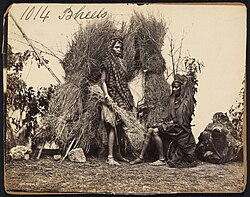
 Bhils of Sindh | |
| Total population | |
|---|---|
| 17 Million (2011, census) | |
| Regions with significant populations | |
 India India | 16,908,907<ref name=list>"List of notified Scheduled Tribes" (PDF). Census India. Archived from the original (PDF) on 7 November 2013. Retrieved 15 December 2013.</ref><ref name=Census2011>"A-11 Individual Scheduled Tribe Primary Census Abstract Data and its Appendix". Census of India 2011. Office of the Registrar General & Census Commissioner, India. Retrieved 24 March 2017.</ref> |
| Madhya Pradesh | 5,993,921<ref name=Census2011/> |
| Gujarat | 4,215,603<ref name=Census2011/> |
| Rajasthan | 4,100,264<ref name=Census2011/> |
| Maharastra | 2,588,658<ref name=Census2011/> |
| Karnataka | 6,204<ref name=Census2011/> |
| Tripura | 3,105<ref name=Census2011/> |
| Andhra Pradesh | 604<ref name=Census2011/> |
| Chhattisgarh | 547<ref name=Census2011/> |
 Pakistan (Sindh) Pakistan (Sindh) | 1,200,000 to 1,700,000 (2020)<ref>Bhil of Pakistan, Hussain Ghulam (2020) Bielefeld University https://www.researchgate.net/publication/343611243_Bhil_of_Pakistan#:~:text=Although%20official%20population%20figures%20are,million%20(as%20of%202020)</ref> |
| Languages | |
| Religion | |
| Hindu • Christianity • Islam • Animism | |
Bhil or Bheel are various indigenous groups inhabiting western India, including parts of Rajasthan and Madhya Pradesh<ref>Gall, Timothy L.; Hobby, Jeneen (2009). Worldmark Encyclopedia of Cultures and Daily Life. Gale. ISBN 978-1-4144-4891-6.</ref> and in Sindh, Pakistan.<ref>Khan, Mustafa; Thakur, Vikramaditya (January 2025). "Being Bhil: The politics of becoming indigenous in India and Pakistan". History and Anthropology. 36 (1): 78–98. doi:10.1080/02757206.2023.2261960. ISSN 0275-7206.</ref> Additionally they are also found in distant places such as Bengal and Tripura.<ref name=WECDL>Gall, Timothy L.; Hobby, Jeneen, eds. (2009). Worldmark Encyclopedia of Cultures and Daily Life. Vol. 3 (2, illustrated ed.). Farmington Hills, Michigan: Gale. p. 131. ISBN 9781414448916. OCLC 1112785346. The name Bhil identifies various ethnic communities inhabiting the hills and forests of southern Rajasthan and neighboring areas of western India. Some scholars argue that "Bhil" comes from the Dravidian word for bow (billa or billu) and reflects the popularity of the bow and arrow as a weapon among these groups. The term is also used in a broader sense to refer to the aboriginal peoples of this region.
</ref> Though they now speak the Bhili language, an Indo-Aryan language, the aboriginal language that the Bhil originally spoke is lost.<ref>Gregory D.S. Anderson (8 April 2015). The Munda Languages. Routledge. ISBN 978-1-317-82885-3.</ref><ref>Statistical Profile of Scheduled Tribes in India (PDF). New Delhi: Ministry of Tribal Affairs. 2013. p. 10.</ref> Bhils are divided into a number of endogamous territorial divisions, which in turn have a number of clans and lineages.
Bhils are listed as tribal people in the states of Gujarat, Madhya Pradesh, Chhattisgarh, Maharashtra and Rajasthan—all in the western Deccan regions and central India—as well as in Bengal and Tripura in far-eastern India, on the border with Bangladesh. Many Bhils speak the dominant language of the region they reside in, such as Marathi, Gujarati or Bengali.
Etymology
Some scholars suggest that the term Bhil is derived from the word billa or billu which means bow in the Dravidian lexis. The term Bhil is used to refer to "various ethnic communities" living in the forests and hills of Rajasthan's southern parts and surrounding regions of western India, highlighting the "popularity of the bow and arrow as a weapon among these groups". It is also used as a blanket term to refer to the aboriginal peoples of these areas.<ref name=WECDL></ref>
History
Bhil Rebellion
The Bhils of what is now the state of Gujarat rebelled on several occasions during the British colonial era, notably in 1846, 1857–58, and 1868.<ref>Ghosh, S. K. (1987). Law Enforcement in Tribal Areas. Ashish Publishing House. p. 124. ISBN 9788170241003.</ref>
Along with several other Indian social groups, the Bhils were designated as a criminal tribe by the British colonial government under the Criminal Tribes Act 1871, which meant that a Bhil could be "randomly picked up, tortured, maimed or even killed" by the colonial authorities. Susan Abraham notes that many of the tribes characterised as criminal under the Act had earlier rebelled against the East India Company and participated in the Indian Rebellion of 1857. She claims that the British colonial government legislated the Act in 1871 in the wake of these autochthonic tribes' proclivity for rebellion.<ref>Abraham, Susan (July 1999). "Steal or I'll Call You a Thief: 'Criminal' Tribes of India". Economic and Political Weekly. 34 (27). Economic and Political Weekly: 1751–1753. JSTOR 4408149.</ref>
Mutiny against Mewar State

According to Ram Pande, in 1881, the Bhils protested against "the census classification, prohibition on alcohol manufacture, the establishment of police and customs, and the ban on the killing of witches". Their campaigning was stepped up and given meaning by Govind Guru who was a social and political leader. Pande suggests that because of his long-term Brahminical Hinduism missionary work among the tribe, Govind was able to stop them from consuming meat and alcohol and to pressurise the state for the formation of village councils that could administer their affairs and for barring forced labour. In 1917, Mewar State's Girasias joined the Bhils in the struggle to get the petty taxes and forced labour quashed, and to get the land revenues decreased. Taking note of these protests, the jagirdars of Mewar had called on a British political agent to suppress the mutiny. Pande noted that 1,500 Bhils got shot in 1913. In 1921, the tribals and peasants united under the leadership of Motilal Tejawat in the struggle against "forced labour, petty taxes, the disparity in taxes, high taxes and the tyrannical ways of the jagirdars". Tejawat's thoughts drew followers from the Bhils and Girasias of the Danta, Idar, Palanpur and Sirohi regions of Gujarat; and he "became a notorious offender against the state".<ref>Unnithan-Kumar, Maya (1997). "Class Resistance and Identity". Identity, Gender, and Poverty: New Perspectives on Caste and Tribe in Rajasthan (illustrated ed.). Oxford; Providence: Berghahn. p. 240. ISBN 978-1571819185. OCLC 1043247151.</ref>
Demographics
The Bhils are inhabitants of Dhar, Jhabua, Khargone and Ratlam districts of Madhya Pradesh. Bhilai (Bhil= Tribe, Aai= Came, meaning Bhils came), a city in Durg district of Chhattisgarh is named after this.[citation needed] A large number of Bhils live in the neighbouring states of Maharashtra, Gujarat, and Rajasthan. In Bengal, the Bauris represent the Bhil tribe.<ref>Chakraborty, Goutam; Pattrea, Madhumita (7 December 2020). Know Your State West Bengal. Arihant Publications India limited. ISBN 978-93-252-9222-2.</ref>[better source needed] They constitute the largest tribe of India. According to Victoria R. Williams, the Bhils are India's "most widely dispersed tribal group". A small population of Bhils also resides in Pakistan's Sindh province, who are known as the Sindhi Bhils.<ref name="VRW"/>
Present circumstances
The Bhil are classified as a Scheduled Tribe in Andhra Pradesh, Chhattisgarh, Gujarat, Karnataka, Madhya Pradesh,<ref>उपाध्याय, गिरीश (21 April 2022). "MP के दूसरे दौरे में भी ट्राइबल पर फोकस; जानिए BJP के लिए आदिवासी क्यों जरूरी". Dainik Bhaskar. Retrieved 22 April 2022.</ref> Maharashtra, Rajasthan and Tripura under the Indian government's reservation program of positive discrimination.<ref name=list/>
Subdivisions
The Bhil are divided into several endogamous territorial divisions, which in turn have several clans and lineages. In Rajasthan, they exist as Bhil Garasia, Dholi Bhil, Dungri Bhil, Dungri Garasia, Mewasi Bhil, Barda, Patelia, Kataria, Bagdi, Dhodia, Bhillava or Billava, Meena, Barela, Khotil, Dangchai,<ref>Singh, K. S. (1996). Communities, Segments, Synonyms, Surnames and Titles. Anthropological Survey of India. ISBN 978-0-19-563357-3.</ref> Dangehi, Nirdhi Bhil, Gamit, Rawal Bhil, Tadvi Bhil, Bhagalia, Bauris, Bhilala, Thakar, Rathwa,<ref>Tilche, Alice (19 February 2022). Adivasi Art and Activism: Curation in a Nationalist Age. University of Washington Press. ISBN 978-0-295-74972-3.</ref> Pawra, Sonawane, Barda, Warli, Nayak,<ref>Fisher, R. J. (1997). If Rain Doesn't Come: An Anthropological Study of Drought and Human Ecology in Western Rajasthan. Manohar. ISBN 978-81-7304-184-6.</ref> Nahals, Mathvadi, Dorepis,<ref>Gazetteer of the Bombay Presidency: Khandesh. Printed at the Government Central Press. 1880.</ref> Dhanka,<ref>Srivastava, Ashirbadi Lal (1966). The Sultanate of Delhi, 711-1526 A.D.: Including the Arab Invasion of Sindh, Hindu Rule in Afghanistan and Causes of the Defeat of the Hindus in Early Medieval Age. Shiva Lal Agarwala.</ref> Vasava and Vasave.<ref name="census2001">"List of Scheduled Tribes". Census of India: Government of India. 7 March 2007. Archived from the original on 5 June 2010. Retrieved 27 November 2012.</ref>[lower-alpha 1]
Language

The language commonly spoken by Bhils throughout their geographic distribution is Bhili.<ref name=":2">Mehta, Sonu (2004). "Bhils - I". In Mehta, Prakash Chandra (ed.). Ethnographic Atlas of Indian Tribes. New Delhi: Discovery Publishing House. p. 191. ISBN 9788171418527.</ref> Bhili has about up to 36 identified dialects and pronunciation differs by region.<ref name=":2" /><ref>Phillips, Maxwell P. (2012). Dialect Continuum in the Bhil Tribal Belt: Grammatical Aspects (phd). University of London. p. 23.</ref> Bhili is based on Gujarati, but dialects of Bhili gradually merge into more widely spoken languages such as Marathi in the southeast and Rajasthani in the northwest. Around 10 million people recorded themselves as speaking a Bhili dialect in the census.<ref>Ratnagar, Shereen (2010). Being Tribal. Primus Books. ISBN 978-93-80607-02-3.</ref>
Estimates of individuals speaking the language are often inaccurate as speakers of minor languages like Bhili have sometimes been treated as having major languages (such as Marathi or Gujarati) as their mother tongue.<ref>"Paper No. I - Languages". Census of India 1951. 1954. pp. 61.</ref>
The Bhils in Sindh speak Sindhi Bhili and Dhatki.<ref>"Sindhi Bhil: Sindhi Meghwar language". globalrecordings.net. Retrieved 8 March 2025.</ref>
Culture and traditions
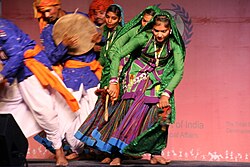
Bhils have a rich and unique culture. The Bhilala sub-division is known for its Pithora painting.<ref>Pachauri, Swasti (26 June 2014). "Pithora art depicts different hues of tribal life". The Indian Express. Retrieved 13 February 2015.</ref> Ghoomar is a traditional folk dance of the Bhil tribe.<ref>Kumar, Ashok Kiran (2014). Inquisitive Social Sciences. Republic of India: S. Chand Publishing. p. 93. ISBN 9789352831098.</ref><ref>Danver, Steven L. (28 June 2014). Native People of The World. United States of America: Routledge. p. 522. ISBN 978-0765682949.</ref> Ghoomar is the symbol of womanhood. Young girls take part in this dance and declare that they are stepping into the shoes of women.
Art
Bhil painting is characterised by the use of multi-coloured dots as in-filling. Bhuri Bai was the first Bhil artist to paint using readymade colours and paper. Other known Bhil artists include Lado Bai, Sher Singh, Ram Singh and Dubu Bariya.<ref>"Bhil Art - How A Tribe Uses Dots To Make Their Story Come Alive". Artisera. Retrieved 18 March 2019.</ref>
Food
The main foods of Bhils are maize, onion, garlic, and chili which they cultivate in their small fields. They collect fruits and vegetables from the local forests. Wheat and rice are used at time of festivals and other special occasions only. They keep self-made bows and arrows, swords, knives, axes, etc. with them as weapons for self-defense and hunting the wild fauna which also form a major part of their diet. They profusely use alcohol distilled by them from the flower of Mahua (Madhuca longifolia). On festive occasions, various special preparations from the dish are rich, i.e. maize, wheat, barley, malt, and rice. Bhils are traditionally non-vegetarian.<ref name=":0">Singh, V. P.; Jadhav, Dinesh (January 2011). Ethnobotany of Bhil Tribe. Scientific Publishers. ISBN 9789387307360.</ref>
Dress

The traditional dresses of men are the Pagri, Angarkha, Dhoti and Gamchha. Traditionally women wear Sari and Ghagra Choli.
There are many traditional ornaments of Bhils. Men wear Kada, Bajuband, Chain, ear rings, Kardhani. Women wear variety of ornaments such as hansli (ring) Zele-zumke, earrings in Bhil language, narniyan[what language is this?] (bangle), nathni (nose-jewel) etc. Tattooing is a traditional custom among them. Women folks do tattooing generally before marriage.<ref name=":0" />
Faith and worship
Every village has its local deity (Gramdev) and families too have their Jatidev, Kuldev and Kuldevi (house hold deity) which is symbolised by stones. 'Bhati dev' and 'Bhilat dev' are their serpent-god. 'Baba dev' is their village god. Karkulia dev is their crop god, Gopal dev is their pastoral god, Bag dev is their Lion god, Bhairav dev is their dog god. Some of their other gods are Indel dev, Bada dev, Mahadevel, Tejaji, Lotha mai, Techma, Orka Chichma and Kajal dev.
They have extreme and staunch faith in superstitious beliefs and Bhopas for their physical, mental, and psychological treatments.<ref name=":0" />
- Bhensasaur - Bhil people worship buffalo as Bhensasaur <ref>Gazetteer of the Bombay Presidency ... Printed at the Government Central Press. 1901.</ref>
According to Victoria R. Williams, the Bhils "identify largely as Hindu". The Dang Bhils follow Christianity, and the Nirdhi and Tadivi Bhils follow Islam. A number of other Bhils follow Sonatan (Sanskrit: Sanatan) which is their "own religion". Williams states that Sonatan "blends Hindu beliefs and animistic philosophies".<ref name="VRW">Williams, Victoria R. (2020). "Bhil". Indigenous Peoples: An Encyclopedia of Culture, History, and Threats to Survival [4 Volumes] (illustrated ed.). Santa Barbara, California: ABC-Clio. p. 179. ISBN 978-1440861185. OCLC 1107833866.</ref>
Festivals
There are several festivals, viz. Rakhi, Navratri, Dashera, Diwali, Holi which are celebrated by the Bhils. They also celebrate some traditional festivals viz. Akhatij, Navmi, Howan Mata ki Chalavani, Sawan Mata ki jatar, Diwasa, Nawai, Bhagoria, Gal, Gar, Dhobi, Sanja, Indel, Doha etc. with ceremonious zeal and enthusiasm.[citation needed]
During some festivals, there are many tribal fairs held at different places in districts. Navratri mela, Bhagoria mela (during Holi festival) etc.<ref name=":0" /> Bhil community of Udaipur celebrate Gavari festival each year after Holi.<ref>"GAVARI: A tribal dance drama by the Bhil community of Udaipur". mediaindia.eu. Retrieved 4 September 2019.</ref>
Types of Dance and Festivities

The chief means of their recreation is folk songs and dances. Women dance at birth celebrations, marriage functions and on a few festivals in traditional Bhili style accompanied by a drum beat. Their dances include the Lathi (staff) dance, Dhol dance, marriage dance, Holi dance, Battle dance, Bhagoria dance, Deepawal dance, Sajoni dance and hunting dance. Musical instruments include the Harmonium, Sarangi, Kundi, Bansuri, Apang, Khajria, Tabla, Jhanjh, Mandal and Thali. They are usually made from local products.<ref name=":0" />
Local political structure
Traditional Bhil village is led by a headman (Gameti). The gameti has authority and decision-making powers over most local disputes or issues.<ref>Winston, Robert, ed. (2004). Human: The Definitive Visual Guide. New York: Dorling Kindersley. p. 439. ISBN 0-7566-0520-2.</ref>
Bhil Pradesh Demand
There has been a demand for the establishment of a separate state of Bhil Pradesh or Bhil Desh by combining the tribal-dominated parts of Gujarat and neighbouring states Madhya Pradesh, Rajasthan, and Maharashtra.<ref>"Explained: Why are tribals of Rajasthan and Gujarat demanding a separate state of Bhil Pradesh?". The Indian Express. 25 May 2022. Retrieved 6 April 2023.</ref> In 2014, when the Telangana state was formed, it reignited hopes of statehood again.<ref name="dnaindia.com">"Clamour for separate Saurashtra, Bhilistan to get louder – Latest News & Updates at Daily News & Analysis". 1 August 2013. Retrieved 6 April 2023.</ref> In 2023, Aam Aadmi Party (AAP) MLA leader Chaitar Vasava raised demand for separate state of Bhil Pradesh.<ref>"Gujarat AAP MLA demands separate state of 'Bhil Pradesh' for tribals". India Today. 4 April 2023. Retrieved 6 April 2023.</ref>
Notable people
Artist
- Bhuri Bai, Artist<ref>"Bhuri Bai | Paintings by Bhuri Bai | Bhuri Bai Painting - Saffronart.com". Saffronart.</ref>
- Lado Bai, Artist<ref>"Lado Bai". Bhil Art. Archived from the original on 23 September 2016.</ref>
Freedom fighter
- Tantia Bhīl, freedom fighter<ref name="GuptāBeniwal2007">Ramaṇikā Guptā; Anup Beniwal (1 January 2007). Tribal Contemporary Issues: Appraisal and Intervention. Concept Publishing Company. pp. 18–. ISBN 978-81-8069-475-2.</ref>
- Bhima Nayak, Freedom fighter
Politician
- Chhotubhai Vasava, Politician<ref>"Ahmed Patel saviour Chhotubhai Vasava puts Congress in bind". dnaindia.</ref>
- Rajkumar Roat, Politician
Players
- Nitin Bhille - Cricket player
- Dinesh Bhil - Archer <ref>"Champion archer Dinesh Bhil to train civil services officers". The Indian Express. 2 October 2020. Retrieved 1 December 2023.</ref>
See also
References
Notes
Citations
Further reading
- Shah, Arvind M. (2012). The Structure of Indian Society: Then and Now. Routledge. ISBN 978-1-13619-770-3.
External links
- History of Bhil Tribe in India - भील जनजाति का इतिहास Archived 23 November 2020 at the Wayback Machine
- Gond & Bhil Tribal Art — Madhya Pradesh, archived from the original on 22 June 2015.
- The desert dwellers of Rajasthan: Bishnoi and Bhil peoples (essay)
- Bhil Tribe In Rajasthan Archived 11 October 2012 at the Wayback Machine
- Genetic Affinity of the Bhil, Kol and Gond Mentioned in Epic Ramayana

- Pages using the JsonConfig extension
- Bhil
- Hindu ethnic groups
- Sindhi tribes
- Indo-Aryan peoples
- Scheduled Castes of Delhi
- Scheduled Tribes of Rajasthan
- Scheduled Tribes of Maharashtra
- Scheduled Tribes of Andhra Pradesh
- Scheduled Tribes of Gujarat
- Scheduled Tribes of Madhya Pradesh
- Scheduled Tribes of Tripura
- Scheduled Tribes of Karnataka
- Scheduled Tribes of Chhattisgarh
- Hindu communities
- Ethnic groups in India
- Ethnic groups in Pakistan