

imported>Doremo considered as one of → considered one of |
quick fix |
||
| Line 1: | Line 1: | ||
{{ | {{Short description|Ancient Hindu kingdom of India}} | ||
{{for|the butterfly genus|Arhopala}} | |||
{{Use dmy dates|date=December 2015}} | {{Use dmy dates|date=December 2015}} | ||
{{Use Indian English|date=December 2015}} | {{Use Indian English|date=December 2015}} | ||
{{Infobox country | {{Infobox country | ||
|native_name = | | native_name = Pañcāla | ||
|conventional_long_name = Panchala | | conventional_long_name = Panchala | ||
|common_name = | | common_name = | ||
|era | | era = [[Iron Age]] | ||
|government_type = [[Monarchy]] | | life_span = {{circa|1100 BCE}} – {{circa|340 BCE}} | ||
|year_leader1=c. 850 BCE | | government_type = [[Monarchy]] | ||
|leader1 | | year_leader1 = c. 850 BCE | ||
|year_leader2=c. 750 BCE | | leader1 = [[Keśin Dālbhya]] | ||
|leader2 | | year_leader2 = c. 750 BCE | ||
|year_leader3=c. 400 CE | | leader2 = [[Pravahana Jaivali]] | ||
|leader3=[[Achyuta of Panchala|Achyuta]] | | year_leader3 = c. 400 CE | ||
|year_start | | leader3 = [[Achyuta of Panchala|Achyuta]] | ||
|year_end | | year_start = c. 1100 BCE (in [[Vedic period|Late Vedic period]]) | ||
| p1 = | | year_end = c. 400 CE (in [[Gupta Empire]]) | ||
| s1 = | | p1 = Rigvedic tribes | ||
| s2 = | | s1 = Nanda Empire{{!}}Magadha | ||
|image_map | | p2 = Maurya Empire{{!}}Magadha | ||
|image_map_caption | | s2 = Gupta Empire | ||
|image_map2 | | image_map = Late_Vedic_Culture_(1100-500_BCE).png | ||
|image_map2_caption | | image_map_caption = Panchala and other kingdoms in the Late Vedic period. | ||
|capital | | image_map2 = Mahajanapadas (c. 500 BCE).png | ||
|common_languages = | | image_map2_caption = Panchala and other Mahajanapadas in the Post Vedic period. | ||
|religion | | capital = [[Ahichatra]] (northern), [[Kampil]]a | ||
|title_leader= | | common_languages = [[Vedic Sanskrit]] | ||
|today = [[India]] | | religion = [[Historical Vedic religion]]<br>[[Jainism]]<br>[[Buddhism]] | ||
| title_leader = [[Raja]] | |||
| today = [[India]] | |||
}} | }} | ||
{{ | '''Panchala''' ({{IAST3|Pañcāla}}) was an ancient [[Realm|kingdom]] of [[northern India]], located in the [[Ganges-Yamuna Doab]] of the [[Gangetic plain|Upper Gangetic plain]] which is identified as [[Kannauj|Kanyakubja]] or region around [[Kannauj]].<ref>{{Cite book|last=wheeler|first=James Boy|url=https://books.google.com/books?id=xzAQAAAAYAAJ&q=kanyakubja&pg=PA432|title=The History of India from the Earliest Ages: The Rámáyana and the Brahmanic period|publisher= N Trubner|date=1869|page=432}}</ref><ref>{{Cite book|url=https://books.google.com/books?id=SVE0AAAAIAAJ&q=kanyakubja&pg=PA38|title=Bibliotheca Indica, Volume 270|publisher=Baptist Mission Press|date=1848|page=38}}</ref> During Late [[Vedic period|Vedic times]] (c. 1100–500 BCE), it was one of the most powerful states of [[History of India|ancient India]], closely allied with the [[Kuru kingdom]].<ref>Witzel, Michael (1995), "Early Sanskritization: Origin and Development of the Kuru state", EJVS |volume=1 |issue=4 |date=1995</ref> By the c. 5th century BCE, it had become an [[Oligarchy|oligarchic]] [[Confederation|confederacy]], considered one of the ''solasa'' (sixteen) [[mahajanapadas]] (major states) of the [[Indian subcontinent]]. After being absorbed into the [[Mauryan Empire]] (322–185 BCE), Panchala regained its independence until it was annexed by the [[Gupta Empire]] in the 4th century CE. | ||
== Location == | |||
The Pañcāla state was located to the west of the [[Gomti River]], and the north of the [[Chambal River]]. Its western neighbours were the [[Surasena|Sūrasena]]s and the Yakṛllomas, while in the north-west it was separated from the [[Ganga]] and the [[Kuru Kingdom|Kuru]]s by dense forests. The northern boundaries of Pañcāla were the forests around the region of the Gaṅgā's source. The territory of Pañcāla corresponded to the modern-day areas of Rohilkhand such as [[Pilibhit district|Pilibhit]], [[Bareilly district|Bareilly]], [[Budaun district|Budaun]], [[Shahjahanpur district|Shahjahanpur]], [[Farrukhabad district|Farrukhabad]], [[Kannauj]] and [[Kanpur]], and parts of Awadh such as the western half of [[Hardoi]], and parts of [[Lakhimpur, Uttar Pradesh|Lakhimpur]]<ref>{{cite book |last=Olivelle |first=Austin Patrick |url=https://books.google.com/books?id=efaOR_-YsIcC&dq=kanpur+panchala&pg=PA21|date=2006 |title=Between the Empires, Society in India 300 BCE to 400 CE|pages=21|publisher=Oxford university press, USA|isbn=978-0-19-977507-1 }}</ref><ref>{{cite book |last=Chakraborty |first=Dilip K. |url=https://books.google.com/books?id=aJAMAQAAMAAJ&q=kanpur+panchala |title=Archaeological Geography of the Ganga Plain, The Upper Ganga (Oudh, Rohilkhand, and the Doab)|date=2007|pages=204|publisher=Munshiram Manohar Lal Publications|isbn=978-81-215-1185-8 }}</ref> as well as the [[Doab#Central or Middle Doab|Central]] Gaṅgā-[[Yamuna|Yamunā]] [[Doab]] in [[Uttar Pradesh]].<ref>{{cite book |last=Raychaudhuri |first=Hemchandra |author-link=Hem Chandra Raychaudhuri |date=1953 |title=Political History of Ancient India: From the Accession of Parikshit to the Extinction of Gupta Dynasty |pages=70–74 |url= |location= |publisher=[[University of Calcutta]] |isbn=}}</ref> | |||
== Mahabharata == | |||
[[Drupada]], the king of [[Panchala Kingdom (Mahabharata)|Panchala]] was the father of [[Draupadi]], who married the [[Pandava]]s. To avenge her humiliation during [[Mahabharata#The dice game|the game of dice]] played at [[Hastinapur]] which led to their lengthy exile, he fought on the side of the Pandavas in the [[Kurukshetra War]]. [[Bhishma]] ranked him a Mighty [[Hindu mythological wars#Levels of Warrior Excellence|''Maharathi'']], his son [[Dhrishtadyumna]] an ''Atirathi'' and his other son, [[Shikhandi]], a ''Rathi''. He contributed three (of the seven) [[Akshauhini]] armies to the Pandavas during the war.<ref>Raychaudhuri, H.C. (1972). ''Political History of Ancient India'', Calcutta: University of Calcutta, p. 206</ref> | |||
''' | == Vedic period == | ||
The Panchala [[janapada]] is believed to have been formed by multiple ''[[jana (Vedic period)|janas]]'' (tribes). The ''[[Shatapatha Brahmana]]'' suggests that Panchala was the later name of the Krivi tribe (who, according to the [[Rigveda]], lived on the bank of the [[Indus River]]). The later [[Vedas|Vedic literature]] uses the term Panchala to describe the close associates of the [[Kuru Kingdom|Kurus]]. | |||
Panchala is identified with the city of [[Kanyakubja]] or the region around it.<ref>{{Cite book|last=wheeler|first=James Boy|url=https://books.google.com/books?id=xzAQAAAAYAAJ&q=kanyakubja&pg=PA432|title=The History of India from the Earliest Ages: The Rámáyana and the Brahmanic period|publisher= N Trubner|date=1869|page=432}}</ref><ref>{{Cite book|url=https://books.google.com/books?id=SVE0AAAAIAAJ&q=kanyakubja&pg=PA38|title=Bibliotheca Indica, Volume 270|publisher=Baptist Mission Press|date=1848|page=38}}</ref> | |||
The ''[[Mahabharata]]'' mentions the 'Saranjayas' as a tribe or a family among the Panchalas, occasionally using the terms interchangeably, but also separately at a few places. The ''Mahabharata'' further mentions that the [[Panchala Kingdom (Mahabharata)|Panchala country]] had its capital at [[Kanyakubja]] or modern day [[Kannauj]]<ref>{{Cite book |first=Gurcharn|last=Singh Sandhu|url=https://books.google.com/books?id=0yXcAAAAMAAJ |title=A Military History of Ancient India|page=164|date=2000|publisher=Vision Books|isbn=978-81-7094-375-4 }}</ref><ref>{{Cite book |url=https://books.google.com/books?id=9x7jAAAAMAAJ |title=Proceedings Volume 29|page=82|date=1968|publisher=Indian History Congress}}</ref><ref>{{Cite book |url=https://books.google.com/books?id=-gJDAAAAYAAJ |title=Uttar Pradesh District Gazetteers: Farrukhabad. 39. Ballia|page=29|date=1988|publisher=Government of Uttar Pradesh}}</ref><ref>{{Cite book |last=Bagchi|first=Jhunu|url=https://books.google.com/books?id=J7RKoMeAtpUC&dq=Panchal+Kanyakubja&pg=RA1-PA3 |title=The History and Culture of the Pālas of Bengal and Bihar, Cir. 750 A.D.-cir. 1200 A.D.|page=3|date=1993|publisher=Abhinav Publications|isbn=978-81-7017-301-4 }}</ref> but was later divided into two territories: the northern Panchala with its capital at [[Ahichchhatra]], and the southern Panchala with its capital at [[Kampilya]].{{sfn|D. C. Sircar|1985|p=1}}<ref>{{Cite book |last=Tripathi|first=Rama Shanker|url=https://books.google.com/books?id=2Tnh2QjGhMQC&q=Kunoj+Panchala |title=History of Kanauj, To the Moslem Conquest|pages=212, 213|date=1989|publisher=Motilal Banarsidas|isbn=978-81-208-0404-3 }}</ref> | |||
According to the political scientist Sudama Misra, the name of the Panchala janapada suggests that it was a fusion of five (''pancha'') [[janapadas|janas]] (tribes).{{sfn|Sudama Misra|1973|p=14}} [[Hem Chandra Raychaudhuri|H.C. Raychaudhuri]] theorised that these five clans were the Krivis, the Turvashas, the Keshins, the Srinjayas, and the Somakas.<ref>{{cite book |author=Oroon K. Ghosh |title=The Changing Indian Civilization: A Perspective on India |url=https://books.google.com/books?id=gPUtAAAAMAAJ |year=1976 |publisher=Minerva |isbn=978-0-88386-502-6}}</ref> Each of these clans is known to be associated with one or more princes mentioned in the Vedic<ref>{{cite book |last1=Raychaudhuri |first1=Hemchandra |title=Political History of Ancient India - From the Accession of Parikshit to the Extinction of the Gupta Dynasty |date=1953 |publisher=Calcutta University Press |location=Kolkata |page=71 |edition=Sixth |url=https://ignca.gov.in/Asi_data/1633.pdf |access-date=8 May 2022}}</ref> texts – the Krivis with Kraivya Panchala, the Turvashas with Sona Satrasaha, the Keshins with Keshin Dalbhya, the Srinjayas with Sahadeva Sarnjaya, and the Somakas with Somaka Sahadevya. The names of the last two clans, the Somakas and the Srinjayas, are also mentioned in the [[Mahabharata]] and the [[Puranas]]. | |||
King Drupada, whose daughter Draupadi was married into the Pandavas in the Mahabharata, belonged to the Somaka clan.<ref>Pargiter, F.E. (1972). ''Ancient Indian Historical Tradition'', Delhi: Motilal Banarsidass, p.117</ref> However, the Mahabharata and the Puranas consider the ruling clan of the northern Panchala as an offshoot of the [[Bharata (Mahabharata)|Bharata]] clan, identifying [[Divodasa]], [[Sudas]], Srinjaya, Somaka, and [[Drupada]] (also called Yajnasena) as its most notable rulers.<ref>Raychaudhuri, H.C. (1972) ''Political History of Ancient India'', Calcutta: University of Calcutta, pp.65-8.</ref> It is also mentioned that [[Upapandavas#Sutasoma|Sutasoma]], the son of Draupadi and the Pandava prince [[Bhima]], was the king of the Somaka tribe during the [[Kurukshetra War]]. | |||
Drupada | |||
The Panchala Kingdom rose to its highest prominence in the aftermath of the decline of the Kuru Kingdom, culminating in its eventual defeat by the non-Vedic [[Salva (India)|Salva tribe]]. The king of Panchala, [[Keśin Dālbhya]] (approximately between 900 and 750 BCE<ref>[[Michael Witzel]] (1989), ''Tracing the Vedic dialects'' in ''Dialectes dans les litteratures Indo-Aryennes'' ed. [[Colette Caillat|Caillat]], Paris, p.127</ref>), was the nephew of the Kuru king, who had died heirless; Keśin subsequently took over the leadership, establishing his kingdom as the new political and cultural center, and ensuring the continuation of the Vedic tradition.<ref>Witzel (1995), p.22</ref> His dynasty remained in power for many generations; one of his later successors was the philosopher-king [[Pravahana Jaivali]], who was the contemporary of King [[Janaka]] of [[Videha]] and the philosophers [[Uddalaka Aruni]] and [[Svetaketu]] (8th–7th centuries BCE).<ref>Raychaudhury, pp.67–68</ref> | |||
== | == Under Magadha == | ||
Originally a [[Monarchy|monarchical]] [[Jat|clan]], the Panchalas appear to have switched to a republican model of government around 500 BCE. The Buddhist text [[Anguttara Nikaya]] mentions Panchala as one of the sixteen [[mahajanapada]]s of the c. 6th century BCE.<ref>Raychaudhuri, H.C. (1972). ''Political History of Ancient India'', Calcutta: University of Calcutta, p.85</ref> The 4th century BCE text [[Arthashastra]] also attests to the Panchalas as following the ''Rajashabdopajivin'' (king consul) constitution. Panchala was annexed into the [[Nanda Dynasty|Magadha empire]] during the reign of [[Mahapadma Nanda]] in the mid-4th century BCE.<ref>Raychaudhuri, H.C. (1972). ''Political History of Ancient India'', Calcutta: University of Calcutta, p.206</ref> | |||
== Post-Mauryan period == | |||
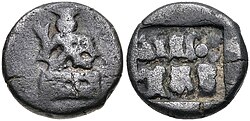
Numismatic evidence reveals the existence of independent rulers of Panchala during the post-Mauryan period. Most of the coins issued by them are found at [[Ahichchhatra|Ahichatra]] and adjoining areas. All the coins are round, made of a copper alloy and have a set pattern on the obverse-a deeply incised square punch consisting of a row of three symbols and the ruler's name placed in a single line below them. The reverse bears depictions of the deities or sometimes of their attributes, whose names form a component of the issuers' names (for example, coins of [[Agnimitra]] bear the depiction of [[Agni]]). The names of the rulers found on these coins are Vangapala, Yajnapala, Damagupta, Rudragupta, Jayagupta, Suryamitra, Phalgunimitra, Bhanumitra, Bhumimitra, Dhruvamitra, Agnimitra, Indramitra, Vishnumitra, Jayamitra, Prajapatimitra, Varunamitra, Anamitra, Bhadraghosha and Yugasena (the reverse of the coins of Varunamitra, Yugasena and Anamitra do not exhibit any deity). Shaunakayaniputra Vangapala, ruler of Ahichatra, whom Vaidehiputra Ashadhasena mentioned as his grandfather in his Pabhosa inscription, is identified with king Vangapala, known from his coins. The name of Damagupta is also found on a clay sealing.<ref>Lahiri, B. (1974). ''Indigenous States of Northern India (Circa 200 B.C. to 320 A.D.) '', Calcutta: University of Calcutta, pp.170-88</ref><ref>Bhandare, S. (2006). ''Numismatics and History: The Maurya-Gupta Interlude in the Gangetic Plain'' in P. Olivelle ed. ''Between the Empires: Society in India 300 BCE to 400 CE'', New York: Oxford University Press, {{ISBN|0-19-568935-6}}, pp.76,88</ref> | |||
The | The last independent ruler of Ahichatra was [[Achyuta of Panchala|Achyuta]], who was defeated by [[Samudragupta]], after which Panchala was annexed into the [[Gupta Empire]].<ref>Raychaudhuri, H.C. (1972). ''Political History of Ancient India'', Calcutta: University of Calcutta, p.473</ref> The coins of Achyuta found from Ahichatra have a wheel of eight spokes on the reverse and the legend ''Achyu'' on the obverse.<ref>Lahiri, B. (1974). ''Indigenous States of Northern India (Circa 200 B.C. to 320 A.D.) '', Calcutta: University of Calcutta, p.182</ref> | ||
== | == Gallery == | ||
<gallery class="center" widths="280px" heights="120px" perrow="3" caption="Panchala coinage"> | |||
File:Panchalas of Adhichhatra.jpg|Coin of the Panchalas of Ahichhatra (75-50 BCE).<br>'''Obv''' [[Indra]] seated facing on pedestal, holding bifurcated object.<br>'''Rev''' ''Idramitrasa'' in [[Brahmi]], Panchala symbols. | File:Panchalas of Adhichhatra.jpg|Coin of the Panchalas of Ahichhatra (75-50 BCE).<br>'''Obv''' [[Indra]] seated facing on pedestal, holding bifurcated object.<br>'''Rev''' ''Idramitrasa'' in [[Brahmi]], Panchala symbols. | ||
File:Coin-of-Agnimitra.jpg|Coin of Agnimitra, showing the depiction of [[Agni]] with flaming hair on the obverse, and a reverse showing the three dynastic symbols of the Panchala rulers and a legend naming the king: Agimitasa. | File:Coin-of-Agnimitra.jpg|Coin of Agnimitra, showing the depiction of [[Agni]] with flaming hair on the obverse, and a reverse showing the three dynastic symbols of the Panchala rulers and a legend naming the king: Agimitasa. | ||
File:I38 12karshapana Panchala MACW4540 1ar (8486500958).jpg|A bronze currency of {{frac|1|2}} [[karshapana]] of King Indramitra (ca 75-50 BC?) Of Ahichatra of Panchala. '''Obv:''' A inside a rectangle, a line of 3 symbols, under the name of the king. '''Rev:''' Indra standing on a pedestal without pillars. '''Dimensions:''' 15 mm. '''Weight:''' 4.18 g. | |||
File:I38 12karshapana Panchala MACW4540 1ar (8486500958).jpg|A bronze currency of | |||
File:Coin-of-Achyuta.jpg|Coin of Achyuta, the last Panchala king, showing an 8-spoked wheel and the king's name: Achyu. | File:Coin-of-Achyuta.jpg|Coin of Achyuta, the last Panchala king, showing an 8-spoked wheel and the king's name: Achyu. | ||
</gallery> | </gallery> | ||
== Rulers == | |||
Ajamida II had a son named Rishin. Rishin had two sons namely Samvarana II whose son was [[King Kuru|Kuru]] and Brihadvasu whose descendants were Panchalas.<ref name=Malik>{{Cite book |last=Malik |first=Dr Malti |url=https://books.google.com/books?id=bMg-DAAAQBAJ&pg=PA12 |title=History of India |date=2016 |publisher=New Saraswati House India Pvt Ltd |isbn=978-81-7335-498-4 |pages=51–54 |language=en}}</ref><ref>Kisari Mohan Ganguli, ''The Mahabharata of Krishna-Dwaipayana Vyasa Translated into English Prose'', 1883-1896, Bk. 1, Ch. 3.</ref><ref>Kisari Mohan Ganguli, ''The Mahabharata of Krishna-Dwaipayana Vyasa Translated into English Prose'', 1883-1896, Book Chapter 1</ref><ref>Raychaudhuri, H.C. (1972). ''Political History of Ancient India'', Calcutta: University of Calcutta, p. 85</ref> | |||
;List of Panchala Kingdom rulers are- | |||
* Rishin, (his sons were Brihadvasu and Samvarana II) | |||
* Brihadbhanu, (son of Brihadvasu) | |||
* Brihatkaya | |||
* Puranjaya | |||
* Riksha | |||
* Bramhyaswa | |||
* Aramyaswa | |||
* Mudgala, Yavinara, Pratiswan, [[Kampilya]] (Founder of [[Kampilya]] – Capital of [[Panchala Kingdom (Mahabharata)|Panchala Kingdom]]) and Sranjaya were the sons of Aramyaswa and were the founders of [[Panchala|Panchala Kingdom]] and were called as Panchalas. | |||
* Dritimana, (son of Mudgala) | |||
* Drdhanemi | |||
* Sarvasena, (founder of Ujjain Kingdom) | |||
* Mitra | |||
* Rukmaratha | |||
* Suparswa | |||
* Sumathi | |||
* Sannatimana | |||
* Krta | |||
* Pijavana | |||
* Somadutta | |||
* Jantuvahana | |||
* Badhrayaswa | |||
* Brihadhishu | |||
* Brihadhanu | |||
* Brihadkarma | |||
* Jayaratha | |||
* Visvajit | |||
* Seinyajit | |||
* Nepavirya, (after this King's name the country was named Nepaldesh) | |||
* Samara | |||
* Sadashva | |||
* Ruchiraswa | |||
* Pruthusena | |||
* Prapti | |||
* Prthaswa | |||
* Sukrthi | |||
* Vibhiraja | |||
* Anuha | |||
* Bramhadatta II | |||
* Vishwaksena | |||
* Dandasena | |||
* Durmukha | |||
* Durbuddhi | |||
* Dharbhya | |||
* Divodasa | |||
* Sivana I | |||
* Mitrayu | |||
* Maitrayana | |||
* Soma | |||
* Sivana II | |||
* Sadasana | |||
* Sahadeva | |||
* Somaka, (Somaka's eldest son was Sugandakrthu and youngest was Prishata. But in a war all sons died and Prishata Survived and became the king of Panchala) | |||
* [[Prishati]], (son of Somaka) | |||
* [[Drupada]], (son of Prishata) | |||
* [[Dhrishtadyumna]], (was the son of Drupada, [[Draupadi]] and [[Shikhandi]] were the daughters of Drupada) | |||
* [[Keśin Dālbhya]] | |||
* [[Pravahana Jaivali]] | |||
* [[Achyuta of Panchala|Achyuta]], (last known ruler of Panchala Kingdom which was defeated in c. 350 CE by [[Gupta Empire|Gupta]] ruler [[Samudragupta]].) | |||
==See also== | ==See also== | ||
{{HistoryOfSouthAsia}} | |||
* [[Vedic period]] | * [[Vedic period]] | ||
* [[Mahabharata]] | |||
* [[History of India]] | |||
* [[History of Hinduism]] | |||
* [[Indus Valley Civilisation]] | |||
* [[Painted Grey Ware culture]] | * [[Painted Grey Ware culture]] | ||
* [[Mahajanapadas]] | * [[Janapadas]] & [[Mahajanapadas]] | ||
* [[Mahabharata]] | * [[Historicity of the Mahabharata]] | ||
* [[Kuru kingdom]] & [[Gandhara Kingdom]] | |||
==References== | ==References== | ||
{{reflist}} | {{reflist}} | ||
===Works cited=== | |||
* {{cite book |author=D. C. Sircar |author-link=Dineshchandra Sircar |title=The Kānyakubja-Gauḍa Struggle |publisher=Asiatic Society |year=1985 |isbn=9788192061580 |url=https://books.google.com/books?id=9mdQAQAAMAAJ |oclc=915112370}} | |||
* {{cite book |author=Sudama Misra |url=http://dli.ernet.in/handle/2015/131690 |title=Janapada state in ancient India |publisher=Bhāratīya Vidyā Prakāśana |location=Vārāṇasī |year=1973 |access-date=18 July 2016 |archive-url=https://web.archive.org/web/20160817151315/http://dli.ernet.in/handle/2015/131690 |archive-date=17 August 2016 |url-status=dead }} | |||
==External links== | ==External links== | ||
| Line 105: | Line 168: | ||
{{Mahajanapada |state=collapsed}} | {{Mahajanapada |state=collapsed}} | ||
[[Category:Pañcāla| ]] | |||
[[Category:Kingdoms of the Puru clan]] | [[Category:Kingdoms of the Puru clan]] | ||
[[Category:Ancient peoples]] | [[Category:Ancient peoples of India]] | ||
[[Category:Indo-Aryan peoples]] | [[Category:Indo-Aryan peoples]] | ||
[[Category:Iron Age cultures of Asia]] | [[Category:Iron Age cultures of Asia]] | ||
[[Category:Iron Age cultures of South Asia]] | [[Category:Iron Age cultures of South Asia]] | ||
[[Category: | [[Category:Places in Hindu mythology]] | ||
[[Category:Mahajanapadas]] | [[Category:Mahajanapadas]] | ||
[[Category:Archaeological cultures of South Asia]] | [[Category:Archaeological cultures of South Asia]] | ||
[[Category:Archaeological cultures in India]] | [[Category:Archaeological cultures in India]] | ||
[[Category:Former kingdoms]] | |||
[[Category:Tribal confederacies]] | |||
Latest revision as of 17:51, 28 December 2025
Panchala Pañcāla | |||||||||||||
|---|---|---|---|---|---|---|---|---|---|---|---|---|---|
| c. 1100 BCE – c. 340 BCE | |||||||||||||
.png) Panchala and other kingdoms in the Late Vedic period. | |||||||||||||
.png) Panchala and other Mahajanapadas in the Post Vedic period. | |||||||||||||
| Capital | Ahichatra (northern), Kampila | ||||||||||||
| Common languages | Vedic Sanskrit | ||||||||||||
| Religion | Historical Vedic religion Jainism Buddhism | ||||||||||||
| Government | Monarchy | ||||||||||||
| Raja | |||||||||||||
• c. 850 BCE | Keśin Dālbhya | ||||||||||||
• c. 750 BCE | Pravahana Jaivali | ||||||||||||
• c. 400 CE | Achyuta | ||||||||||||
| Historical era | Iron Age | ||||||||||||
• Established | c. 1100 BCE (in Late Vedic period) | ||||||||||||
• Disestablished | c. 400 CE (in Gupta Empire) | ||||||||||||
| |||||||||||||
| Today part of | India | ||||||||||||

Panchala (IAST: Pañcāla) was an ancient kingdom of northern India, located in the Ganges-Yamuna Doab of the Upper Gangetic plain which is identified as Kanyakubja or region around Kannauj.[1][2] During Late Vedic times (c. 1100–500 BCE), it was one of the most powerful states of ancient India, closely allied with the Kuru kingdom.[3] By the c. 5th century BCE, it had become an oligarchic confederacy, considered one of the solasa (sixteen) mahajanapadas (major states) of the Indian subcontinent. After being absorbed into the Mauryan Empire (322–185 BCE), Panchala regained its independence until it was annexed by the Gupta Empire in the 4th century CE.
Location[edit | edit source]
The Pañcāla state was located to the west of the Gomti River, and the north of the Chambal River. Its western neighbours were the Sūrasenas and the Yakṛllomas, while in the north-west it was separated from the Ganga and the Kurus by dense forests. The northern boundaries of Pañcāla were the forests around the region of the Gaṅgā's source. The territory of Pañcāla corresponded to the modern-day areas of Rohilkhand such as Pilibhit, Bareilly, Budaun, Shahjahanpur, Farrukhabad, Kannauj and Kanpur, and parts of Awadh such as the western half of Hardoi, and parts of Lakhimpur[4][5] as well as the Central Gaṅgā-Yamunā Doab in Uttar Pradesh.[6]
Mahabharata[edit | edit source]
Drupada, the king of Panchala was the father of Draupadi, who married the Pandavas. To avenge her humiliation during the game of dice played at Hastinapur which led to their lengthy exile, he fought on the side of the Pandavas in the Kurukshetra War. Bhishma ranked him a Mighty Maharathi, his son Dhrishtadyumna an Atirathi and his other son, Shikhandi, a Rathi. He contributed three (of the seven) Akshauhini armies to the Pandavas during the war.[7]
Vedic period[edit | edit source]
The Panchala janapada is believed to have been formed by multiple janas (tribes). The Shatapatha Brahmana suggests that Panchala was the later name of the Krivi tribe (who, according to the Rigveda, lived on the bank of the Indus River). The later Vedic literature uses the term Panchala to describe the close associates of the Kurus. Panchala is identified with the city of Kanyakubja or the region around it.[8][9] The Mahabharata mentions the 'Saranjayas' as a tribe or a family among the Panchalas, occasionally using the terms interchangeably, but also separately at a few places. The Mahabharata further mentions that the Panchala country had its capital at Kanyakubja or modern day Kannauj[10][11][12][13] but was later divided into two territories: the northern Panchala with its capital at Ahichchhatra, and the southern Panchala with its capital at Kampilya.[14][15]
According to the political scientist Sudama Misra, the name of the Panchala janapada suggests that it was a fusion of five (pancha) janas (tribes).[16] H.C. Raychaudhuri theorised that these five clans were the Krivis, the Turvashas, the Keshins, the Srinjayas, and the Somakas.[17] Each of these clans is known to be associated with one or more princes mentioned in the Vedic[18] texts – the Krivis with Kraivya Panchala, the Turvashas with Sona Satrasaha, the Keshins with Keshin Dalbhya, the Srinjayas with Sahadeva Sarnjaya, and the Somakas with Somaka Sahadevya. The names of the last two clans, the Somakas and the Srinjayas, are also mentioned in the Mahabharata and the Puranas.
King Drupada, whose daughter Draupadi was married into the Pandavas in the Mahabharata, belonged to the Somaka clan.[19] However, the Mahabharata and the Puranas consider the ruling clan of the northern Panchala as an offshoot of the Bharata clan, identifying Divodasa, Sudas, Srinjaya, Somaka, and Drupada (also called Yajnasena) as its most notable rulers.[20] It is also mentioned that Sutasoma, the son of Draupadi and the Pandava prince Bhima, was the king of the Somaka tribe during the Kurukshetra War.
The Panchala Kingdom rose to its highest prominence in the aftermath of the decline of the Kuru Kingdom, culminating in its eventual defeat by the non-Vedic Salva tribe. The king of Panchala, Keśin Dālbhya (approximately between 900 and 750 BCE[21]), was the nephew of the Kuru king, who had died heirless; Keśin subsequently took over the leadership, establishing his kingdom as the new political and cultural center, and ensuring the continuation of the Vedic tradition.[22] His dynasty remained in power for many generations; one of his later successors was the philosopher-king Pravahana Jaivali, who was the contemporary of King Janaka of Videha and the philosophers Uddalaka Aruni and Svetaketu (8th–7th centuries BCE).[23]
Under Magadha[edit | edit source]
Originally a monarchical clan, the Panchalas appear to have switched to a republican model of government around 500 BCE. The Buddhist text Anguttara Nikaya mentions Panchala as one of the sixteen mahajanapadas of the c. 6th century BCE.[24] The 4th century BCE text Arthashastra also attests to the Panchalas as following the Rajashabdopajivin (king consul) constitution. Panchala was annexed into the Magadha empire during the reign of Mahapadma Nanda in the mid-4th century BCE.[25]
Post-Mauryan period[edit | edit source]
Numismatic evidence reveals the existence of independent rulers of Panchala during the post-Mauryan period. Most of the coins issued by them are found at Ahichatra and adjoining areas. All the coins are round, made of a copper alloy and have a set pattern on the obverse-a deeply incised square punch consisting of a row of three symbols and the ruler's name placed in a single line below them. The reverse bears depictions of the deities or sometimes of their attributes, whose names form a component of the issuers' names (for example, coins of Agnimitra bear the depiction of Agni). The names of the rulers found on these coins are Vangapala, Yajnapala, Damagupta, Rudragupta, Jayagupta, Suryamitra, Phalgunimitra, Bhanumitra, Bhumimitra, Dhruvamitra, Agnimitra, Indramitra, Vishnumitra, Jayamitra, Prajapatimitra, Varunamitra, Anamitra, Bhadraghosha and Yugasena (the reverse of the coins of Varunamitra, Yugasena and Anamitra do not exhibit any deity). Shaunakayaniputra Vangapala, ruler of Ahichatra, whom Vaidehiputra Ashadhasena mentioned as his grandfather in his Pabhosa inscription, is identified with king Vangapala, known from his coins. The name of Damagupta is also found on a clay sealing.[26][27]
The last independent ruler of Ahichatra was Achyuta, who was defeated by Samudragupta, after which Panchala was annexed into the Gupta Empire.[28] The coins of Achyuta found from Ahichatra have a wheel of eight spokes on the reverse and the legend Achyu on the obverse.[29]
Gallery[edit | edit source]
- Panchala coinage
-
-
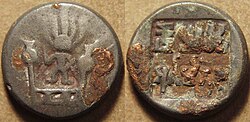 Coin of Agnimitra, showing the depiction of Agni with flaming hair on the obverse, and a reverse showing the three dynastic symbols of the Panchala rulers and a legend naming the king: Agimitasa.
 -
 A bronze currency of 1⁄2 karshapana of King Indramitra (ca 75-50 BC?) Of Ahichatra of Panchala. Obv: A inside a rectangle, a line of 3 symbols, under the name of the king. Rev: Indra standing on a pedestal without pillars. Dimensions: 15 mm. Weight: 4.18 g.
 -
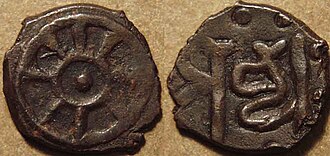 Coin of Achyuta, the last Panchala king, showing an 8-spoked wheel and the king's name: Achyu.


.jpg)

Rulers[edit | edit source]
Ajamida II had a son named Rishin. Rishin had two sons namely Samvarana II whose son was Kuru and Brihadvasu whose descendants were Panchalas.[30][31][32][33]
- List of Panchala Kingdom rulers are-
- Rishin, (his sons were Brihadvasu and Samvarana II)
- Brihadbhanu, (son of Brihadvasu)
- Brihatkaya
- Puranjaya
- Riksha
- Bramhyaswa
- Aramyaswa
- Mudgala, Yavinara, Pratiswan, Kampilya (Founder of Kampilya – Capital of Panchala Kingdom) and Sranjaya were the sons of Aramyaswa and were the founders of Panchala Kingdom and were called as Panchalas.
- Dritimana, (son of Mudgala)
- Drdhanemi
- Sarvasena, (founder of Ujjain Kingdom)
- Mitra
- Rukmaratha
- Suparswa
- Sumathi
- Sannatimana
- Krta
- Pijavana
- Somadutta
- Jantuvahana
- Badhrayaswa
- Brihadhishu
- Brihadhanu
- Brihadkarma
- Jayaratha
- Visvajit
- Seinyajit
- Nepavirya, (after this King's name the country was named Nepaldesh)
- Samara
- Sadashva
- Ruchiraswa
- Pruthusena
- Prapti
- Prthaswa
- Sukrthi
- Vibhiraja
- Anuha
- Bramhadatta II
- Vishwaksena
- Dandasena
- Durmukha
- Durbuddhi
- Dharbhya
- Divodasa
- Sivana I
- Mitrayu
- Maitrayana
- Soma
- Sivana II
- Sadasana
- Sahadeva
- Somaka, (Somaka's eldest son was Sugandakrthu and youngest was Prishata. But in a war all sons died and Prishata Survived and became the king of Panchala)
- Prishati, (son of Somaka)
- Drupada, (son of Prishata)
- Dhrishtadyumna, (was the son of Drupada, Draupadi and Shikhandi were the daughters of Drupada)
- Keśin Dālbhya
- Pravahana Jaivali
- Achyuta, (last known ruler of Panchala Kingdom which was defeated in c. 350 CE by Gupta ruler Samudragupta.)
See also[edit | edit source]
| Outline of South Asian history |
|---|
_without_national_boundaries.svg) |
- Vedic period
- Mahabharata
- History of India
- History of Hinduism
- Indus Valley Civilisation
- Painted Grey Ware culture
- Janapadas & Mahajanapadas
- Historicity of the Mahabharata
- Kuru kingdom & Gandhara Kingdom
References[edit | edit source]
- ↑ wheeler, James Boy (1869). The History of India from the Earliest Ages: The Rámáyana and the Brahmanic period. N Trubner. p. 432.
- ↑ Bibliotheca Indica, Volume 270. Baptist Mission Press. 1848. p. 38.
- ↑ Witzel, Michael (1995), "Early Sanskritization: Origin and Development of the Kuru state", EJVS |volume=1 |issue=4 |date=1995
- ↑ Olivelle, Austin Patrick (2006). Between the Empires, Society in India 300 BCE to 400 CE. Oxford university press, USA. p. 21. ISBN 978-0-19-977507-1.
- ↑ Chakraborty, Dilip K. (2007). Archaeological Geography of the Ganga Plain, The Upper Ganga (Oudh, Rohilkhand, and the Doab). Munshiram Manohar Lal Publications. p. 204. ISBN 978-81-215-1185-8.
- ↑ Raychaudhuri, Hemchandra (1953). Political History of Ancient India: From the Accession of Parikshit to the Extinction of Gupta Dynasty. University of Calcutta. pp. 70–74.
- ↑ Raychaudhuri, H.C. (1972). Political History of Ancient India, Calcutta: University of Calcutta, p. 206
- ↑ wheeler, James Boy (1869). The History of India from the Earliest Ages: The Rámáyana and the Brahmanic period. N Trubner. p. 432.
- ↑ Bibliotheca Indica, Volume 270. Baptist Mission Press. 1848. p. 38.
- ↑ Singh Sandhu, Gurcharn (2000). A Military History of Ancient India. Vision Books. p. 164. ISBN 978-81-7094-375-4.
- ↑ Proceedings Volume 29. Indian History Congress. 1968. p. 82.
- ↑ Uttar Pradesh District Gazetteers: Farrukhabad. 39. Ballia. Government of Uttar Pradesh. 1988. p. 29.
- ↑ Bagchi, Jhunu (1993). The History and Culture of the Pālas of Bengal and Bihar, Cir. 750 A.D.-cir. 1200 A.D. Abhinav Publications. p. 3. ISBN 978-81-7017-301-4.
- ↑ D. C. Sircar 1985, p. 1.
- ↑ Tripathi, Rama Shanker (1989). History of Kanauj, To the Moslem Conquest. Motilal Banarsidas. pp. 212, 213. ISBN 978-81-208-0404-3.
- ↑ Sudama Misra 1973, p. 14.
- ↑ Oroon K. Ghosh (1976). The Changing Indian Civilization: A Perspective on India. Minerva. ISBN 978-0-88386-502-6.
- ↑ Raychaudhuri, Hemchandra (1953). Political History of Ancient India - From the Accession of Parikshit to the Extinction of the Gupta Dynasty (PDF) (Sixth ed.). Kolkata: Calcutta University Press. p. 71. Retrieved 8 May 2022.
- ↑ Pargiter, F.E. (1972). Ancient Indian Historical Tradition, Delhi: Motilal Banarsidass, p.117
- ↑ Raychaudhuri, H.C. (1972) Political History of Ancient India, Calcutta: University of Calcutta, pp.65-8.
- ↑ Michael Witzel (1989), Tracing the Vedic dialects in Dialectes dans les litteratures Indo-Aryennes ed. Caillat, Paris, p.127
- ↑ Witzel (1995), p.22
- ↑ Raychaudhury, pp.67–68
- ↑ Raychaudhuri, H.C. (1972). Political History of Ancient India, Calcutta: University of Calcutta, p.85
- ↑ Raychaudhuri, H.C. (1972). Political History of Ancient India, Calcutta: University of Calcutta, p.206
- ↑ Lahiri, B. (1974). Indigenous States of Northern India (Circa 200 B.C. to 320 A.D.) , Calcutta: University of Calcutta, pp.170-88
- ↑ Bhandare, S. (2006). Numismatics and History: The Maurya-Gupta Interlude in the Gangetic Plain in P. Olivelle ed. Between the Empires: Society in India 300 BCE to 400 CE, New York: Oxford University Press, ISBN 0-19-568935-6, pp.76,88
- ↑ Raychaudhuri, H.C. (1972). Political History of Ancient India, Calcutta: University of Calcutta, p.473
- ↑ Lahiri, B. (1974). Indigenous States of Northern India (Circa 200 B.C. to 320 A.D.) , Calcutta: University of Calcutta, p.182
- ↑ Malik, Dr Malti (2016). History of India. New Saraswati House India Pvt Ltd. pp. 51–54. ISBN 978-81-7335-498-4.
- ↑ Kisari Mohan Ganguli, The Mahabharata of Krishna-Dwaipayana Vyasa Translated into English Prose, 1883-1896, Bk. 1, Ch. 3.
- ↑ Kisari Mohan Ganguli, The Mahabharata of Krishna-Dwaipayana Vyasa Translated into English Prose, 1883-1896, Book Chapter 1
- ↑ Raychaudhuri, H.C. (1972). Political History of Ancient India, Calcutta: University of Calcutta, p. 85
Works cited[edit | edit source]
- D. C. Sircar (1985). The Kānyakubja-Gauḍa Struggle. Asiatic Society. ISBN 9788192061580. OCLC 915112370.
- Sudama Misra (1973). Janapada state in ancient India. Vārāṇasī: Bhāratīya Vidyā Prakāśana. Archived from the original on 17 August 2016. Retrieved 18 July 2016.
External links[edit | edit source]
| Preceded by |
Panchala (850 BC–500 BC) |
Succeeded by Nanda Dynasty |
- Pages using the JsonConfig extension
- Pañcāla
- Kingdoms of the Puru clan
- Ancient peoples of India
- Indo-Aryan peoples
- Iron Age cultures of Asia
- Iron Age cultures of South Asia
- Places in Hindu mythology
- Mahajanapadas
- Archaeological cultures of South Asia
- Archaeological cultures in India
- Former kingdoms
- Tribal confederacies