


Minor updates and cleanup applied |
No edit summary Tags: Visual edit Mobile edit Mobile web edit |
||
| Line 2: | Line 2: | ||
{{Redirect2|Jat|Jat people}} | {{Redirect2|Jat|Jat people}} | ||
{{Distinguish|text = the [[Jats of Afghanistan]]}} | {{Distinguish|text = the [[Jats of Afghanistan]]}} | ||
<!-- do not remove, see [[Special:PermaLink/698674019#Palestine-Israel articles 3 (2): Arbitrator views and discussion]] --> | |||
{{Use dmy dates|date=August 2022}} | |||
{{Use dmy dates|date= | |||
{{Infobox ethnic group | {{Infobox ethnic group | ||
| group | |group=Jat | ||
| image | |image= | ||
| caption | |caption= | ||
| | | region1 = [[South Asia]] | ||
| pop1 = ~30–43 million ({{circa|2009/10}}) | |||
| pop1 = ~ | |langs = [[Hindi]]-[[Urdu]] ([[Haryanvi]]) • [[Punjabi language|Punjabi]] • [[Rajasthani language|Rajasthani]] • [[Sindhi language|Sindhi]] • [[Braj Bhasha|Braj]] | ||
|rels = [[Hinduism]]{{•}}[[Islam]]{{•}}[[Sikhism]] | |||
|related = | |||
| langs | |||
| rels | |||
| related | |||
}} | }} | ||
The '''Jat people''' ({{ | The '''Jat people''' (({{IPA-pa|d͡ʒəʈːᵊ}}), ({{IPA-hi|d͡ʒaːʈ}})) are a traditionally [[agricultural]] community in [[Northern India]] and [[Pakistan]].<ref name="Khanna">{{cite book |last=Khanna |first=Sunil K. |editor1-last=Ember |editor1-first=Carol R. |editor2-last=Ember |editor2-first=Melvin |editor1-link=Carol R. Ember |editor2-link=Melvin Ember |title=Encyclopedia of Medical Anthropology: Health and Illness in the World's Cultures |volume=2 |year=2004 |publisher=[[Springer Science+Business Media|Kluwer Academic/Plenum Publishers]] |page=777 |isbn=978-0-306-47754-6 |entry-url=https://books.google.com/books?id=nrMRezmNrPcC&pg=PA777 |entry=Jat |quote=Notwithstanding social, linguistic, and religious diversity, the Jats are one of the major landowning agriculturalist communities in South Asia.}}</ref><ref name="NesbittE">{{cite book |last=Nesbitt |first=Eleanor |title=Sikhism: A Very Short Introduction |year=2016 |publisher=[[Oxford University Press]] |isbn=978-0-19-874557-0 |page=143 |edition=2nd |url=https://books.google.com/books?id=XebnCwAAQBAJ&pg=PA143 |quote=Jat: Sikhs’ largest ''zat'', a hereditary land-owning community}}</ref><ref name="Gould">{{cite book |last=Gould |first=Harold A. |author-link=Harold A. Gould |title=Sikhs, Swamis, Students and Spies: The India Lobby in the United States, 1900–1946 |year=2006 |orig-year=2005 |publisher=[[SAGE Publishing|SAGE Publications]] |isbn=978-0-7619-3480-6 |page=439 |entry-url=https://books.google.com/books?id=rS5mDwAAQBAJ&pg=PA439 |entry=Glossary |quote=Jat: name of large agricultural caste centered in the undivided Punjab and western Uttar Pradesh}}</ref>{{#tag:ref|"Glossary: '''Jat''': title of north India's major non-elite 'peasant' caste."<ref name="sbayly-p385">{{Cite book |last=Bayly |first=Susan |url=https://books.google.com/books?id=HbAjKR_iHogC&pg=PA385 |title=Caste, Society and Politics in India from the Eighteenth Century to the Modern Age |publisher=Cambridge University Press |year=2001 |isbn=978-0-521-79842-6 |page=385 |access-date=15 October 2011}}</ref>|group=lower-alpha}}{{#tag:ref|"... in the middle decades of the (nineteenth) century, there were two contrasting trends in India's agrarian regions. Previously marginal areas took off as zones of newly profitable 'peasant' agriculture, disadvantaging non-elite tilling groups, who were known by such titles as Jat in western [[North-Western Provinces|NWP]] and Gounder in Coimatore."<ref name="sbayly-p201">{{Cite book |last=Bayly |first=Susan |url=https://books.google.com/books?id=HbAjKR_iHogC&pg=PA201 |title=Caste, Society and Politics in India from the Eighteenth Century to the Modern Age |publisher=Cambridge University Press |year=2001 |isbn=978-0-521-79842-6 |page=201 |access-date=15 October 2011}}</ref>|group=lower-alpha}}{{#tag:ref|"In the later nineteenth century, this thinking led colonial officials to try to protect Sikh Jats and other non-elite 'peasants' whom they now favoured as military recruits by advocating legislation under the so-called land alienation."<ref name="sbayly-p212">{{Cite book |last=Bayly |first=Susan |url=https://books.google.com/books?id=HbAjKR_iHogC&pg=PA212 |title=Caste, Society and Politics in India from the Eighteenth Century to the Modern Age |publisher=Cambridge University Press |year=2001 |isbn=978-0-521-79842-6 |page=212 |access-date=15 October 2011}}</ref>|group=lower-alpha}} Originally [[pastoralism|pastoralist]]s in the lower [[Indus river]]-valley of [[Sindh]], Jats migrated north into the [[Punjab region]] in [[late medieval]] times, and subsequently into the [[Delhi Territory]], northeastern [[Rajputana]], and the western [[Gangetic Plain]] in the 17th and 18th centuries.<ref name="AsherTalbot2006-p269"/><ref name="KhazanovWink2012">{{citation|last1=Khazanov|first1=Anatoly M.| author-link = Anatoly Khazanov|last2=Wink|first2=Andre|title=Nomads in the Sedentary World|url=https://books.google.com/books?id=-v_RORENFbMC&pg=PT177|access-date=15 August 2013|year=2012|publisher=Routledge|isbn=978-1-136-12194-4|page=177}} Quote: "Hiuen Tsang gave the following account of a numerous pastoral-nomadic population in seventh-century Sin-ti (Sind): 'By the side of the river..[of Sind], along the flat marshy lowlands for some thousand li, there are several hundreds of thousands [a very great many] families ..[which] give themselves exclusively to tending cattle and from this derive their livelihood. They have no masters, and whether men or women, have neither rich nor poor.' While they were left unnamed by the Chinese pilgrim, these same people of lower Sind were called Jats' or 'Jats of the wastes' by the Arab geographers. The Jats, as 'dromedary men.' were one of the chief pastoral-nomadic divisions at that time, with numerous subdivisions, ....</ref><ref name="Wink2004">{{citation|last=Wink|first=André|title=Indo-Islamic society: 14th – 15th centuries|url=https://books.google.com/books?id=nyYslywJUE8C&pg=PA92|access-date=15 August 2013|year=2004|publisher=BRILL|isbn=978-90-04-13561-1|pages=92–93}} Quote: "In Sind, the breeding and grazing of sheep and buffaloes was the regular occupations of pastoral nomads in the lower country of the south, while the breeding of goats and camels was the dominant activity in the regions immediately to the east of the Kirthar range and between Multan and Mansura. The jats were one of the chief pastoral-nomadic divisions here in early-medieval times, and although some of these migrated as far as Iraq, they generally did not move over very long distances on a regular basis. Many jats migrated to the north, into the Panjab, and here, between the eleventh and sixteenth centuries, the once largely pastoral-nomadic Jat population was transformed into sedentary peasants. Some Jats continued to live in the thinly populated ''barr'' country between the five rivers of the Panjab, adopting a kind of [[transhumance]], based on the herding of goats and camels. It seems that what happened to the jats is paradigmatic of most other pastoral and pastoral-nomadic populations in India in the sense that they became ever more closed in by an expanding sedentary-agricultural realm."</ref> Of [[Muslim]], [[Sikh]], and [[Hindu]] faiths, they are now found mostly in the [[Pakistan]]i provinces of [[Sindh]] and [[Punjab, Pakistan|Punjab]] and the Indian states of [[Punjab, India|Punjab]], [[Haryana]], [[Uttar Pradesh]] and [[Rajasthan]]. | ||
The [[ | The Jats took up arms against the [[Mughal Empire]] during the late 17th and early 18th centuries.<ref name="AsherTalbot2006">{{Cite book |last1=Catherine Ella Blanshard Asher |title=India before Europe |last2=Cynthia Talbot |publisher=Cambridge University Press |year=2006 |isbn=978-0-521-80904-7 |page=265}}</ref> The community played an important role in the development of the martial [[Khalsa]] ''[[panth]]'' of Sikhism.<ref name="Karine1987">{{Cite book |title=The Sants: studies in a devotional tradition of India |publisher=Motilal Banarsidass Publ. |year=1987 |isbn=978-81-208-0277-3 |editor-last=Karine Schomer and W. H. McLeod |pages=242}}</ref> The Hindu Jat kingdom reached its zenith under [[Maharaja Suraj Mal]] (1707–1763).<ref name="Unit1973">{{Cite book |title=The Gazetteer of India: History and culture |publisher=Publications Division, Ministry of Information and Broadcasting, India |year=1973 |page=348 |oclc=186583361}}</ref> By the 20th century, the landowning Jats became an influential group in several parts of North India, including [[Punjab (India)|Punjab]],<ref name="Srinivas1962">{{Cite book |last=[[M. N. Srinivas|Mysore Narasimhachar Srinivas]] |title=Caste in modern India: and other essays |publisher=Asia Pub. House |year=1962 |page=90 |oclc=185987598}}</ref> [[Western Uttar Pradesh]],<ref name="Nuna1989">{{Cite book |last=Sheel Chand Nuna |url=https://books.google.com/books?id=hjjriYh_hykC&pg=PA61 |title=Spatial fragmentation of political behaviour in India: a geographical perspective on parliamentary elections |date=1 January 1989 |publisher=Concept Publishing Company |isbn=978-81-7022-285-9 |pages=61– |access-date=20 January 2012}}</ref> [[Rajasthan]],<ref name="RudolphRudolph1984">{{Cite book |last1=Lloyd I. Rudolph |url=https://books.google.com/books?id=7guY1ut-0lwC&pg=PA86 |title=The Modernity of Tradition: Political Development in India |last2=Susanne Hoeber Rudolph |publisher=University of Chicago Press |year=1984 |isbn=978-0-226-73137-7 |pages=86– |access-date=20 January 2012}}</ref> [[Haryana]] and [[Delhi]].<ref name="CarlMelvin2004">{{Cite book |title=Encyclopedia of medical anthropology |publisher=Springer |year=2004 |isbn=978-0-306-47754-6 |editor-last=Carol R. Ember |page=778 |editor-last2=Melvin Ember}}</ref> Over the years, several Jats abandoned agriculture in favour of urban jobs, and used their dominant economic and political status to claim higher social status.<ref name="Sunil2009">{{Cite book |last=Sunil K. Khanna |title=Fetal/fatal knowledge: new reproductive technologies and family-building strategies in India |publisher=Cengage Learning |year=2009 |isbn=978-0-495-09525-5 |page=18}}</ref> | ||
== History == | == History == | ||
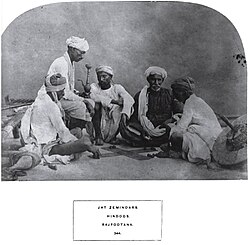
The Jats are a | [[File:JatZemindarsRajpootana1874.jpg|thumb|right|Jat Zamindars Hindoos Rajpootana 1874]] | ||
The Jats are a paradigmatic example of community- and identity-formation in [[Early modern period|early modern]] [[Indian subcontinent]].<ref name="AsherTalbot2006-p269">{{cite book|last1=Asher|first1=Catherine Ella Blanshard|last2=Talbot|first2=Cynthia|title=India before Europe|url=https://books.google.com/books?id=ZvaGuaJIJgoC&pg=PA269|access-date=29 October 2011|year=2006|publisher=Cambridge University Press|isbn=978-0-521-80904-7|page=269}}</ref> "Jat" is an elastic label applied to a wide-ranging community<ref name="Talwar">{{cite book |last=Oldenburg |first=Veena Talwar |author-link=Veena Talwar Oldenburg |title=Dowry Murder: The Imperial Origins of a Cultural Crime |year=2002 |publisher=Oxford University Press |isbn=978-0-19-515071-1 |page=232 |url=https://books.google.com/books?id=d5Fm1XdS-6EC&pg=PA232 |quote=The Jats, who are numerically dominant in central and eastern Punjab, can be Hindu, Sikh, or Muslim; they range from powerful landowners to poor subsistence farmers, and were recruited in large numbers to serve in the British army.}}</ref><ref name="Alavi p.67 ">{{cite book | last=Alavi | first=Seema | title=The eighteenth century in India | publisher=Oxford University Press | publication-place=New Delhi | date=2002 | isbn=0-19-565640-7 | oclc=50783542 | page=67 | quote=The Jat power neat Agra and Mathura arose out of the rebellion of peasants under zamindar leadership, attaining the apex of power under Suraj Mal...it seems to have been an extensive replacement of Rajput by Jat zamindars...and the 'warlike Jats' (a peasant and zamindar caste).}}</ref> from simple landowning peasants {{#tag:ref|"Glossary: '''Jat''': title of north India's major non-elite 'peasant' caste."<ref name="sbayly-p385"/>|group=lower-alpha}}{{#tag:ref|"... in the middle decades of the (nineteenth) century, there were two contrasting trends in India's agrarian regions. Previously marginal areas took off as zones of newly profitable land-owning agriculture, disadvantaging non-elite tilling groups, who were known by such titles as Jat in western [[North-Western Provinces|NWP]] and Gounder in Coimatore."<ref name="sbayly-p201"/>|group=lower-alpha}}{{#tag:ref|"In the later nineteenth century, this thinking led colonial officials to try to protect Sikh Jats and other non-elite 'peasants' whom they now favoured as military recruits by advocating legislation under the so-called land alienation."<ref name="sbayly-p212"/>|group=lower-alpha}}<ref>{{Cite book |last=Judge |first=Paramjit |title=Mapping social exclusion in India : caste, religion and borderlands |publisher=Cambridge University Press |year=2014 |isbn=978-1-107-05609-1 |publication-place=Cambridge |page=112 |oclc=880877884}}</ref><ref>{{Cite book |last=Stokes |first=Eric |title=The peasant and the Raj : studies in agrarian society and peasant rebellion in colonial India |publisher=Cambridge University Press |year=1978 |isbn=978-0-521-29770-7 |publication-place=Cambridge New York |page=185 |oclc=889813954 |quote=n the Ganges Canal Tract of the Muzaffarnagar district where the landowning castes – Tagas , Jats , Rajputs , Sayyids , Sheikhs , Gujars , Borahs}}</ref>{{efn|According to [[Susan Bayly]], "... (North India) contained large numbers of non-elite tillers. In the Punjab and the western Gangetic Plains, convention defined the Rajput's non-elite counterpart as a Jat. Like many similar titles used elsewhere, this was not so much a caste name as a broad designation for the man of substance in rural terrain. … To be called Jat has in some regions implied a background of pastoralism, though it has more commonly been a designation of non-servile cultivating people."<ref name=sbayly-p37>{{cite book|last=Bayly|first=Susan|title=Caste, Society and Politics in India from the Eighteenth Century to the Modern Age|url=https://books.google.com/books?id=HbAjKR_iHogC&pg=PA37|access-date=15 October 2011|year=2001|publisher=Cambridge University Press|isbn=978-0-521-79842-6|page=37}}</ref>}} to wealthy and influential Zamindars.<ref name="Khan 1997 pp. 336">{{cite journal | last=Khan | first=Zahoor Ali | title=ZAMINDARI CASTE CONFIGURATION IN THE PUNJAB, c.1595 — MAPPING THE DATA IN THE | journal=Proceedings of the Indian History Congress | publisher=Indian History Congress | volume=58 | year=1997 | issn=2249-1937 | jstor=44143925 | pages=336 | quote=The number of parganas with Jat zamindaris (Map 2) is surprisingly large and well spread out, though there are none beyond the Jhelum. They appear to be in two blocks, divided by a sparse zone between the Sutlej and the Sarasvati basin. The two blocks, in fact, represent two different segments of the Jats, the western one (Panjab) known as Jat (with short vowel) and the other (Haryanvi) as Jaat (with long vowel). | url=http://www.jstor.org/stable/44143925 | access-date=2 August 2022}}</ref><ref>{{Cite book |last=Ramaswamy |first=Vijaya |title=Migrations in Medieval and Early Colonial India |publisher=Taylor and Francis |year=2016 |isbn=978-1-351-55825-9 |publication-place=London |page=59 |oclc=993781016 |quote=Out of the 45 parganas of the sarkars of Delhi, 17 are reported to have Jat Zamindars. Out of these 17 parganas, the Jats are exclusively found in 11, whereas in other 6 they shared Zamindari rights with other communities.}}</ref><ref>{{Cite book |last=Dhavan |first=Purnima |title=When sparrows became hawks : the making of the Sikh warrior tradition, 1699-1799 |publisher=Oxford University Press |year=2011 |isbn=978-0-19-975655-1 |publication-place=New York |page=54 |oclc=695560144 |quote=Muzaffar Alam's study of the akhbarat (news reports) and chronicles of the period demonstrates that Banda and his followers had wide support amongst the Jat zamindars of the Majha, Jalandhar Doab, and the Malwa area. Jat zamindars actively colluded with the rebels, and frustrated the Mughal faujdars or commanders of the area by supplying Banda and his men with grain, horses, arms, and provisions. This evidence suggests that understanding the rebellion as a competition between peasants and feudal lords is an oversimplification, since the groups affiliated with Banda as well as those affiliated with the state included both Zamindars and peasants.}}</ref><ref name="Alam 1978 pp. 509–522">{{cite journal | last=Alam | first=Muzaffar | title=Sikh Uprisings Under Banda Bahadur 1708-1715 | journal=Proceedings of the Indian History Congress | publisher=Indian History Congress | volume=39 | year=1978 | issn=2249-1937 | jstor=44139389 | pages=509–522 | quote=Banda led predominantly the uprisings of the Jat zamindars.It is also to be noted that tha Jats were the dominant zamindar castes in some of the parganas where Banda had support.But Banda's spectacular success and the amazing increase in the strength of his army within a few months*6 does not cohere with the presence of a few Jat zamindaris…we can, however presume that the unidentified zamindars of our sources who rallied behind Banda were the small zamindars (mah'ks) and the Mughal assessees (malguzars). It is not without significance that they are almost invariably described as the zamindars of village (mauza and dehat). These zamindars were largely the Jats who had settled in the region for the last three or four centuries. | |||
| url=http://www.jstor.org/stable/44139389 | access-date=2 August 2022}}</ref><ref name="Syan 2013 p.40 ">{{cite book | last=Syan | first=H.S. | title=Sikh Militancy in the Seventeenth Century: Religious Violence in Mughal and Early Modern India | publisher=I.B. Tauris | year=2013 | isbn=978-0-7556-2370-9 | url=https://books.google.com/books?id=i1OezQEACAAJ | access-date=2 August 2022 | page=40 | quote= Guru Nanak’s father- in-law, Mula Chonha, works as an administrator for the Jat landlord,Ajita Randawa. If we expand this train of thought and examine other Janamsakhi figures we can detect an interesting pattern…All of Nanak’s immediate relatives were professional administrators for local or regional lords, including Jat masters. From this we can infer that Khatris did seem to occupy a position as a professional class and some Jats held the position of being landlords. There was clearly a professional services relationship between high-ranking Khatris and high-ranking Jats, and this seems indicative of the wider socio- economic relationship between Khatris and Jats in medieval Panjab.}}</ref> | |||
By the time of [[Muhammad bin Qasim]]'s conquest of Sind in the eighth century, Arab writers described agglomerations of Jats in the arid, the wet, and the mountainous regions of the conquered land of Sindh.<ref name="Mayaram2003-p19">{{citation|last=Mayaram|first=Shail|title=Against history, against state: counterperspectives from the margins|url=https://books.google.com/books?id=Yi6QpFCZBy8C&pg=PA19|access-date=12 November 2011|year=2003|publisher=Columbia University Press|isbn=978-0-231-12730-1|page=19}}</ref> The Arab rulers, though professing a theologically egalitarian religion, maintained the position of Jats and the discriminatory practices against them that had been put in place in the long period of Hindu rule in Sind.<ref name="Jackson2003-p15">{{citation|last=Jackson|first=Peter|title=The Delhi Sultanate: A Political and Military History|url=https://books.google.com/books?id=lt2tqOpVRKgC&pg=PA15|access-date=13 November 2011|year=2003|publisher=Cambridge University Press|isbn=978-0-521-54329-3|page=15}} Quote: "... Nor can the liberation that the Muslim conquerors offered to those who sought to escape from the caste system be taken for granted. … a caliphal governor of Sind in the late 830s is said to have … (continued the previous Hindu requirement that) … the Jats, when walking out of doors in future, to be accompanied by a dog. The fact that the dog is an unclean animal to both Hindu and Muslim made it easy for the Muslim conquerors to retain the ''status quo'' regarding a low-caste tribe. In other words, the new regime in the eighth and ninth centuries did not abrogate discriminatory regulations dating from a period of Hindu sovereignty; rather, it maintained them. (page 15)"</ref> Between the eleventh and the sixteenth centuries, Jat herders at the Sind migrated up along the river valleys,<ref name="Grewal1998-p5">{{citation|last=Grewal|first=J. S.|title=The Sikhs of the Punjab|url=https://books.google.com/books?id=2_nryFANsoYC&pg=PA5|access-date=12 November 2011|year=1998|publisher=Cambridge University Press|isbn=978-0-521-63764-0|page=5}} Quote: "... the most numerous of the agricultural tribes (in the Punjab) were the Jats. They had come from Sindh and Rajasthan along the river valleys, moving up, displacing the Gujjars and the Rajputs to occupy culturable lands. (page 5)"</ref> into the Punjab,<ref name="AsherTalbot2006-p269" /> which may have been largely uncultivated in the first millennium.<ref name="Ludden1999-p117">{{citation|last=Ludden|first=David E.|title=An agrarian history of South Asia|url=https://books.google.com/books?id=eHi62S7vZlsC&pg=PA117|access-date=12 November 2011|year=1999|publisher=Cambridge University Press|isbn=978-0-521-36424-9|page=117}} Quote: "The flatlands in the upper Punjab doabs do not seem to have been heavily farmed in the first millennium. … Early-medieval dry farming developed in Sindh, around Multan, and in Rajasthan… From here, Jat farmers seem to have moved into the upper Punjab doabs and into the western Ganga basin in the first half of the second millennium. (page 117)"</ref> Many took up tilling in regions such as [[Western Punjab]], where the [[sakia]] (water wheel) had been recently introduced.<ref name="AsherTalbot2006-p269" /><ref name="Ansari1992">{{cite book|last=Ansari|first=Sarah F. D.|title=Sufi saints and state power: the pirs of Sind, 1843–1947|url=https://books.google.com/books?id=j8wrDHqwEFIC&pg=PA27|access-date=30 October 2011|year=1992|publisher=Cambridge University Press|isbn=978-0-521-40530-0|page=27}} Quote: "Between the eleventh and sixteenth centuries, groups of nomadic pastoralists known as Jats, having worked their way northwards from Sind, settled in the Panjab as peasant agriculturalists and, largely on account of the introduction of the Persian wheel, transformed much of western Panjab into a rich producer of food crops. (page 27)"</ref> By early Mughal times, in the Punjab, the term "Jat" had become loosely synonymous with "peasant",<ref name="Mayaram2003-p33">{{citation|last=Mayaram|first=Shail|title=Against history, against state: counterperspectives from the margins|url=https://books.google.com/books?id=Yi6QpFCZBy8C&pg=PA33|access-date=12 November 2011|year=2003|publisher=Columbia University Press|isbn=978-0-231-12730-1|page=33}}</ref> and some Jats had come to own land and exert local influence.<ref name="AsherTalbot2006-p269" /> The Jats had their origins in [[pastoralism]] in the [[Indus valley]], and gradually became agriculturalist farmers.<ref>{{Cite book|last1=Khazanov|first1=Anatoly M.|last2=Wink|first2=Andre|date=12 October 2012|title=Nomads in the Sedentary World|url=http://dx.doi.org/10.4324/9780203037201|doi=10.4324/9780203037201|isbn=9780203037201}}</ref> Around 1595, Jat Zamindars controlled a little over 32% of the [[Zamindar]]is in the Punjab region.<ref name="Khan 1982 pp. 342–350">{{cite journal | last=Khan | first=Iftikhar Ahmad | title=A Note on Medieval Jatt Immigration in the Punjab | journal=Proceedings of the Indian History Congress | publisher=Indian History Congress | volume=43 | year=1982 | issn=2249-1937 | jstor=44141246 | pages=347, 349 | url=http://www.jstor.org/stable/44141246 | access-date=20 June 2022}}</ref> | |||
By the time of [[Muhammad bin Qasim]]'s conquest of Sind in the eighth century, Arab writers described agglomerations of Jats, | |||
According to historians Catherine Asher and Cynthia Talbot, | According to historians Catherine Asher and Cynthia Talbot,<ref name="AsherTalbot2006-p270">{{cite book|last1=Asher|first1=Catherine Ella Blanshard|last2=Talbot|first2=Cynthia|title=India before Europe|url=https://books.google.com/books?id=ZvaGuaJIJgoC&pg=PA270|access-date=29 October 2011|year=2006|publisher=Cambridge University Press|isbn=978-0-521-80904-7|page=270}}</ref> {{blockquote|The Jats also provide an important insight into how religious identities evolved during the precolonial era. Before they settled in the Punjab and other northern regions, the pastoralist Jats had little exposure to any of the mainstream religions. Only after they became more integrated into the agrarian world did the Jats adopt the dominant religion of the people in whose midst they dwelt.<ref name="AsherTalbot2006-p270" />}} Over time the Jats became primarily Muslim in the western Punjab, Sikh in the eastern Punjab, and Hindu in the areas between [[Delhi Territory]] and Agra, with the divisions by faith reflecting the geographical strengths of these religions.<ref name="AsherTalbot2006-p270" /> | ||
During the decline of [[Mughal | During the decline of [[Mughal empire|Mughal rule]] in the early 18th century, the [[Indian subcontinent]]'s hinterland dwellers, many of whom were armed and nomadic, increasingly interacted with settled townspeople and agriculturists. Many new rulers of the 18th century came from such martial and nomadic backgrounds. The effect of this interaction on India's social organization lasted well into the colonial period. During much of this time, non-elite tillers and pastoralists, such as the Jats, were part of a social spectrum that blended only indistinctly into the elite landowning classes at one end, and the menial or ritually polluting classes at the other.<ref name=bayly-p41>{{citation|last=Bayly|first=Susan|title=Caste, Society and Politics in India from the Eighteenth Century to the Modern Age|url=https://books.google.com/books?id=HbAjKR_iHogC|access-date=1 August 2011|year=2001|publisher=Cambridge University Press|page=41|isbn=978-0-521-79842-6}}</ref> During the heyday of Mughal rule, Jats had recognized rights. According to [[Barbara D. Metcalf]] and [[Thomas R. Metcalf]]: {{blockquote|Upstart warriors, Marathas, Jats, and the like, as coherent social groups with military and governing ideals, were themselves a product of the Mughal context, which recognized them and provided them with military and governing experience. Their successes were a part of the Mughal success.<ref name="MetcalfMetcalf2006-p23">{{cite book|last1=Metcalf|first1=Barbara Daly|last2=Metcalf|first2=Thomas R.|title=A concise history of modern India|url=https://books.google.com/books?id=iuESgYNYPl0C&pg=PA23|access-date=24 October 2011|year=2006|publisher=Cambridge University Press|isbn=978-0-521-86362-9|page=23}}</ref>}} | ||
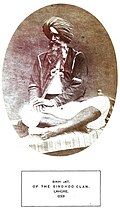
[[File:JatSikhLahore1872.jpg|thumb|left|200px|Jat Sikh of the "Sindhoo" clan, [[Lahore]], 1872]] | [[File:JatSikhLahore1872.jpg|thumb|left|200px|Jat Sikh of the "Sindhoo" clan, [[Lahore]], 1872]] | ||
As the Mughal | As the Mughal empire faltered, there were a series of rural rebellions in North India.<ref name=asher-talbot-2006-p271>{{cite book|last1=Asher|first1=Catherine|last2=Talbot|first2=Cynthia|title=India before Europe|url=https://books.google.com/books?id=ZvaGuaJIJgoC&pg=PA271|access-date=15 October 2011|year=2006|publisher=Cambridge University Press|isbn=978-0-521-80904-7|page=271}}</ref> Although these had sometimes been characterized as "peasant rebellions", others, such as [[Muzaffar Alam]], have pointed out that small local landholders, or ''[[zemindar]]s'', often led these uprisings.<ref name=asher-talbot-2006-p271 /> The Sikh and Jat rebellions were led by such small local zemindars, who had close association and family connections with each other and with the peasants under them, and who were often armed.<ref name=asher-talbot-2006-p272>{{cite book|last1=Asher|first1=Catherine|last2=Talbot|first2=Cynthia|title=India before Europe|url=https://books.google.com/books?id=ZvaGuaJIJgoC&pg=PA272|access-date=15 October 2011|year=2006|publisher=Cambridge University Press|isbn=978-0-521-80904-7|page=272}}</ref> | ||
These communities of rising peasant-warriors were not well-established Indian castes, | These communities of rising peasant-warriors were not well-established Indian castes,<ref name="MetcalfMetcalf2006-p24">{{cite book|last1=Metcalf|first1=Barbara Daly|last2=Metcalf|first2=Thomas R.|title=A concise history of modern India|url=https://books.google.com/books?id=iuESgYNYPl0C&pg=PA24|access-date=24 October 2011|year=2006|publisher=Cambridge University Press|isbn=978-0-521-86362-9|page=24}}</ref> but rather quite new, without fixed status categories, and with the ability to absorb older peasant castes, sundry warlords, and nomadic groups on the fringes of settled agriculture.<ref name=asher-talbot-2006-p272 /><ref name=cbayly-1988-p20>{{cite book|last=Bayly|first=C. A.|author-link=Christopher Bayly|title=Rulers, Townsmen and Bazaars: North Indian Society in the Age of British Expansion, 1770–1870|url=https://books.google.com/books?id=xfo3AAAAIAAJ&pg=PA20|access-date=15 October 2011|year=1988|publisher=CUP Archive|isbn=978-0-521-31054-3|page=20}}</ref> The Mughal Empire, even at the zenith of its power, functioned by devolving authority and never had direct control over its rural grandees.<ref name=asher-talbot-2006-p272 /> It was these zemindars who gained most from these rebellions, increasing the land under their control.<ref name=asher-talbot-2006-p272 /> The triumphant even attained the ranks of minor princes, such as the Jat ruler Badan Singh of the [[princely state]] of Bharatpur.<ref name=asher-talbot-2006-p272 /> | ||
===Hindu Jats=== | ===Hindu Jats=== | ||
[[File: | [[File:The Maharajah of Bharatpore. circa 1882.jpg|thumb|The Hindu Jat Maharaja of [[Bharatpur State|Bharatpur]], 1882]] | ||
In 1669, the Hindu Jats, under the leadership of [[Gokula]], rebelled against the Mughal emperor [[Aurangzeb]] in [[Mathura]].<ref>{{cite book |first=Burjor |last=Avari| author-link=Burjor Avari | title=Islamic Civilization in South Asia: A History of Muslim Power and Presence in the Indian Subcontinent |url= https://books.google.com/books?id=hGHpVtQ8eKoC | publisher=Routledge | isbn=978-0-41558-061-8|year=2013|page=131}} | |||
</ref> The community came to predominate south and east of Delhi after 1710.<ref name=cbayly-1988-p22>{{cite book|last=Bayly|first=C. A.|author-link=Christopher Bayly|title=Rulers, Townsmen and Bazaars: North Indian Society in the Age of British Expansion, 1770–1870|url=https://books.google.com/books?id=xfo3AAAAIAAJ&pg=PA22|access-date=15 October 2011|year=1988|publisher=CUP Archive|isbn=978-0-521-31054-3|page=22}}</ref> According to historian [[Christopher Bayly]] {{blockquote|Men characterised by early eighteenth century Mughal records as plunderers and bandits preying on the imperial lines of communications had by the end of the century spawned a range of petty states linked by marriage alliance and religious practice.<ref name=cbayly-1988-p22 />}} | |||
In 1669, the Hindu Jats, under the leadership of [[Gokula]], rebelled against the Mughal emperor [[Aurangzeb]] in [[Mathura]]. | |||
The Jats had moved into the Gangetic Plain in two large migrations, in the seventeenth and eighteenth centuries respectively.<ref name=cbayly-1988-p22 /> They were not a caste in the usual Hindu sense, for example, in which [[Bhumihar]]s of the eastern Gangetic plain were; rather they were an umbrella group of peasant-warriors.<ref name=cbayly-1988-p22 /> According to Christopher Bayly: {{blockquote|This was a society where [[Brahmin]]s were few and male Jats married into the whole range of lower agricultural and entrepreneurial castes. A kind of tribal nationalism animated them rather than a nice calculation of caste differences expressed within the context of Brahminical Hindu state.<ref name=cbayly-1988-p22 />}} | |||
By the mid-eighteenth century, the ruler of the recently established Jat kingdom of [[Bharatpur State|Bharatpur]], Raja [[Surajmal Jat|Surajmal]], felt sanguine enough about durability to build a garden palace at nearby [[Deeg]].<ref name="MetcalfMetcalf2006-p35">{{cite book|last1=Metcalf|first1=Barbara Daly|last2=Metcalf|first2=Thomas R.|title=A concise history of modern India|url=https://books.google.com/books?id=iuESgYNYPl0C&pg=PA35|access-date=24 October 2011|year=2006|publisher=Cambridge University Press|isbn=978-0-521-86362-9|page=35}}</ref> According to historian, [[Eric Thomas Stokes|Eric Stokes]], {{blockquote|When the power of the Bharatpur raja was riding high, fighting clans of Jats encroached into the Karnal/Panipat, Mathura, Agra, and Aligarh districts, usually at the expense of Rajput groups. But such a political umbrella was too fragile and short-lived for substantial displacement to be effected.<ref name="Stokes1980-p69">{{cite book|last=Stokes|first=Eric|author-link=Eric Thomas Stokes|title=The Peasant and the Raj: Studies in Agrarian Society and Peasant Rebellion in Colonial India|url=https://books.google.com/books?id=9DU5AAAAIAAJ&pg=PA69|access-date=24 October 2011|year=1980|publisher=Cambridge University Press Archive|isbn=978-0-521-29770-7|page=69}}</ref>}} | |||
{{Gallery | {{Gallery | ||
|align=center | |align=center | ||
|width=180 |File:JatsAroundDelhi1868.jpg|Jats in the [[Delhi Territory]] in 1868. | |width=180 |lines=4 | ||
|File:JatsAroundDelhi1868.jpg|Jats in the [[Delhi Territory]] in 1868. | |||
|File:JatGirlAllyghur1868.jpg|Jat girl from [[Aligarh]], [[Uttar Pradesh]], India, 1868. | |File:JatGirlAllyghur1868.jpg|Jat girl from [[Aligarh]], [[Uttar Pradesh]], India, 1868. | ||
|File:JatZemindarsRajpootana1874.jpg|Ethnographic photograph of Jat [[zemindars]] (land owners) in [[Rajasthan]], playing [[pachisi]], 1874. | |File:JatZemindarsRajpootana1874.jpg|Ethnographic photograph of Jat [[zemindars]] (land owners) in [[Rajasthan]], playing [[pachisi]], 1874. | ||
| Line 70: | Line 53: | ||
===Muslim Jats=== | ===Muslim Jats=== | ||
{{Main|Jat | {{Main|Muslim Jat|Muley Jats}} | ||
[[File:JuttBelochTribeSind1872.jpg|200px| | |||
thumb|right|A Jutt (Jat) Muslim camel-driver from [[Sindh|Sind]], 1872]] | |||
When [[Arab people|Arabs]] entered Sindh and other Southern regions of current Pakistan in the seventh century, the chief tribal groupings they found were the Jats and the [[Med people]]. These Jats are often referred as ''Zatts'' in early Arab writings. The Muslim conquest chronicles further point at the important concentrations of Jats in towns and fortresses of Lower and Central Sindh.<ref name=Al-Hind1>{{cite book |title=Al-Hind, The Making of the Indo-Islamic World: Early Medieval India and the Expansion of Islam, 7th-11th Centuries |last=Wink |first=André |year=2002 |location=Boston |publisher=Brill |volume=1 |pages=154–160 |url=https://books.google.com/books?id=g2m7_R5P2oAC&pg=PA154 |isbn=9780391041738 |oclc=48837811}}</ref><ref>{{Cite web|title=Zuṭṭ {{!}} people|url=https://www.britannica.com/topic/Zutt|access-date=12 May 2021|website=Encyclopedia Britannica|language=en}}</ref> Today, Muslim Jats are found in Pakistan and India.<ref>{{cite book|first=Bhagata |last=Singha|title=Canadian Sikhs Through a Century, 1897-1997|year=2001|url=https://books.google.com/books?id=Ovx5AAAAMAAJ&q=Canadian+Sikhs+Through+a+Century,+1897-1997| page=418|publisher=Gyan Sagar Publications|isbn=9788176850759}} Quote: "Most of the Muslim Jats are in Pakistan and some of them are in India as well."</ref> | |||
===Sikh Jats=== | ===Sikh Jats=== | ||
| Line 84: | Line 62: | ||
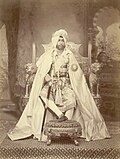
[[File:Portrait of Sir Rajinder Singh Maharaja of Patiala.jpg|right|thumb|The Sikh Jat Maharaja of [[Patiala]], 1898]] | [[File:Portrait of Sir Rajinder Singh Maharaja of Patiala.jpg|right|thumb|The Sikh Jat Maharaja of [[Patiala]], 1898]] | ||
While followers important to Sikh tradition like [[Baba Buddha]] were among the earliest significant historical Sikh figures, and significant numbers of conversions occurred as early as the time of [[Guru Angad]] (1504–1552), | While followers important to Sikh tradition like [[Baba Buddha]] were among the earliest significant historical Sikh figures, and significant numbers of conversions occurred as early as the time of [[Guru Angad]] (1504–1552),<ref name=mandair/> the first large-scale conversions of Jats is commonly held to have begun during the time of [[Guru Arjan]] (1563–1606).<ref name=mandair/><ref>{{cite book | title=The Sikh Revolution: A Perspective View | publisher=Bahri Publications |last1=Singh |first1=Jagjit | date=1981 | location=New Delhi |url=https://archive.org/details/TheSikhRevolutionAPerspectiveView/page/n271/mode/2up | isbn=9788170340416}}</ref>{{rp|265}} While touring the countryside of eastern Punjab, he founded several important towns like [[Tarn Taran Sahib]], [[Kartarpur, India|Kartarpur]], and [[Sri Hargobindpur|Hargobindpur]] which functioned as social and economic hubs, and together with the [[dasvandh|community-funded]] completion of the [[Golden Temple|Darbar Sahib]] to house the [[Guru Granth Sahib]] and serve as a rallying point and center for Sikh activity, established the beginnings of a self-contained Sikh community, which was especially swelled with the region's Jat peasantry.<ref name=mandair>{{cite book |last1=Mandair |first1=Arvind-pal Singh |title=Sikhism: A Guide for the Perplexed |date=2013 |publisher=A&C Black |location=London, U.K. |isbn=9781441102317 |pages=36–42 |edition=illustrated |url=https://books.google.com/books?id=vdhLAQAAQBAJ&q=Jat+peasantry}}{{rp|42}}</ref> They formed the vanguard of Sikh resistance against the [[Mughal Empire]] from the 18th century onwards. | ||
It has been postulated, though inconclusively, that the increased militarization of the Sikh panth following the martyrdom of [[Guru Arjan]] (beginning during the era of [[Guru Hargobind]] and continuing after) and its large Jat presence may have reciprocally influenced each other.<ref>{{cite book |quote=The Jats have long been distinguished by their martial traditions and by the custom of retaining their hair uncut. The influence of these traditions evidently operated prior to the formal inauguration of the Khalsa. |title=Who is a Sikh?: the problem of Sikh identity |first=W. H. |last=McLeod}}</ref>{{full citation needed|date=September 2014}}{{sfn|Singh|1981|pp=190, 265}} | |||
At least eight of the 12 Sikh ''[[Misl]]s'' (Sikh confederacies) were led by Jat Sikhs,<ref name=dhavan60>{{cite book |last1=Dhavan |first1=Purnima |title=When Sparrows Became Hawks: The Making of the Sikh Warrior Tradition, 1699–1799 |date=3 November 2011 |publisher=Oxford University Press, USA |isbn=978-0-19-975655-1 |page=60 |url=https://books.google.com/books?id=-7HJ5idB8_QC&q=Kapur+Singh&pg=PA63 |language=en}}</ref> who would form the vast majority of Sikh chiefs.<ref name="Dhavan">{{cite book |last1=Dhavan |first1=Purnima |title=When Sparrows Became Hawks: The Making of the Sikh Warrior Tradition, 1699–1799 |date=2011 |publisher=[[Oxford University Press]] |isbn=978-0199756551 |page=63 |edition=1st |url=https://books.google.com/books?id=-7HJ5idB8_QC&pg=PA63 |access-date=5 November 2018}}</ref> | |||
The [[ | According to censuses in gazetteers published during the colonial period in the early 20th century, further waves of Jat conversions, from Hinduism to Sikhism, continued during the preceding decades.<ref>The transformation of Sikh society — Page 92 by Ethne K. Marenco - ''The gazetteer also describes the relation of the Jat Sikhs to the Jat Hindus ... to 2019 in 1911 is attributed to the conversion of Jat Hindus to Sikhism. ...''</ref><ref>Social philosophy and social transformation of Sikhs by R. N. Singh (Ph. D.) Page 130 - ''The decrease of Jat Hindus from 16843 in 1881 to 2019 in 1911 is attributed to the conversion of Jat Hindus to Sikhism.'' ...</ref> Writing about the Jats of [[Punjab region|Punjab]], the Sikh author, [[Khushwant Singh]] opined that their attitude never allowed themselves to be absorbed in the Brahminic fold :{{blockquote|The Jat's spirit of freedom and equality refused to submit to Brahmanical Hinduism and in its turn drew the censure of the privileged Brahmins ... The upper caste Hindu's denigration of the Jat did not in the least lower the Jat in his own eyes nor elevate the Brahmin or the Kshatriya in the Jat's estimation. On the contrary, he assumed a somewhat condescending attitude towards the Brahmin, whom he considered little more than a soothsayer or a beggar, or the Kshatriya, who disdained earning an honest living and was proud of being a mercenary.<ref>{{cite book |title=A History of the Sikhs: 1469–1838 |edition=2, illustrated |first=Khushwant |last=Singh |author-link=Khushwant Singh |publisher=[[Oxford University Press]] |year=2004 |page=15 |url=https://books.google.com/books?id=MD9uAAAAMAAJ |isbn=0-19-567308-5 |oclc=438966317}}</ref><ref>{{cite book |title=Not a Nice Man to know: The Best of Khushwant Singh|first=Khushwant |last=Singh |author-link=Khushwant Singh |publisher=Penguin Books|year=2000|page=|url=https://books.google.com/books?id=1cIDAQAAQBAJ&q=The+Jat%27s+spirit+of+freedom+and+equality+refused+to+submit+to+Brahmanical+Hinduism+and+in+its+turn+drew+the+censure+of+the+privileged+Brahmins....+The+upper+caste+Hindu%27s+denigration&pg=PT209 |isbn=9789351182788}}</ref>}} | ||
In [[Punjab]], the [[princely state|states]] of [[Patiala State|Patiala]],<ref>{{cite book |title=Animal Kingdoms |first=Julie E. |last=Hughes |year=2013 |publisher=[[Harvard University Press]] |edition=illustrated |page=237 |isbn=978-0674074781 |url=https://books.google.com/books?id=XyHkMlWnaicC&pg=PA237 |quote=While the rulers of Patiala were Jat Sikhs and not Rajputs, the state was the closest princely territory to Bikaner's northwest.}}</ref> [[Faridkot State|Faridkot]], [[Jind State|Jind]], and [[Nabha State|Nabha]]<ref>{{cite book |title=Mutiny at the Margins: New Perspectives on the Indian Uprising of 1857: Volume I: Anticipations and Experiences in the Locality |first=Crispin |last=Bates |year=2013 |publisher=[[SAGE Publishing]] |place=India |page=176 |isbn=978-8132115892 |url=https://books.google.com/books?id=-xZBDwAAQBAJ&pg=PA176 |quote=The passage to Delhi, however, lay through the cis–Sutlej states of [[Patiala]], [[Jind]], [[Nabha]] and [[Faridkot State|Faridkot]], a long chain of Jat Sikh states that had entered into a treaty of alliance with the British as far back as April 1809 to escape incorporation into the kingdom of their illustrious and much more powerful neighbour, 'the lion of Punjab' Maharaja Ranjit Singh.}}</ref> were ruled by the Sikh Jats. | |||
== Demographics == | == Demographics == | ||
=== India === | According to anthropologist Sunil K. Khanna, Jat population is estimated to be around 30 million (or 3 [[crore]]) in South Asia in 2010. This estimation is based on statistics of the last caste census and the population growth of the region. The last caste census was conducted in 1931, which estimated Jats to be 8 million, mostly concentrated in India and Pakistan.<ref name="Khanna2010-p18">{{cite book |last=Khanna |first=Sunil K. |title=Fetal/Fatal Knowledge: New Reproductive Technologies and Family-Building Strategies in India |year=2010 |publisher=Wadsworth, [[Cengage|Cengage Learning]] |isbn=978-0495095255 |page=18 |url=https://books.google.com/books?id=dscr_DP9etsC&pg=PA18 |access-date=30 January 2020}}</ref> Deryck O. Lodrick estimates Jat population to be over 33 million (around 12 million and over 21 million in India and Pakistan, respectively) in South Asia in 2009 while noting the unavailability of precise statistics in this regard. His estimation is based on a late 1980s population projection of Jats and the population growth of India and Pakistan. He also notes that some estimates put their total population in South Asia at approximately 43 million in 2009. His religion-wise break-up of Jats is as follows: 47% Hindus, 33% Muslims, and 20% Sikhs.<ref name="Lodrick">{{cite book |last=Lodrick |first=Deryck O. |editor1-last=Gallagher |editor1-first=Timothy L. |editor2-last=Hobby |editor2-first=Jeneen |title=Worldmark Encyclopedia of Cultures and Daily Life. Volume 3: Asia & Oceania |year=2009 |publisher=[[Gale (publisher)|Gale]] |isbn=978-1414448916 |pages=418–419 |edition=2nd |chapter-url=https://books.google.com/books?id=QbhZAAAAYAAJ |access-date=30 January 2020 |chapter=JATS}}</ref> | ||
[[File: | === Republic of India === | ||
[[File:CharanSinghRedFortDelhi15August1979.JPG|right|thumb|Chaudhary [[Charan Singh]], the first Jat [[Prime Minister of India]], accompanied by his wife, on his way to address the nation at the [[Red Fort]], [[Delhi]], Independence Day, 15 August 1979.]] | |||
In India, multiple 21st-century estimates put Jats' population share at 20–25% in [[Haryana]] state and at 20–35% in [[East Punjab|Punjab]] state.<ref name="Meena">{{cite journal |last=Meena |first=Sohan Lal |editor-last=Sharma |editor-first=Sanjeev Kumar |title=Dynamics of State Politics in India |journal=The Indian Journal of Political Science |date=October–December 2006 |volume=67 |issue=4 |page=712 |url=https://books.google.com/books?id=zC6DAAAAMAAJ |access-date=30 January 2020 |publisher=[[International Political Science Association]] |issn=0019-5510 |jstor=41856253}}</ref><ref name="Jaijee">{{cite book |last1=Sidhu |first1=Aman |last2=Jaijee |first2=Inderjit Singh |title=Debt and Death in Rural India: The Punjab Story |year=2011 |publisher=[[SAGE Publishing|SAGE Publications]] |isbn=978-8132106531 |page=32 |url=https://books.google.com/books?id=UKKoDwAAQBAJ&pg=PT32 |access-date=30 January 2020}}</ref><ref name="Jodhka">{{cite book |last=Jodhka |first=Surinder S. |editor-last=Gill |editor-first=Manmohan Singh |title=Punjab Society: Perspectives and Challenges |year=2003 |publisher=Concept Publishing Company |isbn=978-8180690389 |page=12 |chapter-url=https://books.google.com/books?id=EcW3eLUr4IoC&pg=PA12 |access-date=30 January 2020 |chapter=Contemporary Punjab: A Brief Introduction}}</ref> In Rajasthan, Delhi, and Uttar Pradesh, they constitute around 9%, 5%, and 1.2% respectively of the total population.<ref name="Jaffrelot">{{cite book |author1=Jaffrelot, Christophe |author-link1=Christophe Jaffrelot |title=India's Silent Revolution: The Rise of the Lower Castes in North India |year=2003 |publisher=[[C. Hurst & Co.]] |isbn=978-1850656708 |pages=69, 281 |url=https://books.google.com/books?id=OAkW94DtUMAC&pg=PA69 |access-date=30 January 2020}}</ref><ref name="Robin">{{cite book |last=Robin |first=Cyril |editor1-last=Jaffrelot |editor1-first=Christophe |editor2-last=Kumar |editor2-first=Sanjay |title=Rise of the Plebeians?: The Changing Face of the Indian Legislative Assemblies |year=2009 |publisher=Routledge |isbn=978-0415460927 |page=66 |chapter-url=https://books.google.com/books?id=MLu6E1AjLmgC&pg=PA66 |access-date=30 January 2020 |chapter=Bihar: The New Stronghold of OBC Politics}}</ref><ref name="Kumar">{{cite book |last=Kumar |first=Sanjay |author-link=Sanjay Kumar (professor) |title=Changing Electoral Politics in Delhi: From Caste to Class |year=2013 |publisher=SAGE Publications |isbn=978-8132113744 |page=43 |url=https://books.google.com/books?id=2d39AAAAQBAJ&pg=PA43 |access-date=30 January 2020}}</ref> | |||
In | In the 20th century and more recently, Jats have dominated as the political class in Haryana<ref>{{cite book|url=https://books.google.com/books?id=2UX2-pnGoScC&pg=PA197|title=Caste and Democratic Politics in India|isbn=9788178240954|last1=Shah|first1=Ghanshyam|year=2004}}</ref> and Punjab.<ref>{{cite web|url=http://www.indianmuslims.info/news/2007/january/21/india_news/history_of_punjab_politics_jats_do_it.html|title=PremiumSale.com Premium Domains|work=indianmuslims.info|url-status=dead|archive-url=https://www.webcitation.org/66s7nr99F?url=http://www.indianmuslims.info/news/2007/january/21/india_news/history_of_punjab_politics_jats_do_it.html|archive-date=12 April 2012}}</ref> Some Jat people have become notable political leaders, including the sixth Prime Minister of India, [[Charan Singh]]<ref>{{Cite news|url=http://ia.rediff.com/election/2003/nov/27akd.htm|publisher=Rediff|title=The anti-reservation man|date=27 November 2003|access-date=18 November 2006}}</ref> and the sixth Deputy Prime Minister of India, [[Chaudhary Devi Lal]].<ref>{{cite magazine|title=The Jat patriarch|url=http://www.frontline.in/static/html/fl1809/18091200.htm|magazine=Frontline|date=April 2001|author=Sukumar Muralidharan|archive-url=https://web.archive.org/web/20140315234640/http://www.frontline.in/static/html/fl1809/18091200.htm|archive-date=15 March 2014|access-date=2 March 2021}}</ref> | ||
Consolidation of economic gains and participation in the electoral process are two visible outcomes of the post-independence situation. Through this participation they have been able to significantly influence the politics of [[North India]]. Economic differentiation, migration and mobility could be clearly noticed amongst the Jat people.<ref>K L Sharma:The Jats — Their Role and Contribution to the Socio-Economic Life and Polity of North and North West India, Vol.I, 2004. Ed. by Vir Singh, page 14</ref> | |||
Jats are classified as [[Other Backward Class]] (OBC) in seven of India's thirty-six [[States and union territories of India|States and UTs]], namely [[Rajasthan]], [[Himachal Pradesh]], [[Delhi]], [[Uttarakhand]], [[Uttar Pradesh]], [[Madhya Pradesh]] and [[Chhattisgarh]].<ref name="Saubhadra Chatterji">{{cite news |url=http://www.hindustantimes.com/india/history-repeats-itself-as-yet-another-central-govt-faces-a-jat-stir/story-S01wlBGQUgpDBxfctW2rnK.html |title=History repeats itself as yet another Central govt faces a Jat stir |author=Saubhadra Chatterji |newspaper=[[Hindustan Times]] |date=22 February 2016 }}</ref> However, only the Jats of [[Rajasthan]] – excluding those of [[Bharatpur district]] and [[Dholpur district]] – are entitled to [[reservation in India|reservation]] of central government jobs under the [[Other Backward Class|OBC]] reservation.<ref>{{cite news|title=Rajasthan was first state to extend OBC benefits to Jats in 1999|url=http://timesofindia.indiatimes.com/city/jaipur/Rajasthan-was-first-state-to-extend-OBC-benefits-to-Jats-in-1999/articleshow/51103445.cms|access-date=15 March 2016|work=[[The Times of India]]|date=23 February 2016}}</ref> In 2016, the Jats of Haryana [[Jat reservation agitation|organized massive protests]] demanding to be classified as OBC in order to obtain such affirmative action benefits.<ref name="Saubhadra Chatterji" /> | |||
=== Pakistan === | === Pakistan === | ||
{{See also|Muslim Jat of Punjab}} | {{See also|Jats of Azad Kashmir|Muslim Jat of Punjab}} | ||
Many Jat Muslim people live in Pakistan and have dominant roles in public life in the [[Punjab (Pakistan)|Pakistani Punjab]] and Pakistan in general. Jat communities also exist in [[Kashmir|Pakistani-administered Kashmir]], in Sindh, particularly the [[Indus River Delta|Indus delta]] and among [[Saraiki language|Seraiki]]-speaking communities in southern Pakistani Punjab, the [[Kachhi region]] of Balochistan and the [[Dera Ismail Khan District]] of the [[Khyber Pakhtunkhwa|North West Frontier Province]]. | Many Jat Muslim people live in Pakistan and have dominant roles in public life in the [[Punjab (Pakistan)|Pakistani Punjab]] and Pakistan in general. Jat communities also exist in [[Kashmir|Pakistani-administered Kashmir]], in Sindh, particularly the [[Indus River Delta|Indus delta]] and among [[Saraiki language|Seraiki]]-speaking communities in southern Pakistani Punjab, the [[Kachhi region]] of Balochistan and the [[Dera Ismail Khan District]] of the [[Khyber Pakhtunkhwa|North West Frontier Province]]. | ||
In Pakistan also, Jat people have become notable political leaders, like [[Hina Rabbani Khar]]. | In Pakistan also, Jat people have become notable political leaders, like [[Hina Rabbani Khar]].<ref>{{cite news |title=Foreign Minister Hina Rabbani Khar |url=http://www.firstpost.com/hina-rabbani-khar/video/foreign-minister-hina-rabbani-khar/3753808q03h1H0MiMB11.html |work=[[First Post (India)]] |access-date=11 May 2013 |quote=Hina Rabbani Khar was born on 19 November 1977 in Multan, Punjab, Pakistan in a Muslim Jat family. |url-status=dead |archive-url=https://web.archive.org/web/20131019040904/http://www.firstpost.com/hina-rabbani-khar/video/foreign-minister-hina-rabbani-khar/3753808q03h1H0MiMB11.html |archive-date=19 October 2013 }}</ref> | ||
== Culture and society == | == Culture and society == | ||
=== Military === | === Military === | ||
| Line 135: | Line 97: | ||
[[File:14th Murrays Jat Lancers (Risaldar Major) by AC Lovett (1862-1919).jpg|thumb|14th Murrays Jat Lancers (Risaldar Major) by AC Lovett (1862–1919).jpg]] | [[File:14th Murrays Jat Lancers (Risaldar Major) by AC Lovett (1862-1919).jpg|thumb|14th Murrays Jat Lancers (Risaldar Major) by AC Lovett (1862–1919).jpg]] | ||
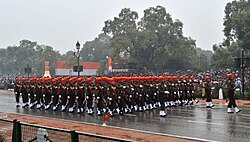
[[File:The Jat Regiment marching contingents passes through the Rajpath during the 66th Republic Day Parade 2015, in New Delhi on January 26, 2015.jpg|thumb|270px|A contingent of the [[Jat Regiment]] of [[Indian Army]], during the [[Indian Republic Day|Republic day]] parade]] | [[File:The Jat Regiment marching contingents passes through the Rajpath during the 66th Republic Day Parade 2015, in New Delhi on January 26, 2015.jpg|thumb|270px|A contingent of the [[Jat Regiment]] of [[Indian Army]], during the [[Indian Republic Day|Republic day]] parade]] | ||
Many Jat people serve in the [[Indian Army]], including the [[Jat Regiment]], [[Sikh Regiment]], [[Rajputana Rifles]] and the [[The Grenadiers|Grenadiers]], where they have won many of the highest military awards for gallantry and bravery. Jat people also serve in the Pakistan Army especially in the [[Punjab Regiment (Pakistan)|Punjab Regiment]]. | Many Jat people serve in the [[Indian Army]], including the [[Jat Regiment]], [[Sikh Regiment]], [[Rajputana Rifles]] and the [[The Grenadiers|Grenadiers]], where they have won many of the highest military awards for gallantry and bravery. Jat people also serve in the Pakistan Army especially in the [[Punjab Regiment (Pakistan)|Punjab Regiment]].<ref>{{Cite book|author=Ian Sumner|year=2001|pages=104–105|title=The Indian Army 1914–1947|location=London|publisher=Osprey|isbn=1-84176-196-6}}</ref> | ||
The Jat people were designated by officials of the [[British Raj]] as a "[[martial race]]", which meant that they were one of the groups whom the British favoured for recruitment to the [[British Indian Army]]. | The Jat people were designated by officials of the [[British Raj]] as a "[[martial race]]", which meant that they were one of the groups whom the British favoured for recruitment to the [[British Indian Army]].<ref>{{cite book |title=India And The First World War |first=Budheswar |last=Pati |publisher=Atlantic Publishers |year=1996 |page=62 |isbn=9788171565818 |url=https://books.google.com/books?id=ASZvjTV1LdUC&pg=PA62}}</ref><ref>{{cite book |title=American Indians in World War I: At Home and at War |first=Thomas A. |last=Britten |publisher=University of New Mexico Press |year=1997 |page=128 |edition=illustrated, reprint |isbn=0-8263-2090-2 |url=https://books.google.com/books?id=M8mZQhVkc-kC&pg=PA128 |quote=The Rajputs, Jats, Dogras, Pathans, Gorkhas, and Sikhs, for example, were considered martial races. Consequently, the British labored to ensure that members of the so-called martial castes dominated the ranks of infantry and cavalry and placed them in special "class regiments."}}</ref> This was a designation created by administrators that classified each ethnic group as either "martial" or "non-martial": a "martial race" was typically considered brave and well built for fighting,<ref name=rand>{{Cite journal |last=Rand |first=Gavin |title=Martial Races and Imperial Subjects: Violence and Governance in Colonial India 1857–1914 |journal=European Review of History |volume=13 |issue=1 |pages=1–20 |date=March 2006 |url= |doi=10.1080/13507480600586726|s2cid=144987021 }}</ref> whilst the remainder were those whom the British believed to be unfit for battle because of their sedentary lifestyles.<ref name="Street">{{cite book |title=Martial Races: The military, race and masculinity in British Imperial Culture, 1857–1914 |last=Streets |first=Heather |year=2004 |publisher=Manchester University Press |location= |isbn=978-0-7190-6962-8 |page=241 |url=https://books.google.com/books?id=BscnZT_1po8C |access-date=20 October 2010}}</ref> However, the martial races were also considered politically subservient, intellectually inferior, lacking the initiative or leadership qualities to command large military formations. The British had a policy of recruiting the martial Indians from those who has less access to education as they were easier to control.<ref name="Khalidi2003">{{cite book|author=Omar Khalidi|title=Khaki and the Ethnic Violence in India: Army, Police, and Paramilitary Forces During Communal Riots|url=https://books.google.com/books?id=B-NtAAAAMAAJ|year=2003|publisher=Three Essays Collective|quote= Apart from their physique , the martial races were regarded as politically subservient or docile to authority|page=5|isbn=9788188789092}}</ref><ref name="Levine2003">{{cite book|author=Philippa Levine|title=Prostitution, Race, and Politics: Policing Venereal Disease in the British Empire|url=https://books.google.com/books?id=It1lPzFCG9EC|year=2003|publisher=Psychology Press|isbn=978-0-415-94447-2|pages=284–285|quote=The Saturday review had made much the same argument a few years earlier in relation to the armies raised by Indian rulers in princely states. They lacked competent leadership and were uneven in quality. Commander in chief Roberts, one of the most enthusiastic proponents of the martial race theory, though poorly of the native troops as a body. Many regarded such troops as childish and simple. The British, claims, David Omissi, believe martial Indians to be stupid. Certainly, the policy of recruiting among those without access to much education gave the British more semblance of control over their recruits.}}</ref> According to modern historian Jeffrey Greenhunt on military history, "The Martial Race theory had an elegant symmetry. Indians who were intelligent and educated were defined as cowards, while those defined as brave were uneducated and backward". According to Amiya Samanta, the marital race was chosen from people of mercenary spirit (a soldier who fights for any group or country that will pay him/her), as these groups lacked nationalism as a trait.<ref name="Samanta2000">{{cite book|author=Amiya K. Samanta|title=Gorkhaland Movement: A Study in Ethnic Separatism|url=https://books.google.com/books?id=J4GqdfG0EU8C&pg=PA26|year=2000|publisher=APH Publishing|isbn=978-81-7648-166-3|pages=26–|quote=Dr . Jeffrey Greenhunt has observed that “ The Martial Race Theory had an elegant symmetry. Indians who were intelligent and educated were defined as cowards, while those defined as brave were uneducated and backward. Besides their mercenary spirit was primarily due to their lack of nationalism.}}</ref> The Jats participated in both [[World War I]] and [[World War II]], as a part of the British Indian Army.<ref>{{Cite book|author= Ashley Jackson|year=2005|title=The British Empire and the Second World War|publisher= Continuum International Publishing Group|isbn= 1-85285-417-0|pages=121–122}}</ref> In the period subsequent to 1881, when the British reversed their prior anti-Sikh policies, it was necessary to profess Sikhism in order to be recruited to the army because the administration believed Hindus to be inferior for military purposes.<ref>{{cite book |title=Religious Nationalism: Hindus and Muslims in India |first=Peter |last=Van Der Veer |author-link=Peter van der Veer |publisher=[[University of California Press]] |year=1994 |isbn=978-0-520-08256-4 |pages=55–56 |url=https://books.google.com/books?id=p29ArJ7j6zgC&pg=PA55}}</ref> | ||
The [[Indian Army]] admitted in 2013 that the 150-strong Presidential Bodyguard comprises only people who are Hindu Jats, Jat Sikhs and Hindu Rajputs. Refuting claims of discrimination, it said that this was for "functional" reasons rather than selection based on caste or religion. | The [[Indian Army]] admitted in 2013 that the 150-strong Presidential Bodyguard comprises only people who are Hindu Jats, Jat Sikhs and Hindu Rajputs. Refuting claims of discrimination, it said that this was for "functional" reasons rather than selection based on caste or religion.<ref>{{cite news|url=http://www.outlookindia.com/news/article/prez-bodyguards-only-for-rajput-jats-and-sikhs-army/812301|title=Prez Bodyguards Only for Rajput, Jats and Sikhs: Army |date=2 October 2013 |work=Outlookindia.com}}</ref> | ||
=== | === Religious beliefs === | ||
{{See also|Jat Sikh|Jat Muslim}} | {{See also|Jat Sikh|Jat Muslim}} | ||
Deryck O. Lodrick estimates religion-wise break-up of Jats as follows: 47% Hindus, 33% Muslims, and 20% Sikhs.<ref name="Lodrick" /> | |||
Deryck O. Lodrick estimates religion-wise break-up of Jats as follows: 47% Hindus, 33% Muslims, and 20% Sikhs. | |||
Jats [[Veneration of the dead|pray to their dead ancestors]], a practice which is called ''Jathera.''<ref>{{cite book |title=The Getes |url=https://books.google.com/books?id=wciBAAAAMAAJ |first=Sundeep S. |last=Jhutti |publisher=Department of East Asian Languages and Civilizations, [[University of Pennsylvania]] |year=2003 |oclc=56397976 |quote=The Jats of the Panjab worship their ancestors in a practice known as Jathera.}}</ref> | |||
=== Varna status === | === Varna status === | ||
There are conflicting scholarly views regarding the [[Varna (Hinduism)|varna]] status of Jats in Hinduism. | There are conflicting scholarly views regarding the [[Varna (Hinduism)|varna]] status of Jats in Hinduism. Some sources state that Jats are regarded as [[Kshatriya]]s, while others assign [[Vaishya]] or [[Shudra]] varna to them.{{citation needed|date=August 2021}} | ||
According to the political scientist Shailendra Sharma, cultivating castes such as Jat and the [[Bhumihar]] in Uttar Pradesh and Haryana are of "upper shudra status".<ref name="Sharma1999">{{cite book | author = Shalendra D. Sharma | date = 1999 | title = Development and Democracy in India | publisher = Lynne Rienner Publishers | pages = 158– | isbn = 978-1-55587-810-8 | url = https://books.google.com/books?id=i4bV4cKpPlIC&pg=PA158|quote=The only exception to the total upper-caste dominance in Uttar Pradesh was the Doab region(now the districts of Aligarh, Bulandshahr and Meerut in Uttar Pradesh, and Rohtak in Haryana), where the Muslim landlords and the elite cultivating peasant castes such as jats and bhumihars(technically of upper shudra status) were heavily concentrated, utilizing their skills to become prosperous farmers and even petty and substantial landlords.}}</ref> | |||
According to the Indian Anthropologist [[Indera Paul Singh]], Brahmins demoted the varna status of Jats from Kshatriya to ''Sat Shudra'' (clean Shudra) in the [[Vedic period]] for challenging the authority of Brahmins.<ref name="Indera">{{cite journal |last=Singh |first=Indera P. |editor1-last=Sebeok |editor1-first=Thomas A. |editor2-last=Singer |editor2-first=Milton |editor3-last=Dorson |editor3-first=Richard M. |editor4-last=Bayard |editor4-first=Samuel Preston |editor5-last=Vogt |editor5-first=Evon Z. |editor6-last=Merriam |editor6-first=Alan P. |editor7-last=Hymes |editor7-first=Dell H. |editor8-last=Thompson |editor8-first=Shelby W. |editor1-link=Thomas Sebeok |editor2-link=Milton Singer |editor3-link=Richard Dorson |editor4-link=Samuel Preston Bayard |editor5-link=Evon Z. Vogt |editor6-link=Alan P. Merriam |editor7-link=Dell Hymes |display-editors=4 |title=A Sikh Village |journal=[[Journal of American Folklore]] |date=July–September 1958 |volume=71 |issue=281 |page=495 |doi=10.2307/538573 |jstor=538573 |publisher=[[American Folklore Society]]}}</ref> According to [[Irfan Habib]], Jats were a "pastoral Chandala-like tribe" in [[Sindh]] during the eighth century. Their 11th-century status of Shudra varna changed to Vaishya varna by the 17th century, with some of them aspiring to improve it further after their 17th-century rebellion against the Mughals.<ref name="Habib">{{cite book |last=Habib |first=Irfan |url=https://books.google.com/books?id=foG83i6XPuMC&pg=PA175 |title=Essays in Indian History: Towards a Marxist Perception |publisher=Anthem Press |year=2002 |isbn=978-1843310259 |page=175 |quote=A historically singular case is that of the Jatts, a pastoral Chandala-like tribe in eighth-century Sind, who attained sudra status by the eleventh century (Alberuni), and had become peasants par excellence (of vaisya status) by the seventeenth century (Dabistani-i Mazahib). The shift to peasant agriculture was probably accompanied by a process of 'sanskritization', a process which continued, when, with the Jat rebellion of the seventeenth century a section of the Jats began to aspire to the position of zamindars and the status of Rajputs. |access-date=29 March 2020}}</ref> | |||
The Rajputs refused to accept Jat claims to Kshatriya status during the later years of the British Raj and this disagreement frequently resulted in violent incidents between the two communities.<ref>{{cite book |title=The Cat and the Lion: Jaipur State in the British Raj |first=Robert W. |last=Stern |publisher=BRILL |location=Leiden |year=1988 |isbn=9789004082830 |page=287 |url=https://books.google.com/books?id=NK1MhWq-9VkC&pg=PA287}}</ref> The claim at that time of Kshatriya status was being made by the [[Arya Samaj]], which was popular in the Jat community. The Arya Samaj saw it as a means to counter the colonial belief that the Jats were not of Aryan descent but of [[Indo-Scythian]] origin.<ref name="Jaffrelotp431">{{cite book |title=Religion, Caste & Politics in India |first=Christophe |last=Jaffrelot |publisher=Primus Books |year=2010 |isbn=9789380607047 |page=431 |url=https://books.google.com/books?id=XAO3i_gS61wC&pg=PA431}}</ref> | |||
=== Female infanticide & status of woman in society === | |||
During colonial period, many communities including Hindu Jats were found to be practicing female infanticide in different regions of Northern India.<ref>{{Cite journal |last=Vishwanath |first=L. S. |date=2004 |title=Female Infanticide: The Colonial Experience |url=https://www.jstor.org/stable/4415098 |journal=Economic and Political Weekly |volume=39 |issue=22 |pages=2313–2318 |jstor=4415098 |issn=0012-9976|quote=The 1921 census reports classifies castes into two categories, namely, castes. having a tradition' of female infanticide and castes without such a tradition (see table). This census provides figures from 1901 to 1921 to show that in Punjab, United Provinces and Rajputana castes such as Hindu rajputs, Hindu jats and gujars with 'a tradition' of female infanticide had a much lower number of females per thousand males compared to castes without such a tradition which included: Muslim rajputs, Muslim jats, chamar, kanet, arain, kumhar, kurmi, brahmin, dhobi, teli and lodha}}</ref><ref>{{Cite journal |last=VISHWANATH |first=L. S. |title=Towards a Conceptual Understanding of Female Infanticide and Neglect in Colonial India |date=1994 |url=https://www.jstor.org/stable/44143417 |journal=Proceedings of the Indian History Congress |volume=55 |pages=606–613 |jstor=44143417 |issn=2249-1937|quote= By 1850, several castes, in North India, the Jats, Ahirs, Gujars and Khutris, and the Lewa Patidar Kanbis in Central Gujarat were found to practice female infanticide. The colonial authorities also found that both in rural North and West India, the castes which practised female infanticide were propertied (they owned substantial arable land), had the hypergamous marriage norm and paid large dowries.}}</ref> | |||
In Jat society, it has been observed that differential treatment is given to woman in comparison to man, birth of a male child in a family is celebrated and is considered as auspicious over the birth of a girl child where the family affair is subdued. In villages, female members are supposed to get married at a younger age and they are expected to work in fields as subordinate to the male members. There is general bias against education for the girl child in the society though the trends to it are changing with urbanisation. Purdah system is practiced by women in Jat villages which act as hindrance to their overall emancipation. The village Jat councils which are male-dominated mostly don't allow female members to head their councils as the common opinion on it is that women are inferior, incapable and less intelligent to men.<ref>{{Cite journal |last=Mann |first=Kamlesh |date=1988 |title=Status Portrait of Jat Woman |url=https://www.jstor.org/stable/41919573 |journal=Indian Anthropologist |volume=18 |issue=1 |pages=51–67 |jstor=41919573 |issn=0970-0927}}</ref> | |||
In | |||
== Clan system == | == Clan system == | ||
The Jat people are subdivided into numerous clans, some of which overlap with | The Jat people are subdivided into numerous clans, some of which overlap with other groups.<ref>{{cite book |first=J. A. |last=Marshall |title=Guide to Taxila |publisher=Cambridge University Press |year=1960 |page=24}}</ref> Hindu and Sikh Jats practice [[exogamy|clan exogamy]].<ref>{{cite book |first=Amir |last=Kadyan |title=Know the Jat |publisher=BlueRose Publishers |url=https://books.google.com/books?id=hm3aDwAAQBAJ&q=jats+practice+clan+exogamy&pg=PA20|year=2020 |page=20}}</ref> | ||
=== List of clans === | === List of clans === | ||
| Line 183: | Line 131: | ||
* [[Bagri clan|Bagri]] | * [[Bagri clan|Bagri]] | ||
* [[Bajwa]] | * [[Bajwa]] | ||
* | * Bargoti (Uttar Pradesh){{citation needed|date=December 2021}} | ||
* | * Bhalothia (Rajasthan, Haryana){{citation needed|date=December 2021}} | ||
* [[Bharwana]] | * [[Bharwana]] | ||
* [[Brar]] | * [[Brar]] | ||
* [[Buttar]] | * [[Buttar]] | ||
* [[Cheema (surname)|Cheema]] | * [[Cheema (surname)|Cheema]] | ||
* Chhina (Punjab){{citation needed|date=December 2021}} | |||
* Chilka (Rajasthan){{citation needed|date=December 2021}} | |||
* [[Dabas (clan)|Dabas]] | * [[Dabas (clan)|Dabas]] | ||
* [[Dahiya (surname)|Dahiya]] | * [[Dahiya (surname)|Dahiya]] | ||
* | * Dara (Rajasthan){{citation needed|date=December 2021}} | ||
* [[Dharan clan|Dharan]] | * [[Dharan clan|Dharan]] | ||
* [[Dhaliwal (surname)|Dhaliwal]] | * [[Dhaliwal (surname)|Dhaliwal]] | ||
* Dhaulya (Rajasthan, Uttar Pradesh, Maharashtra, Karnataka, Kerala, Tamil Nadu){{citation needed|date=December 2021}} | |||
* [[Dhillon]] | * [[Dhillon]] | ||
* | * Goriya (Haryana, Uttar Pradesh){{citation needed|date=December 2021}} | ||
* [[Grewal]] | * [[Grewal]] | ||
* [[ | * [[Jats of Azad Kashmir]] | ||
* [[ | * [[Jats of Kutch]] | ||
* Jewlia (Rajasthan){{citation needed|date=December 2021}} | |||
* Jhajharia (Haryana, Punjab, Rajasthan){{citation needed|date=December 2021}} | |||
* Jhanjhar (Rajasthan){{citation needed|date=December 2021}} | |||
* [[Johiya]] | |||
* Kalwania (Rajasthan, Haryana){{citation needed|date=December 2021}} | |||
* Kasaniya (Rajasthan){{citation needed|date=December 2021}} | |||
* Katewa {{citation needed|date=December 2021}} | |||
* [[Khakh]] | * [[Khakh]] | ||
* [[Khangura]] | * [[Khangura]] | ||
* [[Kharal]] | * [[Kharal]] | ||
* Khatkar (Punjab, Haryana){{citation needed|date=December 2021}} | |||
* [[Lashari]] | * [[Lashari]] | ||
* [[ | * [[Malhi]] | ||
* [[Malik Jat clan|Malik]] | * [[Malik Jat clan|Malik]] | ||
* [[Marhal]] | |||
* [[Maulaheri Jats|Maulaheri]] | * [[Maulaheri Jats|Maulaheri]] | ||
* [[Mirdha]] | * [[Mirdha]] | ||
| Line 213: | Line 170: | ||
* [[Naich clan|Naich]] | * [[Naich clan|Naich]] | ||
* [[Panwar]] | * [[Panwar]] | ||
* Pediwal (Rajasthan){{citation needed|date=December 2021}} | |||
* [[Poonia]] | * [[Poonia]] | ||
* [[Rahal clan|Rahal]] | * [[Rahal clan|Rahal]] | ||
* [[Rahar]] | |||
* [[Randhawa]] | * [[Randhawa]] | ||
* [[Ranjha clan|Ranjha]] | * [[Ranjha clan|Ranjha]] | ||
* [[Rath tribe|Rath]] | |||
* Rawn (Punjab){{citation needed|date=December 2021}} | |||
* [[Rehvar]] | * [[Rehvar]] | ||
* [[Sandhawalia]] | * [[Sandhawalia]] | ||
* Sandhila (Sindh, Punjab){{citation needed|date=December 2021}} | |||
* [[Sandhu]] | * [[Sandhu]] | ||
* | * Sarai (Punjab){{citation needed|date=December 2021}} | ||
* [[Sekhon]] | * [[Sekhon]] | ||
* [[Sial tribe|Sial]] | * [[Sial tribe|Sial]] | ||
* [[Sidhu]] | * [[Sidhu]] | ||
* | * Sunda (Rajasthan){{citation needed|date=December 2021}} | ||
* [[ | * [[Tarar]] | ||
* [[Teotia]] | * [[Teotia]] | ||
* [[Thaheem (tribe)|Thaheem]] | * [[Thaheem (tribe)|Thaheem]] | ||
* [[Tomar | * [[Tomar clan|Tomar]] | ||
* [[Virk]] | * [[Virk]] | ||
{{div col end}} | {{div col end}} | ||
==In popular culture== | |||
Jats are part of [[Punjabi culture|Punjabi]] and [[Haryanvi]] culture and are often portrayed in Indian and Pakistani films and songs. | |||
*''[[Maula Jatt]]'' | |||
*''[[The Legend of Maula Jatt]]'' | |||
*''[[A Flying Jatt]]'' | |||
*''[[Jatt & Juliet]]'' | |||
*''[[Jatt & Juliet 2]]'' | |||
*''[[Jatt James Bond]]'' | |||
*''Badla Jatti Da'' | |||
*''[[Jatts In Golmaal]]'' | |||
* ''Jaattan ka Chhora'' | |||
==Notable people== | ==Notable people== | ||
{{Main|List of | {{Main|List of Jat people}} | ||
== See also == | == See also == | ||
* [[Jat Regiment]] | |||
* [[Jat reservation agitation]] | * [[Jat reservation agitation]] | ||
* [[World Jat Aryan Foundation]] | * [[World Jat Aryan Foundation]] | ||
* [[List of Jat dynasties and states]] | * [[List of Jat dynasties and states]] | ||
* [[List of Jat people]] | |||
* [[Jat Sikh]] | |||
* [[Jāti]] | * [[Jāti]] | ||
== Footnotes == | == Footnotes == | ||
{{ | {{Notelist}} | ||
== References == | == References == | ||
| Line 253: | Line 227: | ||
== Further reading == | == Further reading == | ||
* {{cite book |last=Bayly |first=C. A. |title=Indian Society and the Making of the British Empire |url=https://books.google.com/books?id=fX2zMfWqIzMC& | *{{cite book|last=Bayly|first=C. A.|title=Indian Society and the Making of the British Empire|url=https://books.google.com/books?id=fX2zMfWqIzMC&pg=PA190|access-date=15 October 2011|year=1989|publisher=Cambridge University Press|isbn=978-0-521-38650-0|pages=190–}} | ||
* {{cite book |last=Brass |first=Tom |title=New farmers' movements in India |url=https://books.google.com/books?id=9IcjA67sdrsC& | *{{cite book|last=Brass|first=Tom|title=New farmers' movements in India|url=https://books.google.com/books?id=9IcjA67sdrsC&pg=PA183|access-date=15 October 2011|year=1995|publisher=Taylor & Francis|isbn=978-0-7146-4134-8|pages=183–}} | ||
* {{cite book |last=Byres |first=T. J. |title=Rural labour relations in India |url=https://books.google.com/books?id=6SkYn0aRN9YC& | *{{cite book|last=Byres|first=T. J.|title=Rural labour relations in India|url=https://books.google.com/books?id=6SkYn0aRN9YC&pg=PA217|access-date=15 October 2011|year=1999|publisher=Taylor & Francis|isbn=978-0-7146-8046-0|pages=217–}} | ||
* {{cite book |last1=Chowdhry |first1=Prem |editor1-last=Sarkar |editor1-first=Sumit |editor2-last=Sarkar |editor2-first=Tanika |title=Women and social reform in modern India: a reader|chapter-url=https://books.google.com/books?id=GEPYbuzOwcQC& | *{{cite book|last1=Chowdhry|first1=Prem|editor1-last=Sarkar|editor1-first=Sumit |editor2-last=Sarkar|editor2-first=Tanika |title=Women and social reform in modern India: a reader|chapter-url=https://books.google.com/books?id=GEPYbuzOwcQC&pg=PA147|access-date=15 October 2011|year=2008|publisher=Indiana University Press|isbn=978-0-253-22049-3|pages=147–|chapter=Customs in a Peasant Economy: Women in Colonial Harayana}} | ||
* {{cite book |last=Gupta |first=Akhil |title=Postcolonial developments: agriculture in the making of modern India |url=https://archive.org/details/postcolonialdeve00akhi |url-access=registration |access-date=15 October 2011 |year=1998 |publisher= | *{{cite book|last=Gupta|first=Akhil|title=Postcolonial developments: agriculture in the making of modern India|url=https://archive.org/details/postcolonialdeve00akhi|url-access=registration|access-date=15 October 2011|year=1998|publisher=Duke University Press|isbn=978-0-8223-2213-9|pages=[https://archive.org/details/postcolonialdeve00akhi/page/361 361]–}} | ||
* {{cite book |last=Gupta |first=Dipankar |title=Political sociology in India: contemporary trends|url=https://books.google.com/books?id=BBaY1QCFS2oC& | *{{cite book|last=Gupta|first=Dipankar|title=Political sociology in India: contemporary trends|url=https://books.google.com/books?id=BBaY1QCFS2oC&pg=PA70|access-date=15 October 2011|date=1 January 1996|publisher=Orient Blackswan|isbn=978-81-250-0665-7|pages=70–}} | ||
* {{cite book |last=Jaffrelot |first=Christophe |author-link=Christophe Jaffrelot |title=India's silent revolution: the rise of the lower castes in North India |url=https://books.google.com/books?id=qJZp5tDuY-gC& | *{{cite book|last=Jaffrelot|first=Christophe|author-link=Christophe Jaffrelot|title=India's silent revolution: the rise of the lower castes in North India|url=https://books.google.com/books?id=qJZp5tDuY-gC&pg=PA274|access-date=15 October 2011|year=2003|publisher=Columbia University Press|isbn=978-0-231-12786-8}} | ||
* {{cite book |last=Jalal |first=Ayesha |author-link=Ayesha Jalal |title=Democracy and authoritarianism in South Asia: a comparative and historical perspective |url=https://books.google.com/books?id=mHPok4epvlIC& | *{{cite book|last=Jalal|first=Ayesha|author-link=Ayesha Jalal|title=Democracy and authoritarianism in South Asia: a comparative and historical perspective|url=https://books.google.com/books?id=mHPok4epvlIC&pg=PA212|access-date=15 October 2011|year=1995|publisher=Cambridge University Press|isbn=978-0-521-47862-5|pages=212–}} | ||
* {{cite book |last=Larson |first=Gerald James |title=India's agony over religion |url=https://books.google.com/books?id=g6jmckIUHMAC& | *{{cite book|last=Larson|first=Gerald James|title=India's agony over religion|url=https://books.google.com/books?id=g6jmckIUHMAC&pg=PA90|access-date=15 October 2011|year=1995|publisher=SUNY Press|isbn=978-0-7914-2412-4|pages=90–}} | ||
* {{cite book |last=Lynch |first=Owen M. |title=Divine passions: the social construction of emotion in India |url=https://books.google.com/books?id=y3HEvGsKflwC& | *{{cite book|last=Lynch|first=Owen M.|title=Divine passions: the social construction of emotion in India|url=https://books.google.com/books?id=y3HEvGsKflwC&pg=PA255|access-date=15 October 2011|year=1990|publisher=University of California Press|isbn=978-0-520-06647-2|pages=255–}} | ||
* {{cite book |last=Mazumder |first=Rajit K. |title=The Indian army and the making of Punjab |url=https://books.google.com/books?id=O4Wop9vwS9sC& | *{{cite book|last=Mazumder|first=Rajit K.|title=The Indian army and the making of Punjab|url=https://books.google.com/books?id=O4Wop9vwS9sC&pg=PA176|access-date=15 October 2011|year=2003|publisher=Orient Blackswan|isbn=978-81-7824-059-6|pages=176–}} | ||
* {{cite book |last=Misra |first=Maria |title=Vishnu's crowded temple: India since the Great Rebellion |url=https://books.google.com/books?id=QjxiMSd0YwoC& | *{{cite book|last=Misra|first=Maria|title=Vishnu's crowded temple: India since the Great Rebellion|url=https://books.google.com/books?id=QjxiMSd0YwoC&pg=PA89|access-date=15 October 2011|year=2008|publisher=Yale University Press|isbn=978-0-300-13721-7|pages=89–}} | ||
* {{cite book |last=Oldenburg |first=Veena Talwar |author-link=Veena Talwar Oldenburg|title=Dowry murder: the imperial origins of a cultural crime |url=https://books.google.com/books?id=d5Fm1XdS-6EC& | *{{cite book|last=Oldenburg|first=Veena Talwar|author-link=Veena Talwar Oldenburg|title=Dowry murder: the imperial origins of a cultural crime|url=https://books.google.com/books?id=d5Fm1XdS-6EC&pg=PA34|access-date=15 October 2011|year=2002|publisher=Oxford University Press|isbn=978-0-19-515071-1|pages=34–}} | ||
* {{cite book |editor1-last=Pandian |editor1-first=Anand |editor2-last=Ali |editor2-first=Daud |title=Ethical Life in South Asia |url=https://books.google.com/books?id=7R_nwe6r5R0C& | *{{cite book|editor1-last=Pandian|editor1-first=Anand |editor2-last=Ali|editor2-first=Daud |title=Ethical Life in South Asia|url=https://books.google.com/books?id=7R_nwe6r5R0C&pg=PA206|access-date=15 October 2011|date=1 September 2010|publisher=Indiana University Press|isbn=978-0-253-22243-5|pages=206–}} | ||
* {{cite book |last=Pinch |first=William R. |title=Peasants and monks in British India |url=https://archive.org/details/peasantsmonksinb0000pinc |url-access=registration |access-date=15 October 2011 |year=1996 |publisher= | *{{cite book|last=Pinch|first=William R.|title=Peasants and monks in British India|url=https://archive.org/details/peasantsmonksinb0000pinc|url-access=registration|access-date=15 October 2011|year=1996|publisher=University of California Press|isbn=978-0-520-20061-6|pages=[https://archive.org/details/peasantsmonksinb0000pinc/page/12 12], 26, 28}} | ||
* {{cite book |last=Richards |first=John F. |title=The Mughal Empire |url=https://books.google.com/books?id=HHyVh29gy4QC& | *{{cite book|last=Richards|first=John F.|title=The Mughal Empire|url=https://books.google.com/books?id=HHyVh29gy4QC&pg=PA269|access-date=15 October 2011|date=26 January 1996|publisher=Cambridge University Press|isbn=978-0-521-56603-2|pages=269–}} | ||
* {{cite book |last1=Shweder |first1=Richard A. |last2=Minow |first2=Martha |last3=Markus |first3=Hazel Rose |title=Engaging cultural differences: the multicultural challenge in liberal democracies |url=https://books.google.com/books?id=DljvifEwf34C& | *{{cite book|last1=Shweder|first1=Richard A.|last2=Minow|first2=Martha|last3=Markus|first3=Hazel Rose|title=Engaging cultural differences: the multicultural challenge in liberal democracies|url=https://books.google.com/books?id=DljvifEwf34C&pg=PA57|access-date=15 October 2011|date=November 2004|publisher=Russell Sage Foundation|isbn=978-0-87154-795-8|pages=57–}} | ||
* {{cite book |last1=Schwartzberg |first1=Joseph |editor1-last=Singer |editor1-first=Milton |editor2-last=Cohn |editor2-first=Bernard S. |title=Structure and Change in Indian Society |chapter-url=https://books.google.com/books?id=_g-_r-9Oa_sC& | *{{cite book|last1=Schwartzberg|first1=Joseph|editor1-last=Singer|editor1-first=Milton |editor2-last=Cohn|editor2-first=Bernard S. |title=Structure and Change in Indian Society|chapter-url=https://books.google.com/books?id=_g-_r-9Oa_sC&pg=PA100|access-date=15 October 2011|year=2007|publisher=Transaction Publishers|isbn=978-0-202-36138-3|pages=81–114|chapter=Caste Regions of the Northern Plain}} | ||
* {{cite book |last=Stern |first=Robert W. |title=Changing India: bourgeois revolution on the subcontinent |url=https://books.google.com/books?id=kb_z1KghC1oC& | *{{cite book|last=Stern|first=Robert W.|title=Changing India: bourgeois revolution on the subcontinent|url=https://books.google.com/books?id=kb_z1KghC1oC&pg=PA58|access-date=15 October 2011|year=2003|publisher=Cambridge University Press|isbn=978-0-521-00912-6|pages=58–}} | ||
* {{cite book |last=Talbot |first=Ian |title=Khizr Tiwana, the Punjab Unionist Party and the partition of India |url=https://books.google.com/books?id=4w0HDZxXvlwC& | *{{cite book|last=Talbot|first=Ian|title=Khizr Tiwana, the Punjab Unionist Party and the partition of India|url=https://books.google.com/books?id=4w0HDZxXvlwC&pg=PA94|access-date=15 October 2011|year=1996|publisher=Psychology Press|isbn=978-0-7007-0427-9|pages=94–}} | ||
* {{cite book |last=Tan |first=Tai Yong |title=The garrison state: the military, government and society in colonial Punjab 1849–1947 |url=https://books.google.com/books?id=DrCdFzlq5-AC& | *{{cite book|last=Tan|first=Tai Yong|title=The garrison state: the military, government and society in colonial Punjab 1849–1947|url=https://books.google.com/books?id=DrCdFzlq5-AC&pg=PA85|access-date=15 October 2011|year=2005|publisher=SAGE|isbn=978-0-7619-3336-6|pages=85–}} | ||
* {{cite book |last=Wadley |first=Susan Snow |author-link=Susan Snow Wadley |title=Raja Nal and the Goddess: the north Indian epic Dhola in performance |url=https://books.google.com/books?id=NqcttdCbb9wC& | *{{cite book|last=Wadley|first=Susan Snow|author-link=Susan Snow Wadley|title=Raja Nal and the Goddess: the north Indian epic Dhola in performance|url=https://books.google.com/books?id=NqcttdCbb9wC&pg=PA60|access-date=15 October 2011|year=2004|publisher=Indiana University Press|isbn=978-0-253-34478-6|pages=60–}} | ||
*{{cite book|last=Wink|first=André|title=Al-Hind: Early medieval India and the expansion of Islam, 7th-11th centuries|url=https://books.google.com/books?id=g2m7_R5P2oAC&pg=PA163|access-date=15 October 2011|year=2002|publisher=BRILL|isbn=978-0-391-04173-8|pages=163–}} | |||
== External links == | == External links == | ||
{{Commons category}} | {{Commons category}} | ||
{{Wikiquote}} | {{Wikiquote}} | ||
* {{curlie|Regional/Asia/India/Society_and_Culture/Communities/Jat}} | |||
{{Ethnic groups, tribes and clans of the Punjab}} | {{Ethnic groups, tribes and clans of the Punjab}} | ||
| Line 286: | Line 263: | ||
[[Category:Jat|*]] | [[Category:Jat|*]] | ||
[[Category:Ethnic groups in India]] | [[Category:Ethnic groups in India]] | ||
[[Category:Ethnic groups in | [[Category:Ethnic groups in Pakistan]] | ||
[[Category:Agricultural castes]] | [[Category:Agricultural castes]] | ||
[[Category: | [[Category:Social groups of India]] | ||
[[Category:Social groups of Pakistan]] | |||
[[Category:Social groups of Sindh]] | |||
[[Category:Social groups of Punjab, India]] | [[Category:Social groups of Punjab, India]] | ||
[[Category:Social groups of Haryana]] | [[Category:Social groups of Haryana]] | ||
Latest revision as of 16:01, 19 March 2026
| Regions with significant populations | |
|---|---|
| South Asia | ~30–43 million (c. 2009/10) |
| Languages | |
| Hindi-Urdu (Haryanvi) • Punjabi • Rajasthani • Sindhi • Braj | |
| Religion | |
| Hinduism • Islam • Sikhism | |
The Jat people ((Punjabi pronunciation: [d͡ʒəʈːᵊ]), (Hindi pronunciation: [d͡ʒaːʈ])) are a traditionally agricultural community in Northern India and Pakistan.[1][2][3][lower-alpha 1][lower-alpha 2][lower-alpha 3] Originally pastoralists in the lower Indus river-valley of Sindh, Jats migrated north into the Punjab region in late medieval times, and subsequently into the Delhi Territory, northeastern Rajputana, and the western Gangetic Plain in the 17th and 18th centuries.[7][8][9] Of Muslim, Sikh, and Hindu faiths, they are now found mostly in the Pakistani provinces of Sindh and Punjab and the Indian states of Punjab, Haryana, Uttar Pradesh and Rajasthan.
The Jats took up arms against the Mughal Empire during the late 17th and early 18th centuries.[10] The community played an important role in the development of the martial Khalsa panth of Sikhism.[11] The Hindu Jat kingdom reached its zenith under Maharaja Suraj Mal (1707–1763).[12] By the 20th century, the landowning Jats became an influential group in several parts of North India, including Punjab,[13] Western Uttar Pradesh,[14] Rajasthan,[15] Haryana and Delhi.[16] Over the years, several Jats abandoned agriculture in favour of urban jobs, and used their dominant economic and political status to claim higher social status.[17]
History[edit | edit source]

The Jats are a paradigmatic example of community- and identity-formation in early modern Indian subcontinent.[7] "Jat" is an elastic label applied to a wide-ranging community[18][19] from simple landowning peasants [lower-alpha 4][lower-alpha 5][lower-alpha 6][20][21][lower-alpha 7] to wealthy and influential Zamindars.[23][24][25][26][27]
By the time of Muhammad bin Qasim's conquest of Sind in the eighth century, Arab writers described agglomerations of Jats in the arid, the wet, and the mountainous regions of the conquered land of Sindh.[28] The Arab rulers, though professing a theologically egalitarian religion, maintained the position of Jats and the discriminatory practices against them that had been put in place in the long period of Hindu rule in Sind.[29] Between the eleventh and the sixteenth centuries, Jat herders at the Sind migrated up along the river valleys,[30] into the Punjab,[7] which may have been largely uncultivated in the first millennium.[31] Many took up tilling in regions such as Western Punjab, where the sakia (water wheel) had been recently introduced.[7][32] By early Mughal times, in the Punjab, the term "Jat" had become loosely synonymous with "peasant",[33] and some Jats had come to own land and exert local influence.[7] The Jats had their origins in pastoralism in the Indus valley, and gradually became agriculturalist farmers.[34] Around 1595, Jat Zamindars controlled a little over 32% of the Zamindaris in the Punjab region.[35]
According to historians Catherine Asher and Cynthia Talbot,[36]
The Jats also provide an important insight into how religious identities evolved during the precolonial era. Before they settled in the Punjab and other northern regions, the pastoralist Jats had little exposure to any of the mainstream religions. Only after they became more integrated into the agrarian world did the Jats adopt the dominant religion of the people in whose midst they dwelt.[36]
Over time the Jats became primarily Muslim in the western Punjab, Sikh in the eastern Punjab, and Hindu in the areas between Delhi Territory and Agra, with the divisions by faith reflecting the geographical strengths of these religions.[36] During the decline of Mughal rule in the early 18th century, the Indian subcontinent's hinterland dwellers, many of whom were armed and nomadic, increasingly interacted with settled townspeople and agriculturists. Many new rulers of the 18th century came from such martial and nomadic backgrounds. The effect of this interaction on India's social organization lasted well into the colonial period. During much of this time, non-elite tillers and pastoralists, such as the Jats, were part of a social spectrum that blended only indistinctly into the elite landowning classes at one end, and the menial or ritually polluting classes at the other.[37] During the heyday of Mughal rule, Jats had recognized rights. According to Barbara D. Metcalf and Thomas R. Metcalf:
Upstart warriors, Marathas, Jats, and the like, as coherent social groups with military and governing ideals, were themselves a product of the Mughal context, which recognized them and provided them with military and governing experience. Their successes were a part of the Mughal success.[38]

As the Mughal empire faltered, there were a series of rural rebellions in North India.[39] Although these had sometimes been characterized as "peasant rebellions", others, such as Muzaffar Alam, have pointed out that small local landholders, or zemindars, often led these uprisings.[39] The Sikh and Jat rebellions were led by such small local zemindars, who had close association and family connections with each other and with the peasants under them, and who were often armed.[40]
These communities of rising peasant-warriors were not well-established Indian castes,[41] but rather quite new, without fixed status categories, and with the ability to absorb older peasant castes, sundry warlords, and nomadic groups on the fringes of settled agriculture.[40][42] The Mughal Empire, even at the zenith of its power, functioned by devolving authority and never had direct control over its rural grandees.[40] It was these zemindars who gained most from these rebellions, increasing the land under their control.[40] The triumphant even attained the ranks of minor princes, such as the Jat ruler Badan Singh of the princely state of Bharatpur.[40]
Hindu Jats[edit | edit source]

In 1669, the Hindu Jats, under the leadership of Gokula, rebelled against the Mughal emperor Aurangzeb in Mathura.[43] The community came to predominate south and east of Delhi after 1710.[44] According to historian Christopher Bayly
Men characterised by early eighteenth century Mughal records as plunderers and bandits preying on the imperial lines of communications had by the end of the century spawned a range of petty states linked by marriage alliance and religious practice.[44]
The Jats had moved into the Gangetic Plain in two large migrations, in the seventeenth and eighteenth centuries respectively.[44] They were not a caste in the usual Hindu sense, for example, in which Bhumihars of the eastern Gangetic plain were; rather they were an umbrella group of peasant-warriors.[44] According to Christopher Bayly:
This was a society where Brahmins were few and male Jats married into the whole range of lower agricultural and entrepreneurial castes. A kind of tribal nationalism animated them rather than a nice calculation of caste differences expressed within the context of Brahminical Hindu state.[44]
By the mid-eighteenth century, the ruler of the recently established Jat kingdom of Bharatpur, Raja Surajmal, felt sanguine enough about durability to build a garden palace at nearby Deeg.[45] According to historian, Eric Stokes,
When the power of the Bharatpur raja was riding high, fighting clans of Jats encroached into the Karnal/Panipat, Mathura, Agra, and Aligarh districts, usually at the expense of Rajput groups. But such a political umbrella was too fragile and short-lived for substantial displacement to be effected.[46]
Lua error in Module:Gallery at line 124: attempt to call field '_warning' (a nil value).
Muslim Jats[edit | edit source]

When Arabs entered Sindh and other Southern regions of current Pakistan in the seventh century, the chief tribal groupings they found were the Jats and the Med people. These Jats are often referred as Zatts in early Arab writings. The Muslim conquest chronicles further point at the important concentrations of Jats in towns and fortresses of Lower and Central Sindh.[47][48] Today, Muslim Jats are found in Pakistan and India.[49]
Sikh Jats[edit | edit source]

While followers important to Sikh tradition like Baba Buddha were among the earliest significant historical Sikh figures, and significant numbers of conversions occurred as early as the time of Guru Angad (1504–1552),[50] the first large-scale conversions of Jats is commonly held to have begun during the time of Guru Arjan (1563–1606).[50][51]:265 While touring the countryside of eastern Punjab, he founded several important towns like Tarn Taran Sahib, Kartarpur, and Hargobindpur which functioned as social and economic hubs, and together with the community-funded completion of the Darbar Sahib to house the Guru Granth Sahib and serve as a rallying point and center for Sikh activity, established the beginnings of a self-contained Sikh community, which was especially swelled with the region's Jat peasantry.[50] They formed the vanguard of Sikh resistance against the Mughal Empire from the 18th century onwards.
It has been postulated, though inconclusively, that the increased militarization of the Sikh panth following the martyrdom of Guru Arjan (beginning during the era of Guru Hargobind and continuing after) and its large Jat presence may have reciprocally influenced each other.[52][full citation needed][53]
At least eight of the 12 Sikh Misls (Sikh confederacies) were led by Jat Sikhs,[54] who would form the vast majority of Sikh chiefs.[55]
According to censuses in gazetteers published during the colonial period in the early 20th century, further waves of Jat conversions, from Hinduism to Sikhism, continued during the preceding decades.[56][57] Writing about the Jats of Punjab, the Sikh author, Khushwant Singh opined that their attitude never allowed themselves to be absorbed in the Brahminic fold :
The Jat's spirit of freedom and equality refused to submit to Brahmanical Hinduism and in its turn drew the censure of the privileged Brahmins ... The upper caste Hindu's denigration of the Jat did not in the least lower the Jat in his own eyes nor elevate the Brahmin or the Kshatriya in the Jat's estimation. On the contrary, he assumed a somewhat condescending attitude towards the Brahmin, whom he considered little more than a soothsayer or a beggar, or the Kshatriya, who disdained earning an honest living and was proud of being a mercenary.[58][59]
In Punjab, the states of Patiala,[60] Faridkot, Jind, and Nabha[61] were ruled by the Sikh Jats.
Demographics[edit | edit source]
According to anthropologist Sunil K. Khanna, Jat population is estimated to be around 30 million (or 3 crore) in South Asia in 2010. This estimation is based on statistics of the last caste census and the population growth of the region. The last caste census was conducted in 1931, which estimated Jats to be 8 million, mostly concentrated in India and Pakistan.[62] Deryck O. Lodrick estimates Jat population to be over 33 million (around 12 million and over 21 million in India and Pakistan, respectively) in South Asia in 2009 while noting the unavailability of precise statistics in this regard. His estimation is based on a late 1980s population projection of Jats and the population growth of India and Pakistan. He also notes that some estimates put their total population in South Asia at approximately 43 million in 2009. His religion-wise break-up of Jats is as follows: 47% Hindus, 33% Muslims, and 20% Sikhs.[63]
Republic of India[edit | edit source]

In India, multiple 21st-century estimates put Jats' population share at 20–25% in Haryana state and at 20–35% in Punjab state.[64][65][66] In Rajasthan, Delhi, and Uttar Pradesh, they constitute around 9%, 5%, and 1.2% respectively of the total population.[67][68][69]
In the 20th century and more recently, Jats have dominated as the political class in Haryana[70] and Punjab.[71] Some Jat people have become notable political leaders, including the sixth Prime Minister of India, Charan Singh[72] and the sixth Deputy Prime Minister of India, Chaudhary Devi Lal.[73]
Consolidation of economic gains and participation in the electoral process are two visible outcomes of the post-independence situation. Through this participation they have been able to significantly influence the politics of North India. Economic differentiation, migration and mobility could be clearly noticed amongst the Jat people.[74]
Jats are classified as Other Backward Class (OBC) in seven of India's thirty-six States and UTs, namely Rajasthan, Himachal Pradesh, Delhi, Uttarakhand, Uttar Pradesh, Madhya Pradesh and Chhattisgarh.[75] However, only the Jats of Rajasthan – excluding those of Bharatpur district and Dholpur district – are entitled to reservation of central government jobs under the OBC reservation.[76] In 2016, the Jats of Haryana organized massive protests demanding to be classified as OBC in order to obtain such affirmative action benefits.[75]
Pakistan[edit | edit source]
Many Jat Muslim people live in Pakistan and have dominant roles in public life in the Pakistani Punjab and Pakistan in general. Jat communities also exist in Pakistani-administered Kashmir, in Sindh, particularly the Indus delta and among Seraiki-speaking communities in southern Pakistani Punjab, the Kachhi region of Balochistan and the Dera Ismail Khan District of the North West Frontier Province.
In Pakistan also, Jat people have become notable political leaders, like Hina Rabbani Khar.[77]
Culture and society[edit | edit source]
Military[edit | edit source]
_by_AC_Lovett_(1862-1919).jpg)

Many Jat people serve in the Indian Army, including the Jat Regiment, Sikh Regiment, Rajputana Rifles and the Grenadiers, where they have won many of the highest military awards for gallantry and bravery. Jat people also serve in the Pakistan Army especially in the Punjab Regiment.[78]
The Jat people were designated by officials of the British Raj as a "martial race", which meant that they were one of the groups whom the British favoured for recruitment to the British Indian Army.[79][80] This was a designation created by administrators that classified each ethnic group as either "martial" or "non-martial": a "martial race" was typically considered brave and well built for fighting,[81] whilst the remainder were those whom the British believed to be unfit for battle because of their sedentary lifestyles.[82] However, the martial races were also considered politically subservient, intellectually inferior, lacking the initiative or leadership qualities to command large military formations. The British had a policy of recruiting the martial Indians from those who has less access to education as they were easier to control.[83][84] According to modern historian Jeffrey Greenhunt on military history, "The Martial Race theory had an elegant symmetry. Indians who were intelligent and educated were defined as cowards, while those defined as brave were uneducated and backward". According to Amiya Samanta, the marital race was chosen from people of mercenary spirit (a soldier who fights for any group or country that will pay him/her), as these groups lacked nationalism as a trait.[85] The Jats participated in both World War I and World War II, as a part of the British Indian Army.[86] In the period subsequent to 1881, when the British reversed their prior anti-Sikh policies, it was necessary to profess Sikhism in order to be recruited to the army because the administration believed Hindus to be inferior for military purposes.[87]
The Indian Army admitted in 2013 that the 150-strong Presidential Bodyguard comprises only people who are Hindu Jats, Jat Sikhs and Hindu Rajputs. Refuting claims of discrimination, it said that this was for "functional" reasons rather than selection based on caste or religion.[88]
Religious beliefs[edit | edit source]
Deryck O. Lodrick estimates religion-wise break-up of Jats as follows: 47% Hindus, 33% Muslims, and 20% Sikhs.[63]
Jats pray to their dead ancestors, a practice which is called Jathera.[89]
Varna status[edit | edit source]
There are conflicting scholarly views regarding the varna status of Jats in Hinduism. Some sources state that Jats are regarded as Kshatriyas, while others assign Vaishya or Shudra varna to them.[citation needed] According to the political scientist Shailendra Sharma, cultivating castes such as Jat and the Bhumihar in Uttar Pradesh and Haryana are of "upper shudra status".[90] According to the Indian Anthropologist Indera Paul Singh, Brahmins demoted the varna status of Jats from Kshatriya to Sat Shudra (clean Shudra) in the Vedic period for challenging the authority of Brahmins.[91] According to Irfan Habib, Jats were a "pastoral Chandala-like tribe" in Sindh during the eighth century. Their 11th-century status of Shudra varna changed to Vaishya varna by the 17th century, with some of them aspiring to improve it further after their 17th-century rebellion against the Mughals.[92]
The Rajputs refused to accept Jat claims to Kshatriya status during the later years of the British Raj and this disagreement frequently resulted in violent incidents between the two communities.[93] The claim at that time of Kshatriya status was being made by the Arya Samaj, which was popular in the Jat community. The Arya Samaj saw it as a means to counter the colonial belief that the Jats were not of Aryan descent but of Indo-Scythian origin.[94]
Female infanticide & status of woman in society[edit | edit source]
During colonial period, many communities including Hindu Jats were found to be practicing female infanticide in different regions of Northern India.[95][96]
In Jat society, it has been observed that differential treatment is given to woman in comparison to man, birth of a male child in a family is celebrated and is considered as auspicious over the birth of a girl child where the family affair is subdued. In villages, female members are supposed to get married at a younger age and they are expected to work in fields as subordinate to the male members. There is general bias against education for the girl child in the society though the trends to it are changing with urbanisation. Purdah system is practiced by women in Jat villages which act as hindrance to their overall emancipation. The village Jat councils which are male-dominated mostly don't allow female members to head their councils as the common opinion on it is that women are inferior, incapable and less intelligent to men.[97]
Clan system[edit | edit source]
The Jat people are subdivided into numerous clans, some of which overlap with other groups.[98] Hindu and Sikh Jats practice clan exogamy.[99]
List of clans[edit | edit source]
- Ahlawat
- Anjana Chaudhari
- Aulakh
- Bagri
- Bajwa
- Bargoti (Uttar Pradesh)[citation needed]
- Bhalothia (Rajasthan, Haryana)[citation needed]
- Bharwana
- Brar
- Buttar
- Cheema
- Chhina (Punjab)[citation needed]
- Chilka (Rajasthan)[citation needed]
- Dabas
- Dahiya
- Dara (Rajasthan)[citation needed]
- Dharan
- Dhaliwal
- Dhaulya (Rajasthan, Uttar Pradesh, Maharashtra, Karnataka, Kerala, Tamil Nadu)[citation needed]
- Dhillon
- Goriya (Haryana, Uttar Pradesh)[citation needed]
- Grewal
- Jats of Azad Kashmir
- Jats of Kutch
- Jewlia (Rajasthan)[citation needed]
- Jhajharia (Haryana, Punjab, Rajasthan)[citation needed]
- Jhanjhar (Rajasthan)[citation needed]
- Johiya
- Kalwania (Rajasthan, Haryana)[citation needed]
- Kasaniya (Rajasthan)[citation needed]
- Katewa [citation needed]
- Khakh
- Khangura
- Kharal
- Khatkar (Punjab, Haryana)[citation needed]
- Lashari
- Malhi
- Malik
- Marhal
- Maulaheri
- Mirdha
- Muley
- Naich
- Panwar
- Pediwal (Rajasthan)[citation needed]
- Poonia
- Rahal
- Rahar
- Randhawa
- Ranjha
- Rath
- Rawn (Punjab)[citation needed]
- Rehvar
- Sandhawalia
- Sandhila (Sindh, Punjab)[citation needed]
- Sandhu
- Sarai (Punjab)[citation needed]
- Sekhon
- Sial
- Sidhu
- Sunda (Rajasthan)[citation needed]
- Tarar
- Teotia
- Thaheem
- Tomar
- Virk
In popular culture[edit | edit source]
Jats are part of Punjabi and Haryanvi culture and are often portrayed in Indian and Pakistani films and songs.
- Maula Jatt
- The Legend of Maula Jatt
- A Flying Jatt
- Jatt & Juliet
- Jatt & Juliet 2
- Jatt James Bond
- Badla Jatti Da
- Jatts In Golmaal
- Jaattan ka Chhora
Notable people[edit | edit source]
See also[edit | edit source]
- Jat Regiment
- Jat reservation agitation
- World Jat Aryan Foundation
- List of Jat dynasties and states
- List of Jat people
- Jat Sikh
- Jāti
Footnotes[edit | edit source]
- ↑ "Glossary: Jat: title of north India's major non-elite 'peasant' caste."[4]
- ↑ "... in the middle decades of the (nineteenth) century, there were two contrasting trends in India's agrarian regions. Previously marginal areas took off as zones of newly profitable 'peasant' agriculture, disadvantaging non-elite tilling groups, who were known by such titles as Jat in western NWP and Gounder in Coimatore."[5]
- ↑ "In the later nineteenth century, this thinking led colonial officials to try to protect Sikh Jats and other non-elite 'peasants' whom they now favoured as military recruits by advocating legislation under the so-called land alienation."[6]
- ↑ "Glossary: Jat: title of north India's major non-elite 'peasant' caste."[4]
- ↑ "... in the middle decades of the (nineteenth) century, there were two contrasting trends in India's agrarian regions. Previously marginal areas took off as zones of newly profitable land-owning agriculture, disadvantaging non-elite tilling groups, who were known by such titles as Jat in western NWP and Gounder in Coimatore."[5]
- ↑ "In the later nineteenth century, this thinking led colonial officials to try to protect Sikh Jats and other non-elite 'peasants' whom they now favoured as military recruits by advocating legislation under the so-called land alienation."[6]
- ↑ According to Susan Bayly, "... (North India) contained large numbers of non-elite tillers. In the Punjab and the western Gangetic Plains, convention defined the Rajput's non-elite counterpart as a Jat. Like many similar titles used elsewhere, this was not so much a caste name as a broad designation for the man of substance in rural terrain. … To be called Jat has in some regions implied a background of pastoralism, though it has more commonly been a designation of non-servile cultivating people."[22]
References[edit | edit source]
- ↑ Khanna, Sunil K. (2004). "Jat". In Ember, Carol R.; Ember, Melvin (eds.). Encyclopedia of Medical Anthropology: Health and Illness in the World's Cultures. Vol. 2. Kluwer Academic/Plenum Publishers. p. 777. ISBN 978-0-306-47754-6.
Notwithstanding social, linguistic, and religious diversity, the Jats are one of the major landowning agriculturalist communities in South Asia.
- ↑ Nesbitt, Eleanor (2016). Sikhism: A Very Short Introduction (2nd ed.). Oxford University Press. p. 143. ISBN 978-0-19-874557-0.
Jat: Sikhs' largest zat, a hereditary land-owning community
- ↑ Gould, Harold A. (2006) [2005]. "Glossary". Sikhs, Swamis, Students and Spies: The India Lobby in the United States, 1900–1946. SAGE Publications. p. 439. ISBN 978-0-7619-3480-6.
Jat: name of large agricultural caste centered in the undivided Punjab and western Uttar Pradesh
- ↑ 4.0 4.1 Bayly, Susan (2001). Caste, Society and Politics in India from the Eighteenth Century to the Modern Age. Cambridge University Press. p. 385. ISBN 978-0-521-79842-6. Retrieved 15 October 2011.
- ↑ 5.0 5.1 Bayly, Susan (2001). Caste, Society and Politics in India from the Eighteenth Century to the Modern Age. Cambridge University Press. p. 201. ISBN 978-0-521-79842-6. Retrieved 15 October 2011.
- ↑ 6.0 6.1 Bayly, Susan (2001). Caste, Society and Politics in India from the Eighteenth Century to the Modern Age. Cambridge University Press. p. 212. ISBN 978-0-521-79842-6. Retrieved 15 October 2011.
- ↑ 7.0 7.1 7.2 7.3 7.4 Asher, Catherine Ella Blanshard; Talbot, Cynthia (2006). India before Europe. Cambridge University Press. p. 269. ISBN 978-0-521-80904-7. Retrieved 29 October 2011.
- ↑ Khazanov, Anatoly M.; Wink, Andre (2012), Nomads in the Sedentary World, Routledge, p. 177, ISBN 978-1-136-12194-4, retrieved 15 August 2013 Quote: "Hiuen Tsang gave the following account of a numerous pastoral-nomadic population in seventh-century Sin-ti (Sind): 'By the side of the river..[of Sind], along the flat marshy lowlands for some thousand li, there are several hundreds of thousands [a very great many] families ..[which] give themselves exclusively to tending cattle and from this derive their livelihood. They have no masters, and whether men or women, have neither rich nor poor.' While they were left unnamed by the Chinese pilgrim, these same people of lower Sind were called Jats' or 'Jats of the wastes' by the Arab geographers. The Jats, as 'dromedary men.' were one of the chief pastoral-nomadic divisions at that time, with numerous subdivisions, ....
- ↑ Wink, André (2004), Indo-Islamic society: 14th – 15th centuries, BRILL, pp. 92–93, ISBN 978-90-04-13561-1, retrieved 15 August 2013 Quote: "In Sind, the breeding and grazing of sheep and buffaloes was the regular occupations of pastoral nomads in the lower country of the south, while the breeding of goats and camels was the dominant activity in the regions immediately to the east of the Kirthar range and between Multan and Mansura. The jats were one of the chief pastoral-nomadic divisions here in early-medieval times, and although some of these migrated as far as Iraq, they generally did not move over very long distances on a regular basis. Many jats migrated to the north, into the Panjab, and here, between the eleventh and sixteenth centuries, the once largely pastoral-nomadic Jat population was transformed into sedentary peasants. Some Jats continued to live in the thinly populated barr country between the five rivers of the Panjab, adopting a kind of transhumance, based on the herding of goats and camels. It seems that what happened to the jats is paradigmatic of most other pastoral and pastoral-nomadic populations in India in the sense that they became ever more closed in by an expanding sedentary-agricultural realm."
- ↑ Catherine Ella Blanshard Asher; Cynthia Talbot (2006). India before Europe. Cambridge University Press. p. 265. ISBN 978-0-521-80904-7.
- ↑ Karine Schomer and W. H. McLeod, ed. (1987). The Sants: studies in a devotional tradition of India. Motilal Banarsidass Publ. p. 242. ISBN 978-81-208-0277-3.
- ↑ The Gazetteer of India: History and culture. Publications Division, Ministry of Information and Broadcasting, India. 1973. p. 348. OCLC 186583361.
- ↑ Mysore Narasimhachar Srinivas (1962). Caste in modern India: and other essays. Asia Pub. House. p. 90. OCLC 185987598.
- ↑ Sheel Chand Nuna (1 January 1989). Spatial fragmentation of political behaviour in India: a geographical perspective on parliamentary elections. Concept Publishing Company. pp. 61–. ISBN 978-81-7022-285-9. Retrieved 20 January 2012.
- ↑ Lloyd I. Rudolph; Susanne Hoeber Rudolph (1984). The Modernity of Tradition: Political Development in India. University of Chicago Press. pp. 86–. ISBN 978-0-226-73137-7. Retrieved 20 January 2012.
- ↑ Carol R. Ember; Melvin Ember, eds. (2004). Encyclopedia of medical anthropology. Springer. p. 778. ISBN 978-0-306-47754-6.
- ↑ Sunil K. Khanna (2009). Fetal/fatal knowledge: new reproductive technologies and family-building strategies in India. Cengage Learning. p. 18. ISBN 978-0-495-09525-5.
- ↑ Oldenburg, Veena Talwar (2002). Dowry Murder: The Imperial Origins of a Cultural Crime. Oxford University Press. p. 232. ISBN 978-0-19-515071-1.
The Jats, who are numerically dominant in central and eastern Punjab, can be Hindu, Sikh, or Muslim; they range from powerful landowners to poor subsistence farmers, and were recruited in large numbers to serve in the British army.
- ↑ Alavi, Seema (2002). The eighteenth century in India. New Delhi: Oxford University Press. p. 67. ISBN 0-19-565640-7. OCLC 50783542.
The Jat power neat Agra and Mathura arose out of the rebellion of peasants under zamindar leadership, attaining the apex of power under Suraj Mal...it seems to have been an extensive replacement of Rajput by Jat zamindars...and the 'warlike Jats' (a peasant and zamindar caste).
- ↑ Judge, Paramjit (2014). Mapping social exclusion in India : caste, religion and borderlands. Cambridge: Cambridge University Press. p. 112. ISBN 978-1-107-05609-1. OCLC 880877884.
- ↑ Stokes, Eric (1978). The peasant and the Raj : studies in agrarian society and peasant rebellion in colonial India. Cambridge New York: Cambridge University Press. p. 185. ISBN 978-0-521-29770-7. OCLC 889813954.
n the Ganges Canal Tract of the Muzaffarnagar district where the landowning castes – Tagas , Jats , Rajputs , Sayyids , Sheikhs , Gujars , Borahs
- ↑ Bayly, Susan (2001). Caste, Society and Politics in India from the Eighteenth Century to the Modern Age. Cambridge University Press. p. 37. ISBN 978-0-521-79842-6. Retrieved 15 October 2011.
- ↑ Khan, Zahoor Ali (1997). "ZAMINDARI CASTE CONFIGURATION IN THE PUNJAB, c.1595 — MAPPING THE DATA IN THE". Proceedings of the Indian History Congress. 58. Indian History Congress: 336. ISSN 2249-1937. JSTOR 44143925. Retrieved 2 August 2022.
The number of parganas with Jat zamindaris (Map 2) is surprisingly large and well spread out, though there are none beyond the Jhelum. They appear to be in two blocks, divided by a sparse zone between the Sutlej and the Sarasvati basin. The two blocks, in fact, represent two different segments of the Jats, the western one (Panjab) known as Jat (with short vowel) and the other (Haryanvi) as Jaat (with long vowel).
- ↑ Ramaswamy, Vijaya (2016). Migrations in Medieval and Early Colonial India. London: Taylor and Francis. p. 59. ISBN 978-1-351-55825-9. OCLC 993781016.
Out of the 45 parganas of the sarkars of Delhi, 17 are reported to have Jat Zamindars. Out of these 17 parganas, the Jats are exclusively found in 11, whereas in other 6 they shared Zamindari rights with other communities.
- ↑ Dhavan, Purnima (2011). When sparrows became hawks : the making of the Sikh warrior tradition, 1699-1799. New York: Oxford University Press. p. 54. ISBN 978-0-19-975655-1. OCLC 695560144.
Muzaffar Alam's study of the akhbarat (news reports) and chronicles of the period demonstrates that Banda and his followers had wide support amongst the Jat zamindars of the Majha, Jalandhar Doab, and the Malwa area. Jat zamindars actively colluded with the rebels, and frustrated the Mughal faujdars or commanders of the area by supplying Banda and his men with grain, horses, arms, and provisions. This evidence suggests that understanding the rebellion as a competition between peasants and feudal lords is an oversimplification, since the groups affiliated with Banda as well as those affiliated with the state included both Zamindars and peasants.
- ↑ Alam, Muzaffar (1978). "Sikh Uprisings Under Banda Bahadur 1708-1715". Proceedings of the Indian History Congress. 39. Indian History Congress: 509–522. ISSN 2249-1937. JSTOR 44139389. Retrieved 2 August 2022.
Banda led predominantly the uprisings of the Jat zamindars.It is also to be noted that tha Jats were the dominant zamindar castes in some of the parganas where Banda had support.But Banda's spectacular success and the amazing increase in the strength of his army within a few months*6 does not cohere with the presence of a few Jat zamindaris…we can, however presume that the unidentified zamindars of our sources who rallied behind Banda were the small zamindars (mah'ks) and the Mughal assessees (malguzars). It is not without significance that they are almost invariably described as the zamindars of village (mauza and dehat). These zamindars were largely the Jats who had settled in the region for the last three or four centuries.
- ↑ Syan, H.S. (2013). Sikh Militancy in the Seventeenth Century: Religious Violence in Mughal and Early Modern India. I.B. Tauris. p. 40. ISBN 978-0-7556-2370-9. Retrieved 2 August 2022.
Guru Nanak's father- in-law, Mula Chonha, works as an administrator for the Jat landlord,Ajita Randawa. If we expand this train of thought and examine other Janamsakhi figures we can detect an interesting pattern…All of Nanak's immediate relatives were professional administrators for local or regional lords, including Jat masters. From this we can infer that Khatris did seem to occupy a position as a professional class and some Jats held the position of being landlords. There was clearly a professional services relationship between high-ranking Khatris and high-ranking Jats, and this seems indicative of the wider socio- economic relationship between Khatris and Jats in medieval Panjab.
- ↑ Mayaram, Shail (2003), Against history, against state: counterperspectives from the margins, Columbia University Press, p. 19, ISBN 978-0-231-12730-1, retrieved 12 November 2011
- ↑ Jackson, Peter (2003), The Delhi Sultanate: A Political and Military History, Cambridge University Press, p. 15, ISBN 978-0-521-54329-3, retrieved 13 November 2011 Quote: "... Nor can the liberation that the Muslim conquerors offered to those who sought to escape from the caste system be taken for granted. … a caliphal governor of Sind in the late 830s is said to have … (continued the previous Hindu requirement that) … the Jats, when walking out of doors in future, to be accompanied by a dog. The fact that the dog is an unclean animal to both Hindu and Muslim made it easy for the Muslim conquerors to retain the status quo regarding a low-caste tribe. In other words, the new regime in the eighth and ninth centuries did not abrogate discriminatory regulations dating from a period of Hindu sovereignty; rather, it maintained them. (page 15)"
- ↑ Grewal, J. S. (1998), The Sikhs of the Punjab, Cambridge University Press, p. 5, ISBN 978-0-521-63764-0, retrieved 12 November 2011 Quote: "... the most numerous of the agricultural tribes (in the Punjab) were the Jats. They had come from Sindh and Rajasthan along the river valleys, moving up, displacing the Gujjars and the Rajputs to occupy culturable lands. (page 5)"
- ↑ Ludden, David E. (1999), An agrarian history of South Asia, Cambridge University Press, p. 117, ISBN 978-0-521-36424-9, retrieved 12 November 2011 Quote: "The flatlands in the upper Punjab doabs do not seem to have been heavily farmed in the first millennium. … Early-medieval dry farming developed in Sindh, around Multan, and in Rajasthan… From here, Jat farmers seem to have moved into the upper Punjab doabs and into the western Ganga basin in the first half of the second millennium. (page 117)"
- ↑ Ansari, Sarah F. D. (1992). Sufi saints and state power: the pirs of Sind, 1843–1947. Cambridge University Press. p. 27. ISBN 978-0-521-40530-0. Retrieved 30 October 2011. Quote: "Between the eleventh and sixteenth centuries, groups of nomadic pastoralists known as Jats, having worked their way northwards from Sind, settled in the Panjab as peasant agriculturalists and, largely on account of the introduction of the Persian wheel, transformed much of western Panjab into a rich producer of food crops. (page 27)"
- ↑ Mayaram, Shail (2003), Against history, against state: counterperspectives from the margins, Columbia University Press, p. 33, ISBN 978-0-231-12730-1, retrieved 12 November 2011
- ↑ Khazanov, Anatoly M.; Wink, Andre (12 October 2012). Nomads in the Sedentary World. doi:10.4324/9780203037201. ISBN 9780203037201.
- ↑ Khan, Iftikhar Ahmad (1982). "A Note on Medieval Jatt Immigration in the Punjab". Proceedings of the Indian History Congress. 43. Indian History Congress: 347, 349. ISSN 2249-1937. JSTOR 44141246. Retrieved 20 June 2022.
- ↑ 36.0 36.1 36.2 Asher, Catherine Ella Blanshard; Talbot, Cynthia (2006). India before Europe. Cambridge University Press. p. 270. ISBN 978-0-521-80904-7. Retrieved 29 October 2011.
- ↑ Bayly, Susan (2001), Caste, Society and Politics in India from the Eighteenth Century to the Modern Age, Cambridge University Press, p. 41, ISBN 978-0-521-79842-6, retrieved 1 August 2011
- ↑ Metcalf, Barbara Daly; Metcalf, Thomas R. (2006). A concise history of modern India. Cambridge University Press. p. 23. ISBN 978-0-521-86362-9. Retrieved 24 October 2011.
- ↑ 39.0 39.1 Asher, Catherine; Talbot, Cynthia (2006). India before Europe. Cambridge University Press. p. 271. ISBN 978-0-521-80904-7. Retrieved 15 October 2011.
- ↑ 40.0 40.1 40.2 40.3 40.4 Asher, Catherine; Talbot, Cynthia (2006). India before Europe. Cambridge University Press. p. 272. ISBN 978-0-521-80904-7. Retrieved 15 October 2011.
- ↑ Metcalf, Barbara Daly; Metcalf, Thomas R. (2006). A concise history of modern India. Cambridge University Press. p. 24. ISBN 978-0-521-86362-9. Retrieved 24 October 2011.
- ↑ Bayly, C. A. (1988). Rulers, Townsmen and Bazaars: North Indian Society in the Age of British Expansion, 1770–1870. CUP Archive. p. 20. ISBN 978-0-521-31054-3. Retrieved 15 October 2011.
- ↑ Avari, Burjor (2013). Islamic Civilization in South Asia: A History of Muslim Power and Presence in the Indian Subcontinent. Routledge. p. 131. ISBN 978-0-41558-061-8.
- ↑ 44.0 44.1 44.2 44.3 44.4 Bayly, C. A. (1988). Rulers, Townsmen and Bazaars: North Indian Society in the Age of British Expansion, 1770–1870. CUP Archive. p. 22. ISBN 978-0-521-31054-3. Retrieved 15 October 2011.
- ↑ Metcalf, Barbara Daly; Metcalf, Thomas R. (2006). A concise history of modern India. Cambridge University Press. p. 35. ISBN 978-0-521-86362-9. Retrieved 24 October 2011.
- ↑ Stokes, Eric (1980). The Peasant and the Raj: Studies in Agrarian Society and Peasant Rebellion in Colonial India. Cambridge University Press Archive. p. 69. ISBN 978-0-521-29770-7. Retrieved 24 October 2011.
- ↑ Wink, André (2002). Al-Hind, The Making of the Indo-Islamic World: Early Medieval India and the Expansion of Islam, 7th-11th Centuries. Vol. 1. Boston: Brill. pp. 154–160. ISBN 9780391041738. OCLC 48837811.
- ↑ "Zuṭṭ | people". Encyclopedia Britannica. Retrieved 12 May 2021.
- ↑ Singha, Bhagata (2001). Canadian Sikhs Through a Century, 1897-1997. Gyan Sagar Publications. p. 418. ISBN 9788176850759. Quote: "Most of the Muslim Jats are in Pakistan and some of them are in India as well."
- ↑ 50.0 50.1 50.2 Mandair, Arvind-pal Singh (2013). Sikhism: A Guide for the Perplexed (illustrated ed.). London, U.K.: A&C Black. pp. 36–42. ISBN 9781441102317.:42
- ↑ Singh, Jagjit (1981). The Sikh Revolution: A Perspective View. New Delhi: Bahri Publications. ISBN 9788170340416.
- ↑ McLeod, W. H. Who is a Sikh?: the problem of Sikh identity.
The Jats have long been distinguished by their martial traditions and by the custom of retaining their hair uncut. The influence of these traditions evidently operated prior to the formal inauguration of the Khalsa.
- ↑ Singh 1981, pp. 190, 265.
- ↑ Dhavan, Purnima (3 November 2011). When Sparrows Became Hawks: The Making of the Sikh Warrior Tradition, 1699–1799. Oxford University Press, USA. p. 60. ISBN 978-0-19-975655-1.
- ↑ Dhavan, Purnima (2011). When Sparrows Became Hawks: The Making of the Sikh Warrior Tradition, 1699–1799 (1st ed.). Oxford University Press. p. 63. ISBN 978-0199756551. Retrieved 5 November 2018.
- ↑ The transformation of Sikh society — Page 92 by Ethne K. Marenco - The gazetteer also describes the relation of the Jat Sikhs to the Jat Hindus ... to 2019 in 1911 is attributed to the conversion of Jat Hindus to Sikhism. ...
- ↑ Social philosophy and social transformation of Sikhs by R. N. Singh (Ph. D.) Page 130 - The decrease of Jat Hindus from 16843 in 1881 to 2019 in 1911 is attributed to the conversion of Jat Hindus to Sikhism. ...
- ↑ Singh, Khushwant (2004). A History of the Sikhs: 1469–1838 (2, illustrated ed.). Oxford University Press. p. 15. ISBN 0-19-567308-5. OCLC 438966317.
- ↑ Singh, Khushwant (2000). Not a Nice Man to know: The Best of Khushwant Singh. Penguin Books. ISBN 9789351182788.
- ↑ Hughes, Julie E. (2013). Animal Kingdoms (illustrated ed.). Harvard University Press. p. 237. ISBN 978-0674074781.
While the rulers of Patiala were Jat Sikhs and not Rajputs, the state was the closest princely territory to Bikaner's northwest.
- ↑ Bates, Crispin (2013). Mutiny at the Margins: New Perspectives on the Indian Uprising of 1857: Volume I: Anticipations and Experiences in the Locality. India: SAGE Publishing. p. 176. ISBN 978-8132115892.
The passage to Delhi, however, lay through the cis–Sutlej states of Patiala, Jind, Nabha and Faridkot, a long chain of Jat Sikh states that had entered into a treaty of alliance with the British as far back as April 1809 to escape incorporation into the kingdom of their illustrious and much more powerful neighbour, 'the lion of Punjab' Maharaja Ranjit Singh.
- ↑ Khanna, Sunil K. (2010). Fetal/Fatal Knowledge: New Reproductive Technologies and Family-Building Strategies in India. Wadsworth, Cengage Learning. p. 18. ISBN 978-0495095255. Retrieved 30 January 2020.
- ↑ 63.0 63.1 Lodrick, Deryck O. (2009). "JATS". In Gallagher, Timothy L.; Hobby, Jeneen (eds.). Worldmark Encyclopedia of Cultures and Daily Life. Volume 3: Asia & Oceania (2nd ed.). Gale. pp. 418–419. ISBN 978-1414448916. Retrieved 30 January 2020.
- ↑ Meena, Sohan Lal (October–December 2006). Sharma, Sanjeev Kumar (ed.). "Dynamics of State Politics in India". The Indian Journal of Political Science. 67 (4). International Political Science Association: 712. ISSN 0019-5510. JSTOR 41856253. Retrieved 30 January 2020.
- ↑ Sidhu, Aman; Jaijee, Inderjit Singh (2011). Debt and Death in Rural India: The Punjab Story. SAGE Publications. p. 32. ISBN 978-8132106531. Retrieved 30 January 2020.
- ↑ Jodhka, Surinder S. (2003). "Contemporary Punjab: A Brief Introduction". In Gill, Manmohan Singh (ed.). Punjab Society: Perspectives and Challenges. Concept Publishing Company. p. 12. ISBN 978-8180690389. Retrieved 30 January 2020.
- ↑ Jaffrelot, Christophe (2003). India's Silent Revolution: The Rise of the Lower Castes in North India. C. Hurst & Co. pp. 69, 281. ISBN 978-1850656708. Retrieved 30 January 2020.
- ↑ Robin, Cyril (2009). "Bihar: The New Stronghold of OBC Politics". In Jaffrelot, Christophe; Kumar, Sanjay (eds.). Rise of the Plebeians?: The Changing Face of the Indian Legislative Assemblies. Routledge. p. 66. ISBN 978-0415460927. Retrieved 30 January 2020.
- ↑ Kumar, Sanjay (2013). Changing Electoral Politics in Delhi: From Caste to Class. SAGE Publications. p. 43. ISBN 978-8132113744. Retrieved 30 January 2020.
- ↑ Shah, Ghanshyam (2004). Caste and Democratic Politics in India. ISBN 9788178240954.
- ↑ "PremiumSale.com Premium Domains". indianmuslims.info. Archived from the original on 12 April 2012.
- ↑ "The anti-reservation man". Rediff. 27 November 2003. Retrieved 18 November 2006.
- ↑ Sukumar Muralidharan (April 2001). "The Jat patriarch". Frontline. Archived from the original on 15 March 2014. Retrieved 2 March 2021.
- ↑ K L Sharma:The Jats — Their Role and Contribution to the Socio-Economic Life and Polity of North and North West India, Vol.I, 2004. Ed. by Vir Singh, page 14
- ↑ 75.0 75.1 Saubhadra Chatterji (22 February 2016). "History repeats itself as yet another Central govt faces a Jat stir". Hindustan Times.
- ↑ "Rajasthan was first state to extend OBC benefits to Jats in 1999". The Times of India. 23 February 2016. Retrieved 15 March 2016.
- ↑ "Foreign Minister Hina Rabbani Khar". First Post (India). Archived from the original on 19 October 2013. Retrieved 11 May 2013.
Hina Rabbani Khar was born on 19 November 1977 in Multan, Punjab, Pakistan in a Muslim Jat family.
- ↑ Ian Sumner (2001). The Indian Army 1914–1947. London: Osprey. pp. 104–105. ISBN 1-84176-196-6.
- ↑ Pati, Budheswar (1996). India And The First World War. Atlantic Publishers. p. 62. ISBN 9788171565818.
- ↑ Britten, Thomas A. (1997). American Indians in World War I: At Home and at War (illustrated, reprint ed.). University of New Mexico Press. p. 128. ISBN 0-8263-2090-2.
The Rajputs, Jats, Dogras, Pathans, Gorkhas, and Sikhs, for example, were considered martial races. Consequently, the British labored to ensure that members of the so-called martial castes dominated the ranks of infantry and cavalry and placed them in special "class regiments."
- ↑ Rand, Gavin (March 2006). "Martial Races and Imperial Subjects: Violence and Governance in Colonial India 1857–1914". European Review of History. 13 (1): 1–20. doi:10.1080/13507480600586726. S2CID 144987021.
- ↑ Streets, Heather (2004). Martial Races: The military, race and masculinity in British Imperial Culture, 1857–1914. Manchester University Press. p. 241. ISBN 978-0-7190-6962-8. Retrieved 20 October 2010.
- ↑ Omar Khalidi (2003). Khaki and the Ethnic Violence in India: Army, Police, and Paramilitary Forces During Communal Riots. Three Essays Collective. p. 5. ISBN 9788188789092.
Apart from their physique , the martial races were regarded as politically subservient or docile to authority
- ↑ Philippa Levine (2003). Prostitution, Race, and Politics: Policing Venereal Disease in the British Empire. Psychology Press. pp. 284–285. ISBN 978-0-415-94447-2.
The Saturday review had made much the same argument a few years earlier in relation to the armies raised by Indian rulers in princely states. They lacked competent leadership and were uneven in quality. Commander in chief Roberts, one of the most enthusiastic proponents of the martial race theory, though poorly of the native troops as a body. Many regarded such troops as childish and simple. The British, claims, David Omissi, believe martial Indians to be stupid. Certainly, the policy of recruiting among those without access to much education gave the British more semblance of control over their recruits.
- ↑ Amiya K. Samanta (2000). Gorkhaland Movement: A Study in Ethnic Separatism. APH Publishing. pp. 26–. ISBN 978-81-7648-166-3.
Dr . Jeffrey Greenhunt has observed that " The Martial Race Theory had an elegant symmetry. Indians who were intelligent and educated were defined as cowards, while those defined as brave were uneducated and backward. Besides their mercenary spirit was primarily due to their lack of nationalism.
- ↑ Ashley Jackson (2005). The British Empire and the Second World War. Continuum International Publishing Group. pp. 121–122. ISBN 1-85285-417-0.
- ↑ Van Der Veer, Peter (1994). Religious Nationalism: Hindus and Muslims in India. University of California Press. pp. 55–56. ISBN 978-0-520-08256-4.
- ↑ "Prez Bodyguards Only for Rajput, Jats and Sikhs: Army". Outlookindia.com. 2 October 2013.
- ↑ Jhutti, Sundeep S. (2003). The Getes. Department of East Asian Languages and Civilizations, University of Pennsylvania. OCLC 56397976.
The Jats of the Panjab worship their ancestors in a practice known as Jathera.
- ↑ Shalendra D. Sharma (1999). Development and Democracy in India. Lynne Rienner Publishers. pp. 158–. ISBN 978-1-55587-810-8.
The only exception to the total upper-caste dominance in Uttar Pradesh was the Doab region(now the districts of Aligarh, Bulandshahr and Meerut in Uttar Pradesh, and Rohtak in Haryana), where the Muslim landlords and the elite cultivating peasant castes such as jats and bhumihars(technically of upper shudra status) were heavily concentrated, utilizing their skills to become prosperous farmers and even petty and substantial landlords.
- ↑ Singh, Indera P. (July–September 1958). Sebeok, Thomas A.; Singer, Milton; Dorson, Richard M.; Bayard, Samuel Preston; et al. (eds.). "A Sikh Village". Journal of American Folklore. 71 (281). American Folklore Society: 495. doi:10.2307/538573. JSTOR 538573.
- ↑ Habib, Irfan (2002). Essays in Indian History: Towards a Marxist Perception. Anthem Press. p. 175. ISBN 978-1843310259. Retrieved 29 March 2020.
A historically singular case is that of the Jatts, a pastoral Chandala-like tribe in eighth-century Sind, who attained sudra status by the eleventh century (Alberuni), and had become peasants par excellence (of vaisya status) by the seventeenth century (Dabistani-i Mazahib). The shift to peasant agriculture was probably accompanied by a process of 'sanskritization', a process which continued, when, with the Jat rebellion of the seventeenth century a section of the Jats began to aspire to the position of zamindars and the status of Rajputs.
- ↑ Stern, Robert W. (1988). The Cat and the Lion: Jaipur State in the British Raj. Leiden: BRILL. p. 287. ISBN 9789004082830.
- ↑ Jaffrelot, Christophe (2010). Religion, Caste & Politics in India. Primus Books. p. 431. ISBN 9789380607047.
- ↑ Vishwanath, L. S. (2004). "Female Infanticide: The Colonial Experience". Economic and Political Weekly. 39 (22): 2313–2318. ISSN 0012-9976. JSTOR 4415098.
The 1921 census reports classifies castes into two categories, namely, castes. having a tradition' of female infanticide and castes without such a tradition (see table). This census provides figures from 1901 to 1921 to show that in Punjab, United Provinces and Rajputana castes such as Hindu rajputs, Hindu jats and gujars with 'a tradition' of female infanticide had a much lower number of females per thousand males compared to castes without such a tradition which included: Muslim rajputs, Muslim jats, chamar, kanet, arain, kumhar, kurmi, brahmin, dhobi, teli and lodha
- ↑ VISHWANATH, L. S. (1994). "Towards a Conceptual Understanding of Female Infanticide and Neglect in Colonial India". Proceedings of the Indian History Congress. 55: 606–613. ISSN 2249-1937. JSTOR 44143417.
By 1850, several castes, in North India, the Jats, Ahirs, Gujars and Khutris, and the Lewa Patidar Kanbis in Central Gujarat were found to practice female infanticide. The colonial authorities also found that both in rural North and West India, the castes which practised female infanticide were propertied (they owned substantial arable land), had the hypergamous marriage norm and paid large dowries.
- ↑ Mann, Kamlesh (1988). "Status Portrait of Jat Woman". Indian Anthropologist. 18 (1): 51–67. ISSN 0970-0927. JSTOR 41919573.
- ↑ Marshall, J. A. (1960). Guide to Taxila. Cambridge University Press. p. 24.
- ↑ Kadyan, Amir (2020). Know the Jat. BlueRose Publishers. p. 20.
Further reading[edit | edit source]
- Bayly, C. A. (1989). Indian Society and the Making of the British Empire. Cambridge University Press. pp. 190–. ISBN 978-0-521-38650-0. Retrieved 15 October 2011.
- Brass, Tom (1995). New farmers' movements in India. Taylor & Francis. pp. 183–. ISBN 978-0-7146-4134-8. Retrieved 15 October 2011.
- Byres, T. J. (1999). Rural labour relations in India. Taylor & Francis. pp. 217–. ISBN 978-0-7146-8046-0. Retrieved 15 October 2011.
- Chowdhry, Prem (2008). "Customs in a Peasant Economy: Women in Colonial Harayana". In Sarkar, Sumit; Sarkar, Tanika (eds.). Women and social reform in modern India: a reader. Indiana University Press. pp. 147–. ISBN 978-0-253-22049-3. Retrieved 15 October 2011.
- Gupta, Akhil (1998). Postcolonial developments: agriculture in the making of modern India. Duke University Press. pp. 361–. ISBN 978-0-8223-2213-9. Retrieved 15 October 2011.
- Gupta, Dipankar (1 January 1996). Political sociology in India: contemporary trends. Orient Blackswan. pp. 70–. ISBN 978-81-250-0665-7. Retrieved 15 October 2011.
- Jaffrelot, Christophe (2003). India's silent revolution: the rise of the lower castes in North India. Columbia University Press. ISBN 978-0-231-12786-8. Retrieved 15 October 2011.
- Jalal, Ayesha (1995). Democracy and authoritarianism in South Asia: a comparative and historical perspective. Cambridge University Press. pp. 212–. ISBN 978-0-521-47862-5. Retrieved 15 October 2011.
- Larson, Gerald James (1995). India's agony over religion. SUNY Press. pp. 90–. ISBN 978-0-7914-2412-4. Retrieved 15 October 2011.
- Lynch, Owen M. (1990). Divine passions: the social construction of emotion in India. University of California Press. pp. 255–. ISBN 978-0-520-06647-2. Retrieved 15 October 2011.
- Mazumder, Rajit K. (2003). The Indian army and the making of Punjab. Orient Blackswan. pp. 176–. ISBN 978-81-7824-059-6. Retrieved 15 October 2011.
- Misra, Maria (2008). Vishnu's crowded temple: India since the Great Rebellion. Yale University Press. pp. 89–. ISBN 978-0-300-13721-7. Retrieved 15 October 2011.
- Oldenburg, Veena Talwar (2002). Dowry murder: the imperial origins of a cultural crime. Oxford University Press. pp. 34–. ISBN 978-0-19-515071-1. Retrieved 15 October 2011.
- Pandian, Anand; Ali, Daud, eds. (1 September 2010). Ethical Life in South Asia. Indiana University Press. pp. 206–. ISBN 978-0-253-22243-5. Retrieved 15 October 2011.
- Pinch, William R. (1996). Peasants and monks in British India. University of California Press. pp. 12, 26, 28. ISBN 978-0-520-20061-6. Retrieved 15 October 2011.
- Richards, John F. (26 January 1996). The Mughal Empire. Cambridge University Press. pp. 269–. ISBN 978-0-521-56603-2. Retrieved 15 October 2011.
- Shweder, Richard A.; Minow, Martha; Markus, Hazel Rose (November 2004). Engaging cultural differences: the multicultural challenge in liberal democracies. Russell Sage Foundation. pp. 57–. ISBN 978-0-87154-795-8. Retrieved 15 October 2011.
- Schwartzberg, Joseph (2007). "Caste Regions of the Northern Plain". In Singer, Milton; Cohn, Bernard S. (eds.). Structure and Change in Indian Society. Transaction Publishers. pp. 81–114. ISBN 978-0-202-36138-3. Retrieved 15 October 2011.
- Stern, Robert W. (2003). Changing India: bourgeois revolution on the subcontinent. Cambridge University Press. pp. 58–. ISBN 978-0-521-00912-6. Retrieved 15 October 2011.
- Talbot, Ian (1996). Khizr Tiwana, the Punjab Unionist Party and the partition of India. Psychology Press. pp. 94–. ISBN 978-0-7007-0427-9. Retrieved 15 October 2011.
- Tan, Tai Yong (2005). The garrison state: the military, government and society in colonial Punjab 1849–1947. SAGE. pp. 85–. ISBN 978-0-7619-3336-6. Retrieved 15 October 2011.
- Wadley, Susan Snow (2004). Raja Nal and the Goddess: the north Indian epic Dhola in performance. Indiana University Press. pp. 60–. ISBN 978-0-253-34478-6. Retrieved 15 October 2011.
- Wink, André (2002). Al-Hind: Early medieval India and the expansion of Islam, 7th-11th centuries. BRILL. pp. 163–. ISBN 978-0-391-04173-8. Retrieved 15 October 2011.
External links[edit | edit source]
- Pages using the JsonConfig extension
- Pages with plain IPA
- Jat
- Ethnic groups in India
- Ethnic groups in Pakistan
- Agricultural castes
- Social groups of India
- Social groups of Pakistan
- Social groups of Sindh
- Social groups of Punjab, India
- Social groups of Haryana
- Social groups of Punjab, Pakistan
- Social groups of Uttar Pradesh
- Social groups of Rajasthan
- Hindu communities
- Social groups of Gujarat