





robot: Trimming article to decrease server load |
Muralikvs11 (talk | contribs) Added driving side in infobox |
||
| Line 1: | Line 1: | ||
{{short description|Country in South Asia}} | |||
{{about|the country|other uses}} | |||
{{Use Bangladeshi English|date=December 2021}} | |||
{{Use dmy dates|date=May 2023}} | |||
{{Infobox country | {{Infobox country | ||
| conventional_long_name = People's Republic of Bangladesh | | conventional_long_name = People's Republic of Bangladesh | ||
| common_name = Bangladesh | | common_name = Bangladesh | ||
| native_name = {{ubl|{{native name|bn|গণপ্রজাতন্ত্রী বাংলাদেশ}}|''Gônoprojatontrī Bangladesh''}} | |||
| image_flag = Flag of Bangladesh.svg | | image_flag = Flag of Bangladesh.svg | ||
| image_coat = | | image_coat = National emblem of Bangladesh.svg | ||
| symbol_type = Emblem | | symbol_type = Emblem | ||
| | | other_symbol = {{unbulleted list |[[File:Government Seal of Bangladesh.svg|100px|Seal of the Government of Bangladesh]]}} | ||
| | | other_symbol_type = [[Government Seal of Bangladesh|Official Seal of the Government of Bangladesh]] | ||
| | | national_anthem = {{native phrase|bn|"[[Amar Sonar Bangla]]"|italics=off}}<br />"My Golden Bengal"<br /><div style="display:inline-block;margin-top:0.4em;">[[File:Amar Sonar Bangla instrumental by US Navy Band.oga|center]]</div>{{center|'''March:''' "[[Notuner Gaan]]"<br />"The Song of Youth"<ref name="national march">{{cite web|title=National Symbols→National march|website=Bangladesh Tourism Board|publisher=Ministry of Civil Aviation & Tourism|url=http://visitbangladesh.gov.bd/about-bangladesh/national-symbol/|quote=In 13 January 1972, the ministry of Bangladesh has adopted this song as a national marching song on its first meeting after the country's independence.|access-date=21 February 2015|archive-url=https://web.archive.org/web/20161228040953/http://visitbangladesh.gov.bd/about-bangladesh/national-symbol/|archive-date=28 December 2016|url-status=dead}}</ref>}}{{center|'''National Slogan:''' "[[Joy Bangla]]" <br />"Victory to Bengal"<ref>{{cite news|url= https://en.prothomalo.com/bangladesh/joy-bangla-to-be-national-slogan-hc|title='Joy Bangla' to be national slogan: HC|publisher= Daily Prothom Alo|date=10 March 2020|access-date = 10 March 2020}}</ref><ref name="bn2">{{cite news|url=https://m.bdnews24.com/en/detail/bangladesh/1732865|title=HC orders govt to announce 'Joy Bangla' as national slogan in three months|publisher=bdnews24.com|date=10 March 2020|access-date=10 March 2020|archive-date=30 June 2021|archive-url=https://web.archive.org/web/20210630151417/https://m.bdnews24.com/en/detail/bangladesh/1732865|url-status=dead}}</ref>}} | ||
| | | image_map = Bangladesh (orthographic projection).svg | ||
| | | map_caption = | ||
| | | map_width = 220px | ||
| | |||
| | |||
| | |||
| | |||
| capital = [[Dhaka]] | | capital = [[Dhaka]] | ||
| coordinates = {{Coord|23| | | coordinates = {{Coord|23|45|50|N|90|23|20|E|type:city_region:BD|display=inline}} | ||
| largest_city = | | largest_city = Dhaka | ||
| | | languages_type = Official language<br /> {{nowrap|{{nobold|and national language}}}} | ||
| languages = [[Bengali language|Bengali]]<ref name="bdlaws.minlaw.gov.bd">{{cite web |url=http://bdlaws.minlaw.gov.bd/act-details-367.html |title=The Constitution of the People's Republic of Bangladesh |website=Ministry of Law, Justice and Parliamentary Affairs |access-date=1 February 2017}}</ref> | |||
| religion = {{ublist |item_style=white-space:nowrap; |91.04% [[Islam in Bangladesh|Islam]] ([[State religion|official]])<ref>The Constitution of the People's Republic of Bangladesh ( ACT NO. OF 1972 ). (n.d.). In Bangladesh. Retrieved June 13, 2023, from http://bdlaws.minlaw.gov.bd/act-367/section-24549.html</ref> |7.95% [[Hinduism in Bangladesh|Hinduism]] |0.61% [[Buddhism in Bangladesh|Buddhism]] |0.30% [[Christianity in Bangladesh|Christianity]] | |||
|0.12% [[Religion in Bangladesh|other]]}} | |||
| religion_year = [[2022 Census of Bangladesh|2022 census]]<ref name="dhakatribune1">{{cite web |title=Census 2022: Bangladesh population now 165 million |url=https://www.dhakatribune.com/bangladesh/2022/07/27/bangladeshs-population-size-now-1651-million |date=27 July 2022}}</ref> | |||
| ethnic_groups = {{vunblist | |||
| 98.2–99% [[Bengalis]] | |||
| {{collapsible list | |||
|titlestyle = background:transparent;text-align:left;font-weight:normal;font-size:100%; | |||
|title= 1–1.8% minorities | |||
| [[Chakma people|Chakmas]] | [[Manipuri people|Manipuris]] ([[Meitei people|Meiteis]]<ref>{{cite web |title=Meitei {{!}} people |url=https://www.britannica.com/topic/Meitei |access-date=12 February 2023 |website=Britannica |quote=Meitei, also spelled Meetei or Meithei, also called Manipuri, ...}}</ref><ref>{{cite web |title=Manipuri language |website= Britannica |url=https://www.britannica.com/topic/Manipuri-language |access-date=12 February 2023 |quote=Manipuri language, Manipuri Meiteilon, also called Meitei (Meetei), a Tibeto-Burman language spoken predominantly in Manipur, a northeastern state of India. Smaller speech communities exist in the Indian states of Assam, Mizoram, and Tripura, as well as in Bangladesh and Myanmar (Burma).}}</ref><ref>{{cite web |title=Meitei |url=https://www.ethnologue.com/language/mni/25 |access-date=12 February 2023 |website=Ethnologue}}</ref>) | [[Biharis in Bangladesh|Biharis]] | [[Marma people|Marmas]] | [[Santal people|Santals]] | [[Mru people (Mrucha)|Mros]] | [[Tanchangya people|Tanchangyas]] | [[Bawm people|Bawms]] | [[Tripuri people|Tripuris]] | [[Khasi people|Khasis]]| [[Khumi people|Khumis]] | [[Kuki people|Kukis]] | [[Garo people|Garos]] | [[Bisnupriya Manipuri people|Bisnupriya Manipuris]] | |||
}} | |||
}} | |||
| ethnic_groups_year = 2022<ref>{{cite web |title=Ethnic population in 2022 census: Real picture not reflected |url=https://www.thedailystar.net/news/bangladesh/news/ethnic-population-2022-census-real-picture-not-reflected-3090941 |work=The Daily Star |date=9 August 2022 |access-date=11 August 2022}}</ref> | |||
| demonym = [[Bangladeshis|Bangladeshi]] | |||
| government_type = [[Unitary state|Unitary]] dominant-party [[parliamentary republic]] | |||
| leader_title1 = [[President of Bangladesh|President]] | | leader_title1 = [[President of Bangladesh|President]] | ||
| leader_name1 = [[ | | leader_name1 = [[Mohammed Shahabuddin]] | ||
| leader_title2 = [[Prime Minister of Bangladesh|Prime Minister]] | | leader_title2 = [[Prime Minister of Bangladesh|Prime Minister]] | ||
| leader_name2 = [[Sheikh Hasina]] | | leader_name2 = [[Sheikh Hasina]] | ||
| | | legislature = [[Jatiya Sangsad]] | ||
| sovereignty_type = [[Bangladesh Liberation War|Independence]] | |||
| sovereignty_type = [[ | |||
| sovereignty_note = from [[Pakistan]] | | sovereignty_note = from [[Pakistan]] | ||
| established_event1 = [[Independence Day | | established_event1 = [[Independence Day (Bangladesh)|Declared]] | ||
| established_date1 = 26 March 1971 | | established_date1 = 26 March 1971 | ||
| established_event3 = Current | | established_event2 = [[Victory Day (Bangladesh)|Victory Day]] | ||
| established_date3 = | | established_date2 = 16 December 1971 | ||
| | | established_event3 = [[Constitution of Bangladesh|Current Constitution]] | ||
| | | established_date3 = 16 December 1972 | ||
| area_km2 = 148,460 <ref name="bdarea">{{Cite CIA World Factbook|country=Bangladesh|access-date=13 November 2021|year=2021}}</ref> | |||
| area_rank = 92nd | |||
| area_sq_mi = 57320 | |||
| area_label2 = Land area | |||
| area_data2 = 130,170 km<sup>2</sup><ref name="bdarea"/> | |||
| area_label3 = Water area | |||
| area_data3 = 18,290 km<sup>2</sup><ref name="bdarea"/> | |||
| percent_water = 6.4 | | percent_water = 6.4 | ||
| population_estimate = | | population_estimate = | ||
| population_estimate_year = | | population_census = 169,828,911<ref name="populationcensus2022">{{cite web |title=Population and Housing Census 2022: Post Enumeration Check (PEC) Adjusted Population |url=http://bbs.portal.gov.bd/sites/default/files/files/bbs.portal.gov.bd/page/b343a8b4_956b_45ca_872f_4cf9b2f1a6e0/2023-04-18-08-42-4f13d316f798b9e5fd3a4c61eae4bfef.pdf |date=18 April 2023 |website=Bangladesh Bureau of Statistics}}</ref> | ||
| population_estimate_rank = 8th | | population_estimate_year = | ||
| population_density_km2 = | | population_estimate_rank = | ||
| population_density_sq_mi = | | population_census_year = 2022 | ||
| population_density_rank = | | population_census_rank = 8th | ||
| population_density_km2 = 1,305 | |||
| GDP_PPP = $ | | population_density_sq_mi = 3,379.9 | ||
| GDP_PPP_rank = | | population_density_rank = 7th | ||
| GDP_PPP_per_capita = $ | | GDP_PPP = {{increase}} $1.476 trillion<ref name="IMFWEO.BD">{{cite web |url=https://www.imf.org/en/Publications/WEO/weo-database/2023/October/weo-report?c=513,&s=NGDPD,PPPGDP,NGDPDPC,PPPPC,&sy=2020&ey=2028&ssm=0&scsm=1&scc=0&ssd=1&ssc=0&sic=0&sort=country&ds=.&br=1 |title=World Economic Outlook Database, October 2023 Edition. (Bangladesh) |publisher=[[International Monetary Fund]] |website=IMF.org |date=10 October 2023 |access-date=12 October 2023}}</ref> | ||
| GDP_PPP_per_capita_rank = | | GDP_PPP_year = 2023 | ||
| GDP_nominal = $ | | GDP_PPP_rank = 25th | ||
| | | GDP_PPP_per_capita = {{increase}} $8,673<ref name="IMFWEO.BD" /> | ||
| | | GDP_PPP_per_capita_rank = 128th | ||
| GDP_nominal_per_capita = $ | | GDP_nominal = {{decrease}} $446.349 billion<ref name="IMFWEO.BD" /> | ||
| GDP_nominal_per_capita_rank = | | GDP_nominal_year = 2023 | ||
| Gini = | | GDP_nominal_rank = 34th | ||
| Gini_ref = <ref>{{cite | | GDP_nominal_per_capita = {{decrease}} $2,621<ref name="IMFWEO.BD" /> | ||
| | | GDP_nominal_per_capita_rank = 138th | ||
| HDI_year = | | Gini = 49.9 <!--number only--> | ||
| HDI_change = increase | | Gini_year = 2022 | ||
| HDI_ref = <ref name=" | | Gini_change = increase<!--increase/decrease/steady--> | ||
| HDI_rank = {{ordinal| | | Gini_ref = <ref>{{cite press release |title=KEY FINDINGS HIES 2022 |url=https://bbs.portal.gov.bd/sites/default/files/files/bbs.portal.gov.bd/page/57def76a_aa3c_46e3_9f80_53732eb94a83/2023-04-13-09-35-ee41d2a35dcc47a94a595c88328458f4.pdf |page=15 |publisher=[[Bangladesh Bureau of Statistics]] |access-date=13 April 2023 |archive-date=30 May 2023 |archive-url=https://web.archive.org/web/20230530091430/https://bbs.portal.gov.bd/sites/default/files/files/bbs.portal.gov.bd/page/57def76a_aa3c_46e3_9f80_53732eb94a83/2023-04-13-09-35-ee41d2a35dcc47a94a595c88328458f4.pdf |url-status=live |language=en}}</ref> | ||
| Gini_rank = | |||
| currency = [[Bangladeshi | | HDI = 0.661 <!--number only--> | ||
| HDI_year = 2021 <!--Please use the year to which the HDI data refers, not the publication year--> | |||
| HDI_change = increase <!--increase/decrease/steady--> | |||
| HDI_ref = <ref name="HDI">{{cite web|url=https://hdr.undp.org/system/files/documents/global-report-document/hdr2021-22pdf_1.pdf |archive-url=https://ghostarchive.org/archive/20221009/https://hdr.undp.org/system/files/documents/global-report-document/hdr2021-22pdf_1.pdf |archive-date=9 October 2022 |url-status=live|title=Human Development Report 2021/2022|publisher=[[United Nations Development Programme]]|date=8 September 2022|access-date=8 September 2022}}</ref> | |||
| HDI_rank = {{ordinal|129}} | |||
| currency = [[Bangladeshi taka|Taka]] ({{lang|bn|৳}}) | |||
| currency_code = BDT | | currency_code = BDT | ||
| time_zone = [[Bangladesh Standard Time|BST]] | | time_zone = [[Bangladesh Standard Time|BST]] | ||
| drives_on = left | |||
| utc_offset = +6 | | utc_offset = +6 | ||
| | | calling_code = [[Telephone numbers in Bangladesh|+880]] | ||
| cctld = [[.bd]] | | cctld = [[.bd]]<br />{{lang|bn|[[.bangla|.বাংলা]]}} | ||
| | | official_website = <!-- do not add www.bangladesh.gov.bd – The article is about the country, not the government – from Template:Infobox country, "do not use government website (e.g. usa.gov) for countries (e.g. United States) --> | ||
| | | area_magnitude = | ||
| | | footnote = | ||
| today = | |||
}} | }} | ||
{{ | {{Contains special characters|Bengali}} | ||
'''Bangladesh''' (officially | '''Bangladesh''' ({{IPAc-en|%|b|ae|N|g|l|@|"|d|E|S|,_|%|b|A:|N|-}};<ref>{{cite book|title=Collins English Dictionary |publisher=HarperCollins |year=2018 |isbn=978-0-008-28437-4|edition=13th|chapter=Bangladesh}}</ref> {{lang-bn|<!-- The following spelling is correct. If you see anything odd, your browser isn't Unicode compliant. -->বাংলাদেশ}}, {{IPA-bn|ˈbaŋlaˌdeʃ|pron|Bn-বাংলাদেশ.oga}}), officially the '''People's Republic of Bangladesh''', is a country in [[South Asia]]. It is the [[List of countries and dependencies by population|eighth-most-populous]] and among the [[List of countries and dependencies by population density|most densely populated countries]], with a population of around 200 million in an area of {{convert|148460|km2|sqmi}}.<ref name="bdarea"/> Bangladesh shares land borders with [[India]] to the west, north, and east, and [[Myanmar]] to the southeast; to the south it has a coastline along the [[Bay of Bengal]]. It is narrowly separated from [[Bhutan]] and [[Nepal]] by the [[Siliguri Corridor]]; and from [[China]] by the Indian state of [[Sikkim]] in the north. [[Dhaka]], the capital and [[list of cities and towns in Bangladesh|largest city]], is the nation's political, financial and cultural centre. [[Chittagong]], the second-largest city, is the busiest port on the [[Bay of Bengal]]. The official language is [[Bengali language|Bengali]]. | ||
Bangladesh | Bangladesh forms the sovereign part of the historic and [[ethnolinguistic]] region of [[Bengal]], which was divided during the [[Partition of India]] in 1947.<ref name="EyetsemitanGire2003">{{cite book|author1=Frank E. Eyetsemitan|author2=James T. Gire|title=Aging and Adult Development in the Developing World: Applying Western Theories and Concepts|url={{GBurl|id=xxZf3Jai1rAC|p=91}}|year=2003|publisher=Greenwood Publishing Group|isbn=978-0-89789-925-3|page=91}}</ref> The country has a [[Bengali Muslim]] majority. Ancient Bengal was known as [[Gangaridai]] and was a bastion of pre-Islamic kingdoms. [[Muslim conquests in the Indian subcontinent|Muslim conquest]]s after 1204 heralded the sultanate and [[Mughal Empire|Mughal]] periods, during which an independent [[Bengal Sultanate]] and a wealthy [[Mughal Bengal]] transformed the region into an important centre of regional affairs, trade, and diplomacy. After 1757, Bengal's administrative jurisdiction reached its greatest extent under the [[Bengal Presidency]] of the [[British Empire]]. The creation of [[Eastern Bengal and Assam]] in 1905 set a precedent for the emergence of Bangladesh. In 1940, the first [[Prime Minister of Bengal]] [[A. K. Fazlul Huq]] supported the [[Lahore Resolution]]. Before the [[Partition of Bengal (1947)|partition of Bengal]], a [[United Bengal|Bengali sovereign state]] was first proposed by premier [[H. S. Suhrawardy]]. A [[Sylhet referendum, 1947|referendum]] and the announcement of the [[Radcliffe Line]] established the present-day territorial boundary. | ||
Bangladesh | In 1947, [[East Bengal]] became the most populous province in the [[Dominion of Pakistan]]. It was renamed as [[East Pakistan]], with Dhaka becoming the country's legislative capital. The [[Bengali Language Movement]] in 1952; the [[East Bengali legislative election, 1954]]; the [[1958 Pakistani coup d'état]]; the [[six point movement]] of 1966; and the [[1970 Pakistani general election]] resulted in the rise of [[Bengali nationalism]] and [[pro-democracy]] movements. The refusal of the Pakistani military junta to transfer power to the [[Awami League]] led by [[Sheikh Mujibur Rahman]] led to the [[Bangladesh Liberation War]] in 1971, in which the [[Mukti Bahini]] aided by India waged a successful [[Revolution|armed revolution]]. The conflict saw the [[1971 Bangladesh genocide|Bangladesh genocide]] and the massacre of pro-independence Bengali civilians, including [[1971 killing of Bengali intellectuals|intellectuals]]. The new state of Bangladesh became the first constitutionally [[Secularism in Bangladesh|secular state]] in South Asia in 1972.<ref>{{cite web|author=Lailufar Yasmin |url=https://institute.global/policy/struggle-soul-bangladesh |title=Struggle for the Soul of Bangladesh |publisher=Institute for Global Change |access-date=10 January 2022}}</ref> [[Islam]] was declared the state religion in 1988.<ref>{{cite web|url=https://www.bbc.co.uk/news/world-south-asia-12651483 |title=Bangladesh profile – Timeline |publisher=BBC News |date=26 February 2019 |access-date=10 January 2022}}</ref><ref>{{cite journal|url=http://www.jstor.org/stable/43110030|title=The State-Religion Amendment to the Constitution of Bangladesh: A Critique|author=Alam, Shah |year=1991 |journal=Verfassung und Recht in Übersee / Law and Politics in Africa, Asia and Latin America |volume=24 |issue=2 |pages=209–225 |jstor=43110030 |via=JSTOR}}</ref><ref>{{cite web |title=Writ challenging Islam as state religion rejected |url=https://www.thedailystar.net/city/islam-retains-status-state-religion-1200808 |work=The Daily Star |date=28 March 2016 |access-date=10 January 2022}}</ref> In 2010, the [[Bangladesh Supreme Court]] reaffirmed secular principles in the constitution.<ref>{{cite web |url=https://2009-2017.state.gov/documents/organization/171752.pdf |archive-url=https://ghostarchive.org/archive/20221009/https://2009-2017.state.gov/documents/organization/171752.pdf |archive-date=9 October 2022 |url-status=live |title=Bangladesh |website=U.S. State Department |access-date=7 November 2016}}</ref> | ||
A [[middle power]] in the [[Indo-Pacific]],<ref>{{cite web|url=https://www.lowyinstitute.org/the-interpreter/rising-bangladesh-starts-exert-its-regional-power |title=A rising Bangladesh starts to exert its regional power|work= The Interpreter |publisher=Lowyinstitute.org |date=2019-02-21 |access-date=2022-01-10}}</ref> Bangladesh is home to the [[List of languages by number of native speakers|sixth-most spoken language in the world]], the [[Islam by country|third-largest Muslim-majority population]] in the world, and the [[Economy of Bangladesh|second-largest economy]] in South Asia. It maintains the third-largest [[Bangladesh Armed Forces|military]] in the region and is the largest contributor of personnel to [[UN peacekeeping]] operations.<ref>{{Cite web |date=4 April 2023 |title=Contribution of Uniformed Personnel to UN by Country and Personnel Type |url=https://peacekeeping.un.org/sites/default/files/01_contributions_to_un_peacekeeping_operations_by_country_and_post_59_february_23.pdf.pdf |access-date=12 May 2023 |website=[[United Nations]] |language=en}}</ref> Bangladesh is a unitary [[parliamentary republic]] based on the [[Westminster system]]. [[Bengalis]] make up 99% of the total population.<ref>{{cite web |last1=Roy |first1=Pinaki |last2=Deshwara |first2=Mintu |date=2022-08-09 |title=Ethnic population in 2022 census: Real picture not reflected |url=https://www.thedailystar.net/news/bangladesh/news/ethnic-population-2022-census-real-picture-not-reflected-3090941 |access-date=2022-08-11 |website=The Daily Star}}</ref> The country consists of [[Divisions of Bangladesh|eight divisions]], [[Districts of Bangladesh|64 districts]] and [[Upazila|495 subdistricts]], as well as the [[Sundarbans|world's largest mangrove forest]]. It hosts one of the largest [[Rohingya refugees in Bangladesh|refugee]] populations in the world due to the [[Rohingya genocide]].<ref>{{cite web|last=Mahmud |first=Faisal |url=https://www.aljazeera.com/news/2021/8/25/rohingya-exodus-hopes-are-getting-thin-for-repatriation |title=Four years on, Rohingya stuck in Bangladesh camps yearn for home |work=Al Jazeera |access-date=2022-01-10}}</ref> Bangladesh faces many challenges, particularly [[Corruption in Bangladesh|corruption]], [[political instability]], [[overpopulation]] and [[effects of climate change]]. Bangladesh has been a leader within the [[Climate Vulnerable Forum]]. It hosts the headquarters of [[BIMSTEC]]. It is a founding member of [[SAARC]], as well as a member of the [[Organisation of Islamic Cooperation]] and the [[Commonwealth of Nations]]. | |||
==Etymology== | |||
{{Main|Names of Bengal}} | |||
The etymology of ''Bangladesh'' ("Bengali country") can be traced to the early 20th century, when Bengali patriotic songs, such as ''Namo Namo Namo Bangladesh Momo'' by [[Kazi Nazrul Islam]] and ''Aaji Bangladesher Hridoy'' by [[Rabindranath Tagore]], used the term.<ref>{{cite web |url=http://www.geetabitan.com/lyrics/A/aaji-bangladesher-hridoy.html |title=Notation of song aaji bangladesher hridoy |access-date=10 September 2015 |archiveurl=https://web.archive.org/web/20150904011316/http://www.geetabitan.com/lyrics/A/aaji-bangladesher-hridoy.html |url-status=dead |archive-date=4 September 2015}}</ref> Starting in the 1950s, Bengali nationalists used the term in political rallies in [[East Pakistan]]. The term ''Bangla'' is a major name for both the [[Bengal]] region and the [[Bengali language]]. The origins of the term ''Bangla'' are unclear, with theories pointing to a [[Bronze Age]] [[Proto-Dravidian language|proto-Dravidian]] tribe,<ref>{{cite web |url=http://memory.loc.gov/cgi-bin/query/r?frd/cstdy:@field%28DOCID+bd0014%29 |title=Bangladesh: early history, 1000 B.C.–A.D. 1202 |date=September 1988 |website=Bangladesh: A country study |publisher=[[Library of Congress]] |access-date=1 December 2014 |quote=Historians believe that Bengal, the area comprising present-day Bangladesh and the Indian state of [[West Bengal]], was settled in about 1000 B.C. by Dravidian-speaking peoples who were later known as the Bang. Their homeland bore various titles that reflected earlier tribal names, such as Vanga, Banga, Bangala, Bangal, and Bengal. |archive-url=https://web.archive.org/web/20131207010051/http://memory.loc.gov/cgi-bin/query/r?frd%2Fcstdy%3A%40field%28DOCID+bd0014%29 |url-status=live |archive-date=7 December 2013 }}</ref> and the Iron Age [[Vanga Kingdom]].<ref>{{Cite web|url=https://www.britannica.com/place/Vanga|title=Vanga | ancient kingdom, India |website= Britannica}}</ref> The earliest known usage of the term is the [[Nesari|Nesari plate]] in 805 AD. The term ''Vangala Desa'' is found in 11th-century South Indian records.<ref>{{cite book |last=Keay |first=John |author-link=John Keay |year=2000 |title=India: A History |publisher=Atlantic Monthly Press |page=220 |isbn=978-0-87113-800-2 |quote=In C1020 ... launched Rajendra's great northern escapade ... peoples he defeated have been tentatively identified ... 'Vangala-desa where the rain water never stopped' sounds like a fair description of Bengal in the monsoon.}}</ref><ref name="auto3">{{cite book |last=Sen |first=Sailendra Nath |year=1999 |orig-year=First published 1988 |title=Ancient Indian History and Civilization |url={{GBurl|id=Wk4_ICH_g1EC|p=281}} |publisher=New Age International |page=281 |isbn=978-81-224-1198-0}}</ref> The term gained official status during the [[Sultanate of Bengal]] in the 14th century.<ref name="Ahmed2004">{{cite book |last=Ahmed |first=Salahuddin |date=2004 |title=Bangladesh: Past and Present |url={{GBurl|id=Szfqq7ruqWgC|p=23}} |publisher=APH Publishing |page=23 |isbn=978-81-7648-469-5 |access-date=14 May 2016 }}</ref><ref>"But the most important development of this period was that the country for the first time received a name, ie Bangalah." [http://en.banglapedia.org/index.php?title=Islam,_Bengal Banglapedia: Islam, Bengal] {{Webarchive|url=https://web.archive.org/web/20150723091245/http://en.banglapedia.org/index.php?title=Islam,_Bengal |date=23 July 2015 }}</ref> [[Shamsuddin Ilyas Shah]] proclaimed himself as the first "[[Shah]] of Bangala" in 1342.<ref name="Ahmed2004"/> The word ''Bangāl'' became the most common name for the region during the Islamic period.<ref>{{Cite book |last=Sircar |first=D.C. |author-link=Dineshchandra Sircar |year=1971 |orig-year=First published 1960 |title=Studies in the Geography of Ancient and Medieval India |url={{GBurl|id=AqKw1Mn8WcwC}} |edition=2nd |publisher=Motilal Banarsidass |page=135 |isbn=978-81-208-0690-0 |access-date=19 April 2016 }}</ref> 16th-century historian [[Abu'l-Fazl ibn Mubarak]] mentions in his ''[[Ain-i-Akbari]]'' that the addition of the suffix ''"al"'' came from the fact that the ancient rajahs of the land raised mounds of earth in lowlands at the foot of the hills which were called "al".<ref>Land of Two Rivers, [[Nitish Sengupta]]</ref> This is also mentioned in [[Ghulam Husain Salim]]'s [[Riyaz-us-Salatin]].<ref name="riaj">[http://persian.packhum.org/persian/pf?file=07601010&ct=11 RIYAZU-S-SALĀTĪN: A History of Bengal] {{Webarchive|url=https://web.archive.org/web/20141215055926/http://persian.packhum.org/persian/pf?file=07601010&ct=11|date=15 December 2014}}, [[Ghulam Husain Salim]], The Asiatic Society, Calcutta, 1902.</ref> The Indo-Aryan suffix ''Desh'' is derived from the Sanskrit word ''deśha'', which means "land" or "country". Hence, the name ''Bangladesh'' means "Land of Bengal" or "Country of Bengal".<ref name="auto3"/> | |||
==History== | ==History== | ||
{{Main|History of Bengal|History of Bangladesh}} | |||
=== Bengal | ===Ancient Bengal=== | ||
[[File:Asia 800ad.jpg|thumb|The earliest form of the [[Bengali language]] developed during the [[Pala Empire]], shown here on a map of Asia in 800 CE.]] | |||
[[Stone Age]] tools have been found in different parts of Bangladesh.<ref>{{cite web | url=https://en.banglapedia.org/index.php/Prehistory | title=Prehistory |website=Banglapedia}}</ref> Remnants of [[Copper Age]] settlements date back 4,000 years.<ref name="Bharadwaj2003">{{cite book |editor=Majumdar, RC |year=2003 |title=History of Bengal |publisher=B.R. Publishing Corp |isbn=93-86223-46-5}}</ref> Ancient Bengal was settled by [[Austroasiatic]]s, [[Tibeto-Burman]]s, [[Dravidian people|Dravidians]] and [[Rigvedic tribes|Indo-Aryans]] in consecutive waves of migration.<ref name="Bharadwaj2003" /><ref name="congress">{{cite book |last=Blood |first=Peter R. |year=1989 |chapter=Early History, 1000 B.C.–A.D. 1202 |chapter-url=http://countrystudies.us/bangladesh/4.htm |editor1-last=Heitzman |editor1-first=James |editor2-last=Worden |editor2-first=Robert |title=Bangladesh: A Country Study |url=http://countrystudies.us/bangladesh/ |publisher=Federal Research Division, Library of Congress |page=4 |access-date=17 October 2010 |archive-url=https://web.archive.org/web/20110622211513/http://countrystudies.us/bangladesh/21.htm |archive-date=22 June 2011 |url-status=live}}</ref> Archaeological evidence confirms that by the second millennium BCE, rice-cultivating communities inhabited the region. By the 11th century, people lived in systemically aligned housing, buried their dead, and manufactured copper ornaments and black and red pottery.<ref name="google5">{{cite book|title=The Rise of Islam and the Bengal Frontier, 1204–1760|author=Eaton, R.M.|date=1996|publisher=University of California Press|isbn=978-0-520-20507-9|url={{GBurl|id=gKhChF3yAOUC}}|access-date=20 June 2015}}</ref> The [[Ganges]], [[Brahmaputra]] and [[Meghna]] rivers were natural arteries for communication and transportation,<ref name="google5"/> and estuaries on the Bay of Bengal permitted maritime trade. The early [[Iron Age]] saw the development of metal weaponry, coinage, agriculture and [[irrigation]].<ref name="google5"/> Major urban settlements formed during the late Iron Age, in the mid-[[first millennium BCE]],<ref>{{cite book |last=Lewis |first=David |author-link=David Lewis (academic) |date=2011 |title=Bangladesh: Politics, Economy and Civil Society |url={{GBurl|id=5lH40gT7xvYC|p=42}} |publisher=Cambridge University Press |page=42 |isbn=978-1-139-50257-3 |access-date=16 July 2017}}</ref> when the [[Northern Black Polished Ware]] culture developed.<ref name="PierisRaven2010">{{cite book |last1=Pieris |first1=Sita |last2=Raven |first2=Ellen |date=2010 |title=ABIA: South and Southeast Asian Art and Archaeology Index |volume=3 |url={{GBurl|id=fCL8pjd0JVMC|p=116}} |publisher=Brill |page=116 |isbn=978-90-04-19148-8 |access-date=11 December 2015}}</ref> In 1879, [[Alexander Cunningham]] identified [[Mahasthangarh]] as the capital of the [[Pundra Kingdom]] mentioned in the ''[[Rigveda]]''.<ref>{{cite book |last=Alam |first=Shafiqul |year=2012 |chapter=Mahasthan |chapter-url=http://en.banglapedia.org/index.php?title=Mahasthan |editor1-last=Islam |editor1-first=Sirajul |editor1-link=Sirajul Islam |editor2-last=Jamal |editor2-first=Ahmed A. |title=Banglapedia: National Encyclopedia of Bangladesh |edition=Second |publisher=[[Asiatic Society of Bangladesh]]}}</ref><ref>{{cite book |last=Ghosh |first=Suchandra |year=2012 |chapter=Pundravardhana |chapter-url=http://en.banglapedia.org/index.php?title=Pundravardhana |editor1-last=Islam |editor1-first=Sirajul |editor1-link=Sirajul Islam |editor2-last=Jamal |editor2-first=Ahmed A. |title=Banglapedia: National Encyclopedia of Bangladesh |edition=Second |publisher=[[Asiatic Society of Bangladesh]]}}</ref> The oldest inscription in Bangladesh was found in Mahasthangarh and dates from the 3rd century BCE, written in the [[Brahmi script]].<ref>{{cite web | url=http://en.banglapedia.org/index.php?title=Mahasthan_Brahmi_Inscription |title = Mahasthan Brahmi Inscription |website=Banglapedia}}</ref> | |||
[[Greco-Roman world|Greek and Roman]] records of the ancient [[Gangaridai]] Kingdom, which (according to legend) deterred the invasion of [[Alexander the Great]], are linked to the fort city in [[Wari-Bateshwar ruins|Wari-Bateshwar]].<ref>{{cite book |author=Diodorus Siculus |translator=Charles Henry Oldfather |title=The Library of History of Diodorus Siculus |volume=II |series=[[Loeb Classical Library]] |publisher=[[Harvard University Press]] |url=https://penelope.uchicago.edu/Thayer/E/Roman/Texts/Diodorus_Siculus/2B*.html |year=1940 |oclc=875854910}}</ref><ref name="thedailystar1">{{cite news |last=Hossain |first=Emran |date=19 March 2008 |title=Wari-Bateshwar one of earliest kingdoms |url=http://www.thedailystar.net/news-detail-28431 |work=The Daily Star |access-date=16 July 2017 |archive-url=https://web.archive.org/web/20170630014116/http://www.thedailystar.net/news-detail-28431 |archive-date=30 June 2017 |url-status=live}}</ref> The site is also identified with the prosperous trading centre of Souanagoura listed on [[Ptolemy's world map]].<ref name="google1">{{cite book |last=Olivelle |first=Patrick |date=2006 |title=Between the Empires: Society in India 300 BCE to 400 CE |url={{GBurl|id=efaOR_-YsIcC|p=6}} |publisher=Oxford University Press |page=6 |isbn=978-0-19-977507-1 |access-date=20 June 2015}}</ref> Roman geographers noted a large seaport in southeastern Bengal, corresponding to the present-day [[Chittagong District|Chittagong]] region.<ref>{{cite book |last1=Ring |first1=Trudy |last2=Salkin |first2=Robert M. |last3=La Boda |first3=Sharon |date=1994 |title=International Dictionary of Historic Places: Asia and Oceania |url={{GBurl|id=vWLRxJEU49EC|p=186}} |publisher=Taylor & Francis |page=186 |isbn=978-1-884964-04-6 |access-date=11 December 2015}}</ref> | |||
Ancient [[Buddhist]] and [[Hindu]] states which ruled Bangladesh included the [[Vanga Kingdom|Vanga]], [[Samatata]] and Pundra kingdoms, the Mauryan and [[Gupta Empire]]s, the [[Varman dynasty]], [[Shashanka]]'s kingdom, the [[Khadga dynasty|Khadga]] and [[Candra dynasty|Candra dynasties]], the [[Pala Empire]], the [[Sena dynasty]], the [[Harikela]] kingdom and the [[Deva dynasty]]. These states had well-developed currencies, banking, shipping, architecture, and art, and the ancient universities of [[Bikrampur]] and [[Mainamati]] hosted scholars from other parts of Asia. [[Gopala I]] was the first ever elected ruler of the region in 750 AD; he went on to form the Pala dynasty that ruled until 1161 AD, during which time Bengal prospered.<ref name="Majumdar1977">{{cite book |author=R. C. Majumdar |author-link=R. C. Majumdar |date=1977 |title=Ancient India |url={{GBurl|id=XNxiN5tzKOgC|p=268}} |publisher=Motilal Banarsidass |pages=268– |isbn=978-81-208-0436-4}}</ref> [[Xuanzang]] of China was a noted scholar who resided at the [[Somapura Mahavihara]] (the largest monastery in ancient India), and [[Atisa]] travelled from Bengal to [[Tibet]] to preach Buddhism. The earliest form of the Bengali language emerged during the eighth century. Seafarers in the [[Bay of Bengal]] sailed and traded with [[Southeast Asia]]<ref>{{Cite journal|url=https://doi.org/10.1080/19480881.2019.1640577|title=Crossings and contacts across the Bay of Bengal: a connected history of ports in early South and Southeast Asia|first=Suchandra|last=Ghosh|date=2 September 2019|journal=Journal of the Indian Ocean Region|volume=15|issue=3|pages=281–296|via=Taylor and Francis+NEJM|doi=10.1080/19480881.2019.1640577|s2cid=202332142 }}</ref> and exported Buddhist and Hindu cultures to the region since the early Christian era.<ref>{{Cite journal|url=https://journals.sagepub.com/doi/abs/10.1177/025764309000600101?journalCode=siha|title=Seafaring in the Bay of Bengal in the Early Centuries AD By Himanshu Prabha Ray|journal=Studies in History|volume=6|issue=1|doi=10.1177/025764309000600101 |s2cid=220673640 }}</ref> | |||
<gallery mode="packed" style="font-size:88%; line-height:130%; border-bottom:1px #aaa solid;" heights="180" caption="Ancient Bengal"> | |||
File:Ruins of Somapura Mahavihara, May 2017 47.jpg|Pyramid-like [[Somapura Mahavihara|ruins of Paharpur]] | |||
File:Mohastangor.jpg|[[Mahasthangarh]] | |||
File:শরতের বয়ে চলা নদী.jpg|[[Mainamati]] | |||
</gallery> | |||
===Islamic Bengal=== | |||
The early history of Islam in Bengal is divided into two phases: the period of maritime trade with Arabia and Persia between the 8th and 12th centuries, and centuries of Muslim dynastic rule after the Islamic conquest of Bengal. The writings of [[Muhammad al-Idrisi|Al-Idrisi]], [[Ibn Hawqal]], [[Al-Masudi]], [[Ibn Khordadbeh]] and [[Sulaiman al-Tajir|Sulaiman]] record the maritime links between Arabia, Persia and Bengal.<ref name="auto5">{{cite web|url=https://en.banglapedia.org/index.php?title=Arabs,_The|title=Arabs, The |website=Banglapedia}}</ref> Muslim trade with Bengal flourished after the fall of the [[Sasanian Empire]] and the Arab takeover of Persian trade routes. Much of this trade occurred with southeastern Bengal in areas east of the [[Meghna River]]. There is speculation regarding the presence of a Muslim community in Bangladesh as early as 690 CE; this is based on the discovery of one of South Asia's oldest mosques in northern Bangladesh.<ref>{{cite web|url=https://www.youtube.com/watch?v=D7zy_hTIyNA|title=Remains of ancient mosque found in Bangladesh|via=YouTube}}</ref><ref>{{cite news |url=https://m.theindependentbd.com/magazine/details/139441/Harano-Masjid- |title=Harano Masjid |work=The Independent |access-date=18 January 2022|archive-date=16 January 2022|archive-url=https://web.archive.org/web/20220116095507/https://m.theindependentbd.com/magazine/details/139441/Harano-Masjid-|url-status=dead}}</ref><ref name="auto5"/> Bengal was possibly used as a transit route to [[China]] by the earliest Muslims. [[Abbasid]] coins have been discovered in the archaeological ruins of [[Somapura Mahavihara|Paharpur]] and [[Mainamati]].<ref>{{cite web|url=https://en.banglapedia.org/index.php/Coins|title=Coins |website=Banglapedia}}</ref> | |||
====Sultanate period==== | |||
{{see also|Bengal Sultanate}} | |||
[[File:Delhi Sultanate Coin from Gaur, Bengal in the British Museum.jpg|thumb|Coin featuring a horseman issued after the Muslim conquest of Bengal.]] | |||
The Muslim conquest of Bengal began with the 1204 [[Ghurid Empire|Ghurid]] expeditions led by [[Muhammad bin Bakhtiyar Khalji]], who overran the Sena capital in [[Gauda (city)|Gauda]] and led the [[Islamic invasion of Tibet|first Muslim army into Tibet]].<ref name="google5" /> Bengal was ruled by the Sultans of the [[Delhi Sultanate]] for a century under the [[Mamluk dynasty (Delhi)|Mamluk]], Balban, and [[Tughluq dynasty|Tughluq dynasties]]. In the 14th century, three city-states emerged in Bengal, including [[Sonargaon]] led by [[Fakhruddin Mubarak Shah]], [[Satgaon]] led by [[Shamsuddin Ilyas Shah]] and [[Gauḍa (city)|Lakhnauti]] led by [[Alauddin Ali Shah]]. These city-states were led by former governors who declared independence from Delhi. In 1352, Shamsuddin Ilyas Shah united the three city-states into a single, unitary and independent [[Bengal Sultanate]]. The new Sultan of Bengal forced the Sultan of Delhi to [[Bengal Sultanate-Delhi Sultanate War|retreat]] during an invasion. The army of Ilyas Shah reached as far as [[Varanasi]] in the northwest, [[Kathmandu]] in the north, [[Kamarupa]] in the east, and [[Orissa]] in the south. During the reign of [[Sikandar Shah]], Delhi recognised Bengal's independence. The Bengal Sultanate established a network of mint towns that acted as provincial capitals where the [[History of the taka|Sultan's currency]] was minted.<ref>{{cite web|url=https://en.banglapedia.org/index.php/Mint_Towns|title=Mint Towns |website=Banglapedia}}</ref> As Bengal became the easternmost frontier of the Islamic world, Bengali crystallized as an official court language, giving rise to various prominent writers. The sultanate was evolving as a commercialized and monetized economy and as a melting pot of Muslim political, mercantile and military elites.<ref name="auto1">{{Cite encyclopedia|url=https://www.iranicaonline.org/articles/bengal|title=Bengal|encyclopedia=Encyclopaedia Iranica}}</ref> | |||
=== Bengal | The two most prominent dynasties of the Bengal Sultanate were the [[Ilyas Shahi dynasty|Ilyas Shahi]] and [[Hussain Shahi dynasty|Hussain Shahi]] dynasties. The reign of Sultan [[Ghiyasuddin Azam Shah]] saw the opening of diplomatic relations with [[Ming China]]. The reign of the Sultan [[Jalaluddin Muhammad Shah]] saw the development of [[Bengali architecture]]. During the early 15th century, Bengal aided the [[Restoration of Min Saw Mon]] in [[Arakan]], which led to the latter becoming a tributary state of Bengal.<ref name="Chowdhury2004">{{cite book | author = Mohammed Ali Chowdhury | date = 2004 | title = Bengal-Arakan Relations, 1430–1666 A.D. | publisher = Firma K.L.M. | pages = | isbn = 9788171021185 | url = {{GBurl|id=rohuAAAAMAAJ}}}}</ref><ref name="ChutintharanonChutintharānonBaker2002">{{cite book | author1 = [[Jacques Leider]] | date = 2002 | title = Recalling Local Pasts: Autonomous History in Southeast Asia | publisher = Silkworm Books | pages = | isbn = 9789747551686 | url = {{GBurl|id=HnluAAAAMAAJ}}}}</ref> During the reign of Sultan [[Alauddin Hussain Shah]], Bengali forces penetrated deep into the [[Brahmaputra Valley]]—and being led by [[Shah Ismail Ghazi]], conquered [[Kamata Kingdom|Assam]],<ref name=r1>Majumdar, R.C. (ed.) (2006). ''The Delhi Sultanate'', Mumbai: Bharatiya Vidya Bhavan, pp.215–20</ref> Jajnagar in Orissa,<ref>{{cite web|url=https://en.banglapedia.org/index.php?title=Kamata-Kamatapura|title=Kamata-Kamatapura |website=Banglapedia}}</ref><ref>{{cite web|url=https://en.banglapedia.org/index.php/Husain_Shah|title=Husain Shah |website=Banglapedia}}</ref> the [[Jaunpur Sultanate]], [[Pratapgarh Kingdom]] and the island of [[Chandradwip]].<ref name="Hasan2007p16-17">{{cite book |author=Perween Hasan |year=2007 |title=Sultans and Mosques: The Early Muslim Architecture of Bangladesh |url={{GBurl|id=Uunyz4qFZwEC|p=16}} |publisher=I.B.Tauris |pages=16–17 |isbn=978-1-84511-381-0 |quote="[Husayn Shah pushed] its western frontier past Bihar up to Saran in Jaunpur ... when Sultan Husayn Shah Sharqi of Jaunpur fled to Bengal after being defeated in battle by Sultan Sikandar Lodhi of Delhi, the latter attacked Bengal in pursuit of the Jaunpur ruler. Unable to make any gains, Sikandar Lodhi returned home after concluding a peace treaty with the Bengal sultan."}}</ref><ref>{{cite wikisource |script-title=bn:শ্রীহট্রের ইতিবৃত্ত: উত্তরাংশ |title=Srihattar Itibritta: Uttarrangsho |wslink=পাতা:শ্রীহট্টের_ইতিবৃত্ত_-_উত্তরাংশ.pdf/৪৮৪ |wslanguage=bn |last=Choudhury |first=Achyut Charan |author-link=Achyut Charan Choudhury |year=1917|publisher=Katha |page=484}}</ref><ref>Bangladesh Itihas Samiti, Sylhet: History and Heritage, (1999), p. 715</ref><ref name="Hasan1987">{{cite book |author=Sayed Mahmudul Hasan |title=Muslim monuments of Bangladesh |url={{GBurl|id=9vdtAAAAMAAJ}} |year=1987 |publisher=Islamic Foundation Bangladesh}}</ref><ref>{{cite book |title=Population Census of Bangladesh, 1974: District census report |url={{GBurl|id=cE7C3wpNgX4C}} |year=1979 |publisher=Bangladesh Bureau of Statistics, Statistics Division, Ministry of Planning, Government of the People's Republic of Bangladesh}}</ref> By 1500, Gaur became the fifth-most populous city in the world with a population of 200,000.<ref>{{cite web|url=https://www.youtube.com/watch?v=pMs5xapBewM |archive-url=https://ghostarchive.org/varchive/youtube/20211221/pMs5xapBewM |archive-date=21 December 2021 |url-status=live|title=Bar chart race: the most populous cities through time|via=YouTube}}{{cbignore}}</ref><ref>{{cite web|url=https://scroll.in/article/917929/medieval-cities-in-gujarat-were-once-the-biggest-in-the-world-their-culture-deeply-influential|title=Gujarat's medieval cities were once the biggest in the world – as a viral video reminds us|first=Aparna|last=Kapadia|website=Scroll.in|date=30 March 2019 }}</ref> Maritime trade linked Bengal with [[China]], [[Malacca Sultanate|Malacca]], [[Aceh Sultanate|Sumatra]], [[Bruneian Empire|Brunei]], [[Portuguese India]], [[East Africa]], Arabia, Persia, Mesopotamia, [[Yemen]] and the [[Maldives]]. The Sultans permitted the opening of the [[Portuguese settlement in Chittagong]]. | ||
{{ | |||
Bengal | The disintegration of the Bengal Sultanate began with the intervention of the [[Suri Empire]]. [[Babur]] began invading Bengal after creating the Mughal Empire. The Bengal Sultanate collapsed with the overthrow of the [[Karrani dynasty]] during the reign of Akbar. However, the [[Bhati (region)|Bhati]] region of eastern Bengal continued to be ruled by aristocrats of the former Bengal Sultanate led by [[Isa Khan]]. They formed an independent federation called the [[Baro-Bhuyan|Twelve Bhuiyans]], with their capital in Sonargaon. The Bhuiyans ultimately succumbed to the Mughals after [[Musa Khan of Bengal|Musa Khan]] was defeated. | ||
=== | <gallery mode="packed" caption="Sultanate period" style="font-size:88%; line-height:130%; border-bottom:1px #aaa solid;" heights="180"> | ||
Faridpur PatrailMoshjid MG 2967.jpg|[[Pathrail Mosque]] | |||
Darashbari Mosque PRG 8155.jpg|[[Mihrab]]s in [[Darasbari Mosque]] | |||
ছোট সোনা মসজিদ 5.jpg|[[Choto Sona Mosque]] | |||
গোয়ালদি মসজিদ 2.jpg|[[Goaldi Mosque]] | |||
ষাট গম্বুজ মসজিদ, বাগেরহাটের সম্মুখ দৃশ্য.jpg|[[Sixty Dome Mosque]] | |||
Kusumba Mosque, Naogaon.jpg|[[Kusumba Mosque]] | |||
বাঘা মসজিদ, রাজশাহী ০৩.jpg|[[Bagha Mosque]] | |||
</gallery> | |||
=== | ====Mughal period==== | ||
{{See also|Bengal Subah}} | |||
[[File:Siraj ud-Daula.jpg|thumb|upright|[[Siraj-ud-Daulah]], the last independent Nawab of Bengal]] | |||
The [[Mughal Empire]] controlled Bengal by the 17th century. [[Musa Khan of Bengal]], the last independent ruler of [[Sonargaon]] after resisting Mughal conquest for several years on 10 July 1610 was defeated and dethroned by [[Islam Khan I|Islam Khan Chishti]], the army general of Mughal Emperor [[Jahangir]]. Islam Khan Chisty became the first Mughal [[Subahdar]] of Bengal. After his defeat Musa Khan became loyal to the Mughal Empire. He actively participated in the conquest of [[Tripura]] and the suppression of revolt in [[Kamrup region|Kamrup]].<ref name="bpedia">[http://en.banglapedia.org/index.php?title=Shipbuilding_Industry Shipbuilding Industry] in [[Banglapedia]]</ref> | |||
The Mughals established Dhaka as a fort city and commercial metropolis. It was the capital of [[Bengal Subah]] for 75 years.<ref>{{cite web|url=https://www.britannica.com/place/Dhaka|title=Dhaka – national capital, Bangladesh|website=Encyclopædia Britannica|access-date=19 September 2017|archive-url=https://web.archive.org/web/20171010143325/https://www.britannica.com/place/Dhaka|archive-date=10 October 2017|url-status=live}}</ref> n 1666, the Mughals expelled the [[Kingdom of Mrauk U|Arakanese]] from the port of Chittagong. Mughal Bengal attracted foreign traders for its [[muslin]] and silk goods, and the [[Armenians in Bangladesh|Armenians]] were a notable merchant community. A Portuguese settlement in Chittagong flourished in the southeast, and a [[Dutch settlement in Rajshahi]] existed in the north. Bengal accounted for 40% of overall Dutch imports from Asia, including more than 50% of textiles and around 80% of silks.<ref name="Prakash">[[Om Prakash (historian)|Om Prakash]], "[http://link.galegroup.com/apps/doc/CX3447600139/WHIC?u=seat24826&xid=6b597320 Empire, Mughal]", ''History of World Trade Since 1450'', edited by John J. McCusker, vol. 1, Macmillan Reference USA, 2006, pp. 237–240, ''World History in Context''. Retrieved 3 August 2017</ref> The Bengal Subah, described as the ''Paradise of the Nations'',<ref name=paradise>{{cite news |url=http://archive.dhakatribune.com/heritage/2014/dec/20/paradise-nations |title=The paradise of nations |work=Dhaka Tribune |date=20 December 2014 |access-date=7 November 2016 |archive-url=https://web.archive.org/web/20171216011429/http://archive.dhakatribune.com/heritage/2014/dec/20/paradise-nations |archive-date=16 December 2017 |url-status=dead}}</ref> was the empire's wealthiest province, and a major global exporter,<ref name="Prakash" /><ref name="richards95">[[John F. Richards]] (1995), [{{GBurl|id=HHyVh29gy4QC|p=202}} ''The Mughal Empire'', page 202], [[Cambridge University Press]]</ref><ref name="riello">{{cite book |title=How India Clothed the World: The World of South Asian Textiles, 1500–1850 |author=Giorgio Riello, Tirthankar Roy |publisher=[[Brill Publishers]] | year=2009 |page=174 |url={{GBurl|id=niuwCQAAQBAJ|p=174}}|isbn=978-90-474-2997-5}}</ref> a notable centre of worldwide industries such as [[Muslin trade in Bengal|muslin]], cotton textiles, silk,<ref name="google5"/> and [[shipbuilding in Bangladesh|shipbuilding]].<ref name="ray174">{{cite book |last=Ray |first=Indrajit |year=2011 |title=Bengal Industries and the British Industrial Revolution (1757–1857)|url={{GBurl|id=CHOrAgAAQBAJ|p=174}} |publisher=Routledge |page=174 |isbn=978-1-136-82552-1}}</ref> Its citizens enjoyed one of the world's best [[Standard of living|living standards]].<ref name="harrison">{{cite book|title=Developing cultures: case studies|author=[[Lawrence Harrison (academic)|Lawrence E. Harrison]], [[Peter L. Berger]]|publisher=[[Routledge]]|year=2006|page=158|url={{GBurl|id=RB0oAQAAIAAJ}}|isbn=978-0-415-95279-8}}</ref> | |||
During the 18th century, the [[Nawabs of Bengal]] became the region's [[de facto]] rulers, with a realm encompassing much of [[eastern South Asia]]. The Nawabs forged alliances with European colonial companies, making the region relatively prosperous early in the century. Bengal accounted for 50% of the gross domestic product of the empire. The Bengali economy relied on [[textile manufacturing]], shipbuilding, [[saltpetre]] production, craftsmanship, and agricultural produce. Bengal was a major hub for international trade, renowned for its silk and cotton textiles worldwide.<ref>John F. Richards (1995), The Mughal Empire, p. 202, Cambridge University Press</ref><ref name="google5"/> Bengal was also famed as a shipbuilding hub.<ref>[[Angus Maddison|Maddison, Angus]] (2003): ''[{{GBurl|id=rHJGz3HiJbcC|p=259}} Development Centre Studies The World Economy Historical Statistics: Historical Statistics]'', [[OECD Publishing]], {{ISBN|92-64-10414-3}}, pages 259–261</ref><ref name="Prakash 1450, pp. 237">Om Prakash, "Empire, Mughal", ''History of World Trade Since 1450'', edited by [[John J. McCusker]], vol. 1, Macmillan Reference US, 2006, pp. 237–240, World History in Context. Retrieved 3 August 2017</ref> | |||
Eastern Bengal was a thriving [[melting pot]] with strong trade and cultural networks. It was a relatively prosperous part of the subcontinent and the centre of the Muslim population in the eastern subcontinent.<ref name="star">{{cite news |last=Khandker |first=Hissam |date=31 July 2015 |title=Which India is claiming to have been colonised? |url=http://www.thedailystar.net/op-ed/politics/which-india-claiming-have-been-colonised-119284 |work=The Daily Star |type=Op-ed}}</ref><ref>{{cite book|url={{GBurl|id=sxhAtCflwOMC|q=bengal+most+fertile+salma+farooqi|p=366}} |title=A Comprehensive History of Medieval India: Twelfth to the Mid-Eighteenth Century |author=Farooqui Salma Ahmed |page=366 |access-date=7 November 2016|isbn=9788131732021 |year=2011 |publisher=Pearson Education India }}</ref> The [[Bengali Muslim]] population was a product of conversion and religious evolution,<ref name="google5"/> and their pre-Islamic beliefs included elements of Buddhism and Hinduism. The construction of mosques, Islamic academies (madrasas), and Sufi monasteries ([[khanqah]]s) facilitated conversion, and [[Islamic cosmology]] played a significant role in developing Bengali Muslim society. Scholars have theorised that Bengalis were attracted to Islam by its egalitarian social order, which contrasted with the Hindu caste system.<ref name="Roy1999">{{cite book|author=Samaren Roy|title=The Bengalees: Glimpses of History and Culture|url={{GBurl|id=2e44ZHj_fsQC|p=72}}|year=1999|publisher=Allied Publishers|isbn=978-81-7023-981-9|page=72|access-date=30 July 2017}}</ref> By the 15th century, Muslim poets were widely writing in the Bengali language. [[Syncretic]] cults, such as the [[Baul]] movement, emerged on the fringes of Bengali Muslim society. The [[Persianate]] culture was significant in Bengal, where cities like Sonargaon became the easternmost centres of Persian influence.<ref>{{cite web|url=http://www.iranicaonline.org/articles/bengal|title=Bengal|website=Encyclopaedia Iranica|access-date=19 September 2017|archive-url=https://web.archive.org/web/20170930180854/http://www.iranicaonline.org/articles/bengal|archive-date=30 September 2017|url-status=live}}</ref><ref>{{cite web|url=http://en.banglapedia.org/index.php?title=Persian|title=Persian|work=Banglapedia|access-date=21 September 2017|archive-url=https://web.archive.org/web/20170911055911/http://en.banglapedia.org/index.php?title=Persian|archive-date=11 September 2017|url-status=live}}</ref> | |||
== | |||
{{ | |||
In 1756, nawab [[Siraj ud-Daulah]] sought to rein in the rising power of the [[British East India Company]] by revoking their free trade rights and demanding the dismantling of their fortification in Calcutta. A military conflict culminated in the [[Battle of Plassey]] on 23 June 1757.<ref>{{cite book |last1=Lewis |first1=David |author-link=David Lewis (academic) |year=2011 |title=Bangladesh: Politics, Economics, and Civil Society |publisher=Cambridge University Press |page=47 |isbn=978-0-521-88612-3}}</ref> [[Robert Clive]] exploited rivalries within the nawab's family, bribing [[Mir Jafar]], the nawab's uncle and commander in chief, to ensure Siraj-ud-Daula's defeat.<ref>{{cite book |last1=Lewis |first1=David |author-link=David Lewis (academic) |year=2011 |title=Bangladesh: Politics, Economics, and Civil Society |publisher=Cambridge University Press |pages=47–48 |isbn=978-0-521-88612-3}}</ref><ref name="Avari2013p137">{{cite book |last1=Avari |first1=Burjor |author-link=Burjor Avari |year=2013 |title=Islamic Civilization in South Asia: A History of Muslim Power and Presence in the Indian Subcontinent |publisher=Routledge |page=137 |isbn=978-0-203-09522-5}}</ref> Clive rewarded Mir Jafar by making him nawab in place of Siraj-ud-Daula, but henceforth the position was a figurehead appointed and controlled by the company.<ref>{{cite book |last1=Metcalf |first1=Barbara D. |author1-link=Barbara D. Metcalf |last2=Metcalf |first2=Thomas R. |author2-link=Thomas R. Metcalf |year=2012 |orig-year=First published 2001 |title=A Concise History of Modern India |edition=3rd |publisher=Cambridge University Press |page=52 |isbn=978-1-139-53705-6}}</ref><ref name="Lewis2011p48">{{cite book |last1=Lewis |first1=David |author-link=David Lewis (academic) |year=2011 |title=Bangladesh: Politics, Economics, and Civil Society |publisher=Cambridge University Press |page=48 |isbn=978-0-521-88612-3}}</ref> Historians often describe the battle as "the beginning of British colonial rule in South Asia".<ref>{{cite book |last1=van Schendel |first1=Willem |year=2009 |title=A History of Bangladesh |edition=1st |publisher=Cambridge University Press |page=49 |isbn=978-0-521-86174-8}}</ref> | |||
The | The Company replaced Mir Jafar with his son-in-law, Mir Kasim, in 1760. Mir Kasim challenged British control by allying with Mughal emperor [[Shah Alam II]] and the Nawab of Awadh, Shuja ud-Daulah, but the company decisively defeated the three at the [[Battle of Buxar]] on 23 October 1764.<ref name="Avari2013p137" /><ref name="Lewis2011p48" /> The resulting treaty made the Mughal emperor a puppet of the British and gave the company the right to collect taxes (''[[Dewan|diwani]]'') in Bengal, Bihar, and Orissa, giving them de facto control of the region.<ref name="Lewis2011p48" /><ref name="vanSchendel2009p56">{{cite book |last1=van Schendel |first1=Willem |year=2009 |title=A History of Bangladesh |edition=1st |publisher=Cambridge University Press |page=56 |isbn=978-0-521-86174-8}}</ref> The Company used Bengal's tax revenue to conquer the rest of India.<ref name="vanSchendel2009p56" /> | ||
<gallery mode="packed" style="font-size:88%; line-height:130%; border-bottom:1px #aaa solid;" heights="180" caption="Mughal period"> | |||
File:DG 85 - 09 SAINT SHEKH NIAMOT ULLAH MOSQUE 15 CENTURY CHANPAI NAWAB GONJ IMG 3196.jpg|[[Mughal Tahakhana]] | |||
File:Rohanpur Octagonal Tomb 04.jpg|Rohanpur Octagonal Tomb | |||
ইদ্রাকপুর দুর্গ 04.jpg|[[Idrakpur Fort]] | |||
File:Atia mosque Tangail.jpg|[[Atia Mosque]] | |||
File:Lalbagh fort.jpg|[[Lalbagh Fort]] | |||
File:Asiatic Society Heritage Museum.jpg|[[Nimtali arch]] | |||
</gallery> | |||
===Colonial period=== | |||
{{Main|Bengal Presidency|Eastern Bengal and Assam}} | |||
After | ====Initial period==== | ||
[[File:Clive.jpg|thumb|[[Lord Clive]] meeting with [[Mir Jafar]] after the [[Battle of Plassey]], which led to the overthrow of the last independent [[Nawab of Bengal]]]] | |||
The Bengal Sultanate permitted the [[Portuguese Empire|Portuguese]] settlement in Chittagong to be established in 1528. It became the first European colonial enclave in Bengal. The Bengal Sultanate lost control of Chittagong in 1531 after Arakan declared independence and the established Kingdom of Mrauk U. Portuguese ships from Goa and [[Portuguese Malacca|Malacca]] began frequenting the port city in the 16th century. The ''[[cartaz]]'' system was introduced and required all ships in the area to purchase naval trading licenses from the Portuguese. [[Slave trade]] and piracy flourished. The nearby island of [[Sandwip]] was conquered in 1602. In 1615, the [[Portuguese Navy]] defeated a joint [[Dutch East India Company]] and Arakanese fleet near the coast of Chittagong. | |||
The Bengal Sultan after 1534 allowed the Portuguese to create several settlements at Chitagoong, Satgaon,<ref>{{cite book |editor1=Taniya Gupta |editor2=Antonia Navarro-Tejero |year=2014 |title=India in Canada: Canada in India |url={{GBurl|id=EmYxBwAAQBAJ|p=22}} |publisher=Cambridge Scholars Publishing |pages=22– |isbn=978-1-4438-5571-6}}</ref> Hughli, Bandel, and Dhaka. In 1535, the Portuguese allied with the Bengal sultan and held the Teliagarhi pass {{Convert|280|km|mi}} from [[Patna]] helping to avoid the invasion by the Mughals. By then several of the products came from Patna and the Portuguese send in traders, establishing a factory there in 1580.<ref>{{cite book |last=Thakur |first=Baleshwar |year=1980 |title=Urban Settlements in Eastern India |url={{GBurl|id=HHVIU-HsMswC|p=117}} |publisher=Concept Publishing Company |pages=117– |oclc=729123405}}</ref> The region accounted for 40% of Dutch imports outside Europe.<ref name="Prakash"/><ref name="star"/>In 1666, the Mughal government of Bengal led by viceroy [[Shaista Khan]] moved to retake Chittagong from Portuguese and Arakanese control. The [[Anglo-Mughal War (1686–1690)|Anglo-Mughal War]] was witnessed in 1686.<ref>{{Cite journal|title=Conflict and Cooperation in Anglo-Mughal Trade Relations during the Reign of Aurangzeb|first=Farhat|last=Hasan|journal=Journal of the Economic and Social History of the Orient|volume=34|issue=4|year=1991|pages=351–360|doi=10.1163/156852091X00058|jstor=3632456}}</ref><ref>{{Cite journal|title=John Company Armed: The English East India Company, the Anglo-Mughal War and Absolutist Imperialism, c. 1675–1690|first=James|last=Vaugn|journal=Britain and the World|volume=11|issue=1|date=September 2017}} | |||
</ref> | |||
====Company rule==== | |||
[[File:Lord Cornwallis.jpg|thumb|upright|[[Charles Cornwallis]] was responsible for enacting the [[Permanent Settlement]].]] | |||
After the 1757 [[Battle of Plassey]], Bengal was the first region of the Indian subcontinent conquered by the [[British East India Company]]. The company formed the [[Bengal Presidency|Presidency of Fort William]], which administered the region until 1858. A notable aspect of [[Company rule in India|Company rule]] was the [[Permanent Settlement]], which established the feudal [[zamindar]]i system; in addition, Company policies led to the [[deindustrialisation]] of Bengal's textile industry.<ref>{{cite web|url=http://academic.eb.com/levels/collegiate/article/Cornwallis-Code/26365|title=Cornwallis Code|date=4 February 2009|website=Encyclopædia Britannica|access-date=24 February 2017}}</ref> The capital amassed by the East India Company in Bengal was invested in the emerging [[Industrial Revolution]] in [[United Kingdom of Great Britain and Ireland|Great Britain]].<ref>{{cite book |last=Ray |first=Indrajit |year=2011 |title=Bengal Industries and the British Industrial Revolution (1757–1857) |url={{GBurl|id=CHOrAgAAQBAJ|p=7}} |publisher=Routledge |pages=7–10 |isbn=978-1-136-82552-1}}</ref><ref name="sengupta">Shombit Sengupta, [http://www.financialexpress.com/archive/bengals-plunder-gifted-the-british-industrial-revolution/576476/ Bengals plunder gifted the British Industrial Revolution], ''[[The Financial Express (India)|The Financial Express]]'', 8 February 2010</ref> Economic mismanagement, alongside drought and a smallpox epidemic, directly led to the [[Great Bengal famine of 1770]], which is estimated to have caused the deaths of between 1 million and 10 million people.<ref name="Roy2019">{{citation|last=Roy|first=Tirthankar|title=How British Rule Changed India's Economy: The Paradox of the Raj|url={{GBurl|id=XBWZDwAAQBAJ|p=117}}|year=2019|publisher=Springer|isbn=978-3-030-17708-9|pages=117–|quote=The 1769-1770 famine in Bengal followed two years of erratic rainfall worsened by a smallpox epidemic.}}</ref><ref>{{Cite book|last=Datta|first=Rajat|url=https://www.worldcat.org/oclc/44927255|title=Society, economy, and the market : commercialization in rural Bengal, c. 1760–1800|date=2000|publisher=Manohar Publishers & Distributors|isbn=81-7304-341-8|pages=262, 266|oclc=44927255}}</ref><ref>{{cite book|author=Amartya Sen|title=Poverty and Famines: An Essay on Entitlement and Deprivation|url=https://archive.org/details/povertyfamineses0000sena|url-access=registration|year=1981|publisher=Oxford University Press|isbn=978-0-19-828463-5|page=[https://archive.org/details/povertyfamineses0000sena/page/39 39]}}</ref><ref name="Jonsson2013p167">{{cite book|author=Fredrik Albritton Jonsson|title=Enlightenment's Frontier: The Scottish Highlands and the Origins of Environmentalism|url={{GBurl|id=d9FUmajYyqgC|pg=PT167}}|date=18 June 2013|publisher=Yale University Press|isbn=978-0-300-16374-2|pages=167–170}}</ref> Several rebellions broke out during the early 19th century, as Company rule had displaced the Muslim ruling class from power. A conservative Islamic cleric, [[Haji Shariatullah]], sought to overthrow the British by propagating Islamic revivalism.<ref>Khan, Moin-Ud-Din. "[http://search.proquest.com/docview/1301938794/?pq-origsite=primo Haji Shari'at-Allah]". ''Journal of the Pakistan Historical Society'', vol. 11, no. 2 p. 106 (1 April 1963).</ref> Several towns in Bangladesh participated in the [[Indian Rebellion of 1857]].<ref>{{cite news |url=http://www.thedailystar.net/revisiting-the-great-rebellion-of-1857-33161 |title=Revisiting the Great Rebellion of 1857 |work=The Daily Star |date=13 July 2014}}</ref> | |||
====British Raj==== | |||
[[File:George Nathaniel Curzon by John Singer Sargent 1914.jpeg|thumb|upright|[[Lord Curzon]] oversaw the creation of [[Eastern Bengal and Assam]].]] | |||
[[File:Fort William Presidency Map.png|thumb|The [[Bengal Presidency]] at its greatest extent]] | |||
[[File:BengalPartition1905 Map.png|thumb|West Bengal and [[Eastern Bengal and Assam]] in the early 20th century]] | |||
The challenge posed to company rule by the failed Indian Mutiny led to the creation of the [[British Indian Empire]] as a [[crown colony]]. The British established several schools, colleges, and a university in Bangladesh. [[Syed Ahmed Khan]] and [[Ram Mohan Roy]] promoted modern and [[liberal education]] in the subcontinent, inspiring the [[Aligarh movement]]<ref>{{cite web|url=http://www.yourarticlelibrary.com/history/sir-syed-ahmed-khan-and-the-aligarh-movement/23145/|title=Sir Syed Ahmed Khan and the Aligarh Movement|website=YourArticleLibrary.com: The Next Generation Library|date=4 January 2014|access-date=3 April 2016}}</ref> and the [[Bengal Renaissance]].<ref>{{cite book |author=Nitish Sengupta |author-link=Nitish Sengupta |year=2001 |title=History of the Bengali-speaking People |publisher=UBS Publishers' Distributors |page=211 |isbn=978-81-7476-355-6 |quote=The Bengal Renaissance can be said to have started with Raja Ram Mohan Roy (1775-1833) and ended with Rabindranath Tagore (1861-1941), also there were many other stalwarts embodying particular aspects of the unique intellectual and creative ferment.}}</ref> During the late 19th century, novelists, social reformers, and feminists emerged from Muslim Bengali society. [[Electricity]] and municipal water systems were introduced in the 1890s; [[Movie theatre|cinemas]] opened in many towns during the early 20th century. East Bengal's [[plantation economy]] was important to the British Empire, particularly its [[jute]] and [[Tea production in Bangladesh|tea]]. The British established [[free port|tax-free river ports]], such as the [[Port of Narayanganj]], and large seaports like the [[Port of Chittagong]]. | |||
Bengal had the highest gross domestic product in British India.<ref name="daily-sun.com">{{Cite news |url=https://www.daily-sun.com/home/printnews/218795 |title=Reimagining the Colonial Bengal Presidency Template (Part I) |work=Daily Sun}}</ref> Bengal was one of the first regions in Asia to have a railway, which began operating in 1862.<ref>{{cite web |url=http://en.banglapedia.org/index.php?title=Railway |title=Railway |website=Banglapedia |access-date=15 August 2019}}</ref> The main railway companies in the region were the [[Eastern Bengal Railway]] and [[Assam Bengal Railway]]. Railways competed with waterborne transport to become one of the main means of transport.<ref>{{Cite news |url=https://www.thedailystar.net/in-focus/news/railways-colonial-bengal-1726765 |title=Railways in colonial Bengal |date=8 April 2019 |work=The Daily Star |access-date=15 August 2019}}</ref> | |||
Supported by the Muslim aristocracy, the British government created the province of [[Eastern Bengal and Assam]] in 1905; the new province received increased investment in education, transport, and industry.<ref>{{cite web|url=http://www.theodora.com/encyclopedia/e/eastern_bengal_and_assam.html |title=Eastern Bengal and Assam – Encyclopedia |publisher=Theodora.com |access-date=24 September 2015}}</ref> However, the [[Partition of Bengal (1905)|first partition of Bengal]] created an uproar in [[Kolkata|Calcutta]] and the [[Indian National Congress]]. In response to growing Hindu nationalism, the [[All India Muslim League]] was formed in Dhaka in 1906. The British government reorganised the provinces in 1912, reuniting East and West Bengal and making [[Assam Province|Assam]] a second province. | |||
The Raj was slow to allow self-rule in the colonial subcontinent. It established the [[Bengal Legislative Council]] in 1862, and the council's native Bengali representation increased during the early 20th century. The [[Bengal Provincial Muslim League]] was formed in 1913 to advocate [[civil rights]] for Bengali Muslims. During the 1920s, the league was divided into factions supporting the [[Khilafat movement]] and favouring cooperation with the British to achieve self-rule. Segments of the Bengali elite supported [[Mustafa Kemal Atatürk]]'s [[Secularism in Turkey|secularist]] forces.<ref>{{cite magazine |last=Kennedy |first=Bernard |date=December 2005 |title=Ambassador Rezaqul Haider: Mediating for commerce |url=http://www.diplomat.com.tr/sayilar/s14/yazilar/s14-3.htm |magazine=Diplomat|quote=After the First World War when the great leader Mustafa Kemal Atatürk started his war of independence, the people of Bengal were very spontaneous in giving all sorts of support. To the extent that there is evidence that the womenfolk donated their own bangles and gold ornaments, and the funds were used for the establishment of a bank, the construction of the parliament building, and the purchase of armaments and ammunition to help the war of liberation. Bangladesh's national poet, Nazrul Islam, was the first foreigner to write an epic poem about Mustafa Kemal. |access-date=30 July 2017 |archive-url=https://web.archive.org/web/20171010140515/http://www.diplomat.com.tr/sayilar/s14/yazilar/s14-3.htm |archive-date=10 October 2017 |url-status=live}}</ref> In 1929, the [[Krishak Sramik Party|All Bengal Tenants Association]] was formed in the Bengal Legislative Council to counter the influence of the Hindu landed gentry, and the [[Indian Independence Movement|Indian Independence]] and [[Pakistan Movement]]s strengthened during the early 20th century. After the [[Morley-Minto Reforms]] and the [[Government of India Act 1919|diarchy]] era in the [[legislatures of British India]], the British government promised [[Government of India Act 1935|limited provincial autonomy]] in 1935. The [[Bengal Legislative Assembly]], British India's largest legislature, was established in 1937. | |||
Although it won most seats in 1937, the Bengal Congress boycotted the legislature. [[A. K. Fazlul Huq]] of the [[Krishak Sramik Party|Krishak Praja Party]] was elected as the first [[Prime Minister of Bengal]]. In 1940 Huq supported the [[Lahore Resolution]], which envisaged independent states in the subcontinent's northwestern and eastern Muslim-majority regions. Huq was succeeded by [[Khawaja Nazimuddin]], who grappled with the effects of the [[Burma Campaign]], the [[Bengal famine of 1943]], which killed up to 3 million people,<ref>{{cite news |title=Churchill's policies contributed to 1943 Bengal famine – study |url=https://www.theguardian.com/world/2019/mar/29/winston-churchill-policies-contributed-to-1943-bengal-famine-study |work=The Guardian |date=29 March 2019}}</ref> and the [[Quit India]] movement. In 1946, the Bengal Provincial Muslim League won the provincial election with the largest Muslim League mandate in British India. [[H. S. Suhrawardy]], who made a final futile effort for a [[United Bengal]] in 1946, was the last premier of Bengal. | |||
<gallery mode="packed" style="font-size:88%; line-height:130%; border-bottom:1px #aaa solid;" heights="180" caption="Colonial period"> | |||
File:Baliati Jamindar Bari (140699635).jpeg|Baliati | |||
File:স্মৃতিরা যেথায় খেলে লুকোচুরি.jpg|[[Panam Nagar]] | |||
File:Curzon Hall (185220146).jpg|Curzon Hall | |||
File:Old Highcourt Bhaban (3).JPG|Old High Court | |||
File:তাজহাট জমিদার বাড়ি, রংপুর, বাংলাদেশ.jpg|[[Tajhat Palace]] | |||
File:Administration Building of Rajshshi College.jpg|Rajshahi College | |||
File:Colonial-Era Court Building - Chittagong - Bangladesh (13081106214).jpg|Chittagong Court House | |||
File:Rani Vabani Rajbari.jpg|Natore | |||
File:Shoshi Lodge Mymensingh (শশী লজ).jpg|Mymensingh | |||
File:Mohera Zamindar Bari 3.jpg|Tangail | |||
</gallery> | |||
===Partition of Bengal (1947)=== | |||
{{Main|Partition of Bengal (1947)}} | |||
[[File:Suhrawardy interview on Partition of India.oga|thumb|British Bengal's last premier [[H. S. Suhrawardy]] speaking about partition]] | |||
On 3 June 1947, the [[Mountbatten Plan]] outlined the [[partition of British India]]. On 6 July, the [[Sylhet Division|Sylhet region]] of Assam voted in a [[1947 Sylhet referendum|referendum to join East Bengal]]. [[Cyril Radcliffe]] was tasked with drawing the borders of Pakistan and India, and the [[Radcliffe Line]] established the boundaries of present-day Bangladesh. The Radcliffe Line awarded two-thirds of Bengal as the eastern wing of Pakistan, but the medieval and early modern Bengali capitals of [[Gauda (city)|Gaur]], [[Pandua, Malda|Pandua]] and [[Murshidabad]] fell on the Indian side close to the border with Pakistan. | |||
===Union with Pakistan=== | |||
{{Main|East Bengal|East Pakistan}} | |||
[[File:21 Feb 1953 Dhaka University female students procession.png|thumb|Women students of Dhaka University marching in defiance of the [[Section 144]] prohibition on assembly during the Bengali Language Movement in early 1953]] | |||
[[File:Sheikh Mujib at Fletcher School.jpg|thumb|[[Sheikh Mujibur Rahman]] (seated) at the Fletcher School of Law and Diplomacy in the United States in 1958]] | |||
The [[Dominion of Pakistan]] was created on 14 August 1947. East Bengal, with Dhaka as its capital, was the most populous province of the 1947 [[State of Pakistan|Pakistani federation]] (led by [[Muhammad Ali Jinnah]], who promised freedom of religion and secular democracy in the new state).<ref name="Ispahani2017">{{cite book|author=Farahnaz Ispahani|title=Purifying the Land of the Pure: A History of Pakistan's Religious Minorities|url={{GBurl|id=o36uDQAAQBAJ|p=8}}|year=2017|publisher=Oxford University Press|isbn=978-0-19-062165-0|page=8|access-date=29 August 2017}}</ref><ref name="Saikia2011">{{cite book|author=Yasmin Saikia|title=Women, War, and the Making of Bangladesh: Remembering 1971|url={{GBurl|id=YdQaz1ddI-wC|p=34}}|year=2011|publisher=Duke University Press|isbn=978-0-8223-5038-5|page=34}}</ref> | |||
Khawaja Nazimuddin was East Bengal's first [[Chief Minister of East Bengal|chief minister]] with [[Frederick Chalmers Bourne]] its governor. The [[All Pakistan Awami Muslim League]] was formed in 1949. In 1950, the [[East Bengal Legislative Assembly]] enacted [[land reform]], abolishing the Permanent Settlement and the zamindari system.<ref>[[#Baxter|Baxter]], p. 72</ref> The 1952 [[Bengali Language Movement]] was the first sign of friction between the country's geographically separated wings. The Awami Muslim League was renamed the more secular [[Awami League]] in 1953.<ref name="LewisSagar1992">{{cite book|author1=David S. Lewis|author2=Darren J. Sagar|title=Political Parties of Asia and the Pacific: A Reference Guide|url={{GBurl|id=S4uyAAAAIAAJ}}|year=1992|publisher=Longman|isbn=978-0-582-09811-4|page=36|access-date=30 July 2017}}"ts present name in December 1953"</ref> The first constituent assembly was dissolved in 1954. The [[United Front (East Pakistan)|United Front]] coalition swept aside the Muslim League in a landslide victory in the [[1954 East Bengali legislative election]]. The following year, East Bengal renamed East Pakistan as part of the [[One Unit]] programme, and the province became a vital part of the [[Southeast Asia Treaty Organization]]. | |||
Pakistan adopted a new constitution in 1956. The [[Pakistan Army]] imposed [[1958 Pakistani coup d'état|military rule in 1958]], and [[Ayub Khan (general)|Ayub Khan]] was the country's strongman for 11 years. Political repression increased after the coup. Khan introduced a new constitution in 1962, replacing Pakistan's parliamentary system with a presidential and gubernatorial system (based on [[electoral college]] selection) known as Basic Democracy.<ref>{{cite journal | url=https://www.jstor.org/stable/4323370 | jstor=4323370 | title=Pakistan's Basic Democracy | last1=Sayeed | first1=Khalid B. | journal=Middle East Journal | year=1961 | volume=15 | issue=3 | pages=249–263 }}</ref><ref>{{cite web | url=http://www.country-data.com/cgi-bin/query/r-9776.html | title=Pakistan - Basic Democracies }}</ref><ref>{{cite web | url=https://en.banglapedia.org/index.php/Basic_Democracies | title=Basic Democracies |website=Banglapedia}}</ref> In 1962, Dhaka became the seat of the [[National Assembly of Pakistan]], a move seen as appeasing increased Bengali nationalism.<ref>{{cite book |last=Vale |first=Lawrence J. |year=2008 |title=Architecture, Power and National Identity |url={{GBurl|id=qWx9AwAAQBAJ|p=291}} |publisher=Routledge |edition=2nd |page=291 |isbn=978-1-134-72921-0 |access-date=14 May 2016}}</ref> The Pakistani government built the controversial [[Kaptai Dam]], displacing the [[Chakma people]] from their indigenous homeland in the [[Chittagong Hill Tracts]].<ref>{{cite book |last=Terminski |first=Bogumil |year=2014 |title=Development-Induced Displacement and Resettlement |url={{GBurl|id=WW8xCgAAQBAJ|p=28}} |publisher=Columbia University Press |page=28 |isbn=978-3-8382-6723-4 |access-date=20 January 2017}}</ref> The [[Indo-Pakistani War of 1965]] blocked cross-border transport links with neighbouring India in what is described as a second partition.<ref>{{cite news |author=Zafar Sobhan |date=17 August 2007 |title=Tragedy of errors |url=http://www.thedailystar.net/news-detail-318 |work=The Daily Star |type=Editorial |access-date=19 September 2017 |archive-url=https://web.archive.org/web/20170829180610/http://www.thedailystar.net/news-detail-318 |archive-date=29 August 2017 |url-status=live}}</ref> In 1966, Awami League leader [[Sheikh Mujibur Rahman]] announced a [[six point movement|six-point movement]] for a federal parliamentary democracy. | |||
According to senior [[World Bank]] officials, the Pakistani government practised extensively [[economic discrimination]] against East Pakistan. Despite generating 70 per cent of Pakistan's export revenue with jute and tea,<ref>{{cite web|url=http://countrystudies.us/bangladesh/15.htm|title=Bangladesh – The "Revolution" of Ayub Khan, 1958–66|access-date=11 December 2015|archive-url=https://web.archive.org/web/20160306080130/http://countrystudies.us/bangladesh/15.htm|archive-date=6 March 2016|url-status=live}}</ref> East Pakistan received much less government spending than West Pakistan. Economists in East Pakistan, including [[Rehman Sobhan]] and [[Nurul Islam (economist)|Nurul Islam]] among others, demanded a separate foreign exchange account for the eastern wing. The economists paraphrased Pakistan's [[Two-Nation Theory]] ideology against India, by pointing to the existence of two different economies with Pakistan itself, dubbed the Two-Economies Theory.<ref>{{Cite news |url=https://www.thedailystar.net/the-two-economies-thesis-road-to-the-six-points-programme-29679 |title=The Two Economies thesis: Road to the Six Points Programme |first=Nurul |last=Islam |date=22 June 2014 |work=The Daily Star}}</ref><ref>{{Cite web |url=https://cpd.org.bd/from-two-economies-to-two-nations-my-journey-to-bangladesh/ |title=Two Economies to Two Nations: Rehman Sobhan's Journey to Bangladesh |work=CPD |date=30 August 2015}}</ref><ref>{{cite news |url=https://www.tbsnews.net/first-anniversary/two-economies-two-nations-revisiting-bangladeshs-economic-transformation-189289 |title=From Two Economies to Two Nations: Revisiting Bangladesh's Economic Transformation |work=The Daily Star |date=21 January 2021}}</ref><ref>{{Cite web |url=https://www.goodreads.com/work/best_book/48150285-from-two-economies-to-two-nations-my-journey-to-bangladesh |title=From Two Economies To Two Nations |website=goodreads.com}}</ref> The central government also refused to release foreign aid allocated for East Pakistan.<ref name="google.co.nz">{{cite book |last=Muscat |first=Robert J. |year=2015 |title=Investing in Peace: How Development Aid Can Prevent or Promote Conflict |url={{GBurl|id=yZ5zCQAAQBAJ|pg=PT72}} |publisher=Routledge |isbn=978-1-317-46729-8 |access-date=20 January 2017}}</ref> The populist leader Sheikh Mujibur Rahman was arrested for treason in the [[Agartala Conspiracy Case]] and was released during the [[1969 uprising in East Pakistan]] which resulted in Ayub Khan's resignation. General [[Yahya Khan]] assumed power, reintroducing martial law. | |||
Ethnic and linguistic discrimination was common in Pakistan's civil and military services, in which Bengalis were under-represented.<ref>{{Cite book |last1=Raic |first1=D |year=2002 |title=Statehood and the Law of Self-Determination |url={{GBurl|id=L7UOyPGYBkwC|p=336}} |publisher=Martinus Nijhoff Publishers |page=336 |isbn=978-90-411-1890-5 |access-date=20 January 2017}}</ref> Cultural discrimination also prevailed, making East Pakistan forge a distinct political identity.<ref>{{Cite book |last1=Thomas |first1=Raju G.C. |year=2003 |title=Yugoslavia Unraveled |url={{GBurl|id=9L6ZayN27PAC|p=322}} |publisher=Lexington Books |page=322 |isbn=978-0-7391-0757-7}}</ref> Authorities banned Bengali literature and music in state media.<ref>{{cite news |author=Ahsan |first=Syed Badrul |author-link=Syed Badrul Ahsan |date=2 June 2010 |title=The sky, the mind, the ban culture |work=The Daily Star |type=Editorial |url=http://archive.thedailystar.net/newDesign/news-details.php?nid=140968 |url-status=live |access-date=11 December 2015 |archive-url=https://web.archive.org/web/20151222114353/http://archive.thedailystar.net/newDesign/news-details.php?nid=140968 |archive-date=22 December 2015}}</ref> A [[1970 Bhola cyclone|cyclone]] devastated the coast of East Pakistan in 1970, killing an estimated 500,000 people,<ref>[https://www.britannica.com/EBchecked/topic/1483615/Bangladesh-cyclone-of-1991 Bangladesh cyclone of 1991] {{Webarchive|url=https://web.archive.org/web/20090826071713/https://www.britannica.com/EBchecked/topic/1483615/Bangladesh-cyclone-of-1991 |date=26 August 2009}}. Britannica Online Encyclopedia.</ref> and the central government was criticised for its poor response.<ref name="countrystudies.us1">{{cite web|url=http://countrystudies.us/bangladesh/16.htm|title=Bangladesh – Emerging Discontent, 1966–70|access-date=11 December 2015|archive-url=https://web.archive.org/web/20110623150140/http://countrystudies.us/bangladesh/16.htm|archive-date=23 June 2011|url-status=live}}</ref> After the December 1970 elections, the Bengali-nationalist Awami League won 167 of 169 East Pakistani seats in the National Assembly. The League claimed the right to form a government and develop a new constitution but was strongly opposed by the Pakistani military and the [[Pakistan Peoples Party]] (led by [[Zulfikar Ali Bhutto]]). | |||
===War of Independence=== | |||
{{Main|Bangladesh Liberation War}} | |||
{{see also|Bangladesh genocide}} | |||
In early 1971, negotiations began on the transfer of power.<ref name="auto2">{{cite web | url=http://www.uplbooks.com/book/bangladesh-quest-freedom-and-justice | title=Bangladesh: Quest for Freedom and Justice | the University Press Limited }}</ref> The Awami League wanted to develop a constitution based on its [[Six point movement|Six Points]] agenda;<ref name="auto2"/> this was opposed by the Pakistani military, the Pakistan Peoples Party and the Muslim League factions. Talks eventually broke down as the junta led by [[Yahya Khan]] prepared for a military operation in East Pakistan. The Bengali population was angered when the newly elected National Assembly was not convened under pressure from the junta and West Pakistani politicians. Despite enjoying an [[absolute majority]] in the newly elected parliament, Prime Minister-elect [[Sheikh Mujibur Rahman]] was prevented from taking the oath. [[Zulfikar Ali Bhutto]] threatened to break the legs of West Pakistani MPs if they flew to Dhaka for the first session of parliament.<ref>Hossain, Kamal (2013). Bangladesh: Quest for Freedom and Justice. Oxford University Press. p. 130. {{ISBN|978-0199068531}}.</ref><ref>[[#Baxter|Baxter]], pp. 78–79</ref> [[Non-cooperation movement (1971)|Civil disobedience]] erupted across East Pakistan,<ref>{{cite book |last1=Ray |first1=Jayanta Kumar |author-link=Jayanta Kumar Ray |year=2010 |title=India's Foreign Relations, 1947–2007 |url={{GBurl|id=-NnfCgAAQBAJ|pg=PG148}} |publisher=Routledge |pages=148–149 |isbn=978-0-415-59742-5}}</ref> with loud calls for independence. Mujib addressed a [[7 March Speech of Bangabandhu|pro-independence rally]] of nearly 2 million people on 7 March 1971, where he said, "This time the struggle is for our liberation. This time the struggle is for our independence".<ref>{{cite web |title=The Historic 7th March Speech|url=https://www.youtube.com/watch?v=ScueL1pcHD4 |website=YouTube |access-date=31 October 2017}}</ref> The flag of Bangladesh was raised for the first time on 23 March, Pakistan's Republic Day.<ref>{{cite book |last1=Thorpe |first1=Edgar |year=2012 |title=The Pearson General Knowledge Manual |url={{GBurl|id=I9OyQ9mEpxkC|pg=SL1-PA125}} |publisher=Pearson Education India |page=A.125 |isbn=978-81-317-6190-8}}</ref> | |||
[[File:Central Rotunda with Light-infused Water Pillar - Museum of Independence - Suhrawardy Udyan - Dhaka 2015-05-31 2177-2181.tif|300px|thumb|[[Museum of Independence, Dhaka]]]] | |||
Around midnight on 26 March 1971, military operations under the code name of [[Operation Searchlight]] began.<ref>{{cite book |last=Bass |first=Gary J. |author-link=Gary J. Bass |year=2013 |title=The Blood Telegram: Nixon, Kissinger, and a Forgotten Genocide |publisher=Alfred A. Knopf |page=50 |isbn=978-0-307-70020-9 |quote=That night [25 March] ... The Pakistani military had launched a devastating assault on the Bengalis.}}</ref><ref>{{cite book|author1=Siegfried O. Wolf|author2=Jivanta Schöttli|author3=Dominik Frommherz|author4=Kai Fürstenberg|author5=Marian Gallenkamp|author6=Lion König|author7=Markus Pauli|title=Politics in South Asia: Culture, Rationality and Conceptual Flow|url={{GBurl|id=BAJNBQAAQBAJ|p=111}}|year=2014|publisher=Springer|isbn=978-3-319-09087-0|page=111|access-date=20 January 2017}}</ref> The first targets were the [[1971 Dhaka University massacre|student dormitories of Dhaka University]], the police barracks in Dhaka's Rajarbagh locality, and Hindu neighbourhoods in Old Dhaka. The Pakistan Army arrested Sheikh Mujibur Rahman and flew him to a jail in West Pakistan.<ref>{{cite book |last1=Bates |first1=Crispin |year=2013 |title=Subalterns and Raj: South Asia Since 1600 |url={{GBurl|id=fXjdAAAAQBAJ|p=191}} |publisher=Routledge |page=191 |isbn=978-1-134-51375-8 |access-date=20 January 2017}}</ref><ref>{{cite book|author=Pervez Musharraf|title=In the Line of Fire|url={{GBurl|id=ZBws32j4zwYC|pg=PT70}}|year=2008|publisher=Simon and Schuster|isbn=978-1-84739-596-2|page=70}}</ref><ref>{{cite book |last1=Johnston |first1=Faith |year=2013 |title=Four Miles to Freedom |url={{GBurl|id=LFYiAgAAQBAJ|pg=PT112}} |publisher=Random House India |isbn=978-81-8400-507-3 |access-date=20 January 2017}}</ref> The army burnt down the ''[[The Daily Ittefaq|Ittefaq]]'' newspaper's office.<ref>{{cite news | url=https://www.thedailystar.net/opinion/views/news/the-genocide-march-25-metaphor-3279591 | title=The genocide of March 25 as a metaphor |work=The Daily Star | date=25 March 2023 |type=Opinion}}</ref> Before his arrest, Mujib [[Proclamation of Bangladeshi Independence|proclaimed the independence of Bangladesh]].<ref>{{cite web |title=ABC News, March 26, 1971 |url=https://www.youtube.com/watch?v=0tQk4r0FtmY |website=YouTube |access-date=25 March 2012}}</ref><ref>{{cite news |title=Bangabandhur Shadhinota Ghoshonar Telegraphic Barta |url=https://opinion.bdnews24.com/bangla/archives/46455 |newspaper=BDNews24 |type=Opinion |access-date=31 March 2017 |archive-date=5 April 2018 |archive-url=https://web.archive.org/web/20180405024844/https://opinion.bdnews24.com/bangla/archives/46455 |url-status=dead }}</ref> Pakistani forces launched a widespread campaign of killings, torture, rape, arson and destruction across East Pakistan, targeting segments of the population perceived to be pro-Awami League and pro-independence. The Hindu minority was distinctly targeted because of Pakistan's hostility with neighbouring Hindu-majority India.<ref>{{cite book |last=Debnath |first=Angela |year=2012 |orig-year=First published 2009 |chapter=The Bangladesh Genocide: The Plight of Women |editor-last1=Totten |editor-first1=Samuel |editor-link=Samuel Totten |title=Plight and Fate of Women During and Following Genocide |chapter-url={{GBurl|id=crJ7ai7GJH0C|p=47}} |publisher=Transaction Publishers |page=47 |isbn=978-1-4128-4759-9 |access-date=20 January 2017}}</ref> | |||
During the [[Bangladesh Liberation War]], the [[Mukti Bahini]] emerged as the Bengali resistance force. A highly successful [[guerrilla war]] was fought against Pakistan. Bengalis continued to defect from Pakistan's diplomatic service, military, police, and bureaucracy. In April, they helped Awami League leaders to set up the [[Provisional Government of Bangladesh]], which operated in exile from [[Calcutta]] with the support of the Indian government until December 1971. The [[Bangladesh Armed Forces]] was formally established in November 1971, when Bengali forces secured control of much of the countryside. The Mukti Bahini forced the railway network to shut down to stop Pakistani troop movements. Some of the notable operations of the Mukti Bahini included [[Operation Jackpot]] and [[Operation Barisal]]. | |||
India intervened in the war on 3 December 1971, after Pakistan's failed pre-emptive air strikes on India's northwestern flank. With a joint ground advance by Bangladeshi and Indian forces, coupled with air strikes by both India and the small Bangladeshi air contingent, the capital Dhaka was liberated from Pakistani occupation in mid-December. During the last phase of the war, both the Soviet Union and the United States dispatched naval forces to the Bay of Bengal in a Cold War standoff. The nine-month-long war ended with the [[Surrender of Pakistan|surrender of the Pakistan Eastern Command]] to the Bangladesh-India Allied Forces on 16 December 1971.<ref>{{cite web | url=https://www.thedailystar.net/victory-pakistan-army-surrenders-to-allied-forces-54462 | title=Victory: Pakistan army surrenders to allied forces | date=15 December 2014 }}</ref><ref>{{cite web | url=https://www.dhakatribune.com/bangladesh/2022/12/15/indian-1971-veteran-unveils-prelude-to-surrender-negotiation | title=Victory Day: Indian 1971 veteran unveils prelude to surrender negotiation | date=15 December 2022 }}</ref> Under international pressure, Pakistan released Mujib from imprisonment on 8 January 1972 and he was flown to a million-strong homecoming in Dhaka.<ref>{{cite book|author=Srinath Raghavan|title=1971|url={{GBurl|id=u6gQCgAAQBAJ|pg=PT247}}|year=2013|publisher=Harvard University Press|isbn=978-0-674-73127-1|page=247|access-date=20 January 2017}}</ref><ref>{{cite AV media|url=https://www.youtube.com/watch?v=PsTOIiJr7so|title=Sheikh Mujib's Return to Bangladesh – January 10, 1972 Monday|date=23 December 2013|publisher=NBC|access-date=21 December 2015|via=Centre for Bangladesh Genocide Research|archive-url=https://web.archive.org/web/20160317043314/https://www.youtube.com/watch?v=PsTOIiJr7so|archive-date=17 March 2016|url-status=live}}</ref> Remaining Indian troops were withdrawn by 12 March 1972.<ref>{{cite book |last=Lyon |first=Peter |year=2008 |title=Conflict Between India and Pakistan: An Encyclopedia |url={{GBurl|id=vLwOck15eboC|p=192}} |publisher=ABC-CLIO |page=193 |isbn=978-1-57607-712-2 |quote="12 March India's armed forces withdraw from Bangladesh at a ceremonial parade in Dacca."}}</ref> | |||
By August 1972, the new state was recognised by 86 countries.<ref name="Benvenisti2012">{{cite book |last=Benvenisti |first=Eyal |author-link=Eyal Benvenisti |year=2012 |orig-year=First published 1992 |title=The International Law of Occupation |edition=2nd |url={{GBurl|id=f19hVb54_s8C|p=190}} |publisher=Oxford University Press |page=190 |isbn=978-0-19-163957-9 |quote=The genuine and widely recognized claim for Bangladeshi self-determination as an entity independent of West Pakistan, coupled with the repulsion caused by the Pakistani measures to suppress that claim convinced global public opinion ... By the time its admission for membership in the United Nations came before the Security Council, in August 1972, Bangladesh had already been recognized by eighty-six countries. |access-date=20 January 2017}}</ref> Pakistan recognised Bangladesh in 1974 after pressure from most of the Muslim countries.<ref>{{cite news |author=Syed Muazzem Ali |date=19 February 2006 |title=Bangladesh and the OIC |url=http://archive.thedailystar.net/suppliments/2006/15thanniv/bangladesh&theworld/bd_world21.htm|work=The Daily Star|access-date=21 December 2015 |archive-url=https://web.archive.org/web/20160304065259/http://archive.thedailystar.net/suppliments/2006/15thanniv/bangladesh%26theworld/bd_world21.htm |archive-date=4 March 2016 |url-status=live}}</ref> | |||
[[File:Artifact in liberation war museum, Agargaon 11.jpg|thumb|The Liberation War Museum in Dhaka has many exhibits on the victims of the 1971 war.]] | |||
The government of Bangladesh records the official death toll of the war at 3 million,<ref>{{cite web | url=https://www.thedailystar.net/frontpage/30-lakh-martyrs-settled-history-211537 | title=30 lakh martyrs a settled history | date=3 February 2016 }}</ref> including victims of atrocities and those who died from starvation. Minimum estimates for the number of those killed range between 300,000 and 500,000.<ref>{{cite web | url=https://www.smithsonianmag.com/history/genocide-us-cant-remember-bangladesh-cant-forget-180961490/ | title=The Genocide the U.S. Can't Remember, but Bangladesh Can't Forget }}</ref><ref>{{cite news | url=https://www.bbc.com/news/world-asia-16207201 | title=Bangladesh war: The article that changed history | work=BBC News | date=15 December 2011 }}</ref> An estimated 10 million [[refugee]]s fled to neighboring India and 30 million were internally displaced.<ref>{{cite web | url=https://www.tbsnews.net/feature/panorama/1971-exodus-managing-astronomical-10-million-refugees-222751 | title=1971 Exodus: Managing an astronomical 10 million refugees | date=27 March 2021 }}</ref><ref>{{cite web | url=https://www.governancenow.com/news/regular-story/how-india-responded-the-influx-10-million-refugees | title=How India responded to the influx of 10 million refugees | date=5 October 2015 }}</ref><ref>{{cite web | url=https://bdnews24.com/opinion/1971/genocide-confusion-with-numbers | title=Genocide: Confusion with numbers }}</ref><ref>{{cite web | url=https://www.efsas.org/publications/study-papers/bangladesh%E2%80%99s-genocide-debate;-a-conscientious-research/ | title=Bangladesh's genocide debate; A conscientious research }}</ref> The war was one of the first to record the use of [[Rape during the Bangladesh Liberation War|rape as a weapon of war]], with an estimated 200,000 women being subjected to sexual abuse by the Pakistani army.<ref>{{cite news | url=https://www.theguardian.com/global-development/2023/apr/03/52-years-bangladesh-birangona-women-mass-rape-surviviors?CMP=share_btn_tw | title='We lay like corpses. Then the raping began': 52 years on, Bangladesh's rape camp survivors speak out | newspaper=The Guardian | date=3 April 2023 | last1=Begum | first1=Thaslima }}</ref> The war saw the systematic targeting of Bengali elites,<ref>{{cite web | url=https://mittalsouthasiainstitute.harvard.edu/2019/09/gary-bass-development-legacy-1971-bangladesh/ | title=Gary Bass: Development and the Legacy of the 1971 War in Bangladesh • the Lakshmi Mittal and Family South Asia Institute | date=5 September 2019 }}</ref> particularly [[1971 killing of Bengali intellectuals|intellectual]]s. The [[Jamaat-e-Islami]] formed paramilitary militias, which aided Pakistani troops and guided them to their intended targets. While [[Bengali Muslims]] bore the brunt of atrocities because of racial tensions with the largely [[Punjabi Muslims|Punjabi Muslim]] West Pakistani forces,<ref>{{cite web | url=https://www.thedailystar.net/opinion/editorial/news/why-wont-the-un-recognise-1971-genocide-3280396 | title=Why won't the UN recognise 1971 genocide? | date=25 March 2023 }}</ref> the minority [[Bengali Hindu]] community was singled out for attacks by the Pakistani armed forces, a legacy which has led Hindu nationalist groups to claim that the war was a Hindu genocide.<ref>{{cite web | url=https://www.hinduamerican.org/1971-bangladesh-genocide | title=1971 Bengali Hindu Genocide }}</ref> [[Archer Blood]], the US Consul General in East Pakistan at the time of the war, described the situation as "selective genocide".<ref>{{cite book | url={{GBurl|id=NjxuAAAAMAAJ|q=archer+k+blood+selective+genocide+1971+bangladesh+war+book}} | title=The Cruel Birth of Bangladesh: Memoirs of an American Diplomat | isbn=9789840516506 | last1=Blood | first1=Archer K. | year=2002 | publisher=University Press }}</ref><ref>{{cite book |last1=Bass |first1=Gary J. |author-link=Gary J. Bass |year=2013 |title=The Blood Telegram: Nixon, Kissinger, and a Forgotten Genocide |url={{GBurl|id=dQ_lAAAAQBAJ}} |publisher=Alfred A. Knopf |page=58 |isbn=978-0-307-70020-9}}</ref><ref>{{cite web | url=https://bdnews24.com/bangladesh/american-centre-library-after-name-of-archer-k-blood-his-son-deplores-bombers | title=American Centre Library after name of Archer K Blood: His son deplores bombers }}</ref> In 1974 and 2002, Pakistan formally expressed "regret" for what happened.<ref>{{cite news | url=https://www.nytimes.com/1974/06/29/archives/bhutto-regrets-crimes-in-bangladesh.html | title=Bhutto Regrets 'Crimes' in Bangladesh | work=The New York Times | date=29 June 1974 }}</ref><ref>{{cite web | url=https://www.dawn.com/news/50327/president-regrets-71-war-excesses-trade-accords-to-be-signed-today | title=President regrets '71 war excesses: Trade accords to be signed today | date=30 July 2002 }}</ref> In 2015, Pakistan denied any atrocities took place.<ref>{{cite web | url=https://www.thedailystar.net/country/pakistan-denies-war-atrocities-1971-180319 | title=Pakistan denies war atrocities in 1971 | date=30 November 2015 }}</ref> In 2022, a bipartisan resolution was introduced in the [[US Congress]] to "Recognize the Bangladesh Genocide of 1971".<ref>{{Cite web|url=https://www.congress.gov/bill/117th-congress/house-resolution/1430/text|title=Text - H.Res.1430 - 117th Congress (2021-2022): Recognizing the Bangladesh Genocide of 1971. | Congress.gov | Library of Congress}}</ref> The [[International Association of Genocide Scholars]] regards the atrocities as a genocide.<ref>{{Cite web|url=https://www.newagebd.net/article/200115/scholars-recognise-1971-genocide|title=Scholars recognise 1971 genocide|website=New Age | The Most Popular Outspoken English Daily in Bangladesh}}</ref><ref>{{Cite news |url=https://bdnews24.com/bangladesh/h604uz7l94|title=IAGS declares crimes committed by Pakistan during Bangladesh's independence war were genocide|work=bdnews24.com}}</ref> | |||
===Modern Bangladesh=== | |||
====First parliamentary era==== | |||
[[File:MH Khan with Bangabandhu.jpg|thumb|Sheikh Mujibur Rahman with a commander of the Bangladesh Navy]] | |||
The new government of Bangladesh transformed East Pakistan's state apparatus into an independent Bangladeshi state. The Awami League successfully reorganised the bureaucracy, framed a [[written constitution]], and rehabilitated war victims. In January 1972, Mujib introduced a [[parliamentary republic]] through a presidential decree.<ref name=autogenerated5>{{cite web |url=https://whiteboardmagazine.com/1874/mujib-administrations-policy-action-timeline/ |title=Mujib Administration's Policy Action Timeline |date=16 March 2020}}</ref> On 12 January 1972 Mujib took oath and assumed office as Prime Minister of Bangladesh.<ref>{{cite web |url=https://www.albd.org/pages/7/Bangabandu-Sheikh-Mujibur-Rahman |title=Life and Struggle of Bangbandhu Sheikh Mujibur Rahman |date=19 December 2017 |website=Bangladesh Awami League}}</ref> The emerging state structure was heavily influenced by the British [[Westminster]] model. The Constitution Drafting Committee led by Kamal Hossain established a [[bill of rights]] influenced by the [[Universal Declaration of Human Rights]].<ref>{{cite web | url=https://legal.un.org/avl/ls/Hossain_HR.html | title=Lecture Series - Dr. Kamal Hossain }}</ref> | |||
The constituent assembly adopted the constitution of Bangladesh on 4 November 1972, establishing a secular, multiparty parliamentary democracy. Bangladesh joined the [[Commonwealth of Nations]], the UN, the [[Organisation of Islamic Cooperation|OIC]], and the [[Non-Aligned Movement]]. In his maiden speech to the [[UNGA]], Mujib stated that "the Bengali has struggled for many centuries for the right to live a free and honourable life as independent citizens of an independent country. They expected to live in peace and harmony with all the nations in the world".<ref name=autogenerated2>{{Cite news |url=https://www.theindependentbd.com/post/253673 |title=Bangabandhu's historic 1974 UN speech |work=The Independent |access-date=6 April 2023 |archive-date=5 November 2022 |archive-url=https://web.archive.org/web/20221105024614/https://www.theindependentbd.com/post/253673 |url-status=dead }}</ref><ref name=autogenerated3>{{Cite web |url=https://www.youtube.com/watch?v=Bzpb14fl73M |title=25th September 1974 Speech in UN by Bangabandhu Sheikh Mujibur Rahman |via=YouTube}}</ref> He strengthened relations with India by signing a 25-year friendship treaty, a border demarcation agreement, and protocols on cross-border trade. The land boundary treaty was aimed at resolving border disputes inherited from East Pakistan and swapping the [[Indo-Bangladesh enclaves]]. The land boundary agreement was challenged in court, which ruled that the government needed the prior approval of parliament to implement the land boundary treaty.<ref>{{cite journal | url=https://www.cambridge.org/core/journals/international-law-reports/article/abs/kazi-mukhlesur-rahman-v-bangladesh-and-another/33725F95F2064D3BE08F2035865C7763 | doi=10.1017/CBO9781316151983.013 | title=Kazi Mukhlesur Rahman v. Bangladesh and Another | journal=International Law Reports | year=1986 | volume=70 | pages=35–50 | s2cid=248999854 }}</ref> Mujib was a vocal supporter of Palestinian rights despite Israel being one of the first countries to recognize Bangladesh's independence. In what became Bangladesh's first dispatch of military aid overseas, Mujib sent an army medical unit to Egypt during the [[Yom Kippur War|1973 Arab-Israeli War]].<ref name="auto8">{{cite web | url=https://archive.dhakatribune.com/opinion/op-ed/2020/10/24/op-ed-bangladesh-and-the-first-gulf-war | title=OP-ED: Bangladesh and the first Gulf War | date=24 October 2020 }}</ref> | |||
In economic policy, the first five years of Bangladesh was the only [[socialist]] period in its history. Mujib [[nationalized]] 580 industrial plants, as well as banks and insurance companies. In 1974, the government invited international oil companies to explore the [[Bay of Bengal]] for oil and natural gas. [[Petrobangla]] was established as the national oil and gas corporation.<ref>{{cite news |url=https://www.newagebd.net/article/178014/national-energy-security-day-today |title=National Energy Security Day today |work=New Age}}</ref> The Mujib government faced huge economic problems exasperated by the resettlement of millions of people displaced in 1971, a breakdown in the food supply chain, poor health services and a lack of other necessities. The effects of the 1970 cyclone were still being felt, and the [[economy of Bangladesh|economy]] needed reconstruction after the war.<ref>Lawrence B. Lesser. "Economic Reconstruction after Independence". [http://lcweb2.loc.gov/frd/cs/bdtoc.html ''A Country Study: Bangladesh''] (James Heitzman and Robert Worden, editors). [[Federal Research Division]], Library of Congress (September 1988). ''This article incorporates text from this source, which is in the public domain.''[http://lcweb2.loc.gov/frd/cs/about.html About the Country Studies / Area Handbooks Program: Country Studies – Federal Research Division, Library of Congress]</ref> The [[Bangladesh famine of 1974]] damaged Mujib's popularity. | |||
Mujib presided over a regime that was built around his personality cult. Sycophants and loyalists developed an ideology called [[Mujibism]]. | |||
====Presidential era (1975–1991)==== | |||
{{See also|Military coups in Bangladesh}} | |||
[[File:Statiefoto Koninklijke Familie en President Ziaur Rakm (Bangladesj) en echtgenot, Bestanddeelnr 253-8087.jpg|thumb|[[Ziaur Rahman]] (second from right) with members of the Dutch royal family in 1978]] | |||
In January 1975, Sheikh Mujibur Rahman introduced [[One-party state|one-party socialist rule]] under [[Bangladesh Krishak Sramik Awami League|BAKSAL]]. Rahman banned all newspapers except four state-owned publications and amended the constitution to increase his power. He was [[Assassination of Sheikh Mujibur Rahman|assassinated]] during a coup on 15 August 1975, and the presidency passed to the [[usurper]] [[Khondaker Mostaq Ahmad]] for four months. Ahmad is widely regarded as a traitor by Bangladeshis.<ref>{{cite news|title=Mushtaq was the worst traitor: attorney general|url=http://bdnews24.com/bangladesh/2009/11/08/mushtaq-was-worst-traitor-attorney-general|work=bdnews24.com|access-date=19 September 2017|archive-url=https://web.archive.org/web/20171010140521/https://bdnews24.com/bangladesh/2009/11/08/mushtaq-was-worst-traitor-attorney-general|archive-date=10 October 2017|url-status=live}}</ref> Tajuddin Ahmad, the nation's first prime minister, and four other independence leaders were assassinated on 4 November 1975. Chief Justice [[Abu Sadat Mohammad Sayem]] was installed as president by the military on 6 November 1975. Bangladesh was governed by a [[military junta]] led by the [[Chief Martial Law Administrator]] for three years. In 1977, the army chief [[Ziaur Rahman]] became president. Rahman reinstated [[multiparty]] politics, [[privatised]] industries and newspapers, re-opened the [[Dhaka Stock Exchange]], established [[Bangladesh Export Processing Zone Authority|BEPZA]] and held the country's second general election in 1979. In 1978, 200,000 [[Arakan]]ese Muslim refugees crossed the [[Naf River]] into Bangladesh due to a Burmese military crackdown. The refugees were later repatriated.<ref name="auto4">{{cite web | url=https://www.hrw.org/reports/2000/burma/burm005-01.htm | title=Burma/Bangladesh: Burmese Refugees in Bangladesh - Historical Background }}</ref> A [[semi-presidential]] system evolved, with the [[Bangladesh Nationalist Party]] (BNP) governing until 1982. Rahman was assassinated in 1981 and was succeeded by vice-president [[Abdus Sattar (president)|Abdus Sattar]].<ref name="Khasru">{{cite book|author=B.Z. Khasru|title=The Bangladesh Military Coup and the CIA Link|url={{GBurl|id=z8OeAwAAQBAJ}}|publisher=Rupa Publications India Pvt. Ltd|isbn=978-81-291-3416-5}}</ref> | |||
After a year in office, Sattar was overthrown in the [[1982 Bangladesh coup d'état]]. Chief Justice [[A. F. M. Ahsanuddin Chowdhury]] was installed as president, but army chief [[Hussain Muhammad Ershad]] became the country's ''de facto'' leader and assumed the presidency in 1983. Ershad lifted martial law in 1986. He governed with four successive prime ministers ([[Ataur Rahman Khan]], [[Mizanur Rahman Chowdhury]], [[Moudud Ahmed]] and [[Kazi Zafar Ahmed]]) and a parliament dominated by his [[Jatiya Party (Ershad)|Jatiyo Party]]. Ershad pursued administrative decentralisation, dividing the country into 64 districts, and pushed Parliament to make Islam the state religion in 1988.<ref>{{cite news |url=https://www.bbc.com/news/world-south-asia-12651483|title=Bangladesh profile|date=13 August 2017|access-date=19 September 2017|work=BBC News|archive-url=https://web.archive.org/web/20180711040420/https://www.bbc.com/news/world-south-asia-12651483|archive-date=11 July 2018|url-status=live}}</ref> Bangladesh dispatched its first contingent of [[UN Peacekeeping|UN peacekeepers]] in 1988.<ref name="auto8"/> In 1990, Bangladesh joined the US-led coalition to liberate Kuwait during the [[Gulf War]].<ref name="auto8"/><ref>{{cite journal | url=https://www.jstor.org/stable/41393571 | jstor=41393571 | title=Bangladesh and the Gulf War: Response of a Small State | last1=Hossain | first1=Ishtiaq | journal=Pakistan Horizon | year=1997 | volume=50 | issue=2 | pages=39–55 }}</ref> A [[1990 Mass Uprising in Bangladesh|mass uprising]] forced Ershad to resign, and Chief Justice [[Shahabuddin Ahmed]] led the country's first caretaker government as part of the transition to parliamentary rule.<ref name="Khasru"/> | |||
====Parliamentary era (1991–present)==== | |||
[[File:Mohammad Mosaddak Ali met with Emir of Bahrain Isa bin Salman Al Khalifa at the Kings Palace in Bahrain.jpg|thumb|[[Khaleda Zia]] (standing second from right) with the Emir of Bahrain in 1994.]] | |||
[[File:Sheikh Hasina with David Cameron.jpg|thumb|[[Sheikh Hasina]] with British Prime Minister [[David Cameron]] at [[10 Downing Street]] in 2011.]] | |||
After the 1991 general election, the twelfth amendment to the constitution restored the parliamentary republic, and [[Begum Khaleda Zia]] became Bangladesh's first female prime minister. Zia, a former first lady, led a BNP government from 1990 to 1996. In 1991, her finance minister, [[Saifur Rahman (Bangladeshi politician)|Saifur Rahman]], began a major programme to liberalise the Bangladeshi economy.<ref name="Lewis2011">{{cite book|author=David Lewis|title=Bangladesh: Politics, Economy and Civil Society|url={{GBurl|id=5lH40gT7xvYC}}|year=2011|publisher=Cambridge University Press|isbn=978-1-139-50257-3|access-date=11 December 2015}}</ref> In addition to setting up the [[Chittagong Stock Exchange]]; banking, pharmaceuticals, aviation, ceramics, steel, telecoms, and tertiary education were opened up for investments, resulting in increased market competition. In 1992, an estimated 250,000 refugees from [[Burma]] took shelter in Bangladesh due to the suppression of the Burmese pro-democracy movement; most of these refugees returned to Burma by 1993.<ref name="auto4"/> In 1994, Bangladesh provided the largest non-US contingent in [[Operation Uphold Democracy]], a military intervention in [[Haiti]].<ref>{{cite web |url=https://2001-2009.state.gov/r/pa/ei/bgn/3452.htm |title=Background Note: Bangladesh |website=U.S. Department of State}}</ref> | |||
In 1996, a year of political upheaval saw a [[February 1996 Bangladeshi general election|boycotted February election]], an [[1996 Bangladeshi coup d'état attempt|attempted military coup]], and mediation efforts producing a [[caretaker government of Bangladesh|caretaker government]] to oversee elections. For three months, [[Muhammad Habibur Rahman]] served as the interim leader of the country. The Awami League returned to power in the [[June 1996 Bangladeshi general election|June election]] after 21 years. One of the first initiatives of Prime Minister [[Sheikh Hasina]] was to repeal the deeply controversial [[Indemnity Ordinance]], which protected her father's killers from prosecution. Hasina also signed the [[Chittagong Hill Tracts Peace Accord]], which ended an insurgency in the southeastern hill districts. She reached an agreement with India for [[sharing the water of the Ganges]].<ref>{{cite web | url=http://www.uplbooks.com/book/sharing-ganges-water-indo-bangladesh-treaties-and-international-law | title='Sharing' Ganges Water: Indo-Bangladesh Treaties and International Law | the University Press Limited }}</ref> | |||
The economic reform momentum lost steam due to political instability, including frequent [[hartal]]s and strikes by the opposition. In 2001, the BNP returned to power on the back of promises to improve the economy. The second Zia administration saw higher economic growth, but security and political problems gripped the country between 2004 and 2006. A radical Islamist militant group, the [[Jamaat-ul-Mujahideen Bangladesh|JMB]], carried out a series of terror attacks. At the end of the BNP's term in 2006, there was widespread political unrest. The Bangladeshi military urged President [[Iajuddin Ahmed]] to impose a [[state of emergency]] and a caretaker government, led by [[Fakhruddin Ahmed]], was installed from January 2007 to December 2008 to implement reforms to the electoral system, judiciary, and bureaucracy.<ref name="Lewis2011"/> The JMB leaders were arrested and later executed in March 2007.<ref>{{Cite news|url=https://archive.thedailystar.net/2007/03/31/d7033101011.htm|title=Six JMB militants hanged|work=The Daily Star|access-date=10 November 2018}}</ref> | |||
After achieving a landslide victory in the [[2008 Bangladeshi general election]] the Awami League Government returned to power taking oath on 6 January 2009, with Sheikh Hasina once again becoming the Prime Minister and brought political stability and economic growth to the nation.<ref name="mid-day">{{Cite news |url=https://www.mid-day.com/articles/hasina-sworn-in-bangladesh-pm-for-second-time/26544|title=Hasina sworn-in Bangladesh PM for second time|date=2009-01-06|work=mid-day|language=en|access-date=2019-01-09}}</ref> In 2010, the [[Supreme Court of Bangladesh|Supreme Court]] reduced the scope for military interventions through legal loopholes and reaffirmed [[Secularism|secular]] principles in the constitution. The Awami League set up a [[International Crimes Tribunal (Bangladesh)|war crimes tribunal]] to prosecute surviving Bengali Islamist collaborators of the 1971 atrocities. [[Human rights abuses]] increased under the Hasina administration, particularly [[Forced disappearance in Bangladesh|enforced disappearances]] by the [[Rapid Action Battalion]]. The [[2014 Bangladeshi general election|2014 election]] was boycotted by the BNP-Jamaat alliance. The BNP and Jamaat have often engaged in violent protests to overthrow the government. In 2017, Bangladesh experienced the largest influx of Arakanese refugees in its history. An estimated 700,000 [[Rohingya]] refugees took shelter in [[Cox's Bazar District|Cox's Bazar]] after a campaign of [[Rohingya genocide|ethnic cleansing]] in [[Rakhine State]], [[Myanmar]].<ref>{{cite web | url=https://www.oxfam.org/en/what-we-do/emergencies/bangladesh-rohingya-refugee-crisis#:~:text=Beginning%20on%2025%20August%202017,huge%20protection%20risks%20and%20challenges | title=Bangladesh Rohingya refugee crisis | date=25 May 2022 }}</ref> | |||
The national [[poverty rate]] went down from 80% in 1971 to 44.2% in 1991 to 12.9% in 2021.<ref name="auto">{{cite news |url=https://www.thedailystar.net/news/bangladesh/news/pre-pandemic-level-poverty-set-drop-further-2193171 |title=Pre-Pandemic Level: Poverty set to drop further |work=The Daily Star |date=8 October 2021 |access-date=2 October 2022}}</ref><ref>{{Cite web|url=https://cri.org.bd/2021/03/26/what-milestones-have-bangladesh-crossed-in-50-years/|title=What milestones have Bangladesh crossed in 50 years|date=26 March 2021}}</ref><ref>{{Cite web|url=https://www.worldbank.org/en/results/2018/11/15/bangladesh-reducing-poverty-and-sharing-prosperity|title=Bangladesh: Reducing Poverty and Sharing Prosperity|website=World Bank}}</ref> Bangladeshi economist [[Muhammad Yunus]] and the [[Grameen Bank]], which Yunus founded, were awarded the [[Nobel Peace Prize]] for pioneering [[microfinance]] and their efforts to eradicate poverty. Bangladesh has emerged as the second-largest economy in South Asia,<ref name="auto9">{{cite news |url=https://www.thedailystar.net/bangladesh/bangladesh-ranked-41st-largest-economy-in-2019-all-over-the-world-study-1684078 |title=Bangladesh ranked 41st largest economy in 2019 all over the world |work=The Daily Star |date=8 January 2019 |access-date=2 October 2022}}</ref><ref name="scroll.in">{{cite news |author=Sayeed Iftekhar Ahmed |url=https://scroll.in/article/1019006/where-do-bangladesh-and-pakistan-stand-after-50-years-of-separation#:~:text=Bangladesh%20outpaces%20Pakistan%20across%20all,the%20world's%20fastest%2Dgrowing%20economies |title=Where do Bangladesh and Pakistan stand after 50 years of separation? |work=Scroll.in |date=18 March 2022 |access-date=2 October 2022}}</ref> surpassing the per capita income levels of both India and Pakistan.<ref name="auto7">{{cite news |last=Sharma |first=Mihir |date=31 May 2021 |url=https://www.bloomberg.com/opinion/articles/2021-05-31/india-and-pakistan-are-now-poorer-than-bangladesh |title=South Asia Should Pay Attention to Its Standout Star |work=Bloomberg News |type=Opinion |archive-url=https://web.archive.org/web/20220207162332/https://www.bloomberg.com/opinion/articles/2021-05-31/india-and-pakistan-are-now-poorer-than-bangladesh |archive-date=7 February 2022 |access-date=2 October 2022}}</ref><ref name="scroll.in"/> Since 2009, Bangladesh has launched a series of infrastructure megaprojects. On 25 June 2022, the [[Padma Bridge]] opened and connected southwestern Bangladesh with the rest of the country, while the [[Dhaka Metro]] was opened in 2023.<ref name="likely">{{cite news |date=24 June 2022 |title=Grand preparations made for Padma Bridge inauguration |work=The Daily Star |url=https://www.thedailystar.net/news/bangladesh/development/news/grand-preparations-made-padma-bridge-inauguration-3055601 |access-date=24 June 2022}}</ref><ref>{{cite news | url=https://www.bbc.com/news/world-asia-64111526 | title=Bangladesh: Densely-populated Dhaka gets first metro line | work=BBC News | date=28 December 2022 }}</ref> As part of the [[green transition]], Bangladesh's industrial sector emerged as a leader in building green factories, with the country having the largest number of certified green factories in the world in 2023.<ref>[https://www.dhakatribune.com/opinion/op-ed/321769/spearheading-sustainable-industries". Spearheading sustainable industries"]. ''Dhaka Tribune.'' 6 August 2023.</ref> | |||
==Geography== | ==Geography== | ||
Bangladesh is in the | {{Main|Geography of Bangladesh}} | ||
[[File:Map of Bangladesh-en.svg|thumb|Physical map of Bangladesh]] | |||
Bangladesh is in [[South Asia]] on the [[Bay of Bengal]]. It is surrounded almost entirely by neighbouring [[India]], and shares a small border with [[Myanmar]] to its southeast, though it lies very close to [[Nepal]], [[Bhutan]], and [[China]]. The country is divided into three regions. Most of the country is dominated by the fertile [[Ganges Delta]], the largest river delta in the world.<ref>{{cite web|author1=Aditi Rajagopal|title=How the World's Largest Delta Might Slowly Go Under Water|url=https://www.discovery.com/nature/largest-delta-underwater|website=Discovery|date=8 February 2020}}</ref> The northwest and central parts of the country are formed by the [[Madhupur tract|Madhupur]] and the [[Barind Tract|Barind]] plateaus. The northeast and southeast are home to [[evergreen]] hill ranges. | |||
The Ganges delta is formed by the confluence of the Ganges (local name [[Padma River|Padma]] or ''Pôdda''), [[Brahmaputra River|Brahmaputra]] ([[Jamuna River (Bangladesh)|Jamuna]] or ''Jomuna''), and [[Meghna River|Meghna]] rivers and their tributaries. The Ganges unites with the Jamuna (main channel of the Brahmaputra) and later join the Meghna, finally flowing into the Bay of Bengal. Bangladesh is called the "Land of Rivers";<ref>{{cite web |title=No Place Like Home – BANGLADESH: LAND OF RIVERS |url=https://ejfoundation.org/films/bangladesh-land-of-rivers |work=Environmental Justice Foundation |access-date=10 March 2020}}</ref> as it is home to over 57 [[trans-boundary river]]s, the most of any nation-state. Water issues are hence politically complicated inasmuch as the country is a lower [[Riparian zone|riparian]] state to India.<ref>{{cite book |last=Suvedī |first=Sūryaprasāda |title=International watercourses law for the 21st century |publisher=Ashgate Publishing, Ltd. |year=2005 |pages=154–166 |isbn=978-0-7546-4527-6}}</ref> | |||
Bangladesh | Bangladesh is predominantly rich fertile flat land. Most of it is less than {{convert|12|m|ft|abbr=on}} above sea level, and it is estimated that about 10% of its land would be flooded if the sea level were to rise by {{convert|1|m|ft|abbr=on}}.<ref name="ali">{{cite journal |last=Ali |first=A. |title=Vulnerability of Bangladesh to climate change and sea level rise through tropical cyclones and storm surges |url=https://link.springer.com/article/10.1007/BF00175563 |journal=Water, Air, & Soil Pollution |volume=92 |issue=1–2 |pages=171–179 |year=1996 |bibcode=1996WASP...92..171A |s2cid=93611792 |doi=10.1007/BF00175563}}</ref> 17% of the country is covered by forests and 12% is covered by hill systems. The country's [[haor]] wetlands are of significance to global environmental science. The [[List of mountains of Bangladesh|highest point in Bangladesh]] is the [[Saka Haphong]], located near the border with Myanmar, with an elevation of {{convert|1064|m|ft|abbr=on}}.<ref name=CIA/> Previously, either [[Keokradong]] or [[Tazing Dong]] were considered the highest. | ||
== | ===Administrative divisions=== | ||
{{main|Administrative geography of Bangladesh}} | |||
Bangladesh is divided into eight administrative divisions | {{further|Divisions of Bangladesh|Districts of Bangladesh|Upazilas of Bangladesh}} | ||
{{Bangladesh Divisions Image Map}} | |||
Bangladesh is divided into eight administrative divisions,<ref>{{cite web|url=http://www.bangladesh.gov.bd/site/view/division-list/List-of-Divisions|publisher=Bangladesh Government|title=National Web Portal of Bangladesh|date=15 September 2015|access-date=23 September 2015|archive-url=https://web.archive.org/web/20150923061605/http://www.bangladesh.gov.bd/site/view/division-list/List-of-Divisions|archive-date=23 September 2015|url-status=live}}</ref><ref name=CIA>{{Cite CIA World Factbook|country=Bangladesh|access-date=15 May 2007 |year=2007}}</ref><ref>{{cite news |url=http://bdnews24.com/bangladesh/2010/01/25/rangpur-becomes-a-division |title=Rangpur becomes a divivion |work=bdnews24.com |date=25 January 2010 |access-date=6 August 2011 |archive-url=https://web.archive.org/web/20150903184553/http://bdnews24.com/bangladesh/2010/01/25/rangpur-becomes-a-division |archive-date=3 September 2015 |url-status=live}}</ref> each named after their respective divisional headquarters: [[Barisal Division|Barisal]] (officially ''Barishal''<ref name=namechange>{{cite news|url=https://bdnews24.com/bangladesh/2018/04/02/bangladesh-changes-english-spellings-of-five-districts|title=Bangladesh changes English spellings of five districts|work=bdnews24.com|date=2 April 2018|access-date=1 October 2019}}</ref>), [[Chittagong Division|Chittagong]] (officially ''Chattogram''<ref name=namechange/>), [[Dhaka Division|Dhaka]], [[Khulna Division|Khulna]], [[Mymensingh Division|Mymensingh]], Rajshahi, Rangpur, and Sylhet. | |||
Divisions are | Divisions are subdivided into districts (''zila''). There are 64 districts in Bangladesh, each further subdivided into ''upazila'' (subdistricts) or ''thana''. The area within each police station, except for those in metropolitan areas, is divided into several ''[[Union Councils of Bangladesh|unions]]'', with each union consisting of multiple villages. In the metropolitan areas, police stations are divided into wards, further divided into ''mahallas''. | ||
There are no elected officials at the divisional or district levels, and the administration is composed only of government officials. Direct elections are held in each union (or ward) for a chairperson and a number of members. In 1997, a parliamentary act was passed to reserve three seats (out of 12) in every union for female candidates.<ref>''Local Government Act'', No. 20, 1997</ref> | |||
{| class="wikitable sortable" | {| class="wikitable sortable" style="text-align: right" | ||
|+ Administrative Divisions of Bangladesh | |||
|- | |||
! scope="col" | [[Divisions of Bangladesh|Division]] | |||
! scope="col" | [[Capital (political)|Capital]] | |||
! scope="col" data-sort-type="date" | Established | |||
! scope="col" | Area (km<sup>2</sup>)<br /><ref name="ReferenceA">{{cite web |url=http://www.dghs.gov.bd/images/docs/Publicaations/HB%202016%20_2nd_edition_13_01_17.pdf |title=Health Bulletin 2016 |website=Directorate General of Health Services |page=14 |access-date=7 April 2022 |archive-url=https://web.archive.org/web/20170613050056/http://dghs.gov.bd/images/docs/Publicaations/HB%202016%20_2nd_edition_13_01_17.pdf |archive-date=13 June 2017 |url-status=live}}</ref> | |||
! scope="col" | 2021 Population <br />(projected)<ref>{{cite web |url=http://203.112.218.65:8008/WebTestApplication/userfiles/Image/PopMonographs/PopulationProjection.pdf |archive-url=https://ghostarchive.org/archive/20221009/http://203.112.218.65:8008/WebTestApplication/userfiles/Image/PopMonographs/PopulationProjection.pdf |archive-date=9 October 2022 |url-status=live |title=Population Projection of Bangladesh: Dynamics and Trends, 2011–2061 |date=November 2015 |website=Bangladesh Bureau of Statistics |pages=25–28}}</ref> | |||
! scope="col" | [[Population density|Density]]<br />2021 | |||
|- | |- | ||
| style="text-align:left" | [[Barisal Division]] | |||
| style="text-align:left" | [[Barisal]] | |||
| 1 January 1993 | |||
| 13,225 | |||
| 9,713,000 | |||
| 734 | |||
|- | |- | ||
| [[ | | style="text-align:left" | [[Chittagong Division]] | ||
| | | style="text-align:left" | [[Chittagong]] | ||
| | | 1 January 1829 | ||
| 33,909 | |||
| 34,747,000 | |||
| 1,025 | |||
|- | |- | ||
| [[ | | style="text-align:left" | [[Dhaka Division]] | ||
| | | style="text-align:left" | [[Dhaka]] | ||
| | | 1 January 1829 | ||
| 20,594 | |||
| 42,607,000 | |||
| 2,069 | |||
|- | |- | ||
| [[Khulna]] | | style="text-align:left" | [[Khulna Division]] | ||
| 1, | | style="text-align:left" | [[Khulna]] | ||
| | | 1 October 1960 | ||
| 22,284 | |||
| 18,217,000 | |||
| 817 | |||
|- | |- | ||
| [[ | | style="text-align:left" | [[Mymensingh Division]] | ||
| | | style="text-align:left" | [[Mymensingh]] | ||
| | | 14 September 2015 | ||
| 10,584 | |||
| 13,457,000 | |||
| 1,271 | |||
|- | |- | ||
| [[ | | style="text-align:left" | [[Rajshahi Division]] | ||
| | | style="text-align:left" | [[Rajshahi]] | ||
| | | 1 January 1829 | ||
| 18,153 | |||
| 21,607,000 | |||
| 1,190 | |||
|- | |- | ||
| [[ | | style="text-align:left" | [[Rangpur Division]] | ||
| | | style="text-align:left" | [[Rangpur City|Rangpur]] | ||
| | | 25 January 2010 | ||
| 16,185 | |||
| 18,868,000 | |||
| 1,166 | |||
|- | |- | ||
| [[ | | style="text-align:left" | [[Sylhet Division]] | ||
| | | style="text-align:left" | [[Sylhet]] | ||
| | | 1 August 1995 | ||
| 12,635 | |||
| 12,463,000 | |||
| 986 | |||
|} | |} | ||
== | ===Climate=== | ||
{{ | {{Main|Geography of Bangladesh#Climate|Climate change in Bangladesh}} | ||
{{ | [[File:Flooding after 1991 cyclone.jpg|thumb|Flooding after the [[1991 Bangladesh cyclone]], which killed around 140,000 people]] | ||
|thumb | Straddling the [[Tropic of Cancer]], Bangladesh's climate is tropical, with a mild winter from October to March and a hot, humid summer from March to June. The country has never recorded an air temperature below {{convert|0|°C}}, with a record low of {{convert|1.1|°C}} in the northwest city of [[Dinajpur]] on 3 February 1905.<ref>{{cite web|url=http://kantaji.com/dinajpurmap.html |title=Map of Dinajpur |website=kantaji.com |archive-url=https://web.archive.org/web/20110713134542/http://kantaji.com/dinajpurmap.html |archive-date=13 July 2011 |access-date=17 April 2015}}</ref> A warm and humid [[monsoon]] season lasts from June to October and supplies most of the country's rainfall. Natural calamities, such as [[Floods in Bangladesh|floods]], [[tropical cyclone]]s, [[tornado]]es, and [[tidal bore]]s occur almost every year,<ref name="NatDis">{{cite book |last=Alexander |first=David E. |title= Natural Disasters |chapter-url= {{GBurl|id=gWHsuGTcF34C|p=532}}|year= 1999|publisher=Kluwer Academic Publishers |isbn=978-0-412-04751-0 |page=532 |chapter=The Third World |orig-year=1993}}</ref> combined with the effects of [[deforestation]], [[Soils retrogression and degradation|soil degradation]] and [[erosion]]. The [[List of Bangladesh tropical cyclones|cyclones]] of 1970 and 1991 were particularly devastating, the [[1991 Bangladesh cyclone|latter]] killing approximately 140,000 people.<ref>"[https://articles.latimes.com/2005/feb/27/news/adfg-bangla27 Beset by Bay's Killer Storms, Bangladesh Prepares and Hopes] {{Webarchive|url=https://web.archive.org/web/20110511191252/http://articles.latimes.com/2005/feb/27/news/adfg-bangla27 |date=11 May 2011}}". ''Los Angeles Times''. 27 February 2005</ref> | ||
| | |||
| | In September 1998, Bangladesh saw the [[1998 Bangladesh floods|most severe flooding]] in modern history, after which two-thirds of the country went underwater, along with a death toll of 1,000.<ref name="EWG">{{cite book |last=Haggett|first=Peter |title= Encyclopedia of World Geography |chapter-url= {{GBurl|id=IROIY4ONOSEC|p=2634}}|publisher=Marshall Cavendish |year= 2002 |isbn=978-0-7614-7308-4 |oclc= 46578454|pages=2, 634 |chapter=The Indian Subcontinent |orig-year=2002}}</ref> As a result of various international and national level initiatives in disaster risk reduction, the human toll and economic damage from floods and cyclones have come down over the years.<ref>{{cite news|last=Raju |first= M. N. A. |title=Disaster Preparedness for Sustainable Development in Bangladesh |url=https://www.daily-sun.com/arcprint/details/294175/Disaster-Preparedness-for-Sustainable-Development-in-Bangladesh/2018-03-10 |work=Daily Sun|date=10 March 2018 |access-date=26 September 2019}}</ref> The [[2007 South Asian floods]] ravaged areas across the country, leaving five million people displaced, had a death toll around 500.<ref>{{cite news|title=Bangladesh flood death toll nears 500, thousands ill |url=http://www.alertnet.org/thenews/newsdesk/DHA30252.htm |agency=[[Reuters]] |date=15 August 2007 |access-date=15 August 2007}}</ref> | ||
| | |||
| | Bangladesh is recognised to be one of the countries most [[Climate change vulnerability|vulnerable to climate change]].<ref>{{Cite journal|last1=Kulp|first1=Scott A.|last2=Strauss|first2=Benjamin H.|date=29 October 2019|title=New elevation data triple estimates of global vulnerability to sea-level rise and coastal flooding|journal=Nature Communications|volume=10|issue=1|page=4844|bibcode=2019NatCo..10.4844K|doi=10.1038/s41467-019-12808-z|issn=2041-1723|pmc=6820795|pmid=31664024}}</ref><ref>{{cite web|date=29 October 2019|title=Report: Flooded Future: Global vulnerability to sea level rise worse than previously understood|url=https://climatecentral.org/news/report-flooded-future-global-vulnerability-to-sea-level-rise-worse-than-previously-understood|access-date=3 November 2019|website=climatecentral.org|archive-date=2 November 2019|archive-url=https://web.archive.org/web/20191102025006/https://climatecentral.org/news/report-flooded-future-global-vulnerability-to-sea-level-rise-worse-than-previously-understood|url-status=dead}}</ref> Over the course of a century, 508 cyclones have affected the Bay of Bengal region, 17 percent of which are believed to have made landfall in Bangladesh.<ref>{{Cite book|last=Chaturvedi|first=Sanjay|url={{GBurl|id=UB1qDwAAQBAJ|pg=PT67}}|title=Climate Change and the Bay of Bengal|date=29 April 2016|publisher=Flipside Digital Content Company Inc.|isbn=978-981-4762-01-4}}</ref> Natural hazards that come from increased rainfall, rising sea levels, and tropical cyclones are expected to increase as the climate changes, each seriously affecting agriculture, water and food security, human health, and shelter.<ref>{{cite book|url=http://www.moef.gov.bd/moef.pdf|title=Bangladesh Climate Change Strategy and Action Plan, 2008|publisher=Ministry of Environment and Forests Government of the People's Republic of Bangladesh|year=2008|isbn=978-984-8574-25-6|archive-url=https://web.archive.org/web/20091007060017/http://www.moef.gov.bd/moef.pdf|archive-date=7 October 2009|url-status=dead}}</ref> It is estimated that by 2050, a three-foot rise in sea levels will inundate some 20 percent of the land and displace more than 30 million people.<ref>{{cite web|last=Glennon|first=Robert|title=The Unfolding Tragedy of Climate Change in Bangladesh|url=https://blogs.scientificamerican.com/guest-blog/the-unfolding-tragedy-of-climate-change-in-bangladesh/|url-status=live|archive-url=https://web.archive.org/web/20171201040750/https://blogs.scientificamerican.com/guest-blog/the-unfolding-tragedy-of-climate-change-in-bangladesh/|archive-date=1 December 2017|access-date=23 November 2017}}</ref> To address the [[sea level rise]] threat in Bangladesh, the Bangladesh Delta Plan 2100 has been launched.<ref name=":2">{{cite web|url=https://www.dutchwatersector.com/news/bangladesh-delta-plan-2100|title=Bangladesh Delta Plan 2100|publisher=The Dutch water sector|access-date=24 September 2019|date=20 May 2019}}</ref><ref>{{cite web|url=https://www.gwp.org/globalassets/global/gwp-sas_images/gwp-sas-in-action/ldai/bdp-2100-ppt.pdf |archive-url=https://ghostarchive.org/archive/20221009/https://www.gwp.org/globalassets/global/gwp-sas_images/gwp-sas-in-action/ldai/bdp-2100-ppt.pdf |archive-date=9 October 2022 |url-status=live|title=Bangladesh Delta Plan (BDP) 2100}}</ref> | ||
| | |||
| | ===Biodiversity=== | ||
| | {{Main|Wildlife of Bangladesh|Fauna of Bangladesh}} | ||
| | [[File:Bengal Tiger gets down in a shallow canal in Sundarban.jpg|thumb|A [[Bengal tiger]], the national animal, in the Sundarbans]] | ||
| | Bangladesh is located in the [[Indomalayan realm]], and lies within four terrestrial ecoregions: [[Lower Gangetic Plains moist deciduous forests]], [[Mizoram–Manipur–Kachin rain forests]], [[Sundarbans freshwater swamp forests]], and [[Sundarbans mangroves]].<ref name="DinersteinOlson2017">{{cite journal|last1=Dinerstein|first1=Eric|last2=Olson|first2=David|last3=Joshi|first3=Anup|last4=Vynne|first4=Carly|last5=Burgess|first5=Neil D.|last6=Wikramanayake|first6=Eric|last7=Hahn|first7=Nathan|last8=Palminteri|first8=Suzanne|last9=Hedao|first9=Prashant|last10=Noss|first10=Reed|last11=Hansen|first11=Matt|last12=Locke|first12=Harvey|last13=Ellis|first13=Erle C|last14=Jones|first14=Benjamin|last15=Barber|first15=Charles Victor|last16=Hayes|first16=Randy|last17=Kormos|first17=Cyril|last18=Martin|first18=Vance|last19=Crist|first19=Eileen|last20=Sechrest|first20=Wes|last21=Price|first21=Lori|last22=Baillie|first22=Jonathan E. M.|last23=Weeden|first23=Don|last24=Suckling|first24=Kierán|last25=Davis|first25=Crystal|last26=Sizer|first26=Nigel|last27=Moore|first27=Rebecca|last28=Thau|first28=David|last29=Birch|first29=Tanya|last30=Potapov|first30=Peter|last31=Turubanova|first31=Svetlana|last32=Tyukavina|first32=Alexandra|last33=de Souza|first33=Nadia|last34=Pintea|first34=Lilian|last35=Brito|first35=José C.|last36=Llewellyn|first36=Othman A.|last37=Miller|first37=Anthony G.|last38=Patzelt|first38=Annette|last39=Ghazanfar|first39=Shahina A.|last40=Timberlake|first40=Jonathan|last41=Klöser|first41=Heinz|last42=Shennan-Farpón|first42=Yara|last43=Kindt|first43=Roeland|last44=Lillesø|first44=Jens-Peter Barnekow|last45=van Breugel|first45=Paulo|last46=Graudal|first46=Lars|last47=Voge|first47=Maianna|last48=Al-Shammari|first48=Khalaf F.|last49=Saleem|first49=Muhammad|title=An Ecoregion-Based Approach to Protecting Half the Terrestrial Realm|journal=BioScience|volume=67|issue=6|year=2017|pages=534–545|issn=0006-3568|doi=10.1093/biosci/bix014|pmid=28608869|pmc=5451287}}</ref> Its ecology includes a long sea coastline, numerous [[List of rivers in Bangladesh|rivers and tributaries]], lakes, [[wetland]]s, evergreen forests, semi evergreen forests, hill forests, moist [[deciduous forest]]s, freshwater swamp forests and flat land with tall grass. The Bangladesh Plain is famous for its fertile [[alluvial]] soil which supports extensive cultivation. The country is dominated by lush vegetation, with villages often buried in groves of [[mango]], [[jackfruit]], [[bamboo]], [[betel nut]], [[coconut]], and [[date palm]].<ref name="global.britannica.com">[http://global.britannica.com/EBchecked/topic/51736/Bangladesh/33426/Plant-and-animal-life Bangladesh | history – geography :: Plant and animal life] {{Webarchive|url=https://web.archive.org/web/20140203195926/http://global.britannica.com/EBchecked/topic/51736/Bangladesh/33426/Plant-and-animal-life|date=3 February 2014}}. ''Encyclopædia Britannica''.</ref> The country has up to 6000 species of plant life, including 5000 flowering plants.<ref>{{cite web |url=http://www.bdhcdelhi.org/index.php/flora-fauna|title=Flora and Fauna – Bangladesh high commission in India |website=Bangladesh High Commission, New Delhi |archive-url=https://web.archive.org/web/20130820012655/http://www.bdhcdelhi.org/index.php/flora-fauna |archive-date=20 August 2013}}</ref> Water bodies and wetland systems provide a habitat for many aquatic plants. [[Nymphaeaceae|Water lilies]] and [[Nelumbo nucifera|lotuses]] grow vividly during the monsoon season. The country has [[List of protected areas of Bangladesh|50 wildlife sanctuaries]]. | ||
| | |||
| | Bangladesh is home to much of the [[Sundarbans]], the world's largest [[mangrove forest]], covering an area of {{convert|6,000|km2}} in the southwest littoral region. It is divided into three protected sanctuaries–the [[Sundarbans South Wildlife Sanctuary|South]], [[Sundarbans East Wildlife Sanctuary|East]], and [[Sundarbans West Wildlife Sanctuary|West]] zones. The forest is a UNESCO World Heritage Site. The northeastern Sylhet region is home to haor wetlands, a unique ecosystem. It also includes [[tropical and subtropical coniferous forests]], a [[freshwater swamp forest]], and mixed deciduous forests. The southeastern Chittagong region covers evergreen and semi-evergreen hilly jungles. Central Bangladesh includes the plainland Sal forest running along with the districts of Gazipur, [[Tangail]], and [[Mymensingh]]. [[St. Martin's Island]] is the only [[coral reef]] in the country. | ||
| | |||
| | Bangladesh has an abundance of [[Wildlife in Bangladesh|wildlife]] in its forests, marshes, woodlands, and hills.<ref name="global.britannica.com"/> The vast majority of animals dwell within a habitat of {{convert|150,000|km2}}.<ref>{{cite news |author1=Soraya Auer |author2=Anika Hossain |date=7 July 2012 |title=Lost Wards of the State |url=http://archive.thedailystar.net/magazine/2012/07/01/cover.htm|work=The Daily Star|access-date=14 February 2015 |archive-url=https://web.archive.org/web/20150214120509/http://archive.thedailystar.net/magazine/2012/07/01/cover.htm |archive-date=14 February 2015 |url-status=live}}</ref> The [[Bengal tiger]], [[clouded leopard]], [[saltwater crocodile]], [[black panther]] and [[fishing cat]] are among the chief predators in the Sundarbans.<ref>{{cite book|author=Peter Haggett|title=Encyclopedia of World Geography|url={{GBurl|id=IROIY4ONOSEC|p=2620}}|year=2001|publisher=Marshall Cavendish|isbn=978-0-7614-7289-6|page=2620|access-date=20 January 2017}}</ref> Northern and eastern Bangladesh is home to the [[Asian elephant]], [[hoolock gibbon]], [[Asian black bear]] and [[oriental pied hornbill]].<ref name="bearprojectbd.weebly.com">{{cite web|url=http://bearprojectbd.weebly.com/bears-in-bangladesh.html|title=Bears in Bangladesh|website=Bangladesh Bear Project|access-date=14 February 2015|archive-url=https://web.archive.org/web/20150214061240/http://bearprojectbd.weebly.com/bears-in-bangladesh.html|archive-date=14 February 2015|url-status=live}}</ref> The [[Chital]] deer are widely seen in southwestern woodlands. Other animals include the [[black giant squirrel]], [[capped langur]], [[Bengal fox]], [[sambar deer]], [[jungle cat]], [[king cobra]], [[wild boar]], [[mongoose]]s, [[pangolin]]s, [[Python (genus)|pythons]] and [[Asian water monitor|water monitors]]. Bangladesh has one of the largest populations of [[Irrawaddy dolphins|Irrawaddy]] and [[South Asian river dolphin|Ganges dolphins]].<ref>{{cite web|url=http://news.nationalgeographic.com/news/2009/03/090331-dolphins-found.html|title=6,000 Rare, Large River Dolphins Found in Bangladesh|work=National Geographic|date=March 2009|access-date=13 February 2015|archive-url=https://web.archive.org/web/20141012093653/http://news.nationalgeographic.com/news/2009/03/090331-dolphins-found.html|archive-date=12 October 2014|url-status=live}}</ref> The country has numerous species of [[amphibian]]s (53), reptiles (139), [[marine reptile]]s (19) and [[marine mammal]]s (5). It also has [[List of birds of Bangladesh|628 species of birds]].<ref>{{cite news |last1=Hossain |first1=Muhammad Selim |date=23 May 2009 |title=Conserving biodiversity must for survival |url=http://archive.thedailystar.net/newDesign/news-details.php?nid=89375 |work=The Daily Star |access-date=30 May 2015 |archive-url=https://web.archive.org/web/20150530100603/http://archive.thedailystar.net/newDesign/news-details.php?nid=89375 |archive-date=30 May 2015 |url-status=live}}</ref> | ||
| | |||
| | Several animals became extinct in Bangladesh during the last century, including the one-horned and two-horned [[rhinoceros]] and common [[peafowl]]. The human population is concentrated in urban areas, limiting deforestation to a certain extent. Rapid urban growth has threatened natural habitats. The country has widespread environmental issues, pollution of the [[Dhaleshwari River]] by the textile industry and shrimp cultivation in Chakaria Sundarbans have both been described by academics as [[ecocide]]s.<ref>{{Citation |last1=Suny |first1=Rabby Us |title=Political Economy of River Ecocide in Bangladesh: A Study in the Context of Dhaleshwari River |date=2022-06-20 |url=https://www.worldscientific.com/doi/abs/10.1142/9789811263750_0005 |work=Politics of Climate Change |pages=83–103 |access-date=2023-07-10 |publisher=WORLD SCIENTIFIC |doi=10.1142/9789811263750_0005 |isbn=978-981-12-6374-3 |last2=Sarkar |first2=Oliver Tirtho |last3=Hasan |first3=Md Abid}}</ref><ref>{{Cite journal |last=Zaman |first=Samia |date=2023-06-07 |title=The Bangladesh Environmental Humanities Reader: by Samina Luthfa, Mohammad Tanzimuddin Khan, and Munasir Kamal, Lanham, Lexinton Books, 2022. ISBN:978-1-4985-9913-9 and 978-1-4985-9914-6 |journal=Environmental Politics |language=en |volume=32 |issue=4 |pages=752–754 |doi=10.1080/09644016.2023.2192149 |s2cid=257785219 |issn=0964-4016|doi-access=free }}</ref> Although many areas are protected under law, some Bangladeshi wildlife is threatened by this growth. The [[Bangladesh Environment Conservation Act]] was enacted in 1995. The government has designated several regions as [[Ecologically Critical Area]]s, including wetlands, forests, and rivers. The [[Sundarbans tiger project]] and the Bangladesh Bear Project are among the key initiatives to strengthen conservation.<ref name="bearprojectbd.weebly.com"/> It ratified the Rio [[Convention on Biological Diversity]] on 3 May 1994.<ref name="cbd.int">{{cite web|url=http://www.cbd.int/countries/profile/default.shtml?country=bd|title=Bangladesh – Country Profile|website=cbd.int|access-date=16 February 2015|archive-url=https://web.archive.org/web/20150217020013/http://www.cbd.int/countries/profile/default.shtml?country=bd|archive-date=17 February 2015|url-status=live}}</ref> {{As of|2014}}, the country was set to revise its [[Biodiversity action plan|National Biodiversity Strategy and Action Plan]].<ref name="cbd.int"/> | ||
| | |||
==Politics and government== | |||
{{Main|Politics of Bangladesh|Government of Bangladesh}} | |||
[[File:Bangabhaban.jpg|thumb|[[Bangabhaban]] (literally ''Bengal House'') is the [[presidential palace]] of Bangladesh. It was originally a house for the [[Viceroy of India]] and the [[List of governors of Bengal Presidency|Governor of Bengal]].]] | |||
[[File:Bangladesh National Parliament in 2022.04.jpg|thumb|The [[Jatiya Sangsad Bhaban|National Parliament]] building in [[Sher-e-Bangla Nagar]], a neighborhood named after the first [[Prime Minister of Bengal]]]] | |||
{{multiple image|perrow=2|total_width=320 | |||
| align = right | |||
| image_style = border:none; | |||
| title = | |||
| image1 = Dr. Kamal Hossain in front of Bangladesh Supreme Court (cropped).PNG | |||
| caption1 = [[Kamal Hossain]], jurist and author of the 1972 [[Constitution of Bangladesh]] | |||
| image2 = Bangladesh Supreme Court.jpg | |||
| caption2 = [[Supreme Court of Bangladesh]] | |||
}} | |||
Bangladesh is a ''[[de jure]]'' [[representative democracy]] under its [[Constitution of Bangladesh|constitution]], with a [[Westminster system|Westminster]]-style [[parliamentary republic]] that has [[universal suffrage]]. The head of government is the Prime Minister, who forms a government every five years. The President invites the leader of the largest party in parliament to become Prime Minister.<ref>{{Cite news |title=Is Bangladesh becoming an autocracy? |url=https://www.dw.com/en/is-bangladesh-becoming-an-autocracy/a-43151970 |publisher=Deutsche Welle |date=27 March 2018 |access-date=15 August 2019}}</ref> | |||
The [[Jatiya Sangshad]] (National Parliament) is the [[unicameral]] parliament. It has 350 [[Member of parliament|Members of Parliament]] (MPs), including 300 MPs elected on the [[first past the post]] system and 50 MPs appointed to reserved seats for [[women's empowerment]]. [[Article 70 of the Constitution of Bangladesh]] forbids MPs from voting against their party. However, several laws proposed independently by MPs have been transformed into legislation, including the anti-torture law.<ref>{{Cite news |url=http://www.newagebd.net/article/32228/amendment-to-anti-torture-law-to-hinder-hr-protection-says-ask|title=Amendment to anti-torture law to hinder HR protection, says ASK |work=New Age |access-date=15 August 2019}}</ref> The parliament is presided over by the [[Speaker of the Jatiya Sangsad]], who is second in line to the president as per the constitution.<ref>{{cite news|last=Shahid|first=S. A.|url=https://www.thedailystar.net/news-detail-71818|title=Deputy speaker from opposition, no chance for war criminals|date=18 January 2019|work=The Daily Star|access-date=14 October 2019}}</ref> | |||
The [[Government of Bangladesh]] is overseen by a [[Cabinet of Bangladesh|cabinet]] headed by the [[Prime Minister of Bangladesh]]. The tenure of a parliamentary government is five years. The [[Bangladesh Civil Service]] assists the cabinet in running the government. Recruitment for the civil service is based on a public examination. In theory, the civil service should be a meritocracy. But a disputed quota system coupled with politicisation and preference for seniority have allegedly affected the civil service's meritocracy.<ref>{{cite magazine |url= https://thediplomat.com/2013/08/no-meritocracy-bangladeshs-civil-service/|last=Kabir|first=A.|title=No Meritocracy: Bangladesh's Civil Service|magazine=The Diplomat|date=12 August 2013|access-date=9 October 2019}}</ref> The [[President of Bangladesh]] is the ceremonial head of state<ref>{{cite web|url=http://www.commonwealthofnations.org/sectors-bangladesh/government/president/|title=President|publisher=The Nexus Commonwealth Network|access-date=10 October 2019}}</ref> whose powers include signing bills passed by parliament into law. The President is the Supreme Commander of the Bangladesh Armed Forces and the chancellor of all universities. | |||
The [[Supreme Court of Bangladesh]] is the highest court of the land, followed by the [[High Court Division|High Court]] and Appellate Divisions. The head of the judiciary is the [[Chief Justice of Bangladesh]], who sits on the Supreme Court. The courts have wide latitude in [[judicial review in Bangladesh|judicial review]], and judicial [[precedent]] is supported by Article 111 of the constitution. The [[Judiciary of Bangladesh|judiciary]] includes district and metropolitan courts divided into civil and criminal courts. Due to a shortage of judges, the judiciary has a large backlog. | |||
===Military=== | |||
{{Main|Bangladesh Armed Forces}} | |||
[[File:BangladeshMilitaryUN PeacekeepingForce.jpg|thumb|upright=1.2|alt=World map, indicating where the Bangladeshi UN peacekeeping force is stationed|Map of [[Bangladesh UN Peacekeeping Force]] deployments]] | |||
The Bangladesh Armed Forces have inherited the institutional framework of the [[British military]] and the [[British Indian Army]].<ref>{{cite web|url=http://press-files.anu.edu.au/downloads/press/p33231/mobile/ch07.html|title=The Military and Democracy in Bangladesh|website=press-files.anu.edu.au|access-date=19 September 2017}}</ref> In 2022, the active personnel strength of the [[Bangladesh Army]] was around 250,000,<ref name="IISS">*{{cite book| title=The Military Balance 2018| author1=International Institute for Strategic Studies| author-link1=International Institute for Strategic Studies| date=14 February 2018| publisher=[[Routledge]]| isbn=978-1-85743-955-7| ref=IISS2018}}</ref> excluding the Air Force and the Navy (24,000).<ref>Including service and civilian personnel. See [https://web.archive.org/web/20120112044228/http://www.bangladeshnavy.org/glance.html Bangladesh Navy]. Retrieved 17 July 2007.</ref> In addition to traditional defence roles, the military has supported civil authorities in disaster relief and provided internal security during periods of political unrest. For many years, Bangladesh has been the world's largest contributor to [[United Nations peacekeeping|UN peacekeeping forces]]. The [[military budget of Bangladesh]] accounts for 1.3% of GDP, amounting to US$4.3 billion in 2021.<ref>{{cite web |url=https://data.worldbank.org/indicator/MS.MIL.XPND.GD.ZS?locations=BD |title=Military expenditure (% of GDP) – Bangladesh |website=World Bank}}</ref><ref>{{cite news |last=Alif |first= Abdullah |date=11 June 2020 |title=Budget FY21: Military spending increases by Tk2,327 crore |url=https://archive.dhakatribune.com/business/economy/2020/06/11/military-spending-increases-by-tk2-327-crore |work=Dhaka Trbiune}}</ref> | |||
The [[Bangladesh Navy]], one of the largest in the Bay of Bengal, includes a [[List of active ships of the Bangladesh Navy|fleet]] of frigates, submarines, corvettes, and other vessels. The [[Bangladesh Air Force]] has a [[List of active Bangladesh military aircraft|small fleet]] of multi-role combat aircraft. Most of Bangladesh's military equipment comes from China.<ref>{{cite news |last=Balachandran |first=P.K. |date=12 April 2017 |title=Rivals India and China woo Bangladesh with aid totalling $46 b |url=http://www.ft.lk/article/609166/Rivals-India-and-China-woo-Bangladesh-with-aid-totalling---46-b |work=[[Daily FT]]}}</ref> In recent years, Bangladesh and India have increased joint military exercises, high-level visits of military leaders, [[counter-terrorism]] cooperation and intelligence sharing. Bangladesh is vital to ensuring stability and security in [[northeast India]].<ref>{{cite web |url=https://www.orfonline.org/research/migration-river-management-radicalisation-66008/ |title=Migration, river management, radicalisation: What does the future hold for India-Bangladesh relations? |last=Bhattacharjee |first=Joyeeta |date=May 2020 |website=Observer Research Foundation}}</ref><ref>{{cite web|url=https://www.thedailystar.net/news-detail-206537 |title=Bangladesh and India's Northeast: A security perspective |publisher=The Daily Star |date=15 October 2011 |access-date=14 February 2022}}</ref> | |||
Bangladesh's strategic importance in the eastern subcontinent hinges on its proximity to China, its frontier with Burma, the separation of mainland and northeast India, and its maritime territory in the Bay of Bengal.<ref>{{cite web|author=Anu Anwar, Michael Kugelman |url=https://foreignpolicy.com/2021/12/01/us-bangladesh-relations-dhaka-india-china-bri/ |title=The U.S. Should Deepen Ties With Bangladesh |publisher=Foreignpolicy.com |date=1 December 2021 |access-date=14 February 2022}}</ref> In 2002, Bangladesh and China signed a Defence Cooperation Agreement.<ref>{{cite journal |last=Kinne |first=Brandon J. |date=15 August 2018 |title=Defense Cooperation Agreements and the Emergence of a Global Security Network |journal=International Organization |volume=72 |issue=4 |pages=799–837 |doi=10.1017/S0020818318000218 |s2cid=158722872 |doi-access=free }}</ref> The United States has pursued negotiations with Bangladesh on a [[Status of forces agreement|Status of Forces Agreement]], an [[Acquisition and Cross-Servicing Agreement]] and a General Security of Military Information Agreement.<ref>{{cite journal |last=Paul |first=Bimal Kanti |date=2005 |title=Bangladeshi American Response to the 1998 Status of Forces Agreement (SOFA): An Assessment |url=https://www.tandfonline.com/doi/abs/10.1111/j.1467-9272.2005.00494.x?journalCode=rtpg20 |journal=The Professional Geographer |volume=57 |issue=4 |pages=495–505 |doi=10.1111/j.1467-9272.2005.00494.x |bibcode=2005ProfG..57..495P |s2cid=129498633}}</ref><ref>{{cite web|last=Ashraf |first=Nazmul |url=https://gulfnews.com/uae/us-keen-on-military-ties-with-dhaka-1.386026 |title=U.S. keen on military ties with Dhaka | Uae – Gulf News |publisher=Gulfnews.com |date=11 May 2002 |access-date=14 February 2022}}</ref><ref>{{cite news |title=US wants 2 defence deals with Bangladesh |url=https://www.thedailystar.net/frontpage/us-wants-2-defence-deals-bangladesh-1815466 |work=The Daily Star |date=18 October 2019}}</ref> In 2019, Bangladesh ratified the UN [[Treaty on the Prohibition of Nuclear Weapons]].<ref>{{cite news |title=Bangladesh ratifies nuclear weapons prohibition treaty |url=https://www.dhakatribune.com/bangladesh/government-affairs/2019/09/28/bangladesh-ratifies-nuclear-weapons-prohibition-treaty |work=Dhaka Tribune |date=28 September 2020}}</ref> | |||
===Foreign relations=== | |||
{{main|Foreign relations of Bangladesh}} | |||
Bangladesh is considered a [[middle power]] in [[global politics]].<ref>{{cite web|url=https://thediplomat.com/2021/12/bangladesh-at-50-on-the-path-to-becoming-a-middle-power/|title=Bangladesh at 50: On the Path to Becoming a Middle Power|work=[[The Diplomat]]|date=16 December 2021|last=Hassan|first=Asif Muztaba|access-date=26 September 2022}}</ref> It plays an important role in the geopolitical affairs of the [[Indo-Pacific]],<ref>{{cite web|url=https://www.nbr.org/publication/understanding-the-importance-of-bangladesh-in-the-bay-of-bengal-and-the-indo-pacific/|title=Understanding the Importance of Bangladesh in the Bay of Bengal and the Indo-Pacific|last=Karim|first=Tariq A.|date=21 May 2022|publisher=[[National Bureau of Asian Research]]|access-date=26 September 2022}}</ref> due to its strategic location between South and Southeast Asia.<ref>{{cite web|url=https://www.adb.org/sites/default/files/publication/156355/adbi-wp500.pdf |archive-url=https://ghostarchive.org/archive/20221009/https://www.adb.org/sites/default/files/publication/156355/adbi-wp500.pdf |archive-date=9 October 2022 |url-status=live|title=Connecting South Asia and Southeast Asia: A Bangladesh Country Study|date=September 2014|publisher=[[Asian Development Bank]]|access-date=26 September 2022|number=500|last1=Rahman|first1=Mustafizur|last2=Moazzem|first2=Khondaker Golam|last3=Chowdhury|first3=Mehruna Islam|last4=Sehrin|first4=Farzana}}</ref> Bangladesh joined the [[Commonwealth of Nations]] in 1972 and the [[United Nations]] in 1974.<ref>{{cite web|url=https://www.thedailystar.net/backpage/news/bangladesh-enters-commonwealth-1894048|title=Bangladesh enters Commonwealth|last=Sajen|first=Shamsuddoza|work=[[The Daily Star (Bangladesh)|The Daily Star]]|date=18 April 2020|access-date=26 September 2022}}</ref><ref>{{cite web|url=https://news.un.org/en/audio/2014/09/592702|title=Bangladesh marks 40 years as Member State of the UN|work=[[United Nations]]|date=26 September 2014|access-date=26 September 2022|last=Chaudhury|first=Dipanjan Roy}}</ref> It relies on [[multilateralism|multilateral]] diplomacy on issues like climate change, nuclear nonproliferation, trade policy and non-traditional security issues.<ref>{{cite web | url=https://rsis-ntsasia.org/roundtable-on-non-traditional-security-threats-in-the-indo-pacific-region/ | title=Roundtable on 'Non Traditional Security Threats in the Indo-Pacific Region' – NTS-Asia | date=30 August 2022 }}</ref> Bangladesh pioneered the creation of [[South Asian Association for Regional Cooperation|SAARC]], which has been the preeminent forum for regional diplomacy among the countries of the [[Indian subcontinent]].<ref>{{cite web|url=https://www.adb.org/sites/default/files/publication/156717/adbi-dp78.pdf |archive-url=https://ghostarchive.org/archive/20221009/https://www.adb.org/sites/default/files/publication/156717/adbi-dp78.pdf |archive-date=9 October 2022 |url-status=live|last1=De|first1=Prabir|last2=Bhattacharyay|first2=Biswa N.|title=Prospects of India–Bangladesh Economic Cooperation: Implications for South Asian Regional Cooperation|work=[[Asian Development Bank]]|date=September 2007|access-date=27 September 2022}}</ref> It joined the [[Organisation of Islamic Cooperation]] in 1974,<ref>{{cite web|url=https://www.thedailystar.net/backpage/news/bangladesh-example-religious-harmony-oic-2064177|title=Bangladesh an example of religious harmony: OIC|work=[[The Daily Star (Bangladesh)|The Daily Star]]|date=21 March 2021|access-date=27 September 2022}}</ref> and is a founding member of the [[Developing 8 Countries]].<ref>{{cite web|url=https://www.thedailystar.net/news/bangladesh/news/bangladesh-receives-international-peace-award-d-8-founding-member-3085371|work=[[The Daily Star (Bangladesh)|The Daily Star]]|date=1 August 2022|access-date=27 September 2022|title=Bangladesh receives "International Peace Award" as D-8 founding member}}</ref> In recent years, Bangladesh has focused on promoting regional trade and transport links with support from the [[World Bank]].<ref>{{cite web | url=https://www.worldbank.org/en/news/press-release/2022/06/28/regional-trade-and-connectivity-in-south-asia-gets-more-than-1-billion-boost-from-world-bank | title=Regional Trade and Connectivity in South Asia Gets More Than $1 Billion Boost from World Bank }}</ref> Dhaka hosts the headquarters of [[BIMSTEC]], an organisation that brings together [[countries dependent on the Bay of Bengal]]. | |||
[[Bangladesh–Myanmar relations|Relations]] with neighbouring Myanmar have been severely strained since 2016–2017, after over 700,000 [[Rohingya refugees in Bangladesh|Rohingya refugees]] illegally entered Bangladesh.<ref name="RohingyaHRW">{{cite web|url=https://www.hrw.org/report/2018/08/05/bangladesh-not-my-country/plight-rohingya-refugees-myanmar|title=Bangladesh Is Not My Country|publisher=[[Human Rights Watch]]|date=5 August 2018|access-date=27 September 2022}}</ref> The parliament, government, and civil society of Bangladesh have been at the forefront of [[International reaction to the 2016–17 Rohingya exodus|international criticism]] against Myanmar for military operations against the Rohingya, and have demanded their [[right of return]] to [[Arakan]].<ref>{{cite web | url=https://thediplomat.com/2022/02/bangladesh-and-myanmar-resume-talks-on-rohingya-repatriation/ | title=Bangladesh and Myanmar Resume Talks on Rohingya Repatriation }}</ref><ref>{{cite web|url=https://www.aljazeera.com/news/2022/8/17/rohingya-refugees-have-to-be-taken-back-bangladesh-pm-says|title=Bangladesh tells UN that Rohingya refugees must return to Myanmar|date=17 August 2022|work=[[Al Jazeera]]|access-date=27 September 2022}}</ref> | |||
Bangladesh shares an important [[Bangladesh–India relations|bilateral and economic relationship]] with its largest neighbour India,<ref>{{cite web|url=https://mea.gov.in/Portal/ForeignRelation/India_Bangladesh_MAR2021.pdf |archive-url=https://ghostarchive.org/archive/20221009/https://mea.gov.in/Portal/ForeignRelation/India_Bangladesh_MAR2021.pdf |archive-date=9 October 2022 |url-status=live|title=India-Bangladesh Bilateral Relations|date=March 2021|publisher=[[Ministry of External Affairs (India)]]|access-date=27 September 2022}}</ref> which is often strained by [[Water politics in India|water politics]] of the [[Ganges water dispute|Ganges]] and the [[Teesta River#Water sharing challenge|Teesta]],<ref>{{cite web | url=https://climate-diplomacy.org/case-studies/india-and-bangladesh-conflict-over-ganges-river | title=India and Bangladesh Conflict over the Ganges River | Climate-Diplomacy | date=January 1957 }}</ref><ref>{{cite thesis |last=Karim |first=Sajid |date=November 2020 |title=Transboundary Water Cooperation between Bangladesh and India in the Ganges River Basin: Exploring a Benefit-sharing Approach |type=Master's |publisher=[[Uppsala University]] |url=http://www.diva-portal.org/smash/get/diva2:1499222/FULLTEXT01.pdf |archive-url=https://ghostarchive.org/archive/20221009/http://www.diva-portal.org/smash/get/diva2:1499222/FULLTEXT01.pdf |archive-date=9 October 2022 |url-status=live|access-date=27 September 2022}}</ref><ref>{{cite web|url=https://thediplomat.com/2021/04/india-must-settle-the-teesta-river-dispute-with-bangladesh-for-lasting-gains/|title=India Must Settle the Teesta River Dispute With Bangladesh for Lasting Gains|work=[[The Diplomat]]|date=9 April 2021|access-date=27 September 2022|last=Banerji|first=Anuttama}}</ref> and the [[Deaths along the Bangladesh–India border|border killings of Bangladeshi civilians]].<ref>{{cite web|url=https://www.aa.com.tr/en/asia-pacific/unlawful-killings-along-india-border-bangladeshi-families-seek-justice/2141343|title='Unlawful killings' along India border: Bangladeshi families seek justice|work=[[Anadolu Agency]]|date=11 February 2021|access-date=27 September 2022|last=Kamruzzaman|first=Md.}}</ref><ref>{{cite web|url=https://archive.dhakatribune.com/bangladesh/2020/12/22/bangladesh-sees-highest-border-deaths-in-10-years|title=Bangladesh sees highest border deaths in 10 years|date=22 December 2020|last=Anik|first=Syed Samiul Basher|work=[[Dhaka Tribune]]|access-date=27 September 2022}}</ref> Post-independent Bangladesh has continued to have a problematic relationship with Pakistan, mainly due to its denial of the 1971 Bangladesh genocide.<ref>{{cite web|url=https://www.dw.com/en/should-pakistan-apologize-to-bangladesh-for-the-1971-war/a-57051549|title=Should Pakistan apologize to Bangladesh for the 1971 war?|work=[[DW News]]|publisher=[[Deutsche Welle]]|date=30 March 2021|access-date=27 September 2022|last=Janjua|first=Haroon}}</ref> It maintains a [[Bangladesh-China relations|warm relationship]] with China, which is its largest trading partner, and the largest arms supplier.<ref>{{cite web|url=https://www.orfonline.org/expert-speak/41935-decoding-china-bangladesh-relationship/|title=Decoding China-Bangladesh relationship|last=Bhattacharjee|first=Joyeeta|date=27 June 2018|access-date=27 September 2022|publisher=[[Observer Research Foundation]]}}</ref> Japan is Bangladesh's largest economic aid provider, and the two maintain a [[Bangladesh–Japan relations|strategic and economic partnership]].<ref>{{cite web|url=https://thediplomat.com/2022/02/50-years-of-japan-bangladesh-ties-from-economic-to-strategic-partnership/|title=50 Years of Japan-Bangladesh Ties: From Economic to Strategic Partnership|work=[[The Diplomat]]|date=10 February 2022|last=Shazzad|first=Hussain|access-date=26 September 2022}}</ref> Political relations with Middle Eastern countries are robust.<ref>{{cite web | url=https://saudigazette.com.sa/article/38010 | title=Bangladesh and Saudi Arabia have extremely cordial relations — Rizvi | date=27 March 2013 }}</ref> Bangladesh receives 59% of its remittances from the Middle East,<ref>{{cite web | url=https://www.tbsnews.net/thoughts/middle-east-dual-shock-spillover-bangladeshs-remittance-108325 | title=Middle East dual shock spillover on Bangladesh's remittance | date=19 July 2020 }}</ref> despite poor working conditions affecting over 4 million [[Bangladeshis in the Middle East|Bangladeshi workers]].<ref>{{cite web|url=https://www.dhakatribune.com/bangladesh/2022/06/29/experts-middle-east-remains-key-to-bangladeshs-fortunes-in-a-changing-world|title=Experts: Middle East remains key to Bangladesh's fortunes in a changing world|date=29 June 2022|work=[[Dhaka Tribune]]|access-date=27 September 2022}}</ref> Bangladesh plays a major role in [[Climate change|global climate]] diplomacy as a leader of the [[Climate Vulnerable Forum]].<ref>{{cite web | url=https://study.soas.ac.uk/cop26-bangladesh-climate-diplomacy/ | title=COP26 and Bangladesh: Time to Consolidate Climate Diplomacy | date=11 October 2021 }}</ref> | |||
===Civil society=== | |||
Since the colonial period, Bangladesh has had a prominent [[civil society]]. There are various special interest groups, including [[non-governmental organisations]], human rights organisations, professional associations, [[chamber of commerce|chambers of commerce]], employers' associations, and [[trade unions]].<ref>{{cite web|url=https://www.bti-project.org/en/reports/country-reports/detail/itc/BGD/|title=Detail|website=bti-project.org|access-date=15 August 2019|archive-date=26 June 2019|archive-url=https://web.archive.org/web/20190626213607/https://www.bti-project.org/en/reports/country-reports/detail/itc/BGD/|url-status=dead}}</ref> The [[National Human Rights Commission of Bangladesh]] was set up in 2007. Notable human rights organisations and initiatives include the [[Centre for Law and Mediation (Bangladesh)|Centre for Law and Mediation]], [[Odhikar]], the [[Alliance for Bangladesh Worker Safety]], the [[Bangladesh Environmental Lawyers Association]], the [[Bangladesh Hindu Buddhist Christian Unity Council]] and the [[War Crimes Fact Finding Committee]]. The world's largest international NGO [[BRAC (organisation)|BRAC]] is based in Bangladesh. There have been concerns regarding the shrinking space for independent civil society in recent years.<ref>{{cite web|url=https://netra.news/2021/the-rise-and-fade-of-ngos-2357|title=The rise and fade of NGOs?|date=26 October 2021|access-date=8 January 2022|archive-date=8 January 2022|archive-url=https://web.archive.org/web/20220108042353/https://netra.news/2021/the-rise-and-fade-of-ngos-2357|url-status=dead}}</ref><ref>{{cite web|url=https://blogs.lse.ac.uk/internationaldevelopment/2021/10/25/bangladeshs-ngos-at-50-a-conversation-between-david-lewis-and-naomi-hossain/|title=Bangladesh's NGOs at 50: a conversation between David Lewis and Naomi Hossain|date=25 October 2021}}</ref><ref>{{Cite news |url=https://www.dhakatribune.com/op-ed/2021/12/30/is-our-civil-society-dead|title=Is our civil society dead?|work=Dhaka Tribune}}</ref> | |||
===Human rights=== | |||
{{Main|Human rights in Bangladesh}} | |||
[[File:R.A.B.jpg|thumb|upright|alt=Armed men in black uniforms on a street|The [[Rapid Action Battalion]] has been sanctioned by the United States for human rights abuses.]] | |||
[[Torture]] is banned by the [[Constitution of Bangladesh]],<ref>{{cite web|url=http://bdlaws.minlaw.gov.bd/act-367/section-24583.html|title=The Constitution of the People's Republic of Bangladesh | 35. Protection in respect of trial and punishment|website=bdlaws.minlaw.gov.bd}}</ref> but is rampantly used by Bangladesh's security forces. Bangladesh joined the [[Convention against Torture]] in 1998 and it enacted its first anti-torture law, the [[Torture and Custodial Death (Prevention) Act]], in 2013. The first conviction under this law was announced in 2020.<ref>{{cite web|url=https://www.thedailystar.net/law-our-rights/news/jonnys-custodial-death-case-lessons-learned-the-verdict-1969413|title=Jonny's custodial death case: Lessons learned from the verdict|first=Ali|last=Mashraf|date=29 September 2020|website=The Daily Star}}</ref> Amnesty International [[Prisoner of conscience|Prisoners of Conscience]] from Bangladesh have included [[Saber Hossain Chowdhury]] and [[Shahidul Alam]].<ref>{{cite web|url=https://www.amnesty.org/en/documents/asa13/9065/2018/en/|title=Bangladesh: Prisoner of conscience faces prolonged detention: Shahidul Alam|date=11 September 2018 |publisher=Amnesty International}}</ref><ref>{{cite press release |url=https://www.amnesty.org/en/wp-content/uploads/2021/06/asa130022003en.pdf |archive-url=https://ghostarchive.org/archive/20221009/https://www.amnesty.org/en/wp-content/uploads/2021/06/asa130022003en.pdf |archive-date=9 October 2022 |url-status=live |title=Bangladesh: Senior Awami League politician in danger of torture |date=9 January 2003 |website=Amnesty International}}</ref> The [[Digital Security Act]] of 2018 has greatly reduced [[freedom of expression]] in Bangladesh and has been used to target critics of the government.<ref>{{cite web|url=https://www.dw.com/en/how-is-bangladeshs-digital-security-act-muzzling-free-speech/a-56762799|title=How is Bangladesh's Digital Security Act muzzling free speech? |publisher=Deutsche Welle |date=3 March 2021}}</ref><ref>{{cite web|url=https://carnegieendowment.org/2021/12/09/how-bangladesh-s-digital-security-act-is-creating-culture-of-fear-pub-85951|title=How Bangladesh's Digital Security Act Is Creating a Culture of Fear|first1=Ali|last1=Riaz|website=Carnegie Endowment for International Peace}}</ref><ref>{{cite web|url=https://www.amnesty.org/en/documents/asa13/4514/2021/en/|title=Bangladesh: Repeal the digital security act and end crackdown on freedom of expression online|date=26 July 2021 |publisher=Amnesty International}}</ref><ref>{{cite web|url=https://www.thedailystar.net/opinion/the-third-view/news/column-mahfuz-anam-why-individual-freedom-such-plaything-our-legal-system-2187881|title=Column by Mahfuz Anam: Why is individual freedom such a plaything in our legal system?|first=Mahfuz|last=Anam|date=1 October 2021|website=The Daily Star}}</ref> | |||
On [[International Human Rights Day]] in December 2021, the United States [[United States Department of the Treasury|Department of Treasury]] announced [[Economic sanctions|sanctions]] on commanders of the [[Rapid Action Battalion]] for extrajudicial killings, torture, and other human rights abuses.<ref>{{cite web|url=https://home.treasury.gov/news/press-releases/jy0526|title=Treasury Sanctions Perpetrators of Serious Human Rights Abuse on International Human Rights Day|website=U.S. Department of the Treasury}}</ref> [[Freedom House]] has criticised the ruling party for human rights abuses, the crackdown on the opposition, mass media, and civil society through politicized enforcement.<ref>{{cite web|url=https://freedomhouse.org/country/bangladesh|title=Bangladesh: Country Profile|website=Freedom House|date=30 March 2022 }}</ref> Bangladesh is ranked "partly free" in Freedom House's ''[[Freedom in the World]]'' report,<ref>[https://freedomhouse.org/country/bangladesh Bangladesh]. Freedom House. Retrieved 27 April 2015.</ref> but its [[press freedom]] has deteriorated from "free" to "not free" in recent years due to increasing pressure from the authoritarian government.<ref>{{cite web|url=https://freedomhouse.org/report/freedom-world/2016/bangladesh|title=Bangladesh – Country report – Freedom in the World – 2016|website=freedomhouse.org|access-date=12 May 2016|date=27 January 2016|archive-date=10 June 2016|archive-url=https://web.archive.org/web/20160610020814/https://freedomhouse.org/report/freedom-world/2016/bangladesh|url-status=dead}}</ref> According to the British [[Economist Intelligence Unit]], the country has a [[hybrid regime]]: the third of four rankings in its [[Democracy Index]].<ref>{{cite news |url=http://www.sudestada.com.uy/Content/Articles/421a313a-d58f-462e-9b24-2504a37f6b56/Democracy-index-2014.pdf |archive-url=https://ghostarchive.org/archive/20221009/http://www.sudestada.com.uy/Content/Articles/421a313a-d58f-462e-9b24-2504a37f6b56/Democracy-index-2014.pdf |archive-date=9 October 2022 |url-status=live |title=Democracy Index 2014: Democracy and its discontents |newspaper=The Economist |via=Sudestada.com.uy}}</ref> Bangladesh was ranked 96th among 163 countries in the 2022 [[Global Peace Index]].<ref>{{cite web |url=https://www.visionofhumanity.org/wp-content/uploads/2022/06/GPI-2022-web.pdf |archive-url=https://ghostarchive.org/archive/20221009/https://www.visionofhumanity.org/wp-content/uploads/2022/06/GPI-2022-web.pdf |archive-date=9 October 2022 |url-status=live |title=Global Peace Index 2022 |publisher=Institute for Economics & Peace |date=June 2022 |access-date=16 June 2022 |pages=10–11}}</ref> According to National Human Rights Commission, 70% of alleged human-rights violations are committed by law-enforcement agencies.<ref>{{cite web|url= http://www.dandc.eu/en/article/bangladeshs-crisis-civil-liberties-and-human-rights |title= Clashing ideologies |author= Ridwanul Hoque |date= 5 August 2015 |publisher=D+C, development and cooperation|access-date=21 December 2015}}</ref> | |||
[[LGBT rights in Bangladesh|LGBT rights]] are heavily suppressed:<ref>{{cite web|url=https://www.hrw.org/news/2019/01/18/lgbt-activists-are-using-visual-arts-change-hearts-and-minds-bangladesh|last=Knight|first=Kyle|title=LGBT Activists Are Using Visual Arts to Change Hearts and Minds in Bangladesh|date=18 January 2019|publisher=[[Human Rights Watch]]|access-date=3 October 2022}}</ref> [[homosexuality]] is punishable by a maximum of life imprisonment.<ref>{{Cite news |author=Ashif Islam Shaon |date=27 April 2016 |title=Where does Bangladesh stand on homosexuality issue? |url=http://archive.dhakatribune.com/bangladesh/2016/apr/27/where-does-bangladesh-stand-homosexuality-issue |work=Dhaka Tribune |access-date=30 May 2017 |url-status=dead |archive-url=https://web.archive.org/web/20170605155955/http://archive.dhakatribune.com/bangladesh/2016/apr/27/where-does-bangladesh-stand-homosexuality-issue |archive-date=5 June 2017}}</ref><ref>{{cite news |url=https://www.independent.co.uk/news/world/asia/bangladesh-authorities-arrest-27-men-gay-homosexuality-muslim-country-islam-police-charge-a7744366.html|title=Bangladesh authorities arrest 27 men on suspicion of being gay|work=[[The Independent]]|date=19 May 2017}}</ref> However, Bangladesh recognises the [[third gender]] and accords limited rights for [[transgender]] people.<ref>{{Cite magazine |url=https://thediplomat.com/2018/01/bangladesh-adds-third-gender-option-to-voter-forms/|title=Bangladesh Adds Third Gender Option to Voter Forms|last=Shakil Bin Mushtaq|magazine=The Diplomat|access-date=15 August 2019}}</ref> According to the 2016 Global Slavery Index, an estimated 1,531,300 people are enslaved in Bangladesh, or roughly 1% of the population.<ref>{{cite web|last1=Kevin Bales|display-authors=etal|title=Bangladesh|url=https://www.globalslaveryindex.org/country/bangladesh/|website=The Global Slavery Index 2016|publisher=The Minderoo Foundation Pty Ltd|access-date=13 March 2018|archive-url=https://web.archive.org/web/20180313231120/https://www.globalslaveryindex.org/country/bangladesh/|archive-date=13 March 2018|url-status=dead}}</ref><ref>{{cite book|last1=Bales|first1=Kevin|title=Blood and Earth: Modern Slavery, Ecocide, and the Secret to Saving the World|date=2016|publisher=Spiegel & Grau|isbn=978-0-8129-9576-3|pages=71–97|edition=First}}</ref><ref>{{cite book|last1=Siddharth|first1=Kara|title=Bonded Labor: Tackling the System of Slavery in South Asia|date=2012|publisher=Columbia University Press|pages=104–22}}</ref><ref>{{cite news|last1=McGoogan|first1=Cara|last2=Rashid|first2=Muktadir|title=Satellites reveal 'child slave camps' in Unesco-protected park in Bangladesh|url=https://www.telegraph.co.uk/technology/2016/10/23/satellites-reveal-child-slave-camps-in-unesco-protected-park-in/ |archive-url=https://ghostarchive.org/archive/20220110/https://www.telegraph.co.uk/technology/2016/10/23/satellites-reveal-child-slave-camps-in-unesco-protected-park-in/ |archive-date=10 January 2022 |url-access=subscription |url-status=live|access-date=13 March 2018|work=The Telegraph|date=23 October 2016}}{{cbignore}}</ref> | |||
===Corruption=== | |||
{{Main|Corruption in Bangladesh}} | |||
Like many developing countries, [[institutional corruption]] is an issue of concern for Bangladesh. Bangladesh was ranked 146th among 180 countries on [[Transparency International]]'s 2018 [[Corruption Perceptions Index]].<ref>{{cite web|url=https://www.transparency.org/cpi2018/results|title=Corruption Perceptions Index 2018 – Transparency International|publisher=[[Transparency International]]|access-date=29 January 2017|archive-date=30 January 2019|archive-url=https://web.archive.org/web/20190130053429/https://www.transparency.org/cpi2018/results|url-status=dead}}</ref> Land administration was the sector with the most bribery in 2015,<ref name=":3">''[https://www.ti-bangladesh.org/beta3/images/2016/es_nhhs_16_en.pdf Corruption in Service Sectors: National Household Survey 2015] {{Webarchive|url=https://web.archive.org/web/20170107003918/https://www.ti-bangladesh.org/beta3/images/2016/es_nhhs_16_en.pdf |date=7 January 2017 }}'', Transparency International Bangladesh, Dhaka, 2016, p. 1</ref> followed by education,<ref>''[https://www.ti-bangladesh.org/beta3/images/2016/es_nhhs_16_en.pdf Corruption in Service Sectors: National Household Survey 2015] {{Webarchive|url=https://web.archive.org/web/20170107003918/https://www.ti-bangladesh.org/beta3/images/2016/es_nhhs_16_en.pdf |date=7 January 2017 }}'', Transparency International Bangladesh, Dhaka, 2016, p. 12</ref> police<ref>''[https://www.ti-bangladesh.org/beta3/images/2016/es_nhhs_16_en.pdf Corruption in Service Sectors: National Household Survey 2015] {{Webarchive|url=https://web.archive.org/web/20170107003918/https://www.ti-bangladesh.org/beta3/images/2016/es_nhhs_16_en.pdf |date=7 January 2017 }}'', Transparency International Bangladesh, Dhaka, 2016, p. 21</ref> | |||
and water supply.<ref> | |||
''[https://www.pbs.org/frontlineworld/stories/bribe/2009/08/bangladesh-a-dirty-deal-back-fires.html The Business of Bribes: Bangladesh: The Blowback of Corruption]'', Public Broadcasting Services, Arlington, Virginia, 2009</ref> The [[Anti Corruption Commission Bangladesh|Anti Corruption Commission]] was formed in 2004, and it was active during the [[2006–08 Bangladeshi political crisis]], indicting many leading politicians, bureaucrats and businessmen for [[Graft (politics)|graft]].<ref>{{cite web|url=http://www.u4.no/publications/overview-of-corruption-and-anti-corruption-in-bangladesh/|title=Overview of corruption and anti-corruption in Bangladesh|website=U4|access-date=9 December 2015}}</ref><ref>{{cite news |title=ACC largely ineffective |url=http://www.thedailystar.net/acc-largely-ineffective-25194 |newspaper=The Daily Star |date=21 May 2014 |access-date=1 June 2016}}</ref><ref>{{cite web|url=http://govpoliju.com/anti-corruption-commission-and-political-government-an-evaluation-of-awami-league-regime-2009-2012/|title=Anti Corruption Commission and Political Government: An Evaluation of Awami League Regime (2009–2012) {{!}} Government and Politics, JU|website=govpoliju.com|access-date=1 June 2016|archive-date=18 November 2018|archive-url=https://web.archive.org/web/20181118035306/http://govpoliju.com/anti-corruption-commission-and-political-government-an-evaluation-of-awami-league-regime-2009-2012/|url-status=dead}}</ref> | |||
==Economy== | |||
{{main|Economy of Bangladesh}} | |||
[[File:Buildings on Gulshan Avenue 3.jpg|thumb|[[Gulshan Thana|Gulshan Avenue]], one of the financial hubs of Bangladesh]] | |||
Bangladesh is the second largest economy in South Asia after India.<ref name="auto9" /><ref name="scroll.in" /> The country has outpaced India and Pakistan in terms of per capita income.<ref name="auto7" /><ref name="scroll.in" /> According to the World Bank, <blockquote>When the newly independent country of Bangladesh was born on December 16, 1971, it was the second poorest country in the world—making the country's transformation over the next 50 years one of the great development stories. Since then, poverty has been cut in half at record speed. Enrolment in primary school is now nearly universal. Hundreds of thousands of women have entered the workforce. Steady progress has been made on maternal and child health. And the country is better buttressed against the destructive forces posed by climate change and natural disasters. Bangladesh's success comprises many moving parts—from investing in human capital to establishing macroeconomic stability. Building on this success, the country is now setting the stage for further economic growth and job creation by ramping up investments in energy, inland connectivity, urban projects, and transport infrastructure, as well as focusing on climate change adaptation and disaster preparedness on its path toward sustainable growth.<ref>{{Cite web|url=https://www.worldbank.org/en/news/immersive-story/2021/09/16/country-on-a-mission-the-remarkable-story-of-bangladeshs-development-journey|title=Country on a Mission: The Remarkable Story of Bangladesh's Development Journey|website=World Bank}}</ref></blockquote> | |||
[[File:Shah Amanat 763.jpg|thumb|[[Chittagong]] has the [[Port of Chittagong|busiest port]] on the Bay of Bengal.]]In 2022, Bangladesh had the second largest [[List of countries by foreign exchange reserves|foreign-exchange reserves]] in South Asia. The reserves have boosted the government's spending capacity despite tax revenues forming only 7.7% of government revenue.<ref name="trade.gov">{{cite web|url=https://www.trade.gov/country-commercial-guides/bangladesh-market-overview |title=Bangladesh - Market Overview |publisher=Trade.gov |date=20 July 2022 |access-date=2 October 2022}}</ref> A big chunk of investments have gone into the [[Electric power|power]] sector. In 2009, Bangladesh was experiencing daily blackouts several times a day. In 2022, the country achieved 100% electrification.<ref>{{cite web|url=https://www.tbsnews.net/economy/how-100-electrification-changed-rural-game-384954|title=How 100% electrification changed the rural game|date=14 March 2022|website=The Business Standard}}</ref><ref>{{cite web |url=https://english.news.cn/20220323/02a1bb98b82b465a9774029ad01797fd/c.html |title=Bangladesh attains full electricity coverage with inauguration of China-funded power plant-Xinhua |publisher=English.news.cn |date=23 March 2022 |access-date=2 October 2022}}</ref><ref>{{cite web|url=https://www.thedailystar.net/news/bangladesh/news/electricity-now-every-house-2987601 |title=Electricity now in every house |publisher=The Daily Star |date=22 March 2022 |access-date=2 October 2022}}</ref> One of the major anti-poverty schemes of the Bangladeshi government is the [[Ashrayan Project]] which aims to eradicate homelessness by providing free housing.<ref>{{cite web |date=28 September 2022 |title=PM Hasina: 1 million families get free homes under Ashrayan project |url=https://www.dhakatribune.com/bangladesh/2022/09/28/pm-hasina-1-million-families-get-free-homes-under-ashrayan-project |access-date=23 November 2022 |website=dhakatribune.com}}</ref> The poverty rate has gone down from 80% in 1971,<ref>{{cite web|url=https://cri.org.bd/2021/03/26/what-milestones-have-bangladesh-crossed-in-50-years/|title=What milestones have Bangladesh crossed in 50 years|date=26 March 2021}}</ref> to 44.2% in 1991,<ref>{{cite web|url=https://www.worldbank.org/en/results/2018/11/15/bangladesh-reducing-poverty-and-sharing-prosperity|title=Bangladesh: Reducing Poverty and Sharing Prosperity|publisher=World Bank}}</ref> to 12.9% in 2021.<ref name="auto"/> The literacy rate was 74.66% in 2022.<ref>{{cite web|url=https://www.thedailystar.net/youth/education/news/bangladeshs-literacy-rate-now-7466-3080701 |title=Population census 2022: Bangladesh's literacy rate now 74.66% |website=Thedailystar.net |date=27 July 2022 |access-date=2 October 2022}}</ref> Bangladesh has a [[labor force]] of roughly 70 million,<ref>{{cite web|url=https://data.worldbank.org/indicator/SL.TLF.TOTL.IN?locations=BD|title=Labor force, total - Bangladesh|work=[[World Bank]]|access-date=30 September 2022}}</ref> which is the world's [[List of countries by labour force|seventh-largest]]; with an unemployment rate of 5.2% {{as of|2021|lc=y}}.<ref>{{cite web|url=https://data.worldbank.org/indicator/SL.UEM.TOTL.ZS?locations=BD|title=Unemployment, total (% of total labor force) (modeled ILO estimate) - Bangladesh|work=[[World Bank]]|access-date=30 September 2022}}</ref> The government is setting up 100 special economic zones to attract [[foreign direct investment]] (FDI) and generate 10 million jobs.<ref>{{cite web |last1=Razzaque |first1=Mohammad A. |last2=Khondker |first2=Bazlul H. |last3=Eusuf |first3=Abu |title=Promoting inclusive growth in Bangladesh through special economic zones |url=https://asiafoundation.org/wp-content/uploads/2018/11/EDIG-Promoting-inclusive-growth-in-Bangladesh-through-special-economic-zones.pdf |archive-url=https://web.archive.org/web/20211022182453/https://asiafoundation.org/wp-content/uploads/2018/11/EDIG-Promoting-inclusive-growth-in-Bangladesh-through-special-economic-zones.pdf |archive-date=22 October 2021 |url-status=live |access-date=12 October 2022 |website=asiafoundation.org}}</ref> The [[Bangladesh Investment Development Authority]] (BIDA) and the [[Bangladesh Economic Zones Authority]] (BEZA) have been established to help investors in setting up factories; and to complement the longstanding [[Bangladesh Export Processing Zone Authority]] (BEPZA). | |||
The [[Bangladeshi taka]] is the national currency. The service sector accounts for about 51.3% of total GDP and employs 39% of the workforce. The industrial sector accounts for 35.1% of GDP and employs 20.4% of the workforce. The [[Agriculture in Bangladesh|agriculture sector]] makes up 13.6% of the economy but is the biggest employment sector, with 40.6% of the workforce.<ref name="trade.gov"/> In agriculture, the country is a major producer of [[Rice production in Bangladesh|rice]], [[List of fishes in Bangladesh|fish]], [[Tea production in Bangladesh|tea]], fruits, vegetables, flowers,<ref>{{Cite web|url=https://www.tbsnews.net/thoughts/floriculture-lucrative-sector-bangladesh-131728|title=Floriculture: A lucrative sector in Bangladesh|date=12 September 2020|website=The Business Standard}}</ref> and jute. [[Lobster]]s and [[shrimp]]s are some of Bangladesh's well-known exports.<ref>{{Cite web |last=Kabir |first=S. Humayun |title=Sea Food Export from Bangladesh and Current Status of Traceability |url=https://www.unescap.org/sites/default/files/6-%20%20Sea%20Food%20Export%20from%20Bangladesh-Kabir.pdf |archive-url=https://web.archive.org/web/20160528030027/http://www.unescap.org/sites/default/files/6-%20%20Sea%20Food%20Export%20from%20Bangladesh-Kabir.pdf |archive-date=28 May 2016 |url-status=live |access-date=12 October 2022 |website=unescap.org}}</ref> | |||
===Private sector=== | |||
The private sector accounts for 80% of GDP compared to the dwindling role of state-owned companies.<ref>{{Cite web|url=https://www.tbsnews.net/supplement/public-sector-needs-keep-pace-private-sector-359749|title=Public sector needs to keep pace with private sector|date=20 January 2022|website=The Business Standard}}</ref> Bangladesh's economy is dominated by family-owned [[List of companies of Bangladesh|conglomerates]] and small and medium-sized businesses. Some of the largest publicly traded companies in Bangladesh include [[Beximco]], [[BRAC Bank]], [[BSRM]], [[GPH Ispat]], [[Grameenphone]], [[Summit Group]], and [[Square Pharmaceuticals]].<ref>{{Cite web|url=https://www.dse.com.bd/dse30_share.php|title=DS30 Index | Dhaka Stock Exchange|website=dse.com.bd}}</ref> Capital markets include the [[Dhaka Stock Exchange]] and the [[Chittagong Stock Exchange]]. Its [[Telecommunications in Bangladesh|telecommunications industry]] is one of the world's fastest-growing, with 171.854 million cellphone subscribers in January 2021.<ref>{{cite web|title=Mobile Phone Subscribers in Bangladesh January, 2021 {{!}} BTRC|url=http://www.btrc.gov.bd/content/mobile-phone-subscribers-bangladesh-january-2021|access-date=24 December 2021|website=btrc.gov.bd}}</ref> Over 80% of Bangladesh's export earnings come from the [[Bangladesh textile industry|garments industry]].<ref name="bdarea"/> Other major industries include [[Shipbuilding in Bangladesh|shipbuilding]], [[pharmaceutical industry in Bangladesh|pharmaceuticals]], [[Steel industry in Bangladesh|steel]], [[Ceramics industry in Bangladesh|ceramics]], [[Electronics industry in Bangladesh|electronics]], and [[Leather industry in Bangladesh|leather goods]].<ref>{{cite journal|last1=Ahaduzzaman|last2=Sarkar|first2=Prottasha|last3=Anjum|first3=Aniqa|last4=Khan|first4=Easir A.|title=Overview of Major Industries in Bangladesh|date=7 December 2017|journal=Journal of Chemical Engineering|volume=30|number=1|doi=10.3329/jce.v30i1.34798|pages=51–58|doi-access=free}}</ref> [[Aziz Khan (businessman)|Muhammad Aziz Khan]] became the first person from Bangladesh to be listed as a billionaire by ''[[Forbes]]''.<ref>{{Cite web |title=Muhammed Aziz Khan |url=https://www.forbes.com/profile/muhammed-aziz-khan/ |access-date=23 November 2022 |website=Forbes}}</ref> | |||
===Infrastructure=== | |||
[[File:উদ্বোধনের আগের দিনে পদ্মা সেতু.jpg|thumb|The [[Padma Bridge]] is a [[List of road–rail bridges|road-rail bridge]] which spans the Bangladeshi branch of the [[Ganges]] that is known as the [[Padma River]]. It is the longest bridge on the Ganges. When it was opened in June 2022, the bridge was expected to boost GDP by 1.23%.<ref>{{cite web |title=Economic impact of Padma Bridge |url=https://www.thedailystar.net/business/economy/news/economic-impact-padma-bridge-3092311 |date=11 August 2022}}</ref>]] | |||
Since 2009, Bangladesh has embarked on a series of [[List of megaprojects in Bangladesh|megaprojects]]. The 6.15 km long Padma Bridge was built for US$3.86 billion.<ref>{{cite web|url=https://www.voanews.com/a/bangladesh-unveils-padma-river-bridge/6633218.html#:~:text=Costing%20%243.86%20billion%2C%20it%20is,company%20linked%20to%20the%20bridge |title=Bangladesh Unveils Padma River Bridge |publisher=Voanews.com |date=25 June 2022 |access-date=2 October 2022}}</ref> The bridge was the first self-financed megaproject in the country's history.<ref>{{cite web|url=https://www.tbsnews.net/bangladesh/padma-bridge-collects-over-tk52-crore-tolls-20-days-459242|title=Padma Bridge collects over Tk52 crore tolls in 20 days|date=16 July 2022|website=The Business Standard}}</ref> Other megaprojects include the [[Dhaka Metro]], [[Karnaphuli Tunnel]], [[Dhaka Elevated Expressway]] and [[Chittagong Elevated Expressway]]; as well as the [[Bangladesh Delta Plan]] to mitigate the impact of climate change. | |||
===Tourism=== | |||
The [[Tourism in Bangladesh|tourism industry]] is expanding, contributing some 3.02% of total GDP.<ref>{{cite web|last1=Byron|first1=Rejaul Karim|first2=Mahmudul|last2=Hasan|url=https://www.thedailystar.net/business/economy/industries/tourism/news/tourisms-share-302pc-gdp-2904556|title=Tourism's share 3.02% in GDP|work=[[The Daily Star (Bangladesh)|The Daily Star]]|date=28 November 2021|access-date=30 September 2022}}</ref> Bangladesh's international tourism receipts in 2019 amounted to $391 million.<ref>{{cite web|url=https://data.worldbank.org/indicator/ST.INT.RCPT.CD?locations=BD|title=International tourism, receipts (current US$) - Bangladesh|work=[[World Bank]]|access-date=30 September 2022}}</ref> The country has [[List of World Heritage Sites in Bangladesh|three UNESCO World Heritage Sites]] ([[Historic Mosque City of Bagerhat|the Mosque City]], [[Ruins of the Buddhist Vihara at Paharpur|the Paharpur Buddhist Ruins]] and the [[Sundarbans]]) and five [[World Heritage Site#Nominating process|tentative-list]] sites.<ref>{{cite web|url=https://whc.unesco.org/en/tentativelists/state=bd|title=Tentative Lists|access-date=6 September 2017|archive-url=https://web.archive.org/web/20120806231331/https://whc.unesco.org/en/tentativelists/state=bd|archive-date=6 August 2012|url-status=live}}</ref> Activities for tourists include [[angling]], [[water skiing]], river cruising, hiking, [[rowing (sport)|rowing]], [[yachting]], and [[beachgoing]].<ref name=lp>{{cite book |title=Lonely Planet's Best in Travel |year=2011 |publisher=Lonely Planet |url=http://www.lonelyplanet.com/ |isbn=978-1-74220-090-3 |access-date=11 April 2018 |archive-url=https://web.archive.org/web/19990224000651/http://www.lonelyplanet.com/ |archive-date=24 February 1999 |url-status=live}}</ref><ref name=lp_web>{{cite web |url=http://www.lonelyplanet.com/usa/travel-tips-and-articles/76216 |title=Top 10 best value destinations for 2011 |website=Lonely Planet |year=2011 |access-date=11 April 2018 |archive-url=https://web.archive.org/web/20170116145605/https://www.lonelyplanet.com/usa/travel-tips-and-articles/76216 |archive-date=16 January 2017 |url-status=live}}</ref> The [[World Travel and Tourism Council]] (WTTC) reported in 2019 that the travel and tourism industry in Bangladesh directly generated 1,180,500 jobs in 2018 or 1.9% of the country's total employment.<ref name="2019 report">{{cite web |url=http://reports.weforum.org/pdf/ttci-2019/WEF_TTCI_2019_Profile_BGD.pdf |archive-url=https://ghostarchive.org/archive/20221009/http://reports.weforum.org/pdf/ttci-2019/WEF_TTCI_2019_Profile_BGD.pdf |archive-date=9 October 2022 |url-status=live |title=Travel & Tourism Competitiveness Index 2019 edition: Bangladesh |website=World Travel and Tourism Council|access-date=18 December 2019}}</ref> According to the same report, Bangladesh experiences around 125,000 international tourist arrivals per year.<ref name="2019 report"/> Domestic spending generated 97.7 percent of direct travel and tourism gross domestic product (GDP) in 2012.<ref name="2013 report">{{cite web |url=http://www.wttc.org/site_media/uploads/downloads/bangladesh2013.pdf |title=Travel & Tourism Economic Impact 2013: Bangladesh |website=World Travel and Tourism Council |archive-url=https://web.archive.org/web/20131007183403/http://www.wttc.org/site_media/uploads/downloads/bangladesh2013.pdf |archive-date=7 October 2013}}</ref> | |||
===Energy and electricity=== | |||
{{main|Electricity sector in Bangladesh|Energy policy of Bangladesh|Bangladesh Power Development Board|Natural gas and petroleum in Bangladesh|Petrobangla}} | |||
[[File:Moving Turbines!!.jpg|thumb|Wind turbines on [[Kutubdia Island]]]] | |||
Bangladesh is gradually transitioning to a [[green economy]]. It has the largest off-grid solar power programme in the world, benefiting 20 million people.<ref>{{cite web|url=https://www.worldbank.org/en/news/press-release/2021/04/07/bangladesh-solar-home-systems-provide-clean-energy-for-20-million-people|title=Bangladesh Solar Home Systems Provide Clean Energy for 20 million People|website=World Bank}}</ref> An [[electric car]] called the ''Palki'' is being developed for production in the country.<ref>{{cite web|url=https://www.thedailystar.net/tech-startup/news/palki-affordable-locally-assembled-electric-vehicle-its-way-3103341 |title=Palki: An affordable locally assembled Electric Vehicle on its way |publisher=The Daily Star |date=26 August 2022 |access-date=2 October 2022}}</ref> [[Biogas]] is being used to produce organic fertilizer.<ref>{{cite web |last=Mang |first=Heinz-Peter |title=Situation Analysis of Agro-Industrial Biogas Plants in Bangladesh |url=https://reeep.sreda.gov.bd/projects/2017-02-Situation-Analysis-of-Agro-Industrial-Biogas-Plants-In-Bangladesh_HPMang.pdf |archive-url=https://web.archive.org/web/20220618191038/https://reeep.sreda.gov.bd/projects/2017-02-Situation-Analysis-of-Agro-Industrial-Biogas-Plants-In-Bangladesh_HPMang.pdf |archive-date=18 June 2022 |url-status=live |access-date=12 October 2022 |website=sreeda.gov.bd}}</ref> | |||
Bangladesh continues to have huge untapped reserves of [[natural gas]], particularly in its maritime territory.<ref>{{cite web|url=http://www.geoexpro.com/articles/2021/12/natural-gas-underexplored-in-bangladesh|title=Natural Gas – Underexplored in Bangladesh?|date=15 December 2021|website=GEO ExPro|access-date=3 October 2022|archive-date=3 October 2022|archive-url=https://web.archive.org/web/20221003114124/https://www.geoexpro.com/articles/2021/12/natural-gas-underexplored-in-bangladesh|url-status=dead}}</ref><ref>{{cite web |url=https://thediplomat.com/2014/11/bangladesh-asias-new-energy-superpower/#:~:text=With%20its%20new%20territory%2C%20Bangladesh%27s,the%20end%20of%20the%20year. | title=Bangladesh: Asia's New Energy Superpower?}}</ref> A lack of exploration and decreasing proven reserves have forced Bangladesh to import [[LNG]] from abroad.<ref>{{Cite web|url=https://www.tbsnews.net/bangladesh/energy/imported-lng-be-24-times-more-expensive-local-gas-cpd-370075|title=Imported LNG to be 24 times more expensive than local gas: CPD|date=13 February 2022|website=The Business Standard}}</ref><ref>{{Cite news|url=https://www.reuters.com/article/bangladesh-lng-power-idINL1N2Z10R7|title=Bangladesh halts expensive spot LNG imports despite load-shedding|newspaper=Reuters |date=20 July 2022|via=www.reuters.com}}</ref><ref>{{Cite web|url=https://www.thedailystar.net/views/opinion/news/let-us-not-become-dependent-lng-import-2925721|title=Let us not become dependent on LNG import|first=Badrul|last=Imam|date=26 December 2021|website=The Daily Star}}</ref> Gas shortages were further exasperated by the [[Russia-Ukraine War]].<ref>{{Cite news|url=https://www.ft.com/content/a9b8d051-a126-469c-b1ad-b0d29a8d53eb|title=Bangladesh is being 'killed by economic conditions elsewhere in the world'|newspaper=Financial Times |date=24 August 2022}}</ref> | |||
While [[List of government-owned companies of Bangladesh|government-owned companies in Bangladesh]] generate nearly half of Bangladesh's electricity, privately owned companies like the Summit Group and [[Orion Group]] are playing an increasingly important role in both generating electricity, and supplying machinery, reactors, and equipment.<ref>{{Cite web|url=https://www.ge.com/news/press-releases/summit-signs-22-year-ppa-upcoming-583-mw-gas-power-plant-ge-co-develop-plant|title=Summit signs 22-year PPA for upcoming 583 MW gas power plant; GE to co-develop plant in Bangladesh |website= GE News}}</ref> Bangladesh increased electricity production from 5 gigawatts in 2009 to 25.5 gigawatts in 2022. It plans to produce 50 [[gigawatts]] by 2041. U.S. companies like [[Chevron Corporation|Chevron]] and [[General Electric]] supply around 55% of Bangladesh's domestic natural gas production and are among the largest investors in power projects. 80% of Bangladesh's installed gas-fired power generation capacity comes from turbines manufactured in the United States.<ref>{{cite web | url=https://www.trade.gov/country-commercial-guides/bangladesh-power-and-energy | title=Bangladesh - Power and Energy }}</ref> | |||
On 4 October 2022, the national grid collapsed and plunged the entire country into a nationwide blackout lasting eight hours. The government's investigation focused on technical failure, negligence, and possible sabotage. The investigation found that grid capacity has not kept up with the expansion of electricity generation and the opening of new power plants.<ref>{{Cite web|url=https://www.thedailystar.net/environment/natural-resources/energy/news/power-grid-failure-result-neglect-lessons-not-learnt-3135946|title=Power grid failure: Result of neglect, lessons not learnt|first=Asifur|last=Rahman|date=6 October 2022|website=The Daily Star}}</ref> Gas shortages were also to blame. The [[electricity sector in Bangladesh]] is heavily reliant on natural gas.<ref>{{cite news | url=https://www.reuters.com/world/asia-pacific/large-parts-bangladesh-without-power-after-national-grid-failure-daily-star-2022-10-04/ | title=Bangladesh plunged into darkness by national grid failure | newspaper=Reuters | date=4 October 2022 | last1=Paul | first1=Ruma | last2=Varadhan | first2=Sudarshan }}</ref> Gas shortages forced the government to import [[Liquified natural gas|LNG]] from abroad. As a result, Texas-based Excelerate Energy opened Bangladesh's first floating LNG terminal in 2018 off the coast of [[Maheshkhali Island]].<ref>{{Cite web|url=https://excelerateenergy.com/projects/moheshkhali-floating-lng/|title=Moheshkhali Floating LNG | Excelerate Energy | Integrated LNG Solutions|website=Excelerate Energy}}</ref> The Summit LNG Terminal was opened in 2019.<ref>{{cite web | url=https://www.offshore-energy.biz/bangladeshs-2nd-lng-terminal-starts-operations/#:~:text=Bangladesh%20has%20commissioned%20its%20second,in%20the%20Bay%20of%20Bengal | title=Bangladesh's 2nd LNG Terminal Starts Operations | date=2 May 2019 }}</ref> The Government of Bangladesh has [[subsidized]] LNG imports worth several billion dollars. Since October 2021, Bangladesh imported LNG for US$30–37 per million [[British thermal unit|Btu]] which is 10 times the price it paid in May 2020.<ref>{{cite web | url=https://ieefa.org/resources/global-lng-outlooks-point-rough-waters-ahead-bangladesh#:~:text=Since%20October%202021%2C%20Bangladesh%20has,cost%20US%24110%2D135%20million | title=Global LNG outlooks point to rough waters ahead for Bangladesh }}</ref> | |||
The government stopped buying [[spot price]] LNG in June 2022. The country's [[forex]] reserves declined due to surging fuel imports. Bangladesh imported 30% of its LNG on the [[spot price]] market in 2022, down from 40% in 2021. Bangladesh continues to trade in LNG on the [[futures exchange]] markets.<ref>{{Cite web |last=Devnath |first=Arun |date=7 August 2022 |title=Bangladesh Plans Staggered Factory Holidays to Ease Power Crunch |url=https://www.bloomberg.com/news/articles/2022-08-08/bangladesh-plans-staggered-factory-holidays-to-ease-power-crunch |access-date=12 October 2022 |website=Bloomberg}}</ref> | |||
The [[Rooppur Nuclear Power Plant]], Bangladesh's first operational nuclear plant, is nearing completion as of the end of 2023. <ref>{{cite web | url=https://apnews.com/article/bangladesh-russia-nuclear-plant-b38f3dcdce3404c3da0be1d68e7ba469 | title=Bangladesh gets first uranium shipment from Russia for its Moscow-built nuclear power plant | website=[[Associated Press News]] | date=5 October 2023 }}</ref> | |||
==Demographics== | |||
{{Main|Demographics of Bangladesh|Bengalis}} | |||
{{Historical populations | |||
|source = OECD/World Bank<ref name=IEApop2011>[https://web.archive.org/web/20111021013446/http://www.iea.org/co2highlights/co2Highlights.XLS CO<sub>2</sub> Emissions from Fuel Combustion] Population 1971–2009 IEA ([https://web.archive.org/web/20120202035728/http://www.iea.org/co2highlights/co2highlights.pdf pdf]. pp. 87–89)</ref><ref name="dhakatribune1"/> | |||
|title = Population (millions) | |||
|percentages = pagr | |||
|1971 |67,800,000 | |||
|1980 |80,600,000 | |||
|1990 |105,300,001 | |||
|2000 |129,600,000 | |||
|2010|148,700,000 | |||
|2012|161,100,200 | |||
|2022|165,160,000 | |||
}} | }} | ||
According to the [[2022 Census of Bangladesh|2022 Census]], Bangladesh has a population of 165.1 million,<ref name="populationcensus2022"/> and is the [[List of countries by population|eighth-most-populous country]] in the world, the [[List of Asian countries by population|fifth-most populous country]] in Asia, and the [[List of countries and dependencies by population density|most densely populated large country]] in the world, with a headline [[population density]] of 1,265 people/km<sup>2</sup> {{as of|2020|lc=y}}.<ref>{{cite web|url=https://data.worldbank.org/indicator/EN.POP.DNST?locations=BD|title=Population density (people per sq. km of land area) - Bangladesh|work=[[World Bank]]|access-date=4 October 2022}}</ref> Its [[total fertility rate]] (TFR), once among the highest in the world, has experienced a dramatic decline, from 5.5 in 1985 to 3.7 in 1995, down to 2.0 in 2020,<ref>{{cite web|url=https://data.worldbank.org/indicator/SP.DYN.TFRT.IN?locations=BD|title=Fertility rate, total (births per woman) - Bangladesh|work=[[World Bank]]|access-date=4 October 2022}}</ref> which is below the [[sub-replacement fertility]] of 2.1.<ref>{{cite journal|last1=Bora|first1=Jayanta Kumar|last2=Saikia|first2=Nandita|last3=Kebede|first3=Endale Birhanu|last4=Lutz|first4=Wolfgang|title=Revisiting the causes of fertility decline in Bangladesh: the relative importance of female education and family planning programs|date=21 January 2022|journal=[[Asian Population Studies]]|volume=19 |publisher=[[Routledge]]|doi=10.1080/17441730.2022.2028253|pages=81–104|s2cid=246183181 |doi-access=free}}</ref> The vast majority of Bangladeshis live in [[rural area]]s, with only 39% of the population living in [[urban area]]s {{as of|2021|lc=y}}.<ref>{{cite web|url=https://data.worldbank.org/indicator/SP.URB.TOTL.IN.ZS?locations=BD|title=Urban population (% of total population) - Bangladesh|work=[[World Bank]]|access-date=4 October 2022}}</ref> It has a [[median age]] of roughly 28 years, with 26% of the total population aged 14 or younger,<ref>{{cite web|url=https://data.worldbank.org/indicator/SP.POP.0014.TO.ZS?locations=BD|title=Population ages 0-14 (% of total population) - Bangladesh|work=[[World Bank]]|access-date=4 October 2022}}</ref> and merely 5% aged 65 and above.<ref>{{cite web|url=https://data.worldbank.org/indicator/SP.POP.65UP.TO.ZS?locations=BD|title=Population ages 65 and above (% of total population) - Bangladesh|work=[[World Bank]]|access-date=4 October 2022}}</ref> | |||
Bangladesh is an [[List of countries ranked by ethnic and cultural diversity level|ethnically and culturally homogeneous society]], as [[Bengali people|Bengalis]] form 99% of the population.<ref name="dhakatribune1"/> The [[Adivasi]] population includes the [[Chakma people|Chakmas]], [[Marma people|Marmas]], [[Santhal people|Santhals]], [[Mru people (Mrucha)|Mros]], [[Tanchangya people|Tanchangyas]], [[Bawm people|Bawms]], [[Tripuri people|Tripuris]], [[Khasi people|Khasis]], [[Khumi people|Khumis]], [[Kuki people|Kukis]], [[Garo people|Garos]], and [[Bisnupriya Manipuri people|Bisnupriya Manipuris]]. The Chittagong Hill Tracts region experienced unrest and an [[Chittagong Hill Tracts conflict|insurgency]] from 1975 to 1997 in an autonomy movement by its indigenous people. Although a peace accord was signed in 1997, the region remains militarised.<ref name="rashiduzzaman">{{cite journal |last=Rashiduzzaman |first=M |year=1998 |title=Bangladesh's Chittagong Hill Tracts Peace Accord: Institutional Features and Strategic Concerns |journal=Asian Survey |volume=38 |issue=7 |pages=653–70 |doi=10.2307/2645754 |jstor=2645754}}</ref> [[Urdu]]-speaking [[stranded Pakistanis]] were given citizenship by the Supreme Court in 2008.<ref>[https://www.ecoi.net/file_upload/1226_1261574665_4b2b90c32.pdf Note on the nationality status of the Urdu-speaking community in Bangladesh] {{Webarchive|url=https://web.archive.org/web/20150222201246/https://www.ecoi.net/file_upload/1226_1261574665_4b2b90c32.pdf |date=22 February 2015}}. UNHCR – The UN Refugee Agency.</ref> Bangladesh also hosts over 700,000 Rohingya refugees since 2017, giving it one of the largest refugee populations in the world.<ref name="RohingyaHRW"/> | |||
===Urban centres=== | |||
{{Further|List of cities and towns in Bangladesh}} | |||
Bangladesh's capital Dhaka and the largest city and is overseen by two city corporations that manage between them the northern and southern parts of the city. There are 12 [[List of City Corporations of Bangladesh|city corporations]] which hold mayoral elections: Dhaka South, Dhaka North, [[Chittagong]], [[Comilla]], [[Khulna]], [[Mymensingh]], [[Sylhet]], [[Rajshahi]], [[Barisal]], [[Rangpur, Bangladesh|Rangpur]], [[Gazipur, Dhaka Division|Gazipur]] and [[Narayanganj]]. Mayors are elected for five-year terms. Altogether there are 506 urban centres in Bangladesh which 43 cities have a population of more than 100,000. | |||
{{Largest cities | |||
| country = Bangladesh | |||
| stat_ref = [http://bbs.portal.gov.bd/sites/default/files/files/bbs.portal.gov.bd/page/b343a8b4_956b_45ca_872f_4cf9b2f1a6e0/2022-07-28-14-31-b21f81d1c15171f1770c661020381666.pdf] | |||
| list_by_pop = | |||
| [[ | | div_name = Country | ||
| div_link = Bangladesh <!-- ONLY MONOCENTRIC AREAS, WITHOUT CONURBATIONS | |||
--> | |||
| | | city_1 = Dhaka| pop_1 = 10,278,882| img_1 = 2.শাপলা চত্বর.jpg | ||
| [ | | city_2 = Chittagong | pop_2 = 3,227,246 | img_2 = Chittagong city skyline.jpg | ||
| city_3 = Gazipur| pop_3 = 2,674,697| img_3 = Halls and student center (front view), Islamic University of Technology.jpg | |||
| city_4 = Narayanganj| pop_4 = 967,724| img_4 = Hajiganj Fort.jpg | |||
| city_5 = Khulna| pop_5 = 718,735 | |||
| | | city_6 = Rangpur| pop_6 = 708,384 | ||
| | | city_7 = Mymensingh| pop_7 = 576,722 | ||
|- | | city_8 = Rajshahi| pop_8 = 552,791 | ||
| | | city_9 = Sylhet| pop_9 = 532,426 | ||
| | | city_10 = Cumilla| pop_10 = 439,414 | ||
| | }} | ||
| | |||
| | ===Language=== | ||
{{Main|Languages of Bangladesh}} | |||
| | [[File:Hamtramck Bangladeshi mural.jpg|thumb|A mural with [[Bengali language|Bengali]] letters in [[Detroit]], United States]] | ||
| | The official and predominant language of Bangladesh is [[Bengali language|Bengali]], which is spoken by more than 98% of the population as their [[first language|native language]].<ref name="LOG">{{cite web|editor1-last=Heitzman|editor1-first=James|editor2-last=Worden|editor2-first=Robert|title=Ethnicity and Linguistic Diversity|year=1989|access-date=24 September 2022|url=http://countrystudies.us/bangladesh/29.htm|publisher=[[Library of Congress]]}}</ref> Bengali is described as a [[dialect continuum]] where there are various [[Bengali dialects|dialects]] spoken throughout the country. There is a [[diglossia]] in which much of the population is able to understand or speak Standard Colloquial Bengali, and in their regional dialects.<ref>{{cite web|url=https://www.thedailystar.net/supplements/amar-ekushey-2018/amago-bhasha-1537534|title=Amago Basha|last=Khan|first=Sameer Ud Dowla|date=21 February 2018|access-date=24 September 2022|work=[[The Daily Star (Bangladesh)|The Daily Star]]}}</ref> These include [[Chittagonian language|Chittagonian]] or [[Sylheti language|Sylheti]], though some linguists consider them as separate languages.<ref name="LOG"/> | ||
| | |||
| | [[English language|English]] plays an important role in Bangladesh's judicial and educational affairs, due to the country's history as part of the British Empire. It is widely spoken and commonly understood, and is taught as a compulsory subject in all [[List of schools in Bangladesh|schools]], [[List of colleges in Bangladesh|colleges]] and [[List of universities in Bangladesh|universities]], while the English-medium educational system is widely attended.<ref>{{cite journal|last1=Rahman|first1=Mohammad Mosiur|last2=Islam|first2=Mohammad Shaiful|last3=Karim|first3=Abdul|last4=Chowdhury|first4=Takad Ahmed|last5=Rahman|first5=Muhammad Mushfiqur|last6=Ibna Seraj|first6=Prodhan Mahbub|last7=Mehar Singh|first7=Manjet Kaur|title=English language teaching in Bangladesh today: Issues, outcomes, and implications|date=5 June 2019|journal=Language Testing in Asia|volume=9|number=9|doi=10.1186/s40468-019-0085-8|s2cid=189801612 |doi-access=free}}</ref> | ||
| | |||
| | Tribal languages, although increasingly endangered, include the [[Chakma language]], another native Eastern Indo-Aryan language, spoken by the Chakma people. Others are [[Garo language|Garo]], [[Meitei language|Meitei]], [[Kokborok]] and [[Rakhine language|Rakhine]]. Among the [[Austroasiatic languages]], the most spoken is the [[Santali language]], native to the [[Santal people]].<ref>{{cite web|last1=Seung|first1=Kim|last2=Kim|first2=Amy|title=The Santali cluster in Bangladesh: a sociolinguistic survey|year=2010|url=https://www.sil.org/system/files/reapdata/85/39/32/85393268857150358467007206894440229270/silesr2010_006.pdf |archive-url=https://ghostarchive.org/archive/20221009/https://www.sil.org/system/files/reapdata/85/39/32/85393268857150358467007206894440229270/silesr2010_006.pdf |archive-date=9 October 2022 |url-status=live|issue=2010–006|publisher=[[SIL International]]|series=Survey Report|access-date=24 September 2022}}</ref> | ||
== | |||
The [[Stranded Pakistanis in Bangladesh|stranded Pakistanis]] and some sections of the [[Dhakaiyas|Old Dhakaite]]s often use [[Urdu]] as their native tongue, but the usage of the latter remains highly reproached.<ref>{{cite web|last=Ashrafi|first=Shah Tazrian|title=How the Urdu language and literature slipped into darkness in Bangladesh|url=https://www.trtworld.com/opinion/how-the-urdu-language-and-literature-slipped-into-darkness-in-bangladesh-43391|work=[[TRT World]]|date=19 January 2021|access-date=24 September 2022}}</ref> | |||
The | |||
=== Religion === | |||
{{Main|Religion in Bangladesh}} | |||
[[File:Baitul Mukarram (Arabic, بيت المكرّم; Bengali, বায়তুল মুকাররম; The Holy House).jpg|thumb|[[Baitul Mukarram National Mosque]]]][[File:Swarno Mandir.JPG|thumb|[[Buddha Dhatu Jadi]], the largest [[Theravada Buddhist]] temple in Bangladesh]] | |||
Bangladesh was constitutionally proclaimed as the first [[secular state]] of South Asia in 1972. It grants [[freedom of religion]] and claims to be "secular in practise" while establishing Islam as the [[state religion]].<ref>{{cite web |url=http://bdlaws.minlaw.gov.bd/act-367/section-24556.html |title=The Constitution of the People's Republic of Bangladesh (part II) |website=Laws of Bangladesh}}</ref><ref name="Secularism">{{cite web |url=http://bdlaws.minlaw.gov.bd/act-details-367.html |title=The Constitution of the People's Republic of Bangladesh |website=Ministry of Law, Justice and Parliamentary Affairs |access-date=17 May 2019 |quote=Article 2A. – The state religion and Article 12. – Secularism and freedom of religion}}</ref><ref name="constituteproject">{{cite web|url=https://constituteproject.org/constitution/Bangladesh_2014.pdf?lang=en|title=Bangladesh's Constitution of 1972, Reinstated in 1986, with Amendments through 2014|website=constituteproject.org|access-date=29 October 2017}}</ref><ref name="aljazeera:1">{{cite news |url=https://www.aljazeera.com/news/2016/03/bangladesh-court-upholds-islam-religion-state-160328112919301.html|title=Bangladesh court upholds Islam as the religion of the state|last=Bergman|first=David|date=28 March 2016|publisher=[[Al Jazeera]]}}</ref> The constitution bans religion-based politics and discrimination, and proclaims equal recognition of people adhering to all faiths.<ref>{{cite web|url=https://2009-2017.state.gov/j/drl/rls/irf/2013/sca/222325.htm|title=Report on International Religious Freedom|website=U.S. Department of State|access-date=24 June 2017}}</ref> [[Islam in Bangladesh|Islam]] is the largest religion across the country, being followed by about 91.1% of the population.<ref name="dhakatribune1" /><ref name="globalreligiousfutures1">{{cite web | url=http://www.globalreligiousfutures.org/countries/bangladesh#/?affiliations_religion_id=14&affiliations_year=2020®ion_name=All%20Countries&restrictions_year=2020 | title=Religions in Bangladesh | PEW-GRF }}</ref><ref name="kbrs">{{cite web |title=Know Bangladesh |url=https://bangladesh.gov.bd/site/page/812d94a8-0376-4579-a8f1-a1f66fa5df5d/Know--Bangladesh |website=Government of Bangladesh |access-date=10 October 2018 |archive-url=https://web.archive.org/web/20181009183830/http://www.bangladesh.gov.bd/site/page/812d94a8-0376-4579-a8f1-a1f66fa5df5d/Know--Bangladesh |archive-date=9 October 2018 |url-status=live}}</ref> The vast majority of Bangladeshi citizens are [[Bengali Muslims]], adhering to [[Sunni Islam]]. The country is the third-most populous Muslim-majority state in the world and has the fourth-largest overall Muslim population.<ref>{{cite web |url=http://features.pewforum.org/muslim-population/?sort=Pop2010 |title=Muslim Population by Country |publisher=Pew Research |date=27 January 2011 |access-date=23 October 2013 |archive-url=https://web.archive.org/web/20130726201620/http://features.pewforum.org/muslim-population/?sort=Pop2010 |archive-date=26 July 2013 |url-status=live}}</ref> | |||
[[Hinduism in Bangladesh|Hinduism]] is followed by 7.9% of the population,<ref name="dhakatribune1"/><ref name="globalreligiousfutures1"/><ref name=kbrs/> mainly by the [[Bengali Hindus]], who form the country's second-largest religious group and the third-largest Hindu community globally, after those in India and Nepal. [[Buddhism in Bangladesh|Buddhism]] is the third-largest religion, at 0.6% of the population. Bangladeshi Buddhists are concentrated among the tribal ethnic groups in the Chittagong Hill Tracts. At the same time, coastal Chittagong is home to many [[Bengali Buddhist]]s. Christianity is the fourth-largest religion at 0.3%, followed mainly by a small [[Bengali Christians|Bengali Christian]] minority. 0.1% of the population practices other religions like [[Animism]] or is [[Irreligion|irreligious]].<ref name="dhakatribune1"/><ref>{{cite news |url=http://archive.prothom-alo.com/detail/date/2012-09-22/news/291536|script-title=bn:১০ বছরে ৯ লাখ হিন্দু কমেছে|work=Prothom Alo |language=bn |access-date=3 December 2015|archive-url=https://web.archive.org/web/20141224032117/http://archive.prothom-alo.com/detail/date/2012-09-22/news/291536|archive-date=24 December 2014|url-status=live}}</ref> | |||
=== Education === | |||
{{Main|Education in Bangladesh}} | |||
[[File:Literacy rate Bangladesh.png|thumb|right|Literacy rates in Bangladesh districts]] | |||
The constitution states that all children shall receive free and compulsory education.<ref>{{cite web |title=The Constitution of the People's Republic of Bangladesh: Article 17 (Free and compulsory education) |url=http://bdlaws.minlaw.gov.bd/sections_detail.php?id=367§ions_id=24565 |website=Legislative and Parliamentary Affairs Division, Ministry of Law, Justice and Parliamentary Affairs |access-date=2 May 2017}}</ref> Education in Bangladesh is overseen by the [[Ministry of Education (Bangladesh)|Ministry of Education]]. The [[Ministry of Primary and Mass Education]] is responsible for implementing policy for [[primary education]] and state-funded schools at a local level. Primary and secondary education is [[compulsory education|compulsory]], and is financed by the state and free of charge in public schools. Bangladesh has a [[literacy rate]] of 74.7% per cent as of 2019: 77.4% for males and 71.9% for females.<ref>{{cite news|date=8 September 2020 |title=State minister: Literacy rate now 74.7% |url=https://www.dhakatribune.com/bangladesh/education/2020/09/08/state-minister-literacy-rate-now-74-7|newspaper=Dhaka Tribune|agency=BSS}}</ref><ref>{{cite web|title=Bangladesh|date=27 November 2016|url=http://uis.unesco.org/en/country/bd|publisher=UNESCO Institute for Statistics|access-date=30 March 2021}}</ref> The country's educational system is three-tiered and heavily subsidised, with the government operating many schools at the primary, secondary and higher secondary levels and subsidising many private schools. In the tertiary education sector, the Bangladeshi government funds over 45 state universities<ref name="ugc-universities.gov.bd">{{cite web|url=http://www.ugc-universities.gov.bd/public-universities|title=List of Public Universities | University Grants Commission of Bangladesh|first=University Grants Commission of Bangladesh|[email protected]|website=List of Public Universities | University Grants Commission of Bangladesh}}</ref> through the [[University Grants Commission (Bangladesh)|University Grants Commission]] (UGC), created by Presidential Order 10 in 1973.<ref>{{cite web |url=http://www.moedu.gov.bd/index.php?option=com_content&task=view&id=318&Itemid=229 |title=University Grant Commission (UGC) |access-date=29 March 2008 |website=Ministry of Education, Government of Bangladesh |archive-url=https://web.archive.org/web/20121201205902/http://www.moedu.gov.bd/index.php?option=com_content&task=view&id=318&Itemid=229 |archive-date=1 December 2012 |url-status=live}}</ref> | |||
The education system is divided into five levels: primary (first to fifth grade), junior secondary (sixth to eighth grade), secondary (ninth and tenth grade), higher secondary (11th and 12th grade), and tertiary which is university level.<ref name="CompEd2">{{cite book |author=T. Neville Postlethwaite |title=The Encyclopedia of Comparative Education and National Systems of Education |publisher=Pergamon Press |year=1988 |isbn=978-0-08-030853-1 |page=130}}</ref> According to Hossain 2016, the formal schooling of secondary education in Bangladesh is seven years. The first three years are called junior secondary and include grades six to eight. The next two years are called secondary and include grades nine and ten. The final two years are called higher secondary and include grade eleven and twelve. Based on the information from Hossain 2016 and Daily Star 2010, to pass the fifth grade the Bangladesh Education Ministry requires a public exam called Primary School Certificate (PSC). During the eighth grade students have to pass the Junior School Certificate (JSC) exam to get enrolled in ninth grade, while tenth-grade students have to pass the Secondary School Certificate (SSC) exam to proceed to eleventh grade. Lastly, students have to pass the Higher Secondary Certificate (HSC) exam at grade twelve to apply for university.<ref>{{Cite journal |last1=Mamun |first1=Mohammed A. |last2=Griffiths |first2=Mark D. |date=2022 |title=Young Teenage Suicides in Bangladesh—Are Mandatory Junior School Certificate Exams to Blame? |url=https://link.springer.com/10.1007/s11469-020-00275-3 |journal=International Journal of Mental Health and Addiction |language=en |volume=20 |issue=3 |pages=1627–1631 |doi=10.1007/s11469-020-00275-3 |s2cid=216076151 |issn=1557-1874}}</ref><ref>{{Cite web |title=News |url=https://www.thedailystar.net/news |access-date=2023-08-08 |website=The Daily Star |language=en}}</ref> | |||
[[Universities in Bangladesh]] are of three general types: public (government-owned and subsidised), private (privately owned universities) and international (operated and funded by international organisations). The country has 47 public,<ref name="ugc-universities.gov.bd"/> 105 private<ref>{{cite web|url=http://www.ugc-universities.gov.bd/private-universities|title=List of Private Universities | University Grants Commission of Bangladesh|first=University Grants Commission of Bangladesh|[email protected]|website=List of Private Universities | University Grants Commission of Bangladesh}}</ref> and two international [[List of universities in Bangladesh|universities]]; [[Bangladesh National University]] has the largest enrolment, and the [[University of Dhaka]] (established in 1921) is the oldest. [[Bangladesh University of Engineering and Technology|Bangladesh University of Engineering and Technology (BUET)]] is a premiere university for engineering education. [[University of Chittagong]], established in 1966, has the largest campus.<ref>{{cite web|url=https://archive.dhakatribune.com/bangladesh/education/2017/10/19/chittagong-university-model-campus-tourism/|title=Chittagong University: A model of campus tourism|last=Mahmud|first=Tarek|date=19 October 2017|work=[[Dhaka Tribune]]|access-date=4 October 2022|archive-date=7 October 2022|archive-url=https://web.archive.org/web/20221007152843/https://archive.dhakatribune.com/bangladesh/education/2017/10/19/chittagong-university-model-campus-tourism|url-status=dead}}</ref> [[Dhaka College]], established in 1841, is the oldest educational institution for higher education in Bangladesh.<ref>{{Cite web |title=Dhaka College |url=https://en.banglapedia.org/index.php/Dhaka_College |access-date=2023-09-13 |website=Banglapedia |language=en}}</ref> Medical education is provided by 29 government and private [[List of medical colleges in Bangladesh|medical colleges]]. All medical colleges are affiliated with the [[Ministry of Health and Family Welfare (Bangladesh)|Ministry of Health and Family Welfare]]. | |||
===Health=== | |||
{{Main|Health in Bangladesh}} | |||
[[File:Life expectancy by WBG -Bangladesh.png|thumb|Historical development of [[life expectancy]] in Bangladesh, displaying significant strides since independence<ref>{{cite web|last1=Byron|first1=Rejaul Karim|last2=Alamgir|first2=Mohiuddin|title=Life expectancy rises|work=[[The Daily Star (Bangladesh)|The Daily Star]]|date=1 July 2020|access-date=1 October 2022|url=https://www.thedailystar.net/backpage/news/life-expectancy-birth-rises-1923149}}</ref>]] | |||
Bangladesh, by the constitution, guarantees healthcare services as a fundamental right to all of its citizens.<ref>{{cite web|url=https://mof.portal.gov.bd/sites/default/files/files/mof.portal.gov.bd/budget_mof/b3342588_2e85_4fcb_95af_dddfdea4851b/G-1_04_127_Health%20Services_English.pdf |archive-url=https://ghostarchive.org/archive/20221009/https://mof.portal.gov.bd/sites/default/files/files/mof.portal.gov.bd/budget_mof/b3342588_2e85_4fcb_95af_dddfdea4851b/G-1_04_127_Health%20Services_English.pdf |archive-date=9 October 2022 |url-status=live|title=Chapter-5 {{!}} Health Services Division|publisher=[[Ministry of Finance (Bangladesh)]]|access-date=1 October 2022}}</ref> The [[Ministry of Health and Family Welfare (Bangladesh)|Ministry of Health and Family Welfare]] is the largest institutional healthcare provider in Bangladesh,<ref name="overview">{{cite book|editor-last1=Naheed|editor-first1=Aliya|editor-last2=Hort|editor-first2=Krishna|last1=Ahmed|first1=Syed Masud|last2=Alam|first2=Bushra Binte|last3=Anwar|first3=Iqbal|last4=Begum|first4=Tahmina|last5=Huque|first5=Rumana|last6=AM Khan|first6=Jahangir|last7=Nababan|first7=Herfina|last8=Osman|first8=Ferdaus Arfina|title=Bangladesh Health System Review|volume=5|number=3|year=2015|publisher=[[World Health Organization]]|isbn=978-92-9061-705-1|url=https://apps.who.int/iris/bitstream/handle/10665/208214/9789290617051_eng.pdf?sequence=1&isAllowed=y|access-date=1 October 2022}}</ref> and contains two divisions: [[Health Service Division]] and [[Medical Education And Family Welfare Division]].<ref>{{cite web|url=https://www.newagebd.net/article/11610/onelink.to/articlelist/323/Cartoon|title=Health Ministry split into 2 divisions|work=[[New Age (Bangladesh)|New Age]]|date=20 March 2017|access-date=1 October 2022|quote=The government has now split the Health and Family Welfare Ministry into two divisions. The new divisions under the ministry are — Health Services Division and Medical Education and Family Welfare Division.}}</ref> However, healthcare facilities in Bangladesh are considered less than adequate, although they have improved as the economy has grown and poverty levels have decreased significantly.<ref name="overview"/> Bangladesh faces a severe health workforce crisis, as formally-trained providers make up a short percentage of the total health workforce.<ref>{{cite journal|last1=Ahmed|first1=Syed Masud|last2=Hossain|first2=Md Awlad|last3=Chowdhury|first3=Ahmed Mushtaque Raja|last4=Bhuiya|first4=Abbas Uddin|title=The health workforce crisis in Bangladesh: shortage, inappropriate skill-mix, and inequitable distribution|date=22 January 2011|journal=[[Human Resources for Health]]|publisher=[[BioMed Central]]|volume=9|number=3|page=3 |pmid=21255446|doi=10.1186/1478-4491-9-3|pmc=3037300 |doi-access=free }}</ref> Significant deficiencies in the treatment practices of village doctors persist, with widespread harmful and inappropriate drug prescribing.<ref>{{cite journal|last1=Mahmood|first1=Shehrin S.|last2=Iqbal|first2=Mohammad|last3=Hanifi|first3=S M A|last4=Wahed|first4=Tania|last5=Bhuiya|first5=Abbas|title=Are 'Village Doctors' in Bangladesh a curse or a blessing?|date=6 July 2010|doi=10.1186/1472-698X-10-18|volume=10|number=18|pmid=20602805|journal=BMC International Health and Human Rights|page=18 |publisher=[[BioMed Central]]|pmc=2910021 |doi-access=free }}</ref> | |||
Bangladesh's poor healthcare system suffers from severe underfunding from the government.<ref name="overview"/> {{As of|2019}}, some 2.48% of total GDP was attributed to healthcare,<ref>{{cite web|url=https://data.worldbank.org/indicator/SH.XPD.CHEX.GD.ZS?locations=BD|title=Current health expenditure (% of GDP) - Bangladesh|work=[[World Bank]]|access-date=1 October 2022}}</ref> and domestic general government spending on healthcare was 18.63% of the total budget,<ref>{{cite web|url=https://data.worldbank.org/indicator/SH.XPD.GHED.CH.ZS?locations=BD|title=Domestic general government health expenditure (% of current health expenditure) - Bangladesh|work=[[World Bank]]|access-date=1 October 2022}}</ref> while out-of-pocket expenditures made up the vast majority of the total budget, totalling 72.68%.<ref>{{cite web|url=https://data.worldbank.org/indicator/SH.XPD.OOPC.CH.ZS?locations=BD|title=Out-of-pocket expenditure (% of current health expenditure) - Bangladesh|work=[[World Bank]]|access-date=1 October 2022}}</ref> Domestic private health expenditure was about 75% of the total healthcare expenditure.<ref>{{cite web|url=https://data.worldbank.org/indicator/SH.XPD.PVTD.CH.ZS?locations=BD|title=Domestic private health expenditure (% of current health expenditure) - Bangladesh|work=[[World Bank]]|access-date=4 October 2022}}</ref> {{As of|2020}}, there are only 5.3 doctors per 10,000 people, and about six physicians<ref>{{cite web|url=https://data.worldbank.org/indicator/SH.MED.PHYS.ZS?locations=BD|title=Physicians (per 1,000 people) - Bangladesh|work=[[World Bank]]|access-date=1 October 2022}}</ref> and three nurses per 10,000 people, while the number of hospital beds is 8 per 10,000.<ref>{{cite journal|last1=Islam|first1=Md. Taimur|last2=Talukder|first2=Anup Kumar|last3=Siddiqui|first3=Md. Nurealam|last4=Islam|first4=Tofazzal|title=Tackling the COVID-19 pandemic: The Bangladesh perspective|journal=Journal of Public Health Research|doi=10.4081/jphr.2020.1794|date=14 October 2020|volume=9|number=4|pages=jphr.2020.1794 |pmid=33117758|pmc=7582102 }}</ref><ref>{{cite web|url=https://data.worldbank.org/indicator/SH.MED.BEDS.ZS?locations=BD|title=Hospital beds (per 1,000 people) - Bangladesh|work=[[World Bank]]|access-date=1 October 2022}}</ref> The overall life expectancy in Bangladesh at birth was 73 years (71 years for males and 75 years for females) {{as of|2020|lc=y}},<ref>{{cite web|url=https://data.worldbank.org/indicator/SP.DYN.LE00.IN?locations=BD|title=Life expectancy at birth, total (years) - Bangladesh|work=[[World Bank]]|access-date=1 October 2022}}</ref> and it has a comparably high [[infant mortality]] rate (24 per 1,000 live births) and [[child mortality]] rate (29 per 1,000 live births).<ref>{{cite web|url=https://data.worldbank.org/indicator/SP.DYN.IMRT.IN?locations=BD|title=Mortality rate, infant (per 1,000 live births) - Bangladesh|work=[[World Bank]]|access-date=1 October 2022}}</ref><ref>{{cite web|url=https://data.worldbank.org/indicator/SH.DYN.MORT?locations=BD|title=Mortality rate, under-5 (per 1,000 live births) - Bangladesh|work=[[World Bank]]|access-date=1 October 2022}}</ref> [[Maternal death|Maternal mortality]] remains high, clocking at 173 per 100,000 live births.<ref>{{cite web|url=https://data.worldbank.org/indicator/SH.STA.MMRT?locations=BD|title=Maternal mortality ratio (modeled estimate, per 100,000 live births) - Bangladesh|work=[[World Bank]]|access-date=1 October 2022}}</ref> Bangladesh is a key source market for [[medical tourism]] for various countries, mainly [[Medical tourism in India|India]],<ref>{{cite web|url=https://www.thedailystar.net/business/tourism/bangladesh-key-source-market-medical-tourism-1571314|title=Bangladesh a key source market for medical tourism|work=[[The Daily Star (Bangladesh)|The Daily Star]]|date=4 May 2018|access-date=4 October 2022}}</ref> due to its citizens dissatisfaction and distrust over their own healthcare system.<ref>{{cite journal|last1=Andaleeb|first1=Syed Saad|last2=Siddiqui|first2=Nazlee|first3=Shahjahan|last3=Khandakar|title=Patient satisfaction with health services in Bangladesh|volume=22|number=4|date=July 2007|pages=263–273|doi=10.1093/heapol/czm017 |journal=[[Health Policy and Planning]]|publisher=[[Oxford University Press]]|pmid=17545252 |doi-access=free}}</ref> | |||
The main causes of death are [[coronary artery disease]], [[stroke]], and chronic [[respiratory disease]]; comprising 62% and 60% of all adult male and female deaths, respectively.<ref>{{cite journal|last1=Shawon|first1=Md. Toufiq Hassan|last2=Ashrafi|first2=Shah Ali Akbar|last3=Azad|first3=Abul Kalam|last4=Firth|first4=Sonja M.|last5=Chowdhury|first5=Hafizur|last6=Mswia|first6=Robert G.|last7=Adair|first7=Tim|last8=Riley|first8=Ian|last9=Abouzahr|first9=Carla|last10=Lopez|first10=Alan D.|title=Routine mortality surveillance to identify the cause of death pattern for out-of-hospital adult (aged 12+ years) deaths in Bangladesh: introduction of automated verbal autopsy|date=12 March 2021|journal=BMC Public Health|publisher=[[BioMed Central]]|volume=21|number=491|page=491 |doi=10.1186/s12889-021-10468-7|pmid=33706739 |pmc=7952220 |doi-access=free }}</ref> [[Malnutrition]] is a major and persistent problem in Bangladesh, mainly affecting the rural regions, more than half of the population suffers from it. Severe acute malnutrition affects 450,000 children, while nearly 2 million children have moderate acute malnutrition. For children under the age of five, 52% are affected by [[anaemia]], 41% are [[stunted growth|stunted]], 16% are [[wasting|wasted]], and 36% are [[underweight]]. A quarter of women are underweight and around 15% have short stature, while over half also suffer from anaemia.<ref>{{cite web|url=https://www.icddrb.org/news-and-events/press-corner/media-resources/malnutrition|title=Malnutrition|publisher=[[International Centre for Diarrhoeal Disease Research, Bangladesh]] (ICDDR,B)|access-date=1 October 2022}}</ref> | |||
==Culture== | |||
{{Main|Culture of Bangladesh|Culture of Bengal|Bengali Renaissance}} | |||
===Visual arts and crafts=== | |||
{{Main|Bangladeshi art}} | |||
[[File:Kantha (Quilt) LACMA AC1994.131.1.jpg|thumb|Embroidery on [[Nakshi kantha]] (embroidered [[quilt]]), a centuries-old Bengali art tradition]] | |||
The recorded history of art in Bangladesh can be traced to the 3rd century BCE, when [[terracotta]] sculptures were made in the region. In classical antiquity, notable sculptural Hindu, Jain, and Buddhist art developed in the Pala Empire and the Sena dynasty. Islamic art has evolved since the 14th century. The architecture of the Bengal Sultanate saw a distinct style of domed mosques with complex niche pillars that had no minarets. [[Mughal Bengal]]'s most celebrated artistic tradition was the weaving of [[Jamdani]] [[Motif (textile arts)|motifs]] on fine muslin, which is now classified by UNESCO as an [[intangible cultural heritage]]. Jamdani motifs were similar to Iranian textile art (buta motifs) and Western textile art ([[Paisley (design)|paisley]]). The Jamdani weavers in Dhaka received imperial patronage.<ref name="star"/><ref>{{cite web|url=http://www.metmuseum.org/blogs/ruminations/2015/bangladeshi-islamic-art|title=In Search of Bangladeshi Islamic Art|website=The Metropolitan Museum of Art, i.e. The Met Museum|access-date=19 September 2017|archive-url=https://web.archive.org/web/20160812083629/http://www.metmuseum.org/blogs/ruminations/2015/bangladeshi-islamic-art|archive-date=12 August 2016|url-status=live}}</ref> [[Ivory]] and [[brass]] were also widely used in Mughal art. [[Pottery]] is thoroughly used in Bengali culture. | |||
The [[modern art]] movement in Bangladesh took shape during the 1950s, particularly with the pioneering works of [[Zainul Abedin]]. East Bengal developed its own modernist painting and sculpture traditions, which were distinct from the art movements in West Bengal. The [[Art Institute Dhaka]] has been a significant centre for visual art in the region. Its annual [[Mangal Shobhajatra|Bengali New Year parade]] was enlisted as an intangible cultural heritage by UNESCO in 2016. | |||
Modern Bangladesh has produced many of South Asia's leading painters, including [[SM Sultan]], [[Mohammad Kibria]], [[Shahabuddin Ahmed (artist)|Shahabuddin Ahmed]], [[Kanak Chanpa Chakma]], [[Kafil Ahmed]], [[Saifuddin Ahmed]], [[Qayyum Chowdhury]], [[Rashid Choudhury]], [[Quamrul Hassan]], [[Rafiqun Nabi]] and [[Syed Jahangir]], among others. [[Novera Ahmed]] and [[Nitun Kundu]] were the country's pioneers of modernist sculpture. | |||
In recent times, photography as a medium of art has become popular. Biennial [[Chobi Mela]] is considered the largest photography festival in Asia.<ref>{{cite news |date=19 December 2014 |title=Chobi Mela kicks off next month |url=http://www.observerbd.com/2014/12/19/61610.php |newspaper=The Daily Observer}}</ref> | |||
===Literature=== | |||
{{See also|Bangladeshi literature}} | |||
[[File:Syed Mujtaba Ali.jpg|thumb|[[Syed Mujtaba Ali]]]] | |||
Bengali literature is a millennium-old tradition; the [[Charyapada]]s are the earliest examples of Bengali poetry. Sufi spiritualism inspired many Bengali Muslim writers. During the Bengal Sultanate, medieval Bengali writers were influenced by [[Arabic literature|Arabic]] and [[Persian literature|Persian works]]. Sultans of Bengal patronized Bengali literature. Examples include the writings of [[Maladhar Basu]], [[Bipradas Pipilai]], [[Vijay Gupta (poet)|Vijay Gupta]], and Yasoraj Khan. The [[Chandidas]] are notable lyric poets from the early Medieval Age. [[Alaol|Syed Alaol]] was the bard of Middle Bengali literature. The Bengal Renaissance shaped modern Bengali literature, including novels, short stories, and [[Bengali science fiction|science fiction]]. Rabindranath Tagore was the first non-European laureate of the [[Nobel Prize in Literature]] and is described as the Bengali Shakespeare.<ref>{{cite news |author=Junaidul Haque |date=7 May 2011 |title=Rabindranath: He belonged to the world |url=http://archive.thedailystar.net/newDesign/news-details.php?nid=184548 |work=The Daily Star |access-date=17 December 2015 |archive-url=https://web.archive.org/web/20160304092524/http://archive.thedailystar.net/newDesign/news-details.php?nid=184548 |archive-date=4 March 2016 |url-status=live}}</ref> [[Kazi Nazrul Islam]] was a revolutionary poet who espoused political rebellion against colonialism and fascism. [[Begum Rokeya]] is regarded as the pioneer feminist writer of Bangladesh.<ref name="Rubaiyat">{{cite news|url=https://rubaiyat-hossain.com/2011/05/26/begum-rokeya-the-pioneer-feminist-of-bangladesh/|title=Begum Rokeya : The Pioneer Feminist of Bangladesh|last1=Rubaiyat|first1=Hossain|work=The Daily Star|access-date=25 June 2016|archive-url=https://web.archive.org/web/20160815113311/https://rubaiyat-hossain.com/2011/05/26/begum-rokeya-the-pioneer-feminist-of-bangladesh/|archive-date=15 August 2016|url-status=live}}</ref> Other renaissance icons included Michael Madhusudan Dutt and [[Sarat Chandra Chattopadhyay]]. | |||
The writer [[Syed Mujtaba Ali]] is noted for his cosmopolitan Bengali worldview.<ref>{{cite news |title=Syed Mujtaba Ali |url=http://archive.thedailystar.net/newDesign/news-details.php?nid=106359 |work=The Daily Star |date=18 September 2009 |access-date=17 December 2015 |archive-url=https://web.archive.org/web/20151222125956/http://archive.thedailystar.net/newDesign/news-details.php?nid=106359 |archive-date=22 December 2015 |url-status=live}}</ref> [[Jasimuddin]] was a renowned pastoral poet. [[Shamsur Rahman (poet)|Shamsur Rahman]] and [[Al Mahmud]] are considered two of the greatest Bengali poets to have emerged in the 20th century. [[Farrukh Ahmad]], [[Sufia Kamal]], [[Syed Ali Ahsan]], [[Ahsan Habib (poet)|Ahsan Habib]], [[Abul Hussain]], [[Shahid Qadri]], [[Fazal Shahabuddin]], [[Abu Zafar Obaidullah]], [[Omar Ali (poet)|Omar Ali]], [[Al Mujahidi]], [[Syed Shamsul Huq]], [[Nirmalendu Goon]], [[Abid Azad]], [[Hasan Hafizur Rahman]] and [[Abdul Hye Sikder]] are important figures of modern Bangladeshi poetry. [[Ahmed Sofa]] is regarded as the most important Bangladeshi intellectual in the post-independence era. [[Humayun Ahmed]] was a popular writer of modern Bangladeshi [[magical realism]] and science fiction. Notable writers of Bangladeshi fictions include Mir Mosharraf Hossain, [[Akhteruzzaman Elias]], [[Alauddin Al Azad]], [[Shahidul Zahir]], [[Rashid Karim]], [[Mahmudul Haque]], [[Syed Waliullah]], [[Shahidullah Kaiser]], [[Shawkat Osman]], [[Selina Hossain]], [[Shahed Ali]], [[Razia Khan]], [[Anisul Hoque]], and [[Abdul Mannan Syed]]. | |||
The annual [[Ekushey Book Fair]] and [[Hay Festival Dhaka|Dhaka Literature Festival]], organised by the [[Bangla Academy]], are among the enormous literary festivals in South Asia. | |||
===Women=== | |||
{{Main|Women in Bangladesh}}{{See also|Gender inequality in Bangladesh}}{{Further|Child marriage in Bangladesh}} | |||
Although {{as of|2015|lc=y}}, several women occupied a key political office in Bangladesh. Its women continue to live under a patriarchal social regime where violence is common.<ref name=whispers>[http://www-wds.worldbank.org/external/default/WDSContentServer/WDSP/IB/2008/03/25/000334955_20080325105524/Rendered/PDF/430450NWP0BD0gender0Box0327344B01PUBLIC1.pdf Whispers to Voices: Gender and Social Transformation in Bangladesh] {{Webarchive|url=https://web.archive.org/web/20160303214942/http://www-wds.worldbank.org/external/default/WDSContentServer/WDSP/IB/2008/03/25/000334955_20080325105524/Rendered/PDF/430450NWP0BD0gender0Box0327344B01PUBLIC1.pdf |date=3 March 2016}} World Bank.org 2008</ref> Whereas in India and Pakistan, women participate less in the workforce as their education increases, the reverse is the case in Bangladesh.<ref name=whispers/> | |||
Bengal has a long history of [[feminist activism]] dating back to the 19th century. [[Begum Rokeya]] and [[Nawab Faizunnesa|Faizunnessa Chowdhurani]] played an important role in emancipating Bengali Muslim women from [[purdah]], before the country's division, as well as promoting girls' education. Several women were elected to the Bengal Legislative Assembly in the British Raj. The first women's magazine, ''[[Begum (magazine)|Begum]]'', was published in 1948. | |||
In 2008, Bangladeshi female workforce participation stood at 26%.<ref>{{cite web|url=http://www-wds.worldbank.org/external/default/WDSContentServer/WDSP/IB/2008/03/25/000334955_20080325105524/Rendered/PDF/430450NWP0BD0gender0Box0327344B01PUBLIC1.pdf|title=World Bank Document|publisher=World Bank|access-date=19 September 2017|archive-url=https://web.archive.org/web/20160303214942/http://www-wds.worldbank.org/external/default/WDSContentServer/WDSP/IB/2008/03/25/000334955_20080325105524/Rendered/PDF/430450NWP0BD0gender0Box0327344B01PUBLIC1.pdf|archive-date=3 March 2016|url-status=live}}</ref> Women dominate [[blue collar]] jobs in the Bangladeshi garment industry. Agriculture, social services, healthcare, and education are chosen occupations for Bangladeshi women, while their employment in [[White-collar worker|white collar]] positions has steadily increased. | |||
===Architecture=== | |||
{{Main|Architecture of Bangladesh}} | |||
{{multiple image | |||
|align = right | |||
|direction = horizontal | |||
|caption_align = center | |||
|image1 = Mosque in the 15th century Bengal style.jpg | |||
|caption1 = Mosque in the 15th century [[Bengal Sultanate|Bengal style]] | |||
|width1 = 240 | |||
|image2 = Zoffany-Lalbagh Fort.jpg | |||
|caption2 = 'The South Gate of the [[Lalbagh Fort]]' by [[Johan Zoffany]] | |||
|width2 = 200 | |||
|image3 = Kantaji Temple 1870's.jpg | |||
|caption3 = 18th century [[terracotta]] [[Kantanagar Temple]] | |||
|width3 = 140 | |||
|total_width = | |||
}} | |||
The architectural traditions of Bangladesh have a 2,500-year-old heritage.<ref>{{cite book |last=Rahman |first=Mahbubur |year=2012 |chapter=Architecture |chapter-url=http://en.banglapedia.org/index.php?title=Architecture |editor1-last=Islam |editor1-first=Sirajul |editor1-link=Sirajul Islam |editor2-last=Jamal |editor2-first=Ahmed A. |title=Banglapedia: National Encyclopedia of Bangladesh |edition=Second |publisher=[[Asiatic Society of Bangladesh]]}}</ref> Terracotta architecture is a distinct feature of Bengal. Pre-Islamic Bengali architecture reached its pinnacle in the Pala Empire when the Pala School of Sculptural Art established grand structures such as the Somapura Mahavihara. [[Islamic architecture]] began developing under the Bengal Sultanate, when local terracotta styles influenced medieval mosque construction. | |||
The [[Sixty Dome Mosque]] was the largest medieval mosque built in Bangladesh and is a fine example of Turkic-Bengali architecture. The [[Mughal architecture|Mughal style]] replaced indigenous architecture when Bengal became a province of the Mughal Empire and influenced urban housing development. The [[Kantajew Temple]] and [[Dhakeshwari Temple]] are excellent examples of late medieval [[Hindu temple architecture]]. [[Indo-Saracenic Revival architecture]], based on Indo-Islamic styles, flourished during the British period. The zamindar gentry in Bangladesh built numerous Indo-Saracenic palaces and country mansions, such as the [[Ahsan Manzil]], [[Tajhat Palace]], [[Uttara Gonobhaban|Dighapatia Palace]], [[Puthia Rajbari]] and [[Natore Rajbari]]. | |||
Bengali [[vernacular architecture]] is noted for pioneering the [[bungalow]]. Bangladeshi villages consist of [[thatch]]ed roofed houses made of natural materials like [[mud]], [[straw]], wood, and bamboo. In modern times, village bungalows are increasingly made of [[tin]]. | |||
[[Muzharul Islam]] was the pioneer of Bangladeshi modern architecture. His varied works set the course of modern architectural practice in the country. Islam brought leading global architects, including [[Louis Kahn]], [[Richard Neutra]], [[Stanley Tigerman]], [[Paul Rudolph (architect)|Paul Rudolph]], [[Robert Boughey]] and [[Konstantinos Apostolos Doxiadis|Konstantinos Doxiadis]], to work in erstwhile East Pakistan. Louis Kahn was chosen to design the National Parliament Complex in [[Sher-e-Bangla Nagar]]. Kahn's monumental designs, combining regional red brick aesthetics, his concrete and marble [[brutalism]] and the use of lakes to represent Bengali geography, are regarded as one of the masterpieces of the 20th century. In recent times, award-winning architects like [[Rafiq Azam]] have set the course of contemporary architecture by adopting influences from the works of Islam and Kahn. | |||
===Performing arts=== | |||
[[File:Bangladesh Udichi Shilpigoshthi - Chittagong University Sangsad celebrating Pohela Falgun 1423 at CU Muktomoncho (02).jpg|thumb|left|Women dancers during the [[Bengali New Year]] in Chittagong]] | |||
[[File:Ektara player.jpg|thumb|A [[Baul]] playing the ''[[ektara]]'' at [[Lalon Shah]]'s shrine in [[Kushtia]]]] | |||
[[Theatre in Bangladesh]] includes various forms with a history dating back to the 4th century CE.<ref name="Ahmed, Syed Jamil 2000 p. 396">{{cite book |last=Ahmed |first=Syed Jamil |date=2000 |title=Achinpakhi Infinity: Indigenous Theatre of Bangladesh |publisher=University Press Ltd. |page=396 |isbn=978-984-05-1462-5}}</ref> It includes narrative forms, song and dance forms, supra-personae forms, performances with scroll paintings, puppet theatre and processional forms.<ref name="Ahmed, Syed Jamil 2000 p. 396"/> The [[Jatra (theatre)|Jatra]] is the most popular form of Bengali folk theatre. | |||
The dance traditions of Bangladesh include indigenous tribal and Bengali dance forms, as well as [[classical Indian dance]]s, including the [[Kathak]], [[Odissi]] and [[Manipuri dance]]s. | |||
The [[music of Bangladesh]] features the [[Baul]] [[Mysticism|mystical]] tradition, listed by UNESCO as a [[Masterpiece of the Oral and Intangible Heritage of Humanity|Masterpiece of Intangible Cultural Heritage]].<ref>{{cite web|url=http://portal.unesco.org/en/ev.php-URL_ID=30973&URL_DO=DO_TOPIC&URL_SECTION=201.html|title=UNESCO – The Samba of Roda and the Ramlila proclaimed Masterpieces of the Oral and Intangible Heritage of Humanity|publisher=UNESCO|access-date=17 December 2015|archive-url=https://web.archive.org/web/20160303211111/http://portal.unesco.org/en/ev.php-URL_ID%3D30973%26URL_DO%3DDO_TOPIC%26URL_SECTION%3D201.html|archive-date=3 March 2016|url-status=live}}</ref> [[Lalon|Fakir Lalon Shah]] popularised Baul music in the country in the 18th century and it has since been one of the most popular music genres in the country since then. Most modern [[Bauls]] are devoted to Lalon Shah.<ref>{{cite news|url=http://news.bbc.co.uk/2/hi/south_asia/3623345.stm|title=Listeners name 'greatest Bengali'|date=14 April 2004|publisher=BBC News}}</ref> Numerous lyric-based musical traditions, varying from one region to the next, exist, including [[Gombhira]], [[Bhatiali]] and [[Bhawaiya]]. Folk music is accompanied by a one-stringed instrument known as the [[ektara]]. Other instruments include the [[dotara]], [[dhol]], flute, and [[tabla]]. Bengali classical music includes [[Tagore songs]] and [[Nazrul geeti|Nazrul Sangeet]]. Bangladesh has a rich tradition of [[Indian classical music]], which uses instruments like the [[sitar]], tabla, [[sarod]], and [[santoor]].<ref>London, Ellen (2004). Bangladesh. Gareth Stevens Pub. p. 29. {{ISBN|0-8368-3107-1}}.</ref> [[Sabina Yasmin]] and [[Runa Laila]] were considered the leading playback singers in the 1990s, while musicians such as [[Ayub Bachchu]] and [[James (musician)|James]] are credited with popularising rock music in Bangladesh.<ref>{{Cite news| url=https://www.thedailystar.net/arts-entertainment/news/ayub-bachchu-passes-away-1648585| title=Rock's leading light goes out|work=The Daily Star| date=18 October 2018| access-date=10 November 2018| archive-url=https://web.archive.org/web/20181020110810/https://www.thedailystar.net/arts-entertainment/news/ayub-bachchu-passes-away-1648585| archive-date=20 October 2018| url-status=live| df=dmy-all}}</ref><ref>{{cite web|last=Shahnewaz|first=Sadi Mohammad|url=https://www.thedailystar.net/showbiz/cover-story/ode-the-guru-of-bangladeshi-rock-james-1509028|title=An Ode to the Guru of Rock|work=[[The Daily Star (Bangladesh)|The Daily Star]]|date=23 December 2017|access-date=28 September 2022}}</ref> | |||
===Textiles=== | |||
{{See also|Textile arts of Bangladesh|Muslin trade in Bengal}} | |||
[[File:Fashion Exhibition of Bangladesh.jpg|thumb|upright|A ramp walk by a model during a fashion show in Bangladesh in 2012]] | |||
The [[Nakshi Kantha]] is a centuries-old [[embroidery]] tradition for [[quilt]]s, said to be indigenous to eastern Bengal (Bangladesh). The sari is the national dress for Bangladeshi women. Mughal Dhaka was renowned for producing the finest [[muslin]] saris, as well as the famed [[Dhakai]] and [[Jamdani]], the weaving of which is listed by UNESCO as one of the masterpieces of humanity's intangible cultural heritage.<ref>{{cite web|title=Traditional art of Jamdani weaving – intangible heritage – Culture Sector – UNESCO|url=http://www.unesco.org/culture/ich/en/RL/traditional-art-of-jamdani-weaving-00879|publisher=UNESCO|access-date=2 January 2016|archive-url=https://web.archive.org/web/20151209021720/http://www.unesco.org/culture/ich/en/RL/traditional-art-of-jamdani-weaving-00879|archive-date=9 December 2015|url-status=live}}</ref> Bangladesh also produces the [[Rajshahi silk]]. The [[shalwar kameez]] is also widely worn by Bangladeshi women. In urban areas, some women can be seen in Western clothing. The [[kurta]] and [[sherwani]] are the national dress of Bangladeshi men; the [[lungi]] and [[dhoti]] are worn in informal settings. Aside from ethnic wear, domestically [[tailored]] [[suit (clothing)|suits]] and [[neckties]] are customarily worn by the country's men in offices, in schools, and at social events. | |||
The handloom industry supplies 60–65% of the country's clothing demand.<ref>Ahmad, Shamsuddin (2012). "Textiles". In Islam, Sirajul; Jamal, Ahmed A. Banglapedia: National Encyclopedia of Bangladesh (Second ed.). Asiatic Society of Bangladesh.</ref> The Bengali ethnic [[fashion industry]] has flourished. The retailer [[Aarong]] is one of South Asia's most successful ethnic wear brands. The development of the Bangladesh textile industry, which supplies leading international brands, has promoted the local production and retail of modern Western attire. The country now has several expanding local brands like Westecs and Yellow. Bangladesh is the world's second-largest garment exporter. Among Bangladesh's fashion designers, [[Bibi Russell]] has received international acclaim for her "Fashion for Development" shows.<ref>{{cite web|url=http://www.culture-and-development.info/issues/morebibi.htm|title=more Bibi Russell|url-status=dead|archive-url=https://web.archive.org/web/20150722064606/http://www.culture-and-development.info/issues/morebibi.htm|archive-date=22 July 2015}}</ref> | |||
===Cuisine=== | |||
{{Main|Bangladeshi cuisine}} | |||
{{Further|Bengali cuisine}} | |||
[[File:Bangladeshi cuisine.png|thumb|Traditional Bangladeshi meals: [[shorshe ilish]], Dhakaiya [[biryani]] and [[pitha]]]] | |||
Bangladeshi cuisine, formed by its geographic location and climate, is rich and diverse; sharing its culinary heritage with the neighbouring Indian state of [[West Bengal]].<ref name="cuisine">{{cite book|last=Osman|first=Shawkat|title=খুনতি কড়াই : Bangladeshi Cuisine|publisher=Mapin Publishing|date=16 February 2009|isbn=978-1-890-20602-4}}</ref>{{rp|14}} [[White rice]] is the staple, and along with [[fish]], forms the culinary base. Varieties of [[leaf vegetable]]s, [[potato]]es, [[gourd]]s and [[lentil]]s ([[dal]]) also play an important role. [[Curry|Curries]] of [[beef]], [[mutton]], [[chicken]] and [[duck]] are commonly consumed,<ref name="shaheda">{{cite web|last=Yesmin|first=Shaheda|url=https://www.thedailystar.net/lifestyle/spotlight/bangladesh-cuisine-part-i-delectable-and-diverse-1325551|title=Bangladesh cuisine part I - delectable and diverse|work=[[The Daily Star (Bangladesh)|The Daily Star]]|date=6 December 2016|access-date=1 October 2022}}</ref> along with multiple types of [[Bhurta|bhorta]]s,<ref>{{cite web|url=https://www.thedailystar.net/lifestyle/recipe/news/mashed-1723366|title=MASHED|work=[[The Daily Star (Bangladesh)|The Daily Star]]|last=Huda|first=Shahana|date=2 April 2019|access-date=2 October 2022|quote=Bhorta is just another staple for Bengalis...}}</ref> ''bhajis'' and ''torkaris''.<ref name="cuisine"/>{{rp|8}} Mughal-influenced dishes include [[korma]]s, kalias, [[biryani]]s, [[pilaf|pulaos]], [[Tahri (dish)|tehari]]s and [[khichuri]]s. Among the various spices, [[turmeric]], [[fenugreek]], [[nigella]], [[coriander]], [[anise]], [[cardamom]] and [[chili powder]] are widely used; a famous spice mix is the [[panch phoron]]. Condiments and herbs used include [[red onion]]s, [[Chili pepper|green chilli]]es, [[garlic]], [[ginger]], [[cilantro]], and [[Mentha|mint]].<ref name="cuisine"/>{{rp|12}} [[Coconut milk]], [[Mustard (condiment)|mustard paste]], [[mustard seeds]], [[mustard oil]], [[ghee]], [[South Asian pickle|achar]]s<ref name="shaheda"/> and [[chutney]]s are also widely used in the cuisine.<ref name="cuisine"/>{{rp|13–14}} | |||
Fish is the main source of protein, owing to the country's [[river]]ine geography, and it is often enjoyed with its [[roe]]. The [[hilsa]] is the national fish and is immensely popular; a famous dish is [[shorshe ilish]]. [[Rohu]], [[Pangasius pangasius|pangas]], [[tilapia]],<ref>{{cite journal|last1=Rahman|first1=Md. Naimur|last2=Islam|first2=Abu Reza Md Towfiqul|title=Consumer fish consumption preferences and contributing factors: empirical evidence from Rangpur city corporation, Bangladesh|pmid=33426347|doi=10.1016/j.heliyon.2020.e05864|volume=6|number=12|date=28 December 2020|journal=[[Heliyon]]|pages=e05864 |publisher=[[Cell Press]]|pmc=7779775|bibcode=2020Heliy...605864R }}</ref> [[lobster]]s, [[shrimp]]s and [[dried fish]] (''shutki'') are also widely consumed, with the [[chingri malai curry]] being a famous shrimp dish.<ref name="cuisine"/>{{rp|8}} In Chittagong, famous dishes include [[kala bhuna]] and [[mezban]], the latter being a traditionally popular feast, featuring the serving of ''mezbani gosht'', a hot and spicy beef curry.<ref name="cuisine"/>{{rp|10}}<ref name="shaheda"/><ref name="guardiancuisine">{{cite web|url=https://www.theguardian.com/world/2021/mar/21/from-kala-bhuna-to-shatkora-curry-lets-all-get-a-taste-for-bangladesh|last=Akbar|first=Ahsan|title=From kala bhuna to shatkora curry – let's all get a taste for Bangladesh|work=[[The Guardian]]|date=21 March 2021|access-date=2 October 2022}}</ref> In Sylhet, the ''[[shatkora]]'' lemons are used to marinate dishes, a notable one is [[Beef Hatkhora|beef hatkora]].<ref name="guardiancuisine"/> Among the tribal communities in the [[Chittagong Hill Tracts]], cooking with [[bamboo shoot]]s is popular.<ref>{{cite web|url=https://www.tbsnews.net/feature/food/bamboo-shoots-now-popular-delicacy-tourists-120037|title=Bamboo shoots now a popular delicacy for tourists|work=[[The Business Standard]]|date=16 August 2020|access-date=2 October 2022}}</ref> Khulna is renowned for using ''chui jhal'' ([[piper chaba]]) in its meat-based dishes.<ref name="guardiancuisine"/><ref name="shaheda"/> | |||
Bangladesh has a vast spread of desserts, including distinctive [[sweets]] such as the ''[[Rasgulla|rôshogolla]]'', ''[[Ras malai|roshmalai]]'', ''[[chomchom]]'', ''[[Sandesh (confectionery)|sondesh]]'', ''[[mishti doi]]'' and ''[[Gulab jamun|kalojaam]]'', and ''[[Jalebi|jilapi]]''.<ref>{{cite web|url=https://www.thedailystar.net/star-weekend/the-concept-desserts-bangladesh-1244389|title=The Concept of Desserts in Bangladesh|work=[[The Daily Star (Bangladesh)|The Daily Star]]|date=24 June 2016|access-date=2 October 2022|last=Karim|first=Elita}}</ref> [[Pitha]]s are traditional boiled desserts made with rice or fruits.<ref>{{cite web|url=https://www.thedailystar.net/lifestyle/deshi-mix/winter-pitha-176893|title=Winter Pitha|work=[[The Daily Star (Bangladesh)|The Daily Star]]|date=24 November 2015|access-date=2 October 2022}}</ref> [[Halwa]] and [[shemai]], the latter being a variation of [[vermicelli]]; are popular desserts during religious festivities.<ref>{{cite web|url=https://www.thedailystar.net/life-living/news/shab-e-barat-the-night-fortune-and-forgiveness-2983236|title=Shab-e-Barat: The night of fortune and forgiveness|work=[[The Daily Star (Bangladesh)|The Daily Star]]|date=15 March 2022|access-date=2 October 2022|last=Khondokar|first=Faiza}}</ref><ref>{{cite web|url=https://www.thedailystar.net/lifestyle/aappayon/variations-vermicelli-1250221|title=Variations on Vermicelli|date=5 July 2016|work=[[The Daily Star (Bangladesh)|The Daily Star]]|access-date=24 April 2023}}</ref> [[Roti|Ruti]], [[naan]], [[paratha]], [[luchi]] and [[bakarkhani]] are the main local breads.<ref>{{cite web|url=https://www.thedailystar.net/lifestyle/ls-special/bread-101-1566847|title=Bread 101|work=[[The Daily Star (Bangladesh)|The Daily Star]]|date=24 April 2018|access-date=2 October 2022|last=Tariq|first=Jahanara}}</ref><ref name="shaheda"/> Hot [[milk tea]] is the most commonly consumed beverage in the country, being the centre of [[Adda (South Asian)|adda]]s.<ref>{{cite web|url=https://www.thedailystar.net/lifestyle/reader%E2%80%99s-chit/coffee-lifestyle-or-just-another-alternative-tea-1503541|title=Coffee: a lifestyle or just another alternative to tea?|work=[[The Daily Star (Bangladesh)|The Daily Star]]|date=12 December 2017|access-date=1 October 2022|last1=Amatya|first1=Suki|last2=Mahin|first2=Tamanna|last3=Sadaaf|first3=Bushra Humaira|last4=Sarkar|first4=Supriti}}</ref> [[Borhani]], [[mattha]] and [[lassi]] are popular traditionally consumed beverages.<ref>{{cite book |last1=Jyoti Prakash |first1=Tamang |title=Ethnic Fermented Foods and Alcoholic Beverages of Asia |date=2016 |publisher=Springer |isbn=9788132228004 |pages=77–89}}</ref><ref>{{cite web|last=Sarkar|first=Supriti|title=Tis' the season (almost) for Lassi|date=13 February 2018|access-date=24 April 2023|work=[[The Daily Star (Bangladesh)|The Daily Star]]|url=https://www.thedailystar.net/lifestyle/ls-pick/tis-the-season-almost-lassi-1533559}}</ref> [[Kebab]]s are widely popular, particularly [[seekh kebab]], [[chapli kebab]], [[shami kebab]], [[chicken tikka]] and [[shashlik]], along with various types of ''chaaps''.<ref name="shaheda"/> Popular street foods include [[chotpoti]], [[jhal muri]] and [[Panipuri|fuchka]].<ref>{{cite news|url=https://archive.thedailystar.net/lifestyle/2010/03/02/centre.htm|title=street food 101|work=[[The Daily Star (Bangladesh)|The Daily Star]]|date=9 March 2010|last=Haider|first=M. H.|access-date=2 October 2022}}</ref> | |||
===Festivals=== | |||
{{Main|Public holidays in Bangladesh|List of festivals in Bangladesh}} | |||
''[[Pahela Baishakh]]'', the Bengali new year, is the major festival of [[Culture of Bengal|Bengali culture]] and sees widespread festivities. Of the major holidays celebrated in Bangladesh, only Pahela Baishakh comes without any pre-existing expectations (specific religious identity, a culture of gift-giving, etc.) and has become an occasion for celebrating the simpler, rural roots of Bengal. Other cultural festivals include [[Nabanna|Nabonno]] and Poush Parbon, Bengali harvest festivals. | |||
[[File:Eid Prayers at Barashalghar, Debidwar, Comilla.jpg|thumb|An [[Eid al-Fitr]] prayer]] | |||
The Muslim festivals of Eid al-Fitr, [[Eid al-Adha]], [[Mawlid]], [[Muharram]], [[Chand Raat]], [[Barat Night|Shab-e-Barat]]; the Hindu festivals of [[Durga Puja]], [[Janmashtami]] and [[Rath Yatra]]; the Buddhist festival of [[Vesak|Buddha Purnima]], which marks the birth of [[Gautama Buddha]], and the Christian festival of Christmas are [[Public holidays in Bangladesh|national holidays]] in Bangladesh and see the most widespread celebrations in the country. The two Eids are celebrated with a long streak of public holidays and allow celebrating the festivals with their families outside the city. | |||
Alongside national days like the remembrance of 21 February 1952 [[Language Movement Day]] (declared as [[International Mother Language Day]] by [[UNESCO]] in 1999),<ref name="UNESCO">{{cite web |url=https://unesdoc.unesco.org/ark:/48223/pf0000117961.page=38|title=The General Conference proclaim"International Mother Language Day" to be observed on 21 February|publisher=UNESCO |date=16 November 1999 |access-date=21 April 2019}}</ref> [[Independence Day (Bangladesh)|Independence Day]] and [[Victory day of Bangladesh|Victory Day]]. On Language Movement Day, people congregate at the [[Shaheed Minar, Dhaka|Shaheed Minar]] in Dhaka to remember the national heroes of the Bengali Language Movement. Similar gatherings are observed at the [[National Martyrs' Memorial]] on Independence Day and Victory Day to remember the national heroes of the Bangladesh Liberation War.<ref>{{cite web|url=http://en.banglapedia.org/index.php?title=Pahela_Baishakh|title=Pahela Baisakh |website=Banglapedia|access-date=12 July 2019}}</ref> | |||
===Sports=== | |||
{{Main|Sports in Bangladesh}} | |||
[[File:Mashrafe 2016 (9).jpg|thumb|[[Bangladesh cricket team]]]] | |||
In rural Bangladesh, several [[Traditional games of Bangladesh|traditional indigenous sports]] such as [[Kabaddi]], [[Boli Khela]], [[Lathi Khela]] and [[Nouka Baich]] remain fairly popular. While Kabaddi is the national sport,<ref>{{cite book |last=Faroqi |first=Gofran |year=2012 |chapter=Kabadi |chapter-url=http://en.banglapedia.org/index.php?title=Kabadi |editor1-last=Islam |editor1-first=Sirajul |editor1-link=Sirajul Islam |editor2-last=Jamal |editor2-first=Ahmed A. |title=Banglapedia: National Encyclopedia of Bangladesh |edition=Second |publisher=[[Asiatic Society of Bangladesh]]}}</ref> [[Cricket]] is the most popular sport in the country. The [[Bangladesh national cricket team|national cricket team]] participated in their first [[Cricket World Cup]] in 1999 and the following year was granted [[Test cricket]] status. Bangladesh reached the quarter-final of the [[2015 Cricket World Cup]], the semi-final of the [[2017 ICC Champions Trophy]] and they reached the final of the [[Asia Cup]] 3 times – in 2012, 2016, and 2018. [[Shakib Al Hasan]] is widely regarded as one of the greatest [[All-rounder]]s in the history of Cricket and as one of the greatest Bangladeshi sportsman ever.<ref>{{Cite news |date=24 March 2020 |title=Why Shakib Al Hasan is one of cricket's greatest allrounders |language=en |website=[[ESPNcricinfo]] |url=https://www.espncricinfo.com/story/stats-analysis-why-shakib-al-hasan-is-one-of-cricket-s-greatest-allrounders-1219732 |access-date=2021-03-23}}</ref><ref>{{Cite web |title=Is Shakib Al Hasan a greater allrounder than Garry Sobers? |url=https://www.espncricinfo.com/story/anantha-narayanan-is-shakib-al-hasan-a-greater-allrounder-than-garry-sobers-1257937 |access-date=2021-04-25 |website=ESPNcricinfo |language=en}}</ref><ref>{{Cite web |last=Express |first=The Financial |title=Where does Shakib stand among the greatest test all-rounders? |url=https://thefinancialexpress.com.bd/sports/where-does-shakib-stand-among-the-greatest-test-all-rounders-1640519263 |access-date=2021-12-29 |website=The Financial Express |language=en}}</ref><ref>{{Cite web |date=2021-08-14 |title=The Current All-Format World XI, As Based On The ICC Rankings |url=https://wisden.com/stories/the-current-all-format-world-xi-as-based-on-the-icc-rankings |access-date=2022-03-30 |website=Wisden |language=en-GB}}</ref><ref name="dailycricket.com.bd">{{Cite web |title=Top Five Shakib Al Hasan Match Winning Performances |url=https://dailycricket.com.bd/en/news/top-five-shakib-al-hasan-match-winning-performances |access-date=2022-10-28 |website=dailycricket.com.bd |language=en-US}}</ref><ref>{{Cite web |title=2019 World Fame 100: Who are the biggest names in sports? |url=https://www.espn.com/espn/feature/story/_/id/26113613/espn-world-fame-100-2019 |access-date=2022-03-30 |work=ESPNcricinfo}}</ref> On 9 February 2020, the Bangladesh youth national cricket team won the men's [[2020 Under-19 Cricket World Cup|Under-19 Cricket World Cup]], held in South Africa. This was Bangladesh's first World Cup victory.<ref>{{cite news|title=U19s Cricket World Cup: Bangladesh beat India in final to win first title|url=https://www.bbc.com/sport/cricket/51437334|work=BBC Sport|date=9 February 2020|access-date=9 February 2020}}</ref><ref>{{cite news|author1=Minhaz Uddin Khan|title=Young Tigers become World Champions|url=https://www.dhakatribune.com/sport/cricket/2020/02/09/u19wc-final-tilak-out-india-103-2-after-29-overs|work=Dhaka Tribune|date=9 February 2020|access-date=9 February 2020}}</ref> Women's Cricket saw significant progress in the 2010s decade in Bangladesh. In 2018, the [[Bangladesh women's national cricket team]] won the [[2018 Women's Twenty20 Asia Cup]] defeating [[India women's national cricket team]] in the final.<ref>{{cite news |url=https://www.thedailystar.net/star-live/women-asia-cup-t20-champions-2018-bangladesh-womens-cricket-team-got-victory-1590118 |title=Champions of Asia T20 Cup 2018: Bangladesh Women's Cricket Team |work=The Daily Star |date=12 June 2018 |access-date=14 August 2018 |archive-url=https://web.archive.org/web/20180829153434/https://www.thedailystar.net/star-live/women-asia-cup-t20-champions-2018-bangladesh-womens-cricket-team-got-victory-1590118 |archive-date=29 August 2018 |url-status=live}}</ref> | |||
[[File:Bangladesh National Football Team in Maldives in the SAFF Championship 2021.jpg|thumb|[[Bangladesh national football team|Bangladeshi football team]]]] | |||
Football is also a leading sport in Bangladesh.<ref>{{Cite web|url=https://thefinancialexpress.com.bd/views/football-the-game-which-makes-us-come-alive-1671032486|title=Football ... the game which makes us come alive|first=The Financial|last=Express|website=The Financial Express}}</ref> Although football was seen as the most popular sport in the country before the 21st century, success in cricket has overshadowed its previous popularity. The first instance of a national football team was the emergence of the [[Shadhin Bangla Football Team|Shadhin Bangla Team]], which played friendly matches throughout India to raise international awareness about the Bangladesh Liberation War in 1971.<ref>{{Cite news |url=https://www.tbsnews.net/sports/shadhin-bangla-football-dal-team-no-other |title='Shadhin Bangla Football Dal': A team like no other |date=16 December 2019 |work=The Business Standard |access-date=15 August 2022 |archive-date=15 August 2022 |archive-url=https://web.archive.org/web/20220815160845/https://www.tbsnews.net/sports/shadhin-bangla-football-dal-team-no-other |url-status=live }}</ref> On 26 July 1971, the team's captain, [[Zakaria Pintoo]], became the first person to hoist the Bangladesh flag on foreign land before their match in [[Nadia district]] of [[West Bengal]].<ref>{{Cite web|url=https://www.newagebd.net/article/133717/i-am-luckier-than-pele-zakaria-pintoo|title=I am luckier than Pele: Zakaria Pintoo|website=New Age | The Most Popular Outspoken English Daily in Bangladesh}}</ref> Following independence, the [[Bangladesh national football team|national football team]] participated in the [[AFC Asian Cup]] ([[1980 AFC Asian Cup|1980]]), becoming only the second South Asian team to do so.<ref>{{cite web|url=https://www.prothomalo.com/sports/football/যে-ম্যাচগুলো-‘আফসোস’-বাংলাদেশের-ফুটবলে|title=যে ম্যাচগুলো 'আফসোস' বাংলাদেশের ফুটবলে|first=নাইর|last=ইকবাল|website=Prothomalo|date=6 April 2020 }}</ref> Bangladesh's most notable achievements in football include the [[2003 South Asian Football Federation Gold Cup|2003 SAFF Gold Cup]] and [[Football at the 1999 South Asian Games|1999 South Asian Games]]. In 2022, the [[Bangladesh women's national football team]] won the [[2022 SAFF Women's Championship]].<ref>{{cite web|url=https://www.dhakatribune.com/bangladesh/2022/09/19/president-pm-lauds-bangladesh-team-for-winning-saff-womens-championship-2022|title=President, PM lauds Bangladesh team for winning SAFF Women's Championship 2022|website=[[Dhaka Tribune]]|date=19 September 2022|access-date=19 September 2022}}</ref><ref>{{cite web|url=https://www.dhakatribune.com/sport/2022/09/19/bangladesh-women-create-history-clinch-saff-championship-for-first-time|title=Bangladesh women create history, clinch Saff Championship for first time|website=[[Dhaka Tribune]]|date=19 September 2022|access-date=19 September 2022}}</ref> | |||
The | Bangladesh archers Ety Khatun and Roman Sana won several gold medals winning all the 10 [[archery]] events (both individual and team events) in the [[2019 South Asian Games]].<ref>{{Cite news |url=https://www.thedailystar.net/sports/athletics/bangladesh-win-all-10-golds-in-archery-sa-games-2019-1837909 |title=Ety, Sana complete Bangladesh's clean sweep in archery |date=9 December 2019 |work=The Daily Star}}</ref> The [[National Sports Council]] regulates 42 sporting federations.<ref>{{cite web|title=All Affiliated National Federation/Association |url=http://nsc.gov.bd/n/?cat=11 |publisher=[[National Sports Council]] |access-date=25 January 2013 |url-status=dead |archive-url=https://web.archive.org/web/20130121160742/http://nsc.gov.bd/n/?cat=11 |archive-date=21 January 2013}}</ref> [[Chess]] is very popular in Bangladesh. Bangladesh has five grandmasters in chess. Among them, [[Niaz Murshed]] was the first grandmaster in South Asia.<ref>{{cite web|url=http://bdchessfed.com/grand-masters|title=Bangladesh Chess Federation|website=bdchessfed.com}}</ref> In 2010, mountain climber [[Musa Ibrahim]] became the first Bangladeshi climber to conquer [[Mount Everest]].<ref name="dailystardetail">{{cite news |title=Musa conquers Everest |url=http://www.thedailystar.net/newDesign/news-details.php?nid=139787 |work=The Daily Star |archive-url=https://web.archive.org/web/20171027015045/https://www.thedailystar.net/news-detail-139787 |archive-date=27 October 2017 |date=24 May 2010}}</ref> [[Wasfia Nazreen]] is the first Bangladeshi climber to climb the [[Seven Summits]].<ref>{{cite web |author1=Mary Anne Potts |title=Bangladeshi Climber Shares Her Spiritual Journey for the Women of Her Country |url=https://www.nationalgeographic.com/adventure/adventure-blog/2016/05/27/bangadeshi-climber-wasfia-nazreen-shares-her-spiritual-journey-for-the-women-of-her-country/ |website=National Geographic |date=27 May 2016}}</ref> | ||
Bangladesh | Bangladesh hosts several international tournaments. [[Bangabandhu Cup]] is an international football tournament hosted in the country. Bangladesh hosted the South Asian Games several times. In 2011, Bangladesh co-hosted the [[ICC Cricket World Cup 2011]] with India and Sri Lanka. Bangladesh solely hosted the [[2014 ICC World Twenty20]] championship. Bangladesh hosted the Asia Cup Cricket Tournament in 2000, 2012, 2014 and 2016. | ||
===Media and cinema=== | |||
{{Main|Media of Bangladesh|Cinema of Bangladesh}} | |||
[[File:Anwar Hossain in the film "Nawab Sirajuddoulah" (1967).jpg|thumb|[[Anwar Hossain (actor)|Anwar Hossain]] playing [[Siraj-ud-Daulah]], the last independent [[Nawab of Bengal]], in the 1967 film ''[[Nawab Sirajuddaula (film)|Nawab Sirajuddaulah]]'']] | |||
The Bangladeshi press is diverse and privately owned. Over 200 newspapers are published in the country. [[Bangladesh Betar]] is a state-run radio service.<ref>{{cite news |title=Swadhin Bangla Betar Kendra's Rashidul Hossain passes away |url=http://bdnews24.com/bangladesh/2015/12/22/swadhin-bangla-betar-kendras-rashidul-hossain-passes-away |work=bdnews24.com |access-date=2 January 2016 |archive-url=https://web.archive.org/web/20151229065132/http://bdnews24.com/bangladesh/2015/12/22/swadhin-bangla-betar-kendras-rashidul-hossain-passes-away |archive-date=29 December 2015 |url-status=live}}</ref> The [[British Broadcasting Corporation]] operates the popular [[BBC Bangla]] news and current affairs service. Bengali broadcasts from [[Voice of America]] are also very popular. [[Bangladesh Television]] (BTV) is a state-owned television network. More than 20 privately owned television networks, including several [[news channel]]s. [[Freedom of the media]] remains a major concern due to government attempts at censorship and the harassment of journalists. | |||
The [[ | The [[cinema of Bangladesh]] dates back to 1898 when films began screening at the Crown Theatre in Dhaka. The [[Dhaka Nawab Family]] patronised the production of several [[silent film]]s in the 1920s and 30s. In 1931, the East Bengal Cinematograph Society released the first full-length feature film in Bangladesh, titled ''Last Kiss''. The first feature film in East Pakistan, ''[[Mukh O Mukhosh]]'', was released in 1956. During the 1960s, 25–30 films were produced annually in Dhaka. By the 2000s, Bangladesh produced 80–100 films a year. While the Bangladeshi film industry has achieved limited commercial success, the country has produced notable independent filmmakers. [[Zahir Raihan]] was a prominent documentary maker assassinated in 1971. [[Tareque Masud]] is regarded as one of Bangladesh's outstanding directors.<ref>{{Cite news |title=Tareque Masud, filmmaker extraordinaire|url=https://www.thedailystar.net/tareque-masud-filmmaker-extraordinaire-36845|date=13 August 2014|work=The Daily Star|access-date=28 May 2020}}</ref><ref>{{Cite news |title=Tareque Masud's 63rd birth anniversary observed|url=https://www.unb.com.bd/category/Lifestyle/tareque-masuds-63rd-birth-anniversary-observed/37230|website=UNB|access-date=28 May 2020}}</ref> Masud was honoured by [[FIPRESCI]] at the 2002 [[Cannes Film Festival]] for his film ''[[Matir Moina|The Clay Bird]]''. [[Tanvir Mokammel]], [[Mostofa Sarwar Farooki]], [[Humayun Ahmed]], [[Alamgir Kabir (filmmaker)|Alamgir Kabir]], [[Chashi Nazrul Islam]] and [[Sohanur Rahman Sohan]], who was best known in [[Dhallywood]] for directing romantic films.<ref>{{cite news |last1=Kamol |first1=Ershad |date=23 May 2007 |title="Our young generation is least interested in Dhallywood" |language=en |work=[[The Daily Star (Bangladesh)|The Daily Star]] |url=http://archive.thedailystar.net/2007/05/23/d705231401127.htm |access-date=6 December 2017}}</ref> His film ''[[Ananta Bhalobasha]]'' released in 1999 marked a turning point in Bangladeshi cinema by introducing [[Shakib Khan]], who is now one of the biggest superstars in the industry,<ref>{{Cite news |date=2023-09-14 |title=Renowned filmmaker Sohanur Rahman Sohan found dead at home, a day after his wife's demise |work=The Times of India |url=https://timesofindia.indiatimes.com/entertainment/bengali/movies/news/renowned-filmmaker-sohanur-rahman-sohan-found-dead-at-home-a-day-after-his-wifes-demise/articleshow/103657633.cms?from=mdr |access-date=2023-09-25 |issn=0971-8257}}</ref> are some of the prominent directors of Bangladeshi cinema. Bangladesh has a very active film society culture. It started in 1963 in Dhaka. Now around 40 Film Societies are active all over Bangladesh. [[Federation of Film Societies of Bangladesh]] is the parent organisation of the film society movement of Bangladesh. Active film societies include the Rainbow Film Society, [[Children's Film Society]], [[Moviyana Film Society]], and [[Dhaka University Film Society]]. | ||
[[ | ===Museums and libraries=== | ||
{{Main|Museums in Bangladesh|List of libraries in Bangladesh}} | |||
[[File:Varendra Research Museum 10.jpg|thumb|The [[Varendra Research Museum]] in [[Rajshahi]] is the oldest surviving museum in Bangladesh.]] | |||
The [[Varendra Research Museum]] is the oldest museum in Bangladesh. It houses important collections from both the pre-Islamic and Islamic periods, including the sculptures of the Pala-Sena School of Art and the Indus Valley civilisation, and Sanskrit, Arabic, and Persian manuscripts and inscriptions. The Ahsan Manzil, the former residence of the Nawab of Dhaka, is a national museum housing collections from the British Raj. | |||
The [[Tajhat Palace]] Museum preserves artifacts of the rich cultural heritage of North Bengal, including Hindu-Buddhist sculptures and Islamic manuscripts. The [[Mymensingh Museum]] houses the personal antique collections of Bengali aristocrats in central Bengal. The [[Ethnological Museum of Chittagong]] showcases the lifestyle of various tribes in Bangladesh. The [[Bangladesh National Museum]] is located in [[Ramna]], Dhaka, and has a rich collection of antiquities. The [[Liberation War Museum]] documents the Bangladeshi struggle for independence and the 1971 genocide. | |||
[[ | |||
[[ | The Hussain Shahi dynasty established royal libraries during the Bengal Sultanate. Libraries were established in each district of Bengal by the [[Zamindar]] gentry during the Bengal Renaissance in the 19th century. The trend of establishing libraries continued until the beginning of World War II. In 1854, four major public libraries were opened, including the Bogra Woodburn Library, the Rangpur Public Library, the Jessore Institute Public Library, and the Barisal Public Library. | ||
=== | The [[Northbrook Hall|Northbrook Hall Public Library]] was established in Dhaka in 1882 in honour of [[Lord Northbrook]], the Governor-General. Other libraries inaugurated in the British period included the Victoria Public Library, Natore (1901), the Sirajganj Public Library (1882), the [[Rajshahi Public Library]] (1884), the Comilla Birchandra Library (1885), the Shah Makhdum Institute Public Library, Rajshahi (1891), the Noakhali Town Hall Public Library (1896), the Prize Memorial Library, Sylhet (1897), the Chittagong Municipality Public Library (1904) and the Varendra Research Library (1910). The Great Bengal Library Association was formed in 1925.<ref>{{cite book |last=Rahman |first=Md Zillur |year=2012 |chapter=Library |chapter-url=http://en.banglapedia.org/index.php?title=Library |editor1-last=Islam |editor1-first=Sirajul |editor1-link=Sirajul Islam |editor2-last=Jamal |editor2-first=Ahmed A. |title=Banglapedia: National Encyclopedia of Bangladesh |edition=Second |publisher=[[Asiatic Society of Bangladesh]]}}</ref> The [[Central Public Library (Dhaka)|Central Public Library of Dhaka]] was established in 1959. The [[National Library of Bangladesh]] was established in 1972. The [[Bishwo Shahitto Kendro|World Literature Centre]], founded by [[Ramon Magsaysay Award]] winner [[Abdullah Abu Sayeed]], is noted for operating numerous [[mobile library|mobile libraries]] across Bangladesh and was awarded the UNESCO Jon, Amos Comenius Medal. | ||
The [[National | |||
==See also== | |||
* [[Index of Bangladesh-related articles]] | |||
* [[Bangladesh | * [[Outline of Bangladesh]]{{clear}} | ||
* [[ | |||
==References== | ==References== | ||
{{ | {{reflist|colwidth=30em}} | ||
==Cited sources== | |||
* {{cite book |last=Ahmed |first=Salahuddin |year=2004 |title=Bangladesh: Past and Present |publisher=APH Publishing |isbn=978-81-7648-469-5}} | |||
* {{cite book|ref=Baxter | |||
|last=Baxter |first=Craig|author-link = Craig Baxter |year=1997 |title=Bangladesh, from a Nation to a State |publisher=Westview Press |isbn=978-0-8133-3632-9 | |||
|oclc=47885632}} | |||
* {{cite book |last=Lewis |first=David |year=2011 |title=Bangladesh: Politics, Economy and Civil Society |publisher=Cambridge University Press |isbn=978-1-139-50257-3}} | |||
==Further reading== | |||
{{Refbegin|30em}} | |||
* Ahmed, Nizam. ''The Parliament of Bangladesh'' (Routledge, 2018). | |||
* {{cite book |last=Ali |first=S. Mahmud |date=2010|title=Understanding Bangladesh |url={{GBurl|id=FD2KzBG1ejwC}}|publisher=Columbia University Press |isbn=978-0-231-70143-3}} | |||
* {{cite book |title=Bangladesh War: Report from Ground Zero |last=Ghosh |first=Manash |year=2021 |publisher=Niyogi Books |isbn=9789391125370}} | |||
* Baxter, Craig. ''Bangladesh: From a nation to a state'' (Routledge, 2018). | |||
* {{cite book |last=Bose |first=Sarmila |date=2012 |title=Dead Reckoning Memories of the 1971 Bangladesh War |publisher=Hachette UK |isbn=978-93-5009-426-6 }} | |||
* {{cite book |last=Chakrabarty |first=Bidyut | date=2004 |title=The Partition of Bengal and Assam, 1932-1947: Contour of Freedom |publisher=Routledge |isbn=978-1-134-33274-8 |url={{GBurl|id=in1_AgAAQBAJ}}}} | |||
* {{cite book |last=Grover |first=Verinder |date=2000 |title=Bangladesh: Government and Politics |publisher=Deep and Deep Publications |isbn=978-81-7100-928-2 }} | |||
* {{cite book |editor1-last=Guhathakurta |editor1-first=Meghna |editor2-last=van Schendel |editor2-first=Willem |year=2013 |title=The Bangladesh Reader: History, Culture, Politics |publisher=Duke University Press |isbn=978-0-8223-5304-1}} | |||
* Hasnat, GN Tanjina, Md Alamgir Kabir, and Md Akhter Hossain. "Major environmental issues and problems of South Asia, particularly Bangladesh." ''Handbook of environmental materials management'' (2018): 1-40. [https://www.researchgate.net/profile/G_N_Hasnat/publication/323264078_Major_Environmental_Issues_and_Problems_of_South_Asia_Particularly_Bangladesh/links/5e7c678fa6fdcc139c04692f/Major-Environmental-Issues-and-Problems-of-South-Asia-Particularly-Bangladesh.pdf online] | |||
* Iftekhar Iqbal (2010) ''The Bengal Delta: Ecology, State and Social Change, 1840–1943'' (Palgrave Macmillan) {{ISBN|0-230-23183-7}} | |||
* Islam, Saiful, and Md Ziaur Rahman Khan. "A review of the energy sector of Bangladesh." ''Energy Procedia'' 110 (2017): 611–618. [https://www.sciencedirect.com/science/article/pii/S1876610217302230/pdf?md5=762df35a45d6d280234429fc79ec79bd&pid=1-s2.0-S1876610217302230-main.pdf online] | |||
* Jannuzi, F. Tomasson, and James T. Peach. ''The agrarian structure of Bangladesh: An impediment to development'' (Routledge, 2019). | |||
* {{cite book |last=Khan |first=Muhammad Mojlum |year=2013 |title=The Muslim Heritage of Bengal: The Lives, Thoughts and Achievements of Great Muslim Scholars, Writers and Reformers of Bangladesh and West Bengal |publisher=Kube Publishing Ltd |isbn=978-1-84774-052-6}} | |||
* {{cite book |last=Mookherjee |first=Nayanika |date=2015 |title=The Spectral Wound: Sexual Violence, Public Memories, and the Bangladesh War of 1971 |url={{GBurl|id=JjUWrgEACAAJ}}|publisher=Duke University Press |isbn=978-0-8223-5949-4}} | |||
* M. Mufakharul Islam (edited) (2004) Socio-Economic History of Bangladesh: essays in memory of Professor Shafiqur Rahman, 1st Edition, Asiatic Society of Bangladesh, {{oclc|156800811}} | |||
* M. Mufakharul Islam (2007) ''Bengal Agriculture 1920–1946: A Quantitative Study'' (Cambridge University Press), {{ISBN|0-521-04985-7}} | |||
* Prodhan, Mohit. "The educational system in Bangladesh and scope for improvement." ''Journal of International Social Issues'' 4.1 (2016): 11–23. [https://www.winona.edu/socialwork/Media/Prodhan%20The%20Educational%20System%20in%20Bangladesh%20and%20Scope%20for%20Improvement.pdf online] | |||
* {{cite book |last=Raghavan |first=Srinath |year=2013 |title=1971: A Global History of the Creation of Bangladesh |publisher=Harvard University Press |isbn=978-0-674-72864-6}} | |||
* {{cite book |last=Rashid |first=Haroun Er |year=1977 |title=Geography of Bangladesh|publisher=University Press Ltd. |oclc=4638928}} | |||
* Riaz, Ali. ''Bangladesh: A political history since independence'' (Bloomsbury Publishing, 2016). | |||
* {{cite book |last=Riaz |first=Ali |date=2010 |title=Political Islam and Governance in Bangladesh |publisher=Routledge |isbn=978-1-136-92624-2 }} | |||
* {{cite book |last1=Riaz |first1= Ali|last2=Rahman |first2= Mohammad Sajjadur |date=2016 |title=Routledge Handbook of Contemporary Bangladesh |publisher=Routledge |isbn=978-1-317-30877-5 }} | |||
* {{cite book |last=Schendel |first=Willem van |year=2009 |title=A History of Bangladesh |publisher=Cambridge University Press |isbn=978-0-521-86174-8 }} | |||
* Shelley, Israt J., et al. "Rice cultivation in Bangladesh: present scenario, problems, and prospects." ''Journal of International Cooperation for Agricultural Development'' 14.4 (2016): 20–29. [http://icrea.agr.nagoya-u.ac.jp/jpn/journal/Vol14_20-29-Review-Shelley.pdf online] | |||
* Sirajul Islam (edited) (1997) History of Bangladesh 1704–1971(Three Volumes: Vol 1: Political History, Vol 2: Economic History Vol 3: Social and Cultural History), 2nd Edition (Revised New Edition), The Asiatic Society of Bangladesh, {{ISBN|984-512-337-6}} | |||
* Sirajul Islam (Chief Editor) (2003) Banglapedia: A National Encyclopedia of Bangladesh.(10 Vols. Set), (written by 1300 scholars & 22 editors) The Asiatic Society of Bangladesh, {{ISBN|984-32-0585-5}} | |||
* {{cite book |last1=Sisson |first1=Richard |last2=Rose |first2= Leo E|date=1991|title=War and Secession: Pakistan, India, and the Creation of Bangladesh |publisher=University of California Press |isbn= 978-0-520-07665-5}} | |||
* {{cite book |last= Sogra|first= Khair Jahan|date=2014 |title=The Impact of Gender Differences on the Conflict Management Styles of Managers in Bangladesh: An Analysis |publisher=Cambridge Scholars Publishing |isbn= 978-1-4438-6854-9}} | |||
* {{cite book |last= Umar|first=Badruddin |date=2006 |title=The Emergence of Bangladesh: Rise of Bengali nationalism, 1958–1971|publisher=Oxford University Press |isbn= 978-0-19-597908-4}} | |||
* Van Schendel, Willem. ''A history of Bangladesh'' (Cambridge University Press, 2020). | |||
* {{cite book |last=Uddin |first=Sufia M. |date=2006|title=Constructing Bangladesh: Religion, Ethnicity, and Language in an Islamic Nation |publisher=University of North Carolina Press |isbn=978-0-8078-7733-3 }} | |||
* {{cite book |last1=Wahid |first1=Abu N.M.. |last2=Weis |first2= Charles E |date=1996 |title=The Economy of Bangladesh: Problems and Prospects |publisher=Praeger |isbn=978-0-275-95347-8 }} | |||
{{Refend}} | |||
==External links== | ==External links== | ||
{{Asia}} | '''Government''' | ||
{{ | * {{Official website|http://www.bangladesh.gov.bd}} | ||
* [http://bida.portal.gov.bd/ Official Site of Bangladesh Investment Development Authority] | |||
'''General information''' | |||
* {{Britannica|51736}} | |||
* [https://www.cia.gov/the-world-factbook/countries/bangladesh/ Bangladesh]. ''[[The World Factbook]]''. [[Central Intelligence Agency]]. | |||
* {{Curlie|Regional/Asia/Bangladesh}} | |||
* [https://www.bbc.com/news/world-south-asia-12650940 Bangladesh] from the [[BBC News]] | |||
* [https://web.archive.org/web/20081026124922/http://ucblibraries.colorado.edu/govpubs/for/bangladesh.htm Bangladesh] from ''UCB Libraries GovPubs'' | |||
* {{osmrelation-inline|184640}} | |||
* {{wikiatlas|Bangladesh}} | |||
* [http://www.ifs.du.edu/ifs/frm_CountryProfile.aspx?Country=BD Key Development Forecasts for Bangladesh] from [[International Futures]] | |||
{{ | {{Bangladesh topics}} | ||
{{Navboxes | |||
|list = | |||
{{Countries of Asia}} | |||
{{South Asian topics}} | |||
{{South Asian Association for Regional Cooperation|state=collapsed}} | |||
{{Commonwealth of Nations}} | |||
{{Organisation of Islamic Cooperation}} | |||
{{Socialist rulers}} | |||
}} | |||
{{Coord|24|N|90|E|type:country_region:BD|display=title}} | |||
[[Category: | [[Category:Bangladesh| ]]<!--please leave the empty space as standard--> | ||
[[Category: | [[Category:Bengal]] | ||
[[Category:Countries in Asia]] | |||
[[Category:Countries and territories where Bengali is an official language]] | |||
[[Category:Republics in the Commonwealth of Nations]] | |||
[[Category:Developing 8 Countries member states]] | |||
[[Category:Former British colonies and protectorates in Asia]] | |||
[[Category:Least developed countries]] | [[Category:Least developed countries]] | ||
[[Category: | [[Category:Member states of the Commonwealth of Nations]] | ||
[[Category:Member states of the Organisation of Islamic Cooperation]] | |||
[[Category:Member states of the South Asian Association for Regional Cooperation]] | |||
[[Category:Member states of the United Nations]] | |||
[[Category:South Asian countries]] | |||
[[Category:States and territories established in 1971]] | |||
[[Category:1971 establishments in Asia]] | |||
[[Category:Geographical articles missing image alternative text]] | |||
[[Category:Member states of the BRICS Development Bank]] | |||
Revision as of 19:50, 12 October 2023
Template:Use Bangladeshi English
People's Republic of Bangladesh
| |
|---|---|
| Anthem: "Amar Sonar Bangla" (Bengali) "My Golden Bengal" | |
| Official Seal of the Government of Bangladesh | |
.svg) | |
| Capital and largest city | Dhaka 23°45′50″N 90°23′20″E / 23.76389°N 90.38889°E |
| Official language and national language | Bengali[4] |
| Ethnic groups (2022[5]) | |
| Religion | |
| Demonym | Bangladeshi |
| Government | Unitary dominant-party parliamentary republic |
| Mohammed Shahabuddin | |
| Sheikh Hasina | |
| Legislature | Jatiya Sangsad |
| Independence from Pakistan | |
• Declared | 26 March 1971 |
| 16 December 1971 | |
| 16 December 1972 | |
| Area | |
• Total | 148,460[11] km2 (57,320 sq mi) (92nd) |
• Water (%) | 6.4 |
• Land area | 130,170 km2[11] |
• Water area | 18,290 km2[11] |
| Population | |
• 2022 census | 169,828,911[12] (8th) |
• Density | 1,305/km2 (3,379.9/sq mi) (7th) |
| GDP (PPP) | 2023 estimate |
• Total |  $1.476 trillion[13] (25th) $1.476 trillion[13] (25th) |
• Per capita | $8,673[13] (128th) |
| GDP (nominal) | 2023 estimate |
• Total |  $446.349 billion[13] (34th) $446.349 billion[13] (34th) |
• Per capita | $2,621[13] (138th) |
| Gini (2022) |  49.9[14] 49.9[14]high inequality |
| HDI (2021) | 0.661[15] medium (129th) |
| Currency | Taka (৳) (BDT) |
| Time zone | UTC+6 (BST) |
| Calling code | +880 |
| ISO 3166 code | BD |
| Internet TLD | .bd .বাংলা |


Bangladesh (/ˌbæŋɡləˈdɛʃ, ˌbɑːŋ-/;[16] Bengali: বাংলাদেশ, pronounced [ˈbaŋlaˌdeʃ] ( listen)), officially the People's Republic of Bangladesh, is a country in South Asia. It is the eighth-most-populous and among the most densely populated countries, with a population of around 200 million in an area of 148,460 square kilometres (57,320 sq mi).[11] Bangladesh shares land borders with India to the west, north, and east, and Myanmar to the southeast; to the south it has a coastline along the Bay of Bengal. It is narrowly separated from Bhutan and Nepal by the Siliguri Corridor; and from China by the Indian state of Sikkim in the north. Dhaka, the capital and largest city, is the nation's political, financial and cultural centre. Chittagong, the second-largest city, is the busiest port on the Bay of Bengal. The official language is Bengali.
Bangladesh forms the sovereign part of the historic and ethnolinguistic region of Bengal, which was divided during the Partition of India in 1947.[17] The country has a Bengali Muslim majority. Ancient Bengal was known as Gangaridai and was a bastion of pre-Islamic kingdoms. Muslim conquests after 1204 heralded the sultanate and Mughal periods, during which an independent Bengal Sultanate and a wealthy Mughal Bengal transformed the region into an important centre of regional affairs, trade, and diplomacy. After 1757, Bengal's administrative jurisdiction reached its greatest extent under the Bengal Presidency of the British Empire. The creation of Eastern Bengal and Assam in 1905 set a precedent for the emergence of Bangladesh. In 1940, the first Prime Minister of Bengal A. K. Fazlul Huq supported the Lahore Resolution. Before the partition of Bengal, a Bengali sovereign state was first proposed by premier H. S. Suhrawardy. A referendum and the announcement of the Radcliffe Line established the present-day territorial boundary.
In 1947, East Bengal became the most populous province in the Dominion of Pakistan. It was renamed as East Pakistan, with Dhaka becoming the country's legislative capital. The Bengali Language Movement in 1952; the East Bengali legislative election, 1954; the 1958 Pakistani coup d'état; the six point movement of 1966; and the 1970 Pakistani general election resulted in the rise of Bengali nationalism and pro-democracy movements. The refusal of the Pakistani military junta to transfer power to the Awami League led by Sheikh Mujibur Rahman led to the Bangladesh Liberation War in 1971, in which the Mukti Bahini aided by India waged a successful armed revolution. The conflict saw the Bangladesh genocide and the massacre of pro-independence Bengali civilians, including intellectuals. The new state of Bangladesh became the first constitutionally secular state in South Asia in 1972.[18] Islam was declared the state religion in 1988.[19][20][21] In 2010, the Bangladesh Supreme Court reaffirmed secular principles in the constitution.[22]
A middle power in the Indo-Pacific,[23] Bangladesh is home to the sixth-most spoken language in the world, the third-largest Muslim-majority population in the world, and the second-largest economy in South Asia. It maintains the third-largest military in the region and is the largest contributor of personnel to UN peacekeeping operations.[24] Bangladesh is a unitary parliamentary republic based on the Westminster system. Bengalis make up 99% of the total population.[25] The country consists of eight divisions, 64 districts and 495 subdistricts, as well as the world's largest mangrove forest. It hosts one of the largest refugee populations in the world due to the Rohingya genocide.[26] Bangladesh faces many challenges, particularly corruption, political instability, overpopulation and effects of climate change. Bangladesh has been a leader within the Climate Vulnerable Forum. It hosts the headquarters of BIMSTEC. It is a founding member of SAARC, as well as a member of the Organisation of Islamic Cooperation and the Commonwealth of Nations.
Etymology
The etymology of Bangladesh ("Bengali country") can be traced to the early 20th century, when Bengali patriotic songs, such as Namo Namo Namo Bangladesh Momo by Kazi Nazrul Islam and Aaji Bangladesher Hridoy by Rabindranath Tagore, used the term.[27] Starting in the 1950s, Bengali nationalists used the term in political rallies in East Pakistan. The term Bangla is a major name for both the Bengal region and the Bengali language. The origins of the term Bangla are unclear, with theories pointing to a Bronze Age proto-Dravidian tribe,[28] and the Iron Age Vanga Kingdom.[29] The earliest known usage of the term is the Nesari plate in 805 AD. The term Vangala Desa is found in 11th-century South Indian records.[30][31] The term gained official status during the Sultanate of Bengal in the 14th century.[32][33] Shamsuddin Ilyas Shah proclaimed himself as the first "Shah of Bangala" in 1342.[32] The word Bangāl became the most common name for the region during the Islamic period.[34] 16th-century historian Abu'l-Fazl ibn Mubarak mentions in his Ain-i-Akbari that the addition of the suffix "al" came from the fact that the ancient rajahs of the land raised mounds of earth in lowlands at the foot of the hills which were called "al".[35] This is also mentioned in Ghulam Husain Salim's Riyaz-us-Salatin.[36] The Indo-Aryan suffix Desh is derived from the Sanskrit word deśha, which means "land" or "country". Hence, the name Bangladesh means "Land of Bengal" or "Country of Bengal".[31]
History
Ancient Bengal

Stone Age tools have been found in different parts of Bangladesh.[37] Remnants of Copper Age settlements date back 4,000 years.[38] Ancient Bengal was settled by Austroasiatics, Tibeto-Burmans, Dravidians and Indo-Aryans in consecutive waves of migration.[38][39] Archaeological evidence confirms that by the second millennium BCE, rice-cultivating communities inhabited the region. By the 11th century, people lived in systemically aligned housing, buried their dead, and manufactured copper ornaments and black and red pottery.[40] The Ganges, Brahmaputra and Meghna rivers were natural arteries for communication and transportation,[40] and estuaries on the Bay of Bengal permitted maritime trade. The early Iron Age saw the development of metal weaponry, coinage, agriculture and irrigation.[40] Major urban settlements formed during the late Iron Age, in the mid-first millennium BCE,[41] when the Northern Black Polished Ware culture developed.[42] In 1879, Alexander Cunningham identified Mahasthangarh as the capital of the Pundra Kingdom mentioned in the Rigveda.[43][44] The oldest inscription in Bangladesh was found in Mahasthangarh and dates from the 3rd century BCE, written in the Brahmi script.[45]
Greek and Roman records of the ancient Gangaridai Kingdom, which (according to legend) deterred the invasion of Alexander the Great, are linked to the fort city in Wari-Bateshwar.[46][47] The site is also identified with the prosperous trading centre of Souanagoura listed on Ptolemy's world map.[48] Roman geographers noted a large seaport in southeastern Bengal, corresponding to the present-day Chittagong region.[49]
Ancient Buddhist and Hindu states which ruled Bangladesh included the Vanga, Samatata and Pundra kingdoms, the Mauryan and Gupta Empires, the Varman dynasty, Shashanka's kingdom, the Khadga and Candra dynasties, the Pala Empire, the Sena dynasty, the Harikela kingdom and the Deva dynasty. These states had well-developed currencies, banking, shipping, architecture, and art, and the ancient universities of Bikrampur and Mainamati hosted scholars from other parts of Asia. Gopala I was the first ever elected ruler of the region in 750 AD; he went on to form the Pala dynasty that ruled until 1161 AD, during which time Bengal prospered.[50] Xuanzang of China was a noted scholar who resided at the Somapura Mahavihara (the largest monastery in ancient India), and Atisa travelled from Bengal to Tibet to preach Buddhism. The earliest form of the Bengali language emerged during the eighth century. Seafarers in the Bay of Bengal sailed and traded with Southeast Asia[51] and exported Buddhist and Hindu cultures to the region since the early Christian era.[52]
- Ancient Bengal
-
 Pyramid-like ruins of Paharpur
 -

-


Islamic Bengal
The early history of Islam in Bengal is divided into two phases: the period of maritime trade with Arabia and Persia between the 8th and 12th centuries, and centuries of Muslim dynastic rule after the Islamic conquest of Bengal. The writings of Al-Idrisi, Ibn Hawqal, Al-Masudi, Ibn Khordadbeh and Sulaiman record the maritime links between Arabia, Persia and Bengal.[53] Muslim trade with Bengal flourished after the fall of the Sasanian Empire and the Arab takeover of Persian trade routes. Much of this trade occurred with southeastern Bengal in areas east of the Meghna River. There is speculation regarding the presence of a Muslim community in Bangladesh as early as 690 CE; this is based on the discovery of one of South Asia's oldest mosques in northern Bangladesh.[54][55][53] Bengal was possibly used as a transit route to China by the earliest Muslims. Abbasid coins have been discovered in the archaeological ruins of Paharpur and Mainamati.[56]
Sultanate period

The Muslim conquest of Bengal began with the 1204 Ghurid expeditions led by Muhammad bin Bakhtiyar Khalji, who overran the Sena capital in Gauda and led the first Muslim army into Tibet.[40] Bengal was ruled by the Sultans of the Delhi Sultanate for a century under the Mamluk, Balban, and Tughluq dynasties. In the 14th century, three city-states emerged in Bengal, including Sonargaon led by Fakhruddin Mubarak Shah, Satgaon led by Shamsuddin Ilyas Shah and Lakhnauti led by Alauddin Ali Shah. These city-states were led by former governors who declared independence from Delhi. In 1352, Shamsuddin Ilyas Shah united the three city-states into a single, unitary and independent Bengal Sultanate. The new Sultan of Bengal forced the Sultan of Delhi to retreat during an invasion. The army of Ilyas Shah reached as far as Varanasi in the northwest, Kathmandu in the north, Kamarupa in the east, and Orissa in the south. During the reign of Sikandar Shah, Delhi recognised Bengal's independence. The Bengal Sultanate established a network of mint towns that acted as provincial capitals where the Sultan's currency was minted.[57] As Bengal became the easternmost frontier of the Islamic world, Bengali crystallized as an official court language, giving rise to various prominent writers. The sultanate was evolving as a commercialized and monetized economy and as a melting pot of Muslim political, mercantile and military elites.[58]
The two most prominent dynasties of the Bengal Sultanate were the Ilyas Shahi and Hussain Shahi dynasties. The reign of Sultan Ghiyasuddin Azam Shah saw the opening of diplomatic relations with Ming China. The reign of the Sultan Jalaluddin Muhammad Shah saw the development of Bengali architecture. During the early 15th century, Bengal aided the Restoration of Min Saw Mon in Arakan, which led to the latter becoming a tributary state of Bengal.[59][60] During the reign of Sultan Alauddin Hussain Shah, Bengali forces penetrated deep into the Brahmaputra Valley—and being led by Shah Ismail Ghazi, conquered Assam,[61] Jajnagar in Orissa,[62][63] the Jaunpur Sultanate, Pratapgarh Kingdom and the island of Chandradwip.[64][65][66][67][68] By 1500, Gaur became the fifth-most populous city in the world with a population of 200,000.[69][70] Maritime trade linked Bengal with China, Malacca, Sumatra, Brunei, Portuguese India, East Africa, Arabia, Persia, Mesopotamia, Yemen and the Maldives. The Sultans permitted the opening of the Portuguese settlement in Chittagong.
The disintegration of the Bengal Sultanate began with the intervention of the Suri Empire. Babur began invading Bengal after creating the Mughal Empire. The Bengal Sultanate collapsed with the overthrow of the Karrani dynasty during the reign of Akbar. However, the Bhati region of eastern Bengal continued to be ruled by aristocrats of the former Bengal Sultanate led by Isa Khan. They formed an independent federation called the Twelve Bhuiyans, with their capital in Sonargaon. The Bhuiyans ultimately succumbed to the Mughals after Musa Khan was defeated.
- Sultanate period
-

-

-

-

-

-

-


Mughal period

The Mughal Empire controlled Bengal by the 17th century. Musa Khan of Bengal, the last independent ruler of Sonargaon after resisting Mughal conquest for several years on 10 July 1610 was defeated and dethroned by Islam Khan Chishti, the army general of Mughal Emperor Jahangir. Islam Khan Chisty became the first Mughal Subahdar of Bengal. After his defeat Musa Khan became loyal to the Mughal Empire. He actively participated in the conquest of Tripura and the suppression of revolt in Kamrup.[71]
The Mughals established Dhaka as a fort city and commercial metropolis. It was the capital of Bengal Subah for 75 years.[72] n 1666, the Mughals expelled the Arakanese from the port of Chittagong. Mughal Bengal attracted foreign traders for its muslin and silk goods, and the Armenians were a notable merchant community. A Portuguese settlement in Chittagong flourished in the southeast, and a Dutch settlement in Rajshahi existed in the north. Bengal accounted for 40% of overall Dutch imports from Asia, including more than 50% of textiles and around 80% of silks.[73] The Bengal Subah, described as the Paradise of the Nations,[74] was the empire's wealthiest province, and a major global exporter,[73][75][76] a notable centre of worldwide industries such as muslin, cotton textiles, silk,[40] and shipbuilding.[77] Its citizens enjoyed one of the world's best living standards.[78]
During the 18th century, the Nawabs of Bengal became the region's de facto rulers, with a realm encompassing much of eastern South Asia. The Nawabs forged alliances with European colonial companies, making the region relatively prosperous early in the century. Bengal accounted for 50% of the gross domestic product of the empire. The Bengali economy relied on textile manufacturing, shipbuilding, saltpetre production, craftsmanship, and agricultural produce. Bengal was a major hub for international trade, renowned for its silk and cotton textiles worldwide.[79][40] Bengal was also famed as a shipbuilding hub.[80][81]
Eastern Bengal was a thriving melting pot with strong trade and cultural networks. It was a relatively prosperous part of the subcontinent and the centre of the Muslim population in the eastern subcontinent.[82][83] The Bengali Muslim population was a product of conversion and religious evolution,[40] and their pre-Islamic beliefs included elements of Buddhism and Hinduism. The construction of mosques, Islamic academies (madrasas), and Sufi monasteries (khanqahs) facilitated conversion, and Islamic cosmology played a significant role in developing Bengali Muslim society. Scholars have theorised that Bengalis were attracted to Islam by its egalitarian social order, which contrasted with the Hindu caste system.[84] By the 15th century, Muslim poets were widely writing in the Bengali language. Syncretic cults, such as the Baul movement, emerged on the fringes of Bengali Muslim society. The Persianate culture was significant in Bengal, where cities like Sonargaon became the easternmost centres of Persian influence.[85][86]
In 1756, nawab Siraj ud-Daulah sought to rein in the rising power of the British East India Company by revoking their free trade rights and demanding the dismantling of their fortification in Calcutta. A military conflict culminated in the Battle of Plassey on 23 June 1757.[87] Robert Clive exploited rivalries within the nawab's family, bribing Mir Jafar, the nawab's uncle and commander in chief, to ensure Siraj-ud-Daula's defeat.[88][89] Clive rewarded Mir Jafar by making him nawab in place of Siraj-ud-Daula, but henceforth the position was a figurehead appointed and controlled by the company.[90][91] Historians often describe the battle as "the beginning of British colonial rule in South Asia".[92]
The Company replaced Mir Jafar with his son-in-law, Mir Kasim, in 1760. Mir Kasim challenged British control by allying with Mughal emperor Shah Alam II and the Nawab of Awadh, Shuja ud-Daulah, but the company decisively defeated the three at the Battle of Buxar on 23 October 1764.[89][91] The resulting treaty made the Mughal emperor a puppet of the British and gave the company the right to collect taxes (diwani) in Bengal, Bihar, and Orissa, giving them de facto control of the region.[91][93] The Company used Bengal's tax revenue to conquer the rest of India.[93]
- Mughal period
-

-
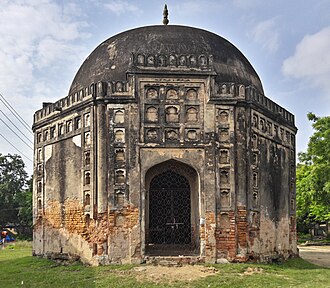 Rohanpur Octagonal Tomb
 -

-

-

-


Colonial period
Initial period
The Bengal Sultanate permitted the Portuguese settlement in Chittagong to be established in 1528. It became the first European colonial enclave in Bengal. The Bengal Sultanate lost control of Chittagong in 1531 after Arakan declared independence and the established Kingdom of Mrauk U. Portuguese ships from Goa and Malacca began frequenting the port city in the 16th century. The cartaz system was introduced and required all ships in the area to purchase naval trading licenses from the Portuguese. Slave trade and piracy flourished. The nearby island of Sandwip was conquered in 1602. In 1615, the Portuguese Navy defeated a joint Dutch East India Company and Arakanese fleet near the coast of Chittagong.
The Bengal Sultan after 1534 allowed the Portuguese to create several settlements at Chitagoong, Satgaon,[94] Hughli, Bandel, and Dhaka. In 1535, the Portuguese allied with the Bengal sultan and held the Teliagarhi pass 280 kilometres (170 mi) from Patna helping to avoid the invasion by the Mughals. By then several of the products came from Patna and the Portuguese send in traders, establishing a factory there in 1580.[95] The region accounted for 40% of Dutch imports outside Europe.[73][82]In 1666, the Mughal government of Bengal led by viceroy Shaista Khan moved to retake Chittagong from Portuguese and Arakanese control. The Anglo-Mughal War was witnessed in 1686.[96][97]
Company rule

After the 1757 Battle of Plassey, Bengal was the first region of the Indian subcontinent conquered by the British East India Company. The company formed the Presidency of Fort William, which administered the region until 1858. A notable aspect of Company rule was the Permanent Settlement, which established the feudal zamindari system; in addition, Company policies led to the deindustrialisation of Bengal's textile industry.[98] The capital amassed by the East India Company in Bengal was invested in the emerging Industrial Revolution in Great Britain.[99][100] Economic mismanagement, alongside drought and a smallpox epidemic, directly led to the Great Bengal famine of 1770, which is estimated to have caused the deaths of between 1 million and 10 million people.[101][102][103][104] Several rebellions broke out during the early 19th century, as Company rule had displaced the Muslim ruling class from power. A conservative Islamic cleric, Haji Shariatullah, sought to overthrow the British by propagating Islamic revivalism.[105] Several towns in Bangladesh participated in the Indian Rebellion of 1857.[106]
British Raj


The challenge posed to company rule by the failed Indian Mutiny led to the creation of the British Indian Empire as a crown colony. The British established several schools, colleges, and a university in Bangladesh. Syed Ahmed Khan and Ram Mohan Roy promoted modern and liberal education in the subcontinent, inspiring the Aligarh movement[107] and the Bengal Renaissance.[108] During the late 19th century, novelists, social reformers, and feminists emerged from Muslim Bengali society. Electricity and municipal water systems were introduced in the 1890s; cinemas opened in many towns during the early 20th century. East Bengal's plantation economy was important to the British Empire, particularly its jute and tea. The British established tax-free river ports, such as the Port of Narayanganj, and large seaports like the Port of Chittagong.
Bengal had the highest gross domestic product in British India.[109] Bengal was one of the first regions in Asia to have a railway, which began operating in 1862.[110] The main railway companies in the region were the Eastern Bengal Railway and Assam Bengal Railway. Railways competed with waterborne transport to become one of the main means of transport.[111]
Supported by the Muslim aristocracy, the British government created the province of Eastern Bengal and Assam in 1905; the new province received increased investment in education, transport, and industry.[112] However, the first partition of Bengal created an uproar in Calcutta and the Indian National Congress. In response to growing Hindu nationalism, the All India Muslim League was formed in Dhaka in 1906. The British government reorganised the provinces in 1912, reuniting East and West Bengal and making Assam a second province.
The Raj was slow to allow self-rule in the colonial subcontinent. It established the Bengal Legislative Council in 1862, and the council's native Bengali representation increased during the early 20th century. The Bengal Provincial Muslim League was formed in 1913 to advocate civil rights for Bengali Muslims. During the 1920s, the league was divided into factions supporting the Khilafat movement and favouring cooperation with the British to achieve self-rule. Segments of the Bengali elite supported Mustafa Kemal Atatürk's secularist forces.[113] In 1929, the All Bengal Tenants Association was formed in the Bengal Legislative Council to counter the influence of the Hindu landed gentry, and the Indian Independence and Pakistan Movements strengthened during the early 20th century. After the Morley-Minto Reforms and the diarchy era in the legislatures of British India, the British government promised limited provincial autonomy in 1935. The Bengal Legislative Assembly, British India's largest legislature, was established in 1937.
Although it won most seats in 1937, the Bengal Congress boycotted the legislature. A. K. Fazlul Huq of the Krishak Praja Party was elected as the first Prime Minister of Bengal. In 1940 Huq supported the Lahore Resolution, which envisaged independent states in the subcontinent's northwestern and eastern Muslim-majority regions. Huq was succeeded by Khawaja Nazimuddin, who grappled with the effects of the Burma Campaign, the Bengal famine of 1943, which killed up to 3 million people,[114] and the Quit India movement. In 1946, the Bengal Provincial Muslim League won the provincial election with the largest Muslim League mandate in British India. H. S. Suhrawardy, who made a final futile effort for a United Bengal in 1946, was the last premier of Bengal.
- Colonial period
-
 Baliati
 -

-
 Curzon Hall
 -
 Old High Court
 -

-
 Rajshahi College
 -
 Chittagong Court House
 -
 Natore
 -
 Mymensingh
 -
 Tangail
.jpeg)

.jpg)
.JPG)


.jpg)

.jpg)

Partition of Bengal (1947)
On 3 June 1947, the Mountbatten Plan outlined the partition of British India. On 6 July, the Sylhet region of Assam voted in a referendum to join East Bengal. Cyril Radcliffe was tasked with drawing the borders of Pakistan and India, and the Radcliffe Line established the boundaries of present-day Bangladesh. The Radcliffe Line awarded two-thirds of Bengal as the eastern wing of Pakistan, but the medieval and early modern Bengali capitals of Gaur, Pandua and Murshidabad fell on the Indian side close to the border with Pakistan.
Union with Pakistan


The Dominion of Pakistan was created on 14 August 1947. East Bengal, with Dhaka as its capital, was the most populous province of the 1947 Pakistani federation (led by Muhammad Ali Jinnah, who promised freedom of religion and secular democracy in the new state).[115][116]
Khawaja Nazimuddin was East Bengal's first chief minister with Frederick Chalmers Bourne its governor. The All Pakistan Awami Muslim League was formed in 1949. In 1950, the East Bengal Legislative Assembly enacted land reform, abolishing the Permanent Settlement and the zamindari system.[117] The 1952 Bengali Language Movement was the first sign of friction between the country's geographically separated wings. The Awami Muslim League was renamed the more secular Awami League in 1953.[118] The first constituent assembly was dissolved in 1954. The United Front coalition swept aside the Muslim League in a landslide victory in the 1954 East Bengali legislative election. The following year, East Bengal renamed East Pakistan as part of the One Unit programme, and the province became a vital part of the Southeast Asia Treaty Organization.
Pakistan adopted a new constitution in 1956. The Pakistan Army imposed military rule in 1958, and Ayub Khan was the country's strongman for 11 years. Political repression increased after the coup. Khan introduced a new constitution in 1962, replacing Pakistan's parliamentary system with a presidential and gubernatorial system (based on electoral college selection) known as Basic Democracy.[119][120][121] In 1962, Dhaka became the seat of the National Assembly of Pakistan, a move seen as appeasing increased Bengali nationalism.[122] The Pakistani government built the controversial Kaptai Dam, displacing the Chakma people from their indigenous homeland in the Chittagong Hill Tracts.[123] The Indo-Pakistani War of 1965 blocked cross-border transport links with neighbouring India in what is described as a second partition.[124] In 1966, Awami League leader Sheikh Mujibur Rahman announced a six-point movement for a federal parliamentary democracy.
According to senior World Bank officials, the Pakistani government practised extensively economic discrimination against East Pakistan. Despite generating 70 per cent of Pakistan's export revenue with jute and tea,[125] East Pakistan received much less government spending than West Pakistan. Economists in East Pakistan, including Rehman Sobhan and Nurul Islam among others, demanded a separate foreign exchange account for the eastern wing. The economists paraphrased Pakistan's Two-Nation Theory ideology against India, by pointing to the existence of two different economies with Pakistan itself, dubbed the Two-Economies Theory.[126][127][128][129] The central government also refused to release foreign aid allocated for East Pakistan.[130] The populist leader Sheikh Mujibur Rahman was arrested for treason in the Agartala Conspiracy Case and was released during the 1969 uprising in East Pakistan which resulted in Ayub Khan's resignation. General Yahya Khan assumed power, reintroducing martial law.
Ethnic and linguistic discrimination was common in Pakistan's civil and military services, in which Bengalis were under-represented.[131] Cultural discrimination also prevailed, making East Pakistan forge a distinct political identity.[132] Authorities banned Bengali literature and music in state media.[133] A cyclone devastated the coast of East Pakistan in 1970, killing an estimated 500,000 people,[134] and the central government was criticised for its poor response.[135] After the December 1970 elections, the Bengali-nationalist Awami League won 167 of 169 East Pakistani seats in the National Assembly. The League claimed the right to form a government and develop a new constitution but was strongly opposed by the Pakistani military and the Pakistan Peoples Party (led by Zulfikar Ali Bhutto).
War of Independence
In early 1971, negotiations began on the transfer of power.[136] The Awami League wanted to develop a constitution based on its Six Points agenda;[136] this was opposed by the Pakistani military, the Pakistan Peoples Party and the Muslim League factions. Talks eventually broke down as the junta led by Yahya Khan prepared for a military operation in East Pakistan. The Bengali population was angered when the newly elected National Assembly was not convened under pressure from the junta and West Pakistani politicians. Despite enjoying an absolute majority in the newly elected parliament, Prime Minister-elect Sheikh Mujibur Rahman was prevented from taking the oath. Zulfikar Ali Bhutto threatened to break the legs of West Pakistani MPs if they flew to Dhaka for the first session of parliament.[137][138] Civil disobedience erupted across East Pakistan,[139] with loud calls for independence. Mujib addressed a pro-independence rally of nearly 2 million people on 7 March 1971, where he said, "This time the struggle is for our liberation. This time the struggle is for our independence".[140] The flag of Bangladesh was raised for the first time on 23 March, Pakistan's Republic Day.[141]
Around midnight on 26 March 1971, military operations under the code name of Operation Searchlight began.[142][143] The first targets were the student dormitories of Dhaka University, the police barracks in Dhaka's Rajarbagh locality, and Hindu neighbourhoods in Old Dhaka. The Pakistan Army arrested Sheikh Mujibur Rahman and flew him to a jail in West Pakistan.[144][145][146] The army burnt down the Ittefaq newspaper's office.[147] Before his arrest, Mujib proclaimed the independence of Bangladesh.[148][149] Pakistani forces launched a widespread campaign of killings, torture, rape, arson and destruction across East Pakistan, targeting segments of the population perceived to be pro-Awami League and pro-independence. The Hindu minority was distinctly targeted because of Pakistan's hostility with neighbouring Hindu-majority India.[150]
During the Bangladesh Liberation War, the Mukti Bahini emerged as the Bengali resistance force. A highly successful guerrilla war was fought against Pakistan. Bengalis continued to defect from Pakistan's diplomatic service, military, police, and bureaucracy. In April, they helped Awami League leaders to set up the Provisional Government of Bangladesh, which operated in exile from Calcutta with the support of the Indian government until December 1971. The Bangladesh Armed Forces was formally established in November 1971, when Bengali forces secured control of much of the countryside. The Mukti Bahini forced the railway network to shut down to stop Pakistani troop movements. Some of the notable operations of the Mukti Bahini included Operation Jackpot and Operation Barisal.
India intervened in the war on 3 December 1971, after Pakistan's failed pre-emptive air strikes on India's northwestern flank. With a joint ground advance by Bangladeshi and Indian forces, coupled with air strikes by both India and the small Bangladeshi air contingent, the capital Dhaka was liberated from Pakistani occupation in mid-December. During the last phase of the war, both the Soviet Union and the United States dispatched naval forces to the Bay of Bengal in a Cold War standoff. The nine-month-long war ended with the surrender of the Pakistan Eastern Command to the Bangladesh-India Allied Forces on 16 December 1971.[151][152] Under international pressure, Pakistan released Mujib from imprisonment on 8 January 1972 and he was flown to a million-strong homecoming in Dhaka.[153][154] Remaining Indian troops were withdrawn by 12 March 1972.[155]
By August 1972, the new state was recognised by 86 countries.[156] Pakistan recognised Bangladesh in 1974 after pressure from most of the Muslim countries.[157]

The government of Bangladesh records the official death toll of the war at 3 million,[158] including victims of atrocities and those who died from starvation. Minimum estimates for the number of those killed range between 300,000 and 500,000.[159][160] An estimated 10 million refugees fled to neighboring India and 30 million were internally displaced.[161][162][163][164] The war was one of the first to record the use of rape as a weapon of war, with an estimated 200,000 women being subjected to sexual abuse by the Pakistani army.[165] The war saw the systematic targeting of Bengali elites,[166] particularly intellectuals. The Jamaat-e-Islami formed paramilitary militias, which aided Pakistani troops and guided them to their intended targets. While Bengali Muslims bore the brunt of atrocities because of racial tensions with the largely Punjabi Muslim West Pakistani forces,[167] the minority Bengali Hindu community was singled out for attacks by the Pakistani armed forces, a legacy which has led Hindu nationalist groups to claim that the war was a Hindu genocide.[168] Archer Blood, the US Consul General in East Pakistan at the time of the war, described the situation as "selective genocide".[169][170][171] In 1974 and 2002, Pakistan formally expressed "regret" for what happened.[172][173] In 2015, Pakistan denied any atrocities took place.[174] In 2022, a bipartisan resolution was introduced in the US Congress to "Recognize the Bangladesh Genocide of 1971".[175] The International Association of Genocide Scholars regards the atrocities as a genocide.[176][177]
Modern Bangladesh
First parliamentary era
The new government of Bangladesh transformed East Pakistan's state apparatus into an independent Bangladeshi state. The Awami League successfully reorganised the bureaucracy, framed a written constitution, and rehabilitated war victims. In January 1972, Mujib introduced a parliamentary republic through a presidential decree.[178] On 12 January 1972 Mujib took oath and assumed office as Prime Minister of Bangladesh.[179] The emerging state structure was heavily influenced by the British Westminster model. The Constitution Drafting Committee led by Kamal Hossain established a bill of rights influenced by the Universal Declaration of Human Rights.[180]
The constituent assembly adopted the constitution of Bangladesh on 4 November 1972, establishing a secular, multiparty parliamentary democracy. Bangladesh joined the Commonwealth of Nations, the UN, the OIC, and the Non-Aligned Movement. In his maiden speech to the UNGA, Mujib stated that "the Bengali has struggled for many centuries for the right to live a free and honourable life as independent citizens of an independent country. They expected to live in peace and harmony with all the nations in the world".[181][182] He strengthened relations with India by signing a 25-year friendship treaty, a border demarcation agreement, and protocols on cross-border trade. The land boundary treaty was aimed at resolving border disputes inherited from East Pakistan and swapping the Indo-Bangladesh enclaves. The land boundary agreement was challenged in court, which ruled that the government needed the prior approval of parliament to implement the land boundary treaty.[183] Mujib was a vocal supporter of Palestinian rights despite Israel being one of the first countries to recognize Bangladesh's independence. In what became Bangladesh's first dispatch of military aid overseas, Mujib sent an army medical unit to Egypt during the 1973 Arab-Israeli War.[184]
In economic policy, the first five years of Bangladesh was the only socialist period in its history. Mujib nationalized 580 industrial plants, as well as banks and insurance companies. In 1974, the government invited international oil companies to explore the Bay of Bengal for oil and natural gas. Petrobangla was established as the national oil and gas corporation.[185] The Mujib government faced huge economic problems exasperated by the resettlement of millions of people displaced in 1971, a breakdown in the food supply chain, poor health services and a lack of other necessities. The effects of the 1970 cyclone were still being felt, and the economy needed reconstruction after the war.[186] The Bangladesh famine of 1974 damaged Mujib's popularity.
Mujib presided over a regime that was built around his personality cult. Sycophants and loyalists developed an ideology called Mujibism.
Presidential era (1975–1991)
_en_echtgenot,_Bestanddeelnr_253-8087.jpg)
In January 1975, Sheikh Mujibur Rahman introduced one-party socialist rule under BAKSAL. Rahman banned all newspapers except four state-owned publications and amended the constitution to increase his power. He was assassinated during a coup on 15 August 1975, and the presidency passed to the usurper Khondaker Mostaq Ahmad for four months. Ahmad is widely regarded as a traitor by Bangladeshis.[187] Tajuddin Ahmad, the nation's first prime minister, and four other independence leaders were assassinated on 4 November 1975. Chief Justice Abu Sadat Mohammad Sayem was installed as president by the military on 6 November 1975. Bangladesh was governed by a military junta led by the Chief Martial Law Administrator for three years. In 1977, the army chief Ziaur Rahman became president. Rahman reinstated multiparty politics, privatised industries and newspapers, re-opened the Dhaka Stock Exchange, established BEPZA and held the country's second general election in 1979. In 1978, 200,000 Arakanese Muslim refugees crossed the Naf River into Bangladesh due to a Burmese military crackdown. The refugees were later repatriated.[188] A semi-presidential system evolved, with the Bangladesh Nationalist Party (BNP) governing until 1982. Rahman was assassinated in 1981 and was succeeded by vice-president Abdus Sattar.[189]
After a year in office, Sattar was overthrown in the 1982 Bangladesh coup d'état. Chief Justice A. F. M. Ahsanuddin Chowdhury was installed as president, but army chief Hussain Muhammad Ershad became the country's de facto leader and assumed the presidency in 1983. Ershad lifted martial law in 1986. He governed with four successive prime ministers (Ataur Rahman Khan, Mizanur Rahman Chowdhury, Moudud Ahmed and Kazi Zafar Ahmed) and a parliament dominated by his Jatiyo Party. Ershad pursued administrative decentralisation, dividing the country into 64 districts, and pushed Parliament to make Islam the state religion in 1988.[190] Bangladesh dispatched its first contingent of UN peacekeepers in 1988.[184] In 1990, Bangladesh joined the US-led coalition to liberate Kuwait during the Gulf War.[184][191] A mass uprising forced Ershad to resign, and Chief Justice Shahabuddin Ahmed led the country's first caretaker government as part of the transition to parliamentary rule.[189]
Parliamentary era (1991–present)


After the 1991 general election, the twelfth amendment to the constitution restored the parliamentary republic, and Begum Khaleda Zia became Bangladesh's first female prime minister. Zia, a former first lady, led a BNP government from 1990 to 1996. In 1991, her finance minister, Saifur Rahman, began a major programme to liberalise the Bangladeshi economy.[192] In addition to setting up the Chittagong Stock Exchange; banking, pharmaceuticals, aviation, ceramics, steel, telecoms, and tertiary education were opened up for investments, resulting in increased market competition. In 1992, an estimated 250,000 refugees from Burma took shelter in Bangladesh due to the suppression of the Burmese pro-democracy movement; most of these refugees returned to Burma by 1993.[188] In 1994, Bangladesh provided the largest non-US contingent in Operation Uphold Democracy, a military intervention in Haiti.[193]
In 1996, a year of political upheaval saw a boycotted February election, an attempted military coup, and mediation efforts producing a caretaker government to oversee elections. For three months, Muhammad Habibur Rahman served as the interim leader of the country. The Awami League returned to power in the June election after 21 years. One of the first initiatives of Prime Minister Sheikh Hasina was to repeal the deeply controversial Indemnity Ordinance, which protected her father's killers from prosecution. Hasina also signed the Chittagong Hill Tracts Peace Accord, which ended an insurgency in the southeastern hill districts. She reached an agreement with India for sharing the water of the Ganges.[194]
The economic reform momentum lost steam due to political instability, including frequent hartals and strikes by the opposition. In 2001, the BNP returned to power on the back of promises to improve the economy. The second Zia administration saw higher economic growth, but security and political problems gripped the country between 2004 and 2006. A radical Islamist militant group, the JMB, carried out a series of terror attacks. At the end of the BNP's term in 2006, there was widespread political unrest. The Bangladeshi military urged President Iajuddin Ahmed to impose a state of emergency and a caretaker government, led by Fakhruddin Ahmed, was installed from January 2007 to December 2008 to implement reforms to the electoral system, judiciary, and bureaucracy.[192] The JMB leaders were arrested and later executed in March 2007.[195]
After achieving a landslide victory in the 2008 Bangladeshi general election the Awami League Government returned to power taking oath on 6 January 2009, with Sheikh Hasina once again becoming the Prime Minister and brought political stability and economic growth to the nation.[196] In 2010, the Supreme Court reduced the scope for military interventions through legal loopholes and reaffirmed secular principles in the constitution. The Awami League set up a war crimes tribunal to prosecute surviving Bengali Islamist collaborators of the 1971 atrocities. Human rights abuses increased under the Hasina administration, particularly enforced disappearances by the Rapid Action Battalion. The 2014 election was boycotted by the BNP-Jamaat alliance. The BNP and Jamaat have often engaged in violent protests to overthrow the government. In 2017, Bangladesh experienced the largest influx of Arakanese refugees in its history. An estimated 700,000 Rohingya refugees took shelter in Cox's Bazar after a campaign of ethnic cleansing in Rakhine State, Myanmar.[197]
The national poverty rate went down from 80% in 1971 to 44.2% in 1991 to 12.9% in 2021.[198][199][200] Bangladeshi economist Muhammad Yunus and the Grameen Bank, which Yunus founded, were awarded the Nobel Peace Prize for pioneering microfinance and their efforts to eradicate poverty. Bangladesh has emerged as the second-largest economy in South Asia,[201][202] surpassing the per capita income levels of both India and Pakistan.[203][202] Since 2009, Bangladesh has launched a series of infrastructure megaprojects. On 25 June 2022, the Padma Bridge opened and connected southwestern Bangladesh with the rest of the country, while the Dhaka Metro was opened in 2023.[204][205] As part of the green transition, Bangladesh's industrial sector emerged as a leader in building green factories, with the country having the largest number of certified green factories in the world in 2023.[206]
Geography

Bangladesh is in South Asia on the Bay of Bengal. It is surrounded almost entirely by neighbouring India, and shares a small border with Myanmar to its southeast, though it lies very close to Nepal, Bhutan, and China. The country is divided into three regions. Most of the country is dominated by the fertile Ganges Delta, the largest river delta in the world.[207] The northwest and central parts of the country are formed by the Madhupur and the Barind plateaus. The northeast and southeast are home to evergreen hill ranges.
The Ganges delta is formed by the confluence of the Ganges (local name Padma or Pôdda), Brahmaputra (Jamuna or Jomuna), and Meghna rivers and their tributaries. The Ganges unites with the Jamuna (main channel of the Brahmaputra) and later join the Meghna, finally flowing into the Bay of Bengal. Bangladesh is called the "Land of Rivers";[208] as it is home to over 57 trans-boundary rivers, the most of any nation-state. Water issues are hence politically complicated inasmuch as the country is a lower riparian state to India.[209]
Bangladesh is predominantly rich fertile flat land. Most of it is less than 12 m (39 ft) above sea level, and it is estimated that about 10% of its land would be flooded if the sea level were to rise by 1 m (3.3 ft).[210] 17% of the country is covered by forests and 12% is covered by hill systems. The country's haor wetlands are of significance to global environmental science. The highest point in Bangladesh is the Saka Haphong, located near the border with Myanmar, with an elevation of 1,064 m (3,491 ft).[211] Previously, either Keokradong or Tazing Dong were considered the highest.
Administrative divisions
Template:Bangladesh Divisions Image Map Bangladesh is divided into eight administrative divisions,[212][211][213] each named after their respective divisional headquarters: Barisal (officially Barishal[214]), Chittagong (officially Chattogram[214]), Dhaka, Khulna, Mymensingh, Rajshahi, Rangpur, and Sylhet.
Divisions are subdivided into districts (zila). There are 64 districts in Bangladesh, each further subdivided into upazila (subdistricts) or thana. The area within each police station, except for those in metropolitan areas, is divided into several unions, with each union consisting of multiple villages. In the metropolitan areas, police stations are divided into wards, further divided into mahallas.
There are no elected officials at the divisional or district levels, and the administration is composed only of government officials. Direct elections are held in each union (or ward) for a chairperson and a number of members. In 1997, a parliamentary act was passed to reserve three seats (out of 12) in every union for female candidates.[215]
| Division | Capital | Established | Area (km2) [216] |
2021 Population (projected)[217] |
Density 2021 |
|---|---|---|---|---|---|
| Barisal Division | Barisal | 1 January 1993 | 13,225 | 9,713,000 | 734 |
| Chittagong Division | Chittagong | 1 January 1829 | 33,909 | 34,747,000 | 1,025 |
| Dhaka Division | Dhaka | 1 January 1829 | 20,594 | 42,607,000 | 2,069 |
| Khulna Division | Khulna | 1 October 1960 | 22,284 | 18,217,000 | 817 |
| Mymensingh Division | Mymensingh | 14 September 2015 | 10,584 | 13,457,000 | 1,271 |
| Rajshahi Division | Rajshahi | 1 January 1829 | 18,153 | 21,607,000 | 1,190 |
| Rangpur Division | Rangpur | 25 January 2010 | 16,185 | 18,868,000 | 1,166 |
| Sylhet Division | Sylhet | 1 August 1995 | 12,635 | 12,463,000 | 986 |
Climate

Straddling the Tropic of Cancer, Bangladesh's climate is tropical, with a mild winter from October to March and a hot, humid summer from March to June. The country has never recorded an air temperature below 0 °C (32 °F), with a record low of 1.1 °C (34.0 °F) in the northwest city of Dinajpur on 3 February 1905.[218] A warm and humid monsoon season lasts from June to October and supplies most of the country's rainfall. Natural calamities, such as floods, tropical cyclones, tornadoes, and tidal bores occur almost every year,[219] combined with the effects of deforestation, soil degradation and erosion. The cyclones of 1970 and 1991 were particularly devastating, the latter killing approximately 140,000 people.[220]
In September 1998, Bangladesh saw the most severe flooding in modern history, after which two-thirds of the country went underwater, along with a death toll of 1,000.[221] As a result of various international and national level initiatives in disaster risk reduction, the human toll and economic damage from floods and cyclones have come down over the years.[222] The 2007 South Asian floods ravaged areas across the country, leaving five million people displaced, had a death toll around 500.[223]
Bangladesh is recognised to be one of the countries most vulnerable to climate change.[224][225] Over the course of a century, 508 cyclones have affected the Bay of Bengal region, 17 percent of which are believed to have made landfall in Bangladesh.[226] Natural hazards that come from increased rainfall, rising sea levels, and tropical cyclones are expected to increase as the climate changes, each seriously affecting agriculture, water and food security, human health, and shelter.[227] It is estimated that by 2050, a three-foot rise in sea levels will inundate some 20 percent of the land and displace more than 30 million people.[228] To address the sea level rise threat in Bangladesh, the Bangladesh Delta Plan 2100 has been launched.[229][230]
Biodiversity

Bangladesh is located in the Indomalayan realm, and lies within four terrestrial ecoregions: Lower Gangetic Plains moist deciduous forests, Mizoram–Manipur–Kachin rain forests, Sundarbans freshwater swamp forests, and Sundarbans mangroves.[231] Its ecology includes a long sea coastline, numerous rivers and tributaries, lakes, wetlands, evergreen forests, semi evergreen forests, hill forests, moist deciduous forests, freshwater swamp forests and flat land with tall grass. The Bangladesh Plain is famous for its fertile alluvial soil which supports extensive cultivation. The country is dominated by lush vegetation, with villages often buried in groves of mango, jackfruit, bamboo, betel nut, coconut, and date palm.[232] The country has up to 6000 species of plant life, including 5000 flowering plants.[233] Water bodies and wetland systems provide a habitat for many aquatic plants. Water lilies and lotuses grow vividly during the monsoon season. The country has 50 wildlife sanctuaries.
Bangladesh is home to much of the Sundarbans, the world's largest mangrove forest, covering an area of 6,000 square kilometres (2,300 sq mi) in the southwest littoral region. It is divided into three protected sanctuaries–the South, East, and West zones. The forest is a UNESCO World Heritage Site. The northeastern Sylhet region is home to haor wetlands, a unique ecosystem. It also includes tropical and subtropical coniferous forests, a freshwater swamp forest, and mixed deciduous forests. The southeastern Chittagong region covers evergreen and semi-evergreen hilly jungles. Central Bangladesh includes the plainland Sal forest running along with the districts of Gazipur, Tangail, and Mymensingh. St. Martin's Island is the only coral reef in the country.
Bangladesh has an abundance of wildlife in its forests, marshes, woodlands, and hills.[232] The vast majority of animals dwell within a habitat of 150,000 square kilometres (58,000 sq mi).[234] The Bengal tiger, clouded leopard, saltwater crocodile, black panther and fishing cat are among the chief predators in the Sundarbans.[235] Northern and eastern Bangladesh is home to the Asian elephant, hoolock gibbon, Asian black bear and oriental pied hornbill.[236] The Chital deer are widely seen in southwestern woodlands. Other animals include the black giant squirrel, capped langur, Bengal fox, sambar deer, jungle cat, king cobra, wild boar, mongooses, pangolins, pythons and water monitors. Bangladesh has one of the largest populations of Irrawaddy and Ganges dolphins.[237] The country has numerous species of amphibians (53), reptiles (139), marine reptiles (19) and marine mammals (5). It also has 628 species of birds.[238]
Several animals became extinct in Bangladesh during the last century, including the one-horned and two-horned rhinoceros and common peafowl. The human population is concentrated in urban areas, limiting deforestation to a certain extent. Rapid urban growth has threatened natural habitats. The country has widespread environmental issues, pollution of the Dhaleshwari River by the textile industry and shrimp cultivation in Chakaria Sundarbans have both been described by academics as ecocides.[239][240] Although many areas are protected under law, some Bangladeshi wildlife is threatened by this growth. The Bangladesh Environment Conservation Act was enacted in 1995. The government has designated several regions as Ecologically Critical Areas, including wetlands, forests, and rivers. The Sundarbans tiger project and the Bangladesh Bear Project are among the key initiatives to strengthen conservation.[236] It ratified the Rio Convention on Biological Diversity on 3 May 1994.[241] As of 2014[update], the country was set to revise its National Biodiversity Strategy and Action Plan.[241]
Politics and government


.PNG)

Bangladesh is a de jure representative democracy under its constitution, with a Westminster-style parliamentary republic that has universal suffrage. The head of government is the Prime Minister, who forms a government every five years. The President invites the leader of the largest party in parliament to become Prime Minister.[242]
The Jatiya Sangshad (National Parliament) is the unicameral parliament. It has 350 Members of Parliament (MPs), including 300 MPs elected on the first past the post system and 50 MPs appointed to reserved seats for women's empowerment. Article 70 of the Constitution of Bangladesh forbids MPs from voting against their party. However, several laws proposed independently by MPs have been transformed into legislation, including the anti-torture law.[243] The parliament is presided over by the Speaker of the Jatiya Sangsad, who is second in line to the president as per the constitution.[244]
The Government of Bangladesh is overseen by a cabinet headed by the Prime Minister of Bangladesh. The tenure of a parliamentary government is five years. The Bangladesh Civil Service assists the cabinet in running the government. Recruitment for the civil service is based on a public examination. In theory, the civil service should be a meritocracy. But a disputed quota system coupled with politicisation and preference for seniority have allegedly affected the civil service's meritocracy.[245] The President of Bangladesh is the ceremonial head of state[246] whose powers include signing bills passed by parliament into law. The President is the Supreme Commander of the Bangladesh Armed Forces and the chancellor of all universities. The Supreme Court of Bangladesh is the highest court of the land, followed by the High Court and Appellate Divisions. The head of the judiciary is the Chief Justice of Bangladesh, who sits on the Supreme Court. The courts have wide latitude in judicial review, and judicial precedent is supported by Article 111 of the constitution. The judiciary includes district and metropolitan courts divided into civil and criminal courts. Due to a shortage of judges, the judiciary has a large backlog.
Military

The Bangladesh Armed Forces have inherited the institutional framework of the British military and the British Indian Army.[247] In 2022, the active personnel strength of the Bangladesh Army was around 250,000,[248] excluding the Air Force and the Navy (24,000).[249] In addition to traditional defence roles, the military has supported civil authorities in disaster relief and provided internal security during periods of political unrest. For many years, Bangladesh has been the world's largest contributor to UN peacekeeping forces. The military budget of Bangladesh accounts for 1.3% of GDP, amounting to US$4.3 billion in 2021.[250][251]
The Bangladesh Navy, one of the largest in the Bay of Bengal, includes a fleet of frigates, submarines, corvettes, and other vessels. The Bangladesh Air Force has a small fleet of multi-role combat aircraft. Most of Bangladesh's military equipment comes from China.[252] In recent years, Bangladesh and India have increased joint military exercises, high-level visits of military leaders, counter-terrorism cooperation and intelligence sharing. Bangladesh is vital to ensuring stability and security in northeast India.[253][254]
Bangladesh's strategic importance in the eastern subcontinent hinges on its proximity to China, its frontier with Burma, the separation of mainland and northeast India, and its maritime territory in the Bay of Bengal.[255] In 2002, Bangladesh and China signed a Defence Cooperation Agreement.[256] The United States has pursued negotiations with Bangladesh on a Status of Forces Agreement, an Acquisition and Cross-Servicing Agreement and a General Security of Military Information Agreement.[257][258][259] In 2019, Bangladesh ratified the UN Treaty on the Prohibition of Nuclear Weapons.[260]
Foreign relations
Bangladesh is considered a middle power in global politics.[261] It plays an important role in the geopolitical affairs of the Indo-Pacific,[262] due to its strategic location between South and Southeast Asia.[263] Bangladesh joined the Commonwealth of Nations in 1972 and the United Nations in 1974.[264][265] It relies on multilateral diplomacy on issues like climate change, nuclear nonproliferation, trade policy and non-traditional security issues.[266] Bangladesh pioneered the creation of SAARC, which has been the preeminent forum for regional diplomacy among the countries of the Indian subcontinent.[267] It joined the Organisation of Islamic Cooperation in 1974,[268] and is a founding member of the Developing 8 Countries.[269] In recent years, Bangladesh has focused on promoting regional trade and transport links with support from the World Bank.[270] Dhaka hosts the headquarters of BIMSTEC, an organisation that brings together countries dependent on the Bay of Bengal.
Relations with neighbouring Myanmar have been severely strained since 2016–2017, after over 700,000 Rohingya refugees illegally entered Bangladesh.[271] The parliament, government, and civil society of Bangladesh have been at the forefront of international criticism against Myanmar for military operations against the Rohingya, and have demanded their right of return to Arakan.[272][273]
Bangladesh shares an important bilateral and economic relationship with its largest neighbour India,[274] which is often strained by water politics of the Ganges and the Teesta,[275][276][277] and the border killings of Bangladeshi civilians.[278][279] Post-independent Bangladesh has continued to have a problematic relationship with Pakistan, mainly due to its denial of the 1971 Bangladesh genocide.[280] It maintains a warm relationship with China, which is its largest trading partner, and the largest arms supplier.[281] Japan is Bangladesh's largest economic aid provider, and the two maintain a strategic and economic partnership.[282] Political relations with Middle Eastern countries are robust.[283] Bangladesh receives 59% of its remittances from the Middle East,[284] despite poor working conditions affecting over 4 million Bangladeshi workers.[285] Bangladesh plays a major role in global climate diplomacy as a leader of the Climate Vulnerable Forum.[286]
Civil society
Since the colonial period, Bangladesh has had a prominent civil society. There are various special interest groups, including non-governmental organisations, human rights organisations, professional associations, chambers of commerce, employers' associations, and trade unions.[287] The National Human Rights Commission of Bangladesh was set up in 2007. Notable human rights organisations and initiatives include the Centre for Law and Mediation, Odhikar, the Alliance for Bangladesh Worker Safety, the Bangladesh Environmental Lawyers Association, the Bangladesh Hindu Buddhist Christian Unity Council and the War Crimes Fact Finding Committee. The world's largest international NGO BRAC is based in Bangladesh. There have been concerns regarding the shrinking space for independent civil society in recent years.[288][289][290]
Human rights

Torture is banned by the Constitution of Bangladesh,[291] but is rampantly used by Bangladesh's security forces. Bangladesh joined the Convention against Torture in 1998 and it enacted its first anti-torture law, the Torture and Custodial Death (Prevention) Act, in 2013. The first conviction under this law was announced in 2020.[292] Amnesty International Prisoners of Conscience from Bangladesh have included Saber Hossain Chowdhury and Shahidul Alam.[293][294] The Digital Security Act of 2018 has greatly reduced freedom of expression in Bangladesh and has been used to target critics of the government.[295][296][297][298]
On International Human Rights Day in December 2021, the United States Department of Treasury announced sanctions on commanders of the Rapid Action Battalion for extrajudicial killings, torture, and other human rights abuses.[299] Freedom House has criticised the ruling party for human rights abuses, the crackdown on the opposition, mass media, and civil society through politicized enforcement.[300] Bangladesh is ranked "partly free" in Freedom House's Freedom in the World report,[301] but its press freedom has deteriorated from "free" to "not free" in recent years due to increasing pressure from the authoritarian government.[302] According to the British Economist Intelligence Unit, the country has a hybrid regime: the third of four rankings in its Democracy Index.[303] Bangladesh was ranked 96th among 163 countries in the 2022 Global Peace Index.[304] According to National Human Rights Commission, 70% of alleged human-rights violations are committed by law-enforcement agencies.[305]
LGBT rights are heavily suppressed:[306] homosexuality is punishable by a maximum of life imprisonment.[307][308] However, Bangladesh recognises the third gender and accords limited rights for transgender people.[309] According to the 2016 Global Slavery Index, an estimated 1,531,300 people are enslaved in Bangladesh, or roughly 1% of the population.[310][311][312][313]
Corruption
Like many developing countries, institutional corruption is an issue of concern for Bangladesh. Bangladesh was ranked 146th among 180 countries on Transparency International's 2018 Corruption Perceptions Index.[314] Land administration was the sector with the most bribery in 2015,[315] followed by education,[316] police[317] and water supply.[318] The Anti Corruption Commission was formed in 2004, and it was active during the 2006–08 Bangladeshi political crisis, indicting many leading politicians, bureaucrats and businessmen for graft.[319][320][321]
Economy

Bangladesh is the second largest economy in South Asia after India.[201][202] The country has outpaced India and Pakistan in terms of per capita income.[203][202] According to the World Bank,
When the newly independent country of Bangladesh was born on December 16, 1971, it was the second poorest country in the world—making the country's transformation over the next 50 years one of the great development stories. Since then, poverty has been cut in half at record speed. Enrolment in primary school is now nearly universal. Hundreds of thousands of women have entered the workforce. Steady progress has been made on maternal and child health. And the country is better buttressed against the destructive forces posed by climate change and natural disasters. Bangladesh's success comprises many moving parts—from investing in human capital to establishing macroeconomic stability. Building on this success, the country is now setting the stage for further economic growth and job creation by ramping up investments in energy, inland connectivity, urban projects, and transport infrastructure, as well as focusing on climate change adaptation and disaster preparedness on its path toward sustainable growth.[322]

In 2022, Bangladesh had the second largest foreign-exchange reserves in South Asia. The reserves have boosted the government's spending capacity despite tax revenues forming only 7.7% of government revenue.[323] A big chunk of investments have gone into the power sector. In 2009, Bangladesh was experiencing daily blackouts several times a day. In 2022, the country achieved 100% electrification.[324][325][326] One of the major anti-poverty schemes of the Bangladeshi government is the Ashrayan Project which aims to eradicate homelessness by providing free housing.[327] The poverty rate has gone down from 80% in 1971,[328] to 44.2% in 1991,[329] to 12.9% in 2021.[198] The literacy rate was 74.66% in 2022.[330] Bangladesh has a labor force of roughly 70 million,[331] which is the world's seventh-largest; with an unemployment rate of 5.2% as of 2021[update].[332] The government is setting up 100 special economic zones to attract foreign direct investment (FDI) and generate 10 million jobs.[333] The Bangladesh Investment Development Authority (BIDA) and the Bangladesh Economic Zones Authority (BEZA) have been established to help investors in setting up factories; and to complement the longstanding Bangladesh Export Processing Zone Authority (BEPZA).
The Bangladeshi taka is the national currency. The service sector accounts for about 51.3% of total GDP and employs 39% of the workforce. The industrial sector accounts for 35.1% of GDP and employs 20.4% of the workforce. The agriculture sector makes up 13.6% of the economy but is the biggest employment sector, with 40.6% of the workforce.[323] In agriculture, the country is a major producer of rice, fish, tea, fruits, vegetables, flowers,[334] and jute. Lobsters and shrimps are some of Bangladesh's well-known exports.[335]
Private sector
The private sector accounts for 80% of GDP compared to the dwindling role of state-owned companies.[336] Bangladesh's economy is dominated by family-owned conglomerates and small and medium-sized businesses. Some of the largest publicly traded companies in Bangladesh include Beximco, BRAC Bank, BSRM, GPH Ispat, Grameenphone, Summit Group, and Square Pharmaceuticals.[337] Capital markets include the Dhaka Stock Exchange and the Chittagong Stock Exchange. Its telecommunications industry is one of the world's fastest-growing, with 171.854 million cellphone subscribers in January 2021.[338] Over 80% of Bangladesh's export earnings come from the garments industry.[11] Other major industries include shipbuilding, pharmaceuticals, steel, ceramics, electronics, and leather goods.[339] Muhammad Aziz Khan became the first person from Bangladesh to be listed as a billionaire by Forbes.[340]
Infrastructure

Since 2009, Bangladesh has embarked on a series of megaprojects. The 6.15 km long Padma Bridge was built for US$3.86 billion.[342] The bridge was the first self-financed megaproject in the country's history.[343] Other megaprojects include the Dhaka Metro, Karnaphuli Tunnel, Dhaka Elevated Expressway and Chittagong Elevated Expressway; as well as the Bangladesh Delta Plan to mitigate the impact of climate change.
Tourism
The tourism industry is expanding, contributing some 3.02% of total GDP.[344] Bangladesh's international tourism receipts in 2019 amounted to $391 million.[345] The country has three UNESCO World Heritage Sites (the Mosque City, the Paharpur Buddhist Ruins and the Sundarbans) and five tentative-list sites.[346] Activities for tourists include angling, water skiing, river cruising, hiking, rowing, yachting, and beachgoing.[347][348] The World Travel and Tourism Council (WTTC) reported in 2019 that the travel and tourism industry in Bangladesh directly generated 1,180,500 jobs in 2018 or 1.9% of the country's total employment.[349] According to the same report, Bangladesh experiences around 125,000 international tourist arrivals per year.[349] Domestic spending generated 97.7 percent of direct travel and tourism gross domestic product (GDP) in 2012.[350]
Energy and electricity

Bangladesh is gradually transitioning to a green economy. It has the largest off-grid solar power programme in the world, benefiting 20 million people.[351] An electric car called the Palki is being developed for production in the country.[352] Biogas is being used to produce organic fertilizer.[353]
Bangladesh continues to have huge untapped reserves of natural gas, particularly in its maritime territory.[354][355] A lack of exploration and decreasing proven reserves have forced Bangladesh to import LNG from abroad.[356][357][358] Gas shortages were further exasperated by the Russia-Ukraine War.[359]
While government-owned companies in Bangladesh generate nearly half of Bangladesh's electricity, privately owned companies like the Summit Group and Orion Group are playing an increasingly important role in both generating electricity, and supplying machinery, reactors, and equipment.[360] Bangladesh increased electricity production from 5 gigawatts in 2009 to 25.5 gigawatts in 2022. It plans to produce 50 gigawatts by 2041. U.S. companies like Chevron and General Electric supply around 55% of Bangladesh's domestic natural gas production and are among the largest investors in power projects. 80% of Bangladesh's installed gas-fired power generation capacity comes from turbines manufactured in the United States.[361]
On 4 October 2022, the national grid collapsed and plunged the entire country into a nationwide blackout lasting eight hours. The government's investigation focused on technical failure, negligence, and possible sabotage. The investigation found that grid capacity has not kept up with the expansion of electricity generation and the opening of new power plants.[362] Gas shortages were also to blame. The electricity sector in Bangladesh is heavily reliant on natural gas.[363] Gas shortages forced the government to import LNG from abroad. As a result, Texas-based Excelerate Energy opened Bangladesh's first floating LNG terminal in 2018 off the coast of Maheshkhali Island.[364] The Summit LNG Terminal was opened in 2019.[365] The Government of Bangladesh has subsidized LNG imports worth several billion dollars. Since October 2021, Bangladesh imported LNG for US$30–37 per million Btu which is 10 times the price it paid in May 2020.[366] The government stopped buying spot price LNG in June 2022. The country's forex reserves declined due to surging fuel imports. Bangladesh imported 30% of its LNG on the spot price market in 2022, down from 40% in 2021. Bangladesh continues to trade in LNG on the futures exchange markets.[367]
The Rooppur Nuclear Power Plant, Bangladesh's first operational nuclear plant, is nearing completion as of the end of 2023. [368]
Demographics
| Year | Pop. | ±% p.a. |
|---|---|---|
| 1971 | 67,800,000 | — |
| 1980 | 80,600,000 | +1.94% |
| 1990 | 105,300,001 | +2.71% |
| 2000 | 129,600,000 | +2.10% |
| 2010 | 148,700,000 | +1.38% |
| 2012 | 161,100,200 | +4.09% |
| 2022 | 165,160,000 | +0.25% |
| Source: OECD/World Bank[369][9] | ||
According to the 2022 Census, Bangladesh has a population of 165.1 million,[12] and is the eighth-most-populous country in the world, the fifth-most populous country in Asia, and the most densely populated large country in the world, with a headline population density of 1,265 people/km2 as of 2020[update].[370] Its total fertility rate (TFR), once among the highest in the world, has experienced a dramatic decline, from 5.5 in 1985 to 3.7 in 1995, down to 2.0 in 2020,[371] which is below the sub-replacement fertility of 2.1.[372] The vast majority of Bangladeshis live in rural areas, with only 39% of the population living in urban areas as of 2021[update].[373] It has a median age of roughly 28 years, with 26% of the total population aged 14 or younger,[374] and merely 5% aged 65 and above.[375]
Bangladesh is an ethnically and culturally homogeneous society, as Bengalis form 99% of the population.[9] The Adivasi population includes the Chakmas, Marmas, Santhals, Mros, Tanchangyas, Bawms, Tripuris, Khasis, Khumis, Kukis, Garos, and Bisnupriya Manipuris. The Chittagong Hill Tracts region experienced unrest and an insurgency from 1975 to 1997 in an autonomy movement by its indigenous people. Although a peace accord was signed in 1997, the region remains militarised.[376] Urdu-speaking stranded Pakistanis were given citizenship by the Supreme Court in 2008.[377] Bangladesh also hosts over 700,000 Rohingya refugees since 2017, giving it one of the largest refugee populations in the world.[271]
Urban centres
Bangladesh's capital Dhaka and the largest city and is overseen by two city corporations that manage between them the northern and southern parts of the city. There are 12 city corporations which hold mayoral elections: Dhaka South, Dhaka North, Chittagong, Comilla, Khulna, Mymensingh, Sylhet, Rajshahi, Barisal, Rangpur, Gazipur and Narayanganj. Mayors are elected for five-year terms. Altogether there are 506 urban centres in Bangladesh which 43 cities have a population of more than 100,000.
| Rank | Bangladesh | Pop. | |||||||
|---|---|---|---|---|---|---|---|---|---|
 Dhaka  Chittagong |
1 | Dhaka | [[{{{div_1}}}]] | 10,278,882 | ,_Islamic_University_of_Technology.jpg) Gazipur  Narayanganj | ||||
| 2 | Chittagong | [[{{{div_2}}}]] | 3,227,246 | ||||||
| 3 | Gazipur | [[{{{div_3}}}]] | 2,674,697 | ||||||
| 4 | Narayanganj | [[{{{div_4}}}]] | 967,724 | ||||||
| 5 | Khulna | [[{{{div_5}}}]] | 718,735 | ||||||
| 6 | Rangpur | [[{{{div_6}}}]] | 708,384 | ||||||
| 7 | Mymensingh | [[{{{div_7}}}]] | 576,722 | ||||||
| 8 | Rajshahi | [[{{{div_8}}}]] | 552,791 | ||||||
| 9 | Sylhet | [[{{{div_9}}}]] | 532,426 | ||||||
| 10 | Cumilla | [[{{{div_10}}}]] | 439,414 | ||||||
Language
The official and predominant language of Bangladesh is Bengali, which is spoken by more than 98% of the population as their native language.[378] Bengali is described as a dialect continuum where there are various dialects spoken throughout the country. There is a diglossia in which much of the population is able to understand or speak Standard Colloquial Bengali, and in their regional dialects.[379] These include Chittagonian or Sylheti, though some linguists consider them as separate languages.[378]
English plays an important role in Bangladesh's judicial and educational affairs, due to the country's history as part of the British Empire. It is widely spoken and commonly understood, and is taught as a compulsory subject in all schools, colleges and universities, while the English-medium educational system is widely attended.[380]
Tribal languages, although increasingly endangered, include the Chakma language, another native Eastern Indo-Aryan language, spoken by the Chakma people. Others are Garo, Meitei, Kokborok and Rakhine. Among the Austroasiatic languages, the most spoken is the Santali language, native to the Santal people.[381]
The stranded Pakistanis and some sections of the Old Dhakaites often use Urdu as their native tongue, but the usage of the latter remains highly reproached.[382]
Religion
.jpg)

Bangladesh was constitutionally proclaimed as the first secular state of South Asia in 1972. It grants freedom of religion and claims to be "secular in practise" while establishing Islam as the state religion.[383][384][385][386] The constitution bans religion-based politics and discrimination, and proclaims equal recognition of people adhering to all faiths.[387] Islam is the largest religion across the country, being followed by about 91.1% of the population.[9][388][389] The vast majority of Bangladeshi citizens are Bengali Muslims, adhering to Sunni Islam. The country is the third-most populous Muslim-majority state in the world and has the fourth-largest overall Muslim population.[390]
Hinduism is followed by 7.9% of the population,[9][388][389] mainly by the Bengali Hindus, who form the country's second-largest religious group and the third-largest Hindu community globally, after those in India and Nepal. Buddhism is the third-largest religion, at 0.6% of the population. Bangladeshi Buddhists are concentrated among the tribal ethnic groups in the Chittagong Hill Tracts. At the same time, coastal Chittagong is home to many Bengali Buddhists. Christianity is the fourth-largest religion at 0.3%, followed mainly by a small Bengali Christian minority. 0.1% of the population practices other religions like Animism or is irreligious.[9][391]
Education

The constitution states that all children shall receive free and compulsory education.[392] Education in Bangladesh is overseen by the Ministry of Education. The Ministry of Primary and Mass Education is responsible for implementing policy for primary education and state-funded schools at a local level. Primary and secondary education is compulsory, and is financed by the state and free of charge in public schools. Bangladesh has a literacy rate of 74.7% per cent as of 2019: 77.4% for males and 71.9% for females.[393][394] The country's educational system is three-tiered and heavily subsidised, with the government operating many schools at the primary, secondary and higher secondary levels and subsidising many private schools. In the tertiary education sector, the Bangladeshi government funds over 45 state universities[395] through the University Grants Commission (UGC), created by Presidential Order 10 in 1973.[396]
The education system is divided into five levels: primary (first to fifth grade), junior secondary (sixth to eighth grade), secondary (ninth and tenth grade), higher secondary (11th and 12th grade), and tertiary which is university level.[397] According to Hossain 2016, the formal schooling of secondary education in Bangladesh is seven years. The first three years are called junior secondary and include grades six to eight. The next two years are called secondary and include grades nine and ten. The final two years are called higher secondary and include grade eleven and twelve. Based on the information from Hossain 2016 and Daily Star 2010, to pass the fifth grade the Bangladesh Education Ministry requires a public exam called Primary School Certificate (PSC). During the eighth grade students have to pass the Junior School Certificate (JSC) exam to get enrolled in ninth grade, while tenth-grade students have to pass the Secondary School Certificate (SSC) exam to proceed to eleventh grade. Lastly, students have to pass the Higher Secondary Certificate (HSC) exam at grade twelve to apply for university.[398][399]
Universities in Bangladesh are of three general types: public (government-owned and subsidised), private (privately owned universities) and international (operated and funded by international organisations). The country has 47 public,[395] 105 private[400] and two international universities; Bangladesh National University has the largest enrolment, and the University of Dhaka (established in 1921) is the oldest. Bangladesh University of Engineering and Technology (BUET) is a premiere university for engineering education. University of Chittagong, established in 1966, has the largest campus.[401] Dhaka College, established in 1841, is the oldest educational institution for higher education in Bangladesh.[402] Medical education is provided by 29 government and private medical colleges. All medical colleges are affiliated with the Ministry of Health and Family Welfare.
Health

Bangladesh, by the constitution, guarantees healthcare services as a fundamental right to all of its citizens.[404] The Ministry of Health and Family Welfare is the largest institutional healthcare provider in Bangladesh,[405] and contains two divisions: Health Service Division and Medical Education And Family Welfare Division.[406] However, healthcare facilities in Bangladesh are considered less than adequate, although they have improved as the economy has grown and poverty levels have decreased significantly.[405] Bangladesh faces a severe health workforce crisis, as formally-trained providers make up a short percentage of the total health workforce.[407] Significant deficiencies in the treatment practices of village doctors persist, with widespread harmful and inappropriate drug prescribing.[408]
Bangladesh's poor healthcare system suffers from severe underfunding from the government.[405] As of 2019[update], some 2.48% of total GDP was attributed to healthcare,[409] and domestic general government spending on healthcare was 18.63% of the total budget,[410] while out-of-pocket expenditures made up the vast majority of the total budget, totalling 72.68%.[411] Domestic private health expenditure was about 75% of the total healthcare expenditure.[412] As of 2020[update], there are only 5.3 doctors per 10,000 people, and about six physicians[413] and three nurses per 10,000 people, while the number of hospital beds is 8 per 10,000.[414][415] The overall life expectancy in Bangladesh at birth was 73 years (71 years for males and 75 years for females) as of 2020[update],[416] and it has a comparably high infant mortality rate (24 per 1,000 live births) and child mortality rate (29 per 1,000 live births).[417][418] Maternal mortality remains high, clocking at 173 per 100,000 live births.[419] Bangladesh is a key source market for medical tourism for various countries, mainly India,[420] due to its citizens dissatisfaction and distrust over their own healthcare system.[421]
The main causes of death are coronary artery disease, stroke, and chronic respiratory disease; comprising 62% and 60% of all adult male and female deaths, respectively.[422] Malnutrition is a major and persistent problem in Bangladesh, mainly affecting the rural regions, more than half of the population suffers from it. Severe acute malnutrition affects 450,000 children, while nearly 2 million children have moderate acute malnutrition. For children under the age of five, 52% are affected by anaemia, 41% are stunted, 16% are wasted, and 36% are underweight. A quarter of women are underweight and around 15% have short stature, while over half also suffer from anaemia.[423]
Culture
Visual arts and crafts
_LACMA_AC1994.131.1.jpg)
The recorded history of art in Bangladesh can be traced to the 3rd century BCE, when terracotta sculptures were made in the region. In classical antiquity, notable sculptural Hindu, Jain, and Buddhist art developed in the Pala Empire and the Sena dynasty. Islamic art has evolved since the 14th century. The architecture of the Bengal Sultanate saw a distinct style of domed mosques with complex niche pillars that had no minarets. Mughal Bengal's most celebrated artistic tradition was the weaving of Jamdani motifs on fine muslin, which is now classified by UNESCO as an intangible cultural heritage. Jamdani motifs were similar to Iranian textile art (buta motifs) and Western textile art (paisley). The Jamdani weavers in Dhaka received imperial patronage.[82][424] Ivory and brass were also widely used in Mughal art. Pottery is thoroughly used in Bengali culture.
The modern art movement in Bangladesh took shape during the 1950s, particularly with the pioneering works of Zainul Abedin. East Bengal developed its own modernist painting and sculpture traditions, which were distinct from the art movements in West Bengal. The Art Institute Dhaka has been a significant centre for visual art in the region. Its annual Bengali New Year parade was enlisted as an intangible cultural heritage by UNESCO in 2016.
Modern Bangladesh has produced many of South Asia's leading painters, including SM Sultan, Mohammad Kibria, Shahabuddin Ahmed, Kanak Chanpa Chakma, Kafil Ahmed, Saifuddin Ahmed, Qayyum Chowdhury, Rashid Choudhury, Quamrul Hassan, Rafiqun Nabi and Syed Jahangir, among others. Novera Ahmed and Nitun Kundu were the country's pioneers of modernist sculpture.
In recent times, photography as a medium of art has become popular. Biennial Chobi Mela is considered the largest photography festival in Asia.[425]
Literature

Bengali literature is a millennium-old tradition; the Charyapadas are the earliest examples of Bengali poetry. Sufi spiritualism inspired many Bengali Muslim writers. During the Bengal Sultanate, medieval Bengali writers were influenced by Arabic and Persian works. Sultans of Bengal patronized Bengali literature. Examples include the writings of Maladhar Basu, Bipradas Pipilai, Vijay Gupta, and Yasoraj Khan. The Chandidas are notable lyric poets from the early Medieval Age. Syed Alaol was the bard of Middle Bengali literature. The Bengal Renaissance shaped modern Bengali literature, including novels, short stories, and science fiction. Rabindranath Tagore was the first non-European laureate of the Nobel Prize in Literature and is described as the Bengali Shakespeare.[426] Kazi Nazrul Islam was a revolutionary poet who espoused political rebellion against colonialism and fascism. Begum Rokeya is regarded as the pioneer feminist writer of Bangladesh.[427] Other renaissance icons included Michael Madhusudan Dutt and Sarat Chandra Chattopadhyay. The writer Syed Mujtaba Ali is noted for his cosmopolitan Bengali worldview.[428] Jasimuddin was a renowned pastoral poet. Shamsur Rahman and Al Mahmud are considered two of the greatest Bengali poets to have emerged in the 20th century. Farrukh Ahmad, Sufia Kamal, Syed Ali Ahsan, Ahsan Habib, Abul Hussain, Shahid Qadri, Fazal Shahabuddin, Abu Zafar Obaidullah, Omar Ali, Al Mujahidi, Syed Shamsul Huq, Nirmalendu Goon, Abid Azad, Hasan Hafizur Rahman and Abdul Hye Sikder are important figures of modern Bangladeshi poetry. Ahmed Sofa is regarded as the most important Bangladeshi intellectual in the post-independence era. Humayun Ahmed was a popular writer of modern Bangladeshi magical realism and science fiction. Notable writers of Bangladeshi fictions include Mir Mosharraf Hossain, Akhteruzzaman Elias, Alauddin Al Azad, Shahidul Zahir, Rashid Karim, Mahmudul Haque, Syed Waliullah, Shahidullah Kaiser, Shawkat Osman, Selina Hossain, Shahed Ali, Razia Khan, Anisul Hoque, and Abdul Mannan Syed.
The annual Ekushey Book Fair and Dhaka Literature Festival, organised by the Bangla Academy, are among the enormous literary festivals in South Asia.
Women
Although as of 2015[update], several women occupied a key political office in Bangladesh. Its women continue to live under a patriarchal social regime where violence is common.[429] Whereas in India and Pakistan, women participate less in the workforce as their education increases, the reverse is the case in Bangladesh.[429]
Bengal has a long history of feminist activism dating back to the 19th century. Begum Rokeya and Faizunnessa Chowdhurani played an important role in emancipating Bengali Muslim women from purdah, before the country's division, as well as promoting girls' education. Several women were elected to the Bengal Legislative Assembly in the British Raj. The first women's magazine, Begum, was published in 1948.
In 2008, Bangladeshi female workforce participation stood at 26%.[430] Women dominate blue collar jobs in the Bangladeshi garment industry. Agriculture, social services, healthcare, and education are chosen occupations for Bangladeshi women, while their employment in white collar positions has steadily increased.
Architecture


The architectural traditions of Bangladesh have a 2,500-year-old heritage.[431] Terracotta architecture is a distinct feature of Bengal. Pre-Islamic Bengali architecture reached its pinnacle in the Pala Empire when the Pala School of Sculptural Art established grand structures such as the Somapura Mahavihara. Islamic architecture began developing under the Bengal Sultanate, when local terracotta styles influenced medieval mosque construction.
The Sixty Dome Mosque was the largest medieval mosque built in Bangladesh and is a fine example of Turkic-Bengali architecture. The Mughal style replaced indigenous architecture when Bengal became a province of the Mughal Empire and influenced urban housing development. The Kantajew Temple and Dhakeshwari Temple are excellent examples of late medieval Hindu temple architecture. Indo-Saracenic Revival architecture, based on Indo-Islamic styles, flourished during the British period. The zamindar gentry in Bangladesh built numerous Indo-Saracenic palaces and country mansions, such as the Ahsan Manzil, Tajhat Palace, Dighapatia Palace, Puthia Rajbari and Natore Rajbari.
Bengali vernacular architecture is noted for pioneering the bungalow. Bangladeshi villages consist of thatched roofed houses made of natural materials like mud, straw, wood, and bamboo. In modern times, village bungalows are increasingly made of tin.
Muzharul Islam was the pioneer of Bangladeshi modern architecture. His varied works set the course of modern architectural practice in the country. Islam brought leading global architects, including Louis Kahn, Richard Neutra, Stanley Tigerman, Paul Rudolph, Robert Boughey and Konstantinos Doxiadis, to work in erstwhile East Pakistan. Louis Kahn was chosen to design the National Parliament Complex in Sher-e-Bangla Nagar. Kahn's monumental designs, combining regional red brick aesthetics, his concrete and marble brutalism and the use of lakes to represent Bengali geography, are regarded as one of the masterpieces of the 20th century. In recent times, award-winning architects like Rafiq Azam have set the course of contemporary architecture by adopting influences from the works of Islam and Kahn.
Performing arts
.jpg)

Theatre in Bangladesh includes various forms with a history dating back to the 4th century CE.[432] It includes narrative forms, song and dance forms, supra-personae forms, performances with scroll paintings, puppet theatre and processional forms.[432] The Jatra is the most popular form of Bengali folk theatre. The dance traditions of Bangladesh include indigenous tribal and Bengali dance forms, as well as classical Indian dances, including the Kathak, Odissi and Manipuri dances.
The music of Bangladesh features the Baul mystical tradition, listed by UNESCO as a Masterpiece of Intangible Cultural Heritage.[433] Fakir Lalon Shah popularised Baul music in the country in the 18th century and it has since been one of the most popular music genres in the country since then. Most modern Bauls are devoted to Lalon Shah.[434] Numerous lyric-based musical traditions, varying from one region to the next, exist, including Gombhira, Bhatiali and Bhawaiya. Folk music is accompanied by a one-stringed instrument known as the ektara. Other instruments include the dotara, dhol, flute, and tabla. Bengali classical music includes Tagore songs and Nazrul Sangeet. Bangladesh has a rich tradition of Indian classical music, which uses instruments like the sitar, tabla, sarod, and santoor.[435] Sabina Yasmin and Runa Laila were considered the leading playback singers in the 1990s, while musicians such as Ayub Bachchu and James are credited with popularising rock music in Bangladesh.[436][437]
Textiles

The Nakshi Kantha is a centuries-old embroidery tradition for quilts, said to be indigenous to eastern Bengal (Bangladesh). The sari is the national dress for Bangladeshi women. Mughal Dhaka was renowned for producing the finest muslin saris, as well as the famed Dhakai and Jamdani, the weaving of which is listed by UNESCO as one of the masterpieces of humanity's intangible cultural heritage.[438] Bangladesh also produces the Rajshahi silk. The shalwar kameez is also widely worn by Bangladeshi women. In urban areas, some women can be seen in Western clothing. The kurta and sherwani are the national dress of Bangladeshi men; the lungi and dhoti are worn in informal settings. Aside from ethnic wear, domestically tailored suits and neckties are customarily worn by the country's men in offices, in schools, and at social events.
The handloom industry supplies 60–65% of the country's clothing demand.[439] The Bengali ethnic fashion industry has flourished. The retailer Aarong is one of South Asia's most successful ethnic wear brands. The development of the Bangladesh textile industry, which supplies leading international brands, has promoted the local production and retail of modern Western attire. The country now has several expanding local brands like Westecs and Yellow. Bangladesh is the world's second-largest garment exporter. Among Bangladesh's fashion designers, Bibi Russell has received international acclaim for her "Fashion for Development" shows.[440]
Cuisine

Bangladeshi cuisine, formed by its geographic location and climate, is rich and diverse; sharing its culinary heritage with the neighbouring Indian state of West Bengal.[441]:14 White rice is the staple, and along with fish, forms the culinary base. Varieties of leaf vegetables, potatoes, gourds and lentils (dal) also play an important role. Curries of beef, mutton, chicken and duck are commonly consumed,[442] along with multiple types of bhortas,[443] bhajis and torkaris.[441]:8 Mughal-influenced dishes include kormas, kalias, biryanis, pulaos, teharis and khichuris. Among the various spices, turmeric, fenugreek, nigella, coriander, anise, cardamom and chili powder are widely used; a famous spice mix is the panch phoron. Condiments and herbs used include red onions, green chillies, garlic, ginger, cilantro, and mint.[441]:12 Coconut milk, mustard paste, mustard seeds, mustard oil, ghee, achars[442] and chutneys are also widely used in the cuisine.[441]:13–14
Fish is the main source of protein, owing to the country's riverine geography, and it is often enjoyed with its roe. The hilsa is the national fish and is immensely popular; a famous dish is shorshe ilish. Rohu, pangas, tilapia,[444] lobsters, shrimps and dried fish (shutki) are also widely consumed, with the chingri malai curry being a famous shrimp dish.[441]:8 In Chittagong, famous dishes include kala bhuna and mezban, the latter being a traditionally popular feast, featuring the serving of mezbani gosht, a hot and spicy beef curry.[441]:10[442][445] In Sylhet, the shatkora lemons are used to marinate dishes, a notable one is beef hatkora.[445] Among the tribal communities in the Chittagong Hill Tracts, cooking with bamboo shoots is popular.[446] Khulna is renowned for using chui jhal (piper chaba) in its meat-based dishes.[445][442]
Bangladesh has a vast spread of desserts, including distinctive sweets such as the rôshogolla, roshmalai, chomchom, sondesh, mishti doi and kalojaam, and jilapi.[447] Pithas are traditional boiled desserts made with rice or fruits.[448] Halwa and shemai, the latter being a variation of vermicelli; are popular desserts during religious festivities.[449][450] Ruti, naan, paratha, luchi and bakarkhani are the main local breads.[451][442] Hot milk tea is the most commonly consumed beverage in the country, being the centre of addas.[452] Borhani, mattha and lassi are popular traditionally consumed beverages.[453][454] Kebabs are widely popular, particularly seekh kebab, chapli kebab, shami kebab, chicken tikka and shashlik, along with various types of chaaps.[442] Popular street foods include chotpoti, jhal muri and fuchka.[455]
Festivals
Pahela Baishakh, the Bengali new year, is the major festival of Bengali culture and sees widespread festivities. Of the major holidays celebrated in Bangladesh, only Pahela Baishakh comes without any pre-existing expectations (specific religious identity, a culture of gift-giving, etc.) and has become an occasion for celebrating the simpler, rural roots of Bengal. Other cultural festivals include Nabonno and Poush Parbon, Bengali harvest festivals.

The Muslim festivals of Eid al-Fitr, Eid al-Adha, Mawlid, Muharram, Chand Raat, Shab-e-Barat; the Hindu festivals of Durga Puja, Janmashtami and Rath Yatra; the Buddhist festival of Buddha Purnima, which marks the birth of Gautama Buddha, and the Christian festival of Christmas are national holidays in Bangladesh and see the most widespread celebrations in the country. The two Eids are celebrated with a long streak of public holidays and allow celebrating the festivals with their families outside the city.
Alongside national days like the remembrance of 21 February 1952 Language Movement Day (declared as International Mother Language Day by UNESCO in 1999),[456] Independence Day and Victory Day. On Language Movement Day, people congregate at the Shaheed Minar in Dhaka to remember the national heroes of the Bengali Language Movement. Similar gatherings are observed at the National Martyrs' Memorial on Independence Day and Victory Day to remember the national heroes of the Bangladesh Liberation War.[457]
Sports
.jpg)
In rural Bangladesh, several traditional indigenous sports such as Kabaddi, Boli Khela, Lathi Khela and Nouka Baich remain fairly popular. While Kabaddi is the national sport,[458] Cricket is the most popular sport in the country. The national cricket team participated in their first Cricket World Cup in 1999 and the following year was granted Test cricket status. Bangladesh reached the quarter-final of the 2015 Cricket World Cup, the semi-final of the 2017 ICC Champions Trophy and they reached the final of the Asia Cup 3 times – in 2012, 2016, and 2018. Shakib Al Hasan is widely regarded as one of the greatest All-rounders in the history of Cricket and as one of the greatest Bangladeshi sportsman ever.[459][460][461][462][463][464] On 9 February 2020, the Bangladesh youth national cricket team won the men's Under-19 Cricket World Cup, held in South Africa. This was Bangladesh's first World Cup victory.[465][466] Women's Cricket saw significant progress in the 2010s decade in Bangladesh. In 2018, the Bangladesh women's national cricket team won the 2018 Women's Twenty20 Asia Cup defeating India women's national cricket team in the final.[467]

Football is also a leading sport in Bangladesh.[468] Although football was seen as the most popular sport in the country before the 21st century, success in cricket has overshadowed its previous popularity. The first instance of a national football team was the emergence of the Shadhin Bangla Team, which played friendly matches throughout India to raise international awareness about the Bangladesh Liberation War in 1971.[469] On 26 July 1971, the team's captain, Zakaria Pintoo, became the first person to hoist the Bangladesh flag on foreign land before their match in Nadia district of West Bengal.[470] Following independence, the national football team participated in the AFC Asian Cup (1980), becoming only the second South Asian team to do so.[471] Bangladesh's most notable achievements in football include the 2003 SAFF Gold Cup and 1999 South Asian Games. In 2022, the Bangladesh women's national football team won the 2022 SAFF Women's Championship.[472][473]
Bangladesh archers Ety Khatun and Roman Sana won several gold medals winning all the 10 archery events (both individual and team events) in the 2019 South Asian Games.[474] The National Sports Council regulates 42 sporting federations.[475] Chess is very popular in Bangladesh. Bangladesh has five grandmasters in chess. Among them, Niaz Murshed was the first grandmaster in South Asia.[476] In 2010, mountain climber Musa Ibrahim became the first Bangladeshi climber to conquer Mount Everest.[477] Wasfia Nazreen is the first Bangladeshi climber to climb the Seven Summits.[478]
Bangladesh hosts several international tournaments. Bangabandhu Cup is an international football tournament hosted in the country. Bangladesh hosted the South Asian Games several times. In 2011, Bangladesh co-hosted the ICC Cricket World Cup 2011 with India and Sri Lanka. Bangladesh solely hosted the 2014 ICC World Twenty20 championship. Bangladesh hosted the Asia Cup Cricket Tournament in 2000, 2012, 2014 and 2016.
Media and cinema
The Bangladeshi press is diverse and privately owned. Over 200 newspapers are published in the country. Bangladesh Betar is a state-run radio service.[479] The British Broadcasting Corporation operates the popular BBC Bangla news and current affairs service. Bengali broadcasts from Voice of America are also very popular. Bangladesh Television (BTV) is a state-owned television network. More than 20 privately owned television networks, including several news channels. Freedom of the media remains a major concern due to government attempts at censorship and the harassment of journalists.
The cinema of Bangladesh dates back to 1898 when films began screening at the Crown Theatre in Dhaka. The Dhaka Nawab Family patronised the production of several silent films in the 1920s and 30s. In 1931, the East Bengal Cinematograph Society released the first full-length feature film in Bangladesh, titled Last Kiss. The first feature film in East Pakistan, Mukh O Mukhosh, was released in 1956. During the 1960s, 25–30 films were produced annually in Dhaka. By the 2000s, Bangladesh produced 80–100 films a year. While the Bangladeshi film industry has achieved limited commercial success, the country has produced notable independent filmmakers. Zahir Raihan was a prominent documentary maker assassinated in 1971. Tareque Masud is regarded as one of Bangladesh's outstanding directors.[480][481] Masud was honoured by FIPRESCI at the 2002 Cannes Film Festival for his film The Clay Bird. Tanvir Mokammel, Mostofa Sarwar Farooki, Humayun Ahmed, Alamgir Kabir, Chashi Nazrul Islam and Sohanur Rahman Sohan, who was best known in Dhallywood for directing romantic films.[482] His film Ananta Bhalobasha released in 1999 marked a turning point in Bangladeshi cinema by introducing Shakib Khan, who is now one of the biggest superstars in the industry,[483] are some of the prominent directors of Bangladeshi cinema. Bangladesh has a very active film society culture. It started in 1963 in Dhaka. Now around 40 Film Societies are active all over Bangladesh. Federation of Film Societies of Bangladesh is the parent organisation of the film society movement of Bangladesh. Active film societies include the Rainbow Film Society, Children's Film Society, Moviyana Film Society, and Dhaka University Film Society.
Museums and libraries

The Varendra Research Museum is the oldest museum in Bangladesh. It houses important collections from both the pre-Islamic and Islamic periods, including the sculptures of the Pala-Sena School of Art and the Indus Valley civilisation, and Sanskrit, Arabic, and Persian manuscripts and inscriptions. The Ahsan Manzil, the former residence of the Nawab of Dhaka, is a national museum housing collections from the British Raj.
The Tajhat Palace Museum preserves artifacts of the rich cultural heritage of North Bengal, including Hindu-Buddhist sculptures and Islamic manuscripts. The Mymensingh Museum houses the personal antique collections of Bengali aristocrats in central Bengal. The Ethnological Museum of Chittagong showcases the lifestyle of various tribes in Bangladesh. The Bangladesh National Museum is located in Ramna, Dhaka, and has a rich collection of antiquities. The Liberation War Museum documents the Bangladeshi struggle for independence and the 1971 genocide.
The Hussain Shahi dynasty established royal libraries during the Bengal Sultanate. Libraries were established in each district of Bengal by the Zamindar gentry during the Bengal Renaissance in the 19th century. The trend of establishing libraries continued until the beginning of World War II. In 1854, four major public libraries were opened, including the Bogra Woodburn Library, the Rangpur Public Library, the Jessore Institute Public Library, and the Barisal Public Library.
The Northbrook Hall Public Library was established in Dhaka in 1882 in honour of Lord Northbrook, the Governor-General. Other libraries inaugurated in the British period included the Victoria Public Library, Natore (1901), the Sirajganj Public Library (1882), the Rajshahi Public Library (1884), the Comilla Birchandra Library (1885), the Shah Makhdum Institute Public Library, Rajshahi (1891), the Noakhali Town Hall Public Library (1896), the Prize Memorial Library, Sylhet (1897), the Chittagong Municipality Public Library (1904) and the Varendra Research Library (1910). The Great Bengal Library Association was formed in 1925.[484] The Central Public Library of Dhaka was established in 1959. The National Library of Bangladesh was established in 1972. The World Literature Centre, founded by Ramon Magsaysay Award winner Abdullah Abu Sayeed, is noted for operating numerous mobile libraries across Bangladesh and was awarded the UNESCO Jon, Amos Comenius Medal.
See also
References
- ↑ "National Symbols→National march". Bangladesh Tourism Board. Ministry of Civil Aviation & Tourism. Archived from the original on 28 December 2016. Retrieved 21 February 2015.
In 13 January 1972, the ministry of Bangladesh has adopted this song as a national marching song on its first meeting after the country's independence.
- ↑ "'Joy Bangla' to be national slogan: HC". Daily Prothom Alo. 10 March 2020. Retrieved 10 March 2020.
- ↑ "HC orders govt to announce 'Joy Bangla' as national slogan in three months". bdnews24.com. 10 March 2020. Archived from the original on 30 June 2021. Retrieved 10 March 2020.
- ↑ "The Constitution of the People's Republic of Bangladesh". Ministry of Law, Justice and Parliamentary Affairs. Retrieved 1 February 2017.
- ↑ "Ethnic population in 2022 census: Real picture not reflected". The Daily Star. 9 August 2022. Retrieved 11 August 2022.
- ↑ "Meitei | people". Britannica. Retrieved 12 February 2023.
Meitei, also spelled Meetei or Meithei, also called Manipuri, ...
- ↑ "Manipuri language". Britannica. Retrieved 12 February 2023.
Manipuri language, Manipuri Meiteilon, also called Meitei (Meetei), a Tibeto-Burman language spoken predominantly in Manipur, a northeastern state of India. Smaller speech communities exist in the Indian states of Assam, Mizoram, and Tripura, as well as in Bangladesh and Myanmar (Burma).
- ↑ "Meitei". Ethnologue. Retrieved 12 February 2023.
- ↑ 9.0 9.1 9.2 9.3 9.4 9.5 "Census 2022: Bangladesh population now 165 million". 27 July 2022.
- ↑ The Constitution of the People's Republic of Bangladesh ( ACT NO. OF 1972 ). (n.d.). In Bangladesh. Retrieved June 13, 2023, from http://bdlaws.minlaw.gov.bd/act-367/section-24549.html
- ↑ 11.0 11.1 11.2 11.3 11.4 "Bangladesh". The World Factbook (2021 ed.). Central Intelligence Agency. Retrieved 13 November 2021.
- ↑ 12.0 12.1 "Population and Housing Census 2022: Post Enumeration Check (PEC) Adjusted Population" (PDF). Bangladesh Bureau of Statistics. 18 April 2023.
- ↑ 13.0 13.1 13.2 13.3 "World Economic Outlook Database, October 2023 Edition. (Bangladesh)". IMF.org. International Monetary Fund. 10 October 2023. Retrieved 12 October 2023.
- ↑ "KEY FINDINGS HIES 2022" (PDF) (Press release). Bangladesh Bureau of Statistics. p. 15. Archived (PDF) from the original on 30 May 2023. Retrieved 13 April 2023.
- ↑ "Human Development Report 2021/2022" (PDF). United Nations Development Programme. 8 September 2022. Archived (PDF) from the original on 9 October 2022. Retrieved 8 September 2022.
- ↑ "Bangladesh". Collins English Dictionary (13th ed.). HarperCollins. 2018. ISBN 978-0-008-28437-4.
- ↑ Frank E. Eyetsemitan; James T. Gire (2003). Aging and Adult Development in the Developing World: Applying Western Theories and Concepts. Greenwood Publishing Group. p. 91. ISBN 978-0-89789-925-3.
- ↑ Lailufar Yasmin. "Struggle for the Soul of Bangladesh". Institute for Global Change. Retrieved 10 January 2022.
- ↑ "Bangladesh profile – Timeline". BBC News. 26 February 2019. Retrieved 10 January 2022.
- ↑ Alam, Shah (1991). "The State-Religion Amendment to the Constitution of Bangladesh: A Critique". Verfassung und Recht in Übersee / Law and Politics in Africa, Asia and Latin America. 24 (2): 209–225. JSTOR 43110030 – via JSTOR.
- ↑ "Writ challenging Islam as state religion rejected". The Daily Star. 28 March 2016. Retrieved 10 January 2022.
- ↑ "Bangladesh" (PDF). U.S. State Department. Archived (PDF) from the original on 9 October 2022. Retrieved 7 November 2016.
- ↑ "A rising Bangladesh starts to exert its regional power". The Interpreter. Lowyinstitute.org. 21 February 2019. Retrieved 10 January 2022.
- ↑ "Contribution of Uniformed Personnel to UN by Country and Personnel Type" (PDF). United Nations. 4 April 2023. Retrieved 12 May 2023.
- ↑ Roy, Pinaki; Deshwara, Mintu (9 August 2022). "Ethnic population in 2022 census: Real picture not reflected". The Daily Star. Retrieved 11 August 2022.
- ↑ Mahmud, Faisal. "Four years on, Rohingya stuck in Bangladesh camps yearn for home". Al Jazeera. Retrieved 10 January 2022.
- ↑ "Notation of song aaji bangladesher hridoy". Archived from the original on 4 September 2015. Retrieved 10 September 2015.
- ↑ "Bangladesh: early history, 1000 B.C.–A.D. 1202". Bangladesh: A country study. Library of Congress. September 1988. Archived from the original on 7 December 2013. Retrieved 1 December 2014.
Historians believe that Bengal, the area comprising present-day Bangladesh and the Indian state of West Bengal, was settled in about 1000 B.C. by Dravidian-speaking peoples who were later known as the Bang. Their homeland bore various titles that reflected earlier tribal names, such as Vanga, Banga, Bangala, Bangal, and Bengal.
- ↑ "Vanga | ancient kingdom, India". Britannica.
- ↑ Keay, John (2000). India: A History. Atlantic Monthly Press. p. 220. ISBN 978-0-87113-800-2.
In C1020 ... launched Rajendra's great northern escapade ... peoples he defeated have been tentatively identified ... 'Vangala-desa where the rain water never stopped' sounds like a fair description of Bengal in the monsoon.
- ↑ 31.0 31.1 Sen, Sailendra Nath (1999) [First published 1988]. Ancient Indian History and Civilization. New Age International. p. 281. ISBN 978-81-224-1198-0.
- ↑ 32.0 32.1 Ahmed, Salahuddin (2004). Bangladesh: Past and Present. APH Publishing. p. 23. ISBN 978-81-7648-469-5. Retrieved 14 May 2016.
- ↑ "But the most important development of this period was that the country for the first time received a name, ie Bangalah." Banglapedia: Islam, Bengal Archived 23 July 2015 at the Wayback Machine
- ↑ Sircar, D.C. (1971) [First published 1960]. Studies in the Geography of Ancient and Medieval India (2nd ed.). Motilal Banarsidass. p. 135. ISBN 978-81-208-0690-0. Retrieved 19 April 2016.
- ↑ Land of Two Rivers, Nitish Sengupta
- ↑ RIYAZU-S-SALĀTĪN: A History of Bengal Archived 15 December 2014 at the Wayback Machine, Ghulam Husain Salim, The Asiatic Society, Calcutta, 1902.
- ↑ "Prehistory". Banglapedia.
- ↑ 38.0 38.1 Majumdar, RC, ed. (2003). History of Bengal. B.R. Publishing Corp. ISBN 93-86223-46-5.
- ↑ Blood, Peter R. (1989). "Early History, 1000 B.C.–A.D. 1202". In Heitzman, James; Worden, Robert (eds.). Bangladesh: A Country Study. Federal Research Division, Library of Congress. p. 4. Archived from the original on 22 June 2011. Retrieved 17 October 2010.
- ↑ 40.0 40.1 40.2 40.3 40.4 40.5 40.6 Eaton, R.M. (1996). The Rise of Islam and the Bengal Frontier, 1204–1760. University of California Press. ISBN 978-0-520-20507-9. Retrieved 20 June 2015.
- ↑ Lewis, David (2011). Bangladesh: Politics, Economy and Civil Society. Cambridge University Press. p. 42. ISBN 978-1-139-50257-3. Retrieved 16 July 2017.
- ↑ Pieris, Sita; Raven, Ellen (2010). ABIA: South and Southeast Asian Art and Archaeology Index. Vol. 3. Brill. p. 116. ISBN 978-90-04-19148-8. Retrieved 11 December 2015.
- ↑ Alam, Shafiqul (2012). "Mahasthan". In Islam, Sirajul; Jamal, Ahmed A. (eds.). Banglapedia: National Encyclopedia of Bangladesh (Second ed.). Asiatic Society of Bangladesh.
- ↑ Ghosh, Suchandra (2012). "Pundravardhana". In Islam, Sirajul; Jamal, Ahmed A. (eds.). Banglapedia: National Encyclopedia of Bangladesh (Second ed.). Asiatic Society of Bangladesh.
- ↑ "Mahasthan Brahmi Inscription". Banglapedia.
- ↑ Diodorus Siculus (1940). The Library of History of Diodorus Siculus. Loeb Classical Library. Vol. II. Translated by Charles Henry Oldfather. Harvard University Press. OCLC 875854910.
- ↑ Hossain, Emran (19 March 2008). "Wari-Bateshwar one of earliest kingdoms". The Daily Star. Archived from the original on 30 June 2017. Retrieved 16 July 2017.
- ↑ Olivelle, Patrick (2006). Between the Empires: Society in India 300 BCE to 400 CE. Oxford University Press. p. 6. ISBN 978-0-19-977507-1. Retrieved 20 June 2015.
- ↑ Ring, Trudy; Salkin, Robert M.; La Boda, Sharon (1994). International Dictionary of Historic Places: Asia and Oceania. Taylor & Francis. p. 186. ISBN 978-1-884964-04-6. Retrieved 11 December 2015.
- ↑ R. C. Majumdar (1977). Ancient India. Motilal Banarsidass. pp. 268–. ISBN 978-81-208-0436-4.
- ↑ Ghosh, Suchandra (2 September 2019). "Crossings and contacts across the Bay of Bengal: a connected history of ports in early South and Southeast Asia". Journal of the Indian Ocean Region. 15 (3): 281–296. doi:10.1080/19480881.2019.1640577. S2CID 202332142 – via Taylor and Francis+NEJM.
- ↑ "Seafaring in the Bay of Bengal in the Early Centuries AD By Himanshu Prabha Ray". Studies in History. 6 (1). doi:10.1177/025764309000600101. S2CID 220673640.
- ↑ 53.0 53.1 "Arabs, The". Banglapedia.
- ↑ "Remains of ancient mosque found in Bangladesh" – via YouTube.
- ↑ "Harano Masjid". The Independent. Archived from the original on 16 January 2022. Retrieved 18 January 2022.
- ↑ "Coins". Banglapedia.
- ↑ "Mint Towns". Banglapedia.
- ↑ "Bengal". Encyclopaedia Iranica.
- ↑ Mohammed Ali Chowdhury (2004). Bengal-Arakan Relations, 1430–1666 A.D. Firma K.L.M. ISBN 9788171021185.
- ↑ Jacques Leider (2002). Recalling Local Pasts: Autonomous History in Southeast Asia. Silkworm Books. ISBN 9789747551686.
- ↑ Majumdar, R.C. (ed.) (2006). The Delhi Sultanate, Mumbai: Bharatiya Vidya Bhavan, pp.215–20
- ↑ "Kamata-Kamatapura". Banglapedia.
- ↑ "Husain Shah". Banglapedia.
- ↑ Perween Hasan (2007). Sultans and Mosques: The Early Muslim Architecture of Bangladesh. I.B.Tauris. pp. 16–17. ISBN 978-1-84511-381-0.
[Husayn Shah pushed] its western frontier past Bihar up to Saran in Jaunpur ... when Sultan Husayn Shah Sharqi of Jaunpur fled to Bengal after being defeated in battle by Sultan Sikandar Lodhi of Delhi, the latter attacked Bengal in pursuit of the Jaunpur ruler. Unable to make any gains, Sikandar Lodhi returned home after concluding a peace treaty with the Bengal sultan.
- ↑ Choudhury, Achyut Charan (1917). Srihattar Itibritta: Uttarrangsho শ্রীহট্রের ইতিবৃত্ত: উত্তরাংশ (in Bengali). Katha. p. 484 – via Wikisource.
- ↑ Bangladesh Itihas Samiti, Sylhet: History and Heritage, (1999), p. 715
- ↑ Sayed Mahmudul Hasan (1987). Muslim monuments of Bangladesh. Islamic Foundation Bangladesh.
- ↑ Population Census of Bangladesh, 1974: District census report. Bangladesh Bureau of Statistics, Statistics Division, Ministry of Planning, Government of the People's Republic of Bangladesh. 1979.
- ↑ "Bar chart race: the most populous cities through time". Archived from the original on 21 December 2021 – via YouTube.
- ↑ Kapadia, Aparna (30 March 2019). "Gujarat's medieval cities were once the biggest in the world – as a viral video reminds us". Scroll.in.
- ↑ Shipbuilding Industry in Banglapedia
- ↑ "Dhaka – national capital, Bangladesh". Encyclopædia Britannica. Archived from the original on 10 October 2017. Retrieved 19 September 2017.
- ↑ 73.0 73.1 73.2 Om Prakash, "Empire, Mughal", History of World Trade Since 1450, edited by John J. McCusker, vol. 1, Macmillan Reference USA, 2006, pp. 237–240, World History in Context. Retrieved 3 August 2017
- ↑ "The paradise of nations". Dhaka Tribune. 20 December 2014. Archived from the original on 16 December 2017. Retrieved 7 November 2016.
- ↑ John F. Richards (1995), The Mughal Empire, page 202, Cambridge University Press
- ↑ Giorgio Riello, Tirthankar Roy (2009). How India Clothed the World: The World of South Asian Textiles, 1500–1850. Brill Publishers. p. 174. ISBN 978-90-474-2997-5.
- ↑ Ray, Indrajit (2011). Bengal Industries and the British Industrial Revolution (1757–1857). Routledge. p. 174. ISBN 978-1-136-82552-1.
- ↑ Lawrence E. Harrison, Peter L. Berger (2006). Developing cultures: case studies. Routledge. p. 158. ISBN 978-0-415-95279-8.
- ↑ John F. Richards (1995), The Mughal Empire, p. 202, Cambridge University Press
- ↑ Maddison, Angus (2003): Development Centre Studies The World Economy Historical Statistics: Historical Statistics, OECD Publishing, ISBN 92-64-10414-3, pages 259–261
- ↑ Om Prakash, "Empire, Mughal", History of World Trade Since 1450, edited by John J. McCusker, vol. 1, Macmillan Reference US, 2006, pp. 237–240, World History in Context. Retrieved 3 August 2017
- ↑ 82.0 82.1 82.2 Khandker, Hissam (31 July 2015). "Which India is claiming to have been colonised?". The Daily Star (Op-ed).
- ↑ Farooqui Salma Ahmed (2011). A Comprehensive History of Medieval India: Twelfth to the Mid-Eighteenth Century. Pearson Education India. p. 366. ISBN 9788131732021. Retrieved 7 November 2016.
- ↑ Samaren Roy (1999). The Bengalees: Glimpses of History and Culture. Allied Publishers. p. 72. ISBN 978-81-7023-981-9. Retrieved 30 July 2017.
- ↑ "Bengal". Encyclopaedia Iranica. Archived from the original on 30 September 2017. Retrieved 19 September 2017.
- ↑ "Persian". Banglapedia. Archived from the original on 11 September 2017. Retrieved 21 September 2017.
- ↑ Lewis, David (2011). Bangladesh: Politics, Economics, and Civil Society. Cambridge University Press. p. 47. ISBN 978-0-521-88612-3.
- ↑ Lewis, David (2011). Bangladesh: Politics, Economics, and Civil Society. Cambridge University Press. pp. 47–48. ISBN 978-0-521-88612-3.
- ↑ 89.0 89.1 Avari, Burjor (2013). Islamic Civilization in South Asia: A History of Muslim Power and Presence in the Indian Subcontinent. Routledge. p. 137. ISBN 978-0-203-09522-5.
- ↑ Metcalf, Barbara D.; Metcalf, Thomas R. (2012) [First published 2001]. A Concise History of Modern India (3rd ed.). Cambridge University Press. p. 52. ISBN 978-1-139-53705-6.
- ↑ 91.0 91.1 91.2 Lewis, David (2011). Bangladesh: Politics, Economics, and Civil Society. Cambridge University Press. p. 48. ISBN 978-0-521-88612-3.
- ↑ van Schendel, Willem (2009). A History of Bangladesh (1st ed.). Cambridge University Press. p. 49. ISBN 978-0-521-86174-8.
- ↑ 93.0 93.1 van Schendel, Willem (2009). A History of Bangladesh (1st ed.). Cambridge University Press. p. 56. ISBN 978-0-521-86174-8.
- ↑ Taniya Gupta; Antonia Navarro-Tejero, eds. (2014). India in Canada: Canada in India. Cambridge Scholars Publishing. pp. 22–. ISBN 978-1-4438-5571-6.
- ↑ Thakur, Baleshwar (1980). Urban Settlements in Eastern India. Concept Publishing Company. pp. 117–. OCLC 729123405.
- ↑ Hasan, Farhat (1991). "Conflict and Cooperation in Anglo-Mughal Trade Relations during the Reign of Aurangzeb". Journal of the Economic and Social History of the Orient. 34 (4): 351–360. doi:10.1163/156852091X00058. JSTOR 3632456.
- ↑ Vaugn, James (September 2017). "John Company Armed: The English East India Company, the Anglo-Mughal War and Absolutist Imperialism, c. 1675–1690". Britain and the World. 11 (1).
- ↑ "Cornwallis Code". Encyclopædia Britannica. 4 February 2009. Retrieved 24 February 2017.
- ↑ Ray, Indrajit (2011). Bengal Industries and the British Industrial Revolution (1757–1857). Routledge. pp. 7–10. ISBN 978-1-136-82552-1.
- ↑ Shombit Sengupta, Bengals plunder gifted the British Industrial Revolution, The Financial Express, 8 February 2010
- ↑ Roy, Tirthankar (2019), How British Rule Changed India's Economy: The Paradox of the Raj, Springer, pp. 117–, ISBN 978-3-030-17708-9,
The 1769-1770 famine in Bengal followed two years of erratic rainfall worsened by a smallpox epidemic.
- ↑ Datta, Rajat (2000). Society, economy, and the market : commercialization in rural Bengal, c. 1760–1800. Manohar Publishers & Distributors. pp. 262, 266. ISBN 81-7304-341-8. OCLC 44927255.
- ↑ Amartya Sen (1981). Poverty and Famines: An Essay on Entitlement and Deprivation. Oxford University Press. p. 39. ISBN 978-0-19-828463-5.
- ↑ Fredrik Albritton Jonsson (18 June 2013). Enlightenment's Frontier: The Scottish Highlands and the Origins of Environmentalism. Yale University Press. pp. 167–170. ISBN 978-0-300-16374-2.
- ↑ Khan, Moin-Ud-Din. "Haji Shari'at-Allah". Journal of the Pakistan Historical Society, vol. 11, no. 2 p. 106 (1 April 1963).
- ↑ "Revisiting the Great Rebellion of 1857". The Daily Star. 13 July 2014.
- ↑ "Sir Syed Ahmed Khan and the Aligarh Movement". YourArticleLibrary.com: The Next Generation Library. 4 January 2014. Retrieved 3 April 2016.
- ↑ Nitish Sengupta (2001). History of the Bengali-speaking People. UBS Publishers' Distributors. p. 211. ISBN 978-81-7476-355-6.
The Bengal Renaissance can be said to have started with Raja Ram Mohan Roy (1775-1833) and ended with Rabindranath Tagore (1861-1941), also there were many other stalwarts embodying particular aspects of the unique intellectual and creative ferment.
- ↑ "Reimagining the Colonial Bengal Presidency Template (Part I)". Daily Sun.
- ↑ "Railway". Banglapedia. Retrieved 15 August 2019.
- ↑ "Railways in colonial Bengal". The Daily Star. 8 April 2019. Retrieved 15 August 2019.
- ↑ "Eastern Bengal and Assam – Encyclopedia". Theodora.com. Retrieved 24 September 2015.
- ↑ Kennedy, Bernard (December 2005). "Ambassador Rezaqul Haider: Mediating for commerce". Diplomat. Archived from the original on 10 October 2017. Retrieved 30 July 2017.
After the First World War when the great leader Mustafa Kemal Atatürk started his war of independence, the people of Bengal were very spontaneous in giving all sorts of support. To the extent that there is evidence that the womenfolk donated their own bangles and gold ornaments, and the funds were used for the establishment of a bank, the construction of the parliament building, and the purchase of armaments and ammunition to help the war of liberation. Bangladesh's national poet, Nazrul Islam, was the first foreigner to write an epic poem about Mustafa Kemal.
- ↑ "Churchill's policies contributed to 1943 Bengal famine – study". The Guardian. 29 March 2019.
- ↑ Farahnaz Ispahani (2017). Purifying the Land of the Pure: A History of Pakistan's Religious Minorities. Oxford University Press. p. 8. ISBN 978-0-19-062165-0. Retrieved 29 August 2017.
- ↑ Yasmin Saikia (2011). Women, War, and the Making of Bangladesh: Remembering 1971. Duke University Press. p. 34. ISBN 978-0-8223-5038-5.
- ↑ Baxter, p. 72
- ↑ David S. Lewis; Darren J. Sagar (1992). Political Parties of Asia and the Pacific: A Reference Guide. Longman. p. 36. ISBN 978-0-582-09811-4. Retrieved 30 July 2017."ts present name in December 1953"
- ↑ Sayeed, Khalid B. (1961). "Pakistan's Basic Democracy". Middle East Journal. 15 (3): 249–263. JSTOR 4323370.
- ↑ "Pakistan - Basic Democracies".
- ↑ "Basic Democracies". Banglapedia.
- ↑ Vale, Lawrence J. (2008). Architecture, Power and National Identity (2nd ed.). Routledge. p. 291. ISBN 978-1-134-72921-0. Retrieved 14 May 2016.
- ↑ Terminski, Bogumil (2014). Development-Induced Displacement and Resettlement. Columbia University Press. p. 28. ISBN 978-3-8382-6723-4. Retrieved 20 January 2017.
- ↑ Zafar Sobhan (17 August 2007). "Tragedy of errors". The Daily Star (Editorial). Archived from the original on 29 August 2017. Retrieved 19 September 2017.
- ↑ "Bangladesh – The "Revolution" of Ayub Khan, 1958–66". Archived from the original on 6 March 2016. Retrieved 11 December 2015.
- ↑ Islam, Nurul (22 June 2014). "The Two Economies thesis: Road to the Six Points Programme". The Daily Star.
- ↑ "Two Economies to Two Nations: Rehman Sobhan's Journey to Bangladesh". CPD. 30 August 2015.
- ↑ "From Two Economies to Two Nations: Revisiting Bangladesh's Economic Transformation". The Daily Star. 21 January 2021.
- ↑ "From Two Economies To Two Nations". goodreads.com.
- ↑ Muscat, Robert J. (2015). Investing in Peace: How Development Aid Can Prevent or Promote Conflict. Routledge. ISBN 978-1-317-46729-8. Retrieved 20 January 2017.
- ↑ Raic, D (2002). Statehood and the Law of Self-Determination. Martinus Nijhoff Publishers. p. 336. ISBN 978-90-411-1890-5. Retrieved 20 January 2017.
- ↑ Thomas, Raju G.C. (2003). Yugoslavia Unraveled. Lexington Books. p. 322. ISBN 978-0-7391-0757-7.
- ↑ Ahsan, Syed Badrul (2 June 2010). "The sky, the mind, the ban culture". The Daily Star (Editorial). Archived from the original on 22 December 2015. Retrieved 11 December 2015.
- ↑ Bangladesh cyclone of 1991 Archived 26 August 2009 at the Wayback Machine. Britannica Online Encyclopedia.
- ↑ "Bangladesh – Emerging Discontent, 1966–70". Archived from the original on 23 June 2011. Retrieved 11 December 2015.
- ↑ 136.0 136.1 "Bangladesh: Quest for Freedom and Justice | the University Press Limited".
- ↑ Hossain, Kamal (2013). Bangladesh: Quest for Freedom and Justice. Oxford University Press. p. 130. ISBN 978-0199068531.
- ↑ Baxter, pp. 78–79
- ↑ Ray, Jayanta Kumar (2010). India's Foreign Relations, 1947–2007. Routledge. pp. 148–149. ISBN 978-0-415-59742-5.
- ↑ "The Historic 7th March Speech". YouTube. Retrieved 31 October 2017.
- ↑ Thorpe, Edgar (2012). The Pearson General Knowledge Manual. Pearson Education India. p. A.125. ISBN 978-81-317-6190-8.
- ↑ Bass, Gary J. (2013). The Blood Telegram: Nixon, Kissinger, and a Forgotten Genocide. Alfred A. Knopf. p. 50. ISBN 978-0-307-70020-9.
That night [25 March] ... The Pakistani military had launched a devastating assault on the Bengalis.
- ↑ Siegfried O. Wolf; Jivanta Schöttli; Dominik Frommherz; Kai Fürstenberg; Marian Gallenkamp; Lion König; Markus Pauli (2014). Politics in South Asia: Culture, Rationality and Conceptual Flow. Springer. p. 111. ISBN 978-3-319-09087-0. Retrieved 20 January 2017.
- ↑ Bates, Crispin (2013). Subalterns and Raj: South Asia Since 1600. Routledge. p. 191. ISBN 978-1-134-51375-8. Retrieved 20 January 2017.
- ↑ Pervez Musharraf (2008). In the Line of Fire. Simon and Schuster. p. 70. ISBN 978-1-84739-596-2.
- ↑ Johnston, Faith (2013). Four Miles to Freedom. Random House India. ISBN 978-81-8400-507-3. Retrieved 20 January 2017.
- ↑ "The genocide of March 25 as a metaphor". The Daily Star (Opinion). 25 March 2023.
- ↑ "ABC News, March 26, 1971". YouTube. Retrieved 25 March 2012.
- ↑ "Bangabandhur Shadhinota Ghoshonar Telegraphic Barta". BDNews24 (Opinion). Archived from the original on 5 April 2018. Retrieved 31 March 2017.
- ↑ Debnath, Angela (2012) [First published 2009]. "The Bangladesh Genocide: The Plight of Women". In Totten, Samuel (ed.). Plight and Fate of Women During and Following Genocide. Transaction Publishers. p. 47. ISBN 978-1-4128-4759-9. Retrieved 20 January 2017.
- ↑ "Victory: Pakistan army surrenders to allied forces". 15 December 2014.
- ↑ "Victory Day: Indian 1971 veteran unveils prelude to surrender negotiation". 15 December 2022.
- ↑ Srinath Raghavan (2013). 1971. Harvard University Press. p. 247. ISBN 978-0-674-73127-1. Retrieved 20 January 2017.
- ↑ Sheikh Mujib's Return to Bangladesh – January 10, 1972 Monday. NBC. 23 December 2013. Archived from the original on 17 March 2016. Retrieved 21 December 2015 – via Centre for Bangladesh Genocide Research.
- ↑ Lyon, Peter (2008). Conflict Between India and Pakistan: An Encyclopedia. ABC-CLIO. p. 193. ISBN 978-1-57607-712-2.
12 March India's armed forces withdraw from Bangladesh at a ceremonial parade in Dacca.
- ↑ Benvenisti, Eyal (2012) [First published 1992]. The International Law of Occupation (2nd ed.). Oxford University Press. p. 190. ISBN 978-0-19-163957-9. Retrieved 20 January 2017.
The genuine and widely recognized claim for Bangladeshi self-determination as an entity independent of West Pakistan, coupled with the repulsion caused by the Pakistani measures to suppress that claim convinced global public opinion ... By the time its admission for membership in the United Nations came before the Security Council, in August 1972, Bangladesh had already been recognized by eighty-six countries.
- ↑ Syed Muazzem Ali (19 February 2006). "Bangladesh and the OIC". The Daily Star. Archived from the original on 4 March 2016. Retrieved 21 December 2015.
- ↑ "30 lakh martyrs a settled history". 3 February 2016.
- ↑ "The Genocide the U.S. Can't Remember, but Bangladesh Can't Forget".
- ↑ "Bangladesh war: The article that changed history". BBC News. 15 December 2011.
- ↑ "1971 Exodus: Managing an astronomical 10 million refugees". 27 March 2021.
- ↑ "How India responded to the influx of 10 million refugees". 5 October 2015.
- ↑ "Genocide: Confusion with numbers".
- ↑ "Bangladesh's genocide debate; A conscientious research".
- ↑ Begum, Thaslima (3 April 2023). "'We lay like corpses. Then the raping began': 52 years on, Bangladesh's rape camp survivors speak out". The Guardian.
- ↑ "Gary Bass: Development and the Legacy of the 1971 War in Bangladesh • the Lakshmi Mittal and Family South Asia Institute". 5 September 2019.
- ↑ "Why won't the UN recognise 1971 genocide?". 25 March 2023.
- ↑ "1971 Bengali Hindu Genocide".
- ↑ Blood, Archer K. (2002). The Cruel Birth of Bangladesh: Memoirs of an American Diplomat. University Press. ISBN 9789840516506.
- ↑ Bass, Gary J. (2013). The Blood Telegram: Nixon, Kissinger, and a Forgotten Genocide. Alfred A. Knopf. p. 58. ISBN 978-0-307-70020-9.
- ↑ "American Centre Library after name of Archer K Blood: His son deplores bombers".
- ↑ "Bhutto Regrets 'Crimes' in Bangladesh". The New York Times. 29 June 1974.
- ↑ "President regrets '71 war excesses: Trade accords to be signed today". 30 July 2002.
- ↑ "Pakistan denies war atrocities in 1971". 30 November 2015.
- ↑ "Text - H.Res.1430 - 117th Congress (2021-2022): Recognizing the Bangladesh Genocide of 1971. | Congress.gov | Library of Congress".
- ↑ "Scholars recognise 1971 genocide". New Age | The Most Popular Outspoken English Daily in Bangladesh.
- ↑ "IAGS declares crimes committed by Pakistan during Bangladesh's independence war were genocide". bdnews24.com.
- ↑ "Mujib Administration's Policy Action Timeline". 16 March 2020.
- ↑ "Life and Struggle of Bangbandhu Sheikh Mujibur Rahman". Bangladesh Awami League. 19 December 2017.
- ↑ "Lecture Series - Dr. Kamal Hossain".
- ↑ "Bangabandhu's historic 1974 UN speech". The Independent. Archived from the original on 5 November 2022. Retrieved 6 April 2023.
- ↑ "25th September 1974 Speech in UN by Bangabandhu Sheikh Mujibur Rahman" – via YouTube.
- ↑ "Kazi Mukhlesur Rahman v. Bangladesh and Another". International Law Reports. 70: 35–50. 1986. doi:10.1017/CBO9781316151983.013. S2CID 248999854.
- ↑ 184.0 184.1 184.2 "OP-ED: Bangladesh and the first Gulf War". 24 October 2020.
- ↑ "National Energy Security Day today". New Age.
- ↑ Lawrence B. Lesser. "Economic Reconstruction after Independence". A Country Study: Bangladesh (James Heitzman and Robert Worden, editors). Federal Research Division, Library of Congress (September 1988). This article incorporates text from this source, which is in the public domain.About the Country Studies / Area Handbooks Program: Country Studies – Federal Research Division, Library of Congress
- ↑ "Mushtaq was the worst traitor: attorney general". bdnews24.com. Archived from the original on 10 October 2017. Retrieved 19 September 2017.
- ↑ 188.0 188.1 "Burma/Bangladesh: Burmese Refugees in Bangladesh - Historical Background".
- ↑ 189.0 189.1 B.Z. Khasru. The Bangladesh Military Coup and the CIA Link. Rupa Publications India Pvt. Ltd. ISBN 978-81-291-3416-5.
- ↑ "Bangladesh profile". BBC News. 13 August 2017. Archived from the original on 11 July 2018. Retrieved 19 September 2017.
- ↑ Hossain, Ishtiaq (1997). "Bangladesh and the Gulf War: Response of a Small State". Pakistan Horizon. 50 (2): 39–55. JSTOR 41393571.
- ↑ 192.0 192.1 David Lewis (2011). Bangladesh: Politics, Economy and Civil Society. Cambridge University Press. ISBN 978-1-139-50257-3. Retrieved 11 December 2015.
- ↑ "Background Note: Bangladesh". U.S. Department of State.
- ↑ "'Sharing' Ganges Water: Indo-Bangladesh Treaties and International Law | the University Press Limited".
- ↑ "Six JMB militants hanged". The Daily Star. Retrieved 10 November 2018.
- ↑ "Hasina sworn-in Bangladesh PM for second time". mid-day. 6 January 2009. Retrieved 9 January 2019.
- ↑ "Bangladesh Rohingya refugee crisis". 25 May 2022.
- ↑ 198.0 198.1 "Pre-Pandemic Level: Poverty set to drop further". The Daily Star. 8 October 2021. Retrieved 2 October 2022.
- ↑ "What milestones have Bangladesh crossed in 50 years". 26 March 2021.
- ↑ "Bangladesh: Reducing Poverty and Sharing Prosperity". World Bank.
- ↑ 201.0 201.1 "Bangladesh ranked 41st largest economy in 2019 all over the world". The Daily Star. 8 January 2019. Retrieved 2 October 2022.
- ↑ 202.0 202.1 202.2 202.3 Sayeed Iftekhar Ahmed (18 March 2022). "Where do Bangladesh and Pakistan stand after 50 years of separation?". Scroll.in. Retrieved 2 October 2022.
- ↑ 203.0 203.1 Sharma, Mihir (31 May 2021). "South Asia Should Pay Attention to Its Standout Star". Bloomberg News (Opinion). Archived from the original on 7 February 2022. Retrieved 2 October 2022.
- ↑ "Grand preparations made for Padma Bridge inauguration". The Daily Star. 24 June 2022. Retrieved 24 June 2022.
- ↑ "Bangladesh: Densely-populated Dhaka gets first metro line". BBC News. 28 December 2022.
- ↑ ". Spearheading sustainable industries". Dhaka Tribune. 6 August 2023.
- ↑ Aditi Rajagopal (8 February 2020). "How the World's Largest Delta Might Slowly Go Under Water". Discovery.
- ↑ "No Place Like Home – BANGLADESH: LAND OF RIVERS". Environmental Justice Foundation. Retrieved 10 March 2020.
- ↑ Suvedī, Sūryaprasāda (2005). International watercourses law for the 21st century. Ashgate Publishing, Ltd. pp. 154–166. ISBN 978-0-7546-4527-6.
- ↑ Ali, A. (1996). "Vulnerability of Bangladesh to climate change and sea level rise through tropical cyclones and storm surges". Water, Air, & Soil Pollution. 92 (1–2): 171–179. Bibcode:1996WASP...92..171A. doi:10.1007/BF00175563. S2CID 93611792.
- ↑ 211.0 211.1 "Bangladesh". The World Factbook (2007 ed.). Central Intelligence Agency. Retrieved 15 May 2007.
- ↑ "National Web Portal of Bangladesh". Bangladesh Government. 15 September 2015. Archived from the original on 23 September 2015. Retrieved 23 September 2015.
- ↑ "Rangpur becomes a divivion". bdnews24.com. 25 January 2010. Archived from the original on 3 September 2015. Retrieved 6 August 2011.
- ↑ 214.0 214.1 "Bangladesh changes English spellings of five districts". bdnews24.com. 2 April 2018. Retrieved 1 October 2019.
- ↑ Local Government Act, No. 20, 1997
- ↑ "Health Bulletin 2016" (PDF). Directorate General of Health Services. p. 14. Archived (PDF) from the original on 13 June 2017. Retrieved 7 April 2022.
- ↑ "Population Projection of Bangladesh: Dynamics and Trends, 2011–2061" (PDF). Bangladesh Bureau of Statistics. November 2015. pp. 25–28. Archived (PDF) from the original on 9 October 2022.
- ↑ "Map of Dinajpur". kantaji.com. Archived from the original on 13 July 2011. Retrieved 17 April 2015.
- ↑ Alexander, David E. (1999) [1993]. "The Third World". Natural Disasters. Kluwer Academic Publishers. p. 532. ISBN 978-0-412-04751-0.
- ↑ "Beset by Bay's Killer Storms, Bangladesh Prepares and Hopes Archived 11 May 2011 at the Wayback Machine". Los Angeles Times. 27 February 2005
- ↑ Haggett, Peter (2002) [2002]. "The Indian Subcontinent". Encyclopedia of World Geography. Marshall Cavendish. pp. 2, 634. ISBN 978-0-7614-7308-4. OCLC 46578454.
- ↑ Raju, M. N. A. (10 March 2018). "Disaster Preparedness for Sustainable Development in Bangladesh". Daily Sun. Retrieved 26 September 2019.
- ↑ "Bangladesh flood death toll nears 500, thousands ill". Reuters. 15 August 2007. Retrieved 15 August 2007.
- ↑ Kulp, Scott A.; Strauss, Benjamin H. (29 October 2019). "New elevation data triple estimates of global vulnerability to sea-level rise and coastal flooding". Nature Communications. 10 (1): 4844. Bibcode:2019NatCo..10.4844K. doi:10.1038/s41467-019-12808-z. ISSN 2041-1723. PMC 6820795. PMID 31664024.
- ↑ "Report: Flooded Future: Global vulnerability to sea level rise worse than previously understood". climatecentral.org. 29 October 2019. Archived from the original on 2 November 2019. Retrieved 3 November 2019.
- ↑ Chaturvedi, Sanjay (29 April 2016). Climate Change and the Bay of Bengal. Flipside Digital Content Company Inc. ISBN 978-981-4762-01-4.
- ↑ Bangladesh Climate Change Strategy and Action Plan, 2008 (PDF). Ministry of Environment and Forests Government of the People's Republic of Bangladesh. 2008. ISBN 978-984-8574-25-6. Archived from the original (PDF) on 7 October 2009.
- ↑ Glennon, Robert. "The Unfolding Tragedy of Climate Change in Bangladesh". Archived from the original on 1 December 2017. Retrieved 23 November 2017.
- ↑ "Bangladesh Delta Plan 2100". The Dutch water sector. 20 May 2019. Retrieved 24 September 2019.
- ↑ "Bangladesh Delta Plan (BDP) 2100" (PDF). Archived (PDF) from the original on 9 October 2022.
- ↑ Dinerstein, Eric; Olson, David; Joshi, Anup; Vynne, Carly; Burgess, Neil D.; Wikramanayake, Eric; Hahn, Nathan; Palminteri, Suzanne; Hedao, Prashant; Noss, Reed; Hansen, Matt; Locke, Harvey; Ellis, Erle C; Jones, Benjamin; Barber, Charles Victor; Hayes, Randy; Kormos, Cyril; Martin, Vance; Crist, Eileen; Sechrest, Wes; Price, Lori; Baillie, Jonathan E. M.; Weeden, Don; Suckling, Kierán; Davis, Crystal; Sizer, Nigel; Moore, Rebecca; Thau, David; Birch, Tanya; Potapov, Peter; Turubanova, Svetlana; Tyukavina, Alexandra; de Souza, Nadia; Pintea, Lilian; Brito, José C.; Llewellyn, Othman A.; Miller, Anthony G.; Patzelt, Annette; Ghazanfar, Shahina A.; Timberlake, Jonathan; Klöser, Heinz; Shennan-Farpón, Yara; Kindt, Roeland; Lillesø, Jens-Peter Barnekow; van Breugel, Paulo; Graudal, Lars; Voge, Maianna; Al-Shammari, Khalaf F.; Saleem, Muhammad (2017). "An Ecoregion-Based Approach to Protecting Half the Terrestrial Realm". BioScience. 67 (6): 534–545. doi:10.1093/biosci/bix014. ISSN 0006-3568. PMC 5451287. PMID 28608869.
- ↑ 232.0 232.1 Bangladesh | history – geography :: Plant and animal life Archived 3 February 2014 at the Wayback Machine. Encyclopædia Britannica.
- ↑ "Flora and Fauna – Bangladesh high commission in India". Bangladesh High Commission, New Delhi. Archived from the original on 20 August 2013.
- ↑ Soraya Auer; Anika Hossain (7 July 2012). "Lost Wards of the State". The Daily Star. Archived from the original on 14 February 2015. Retrieved 14 February 2015.
- ↑ Peter Haggett (2001). Encyclopedia of World Geography. Marshall Cavendish. p. 2620. ISBN 978-0-7614-7289-6. Retrieved 20 January 2017.
- ↑ 236.0 236.1 "Bears in Bangladesh". Bangladesh Bear Project. Archived from the original on 14 February 2015. Retrieved 14 February 2015.
- ↑ "6,000 Rare, Large River Dolphins Found in Bangladesh". National Geographic. March 2009. Archived from the original on 12 October 2014. Retrieved 13 February 2015.
- ↑ Hossain, Muhammad Selim (23 May 2009). "Conserving biodiversity must for survival". The Daily Star. Archived from the original on 30 May 2015. Retrieved 30 May 2015.
- ↑ Suny, Rabby Us; Sarkar, Oliver Tirtho; Hasan, Md Abid (20 June 2022), "Political Economy of River Ecocide in Bangladesh: A Study in the Context of Dhaleshwari River", Politics of Climate Change, WORLD SCIENTIFIC, pp. 83–103, doi:10.1142/9789811263750_0005, ISBN 978-981-12-6374-3, retrieved 10 July 2023
{{citation}}: CS1 maint: work parameter with ISBN (link) - ↑ Zaman, Samia (7 June 2023). "The Bangladesh Environmental Humanities Reader: by Samina Luthfa, Mohammad Tanzimuddin Khan, and Munasir Kamal, Lanham, Lexinton Books, 2022. ISBN:978-1-4985-9913-9 and 978-1-4985-9914-6". Environmental Politics. 32 (4): 752–754. doi:10.1080/09644016.2023.2192149. ISSN 0964-4016. S2CID 257785219.
- ↑ 241.0 241.1 "Bangladesh – Country Profile". cbd.int. Archived from the original on 17 February 2015. Retrieved 16 February 2015.
- ↑ "Is Bangladesh becoming an autocracy?". Deutsche Welle. 27 March 2018. Retrieved 15 August 2019.
- ↑ "Amendment to anti-torture law to hinder HR protection, says ASK". New Age. Retrieved 15 August 2019.
- ↑ Shahid, S. A. (18 January 2019). "Deputy speaker from opposition, no chance for war criminals". The Daily Star. Retrieved 14 October 2019.
- ↑ Kabir, A. (12 August 2013). "No Meritocracy: Bangladesh's Civil Service". The Diplomat. Retrieved 9 October 2019.
- ↑ "President". The Nexus Commonwealth Network. Retrieved 10 October 2019.
- ↑ "The Military and Democracy in Bangladesh". press-files.anu.edu.au. Retrieved 19 September 2017.
- ↑ *International Institute for Strategic Studies (14 February 2018). The Military Balance 2018. Routledge. ISBN 978-1-85743-955-7.
- ↑ Including service and civilian personnel. See Bangladesh Navy. Retrieved 17 July 2007.
- ↑ "Military expenditure (% of GDP) – Bangladesh". World Bank.
- ↑ Alif, Abdullah (11 June 2020). "Budget FY21: Military spending increases by Tk2,327 crore". Dhaka Trbiune.
- ↑ Balachandran, P.K. (12 April 2017). "Rivals India and China woo Bangladesh with aid totalling $46 b". Daily FT.
- ↑ Bhattacharjee, Joyeeta (May 2020). "Migration, river management, radicalisation: What does the future hold for India-Bangladesh relations?". Observer Research Foundation.
- ↑ "Bangladesh and India's Northeast: A security perspective". The Daily Star. 15 October 2011. Retrieved 14 February 2022.
- ↑ Anu Anwar, Michael Kugelman (1 December 2021). "The U.S. Should Deepen Ties With Bangladesh". Foreignpolicy.com. Retrieved 14 February 2022.
- ↑ Kinne, Brandon J. (15 August 2018). "Defense Cooperation Agreements and the Emergence of a Global Security Network". International Organization. 72 (4): 799–837. doi:10.1017/S0020818318000218. S2CID 158722872.
- ↑ Paul, Bimal Kanti (2005). "Bangladeshi American Response to the 1998 Status of Forces Agreement (SOFA): An Assessment". The Professional Geographer. 57 (4): 495–505. Bibcode:2005ProfG..57..495P. doi:10.1111/j.1467-9272.2005.00494.x. S2CID 129498633.
- ↑ Ashraf, Nazmul (11 May 2002). "U.S. keen on military ties with Dhaka | Uae – Gulf News". Gulfnews.com. Retrieved 14 February 2022.
- ↑ "US wants 2 defence deals with Bangladesh". The Daily Star. 18 October 2019.
- ↑ "Bangladesh ratifies nuclear weapons prohibition treaty". Dhaka Tribune. 28 September 2020.
- ↑ Hassan, Asif Muztaba (16 December 2021). "Bangladesh at 50: On the Path to Becoming a Middle Power". The Diplomat. Retrieved 26 September 2022.
- ↑ Karim, Tariq A. (21 May 2022). "Understanding the Importance of Bangladesh in the Bay of Bengal and the Indo-Pacific". National Bureau of Asian Research. Retrieved 26 September 2022.
- ↑ Rahman, Mustafizur; Moazzem, Khondaker Golam; Chowdhury, Mehruna Islam; Sehrin, Farzana (September 2014). "Connecting South Asia and Southeast Asia: A Bangladesh Country Study" (PDF). Asian Development Bank. Archived (PDF) from the original on 9 October 2022. Retrieved 26 September 2022.
- ↑ Sajen, Shamsuddoza (18 April 2020). "Bangladesh enters Commonwealth". The Daily Star. Retrieved 26 September 2022.
- ↑ Chaudhury, Dipanjan Roy (26 September 2014). "Bangladesh marks 40 years as Member State of the UN". United Nations. Retrieved 26 September 2022.
- ↑ "Roundtable on 'Non Traditional Security Threats in the Indo-Pacific Region' – NTS-Asia". 30 August 2022.
- ↑ De, Prabir; Bhattacharyay, Biswa N. (September 2007). "Prospects of India–Bangladesh Economic Cooperation: Implications for South Asian Regional Cooperation" (PDF). Asian Development Bank. Archived (PDF) from the original on 9 October 2022. Retrieved 27 September 2022.
- ↑ "Bangladesh an example of religious harmony: OIC". The Daily Star. 21 March 2021. Retrieved 27 September 2022.
- ↑ "Bangladesh receives "International Peace Award" as D-8 founding member". The Daily Star. 1 August 2022. Retrieved 27 September 2022.
- ↑ "Regional Trade and Connectivity in South Asia Gets More Than $1 Billion Boost from World Bank".
- ↑ 271.0 271.1 "Bangladesh Is Not My Country". Human Rights Watch. 5 August 2018. Retrieved 27 September 2022.
- ↑ "Bangladesh and Myanmar Resume Talks on Rohingya Repatriation".
- ↑ "Bangladesh tells UN that Rohingya refugees must return to Myanmar". Al Jazeera. 17 August 2022. Retrieved 27 September 2022.
- ↑ "India-Bangladesh Bilateral Relations" (PDF). Ministry of External Affairs (India). March 2021. Archived (PDF) from the original on 9 October 2022. Retrieved 27 September 2022.
- ↑ "India and Bangladesh Conflict over the Ganges River | Climate-Diplomacy". January 1957.
- ↑ Karim, Sajid (November 2020). Transboundary Water Cooperation between Bangladesh and India in the Ganges River Basin: Exploring a Benefit-sharing Approach (PDF) (Master's). Uppsala University. Archived (PDF) from the original on 9 October 2022. Retrieved 27 September 2022.
- ↑ Banerji, Anuttama (9 April 2021). "India Must Settle the Teesta River Dispute With Bangladesh for Lasting Gains". The Diplomat. Retrieved 27 September 2022.
- ↑ Kamruzzaman, Md. (11 February 2021). "'Unlawful killings' along India border: Bangladeshi families seek justice". Anadolu Agency. Retrieved 27 September 2022.
- ↑ Anik, Syed Samiul Basher (22 December 2020). "Bangladesh sees highest border deaths in 10 years". Dhaka Tribune. Retrieved 27 September 2022.
- ↑ Janjua, Haroon (30 March 2021). "Should Pakistan apologize to Bangladesh for the 1971 war?". DW News. Deutsche Welle. Retrieved 27 September 2022.
- ↑ Bhattacharjee, Joyeeta (27 June 2018). "Decoding China-Bangladesh relationship". Observer Research Foundation. Retrieved 27 September 2022.
- ↑ Shazzad, Hussain (10 February 2022). "50 Years of Japan-Bangladesh Ties: From Economic to Strategic Partnership". The Diplomat. Retrieved 26 September 2022.
- ↑ "Bangladesh and Saudi Arabia have extremely cordial relations — Rizvi". 27 March 2013.
- ↑ "Middle East dual shock spillover on Bangladesh's remittance". 19 July 2020.
- ↑ "Experts: Middle East remains key to Bangladesh's fortunes in a changing world". Dhaka Tribune. 29 June 2022. Retrieved 27 September 2022.
- ↑ "COP26 and Bangladesh: Time to Consolidate Climate Diplomacy". 11 October 2021.
- ↑ "Detail". bti-project.org. Archived from the original on 26 June 2019. Retrieved 15 August 2019.
- ↑ "The rise and fade of NGOs?". 26 October 2021. Archived from the original on 8 January 2022. Retrieved 8 January 2022.
- ↑ "Bangladesh's NGOs at 50: a conversation between David Lewis and Naomi Hossain". 25 October 2021.
- ↑ "Is our civil society dead?". Dhaka Tribune.
- ↑ "The Constitution of the People's Republic of Bangladesh | 35. Protection in respect of trial and punishment". bdlaws.minlaw.gov.bd.
- ↑ Mashraf, Ali (29 September 2020). "Jonny's custodial death case: Lessons learned from the verdict". The Daily Star.
- ↑ "Bangladesh: Prisoner of conscience faces prolonged detention: Shahidul Alam". Amnesty International. 11 September 2018.
- ↑ "Bangladesh: Senior Awami League politician in danger of torture" (PDF). Amnesty International (Press release). 9 January 2003. Archived (PDF) from the original on 9 October 2022.
- ↑ "How is Bangladesh's Digital Security Act muzzling free speech?". Deutsche Welle. 3 March 2021.
- ↑ Riaz, Ali. "How Bangladesh's Digital Security Act Is Creating a Culture of Fear". Carnegie Endowment for International Peace.
- ↑ "Bangladesh: Repeal the digital security act and end crackdown on freedom of expression online". Amnesty International. 26 July 2021.
- ↑ Anam, Mahfuz (1 October 2021). "Column by Mahfuz Anam: Why is individual freedom such a plaything in our legal system?". The Daily Star.
- ↑ "Treasury Sanctions Perpetrators of Serious Human Rights Abuse on International Human Rights Day". U.S. Department of the Treasury.
- ↑ "Bangladesh: Country Profile". Freedom House. 30 March 2022.
- ↑ Bangladesh. Freedom House. Retrieved 27 April 2015.
- ↑ "Bangladesh – Country report – Freedom in the World – 2016". freedomhouse.org. 27 January 2016. Archived from the original on 10 June 2016. Retrieved 12 May 2016.
- ↑ "Democracy Index 2014: Democracy and its discontents" (PDF). The Economist. Archived (PDF) from the original on 9 October 2022 – via Sudestada.com.uy.
- ↑ "Global Peace Index 2022" (PDF). Institute for Economics & Peace. June 2022. pp. 10–11. Archived (PDF) from the original on 9 October 2022. Retrieved 16 June 2022.
- ↑ Ridwanul Hoque (5 August 2015). "Clashing ideologies". D+C, development and cooperation. Retrieved 21 December 2015.
- ↑ Knight, Kyle (18 January 2019). "LGBT Activists Are Using Visual Arts to Change Hearts and Minds in Bangladesh". Human Rights Watch. Retrieved 3 October 2022.
- ↑ Ashif Islam Shaon (27 April 2016). "Where does Bangladesh stand on homosexuality issue?". Dhaka Tribune. Archived from the original on 5 June 2017. Retrieved 30 May 2017.
- ↑ "Bangladesh authorities arrest 27 men on suspicion of being gay". The Independent. 19 May 2017.
- ↑ Shakil Bin Mushtaq. "Bangladesh Adds Third Gender Option to Voter Forms". The Diplomat. Retrieved 15 August 2019.
- ↑ Kevin Bales; et al. "Bangladesh". The Global Slavery Index 2016. The Minderoo Foundation Pty Ltd. Archived from the original on 13 March 2018. Retrieved 13 March 2018.
- ↑ Bales, Kevin (2016). Blood and Earth: Modern Slavery, Ecocide, and the Secret to Saving the World (First ed.). Spiegel & Grau. pp. 71–97. ISBN 978-0-8129-9576-3.
- ↑ Siddharth, Kara (2012). Bonded Labor: Tackling the System of Slavery in South Asia. Columbia University Press. pp. 104–22.
- ↑ McGoogan, Cara; Rashid, Muktadir (23 October 2016). "Satellites reveal 'child slave camps' in Unesco-protected park in Bangladesh". The Telegraph. Archived from the original on 10 January 2022. Retrieved 13 March 2018.
- ↑ "Corruption Perceptions Index 2018 – Transparency International". Transparency International. Archived from the original on 30 January 2019. Retrieved 29 January 2017.
- ↑ Corruption in Service Sectors: National Household Survey 2015 Archived 7 January 2017 at the Wayback Machine, Transparency International Bangladesh, Dhaka, 2016, p. 1
- ↑ Corruption in Service Sectors: National Household Survey 2015 Archived 7 January 2017 at the Wayback Machine, Transparency International Bangladesh, Dhaka, 2016, p. 12
- ↑ Corruption in Service Sectors: National Household Survey 2015 Archived 7 January 2017 at the Wayback Machine, Transparency International Bangladesh, Dhaka, 2016, p. 21
- ↑ The Business of Bribes: Bangladesh: The Blowback of Corruption, Public Broadcasting Services, Arlington, Virginia, 2009
- ↑ "Overview of corruption and anti-corruption in Bangladesh". U4. Retrieved 9 December 2015.
- ↑ "ACC largely ineffective". The Daily Star. 21 May 2014. Retrieved 1 June 2016.
- ↑ "Anti Corruption Commission and Political Government: An Evaluation of Awami League Regime (2009–2012) | Government and Politics, JU". govpoliju.com. Archived from the original on 18 November 2018. Retrieved 1 June 2016.
- ↑ "Country on a Mission: The Remarkable Story of Bangladesh's Development Journey". World Bank.
- ↑ 323.0 323.1 "Bangladesh - Market Overview". Trade.gov. 20 July 2022. Retrieved 2 October 2022.
- ↑ "How 100% electrification changed the rural game". The Business Standard. 14 March 2022.
- ↑ "Bangladesh attains full electricity coverage with inauguration of China-funded power plant-Xinhua". English.news.cn. 23 March 2022. Retrieved 2 October 2022.
- ↑ "Electricity now in every house". The Daily Star. 22 March 2022. Retrieved 2 October 2022.
- ↑ "PM Hasina: 1 million families get free homes under Ashrayan project". dhakatribune.com. 28 September 2022. Retrieved 23 November 2022.
- ↑ "What milestones have Bangladesh crossed in 50 years". 26 March 2021.
- ↑ "Bangladesh: Reducing Poverty and Sharing Prosperity". World Bank.
- ↑ "Population census 2022: Bangladesh's literacy rate now 74.66%". Thedailystar.net. 27 July 2022. Retrieved 2 October 2022.
- ↑ "Labor force, total - Bangladesh". World Bank. Retrieved 30 September 2022.
- ↑ "Unemployment, total (% of total labor force) (modeled ILO estimate) - Bangladesh". World Bank. Retrieved 30 September 2022.
- ↑ Razzaque, Mohammad A.; Khondker, Bazlul H.; Eusuf, Abu. "Promoting inclusive growth in Bangladesh through special economic zones" (PDF). asiafoundation.org. Archived (PDF) from the original on 22 October 2021. Retrieved 12 October 2022.
- ↑ "Floriculture: A lucrative sector in Bangladesh". The Business Standard. 12 September 2020.
- ↑ Kabir, S. Humayun. "Sea Food Export from Bangladesh and Current Status of Traceability" (PDF). unescap.org. Archived (PDF) from the original on 28 May 2016. Retrieved 12 October 2022.
- ↑ "Public sector needs to keep pace with private sector". The Business Standard. 20 January 2022.
- ↑ "DS30 Index | Dhaka Stock Exchange". dse.com.bd.
- ↑ "Mobile Phone Subscribers in Bangladesh January, 2021 | BTRC". btrc.gov.bd. Retrieved 24 December 2021.
- ↑ Ahaduzzaman; Sarkar, Prottasha; Anjum, Aniqa; Khan, Easir A. (7 December 2017). "Overview of Major Industries in Bangladesh". Journal of Chemical Engineering. 30 (1): 51–58. doi:10.3329/jce.v30i1.34798.
- ↑ "Muhammed Aziz Khan". Forbes. Retrieved 23 November 2022.
- ↑ "Economic impact of Padma Bridge". 11 August 2022.
- ↑ "Bangladesh Unveils Padma River Bridge". Voanews.com. 25 June 2022. Retrieved 2 October 2022.
- ↑ "Padma Bridge collects over Tk52 crore tolls in 20 days". The Business Standard. 16 July 2022.
- ↑ Byron, Rejaul Karim; Hasan, Mahmudul (28 November 2021). "Tourism's share 3.02% in GDP". The Daily Star. Retrieved 30 September 2022.
- ↑ "International tourism, receipts (current US$) - Bangladesh". World Bank. Retrieved 30 September 2022.
- ↑ "Tentative Lists". Archived from the original on 6 August 2012. Retrieved 6 September 2017.
- ↑ Lonely Planet's Best in Travel. Lonely Planet. 2011. ISBN 978-1-74220-090-3. Archived from the original on 24 February 1999. Retrieved 11 April 2018.
- ↑ "Top 10 best value destinations for 2011". Lonely Planet. 2011. Archived from the original on 16 January 2017. Retrieved 11 April 2018.
- ↑ 349.0 349.1 "Travel & Tourism Competitiveness Index 2019 edition: Bangladesh" (PDF). World Travel and Tourism Council. Archived (PDF) from the original on 9 October 2022. Retrieved 18 December 2019.
- ↑ "Travel & Tourism Economic Impact 2013: Bangladesh" (PDF). World Travel and Tourism Council. Archived from the original (PDF) on 7 October 2013.
- ↑ "Bangladesh Solar Home Systems Provide Clean Energy for 20 million People". World Bank.
- ↑ "Palki: An affordable locally assembled Electric Vehicle on its way". The Daily Star. 26 August 2022. Retrieved 2 October 2022.
- ↑ Mang, Heinz-Peter. "Situation Analysis of Agro-Industrial Biogas Plants in Bangladesh" (PDF). sreeda.gov.bd. Archived (PDF) from the original on 18 June 2022. Retrieved 12 October 2022.
- ↑ "Natural Gas – Underexplored in Bangladesh?". GEO ExPro. 15 December 2021. Archived from the original on 3 October 2022. Retrieved 3 October 2022.
- ↑ "Bangladesh: Asia's New Energy Superpower?".
- ↑ "Imported LNG to be 24 times more expensive than local gas: CPD". The Business Standard. 13 February 2022.
- ↑ "Bangladesh halts expensive spot LNG imports despite load-shedding". Reuters. 20 July 2022 – via www.reuters.com.
- ↑ Imam, Badrul (26 December 2021). "Let us not become dependent on LNG import". The Daily Star.
- ↑ "Bangladesh is being 'killed by economic conditions elsewhere in the world'". Financial Times. 24 August 2022.
- ↑ "Summit signs 22-year PPA for upcoming 583 MW gas power plant; GE to co-develop plant in Bangladesh". GE News.
- ↑ "Bangladesh - Power and Energy".
- ↑ Rahman, Asifur (6 October 2022). "Power grid failure: Result of neglect, lessons not learnt". The Daily Star.
- ↑ Paul, Ruma; Varadhan, Sudarshan (4 October 2022). "Bangladesh plunged into darkness by national grid failure". Reuters.
- ↑ "Moheshkhali Floating LNG | Excelerate Energy | Integrated LNG Solutions". Excelerate Energy.
- ↑ "Bangladesh's 2nd LNG Terminal Starts Operations". 2 May 2019.
- ↑ "Global LNG outlooks point to rough waters ahead for Bangladesh".
- ↑ Devnath, Arun (7 August 2022). "Bangladesh Plans Staggered Factory Holidays to Ease Power Crunch". Bloomberg. Retrieved 12 October 2022.
- ↑ "Bangladesh gets first uranium shipment from Russia for its Moscow-built nuclear power plant". Associated Press News. 5 October 2023.
- ↑ CO2 Emissions from Fuel Combustion Population 1971–2009 IEA (pdf. pp. 87–89)
- ↑ "Population density (people per sq. km of land area) - Bangladesh". World Bank. Retrieved 4 October 2022.
- ↑ "Fertility rate, total (births per woman) - Bangladesh". World Bank. Retrieved 4 October 2022.
- ↑ Bora, Jayanta Kumar; Saikia, Nandita; Kebede, Endale Birhanu; Lutz, Wolfgang (21 January 2022). "Revisiting the causes of fertility decline in Bangladesh: the relative importance of female education and family planning programs". Asian Population Studies. 19. Routledge: 81–104. doi:10.1080/17441730.2022.2028253. S2CID 246183181.
- ↑ "Urban population (% of total population) - Bangladesh". World Bank. Retrieved 4 October 2022.
- ↑ "Population ages 0-14 (% of total population) - Bangladesh". World Bank. Retrieved 4 October 2022.
- ↑ "Population ages 65 and above (% of total population) - Bangladesh". World Bank. Retrieved 4 October 2022.
- ↑ Rashiduzzaman, M (1998). "Bangladesh's Chittagong Hill Tracts Peace Accord: Institutional Features and Strategic Concerns". Asian Survey. 38 (7): 653–70. doi:10.2307/2645754. JSTOR 2645754.
- ↑ Note on the nationality status of the Urdu-speaking community in Bangladesh Archived 22 February 2015 at the Wayback Machine. UNHCR – The UN Refugee Agency.
- ↑ 378.0 378.1 Heitzman, James; Worden, Robert, eds. (1989). "Ethnicity and Linguistic Diversity". Library of Congress. Retrieved 24 September 2022.
- ↑ Khan, Sameer Ud Dowla (21 February 2018). "Amago Basha". The Daily Star. Retrieved 24 September 2022.
- ↑ Rahman, Mohammad Mosiur; Islam, Mohammad Shaiful; Karim, Abdul; Chowdhury, Takad Ahmed; Rahman, Muhammad Mushfiqur; Ibna Seraj, Prodhan Mahbub; Mehar Singh, Manjet Kaur (5 June 2019). "English language teaching in Bangladesh today: Issues, outcomes, and implications". Language Testing in Asia. 9 (9). doi:10.1186/s40468-019-0085-8. S2CID 189801612.
- ↑ Seung, Kim; Kim, Amy (2010). "The Santali cluster in Bangladesh: a sociolinguistic survey" (PDF). Survey Report. SIL International. Archived (PDF) from the original on 9 October 2022. Retrieved 24 September 2022.
- ↑ Ashrafi, Shah Tazrian (19 January 2021). "How the Urdu language and literature slipped into darkness in Bangladesh". TRT World. Retrieved 24 September 2022.
- ↑ "The Constitution of the People's Republic of Bangladesh (part II)". Laws of Bangladesh.
- ↑ "The Constitution of the People's Republic of Bangladesh". Ministry of Law, Justice and Parliamentary Affairs. Retrieved 17 May 2019.
Article 2A. – The state religion and Article 12. – Secularism and freedom of religion
- ↑ "Bangladesh's Constitution of 1972, Reinstated in 1986, with Amendments through 2014" (PDF). constituteproject.org. Retrieved 29 October 2017.
- ↑ Bergman, David (28 March 2016). "Bangladesh court upholds Islam as the religion of the state". Al Jazeera.
- ↑ "Report on International Religious Freedom". U.S. Department of State. Retrieved 24 June 2017.
- ↑ 388.0 388.1 "Religions in Bangladesh | PEW-GRF".
- ↑ 389.0 389.1 "Know Bangladesh". Government of Bangladesh. Archived from the original on 9 October 2018. Retrieved 10 October 2018.
- ↑ "Muslim Population by Country". Pew Research. 27 January 2011. Archived from the original on 26 July 2013. Retrieved 23 October 2013.
- ↑ ১০ বছরে ৯ লাখ হিন্দু কমেছে. Prothom Alo (in Bengali). Archived from the original on 24 December 2014. Retrieved 3 December 2015.
- ↑ "The Constitution of the People's Republic of Bangladesh: Article 17 (Free and compulsory education)". Legislative and Parliamentary Affairs Division, Ministry of Law, Justice and Parliamentary Affairs. Retrieved 2 May 2017.
- ↑ "State minister: Literacy rate now 74.7%". Dhaka Tribune. BSS. 8 September 2020.
- ↑ "Bangladesh". UNESCO Institute for Statistics. 27 November 2016. Retrieved 30 March 2021.
- ↑ 395.0 395.1 [email protected], University Grants Commission of Bangladesh. "List of Public Universities | University Grants Commission of Bangladesh". List of Public Universities | University Grants Commission of Bangladesh.
- ↑ "University Grant Commission (UGC)". Ministry of Education, Government of Bangladesh. Archived from the original on 1 December 2012. Retrieved 29 March 2008.
- ↑ T. Neville Postlethwaite (1988). The Encyclopedia of Comparative Education and National Systems of Education. Pergamon Press. p. 130. ISBN 978-0-08-030853-1.
- ↑ Mamun, Mohammed A.; Griffiths, Mark D. (2022). "Young Teenage Suicides in Bangladesh—Are Mandatory Junior School Certificate Exams to Blame?". International Journal of Mental Health and Addiction. 20 (3): 1627–1631. doi:10.1007/s11469-020-00275-3. ISSN 1557-1874. S2CID 216076151.
- ↑ "News". The Daily Star. Retrieved 8 August 2023.
- ↑ [email protected], University Grants Commission of Bangladesh. "List of Private Universities | University Grants Commission of Bangladesh". List of Private Universities | University Grants Commission of Bangladesh.
- ↑ Mahmud, Tarek (19 October 2017). "Chittagong University: A model of campus tourism". Dhaka Tribune. Archived from the original on 7 October 2022. Retrieved 4 October 2022.
- ↑ "Dhaka College". Banglapedia. Retrieved 13 September 2023.
- ↑ Byron, Rejaul Karim; Alamgir, Mohiuddin (1 July 2020). "Life expectancy rises". The Daily Star. Retrieved 1 October 2022.
- ↑ "Chapter-5 | Health Services Division" (PDF). Ministry of Finance (Bangladesh). Archived (PDF) from the original on 9 October 2022. Retrieved 1 October 2022.
- ↑ 405.0 405.1 405.2 Ahmed, Syed Masud; Alam, Bushra Binte; Anwar, Iqbal; Begum, Tahmina; Huque, Rumana; AM Khan, Jahangir; Nababan, Herfina; Osman, Ferdaus Arfina (2015). Naheed, Aliya; Hort, Krishna (eds.). Bangladesh Health System Review (PDF). Vol. 5. World Health Organization. ISBN 978-92-9061-705-1. Retrieved 1 October 2022.
- ↑ "Health Ministry split into 2 divisions". New Age. 20 March 2017. Retrieved 1 October 2022.
The government has now split the Health and Family Welfare Ministry into two divisions. The new divisions under the ministry are — Health Services Division and Medical Education and Family Welfare Division.
- ↑ Ahmed, Syed Masud; Hossain, Md Awlad; Chowdhury, Ahmed Mushtaque Raja; Bhuiya, Abbas Uddin (22 January 2011). "The health workforce crisis in Bangladesh: shortage, inappropriate skill-mix, and inequitable distribution". Human Resources for Health. 9 (3). BioMed Central: 3. doi:10.1186/1478-4491-9-3. PMC 3037300. PMID 21255446.
- ↑ Mahmood, Shehrin S.; Iqbal, Mohammad; Hanifi, S M A; Wahed, Tania; Bhuiya, Abbas (6 July 2010). "Are 'Village Doctors' in Bangladesh a curse or a blessing?". BMC International Health and Human Rights. 10 (18). BioMed Central: 18. doi:10.1186/1472-698X-10-18. PMC 2910021. PMID 20602805.
- ↑ "Current health expenditure (% of GDP) - Bangladesh". World Bank. Retrieved 1 October 2022.
- ↑ "Domestic general government health expenditure (% of current health expenditure) - Bangladesh". World Bank. Retrieved 1 October 2022.
- ↑ "Out-of-pocket expenditure (% of current health expenditure) - Bangladesh". World Bank. Retrieved 1 October 2022.
- ↑ "Domestic private health expenditure (% of current health expenditure) - Bangladesh". World Bank. Retrieved 4 October 2022.
- ↑ "Physicians (per 1,000 people) - Bangladesh". World Bank. Retrieved 1 October 2022.
- ↑ Islam, Md. Taimur; Talukder, Anup Kumar; Siddiqui, Md. Nurealam; Islam, Tofazzal (14 October 2020). "Tackling the COVID-19 pandemic: The Bangladesh perspective". Journal of Public Health Research. 9 (4): jphr.2020.1794. doi:10.4081/jphr.2020.1794. PMC 7582102. PMID 33117758.
{{cite journal}}: CS1 maint: article number as page number (link) - ↑ "Hospital beds (per 1,000 people) - Bangladesh". World Bank. Retrieved 1 October 2022.
- ↑ "Life expectancy at birth, total (years) - Bangladesh". World Bank. Retrieved 1 October 2022.
- ↑ "Mortality rate, infant (per 1,000 live births) - Bangladesh". World Bank. Retrieved 1 October 2022.
- ↑ "Mortality rate, under-5 (per 1,000 live births) - Bangladesh". World Bank. Retrieved 1 October 2022.
- ↑ "Maternal mortality ratio (modeled estimate, per 100,000 live births) - Bangladesh". World Bank. Retrieved 1 October 2022.
- ↑ "Bangladesh a key source market for medical tourism". The Daily Star. 4 May 2018. Retrieved 4 October 2022.
- ↑ Andaleeb, Syed Saad; Siddiqui, Nazlee; Khandakar, Shahjahan (July 2007). "Patient satisfaction with health services in Bangladesh". Health Policy and Planning. 22 (4). Oxford University Press: 263–273. doi:10.1093/heapol/czm017. PMID 17545252.
- ↑ Shawon, Md. Toufiq Hassan; Ashrafi, Shah Ali Akbar; Azad, Abul Kalam; Firth, Sonja M.; Chowdhury, Hafizur; Mswia, Robert G.; Adair, Tim; Riley, Ian; Abouzahr, Carla; Lopez, Alan D. (12 March 2021). "Routine mortality surveillance to identify the cause of death pattern for out-of-hospital adult (aged 12+ years) deaths in Bangladesh: introduction of automated verbal autopsy". BMC Public Health. 21 (491). BioMed Central: 491. doi:10.1186/s12889-021-10468-7. PMC 7952220. PMID 33706739.
- ↑ "Malnutrition". International Centre for Diarrhoeal Disease Research, Bangladesh (ICDDR,B). Retrieved 1 October 2022.
- ↑ "In Search of Bangladeshi Islamic Art". The Metropolitan Museum of Art, i.e. The Met Museum. Archived from the original on 12 August 2016. Retrieved 19 September 2017.
- ↑ "Chobi Mela kicks off next month". The Daily Observer. 19 December 2014.
- ↑ Junaidul Haque (7 May 2011). "Rabindranath: He belonged to the world". The Daily Star. Archived from the original on 4 March 2016. Retrieved 17 December 2015.
- ↑ Rubaiyat, Hossain. "Begum Rokeya : The Pioneer Feminist of Bangladesh". The Daily Star. Archived from the original on 15 August 2016. Retrieved 25 June 2016.
- ↑ "Syed Mujtaba Ali". The Daily Star. 18 September 2009. Archived from the original on 22 December 2015. Retrieved 17 December 2015.
- ↑ 429.0 429.1 Whispers to Voices: Gender and Social Transformation in Bangladesh Archived 3 March 2016 at the Wayback Machine World Bank.org 2008
- ↑ "World Bank Document" (PDF). World Bank. Archived (PDF) from the original on 3 March 2016. Retrieved 19 September 2017.
- ↑ Rahman, Mahbubur (2012). "Architecture". In Islam, Sirajul; Jamal, Ahmed A. (eds.). Banglapedia: National Encyclopedia of Bangladesh (Second ed.). Asiatic Society of Bangladesh.
- ↑ 432.0 432.1 Ahmed, Syed Jamil (2000). Achinpakhi Infinity: Indigenous Theatre of Bangladesh. University Press Ltd. p. 396. ISBN 978-984-05-1462-5.
- ↑ "UNESCO – The Samba of Roda and the Ramlila proclaimed Masterpieces of the Oral and Intangible Heritage of Humanity". UNESCO. Archived from the original on 3 March 2016. Retrieved 17 December 2015.
- ↑ "Listeners name 'greatest Bengali'". BBC News. 14 April 2004.
- ↑ London, Ellen (2004). Bangladesh. Gareth Stevens Pub. p. 29. ISBN 0-8368-3107-1.
- ↑ "Rock's leading light goes out". The Daily Star. 18 October 2018. Archived from the original on 20 October 2018. Retrieved 10 November 2018.
- ↑ Shahnewaz, Sadi Mohammad (23 December 2017). "An Ode to the Guru of Rock". The Daily Star. Retrieved 28 September 2022.
- ↑ "Traditional art of Jamdani weaving – intangible heritage – Culture Sector – UNESCO". UNESCO. Archived from the original on 9 December 2015. Retrieved 2 January 2016.
- ↑ Ahmad, Shamsuddin (2012). "Textiles". In Islam, Sirajul; Jamal, Ahmed A. Banglapedia: National Encyclopedia of Bangladesh (Second ed.). Asiatic Society of Bangladesh.
- ↑ "more Bibi Russell". Archived from the original on 22 July 2015.
- ↑ 441.0 441.1 441.2 441.3 441.4 441.5 Osman, Shawkat (16 February 2009). খুনতি কড়াই : Bangladeshi Cuisine. Mapin Publishing. ISBN 978-1-890-20602-4.
- ↑ 442.0 442.1 442.2 442.3 442.4 442.5 Yesmin, Shaheda (6 December 2016). "Bangladesh cuisine part I - delectable and diverse". The Daily Star. Retrieved 1 October 2022.
- ↑ Huda, Shahana (2 April 2019). "MASHED". The Daily Star. Retrieved 2 October 2022.
Bhorta is just another staple for Bengalis...
- ↑ Rahman, Md. Naimur; Islam, Abu Reza Md Towfiqul (28 December 2020). "Consumer fish consumption preferences and contributing factors: empirical evidence from Rangpur city corporation, Bangladesh". Heliyon. 6 (12). Cell Press: e05864. Bibcode:2020Heliy...605864R. doi:10.1016/j.heliyon.2020.e05864. PMC 7779775. PMID 33426347.
{{cite journal}}: CS1 maint: article number as page number (link) - ↑ 445.0 445.1 445.2 Akbar, Ahsan (21 March 2021). "From kala bhuna to shatkora curry – let's all get a taste for Bangladesh". The Guardian. Retrieved 2 October 2022.
- ↑ "Bamboo shoots now a popular delicacy for tourists". The Business Standard. 16 August 2020. Retrieved 2 October 2022.
- ↑ Karim, Elita (24 June 2016). "The Concept of Desserts in Bangladesh". The Daily Star. Retrieved 2 October 2022.
- ↑ "Winter Pitha". The Daily Star. 24 November 2015. Retrieved 2 October 2022.
- ↑ Khondokar, Faiza (15 March 2022). "Shab-e-Barat: The night of fortune and forgiveness". The Daily Star. Retrieved 2 October 2022.
- ↑ "Variations on Vermicelli". The Daily Star. 5 July 2016. Retrieved 24 April 2023.
- ↑ Tariq, Jahanara (24 April 2018). "Bread 101". The Daily Star. Retrieved 2 October 2022.
- ↑ Amatya, Suki; Mahin, Tamanna; Sadaaf, Bushra Humaira; Sarkar, Supriti (12 December 2017). "Coffee: a lifestyle or just another alternative to tea?". The Daily Star. Retrieved 1 October 2022.
- ↑ Jyoti Prakash, Tamang (2016). Ethnic Fermented Foods and Alcoholic Beverages of Asia. Springer. pp. 77–89. ISBN 9788132228004.
- ↑ Sarkar, Supriti (13 February 2018). "Tis' the season (almost) for Lassi". The Daily Star. Retrieved 24 April 2023.
- ↑ Haider, M. H. (9 March 2010). "street food 101". The Daily Star. Retrieved 2 October 2022.
- ↑ "The General Conference proclaim"International Mother Language Day" to be observed on 21 February". UNESCO. 16 November 1999. Retrieved 21 April 2019.
- ↑ "Pahela Baisakh". Banglapedia. Retrieved 12 July 2019.
- ↑ Faroqi, Gofran (2012). "Kabadi". In Islam, Sirajul; Jamal, Ahmed A. (eds.). Banglapedia: National Encyclopedia of Bangladesh (Second ed.). Asiatic Society of Bangladesh.
- ↑ "Why Shakib Al Hasan is one of cricket's greatest allrounders". ESPNcricinfo. 24 March 2020. Retrieved 23 March 2021.
- ↑ "Is Shakib Al Hasan a greater allrounder than Garry Sobers?". ESPNcricinfo. Retrieved 25 April 2021.
- ↑ Express, The Financial. "Where does Shakib stand among the greatest test all-rounders?". The Financial Express. Retrieved 29 December 2021.
- ↑ "The Current All-Format World XI, As Based On The ICC Rankings". Wisden. 14 August 2021. Retrieved 30 March 2022.
- ↑ "Top Five Shakib Al Hasan Match Winning Performances". dailycricket.com.bd. Retrieved 28 October 2022.
- ↑ "2019 World Fame 100: Who are the biggest names in sports?". ESPNcricinfo. Retrieved 30 March 2022.
- ↑ "U19s Cricket World Cup: Bangladesh beat India in final to win first title". BBC Sport. 9 February 2020. Retrieved 9 February 2020.
- ↑ Minhaz Uddin Khan (9 February 2020). "Young Tigers become World Champions". Dhaka Tribune. Retrieved 9 February 2020.
- ↑ "Champions of Asia T20 Cup 2018: Bangladesh Women's Cricket Team". The Daily Star. 12 June 2018. Archived from the original on 29 August 2018. Retrieved 14 August 2018.
- ↑ Express, The Financial. "Football ... the game which makes us come alive". The Financial Express.
- ↑ "'Shadhin Bangla Football Dal': A team like no other". The Business Standard. 16 December 2019. Archived from the original on 15 August 2022. Retrieved 15 August 2022.
- ↑ "I am luckier than Pele: Zakaria Pintoo". New Age | The Most Popular Outspoken English Daily in Bangladesh.
- ↑ ইকবাল, নাইর (6 April 2020). "যে ম্যাচগুলো 'আফসোস' বাংলাদেশের ফুটবলে". Prothomalo.
- ↑ "President, PM lauds Bangladesh team for winning SAFF Women's Championship 2022". Dhaka Tribune. 19 September 2022. Retrieved 19 September 2022.
- ↑ "Bangladesh women create history, clinch Saff Championship for first time". Dhaka Tribune. 19 September 2022. Retrieved 19 September 2022.
- ↑ "Ety, Sana complete Bangladesh's clean sweep in archery". The Daily Star. 9 December 2019.
- ↑ "All Affiliated National Federation/Association". National Sports Council. Archived from the original on 21 January 2013. Retrieved 25 January 2013.
- ↑ "Bangladesh Chess Federation". bdchessfed.com.
- ↑ "Musa conquers Everest". The Daily Star. 24 May 2010. Archived from the original on 27 October 2017.
- ↑ Mary Anne Potts (27 May 2016). "Bangladeshi Climber Shares Her Spiritual Journey for the Women of Her Country". National Geographic.
- ↑ "Swadhin Bangla Betar Kendra's Rashidul Hossain passes away". bdnews24.com. Archived from the original on 29 December 2015. Retrieved 2 January 2016.
- ↑ "Tareque Masud, filmmaker extraordinaire". The Daily Star. 13 August 2014. Retrieved 28 May 2020.
- ↑ "Tareque Masud's 63rd birth anniversary observed". UNB. Retrieved 28 May 2020.
- ↑ Kamol, Ershad (23 May 2007). ""Our young generation is least interested in Dhallywood"". The Daily Star. Retrieved 6 December 2017.
- ↑ "Renowned filmmaker Sohanur Rahman Sohan found dead at home, a day after his wife's demise". The Times of India. 14 September 2023. ISSN 0971-8257. Retrieved 25 September 2023.
- ↑ Rahman, Md Zillur (2012). "Library". In Islam, Sirajul; Jamal, Ahmed A. (eds.). Banglapedia: National Encyclopedia of Bangladesh (Second ed.). Asiatic Society of Bangladesh.
Cited sources
- Ahmed, Salahuddin (2004). Bangladesh: Past and Present. APH Publishing. ISBN 978-81-7648-469-5.
- Baxter, Craig (1997). Bangladesh, from a Nation to a State. Westview Press. ISBN 978-0-8133-3632-9. OCLC 47885632.
- Lewis, David (2011). Bangladesh: Politics, Economy and Civil Society. Cambridge University Press. ISBN 978-1-139-50257-3.
Further reading
- Ahmed, Nizam. The Parliament of Bangladesh (Routledge, 2018).
- Ali, S. Mahmud (2010). Understanding Bangladesh. Columbia University Press. ISBN 978-0-231-70143-3.
- Ghosh, Manash (2021). Bangladesh War: Report from Ground Zero. Niyogi Books. ISBN 9789391125370.
- Baxter, Craig. Bangladesh: From a nation to a state (Routledge, 2018).
- Bose, Sarmila (2012). Dead Reckoning Memories of the 1971 Bangladesh War. Hachette UK. ISBN 978-93-5009-426-6.
- Chakrabarty, Bidyut (2004). The Partition of Bengal and Assam, 1932-1947: Contour of Freedom. Routledge. ISBN 978-1-134-33274-8.
- Grover, Verinder (2000). Bangladesh: Government and Politics. Deep and Deep Publications. ISBN 978-81-7100-928-2.
- Guhathakurta, Meghna; van Schendel, Willem, eds. (2013). The Bangladesh Reader: History, Culture, Politics. Duke University Press. ISBN 978-0-8223-5304-1.
- Hasnat, GN Tanjina, Md Alamgir Kabir, and Md Akhter Hossain. "Major environmental issues and problems of South Asia, particularly Bangladesh." Handbook of environmental materials management (2018): 1-40. online
- Iftekhar Iqbal (2010) The Bengal Delta: Ecology, State and Social Change, 1840–1943 (Palgrave Macmillan) ISBN 0-230-23183-7
- Islam, Saiful, and Md Ziaur Rahman Khan. "A review of the energy sector of Bangladesh." Energy Procedia 110 (2017): 611–618. online
- Jannuzi, F. Tomasson, and James T. Peach. The agrarian structure of Bangladesh: An impediment to development (Routledge, 2019).
- Khan, Muhammad Mojlum (2013). The Muslim Heritage of Bengal: The Lives, Thoughts and Achievements of Great Muslim Scholars, Writers and Reformers of Bangladesh and West Bengal. Kube Publishing Ltd. ISBN 978-1-84774-052-6.
- Mookherjee, Nayanika (2015). The Spectral Wound: Sexual Violence, Public Memories, and the Bangladesh War of 1971. Duke University Press. ISBN 978-0-8223-5949-4.
- M. Mufakharul Islam (edited) (2004) Socio-Economic History of Bangladesh: essays in memory of Professor Shafiqur Rahman, 1st Edition, Asiatic Society of Bangladesh, OCLC 156800811
- M. Mufakharul Islam (2007) Bengal Agriculture 1920–1946: A Quantitative Study (Cambridge University Press), ISBN 0-521-04985-7
- Prodhan, Mohit. "The educational system in Bangladesh and scope for improvement." Journal of International Social Issues 4.1 (2016): 11–23. online
- Raghavan, Srinath (2013). 1971: A Global History of the Creation of Bangladesh. Harvard University Press. ISBN 978-0-674-72864-6.
- Rashid, Haroun Er (1977). Geography of Bangladesh. University Press Ltd. OCLC 4638928.
- Riaz, Ali. Bangladesh: A political history since independence (Bloomsbury Publishing, 2016).
- Riaz, Ali (2010). Political Islam and Governance in Bangladesh. Routledge. ISBN 978-1-136-92624-2.
- Riaz, Ali; Rahman, Mohammad Sajjadur (2016). Routledge Handbook of Contemporary Bangladesh. Routledge. ISBN 978-1-317-30877-5.
- Schendel, Willem van (2009). A History of Bangladesh. Cambridge University Press. ISBN 978-0-521-86174-8.
- Shelley, Israt J., et al. "Rice cultivation in Bangladesh: present scenario, problems, and prospects." Journal of International Cooperation for Agricultural Development 14.4 (2016): 20–29. online
- Sirajul Islam (edited) (1997) History of Bangladesh 1704–1971(Three Volumes: Vol 1: Political History, Vol 2: Economic History Vol 3: Social and Cultural History), 2nd Edition (Revised New Edition), The Asiatic Society of Bangladesh, ISBN 984-512-337-6
- Sirajul Islam (Chief Editor) (2003) Banglapedia: A National Encyclopedia of Bangladesh.(10 Vols. Set), (written by 1300 scholars & 22 editors) The Asiatic Society of Bangladesh, ISBN 984-32-0585-5
- Sisson, Richard; Rose, Leo E (1991). War and Secession: Pakistan, India, and the Creation of Bangladesh. University of California Press. ISBN 978-0-520-07665-5.
- Sogra, Khair Jahan (2014). The Impact of Gender Differences on the Conflict Management Styles of Managers in Bangladesh: An Analysis. Cambridge Scholars Publishing. ISBN 978-1-4438-6854-9.
- Umar, Badruddin (2006). The Emergence of Bangladesh: Rise of Bengali nationalism, 1958–1971. Oxford University Press. ISBN 978-0-19-597908-4.
- Van Schendel, Willem. A history of Bangladesh (Cambridge University Press, 2020).
- Uddin, Sufia M. (2006). Constructing Bangladesh: Religion, Ethnicity, and Language in an Islamic Nation. University of North Carolina Press. ISBN 978-0-8078-7733-3.
- Wahid, Abu N.M..; Weis, Charles E (1996). The Economy of Bangladesh: Problems and Prospects. Praeger. ISBN 978-0-275-95347-8.
External links
Government
General information
- Bangladesh at the Encyclopædia Britannica
- Bangladesh. The World Factbook. Central Intelligence Agency.
- Bangladesh at Curlie
- Bangladesh from the BBC News
- Bangladesh from UCB Libraries GovPubs
 Geographic data related to Bangladesh at OpenStreetMap
 Wikimedia Atlas of Bangladesh
- Key Development Forecasts for Bangladesh from International Futures
.svg)


.jpg)
- Pages using the JsonConfig extension
- Pages using contains special characters for widely supported languages
- Pages using Lang-xx templates
- Pages with plain IPA
- Bangladesh
- Bengal
- Countries in Asia
- Countries and territories where Bengali is an official language
- Republics in the Commonwealth of Nations
- Developing 8 Countries member states
- Former British colonies and protectorates in Asia
- Least developed countries
- Member states of the Commonwealth of Nations
- Member states of the Organisation of Islamic Cooperation
- Member states of the South Asian Association for Regional Cooperation
- Member states of the United Nations
- South Asian countries
- States and territories established in 1971
- 1971 establishments in Asia
- Geographical articles missing image alternative text
- Member states of the BRICS Development Bank