






ImportMaster (talk | contribs) robot: Import missing articles |
m Fixed an incorrectly made hyperlink |
||
| Line 1: | Line 1: | ||
{{Short description| | {{Short description|Distinct beverages associated with a particular country}} | ||
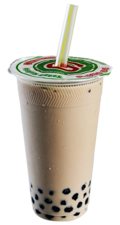
[[File: | [[File:Bubble Tea.png|thumb|Characteristics of boba tea (also known as "bubble tea" or "pearl milk tea") -- the national drink of Taiwan -- are the tapioca balls that rest at the bottom of the beverage that are drunk with a wide straw.]] | ||
A '''national drink''' is a distinct beverage that is strongly associated with a particular country, and can be part of their [[national identity]] and self-image. National drinks fall into two categories: [[alcoholic drink|alcoholic]] and [[Non-alcoholic drink|non-alcoholic]]. An alcoholic national drink is sometimes a liquor drunk straight/neat (e.g., [[Irish whiskey|whiskey]] in [[Ireland]]), but is most often a mixed drink (e.g., | A '''national drink''' is a distinct beverage that is strongly associated with a particular country, and can be part of their [[national identity]] and self-image. National drinks fall into two categories: [[alcoholic drink|alcoholic]] and [[Non-alcoholic drink|non-alcoholic]]. An alcoholic national drink is sometimes a liquor drunk straight/neat (e.g., [[Irish whiskey|whiskey]] in [[Ireland]]), but is most often a mixed drink (e.g., [[Caipirinha|caipirinhas]] in [[Brazil]]), [[beer]], or [[wine]]. A beverage can be considered a national drink for a variety of reasons: | ||
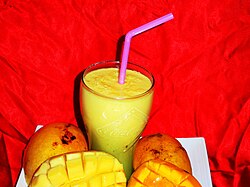
* It is a common drink, made from a selection of locally available foodstuffs that can be prepared in a distinctive way, such as mango lassi that uses | * It is a common drink, made from a selection of locally available foodstuffs that can be prepared in a distinctive way, such as [[Lassi|mango lassi]] that uses dahi, a traditional [[yogurt]] or [[fermented milk product]] originating from the [[Indian subcontinent]], usually prepared from [[A2 milk|cow's milk]], and sometimes [[buffalo milk]], [[goat milk]], or camel's milk.<ref name="Caballero Finglas Toldra 2015">{{cite book|url=https://books.google.com/books?id=O-t9BAAAQBAJ&pg=RA1-PA345|title=Encyclopedia of Food and Health|last1=Caballero|first1=B.|last2=Finglas|first2=P.|last3=Toldra|first3=F.|publisher=Elsevier Science|year=2015|isbn=978-0-12-384953-3|pages=345–351|access-date=December 6, 2017}}</ref> | ||
* It contains a particular 'exotic' ingredient that is produced locally. | * It contains a particular 'exotic' ingredient that is produced locally. | ||
* It is served as a [[Festival|festive]] culinary tradition that forms part of a [[cultural heritage]]. | * It is served as a [[Festival|festive]] culinary tradition that forms part of a [[cultural heritage]]. | ||
* It has been promoted as a national | * It has been promoted as a national drink by the country itself. | ||
In some cases, it may be impossible to settle on a national drink for a particular country. In the realm of food at least, <!--in the reference: Zilkia Janer, a lecturer on[Latin American culture at Hofstra University, says that -->it may be impossible to choose a single national dish, even unofficially, for countries such as [[Mexico]], [[China]], or [[India]] because of their diverse ethnic populations and cultures. | In some cases, it may be impossible to settle on a national drink for a particular country. In the realm of food at least, <!--in the reference: Zilkia Janer, a lecturer on[Latin American culture at Hofstra University, says that -->it may be impossible to choose a single national dish, even unofficially, for countries such as [[Mexico]], [[China]], or [[India]] because of their diverse ethnic populations and cultures. At the other end of the spectrum, and now referring to drinks, sometimes different countries see the same beverage as their national drink (e.g., [[pisco sour]] in [[Peru]] and [[Chile]]). | ||
The national drinks below are categorized within geo-political regions modified from the United Nations' five "regional groups". This list usually does not include [[moonshine]]s or alcoholic beverages produced illicitly.<ref name="Members">{{cite web|url=http://www.un.org/depts/DGACM/RegionalGroups.shtml|title=United Nations Regional Groups of Member States|author=<!--Not stated-->|date=n.d.|website=Department for General Assembly and Conference Management|publisher=United Nations|access-date=5 March 2019}}</ref> | The national drinks below are categorized within geo-political regions modified from the United Nations' five "regional groups". This list usually does not include [[moonshine]]s or alcoholic beverages produced illicitly.<ref name="Members">{{cite web|url=http://www.un.org/depts/DGACM/RegionalGroups.shtml|title=United Nations Regional Groups of Member States|author=<!--Not stated-->|date=n.d.|website=Department for General Assembly and Conference Management|publisher=United Nations|access-date=5 March 2019}}</ref> | ||
| Line 18: | Line 18: | ||
===North=== | ===North=== | ||
*'''{{flag|Canada}}:''' A [[Caesar (cocktail)|Caesar]] is a [[cocktail]] that originated in [[Calgary]], and is widely drunk in all parts of Canada. Similar to a [[Bloody Mary (cocktail)|Bloody Mary]], it contains vodka, a blend of tomato juice, clam broth, hot sauce, and Worcestershire sauce, and is served with ice in a salt-rimmed glass, typically garnished with a stalk of celery and wedge of lime. What distinguishes the two is that only the Caesar contains clam broth. Calgary officially celebrated an anniversary of its creation and launched a national petition for it to be recognized as the official cocktail of Canada.<ref>{{Cite news|url=https://www.winnipegfreepress.com/canada/we-stand-on-guard----for-our-favourite-cocktail-44970142.html|title=We stand on guard – for our favourite cocktail|last=Graveland|first=Bill|date=2009-05-14|work=Winnipeg Free Press|access-date=2019-06-27}}</ref> | *'''{{flag|Canada}}:''' A [[Caesar (cocktail)|Caesar]] is a [[cocktail]] that originated in [[Calgary]], and is widely drunk in all parts of Canada. Similar to a [[Bloody Mary (cocktail)|Bloody Mary]], it contains vodka, a blend of tomato juice, clam broth, hot sauce, and Worcestershire sauce, and is served with ice in a salt-rimmed glass, typically garnished with a stalk of celery and wedge of lime. What distinguishes the two is that only the Caesar contains clam broth. Calgary officially celebrated an anniversary of its creation and launched a national petition for it to be recognized as the official cocktail of Canada.<ref>{{Cite news|url=https://www.winnipegfreepress.com/canada/we-stand-on-guard----for-our-favourite-cocktail-44970142.html|title=We stand on guard – for our favourite cocktail|last=Graveland|first=Bill|date=2009-05-14|work=Winnipeg Free Press|access-date=2019-06-27}}</ref> | ||
*'''{{flag|United States}}:''' [[Coffee]]<ref>[https://www.georgewashingtoninn.com/blog/the-history-of-coffee#:~:text=The%20History%20of%20Coffee%2C%20America's,coffee%20the%20%E2%80%9Cnational%20drink%E2%80%9D. The History of America's "National Drink"], George Washington Inn 25 April 2018. Accessed on 23 February 2021.</ref> was defiantly adopted as an alternative to British tea in the period leading up to the American Revolution. [[Coca-Cola]]<ref>{{Cite web|url=https://www.cnbc.com/2009/11/09/The-Evolution-of-an-American-Icon.html|title = The Evolution of an American Icon|website = [[CNBC]]|date = 9 November 2009}}</ref> is America's iconic soft drink, with the name of the drink referring to two of its original ingredients: [[coca]] leaves and [[kola nut]]s (a source of [[caffeine]]). [[Pepsi]] is another popular soft drink | *'''{{flag|United States}}:''' [[Coffee]]<ref>[https://www.georgewashingtoninn.com/blog/the-history-of-coffee#:~:text=The%20History%20of%20Coffee%2C%20America's,coffee%20the%20%E2%80%9Cnational%20drink%E2%80%9D. The History of America's "National Drink"], George Washington Inn 25 April 2018. Accessed on 23 February 2021.</ref> was defiantly adopted as an alternative to British tea in the period leading up to the American Revolution. [[Coca-Cola]]<ref>{{Cite web|url=https://www.cnbc.com/2009/11/09/The-Evolution-of-an-American-Icon.html|title = The Evolution of an American Icon|website = [[CNBC]]|date = 9 November 2009}}</ref> is America's iconic soft drink, with the name of the drink referring to two of its original ingredients: [[coca]] leaves and [[kola nut]]s (a source of [[caffeine]]). [[Pepsi]] is another popular soft drink. [[Bourbon (whiskey)]],<ref>{{Cite web|url=https://theweek.com/articles/569443/how-bourbon-became-americas-national-spirit|title = The Week: The Latest News, Opinion, Sport, People & Business}}</ref> named for Bourbon County, Kentucky, is a corn whiskey aged in charred oak barrels. It was proclaimed the U.S. National Spirit by an act of Congress in 1964. | ||
*'''{{flag|Mexico}}:''' [[Tequila]] is a liquor distilled from the [[Agave tequilana|blue agave]] plant, primarily in the area surrounding the city of [[Tequila, Jalisco|Tequila]], of the central western [[Mexican state]] of [[Jalisco]]. In 2018, the Mexican government approved a proposal to celebrate every third Saturday of March as National Tequila Day.<ref>{{Cite web|url=https://theculturetrip.com/north-america/mexico/articles/mexicos-senate-just-declared-a-new-national-tequila-day/|title=Mexico's Senate Just Declared a New National Tequila Day|last=Woodman|first=Stephen|website=Culture Trip|date=23 March 2018|access-date=2019-06-28}}</ref> [[Aguas | *'''{{flag|Mexico}}:''' [[Tequila]] is a liquor distilled from the [[Agave tequilana|blue agave]] plant, primarily in the area surrounding the city of [[Tequila, Jalisco|Tequila]], of the central western [[Mexican state]] of [[Jalisco]]. In 2018, the Mexican government approved a proposal to celebrate every third Saturday of March as National Tequila Day.<ref>{{Cite web|url=https://theculturetrip.com/north-america/mexico/articles/mexicos-senate-just-declared-a-new-national-tequila-day/|title=Mexico's Senate Just Declared a New National Tequila Day|last=Woodman|first=Stephen|website=Culture Trip|date=23 March 2018|access-date=2019-06-28}}</ref> [[Aguas frescas]] are also quite popular, two notable ones being [[Hibiscus tea|Jamaica]] and [[horchata]]. A [[margarita]] is another notable drink containing tequila. | ||
===Central and South=== | ===Central and South=== | ||
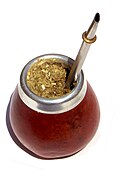
[[File:Mate en calabaza.jpg|thumb|200px|[[Mate (drink)|Mate]], a traditional beverage in southern [[South America]], especially in [[Argentina]], [[Paraguay]], and [[Uruguay]]]] | [[File:Mate en calabaza.jpg|thumb|200px|[[Mate (drink)|Mate]], a traditional beverage in southern [[South America]], especially in [[Argentina]], [[Paraguay]], and [[Uruguay]]]] | ||
*'''{{flag|Antigua and Barbuda}}:''' | *'''{{flag|Antigua and Barbuda}}:''' [[Rum]] | ||
*'''{{flag|Argentina}}:''' [[mate (drink)|Mate]] | *'''{{flag|Argentina}}:''' [[mate (drink)|Mate]]. [[Wine]].<ref>{{cite web|url=https://www.argentina.gob.ar/agricultura/vino-argentino|access-date= 1 May 2023|title=Vino argentino}}</ref> ''Fernet con coca'' is a cocktail that consists in [[Cola]] and [[Fernet]] on ice. It is usually prepared with [[Coca-Cola]] and [[Fernet Branca]]. The fernet with cola was created in the city of [[Provincia de Córdoba (Argentina)|Córdoba]] and is an emblem of that province. [[Hesperidina]] | ||
*'''{{flag|Bahamas}}:''' [[Switcha]] | *'''{{flag|Bahamas}}:''' [[Switcha]] | ||
*'''{{flag|Barbados}}:''' | *'''{{flag|Barbados}}:''' [[Mauby]] | ||
*'''{{flag|Belize}}:''' | *'''{{flag|Belize}}:''' Rum [[Punch (drink)|Punch]] | ||
*'''{{flag|Bermuda}}:''' [[Rum swizzle]]<ref>{{cite web|url=https://www.smithsonianmag.com/travel/story-behind-bermudas-rum-swizzle-cocktail-180971701/|title=The Story Behind Bermuda's Rum Swizzle (Recipe)|first=Jennifer|last=Nalewicki|date=March 15, 2019|work=[[Smithsonian (magazine)|Smithsonian]]|access-date=11 June 2019}}</ref><ref>{{cite web|url=https://www.floridatoday.com/story/entertainment/dining/2017/10/25/heres-how-swizzle-national-cocktail-bermuda/799505001/|title=Cheers! Here's how to swizzle the national cocktail of Bermuda|first=Christina | last=Jordan | date=October 25, 2017 | work=[[Florida Today]]|access-date=11 June 2019 | quote= The Rum Swizzle is probably the most well known swizzled cocktail. It’s the national drink of Bermuda and uses Bermuda Rum. }}</ref> | *'''{{flag|Bermuda}}:''' [[Rum swizzle]],<ref>{{cite web|url=https://www.smithsonianmag.com/travel/story-behind-bermudas-rum-swizzle-cocktail-180971701/|title=The Story Behind Bermuda's Rum Swizzle (Recipe)|first=Jennifer|last=Nalewicki|date=March 15, 2019|work=[[Smithsonian (magazine)|Smithsonian]]|access-date=11 June 2019}}</ref><ref>{{cite web|url=https://www.floridatoday.com/story/entertainment/dining/2017/10/25/heres-how-swizzle-national-cocktail-bermuda/799505001/|title=Cheers! Here's how to swizzle the national cocktail of Bermuda|first=Christina | last=Jordan | date=October 25, 2017 | work=[[Florida Today]]|access-date=11 June 2019 | quote= The Rum Swizzle is probably the most well known swizzled cocktail. It’s the national drink of Bermuda and uses Bermuda Rum. }}</ref> [[Dark 'n' Stormy|Dark N' Stormy]] (Only classified as such if made with [[Gosling Brothers|Gosling's Dark Rum]] only made in Bermuda.) | ||
*'''{{flag|Bolivia |name=Bolivia (Plurinational State of)}}:''' [[Chuflay]], [[Singani]] | *'''{{flag|Bolivia |name=Bolivia (Plurinational State of)}}:''' [[Chuflay]], [[Singani]] | ||
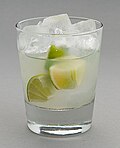
*'''{{flag|Brazil}}:''' [[Caipirinha]] is a well-known cocktail made of cachaça, lime, and sugar,<ref name=":2"/><ref name=":1"/><ref name=":0"/> while Guaraná is a carbonated soft drink made from a fruit originating in Amazonia. | *'''{{flag|Brazil}}:''' [[Caipirinha]] is a well-known cocktail made of cachaça, lime, and sugar,<ref name=":2"/><ref name=":1"/><ref name=":0"/> while Guaraná is a carbonated soft drink made from a fruit originating in Amazonia. | ||
| Line 34: | Line 34: | ||
*'''{{flag|Chile}}:''' [[Pisco sour]] | *'''{{flag|Chile}}:''' [[Pisco sour]] | ||
*'''{{flag|Colombia}}:''' [[Aguardiente]], [[coffee]] | *'''{{flag|Colombia}}:''' [[Aguardiente]], [[coffee]] | ||
*'''{{flag|Costa Rica}}:''' [[Imperial (beer)|Imperial]] | *'''{{flag|Costa Rica}}:''' [[Imperial (beer)|Imperial]], [[Guaro Cacique]]. | ||
*'''{{flag|Cuba}}:''' [[Cuba Libre]], [[Mojito]], [[Daiquiri]] | *'''{{flag|Cuba}}:''' [[Cuba Libre]], [[Mojito]], [[Daiquiri]] | ||
*'''{{flag|Dominica}}:''' [[Mama Juana]] | *'''{{flag|Dominica}}:''' [[Mama Juana]] | ||
| Line 40: | Line 40: | ||
*'''{{flag|Ecuador}}:''' [[Chicha]] | *'''{{flag|Ecuador}}:''' [[Chicha]] | ||
*'''{{flag|El Salvador}}:''' [[Pilsener]], [[Champagne cola]]{{citation needed|date=May 2022}} | *'''{{flag|El Salvador}}:''' [[Pilsener]], [[Champagne cola]]{{citation needed|date=May 2022}} | ||
*'''{{flag|Grenada}}:''' | *'''{{flag|Grenada}}:''' Rum [[Punch (drink)|Punch]] | ||
*'''{{flag|Guatemala}}:''' [[Gallo (beer)|Gallo]] | *'''{{flag|Guatemala}}:''' [[Gallo (beer)|Gallo]] | ||
*'''{{flag|Guyana}}:''' | *'''{{flag|Guyana}}:''' [[Mauby]] | ||
*'''{{flag|Haiti}}:''' Barbancourt is a [[Rhum agricole|rum]] produced and bottled in [[Haiti]] by Société du Rhum Barbancourt, one Haiti's oldest companies. It is made by distillation of sugar cane juice rather than the sugar cane by-product [[molasses]]. Fermentation of fresh sugar cane juice is considered to provide a more flavorful product.<ref>{{Cite news|url=https://www.latimes.com/archives/la-xpm-2010-feb-09-la-fg-haiti-rum9-2010feb09-story.html|title=In Haiti, a rum everyone can agree on|date=2010-02-09|work=Los Angeles Times|access-date=2019-07-03|language=en-US|issn=0458-3035}}</ref> | *'''{{flag|Haiti}}:''' [[Rhum Barbancourt|Barbancourt]] is a [[Rhum agricole|rum]] produced and bottled in [[Haiti]] by Société du Rhum Barbancourt, one Haiti's oldest companies. It is made by distillation of sugar cane juice rather than the sugar cane by-product [[molasses]]. Fermentation of fresh sugar cane juice is considered to provide a more flavorful product.<ref>{{Cite news|url=https://www.latimes.com/archives/la-xpm-2010-feb-09-la-fg-haiti-rum9-2010feb09-story.html|title=In Haiti, a rum everyone can agree on|date=2010-02-09|work=Los Angeles Times|access-date=2019-07-03|language=en-US|issn=0458-3035}}</ref> | ||
*'''{{flag|Honduras}}:''' [[Pinol]] | *'''{{flag|Honduras}}:''' [[Pinol]] | ||
*'''{{flag|Jamaica}}:''' | *'''{{flag|Jamaica}}:''' Rum [[Punch (drink)|Punch]] | ||
*'''{{flag|Nicaragua}}:''' [[Macuá]] | *'''{{flag|Nicaragua}}:''' [[Macuá]] | ||
*'''{{flag|Panama}}:''' [[Seco Herrerano]] | *'''{{flag|Panama}}:''' [[Seco Herrerano]] | ||
*'''{{flag|Paraguay}}:''' [[mate (drink)|Mate]] is an infusion that is prepared by soaking dried [[yerba mate]] leaves in hot water and served with a metal straw and a hollow [[calabash]]. This is served and shared in the round, making it an integral part of society. Its origin is shared with Argentina and Uruguay. | *'''{{flag|Paraguay}}:''' [[mate (drink)|Mate]] is an infusion that is prepared by soaking dried [[yerba mate]] leaves in hot water and served with a metal straw and a hollow [[calabash]]. This is served and shared in the round, making it an integral part of society. Its origin is shared with Argentina and Uruguay. [[Carrulim]] is an alcoholic beverage made from caña blanca paraguaya, [[rue]], sugar and lemon juice. | ||
*'''{{flag|Peru}}:''' [[Pisco sour|Pisco sour's]]'''<ref name=":0" /><ref name=":1" /><ref name=":2" />''' name comes from ''[[pisco]]'', which is its base liquor, and the cocktail term ''[[Sour (cocktail)|sour]]'', in reference to sour citrus juice and sweetener components. The drink originated in the city of [[Pisco, Peru|Pisco]]. [[Inca Kola]], a lemon verbena based soda, is also popular. | *'''{{flag|Peru}}:''' [[Pisco sour|Pisco sour's]]'''<ref name=":0" /><ref name=":1" /><ref name=":2" />''' name comes from ''[[pisco]]'', which is its base liquor, and the cocktail term ''[[Sour (cocktail)|sour]]'', in reference to sour citrus juice and sweetener components. The drink originated in the city of [[Pisco, Peru|Pisco]]. [[Inca Kola]], a lemon verbena based soda, is also popular. | ||
*'''{{flag|Puerto Rico}} (US):''' [[Pina colada]] | *'''{{flag|Puerto Rico}} (US):''' [[Pina colada]] | ||
*'''{{flag|Saint Kitts and Nevis}}:''' | *'''{{flag|Saint Kitts and Nevis}}:''' [[Rum]] | ||
*'''{{flag|Saint Lucia}}:''' | *'''{{flag|Saint Lucia}}:''' Bounty brand [[Rum]] | ||
*'''{{flag|Saint Vincent and the Grenadines}}:''' | *'''{{flag|Saint Vincent and the Grenadines}}:''' Golden [[Apple juice|Apple Juice]] | ||
*'''{{flag|Suriname}}:''' | *'''{{flag|Suriname}}:''' [[Kasiri]] | ||
*'''{{flag|Trinidad and Tobago}}:''' | *'''{{flag|Trinidad and Tobago}}:''' [[Queen's Park Swizzle]] | ||
*'''{{flag|Uruguay}}:''' [[mate (drink)|Mate]] | *'''{{flag|Uruguay}}:''' [[mate (drink)|Mate]]. [[Half and half#Uruguay|medio y medio]], uvita (a type of fortified wine), [[grappamiel]], amarga (a kind of bitter or [[Amaro (liqueur)|amaro]] made of local herbs), [[schnaps]] made from local caña or grappa. | ||
*'''{{flag|Venezuela |name=Venezuela (Bolivarian Republic of)}}:''' Rum, tizana | *'''{{flag|Venezuela |name=Venezuela (Bolivarian Republic of)}}:''' Rum, tizana | ||
| Line 62: | Line 62: | ||
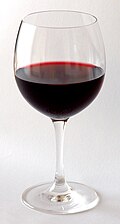
[[File:Red Wine Glass.jpg|thumb|200px|Red wine is popular in many European countries, notably [[France]] and [[Italy]].]] | [[File:Red Wine Glass.jpg|thumb|200px|Red wine is popular in many European countries, notably [[France]] and [[Italy]].]] | ||
[[File:Shops in Baščaršija, September, 2017.jpg|thumb|200px|Bosnian Coffee accessory manufacturers' small shops in [[Baščaršija]] - drink is important part of country's culture, and was major part of its economy in the past.]] | [[File:Shops in Baščaršija, September, 2017.jpg|thumb|200px|Bosnian Coffee accessory manufacturers' small shops in [[Baščaršija]] - drink is important part of country's culture, and was major part of its economy in the past.]] | ||
The "[[Alcohol belts of Europe|beer belt]]" in Europe includes Germany, the UK, and Ireland, whereas the "[[Alcohol belts of Europe|wine belt]]" includes the Mediterranean countries like Spain, Italy, and Greece. Several drinks are common and particular to Slavic countries. [[Vodka]] is a clear alcoholic beverage made most often by distilling the liquid from fermented [[cereal grains]] and potatoes. Countries where vodka is identified as a national beverage have been referred to as the "[[Vodka Belt|vodka belt]]". [[Kvass]] is a traditional fermented non-alcoholic beverage commonly made from rye bread and is drank in many Slavic countries, as well as [[Latvia]] and [[Lithuania]]. [[Kompot]] is another drink that is traditionally popular throughout this region and made by boiling together different fruit including [[Strawberry|strawberries]], [[apricot]]s, [[peach]]es, [[apple]]s, and [[raisin]]s in large volume of water and served hot or cold, depending on tradition and season. [[Fruit brandy|Fruit brandies]] are popular in the [[Balkans]], while [[Brännvin]] and [[Akvavit]] are popular in Scandinavia. | The "[[Alcohol belts of Europe|beer belt]]" in Europe includes Belgium, Germany, the UK, and Ireland, whereas the "[[Alcohol belts of Europe|wine belt]]" includes the Mediterranean countries like Spain, Italy, and Greece. Several drinks are common and particular to Slavic countries. [[Vodka]] is a clear alcoholic beverage made most often by distilling the liquid from fermented [[cereal grains]] and potatoes. Countries where vodka is identified as a national beverage have been referred to as the "[[Vodka Belt|vodka belt]]". [[Kvass]] is a traditional fermented non-alcoholic beverage commonly made from rye bread and is drank in many Slavic countries, as well as [[Latvia]] and [[Lithuania]]. [[Kompot]] is another drink that is traditionally popular throughout this region and made by boiling together different fruit including [[Strawberry|strawberries]], [[apricot]]s, [[peach]]es, [[apple]]s, and [[raisin]]s in large volume of water and served hot or cold, depending on tradition and season. [[Fruit brandy|Fruit brandies]] are popular in the [[Balkans]], while [[Brännvin]] and [[Akvavit]] are popular in Scandinavia. | ||
[[File:Vodka with pickled cucumber.jpg|thumb|Clear [[vodka]] served with [[pickled cucumber]] – the usual way of consuming it in Slavic{{citation needed|date=May 2022}} countries of the so-called "[[vodka belt]]".]] | [[File:Vodka with pickled cucumber.jpg|thumb|Clear [[vodka]] served with [[pickled cucumber]] – the usual way of consuming it in Slavic{{citation needed|date=May 2022}} countries of the so-called "[[vodka belt]]".]] | ||
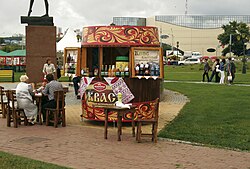
[[File:Бочка кваса Белгород.jpg|thumb|A kvass street vendor in [[Belgorod]], Russia, 2013]] | [[File:Бочка кваса Белгород.jpg|thumb|A kvass street vendor in [[Belgorod]], Russia, 2013]] | ||
[[File:Glencairn Whisky Glass.jpg|thumb|alt=|213x213px|A [[Glencairn whisky glass|Glencairn whisky]] glass. ]] | [[File:Glencairn Whisky Glass.jpg|thumb|alt=|213x213px|A [[Glencairn whisky glass|Glencairn whisky]] glass. ]] | ||
*'''{{flag|Albania}}:''' [[Rakia|Raki]] | *'''{{flag|Albania}}:''' [[Rakia|Raki]] | ||
*'''{{flag|Andorra}}:''' | *'''{{flag|Andorra}}:''' Catalan [[Brandy]], [[Wine]] | ||
*'''{{flag|Austria}}:''' [[Almdudler]] | *'''{{flag|Austria}}:''' [[Almdudler]] | ||
*'''{{flag|Belarus}}:''' [[Byarozavik]] is a traditional Belarusian drink made from birch sap, achieving widespread popularity in the Soviet Union before undergoing a modern resurgence. | *'''{{flag|Belarus}}:''' [[Byarozavik]] is a traditional Belarusian drink made from birch sap, achieving widespread popularity in the Soviet Union before undergoing a modern resurgence. | ||
| Line 75: | Line 75: | ||
*'''{{flag|Croatia}}:''' [[Rakija]], [[Pelinkovac]] | *'''{{flag|Croatia}}:''' [[Rakija]], [[Pelinkovac]] | ||
*'''{{flag|Cyprus}}:''' [[Zivania]], [[Brandy sour]] (unofficial) | *'''{{flag|Cyprus}}:''' [[Zivania]], [[Brandy sour]] (unofficial) | ||
*'''{{flag|Czech Republic}}:''' [[Pilsner]] is a pale lager originating in [[Plzeň]]. | *'''{{flag|Czech Republic}}:''' [[Kofola]],<ref>{{Cite web |last=Mersom |first=Daryl |title=The Cold War-era drink that rivals cola |url=https://www.bbc.com/travel/article/20190329-the-cold-war-era-drink-that-rivals-cola |access-date=2022-12-07 |website=www.bbc.com |language=en}}</ref> [[Pilsner]] is a pale lager originating in [[Plzeň]]. | ||
*'''{{flag|Denmark}}:''' [[ | *'''{{flag|Denmark}}:''' [[Akvavit|Akavit]], [[Brännvin]], [[Snaps]], [[Gammel Dansk]]<ref>{{cite web | url=https://www.insureandgo.com/blog/food-and-drink/6-national-drinks-that-will-make-you-a-little-squiffy/ | title=6 national drinks that will make you a little squiffy | date=22 March 2013 }}</ref> | ||
*'''{{flag|Estonia}}:''' [[Viru Valge]], ''koduõlu'' ([[Homebrewing|homebrew beer]]), ''[[Kama (food)|kama]]'' <!--Estonians neither associate with, nor rarely ever consume, kvass or "Vana Tallinn"; the latter has been apparently a well-known and popular sought-after "Estonian souvenir" for Russian tourists--> | *'''{{flag|Estonia}}:''' [[Viru Valge]], ''koduõlu'' ([[Homebrewing|homebrew beer]]), ''[[Kama (food)|kama]]'' <!--Estonians neither associate with, nor rarely ever consume, kvass or "Vana Tallinn"; the latter has been apparently a well-known and popular sought-after "Estonian souvenir" for Russian tourists--> | ||
*'''{{flag|Finland}}:''' [[Lonkero]]<ref>{{Cite web|url=https://scandasia.com/finnish-hartwall-original-long-drink-now-in-hong-kong/|title=Finnish Hartwall Original Long Drink now in Hong Kong|website=ScandAsia|author=Joakim Persson |date=November 6, 2016|access-date=August 21, 2020}}</ref> | *'''{{flag|Finland}}:''' [[Lonkero]]<ref>{{Cite web|url=https://scandasia.com/finnish-hartwall-original-long-drink-now-in-hong-kong/|title=Finnish Hartwall Original Long Drink now in Hong Kong|website=ScandAsia|author=Joakim Persson |date=November 6, 2016|access-date=August 21, 2020}}</ref> | ||
*'''{{flag|France}}:''' [[Red wine]] is a type of [[wine]] made from dark-colored (black) [[grape varieties]].<ref name="auto1">{{Cite web|url=https://www.foodandwine.com/fwx/drink/32-officialish-drinks-every-country-playing-world-cup|title=32 Official(ish) Drinks for Every Country Playing in the World Cup|website=Food & Wine|language=en|access-date=2019-05-19}}</ref><ref name="auto2">{{Cite web|url=https://www.thedailymeal.com/drink/signature-drink-every-country-world-cup-gallery|title=The Signature Drink of Every Country in the World Cup Gallery|last=Rose|first=Jeremy|date=2018-06-14|website=The Daily Meal|language=en|access-date=2019-05-19}}</ref> Champagne is the typical white wine of France. | *'''{{flag|France}}:''' [[Red wine]] is a type of [[wine]] made from dark-colored (black) [[grape varieties]].<ref name="auto1">{{Cite web|url=https://www.foodandwine.com/fwx/drink/32-officialish-drinks-every-country-playing-world-cup|title=32 Official(ish) Drinks for Every Country Playing in the World Cup|website=Food & Wine|language=en|access-date=2019-05-19}}</ref><ref name="auto2">{{Cite web|url=https://www.thedailymeal.com/drink/signature-drink-every-country-world-cup-gallery|title=The Signature Drink of Every Country in the World Cup Gallery|last=Rose|first=Jeremy|date=2018-06-14|website=The Daily Meal|language=en|access-date=2019-05-19}}</ref> Champagne is the typical white wine of France. | ||
*'''{{flag|Germany}}:''' [[Lager]],<ref name="auto2"/><ref name="auto1"/> [[Fanta]]<ref name="auto3">{{Cite web|url=https://www.cnn.com/travel/article/most-delicious-drinks-world/index.html|title=World's 50 most delicious drinks|first=Tim |last=Cheung|date=2017-07-12|website=CNN Travel|language=en|access-date=2019-05-20}}</ref> | *'''{{flag|Germany}}:''' [[Lager]],<ref name="auto2"/><ref name="auto1"/> [[Fanta]],<ref name="auto3">{{Cite web|url=https://www.cnn.com/travel/article/most-delicious-drinks-world/index.html|title=World's 50 most delicious drinks|first=Tim |last=Cheung|date=2017-07-12|website=CNN Travel|language=en|access-date=2019-05-20}}</ref> [[Spezi]]<ref>{{Cite news |last=Sloat |first=Christopher Alessi and Sarah |title=Germans Love Spezi, the 'Swamp Juice' Soda. Will Anyone Else? |language=en-US |work=WSJ |url=https://www.wsj.com/articles/germans-love-spezi-the-swamp-juice-soda-will-anyone-else-1457542759 |access-date=2022-12-07}}</ref> | ||
*'''{{flag|Georgia}}:''' [[Chacha (brandy)|Chacha]] and [[Georgian wine|Red wine]] | *'''{{flag|Georgia}}:''' [[Chacha (brandy)|Chacha]] and [[Georgian wine|Red wine]] | ||
*'''{{flag|Greece}}:''' [[Ouzo]] is a dry [[anise]]-flavoured [[Apéritif and digestif|aperitif]] that is widely consumed in [[Greece]] and [[Cyprus]].<ref name="auto4">{{Cite web|url=https://www.businessinsider.com/most-popular-drink-in-80-world-countries-2013-12|title=The Most Iconic Beverage In 80 Countries Around The World|last=Willett|first=Megan|website=Business Insider|access-date=2019-05-19}}</ref><ref name="auto1"/><ref name="auto2"/> | *'''{{flag|Greece}}:''' [[Ouzo]] is a dry [[anise]]-flavoured [[Apéritif and digestif|aperitif]] that is widely consumed in [[Greece]] and [[Cyprus]].<ref name="auto4">{{Cite web|url=https://www.businessinsider.com/most-popular-drink-in-80-world-countries-2013-12|title=The Most Iconic Beverage In 80 Countries Around The World|last=Willett|first=Megan|website=Business Insider|access-date=2019-05-19}}</ref><ref name="auto1"/><ref name="auto2"/> | ||
| Line 86: | Line 86: | ||
*'''{{flag|Iceland}}:''' [[Brennivín]], [[Appelsín]]{{citation needed|date=May 2022}} | *'''{{flag|Iceland}}:''' [[Brennivín]], [[Appelsín]]{{citation needed|date=May 2022}} | ||
*'''{{flag|Ireland}}:''' [[Guinness]] is a [[Dark beer|dark]] [[Irish beer|Irish]] [[Stout|dry stout]].<ref>{{Cite web|url=https://www.prnewswire.com/news-releases/famous-brewer-expands-with-national-launch-of-guinness-black-lager-128316313.html|title=Famous Brewer Expands with National Launch of GUINNESS® Black Lager|last=GUINNESS®|website=www.prnewswire.com|language=en|access-date=2019-05-19}}</ref><ref>{{Cite news|url=https://www.economist.com/the-economist-explains/2014/03/16/why-guinness-is-less-irish-than-you-think|title=Why Guinness is less Irish than you think|date=2014-03-16|newspaper=The Economist|access-date=2019-05-19|issn=0013-0613}}</ref> [[Irish whiskey]] is also popular. | *'''{{flag|Ireland}}:''' [[Guinness]] is a [[Dark beer|dark]] [[Irish beer|Irish]] [[Stout|dry stout]].<ref>{{Cite web|url=https://www.prnewswire.com/news-releases/famous-brewer-expands-with-national-launch-of-guinness-black-lager-128316313.html|title=Famous Brewer Expands with National Launch of GUINNESS® Black Lager|last=GUINNESS®|website=www.prnewswire.com|language=en|access-date=2019-05-19}}</ref><ref>{{Cite news|url=https://www.economist.com/the-economist-explains/2014/03/16/why-guinness-is-less-irish-than-you-think|title=Why Guinness is less Irish than you think|date=2014-03-16|newspaper=The Economist|access-date=2019-05-19|issn=0013-0613}}</ref> [[Irish whiskey]] is also popular. | ||
*'''{{flag|Italy}}:''' [[Chinotto (drink)|Chinotto]] is a type of [[Soft drink|carbonated soft drink]] produced from the juice of the fruit of the [[Citrus myrtifolia|myrtle-leaved orange tree]] (''Citrus myrtifolia''); [[Wine]]; [[Grappa]]; [[Espresso]]; [[Cappuccino]] | *'''{{flag|Italy}}:''' [[Chinotto (drink)|Chinotto]] is a type of [[Soft drink|carbonated soft drink]] produced from the juice of the fruit of the [[Citrus myrtifolia|myrtle-leaved orange tree]] (''Citrus myrtifolia''); [[Wine]]; [[Spritz (cocktail)|Spritz]]; [[Grappa]]; [[Espresso]]; [[Cappuccino]] | ||
*''{{flag|Kosovo}}:'' [[Rakia]] and Semoj, fermented cabbage juice | *''{{flag|Kosovo}}:'' [[Rakia]] and Semoj, fermented cabbage juice | ||
*'''{{flag|Latvia}}:''' [[Riga Black Balsam]]<ref>{{Cite magazine |url=https://chilledmagazine.com/the-global-sip-riga-black-balsam |author=Katy Spratte Joyce |year=2020 |title=The Global Sip: Riga Black Balsam: Latvia's funky, herby liqueur |magazine=Chilled |access-date=January 22, 2021}}</ref> | *'''{{flag|Latvia}}:''' [[Riga Black Balsam]]<ref>{{Cite magazine |url=https://chilledmagazine.com/the-global-sip-riga-black-balsam |author=Katy Spratte Joyce |year=2020 |title=The Global Sip: Riga Black Balsam: Latvia's funky, herby liqueur |magazine=Chilled |access-date=January 22, 2021}}</ref> | ||
*'''{{flag|Liechtenstein}}:''' | *'''{{flag|Liechtenstein}}:''' [[Pinot noir|Blauburgunder]] | ||
*'''{{flag|Lithuania}}:''' [[Midus]], [[Gira]] | *'''{{flag|Lithuania}}:''' [[Midus]], [[Gira]] | ||
*'''{{flag|Luxembourg}}:''' | *'''{{flag|Luxembourg}}:''' [[Sparkling wine|Crémant]] de Luxembourg | ||
*'''{{flag|Malta}}:''' [[Kinnie]],<ref>{{Cite book|url=https://books.google.com/books?id=WmKKCwAAQBAJ&q=kinnie+malta&pg=PA66|title = Malta and Gozo|isbn = 9781784770259|last1 = Rix|first1 = Juliet|date = 3 December 2015}}</ref> Bajtra liqueur (unofficial), cactus pear liquor, Maltese falcon | *'''{{flag|Malta}}:''' [[Kinnie]],<ref>{{Cite book|url=https://books.google.com/books?id=WmKKCwAAQBAJ&q=kinnie+malta&pg=PA66|title = Malta and Gozo|isbn = 9781784770259|last1 = Rix|first1 = Juliet|date = 3 December 2015}}</ref> Bajtra liqueur (unofficial), cactus pear liquor, Maltese falcon | ||
*'''{{flag|Moldova|name=Moldova}}:''' | *'''{{flag|Moldova|name=Moldova}}:''' Divin (Distilled Wine, portmanteau of Distilat de Vin) | ||
*'''{{flag|Monaco}}:''' | *'''{{flag|Monaco}}:''' [[Champagne]] | ||
*'''{{flag|Montenegro}}:''' | *'''{{flag|Montenegro}}:''' [[Rakia|Rakija]] | ||
*'''{{flag|Netherlands}}:''' [[Jenever]] | *'''{{flag|Netherlands}}:''' [[Jenever]] | ||
*'''{{flag|North Macedonia}}:''' [[Rakija]], [[Boza]] | *'''{{flag|North Macedonia}}:''' [[Rakija]], [[Boza]] | ||
*'''{{flag|Norway}}:''' [[Akvavit]], [[Solo (Norwegian soft drink)|Solo]] | *'''{{flag|Norway}}:''' [[Akvavit]], [[Solo (Norwegian soft drink)|Solo]] | ||
*'''{{flag|Poland}}''': | *'''{{flag|Poland}}''': [[Vodka]] is regarded a national beverage as some sources consider it to have originated in Poland, dating back to 15th century.<ref name="KRPS">{{cite web|url=http://krps.pl/index.php?option=com_content&task=view&id=17&Itemid=27|title=History of vodka production, at the official page of Polish Spirit Industry Association (KRPS), 2007|language=pl|archive-url=https://web.archive.org/web/20070930131416/http://krps.pl/index.php?option=com_content&task=view&id=17&Itemid=27|archive-date=30 September 2007}}</ref> Other distinctive alcoholic drinks feature [[żubrówka|bison grass vodka]], [[krupnik]], variety of traditional tinctures ([[nalewka]]) like [[piołunówka]], along with traditional [[mead in Poland|Polish meads]]. | ||
*'''{{flag|Portugal}}:''' [[Port wine]] is a sweet [[Portuguese wine|Portuguese]] [[fortified wine]] produced with distilled grape spirits in the [[Douro|Douro Valley]] in the [[Norte, Portugal|northern provinces]] of Portugal and is commonly served as a [[dessert wine]].<ref>{{Cite web|url=https://portugal.com/portugal-blogs/porto-wine|title=Porto wine – Made in Portugal|website=Portugal.com|date=3 February 2018|language=en-US|access-date=2019-06-21}}</ref> There are also distinct sorts of non port [[portuguese wine]]s produced in particular regions.<ref>{{Cite web|url=https://www.forbes.com/sites/courtneyschiessl/2019/02/28/portuguese-wines-for-every-palate/|title=Portuguese Wines For Every Palate|last=Schiessl|first=Courtney|website=Forbes|language=en|access-date=2019-06-21}}</ref> | *'''{{flag|Portugal}}:''' [[Port wine]] is a sweet [[Portuguese wine|Portuguese]] [[fortified wine]] produced with distilled grape spirits in the [[Douro|Douro Valley]] in the [[Norte, Portugal|northern provinces]] of Portugal and is commonly served as a [[dessert wine]].<ref>{{Cite web|url=https://portugal.com/portugal-blogs/porto-wine|title=Porto wine – Made in Portugal|website=Portugal.com|date=3 February 2018|language=en-US|access-date=2019-06-21}}</ref> There are also distinct sorts of non port [[portuguese wine]]s produced in particular regions.<ref>{{Cite web|url=https://www.forbes.com/sites/courtneyschiessl/2019/02/28/portuguese-wines-for-every-palate/|title=Portuguese Wines For Every Palate|last=Schiessl|first=Courtney|website=Forbes|language=en|access-date=2019-06-21}}</ref> | ||
*'''{{flag|Romania}}:''' [[Țuică]], sometimes referred to as "white lightning" due to its clarity and potency, is a plum [[fruit brandy]], that is distilled in a [[brass]] [[still]], using traditional fire sources such as wood and charcoal. Țuică is traditionally drank prior to meals and at celebrations.<ref>{{Cite journal|last=Stein|first=Max|date=December 6, 2012|title=Tuica – Romania's White Lightning|url=https://www.thedrinksbusiness.com/2012/12/tuica-romanias-white-lightning/|journal=The Drinks Business}}</ref> | *'''{{flag|Romania}}:''' [[Țuică]], sometimes referred to as "white lightning" due to its clarity and potency, is a plum [[fruit brandy]], that is distilled in a [[brass]] [[still]], using traditional fire sources such as wood and charcoal. Țuică is traditionally drank prior to meals and at celebrations.<ref>{{Cite journal|last=Stein|first=Max|date=December 6, 2012|title=Tuica – Romania's White Lightning|url=https://www.thedrinksbusiness.com/2012/12/tuica-romanias-white-lightning/|journal=The Drinks Business}}</ref> | ||
*'''{{flag|Russia}}:''' [[Kvass]] is a traditional [[fermented]] non-alcoholic beverage commonly made from [[rye bread]], and while kvass is seen as the national non-alcoholic drink, it is [[vodka]] that most Russians identify as their national alcoholic beverage.<ref name="Ermochkine 2003">Ermochkine, Nicholas and Iglikowski, Peter (2003). ''40 degrees east: an anatomy of vodka'', Nova Publishers, p. 65, {{ISBN|1-59033-594-5}}.</ref> | *'''{{flag|Russia}}:''' [[Kvass]] is a traditional [[fermented]] non-alcoholic beverage commonly made from [[rye bread]], and while kvass is seen as the national non-alcoholic drink, it is [[vodka]] that most Russians identify as their national alcoholic beverage.<ref name="Ermochkine 2003">Ermochkine, Nicholas and Iglikowski, Peter (2003). ''40 degrees east: an anatomy of vodka'', Nova Publishers, p. 65, {{ISBN|1-59033-594-5}}.</ref> | ||
*'''{{flag|San Marino}}:''' | *'''{{flag|San Marino}}:''' Biancale | ||
*'''{{flag|Serbia}}:''' [[Rakia|Rakija]]. | *'''{{flag|Serbia}}:''' [[Rakia|Rakija]]. | ||
*'''{{flag|Slovakia}}: '''[[Borovička]] is a juniper alcoholic spirit. | *'''{{flag|Slovakia}}: '''[[Borovička]] is a juniper alcoholic spirit. | ||
*'''{{flag|Slovenia}}:''' [[Schnapps]]{{citation needed|date=May 2022}} | *'''{{flag|Slovenia}}:''' [[Schnapps]]{{citation needed|date=May 2022}} | ||
*'''{{flag|Spain}}:''' A [[Punch (drink)|punch]], [[sangria]] traditionally consists of [[red wine]] and chopped fruit, often with other ingredients such as [[orange juice]] or [[brandy]].<ref name=":1" /><ref name=":0" /> | *'''{{flag|Spain}}:''' A [[Punch (drink)|punch]], [[sangria]] traditionally consists of [[red wine]] and chopped fruit, often with other ingredients such as [[orange juice]] or [[brandy]].<ref name=":1" /><ref name=":0" /> | ||
*'''{{flag|Sweden}}:''' [[Brännvin]], [[Punsch]],<ref>{{Cite web|url=http://www.aperitifklubben.se/fakta_punsch1.htm|title=Populär punch|website=www.aperitifklubben.se|access-date=2019-12-26}}</ref> [[Akvavit]] | *'''{{flag|Sweden}}:''' [[Brännvin]], [[Punsch]],<ref>{{Cite web|url=http://www.aperitifklubben.se/fakta_punsch1.htm|title=Populär punch|website=www.aperitifklubben.se|access-date=2019-12-26}}</ref> [[Akvavit]], [[Julmust]], [[Pommac]], [[Champis]] | ||
*'''{{flag|Switzerland}}:''' [[Rivella]]. | *'''{{flag|Switzerland}}:''' [[Rivella]]. | ||
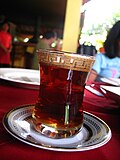
[[File:Rize tea.JPG|thumb| [[List of countries by tea consumption per capita|Per capita, Turkey drinks more tea than any other nation.]]]] | [[File:Rize tea.JPG|thumb| [[List of countries by tea consumption per capita|Per capita, Turkey drinks more tea than any other nation.]]]] | ||
| Line 120: | Line 120: | ||
[[File:ET Amhara asv2018-02 img077 Lake Tana at Bahir Dar.jpg|thumb|A ''berele'' glass containing tej, which is a [[mead]] or honey wine brewed and consumed in [[Ethiopia]].|alt=|263x263px]] | [[File:ET Amhara asv2018-02 img077 Lake Tana at Bahir Dar.jpg|thumb|A ''berele'' glass containing tej, which is a [[mead]] or honey wine brewed and consumed in [[Ethiopia]].|alt=|263x263px]] | ||
*'''{{flag|Algeria}}:''' [[Tea]] | *'''{{flag|Algeria}}:''' [[Coffee]], [[Tea]] | ||
*'''{{flag|Angola}}:''' | *'''{{flag|Angola}}:''' [[Cuca beer|Cuca Beer]] | ||
*'''{{flag|Benin}}:''' | *'''{{flag|Benin}}:''' [[Sodabi]] | ||
*'''{{flag|Botswana}}:''' [[Chibuku Shake Shake]] is a traditional beer that originated in Botswana, and now other African countries manufacture it. Keone Mooka Mageu is a traditional fermented porridge, but it is drunk. [[Ginger beer]] is a favorite non-alcoholic homemade drink which is served at special occasions, like weddings and parties. | *'''{{flag|Botswana}}:''' [[Chibuku Shake Shake]] is a traditional beer that originated in Botswana, and now other African countries manufacture it. Keone Mooka Mageu is a traditional fermented porridge, but it is drunk. [[Ginger beer]] is a favorite non-alcoholic homemade drink which is served at special occasions, like weddings and parties. | ||
*'''{{flag|Burkina Faso}}:''' | *'''{{flag|Burkina Faso}}:''' [[Zoomkoom]] | ||
*'''{{flag|Burundi}}:''' [[Sorghum beer]] | *'''{{flag|Burundi}}:''' [[Sorghum beer]] | ||
*'''{{flag|Cabo Verde}}:''' | *'''{{flag|Cabo Verde}}:''' [[Grogue]] | ||
*'''{{flag|Cameroon}}:''' Odontol | *'''{{flag|Cameroon}}:''' Odontol | ||
*'''{{flag|Central African Republic}}:''' | *'''{{flag|Central African Republic}}:''' Karkanji, [[Coffee]] | ||
*'''{{flag|Chad}}:''' | *'''{{flag|Chad}}:''' Jus de Fruit, [[Tea]] | ||
*'''{{flag|Comoros}}:''' | *'''{{flag|Comoros}}:''' [[Singani]] | ||
*'''{{flag|Congo}}:''' [[Lotoko]] | *'''{{flag|Congo}}:''' [[Lotoko]] | ||
*'''{{flag|Côte d'Ivoire}}:''' [[Akpeteshie]] | *'''{{flag|Côte d'Ivoire}}:''' [[Akpeteshie]] | ||
*'''{{flag|Democratic Republic of the Congo}}:''' [[Lotoko]] | *'''{{flag|Democratic Republic of the Congo}}:''' [[Lotoko]] | ||
*'''{{flag|Djibouti}}:''' | *'''{{flag|Djibouti}}:''' Kabisa (Djiboutian energy drink, there is no national or popular drink in Djibouti due to strict laws from the government.) | ||
*'''{{flag|Egypt}}:''' [[Black tea]], [[Sugarcane]] juice | *'''{{flag|Egypt}}:''' [[Black tea]], [[Sugarcane]] juice | ||
*'''{{flag|Equatorial Guinea}}:''' | *'''{{flag|Equatorial Guinea}}:''' [[Malamba (beverage)|Malamba]] Juice | ||
*'''{{flag|Eritrea}}:''' [[ | *'''{{flag|Eritrea}}:''' [[Siwa (beer)|Siwa]], coffee, araki, tea <ref>{{Cite web|url=http://www.eritrea.be/old/eritrea-cuisine.htm#:~:text=The%20national%20beverages%20are%20called,of%20sugar%2C%20are%20very%20popular.|title = Eritrea - Cuisine}}</ref> | ||
*'''{{flag|Ethiopia}}:''' [[Coffee]], [[Tej]]<ref name=":2">{{Cite web|url=https://www.businessinsider.com/most-popular-drink-in-80-world-countries-2013-12|title=The Most Iconic Beverage In 80 Countries Around The World|last=Willett|first=Megan|website=Business Insider|access-date=2019-05-20}}</ref><ref name="auto">{{Cite web|url=http://matadornetwork.com/nights/59-national-drinks-from-59-awesome-countries/|title=59 national drinks from 59 awesome countries|website=Matador Network|language=en-US|access-date=2019-05-20}}</ref><ref>{{Cite web|url=https://www.thrillist.com/drink/nation/the-national-drinks-of-42-countries-italian-grappa-french-champagne-thrillist-nation|title=World booze guide: The best things to drink in 43 countries|last=Alexander|first=Kevin|date=2014-03-15|website=Thrillist|access-date=2019-05-20}}</ref> | *'''{{flag|Ethiopia}}:''' [[Coffee]], [[Tej]]<ref name=":2">{{Cite web|url=https://www.businessinsider.com/most-popular-drink-in-80-world-countries-2013-12|title=The Most Iconic Beverage In 80 Countries Around The World|last=Willett|first=Megan|website=Business Insider|access-date=2019-05-20}}</ref><ref name="auto">{{Cite web|url=http://matadornetwork.com/nights/59-national-drinks-from-59-awesome-countries/|title=59 national drinks from 59 awesome countries|website=Matador Network|language=en-US|access-date=2019-05-20}}</ref><ref>{{Cite web|url=https://www.thrillist.com/drink/nation/the-national-drinks-of-42-countries-italian-grappa-french-champagne-thrillist-nation|title=World booze guide: The best things to drink in 43 countries|last=Alexander|first=Kevin|date=2014-03-15|website=Thrillist|access-date=2019-05-20}}</ref> | ||
*'''{{flag|Eswatini}}:''' | *'''{{flag|Eswatini}}:''' [[Eswatini Beverages Ltd|Sibebe]] | ||
*'''{{flag|Gabon}}:''' | *'''{{flag|Gabon}}:''' Regab | ||
*'''{{flag|Gambia|name=Gambia (Republic of The)}}:''' | *'''{{flag|Gambia|name=Gambia (Republic of The)}}:''' Ginger Beer | ||
*'''{{flag|Ghana}}:''' [[Akpeteshie]] (National spirit) | *'''{{flag|Ghana}}:''' [[Akpeteshie]] (National spirit) | ||
*'''{{flag|Guinea}}:''' | *'''{{flag|Guinea}}:''' [[Malamba (beverage)|Malamba]] Juice | ||
*'''{{flag|Guinea-Bissau}}:''' | *'''{{flag|Guinea-Bissau}}:''' Cana de Cajeu | ||
*'''{{flag|Kenya}}:''' [[Tea]], [[Dawa cocktail]] | *'''{{flag|Kenya}}:''' [[Tea]], [[Dawa cocktail]] | ||
*'''{{flag|Lesotho}}:''' | *'''{{flag|Lesotho}}:''' Tholoana | ||
*'''{{flag|Liberia}}:''' [[Ginger beer]] | *'''{{flag|Liberia}}:''' [[Ginger beer]] | ||
*'''{{flag|Libya}}:''' [[Libyan tea]], [[Arabic coffee]] | *'''{{flag|Libya}}:''' [[Libyan tea]], [[Arabic coffee]] | ||
*'''{{flag|Madagascar}}:''' | *'''{{flag|Madagascar}}:''' [[Rum]] | ||
*'''{{flag|Malawi}}:''' [[Thobwa]] | *'''{{flag|Malawi}}:''' [[Thobwa]] | ||
*'''{{flag|Mali}}:''' [[Green tea]]{{citation needed|date=May 2022}} | *'''{{flag|Mali}}:''' [[Green tea]]{{citation needed|date=May 2022}} | ||
| Line 156: | Line 156: | ||
*'''{{flag|Morocco}}:''' [[Maghrebi mint tea|Moroccan mint tea (atai)]]<ref>{{Cite web|url=https://www.organicauthority.com/eco-chic-table/the-art-of-moroccan-mint-tea-and-how-to-brew-it|title=The Art of Moroccan Mint Tea and How to Brew It|last=Urban|first=Shilo|website=Organic Authority|language=en-us|access-date=2019-07-31}}</ref><ref>{{Cite web|url=https://www.thespruceeats.com/how-to-make-moroccan-mint-tea-2394995|title=How to Make the Perfect Pot of Moroccan Mint Tea|website=The Spruce Eats|language=en|access-date=2019-07-31}}</ref> is a [[green tea]] prepared with [[spearmint]] leaves and sugar. | *'''{{flag|Morocco}}:''' [[Maghrebi mint tea|Moroccan mint tea (atai)]]<ref>{{Cite web|url=https://www.organicauthority.com/eco-chic-table/the-art-of-moroccan-mint-tea-and-how-to-brew-it|title=The Art of Moroccan Mint Tea and How to Brew It|last=Urban|first=Shilo|website=Organic Authority|language=en-us|access-date=2019-07-31}}</ref><ref>{{Cite web|url=https://www.thespruceeats.com/how-to-make-moroccan-mint-tea-2394995|title=How to Make the Perfect Pot of Moroccan Mint Tea|website=The Spruce Eats|language=en|access-date=2019-07-31}}</ref> is a [[green tea]] prepared with [[spearmint]] leaves and sugar. | ||
*'''{{flag|Mozambique}}:''' [[Tipo Tinto]] | *'''{{flag|Mozambique}}:''' [[Tipo Tinto]] | ||
*'''{{flag|Namibia}}:''' | *'''{{flag|Namibia}}:''' [[Oshikundu]], [[Beer]] (Either brewed domestically or from Germany.) | ||
*'''{{flag|Niger}}:''' | *'''{{flag|Niger}}:''' [[Wheat beer|Biere]] Niger | ||
*'''{{flag|Nigeria}}:''' [[Akpeteshie]] | *'''{{flag|Nigeria}}:''' [[Akpeteshie]] | ||
*'''{{flag|Rwanda}}:''' Ikigage, sorghum beer | *'''{{flag|Rwanda}}:''' Ikigage, sorghum beer | ||
*'''{{flag|São Tomé and Príncipe}}:''' | *'''{{flag|São Tomé and Príncipe}}:''' [[Palm wine|Palm Wine]] | ||
*'''{{flag|Senegal}}:''' [[Bissap]] | *'''{{flag|Senegal}}:''' [[Bissap]] | ||
*'''{{flag|Seychelles}}:''' | *'''{{flag|Seychelles}}:''' Buka | ||
*'''{{flag|Sierra Leone}}:''' | *'''{{flag|Sierra Leone}}:''' Poyo | ||
*'''{{flag|Somalia}}:''' No official drink, however Shah hawaash ([[Cardamom]] tea), coffee, and [[camel milk]] are popular | *'''{{flag|Somalia}}:''' No official drink, however Shah hawaash ([[Cardamom]] tea), coffee, and [[camel milk]] are popular | ||
*'''{{flag|South Africa}}:''' No official drink but [[Beer]], [[Springbokkie]] and [[Boeber]] are common | *'''{{flag|South Africa}}:''' No official drink but [[Beer]], [[Springbokkie]] and [[Boeber]] are common | ||
*'''{{flag|South Sudan}}:''' | *'''{{flag|South Sudan}}:''' [[Araqi (drink)|Araqi]] | ||
*'''{{flag|Sudan}}:''' No official drink, however [[Hibiscus tea|Roselle]] tea, [[Araqi (drink)|Araqi]], Gongolez (baobab drink), Hulu-Murr (spiced [[sorghum]] beverage)<ref>{{cite journal |last1=Agab |first1=Muna Ahmed |title=Fermented food products 'Hulu Mur' drink made from Sorghum bicolor |journal=Food Microbiology |date=1 April 1985 |volume=2 |issue=2 |pages=147–155 |doi=10.1016/S0740-0020(85)80007-1 }}</ref> and Aradaib (tamarind) are popular | *'''{{flag|Sudan}}:''' No official drink, however [[Hibiscus tea|Roselle]] tea, [[Araqi (drink)|Araqi]], Gongolez (baobab drink), Hulu-Murr (spiced [[sorghum]] beverage)<ref>{{cite journal |last1=Agab |first1=Muna Ahmed |title=Fermented food products 'Hulu Mur' drink made from Sorghum bicolor |journal=Food Microbiology |date=1 April 1985 |volume=2 |issue=2 |pages=147–155 |doi=10.1016/S0740-0020(85)80007-1 }}</ref> and Aradaib (tamarind) are popular | ||
*'''{{flag|Togo}}:''' | *'''{{flag|Togo}}:''' Tchakpallo | ||
*'''{{flag|Tunisia}}:''' [[Arabic tea|Tea]]<ref>{{cite web|url=http://www.atlasobscura.com/articles/tea-in-tunisia|title=In 1930s Tunisia, French Doctors Feared a 'Tea Craze' Would Destroy Society|first=Nina|last=Studer|date=27 February 2019|website=Atlas Obscura|access-date=11 June 2019}}</ref | *'''{{flag|Tunisia}}:''' [[Arabic tea|Tea]]<ref>{{cite web|url=http://www.atlasobscura.com/articles/tea-in-tunisia|title=In 1930s Tunisia, French Doctors Feared a 'Tea Craze' Would Destroy Society|first=Nina|last=Studer|date=27 February 2019|website=Atlas Obscura|access-date=11 June 2019}}</ref> | ||
*'''{{flag|Uganda}}:''' [[Waragi]] | *'''{{flag|Uganda}}:''' [[Waragi]] | ||
*'''{{flag|United Republic of Tanzania}}:''' | *'''{{flag|United Republic of Tanzania}}:''' [[Konyagi]], [[tea]], [[coffee]]<ref>{{cite web | url=https://www.theworldinmypocket.co.uk/what-to-drink-in-tanzania-the-most-popular-tanzanian-drinks/ | title=What to Drink in Tanzania: The Most Popular Tanzanian Drinks | date=25 January 2020 }}</ref> | ||
*'''{{flag|Zambia}}:''' | *'''{{flag|Zambia}}:''' [[Munkoyo]] | ||
*'''{{flag|Zimbabwe}}:''' [[Chibuku Shake Shake|Chibuku]]<ref name=":2"/><ref name="auto"/> | *'''{{flag|Zimbabwe}}:''' [[Chibuku Shake Shake|Chibuku]]<ref name=":2"/><ref name="auto"/> | ||
| Line 180: | Line 180: | ||
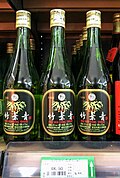
[[File:Chu Yeh Ching Chiew in glass bottle (20191118165928).jpg|thumb|200px|Bottles of Zhuyeqing (Chu Yeh Ching) [[baijiu]] produced in [[Shanxi]], China]] | [[File:Chu Yeh Ching Chiew in glass bottle (20191118165928).jpg|thumb|200px|Bottles of Zhuyeqing (Chu Yeh Ching) [[baijiu]] produced in [[Shanxi]], China]] | ||
*'''{{flag|China|name=China}}:''' [[Tea]] has been a vital part of the Chinese culture for thousands of years. China is considered to have the earliest records of tea consumption, with possible records dating back to the 10th century BC.<ref>{{cite encyclopedia|url=http://encarta.msn.com/encyclopedia_761563182/Tea.html|title=Tea|encyclopedia=[[Encarta]]|access-date=2008-07-23|archive-url=https://web.archive.org/web/20080308234307/http://encarta.msn.com/encyclopedia_761563182/Tea.html|archive-date=2008-03-08}}</ref><ref>{{cite web|url=http://www.encyclopedia.com/topic/tea.aspx|title=Tea|publisher=The [[Columbia Encyclopedia]] Sixth Edition. 2001–07|access-date=2008-07-23}}</ref> Depending on different traditional methods in processing the tea leaves, Chinese tea can be classified into at least six distinct categories, namely [[white tea]], [[yellow tea]], [[green tea]], [[oolong tea]], [[black tea]] and [[post-fermented tea]] (dark tea). | *'''{{flag|China|name=China}}:''' [[Tea]] has been a vital part of the Chinese culture for thousands of years. China is considered to have the earliest records of tea consumption, with possible records dating back to the 10th century BC.<ref>{{cite encyclopedia|url=http://encarta.msn.com/encyclopedia_761563182/Tea.html|title=Tea|encyclopedia=[[Encarta]]|access-date=2008-07-23|archive-url=https://web.archive.org/web/20080308234307/http://encarta.msn.com/encyclopedia_761563182/Tea.html|archive-date=2008-03-08}}</ref><ref>{{cite web|url=http://www.encyclopedia.com/topic/tea.aspx|title=Tea|publisher=The [[Columbia Encyclopedia]] Sixth Edition. 2001–07|access-date=2008-07-23}}</ref> Depending on different traditional methods in processing the tea leaves, Chinese tea can be classified into at least six distinct categories, namely [[white tea]], [[yellow tea]], [[green tea]], [[oolong tea]], [[black tea]] and [[post-fermented tea]] (dark tea). | ||
:The Chinese national liquor, [[Baijiu]] ({{zh|s=白酒|p=báijiǔ|l=white (clear) liquor}}) is a [[distilled alcoholic beverage]] made from various types of grains, including [[rice]], [[glutinous rice]], [[wheat]], [[barley]], and [[millet]].<ref>Zheng, Xiao‐Wei, et al. "Daqu—A traditional Chinese liquor fermentation starter." Journal of the Institute of Brewing 117.1 (2011): 82–90.</ref><ref>Rong and Fa, Grandiose Survey of Chinese Alcoholic Drinks and Beverages, 2013, {{cite web|url=http://www.jiangnan.edu.cn/zhgjiu/umain.htm |title= | :The Chinese national liquor, [[Baijiu]] ({{zh|s=白酒|p=báijiǔ|l=white (clear) liquor}}) is a [[distilled alcoholic beverage]] made from various types of grains, including [[rice]], [[glutinous rice]], [[wheat]], [[barley]], and [[millet]].<ref>Zheng, Xiao‐Wei, et al. "Daqu—A traditional Chinese liquor fermentation starter." Journal of the Institute of Brewing 117.1 (2011): 82–90.</ref><ref>Rong and Fa, Grandiose Survey of Chinese Alcoholic Drinks and Beverages, 2013, {{cite web|url=http://www.jiangnan.edu.cn/zhgjiu/umain.htm |title=Grandiose Survey of Chinese Alcoholic Drinks and Beverages |access-date=2015-05-29 |url-status=dead |archive-url=https://web.archive.org/web/20140729200500/http://www.jiangnan.edu.cn/zhgjiu/umain.htm |archive-date=2014-07-29 }}</ref> [[Baijiu]] was first made 5,000 years ago. Baijiu can be broken down into five main aroma categories: strong, light, sauce (soy, specifically), rice, and mixed. | ||
*'''{{flag|Hong Kong}}''': [[Hong Kong-style milk tea]]<ref name="Pantyhose">{{cite news|url=https://www.latimes.com/archives/la-xpm-2006-mar-05-adfg-panty5-story.html|title='Pantyhose Tea' Has Leg Up in Hong Kong|last=Hui|first=Sylvia|date=March 5, 2006|website=The LA Times|language=en|access-date=August 28, 2020}}</ref> | *'''{{flag|Hong Kong}}''': [[Hong Kong-style milk tea]]<ref name="Pantyhose">{{cite news|url=https://www.latimes.com/archives/la-xpm-2006-mar-05-adfg-panty5-story.html|title='Pantyhose Tea' Has Leg Up in Hong Kong|last=Hui|first=Sylvia|date=March 5, 2006|website=The LA Times|language=en|access-date=August 28, 2020}}</ref> | ||
*'''{{flag|Macau}}:''' Coffee (typically served with condensed milk) and tea<ref name="Macao">{{cite news|url=https://macaudailytimes.com.mo/made-macao-coffee-tea.html|title=MADE IN MACAO: COFFEE, TEA OR BOTH?|last=Lao-Phillips|first=Jenny|date=June 22, 2017|website=Macau Daily Times|language=en|access-date=August 28, 2020}}</ref> | *'''{{flag|Macau}}:''' [[Coffee]] (typically served with condensed milk) and tea<ref name="Macao">{{cite news|url=https://macaudailytimes.com.mo/made-macao-coffee-tea.html|title=MADE IN MACAO: COFFEE, TEA OR BOTH?|last=Lao-Phillips|first=Jenny|date=June 22, 2017|website=Macau Daily Times|language=en|access-date=August 28, 2020}}</ref> | ||
*'''{{flag|ROC|name= Taiwan}}:''' [[Bubble tea]]<ref>{{cite web|url=http://www.taipeitimes.com/News/feat/archives/2018/11/13/2003704115|title=Who invented bubble tea? – Taipei Times|first=Edward|last=Jones|date=2018-11-13|website=[[Taipei Times]]|access-date=11 June 2019 | quote=Surprisingly little is known for sure about the origin of Taiwan’s national drink }}</ref><ref>{{cite web|url=https://chinalivesf.com/bubble-tea/|title=Bubble Tea|first=Gloria | last=Tai |website=[[China Live]]|access-date=11 June 2019 | quote=It can almost be considered a national drink in Taiwan where it originated and took by storm in the 1980’s }}</ref> (also known as pearl milk tea, bubble milk tea, or boba) is a Taiwanese [[tea]]-based drink invented in the 1980s.<ref name="Martin 2007 2192">{{cite book|title=Tea: The drink that changed the world|last=Martin|first=Laura C.|publisher=Tuttle Publishing|year=2007|isbn=9780804837248|location=Rutland|page=219}}</ref> | *'''{{flag|ROC|name= Taiwan}}:''' [[Bubble tea]]<ref>{{cite web|url=http://www.taipeitimes.com/News/feat/archives/2018/11/13/2003704115|title=Who invented bubble tea? – Taipei Times|first=Edward|last=Jones|date=2018-11-13|website=[[Taipei Times]]|access-date=11 June 2019 | quote=Surprisingly little is known for sure about the origin of Taiwan’s national drink }}</ref><ref>{{cite web|url=https://chinalivesf.com/bubble-tea/|title=Bubble Tea|first=Gloria | last=Tai |website=[[China Live]]|access-date=11 June 2019 | quote=It can almost be considered a national drink in Taiwan where it originated and took by storm in the 1980’s }}</ref> (also known as pearl milk tea, bubble milk tea, or boba) is a Taiwanese [[tea]]-based drink invented in the 1980s.<ref name="Martin 2007 2192">{{cite book|title=Tea: The drink that changed the world|last=Martin|first=Laura C.|publisher=Tuttle Publishing|year=2007|isbn=9780804837248|location=Rutland|page=219}}</ref> | ||
*'''{{flag|Japan}}:''' [[Green tea#Japan|Green Tea]].<ref>{{Cite web|url=http://jccabulletin-geppo.ca/ocha-japans-national-drink/|title=OCHA: JAPAN'S NATIONAL DRINK|last=Kita|first=Satoye|date=January 12, 2009|website=The Bulletin|language=en|access-date=August 27, 2020}}</ref> Tea consumption became popular among the gentry during the 12th century, after the publication of Eisai's Kissa Yōjōki. Uji, with its strategic location near the capital at Kyoto, became Japan's first major tea-producing region during this period. Beginning in the 13th and 14th centuries, Japanese tea culture developed the distinctive features for which it is known today, and the [[Japanese tea ceremony]] emerged as a key component of that culture. | *'''{{flag|Japan}}:''' [[Green tea#Japan|Green Tea]].<ref>{{Cite web|url=http://jccabulletin-geppo.ca/ocha-japans-national-drink/|title=OCHA: JAPAN'S NATIONAL DRINK|last=Kita|first=Satoye|date=January 12, 2009|website=The Bulletin|language=en|access-date=August 27, 2020}}</ref> Tea consumption became popular among the gentry during the 12th century, after the publication of Eisai's Kissa Yōjōki. Uji, with its strategic location near the capital at Kyoto, became Japan's first major tea-producing region during this period. Beginning in the 13th and 14th centuries, Japanese tea culture developed the distinctive features for which it is known today, and the [[Japanese tea ceremony]] emerged as a key component of that culture. | ||
:[[Sake]], also referred to as Japanese [[rice wine]], is an alcoholic beverage made by fermenting [[rice]] that has been [[Polished rice|polished]] to remove the [[bran]].<ref name=":2"/><ref name=":1">{{Cite web|url=https://www.foodandwine.com/fwx/drink/32-officialish-drinks-every-country-playing-world-cup|title=32 Official(ish) Drinks for Every Country Playing in the World Cup|website=Food & Wine|language=en|access-date=2019-05-20}}</ref><ref name=":0">{{Cite web|url=https://www.thedailymeal.com/drink/signature-drink-every-country-world-cup-gallery|title=The Signature Drink of Every Country in the World Cup Gallery|last=Rose|first=Jeremy|date=2018-06-14|website=The Daily Meal|language=en|access-date=2019-05-20}}</ref> | :[[Sake]], also referred to as Japanese [[rice wine]], is an alcoholic beverage made by fermenting [[rice]] that has been [[Polished rice|polished]] to remove the [[bran]].<ref name=":2"/><ref name=":1">{{Cite web|url=https://www.foodandwine.com/fwx/drink/32-officialish-drinks-every-country-playing-world-cup|title=32 Official(ish) Drinks for Every Country Playing in the World Cup|website=Food & Wine|language=en|access-date=2019-05-20}}</ref><ref name=":0">{{Cite web|url=https://www.thedailymeal.com/drink/signature-drink-every-country-world-cup-gallery|title=The Signature Drink of Every Country in the World Cup Gallery|last=Rose|first=Jeremy|date=2018-06-14|website=The Daily Meal|language=en|access-date=2019-05-20}}</ref> | ||
*'''{{flag|Mongolia}}:''' Airag ({{lang-mn|айраг}} {{IPA-mn|ˈai̯rəɡ|}})<ref>{{cite web|url=http://www.mongolfood.info/en/recipes/ayrag.html|title=Airag – Fermented Mare's Milk – Mongolian Beverage}}</ref> or, in some areas, tsegee is a [[Fermented milk products|fermented dairy product]] traditionally made from [[mare's milk]]. The drink remains important to the peoples of the [[Central Asia]]n [[steppe]]s, of Huno-Bulgar, [[Turkic peoples|Turkic]] and Mongol origin: [[Kazakhs]], [[Bashkirs]], [[Kalmyks]], [[Kyrgyz people|Kyrgyz]], [[Mongol]]s, and [[Yakuts]].<ref name="Zeder">{{cite book | author=Zeder, Melinda A. ed. | title= Documenting Domestication: New Genetic and Archaeological Paradigms | publisher=University of California Press | year=2006 | isbn=0-520-24638-1 | pages=264}}</ref> {{sfnb|Anderson|1988| p= [https://books.google.com/books?id=BAcknxN_S8QC | *'''{{flag|Mongolia}}:''' Airag ({{lang-mn|айраг}} {{IPA-mn|ˈai̯rəɡ|}})<ref>{{cite web|url=http://www.mongolfood.info/en/recipes/ayrag.html|title=Airag – Fermented Mare's Milk – Mongolian Beverage}}</ref> or, in some areas, tsegee is a [[Fermented milk products|fermented dairy product]] traditionally made from [[mare's milk]]. The drink remains important to the peoples of the [[Central Asia]]n [[steppe]]s, of Huno-Bulgar, [[Turkic peoples|Turkic]] and Mongol origin: [[Kazakhs]], [[Bashkirs]], [[Kalmyks]], [[Kyrgyz people|Kyrgyz]], [[Mongol]]s, and [[Yakuts]].<ref name="Zeder">{{cite book | author=Zeder, Melinda A. ed. | title= Documenting Domestication: New Genetic and Archaeological Paradigms | publisher=University of California Press | year=2006 | isbn=0-520-24638-1 | pages=264}}</ref> {{sfnb|Anderson|1988| p= [https://books.google.com/books?id=BAcknxN_S8QC&dq=yogurt+fish+wei&pg=PA80 80]}} A 1982 source reported 230,000 horses were kept in the [[Soviet Union]] specifically for producing milk to make into kumis.<ref>{{cite book | author=Steinkraus, Keith H. ed | title=Handbook of Indigenous Fermented Foods | year=1995 | publisher=Marcel Dekker | isbn=0-8247-9352-8 | pages=304}}</ref> Rinchingiin Indra, writing about Mongolian dairying, says "it takes considerable skill to milk a mare" and describes the technique: the milker kneels on one knee, with a pail propped on the other, steadied by a string tied to an arm. One arm is wrapped behind the mare's rear leg and the other in front. A foal starts the milk flow and is pulled away by another person, but left touching the mare's side during the entire process.<ref>{{cite book | author = Indra, Rinchingiin | chapter = Mongolian Dairy Products | title = Mongolia Today: Science, Culture, Environment and Development | publisher = Routledge | year = 2003 | editor = Dendev Badarch, Raymond A Zilinskas | isbn=0-7007-1598-3 | pages=74}}</ref> In [[Mongolia]], the milking season for horses traditionally runs between mid-June and early October. During one season, a mare produces approximately 1,000 to 1,200 litres of milk, of which about half is left to the foals.<ref>Indra p. 73.</ref> | ||
*'''{{flag|North Korea}}: '''On June 18, 2019, [[Kim Jong-un]] designated | *'''{{flag|North Korea}}: '''On June 18, 2019, [[Kim Jong-un]] designated Pyongyang Soju, an alcoholic beverage that embodies the "innocent and tender hearts" of the North Korean people as the national beverage of North Korea, according to a state propaganda service.<ref>{{Cite news|url=https://www.upi.com/Top_News/World-News/2019/06/18/Pyongyang-Soju-selected-national-beverage-of-North-Korea/9641560869943/|title=Pyongyang Soju selected national beverage of North Korea|last=Shim|first=Elizabeth|date=2019-06-18|work=UPI|access-date=2019-07-30|language=en-GB|issn=0261-3077}}</ref> [[Soju]] is a clear, colorless distilled beverage of [[Korea]]n origin.<ref>{{Cite news|url=https://www.theguardian.com/lifeandstyle/wordofmouth/2013/dec/02/soju-popular-booze-world-south-korea|title=Soju: the most popular booze in the world|last=Miller|first=Norman|date=2013-12-02|work=The Guardian|access-date=2019-05-20|language=en-GB|issn=0261-3077}}</ref> | ||
*'''{{flag|South Korea}}:''' [[Soju]] ({{IPAc-en|ˈ|s|oʊ|dʒ|uː}}; <small>from Korean:</small> {{Korean|hangul=소주|hanja=燒酒|labels=no}} {{IPA-ko|so.dʑu|}}) is a clear, colorless distilled beverage of [[Korea]]n origin.<ref name="ODE">{{Cite web|url=https://en.oxforddictionaries.com/definition/soju|title=soju|website=[[Oxford Dictionary of English]]|publisher=[[Oxford University Press]]|access-date=14 April 2017}}</ref><ref name="MW">{{Cite web|url=https://www.merriam-webster.com/dictionary/soju|title=soju|website=[[Merriam-Webster Dictionary]]|publisher=[[Encyclopædia Britannica, Inc.|Encyclopædia Britannica]]|access-date=22 November 2014}}</ref><ref name="Miller">{{Cite news|url=https://www.theguardian.com/lifeandstyle/wordofmouth/2013/dec/02/soju-popular-booze-world-south-korea|title=Soju: the most popular booze in the world|last=Miller|first=Norman|date=2 December 2013|work=[[The Guardian]]|access-date=13 April 2017}}</ref> It is usually consumed [[neat (bartending)|neat]], and its alcohol content varies from about 16.8% to 53% [[alcohol by volume]] (ABV).<ref name="Park">{{Cite web|url=http://koreajoongangdaily.joins.com/news/article/article.aspx?aid=2997481|title=Koreans looking for weaker soju|last=Park|first=Eun-jee|date=19 November 2014|website=[[Korea JoongAng Daily]]|access-date=14 April 2017}}</ref><ref name="Hall">{{Cite news|url=https://blogs.wsj.com/korearealtime/2014/10/17/soju-makers-aim-to-turn-fire-water-into-liquid-gold/|title=Soju Makers Aim to Turn Fire Water Into Liquid Gold|last=Hall|first=Joshua|date=17 October 2014|work=[[The Wall Street Journal]]|access-date=24 December 2014}}</ref> Most brands of soju are made in [[South Korea]]. While soju is traditionally made from [[rice]], [[wheat]], or [[barley]], modern producers often replace rice with other starches such as [[potato]]es, [[sweet potato]]es, or [[tapioca]].<ref name="Archibald">{{Cite news|url=http://www.liquor.com/articles/korean-soju/|title=Why You Should Be Drinking Korean Soju Right Now|last=Archibald|first=Anna|date=27 August 2015|work=Liquor.com|access-date=14 December 2015}}</ref> | *'''{{flag|South Korea}}:''' [[Soju]] ({{IPAc-en|ˈ|s|oʊ|dʒ|uː}}; <small>from Korean:</small> {{Korean|hangul=소주|hanja=燒酒|labels=no}} {{IPA-ko|so.dʑu|}}) is a clear, colorless distilled beverage of [[Korea]]n origin.<ref name="ODE">{{Cite web|url=https://en.oxforddictionaries.com/definition/soju|archive-url=https://web.archive.org/web/20170113153923/https://en.oxforddictionaries.com/definition/soju|url-status=dead|archive-date=January 13, 2017|title=soju|website=[[Oxford Dictionary of English]]|publisher=[[Oxford University Press]]|access-date=14 April 2017}}</ref><ref name="MW">{{Cite web|url=https://www.merriam-webster.com/dictionary/soju|title=soju|website=[[Merriam-Webster Dictionary]]|publisher=[[Encyclopædia Britannica, Inc.|Encyclopædia Britannica]]|access-date=22 November 2014}}</ref><ref name="Miller">{{Cite news|url=https://www.theguardian.com/lifeandstyle/wordofmouth/2013/dec/02/soju-popular-booze-world-south-korea|title=Soju: the most popular booze in the world|last=Miller|first=Norman|date=2 December 2013|work=[[The Guardian]]|access-date=13 April 2017}}</ref> It is usually consumed [[neat (bartending)|neat]], and its alcohol content varies from about 16.8% to 53% [[alcohol by volume]] (ABV).<ref name="Park">{{Cite web|url=http://koreajoongangdaily.joins.com/news/article/article.aspx?aid=2997481|title=Koreans looking for weaker soju|last=Park|first=Eun-jee|date=19 November 2014|website=[[Korea JoongAng Daily]]|access-date=14 April 2017}}</ref><ref name="Hall">{{Cite news|url=https://blogs.wsj.com/korearealtime/2014/10/17/soju-makers-aim-to-turn-fire-water-into-liquid-gold/|title=Soju Makers Aim to Turn Fire Water Into Liquid Gold|last=Hall|first=Joshua|date=17 October 2014|work=[[The Wall Street Journal]]|access-date=24 December 2014}}</ref> Most brands of soju are made in [[South Korea]]. While soju is traditionally made from [[rice]], [[wheat]], or [[barley]], modern producers often replace rice with other starches such as [[potato]]es, [[sweet potato]]es, or [[tapioca]].<ref name="Archibald">{{Cite news|url=http://www.liquor.com/articles/korean-soju/|title=Why You Should Be Drinking Korean Soju Right Now|last=Archibald|first=Anna|date=27 August 2015|work=Liquor.com|access-date=14 December 2015}}</ref> | ||
===Southeast=== | ===Southeast=== | ||
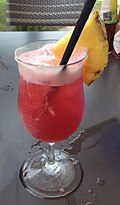
[[File:Singaporesling-march2017.jpg|thumb|200px|Singapore Sling]] | [[File:Singaporesling-march2017.jpg|thumb|200px|Singapore Sling]] | ||
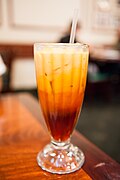
[[File:JOH 5217 - Lotus of Siam.jpg|thumb|200px|Thai iced tea is a popular drink in [[Thailand]] and in many parts of the world. ]] | [[File:JOH 5217 - Lotus of Siam.jpg|thumb|200px|Thai iced tea is a popular drink in [[Thailand]] and in many parts of the world. ]] | ||
*'''{{flag|Brunei}}:''' No national drink, however Air Batu Campur (ABC) is popular among citizens. | |||
*'''{{flag|Brunei}}:''' | |||
*'''{{flag|Cambodia}}:''' [[Sombai]] infused [[rice wine]].<ref>{{Cite news |last=Rice |first=Jessica |date=22 August 2013 |url=https://matadornetwork.com/nights/59-national-drinks-from-59-awesome-countries |title=59 national drinks from 59 awesome countries |work=Matador Network |access-date=28 July 2017}}</ref><ref>{{Cite web |url=https://www.oyster.com/articles/54839-6-local-liquors-around-the-world-you-havent-heard-of/|title=6 Local Liquors Around the World You Haven't Heard Of |last=Grant |first=Lara |date=29 August 2016 |website=Oyster.com |access-date=28 July 2017}}</ref> | *'''{{flag|Cambodia}}:''' [[Sombai]] infused [[rice wine]].<ref>{{Cite news |last=Rice |first=Jessica |date=22 August 2013 |url=https://matadornetwork.com/nights/59-national-drinks-from-59-awesome-countries |title=59 national drinks from 59 awesome countries |work=Matador Network |access-date=28 July 2017}}</ref><ref>{{Cite web |url=https://www.oyster.com/articles/54839-6-local-liquors-around-the-world-you-havent-heard-of/|title=6 Local Liquors Around the World You Haven't Heard Of |last=Grant |first=Lara |date=29 August 2016 |website=Oyster.com |access-date=28 July 2017}}</ref> | ||
*'''{{flag|Indonesia}}''': [[Es teler]], a sweet iced concoction created by Murniati Widjaja, who won a competition to come up with a national drink for Indonesia in 1982.<ref>[http://www.theage.com.au/news/reviews/es-teler/2005/07/18/1121538895219.html Es teler ]</ref><ref>{{cite web| url=https://theweek.com/articles/773132/indonesias-delicious-twist-avocados |date=May 27, 2018 | *'''{{flag|Indonesia}}''': [[Es teler]], a sweet iced concoction created by Murniati Widjaja, who won a competition to come up with a national drink for Indonesia in 1982.<ref>[http://www.theage.com.au/news/reviews/es-teler/2005/07/18/1121538895219.html Es teler ]</ref><ref>{{cite web| url=https://theweek.com/articles/773132/indonesias-delicious-twist-avocados |date=May 27, 2018 | ||
| Line 210: | Line 208: | ||
*The [[Milo dinosaur]] is a Singaporean [[chocolate]] [[malt]]–based beverage composed of a cup of iced [[Milo (drink)|Milo]] with undissolved Milo powder added on top of it. It is usually served cold to prevent the powder from immediately dissolving in the drink.<ref name="MODINO3" /> It originates from [[Indian Singaporean]] eateries in Singapore during the 1990s, and it is now most commonly found in [[mamak stall]]s, [[kopitiam]]s and [[hawker centre]]s from [[Demographics of Singapore|all ethnic groups]] in [[Singapore]].<ref name="MODINO3">{{cite web|url=https://thesmartlocal.com/reviews/singapore/uniquely-singapore-2/singapore-products-uniquely-singapore-2/milo-dinosaur/|title=Milo Dinosaur: Uniquely Singapore|author=Denise Chia|publisher=The Smart Local|year=2014|access-date=29 November 2020}}</ref><ref name="IIAS">{{cite web |last1=Pakiam |first1=Geoffrey K. |title=Milo Dinosaur. The life and times of a Southeast Asian national beverage {{!}} IIAS |url=https://www.iias.asia/the-newsletter/article/milo-dinosaur-life-and-times-southeast-asian-national-beverage |website=www.iias.asia |access-date=29 October 2021 |quote=Milo Dinosaur’s name appears to have originated in '''Singapore-based Indian-Muslim eateries during the mid-1990s.''' Labelling a turbo-charged version of ice Milo as Milo Dinosaur may have been a way to riff on '''Singapore’s cinema culture''', which during the 1990s was saturated with the exploits of giant reptiles in Jurassic Park and its sequels.}}</ref> | *The [[Milo dinosaur]] is a Singaporean [[chocolate]] [[malt]]–based beverage composed of a cup of iced [[Milo (drink)|Milo]] with undissolved Milo powder added on top of it. It is usually served cold to prevent the powder from immediately dissolving in the drink.<ref name="MODINO3" /> It originates from [[Indian Singaporean]] eateries in Singapore during the 1990s, and it is now most commonly found in [[mamak stall]]s, [[kopitiam]]s and [[hawker centre]]s from [[Demographics of Singapore|all ethnic groups]] in [[Singapore]].<ref name="MODINO3">{{cite web|url=https://thesmartlocal.com/reviews/singapore/uniquely-singapore-2/singapore-products-uniquely-singapore-2/milo-dinosaur/|title=Milo Dinosaur: Uniquely Singapore|author=Denise Chia|publisher=The Smart Local|year=2014|access-date=29 November 2020}}</ref><ref name="IIAS">{{cite web |last1=Pakiam |first1=Geoffrey K. |title=Milo Dinosaur. The life and times of a Southeast Asian national beverage {{!}} IIAS |url=https://www.iias.asia/the-newsletter/article/milo-dinosaur-life-and-times-southeast-asian-national-beverage |website=www.iias.asia |access-date=29 October 2021 |quote=Milo Dinosaur’s name appears to have originated in '''Singapore-based Indian-Muslim eateries during the mid-1990s.''' Labelling a turbo-charged version of ice Milo as Milo Dinosaur may have been a way to riff on '''Singapore’s cinema culture''', which during the 1990s was saturated with the exploits of giant reptiles in Jurassic Park and its sequels.}}</ref> | ||
*'''{{flag|Thailand}}:''' [[Thai tea]] is a Thai drink made from tea, milk and sugar, and served hot or cold. It is popular in [[Southeast Asia]] and is served in many restaurants that serve [[Thai cuisine|Thai food]].<ref>{{cite document|url=https://www.academia.edu/424778|title=History of Tea in Thailand|last1=Commins|first1=Terry}}</ref> When served cold it is known as Thai iced tea. Another highly popular drink is [[Krating Daeng]], an energy drink which was first introduced in 1976. In Thai, ''daeng'' means red, and a ''[[Gaur|krating]]'' is a large species of wild [[bovine]] native to South Asia. Krating Daeng inspired the creation of the Western drink [[Red Bull]]. | *'''{{flag|Thailand}}:''' [[Thai tea]] is a Thai drink made from tea, milk and sugar, and served hot or cold. It is popular in [[Southeast Asia]] and is served in many restaurants that serve [[Thai cuisine|Thai food]].<ref>{{cite document|url=https://www.academia.edu/424778|title=History of Tea in Thailand|last1=Commins|first1=Terry}}</ref> When served cold it is known as Thai iced tea. Another highly popular drink is [[Krating Daeng]], an energy drink which was first introduced in 1976. In Thai, ''daeng'' means red, and a ''[[Gaur|krating]]'' is a large species of wild [[bovine]] native to South Asia. Krating Daeng inspired the creation of the Western drink [[Red Bull]]. | ||
*'''{{flag|Timor-Leste}}:''' | *'''{{flag|Timor-Leste}}:''' [[Cachaça|Cachaca]] | ||
*'''{{flag|Vietnam}}:''' [[ | *'''{{flag|Vietnam}}:''' [[Rượu nếp]], Vietnamese rice wine, made from glutinous rice that has been fermented with the aid of yeast and steamed in a banana leaf. | ||
===South=== | ===South=== | ||
| Line 218: | Line 216: | ||
*'''{{flag|Bangladesh}}:''' Tea ({{lang-bn|চা|Cha}}) is considered to be the national drink of Bangladesh, with government bodies such as the [[Bangladesh Tea Board]] and the [[Bangladesh Tea Research Institute]] supporting the production, certification, and exportation of the tea trade in the country.<ref>Bangladesh Tea Research Institute, ''[[Banglapedia]]''</ref> Recently, new types of tea, such as the [[Seven Color Tea|seven color tea]] or seven-layer tea, ({{lang-bn|সাত রং চা|Shat Rong Cha}}) has popped up as a well-known [[beverage]] of the country's [[Sylhet Division]].<ref name="prothomalo12">{{cite web|url=https://prothomalo.news/archives/1954|title=সিলেটের সাতরঙা চা এর রহস্য ভেদ, জানুন তৈরির নিয়ম|publisher=The Daily Prothom Alo|language=bn|access-date=November 4, 2017|url-status=dead|archive-url=https://web.archive.org/web/20170504214809/http://prothomalo.news/archives/1954|archive-date=May 4, 2017}}</ref><ref name="theguardian2">{{cite web|url=https://www.theguardian.com/travel/2016/aug/28/sylhet-bangladesh-seven-layer-tea-nikantha-tea-cabins|title=Making rainbows in a glass – seven-layer tea in Bangladesh|work=The Guardian|date=28 August 2016|access-date=November 2, 2017}}</ref> Romesh Ram Gour invented the seven-layer tea after discovering that different tea leaves have different densities.<ref name="wsj2">{{cite news|url=https://blogs.wsj.com/scene/2011/06/07/the-secret-of-the-seven-layer-tea/|title=One Glass, Seven Layers of Tea – Scene Asia|newspaper=Wall Street Journal|date=7 June 2011|publisher=Wall Street Journal Blog|access-date=November 7, 2017|last1=Shay|first1=Christopher}}</ref><ref name="theguardian2" /> Each layer contrasts in color and taste, ranging from syrupy sweet to spicy clove. The result is an alternating dark/light band pattern throughout the drink, giving the tea its name. | *'''{{flag|Bangladesh}}:''' Tea ({{lang-bn|চা|Cha}}) is considered to be the national drink of Bangladesh, with government bodies such as the [[Bangladesh Tea Board]] and the [[Bangladesh Tea Research Institute]] supporting the production, certification, and exportation of the tea trade in the country.<ref>Bangladesh Tea Research Institute, ''[[Banglapedia]]''</ref> Recently, new types of tea, such as the [[Seven Color Tea|seven color tea]] or seven-layer tea, ({{lang-bn|সাত রং চা|Shat Rong Cha}}) has popped up as a well-known [[beverage]] of the country's [[Sylhet Division]].<ref name="prothomalo12">{{cite web|url=https://prothomalo.news/archives/1954|title=সিলেটের সাতরঙা চা এর রহস্য ভেদ, জানুন তৈরির নিয়ম|publisher=The Daily Prothom Alo|language=bn|access-date=November 4, 2017|url-status=dead|archive-url=https://web.archive.org/web/20170504214809/http://prothomalo.news/archives/1954|archive-date=May 4, 2017}}</ref><ref name="theguardian2">{{cite web|url=https://www.theguardian.com/travel/2016/aug/28/sylhet-bangladesh-seven-layer-tea-nikantha-tea-cabins|title=Making rainbows in a glass – seven-layer tea in Bangladesh|work=The Guardian|date=28 August 2016|access-date=November 2, 2017}}</ref> Romesh Ram Gour invented the seven-layer tea after discovering that different tea leaves have different densities.<ref name="wsj2">{{cite news|url=https://blogs.wsj.com/scene/2011/06/07/the-secret-of-the-seven-layer-tea/|title=One Glass, Seven Layers of Tea – Scene Asia|newspaper=Wall Street Journal|date=7 June 2011|publisher=Wall Street Journal Blog|access-date=November 7, 2017|last1=Shay|first1=Christopher}}</ref><ref name="theguardian2" /> Each layer contrasts in color and taste, ranging from syrupy sweet to spicy clove. The result is an alternating dark/light band pattern throughout the drink, giving the tea its name. | ||
*'''{{flag|Bhutan}}:''' Ara, or Arag, ([[Tibetic languages|Tibetan]] and [[Dzongkha]]: ཨ་རག་; [[Wylie transliteration|Wylie]]: ''a-rag''; "alcohol, liquor") is a traditional [[alcoholic beverage]] consumed in [[Bhutan]]. Ara is made from native and high-altitude tolerant [[barley]], [[rice]], [[maize]], [[millet]], or [[wheat]], and may be either [[Fermentation (food)|fermented]] or [[distillation|distilled]]. The beverage is usually a clear, creamy, or white color.<ref>{{cite web|url=http://www.windhorsetours.com/countrypages/meraksakteng.php |title=Merak and Sakteng – The Land of Brokpas |publisher=Wind Horse Tours online |access-date=2011-07-27 |url-status=dead |archive-url=https://web.archive.org/web/20110927045148/http://www.windhorsetours.com/countrypages/meraksakteng.php |archive-date=2011-09-27 }}</ref> | *'''{{flag|Bhutan}}:''' Ara, or Arag, ([[Tibetic languages|Tibetan]] and [[Dzongkha]]: ཨ་རག་; [[Wylie transliteration|Wylie]]: ''a-rag''; "alcohol, liquor") is a traditional [[alcoholic beverage]] consumed in [[Bhutan]]. Ara is made from native and high-altitude tolerant [[barley]], [[rice]], [[maize]], [[millet]], or [[wheat]], and may be either [[Fermentation (food)|fermented]] or [[distillation|distilled]]. The beverage is usually a clear, creamy, or white color.<ref>{{cite web|url=http://www.windhorsetours.com/countrypages/meraksakteng.php |title=Merak and Sakteng – The Land of Brokpas |publisher=Wind Horse Tours online |access-date=2011-07-27 |url-status=dead |archive-url=https://web.archive.org/web/20110927045148/http://www.windhorsetours.com/countrypages/meraksakteng.php |archive-date=2011-09-27 }}</ref> | ||
*'''{{flag|India}}: Tea is the most widely consumed beverage in India. | *'''{{flag|India}}:''' Tea is the most widely consumed beverage in India. [[Lassi]] or [[Chaas]] is another yogurt-based drink and can be sweet or salty. ''Lassi'' or ''Chaas'' is a blend of [[yogurt]], water, spices and sometimes fruit like [[mango]].<ref>{{Cite web|url=https://www.britannica.com/topic/lassi|title=Lassi {{!}} beverage|website=Encyclopedia Britannica|language=en|access-date=2019-06-15}}</ref><ref>{{Cite web|url=https://food.ndtv.com/food-drinks/5-best-lassi-recipes-the-creamy-summer-cooler-from-punjab-1402630|title=5 Best Lassi Recipes: The Ultimate Summer Cooler from Punjab|website=NDTV Food|access-date=2019-06-15}}</ref> While the [[Masala chai]] is a hot, sweet tea popular throughout the subcontinent and is a combination of brewed [[black tea]], aromatic [[spices]], and [[herb]]s, milk and sugar.<ref>{{Cite book|url=https://books.google.com/books?id=-l9GbAemUAEC&pg=PA40|title=The New Tea Book: A Guide to Black, Green, Herbal and Chai Teas|last=Perry|first=Sara|date=August 2001|publisher=Chronicle Books|isbn=9780811830539|language=en}}</ref> In southern India, the iconic beverage is [[Indian filter coffee|Kaapi]], also known as Indian filter coffee, which is made by mixing frothed and boiled milk with coffee brewed through a metal filter.<ref>{{Cite news|url=https://www.thehindu.com/life-and-style/food/Make-fantastic-filter-kaapi/article11211260.ece/photo/1/|title=Make fantastic filter kaapi|last=Harish|first=Chef|date=2014-08-22|work=The Hindu|access-date=2019-06-15|language=en-IN|issn=0971-751X}}</ref> | ||
*'''{{flag|Maldives}}:''' It can be said that the Maldives have two national drinks. Firstly, due to their history and location near the Indian Subcontinent, sai (tea) is a Maldivian favorite. Secondly, as the Maldives are truly an Island nation, raa ([[Palm wine|toddy tapped from palm trees]]) is also has its place in the national identity of the Maldives. Sometimes raa is left to ferment and is thus slightly alcoholic – the closest any Maldivian gets to alcohol. | *'''{{flag|Maldives}}:''' It can be said that the Maldives have two national drinks. Firstly, due to their history and location near the Indian Subcontinent, sai (tea) is a Maldivian favorite. Secondly, as the Maldives are truly an Island nation, raa ([[Palm wine|toddy tapped from palm trees]]) is also has its place in the national identity of the Maldives. Sometimes raa is left to ferment and is thus slightly alcoholic – the closest any Maldivian gets to alcohol. | ||
*'''{{flag|Nepal}}:''' [[Raksi]]<ref>Ethnic Fermented Foods and Alcoholic Beverages of Asia, Front Cover By Jyoti Prakash Tamang, Springer, 5 Aug 2016 – Technology & Engineering – 409 pages, P.107</ref> is a strong drink, clear like vodka or gin, tasting somewhat like Japanese [[sake]]. It is usually made from kodo [[millet]] (kodo) or rice; different grains produce different flavors.<ref>{{cite web|url=http://www.globalgourmet.com/destinations/nepal/nepalliq.html|title=Nepal: Liquor|website = The Global Gourmet|archive-url= https://web.archive.org/web/20160309001559/http://www.globalgourmet.com/destinations/nepal/nepalliq.html |archive-date = 9 March 2016}}</ref> The [[Limbu people|Limbus]], for whom it is a traditional beverage,<ref>P.67 Land and Social Change in East Nepal: A Study of Hindu-Tribal Relations By Professor Lionel Caplan, Lionel Caplan</ref> drink an enormous amount of [[Tongba]] and raksi served with pieces of pork, water buffalo or goat meat [[sekuwa]].<ref>p.34 Kinship and Marriage Among the Limbu of Eastern Nepal: A Study By Rex Lee Jones – 1973</ref> For the Newars, [[Aila (liquor)|aylaa]] is indispensable during festivals and various religious rituals as [[libation]], ''[[prasad]]'' or [[Sagan (ceremony)|''sagan'']]. | *'''{{flag|Nepal}}:''' [[Raksi]]<ref>Ethnic Fermented Foods and Alcoholic Beverages of Asia, Front Cover By Jyoti Prakash Tamang, Springer, 5 Aug 2016 – Technology & Engineering – 409 pages, P.107</ref> is a strong drink, clear like vodka or gin, tasting somewhat like Japanese [[sake]]. It is usually made from kodo [[millet]] (kodo) or rice; different grains produce different flavors.<ref>{{cite web|url=http://www.globalgourmet.com/destinations/nepal/nepalliq.html|title=Nepal: Liquor|website = The Global Gourmet|archive-url= https://web.archive.org/web/20160309001559/http://www.globalgourmet.com/destinations/nepal/nepalliq.html |archive-date = 9 March 2016}}</ref> The [[Limbu people|Limbus]], for whom it is a traditional beverage,<ref>P.67 Land and Social Change in East Nepal: A Study of Hindu-Tribal Relations By Professor Lionel Caplan, Lionel Caplan</ref> drink an enormous amount of [[Tongba]] and raksi served with pieces of pork, water buffalo or goat meat [[sekuwa]].<ref>p.34 Kinship and Marriage Among the Limbu of Eastern Nepal: A Study By Rex Lee Jones – 1973</ref> For the Newars, [[Aila (liquor)|aylaa]] is indispensable during festivals and various religious rituals as [[libation]], ''[[prasad]]'' or [[Sagan (ceremony)|''sagan'']]. | ||
*'''{{flag|Pakistan}}:''' [[Sugarcane]] | *'''{{flag|Pakistan}}:''' [[Sugarcane juice]]<ref>{{cite web|url=https://www.hindustantimes.com/world-news/sugarcane-juice-declared-national-drink-of-pakistan/story-k63H3ElU6Nm2aBEub2hpCO.html#:~:text=The%20Pakistan%20government%20on%20Friday,national%20drink%E2%80%9D%20of%20the%20country.&text=According%20to%20the%20poll%2C%207%2C616,4%20per%20cent%20chose%20carrot.|title=Sugarcane juice declared 'national drink' of Pakistan after Twitter poll | ||
| date=January 25, 2019 | work=[[Hindustan Times]] | access-date=August 21, 2020}}</ref> | | date=January 25, 2019 | work=[[Hindustan Times]] | access-date=August 21, 2020}}</ref> | ||
*'''{{flag|Sri Lanka}}:''' [[Tea]] | *'''{{flag|Sri Lanka}}:''' [[Tea]] | ||
| Line 227: | Line 225: | ||
===Central=== | ===Central=== | ||
*'''{{flag|Afghanistan}}:''' Technically | *'''{{flag|Afghanistan}}:''' Technically there isn't an official beverage, however, [[tea]] and [[doogh]] are popular | ||
*'''{{flag|Kazakhstan}}:''' [[Kumis]], fermented horse milk | *'''{{flag|Kazakhstan}}:''' [[Kumis]], fermented horse milk | ||
*'''{{flag|Kyrgyzstan}}:''' maksym<ref>{{Cite news|url=https://www.theguardian.com/world/2015/jun/22/kyrgyzstan-fermented-drink-shoro-national-drink|title=Kyrgyzstan's fermented drink: a strong, salty national treasure|last=Bakirova|first=Elita|date=2015-06-22|work=The Guardian|access-date=2020-01-14|language=en-GB|issn=0261-3077}}</ref> or [[Jarma (beverage)|jarma]], both of which are made out of barley | *'''{{flag|Kyrgyzstan}}:''' maksym<ref>{{Cite news|url=https://www.theguardian.com/world/2015/jun/22/kyrgyzstan-fermented-drink-shoro-national-drink|title=Kyrgyzstan's fermented drink: a strong, salty national treasure|last=Bakirova|first=Elita|date=2015-06-22|work=The Guardian|access-date=2020-01-14|language=en-GB|issn=0261-3077}}</ref> or [[Jarma (beverage)|jarma]], both of which are made out of barley | ||
| Line 235: | Line 233: | ||
===West=== | ===West=== | ||
*'''{{flag|Armenia}}:''' [[Oghi (drink)|Oghi]], [[Armenian wine]], [[Ararat (brandy)]] | *'''{{flag|Armenia}}:''' [[Oghi (drink)|Oghi]], [[Armenian wine]], [[Ararat (brandy)|Ararat]] | ||
*'''{{flag|Azerbaijan}}:''' [[Black tea]], [[ | *'''{{flag|Azerbaijan}}:''' [[Black tea]], [[ayran]] | ||
*'''{{flag|Bahrain}}:''' [[ | *'''{{flag|Bahrain}}:''' [[Coffee]] | ||
*'''{{flag|Georgia}}:''' [[Chacha (brandy)|Chacha]] and [[Georgian wine| | *'''{{flag|Georgia}}:''' [[Chacha (brandy)|Chacha]] and [[Georgian wine|red wine]] | ||
*'''{{flag|Iraq}}:''' [[ | *'''{{flag|Iraq}}:''' [[Coffee]], [[Arak (drink)|arak]], and mint tea | ||
*'''{{flag|Iran}}:''' [[Doogh]], Persian yogurt drink and [[ | *'''{{flag|Iran}}:''' [[Doogh]], Persian yogurt drink and [[black tea]], [[Aragh Sagi]] (underground) | ||
*'''{{flag|Israel}}:''' [[ | *'''{{flag|Israel}}:''' [[Wine]] | ||
*'''{{flag|Jordan}}:''' [[Arabic coffee]], non-sweetened and in small shots, [[ | *'''{{flag|Jordan}}:''' [[Arabic coffee]], non-sweetened and in small shots, [[mint lemonade]], and [[arak (drink)|arak]] | ||
*'''{{flag|Kuwait}}:''' [[Arabic coffee]] (kahwah) | *'''{{flag|Kuwait}}:''' [[Arabic coffee]] (kahwah) | ||
*'''{{flag|Lebanon}}:''' [[Arak (drink)|Arak]] | *'''{{flag|Lebanon}}:''' [[Arak (drink)|Arak]] | ||
*'''{{flag|Oman}}:''' [[Arabic coffee]] | *'''{{flag|Oman}}:''' [[Arabic coffee]] | ||
*'''{{flag|Palestine}}:''' [[ | *'''{{flag|Palestine}}:''' [[Coffee]], [[Arak (drink)|arak]], [[mint lemonade]] | ||
*'''{{flag|Qatar}}:''' [[Arabic coffee]] | *'''{{flag|Qatar}}:''' [[Arabic coffee]] | ||
*'''{{flag|Saudi Arabia}}:''' [[Arabic coffee]] | *'''{{flag|Saudi Arabia}}:''' [[Arabic coffee]] | ||
*'''{{flag|Syria}}:''' [[ | *'''{{flag|Syria}}:''' [[Coffee]] and [[Arak (drink)|arak]] | ||
*'''{{flag|Turkey}}:''' [[Rakı| | *'''{{flag|Turkey}}:''' [[Rakı|Raki]];<ref>{{cite web|url=https://www.fodors.com/?post_type=slideshow&p=153835|title=15 Things to Eat and Drink in Turkey|first=Katie|last=Nadworny|date=6 June 2019|website=[[Fodor's|Fodors Travel Guide]] |access-date=11 June 2019 | quote= Turkey’s national drink isn’t just a beverage—it’s an experience. A clear anise liquor that turns milky white with water and ice (sometimes referred to as “lion’s milk”) }}</ref><ref>{{cite web|url=https://www.cnn.com/travel/article/turkey-signature-drink-raki/index.html|title=How to drink raki, Turkey's signature drink|first=Talya |last=Arditi | work=[[CNN Travel]] | date=29 December 2015 | access-date=11 June 2019 | quote=Meet raki – otherwise known as Lion's Milk – the Turkish national drink made of twice-distilled grapes and aniseed.}}</ref> [[Tea in Turkey|tea]]{{citation needed|date=June 2019}}; [[Doogh|ayran]] (as proclaimed by Prime Minister [[Tayyip Erdogan]] in 2013) is a non-alcoholic yogurt drink<ref>{{cite web|url=https://in.reuters.com/article/turkey-alcohol-idINDEE93Q02C20130427|title=Turkey's leader hits a nerve over country's "national drink"|work=[[Reuters]] | first=Jonathon | last=Burch | date=27 April 2013|access-date=11 June 2019 | quote=That is what Turkey’s often divisive prime minister did late on Friday when he pronounced that the national drink was not beer, nor the aniseed spirit raki – choice tipple of Turkey’s founding father – but the non-alcoholic yoghurt drink ayran.}}</ref><ref>{{cite web|url=https://www.dailysabah.com/feature/2014/05/22/ayran-turkeys-favorite-summer-drink|title=Ayran, Turkey's favorite summer drink|first=Onur|last=Kanan | date=May 22, 2014 | work=[[Daily Sabah]] | access-date=11 June 2019 | quote= Ayran, which is also known as the non-alcoholic national drink of Turkey, is made of yogurt, water and salt. }}</ref> | ||
*'''{{flag|United Arab Emirates}}:''' [[Arabic | *'''{{flag|United Arab Emirates}}:''' [[Arabic coffee]] | ||
*'''{{flag|Yemen}}:''' [[Arabic | *'''{{flag|Yemen}}:''' [[Arabic coffee]], being one of the oldest known places to grow coffee, [[Qishr]], and [[Naqe'e Al Zabib]] | ||
==Oceania== | ==Oceania== | ||
*'''{{flag|American Samoa}} (US):''' [[Kava]] | *'''{{flag|American Samoa}} (US):''' [[Kava]] | ||
*'''{{flag|Australia}}:''' An [[ABC News (Australia)|ABC News]] article published in 2018 described [[lemon, lime and bitters|lemon, lime, and bitters (LLB)]] as "Australia's national drink".<ref name="ABCLLB" /> Lemon, lime, and bitters is a mixed drink made with [[Lemonade#Clear lemonade|(clear) lemonade]], [[lime (fruit)|lime]] [[lime cordial|cordial]], and [[Angostura bitters]]. The lemonade is sometimes substituted with [[soda water]]<ref name = ABCLLB/> or [[Solo (Australian soft drink)|lemon squash]]. It was served as a non-alcoholic alternative to "[[Pink Gin]]" (gin mixed with Angostura bitters).<ref name = ABCLLB>{{cite news |last1=Kriewaldt |first1=Kit |title=We drink more than 100 million a year and it's all ours |url=https://www.abc.net.au/news/2018-12-08/lemon-lime-and-bitters-australias-national-drink/10591442 |access-date=8 December 2018 |work=ABC News |date=8 December 2018 |language=en-AU}}</ref> It is often considered to be a non-alcoholic [[cocktail]] (or [[mocktail]]) due to its exceedingly low alcohol content, though some establishments consider it to be alcoholic and will not serve it without [[Identity document|identification]] or [[proof of age]].{{citation needed|date=April 2018}} | *'''{{flag|Australia}}:''' Australia has quickly become the premier country in the world for coffee, thanks to the immigration of Italian and Greek migrants post World War 2, coffee has become a dominating factor in Australian culture. An [[ABC News (Australia)|ABC News]] article published in 2018 described [[lemon, lime and bitters|lemon, lime, and bitters (LLB)]] as "Australia's national drink".<ref name="ABCLLB" /> Lemon, lime, and bitters is a mixed drink made with [[Lemonade#Clear lemonade|(clear) lemonade]], [[lime (fruit)|lime]] [[lime cordial|cordial]], and [[Angostura bitters]]. The lemonade is sometimes substituted with [[soda water]]<ref name = ABCLLB/> or [[Solo (Australian soft drink)|lemon squash]]. It was served as a non-alcoholic alternative to "[[Pink Gin]]" (gin mixed with Angostura bitters).<ref name = ABCLLB>{{cite news |last1=Kriewaldt |first1=Kit |title=We drink more than 100 million a year and it's all ours |url=https://www.abc.net.au/news/2018-12-08/lemon-lime-and-bitters-australias-national-drink/10591442 |access-date=8 December 2018 |work=ABC News |date=8 December 2018 |language=en-AU}}</ref> It is often considered to be a non-alcoholic [[cocktail]] (or [[mocktail]]) due to its exceedingly low alcohol content, though some establishments consider it to be alcoholic and will not serve it without [[Identity document|identification]] or [[proof of age]].{{citation needed|date=April 2018}} [[Beer in Australia|Beer]] and [[wine in Australia|wine]] have also been referred to as the unofficial national drinks of Australia. | ||
*'''{{flag|Christmas Island}} (AU):''' [[Coffee]] | |||
*'''{{flag|Cocos (Keeling) Islands}} (AU):''' [[Tea]] | |||
*'''{{flag|Cook Islands}}:''' [[Tumunu]] | *'''{{flag|Cook Islands}}:''' [[Tumunu]] | ||
*'''{{flag|Easter Island}}:''' | *'''{{flag|Easter Island}}:''' Easter Island Cocktail | ||
*'''{{flag|Fiji}}:''' Most Fijians would say that [[Kava]] is the unofficial national drink of Fiji. In [[Fiji]], kava (also called "grog" or "yaqona") is drunk at all times of day in both public and private settings. The consumption of the drink is a form of welcome and figures in important socio-political events. Both genders drink kava. Kava is consumed for its [[Sedation|sedating effects]] throughout the [[Pacific Ocean]] cultures of [[Polynesia]], including [[Hawaii]], [[Vanuatu]], [[Melanesia]], and some parts of [[Micronesia]]. To a lesser extent, it is consumed in nations where it is exported as an [[Herbalism|herbal medicine]]. | *'''{{flag|Fiji}}:''' Most Fijians would say that [[Kava]] is the unofficial national drink of Fiji. In [[Fiji]], kava (also called "grog" or "yaqona") is drunk at all times of day in both public and private settings. The consumption of the drink is a form of welcome and figures in important socio-political events. Both genders drink kava. Kava is consumed for its [[Sedation|sedating effects]] throughout the [[Pacific Ocean]] cultures of [[Polynesia]], including [[Hawaii]], [[Vanuatu]], [[Melanesia]], and some parts of [[Micronesia]]. To a lesser extent, it is consumed in nations where it is exported as an [[Herbalism|herbal medicine]]. | ||
*'''{{flag|French Polynesia}}:''' | *'''{{flag|French Polynesia}}:''' Hinano [[Lager]] | ||
* '''{{flag|Guam}} (US):''' | * '''{{flag|Guam}} (US):''' Calamansi Basil Lemonade | ||
*'''{{flag|Hawaii}} (US):''' [[Mai tai]] | *'''{{flag|Hawaii}} (US):''' [[Mai tai]] | ||
*'''{{flag|Kiribati}}:''' [[Palm wine|Karewe]] is a palm wine beverage made from "Toddy" (sap of [[Toddy palm|certain coconut palms]]) in Kiribati. It is said that "Every male child in Kiribati is expected to learn climbing and toddy cutting from very early age just as a female child is expected to learn cooking and weaving from very early age".<ref>{{Cite news|url=https://imperor.net/en/aristocracy/toddy-the-national-drink-of-kiribati/|title=Toddy: The national drink of Kiribati|last=Imperor|first=Rex|date=2013-12-02|work=Imperor, All about the monarchy|access-date=2019-07-30|language=en-GB|issn=0261-3077|archive-date=2019-07-30|archive-url=https://web.archive.org/web/20190730004250/https://imperor.net/en/aristocracy/toddy-the-national-drink-of-kiribati/|url-status=dead}}</ref><ref name=":1"/><ref name=":0"/> It is known by various names in different regions and is common in various parts of [[Asia]], [[Africa]], the [[Caribbean]], [[South America]], and [[Micronesia]]. Karewe production by small landholders and individual farmers may promote conservation as palm trees become a source of regular household income that may economically be worth more than the value of timber sold.<ref>Confirel:[http://www.confirel.com/?mid=3&lang= Sugar Palm Tree – Conservation of natural heritage] retrieved on 15 April 2012</ref> | *'''{{flag|Kiribati}}:''' [[Palm wine|Karewe]] is a palm wine beverage made from "Toddy" (sap of [[Toddy palm|certain coconut palms]]) in Kiribati. It is said that "Every male child in Kiribati is expected to learn climbing and toddy cutting from very early age just as a female child is expected to learn cooking and weaving from very early age".<ref>{{Cite news|url=https://imperor.net/en/aristocracy/toddy-the-national-drink-of-kiribati/|title=Toddy: The national drink of Kiribati|last=Imperor|first=Rex|date=2013-12-02|work=Imperor, All about the monarchy|access-date=2019-07-30|language=en-GB|issn=0261-3077|archive-date=2019-07-30|archive-url=https://web.archive.org/web/20190730004250/https://imperor.net/en/aristocracy/toddy-the-national-drink-of-kiribati/|url-status=dead}}</ref><ref name=":1"/><ref name=":0"/> It is known by various names in different regions and is common in various parts of [[Asia]], [[Africa]], the [[Caribbean]], [[South America]], and [[Micronesia]]. Karewe production by small landholders and individual farmers may promote conservation as palm trees become a source of regular household income that may economically be worth more than the value of timber sold.<ref>Confirel:[http://www.confirel.com/?mid=3&lang= Sugar Palm Tree – Conservation of natural heritage] retrieved on 15 April 2012</ref> | ||
*'''{{flag|Marshall Islands}}''': | *'''{{flag|Marshall Islands}}''': [[Coconut water|Coconut Water]] | ||
*'''{{flag|Federated States of Micronesia|name=Micronesia}}:''' [[Sakau]] | *'''{{flag|Federated States of Micronesia|name=Micronesia}}:''' [[Sakau]] | ||
*'''{{flag|Nauru}}:''' | *'''{{flag|Nauru}}:''' [[Iced coffee|Iced Coffee]] | ||
*'''{{flag|New Caledonia}}''': | *'''{{flag|New Caledonia}}''': [[Wine]] | ||
*'''{{flag|New Zealand}}:''' [[Lemon & Paeroa|L&P]] | *'''{{flag|New Zealand}}:''' [[Lemon & Paeroa|L&P]] | ||
*'''{{flag|Niue}}:''' | *'''{{flag|Niue}}:''' [[Coconut water|Coconut Water]] | ||
*'''{{flag|Northern Mariana Islands}}:''' | *'''{{flag|Norfolk Island}} (AU):''' [[Beer]] and [[Wine]] | ||
*'''{{flag|Palau}}:''' | *'''{{flag|Northern Mariana Islands}}:''' [[Beer|Michelob Ultra]] | ||
*'''{{flag|Papua New Guinea}}:''' | *'''{{flag|Palau}}:''' [[Coconut water|Coconut Water]] | ||
*'''{{flag|Pitcairn Islands}}:''' | *'''{{flag|Papua New Guinea}}:''' [[Kava]] | ||
*'''{{flag|Pitcairn Islands}}:''' [[Ti' punch]] | |||
*'''{{flag|Samoa}}:''' [[Kava]] | *'''{{flag|Samoa}}:''' [[Kava]] | ||
*'''{{flag|Solomon Islands}}:''' | *'''{{flag|Solomon Islands}}:''' [[Kava]] | ||
*'''{{flag|Tokelau}}:''' | *'''{{flag|Tokelau}}:''' [[Kava]] | ||
*'''{{flag|Tonga}}:''' [[Kava]] is a very important drink in Tonga, and some would also argue that it is their unofficial national drink. In [[Tonga]], kava is like alcohol and drunk nightly at ''kalapu'' ([[Tongan language|Tongan]] for "club"), which is also called a ''faikava'' ("to do kava"). Only men are allowed to drink kava, although women who serve it may be present. The female server is usually an unmarried, young woman called "tou{{okina}}a." In the past, this was a position reserved for women being courted by an unmarried male, and much respect was shown. These days, it is imperative that the ''tou{{okina}}a'' not be related to anyone in the ''kalapu'', and if someone is found to be a relative of the ''tou{{okina}}a'', he (not the ''tou{{okina}}a'') will leave the club for that night; otherwise the brother-sister taboo would make it impossible to talk openly, especially about courtship. Foreign girls, especially volunteer workers from overseas are often invited to be a ''tou{{okina}}a'' for a night. If no female ''tou{{okina}}a'' can be found, or it is such a small, very informal gathering, one of the men will do the job of serving the kava root; this is called ''fakatangata'' ("all-man"). [[Tongan Kava Ceremony-Taumafa Kava|See Tongan Kava Ceremony for more information]]. | *'''{{flag|Tonga}}:''' [[Kava]] is a very important drink in Tonga, and some would also argue that it is their unofficial national drink. In [[Tonga]], kava is like alcohol and drunk nightly at ''kalapu'' ([[Tongan language|Tongan]] for "club"), which is also called a ''faikava'' ("to do kava"). Only men are allowed to drink kava, although women who serve it may be present. The female server is usually an unmarried, young woman called "tou{{okina}}a." In the past, this was a position reserved for women being courted by an unmarried male, and much respect was shown. These days, it is imperative that the ''tou{{okina}}a'' not be related to anyone in the ''kalapu'', and if someone is found to be a relative of the ''tou{{okina}}a'', he (not the ''tou{{okina}}a'') will leave the club for that night; otherwise the brother-sister taboo would make it impossible to talk openly, especially about courtship. Foreign girls, especially volunteer workers from overseas are often invited to be a ''tou{{okina}}a'' for a night. If no female ''tou{{okina}}a'' can be found, or it is such a small, very informal gathering, one of the men will do the job of serving the kava root; this is called ''fakatangata'' ("all-man"). [[Tongan Kava Ceremony-Taumafa Kava|See Tongan Kava Ceremony for more information]]. | ||
*'''{{flag|Tuvalu}}''' | *'''{{flag|Tuvalu}}''': [[Kava]] | ||
*'''{{flag|Vanuatu}}:''' [[Kava drink]] | *'''{{flag|Vanuatu}}:''' [[Kava|Kava drink]] | ||
*'''{{flag|Wake Island}}:''' | *'''{{flag|Wake Island}}:''' [[Beer]] | ||
*'''{{flag|Wallis and Futuna|local}}:''' | *'''{{flag|Wallis and Futuna|local}}:''' [[Kava]] | ||
==Gallery== | ==Gallery== | ||
| Line 292: | Line 293: | ||
File:2017 Likier miodowy Krupnik.jpg|[[Krupnik]], a national drink of [[Poland]]. | File:2017 Likier miodowy Krupnik.jpg|[[Krupnik]], a national drink of [[Poland]]. | ||
File:HBH Juozo Gira (9617424290).jpg|[[Kvass]], popular in the [[Balts|Baltic]] and [[Slavs|Slavic countries]]. | File:HBH Juozo Gira (9617424290).jpg|[[Kvass]], popular in the [[Balts|Baltic]] and [[Slavs|Slavic countries]]. | ||
File:Lemon, Lime and Bitters.jpg|[[Lemon, lime and bitters]] is commonly consumed in Australia and New Zealand. | File:Lemon, Lime and Bitters.jpg|[[Lemon, lime and bitters]] is commonly consumed in Australia and New Zealand. | ||
File:10 layer tea,Srimongol.jpg|The new [[Seven Color Tea]], a recent competitor for national drink of Bangladesh. | File:10 layer tea,Srimongol.jpg|The new [[Seven Color Tea]], a recent competitor for national drink of Bangladesh. | ||
| Line 307: | Line 307: | ||
==References== | ==References== | ||
{{Reflist|refs= | {{Reflist|refs= | ||
<ref name=Janer2008>{{Cite book|title=Latino food culture|series=Food cultures in America|author=Zilkia Janer|publisher=ABC-CLIO|year=2008|isbn=9780313340277|pages=71–73}}</ref> | <!-- <ref name=Janer2008>{{Cite book|title=Latino food culture|series=Food cultures in America|author=Zilkia Janer|publisher=ABC-CLIO|year=2008|isbn=9780313340277|pages=71–73}}</ref> --> | ||
|colwidth=30em | |colwidth=30em | ||
}} | }} | ||
Revision as of 08:09, 18 July 2023

A national drink is a distinct beverage that is strongly associated with a particular country, and can be part of their national identity and self-image. National drinks fall into two categories: alcoholic and non-alcoholic. An alcoholic national drink is sometimes a liquor drunk straight/neat (e.g., whiskey in Ireland), but is most often a mixed drink (e.g., caipirinhas in Brazil), beer, or wine. A beverage can be considered a national drink for a variety of reasons:
- It is a common drink, made from a selection of locally available foodstuffs that can be prepared in a distinctive way, such as mango lassi that uses dahi, a traditional yogurt or fermented milk product originating from the Indian subcontinent, usually prepared from cow's milk, and sometimes buffalo milk, goat milk, or camel's milk.[1]
- It contains a particular 'exotic' ingredient that is produced locally.
- It is served as a festive culinary tradition that forms part of a cultural heritage.
- It has been promoted as a national drink by the country itself.
In some cases, it may be impossible to settle on a national drink for a particular country. In the realm of food at least, it may be impossible to choose a single national dish, even unofficially, for countries such as Mexico, China, or India because of their diverse ethnic populations and cultures. At the other end of the spectrum, and now referring to drinks, sometimes different countries see the same beverage as their national drink (e.g., pisco sour in Peru and Chile).
The national drinks below are categorized within geo-political regions modified from the United Nations' five "regional groups". This list usually does not include moonshines or alcoholic beverages produced illicitly.[2]
America

North
 Canada: A Caesar is a cocktail that originated in Calgary, and is widely drunk in all parts of Canada. Similar to a Bloody Mary, it contains vodka, a blend of tomato juice, clam broth, hot sauce, and Worcestershire sauce, and is served with ice in a salt-rimmed glass, typically garnished with a stalk of celery and wedge of lime. What distinguishes the two is that only the Caesar contains clam broth. Calgary officially celebrated an anniversary of its creation and launched a national petition for it to be recognized as the official cocktail of Canada.[3]
 United States: Coffee[4] was defiantly adopted as an alternative to British tea in the period leading up to the American Revolution. Coca-Cola[5] is America's iconic soft drink, with the name of the drink referring to two of its original ingredients: coca leaves and kola nuts (a source of caffeine). Pepsi is another popular soft drink. Bourbon (whiskey),[6] named for Bourbon County, Kentucky, is a corn whiskey aged in charred oak barrels. It was proclaimed the U.S. National Spirit by an act of Congress in 1964.
 Mexico: Tequila is a liquor distilled from the blue agave plant, primarily in the area surrounding the city of Tequila, of the central western Mexican state of Jalisco. In 2018, the Mexican government approved a proposal to celebrate every third Saturday of March as National Tequila Day.[7] Aguas frescas are also quite popular, two notable ones being Jamaica and horchata. A margarita is another notable drink containing tequila.
Central and South

 Antigua and Barbuda: Rum
 Argentina: Mate. Wine.[8] Fernet con coca is a cocktail that consists in Cola and Fernet on ice. It is usually prepared with Coca-Cola and Fernet Branca. The fernet with cola was created in the city of Córdoba and is an emblem of that province. Hesperidina
 Bahamas: Switcha
 Barbados: Mauby
 Belize: Rum Punch
 Bermuda: Rum swizzle,[9][10] Dark N' Stormy (Only classified as such if made with Gosling's Dark Rum only made in Bermuda.)
 Bolivia (Plurinational State of): Chuflay, Singani
 Brazil: Caipirinha is a well-known cocktail made of cachaça, lime, and sugar,[11][12][13] while Guaraná is a carbonated soft drink made from a fruit originating in Amazonia.
 Curaçao: Curaçao liqueur is traditionally made with the dried peels of the Laraha, which is a bitter orange native to Curaçao.[14] The liqueur is distilled along with sweet fragrant oils, derived from the dried Laraha peels. Following distillation blue or orange colors are added for an exotic appearance.[15]
 Chile: Pisco sour
 Colombia: Aguardiente, coffee
 Costa Rica: Imperial, Guaro Cacique.
 Cuba: Cuba Libre, Mojito, Daiquiri
 Dominica: Mama Juana
 Dominican Republic: Mama Juana
 Ecuador: Chicha
 El Salvador: Pilsener, Champagne cola[citation needed]
 Grenada: Rum Punch
 Guatemala: Gallo
 Guyana: Mauby
 Haiti: Barbancourt is a rum produced and bottled in Haiti by Société du Rhum Barbancourt, one Haiti's oldest companies. It is made by distillation of sugar cane juice rather than the sugar cane by-product molasses. Fermentation of fresh sugar cane juice is considered to provide a more flavorful product.[16]
- File:Flag of Honduras (darker variant).svg Honduras: Pinol
 Jamaica: Rum Punch
 Nicaragua: Macuá
 Panama: Seco Herrerano
 Paraguay: Mate is an infusion that is prepared by soaking dried yerba mate leaves in hot water and served with a metal straw and a hollow calabash. This is served and shared in the round, making it an integral part of society. Its origin is shared with Argentina and Uruguay. Carrulim is an alcoholic beverage made from caña blanca paraguaya, rue, sugar and lemon juice.
 Peru: Pisco sour's[13][12][11] name comes from pisco, which is its base liquor, and the cocktail term sour, in reference to sour citrus juice and sweetener components. The drink originated in the city of Pisco. Inca Kola, a lemon verbena based soda, is also popular.
 Puerto Rico (US): Pina colada
 Saint Kitts and Nevis: Rum
 Saint Lucia: Bounty brand Rum
 Saint Vincent and the Grenadines: Golden Apple Juice
 Suriname: Kasiri
 Trinidad and Tobago: Queen's Park Swizzle
 Uruguay: Mate. medio y medio, uvita (a type of fortified wine), grappamiel, amarga (a kind of bitter or amaro made of local herbs), schnaps made from local caña or grappa.
 Venezuela (Bolivarian Republic of): Rum, tizana
Europe


The "beer belt" in Europe includes Belgium, Germany, the UK, and Ireland, whereas the "wine belt" includes the Mediterranean countries like Spain, Italy, and Greece. Several drinks are common and particular to Slavic countries. Vodka is a clear alcoholic beverage made most often by distilling the liquid from fermented cereal grains and potatoes. Countries where vodka is identified as a national beverage have been referred to as the "vodka belt". Kvass is a traditional fermented non-alcoholic beverage commonly made from rye bread and is drank in many Slavic countries, as well as Latvia and Lithuania. Kompot is another drink that is traditionally popular throughout this region and made by boiling together different fruit including strawberries, apricots, peaches, apples, and raisins in large volume of water and served hot or cold, depending on tradition and season. Fruit brandies are popular in the Balkans, while Brännvin and Akvavit are popular in Scandinavia.


 Albania: Raki
 Andorra: Catalan Brandy, Wine
 Austria: Almdudler
 Belarus: Byarozavik is a traditional Belarusian drink made from birch sap, achieving widespread popularity in the Soviet Union before undergoing a modern resurgence.
 Belgium: Belgium is situated in the “Beer belt” and is known for its beers and breweries. There are over 1,400 kinds of beer and this alcoholic drink is important in Belgian social life. See Belgian beer culture and Beer in Belgium.
 Bosnia and Herzegovina: Rakija, coffee
 Bulgaria: Bulgaria considers Rakia to be its national beverage, as well as the place of origin of this distilled beverage that can be made from fruits like plums and apricots.[17]
 Croatia: Rakija, Pelinkovac
 Cyprus: Zivania, Brandy sour (unofficial)
 Czech Republic: Kofola,[18] Pilsner is a pale lager originating in Plzeň.
 Denmark: Akavit, Brännvin, Snaps, Gammel Dansk[19]
 Estonia: Viru Valge, koduõlu (homebrew beer), kama
 Finland: Lonkero[20]
 France: Red wine is a type of wine made from dark-colored (black) grape varieties.[21][22] Champagne is the typical white wine of France.
 Germany: Lager,[22][21] Fanta,[23] Spezi[24]
 Georgia: Chacha and Red wine
 Greece: Ouzo is a dry anise-flavoured aperitif that is widely consumed in Greece and Cyprus.[25][21][22]
 Hungary: Pálinka
 Iceland: Brennivín, Appelsín[citation needed]
 Ireland: Guinness is a dark Irish dry stout.[26][27] Irish whiskey is also popular.
 Italy: Chinotto is a type of carbonated soft drink produced from the juice of the fruit of the myrtle-leaved orange tree (Citrus myrtifolia); Wine; Spritz; Grappa; Espresso; Cappuccino
 Kosovo: Rakia and Semoj, fermented cabbage juice
 Latvia: Riga Black Balsam[28]
 Liechtenstein: Blauburgunder
 Lithuania: Midus, Gira
 Luxembourg: Crémant de Luxembourg
 Malta: Kinnie,[29] Bajtra liqueur (unofficial), cactus pear liquor, Maltese falcon
 Moldova: Divin (Distilled Wine, portmanteau of Distilat de Vin)
 Monaco: Champagne
 Montenegro: Rakija
 Netherlands: Jenever
 North Macedonia: Rakija, Boza
 Norway: Akvavit, Solo
 Poland: Vodka is regarded a national beverage as some sources consider it to have originated in Poland, dating back to 15th century.[30] Other distinctive alcoholic drinks feature bison grass vodka, krupnik, variety of traditional tinctures (nalewka) like piołunówka, along with traditional Polish meads.
 Portugal: Port wine is a sweet Portuguese fortified wine produced with distilled grape spirits in the Douro Valley in the northern provinces of Portugal and is commonly served as a dessert wine.[31] There are also distinct sorts of non port portuguese wines produced in particular regions.[32]
 Romania: Țuică, sometimes referred to as "white lightning" due to its clarity and potency, is a plum fruit brandy, that is distilled in a brass still, using traditional fire sources such as wood and charcoal. Țuică is traditionally drank prior to meals and at celebrations.[33]
 Russia: Kvass is a traditional fermented non-alcoholic beverage commonly made from rye bread, and while kvass is seen as the national non-alcoholic drink, it is vodka that most Russians identify as their national alcoholic beverage.[34]
 San Marino: Biancale
 Serbia: Rakija.
 Slovakia: Borovička is a juniper alcoholic spirit.
 Slovenia: Schnapps[citation needed]
 Spain: A punch, sangria traditionally consists of red wine and chopped fruit, often with other ingredients such as orange juice or brandy.[12][13]
 Sweden: Brännvin, Punsch,[35] Akvavit, Julmust, Pommac, Champis
 Switzerland: Rivella.

 Ukraine: Horilka, Kvass
 United Kingdom: Tea
 England: Gin[36]
 Scotland Scotch is a whisky that is by law required to be both produced in Scotland and aged in oak barrels for at least three years.[37] Irn-Bru (pronounced "Iron Brew") is a sweet, fruity flavoured, soda with a rusty orange color that has been referred to as the country's "other national drink."[38]
- File:Flag of Wales (1959–present).svg Wales: Perry[39]
Africa

 Algeria: Coffee, Tea
 Angola: Cuca Beer
 Benin: Sodabi
 Botswana: Chibuku Shake Shake is a traditional beer that originated in Botswana, and now other African countries manufacture it. Keone Mooka Mageu is a traditional fermented porridge, but it is drunk. Ginger beer is a favorite non-alcoholic homemade drink which is served at special occasions, like weddings and parties.
 Burkina Faso: Zoomkoom
 Burundi: Sorghum beer
- Template:Country data Cabo Verde: Grogue
 Cameroon: Odontol
 Central African Republic: Karkanji, Coffee
 Chad: Jus de Fruit, Tea
 Comoros: Singani
 Congo: Lotoko
 Côte d'Ivoire: Akpeteshie
 Democratic Republic of the Congo: Lotoko
 Djibouti: Kabisa (Djiboutian energy drink, there is no national or popular drink in Djibouti due to strict laws from the government.)
 Egypt: Black tea, Sugarcane juice
 Equatorial Guinea: Malamba Juice
 Eritrea: Siwa, coffee, araki, tea [40]
 Ethiopia: Coffee, Tej[11][41][42]
 Eswatini: Sibebe
 Gabon: Regab
 Gambia (Republic of The): Ginger Beer
 Ghana: Akpeteshie (National spirit)
 Guinea: Malamba Juice
 Guinea-Bissau: Cana de Cajeu
 Kenya: Tea, Dawa cocktail
 Lesotho: Tholoana
 Liberia: Ginger beer
 Libya: Libyan tea, Arabic coffee
 Madagascar: Rum
 Malawi: Thobwa
 Mali: Green tea[citation needed]
 Mauritania: Tea, Zrig (camel milk)
 Mauritius: Alouda
 Morocco: Moroccan mint tea (atai)[43][44] is a green tea prepared with spearmint leaves and sugar.
 Mozambique: Tipo Tinto
 Namibia: Oshikundu, Beer (Either brewed domestically or from Germany.)
 Niger: Biere Niger
 Nigeria: Akpeteshie
 Rwanda: Ikigage, sorghum beer
 São Tomé and Príncipe: Palm Wine
 Senegal: Bissap
- File:Flag of the Seychelles.svg Seychelles: Buka
 Sierra Leone: Poyo
 Somalia: No official drink, however Shah hawaash (Cardamom tea), coffee, and camel milk are popular
 South Africa: No official drink but Beer, Springbokkie and Boeber are common
 South Sudan: Araqi
 Sudan: No official drink, however Roselle tea, Araqi, Gongolez (baobab drink), Hulu-Murr (spiced sorghum beverage)[45] and Aradaib (tamarind) are popular
 Togo: Tchakpallo
 Tunisia: Tea[46]
 Uganda: Waragi
 United Republic of Tanzania: Konyagi, tea, coffee[47]
 Zambia: Munkoyo
 Zimbabwe: Chibuku[11][41]
Asia
East

.jpg)
 China: Tea has been a vital part of the Chinese culture for thousands of years. China is considered to have the earliest records of tea consumption, with possible records dating back to the 10th century BC.[48][49] Depending on different traditional methods in processing the tea leaves, Chinese tea can be classified into at least six distinct categories, namely white tea, yellow tea, green tea, oolong tea, black tea and post-fermented tea (dark tea).
- The Chinese national liquor, Baijiu (Chinese: 白酒; pinyin: báijiǔ; lit. 'white (clear) liquor') is a distilled alcoholic beverage made from various types of grains, including rice, glutinous rice, wheat, barley, and millet.[50][51] Baijiu was first made 5,000 years ago. Baijiu can be broken down into five main aroma categories: strong, light, sauce (soy, specifically), rice, and mixed.
 Hong Kong: Hong Kong-style milk tea[52]
 Macau: Coffee (typically served with condensed milk) and tea[53]
 Taiwan: Bubble tea[54][55] (also known as pearl milk tea, bubble milk tea, or boba) is a Taiwanese tea-based drink invented in the 1980s.[56]
 Japan: Green Tea.[57] Tea consumption became popular among the gentry during the 12th century, after the publication of Eisai's Kissa Yōjōki. Uji, with its strategic location near the capital at Kyoto, became Japan's first major tea-producing region during this period. Beginning in the 13th and 14th centuries, Japanese tea culture developed the distinctive features for which it is known today, and the Japanese tea ceremony emerged as a key component of that culture.
- Sake, also referred to as Japanese rice wine, is an alcoholic beverage made by fermenting rice that has been polished to remove the bran.[11][12][13]
 Mongolia: Airag (Template:Lang-mn Template:IPA-mn)[58] or, in some areas, tsegee is a fermented dairy product traditionally made from mare's milk. The drink remains important to the peoples of the Central Asian steppes, of Huno-Bulgar, Turkic and Mongol origin: Kazakhs, Bashkirs, Kalmyks, Kyrgyz, Mongols, and Yakuts.[59] [60] A 1982 source reported 230,000 horses were kept in the Soviet Union specifically for producing milk to make into kumis.[61] Rinchingiin Indra, writing about Mongolian dairying, says "it takes considerable skill to milk a mare" and describes the technique: the milker kneels on one knee, with a pail propped on the other, steadied by a string tied to an arm. One arm is wrapped behind the mare's rear leg and the other in front. A foal starts the milk flow and is pulled away by another person, but left touching the mare's side during the entire process.[62] In Mongolia, the milking season for horses traditionally runs between mid-June and early October. During one season, a mare produces approximately 1,000 to 1,200 litres of milk, of which about half is left to the foals.[63]
 North Korea: On June 18, 2019, Kim Jong-un designated Pyongyang Soju, an alcoholic beverage that embodies the "innocent and tender hearts" of the North Korean people as the national beverage of North Korea, according to a state propaganda service.[64] Soju is a clear, colorless distilled beverage of Korean origin.[65]
 South Korea: Soju (/ˈsoʊdʒuː/; from Korean: Template:Korean [so.dʑu]) is a clear, colorless distilled beverage of Korean origin.[66][67][68] It is usually consumed neat, and its alcohol content varies from about 16.8% to 53% alcohol by volume (ABV).[69][70] Most brands of soju are made in South Korea. While soju is traditionally made from rice, wheat, or barley, modern producers often replace rice with other starches such as potatoes, sweet potatoes, or tapioca.[71]
Southeast


 Brunei: No national drink, however Air Batu Campur (ABC) is popular among citizens.
 Cambodia: Sombai infused rice wine.[72][73]
 Indonesia: Es teler, a sweet iced concoction created by Murniati Widjaja, who won a competition to come up with a national drink for Indonesia in 1982.[74][75]
 Laos: Lao-Lao (Template:Lang-lo) is a Laotian rice whisky produced in Laos.[76][77] Along with Beerlao, lao-Lao is a staple drink in Laos. The name lao-Lao is not the same word repeated twice, but two different words pronounced with different tones: the first, ເຫລົ້າ, means "alcohol" and is pronounced with a low-falling tone in the standard dialect, while the second, ລາວ, means Laotian ("Lao") and is pronounced with a high(-rising) tone.
 Malaysia: Teh tarik (literally "pulled tea") is a hot milk tea beverage which can be commonly found in restaurants, outdoor stalls and kopi tiams.[78] Its name is derived from the pouring process of "pulling" the drink during preparation. It is made from a strong brew of black tea blended with condensed milk. It is the national drink of Malaysia.[79]
 Myanmar: Lahpet yay is brewed from a mix of fermented or pickled tea, sweetened condensed milk, and evaporated milk. It is traditionally served hot in Burmese tea houses - open air, bustling, street corner places.[80][81]
 Philippines: San Miguel Beer.[82]
 Singapore: Kopi is a type of traditional highly caffeinated black coffee, sometimes served with milk and/or sugar. This drink has Hainanese roots, many of which migrated south to Singapore during the 19th to 20th centuries. It is also otherwise known as Nanyang coffee. Nanyang means ‘South Sea’ in Mandarin, and usually references to Southeast Asia.[83] The Singapore coffee is recognized to be culturally significant[84] and part of the everyday diet and lifestyle of many Singaporeans.[85]
- The Singapore Sling is a gin-based sling cocktail from Singapore. It was created before 1915 by Ngiam Tong Boon (Chinese: 严崇文; pinyin: Yán Chóng-Wén), also of Hainanese descent, at the Long Bar in Raffles Hotel, Singapore, and is considered the national cocktail.
- Tiger Beer is considered the national beer of Singapore.
- The Milo dinosaur is a Singaporean chocolate malt–based beverage composed of a cup of iced Milo with undissolved Milo powder added on top of it. It is usually served cold to prevent the powder from immediately dissolving in the drink.[86] It originates from Indian Singaporean eateries in Singapore during the 1990s, and it is now most commonly found in mamak stalls, kopitiams and hawker centres from all ethnic groups in Singapore.[86][87]
 Thailand: Thai tea is a Thai drink made from tea, milk and sugar, and served hot or cold. It is popular in Southeast Asia and is served in many restaurants that serve Thai food.[88] When served cold it is known as Thai iced tea. Another highly popular drink is Krating Daeng, an energy drink which was first introduced in 1976. In Thai, daeng means red, and a krating is a large species of wild bovine native to South Asia. Krating Daeng inspired the creation of the Western drink Red Bull.
 Timor-Leste: Cachaca
 Vietnam: Rượu nếp, Vietnamese rice wine, made from glutinous rice that has been fermented with the aid of yeast and steamed in a banana leaf.
South


 Bangladesh: Tea (Bengali: চা, romanized: Cha) is considered to be the national drink of Bangladesh, with government bodies such as the Bangladesh Tea Board and the Bangladesh Tea Research Institute supporting the production, certification, and exportation of the tea trade in the country.[89] Recently, new types of tea, such as the seven color tea or seven-layer tea, (Bengali: সাত রং চা, romanized: Shat Rong Cha) has popped up as a well-known beverage of the country's Sylhet Division.[90][91] Romesh Ram Gour invented the seven-layer tea after discovering that different tea leaves have different densities.[92][91] Each layer contrasts in color and taste, ranging from syrupy sweet to spicy clove. The result is an alternating dark/light band pattern throughout the drink, giving the tea its name.
 Bhutan: Ara, or Arag, (Tibetan and Dzongkha: ཨ་རག་; Wylie: a-rag; "alcohol, liquor") is a traditional alcoholic beverage consumed in Bhutan. Ara is made from native and high-altitude tolerant barley, rice, maize, millet, or wheat, and may be either fermented or distilled. The beverage is usually a clear, creamy, or white color.[93]
 India: Tea is the most widely consumed beverage in India. Lassi or Chaas is another yogurt-based drink and can be sweet or salty. Lassi or Chaas is a blend of yogurt, water, spices and sometimes fruit like mango.[94][95] While the Masala chai is a hot, sweet tea popular throughout the subcontinent and is a combination of brewed black tea, aromatic spices, and herbs, milk and sugar.[96] In southern India, the iconic beverage is Kaapi, also known as Indian filter coffee, which is made by mixing frothed and boiled milk with coffee brewed through a metal filter.[97]
 Maldives: It can be said that the Maldives have two national drinks. Firstly, due to their history and location near the Indian Subcontinent, sai (tea) is a Maldivian favorite. Secondly, as the Maldives are truly an Island nation, raa (toddy tapped from palm trees) is also has its place in the national identity of the Maldives. Sometimes raa is left to ferment and is thus slightly alcoholic – the closest any Maldivian gets to alcohol.
 Nepal: Raksi[98] is a strong drink, clear like vodka or gin, tasting somewhat like Japanese sake. It is usually made from kodo millet (kodo) or rice; different grains produce different flavors.[99] The Limbus, for whom it is a traditional beverage,[100] drink an enormous amount of Tongba and raksi served with pieces of pork, water buffalo or goat meat sekuwa.[101] For the Newars, aylaa is indispensable during festivals and various religious rituals as libation, prasad or sagan.
 Pakistan: Sugarcane juice[102]
 Sri Lanka: Tea
Central
- File:Flag of Afghanistan.svg Afghanistan: Technically there isn't an official beverage, however, tea and doogh are popular
 Kazakhstan: Kumis, fermented horse milk
 Kyrgyzstan: maksym[103] or jarma, both of which are made out of barley
 Tajikistan: Green tea
 Turkmenistan: Chal
 Uzbekistan: Green tea
West
 Armenia: Oghi, Armenian wine, Ararat
 Azerbaijan: Black tea, ayran
 Bahrain: Coffee
- Georgia: Chacha and red wine
 Iraq: Coffee, arak, and mint tea
 Iran: Doogh, Persian yogurt drink and black tea, Aragh Sagi (underground)
 Israel: Wine
 Jordan: Arabic coffee, non-sweetened and in small shots, mint lemonade, and arak
 Kuwait: Arabic coffee (kahwah)
 Lebanon: Arak
 Oman: Arabic coffee
 Palestine: Coffee, arak, mint lemonade
 Qatar: Arabic coffee
 Saudi Arabia: Arabic coffee
- File:Flag of Syria.svg Syria: Coffee and arak
 Turkey: Raki;[104][105] tea[citation needed]; ayran (as proclaimed by Prime Minister Tayyip Erdogan in 2013) is a non-alcoholic yogurt drink[106][107]
 United Arab Emirates: Arabic coffee
 Yemen: Arabic coffee, being one of the oldest known places to grow coffee, Qishr, and Naqe'e Al Zabib
Oceania
- Template:Country data American Samoa (US): Kava
 Australia: Australia has quickly become the premier country in the world for coffee, thanks to the immigration of Italian and Greek migrants post World War 2, coffee has become a dominating factor in Australian culture. An ABC News article published in 2018 described lemon, lime, and bitters (LLB) as "Australia's national drink".[108] Lemon, lime, and bitters is a mixed drink made with (clear) lemonade, lime cordial, and Angostura bitters. The lemonade is sometimes substituted with soda water[108] or lemon squash. It was served as a non-alcoholic alternative to "Pink Gin" (gin mixed with Angostura bitters).[108] It is often considered to be a non-alcoholic cocktail (or mocktail) due to its exceedingly low alcohol content, though some establishments consider it to be alcoholic and will not serve it without identification or proof of age.[citation needed] Beer and wine have also been referred to as the unofficial national drinks of Australia.
- Template:Country data Christmas Island (AU): Coffee
- Template:Country data Cocos (Keeling) Islands (AU): Tea
 Cook Islands: Tumunu
- Template:Country data Easter Island: Easter Island Cocktail
 Fiji: Most Fijians would say that Kava is the unofficial national drink of Fiji. In Fiji, kava (also called "grog" or "yaqona") is drunk at all times of day in both public and private settings. The consumption of the drink is a form of welcome and figures in important socio-political events. Both genders drink kava. Kava is consumed for its sedating effects throughout the Pacific Ocean cultures of Polynesia, including Hawaii, Vanuatu, Melanesia, and some parts of Micronesia. To a lesser extent, it is consumed in nations where it is exported as an herbal medicine.
 French Polynesia: Hinano Lager
- Template:Country data Guam (US): Calamansi Basil Lemonade
- Template:Country data Hawaii (US): Mai tai
 Kiribati: Karewe is a palm wine beverage made from "Toddy" (sap of certain coconut palms) in Kiribati. It is said that "Every male child in Kiribati is expected to learn climbing and toddy cutting from very early age just as a female child is expected to learn cooking and weaving from very early age".[109][12][13] It is known by various names in different regions and is common in various parts of Asia, Africa, the Caribbean, South America, and Micronesia. Karewe production by small landholders and individual farmers may promote conservation as palm trees become a source of regular household income that may economically be worth more than the value of timber sold.[110]
 Marshall Islands: Coconut Water
 Micronesia: Sakau
 Nauru: Iced Coffee
- Template:Country data New Caledonia: Wine
 New Zealand: L&P
 Niue: Coconut Water
- Template:Country data Norfolk Island (AU): Beer and Wine
- Template:Country data Northern Mariana Islands: Michelob Ultra
 Palau: Coconut Water
 Papua New Guinea: Kava
- Template:Country data Pitcairn Islands: Ti' punch
 Samoa: Kava
 Solomon Islands: Kava
- Template:Country data Tokelau: Kava
 Tonga: Kava is a very important drink in Tonga, and some would also argue that it is their unofficial national drink. In Tonga, kava is like alcohol and drunk nightly at kalapu (Tongan for "club"), which is also called a faikava ("to do kava"). Only men are allowed to drink kava, although women who serve it may be present. The female server is usually an unmarried, young woman called "touTemplate:Okinaa." In the past, this was a position reserved for women being courted by an unmarried male, and much respect was shown. These days, it is imperative that the touTemplate:Okinaa not be related to anyone in the kalapu, and if someone is found to be a relative of the touTemplate:Okinaa, he (not the touTemplate:Okinaa) will leave the club for that night; otherwise the brother-sister taboo would make it impossible to talk openly, especially about courtship. Foreign girls, especially volunteer workers from overseas are often invited to be a touTemplate:Okinaa for a night. If no female touTemplate:Okinaa can be found, or it is such a small, very informal gathering, one of the men will do the job of serving the kava root; this is called fakatangata ("all-man"). See Tongan Kava Ceremony for more information.
 Tuvalu: Kava
 Vanuatu: Kava drink
- Template:Country data Wake Island: Beer
- Template:Country data Wallis and Futuna: Kava
Gallery
-
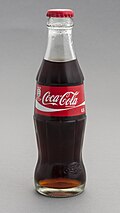
-
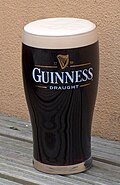
-
 Kaapi, Indian filter coffee.
 -
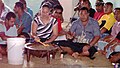 A typical informal faikava in Tonga with the touTemplate:Okinaa serving the men.
 -
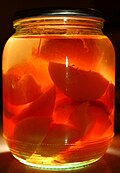 Peach kompot, traditional to several countries in Eastern and Southeastern Europe.
 -

-

-
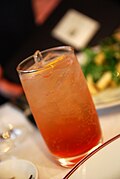 Lemon, lime and bitters is commonly consumed in Australia and New Zealand.
 -
 The new Seven Color Tea, a recent competitor for national drink of Bangladesh.
 -
 Indian Masala chai served in a red clay tea cup.
 -
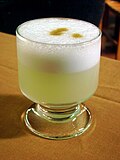


.jpg)


.svg)
.svg)


See also
References
- ↑ Caballero, B.; Finglas, P.; Toldra, F. (2015). Encyclopedia of Food and Health. Elsevier Science. pp. 345–351. ISBN 978-0-12-384953-3. Retrieved December 6, 2017.
- ↑ "United Nations Regional Groups of Member States". Department for General Assembly and Conference Management. United Nations. n.d. Retrieved 5 March 2019.
- ↑ Graveland, Bill (2009-05-14). "We stand on guard – for our favourite cocktail". Winnipeg Free Press. Retrieved 2019-06-27.
- ↑ The History of America's "National Drink", George Washington Inn 25 April 2018. Accessed on 23 February 2021.
- ↑ "The Evolution of an American Icon". CNBC. 9 November 2009.
- ↑ "The Week: The Latest News, Opinion, Sport, People & Business".
- ↑ Woodman, Stephen (23 March 2018). "Mexico's Senate Just Declared a New National Tequila Day". Culture Trip. Retrieved 2019-06-28.
- ↑ "Vino argentino". Retrieved 1 May 2023.
- ↑ Nalewicki, Jennifer (March 15, 2019). "The Story Behind Bermuda's Rum Swizzle (Recipe)". Smithsonian. Retrieved 11 June 2019.
- ↑ Jordan, Christina (October 25, 2017). "Cheers! Here's how to swizzle the national cocktail of Bermuda". Florida Today. Retrieved 11 June 2019.
The Rum Swizzle is probably the most well known swizzled cocktail. It's the national drink of Bermuda and uses Bermuda Rum.
- ↑ 11.0 11.1 11.2 11.3 11.4 Willett, Megan. "The Most Iconic Beverage In 80 Countries Around The World". Business Insider. Retrieved 2019-05-20.
- ↑ 12.0 12.1 12.2 12.3 12.4 "32 Official(ish) Drinks for Every Country Playing in the World Cup". Food & Wine. Retrieved 2019-05-20.
- ↑ 13.0 13.1 13.2 13.3 13.4 Rose, Jeremy (2018-06-14). "The Signature Drink of Every Country in the World Cup Gallery". The Daily Meal. Retrieved 2019-05-20.
- ↑ "Genuine Curaçao Liqueur and Premium Blue Curaçao | Senior Curaçao Liqueur". www.curacaoliqueur.com. Retrieved 2019-07-01.
- ↑ "Webpage about Curacao Liqueur and Triple secs". Archived from the original on May 29, 2013. Retrieved 2012-01-01.
- ↑ "In Haiti, a rum everyone can agree on". Los Angeles Times. 2010-02-09. ISSN 0458-3035. Retrieved 2019-07-03.
- ↑ "Bulgarian Archaeologists Discover 11th Century Rakia Distillation Vessel – Novinite.com – Sofia News Agency". www.novinite.com. Retrieved 2019-06-16.
- ↑ Mersom, Daryl. "The Cold War-era drink that rivals cola". www.bbc.com. Retrieved 2022-12-07.
- ↑ "6 national drinks that will make you a little squiffy". 22 March 2013.
- ↑ Joakim Persson (November 6, 2016). "Finnish Hartwall Original Long Drink now in Hong Kong". ScandAsia. Retrieved August 21, 2020.
- ↑ 21.0 21.1 21.2 "32 Official(ish) Drinks for Every Country Playing in the World Cup". Food & Wine. Retrieved 2019-05-19.
- ↑ 22.0 22.1 22.2 Rose, Jeremy (2018-06-14). "The Signature Drink of Every Country in the World Cup Gallery". The Daily Meal. Retrieved 2019-05-19.
- ↑ Cheung, Tim (2017-07-12). "World's 50 most delicious drinks". CNN Travel. Retrieved 2019-05-20.
- ↑ Sloat, Christopher Alessi and Sarah. "Germans Love Spezi, the 'Swamp Juice' Soda. Will Anyone Else?". WSJ. Retrieved 2022-12-07.
- ↑ Willett, Megan. "The Most Iconic Beverage In 80 Countries Around The World". Business Insider. Retrieved 2019-05-19.
- ↑ GUINNESS®. "Famous Brewer Expands with National Launch of GUINNESS® Black Lager". www.prnewswire.com. Retrieved 2019-05-19.
- ↑ "Why Guinness is less Irish than you think". The Economist. 2014-03-16. ISSN 0013-0613. Retrieved 2019-05-19.
- ↑ Katy Spratte Joyce (2020). "The Global Sip: Riga Black Balsam: Latvia's funky, herby liqueur". Chilled. Retrieved January 22, 2021.
- ↑ Rix, Juliet (3 December 2015). Malta and Gozo. ISBN 9781784770259.
- ↑ "History of vodka production, at the official page of Polish Spirit Industry Association (KRPS), 2007" (in polski). Archived from the original on 30 September 2007.
- ↑ "Porto wine – Made in Portugal". Portugal.com. 3 February 2018. Retrieved 2019-06-21.
- ↑ Schiessl, Courtney. "Portuguese Wines For Every Palate". Forbes. Retrieved 2019-06-21.
- ↑ Stein, Max (December 6, 2012). "Tuica – Romania's White Lightning". The Drinks Business.
- ↑ Ermochkine, Nicholas and Iglikowski, Peter (2003). 40 degrees east: an anatomy of vodka, Nova Publishers, p. 65, ISBN 1-59033-594-5.
- ↑ "Populär punch". www.aperitifklubben.se. Retrieved 2019-12-26.
- ↑ Abel, Ernest L. (2001-09-01). "The Gin Epidemic: Much Ado About What?". Alcohol and Alcoholism. 36 (5): 401–405. doi:10.1093/alcalc/36.5.401. ISSN 0735-0414. PMID 11524305.
- ↑ "The Scotch Whisky Regulations 2009". www.legislation.gov.uk. Retrieved 2019-06-12.
- ↑ Brooks, Libby (2007-05-30). "Scotland's other national drink". The Guardian. ISSN 0261-3077. Retrieved 2019-06-12.
- ↑ "3 Most Popular Welsh Alcoholic Beverages". www.tasteatlas.com. Retrieved 2021-03-04.
- ↑ "Eritrea - Cuisine".
- ↑ 41.0 41.1 "59 national drinks from 59 awesome countries". Matador Network. Retrieved 2019-05-20.
- ↑ Alexander, Kevin (2014-03-15). "World booze guide: The best things to drink in 43 countries". Thrillist. Retrieved 2019-05-20.
- ↑ Urban, Shilo. "The Art of Moroccan Mint Tea and How to Brew It". Organic Authority. Retrieved 2019-07-31.
- ↑ "How to Make the Perfect Pot of Moroccan Mint Tea". The Spruce Eats. Retrieved 2019-07-31.
- ↑ Agab, Muna Ahmed (1 April 1985). "Fermented food products 'Hulu Mur' drink made from Sorghum bicolor". Food Microbiology. 2 (2): 147–155. doi:10.1016/S0740-0020(85)80007-1.
- ↑ Studer, Nina (27 February 2019). "In 1930s Tunisia, French Doctors Feared a 'Tea Craze' Would Destroy Society". Atlas Obscura. Retrieved 11 June 2019.
- ↑ "What to Drink in Tanzania: The Most Popular Tanzanian Drinks". 25 January 2020.
- ↑ "Tea". Encarta. Archived from the original on 2008-03-08. Retrieved 2008-07-23.
- ↑ "Tea". The Columbia Encyclopedia Sixth Edition. 2001–07. Retrieved 2008-07-23.
- ↑ Zheng, Xiao‐Wei, et al. "Daqu—A traditional Chinese liquor fermentation starter." Journal of the Institute of Brewing 117.1 (2011): 82–90.
- ↑ Rong and Fa, Grandiose Survey of Chinese Alcoholic Drinks and Beverages, 2013, "Grandiose Survey of Chinese Alcoholic Drinks and Beverages". Archived from the original on 2014-07-29. Retrieved 2015-05-29.
- ↑ Hui, Sylvia (March 5, 2006). "'Pantyhose Tea' Has Leg Up in Hong Kong". The LA Times. Retrieved August 28, 2020.
- ↑ Lao-Phillips, Jenny (June 22, 2017). "MADE IN MACAO: COFFEE, TEA OR BOTH?". Macau Daily Times. Retrieved August 28, 2020.
- ↑ Jones, Edward (2018-11-13). "Who invented bubble tea? – Taipei Times". Taipei Times. Retrieved 11 June 2019.
Surprisingly little is known for sure about the origin of Taiwan's national drink
- ↑ Tai, Gloria. "Bubble Tea". China Live. Retrieved 11 June 2019.
It can almost be considered a national drink in Taiwan where it originated and took by storm in the 1980's
- ↑ Martin, Laura C. (2007). Tea: The drink that changed the world. Rutland: Tuttle Publishing. p. 219. ISBN 9780804837248.
- ↑ Kita, Satoye (January 12, 2009). "OCHA: JAPAN'S NATIONAL DRINK". The Bulletin. Retrieved August 27, 2020.
- ↑ "Airag – Fermented Mare's Milk – Mongolian Beverage".
- ↑ Zeder, Melinda A. ed. (2006). Documenting Domestication: New Genetic and Archaeological Paradigms. University of California Press. p. 264. ISBN 0-520-24638-1.
{{cite book}}:|author=has generic name (help) - ↑ Anderson (1988), p. 80.
- ↑ Steinkraus, Keith H. ed (1995). Handbook of Indigenous Fermented Foods. Marcel Dekker. p. 304. ISBN 0-8247-9352-8.
{{cite book}}:|author=has generic name (help) - ↑ Indra, Rinchingiin (2003). "Mongolian Dairy Products". In Dendev Badarch, Raymond A Zilinskas (ed.). Mongolia Today: Science, Culture, Environment and Development. Routledge. p. 74. ISBN 0-7007-1598-3.
- ↑ Indra p. 73.
- ↑ Shim, Elizabeth (2019-06-18). "Pyongyang Soju selected national beverage of North Korea". UPI. ISSN 0261-3077. Retrieved 2019-07-30.
- ↑ Miller, Norman (2013-12-02). "Soju: the most popular booze in the world". The Guardian. ISSN 0261-3077. Retrieved 2019-05-20.
- ↑ "soju". Oxford Dictionary of English. Oxford University Press. Archived from the original on January 13, 2017. Retrieved 14 April 2017.
- ↑ "soju". Merriam-Webster Dictionary. Encyclopædia Britannica. Retrieved 22 November 2014.
- ↑ Miller, Norman (2 December 2013). "Soju: the most popular booze in the world". The Guardian. Retrieved 13 April 2017.
- ↑ Park, Eun-jee (19 November 2014). "Koreans looking for weaker soju". Korea JoongAng Daily. Retrieved 14 April 2017.
- ↑ Hall, Joshua (17 October 2014). "Soju Makers Aim to Turn Fire Water Into Liquid Gold". The Wall Street Journal. Retrieved 24 December 2014.
- ↑ Archibald, Anna (27 August 2015). "Why You Should Be Drinking Korean Soju Right Now". Liquor.com. Retrieved 14 December 2015.
- ↑ Rice, Jessica (22 August 2013). "59 national drinks from 59 awesome countries". Matador Network. Retrieved 28 July 2017.
- ↑ Grant, Lara (29 August 2016). "6 Local Liquors Around the World You Haven't Heard Of". Oyster.com. Retrieved 28 July 2017.
- ↑ Es teler
- ↑ Pat Tanumihardja (May 27, 2018). "Indonesia's delicious twist on avocados". The Week. Retrieved August 21, 2020.
- ↑ Sally Everett (12 April 2016). Food and Drink Tourism: Principles and Practice. SAGE Publications. p. 301. ISBN 978-1-4739-6597-3.
- ↑ "The cheapest alcohol in the world: Lao-Lao, Laos rice whiskey". www.priceoftravel.com. 9 December 2010. Retrieved 17 July 2017.
- ↑ "Disputes – International". CIA. Archived from the original on June 13, 2007. Retrieved 4 January 2011.
- ↑ "Lipton urges Malaysians to take pride in teh tarik, our national beverage". New Sabah Times. 7 September 2012. Archived from the original on 2 July 2014. Retrieved 6 November 2013.
- ↑ Gora, Sasha (2015-03-27). "Taking the Machismo and MSG Out of Myanmar's Tea Shops". Vice. Retrieved 2019-10-20.
- ↑ Crane, Brent (2019-10-20). "The Underage Tea Boys of Myanmar". Vice. Archived from the original on 2019-10-20. Retrieved 2019-10-20.
- ↑ Tiu, Cheryl (July 9, 2014). "Revolution and rum: 18 drinks inspired by the Philippines". CNN. Retrieved August 21, 2020.
- ↑ "Traditional Breakfast of Kaya and Kopi". www.roots.sg. Retrieved 2020-05-19.[permanent dead link]
- ↑ Aljunied, Khairudin (2014). "Coffee-shops in Colonial Singapore: Domains of Contentious Publics". History Workshop Journal. 77: 65–85. doi:10.1093/hwj/dbt011. S2CID 154985319 – via Oxford Academic.
- ↑ Max Falkowitz (August 7, 2012). "Snapshots from Singapore: A Guide to Singaporean Coffee". Seriouseats.com. Retrieved August 21, 2020.
- ↑ 86.0 86.1 Denise Chia (2014). "Milo Dinosaur: Uniquely Singapore". The Smart Local. Retrieved 29 November 2020.
- ↑ Pakiam, Geoffrey K. "Milo Dinosaur. The life and times of a Southeast Asian national beverage | IIAS". www.iias.asia. Retrieved 29 October 2021.
Milo Dinosaur's name appears to have originated in Singapore-based Indian-Muslim eateries during the mid-1990s. Labelling a turbo-charged version of ice Milo as Milo Dinosaur may have been a way to riff on Singapore's cinema culture, which during the 1990s was saturated with the exploits of giant reptiles in Jurassic Park and its sequels.
- ↑ Commins, Terry. "History of Tea in Thailand".
{{cite journal}}: Cite journal requires|journal=(help) - ↑ Bangladesh Tea Research Institute, Banglapedia
- ↑ "সিলেটের সাতরঙা চা এর রহস্য ভেদ, জানুন তৈরির নিয়ম" (in Bengali). The Daily Prothom Alo. Archived from the original on May 4, 2017. Retrieved November 4, 2017.
- ↑ 91.0 91.1 "Making rainbows in a glass – seven-layer tea in Bangladesh". The Guardian. 28 August 2016. Retrieved November 2, 2017.
- ↑ Shay, Christopher (7 June 2011). "One Glass, Seven Layers of Tea – Scene Asia". Wall Street Journal. Wall Street Journal Blog. Retrieved November 7, 2017.
- ↑ "Merak and Sakteng – The Land of Brokpas". Wind Horse Tours online. Archived from the original on 2011-09-27. Retrieved 2011-07-27.
- ↑ "Lassi | beverage". Encyclopedia Britannica. Retrieved 2019-06-15.
- ↑ "5 Best Lassi Recipes: The Ultimate Summer Cooler from Punjab". NDTV Food. Retrieved 2019-06-15.
- ↑ Perry, Sara (August 2001). The New Tea Book: A Guide to Black, Green, Herbal and Chai Teas. Chronicle Books. ISBN 9780811830539.
- ↑ Harish, Chef (2014-08-22). "Make fantastic filter kaapi". The Hindu. ISSN 0971-751X. Retrieved 2019-06-15.
- ↑ Ethnic Fermented Foods and Alcoholic Beverages of Asia, Front Cover By Jyoti Prakash Tamang, Springer, 5 Aug 2016 – Technology & Engineering – 409 pages, P.107
- ↑ "Nepal: Liquor". The Global Gourmet. Archived from the original on 9 March 2016.
- ↑ P.67 Land and Social Change in East Nepal: A Study of Hindu-Tribal Relations By Professor Lionel Caplan, Lionel Caplan
- ↑ p.34 Kinship and Marriage Among the Limbu of Eastern Nepal: A Study By Rex Lee Jones – 1973
- ↑ "Sugarcane juice declared 'national drink' of Pakistan after Twitter poll". Hindustan Times. January 25, 2019. Retrieved August 21, 2020.
- ↑ Bakirova, Elita (2015-06-22). "Kyrgyzstan's fermented drink: a strong, salty national treasure". The Guardian. ISSN 0261-3077. Retrieved 2020-01-14.
- ↑ Nadworny, Katie (6 June 2019). "15 Things to Eat and Drink in Turkey". Fodors Travel Guide. Retrieved 11 June 2019.
Turkey's national drink isn't just a beverage—it's an experience. A clear anise liquor that turns milky white with water and ice (sometimes referred to as "lion's milk")
- ↑ Arditi, Talya (29 December 2015). "How to drink raki, Turkey's signature drink". CNN Travel. Retrieved 11 June 2019.
Meet raki – otherwise known as Lion's Milk – the Turkish national drink made of twice-distilled grapes and aniseed.
- ↑ Burch, Jonathon (27 April 2013). "Turkey's leader hits a nerve over country's "national drink"". Reuters. Retrieved 11 June 2019.
That is what Turkey's often divisive prime minister did late on Friday when he pronounced that the national drink was not beer, nor the aniseed spirit raki – choice tipple of Turkey's founding father – but the non-alcoholic yoghurt drink ayran.
- ↑ Kanan, Onur (May 22, 2014). "Ayran, Turkey's favorite summer drink". Daily Sabah. Retrieved 11 June 2019.
Ayran, which is also known as the non-alcoholic national drink of Turkey, is made of yogurt, water and salt.
- ↑ 108.0 108.1 108.2 Kriewaldt, Kit (8 December 2018). "We drink more than 100 million a year and it's all ours". ABC News. Retrieved 8 December 2018.
- ↑ Imperor, Rex (2013-12-02). "Toddy: The national drink of Kiribati". Imperor, All about the monarchy. ISSN 0261-3077. Archived from the original on 2019-07-30. Retrieved 2019-07-30.
- ↑ Confirel:Sugar Palm Tree – Conservation of natural heritage retrieved on 15 April 2012