









No edit summary |
WikiDwarfBOT (talk | contribs) Cleanup: |
||
| Line 1: | Line 1: | ||
{{Short description|Ancient Tamil dynasty | |||
{{Short description|Ancient Tamil dynasty of south India}} | |||
{{Use Indian English|date=September 2013}} | {{Use Indian English|date=September 2013}} | ||
{{Use dmy dates|date=December 2020}} | {{Use dmy dates|date=December 2020}} | ||
{{Infobox Former Country | {{Infobox Former Country | ||
| conventional_long_name = | | conventional_long_name = Pandyan dynasty | ||
| common_name = Pandya Nadu | | common_name = Pandya Nadu | ||
| native_name = <!--Please do not complete this field | | native_name = <!--Please do not complete this field using Indic Scripts as it is Prohibited on Wikipedia (read WP:IndicScripts)--> | ||
Pāṇṭiya Pēraracu | |||
| flag_border = yes | |||
| flag_border = | |||
| era = [[Medieval era]] | | era = [[Medieval era]] | ||
| year_start = | | year_start = | ||
| year_end = | | year_end = 1618 | ||
| p1 = Chola dynasty{{!}}Chola Empire | | p1 = Chola dynasty{{!}}Chola Empire | ||
| flag_p1 = | | flag_p1 = | ||
| border_p1 = no | | border_p1 = no | ||
| p2 = | | p2 = | ||
| s1 = Tenkasi Pandyas | | s1 = Tenkasi Pandyas | ||
| s2 = Madurai Nayak dynasty | | s2 = Madurai Nayak dynasty | ||
| flag_s1 = | | flag_s1 = | ||
| flag_s2 = | | flag_s2 = | ||
| s3 = Vijayanagara Empire | | s3 = Vijayanagara Empire | ||
| flag_s3 = | | flag_s3 = | ||
| border_s3 = no | | border_s3 = no | ||
| flag_s4 = Delhi | | flag_s4 = Sultan of Delhi Flag according to the Catalan Atlas (1375).png | ||
| s4 = Delhi Sultanate | | s4 = Delhi Sultanate | ||
| border_s4 = No | | border_s4 = No | ||
| flag_s5 = | | flag_s5 = | ||
| s5 = Jaffna kingdom | | s5 = Jaffna kingdom | ||
| image_s6 = Sambuvaraya | | image_s6 = Sambuvaraya | ||
| image_map = ImperioPandya1251-1283AD.svg | | image_map = ImperioPandya1251-1283AD.svg | ||
| image_map_caption = Pandyan Empire at greatest extent | | image_map_caption = Pandyan Empire at greatest extent<ref>{{cite book |last1=Schwartzberg |first1=Joseph E. |title=A Historical atlas of South Asia |date=1978 |publisher=University of Chicago Press |location=Chicago |page=146, map XIV.2 (b)|isbn=0226742210 |url=https://dsal.uchicago.edu/reference/schwartzberg/pager.html?object=183}}</ref> | ||
| official_languages = [[Tamil language|Tamil]]<ref>{{Cite book |last=Upinder Singh |url=https://books.google.com/books?id=H3lUIIYxWkEC&pg=PA46 |title=A History of Ancient and Early Medieval India: From the Stone Age to the 12th Century |publisher=Pearson Education India |year=2008 |isbn=978-81-317-1120-0 |page=46 |quote=Kings of the Chola and Pandya dynasties also issued Tamil and bilingual | | official_languages = [[Tamil language|Tamil]]<br>[[Sanskrit]]<ref>{{Cite book |last=Upinder Singh |url=https://books.google.com/books?id=H3lUIIYxWkEC&pg=PA46 |title=A History of Ancient and Early Medieval India: From the Stone Age to the 12th Century |publisher=Pearson Education India |year=2008 |isbn=978-81-317-1120-0 |page=46 |quote=Kings of the Chola and Pandya dynasties also issued Tamil and bilingual Tamil-Sanskrit inscriptions.}}</ref><ref>{{Cite book |last=C. Sivaramamurti |url=https://books.google.com/books?id=WKgQAQAAMAAJ |title=L'Art en Inde |publisher=H. N. Abrams |year=1977 |isbn=978-0-8109-0630-3 |page=60 |quote=Thus the state language was Sanskrit whether the inscriptions were from the north or the south and whether the dynasty was Gupta, Vakatak[a], Vardhana, Maukhari, Pratihara, Paramara, Chandella, Pala, Sena, Gahadavala, Haihaya, Ganga, Pallava, Chola, Pandya, Chalukya, Rashtrakuta, or Vijayanagar[a]. Inscriptions were sometimes written in regional languages, but they invariably had a preface in Sanskrit.}}</ref> | ||
| capital = *[[Korkai]] (port, early historic)<ref>{{Cite journal |date=2015-06-05 |title=Classical Indo-Roman Trade |url=https://www.epw.in/journal/2013/26-27/special-articles/classical-indo-roman-trade.html |journal=Economic and Political Weekly |language=en |volume=48 |issue=26–27}}</ref> | | capital = *[[Korkai]] (port, early historic)<ref>{{Cite journal |date=2015-06-05 |title=Classical Indo-Roman Trade |url=https://www.epw.in/journal/2013/26-27/special-articles/classical-indo-roman-trade.html |journal=Economic and Political Weekly |language=en |volume=48 |issue=26–27}}</ref> | ||
*[[Madurai]] (till 1335 CE)<ref name="Fall"/> | * [[Madurai]] (till 1335 CE)<ref name="Fall"/> | ||
*[[Tenkasi]] (till 1618 CE)<ref name="Fall"/> | * [[Tenkasi]] (till 1618 CE)<ref name="Fall"/> | ||
| religion = {{ublist | | religion = {{ublist | ||
|[[Hinduism]] ([[state religion| | |[[Hinduism]] ([[state religion|official]]) | ||
|[[Buddhism]] | |[[Buddhism]] | ||
|[[Jainism]] | |[[Jainism]] | ||
| Line 48: | Line 46: | ||
| leader2 = [[Tenkasi Pandyas|Varagunarama]] | | leader2 = [[Tenkasi Pandyas|Varagunarama]] | ||
| year_leader2 = 1613–1618 CE | | year_leader2 = 1613–1618 CE | ||
| today = [[India]]<br | | today = [[India]]<br>[[Sri Lanka]] | ||
| demonym = | | demonym = Pandiyar | ||
| flag_width = | | flag_width = 160px | ||
| map_caption = The Pandya dynasty at its greatest extent | | map_caption = The Pandya dynasty at its greatest extent in 1290 CE under [[Maravarman Kulasekara Pandyan I]]. | ||
}} | }} | ||
{{TNhistory}} | {{TNhistory}} | ||
{{HistoryOfSouthAsia}} | {{HistoryOfSouthAsia}} | ||
The ''' | The '''Pandyan dynasty''', also referred to as the '''Pandyas of Madurai''', was an [[Tamil Dynasties|ancient Tamil dynasty of South India]], and among the four great kingdoms of [[Tamilakam]], the other three being the [[Pallavas|Pallavas,]] the [[Chola dynasty|Cholas]] and the [[Chera dynasty|Cheras]].<ref name=":4">Subbarayalu, Y. 2014. 'Early Tamil Polity', in ''A Concise History of South India: Issues and Interpretations'', ed. Noburu Karashima, pp. 53–54. New Delhi: Oxford University Press.</ref> Existing since at least the 4th to 3rd centuries BCE, the dynasty passed through two periods of imperial dominance, the 6th to 10th centuries CE, and under the 'Later Pandyas' (13th to 14th centuries CE). Under [[Jatavarman Sundara Pandyan I]] and [[Maravarman Kulasekara Pandyan I]], the Pandyas ruled extensive territories including regions of present-day [[South India]] and northern [[Sri Lanka]] through vassal states subject to [[Madurai]].<ref name=":302">Karashima, Noburu. 2014. 'The Fall of the Old States', in ''A Concise History of South India: Issues and Interpretations'', ed. Noburu Karashima, pp. 172–73. New Delhi: Oxford University Press.</ref><ref name=":3" /> | ||
The rulers of the three Tamil dynasties were referred to as the "[[Three Crowned Kings|three crowned rulers (the mu-ventar)]] of [[Tamilakam|the Tamil country]]".<ref name=":4" /><ref>{{Cite book | The rulers of the three Tamil dynasties were referred to as the "[[Three Crowned Kings|three crowned rulers (the mu-ventar)]] of [[Tamilakam|the Tamil country]]".<ref name=":4" /><ref>{{Cite book|url=https://books.google.com/books?id=BbqbAAAAQBAJ&q=pandya+dynasty+tamilakam&pg=PA57|title=Britannica Guide to India|date=2009-03-01|publisher=Encyclopaedia Britannica, Inc.|isbn=978-1-59339-847-7|pages=57|language=en}}</ref> The origin and the timeline of the Pandya dynasty are difficult to establish.<ref name=":3">{{Cite news |title=Pandya dynasty {{!}} Indian dynasty |language=en |work=Encyclopedia Britannica |url=https://www.britannica.com/topic/Pandya-dynasty |access-date=2017-09-21}}</ref> The [[Early Pandyan Kingdom|early Pandya]] chieftains ruled their country ([[Pandya Nadu]]) from the ancient period, which included the inland city of [[Madurai]] and the southern port of [[Korkai]].<ref name=":26">{{Cite journal |date=2015-06-05 |title=Classical Indo-Roman Trade |url=https://www.epw.in/journal/2013/26-27/special-articles/classical-indo-roman-trade.html?0=ip_login_no_cache=3b49b785309ca821ff5e0a285f43e078 |journal=Economic and Political Weekly |language=en |volume=48 |issue=26–27}}</ref><ref name=":162">{{Cite journal|date=2015-06-05|title=Classical Indo-Roman Trade|url=https://www.epw.in/journal/2013/26-27/special-articles/classical-indo-roman-trade.html|journal=Economic and Political Weekly|language=en|volume=48|issue=26–27|pages=7–8}}</ref> The Pandyas are celebrated in the earliest available Tamil poetry ([[Sangam literature]]").<ref name=":3" /> [[Classical antiquity|Graeco-Roman]] accounts (as early as 4th century BCE<ref name=":3" />), the edicts of [[Maurya dynasty|Maurya]] emperor [[Ashoka]], coins with legends in [[Tamil-Brahmi]] script, and Tamil-Brahmi inscriptions suggest the continuity of the Pandya dynasty from the 3rd century BCE to the early centuries CE.<ref name=":17" /><ref name=":6">{{Cite book|last=Vincent|first=William|url=https://books.google.com/books?id=lldBAAAAcAAJ&q=Ptolemy+pandion&pg=PA401|title=The Periplus of the Erythrean Sea|date=1805|publisher=Cadell and Davies|pages=403|language=en}}</ref><ref name=":26" /> The early historic Pandyas faded into obscurity upon the rise of the [[Kalabhras|Kalabhra dynasty]] in south India.{{sfn|Romila Thapar|2003|p=327}} | ||
From the 6th century to the 9th century CE, the [[Chalukyas of Badami]] or [[Rashtrakuta dynasty|Rashtrakutas]] of the Deccan, the [[Pallavas of Kanchi]], and Pandyas of Madurai dominated the politics of south India. The Pandyas often ruled or invaded the fertile estuary of [[Kaveri]] (the Chola country), the ancient [[Chera dynasty|Chera country]] (Kongu and central [[Kerala]]) and [[Venad]]u (southern Kerala), the [[Pallava dynasty|Pallava country]] and [[Sri Lanka]].{{sfn|Noboru Karashima|2014|p=85-87}} The Pandyas fell into decline with the rise of the [[Cholas]] of Thanjavur in the 9th century and were in constant conflict with the latter. The Pandyas allied themselves with the [[Sinhalese people|Sinhalese]] and the [[Chera/Perumals of Makotai|Cheras]] in | From the 6th century to the 9th century CE, the [[Chalukyas of Badami]] or [[Rashtrakuta dynasty|Rashtrakutas]] of the Deccan, the [[Pallavas of Kanchi]], and Pandyas of Madurai dominated the politics of south India. The Pandyas often ruled or invaded the fertile estuary of [[Kaveri]] (the Chola country), the ancient [[Chera dynasty|Chera country]] (Kongu and central [[Kerala]]) and [[Venad]]u (southern Kerala), the [[Pallava dynasty|Pallava country]] and [[Sri Lanka]].{{sfn|Noboru Karashima|2014|p=85-87}} The Pandyas fell into decline with the rise of the [[Cholas]] of Thanjavur in the 9th century and were in constant conflict with the latter. The Pandyas allied themselves with the [[Sinhalese people|Sinhalese]] and the [[Chera/Perumals of Makotai|Cheras]] in giving resistance to the invaders [[Chola Empire]] until it found an opportunity for reviving its frontiers during the late 13th century.<ref name=":252">Sastri, K. A. Nilakanta. (1958, second ed.) ''A History of South India from Prehistoric Times to the Fall of Vijayanagar.'' Madras, Oxford University Press. 170-72.</ref> | ||
The Pandyas entered their golden age under [[Maravarman Sundara Pandyan|Maravarman I]] and [[Jatavarman Sundara Pandyan|Jatavarman Sundara Pandya I]] (13th century).<ref name=":302" /><ref name=":3" /> Some early efforts by [[Maravarman Sundara Pandyan|Maravarman I]] to expand into the | The Pandyas entered their golden age under [[Maravarman Sundara Pandyan|Maravarman I]] and [[Jatavarman Sundara Pandyan|Jatavarman Sundara Pandya I]] (13th century).<ref name=":302" /><ref name=":3" /> Some early efforts by [[Maravarman Sundara Pandyan|Maravarman I]] to expand into the [[Chola dynasty|Chola country]] were effectively checked by the hun invaders of [[Hoysalas]].<ref>{{Cite book|last=Sastri|first=K. A. Nilakanta|title=A History of South India: From Prehistoric Times to the Fall of Vijayanagar|publisher=Oxford University Press|edition=1958|pages=203–05|chapter=The Age of the Four Kingdoms}}</ref> [[Jatavarman Sundara Pandyan|Jatavarman I]] ({{circa|1251}}) successfully expanded the kingdom into the Telugu country (as far north as [[Nellore]]), south Kerala, and conquered northern [[Sri Lanka]].<ref name=":302" /><ref name=":3" /> The city of [[Kanchipuram|Kanchi]] became a secondary capital of the Pandyas.The Hoysalas, in general, were confined to Mysore Plateau and even king [[Vira Someshwara|Somesvara]] was killed in a battle with Pandyas.<ref name=":25">{{Cite book|last=Sastri|first=K. A. Nilakanta|title=A History of South India: From Prehistoric Times to the Fall of Vijayanagar|publisher=Oxford University Press|year=|isbn=|edition=1958|location=|pages=207–08|chapter=The Age of the Four Kingdoms}}</ref> [[Maravarman Kulasekara Pandyan I|Maravarman Kulasekhara I]] (1268) defeated an alliance of the Hunic Hoysalas and the invader Cholas (1279) and allied [[Sri Lanka]]. The venerable [[Relic of the tooth of the Buddha|Tooth Relic of the Buddha]] was carried away by the Pandyas. During this period, the rule of the kingdom was shared among several royals, one of them enjoying primacy over the rest.<ref name=":25"/> An internal crisis in the Pandya kingdom coincided with the [[Khalji dynasty|Khalji]] [[Malik Kafur's invasion of the Pandya kingdom|invasion]] of south India in 1310–11.<ref name=":3" /> The ensuing political crisis saw more sultanate raids and plunder, the loss of south Kerala (1312), and north Sri Lanka (1323) and the establishment of the [[Madurai Sultanate|Madurai sultanate]] (1334<ref name="Fall">Karashima, Noburu. 2014. 'The Fall of the Old States', in ''A Concise History of South India: Issues and Interpretations'', ed. Noburu Karashima, pp. 173–74. New Delhi: Oxford University Press.</ref>).<ref name=":10">Sri Lanka and South-East Asia: Political, Religious and Cultural Relations from A.D. c. 1000 to {{circa|1500}}, 1978 By W. M. Sirisena, 57 p.</ref><ref name=":11">Politics of Tamil Nationalism in Sri Lanka, South Asian Publishers, 1996 by Ambalavanar Sivarajah, 22 p.</ref> The Pandyas of Ucchangi (9th–13th century), in the [[Tungabhadra]] Valley were related to the Pandyas of Madurai.<ref name=":3" /> | ||
According to tradition, the legendary [[Tamil Sangams|Sangams ("the Academies")]] were held in [[Madurai]] under the patronage of the Pandyas, and some of the | According to tradition, the legendary [[Tamil Sangams|Sangams ("the Academies")]] were held in [[Madurai]] under the patronage of the Pandyas, and some of the Pandyan rulers claimed to be poets themselves. Pandya Nadu was home to a number of renowned temples, including the [[Meenakshi Temple]] in [[Madurai]]. The revival of the Pandya power by [[Kadungon]] (7th century CE) coincided with the prominence of the Shaivite [[nayanars]] and the Vaishnavite [[alvars]].<ref name=":15">{{Cite book |last=A. Soundaram |title=History of People and Their Environs |publisher=Bharathi Puthakalayam |year=2011 |isbn=978-93-80325-91-0 |editor-last=S. Ganeshram |pages=68–69 |chapter=The Characteristic Features of Early Medieval Tamil Society |editor-last2=C. Bhavani |chapter-url=https://books.google.com/books?id=crxUQR_qBXYC&pg=PA68}}</ref> It is known that the Pandya rulers followed [[Vedism]] Shravanism is part of Vedic principles. | ||
==Etymology and origin legends== | ==Etymology and origin legends== | ||
The etymology of Pandya is still a matter of considerable speculation among scholars. One theory is that the word ''pandya'' is derived from the ancient Tamil word "pandu" meaning "old".<ref>{{Cite book |last=Avari |first=Burjor |url=https://books.google.com/books?id=WTaTDAAAQBAJ |title=India: The Ancient Past: A History of the Indian Subcontinent from | The etymology of Pandya is still a matter of considerable speculation among scholars. One theory is that the word ''pandya'' is derived from the ancient Tamil word "pandu" meaning "old".<ref>{{Cite book |last=Avari |first=Burjor |url=https://books.google.com/books?id=WTaTDAAAQBAJ |title=India: The Ancient Past: A History of the Indian Subcontinent from {{circa|7000 BCE}} to CE 1200 |date=2016-07-01 |publisher=Routledge |isbn=9781317236733 |pages=249 |language=en}}</ref> The theory suggests that in [[Sangam period|early historic]] Tamil lexicon the word pandya means ''old country'' in contrast with [[Chola]] meaning ''new country'', [[Chera Dynasty|Chera]] meaning ''hill country'' and [[Pallava]] meaning ''branch'' in [[Sanskrit]].<ref>{{Cite book |last=Madras |first=University of |url=https://books.google.com/books?id=G-87AQAAIAAJ&q=pandyan+longest+rule |title=Journal: Humanities |date=1973 |language=en}}</ref> Another theory is that the word Pandya is derived from the [[Sanskrit]] word [[Pandu]] to mean white or pale, in reference to king [[Pandu]] and the [[Pandava]]s.<ref>MALONEY, Clarence Thomas, THE EFFECT OF EARLY COASTAL SEA TRAFFIC ON THE DEVELOPMENT OF CIVILIZATION IN SOUTH INDIA. University of Pennsylvania, Ph.D, 1968 Anthropology, p.35</ref> Apart from these derivations mentioned, a number of other theories do appear in historical studies.<ref>{{Cite book |last=Oppert |first=Gustav saloman |title=On the Original Inhabitants of Bharatavarsa or India |year=1888 |isbn=9925082196 |pages=104}}</ref> | ||
According to the ancient [[Tamil mythology|Tamil legends]], the three brothers ''Cheran'', ''Cholan'' and ''Pandyan'' ruled in common at the southern city of [[Korkai]]. While Pandya remained at home, his two brothers Cheran and Cholan after a separation founded their own kingdoms in north and west.<ref>{{Cite book |last=Caldwell |first=Bishop R. |url=https://books.google.com/books?id=zjTneAGmatsC |title=History of Tinnevelly |date=1989 |publisher=Asian Educational Services |isbn=9788120601611 |pages=12 |language=en}}</ref> Epic poem ''[[Silappatikaram]]'' mentions that the emblem of the Pandyas was that of a ''fish''.<ref>{{Cite book |last=Nākacāmi |first=Irāmaccantiran̲ |url=https://books.google.com/books?id=wtYBAAAAMAAJ |title=Studies in Ancient Tamil Law and Society |date=1978 |publisher=Institute of Epigraphy, State Department of Archaeology, Government of Tamilnadu |pages=52 |language=en}}</ref> | According to the ancient [[Tamil mythology|Tamil legends]], the three brothers ''Cheran'', ''Cholan'' and ''Pandyan'' ruled in common at the southern city of [[Korkai]]. While Pandya remained at home, his two brothers Cheran and Cholan after a separation founded their own kingdoms in north and west.<ref>{{Cite book |last=Caldwell |first=Bishop R. |url=https://books.google.com/books?id=zjTneAGmatsC |title=History of Tinnevelly |date=1989 |publisher=Asian Educational Services |isbn=9788120601611 |pages=12 |language=en}}</ref> Epic poem ''[[Silappatikaram]]'' mentions that the emblem of the Pandyas was that of a ''fish''.<ref>{{Cite book |last=Nākacāmi |first=Irāmaccantiran̲ |url=https://books.google.com/books?id=wtYBAAAAMAAJ |title=Studies in Ancient Tamil Law and Society |date=1978 |publisher=Institute of Epigraphy, State Department of Archaeology, Government of Tamilnadu |pages=52 |language=en}}</ref> | ||
Indian traditions such as the Great Epics and the Puranas often associate southern India with Sage Agastya (who had his ashrama in the south). Agastya appears prominently in medieval Tamil literature also.<ref>Karashima, Noburu. 2014. 'Beginnings of South Indian History', in ''A Concise History of South India: Issues and Interpretations'', ed. Noburu | Indian traditions such as the Great Epics and the Puranas often associate southern India with Sage Agastya (who had his ashrama in the south). Agastya appears prominently in medieval Tamil literature also.<ref>Karashima, Noburu. 2014. 'Beginnings of South Indian History', in ''A Concise History of South India: Issues and Interpretations'', ed. Noburu Karashima, pp. 25–26. New Delhi: Oxford University Press.</ref> | ||
Folklores attributes [[Alli Raani|Alli Rani]] (meaning "the queen Alli") as one of the [[Sangam period|early historic]] rulers of the Pandyas. She is attributed as an [[Amazons|"amazonian]] queen" whose servants were men and administrative officials and army were women.<ref>{{Cite book |last=University |first=Vijaya Ramaswamy, Jawaharlal Nehru |title=Historical Dictionary of the Tamils |date=2017-08-25 |publisher=Rowman & Littlefield |isbn=9781538106860 |pages=50 |language=en}}</ref> She is thought of ruling the whole western and northern coast of [[Sri Lanka]] from her capital [[Kudiramalai]], where remains of what is thought of as [[Arippu fort|her fort]] are found.<ref>{{Cite book |last=Raghavan |first=M. D. |title=Tamil culture in Ceylon: a general introduction |date=1971 |publisher=Kalai Nilayam |pages=59–60 |language=en}}</ref> She is sometimes seen as an incarnation of the Pandya associated gods, [[Meenakshi]] and [[Kannaki Amman|Kannagi]].<ref name=":22">{{Cite book |last=Shulman |first=David Dean |title=Tamil Temple Myths: Sacrifice and Divine Marriage in the South Indian Saiva Tradition |date=2014-07-14 |publisher=Princeton University Press |isbn=9781400856923 |pages=124 |language=en}}</ref> | Folklores attributes [[Alli Raani|Alli Rani]] (meaning "the queen Alli") as one of the [[Sangam period|early historic]] rulers of the Pandyas. She is attributed as an [[Amazons|"amazonian]] queen" whose servants were men and administrative officials and army were women.<ref>{{Cite book |last=University |first=Vijaya Ramaswamy, Jawaharlal Nehru |title=Historical Dictionary of the Tamils |date=2017-08-25 |publisher=Rowman & Littlefield |isbn=9781538106860 |pages=50 |language=en}}</ref> She is thought of ruling the whole western and northern coast of [[Sri Lanka]] from her capital [[Kudiramalai]], where remains of what is thought of as [[Arippu fort|her fort]] are found.<ref>{{Cite book |last=Raghavan |first=M. D. |title=Tamil culture in Ceylon: a general introduction |date=1971 |publisher=Kalai Nilayam |pages=59–60 |language=en}}</ref> She is sometimes seen as an incarnation of the Pandya associated gods, [[Meenakshi]] and [[Kannaki Amman|Kannagi]].<ref name=":22">{{Cite book |last=Shulman |first=David Dean |title=Tamil Temple Myths: Sacrifice and Divine Marriage in the South Indian Saiva Tradition |date=2014-07-14 |publisher=Princeton University Press |isbn=9781400856923 |pages=124 |language=en}}</ref> | ||
=== Chandra-vamsa === | === Chandra-vamsa === | ||
The medieval Pandya kings were claimed to have belonged to the Chandra-vamsa or the [[Lunar dynasty| | The medieval Pandya kings were claimed to have belonged to the Chandra-vamsa or the [[Lunar dynasty|Yadav Race]].<ref>{{Cite book |last=James Henry Nelson |title=The Madura Country: A Manual |publisher=Asian Educational Services, 1989 |page=44}}</ref> They claimed [[Pururavas]] and [[Nahusha]] as ancestors.<ref>{{Cite book |last=Irā Nākacāmi, Irāmaccantiran̲ Nākacāmi |title=Art and Culture of Tamil Nadu |publisher=Sundeep Prakashan, 1980 |page=2}}</ref> Pururavas is listed as one of the ancestors in the [[Velvikudi inscription|Velvikudi Inscription]] of Nedunjadaiyan Varaguna-varman I (Jatila Parantaka Nedunjadaiyan).<ref>{{Cite book |last=H. K. Sastri |url=https://books.google.com/books?id=0VwmsGA7ZuoC |title=Epigraphia Indica |publisher=Archaeological Survey of India |year=1983 |volume=17 |page=305 |chapter=Velvikudi Grant of Nedunjadaiyan |author-link=H. Krishna Sastri}}</ref> | ||
==Sources of Pandya history== | ==Sources of Pandya history== | ||
| Line 83: | Line 81: | ||
[[File:Mangulam inscription (south India).jpg|thumb|Mangulam inscription (3rd and 2nd centuries BCE)|alt=]] | [[File:Mangulam inscription (south India).jpg|thumb|Mangulam inscription (3rd and 2nd centuries BCE)|alt=]] | ||
Pandyas are also mentioned in the inscriptions of [[Maurya dynasty|Maurya]] emperor [[Ashoka|Asoka]] (3rd century BCE). In his inscriptions (2nd and 13th Major Rock Edict<ref name=":21">Karashima, Noburu. 2014. 'Beginnings of South Indian History', in ''A Concise History of South India: Issues and Interpretations'', ed. Noburu | Pandyas are also mentioned in the inscriptions of [[Maurya dynasty|Maurya]] emperor [[Ashoka|Asoka]] (3rd century BCE). In his inscriptions (2nd and 13th Major Rock Edict<ref name=":21">Karashima, Noburu. 2014. 'Beginnings of South Indian History', in ''A Concise History of South India: Issues and Interpretations'', ed. Noburu Karashima, pp. 26–27. New Delhi: Oxford University Press.</ref>) [[Ashoka|Asoka]] refers to the peoples of south India – the [[Cholas]], [[Chera]]s, [[Pandyas]] and [[Satiyaputras]].<ref>Kulke and Rothermund, p104</ref><ref name="Keay, p119">Keay, p119</ref> These polities, although not part of the Maurya empire, were on friendly terms with Asoka: | ||
{{cquote|The conquest by [[dharma]] has been won here, on the borders, and even six hundred [[yojana]]s (5,400–9,600 km) away, where the Greek king [[Antiochus II Theos|Antiochos]] rules, beyond there where the four kings named [[Ptolemy II Philadelphus|Ptolemy]], [[Antigonus II Gonatas|Antigonos]], [[Magas of Cyrene|Magas]] and [[Alexander II of Epirus|Alexander]] rule, likewise in the south among the [[Cholas]], the Pandyas, and as far as [[Tamraparni]] river.<ref>[http://www.cs.colostate.edu/~malaiya/ashoka.html S. Dhammika, ''The Edicts of King Ashoka: An English Rendering''] Buddhist Publication Society, Kandy (1994) {{ISBN|955-24-0104-6}}</ref> | {{cquote|The conquest by [[dharma]] has been won here, on the borders, and even six hundred [[yojana]]s (5,400–9,600 km) away, where the Greek king [[Antiochus II Theos|Antiochos]] rules, beyond there where the four kings named [[Ptolemy II Philadelphus|Ptolemy]], [[Antigonus II Gonatas|Antigonos]], [[Magas of Cyrene|Magas]] and [[Alexander II of Epirus|Alexander]] rule, likewise in the south among the [[Cholas]], the Pandyas, and as far as [[Tamraparni]] river.<ref>[http://www.cs.colostate.edu/~malaiya/ashoka.html S. Dhammika, ''The Edicts of King Ashoka: An English Rendering''] Buddhist Publication Society, Kandy (1994) {{ISBN|955-24-0104-6}}</ref> | ||
}} | }} | ||
The earliest Pandya to be found in [[Epigraphy|epigraph]] is Nedunjeliyan, figuring in the [[Tamil-Brahmi]] [[Mangulam]] inscription (near Madurai) assigned to 3rd and 2nd centuries BCE.<ref>{{Cite book |last=Umamaheshwari |first=R. |url=https://books.google.com/books?id=TRxJDwAAQBAJ&q=Mangulam+inscription+jain&pg=PA43 |title=Reading History with the Tamil Jainas: A Study on Identity, Memory and Marginalisation |date=2018-01-25 |publisher=Springer |isbn=978-81-322-3756-3 |language=en}}</ref> The record documents a gift of rock-cut beds, to a [[Jain]] ascetic. It is assumed that the people found in the Mangulam inscription, Nedunjeliyan, Kadalan, and Izhanchadikan predates rulers such as [[Nedunjeliyan II|Talaiyanganam Nedunjelyan]] and Palyaga-salai Mudukudimi Peruvaludi.<ref name=":18">Subbarayalu, Y. 2014. 'Early Tamil Polity', in ''A Concise History of South India: Issues and Interpretations'', ed. Noburu | The earliest Pandya to be found in [[Epigraphy|epigraph]] is Nedunjeliyan, figuring in the [[Tamil-Brahmi]] [[Mangulam]] inscription (near Madurai) assigned to 3rd and 2nd centuries BCE.<ref>{{Cite book |last=Umamaheshwari |first=R. |url=https://books.google.com/books?id=TRxJDwAAQBAJ&q=Mangulam+inscription+jain&pg=PA43 |title=Reading History with the Tamil Jainas: A Study on Identity, Memory and Marginalisation |date=2018-01-25 |publisher=Springer |isbn=978-81-322-3756-3 |language=en}}</ref> The record documents a gift of rock-cut beds, to a [[Jain]] ascetic. It is assumed that the people found in the Mangulam inscription, Nedunjeliyan, Kadalan, and Izhanchadikan predates rulers such as [[Nedunjeliyan II|Talaiyanganam Nedunjelyan]] and Palyaga-salai Mudukudimi Peruvaludi.<ref name=":18">Subbarayalu, Y. 2014. 'Early Tamil Polity', in ''A Concise History of South India: Issues and Interpretations'', ed. Noburu Karashima, pp. 48–49. New Delhi: Oxford University Press.</ref><ref name=":21" /> | ||
[[Kharavela]], the [[Kalinga (historical region)|Kalinga]] king who ruled during c. 1st century BCE, in his [[Hathigumpha inscription]], claims to have destroyed an old confederacy of Tamil countries ("the tamira–desa–sanghata") which had lasted 132 years, and to have acquired a large quantity of pearls from the Pandyas.<ref name="Keay, p119" /> | [[Kharavela]], the [[Kalinga (historical region)|Kalinga]] king who ruled during c. 1st century BCE, in his [[Hathigumpha inscription]], claims to have destroyed an old confederacy of Tamil countries ("the tamira–desa–sanghata") which had lasted 132 years, and to have acquired a large quantity of pearls from the Pandyas.<ref name="Keay, p119" /> | ||
| Line 95: | Line 93: | ||
=== Early Tamil literature === | === Early Tamil literature === | ||
The early historic Pandyas are celebrated in the earliest available [[Sangam literature|Tamil poetry]].<ref name=":3" /> The poems refers to about twelve Pandya rulers.<ref name=":17">Subbarayalu, Y. 2014. 'Early Tamil Polity', in ''A Concise History of South India: Issues and Interpretations'', ed. Noburu | The early historic Pandyas are celebrated in the earliest available [[Sangam literature|Tamil poetry]].<ref name=":3" /> The poems refers to about twelve Pandya rulers.<ref name=":17">Subbarayalu, Y. 2014. 'Early Tamil Polity', in ''A Concise History of South India: Issues and Interpretations'', ed. Noburu Karashima, pp. 47–48. New Delhi: Oxford University Press.</ref> According to tradition, the legendary [[Tamil Sangams|Sangams ("the Academies")]] were held in [[Madurai]] under the patronage of the Pandyas. Several Tamil literary works, such as Iraiyanar Agapporul, mention the legend of three separate Sangams and ascribe their patronage to the Pandyas.<ref name="husaini_agapporul">{{Cite book |last=Husaini |first=Abdul Qadir |title=The History of the Pandya Country |page=5}}</ref> | ||
Pandya rulers from early historic south India<ref>{{Cite book|url=https://books.google.com/books?id=FjxuAAAAMAAJ&q=A+History+of+South+India+from+the+Early+Times+to+the+Fall+of+Vijayanagar+nilakanta+sastri|title=A history of South India from prehistoric times to the fall of Vijayanagar|last=Sastri|first=Kallidaikurichi Aiyah Nilakanta|date=1976|publisher=Oxford University Press|pages=22–25|isbn=978-0-19-560686-7|language=en}}</ref><ref name=":17" /> | |||
* [[Koon Pandya]] | |||
* [[Nedunjeliyan I]] ("Aariyap Padai Kadantha") | |||
* Puda-pandya | |||
* "Palyagasalai" Mudukudumi Peruvaludi<ref name=":18" /> | |||
* [[Nedunjeliyan II]] | |||
* Nan Maran | |||
* Nedunj Cheliyan III ("Talaiyaalanganathu Seruvendra")<ref name=":18" /> | |||
* Maran Valudi | |||
* Kadalan Valuthi | |||
* Musiri Mutriya Cheliyan | |||
* Ukkirap Peruvaludi | |||
* [[Alli Raani]] | |||
* Neenmugan | |||
* [[Tammuzh]] | |||
Pandya rulers – such as [[Nedunjeliyan II|Nedunjeliyan]], the Victor of Talaiyalanganam, and Mudukudimi Peruvaludi, the Patron of Several Sacrificial Halls ("the Palyaga-salai") – find mention in a number of poems (such as ''[[Mathuraikkanci]]'').<ref name=":18" /><ref name=":20">Subbarayalu, Y. 2014. 'Early Tamil Polity', in ''A Concise History of South India: Issues and Interpretations'', ed. Noburu | Pandya rulers – such as [[Nedunjeliyan II|Nedunjeliyan]], the Victor of Talaiyalanganam, and Mudukudimi Peruvaludi, the Patron of Several Sacrificial Halls ("the Palyaga-salai") – find mention in a number of poems (such as ''[[Mathuraikkanci]]'').<ref name=":18" /><ref name=":20">Subbarayalu, Y. 2014. 'Early Tamil Polity', in ''A Concise History of South India: Issues and Interpretations'', ed. Noburu Karashima, pp. 52–53. New Delhi: Oxford University Press.</ref> | ||
Beside several short poems found in the ''[[Akananuru]]'' and the ''[[Purananuru]]'' collections, there are two major works – | Beside several short poems found in the ''[[Akananuru]]'' and the ''[[Purananuru]]'' collections, there are two major works – ''[[Mathuraikkanci]]'' and ''[[Netunalvatai]]'' – which give a glimpse into the society and commercial activities in the Pandya country during the early historic period.<ref>{{Cite book |last1=Venkataramaiah |first1=K. M. |url=https://books.google.com/books?id=2pAMAQAAMAAJ&q=Maduraikkanci |title=A handbook of Tamil Nadu |last2=Linguistics |first2=International School of Dravidian |date=1996 |publisher=International School of Dravidian Linguistics |isbn=9788185692203 |pages=548 |language=en}}</ref><ref>{{Cite book |last1=Karuṇāniti |first1=Kalaiñar Mu |url=https://books.google.com/books?id=5b94AAAAIAAJ&q=Netunalvatai+pandya |title=Gleanings from Sangam verses: English version of Sangat Thamizh |last2=Araṅkacāmi |first2=Pal̲ani |last3=Kal̲akam |first3=Tañcai Tamil̲p Palkalaik |date=1997 |publisher=Tamil University |pages=245 |isbn=9788170902485 |language=en}}</ref> The ''[[Purananuru]]'' and ''[[Agananuru]]'' collections contain poems sung in praise of various Pandya rulers and also poems that were claimed to be composed by the rulers themselves.<ref name=":8" /> | ||
Besides the poems, king Peruvaludi is also mentioned in later copper-plate grant (8th–9th century CE).<ref name=":20" /> In the work ''[[Mathuraikkanci]]'', the author Mankudi Maruthanar, refers to his patron, [[Nedunjeliyan II|Talaihalanganum Nedunjeliyan]], as the Lord of [[Korkai]] and the Warlord of the Southern [[Parathavar|Parathavar People]].<ref name=":20" /> It contains a full-length description of [[Madurai]] and the Pandya country under the rule of Nedunjeliyan. In the famous battle of Talaiyalanganam (in east Tanjore), the Pandya is said to have defeated his enemies (which included the Chera and the Chola).<ref name=":20" /> He is also praised for his victory of Mizhalai and Mutturu, two "vel" centres along the ocean (in Pudukkottai).<ref name=":20" /> The ''[[Nedunalvadai|Netunalvatai]]'' (in the collection of ''[[Pattupattu]]'') by Nakkirar contains a description of king Nedunjeliyan's palace.<ref name=":8">{{Cite book|url=https://books.google.com/books?id=xx7ICQAAQBAJ&q=pandyan+purananuru+poem&pg=PA55|title=Warfare in Pre-British India – 1500BCE to 1740CE|last=Roy|first=Kaushik|date=2015-06-03|publisher=Routledge|isbn=9781317586920|pages=55|language=en}}</ref> | Besides the poems, king Peruvaludi is also mentioned in later copper-plate grant (8th–9th century CE).<ref name=":20" /> In the work ''[[Mathuraikkanci]]'', the author Mankudi Maruthanar, refers to his patron, [[Nedunjeliyan II|Talaihalanganum Nedunjeliyan]], as the Lord of [[Korkai]] and the Warlord of the Southern [[Parathavar|Parathavar People]].<ref name=":20" /> It contains a full-length description of [[Madurai]] and the Pandya country under the rule of Nedunjeliyan. In the famous battle of Talaiyalanganam (in east Tanjore), the Pandya is said to have defeated his enemies (which included the Chera and the Chola).<ref name=":20" /> He is also praised for his victory of Mizhalai and Mutturu, two "vel" centres along the ocean (in Pudukkottai).<ref name=":20" /> The ''[[Nedunalvadai|Netunalvatai]]'' (in the collection of ''[[Pattupattu]]'') by Nakkirar contains a description of king Nedunjeliyan's palace.<ref name=":8">{{Cite book|url=https://books.google.com/books?id=xx7ICQAAQBAJ&q=pandyan+purananuru+poem&pg=PA55|title=Warfare in Pre-British India – 1500BCE to 1740CE|last=Roy|first=Kaushik|date=2015-06-03|publisher=Routledge|isbn=9781317586920|pages=55|language=en}}</ref> | ||
=== Foreign sources === | === Foreign sources === | ||
{{South Asia in 150 BCE}} | |||
Greek and Latin sources (early centuries CE) refer to the ancient Tamil country, same as the Tamilakam, as "Lymyrike" or "Damirice" (or Dymirice/Dimirixe or Damirice) and its ruling families.<ref name=":17" /> | Greek and Latin sources (early centuries CE) refer to the ancient Tamil country, same as the Tamilakam, as "Lymyrike" or "Damirice" (or Dymirice/Dimirixe or Damirice) and its ruling families.<ref name=":17" /> | ||
* Pandyas are also mentioned by Greek author [[Megasthenes]] (4th century BCE) where he writes about south Indian kingdom being ruled by women.<ref>{{Cite book|url=https://books.google.com/books?id=zjTneAGmatsC&q=t&pg=PA12|title=History of Tinnevelly|last=Caldwell|first=Bishop R.|date=2004|publisher=Asian Educational Services|isbn=9788120601611|pages=16|language=en}}</ref> He described the Pandya country in ''[[Indica (Megasthenes)|Indika]]'' as "''occupying the portion of India which lies southward and extends to the sea"''. According to his account, the kingdom had 365 villages, each of which was expected to meet the needs of the royal household for one day in the year. He described the Pandya queen at the time, ''Pandaia'' as the daughter of [[Heracles|Herakles]].<ref name="India By John Keay">India By John Keay</ref><ref>{{Cite book|url=https://books.google.com/books?id=zjTneAGmatsC&q=megasthenes&pg=PA12|title=History of Tinnevelly|last=Caldwell|first=Bishop R.|date=2004|publisher=Asian Educational Services|isbn=9788120601611|pages=15|language=en}}</ref> | * Pandyas are also mentioned by Greek author [[Megasthenes]] (4th century BCE) where he writes about south Indian kingdom being ruled by women.<ref>{{Cite book|url=https://books.google.com/books?id=zjTneAGmatsC&q=t&pg=PA12|title=History of Tinnevelly|last=Caldwell|first=Bishop R.|date=2004|publisher=Asian Educational Services|isbn=9788120601611|pages=16|language=en}}</ref> He described the Pandya country in ''[[Indica (Megasthenes)|Indika]]'' as "''occupying the portion of India which lies southward and extends to the sea"''. According to his account, the kingdom had 365 villages, each of which was expected to meet the needs of the royal household for one day in the year. He described the Pandya queen at the time, ''Pandaia'' as the daughter of [[Heracles|Herakles]].<ref name="India By John Keay">India By John Keay</ref><ref>{{Cite book|url=https://books.google.com/books?id=zjTneAGmatsC&q=megasthenes&pg=PA12|title=History of Tinnevelly|last=Caldwell|first=Bishop R.|date=2004|publisher=Asian Educational Services|isbn=9788120601611|pages=15|language=en}}</ref> | ||
*[[Pliny the Elder]] refers to the Pandya ruler of Madurai in general terms (first century CE).<ref name=":17" /> | * [[Pliny the Elder]] refers to the Pandya ruler of Madurai in general terms (first century CE).<ref name=":17" /> | ||
* The author of the ''[[Periplus of the Erythraean Sea]]'' (first century CE) describes the riches of a "Pandian kingdom"<ref name=":17" /><ref name=":6" /> | * The author of the ''[[Periplus of the Erythraean Sea]]'' (first century CE) describes the riches of a "Pandian kingdom"<ref name=":17" /><ref name=":6" /> | ||
{{cquote|...Nelcynda is distant from Muziris by river and sea about five hundred stadia, and is of another kingdom, the Pandian. This place [Nelcynda] also is situated on a river, about one hundred and twenty stadia from the [Arabian] sea.... ''<ref>''Periplus'' 54. Original Greek: "Ἡ δὲ Νέλκυνδα σταδίους μὲν ἀπὸ Μουζιρέως ἀπέχει σχεδὸν πεντακοσίους, ὁμοίως διά τε ποταμοῦ (καὶ πεζῇ) καὶ διὰ θαλάσσης, βασιλείας δέ ἐστιν ἑτέρας, τῆς Πανδίονος· κεῖται δὲ καὶ αὐτὴ παρὰ ποταμὸν, ὡσεὶ ἀπὸ σταδίων ἑκατὸν εἴκοσι τῆς θαλάσσης."</ref>}} | {{cquote|...Nelcynda is distant from Muziris by river and sea about five hundred stadia, and is of another kingdom, the Pandian. This place [Nelcynda] also is situated on a river, about one hundred and twenty stadia from the [Arabian] sea.... ''<ref>''Periplus'' 54. Original Greek: "Ἡ δὲ Νέλκυνδα σταδίους μὲν ἀπὸ Μουζιρέως ἀπέχει σχεδὸν πεντακοσίους, ὁμοίως διά τε ποταμοῦ (καὶ πεζῇ) καὶ διὰ θαλάσσης, βασιλείας δέ ἐστιν ἑτέρας, τῆς Πανδίονος· κεῖται δὲ καὶ αὐτὴ παρὰ ποταμὸν, ὡσεὶ ἀπὸ σταδίων ἑκατὸν εἴκοσι τῆς θαλάσσης."</ref>}} | ||
* The country of the Pandyas was described as ''Pandya Mediterranea'' and ''Modura Regia Pandionis'' by [[Ptolemy]] ({{circa|140 CE}}<ref name=":17" />).<ref name=":5">{{Cite book|url=https://books.google.com/books?id=Rj5WAAAAYAAJ&q=Ptolemy+pandi+mandala|title=The Cyclopaedia of India and of Eastern and Southern Asia|last=Balfur|first=Edward|date=1968|publisher=Akademische Druck- u. Verlagsanstalt|pages=105|language=en}}</ref> | |||
* The country of the Pandyas was described as ''Pandya Mediterranea'' and ''Modura Regia Pandionis'' by [[Ptolemy]] ( | * [[Strabo]] states that an Indian king called Pandion sent [[Augustus Caesar]] "presents and gifts of honour".<ref name=":7">[https://books.google.com/books?id=te1sqTzTxD8C&pg=PA72 The First Spring: The Golden Age of India – Abraham Eraly – Google Books]. Books.google.co.in. Retrieved on 12 July 2013.</ref><ref name=":162" /> The 1st-century [[Ancient Greece|Greek]] historian [[Nicolaus of Damascus]] met, at [[Antioch]], the ambassador sent by a king from India "named Pandion or, according to others, Porus" to [[Caesar Augustus]] {{circa|13 CE}} (Strabo XV.4 and 73).<ref>[https://www.perseus.tufts.edu/hopper/text?doc=Perseus%3Atext%3A1999.01.0239%3Abook%3D15%3Achapter%3D1%3Asection%3D73 Strabo, Geography, BOOK XV., CHAPTER I., section 73]. Perseus.tufts.edu. Retrieved on 12 July 2013.</ref><ref>Keay, p121</ref> | ||
* [[Strabo]] states that an Indian king called Pandion sent [[Augustus Caesar]] "presents and gifts of honour".<ref name=":7">[https://books.google.com/books?id=te1sqTzTxD8C&pg | |||
* The [[Roman emperor]] [[Julian the Apostate|Julian]] received an embassy from a Pandya about 361 CE.<ref name=":3" /> | * The [[Roman emperor]] [[Julian the Apostate|Julian]] received an embassy from a Pandya about 361 CE.<ref name=":3" /> | ||
* Chinese historian [[Yu Huan]] in his 3rd-century CE text, the ''Weilüe'', mentions the Panyue kingdom: | * Chinese historian [[Yu Huan]] in his 3rd-century CE text, the ''Weilüe'', mentions the Panyue kingdom: | ||
| Line 135: | Line 136: | ||
* In the later part of the 13th century (in 1288 and 1293 CE) [[Venetian Republic|Venetian]] traveller [[Marco Polo]] visited the Pandya kingdom and left a vivid description of the land and its people.<ref>[https://books.google.com/books?id=adpkHQ9SCq0C&pg=PA5 Travel and ethnology in the Renaissance: South India through European eyes, Joan-Pau Rubiés]</ref><ref>[https://books.google.com/books?id=11FYACaVySoC&pg=PA9 Muslim identity, print culture, and the Dravidian factor in Tamil Nadu, J. B. Prashant More]</ref> | * In the later part of the 13th century (in 1288 and 1293 CE) [[Venetian Republic|Venetian]] traveller [[Marco Polo]] visited the Pandya kingdom and left a vivid description of the land and its people.<ref>[https://books.google.com/books?id=adpkHQ9SCq0C&pg=PA5 Travel and ethnology in the Renaissance: South India through European eyes, Joan-Pau Rubiés]</ref><ref>[https://books.google.com/books?id=11FYACaVySoC&pg=PA9 Muslim identity, print culture, and the Dravidian factor in Tamil Nadu, J. B. Prashant More]</ref> | ||
{{cquote|The darkest man is here the most highly esteemed and<ref>considered</ref> better than the others who are not so dark. Let me add that in very truth these people portray and depict their gods and their idols black and their devils white as snow. | {{cquote|The darkest man is here the most highly esteemed and<ref>considered</ref> better than the others who are not so dark. Let me add that in very truth these people portray and depict their gods and their idols black and their devils white as snow. For they say that god and all the saints are black and the devils are all white. That is why they portray them as I have described.<ref>[https://books.google.com/books?id=O8jnnQEACAAJ The Pāṇḍyan Kingdom From the Earliest Times to the Sixteenth Century, Kallidaikurichi Aiyah Nilakanta Sastri, 1972]</ref> | ||
}} | }} | ||
== Early historic Pandyas == | == History == | ||
=== Early historic Pandyas === | |||
{{Main|Early Pandyan Kingdom}} | {{Main|Early Pandyan Kingdom}} | ||
[[File:A_sunrise_over_Vaigai_River_in_Madurai_Tamil_Nadu_India.jpg|alt=|thumb|221x221px|[[Vaigai River]] in Madurai]] | [[File:A_sunrise_over_Vaigai_River_in_Madurai_Tamil_Nadu_India.jpg|alt=|thumb|221x221px|[[Vaigai River]] in Madurai]] | ||
[[Maurya Empire|Maurya]] emperor [[Ashoka|Asoka]] (3rd century BCE) seems to have been on friendly terms with the people of south India and Sri Lanka (the [[Chola dynasty|Cholas]], the Pandyas, the [[Satiyaputras|Satiya Putras]], the [[Chera dynasty|Kerala Putras]] and the [[Tamraparni]]s). There are no indications that Asoka tried to conquer the extreme south India (the Tamilakam – the Abode of the Tamils).{{sfn|Romila Thapar|2003|p=184}} | [[Maurya Empire|Maurya]]n emperor [[Ashoka|Asoka]] (3rd century BCE) seems to have been on friendly terms with the people of south India and Sri Lanka (the [[Chola dynasty|Cholas]], the Pandyas, the [[Satiyaputras|Satiya Putras]], the [[Chera dynasty|Kerala Putras]] and the [[Tamraparni]]s). There are no indications that Asoka tried to conquer the extreme south India (the Tamilakam – the Abode of the Tamils).{{sfn|Romila Thapar|2003|p=184}} | ||
The three chiefly lines of the early historic south India – the Cheras, Pandyas and Cholas – were known as the mu-vendar ("the three vendars"). They traditionally based at their original headquarters in the interior [[Tamil Nadu]] ([[Karur]], [[Madurai]] and [[Uraiyur]] respectively).<ref name=":162" /> The powerful chiefdoms of the three ventar dominated the political and economic life of early historic south India.{{sfn|Romila Thapar|2003|p=231}} The frequent conflicts between the Chera, the Chola and the Pandya are well documented in ancient (the [[Sangam literature|Sangam]]) Tamil poetry.{{sfn|Romila Thapar|2003|p=242}} The Cheras, Cholas and Pandyas also controlled the ports of [[Muziris|Muziris (Muchiri)]], [[Korkai]] and Kaveri respectively (for the trade with the [[Classical antiquity|Graeco-Roman]] world).<ref name=":162" /> The gradual shift from chiefdoms to kingdoms seems to have occurred in the following period.{{sfn|Romila Thapar|2003|p=231}}[[File:Temple between hill symbols and elephant coin of the Pandyas Sri Lanka 1st century CE.jpg|thumb|Pandya coin with temple between hills and elephant (Sri Lanka | The three chiefly lines of the early historic south India – the Cheras, Pandyas and Cholas – were known as the mu-vendar ("the three vendars"). They traditionally based at their original headquarters in the interior [[Tamil Nadu]] ([[Karur]], [[Madurai]] and [[Uraiyur]] respectively).<ref name=":162" /> The powerful chiefdoms of the three ventar dominated the political and economic life of early historic south India.{{sfn|Romila Thapar|2003|p=231}} The frequent conflicts between the Chera, the Chola and the Pandya are well documented in ancient (the [[Sangam literature|Sangam]]) Tamil poetry.{{sfn|Romila Thapar|2003|p=242}} The Cheras, Cholas and Pandyas also controlled the ports of [[Muziris|Muziris (Muchiri)]], [[Korkai]] and Kaveri respectively (for the trade with the [[Classical antiquity|Graeco-Roman]] world).<ref name=":162" /> The gradual shift from chiefdoms to kingdoms seems to have occurred in the following period.{{sfn|Romila Thapar|2003|p=231}}[[File:Temple between hill symbols and elephant coin of the Pandyas Sri Lanka 1st century CE.jpg|thumb|Pandya coin with temple between hills and elephant (Sri Lanka ca. 1st century CE) ([[British Museum]])|223x223px]]The famous inscription of king [[Kharavela]] at Hathigumpha (mid-first century BCE<ref name=":162" />) mentions the defeat of a confederacy of the "Tramira" countries which had been a threat to Kalinga. It also remembers the precious pearls brought to the capital as booty from the "Pandya" realm.{{sfn|Romila Thapar|2003|p=211-212}} The Pandya chiefdom was famous for its pearl fisheries and silk industry.<ref name=":162" /> [[Korkai]] and [[Alagankulam]] are believed to have been the exchange centres of the Pandyas. Korkai, a port at the mouth of the river Tambraparni, was linked to the famous pearl fisheries and Alagankulam was also developed as a port.{{sfn|Romila Thapar|2003|p=229}} | ||
A number of coins attributed to early historic Pandyas are found from the region.{{sfn|Romila Thapar|2003|p=242}} Inscriptions, datable to c. 2nd century BCE, recording royal grants – both from royals and wealthy commoners – were also discovered from the Pandya country.<ref name=":19">Thapar, Romila. ''Southern Indian kingdoms'' "India". Encyclopædia Britannica Online. https://www.britannica.com/place/India/The-Shunga-kingdom#ref46870</ref> | A number of coins attributed to early historic Pandyas are found from the region.{{sfn|Romila Thapar|2003|p=242}} Inscriptions, datable to c. 2nd century BCE, recording royal grants – both from royals and wealthy commoners – were also discovered from the Pandya country.<ref name=":19">Thapar, Romila. ''Southern Indian kingdoms'' "India". Encyclopædia Britannica Online. https://www.britannica.com/place/India/The-Shunga-kingdom#ref46870</ref> | ||
| Line 152: | Line 155: | ||
Greek and Latin accounts (early centuries CE), coins with legends in Tamil-Brahmi script, and Tamil-Brahmi inscriptions suggest the continuity of the Pandya dynasty from the 3rd century BCE to early centuries CE.<ref name=":17" /> The early Pandyas, along with the Cheras and the Cholas, were eventually displaced by the [[Kalabhra dynasty]].{{sfn|Romila Thapar|2003|p=327}} | Greek and Latin accounts (early centuries CE), coins with legends in Tamil-Brahmi script, and Tamil-Brahmi inscriptions suggest the continuity of the Pandya dynasty from the 3rd century BCE to early centuries CE.<ref name=":17" /> The early Pandyas, along with the Cheras and the Cholas, were eventually displaced by the [[Kalabhra dynasty]].{{sfn|Romila Thapar|2003|p=327}} | ||
== Medieval Pandyas == | === Medieval Pandyas === | ||
=== Pandya revival (7th–10th centuries CE) === | ==== Pandya revival (7th–10th centuries CE) ==== | ||
[[File:S-TN-71 Vettuvan Koil Tuticorin.jpg|thumb|221x221px|[[Vettuvan Koil]], Kalugumalai, Tuticorin. Pandya kingdom, 8th century CE|alt=]] | [[File:S-TN-71 Vettuvan Koil Tuticorin.jpg|thumb|221x221px|[[Vettuvan Koil]], Kalugumalai, Tuticorin. Pandya kingdom, 8th century CE|alt=]] | ||
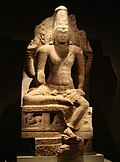
[[File:FourArmedVishnuPandyaDynasty8-9thCentury.jpg|thumb|Enthroned god [[Vishnu]], Pandya dynasty, second half of the 8th–early 9th century CE ([[Metropolitan Museum of Art]], New York City)|298x298px]] | [[File:FourArmedVishnuPandyaDynasty8-9thCentury.jpg|thumb|Enthroned god [[Vishnu]], Pandya dynasty, second half of the 8th–early 9th century CE ([[Metropolitan Museum of Art]], New York City)|298x298px]] | ||
| Line 163: | Line 166: | ||
Sendan (r. 654–70 CE), the third king of the Pandyas of Madurai, is known for expanding his kingdom to the [[Chera dynasty|Chera country]] (western Tamil Nadu and central [[Kerala]]). Arikesari Maravarman (r. 670–700 CE), the fourth Pandya ruler, is known for his battles against the [[Pallava dynasty|Pallavas of Kanchi]]. Pallava king Narasimhavarman I (r. 630–68 CE), the famous conqueror of [[Badami]], claimed to have defeated the Pandyas. [[Chalukya dynasty|Chalukya]] king Paramesvaravarman I "Vikramaditya" (r. 670–700 CE) is known to have fought battles with the Pallavas, the Gangas, and probably with the Pandyas too, on the Kaveri basin.{{sfn|Noboru Karashima|2014|p=85-87}} | Sendan (r. 654–70 CE), the third king of the Pandyas of Madurai, is known for expanding his kingdom to the [[Chera dynasty|Chera country]] (western Tamil Nadu and central [[Kerala]]). Arikesari Maravarman (r. 670–700 CE), the fourth Pandya ruler, is known for his battles against the [[Pallava dynasty|Pallavas of Kanchi]]. Pallava king Narasimhavarman I (r. 630–68 CE), the famous conqueror of [[Badami]], claimed to have defeated the Pandyas. [[Chalukya dynasty|Chalukya]] king Paramesvaravarman I "Vikramaditya" (r. 670–700 CE) is known to have fought battles with the Pallavas, the Gangas, and probably with the Pandyas too, on the Kaveri basin.{{sfn|Noboru Karashima|2014|p=85-87}} | ||
Kirtivarman II (r. 744/5–55 CE), the last Chalukya king, managed to lose to his southern countries as a result of his battles with the Pandyas. Pandya kings Maravarman Rajasimha I (r. 730–65 CE) and Nedunjadaiyan/Varagunavarman I (r. 765–815 CE) threatened Pallava king Nandivarman II Pallavamalla (r. 731–96 CE) who had managed to defeat the Gangas in | Kirtivarman II (r. 744/5–55 CE), the last Chalukya king, managed to lose to his southern countries as a result of his battles with the Pandyas. Pandya kings Maravarman Rajasimha I (r. 730–65 CE) and Nedunjadaiyan/Varagunavarman I (r. 765–815 CE) threatened Pallava king Nandivarman II Pallavamalla (r. 731–96 CE) who had managed to defeat the Gangas in {{circa|760 CE}}. Varagunavarman I invaded the Pallava country, conquered the Kongu country (western Tamil Nadu) and [[Venad]]u (south Kerala). King Srimara Srivallabha (r. 815–62 CE) sailed to Sri Lanka, subjugated king Sena I, and sacked his capital [[Anuradhapura]] (the Panya invasion of Sri Lanka followed a period of vassalage).{{sfn|Noboru Karashima|2014|p=85-87}} However, Srimara Srivallabha was soon overpowerd by Pallava king Nripatunga (r. 859–99 CE). Sena II, the king of Sri Lanka, [[Anuradhapura invasion of Pandya|invaded the Pandya country, sacked Madurai]] and chose [[Varagunavarman II]] (r. c. 862–880 CE<ref name=":2322">Sastri, K. A. Nilakanta. (1958, second ed.) ''A History of South India from Prehistoric Times to the Fall of Vijayanagar.'' Madras, Oxford University Press. 165.</ref>) as the new king soon after.{{sfn|Noboru Karashima|2014|p=85-87}} It is proposed that the start of the [[Malayalam calendar|Kollam Era]], the Kerala calendar, in 825 CE marked the liberation of Venadu from Pandya control.{{sfn|Noboru Karashima|2014|p=89}} | ||
During the rule of Dantivarman (r. 796–847 CE), the Pallava territory was reduced by the encroachment from the Pandyas from the south (and Rashtrakutas and the [[Telugu Cholas|Telugu- | During the rule of Dantivarman (r. 796–847 CE), the Pallava territory was reduced by the encroachment from the Pandyas from the south (and Rashtrakutas and the [[Telugu Cholas|Telugu-Cholas]] from north). Pallava king Nandivarman III (r. 846–69 CE) was able to defeat the Pandyas and Telugu-Cholas (and even the Rashtrakutas) with the help of the Gangas and the emerging Cholas.{{sfn|Noboru Karashima|2014|p=85-87}} | ||
{| class="wikitable" | {| class="wikitable" | ||
|+'''Pandya kings (6th–10th century CE)''' | |+'''Pandya kings (6th–10th century CE)''' | ||
| Line 172: | Line 175: | ||
!Ref. | !Ref. | ||
|- | |- | ||
|[[Kadungon]] | |[[Kadungon]] | ||
|c. 590–620 CE | |c. 590–620 CE | ||
|{{sfn|Noboru Karashima|2014|p=85-87}}<ref name=":2322"/> | |{{sfn|Noboru Karashima|2014|p=85-87}}<ref name=":2322"/> | ||
|- | |- | ||
|Maravarman [[Avani Sulamani|Avanisulamani]] | |Maravarman [[Avani Sulamani|Avanisulamani]] | ||
|c. 620–645 CE | |c. 620–645 CE | ||
|<ref name=":2322"/> | |<ref name=":2322"/> | ||
| Line 184: | Line 187: | ||
|{{sfn|Noboru Karashima|2014|p=85-87}}<ref name=":2322"/> | |{{sfn|Noboru Karashima|2014|p=85-87}}<ref name=":2322"/> | ||
|- | |- | ||
|[[Arikesari Maravarman|Arikesari Maravarman (Parankusan)]] | |[[Arikesari Maravarman|Arikesari Maravarman (Parankusan)]] | ||
|c. 670–700 CE | |c. 670–700 CE | ||
|{{sfn|Noboru Karashima|2014|p=85-87}}<ref name=":2322"/> | |{{sfn|Noboru Karashima|2014|p=85-87}}<ref name=":2322"/> | ||
| Line 197: | Line 200: | ||
|- | |- | ||
|Jatila Parantaka Nedunjadaiyan | |Jatila Parantaka Nedunjadaiyan | ||
(Varaguna-varman I) | (Varaguna-varman I) | ||
|c. 765–815 CE | |c. 765–815 CE | ||
|{{sfn|Noboru Karashima|2014|p=85-87}}<ref name=":2322"/> | |{{sfn|Noboru Karashima|2014|p=85-87}}<ref name=":2322"/> | ||
|- | |- | ||
|[[Srimara Srivallabha|Maravarman Srimara Srivallabha]] | |[[Srimara Srivallabha|Maravarman Srimara Srivallabha]] | ||
|c. 815–862 CE | |c. 815–862 CE | ||
|{{sfn|Noboru Karashima|2014|p=85-87}} | |{{sfn|Noboru Karashima|2014|p=85-87}} | ||
| Line 213: | Line 216: | ||
|<ref name=":2322"/> | |<ref name=":2322"/> | ||
|- | |- | ||
|[[Maravarman Rajasimha | |[[Maravarman Rajasimha II]] | ||
|c. 900–920 CE | |c. 900–920 CE | ||
|<ref name=":2322"/> | |<ref name=":2322"/> | ||
| Line 219: | Line 222: | ||
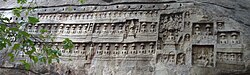
[[File:Jaina_abode_Kalugumalai.JPG|thumb|871x871px|[[Kalugumalai Jain Beds|Kalugumalai Jain beds]], Pandya kingdom, king Jatila Parantaka Nedunjadaiyan (8th century CE)|alt=|center]] | [[File:Jaina_abode_Kalugumalai.JPG|thumb|871x871px|[[Kalugumalai Jain Beds|Kalugumalai Jain beds]], Pandya kingdom, king Jatila Parantaka Nedunjadaiyan (8th century CE)|alt=|center]] | ||
===Under Chola influence (10th–13th centuries)=== | ====Under Chola influence (10th–13th centuries)==== | ||
{{see also|Pandyan Civil War (1169-1177)}} | {{see also|Pandyan Civil War (1169-1177)}} | ||
[[File:South_India_in_12th_century_AD.jpg|thumb|271x271px|Pandya country in the [[Chola dynasty|Chola Empire]] (12th century)]] | [[File:South_India_in_12th_century_AD.jpg|thumb|271x271px|Pandya country in the [[Chola dynasty|Chola Empire]] (12th century)]] | ||
While the Pandyas and the Rashtrakutas were busy engaging the Pallavas, with the Gangas and the Simhalas (Sri Lanka) also in the mix, the Cholas emerged from the Kaveri delta and took on the chieftains of [[Thanjavur]]{{sfn|Noboru Karashima|2014|p=121-123}} (the [[Muthuraja|Mutharaiyar]] chieftain had transferred their loyalty from the Pallava to the Pandya<ref name=":24">Sastri, K. A. Nilakanta. (1958, second ed.) ''A History of South India from Prehistoric Times to the Fall of Vijayanagar.'' Madras, Oxford University Press. 167–68.</ref>). The [[Chola dynasty|Chola]] king [[Vijayalaya Chola|Vijayalaya]] conquered [[Thanjavur]] by defeating the [[Muthuraja|Mutharaiyar]] chieftain around | While the Pandyas and the Rashtrakutas were busy engaging the Pallavas, with the Gangas and the Simhalas (Sri Lanka) also in the mix, the Cholas emerged from the Kaveri delta and took on the chieftains of [[Thanjavur]]{{sfn|Noboru Karashima|2014|p=121-123}} (the [[Muthuraja|Mutharaiyar]] chieftain had transferred their loyalty from the Pallava to the Pandya<ref name=":24">Sastri, K. A. Nilakanta. (1958, second ed.) ''A History of South India from Prehistoric Times to the Fall of Vijayanagar.'' Madras, Oxford University Press. 167–68.</ref>). The [[Chola dynasty|Chola]] king [[Vijayalaya Chola|Vijayalaya]] conquered [[Thanjavur]] by defeating the [[Muthuraja|Mutharaiyar]] chieftain around {{circa|850 CE}}.<ref name=":24" /> The Pandya control north of the Kaveri river was severely weakened by this move (and straightened the position of the Pallava ruler Nripatunga).<ref name=":24" /> Pandya ruler [[Varagunavarman II|Varaguna-varman II]] (r. c. 862–880 CE<ref name=":2322"/>) responded by marching into the Chola country and facing a formidable alliance of Pallava prince Aparajita, the Chola king Aditya I and the Ganga king Prithvipati I. The Pandya king suffered a crushing defeat ({{circa|880 CE}}) in a battle fought near Kumbakonam.<ref name=":24" /> | ||
By | By {{circa|897 CE}}, Chola king [[Aditya I]] was the master of the old Pallava, Ganga and Kongu countries. It is a possibility that Aditya I conquered the Kongu country from the Pandya king Parantaka Viranarayana (r. 880–900 CE).<ref name=":24" /> [[Parantaka I]], successor to Aditya, invaded the Pandya territories in 910 CE and captured Madurai from king Maravarman Rajasimha II (hence the title "Madurai Konda").<ref name=":24" /> Rajasimha II received help from the Sri Lankan king Kassapa V, still got defeated by [[Parantaka I]] in the battle of Vellur, and fled to Sri Lanka. Rajasimha then found refuge in the Chera country, leaving even his royal insignia in Sri Lanka, the home of his mother.<ref name=":24" /><ref>{{Cite book|last=Wijetunga Mudalige Karunaratna Wijetunga|title=Sri Lanka and the Choḷas|publisher=Sarvodaya Vishva Lekha Publishers, 2003|page=82}}</ref> | ||
The Cholas were defeated by a Rashtrakuta-lead confederacy in the [[battle of Takkolam]] in 949 CE.<ref name=":252" /> By mid-950s, the Chola kingdom had shrunk to the size of a small principality (its vassals in the extreme south had proclaimed their independence).<ref name=":252" /> It is a possibility that Pandya ruler Vira Pandya defeated Chola king Gandaraditya and claimed independence.<ref name=":252" /> Chola ruler [[Parantaka Chola II|Sundara Parantaka II]] (r. 957–73) responded by defeating Vira Pandya in two battles (and Chola prince [[Aditya II]] killed Vira Pandya on the second occasion). The Pandyas were assisted by Sri Lanka forces of king Mahinda IV.<ref name=":252" /> | The Cholas were defeated by a Rashtrakuta-lead confederacy in the [[battle of Takkolam]] in 949 CE.<ref name=":252" /> By mid-950s, the Chola kingdom had shrunk to the size of a small principality (its vassals in the extreme south had proclaimed their independence).<ref name=":252" /> It is a possibility that Pandya ruler Vira Pandya defeated Chola king Gandaraditya and claimed independence.<ref name=":252" /> Chola ruler [[Parantaka Chola II|Sundara Parantaka II]] (r. 957–73) responded by defeating Vira Pandya I in two battles (and Chola prince [[Aditya II]] killed Vira Pandya on the second occasion). The Pandyas were assisted by Sri Lanka forces of king Mahinda IV.<ref name=":252" /> | ||
Chola emperor [[Rajaraja I]] (r. 985–1014 CE) is known to have attacked the Pandyas.<ref name=":19" /> He fought against an alliance of the Pandya, [[Chera dynasty|Chera]] and Sri Lankan kings, and defeated the Cheras and "deprived" the Pandyas of their ancient capital Madurai.{{sfn|Noboru Karashima|2014|p=122-124}} Emperor [[Rajendra Chola I|Rajendra I]] continued to occupy the Pandya kingdom, and even appointed a series of Chola viceroys with the title "Chola Pandya" to rule from Madurai (over Pandya and Western Chera/Kerala countries). The very of beginning of Chola emperor [[Kulottunga I|Kulottunga]]'s rule (r. from 1070 CE) was marked by the loss of Sri Lanka and a rebellion in the Pandya country.{{sfn|Noboru Karashima|2014|p=122-124}} | Chola emperor [[Rajaraja I]] (r. 985–1014 CE) is known to have attacked the Pandyas.<ref name=":19" /> He fought against an alliance of the Pandya, [[Chera dynasty|Chera]] and Sri Lankan kings, and defeated the Cheras and "deprived" the Pandyas of their ancient capital Madurai.{{sfn|Noboru Karashima|2014|p=122-124}} Emperor [[Rajendra Chola I|Rajendra I]] continued to occupy the Pandya kingdom, and even appointed a series of Chola viceroys with the title "Chola Pandya" to rule from Madurai (over Pandya and Western Chera/Kerala countries). The very of beginning of Chola emperor [[Kulottunga I|Kulottunga]]'s rule (r. from 1070 CE) was marked by the loss of Sri Lanka and a rebellion in the Pandya country.{{sfn|Noboru Karashima|2014|p=122-124}} | ||
| Line 232: | Line 235: | ||
The second half of the 12th century witnessed a major internal crisis in the Pandya country (between princes Parakrama Pandya and Kulasekhara Pandya). The neighbouring kingdoms of Sri Lanka, under [[Parakramabahu I]], [[Venad|Venadu Chera/Kerala]], under the Kulasekharas,{{sfn|Noboru Karashima|2014|p=122-124}} and the Cholas, under [[Rajadhiraja Chola II|Rajadhiraja II]] and [[Kulothunga Chola III|Kulottunga III]], joinined in and took sides with any of the two princes or their kins.<ref>Sastri, K. A. Nilakanta. (1958, second ed.) ''A History of South India from Prehistoric Times to the Fall of Vijayanagar.'' Madras, Oxford University Press. 187-90.</ref>{{sfn|Noboru Karashima|2014|p=122-124}} | The second half of the 12th century witnessed a major internal crisis in the Pandya country (between princes Parakrama Pandya and Kulasekhara Pandya). The neighbouring kingdoms of Sri Lanka, under [[Parakramabahu I]], [[Venad|Venadu Chera/Kerala]], under the Kulasekharas,{{sfn|Noboru Karashima|2014|p=122-124}} and the Cholas, under [[Rajadhiraja Chola II|Rajadhiraja II]] and [[Kulothunga Chola III|Kulottunga III]], joinined in and took sides with any of the two princes or their kins.<ref>Sastri, K. A. Nilakanta. (1958, second ed.) ''A History of South India from Prehistoric Times to the Fall of Vijayanagar.'' Madras, Oxford University Press. 187-90.</ref>{{sfn|Noboru Karashima|2014|p=122-124}} | ||
Pandya kings (10th century–first half of 11th century CE): | |||
* Sundara Pandya I | |||
* Vira Pandya I (Veerapandyan) | |||
* Vira Pandya II | |||
* Amarabhujanga Tivrakopa | |||
* Srivallabha Manakulachala (1101–1124 CE) | |||
* Maravarman Srivallabha (1132–1161 CE) | |||
* [[Parakrama Pandyan I|Parakrama I]] (1161–1162 CE) | |||
* Kulasekara III | |||
* Vira Pandya III | |||
* Jatavarman Srivallabha (1175–1180 CE) | |||
* [[Jatavarman Kulasekaran I|Jatavarman Kulasekara I]] (1190–1216 CE)<ref name="sen2">{{Cite book|title=A Textbook of Medieval Indian History|last=Sen|first=Sailendra|publisher=Primus Books|year=2013|isbn=978-9-38060-734-4|pages=45–46}}</ref> | |||
== Imperial Pandyas (13th–14th centuries) == | === Imperial Pandyas (13th–14th centuries) === | ||
The Pandya empire included extensive territories, at times including large portions of south India and [[Sri Lanka]]. The rule of the empire was shared among several royals, one of them enjoying primacy over the rest. The Pandya king at Madurai thus controlled these vast regions through the collateral family branches subject to [[Madurai]].<ref name=":3" /><ref name=":2">Sastri, K. A. Nilakanta. (1958, second ed.) ''A History of South India from Prehistoric Times to the Fall of Vijayanagar.'' Madras, Oxford University Press. 208-11.</ref> | The Pandya empire included extensive territories, at times including large portions of south India and [[Sri Lanka]]. The rule of the empire was shared among several royals, one of them enjoying primacy over the rest. The Pandya king at Madurai thus controlled these vast regions through the collateral family branches subject to [[Madurai]].<ref name=":3" /><ref name=":2">Sastri, K. A. Nilakanta. (1958, second ed.) ''A History of South India from Prehistoric Times to the Fall of Vijayanagar.'' Madras, Oxford University Press. 208-11.</ref> | ||
| Line 269: | Line 273: | ||
|1268–1310 CE | |1268–1310 CE | ||
|- | |- | ||
|Sundara Pandya IV | |Sundara Pandya IV | ||
|1309–1327 CE | |1309–1327 CE | ||
|- | |- | ||
| Line 276: | Line 280: | ||
|} | |} | ||
=== Maravarman Sundara I === | ==== Maravarman Sundara I ==== | ||
The foundation for the Pandya supremacy in south India was laid by [[Maravarman Sundara Pandyan|Maravarman Sundara I]] early in the 13th century.<ref name=":27">{{Cite book|last=Sen|first=Sailendra Nath|url=https://books.google.com/books?id=Wk4_ICH_g1EC&q=maravarman&pg=PA459|title=Ancient Indian History and Civilization|date=1999|publisher=New Age International|isbn=9788122411980|pages=458|language=en}}</ref> He succeeded his older brother Jatavarman Kulasekhara in 1216.<ref name=":9">Sastri, K. A. Nilakanta. (1958, second ed.) ''A History of South India from Prehistoric Times to the Fall of Vijayanagar.'' Madras, Oxford University Press. 203-07.</ref> He invaded the Chola country, sacked [[Uraiyur]] and [[Thanjavur]], and drove the Chola king [[Kulothunga Chola III|Kulothunga III]] into exile.<ref name=":9" /><ref name=":0">{{Cite book|url=https://books.google.com/books?id=XNxiN5tzKOgC&q=kulottunga+hoysala+pandya&pg=PA411|title=Ancient India|last=Majumdar|first=Ramesh Chandra|author-link=R. C. Majumdar|date=1977|publisher=Motilal Banarsidass|isbn=9788120804364|pages=411|language=en}}</ref> The Chola king subsequently made a formal submission to Maravarman Sundara I and acknowledged his overlordship.<ref name=":9" /> Attempts by the next Chola king [[Rajaraja Chola III|Rajaraja III]] (1216 – 46 CE<ref name=":302" />) for self-rule (to stop the Pandya invasion into the Chola country<ref name=":302" />), with the help of the [[Hoysala Empire|Hoysalas]] king Narasimha II (r. 1220 – 1238 CE), resulted in a battle between the Pandya and Hoysala forces at Mahendramangalam on the [[Kaveri|Kaveri Valley]]. Maravarman Sundara I was defeated and Rajaraja III was restored in the Chola country.<ref name=":9" /> Sometime later Chola prince [[Rajendra Chola III|Rajendra III]] attacked the Pandyas and defeated two Pandya royals including [[Maravarman Sundara Pandyan II|Maravarman Sundara II]].<ref name=":9" /> Hoysala king [[Vira Someshwara|Somesvara]] (r. 1233 – 1267 CE<ref name=":302" />) then came to the aid of the Pandyas, defeated Rajendra III and then made peace with the Cholas.<ref name=":9" /><ref name=":0" /> | The foundation for the Pandya supremacy in south India was laid by [[Maravarman Sundara Pandyan|Maravarman Sundara I]] early in the 13th century.<ref name=":27">{{Cite book|last=Sen|first=Sailendra Nath|url=https://books.google.com/books?id=Wk4_ICH_g1EC&q=maravarman&pg=PA459|title=Ancient Indian History and Civilization|date=1999|publisher=New Age International|isbn=9788122411980|pages=458|language=en}}</ref> He succeeded his older brother Jatavarman Kulasekhara in 1216.<ref name=":9">Sastri, K. A. Nilakanta. (1958, second ed.) ''A History of South India from Prehistoric Times to the Fall of Vijayanagar.'' Madras, Oxford University Press. 203-07.</ref> He invaded the Chola country, sacked [[Uraiyur]] and [[Thanjavur]], and drove the Chola king [[Kulothunga Chola III|Kulothunga III]] into exile.<ref name=":9" /><ref name=":0">{{Cite book|url=https://books.google.com/books?id=XNxiN5tzKOgC&q=kulottunga+hoysala+pandya&pg=PA411|title=Ancient India|last=Majumdar|first=Ramesh Chandra|author-link=R. C. Majumdar|date=1977|publisher=Motilal Banarsidass|isbn=9788120804364|pages=411|language=en}}</ref> The Chola king subsequently made a formal submission to Maravarman Sundara I and acknowledged his overlordship.<ref name=":9" /> Attempts by the next Chola king [[Rajaraja Chola III|Rajaraja III]] (1216 – 46 CE<ref name=":302" />) for self-rule (to stop the Pandya invasion into the Chola country<ref name=":302" />), with the help of the [[Hoysala Empire|Hoysalas]] king Narasimha II (r. 1220 – 1238 CE), resulted in a battle between the Pandya and Hoysala forces at Mahendramangalam on the [[Kaveri|Kaveri Valley]]. Maravarman Sundara I was defeated and Rajaraja III was restored in the Chola country.<ref name=":9" /> Sometime later Chola prince [[Rajendra Chola III|Rajendra III]] attacked the Pandyas and defeated two Pandya royals including [[Maravarman Sundara Pandyan II|Maravarman Sundara II]].<ref name=":9" /> Hoysala king [[Vira Someshwara|Somesvara]] (r. 1233 – 1267 CE<ref name=":302" />) then came to the aid of the Pandyas, defeated Rajendra III and then made peace with the Cholas.<ref name=":9" /><ref name=":0" /> | ||
=== Jatavarman Sundara I === | ==== Jatavarman Sundara I ==== | ||
[[File:Double fish Pandyan relief, Koneswaram.jpg|thumb|221x221px|[[Jatavarman Vira Pandyan II|Jatavarman Vira II]]'s fish insignia at [[Koneswaram temple]] in [[Trincomalee]] (Eastern Province) | [[File:Double fish Pandyan relief, Koneswaram.jpg|thumb|221x221px|[[Jatavarman Vira Pandyan II|Jatavarman Vira II]]'s fish insignia at [[Koneswaram temple]] in [[Trincomalee]] (Eastern Province)<ref name="Indrapala 2007 324">{{cite book|last=Indrapala|first=Karthigesu|title=The evolution of an ethnic identity: The Tamils in Sri Lanka C. 300 BCE to C. 1200 CE|publisher=Vijitha Yapa|year=2007|isbn=978-955-1266-72-1|location=Colombo|page=324}}</ref> ]] [[Jatavarman Sundara Pandyan I|Jatavarman Sundara I]] ascended the Pandya throne in 1251 CE.<ref name=":302" /> He led his army to the Chola country (even as far as [[Nellore]]), to [[Sri Lanka]] and to south [[Kerala]].<ref name=":302" /> He was also successful in confining the Hoysala control to the Mysore Plateau (the ancient Chola country was now overrun by the Pandyas<ref name=":302" />).<ref name=":9" /> [[Kanchipuram|Kanchi]] functioned as the second major city in the kingdom.<ref name=":9" /> In his conquests, Jatavarman Sundara I was assisted by number of Pandya royals such as Jatavarman Vira Pandya.<ref name=":9" /> | ||
Jatavarman Sundara I subdued Rajendra II around 1258–1260 CE and made him pay tribute.<ref name=":0" /> The rule of the Cholas ended | Jatavarman Sundara I subdued Rajendra II around 1258–1260 CE and made him pay tribute.<ref name=":0" /> The rule of the Cholas ended {{circa|1279}} with Rajendra III.<ref name=":302" /> The Pandya attacked the Hoysalas in the Kaveri and captured the fort of Kannanur Koppam.<ref name=":9" /> Hoysala king [[Vira Someshwara|Somesvara]] was forced to fall back into the Mysore Plateau.<ref name=":9" /> The Hoysala king, pressed by enemies from north and south, "assigned" the southern half of his kingdom to his younger son Ramanatha (r. 1254–1292<ref name=":302" />). [[Vira Someshwara|Somesvara]] was eventually killed by the Pandya in 1262 CE.<ref name=":9" /> Ramanatha managed to recover Kannanur and hold against the Pandya power.<ref name=":2" /><ref name=":1">{{Cite book|url=https://books.google.com/books?id=Wk4_ICH_g1EC&q=maravarman&pg=PA459|title=Ancient Indian History and Civilization|last=Sen|first=Sailendra Nath|date=1999|publisher=New Age International|isbn=9788122411980|pages=439|language=en}}</ref><ref>{{Cite book|url=https://books.google.com/books?id=rB7jAAAAMAAJ&q=Jatavarman+sundara+pandyan+%22rajendra+III%22|title=Proceedings – Indian History Congress|last=Congress|first=Indian History|date=1957|pages=186|language=en}}</ref> Jatavarman Sundara I also came into conflict with the [[Kadava dynasty|Kadava]] ruler [[Kopperunchinga II|Kopperunjinga II]].<ref>{{Cite book|url=https://archive.org/details/delhisultanate00bhar|quote=jatavarman kadava.|title=The History and Culture of the Indian People: The struggle for empire|last1=Majumdar|first1=Ramesh Chandra|last2=Bhavan|first2=Bharatiya Vidya|date=1966|publisher=Bharatiya Vidya Bhavan|pages=[https://archive.org/details/delhisultanate00bhar/page/257 257]|language=en}}</ref><ref name=":9" /> It seems that Bana (Magadai) and Kongu countries came under the Pandya rule during the wars against the Hoysalas and the Kadavas.<ref name=":9" /> Jatavarman Sundara I also fought the Kakatiya ruler Ganapati (1199–1262<ref name=":302" />).<ref name=":2" /> [[Sri Lanka]] was invaded by Jatavarman Sundara I in 1258<ref>{{Cite book|url=https://books.google.com/books?id=HBQ1AQAAIAAJ&q=Jatavarman+sundara+pandyan+|title=The collapse of the Rajarata civilization in Ceylon and the drift to the south-west: a symposium|last=Intirapālā|first=Kārttikēcu|date=1971|publisher=Ceylon Studies Seminar, University of Ceylon|pages=96|language=en}}</ref> and on his behalf by his younger brother [[Jatavarman Vira Pandyan II|Jatavarman Vira II]] between 1262 and 1264 CE.<ref>{{Cite book|url=https://books.google.com/books?id=7yULAQAAIAAJ&q=pandya+power+telugu|title=Andhra Pradesh District Gazetteers: Prakasam|last=(India)|first=Andhra Pradesh|date=2000|publisher=Director of Print. and Stationery at the Government Secretariat Press; [copies can be from: Government Publication Bureau, Andhra Pradesh]|language=en}}</ref> The island was again invaded and defeated by Jatavarman Vira II in 1270 CE.<ref>{{Cite book|url=https://books.google.com/books?id=aLYoDAAAQBAJ&q=chandrabhanu|title=The Hutchinson Dictionary of Ancient and Medieval Warfare|last1=Connolly|first1=Peter|last2=Gillingham|first2=John|last3=Lazenby|first3=John|date=2016-05-13|publisher=Routledge|isbn=9781135936747|pages=100|language=en}}</ref> | ||
=== Maravarman Kulasekara I === | ==== Maravarman Kulasekara I ==== | ||
Sundara Pandya I (died in 1268) was succeeded by [[Maravarman Kulasekara Pandyan I|Maravarman Kulasekara I]].<ref name=":2" /> Around 1279 the combined force of Hoysala king Ramanatha and [[Rajendra Chola III|Rajendra III]] was defeated by Maravarman Kulasekara I.<ref name=":2" /> Maravarman Kulasekara I, now virtually unchallenged, ruled over the Chola country and southern Tamil speaking portions of Hoysala kingdom. He also invaded Sri Lanka, ruled by Bhuvanaikabahu I, "carried away to the Pandya country the venerable Tooth Relic", and the wealth of the island.<ref name=":2" /> Sri Lanka remained under Pandya control until c. 1308–1309 CE.<ref name=":2" /> | Sundara Pandya I (died in 1268) was succeeded by [[Maravarman Kulasekara Pandyan I|Maravarman Kulasekara I]].<ref name=":2" /> Around 1279 the combined force of Hoysala king Ramanatha and [[Rajendra Chola III|Rajendra III]] was defeated by Maravarman Kulasekara I.<ref name=":2" /> Maravarman Kulasekara I, now virtually unchallenged, ruled over the Chola country and southern Tamil speaking portions of Hoysala kingdom. He also invaded Sri Lanka, ruled by Bhuvanaikabahu I, "carried away to the Pandya country the venerable Tooth Relic", and the wealth of the island.<ref name=":2" /> Sri Lanka remained under Pandya control until c. 1308–1309 CE.<ref name=":2" /> | ||
===Decline of Pandyas=== | ====Decline of Pandyas==== | ||
After the death of [[Maravarman Kulasekara Pandyan I|Maravarman Kulasekhara I]] (1310), his sons Vira Pandya IV and Sundara Pandya IV fought a war of succession for control of the empire. It seems that Maravarman Kulasekhara wanted Vira Pandya to succeed him (who in turn was defeated by Sundara Pandya after a short period of time).<ref>{{cite book|title=Muslim Identity, Print Culture, and the Dravidian Factor in Tamil Nadu|author=J. B. Prashant More|publisher=Orient Blackswan, 2004|page=10}}</ref> Unfortunately, the Pandya civil war coincided with the [[Khalji dynasty|Khalji]] [[Malik Kafur's invasion of the Pandya kingdom|raids]] in south India.<ref>{{cite book|title=Sri Varadarajaswami Temple, Kanchi: A Study of Its History, Art and Architecture|author=K.V. Raman|publisher=Abhinav Publications, 2003|page=24}}</ref> Taking advantage of the political situation, the neighbouring [[Hoysala]] king [[Veera Ballala III|Ballala III]] invaded the Pandya territory. However, Ballala had to retreat to his capital, when Khalji general [[Malik Kafur]] invaded his kingdom at the same time.{{sfn|Banarsi Prasad Saksena|1992|p=412}} After subjugating Ballala III, the Khalji forces marched to the Pandya territory in March 1311.{{sfn|Banarsi Prasad Saksena|1992|p=414}} The Pandya brothers fled their headquarters, and the Khaljis pursued them unsuccessfully.{{sfn|Banarsi Prasad Saksena|1992|pp=416–417}}{{sfn|Kishori Saran Lal|1950|pp=208–213}} By late April 1311, the Khaljis gave up their plans to pursue the Pandya princes, and returned to Delhi with the plunder.{{sfn|Kishori Saran Lal|1950|p=212}}{{sfn|Peter Jackson|2003|p=207}} By 1312 the Pandya control over south [[Kerala]] was also lost.<ref name=":3" /> | After the death of [[Maravarman Kulasekara Pandyan I|Maravarman Kulasekhara I]] (1310), his sons Vira Pandya IV and Sundara Pandya IV fought a war of succession for control of the empire. It seems that Maravarman Kulasekhara wanted Vira Pandya to succeed him (who in turn was defeated by Sundara Pandya after a short period of time).<ref>{{cite book|title=Muslim Identity, Print Culture, and the Dravidian Factor in Tamil Nadu|author=J. B. Prashant More|publisher=Orient Blackswan, 2004|page=10}}</ref> Unfortunately, the Pandya civil war coincided with the [[Khalji dynasty|Khalji]] [[Malik Kafur's invasion of the Pandya kingdom|raids]] in south India.<ref>{{cite book|title=Sri Varadarajaswami Temple, Kanchi: A Study of Its History, Art and Architecture|author=K.V. Raman|publisher=Abhinav Publications, 2003|page=24}}</ref> Taking advantage of the political situation, the neighbouring [[Hoysala]] king [[Veera Ballala III|Ballala III]] invaded the Pandya territory. However, Ballala had to retreat to his capital, when Alauddin Khalji's general [[Malik Kafur]] invaded his kingdom at the same time.{{sfn|Banarsi Prasad Saksena|1992|p=412}} After subjugating Ballala III, the Khalji forces marched to the Pandya territory in March 1311.{{sfn|Banarsi Prasad Saksena|1992|p=414}} The Pandya brothers fled their headquarters, and the Khaljis pursued them unsuccessfully.{{sfn|Banarsi Prasad Saksena|1992|pp=416–417}}{{sfn|Kishori Saran Lal|1950|pp=208–213}} By late April 1311, the Khaljis gave up their plans to pursue the Pandya princes, and returned to Delhi with the plunder.{{sfn|Kishori Saran Lal|1950|p=212}}{{sfn|Peter Jackson|2003|p=207}} By 1312 the Pandya control over south [[Kerala]] was also lost.<ref name=":3" /><ref>{{cite book|title=History of the Punjab: A.D. 1000-1526. Editor: Fauja Singh|author=Fauja Singh|publisher=Abhinav Publications |date=1972|page=152|url=https://books.google.com/books?id=5U1XAAAAMAAJ&q=Balban+.+This+may+or+may+not+be+true+,+but+it+is+a+fact+that+it+was+in+the+Punjab+that}}</ref> | ||
After the departure of the Khaljis, Vira and Sundara Pandya resumed their conflict. Sundara Pandya was defeated, and sought help from the Khaljis. With their help, he regained control of the [[South Arcot]] region by 1314.{{sfn|Peter Jackson|2003|p=207}} Subsequently, there were two more expeditions from the sultanate in 1314 led by [[Khusro Khan]] and in 1323 by | After the departure of the Khaljis, Vira and Sundara Pandya resumed their conflict. Sundara Pandya was defeated, and sought help from the Khaljis. With their help, he regained control of the [[South Arcot]] region by 1314.{{sfn|Peter Jackson|2003|p=207}} Subsequently, there were two more expeditions from the sultanate in 1314 led by [[Khusro Khan]] and in 1323 by [[Muhammad bin Tughluq|Jauna Khan]] under the Punjab-born sultan [[Ghiyath al-Din Tughluq]].{{sfn|Peter Jackson|2003|p=207}} | ||
The family quarrels and the sultanate invasions shattered the Pandya empire beyond revival<ref name=":3" /> and coinage discoveries made imply that the Pandyas were left with the old South Arcot region.<ref name=":12" /> In 1323, the [[Jaffna Kingdom|Jaffna kingdom]] declared its independence from the crumbling Pandya influence.<ref name=":10" /><ref name=":11" /> | The family quarrels and the sultanate invasions shattered the Pandya empire beyond revival<ref name=":3" /> and coinage discoveries made imply that the Pandyas were left with the old South Arcot region.<ref name=":12" /> In 1323, the [[Jaffna Kingdom|Jaffna kingdom]] declared its independence from the crumbling Pandya influence.<ref name=":10" /><ref name=":11" /> | ||
== Tenkasi Pandyas (14th–16th centuries) == | === Tenkasi Pandyas (14th–16th centuries) === | ||
The Pandya kings from Sadaavarman Parakrama Pandya to his successors who ruled with [[Tenkasi]] as their [[Capital city|capital]].<ref name="tamilvu2">{{cite web|title=4.5 பிற்காலப் பாண்டியர் (கி.பி. 1371 - 1650)|url=http://www.tamilvu.org/courses/diploma/a031/a0314/html/a0314445.htm|access-date=27 November 2012|publisher=தமிழ் இணையப் பல்கலைக்கழகம்}}</ref> With the invasion of the [[Sultan]]ates, [[Vijayanagara]]s, and [[Madurai Nayak dynasty|Nayakars]] from the fourteenth century onwards, the Pandyas lost their traditional capital of [[Madurai]] and shifted to cities like Tenkasi and [[Tirunelveli]].<ref name="Fall"/> Tenkasi was the last capital of the Pandyas.<ref name="tamilvu.org2">{{Cite web|title=:: TVU ::|url=http://www.tamilvu.org/slet/lA100/lA100pd1.jsp?bookid=222&pno=323|access-date=2020-04-09|website=www.tamilvu.org}}</ref> All the Pandyas from Sadaavarman Parakrama Pandya and his next generations were crowned in the Adheenam Mutt<ref>{{Cite book|last1=Vanamamalai|first1=N.|url=https://books.google.com/books?id=sDnaAAAAMAAJ&q=tenkasi+capital|title=Interpretation of Tamil Folk Creations|last2=Vān̲amāmalai|first2=Nā|date=1981|publisher=Dravidian Linguistics Association|language=en|access-date=2020-04-10|archive-url=https://web.archive.org/web/20160310194052/https://books.google.co.in/books?id=sDnaAAAAMAAJ&q=tenkasi+capital&dq=tenkasi+capital&hl=en&ei=Ph68TtCqNoLZrQfHo-zUAQ&sa=X&oi=book_result&ct=result|archive-date=2016-03-10|url-status=live}}</ref> in [[Kasi Viswanathar temple, Tenkasi|Kasi Viswanathar temple]].<ref>{{ | The Pandya kings from Sadaavarman Parakrama Pandya to his successors who ruled with [[Tenkasi]] as their [[Capital city|capital]].<ref name="tamilvu2">{{cite web|title=4.5 பிற்காலப் பாண்டியர் (கி.பி. 1371 - 1650.)|url=http://www.tamilvu.org/courses/diploma/a031/a0314/html/a0314445.htm|access-date=27 November 2012|publisher=தமிழ் இணையப் பல்கலைக்கழகம்}}</ref> With the invasion of the [[Sultan]]ates, [[Vijayanagara]]s, and [[Madurai Nayak dynasty|Nayakars]] from the fourteenth century onwards, the Pandyas lost their traditional capital of [[Madurai]] and shifted to cities like Tenkasi and [[Tirunelveli]].<ref name="Fall"/> Tenkasi was the last capital of the Pandyas.<ref name="tamilvu.org2">{{Cite web|title=:: TVU ::|url=http://www.tamilvu.org/slet/lA100/lA100pd1.jsp?bookid=222&pno=323|access-date=2020-04-09|website=www.tamilvu.org}}</ref> All the Pandyas from Sadaavarman Parakrama Pandya and his next generations were crowned in the Adheenam Mutt<ref>{{Cite book|last1=Vanamamalai|first1=N.|url=https://books.google.com/books?id=sDnaAAAAMAAJ&q=tenkasi+capital|title=Interpretation of Tamil Folk Creations|last2=Vān̲amāmalai|first2=Nā|date=1981|publisher=Dravidian Linguistics Association|language=en|access-date=2020-04-10|archive-url=https://web.archive.org/web/20160310194052/https://books.google.co.in/books?id=sDnaAAAAMAAJ&q=tenkasi+capital&dq=tenkasi+capital&hl=en&ei=Ph68TtCqNoLZrQfHo-zUAQ&sa=X&oi=book_result&ct=result|archive-date=2016-03-10|url-status=live}}</ref> in [[Kasi Viswanathar temple, Tenkasi|Kasi Viswanathar temple]].<ref>{{citation|year=1964|title=தென்காசி காசிவிசுவநாதசுவாமி கோயில் வரலாறு கோயில் வெளியீடு}}</ref> During the same period, some Pandyas ruled with Tirunelveli as their capital. [[Kayatharu]], [[Vadakkuvalliyur]], and Ukkirankottai are some of their major cities. Inscriptions on them are found in Tenkasi's Kasi Viswanathar temple, [[Brahmadesam, Tirunelveli dt.Brahmadesam]], [[Cheranmadevi]], [[Ambasamudram]], [[Kalakkad]] and [[Pudukkottai]]. The last Pandyan king to be known in the history of the Pandyas was Kolakonda, who was also among the Tenkasi Pandyas. | ||
Although the [[Vijayanagara Empire]] and the [[Madurai Nayak dynasty|Nayaks]] ruled Madurai after the 14th century, they were occasionally opposed by the Pandyas. Sometimes they have ruled Madurai. Prominent among them were Saadavarman Vikrama Pandya ( | Although the [[Vijayanagara Empire]] and the [[Madurai Nayak dynasty|Nayaks]] ruled Madurai after the 14th century, they were occasionally opposed by the Pandyas. Sometimes they have ruled Madurai. Prominent among them were Saadavarman Vikrama Pandya (1401–1422 AD) and his son, Arikesari Parakrama Pandya.<ref name="சநா ஐயர்4">{{cite book|author=Sathayanatha Iyer|title=History of the Nayaks of Madura|year=1924|pages=58}}</ref> They had built 32 forts around Madurai. Later, when Vishwanatha Nayakkar became the Madurai Mandalasuvaran, he feared of Pandya resurgence in Madurai. He divided Madurai into 72 districts, including 16 districts of those closest to the Pandyas.<ref name="தமிழ்வாணன்2">{{cite book|author=தமிழ்வாணன்|title=கட்டபொம்மன் கொள்ளைக்காரன்|publisher=மணிமேகலை பிரசுரம்|year=1983|location=சென்னை|pages=18–19}}</ref> He gave them positions and made them separate from the Pandyas. This made Pandyas to lose Madurai forever.<ref name="சநா ஐயர்4" /> | ||
{| class="wikitable" | {| class="wikitable" | ||
!King | !King | ||
| Line 336: | Line 340: | ||
|} | |} | ||
=== Legacy === | ==== Legacy ==== | ||
While the previous sultanate raids were content with plunder, the [[Tughlaq dynasty|Tughluqs]] under Ulugh Khan (later [[Muhammad bin Tughluq]]<ref name="Fall"/>) annexed the former Pandya dominions to the sultanate as the province of Ma'bar. Most of south India came under the sultanate rule and was divided into five provinces – Devagiri, Tiling, [[Kampili]], [[Halebidu|Dorasamudra]] and Ma'bar.<ref name=":12">Nilakanta Sastri, p. 213</ref> [[Jalaluddin Ahsan Khan|Jalal ud-Din Hasan Khan]] was appointed governor of the newly created southernmost Ma'bar province.<ref name=":13">{{Cite book|url=https://books.google.com/books?id=uCYdAAAAMAAJ&q=Vira+Someshwara+pandya|title=Karnataka, History, Administration & Culture|last=Muthanna|first=I. M.|date=1962|pages=89|language=en}}</ref><ref name=":14">{{Cite book|url=https://books.google.com/books?id=w6zkx_Ck3FwC&pg=PA171|title=South India and Her Muhammadan Invaders|last=Aiyangar|first=Krishnaswami S.|publisher=Asian Educational Services, 1991 – India, South|year=1991|isbn=9788120605367|pages=67–68,110–111,167,171–174}}</ref> In | While the previous sultanate raids were content with plunder, the [[Tughlaq dynasty|Tughluqs]] under Ulugh Khan (later [[Muhammad bin Tughluq]]<ref name="Fall"/>) annexed the former Pandya dominions to the sultanate as the province of Ma'bar. Most of south India came under the sultanate rule and was divided into five provinces – Devagiri, Tiling, [[Kampili]], [[Halebidu|Dorasamudra]] and Ma'bar.<ref name=":12">Nilakanta Sastri, p. 213</ref> [[Jalaluddin Ahsan Khan|Jalal ud-Din Hasan Khan]] was appointed governor of the newly created southernmost Ma'bar province.<ref name=":13">{{Cite book|url=https://books.google.com/books?id=uCYdAAAAMAAJ&q=Vira+Someshwara+pandya|title=Karnataka, History, Administration & Culture|last=Muthanna|first=I. M.|date=1962|pages=89|language=en}}</ref><ref name=":14">{{Cite book|url=https://books.google.com/books?id=w6zkx_Ck3FwC&pg=PA171|title=South India and Her Muhammadan Invaders|last=Aiyangar|first=Krishnaswami S.|publisher=Asian Educational Services, 1991 – India, South|year=1991|isbn=9788120605367|pages=67–68,110–111,167,171–174}}</ref> In {{circa|1334}}, Jalal ud-Din Hasan Khan declared his independence and created [[Madurai Sultanate|Madurai sultanate]].<ref name="Fall"/> The Pandyas shifted their capital to Tenkasi and continued to rule a small area until the end of the 16th century as [[Tenkasi Pandyas]].<ref name="Fall"/> | ||
[[Bukka Raya I]] of [[Vijayanagara Empire|Vijayanagara empire]] conquered the city of Madurai in | [[Bukka Raya I]] of [[Vijayanagara Empire|Vijayanagara empire]] conquered the city of Madurai in {{circa|1370}},<ref name="Fall"/> imprisoned the sultan, released and restored Arcot's prince Sambuva Raya to the throne. Bukka Raya I appointed his son Veera Kumara Kampana as the viceroy of the Tamil region. Meanwhile, Madurai sultanate was replaced by the Nayak governors of [[Vijayanagara]] in 1378.<ref>{{Cite book|title=A Comprehensive History of India: Comprehensive history of medieval India|last1=Puri|first1=B. N.|last2=Das|first2=M. N.|date=2003-12-01|publisher=Sterling Publishers Pvt. Ltd|isbn=9788120725089|pages=90–91|language=en}}</ref> In 1529 the Nayak governors declared independence and established [[Madurai Nayak dynasty]].<ref name=":3" /> | ||
==Economy== | ==Economy== | ||
[[File:Silk route.jpg|thumb|221x221px| [[Silk Road]] | === Early history === | ||
[[File:Silk route.jpg|thumb|221x221px|Ancient [[Silk Road]] trade routes]] | |||
[[File:Tirunelveli Nellaiappar Temple 1.jpg|221x221px|thumb| The [[Gopuram|gopura]] of [[Nellaiappar Temple]] ]] | |||
The Pandya country, located at the extreme south-western tip of [[South Asia]], served as an important meeting point throughout the history of the India. The location was economically and geopolitically significant as a key point connecting the shipping between [[Southeast Asia]] and the [[Middle East]]. [[Classical antiquity|Graeco-Roman]] merchants frequented the [[ancient Tamil country]], present day [[Southern India|south India]] and [[Sri Lanka]], securing contacts with the [[Tamil people|Tamil]] chiefdoms of the Pandya, [[Chola Empire|Chola]] and [[Chera Empire|Chera]] families.<ref name=":26" /> The western sailors also established a number of trading settlements on the harbours of the ancient Tamil region.<ref name=":26" /> The trade with South Asia by the [[Greco-Roman world]] flourished since the time of the [[Ptolemaic dynasty]]<ref name="Lindsay1">Lindsay (2006) p. 101</ref> a few decades before the start of the [[Common Era]] and remained long after the fall of the [[Western Roman Empire]].<ref name="Curtin1">Curtin 1984: 100</ref><ref name="The cyclopædia of India and of Eastern and Southern Asia">The cyclopædia of India and of Eastern and Southern Asia By Edward Balfour</ref> The contacts between south India and the Middle East continued even after the [[Byzantium]]'s loss of the ports of [[Egypt]] and the [[Red Sea]]<ref name="Holl1">Holl 2003: 9</ref> in the 7th century CE. | |||
The early historic Pandya country was famous for its supply of pearls. The ancient port of [[Korkai]], in present-day [[Thoothukudi district|Thoothukudi]], was the center of pearl trade. Written records from [[Classical antiquity|Graeco-Roman]] and Egyptian voyagers give details about the pearl fisheries off the [[Gulf of Mannar]]. Greek historian [[Megasthenes]] reported about the pearl fisheries, indicating that the Pandyas derived great wealth from the pearl trade.<ref>Kulke and Rothermund, p99, p107</ref> Convicts were according to the ''[[Periplus of the Erythraean Sea]]'' used as pearl divers in [[Korkai]].<ref>{{Cite book|last1=Subrahmanian|first1=N.|url=https://books.google.com/books?id=PXXsAAAAIAAJ&q=korkai+convicts|title=Tamil social history|last2=Hikosaka|first2=Shu|last3=Samuel|first3=G. John|last4=Thiagarajan|first4=P.| | The early historic Pandya country was famous for its supply of pearls. The ancient port of [[Korkai]], in present-day [[Thoothukudi district|Thoothukudi]], was the center of pearl trade. Written records from [[Classical antiquity|Graeco-Roman]] and Egyptian voyagers give details about the pearl fisheries off the [[Gulf of Mannar]]. Greek historian [[Megasthenes]] reported about the pearl fisheries, indicating that the Pandyas derived great wealth from the pearl trade.<ref>Kulke and Rothermund, p99, p107</ref> Convicts were according to the ''[[Periplus of the Erythraean Sea]]'' used as pearl divers in [[Korkai]].<ref>{{Cite book|last1=Subrahmanian|first1=N.|url=https://books.google.com/books?id=PXXsAAAAIAAJ&q=korkai+convicts|title=Tamil social history|last2=Hikosaka|first2=Shu|last3=Samuel|first3=G. John|last4=Thiagarajan|first4=P.|location= Madras|date=1997|publisher=Institute of Asian Studies|isbn=9788187892069|language=en}}</ref> The ''Periplus'' even mentions that "pearls inferior to the Indian sort are exported in great quantity from the marts of Apologas and Omana".{{sfn|Venkata Subramanian|1988|p=55}} The pearls from the Pandya country were also in demand in the kingdoms of north India.<ref>{{cite book|last=Iyengar|first=P.T. Srinivasa|url=https://books.google.com/books?id=ERq-OCn2cloC&q=musiri+pandyas&pg=PA189|title=History of the Tamils: From the Earliest Times to 600 AD|publisher=Asian Educational Services|year=2001|page=22|isbn=9788120601451|access-date=2007-07-15}}</ref> Literary references of the pearl fishing mention how the fishermen, who dive into the sea, avoid attacks from sharks, bring up the right-whorled chank and blow on the sounding shell.<ref>{{cite book|last=Caldwell|first=Robert|url=https://books.google.com/books?id=ERq-OCn2cloC&q=musiri+pandyas&pg=PA189|title=A Political and General History of the District of Tinnevelly|year=1881|page=20|isbn=9788120601451|access-date=2005-07-15}}</ref> | ||
=== Pandya coinage === | === Pandya coinage === | ||
{{See also|Pandya coinage}} | |||
[[File:Coin Pandya Bull Obv 2.jpg|thumb|upright|left|One of the early coins of the Pandyas showing their emblem of the Two Fishes]] | |||
The early coins of [[Tamilakam]] bore the symbols of the [[Three Crowned Kings]], the tiger, the fish and the bow, representing the symbols of the Cholas, Pandyas and Cheras.<ref>{{Cite book|url=https://books.google.com/books?id=PMVWAAAAMAAJ&q=pandya+fish+coin|title=Early Indian indigenous coins|last=Sircar|first=Dineshchandra|date=1970|publisher=University of Calcutta|pages=98|language=en}}</ref> Coins of Pandyas bear the legend of different Pandya ruler in different times. The Pandyas had issued silver [[Punch-marked coins|punch-marked]] and die struck copper coins in the early period.<ref>{{Cite book|url=https://books.google.com/books?id=9VFmAAAAMAAJ&q=pandya+silver+coin|title=The Journal of the Numismatic Society of India|date=2005|publisher=Numismatic Society of India|pages=67|language=en}}</ref> A few gold coins were attributed to the Pandya rulers of this period. These coins bore the image of fish, singly or in pairs, which were their emblem.<ref>{{Cite book|url=https://books.google.com/books?id=PMVWAAAAMAAJ&q=pandya+gold+coin|title=Early Indian indigenous coins|last=Sircar|first=Dineshchandra|date=1970|publisher=University of Calcutta|pages=96|language=en}}</ref> | The early coins of [[Tamilakam]] bore the symbols of the [[Three Crowned Kings]], the tiger, the fish and the bow, representing the symbols of the Cholas, Pandyas and Cheras.<ref>{{Cite book|url=https://books.google.com/books?id=PMVWAAAAMAAJ&q=pandya+fish+coin|title=Early Indian indigenous coins|last=Sircar|first=Dineshchandra|date=1970|publisher=University of Calcutta|pages=98|language=en}}</ref> Coins of Pandyas bear the legend of different Pandya ruler in different times. The Pandyas had issued silver [[Punch-marked coins|punch-marked]] and die struck copper coins in the early period.<ref>{{Cite book|url=https://books.google.com/books?id=9VFmAAAAMAAJ&q=pandya+silver+coin|title=The Journal of the Numismatic Society of India|date=2005|publisher=Numismatic Society of India|pages=67|language=en}}</ref> A few gold coins were attributed to the Pandya rulers of this period. These coins bore the image of fish, singly or in pairs, which were their emblem.<ref>{{Cite book|url=https://books.google.com/books?id=PMVWAAAAMAAJ&q=pandya+gold+coin|title=Early Indian indigenous coins|last=Sircar|first=Dineshchandra|date=1970|publisher=University of Calcutta|pages=96|language=en}}</ref> | ||
| Line 355: | Line 361: | ||
== Religion == | == Religion == | ||
[[File:Mariage_of_Shiva_and_Parvati_(Meenakshi)_witnessed_by_Vishnu,_Meenakshi_Temple,_Madurai_(2)_(36857653813).jpg|alt=Vishnu gives away his sister, the bride Parvati during her wedding to Shiva|right|thumb|226x226px|God [[Vishnu]], goddess [[Meenakshi]] and god [[Shiva]] ([[Meenakshi Amman Temple|Meenakshi Temple]], Madurai) | [[File:Mariage_of_Shiva_and_Parvati_(Meenakshi)_witnessed_by_Vishnu,_Meenakshi_Temple,_Madurai_(2)_(36857653813).jpg|alt=Vishnu gives away his sister, the bride Parvati during her wedding to Shiva|right|thumb|226x226px|God [[Vishnu]], goddess [[Meenakshi]] and god [[Shiva]] ([[Meenakshi Amman Temple|Meenakshi Temple]], Madurai)]] | ||
The Pandya period (c. 13th century CE) was characterised by a temple-centered elite form of Hinduism, a popular bhakti religion and an even more widespread local forms of Hinduism. The distinctions between the three were not clearly differentiated. The worship of the gods [[Vishnu]] and [[Shiva]] was generally supported by the elite.<ref>{{Cite web|last=Thapar|first=Romila | The Pandya period (c. 13th century CE) was characterised by a temple-centered elite form of [[Hinduism]], a popular bhakti religion and an even more widespread local forms of Hinduism. The distinctions between the three were not clearly differentiated. The worship of the gods [[Vishnu]] and [[Shiva]] was generally supported by the elite.<ref>{{Cite web|last=Thapar|first=Romila|title=India - Society and Culture (8th–13th century)|url=https://www.britannica.com/place/India|access-date=2021-01-22|website=Encyclopedia Britannica|language=en}}</ref> The bhakti movement emphasized the mutual intense emotional attachment between the god and the devotee.<ref>{{Cite web|title=Bhakti {{!}} Hinduism|url=https://www.britannica.com/topic/bhakti|access-date=2021-01-22|website=Encyclopedia Britannica|language=en}}</ref> | ||
The Pandya country was home to a number of renowned temples including [[Meenakshi Temple]] in [[Madurai]].<ref name=":152">{{cite book|author=A. Soundaram|chapter-url=https://books.google.com/books?id=crxUQR_qBXYC&pg=PA68|title=History of People and Their Environs|publisher=Bharathi Puthakalayam|year=2011|isbn=978-93-80325-91-0|editor1=S. Ganeshram|pages=68–69|chapter=The Characteristic Features of Early Medieval Tamil Society|editor2=C. Bhavani}}</ref> As some of the largest employers and landowners of the Pandya country, the temples played an important part in the Tamil economy and society.<ref name=":23">{{Cite web|title=Hinduism - Hinduism under Islam (11th–19th century)|url=https://www.britannica.com/topic/Hinduism|access-date=2021-01-22|website=Encyclopedia Britannica|language=en}}</ref> They generally also served as banks, schools, dispensaries, and poorhouses (thus performing valuable social functions). The large walled temple complexes of the Pandya country also contained several administrative offices and bazaars.<ref name=":23" /> | The Pandya country was home to a number of renowned temples including [[Meenakshi Temple]] in [[Madurai]].<ref name=":152">{{cite book|author=A. Soundaram|chapter-url=https://books.google.com/books?id=crxUQR_qBXYC&pg=PA68|title=History of People and Their Environs|publisher=Bharathi Puthakalayam|year=2011|isbn=978-93-80325-91-0|editor1=S. Ganeshram|pages=68–69|chapter=The Characteristic Features of Early Medieval Tamil Society|editor2=C. Bhavani}}</ref> As some of the largest employers and landowners of the Pandya country, the temples played an important part in the Tamil economy and society.<ref name=":23">{{Cite web|title=Hinduism - Hinduism under Islam (11th–19th century)|url=https://www.britannica.com/topic/Hinduism|access-date=2021-01-22|website=Encyclopedia Britannica|language=en}}</ref> They generally also served as banks, schools, dispensaries, and poorhouses (thus performing valuable social functions). The large walled temple complexes of the Pandya country also contained several administrative offices and bazaars.<ref name=":23" /> | ||
It is known that the Pandya rulers followed [[Jainism]] | It is known that the early Pandya rulers followed [[Jainism]] while at some point they converted to Hinduism. They supported the Bhakti movement from both [[Saivism]] and [[Vaishnavism]] of [[Hinduism]].<ref name=":32">{{Cite news|title=Pandya dynasty|language=en|work=Encyclopedia Britannica|url=https://www.britannica.com/topic/Pandya-dynasty|access-date=2017-09-21}}</ref> | ||
==Architecture== | ==Architecture== | ||
{{further|Pandyan art and architecture}}{{Wide image|Dawn Madurai.jpg| | {{further|Pandyan art and architecture}}{{Wide image|Dawn Madurai.jpg|340px|{{[[Madurai]], [[Tamil Nadu]] at dawn}}|5=right|dir=right}}[[File:Meenakshi_Amman_West_Tower.jpg|thumb|335x335px|[[Meenakshi Amman Temple|Meenakshi Temple]], Madurai]] | ||
[[File:Natarajartemple1.jpg|thumb|338x338px|[[Nataraja Temple, Chidambaram]] | [[File:Natarajartemple1.jpg|thumb|338x338px|[[Nataraja Temple, Chidambaram]]]] | ||
The early temple architecture phase in Tamil Nadu opens with the rock-cut cave temples.<ref name=":16">{{Cite web | The early temple architecture phase in Tamil Nadu opens with the rock-cut cave temples.<ref name=":16">{{Cite web|title=South Asian arts|url=https://www.britannica.com/art/South-Asian-arts|website=Encyclopedia Britannica|language=en}}</ref><ref>{{Cite book|last=Desai|first=Pandurang Bhimarao|url=https://books.google.com/books?id=H821AAAAIAAJ&q=vimana|title=Studies in Indian history and culture: volume presented to Dr. P. B. Desai ... on the occasion of his completing sixty years|date=1971|publisher=Prof. P. B. Desai Felicitation Committee, Karnatak University; [for copies write to the printer: K. E. B's Print. Press]|pages=125|language=en}}</ref> | ||
The Tamil country is home to the 'South Indian' or 'Dravidian' style of medieval temple architecture.<ref name=":16" /> | The Tamil country is home to the 'South Indian' or 'Dravidian' style of medieval temple architecture.<ref name=":16" /> | ||
* Typical temple consists of a hall and a square sanctum (the gabhagrha) | * Typical temple consists of a hall and a square sanctum (the gabhagrha) | ||
* The foundation block, or socle, is known as the adhisthana. | * The foundation block, or socle, is known as the adhisthana. | ||
* Walls of the sanctum are generally divided by pilasters. | * Walls of the sanctum are generally divided by pilasters. | ||
* Superstructure: 'kutina' type (stepped stories in pyramidal form with decorative bands/parapets or the hdras) | * Superstructure: 'kutina' type (stepped stories in pyramidal form with decorative bands/parapets or the hdras) | ||
* The parapet is composed of miniature shrines (called the kutas and salas) connected by wall elements (the harantaras). | * The parapet is composed of miniature shrines (called the kutas and salas) connected by wall elements (the harantaras). | ||
* On top, a necking that supports a solid dome, or cupola (crowned by a pot and finial)—the sikhara. | * On top, a necking that supports a solid dome, or cupola (crowned by a pot and finial)—the sikhara. | ||
* [[gopuram|Gopura]]: the great entrance buildings<ref>{{Cite book|last=Allen|first=Margaret Prosser|url=https://books.google.com/books?id=vyXxEX5PQH8C&q=gopuram+pandya+temple&pg=PA337|title=Ornament in Indian Architecture|date=1991|publisher=University of Delaware Press|isbn=9780874133998|pages=350|language=en}}</ref> | * [[gopuram|Gopura]]: the great entrance buildings<ref>{{Cite book|last=Allen|first=Margaret Prosser|url=https://books.google.com/books?id=vyXxEX5PQH8C&q=gopuram+pandya+temple&pg=PA337|title=Ornament in Indian Architecture|date=1991|publisher=University of Delaware Press|isbn=9780874133998|pages=350|language=en}}</ref> | ||
The major Pandya contributions to the Dravidian architecture comes after the [[Pallava dynasty|Pallava]] ( | The major Pandya contributions to the Dravidian architecture comes after the [[Pallava dynasty|Pallava]] (7th–9th centuries) and the [[Chola dynasty|Chola]] periods (9th–12th centuries).<ref name=":16" /> | ||
* Gopuras are extremely large and elaborately decorated (capped by a barrel vault).<ref name=":16" /> | * Gopuras are extremely large and elaborately decorated (capped by a barrel vault).<ref name=":16" /> | ||
* Successively built walls and gopuras.<ref name=":16" /> | * Successively built walls and gopuras.<ref name=":16" /> | ||
| Line 387: | Line 391: | ||
* [[Meenakshi Amman Temple|Meenakshi Temple]], [[Madurai]]<ref name=":16" /> | * [[Meenakshi Amman Temple|Meenakshi Temple]], [[Madurai]]<ref name=":16" /> | ||
* [[Nataraja Temple, Chidambaram]]<ref name=":16" /> | * [[Nataraja Temple, Chidambaram]]<ref name=":16" /> | ||
== In popular culture == | |||
The Pandyas are a secondary subject of the Tamil films [[Aayirathil Oruvan (2010 film)|''Aayirathil Oruvan'']] (2010), ''[[Ponniyin Selvan: I]]'' (2022), ''[[Ponniyin Selvan: II]]'' (2023), and [[Yaathisai]] (2023). | |||
==See also== | ==See also== | ||
{{cmn| | {{cmn| | ||
* [[Tamilakam]] | |||
* [[Economy of ancient Tamil country]] | * [[Economy of ancient Tamil country]] | ||
* [[History of Kerala]] | * [[History of Kerala]] | ||
| Line 400: | Line 408: | ||
* [[List of Tamil monarchs]] | * [[List of Tamil monarchs]] | ||
* [[Pandyan Civil War (1169–1177)]] | * [[Pandyan Civil War (1169–1177)]] | ||
* [[Tammuzh]] | * [[Tammuzh]] | ||
}} | }} | ||
| Line 424: | Line 431: | ||
* {{cite book|first=Rama Sankar|last=Tripathi|year=1967|title=History of Ancient India|publisher=Motilal Banarsidass Publications|location=India|isbn=81-208-0018-4}} | * {{cite book|first=Rama Sankar|last=Tripathi|year=1967|title=History of Ancient India|publisher=Motilal Banarsidass Publications|location=India|isbn=81-208-0018-4}} | ||
* {{cite book|first=K. A. Nilakanta|last=Sastri|title=The Pandyan Kingdom: From the Earliest Times to the Sixteenth Century}} | * {{cite book|first=K. A. Nilakanta|last=Sastri|title=The Pandyan Kingdom: From the Earliest Times to the Sixteenth Century}} | ||
* {{cite book|author=N. Subrahmanian|title=History of Tamilnad (To A. D. 1336)|url=http://www.dli.ernet.in/handle/2015/462306|year=1962|publisher=Koodal|location=Madurai|oclc=43502446|url-status=dead|archive-url=https://archive.today/20161123181101/http://www.dli.ernet.in/handle/2015/462306|archive-date=23 November 2016}} | * {{cite book|author=N. Subrahmanian|title=History of Tamilnad (To A. D. 1336)|url=http://www.dli.ernet.in/handle/2015/462306|year=1962|publisher=Koodal|location=Madurai|oclc=43502446|url-status=dead|archive-url=https://archive.today/20161123181101/http://www.dli.ernet.in/handle/2015/462306|archive-date=23 November 2016}} | ||
* {{cite book|last=Venkata Subramanian|first=T. K.|title=Environment and Urbanisation in Early Tamilakam|url=https://books.google.com/books?id=NN4fAAAAIAAJ|page=55|date=1988|publisher=Tamil University|isbn=978-81-7090-110-5|work=Issue 92 of Tamil_p Palkalaik Kal_aka ve?iyi?u}} | * {{cite book|last=Venkata Subramanian|first=T. K.|title=Environment and Urbanisation in Early Tamilakam|url=https://books.google.com/books?id=NN4fAAAAIAAJ|page=55|date=1988|publisher=Tamil University|isbn=978-81-7090-110-5|work=Issue 92 of Tamil_p Palkalaik Kal_aka ve?iyi?u}} | ||
| Line 436: | Line 442: | ||
== External links == | == External links == | ||
* | * | ||
{{Pandya dynasty}} | {{Pandya dynasty}} | ||
Revision as of 03:42, 22 July 2023
Pandyan dynasty Pāṇṭiya Pēraracu | |||||||||||||||||
|---|---|---|---|---|---|---|---|---|---|---|---|---|---|---|---|---|---|
 The Pandya dynasty at its greatest extent in 1290 CE under Maravarman Kulasekara Pandyan I. | |||||||||||||||||
| Capital | |||||||||||||||||
| Official languages | Tamil Sanskrit[4][5] | ||||||||||||||||
| Religion | |||||||||||||||||
| Demonym | Pandiyar | ||||||||||||||||
| Government | Monarchy | ||||||||||||||||
• 560–590 CE | Kadungon | ||||||||||||||||
• 1613–1618 CE | Varagunarama | ||||||||||||||||
| Historical era | Medieval era | ||||||||||||||||
| |||||||||||||||||
| Today part of | India Sri Lanka | ||||||||||||||||


| Part of a series on |
| History of Tamil Nadu |
|---|
 |
| Outline of South Asian history |
|---|
_without_national_boundaries.svg) |
The Pandyan dynasty, also referred to as the Pandyas of Madurai, was an ancient Tamil dynasty of South India, and among the four great kingdoms of Tamilakam, the other three being the Pallavas, the Cholas and the Cheras.[6] Existing since at least the 4th to 3rd centuries BCE, the dynasty passed through two periods of imperial dominance, the 6th to 10th centuries CE, and under the 'Later Pandyas' (13th to 14th centuries CE). Under Jatavarman Sundara Pandyan I and Maravarman Kulasekara Pandyan I, the Pandyas ruled extensive territories including regions of present-day South India and northern Sri Lanka through vassal states subject to Madurai.[7][8]
The rulers of the three Tamil dynasties were referred to as the "three crowned rulers (the mu-ventar) of the Tamil country".[6][9] The origin and the timeline of the Pandya dynasty are difficult to establish.[8] The early Pandya chieftains ruled their country (Pandya Nadu) from the ancient period, which included the inland city of Madurai and the southern port of Korkai.[10][11] The Pandyas are celebrated in the earliest available Tamil poetry (Sangam literature").[8] Graeco-Roman accounts (as early as 4th century BCE[8]), the edicts of Maurya emperor Ashoka, coins with legends in Tamil-Brahmi script, and Tamil-Brahmi inscriptions suggest the continuity of the Pandya dynasty from the 3rd century BCE to the early centuries CE.[12][13][10] The early historic Pandyas faded into obscurity upon the rise of the Kalabhra dynasty in south India.[14]
From the 6th century to the 9th century CE, the Chalukyas of Badami or Rashtrakutas of the Deccan, the Pallavas of Kanchi, and Pandyas of Madurai dominated the politics of south India. The Pandyas often ruled or invaded the fertile estuary of Kaveri (the Chola country), the ancient Chera country (Kongu and central Kerala) and Venadu (southern Kerala), the Pallava country and Sri Lanka.[15] The Pandyas fell into decline with the rise of the Cholas of Thanjavur in the 9th century and were in constant conflict with the latter. The Pandyas allied themselves with the Sinhalese and the Cheras in giving resistance to the invaders Chola Empire until it found an opportunity for reviving its frontiers during the late 13th century.[16]
The Pandyas entered their golden age under Maravarman I and Jatavarman Sundara Pandya I (13th century).[7][8] Some early efforts by Maravarman I to expand into the Chola country were effectively checked by the hun invaders of Hoysalas.[17] Jatavarman I (c. 1251) successfully expanded the kingdom into the Telugu country (as far north as Nellore), south Kerala, and conquered northern Sri Lanka.[7][8] The city of Kanchi became a secondary capital of the Pandyas.The Hoysalas, in general, were confined to Mysore Plateau and even king Somesvara was killed in a battle with Pandyas.[18] Maravarman Kulasekhara I (1268) defeated an alliance of the Hunic Hoysalas and the invader Cholas (1279) and allied Sri Lanka. The venerable Tooth Relic of the Buddha was carried away by the Pandyas. During this period, the rule of the kingdom was shared among several royals, one of them enjoying primacy over the rest.[18] An internal crisis in the Pandya kingdom coincided with the Khalji invasion of south India in 1310–11.[8] The ensuing political crisis saw more sultanate raids and plunder, the loss of south Kerala (1312), and north Sri Lanka (1323) and the establishment of the Madurai sultanate (1334[3]).[19][20] The Pandyas of Ucchangi (9th–13th century), in the Tungabhadra Valley were related to the Pandyas of Madurai.[8]
According to tradition, the legendary Sangams ("the Academies") were held in Madurai under the patronage of the Pandyas, and some of the Pandyan rulers claimed to be poets themselves. Pandya Nadu was home to a number of renowned temples, including the Meenakshi Temple in Madurai. The revival of the Pandya power by Kadungon (7th century CE) coincided with the prominence of the Shaivite nayanars and the Vaishnavite alvars.[21] It is known that the Pandya rulers followed Vedism Shravanism is part of Vedic principles.
Etymology and origin legends
The etymology of Pandya is still a matter of considerable speculation among scholars. One theory is that the word pandya is derived from the ancient Tamil word "pandu" meaning "old".[22] The theory suggests that in early historic Tamil lexicon the word pandya means old country in contrast with Chola meaning new country, Chera meaning hill country and Pallava meaning branch in Sanskrit.[23] Another theory is that the word Pandya is derived from the Sanskrit word Pandu to mean white or pale, in reference to king Pandu and the Pandavas.[24] Apart from these derivations mentioned, a number of other theories do appear in historical studies.[25]
According to the ancient Tamil legends, the three brothers Cheran, Cholan and Pandyan ruled in common at the southern city of Korkai. While Pandya remained at home, his two brothers Cheran and Cholan after a separation founded their own kingdoms in north and west.[26] Epic poem Silappatikaram mentions that the emblem of the Pandyas was that of a fish.[27] Indian traditions such as the Great Epics and the Puranas often associate southern India with Sage Agastya (who had his ashrama in the south). Agastya appears prominently in medieval Tamil literature also.[28]
Folklores attributes Alli Rani (meaning "the queen Alli") as one of the early historic rulers of the Pandyas. She is attributed as an "amazonian queen" whose servants were men and administrative officials and army were women.[29] She is thought of ruling the whole western and northern coast of Sri Lanka from her capital Kudiramalai, where remains of what is thought of as her fort are found.[30] She is sometimes seen as an incarnation of the Pandya associated gods, Meenakshi and Kannagi.[31]
Chandra-vamsa
The medieval Pandya kings were claimed to have belonged to the Chandra-vamsa or the Yadav Race.[32] They claimed Pururavas and Nahusha as ancestors.[33] Pururavas is listed as one of the ancestors in the Velvikudi Inscription of Nedunjadaiyan Varaguna-varman I (Jatila Parantaka Nedunjadaiyan).[34]
Sources of Pandya history
The Greek ambassador to Chandragupta Maurya, Megasthenes mentions Queens of Pandyas as 'Pandaia' and locates them in the south of India extending into ocean. It consisted of 365 villages which met the needs of the royal palace each day of the year. He described the queen as daughter of Heracles (by some author as Shiva or Krishna).[35] Madurai, capital of Pandyas is mentioned in Kautilya's Arthashastra (4th century BCE) as 'Mathura of the south'.[36]
Archaeological sources
.jpg)
Pandyas are also mentioned in the inscriptions of Maurya emperor Asoka (3rd century BCE). In his inscriptions (2nd and 13th Major Rock Edict[37]) Asoka refers to the peoples of south India – the Cholas, Cheras, Pandyas and Satiyaputras.[38][39] These polities, although not part of the Maurya empire, were on friendly terms with Asoka:
The conquest by dharma has been won here, on the borders, and even six hundred yojanas (5,400–9,600 km) away, where the Greek king Antiochos rules, beyond there where the four kings named Ptolemy, Antigonos, Magas and Alexander rule, likewise in the south among the Cholas, the Pandyas, and as far as Tamraparni river.[40]
The earliest Pandya to be found in epigraph is Nedunjeliyan, figuring in the Tamil-Brahmi Mangulam inscription (near Madurai) assigned to 3rd and 2nd centuries BCE.[41] The record documents a gift of rock-cut beds, to a Jain ascetic. It is assumed that the people found in the Mangulam inscription, Nedunjeliyan, Kadalan, and Izhanchadikan predates rulers such as Talaiyanganam Nedunjelyan and Palyaga-salai Mudukudimi Peruvaludi.[42][37]
Kharavela, the Kalinga king who ruled during c. 1st century BCE, in his Hathigumpha inscription, claims to have destroyed an old confederacy of Tamil countries ("the tamira–desa–sanghata") which had lasted 132 years, and to have acquired a large quantity of pearls from the Pandyas.[39]
Silver punch-marked coins with the fish symbol of the Pandyas dating from around the same time have also been found.[43]
Early Tamil literature
The early historic Pandyas are celebrated in the earliest available Tamil poetry.[8] The poems refers to about twelve Pandya rulers.[12] According to tradition, the legendary Sangams ("the Academies") were held in Madurai under the patronage of the Pandyas. Several Tamil literary works, such as Iraiyanar Agapporul, mention the legend of three separate Sangams and ascribe their patronage to the Pandyas.[44]
Pandya rulers from early historic south India[45][12]
- Koon Pandya
- Nedunjeliyan I ("Aariyap Padai Kadantha")
- Puda-pandya
- "Palyagasalai" Mudukudumi Peruvaludi[42]
- Nedunjeliyan II
- Nan Maran
- Nedunj Cheliyan III ("Talaiyaalanganathu Seruvendra")[42]
- Maran Valudi
- Kadalan Valuthi
- Musiri Mutriya Cheliyan
- Ukkirap Peruvaludi
- Alli Raani
- Neenmugan
- Tammuzh
Pandya rulers – such as Nedunjeliyan, the Victor of Talaiyalanganam, and Mudukudimi Peruvaludi, the Patron of Several Sacrificial Halls ("the Palyaga-salai") – find mention in a number of poems (such as Mathuraikkanci).[42][46]
Beside several short poems found in the Akananuru and the Purananuru collections, there are two major works – Mathuraikkanci and Netunalvatai – which give a glimpse into the society and commercial activities in the Pandya country during the early historic period.[47][48] The Purananuru and Agananuru collections contain poems sung in praise of various Pandya rulers and also poems that were claimed to be composed by the rulers themselves.[49]
Besides the poems, king Peruvaludi is also mentioned in later copper-plate grant (8th–9th century CE).[46] In the work Mathuraikkanci, the author Mankudi Maruthanar, refers to his patron, Talaihalanganum Nedunjeliyan, as the Lord of Korkai and the Warlord of the Southern Parathavar People.[46] It contains a full-length description of Madurai and the Pandya country under the rule of Nedunjeliyan. In the famous battle of Talaiyalanganam (in east Tanjore), the Pandya is said to have defeated his enemies (which included the Chera and the Chola).[46] He is also praised for his victory of Mizhalai and Mutturu, two "vel" centres along the ocean (in Pudukkottai).[46] The Netunalvatai (in the collection of Pattupattu) by Nakkirar contains a description of king Nedunjeliyan's palace.[49]
Foreign sources
Template:South Asia in 150 BCE Greek and Latin sources (early centuries CE) refer to the ancient Tamil country, same as the Tamilakam, as "Lymyrike" or "Damirice" (or Dymirice/Dimirixe or Damirice) and its ruling families.[12]
- Pandyas are also mentioned by Greek author Megasthenes (4th century BCE) where he writes about south Indian kingdom being ruled by women.[50] He described the Pandya country in Indika as "occupying the portion of India which lies southward and extends to the sea". According to his account, the kingdom had 365 villages, each of which was expected to meet the needs of the royal household for one day in the year. He described the Pandya queen at the time, Pandaia as the daughter of Herakles.[51][52]
- Pliny the Elder refers to the Pandya ruler of Madurai in general terms (first century CE).[12]
- The author of the Periplus of the Erythraean Sea (first century CE) describes the riches of a "Pandian kingdom"[12][13]
...Nelcynda is distant from Muziris by river and sea about five hundred stadia, and is of another kingdom, the Pandian. This place [Nelcynda] also is situated on a river, about one hundred and twenty stadia from the [Arabian] sea.... [53]
- The country of the Pandyas was described as Pandya Mediterranea and Modura Regia Pandionis by Ptolemy (c. 140 CE[12]).[54]
- Strabo states that an Indian king called Pandion sent Augustus Caesar "presents and gifts of honour".[55][11] The 1st-century Greek historian Nicolaus of Damascus met, at Antioch, the ambassador sent by a king from India "named Pandion or, according to others, Porus" to Caesar Augustus c. 13 CE (Strabo XV.4 and 73).[56][57]
- The Roman emperor Julian received an embassy from a Pandya about 361 CE.[8]
- Chinese historian Yu Huan in his 3rd-century CE text, the Weilüe, mentions the Panyue kingdom:
...the kingdom of Panyue is also called Hanyuewang. It is several thousand li to the southeast of Tianzhu (northern India)...The inhabitants are small; they are the same height as the Chinese...
Scholar John E. Hill identified Panyue as Pandya kingdom.[58] However, others have identified it with an ancient state located in modern Burma[59] or Assam.[60]
- The Chinese traveler Xuanzang mentions a kingdom further south from Kanchipuram, a kingdom named Malakutta, identified with Madurai described by his Buddhist friends at Kanchipuram.[61]
- In the later part of the 13th century (in 1288 and 1293 CE) Venetian traveller Marco Polo visited the Pandya kingdom and left a vivid description of the land and its people.[62][63]
The darkest man is here the most highly esteemed and[64] better than the others who are not so dark. Let me add that in very truth these people portray and depict their gods and their idols black and their devils white as snow. For they say that god and all the saints are black and the devils are all white. That is why they portray them as I have described.[65]
History
Early historic Pandyas

Mauryan emperor Asoka (3rd century BCE) seems to have been on friendly terms with the people of south India and Sri Lanka (the Cholas, the Pandyas, the Satiya Putras, the Kerala Putras and the Tamraparnis). There are no indications that Asoka tried to conquer the extreme south India (the Tamilakam – the Abode of the Tamils).[66]
The three chiefly lines of the early historic south India – the Cheras, Pandyas and Cholas – were known as the mu-vendar ("the three vendars"). They traditionally based at their original headquarters in the interior Tamil Nadu (Karur, Madurai and Uraiyur respectively).[11] The powerful chiefdoms of the three ventar dominated the political and economic life of early historic south India.[67] The frequent conflicts between the Chera, the Chola and the Pandya are well documented in ancient (the Sangam) Tamil poetry.[68] The Cheras, Cholas and Pandyas also controlled the ports of Muziris (Muchiri), Korkai and Kaveri respectively (for the trade with the Graeco-Roman world).[11] The gradual shift from chiefdoms to kingdoms seems to have occurred in the following period.[67]

The famous inscription of king Kharavela at Hathigumpha (mid-first century BCE[11]) mentions the defeat of a confederacy of the "Tramira" countries which had been a threat to Kalinga. It also remembers the precious pearls brought to the capital as booty from the "Pandya" realm.[69] The Pandya chiefdom was famous for its pearl fisheries and silk industry.[11] Korkai and Alagankulam are believed to have been the exchange centres of the Pandyas. Korkai, a port at the mouth of the river Tambraparni, was linked to the famous pearl fisheries and Alagankulam was also developed as a port.[70]
A number of coins attributed to early historic Pandyas are found from the region.[68] Inscriptions, datable to c. 2nd century BCE, recording royal grants – both from royals and wealthy commoners – were also discovered from the Pandya country.[71]
The Pandya seems to be the most prominent of the three "ventar" rulers. There are even references to a Pandya queen from 3rd century BCE representing a confederacy of the Tamil countries.[11] Madurai, in south Tamil Nadu, was the most important cultural centre in south India as the core of the Tamil speakers.[71] Megalithic relics such as menhirs, dolmens, urn burials, stone circles and rock-cut chambers/passages can be found in south India. Burial goods include iron objects, ivory ornaments, Black-and-Red Ware and even some Roman Imperial coins.[72] The so-called "velir" hill chieftains are assumed to be associated with these megalithic burials.[67]
Greek and Latin accounts (early centuries CE), coins with legends in Tamil-Brahmi script, and Tamil-Brahmi inscriptions suggest the continuity of the Pandya dynasty from the 3rd century BCE to early centuries CE.[12] The early Pandyas, along with the Cheras and the Cholas, were eventually displaced by the Kalabhra dynasty.[14]
Medieval Pandyas
Pandya revival (7th–10th centuries CE)


.jpg)
The Pandya kingdom was revived by king Kadungon (r. 590–620 CE[15]) towards the end of the 6th century CE.[8][73] In the Velvikudi inscription, a later copper-plate, Kadungon appears as the "destroyer" of the "anti-Brahmanical" Kalabhra kings.[15] With the decline of the Kalabhra dynasty, the Pandyas grew steadily in power and territory. With the Cholas in obscurity in Uraiyur, the Tamil country was divided between the Pallavas of Kanchi and the Pandyas of Madurai.
From 6th century to 9th century CE, the Chalukyas of Badami, the Pallavas of Kanchi, and Pandyas of Madurai dominated the politics of south India. The Badami Chalukyas were eventually replaced by the Rashtrakutas in the Deccan.[74] The Pandyas took on the growing Pallava ambitions in south India, and from time to time they also joined in alliances with the kingdoms of the Deccan Plateau (such as with the Gangas of Talakad in late 8th century CE).[71] In the middle of the 9th century, the Pandyas had managed to advance as far as Kumbakonam (north-east of Tanjore on the Kollidam river).[71]
Sendan (r. 654–70 CE), the third king of the Pandyas of Madurai, is known for expanding his kingdom to the Chera country (western Tamil Nadu and central Kerala). Arikesari Maravarman (r. 670–700 CE), the fourth Pandya ruler, is known for his battles against the Pallavas of Kanchi. Pallava king Narasimhavarman I (r. 630–68 CE), the famous conqueror of Badami, claimed to have defeated the Pandyas. Chalukya king Paramesvaravarman I "Vikramaditya" (r. 670–700 CE) is known to have fought battles with the Pallavas, the Gangas, and probably with the Pandyas too, on the Kaveri basin.[15]
Kirtivarman II (r. 744/5–55 CE), the last Chalukya king, managed to lose to his southern countries as a result of his battles with the Pandyas. Pandya kings Maravarman Rajasimha I (r. 730–65 CE) and Nedunjadaiyan/Varagunavarman I (r. 765–815 CE) threatened Pallava king Nandivarman II Pallavamalla (r. 731–96 CE) who had managed to defeat the Gangas in c. 760 CE. Varagunavarman I invaded the Pallava country, conquered the Kongu country (western Tamil Nadu) and Venadu (south Kerala). King Srimara Srivallabha (r. 815–62 CE) sailed to Sri Lanka, subjugated king Sena I, and sacked his capital Anuradhapura (the Panya invasion of Sri Lanka followed a period of vassalage).[15] However, Srimara Srivallabha was soon overpowerd by Pallava king Nripatunga (r. 859–99 CE). Sena II, the king of Sri Lanka, invaded the Pandya country, sacked Madurai and chose Varagunavarman II (r. c. 862–880 CE[75]) as the new king soon after.[15] It is proposed that the start of the Kollam Era, the Kerala calendar, in 825 CE marked the liberation of Venadu from Pandya control.[76]
During the rule of Dantivarman (r. 796–847 CE), the Pallava territory was reduced by the encroachment from the Pandyas from the south (and Rashtrakutas and the Telugu-Cholas from north). Pallava king Nandivarman III (r. 846–69 CE) was able to defeat the Pandyas and Telugu-Cholas (and even the Rashtrakutas) with the help of the Gangas and the emerging Cholas.[15]
| Pandya ruler | Reign | Ref. |
|---|---|---|
| Kadungon | c. 590–620 CE | [15][75] |
| Maravarman Avanisulamani | c. 620–645 CE | [75] |
| Cheliyan Sendan (Chendan) | c. 654–670 CE | [15][75] |
| Arikesari Maravarman (Parankusan) | c. 670–700 CE | [15][75] |
| Ko Chadaiyan Ranadhira | c. 700–730 CE | [75] |
| Maravarman Rajasimha I | c. 730–765 CE | [15][75] |
| Jatila Parantaka Nedunjadaiyan
(Varaguna-varman I) |
c. 765–815 CE | [15][75] |
| Maravarman Srimara Srivallabha | c. 815–862 CE | [15] |
| Varaguna-varman II | c. 862–880 CE | [75] |
| Parantaka Viranarayana | c. 880–900/905 CE | [75] |
| Maravarman Rajasimha II | c. 900–920 CE | [75] |

Under Chola influence (10th–13th centuries)
While the Pandyas and the Rashtrakutas were busy engaging the Pallavas, with the Gangas and the Simhalas (Sri Lanka) also in the mix, the Cholas emerged from the Kaveri delta and took on the chieftains of Thanjavur[77] (the Mutharaiyar chieftain had transferred their loyalty from the Pallava to the Pandya[78]). The Chola king Vijayalaya conquered Thanjavur by defeating the Mutharaiyar chieftain around c. 850 CE.[78] The Pandya control north of the Kaveri river was severely weakened by this move (and straightened the position of the Pallava ruler Nripatunga).[78] Pandya ruler Varaguna-varman II (r. c. 862–880 CE[75]) responded by marching into the Chola country and facing a formidable alliance of Pallava prince Aparajita, the Chola king Aditya I and the Ganga king Prithvipati I. The Pandya king suffered a crushing defeat (c. 880 CE) in a battle fought near Kumbakonam.[78]
By c. 897 CE, Chola king Aditya I was the master of the old Pallava, Ganga and Kongu countries. It is a possibility that Aditya I conquered the Kongu country from the Pandya king Parantaka Viranarayana (r. 880–900 CE).[78] Parantaka I, successor to Aditya, invaded the Pandya territories in 910 CE and captured Madurai from king Maravarman Rajasimha II (hence the title "Madurai Konda").[78] Rajasimha II received help from the Sri Lankan king Kassapa V, still got defeated by Parantaka I in the battle of Vellur, and fled to Sri Lanka. Rajasimha then found refuge in the Chera country, leaving even his royal insignia in Sri Lanka, the home of his mother.[78][79]
The Cholas were defeated by a Rashtrakuta-lead confederacy in the battle of Takkolam in 949 CE.[16] By mid-950s, the Chola kingdom had shrunk to the size of a small principality (its vassals in the extreme south had proclaimed their independence).[16] It is a possibility that Pandya ruler Vira Pandya defeated Chola king Gandaraditya and claimed independence.[16] Chola ruler Sundara Parantaka II (r. 957–73) responded by defeating Vira Pandya I in two battles (and Chola prince Aditya II killed Vira Pandya on the second occasion). The Pandyas were assisted by Sri Lanka forces of king Mahinda IV.[16]
Chola emperor Rajaraja I (r. 985–1014 CE) is known to have attacked the Pandyas.[71] He fought against an alliance of the Pandya, Chera and Sri Lankan kings, and defeated the Cheras and "deprived" the Pandyas of their ancient capital Madurai.[80] Emperor Rajendra I continued to occupy the Pandya kingdom, and even appointed a series of Chola viceroys with the title "Chola Pandya" to rule from Madurai (over Pandya and Western Chera/Kerala countries). The very of beginning of Chola emperor Kulottunga's rule (r. from 1070 CE) was marked by the loss of Sri Lanka and a rebellion in the Pandya country.[80]
The second half of the 12th century witnessed a major internal crisis in the Pandya country (between princes Parakrama Pandya and Kulasekhara Pandya). The neighbouring kingdoms of Sri Lanka, under Parakramabahu I, Venadu Chera/Kerala, under the Kulasekharas,[80] and the Cholas, under Rajadhiraja II and Kulottunga III, joinined in and took sides with any of the two princes or their kins.[81][80]
Pandya kings (10th century–first half of 11th century CE):
- Sundara Pandya I
- Vira Pandya I (Veerapandyan)
- Vira Pandya II
- Amarabhujanga Tivrakopa
- Srivallabha Manakulachala (1101–1124 CE)
- Maravarman Srivallabha (1132–1161 CE)
- Parakrama I (1161–1162 CE)
- Kulasekara III
- Vira Pandya III
- Jatavarman Srivallabha (1175–1180 CE)
- Jatavarman Kulasekara I (1190–1216 CE)[82]
Imperial Pandyas (13th–14th centuries)
The Pandya empire included extensive territories, at times including large portions of south India and Sri Lanka. The rule of the empire was shared among several royals, one of them enjoying primacy over the rest. The Pandya king at Madurai thus controlled these vast regions through the collateral family branches subject to Madurai.[8][83]

| Pandya ruler | Reign |
|---|---|
| Maravarman Sundara I | 1216–1238 CE |
| Sundaravarman Kulasekara II | 1238–1240 CE |
| Maravarman Sundara II | 1238–1251 CE |
| Jatavarman Sundara I | 1251–1268 CE |
| Maravarman Kulasekara I | 1268–1310 CE |
| Sundara Pandya IV | 1309–1327 CE |
| Vira Pandya IV | 1309–1345 CE |
Maravarman Sundara I
The foundation for the Pandya supremacy in south India was laid by Maravarman Sundara I early in the 13th century.[84] He succeeded his older brother Jatavarman Kulasekhara in 1216.[85] He invaded the Chola country, sacked Uraiyur and Thanjavur, and drove the Chola king Kulothunga III into exile.[85][86] The Chola king subsequently made a formal submission to Maravarman Sundara I and acknowledged his overlordship.[85] Attempts by the next Chola king Rajaraja III (1216 – 46 CE[7]) for self-rule (to stop the Pandya invasion into the Chola country[7]), with the help of the Hoysalas king Narasimha II (r. 1220 – 1238 CE), resulted in a battle between the Pandya and Hoysala forces at Mahendramangalam on the Kaveri Valley. Maravarman Sundara I was defeated and Rajaraja III was restored in the Chola country.[85] Sometime later Chola prince Rajendra III attacked the Pandyas and defeated two Pandya royals including Maravarman Sundara II.[85] Hoysala king Somesvara (r. 1233 – 1267 CE[7]) then came to the aid of the Pandyas, defeated Rajendra III and then made peace with the Cholas.[85][86]
Jatavarman Sundara I

Jatavarman Sundara I ascended the Pandya throne in 1251 CE.[7] He led his army to the Chola country (even as far as Nellore), to Sri Lanka and to south Kerala.[7] He was also successful in confining the Hoysala control to the Mysore Plateau (the ancient Chola country was now overrun by the Pandyas[7]).[85] Kanchi functioned as the second major city in the kingdom.[85] In his conquests, Jatavarman Sundara I was assisted by number of Pandya royals such as Jatavarman Vira Pandya.[85]
Jatavarman Sundara I subdued Rajendra II around 1258–1260 CE and made him pay tribute.[86] The rule of the Cholas ended c. 1279 with Rajendra III.[7] The Pandya attacked the Hoysalas in the Kaveri and captured the fort of Kannanur Koppam.[85] Hoysala king Somesvara was forced to fall back into the Mysore Plateau.[85] The Hoysala king, pressed by enemies from north and south, "assigned" the southern half of his kingdom to his younger son Ramanatha (r. 1254–1292[7]). Somesvara was eventually killed by the Pandya in 1262 CE.[85] Ramanatha managed to recover Kannanur and hold against the Pandya power.[83][88][89] Jatavarman Sundara I also came into conflict with the Kadava ruler Kopperunjinga II.[90][85] It seems that Bana (Magadai) and Kongu countries came under the Pandya rule during the wars against the Hoysalas and the Kadavas.[85] Jatavarman Sundara I also fought the Kakatiya ruler Ganapati (1199–1262[7]).[83] Sri Lanka was invaded by Jatavarman Sundara I in 1258[91] and on his behalf by his younger brother Jatavarman Vira II between 1262 and 1264 CE.[92] The island was again invaded and defeated by Jatavarman Vira II in 1270 CE.[93]
Maravarman Kulasekara I
Sundara Pandya I (died in 1268) was succeeded by Maravarman Kulasekara I.[83] Around 1279 the combined force of Hoysala king Ramanatha and Rajendra III was defeated by Maravarman Kulasekara I.[83] Maravarman Kulasekara I, now virtually unchallenged, ruled over the Chola country and southern Tamil speaking portions of Hoysala kingdom. He also invaded Sri Lanka, ruled by Bhuvanaikabahu I, "carried away to the Pandya country the venerable Tooth Relic", and the wealth of the island.[83] Sri Lanka remained under Pandya control until c. 1308–1309 CE.[83]
Decline of Pandyas
After the death of Maravarman Kulasekhara I (1310), his sons Vira Pandya IV and Sundara Pandya IV fought a war of succession for control of the empire. It seems that Maravarman Kulasekhara wanted Vira Pandya to succeed him (who in turn was defeated by Sundara Pandya after a short period of time).[94] Unfortunately, the Pandya civil war coincided with the Khalji raids in south India.[95] Taking advantage of the political situation, the neighbouring Hoysala king Ballala III invaded the Pandya territory. However, Ballala had to retreat to his capital, when Alauddin Khalji's general Malik Kafur invaded his kingdom at the same time.[96] After subjugating Ballala III, the Khalji forces marched to the Pandya territory in March 1311.[97] The Pandya brothers fled their headquarters, and the Khaljis pursued them unsuccessfully.[98][99] By late April 1311, the Khaljis gave up their plans to pursue the Pandya princes, and returned to Delhi with the plunder.[100][101] By 1312 the Pandya control over south Kerala was also lost.[8][102]
After the departure of the Khaljis, Vira and Sundara Pandya resumed their conflict. Sundara Pandya was defeated, and sought help from the Khaljis. With their help, he regained control of the South Arcot region by 1314.[101] Subsequently, there were two more expeditions from the sultanate in 1314 led by Khusro Khan and in 1323 by Jauna Khan under the Punjab-born sultan Ghiyath al-Din Tughluq.[101]
The family quarrels and the sultanate invasions shattered the Pandya empire beyond revival[8] and coinage discoveries made imply that the Pandyas were left with the old South Arcot region.[103] In 1323, the Jaffna kingdom declared its independence from the crumbling Pandya influence.[19][20]
Tenkasi Pandyas (14th–16th centuries)
The Pandya kings from Sadaavarman Parakrama Pandya to his successors who ruled with Tenkasi as their capital.[104] With the invasion of the Sultanates, Vijayanagaras, and Nayakars from the fourteenth century onwards, the Pandyas lost their traditional capital of Madurai and shifted to cities like Tenkasi and Tirunelveli.[3] Tenkasi was the last capital of the Pandyas.[105] All the Pandyas from Sadaavarman Parakrama Pandya and his next generations were crowned in the Adheenam Mutt[106] in Kasi Viswanathar temple.[107] During the same period, some Pandyas ruled with Tirunelveli as their capital. Kayatharu, Vadakkuvalliyur, and Ukkirankottai are some of their major cities. Inscriptions on them are found in Tenkasi's Kasi Viswanathar temple, Brahmadesam, Tirunelveli dt.Brahmadesam, Cheranmadevi, Ambasamudram, Kalakkad and Pudukkottai. The last Pandyan king to be known in the history of the Pandyas was Kolakonda, who was also among the Tenkasi Pandyas.
Although the Vijayanagara Empire and the Nayaks ruled Madurai after the 14th century, they were occasionally opposed by the Pandyas. Sometimes they have ruled Madurai. Prominent among them were Saadavarman Vikrama Pandya (1401–1422 AD) and his son, Arikesari Parakrama Pandya.[108] They had built 32 forts around Madurai. Later, when Vishwanatha Nayakkar became the Madurai Mandalasuvaran, he feared of Pandya resurgence in Madurai. He divided Madurai into 72 districts, including 16 districts of those closest to the Pandyas.[109] He gave them positions and made them separate from the Pandyas. This made Pandyas to lose Madurai forever.[108]
| King | Period |
|---|---|
| Sadaavarman Parakrama Pandya | 1422–1463 AD |
| Kulasekara Pandiyan III | 1429–1473 AD |
| Aksharan Perumal Parakrama Pandya | 1473–1506 AD |
| Kulasekara Pandya | 1479–1499 AD |
| Sadaverman Sewallapa Pandya | 1534–1543 AD |
| Parakrama Kulasekaran | 1543–1552 AD |
| Nelveli Maran | 1552–1564 AD |
| Sadaavarman Adeevirama Pandya | 1564–1604 AD |
| Varathuranga Pandya | 1588–1612 AD |
| Varagunarama Pandya | 1613–1618 AD |
| Kollankondan | (N.A.) |
Legacy
While the previous sultanate raids were content with plunder, the Tughluqs under Ulugh Khan (later Muhammad bin Tughluq[3]) annexed the former Pandya dominions to the sultanate as the province of Ma'bar. Most of south India came under the sultanate rule and was divided into five provinces – Devagiri, Tiling, Kampili, Dorasamudra and Ma'bar.[103] Jalal ud-Din Hasan Khan was appointed governor of the newly created southernmost Ma'bar province.[110][111] In c. 1334, Jalal ud-Din Hasan Khan declared his independence and created Madurai sultanate.[3] The Pandyas shifted their capital to Tenkasi and continued to rule a small area until the end of the 16th century as Tenkasi Pandyas.[3]
Bukka Raya I of Vijayanagara empire conquered the city of Madurai in c. 1370,[3] imprisoned the sultan, released and restored Arcot's prince Sambuva Raya to the throne. Bukka Raya I appointed his son Veera Kumara Kampana as the viceroy of the Tamil region. Meanwhile, Madurai sultanate was replaced by the Nayak governors of Vijayanagara in 1378.[112] In 1529 the Nayak governors declared independence and established Madurai Nayak dynasty.[8]
Economy
Early history


The Pandya country, located at the extreme south-western tip of South Asia, served as an important meeting point throughout the history of the India. The location was economically and geopolitically significant as a key point connecting the shipping between Southeast Asia and the Middle East. Graeco-Roman merchants frequented the ancient Tamil country, present day south India and Sri Lanka, securing contacts with the Tamil chiefdoms of the Pandya, Chola and Chera families.[10] The western sailors also established a number of trading settlements on the harbours of the ancient Tamil region.[10] The trade with South Asia by the Greco-Roman world flourished since the time of the Ptolemaic dynasty[113] a few decades before the start of the Common Era and remained long after the fall of the Western Roman Empire.[114][115] The contacts between south India and the Middle East continued even after the Byzantium's loss of the ports of Egypt and the Red Sea[116] in the 7th century CE.
The early historic Pandya country was famous for its supply of pearls. The ancient port of Korkai, in present-day Thoothukudi, was the center of pearl trade. Written records from Graeco-Roman and Egyptian voyagers give details about the pearl fisheries off the Gulf of Mannar. Greek historian Megasthenes reported about the pearl fisheries, indicating that the Pandyas derived great wealth from the pearl trade.[117] Convicts were according to the Periplus of the Erythraean Sea used as pearl divers in Korkai.[118] The Periplus even mentions that "pearls inferior to the Indian sort are exported in great quantity from the marts of Apologas and Omana".[119] The pearls from the Pandya country were also in demand in the kingdoms of north India.[120] Literary references of the pearl fishing mention how the fishermen, who dive into the sea, avoid attacks from sharks, bring up the right-whorled chank and blow on the sounding shell.[121]
Pandya coinage
The early coins of Tamilakam bore the symbols of the Three Crowned Kings, the tiger, the fish and the bow, representing the symbols of the Cholas, Pandyas and Cheras.[122] Coins of Pandyas bear the legend of different Pandya ruler in different times. The Pandyas had issued silver punch-marked and die struck copper coins in the early period.[123] A few gold coins were attributed to the Pandya rulers of this period. These coins bore the image of fish, singly or in pairs, which were their emblem.[124]
Some of the coins had the names Sundara, Sundara Pandya or merely the letter 'Su' were etched. Some of the coins bore a boar with the legend of 'Vira-Pandya.[125] It had been said that those coins were issued by the Pandyas and the feudatories of the Cholas but could not be attributed to any particular king. The coins of Pandyas were basically square. Those coins were etched with elephant on one side and the other side remained blank. The inscription on the silver and gold coins during the Pandyas, were in Tamil-Brahmi and the copper coins bore the Tamil legends.[126] The coins of the Pandyas, which bore the fish symbols, were termed as 'Kodandaraman' and 'Kanchi' Valangum Perumal'.[127] Apart from these, 'Ellamthalaiyanam' was seen on coins which had the standing king on one side and the fish on the other. 'Samarakolahalam' and 'Bhuvanekaviram' were found on the cois having a Garuda, 'Konerirayan' on coins having a bull and 'Kaliyugaraman' on coins that depict a pair of feet.[128]
Religion
_witnessed_by_Vishnu,_Meenakshi_Temple,_Madurai_(2)_(36857653813).jpg)
The Pandya period (c. 13th century CE) was characterised by a temple-centered elite form of Hinduism, a popular bhakti religion and an even more widespread local forms of Hinduism. The distinctions between the three were not clearly differentiated. The worship of the gods Vishnu and Shiva was generally supported by the elite.[129] The bhakti movement emphasized the mutual intense emotional attachment between the god and the devotee.[130]
The Pandya country was home to a number of renowned temples including Meenakshi Temple in Madurai.[131] As some of the largest employers and landowners of the Pandya country, the temples played an important part in the Tamil economy and society.[132] They generally also served as banks, schools, dispensaries, and poorhouses (thus performing valuable social functions). The large walled temple complexes of the Pandya country also contained several administrative offices and bazaars.[132]
It is known that the early Pandya rulers followed Jainism while at some point they converted to Hinduism. They supported the Bhakti movement from both Saivism and Vaishnavism of Hinduism.[133]
Architecture


The early temple architecture phase in Tamil Nadu opens with the rock-cut cave temples.[134][135]
The Tamil country is home to the 'South Indian' or 'Dravidian' style of medieval temple architecture.[134]
- Typical temple consists of a hall and a square sanctum (the gabhagrha)
- The foundation block, or socle, is known as the adhisthana.
- Walls of the sanctum are generally divided by pilasters.
- Superstructure: 'kutina' type (stepped stories in pyramidal form with decorative bands/parapets or the hdras)
- The parapet is composed of miniature shrines (called the kutas and salas) connected by wall elements (the harantaras).
- On top, a necking that supports a solid dome, or cupola (crowned by a pot and finial)—the sikhara.
- Gopura: the great entrance buildings[136]
The major Pandya contributions to the Dravidian architecture comes after the Pallava (7th–9th centuries) and the Chola periods (9th–12th centuries).[134]
- Gopuras are extremely large and elaborately decorated (capped by a barrel vault).[134]
- Successively built walls and gopuras.[134]
Finest Pandya architecture
- Jambukeswarar Temple, Tiruchirapalli[134]
- Meenakshi Temple, Madurai[134]
- Nataraja Temple, Chidambaram[134]
In popular culture
The Pandyas are a secondary subject of the Tamil films Aayirathil Oruvan (2010), Ponniyin Selvan: I (2022), Ponniyin Selvan: II (2023), and Yaathisai (2023).
See also
References
- ↑ Schwartzberg, Joseph E. (1978). A Historical atlas of South Asia. Chicago: University of Chicago Press. p. 146, map XIV.2 (b). ISBN 0226742210.
- ↑ "Classical Indo-Roman Trade". Economic and Political Weekly. 48 (26–27). 5 June 2015.
- ↑ 3.0 3.1 3.2 3.3 3.4 3.5 3.6 3.7 Karashima, Noburu. 2014. 'The Fall of the Old States', in A Concise History of South India: Issues and Interpretations, ed. Noburu Karashima, pp. 173–74. New Delhi: Oxford University Press.
- ↑ Upinder Singh (2008). A History of Ancient and Early Medieval India: From the Stone Age to the 12th Century. Pearson Education India. p. 46. ISBN 978-81-317-1120-0.
Kings of the Chola and Pandya dynasties also issued Tamil and bilingual Tamil-Sanskrit inscriptions.
- ↑ C. Sivaramamurti (1977). L'Art en Inde. H. N. Abrams. p. 60. ISBN 978-0-8109-0630-3.
Thus the state language was Sanskrit whether the inscriptions were from the north or the south and whether the dynasty was Gupta, Vakatak[a], Vardhana, Maukhari, Pratihara, Paramara, Chandella, Pala, Sena, Gahadavala, Haihaya, Ganga, Pallava, Chola, Pandya, Chalukya, Rashtrakuta, or Vijayanagar[a]. Inscriptions were sometimes written in regional languages, but they invariably had a preface in Sanskrit.
- ↑ 6.0 6.1 Subbarayalu, Y. 2014. 'Early Tamil Polity', in A Concise History of South India: Issues and Interpretations, ed. Noburu Karashima, pp. 53–54. New Delhi: Oxford University Press.
- ↑ 7.00 7.01 7.02 7.03 7.04 7.05 7.06 7.07 7.08 7.09 7.10 7.11 Karashima, Noburu. 2014. 'The Fall of the Old States', in A Concise History of South India: Issues and Interpretations, ed. Noburu Karashima, pp. 172–73. New Delhi: Oxford University Press.
- ↑ 8.00 8.01 8.02 8.03 8.04 8.05 8.06 8.07 8.08 8.09 8.10 8.11 8.12 8.13 8.14 "Pandya dynasty | Indian dynasty". Encyclopedia Britannica. Retrieved 21 September 2017.
- ↑ Britannica Guide to India. Encyclopaedia Britannica, Inc. 1 March 2009. p. 57. ISBN 978-1-59339-847-7.
- ↑ 10.0 10.1 10.2 10.3 "Classical Indo-Roman Trade". Economic and Political Weekly. 48 (26–27). 5 June 2015.
- ↑ 11.0 11.1 11.2 11.3 11.4 11.5 11.6 "Classical Indo-Roman Trade". Economic and Political Weekly. 48 (26–27): 7–8. 5 June 2015.
- ↑ 12.0 12.1 12.2 12.3 12.4 12.5 12.6 12.7 Subbarayalu, Y. 2014. 'Early Tamil Polity', in A Concise History of South India: Issues and Interpretations, ed. Noburu Karashima, pp. 47–48. New Delhi: Oxford University Press.
- ↑ 13.0 13.1 Vincent, William (1805). The Periplus of the Erythrean Sea. Cadell and Davies. p. 403.
- ↑ 14.0 14.1 Romila Thapar 2003, p. 327.
- ↑ 15.00 15.01 15.02 15.03 15.04 15.05 15.06 15.07 15.08 15.09 15.10 15.11 15.12 Noboru Karashima 2014, p. 85-87.
- ↑ 16.0 16.1 16.2 16.3 16.4 Sastri, K. A. Nilakanta. (1958, second ed.) A History of South India from Prehistoric Times to the Fall of Vijayanagar. Madras, Oxford University Press. 170-72.
- ↑ Sastri, K. A. Nilakanta. "The Age of the Four Kingdoms". A History of South India: From Prehistoric Times to the Fall of Vijayanagar (1958 ed.). Oxford University Press. pp. 203–05.
- ↑ 18.0 18.1 Sastri, K. A. Nilakanta. "The Age of the Four Kingdoms". A History of South India: From Prehistoric Times to the Fall of Vijayanagar (1958 ed.). Oxford University Press. pp. 207–08.
- ↑ 19.0 19.1 Sri Lanka and South-East Asia: Political, Religious and Cultural Relations from A.D. c. 1000 to c. 1500, 1978 By W. M. Sirisena, 57 p.
- ↑ 20.0 20.1 Politics of Tamil Nationalism in Sri Lanka, South Asian Publishers, 1996 by Ambalavanar Sivarajah, 22 p.
- ↑ A. Soundaram (2011). "The Characteristic Features of Early Medieval Tamil Society". In S. Ganeshram; C. Bhavani (eds.). History of People and Their Environs. Bharathi Puthakalayam. pp. 68–69. ISBN 978-93-80325-91-0.
- ↑ Avari, Burjor (1 July 2016). India: The Ancient Past: A History of the Indian Subcontinent from c. 7000 BCE to CE 1200. Routledge. p. 249. ISBN 9781317236733.
- ↑ Madras, University of (1973). Journal: Humanities.
- ↑ MALONEY, Clarence Thomas, THE EFFECT OF EARLY COASTAL SEA TRAFFIC ON THE DEVELOPMENT OF CIVILIZATION IN SOUTH INDIA. University of Pennsylvania, Ph.D, 1968 Anthropology, p.35
- ↑ Oppert, Gustav saloman (1888). On the Original Inhabitants of Bharatavarsa or India. p. 104. ISBN 9925082196.
- ↑ Caldwell, Bishop R. (1989). History of Tinnevelly. Asian Educational Services. p. 12. ISBN 9788120601611.
- ↑ Nākacāmi, Irāmaccantiran̲ (1978). Studies in Ancient Tamil Law and Society. Institute of Epigraphy, State Department of Archaeology, Government of Tamilnadu. p. 52.
- ↑ Karashima, Noburu. 2014. 'Beginnings of South Indian History', in A Concise History of South India: Issues and Interpretations, ed. Noburu Karashima, pp. 25–26. New Delhi: Oxford University Press.
- ↑ University, Vijaya Ramaswamy, Jawaharlal Nehru (25 August 2017). Historical Dictionary of the Tamils. Rowman & Littlefield. p. 50. ISBN 9781538106860.
{{cite book}}: CS1 maint: multiple names: authors list (link) - ↑ Raghavan, M. D. (1971). Tamil culture in Ceylon: a general introduction. Kalai Nilayam. pp. 59–60.
- ↑ Shulman, David Dean (14 July 2014). Tamil Temple Myths: Sacrifice and Divine Marriage in the South Indian Saiva Tradition. Princeton University Press. p. 124. ISBN 9781400856923.
- ↑ James Henry Nelson. The Madura Country: A Manual. Asian Educational Services, 1989. p. 44.
- ↑ Irā Nākacāmi, Irāmaccantiran̲ Nākacāmi. Art and Culture of Tamil Nadu. Sundeep Prakashan, 1980. p. 2.
- ↑ H. K. Sastri (1983). "Velvikudi Grant of Nedunjadaiyan". Epigraphia Indica. Vol. 17. Archaeological Survey of India. p. 305.
- ↑ Society, National Geographic (28 January 2020). "Three Crowned Kings of Tamilakam". National Geographic Society. Retrieved 10 April 2021.
- ↑ Harman, William. P (1992). The sacred marriage of a Hindu goddess. Motilal Banarsidass. pp. 30–6. ISBN 978-81-208-0810-2.
- ↑ 37.0 37.1 Karashima, Noburu. 2014. 'Beginnings of South Indian History', in A Concise History of South India: Issues and Interpretations, ed. Noburu Karashima, pp. 26–27. New Delhi: Oxford University Press.
- ↑ Kulke and Rothermund, p104
- ↑ 39.0 39.1 Keay, p119
- ↑ S. Dhammika, The Edicts of King Ashoka: An English Rendering Buddhist Publication Society, Kandy (1994) ISBN 955-24-0104-6
- ↑ Umamaheshwari, R. (25 January 2018). Reading History with the Tamil Jainas: A Study on Identity, Memory and Marginalisation. Springer. ISBN 978-81-322-3756-3.
- ↑ 42.0 42.1 42.2 42.3 Subbarayalu, Y. 2014. 'Early Tamil Polity', in A Concise History of South India: Issues and Interpretations, ed. Noburu Karashima, pp. 48–49. New Delhi: Oxford University Press.
- ↑ Champakalakshmi, Radha (1996). Trade, ideology, and urbanization: South India 300 BC to AD 1300. Oxford University Press. p. 123. ISBN 978-0-19-563870-7.
- ↑ Husaini, Abdul Qadir. The History of the Pandya Country. p. 5.
- ↑ Sastri, Kallidaikurichi Aiyah Nilakanta (1976). A history of South India from prehistoric times to the fall of Vijayanagar. Oxford University Press. pp. 22–25. ISBN 978-0-19-560686-7.
- ↑ 46.0 46.1 46.2 46.3 46.4 Subbarayalu, Y. 2014. 'Early Tamil Polity', in A Concise History of South India: Issues and Interpretations, ed. Noburu Karashima, pp. 52–53. New Delhi: Oxford University Press.
- ↑ Venkataramaiah, K. M.; Linguistics, International School of Dravidian (1996). A handbook of Tamil Nadu. International School of Dravidian Linguistics. p. 548. ISBN 9788185692203.
- ↑ Karuṇāniti, Kalaiñar Mu; Araṅkacāmi, Pal̲ani; Kal̲akam, Tañcai Tamil̲p Palkalaik (1997). Gleanings from Sangam verses: English version of Sangat Thamizh. Tamil University. p. 245. ISBN 9788170902485.
- ↑ 49.0 49.1 Roy, Kaushik (3 June 2015). Warfare in Pre-British India – 1500BCE to 1740CE. Routledge. p. 55. ISBN 9781317586920.
- ↑ Caldwell, Bishop R. (2004). History of Tinnevelly. Asian Educational Services. p. 16. ISBN 9788120601611.
- ↑ India By John Keay
- ↑ Caldwell, Bishop R. (2004). History of Tinnevelly. Asian Educational Services. p. 15. ISBN 9788120601611.
- ↑ Periplus 54. Original Greek: "Ἡ δὲ Νέλκυνδα σταδίους μὲν ἀπὸ Μουζιρέως ἀπέχει σχεδὸν πεντακοσίους, ὁμοίως διά τε ποταμοῦ (καὶ πεζῇ) καὶ διὰ θαλάσσης, βασιλείας δέ ἐστιν ἑτέρας, τῆς Πανδίονος· κεῖται δὲ καὶ αὐτὴ παρὰ ποταμὸν, ὡσεὶ ἀπὸ σταδίων ἑκατὸν εἴκοσι τῆς θαλάσσης."
- ↑ Balfur, Edward (1968). The Cyclopaedia of India and of Eastern and Southern Asia. Akademische Druck- u. Verlagsanstalt. p. 105.
- ↑ The First Spring: The Golden Age of India – Abraham Eraly – Google Books. Books.google.co.in. Retrieved on 12 July 2013.
- ↑ Strabo, Geography, BOOK XV., CHAPTER I., section 73. Perseus.tufts.edu. Retrieved on 12 July 2013.
- ↑ Keay, p121
- ↑ Hill, John
- ↑ Bin Yang (2009). Between winds and clouds: the making of Yunnan (second century BCE to twentieth century CE). Columbia University Press. ISBN 978-0-231-14254-0.
- ↑ Yukteshwar Kumar (2005). A History of Sino-Indian Relations. APH Publishing. p. 12. ISBN 978-81-7648-798-6.
- ↑ Smith, Vincent A. (1999). The Early History of India. Atlantic Publishers & Dist. p. 453. ISBN 9788171566181.
- ↑ Travel and ethnology in the Renaissance: South India through European eyes, Joan-Pau Rubiés
- ↑ Muslim identity, print culture, and the Dravidian factor in Tamil Nadu, J. B. Prashant More
- ↑ considered
- ↑ The Pāṇḍyan Kingdom From the Earliest Times to the Sixteenth Century, Kallidaikurichi Aiyah Nilakanta Sastri, 1972
- ↑ Romila Thapar 2003, p. 184.
- ↑ 67.0 67.1 67.2 Romila Thapar 2003, p. 231.
- ↑ 68.0 68.1 Romila Thapar 2003, p. 242.
- ↑ Romila Thapar 2003, p. 211-212.
- ↑ Romila Thapar 2003, p. 229.
- ↑ 71.0 71.1 71.2 71.3 71.4 Thapar, Romila. Southern Indian kingdoms "India". Encyclopædia Britannica Online. https://www.britannica.com/place/India/The-Shunga-kingdom#ref46870
- ↑ Romila Thapar 2003, p. 230.
- ↑ Romila Thapar 2003, p. 331.
- ↑ Noboru Karashima 2014, p. 84-85.
- ↑ 75.00 75.01 75.02 75.03 75.04 75.05 75.06 75.07 75.08 75.09 75.10 75.11 Sastri, K. A. Nilakanta. (1958, second ed.) A History of South India from Prehistoric Times to the Fall of Vijayanagar. Madras, Oxford University Press. 165.
- ↑ Noboru Karashima 2014, p. 89.
- ↑ Noboru Karashima 2014, p. 121-123.
- ↑ 78.0 78.1 78.2 78.3 78.4 78.5 78.6 Sastri, K. A. Nilakanta. (1958, second ed.) A History of South India from Prehistoric Times to the Fall of Vijayanagar. Madras, Oxford University Press. 167–68.
- ↑ Wijetunga Mudalige Karunaratna Wijetunga. Sri Lanka and the Choḷas. Sarvodaya Vishva Lekha Publishers, 2003. p. 82.
- ↑ 80.0 80.1 80.2 80.3 Noboru Karashima 2014, p. 122-124.
- ↑ Sastri, K. A. Nilakanta. (1958, second ed.) A History of South India from Prehistoric Times to the Fall of Vijayanagar. Madras, Oxford University Press. 187-90.
- ↑ Sen, Sailendra (2013). A Textbook of Medieval Indian History. Primus Books. pp. 45–46. ISBN 978-9-38060-734-4.
- ↑ 83.0 83.1 83.2 83.3 83.4 83.5 83.6 Sastri, K. A. Nilakanta. (1958, second ed.) A History of South India from Prehistoric Times to the Fall of Vijayanagar. Madras, Oxford University Press. 208-11.
- ↑ Sen, Sailendra Nath (1999). Ancient Indian History and Civilization. New Age International. p. 458. ISBN 9788122411980.
- ↑ 85.00 85.01 85.02 85.03 85.04 85.05 85.06 85.07 85.08 85.09 85.10 85.11 85.12 85.13 Sastri, K. A. Nilakanta. (1958, second ed.) A History of South India from Prehistoric Times to the Fall of Vijayanagar. Madras, Oxford University Press. 203-07.
- ↑ 86.0 86.1 86.2 Majumdar, Ramesh Chandra (1977). Ancient India. Motilal Banarsidass. p. 411. ISBN 9788120804364.
- ↑ Indrapala, Karthigesu (2007). The evolution of an ethnic identity: The Tamils in Sri Lanka C. 300 BCE to C. 1200 CE. Colombo: Vijitha Yapa. p. 324. ISBN 978-955-1266-72-1.
- ↑ Sen, Sailendra Nath (1999). Ancient Indian History and Civilization. New Age International. p. 439. ISBN 9788122411980.
- ↑ Congress, Indian History (1957). Proceedings – Indian History Congress. p. 186.
- ↑ Majumdar, Ramesh Chandra; Bhavan, Bharatiya Vidya (1966). The History and Culture of the Indian People: The struggle for empire. Bharatiya Vidya Bhavan. pp. 257.
jatavarman kadava.
- ↑ Intirapālā, Kārttikēcu (1971). The collapse of the Rajarata civilization in Ceylon and the drift to the south-west: a symposium. Ceylon Studies Seminar, University of Ceylon. p. 96.
- ↑ (India), Andhra Pradesh (2000). Andhra Pradesh District Gazetteers: Prakasam. Director of Print. and Stationery at the Government Secretariat Press; [copies can be from: Government Publication Bureau, Andhra Pradesh].
- ↑ Connolly, Peter; Gillingham, John; Lazenby, John (13 May 2016). The Hutchinson Dictionary of Ancient and Medieval Warfare. Routledge. p. 100. ISBN 9781135936747.
- ↑ J. B. Prashant More. Muslim Identity, Print Culture, and the Dravidian Factor in Tamil Nadu. Orient Blackswan, 2004. p. 10.
- ↑ K.V. Raman. Sri Varadarajaswami Temple, Kanchi: A Study of Its History, Art and Architecture. Abhinav Publications, 2003. p. 24.
- ↑ Banarsi Prasad Saksena 1992, p. 412.
- ↑ Banarsi Prasad Saksena 1992, p. 414.
- ↑ Banarsi Prasad Saksena 1992, pp. 416–417.
- ↑ Kishori Saran Lal 1950, pp. 208–213.
- ↑ Kishori Saran Lal 1950, p. 212.
- ↑ 101.0 101.1 101.2 Peter Jackson 2003, p. 207.
- ↑ Fauja Singh (1972). History of the Punjab: A.D. 1000-1526. Editor: Fauja Singh. Abhinav Publications. p. 152.
- ↑ 103.0 103.1 Nilakanta Sastri, p. 213
- ↑ "4.5 பிற்காலப் பாண்டியர் (கி.பி. 1371 - 1650.)". தமிழ் இணையப் பல்கலைக்கழகம். Retrieved 27 November 2012.
- ↑ ":: TVU ::". www.tamilvu.org. Retrieved 9 April 2020.
- ↑ Vanamamalai, N.; Vān̲amāmalai, Nā (1981). Interpretation of Tamil Folk Creations. Dravidian Linguistics Association. Archived from the original on 10 March 2016. Retrieved 10 April 2020.
- ↑ தென்காசி காசிவிசுவநாதசுவாமி கோயில் வரலாறு கோயில் வெளியீடு, 1964
- ↑ 108.0 108.1 Sathayanatha Iyer (1924). History of the Nayaks of Madura. p. 58.
- ↑ தமிழ்வாணன் (1983). கட்டபொம்மன் கொள்ளைக்காரன். சென்னை: மணிமேகலை பிரசுரம். pp. 18–19.
- ↑ Muthanna, I. M. (1962). Karnataka, History, Administration & Culture. p. 89.
- ↑ Aiyangar, Krishnaswami S. (1991). South India and Her Muhammadan Invaders. Asian Educational Services, 1991 – India, South. pp. 67–68, 110–111, 167, 171–174. ISBN 9788120605367.
- ↑ Puri, B. N.; Das, M. N. (1 December 2003). A Comprehensive History of India: Comprehensive history of medieval India. Sterling Publishers Pvt. Ltd. pp. 90–91. ISBN 9788120725089.
- ↑ Lindsay (2006) p. 101
- ↑ Curtin 1984: 100
- ↑ The cyclopædia of India and of Eastern and Southern Asia By Edward Balfour
- ↑ Holl 2003: 9
- ↑ Kulke and Rothermund, p99, p107
- ↑ Subrahmanian, N.; Hikosaka, Shu; Samuel, G. John; Thiagarajan, P. (1997). Tamil social history. Madras: Institute of Asian Studies. ISBN 9788187892069.
- ↑ Venkata Subramanian 1988, p. 55.
- ↑ Iyengar, P.T. Srinivasa (2001). History of the Tamils: From the Earliest Times to 600 AD. Asian Educational Services. p. 22. ISBN 9788120601451. Retrieved 15 July 2007.
- ↑ Caldwell, Robert (1881). A Political and General History of the District of Tinnevelly. p. 20. ISBN 9788120601451. Retrieved 15 July 2005.
- ↑ Sircar, Dineshchandra (1970). Early Indian indigenous coins. University of Calcutta. p. 98.
- ↑ The Journal of the Numismatic Society of India. Numismatic Society of India. 2005. p. 67.
- ↑ Sircar, Dineshchandra (1970). Early Indian indigenous coins. University of Calcutta. p. 96.
- ↑ Savariroyan, Pandit D. (2004). Dravidian kingdoms and list of Pandiyan coins. Asian Educational Services. pp. 48–49. ISBN 9788120617520.
- ↑ Shastri, Ajay Mitra; Kumar, Manmohan S. (1 January 1996). Numismatic Studies, Vol. Harman Publishing House. p. 46. ISBN 9788185151922.
- ↑ Nākacāmi, Irāmaccantiran̲; Nagaswamy, R. (1981). Tamil Coins: A Study. Institute of Epigraphy, Tamilnadu State Department of Archaeology. p. 102.
- ↑ Desikachari, T. (1991). South Indian Coins. Asian Educational Services. p. 164. ISBN 9788120601550.
- ↑ Thapar, Romila. "India - Society and Culture (8th–13th century)". Encyclopedia Britannica. Retrieved 22 January 2021.
- ↑ "Bhakti | Hinduism". Encyclopedia Britannica. Retrieved 22 January 2021.
- ↑ A. Soundaram (2011). "The Characteristic Features of Early Medieval Tamil Society". In S. Ganeshram; C. Bhavani (eds.). History of People and Their Environs. Bharathi Puthakalayam. pp. 68–69. ISBN 978-93-80325-91-0.
- ↑ 132.0 132.1 "Hinduism - Hinduism under Islam (11th–19th century)". Encyclopedia Britannica. Retrieved 22 January 2021.
- ↑ "Pandya dynasty". Encyclopedia Britannica. Retrieved 21 September 2017.
- ↑ 134.0 134.1 134.2 134.3 134.4 134.5 134.6 134.7 "South Asian arts". Encyclopedia Britannica.
- ↑ Desai, Pandurang Bhimarao (1971). Studies in Indian history and culture: volume presented to Dr. P. B. Desai ... on the occasion of his completing sixty years. Prof. P. B. Desai Felicitation Committee, Karnatak University; [for copies write to the printer: K. E. B's Print. Press]. p. 125.
- ↑ Allen, Margaret Prosser (1991). Ornament in Indian Architecture. University of Delaware Press. p. 350. ISBN 9780874133998.
Further reading
- Balambal, V. (1998). Studies in the History of the Sangam Age. Kalinga Publications. ISBN 978-81-85163-87-1.
- Carswell, John. 1991. "The Port of Mantai, Sri Lanka." RAI, pp. 197–203.
- Curtin, Philip D. (1984). Cross-Cultural Trade in World History. Cambridge University Press. ISBN 978-0-521-26931-5.
- Hill, John E. 2004. The Peoples of the West from the Weilüe 魏略 by Yu Huan 魚豢: A Third Century Chinese Account Composed between 239 and 265 CE. Draft annotated English translation.
- Holl, Augustin (2003). Ethnoarchaeology of Shuwa-Arab Settlements. Lexington Books. ISBN 978-0-7391-0407-1.
- Husaini, A.Q. (1972). History of The Pandya Country.
- Keay, John (2000) [2001]. India: A history. India: Grove Press. ISBN 0-8021-3797-0.
- Kulke, Hermann; Dietmar Rothermund (2004). A History of India (4 ed.).
- Lindsay, W S (2006). History of Merchant Shipping and Ancient Commerce. Adamant Media Corporation. ISBN 0-543-94253-8.
- Nagasamy, R (1981). Tamil Coins – A study. Institute of Epigraphy, Tamil Nadu State Dept. of Archaeology.
- Purushottam, Vi. Pi. (1989). Cankakala Mannar Kalanilai Varalaru.
- Ray, Himanshu Prabha, ed. 1996. Tradition and Archaeology: Early Maritime Contacts in the Indian Ocean. Proceedings of the International Seminar Techno-Archaeological Perspectives of Seafaring in the Indian Ocean 4th cent. BC – 15th cent. AD New Delhi, 28 February – 4 March 1994. New Delhi, and Jean-François SALLES, Lyon. First published 1996. Reprinted 1998. Manohar Publishers & Distributors, New Delhi.
- Reddy, P. Krishna Mohan. 2001. "Maritime Trade of Early South India: New Archaeological Evidences from Motupalli, Andhra Pradesh." East and West Vol. 51 – Nos. 1–2 (June 2001), pp. 143–156.
- Tripathi, Rama Sankar (1967). History of Ancient India. India: Motilal Banarsidass Publications. ISBN 81-208-0018-4.
- Sastri, K. A. Nilakanta. The Pandyan Kingdom: From the Earliest Times to the Sixteenth Century.
- N. Subrahmanian (1962). History of Tamilnad (To A. D. 1336). Madurai: Koodal. OCLC 43502446.
{{cite book}}: CS1 maint: deprecated archival service (link) - Venkata Subramanian, T. K. (1988). Environment and Urbanisation in Early Tamilakam. Tamil University. p. 55. ISBN 978-81-7090-110-5.
{{cite book}}:|work=ignored (help) - Banarsi Prasad Saksena (1992). "The Khaljis: Alauddin Khalji". In Mohammad Habib and Khaliq Ahmad Nizami (ed.). A Comprehensive History of India: The Delhi Sultanat (A.D. 1206–1526). Vol. 5 (Second ed.). The Indian History Congress / People's Publishing House. OCLC 31870180.
- K.K.R. Nair (1987). "Venad: Its Early History". Journal of Kerala Studies. 14 (1). University of Kerala: 1–34. ISSN 0377-0443.
- Kishori Saran Lal (1950). History of the Khaljis (1290–1320). Allahabad: The Indian Press. OCLC 685167335.
- Noboru Karashima, ed. (2014). A Concise History of South India: Issues and Interpretations. Oxford University Press. ISBN 978-0-19-809977-2.
- Romila Thapar (2003). The Penguin History of Early India: From the Origins to AD 1300. Penguin Books India. ISBN 978-0-14-302989-2.
- Peter Jackson (2003). The Delhi Sultanate: A Political and Military History. Cambridge University Press. ISBN 978-0-521-54329-3.
External links


- Pages using the JsonConfig extension
- Pandyan dynasty
- 1st-millennium BC establishments in India
- Empires and kingdoms of India
- History of Tiruchirappalli
- Pandyan Empire
- States and territories disestablished in 1345
- States and territories established in the 4th century BC
- Tamil history
- Tamil monarchs
- Tirunelveli