













ImportMaster (talk | contribs) robot: Creating new article from Special:WantedPages |
robot: Update article (please report if you notice any mistake or error in this edit) |
||
| Line 1: | Line 1: | ||
{{Use dmy dates|date= | {{short description|Country in Southeast Asia}} | ||
{{other uses}} | |||
{{pp-protected|reason=Persistent [[WP:Disruptive editing|disruptive editing]]. Restoring previous indefinite semi-protection, which was superseded by temporary extended-confirmed protection|small=yes}} | |||
{{EngvarB|date = May 2022}} | |||
{{Use dmy dates|date=March 2021}} | |||
<!-- Note: All of the following within double brackets is template text. Please skip over it to edit the main body of the article. --> | |||
{{coord|16|N|108|E|display=title}} | |||
{{Infobox country | {{Infobox country | ||
| conventional_long_name = Socialist Republic of Vietnam | | conventional_long_name = Socialist Republic of Vietnam | ||
| common_name = Vietnam | | common_name = Vietnam | ||
| native_name = {{native name|vi|Cộng hòa | | native_name = {{native name|vi|Cộng hòa Xã hội chủ nghĩa Việt Nam}} | ||
| image_flag = Flag of Vietnam.svg | | image_flag = Flag of Vietnam.svg | ||
| image_coat = Emblem of Vietnam.svg | | image_coat = Emblem of Vietnam.svg | ||
| symbol_type = Emblem | | symbol_type = Emblem | ||
| national_motto = {{ | | national_motto = {{native phrase|vi|Độc lập – Tự do – Hạnh phúc|paren=omit}} | ||
| englishmotto = "Independence – | | englishmotto = "Independence – Liberty – Happiness" | ||
| national_anthem = {{lang|vi|[[Tiến Quân Ca]]}}<br /> | | national_anthem = {{lang|vi|[[Tiến Quân Ca]]}}<br />"Army March"{{parabr}}{{center|[[File:National Anthem of Vietnam.ogg]]}} | ||
| image_map = Location Vietnam ASEAN.svg | | image_map = {{Switcher|[[File:Vietnam (orthographic projection).svg|upright=1.15|frameless]]|Show globe|[[File:Location Vietnam ASEAN.svg|upright=1.15|frameless]]|Show map of ASEAN|default=1}} | ||
| map_caption = {{map caption |location_color=green |region=[[ASEAN]] |region_color=dark grey |legend=Location Vietnam ASEAN.svg}} | | map_caption = {{map caption|location_color=green|region=[[ASEAN]]|region_color=dark grey|legend=Location Vietnam ASEAN.svg}} | ||
| capital = [[Hanoi]] | | capital = [[Hanoi]] | ||
| coordinates = {{ | | coordinates = {{coord|21|2|N|105|51|E|type:city}} | ||
| largest_city = [[Ho Chi Minh City]] | | largest_city = [[Ho Chi Minh City]]<br />{{coord|10|48|N|106|39|E|type:city}} | ||
| languages_type = National language | |||
| languages = [[Vietnamese language|Vietnamese]] | | languages = [[Vietnamese language|Vietnamese]]{{#tag:ref|The Constitution of the Socialist Republic of Vietnam states that [[Vietnamese language|Vietnamese]] is the "national language", rather than the "official language". However, Vietnamese is the only language used in official documents and legal proceedings.<ref>{{cite web|url=https://vietnamnews.vn/politics-laws/250222/the-constitution-of-the-socialist-republic-of-viet-nam.html#pKxAv0j1eAlwxQq9.97|title=The Constitution of the Socialist Republic of Vietnam|publisher=[[Vietnam News Agency]]|date=15 January 2014|access-date=13 June 2019}}</ref>|group="n"}} | ||
| | |||
| | |||
| ethnic_groups = {{vunblist | | ethnic_groups = {{vunblist | ||
| 85. | | 85.32% [[Kinh Vietnamese]] | ||
| 14.68% [[List of ethnic groups in Vietnam|Others]]{{sfn|General Statistics Office of Vietnam|2019}}}} | |||
| ethnic_groups_year = 2019 | |||
| religion = {{ublist |item_style=white-space:nowrap; | | | religion = {{ublist |item_style=white-space:nowrap; |45.3% [[Vietnamese folk religion|Folk]] |28.4% [[Irreligion|No religion]] |14.9% [[Buddhism in Vietnam|Buddhism]] |8.5% [[Christianity in Vietnam|Christianity]] |1.5% [[Hoahaoism]] |1.2% [[Caodaism]] |0.2% [[Religion in Vietnam|Other]]s<ref>{{Cite web|url=https://www.state.gov/reports/2019-report-on-international-religious-freedom/vietnam/|title=2019 Report on International Religious Freedom: Vietnam|website=[[U.S. Department of State]]}}</ref>}} | ||
| religion_year = 2019 | |||
| demonym = [[Vietnamese people|Vietnamese]] | | demonym = [[Vietnamese people|Vietnamese]] | ||
| government_type = [[Unitary state|Unitary]] [[ | | government_type = [[Unitary state|Unitary]] [[Marxism–Leninism|Marxist–Leninist]] [[One-party state|one-party]] [[Socialist state|socialist]] [[republic]]<!-- The Constitution of Vietnam states that the country is a "socialist republic". This is often regarded as being interchangeable with "communist state" by Western scholars, but legally and officially speaking it is not. --> | ||
| leader_title1 = [[General Secretary of the Communist Party of Vietnam| | | leader_title1 = [[General Secretary of the Communist Party of Vietnam|General Secretary]] | ||
| leader_name1 = [[Nguyễn Phú Trọng]] | | leader_name1 = [[Nguyễn Phú Trọng]] | ||
| leader_title2 = [[President of Vietnam|President]] | | leader_title2 = [[President of Vietnam|President]] | ||
| leader_name2 = [[Nguyễn | | leader_name2 = [[Nguyễn Xuân Phúc]] | ||
| leader_title3 | | leader_title3 = [[Prime Minister of Vietnam|Prime Minister]] | ||
| leader_name3 = [[Phạm Minh Chính]] | |||
| leader_title4 = [[Chairperson of the National Assembly of Vietnam|National Assembly Chairman]] | |||
| | | leader_name4 = [[Vương Đình Huệ]] | ||
| | | legislature = [[National Assembly (Vietnam)|National Assembly]] | ||
| | |||
| legislature = [[National Assembly | |||
| sovereignty_type = [[History of Vietnam|Formation]] | | sovereignty_type = [[History of Vietnam|Formation]] | ||
| sovereignty_note = | | sovereignty_note = | ||
| established_event1 = [[ | | established_event1 = [[History of Vietnam|Pre-historic and medieval Vietnam]] | ||
| | | established_date1 = before 1500 | ||
| | | established_event2 = [[Nguyen dynasty|Empire of Việt Nam]] proclaimed | ||
| | | established_date2 = 1804 | ||
| | | established_event3 = [[Proclamation of Independence of the Democratic Republic of Vietnam|Proclamation of Independence]] | ||
| | | established_date3 = 2 September 1945 | ||
| | | established_event4 = [[1954 Geneva Conference|Geneva Accords]] | ||
| | | established_date4 = 21 July 1954 | ||
| area_km2 = 331, | | established_event5 = [[Fall of Saigon]] | ||
| area_rank = | | established_date5 = 30 April 1975 | ||
| established_event6 = Reunification | |||
| established_date6 = 2 July 1976 | |||
| established_event7 = [[Constitution of the Socialist Republic of Vietnam|Current constitution]] | |||
| established_date7 = 28 November 2013{{#tag:ref|In effect since 1 January 2014.{{sfn|Constitution of Vietnam|2014}}|group="n"}} | |||
| area_km2 = 331,699 | |||
| area_rank = 66th | |||
| area_sq_mi = 128,069 | | area_sq_mi = 128,069 | ||
| percent_water = 6.38 | | percent_water = 6.38 | ||
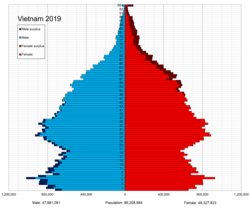
| | | population_census = 96,208,984{{sfn|General Statistics Office of Vietnam|2019}} | ||
| | | population_census_year = 2019 | ||
| | | population_census_rank = 15th | ||
| population_density_km2 = | | population_density_km2 = 295.0 | ||
| population_density_sq_mi = | | population_density_sq_mi = 752 | ||
| population_density_rank = | | population_density_rank = 29th | ||
| GDP_PPP = $ | | GDP_PPP = {{increase}} $1.047 trillion{{sfn|International Monetary Fund}} | ||
| GDP_PPP_year = | | GDP_PPP_year = 2020 | ||
| GDP_PPP_rank = | | GDP_PPP_rank = 23rd | ||
| GDP_PPP_per_capita = $ | | GDP_PPP_per_capita = {{increase}} $10,755{{sfn|International Monetary Fund}} | ||
| GDP_PPP_per_capita_rank = | | GDP_PPP_per_capita_rank = 106th | ||
| GDP_nominal = $ | | GDP_nominal = {{increase}} $340.602 billion{{sfn|International Monetary Fund}} | ||
| GDP_nominal_year = | | GDP_nominal_year = 2020 | ||
| GDP_nominal_rank = | | GDP_nominal_rank = 35th | ||
| GDP_nominal_per_capita = $ | | GDP_nominal_per_capita = {{increase}} $3,498{{sfn|International Monetary Fund}} | ||
| GDP_nominal_per_capita_rank = | | GDP_nominal_per_capita_rank = 115th | ||
| Gini = | | Gini = 35.7 <!--number only--> | ||
| Gini_year = | | Gini_year = 2018 | ||
| Gini_change = | | Gini_change = decrease | ||
| Gini_ref = {{sfn|World Bank| | | Gini_ref = {{sfn|World Bank|2018c}} | ||
| Gini_rank = | | Gini_rank = | ||
| HDI = 0. | | HDI = 0.704<!--number only--> | ||
| HDI_year = | | HDI_year = 2019<!-- Please use the year to which the data refers, not the publication year--> | ||
| HDI_change = increase<!--increase/decrease/steady--> | | HDI_change = increase<!--increase/decrease/steady--> | ||
| HDI_ref = {{ | | HDI_ref = <ref>{{cite book |title=Human Development Report 2020 The Next Frontier: Human Development and the Anthropocene |date=15 December 2020 |publisher=United Nations Development Programme |isbn=978-9-211-26442-5 |pages=343–346 |website=hdr.undp.org |url=http://hdr.undp.org/sites/default/files/hdr2020.pdf |access-date=15 December 2020 |archive-date=15 December 2020 |archive-url=https://web.archive.org/web/20201215063955/http://hdr.undp.org/sites/default/files/hdr2020.pdf |url-status=live }}</ref> | ||
| HDI_rank = | | HDI_rank = 117th | ||
| currency = [[Vietnamese đồng|đồng]] (₫) | | currency = [[Vietnamese đồng|đồng]] (₫) | ||
| currency_code = VND | | currency_code = VND | ||
| time_zone = [[UTC+07:00|Vietnam Standard Time]] | | time_zone = [[UTC+07:00|Vietnam Standard Time]] | ||
| utc_offset = + | | utc_offset = +07:00 | ||
| utc_offset_DST = | | utc_offset_DST = | ||
| time_zone_DST = | | time_zone_DST = | ||
| Line 87: | Line 96: | ||
| calling_code = [[Telephone numbers in Vietnam|+84]] | | calling_code = [[Telephone numbers in Vietnam|+84]] | ||
| cctld = [[.vn]] | | cctld = [[.vn]] | ||
| today = | |||
}} | }} | ||
{{Contains special characters|Vietnamese}} | |||
'''Vietnam''' ({{lang-vi|Việt Nam}}, {{IPA-vi|vîət nāːm||Vietnam.ogg|help=no}}), officially the '''Socialist Republic of Vietnam''',{{#tag:ref|{{lang-vi|Cộng hòa Xã hội chủ nghĩa Việt Nam}}|group="n"}} is a country in [[Southeast Asia]]. Located at the eastern edge of [[mainland Southeast Asia]], it covers {{Convert|311699|km2|sqmi}}. With a population of over 96 million, it is the world's [[List of countries and dependencies by population|fifteenth-most populous country]]. Vietnam borders [[China]] to the north, [[Laos]] and [[Cambodia]] to the west, and shares [[Maritime boundary|maritime borders]] with [[Thailand]] through the [[Gulf of Thailand]], and the [[Philippines]], [[Indonesia]], and [[Malaysia]] through the [[South China Sea]]. Its capital is [[Hanoi]] and its largest city is [[Ho Chi Minh City]].{{#tag:ref|Commonly known as Saigon|group="n"}} | |||
Vietnam was inhabited as early as the [[Paleolithic]] age. The first known states during the first millennium BC centered on the [[Red River Delta]], located in modern-day [[northern Vietnam]]. The [[Han dynasty]] annexed and put Northern and Central Vietnam under [[Vietnam under Chinese rule|Chinese rule]] from 111 BC, until the [[Ngô dynasty|first dynasty]] emerged in 939. Successive [[List of Vietnamese dynasties|monarchical dynasties]] absorbed Chinese influences through [[Confucianism]] and [[Buddhism]], and [[Nam tiến|expanded southward]] to the [[Mekong Delta]], [[History of the Cham–Vietnamese wars|conquering]] [[Champa]]. The [[Nguyễn dynasty|Nguyễn]]—the last imperial dynasty—fell to [[French Indochina|French colonisation]] in 1887. Following the [[August Revolution]], the nationalist [[Viet Minh]] under the leadership of communist revolutionary [[Ho Chi Minh]] proclaimed [[Proclamation of Independence of the Democratic Republic of Vietnam|independence]] from France in 1945. | |||
After | Vietnam went through prolonged warfare through the 20th century. After [[World War II]], France returned to reclaim colonial power in the [[First Indochina War]], from which Vietnam emerged victorious in 1954. The [[Vietnam War]] began shortly after, during which the nation was divided into communist [[North Vietnam|North]] supported by the [[Soviet Union]] and [[China in the Vietnam War|China]], and anti-communist [[South Vietnam|South]] supported by the [[United States in the Vietnam War|United States]]. Upon the [[fall of Saigon|North Vietnamese victory]] in 1975, Vietnam reunified as a [[unitary state|unitary]] [[socialist state]] under the [[Communist Party of Vietnam]] (CPV) in 1976. An ineffective [[planned economy]], a trade embargo by the [[Western world|West]], and wars with [[Cambodian–Vietnamese War|Cambodia]] and [[Sino-Vietnamese War|China]] crippled the country further. A [[Unitary State|unitary]] [[One-party state|one-party]] [[Republic|socialist republic]], in 1986, the CPV decided to initiate [[Đổi Mới|economic and political reforms]] similar to the [[Chinese economic reform]] a few years prior, transforming the country to a [[market economy|market]]-oriented economy. The reforms facilitated Vietnamese reintegration into [[global economy]] and [[global politics|politics]]. | ||
A [[developing country]] with a lower-middle-income economy, Vietnam after a turbulent 20th century is nevertheless one of the [[List of countries by real GDP growth rate|fastest growing economies]] of the 21st century, and its total GDP is predicted to possibly rival those of several [[developed nation]]s by 2050 under current trajectories. Contemporary issues in Vietnam include [[Corruption in Vietnam|high levels of corruption]], [[Censorship in Vietnam|censorship]] and a poor [[human rights in Vietnam|human rights record]]; the country [[International rankings of Vietnam|ranks among the lowest]] in international measurements of [[civil liberties]], [[freedom of the press]] and [[Freedom of religion in Vietnam|freedom of religion and ethnic minorities]]. It is part of international and intergovernmental institutions including the [[Association of Southeast Asian Nations|ASEAN]], the [[Asia-Pacific Economic Cooperation|APEC]], the [[Comprehensive and Progressive Agreement for Trans-Pacific Partnership|CPTPP]], the [[Non-Aligned Movement]], the [[Organisation internationale de la Francophonie|OIF]], and the [[World Trade Organization|WTO]]. It has assumed a seat on the [[United Nations Security Council]] twice. | |||
==Names of Vietnam | == Etymology == | ||
{{Main|Names of Vietnam}} | |||
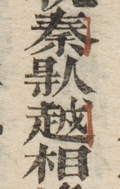
The name {{lang|vi|Việt Nam}} ({{IPA-vi|viə̀t naːm}}, [[chữ Hán]]: {{Vi-nom|{{linktext|越南}}}}), literally “Viet south”, means “Viet of the South” per Vietnamese word order or “South of the Viet” per [[Classical Chinese]] word order.<ref name="Brindley 2015 p27">{{cite book|title=Ancient China and the Yue Perceptions and Identities on the Southern Frontier, c.400 BCE–50 CE|first=Erica Fox|last=Brindley|date=2015|page=27|publisher=Cambridge University Press|quote=The term “Yue” survives today in the name of the Vietnamese state (yue nan 越南, or, “Viet south” – “Viet of the South,” – as the Vietnamese likely took it; or “South of the Viet” – as the Chinese likely took it}}</ref> A variation of the name, [[Nanyue]] (or Nam Việt, {{Vi-nom|[[wikt:南越|南越]]}}), was first documented in the 2nd century BC.{{sfn|Woods|2002|p=38}} The term "{{linktext|Việt}}" (Yue) ({{CJKV|t={{linktext|越}}|s={{linktext|越}}|p=Yuè|w=Yüeh<sup>4</sup>|cy=Yuht|v={{linktext|Việt}}}}) in [[Early Middle Chinese]] was first written using the [[logogram|logograph]] "戉" for an axe (a homophone), in [[oracle bone]] and bronze inscriptions of the late [[Shang dynasty]] ({{circa|lk=no|1200}} BC), and later as "越".{{sfn|Norman|Mei|1976}} At that time it referred to a people or chieftain to the northwest of the Shang.{{sfn|Meacham|1996}} In the early 8th century BC, a tribe on the middle [[Yangtze]] were called the [[Yangyue]], a term later used for peoples further south.{{sfn|Meacham|1996}} Between the 7th and 4th centuries BC Yue/Việt referred to the [[Yue (state)|State of Yue]] in the lower Yangtze basin and its people.{{sfn|Norman|Mei|1976}}{{sfn|Meacham|1996}} From the 3rd century BC the term was used for the non-Chinese populations of south and southwest China and northern Vietnam, with particular ethnic groups called [[Minyue]], [[Ouyue]], Luoyue (Vietnamese: [[Lạc Việt]]), etc., collectively called the [[Baiyue]] (Bách Việt, {{CJKV|t={{linktext|百越}}|s={{linktext|百越}}|p=Bǎiyuè|cy=Baak Yuet|v=Bách Việt|l=Hundred Yue/Viet}}; ).{{sfn|Norman|Mei|1976}}{{sfn|Meacham|1996}}{{sfn|Yue Hashimoto|1972|p=1}} The term Baiyue/Bách Việt first appeared in the book ''[[Lüshi Chunqiu]]'' compiled around 239 BC.{{sfn|Knoblock|Riegel|2001|p=510}} By the 17th and 18th centuries AD, educated Vietnamese apparently referred to themselves as ''nguoi Viet'' (Viet people) or ''nguoi nam'' (southern people).{{sfn|Lieberman|2003|p=405}} | |||
The form {{lang|vi|Việt Nam}} ({{Vi-nom|{{linktext|越南}}}}) is first recorded in the 16th-century oracular poem ''[[Sấm Trạng Trình]]''. The name has also been found on 12 [[stele]]s carved in the 16th and 17th centuries, including one at Bao Lam Pagoda in [[Haiphong|Hải Phòng]] that dates to 1558.{{sfn|Phan|1976|p=510}} In 1802, [[Nguyễn Phúc Ánh]] (who later became Emperor Gia Long) established the [[Nguyễn dynasty]]. In the second year of his rule, he asked the [[Jiaqing Emperor]] of the [[Qing dynasty]] to confer on him the title 'King of Nam Việt / Nanyue' ({{lang|zh|南越}} in Chinese character) after seizing power in Annam. The Emperor refused because the name was related to [[Zhao Tuo]]'s Nanyue, which included the regions of [[Guangxi]] and [[Guangdong]] in southern China. The Qing Emperor, therefore, decided to call the area "Việt Nam" instead,{{#tag:ref|At first, [[Gia Long]] requested the name "Nam Việt", but the [[Jiaqing Emperor]] refused.{{sfn|Woods|2002|p=38}}{{sfn|Shaofei|Guoqing|2016}}|name="etymology"|group="n"}}{{sfn|Ooi|2004|p=932}} meaning “South of the Viet” per [[Classical Chinese]] word order but the Vietnamese understood it as “Viet of the South” per Vietnamese word order.<ref name="Brindley 2015 p27"/> Between 1804 and 1813, the name Vietnam was used officially by Emperor Gia Long.<ref name="etymology" group="n" /> It was revived in the early 20th century in [[Phan Bội Châu]]'s ''[[History of the Loss of Vietnam]]'', and later by the [[Việt Nam Quốc Dân Đảng|Vietnamese Nationalist Party]] (VNQDĐ).{{sfn|Tonnesson|Antlov|1996|p=117}} The country was usually called Annam until 1945, when the [[Empire of Vietnam|imperial government]] in [[Huế]] adopted {{lang|vi|Việt Nam}}.{{sfn|Tonnesson|Antlov|1996|p=126}} | |||
== | == History == | ||
{{Main|History of Vietnam}} | |||
{{For timeline|Timeline of Vietnamese history}} | |||
=== Prehistory === | |||
[[File:DrumFromSongDaVietnamDongSonIICultureMid1stMilleniumBCEBronze.jpg|left|thumb|alt=Photograph of a Đông Sơn bronze drum | A [[Đông Sơn drums|Đông Sơn]] bronze drum, {{circa|800 BC}}]] | |||
Archaeological excavations have revealed the existence of humans in what is now Vietnam as early as the [[Paleolithic]] age. Stone artefacts excavated in [[Gia Lai province]] have been claimed to date to 0.78 Ma,<ref>{{cite journal |last1=Derevianko |first1=A. P. |last2=Kandyba |first2=A. V. |last3=Nguyen |first3=Khac Su |last4=Gladyshev |first4=S. A. |last5=Nguyen |first5=Gia Doi |last6=Lebedev |first6=V. A. |last7=Chekha |first7=A. M. |last8=Rybalko |first8=A. G. |last9=Kharevich |first9=V. M. |last10=Tsybankov |first10=A. A. |title=The Discovery of a Bifacial Industry in Vietnam |journal=Archaeology, Ethnology & Anthropology of Eurasia |date=21 September 2018 |volume=46 |issue=3 |pages=3–21 |doi=10.17746/1563-0110.2018.46.3.003-021 |s2cid=229297187 }}</ref> based on associated find of [[tektite|tektites]], however this claim has been challenged because tektites are often found in archaeological sites of various ages in Vietnam.<ref>{{cite journal |last1=Marwick |first1=Ben |last2=Pham |first2=Son Thanh |last3=Brewer |first3=Rachel |last4=Wang |first4=Li-Ying |title=Tektite geoarchaeology in mainland Southeast Asia |journal=PCI Archaeology |date=14 August 2021 |doi=10.31235/osf.io/93fpa|s2cid=243640447 |url=https://osf.io/93fpa/ }}</ref> ''[[Homo erectus]]'' fossils dating to around 500,000 BC have been found in caves in [[Lạng Sơn Province|Lạng Sơn]] and [[Nghệ An Province|Nghệ An]] provinces in northern Vietnam.{{sfn|McKinney|2009}} The oldest ''[[Homo sapiens]]'' fossils from mainland Southeast Asia are of [[Middle Pleistocene]] provenance, and include isolated tooth fragments from Tham Om and Hang Hum.{{sfn|Akazawa|Aoki|Kimura|1992|p=321}}{{sfn|Rabett|2012|p=109}}{{sfn|Dennell|Porr|2014|p=41}} Teeth attributed to ''Homo sapiens'' from the [[Late Pleistocene]] have been found at Dong Can,{{sfn|Matsumura|Yoneda|Yukio|Oxenham|2008|p=12}} and from the Early [[Holocene]] at Mai Da Dieu,{{sfn|Matsumura|Lan Cuong|Kim Thuy|Anezaki|2001}}{{sfn|Oxenham|Tayles|2006|p=36}} Lang Gao{{sfn|Nguyen|1985|p=16}}{{sfn|Karlström|Källén|2002|p=83}} and Lang Cuom.{{sfn|Oxenham|Buckley|2015|p=329}} By about 1,000 BC, the development of wet-[[rice]] cultivation in the [[Ma River]] and [[Red River (Asia)|Red River]] floodplains led to the flourishing of [[Đông Sơn culture]],{{sfn|Higham|1984}}{{sfn|Nang Chung|Giang Hai|2017|p=31}} notable for its [[bronze]] casting used to make elaborate bronze [[Đông Sơn drums]].{{sfn|de Laet|Herrmann|1996|p=408}}{{sfn|Calò|2009|p=51}}{{sfn|Kiernan|2017|p=31}} At this point, the early Vietnamese kingdoms of [[Văn Lang]] and [[Âu Lạc]] appeared, and the culture's influence spread to other parts of [[Southeast Asia]], including [[Maritime Southeast Asia]], throughout the first millennium BC.{{sfn|Calò|2009|p=51}}{{sfn|Cooke|Li|Anderson|2011|p=46}} | |||
=== Dynastic Vietnam === | |||
{{For timeline|Timeline of Vietnam under Chinese rule}} | |||
[[File:Nguyen Dynasty, administrative divisions map (1838).svg|thumb|Vietnam's territories around 1838]] | |||
According to legends, [[Hồng Bàng dynasty]] of the [[Hùng kings]] first established in 2879 BC is considered the first state in the [[History of Vietnam]] (then known as Xích Quỷ and later [[Văn Lang]]).{{sfn|Pelley|2002|p=151}}{{sfn|Cottrell|2009|p=14}} In 257 BC, the last Hùng king was defeated by Thục Phán. He consolidated the [[Lạc Việt]] and [[Âu Việt]] tribes to form the [[Âu Lạc]], proclaiming himself [[An Dương Vương]].{{sfn|Đức Trần|Thư Hà|2000|p=8}} In 179 BC, a Chinese general named [[Zhao Tuo]] defeated An Dương Vương and consolidated Âu Lạc into [[Nanyue]].{{sfn|Nang Chung|Giang Hai|2017|p=31}} However, Nanyue was itself [[Southward expansion of the Han dynasty|incorporated into the empire]] of the Chinese [[Han dynasty]] in 111 BC after the [[Han–Nanyue War]].{{sfn|Ooi|2004|p=932}}{{sfn|Yao|2016|p=62}} For the next thousand years, what is now northern Vietnam remained mostly under [[Chinese domination of Vietnam|Chinese rule]].{{sfn|Holmgren|1980}}{{sfn|Taylor|1983|p=30}} Early independence movements, such as those of the [[Trưng Sisters]] and [[Lady Triệu]],{{sfn|Pelley|2002|p=177}} were temporarily successful,{{sfn|Cottrell|2009|p=15}} though the region gained a longer period of independence as Vạn Xuân under the [[Anterior Lý dynasty]] between AD 544 and 602.{{sfn|Thái Nguyên|Mừng Nguyẽ̂n|1958|p=33}}{{sfn|Chesneaux|1966|p=20}}{{sfn|anon.|1972|p=24}} By the early 10th century, Northern Vietnam had gained autonomy, but not sovereignty, under the [[Khúc family]].{{sfn|Tuyet Tran|Reid|2006|p=32}} | |||
In AD 938, the Vietnamese lord [[Ngô Quyền]] defeated the forces of the Chinese [[Southern Han]] state at [[Battle of Bạch Đằng (938)|Bạch Đằng River]] and achieved full independence for Vietnam after a millennium of Chinese domination.{{sfn|Hiẻ̂n Lê|2003|p=65}}{{sfn|Hong Lien|Sharrock|2014|p=55}}{{sfn|Kiernan|2017|p=226}} By the 960s, the dynastic [[Đại Việt]] (''Great Viet'') kingdom was established, Vietnamese society enjoyed a golden era under the Lý and [[Trần dynasty|Trần]] dynasties. During the rule of the Trần Dynasty, Đại Việt repelled three [[Mongol invasions of Vietnam|Mongol invasions]].{{sfn|Cottrell|2009|p=16}}{{sfn|Hong Lien|Sharrock|2014|p=95}} Meanwhile, the [[Mahāyāna]] branch of [[Buddhism in Vietnam|Buddhism]] flourished and became the state religion.{{sfn|Kiernan|2017|p=226}}{{sfn|Keyes|1995|p=183}} Following the 1406–7 [[Ming–Hồ War]], which overthrew the [[Hồ dynasty]], Vietnamese independence was [[Fourth Chinese domination of Vietnam|interrupted briefly]] by the Chinese [[Ming dynasty]], but was restored by [[Lê Lợi]], the founder of the [[Lê dynasty]].{{sfn|Hong Lien|Sharrock|2014|p=111}} The Vietnamese polity reached their zenith in the Lê dynasty of the 15th century, especially during the reign of king [[Lê Thánh Tông]] (1460–1497).{{sfn|Hong Lien|Sharrock|2014|p=120}}{{sfn|Kiernan|2017|p=265}} Between the 11th and 18th centuries, the Vietnamese polity expanded southward in a gradual process known as {{lang|vi|[[Nam tiến]]}} ("Southward expansion"),{{sfn|Anderson|Whitmore|2014|p=158}} eventually conquering the kingdom of [[Champa]] and part of the [[Post-Angkor Period|Khmer Kingdom]].{{sfn|Vo|2011|p=13}}{{sfn|Ooi|Anh Tuan|2015|p=212}}{{sfn|Phuong Linh|2016|p=39}} | |||
From the 16th century onward, civil strife and frequent political infighting engulfed much of Dai Viet. First, the Chinese-supported [[Mạc dynasty]] challenged the Lê dynasty's power.{{sfn|Anderson|Whitmore|2014|p=174}} After the Mạc dynasty was defeated, the Lê dynasty was nominally reinstalled. Actual power, however, was divided between the northern [[Trịnh lords]] and the southern [[Nguyễn lords]], who engaged in a [[Trịnh–Nguyễn War|civil war]] for more than four decades before a truce was called in the 1670s.{{sfn|Leonard|1984|p=131}} During this period, the Nguyễn expanded southern Vietnam into the [[Mekong Delta]], annexing the [[Central Highlands (Vietnam)|Central Highlands]] and the Khmer lands in the Mekong Delta.{{sfn|Vo|2011|p=13}}{{sfn|Phuong Linh|2016|p=39}}{{sfn|Ooi|2004|p=356}} The division of the country ended a century later when the [[Tây Sơn]] brothers established a new dynasty. However, their rule did not last long, and they were defeated by the remnants of the Nguyễn lords, led by [[Gia Long|Nguyễn Ánh]], aided by the French.{{sfn|Page|Sonnenburg|2003|p=723}} Nguyễn Ánh unified Vietnam, and established the [[Nguyễn dynasty]], ruling under the name [[Gia Long]].{{sfn|Ooi|2004|p=356}} | |||
=== French Indochina === | |||
{{Main|Cochinchina campaign|Sino-French War|Tonkin campaign|French Indochina}} | |||
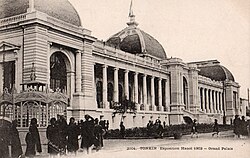
[[File:ExpositionHanoi1902 GrandPalais (1).jpg|thumb|upright=1.2|alt=Photograph of the Grand Palais building in Hanoi|The [[Grand Palais (Hanoi)|Grand Palais]] built for the 1902–1903 [[Hanoi exhibition|world's fair]], when [[Hanoi]] was French Indochina's capital]] | |||
In the 1500s, the [[Portuguese Empire|Portuguese]] explored the Vietnamese coast and reportedly erected a [[stele]] on the [[Chàm Islands]] to mark their presence.{{sfn|Hoàng|2007|p=50}} By 1533, they began landing in the Vietnamese delta but were forced to leave because of local turmoil and fighting. They also had less interest in the territory than they did in China and Japan.{{sfn|Hoàng|2007|p=50}} After they had settled in [[Portuguese Macau|Macau]] and [[Portuguese Nagasaki|Nagasaki]] to begin the profitable Macau–Japan trade route, the Portuguese began to involve themselves in trade with [[Hội An]].{{sfn|Hoàng|2007|p=50}} Portuguese traders and [[Society of Jesus|Jesuit]] missionaries under the ''[[Padroado]]'' system were active in both Vietnamese realms of ''[[Đàng Trong]]'' ([[Cochinchina]] or Quinan) and ''[[Đàng Ngoài]]'' ([[Tonkin]]) in the 17th century.{{sfn|Tran|2018}} The [[Dutch Empire|Dutch]] also tried to establish contact with Quinan in 1601 but failed to sustain a presence there after several violent encounters with the locals. The [[Dutch East India Company]] (VOC) only managed to establish official relations with Tonkin in the spring of 1637 after leaving [[Dejima]] in Japan to establish trade for [[silk]].{{sfn|Hoàng|2007|p=52}} Meanwhile, in 1613, the first [[Kingdom of England|English]] attempt to establish contact with Hội An failed following a violent incident involving the [[East India Company|Honourable East India Company]]. By 1672 the English did establish relations with Tonkin and were allowed to reside in [[Hưng Yên|Phố Hiến]].{{sfn|Hoàng|2007|p=53}} | |||
Between 1615 and 1753, French traders also engaged in trade in Vietnam.{{sfn|Li|1998|p=89}}{{sfn|Lockard|2010|p=479}} The first French missionaries<!--Joseph Francis Tissanier and Pierre Jacques Albier, SJ--> arrived in 1658, under the Portuguese ''Padroado''. From its foundation, the [[Paris Foreign Missions Society]] under [[Congregation for the Evangelization of Peoples|''Propaganda Fide'']] actively sent missionaries to Vietnam, entering Cochinchina first<!--Louis Chevreuil--> in 1664 and Tonkin first<!--François Deydier--> in 1666.{{sfn|Tran|2017|p=27}} Spanish [[Dominican Order|Dominicans]] joined the Tonkin mission in 1676, and [[Franciscans]] were in Cochinchina from 1719 to 1834. The Vietnamese authorities began{{when|date=October 2020}} to feel threatened by continuous [[Christianisation]] activities.{{sfn|McLeod|1991|p=22}} After several Catholic missionaries were detained, the [[French Navy]] intervened in 1843 to free them, as the kingdom was perceived as [[xenophobic]].{{sfn|Woods|2002|p=42}} In a series of conquests from 1859 to 1885, [[French colonial empire|France eroded]] Vietnam's sovereignty.{{sfn|Cortada|1994|p=29}} At the [[Siege of Tourane]] in 1858, France was aided by [[Spanish Empire|Spain]] (with Filipino, [[Latin American Asian|Latin American]], and Spanish troops from the [[Philippines]])<ref>{{Cite web|url=https://www.manilatimes.net/2020/03/10/opinion/columnists/the-day-the-filipinos-conquered-saigon/701612|title=The day the Filipinos conquered Saigon|first=Jorge|last=Mojarro|date=10 March 2020|website=The Manila Times}}</ref> and perhaps some Tonkinese Catholics.{{sfn|Keith|2012|p=46}} After the [[Treaty of Saigon (1862)|1862 Treaty]], and especially after France completely conquered [[Southern Vietnam|Lower Cochinchina]] in 1867, the [[Văn Thân movement]] of scholar-gentry class arose and committed violence against Catholics across central and northern Vietnam.{{sfn|Keith|2012|pp=49–50}} | |||
Between 1862 and 1867, the southern third of the country became the [[French Cochinchina|French colony of Cochinchina]].{{sfn|McLeod|1991|p=61}} By 1884, the entire country was under French rule, with the central and northern parts of Vietnam separated into the two protectorates of [[Annam (French protectorate)|Annam]] and [[Tonkin (French protectorate)|Tonkin]]. The three entities were formally integrated into the union of [[French Indochina]] in 1887.{{sfn|Ooi|2004|p=520}}{{sfn|Cook|2001|p=396}} The French administration imposed significant political and cultural changes on Vietnamese society.{{sfn|Frankum Jr.|2011|p=172}} A Western-style system of modern education introduced new [[humanism|humanist]] values.{{sfn|Nhu Nguyen|2016|p=37}} Most French settlers in Indochina were concentrated in Cochinchina, particularly in [[Saigon]], and in [[Hanoi]], the colony's capital.{{sfn|Richardson|1876|p=269}} | |||
During the colonial period, guerrillas of the royalist [[Cần Vương movement]] rebelled against French rule and massacred around a third of Vietnam's Christian population.{{sfn|Keith|2012|p=53}}{{sfn|Anh Ngo|2016|p=71}} After a decade of resistance, they were defeated in the 1890s by the Catholics in reprisal for their earlier massacres.{{sfn|Quach Langlet|1991|p=360}}{{sfn|Ramsay|2008|p=171}} Another large-scale rebellion, the [[Thái Nguyên uprising]], was also suppressed heavily.{{sfn|Zinoman|2000}} The French developed a [[plantation economy]] to promote export of [[tobacco]], [[indigo dye|indigo]], [[tea]] and [[coffee]].{{sfn|Lim|2014|p=33}} However, they largely ignored the increasing demands for civil rights and [[self-government]]. | |||
A nationalist political movement soon emerged, with leaders like [[Phan Bội Châu]], [[Phan Châu Trinh]], [[Phan Đình Phùng]], Emperor [[Hàm Nghi]], and [[Hồ Chí Minh]] fighting or calling for independence.{{sfn|Largo|2002|p=112}} This resulted in the 1930 [[Yên Bái mutiny]] by the [[Việt Nam Quốc Dân Đảng|Vietnamese Nationalist Party]] (VNQDĐ), which the French quashed. The mutiny split the independence movement, as many leading members converted to [[communism]].{{sfn|Khánh Huỳnh|1986|p=98}}{{sfn|Odell|Castillo|2008|p=82}}{{sfn|Thomas|2012}} | |||
The French maintained full control of their colonies until World War II, when the [[Pacific War|war in the Pacific]] led to the [[Japanese invasion of French Indochina]] in 1940. Afterwards, the [[Empire of Japan|Japanese Empire]] was allowed to station its troops in Vietnam while the pro-[[Vichy France|Vichy French]] colonial administration continued.{{sfn|Miller|1990|p=293}}{{sfn|Gettleman|Franklin|Young|Franklin|1995|p=4}} Japan exploited Vietnam's natural resources to support its military campaigns, culminating in a [[Japanese coup d'état in French Indochina|full-scale takeover of the country]] in March 1945. This led to the [[Vietnamese Famine of 1945]] which killed up to two million people.{{sfn|Thanh Niên|2015}}{{sfn|Vietnam Net|2015}} | |||
=== First Indochina War === | |||
{{Main|First Indochina War|Empire of Vietnam|Democratic Republic of Vietnam|State of Vietnam|Operation Passage to Freedom}} | |||
In 1941, the [[Viet Minh|Việt Minh]], a nationalist liberation movement based on a [[Communist Ideology]], emerged under the Vietnamese revolutionary leader [[Hồ Chí Minh]]. The Việt Minh sought independence for Vietnam from France and the end of the [[Japanese occupation of Vietnam|Japanese occupation]].{{sfn|Joes|1992|p=95}}{{sfn|Pike|2011|p=192}} After the military defeat of Japan and the fall of its puppet [[Empire of Vietnam]] in August 1945, Saigon's administrative services collapsed and chaos, riots, and murder were widespread.{{sfn|Gunn|2014|p=270}} The Việt Minh occupied [[Hanoi]] and proclaimed a provisional government, which asserted national independence on 2 September.{{sfn|Pike|2011|p=192}} | |||
In July 1945, the [[Allies of World War II|Allies]] had decided to divide Indochina at the [[16th parallel north|16th parallel]] to allow [[Chiang Kai-shek]] of the [[Republic of China (1912–1949)|Republic of China]] to receive the Japanese surrender in the north while Britain's [[Louis Mountbatten, 1st Earl Mountbatten of Burma|Lord Louis Mountbatten]] received their surrender in the south. The Allies agreed that Indochina still belonged to France.{{sfn|Neville|2007|p=175}}{{sfn|Smith|2007|p=6}} | |||
[[File:French Indochina post partition.png|thumb|left|alt=Map showing the partition of French Indochina following the 1954 Geneva Conference | [[Partition (politics)|Partition]] of French Indochina after the [[1954 Geneva Conference]]]] | |||
But as the French were weakened by the [[German military administration in occupied France during World War II|German occupation]], [[British Raj|British-Indian]] forces and the remaining Japanese [[Southern Expeditionary Army Group]] were used to maintain order and help France reestablish control through the [[War in Vietnam (1945–46)|1945–1946 War in Vietnam]].{{sfn|Neville|2007|p=124}} Hồ initially chose to take a moderate stance to avoid military conflict with France, asking the French to withdraw their colonial administrators and for French professors and engineers to help build a modern independent Vietnam.{{sfn|Pike|2011|p=192}} But the [[Provisional Government of the French Republic]] did not act on these requests, including the idea of independence, and dispatched the [[French Far East Expeditionary Corps]] to restore colonial rule. This resulted in the Việt Minh launching a guerrilla campaign against the French in late 1946.{{sfn|Joes|1992|p=95}}{{sfn|Pike|2011|p=192}}{{sfn|Tonnesson|2011|p=66}} The resulting [[First Indochina War]] lasted until July 1954. The defeat of French colonialists and [[Vietnamese National Army|Vietnamese loyalists]] in the 1954 [[battle of Điện Biên Phủ]] allowed Hồ to negotiate a ceasefire from a favourable position at the subsequent [[1954 Geneva Conference|Geneva Conference]].{{sfn|Pike|2011|p=192}}{{sfn|Waite|2012|p=89}} | |||
The colonial administration was thereby ended and French Indochina was dissolved under the Geneva Accords of 1954 into three countries—Vietnam, and the kingdoms of [[Kingdom of Cambodia (1953–1970)|Cambodia]] and [[Kingdom of Laos|Laos]]. Vietnam was further divided into North and South administrative regions at the [[Vietnamese Demilitarized Zone|Demilitarised Zone]], roughly along the [[17th parallel north]], pending elections scheduled for July 1956.{{#tag:ref|Neither the American government nor Ngô Đình Diệm's State of Vietnam signed anything at the 1954 Geneva Conference. The non-communist Vietnamese delegation objected strenuously to any division of Vietnam; however, the French accepted the Việt Minh proposal{{sfn|Gravel|1971|p=134}} that Vietnam be united by elections under the supervision of "local commissions".{{sfn|Gravel|1971|p=119}} The [[United States]], with the support of [[South Vietnam]] and the [[United Kingdom]], countered with the "American Plan",{{sfn|Gravel|1971|p=140}} which provided for [[United Nations]]-supervised unification elections. The plan, however, was rejected by [[Soviet Union|Soviet]] and other communist delegations.{{sfn|Kort|2017|p=96}}|group="n"}} A 300-day period of free movement was permitted, during which almost a million northerners, mainly Catholics, moved south, fearing persecution by the communists. This migration was in large part aided by the United States military through [[Operation Passage to Freedom]].{{sfn|Olson|2012|p=43}}{{sfn|DK|2017|p=39}} The [[partition of Vietnam]] by the Geneva Accords was not intended to be permanent, and stipulated that Vietnam would be reunited after the elections.{{sfn|van Dijk|Gray|Savranskaya|Suri|2013|p=68}} But in 1955, the southern State of Vietnam's prime minister, [[Ngô Đình Diệm]], toppled [[Bảo Đại]] in a fraudulent [[1955 State of Vietnam referendum|referendum]] organised by his brother [[Ngô Đình Nhu]], and proclaimed himself president of the [[Republic of Vietnam]].{{sfn|van Dijk|Gray|Savranskaya|Suri|2013|p=68}} This effectively replaced the internationally recognised [[State of Vietnam]] by the [[Republic of Vietnam]] in the south—supported by the United States, France, [[Kingdom of Laos|Laos]], [[Republic of China]] and Thailand—and Hồ's [[Democratic Republic of Vietnam]] in the north, supported by the [[Soviet Union]], Sweden,<ref>{{cite web |last=Guttman |first=John |title=Why did Sweden support the Viet Cong? |url=http://www.historynet.com/why-did-sweeden-support-the-viet-cong.htm |website=History Net |access-date=25 September 2019|date=25 July 2013 }}</ref> [[Khmer Rouge]], and the [[People's Republic of China]].{{sfn|van Dijk|Gray|Savranskaya|Suri|2013|p=68}} | |||
=== Vietnam War === | |||
{{Main|Vietnam War|Role of the United States in the Vietnam War}} | |||
From 1953 to 1956, the North Vietnamese government instituted [[Agrarianism|agrarian]] reforms including "[[Rent regulation|rent reduction]]" and "[[Land reform in Vietnam|land reform]]", which resulted in significant [[political repression]].{{sfn|Moïse|2017|p=56}} During the land reform, testimony from North Vietnamese witnesses initially suggested a ratio of one execution for every 160 village residents, which extrapolated across all of Vietnam would indicate nearly 100,000 executions.{{sfn|Turner|1975|p=143}} Because the campaign was concentrated mainly in the [[Red River Delta]] area, a lower estimate of 50,000 executions became widely accepted by scholars at the time,{{sfn|Turner|1975|p=143}}{{sfn|Gittinger|1959}} but declassified documents from the Vietnamese and Hungarian archives indicate that the number was much lower, although likely more than 13,500.{{sfn|Vu|2007}} In the South, Diệm countered North Vietnamese subversion (including the assassination of over 450 South Vietnamese officials in 1956) by detaining tens of thousands of suspected communists in "political reeducation centres".{{sfn|Heneghan|1969|p=160}}{{sfn|Turner|1975|p=177}} This program incarcerated many non-communists, but was successful at curtailing communist activity in the country, if only for a time.{{sfn|Crozier|1955}} The North Vietnamese government claimed that 2,148 people were killed in the process by November 1957.{{sfn|Turner|1975|pp=174–178}} The pro-Hanoi [[Việt Cộng]] began a guerrilla campaign in South Vietnam in the late 1950s to overthrow Diệm's government.{{sfn|Gilbert|2013|p=292}} From 1960, the [[Soviet Union]] and North Vietnam signed treaties providing for further Soviet military support.{{sfn|Jukes|1973|p=209}}{{sfn|Olsen|2007|p=92}}{{sfn|Khoo|2011|p=27}} | |||
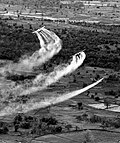
= | [[File:Agent Orange Cropdusting.jpg|thumb|right|alt=Three US Fairchild UC-123B aircraft pictured spraying Agent Orange | Three US [[Fairchild C-123 Provider|Fairchild UC-123B]] aircraft spraying [[Agent Orange]] during the [[Operation Ranch Hand]] as part of a [[herbicidal warfare]] operation depriving the food and vegetation cover of the [[Việt Cộng]], {{circa|1962–1971}}]] | ||
In 1963, Buddhist discontent with Diệm's Catholic regime erupted into [[Buddhist crisis|mass demonstrations]], leading to a violent government crackdown.{{sfn|Muehlenbeck|Muehlenbeck|2012|p=221}} This led to the [[Cable 243|collapse of Diệm's relationship with the United States]], and ultimately to a [[1963 South Vietnamese coup|1963 coup]] in which [[Arrest and assassination of Ngô Đình Diệm|he and Nhu were assassinated]].{{sfn|Willbanks|2013|p=53}} The Diệm era was followed by more than a dozen successive military governments, before the pairing of Air Marshal [[Nguyễn Cao Kỳ]] and General [[Nguyễn Văn Thiệu]] took control in mid-1965.{{sfn|Duy Hinh|Dinh Tho|2015|p=238}} Thiệu gradually outmaneuvered Kỳ and cemented his grip on power in fraudulent elections in 1967 and 1971.{{sfn|Isserman|Bowman|2009|p=46}} During this political instability, the communists began to gain ground. To support South Vietnam's struggle against the communist insurgency, the United States began increasing its contribution of military advisers, using the 1964 [[Gulf of Tonkin incident]] as a pretext for such intervention.{{sfn|Alterman|2005|p=213}} US forces became involved in ground combat operations by 1965, and at their peak several years later, numbered more than 500,000.{{sfn|Lewy|1980}}{{sfn|Gibbons|2014|p=166}} The US also engaged in [[Operation Rolling Thunder|sustained aerial bombing]]. Meanwhile, [[China]] and the Soviet Union provided North Vietnam with significant material aid and 15,000 combat advisers.{{sfn|Jukes|1973|p=209}}{{sfn|Olsen|2007|p=92}}{{sfn|Li|2012|p=67}} Communist forces supplying the Việt Cộng carried supplies along the [[Ho Chi Minh trail|Hồ Chí Minh trail]], which passed through [[Kingdom of Laos|Laos]].{{sfn|Gillet|2011}} | |||
== | The communists attacked South Vietnamese targets during the 1968 [[Tết Offensive]]. The campaign failed militarily, but shocked the American establishment and turned US public opinion against the war.{{sfn|Dallek|2018}} During the offensive, communist troops [[Massacre at Huế|massacred over 3,000 civilians]] at [[Huế]].{{sfn|Turner|1975|p=251}}{{sfn|Frankum Jr.|2011|p=209}} Facing an increasing casualty count, [[Opposition to United States involvement in the Vietnam War|rising domestic opposition]] to the war, and growing international condemnation, the US began [[Nixon Doctrine|withdrawing from ground combat roles]] in the early 1970s. This also entailed an unsuccessful effort to [[Vietnamisation|strengthen and stabilise South Vietnam]].{{sfn|Eggleston|2014|p=1}} Following the [[Paris Peace Accords]] of 27 January 1973, all American combat troops were withdrawn by 29 March 1973.{{sfn|History|2018}} In December 1974, North Vietnam [[Battle of Phước Long|captured]] the province of [[Phước Long Province|Phước Long]] and started a [[1975 Spring Offensive|full-scale offensive]], culminating in the [[fall of Saigon]] on 30 April 1975.{{sfn|Tucker|2011|p=749}} South Vietnam was ruled by a [[Provisional Revolutionary Government of the Republic of South Vietnam|provisional government]] for almost eight years while under North Vietnamese military occupation.{{sfn|Brigham|1998|p=86}} | ||
=== Reunification and reforms === | |||
{{further|Re-education camp (Vietnam)|Vietnamese boat people|Đổi Mới}} | |||
[[ | On 2 July 1976, North and South Vietnam were merged to form the Socialist Republic of Việt Nam.{{sfn|''The New York Times''|1976}} The war devastated Vietnam and killed 966,000 to 3.8 million people.{{sfn|Hirschman|Preston|Manh Loi|1995}}{{sfn|Shenon|1995}}{{sfn|Obermeyer|Murray|Gakidou|2008}} A 1974 US Senate subcommittee estimated nearly 1.4 million [[Vietnam War casualties|Vietnamese civilians]] were killed or wounded between 1965 and 1974—including 415,000 killed.{{sfn|Dohrenwend|Turse|Wall|Yager|2018|p=69}}<ref>{{Cite news|date=1975-01-26|title=VIETNAM REFUGEES PUT AT 1.4 MILLION|language=en-US|work=The New York Times|url=https://www.nytimes.com/1975/01/26/archives/vietnam-refugees-put-at-14-million.html|access-date=2021-08-09|issn=0362-4331}}</ref> In its aftermath, under [[Lê Duẩn]]'s administration, there were no mass executions of South Vietnamese who had collaborated with the US or the defunct South Vietnamese government, confounding Western fears,{{sfn|Elliott|2010|pp=499, 512–513}} but up to 300,000 South Vietnamese were sent to [[Re-education camp (Vietnam)|reeducation camps]], where many endured torture, starvation, and disease while being forced to perform hard labour.{{sfn|Sagan|Denny|1982}} The government embarked on a mass campaign of [[collectivisation]] of farms and factories.{{sfn|''Spokesman-Review''|1977|p=8}} Many fled the country following the conclusion of the war.{{Sfn|Moise|1988|p=12}} In 1978, in response to the [[Khmer Rouge]] government of Cambodia ordering massacres of Vietnamese residents in the border villages in the districts of [[An Giang Province|An Giang]] and [[Kiên Giang Province|Kiên Giang]],{{sfn|Kissi|2006|p=144}} the Vietnamese military [[Cambodian–Vietnamese War|invaded Cambodia]] and removed them from power after occupying [[Phnom Penh]].{{sfn|Meggle|2004|p=166}} The intervention was a success, resulting in the establishment of a new, pro-Vietnam socialist government, the [[People's Republic of Kampuchea]], which ruled until 1989.{{sfn|Hampson|1996|p=175}} However, this worsened relations with China, which had supported the Khmer Rouge. China later launched a [[Sino-Vietnamese War|brief incursion into northern Vietnam]] in 1979, causing Vietnam to rely even more heavily on Soviet economic and military aid, while mistrust of the [[Government of China|Chinese government]] escalated.{{sfn|Khoo|2011|p=131}} | ||
At the [[6th National Congress of the Communist Party of Vietnam|Sixth National Congress]] of the [[Communist Party of Vietnam]] (CPV) in December 1986, reformist politicians replaced the "old guard" government with new leadership.{{sfn|BBC News|1997}}{{sfn|Văn Phúc|2014}} The reformers were led by 71-year-old [[Nguyễn Văn Linh]], who became the party's new general secretary.{{sfn|BBC News|1997}} He and the reformers implemented a series of [[free-market]] reforms known as {{lang|vi|[[Đổi Mới]]}} ("Renovation") that carefully managed the transition from a [[planned economy]] to a "[[socialist-oriented market economy]]".{{sfn|Murray|1997|pp=24–25}}{{sfn|Bich Loan|2007}} Although the authority of the state remained unchallenged under ''Đổi Mới'', the government encouraged [[private ownership]] of farms and factories, economic deregulation, and foreign investment, while maintaining control over strategic industries.{{sfn|Bich Loan|2007}}{{sfn|Howe|2016|p=20}} Subsequently, Vietnam's economy achieved strong growth in agricultural and industrial production, construction, exports, and foreign investment, although these reforms also resulted in a rise in income inequality and gender disparities.{{sfn|Goodkind|1995}}{{sfn|Gallup|2002}}{{sfn|Wagstaff|van Doorslaer|Watanabe|2003}} | |||
According to British journalist [[Nick Davies]], writing for ''[[The Guardian]]'', the long wars against the French and Americans have failed to achieve their stated goals:<blockquote>The reality now is that it has ended up with the worst of two systems: the authoritarian socialist state and the unfettered ideology of neoliberalism; the two combining to strip Vietnam’s people of their money and their rights while a tiny elite fills its pockets and hides behind the rhetoric of the revolution. That, finally, is the biggest lie of all. Victorious in war but defeated in peace, the claim by Vietnam’s leaders to be socialist looks like empty propaganda.<ref>{{Cite news |last=Davies |first=Nick |date=2015 |title=Vietnam 40 years on: how a communist victory gave way to capitalist corruption |work=The Guardian |url=https://www.theguardian.com/news/2015/apr/22/vietnam-40-years-on-how-communist-victory-gave-way-to-capitalist-corruption}}</ref></blockquote> | |||
== Geography == | |||
{{Main|Geography of Vietnam}} | |||
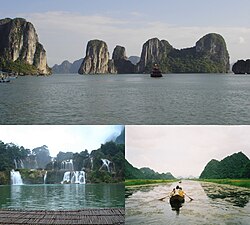
[[File:Geography of Vietnam.jpg|thumb|left|alt= Images showing Hạ Long Bay, the Yến River and the Bản-Giốc Waterfalls | Nature attractions in Vietnam, clockwise from top: [[Hạ Long Bay]], Yến River and [[Ban Gioc–Detian Falls|Bản-Giốc Waterfalls]]]] | |||
Vietnam is located on the eastern [[Mainland Southeast Asia|Indochinese Peninsula]] between the latitudes [[8th parallel north|8°]] and [[24th parallel north|24°N]], and the longitudes [[102nd meridian east|102°]] and [[110th meridian east|110°E]]. It covers a total area of approximately {{convert|331212|km2|sqmi|0|abbr=on}}.{{#tag:ref|See [[List of countries and dependencies by area]].|name="area"|group="n"}} The combined length of the country's land boundaries is {{convert|4639|km|mi|0|abbr=on}}, and its coastline is {{convert|3444|km|mi|0|abbr=on}} long.{{sfn|Nasuchon|2008|p=7}} At its narrowest point in the central [[Quảng Bình Province]], the country is as little as {{convert|50|km|mi}} across, though it widens to around {{convert|600|km|mi}} in the north.{{sfn|Protected Areas and Development Partnership|2003|p=13}} Vietnam's land is mostly hilly and densely forested, with level land covering no more than 20%. Mountains account for 40% of the country's land area,{{sfn|Fröhlich|Schreinemachers|Stahr|Clemens|2013|p=5}} and tropical forests cover around 42%.{{sfn|Natural Resources and Environment Program|1995|p=56}} The Red River Delta in the north, a flat, roughly triangular region covering {{convert|15000|km2|0|abbr=on}},{{sfn|Vietnam Ministry of Agriculture and Rural Development|2007}} is smaller but more intensely developed and more densely populated than the [[Mekong River Delta]] in the south. Once an inlet of the [[Gulf of Tonkin]], it has been filled in over the millennia by riverine [[alluvial deposits]].{{sfn|Huu Chiem|1993|p=180}}{{sfn|Minh Hoang|van Lap|Kim Oanh|Jiro|2016}} The delta, covering about {{convert|40000|km2|0|abbr=on}}, is a low-level plain no more than {{convert|3|m|ft|1}} [[Above mean sea level|above sea level]] at any point. It is criss-crossed by a maze of rivers and canals, which carry so much sediment that the delta advances {{convert|60|to|80|m|ft|1}} into the sea every year.{{sfn|Huu Chiem|1993|p=183}}{{sfn|Hong Truong|Ye|Stive|2017|p=757}} The [[exclusive economic zone of Vietnam]] covers {{convert|417663|km²|sqmi|abbr=on}} in the [[South China Sea]].{{sfn|Vietnamese Waters Zone}} | |||
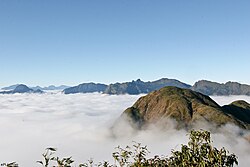
[[ | [[File:I'm coming, PXP.jpg|thumb|right|alt=Image of the Hoàng Liên Sơn mountain range | Hoàng Liên Sơn [[mountain range]], the range that includes [[Fansipan]] which is the highest summit on the Indochinese Peninsula.]] | ||
Southern Vietnam is divided into coastal lowlands, the mountains of the [[Annamite Range]], and extensive forests. Comprising five relatively flat plateaus of [[basalt]] soil, the highlands account for 16% of the country's [[arable land]] and 22% of its total forested land.{{sfn|Cosslett|Cosslett|2017|p=13}} The soil in much of the southern part of Vietnam is relatively low in nutrients as a result of intense cultivation.{{sfn|Van De|Douglas|McMorrow|Lindley|2008}} Several minor [[earthquake]]s have been recorded in the past. Most have occurred near the northern Vietnamese border in the provinces of [[Điện Biên Province|Điện Biên]], Lào Cai and [[Sơn La Province|Sơn La]], while some have been recorded offshore of the central part of the country.{{sfn|Hong Phuong|2012|p=3}}{{sfn|''Việt Nam News''|2016}} The northern part of the country consists mostly of highlands and the Red River Delta. [[Fansipan]] (also known as Phan Xi Păng), which is located in [[Lào Cai Province]], is the highest mountain in Vietnam, standing {{convert|3143|m|adj=on|abbr=on}} high.{{sfn|Vietnam Ministry of Culture, Sports and Tourism|2014}} From north to south Vietnam, the country also has [[List of islands of Vietnam|numerous islands]]; [[Phú Quốc]] is the largest.{{sfn|Boobbyer|Spooner|2013|p=173}} The [[Hang Sơn Đoòng]] Cave is considered the largest known cave passage in the world since its discovery in 2009. The [[Ba Bể Lake]] and [[Mekong]] River are the largest lake and longest river in the country.{{sfn|Cosslett|Cosslett|2013|p=13}}{{sfn|Anh|2016a}}{{sfn|''The Telegraph''}} | |||
=== Climate === | |||
{{Main|Climate of Vietnam}} | |||
[[File:Koppen-Geiger Map VNM present.svg|thumb|alt= An image of the Köppen climate classification map of Vietnam|[[Köppen climate classification]] map of Vietnam.]] | |||
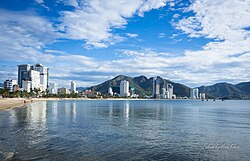
[[File:Nha Trang skyline.jpg|thumb|right|325x325px|alt=Photograph of Nha Trang beach with many high rise buildings behind it | [[Nha Trang]], a popular beach destination has a [[tropical savanna climate]].]] | |||
Due to differences in latitude and the marked variety in [[topographical relief]], Vietnam's climate tends to vary considerably for each region.{{sfn|Vu|1979|p=66}} During the winter or dry season, extending roughly from November to April, the [[monsoon]] winds usually blow from the northeast along the Chinese coast and across the Gulf of Tonkin, picking up considerable moisture.{{sfn|Riehl|Augstein|1973|p=1}} The average annual temperature is generally higher in the plains than in the mountains, especially in southern Vietnam compared to the north. Temperatures vary less in the southern plains around Ho Chi Minh City and the Mekong Delta, ranging from between {{convert|21|and|35|°C|°F|1}} over the year.{{sfn|Buleen|2017}} In Hanoi and the surrounding areas of Red River Delta, the temperatures are much lower between {{convert|15|and|33|°C|°F|1}}.{{sfn|Buleen|2017}} Seasonal variations in the mountains, plateaus, and the northernmost areas are much more dramatic, with temperatures varying from {{convert|3|°C|1}} in December and January to {{convert|37|°C|1}} in July and August.{{sfn|Vietnam Net|2018a}} During winter, snow occasionally falls over the highest peaks of the far northern mountains near the Chinese border.<ref>{{Cite web|url=https://vnexpress.net/news/news/vietnamese-amazed-at-snow-capped-northern-mountains-4219248.html|title=Vietnamese amazed at snow-capped northern mountains|date=11 January 2021|publisher=[[VnExpress]]}}</ref> Vietnam receives high rates of [[precipitation]] in the form of rainfall with an average amount from {{cvt|1500|mm}} to {{cvt|2000|mm}} during the monsoon seasons; this often causes flooding, especially in the cities with poor drainage systems.{{sfn|Thi Anh}} The country is also affected by [[tropical depression]]s, [[tropical storm]]s and [[typhoon]]s.{{sfn|Thi Anh}} Vietnam is one of the most vulnerable countries to climate change, with 55% of its population living in low-elevation coastal areas.{{sfn|Overland|2017}}<ref>{{Cite web|url=https://climatecentral.org/news/report-flooded-future-global-vulnerability-to-sea-level-rise-worse-than-previously-understood|title=Report: Flooded Future: Global vulnerability to sea level rise worse than previously understood|date=29 October 2019|website=climatecentral.org|access-date=3 November 2019}}</ref> | |||
=== | === Biodiversity === | ||
[[File: | {{Main|Wildlife of Vietnam|Environmental issues in Vietnam|List of endangered species in Vietnam|Protected areas of Vietnam}} | ||
[[File:Wildlife of Vietnam.jpg|thumb|left|alt=Photographs of Native species in Vietnam the crested argus; the red-shanked douc, a monkey; the Indochinese leopard and the saola, a bovine. | Native species in Vietnam, clockwise from top-right: [[crested argus]], a peafowl, [[red-shanked douc]], [[Indochinese leopard]], [[saola]].]] | |||
As the country is located within the [[Indomalayan realm]], Vietnam is one of twenty-five countries considered to possess a uniquely high level of [[biodiversity]]. This was noted in the country's National Environmental Condition Report in 2005.{{sfn|Vietnam National Environment Administration}} It is ranked 16th worldwide in biological diversity, being home to approximately 16% of the world's species. 15,986 species of [[flora]] have been identified in the country, of which 10% are [[Endemism|endemic]]. Vietnam's [[fauna]] includes 307 [[nematode]] species, 200 [[oligochaeta]], 145 [[acarina]], 113 [[springtail]]s, 7,750 insects, 260 reptiles, and 120 amphibians. There are 840 birds and 310 mammals are found in Vietnam, of which 100 birds and 78 mammals are endemic.{{sfn|Vietnam National Environment Administration}} Vietnam has two [[World Natural Heritage Site]]s—the [[Hạ Long Bay]] and [[Phong Nha-Kẻ Bàng National Park]]—together with nine [[World Network of Biosphere Reserves in Asia and the Pacific#Vietnam|biosphere reserves]], including [[Cần Giờ Mangrove Forest]], [[Cát Tiên National Park|Cát Tiên]], [[Cát Bà National Park|Cát Bà]], [[U Minh Thượng National Park|Kiên Giang]], the Red River Delta, Mekong Delta, [[Western Nghệ An]], [[Mũi Cà Mau National Park|Cà Mau]], and [[Cu Lao Cham Marine Park]].{{sfn|UNESCO World Heritage Convention|1994}}{{sfn|UNESCO World Heritage Convention|2003}}{{sfn|Pha Le|2016}} | |||
In | Vietnam is also home to 1,438 species of freshwater [[microalgae]], constituting 9.6% of all microalgae species, as well as 794 aquatic [[invertebrate]]s and 2,458 species of sea fish.{{sfn|Vietnam National Environment Administration}} In recent years, 13 [[genera]], 222 species, and 30 [[taxa]] of flora have been newly described in Vietnam.{{sfn|Vietnam National Environment Administration}} Six new mammal species, including the [[saola]], [[giant muntjac]] and [[Tonkin snub-nosed monkey]] have also been discovered, along with one new bird species, the endangered [[Edwards's pheasant]].{{sfn|BirdLife International|2016}} In the late 1980s, a small population of [[Javan rhinoceros]] was found in Cát Tiên National Park. However, the last individual of the species in Vietnam was reportedly shot in 2010.{{sfn|Kinver|2011}} In agricultural [[genetic diversity]], Vietnam is one of the world's twelve original [[cultivar]] centres. The Vietnam National Cultivar Gene Bank preserves 12,300 cultivars of 115 species.{{sfn|Vietnam National Environment Administration}} The Vietnamese government spent US$49.07 million on the preservation of biodiversity in 2004 alone and has established 126 conservation areas, including 30 [[List of national parks of Vietnam|national parks]].{{sfn|Vietnam National Environment Administration}} | ||
[[File:Sa Pa mountain hills with agricultural activities.jpg|thumb|left|alt=Photograph of the Sa Pa mountain hills with agricultural activity shiwn in the foreground | [[Sa Pa (town)|Sa Pa]] mountain hills with [[Agriculture in Vietnam|agricultural activities]]]] | |||
In Vietnam, wildlife [[poaching]] has become a major concern. In 2000, a [[non-governmental organisation]] (NGO) called [[Education for Nature – Vietnam]] was founded to instill in the population the importance of wildlife conservation in the country.{{sfn|Dall|2017}} In the years that followed, another NGO called GreenViet was formed by Vietnamese youngsters for the enforcement of wildlife protection. Through collaboration between the NGOs and local authorities, many local poaching syndicates were crippled by their leaders' arrests.{{sfn|Dall|2017}} A study released in 2018 revealed Vietnam is a destination for the illegal export of [[rhinoceros]] horns from [[South Africa]] due to the demand for them as a medicine and a status symbol.{{sfn|Dang Vu|Nielsen|2018}}{{sfn|Nam Dang|Nielsen|2019}} | |||
The main environmental concern that persists in Vietnam today is the legacy of the use of the chemical [[herbicide]] [[Agent Orange]], which continues to cause [[birth defect]]s and many health problems in the Vietnamese population. In the southern and central areas affected most by the chemical's use during the Vietnam War, nearly 4.8 million Vietnamese people have been exposed to it and suffered from its effects.{{sfn|Banout|Urban|Musil|Szakova|2014}}{{sfn|Cerre|2016}}{{sfn|Brown|2018}} In 2012, approximately 50 years after the war,{{sfn|Agence France-Presse|2016}} the US began a [[United States dollar|US]]$43 million joint clean-up project in the former chemical storage areas in Vietnam to take place in stages.{{sfn|Cerre|2016}}{{sfn|MacLeod|2012}} Following the completion of the first phase in [[Đà Nẵng]] in late 2017,{{sfn|United States Agency for International Development}} the US announced its commitment to clean other sites, especially in the heavily impacted site of [[Biên Hòa]], which is four times larger than the previously treated site, at an estimated cost of $390 million.{{sfn|Stewart|2018}} | |||
The Vietnamese government spends over [[Vietnamese đồng|VNĐ]]10 trillion each year ($431.1 million) for monthly allowances and the physical rehabilitation of victims of the chemicals.{{sfn|''Việt Nam News''|2018a}} In 2018, the Japanese engineering group [[Shimizu Corporation]], working with Vietnamese military, built a plant for the treatment of soil polluted by Agent Orange. Plant construction costs were funded by the company itself.{{sfn|''Nikkei Asian Review''|2018}}{{sfn|NHK World-Japan|2018}} One of the long-term plans to restore southern Vietnam's damaged [[ecosystem]]s is through the use of [[reforestation]] efforts. The Vietnamese government began doing this at the end of the war. It started by replanting [[mangrove forest]]s in the Mekong Delta regions and in [[Cần Giờ District|Cần Giờ]] outside Hồ Chí Minh City, where mangroves are important to ease (though not eliminate) flood conditions during monsoon seasons.{{sfn|Agent Orange Record}} The country had a 2019 [[Forest Landscape Integrity Index]] mean score of 5.35/10, ranking it 104th globally out of 172 countries.<ref name="FLII-Supplementary">{{cite journal|last1=Grantham|first1=H. S.|last2=Duncan|first2=A.|last3=Evans|first3=T. D.|last4=Jones|first4=K. R.|last5=Beyer|first5=H. L.|last6=Schuster|first6=R.|last7=Walston|first7=J.|last8=Ray|first8=J. C.|last9=Robinson|first9=J. G.|last10=Callow|first10=M.|last11=Clements|first11=T.|last12=Costa|first12=H. M.|last13=DeGemmis|first13=A.|last14=Elsen|first14=P. R.|last15=Ervin|first15=J.|last16=Franco|first16=P.|last17=Goldman|first17=E.|last18=Goetz|first18=S.|last19=Hansen|first19=A.|last20=Hofsvang|first20=E.|last21=Jantz|first21=P.|last22=Jupiter|first22=S.|last23=Kang|first23=A.|last24=Langhammer|first24=P.|last25=Laurance|first25=W. F.|last26=Lieberman|first26=S.|last27=Linkie|first27=M.|last28=Malhi|first28=Y.|last29=Maxwell|first29=S.|last30=Mendez|first30=M.|last31=Mittermeier|first31=R.|last32=Murray|first32=N. J.|last33=Possingham|first33=H.|last34=Radachowsky|first34=J.|last35=Saatchi|first35=S.|last36=Samper|first36=C.|last37=Silverman|first37=J.|last38=Shapiro|first38=A.|last39=Strassburg|first39=B.|last40=Stevens|first40=T.|last41=Stokes|first41=E.|last42=Taylor|first42=R.|last43=Tear|first43=T.|last44=Tizard|first44=R.|last45=Venter|first45=O.|last46=Visconti|first46=P.|last47=Wang|first47=S.|last48=Watson|first48=J. E. M.|display-authors=1|title=Anthropogenic modification of forests means only 40% of remaining forests have high ecosystem integrity – Supplementary Material|journal=Nature Communications|volume=11|issue=1|year=2020|page=5978|issn=2041-1723|doi=10.1038/s41467-020-19493-3|pmid=33293507|pmc=7723057}}</ref> | |||
Apart from herbicide problems, [[arsenic poisoning|arsenic]] in the [[ground water]] in the Mekong and Red River Deltas has also become a major concern.{{sfn|Berg|Stengel|Pham|Pham|2007}}{{sfn|Merola|Hien|Quyen|Vengosh|2014}} And most notoriously, [[unexploded ordnance]]s (UXO) pose dangers to humans and wildlife—another bitter legacy from the long wars.{{sfn|Miguel|Roland|2005}} As part of the continuous campaign to [[demining|demine]]/remove UXOs, several international [[mine clearance agency|bomb removal agencies]] from the [[United Kingdom]],{{sfn|United Kingdom Department for International Development|2017}} [[Denmark]],{{sfn|LM Report|2000}} [[South Korea]]{{sfn|United Nations Development Programme|2018}} and the US{{sfn|United States Department of State|2006}} have been providing assistance. The Vietnam government spends over VNĐ1 trillion ($44 million) annually on demining operations and additional hundreds of billions of đồng for treatment, assistance, rehabilitation, vocational training and resettlement of the victims of UXOs.{{sfn|Van Thanh|2016}} In 2017 the Chinese government also removed 53,000 land mines and explosives left over from the war between the two countries, in an area of {{cvt|18.4|km2}} in the Chinese province of [[Yunnan]] bordering the [[China–Vietnam border]].{{sfn|Tao|2017}} | |||
{{wide image|Halong Bay panorama.jpg|1000px|Panoramic view of [[Hạ Long Bay]]}} | |||
The " | == Government and politics == | ||
{{Main|Politics of Vietnam|Government of Vietnam}} | |||
Vietnam is a [[unitary state|unitary]] [[Marxism-Leninism|Marxist-Leninist]] [[one-party state|one-party]] [[socialist state|socialist]] [[republic]], one of the two [[communist state]]s (the other being [[Laos]]) in [[Southeast Asia]].{{sfn|Government of Vietnam (II)}} Although Vietnam remains officially committed to [[socialism]] as its defining creed, its economic policies have grown increasingly [[capitalism|capitalist]],{{sfn|Greenfield|1994|p=204}}{{sfn|Baccini|Impullitti|Malesky|2017}} with ''[[The Economist]]'' characterising its leadership as "ardently capitalist communists".{{sfn|''The Economist''|2008}} Under the [[Constitution of Vietnam|constitution]], the [[Communist Party of Vietnam]] (CPV) asserts their role in all branches of the country's politics and society.{{sfn|Government of Vietnam (II)}} The [[President of Vietnam|president]] is the elected [[head of state]] and the [[commander-in-chief]] of the military, serving as the chairman of the Council of Supreme Defence and Security, and holds the second highest office in Vietnam as well as performing executive functions and state appointments and setting policy.{{sfn|Government of Vietnam (II)}} | |||
{{multiple image | |||
| align = left | |||
| image1 = | |||
| width1 = 100 | |||
| alt1 = Nguyễn Phú Trọng | |||
| caption1 = [[Nguyễn Phú Trọng]]<br /><small>[[General Secretary of the Communist Party of Vietnam]] </small> | |||
| image2 = | |||
| width2 = 100 | |||
| alt2 = Nguyễn Xuân Phúc | |||
| caption2 = [[Nguyễn Xuân Phúc]]<br /><small>[[President of Vietnam|President]]</small> | |||
| image3 = | |||
| width3 = 100 | |||
| alt3 = Phạm Minh Chính | |||
| caption3 = [[Phạm Minh Chính]]<br /><small>[[Prime Minister of Vietnam|Prime Minister]]</small> | |||
| image4 = | |||
| width4 = 100 | |||
| alt4 = Vương Đình Huệ | |||
| caption4 = [[Vương Đình Huệ]]<br /><small>[[Chairperson of the National Assembly of Vietnam|Chairman of the National Assembly]]</small> | |||
}} | |||
The [[General Secretary of the Communist Party of Vietnam|general secretary]] of the CPV performs numerous key administrative functions, controlling the party's national organisation.{{sfn|Government of Vietnam (II)}} The [[Prime Minister of Vietnam|prime minister]] is the [[head of government]], presiding over a council of ministers composed of five deputy prime ministers and the heads of 26 ministries and commissions. Only political organisations affiliated with or endorsed by the CPV are permitted to contest elections in Vietnam. These include the [[Vietnamese Fatherland Front]] and worker and [[trade union]]ist parties.{{sfn|Government of Vietnam (II)}} | |||
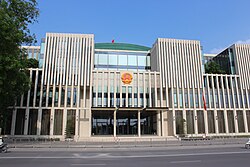
= | [[File:National Assembly of Vietnam.JPG|thumb|right|alt=Photograph of the National Assembly of Vietnam in Hanoi | The [[National Assembly of Vietnam]] building in Hanoi]] | ||
The | The [[National Assembly of Vietnam]] is the [[unicameral]] state [[legislature]] composed of 500 members.{{sfn|Embassy of Vietnam in USA}} Headed by a [[List of Chairmen of the Standing Committee of the National Assembly of Vietnam|chairman]], it is superior to both the executive and judicial branches, with all government ministers being appointed from members of the National Assembly.{{sfn|Government of Vietnam (II)}} The [[Supreme People's Court of Vietnam]], headed by a chief justice, is the country's highest [[court of appeal]], though it is also answerable to the National Assembly. Beneath the Supreme People's Court stand the [[Provincial Municipal Courts of Vietnam|provincial municipal courts]] and many [[Local Courts of Vietnam|local courts]]. [[Military Courts of Vietnam|Military courts]] possess special jurisdiction in matters of [[National security|state security]]. Vietnam maintains the [[Capital punishment in Vietnam|death penalty]] for numerous offences.{{sfn|Vietnam Penal Code|1999}} | ||
=== Foreign relations === | |||
{{Main|Foreign relations of Vietnam}} | |||
{{multiple image | |||
| direction = vertical | |||
| image1 = Trần Đại Quang and Vladimir Putin, 2016-01.jpg | |||
| alt1 = Trần Đại Quang and Vladimir Putin | |||
| caption1 = President [[Trần Đại Quang]] with Russian President [[Vladimir Putin]] on 19 November 2016. | |||
| image2 = Secretary Tillerson Joins Commercial Deals Signing Ceremony at the Presidential Palace in Vietnam (38322247422).jpg | |||
| alt2 = Secretary Tillerson at the Presidential Palace | |||
| caption2 = US Secretary of State [[Rex Tillerson]] accompanies US President [[Donald Trump]] to a commercial deal signing ceremony with Vietnamese President on 12 November 2017. | |||
}} | |||
Throughout its history, Vietnam's main foreign relationship has been with various Chinese dynasties.{{sfn|Thayer|1994}} Following the partition of Vietnam in 1954, North Vietnam maintained relations with the [[Eastern Bloc]], South Vietnam maintained relations with the [[Western Bloc]].{{sfn|Thayer|1994}} Despite these differences, Vietnam's sovereign principles and insistence on cultural independence have been laid down in numerous documents over the centuries before its independence. These include the 11th-century patriotic poem "''[[Nam quốc sơn hà]]''" and the 1428 proclamation of independence "''[[Bình Ngô đại cáo]]''". Though China and Vietnam are now formally at peace,{{sfn|Thayer|1994}} [[Spratly Islands#Military conflict and diplomatic dialogues|significant territorial tensions]] remain between the two countries over the South China Sea.{{sfn|Thanh Hai|2016|p=177}} Vietnam holds membership in 63 international organisations, including the [[United Nations]] (UN), [[Association of Southeast Asian Nations]] (ASEAN), [[Non-Aligned Movement]] (NAM), [[Organisation internationale de la Francophonie|International Organisation of the Francophonie]] (La Francophonie), and [[World Trade Organization]] (WTO). It also maintains relations with over 650 non-governmental organisations.{{sfn|Vietnam Ministry of Foreign Affairs|2018}} As of 2010 Vietnam had established diplomatic relations with 178 countries.{{sfn|Vietnam Ministry of Foreign Affairs|2013}} | |||
[[ | Vietnam's current foreign policy is to consistently implement a policy of independence, self-reliance, peace, co-operation, and development, as well openness, diversification, [[multilateralism|multilateralisation]] with international relations.{{sfn|Vietnam Ministry of Foreign Affairs|2007}}{{sfn|Vietnam Ministry of Foreign Affairs|2014}} The country declares itself a friend and partner of all countries in the international community, regardless of their political affiliation, by actively taking part in international and regional cooperative development projects.{{sfn|Bich Loan|2007}}{{sfn|Vietnam Ministry of Foreign Affairs|2007}} Since the 1990s, Vietnam has taken several key steps to restore diplomatic ties with capitalist [[Western countries]]. It already had relations with communist Western countries in the decades prior.{{sfn|Dayley|2018|p=98}} Relations with the United States [[United States–Vietnam relations|began improving]] in August 1995 with both states upgrading their ''[[:wikt:liaison|liaison]]'' offices to embassy status.{{sfn|Mitchell|1995}} As diplomatic ties between the two governments grew, the United States opened a [[consul (representative)|consulate general]] in Ho Chi Minh City while Vietnam opened [[List of diplomatic missions in San Francisco|its consulate]] in [[San Francisco]]. Full diplomatic relations were also restored with [[New Zealand]], which opened its embassy in Hanoi in 1995;{{sfn|Green|2012}} Vietnam established an embassy in [[Wellington]] in 2003.{{sfn|Smith|2005|p=386}} [[Pakistan]] also reopened its embassy in Hanoi in October 2000, with Vietnam reopening its embassy in [[Islamabad]] in December 2005 and trade office in [[Karachi]] in November 2005.{{sfn|Institute of Regional Studies|2001|p=66}}{{sfn|Vietnam Ministry of Foreign Affairs}} In May 2016, US President [[Barack Obama]] further normalised relations with Vietnam after he announced the lifting of an arms [[United States embargoes|embargo]] on sales of lethal arms to Vietnam.{{sfn|Garamone|2016}} Despite their historical past, today Vietnam is considered to be a potential ally of the United States, especially in the geopolitical context of the [[territorial disputes in the South China Sea]] and in containment of [[Chinese expansionism]].{{sfn|Hutt|2020}}{{sfn|Corr|2019}}{{sfn|Tran|2020}} | ||
=== Military === | |||
{{Main|Vietnam People's Armed Forces}} | |||
[[File:Vietnam People's Armed Forces.jpg|thumb|right|alt=Photographs of Vietnam People's Armed Forces weaponry assets including a T-54B tank, a Sukhoi Su-27UBK fighter aircraft, a Vietnam Coast Guard Hamilton-class cutter, and a Vietnam People's Army chemical corps carrying a Type 56 assault rifle. | Examples of the [[Vietnam People's Armed Forces]] weaponry assets. Clockwise from top right: [[T-54/T-55|T-54B tank]], [[Sukhoi Su-27]]UBK fighter aircraft, [[Vietnam Coast Guard]] [[Hamilton-class cutter]], and [[Vietnam People's Army]] chemical corps with [[Type 56 assault rifle|Type 56]].]] | |||
The [[Vietnam People's Armed Forces]] consists of the [[Vietnam People's Army]] (VPA), the [[Vietnam People's Public Security]] and the Vietnam Self-Defence Militia. The VPA is the official name for the active military services of Vietnam, and is subdivided into the [[Vietnam People's Ground Forces]], the [[Vietnam People's Navy]], the [[Vietnam People's Air Force]], the [[Vietnam Border Guard]] and the [[Vietnam Coast Guard]]. The VPA has an active manpower of around 450,000, but its total strength, including paramilitary forces, may be as high as 5,000,000.{{sfn|Taylor|Rutherford|2011|p=50}} In 2015, Vietnam's [[List of countries by military expenditures|military expenditure]] totalled approximately US$4.4 billion, equivalent to around 8% of its total government spending.{{sfn|Yan|2016}} Joint military exercises and war games have been held with [[Brunei]],{{sfn|Voice of Vietnam|2016}} [[India]],{{sfn|''The Economic Times''|2018}} [[Japan]],{{sfn|''The Japan Times''|2015}} Laos,{{sfn|Voice of Vietnam|2018b}} [[Russia]],{{sfn|Russia Ministry of Defence|2018}} [[Singapore]]{{sfn|Voice of Vietnam|2016}} and the US.{{sfn|''The Telegraph''|2012}} In 2017, Vietnam signed the UN treaty on the [[Treaty on the Prohibition of Nuclear Weapons|Prohibition of Nuclear Weapons]].{{sfn|United Nations Treaty Collection}}{{sfn|Giap|2017}} | |||
=== | === Human rights and sociopolitical issues === | ||
{{See also|Human rights in Vietnam}} | |||
Under the current constitution, the CPV is the only party allowed to rule, the operation of all other political parties being outlawed. Other human rights issues concern [[freedom of association]], [[freedom of speech]], [[freedom of religion]], and [[freedom of the press]]. In 2009, Vietnamese lawyer [[Lê Công Định]] was arrested and charged with the capital crime of [[subversion]]; several of his associates were also arrested.{{sfn|BBC News|2009}}{{sfn|Mydans|2009}} [[Amnesty International]] described him and his arrested associates as [[prisoners of conscience]].{{sfn|BBC News|2009}} Vietnam has also suffered from human trafficking and related issues.<ref>{{cite web|url=http://un-act.org/vietnam/|title=VIET NAM – UN ACT|website=UN-Act}}</ref><ref>{{cite web|url=http://www.asianews.it/news-en/Women,-children-and-babies:-human-trafficking-to-China-is-on-the-rise-47513.html|title=Women, children and babies: human trafficking to China is on the rise|date=11 July 2019|website=Asia News}}</ref><ref name="auto3">{{cite web|url=https://thediplomat.com/2019/11/vietnams-human-trafficking-problem-is-too-big-to-ignore/|title=Vietnam's Human Trafficking Problem Is Too Big to Ignore|date=8 November 2019|website=The Diplomat}}</ref> | |||
== | == Administrative divisions == | ||
Vietnam is divided into 58 [[province]]s. There are also five [[ | {{Main|Subdivisions of Vietnam}} | ||
Vietnam is divided into 58 [[province]]s ({{lang-vi|Tỉnh|link=no}}, [[chữ Hán]]: {{wikt-lang|vi-Hani|省}}).{{sfn|Japan Ministry of Land, Infrastructure, Transport and Tourism}} There are also five [[municipality|municipalities]] ({{lang|vi|thành phố trực thuộc trung ương}}), which are administratively on the same level as provinces. | |||
{{col-begin|width=auto}} | |||
{{col-break}} | |||
{{Provinces of Vietnam|align=none}} | |||
{{col-break|gap=2em}} | |||
{| style="margin:auto;" | {| style="margin:auto;" | ||
| style="padding-right:1em; vertical-align:top;" | | | style="padding-right:1em; vertical-align:top;" | | ||
<div class="center">'''[[ | <div class="center">'''[[Northwest (Vietnam)|Northwest]]'''</div> | ||
---- | ---- | ||
[[ | 6. [[Điện Biên Province|Điện Biên]]<br /> | ||
[[ | 22. [[Hòa Bình Province|Hòa Bình]]<br /> | ||
[[ | 7. [[Lai Châu Province|Lai Châu]]<br /> | ||
[[ | 8. [[Lào Cai Province|Lào Cai]]<br /> | ||
[[ | 16. [[Sơn La Province|Sơn La]]<br /> | ||
[[ | 12. [[Yên Bái Province|Yên Bái]] | ||
| style="padding-right:1em; vertical-align:top;" | | | style="padding-right:1em; vertical-align:top;" | | ||
<div class="center">'''[[ | <div class="center">'''[[Northeast (Vietnam)|Northeast]]'''</div> | ||
---- | ---- | ||
[[Hà | 20. [[Bắc Giang Province|Bắc Giang]]<br /> | ||
[[ | 14. [[Bắc Kạn Province|Bắc Kạn]]<br /> | ||
[[ | 10. [[Cao Bằng Province|Cao Bằng]]<br /> | ||
[[Quảng | 9. [[Hà Giang Province|Hà Giang]]<br /> | ||
[[ | 11. [[Lạng Sơn Province|Lạng Sơn]]<br /> | ||
[[ | 17. [[Phú Thọ Province|Phú Thọ]]<br /> | ||
21. [[Quảng Ninh Province|Quảng Ninh]]<br /> | |||
15. [[Thái Nguyên Province|Thái Nguyên]]<br /> | |||
13. [[Tuyên Quang Province|Tuyên Quang]] | |||
| style="padding-right:1em; vertical-align:top;" | | | style="padding-right:1em; vertical-align:top;" | | ||
<div class="center">'''[[ | <div class="center">'''[[Red River Delta]]'''</div> | ||
---- | ---- | ||
[[ | 1. [[Hanoi|Hà Nội]] (municipality)<br /> | ||
[[Bắc | 3. [[Hai Phong|Hải Phòng]] (municipality)<br /> | ||
[[ | 19. [[Bắc Ninh Province|Bắc Ninh]]<br /> | ||
[[ | 26. [[Hà Nam Province|Hà Nam]]<br /> | ||
[[ | 24. [[Hải Dương Province|Hải Dương]]<br /> | ||
[[ | 23. [[Hưng Yên Province|Hưng Yên]]<br /> | ||
[[ | 27. [[Nam Định Province|Nam Định]]<br /> | ||
[[Thái | 28. [[Ninh Bình Province|Ninh Bình]]<br /> | ||
[[ | 25. [[Thái Bình Province|Thái Bình]]<br /> | ||
18. [[Vĩnh Phúc Province|Vĩnh Phúc]] | |||
|- | |||
| style="padding-right:1em; vertical-align:top;" | | | style="padding-right:1em; vertical-align:top;" | | ||
<div class="center">'''[[ | <div class="center">'''[[North Central Coast]]'''</div> | ||
---- | ---- | ||
[[ | 31. [[Hà Tĩnh Province|Hà Tĩnh]]<br /> | ||
[[ | 30. [[Nghệ An Province|Nghệ An]]<br /> | ||
[[ | 32. [[Quảng Bình Province|Quảng Bình]]<br /> | ||
[[ | 33. [[Quảng Trị Province|Quảng Trị]]<br /> | ||
[[ | 29. [[Thanh Hóa Province|Thanh Hóa]]<br /> | ||
[[ | 34. [[Thừa Thiên–Huế Province|Thừa Thiên–Huế]] | ||
| style="padding-right:1em; vertical-align:top;" | | | style="padding-right:1em; vertical-align:top;" | | ||
<div class="center">'''[[ | <div class="center">'''[[Central Highlands (Vietnam)|Central Highlands]]'''</div> | ||
---- | ---- | ||
[[Đắk Lắk Province| | 41. [[Đắk Lắk Province|Đắk Lắk]]<br /> | ||
[[Đắk Nông Province| | 42. [[Đắk Nông Province|Đắk Nông]]<br /> | ||
[[Gia Lai Province|Gia Lai]]<br /> | 38. [[Gia Lai Province|Gia Lai]]<br /> | ||
[[Kon Tum Province|Kon Tum]]<br /> | 37. [[Kon Tum Province|Kon Tum]]<br /> | ||
[[Lâm Đồng Province| | 44. [[Lâm Đồng Province|Lâm Đồng]] | ||
| style="padding-right:1em; vertical-align:top;" | | | style="padding-right:1em; vertical-align:top;" | | ||
<div class="center">'''[[ | <div class="center">'''[[South Central Coast]]'''</div> | ||
---- | ---- | ||
[[Bình Định Province| | 4. [[Da Nang|Đà Nẵng]] (municipality)<br /> | ||
[[Bình Thuận Province| | 39. [[Bình Định Province|Bình Định]]<br /> | ||
[[Khánh Hòa Province| | 46. [[Bình Thuận Province|Bình Thuận]]<br /> | ||
[[Ninh Thuận Province|Ninh | 43. [[Khánh Hòa Province|Khánh Hòa]]<br /> | ||
[[Phú Yên Province| | 45. [[Ninh Thuận Province|Ninh Thuận]]<br /> | ||
[[Quảng Nam Province| | 40. [[Phú Yên Province|Phú Yên]]<br /> | ||
[[Quảng Ngãi Province| | 35. [[Quảng Nam Province|Quảng Nam]]<br /> | ||
36. [[Quảng Ngãi Province|Quảng Ngãi]] | |||
|- | |||
| style="padding-right:1em; vertical-align:top;" | | | style="padding-right:1em; vertical-align:top;" | | ||
<div class="center">'''[[ | <div class="center">'''[[Southeast (Vietnam)|Southeast]]'''</div> | ||
---- | ---- | ||
[[Bà | 2. [[Ho Chi Minh City|Hồ Chí Minh City]] (municipality)<br /> | ||
[[Bình Dương Province|Bình Dương]]<br /> | 51. [[Bà Rịa–Vũng Tàu province|Bà Rịa–Vũng Tàu]]<br /> | ||
[[Bình Phước Province|Bình Phước]]<br /> | 49. [[Bình Dương Province|Bình Dương]]<br /> | ||
[[Đồng Nai Province|Đồng Nai]]<br /> | 47. [[Bình Phước Province|Bình Phước]]<br /> | ||
[[Tây Ninh Province|Tây Ninh]] | 50. [[Đồng Nai Province|Đồng Nai]]<br /> | ||
48. [[Tây Ninh Province|Tây Ninh]] | |||
| style="padding-right:1em; vertical-align:top;" | | | style="padding-right:1em; vertical-align:top;" | | ||
<div class="center">'''[[Mekong | <div class="center">'''[[Mekong Delta]]'''</div> | ||
---- | ---- | ||
[[An Giang Province|An Giang]]<br /> | 5. [[Cần Thơ]] (municipality)<br /> | ||
[[Bạc Liêu Province|Bạc Liêu]]<br /> | 56. [[An Giang Province|An Giang]]<br /> | ||
[[Bến Tre Province|Bến Tre]]<br /> | 62. [[Bạc Liêu Province|Bạc Liêu]]<br /> | ||
[[Cà Mau Province|Cà Mau]]<br /> | 55. [[Bến Tre Province|Bến Tre]]<br /> | ||
[[Đồng Tháp Province|Đồng Tháp]]<br /> | 63. [[Cà Mau Province|Cà Mau]]<br /> | ||
[[Hậu Giang Province|Hậu Giang]]<br /> | 53. [[Đồng Tháp Province|Đồng Tháp]]<br /> | ||
[[Kiên Giang Province|Kiên Giang]]<br /> | 59. [[Hậu Giang Province|Hậu Giang]]<br /> | ||
[[Long An Province|Long An]]<br /> | 58. [[Kiên Giang Province|Kiên Giang]]<br /> | ||
[[Sóc Trăng Province|Sóc Trăng]]<br /> | 52. [[Long An Province|Long An]]<br /> | ||
[[Tiền Giang Province|Tiền Giang]]<br /> | 61. [[Sóc Trăng Province|Sóc Trăng]]<br /> | ||
[[Trà Vinh Province|Trà Vinh]]<br /> | 54. [[Tiền Giang Province|Tiền Giang]]<br /> | ||
[[Vĩnh Long Province|Vĩnh Long]] | 60. [[Trà Vinh Province|Trà Vinh]]<br /> | ||
[[ | 57. [[Vĩnh Long Province|Vĩnh Long]] | ||
|} | |||
{{col-end}} | |||
[[File:Tay Ho Communist propaganda posters in 2015 11.jpg|thumb|alt=A Tay Ho Communist propaganda poster | A [[Communist Party of Vietnam|Communist Party]] propaganda poster in Hanoi]] | |||
Provinces are subdivided into [[provincial city (Vietnam)|provincial municipalities]] ({{lang|vi|thành phố trực thuộc tỉnh}}, 'city under province'), [[township]]s ({{lang|vi|thị xã}}) and [[county|counties]] ({{lang|vi|huyện}}), which are in turn subdivided into [[town]]s ({{lang|vi|thị trấn}}) or [[commune-level subdivisions (Vietnam)|communes]] ({{lang|vi|xã}}). | |||
Centrally controlled municipalities are subdivided into [[district]]s ({{lang|vi|quận}}) and counties, which are further subdivided into [[ward (country subdivision)|wards]] ({{lang|vi|phường}}). | |||
== Economy == | |||
{{Main|Economy of Vietnam}} | |||
[[File:GDP per capita development in Vietnam.svg|thumb|right|Historical GDP per capita development of Vietnam]] | |||
{|class="wikitable" style="float: right; margin-left: 10px" | |||
! style="text-align:center; background:#cfb;" colspan="2" |Share of world [[Gross domestic product|GDP]] ([[Purchasing power parity|PPP]]){{sfn|International Monetary Fund}} | |||
|- | |||
! style="background:#cfb;"|Year | |||
! style="background:#cfb;"|Share | |||
|- | |||
| 1980 || style="text-align:right;" |0.18% | |||
|- | |||
| 1990 || style="text-align:right;" |0.23% | |||
|- | |||
| 2000 || style="text-align:right;"|0.32% | |||
|- | |||
| 2010 || style="text-align:right;"|0.43% | |||
|- | |||
| 2018 || style="text-align:right;"|0.52% | |||
|} | |} | ||
The provinces of Vietnam are divided (by the government) into [[ | [[File:Viet Nam Export Treemap.png|thumb|alt=A tree map of Vietnam's exports in 2012 | [[Tree map]] showing Vietnam's exports]] | ||
Throughout the history of Vietnam, its economy has been based largely on [[agriculture]]—primarily [[Rice production in Vietnam|wet rice cultivation]].{{sfn|Cornell University}} [[bauxite mining in Vietnam|Bauxite]], an important material in the production of [[aluminium]], is mined in central Vietnam.{{sfn|Kim Phuong|2014|p=1}} Since reunification, the country's economy is shaped primarily by the CPV through [[Five-Year Plans of Vietnam|Five Year Plans]] decided upon at the plenary sessions of the Central Committee and national congresses.{{sfn|Kimura|1986}} The [[collectivisation]] of farms, factories, and capital goods was carried out as part of the establishment of central planning, with millions of people working for state enterprises. Under strict state control, Vietnam's economy continued to be plagued by inefficiency, [[Corruption in Vietnam|corruption in state-owned enterprises]], poor quality and underproduction.{{sfn|Adhikari|Kirkpatrick|Weiss|1992|p=249}}{{sfn|Ngoc Vo|Le|2014|p=7}}{{sfn|Van Tho|2003|p=11}} With the decline in economic aid from its main trading partner, the Soviet Union, following the erosion of the [[Eastern bloc]] in the late 1980s, and the subsequent [[Dissolution of the Soviet Union|collapse of the Soviet Union]], as well as the negative impacts of the post-war [[economic sanctions|trade embargo]] imposed by the United States,{{sfn|Litvack|Litvack|Rondinelli|1999|p=31}}{{sfn|Freeman|2002}} Vietnam began to liberalise its trade by [[devaluation|devaluing]] its exchange rate to increase exports and embarked on a policy of economic development.{{sfn|Litvack|Litvack|Rondinelli|1999|p=33}} | |||
[[File:The Landmark 81 at night.jpg|alt=Photograph of Vietnam's tallest skyscraper, the Landmark 81, located in Bình Thạnh District in Ho Chi Minh City|thumb|Vietnam's tallest skyscraper, the [[Landmark 81]] located in [[Bình Thạnh District|Bình Thạnh]], [[Ho Chi Minh City|Ho Chi Minh City (Saigon)]].]] | |||
In 1986, the [[6th National Congress of the Communist Party of Vietnam|Sixth National Congress]] of the CPV introduced [[Socialist-oriented market economy|socialist-oriented market]] economic reforms as part of the ''[[Đổi Mới]]'' reform program. [[Private ownership]] began to be encouraged in industry, commerce and agriculture and state enterprises were [[Corporatisation|restructured]] to operate under market constraints.{{sfn|Van Tho|2003|p=5}}{{sfn|Hoang Vuong|Dung Tran|2009}} This led to the five-year economic plans being replaced by the socialist-oriented market mechanism.{{sfn|Hoang Vuong|2014}} As a result of these reforms, Vietnam achieved approximately 8% annual [[gross domestic product]] (GDP) growth between 1990 and 1997.{{sfn|Largo|2002|p=66}}{{sfn|International Monetary Fund|1999|p=23}} The United States ended its economic embargo against Vietnam in early 1994.{{sfn|Cockburn|1994}} Although the [[1997 Asian financial crisis]] caused an economic slowdown to 4–5% growth per year, its economy began to recover in 1999,{{sfn|Van Tho|2003|p=5}} and grew at around 7% per year from 2000 to 2005, one of the growths in the world.<ref name=Pincus2015>{{harvnb|Pincus|2015|p=27}}; this article refers to the so-called "[[Vent for surplus]]" theory of international trade.</ref>{{sfn|Quang Vinh|p=13}} According to the [[General Statistics Office of Vietnam]] (GSO), growth remained strong despite the [[late-2000s global recession]], holding at 6.8% in 2010. Vietnam's year-on-year inflation rate reached 11.8% in December 2010 and the currency, the [[Vietnamese đồng]], was devalued three times.{{sfn|Asian Development Bank|2010|p=388}}{{sfn|Thanh Niên|2010}} | |||
Deep [[poverty]], defined as the percentage of the population living on less than $1 per day, has declined significantly in Vietnam and the relative poverty rate is now less than that of China, India and the [[Philippines]].{{sfn|Vierra|Vierra|2011|p=5}} This decline can be attributed to [[Equity (economics)|equitable economic policies]] aimed at improving [[living standards]] and preventing the rise of [[Economic inequality|inequality]].{{sfn|Vandemoortele|Bird|2010}} These policies have included egalitarian land distribution during the initial stages of the ''Đổi Mới'' program, investment in poorer remote areas, and subsidising of education and healthcare.{{sfn|Cuong Le|Kubo|Fujino|Minh Pham|2010|p=23}}{{sfn|H. Dang|Glewwe|2017|p=9}} Since the early 2000s, Vietnam has applied sequenced trade liberalisation, a two-track approach opening some sectors of the economy to international markets.{{sfn|Vandemoortele|Bird|2010}}{{sfn|Vandemoortele|2010}} Manufacturing, [[information technology]] and high-tech industries now form a large and fast-growing part of the national economy. Although Vietnam is a relative newcomer to the [[oil industry]], it is the third-largest oil producer in Southeast Asia with a total 2011 output of {{convert|318000|oilbbl/d|m3/d}}.{{sfn|UPI.com|2013}} In 2010, Vietnam was ranked as the eighth-largest crude [[petroleum]] producer in the Asia and Pacific region.{{sfn|Fong-Sam|2010|p=26}} The US bought the highest amount of Vietnam's exports,{{sfn|''Việt Nam News''|2018b}} while [[goods]] from China were the most popular Vietnamese import.{{sfn|Vietnam News Agency|2018}} | |||
According to a December 2005 forecast by [[Goldman Sachs]], the Vietnamese economy will become the [[List of countries by past and future GDP (nominal)|world's 21st-largest by 2025]],{{sfn|Karmel|2010|p=1}} with an estimated nominal GDP of $436 billion and a nominal GDP per capita of $4,357.{{sfn|Lyimo|2016}} Based on findings by the [[International Monetary Fund]] (IMF) in 2012, the [[unemployment]] rate in Vietnam was 4.46%,{{sfn|International Monetary Fund}} the [[nominal GDP]] US$138 billion, and a nominal [[GDP per capita]] $1,527.{{sfn|International Monetary Fund}} The [[HSBC]] also predicted that Vietnam's total GDP would surpass those of [[Norway]], Singapore and [[Portugal]] by 2050.{{sfn|Lyimo|2016}}{{sfn|''Tuổi Trẻ News''|2012}} Another forecast by [[PricewaterhouseCoopers]] in 2008 stated Vietnam could be the fastest-growing of the world's emerging economies by 2025, with a potential growth of almost 10% per year in real dollar terms.{{sfn|PWC|2008}} Besides the [[Primary sector of the economy|primary sector economy]], [[Tourism in Vietnam|tourism]] has contributed significantly to Vietnam's economic growth with 7.94 million foreign visitors recorded in 2015.{{sfn|Vietnam Net|2016a}} | |||
=== Agriculture === | |||
[[File:Terraced fields Sa Pa 3.jpg|thumb|right|alt=Photograph of terraced rice fields in Sa Pa | Terraced rice fields in [[Sa Pa]]]] | |||
As a result of several [[land reform]] measures, Vietnam has become a major exporter of agricultural products. It is now the world's largest producer of [[cashew]] nuts, with a one-third global share;{{sfn|Mai|2017}} the largest producer of [[black pepper]], accounting for one-third of the world's market;{{sfn|Voice of Vietnam|2018c}} and the second-largest [[rice]] exporter in the world after [[Thailand]] since the 1990s.{{sfn|Nielsen|2007|p=1}} Subsequently, Vietnam is also the world's second largest exporter of [[coffee]].{{sfn|Summers|2014}} The country has the highest proportion of land use for [[permanent crop]]s together with other states in the [[Greater Mekong Subregion]].{{sfn|Truong|Vo|Nguyen|2018|p=172}} Other primary exports include [[tea]], [[rubber]] and fishery products. Agriculture's share of Vietnam's GDP has fallen in recent decades, declining from 42% in 1989 to 20% in 2006 as production in other sectors of the economy has risen. | |||
====Seafood==== | |||
The overall fisheries production of Vietnam from capture fisheries and [[aquaculture]] was 5.6 million MT in 2011 and 6.7 million MT in 2016. The output of Vietnam's fisheries sector has seen strong growth, which could be attributed to the continued expansion of the aquaculture sub-sector.<ref>{{cite web | |||
| url =http://www.seafdec.org/fisheries-country-profile-viet-nam/ | |||
| title =Fisheries Country Profile: Vietnam | |||
| date =June 2018 | |||
| website =Southeast Asian Fisheries Development Center | |||
| access-date =24 April 2021}}</ref> | |||
=== Science and technology === | |||
{{Main|Science and technology in Vietnam}} | |||
[[File:TOPIO 3.jpg|thumb|left|alt=Photograph of a TOPIO humanoid ping-pong-playing robot | A Vietnamese-made [[TOPIO]] 3.0 [[humanoid robot|humanoid]] [[ping-pong]]-playing robot displayed during the 2009 [[International Robot Exhibition]] (IREX) in [[Tokyo]].{{sfn|DigInfo|2007}}{{sfn|Borel|2010}}]] | |||
In 2010, Vietnam's total state spending on science and technology amounted to roughly 0.45% of its GDP.{{sfn|''Việt Nam News''|2010}} Since the dynastic era, Vietnamese scholars have developed many academic fields especially in [[social science]]s and humanities. Vietnam has a millennium-deep legacy of analytical histories, such as the ''[[Đại Việt sử ký toàn thư]]'' of [[Ngô Sĩ Liên]]. Vietnamese monks, led by the abdicated Emperor [[Trần Nhân Tông]], developed the Trúc Lâm Zen branch of philosophy in the 13th century.{{sfn|Różycka-Tran|Anh Tran|2014|p=123}} [[Arithmetic]] and [[geometry]] have been widely taught in Vietnam since the 15th century, using the textbook ''Đại thành toán pháp'' by Lương Thế Vinh. Lương Thế Vinh introduced Vietnam to the notion of [[0 (number)|zero]], while Mạc Hiển Tích used the term ''số ẩn'' (Eng: "unknown/secret/hidden number") to refer to [[negative number]]s. Furthermore, Vietnamese scholars produced numerous [[encyclopaedia]]s, such as [[Lê Quý Đôn]]'s ''Vân đài loại ngữ''. | |||
In modern times, Vietnamese scientists have made many significant contributions in various fields of study, most notably in [[mathematics]]. [[Hoang Tuy|Hoàng Tụy]] pioneered the [[applied mathematics]] field of [[global optimisation]] in the 20th century,{{sfn|Koblitz|2009|p=198}} while [[Ngô Bảo Châu]] won the 2010 [[Fields Medal]] for his proof of [[Fundamental lemma (Langlands program)|fundamental lemma in the theory of automorphic forms]].{{sfn|CNRS|2010}}{{sfn|Koppes|2010}} Since the establishment of the [[Vietnam Academy of Science and Technology]] (VAST) by the government in 1975, the country is working to develop its first national [[space flight]] program especially after the completion of the infrastructure at the Vietnam Space Centre (VSC) in 2018.{{sfn|Vietnam National Space Centre|2016}}{{sfn|Vietnam Academy of Science and Technology|2017}} Vietnam has also made significant advances in the development of [[robot]]s, such as the [[TOPIO]] humanoid model.{{sfn|DigInfo|2007}}{{sfn|Borel|2010}} One of Vietnam's main [[messaging apps]], Zalo, was developed by [[Vương Quang Khải]], a Vietnamese [[hacker]] who later worked with the country's largest [[information technology]] service company, the [[FPT Group]].{{sfn|Raslan|2017}} | |||
[[File:Svhutech nckh4.jpg|thumb|right|alt=Vietnamese science students working on an [[experiment]] in their university lab.|Vietnamese science students working on an [[experiment]] in their university lab.]] | |||
According to the [[UNESCO Institute for Statistics]], Vietnam devoted 0.19% of its GDP to science research and development in 2011.{{sfn|UNESCO Media Services|2016}} Vietnam was ranked 44th in the [[Global Innovation Index]] in 2021, it has increased its ranking considerably since 2012, where it was ranked 76th.<ref>{{Cite web |title=Global Innovation Index 2021 |url=https://www.wipo.int/global_innovation_index/en/2021/|work=[[World Intellectual Property Organization]]|publisher=[[United Nations]]|access-date=2022-03-05 |language=en}}</ref><ref>{{Cite web|title=Global Innovation Index 2019|url=https://www.wipo.int/global_innovation_index/en/2019/index.html|access-date=2021-09-02|website=www.wipo.int|language=en}}</ref><ref>{{Cite web|title=RTD - Item|url=https://ec.europa.eu/newsroom/rtd/items/691898|access-date=2021-09-02|website=ec.europa.eu}}</ref><ref>{{Cite web|date=2013-10-28|title=Global Innovation Index|url=https://knowledge.insead.edu/entrepreneurship-innovation/global-innovation-index-2930|access-date=2021-09-02|website=INSEAD Knowledge|language=en}}</ref> Between 2005 and 2014, the number of Vietnamese scientific publications recorded in Thomson Reuters' [[Web of Science]] increased at a rate well above the average for Southeast Asia, albeit from a modest starting point.{{sfn|UNESCO Publishing|pp=713–714}} Publications focus mainly on [[life science]]s (22%), [[:wikt:physic|physics]] (13%) and [[engineering]] (13%), which is consistent with recent advances in the production of diagnostic equipment and shipbuilding.{{sfn|UNESCO Publishing|pp=713–714}} Almost 77% of all papers published between 2008 and 2014 had at least one international co-author. The autonomy which Vietnamese research centres have enjoyed since the mid-1990s has enabled many of them to operate as quasi-private organisations, providing services such as consulting and technology development.{{sfn|UNESCO Publishing|pp=713–714}} Some have 'spun off' from the larger institutions to form their own semi-private enterprises, fostering the transfer of public sector science and technology personnel to these semi-private establishments. One comparatively new university, the [[Tôn Đức Thắng University]] which was built in 1997, has already set up 13 centres for technology transfer and services that together produce 15% of university revenue. Many of these research centres serve as valuable intermediaries bridging public research institutions, universities, and firms.{{sfn|UNESCO Publishing|pp=713–714}} | |||
=== Tourism === | |||
{{Main|Tourism in Vietnam}} | |||
[[File:Pont-pagode "japonais" de Hoi-an, vue de nuit.jpg|thumb|right|alt=Photograph of Hội An, a UNESCO World Heritage Site and a major tourist destination |[[Hội An]], a [[United Nations Educational, Scientific and Cultural Organization|UNESCO]] [[List of World Heritage Sites in Southeast Asia|World Heritage Site]], is a major tourist destination.]] | |||
Tourism is an important element of economic activity in the nation, contributing 7.5% of the total GDP. Vietnam hosted roughly 13 million tourists in 2017, an increase of 29.1% over the previous year, making it one of the fastest growing tourist destinations in the world. The vast majority of the tourists in the country, some 9.7 million, came from Asia; namely China (4 million), [[South Korea]] (2.6 million), and [[Japan]] (798,119).{{sfn|Vietnam General Statistics Office|2018}} Vietnam also attracts large numbers of visitors from Europe, with almost 1.9 million visitors in 2017; most European visitors came from [[Russia]] (574,164), followed by the [[United Kingdom]] (283,537), [[France]] (255,396), and [[Germany]] (199,872). Other significant international arrivals by nationality include the United States (614,117) and [[Australia]] (370,438).{{sfn|Vietnam General Statistics Office|2018}} | |||
The most visited destinations in Vietnam is the largest city, Ho Chi Minh City, with over 5.8 million international arrivals, followed by Hanoi with 4.6 million and [[Hạ Long]], including Hạ Long Bay with 4.4 million arrivals. All three are ranked in the top 100 most visited cities in the world.{{sfn|Quy|2018}} Vietnam is home to eight [[World Heritage Site|UNESCO World Heritage Sites]]. In 2018, ''[[Travel + Leisure]]'' ranked [[Hội An]] as one of the world's top 15 best destinations to visit.{{sfn|Terzian|2018}} | |||
== Infrastructure == | |||
=== Transport === | |||
{{Main|Transport in Vietnam|Rail transport in Vietnam|List of airports in Vietnam}} | |||
Much of Vietnam's modern transportation network can trace its roots to the French colonial era when it was used to facilitate the transportation of [[raw material]]s to its main ports. It was extensively expanded and modernised following the partition of Vietnam.{{sfn|Crook|2014|p=7}} Vietnam's road system includes national roads administered at the central level, provincial roads managed at the provincial level, district roads managed at the district level, urban roads managed by cities and towns and commune roads managed at the commune level.{{sfn|Vietnam General Statistics Office|2010}} In 2010, Vietnam's road system had a total length of about {{convert|188744|km|mi|0}} of which {{convert|93535|km|mi|0}} are [[asphalt]] roads comprising national, provincial and district roads.{{sfn|Vietnam General Statistics Office|2010}} The length of the national road system is about {{convert|15370|km|mi|0}} with {{convert|15085|km|mi|0}} of its length paved. The provincial road system has around {{convert|27976|km|mi|0}} of paved roads while {{convert|50474|km|mi|0}} district roads are paved.{{sfn|Vietnam General Statistics Office|2010}} | |||
[[File:Cầu Long Thành, Đường cao tốc TP.HCM - Long Thành - Dầu Giây.JPG|thumb|right|alt=Photograph of Ho Chi Minh City's North-South Expressway | [[Ho Chi Minh City – Long Thanh – Dau Giay Expressway|HCMC–LT–DG]] section of the [[North–South Expressway (Vietnam)|North–South Expressway]].]] | |||
[[File:Tan Son Nhat International Airport.jpg|thumb|right|alt=Photograph of Tan Son Nhat International Airport | [[Tan Son Nhat International Airport]] is the busiest airport in the country.]] | |||
[[Bicycle]]s, [[motorcycle]]s and [[motor scooter]]s remain the most popular forms of road transport in the country, a legacy of the French, though the number of privately owned [[car]]s has been increasing in recent years.{{sfn|Huu Duc|Mai Hoa|Thien Huong|Ngoc Bao|2013|p=2080}} Public buses operated by private companies are the main mode of long-distance travel for much of the population. [[Traffic collision|Road accidents]] remain the major safety issue of Vietnamese transportation with an average of 30 people losing their lives daily.{{sfn|Vietnam General Statistics Office|2011}} [[Traffic congestion]] is a growing problem in both Hanoi and Ho Chi Minh City especially with the growth of individual car ownership.{{sfn|Linh Le|Anh Trinh|2016}}{{sfn|Sohr|Brockfeld|Sauerländer|Melde|2016|p=220}} Vietnam's primary cross-country rail service is the [[North–South Railway (Vietnam)|Reunification Express]] from Ho Chi Minh City to Hanoi, a distance of nearly {{convert|1726|km|mi}}.{{sfn|Chin|2018}} From Hanoi, railway lines branch out to the northeast, north, and west; the eastbound line runs from Hanoi to Hạ Long Bay, the northbound line from Hanoi to [[Thái Nguyên]], and the northeast line from Hanoi to Lào Cai. In 2009, Vietnam and Japan signed a deal to build a [[North–South Express Railway (Vietnam)|high-speed railway]]—[[shinkansen]] (bullet train)—using Japanese technology.{{sfn|''The Japan Times''|2009}} Vietnamese engineers were sent to Japan to receive training in the operation and maintenance of high-speed trains.{{sfn|Vietnam+|2008}} The planned railway will be a {{convert|1545|km|mi|0}}-long express route serving a total of 23 stations, including Hanoi and Ho Chi Minh City, with 70% of its route running on bridges and through tunnels.{{sfn|''The Nation''|2018}}{{sfn|''Vietnam Net''|2018b}} The trains will travel at a maximum speed of {{convert|350|km|mi}} per hour.{{sfn|''Vietnam Net''|2018b}}{{sfn|South East Asia Iron and Steel Institute|2009}} Plans for the high-speed rail line, however, have been postponed after the Vietnamese government decided to prioritise the development of both the [[Hanoi Metro|Hanoi]] and [[Ho Chi Minh City Metro|Ho Chi Minh City]] metros and expand road networks instead.{{sfn|Chin|2018}}{{sfn|Chi|2017}}{{sfn|Tatarski|2017}} | |||
[[File:Chùa Vẽ Terminal, Port of Hải Phòng.JPG|thumb|alt=Photograph if a crane at the Port of Hai Phong | The port of [[Hai Phong]] is one of the largest and busiest container ports in Vietnam.]] | |||
Vietnam operates 20 major civil airports, including three international gateways: [[Noi Bai]] in Hanoi, [[Da Nang International Airport]] in Đà Nẵng and [[Tan Son Nhat]] in Ho Chi Minh City. Tan Son Nhat is the country's largest airport handling the majority of international passenger traffic.{{sfn|Hoang|2016|p=1}} According to a government-approved plan, Vietnam will have another seven international airports by 2025, including [[Vinh International Airport]], [[Phu Bai International Airport]], [[Cam Ranh International Airport]], [[Phu Quoc International Airport]], [[Cat Bi International Airport]], [[Can Tho International Airport]], and [[Long Thanh International Airport]]. The planned Long Thanh International Airport will have an annual service capacity of 100 million passengers once it becomes fully operational in 2025.{{sfn|''Vietnam Investment Review''|2018}} [[Vietnam Airlines]], the state-owned national airline, maintains a fleet of 86 passenger aircraft and aims to operate 170 by 2020.{{sfn|Ha|Giang|Denslow|2012}} Several private airlines also operate in Vietnam, including [[Air Mekong]], [[Bamboo Airways]], [[Jetstar Pacific Airlines]], [[Vietnam Air Service Company|VASCO]] and [[VietJet Air]]. As a coastal country, Vietnam has many major sea ports, including [[Cam Ranh]], Đà Nẵng, [[Haiphong|Hải Phòng]], Ho Chi Minh City, [[Hạ Long]], [[Qui Nhơn]], [[Vũng Tàu]], [[Cửa Lò]] and [[Nha Trang]]. Further inland, the country's extensive network of rivers plays a key role in rural transportation with over {{convert|47130|km|mi}} of navigable [[waterway]]s carrying ferries, barges and [[water taxi]]s.{{sfn|Index Mundi|2018}} | |||
=== Energy === | |||
{{Main|Energy in Vietnam|List of power stations in Vietnam}} | |||
[[File:Sơn La Dam.JPG|thumb|left|alt=Photograph of the Son La Dam | [[Sơn La Dam]] in northern Vietnam, the [[List of largest hydroelectric power stations|largest hydroelectric dam]] in Southeast Asia.{{sfn|''Intellasia''|2010}}]] | |||
Vietnam's energy sector is dominated largely by the state-controlled [[Vietnam Electricity|Vietnam Electricity Group]] (EVN). As of 2017, EVN made up about 61.4% of the country's power generation system with a total power capacity of 25,884 [[Megawatt|MW]].{{sfn|Electricity of Vietnam|2017|p=10}} Other energy sources are [[PetroVietnam]] (4,435 MW), [[Vinacomin]] (1,785 MW) and 10,031 MW from [[build–operate–transfer]] (BOT) investors.{{sfn|Electricity of Vietnam|2017|p=12}} | |||
Most of Vietnam's power is generated by either [[hydropower]] or [[fossil fuel power station|fossil fuel power]] such as [[coal]], [[oil]] and [[natural gas|gas]], while [[diesel fuel|diesel]], [[small hydropower]] and renewable energy supplies the remainder.{{sfn|Electricity of Vietnam|2017|p=12}} The Vietnamese government had planned to develop a [[nuclear reactor]] as the path to establish [[Nuclear energy in Vietnam|another source for electricity]] from [[nuclear power]]. The plan was abandoned in late 2016 when a majority of the National Assembly voted to oppose the project due to widespread public concern over [[radioactive contamination]].{{sfn|Nguyen|Binh Minh|Pham|Burmistrova|2016}} | |||
The household gas sector in Vietnam is dominated by PetroVietnam, which controls nearly 70% of the country's domestic market for [[liquefied petroleum gas]] (LPG).{{sfn|''Nikkei Asian Review''}} Since 2011, the company also operates five renewable energy power plants including the Nhơn Trạch 2 Thermal Power Plant (750 MW), Phú Quý Wind Power Plant (6 MW), Hủa Na Hydro-power Plant (180 MW), Dakdrinh Hydro-power Plant (125 MW) and Vũng Áng 1 Thermal Power Plant (1,200 MW).{{sfn|Viet Trung|Quoc Viet|Van Chat|2016|p=70}} | |||
According to statistics from [[British Petroleum]] (BP), Vietnam is listed among the 52 countries that have [[List of countries by proven oil reserves|proven crude oil reserves]]. In 2015 the reserve was approximately 4.4 billion barrels ranking Vietnam first place in Southeast Asia, while the [[List of countries by natural gas proven reserves|proven gas reserves]] were about 0.6 trillion cubic metres (tcm) and ranking it third in Southeast Asia after [[Indonesia]] and [[Malaysia]].{{sfn|Viet Trung|Quoc Viet|Van Chat|2016|p=64}} | |||
=== Telecommunication === | |||
{{Main|Telecommunications in Vietnam}} | |||
Telecommunications services in Vietnam are wholly provided by the Vietnam Post and Telecommunications General Corporation (now the [[VNPT]] Group) which is a [[state-owned]] company.{{sfn|Pham|2015|p=6}} The VNPT retained its monopoly until 1986. The telecom sector was reformed in 1995 when the Vietnamese government began to implement a competitive policy with the creation of two domestic telecommunication companies, the Military Electronic and Telecommunication Company ([[Viettel]], which is wholly owned by the Vietnamese Ministry of Defence) and the Saigon Post and Telecommunication Company (SPT or SaigonPostel), with 18% of it owned by VNPT.{{sfn|Pham|2015|p=6}} VNPT's monopoly was finally ended by the government in 2003 with the issuance of a decree.{{sfn|Pham|2015|p=7}} By 2012, the top three telecom operators in Vietnam were Viettel, [[Vinaphone]] and [[MobiFone]]. The remaining companies included: [[EVNTelecom]], Vietnammobile and [[S-Fone]].{{sfn|''Việt Nam News''|2012}} With the shift towards a more [[market economy|market-orientated economy]], Vietnam's telecommunications market is continuously being reformed to attract [[Foreign direct investment|foreign investment]], which includes the supply of services and the establishment of nationwide telecom infrastructure.{{sfn|Oxford Business Group|2017}} | |||
=== Water supply and sanitation === | |||
{{Main|Water supply and sanitation in Vietnam}} | |||
[[File:Village vietnam sapa bridge.jpg|thumb|right|alt=Stream flowing down a hill with a bridge crossing it | In rural areas of Vietnam, [[water supply|piped water systems]] are operated by a wide variety of institutions including a national organisation, people committees (local government), community groups, co-operatives and private companies.]] | |||
Vietnam has 2,360 rivers with an average annual discharge of 310 billion [[cubic metre|m³]]. The rainy season accounts for 70% of the year's discharge.{{sfn|United Kingdom Department for International Trade|2017|p=1}} Most of the country's urban [[water supply]] systems have been developed without proper management within the last 10 years. Based on a 2008 survey by the Vietnam Water Supply and Sewerage Association (VWSA), existing water production capacity exceeded demand, but service coverage is still sparse. Most of the clean water supply infrastructure is not widely developed. It is only available to a small proportion of the population with about one third of 727 district towns having some form of piped water supply.{{sfn|United Kingdom Department for International Trade|2017|p=2}} There is also concern over the safety of existing water resources for urban and rural water supply systems. Most industrial factories release their untreated [[wastewater]] directly into the water sources. Where the government does not take measures to address the issue, most domestic wastewater is discharged, untreated, back into the environment and pollutes the [[surface water]].{{sfn|United Kingdom Department for International Trade|2017|p=2}} | |||
In recent years, there have been some efforts and collaboration between local and foreign universities to develop access to safe water in the country by introducing [[water filter|water filtration systems]]. There is a growing concern among local populations over the serious public health issues associated with water contamination caused by pollution as well as the [[arsenic contamination of groundwater|high levels of arsenic]] in [[groundwater]] sources.{{sfn|University of Technology Sydney|2018}} The government of [[Netherlands]] has been providing aid focusing its investments mainly on water-related sectors including [[water treatment]] projects.{{sfn|Government of the Netherlands|2016}}{{sfn|Government of the Netherlands|2018}}{{sfn|Anh|2018}} Regarding [[sanitation]], 78% of Vietnam's population has access to [[Improved sanitation|"improved" sanitation]]—94% of the urban population and 70% of the rural population. However, there are still about 21 million people in the country lacking access to "improved" sanitation according to a survey conducted in 2015.{{sfn|UNICEF|2015}} In 2018, the construction ministry said the country's water supply, and drainage industry had been applying hi-tech methods and [[information technology]] (IT) to sanitation issues but faced problems like limited funding, climate change, and pollution.{{sfn|''Việt Nam News''|2018c}} The health ministry has also announced that water inspection units will be established nationwide beginning in June 2019. Inspections are to be conducted without notice, since there have been many cases involving health issues caused by poor or polluted water supplies as well unhygienic conditions reported every year.{{sfn|''Việt Nam News''|2018d}} | |||
=== Health === | |||
{{Main|Health in Vietnam}} | |||
[[File:Life expectancy in Vietnam.svg|thumb|Development of life expectancy in Vietnam since 1950]] | |||
By 2015, 97% of the population had access to improved water sources.{{sfn|Index Mundi|2016}} In 2016, Vietnam's national [[life expectancy]] stood at 80.9 years for women and 71.5 for men, and the [[infant mortality]] rate was 17 per 1,000 live births.{{sfn|World Bank|2016a}}{{sfn|World Bank|2016b}}{{sfn|World Bank|2017}} Despite these improvements, [[malnutrition]] is still common in rural provinces.{{sfn|Wagstaff|van Doorslaer|Watanabe|2003}} Since the partition, North Vietnam has established a public health system that has reached down to the [[Hamlet (place)|hamlet]] level.{{sfn|''The Harvard Crimson''|1972}} After the national reunification in 1975, a nationwide health service was established.{{sfn|Wagstaff|van Doorslaer|Watanabe|2003}} In the late 1980s, the quality of healthcare declined to some degree as a result of budgetary constraints, a shift of responsibility to the provinces and the introduction of charges.{{sfn|Cuong Le|Kubo|Fujino|Minh Pham|2010|p=23}} Inadequate funding has also contributed to a shortage of [[nurses]], [[midwives]] and hospital beds; in 2000, Vietnam had only 24.7 hospital beds per 10,000 people before declining to 23.7 in 2005 as stated in the annual report of [[Ministry of Health (Vietnam)|Vietnamese Health Ministry]].{{sfn|Trung Chien|2006|p=65}} The controversial use of herbicides as a chemical weapon by the [[United States Armed Forces|US military]] during the war left tangible, long-term [[Effects of Agent Orange on the Vietnamese people|impacts upon the Vietnamese people]] that persist in the country today.{{sfn|BBC News|2005}}{{sfn|Haberman|2014}} For instance, it led to three million Vietnamese people suffering health problems, one million birth defects caused directly by exposure to the chemical and 24% of Vietnam's land being defoliated.{{sfn|Gustafsson|2010|p=125}} | |||
Since the early 2000s, Vietnam has made significant progress in combating [[malaria]]. The malaria mortality rate fell to about five per cent of its 1990s equivalent by 2005 after the country introduced improved antimalarial drugs and treatment.{{sfn|Van Nam|de Vries|Van Toi|Nagelkerke|2005}} [[Tuberculosis]] (TB) cases, however, are on the rise. TB has become the second most infectious disease in the country after [[respiratory disease|respiratory-related illness]].{{sfn|Trinh|Nguyen|Do|Nguyen|2016}} With an intensified vaccination program, better hygiene and foreign assistance, Vietnam hopes to reduce sharply the number of TB cases and new TB infections.{{sfn|McNeil Jr.|2016}} In 2004, government subsidies covering about 15% of health care expenses.{{sfn|Lieberman|Wagstaff|2009|p=40}} That year, the United States announced Vietnam would be one of 15 states to receive funding as part of its global AIDS relief plan.{{sfn|Manyin|2005|p=4}} By the following year, Vietnam had diagnosed 101,291 [[human immunodeficiency virus]] (HIV) cases, of which 16,528 progressed to [[acquired immune deficiency syndrome]] (AIDS); 9,554 have died.{{sfn|Vietnam Women's Union|2005}} The actual number of HIV-positive individuals is estimated to be much higher. On average between 40 and 50 new infections are reported daily in the country. In 2007, 0.4% of the population was estimated to be infected with HIV and the figure has remained stable since 2005.{{sfn|World Bank|2018a}} More global aid is being delivered through [[The Global Fund to Fight AIDS, Tuberculosis and Malaria]] to fight the spread of the disease in the country.{{sfn|McNeil Jr.|2016}} In September 2018, the Hanoi People's Committee urged the citizens of the country to stop eating [[dog meat|dog]] and [[cat meat]] as it can cause diseases like [[rabies]] and [[leptospirosis]]. More than 1,000 stores in the capital city of Hanoi were found to be selling both meats. The decision prompted positive comments among Vietnamese on [[social media]], though some noted that the consumption of dog meat will remain an ingrained habit among many people.{{sfn|BBC News|2018}} | |||
=== Education === | |||
{{Main|Education in Vietnam}} | |||
Vietnam has an extensive state-controlled network of schools, colleges, and universities and a growing number of privately run and partially privatised institutions. General education in Vietnam is divided into five categories: [[kindergarten]], [[elementary school]]s, [[middle school]]s, [[high school]]s, and [[universities]]. A large number of public schools have been constructed across the country to raise the national [[literacy rate]], which stood at 90% in 2008.{{sfn|UNICEF}} Most universities are located in major cities of Hanoi and Ho Chi Minh City with the country's education system continuously undergoing a series of reforms by the government. [[Basic education]] in the country is relatively free for the poor although some families may still have trouble paying tuition fees for their children without some form of public or private assistance.{{sfn|Ha Trân|2014}} Regardless, Vietnam's school enrolment is among the highest in the world.{{sfn|World Bank|2013}}{{sfn|World Bank|2015}} The number of colleges and universities increased dramatically in the 2000s from 178 in 2000 to 299 in 2005. In higher education, the government provides subsidised loans for students through the national bank, although there are deep concerns about access to the loans as well the burden on students to repay them.{{sfn|Pham|2012}}{{sfn|Chapman|Liu|2013}}Since 1995, enrolment in higher education has grown tenfold to over 2.2 million with 84,000 lecturers and 419 institutions of higher education.{{sfn|de Mora|Wood|2014|p=55}} A number of foreign universities operate private campuses in Vietnam, including [[Harvard University]] (USA) and the [[RMIT University Vietnam|Royal Melbourne Institute of Technology]] (Australia). The government's strong commitment to education has fostered significant growth but still need to be sustained to retain academics. In 2018, a decree on university autonomy allowing them to operate independently without ministerial control is in its final stages of approval. The government will continue investing in education especially for the poor to have access to basic education.{{sfn|''Vietnam Net''|2016b}} | |||
== Demographics == | |||
{{Main|Demographics of Vietnam|Vietnamese people|Ethnic groups in Vietnam}} | |||
[[File:Vietnam population pyramid 01.04.2019.png|350px|alt=|thumb|upright=1.4|Vietnam population pyramid in 2019]] | |||
{{As of|{{UN Population|Year}}}}, the population of Vietnam stands at approximately {{#expr:{{replace|{{UN Population|Viet Nam}}|,||}}/1e6 round 1}} million people.{{sfn|United Nations Department of Economic and Social Affairs}} The population had grown significantly from the 1979 census, which showed the total population of reunified Vietnam to be 52.7 million.{{sfn|Fraser|1980}} According to the 2019 census, the country's population was 96,208,984.{{sfn|General Statistics Office of Vietnam|2019}} Based on the 2019 census, 65.6% of the Vietnamese population live in rural areas while only 34.4% live in urban areas. The average growth rate of the urban population has recently increased which is attributed mainly to migration and rapid urbanisation.{{sfn|General Statistics Office of Vietnam|2019}} The dominant [[Viet people|Viet]] or Kinh ethnic group constitute 82,085,826 people or 85.32% of the population.{{sfn|General Statistics Office of Vietnam|2019}} Most of their population is concentrated in the country's [[alluvial fans|alluvial deltas]] and coastal plains. As a majority ethnic group, the Kinh possess significant political and economic influence over the country.{{sfn|Jones|1998|p=21}} Despite this, Vietnam is also home to various ethnic groups, of which [[Ethnic groups in Vietnam|54 are officially recognised]], including the [[Hmong people|Hmong]], [[Yao people|Dao]], [[Tay people|Tày]], [[Thai people in Vietnam|Thái]] and [[Nùng people|Nùng]].{{sfn|Canada Ministry of Citizenship and Immigration|2013|p=1}} Many ethnic minorities such as the [[Muong people|Muong]], who are closely related to the Kinh, dwell in the highlands which cover two-thirds of Vietnam's territory.{{sfn|Government of Vietnam (I)}} | |||
Other uplanders in the north migrated from southern China between the 1300s and 1800s.{{sfn|Koskoff|2008|p=1316}} Since the partition of Vietnam, the population of the [[Central Highlands (Vietnam)|Central Highlands]] was almost exclusively [[Degar]] (including more than 40 tribal groups); however, the South Vietnamese government at the time enacted a program of resettling Kinh in indigenous areas.{{sfn|Cultural Orientation Resource Centre|p=7}}{{sfn|Montagnard Human Rights Organisation}} The [[Hoa people|Hoa]] (ethnic [[Overseas Chinese|Chinese]]) and [[Khmer Krom]] people are mainly lowlanders.{{sfn|Jones|1998|p=21}}{{sfn|Koskoff|2008|p=1316}} Throughout Vietnam's history, many Chinese people, largely from [[South China]], migrated to the country as administrators, merchants and even refugees.{{sfn|Dodd|Lewis|2003|p=531}} Since the reunification in 1976, an increase of communist policies nationwide resulted in the nationalisation and confiscation of property especially from the Hoa in the south and the wealthy in cities. This led many of them to leave Vietnam.{{sfn|Amer|1996}}{{sfn|Feinberg|2016}} Furthermore, with the deterioration of [[Sino-Vietnamese relations]] after the [[Sino-Vietnamese War|border invasion]] by Chinese government in 1979 many Vietnamese were wary of Chinese government's intentions. This indirectly caused more Hoa people in the north to leave the country.{{sfn|Dodd|Lewis|2003|p=531}}{{sfn|Gough|1986}} | |||
=== Urbanisation === | |||
{{See also|List of cities in Vietnam}} | |||
[[File:Ho Chi Minh City Skyline (night).jpg|thumb|right|300x300px|alt=Ho Chi Minh City's District 1 skyline photographed at night | [[District 1, Ho Chi Minh City|District 1]], Ho Chi Minh City.]] | |||
The number of people who live in urbanised areas in 2019 is 33,122,548 people (with the urbanisation rate at 34.4%).{{sfn|General Statistics Office of Vietnam|2019}} Since 1986, Vietnam's urbanisation rates have surged rapidly after the Vietnamese government implemented the Đổi Mới economic program, changing the system into a socialist one and liberalising property rights. As a result, Hanoi and Ho Chi Minh City (the two major cities in the Red River Delta and Southeast regions respectively) increased their share of the total urban population from 8.5% and 24.9% to 15.9% and 31% respectively.{{sfn|Vietnam General Statistics Office|2009b|p=117}} The Vietnamese government, through its [[Ministry of Construction (Vietnam)|construction ministry]], forecasts the country will have a 45% urbanisation rate by 2020 although it was confirmed to only be 34.4% according to the 2019 census.{{sfn|General Statistics Office of Vietnam|2019}} Urbanisation is said to have a positive correlation with economic growth. Any country with higher urbanisation rates has a higher GDP growth rate.{{sfn|World Bank|2002}} Furthermore, the urbanisation movement in Vietnam is mainly between the rural areas and the country's Southeast region. Ho Chi Minh City has received a large number of migrants due mainly to better weather and economic opportunities.{{sfn|Vietnam General Statistics Office|2009b|p=102}} | |||
[[File:West Hanoi.jpg|thumb|left|alt=Photograph showing the large number of high-rise buildings in west Hanoi | Urbanisation in west Hanoi]] | |||
A study also shows that rural-to-urban area migrants have a higher standard of living than both non-migrants in rural areas and non-migrants in urban areas. This results in changes to economic structures. In 1985, agriculture made up 37.2% of Vietnam's GDP; in 2008, that number had declined to 18.5%.{{sfn|Cira|Dastur|Kilroy|Lozano|2011|p=194}} In 1985, industry made up only 26.2% of Vietnam's GDP; by 2008, that number had increased to 43.2%. Urbanisation also helps to improve basic services which increase people's standards of living. Access to electricity grew from 14% of total households with electricity in 1993 to above 96% in 2009.{{sfn|Cira|Dastur|Kilroy|Lozano|2011|p=194}} In terms of access to fresh water, data from 65 utility companies shows that only 12% of households in the area covered by them had access to the water network in 2002; by 2007, more than 70% of the population was connected. Though urbanisation has many benefits, it has some drawbacks since it creates more traffic, and air and water pollution.{{sfn|Cira|Dastur|Kilroy|Lozano|2011|p=194}} | |||
Many Vietnamese use [[moped]]s for transportation, since they are relatively cheap and easy to operate. Their large numbers have been known to cause traffic congestion and air pollution in Vietnam. In the capital city alone, the number of mopeds increased from 0.5 million in 2001 to 4.7 million in 2013.{{sfn|Cira|Dastur|Kilroy|Lozano|2011|p=194}} With rapid development, factories have sprung up which indirectly pollute the air and water. An example is the [[2016 Vietnam marine life disaster]] caused by the [[Formosa Ha Tinh Steel]] Company illegally discharging toxic industrial waste into the ocean. This killed many fish and destroyed marine habitats in Vietnamese waters, resulting in major losses to the country's economy.{{sfn|Tiezzi|2016}} The government is intervening and attempting solutions to decrease air pollution by decreasing the number of motorcycles while increasing public transportation. It has introduced more regulations for [[waste]] handling by factories. Although the authorities also have schedules for collecting different types of waste, waste disposal is another problem caused by urbanisation. The amount of solid waste generated in urban areas of Vietnam has increased by more than 200% from 2003 to 2008. Industrial solid waste accounted for 181% of that increase. One of the government's efforts includes attempting to promote campaigns that encourage locals to sort [[municipal solid waste|household waste]], since [[waste sorting]] is still not practised by most of Vietnamese society.{{sfn|Trương|2018|p=19}} | |||
{{Largest cities of Vietnam|class=info}} | |||
=== Religion === | |||
{{Main|Religion in Vietnam}} | |||
{{Pie chart | |||
| caption = Religion in Vietnam (2019){{sfn|General Statistics Office of Vietnam|2019}} | |||
| label1 = [[Vietnamese folk religion]] or no religion | |||
| value1 = 86.32 | |||
| color1 = #e3ffff | |||
| label2 = [[Buddhism in Vietnam|Buddhism]] | |||
| value2 = 4.79 | |||
| color2 = #ffdab0 | |||
| label3 = [[Catholic Church in Vietnam|Catholicism]] | |||
| value3 = 6.1 | |||
| color3 = #edb7e9 | |||
| label4 = [[Protestantism in Vietnam|Protestantism]] | |||
| value4 = 1.0 | |||
| color4 = #87CEFA | |||
| label5 = [[Hòa Hảo|Hoahaoism]] | |||
| value5 = 1.02 | |||
| color5 = #fffa75 | |||
| label6 = [[Caodaism]] | |||
| value6 = 0.58 | |||
| color6 = #b3ff9e | |||
| label7 = Islam | |||
| value7 = 0.07 | |||
| color7 = #FF6600 | |||
| label8 = Others | |||
| value8 = 0.12 | |||
| color8 = #fcf7f7 | |||
}} | |||
Under Article 70 of the 1992 Constitution of Vietnam, all citizens enjoy [[freedom of religion|freedom of belief and religion]].{{sfn|Constitution of Vietnam|1992}} All religions are equal before the law and each [[place of worship]] is protected under Vietnamese state law. Religious beliefs cannot be misused to undermine state law and policies.{{sfn|Constitution of Vietnam|1992}}{{sfn|Vietnam Ordinance of Beliefs and Religion|2004}} According to a 2007 survey 81% of Vietnamese people [[Atheism|did not believe in a god]].{{sfn|Zuckerman|2007|p=11}} Based on government findings in 2009, the number of religious people increased by 932,000.{{sfn|Vietnam General Statistics Office|2009a}} The official statistics, presented by the Vietnamese government to the [[United Nations special rapporteur]] in 2014, indicate the overall number of followers of recognised religions is about 24 million of a total population of almost 90 million.{{sfn|Bielefeldt|2014}} According to the General Statistics Office of Vietnam in 2019, [[Buddhism in Vietnam|Buddhists]] account for 4.79% of the total population, [[Catholic Church in Vietnam|Catholics]] 6.1%, [[Protestantism in Vietnam|Protestants]] 1.0%, [[Hòa Hảo|Hoahao Buddhists]] 1.02%, and [[Caodaism]] followers 0.58%.{{sfn|General Statistics Office of Vietnam|2019}} Other religions includes [[Islam]], [[Baháʼí Faith|Bahaʼís]] and [[Hinduism]], representing less than 0.2% of the population. | |||
The majority of Vietnamese do not follow any organised religion, though many of them observe some form of [[Vietnamese folk religion]]. [[Confucianism]] as a system of social and ethical philosophy still has certain influences in modern Vietnam. [[Mahāyāna Buddhism|Mahāyāna]] is the dominant branch of Buddhism, while [[Theravāda Buddhism|Theravāda]] is practised mostly by the Khmer minority. About 8 to 9% of the population is Christian—made up of Roman Catholics and Protestants. Catholicism was introduced to Vietnam in the 16th century and was firmly established by [[Society of Jesus|Jesuits]] missionaries (mainly [[Portuguese people|Portuguese]] and [[Italians|Italian]]) in the 17th centuries from nearby [[Portuguese Macau]].{{sfn|Tran|2018}} [[French people|French]] missionaries (from the [[Paris Foreign Missions Society]]) together with [[Spaniards|Spanish]] missionaries (from the [[Dominican Order]] of the neighbouring [[Spanish East Indies]]) actively sought converts in the 18th, 19th, and first half of the 20th century.{{sfn|Woods|2002|p=34}}{{sfn|Keith|2012|pp=42, 72}}{{sfn|Lamport|2018|p=898}} A significant number of Vietnamese people, especially in the South, are also adherents of two indigenous religions of syncretic [[Caodaism]] and quasi-Buddhist [[Hòa Hảo|Hoahaoism]].{{sfn|Largo|2002|p=168}} Protestantism was only recently spread by American and Canadian missionaries in the 20th century;{{sfn|Van Hoang|2017|p=1}} the largest Protestant denomination is the [[Evangelical Church of Vietnam – South|Evangelical Church of Vietnam]]. Around 770,000 of the country's Protestants are members of ethnic minorities,{{sfn|Van Hoang|2017|p=1}} particularly the highland [[Montagnard (Vietnam)|Montagnards]]{{sfn|Cultural Orientation Resource Centre|pp=5, 7}} and [[Hmong people]]. Although it is one of the country's minority religions, Protestantism is the [[fastest-growing religion]] in Vietnam, expanding at a rate of 600% in recent decades.{{sfn|Van Hoang|2017|p=1}}{{sfn|United States Department of State|2005}} Several other minority faiths exist in Vietnam, these include: Bani, [[Sunni Islam|Sunni]] and [[Non-denominational Muslim|non-denominational]] sections of Islam which is practised primarily among the ethnic [[Cham people|Cham]] minority.{{sfn|Kỳ Phương|Lockhart|2011|p=35}} There are also a few Kinh adherents of Islam, other minority adherents of Baha'i, as well as [[Hinduism in Southeast Asia#Vietnam|Hindus among the Cham]]'s.{{sfn|Levinson|Christensen|2002|p=89}}{{sfn|Sharma|2009|p=48}} | |||
=== Languages === | |||
The [[national language]] of the country is [[Vietnamese language|Vietnamese]], a tonal [[Austroasiatic languages|Austroasiatic language]] (Mon–Khmer), which is spoken by the majority of the population. In its early history, Vietnamese writing used [[Chinese characters]] ({{lang|vi|chữ Hán}}) before a different meaning set of Chinese characters known as {{lang|vi|[[chữ Nôm]]}} developed between the 7th–13th century.{{sfn|Zwartjes|2011|p=292}}{{sfn|Choy|2013|p=340}}{{sfn|Dinh Tham|2018|p=67}} The folk epic {{lang|vi|[[The Tale of Kieu|Truyện Kiều]]}} (''The Tale of Kieu'', originally known as {{lang|vi|Đoạn trường tân thanh}}) by {{lang|vi|[[Nguyễn Du]]|italic=no}} was written in {{lang|vi|chữ Nôm}}.{{sfn|Ozolinš|2016|p=130}} {{lang|vi|[[Vietnamese alphabet|Chữ Quốc ngữ]]}}, the Romanised Vietnamese alphabet, was developed in the 17th century by [[Society of Jesus|Jesuit]] missionaries such as [[Francisco de Pina]] and [[Alexandre de Rhodes]] by using the alphabets of the [[Romance languages]], particularly the [[Portuguese alphabet]], which later became widely used through Vietnamese institutions during the French colonial period.{{sfn|Zwartjes|2011|p=292}}{{sfn|Jacques|1998|p=21}} | |||
Vietnam's minority groups speak a variety of languages, including: [[Tày language|Tày]], [[Muong language|Mường]], [[Cham language|Cham]], [[Khmer language|Khmer]], [[Chinese language|Chinese]], [[Nung language (Tai)|Nùng]] and [[Hmong language|Hmong]]. The [[Montagnard (Vietnam)|Montagnard]] peoples of the [[Central Highlands (Vietnam)|Central Highlands]] also speak a number of distinct languages, some belonging to the Austroasiatic and others to the [[Malayo-Polynesian languages|Malayo-Polynesian]] language families.{{sfn|Cultural Orientation Resource Centre|p=10}} In recent years, a number of [[Vietnamese sign languages|sign languages]] have developed in the major cities. | |||
[[File:Vietnamese calligraphy.jpg|thumb|right|alt=A sample of traditional Vietnamese calligraphy | [[Vietnamese calligraphy]] in Latin alphabet.]] | |||
The [[French language]], a legacy of colonial rule, is spoken by many educated Vietnamese as a second language, especially among the older generation and those educated in the former [[South Vietnam]], where it was a principal language in administration, education and commerce. Vietnam remains a full member of the [[Organisation internationale de la Francophonie|International Organisation of the Francophonie]] ({{lang|fr|La Francophonie}}) and education has revived some interest in the language.{{sfn|French Senate|1997}} [[Russian language|Russian]], and to a lesser extent [[German language|German]], [[Czech language|Czech]] and [[Polish language|Polish]] are known among some northern Vietnamese whose families had ties with the Eastern Bloc during the Cold War.{{sfn|Van Van|p=8}} With improved relations with Western countries and recent reforms in Vietnamese administration, [[English language|English]] has been increasingly used as a second language and the study of English is now obligatory in most schools either alongside or in place of French.{{sfn|Van Van|p=9}}{{sfn|United Kingdom Department for International Trade|2018}} The popularity of [[Japanese language|Japanese]], [[Korean language|Korean]], and [[Mandarin Chinese]] have also grown as the country's ties with other [[East Asia]]n nations have strengthened.{{sfn|Wai-ming|2002|p=3}}{{sfn|Anh Dinh|2016|p=63}}{{sfn|Hirano|2016}} Third-graders can choose one of seven languages (English, Russian, French, Chinese, Japanese, Korean, German) as their first foreign language.<ref>{{Cite news |author=Thống Nhất |title=Nhà trường chọn 1 trong 7 thứ tiếng làm ngoại ngữ 1 |work=Hànộimới |url=http://www.hanoimoi.com.vn/ban-in/Giao-duc/992650/nha-truong-chon-1-trong-7-thu-tieng-lam-ngoai-ngu-1 |url-status=live |access-date=2022-06-21 |archive-url=https://web.archive.org/web/20220621032914/http://www.hanoimoi.com.vn/ban-in/Giao-duc/992650/nha-truong-chon-1-trong-7-thu-tieng-lam-ngoai-ngu-1 |archive-date=2022-06-21}}</ref><ref>{{Cite news |last=Nguyễn |first=Tuệ |date=2021-03-08 |title=Vì sao tiếng Hàn, tiếng Đức là ngoại ngữ 1 trong trường phổ thông? |work=Thanh Niên |url=https://thanhnien.vn/vi-sao-tieng-han-tieng-duc-la-ngoai-ngu-1-trong-truong-pho-thong-post1043764.html |url-status=live |access-date=2022-06-21 |archive-url=https://web.archive.org/web/20220621032913/https://thanhnien.vn/vi-sao-tieng-han-tieng-duc-la-ngoai-ngu-1-trong-truong-pho-thong-post1043764.html |archive-date=2022-06-21}}</ref><ref>{{Cite news |author=Ngọc Diệp |date=2021-03-04 |title=Tiếng Hàn, tiếng Đức được đưa vào chương trình phổ thông, học sinh được tự chọn |work=Tuổi Trẻ |url=https://tuoitre.vn/tieng-han-tieng-duc-duoc-dua-vao-chuong-trinh-pho-thong-hoc-sinh-duoc-tu-chon-20210304094821994.htm |url-status=live |access-date=2022-06-21 |archive-url=https://web.archive.org/web/20220621032925/https://tuoitre.vn/tieng-han-tieng-duc-duoc-dua-vao-chuong-trinh-pho-thong-hoc-sinh-duoc-tu-chon-20210304094821994.htm |archive-date=2022-06-21}}</ref> In Vietnam's [[Education in Vietnam|high school graduation examinations]], students can take their foreign language exam in one of the above-mentioned languages.<ref>{{Cite news |last=Phạm |first=Mai |date=2022-04-20 |title=Các trường hợp được miễn thi ngoại ngữ kỳ thi tốt nghiệp THPT 2022 |trans-title=Exemption from the foreign language test in the high school graduation exam|url=https://www.vietnamplus.vn/cac-truong-hop-duoc-mien-thi-ngoai-ngu-ky-thi-tot-nghiep-thpt-2022/784750.vnp|work=VietnamPlus|url-status=live |access-date=2022-06-21 |archive-url=https://web.archive.org/web/20220621025024/https://www.vietnamplus.vn/cac-truong-hop-duoc-mien-thi-ngoai-ngu-ky-thi-tot-nghiep-thpt-2022/784750.vnp |archive-date=2022-06-21}}</ref> | |||
== Culture == | |||
{{Main|Culture of Vietnam}} | |||
{{multiple image | |||
| align = left | |||
|direction =vertical | |||
| image1 = Hanoi Temple of Litterature.jpeg | |||
| alt1 = The Temple of Literature in Hanoi | |||
| caption1 = The [[Temple of Literature]] in Hanoi | |||
| image2 = Hue Vietnam Citadel-of-Huế-01.jpg | |||
| alt2 = The [[Meridian Gate (Huế)]] | |||
| caption2 = The [[Imperial City of Huế]] | |||
| image3 = Ópera, Ciudad Ho Chi Minh, Vietnam, 2013-08-14, DD 02.JPG | |||
| alt3 = The Municipal Theatre in Ho Chi Minh City | |||
| caption3 = The [[Municipal Theatre, Ho Chi Minh City|Municipal Theatre]] (Saigon Opera House) in Ho Chi Minh City | |||
}} | |||
Vietnam's culture has developed over the centuries from indigenous ancient [[Đông Sơn culture]] with wet rice cultivation as its economic base.{{sfn|Higham|1984}}{{sfn|Calò|2009|p=51}} Some elements of the nation's culture have Chinese origins, drawing on elements of [[Confucianism]], Mahāyāna Buddhism and [[Taoism]] in its traditional political system and philosophy.{{sfn|Tung Hieu|2015|p=71}}{{sfn|Nhu Nguyen|2016|p=32}} Vietnamese society is structured around {{lang|vi|làng}} (ancestral villages);{{sfn|Endres|2001}} all Vietnamese mark a [[Giỗ Tổ Hùng Vương|common ancestral anniversary]] on the tenth day of the third [[lunar calendar|lunar month]].{{sfn|Grigoreva|2014|p=4}}{{sfn|UNESCO Intangible Cultural Heritage|2012}} The influence of [[Chinese culture]] such as the [[Cantonese culture|Cantonese]], [[Hakka culture|Hakka]], [[Hokkien culture|Hokkien]] and [[Hainan]]ese cultures is more evident in the north where Buddhism is strongly entwined with popular culture.{{sfn|Zhu|Ren|Collins|Warner|2017|p=142}} Despite this, there are [[Chinatown]]s in the south, such as in {{lang|vi|[[Chợ Lớn, Ho Chi Minh City|Chợ Lớn]]|italic=no}}, where many Chinese have [[interracial marriage|intermarried]] with Kinh and are indistinguishable among them.{{sfn|McLeod|Thi Dieu|2001|p=8}} In the central and southern parts of Vietnam, traces of Champa and [[Khmer culture]] are evidenced through the remains of ruins, artefacts as well within their population as the successor of the ancient [[Sa Huỳnh culture]].{{sfn|Momoki|1996|p=36}}{{sfn|Kỳ Phương|Lockhart|2011|p=84}} In recent centuries, Western cultures have become popular among recent generations of Vietnamese.{{sfn|Nhu Nguyen|2016|p=32}} | |||
[[File:Ao-dai-xu-Hue-2.jpg|thumb|right|upright|alt=Photograph of two girls wearing a traditional Vietnamese white school uniform, the áo dài—both are holding the nón lá, a conical hat | Vietnamese traditional white [[school uniforms by country#Vietnam|school uniform]] for girls in the country, the {{lang|vi|[[áo dài]]}} with the addition of {{lang|vi|[[Asian conical hat|nón lá]]}}, a conical hat.]] | |||
The traditional focuses of Vietnamese culture are based on humanity ({{lang|vi|nhân nghĩa}}) and harmony ({{lang|vi|hòa}}) in which family and community values are highly regarded.{{sfn|Zhu|Ren|Collins|Warner|2017|p=142}} Vietnam reveres a number of key cultural symbols,{{sfn|Vo|2012|p=96}} such as the [[Vietnamese dragon]] which is derived from [[crocodile]] and [[snake]] imagery; Vietnam's national father, {{lang|vi|[[Lạc Long Quân]]|italic=no}} is depicted as a holy dragon.{{sfn|Grigoreva|2014|p=4}}{{sfn|Gallop|2017}}{{sfn|Vietnamese-American Association}} The {{lang|vi|lạc}} is a holy bird representing Vietnam's national mother {{lang|vi|[[Âu Cơ]]|italic=no}}. Other prominent images that are also revered are the [[turtle]], [[water buffalo|buffalo]] and [[horse]].{{sfn|Chonchirdsin|2016}} Many Vietnamese also believe in the [[supernatural]] and [[spiritualism]] where illness can be brought on by a [[curse]] or [[witchcraft|sorcery]] or caused by non-observance of a religious ethic. Traditional medical practitioners, [[amulet]]s and other forms of spiritual protection and religious practices may be employed to treat the ill person.{{sfn|Waitemata District Health Board|2015|p=2}} In the modern era, the cultural life of Vietnam has been deeply influenced by government-controlled media and cultural programs.{{sfn|Nhu Nguyen|2016|p=32}} For many decades, foreign cultural influences, especially those of Western origin, were shunned. But since the recent reformation, Vietnam has seen a greater exposure to neighbouring Southeast Asian, East Asian as well to Western culture and media.{{sfn|Phuong|2012}} | |||
The main Vietnamese formal dress, the {{lang|vi|[[áo dài]]}} is worn for special occasions such as weddings and religious festivals. White {{lang|vi|áo dài}} is the required uniform for girls in many high schools across the country. Other examples of traditional Vietnamese clothing include: the {{lang|vi|[[áo tứ thân]]}}, a four-piece woman's dress; the {{lang|vi|áo ngũ}}, a form of the {{lang|vi|thân}} in five-piece form, mostly worn in the north of the country; the {{lang|vi|[[yếm]]}}, a woman's undergarment; the {{lang|vi|[[áo bà ba]]}}, rural working "[[pyjamas]]" for men and women; the {{lang|vi|[[áo gấm]]}}, a formal brocade tunic for government receptions; and the {{lang|vi|áo the}}, a variant of the {{lang|vi|áo gấm}} worn by grooms at weddings.{{sfn|Lewandowski|2011|p=12}}{{sfn|Howard|2016|p=90}} Traditional headwear includes the standard conical {{lang|vi|[[nón lá]]}} and the "lampshade-like" {{lang|vi|[[nón quai thao]]}}.{{sfn|Howard|2016|p=90}}{{sfn|Chico|2013|p=354}} In tourism, a number of popular cultural tourist destinations include the former [[Imperial City of Huế]], the [[World Heritage Site]]s of [[Phong Nha-Kẻ Bàng National Park]], {{lang|vi|[[Hội An]]|italic=no}} and {{lang|vi|[[Mỹ Sơn]]|italic=no}}, coastal regions such as Nha Trang, the caves of Hạ Long Bay and the [[Marble Mountains (Vietnam)|Marble Mountains]].{{sfn|Pha Le|2014}}{{sfn|Vietnam Net|2017a}} | |||
=== Literature === | |||
{{Main|Vietnamese literature|Vietnamese poetry|Vietnamese fairy tales}} | |||
[[File:Dragon on Emperor Khải Định’s scroll, 1917 (British Library).png|thumb|250px|left|alt=A scroll showing a Vietnamese dragon | [[Vietnamese dragon]] on Emperor {{lang|vi|[[Khải Định]]|italic=no}}'s {{circa|1917}} scroll in [[British Library]] collection.]] | |||
Vietnamese literature has centuries-deep history and the country has a rich tradition of [[folk literature]] based on the typical six–to-eight-verse poetic form called {{lang|vi|ca dao}} which usually focuses on village ancestors and heroes.{{sfn|Huong|2010}} Written literature has been found dating back to the 10th century [[Ngô dynasty]], with notable ancient authors including: {{lang|vi|[[Nguyễn Trãi]]|italic=no}}, {{lang|vi|[[Trần Hưng Đạo]]|italic=no}}, {{lang|vi|[[Nguyễn Du]]|italic=no}} and {{lang|vi|[[Nguyễn Đình Chiểu]]|italic=no}}. Some literary genres play an important role in theatrical performance, such as {{lang|vi|hát nói}} in {{lang|vi|[[ca trù]]}}.{{sfn|Norton|2015}} Some poetic unions have also been formed in Vietnam, such as the {{lang|vi|tao đàn}}. Vietnamese literature has been influenced by Western styles in recent times, with the first literary transformation movement of {{lang|vi|[[thơ mới]]}} emerging in 1932.{{sfn|Le|2008}} Vietnamese folk literature is an intermingling of many forms. It is not only an oral tradition, but a mixing of three media: hidden (only retained in the memory of folk authors), fixed (written), and shown (performed). Folk literature usually exists in many versions, passed down orally, and has unknown authors. [[Myths]] consist of stories about supernatural beings, heroes, creator gods and reflect the viewpoint of ancient people about human life.{{sfn|Vo|2012|p=4}} They consist of creation stories, stories about their origins ({{lang|vi|Lạc Long Quân}} and {{lang|vi|Âu Cơ}}), [[culture heroes]] ([[Sơn Tinh – Thủy Tinh|{{lang|vi|Sơn Tinh|nocat=y}} and {{lang|vi|Thủy Tinh|nocat=y}}]]) which are referred to as a mountain and water spirit respectively and many other folklore tales.{{sfn|McLeod|Thi Dieu|2001|p=8}}{{sfn|Tran|Le|2017|p=5}} | |||
=== Music === | |||
{{Main|Music of Vietnam}} | |||
[[File:Ca trù performance.jpg|thumb|left|alt=Three musicians are performing on a stage. | {{lang|vi|[[Ca trù]]}} trio performance in northern Vietnam]] | |||
Traditional Vietnamese music varies between the country's northern and southern regions.{{sfn|Trần|1972}} Northern classical music is Vietnam's oldest musical form and is traditionally more formal. The origins of Vietnamese classical music can be traced to the Mongol invasions in the 13th century when the Vietnamese captured a [[Chinese opera]] troupe.{{sfn|Miettinen|1992|p=163}} Throughout its history, Vietnam has been the most heavily impacted by the [[Music of China|Chinese musical tradition]] along with those of Japan, [[Korea]] and [[Mongolia]].{{sfn|Trần|1985}} {{lang|vi|[[Nhã nhạc]]}} is the most popular form of imperial court music, {{lang|vi|[[Chèo]]}} is a form of generally satirical [[musical theatre]], while {{lang|vi|[[Xẩm]]}} or {{lang|vi|hát xẩm}} ({{lang|vi|xẩm}} singing) is a type of Vietnamese [[folk music]]. {{lang|vi|[[Quan họ]]}} (alternate singing) is popular in the former [[Hà Bắc Province]] (which is now divided into {{lang|vi|[[Bắc Ninh Province|Bắc Ninh]]|italic=no}} and {{lang|vi|[[Bắc Giang Province|Bắc Giang]]|italic=no}} Provinces) and across Vietnam. Another form of music called {{lang|vi|[[Hat chau van|Hát chầu văn]]}} or {{lang|vi|hát văn}} is used to invoke spirits during ceremonies. {{lang|vi|[[Nhạc dân tộc cải biên]]}} is a modern form of Vietnamese [[folk music]] which arose in the 1950s, while {{lang|vi|[[ca trù]]}} (also known as {{lang|vi|hát ả đào}}) is a popular folk music. {{lang|vi|Hò}} can be thought of as the southern style of {{lang|vi|Quan họ}}. There is a range of traditional instruments, including the {{lang|vi|[[đàn bầu]]}} (a monochord [[zither]]), the {{lang|vi|[[đàn gáo]]}} (a two-stringed [[fiddle]] with coconut body), and the {{lang|vi|[[đàn nguyệt]]}} (a two-stringed fretted moon [[lute]]). In recent times, there have been some efforts at mixing Vietnamese traditional music—especially folk music—with modern music to revive and promote national music in the modern context and educate the younger generations about Vietnam's traditional musical instruments and singing styles.{{sfn|Voice of Vietnam|2018d}} [[Bolero#Vietnam|Bolero]] music has gained popularity in the country since the 1930s, albeit with a different style—a combination of traditional Vietnamese music with Western elements.{{sfn|Duy|2016}} In the 21st century, the modern Vietnamese [[pop music]] industry known as [[V-pop]] incorporates elements of many popular genres worldwide, such as [[electronic music|electronic]], [[dance music|dance]] and [[contemporary R&B|R&B]].{{sfn|Phương|2018}}{{sfn|Chen|2018|p=194}} | |||
=== Cuisine === | |||
{{Main|Vietnamese cuisine}} | |||
[[File:Cuisine of Vietnam.jpg|thumb|right|alt=Photographs of a phở noodle dish, a chè thái fruit dessert, a chả giò spring roll and a bánh mì sandwich | Some of the notable Vietnamese cuisine, clockwise from top-right: {{lang|vi|[[phở]]}} noodle, {{lang|vi|chè thái}} fruit dessert, {{lang|vi|[[chả giò]]}} spring roll and {{lang|vi|[[bánh mì]]}} sandwich.]] | |||
Traditionally, Vietnamese cuisine is based around five fundamental taste "elements" ({{lang-vi|ngũ vị}}): spicy (metal), sour (wood), bitter (fire), salty (water) and sweet (earth).{{sfn|Vietnam Culture Information Network|2014}} Common ingredients include [[fish sauce]], [[shrimp paste]], [[soy sauce]], rice, fresh herbs, fruits and vegetables. Vietnamese recipes use: [[cymbopogon|lemongrass]], [[ginger]], [[mentha|mint]], [[Vietnamese mint]], [[eryngium foetidum|long coriander]], [[Saigon cinnamon]], [[bird's eye chilli]], [[lime (fruit)|lime]] and [[basil]] leaves.{{sfn|Australia Special Broadcasting Service|2013}} Traditional Vietnamese cooking is known for its fresh ingredients, minimal use of oil and reliance on herbs and vegetables; it is considered one of the healthiest cuisines worldwide.{{sfn|Corapi|2010}} The use of meats such as pork, beef and chicken was relatively limited in the past. Instead freshwater fish, [[crustacean]]s (particularly [[crab]]s), and [[mollusc]]s became widely used. Fish sauce, soy sauce, prawn sauce and limes are among the main flavouring ingredients. Vietnam has a strong [[street food]] culture, with 40 popular dishes commonly found throughout the country.{{sfn|Clark|Miller|2017}} Many notable Vietnamese dishes such as {{lang|vi|[[gỏi cuốn]]}} (salad roll), {{lang|vi|[[bánh cuốn]]}} (rice noodle roll), {{lang|vi|[[bún riêu]]}} (rice vermicelli soup) and {{lang|vi|[[phở]]}} noodles originated in the north and were introduced to central and southern Vietnam by northern migrants.{{sfn|Nguyen|2011}}{{sfn|Thaker|Barton|2012|p=170}} Local foods in the north are often less spicy than southern dishes, as the colder northern climate limits the production and availability of spices.{{sfn|Williams|2017}} [[Black pepper]] is frequently used in place of [[chilli pepper|chillis]] to produce spicy flavours. Vietnamese drinks in the south also are usually served cold with [[ice cube]]s, especially during the annual hot seasons; in contrast, in the north hot drinks are more preferable in a colder climate. Some examples of basic Vietnamese drinks include {{lang|vi|[[Vietnamese iced coffee|cà phê đá]]}} (Vietnamese iced coffee), {{lang|vi|[[egg coffee|cà phê trứng]]}} (egg coffee), {{lang|vi|[[chanh muối]]}} (salted pickled lime juice), {{lang|vi|[[cơm rượu]]}} (glutinous rice wine), {{lang|vi|[[nước mía]]}} (sugarcane juice) and {{lang|vi|[[Vietnamese lotus tea|trà sen]]}} (Vietnamese lotus tea).{{sfn|Batruny|2014}} | |||
=== Media === | |||
{{Main|Media of Vietnam}} | |||
[[File:Vietnam Television logo from 2013.svg|thumb|left|alt=Shown is the logo of the state broadcaster Vietnam Television. | [[Vietnam Television]] (VTV), the main [[State media|state television]] station]] | |||
Vietnam's media sector is regulated by the government under the 2004 Law on Publication.{{sfn|Vietnam National Assembly|2004}} It is generally perceived that the country media sector is controlled by the government and follows the official communist party line, though some newspapers are relatively outspoken.{{sfn|Xuan Dinh|2000}}{{sfn|Datta|Mendizabal|2018}} The [[Voice of Vietnam]] (VOV) is the official state-run national radio broadcasting service, broadcasting internationally via shortwave using rented transmitters in other countries and providing broadcasts from its website, while [[Vietnam Television]] (VTV) is the national television broadcasting company. Since 1997, Vietnam has regulated public [[internet]] access extensively using both legal and technical means. The resulting lockdown is widely referred to as the "[[Internet censorship in Vietnam|Bamboo Firewall]]".{{sfn|Wilkey|2002}} The collaborative project [[OpenNet Initiative]] classifies Vietnam's level of online political censorship to be "pervasive",{{sfn|OpenNet Initiative|2012}} while [[Reporters Without Borders]] (RWB) considers Vietnam to be one of 15 global "internet enemies".{{sfn|Reporters Without Borders}} Though the government of Vietnam maintains that such censorship is necessary to safeguard the country against obscene or sexually explicit content, many political and religious websites that are deemed to be undermining state authority are also blocked.{{sfn|Berkman Klein Center|2006}} | |||
== | === Holidays and festivals === | ||
{{Main|Public holidays in Vietnam|List of traditional festivals in Vietnam}} | |||
[[File:Đèn kéo quân.jpg|thumb|right|alt=A large round white fabric band decorated with red figures and images for Tết | Special {{lang|vi|[[Tết]]}} decoration in the country seen during the holiday]] | |||
The country has eleven national recognised holidays. These include: [[New Year's Day]] on 1 January; Vietnamese New Year ({{lang|vi|[[Tết]]}}) from the last day of the last lunar month to fifth day of the first [[lunar calendar|lunar month]]; [[Hùng Kings' Festival]] on the 10th day of the third lunar month; [[Reunification Day]] on 30 April; [[International Workers' Day]] on 1 May; and [[National Day (Vietnam)|National Day]] on 2 September.{{sfn|National Congress of the Communist Party of Vietnam|2012}}{{sfn|Travel|2017|p=37}}{{sfn|Loan|2018}} During {{lang|vi|Tết}}, many Vietnamese from the major cities will return to their villages for family reunions and to pray for dead ancestors.{{sfn|Anh|2016b}}{{sfn|Trieu Dan|2017|p=92}} Older people will usually give the young a {{lang|vi|[[red envelope|lì xì]]}} (red envelope) while special holiday food, such as {{lang|vi|[[bánh chưng]]}} (rice cake) in a square shape together with variety of [[dried fruit]]s, are presented in the house for visitors.{{sfn|Pike|2018}} Many other festivals are celebrated throughout the seasons, including the [[Lantern Festival]] ({{lang|vi|Tết Nguyên Tiêu}}), [[Mid-Autumn Festival]] ({{lang|vi|Tết Trung Thu}}) and various temple and nature festivals.{{sfn|Travel|2017|p=34}} In the highlands, [[Elephant racing|Elephant Race Festivals]] are held annually during the [[spring (season)|spring]]; riders will ride their elephants for about {{cvt|1.6|km}} and the winning elephant will be given sugarcane.{{sfn|Englar|2006|p=23}} [[Traditional Vietnamese wedding]]s remain widely popular and are often celebrated by [[overseas Vietnamese|expatriate Vietnamese]] in Western countries.{{sfn|Anderson|Lee|2005|p=217}} In Vietnam, wedding dress has been influenced by Western styles, with the wearing of white [[wedding dress]]es and black [[black tie|jackets]]; however, there are also many who still prefer to choose Vietnamese traditional wedding costumes for traditional ceremonies.{{sfn|Khanh|2008}} | |||
=== Sports === | |||
{{Main|Sport in Vietnam|List of Vietnamese traditional games}} | |||
[[File:Khán đài B - Sân vận động Quốc gia Mỹ Đình.jpg|thumb|[[Mỹ Đình National Stadium]] in [[Hanoi]].]] | |||
The [[Vovinam]], {{lang|vi|kim ke}} and {{lang|vi|bình định}} [[martial arts]] are widespread in Vietnam,{{sfn|Green|2001|p=548}}{{sfn|Nghia|Luan|2017}} while [[association football|football]] is the country's most popular sport.{{sfn|''FourFourTwo''|2017}} Its [[Vietnam national football team|national team]] won the [[ASEAN Football Championship]] twice in [[2008 AFF Championship|2008]] and [[2018 AFF Championship|2018]] and reached the [[2019 AFC Asian Cup knockout stage#Vietnam vs Japan|quarter-finals]] of [[2019 AFC Asian Cup]],{{sfn|''China Daily''|2008}}{{sfn|''The Saigon Times Daily''|2018}}{{sfn|Gomes|2019}} its junior team of [[Vietnam national under-23 football team|under-23]] became the runners-up of [[2018 AFC U-23 Championship]] and reached fourth place in [[Football at the 2018 Asian Games|2018 Asian Games]], while the [[Vietnam national under-20 football team|under-20]] managed to qualify the [[2017 FIFA U-20 World Cup]] for the first time in their football history.{{sfn|Rick|2018}}{{sfn|Yan|Jun|Long|2018}} The national football [[Vietnam women's national football team|women's team]] also traditionally dominates the [[Football at the Southeast Asian Games#Women's tournament|Southeast Asian Games]], along with its chief rival, [[Thailand women's national football team|Thailand]]. Other Western sports such as [[badminton]], [[tennis]], [[volleyball]], [[ping-pong]] and [[chess]] are also widely popular. Vietnam has participated in the [[Summer Olympic Games]] since [[Vietnam at the 1952 Summer Olympics|1952]], when it competed as the State of Vietnam. After the partition of the country in 1954, only South Vietnam competed in the games, sending athletes to the [[Vietnam at the 1956 Summer Olympics|1956]] and [[Vietnam at the 1972 Summer Olympics|1972]] Olympics. Since the reunification of Vietnam in 1976, it has competed as the Socialist Republic of Vietnam, attending every Summer Olympics from [[1988 Summer Olympics|1988]] onwards. The present Vietnam Olympic Committee was formed in 1976 and recognised by the [[International Olympic Committee]] (IOC) in 1979.{{sfn|International Olympic Committee|2018}} Vietnam has never participated in the [[Winter Olympic Games]]. In 2016, Vietnam won their first [[gold medal]] at the Olympics.{{sfn|Sims|2016}} Basketball has become an increasingly popular sport in Vietnam, especially in [[Ho Chi Minh City]], [[Hanoi]] and {{lang|vi|[[Sóc Trăng]]|italic=no}}.<ref>[https://www.vietnamonline.com/az/basketball.html Vietnam basketball] Vietnam Online. Accessed 19 February 2020.</ref> | |||
==See also== | == See also == | ||
* [[Index of Vietnam-related articles]] | |||
* [[Outline of Vietnam]] | |||
== Notes == | |||
{{notelist}} | |||
{{Reflist|group=n}} | |||
== References == | == References == | ||
{{Sister project links|Vietnam}} | {{Reflist|24em}} | ||
{{ | |||
{{ | == Further reading == | ||
=== Print === | |||
{{Refbegin|30em}} | |||
* {{Cite book |last=Dror |first=Olga |title=Making Two Vietnams: War and Youth Identities, 1965–1975 |date=2018 |publisher=Cambridge University Press |isbn=9781108470124}} | |||
* {{Cite book |last=Goscha |first=Christopher |author-link=Christopher Goscha |date=2016 |title=Vietnam: A New History |publisher=[[Basic Books]] |isbn=9780465094363}} | |||
* {{Cite book |last1=Holcombe |first1=Alec |title=Mass Mobilization in the Democratic Republic of Vietnam, 1945–1960 |date=2020 |publisher=University of Hawaiʻi Press |isbn= 9780824884475}} | |||
* {{Cite book |last=Nguyen |first=Lien-Hang T. |title=Hanoi's War: An International History of the War for Peace in Vietnam |date=2012 |publisher=University of North Carolina Press |isbn=9780807835517}} | |||
* {{Cite book |editor-last=Vu |editor-first=Tuong |editor-last2=Fear |editor-first2=Sean |title=The Republic of Vietnam, 1955–1975: Vietnamese Perspectives on Nation Building |date=2020 |publisher=Cornell University Press |isbn=9781501745133}} | |||
* {{Cite book |last=Richardson |first=John |year=1876 |title=A school manual of modern geography. Physical and political |url=https://books.google.com/books?id=GHYDAAAAQAAJ&q=french+settled+saigon+cochinchina&pg=PA269 |publisher=Publisher not identified}} | |||
* {{Cite book |last1=Thái Nguyên |first1= Văn |last2=Mừng Nguyẽ̂n |first2=Văn |year=1958 |title=A Short History of Viet-Nam |url=https://books.google.com/books?id=nQ1wAAAAMAAJ&q=early+ly+dynasty+van+xuan+independent+china+544 |publisher=Vietnamese-American Association}} | |||
* {{Cite book |last=Chesneaux |first=Jean |year=1966 |title=The Vietnamese Nations: Contribution to a History |url=https://books.google.com/books?id=rVpuAAAAMAAJ&q=early+ly+dynasty+van+xuan+independent+china+544 |publisher=Current Book Distributors}} | |||
* {{Cite book |last=Heneghan |first=George Martin |year=1969 |title=Nationalism, Communism and the National Liberation Front of Vietnam: Dilemma for American Foreign Policy |url=https://books.google.com/books?id=tuVCAAAAIAAJ&q=diem+detain+communist+reeducation |publisher=Department of Political Science, Stanford University}} | |||
* {{Cite book |last=Gravel |first=Mike |year=1971 |title=The Pentagon Papers: The Defense Department History of United States Decision-making on Vietnam |url=https://books.google.com/books?id=7yMQtQEACAAJ&q=the+pentagon+papers+beacon+press+volume+3 |publisher=[[Beacon Press]] |isbn=978-0-8070-0526-2}} | |||
* {{Cite book |author=<!--anon.--> |year=1972 |title=Peasant and Labour |url=https://books.google.com/books?id=g0wNAQAAIAAJ&q=early+ly+dynasty+van+xuan+independent+china+544 |publisher=<!--Publisher not identified-->}} | |||
* {{Cite book |last=Yue Hashimoto |first=Oi-kan |year=1972 |title=Phonology of Cantonese |publisher=[[Cambridge University Press]] |isbn=978-0-521-08442-0}} | |||
* {{Cite book |last=Jukes |first=Geoffrey |year=1973 |title=The Soviet Union in Asia |url=https://archive.org/details/sovietunioninasi00geof |publisher=[[University of California Press]] |isbn=978-0-520-02393-2}} | |||
* {{Cite book |last=Turner |first=Robert F. |year=1975 |title=Vietnamese communism, its origins and development |url=https://books.google.com/books?id=RclmAAAAMAAJ&q=100,000+execution+north+vietnam+land+reform |publisher=[[Hoover Institution Press]], Stanford University |isbn=978-0-8179-6431-3}} | |||
* {{Cite book |last=Phan |first=Khoang |year=1976 |title=Việt sử: xứ đàng trong, 1558–1777. Cuộc nam-tié̂n của dân-tộc Việt-Nam |url=https://books.google.com/books?id=5BsaAAAAMAAJ&q=vietnam+1558+bao+lam |language=vi |work=Nhà Sách Khai Trí |publisher=[[University of Michigan]]}} | |||
* {{Cite book |last=Vu |first=Tu Lap |year=1979 |title=Vietnam: Geographical Data |url=https://books.google.com/books?id=-oWGAAAAIAAJ&q=vietnam+climate |publisher=[[Foreign Languages Publishing House (Vietnam)|Foreign Languages Publishing House]]}} | |||
* {{Cite book |last=Lewy |first=Guenter |year=1980 |title=America in Vietnam |url=https://archive.org/details/americainvietnam00lewy |url-access=registration |publisher=[[Oxford University Press]] |isbn=978-0-19-991352-7}} | |||
* {{Cite book |last=Holmgren |first=Jennifer |year=1980 |title=Chinese colonisation of northern Vietnam: administrative geography and political development in the Tongking Delta, first to sixth centuries A.D. |publisher=Australian National University, Faculty of Asian Studies: distributed by Australian University Press |isbn=978-0-909879-12-9}} | |||
* {{Cite book |last=Taylor |first=Keith Weller |year=1983 |title=The Birth of Vietnam |publisher=[[University of California Press]] |isbn=978-0-520-04428-9}} | |||
* {{Cite book |last=Leonard |first=Jane Kate |year=1984 |title=Wei Yuan and China's Rediscovery of the Maritime World |publisher=[[Harvard Univ Asia Center]] |isbn=978-0-674-94855-6}} | |||
* {{Cite book |last= Tran |first= Tu Binh |author-link= Trần Tử Bình |editor= David G. Marr |editor-link= David G. Marr |year= 1985 |title= The Red Earth: A Vietnamese Memoir of Life on a Colonial Rubber Plantation |series= Southeast Asia Series|translator= John Spragens, Jr |location= Athens, OH |publisher= [[Ohio University Press]] |isbn= 978-0-896-80119-6 }} | |||
* {{Cite book |last=Khánh Huỳnh |first=Kim |year=1986 |title=Vietnamese Communism, 1925–1945 |publisher=[[Cornell University Press]] |isbn=978-0-8014-9397-3}} | |||
* {{Cite book |last=Miller |first=Robert Hopkins |year=1990 |title=United States and Vietnam 1787–1941 |publisher=DIANE Publishing |isbn = 978-0-7881-0810-5}} | |||
* {{Cite book |last=McLeod |first=Mark W. |year=1991 |title=The Vietnamese Response to French Intervention, 1862–1874 |publisher=[[Greenwood Publishing Group]] |isbn=978-0-275-93562-7}} | |||
* {{Cite book |last=Joes |first=Anthony James |year=1992 |title=Modern Guerrilla Insurgency |publisher=[[ABC-CLIO]] |isbn=978-0-275-94263-2}} | |||
* {{Cite book |last=Miettinen |first=Jukka O. |year=1992 |title=Classical Dance and Theatre in South-East Asia |publisher=[[Oxford University Press]] |isbn=978-0-19-588595-8}} | |||
* {{Cite book |last1=Adhikari |first1=Ramesh |last2=Kirkpatrick |first2=Colin H. |last3=Weiss |first3=John |year=1992 |title=Industrial and Trade Policy Reform in Developing Countries |publisher=[[Manchester University Press]] |isbn=978-0-7190-3553-1}} | |||
* {{Cite book |last1=Akazawa |first1=Takeru |last2=Aoki |first2=Kenichi |last3=Kimura |first3=Tasuku |year=1992 |title=The evolution and dispersal of modern humans in Asia |publisher=[[Hakusensha|Hokusen-sha]] |isbn=978-4-938424-41-1}} | |||
* {{Cite book |last=Cortada |first=James W. |year=1994 |title=Spain in the Nineteenth-century World: Essays on Spanish Diplomacy, 1789–1898 |publisher=[[Greenwood Press]] |isbn=978-0-313-27655-2}} | |||
* {{Cite book |last=Keyes |first=Charles F. |year=1995 |title=The Golden Peninsula: Culture and Adaptation in Mainland Southeast Asia |publisher=[[University of Hawaii Press]] |isbn=978-0-8248-1696-4}} | |||
* {{Cite book |last1=Gettleman |first1=Marvin E. |last2=Franklin |first2=Jane |last3=Young |first3=Marilyn B. |last4=Franklin |first4=H. Bruce |year=1995 |title=Vietnam and America: A Documented History |publisher=[[Grove Press]] |isbn=978-0-8021-3362-5}} | |||
* {{Cite book |author=<!--Staff writer(s); no by-line.--> |year=1995 |title=Proceedings of the Regional Dialogue on Biodiversity and Natural Resources Management in Mainland Southeast Asian Economies, Kunming Institute of Botany, Yunnan, China, 21–24 February 1995 |url=https://books.google.com/books?id=yfaOAAAAIAAJ&q=vietnam+tropical+forest+25%25 |publisher=Natural Resources and Environment Program, Thailand Development Research Institute Foundation}} | |||
* {{Cite book |last=Hampson |first=Fen Osler |year=1996 |title=Nurturing Peace: Why Peace Settlements Succeed Or Fail |url=https://archive.org/details/nurturingpeacewh0000hamp |url-access=registration |publisher=[[US Institute of Peace Press]] |isbn=978-1-878379-55-9}} | |||
* {{Cite book |last1=de Laet |first1=Sigfried J. |last2=Herrmann |first2=Joachim |year=1996 |title=History of Humanity: From the seventh century B.C. to the seventh century A.D. |publisher=[[Routledge]] |isbn=978-92-3-102812-0}} | |||
* {{Cite book |last1=Tonnesson |first1=Stein |last2=Antlov |first2=Hans |year=1996 |title = Asian Forms of the Nation |url=https://archive.org/details/asianformsofnati0000unse |url-access=registration |publisher=[[Routledge]] |isbn=978-0-7007-0442-2}} | |||
* {{Cite book |last=Murray |first=Geoffrey |year=1997 |title=Vietnam Dawn of a New Market |url=https://archive.org/details/vietnamdawnofnew00murr |publisher=[[St. Martin's Press]] |isbn=978-0-312-17392-0}} | |||
* {{Cite book |last=Jones |first=John R. |year=1998 |title=Guide to Vietnam |publisher=Bradt Publications |isbn=978-1-898323-67-9}} | |||
* {{Cite book |last=Brigham |first=Robert Kendall |year=1998 |title=Guerrilla Diplomacy: The NLF's Foreign Relations and the Viet Nam War |url=https://archive.org/details/guerrilladiploma00brig |publisher=[[Cornell University Press]] |isbn=978-0-8014-3317-7}} | |||
* {{Cite book |last=Li |first=Tana |year=1998 |title=Nguyễn Cochinchina: Southern Vietnam in the Seventeenth and Eighteenth Centuries |publisher=[[SEAP Publications]] |isbn=978-0-87727-722-4}} | |||
* {{Cite book |author=<!--Staff writer(s); no by-line.--> |year=1999 |title=Vietnam: Selected Issues |publisher=[[International Monetary Fund]] |isbn=978-1-4519-8721-8}} | |||
* {{Cite book |last1=Litvack |first1=Jennie |last2=Litvack |first2=Jennie Ilene |last3=Rondinelli |first3=Dennis A. |year=1999 |title=Market Reform in Vietnam: Building Institutions for Development |publisher=[[Greenwood Publishing Group]] |isbn=978-1-56720-288-5}} | |||
* {{Cite book |last1=Đức Trần |first1=Hồng |last2=Thư Hà |first2=Anh |year=2000 |title=A Brief Chronology of Vietnam's History |url=https://books.google.com/books?id=TYZuAAAAMAAJ&q=Th%E1%BB%A5c+Ph%C3%A1n+257+bc |publisher=[[Thế Giới Publishers]]}} | |||
* {{Cite book |last=Cook |first=Bernard A. |year=2001 |title=Europe Since 1945: An Encyclopedia |publisher=[[Taylor & Francis]] |isbn=978-0-8153-4057-7}} | |||
* {{Cite book|last1=Knoblock|first1=John|title=The Annals of Lü Buwei|last2=Riegel|first2=Jeffrey|publisher=Stanford University Press|year=2001|isbn=978-0804733540}} | |||
* {{Cite book |author=<!--Staff writer(s); no by-line.--> |year=2001 |title=Selections from Regional Press |url=https://books.google.com/books?id=5sUuAQAAIAAJ&q=pakistan+embassy+hanoi+2000 |publisher=[[Institute of Regional Studies]] |volume=20}} | |||
* {{Cite book |last=Green |first=Thomas A. |year=2001 |title=Martial Arts of the World: A-Q |publisher=[[ABC-CLIO]] |isbn=978-1-57607-150-2}} | |||
* {{Cite book |last1=Karlström |first1=Anna |last2=Källén |first2=Anna |year=2002 |title=Southeast Asian Archaeology |url=https://books.google.com/books?id=0nFuAAAAMAAJ&q=lang+gao+tooth+vietnam |work=Östasiatiska Samlingarna (Stockholm, Sweden), European Association of Southeast Asian Archaeologists. International Conference |publisher=[[Museum of Far Eastern Antiquities, Stockholm]] |isbn=978-91-970616-0-5}} | |||
* {{Cite book |last1=Levinson |first1=David |last2=Christensen |first2=Karen |year=2002 |title=Encyclopedia of Modern Asia |url=https://archive.org/details/encyclopediaofmo00davi |url-access=registration |publisher=[[Charles Scribner's Sons]] |isbn=978-0-684-31247-7}} | |||
* {{Cite book |last=Pelley |first=Patricia M. |year=2002 |title=Postcolonial Vietnam: New Histories of the National Past |publisher=[[Duke University Press]] |isbn=978-0-8223-2966-4}} | |||
* {{Cite book |last=Woods |first=L. Shelton |year=2002 |title=Vietnam: a global studies handbook |publisher=[[ABC-CLIO]] |isbn=978-1-57607-416-9}} | |||
* {{Cite book |last=Largo |first=V. |year=2002 |title=Vietnam: Current Issues and Historical Background |publisher=[[Nova Publishers]] |isbn=978-1-59033-368-6}} | |||
* {{Cite book |last1=Page |first1=Melvin Eugene |last2=Sonnenburg |first2=Penny M. |year=2003 |title=Colonialism: An International, Social, Cultural, and Political Encyclopedia |publisher=[[ABC-CLIO]] |isbn=978-1-57607-335-3}} | |||
* {{cite book | |||
| last1 = Dodd | |||
| first1 = Jan | |||
| last2 = Lewis | |||
| first2 = Mark | |||
| year = 2003 | |||
| title = Vietnam | |||
| publisher = [[Rough Guides]] | |||
| isbn = 978-1-84353-095-4 | |||
}} | |||
* {{cite book | |||
| last = Hiẻ̂n Lê | |||
| first = Năng | |||
| year = 2003 | |||
| url = https://books.google.com/books?id=bXduAAAAMAAJ&q=kh%C3%BAc+autonomy | |||
| title = Three victories on the Bach Dang river | |||
| publisher = Nhà xuất bản Văn hóa-thông tin | |||
}} | |||
* {{cite book | |||
|last= Lieberman | |||
|first= Victor | |||
|author-link= Victor Lieberman | |||
|title=Strange Parallels: Integration of the Mainland Southeast Asia in Global Context, c. 800-1830, Vol 1 | |||
|year=2003 | |||
|publisher=Cambridge University Press | |||
}} | |||
* {{cite book | |||
| author = Protected Areas and Development Partnership | |||
| year = 2003 | |||
| title = Review of Protected Areas and Development in the Four Countries of the Lower Mekong River Region | |||
| publisher = ICEM | |||
| isbn = 978-0-9750332-4-1 | |||
}} | |||
* {{cite book | |||
| last = Meggle | |||
| first = Georg | |||
| year = 2004 | |||
| title = Ethics of Humanitarian Interventions | |||
| publisher = [[Walter de Gruyter]] | |||
| isbn = 978-3-11-032773-1 | |||
}} | |||
* {{cite book | |||
| last = Ooi | |||
| first = Keat Gin | |||
| year = 2004 | |||
| title = Southeast Asia: A Historical Encyclopedia, from Angkor Wat to East Timor | |||
| publisher = [[ABC-CLIO]] | |||
| isbn = 978-1-57607-770-2 | |||
}} | |||
* {{cite book | |||
| last = Smith | |||
| first = Anthony L. | |||
| year = 2005 | |||
| title = Southeast Asia and New Zealand: A History of Regional and Bilateral Relations | |||
| publisher = [[Victoria University Press]] | |||
| isbn = 978-0-86473-519-5 | |||
}} | |||
* {{cite book | |||
| last = Alterman | |||
| first = Eric | |||
| year = 2005 | |||
| title = When Presidents Lie: A History of Official Deception and Its Consequences | |||
| publisher = [[Penguin Group|Penguin]] | |||
| isbn = 978-0-14-303604-3 | |||
}} | |||
* {{cite book | |||
| last1 = Anderson | |||
| first1 = Wanni Wibulswasdi | |||
| last2 = Lee | |||
| first2 = Robert G. | |||
| year = 2005 | |||
| title = Displacements and Diasporas: Asians in the Americas | |||
| publisher = [[Rutgers University Press]] | |||
| isbn = 978-0-8135-3611-8 | |||
}} | |||
* {{cite book | |||
| last = Kissi | |||
| first = Edward | |||
| year = 2006 | |||
| title = Revolution and Genocide in Ethiopia and Cambodia | |||
| publisher = [[Lexington Books]] | |||
| isbn = 978-0-7391-1263-2 | |||
}} | |||
* {{cite book | |||
| last1 = Oxenham | |||
| first1 = Marc | |||
| last2 = Tayles | |||
| first2 = Nancy | |||
| year = 2006 | |||
| title = Bioarchaeology of Southeast Asia | |||
| publisher = [[Cambridge University Press]] | |||
| isbn = 978-0-521-82580-1 | |||
}} | |||
* {{cite book | |||
| last = Englar | |||
| first = Mary | |||
| year = 2006 | |||
| title = Vietnam: A Question and Answer Book | |||
| publisher = [[Capstone Publishers]] | |||
| isbn = 978-0-7368-6414-5 | |||
}} | |||
* {{cite book | |||
| editor-last1 =Tran |editor-first1=Nhung Tuyet | |||
| editor-last2 =Reid |editor-first2=Anthony | |||
| editor-link2 = Anthony Reid (academic) | |||
| year = 2006 | |||
| title = Viet Nam: Borderless Histories | |||
| publisher = [[University of Wisconsin Press]] | |||
| isbn = 978-0-299-21773-0 | |||
}} | |||
* {{cite book | |||
| last = Hoàng | |||
| first = Anh Tuấn | |||
| year = 2007 | |||
| title = Silk for Silver: Dutch-Vietnamese Relations, 1637–1700 | |||
| publisher = [[Brill Publishers]] | |||
| isbn = 978-90-04-15601-2 | |||
}} | |||
* {{cite book | |||
| last = Jeffries | |||
| first = Ian | |||
| year = 2007 | |||
| title = Vietnam: A Guide to Economic and Political Developments | |||
| publisher = [[Routledge]] | |||
| isbn = 978-1-134-16454-7 | |||
}} | |||
* {{cite book | |||
| last = Olsen | |||
| first = Mari | |||
| year = 2007 | |||
| title = Soviet-Vietnam Relations and the Role of China 1949–64: Changing Alliances | |||
| publisher = [[Routledge]] | |||
| isbn = 978-1-134-17413-3 | |||
}} | |||
* {{cite book | |||
| last = Neville | |||
| first = Peter | |||
| year = 2007 | |||
| title = Britain in Vietnam: Prelude to Disaster, 1945–46 | |||
| publisher = [[Routledge]] | |||
| isbn = 978-1-134-24476-8 | |||
}} | |||
* {{cite book | |||
| last = Smith | |||
| first = T. | |||
| year = 2007 | |||
| title = Britain and the Origins of the Vietnam War: UK Policy in Indo-China, 1943–50 | |||
| publisher = [[Palgrave Macmillan UK]] | |||
| isbn = 978-0-230-59166-0 | |||
}} | |||
* {{cite book | |||
| last = Koskoff | |||
| first = Ellen | |||
| year = 2008 | |||
| title = The Concise Garland Encyclopedia of World Music: The Middle East, South Asia, East Asia, Southeast Asia | |||
| publisher = [[Routledge]] | |||
| isbn = 978-0-415-99404-0 | |||
}} | |||
* {{cite book | |||
| last = Ramsay | |||
| first = Jacob | |||
| year = 2008 | |||
| title = Mandarins and Martyrs: The Church and the Nguyen Dynasty in Early Nineteenth-century Vietnam | |||
| publisher = [[Stanford University Press]] | |||
| isbn = 978-0-8047-7954-8 | |||
}} | |||
* {{cite book | |||
| last = Calò | |||
| first = Ambra | |||
| year = 2009 | |||
| title = Trails of Bronze Drums Across Early Southeast Asia: Exchange Routes and Connected Cultural Spheres | |||
| publisher = [[Archaeopress]] | |||
| isbn = 978-1-4073-0396-3 | |||
}} | |||
* {{cite book | |||
| last = Sharma | |||
| first = Gitesh | |||
| year = 2009 | |||
| title = Traces of Indian Culture in Vietnam | |||
| publisher = [[Rajkamal Prakashan]] | |||
| isbn = 978-81-905401-4-8 | |||
}} | |||
* {{cite book | |||
| last1 = Isserman | |||
| first1 = Maurice | |||
| last2 = Bowman | |||
| first2 = John Stewart | |||
| year = 2009 | |||
| title = Vietnam War | |||
| publisher = [[Infobase Publishing]] | |||
| isbn = 978-1-4381-0015-9 | |||
}} | |||
* {{cite book | |||
| last = Koblitz | |||
| first = Neal | |||
| year = 2009 | |||
| title = Random Curves: Journeys of a Mathematician | |||
| publisher = [[Springer Science + Business Media]] | |||
| isbn = 978-3-540-74078-0 | |||
}} | |||
* {{cite book | |||
| last = Cottrell | |||
| first = Robert C. | |||
| year = 2009 | |||
| title = Vietnam | |||
| publisher = [[Infobase Publishing]] | |||
| isbn = 978-1-4381-2147-5 | |||
}} | |||
* {{cite book | |||
| author = Asian Development Bank | |||
| year = 2010 | |||
| title = Asian Development Outlook 2010 Update | |||
| publisher = [[Asian Development Bank]] | |||
| isbn = 978-92-9092-181-3 | |||
}} | |||
* {{cite book | |||
| last = Lockard | |||
| first = Craig A. | |||
| year = 2010 | |||
| title = Societies, Networks, and Transitions, Volume 2: Since 1450 | |||
| publisher = [[Cengage]] Learning | |||
| isbn = 978-1-4390-8536-3 | |||
}} | |||
* {{cite book | |||
| last = Elliott | |||
| first = Mai | |||
| year = 2010 | |||
| title = RAND in Southeast Asia: A History of the Vietnam War Era | |||
| publisher = [[RAND Corporation]] | |||
| isbn = 978-0-8330-4915-5 | |||
}} | |||
* {{cite book | |||
| last = Gustafsson | |||
| first = Mai Lan | |||
| year = 2010 | |||
| title = War and Shadows: The Haunting of Vietnam | |||
| publisher = [[Cornell University Press]] | |||
| isbn = 978-0-8014-5745-6 | |||
}} | |||
* {{cite book | |||
| last = Jones | |||
| first = Daniel | |||
| year = 2011 | |||
| title = Cambridge English Pronouncing Dictionary | |||
| publisher = [[Cambridge University Press]] | |||
| isbn = 978-0-521-76575-6 | |||
}} | |||
* {{cite book | |||
| last = Lewandowski | |||
| first = Elizabeth J. | |||
| year = 2011 | |||
| title = The Complete Costume Dictionary | |||
| publisher = [[Scarecrow Press]] | |||
| isbn = 978-0-8108-4004-1 | |||
}} | |||
* {{cite book | |||
| last = Pike | |||
| first = Francis | |||
| year = 2011 | |||
| title = Empires at War: A Short History of Modern Asia Since World War II | |||
| publisher = [[I.B.Tauris]] | |||
| isbn = 978-0-85773-029-9 | |||
}} | |||
* {{cite book | |||
| last1 = Vierra | |||
| first1 = Kimberly | |||
| last2 = Vierra | |||
| first2 = Brian | |||
| year = 2011 | |||
| title = Vietnam Business Guide: Getting Started in Tomorrow's Market Today | |||
| publisher = [[John Wiley & Sons]] | |||
| isbn = 978-1-118-17881-2 | |||
}} | |||
* {{cite book | |||
| last = Vo | |||
| first = Nghia M. | |||
| year = 2011 | |||
| title = Saigon: A History | |||
| publisher = [[McFarland & Company]] | |||
| isbn = 978-0-7864-8634-2 | |||
}} | |||
* {{cite book | |||
| last = Khoo | |||
| first = Nicholas | |||
| year = 2011 | |||
| title = Collateral Damage: Sino-Soviet Rivalry and the Termination of the Sino-Vietnamese Alliance | |||
| publisher = [[Columbia University Press]] | |||
| isbn = 978-0-231-15078-1 | |||
}} | |||
* {{cite book | |||
| last1 = Cooke | |||
| first1 = Nola | |||
| last2 = Li | |||
| first2 = Tana | |||
| last3 = Anderson | |||
| first3 = James | |||
| year = 2011 | |||
| title = The Tongking Gulf Through History | |||
| publisher = [[University of Pennsylvania Press]], Incorporated | |||
| isbn = 978-0-8122-4336-9 | |||
}} | |||
* {{cite book | |||
| last = Zwartjes | |||
| first = Otto | |||
| year = 2011 | |||
| title = Portuguese Missionary Grammars in Asia, Africa and Brazil, 1550–1800 | |||
| publisher = [[John Benjamins Publishing Company]] | |||
| isbn = 978-90-272-4608-0 | |||
}} | |||
* {{cite book | |||
| last = Frankum Jr. | |||
| first = Ronald B. | |||
| year = 2011 | |||
| title = Historical Dictionary of the War in Vietnam | |||
| publisher = [[Scarecrow Press]] | |||
| isbn = 978-0-8108-7956-0 | |||
}} | |||
* {{cite book | |||
| last = Tucker | |||
| first = Spencer C. | |||
| year = 2011 | |||
| title = The Encyclopedia of the Vietnam War: A Political, Social, and Military History, 2nd Edition [4 volumes]: A Political, Social, and Military History | |||
| publisher = [[ABC-CLIO]] | |||
| isbn = 978-1-85109-961-0 | |||
}} | |||
* {{cite book | |||
| last = Tonnesson | |||
| first = Stein | |||
| year = 2011 | |||
| title = Vietnam 1946: How the War Began | |||
| publisher = [[University of California Press]] | |||
| isbn = 978-0-520-26993-4 | |||
}} | |||
* {{cite book | |||
| last1 = Kỳ Phương | |||
| first1 = Trần | |||
| last2 = Lockhart | |||
| first2 = Bruce M. | |||
| year = 2011 | |||
| title = The Cham of Vietnam: History, Society and Art | |||
| publisher = [[NUS Press]] | |||
| isbn = 978-9971-69-459-3 | |||
}} | |||
* {{cite book | |||
| last1 = Thaker | |||
| first1 = Aruna | |||
| last2 = Barton | |||
| first2 = Arlene | |||
| year = 2012 | |||
| title = Multicultural Handbook of Food, Nutrition and Dietetics | |||
| publisher = [[John Wiley & Sons]] | |||
| isbn = 978-1-118-35046-1 | |||
}} | |||
* {{cite book | |||
| last = Keith | |||
| first = Charles | |||
| year = 2012 | |||
| title = Catholic Vietnam: A Church from Empire to Nation | |||
| publisher = [[University of California Press]] | |||
| isbn = 978-0-520-95382-6 | |||
}} | |||
* {{cite book | |||
| last = Olson | |||
| first = Gregory A. | |||
| year = 2012 | |||
| title = Mansfield and Vietnam: A Study in Rhetorical Adaptation | |||
| publisher = [[MSU Press]] | |||
| isbn = 978-0-87013-941-3 | |||
}} | |||
* {{cite book | |||
| last = Waite | |||
| first = James | |||
| year = 2012 | |||
| title = The End of the First Indochina War: A Global History | |||
| publisher = [[Routledge]] | |||
| isbn = 978-1-136-27334-6 | |||
}} | |||
* {{cite book | |||
| last = Vo | |||
| first = Nghia M. | |||
| year = 2012 | |||
| title = Legends of Vietnam: An Analysis and Retelling of 88 Tales | |||
| publisher = [[McFarland & Company]] | |||
| isbn = 978-0-7864-9060-8 | |||
}} | |||
* {{cite book | |||
| last1 = Muehlenbeck | |||
| first1 = Philip Emil | |||
| last2 = Muehlenbeck | |||
| first2 = Philip | |||
| year = 2012 | |||
| title = Religion and the Cold War: A Global Perspective | |||
| publisher = [[Vanderbilt University Press]] | |||
| isbn = 978-0-8265-1852-1 | |||
}} | |||
* {{cite book | |||
| last = Rabett | |||
| first = Ryan J. | |||
| year = 2012 | |||
| title = Human Adaptation in the Asian Palaeolithic: Hominin Dispersal and Behaviour During the Late Quaternary | |||
| publisher = [[Cambridge University Press]] | |||
| isbn = 978-1-107-01829-7 | |||
}} | |||
* {{cite book | |||
| last = Li | |||
| first = Xiaobing | |||
| year = 2012 | |||
| title = China at War: An Encyclopedia | |||
| publisher = [[ABC-CLIO]] | |||
| isbn = 978-1-59884-415-3 | |||
}} | |||
* {{cite book | |||
| last = Gilbert | |||
| first = Adrian | |||
| year = 2013 | |||
| title = Encyclopedia of Warfare: From the Earliest Times to the Present Day | |||
| publisher = [[Taylor & Francis]] | |||
| isbn = 978-1-135-95697-4 | |||
}} | |||
* {{cite book | |||
| last = Chico | |||
| first = Beverly | |||
| year = 2013 | |||
| title = Hats and Headwear around the World: A Cultural Encyclopedia: A Cultural Encyclopedia | |||
| publisher = [[ABC-CLIO]] | |||
| isbn = 978-1-61069-063-8 | |||
}} | |||
* {{cite book | |||
| last1 = Boobbyer | |||
| first1 = Claire | |||
| last2 = Spooner | |||
| first2 = Andrew | |||
| year = 2013 | |||
| title = Vietnam, Cambodia & Laos Footprint Handbook | |||
| publisher = [[Footprint Travel Guides]] | |||
| isbn = 978-1-907263-64-4 | |||
| url-access = registration | |||
| url = https://archive.org/details/vietnamcambodial0000boob | |||
}} | |||
* {{cite book | |||
| last1 = Fröhlich | |||
| first1 = Holger L. | |||
| last2 = Schreinemachers | |||
| first2 = Pepijn | |||
| last3 = Stahr | |||
| first3 = Karl | |||
| last4 = Clemens | |||
| first4 = Gerhard | |||
| year = 2013 | |||
| title = Sustainable Land Use and Rural Development in Southeast Asia: Innovations and Policies for Mountainous Areas | |||
| publisher = [[Springer Science + Business Media]] | |||
| isbn = 978-3-642-33377-4 | |||
}} | |||
* {{cite book | |||
| last = Willbanks | |||
| first = James H. | |||
| year = 2013 | |||
| title = Vietnam War Almanac: An In-Depth Guide to the Most Controversial Conflict in American History | |||
| publisher = [[Skyhorse Publishing]] | |||
| isbn = 978-1-62636-528-5 | |||
}} | |||
* {{cite book | |||
| last = Choy | |||
| first = Lee Khoon | |||
| year = 2013 | |||
| title = Golden Dragon And Purple Phoenix: The Chinese And Their Multi-ethnic Descendants In Southeast Asia | |||
| publisher = [[World Scientific]] | |||
| isbn = 978-981-4518-49-9 | |||
}} | |||
* {{cite book | |||
| last1 = van Dijk | |||
| first1 = Ruud | |||
| last2 = Gray | |||
| first2 = William Glenn | |||
| last3 = Savranskaya | |||
| first3 = Svetlana | |||
| last4 = Suri | |||
| first4 = Jeremi | |||
| last5 = Zhai | |||
| first5 = Qiang | |||
| display-authors = 4 | |||
| year = 2013 | |||
| title = Encyclopedia of the Cold War | |||
| publisher = [[Routledge]] | |||
| isbn = 978-1-135-92311-2 | |||
}} | |||
* {{cite book | |||
| last1 = Cosslett | |||
| first1 = Tuyet L. | |||
| last2 = Cosslett | |||
| first2 = Patrick D. | |||
| year = 2013 | |||
| title = Water Resources and Food Security in the Vietnam Mekong Delta | |||
| publisher = [[Springer Science + Business Media]] | |||
| isbn = 978-3-319-02198-0 | |||
}} | |||
* {{cite book | |||
| last = Lim | |||
| first = David | |||
| year = 2014 | |||
| title = Economic Growth and Employment in Vietnam | |||
| publisher = [[Taylor & Francis]] | |||
| isbn = 978-1-317-81859-5 | |||
}} | |||
* {{cite book | |||
| last = Gunn | |||
| first = Geoffrey C. | |||
| year = 2014 | |||
| title = Rice Wars in Colonial Vietnam: The Great Famine and the Viet Minh Road to Power | |||
| publisher = [[Rowman & Littlefield Publishers]] | |||
| isbn = 978-1-4422-2303-5 | |||
}} | |||
* {{cite book | |||
| last1 = Anderson | |||
| first1 = James A. | |||
| last2 = Whitmore | |||
| first2 = John K. | |||
| year = 2014 | |||
| title = China's Encounters on the South and Southwest: Reforging the Fiery Frontier Over Two Millennia | |||
| publisher = [[Brill Publishers]] | |||
| isbn = 978-90-04-28248-3 | |||
}} | |||
* {{cite book | |||
| last1 = de Mora | |||
| first1 = Javier Calvo | |||
| last2 = Wood | |||
| first2 = Keith | |||
| year = 2014 | |||
| title = Practical Knowledge in Teacher Education: Approaches to teacher internship programmes | |||
| publisher = [[Taylor & Francis]] | |||
| isbn = 978-1-317-80333-1 | |||
}} | |||
* {{cite book | |||
| last = Eggleston | |||
| first = Michael A. | |||
| year = 2014 | |||
| title = Exiting Vietnam: The Era of Vietnamization and American Withdrawal Revealed in First-Person Accounts | |||
| publisher = [[McFarland Publishing]] | |||
| isbn = 978-0-7864-7772-2 | |||
}} | |||
* {{cite book | |||
| last1 = Dennell | |||
| first1 = Robin | |||
| last2 = Porr | |||
| first2 = Martin | |||
| year = 2014 | |||
| title = Southern Asia, Australia, and the Search for Human Origins | |||
| publisher = [[Cambridge University Press]] | |||
| isbn = 978-1-107-72913-1 | |||
}} | |||
* {{cite book | |||
| last1 = Hong Lien | |||
| first1 = Vu | |||
| last2 = Sharrock | |||
| first2 = Peter | |||
| year = 2014 | |||
| title = Descending Dragon, Rising Tiger: A History of Vietnam | |||
| publisher = [[Reaktion Books]] | |||
| isbn = 978-1-78023-388-8 | |||
}} | |||
* {{cite book | |||
| last = Gibbons | |||
| first = William Conrad | |||
| year = 2014 | |||
| title = The U.S. Government and the Vietnam War: Executive and Legislative Roles and Relationships, Part III: 1965–1966 | |||
| publisher = [[Princeton University Press]] | |||
| isbn = 978-1-4008-6153-8 | |||
}} | |||
* {{cite book | |||
| last1 = Ooi | |||
| first1 = Keat Gin | |||
| last2 = Anh Tuan | |||
| first2 = Hoang | |||
| year = 2015 | |||
| title = Early Modern Southeast Asia, 1350–1800 | |||
| publisher = [[Routledge]] | |||
| isbn = 978-1-317-55919-1 | |||
}} | |||
* {{cite book | |||
| last1 = Oxenham | |||
| first1 = Marc | |||
| last2 = Buckley | |||
| first2 = Hallie | |||
| year = 2015 | |||
| title = The Routledge Handbook of Bioarchaeology in Southeast Asia and the Pacific Islands | |||
| publisher = [[Routledge]] | |||
| isbn = 978-1-317-53401-3 | |||
}} | |||
* {{cite book | |||
| last1 = Duy Hinh | |||
| first1 = Nguyen | |||
| last2 = Dinh Tho | |||
| first2 = Tran | |||
| year = 2015 | |||
| title = The South Vietnamese Society | |||
| publisher = Normanby Press | |||
| isbn = 978-1-78625-513-6 | |||
}} | |||
* {{cite book | |||
| last = Yao | |||
| first = Alice | |||
| year = 2016 | |||
| title = The Ancient Highlands of Southwest China: From the Bronze Age to the Han Empire | |||
| publisher = [[Oxford University Press]] | |||
| isbn = 978-0-19-936734-4 | |||
}} | |||
* {{cite book | |||
| last = Howe | |||
| first = Brendan M. | |||
| year = 2016 | |||
| title = Post-Conflict Development in East Asia | |||
| publisher = [[Routledge]] | |||
| isbn = 978-1-317-07740-4 | |||
}} | |||
* {{cite book | |||
| last = Thanh Hai | |||
| first = Do | |||
| year = 2016 | |||
| title = Vietnam and the South China Sea: Politics, Security and Legality | |||
| publisher = [[Taylor & Francis]] | |||
| isbn = 978-1-317-39820-2 | |||
}} | |||
* {{cite book | |||
| last = Phuong Linh | |||
| first = Huynh Thi | |||
| year = 2016 | |||
| title = State-Society Interaction in Vietnam | |||
| publisher = [[LIT Verlag]] Münster | |||
| isbn = 978-3-643-90719-6 | |||
}} | |||
* {{cite book | |||
| last = Ozolinš | |||
| first = Janis Talivaldis | |||
| year = 2016 | |||
| title = Religion and Culture in Dialogue: East and West Perspectives | |||
| publisher = [[Springer Publishing]] | |||
| isbn = 978-3-319-25724-2 | |||
}} | |||
* {{cite book | |||
| last = Howard | |||
| first = Michael C. | |||
| year = 2016 | |||
| title = Textiles and Clothing of Việt Nam: A History | |||
| publisher = [[McFarland & Company]] | |||
| isbn = 978-1-4766-2440-2 | |||
}} | |||
* {{cite book | |||
| last = Kiernan | |||
| first = Ben | |||
| year = 2017 | |||
| title = Việt Nam: A History from Earliest Times to the Present | |||
| publisher = [[Oxford University Press]] | |||
| isbn = 978-0-19-516076-5 | |||
}} | |||
* {{cite book | |||
| author = DK | |||
| year = 2017 | |||
| title = The Vietnam War: The Definitive Illustrated History | |||
| publisher = [[Dorling Kindersley Limited]] | |||
| isbn = 978-0-241-30868-4 | |||
}} | |||
* {{cite book | |||
| last = Travel | |||
| first = DK | |||
| year = 2017 | |||
| title = DK Eyewitness Travel Guide Vietnam and Angkor Wat | |||
| publisher = [[Dorling Kindersley Limited]] | |||
| isbn = 978-0-241-30136-4 | |||
}} | |||
* {{cite book | |||
| last = Moïse | |||
| first = Edwin E. | |||
| year = 2017 | |||
| title = Land Reform in China and North Vietnam: Consolidating the Revolution at the Village Level | |||
| publisher = [[University of North Carolina Press]] | |||
| isbn = 978-0-8078-7445-5 | |||
}} | |||
* {{cite book | |||
| last = Hinchey | |||
| first = Jane | |||
| year = 2017 | |||
| title = Vietnam: Discover the Country, Culture and People | |||
| publisher = Redback Publishing | |||
| isbn = 978-1-925630-02-2 | |||
}} | |||
* {{cite book | |||
| last = Kort | |||
| first = Michael | |||
| year = 2017 | |||
| title = The Vietnam War Re-Examined | |||
| publisher = [[Cambridge University Press]] | |||
| isbn = 978-1-107-04640-5 | |||
}} | |||
* {{cite book | |||
| last = Trieu Dan | |||
| first = Nguyen | |||
| year = 2017 | |||
| title = A Vietnamese Family Chronicle: Twelve Generations on the Banks of the Hat River | |||
| publisher = [[McFarland Publishing]] | |||
| isbn = 978-0-7864-8779-0 | |||
}} | |||
* {{cite book | |||
| last1 = Tran | |||
| first1 = Tri C. | |||
| last2 = Le | |||
| first2 = Tram | |||
| year = 2017 | |||
| title = Vietnamese Stories for Language Learners: Traditional Folktales in Vietnamese and English Text (MP3 Downloadable Audio Included) | |||
| publisher = [[Tuttle Publishing]] | |||
| isbn = 978-1-4629-1956-7 | |||
}} | |||
* {{cite book |last=Tran |first=Anh Q. |title=Gods, Heroes, and Ancestors: An Interreligious Encounter in Eighteenth-Century Vietnam |year=2017 |publisher=Oxford University Press |isbn=978-0-19-067760-2 |url=https://www.oxfordscholarship.com/view/10.1093/oso/9780190677602.001.0001/oso-9780190677602 }} | |||
* {{cite book | |||
| last1 = Cosslett | |||
| first1 = Tuyet L. | |||
| last2 = Cosslett | |||
| first2 = Patrick D. | |||
| year = 2017 | |||
| title = Sustainable Development of Rice and Water Resources in Mainland Southeast Asia and Mekong River Basin | |||
| publisher = [[Springer Publishing]] | |||
| isbn = 978-981-10-5613-0 | |||
}} | |||
* {{cite book | |||
| last1 = Zhu | |||
| first1 = Ying | |||
| last2 = Ren | |||
| first2 = Shuang | |||
| last3 = Collins | |||
| first3 = Ngan | |||
| last4 = Warner | |||
| first4 = Malcolm | |||
| year = 2017 | |||
| title = Business Leaders and Leadership in Asia | |||
| publisher = [[Taylor & Francis]] | |||
| isbn = 978-1-317-56749-3 | |||
}} | |||
* {{cite book | |||
| last1 = Dohrenwend | |||
| first1 = Bruce P. | |||
| last2 = Turse | |||
| first2 = Nick | |||
| last3 = Wall | |||
| first3 = Melanie M. | author3-link = Melanie Wall | |||
| last4 = Yager | |||
| first4 = Thomas J. | |||
| year = 2018 | |||
| title = Surviving Vietnam: Psychological Consequences of the War for US Veterans | |||
| publisher = [[Oxford University Press]] | |||
| isbn = 978-0-19-090444-9 | |||
}} | |||
* {{cite book | |||
| last = Lamport | |||
| first = Mark A. | |||
| year = 2018 | |||
| title = Encyclopedia of Christianity in the Global South | |||
| publisher = [[Rowman & Littlefield Publishers]] | |||
| isbn = 978-1-4422-7157-9 | |||
}} | |||
* {{cite book | |||
| last = Dinh Tham | |||
| first = Nguyen | |||
| year = 2018 | |||
| title = Studies on Vietnamese Language and Literature: A Preliminary Bibliography | |||
| publisher = [[Cornell University Press]] | |||
| isbn = 978-1-5017-1882-3 | |||
}} | |||
* {{cite book | |||
| last = Dayley | |||
| first = Robert | |||
| year = 2018 | |||
| title = Southeast Asia in the New International Era | |||
| publisher = [[Taylor & Francis]] | |||
| isbn = 978-0-429-97424-3 | |||
}} | |||
* {{cite book | |||
| last = Chen | |||
| first = Steven | |||
| year = 2018 | |||
| title = The Design Imperative: The Art and Science of Design Management | |||
| publisher = [[Springer Publishing]] | |||
| isbn = 978-3-319-78568-4 | |||
}} | |||
* {{cite book |editor-last=Wilcox |editor-first=Wynn |title=Vietnam and the West: New Approaches |date=2010 |publisher=[[Cornell Southeast Asia Program#SEAP Publications|SEAP Publications]], Cornell University Press |location=Ithaca, NY |isbn=978-0-87727-782-8 }} | |||
{{refend}} | |||
=== Legislation and government source === | |||
{{refbegin|30em}} | |||
* {{cite document | |||
| author = Constitution of Vietnam | |||
| year = 1992 | |||
| url = http://www.moj.gov.vn/vbpq/en/lists/vn%20bn%20php%20lut/view_detail.aspx?itemid=10450 | |||
| title = Constitution [Chapter Five: Fundamental Rights and Duties of the Citizen] | |||
| publisher = [[Ministry of Justice (Vietnam)]] | |||
| archive-url = https://web.archive.org/web/20181013071327/http://www.moj.gov.vn/vbpq/en/lists/vn%20bn%20php%20lut/view_detail.aspx?itemid=10450 | |||
| archive-date = 13 October 2018 | |||
| url-status = dead | |||
}} | |||
* {{cite document | |||
| author = French Senate | |||
| year = 1997 | |||
| url = http://www.senat.fr/rap/r97-001/r97-001.html | |||
| title = Annexe au procès-verbal de la séance du 1er octobre 1997 | |||
| language = fr | |||
| publisher = [[Senate (France)]] | |||
}} | |||
* {{cite document | |||
| author = Vietnam Penal Code | |||
| year = 1999 | |||
| url = http://vbqppl.moj.gov.vn/vbpq/en/_layouts/printeng.aspx?id=610 | |||
| title = Penal Code (No. 15/1999/QH10) | |||
| publisher = Ministry of Justice (Vietnam) | |||
| archive-url = https://web.archive.org/web/20131002004440/http://vbqppl.moj.gov.vn/vbpq/en/_layouts/printeng.aspx?id=610 | |||
| archive-date = 2 October 2013 | |||
| url-status = dead | |||
}} | |||
* {{cite document | |||
| author = Vietnam National Assembly | |||
| year = 2004 | |||
| url = http://vbqppl.moj.gov.vn/vbpq/en/Lists/Vn%20bn%20php%20lut/View_Detail.aspx?ItemID=7315 | |||
| title = Law on Publication (No. 30/2004/QH11) | |||
| publisher = Ministry of Justice (Vietnam) | |||
| archive-url = https://web.archive.org/web/20111218104027/http://vbqppl.moj.gov.vn/vbpq/en/Lists/Vn%20bn%20php%20lut/View_Detail.aspx?ItemID=7315 | |||
| archive-date = 18 December 2011 | |||
| url-status = dead | |||
}} | |||
* {{cite document | |||
| author = Vietnam Ordinance of Beliefs and Religion | |||
| year = 2004 | |||
| url = http://moj.gov.vn/vbpq/en/Lists/Vn%20bn%20php%20lut/View_Detail.aspx?ItemID=7818 | |||
| title = Ordinance of Beliefs and Religion [No. 21] | |||
| publisher = Ministry of Justice (Vietnam) | |||
| archive-url = https://web.archive.org/web/20181014025515/http://moj.gov.vn/vbpq/en/Lists/Vn%20bn%20php%20lut/View_Detail.aspx?ItemID=7818 | |||
| archive-date = 14 October 2018 | |||
| url-status = dead | |||
}} | |||
* {{cite document | |||
| author = Office of International Religious Freedom | |||
| year = 2019 | |||
| url = https://www.state.gov/reports/2019-report-on-international-religious-freedom/vietnam/ | |||
| title = Report on International Religious Freedom: Vietnam | |||
| publisher = US Department of State | |||
}} | |||
* {{cite document | |||
| author = United States Department of State | |||
| year = 2005 | |||
| url = https://2009-2017.state.gov/j/drl/rls/irf/2006/71363.htm | |||
| title = International Religious Freedom Report 2006 | |||
| work = [[Bureau of Democracy, Human Rights, and Labor]] | |||
| publisher = [[United States Department of State]] | |||
}} | |||
* {{cite document | |||
| author = United States Department of State | |||
| year = 2006 | |||
| url = https://2009-2017.state.gov/t/pm/rls/rpt/walkearth/2006/68018.htm | |||
| title = U.S. Humanitarian Mine Action Programs: Asia | |||
| publisher = United States Department of State | |||
}} | |||
* {{cite document | |||
| last = Trung Chien | |||
| first = Tran Thi | |||
| year = 2006 | |||
| url = http://jahr.org.vn/downloads/Nghien%20cuu/Khac/Vietnam%20National%20Health%20Report%202006.pdf | |||
| title = Vietnam Health Report | |||
| publisher = [[Ministry of Health (Vietnam)]] | |||
| archive-url = https://web.archive.org/web/20181009113634/http://jahr.org.vn/downloads/Nghien%20cuu/Khac/Vietnam%20National%20Health%20Report%202006.pdf | |||
| archive-date = 9 October 2018 | |||
| url-status = dead | |||
}} | |||
* {{cite document | |||
| last = Nielsen | |||
| first = Chantal Pohl | |||
| year = 2007 | |||
| url = http://agro.gov.vn/images/2007/04/VN%20Rice%20Policy.pdf | |||
| title = Vietnam's Rice Policy: Recent Reforms and Future Opportunities | |||
| work = AgroInfo | |||
| publisher = [[Ministry of Agriculture and Rural Development (Vietnam)]] | |||
| archive-url = https://web.archive.org/web/20181005074015/http://agro.gov.vn/images/2007/04/VN%20Rice%20Policy.pdf | |||
| archive-date = 5 October 2018 | |||
| url-status = dead | |||
}} | |||
* {{cite document | |||
| author = Vietnam Ministry of Agriculture and Rural Development | |||
| year = 2007 | |||
| url = http://xttm.agroviet.gov.vn/en/newsletter/2005/September.asp | |||
| title = Vietnamese general company of rubber-prospect of being a foremost Vietnamese agriculture group | |||
| work = AgroViet Newsletter | |||
| publisher = Ministry of Agriculture and Rural Development (Vietnam) | |||
| archive-url = https://web.archive.org/web/20080221184058/http://xttm.agroviet.gov.vn/en/newsletter/2005/September.asp | |||
| archive-date = 21 February 2008 | |||
| url-status = dead | |||
}} | |||
* {{cite document | |||
| author = Vietnam Ministry of Foreign Affairs | |||
| year = 2007 | |||
| url = http://www.mofa.gov.vn/en/cs_doingoai/ | |||
| title = Vietnam Foreign Policy | |||
| publisher = [[Ministry of Foreign Affairs (Vietnam)]] | |||
| archive-url = https://web.archive.org/web/20090118165608/http://www.mofa.gov.vn/en/cs_doingoai/ | |||
| archive-date = 18 January 2009 | |||
| url-status = dead | |||
| access-date = 25 February 2009 | |||
| df = dmy-all | |||
}} | |||
* {{cite document | |||
| author = Vietnam General Statistics Office | |||
| year = 2009a | |||
| url = https://www.gso.gov.vn/default_en.aspx?tabid=599&ItemID=9788 | |||
| title = MEDIA RELEASE: The 2009 Population and Housing Census | |||
| work = [[General Statistics Office of Vietnam]] | |||
| publisher = [[Ministry of Planning and Investment (Vietnam)]] | |||
| archive-url = https://web.archive.org/web/20101113154908/https://www.gso.gov.vn/default_en.aspx?tabid=599&ItemID=9788 | |||
| archive-date = 13 November 2010 | |||
| url-status = dead | |||
}} | |||
* {{cite document | |||
| last1 = Mạnh Cường | |||
| first1 = Nguyễn | |||
| last2 = Ngọc Lin | |||
| first2 = Nguyễn | |||
| year = 2010 | |||
| url = https://luutru.gov.vn/gioi-thieu-quoc-hoa-cua-mot-so-nuoc-va-viec-lua-chon-quoc-hoa-cua-viet-nam-30-vtlt.htm | |||
| title = Giới thiệu Quốc hoa của một số nước và việc lựa chọn Quốc hoa của Việt Nam | |||
| trans-title = Introducing the national flower of some countries and the selection of national flower of Vietnam | |||
| language = vi | |||
| publisher = National Archives of Vietnam | |||
| archive-url = https://web.archive.org/web/20190412072538/https://luutru.gov.vn/gioi-thieu-quoc-hoa-cua-mot-so-nuoc-va-viec-lua-chon-quoc-hoa-cua-viet-nam-30-vtlt.htm | |||
| archive-date = 12 April 2019 | |||
| url-status = dead | |||
}} | |||
* {{cite document | |||
| author = Vietnam General Statistics Office | |||
| year = 2010 | |||
| url = http://www.gso.gov.vn/default_en.aspx?tabid=473&idmid=&ItemID=12788 | |||
| title = Transport, Postal Services and Telecommunications | |||
| work = General Statistics Office of Vietnam | |||
| publisher = Ministry of Planning and Investment (Vietnam) | |||
| archive-url = https://web.archive.org/web/20181006104535/http://www.gso.gov.vn/default_en.aspx?tabid=473&idmid=&ItemID=12788 | |||
| archive-date = 6 October 2018 | |||
| url-status = dead | |||
}} | |||
* {{cite document | |||
| last = Fong-Sam | |||
| first = Yolanda | |||
| year = 2010 | |||
| url = http://minerals.usgs.gov/minerals/pubs/country/2010/myb3-2010-vn.pdf | |||
| title = 2010 Minerals Yearbook [The Mineral Industry of Vietnam] | |||
| publisher = [[United States Geological Survey]] | |||
| archive-url = https://web.archive.org/web/20130302030501/http://minerals.usgs.gov/minerals/pubs/country/2010/myb3-2010-vn.pdf | |||
| archive-date = 2 March 2013 | |||
| url-status = dead | |||
}} | |||
* {{cite document | |||
| last1 = Taylor | |||
| first1 = Claire | |||
| last2 = Rutherford | |||
| first2 = Tom | |||
| year = 2011 | |||
| url = http://researchbriefings.files.parliament.uk/documents/RP11-79/RP11-79.pdf | |||
| title = Military Balance in Southeast Asia [Research Paper 11/79] | |||
| publisher = [[House of Commons Library]] | |||
}} | |||
* {{cite document | |||
| author = Vietnam General Statistics Office | |||
| year = 2011 | |||
| url = http://www.gso.gov.vn/default.aspx?tabid=622&ItemID=11314 | |||
| title = Monthly statistical information – Social and economic situation, 8 months of 2011 [Traffic accidents] | |||
| work = General Statistics Office of Vietnam | |||
| publisher = Ministry of Planning and Investment (Vietnam) | |||
| archive-url = https://web.archive.org/web/20181006121519/http://www.gso.gov.vn/default.aspx?tabid=622&ItemID=11314 | |||
| archive-date = 6 October 2018 | |||
| url-status = dead | |||
}} | |||
* {{cite encyclopedia | |||
| last = Green | |||
| first = Michael | |||
| year = 2012 | |||
| url = https://teara.govt.nz/en/foreign-policy-and-diplomatic-representation/print | |||
| title = Foreign policy and diplomatic representation | |||
| encyclopedia = [[Te Ara: The Encyclopedia of New Zealand]] | |||
}} | |||
* {{cite document | |||
| author = National Congress of the Communist Party of Vietnam | |||
| year = 2012 | |||
| url = http://www.moj.gov.vn/vbpq/Lists/Vn%20bn%20php%20lut/View_Detail.aspx?ItemID=27800 | |||
| title = Bộ Luật Lao Động (No. 10/2012/QH13) | |||
| publisher = Ministry of Justice (Vietnam) | |||
| language = vi | |||
| archive-url = https://web.archive.org/web/20181016070557/http://www.moj.gov.vn/vbpq/Lists/Vn%20bn%20php%20lut/View_Detail.aspx?ItemID=27800 | |||
| archive-date = 16 October 2018 | |||
| url-status = dead | |||
}} | |||
* {{cite document | |||
| author = Australia Special Broadcasting Service | |||
| year = 2013 | |||
| url = https://www.sbs.com.au/food/article/2013/05/16/key-ingredients-vietnamese | |||
| title = Key ingredients: Vietnamese | |||
| publisher = [[Special Broadcasting Service]], [[Government of Australia]] | |||
| archive-url = https://web.archive.org/web/20181015235902/https://www.sbs.com.au/food/article/2013/05/16/key-ingredients-vietnamese | |||
| archive-date = 15 October 2018 | |||
| url-status = dead | |||
}} | |||
* {{cite document | |||
| author = Canada Ministry of Citizenship and Immigration | |||
| year = 2013 | |||
| url = http://immigration.london.ca/LMLIP/Publications/Documents/VietnameseCommunity.pdf | |||
| title = Vietnam [The Full Picture of Vietnam] | |||
| publisher = [[Ministry of Citizenship, Immigration and International Trade|Ministry of Citizenship and Immigration (Canada)]], [[Government of Ontario]] | |||
| archive-url = https://web.archive.org/web/20181011021028/http://immigration.london.ca/LMLIP/Publications/Documents/VietnameseCommunity.pdf | |||
| archive-date = 11 October 2018 | |||
| url-status = dead | |||
}} | |||
* {{cite document | |||
| author = Vietnam Ministry of Foreign Affairs | |||
| year = 2013 | |||
| url = http://www.mofa.gov.vn/en/cn_vakv | |||
| title = General Information about Countries and Regions [List of countries which maintains diplomatic relations with the Socialist Republic of Vietnam (as April 2010)] | |||
| publisher = Ministry of Foreign Affairs (Vietnam) | |||
| journal = | |||
| access-date = 15 August 2008 | |||
| archive-date = 16 November 2017 | |||
| archive-url = https://web.archive.org/web/20171116143650/http://www.mofa.gov.vn/en/cn_vakv/ | |||
| url-status = dead | |||
}} | |||
* {{cite document | |||
| author = Vietnam Culture Information Network | |||
| year = 2014 | |||
| url = http://english.cinet.vn/topics/articledetail.aspx?topicid=7&articleid=14539 | |||
| title = Nha Trang city: Vietnamese cultural cuisine festival 2014 opens | |||
| publisher = Centre of Information and Technology – [[Ministry of Culture, Sports and Tourism (Vietnam)]] | |||
| journal = | |||
| access-date = 16 October 2018 | |||
| archive-date = 16 October 2018 | |||
| archive-url = https://web.archive.org/web/20181016165009/http://english.cinet.vn/topics/articledetail.aspx?topicid=7&articleid=14539 | |||
| url-status = dead | |||
}} | |||
* {{cite document | |||
| author = Vietnam Ministry of Culture, Sports and Tourism | |||
| year = 2014 | |||
| url = http://vietnamtourism.gov.vn/english/index.php/items/7911 | |||
| title = Conquering the Fansipan | |||
| work = VIR | |||
| publisher = Ministry of Culture, Sports and Tourism (Vietnam) | |||
| archive-url = https://web.archive.org/web/20181002053919/http://vietnamtourism.gov.vn/english/index.php/items/7911 | |||
| archive-date = 2 October 2018 | |||
| url-status = dead | |||
| access-date = 16 October 2018 | |||
| df = dmy-all | |||
}} | |||
* {{cite document | |||
| author = Vietnam Ministry of Foreign Affairs | |||
| year = 2014 | |||
| url = http://www.mofa.gov.vn/en/nr140319210702/nr150107173136/nr150109091301/ns150129142936 | |||
| title = Continue moving forward with intensive international integration | |||
| publisher = Ministry of Foreign Affairs (Vietnam) | |||
}} | |||
* {{cite document | |||
| author = Vietnam General Statistics Office | |||
| year = 2015 | |||
| url = https://www.gso.gov.vn/default.aspx?tabid=714 | |||
| title = Số liệu thống kê – Danh sách | |||
| language = vi | |||
| work = General Statistics Office of Vietnam | |||
| publisher = Ministry of Planning and Investment (Vietnam) | |||
}} | |||
* {{cite document | |||
| author = Government of the Netherlands | |||
| year = 2016 | |||
| url = https://www.government.nl/latest/news/2016/03/30/minister-schultz-signs-agreement-on-water-treatment-project-in-vietnam | |||
| title = Minister Schultz signs agreement on water treatment project in Vietnam | |||
| publisher = [[Government of the Netherlands]] | |||
}} | |||
* {{cite document | |||
| last = Garamone | |||
| first = Jim | |||
| year = 2016 | |||
| url = https://dod.defense.gov/News/Article/Article/779762/lifting-embargo-allows-closer-us-vietnam-cooperation-obama-carter-say/ | |||
| title = Lifting Embargo Allows Closer U.S., Vietnam Cooperation, Obama, Carter Say | |||
| publisher = [[United States Department of Defense]] | |||
}} | |||
* {{cite document | |||
| author = United Kingdom Department for International Development | |||
| year = 2017 | |||
| url = https://www.gov.uk/government/news/uk-aid-helps-clear-lethal-landmines-in-war-torn-countries-following-generosity-of-british-public--2 | |||
| title = UK aid helps clear lethal landmines in war-torn countries following generosity of British public | |||
| publisher = [[Government of the United Kingdom]] | |||
}} | |||
* {{cite document | |||
| author = Government of the Netherlands | |||
| year = 2018 | |||
| url = https://www.government.nl/documents/speeches/2018/03/26/speech-by-cora-van-nieuwenhuizen-minister-of-infrastructure-and-water-management-at-the-celebration-of-45-years-of-bilateral-relations-with-vietnam-hilton-hotel-the-hague-26-march-2018 | |||
| title = Speech by Cora van Nieuwenhuizen, Minister of Infrastructure and Water Management, at the celebration of 45 years of bilateral relations with Vietnam, Hilton Hotel The Hague, 26 March 2018 | |||
| publisher = Government of the Netherlands | |||
}} | |||
* {{cite document | |||
| author = Russia Ministry of Defence | |||
| year = 2018 | |||
| url = http://eng.mil.ru/en/news_page/country/more.htm?id=12159205@egNews | |||
| title = Russia and Vietnam draft International Military Activity Plan 2020 | |||
| publisher = [[Ministry of Defence (Russia)]] | |||
}} | |||
* {{cite document | |||
| author = United Kingdom Department for International Trade | |||
| year = 2018 | |||
| url = https://www.gov.uk/government/speeches/uk-trade-with-vietnam-looking-to-the-next-45-years | |||
| title = UK trade with Vietnam – looking to the next 45 years | |||
| publisher = Government of the United Kingdom | |||
}} | |||
* {{cite document | |||
| last = Anh | |||
| first = Van | |||
| year = 2018 | |||
| url = https://www.vir.com.vn/vietnam-and-netherlands-reaffirm-economic-relations-56240.html | |||
| title = Vietnam and Netherlands reaffirm economic relations | |||
| work = Vietnam Investment Review | |||
| publisher = Ministry of Planning and Investment (Vietnam) | |||
| archive-url = https://web.archive.org/web/20190116032046/https://www.vir.com.vn/vietnam-and-netherlands-reaffirm-economic-relations-56240.html | |||
| archive-date = 16 January 2019 | |||
| url-status = dead | |||
}} | |||
* {{cite document | |||
| author = Vietnam Investment Review | |||
| year = 2018 | |||
| url = https://www.vir.com.vn/contract-signed-for-feasibility-study-for-long-thanh-airport-59845.html | |||
| title = Contract signed for feasibility study for Long Thanh airport | |||
| work = Vietnam Investment Review | |||
| publisher = Ministry of Planning and Investment (Vietnam) | |||
| archive-url = https://web.archive.org/web/20181007041513/https://www.vir.com.vn/contract-signed-for-feasibility-study-for-long-thanh-airport-59845.html | |||
| archive-date = 7 October 2018 | |||
| url-status = dead | |||
}} | |||
* {{cite document | |||
| author = Vietnam Ministry of Foreign Affairs | |||
| year = 2018 | |||
| url = http://www.mofa.gov.vn/en/ctc_quocte | |||
| title = Vietnam and International Organizations | |||
| publisher = Ministry of Foreign Affairs (Vietnam) | |||
}} | |||
* {{cite document | |||
| author = Vietnam General Statistics Office | |||
| year = 2018 | |||
| url = http://vietnamtourism.gov.vn/english/index.php/items/12453 | |||
| title = International visitors to Viet Nam in December and 12 months of 2017 | |||
| work = General Statistics Office of Vietnam | |||
| publisher = [[Vietnam National Administration of Tourism]] | |||
| archive-url = https://web.archive.org/web/20190108061659/http://vietnamtourism.gov.vn/english/index.php/items/12453 | |||
| archive-date = 8 January 2019 | |||
| url-status = dead | |||
}} | |||
* {{cite document | |||
| author = Government of Vietnam (I) | |||
| url = http://www.chinhphu.vn/portal/page/portal/English/TheSocialistRepublicOfVietnam/AboutVietnam/AboutVietnamDetail?categoryId=10000103&articleId=10000505 | |||
| title = Overview on Vietnam geography | |||
| publisher = [[Government of Vietnam]] | |||
}} | |||
* {{cite document | |||
| author = Government of Vietnam (II) | |||
| url = http://www.chinhphu.vn/portal/page/portal/English/TheSocialistRepublicOfVietnam/AboutVietnam/AboutVietnamDetail?categoryId=10000103&articleId=10001578 | |||
| title = About Vietnam (Political System) | |||
| publisher = Government of Vietnam | |||
}} | |||
* {{cite document | |||
| author = Japan Ministry of Land, Infrastructure, Transport and Tourism | |||
| url = http://www.mlit.go.jp/kokudokeikaku/international/spw/general/vietnam/index_e.html | |||
| title = An Overview of Spatial Policy in Asian and European Countries | |||
| work = Local Governments and Spatial Planning System | |||
| publisher = [[Ministry of Land, Infrastructure, Transport and Tourism]] (Japan) | |||
}} | |||
* {{cite document | |||
| author = United States Agency for International Development | |||
| url = https://www.usaid.gov/vietnam/environmental-remediation | |||
| title = Environmental Remediation [Agent Orange] | |||
| publisher = [[United States Agency for International Development]] | |||
| date = 3 December 2018 | |||
}} | |||
* {{cite document | |||
| author = Vietnam Ministry of Foreign Affairs | |||
| url = http://www.mofahcm.gov.vn/en/mofa/cn_vakv/ca_tbd/nr040819104054/ns150602164120 | |||
| title = Tài Liệu Cơ Bản Nước Cộng Hoà Hồi Giáo Pa-kít-xtan | |||
| language = vi | |||
| publisher = Ministry of Foreign Affairs (Vietnam) | |||
}} | |||
* {{cite document | |||
| author = Vietnam National Environment Administration | |||
| url = http://www.nea.gov.vn/HTMT_ddsh05.htm | |||
| title = Báo cáo Hiện trạng môi trường quốc gia 2005 Chuyên đề Đa dạng sinh học | |||
| language = vi | |||
| publisher = [[Ministry of Natural Resources and Environment (Vietnam)]] | |||
| archive-url = https://web.archive.org/web/20090223065322/http://www.nea.gov.vn/HTMT_ddsh05.htm | |||
| archive-date = 23 February 2009 | |||
| url-status = dead | |||
}} | |||
* {{cite book | |||
| author = [[General Statistics Office of Vietnam]] | |||
| year = 2019 | |||
| url = https://www.gso.gov.vn/wp-content/uploads/2019/12/Ket-qua-toan-bo-Tong-dieu-tra-dan-so-va-nha-o-2019.pdf | |||
| title = "Completed Results of the 2019 Viet Nam Population and Housing Census" | |||
| publisher = Statistical Publishing House (Vietnam) | |||
| isbn = 978-604-75-1532-5 | |||
}} | |||
{{refend}} | |||
=== Academic publications === | |||
{{refbegin|30em}} | |||
* {{cite journal | |||
| last = Crozier | |||
| first = Brian | |||
| year = 1955 | |||
| title = The Diem Regime in Southern Vietnam | |||
| journal = Far Eastern Survey | |||
| volume = 24 | |||
| issue = 4 | |||
| pages = 49–56 | |||
| jstor = 3023970 | |||
| doi = 10.2307/3023970 | |||
}} | |||
* {{cite journal | |||
| last = Gittinger | |||
| first = J. Price | |||
| year = 1959 | |||
| title = Communist Land Policy in North Viet Nam | |||
| journal = Far Eastern Survey | |||
| volume = 28 | |||
| issue = 8 | |||
| pages = 113–126 | |||
| jstor = 3024603 | |||
| doi = 10.2307/3024603 | |||
}} | |||
* {{cite journal | |||
| last = Trần | |||
| first = Văn Khê | |||
| author-link= Trần Văn Khê | |||
| year = 1972 | |||
| title = Means of Preservation and Diffusion of Traditional Music in Vietnam | |||
| journal = Asian Music | |||
| volume = 3 | |||
| issue = 1 | |||
| pages = 40–44 | |||
| jstor = 834104 | |||
| doi = 10.2307/834104 | |||
}} | |||
* {{cite journal | |||
| last1 = Riehl | |||
| first1 = Herbert | |||
| last2 = Augstein | |||
| first2 = Ernst | |||
| year = 1973 | |||
| title = Surface interaction calculations over the Gulf of Tonkin | |||
| journal = Tellus | |||
| volume = 25 | |||
| doi = 10.3402/tellusa.v25i5.9694 | |||
| issue = 5 | |||
| pages = 424–434 | |||
| bibcode = 1973Tell...25..424R | |||
}} | |||
* {{cite journal | |||
| title = The Austroasiatics in Ancient South China: Some Lexical Evidence | |||
| first1 = Jerry | |||
| last1 = Norman | |||
| first2 = Tsu-lin | |||
| last2 = Mei | |||
| journal = Monumenta Serica | |||
| year = 1976 | |||
| volume = 32 | |||
|pages = 274–301 | |||
| doi = 10.1080/02549948.1976.11731121 | |||
}} | |||
* {{cite web | |||
| last = Fraser | |||
| first = SE | |||
| year = 1980 | |||
| url = https://www.popline.org/node/448682 | |||
| title = Vietnam's first census | |||
| publisher = Intercom | |||
| website = [[POPLINE]] | |||
| volume = 8 | |||
| issue = 8 | |||
| access-date = 16 October 2018 | |||
| archive-date = 16 October 2018 | |||
| archive-url = https://web.archive.org/web/20181016125947/https://www.popline.org/node/448682 | |||
| url-status = dead | |||
}} | |||
* {{cite journal | |||
| last = Higham | |||
| first = C.F.W. | |||
| year = 1984 | |||
| title = Prehistoric Rice Cultivation in Southeast Asia | |||
| journal = Scientific American | |||
| volume = 250 | |||
| issue = 4 | |||
| pages = 138–149 | |||
| jstor = 24969352 | |||
| bibcode = 1984SciAm.250d.138H | |||
| doi = 10.1038/scientificamerican0484-138 | |||
}} | |||
* {{cite journal | |||
| last = Nguyen | |||
| first = Lan Cuong | |||
| year = 1985 | |||
| title = Two early Hoabinhian crania from Thanh Hoa Province, Vietnam | |||
| journal = Zeitschrift für Morphologie und Anthropologie | |||
| volume = 77 | |||
| issue = 1 | |||
| pages = 11–17 | |||
| doi = 10.1127/zma/77/1987/11 | |||
| jstor = 25757211 | |||
| pmid = 3564631 | |||
}} | |||
* {{cite journal | |||
| last = Trần | |||
| first = Văn Khê | |||
| author-link= Trần Văn Khê | |||
| year = 1985 | |||
| title = Chinese Music and Musical Traditions of Eastern Asia | |||
| journal = The World of Music, Verlag für Wissenschaft und Bildung | |||
| volume = 27 | |||
| issue = 1 | |||
| pages = 78–90 | |||
| jstor = 43562680 | |||
}} | |||
* {{cite journal | |||
| last = Gough | |||
| first = Kathleen | |||
| year = 1986 | |||
| title = The Hoa in Vietnam | |||
| journal = Contemporary Marxism, Social Justice/Global Options | |||
| issue = 12/13 | |||
| pages = 81–91 | |||
| jstor = 29765847 | |||
}} | |||
* {{cite journal | |||
| last = Kimura | |||
| first = Tetsusaburo | |||
| year = 1986 | |||
| title = Vietnam—Ten Years of Economic Struggle | |||
| journal = Asian Survey | |||
| volume = 26 | |||
| issue = 10 | |||
| pages = 1039–1055 | |||
| jstor = 2644255 | |||
| doi = 10.2307/2644255 | |||
}} | |||
* {{cite journal | |||
| last = Quach Langlet | |||
| first = Tâm | |||
| year = 1991 | |||
| url = https://www.persee.fr/doc/befeo_0336-1519_1991_num_78_1_1802 | |||
| title = Charles Fourniau : Annam-Tonkin 1885–1896. Lettrés et paysans vietnamiens face à la conquête coloniale. Travaux du Centre d'Histoire et Civilisations de la péninsule Indochinoise | |||
| language = fr | |||
| journal = [[Bulletin de l'École Française d'Extrême-Orient]] | |||
| via = [[Persée (web portal)|Persée]] | |||
| volume = 78 | |||
}} {{free access}} | |||
* {{cite journal | |||
| last = Huu Chiem | |||
| first = Nguyen | |||
| year = 1993 | |||
| url = https://kyoto-seas.org/pdf/31/2/310205.pdf | |||
| title = Geo-Pedological Study of the Mekong Delta | |||
| journal = [[Southeast Asian Studies]] | |||
| via = [[Kyoto University]] | |||
| volume = 31 | |||
| issue = 2 | |||
| archive-url = https://web.archive.org/web/20181002080004/https://kyoto-seas.org/pdf/31/2/310205.pdf | |||
| archive-date = 2 October 2018 | |||
| url-status = dead | |||
| access-date = 16 October 2018 | |||
| df = dmy-all | |||
}} | |||
* {{cite journal | |||
| last = Thayer | |||
| first = Carlyle A. | |||
| year = 1994 | |||
| title = Sino-Vietnamese Relations: The Interplay of Ideology and National Interest | |||
| journal = [[Asian Survey]] | |||
| volume = 34 | |||
| issue = 6 | |||
| pages = 513–528 | |||
| jstor = 2645338 | |||
| doi = 10.2307/2645338 | |||
}} | |||
* {{cite journal | |||
| last = Greenfield | |||
| first = Gerard | |||
| year = 1994 | |||
| url = https://socialistregister.com/index.php/srv/article/download/5642/2540/&ved=2ahUKEwit8der4-HdAhVEFHIKHWamD8UQFjAJegQIBRAB&usg=AOvVaw1B9CcAzbmJbShbixe5lpWI | |||
| title = The Development of Capitalism in Vietnam | |||
| journal = [[Socialist Register]] | |||
| archive-url = https://web.archive.org/web/20180930040508/https://socialistregister.com/index.php/srv/article/download/5642/2540/%26ved%3D2ahUKEwit8der4-HdAhVEFHIKHWamD8UQFjAJegQIBRAB%26usg%3DAOvVaw1B9CcAzbmJbShbixe5lpWI | |||
| archive-date = 30 September 2018 | |||
| url-status = dead | |||
| access-date = 8 November 2018 | |||
| df = dmy-all | |||
}} | |||
* {{cite journal | |||
| last1 = Hirschman | |||
| first1 = Charles | |||
| last2 = Preston | |||
| first2 = Samuel | |||
| last3 = Manh Loi | |||
| first3 = Vu | |||
| year = 1995 | |||
| title = Vietnamese Casualties During the American War: A New Estimate | |||
| journal = Population and Development Review | |||
| volume = 21 | |||
| issue = 4 | |||
| pages = 783–812 | |||
| jstor = 2137774 | |||
| doi = 10.2307/2137774 | |||
}} | |||
* {{cite journal | |||
| last = Goodkind | |||
| first = Daniel | |||
| year = 1995 | |||
| title = Rising Gender Inequality in Vietnam Since Reunification | |||
| journal = Pacific Affairs | |||
| volume = 68 | |||
| issue = 3 | |||
| pages = 342–359 | |||
| jstor = 2761129 | |||
| doi = 10.2307/2761129 | |||
}} | |||
* {{cite journal | |||
| last = Amer | |||
| first = Ramses | |||
| year = 1996 | |||
| title = Vietnam's Policies and the Ethnic Chinese since 1975 | |||
| journal = Sojourn: Journal of Social Issues in Southeast Asia | |||
| volume = 11 | |||
| issue = 1 | |||
| pages = 76–104 | |||
| doi = 10.1355/SJ11-1D | |||
| jstor = 41056928 | |||
}} | |||
* {{cite journal | |||
| last = Momoki | |||
| first = Shiro | |||
| year = 1996 | |||
| url = https://core.ac.uk/download/pdf/39312548.pdf | |||
| title = A Short Introduction to Champa Studies | |||
| publisher = Kyoto University Research Information Repository, Kyoto University | |||
| via = [[CORE (research service)|CORE]] | |||
| archive-url = https://web.archive.org/web/20181018045312/https://core.ac.uk/download/pdf/39312548.pdf | |||
| archive-date = 18 October 2018 | |||
| url-status = dead | |||
}} | |||
* {{cite journal | |||
| title = Defining the Hundred Yue | |||
| first = William | |||
| last = Meacham | |||
| journal = Bulletin of the Indo-Pacific Prehistory Association | |||
| volume = 15 | |||
| year = 1996 | |||
| pages = 93–100 | |||
| doi = 10.7152/bippa.v15i0.11537 | |||
}} | |||
* {{cite journal | |||
| last = Jacques | |||
| first = Roland | |||
| year = 1998 | |||
| url = https://www.persee.fr/doc/outre_0300-9513_1998_num_85_318_3600 | |||
| title = Le Portugal et la romanisation de la langue vietnamienne. Faut- il réécrire l'histoire ? | |||
| language = fr | |||
| journal = Outre-Mers. Revue d'Histoire | |||
| via = Persée | |||
| volume = 318 | |||
}} {{free access}} | |||
* {{cite journal | |||
| last = Zinoman | |||
| first = Peter | |||
| year = 2000 | |||
| title = Colonial Prisons and Anti-Colonial Resistance in French Indochina: The Thai Nguyen Rebellion, 1917 | |||
| journal = [[Modern Asian Studies]] | |||
| volume = 34 | |||
| issue = 1 | |||
| pages = 57–98 | |||
| jstor = 313112 | |||
| doi = 10.1017/S0026749X00003590 | |||
| s2cid = 145191678 | |||
}} | |||
* {{cite journal | |||
| last = Xuan Dinh | |||
| first = Quan | |||
| year = 2000 | |||
| title = The Political Economy of Vietnam's Transformation Process | |||
| journal = Contemporary Southeast Asia | |||
| volume = 22 | |||
| issue = 2 | |||
| pages = 360–388 | |||
| jstor = 25798497 | |||
| doi = 10.1355/CS22-2G | |||
}} | |||
* {{cite journal | |||
|year=1988 | |||
|title=Nationalism and Communism in Vietnam | |||
|first=Edwin E. | |||
|last=Moise | |||
|volume=5 | |||
|issue=2 | |||
|journal=Journal of Third World Studies | |||
|pages=6–22 | |||
|publisher=University Press of Florida | |||
|jstor=45193059 | |||
}} | |||
* {{cite journal | |||
| last1 = Matsumura | |||
| first1 = Hirofumi | |||
| last2 = Lan Cuong | |||
| first2 = Nguyen | |||
| last3 = Kim Thuy | |||
| first3 = Nguyen | |||
| last4 = Anezaki | |||
| first4 = Tomoko | |||
| year = 2001 | |||
| title = Dental Morphology of the Early Hoabinian, the Neolithic Da But and the Metal Age Dong Son Civilized Peoples in Vietnam | |||
| journal = Zeitschrift für Morphologie und Anthropologie | |||
| volume = 83 | |||
| issue = 1 | |||
| pages = 59–73 | |||
| doi = 10.1127/zma/83/2001/59 | |||
| jstor = 25757578 | |||
| pmid = 11372468 | |||
}} | |||
* {{Cite journal | |||
|last=Emmers | |||
|first=Ralf | |||
|date=2005 | |||
|title=Regional Hegemonies and the Exercise of Power in Southeast Asia: A Study of Indonesia and Vietnam | |||
|url=https://www.jstor.org/stable/10.1525/as.2005.45.4.645 | |||
|journal=[[Asian Survey]] | |||
|publisher=University of California Press | |||
|volume=45 | |||
|issue=4 | |||
|pages=645–665 | |||
|doi=10.1525/as.2005.45.4.645 | |||
|jstor=10.1525/as.2005.45.4.645 | |||
|via=JSTOR | |||
}} | |||
* {{cite journal | |||
| last = Endres | |||
| first = Kirsten W. | |||
| year = 2001 | |||
| title = Local Dynamics of Renegotiating Ritual Space in Northern Vietnam: The Case of the "Dinh" | |||
| journal = Journal of Social Issues in Southeast Asia | |||
| volume = 16 | |||
| issue = 1 | |||
| pages = 70–101 | |||
| doi = 10.1355/sj16-1c | |||
| jstor = 41057051 | |||
| pmid = 19195125 | |||
}} | |||
* {{cite book | |||
| last1 = McLeod | |||
| first1 = Mark W. | |||
| last2 = Thi Dieu | |||
| first2 = Nguyen | |||
| year = 2001 | |||
| title = Culture and Customs of Vietnam | |||
| journal = Culture and Customs of Asia | |||
| url = https://archive.org/details/culturecustomsof0000mcle | |||
| url-access = registration | |||
| publisher = [[Greenwood Press]] | |||
| isbn = 978-0-313-30485-9 | |||
| issn = 1097-0738 | |||
}} | |||
* {{cite journal | |||
| last = Gallup | |||
| first = John Luke | |||
| year = 2002 | |||
| url = https://ideas.repec.org/p/wbk/wbrwps/2896.html | |||
| title = The wage labor market and inequality in Viet Nam in the 1990s | |||
| journal = Policy Research Working Paper Series, World Bank | |||
| via = [[Research Papers in Economics]] | |||
| doi = 10.1596/1813-9450-2896 | |||
| series = Policy Research Working Papers | |||
| hdl = 10986/19272 | |||
| s2cid = 18598221 | |||
}} | |||
* {{cite journal | |||
| last = Wai-ming | |||
| first = Ng | |||
| year = 2002 | |||
| url = http://www.cuhk.edu.hk/jas/staff/benng/publications/anime1.pdf | |||
| title = The Impact of Japanese Comics and Animation in Asia | |||
| journal = [[Japan Spotlight|Journal of Japanese Trade & Industry]] | |||
| via = [[Chinese University of Hong Kong]] | |||
}} | |||
* {{cite journal | |||
| last = Freeman | |||
| first = Nick J. | |||
| year = 2002 | |||
| title = United States's economic sanctions against Vietnam: International business and development repercussions | |||
| journal = The Columbia Journal of World Business | |||
| volume = 28 | |||
| doi = 10.1016/0022-5428(93)90038-Q | |||
| issue = 2 | |||
| pages = 12–22 | |||
}} | |||
* {{cite journal | |||
| last = Wilkey | |||
| first = Robert Neil | |||
| year = 2002 | |||
| url = https://repository.jmls.edu/jitpl/vol20/iss4/4/ | |||
| title = Vietnam's Antitrust Legislation and Subscription to E-ASEAN: An End to the Bamboo Firewall Over Internet Regulation | |||
| journal = [[The John Marshall Journal of Information Technology and Privacy Law]] | |||
| volume = 20 | |||
| issue = 4 | |||
}} | |||
* {{cite journal | |||
| last1 = Wagstaff | |||
| first1 = Adam | |||
| last2 = van Doorslaer | |||
| first2 = Eddy | |||
| last3 = Watanabe | |||
| first3 = Naoko | |||
| year = 2003 | |||
| title = On decomposing the causes of health sector inequalities with an application to malnutrition inequalities in Vietnam | |||
| journal = [[Journal of Econometrics]] | |||
| volume = 112 | |||
| doi = 10.1016/S0304-4076(02)00161-6 | |||
| issue = 1 | |||
| pages = 207–223 | |||
| hdl = 10986/19426 | |||
| s2cid = 122165846 | |||
| url = http://www-wds.worldbank.org/external/default/WDSContentServer/WDSP/IB/2001/12/17/000094946_01120604025228/Rendered/PDF/multi0page.pdf | |||
}} | |||
* {{cite journal | |||
| last = Van Tho | |||
| first = Tran | |||
| year = 2003 | |||
| url = http://www.f.waseda.jp/tvttran/en/recentpapers/E03_Longterm_development_of_Vietnam.pdf | |||
| title = Economic development in Vietnam during the second half of the 20th century: How to avoid the danger of lagging behind | |||
| journal = The Vietnamese Economy: Awakening the Dorming Dragon | |||
| via = [[Waseda University]] | |||
| issue = 2 | |||
| archive-url = https://web.archive.org/web/20181005050943/http://www.f.waseda.jp/tvttran/en/recentpapers/E03_Longterm_development_of_Vietnam.pdf | |||
| archive-date = 5 October 2018 | |||
| url-status = dead | |||
}} | |||
* {{cite journal | |||
| last1 = Miguel | |||
| first1 = Edward | |||
| last2 = Roland | |||
| first2 = Gérard | |||
| year = 2005 | |||
| url = https://eml.berkeley.edu/~groland/pubs/vietnam-bombs_19oct05.pdf | |||
| title = The Long Run Impact of Bombing Vietnam | |||
| publisher = [[University of California, Berkeley]] | |||
| archive-url = https://web.archive.org/web/20181003230038/https://eml.berkeley.edu/~groland/pubs/vietnam-bombs_19oct05.pdf | |||
| archive-date = 3 October 2018 | |||
| url-status = dead | |||
| access-date = 16 October 2018 | |||
| df = dmy-all | |||
}} | |||
* {{cite journal | |||
| last = Manyin | |||
| first = Mark E. | |||
| year = 2005 | |||
| url = https://fas.org/sgp/crs/row/RL32636.pdf | |||
| title = U.S. Assistance to Vietnam | |||
| journal = [[CRS Report for Congress]] | |||
| via = [[Federation of American Scientists]] | |||
| archive-url = https://web.archive.org/web/20181009075632/https://fas.org/sgp/crs/row/RL32636.pdf | |||
| archive-date = 9 October 2018 | |||
| url-status = dead | |||
}} | |||
* {{cite journal | |||
| last1 = Van Nam | |||
| first1 = Nguyen | |||
| last2 = de Vries | |||
| first2 = Peter J. | |||
| last3 = Van Toi | |||
| first3 = Le | |||
| last4 = Nagelkerke | |||
| first4 = Nico | |||
| year = 2005 | |||
| title = Malaria control in Vietnam: the Binh Thuan experience | |||
| journal = Tropical Medicine & International Health | |||
| volume = 10 | |||
| doi = 10.1111/j.1365-3156.2005.01387.x | |||
| pmid = 15807800 | |||
| issue = 4 | |||
| pages = 357–365 | |||
| s2cid = 22083432 | |||
}} | |||
* {{cite journal | |||
| last1 = Berg | |||
| first1 = M | |||
| last2 = Stengel | |||
| first2 = C | |||
| last3 = Pham | |||
| first3 = TK | |||
| last4 = Pham | |||
| first4 = HV | |||
| last5 = Sampson | |||
| first5 = ML | |||
| last6 = Leng | |||
| first6 = M | |||
| last7 = Samreth | |||
| first7 = S | |||
| last8 = Fredericks | |||
| first8 = D | |||
| display-authors = 4 | |||
| year = 2007 | |||
| title = Magnitude of arsenic pollution in the Mekong and Red River Deltas—Cambodia and Vietnam | |||
| journal = [[Science of the Total Environment]] | |||
| volume = 372 | |||
| issue = 2–3 | |||
| pages = 413–25 | |||
| doi = 10.1016/j.scitotenv.2006.09.010 | |||
| pmid = 17081593 | |||
| bibcode = 2007ScTEn.372..413B | |||
}} | |||
* {{cite book | |||
| last = Zuckerman | |||
| first = Phil | |||
| year = 2007 | |||
| chapter-url = http://www.pitzer.edu/academics/faculty/zuckerman/Ath-Chap-under-7000.pdf | |||
| chapter = Atheism: Contemporary Rates and Patterns | |||
| title = Cambridge Companion to Atheism | |||
| via = [[Pitzer College]] | |||
| archive-url = https://web.archive.org/web/20090612114443/http://www.pitzer.edu/academics/faculty/zuckerman/Ath-Chap-under-7000.pdf | |||
| archive-date = 12 June 2009 | |||
| url-status = dead | |||
}} | |||
* {{cite journal | |||
| last1 = Odell | |||
| first1 = Andrew L. | |||
| last2 = Castillo | |||
| first2 = Marlene F. | |||
| year = 2008 | |||
| url = https://www.duanemorris.com/articles/static/odell_inpr_aut08.pdf | |||
| title = Vietnam in a Nutshell: An Historical, Political and Commercial Overview | |||
| journal = NYBSA International Law Practicum | |||
| via = [[Duane Morris]] | |||
| volume = 21 | |||
| issue = 2 | |||
| archive-url = https://web.archive.org/web/20181012072232/https://www.duanemorris.com/articles/static/odell_inpr_aut08.pdf | |||
| archive-date = 12 October 2018 | |||
| url-status = dead | |||
}} | |||
* {{cite journal | |||
| last1 = Matsumura | |||
| first1 = Hirofumi | |||
| last2 = Yoneda | |||
| first2 = Minoru | |||
| last3 = Yukio | |||
| first3 = Dodo | |||
| last4 = Oxenham | |||
| first4 = Marc | |||
| last5 = Lan Cuong | |||
| first5 = Nguyen | |||
| last6 = Kim Thuy | |||
| first6 = Nguyen | |||
| last7 = My Dung | |||
| first7 = Lam | |||
| last8 = The Long | |||
| first8 = Vu | |||
| last9 = Yamagata | |||
| first9 = Mariko | |||
| last10 = Sawada | |||
| first10 = Junmei | |||
| last11 = Shinoda | |||
| first11 = Kenichi | |||
| last12 = Takigawa | |||
| first12 = Wataru | |||
| display-authors = 4 | |||
| year = 2008 | |||
| url = https://www.jstage.jst.go.jp/article/ase/advpub/0/advpub_070416/_pdf | |||
| title = Terminal Pleistocene human skeleton from Hang Cho Cave, northern Vietnam: implications for the biological affinities of Hoabinhian people | |||
| journal = Anthropological Science | |||
| volume = 116 | |||
| issue = 3 | |||
| pages = 201–217 | |||
| via = J-STAGE | |||
| format = PDF | |||
| archive-url = https://web.archive.org/web/20180924121301/https://www.jstage.jst.go.jp/article/ase/advpub/0/advpub_070416/_pdf | |||
| archive-date = 24 September 2018 | |||
| url-status = dead | |||
| access-date = 16 October 2018 | |||
| df = dmy-all | |||
| doi = 10.1537/ase.070416 | |||
}} | |||
* {{cite journal | |||
| last1 = Van De | |||
| first1 = Nguyen | |||
| last2 = Douglas | |||
| first2 = Ian | |||
| last3 = McMorrow | |||
| first3 = Julia | |||
| last4 = Lindley | |||
| first4 = Sarah | |||
| last5 = Thuy Binh | |||
| first5 = Dao Kim Nguyen | |||
| last6 = Thi Van | |||
| first6 = Tranh | |||
| last7 = Huu Thanh | |||
| first7 = Le | |||
| last8 = Tho | |||
| first8 = Nguyen | |||
| display-authors = 4 | |||
| year = 2008 | |||
| title = Erosion and Nutrient Loss on Sloping Land under Intense Cultivation in Southern Vietnam | |||
| journal = Geographical Research | |||
| volume = 46 | |||
| doi = 10.1111/j.1745-5871.2007.00487.x | |||
| issue = 1 | |||
| pages = 4–16 | |||
| url = https://www.research.manchester.ac.uk/portal/en/publications/erosion-and-nutrient-loss-on-sloping-land-under-intense-cultivation-in-southern-vietnam(511fb80d-fa5b-4ce9-b09e-194b12bda7f7).html | |||
}} | |||
* {{cite journal | |||
| last = Nasuchon | |||
| first = Nopparat | |||
| year = 2008 | |||
| url = http://www.un.org/depts/los/nippon/unnff_programme_home/fellows_pages/fellows_papers/nasuchon_0809_thailand_ppt.pdf | |||
| title = Coastal Management and Community Management in Malaysia, Vietnam, Cambodia and Thailand, with a case study of Thai Fisheries Management | |||
| journal = United Nations-Nippon Foundation Fellow Research Presentation | |||
| via = [[United Nations]] | |||
| archive-url = https://web.archive.org/web/20181002033819/http://www.un.org/depts/los/nippon/unnff_programme_home/fellows_pages/fellows_papers/nasuchon_0809_thailand_ppt.pdf | |||
| archive-date = 2 October 2018 | |||
| url-status = dead | |||
| access-date = 16 October 2018 | |||
| df = dmy-all | |||
}} | |||
* {{cite journal | |||
| last1 = Obermeyer | |||
| first1 = Ziad | |||
| last2 = Murray | |||
| first2 = Christopher J L | |||
| last3 = Gakidou | |||
| first3 = Emmanuela | |||
| year = 2008 | |||
| title = Fifty years of violent war deaths from Vietnam to Bosnia: analysis of data from the world health survey programme [Table 3] | |||
| journal = [[BMJ]] | |||
| volume = 336 | |||
| doi = 10.1136/bmj.a137 | |||
| issue = 7659 | |||
| pages = 1482–6 | |||
| pmc = 2440905 | |||
| pmid = 18566045 | |||
}} | |||
* {{cite journal | |||
| last1 = Hoang Vuong | |||
| first1 = Quan | |||
| last2 = Dung Tran | |||
| first2 = Tri | |||
| year = 2009 | |||
| title = The Cultural Dimensions of the Vietnamese Private Entrepreneurship | |||
| journal = The IUP Journal of Entrepreneurship Development | |||
| via = [[Social Science Research Network]] | |||
| ssrn = 1442384 | |||
}} | |||
* {{cite book | |||
| last1 = Lieberman | |||
| first1 = Samuel S. | |||
| last2 = Wagstaff | |||
| first2 = Adam | |||
| year = 2009 | |||
| title = Health financing and delivery in Vietnam | |||
| publisher = [[World Bank]] | |||
| doi = 10.1596/978-0-8213-7782-6 | |||
| isbn = 978-0-8213-7782-6 | |||
}} | |||
* {{cite journal | |||
| last1 = Cuong Le | |||
| first1 = Duc | |||
| last2 = Kubo | |||
| first2 = Tatsuhiko | |||
| last3 = Fujino | |||
| first3 = Yoshihisa | |||
| last4 = Minh Pham | |||
| first4 = Truong | |||
| last5 = Matsuda | |||
| first5 = Shinya | |||
| display-authors = 4 | |||
| year = 2010 | |||
| url = https://www.jstage.jst.go.jp/article/apjdm/4/2/4_23/_pdf | |||
| title = Health Care System in Vietnam: Current Situation and Challenges | |||
| journal = Asian Pacific Journal of Disease Management | |||
| via = J-STAGE | |||
| volume = 4 | |||
| issue = 2 | |||
| archive-url = https://web.archive.org/web/20181005063017/https://www.jstage.jst.go.jp/article/apjdm/4/2/4_23/_pdf | |||
| archive-date = 5 October 2018 | |||
| url-status = dead | |||
}} | |||
* {{cite report | |||
| last1 = Cira | |||
| first1 = Dean | |||
| last2 = Dastur | |||
| first2 = Arish | |||
| last3 = Kilroy | |||
| first3 = Austin | |||
| last4 = Lozano | |||
| first4 = Nancy | |||
| last5 = Gun-wang | |||
| first5 = Hyoung | |||
| display-authors = 4 | |||
| year = 2011 | |||
| title = Vietnam Urbanization Review | |||
| publisher= [[World Bank]] | |||
| via = [[ResearchGate]] | |||
| doi = 10.13140/2.1.5100.6249 | |||
}} | |||
* {{cite journal | |||
| last1 = Buiter | |||
| first1 = Willem | |||
| last2 = Rahbari | |||
| first2 = Ebrahim | |||
| year = 2011 | |||
| url = https://voxeu.org/article/global-growth-generators-moving-beyond-emerging-markets-and-brics | |||
| title = Global growth generators: Moving beyond emerging markets and BRICs | |||
| journal = [[Centre for Economic Policy Research]] | |||
| archive-url = https://web.archive.org/web/20181017023329/https://voxeu.org/article/global-growth-generators-moving-beyond-emerging-markets-and-brics | |||
| archive-date = 17 October 2018 | |||
| url-status = dead | |||
}} | |||
* {{cite journal | |||
| last = Pincus | |||
| first = Jonathan | |||
| year = 2015 | |||
| url = https://www.flandersinvestmentandtrade.com/export/sites/trade/files/news/223150605130929/223150605130929_1.pdf | |||
| title = Why Doesn't Vietnam Grow Faster?: State Fragmentation and the Limits of Vent for Surplus Growth | |||
| journal = Southeast Asian Economies | |||
| via = [[Flanders Investment and Trade]] | |||
| doi = 10.1355/ae32-1c | |||
| volume = 32 | |||
| issue = 1 | |||
| pages = 26 | |||
| s2cid = 154680467 | |||
| archive-url = https://web.archive.org/web/20181017031232/https://www.flandersinvestmentandtrade.com/export/sites/trade/files/news/223150605130929/223150605130929_1.pdf | |||
| archive-date = 17 October 2018 | |||
| url-status = dead | |||
}} | |||
* {{cite book | |||
| last = Thomas | |||
| first = Martin | |||
| year = 2012 | |||
| title = Rubber, coolies and communists: In Violence and Colonial Order: Police, Workers and Protest in the European Colonial Empires, 1918–1940 (Critical Perspectives on Empire from Part II – Colonial case studies: French, British and Belgian) | |||
| pages = 141–176 | |||
| doi = 10.1017/CBO9781139045643.009 | |||
| isbn = 978-1-139-04564-3 | |||
}} | |||
* {{cite journal | |||
| last = Hong Phuong | |||
| first = Nguyen | |||
| year = 2012 | |||
| url = http://tec.earth.sinica.edu.tw/TEM/meeting/20120606_pdf/771_18_GEM_Taipei_June12_VietnamHazard.pdf | |||
| title = Seismic Hazard Studies in Vietnam | |||
| journal = GEM Semi-Annual Meeting – Academia Sinica | |||
| via = Taiwan Earthquake Research Center | |||
| archive-url = https://web.archive.org/web/20181010113105/http://tec.earth.sinica.edu.tw/TEM/meeting/20120606_pdf/771_18_GEM_Taipei_June12_VietnamHazard.pdf | |||
| archive-date = 10 October 2018 | |||
| url-status = dead | |||
}} | |||
* {{cite journal | |||
| last1 = McCaig | |||
| first1 = Brian | |||
| last2 = Pavcnik | |||
| first2 = Nina | |||
| year = 2013 | |||
| url = https://www.dartmouth.edu/~npavcnik/docs/Vietnam_structural_change_October_2013.pdf | |||
| title = Moving out of agriculture: structural change in Vietnam | |||
| publisher = [[Dartmouth College]] | |||
| archive-url = https://web.archive.org/web/20181009053832/https://www.dartmouth.edu/~npavcnik/docs/Vietnam_structural_change_October_2013.pdf | |||
| archive-date = 9 October 2018 | |||
| url-status = dead | |||
| access-date = 16 October 2018 | |||
| df = dmy-all | |||
}} | |||
* {{cite journal | |||
| last1 = Chapman | |||
| first1 = Bruce | |||
| last2 = Liu | |||
| first2 = Amy Y.C. | |||
| year = 2013 | |||
| title = Repayment Burdens of Student Loans for Vietnamese Higher Education | |||
| journal = Crawford School Research Paper | |||
| via = Social Science Research Network | |||
| ssrn = 2213076 | |||
}} | |||
* {{cite journal | |||
| last1 = Huu Duc | |||
| first1 = Nguyen | |||
| last2 = Mai Hoa | |||
| first2 = Duong Thi | |||
| last3 = Thien Huong | |||
| first3 = Nguyen | |||
| last4 = Ngoc Bao | |||
| first4 = Nguyen | |||
| year = 2013 | |||
| url = https://www.jstage.jst.go.jp/article/easts/10/0/10_2080/_pdf | |||
| title = On Various Essential Data Related to Status Quo of Motorcycles in Vietnam | |||
| journal = Journal of the Eastern Asia Society for Transportation Studies | |||
| via = J-STAGE | |||
| volume = 10 | |||
| archive-url = https://web.archive.org/web/20181006081630/https://www.jstage.jst.go.jp/article/easts/10/0/10_2080/_pdf | |||
| archive-date = 6 October 2018 | |||
| url-status = dead | |||
}} | |||
* {{cite journal | |||
| last1 = Ngoc Vo | |||
| first1 = Anne | |||
| last2 = Le | |||
| first2 = V | |||
| year = 2014 | |||
| url = https://ro.uow.edu.au/cgi/viewcontent.cgi?referer=https://www.google.com/&httpsredir=1&article=1479&context=buspapers | |||
| title = Governmental influences on the evolution of agricultural cooperatives in Vietnam: an institutional perspective with case studies | |||
| journal = Faculty of Business, University of Wollongong Research Online | |||
| via = [[University of Wollongong]] | |||
| volume = 20 | |||
| issue = 3 | |||
| archive-url = https://web.archive.org/web/20181004090758/https://ro.uow.edu.au/cgi/viewcontent.cgi?referer=https%3A%2F%2Fwww.google.com%2F&httpsredir=1&article=1479&context=buspapers | |||
| archive-date = 4 October 2018 | |||
| url-status = dead | |||
| access-date = 8 November 2018 | |||
| df = dmy-all | |||
}} | |||
* {{cite journal | |||
| last1 = Banout | |||
| first1 = Jan | |||
| last2 = Urban | |||
| first2 = Ondrej | |||
| last3 = Musil | |||
| first3 = Vojtech | |||
| last4 = Szakova | |||
| first4 = Jirina | |||
| last5 = Balik | |||
| first5 = Jiri | |||
| display-authors = 4 | |||
| year = 2014 | |||
| title = Agent Orange Footprint Still Visible in Rural Areas of Central Vietnam | |||
| journal = Journal of Environmental and Public Health | |||
| volume = 2014 | |||
| pages = 1–10 | |||
| doi = 10.1155/2014/528965 | |||
| pmc = 3930020 | |||
| pmid = 24639878 | |||
| doi-access = free | |||
}} | |||
* {{cite journal | |||
| last1 = Różycka-Tran | |||
| first1 = Joanna | |||
| last2 = Anh Tran | |||
| first2 = Quan | |||
| year = 2014 | |||
| url = https://terebess.hu/zen/mesterek/Self-regulation.pdf | |||
| title = Self-regulation techniques in Vietnamese Zen Truc Lam Monastery | |||
| publisher = Terebess Online | |||
| archive-url = https://web.archive.org/web/20181008135502/https://terebess.hu/zen/mesterek/Self-regulation.pdf | |||
| archive-date = 8 October 2018 | |||
| url-status = dead | |||
}} | |||
* {{cite journal | |||
| last = Crook | |||
| first = Joe | |||
| year = 2014 | |||
| url = http://digitalcollections.sit.edu/cgi/viewcontent.cgi?article=2852&context=isp_collection | |||
| title = Traveling Through Space: A Look at the Evolution of Transportation in Vietnam and its Implications | |||
| journal = Independent Study Project (ISP) Collection | |||
| via = SIT Digital Collections | |||
| archive-url = https://web.archive.org/web/20181006073817/https://digitalcollections.sit.edu/cgi/viewcontent.cgi?referer=&httpsredir=1&article=2852&context=isp_collection | |||
| archive-date = 6 October 2018 | |||
| url-status = dead | |||
}} | |||
* {{cite journal | |||
| last = Grigoreva | |||
| first = Nina V. | |||
| year = 2014 | |||
| url = https://www.hse.ru/data/2014/09/22/1315713592/62HUM2014.pdf | |||
| title = Legendary Ancestors, National Identity, and the Socialization of Children in Contemporary Vietnam | |||
| journal = Centre for Asian and African Studies | |||
| archive-url = https://web.archive.org/web/20181015053635/https://www.hse.ru/data/2014/09/22/1315713592/62HUM2014.pdf | |||
| archive-date = 15 October 2018 | |||
| url-status = dead | |||
}} | |||
* {{cite journal | |||
| last1 = Merola | |||
| first1 = R. B. | |||
| last2 = Hien | |||
| first2 = T. T. | |||
| last3 = Quyen | |||
| first3 = D. T. T. | |||
| last4 = Vengosh | |||
| first4 = A. | |||
| year = 2014 | |||
| title = Arsenic exposure to drinking water in the Mekong Delta | |||
| journal = [[Science of the Total Environment]] | |||
| volume = 511 | |||
| pages = 544–552 | |||
| doi = 10.1016/j.scitotenv.2014.12.091 | |||
| pmid = 25585157 | |||
| bibcode = 2015ScTEn.511..544M | |||
}} | |||
* {{cite journal | |||
| last = Ha Trân | |||
| first = Thi Thai | |||
| year = 2014 | |||
| url = https://journals.openedition.org/ries/3895 | |||
| title = Education financing in Vietnam | |||
| journal = Revue Internationale d'Éducation de Sèvres | |||
| via = OpenEdition Journals | |||
}} {{free access}} | |||
* {{cite journal | |||
| last = Kim Phuong | |||
| first = Tran | |||
| year = 2014 | |||
| url = https://www.metalbulletin.com/events/download.ashx/document/speaker/7373/a0ID000000X0k5EMAR/Presentation | |||
| title = Vietnam: Highland bauxite Projects and initial economic effects | |||
| journal = Vietnam Institute of Geosciences and Mineral Resources | |||
| via = [[Metal Bulletin]] | |||
| archive-url = https://web.archive.org/web/20181004074521/https://www.metalbulletin.com/events/download.ashx/document/speaker/7373/a0ID000000X0k5EMAR/Presentation | |||
| archive-date = 4 October 2018 | |||
| url-status = dead | |||
}} | |||
* {{cite journal | |||
| last = Pham | |||
| first = Alice | |||
| year = 2015 | |||
| url = http://www.cuts-geneva.org/pdf/TAF087_good-practice-telecom-regulations_Vietnam.pdf | |||
| title = The Vietnam Telecommunications Sector: Good Practices in Regulatory Reform in Relation to Competition Policy & Law Issues | |||
| location = [[Toronto]], [[Geneva]] and [[Brighton]] | |||
| via = [[CUTS International]] | |||
| archive-url = https://web.archive.org/web/20190225033214/http://www.cuts-geneva.org/pdf/TAF087_good-practice-telecom-regulations_Vietnam.pdf | |||
| archive-date = 25 February 2019 | |||
| url-status = dead | |||
}} | |||
* {{cite journal | |||
| last = Tung Hieu | |||
| first = Ly | |||
| year = 2015 | |||
| url = http://www.vjol.info/index.php/VSS/article/viewFile/22956/19604 | |||
| title = Confucian Influences on Vietnamese Culture | |||
| journal = Vietnam Social Sciences | |||
| via = Vietnam Journals Online | |||
| volume = 5 | |||
| issue = 169 | |||
| archive-url = https://web.archive.org/web/20181015044859/http://www.vjol.info/index.php/VSS/article/viewFile/22956/19604 | |||
| archive-date = 15 October 2018 | |||
| url-status = dead | |||
}} | |||
* {{cite journal | |||
| last1 = Sohr | |||
| first1 = Alexander | |||
| last2 = Brockfeld | |||
| first2 = Elmar | |||
| last3 = Sauerländer | |||
| first3 = Anke | |||
| last4 = Melde | |||
| first4 = Eric | |||
| year = 2016 | |||
| title = Traffic Information System for Hanoi | |||
| journal = Procedia Engineering | |||
| doi = 10.1016/j.proeng.2016.02.035 | |||
| volume = 142 | |||
| pages = 221–228 | |||
}} | |||
* {{cite journal | |||
| author = BirdLife International | |||
| year = 2016 | |||
| title = Lophura edwardsi | |||
| journal = [[The IUCN Red List of Threatened Species]] | |||
| doi = 10.2305/IUCN.UK.2016-3.RLTS.T45354985A95145107.en | |||
}} | |||
* {{cite thesis | |||
| last = Ngo | |||
| first = Lan A. | |||
| year = 2016 | |||
| url = https://repository.library.georgetown.edu/bitstream/handle/10822/1040724/NGO_georgetown_0076D_13171.pdf?sequence=1&isAllowed=n | |||
| title = Nguyễn–Catholic History (1770s–1890s) and the Gestation of Vietnamese Catholic National Identity | |||
| journal = [[Georgetown University Graduate School of Arts and Sciences]] | |||
| via = DigitalGeorgetown | |||
| format = PDF | |||
| archive-url = https://web.archive.org/web/20180928022618/https://repository.library.georgetown.edu/bitstream/handle/10822/1040724/NGO_georgetown_0076D_13171.pdf?sequence=1&isAllowed=n | |||
| archive-date = 28 September 2018 | |||
| url-status = dead | |||
| access-date = 16 October 2018 | |||
| df = dmy-all | |||
}} <!-- Ngô Anh Lân --> | |||
* {{cite journal | |||
| last1 = Viet Trung | |||
| first1 = Le | |||
| last2 = Quoc Viet | |||
| first2 = Tran | |||
| last3 = Van Chat | |||
| first3 = Pham | |||
| year = 2016 | |||
| url = https://www.vpi.pvn.vn/upload/file/TCDK/2016/Thang%2011/Le%20Viet%20Trung.pdf | |||
| title = An Overview of Vietnam's Oil and Gas Industry | |||
| journal = Petroleum Economics & Management | |||
| via = [[Vietnam Petroleum Institute]] | |||
| volume = 10 | |||
| archive-url = https://web.archive.org/web/20181010050015/https://www.vpi.pvn.vn/upload/file/TCDK/2016/Thang%2011/Le%20Viet%20Trung.pdf | |||
| archive-date = 10 October 2018 | |||
| url-status = dead | |||
}} | |||
* {{cite journal | |||
| last1 = Trinh | |||
| first1 = Q. M. | |||
| last2 = Nguyen | |||
| first2 = H. L. | |||
| last3 = Do | |||
| first3 = T. N. | |||
| last4 = Nguyen | |||
| first4 = V. N. | |||
| last5 = Nguyen | |||
| first5 = B. H. | |||
| last6 = Nguyen | |||
| first6 = T. V. A. | |||
| last7 = Sintchenko | |||
| first7 = V. | |||
| last8 = Marais | |||
| first8 = B. J. | |||
| display-authors = 4 | |||
| year = 2016 | |||
| title = Tuberculosis and HIV co-infection in Vietnam | |||
| journal = [[International Journal of Infectious Diseases]] | |||
| volume = 46 | |||
| issue = 2 | |||
| pages = 12–22 | |||
| doi = 10.1016/0022-5428(93)90038-Q | |||
| pmid = 27044521 | |||
}} | |||
* {{cite journal | |||
| last = Nhu Nguyen | |||
| first = Quynh Thi | |||
| year = 2016 | |||
| url = https://files.eric.ed.gov/fulltext/EJ1121509.pdf | |||
| title = The Vietnamese Values System: A Blend of Oriental, Western and Socialist Values | |||
| journal = International Education Studies | |||
| via = [[Institute of Education Sciences]] | |||
| volume = 9 | |||
| issue = 12 | |||
| archive-url = https://web.archive.org/web/20181015045249/https://files.eric.ed.gov/fulltext/EJ1121509.pdf | |||
| archive-date = 15 October 2018 | |||
| url-status = dead | |||
}} | |||
* {{cite journal | |||
| last = Feinberg | |||
| first = Richard E. | |||
| year = 2016 | |||
| title = Principles and Power | |||
| journal = [[Problems of Post-Communism]] | |||
| volume = 63 | |||
| issue = 2 | |||
| pages = 75–83 | |||
| via = Taylor & Francis | |||
| doi = 10.1080/10758216.2015.1083377 | |||
| s2cid = 156148830 | |||
}} | |||
* {{cite journal | |||
| last1 = Linh Le | |||
| first1 = Thi Phuong | |||
| last2 = Anh Trinh | |||
| first2 = Tu | |||
| year = 2016 | |||
| title = Encouraging Public Transport Use to Reduce Traffic Congestion and Air Pollutant: A Case Study of Ho Chi Minh City, Vietnam | |||
| journal = Procedia Engineering | |||
| volume = 142 | |||
| pages = 236–243 | |||
| doi = 10.1016/j.proeng.2016.02.037 | |||
}} | |||
* {{cite journal | |||
| last = Anh Dinh | |||
| first = Thuy | |||
| year = 2016 | |||
| url = http://ethesisarchive.library.tu.ac.th/thesis/2016/TU_2016_5866090052_5610_4098.pdf | |||
| title = The Causes and Effects of Korean Pop Culture on Vietnamese Consumer Behavior | |||
| publisher = [[Thammasat University]] | |||
| archive-url = https://web.archive.org/web/20181012063519/http://ethesisarchive.library.tu.ac.th/thesis/2016/TU_2016_5866090052_5610_4098.pdf | |||
| archive-date = 12 October 2018 | |||
| url-status = dead | |||
}} | |||
* {{cite journal | |||
| last1 = Minh Hoang | |||
| first1 = Truong | |||
| last2 = van Lap | |||
| first2 = Nguyen | |||
| last3 = Kim Oanh | |||
| first3 = Ta Thi | |||
| last4 = Jiro | |||
| first4 = Takemura | |||
| year = 2016 | |||
| title = The influence of delta formation mechanism on geotechnical property sequence of the late Pleistocene–Holocene sediments in the Mekong River Delta | |||
| journal = Heliyon | |||
| volume = 2 | |||
| issue = 11 | |||
| pages = e00165 | |||
| doi = 10.1016/j.heliyon.2016.e00165 | |||
| pmc = 5114594 | |||
| pmid = 27882357 | |||
}} | |||
* {{cite journal | |||
| last1 = Shaofei | |||
| first1 = YE | |||
| last2 = Guoqing | |||
| first2 = Zhang | |||
| year = 2016 | |||
| url = http://jtp.cnki.net/bilingual/detail/html/ZGBJ201603017 | |||
| title = The relationship between Nanyue and Annam in the ancient historical records of China and Vietnam | |||
| journal = Honghe Prefecture Center for Vietnamese Studies, Honghe University | |||
| via = CNKI Journal Translation Project | |||
}} | |||
* {{cite journal | |||
| last = Van Hoang | |||
| first = Chung | |||
| year = 2017 | |||
| url = https://www.iseas.edu.sg/images/pdf/ISEAS_Perspective_2017_34.pdf | |||
| title = Evangelizing Post-Đổi Mới Vietnam: The Rise of Protestantism and the State's Response | |||
| journal = Perspective | |||
| publisher = ISEAS–Yusof Ishak Institute | |||
| issue = 34 | |||
| issn = 2335-6677 | |||
| archive-url = https://web.archive.org/web/20181014021910/https://www.iseas.edu.sg/images/pdf/ISEAS_Perspective_2017_34.pdf | |||
| archive-date = 14 October 2018 | |||
| url-status = dead | |||
}} | |||
* {{cite journal | |||
| last1 = H. Dang | |||
| first1 = Hai-Anh | |||
| last2 = Glewwe | |||
| first2 = Paul W. | |||
| year = 2017 | |||
| url = https://www.riseprogramme.org/sites/www.riseprogramme.org/files/publications/RISE_WP-017_Dang%20%26%20Glewwe.pdf | |||
| title = Well Begun, but Aiming Higher: A Review of Vietnam's Education Trends in the Past 20 Years and Emerging Challenges | |||
| via = Research on Improving Systems of Education | |||
| archive-url = https://web.archive.org/web/20181005063352/https://www.riseprogramme.org/sites/www.riseprogramme.org/files/publications/RISE_WP-017_Dang%20%26%20Glewwe.pdf | |||
| archive-date = 5 October 2018 | |||
| url-status = dead | |||
}} | |||
* {{cite journal | |||
| last = Overland | |||
| first = Indra | |||
| year = 2017 | |||
| title = Impact of Climate Change on ASEAN International Affairs: Risk and Opportunity Multiplier | |||
| journal = Norwegian Institute of International Affairs (NUPI) and Myanmar Institute of International and Strategic Studies (MISIS) | |||
| via = ResearchGate | |||
| issn = 1894-650X | |||
}} | |||
* {{cite journal | |||
| last1 = Baccini | |||
| first1 = Leonardo | |||
| last2 = Impullitti | |||
| first2 = Giammario | |||
| last3 = Malesky | |||
| first3 = Edmund J. | |||
| year = 2017 | |||
| title = Globalization and State Capitalism: Assessing Vietnam's Accession to the WTO | |||
| journal = CESifo Working Paper Series | |||
| via = Social Science Research Network | |||
| ssrn = 3036319 | |||
}} | |||
* {{cite journal | |||
| last1 = Hong Truong | |||
| first1 = Son | |||
| last2 = Ye | |||
| first2 = Qinghua | |||
| last3 = Stive | |||
| first3 = Marcel J. F. | |||
| year = 2017 | |||
| title = Estuarine Mangrove Squeeze in the Mekong Delta, Vietnam | |||
| journal = [[Journal of Coastal Research]] | |||
| via = [[BioOne]] | |||
| volume = 33 | |||
| doi = 10.2112/JCOASTRES-D-16-00087.1 | |||
| issue = 4 | |||
| pages = 747–763 | |||
| s2cid = 131892649 | |||
}} | |||
* {{cite journal | |||
| last1 = Nang Chung | |||
| first1 = Trinh | |||
| last2 = Giang Hai | |||
| first2 = Nguyen | |||
| year = 2017 | |||
| url = http://www.vjol.info/index.php/VSS/article/viewFile/30440/25877 | |||
| title = Dong Son Culture in First Ten Centuries AD | |||
| journal = Institute of Archaeology, Vietnam Academy of Social Sciences | |||
| archive-url = https://web.archive.org/web/20181018032546/http://www.vjol.info/index.php/VSS/article/viewFile/30440/25877 | |||
| archive-date = 18 October 2018 | |||
| url-status = dead | |||
}} | |||
* {{cite journal | |||
| last1 = Dang Vu | |||
| first1 = Hoai Nam | |||
| last2 = Nielsen | |||
| first2 = Martin Reinhardt | |||
| year = 2018 | |||
| title = Understanding utilitarian and hedonic values determining the demand for rhino horn in Vietnam | |||
| journal = Human Dimensions of Wildlife | |||
| volume = 23 | |||
| issue = 5 | |||
| pages = 417–432 | |||
| via = Taylor & Francis | |||
| doi = 10.1080/10871209.2018.1449038 | |||
| s2cid = 46933047 | |||
}} | |||
* {{cite journal | |||
| last = Trương | |||
| first = Ngân | |||
| year = 2018 | |||
| url = http://www.theseus.fi/bitstream/handle/10024/147214/Truong_Ngan.pdf | |||
| title = Solid Waste Management in Vietnam | |||
| journal = Degree Programme in Environmental Engineering | |||
| archive-url = https://web.archive.org/web/20190108081019/http://www.theseus.fi/bitstream/handle/10024/147214/Truong_Ngan.pdf | |||
| archive-date = 8 January 2019 | |||
| url-status = dead | |||
}} | |||
* {{cite journal | |||
| last1 = Truong | |||
| first1 = Nhu | |||
| last2 = Vo | |||
| first2 = Dang H. | |||
| last3 = Nguyen | |||
| first3 = Dzung | |||
| year = 2018 | |||
| url = https://mrlg.org/wp-content/uploads/2018/05/Mekong-State-of-Land-DISCUSSION-DRAFT-single-layout.pdf | |||
| title = Mekong State of Land | |||
| via = Mekong Region Land Governance | |||
| archive-url = https://web.archive.org/web/20181006021518/https://mrlg.org/wp-content/uploads/2018/05/Mekong-State-of-Land-DISCUSSION-DRAFT-single-layout.pdf | |||
| archive-date = 6 October 2018 | |||
| url-status = dead | |||
| access-date = 16 October 2018 | |||
| df = dmy-all | |||
}} | |||
* {{cite journal | |||
| last = Quang Vinh | |||
| first = Bui | |||
| url = https://www2.gwu.edu/~iiep/assets/docs/Bai%20trinh%20bay%20VN2035%20tai%20DC-ENG.pdf | |||
| title = Vietnam 2035: Toward Prosperity, Creativity, Equity, and Democracy | |||
| publisher = [[George Washington University]] | |||
| archive-url = https://web.archive.org/web/20181017030816/https://www2.gwu.edu/~iiep/assets/docs/Bai%20trinh%20bay%20VN2035%20tai%20DC-ENG.pdf | |||
| archive-date = 17 October 2018 | |||
| url-status = dead | |||
}} | |||
* {{cite journal | |||
| author = Cornell University | |||
| url = https://seap.einaudi.cornell.edu/rice-vietnamese-culture-and-economy | |||
| title = Rice in Vietnamese Culture and Economy | |||
| journal = Mario Einaudi Center for International Studies – Southeast Asia Program | |||
}} | |||
* {{cite journal | |||
| last = Van Van | |||
| first = Hoang | |||
| url = http://r-cube.ritsumei.ac.jp/repo/repository/rcube/4129/LCS_22_1pp7-18_HOANG.pdf | |||
| title = The Current Situation and Issues of the Teaching of English in Vietnam | |||
| publisher = [[Ritsumeikan Asia Pacific University]] | |||
| volume = 22 | |||
| issue = 1 | |||
| archive-url = https://web.archive.org/web/20181012055826/http://r-cube.ritsumei.ac.jp/repo/repository/rcube/4129/LCS_22_1pp7-18_HOANG.pdf | |||
| archive-date = 12 October 2018 | |||
| url-status = dead | |||
}} | |||
{{refend}} | |||
=== News and magazines === | |||
{{refbegin|30em}} | |||
* {{cite news | |||
| author = The Harvard Crimson | |||
| year = 1972 | |||
| url = https://www.thecrimson.com/article/1972/12/13/med-school-professor-praises-north-vietnams/ | |||
| title = Med School Professor Praises North Vietnam's Medical Care | |||
| newspaper = [[The Harvard Crimson]] | |||
}} | |||
* {{cite web | |||
| author = The New York Times | |||
| date = 3 July 1976 | |||
| url = https://www.nytimes.com/1976/07/03/archives/2-parts-of-vietnam-officially-reunited-leadership-chosen-north-and.html | |||
| title = 2 Parts of Vietnam Officially Reunited; Leadership Chosen | |||
| work = [[The New York Times]] | |||
}} | |||
* {{cite news | |||
| author = Spokesman-Review | |||
| year = 1977 | |||
| url = https://news.google.com/newspapers?nid=1314&dat=19770628&id=XjxOAAAAIBAJ&pg=6918,5104561 | |||
| title = Vietnam outlines collectivization goals | |||
| newspaper = [[The Spokesman-Review]] | |||
}} | |||
* {{cite news | |||
| last = Swanson | |||
| first = Susan | |||
| year = 1978 | |||
| url = https://www.washingtonpost.com/archive/local/1978/03/16/vietnamese-celebrate-womens-day-in-old-and-new-ways/d3502136-2573-4dc0-8ddf-22485acc6765/ | |||
| title = Vietnamese Celebrate 'Women's Day' in Old and New Ways | |||
| newspaper = [[The Washington Post]] | |||
}} | |||
* {{cite news | |||
| last = Cockburn | |||
| first = Patrick | |||
| year = 1994 | |||
| url = https://www.independent.co.uk/news/world/us-finally-ends-vietnam-embargo-1391770.html | |||
| title = US finally ends Vietnam embargo | |||
| newspaper = [[The Independent]] | |||
}} | |||
* {{cite web | |||
| last = Shenon | |||
| first = Philip | |||
| date = 23 April 1995 | |||
| url = https://www.nytimes.com/1995/04/23/world/20-years-after-victory-vietnamese-communists-ponder-how-to-celebrate.html | |||
| title = 20 Years After Victory, Vietnamese Communists Ponder How to Celebrate | |||
| work = [[The New York Times]] | |||
}} | |||
* {{cite web | |||
| last = Mitchell | |||
| first = Alison | |||
| date = 12 July 1995 | |||
| url = https://www.nytimes.com/1995/07/12/world/opening-vietnam-overview-us-grants-vietnam-full-ties-time-for-healing-clinton.html | |||
| title = Opening to Vietnam: The Overview; U.S. Grants Vietnam Full Ties; Time for Healing, Clinton Says | |||
| work = [[The New York Times]] | |||
}} | |||
* {{cite news | |||
| author = BBC News | |||
| year = 1997 | |||
| url = http://news.bbc.co.uk/2/hi/world/analysis/42854.stm | |||
| title = Vietnam: changing of the guard | |||
| work = [[BBC News]] | |||
}} | |||
* {{cite news | |||
| author = BBC News | |||
| year = 2004 | |||
| url = http://news.bbc.co.uk/2/hi/asia-pacific/3752682.stm | |||
| title = Vietnam's new-look economy | |||
| work = [[BBC News]] | |||
}} | |||
* {{cite news | |||
| author = BBC News | |||
| year = 2005 | |||
| url = http://news.bbc.co.uk/2/hi/asia-pacific/4494347.stm | |||
| title = The legacy of Agent Orange | |||
| work = [[BBC News]] | |||
}} | |||
* {{cite web | |||
| author = DigInfo | |||
| year = 2007 | |||
| url = http://www.diginfo.tv/2007/12/05/07-0601-d.php | |||
| title = TOSY TOPIO – Table Tennis Playing Robot | |||
| publisher = DigInfo | |||
| archive-url = https://web.archive.org/web/20090521023057/http://www.diginfo.tv/2007/12/05/07-0601-d.php | |||
| archive-date = 21 May 2009 | |||
| url-status = dead | |||
}} | |||
* {{cite web | |||
| author = China Daily | |||
| year = 2008 | |||
| url = http://english.sina.com/sports/p/2008/1229/208116.html | |||
| title = Vietnam win first int'l title | |||
| work = [[China Daily]] | |||
| publisher = Sina English | |||
}} | |||
* {{cite news | |||
| author = The Economist | |||
| year = 2008 | |||
| url = http://www.economist.com/node/11041548?story_id=E1_TTDQTVQR | |||
| title = A bit of everything [Vietnam's quest for role models] | |||
| newspaper = [[The Economist]] | |||
| archive-url = https://web.archive.org/web/20121021084608/http://www.economist.com/node/11041548?story_id=E1_TTDQTVQR | |||
| archive-date = 21 October 2012 | |||
| url-status = dead | |||
| access-date = 16 October 2018 | |||
| df = dmy-all | |||
}} | |||
* {{cite web | |||
| author = Vietnam+ | |||
| year = 2008 | |||
| url = https://en.vietnamplus.vn/high-speed-railway-engineers-to-be-trained-in-japan/10244.vnp | |||
| title = High speed railway engineers to be trained in Japan | |||
| publisher = Vietnam+ | |||
}} | |||
* {{cite web | |||
| last = Khanh | |||
| first = Vu | |||
| year = 2008 | |||
| url = http://sggpnews.org.vn/lifestyle/cultural-values-of-traditional-vietnamese-wedding-3422.html | |||
| title = Cultural values of traditional Vietnamese wedding | |||
| publisher = [[Sài Gòn Giải Phóng]] | |||
}} | |||
* {{cite news | |||
| author = BBC News | |||
| year = 2009 | |||
| url = http://news.bbc.co.uk/2/hi/asia-pacific/8429351.stm | |||
| title = Vietnam lawyer charged with subversion | |||
| work = [[BBC News]] | |||
}} | |||
* {{cite web | |||
| last = Mydans | |||
| first = Seth | |||
| date = 24 December 2009 | |||
| url = https://www.nytimes.com/2009/12/24/world/asia/24vietnam.html | |||
| title = Vietnam Charges Lawyer With Capital Crime | |||
| work = [[The New York Times]] | |||
}} | |||
* {{cite news | |||
| author = The Japan Times | |||
| year = 2009 | |||
| url = https://www.japantimes.co.jp/news/2009/12/12/national/vietnam-opts-for-japanese-bullet-trains/ | |||
| title = Vietnam opts for Japanese bullet trains | |||
| publisher = [[The Japan Times]] | |||
| newspaper = The Japan Times Online | |||
}} | |||
* {{cite web | |||
| last = Corapi | |||
| first = Annie | |||
| year = 2010 | |||
| url = http://edition.cnn.com/2010/HEALTH/08/25/healthiest.ethnic.cuisines/index.html | |||
| title = The 10 healthiest ethnic cuisines | |||
| publisher = CNN Health | |||
}} | |||
* {{cite magazine | |||
| last = Borel | |||
| first = Brooke | |||
| year = 2010 | |||
| url = https://www.popsci.com/technology/article/2010-02/ping-pong-playing-terminator | |||
| title = A Ping-Pong-Playing Terminator | |||
| magazine = [[Popular Science]] | |||
}} | |||
* {{cite news | |||
| last = Huong | |||
| first = Minh | |||
| year = 2010 | |||
| url = https://vietnamnews.vn/Sunday/Features/201033/Folk-poetry-preservation-a-labour-of-love.html | |||
| title = Folk poetry preservation a labour of love | |||
| newspaper = [[Việt Nam News]] | |||
}} | |||
* {{cite news | |||
| author = Thanh Niên | |||
| year = 2010 | |||
| url = http://www.thanhniennews.com/business/vietnams-2010-growth-fastest-in-three-years-13750.html | |||
| title = Vietnam's 2010 growth fastest in three years | |||
| newspaper = [[Thanh Niên]] | |||
}} | |||
* {{cite news | |||
| author = Việt Nam News | |||
| year = 2010 | |||
| url = https://vietnamnews.vn/Economy/206910/tech-science-spending-too-low.html | |||
| title = Tech, science spending too low | |||
| newspaper = [[Việt Nam News]] | |||
}} | |||
* {{cite magazine | |||
| last = Nguyen | |||
| first = Andrea | |||
| year = 2011 | |||
| url = https://www.saveur.com/article/Travels/Heaven-in-a-Bowl | |||
| title = Heaven in a Bowl: The Original *Pho* | |||
| magazine = [[Saveur]] | |||
}} | |||
* {{cite news | |||
| last = Gillet | |||
| first = Kit | |||
| year = 2011 | |||
| url = https://www.theguardian.com/travel/2011/jul/28/ho-chi-minh-trail-motorbike | |||
| title = Riding Vietnam's Ho Chi Minh trail | |||
| newspaper = [[The Guardian]] | |||
}} | |||
* {{cite news | |||
| last = Kinver | |||
| first = Mark | |||
| year = 2011 | |||
| url = https://www.bbc.com/news/science-environment-15430787 | |||
| title = Javan rhino 'now extinct in Vietnam' | |||
| work = [[BBC News]] | |||
}} | |||
* {{cite news | |||
| author = Nhân Dân | |||
| year = 2011 | |||
| url = http://en.nhandan.org.vn/culture/item/1426202-.html | |||
| title = Pink lotus leads vote for Vietnam's national flower | |||
| newspaper = [[Nhân Dân]] | |||
}} | |||
* {{cite web | |||
| last1 = Ha | |||
| first1 = K. Oanh | |||
| last2 = Giang | |||
| first2 = Nguyen Kieu | |||
| last3 = Denslow | |||
| first3 = Neil | |||
| year = 2012 | |||
| url = https://www.bloomberg.com/news/2012-03-12/vietnam-air-aims-to-be-southeast-asia-s-no-2-carrier-by-2020.html | |||
| title = Vietnam Air Aims to Win Southeast Asia's No. 2 Title by 2020 | |||
| publisher = [[Bloomberg L.P.]] | |||
| archive-url = https://web.archive.org/web/20131029184008/http://www.bloomberg.com/news/2012-03-12/vietnam-air-aims-to-be-southeast-asia-s-no-2-carrier-by-2020.html | |||
| archive-date = 29 October 2013 | |||
| url-status = dead | |||
}} | |||
* {{cite news | |||
| last = MacLeod | |||
| first = Calum | |||
| year = 2012 | |||
| url = https://www.usatoday.com/story/news/world/2012/11/07/agent-orange/1660871/ | |||
| title = Fifty years later, U.S., Vietnam deal with Agent Orange | |||
| newspaper = [[USA Today]] | |||
}} | |||
* {{cite web | |||
| last = Pham | |||
| first = Hiep | |||
| year = 2012 | |||
| url = http://www.universityworldnews.com/article.php?story=20121011111248502 | |||
| title = Government's student loan scheme inadequate to ensure access | |||
| publisher = [[University World News]] | |||
}} | |||
* {{cite web | |||
| last = Phuong | |||
| first = Le | |||
| year = 2012 | |||
| url = http://vovworld.vn/en-US/culture/vietnams-cultural-integration-seen-by-researchers-123534.vov | |||
| title = Vietnam's cultural integration seen by researchers | |||
| publisher = [[Voice of Vietnam]] | |||
}} | |||
* {{cite news | |||
| author = The Telegraph | |||
| year = 2012 | |||
| url = https://www.telegraph.co.uk/news/worldnews/asia/vietnam/9220224/Vietnam-begins-naval-exercises-with-the-US.html | |||
| title = Vietnam begins naval exercises with the US | |||
| newspaper = [[The Daily Telegraph]] | |||
}} | |||
* {{cite web | |||
| last = Cham | |||
| first = Tran | |||
| year = 2012 | |||
| url = https://english.vietnamnet.vn/fms/government/54432/china-continues-its-plot-in-the-east-sea.html | |||
| title = China continues its plot in the East Sea | |||
| work = VNE | |||
| publisher = Vietnam Net | |||
}} | |||
* {{cite news | |||
| author = Tuổi Trẻ News | |||
| year = 2012 | |||
| url = http://www.tuoitrenews.vn/cmlink/tuoitrenews/business/vietnam-to-be-listed-top-economies-by-2050-hsbc-1.58480 | |||
| title = Vietnam to be listed top economies by 2050: HSBC | |||
| newspaper = [[Tuổi Trẻ]] | |||
| archive-url = https://web.archive.org/web/20120116170035/http://www.tuoitrenews.vn/cmlink/tuoitrenews/business/vietnam-to-be-listed-top-economies-by-2050-hsbc-1.58480 | |||
| archive-date = 16 January 2012 | |||
| url-status = dead | |||
}} | |||
* {{cite news | |||
| author = Việt Nam News | |||
| year = 2012 | |||
| url = https://vietnamnews.vn/economy/220657/top-three-telecoms-control-95-per-cent-of-market-share.html | |||
| title = Top three telecoms control 95 per cent of market share | |||
| newspaper = [[Việt Nam News]] | |||
}} | |||
* {{cite web | |||
| author = UPI.com | |||
| year = 2013 | |||
| url = https://www.upi.com/Oil-production-starts-offshore-Vietnam/79191369130468/ | |||
| title = Oil production starts offshore Vietnam | |||
| publisher = [[United Press International]] | |||
}} | |||
* {{cite news | |||
| last = Summers | |||
| first = Chris | |||
| year = 2014 | |||
| url = https://www.bbc.com/news/magazine-25811724 | |||
| title = How Vietnam became a coffee giant | |||
| work = [[BBC News]] | |||
}} | |||
* {{cite web | |||
| last = Haberman | |||
| first = Clyde | |||
| date = 12 May 2014 | |||
| url = https://www.nytimes.com/2014/05/12/us/agent-oranges-long-legacy-for-vietnam-and-veterans.html | |||
| title = Agent Orange's Long Legacy, for Vietnam and Veterans | |||
| work = [[The New York Times]] | |||
}} | |||
* {{cite web | |||
| author = Constitution of Vietnam | |||
| year = 2014 | |||
| url = https://vietnamnews.vn/politics-laws/250222/the-constitution-of-the-socialist-republic-of-viet-nam.html | |||
| title = The constitution of the socialist republic of Viet Nam | |||
| work = XIIIth National Assembly of the Socialist Republic of Vietnam | |||
| publisher = [[Việt Nam News]] | |||
}} | |||
* {{cite web | |||
| last = Batruny | |||
| first = Joe | |||
| year = 2014 | |||
| url = https://matadornetwork.com/nights/20-vietnamese-dishes-drinks-need-try/ | |||
| title = 20 Vietnamese dishes and drinks you need to try | |||
| publisher = Matador Network | |||
}} | |||
* {{cite web | |||
| last = Le | |||
| first = Pha | |||
| year = 2014 | |||
| url = https://english.vietnamnet.vn/fms/travel/108933/marble-mounts---the--rockery--masterpiece-in-the-heart-of-da-nang.html | |||
| title = Marble Mounts – The 'rockery' masterpiece in the heart of Da Nang | |||
| publisher = Vietnam Net | |||
}} | |||
* {{cite web | |||
| author = Yan News | |||
| year = 2014 | |||
| url = http://www.yan.vn/nhom-nhac-han-quoc-tiet-lo-ly-do-hop-tac-cung-thanh-bui-41609.html | |||
| title = Nhóm nhạc Hàn Quốc tiết lộ lý do hợp tác cùng Thanh Bùi | |||
| trans-title = Korean music group revealed the reason for co-operation with Thanh Bùi | |||
| language = vi | |||
| publisher = Yan.vn | |||
}} | |||
* {{cite web | |||
| last = Norton | |||
| first = Barley | |||
| year = 2015 | |||
| url = https://folkways.si.edu/magazine-winter-spring-2015-ca-tru-singing-in-vietnam-revival-and-innovation/article/smithsonian | |||
| title = Ca Trù Singing in Vietnam | |||
| publisher = Smithsonian Folkways Magazine | |||
}} | |||
* {{cite web | |||
| last = Minh Do | |||
| first = Anh | |||
| year = 2015 | |||
| url = https://www.techinasia.com/zalo-30-million-registered-users-vietnam | |||
| title = Vietnam's chat app Zalo challenges Facebook with 30 million registered users | |||
| publisher = [[Tech in Asia]] | |||
}} | |||
* {{cite web | |||
| author = Thanh Niên | |||
| year = 2015 | |||
| url = http://www.thanhniennews.com/arts-culture/horrific-photos-recall-vietnamese-famine-of-1945-37591.html | |||
| title = Horrific photos recall Vietnamese Famine of 1945 | |||
| work = Vo An Ninh | |||
| publisher = [[Thanh Niên]] | |||
}} | |||
* {{cite news | |||
| author = The Japan Times | |||
| year = 2015 | |||
| url = https://www.japantimes.co.jp/news/2015/11/06/national/japan-defense-vessel-stop-vietnam-naval-base-s-china-sea/ | |||
| title = Japan defense vessel to stop at Vietnam naval base in South China Sea | |||
| publisher = [[The Japan Times]] | |||
| newspaper = The Japan Times Online | |||
}} | |||
* {{cite web | |||
| author = Vietnam Net | |||
| year = 2015 | |||
| url = https://english.vietnamnet.vn/fms/society/138833/rare-photos-of-vietnam-s-famine-in-1945.html | |||
| title = Rare photos of Vietnam's famine in 1945 | |||
| work = Vo An Ninh | |||
| publisher = Vietnam Net | |||
}} | |||
* {{cite web | |||
| author = Agence France-Presse | |||
| year = 2016 | |||
| url = http://www.thejournal.ie/vietnam-agent-orange-3038652-Oct2016/ | |||
| title = The US is helping to clean up Agent Orange residue, 50 years since the Vietnam War | |||
| work = [[Agence France-Presse]] | |||
| publisher = [[TheJournal.ie]] | |||
}} | |||
* {{cite news | |||
| last = Sims | |||
| first = Alexandra | |||
| year = 2016 | |||
| url = https://www.independent.co.uk/sport/olympics/rio-2016-vietnam-wins-first-ever-olympic-gold-medal-a7177771.html | |||
| title = Rio 2016: Vietnam wins first ever Olympic gold medal | |||
| newspaper = [[The Independent]] | |||
}} | |||
* {{cite magazine | |||
| last = Duy | |||
| first = Dinh | |||
| year = 2016 | |||
| url = https://thediplomat.com/2016/10/the-revival-of-bolero-in-vietnam/ | |||
| title = The Revival of Boléro in Vietnam | |||
| magazine = [[The Diplomat]] | |||
| url-access = subscription | |||
| archive-url = https://web.archive.org/web/20181015173022/https://thediplomat.com/2016/10/the-revival-of-bolero-in-vietnam/ | |||
| archive-date = 15 October 2018 | |||
| url-status = dead | |||
}} | |||
* {{cite web | |||
| last = McNeil Jr. | |||
| first = Donald G. | |||
| year = 2016 | |||
| url = https://www.nytimes.com/2016/03/29/health/vietnam-tuberculosis.html | |||
| title = Vietnam's Battle With Tuberculosis | |||
| work = [[The New York Times]] | |||
}} | |||
* {{cite news | |||
| last = Lyimo | |||
| first = Henry | |||
| year = 2016 | |||
| url = https://allafrica.com/stories/201603080295.html | |||
| title = Africa: Lessons From Vietnam's March to Progress | |||
| work = [[AllAfrica.com]] | |||
| archive-url = https://web.archive.org/web/20160308152036/https://allafrica.com/stories/201603080295.html | |||
| archive-date = 8 March 2016 | |||
| url-status = dead | |||
| access-date = 16 October 2018 | |||
| df = dmy-all | |||
}} | |||
* {{cite news | |||
| last = Hirano | |||
| first = Ko | |||
| year = 2016 | |||
| url = https://www.japantimes.co.jp/news/2016/05/08/national/japanese-language-studies-taking-root-vietnam-elementary-schools/ | |||
| title = Japanese language studies taking root in Vietnam elementary schools | |||
| publisher = [[The Japan Times]] | |||
| newspaper = The Japan Times Online | |||
}} | |||
* {{cite web | |||
| last = Anh | |||
| first = Lan | |||
| year = 2016a | |||
| url = http://vovworld.vn/en-US/discovery-vietnam/ba-be-the-biggest-mountain-lake-in-vietnam-490525.vov | |||
| title = Ba Be, the biggest mountain lake in Vietnam | |||
| publisher = [[Voice of Vietnam]] | |||
}} | |||
* {{cite web | |||
| last = Anh | |||
| first = Lan | |||
| year = 2016b | |||
| url = http://vovworld.vn/en-US/discovery-vietnam/vietnamese-family-reunion-during-tet-407156.vov | |||
| title = Vietnamese family reunion during Tet | |||
| publisher = [[Voice of Vietnam]] | |||
}} | |||
* {{cite news | |||
| last1 = Nguyen | |||
| first1 = Mai | |||
| last2 = Binh Minh | |||
| first2 = Ho | |||
| last3 = Pham | |||
| first3 = My | |||
| last4 = Burmistrova | |||
| first4 = Svetlana | |||
| last5 = Chalmers | |||
| first5 = John | |||
| last6 = Fenton | |||
| first6 = Susan | |||
| display-authors = 4 | |||
| year = 2016 | |||
| url = https://www.reuters.com/article/us-vietnam-politics-nuclearpower/vietnam-abandons-plan-for-first-nuclear-power-plants-idUSKBN13H0VO | |||
| title = Vietnam abandons plan for first nuclear power plants | |||
| newspaper = [[Reuters]] | |||
}} | |||
* {{cite web | |||
| last = Cerre | |||
| first = Mike | |||
| year = 2016 | |||
| url = https://abc7news.com/news/agent-oranges-legacy-continues-to-haunt-vietnam-and-veterans/1348950/ | |||
| title = Agent Orange's legacy continues to haunt Vietnam and Veterans | |||
| publisher = [[KABC-TV]] | |||
}} | |||
* {{cite web | |||
| last = Le | |||
| first = Pha | |||
| year = 2016 | |||
| url = https://english.vietnamnet.vn/fms/travel/165244/top-national-parks-in-vietnam.html | |||
| title = Top national parks in Vietnam | |||
| publisher = Vietnam Net | |||
}} | |||
* {{cite magazine | |||
| last = Tiezzi | |||
| first = Shannon | |||
| year = 2016 | |||
| url = https://thediplomat.com/2016/07/its-official-formosa-subsidiary-caused-mass-fish-deaths-in-vietnam/ | |||
| title = It's Official: Formosa Subsidiary Caused Mass Fish Deaths in Vietnam | |||
| magazine = [[The Diplomat]] | |||
| url-access = subscription | |||
| archive-url = https://web.archive.org/web/20190108083602/https://thediplomat.com/2016/07/its-official-formosa-subsidiary-caused-mass-fish-deaths-in-vietnam/ | |||
| archive-date = 8 January 2019 | |||
| url-status = dead | |||
}} | |||
* {{cite web | |||
| last = Yan | |||
| first = Sophia | |||
| year = 2016 | |||
| url = https://money.cnn.com/2016/05/23/news/vietnam-military-spending/index.html | |||
| title = Vietnam's defense spending is $5 billion and rising fast | |||
| publisher = [[CNNMoney]] | |||
}} | |||
* {{cite web | |||
| author = Vietnam Net | |||
| year = 2016a | |||
| url = https://english.vietnamnet.vn/fms/business/161915/tourism-contributes-significantly-to-vietnam-s-economy.html | |||
| title = Tourism contributes significantly to Vietnam's economy | |||
| work = Vietnam News Agency | |||
| publisher = Vietnam Net | |||
}} | |||
* {{cite web | |||
| author = Vietnam Net | |||
| year = 2016b | |||
| url = https://english.vietnamnet.vn/fms/education/157914/decree-on-university-autonomy-in-final-stages.html | |||
| title = Decree on university autonomy in final stages | |||
| work = VN Economic Times | |||
| publisher = Vietnam Net | |||
}} | |||
* {{cite news | |||
| last = Van Thanh | |||
| first = Vo | |||
| year = 2016 | |||
| url = https://e.vnexpress.net/news/news/vietnam-draws-up-danger-zone-map-of-unexploded-bombs-3420151.html | |||
| title = Vietnam draws up danger-zone map of unexploded bombs | |||
| newspaper = [[VnExpress]] | |||
}} | |||
* {{cite news | |||
| author = Việt Nam News | |||
| year = 2016 | |||
| url = https://vietnamnews.vn/environment/281576/seismologists-predict-potential-earthquakes.html | |||
| title = Seismologists predict potential earthquakes | |||
| newspaper = Việt Nam News | |||
| access-date = 16 October 2018 | |||
| archive-date = 10 October 2018 | |||
| archive-url = https://web.archive.org/web/20181010113655/https://vietnamnews.vn/environment/281576/seismologists-predict-potential-earthquakes.html | |||
| url-status = dead | |||
}} | |||
* {{cite web | |||
| author = Voice of Vietnam | |||
| year = 2016 | |||
| url = https://english.vov.vn/society/vietnam-joins-intl-naval-exercise-in-brunei-and-singapore-318445.vov | |||
| title = Vietnam joins int'l naval exercise in Brunei and Singapore | |||
| publisher = [[Voice of Vietnam]] | |||
}} | |||
* {{cite news | |||
| last = Buleen | |||
| first = Chad | |||
| year = 2017 | |||
| url = https://traveltips.usatoday.com/average-temperature-vietnam-13542.html | |||
| title = Average Temperature in Vietnam | |||
| newspaper = [[USA Today]] | |||
}} | |||
* {{cite magazine | |||
| author = FourFourTwo | |||
| year = 2017 | |||
| url = https://www.fourfourtwo.com/my/features/time-has-come-vietnam-turn-beautiful-football-real-success | |||
| title = The time has come for Vietnam to turn beautiful football into real success | |||
| magazine = [[FourFourTwo]] | |||
| access-date = 16 October 2018 | |||
| archive-date = 16 October 2018 | |||
| archive-url = https://web.archive.org/web/20181016164902/https://www.fourfourtwo.com/my/features/time-has-come-vietnam-turn-beautiful-football-real-success | |||
| url-status = dead | |||
}} | |||
* {{cite web | |||
| last1 = Clark | |||
| first1 = Helen | |||
| last2 = Miller | |||
| first2 = Karryn | |||
| year = 2017 | |||
| url = https://edition.cnn.com/travel/article/vietnam-food-dishes/index.html | |||
| title = Vietnamese food: 40 delicious dishes you'll love | |||
| publisher = CNN Travel | |||
}} | |||
* {{cite news | |||
| last = Raslan | |||
| first = Karim | |||
| year = 2017 | |||
| url = https://www.scmp.com/week-asia/business/article/2124113/how-vietnams-answer-whatsapp-zalo-began-hack | |||
| title = How Vietnam's answer to Whatsapp, Zalo, began with a hack | |||
| newspaper = [[South China Morning Post]] | |||
}} | |||
* {{cite web | |||
| last = Chi | |||
| first = Kim | |||
| year = 2017 | |||
| url = https://english.vietnamnet.vn/fms/business/189858/vietnam-builds-north-south-highway--but-not-a-railway.html | |||
| title = Vietnam builds north-south highway, but not a railway | |||
| publisher = Vietnam Net | |||
}} | |||
* {{cite news | |||
| last = Tatarski | |||
| first = Michael | |||
| year = 2017 | |||
| url = https://scmp.com/week-asia/business/article/2104149/vietnams-tale-two-metros-one-built-japanese-and-other-chinese | |||
| title = Vietnam's tale of two metros, one built by the Japanese and the other by the Chinese | |||
| newspaper = [[South China Morning Post]] | |||
}} | |||
* {{cite web | |||
| last = Dall | |||
| first = Nick | |||
| year = 2017 | |||
| url = https://www.ozy.com/fast-forward/how-vietnam-learned-to-stop-poaching-and-love-its-beasts/79150 | |||
| title = How Vietnam learned to stop poaching and love its beasts | |||
| publisher = [[Ozy (magazine)|Ozy]] | |||
}} | |||
* {{cite web | |||
| last1 = Nghia | |||
| first1 = Son | |||
| last2 = Luan | |||
| first2 = Nguyen | |||
| year = 2017 | |||
| url = https://vietnam.vnanet.vn/english/unique-fighting-cock-martial-arts/273242.html | |||
| title = Unique Fighting-Cock Martial Arts | |||
| publisher = Báo Ảnh Việt Nam | |||
}} | |||
* {{cite web | |||
| last = Mai | |||
| first = Thanh | |||
| year = 2017 | |||
| url = https://english.vietnamnet.vn/fms/business/187522/vietnam-remains-world-s-no-1-exporter-of-cashews.html | |||
| title = Vietnam remains world's No 1 exporter of cashews | |||
| publisher = Vietnam Net | |||
}} | |||
* {{cite news | |||
| last = Giap | |||
| first = Trong | |||
| year = 2017 | |||
| url = https://e.vnexpress.net/news/news/vietnam-signs-global-treaty-to-ban-nuclear-weapons-3645628.html | |||
| title = Vietnam signs global treaty to ban nuclear weapons | |||
| newspaper = VnExpress | |||
}} | |||
* {{cite news | |||
| last = Williams | |||
| first = Vicki | |||
| year = 2017 | |||
| url = https://www.scmp.com/magazines/style/topics/go-asia-vietnam/article/2120790/vietnamese-food-journey-sure | |||
| title = Why a Vietnamese food journey is sure to tantalise diners from north to south | |||
| newspaper = [[South China Morning Post]] | |||
}} | |||
* {{cite web | |||
| author = Vietnam Net | |||
| year = 2017a | |||
| url = https://english.vietnamnet.vn/fms/travel/174526/top-15-tourist-attractions-in-vietnam.html | |||
| title = Top 15 tourist attractions in Vietnam | |||
| work = Zing/Voice of Vietnam | |||
| publisher = Vietnam Net | |||
}} | |||
* {{cite web | |||
| author = Vietnam Net | |||
| year = 2017b | |||
| url = https://english.vietnamnet.vn/fms/vietnam-in-photos/187494/bird-watching-in-thung-nham-bird-sanctuary.html | |||
| title = Bird watching in Thung Nham bird sanctuary | |||
| work = Hanoi Tour/VNN | |||
| publisher = Vietnam Net | |||
}} | |||
* {{cite web | |||
| last = Tao | |||
| first = Zhang | |||
| year = 2017 | |||
| url = http://english.chinamil.com.cn/view/2017-12/13/content_7866924.htm | |||
| title = Deadly relics: "Mine village" on China-Vietnam border | |||
| publisher = China Military Online | |||
}} | |||
* {{cite web | |||
| last = Rick | |||
| first = August | |||
| year = 2018 | |||
| url = https://www.forbes.com/sites/augustrick/2018/01/29/how-vietnamese-soccer-upset-the-odds-that-china-is-banking-on/ | |||
| title = How Vietnamese Soccer Upset The Odds That China Is Banking On | |||
| work = [[Forbes]] | |||
}} | |||
* {{cite news | |||
| author = BBC News | |||
| year = 2018 | |||
| url = https://www.bbc.com/news/world-asia-45492907 | |||
| title = Vietnamese capital Hanoi asks people not to eat dog meat | |||
| work = [[BBC News]] | |||
}} | |||
* {{cite news | |||
| last = Loan | |||
| first = Doan | |||
| year = 2018 | |||
| url = https://e.vnexpress.net/news/travel-life/vietnam-s-2019-holiday-plan-includes-9-day-tet-break-3777252.html | |||
| title = Vietnam's 2019 holiday plan includes 9-day Tet break | |||
| newspaper = VnExpress | |||
}} | |||
* {{cite web | |||
| last = Quốc Hoàng | |||
| first = Giang | |||
| year = 2018 | |||
| url = https://news.zing.vn/ji-yeon-va-soobin-lan-dau-song-ca-trong-dem-nhac-viet-han-tai-tphcm-post904310.html | |||
| title = Ji Yeon và Soobin lần đầu song ca trong đêm nhạc Việt – Hàn tại TP.HCM | |||
| trans-title = Ji Yeon and Soobin first duet in the night of Vietnamese-Korean music in Ho Chi Minh City | |||
| language = vi | |||
| publisher = Zing.vn | |||
}} | |||
* {{cite web | |||
| last = Dam-young | |||
| first = Hong | |||
| year = 2018 | |||
| url = https://www.thejakartapost.com/life/2018/01/04/sm-entertainment-to-hold-auditions-in-10-countries.html | |||
| title = S.M. Entertainment to hold K-pop auditions in 10 countries | |||
| work = [[The Korea Herald]]/[[Asia News Network]] | |||
| publisher = [[The Jakarta Post]] | |||
| archive-url = https://web.archive.org/web/20190108051255/https://www.thejakartapost.com/life/2018/01/04/sm-entertainment-to-hold-auditions-in-10-countries.html | |||
| archive-date = 8 January 2019 | |||
| url-status = dead | |||
}} | |||
* {{cite web | |||
| last = Phương | |||
| first = Lan | |||
| year = 2018 | |||
| url = https://news.zing.vn/jiyeon-t-ara-chu-dong-dien-canh-tinh-cam-voi-soobin-hoang-son-post863913.html | |||
| title = Jiyeon (T-ara) chủ động diễn cảnh tình cảm với Soobin Hoàng Sơn | |||
| trans-title = Jiyeon (T-ara) took the initiative to act out a love scene with Soobin Hoàng Sơn | |||
| language = vi | |||
| publisher = Zing.vn | |||
}} | |||
* {{cite web | |||
| last = Pike | |||
| first = Matthew | |||
| year = 2018 | |||
| url = https://theculturetrip.com/asia/vietnam/articles/11-traditional-vietnamese-tet-dishes/ | |||
| title = 11 Traditional Vietnamese Tết Dishes | |||
| publisher = Culture Trip | |||
}} | |||
* {{cite news | |||
| last = Quy | |||
| first = Nguyen | |||
| year = 2018 | |||
| url = https://e.vnexpress.net/news/travel-life/travel/three-vietnam-hotspots-among-100-most-visited-cities-3852113.html | |||
| title = Three Vietnam hotspots among 100 most visited cities | |||
| newspaper = VnExpress | |||
}} | |||
* {{cite web | |||
| author = NHK World-Japan | |||
| year = 2018 | |||
| url = https://www3.nhk.or.jp/nhkworld/en/news/20180905_08/ | |||
| title = Japan, Vietnam to launch dioxin cleanup project | |||
| publisher = [[NHK World-Japan]] | |||
| access-date = 16 October 2018 | |||
| archive-url = https://web.archive.org/web/20181003161040/https://www3.nhk.or.jp/nhkworld/en/news/20180905_08/ | |||
| archive-date = 3 October 2018 | |||
| url-status = dead | |||
}} | |||
* {{cite news | |||
| author = Nikkei Asian Review | |||
| year = 2018 | |||
| url = https://asia.nikkei.com/Business/Companies/Vietnam-s-Agent-Orange-cleanup-enlists-Japanese-tech | |||
| title = Vietnam's Agent Orange cleanup enlists Japanese tech | |||
| newspaper = [[Nikkei Asian Review]] | |||
}} | |||
* {{cite magazine | |||
| last = Terzian | |||
| first = Peter | |||
| year = 2018 | |||
| url = https://www.travelandleisure.com/worlds-best/cities | |||
| title = The World's Top 15 Cities | |||
| magazine = [[Travel + Leisure]] | |||
}} | |||
* {{cite web | |||
| last = Chin | |||
| first = Stephen | |||
| year = 2018 | |||
| url = https://theaseanpost.com/article/vietnam-plays-catch-high-speed-rail | |||
| title = Vietnam plays catch up with high speed rail | |||
| publisher = The ASEAN Post | |||
}} | |||
* {{cite news | |||
| last = Stewart | |||
| first = Phil | |||
| year = 2018 | |||
| url = https://www.reuters.com/article/us-vietnam-usa-mattis/u-s-prepares-for-biggest-ever-agent-orange-cleanup-in-vietnam-idUSKCN1MR1U4 | |||
| title = U.S. prepares for biggest-ever Agent Orange cleanup in Vietnam | |||
| newspaper = [[Reuters]] | |||
}} | |||
* {{cite news | |||
| author = The Economic Times | |||
| year = 2018 | |||
| url = https://economictimes.indiatimes.com/news/defence/indian-vietnamese-armies-hold-first-military-exercise/articleshow/62699234.cms | |||
| title = Indian, Vietnamese armies hold first military exercise | |||
| newspaper = [[The Economic Times]] | |||
}} | |||
* {{cite web | |||
| author = The Nation | |||
| year = 2018 | |||
| url = https://www.nytimes.com/2007/02/06/business/worldbusiness/06iht-vietrail.4489612.html | |||
| title = Major Vietnam high speed railway to be elevated, tunnelled: draft report | |||
| work = Việt Nam News/Asia News Network | |||
| publisher = [[The Nation (Thailand)]] | |||
}} | |||
* {{cite web | |||
| author = The Saigon Times Daily | |||
| year = 2018 | |||
| url = https://en.thesaigontimes.vn/tinbaichitiet/64904/ | |||
| title = Wild celebrations in Hanoi as Vietnam win regional title | |||
| publisher = [[The Saigon Times Daily]] | |||
}} | |||
* {{cite news | |||
| last = Brown | |||
| first = Vanessa | |||
| year = 2018 | |||
| url = https://www.news.com.au/lifestyle/real-life/true-stories/dark-side-of-vietnam-reveals-cost-of-war/news-story/3448ad53dc083a3f761f113199f89c99 | |||
| title = Dark side of Vietnam reveals cost of war | |||
| work = [[news.com.au]] | |||
}} | |||
* {{cite news | |||
| author = Việt Nam News | |||
| year = 2018a | |||
| url = https://vietnamnews.vn/society/464566/monsanto-court-ruling-bolsters-the-hope-for-millions-of-vietnamese-agent-orange-victims.html | |||
| title = Monsanto court ruling bolsters the hope for millions of Vietnamese Agent Orange victims | |||
| newspaper = [[Việt Nam News]] | |||
}} | |||
* {{cite news | |||
| author = Việt Nam News | |||
| year = 2018b | |||
| url = https://vietnamnews.vn/economy/462600/us-continues-to-be-key-export-market-for-viet-nam.html | |||
| title = US continues to be key export market for Việt Nam | |||
| newspaper = [[Việt Nam News]] | |||
}} | |||
* {{cite news | |||
| author = Việt Nam News | |||
| year = 2018c | |||
| url = https://vietnamnews.vn/economy/469484/water-industry-needs-smart-tech.html | |||
| title = Water industry needs smart tech | |||
| newspaper = [[Việt Nam News]] | |||
}} | |||
* {{cite news | |||
| author = Việt Nam News | |||
| year = 2018d | |||
| url = https://vietnamnews.vn/environment/482987/water-quality-inspections-to-be-held-nationwide.html | |||
| title = Water quality inspections to be held nationwide | |||
| newspaper = [[Việt Nam News]] | |||
}} | |||
* {{cite web | |||
| author = Vietnam Net | |||
| year = 2018a | |||
| url = https://english.vietnamnet.vn/fms/society/193728/northern-mountain-frozen-as-temperatures-drop.html | |||
| title = Northern mountain frozen as temperatures drop | |||
| work = Dân Trí News | |||
| publisher = Vietnam Net | |||
}} | |||
* {{cite web | |||
| author = Vietnam Net | |||
| year = 2018b | |||
| url = https://english.vietnamnet.vn/fms/society/207750/-58b-for-north-south-high-speed-train--consultants.html | |||
| title = $58b for North-South high speed train: consultants | |||
| work = VNS | |||
| publisher = Vietnam Net | |||
}} | |||
* {{cite web | |||
| author = Voice of Vietnam | |||
| year = 2018a | |||
| url = https://english.vov.vn/society/vietnam-celebrates-international-womens-day-369998.vov | |||
| title = Vietnam celebrates International Women's Day | |||
| publisher = [[Voice of Vietnam]] | |||
}} | |||
* {{cite web | |||
| author = Voice of Vietnam | |||
| year = 2018b | |||
| url = https://english.vov.vn/diplomacy/chief-of-general-staff-of-lao-peoples-army-visits-vietnam-374620.vov | |||
| title = Chief of General Staff of Lao People's Army visits Vietnam | |||
| publisher = [[Voice of Vietnam]] | |||
| access-date = 16 October 2018 | |||
| archive-date = 3 March 2019 | |||
| archive-url = https://web.archive.org/web/20190303182224/https://english.vov.vn/diplomacy/chief-of-general-staff-of-lao-peoples-army-visits-vietnam-374620.vov | |||
| url-status = dead | |||
}} | |||
* {{cite web | |||
| author = Voice of Vietnam | |||
| year = 2018c | |||
| url = https://english.vov.vn/economy/vietnams-pepper-industry-about-to-burst-368980.vov | |||
| title = Vietnam's pepper industry about to burst | |||
| publisher = [[Voice of Vietnam]] | |||
}} | |||
* {{cite web | |||
| author = Voice of Vietnam | |||
| year = 2018d | |||
| url = https://english.vov.vn/your-vietnam/vietnams-folk-music-treasure-promoted-366657.vov | |||
| title = Vietnam's folk music treasure promoted | |||
| publisher = [[Voice of Vietnam]] | |||
| access-date = 9 January 2019 | |||
| archive-date = 9 January 2019 | |||
| archive-url = https://web.archive.org/web/20190109074452/https://english.vov.vn/your-vietnam/vietnams-folk-music-treasure-promoted-366657.vov | |||
| url-status = dead | |||
}} | |||
* {{cite web | |||
| last1 = Yan | |||
| last2 = Jun | |||
| first2 = Tao | |||
| last3 = Long | |||
| first3 = Bui | |||
| year = 2018 | |||
| url = http://www.xinhuanet.com/english/2018-08/30/c_137431651.htm | |||
| title = Feature: Football mania spreads after Vietnam makes history at Asiad | |||
| publisher = [[Xinhua News Agency]] | |||
}} | |||
* {{cite news | |||
| last = Gomes | |||
| first = Alaric | |||
| year = 2019 | |||
| url = https://gulfnews.com/sport/uae-sport/asian-cup-vietnam-continue-to-chase-their-dream-with-quarters-berth-1.61560526 | |||
| title = Asian Cup: Vietnam continue to chase their dream with quarters berth | |||
| newspaper = [[Gulf News]] | |||
}} | |||
* {{cite news | |||
| author = Nikkei Asian Review | |||
| url = https://asia.nikkei.com/Companies/Petrovietnam-Gas-JSC | |||
| title = Petrovietnam Gas JSC | |||
| newspaper = [[Nikkei Asian Review]] | |||
}} | |||
* {{cite news | |||
| author = The Telegraph | |||
| url = https://www.telegraph.co.uk/news/picturegalleries/earth/10914205/In-pictures-Inside-Hang-Son-Doong-the-worlds-largest-caves-in-Vietnam.html | |||
| title = In pictures: Inside Hang Son Doong, the world's largest caves in Vietnam | |||
| newspaper = [[The Daily Telegraph]] | |||
}} | |||
* {{Cite web | |||
|author1=Le Dinh Tinh | |||
|author2=Hoang Long | |||
|url=https://thediplomat.com/2019/08/middle-powers-joining-together-the-case-of-vietnam-and-australia/ | |||
|title=Middle Powers, Joining Together: The Case of Vietnam and Australia | |||
|publisher=[[The Diplomat]] | |||
|date=31 August 2019 | |||
}} | |||
* {{cite web | |||
|first=David | |||
|last=Hutt | |||
|publisher=[[Asia Times]] | |||
|title=US, Vietnam ties have never been better | |||
|date=13 July 2020 | |||
|access-date=24 March 2021 | |||
|url=https://asiatimes.com/2020/07/us-vietnam-ties-have-never-been-better/ | |||
}} | |||
* {{cite web | |||
|first=Anders | |||
|last=Corr | |||
|work=[[The National Interest]] | |||
|title=Can Vietnam Be America's New Ally Against China? | |||
|date=7 November 2019 | |||
|access-date=24 March 2021 | |||
|url=https://nationalinterest.org/feature/can-vietnam-be-america%E2%80%99s-new-ally-against-china-94901 | |||
}} | |||
* {{cite web | |||
|first=Bich T. | |||
|last=Tran | |||
|work=[[The Diplomat]] | |||
|date=15 July 2020 | |||
|access-date=24 March 2021 | |||
|url=https://thediplomat.com/2020/07/will-we-see-a-us-vietnam-strategic-partnership/ | |||
|title=Will We See a US-Vietnam Strategic Partnership? | |||
}} | |||
{{refend}} | |||
=== Websites === | |||
{{refbegin|30em}} | |||
* {{cite web |last1=Tran |first1=Anh Q. |title=The Historiography of the Jesuits in Vietnam: 1615–1773 and 1957–2007 |url=https://referenceworks.brillonline.com/entries/jesuit-historiography-online/the-historiography-of-the-jesuits-in-vietnam-16151773-and-19572007-COM_210470 |publisher=Brill |year=2018 }} | |||
* {{cite web | |||
| last1 = Sagan | |||
| first1 = Ginetta | |||
| last2 = Denny | |||
| first2 = Stephen | |||
| year = 1982 | |||
| url = https://www.ocf.berkeley.edu/~sdenney/Vietnam-Reeducation-Camps-1982 | |||
| title = Re-education in unliberated Vietnam: Loneliness, Suffering and Death | |||
| work = The Indochina Newsletter | |||
| publisher = [[University of California, Berkeley]] | |||
}} | |||
* {{cite web | |||
| last1 = Nam Dang | |||
| first1 = Vu Hoai | |||
| last2 = Nielsen | |||
| first2 = Martin | |||
| year = 2019 | |||
| url = https://www.pri.org/stories/2019-05-02/we-asked-people-vietnam-why-they-use-rhino-horn-here-s-what-they-said | |||
| title = We asked people in Vietnam why they use rhino horn. Here's what they said. | |||
| work = Public Radio International | |||
| publisher = [[Public Radio International]] | |||
}} | |||
* {{cite web | |||
| author = UNESCO World Heritage Convention | |||
| year = 1994 | |||
| url = https://whc.unesco.org/en/list/672 | |||
| title = Ha Long Bay | |||
| work = World Heritage Convention | |||
| publisher = [[UNESCO]] | |||
| archive-url = https://web.archive.org/web/20181128073810/https://whc.unesco.org/en/list/672 | |||
| archive-date = 28 November 2018 | |||
| url-status = dead | |||
}} | |||
* {{cite web | |||
| author = LM Report | |||
| year = 2000 | |||
| url = http://archives.the-monitor.org/index.php/publications/display?url=lm/2000/denmark.html | |||
| title = Denmark Mine Removal Action Funding [Table 1. Governmental donations to mine action in calendar year 1999] | |||
| publisher = [[International Campaign to Ban Landmines]] | |||
}} | |||
* {{cite web | |||
| author = World Bank | |||
| year = 2002 | |||
| url = http://siteresources.worldbank.org/INTEAPREGTOPURBDEV/Resources/vietnam-Urbanisation.pdf | |||
| title = Issues and Dynamics: Urban Systems in Developing East Asia | |||
| work = Urbanization Dynamics and Policy Frameworks in Developing East Asia, East Asia Infrastructure Department | |||
| publisher = World Bank | |||
| archive-url = https://web.archive.org/web/20190108083012/http://siteresources.worldbank.org/INTEAPREGTOPURBDEV/Resources/vietnam-Urbanisation.pdf | |||
| archive-date = 8 January 2019 | |||
| url-status = dead | |||
}} | |||
* {{cite web | |||
| author = UNESCO World Heritage Convention | |||
| year = 2003 | |||
| url = https://whc.unesco.org/en/list/951 | |||
| title = Phong Nha-Ke Bang National Park | |||
| work = World Heritage Convention | |||
| publisher = UNESCO | |||
| archive-url = https://web.archive.org/web/20181128073942/https://whc.unesco.org/en/list/951 | |||
| archive-date = 28 November 2018 | |||
| url-status = dead | |||
}} | |||
* {{cite web | |||
| author = Communist Party of Vietnam | |||
| year = 2004 | |||
| url = http://cpv.org.vn/cpv/Modules/News/NewsDetail.aspx?co_id=30474&cn_id=190032 | |||
| title = Dân tộc Kinh | |||
| language = vi | |||
| publisher = [[Communist Party of Vietnam]] | |||
| archive-url = https://web.archive.org/web/20160105025124/http://cpv.org.vn/cpv/Modules/News/NewsDetail.aspx?co_id=30474&cn_id=190032 | |||
| archive-date = 5 January 2016 | |||
| url-status = dead | |||
}} | |||
* {{cite web | |||
| author = Vietnam Women's Union | |||
| year = 2005 | |||
| url = http://www.hoilhpn.org.vn/NewsDetail.asp?Catid=122&NewsId=1836&lang=EN | |||
| title = Vietnam set priorities for HIV/AIDS prevention in 2006 | |||
| publisher = Vietnam Women's Union | |||
| archive-url = https://web.archive.org/web/20181009134555/http://www.hoilhpn.org.vn/NewsDetail.asp?Catid=122&NewsId=1836&lang=EN | |||
| archive-date = 9 October 2018 | |||
| url-status = dead | |||
}} | |||
* {{cite web | |||
| author = Berkman Klein Center | |||
| year = 2006 | |||
| url = https://cyber.harvard.edu/newsroom/opennet_vietnam | |||
| title = OpenNet Initiative Vietnam Report: University Research Team Finds an Increase in Internet Censorship in Vietnam | |||
| publisher = [[Berkman Klein Center for Internet & Society]] | |||
}} | |||
* {{cite web | |||
| last = Bich Loan | |||
| first = Hoang Thi | |||
| year = 2007 | |||
| url = http://www.tapchicongsan.org.vn/details_e.asp?Object=29152838&News_ID=18459436 | |||
| title = Consistently pursuing the socialist orientation in developing the market economy in Vietnam | |||
| work = Ministry of Culture and Information (Vietnam) | |||
| publisher = Communist Review | |||
| archive-url = https://web.archive.org/web/20110510005305/http://www.tapchicongsan.org.vn/details_e.asp?Object=29152838&News_ID=18459436 | |||
| archive-date = 10 May 2011 | |||
| url-status = dead | |||
}} | |||
* {{cite web | |||
| last = Vu | |||
| first = Tuong | |||
| year = 2007 | |||
| url = http://www.lib.washington.edu/southeastasia/vsg/elist_2007/Newly%20released%20documents%20on%20the%20land%20reform%20.html | |||
| title = Newly released documents on the land reform | |||
| work = Naval Postgraduate School | |||
| publisher = University of Washington Libraries | |||
| archive-url = https://web.archive.org/web/20110420044800/http://www.lib.washington.edu/southeastasia/vsg/elist_2007/Newly%20released%20documents%20on%20the%20land%20reform%20.html | |||
| archive-date = 20 April 2011 | |||
| url-status = dead | |||
}} | |||
* {{cite web | |||
| author = PWC | |||
| year = 2008 | |||
| url = http://www.pwc.com/vn/en/releases2008/vietnam-may-be-fastest-growing-emerging-economy.jhtml | |||
| title = Vietnam may be fastest growing emerging economy | |||
| publisher = [[PricewaterhouseCoopers]] | |||
| archive-url = https://web.archive.org/web/20120111162358/http://www.pwc.com/vn/en/releases2008/vietnam-may-be-fastest-growing-emerging-economy.jhtml | |||
| archive-date = 11 January 2012 | |||
| url-status = dead | |||
| access-date = 20 October 2011 | |||
| df = dmy-all | |||
}} | |||
* {{cite web | |||
| last = Le | |||
| first = Thomas D. | |||
| year = 2008 | |||
| url = http://thehuuvandan.org/vietpoet.html | |||
| title = Vietnamese Poetry | |||
| publisher = Le World | |||
| archive-url = https://web.archive.org/web/20090915001201/http://thehuuvandan.org/vietpoet.html | |||
| archive-date = 15 September 2009 | |||
| url-status = dead | |||
}} | |||
* {{cite web | |||
| last = McKinney | |||
| first = Brennan | |||
| year = 2009 | |||
| url = http://voices.yahoo.com/the-human-migration-homo-erectus-ice-age-3357450.html | |||
| title = The Human Migration: Homo Erectus and the Ice Age | |||
| publisher = [[Yahoo! Voices]] | |||
| archive-url = https://web.archive.org/web/20121112203432/http://voices.yahoo.com/the-human-migration-homo-erectus-ice-age-3357450.html | |||
| archive-date = 12 November 2012 | |||
| url-status = dead | |||
| access-date = 22 January 2013 | |||
| df = dmy-all | |||
}} | |||
* {{cite web | |||
| author = South East Asia Iron and Steel Institute | |||
| year = 2009 | |||
| url = http://www.seaisi.org/News/1341/Japan-Vietnam+alliance+to+advise+high-speed+railway+project | |||
| title = Japan-Vietnam alliance to advise high-speed railway project | |||
| work = Thanh Niên | |||
| publisher = South East Asia Iron and Steel Institute | |||
| access-date = 16 October 2018 | |||
| archive-date = 16 October 2018 | |||
| archive-url = https://web.archive.org/web/20181016125915/http://www.seaisi.org/News/1341/Japan-Vietnam+alliance+to+advise+high-speed+railway+project | |||
| url-status = dead | |||
}} | |||
* {{cite web | |||
| author = Vietnam General Statistics Office | |||
| year = 2009b | |||
| url = https://vietnam.unfpa.org/sites/default/files/pub-pdf/7_Monograph-Migration-Urbanization.pdf | |||
| title = Migration and Urbanization in Vietnam: Patterns, Trends and Differentials | |||
| work = Vietnam Population and Housing Census 2009 | |||
| publisher = [[United Nations Population Fund]] Vietnam | |||
| archive-url = https://web.archive.org/web/20190108075651/https://vietnam.unfpa.org/sites/default/files/pub-pdf/7_Monograph-Migration-Urbanization.pdf | |||
| archive-date = 8 January 2019 | |||
| url-status = dead | |||
}} | |||
* {{cite web | |||
| author = CNRS | |||
| year = 2010 | |||
| url = http://www2.cnrs.fr/en/1780.htm | |||
| title = 2010 Fields Medal awarded to mathematician Ngô Bao Châu | |||
| publisher = [[Centre national de la recherche scientifique]] | |||
| archive-url = https://web.archive.org/web/20181009044409/http://www2.cnrs.fr/en/1780.htm | |||
| archive-date = 9 October 2018 | |||
| url-status = dead | |||
}} | |||
* {{cite web | |||
| author = Intellasia | |||
| year = 2010 | |||
| url = http://www.intellasia.net/news/articles/infra_resources/111311863.shtml | |||
| title = Huge hydro plant starts operation in Vietnam, says official | |||
| publisher = Intellasia | |||
| archive-url = https://web.archive.org/web/20110723160004/http://www.intellasia.net/news/articles/infra_resources/111311863.shtml | |||
| archive-date = 23 July 2011 | |||
| url-status = dead | |||
}} | |||
* {{cite web | |||
| last1 = Vandemoortele | |||
| first1 = Milo | |||
| last2 = Bird | |||
| first2 = Kate | |||
| year = 2010 | |||
| url = http://www.odi.org.uk/resources/details.asp?id=5057&title=viet-nams-progress-economic-growth-poverty-reduction-impressive-improvements | |||
| title = Viet Nam's Progress on Economic Growth and Poverty Reduction: Impressive improvements | |||
| publisher = Development Progress Stories | |||
| via = [[Overseas Development Institute]] | |||
| archive-url = https://web.archive.org/web/20110514200140/http://www.odi.org.uk/resources/details.asp?id=5057&title=viet-nams-progress-economic-growth-poverty-reduction-impressive-improvements | |||
| archive-date = 14 May 2011 | |||
| url-status = dead | |||
}} | |||
* {{cite web | |||
| last = Vandemoortele | |||
| first = Milo | |||
| year = 2010 | |||
| url = http://www.odi.org.uk/resources/details.asp?id=4751&title=millennium-development-goals-equity-development | |||
| title = The MDG fundamentals: improving equity for development | |||
| publisher = ODI Briefing Papers | |||
| via = Overseas Development Institute | |||
| archive-url = https://web.archive.org/web/20100515181557/http://www.odi.org.uk/resources/details.asp?id=4751&title=millennium-development-goals-equity-development | |||
| archive-date = 15 May 2010 | |||
| url-status = dead | |||
}} | |||
* {{cite web | |||
| last = Karmel | |||
| first = Roberta S. | |||
| author-link1 = Roberta Karmel | |||
| year = 2010 | |||
| url = http://www.fwa.org/pdf/Vietnam_posttrip_article.pdf | |||
| title = The Vietnamese Stock Market | |||
| publisher = [[Financial Women's Association]] | |||
| archive-url = https://web.archive.org/web/20181005111807/https://www.fwa.org/pdf/Vietnam_posttrip_article.pdf | |||
| archive-date = 5 October 2018 | |||
| url-status = dead | |||
| access-date = 7 May 2010 | |||
| df = dmy-all | |||
}} | |||
* {{cite web | |||
| last = Koppes | |||
| first = Steve | |||
| year = 2010 | |||
| url = https://news.uchicago.edu/story/ngo-bao-chau-receives-fields-medal-highest-honor-mathematics | |||
| title = Ngô Bao Châu receives Fields Medal, highest honor in mathematics | |||
| publisher = [[University of Chicago]] | |||
| archive-url = https://web.archive.org/web/20181009044101/https://news.uchicago.edu/story/ngo-bao-chau-receives-fields-medal-highest-honor-mathematics | |||
| archive-date = 9 October 2018 | |||
| url-status = dead | |||
}} | |||
* {{cite web | |||
| author = OpenNet Initiative | |||
| year = 2012 | |||
| url = https://opennet.net/research/profiles/vietnam | |||
| title = Country Profiles [Vietnam] | |||
| publisher = [[OpenNet Initiative]] | |||
}} | |||
* {{cite web | |||
| author = UNESCO Intangible Cultural Heritage | |||
| year = 2012 | |||
| url = https://ich.unesco.org/en/RL/worship-of-hung-kings-in-phu-tho-00735 | |||
| title = Worship of Hùng kings in Phú Thọ | |||
| work = [[Intangible cultural heritage]] | |||
| publisher = UNESCO | |||
| archive-url = https://web.archive.org/web/20181015060847/https://ich.unesco.org/en/RL/worship-of-hung-kings-in-phu-tho-00735 | |||
| archive-date = 15 October 2018 | |||
| url-status = dead | |||
}} | |||
* {{cite web | |||
| author = World Bank | |||
| year = 2013 | |||
| url = https://data.worldbank.org/indicator/SE.PRM.NENR?locations=VN | |||
| title = School enrollment, primary (% net) | |||
| publisher = World Bank | |||
}} | |||
* {{cite web | |||
| last = Bielefeldt | |||
| first = Heiner | |||
| year = 2014 | |||
| url = https://www.ohchr.org/EN/NewsEvents/Pages/DisplayNews.aspx?NewsID=14914&LangID=E | |||
| title = Press Statement on the visit to the Socialist Republic of Viet Nam by the Special Rapporteur on freedom of religion or belief | |||
| work = [[United Nations Special Rapporteur on Freedom of Religion or Belief]] | |||
| publisher = [[Office of the United Nations High Commissioner for Human Rights]] | |||
| archive-url = https://web.archive.org/web/20181013073837/https://www.ohchr.org/EN/NewsEvents/Pages/DisplayNews.aspx?NewsID=14914&LangID=E | |||
| archive-date = 13 October 2018 | |||
| url-status = dead | |||
}} | |||
* {{cite web | |||
| last = Hoang Vuong | |||
| first = Quan | |||
| year = 2014 | |||
| url = https://worldview.stratfor.com/article/vietnams-political-economy-transition-1986-2016 | |||
| title = Vietnam's Political Economy in Transition (1986–2016) | |||
| publisher = [[Stratfor]] | |||
}} | |||
* {{cite web | |||
| last = Văn Phúc | |||
| first = Vũ | |||
| year = 2014 | |||
| url = http://english.tapchicongsan.org.vn/Home/Politics/2014/765/Reform-policy-of-the-Communist-Party-of-Vietnam-after-nearly-30-years.aspx | |||
| title = Reform policy of the Communist Party of Vietnam after nearly 30 years of renewal | |||
| work = Ministry of Culture and Information (Vietnam) | |||
| publisher = Communist Review | |||
| archive-url = https://web.archive.org/web/20180929120213/http://english.tapchicongsan.org.vn/Home/Politics/2014/765/Reform-policy-of-the-Communist-Party-of-Vietnam-after-nearly-30-years.aspx | |||
| archive-date = 29 September 2018 | |||
| url-status = dead | |||
| access-date = 16 October 2018 | |||
| df = dmy-all | |||
}} | |||
* {{cite web | |||
| author = UNICEF | |||
| year = 2015 | |||
| url = https://washdata.org/data/household#!/vnm | |||
| title = Viet Nam [Sanitation] | |||
| publisher = [[UNICEF]] | |||
}} | |||
* {{cite web | |||
| author = Waitemata District Health Board | |||
| year = 2015 | |||
| url = https://www.ecald.com/assets/Resources/C2-S4-Vietnamese.pdf | |||
| title = Vietnamese Culture | |||
| publisher = Waitemata District Health Board, New Zealand | |||
| archive-url = https://web.archive.org/web/20190109054519/https://www.ecald.com/assets/Resources/C2-S4-Vietnamese.pdf | |||
| archive-date = 9 January 2019 | |||
| url-status = dead | |||
}} | |||
* {{cite web | |||
| author = World Bank | |||
| year = 2015 | |||
| url = https://data.worldbank.org/indicator/SE.SEC.PROG.ZS?locations=VN | |||
| title = Progression to secondary school (%) | |||
| publisher = World Bank | |||
}} | |||
* {{cite web | |||
| last = Chonchirdsin | |||
| first = Sud | |||
| year = 2016 | |||
| url = http://blogs.bl.uk/asian-and-african/2016/04/mythical-creatures-in-vietnamese-culture.html | |||
| title = Mythical creatures in Vietnamese culture | |||
| publisher = [[British Library]] | |||
}} | |||
* {{cite web | |||
| last = Hoang | |||
| first = Hai | |||
| year = 2016 | |||
| url = https://www.vcsc.com.vn/userfiles/others/ACV/ACV-20161118-ListingNote.pdf | |||
| title = [Listing Note] Riding the boom of passenger traffic growth | |||
| work = [[Airports Corporation of Vietnam]] (ACV) | |||
| publisher = Viet Capital Securities | |||
| archive-url = https://web.archive.org/web/20181007040516/https://www.vcsc.com.vn/userfiles/others/ACV/ACV-20161118-ListingNote.pdf | |||
| archive-date = 7 October 2018 | |||
| url-status = dead | |||
}} | |||
* {{cite web | |||
| author = Index Mundi | |||
| year = 2016 | |||
| url = https://www.indexmundi.com/facts/vietnam/indicator/SH.H2O.SAFE.ZS | |||
| title = Vietnam – Improved water source (% of population with access) | |||
| publisher = Index Mundi | |||
}} | |||
* {{cite web | |||
| author = UNESCO Media Services | |||
| year = 2016 | |||
| url = http://www.unesco.org/new/en/media-services/single-view/news/asean_economic_community_likely_to_spur_scientific_co_operat/ | |||
| title = ASEAN Economic Community likely to spur scientific co-operation, says report | |||
| publisher = UNESCO | |||
| archive-url = https://web.archive.org/web/20181008095742/http://www.unesco.org/new/en/media-services/single-view/news/asean_economic_community_likely_to_spur_scientific_co_operat/ | |||
| archive-date = 8 October 2018 | |||
| url-status = dead | |||
}} | |||
* {{cite web | |||
| author = Vietnam National Space Centre | |||
| year = 2016 | |||
| url = https://vnsc.org.vn/en/about/history/ | |||
| title = History of Establishment and Development [The period of 2016–2020] | |||
| publisher = Vietnam National Space Center | |||
| archive-url = https://web.archive.org/web/20181008102509/https://vnsc.org.vn/en/about/history/ | |||
| archive-date = 8 October 2018 | |||
| url-status = dead | |||
}} | |||
* {{cite web | |||
| author = World Bank | |||
| year = 2016b | |||
| url = https://data.worldbank.org/indicator/SP.DYN.LE00.MA.IN?locations=VN&year_high_desc=true | |||
| title = Life expectancy at birth, male (years) | |||
| publisher = World Bank | |||
}} | |||
* {{cite web | |||
| author = World Bank | |||
| year = 2016c | |||
| url = https://data.worldbank.org/indicator/SP.DYN.LE00.FE.IN?locations=VN&year_high_desc=true | |||
| title = Life expectancy at birth, female (years) | |||
| publisher = World Bank | |||
}} | |||
* {{cite web | |||
| last = Gallop | |||
| first = Annabel | |||
| year = 2017 | |||
| url = http://blogs.bl.uk/asian-and-african/2017/03/vietnam-and-dragonsin-vietnamese-culture-as-in-many-east-and-south-east-asian-cultures-the-dragon-plays-a-very-prominent-ro.html | |||
| title = Vietnam and Dragons | |||
| publisher = British Library | |||
}} | |||
* {{cite web | |||
| author = Electricity of Vietnam | |||
| year = 2017 | |||
| url = https://www.evn.com.vn/userfile/files/2017/EVNAnnualReport2017-web.pdf | |||
| title = Vietnam Electricity [Annual Report] | |||
| publisher = [[Electricity of Vietnam]] | |||
| archive-url = https://web.archive.org/web/20181007082319/https://www.evn.com.vn/userfile/files/2017/EVNAnnualReport2017-web.pdf | |||
| archive-date = 7 October 2018 | |||
| url-status = dead | |||
}} | |||
* {{cite web | |||
| author = Oxford Business Group | |||
| year = 2017 | |||
| url = https://oxfordbusinessgroup.com/overview/wired-digital-content-gains-popularity-operators-are-bolstering-infrastructure-and-introducing-new | |||
| title = Operators in Vietnam bolster infrastructure and introduce new products and services in telecoms sector | |||
| publisher = Oxford Business Group | |||
| archive-url = https://web.archive.org/web/20190225034037/https://oxfordbusinessgroup.com/overview/wired-digital-content-gains-popularity-operators-are-bolstering-infrastructure-and-introducing-new | |||
| archive-date = 25 February 2019 | |||
| url-status = dead | |||
}} | |||
* {{cite web | |||
| author = United Kingdom Department for International Trade | |||
| year = 2017 | |||
| url = http://bbgv.org/wp-content/uploads/2017/09/DIT-BBGV-Water-Sector-Briefing-2017.pdf | |||
| title = Vietnam Water Sector Briefing | |||
| work = United Kingdom Department for International Trade | |||
| publisher = British Business Group Vietnam | |||
| archive-url = https://web.archive.org/web/20190111034221/http://bbgv.org/wp-content/uploads/2017/09/DIT-BBGV-Water-Sector-Briefing-2017.pdf | |||
| archive-date = 11 January 2019 | |||
| url-status = dead | |||
}} | |||
* {{cite web | |||
| author = Vietnam Academy of Science and Technology | |||
| year = 2017 | |||
| url = http://www.unesco.org/new/en/media-services/single-view/news/asean_economic_community_likely_to_spur_scientific_co_operat/ | |||
| title = Recent development and implementation plan 2017–2022 of Vietnam Space Center Project | |||
| publisher = [[Vietnam Academy of Science and Technology]] | |||
| archive-url = https://web.archive.org/web/20181008101506/http://www.vast.ac.vn/en/news/activities/1755-recent-development-and-implementation-plan-2017-2022-of-vietnam-space-center-project | |||
| archive-date = 8 October 2018 | |||
| url-status = dead | |||
}} | |||
* {{cite web | |||
| author = World Bank | |||
| year = 2017 | |||
| url = https://data.worldbank.org/indicator/SP.DYN.IMRT.IN?locations=VN | |||
| title = Mortality rate, infant (per 1,000 live births) | |||
| publisher = World Bank | |||
}} | |||
* {{cite web | |||
| last1 = Datta | |||
| first1 = Ajoy | |||
| last2 = Mendizabal | |||
| first2 = Enrique | |||
| year = 2018 | |||
| url = https://medium.com/@info_92670/political-and-economic-transition-in-vietnam-and-its-impact-on-think-tank-traditions-381ffd8ef303 | |||
| title = Political and economic transition in Vietnam and its impact on think tank traditions | |||
| publisher = [[Medium (website)|Medium]] | |||
}} | |||
* {{cite web | |||
| author = Communist Party of Vietnam Online Newspaper | |||
| year = 2018 | |||
| url = http://en.dangcongsan.vn/overseas-vietnamese/vietnamese-women-in-romania-mark-international-women-s-day-476761.html | |||
| title = Vietnamese women in Romania mark International Women's Day | |||
| publisher = Communist Party of Vietnam Online Newspaper | |||
}} | |||
* {{cite web | |||
| author = Formula One | |||
| year = 2018 | |||
| url = https://www.formula1.com/en/latest/article.vietnam-to-host-formula-1-grand-prix-from-2020.5GwYlGbr56A0GCycMuUM0G.html | |||
| title = Vietnam to host Formula 1 Grand Prix from 2020 | |||
| publisher = [[Formula One]] | |||
}} | |||
* {{cite web | |||
| author = History | |||
| year = 2018 | |||
| url = https://www.history.com/this-day-in-history/u-s-withdraws-from-vietnam | |||
| title = U.S. withdraws from Vietnam [1973] | |||
| publisher = History | |||
}} | |||
* {{cite web | |||
| author = Human Development Report | |||
| year = 2018 | |||
| url = http://hdr.undp.org/sites/default/files/2018_human_development_statistical_update.pdf | |||
| title = Human Development Indices and Indicators | |||
| work = [[Human Development Report]] | |||
| publisher = [[United Nations Development Programme]] | |||
| archive-url = https://web.archive.org/web/20181017040238/http://hdr.undp.org/sites/default/files/2018_human_development_statistical_update.pdf | |||
| archive-date = 17 October 2018 | |||
| url-status = dead | |||
}} | |||
* {{cite web | |||
| author = Index Mundi | |||
| year = 2018 | |||
| url = https://www.indexmundi.com/g/g.aspx?c=vm&v=116 | |||
| title = Waterways [km] | |||
| publisher = Index Mundi | |||
}} | |||
* {{cite web | |||
| last = Dallek | |||
| first = Matthew | |||
| year = 2018 | |||
| url = https://www.history.com/news/tet-offensive-1968-vietnam-war-surprise-attack-changed-american-public-opinion | |||
| title = How the Tet Offensive Shocked Americans into Questioning if the Vietnam War Could be Won | |||
| publisher = [[History (U.S. TV network)|History]] | |||
}} | |||
* {{cite web | |||
| author = SM Entertainment Group | |||
| year = 2018 | |||
| url = http://www.smentertainment.com/PressCenter/Details/1480 | |||
| title = SM ENTERTAINMENT Signs MOU for Strategic Alliance and Collaboration with IPP Group, Vietnam's Largest Retail & Lifestyle Company | |||
| publisher = [[SM Entertainment]] Group | |||
| archive-url = https://web.archive.org/web/20190108050950/http://www.smentertainment.com/PressCenter/Details/1480 | |||
| archive-date = 8 January 2019 | |||
| url-status = dead | |||
}} | |||
* {{cite web | |||
| author = United Nations Development Programme | |||
| year = 2018 | |||
| url = http://www.vn.undp.org/content/vietnam/en/home/presscenter/pressreleases/2018/03/08/viet-nam-mine-action-project-launched-with-support-from-korea.html | |||
| title = Viet Nam: Mine Action Project launched with support from Korea | |||
| publisher = United Nations Development Programme | |||
}} | |||
* {{cite web | |||
| author = University of Technology Sydney | |||
| year = 2018 | |||
| url = https://www.uts.edu.au/about/faculty-engineering-and-information-technology/news/hundreds-vietnamese-children-access-safe | |||
| title = Hundreds of Vietnamese children access safe water | |||
| publisher = [[University of Technology Sydney]] | |||
| archive-url = https://web.archive.org/web/20190111040214/https://www.uts.edu.au/about/faculty-engineering-and-information-technology/news/hundreds-vietnamese-children-access-safe | |||
| archive-date = 11 January 2019 | |||
| url-status = dead | |||
}} | |||
* {{cite web | |||
| author = Vietnam News Agency | |||
| year = 2018 | |||
| url = http://ven.vn/china-tops-vietnams-list-of-importers-31333.html | |||
| title = China tops Vietnam's list of importers | |||
| publisher = VEN.vn | |||
}} | |||
* {{cite web | |||
| author = World Bank | |||
| year = 2018a | |||
| url = https://data.worldbank.org/indicator/SH.DYN.AIDS.ZS?locations=VN | |||
| title = Prevalence of HIV, total (% of population ages 15–49) | |||
| publisher = World Bank | |||
}} | |||
* {{cite web | |||
| author = World Bank | |||
| year = 2018b | |||
| url = https://data.worldbank.org/indicator/SP.URB.TOTL.IN.ZS?locations=VN | |||
| title = Urban population (% of total) | |||
| publisher = World Bank | |||
}} | |||
* {{cite web | |||
| author = World Bank | |||
| year = 2018c | |||
| url = https://data.worldbank.org/indicator/SI.POV.GINI?locations=VN | |||
| title = GINI index (World Bank estimate) | |||
| publisher = World Bank | |||
}} | |||
* {{cite web | |||
| author = Agent Orange Record | |||
| url = http://www.agentorangerecord.com/impact_on_vietnam/environment/defoliation/P1/ | |||
| title = Dealing With the Damage | |||
| publisher = Agent Orange Record | |||
| archive-url = https://web.archive.org/web/20181011112526/http://www.agentorangerecord.com/impact_on_vietnam/environment/defoliation/P1/ | |||
| archive-date = 11 October 2018 | |||
| url-status = dead | |||
}} | |||
* {{cite web | |||
| author = Cultural Orientation Resource Centre | |||
| url = http://www.culturalorientation.net/content/download/2142/12331/version/1/file/Montagnards+CP.pdf | |||
| title = The Montagnards – Culture Profile [Language and Literacy] | |||
| publisher = Cultural Orientation Resource Center | |||
| archive-url = https://web.archive.org/web/20181012040902/http://www.culturalorientation.net/content/download/2142/12331/version/1/file/Montagnards+CP.pdf | |||
| archive-date = 12 October 2018 | |||
| url-status = dead | |||
}} | |||
* {{cite web | |||
| author = Embassy of Vietnam in USA | |||
| url = http://vietnamembassy-usa.org/vietnam/politics/government-structure | |||
| title = Government Structure | |||
| publisher = Embassy of the Socialist Republic of Vietnam in the United States of America | |||
}} | |||
* {{cite web | |||
| author = International Monetary Fund | |||
| url = https://www.imf.org/en/Publications/WEO/weo-database/2020/October | |||
| title = World Economic Outlook Database, October 2020 | |||
| publisher = [[International Monetary Fund]] | |||
}} | |||
* {{cite web | |||
| author = International Olympic Committee | |||
| year = 2018 | |||
| url = https://www.olympic.org/vietnam | |||
| title = Vietnam | |||
| publisher = [[International Olympic Committee]] | |||
}} | |||
* {{cite web | |||
| author = Montagnard Human Rights Organisation | |||
| url = http://www.mhro.org/montangards-history/under-south-vietnam-rule | |||
| title = Under South Vietnam Rule (1955–1975) | |||
| publisher = Montagnard Human Rights Organization | |||
| archive-url = https://web.archive.org/web/20121006164804/http://www.mhro.org/montangards-history/under-south-vietnam-rule | |||
| archive-date = 6 October 2012 | |||
| url-status = dead | |||
}} | |||
* {{cite web | |||
| author = Reporters Without Borders | |||
| url = http://en.rsf.org/internet-enemie-vietnam,39763.html | |||
| title = Internet Enemies [Vietnam] | |||
| publisher = [[Reporters Without Borders]] | |||
| archive-url = https://web.archive.org/web/20110317075418/http://en.rsf.org/internet-enemie-vietnam,39763.html | |||
| archive-date = 17 March 2011 | |||
| url-status = dead | |||
}} | |||
* {{cite web | |||
| last = Thi Anh | |||
| first = Do | |||
| url = https://www.adpc.net/igo/contents/iPrepare/iprepare-news_id.asp?ipid=223 | |||
| title = Flood in Vietnam | |||
| publisher = Asian Disaster Preparedness Center | |||
| archive-url = https://web.archive.org/web/20181010120818/https://www.adpc.net/igo/contents/iPrepare/iprepare-news_id.asp?ipid=223 | |||
| archive-date = 10 October 2018 | |||
| url-status = dead | |||
}} | |||
* {{cite web | |||
| author = UNESCO Publishing | |||
| url = http://unesdoc.unesco.org/images/0023/002354/235406e.pdf | |||
| title = UNESCO Science Report: towards 2030 | |||
| publisher = UNESCO | |||
}} | |||
* {{cite web | |||
| author = UNICEF | |||
| url = https://www.unicef.org/infobycountry/vietnam_statistics.html | |||
| title = At a glance: Viet Nam [Statistics] | |||
| publisher = UNICEF | |||
| archive-url = https://web.archive.org/web/20080111021133/https://www.unicef.org/infobycountry/vietnam_statistics.html | |||
| archive-date = 11 January 2008 | |||
| url-status = dead | |||
}} | |||
* {{cite web | |||
| author = United Nations Department of Economic and Social Affairs | |||
| url = https://population.un.org/wpp/DataQuery/ | |||
| title = Data Query | |||
| publisher = [[United Nations Department of Economic and Social Affairs]] | |||
}} | |||
* {{cite web | |||
| author = United Nations Treaty Collection | |||
| url = https://treaties.un.org/Pages/ViewDetails.aspx?src=TREATY&mtdsg_no=XXVI-9&chapter=26&clang=_en | |||
| title = Treaty on the Prohibition of Nuclear Weapons [Vietnam] | |||
| publisher = United Nations Treaty Collection | |||
}} | |||
* {{cite web | |||
| author = Vietnamese-American Association | |||
| url = http://vietraleigh.org/views/images/heritage/LacLongQuan.pdf | |||
| title = Lạc Long Quân & Âu Cơ | |||
| publisher = Vietnamese-American Association of [[Raleigh, North Carolina]] | |||
| archive-url = https://web.archive.org/web/20181015054226/http://vietraleigh.org/views/images/heritage/LacLongQuan.pdf | |||
| archive-date = 15 October 2018 | |||
| url-status = dead | |||
}} | |||
* {{cite web | |||
| author = Vietnamese Waters Zone | |||
| url = http://www.seaaroundus.org/data/#/eez/704?chart=catch-chart&dimension=taxon&measure=tonnage&limit=10 | |||
| title = Catches by Taxon in the waters of Viet Nam | |||
| publisher = [[Sea Around Us (organization)|Sea Around Us]] | |||
}} | |||
* {{Cite web | |||
|author=Lowy Institute | |||
|title=Asia Power Index 2020 Edition {{!}} Vietnam | |||
|url=https://power.lowyinstitute.org/countries/vietnam/ | |||
|date=2020 | |||
|publisher=[[Lowy Institute]] | |||
}} | |||
{{refend}} | |||
=== Free content === | |||
{{Refbegin}} | |||
{{free-content attribution|author=UNESCO |title=UNESCO Science Report: towards 2030 |publisher=UNESCO Publishing |page numbers=713–714 |documentURL=http://unesdoc.unesco.org/images/0023/002354/235406e.pdf |license=CC BY-SA IGO 3.0}}<br /> | |||
{{US DOS Background Notes |url=https://2001-2009.state.gov/r/pa/ei/bgn/4130.htm |title=(U.S. Relations With Vietnam)}} | |||
{{Refend}} | |||
== External links == | |||
{{Sister project links|voy=Vietnam}} | |||
* [http://news.bbc.co.uk/2/hi/asia-pacific/country_profiles/1243338.stm Vietnam profile] from [[BBC News]] | |||
* [https://www.cia.gov/the-world-factbook/countries/vietnam/ Vietnam]. ''[[The World Factbook]]''. [[Central Intelligence Agency]]. (CIA) | |||
* [https://web.archive.org/web/20121003000923/http://ucblibraries.colorado.edu/govpubs/for/vietnam.htm Vietnam] from ''UCB Libraries GovPubs'' | |||
* {{curlie|Regional/Asia/Vietnam}} | |||
* [http://www.britannica.com/EBchecked/topic/628349/Vietnam Vietnam] at ''[[Encyclopædia Britannica]]'' | |||
* {{wikiatlas|Vietnam}} | |||
* [http://www.ifs.du.edu/ifs/frm_CountryProfile.aspx?Country=VN Key Development Forecasts for Vietnam] from [[International Futures]] | |||
=== Government === | |||
* [http://chinhphu.vn/portal/page/portal/English Portal of the Government of Vietnam] {{Webarchive|url=https://web.archive.org/web/20200520095711/http://www.chinhphu.vn/portal/page/portal/English |date=20 May 2020 }} | |||
* [http://cpv.org.vn/ Communist Party of Vietnam] – official website (in Vietnamese) | |||
* [http://quochoi.vn/en-US/Pages/default.aspx National Assembly] – the Vietnamese legislative body | |||
* [http://www.gso.gov.vn/Default_en.aspx?tabid=491 General Statistics Office] | |||
* [http://www.mofa.gov.vn/en/ Ministry of Foreign Affairs] | |||
* [https://www.cia.gov/library/publications/world-leaders-1/VM.html Chief of State and Cabinet Members] | |||
=== Media and censorship === | |||
* Robert N. Wilkey. [https://web.archive.org/web/20120719190536/http://www.jcil.org/journal/articles/160.html "Vietnam's Antitrust Legislation and Subscription to E-ASEAN: An End to the Bamboo Firewall Over Internet Regulation?"] ''The John Marshall Journal of Computer and Information Law''. Vol. XX, No. 4. Summer 2002. Retrieved 16 February 2013. | |||
{{Asia}} | === Tourism === | ||
{{ | * [http://www.vietnamtourism.gov.vn/english/ Official tourism website] | ||
{{Vietnam topics}} | |||
{{Navboxes | |||
|list = | |||
{{Countries and territories of Southeast Asia}} | |||
{{Countries of Asia}} | |||
}} | |||
{{Portal bar|Asia|Vietnam}} | |||
{{Authority control}} | |||
[[Category:1976 establishments in Vietnam]] | |||
[[Category:Communist states]] | |||
[[Category:Countries in Asia]] | |||
[[Category:Divided regions]] | |||
[[Category:Member states of ASEAN]] | |||
[[Category:Member states of the United Nations]] | |||
[[Category:One-party states]] | |||
[[Category:Republics]] | |||
[[Category:Southeast Asian countries]] | |||
[[Category:States and territories established in 1976]] | |||
[[Category:Vietnam| ]] | [[Category:Vietnam| ]] | ||
Revision as of 15:05, 27 June 2022
Socialist Republic of Vietnam Cộng hòa Xã hội chủ nghĩa Việt Nam (Vietnamese) | |
|---|---|
 Flag
 Emblem
| |
| Motto: Độc lập – Tự do – Hạnh phúc "Independence – Liberty – Happiness" | |
| Anthem: Tiến Quân Ca "Army March" | |
.svg)  | |
| Capital | Hanoi 21°2′N 105°51′E / 21.033°N 105.850°E |
| Largest city | Ho Chi Minh City 10°48′N 106°39′E / 10.800°N 106.650°E |
| National language | Vietnamese[n 1] |
| Ethnic groups (2019) |
|
| Religion (2019) |
|
| Demonym | Vietnamese |
| Government | Unitary Marxist–Leninist one-party socialist republic |
| Nguyễn Phú Trọng | |
| Nguyễn Xuân Phúc | |
| Phạm Minh Chính | |
| Vương Đình Huệ | |
| Legislature | National Assembly |
| Formation | |
| before 1500 | |
• Empire of Việt Nam proclaimed | 1804 |
| 2 September 1945 | |
| 21 July 1954 | |
| 30 April 1975 | |
• Reunification | 2 July 1976 |
| 28 November 2013[n 2] | |
| Area | |
• Total | 331,699 km2 (128,070 sq mi) (66th) |
• Water (%) | 6.38 |
| Population | |
• 2019 census | 96,208,984[2] (15th) |
• Density | 295.0/km2 (764.0/sq mi) (29th) |
| GDP (PPP) | 2020 estimate |
• Total |  $1.047 trillion[5] (23rd) $1.047 trillion[5] (23rd) |
• Per capita | $10,755[5] (106th) |
| GDP (nominal) | 2020 estimate |
• Total | $340.602 billion[5] (35th) |
• Per capita | $3,498[5] (115th) |
| Gini (2018) |  35.7[6] 35.7[6]medium inequality |
| HDI (2019) | 0.704[7] high (117th) |
| Currency | đồng (₫) (VND) |
| Time zone | UTC+07:00 (Vietnam Standard Time) |
| Date format | dd/mm/yyyy |
| Calling code | +84 |
| ISO 3166 code | VN |
| Internet TLD | .vn |

Vietnam (Template:Lang-vi, Template:IPA-vi), officially the Socialist Republic of Vietnam,[n 3] is a country in Southeast Asia. Located at the eastern edge of mainland Southeast Asia, it covers 311,699 square kilometres (120,348 sq mi). With a population of over 96 million, it is the world's fifteenth-most populous country. Vietnam borders China to the north, Laos and Cambodia to the west, and shares maritime borders with Thailand through the Gulf of Thailand, and the Philippines, Indonesia, and Malaysia through the South China Sea. Its capital is Hanoi and its largest city is Ho Chi Minh City.[n 4]
Vietnam was inhabited as early as the Paleolithic age. The first known states during the first millennium BC centered on the Red River Delta, located in modern-day northern Vietnam. The Han dynasty annexed and put Northern and Central Vietnam under Chinese rule from 111 BC, until the first dynasty emerged in 939. Successive monarchical dynasties absorbed Chinese influences through Confucianism and Buddhism, and expanded southward to the Mekong Delta, conquering Champa. The Nguyễn—the last imperial dynasty—fell to French colonisation in 1887. Following the August Revolution, the nationalist Viet Minh under the leadership of communist revolutionary Ho Chi Minh proclaimed independence from France in 1945.
Vietnam went through prolonged warfare through the 20th century. After World War II, France returned to reclaim colonial power in the First Indochina War, from which Vietnam emerged victorious in 1954. The Vietnam War began shortly after, during which the nation was divided into communist North supported by the Soviet Union and China, and anti-communist South supported by the United States. Upon the North Vietnamese victory in 1975, Vietnam reunified as a unitary socialist state under the Communist Party of Vietnam (CPV) in 1976. An ineffective planned economy, a trade embargo by the West, and wars with Cambodia and China crippled the country further. A unitary one-party socialist republic, in 1986, the CPV decided to initiate economic and political reforms similar to the Chinese economic reform a few years prior, transforming the country to a market-oriented economy. The reforms facilitated Vietnamese reintegration into global economy and politics.
A developing country with a lower-middle-income economy, Vietnam after a turbulent 20th century is nevertheless one of the fastest growing economies of the 21st century, and its total GDP is predicted to possibly rival those of several developed nations by 2050 under current trajectories. Contemporary issues in Vietnam include high levels of corruption, censorship and a poor human rights record; the country ranks among the lowest in international measurements of civil liberties, freedom of the press and freedom of religion and ethnic minorities. It is part of international and intergovernmental institutions including the ASEAN, the APEC, the CPTPP, the Non-Aligned Movement, the OIF, and the WTO. It has assumed a seat on the United Nations Security Council twice.
Etymology
The name Việt Nam (Template:IPA-vi, chữ Hán: Page Template:Vi-nom/fonts.css has no content.越南), literally “Viet south”, means “Viet of the South” per Vietnamese word order or “South of the Viet” per Classical Chinese word order.[8] A variation of the name, Nanyue (or Nam Việt, Page Template:Vi-nom/fonts.css has no content.南越), was first documented in the 2nd century BC.[9] The term "Việt" (Yue) (Chinese: 越; pinyin: Yuè; Cantonese Yale: Yuht; Wade–Giles: Yüeh4; Template:Lang-vi) in Early Middle Chinese was first written using the logograph "戉" for an axe (a homophone), in oracle bone and bronze inscriptions of the late Shang dynasty (c. 1200 BC), and later as "越".[10] At that time it referred to a people or chieftain to the northwest of the Shang.[11] In the early 8th century BC, a tribe on the middle Yangtze were called the Yangyue, a term later used for peoples further south.[11] Between the 7th and 4th centuries BC Yue/Việt referred to the State of Yue in the lower Yangtze basin and its people.[10][11] From the 3rd century BC the term was used for the non-Chinese populations of south and southwest China and northern Vietnam, with particular ethnic groups called Minyue, Ouyue, Luoyue (Vietnamese: Lạc Việt), etc., collectively called the Baiyue (Bách Việt, Chinese: 百越; pinyin: Bǎiyuè; Cantonese Yale: Baak Yuet; Template:Lang-vi; "Hundred Yue/Viet"; ).[10][11][12] The term Baiyue/Bách Việt first appeared in the book Lüshi Chunqiu compiled around 239 BC.[13] By the 17th and 18th centuries AD, educated Vietnamese apparently referred to themselves as nguoi Viet (Viet people) or nguoi nam (southern people).[14]
The form Việt Nam (Page Template:Vi-nom/fonts.css has no content.越南) is first recorded in the 16th-century oracular poem Sấm Trạng Trình. The name has also been found on 12 steles carved in the 16th and 17th centuries, including one at Bao Lam Pagoda in Hải Phòng that dates to 1558.[15] In 1802, Nguyễn Phúc Ánh (who later became Emperor Gia Long) established the Nguyễn dynasty. In the second year of his rule, he asked the Jiaqing Emperor of the Qing dynasty to confer on him the title 'King of Nam Việt / Nanyue' (南越 in Chinese character) after seizing power in Annam. The Emperor refused because the name was related to Zhao Tuo's Nanyue, which included the regions of Guangxi and Guangdong in southern China. The Qing Emperor, therefore, decided to call the area "Việt Nam" instead,[n 5][17] meaning “South of the Viet” per Classical Chinese word order but the Vietnamese understood it as “Viet of the South” per Vietnamese word order.[8] Between 1804 and 1813, the name Vietnam was used officially by Emperor Gia Long.[n 5] It was revived in the early 20th century in Phan Bội Châu's History of the Loss of Vietnam, and later by the Vietnamese Nationalist Party (VNQDĐ).[18] The country was usually called Annam until 1945, when the imperial government in Huế adopted Việt Nam.[19]
History
Prehistory

Archaeological excavations have revealed the existence of humans in what is now Vietnam as early as the Paleolithic age. Stone artefacts excavated in Gia Lai province have been claimed to date to 0.78 Ma,[20] based on associated find of tektites, however this claim has been challenged because tektites are often found in archaeological sites of various ages in Vietnam.[21] Homo erectus fossils dating to around 500,000 BC have been found in caves in Lạng Sơn and Nghệ An provinces in northern Vietnam.[22] The oldest Homo sapiens fossils from mainland Southeast Asia are of Middle Pleistocene provenance, and include isolated tooth fragments from Tham Om and Hang Hum.[23][24][25] Teeth attributed to Homo sapiens from the Late Pleistocene have been found at Dong Can,[26] and from the Early Holocene at Mai Da Dieu,[27][28] Lang Gao[29][30] and Lang Cuom.[31] By about 1,000 BC, the development of wet-rice cultivation in the Ma River and Red River floodplains led to the flourishing of Đông Sơn culture,[32][33] notable for its bronze casting used to make elaborate bronze Đông Sơn drums.[34][35][36] At this point, the early Vietnamese kingdoms of Văn Lang and Âu Lạc appeared, and the culture's influence spread to other parts of Southeast Asia, including Maritime Southeast Asia, throughout the first millennium BC.[35][37]
Dynastic Vietnam
.svg)
According to legends, Hồng Bàng dynasty of the Hùng kings first established in 2879 BC is considered the first state in the History of Vietnam (then known as Xích Quỷ and later Văn Lang).[38][39] In 257 BC, the last Hùng king was defeated by Thục Phán. He consolidated the Lạc Việt and Âu Việt tribes to form the Âu Lạc, proclaiming himself An Dương Vương.[40] In 179 BC, a Chinese general named Zhao Tuo defeated An Dương Vương and consolidated Âu Lạc into Nanyue.[33] However, Nanyue was itself incorporated into the empire of the Chinese Han dynasty in 111 BC after the Han–Nanyue War.[17][41] For the next thousand years, what is now northern Vietnam remained mostly under Chinese rule.[42][43] Early independence movements, such as those of the Trưng Sisters and Lady Triệu,[44] were temporarily successful,[45] though the region gained a longer period of independence as Vạn Xuân under the Anterior Lý dynasty between AD 544 and 602.[46][47][48] By the early 10th century, Northern Vietnam had gained autonomy, but not sovereignty, under the Khúc family.[49]
In AD 938, the Vietnamese lord Ngô Quyền defeated the forces of the Chinese Southern Han state at Bạch Đằng River and achieved full independence for Vietnam after a millennium of Chinese domination.[50][51][52] By the 960s, the dynastic Đại Việt (Great Viet) kingdom was established, Vietnamese society enjoyed a golden era under the Lý and Trần dynasties. During the rule of the Trần Dynasty, Đại Việt repelled three Mongol invasions.[53][54] Meanwhile, the Mahāyāna branch of Buddhism flourished and became the state religion.[52][55] Following the 1406–7 Ming–Hồ War, which overthrew the Hồ dynasty, Vietnamese independence was interrupted briefly by the Chinese Ming dynasty, but was restored by Lê Lợi, the founder of the Lê dynasty.[56] The Vietnamese polity reached their zenith in the Lê dynasty of the 15th century, especially during the reign of king Lê Thánh Tông (1460–1497).[57][58] Between the 11th and 18th centuries, the Vietnamese polity expanded southward in a gradual process known as Nam tiến ("Southward expansion"),[59] eventually conquering the kingdom of Champa and part of the Khmer Kingdom.[60][61][62]
From the 16th century onward, civil strife and frequent political infighting engulfed much of Dai Viet. First, the Chinese-supported Mạc dynasty challenged the Lê dynasty's power.[63] After the Mạc dynasty was defeated, the Lê dynasty was nominally reinstalled. Actual power, however, was divided between the northern Trịnh lords and the southern Nguyễn lords, who engaged in a civil war for more than four decades before a truce was called in the 1670s.[64] During this period, the Nguyễn expanded southern Vietnam into the Mekong Delta, annexing the Central Highlands and the Khmer lands in the Mekong Delta.[60][62][65] The division of the country ended a century later when the Tây Sơn brothers established a new dynasty. However, their rule did not last long, and they were defeated by the remnants of the Nguyễn lords, led by Nguyễn Ánh, aided by the French.[66] Nguyễn Ánh unified Vietnam, and established the Nguyễn dynasty, ruling under the name Gia Long.[65]
French Indochina
.jpg)
In the 1500s, the Portuguese explored the Vietnamese coast and reportedly erected a stele on the Chàm Islands to mark their presence.[67] By 1533, they began landing in the Vietnamese delta but were forced to leave because of local turmoil and fighting. They also had less interest in the territory than they did in China and Japan.[67] After they had settled in Macau and Nagasaki to begin the profitable Macau–Japan trade route, the Portuguese began to involve themselves in trade with Hội An.[67] Portuguese traders and Jesuit missionaries under the Padroado system were active in both Vietnamese realms of Đàng Trong (Cochinchina or Quinan) and Đàng Ngoài (Tonkin) in the 17th century.[68] The Dutch also tried to establish contact with Quinan in 1601 but failed to sustain a presence there after several violent encounters with the locals. The Dutch East India Company (VOC) only managed to establish official relations with Tonkin in the spring of 1637 after leaving Dejima in Japan to establish trade for silk.[69] Meanwhile, in 1613, the first English attempt to establish contact with Hội An failed following a violent incident involving the Honourable East India Company. By 1672 the English did establish relations with Tonkin and were allowed to reside in Phố Hiến.[70]
Between 1615 and 1753, French traders also engaged in trade in Vietnam.[71][72] The first French missionaries arrived in 1658, under the Portuguese Padroado. From its foundation, the Paris Foreign Missions Society under Propaganda Fide actively sent missionaries to Vietnam, entering Cochinchina first in 1664 and Tonkin first in 1666.[73] Spanish Dominicans joined the Tonkin mission in 1676, and Franciscans were in Cochinchina from 1719 to 1834. The Vietnamese authorities began[when?] to feel threatened by continuous Christianisation activities.[74] After several Catholic missionaries were detained, the French Navy intervened in 1843 to free them, as the kingdom was perceived as xenophobic.[75] In a series of conquests from 1859 to 1885, France eroded Vietnam's sovereignty.[76] At the Siege of Tourane in 1858, France was aided by Spain (with Filipino, Latin American, and Spanish troops from the Philippines)[77] and perhaps some Tonkinese Catholics.[78] After the 1862 Treaty, and especially after France completely conquered Lower Cochinchina in 1867, the Văn Thân movement of scholar-gentry class arose and committed violence against Catholics across central and northern Vietnam.[79]
Between 1862 and 1867, the southern third of the country became the French colony of Cochinchina.[80] By 1884, the entire country was under French rule, with the central and northern parts of Vietnam separated into the two protectorates of Annam and Tonkin. The three entities were formally integrated into the union of French Indochina in 1887.[81][82] The French administration imposed significant political and cultural changes on Vietnamese society.[83] A Western-style system of modern education introduced new humanist values.[84] Most French settlers in Indochina were concentrated in Cochinchina, particularly in Saigon, and in Hanoi, the colony's capital.[85]
During the colonial period, guerrillas of the royalist Cần Vương movement rebelled against French rule and massacred around a third of Vietnam's Christian population.[86][87] After a decade of resistance, they were defeated in the 1890s by the Catholics in reprisal for their earlier massacres.[88][89] Another large-scale rebellion, the Thái Nguyên uprising, was also suppressed heavily.[90] The French developed a plantation economy to promote export of tobacco, indigo, tea and coffee.[91] However, they largely ignored the increasing demands for civil rights and self-government.
A nationalist political movement soon emerged, with leaders like Phan Bội Châu, Phan Châu Trinh, Phan Đình Phùng, Emperor Hàm Nghi, and Hồ Chí Minh fighting or calling for independence.[92] This resulted in the 1930 Yên Bái mutiny by the Vietnamese Nationalist Party (VNQDĐ), which the French quashed. The mutiny split the independence movement, as many leading members converted to communism.[93][94][95]
The French maintained full control of their colonies until World War II, when the war in the Pacific led to the Japanese invasion of French Indochina in 1940. Afterwards, the Japanese Empire was allowed to station its troops in Vietnam while the pro-Vichy French colonial administration continued.[96][97] Japan exploited Vietnam's natural resources to support its military campaigns, culminating in a full-scale takeover of the country in March 1945. This led to the Vietnamese Famine of 1945 which killed up to two million people.[98][99]
First Indochina War
In 1941, the Việt Minh, a nationalist liberation movement based on a Communist Ideology, emerged under the Vietnamese revolutionary leader Hồ Chí Minh. The Việt Minh sought independence for Vietnam from France and the end of the Japanese occupation.[100][101] After the military defeat of Japan and the fall of its puppet Empire of Vietnam in August 1945, Saigon's administrative services collapsed and chaos, riots, and murder were widespread.[102] The Việt Minh occupied Hanoi and proclaimed a provisional government, which asserted national independence on 2 September.[101]
In July 1945, the Allies had decided to divide Indochina at the 16th parallel to allow Chiang Kai-shek of the Republic of China to receive the Japanese surrender in the north while Britain's Lord Louis Mountbatten received their surrender in the south. The Allies agreed that Indochina still belonged to France.[103][104]

But as the French were weakened by the German occupation, British-Indian forces and the remaining Japanese Southern Expeditionary Army Group were used to maintain order and help France reestablish control through the 1945–1946 War in Vietnam.[105] Hồ initially chose to take a moderate stance to avoid military conflict with France, asking the French to withdraw their colonial administrators and for French professors and engineers to help build a modern independent Vietnam.[101] But the Provisional Government of the French Republic did not act on these requests, including the idea of independence, and dispatched the French Far East Expeditionary Corps to restore colonial rule. This resulted in the Việt Minh launching a guerrilla campaign against the French in late 1946.[100][101][106] The resulting First Indochina War lasted until July 1954. The defeat of French colonialists and Vietnamese loyalists in the 1954 battle of Điện Biên Phủ allowed Hồ to negotiate a ceasefire from a favourable position at the subsequent Geneva Conference.[101][107]
The colonial administration was thereby ended and French Indochina was dissolved under the Geneva Accords of 1954 into three countries—Vietnam, and the kingdoms of Cambodia and Laos. Vietnam was further divided into North and South administrative regions at the Demilitarised Zone, roughly along the 17th parallel north, pending elections scheduled for July 1956.[n 6] A 300-day period of free movement was permitted, during which almost a million northerners, mainly Catholics, moved south, fearing persecution by the communists. This migration was in large part aided by the United States military through Operation Passage to Freedom.[112][113] The partition of Vietnam by the Geneva Accords was not intended to be permanent, and stipulated that Vietnam would be reunited after the elections.[114] But in 1955, the southern State of Vietnam's prime minister, Ngô Đình Diệm, toppled Bảo Đại in a fraudulent referendum organised by his brother Ngô Đình Nhu, and proclaimed himself president of the Republic of Vietnam.[114] This effectively replaced the internationally recognised State of Vietnam by the Republic of Vietnam in the south—supported by the United States, France, Laos, Republic of China and Thailand—and Hồ's Democratic Republic of Vietnam in the north, supported by the Soviet Union, Sweden,[115] Khmer Rouge, and the People's Republic of China.[114]
Vietnam War
From 1953 to 1956, the North Vietnamese government instituted agrarian reforms including "rent reduction" and "land reform", which resulted in significant political repression.[116] During the land reform, testimony from North Vietnamese witnesses initially suggested a ratio of one execution for every 160 village residents, which extrapolated across all of Vietnam would indicate nearly 100,000 executions.[117] Because the campaign was concentrated mainly in the Red River Delta area, a lower estimate of 50,000 executions became widely accepted by scholars at the time,[117][118] but declassified documents from the Vietnamese and Hungarian archives indicate that the number was much lower, although likely more than 13,500.[119] In the South, Diệm countered North Vietnamese subversion (including the assassination of over 450 South Vietnamese officials in 1956) by detaining tens of thousands of suspected communists in "political reeducation centres".[120][121] This program incarcerated many non-communists, but was successful at curtailing communist activity in the country, if only for a time.[122] The North Vietnamese government claimed that 2,148 people were killed in the process by November 1957.[123] The pro-Hanoi Việt Cộng began a guerrilla campaign in South Vietnam in the late 1950s to overthrow Diệm's government.[124] From 1960, the Soviet Union and North Vietnam signed treaties providing for further Soviet military support.[125][126][127]

In 1963, Buddhist discontent with Diệm's Catholic regime erupted into mass demonstrations, leading to a violent government crackdown.[128] This led to the collapse of Diệm's relationship with the United States, and ultimately to a 1963 coup in which he and Nhu were assassinated.[129] The Diệm era was followed by more than a dozen successive military governments, before the pairing of Air Marshal Nguyễn Cao Kỳ and General Nguyễn Văn Thiệu took control in mid-1965.[130] Thiệu gradually outmaneuvered Kỳ and cemented his grip on power in fraudulent elections in 1967 and 1971.[131] During this political instability, the communists began to gain ground. To support South Vietnam's struggle against the communist insurgency, the United States began increasing its contribution of military advisers, using the 1964 Gulf of Tonkin incident as a pretext for such intervention.[132] US forces became involved in ground combat operations by 1965, and at their peak several years later, numbered more than 500,000.[133][134] The US also engaged in sustained aerial bombing. Meanwhile, China and the Soviet Union provided North Vietnam with significant material aid and 15,000 combat advisers.[125][126][135] Communist forces supplying the Việt Cộng carried supplies along the Hồ Chí Minh trail, which passed through Laos.[136]
The communists attacked South Vietnamese targets during the 1968 Tết Offensive. The campaign failed militarily, but shocked the American establishment and turned US public opinion against the war.[137] During the offensive, communist troops massacred over 3,000 civilians at Huế.[138][139] Facing an increasing casualty count, rising domestic opposition to the war, and growing international condemnation, the US began withdrawing from ground combat roles in the early 1970s. This also entailed an unsuccessful effort to strengthen and stabilise South Vietnam.[140] Following the Paris Peace Accords of 27 January 1973, all American combat troops were withdrawn by 29 March 1973.[141] In December 1974, North Vietnam captured the province of Phước Long and started a full-scale offensive, culminating in the fall of Saigon on 30 April 1975.[142] South Vietnam was ruled by a provisional government for almost eight years while under North Vietnamese military occupation.[143]
Reunification and reforms
On 2 July 1976, North and South Vietnam were merged to form the Socialist Republic of Việt Nam.[144] The war devastated Vietnam and killed 966,000 to 3.8 million people.[145][146][147] A 1974 US Senate subcommittee estimated nearly 1.4 million Vietnamese civilians were killed or wounded between 1965 and 1974—including 415,000 killed.[148][149] In its aftermath, under Lê Duẩn's administration, there were no mass executions of South Vietnamese who had collaborated with the US or the defunct South Vietnamese government, confounding Western fears,[150] but up to 300,000 South Vietnamese were sent to reeducation camps, where many endured torture, starvation, and disease while being forced to perform hard labour.[151] The government embarked on a mass campaign of collectivisation of farms and factories.[152] Many fled the country following the conclusion of the war.[153] In 1978, in response to the Khmer Rouge government of Cambodia ordering massacres of Vietnamese residents in the border villages in the districts of An Giang and Kiên Giang,[154] the Vietnamese military invaded Cambodia and removed them from power after occupying Phnom Penh.[155] The intervention was a success, resulting in the establishment of a new, pro-Vietnam socialist government, the People's Republic of Kampuchea, which ruled until 1989.[156] However, this worsened relations with China, which had supported the Khmer Rouge. China later launched a brief incursion into northern Vietnam in 1979, causing Vietnam to rely even more heavily on Soviet economic and military aid, while mistrust of the Chinese government escalated.[157]
At the Sixth National Congress of the Communist Party of Vietnam (CPV) in December 1986, reformist politicians replaced the "old guard" government with new leadership.[158][159] The reformers were led by 71-year-old Nguyễn Văn Linh, who became the party's new general secretary.[158] He and the reformers implemented a series of free-market reforms known as Đổi Mới ("Renovation") that carefully managed the transition from a planned economy to a "socialist-oriented market economy".[160][161] Although the authority of the state remained unchallenged under Đổi Mới, the government encouraged private ownership of farms and factories, economic deregulation, and foreign investment, while maintaining control over strategic industries.[161][162] Subsequently, Vietnam's economy achieved strong growth in agricultural and industrial production, construction, exports, and foreign investment, although these reforms also resulted in a rise in income inequality and gender disparities.[163][164][165]
According to British journalist Nick Davies, writing for The Guardian, the long wars against the French and Americans have failed to achieve their stated goals:
The reality now is that it has ended up with the worst of two systems: the authoritarian socialist state and the unfettered ideology of neoliberalism; the two combining to strip Vietnam’s people of their money and their rights while a tiny elite fills its pockets and hides behind the rhetoric of the revolution. That, finally, is the biggest lie of all. Victorious in war but defeated in peace, the claim by Vietnam’s leaders to be socialist looks like empty propaganda.[166]
Geography

Vietnam is located on the eastern Indochinese Peninsula between the latitudes 8° and 24°N, and the longitudes 102° and 110°E. It covers a total area of approximately 331,212 km2 (127,882 sq mi).[n 7] The combined length of the country's land boundaries is 4,639 km (2,883 mi), and its coastline is 3,444 km (2,140 mi) long.[167] At its narrowest point in the central Quảng Bình Province, the country is as little as 50 kilometres (31 mi) across, though it widens to around 600 kilometres (370 mi) in the north.[168] Vietnam's land is mostly hilly and densely forested, with level land covering no more than 20%. Mountains account for 40% of the country's land area,[169] and tropical forests cover around 42%.[170] The Red River Delta in the north, a flat, roughly triangular region covering 15,000 km2 (5,792 sq mi),[171] is smaller but more intensely developed and more densely populated than the Mekong River Delta in the south. Once an inlet of the Gulf of Tonkin, it has been filled in over the millennia by riverine alluvial deposits.[172][173] The delta, covering about 40,000 km2 (15,444 sq mi), is a low-level plain no more than 3 metres (9.8 ft) above sea level at any point. It is criss-crossed by a maze of rivers and canals, which carry so much sediment that the delta advances 60 to 80 metres (196.9 to 262.5 ft) into the sea every year.[174][175] The exclusive economic zone of Vietnam covers 417,663 km2 (161,261 sq mi) in the South China Sea.[176]

Southern Vietnam is divided into coastal lowlands, the mountains of the Annamite Range, and extensive forests. Comprising five relatively flat plateaus of basalt soil, the highlands account for 16% of the country's arable land and 22% of its total forested land.[177] The soil in much of the southern part of Vietnam is relatively low in nutrients as a result of intense cultivation.[178] Several minor earthquakes have been recorded in the past. Most have occurred near the northern Vietnamese border in the provinces of Điện Biên, Lào Cai and Sơn La, while some have been recorded offshore of the central part of the country.[179][180] The northern part of the country consists mostly of highlands and the Red River Delta. Fansipan (also known as Phan Xi Păng), which is located in Lào Cai Province, is the highest mountain in Vietnam, standing 3,143 m (10,312 ft) high.[181] From north to south Vietnam, the country also has numerous islands; Phú Quốc is the largest.[182] The Hang Sơn Đoòng Cave is considered the largest known cave passage in the world since its discovery in 2009. The Ba Bể Lake and Mekong River are the largest lake and longest river in the country.[183][184][185]
Climate


Due to differences in latitude and the marked variety in topographical relief, Vietnam's climate tends to vary considerably for each region.[186] During the winter or dry season, extending roughly from November to April, the monsoon winds usually blow from the northeast along the Chinese coast and across the Gulf of Tonkin, picking up considerable moisture.[187] The average annual temperature is generally higher in the plains than in the mountains, especially in southern Vietnam compared to the north. Temperatures vary less in the southern plains around Ho Chi Minh City and the Mekong Delta, ranging from between 21 and 35 °C (69.8 and 95.0 °F) over the year.[188] In Hanoi and the surrounding areas of Red River Delta, the temperatures are much lower between 15 and 33 °C (59.0 and 91.4 °F).[188] Seasonal variations in the mountains, plateaus, and the northernmost areas are much more dramatic, with temperatures varying from 3 °C (37.4 °F) in December and January to 37 °C (98.6 °F) in July and August.[189] During winter, snow occasionally falls over the highest peaks of the far northern mountains near the Chinese border.[190] Vietnam receives high rates of precipitation in the form of rainfall with an average amount from 1,500 mm (59 in) to 2,000 mm (79 in) during the monsoon seasons; this often causes flooding, especially in the cities with poor drainage systems.[191] The country is also affected by tropical depressions, tropical storms and typhoons.[191] Vietnam is one of the most vulnerable countries to climate change, with 55% of its population living in low-elevation coastal areas.[192][193]
Biodiversity

As the country is located within the Indomalayan realm, Vietnam is one of twenty-five countries considered to possess a uniquely high level of biodiversity. This was noted in the country's National Environmental Condition Report in 2005.[194] It is ranked 16th worldwide in biological diversity, being home to approximately 16% of the world's species. 15,986 species of flora have been identified in the country, of which 10% are endemic. Vietnam's fauna includes 307 nematode species, 200 oligochaeta, 145 acarina, 113 springtails, 7,750 insects, 260 reptiles, and 120 amphibians. There are 840 birds and 310 mammals are found in Vietnam, of which 100 birds and 78 mammals are endemic.[194] Vietnam has two World Natural Heritage Sites—the Hạ Long Bay and Phong Nha-Kẻ Bàng National Park—together with nine biosphere reserves, including Cần Giờ Mangrove Forest, Cát Tiên, Cát Bà, Kiên Giang, the Red River Delta, Mekong Delta, Western Nghệ An, Cà Mau, and Cu Lao Cham Marine Park.[195][196][197]
Vietnam is also home to 1,438 species of freshwater microalgae, constituting 9.6% of all microalgae species, as well as 794 aquatic invertebrates and 2,458 species of sea fish.[194] In recent years, 13 genera, 222 species, and 30 taxa of flora have been newly described in Vietnam.[194] Six new mammal species, including the saola, giant muntjac and Tonkin snub-nosed monkey have also been discovered, along with one new bird species, the endangered Edwards's pheasant.[198] In the late 1980s, a small population of Javan rhinoceros was found in Cát Tiên National Park. However, the last individual of the species in Vietnam was reportedly shot in 2010.[199] In agricultural genetic diversity, Vietnam is one of the world's twelve original cultivar centres. The Vietnam National Cultivar Gene Bank preserves 12,300 cultivars of 115 species.[194] The Vietnamese government spent US$49.07 million on the preservation of biodiversity in 2004 alone and has established 126 conservation areas, including 30 national parks.[194]

In Vietnam, wildlife poaching has become a major concern. In 2000, a non-governmental organisation (NGO) called Education for Nature – Vietnam was founded to instill in the population the importance of wildlife conservation in the country.[200] In the years that followed, another NGO called GreenViet was formed by Vietnamese youngsters for the enforcement of wildlife protection. Through collaboration between the NGOs and local authorities, many local poaching syndicates were crippled by their leaders' arrests.[200] A study released in 2018 revealed Vietnam is a destination for the illegal export of rhinoceros horns from South Africa due to the demand for them as a medicine and a status symbol.[201][202]
The main environmental concern that persists in Vietnam today is the legacy of the use of the chemical herbicide Agent Orange, which continues to cause birth defects and many health problems in the Vietnamese population. In the southern and central areas affected most by the chemical's use during the Vietnam War, nearly 4.8 million Vietnamese people have been exposed to it and suffered from its effects.[203][204][205] In 2012, approximately 50 years after the war,[206] the US began a US$43 million joint clean-up project in the former chemical storage areas in Vietnam to take place in stages.[204][207] Following the completion of the first phase in Đà Nẵng in late 2017,[208] the US announced its commitment to clean other sites, especially in the heavily impacted site of Biên Hòa, which is four times larger than the previously treated site, at an estimated cost of $390 million.[209]
The Vietnamese government spends over VNĐ10 trillion each year ($431.1 million) for monthly allowances and the physical rehabilitation of victims of the chemicals.[210] In 2018, the Japanese engineering group Shimizu Corporation, working with Vietnamese military, built a plant for the treatment of soil polluted by Agent Orange. Plant construction costs were funded by the company itself.[211][212] One of the long-term plans to restore southern Vietnam's damaged ecosystems is through the use of reforestation efforts. The Vietnamese government began doing this at the end of the war. It started by replanting mangrove forests in the Mekong Delta regions and in Cần Giờ outside Hồ Chí Minh City, where mangroves are important to ease (though not eliminate) flood conditions during monsoon seasons.[213] The country had a 2019 Forest Landscape Integrity Index mean score of 5.35/10, ranking it 104th globally out of 172 countries.[214]
Apart from herbicide problems, arsenic in the ground water in the Mekong and Red River Deltas has also become a major concern.[215][216] And most notoriously, unexploded ordnances (UXO) pose dangers to humans and wildlife—another bitter legacy from the long wars.[217] As part of the continuous campaign to demine/remove UXOs, several international bomb removal agencies from the United Kingdom,[218] Denmark,[219] South Korea[220] and the US[221] have been providing assistance. The Vietnam government spends over VNĐ1 trillion ($44 million) annually on demining operations and additional hundreds of billions of đồng for treatment, assistance, rehabilitation, vocational training and resettlement of the victims of UXOs.[222] In 2017 the Chinese government also removed 53,000 land mines and explosives left over from the war between the two countries, in an area of 18.4 km2 (7.1 sq mi) in the Chinese province of Yunnan bordering the China–Vietnam border.[223]

Government and politics
Vietnam is a unitary Marxist-Leninist one-party socialist republic, one of the two communist states (the other being Laos) in Southeast Asia.[224] Although Vietnam remains officially committed to socialism as its defining creed, its economic policies have grown increasingly capitalist,[225][226] with The Economist characterising its leadership as "ardently capitalist communists".[227] Under the constitution, the Communist Party of Vietnam (CPV) asserts their role in all branches of the country's politics and society.[224] The president is the elected head of state and the commander-in-chief of the military, serving as the chairman of the Council of Supreme Defence and Security, and holds the second highest office in Vietnam as well as performing executive functions and state appointments and setting policy.[224]
The general secretary of the CPV performs numerous key administrative functions, controlling the party's national organisation.[224] The prime minister is the head of government, presiding over a council of ministers composed of five deputy prime ministers and the heads of 26 ministries and commissions. Only political organisations affiliated with or endorsed by the CPV are permitted to contest elections in Vietnam. These include the Vietnamese Fatherland Front and worker and trade unionist parties.[224]

The National Assembly of Vietnam is the unicameral state legislature composed of 500 members.[228] Headed by a chairman, it is superior to both the executive and judicial branches, with all government ministers being appointed from members of the National Assembly.[224] The Supreme People's Court of Vietnam, headed by a chief justice, is the country's highest court of appeal, though it is also answerable to the National Assembly. Beneath the Supreme People's Court stand the provincial municipal courts and many local courts. Military courts possess special jurisdiction in matters of state security. Vietnam maintains the death penalty for numerous offences.[229]
Foreign relations

.jpg)
Throughout its history, Vietnam's main foreign relationship has been with various Chinese dynasties.[230] Following the partition of Vietnam in 1954, North Vietnam maintained relations with the Eastern Bloc, South Vietnam maintained relations with the Western Bloc.[230] Despite these differences, Vietnam's sovereign principles and insistence on cultural independence have been laid down in numerous documents over the centuries before its independence. These include the 11th-century patriotic poem "Nam quốc sơn hà" and the 1428 proclamation of independence "Bình Ngô đại cáo". Though China and Vietnam are now formally at peace,[230] significant territorial tensions remain between the two countries over the South China Sea.[231] Vietnam holds membership in 63 international organisations, including the United Nations (UN), Association of Southeast Asian Nations (ASEAN), Non-Aligned Movement (NAM), International Organisation of the Francophonie (La Francophonie), and World Trade Organization (WTO). It also maintains relations with over 650 non-governmental organisations.[232] As of 2010 Vietnam had established diplomatic relations with 178 countries.[233]
Vietnam's current foreign policy is to consistently implement a policy of independence, self-reliance, peace, co-operation, and development, as well openness, diversification, multilateralisation with international relations.[234][235] The country declares itself a friend and partner of all countries in the international community, regardless of their political affiliation, by actively taking part in international and regional cooperative development projects.[161][234] Since the 1990s, Vietnam has taken several key steps to restore diplomatic ties with capitalist Western countries. It already had relations with communist Western countries in the decades prior.[236] Relations with the United States began improving in August 1995 with both states upgrading their liaison offices to embassy status.[237] As diplomatic ties between the two governments grew, the United States opened a consulate general in Ho Chi Minh City while Vietnam opened its consulate in San Francisco. Full diplomatic relations were also restored with New Zealand, which opened its embassy in Hanoi in 1995;[238] Vietnam established an embassy in Wellington in 2003.[239] Pakistan also reopened its embassy in Hanoi in October 2000, with Vietnam reopening its embassy in Islamabad in December 2005 and trade office in Karachi in November 2005.[240][241] In May 2016, US President Barack Obama further normalised relations with Vietnam after he announced the lifting of an arms embargo on sales of lethal arms to Vietnam.[242] Despite their historical past, today Vietnam is considered to be a potential ally of the United States, especially in the geopolitical context of the territorial disputes in the South China Sea and in containment of Chinese expansionism.[243][244][245]
Military
The Vietnam People's Armed Forces consists of the Vietnam People's Army (VPA), the Vietnam People's Public Security and the Vietnam Self-Defence Militia. The VPA is the official name for the active military services of Vietnam, and is subdivided into the Vietnam People's Ground Forces, the Vietnam People's Navy, the Vietnam People's Air Force, the Vietnam Border Guard and the Vietnam Coast Guard. The VPA has an active manpower of around 450,000, but its total strength, including paramilitary forces, may be as high as 5,000,000.[246] In 2015, Vietnam's military expenditure totalled approximately US$4.4 billion, equivalent to around 8% of its total government spending.[247] Joint military exercises and war games have been held with Brunei,[248] India,[249] Japan,[250] Laos,[251] Russia,[252] Singapore[248] and the US.[253] In 2017, Vietnam signed the UN treaty on the Prohibition of Nuclear Weapons.[254][255]
Human rights and sociopolitical issues
Under the current constitution, the CPV is the only party allowed to rule, the operation of all other political parties being outlawed. Other human rights issues concern freedom of association, freedom of speech, freedom of religion, and freedom of the press. In 2009, Vietnamese lawyer Lê Công Định was arrested and charged with the capital crime of subversion; several of his associates were also arrested.[256][257] Amnesty International described him and his arrested associates as prisoners of conscience.[256] Vietnam has also suffered from human trafficking and related issues.[258][259][260]
Administrative divisions
Vietnam is divided into 58 provinces (Template:Lang-vi, chữ Hán: 省).[261] There are also five municipalities (thành phố trực thuộc trung ương), which are administratively on the same level as provinces.
|

Provinces are subdivided into provincial municipalities (thành phố trực thuộc tỉnh, 'city under province'), townships (thị xã) and counties (huyện), which are in turn subdivided into towns (thị trấn) or communes (xã).
Centrally controlled municipalities are subdivided into districts (quận) and counties, which are further subdivided into wards (phường).
Economy

| Share of world GDP (PPP)[5] | |
|---|---|
| Year | Share |
| 1980 | 0.18% |
| 1990 | 0.23% |
| 2000 | 0.32% |
| 2010 | 0.43% |
| 2018 | 0.52% |

Throughout the history of Vietnam, its economy has been based largely on agriculture—primarily wet rice cultivation.[262] Bauxite, an important material in the production of aluminium, is mined in central Vietnam.[263] Since reunification, the country's economy is shaped primarily by the CPV through Five Year Plans decided upon at the plenary sessions of the Central Committee and national congresses.[264] The collectivisation of farms, factories, and capital goods was carried out as part of the establishment of central planning, with millions of people working for state enterprises. Under strict state control, Vietnam's economy continued to be plagued by inefficiency, corruption in state-owned enterprises, poor quality and underproduction.[265][266][267] With the decline in economic aid from its main trading partner, the Soviet Union, following the erosion of the Eastern bloc in the late 1980s, and the subsequent collapse of the Soviet Union, as well as the negative impacts of the post-war trade embargo imposed by the United States,[268][269] Vietnam began to liberalise its trade by devaluing its exchange rate to increase exports and embarked on a policy of economic development.[270]

In 1986, the Sixth National Congress of the CPV introduced socialist-oriented market economic reforms as part of the Đổi Mới reform program. Private ownership began to be encouraged in industry, commerce and agriculture and state enterprises were restructured to operate under market constraints.[271][272] This led to the five-year economic plans being replaced by the socialist-oriented market mechanism.[273] As a result of these reforms, Vietnam achieved approximately 8% annual gross domestic product (GDP) growth between 1990 and 1997.[274][275] The United States ended its economic embargo against Vietnam in early 1994.[276] Although the 1997 Asian financial crisis caused an economic slowdown to 4–5% growth per year, its economy began to recover in 1999,[271] and grew at around 7% per year from 2000 to 2005, one of the growths in the world.[277][278] According to the General Statistics Office of Vietnam (GSO), growth remained strong despite the late-2000s global recession, holding at 6.8% in 2010. Vietnam's year-on-year inflation rate reached 11.8% in December 2010 and the currency, the Vietnamese đồng, was devalued three times.[279][280]
Deep poverty, defined as the percentage of the population living on less than $1 per day, has declined significantly in Vietnam and the relative poverty rate is now less than that of China, India and the Philippines.[281] This decline can be attributed to equitable economic policies aimed at improving living standards and preventing the rise of inequality.[282] These policies have included egalitarian land distribution during the initial stages of the Đổi Mới program, investment in poorer remote areas, and subsidising of education and healthcare.[283][284] Since the early 2000s, Vietnam has applied sequenced trade liberalisation, a two-track approach opening some sectors of the economy to international markets.[282][285] Manufacturing, information technology and high-tech industries now form a large and fast-growing part of the national economy. Although Vietnam is a relative newcomer to the oil industry, it is the third-largest oil producer in Southeast Asia with a total 2011 output of 318,000 barrels per day (50,600 m3/d).[286] In 2010, Vietnam was ranked as the eighth-largest crude petroleum producer in the Asia and Pacific region.[287] The US bought the highest amount of Vietnam's exports,[288] while goods from China were the most popular Vietnamese import.[289]
According to a December 2005 forecast by Goldman Sachs, the Vietnamese economy will become the world's 21st-largest by 2025,[290] with an estimated nominal GDP of $436 billion and a nominal GDP per capita of $4,357.[291] Based on findings by the International Monetary Fund (IMF) in 2012, the unemployment rate in Vietnam was 4.46%,[5] the nominal GDP US$138 billion, and a nominal GDP per capita $1,527.[5] The HSBC also predicted that Vietnam's total GDP would surpass those of Norway, Singapore and Portugal by 2050.[291][292] Another forecast by PricewaterhouseCoopers in 2008 stated Vietnam could be the fastest-growing of the world's emerging economies by 2025, with a potential growth of almost 10% per year in real dollar terms.[293] Besides the primary sector economy, tourism has contributed significantly to Vietnam's economic growth with 7.94 million foreign visitors recorded in 2015.[294]
Agriculture

As a result of several land reform measures, Vietnam has become a major exporter of agricultural products. It is now the world's largest producer of cashew nuts, with a one-third global share;[295] the largest producer of black pepper, accounting for one-third of the world's market;[296] and the second-largest rice exporter in the world after Thailand since the 1990s.[297] Subsequently, Vietnam is also the world's second largest exporter of coffee.[298] The country has the highest proportion of land use for permanent crops together with other states in the Greater Mekong Subregion.[299] Other primary exports include tea, rubber and fishery products. Agriculture's share of Vietnam's GDP has fallen in recent decades, declining from 42% in 1989 to 20% in 2006 as production in other sectors of the economy has risen.
Seafood
The overall fisheries production of Vietnam from capture fisheries and aquaculture was 5.6 million MT in 2011 and 6.7 million MT in 2016. The output of Vietnam's fisheries sector has seen strong growth, which could be attributed to the continued expansion of the aquaculture sub-sector.[300]
Science and technology

In 2010, Vietnam's total state spending on science and technology amounted to roughly 0.45% of its GDP.[303] Since the dynastic era, Vietnamese scholars have developed many academic fields especially in social sciences and humanities. Vietnam has a millennium-deep legacy of analytical histories, such as the Đại Việt sử ký toàn thư of Ngô Sĩ Liên. Vietnamese monks, led by the abdicated Emperor Trần Nhân Tông, developed the Trúc Lâm Zen branch of philosophy in the 13th century.[304] Arithmetic and geometry have been widely taught in Vietnam since the 15th century, using the textbook Đại thành toán pháp by Lương Thế Vinh. Lương Thế Vinh introduced Vietnam to the notion of zero, while Mạc Hiển Tích used the term số ẩn (Eng: "unknown/secret/hidden number") to refer to negative numbers. Furthermore, Vietnamese scholars produced numerous encyclopaedias, such as Lê Quý Đôn's Vân đài loại ngữ.
In modern times, Vietnamese scientists have made many significant contributions in various fields of study, most notably in mathematics. Hoàng Tụy pioneered the applied mathematics field of global optimisation in the 20th century,[305] while Ngô Bảo Châu won the 2010 Fields Medal for his proof of fundamental lemma in the theory of automorphic forms.[306][307] Since the establishment of the Vietnam Academy of Science and Technology (VAST) by the government in 1975, the country is working to develop its first national space flight program especially after the completion of the infrastructure at the Vietnam Space Centre (VSC) in 2018.[308][309] Vietnam has also made significant advances in the development of robots, such as the TOPIO humanoid model.[301][302] One of Vietnam's main messaging apps, Zalo, was developed by Vương Quang Khải, a Vietnamese hacker who later worked with the country's largest information technology service company, the FPT Group.[310]

According to the UNESCO Institute for Statistics, Vietnam devoted 0.19% of its GDP to science research and development in 2011.[311] Vietnam was ranked 44th in the Global Innovation Index in 2021, it has increased its ranking considerably since 2012, where it was ranked 76th.[312][313][314][315] Between 2005 and 2014, the number of Vietnamese scientific publications recorded in Thomson Reuters' Web of Science increased at a rate well above the average for Southeast Asia, albeit from a modest starting point.[316] Publications focus mainly on life sciences (22%), physics (13%) and engineering (13%), which is consistent with recent advances in the production of diagnostic equipment and shipbuilding.[316] Almost 77% of all papers published between 2008 and 2014 had at least one international co-author. The autonomy which Vietnamese research centres have enjoyed since the mid-1990s has enabled many of them to operate as quasi-private organisations, providing services such as consulting and technology development.[316] Some have 'spun off' from the larger institutions to form their own semi-private enterprises, fostering the transfer of public sector science and technology personnel to these semi-private establishments. One comparatively new university, the Tôn Đức Thắng University which was built in 1997, has already set up 13 centres for technology transfer and services that together produce 15% of university revenue. Many of these research centres serve as valuable intermediaries bridging public research institutions, universities, and firms.[316]
Tourism

Tourism is an important element of economic activity in the nation, contributing 7.5% of the total GDP. Vietnam hosted roughly 13 million tourists in 2017, an increase of 29.1% over the previous year, making it one of the fastest growing tourist destinations in the world. The vast majority of the tourists in the country, some 9.7 million, came from Asia; namely China (4 million), South Korea (2.6 million), and Japan (798,119).[317] Vietnam also attracts large numbers of visitors from Europe, with almost 1.9 million visitors in 2017; most European visitors came from Russia (574,164), followed by the United Kingdom (283,537), France (255,396), and Germany (199,872). Other significant international arrivals by nationality include the United States (614,117) and Australia (370,438).[317]
The most visited destinations in Vietnam is the largest city, Ho Chi Minh City, with over 5.8 million international arrivals, followed by Hanoi with 4.6 million and Hạ Long, including Hạ Long Bay with 4.4 million arrivals. All three are ranked in the top 100 most visited cities in the world.[318] Vietnam is home to eight UNESCO World Heritage Sites. In 2018, Travel + Leisure ranked Hội An as one of the world's top 15 best destinations to visit.[319]
Infrastructure
Transport
Much of Vietnam's modern transportation network can trace its roots to the French colonial era when it was used to facilitate the transportation of raw materials to its main ports. It was extensively expanded and modernised following the partition of Vietnam.[320] Vietnam's road system includes national roads administered at the central level, provincial roads managed at the provincial level, district roads managed at the district level, urban roads managed by cities and towns and commune roads managed at the commune level.[321] In 2010, Vietnam's road system had a total length of about 188,744 kilometres (117,280 mi) of which 93,535 kilometres (58,120 mi) are asphalt roads comprising national, provincial and district roads.[321] The length of the national road system is about 15,370 kilometres (9,550 mi) with 15,085 kilometres (9,373 mi) of its length paved. The provincial road system has around 27,976 kilometres (17,383 mi) of paved roads while 50,474 kilometres (31,363 mi) district roads are paved.[321]


Bicycles, motorcycles and motor scooters remain the most popular forms of road transport in the country, a legacy of the French, though the number of privately owned cars has been increasing in recent years.[322] Public buses operated by private companies are the main mode of long-distance travel for much of the population. Road accidents remain the major safety issue of Vietnamese transportation with an average of 30 people losing their lives daily.[323] Traffic congestion is a growing problem in both Hanoi and Ho Chi Minh City especially with the growth of individual car ownership.[324][325] Vietnam's primary cross-country rail service is the Reunification Express from Ho Chi Minh City to Hanoi, a distance of nearly 1,726 kilometres (1,072 mi).[326] From Hanoi, railway lines branch out to the northeast, north, and west; the eastbound line runs from Hanoi to Hạ Long Bay, the northbound line from Hanoi to Thái Nguyên, and the northeast line from Hanoi to Lào Cai. In 2009, Vietnam and Japan signed a deal to build a high-speed railway—shinkansen (bullet train)—using Japanese technology.[327] Vietnamese engineers were sent to Japan to receive training in the operation and maintenance of high-speed trains.[328] The planned railway will be a 1,545 kilometres (960 mi)-long express route serving a total of 23 stations, including Hanoi and Ho Chi Minh City, with 70% of its route running on bridges and through tunnels.[329][330] The trains will travel at a maximum speed of 350 kilometres (220 mi) per hour.[330][331] Plans for the high-speed rail line, however, have been postponed after the Vietnamese government decided to prioritise the development of both the Hanoi and Ho Chi Minh City metros and expand road networks instead.[326][332][333]

Vietnam operates 20 major civil airports, including three international gateways: Noi Bai in Hanoi, Da Nang International Airport in Đà Nẵng and Tan Son Nhat in Ho Chi Minh City. Tan Son Nhat is the country's largest airport handling the majority of international passenger traffic.[334] According to a government-approved plan, Vietnam will have another seven international airports by 2025, including Vinh International Airport, Phu Bai International Airport, Cam Ranh International Airport, Phu Quoc International Airport, Cat Bi International Airport, Can Tho International Airport, and Long Thanh International Airport. The planned Long Thanh International Airport will have an annual service capacity of 100 million passengers once it becomes fully operational in 2025.[335] Vietnam Airlines, the state-owned national airline, maintains a fleet of 86 passenger aircraft and aims to operate 170 by 2020.[336] Several private airlines also operate in Vietnam, including Air Mekong, Bamboo Airways, Jetstar Pacific Airlines, VASCO and VietJet Air. As a coastal country, Vietnam has many major sea ports, including Cam Ranh, Đà Nẵng, Hải Phòng, Ho Chi Minh City, Hạ Long, Qui Nhơn, Vũng Tàu, Cửa Lò and Nha Trang. Further inland, the country's extensive network of rivers plays a key role in rural transportation with over 47,130 kilometres (29,290 mi) of navigable waterways carrying ferries, barges and water taxis.[337]
Energy

Vietnam's energy sector is dominated largely by the state-controlled Vietnam Electricity Group (EVN). As of 2017, EVN made up about 61.4% of the country's power generation system with a total power capacity of 25,884 MW.[339] Other energy sources are PetroVietnam (4,435 MW), Vinacomin (1,785 MW) and 10,031 MW from build–operate–transfer (BOT) investors.[340]
Most of Vietnam's power is generated by either hydropower or fossil fuel power such as coal, oil and gas, while diesel, small hydropower and renewable energy supplies the remainder.[340] The Vietnamese government had planned to develop a nuclear reactor as the path to establish another source for electricity from nuclear power. The plan was abandoned in late 2016 when a majority of the National Assembly voted to oppose the project due to widespread public concern over radioactive contamination.[341]
The household gas sector in Vietnam is dominated by PetroVietnam, which controls nearly 70% of the country's domestic market for liquefied petroleum gas (LPG).[342] Since 2011, the company also operates five renewable energy power plants including the Nhơn Trạch 2 Thermal Power Plant (750 MW), Phú Quý Wind Power Plant (6 MW), Hủa Na Hydro-power Plant (180 MW), Dakdrinh Hydro-power Plant (125 MW) and Vũng Áng 1 Thermal Power Plant (1,200 MW).[343]
According to statistics from British Petroleum (BP), Vietnam is listed among the 52 countries that have proven crude oil reserves. In 2015 the reserve was approximately 4.4 billion barrels ranking Vietnam first place in Southeast Asia, while the proven gas reserves were about 0.6 trillion cubic metres (tcm) and ranking it third in Southeast Asia after Indonesia and Malaysia.[344]
Telecommunication
Telecommunications services in Vietnam are wholly provided by the Vietnam Post and Telecommunications General Corporation (now the VNPT Group) which is a state-owned company.[345] The VNPT retained its monopoly until 1986. The telecom sector was reformed in 1995 when the Vietnamese government began to implement a competitive policy with the creation of two domestic telecommunication companies, the Military Electronic and Telecommunication Company (Viettel, which is wholly owned by the Vietnamese Ministry of Defence) and the Saigon Post and Telecommunication Company (SPT or SaigonPostel), with 18% of it owned by VNPT.[345] VNPT's monopoly was finally ended by the government in 2003 with the issuance of a decree.[346] By 2012, the top three telecom operators in Vietnam were Viettel, Vinaphone and MobiFone. The remaining companies included: EVNTelecom, Vietnammobile and S-Fone.[347] With the shift towards a more market-orientated economy, Vietnam's telecommunications market is continuously being reformed to attract foreign investment, which includes the supply of services and the establishment of nationwide telecom infrastructure.[348]
Water supply and sanitation

Vietnam has 2,360 rivers with an average annual discharge of 310 billion m³. The rainy season accounts for 70% of the year's discharge.[349] Most of the country's urban water supply systems have been developed without proper management within the last 10 years. Based on a 2008 survey by the Vietnam Water Supply and Sewerage Association (VWSA), existing water production capacity exceeded demand, but service coverage is still sparse. Most of the clean water supply infrastructure is not widely developed. It is only available to a small proportion of the population with about one third of 727 district towns having some form of piped water supply.[350] There is also concern over the safety of existing water resources for urban and rural water supply systems. Most industrial factories release their untreated wastewater directly into the water sources. Where the government does not take measures to address the issue, most domestic wastewater is discharged, untreated, back into the environment and pollutes the surface water.[350]
In recent years, there have been some efforts and collaboration between local and foreign universities to develop access to safe water in the country by introducing water filtration systems. There is a growing concern among local populations over the serious public health issues associated with water contamination caused by pollution as well as the high levels of arsenic in groundwater sources.[351] The government of Netherlands has been providing aid focusing its investments mainly on water-related sectors including water treatment projects.[352][353][354] Regarding sanitation, 78% of Vietnam's population has access to "improved" sanitation—94% of the urban population and 70% of the rural population. However, there are still about 21 million people in the country lacking access to "improved" sanitation according to a survey conducted in 2015.[355] In 2018, the construction ministry said the country's water supply, and drainage industry had been applying hi-tech methods and information technology (IT) to sanitation issues but faced problems like limited funding, climate change, and pollution.[356] The health ministry has also announced that water inspection units will be established nationwide beginning in June 2019. Inspections are to be conducted without notice, since there have been many cases involving health issues caused by poor or polluted water supplies as well unhygienic conditions reported every year.[357]
Health

By 2015, 97% of the population had access to improved water sources.[358] In 2016, Vietnam's national life expectancy stood at 80.9 years for women and 71.5 for men, and the infant mortality rate was 17 per 1,000 live births.[359][360][361] Despite these improvements, malnutrition is still common in rural provinces.[165] Since the partition, North Vietnam has established a public health system that has reached down to the hamlet level.[362] After the national reunification in 1975, a nationwide health service was established.[165] In the late 1980s, the quality of healthcare declined to some degree as a result of budgetary constraints, a shift of responsibility to the provinces and the introduction of charges.[283] Inadequate funding has also contributed to a shortage of nurses, midwives and hospital beds; in 2000, Vietnam had only 24.7 hospital beds per 10,000 people before declining to 23.7 in 2005 as stated in the annual report of Vietnamese Health Ministry.[363] The controversial use of herbicides as a chemical weapon by the US military during the war left tangible, long-term impacts upon the Vietnamese people that persist in the country today.[364][365] For instance, it led to three million Vietnamese people suffering health problems, one million birth defects caused directly by exposure to the chemical and 24% of Vietnam's land being defoliated.[366]
Since the early 2000s, Vietnam has made significant progress in combating malaria. The malaria mortality rate fell to about five per cent of its 1990s equivalent by 2005 after the country introduced improved antimalarial drugs and treatment.[367] Tuberculosis (TB) cases, however, are on the rise. TB has become the second most infectious disease in the country after respiratory-related illness.[368] With an intensified vaccination program, better hygiene and foreign assistance, Vietnam hopes to reduce sharply the number of TB cases and new TB infections.[369] In 2004, government subsidies covering about 15% of health care expenses.[370] That year, the United States announced Vietnam would be one of 15 states to receive funding as part of its global AIDS relief plan.[371] By the following year, Vietnam had diagnosed 101,291 human immunodeficiency virus (HIV) cases, of which 16,528 progressed to acquired immune deficiency syndrome (AIDS); 9,554 have died.[372] The actual number of HIV-positive individuals is estimated to be much higher. On average between 40 and 50 new infections are reported daily in the country. In 2007, 0.4% of the population was estimated to be infected with HIV and the figure has remained stable since 2005.[373] More global aid is being delivered through The Global Fund to Fight AIDS, Tuberculosis and Malaria to fight the spread of the disease in the country.[369] In September 2018, the Hanoi People's Committee urged the citizens of the country to stop eating dog and cat meat as it can cause diseases like rabies and leptospirosis. More than 1,000 stores in the capital city of Hanoi were found to be selling both meats. The decision prompted positive comments among Vietnamese on social media, though some noted that the consumption of dog meat will remain an ingrained habit among many people.[374]
Education
Vietnam has an extensive state-controlled network of schools, colleges, and universities and a growing number of privately run and partially privatised institutions. General education in Vietnam is divided into five categories: kindergarten, elementary schools, middle schools, high schools, and universities. A large number of public schools have been constructed across the country to raise the national literacy rate, which stood at 90% in 2008.[375] Most universities are located in major cities of Hanoi and Ho Chi Minh City with the country's education system continuously undergoing a series of reforms by the government. Basic education in the country is relatively free for the poor although some families may still have trouble paying tuition fees for their children without some form of public or private assistance.[376] Regardless, Vietnam's school enrolment is among the highest in the world.[377][378] The number of colleges and universities increased dramatically in the 2000s from 178 in 2000 to 299 in 2005. In higher education, the government provides subsidised loans for students through the national bank, although there are deep concerns about access to the loans as well the burden on students to repay them.[379][380]Since 1995, enrolment in higher education has grown tenfold to over 2.2 million with 84,000 lecturers and 419 institutions of higher education.[381] A number of foreign universities operate private campuses in Vietnam, including Harvard University (USA) and the Royal Melbourne Institute of Technology (Australia). The government's strong commitment to education has fostered significant growth but still need to be sustained to retain academics. In 2018, a decree on university autonomy allowing them to operate independently without ministerial control is in its final stages of approval. The government will continue investing in education especially for the poor to have access to basic education.[382]
Demographics

As of 2018[update], the population of Vietnam stands at approximately 95.5 million people.[383] The population had grown significantly from the 1979 census, which showed the total population of reunified Vietnam to be 52.7 million.[384] According to the 2019 census, the country's population was 96,208,984.[2] Based on the 2019 census, 65.6% of the Vietnamese population live in rural areas while only 34.4% live in urban areas. The average growth rate of the urban population has recently increased which is attributed mainly to migration and rapid urbanisation.[2] The dominant Viet or Kinh ethnic group constitute 82,085,826 people or 85.32% of the population.[2] Most of their population is concentrated in the country's alluvial deltas and coastal plains. As a majority ethnic group, the Kinh possess significant political and economic influence over the country.[385] Despite this, Vietnam is also home to various ethnic groups, of which 54 are officially recognised, including the Hmong, Dao, Tày, Thái and Nùng.[386] Many ethnic minorities such as the Muong, who are closely related to the Kinh, dwell in the highlands which cover two-thirds of Vietnam's territory.[387]
Other uplanders in the north migrated from southern China between the 1300s and 1800s.[388] Since the partition of Vietnam, the population of the Central Highlands was almost exclusively Degar (including more than 40 tribal groups); however, the South Vietnamese government at the time enacted a program of resettling Kinh in indigenous areas.[389][390] The Hoa (ethnic Chinese) and Khmer Krom people are mainly lowlanders.[385][388] Throughout Vietnam's history, many Chinese people, largely from South China, migrated to the country as administrators, merchants and even refugees.[391] Since the reunification in 1976, an increase of communist policies nationwide resulted in the nationalisation and confiscation of property especially from the Hoa in the south and the wealthy in cities. This led many of them to leave Vietnam.[392][393] Furthermore, with the deterioration of Sino-Vietnamese relations after the border invasion by Chinese government in 1979 many Vietnamese were wary of Chinese government's intentions. This indirectly caused more Hoa people in the north to leave the country.[391][394]
Urbanisation
.jpg)
The number of people who live in urbanised areas in 2019 is 33,122,548 people (with the urbanisation rate at 34.4%).[2] Since 1986, Vietnam's urbanisation rates have surged rapidly after the Vietnamese government implemented the Đổi Mới economic program, changing the system into a socialist one and liberalising property rights. As a result, Hanoi and Ho Chi Minh City (the two major cities in the Red River Delta and Southeast regions respectively) increased their share of the total urban population from 8.5% and 24.9% to 15.9% and 31% respectively.[395] The Vietnamese government, through its construction ministry, forecasts the country will have a 45% urbanisation rate by 2020 although it was confirmed to only be 34.4% according to the 2019 census.[2] Urbanisation is said to have a positive correlation with economic growth. Any country with higher urbanisation rates has a higher GDP growth rate.[396] Furthermore, the urbanisation movement in Vietnam is mainly between the rural areas and the country's Southeast region. Ho Chi Minh City has received a large number of migrants due mainly to better weather and economic opportunities.[397]
A study also shows that rural-to-urban area migrants have a higher standard of living than both non-migrants in rural areas and non-migrants in urban areas. This results in changes to economic structures. In 1985, agriculture made up 37.2% of Vietnam's GDP; in 2008, that number had declined to 18.5%.[398] In 1985, industry made up only 26.2% of Vietnam's GDP; by 2008, that number had increased to 43.2%. Urbanisation also helps to improve basic services which increase people's standards of living. Access to electricity grew from 14% of total households with electricity in 1993 to above 96% in 2009.[398] In terms of access to fresh water, data from 65 utility companies shows that only 12% of households in the area covered by them had access to the water network in 2002; by 2007, more than 70% of the population was connected. Though urbanisation has many benefits, it has some drawbacks since it creates more traffic, and air and water pollution.[398]
Many Vietnamese use mopeds for transportation, since they are relatively cheap and easy to operate. Their large numbers have been known to cause traffic congestion and air pollution in Vietnam. In the capital city alone, the number of mopeds increased from 0.5 million in 2001 to 4.7 million in 2013.[398] With rapid development, factories have sprung up which indirectly pollute the air and water. An example is the 2016 Vietnam marine life disaster caused by the Formosa Ha Tinh Steel Company illegally discharging toxic industrial waste into the ocean. This killed many fish and destroyed marine habitats in Vietnamese waters, resulting in major losses to the country's economy.[399] The government is intervening and attempting solutions to decrease air pollution by decreasing the number of motorcycles while increasing public transportation. It has introduced more regulations for waste handling by factories. Although the authorities also have schedules for collecting different types of waste, waste disposal is another problem caused by urbanisation. The amount of solid waste generated in urban areas of Vietnam has increased by more than 200% from 2003 to 2008. Industrial solid waste accounted for 181% of that increase. One of the government's efforts includes attempting to promote campaigns that encourage locals to sort household waste, since waste sorting is still not practised by most of Vietnamese society.[400] Template:Largest cities of Vietnam
Religion
- Vietnamese folk religion or no religion (86.3%)
- Buddhism (4.79%)
- Catholicism (6.10%)
- Protestantism (1.00%)
- Hoahaoism (1.02%)
- Caodaism (0.58%)
- Islam (0.07%)
- Others (0.12%)
Under Article 70 of the 1992 Constitution of Vietnam, all citizens enjoy freedom of belief and religion.[401] All religions are equal before the law and each place of worship is protected under Vietnamese state law. Religious beliefs cannot be misused to undermine state law and policies.[401][402] According to a 2007 survey 81% of Vietnamese people did not believe in a god.[403] Based on government findings in 2009, the number of religious people increased by 932,000.[404] The official statistics, presented by the Vietnamese government to the United Nations special rapporteur in 2014, indicate the overall number of followers of recognised religions is about 24 million of a total population of almost 90 million.[405] According to the General Statistics Office of Vietnam in 2019, Buddhists account for 4.79% of the total population, Catholics 6.1%, Protestants 1.0%, Hoahao Buddhists 1.02%, and Caodaism followers 0.58%.[2] Other religions includes Islam, Bahaʼís and Hinduism, representing less than 0.2% of the population.
The majority of Vietnamese do not follow any organised religion, though many of them observe some form of Vietnamese folk religion. Confucianism as a system of social and ethical philosophy still has certain influences in modern Vietnam. Mahāyāna is the dominant branch of Buddhism, while Theravāda is practised mostly by the Khmer minority. About 8 to 9% of the population is Christian—made up of Roman Catholics and Protestants. Catholicism was introduced to Vietnam in the 16th century and was firmly established by Jesuits missionaries (mainly Portuguese and Italian) in the 17th centuries from nearby Portuguese Macau.[68] French missionaries (from the Paris Foreign Missions Society) together with Spanish missionaries (from the Dominican Order of the neighbouring Spanish East Indies) actively sought converts in the 18th, 19th, and first half of the 20th century.[406][407][408] A significant number of Vietnamese people, especially in the South, are also adherents of two indigenous religions of syncretic Caodaism and quasi-Buddhist Hoahaoism.[409] Protestantism was only recently spread by American and Canadian missionaries in the 20th century;[410] the largest Protestant denomination is the Evangelical Church of Vietnam. Around 770,000 of the country's Protestants are members of ethnic minorities,[410] particularly the highland Montagnards[411] and Hmong people. Although it is one of the country's minority religions, Protestantism is the fastest-growing religion in Vietnam, expanding at a rate of 600% in recent decades.[410][412] Several other minority faiths exist in Vietnam, these include: Bani, Sunni and non-denominational sections of Islam which is practised primarily among the ethnic Cham minority.[413] There are also a few Kinh adherents of Islam, other minority adherents of Baha'i, as well as Hindus among the Cham's.[414][415]
Languages
The national language of the country is Vietnamese, a tonal Austroasiatic language (Mon–Khmer), which is spoken by the majority of the population. In its early history, Vietnamese writing used Chinese characters (chữ Hán) before a different meaning set of Chinese characters known as chữ Nôm developed between the 7th–13th century.[416][417][418] The folk epic Truyện Kiều (The Tale of Kieu, originally known as Đoạn trường tân thanh) by Nguyễn Du was written in chữ Nôm.[419] Chữ Quốc ngữ, the Romanised Vietnamese alphabet, was developed in the 17th century by Jesuit missionaries such as Francisco de Pina and Alexandre de Rhodes by using the alphabets of the Romance languages, particularly the Portuguese alphabet, which later became widely used through Vietnamese institutions during the French colonial period.[416][420]
Vietnam's minority groups speak a variety of languages, including: Tày, Mường, Cham, Khmer, Chinese, Nùng and Hmong. The Montagnard peoples of the Central Highlands also speak a number of distinct languages, some belonging to the Austroasiatic and others to the Malayo-Polynesian language families.[421] In recent years, a number of sign languages have developed in the major cities.

The French language, a legacy of colonial rule, is spoken by many educated Vietnamese as a second language, especially among the older generation and those educated in the former South Vietnam, where it was a principal language in administration, education and commerce. Vietnam remains a full member of the International Organisation of the Francophonie (La Francophonie) and education has revived some interest in the language.[422] Russian, and to a lesser extent German, Czech and Polish are known among some northern Vietnamese whose families had ties with the Eastern Bloc during the Cold War.[423] With improved relations with Western countries and recent reforms in Vietnamese administration, English has been increasingly used as a second language and the study of English is now obligatory in most schools either alongside or in place of French.[424][425] The popularity of Japanese, Korean, and Mandarin Chinese have also grown as the country's ties with other East Asian nations have strengthened.[426][427][428] Third-graders can choose one of seven languages (English, Russian, French, Chinese, Japanese, Korean, German) as their first foreign language.[429][430][431] In Vietnam's high school graduation examinations, students can take their foreign language exam in one of the above-mentioned languages.[432]
Culture


Vietnam's culture has developed over the centuries from indigenous ancient Đông Sơn culture with wet rice cultivation as its economic base.[32][35] Some elements of the nation's culture have Chinese origins, drawing on elements of Confucianism, Mahāyāna Buddhism and Taoism in its traditional political system and philosophy.[433][434] Vietnamese society is structured around làng (ancestral villages);[435] all Vietnamese mark a common ancestral anniversary on the tenth day of the third lunar month.[436][437] The influence of Chinese culture such as the Cantonese, Hakka, Hokkien and Hainanese cultures is more evident in the north where Buddhism is strongly entwined with popular culture.[438] Despite this, there are Chinatowns in the south, such as in Chợ Lớn, where many Chinese have intermarried with Kinh and are indistinguishable among them.[439] In the central and southern parts of Vietnam, traces of Champa and Khmer culture are evidenced through the remains of ruins, artefacts as well within their population as the successor of the ancient Sa Huỳnh culture.[440][441] In recent centuries, Western cultures have become popular among recent generations of Vietnamese.[434]

The traditional focuses of Vietnamese culture are based on humanity (nhân nghĩa) and harmony (hòa) in which family and community values are highly regarded.[438] Vietnam reveres a number of key cultural symbols,[442] such as the Vietnamese dragon which is derived from crocodile and snake imagery; Vietnam's national father, Lạc Long Quân is depicted as a holy dragon.[436][443][444] The lạc is a holy bird representing Vietnam's national mother Âu Cơ. Other prominent images that are also revered are the turtle, buffalo and horse.[445] Many Vietnamese also believe in the supernatural and spiritualism where illness can be brought on by a curse or sorcery or caused by non-observance of a religious ethic. Traditional medical practitioners, amulets and other forms of spiritual protection and religious practices may be employed to treat the ill person.[446] In the modern era, the cultural life of Vietnam has been deeply influenced by government-controlled media and cultural programs.[434] For many decades, foreign cultural influences, especially those of Western origin, were shunned. But since the recent reformation, Vietnam has seen a greater exposure to neighbouring Southeast Asian, East Asian as well to Western culture and media.[447]
The main Vietnamese formal dress, the áo dài is worn for special occasions such as weddings and religious festivals. White áo dài is the required uniform for girls in many high schools across the country. Other examples of traditional Vietnamese clothing include: the áo tứ thân, a four-piece woman's dress; the áo ngũ, a form of the thân in five-piece form, mostly worn in the north of the country; the yếm, a woman's undergarment; the áo bà ba, rural working "pyjamas" for men and women; the áo gấm, a formal brocade tunic for government receptions; and the áo the, a variant of the áo gấm worn by grooms at weddings.[448][449] Traditional headwear includes the standard conical nón lá and the "lampshade-like" nón quai thao.[449][450] In tourism, a number of popular cultural tourist destinations include the former Imperial City of Huế, the World Heritage Sites of Phong Nha-Kẻ Bàng National Park, Hội An and Mỹ Sơn, coastal regions such as Nha Trang, the caves of Hạ Long Bay and the Marble Mountains.[451][452]
Literature
.png)
Vietnamese literature has centuries-deep history and the country has a rich tradition of folk literature based on the typical six–to-eight-verse poetic form called ca dao which usually focuses on village ancestors and heroes.[453] Written literature has been found dating back to the 10th century Ngô dynasty, with notable ancient authors including: Nguyễn Trãi, Trần Hưng Đạo, Nguyễn Du and Nguyễn Đình Chiểu. Some literary genres play an important role in theatrical performance, such as hát nói in ca trù.[454] Some poetic unions have also been formed in Vietnam, such as the tao đàn. Vietnamese literature has been influenced by Western styles in recent times, with the first literary transformation movement of thơ mới emerging in 1932.[455] Vietnamese folk literature is an intermingling of many forms. It is not only an oral tradition, but a mixing of three media: hidden (only retained in the memory of folk authors), fixed (written), and shown (performed). Folk literature usually exists in many versions, passed down orally, and has unknown authors. Myths consist of stories about supernatural beings, heroes, creator gods and reflect the viewpoint of ancient people about human life.[456] They consist of creation stories, stories about their origins (Lạc Long Quân and Âu Cơ), culture heroes (Sơn Tinh and Thủy Tinh) which are referred to as a mountain and water spirit respectively and many other folklore tales.[439][457]
Music

Traditional Vietnamese music varies between the country's northern and southern regions.[458] Northern classical music is Vietnam's oldest musical form and is traditionally more formal. The origins of Vietnamese classical music can be traced to the Mongol invasions in the 13th century when the Vietnamese captured a Chinese opera troupe.[459] Throughout its history, Vietnam has been the most heavily impacted by the Chinese musical tradition along with those of Japan, Korea and Mongolia.[460] Nhã nhạc is the most popular form of imperial court music, Chèo is a form of generally satirical musical theatre, while Xẩm or hát xẩm (xẩm singing) is a type of Vietnamese folk music. Quan họ (alternate singing) is popular in the former Hà Bắc Province (which is now divided into Bắc Ninh and Bắc Giang Provinces) and across Vietnam. Another form of music called Hát chầu văn or hát văn is used to invoke spirits during ceremonies. Nhạc dân tộc cải biên is a modern form of Vietnamese folk music which arose in the 1950s, while ca trù (also known as hát ả đào) is a popular folk music. Hò can be thought of as the southern style of Quan họ. There is a range of traditional instruments, including the đàn bầu (a monochord zither), the đàn gáo (a two-stringed fiddle with coconut body), and the đàn nguyệt (a two-stringed fretted moon lute). In recent times, there have been some efforts at mixing Vietnamese traditional music—especially folk music—with modern music to revive and promote national music in the modern context and educate the younger generations about Vietnam's traditional musical instruments and singing styles.[461] Bolero music has gained popularity in the country since the 1930s, albeit with a different style—a combination of traditional Vietnamese music with Western elements.[462] In the 21st century, the modern Vietnamese pop music industry known as V-pop incorporates elements of many popular genres worldwide, such as electronic, dance and R&B.[463][464]
Cuisine
Traditionally, Vietnamese cuisine is based around five fundamental taste "elements" (Template:Lang-vi): spicy (metal), sour (wood), bitter (fire), salty (water) and sweet (earth).[465] Common ingredients include fish sauce, shrimp paste, soy sauce, rice, fresh herbs, fruits and vegetables. Vietnamese recipes use: lemongrass, ginger, mint, Vietnamese mint, long coriander, Saigon cinnamon, bird's eye chilli, lime and basil leaves.[466] Traditional Vietnamese cooking is known for its fresh ingredients, minimal use of oil and reliance on herbs and vegetables; it is considered one of the healthiest cuisines worldwide.[467] The use of meats such as pork, beef and chicken was relatively limited in the past. Instead freshwater fish, crustaceans (particularly crabs), and molluscs became widely used. Fish sauce, soy sauce, prawn sauce and limes are among the main flavouring ingredients. Vietnam has a strong street food culture, with 40 popular dishes commonly found throughout the country.[468] Many notable Vietnamese dishes such as gỏi cuốn (salad roll), bánh cuốn (rice noodle roll), bún riêu (rice vermicelli soup) and phở noodles originated in the north and were introduced to central and southern Vietnam by northern migrants.[469][470] Local foods in the north are often less spicy than southern dishes, as the colder northern climate limits the production and availability of spices.[471] Black pepper is frequently used in place of chillis to produce spicy flavours. Vietnamese drinks in the south also are usually served cold with ice cubes, especially during the annual hot seasons; in contrast, in the north hot drinks are more preferable in a colder climate. Some examples of basic Vietnamese drinks include cà phê đá (Vietnamese iced coffee), cà phê trứng (egg coffee), chanh muối (salted pickled lime juice), cơm rượu (glutinous rice wine), nước mía (sugarcane juice) and trà sen (Vietnamese lotus tea).[472]
Media

Vietnam's media sector is regulated by the government under the 2004 Law on Publication.[473] It is generally perceived that the country media sector is controlled by the government and follows the official communist party line, though some newspapers are relatively outspoken.[474][475] The Voice of Vietnam (VOV) is the official state-run national radio broadcasting service, broadcasting internationally via shortwave using rented transmitters in other countries and providing broadcasts from its website, while Vietnam Television (VTV) is the national television broadcasting company. Since 1997, Vietnam has regulated public internet access extensively using both legal and technical means. The resulting lockdown is widely referred to as the "Bamboo Firewall".[476] The collaborative project OpenNet Initiative classifies Vietnam's level of online political censorship to be "pervasive",[477] while Reporters Without Borders (RWB) considers Vietnam to be one of 15 global "internet enemies".[478] Though the government of Vietnam maintains that such censorship is necessary to safeguard the country against obscene or sexually explicit content, many political and religious websites that are deemed to be undermining state authority are also blocked.[479]
Holidays and festivals

The country has eleven national recognised holidays. These include: New Year's Day on 1 January; Vietnamese New Year (Tết) from the last day of the last lunar month to fifth day of the first lunar month; Hùng Kings' Festival on the 10th day of the third lunar month; Reunification Day on 30 April; International Workers' Day on 1 May; and National Day on 2 September.[480][481][482] During Tết, many Vietnamese from the major cities will return to their villages for family reunions and to pray for dead ancestors.[483][484] Older people will usually give the young a lì xì (red envelope) while special holiday food, such as bánh chưng (rice cake) in a square shape together with variety of dried fruits, are presented in the house for visitors.[485] Many other festivals are celebrated throughout the seasons, including the Lantern Festival (Tết Nguyên Tiêu), Mid-Autumn Festival (Tết Trung Thu) and various temple and nature festivals.[486] In the highlands, Elephant Race Festivals are held annually during the spring; riders will ride their elephants for about 1.6 km (0.99 mi) and the winning elephant will be given sugarcane.[487] Traditional Vietnamese weddings remain widely popular and are often celebrated by expatriate Vietnamese in Western countries.[488] In Vietnam, wedding dress has been influenced by Western styles, with the wearing of white wedding dresses and black jackets; however, there are also many who still prefer to choose Vietnamese traditional wedding costumes for traditional ceremonies.[489]
Sports

The Vovinam, kim ke and bình định martial arts are widespread in Vietnam,[490][491] while football is the country's most popular sport.[492] Its national team won the ASEAN Football Championship twice in 2008 and 2018 and reached the quarter-finals of 2019 AFC Asian Cup,[493][494][495] its junior team of under-23 became the runners-up of 2018 AFC U-23 Championship and reached fourth place in 2018 Asian Games, while the under-20 managed to qualify the 2017 FIFA U-20 World Cup for the first time in their football history.[496][497] The national football women's team also traditionally dominates the Southeast Asian Games, along with its chief rival, Thailand. Other Western sports such as badminton, tennis, volleyball, ping-pong and chess are also widely popular. Vietnam has participated in the Summer Olympic Games since 1952, when it competed as the State of Vietnam. After the partition of the country in 1954, only South Vietnam competed in the games, sending athletes to the 1956 and 1972 Olympics. Since the reunification of Vietnam in 1976, it has competed as the Socialist Republic of Vietnam, attending every Summer Olympics from 1988 onwards. The present Vietnam Olympic Committee was formed in 1976 and recognised by the International Olympic Committee (IOC) in 1979.[498] Vietnam has never participated in the Winter Olympic Games. In 2016, Vietnam won their first gold medal at the Olympics.[499] Basketball has become an increasingly popular sport in Vietnam, especially in Ho Chi Minh City, Hanoi and Sóc Trăng.[500]
See also
Notes
- ↑ The Constitution of the Socialist Republic of Vietnam states that Vietnamese is the "national language", rather than the "official language". However, Vietnamese is the only language used in official documents and legal proceedings.[1]
- ↑ In effect since 1 January 2014.[4]
- ↑ Template:Lang-vi
- ↑ Commonly known as Saigon
- ↑ 5.0 5.1 At first, Gia Long requested the name "Nam Việt", but the Jiaqing Emperor refused.[9][16]
- ↑ Neither the American government nor Ngô Đình Diệm's State of Vietnam signed anything at the 1954 Geneva Conference. The non-communist Vietnamese delegation objected strenuously to any division of Vietnam; however, the French accepted the Việt Minh proposal[108] that Vietnam be united by elections under the supervision of "local commissions".[109] The United States, with the support of South Vietnam and the United Kingdom, countered with the "American Plan",[110] which provided for United Nations-supervised unification elections. The plan, however, was rejected by Soviet and other communist delegations.[111]
- ↑ See List of countries and dependencies by area.
References
- ↑ "The Constitution of the Socialist Republic of Vietnam". Vietnam News Agency. 15 January 2014. Retrieved 13 June 2019.
- ↑ 2.0 2.1 2.2 2.3 2.4 2.5 2.6 2.7 2.8 General Statistics Office of Vietnam 2019.
- ↑ "2019 Report on International Religious Freedom: Vietnam". U.S. Department of State.
- ↑ Constitution of Vietnam 2014.
- ↑ 5.0 5.1 5.2 5.3 5.4 5.5 5.6 International Monetary Fund.
- ↑ World Bank 2018c.
- ↑ Human Development Report 2020 The Next Frontier: Human Development and the Anthropocene (PDF). United Nations Development Programme. 15 December 2020. pp. 343–346. ISBN 978-9-211-26442-5. Archived (PDF) from the original on 15 December 2020. Retrieved 15 December 2020.
{{cite book}}:|website=ignored (help) - ↑ 8.0 8.1 Brindley, Erica Fox (2015). Ancient China and the Yue Perceptions and Identities on the Southern Frontier, c.400 BCE–50 CE. Cambridge University Press. p. 27.
The term "Yue" survives today in the name of the Vietnamese state (yue nan 越南, or, "Viet south" – "Viet of the South," – as the Vietnamese likely took it; or "South of the Viet" – as the Chinese likely took it
- ↑ 9.0 9.1 Woods 2002, p. 38.
- ↑ 10.0 10.1 10.2 Norman & Mei 1976.
- ↑ 11.0 11.1 11.2 11.3 Meacham 1996.
- ↑ Yue Hashimoto 1972, p. 1.
- ↑ Knoblock & Riegel 2001, p. 510.
- ↑ Lieberman 2003, p. 405.
- ↑ Phan 1976, p. 510.
- ↑ Shaofei & Guoqing 2016.
- ↑ 17.0 17.1 Ooi 2004, p. 932.
- ↑ Tonnesson & Antlov 1996, p. 117.
- ↑ Tonnesson & Antlov 1996, p. 126.
- ↑ Derevianko, A. P.; Kandyba, A. V.; Nguyen, Khac Su; Gladyshev, S. A.; Nguyen, Gia Doi; Lebedev, V. A.; Chekha, A. M.; Rybalko, A. G.; Kharevich, V. M.; Tsybankov, A. A. (21 September 2018). "The Discovery of a Bifacial Industry in Vietnam". Archaeology, Ethnology & Anthropology of Eurasia. 46 (3): 3–21. doi:10.17746/1563-0110.2018.46.3.003-021. S2CID 229297187.
- ↑ Marwick, Ben; Pham, Son Thanh; Brewer, Rachel; Wang, Li-Ying (14 August 2021). "Tektite geoarchaeology in mainland Southeast Asia". PCI Archaeology. doi:10.31235/osf.io/93fpa. S2CID 243640447.
- ↑ McKinney 2009.
- ↑ Akazawa, Aoki & Kimura 1992, p. 321.
- ↑ Rabett 2012, p. 109.
- ↑ Dennell & Porr 2014, p. 41.
- ↑ Matsumura et al. 2008, p. 12.
- ↑ Matsumura et al. 2001.
- ↑ Oxenham & Tayles 2006, p. 36.
- ↑ Nguyen 1985, p. 16.
- ↑ Karlström & Källén 2002, p. 83.
- ↑ Oxenham & Buckley 2015, p. 329.
- ↑ 32.0 32.1 Higham 1984.
- ↑ 33.0 33.1 Nang Chung & Giang Hai 2017, p. 31.
- ↑ de Laet & Herrmann 1996, p. 408.
- ↑ 35.0 35.1 35.2 Calò 2009, p. 51.
- ↑ Kiernan 2017, p. 31.
- ↑ Cooke, Li & Anderson 2011, p. 46.
- ↑ Pelley 2002, p. 151.
- ↑ Cottrell 2009, p. 14.
- ↑ Đức Trần & Thư Hà 2000, p. 8.
- ↑ Yao 2016, p. 62.
- ↑ Holmgren 1980.
- ↑ Taylor 1983, p. 30.
- ↑ Pelley 2002, p. 177.
- ↑ Cottrell 2009, p. 15.
- ↑ Thái Nguyên & Mừng Nguyẽ̂n 1958, p. 33.
- ↑ Chesneaux 1966, p. 20.
- ↑ anon. 1972, p. 24.
- ↑ Tuyet Tran & Reid 2006, p. 32.
- ↑ Hiẻ̂n Lê 2003, p. 65.
- ↑ Hong Lien & Sharrock 2014, p. 55.
- ↑ 52.0 52.1 Kiernan 2017, p. 226.
- ↑ Cottrell 2009, p. 16.
- ↑ Hong Lien & Sharrock 2014, p. 95.
- ↑ Keyes 1995, p. 183.
- ↑ Hong Lien & Sharrock 2014, p. 111.
- ↑ Hong Lien & Sharrock 2014, p. 120.
- ↑ Kiernan 2017, p. 265.
- ↑ Anderson & Whitmore 2014, p. 158.
- ↑ 60.0 60.1 Vo 2011, p. 13.
- ↑ Ooi & Anh Tuan 2015, p. 212.
- ↑ 62.0 62.1 Phuong Linh 2016, p. 39.
- ↑ Anderson & Whitmore 2014, p. 174.
- ↑ Leonard 1984, p. 131.
- ↑ 65.0 65.1 Ooi 2004, p. 356.
- ↑ Page & Sonnenburg 2003, p. 723.
- ↑ 67.0 67.1 67.2 Hoàng 2007, p. 50.
- ↑ 68.0 68.1 Tran 2018.
- ↑ Hoàng 2007, p. 52.
- ↑ Hoàng 2007, p. 53.
- ↑ Li 1998, p. 89.
- ↑ Lockard 2010, p. 479.
- ↑ Tran 2017, p. 27.
- ↑ McLeod 1991, p. 22.
- ↑ Woods 2002, p. 42.
- ↑ Cortada 1994, p. 29.
- ↑ Mojarro, Jorge (10 March 2020). "The day the Filipinos conquered Saigon". The Manila Times.
- ↑ Keith 2012, p. 46.
- ↑ Keith 2012, pp. 49–50.
- ↑ McLeod 1991, p. 61.
- ↑ Ooi 2004, p. 520.
- ↑ Cook 2001, p. 396.
- ↑ Frankum Jr. 2011, p. 172.
- ↑ Nhu Nguyen 2016, p. 37.
- ↑ Richardson 1876, p. 269.
- ↑ Keith 2012, p. 53.
- ↑ Anh Ngo 2016, p. 71.
- ↑ Quach Langlet 1991, p. 360.
- ↑ Ramsay 2008, p. 171.
- ↑ Zinoman 2000.
- ↑ Lim 2014, p. 33.
- ↑ Largo 2002, p. 112.
- ↑ Khánh Huỳnh 1986, p. 98.
- ↑ Odell & Castillo 2008, p. 82.
- ↑ Thomas 2012.
- ↑ Miller 1990, p. 293.
- ↑ Gettleman et al. 1995, p. 4.
- ↑ Thanh Niên 2015.
- ↑ Vietnam Net 2015.
- ↑ 100.0 100.1 Joes 1992, p. 95.
- ↑ 101.0 101.1 101.2 101.3 101.4 Pike 2011, p. 192.
- ↑ Gunn 2014, p. 270.
- ↑ Neville 2007, p. 175.
- ↑ Smith 2007, p. 6.
- ↑ Neville 2007, p. 124.
- ↑ Tonnesson 2011, p. 66.
- ↑ Waite 2012, p. 89.
- ↑ Gravel 1971, p. 134.
- ↑ Gravel 1971, p. 119.
- ↑ Gravel 1971, p. 140.
- ↑ Kort 2017, p. 96.
- ↑ Olson 2012, p. 43.
- ↑ DK 2017, p. 39.
- ↑ 114.0 114.1 114.2 van Dijk et al. 2013, p. 68.
- ↑ Guttman, John (25 July 2013). "Why did Sweden support the Viet Cong?". History Net. Retrieved 25 September 2019.
- ↑ Moïse 2017, p. 56.
- ↑ 117.0 117.1 Turner 1975, p. 143.
- ↑ Gittinger 1959.
- ↑ Vu 2007.
- ↑ Heneghan 1969, p. 160.
- ↑ Turner 1975, p. 177.
- ↑ Crozier 1955.
- ↑ Turner 1975, pp. 174–178.
- ↑ Gilbert 2013, p. 292.
- ↑ 125.0 125.1 Jukes 1973, p. 209.
- ↑ 126.0 126.1 Olsen 2007, p. 92.
- ↑ Khoo 2011, p. 27.
- ↑ Muehlenbeck & Muehlenbeck 2012, p. 221.
- ↑ Willbanks 2013, p. 53.
- ↑ Duy Hinh & Dinh Tho 2015, p. 238.
- ↑ Isserman & Bowman 2009, p. 46.
- ↑ Alterman 2005, p. 213.
- ↑ Lewy 1980.
- ↑ Gibbons 2014, p. 166.
- ↑ Li 2012, p. 67.
- ↑ Gillet 2011.
- ↑ Dallek 2018.
- ↑ Turner 1975, p. 251.
- ↑ Frankum Jr. 2011, p. 209.
- ↑ Eggleston 2014, p. 1.
- ↑ History 2018.
- ↑ Tucker 2011, p. 749.
- ↑ Brigham 1998, p. 86.
- ↑ The New York Times 1976.
- ↑ Hirschman, Preston & Manh Loi 1995.
- ↑ Shenon 1995.
- ↑ Obermeyer, Murray & Gakidou 2008.
- ↑ Dohrenwend et al. 2018, p. 69.
- ↑ "VIETNAM REFUGEES PUT AT 1.4 MILLION". The New York Times. 26 January 1975. ISSN 0362-4331. Retrieved 9 August 2021.
- ↑ Elliott 2010, pp. 499, 512–513.
- ↑ Sagan & Denny 1982.
- ↑ Spokesman-Review 1977, p. 8.
- ↑ Moise 1988, p. 12.
- ↑ Kissi 2006, p. 144.
- ↑ Meggle 2004, p. 166.
- ↑ Hampson 1996, p. 175.
- ↑ Khoo 2011, p. 131.
- ↑ 158.0 158.1 BBC News 1997.
- ↑ Văn Phúc 2014.
- ↑ Murray 1997, pp. 24–25.
- ↑ 161.0 161.1 161.2 Bich Loan 2007.
- ↑ Howe 2016, p. 20.
- ↑ Goodkind 1995.
- ↑ Gallup 2002.
- ↑ 165.0 165.1 165.2 Wagstaff, van Doorslaer & Watanabe 2003.
- ↑ Davies, Nick (2015). "Vietnam 40 years on: how a communist victory gave way to capitalist corruption". The Guardian.
- ↑ Nasuchon 2008, p. 7.
- ↑ Protected Areas and Development Partnership 2003, p. 13.
- ↑ Fröhlich et al. 2013, p. 5.
- ↑ Natural Resources and Environment Program 1995, p. 56.
- ↑ Vietnam Ministry of Agriculture and Rural Development 2007.
- ↑ Huu Chiem 1993, p. 180.
- ↑ Minh Hoang et al. 2016.
- ↑ Huu Chiem 1993, p. 183.
- ↑ Hong Truong, Ye & Stive 2017, p. 757.
- ↑ Vietnamese Waters Zone.
- ↑ Cosslett & Cosslett 2017, p. 13.
- ↑ Van De et al. 2008.
- ↑ Hong Phuong 2012, p. 3.
- ↑ Việt Nam News 2016.
- ↑ Vietnam Ministry of Culture, Sports and Tourism 2014.
- ↑ Boobbyer & Spooner 2013, p. 173.
- ↑ Cosslett & Cosslett 2013, p. 13.
- ↑ Anh 2016a.
- ↑ The Telegraph.
- ↑ Vu 1979, p. 66.
- ↑ Riehl & Augstein 1973, p. 1.
- ↑ 188.0 188.1 Buleen 2017.
- ↑ Vietnam Net 2018a.
- ↑ "Vietnamese amazed at snow-capped northern mountains". VnExpress. 11 January 2021.
- ↑ 191.0 191.1 Thi Anh.
- ↑ Overland 2017.
- ↑ "Report: Flooded Future: Global vulnerability to sea level rise worse than previously understood". climatecentral.org. 29 October 2019. Retrieved 3 November 2019.
- ↑ 194.0 194.1 194.2 194.3 194.4 194.5 Vietnam National Environment Administration.
- ↑ UNESCO World Heritage Convention 1994.
- ↑ UNESCO World Heritage Convention 2003.
- ↑ Pha Le 2016.
- ↑ BirdLife International 2016.
- ↑ Kinver 2011.
- ↑ 200.0 200.1 Dall 2017.
- ↑ Dang Vu & Nielsen 2018.
- ↑ Nam Dang & Nielsen 2019.
- ↑ Banout et al. 2014.
- ↑ 204.0 204.1 Cerre 2016.
- ↑ Brown 2018.
- ↑ Agence France-Presse 2016.
- ↑ MacLeod 2012.
- ↑ United States Agency for International Development.
- ↑ Stewart 2018.
- ↑ Việt Nam News 2018a.
- ↑ Nikkei Asian Review 2018.
- ↑ NHK World-Japan 2018.
- ↑ Agent Orange Record.
- ↑ Grantham, H. S.; et al. (2020). "Anthropogenic modification of forests means only 40% of remaining forests have high ecosystem integrity – Supplementary Material". Nature Communications. 11 (1): 5978. doi:10.1038/s41467-020-19493-3. ISSN 2041-1723. PMC 7723057. PMID 33293507.
- ↑ Berg et al. 2007.
- ↑ Merola et al. 2014.
- ↑ Miguel & Roland 2005.
- ↑ United Kingdom Department for International Development 2017.
- ↑ LM Report 2000.
- ↑ United Nations Development Programme 2018.
- ↑ United States Department of State 2006.
- ↑ Van Thanh 2016.
- ↑ Tao 2017.
- ↑ 224.0 224.1 224.2 224.3 224.4 224.5 Government of Vietnam (II).
- ↑ Greenfield 1994, p. 204.
- ↑ Baccini, Impullitti & Malesky 2017.
- ↑ The Economist 2008.
- ↑ Embassy of Vietnam in USA.
- ↑ Vietnam Penal Code 1999.
- ↑ 230.0 230.1 230.2 Thayer 1994.
- ↑ Thanh Hai 2016, p. 177.
- ↑ Vietnam Ministry of Foreign Affairs 2018.
- ↑ Vietnam Ministry of Foreign Affairs 2013.
- ↑ 234.0 234.1 Vietnam Ministry of Foreign Affairs 2007.
- ↑ Vietnam Ministry of Foreign Affairs 2014.
- ↑ Dayley 2018, p. 98.
- ↑ Mitchell 1995.
- ↑ Green 2012.
- ↑ Smith 2005, p. 386.
- ↑ Institute of Regional Studies 2001, p. 66.
- ↑ Vietnam Ministry of Foreign Affairs.
- ↑ Garamone 2016.
- ↑ Hutt 2020.
- ↑ Corr 2019.
- ↑ Tran 2020.
- ↑ Taylor & Rutherford 2011, p. 50.
- ↑ Yan 2016.
- ↑ 248.0 248.1 Voice of Vietnam 2016.
- ↑ The Economic Times 2018.
- ↑ The Japan Times 2015.
- ↑ Voice of Vietnam 2018b.
- ↑ Russia Ministry of Defence 2018.
- ↑ The Telegraph 2012.
- ↑ United Nations Treaty Collection.
- ↑ Giap 2017.
- ↑ 256.0 256.1 BBC News 2009.
- ↑ Mydans 2009.
- ↑ "VIET NAM – UN ACT". UN-Act.
- ↑ "Women, children and babies: human trafficking to China is on the rise". Asia News. 11 July 2019.
- ↑ "Vietnam's Human Trafficking Problem Is Too Big to Ignore". The Diplomat. 8 November 2019.
- ↑ Japan Ministry of Land, Infrastructure, Transport and Tourism.
- ↑ Cornell University.
- ↑ Kim Phuong 2014, p. 1.
- ↑ Kimura 1986.
- ↑ Adhikari, Kirkpatrick & Weiss 1992, p. 249.
- ↑ Ngoc Vo & Le 2014, p. 7.
- ↑ Van Tho 2003, p. 11.
- ↑ Litvack, Litvack & Rondinelli 1999, p. 31.
- ↑ Freeman 2002.
- ↑ Litvack, Litvack & Rondinelli 1999, p. 33.
- ↑ 271.0 271.1 Van Tho 2003, p. 5.
- ↑ Hoang Vuong & Dung Tran 2009.
- ↑ Hoang Vuong 2014.
- ↑ Largo 2002, p. 66.
- ↑ International Monetary Fund 1999, p. 23.
- ↑ Cockburn 1994.
- ↑ Pincus 2015, p. 27; this article refers to the so-called "Vent for surplus" theory of international trade.
- ↑ Quang Vinh, p. 13.
- ↑ Asian Development Bank 2010, p. 388.
- ↑ Thanh Niên 2010.
- ↑ Vierra & Vierra 2011, p. 5.
- ↑ 282.0 282.1 Vandemoortele & Bird 2010.
- ↑ 283.0 283.1 Cuong Le et al. 2010, p. 23.
- ↑ H. Dang & Glewwe 2017, p. 9.
- ↑ Vandemoortele 2010.
- ↑ UPI.com 2013.
- ↑ Fong-Sam 2010, p. 26.
- ↑ Việt Nam News 2018b.
- ↑ Vietnam News Agency 2018.
- ↑ Karmel 2010, p. 1.
- ↑ 291.0 291.1 Lyimo 2016.
- ↑ Tuổi Trẻ News 2012.
- ↑ PWC 2008.
- ↑ Vietnam Net 2016a.
- ↑ Mai 2017.
- ↑ Voice of Vietnam 2018c.
- ↑ Nielsen 2007, p. 1.
- ↑ Summers 2014.
- ↑ Truong, Vo & Nguyen 2018, p. 172.
- ↑ "Fisheries Country Profile: Vietnam". Southeast Asian Fisheries Development Center. June 2018. Retrieved 24 April 2021.
- ↑ 301.0 301.1 DigInfo 2007.
- ↑ 302.0 302.1 Borel 2010.
- ↑ Việt Nam News 2010.
- ↑ Różycka-Tran & Anh Tran 2014, p. 123.
- ↑ Koblitz 2009, p. 198.
- ↑ CNRS 2010.
- ↑ Koppes 2010.
- ↑ Vietnam National Space Centre 2016.
- ↑ Vietnam Academy of Science and Technology 2017.
- ↑ Raslan 2017.
- ↑ UNESCO Media Services 2016.
- ↑ "Global Innovation Index 2021". World Intellectual Property Organization. United Nations. Retrieved 5 March 2022.
- ↑ "Global Innovation Index 2019". www.wipo.int. Retrieved 2 September 2021.
- ↑ "RTD - Item". ec.europa.eu. Retrieved 2 September 2021.
- ↑ "Global Innovation Index". INSEAD Knowledge. 28 October 2013. Retrieved 2 September 2021.
- ↑ 316.0 316.1 316.2 316.3 UNESCO Publishing, pp. 713–714.
- ↑ 317.0 317.1 Vietnam General Statistics Office 2018.
- ↑ Quy 2018.
- ↑ Terzian 2018.
- ↑ Crook 2014, p. 7.
- ↑ 321.0 321.1 321.2 Vietnam General Statistics Office 2010.
- ↑ Huu Duc et al. 2013, p. 2080.
- ↑ Vietnam General Statistics Office 2011.
- ↑ Linh Le & Anh Trinh 2016.
- ↑ Sohr et al. 2016, p. 220.
- ↑ 326.0 326.1 Chin 2018.
- ↑ The Japan Times 2009.
- ↑ Vietnam+ 2008.
- ↑ The Nation 2018.
- ↑ 330.0 330.1 Vietnam Net 2018b.
- ↑ South East Asia Iron and Steel Institute 2009.
- ↑ Chi 2017.
- ↑ Tatarski 2017.
- ↑ Hoang 2016, p. 1.
- ↑ Vietnam Investment Review 2018.
- ↑ Ha, Giang & Denslow 2012.
- ↑ Index Mundi 2018.
- ↑ Intellasia 2010.
- ↑ Electricity of Vietnam 2017, p. 10.
- ↑ 340.0 340.1 Electricity of Vietnam 2017, p. 12.
- ↑ Nguyen et al. 2016.
- ↑ Nikkei Asian Review.
- ↑ Viet Trung, Quoc Viet & Van Chat 2016, p. 70.
- ↑ Viet Trung, Quoc Viet & Van Chat 2016, p. 64.
- ↑ 345.0 345.1 Pham 2015, p. 6.
- ↑ Pham 2015, p. 7.
- ↑ Việt Nam News 2012.
- ↑ Oxford Business Group 2017.
- ↑ United Kingdom Department for International Trade 2017, p. 1.
- ↑ 350.0 350.1 United Kingdom Department for International Trade 2017, p. 2.
- ↑ University of Technology Sydney 2018.
- ↑ Government of the Netherlands 2016.
- ↑ Government of the Netherlands 2018.
- ↑ Anh 2018.
- ↑ UNICEF 2015.
- ↑ Việt Nam News 2018c.
- ↑ Việt Nam News 2018d.
- ↑ Index Mundi 2016.
- ↑ World Bank 2016a.
- ↑ World Bank 2016b.
- ↑ World Bank 2017.
- ↑ The Harvard Crimson 1972.
- ↑ Trung Chien 2006, p. 65.
- ↑ BBC News 2005.
- ↑ Haberman 2014.
- ↑ Gustafsson 2010, p. 125.
- ↑ Van Nam et al. 2005.
- ↑ Trinh et al. 2016.
- ↑ 369.0 369.1 McNeil Jr. 2016.
- ↑ Lieberman & Wagstaff 2009, p. 40.
- ↑ Manyin 2005, p. 4.
- ↑ Vietnam Women's Union 2005.
- ↑ World Bank 2018a.
- ↑ BBC News 2018.
- ↑ UNICEF.
- ↑ Ha Trân 2014.
- ↑ World Bank 2013.
- ↑ World Bank 2015.
- ↑ Pham 2012.
- ↑ Chapman & Liu 2013.
- ↑ de Mora & Wood 2014, p. 55.
- ↑ Vietnam Net 2016b.
- ↑ United Nations Department of Economic and Social Affairs.
- ↑ Fraser 1980.
- ↑ 385.0 385.1 Jones 1998, p. 21.
- ↑ Canada Ministry of Citizenship and Immigration 2013, p. 1.
- ↑ Government of Vietnam (I).
- ↑ 388.0 388.1 Koskoff 2008, p. 1316.
- ↑ Cultural Orientation Resource Centre, p. 7.
- ↑ Montagnard Human Rights Organisation.
- ↑ 391.0 391.1 Dodd & Lewis 2003, p. 531.
- ↑ Amer 1996.
- ↑ Feinberg 2016.
- ↑ Gough 1986.
- ↑ Vietnam General Statistics Office 2009b, p. 117.
- ↑ World Bank 2002.
- ↑ Vietnam General Statistics Office 2009b, p. 102.
- ↑ 398.0 398.1 398.2 398.3 Cira et al. 2011, p. 194.
- ↑ Tiezzi 2016.
- ↑ Trương 2018, p. 19.
- ↑ 401.0 401.1 Constitution of Vietnam 1992.
- ↑ Vietnam Ordinance of Beliefs and Religion 2004.
- ↑ Zuckerman 2007, p. 11.
- ↑ Vietnam General Statistics Office 2009a.
- ↑ Bielefeldt 2014.
- ↑ Woods 2002, p. 34.
- ↑ Keith 2012, pp. 42, 72.
- ↑ Lamport 2018, p. 898.
- ↑ Largo 2002, p. 168.
- ↑ 410.0 410.1 410.2 Van Hoang 2017, p. 1.
- ↑ Cultural Orientation Resource Centre, pp. 5, 7.
- ↑ United States Department of State 2005.
- ↑ Kỳ Phương & Lockhart 2011, p. 35.
- ↑ Levinson & Christensen 2002, p. 89.
- ↑ Sharma 2009, p. 48.
- ↑ 416.0 416.1 Zwartjes 2011, p. 292.
- ↑ Choy 2013, p. 340.
- ↑ Dinh Tham 2018, p. 67.
- ↑ Ozolinš 2016, p. 130.
- ↑ Jacques 1998, p. 21.
- ↑ Cultural Orientation Resource Centre, p. 10.
- ↑ French Senate 1997.
- ↑ Van Van, p. 8.
- ↑ Van Van, p. 9.
- ↑ United Kingdom Department for International Trade 2018.
- ↑ Wai-ming 2002, p. 3.
- ↑ Anh Dinh 2016, p. 63.
- ↑ Hirano 2016.
- ↑ Thống Nhất. "Nhà trường chọn 1 trong 7 thứ tiếng làm ngoại ngữ 1". Hànộimới. Archived from the original on 21 June 2022. Retrieved 21 June 2022.
- ↑ Nguyễn, Tuệ (8 March 2021). "Vì sao tiếng Hàn, tiếng Đức là ngoại ngữ 1 trong trường phổ thông?". Thanh Niên. Archived from the original on 21 June 2022. Retrieved 21 June 2022.
- ↑ Ngọc Diệp (4 March 2021). "Tiếng Hàn, tiếng Đức được đưa vào chương trình phổ thông, học sinh được tự chọn". Tuổi Trẻ. Archived from the original on 21 June 2022. Retrieved 21 June 2022.
- ↑ Phạm, Mai (20 April 2022). "Các trường hợp được miễn thi ngoại ngữ kỳ thi tốt nghiệp THPT 2022" [Exemption from the foreign language test in the high school graduation exam]. VietnamPlus. Archived from the original on 21 June 2022. Retrieved 21 June 2022.
- ↑ Tung Hieu 2015, p. 71.
- ↑ 434.0 434.1 434.2 Nhu Nguyen 2016, p. 32.
- ↑ Endres 2001.
- ↑ 436.0 436.1 Grigoreva 2014, p. 4.
- ↑ UNESCO Intangible Cultural Heritage 2012.
- ↑ 438.0 438.1 Zhu et al. 2017, p. 142.
- ↑ 439.0 439.1 McLeod & Thi Dieu 2001, p. 8.
- ↑ Momoki 1996, p. 36.
- ↑ Kỳ Phương & Lockhart 2011, p. 84.
- ↑ Vo 2012, p. 96.
- ↑ Gallop 2017.
- ↑ Vietnamese-American Association.
- ↑ Chonchirdsin 2016.
- ↑ Waitemata District Health Board 2015, p. 2.
- ↑ Phuong 2012.
- ↑ Lewandowski 2011, p. 12.
- ↑ 449.0 449.1 Howard 2016, p. 90.
- ↑ Chico 2013, p. 354.
- ↑ Pha Le 2014.
- ↑ Vietnam Net 2017a.
- ↑ Huong 2010.
- ↑ Norton 2015.
- ↑ Le 2008.
- ↑ Vo 2012, p. 4.
- ↑ Tran & Le 2017, p. 5.
- ↑ Trần 1972.
- ↑ Miettinen 1992, p. 163.
- ↑ Trần 1985.
- ↑ Voice of Vietnam 2018d.
- ↑ Duy 2016.
- ↑ Phương 2018.
- ↑ Chen 2018, p. 194.
- ↑ Vietnam Culture Information Network 2014.
- ↑ Australia Special Broadcasting Service 2013.
- ↑ Corapi 2010.
- ↑ Clark & Miller 2017.
- ↑ Nguyen 2011.
- ↑ Thaker & Barton 2012, p. 170.
- ↑ Williams 2017.
- ↑ Batruny 2014.
- ↑ Vietnam National Assembly 2004.
- ↑ Xuan Dinh 2000.
- ↑ Datta & Mendizabal 2018.
- ↑ Wilkey 2002.
- ↑ OpenNet Initiative 2012.
- ↑ Reporters Without Borders.
- ↑ Berkman Klein Center 2006.
- ↑ National Congress of the Communist Party of Vietnam 2012.
- ↑ Travel 2017, p. 37.
- ↑ Loan 2018.
- ↑ Anh 2016b.
- ↑ Trieu Dan 2017, p. 92.
- ↑ Pike 2018.
- ↑ Travel 2017, p. 34.
- ↑ Englar 2006, p. 23.
- ↑ Anderson & Lee 2005, p. 217.
- ↑ Khanh 2008.
- ↑ Green 2001, p. 548.
- ↑ Nghia & Luan 2017.
- ↑ FourFourTwo 2017.
- ↑ China Daily 2008.
- ↑ The Saigon Times Daily 2018.
- ↑ Gomes 2019.
- ↑ Rick 2018.
- ↑ Yan, Jun & Long 2018.
- ↑ International Olympic Committee 2018.
- ↑ Sims 2016.
- ↑ Vietnam basketball Vietnam Online. Accessed 19 February 2020.
Further reading
- Dror, Olga (2018). Making Two Vietnams: War and Youth Identities, 1965–1975. Cambridge University Press. ISBN 9781108470124.
- Goscha, Christopher (2016). Vietnam: A New History. Basic Books. ISBN 9780465094363.
- Holcombe, Alec (2020). Mass Mobilization in the Democratic Republic of Vietnam, 1945–1960. University of Hawaiʻi Press. ISBN 9780824884475.
- Nguyen, Lien-Hang T. (2012). Hanoi's War: An International History of the War for Peace in Vietnam. University of North Carolina Press. ISBN 9780807835517.
- Vu, Tuong; Fear, Sean, eds. (2020). The Republic of Vietnam, 1955–1975: Vietnamese Perspectives on Nation Building. Cornell University Press. ISBN 9781501745133.
- Richardson, John (1876). A school manual of modern geography. Physical and political. Publisher not identified.
- Thái Nguyên, Văn; Mừng Nguyẽ̂n, Văn (1958). A Short History of Viet-Nam. Vietnamese-American Association.
- Chesneaux, Jean (1966). The Vietnamese Nations: Contribution to a History. Current Book Distributors.
- Heneghan, George Martin (1969). Nationalism, Communism and the National Liberation Front of Vietnam: Dilemma for American Foreign Policy. Department of Political Science, Stanford University.
- Gravel, Mike (1971). The Pentagon Papers: The Defense Department History of United States Decision-making on Vietnam. Beacon Press. ISBN 978-0-8070-0526-2.
- Peasant and Labour. 1972.
- Yue Hashimoto, Oi-kan (1972). Phonology of Cantonese. Cambridge University Press. ISBN 978-0-521-08442-0.
- Jukes, Geoffrey (1973). The Soviet Union in Asia. University of California Press. ISBN 978-0-520-02393-2.
- Turner, Robert F. (1975). Vietnamese communism, its origins and development. Hoover Institution Press, Stanford University. ISBN 978-0-8179-6431-3.
- Phan, Khoang (1976). Việt sử: xứ đàng trong, 1558–1777. Cuộc nam-tié̂n của dân-tộc Việt-Nam (in Tiếng Việt). University of Michigan.
{{cite book}}:|work=ignored (help) - Vu, Tu Lap (1979). Vietnam: Geographical Data. Foreign Languages Publishing House.
- Lewy, Guenter (1980). America in Vietnam. Oxford University Press. ISBN 978-0-19-991352-7.
- Holmgren, Jennifer (1980). Chinese colonisation of northern Vietnam: administrative geography and political development in the Tongking Delta, first to sixth centuries A.D. Australian National University, Faculty of Asian Studies: distributed by Australian University Press. ISBN 978-0-909879-12-9.
- Taylor, Keith Weller (1983). The Birth of Vietnam. University of California Press. ISBN 978-0-520-04428-9.
- Leonard, Jane Kate (1984). Wei Yuan and China's Rediscovery of the Maritime World. Harvard Univ Asia Center. ISBN 978-0-674-94855-6.
- Tran, Tu Binh (1985). David G. Marr (ed.). The Red Earth: A Vietnamese Memoir of Life on a Colonial Rubber Plantation. Southeast Asia Series. Translated by John Spragens, Jr. Athens, OH: Ohio University Press. ISBN 978-0-896-80119-6.
- Khánh Huỳnh, Kim (1986). Vietnamese Communism, 1925–1945. Cornell University Press. ISBN 978-0-8014-9397-3.
- Miller, Robert Hopkins (1990). United States and Vietnam 1787–1941. DIANE Publishing. ISBN 978-0-7881-0810-5.
- McLeod, Mark W. (1991). The Vietnamese Response to French Intervention, 1862–1874. Greenwood Publishing Group. ISBN 978-0-275-93562-7.
- Joes, Anthony James (1992). Modern Guerrilla Insurgency. ABC-CLIO. ISBN 978-0-275-94263-2.
- Miettinen, Jukka O. (1992). Classical Dance and Theatre in South-East Asia. Oxford University Press. ISBN 978-0-19-588595-8.
- Adhikari, Ramesh; Kirkpatrick, Colin H.; Weiss, John (1992). Industrial and Trade Policy Reform in Developing Countries. Manchester University Press. ISBN 978-0-7190-3553-1.
- Akazawa, Takeru; Aoki, Kenichi; Kimura, Tasuku (1992). The evolution and dispersal of modern humans in Asia. Hokusen-sha. ISBN 978-4-938424-41-1.
- Cortada, James W. (1994). Spain in the Nineteenth-century World: Essays on Spanish Diplomacy, 1789–1898. Greenwood Press. ISBN 978-0-313-27655-2.
- Keyes, Charles F. (1995). The Golden Peninsula: Culture and Adaptation in Mainland Southeast Asia. University of Hawaii Press. ISBN 978-0-8248-1696-4.
- Gettleman, Marvin E.; Franklin, Jane; Young, Marilyn B.; Franklin, H. Bruce (1995). Vietnam and America: A Documented History. Grove Press. ISBN 978-0-8021-3362-5.
- Proceedings of the Regional Dialogue on Biodiversity and Natural Resources Management in Mainland Southeast Asian Economies, Kunming Institute of Botany, Yunnan, China, 21–24 February 1995. Natural Resources and Environment Program, Thailand Development Research Institute Foundation. 1995.
- Hampson, Fen Osler (1996). Nurturing Peace: Why Peace Settlements Succeed Or Fail. US Institute of Peace Press. ISBN 978-1-878379-55-9.
- de Laet, Sigfried J.; Herrmann, Joachim (1996). History of Humanity: From the seventh century B.C. to the seventh century A.D. Routledge. ISBN 978-92-3-102812-0.
- Tonnesson, Stein; Antlov, Hans (1996). Asian Forms of the Nation. Routledge. ISBN 978-0-7007-0442-2.
- Murray, Geoffrey (1997). Vietnam Dawn of a New Market. St. Martin's Press. ISBN 978-0-312-17392-0.
- Jones, John R. (1998). Guide to Vietnam. Bradt Publications. ISBN 978-1-898323-67-9.
- Brigham, Robert Kendall (1998). Guerrilla Diplomacy: The NLF's Foreign Relations and the Viet Nam War. Cornell University Press. ISBN 978-0-8014-3317-7.
- Li, Tana (1998). Nguyễn Cochinchina: Southern Vietnam in the Seventeenth and Eighteenth Centuries. SEAP Publications. ISBN 978-0-87727-722-4.
- Vietnam: Selected Issues. International Monetary Fund. 1999. ISBN 978-1-4519-8721-8.
- Litvack, Jennie; Litvack, Jennie Ilene; Rondinelli, Dennis A. (1999). Market Reform in Vietnam: Building Institutions for Development. Greenwood Publishing Group. ISBN 978-1-56720-288-5.
- Đức Trần, Hồng; Thư Hà, Anh (2000). A Brief Chronology of Vietnam's History. Thế Giới Publishers.
- Cook, Bernard A. (2001). Europe Since 1945: An Encyclopedia. Taylor & Francis. ISBN 978-0-8153-4057-7.
- Knoblock, John; Riegel, Jeffrey (2001). The Annals of Lü Buwei. Stanford University Press. ISBN 978-0804733540.
- Selections from Regional Press. Vol. 20. Institute of Regional Studies. 2001.
- Green, Thomas A. (2001). Martial Arts of the World: A-Q. ABC-CLIO. ISBN 978-1-57607-150-2.
- Karlström, Anna; Källén, Anna (2002). Southeast Asian Archaeology. Museum of Far Eastern Antiquities, Stockholm. ISBN 978-91-970616-0-5.
{{cite book}}:|work=ignored (help) - Levinson, David; Christensen, Karen (2002). Encyclopedia of Modern Asia. Charles Scribner's Sons. ISBN 978-0-684-31247-7.
- Pelley, Patricia M. (2002). Postcolonial Vietnam: New Histories of the National Past. Duke University Press. ISBN 978-0-8223-2966-4.
- Woods, L. Shelton (2002). Vietnam: a global studies handbook. ABC-CLIO. ISBN 978-1-57607-416-9.
- Largo, V. (2002). Vietnam: Current Issues and Historical Background. Nova Publishers. ISBN 978-1-59033-368-6.
- Page, Melvin Eugene; Sonnenburg, Penny M. (2003). Colonialism: An International, Social, Cultural, and Political Encyclopedia. ABC-CLIO. ISBN 978-1-57607-335-3.
- Dodd, Jan; Lewis, Mark (2003). Vietnam. Rough Guides. ISBN 978-1-84353-095-4.
- Hiẻ̂n Lê, Năng (2003). Three victories on the Bach Dang river. Nhà xuất bản Văn hóa-thông tin.
- Lieberman, Victor (2003). Strange Parallels: Integration of the Mainland Southeast Asia in Global Context, c. 800-1830, Vol 1. Cambridge University Press.
- Protected Areas and Development Partnership (2003). Review of Protected Areas and Development in the Four Countries of the Lower Mekong River Region. ICEM. ISBN 978-0-9750332-4-1.
- Meggle, Georg (2004). Ethics of Humanitarian Interventions. Walter de Gruyter. ISBN 978-3-11-032773-1.
- Ooi, Keat Gin (2004). Southeast Asia: A Historical Encyclopedia, from Angkor Wat to East Timor. ABC-CLIO. ISBN 978-1-57607-770-2.
- Smith, Anthony L. (2005). Southeast Asia and New Zealand: A History of Regional and Bilateral Relations. Victoria University Press. ISBN 978-0-86473-519-5.
- Alterman, Eric (2005). When Presidents Lie: A History of Official Deception and Its Consequences. Penguin. ISBN 978-0-14-303604-3.
- Anderson, Wanni Wibulswasdi; Lee, Robert G. (2005). Displacements and Diasporas: Asians in the Americas. Rutgers University Press. ISBN 978-0-8135-3611-8.
- Kissi, Edward (2006). Revolution and Genocide in Ethiopia and Cambodia. Lexington Books. ISBN 978-0-7391-1263-2.
- Oxenham, Marc; Tayles, Nancy (2006). Bioarchaeology of Southeast Asia. Cambridge University Press. ISBN 978-0-521-82580-1.
- Englar, Mary (2006). Vietnam: A Question and Answer Book. Capstone Publishers. ISBN 978-0-7368-6414-5.
- Tran, Nhung Tuyet; Reid, Anthony, eds. (2006). Viet Nam: Borderless Histories. University of Wisconsin Press. ISBN 978-0-299-21773-0.
- Hoàng, Anh Tuấn (2007). Silk for Silver: Dutch-Vietnamese Relations, 1637–1700. Brill Publishers. ISBN 978-90-04-15601-2.
- Jeffries, Ian (2007). Vietnam: A Guide to Economic and Political Developments. Routledge. ISBN 978-1-134-16454-7.
- Olsen, Mari (2007). Soviet-Vietnam Relations and the Role of China 1949–64: Changing Alliances. Routledge. ISBN 978-1-134-17413-3.
- Neville, Peter (2007). Britain in Vietnam: Prelude to Disaster, 1945–46. Routledge. ISBN 978-1-134-24476-8.
- Smith, T. (2007). Britain and the Origins of the Vietnam War: UK Policy in Indo-China, 1943–50. Palgrave Macmillan UK. ISBN 978-0-230-59166-0.
- Koskoff, Ellen (2008). The Concise Garland Encyclopedia of World Music: The Middle East, South Asia, East Asia, Southeast Asia. Routledge. ISBN 978-0-415-99404-0.
- Ramsay, Jacob (2008). Mandarins and Martyrs: The Church and the Nguyen Dynasty in Early Nineteenth-century Vietnam. Stanford University Press. ISBN 978-0-8047-7954-8.
- Calò, Ambra (2009). Trails of Bronze Drums Across Early Southeast Asia: Exchange Routes and Connected Cultural Spheres. Archaeopress. ISBN 978-1-4073-0396-3.
- Sharma, Gitesh (2009). Traces of Indian Culture in Vietnam. Rajkamal Prakashan. ISBN 978-81-905401-4-8.
- Isserman, Maurice; Bowman, John Stewart (2009). Vietnam War. Infobase Publishing. ISBN 978-1-4381-0015-9.
- Koblitz, Neal (2009). Random Curves: Journeys of a Mathematician. Springer Science + Business Media. ISBN 978-3-540-74078-0.
- Cottrell, Robert C. (2009). Vietnam. Infobase Publishing. ISBN 978-1-4381-2147-5.
- Asian Development Bank (2010). Asian Development Outlook 2010 Update. Asian Development Bank. ISBN 978-92-9092-181-3.
- Lockard, Craig A. (2010). Societies, Networks, and Transitions, Volume 2: Since 1450. Cengage Learning. ISBN 978-1-4390-8536-3.
- Elliott, Mai (2010). RAND in Southeast Asia: A History of the Vietnam War Era. RAND Corporation. ISBN 978-0-8330-4915-5.
- Gustafsson, Mai Lan (2010). War and Shadows: The Haunting of Vietnam. Cornell University Press. ISBN 978-0-8014-5745-6.
- Jones, Daniel (2011). Cambridge English Pronouncing Dictionary. Cambridge University Press. ISBN 978-0-521-76575-6.
- Lewandowski, Elizabeth J. (2011). The Complete Costume Dictionary. Scarecrow Press. ISBN 978-0-8108-4004-1.
- Pike, Francis (2011). Empires at War: A Short History of Modern Asia Since World War II. I.B.Tauris. ISBN 978-0-85773-029-9.
- Vierra, Kimberly; Vierra, Brian (2011). Vietnam Business Guide: Getting Started in Tomorrow's Market Today. John Wiley & Sons. ISBN 978-1-118-17881-2.
- Vo, Nghia M. (2011). Saigon: A History. McFarland & Company. ISBN 978-0-7864-8634-2.
- Khoo, Nicholas (2011). Collateral Damage: Sino-Soviet Rivalry and the Termination of the Sino-Vietnamese Alliance. Columbia University Press. ISBN 978-0-231-15078-1.
- Cooke, Nola; Li, Tana; Anderson, James (2011). The Tongking Gulf Through History. University of Pennsylvania Press, Incorporated. ISBN 978-0-8122-4336-9.
- Zwartjes, Otto (2011). Portuguese Missionary Grammars in Asia, Africa and Brazil, 1550–1800. John Benjamins Publishing Company. ISBN 978-90-272-4608-0.
- Frankum Jr., Ronald B. (2011). Historical Dictionary of the War in Vietnam. Scarecrow Press. ISBN 978-0-8108-7956-0.
- Tucker, Spencer C. (2011). The Encyclopedia of the Vietnam War: A Political, Social, and Military History, 2nd Edition [4 volumes]: A Political, Social, and Military History. ABC-CLIO. ISBN 978-1-85109-961-0.
- Tonnesson, Stein (2011). Vietnam 1946: How the War Began. University of California Press. ISBN 978-0-520-26993-4.
- Kỳ Phương, Trần; Lockhart, Bruce M. (2011). The Cham of Vietnam: History, Society and Art. NUS Press. ISBN 978-9971-69-459-3.
- Thaker, Aruna; Barton, Arlene (2012). Multicultural Handbook of Food, Nutrition and Dietetics. John Wiley & Sons. ISBN 978-1-118-35046-1.
- Keith, Charles (2012). Catholic Vietnam: A Church from Empire to Nation. University of California Press. ISBN 978-0-520-95382-6.
- Olson, Gregory A. (2012). Mansfield and Vietnam: A Study in Rhetorical Adaptation. MSU Press. ISBN 978-0-87013-941-3.
- Waite, James (2012). The End of the First Indochina War: A Global History. Routledge. ISBN 978-1-136-27334-6.
- Vo, Nghia M. (2012). Legends of Vietnam: An Analysis and Retelling of 88 Tales. McFarland & Company. ISBN 978-0-7864-9060-8.
- Muehlenbeck, Philip Emil; Muehlenbeck, Philip (2012). Religion and the Cold War: A Global Perspective. Vanderbilt University Press. ISBN 978-0-8265-1852-1.
- Rabett, Ryan J. (2012). Human Adaptation in the Asian Palaeolithic: Hominin Dispersal and Behaviour During the Late Quaternary. Cambridge University Press. ISBN 978-1-107-01829-7.
- Li, Xiaobing (2012). China at War: An Encyclopedia. ABC-CLIO. ISBN 978-1-59884-415-3.
- Gilbert, Adrian (2013). Encyclopedia of Warfare: From the Earliest Times to the Present Day. Taylor & Francis. ISBN 978-1-135-95697-4.
- Chico, Beverly (2013). Hats and Headwear around the World: A Cultural Encyclopedia: A Cultural Encyclopedia. ABC-CLIO. ISBN 978-1-61069-063-8.
- Boobbyer, Claire; Spooner, Andrew (2013). Vietnam, Cambodia & Laos Footprint Handbook. Footprint Travel Guides. ISBN 978-1-907263-64-4.
- Fröhlich, Holger L.; Schreinemachers, Pepijn; Stahr, Karl; Clemens, Gerhard (2013). Sustainable Land Use and Rural Development in Southeast Asia: Innovations and Policies for Mountainous Areas. Springer Science + Business Media. ISBN 978-3-642-33377-4.
- Willbanks, James H. (2013). Vietnam War Almanac: An In-Depth Guide to the Most Controversial Conflict in American History. Skyhorse Publishing. ISBN 978-1-62636-528-5.
- Choy, Lee Khoon (2013). Golden Dragon And Purple Phoenix: The Chinese And Their Multi-ethnic Descendants In Southeast Asia. World Scientific. ISBN 978-981-4518-49-9.
- van Dijk, Ruud; Gray, William Glenn; Savranskaya, Svetlana; Suri, Jeremi; et al. (2013). Encyclopedia of the Cold War. Routledge. ISBN 978-1-135-92311-2.
- Cosslett, Tuyet L.; Cosslett, Patrick D. (2013). Water Resources and Food Security in the Vietnam Mekong Delta. Springer Science + Business Media. ISBN 978-3-319-02198-0.
- Lim, David (2014). Economic Growth and Employment in Vietnam. Taylor & Francis. ISBN 978-1-317-81859-5.
- Gunn, Geoffrey C. (2014). Rice Wars in Colonial Vietnam: The Great Famine and the Viet Minh Road to Power. Rowman & Littlefield Publishers. ISBN 978-1-4422-2303-5.
- Anderson, James A.; Whitmore, John K. (2014). China's Encounters on the South and Southwest: Reforging the Fiery Frontier Over Two Millennia. Brill Publishers. ISBN 978-90-04-28248-3.
- de Mora, Javier Calvo; Wood, Keith (2014). Practical Knowledge in Teacher Education: Approaches to teacher internship programmes. Taylor & Francis. ISBN 978-1-317-80333-1.
- Eggleston, Michael A. (2014). Exiting Vietnam: The Era of Vietnamization and American Withdrawal Revealed in First-Person Accounts. McFarland Publishing. ISBN 978-0-7864-7772-2.
- Dennell, Robin; Porr, Martin (2014). Southern Asia, Australia, and the Search for Human Origins. Cambridge University Press. ISBN 978-1-107-72913-1.
- Hong Lien, Vu; Sharrock, Peter (2014). Descending Dragon, Rising Tiger: A History of Vietnam. Reaktion Books. ISBN 978-1-78023-388-8.
- Gibbons, William Conrad (2014). The U.S. Government and the Vietnam War: Executive and Legislative Roles and Relationships, Part III: 1965–1966. Princeton University Press. ISBN 978-1-4008-6153-8.
- Ooi, Keat Gin; Anh Tuan, Hoang (2015). Early Modern Southeast Asia, 1350–1800. Routledge. ISBN 978-1-317-55919-1.
- Oxenham, Marc; Buckley, Hallie (2015). The Routledge Handbook of Bioarchaeology in Southeast Asia and the Pacific Islands. Routledge. ISBN 978-1-317-53401-3.
- Duy Hinh, Nguyen; Dinh Tho, Tran (2015). The South Vietnamese Society. Normanby Press. ISBN 978-1-78625-513-6.
- Yao, Alice (2016). The Ancient Highlands of Southwest China: From the Bronze Age to the Han Empire. Oxford University Press. ISBN 978-0-19-936734-4.
- Howe, Brendan M. (2016). Post-Conflict Development in East Asia. Routledge. ISBN 978-1-317-07740-4.
- Thanh Hai, Do (2016). Vietnam and the South China Sea: Politics, Security and Legality. Taylor & Francis. ISBN 978-1-317-39820-2.
- Phuong Linh, Huynh Thi (2016). State-Society Interaction in Vietnam. LIT Verlag Münster. ISBN 978-3-643-90719-6.
- Ozolinš, Janis Talivaldis (2016). Religion and Culture in Dialogue: East and West Perspectives. Springer Publishing. ISBN 978-3-319-25724-2.
- Howard, Michael C. (2016). Textiles and Clothing of Việt Nam: A History. McFarland & Company. ISBN 978-1-4766-2440-2.
- Kiernan, Ben (2017). Việt Nam: A History from Earliest Times to the Present. Oxford University Press. ISBN 978-0-19-516076-5.
- DK (2017). The Vietnam War: The Definitive Illustrated History. Dorling Kindersley Limited. ISBN 978-0-241-30868-4.
- Travel, DK (2017). DK Eyewitness Travel Guide Vietnam and Angkor Wat. Dorling Kindersley Limited. ISBN 978-0-241-30136-4.
- Moïse, Edwin E. (2017). Land Reform in China and North Vietnam: Consolidating the Revolution at the Village Level. University of North Carolina Press. ISBN 978-0-8078-7445-5.
- Hinchey, Jane (2017). Vietnam: Discover the Country, Culture and People. Redback Publishing. ISBN 978-1-925630-02-2.
- Kort, Michael (2017). The Vietnam War Re-Examined. Cambridge University Press. ISBN 978-1-107-04640-5.
- Trieu Dan, Nguyen (2017). A Vietnamese Family Chronicle: Twelve Generations on the Banks of the Hat River. McFarland Publishing. ISBN 978-0-7864-8779-0.
- Tran, Tri C.; Le, Tram (2017). Vietnamese Stories for Language Learners: Traditional Folktales in Vietnamese and English Text (MP3 Downloadable Audio Included). Tuttle Publishing. ISBN 978-1-4629-1956-7.
- Tran, Anh Q. (2017). Gods, Heroes, and Ancestors: An Interreligious Encounter in Eighteenth-Century Vietnam. Oxford University Press. ISBN 978-0-19-067760-2.
- Cosslett, Tuyet L.; Cosslett, Patrick D. (2017). Sustainable Development of Rice and Water Resources in Mainland Southeast Asia and Mekong River Basin. Springer Publishing. ISBN 978-981-10-5613-0.
- Zhu, Ying; Ren, Shuang; Collins, Ngan; Warner, Malcolm (2017). Business Leaders and Leadership in Asia. Taylor & Francis. ISBN 978-1-317-56749-3.
- Dohrenwend, Bruce P.; Turse, Nick; Wall, Melanie M.; Yager, Thomas J. (2018). Surviving Vietnam: Psychological Consequences of the War for US Veterans. Oxford University Press. ISBN 978-0-19-090444-9.
- Lamport, Mark A. (2018). Encyclopedia of Christianity in the Global South. Rowman & Littlefield Publishers. ISBN 978-1-4422-7157-9.
- Dinh Tham, Nguyen (2018). Studies on Vietnamese Language and Literature: A Preliminary Bibliography. Cornell University Press. ISBN 978-1-5017-1882-3.
- Dayley, Robert (2018). Southeast Asia in the New International Era. Taylor & Francis. ISBN 978-0-429-97424-3.
- Chen, Steven (2018). The Design Imperative: The Art and Science of Design Management. Springer Publishing. ISBN 978-3-319-78568-4.
- Wilcox, Wynn, ed. (2010). Vietnam and the West: New Approaches. Ithaca, NY: SEAP Publications, Cornell University Press. ISBN 978-0-87727-782-8.
Legislation and government source
- Constitution of Vietnam (1992). "Constitution [Chapter Five: Fundamental Rights and Duties of the Citizen]". Ministry of Justice (Vietnam). Archived from the original on 13 October 2018.
{{cite journal}}: Cite journal requires|journal=(help) - French Senate (1997). "Annexe au procès-verbal de la séance du 1er octobre 1997" (in français). Senate (France).
{{cite journal}}: Cite journal requires|journal=(help) - Vietnam Penal Code (1999). "Penal Code (No. 15/1999/QH10)". Ministry of Justice (Vietnam). Archived from the original on 2 October 2013.
{{cite journal}}: Cite journal requires|journal=(help) - Vietnam National Assembly (2004). "Law on Publication (No. 30/2004/QH11)". Ministry of Justice (Vietnam). Archived from the original on 18 December 2011.
{{cite journal}}: Cite journal requires|journal=(help) - Vietnam Ordinance of Beliefs and Religion (2004). "Ordinance of Beliefs and Religion [No. 21]". Ministry of Justice (Vietnam). Archived from the original on 14 October 2018.
{{cite journal}}: Cite journal requires|journal=(help) - Office of International Religious Freedom (2019). "Report on International Religious Freedom: Vietnam". US Department of State.
{{cite journal}}: Cite journal requires|journal=(help) - United States Department of State (2005). "International Religious Freedom Report 2006". Bureau of Democracy, Human Rights, and Labor. United States Department of State.
- United States Department of State (2006). "U.S. Humanitarian Mine Action Programs: Asia". United States Department of State.
{{cite journal}}: Cite journal requires|journal=(help) - Trung Chien, Tran Thi (2006). "Vietnam Health Report" (PDF). Ministry of Health (Vietnam). Archived from the original (PDF) on 9 October 2018.
{{cite journal}}: Cite journal requires|journal=(help) - Nielsen, Chantal Pohl (2007). "Vietnam's Rice Policy: Recent Reforms and Future Opportunities" (PDF). AgroInfo. Ministry of Agriculture and Rural Development (Vietnam). Archived from the original (PDF) on 5 October 2018.
- Vietnam Ministry of Agriculture and Rural Development (2007). "Vietnamese general company of rubber-prospect of being a foremost Vietnamese agriculture group". AgroViet Newsletter. Ministry of Agriculture and Rural Development (Vietnam). Archived from the original on 21 February 2008.
- Vietnam Ministry of Foreign Affairs (2007). "Vietnam Foreign Policy". Ministry of Foreign Affairs (Vietnam). Archived from the original on 18 January 2009. Retrieved 25 February 2009.
{{cite journal}}: Cite journal requires|journal=(help) - Vietnam General Statistics Office (2009a). "MEDIA RELEASE: The 2009 Population and Housing Census". General Statistics Office of Vietnam. Ministry of Planning and Investment (Vietnam). Archived from the original on 13 November 2010.
- Mạnh Cường, Nguyễn; Ngọc Lin, Nguyễn (2010). "Giới thiệu Quốc hoa của một số nước và việc lựa chọn Quốc hoa của Việt Nam" [Introducing the national flower of some countries and the selection of national flower of Vietnam] (in Tiếng Việt). National Archives of Vietnam. Archived from the original on 12 April 2019.
{{cite journal}}: Cite journal requires|journal=(help) - Vietnam General Statistics Office (2010). "Transport, Postal Services and Telecommunications". General Statistics Office of Vietnam. Ministry of Planning and Investment (Vietnam). Archived from the original on 6 October 2018.
- Fong-Sam, Yolanda (2010). "2010 Minerals Yearbook [The Mineral Industry of Vietnam]" (PDF). United States Geological Survey. Archived from the original (PDF) on 2 March 2013.
{{cite journal}}: Cite journal requires|journal=(help) - Taylor, Claire; Rutherford, Tom (2011). "Military Balance in Southeast Asia [Research Paper 11/79]" (PDF). House of Commons Library.
{{cite journal}}: Cite journal requires|journal=(help) - Vietnam General Statistics Office (2011). "Monthly statistical information – Social and economic situation, 8 months of 2011 [Traffic accidents]". General Statistics Office of Vietnam. Ministry of Planning and Investment (Vietnam). Archived from the original on 6 October 2018.
- Green, Michael (2012). "Foreign policy and diplomatic representation". Te Ara: The Encyclopedia of New Zealand.
- National Congress of the Communist Party of Vietnam (2012). "Bộ Luật Lao Động (No. 10/2012/QH13)" (in Tiếng Việt). Ministry of Justice (Vietnam). Archived from the original on 16 October 2018.
{{cite journal}}: Cite journal requires|journal=(help) - Australia Special Broadcasting Service (2013). "Key ingredients: Vietnamese". Special Broadcasting Service, Government of Australia. Archived from the original on 15 October 2018.
{{cite journal}}: Cite journal requires|journal=(help) - Canada Ministry of Citizenship and Immigration (2013). "Vietnam [The Full Picture of Vietnam]" (PDF). Ministry of Citizenship and Immigration (Canada), Government of Ontario. Archived from the original (PDF) on 11 October 2018.
{{cite journal}}: Cite journal requires|journal=(help) - Vietnam Ministry of Foreign Affairs (2013). "General Information about Countries and Regions [List of countries which maintains diplomatic relations with the Socialist Republic of Vietnam (as April 2010)]". Ministry of Foreign Affairs (Vietnam). Archived from the original on 16 November 2017. Retrieved 15 August 2008.
{{cite journal}}: Cite journal requires|journal=(help) - Vietnam Culture Information Network (2014). "Nha Trang city: Vietnamese cultural cuisine festival 2014 opens". Centre of Information and Technology – Ministry of Culture, Sports and Tourism (Vietnam). Archived from the original on 16 October 2018. Retrieved 16 October 2018.
{{cite journal}}: Cite journal requires|journal=(help) - Vietnam Ministry of Culture, Sports and Tourism (2014). "Conquering the Fansipan". VIR. Ministry of Culture, Sports and Tourism (Vietnam). Archived from the original on 2 October 2018. Retrieved 16 October 2018.
- Vietnam Ministry of Foreign Affairs (2014). "Continue moving forward with intensive international integration". Ministry of Foreign Affairs (Vietnam).
{{cite journal}}: Cite journal requires|journal=(help) - Vietnam General Statistics Office (2015). "Số liệu thống kê – Danh sách". General Statistics Office of Vietnam (in Tiếng Việt). Ministry of Planning and Investment (Vietnam).
- Government of the Netherlands (2016). "Minister Schultz signs agreement on water treatment project in Vietnam". Government of the Netherlands.
{{cite journal}}: Cite journal requires|journal=(help) - Garamone, Jim (2016). "Lifting Embargo Allows Closer U.S., Vietnam Cooperation, Obama, Carter Say". United States Department of Defense.
{{cite journal}}: Cite journal requires|journal=(help) - United Kingdom Department for International Development (2017). "UK aid helps clear lethal landmines in war-torn countries following generosity of British public". Government of the United Kingdom.
{{cite journal}}: Cite journal requires|journal=(help) - Government of the Netherlands (2018). "Speech by Cora van Nieuwenhuizen, Minister of Infrastructure and Water Management, at the celebration of 45 years of bilateral relations with Vietnam, Hilton Hotel The Hague, 26 March 2018". Government of the Netherlands.
{{cite journal}}: Cite journal requires|journal=(help) - Russia Ministry of Defence (2018). "Russia and Vietnam draft International Military Activity Plan 2020". Ministry of Defence (Russia).
{{cite journal}}: Cite journal requires|journal=(help) - United Kingdom Department for International Trade (2018). "UK trade with Vietnam – looking to the next 45 years". Government of the United Kingdom.
{{cite journal}}: Cite journal requires|journal=(help) - Anh, Van (2018). "Vietnam and Netherlands reaffirm economic relations". Vietnam Investment Review. Ministry of Planning and Investment (Vietnam). Archived from the original on 16 January 2019.
- Vietnam Investment Review (2018). "Contract signed for feasibility study for Long Thanh airport". Vietnam Investment Review. Ministry of Planning and Investment (Vietnam). Archived from the original on 7 October 2018.
- Vietnam Ministry of Foreign Affairs (2018). "Vietnam and International Organizations". Ministry of Foreign Affairs (Vietnam).
{{cite journal}}: Cite journal requires|journal=(help) - Vietnam General Statistics Office (2018). "International visitors to Viet Nam in December and 12 months of 2017". General Statistics Office of Vietnam. Vietnam National Administration of Tourism. Archived from the original on 8 January 2019.
- Government of Vietnam (I). "Overview on Vietnam geography". Government of Vietnam.
{{cite journal}}: Cite journal requires|journal=(help) - Government of Vietnam (II). "About Vietnam (Political System)". Government of Vietnam.
{{cite journal}}: Cite journal requires|journal=(help) - Japan Ministry of Land, Infrastructure, Transport and Tourism. "An Overview of Spatial Policy in Asian and European Countries". Local Governments and Spatial Planning System. Ministry of Land, Infrastructure, Transport and Tourism (Japan).
{{cite journal}}: CS1 maint: multiple names: authors list (link) - United States Agency for International Development (3 December 2018). "Environmental Remediation [Agent Orange]". United States Agency for International Development.
{{cite journal}}: Cite journal requires|journal=(help) - Vietnam Ministry of Foreign Affairs. "Tài Liệu Cơ Bản Nước Cộng Hoà Hồi Giáo Pa-kít-xtan" (in Tiếng Việt). Ministry of Foreign Affairs (Vietnam).
{{cite journal}}: Cite journal requires|journal=(help) - Vietnam National Environment Administration. "Báo cáo Hiện trạng môi trường quốc gia 2005 Chuyên đề Đa dạng sinh học" (in Tiếng Việt). Ministry of Natural Resources and Environment (Vietnam). Archived from the original on 23 February 2009.
{{cite journal}}: Cite journal requires|journal=(help) - General Statistics Office of Vietnam (2019). "Completed Results of the 2019 Viet Nam Population and Housing Census" (PDF). Statistical Publishing House (Vietnam). ISBN 978-604-75-1532-5.
Academic publications
- Crozier, Brian (1955). "The Diem Regime in Southern Vietnam". Far Eastern Survey. 24 (4): 49–56. doi:10.2307/3023970. JSTOR 3023970.
- Gittinger, J. Price (1959). "Communist Land Policy in North Viet Nam". Far Eastern Survey. 28 (8): 113–126. doi:10.2307/3024603. JSTOR 3024603.
- Trần, Văn Khê (1972). "Means of Preservation and Diffusion of Traditional Music in Vietnam". Asian Music. 3 (1): 40–44. doi:10.2307/834104. JSTOR 834104.
- Riehl, Herbert; Augstein, Ernst (1973). "Surface interaction calculations over the Gulf of Tonkin". Tellus. 25 (5): 424–434. Bibcode:1973Tell...25..424R. doi:10.3402/tellusa.v25i5.9694.
- Norman, Jerry; Mei, Tsu-lin (1976). "The Austroasiatics in Ancient South China: Some Lexical Evidence". Monumenta Serica. 32: 274–301. doi:10.1080/02549948.1976.11731121.
- Fraser, SE (1980). "Vietnam's first census". POPLINE. Intercom. Archived from the original on 16 October 2018. Retrieved 16 October 2018.
- Higham, C.F.W. (1984). "Prehistoric Rice Cultivation in Southeast Asia". Scientific American. 250 (4): 138–149. Bibcode:1984SciAm.250d.138H. doi:10.1038/scientificamerican0484-138. JSTOR 24969352.
- Nguyen, Lan Cuong (1985). "Two early Hoabinhian crania from Thanh Hoa Province, Vietnam". Zeitschrift für Morphologie und Anthropologie. 77 (1): 11–17. doi:10.1127/zma/77/1987/11. JSTOR 25757211. PMID 3564631.
- Trần, Văn Khê (1985). "Chinese Music and Musical Traditions of Eastern Asia". The World of Music, Verlag für Wissenschaft und Bildung. 27 (1): 78–90. JSTOR 43562680.
- Gough, Kathleen (1986). "The Hoa in Vietnam". Contemporary Marxism, Social Justice/Global Options (12/13): 81–91. JSTOR 29765847.
- Kimura, Tetsusaburo (1986). "Vietnam—Ten Years of Economic Struggle". Asian Survey. 26 (10): 1039–1055. doi:10.2307/2644255. JSTOR 2644255.
- Quach Langlet, Tâm (1991). "Charles Fourniau : Annam-Tonkin 1885–1896. Lettrés et paysans vietnamiens face à la conquête coloniale. Travaux du Centre d'Histoire et Civilisations de la péninsule Indochinoise". Bulletin de l'École Française d'Extrême-Orient (in français). 78 – via Persée. Template:Free access
- Huu Chiem, Nguyen (1993). "Geo-Pedological Study of the Mekong Delta" (PDF). Southeast Asian Studies. 31 (2). Archived from the original (PDF) on 2 October 2018. Retrieved 16 October 2018 – via Kyoto University.
- Thayer, Carlyle A. (1994). "Sino-Vietnamese Relations: The Interplay of Ideology and National Interest". Asian Survey. 34 (6): 513–528. doi:10.2307/2645338. JSTOR 2645338.
- Greenfield, Gerard (1994). "The Development of Capitalism in Vietnam". Socialist Register. Archived from the original on 30 September 2018. Retrieved 8 November 2018.
- Hirschman, Charles; Preston, Samuel; Manh Loi, Vu (1995). "Vietnamese Casualties During the American War: A New Estimate". Population and Development Review. 21 (4): 783–812. doi:10.2307/2137774. JSTOR 2137774.
- Goodkind, Daniel (1995). "Rising Gender Inequality in Vietnam Since Reunification". Pacific Affairs. 68 (3): 342–359. doi:10.2307/2761129. JSTOR 2761129.
- Amer, Ramses (1996). "Vietnam's Policies and the Ethnic Chinese since 1975". Sojourn: Journal of Social Issues in Southeast Asia. 11 (1): 76–104. doi:10.1355/SJ11-1D. JSTOR 41056928.
- Momoki, Shiro (1996). "A Short Introduction to Champa Studies" (PDF). Kyoto University Research Information Repository, Kyoto University. Archived from the original (PDF) on 18 October 2018 – via CORE.
{{cite journal}}: Cite journal requires|journal=(help) - Meacham, William (1996). "Defining the Hundred Yue". Bulletin of the Indo-Pacific Prehistory Association. 15: 93–100. doi:10.7152/bippa.v15i0.11537.
- Jacques, Roland (1998). "Le Portugal et la romanisation de la langue vietnamienne. Faut- il réécrire l'histoire ?". Outre-Mers. Revue d'Histoire (in français). 318 – via Persée. Template:Free access
- Zinoman, Peter (2000). "Colonial Prisons and Anti-Colonial Resistance in French Indochina: The Thai Nguyen Rebellion, 1917". Modern Asian Studies. 34 (1): 57–98. doi:10.1017/S0026749X00003590. JSTOR 313112. S2CID 145191678.
- Xuan Dinh, Quan (2000). "The Political Economy of Vietnam's Transformation Process". Contemporary Southeast Asia. 22 (2): 360–388. doi:10.1355/CS22-2G. JSTOR 25798497.
- Moise, Edwin E. (1988). "Nationalism and Communism in Vietnam". Journal of Third World Studies. 5 (2). University Press of Florida: 6–22. JSTOR 45193059.
- Matsumura, Hirofumi; Lan Cuong, Nguyen; Kim Thuy, Nguyen; Anezaki, Tomoko (2001). "Dental Morphology of the Early Hoabinian, the Neolithic Da But and the Metal Age Dong Son Civilized Peoples in Vietnam". Zeitschrift für Morphologie und Anthropologie. 83 (1): 59–73. doi:10.1127/zma/83/2001/59. JSTOR 25757578. PMID 11372468.
- Emmers, Ralf (2005). "Regional Hegemonies and the Exercise of Power in Southeast Asia: A Study of Indonesia and Vietnam". Asian Survey. 45 (4). University of California Press: 645–665. doi:10.1525/as.2005.45.4.645. JSTOR 10.1525/as.2005.45.4.645 – via JSTOR.
- Endres, Kirsten W. (2001). "Local Dynamics of Renegotiating Ritual Space in Northern Vietnam: The Case of the "Dinh"". Journal of Social Issues in Southeast Asia. 16 (1): 70–101. doi:10.1355/sj16-1c. JSTOR 41057051. PMID 19195125.
- McLeod, Mark W.; Thi Dieu, Nguyen (2001). Culture and Customs of Vietnam. Greenwood Press. ISBN 978-0-313-30485-9. ISSN 1097-0738.
{{cite book}}:|journal=ignored (help) - Gallup, John Luke (2002). "The wage labor market and inequality in Viet Nam in the 1990s". Policy Research Working Paper Series, World Bank. Policy Research Working Papers. doi:10.1596/1813-9450-2896. hdl:10986/19272. S2CID 18598221 – via Research Papers in Economics.
- Wai-ming, Ng (2002). "The Impact of Japanese Comics and Animation in Asia" (PDF). Journal of Japanese Trade & Industry – via Chinese University of Hong Kong.
- Freeman, Nick J. (2002). "United States's economic sanctions against Vietnam: International business and development repercussions". The Columbia Journal of World Business. 28 (2): 12–22. doi:10.1016/0022-5428(93)90038-Q.
- Wilkey, Robert Neil (2002). "Vietnam's Antitrust Legislation and Subscription to E-ASEAN: An End to the Bamboo Firewall Over Internet Regulation". The John Marshall Journal of Information Technology and Privacy Law. 20 (4).
- Wagstaff, Adam; van Doorslaer, Eddy; Watanabe, Naoko (2003). "On decomposing the causes of health sector inequalities with an application to malnutrition inequalities in Vietnam" (PDF). Journal of Econometrics. 112 (1): 207–223. doi:10.1016/S0304-4076(02)00161-6. hdl:10986/19426. S2CID 122165846.
- Van Tho, Tran (2003). "Economic development in Vietnam during the second half of the 20th century: How to avoid the danger of lagging behind" (PDF). The Vietnamese Economy: Awakening the Dorming Dragon (2). Archived from the original (PDF) on 5 October 2018 – via Waseda University.
- Miguel, Edward; Roland, Gérard (2005). "The Long Run Impact of Bombing Vietnam" (PDF). University of California, Berkeley. Archived from the original (PDF) on 3 October 2018. Retrieved 16 October 2018.
{{cite journal}}: Cite journal requires|journal=(help) - Manyin, Mark E. (2005). "U.S. Assistance to Vietnam" (PDF). CRS Report for Congress. Archived from the original (PDF) on 9 October 2018 – via Federation of American Scientists.
- Van Nam, Nguyen; de Vries, Peter J.; Van Toi, Le; Nagelkerke, Nico (2005). "Malaria control in Vietnam: the Binh Thuan experience". Tropical Medicine & International Health. 10 (4): 357–365. doi:10.1111/j.1365-3156.2005.01387.x. PMID 15807800. S2CID 22083432.
- Berg, M; Stengel, C; Pham, TK; Pham, HV; et al. (2007). "Magnitude of arsenic pollution in the Mekong and Red River Deltas—Cambodia and Vietnam". Science of the Total Environment. 372 (2–3): 413–25. Bibcode:2007ScTEn.372..413B. doi:10.1016/j.scitotenv.2006.09.010. PMID 17081593.
- Zuckerman, Phil (2007). "Atheism: Contemporary Rates and Patterns" (PDF). Cambridge Companion to Atheism. Archived from the original (PDF) on 12 June 2009 – via Pitzer College.
- Odell, Andrew L.; Castillo, Marlene F. (2008). "Vietnam in a Nutshell: An Historical, Political and Commercial Overview" (PDF). NYBSA International Law Practicum. 21 (2). Archived from the original (PDF) on 12 October 2018 – via Duane Morris.
- Matsumura, Hirofumi; Yoneda, Minoru; Yukio, Dodo; Oxenham, Marc; et al. (2008). "Terminal Pleistocene human skeleton from Hang Cho Cave, northern Vietnam: implications for the biological affinities of Hoabinhian people". Anthropological Science. 116 (3): 201–217. doi:10.1537/ase.070416. Archived from the original (PDF) on 24 September 2018. Retrieved 16 October 2018 – via J-STAGE.
- Van De, Nguyen; Douglas, Ian; McMorrow, Julia; Lindley, Sarah; et al. (2008). "Erosion and Nutrient Loss on Sloping Land under Intense Cultivation in Southern Vietnam". Geographical Research. 46 (1): 4–16. doi:10.1111/j.1745-5871.2007.00487.x.
- Nasuchon, Nopparat (2008). "Coastal Management and Community Management in Malaysia, Vietnam, Cambodia and Thailand, with a case study of Thai Fisheries Management" (PDF). United Nations-Nippon Foundation Fellow Research Presentation. Archived from the original (PDF) on 2 October 2018. Retrieved 16 October 2018 – via United Nations.
- Obermeyer, Ziad; Murray, Christopher J L; Gakidou, Emmanuela (2008). "Fifty years of violent war deaths from Vietnam to Bosnia: analysis of data from the world health survey programme [Table 3]". BMJ. 336 (7659): 1482–6. doi:10.1136/bmj.a137. PMC 2440905. PMID 18566045.
- Hoang Vuong, Quan; Dung Tran, Tri (2009). "The Cultural Dimensions of the Vietnamese Private Entrepreneurship". The IUP Journal of Entrepreneurship Development. SSRN 1442384 – via Social Science Research Network.
- Lieberman, Samuel S.; Wagstaff, Adam (2009). Health financing and delivery in Vietnam. World Bank. doi:10.1596/978-0-8213-7782-6. ISBN 978-0-8213-7782-6.
- Cuong Le, Duc; Kubo, Tatsuhiko; Fujino, Yoshihisa; Minh Pham, Truong; et al. (2010). "Health Care System in Vietnam: Current Situation and Challenges". Asian Pacific Journal of Disease Management. 4 (2). Archived from the original on 5 October 2018 – via J-STAGE.
- Cira, Dean; Dastur, Arish; Kilroy, Austin; Lozano, Nancy; et al. (2011). Vietnam Urbanization Review (Report). World Bank. doi:10.13140/2.1.5100.6249 – via ResearchGate.
- Buiter, Willem; Rahbari, Ebrahim (2011). "Global growth generators: Moving beyond emerging markets and BRICs". Centre for Economic Policy Research. Archived from the original on 17 October 2018.
- Pincus, Jonathan (2015). "Why Doesn't Vietnam Grow Faster?: State Fragmentation and the Limits of Vent for Surplus Growth" (PDF). Southeast Asian Economies. 32 (1): 26. doi:10.1355/ae32-1c. S2CID 154680467. Archived from the original (PDF) on 17 October 2018 – via Flanders Investment and Trade.
- Thomas, Martin (2012). Rubber, coolies and communists: In Violence and Colonial Order: Police, Workers and Protest in the European Colonial Empires, 1918–1940 (Critical Perspectives on Empire from Part II – Colonial case studies: French, British and Belgian). pp. 141–176. doi:10.1017/CBO9781139045643.009. ISBN 978-1-139-04564-3.
- Hong Phuong, Nguyen (2012). "Seismic Hazard Studies in Vietnam" (PDF). GEM Semi-Annual Meeting – Academia Sinica. Archived from the original (PDF) on 10 October 2018 – via Taiwan Earthquake Research Center.
- McCaig, Brian; Pavcnik, Nina (2013). "Moving out of agriculture: structural change in Vietnam" (PDF). Dartmouth College. Archived from the original (PDF) on 9 October 2018. Retrieved 16 October 2018.
{{cite journal}}: Cite journal requires|journal=(help) - Chapman, Bruce; Liu, Amy Y.C. (2013). "Repayment Burdens of Student Loans for Vietnamese Higher Education". Crawford School Research Paper. SSRN 2213076 – via Social Science Research Network.
- Huu Duc, Nguyen; Mai Hoa, Duong Thi; Thien Huong, Nguyen; Ngoc Bao, Nguyen (2013). "On Various Essential Data Related to Status Quo of Motorcycles in Vietnam". Journal of the Eastern Asia Society for Transportation Studies. 10. Archived from the original on 6 October 2018 – via J-STAGE.
- Ngoc Vo, Anne; Le, V (2014). "Governmental influences on the evolution of agricultural cooperatives in Vietnam: an institutional perspective with case studies". Faculty of Business, University of Wollongong Research Online. 20 (3). Archived from the original on 4 October 2018. Retrieved 8 November 2018 – via University of Wollongong.
- Banout, Jan; Urban, Ondrej; Musil, Vojtech; Szakova, Jirina; et al. (2014). "Agent Orange Footprint Still Visible in Rural Areas of Central Vietnam". Journal of Environmental and Public Health. 2014: 1–10. doi:10.1155/2014/528965. PMC 3930020. PMID 24639878.
- Różycka-Tran, Joanna; Anh Tran, Quan (2014). "Self-regulation techniques in Vietnamese Zen Truc Lam Monastery" (PDF). Terebess Online. Archived from the original (PDF) on 8 October 2018.
{{cite journal}}: Cite journal requires|journal=(help) - Crook, Joe (2014). "Traveling Through Space: A Look at the Evolution of Transportation in Vietnam and its Implications". Independent Study Project (ISP) Collection. Archived from the original on 6 October 2018 – via SIT Digital Collections.
- Grigoreva, Nina V. (2014). "Legendary Ancestors, National Identity, and the Socialization of Children in Contemporary Vietnam" (PDF). Centre for Asian and African Studies. Archived from the original (PDF) on 15 October 2018.
- Merola, R. B.; Hien, T. T.; Quyen, D. T. T.; Vengosh, A. (2014). "Arsenic exposure to drinking water in the Mekong Delta". Science of the Total Environment. 511: 544–552. Bibcode:2015ScTEn.511..544M. doi:10.1016/j.scitotenv.2014.12.091. PMID 25585157.
- Ha Trân, Thi Thai (2014). "Education financing in Vietnam". Revue Internationale d'Éducation de Sèvres – via OpenEdition Journals. Template:Free access
- Kim Phuong, Tran (2014). "Vietnam: Highland bauxite Projects and initial economic effects". Vietnam Institute of Geosciences and Mineral Resources. Archived from the original on 4 October 2018 – via Metal Bulletin.
- Pham, Alice (2015). "The Vietnam Telecommunications Sector: Good Practices in Regulatory Reform in Relation to Competition Policy & Law Issues" (PDF). Toronto, Geneva and Brighton. Archived from the original (PDF) on 25 February 2019 – via CUTS International.
{{cite journal}}: Cite journal requires|journal=(help) - Tung Hieu, Ly (2015). "Confucian Influences on Vietnamese Culture". Vietnam Social Sciences. 5 (169). Archived from the original on 15 October 2018 – via Vietnam Journals Online.
- Sohr, Alexander; Brockfeld, Elmar; Sauerländer, Anke; Melde, Eric (2016). "Traffic Information System for Hanoi". Procedia Engineering. 142: 221–228. doi:10.1016/j.proeng.2016.02.035.
- BirdLife International (2016). "Lophura edwardsi". The IUCN Red List of Threatened Species. doi:10.2305/IUCN.UK.2016-3.RLTS.T45354985A95145107.en.
- Ngo, Lan A. (2016). Nguyễn–Catholic History (1770s–1890s) and the Gestation of Vietnamese Catholic National Identity (PDF). Georgetown University Graduate School of Arts and Sciences (Thesis). Archived from the original (PDF) on 28 September 2018. Retrieved 16 October 2018 – via DigitalGeorgetown.
- Viet Trung, Le; Quoc Viet, Tran; Van Chat, Pham (2016). "An Overview of Vietnam's Oil and Gas Industry" (PDF). Petroleum Economics & Management. 10. Archived from the original (PDF) on 10 October 2018 – via Vietnam Petroleum Institute.
- Trinh, Q. M.; Nguyen, H. L.; Do, T. N.; Nguyen, V. N.; et al. (2016). "Tuberculosis and HIV co-infection in Vietnam". International Journal of Infectious Diseases. 46 (2): 12–22. doi:10.1016/0022-5428(93)90038-Q. PMID 27044521.
- Nhu Nguyen, Quynh Thi (2016). "The Vietnamese Values System: A Blend of Oriental, Western and Socialist Values" (PDF). International Education Studies. 9 (12). Archived from the original (PDF) on 15 October 2018 – via Institute of Education Sciences.
- Feinberg, Richard E. (2016). "Principles and Power". Problems of Post-Communism. 63 (2): 75–83. doi:10.1080/10758216.2015.1083377. S2CID 156148830 – via Taylor & Francis.
- Linh Le, Thi Phuong; Anh Trinh, Tu (2016). "Encouraging Public Transport Use to Reduce Traffic Congestion and Air Pollutant: A Case Study of Ho Chi Minh City, Vietnam". Procedia Engineering. 142: 236–243. doi:10.1016/j.proeng.2016.02.037.
- Anh Dinh, Thuy (2016). "The Causes and Effects of Korean Pop Culture on Vietnamese Consumer Behavior" (PDF). Thammasat University. Archived from the original (PDF) on 12 October 2018.
{{cite journal}}: Cite journal requires|journal=(help) - Minh Hoang, Truong; van Lap, Nguyen; Kim Oanh, Ta Thi; Jiro, Takemura (2016). "The influence of delta formation mechanism on geotechnical property sequence of the late Pleistocene–Holocene sediments in the Mekong River Delta". Heliyon. 2 (11): e00165. doi:10.1016/j.heliyon.2016.e00165. PMC 5114594. PMID 27882357.
{{cite journal}}: CS1 maint: article number as page number (link) - Shaofei, YE; Guoqing, Zhang (2016). "The relationship between Nanyue and Annam in the ancient historical records of China and Vietnam". Honghe Prefecture Center for Vietnamese Studies, Honghe University – via CNKI Journal Translation Project.
- Van Hoang, Chung (2017). "Evangelizing Post-Đổi Mới Vietnam: The Rise of Protestantism and the State's Response" (PDF). Perspective (34). ISEAS–Yusof Ishak Institute. ISSN 2335-6677. Archived from the original (PDF) on 14 October 2018.
- H. Dang, Hai-Anh; Glewwe, Paul W. (2017). "Well Begun, but Aiming Higher: A Review of Vietnam's Education Trends in the Past 20 Years and Emerging Challenges" (PDF). Archived from the original (PDF) on 5 October 2018 – via Research on Improving Systems of Education.
{{cite journal}}: Cite journal requires|journal=(help) - Overland, Indra (2017). "Impact of Climate Change on ASEAN International Affairs: Risk and Opportunity Multiplier". Norwegian Institute of International Affairs (NUPI) and Myanmar Institute of International and Strategic Studies (MISIS). ISSN 1894-650X – via ResearchGate.
- Baccini, Leonardo; Impullitti, Giammario; Malesky, Edmund J. (2017). "Globalization and State Capitalism: Assessing Vietnam's Accession to the WTO". CESifo Working Paper Series. SSRN 3036319 – via Social Science Research Network.
- Hong Truong, Son; Ye, Qinghua; Stive, Marcel J. F. (2017). "Estuarine Mangrove Squeeze in the Mekong Delta, Vietnam". Journal of Coastal Research. 33 (4): 747–763. doi:10.2112/JCOASTRES-D-16-00087.1. S2CID 131892649 – via BioOne.
- Nang Chung, Trinh; Giang Hai, Nguyen (2017). "Dong Son Culture in First Ten Centuries AD". Institute of Archaeology, Vietnam Academy of Social Sciences. Archived from the original on 18 October 2018.
- Dang Vu, Hoai Nam; Nielsen, Martin Reinhardt (2018). "Understanding utilitarian and hedonic values determining the demand for rhino horn in Vietnam". Human Dimensions of Wildlife. 23 (5): 417–432. doi:10.1080/10871209.2018.1449038. S2CID 46933047 – via Taylor & Francis.
- Trương, Ngân (2018). "Solid Waste Management in Vietnam" (PDF). Degree Programme in Environmental Engineering. Archived from the original (PDF) on 8 January 2019.
- Truong, Nhu; Vo, Dang H.; Nguyen, Dzung (2018). "Mekong State of Land" (PDF). Archived from the original (PDF) on 6 October 2018. Retrieved 16 October 2018 – via Mekong Region Land Governance.
{{cite journal}}: Cite journal requires|journal=(help) - Quang Vinh, Bui. "Vietnam 2035: Toward Prosperity, Creativity, Equity, and Democracy" (PDF). George Washington University. Archived from the original (PDF) on 17 October 2018.
{{cite journal}}: Cite journal requires|journal=(help) - Cornell University. "Rice in Vietnamese Culture and Economy". Mario Einaudi Center for International Studies – Southeast Asia Program.
- Van Van, Hoang. "The Current Situation and Issues of the Teaching of English in Vietnam" (PDF). 22 (1). Ritsumeikan Asia Pacific University. Archived from the original (PDF) on 12 October 2018.
{{cite journal}}: Cite journal requires|journal=(help)
News and magazines
- The Harvard Crimson (1972). "Med School Professor Praises North Vietnam's Medical Care". The Harvard Crimson.
- The New York Times (3 July 1976). "2 Parts of Vietnam Officially Reunited; Leadership Chosen". The New York Times.
- Spokesman-Review (1977). "Vietnam outlines collectivization goals". The Spokesman-Review.
- Swanson, Susan (1978). "Vietnamese Celebrate 'Women's Day' in Old and New Ways". The Washington Post.
- Cockburn, Patrick (1994). "US finally ends Vietnam embargo". The Independent.
- Shenon, Philip (23 April 1995). "20 Years After Victory, Vietnamese Communists Ponder How to Celebrate". The New York Times.
- Mitchell, Alison (12 July 1995). "Opening to Vietnam: The Overview; U.S. Grants Vietnam Full Ties; Time for Healing, Clinton Says". The New York Times.
- BBC News (1997). "Vietnam: changing of the guard". BBC News.
- BBC News (2004). "Vietnam's new-look economy". BBC News.
- BBC News (2005). "The legacy of Agent Orange". BBC News.
- DigInfo (2007). "TOSY TOPIO – Table Tennis Playing Robot". DigInfo. Archived from the original on 21 May 2009.
- China Daily (2008). "Vietnam win first int'l title". China Daily. Sina English.
- The Economist (2008). "A bit of everything [Vietnam's quest for role models]". The Economist. Archived from the original on 21 October 2012. Retrieved 16 October 2018.
- Vietnam+ (2008). "High speed railway engineers to be trained in Japan". Vietnam+.
- Khanh, Vu (2008). "Cultural values of traditional Vietnamese wedding". Sài Gòn Giải Phóng.
- BBC News (2009). "Vietnam lawyer charged with subversion". BBC News.
- Mydans, Seth (24 December 2009). "Vietnam Charges Lawyer With Capital Crime". The New York Times.
- The Japan Times (2009). "Vietnam opts for Japanese bullet trains". The Japan Times Online. The Japan Times.
- Corapi, Annie (2010). "The 10 healthiest ethnic cuisines". CNN Health.
- Borel, Brooke (2010). "A Ping-Pong-Playing Terminator". Popular Science.
- Huong, Minh (2010). "Folk poetry preservation a labour of love". Việt Nam News.
- Thanh Niên (2010). "Vietnam's 2010 growth fastest in three years". Thanh Niên.
- Việt Nam News (2010). "Tech, science spending too low". Việt Nam News.
- Nguyen, Andrea (2011). "Heaven in a Bowl: The Original *Pho*". Saveur.
- Gillet, Kit (2011). "Riding Vietnam's Ho Chi Minh trail". The Guardian.
- Kinver, Mark (2011). "Javan rhino 'now extinct in Vietnam'". BBC News.
- Nhân Dân (2011). "Pink lotus leads vote for Vietnam's national flower". Nhân Dân.
- Ha, K. Oanh; Giang, Nguyen Kieu; Denslow, Neil (2012). "Vietnam Air Aims to Win Southeast Asia's No. 2 Title by 2020". Bloomberg L.P. Archived from the original on 29 October 2013.
- MacLeod, Calum (2012). "Fifty years later, U.S., Vietnam deal with Agent Orange". USA Today.
- Pham, Hiep (2012). "Government's student loan scheme inadequate to ensure access". University World News.
- Phuong, Le (2012). "Vietnam's cultural integration seen by researchers". Voice of Vietnam.
- The Telegraph (2012). "Vietnam begins naval exercises with the US". The Daily Telegraph.
- Cham, Tran (2012). "China continues its plot in the East Sea". VNE. Vietnam Net.
- Tuổi Trẻ News (2012). "Vietnam to be listed top economies by 2050: HSBC". Tuổi Trẻ. Archived from the original on 16 January 2012.
- Việt Nam News (2012). "Top three telecoms control 95 per cent of market share". Việt Nam News.
- UPI.com (2013). "Oil production starts offshore Vietnam". United Press International.
- Summers, Chris (2014). "How Vietnam became a coffee giant". BBC News.
- Haberman, Clyde (12 May 2014). "Agent Orange's Long Legacy, for Vietnam and Veterans". The New York Times.
- Constitution of Vietnam (2014). "The constitution of the socialist republic of Viet Nam". XIIIth National Assembly of the Socialist Republic of Vietnam. Việt Nam News.
- Batruny, Joe (2014). "20 Vietnamese dishes and drinks you need to try". Matador Network.
- Le, Pha (2014). "Marble Mounts – The 'rockery' masterpiece in the heart of Da Nang". Vietnam Net.
- Yan News (2014). "Nhóm nhạc Hàn Quốc tiết lộ lý do hợp tác cùng Thanh Bùi" [Korean music group revealed the reason for co-operation with Thanh Bùi] (in Tiếng Việt). Yan.vn.
- Norton, Barley (2015). "Ca Trù Singing in Vietnam". Smithsonian Folkways Magazine.
- Minh Do, Anh (2015). "Vietnam's chat app Zalo challenges Facebook with 30 million registered users". Tech in Asia.
- Thanh Niên (2015). "Horrific photos recall Vietnamese Famine of 1945". Vo An Ninh. Thanh Niên.
- The Japan Times (2015). "Japan defense vessel to stop at Vietnam naval base in South China Sea". The Japan Times Online. The Japan Times.
- Vietnam Net (2015). "Rare photos of Vietnam's famine in 1945". Vo An Ninh. Vietnam Net.
- Agence France-Presse (2016). "The US is helping to clean up Agent Orange residue, 50 years since the Vietnam War". Agence France-Presse. TheJournal.ie.
- Sims, Alexandra (2016). "Rio 2016: Vietnam wins first ever Olympic gold medal". The Independent.
- Duy, Dinh (2016). "The Revival of Boléro in Vietnam". The Diplomat. Archived from the original on 15 October 2018.
- McNeil Jr., Donald G. (2016). "Vietnam's Battle With Tuberculosis". The New York Times.
- Lyimo, Henry (2016). "Africa: Lessons From Vietnam's March to Progress". AllAfrica.com. Archived from the original on 8 March 2016. Retrieved 16 October 2018.
- Hirano, Ko (2016). "Japanese language studies taking root in Vietnam elementary schools". The Japan Times Online. The Japan Times.
- Anh, Lan (2016a). "Ba Be, the biggest mountain lake in Vietnam". Voice of Vietnam.
- Anh, Lan (2016b). "Vietnamese family reunion during Tet". Voice of Vietnam.
- Nguyen, Mai; Binh Minh, Ho; Pham, My; Burmistrova, Svetlana; et al. (2016). "Vietnam abandons plan for first nuclear power plants". Reuters.
- Cerre, Mike (2016). "Agent Orange's legacy continues to haunt Vietnam and Veterans". KABC-TV.
- Le, Pha (2016). "Top national parks in Vietnam". Vietnam Net.
- Tiezzi, Shannon (2016). "It's Official: Formosa Subsidiary Caused Mass Fish Deaths in Vietnam". The Diplomat. Archived from the original on 8 January 2019.
- Yan, Sophia (2016). "Vietnam's defense spending is $5 billion and rising fast". CNNMoney.
- Vietnam Net (2016a). "Tourism contributes significantly to Vietnam's economy". Vietnam News Agency. Vietnam Net.
- Vietnam Net (2016b). "Decree on university autonomy in final stages". VN Economic Times. Vietnam Net.
- Van Thanh, Vo (2016). "Vietnam draws up danger-zone map of unexploded bombs". VnExpress.
- Việt Nam News (2016). "Seismologists predict potential earthquakes". Việt Nam News. Archived from the original on 10 October 2018. Retrieved 16 October 2018.
- Voice of Vietnam (2016). "Vietnam joins int'l naval exercise in Brunei and Singapore". Voice of Vietnam.
- Buleen, Chad (2017). "Average Temperature in Vietnam". USA Today.
- FourFourTwo (2017). "The time has come for Vietnam to turn beautiful football into real success". FourFourTwo. Archived from the original on 16 October 2018. Retrieved 16 October 2018.
- Clark, Helen; Miller, Karryn (2017). "Vietnamese food: 40 delicious dishes you'll love". CNN Travel.
- Raslan, Karim (2017). "How Vietnam's answer to Whatsapp, Zalo, began with a hack". South China Morning Post.
- Chi, Kim (2017). "Vietnam builds north-south highway, but not a railway". Vietnam Net.
- Tatarski, Michael (2017). "Vietnam's tale of two metros, one built by the Japanese and the other by the Chinese". South China Morning Post.
- Dall, Nick (2017). "How Vietnam learned to stop poaching and love its beasts". Ozy.
- Nghia, Son; Luan, Nguyen (2017). "Unique Fighting-Cock Martial Arts". Báo Ảnh Việt Nam.
- Mai, Thanh (2017). "Vietnam remains world's No 1 exporter of cashews". Vietnam Net.
- Giap, Trong (2017). "Vietnam signs global treaty to ban nuclear weapons". VnExpress.
- Williams, Vicki (2017). "Why a Vietnamese food journey is sure to tantalise diners from north to south". South China Morning Post.
- Vietnam Net (2017a). "Top 15 tourist attractions in Vietnam". Zing/Voice of Vietnam. Vietnam Net.
- Vietnam Net (2017b). "Bird watching in Thung Nham bird sanctuary". Hanoi Tour/VNN. Vietnam Net.
- Tao, Zhang (2017). "Deadly relics: "Mine village" on China-Vietnam border". China Military Online.
- Rick, August (2018). "How Vietnamese Soccer Upset The Odds That China Is Banking On". Forbes.
- BBC News (2018). "Vietnamese capital Hanoi asks people not to eat dog meat". BBC News.
- Loan, Doan (2018). "Vietnam's 2019 holiday plan includes 9-day Tet break". VnExpress.
- Quốc Hoàng, Giang (2018). "Ji Yeon và Soobin lần đầu song ca trong đêm nhạc Việt – Hàn tại TP.HCM" [Ji Yeon and Soobin first duet in the night of Vietnamese-Korean music in Ho Chi Minh City] (in Tiếng Việt). Zing.vn.
- Dam-young, Hong (2018). "S.M. Entertainment to hold K-pop auditions in 10 countries". The Korea Herald/Asia News Network. The Jakarta Post. Archived from the original on 8 January 2019.
- Phương, Lan (2018). "Jiyeon (T-ara) chủ động diễn cảnh tình cảm với Soobin Hoàng Sơn" [Jiyeon (T-ara) took the initiative to act out a love scene with Soobin Hoàng Sơn] (in Tiếng Việt). Zing.vn.
- Pike, Matthew (2018). "11 Traditional Vietnamese Tết Dishes". Culture Trip.
- Quy, Nguyen (2018). "Three Vietnam hotspots among 100 most visited cities". VnExpress.
- NHK World-Japan (2018). "Japan, Vietnam to launch dioxin cleanup project". NHK World-Japan. Archived from the original on 3 October 2018. Retrieved 16 October 2018.
- Nikkei Asian Review (2018). "Vietnam's Agent Orange cleanup enlists Japanese tech". Nikkei Asian Review.
- Terzian, Peter (2018). "The World's Top 15 Cities". Travel + Leisure.
- Chin, Stephen (2018). "Vietnam plays catch up with high speed rail". The ASEAN Post.
- Stewart, Phil (2018). "U.S. prepares for biggest-ever Agent Orange cleanup in Vietnam". Reuters.
- The Economic Times (2018). "Indian, Vietnamese armies hold first military exercise". The Economic Times.
- The Nation (2018). "Major Vietnam high speed railway to be elevated, tunnelled: draft report". Việt Nam News/Asia News Network. The Nation (Thailand).
- The Saigon Times Daily (2018). "Wild celebrations in Hanoi as Vietnam win regional title". The Saigon Times Daily.
- Brown, Vanessa (2018). "Dark side of Vietnam reveals cost of war". news.com.au.
- Việt Nam News (2018a). "Monsanto court ruling bolsters the hope for millions of Vietnamese Agent Orange victims". Việt Nam News.
- Việt Nam News (2018b). "US continues to be key export market for Việt Nam". Việt Nam News.
- Việt Nam News (2018c). "Water industry needs smart tech". Việt Nam News.
- Việt Nam News (2018d). "Water quality inspections to be held nationwide". Việt Nam News.
- Vietnam Net (2018a). "Northern mountain frozen as temperatures drop". Dân Trí News. Vietnam Net.
- Vietnam Net (2018b). "$58b for North-South high speed train: consultants". VNS. Vietnam Net.
- Voice of Vietnam (2018a). "Vietnam celebrates International Women's Day". Voice of Vietnam.
- Voice of Vietnam (2018b). "Chief of General Staff of Lao People's Army visits Vietnam". Voice of Vietnam. Archived from the original on 3 March 2019. Retrieved 16 October 2018.
- Voice of Vietnam (2018c). "Vietnam's pepper industry about to burst". Voice of Vietnam.
- Voice of Vietnam (2018d). "Vietnam's folk music treasure promoted". Voice of Vietnam. Archived from the original on 9 January 2019. Retrieved 9 January 2019.
- Yan; Jun, Tao; Long, Bui (2018). "Feature: Football mania spreads after Vietnam makes history at Asiad". Xinhua News Agency.
- Gomes, Alaric (2019). "Asian Cup: Vietnam continue to chase their dream with quarters berth". Gulf News.
- Nikkei Asian Review. "Petrovietnam Gas JSC". Nikkei Asian Review.
- The Telegraph. "In pictures: Inside Hang Son Doong, the world's largest caves in Vietnam". The Daily Telegraph.
- Le Dinh Tinh; Hoang Long (31 August 2019). "Middle Powers, Joining Together: The Case of Vietnam and Australia". The Diplomat.
- Hutt, David (13 July 2020). "US, Vietnam ties have never been better". Asia Times. Retrieved 24 March 2021.
- Corr, Anders (7 November 2019). "Can Vietnam Be America's New Ally Against China?". The National Interest. Retrieved 24 March 2021.
- Tran, Bich T. (15 July 2020). "Will We See a US-Vietnam Strategic Partnership?". The Diplomat. Retrieved 24 March 2021.
Websites
- Tran, Anh Q. (2018). "The Historiography of the Jesuits in Vietnam: 1615–1773 and 1957–2007". Brill.
- Sagan, Ginetta; Denny, Stephen (1982). "Re-education in unliberated Vietnam: Loneliness, Suffering and Death". The Indochina Newsletter. University of California, Berkeley.
- Nam Dang, Vu Hoai; Nielsen, Martin (2019). "We asked people in Vietnam why they use rhino horn. Here's what they said". Public Radio International. Public Radio International.
- UNESCO World Heritage Convention (1994). "Ha Long Bay". World Heritage Convention. UNESCO. Archived from the original on 28 November 2018.
- LM Report (2000). "Denmark Mine Removal Action Funding [Table 1. Governmental donations to mine action in calendar year 1999]". International Campaign to Ban Landmines.
- World Bank (2002). "Issues and Dynamics: Urban Systems in Developing East Asia" (PDF). Urbanization Dynamics and Policy Frameworks in Developing East Asia, East Asia Infrastructure Department. World Bank. Archived from the original (PDF) on 8 January 2019.
- UNESCO World Heritage Convention (2003). "Phong Nha-Ke Bang National Park". World Heritage Convention. UNESCO. Archived from the original on 28 November 2018.
- Communist Party of Vietnam (2004). "Dân tộc Kinh" (in Tiếng Việt). Communist Party of Vietnam. Archived from the original on 5 January 2016.
- Vietnam Women's Union (2005). "Vietnam set priorities for HIV/AIDS prevention in 2006". Vietnam Women's Union. Archived from the original on 9 October 2018.
- Berkman Klein Center (2006). "OpenNet Initiative Vietnam Report: University Research Team Finds an Increase in Internet Censorship in Vietnam". Berkman Klein Center for Internet & Society.
- Bich Loan, Hoang Thi (2007). "Consistently pursuing the socialist orientation in developing the market economy in Vietnam". Ministry of Culture and Information (Vietnam). Communist Review. Archived from the original on 10 May 2011.
- Vu, Tuong (2007). "Newly released documents on the land reform". Naval Postgraduate School. University of Washington Libraries. Archived from the original on 20 April 2011.
- PWC (2008). "Vietnam may be fastest growing emerging economy". PricewaterhouseCoopers. Archived from the original on 11 January 2012. Retrieved 20 October 2011.
- Le, Thomas D. (2008). "Vietnamese Poetry". Le World. Archived from the original on 15 September 2009.
- McKinney, Brennan (2009). "The Human Migration: Homo Erectus and the Ice Age". Yahoo! Voices. Archived from the original on 12 November 2012. Retrieved 22 January 2013.
- South East Asia Iron and Steel Institute (2009). "Japan-Vietnam alliance to advise high-speed railway project". Thanh Niên. South East Asia Iron and Steel Institute. Archived from the original on 16 October 2018. Retrieved 16 October 2018.
- Vietnam General Statistics Office (2009b). "Migration and Urbanization in Vietnam: Patterns, Trends and Differentials" (PDF). Vietnam Population and Housing Census 2009. United Nations Population Fund Vietnam. Archived from the original (PDF) on 8 January 2019.
- CNRS (2010). "2010 Fields Medal awarded to mathematician Ngô Bao Châu". Centre national de la recherche scientifique. Archived from the original on 9 October 2018.
- Intellasia (2010). "Huge hydro plant starts operation in Vietnam, says official". Intellasia. Archived from the original on 23 July 2011.
- Vandemoortele, Milo; Bird, Kate (2010). "Viet Nam's Progress on Economic Growth and Poverty Reduction: Impressive improvements". Development Progress Stories. Archived from the original on 14 May 2011 – via Overseas Development Institute.
- Vandemoortele, Milo (2010). "The MDG fundamentals: improving equity for development". ODI Briefing Papers. Archived from the original on 15 May 2010 – via Overseas Development Institute.
- Karmel, Roberta S. (2010). "The Vietnamese Stock Market" (PDF). Financial Women's Association. Archived from the original (PDF) on 5 October 2018. Retrieved 7 May 2010.
- Koppes, Steve (2010). "Ngô Bao Châu receives Fields Medal, highest honor in mathematics". University of Chicago. Archived from the original on 9 October 2018.
- OpenNet Initiative (2012). "Country Profiles [Vietnam]". OpenNet Initiative.
- UNESCO Intangible Cultural Heritage (2012). "Worship of Hùng kings in Phú Thọ". Intangible cultural heritage. UNESCO. Archived from the original on 15 October 2018.
- World Bank (2013). "School enrollment, primary (% net)". World Bank.
- Bielefeldt, Heiner (2014). "Press Statement on the visit to the Socialist Republic of Viet Nam by the Special Rapporteur on freedom of religion or belief". United Nations Special Rapporteur on Freedom of Religion or Belief. Office of the United Nations High Commissioner for Human Rights. Archived from the original on 13 October 2018.
- Hoang Vuong, Quan (2014). "Vietnam's Political Economy in Transition (1986–2016)". Stratfor.
- Văn Phúc, Vũ (2014). "Reform policy of the Communist Party of Vietnam after nearly 30 years of renewal". Ministry of Culture and Information (Vietnam). Communist Review. Archived from the original on 29 September 2018. Retrieved 16 October 2018.
- UNICEF (2015). "Viet Nam [Sanitation]". UNICEF.
- Waitemata District Health Board (2015). "Vietnamese Culture" (PDF). Waitemata District Health Board, New Zealand. Archived from the original (PDF) on 9 January 2019.
- World Bank (2015). "Progression to secondary school (%)". World Bank.
- Chonchirdsin, Sud (2016). "Mythical creatures in Vietnamese culture". British Library.
- Hoang, Hai (2016). "[Listing Note] Riding the boom of passenger traffic growth" (PDF). Airports Corporation of Vietnam (ACV). Viet Capital Securities. Archived from the original (PDF) on 7 October 2018.
- Index Mundi (2016). "Vietnam – Improved water source (% of population with access)". Index Mundi.
- UNESCO Media Services (2016). "ASEAN Economic Community likely to spur scientific co-operation, says report". UNESCO. Archived from the original on 8 October 2018.
- Vietnam National Space Centre (2016). "History of Establishment and Development [The period of 2016–2020]". Vietnam National Space Center. Archived from the original on 8 October 2018.
- World Bank (2016b). "Life expectancy at birth, male (years)". World Bank.
- World Bank (2016c). "Life expectancy at birth, female (years)". World Bank.
- Gallop, Annabel (2017). "Vietnam and Dragons". British Library.
- Electricity of Vietnam (2017). "Vietnam Electricity [Annual Report]" (PDF). Electricity of Vietnam. Archived from the original (PDF) on 7 October 2018.
- Oxford Business Group (2017). "Operators in Vietnam bolster infrastructure and introduce new products and services in telecoms sector". Oxford Business Group. Archived from the original on 25 February 2019.
{{cite web}}:|author=has generic name (help) - United Kingdom Department for International Trade (2017). "Vietnam Water Sector Briefing" (PDF). United Kingdom Department for International Trade. British Business Group Vietnam. Archived from the original (PDF) on 11 January 2019.
- Vietnam Academy of Science and Technology (2017). "Recent development and implementation plan 2017–2022 of Vietnam Space Center Project". Vietnam Academy of Science and Technology. Archived from the original on 8 October 2018.
- World Bank (2017). "Mortality rate, infant (per 1,000 live births)". World Bank.
- Datta, Ajoy; Mendizabal, Enrique (2018). "Political and economic transition in Vietnam and its impact on think tank traditions". Medium.
- Communist Party of Vietnam Online Newspaper (2018). "Vietnamese women in Romania mark International Women's Day". Communist Party of Vietnam Online Newspaper.
- Formula One (2018). "Vietnam to host Formula 1 Grand Prix from 2020". Formula One.
- History (2018). "U.S. withdraws from Vietnam [1973]". History.
- Human Development Report (2018). "Human Development Indices and Indicators" (PDF). Human Development Report. United Nations Development Programme. Archived from the original (PDF) on 17 October 2018.
- Index Mundi (2018). "Waterways [km]". Index Mundi.
- Dallek, Matthew (2018). "How the Tet Offensive Shocked Americans into Questioning if the Vietnam War Could be Won". History.
- SM Entertainment Group (2018). "SM ENTERTAINMENT Signs MOU for Strategic Alliance and Collaboration with IPP Group, Vietnam's Largest Retail & Lifestyle Company". SM Entertainment Group. Archived from the original on 8 January 2019.
- United Nations Development Programme (2018). "Viet Nam: Mine Action Project launched with support from Korea". United Nations Development Programme.
- University of Technology Sydney (2018). "Hundreds of Vietnamese children access safe water". University of Technology Sydney. Archived from the original on 11 January 2019.
- Vietnam News Agency (2018). "China tops Vietnam's list of importers". VEN.vn.
- World Bank (2018a). "Prevalence of HIV, total (% of population ages 15–49)". World Bank.
- World Bank (2018b). "Urban population (% of total)". World Bank.
- World Bank (2018c). "GINI index (World Bank estimate)". World Bank.
- Agent Orange Record. "Dealing With the Damage". Agent Orange Record. Archived from the original on 11 October 2018.
- Cultural Orientation Resource Centre. "The Montagnards – Culture Profile [Language and Literacy]" (PDF). Cultural Orientation Resource Center. Archived from the original (PDF) on 12 October 2018.
- Embassy of Vietnam in USA. "Government Structure". Embassy of the Socialist Republic of Vietnam in the United States of America.
- International Monetary Fund. "World Economic Outlook Database, October 2020". International Monetary Fund.
- International Olympic Committee (2018). "Vietnam". International Olympic Committee.
- Montagnard Human Rights Organisation. "Under South Vietnam Rule (1955–1975)". Montagnard Human Rights Organization. Archived from the original on 6 October 2012.
- Reporters Without Borders. "Internet Enemies [Vietnam]". Reporters Without Borders. Archived from the original on 17 March 2011.
- Thi Anh, Do. "Flood in Vietnam". Asian Disaster Preparedness Center. Archived from the original on 10 October 2018.
- UNESCO Publishing. "UNESCO Science Report: towards 2030" (PDF). UNESCO.
- UNICEF. "At a glance: Viet Nam [Statistics]". UNICEF. Archived from the original on 11 January 2008.
- United Nations Department of Economic and Social Affairs. "Data Query". United Nations Department of Economic and Social Affairs.
- United Nations Treaty Collection. "Treaty on the Prohibition of Nuclear Weapons [Vietnam]". United Nations Treaty Collection.
- Vietnamese-American Association. "Lạc Long Quân & Âu Cơ" (PDF). Vietnamese-American Association of Raleigh, North Carolina. Archived from the original (PDF) on 15 October 2018.
- Vietnamese Waters Zone. "Catches by Taxon in the waters of Viet Nam". Sea Around Us.
- Lowy Institute (2020). "Asia Power Index 2020 Edition | Vietnam". Lowy Institute.
Free content
 This article incorporates text from a free content work. Licensed under CC BY-SA IGO 3.0. Text taken from UNESCO Science Report: towards 2030, 713–714, UNESCO, UNESCO Publishing.
Template:US DOS Background Notes
External links
- Vietnam profile from BBC News
- Vietnam. The World Factbook. Central Intelligence Agency. (CIA)
- Vietnam from UCB Libraries GovPubs
- Vietnam at Curlie
- Vietnam at Encyclopædia Britannica
 Wikimedia Atlas of Vietnam
- Key Development Forecasts for Vietnam from International Futures
Government
- Portal of the Government of Vietnam Archived 20 May 2020 at the Wayback Machine
- Communist Party of Vietnam – official website (in Vietnamese)
- National Assembly – the Vietnamese legislative body
- General Statistics Office
- Ministry of Foreign Affairs
- Chief of State and Cabinet Members
Media and censorship
- Robert N. Wilkey. "Vietnam's Antitrust Legislation and Subscription to E-ASEAN: An End to the Bamboo Firewall Over Internet Regulation?" The John Marshall Journal of Computer and Information Law. Vol. XX, No. 4. Summer 2002. Retrieved 16 February 2013.
Tourism
.svg)


- Pages using the JsonConfig extension
- Articles containing French-language text
- Free-content attribution
- Free content from UNESCO Publishing
- 1976 establishments in Vietnam
- Communist states
- Countries in Asia
- Divided regions
- Member states of ASEAN
- Member states of the United Nations
- One-party states
- Republics
- Southeast Asian countries
- States and territories established in 1976
- Vietnam