

No edit summary |
enhance structure based on references and improved wording as per guidelines |
||
| Line 1: | Line 1: | ||
{{ | {{Short description|Species of tree}} | ||
{{Speciesbox | {{Speciesbox | ||
|name = Ceylon ironwood | | name = Ceylon ironwood | ||
|image = | | image = Mesua ferrea at Kepong Botanical Garden 20230625 111956.jpg | ||
|image_caption = Ceylon ironwood in | | image_caption = Ceylon ironwood in Selangor, Malaysia. | ||
|genus = Mesua | | status = VU | ||
|species = ferrea | | status_system = IUCN3.1 | ||
|authority = [[Carl Linnaeus|L.]] | | status_ref = <ref name=IUCN>{{cite iucn |last1=Amitha Bachan |first1=K.H. |last2=Devika |first2=M.A. |year=2024 |title=''Mesua ferrea'' |volume=2024 |article-number=e.T61987931A61987933 |doi=10.2305/IUCN.UK.2024-2.RLTS.T61987931A61987933.en |access-date=4 February 2026}}</ref> | ||
|synonyms = ''Mesua coromandelina'' <small>[[Robert Wight|Wight]]</small><br/>''Mesua nagassarium'' <small>([[Burm.f.]]) [[Kosterm.]]</small><br/>''Mesua pedunculata'' <small>[[Robert Wight|Wight]]</small><br/>''Mesua roxburghii'' <small>[[Robert Wight|Wight]]</small><br/>''Mesua sclerophylla'' <small>[[Thw.]]</small><br/>''Mesua speciosa'' <small>[[Jacques Denys Choisy|Choisy]]</small> | | genus = Mesua | ||
| species = ferrea | |||
| authority = [[Carl Linnaeus|L.]] | |||
| synonyms_ref = <ref name="WorldFloraOnline"/> | |||
| synonyms = ''Mesua coromandelina'' <small>[[Robert Wight|Wight]]</small><br/>''Mesua nagassarium'' <small>([[Burm.f.]]) [[Kosterm.]]</small><br/>''Mesua pedunculata'' <small>[[Robert Wight|Wight]]</small><br/>''Mesua roxburghii'' <small>[[Robert Wight|Wight]]</small><br/>''Mesua sclerophylla'' <small>[[Thw.]]</small><br/>''Mesua speciosa'' <small>[[Jacques Denys Choisy|Choisy]]</small> | |||
<br />''Mesua stylosa'' | <br />''Mesua stylosa'' | ||
}} | }} | ||
{{ | '''''Mesua ferrea''''', the '''Ceylon ironwood''', or '''cobra saffron''',<ref name="flowers">{{cite web|publisher=Flowers of India|url=http://www.flowersofindia.net/catalog/slides/Nag%20Kesar.html|title=Nag Kesar}}</ref> is a species in the [[family (biology)|family]] [[Calophyllaceae]] native to the [[Indomalayan realm]]. This slow-growing tree is named after the heaviness and hardness of its [[timber]]. It is widely cultivated as an ornamental for its graceful shape, grayish-green [[foliage]] with a striking pink to red flush of drooping young leaves, and its large, fragrant white flowers. It is the [[national tree]] of [[Sri Lanka]], as well as the state tree of [[Mizoram]] and state flower of [[Tripura]] in [[India]].<ref>{{Cite web|url=http://tripuratourism.gov.in/symbol|title=State Symbols of Tripura {{!}} Tripura Tourism Development Corporation Ltd.|website=tripuratourism.gov.in|access-date=2017-04-28}}</ref> | ||
[[Category: | == Vernacular Names == | ||
[[Category: | In the Indian subcontinent, ''Mesua ferrea'' is known by various vernacular names. In Hindi and Sanskrit, it is called {{transliteration|hi|Nagkesar}} ({{lang|hi|नागकेसर}}). In Tamil, it is known as {{transliteration|ta|Vagai}} ({{lang|ta|வாகை}}); in Telugu, {{transliteration|te|Nagakesaramu}} ({{lang|te|నాగకేశరము}}); in Kannada, {{transliteration|kn|Nagakesara}} ({{lang|kn|ನಾಗಕೇಸರ}}); in Malayalam, {{transliteration|ml|Naagappoo}} ({{lang|ml|നാഗപ്പൂ}}); in Bengali, {{transliteration|bn|Nagkeshar}} ({{lang|bn|নাগকেশর}}) ; in Assamese {{transliteration|as|Nahor}} ({{lang|as|নাহৰ}}).<ref>{{cite book |last=Warrier |first=P. K. |title=Indian Medicinal Plants: A Compendium of 500 Species |volume=4 |publisher=Orient Longman |year=1995 |pages=253–254 |isbn=978-8173717055}}</ref><ref>{{cite book |last=Nadkarni |first=K. M. |title=Indian Materia Medica |volume=1 |publisher=Popular Prakashan |year=2002 |pages=798–799 |isbn=978-8171548194}}</ref> | ||
==Taxonomy== | |||
The species was first published in [[Carl Linnaeus]]'s book ''[[Species Plantarum]]'' on page 515 in 1753.''<ref name="Powo">{{cite web |title=''Mesua ferrea'' L. {{!}} Plants of the World Online {{!}} Kew Science |url=https://powo.science.kew.org/taxon/urn:lsid:ipni.org:names:428832-1 |website=Plants of the World Online |access-date=16 November 2023 |language=en}}</ref>'' | |||
''Mesua ferrea'' is a [[Species complex|complex]] species and had been split into several species and varieties.<ref name="biotik">{{cite web |title=Mesua ferrea L. – Clusiaceae |url=http://www.biotik.org/india/species/m/mesuferr/mesuferr_en.html |url-status=dead |archive-url=https://web.archive.org/web/20160304001052/http://www.biotik.org/india/species/m/mesuferr/mesuferr_en.html |archive-date=2016-03-04 |access-date=2012-12-06 |publisher=biotik.org}}</ref> A.J.G.H. Kostermans and Gunatilleke et al. call the tree described in this article ''Mesua nagassarium''.<ref name="Kostermans">{{cite book |last=Kostermans |first=A.J.G.H. |title=A revised handbook to the flora of Ceylon |year=1980 |editor1-last=Dassanayaka |editor1-first=M.D. |volume=I |location=New Delhi |pages=107–110 |chapter=Clusiaceae (Guttiferae) |editor2-last=Fosberg |editor2-first=F.R.}}</ref><ref name="Gunatilleke">{{cite book |last1=Ashton |first1=M |url=http://www.wht.lk/storage/book_downloads/-Trees%20%20Shrubs.pdf |title=A Field Guide to the Common Trees and Shrubs of Sri Lanka |last2=Gunatilleke |first2=S |last3=de Zoysa |first3=N |last4=Dassanayake |first4=MD |last5=Gunatilleke |first5=N |last6=Wijesundera |first6=S |year=1997 |location=Colombo |page=140 |access-date=2012-12-06 |archive-url=https://web.archive.org/web/20130606141603/http://www.wht.lk/storage/book_downloads/-Trees%20%20Shrubs.pdf |archive-date=2013-06-06 |url-status=dead}}</ref> Kostermans lists several subspecies of ''Mesua nagassarium''.<ref name="Kostermans" /> | |||
These authors list ''Mesua ferrea'' as a separate species, that is endemic to Sri Lanka and is a small, 15 meters high tree that grows near streams and in marshes in the southwest of Sri Lanka, where it is called "Diya Na" in [[Sinhala language|Sinhala]], meaning "Water Na Tree". This "Diya Na" is not cultivated.<ref name="Kostermans" /><ref name="Gunatilleke" /> Gunatilleke et al. (p. 139), however, remark in a footnote: "In the most recent revision ''diya na'' is named as ''[[Mesua thwaitesii]]'' and ''na'' as ''Mesua ferrea''".<ref name="Gunatilleke" /> | |||
Kostermans and Gunatilleke et al. classify ''Mesua ferrea'' in the family [[Clusiaceae]], while in the AgroForestryTree Database it is allocated to the [[Guttiferae]].<ref name="Kostermans" /><ref name="Gunatilleke" /> In [[Plants of the World Online]],<ref name="Powo"/> and [[World Flora Online]] it is in the [[Calophyllaceae]] family.<ref name="WorldFloraOnline">{{cite web |title=''Mesua ferrea'' L. |url=https://www.worldfloraonline.org/taxon/wfo-0001296121 |website=worldfloraonline.org |access-date=16 November 2023}}</ref> | |||
===Varieties=== | |||
* ''Mesua ferrea'' var. ''coromandeliana'' {{au|(Wight) N.P.Singh}} | |||
* ''Mesua ferrea'' var. ''ferrea'' | |||
==Description== | |||
[[File:നാഗപ്പൂവു്.jpg|thumb|right]] | |||
The tree can grow over {{convert|30|m|abbr=on}} tall, often buttressed at the base with a trunk up to {{convert|2|m|abbr=on}} in diameter. The bark of younger trees has an ash grey color with flaky peelings, while of old trees the bark is dark ash-grey with a red-brown blaze. It has simple, opposite, narrow, oblong to lanceolate, blue-grey to dark green leaves that are {{convert|7–15|cm|abbr=on}} long and {{convert|1.5–3.5|cm|abbr=on}} wide, with a whitish underside.The emerging young leaves are red to yellowish-pink and characteristically drooping. In contrast, mature leaves exhibit a dark-green adaxial surface, while the abaxial surface appears whitish due to a waxy coating. This wax layer contains nanoscale structures that render the surface water-repellent and hydrophobic, thereby helping to deter insect adhesion.<ref>{{cite journal | |||
|last1=Dubey | |||
|first1=M. C. | |||
|last2=Mohanta | |||
|first2=D. | |||
|last3=Sikarwar | |||
|first3=B. S. | |||
|title=Distinct partial and complete droplet bouncing states on (super)hydrophobic leaf surfaces with ultra-low-to high-adhesion textural features | |||
|journal=Journal of Applied Physics | |||
|volume=138 | |||
|issue=5 | |||
|pages=054703 | |||
|year=2025 | |||
|doi=10.1063/5.0272845 | |||
|doi-access=free | |||
}}</ref> The branches are slender, terete and glabrous. The bisexual [[flower]]s are {{convert|4–7.5|cm|abbr=on}} in diameter, with four white petals and a center of numerous orange yellow stamens. The fruit is an ovoid to globose capsule with one to two seeds.<ref name=biotik/> | |||
== Distribution and habitat == | |||
It is native to wet, tropical parts of Sri Lanka, India, southern [[Nepal]], [[Burma]], [[Thailand]], [[Indochina]], the [[Philippines]], [[Malaysia]] and [[Sumatra]], where it grows in evergreen forests, especially in river valleys. In the eastern Himalayas and [[Western Ghats]] in India it grows up to elevations of {{convert|1500|m|abbr=on}}, while in Sri Lanka up to {{convert|1000|m|abbr=on}}.<ref name="biotik" /><ref name="Kostermans" /><ref name="Gunatilleke" /> | |||
==In culture and heritage== | |||
===History of the tree in Sri Lanka=== | |||
In the dry zone of Sri Lanka, where ironwood trees normally do not grow wild, large, old ironwood trees can be seen around the remains of ancient Buddhist monasteries on rocky hills around [[Dambulla]] such as [[Na Uyana Aranya]], Namal Uyana, Na-golla Aranya, Pidurangala near [[Sigiriya]], Kaludiya Pokuna near [[Kandalama]], and [[Ritigala]]. They are probably the descendants of trees planted as ornamentals in the monasteries in ancient times during the [[Anuradhapura]] period. Older trees form suckers or shoots from the base of the trunk, which become new trees when the old trunk falls down; therefore the bases and roots of some ironwood trees in these sites might be very old.<ref>{{cite web|first=Bhikkhu|last=Nyanatusita|url=http://www.bps.lk/library_other_publi.php%20|title=Forest Monasteries and Meditation Centres in Sri Lanka}}</ref> | |||
===Buddhism=== | |||
In [[Theravada Buddhism]], this tree is said to have used as the tree for achieved enlightenment, or Bodhi by four past [[Buddha]]s: [[Maṅgala Buddha|Mangala]] (මංගල), Sumana (සුමන), Revata (රේවත), and Sobhitha (සෝභිත). | |||
Buddhists believe that the next Buddha [[Maitreya]] will also [[Enlightenment in Buddhism|awaken]] under this tree. In Buddhist texts, it is often called ''nāgapuṣpa'' in Sanskrit and ({{lang|zh|龍華樹}} {{transliteration|zh|lónghuā shù}}) in Chinese.<ref>{{cite web|url=https://www.nparks.gov.sg/florafaunaweb/flora/3/0/3023#:~:text=Oldest%20man%2Dmade%20forest%20in,tree%2C%20and%20Maitreya%20is%20traditionally|title=NParks Mesua ferrea}}</ref><ref>{{cite web|first1=Shōtarō|last1=Iida|first2=Jane|last2= Goldstone|url=https://www.bdkamerica.org/product/the-sutra-that-expounds-the-descent-of-maitreya-buddha-and-his-enlightenment-and-the-sutra-of-manjusris-questions/|title=The Sutra That Expounds the Descent of Maitreya Buddha and His Enlightenment}}</ref> | |||
==Uses== | |||
As the English name indicates, the wood of this tree is very heavy, hard and strong. The density is 940 to 1,195 kg/m<sup>3</sup> (59 to 75 lb/ft<sup>3</sup>) at 15% moisture content. The colour is deep dark red. It is hard to saw and is mainly used for railroad ties and heavy structural timber. | |||
In Sri Lanka the pillars of the 14th century Embekke Shrine near Kandy are made of iron tree wood.<ref>{{cite web|url=http://www.greatmirror.com/index.cfm?navid=978|title=Sri Lanka: Embekke}}</ref> | |||
The flowers, leaves, seeds and roots are used as herbal medicines in India, Malaysia, etc.<ref name=biotik/><ref name=flowers/> and in [[Nag Champa|nag champa]] incense sticks. | |||
In the northeastern state of [[Assam]], India, its seed oil was used daily for lighting in the evenings (while mustard oil was used for religious, health and culinary purposes) before the introduction of [[kerosene]] by the British. | |||
==Gallery== | |||
<gallery mode="packed" heights="200"> | |||
File:Mesua ferrea leaf.png|alt=Mesua ferrea leaf | |||
File:Mesua ferrea - Young leaves.jpg|alt=Mesua ferrea - Young leaves and flowers.|Young leaves and flowers | |||
File:Mesua ferrea - Young leaves and flowers..jpg|alt=Mesua ferrea - Young leaves and flowers|Young leaves and flowers | |||
File:Mesua ferrea – Young fruit.jpg|alt=Mesua ferrea – Young fruit|Young fruit | |||
File:Mesua ferrea – Ripe fruits.jpg|alt=Mesua ferrea – Ripe fruits|Ripe fruits | |||
</gallery> | |||
==See also== | |||
* [[List of Indian timber trees]] | |||
*[[Nagkesar seed oil]] | |||
==References== | |||
{{Reflist|33em}} | |||
==External links== | |||
{{Commons category}} | |||
*{{cite book |last=Caldecott |first=Todd |year=2006 |title=Ayurveda: The Divine Science of Life |publisher=Elsevier/Mosby |isbn=0-7234-3410-7 }} Contains a detailed monograph on ''Mesua ferrea'' (Nagakeshara) as well as a discussion of health benefits and usage in clinical practice. Available online at https://web.archive.org/web/20101229121750/http://www.toddcaldecott.com/index.php/herbs/learning-herbs/312-nagakeshara | |||
*[https://web.archive.org/web/20070312182749/http://www.acs.ac.th/index.php?option=com_content&task=view&id=239&Itemid=203 Sriracha College: ''Mesua ferrea''](in [[Thai language|Thai]]; numerous photos) | |||
{{Tripura}} | |||
{{Taxonbar|from=Q2001737}} | |||
[[Category:Mesua|ferrea]] | |||
[[Category:Flora of tropical Asia]] | |||
[[Category:National symbols of Sri Lanka]] | [[Category:National symbols of Sri Lanka]] | ||
[[Category: | [[Category:Symbols of Mizoram]] | ||
[[Category:Symbols of Tripura]] | |||
[[Category:Plants described in 1753]] | |||
[[Category:Botanical taxa named by Carl Linnaeus]] | |||
[[Category:Trees in Buddhism]] | |||
Latest revision as of 14:40, 4 February 2026
| Ceylon ironwood | |
|---|---|

| |
| Ceylon ironwood in Selangor, Malaysia. | |
Scientific classification 
| |
| : | [[Template:Taxonomy/Mesua]] |
| Species: | Template:Taxonomy/MesuaM. ferrea
|
| Binomial name | |
| Template:Taxonomy/MesuaMesua ferrea | |
| Synonyms[2] | |
|
Mesua coromandelina Wight | |
Mesua ferrea, the Ceylon ironwood, or cobra saffron,[3] is a species in the family Calophyllaceae native to the Indomalayan realm. This slow-growing tree is named after the heaviness and hardness of its timber. It is widely cultivated as an ornamental for its graceful shape, grayish-green foliage with a striking pink to red flush of drooping young leaves, and its large, fragrant white flowers. It is the national tree of Sri Lanka, as well as the state tree of Mizoram and state flower of Tripura in India.[4]
Vernacular Names[edit | edit source]
In the Indian subcontinent, Mesua ferrea is known by various vernacular names. In Hindi and Sanskrit, it is called Nagkesar (नागकेसर). In Tamil, it is known as Vagai (வாகை); in Telugu, Nagakesaramu (నాగకేశరము); in Kannada, Nagakesara (ನಾಗಕೇಸರ); in Malayalam, Naagappoo (നാഗപ്പൂ); in Bengali, Nagkeshar (নাগকেশর) ; in Assamese Nahor (নাহৰ).[5][6]
Taxonomy[edit | edit source]
The species was first published in Carl Linnaeus's book Species Plantarum on page 515 in 1753.[7]
Mesua ferrea is a complex species and had been split into several species and varieties.[8] A.J.G.H. Kostermans and Gunatilleke et al. call the tree described in this article Mesua nagassarium.[9][10] Kostermans lists several subspecies of Mesua nagassarium.[9]
These authors list Mesua ferrea as a separate species, that is endemic to Sri Lanka and is a small, 15 meters high tree that grows near streams and in marshes in the southwest of Sri Lanka, where it is called "Diya Na" in Sinhala, meaning "Water Na Tree". This "Diya Na" is not cultivated.[9][10] Gunatilleke et al. (p. 139), however, remark in a footnote: "In the most recent revision diya na is named as Mesua thwaitesii and na as Mesua ferrea".[10]
Kostermans and Gunatilleke et al. classify Mesua ferrea in the family Clusiaceae, while in the AgroForestryTree Database it is allocated to the Guttiferae.[9][10] In Plants of the World Online,[7] and World Flora Online it is in the Calophyllaceae family.[2]
Varieties[edit | edit source]
- Mesua ferrea var. coromandeliana Template:Au
- Mesua ferrea var. ferrea
Description[edit | edit source]

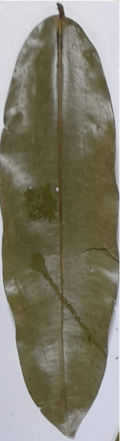
The tree can grow over 30 m (98 ft) tall, often buttressed at the base with a trunk up to 2 m (6 ft 7 in) in diameter. The bark of younger trees has an ash grey color with flaky peelings, while of old trees the bark is dark ash-grey with a red-brown blaze. It has simple, opposite, narrow, oblong to lanceolate, blue-grey to dark green leaves that are 7–15 cm (2.8–5.9 in) long and 1.5–3.5 cm (0.59–1.38 in) wide, with a whitish underside.The emerging young leaves are red to yellowish-pink and characteristically drooping. In contrast, mature leaves exhibit a dark-green adaxial surface, while the abaxial surface appears whitish due to a waxy coating. This wax layer contains nanoscale structures that render the surface water-repellent and hydrophobic, thereby helping to deter insect adhesion.[11] The branches are slender, terete and glabrous. The bisexual flowers are 4–7.5 cm (1.6–3.0 in) in diameter, with four white petals and a center of numerous orange yellow stamens. The fruit is an ovoid to globose capsule with one to two seeds.[8]
Distribution and habitat[edit | edit source]
It is native to wet, tropical parts of Sri Lanka, India, southern Nepal, Burma, Thailand, Indochina, the Philippines, Malaysia and Sumatra, where it grows in evergreen forests, especially in river valleys. In the eastern Himalayas and Western Ghats in India it grows up to elevations of 1,500 m (4,900 ft), while in Sri Lanka up to 1,000 m (3,300 ft).[8][9][10]
In culture and heritage[edit | edit source]
History of the tree in Sri Lanka[edit | edit source]
In the dry zone of Sri Lanka, where ironwood trees normally do not grow wild, large, old ironwood trees can be seen around the remains of ancient Buddhist monasteries on rocky hills around Dambulla such as Na Uyana Aranya, Namal Uyana, Na-golla Aranya, Pidurangala near Sigiriya, Kaludiya Pokuna near Kandalama, and Ritigala. They are probably the descendants of trees planted as ornamentals in the monasteries in ancient times during the Anuradhapura period. Older trees form suckers or shoots from the base of the trunk, which become new trees when the old trunk falls down; therefore the bases and roots of some ironwood trees in these sites might be very old.[12]
Buddhism[edit | edit source]
In Theravada Buddhism, this tree is said to have used as the tree for achieved enlightenment, or Bodhi by four past Buddhas: Mangala (මංගල), Sumana (සුමන), Revata (රේවත), and Sobhitha (සෝභිත).
Buddhists believe that the next Buddha Maitreya will also awaken under this tree. In Buddhist texts, it is often called nāgapuṣpa in Sanskrit and (龍華樹 lónghuā shù) in Chinese.[13][14]
Uses[edit | edit source]
As the English name indicates, the wood of this tree is very heavy, hard and strong. The density is 940 to 1,195 kg/m3 (59 to 75 lb/ft3) at 15% moisture content. The colour is deep dark red. It is hard to saw and is mainly used for railroad ties and heavy structural timber.
In Sri Lanka the pillars of the 14th century Embekke Shrine near Kandy are made of iron tree wood.[15]
The flowers, leaves, seeds and roots are used as herbal medicines in India, Malaysia, etc.[8][3] and in nag champa incense sticks.
In the northeastern state of Assam, India, its seed oil was used daily for lighting in the evenings (while mustard oil was used for religious, health and culinary purposes) before the introduction of kerosene by the British.
Gallery[edit | edit source]
-
-
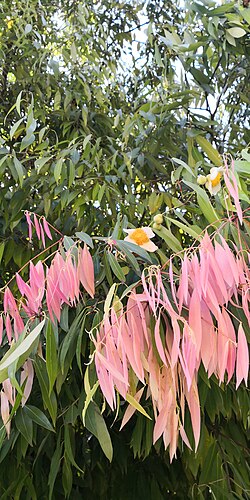 Young leaves and flowers
 -
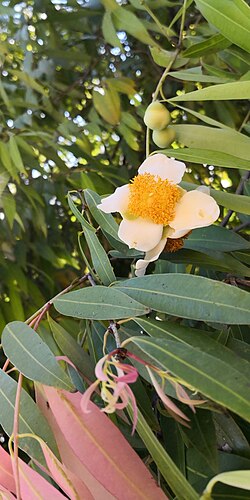 Young leaves and flowers
 -
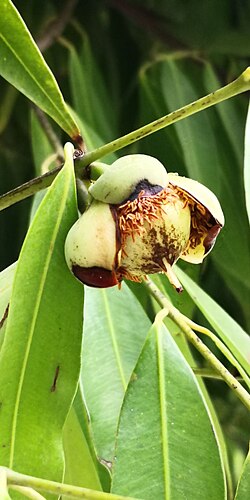 Young fruit
 -
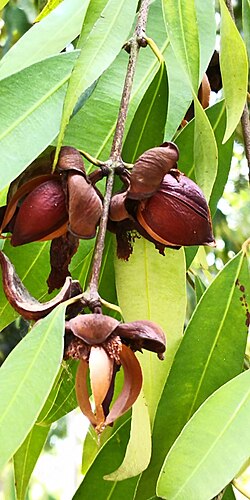 Ripe fruits


See also[edit | edit source]
References[edit | edit source]
- ↑ Amitha Bachan, K.H.; Devika, M.A. (2024). "Mesua ferrea". IUCN Red List of Threatened Species. 2024 e.T61987931A61987933. doi:10.2305/IUCN.UK.2024-2.RLTS.T61987931A61987933.en. Retrieved 4 February 2026.
- ↑ 2.0 2.1 "Mesua ferrea L." worldfloraonline.org. Retrieved 16 November 2023.
- ↑ 3.0 3.1 "Nag Kesar". Flowers of India.
- ↑ "State Symbols of Tripura | Tripura Tourism Development Corporation Ltd". tripuratourism.gov.in. Retrieved 2017-04-28.
- ↑ Warrier, P. K. (1995). Indian Medicinal Plants: A Compendium of 500 Species. Vol. 4. Orient Longman. pp. 253–254. ISBN 978-8173717055.
- ↑ Nadkarni, K. M. (2002). Indian Materia Medica. Vol. 1. Popular Prakashan. pp. 798–799. ISBN 978-8171548194.
- ↑ 7.0 7.1 "Mesua ferrea L. | Plants of the World Online | Kew Science". Plants of the World Online. Retrieved 16 November 2023.
- ↑ 8.0 8.1 8.2 8.3 "Mesua ferrea L. – Clusiaceae". biotik.org. Archived from the original on 2016-03-04. Retrieved 2012-12-06.
- ↑ 9.0 9.1 9.2 9.3 9.4 Kostermans, A.J.G.H. (1980). "Clusiaceae (Guttiferae)". In Dassanayaka, M.D.; Fosberg, F.R. (eds.). A revised handbook to the flora of Ceylon. Vol. I. New Delhi. pp. 107–110.
{{cite book}}: CS1 maint: location missing publisher (link) - ↑ 10.0 10.1 10.2 10.3 10.4 Ashton, M; Gunatilleke, S; de Zoysa, N; Dassanayake, MD; Gunatilleke, N; Wijesundera, S (1997). A Field Guide to the Common Trees and Shrubs of Sri Lanka (PDF). Colombo. p. 140. Archived from the original (PDF) on 2013-06-06. Retrieved 2012-12-06.
{{cite book}}: CS1 maint: location missing publisher (link) - ↑ Dubey, M. C.; Mohanta, D.; Sikarwar, B. S. (2025). "Distinct partial and complete droplet bouncing states on (super)hydrophobic leaf surfaces with ultra-low-to high-adhesion textural features". Journal of Applied Physics. 138 (5): 054703. doi:10.1063/5.0272845.
- ↑ Nyanatusita, Bhikkhu. "Forest Monasteries and Meditation Centres in Sri Lanka".
- ↑ "NParks Mesua ferrea".
- ↑ Iida, Shōtarō; Goldstone, Jane. "The Sutra That Expounds the Descent of Maitreya Buddha and His Enlightenment".
- ↑ "Sri Lanka: Embekke".
External links[edit | edit source]
- Caldecott, Todd (2006). Ayurveda: The Divine Science of Life. Elsevier/Mosby. ISBN 0-7234-3410-7. Contains a detailed monograph on Mesua ferrea (Nagakeshara) as well as a discussion of health benefits and usage in clinical practice. Available online at https://web.archive.org/web/20101229121750/http://www.toddcaldecott.com/index.php/herbs/learning-herbs/312-nagakeshara
- Sriracha College: Mesua ferrea(in Thai; numerous photos)
| State symbols | |
|---|---|
| Topics | |
| Government | |
| Districts | |
| Cities and towns | |
| Education | |
| Culture | |

- Pages using the JsonConfig extension
- IUCN Red List vulnerable species
- Articles containing Telugu-language text
- Articles containing Assamese-language text
- Mesua
- Flora of tropical Asia
- National symbols of Sri Lanka
- Symbols of Mizoram
- Symbols of Tripura
- Plants described in 1753
- Botanical taxa named by Carl Linnaeus
- Trees in Buddhism