

mNo edit summary |
updated page per standard format and fixed typos |
||
| Line 1: | Line 1: | ||
{{Short description|Hindu deity}} | {{Short description|Hindu deity}} | ||
{{Redirect|Ayyappa}} | {{Redirect|Ayyappa}} | ||
{{Infobox deity | {{Use dmy dates|date=January 2024}} | ||
<!-- | {{Use Indian English|date=January 2024}} | ||
{{Infobox deity | |||
<!--Bharatpedia:WikiProject Hinduism-->| type = Hindu <!-- This is template parameter used for internal classification and formatting; it does not display; please do not wiki-link it nor change it --> | |||
| name = Ayyappan | | name = Ayyappan | ||
| birthname = Manikandan | |||
| image = Ayyappa Swamy bazaar art, c.1950's.jpg | | image = Ayyappa Swamy bazaar art, c.1950's.jpg | ||
| | | caption = Ayyappa(n) seated on a tiger | ||
| script_name = | | script_name = | ||
| script = | | script = | ||
| affiliation = [[Hinduism]] | | affiliation = [[Hinduism]] | ||
| god_of = God of righteousness and celibacy | | god_of = God of truth, righteousness, self-discipline and celibacy | ||
| abode = [[Sabarimala]] | | abode = [[Sabarimala]] | ||
| mantra = | | mantra = ''Swāmiye Śaraṇam Ayyappa''{{sfn|Younger|2002|p=21}} | ||
| weapon = [[Bow and arrow]], [[sword]] | | weapon = [[Bow and arrow]], [[sword]] | ||
| mount = [[Tiger]] | | mount = [[Tiger]], [[stallion]] | ||
| symbols = [[Bell]], [[bow and arrow]] | | symbols = [[Bell]], [[bow and arrow]] | ||
| day = [[Saturday]] | |||
| gender = Male | |||
| father = [[Shiva]] | | father = [[Shiva]] | ||
| mother = | | mother = [[Mohini]] | ||
| texts = ''[[Brahmanda Purana]]'' | | texts = ''[[Brahmanda Purana]]'' | ||
| festivals = [[Makaravilakku]] | |||
}} | }} | ||
'''Ayyappan''', also | '''Ayyappan''', also known as '''Dharmasastha''' and '''Manikandan''', is the [[Hindu]] deity of truth and righteousness. According to Hindu theology, he is described as the son of [[Shiva]] and [[Mohini]] (the female avatar of [[Vishnu]]), thus representing a bridge between [[Shaivism]] and [[Vaishnavism]]. | ||
Ayyappan is a warrior deity and is revered for his ascetic devotion to [[Dharma]], the ethical and right way of living. He is usually depicted as a youthful man riding or near a [[Bengal tiger]] and holding a [[bow and arrow]]. In some representations, he is seen holding a sword and riding an [[Indian elephant]] or a [[horse]]. Other iconography generally shows him in a yogic posture wearing a bell around his neck. | |||
The legend and mythology of Ayyappan varies across regions, reflecting a tradition that evolved over time. According to [[Malayalam]] lore, Ayyappan is presented as a warrior prince of [[Pandalam dynasty|Pandala kingdom]]. In the later years, the stories of Ayyappan expanded with various versions describing him as a warrior who protected people from evil doers while helping restore Dharmic practices and he evolved to be a deity. In some regions, Ayyappan and [[Tamil people|Tamil]] folk deity [[Ayyanar]] are considered to be the same with similar characteristics. | |||
Although Ayyappan worship has been prevalent earlier in [[Kerala]], his popularity spread to most of [[Southern India]] in the 20th century. There are several temples in the region dedicated to him, the foremost of which is [[Sabarimala]]. Sabarimala is located on the banks of the [[Pamba River|Pamba river]] in the forests of the [[Western Ghats]], and is a major pilgrimage destination, attracting millions annually. Pilgrims often engage in weeks of preparations in advance by leading a simpler life, remaining celibate, and trekking to the hill barefoot while carrying an ''irumudi'' (a bag with offerings) on the head. | |||
== Names and etymology == | |||
The name Ayyappan is a combination of two words ''ayyan'' and ''appan''.<ref name=Srikant>{{cite book |last=Srikant |first=C.V. Manoj |year=1998 |title=Sabarimala: Its timeless message |isbn=978-8-186-10712-6 |publisher=Integral Books |page=37 |url=https://books.google.com/books?id=HjXAAAAMAAJ }}</ref>{{sfn |Younger |2002 |p=[https://books.google.com/books?id=VqPmCwAAQBAJ&pg=PA166 166] }} ''Ayyan'' in [[Tamil language|Tamil]] and the [[Malayalam]] word ''acchan'' mean "father".<ref>{{cite book |first=Mikhail Sergeevich |last=Andronov |year=1996 |title=A Grammar of the Malayalam Language in Historical Treatment |publisher=[[Otto Harrassowitz Verlag]] |isbn=978-3-447-03811-9 |page=49 |url=https://books.google.com/books?id=H422cDV5qX4C&pg=PA49 }}</ref><ref name="Bronkhorst">{{cite conference |first1=Johannes |last1=Bronkhorst |first2=Madhav |last2=Deshpande |publication-date=1999 |date=25-27 October 1996 |title=Aryan and non-Aryan in south Asia: Evidence, interpretation, and ideology |conference=International Seminar on Aryan and Non-Aryan in South Asia |place=University of Michigan, Ann Arbor, MI |volume=3 |edition=reprint |publisher=[[Harvard University]] |series=Harvard oriental series: ''Opera minora'' |isbn=978-1-888-78904-1 |pages=177–178 |url=https://books.google.com/books?id=EOdtAAAAMAAJ&q=appan }}</ref> ''Appan'' also means "father" in Tamil, and both these words are also used as [[honorific]] titles.<ref name="Srikant"/><ref>{{cite book |first=Iravatham |last=Mahadevan |year=2003 |title=Early Tamil Epigraphy from the Earliest Times to the Sixth Century A.D. |author-link=Iravatham Mahadevan |publisher=[[University of Michigan]] |page=106 |isbn=978-0-674-01227-1 |url=https://books.google.com/books?id=DZBkAAAAMAAJ }}</ref> In [[Hindu texts]], he is described as the son of [[Mohini]] (the female form of [[Vishnu]]) and [[Shiva]] with the name Ayyappan connoting as "lord-father".<ref>{{cite journal |last=Kittel |first=F., Rev. |date=June 1872 |title=Coorg superstitions |journal=Indian Antiquary: A Journal of Oriental Research in Archaeology, History, Literature, Languages, Folklore |publisher=[[Austrian National Library]] |page=168 |quote=Ayyappa (Ayya-Appa)† ''i.e.'' Lord father ... † Ay, Ayya, is an honorific title among the Dravidians, frequently affixed to proper names, ... |url=https://books.google.com/books?id=aPCLDaWvJ7UC&pg=RA2-PA168 |access-date=22 August 2024 }}</ref><ref name=Encyclopedia>{{cite encyclopedia |first1=Constance |last1=Jones |first2=James D. |last2=Ryan |year=2006 |title=Ayyappan |encyclopedia=Encyclopedia of Hinduism |publisher=[[Infobase Publishing]] |isbn=978-0-816-07564-5 |page=58 |url=https://books.google.com/books?id=OgMmceadQ3gC&pg=PA58 |access-date=22 August 2024 }}</ref> The name could have also been derived from the combination of ''aryan'' and ''appan'' with the former meaning "revered".<ref name="Dubey">{{cite book |first=D.P. |last=Dubey |year=1995 |title=Pilgrimage Studies: Sacred places, sacred traditions |publisher=Society of Pilgrimage Studies |isbn=978-8-190-05201-6 |pages=136–137 |url=https://books.google.com/books?id=BHLXAAAAMAAJ&pg=PA136 }}</ref> | |||
In Hindu scriptures such as ''[[Vishnu Purana]]'' and ''[[Srimad Bhagavatham]]'', he is referenced as ''Dharmasastha'' and ''Sastha'', meaning "ruler of the realm".<ref name=Encyclopedia/>{{sfn|Dalal|2010|p=[https://books.google.com/books?id=pNmfdAKFpkQC&pg=PA44 44]}}{{sfn|Sekar|1992|p=[https://books.google.com/books?id=6DOuEAAAQBAJ&pg=PA19 19]}} The word ''Sastha'' could have also be derived from [[Buddhism]] as Ayyappan is seen as an incarnation of [[Gautama Buddha|Buddha]] and Buddha was known by the same name, meaning "teacher".<ref name=Encyclopedia/>{{sfn|Sekar|1992|p=[https://books.google.com/books?id=6DOuEAAAQBAJ&pg=PA19 19]}}<ref>{{cite book |first=Paul J. |last=Griffiths |year=1994 |title=On Being Buddha: The classical doctrine of Buddhahood |isbn=978-0-791-42127-7 |publisher=[[State University of New York Press]] |page=64 |url=https://books.google.com/books?id=0T8o_IK5IMgC&pg=PA64 }}</ref> He is also known as ''Hariharasuthan'', meaning the "son of [[Harihara]]", a fusion of ''Hari'' and ''Hara'', the names given to Vishnu and Shiva respectively.{{sfn|Dalal|2010|p=[https://books.google.com/books?id=pNmfdAKFpkQC&pg=PA44 44]}} He is also called ''Manikanda'' with ''mani'' meaning bell and ''kanda'' meaning neck in [[Sanskrit]], and meaning the wearer of a bell on his neck.{{sfn|Dalal|2010|p=[https://books.google.com/books?id=pNmfdAKFpkQC&pg=PA44 44]}}{{sfn|Sekar|1992|p=[https://books.google.com/books?id=6DOuEAAAQBAJ&pg=PA23 23]}} | |||
[[ | |||
[[ | |||
== Iconography and depictions== | |||
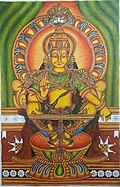
[[File:Lord Ayyappa old painting.jpg|thumb|A painting of Lord Ayyappan is depicted in Yogapattasana, a sacred yogic posture.]] | |||
Ayyappan is a warrior deity | Ayyappan is a warrior deity and is revered for his ascetic devotion to [[Dharma]], the ethical and right way of living, deployment of his military genius and yogic war abilities to destroy those who are powerful but unethical, abusive and arbitrary.{{sfn|Younger|2002|pp=21–25}} He is usually represented as a [[Brahmacharya|celibate]] young man holding a [[bow and arrow]], and riding a [[Bengal tiger]].<ref>{{cite book|author=Mysore Narasimhachar Srinivas|title=Collected Essays|url=https://books.google.com/books?id=2e_ZAAAAMAAJ|year=2002|publisher=[[Oxford University Press]]|isbn=978-0-195-65174-4|page=352}}</ref> In some representations, he is seen holding an upraised bow in his left hand, while holding either an arrow or sword in his right hand placed diagonally across his left thigh.<ref>{{cite book|last=Williams|first=Joanna Gottfried|year=1981|isbn=9004064982|page=72|url=https://books.google.com/books?id=-qoeAAAAIAAJ|title=Kalādarśana: American Studies in the Art of India|publisher=[[Brill Publishers]]}}</ref> Other iconography generally shows him in a yogic posture wearing a bell around his neck.{{sfn|Laser|2014|p=[https://books.google.com/books?id=ho0gBAAAQBAJ&pg=PT63 63]}} In some representations, such as in Sri Lanka, he is shown riding an [[Indian elephant]] or a [[horse]].<ref name="Dubey"/> | ||
== | == Theology and historical development== | ||
The | The legend and mythology of Ayyappan vary across regions, reflecting a tradition that evolved over time.{{sfn|Younger|2002|pp=18–25}} According to the ''[[Puranas]]'', he is mentioned as an incarnation of Hariharaputra, the son of Shiva and Mohini (female form of Vishnu).<ref name="Encyclopedia"/>{{sfn|Dalal|2010|p=[https://books.google.com/books?id=pNmfdAKFpkQC&pg=PA44 44]}}{{sfn|Laser|2014|p=[https://books.google.com/books?id=ho0gBAAAQBAJ&pg=PT63 63]}} While this interaction between Shiva and Vishnu is mentioned in the ''Bhagavata Purana'', he is not referenced by the name Ayyappan.<ref>{{cite book|last=Goudriaan|first=Teun|title=Māyā divine and human|publisher=[[Motilal Banarsidass Publishers]]|year=1978|pages=42–43|chapter=The Māyā of the Gods: Mohini|chapter-url=https://books.google.com/books?id=15-heLWM3UcC&pg=PA42|isbn=978-81-208-2389-1|access-date=1 October 2020|archive-date=25 July 2024|archive-url=https://web.archive.org/web/20240725084527/https://books.google.com/books?id=15-heLWM3UcC&pg=PA42#v=onepage&q&f=false|url-status=live}}</ref> | ||
=== | According to Malayalam folklore, Ayyappan is presented as a warrior prince of [[Pandalam dynasty|Pandalam kingdom]].{{sfn|Younger|2002|p=18}}{{sfn|Laser|2014|p=[https://books.google.com/books?id=ho0gBAAAQBAJ&pg=PT64 64]}} The king of Pandalam found a baby boy on the banks of [[Pamba River|Pamba river]].<ref name="Encyclopedia"/>{{sfn|Dalal|2010|p=[https://books.google.com/books?id=pNmfdAKFpkQC&pg=PA44 44]}}<ref>{{cite book|author1=Denise Cush|author2=Catherine A. Robinson|author3=Michael York|title=Encyclopedia of Hinduism|url=https://books.google.com/books?id=i_T0HeWE-EAC|year=2008|publisher=[[Routledge]]|isbn=978-0-700-71267-0|page=78|access-date=25 August 2017|archive-date=21 April 2023|archive-url=https://web.archive.org/web/20230421115354/https://books.google.com/books?id=i_T0HeWE-EAC|url-status=live}}</ref> As the royal family was childless, the king named the boy Manikantha and raised him his own son, on the advice of an ascetic. When Manikantha was 12 years old, the king wanted to formally anoint him as the heir. However, the queen objected to it, as she favored her younger biological child.<ref name="Encyclopedia"/>{{sfn|Younger|2002|p=18}} Planning to get rid of Manikantha, the queen feigned an illness, and asked for the milk of a tiger as a cure for her illness. She demanded that Manikantha be sent to obtain the same. Manikantha volunteered for the mission and went into the forest. He confronted and defeated the [[asura|demoness]] Mahishi.{{sfn|Dalal|2010|p=[https://books.google.com/books?id=pNmfdAKFpkQC&pg=PA44 44]}} Mahishi wanted to be his wife but Ayyappa being celibate, refused the offer and killed the demoness.<ref name="Encyclopedia"/>{{sfn|Younger|2002|p=18}} He returned back to the kingdom riding on the back of a tiger. The king realised his special ability and recognised him to be a divine being and resolved to make a shrine for him. Manikantha transformed into Ayyappa and shot an arrow to mark the place for the new shrine.{{sfn|Younger|2002|pp=18–19}} | ||
There | There are minor variations in the story in other versions with Ayyappan renouncing the kingdom and becoming an ascetic [[yogi]] in a forested mountain.<ref>{{cite book|author=Devdutt Pattanaik|author-link=Devdutt Pattanaik|title=Pashu: Animal Tales from Hindu Mythology|url=https://books.google.com/books?id=ojqQBQAAQBAJ|year=2014|publisher=[[Penguin Books]]|isbn=978-8-184-75692-0|pages=109–111}}</ref> In another version, he is described as the son of the king's sister, who was born in the forest and sent to his uncle later. When the shrine of Sastha at Sabarimala was destroyed by the king's enemies, he defeated them, re-installed the statue and disappeared into it.{{sfn|Dalal|2010|p=[https://books.google.com/books?id=pNmfdAKFpkQC&pg=PA44 44]}} In some versions, he was raised by a childless royal couple Rajashekara [[Pandya dynasty|Pandian]] and Koperundevi, and grew up as a warrior yogi.<ref name="Brit"/><ref>{{cite book|author=Jeffery D. Long|title=Historical Dictionary of Hinduism|url=https://books.google.com/books?id=ZkkFCwAAQBAJ|year=2011|publisher=[[Scarecrow Press]]|isbn=978-0-810-87960-7|page=78}}</ref>{{sfn|Younger|2002|pp=17-21}} | ||
According to Paul Younger, supplementary legends appeared in the late [[Middle Ages]] that linked other Hindu deities and mythologies to Ayyappan.{{sfn|Younger|2002|pp=20–21}} The divine beings [[Dattatreya|Datta]] and Leela came to Earth as humans. Datta wanted to return to the divine realm, but Leela enjoyed her life on Earth and wanted to stay on Earth.{{sfn|Younger|2002|p=21}} He became angry and cursed her to become a Mahishi (water buffalo demoness). Leela in turn cursed him to become [[Mahishasura|Mahisha]], a water buffalo demon and they both plundered the earth with their evil acts. Mahisha was later killed by goddess [[Durga]], while Mahishi was killed by Ayyapan, ending the terror of evil and liberating Leela who was previously cursed.{{sfn|Younger|2002|pp=21–22}} These legends syncretically linked and combined various Hindu traditions around [[Shaivism]], [[Vaishnavism]] and [[Shaktism]].{{sfn|Younger|2002|pp=21–22}} | |||
In the later years, the stories of Ayyappan expanded. One such version has roots between the 1st and 3rd century CE, where he evolved to be a deity who protected traders and merchants from enemies such as robbers and plundering outlaws.{{sfn|Younger|2002|pp=20–21}} His [[Hindu temple|temples]] and traditions inspired Hindu yogi mercenaries who protected the trade routes in South India from criminals and helped restore Dharmic trading practices.{{sfn|Younger|2002|pp=20–21}} In another version, he is portrayed as a child of a priest whose father was murdered by a fearsome outlaw. The outlaw kidnapped a princess and he made a daring rescue while killing the outlaw in the process.{{sfn|Younger|2002|pp=20–21}} In a variation of the story, Ayyappan forms an alliance with the [[Muslim]] warrior [[Vavar]] against the outlaw Udayanan, which forms the basis for worshiping both in a Hindu temple and a [[mosque]] before starting a pilgrimage to Ayyappa shrine.{{sfn|Younger|2002|pp=20–21}} | |||
=== | According to Eliza Kent, the legends relating to the Ayyappa tradition seem to be "artificially mixed and assembled into a kind of collage".{{sfn|Kent|2013|p=80–83}} Ruth Vanita suggested that Ayyappan probably emerged from the fusion of a [[Dravidian people|Dravidian]] god of tribal provenance and the Puranic story of Shiva and Mohini's interaction.<ref>{{cite book|url=https://books.google.com/books?id=VbvIDAAAQBAJ&pg=PA94|page=94|title=Same-Sex Love in India: Readings in Indian Literature|publisher=[[Springer Publishing]]|author1=Ruth Vanita|author2=Saleem Kidwai|year=2000|isbn=978-1-137-05480-7|access-date=1 October 2020|archive-date=25 July 2024|archive-url=https://web.archive.org/web/20240725084542/https://books.google.com/books?id=VbvIDAAAQBAJ&pg=PA94#v=onepage&q&f=false|url-status=live}}</ref> In some regions, Ayyappan and Tamil folk deity [[Ayyanar]] are considered to be the same with similar characteristics and is cited as a reason for his large following amongst [[Tamil people|Tamils]].{{sfn|Dalal|2010|p=[https://books.google.com/books?id=pNmfdAKFpkQC&pg=PA44 44]}}{{sfn|Sekar|1992|p=[https://books.google.com/books?id=6DOuEAAAQBAJ&pg=PA20 20]}}<ref>{{cite journal|last=Pillai|first=V. Narayana|date=1939|title=Śāsta Cult in Travancore. Is It a Relic of Buddhism ?|url=https://www.jstor.org/stable/44252378|journal=Proceedings of the Indian History Congress|volume=3|pages=230–240|jstor=44252378|issn=2249-1937|access-date=30 August 2023|archive-date=30 August 2023|archive-url=https://web.archive.org/web/20230830062724/https://www.jstor.org/stable/44252378|url-status=live}}</ref> | ||
[[ | |||
== Worship== | |||
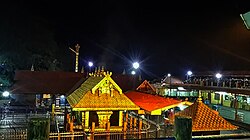
[[File:Sabarimala 2.jpg|thumb|Dharma Sastha temple at [[Sabarimala]]]] | |||
Although Ayyappan worship was prevalent earlier in [[Kerala]], his popularity spread to most of [[Southern India]] in the 20th century.{{sfn|Laser|2014|p=[https://books.google.com/books?id=ho0gBAAAQBAJ&pg=PT63 63]}}{{sfn|Kumar|2014|p=[https://books.google.com/books?id=7Wd_BAAAQBAJ&pg=PA212 212]}}<ref>{{cite book|first=Suresh|last=Chandra|year=1998|title=Encyclopaedia of Hindu Gods and Goddesses|url=https://books.google.com/books?id=mfTE6kpz6XEC|publisher=Sarup and Sons|page=28|isbn=978-8-176-25039-9}}</ref> There are several Ayyappan temples across South India, the most prominent of which is located at [[Sabarimala]]. Sabarimala is located on the banks of the Pamba river amidst the hills of the [[Western Ghats]] in Kerala, and attracts millions of Hindu pilgrims every year.<ref name="Smith">{{cite book|author=Fred Clothey|editor=Bardwell L. Smith|title=Religion and the Legitimation of Power in South Asia|url=https://books.google.com/books?id=x2Jzn_LuLasC|year=1978|publisher=[[Brill Publishers]]|isbn=978-9-004-05674-9|pages=3–9}}</ref>{{sfn|Younger|2002|pp=18-23}}<ref name="Eck"/> The temple is open only on select days of a year.<ref>{{cite web|date=17 November 2022|title=Mandala Puja 2022: All you need to know about Mandala Kalam|work=[[The Times of India]]|url=https://timesofindia.indiatimes.com/religion/rituals-puja/mandala-puja-2022-all-you-need-to-know-about-mandala-kalam/articleshow/95524793.cms|access-date=15 December 2023|issn=0971-8257|archive-date=15 December 2023|archive-url=https://web.archive.org/web/20231215090244/https://timesofindia.indiatimes.com/religion/rituals-puja/mandala-puja-2022-all-you-need-to-know-about-mandala-kalam/articleshow/95524793.cms|url-status=live}}</ref> | |||
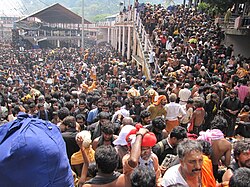
[[File:SabarimalaRush2010.JPG|thumb|left|Pilgrims carrying ''irumudi'' at [[Sabarimala]]]] | |||
[[File: | |||
Pilgrims planning to visit Sabarimala often begin preparations weeks in advance. They lead a simpler life, while remaining celibate, eating vegetarian diet or partially fasting and wearing a black or blue dress. These weeks of rituals are termed as ''vrutham'' which is signified by wearing a [[tulsi]] or [[rudraksha]] [[garland|mala]]. The pilgrims refrain from any form of social or economic discrimination and form a fraternity treating each other as equals.<ref name="Encyclopedia"/><ref name="Smith"/>{{sfn|Kent|2013|p=14-15}}<ref name="Eck"/> They call each other by the name ''swami'' meaning "god".<ref name="Eck">{{cite book|author=Diana L Eck|author-link=Diana L. Eck|title=India: A Sacred Geography|url=https://books.google.com/books?id=rNlJOSf__xYC&pg=PA13|year=2012|publisher=Random House|isbn=978-0-385-53191-7|pages=13–14}}</ref><ref name="Daniel">{{cite book|author=E. Valentine Daniel|title=Fluid Signs: Being a Person the Tamil Way|url=https://books.google.com/books?id=KwZatzse3CsC|year=1987|publisher=[[University of California Press]]|isbn=978-0-520-06167-5|pages=244–262}}</ref> The pilgrims bath in the Pamba river and embark on a trek to the top of the hill on barefoot carrying an ''irumudi'' (a bag with two compartments containing offerings to the god) on the head.<ref name="Smith" />{{sfn|Younger|2002|pp=18–23}} Then they climb the 18 steps in front of the shrine, each representing a dharmic value.<ref name="Smith"/>{{sfn|Younger|2002|pp=18–23}} The priests and devotees bring flowers and scatter them near the shrine while chanting various [[shlokas]].<ref>{{cite book|author=Stephen Knapp|title=Spiritual India Handbook|url=https://books.google.com/books?id=djI5mL2qeocC&pg=PT416|year=2009|publisher=Jaico|isbn=978-8-184-95024-3|pages=416–419}}</ref> As the deity is believed to be celibate, women in their fertile age are not allowed to enter the shrine.<ref name="Brit"/><ref name="Smith"/>{{sfn|Younger|2002|pp=18–23}} | |||
== | Other temples dedicated to Ayyappan include [[Achankovil Sastha Temple]], [[Aryankavu Sastha Temple]], [[Erumely Sree Dharmasastha Temple]], and [[Kulathupuzha Sastha Temple]] in Kerala.<ref>{{cite web|url=https://www.newindianexpress.com/states/kerala/2016/Jan/18/5-temples-part-of-sabarimala-pilgrimage-circuit-870242.html|title=5 Temples Part of Sabarimala Pilgrimage Circuit|date=18 January 2016|access-date=1 June 2024|work=[[The New Indian Express]]|archive-date=5 October 2023|archive-url=https://web.archive.org/web/20231005115943/https://www.newindianexpress.com/states/kerala/2016/jan/18/5-Temples-Part-of-Sabarimala-Pilgrimage-Circuit-870242.html|url-status=live}}</ref> Temples are also located in [[Anna Nagar Ayyappan Koil, Chennai|Anna Nagar]],<ref>{{cite news|title=Where service is divine|date=17 April 2003|url=http://www.hindu.com/thehindu/mp/2003/04/17/stories/2003041700320300.htm|archive-url=https://web.archive.org/web/20040530124134/http://www.hindu.com/thehindu/mp/2003/04/17/stories/2003041700320300.htm|url-status=dead|archive-date=30 May 2004|newspaper=[[The Hindu]]|access-date=1 May 2013}}</ref> [[Mahalingapuram Ayyappan Temple|Mahalingapuram]],<ref>{{cite news|url=https://www.aninews.in/news/national/general-news/tn-saraswati-puja-celebrated-at-mahalingapuram-ayyappan-temple-in-chennai20191008194137/|title=Saraswati Puja celebrated at Mahalingapuram Ayyappan temple in Chennai|date=8 October 2019|access-date=1 June 2024|work=ANI News|archive-date=25 January 2023|archive-url=https://web.archive.org/web/20230125072050/https://www.aninews.in/news/national/general-news/tn-saraswati-puja-celebrated-at-mahalingapuram-ayyappan-temple-in-chennai20191008194137/|url-status=live}}</ref> [[Ayyappan Temple, Perambur|Perambur]],<ref>{{cite news|url=https://timesofindia.indiatimes.com/city/chennai/hundreds-of-kids-get-ready-for-vidyarambham-in-city/articleshow/60868663.cms|title=Hundreds of kids get ready for Vidyarambham in city|date=29 September 2017|access-date=1 June 2024|newspaper=[[The Times of India]]|archive-date=24 December 2023|archive-url=https://web.archive.org/web/20231224115407/https://timesofindia.indiatimes.com/city/chennai/hundreds-of-kids-get-ready-for-vidyarambham-in-city/articleshow/60868663.cms|url-status=live}}</ref> and [[Rajah Annamalaipuram Ayyappan Koil, Chennai|Rajah Annamalaipuram]] in [[Chennai]],<ref>{{cite news|url=https://www.mylaporetimes.com/2022/05/1008-sanga-abhisekam-at-sri-ayyappan-temple-on-june-10/|title=1008 sanga-abhisekam at Sri Ayyappan Temple on June 10|date=31 May 2022|access-date=1 June 2024|work=Mylapore Times|archive-date=25 July 2024|archive-url=https://web.archive.org/web/20240725084645/https://www.mylaporetimes.com/2022/05/1008-sanga-abhisekam-at-sri-ayyappan-temple-on-june-10/|url-status=live}}</ref> and [[Ayyappan Temple, Coimbatore|Coimbatore]].<ref>{{cite news|url=https://www.aninews.in/news/entertainment/out-of-box/onam-2023-devotees-throng-ayyappan-temple-in-coimbatore20230829144646/|title=Onam 2023: Devotees throng Ayyappan Temple in Coimbatore|date=29 August 2023|access-date=1 June 2024|work=ANI News|archive-date=25 July 2024|archive-url=https://web.archive.org/web/20240725084636/https://www.aninews.in/news/entertainment/out-of-box/onam-2023-devotees-throng-ayyappan-temple-in-coimbatore20230829144646/|url-status=live}}</ref> While Ayyappan temples typically show him as a celibate yogi, a few temples such as the Achankovil Sastha Temple depict him as a married man with two wives Poorna and Pushkala, and a son Satyaka.<ref>{{cite book|author=K. Srikumaran|title=Theerthayathra: A Pilgrimage Through Various Temples|url=https://books.google.com/books?id=FGvXAAAAMAAJ|year=2005|publisher=[[Bharatiya Vidya Bhavan]]|isbn=978-8-172-76363-3|pages=103, 120}}</ref><ref>{{cite book|url=https://books.google.com/books?id=Ky3GBQAAQBAJ&pg=PT127|title=The man who was a woman and other queer tales from Hindu lore|page=127|first=Devdutt|last=Pattanaik|author-link=Devdutt Pattanaik|year=2014|publisher=[[Routledge]]|isbn=978-1-317-76630-8}}</ref> Some of the Ayyappan temples in the region are believed to have been established by [[Parashurama]], an [[avatar]] of Vishnu.<ref>{{cite book|author=Maria A. David|title=Beyond Boundaries: Hindu-Christian Relationship and Basic Christian Communities|url=https://books.google.com/books?id=YYlC_qF_eB0C&pg=PA9|year=2009|publisher=ISPCK|isbn=978-8-184-65001-3|page=9}}</ref> The most significant festival linked to him is the [[Makaravilakku]], observed around the [[winter solstice]].{{sfn|Dalal|2010|p=[https://books.google.com/books?id=DH0vmD8ghdMC&pg=PA350 350]}} In [[Ponnambalamedu]] hillock in the Western Ghats, a ritual lighting of a large flame is carried out during the festival.<ref>{{cite web|url=http://zeenews.india.com/news/kerala/the-light-on-markarsamkarama-day-an-aarti_751058.html|title=The light on Markarsamkarama day an 'aarti'|date=7 January 2012|work=[[Zee News]]|access-date=16 January 2013|archive-date=25 July 2024|archive-url=https://web.archive.org/web/20240725084531/https://zeenews.india.com/news/kerala/the-light-on-markarsamkarama-day-an-aarti_751058.html|url-status=live}}</ref> [[Harivarasanam]] is a [[Manipravalam]] [[ashtakam]] composed in praise of Shiva and sung as a [[lullaby]] for Ayyappan.<ref>{{cite web|date=19 November 2017|title=This Sabarimala season, an updated lullaby for Lord Ayyappan|work=[[The Hindu]]|url=https://www.thehindu.com/news/national/kerala/this-sabarimala-season-an-updated-lullaby-for-lord-ayyappan/article20555464.ece|access-date=25 December 2023|issn=0971-751X|archive-date=3 October 2022|archive-url=https://web.archive.org/web/20221003143046/https://www.thehindu.com/news/national/kerala/this-sabarimala-season-an-updated-lullaby-for-lord-ayyappan/article20555464.ece|url-status=live}}</ref> | ||
[[ | |||
Ayyappan | |||
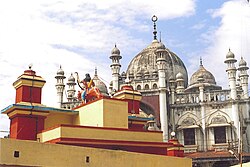
[[File: | [[File:Vavar mosque kerala.jpg|thumb|Vavar's mosque on the way to Sabarimala]] | ||
Ayyappan remains one of the few deities in the Hindu pantheon, who is respected by other religious communities, including [[Muslims]], and [[Christians]].<ref name="Brit">{{cite encyclopedia|url=https://www.britannica.com/topic/Ayyappan|title=Ayyappan – Hindu deity|encyclopedia=[[Encyclopaedia Britannica]]|year=2014|access-date=23 August 2017|archive-date=24 August 2017|archive-url=https://web.archive.org/web/20170824015222/https://www.britannica.com/topic/Ayyappan|url-status=live}}</ref> As per the [[Government of Kerala|Kerala government]], there is a theory that the temple of Sabarimala was of [[Buddhist]] origin.<ref>{{cite news|newspaper=[[The New Indian Express]]|url=https://www.newindianexpress.com/states/kerala/2018/Nov/12/sabarimala-temple-was-buddhist-temple-kerala-government-informs-high-court-1897240.html|title=Sabarimala Temple was Buddhist temple, Kerala government informs High Court|date=12 November 2018|access-date=1 June 2024}}</ref> Ayyappan is revered by [[Islam in Kerala|Muslims in Kerala]] due to his association with Vavar.{{sfn|Laser|2014|p=[https://books.google.com/books?id=ho0gBAAAQBAJ&pg=PT63 63]}}<ref name="Encyclopedia"/> As per the mythology associated with Vavar, Ayyappan confronted the robber Vavar in a jungle and defeated him. Later, he became Ayyappan's trusted lieutenant in the fight against other pirates and robbers.{{sfn|Kent|2013|p=81-86}} In another version, Vavar is stated to be a Muslim saint from Arabia, who worked with him.<ref>{{cite web|url=https://economictimes.indiatimes.com/news/politics-and-nation/before-arriving-at-sabarimala-temple-in-kerala-devotees-visit-a-mosque/articleshow/50334905.cms|title=Before arriving at Sabarimala temple in Kerala, devotees visit a mosque|work=[[The Economic Times]]|last1=Kumar|first1=KP Narayana|date=27 December 2015 |access-date=8 May 2021|archive-date=25 July 2024|archive-url=https://web.archive.org/web/20240725084648/https://economictimes.indiatimes.com/news/politics-and-nation/before-arriving-at-sabarimala-temple-in-kerala-devotees-visit-a-mosque/articleshow/50334905.cms|url-status=live}}</ref> A mosque dedicated to Vavar stands next to the Kadutha swami shrine at the foothills of Sabarimala. Pilgrims often offer a prayer in both the shrines, before beginning the trek towards the hill.{{sfn|Kent|2013|p=81-86}} According to Kent, though the mosque near Sabarimala includes a grave, it does not contain the mortal remains of Vavar, and no one can date Vavar nor provide when and where he lived, so he may be a myth. The Vavar legend and ''palli'' shrines might reflect the Hindu approach to accepting and co-opting legendary figures or saints of other religions within its fold.<ref>{{cite book|author=Eliza Kent|title=Lines in Water: Religious Boundaries in South Asia|url=https://books.google.com/books?id=iYOiAgAAQBAJ|year=2013|publisher=[[Syracuse University Press]]|isbn=978-0-8156-5225-0|pages=84–88}}</ref> | |||
A mosque dedicated to | |||
== Popular culture == | == Popular culture == | ||
A number of Indian films have been made about | A number of Indian films have been made about Ayyappan. These include: ''Sabarimala Ayyappan'' (1961) by [[S. M. Sriramulu Naidu]], ''[[Swami Ayyappan (1975 film)|Swami Ayyappan]]'' (1975) by [[P. Subramaniam]], ''[[Saranam Ayyappa]]'' (1980) by Dasarathan, ''Arul Tharum Ayyappan'' (1987) by Dasarathan, ''Shiv Putra Swami Ayappa'' (1990) by P.S. Mani, ''[[Sabarimala Sri Ayyappan]]'' (1990) by Renuka Sharma, ''[[Engal Swamy Ayyappan]]'' (1990) by Dasarathan, ''Ayyappa Swamy Mahatyam'' (1991), ''Ayyappa Deeksha Mahimalu'' (1992) by Guda Rama Krishna, ''Swami Ayappa Shabarimalai'' (1993) by [[K. Shankar]], ''Jai Hari Hara Putra Ayyappa'' (1995), ''Bhagwaan Ayyappa'' (2007) by Irajaral Bhakhta and V. Swaminathan, ''[[Swami Ayyappan (2012 film)|Swami Ayyappan]]'' (2012) by Chetan Sharma and Mahesh Vettiyar, ''Om Sharanam Ayyappa'' (2015) by K. Sharath, ''Sri Omkara Ayyappane'' (2016) by [[Sai Prakash]], ''Ayyappa Kataksham'' (2019) by Rudrapatla Venugopal and ''[[Malikappuram]]'' (2023) by Vishnu Mohan.<ref name="RajadhyakshaWillemen1999">{{cite book|last1=Rajadhyaksha|first1=Ashish|last2=Willemen|first2=Paul|title=Encyclopaedia of Indian cinema|url=https://archive.org/details/encyclopaediaofi0000raja|url-access=registration|year=1999|publisher="Brit"tish Film Institute|isbn=9780851706696 }}</ref><ref>{{cite news|title=Ayyappan now in toon avatar|newspaper=[[The Hindu]]|url=http://www.thehindu.com/todays-paper/tp-national/tp-kerala/ayyappan-now-in-toon-avatar/article3549553.ece|date=20 June 2012|access-date=21 June 2014|archive-date=31 May 2022|archive-url=https://web.archive.org/web/20220531212951/https://www.thehindu.com/todays-paper/tp-national/tp-kerala/ayyappan-now-in-toon-avatar/article3549553.ece|url-status=live}}</ref> | ||
The story of Ayyappa is dictated by [[Parvati]] to [[Ganesha]] in the Indian TV show | [[Asianet (TV channel)|Asianet]] launched a Malayalam series named [[Swami Ayyappan (TV series)|''Swami Ayyappan'']] in 2006. Other series include ''Swami Ayyappan Saram'' (2010), ''Sabarimala Shri Dharmashasta'' (2012), ''Sabarimala Swami Ayappan'' (2019) and ''[[Malikappuram: Apathbandhavan Ayyappan]]'' (2023). The story of Ayyappa is dictated by [[Parvati]] to [[Ganesha]] in the Indian TV show ''[[Vighnaharta Ganesha]]''.<ref>{{cite web|url=https://www.sonyliv.com/details/episodes/6117114715001/Ep.-608---Story-Time-For-The-Kids---Vighnaharta-Ganesh---19-December-2019|title=Story Time For The Kids - Vighnaharta Ganesh|work=[[Sony Liv]]|access-date=31 December 2019|archive-date=31 December 2019|archive-url=https://web.archive.org/web/20191231085218/https://www.sonyliv.com/details/episodes/6117114715001/Ep.-608---Story-Time-For-The-Kids---Vighnaharta-Ganesh---19-December-2019|url-status=dead}}</ref> The story of Ayyappan was adapted as a comic in the [[List of Amar Chitra Katha comics|673rd issue]] of the Indian comic book series, [[Amar Chitra Katha]].<ref>{{cite book|url=https://books.google.com/books?id=0mk-DgAAQBAJ|title=Ayyappan: The Lord of Shabarimala|author=Shyamala Mahadevan|year=1975|publisher=[[Amar Chitra Katha]]|isbn=978-8-184-82016-4|access-date=23 July 2024|archive-date=25 July 2024|archive-url=https://web.archive.org/web/20240725084533/https://books.google.com/books?id=0mk-DgAAQBAJ|url-status=live}}</ref><ref>{{cite web|url=https://digital.amarchitrakatha.com/id005835142/Ayyappan|title=Ayyappan|publisher=[[Amar Chitra Katha]]|access-date=1 June 2024|archive-date=20 June 2024|archive-url=https://web.archive.org/web/20240620064731/https://digital.amarchitrakatha.com/id005835142/Ayyappan|url-status=live}}</ref> | ||
==See also== | == See also == | ||
* [[Harihara]] | * [[Harihara]] | ||
* [[Harivarasanam]] | * [[Harivarasanam]] | ||
* [[Maalikapurathamma]] | * [[Maalikapurathamma]] | ||
* [[Makara Jyothi]] | * [[Makara Jyothi]] | ||
* [[ | * [[Karuppuswamy]] | ||
== References == | == References == | ||
{{Reflist}} | {{Reflist}} | ||
===Bibliography=== | === Bibliography === | ||
{{Refbegin}} | {{Refbegin}} | ||
* {{ | *{{cite book|first=Roshen|last=Dalal|title=The Religions of India: A Concise Guide to Nine Major Faiths|url=https://books.google.com/books?id=pNmfdAKFpkQC|year=2010|publisher=[[Penguin Books]]|isbn=978-0-143-41517-6}} | ||
*{{cite book|first= | *{{cite book|first=Eliza|last=Kent|title=Lines in Water: Religious Boundaries in South Asia|url=https://books.google.com/books?id=iYOiAgAAQBAJ|year=2013|publisher=[[Syracuse University Press]]|isbn=978-0-815-65225-0}} | ||
*{{cite book|first=Pratap|last=Kumar|title=Contemporary Hinduism|url=https://books.google.com/books?id=o2d_BAAAQBAJ|publisher=[[Routledge Publishing]]|year=2014|isbn=978-1-317-54635-1}} | |||
*{{cite book|first=Tammy|last=Laser|title=Gods & Goddesses of Ancient India|url=https://books.google.com/books?id=ho0gBAAAQBAJ|year=2014|publisher=[[Britannica Educational Publishing]]|isbn=978-1-622-75391-8}} | |||
*{{cite book|title=The Śabarimalai Pilgrimage and Ayyappan Cult|first=Radhika|last=Sekar|year=1992|isbn=978-8-120-81056-3|publisher=[[Motilal Banarsidass Publishers]]|url=https://books.google.com/books?id=6DOuEAAAQBAJ}} | |||
* {{cite book|last=Younger|first=Paul|title=Playing Host to Deity: Festival Religion in the South Indian Tradition|url=https://books.google.com/books?id=VqPmCwAAQBAJ|publisher=[[Oxford University Press]]|year=2002|isbn=978-0-195-14044-6}} | |||
{{Refend}} | {{Refend}} | ||
==External links== | ==External links== | ||
* {{Commons category-inline}} | * {{Commons category-inline}} | ||
*[https://sabarimala.kerala.gov.in/ Sabrimala Official] | |||
{{Hindu deities and texts}} | {{Hindu deities and texts}} | ||
| Line 129: | Line 105: | ||
{{Authority control}} | {{Authority control}} | ||
[[Category:Fertility gods]] | [[Category:Fertility gods]] | ||
[[Category:Regional Hindu gods]] | [[Category:Regional Hindu gods]] | ||
[[Category:Ayyappan]] | |||
[[Category:Children of Shiva]] | |||
Latest revision as of 02:40, 23 January 2026
| Ayyappan | |
|---|---|
God of truth, righteousness, self-discipline and celibacy | |
 Ayyappa(n) seated on a tiger | |
| Affiliation | Hinduism |
| Abode | Sabarimala |
| Mantra | Swāmiye Śaraṇam Ayyappa[1] |
| Weapon | Bow and arrow, sword |
| Symbols | Bell, bow and arrow |
| Day | Saturday |
| Mount | Tiger, stallion |
| Texts | Brahmanda Purana |
| Gender | Male |
| Festivals | Makaravilakku |
| Personal information | |
| Born | Manikandan |
| Parents | |
Ayyappan, also known as Dharmasastha and Manikandan, is the Hindu deity of truth and righteousness. According to Hindu theology, he is described as the son of Shiva and Mohini (the female avatar of Vishnu), thus representing a bridge between Shaivism and Vaishnavism.
Ayyappan is a warrior deity and is revered for his ascetic devotion to Dharma, the ethical and right way of living. He is usually depicted as a youthful man riding or near a Bengal tiger and holding a bow and arrow. In some representations, he is seen holding a sword and riding an Indian elephant or a horse. Other iconography generally shows him in a yogic posture wearing a bell around his neck.
The legend and mythology of Ayyappan varies across regions, reflecting a tradition that evolved over time. According to Malayalam lore, Ayyappan is presented as a warrior prince of Pandala kingdom. In the later years, the stories of Ayyappan expanded with various versions describing him as a warrior who protected people from evil doers while helping restore Dharmic practices and he evolved to be a deity. In some regions, Ayyappan and Tamil folk deity Ayyanar are considered to be the same with similar characteristics.
Although Ayyappan worship has been prevalent earlier in Kerala, his popularity spread to most of Southern India in the 20th century. There are several temples in the region dedicated to him, the foremost of which is Sabarimala. Sabarimala is located on the banks of the Pamba river in the forests of the Western Ghats, and is a major pilgrimage destination, attracting millions annually. Pilgrims often engage in weeks of preparations in advance by leading a simpler life, remaining celibate, and trekking to the hill barefoot while carrying an irumudi (a bag with offerings) on the head.
Names and etymology[edit | edit source]
The name Ayyappan is a combination of two words ayyan and appan.[2][3] Ayyan in Tamil and the Malayalam word acchan mean "father".[4][5] Appan also means "father" in Tamil, and both these words are also used as honorific titles.[2][6] In Hindu texts, he is described as the son of Mohini (the female form of Vishnu) and Shiva with the name Ayyappan connoting as "lord-father".[7][8] The name could have also been derived from the combination of aryan and appan with the former meaning "revered".[9]
In Hindu scriptures such as Vishnu Purana and Srimad Bhagavatham, he is referenced as Dharmasastha and Sastha, meaning "ruler of the realm".[8][10][11] The word Sastha could have also be derived from Buddhism as Ayyappan is seen as an incarnation of Buddha and Buddha was known by the same name, meaning "teacher".[8][11][12] He is also known as Hariharasuthan, meaning the "son of Harihara", a fusion of Hari and Hara, the names given to Vishnu and Shiva respectively.[10] He is also called Manikanda with mani meaning bell and kanda meaning neck in Sanskrit, and meaning the wearer of a bell on his neck.[10][13]
Iconography and depictions[edit | edit source]

Ayyappan is a warrior deity and is revered for his ascetic devotion to Dharma, the ethical and right way of living, deployment of his military genius and yogic war abilities to destroy those who are powerful but unethical, abusive and arbitrary.[14] He is usually represented as a celibate young man holding a bow and arrow, and riding a Bengal tiger.[15] In some representations, he is seen holding an upraised bow in his left hand, while holding either an arrow or sword in his right hand placed diagonally across his left thigh.[16] Other iconography generally shows him in a yogic posture wearing a bell around his neck.[17] In some representations, such as in Sri Lanka, he is shown riding an Indian elephant or a horse.[9]
Theology and historical development[edit | edit source]
The legend and mythology of Ayyappan vary across regions, reflecting a tradition that evolved over time.[18] According to the Puranas, he is mentioned as an incarnation of Hariharaputra, the son of Shiva and Mohini (female form of Vishnu).[8][10][17] While this interaction between Shiva and Vishnu is mentioned in the Bhagavata Purana, he is not referenced by the name Ayyappan.[19]
According to Malayalam folklore, Ayyappan is presented as a warrior prince of Pandalam kingdom.[20][21] The king of Pandalam found a baby boy on the banks of Pamba river.[8][10][22] As the royal family was childless, the king named the boy Manikantha and raised him his own son, on the advice of an ascetic. When Manikantha was 12 years old, the king wanted to formally anoint him as the heir. However, the queen objected to it, as she favored her younger biological child.[8][20] Planning to get rid of Manikantha, the queen feigned an illness, and asked for the milk of a tiger as a cure for her illness. She demanded that Manikantha be sent to obtain the same. Manikantha volunteered for the mission and went into the forest. He confronted and defeated the demoness Mahishi.[10] Mahishi wanted to be his wife but Ayyappa being celibate, refused the offer and killed the demoness.[8][20] He returned back to the kingdom riding on the back of a tiger. The king realised his special ability and recognised him to be a divine being and resolved to make a shrine for him. Manikantha transformed into Ayyappa and shot an arrow to mark the place for the new shrine.[23]
There are minor variations in the story in other versions with Ayyappan renouncing the kingdom and becoming an ascetic yogi in a forested mountain.[24] In another version, he is described as the son of the king's sister, who was born in the forest and sent to his uncle later. When the shrine of Sastha at Sabarimala was destroyed by the king's enemies, he defeated them, re-installed the statue and disappeared into it.[10] In some versions, he was raised by a childless royal couple Rajashekara Pandian and Koperundevi, and grew up as a warrior yogi.[25][26][27]
According to Paul Younger, supplementary legends appeared in the late Middle Ages that linked other Hindu deities and mythologies to Ayyappan.[28] The divine beings Datta and Leela came to Earth as humans. Datta wanted to return to the divine realm, but Leela enjoyed her life on Earth and wanted to stay on Earth.[1] He became angry and cursed her to become a Mahishi (water buffalo demoness). Leela in turn cursed him to become Mahisha, a water buffalo demon and they both plundered the earth with their evil acts. Mahisha was later killed by goddess Durga, while Mahishi was killed by Ayyapan, ending the terror of evil and liberating Leela who was previously cursed.[29] These legends syncretically linked and combined various Hindu traditions around Shaivism, Vaishnavism and Shaktism.[29]
In the later years, the stories of Ayyappan expanded. One such version has roots between the 1st and 3rd century CE, where he evolved to be a deity who protected traders and merchants from enemies such as robbers and plundering outlaws.[28] His temples and traditions inspired Hindu yogi mercenaries who protected the trade routes in South India from criminals and helped restore Dharmic trading practices.[28] In another version, he is portrayed as a child of a priest whose father was murdered by a fearsome outlaw. The outlaw kidnapped a princess and he made a daring rescue while killing the outlaw in the process.[28] In a variation of the story, Ayyappan forms an alliance with the Muslim warrior Vavar against the outlaw Udayanan, which forms the basis for worshiping both in a Hindu temple and a mosque before starting a pilgrimage to Ayyappa shrine.[28]
According to Eliza Kent, the legends relating to the Ayyappa tradition seem to be "artificially mixed and assembled into a kind of collage".[30] Ruth Vanita suggested that Ayyappan probably emerged from the fusion of a Dravidian god of tribal provenance and the Puranic story of Shiva and Mohini's interaction.[31] In some regions, Ayyappan and Tamil folk deity Ayyanar are considered to be the same with similar characteristics and is cited as a reason for his large following amongst Tamils.[10][32][33]
Worship[edit | edit source]

Although Ayyappan worship was prevalent earlier in Kerala, his popularity spread to most of Southern India in the 20th century.[17][34][35] There are several Ayyappan temples across South India, the most prominent of which is located at Sabarimala. Sabarimala is located on the banks of the Pamba river amidst the hills of the Western Ghats in Kerala, and attracts millions of Hindu pilgrims every year.[36][37][38] The temple is open only on select days of a year.[39]

Pilgrims planning to visit Sabarimala often begin preparations weeks in advance. They lead a simpler life, while remaining celibate, eating vegetarian diet or partially fasting and wearing a black or blue dress. These weeks of rituals are termed as vrutham which is signified by wearing a tulsi or rudraksha mala. The pilgrims refrain from any form of social or economic discrimination and form a fraternity treating each other as equals.[8][36][40][38] They call each other by the name swami meaning "god".[38][41] The pilgrims bath in the Pamba river and embark on a trek to the top of the hill on barefoot carrying an irumudi (a bag with two compartments containing offerings to the god) on the head.[36][42] Then they climb the 18 steps in front of the shrine, each representing a dharmic value.[36][42] The priests and devotees bring flowers and scatter them near the shrine while chanting various shlokas.[43] As the deity is believed to be celibate, women in their fertile age are not allowed to enter the shrine.[25][36][42]
Other temples dedicated to Ayyappan include Achankovil Sastha Temple, Aryankavu Sastha Temple, Erumely Sree Dharmasastha Temple, and Kulathupuzha Sastha Temple in Kerala.[44] Temples are also located in Anna Nagar,[45] Mahalingapuram,[46] Perambur,[47] and Rajah Annamalaipuram in Chennai,[48] and Coimbatore.[49] While Ayyappan temples typically show him as a celibate yogi, a few temples such as the Achankovil Sastha Temple depict him as a married man with two wives Poorna and Pushkala, and a son Satyaka.[50][51] Some of the Ayyappan temples in the region are believed to have been established by Parashurama, an avatar of Vishnu.[52] The most significant festival linked to him is the Makaravilakku, observed around the winter solstice.[53] In Ponnambalamedu hillock in the Western Ghats, a ritual lighting of a large flame is carried out during the festival.[54] Harivarasanam is a Manipravalam ashtakam composed in praise of Shiva and sung as a lullaby for Ayyappan.[55]

Ayyappan remains one of the few deities in the Hindu pantheon, who is respected by other religious communities, including Muslims, and Christians.[25] As per the Kerala government, there is a theory that the temple of Sabarimala was of Buddhist origin.[56] Ayyappan is revered by Muslims in Kerala due to his association with Vavar.[17][8] As per the mythology associated with Vavar, Ayyappan confronted the robber Vavar in a jungle and defeated him. Later, he became Ayyappan's trusted lieutenant in the fight against other pirates and robbers.[57] In another version, Vavar is stated to be a Muslim saint from Arabia, who worked with him.[58] A mosque dedicated to Vavar stands next to the Kadutha swami shrine at the foothills of Sabarimala. Pilgrims often offer a prayer in both the shrines, before beginning the trek towards the hill.[57] According to Kent, though the mosque near Sabarimala includes a grave, it does not contain the mortal remains of Vavar, and no one can date Vavar nor provide when and where he lived, so he may be a myth. The Vavar legend and palli shrines might reflect the Hindu approach to accepting and co-opting legendary figures or saints of other religions within its fold.[59]
Popular culture[edit | edit source]
A number of Indian films have been made about Ayyappan. These include: Sabarimala Ayyappan (1961) by S. M. Sriramulu Naidu, Swami Ayyappan (1975) by P. Subramaniam, Saranam Ayyappa (1980) by Dasarathan, Arul Tharum Ayyappan (1987) by Dasarathan, Shiv Putra Swami Ayappa (1990) by P.S. Mani, Sabarimala Sri Ayyappan (1990) by Renuka Sharma, Engal Swamy Ayyappan (1990) by Dasarathan, Ayyappa Swamy Mahatyam (1991), Ayyappa Deeksha Mahimalu (1992) by Guda Rama Krishna, Swami Ayappa Shabarimalai (1993) by K. Shankar, Jai Hari Hara Putra Ayyappa (1995), Bhagwaan Ayyappa (2007) by Irajaral Bhakhta and V. Swaminathan, Swami Ayyappan (2012) by Chetan Sharma and Mahesh Vettiyar, Om Sharanam Ayyappa (2015) by K. Sharath, Sri Omkara Ayyappane (2016) by Sai Prakash, Ayyappa Kataksham (2019) by Rudrapatla Venugopal and Malikappuram (2023) by Vishnu Mohan.[60][61]
Asianet launched a Malayalam series named Swami Ayyappan in 2006. Other series include Swami Ayyappan Saram (2010), Sabarimala Shri Dharmashasta (2012), Sabarimala Swami Ayappan (2019) and Malikappuram: Apathbandhavan Ayyappan (2023). The story of Ayyappa is dictated by Parvati to Ganesha in the Indian TV show Vighnaharta Ganesha.[62] The story of Ayyappan was adapted as a comic in the 673rd issue of the Indian comic book series, Amar Chitra Katha.[63][64]
See also[edit | edit source]
References[edit | edit source]
- ↑ 1.0 1.1 Younger 2002, p. 21.
- ↑ 2.0 2.1 Srikant, C.V. Manoj (1998). Sabarimala: Its timeless message. Integral Books. p. 37. ISBN 978-8-186-10712-6.
- ↑ Younger 2002, p. 166.
- ↑ Andronov, Mikhail Sergeevich (1996). A Grammar of the Malayalam Language in Historical Treatment. Otto Harrassowitz Verlag. p. 49. ISBN 978-3-447-03811-9.
- ↑ Bronkhorst, Johannes; Deshpande, Madhav (25–27 October 1996). Aryan and non-Aryan in south Asia: Evidence, interpretation, and ideology. International Seminar on Aryan and Non-Aryan in South Asia. Harvard oriental series: Opera minora. Vol. 3 (reprint ed.). University of Michigan, Ann Arbor, MI: Harvard University (published 1999). pp. 177–178. ISBN 978-1-888-78904-1.
- ↑ Mahadevan, Iravatham (2003). Early Tamil Epigraphy from the Earliest Times to the Sixth Century A.D. University of Michigan. p. 106. ISBN 978-0-674-01227-1.
- ↑ Kittel, F., Rev. (June 1872). "Coorg superstitions". Indian Antiquary: A Journal of Oriental Research in Archaeology, History, Literature, Languages, Folklore. Austrian National Library: 168. Retrieved 22 August 2024.
Ayyappa (Ayya-Appa)† i.e. Lord father ... † Ay, Ayya, is an honorific title among the Dravidians, frequently affixed to proper names, ...
{{cite journal}}: CS1 maint: multiple names: authors list (link) - ↑ 8.0 8.1 8.2 8.3 8.4 8.5 8.6 8.7 8.8 Jones, Constance; Ryan, James D. (2006). "Ayyappan". Encyclopedia of Hinduism. Infobase Publishing. p. 58. ISBN 978-0-816-07564-5. Retrieved 22 August 2024.
- ↑ 9.0 9.1 Dubey, D.P. (1995). Pilgrimage Studies: Sacred places, sacred traditions. Society of Pilgrimage Studies. pp. 136–137. ISBN 978-8-190-05201-6.
- ↑ 10.0 10.1 10.2 10.3 10.4 10.5 10.6 10.7 Dalal 2010, p. 44.
- ↑ 11.0 11.1 Sekar 1992, p. 19.
- ↑ Griffiths, Paul J. (1994). On Being Buddha: The classical doctrine of Buddhahood. State University of New York Press. p. 64. ISBN 978-0-791-42127-7.
- ↑ Sekar 1992, p. 23.
- ↑ Younger 2002, pp. 21–25.
- ↑ Mysore Narasimhachar Srinivas (2002). Collected Essays. Oxford University Press. p. 352. ISBN 978-0-195-65174-4.
- ↑ Williams, Joanna Gottfried (1981). Kalādarśana: American Studies in the Art of India. Brill Publishers. p. 72. ISBN 9004064982.
- ↑ 17.0 17.1 17.2 17.3 Laser 2014, p. 63.
- ↑ Younger 2002, pp. 18–25.
- ↑ Goudriaan, Teun (1978). "The Māyā of the Gods: Mohini". Māyā divine and human. Motilal Banarsidass Publishers. pp. 42–43. ISBN 978-81-208-2389-1. Archived from the original on 25 July 2024. Retrieved 1 October 2020.
- ↑ 20.0 20.1 20.2 Younger 2002, p. 18.
- ↑ Laser 2014, p. 64.
- ↑ Denise Cush; Catherine A. Robinson; Michael York (2008). Encyclopedia of Hinduism. Routledge. p. 78. ISBN 978-0-700-71267-0. Archived from the original on 21 April 2023. Retrieved 25 August 2017.
- ↑ Younger 2002, pp. 18–19.
- ↑ Devdutt Pattanaik (2014). Pashu: Animal Tales from Hindu Mythology. Penguin Books. pp. 109–111. ISBN 978-8-184-75692-0.
- ↑ 25.0 25.1 25.2 "Ayyappan – Hindu deity". Encyclopaedia Britannica. 2014. Archived from the original on 24 August 2017. Retrieved 23 August 2017.
- ↑ Jeffery D. Long (2011). Historical Dictionary of Hinduism. Scarecrow Press. p. 78. ISBN 978-0-810-87960-7.
- ↑ Younger 2002, pp. 17-21.
- ↑ 28.0 28.1 28.2 28.3 28.4 Younger 2002, pp. 20–21.
- ↑ 29.0 29.1 Younger 2002, pp. 21–22.
- ↑ Kent 2013, p. 80–83.
- ↑ Ruth Vanita; Saleem Kidwai (2000). Same-Sex Love in India: Readings in Indian Literature. Springer Publishing. p. 94. ISBN 978-1-137-05480-7. Archived from the original on 25 July 2024. Retrieved 1 October 2020.
- ↑ Sekar 1992, p. 20.
- ↑ Pillai, V. Narayana (1939). "Śāsta Cult in Travancore. Is It a Relic of Buddhism ?". Proceedings of the Indian History Congress. 3: 230–240. ISSN 2249-1937. JSTOR 44252378. Archived from the original on 30 August 2023. Retrieved 30 August 2023.
- ↑ Kumar 2014, p. 212.
- ↑ Chandra, Suresh (1998). Encyclopaedia of Hindu Gods and Goddesses. Sarup and Sons. p. 28. ISBN 978-8-176-25039-9.
- ↑ 36.0 36.1 36.2 36.3 36.4 Fred Clothey (1978). Bardwell L. Smith (ed.). Religion and the Legitimation of Power in South Asia. Brill Publishers. pp. 3–9. ISBN 978-9-004-05674-9.
- ↑ Younger 2002, pp. 18-23.
- ↑ 38.0 38.1 38.2 Diana L Eck (2012). India: A Sacred Geography. Random House. pp. 13–14. ISBN 978-0-385-53191-7.
- ↑ "Mandala Puja 2022: All you need to know about Mandala Kalam". The Times of India. 17 November 2022. ISSN 0971-8257. Archived from the original on 15 December 2023. Retrieved 15 December 2023.
- ↑ Kent 2013, p. 14-15.
- ↑ E. Valentine Daniel (1987). Fluid Signs: Being a Person the Tamil Way. University of California Press. pp. 244–262. ISBN 978-0-520-06167-5.
- ↑ 42.0 42.1 42.2 Younger 2002, pp. 18–23.
- ↑ Stephen Knapp (2009). Spiritual India Handbook. Jaico. pp. 416–419. ISBN 978-8-184-95024-3.
- ↑ "5 Temples Part of Sabarimala Pilgrimage Circuit". The New Indian Express. 18 January 2016. Archived from the original on 5 October 2023. Retrieved 1 June 2024.
- ↑ "Where service is divine". The Hindu. 17 April 2003. Archived from the original on 30 May 2004. Retrieved 1 May 2013.
- ↑ "Saraswati Puja celebrated at Mahalingapuram Ayyappan temple in Chennai". ANI News. 8 October 2019. Archived from the original on 25 January 2023. Retrieved 1 June 2024.
- ↑ "Hundreds of kids get ready for Vidyarambham in city". The Times of India. 29 September 2017. Archived from the original on 24 December 2023. Retrieved 1 June 2024.
- ↑ "1008 sanga-abhisekam at Sri Ayyappan Temple on June 10". Mylapore Times. 31 May 2022. Archived from the original on 25 July 2024. Retrieved 1 June 2024.
- ↑ "Onam 2023: Devotees throng Ayyappan Temple in Coimbatore". ANI News. 29 August 2023. Archived from the original on 25 July 2024. Retrieved 1 June 2024.
- ↑ K. Srikumaran (2005). Theerthayathra: A Pilgrimage Through Various Temples. Bharatiya Vidya Bhavan. pp. 103, 120. ISBN 978-8-172-76363-3.
- ↑ Pattanaik, Devdutt (2014). The man who was a woman and other queer tales from Hindu lore. Routledge. p. 127. ISBN 978-1-317-76630-8.
- ↑ Maria A. David (2009). Beyond Boundaries: Hindu-Christian Relationship and Basic Christian Communities. ISPCK. p. 9. ISBN 978-8-184-65001-3.
- ↑ Dalal 2010, p. 350.
- ↑ "The light on Markarsamkarama day an 'aarti'". Zee News. 7 January 2012. Archived from the original on 25 July 2024. Retrieved 16 January 2013.
- ↑ "This Sabarimala season, an updated lullaby for Lord Ayyappan". The Hindu. 19 November 2017. ISSN 0971-751X. Archived from the original on 3 October 2022. Retrieved 25 December 2023.
- ↑ "Sabarimala Temple was Buddhist temple, Kerala government informs High Court". The New Indian Express. 12 November 2018. Retrieved 1 June 2024.
- ↑ 57.0 57.1 Kent 2013, p. 81-86.
- ↑ Kumar, KP Narayana (27 December 2015). "Before arriving at Sabarimala temple in Kerala, devotees visit a mosque". The Economic Times. Archived from the original on 25 July 2024. Retrieved 8 May 2021.
- ↑ Eliza Kent (2013). Lines in Water: Religious Boundaries in South Asia. Syracuse University Press. pp. 84–88. ISBN 978-0-8156-5225-0.
- ↑ Rajadhyaksha, Ashish; Willemen, Paul (1999). Encyclopaedia of Indian cinema. "Brit"tish Film Institute. ISBN 9780851706696.
- ↑ "Ayyappan now in toon avatar". The Hindu. 20 June 2012. Archived from the original on 31 May 2022. Retrieved 21 June 2014.
- ↑ "Story Time For The Kids - Vighnaharta Ganesh". Sony Liv. Archived from the original on 31 December 2019. Retrieved 31 December 2019.
- ↑ Shyamala Mahadevan (1975). Ayyappan: The Lord of Shabarimala. Amar Chitra Katha. ISBN 978-8-184-82016-4. Archived from the original on 25 July 2024. Retrieved 23 July 2024.
- ↑ "Ayyappan". Amar Chitra Katha. Archived from the original on 20 June 2024. Retrieved 1 June 2024.
Bibliography[edit | edit source]
- Dalal, Roshen (2010). The Religions of India: A Concise Guide to Nine Major Faiths. Penguin Books. ISBN 978-0-143-41517-6.
- Kent, Eliza (2013). Lines in Water: Religious Boundaries in South Asia. Syracuse University Press. ISBN 978-0-815-65225-0.
- Kumar, Pratap (2014). Contemporary Hinduism. Routledge Publishing. ISBN 978-1-317-54635-1.
- Laser, Tammy (2014). Gods & Goddesses of Ancient India. Britannica Educational Publishing. ISBN 978-1-622-75391-8.
- Sekar, Radhika (1992). The Śabarimalai Pilgrimage and Ayyappan Cult. Motilal Banarsidass Publishers. ISBN 978-8-120-81056-3.
- Younger, Paul (2002). Playing Host to Deity: Festival Religion in the South Indian Tradition. Oxford University Press. ISBN 978-0-195-14044-6.
External links[edit | edit source]
Hindu deities and texts | ||
|---|---|---|
| Gods |  | |
| Goddesses | ||
| Other deities | ||
| Texts | ||
| Philosophy |
|  | |||||||||||||||
|---|---|---|---|---|---|---|---|---|---|---|---|---|---|---|---|---|---|
| Texts |
| ||||||||||||||||
| Deities |
| ||||||||||||||||
| Practices |
| ||||||||||||||||
| Related | |||||||||||||||||
| Deities |  | ||||||
|---|---|---|---|---|---|---|---|
| Texts | |||||||
| Mantra/Stotra | |||||||
| Philosophical traditions | |||||||
| Jyotirlingas | |||||||
| Temples |
| ||||||
| Traditional observances | |||||||
