

→Submit: new section Tags: Reverted Mobile edit Mobile web edit Disambiguation links |
→Wikipedia:Signatures: new section Tags: Reverted Mobile edit Mobile web edit |
||
| Line 1,158: | Line 1,158: | ||
Wikipedia | Wikipedia | ||
Privacy policy Terms of UseDesktop [[User:Merajul Islam|Merajul Islam]] ([[User talk:Merajul Islam#top|talk]]) 13:36, 28 January 2022 (IST) | Privacy policy Terms of UseDesktop [[User:Merajul Islam|Merajul Islam]] ([[User talk:Merajul Islam#top|talk]]) 13:36, 28 January 2022 (IST) | ||
== Wikipedia:Signatures == | |||
<noinclude>{{short description|Wikipedia behavioral guideline}}{{pp-semi|small=yes}}{{pp-move-indef}} | |||
</noinclude>{{Redirect|Wikipedia:Sign|''The Signpost''|Wikipedia:Wikipedia Signpost}} | |||
{{for|the essay about signatures of living people in articles|Wikipedia:Signatures of living persons}} | |||
{{subcat guideline|behavioral guideline|Signatures|WP:SIG}} | |||
{{Policy section top}} | |||
{{nutshell|Please sign your posts on talk pages, using four tildes (<code><nowiki>~~~~</nowiki></code>), or clicking the signature icon [[File:OOjs UI icon signature-ltr.svg|22px]] on the edit toolbar. Keep the coding of your signature short, do not make the signature too large, do not embed files in it, and ensure that the end result is easily readable by virtually everybody.}} | |||
{{Guideline list}} | |||
'''Signing your posts''' on [[Wikipedia:Talk page|talk pages]] (normally using four [[tilde]]s: <code><nowiki>~~~~</nowiki></code>), both for the article and non-article [[Wikipedia:Namespace|namespaces]], is required and facilitates discussion by identifying the author of a particular comment. Other users can then navigate to a talk page and address their comments to the specific, relevant user(s). Discussion is an important part of collaborative editing, because it helps all users to understand the progress and evolution of a work. | |||
Comments posted on user talk pages, article talk pages and other discussion pages must be properly signed. Signature use that is intentionally and persistently disruptive may lead to [[WP:BP|blocks]]. | |||
When [[Help:Editing|editing a page]], [[Wikipedia:What is an article?|main namespace]] articles {{strong|should not}} be signed, because the article is a shared work, based on the contributions of many people, and one editor should not be singled out above others. | |||
== Purpose of signatures == | |||
Signatures on Wikipedia identify you as a user and your contributions to Wikipedia. They encourage [[WP:CIVIL|civility in discussions]] by identifying the author of a particular comment and the date and time at which it was made. Because of that, having an uncivil signature is strongly discouraged (in some cases, to the point of blocking the user until it is changed). In general, anything that is not allowed in a [[WP:UN|username]] should not be used in a signature either. | |||
Furthermore, signatures also serve a technical purpose: various [[WP:SCRIPT|user scripts]] and [[WP:BOT|talk-page archiving bots]], including [[User:lowercase sigmabot III|lowercase sigmabot III]], rely on their time stamps to know when to archive old threads. It's because of this that it's also important to avoid overly customizing the date output of a signature, as doing so can lead to stale threads persisting long after they'd otherwise be [[WP:ARCHIVE|archived]]. | |||
== When signatures should and should not be used == | |||
{{shortcut|WP:SIGNHERE}} | |||
Any posts made to any type of discussion page {{em|must be}} signed (this does not include adding WikiProject boxes and other such administrative templates). Note that, as stated [[#How to sign your posts|below]], if you choose to edit those kinds of pages [[Wikipedia:IPs are human too|without logging in]], then you should still sign your posts – regardless of whether or not you have [[Wikipedia:Why create an account?|an account]]. Edits to articles {{em|must {{strong|not}}}} be signed, as signatures on Wikipedia are not intended to indicate [[Wikipedia:Ownership of content|ownership or authorship of any article]]. Instead, the [[Help:Page history|page history]] identifies who made edits. Signatures do not translate from <code><nowiki>~~~~</nowiki></code> in edit summaries. In other instances when posts {{em|should not}} be signed, specific instructions are provided to contributors. Files used in articles, including image and sound files, should not contain any Wikipedians' signatures. | |||
== How to sign your posts == | |||
{{shortcut|WP:~|WP:SIGHOW|WP:TILDE}} | |||
=== Preferred option === | |||
==== Standard signature ==== | |||
{{anchor|Using four tildes}}{{Shortcut|WP:4TILDES}} | |||
There are three ways to sign your posts: | |||
# At the end of your comments simply type four [[tilde]]s (~), like this: <code><nowiki>~~~~</nowiki></code>. | |||
# If you are using the [[Help:Edit toolbar|edit toolbar]] option (by default, it appears above the edit box), click the signature icon<ref group=Note>If your browser is set to not show pictures, the button will be called "Your signature with timestamp". If the browser's settings don't allow JavaScript, the buttons will not appear.</ref> [[File:OOjs UI icon signature-ltr.svg|22px]] to add two hyphens and four tildes like this: <code>{{nobr|<nowiki>--~~~~</nowiki>}}</code>. | |||
# Use the [[WP:REPLYTOOL|reply tool]] or [[WP:NEWDISCUSSIONTOOL|new discussion tool]] that are available as beta features in your user preferences. Both of these features will automatically insert a signature, without needing to add any wikicode. | |||
The four tildes will be automatically replaced with your signature after you have published the changes, as follows: | |||
{| class="wikitable" | |||
|- | |||
! Wikimarkup !! Resulting code !! Resulting display | |||
|- | |||
| <code><nowiki>~~~~</nowiki></code> | |||
| <code><nowiki>[[User:Example|Example]] ([[User talk:Example|talk]])</nowiki> {{CURRENTTIME}}, {{CURRENTDAY}} {{CURRENTMONTHNAME}} {{CURRENTYEAR}} (UTC)</code><ref group=Note> The actual code is slightly more complicated, turning the talk page link into a link to the top of one's talk page when used at one's talk page itself. It can be found at [[MediaWiki:Signature]].</ref> | |||
| [[User:Example|Example]] ([[User talk:Example|talk]]) {{CURRENTTIME}}, {{CURRENTDAY}} {{CURRENTMONTHNAME}} {{CURRENTYEAR}} (UTC) | |||
|} | |||
Since typing four tildes adds the time and date to your resulting signature, this is the preferred option for signing your posts in discussions. | |||
Note that if you choose to [[Wikipedia:IPs are human too|contribute without logging in]], regardless of whether you have [[Wikipedia:Why create an account?|an account]], you should still sign your posts. In this case your [[IP address]] will take the place of your username, and will link to your contributions history. Your IP address might look something like '''192.0.2.213''' or '''2001:DB8:CEEE:21B:DB60:07FE:4277:63FF'''. | |||
If, for some reason, you are not getting the above results when signing, see the [[User talk:SineBot|SineBot Frequently Asked Questions]] for tips. | |||
=== Other options === | |||
==== Using three tildes ==== | |||
{{Shortcut|WP:3TILDES}} | |||
Typing three tildes results in the following: | |||
{| class="wikitable" | |||
|- | |||
! Wikimarkup !! Resulting code !! Resulting display | |||
|- | |||
|<code><nowiki>~~~</nowiki></code> | |||
|<code><nowiki>[[User:Example|Example]] ([[User talk:Example|talk]])</nowiki></code> | |||
| [[User:Example|Example]] ([[User talk:Example|talk]]) | |||
|} | |||
However, since this does not date-stamp your signature, you may wish to sign this way only when leaving general notices on your user page or user talk page. This is also a convenient shortcut (rather than typing out the full code) when you want to provide a link to your user page. | |||
==== Using five tildes ==== | |||
{{Shortcut|WP:5TILDES}} | |||
Typing five tildes will convert to a date stamp with the current date and time, without adding your signature, like this: | |||
{| class="wikitable" | |||
|- | |||
! Wikimarkup !! Resulting code !! Resulting display | |||
|- | |||
|<code><nowiki>~~~~~</nowiki></code> | |||
| <code>{{CURRENTTIME}}, {{CURRENTDAY}} {{CURRENTMONTHNAME}} {{CURRENTYEAR}} (UTC)</code> | |||
| {{CURRENTTIME}}, {{CURRENTDAY}} {{CURRENTMONTHNAME}} {{CURRENTYEAR}} (UTC) | |||
|} | |||
In general, when communicating with others, you should use one of the previous options and not only a timestamp. There are exceptions to this such as, when requesting assistance from the [[WP:3O|Third Opinion project]] the requested format for signing is the five tilde signature to slightly help improve neutrality from the responding volunteer, or when updating one of your submitted posts on a talk page by appending <code><nowiki>(updated ~~~~~)</nowiki></code> to your already existing signature. | |||
In some [[Help:Template|templates]], this is the preferred way to add the date. | |||
== Customizing your signature == | |||
{{Shortcut|WP:CUSTOMSIG}} | |||
Every editor's default signature (defined by [[MediaWiki:Signature]]) will display when <code><nowiki>~~~~</nowiki></code> is typed. This looks like: | |||
<blockquote> | |||
[[User:Example|Example]] ([[User talk:Example|talk]]) {{CURRENTTIME}}, {{CURRENTDAY}} {{CURRENTMONTHNAME}} {{CURRENTYEAR}} (UTC) | |||
</blockquote> | |||
Unregistered/not-logged-in users may choose to sign manually with a pseudonym or tag (e.g. ''anon.'') as their IP address will be stored in the page history. If you choose to sign your posts in such a way, you should still finish your signature with four tildes (such as <code><nowiki>Anonymous editing as ~~~~</nowiki></code>) to aid others in reading the thread and communicating with you. | |||
=== Customizing how you see your signature === | |||
To change how your signature appears to you, e.g. to make it easier to spot, without affecting how it appears to other users, you can create a personal [[Cascading Style Sheets|CSS style sheet]]. For example, to display your username in bold white text on an orange background (like <span style="font-weight: bold; background-color: #ffa500; color: #ffffff;">Your username</span>), add the following to [[Special:MyPage/common.css]], replacing ''Your username'' with your actual username: | |||
:<code><nowiki>#bodyContent a[title="User:</nowiki>''Your username''<nowiki>"] { background-color: #ffa500; color: #ffffff; font-weight: bold; }</nowiki></code> | |||
When you use this technique, bright colors can help you to more quickly scan long pages that contain <code><nowiki>[[User:</nowiki>''Your username''<nowiki>]]</nowiki></code>, including [[Help:Talk pages|Talk pages]], [[Help:Page history|page histories]], your [[Help:Watching pages|watchlist]], and if anyone links to you in a discussion. Colors to use for this can be researched via the [[Web colors]] article, and you can update your common.css file at any time to modify the display style. | |||
=== Customizing how everyone sees your signature === | |||
{{Shortcut|WP:FANCYSIG}}{{Anchor|CustomSig}} | |||
[[File:Raw signature.png|250px|thumb|Screenshot of the [[Special:Preferences]] page, containing the section '''''Raw Signature'''''.]] | |||
Registered users can customize their signatures by going to [[Special:Preferences#mw-prefsection-personal-signature|Special:Preferences]] and changing the field "Signature". This changes the signature seen by everyone. It can be used to sign your posts with a nickname, or with custom formatting, or both. | |||
This technique only applies where you have signed a page while logged in. It doesn't affect how your username appears in your watchlist, in page histories, or where someone else has linked to your user page in a discussion. When you remove or modify your signature, the change will apply to your future posts, but the signatures on your existing posts will be unchanged. | |||
==== Treat as wiki markup ==== | |||
If you do not check the "Treat the above as wiki markup" box, the exact content you enter will be used as your signature. For example, if [[User:Example]] had set their signature to read <code>NICKNAME</code>, thereafter the signature (generated when they mark a post with <code><nowiki>~~~~</nowiki></code>) would be: | |||
<blockquote> | |||
[[User:Example|NICKNAME]] ([[User talk:Example|talk]]) {{CURRENTTIME}}, {{CURRENTDAY}} {{CURRENTMONTHNAME}} {{CURRENTYEAR}} (UTC) | |||
</blockquote> | |||
Note how NICKNAME still links to [[User:Example]]. | |||
If you do check the "Treat the above as wiki markup" box, you can describe your signature using "raw" wikitext (such as <nowiki><span> and wiki-markup</nowiki>) which will be substituted unchanged when you sign your posts. If [[User:Example]] had set their signature to read <code><nowiki>[[User:Example|Ex@''mple'']]<sup>[[User talk:Example|t@lk]]</sup></nowiki></code>, the signature generated by <code><nowiki>~~~~</nowiki></code> would be: | |||
<blockquote> | |||
[[User:Example|Ex@''mple'']]<sup>[[User talk:Example|t@lk]]</sup> {{CURRENTTIME}}, {{CURRENTDAY}} {{CURRENTMONTHNAME}} {{CURRENTYEAR}} (UTC) | |||
</blockquote> | |||
In this case, you are responsible yourself for linking to your user page (e.g. [[User:Example]]). | |||
To visibly include the pipe (<code>|</code>) or equals (<code>=</code>) characters in your signature, you must [[Escape character|escape]] them, or they will break templates unexpectedly when your signature is present. To escape the <code>|</code> symbol, use the following special code: <code>&#124;</code> (including everything from the ampersand to the semi-colon). To escape the <code>=</code> character, use <code>&#61;</code>. | |||
Putting two or more exclamation points (<code>!!</code>) in a row in your signature can break tables in which your signature appears. Use <code>&#33;</code> as a substitute in order to avoid having two exclamation points in a row. | |||
==== Guidelines and policies ==== | |||
{{shortcut|WP:CUSTOMSIG/P}} | |||
Because these signatures are seen by everyone, be aware of the guidelines and policies summarized below: | |||
* A customised signature should make it easy to identify your username. | |||
* A customised signature should provide an easily identified link to your talk page. You are encouraged to also provide a link to your user page. | |||
* Do not impersonate other users. | |||
* Do not use images, transcluded templates, or external links in your signature. | |||
* A distracting, confusing, or otherwise unsuitable signature may adversely affect other users. For example, some editors find that long formatting disrupts discourse on talk pages, or makes working in the edit window more difficult. | |||
* It is common practice for a signature to resemble to some degree the username it represents.<ref group=Note>A [https://en.wikipedia.org/w/index.php?title=Wikipedia_talk:Signatures&oldid=1029971563#RfC:_usernames_in_signatures 2021 RfC] was closed with consensus against signatures being required to correspond exactly to usernames and no consensus to require that signatures be easily recognizable to a new user as referring to the username they link to.</ref> | |||
* Complicated signatures contain a lot of code ("[[WP:MARKUP|markup]]") that is revealed in the edit window, and can take up unnecessary amounts of narrative space, which can make both reading and editing harder. | |||
* Always keep the time/date-stamp: these are used by bots to determine when a discussion is eligible to be archived. | |||
====Syntax guidance==== | |||
If you attempt to save a signature with certain types of errors, you will see an error message. These errors can be a little tricky to diagnose, but here are some tips: | |||
* Each opening tag must have a corresponding closing tag. Example: each {{tag|b|o}} needs a matching {{tag|b|c}}. This applies to <code><nowiki>''</nowiki></code> and <code><nowiki>'''</nowiki></code> markup as well. | |||
* Tags must be "nested" correctly. Example: <code><nowiki><b>User:<i>Example</i></b></nowiki></code>, not <code><nowiki><b>User:<i>Example</b></i></nowiki></code>. | |||
* If an opening tag appears within a wikilink, it must be closed within a wikilink. Example: <code><nowiki>[[User:'''Example''']]</nowiki></code>, not <code><nowiki>[[User:'''Example]]'''</nowiki></code> | |||
*Your signature must include a link to your user page, talk page, or contributions. (This is a technical requirement enforced by the MediaWiki software.) | |||
=== Signature forgery === | |||
{{policy section|WP:SIGFORGE|WP:Signature forgery}} | |||
{{strong|Never use another editor's signature.}} Impersonating another editor by using their username or signature is forbidden. Altering the markup code of your signature to make it look substantially like another user's signature may also be considered a form of impersonation. Editing the code of your signature to link it to another editor's user page is not permitted. It is also ineffective, as the change log of the page records the IP address and (if applicable) username of all editors; as such, any impersonators can easily be caught if the signature in the ''diff'' view differs from the editor's default signature. While not an absolute requirement, it is common practice for a signature to resemble to some degree the username it represents. | |||
If you encounter a user whose signature is disruptive or appears to be impersonating another account, it is appropriate to ask that user to consider changing their signature to meet the requirements of this policy. When making such a request, always be polite, and [[WP:Good faith|assume good faith]]. Do not immediately assume that the user has intentionally selected a disruptive or inappropriate signature. If {{em|you}} are asked to change your signature, please avoid interpreting a polite request as an attack. Since the success of Wikipedia is based on effective teamwork, both parties should work together to find a mutually acceptable solution. | |||
Signature formatting has been the subject of [[WP:RFC|Requests for Comment]], and has also resulted in some very heated debates. In one case, a user who refused to cease using "<nowiki>~~~~</nowiki>" as their signature was [[Wikipedia:Requests for arbitration/-Ril-#Sig change|required to change it]] by the Arbitration Committee. This is an extreme measure for refusal to cooperate with reasonable requests, and should be considered a last resort. When dealing with potentially problematic signatures, simply being [[WP:POLITE|polite]] is often sufficient and can prevent the situation from escalating into a [[WP:DISPUTE|dispute]]. | |||
=== Appearance and color === | |||
{{Policy section|WP:SIGAPP|WP:Appearance and color}} | |||
{{nutshell|title=This section|Make sure that your signature is easily readable and does not cause disruption to other editors.}} | |||
'''Your signature must not blink, scroll, or otherwise cause inconvenience to or annoy other editors.''' | |||
* Avoid markup such as {{Tag|big|o}} and {{Tag|span|params=style="font-size: 200%;"|o}}<sup>(or more)</sup> tags (which {{Big|enlarge}} text); this is likely to disrupt the way that surrounding text displays. | |||
* Do not add line breaks ({{Tag|br|s}}), which can also negatively affect nearby text display. The use of [[non-breaking space]]s to ensure that the signature displays on one line is recommended. | |||
* Be sparing with [[subscript and superscript]]. In some cases, this type of script can also affect the way that surrounding text is displayed. | |||
* Do not make your signature so small that it is difficult to read. | |||
* As some users have vision problems, be conscious of color and contrast issues. If you use different colors in your signature, please ensure that the result will be readable by people with [[color blindness]], defective color vision, and other visual disabilities.<ref group=Note>The [[Web Content Accessibility Guidelines]] specify a [[contrast ratio]] of {{em|at least}} 4.5:1 for text, and {{section link|Wikipedia:Manual of Style/Accessibility|Color}} requires 7:1 "where feasible". To use named CSS colors on a white background, refer to [[Wikipedia:Manual of Style/Accessibility/CSS colors for text on white]] for recommended colors. For other usage, use this [http://www.msfw.com/Services/ContrastRatioCalculator Contrast ratio calculator] to help determine if the colors will be visible to everyone. Signatures do not always appear on white backgrounds. Other colors for calculations range from the [[Wikipedia:Skin|Monobook skin's]] very pale blue ({{Color box|#F8FCFF|#F8FCFF}}) to the closed discussion [[Template:hat|Hidden archive]] tan ({{Color box|#F2DFCE|#F2DFCE}}) title bar. Other tools for checking contrast are described at {{section link|Wikipedia:Manual of Style/Accessibility|Color}}.</ref> | |||
* Do not include horizontal rules (<code><nowiki>----</nowiki></code> or {{Tag|hr|s}}). | |||
* Do not include {{tag|div}}s because those cause the surrounding text to make a new line. | |||
For guidance on how to use color and other effects to customize the appearance of your signature, see [[Wikipedia:Signature tutorial|this tutorial]]. | |||
=== Font tags === | |||
{{shortcut|WP:SIGFONT}} | |||
{{tag|font}} tags were deprecated in [[HTML4]] and are entirely obsolete in [[HTML5]]. This means that the popular browsers may drop support for them at some point. Wikipedia is already preparing for this by [[lint (software)|delinting]] code project-wide through [[Wikipedia:Linter|Linter]]. When support is finally dropped, the tags will be ignored in all signatures; any properties such as color and font family will revert to their default values. For this reason, it is recommended that you use {{tag|span}} tags and CSS properties instead. For usage examples, see {{section link|Wikipedia:Signature tutorial|Real-life examples}}. You may request additional coding assistance at [[Wikipedia:Help desk]]. | |||
A change to your signature definition does not affect signatures created before then. Therefore, if you currently use {{tag|font}} tags in your signature, switching to {{tag|span}} tags now will reduce the number of your signatures (including those in the archives of talk spaces) that will render incorrectly after the browsers drop support for {{tag|font}}. Moreover, [[Wikipedia:Refactoring talk pages|refactoring]] old signatures from you and other users (including in archive pages) by changing {{tag|font|o}} tags to {{tag|span|o}} tags can help prepare the project for this eventual loss of support. | |||
=== Images === | |||
{{policy section|WP:SIGIMAGE}} | |||
{{See also|Phabricator:T68006}} | |||
{{strong|Images of any kind must not be used in signatures}} for the following reasons. | |||
* Excessive or large images can cause issues for users on low-performance devices or mobiles. | |||
* A new image can be uploaded in place of the one you chose, making your signature a target for possible vandalism | |||
* They make pages more difficult to read and scan | |||
* They make it more difficult to copy text from a page | |||
* They are potentially distracting from the actual content | |||
* Images do not scale with the text, making the lines with images higher than those without them | |||
* They clutter up the "file links" list on the respective image's page every time one signs on a different talk page | |||
* Images in signatures give undue prominence to a given user's contribution | |||
=== <span id="LENGTH"></span> Length === | |||
{{Shortcut|WP:SIGLEN|WP:SIGLENGTH}} | |||
{{strong|Keep signatures short, both in display and in markup.}} | |||
Extremely long signatures with a lot of HTML/wiki markup make page editing and discussion more difficult for the following reasons: | |||
* Signatures that take up more than two or three lines in the edit window clutter the page and make it harder to distinguish posts from signatures. | |||
* Long signatures give undue prominence to a given user's contribution. | |||
* Signatures that occupy more space than necessary in the edit box displace meaningful comments, thus forcing editors to scroll when writing their replies. | |||
* The presence of such long signatures in the discussion also disrupts the reading of comments when editors are formulating their replies. | |||
The software will automatically truncate both plain and raw signatures to 255 characters of {{em|code}} in the Signature field. If [[#NT|substitution]] of templates or another page is used, please be careful to verify that your signature does not violate the 255-character length limit when the templates are expanded, as the software will not do this automatically. | |||
=== Overriding custom signatures === | |||
==== <span id="Signature minimisation"></span>Unclutter signature minimiser ==== | |||
[[File:Keφr's Unclutter signature minimiser.png|thumb|right|Custom-styled Unclutter and [[Wikipedia:Comments in Local Time|Comments in Local Time]] reformatting signatures and timestamps in a Wikipedia discussion.]] | |||
If you prefer not to see other users' custom signatures, you can use the custom [[JavaScript]] module ''Unclutter''. By default, Unclutter scans non-special non-article pages for timestamped signatures, wraps them up and replaces with a text of the form: | |||
: <span class="plainlinks" style="background: rgba(0,0,0,.05);">— [[User:Example|Example]] (annotation) <small>([[User talk:Example|talk]] • [[Special:Contributions/Example|ctb]] • [[Special:Log/Example|act]] • [{{fullurl:Special:Log|page=User:Example}} log] • [[#Signature minimisation|sig]])</small></span> | |||
This technique displays the actual username to you and is extensively configurable. It doesn't affect how anyone else sees the signatures. See [[User:Kephir/gadgets/unclutter]] for more details. | |||
While this script works in practice for most signatures found on the English Wikipedia, there are [[User:Kephir/gadgets/unclutter#Limitations|several unavoidable limitations]] which make Unclutter fail to recognise every possible signature. Signatures which violate policies laid out on this page may not be recognised. Unclutter is not an excuse to violate or decline to enforce the signature policy. | |||
==== Using custom CSS ==== | |||
[[File:manage enwiki signatures with css - thumbnail.png|thumb|right|Overriding custom signature formatting ([[:File:manage enwiki signatures with css.png|→more examples]])]] | |||
It's also possible to use your personal [[Special:MyPage/common.css|common.css]] style sheet to override the formatting of other users' signatures. | |||
This allows you to decide how links to user pages should be displayed to you when you are logged-in. For example, you could highlight <span style="font-weight: bold; background-color: #6633ff; color: #ffffff;">Your username</span> in bold reversed mauve and <span style="font-weight: normal; color: #6633ff; ">Other signatures</span> in normal mauve. This approach works by reversing a variety of commonly used signature formatting techniques, but it doesn't attempt to replace the text content of the signature. For example, if <code>[[User:Example]]</code> has customized their signature to read <span style="background-color: #804; color: #fa0;">Ex</span><span style="font-weight: normal; background-color: inherit; color: #5b2;">@</span><span style="font-style: italic; background-color: #804; color: #fa0;">mple</span>, changing the formatting would display <span style="font-weight: normal; color: #6633ff; ">Ex@mple</span> rather than their actual name <span style="font-weight: normal; color: #6633ff; ">Example</span>. | |||
No other users will see your custom effects. You can remove or modify them at any time by changing the instructions in your style sheet. The change will apply to all pages regardless of how old they may be. For an example stylesheet, see [[User:Pointillist/reformat-signatures.css]]. | |||
== <span id="LINK"></span>Links == | |||
{{shortcut|WP:SIGLINK}} | |||
=== Internal links === | |||
Signatures must include at least one direct internal link to your [[Wikipedia:User pages|user page]], user talk page, or contributions page; this allows other editors easy access to your talk page and contributions log. The lack of such a link is widely viewed as obstructive. | |||
If, while making modifications, you accidentally disable this link, see [[Help:How to fix your signature]]. When you insert your signature on your talk page or user page, a link to that page will appear black, bold and inactive, so test your signature elsewhere, such as the [[Wikipedia:Sandbox|sandbox]]. | |||
=== <span id="DL"></span>Disruptive links === | |||
{{shortcut|WP:SIG#DL}} | |||
It is better to put information on your user page rather than in your signature. Brief additional internal links are generally tolerated when used to facilitate communication or to provide general information, but undesirable if seen as [[Wikipedia:canvassing|canvassing]] for some purpose. | |||
Do not place any disruptive internal links (especially when combined with custom formatting, for example <span style="color:#002BB8; cursor:pointer; vertical-align:super;" title="this is just an example, and does not link to anything">CLICK HERE!!!</span>) in your signature. | |||
=== <span id="EL"></span>External links === | |||
{{shortcut|WP:SIG#EL}} | |||
{{strong|Do not include links to external websites in your signature.}} | |||
Mass posting of links to a particular website is strongly discouraged on Wikipedia. Posting a link to an external website with each comment you make on a talk page could be taken as link spamming, or an attempt to improve your website's ranking on search engines (which doesn't actually work in the first place). If you want to tell other Wikipedians about a website with which you are associated, you can do so on your user page. | |||
<div id="NoTemplates"><div id="NT"> | |||
===Transclusion of templates (or other pages)=== | |||
{{shortcut|WP:SIG#NoTemplates|WP:SIG#NT}} | |||
* [[Wikipedia:Transclusion|Transclusions]] of [[Wikipedia:Template namespace|templates]], [[WP:LUA|Lua modules]], [[mw:Help:Extension:ParserFunctions|parser functions]], and [[Wikipedia:TemplateStyles|TemplateStyles]] in signatures (like those which appear as <code><nowiki>{{User:Name/sig}}</nowiki></code>, <code><nowiki>{{#invoke:...}}</nowiki></code>, <code><nowiki>{{#if:...}}</nowiki></code> or <code><nowiki><templatestyles ... /></nowiki></code>) are forbidden for the following reasons: | |||
** Certain automated scripts (bots) are used to automatically archive particularly active talk pages. These bots read the source of the talk page, but don't transclude templates, and so don't recognize the template as a signature. | |||
** Signature templates are vandalism targets, and will be forever, even if the user leaves the project. | |||
** Signature templates are a small but unnecessary drain on the servers. Transcluded signatures require extra processing—whenever you change your signature source, all talk pages you have posted on must be [[Web cache|re-cached]]. | |||
** [[WP:PING|User mention notifications]] will not work if the mentioning user's signature is contained in a template. | |||
** If you try to use a transcluded signature, it will automatically be converted to <nowiki>{{SUBST:User:Name/sig}}</nowiki>. | |||
* [[WP:SUBST|Substitutions]] of templates in signatures is permissible but <u>discouraged</u>, as the template that is substituted may be vandalized without the user knowing. | |||
** Users who choose to substitute their signature are {{strong|required}} to be {{strong|highly vigilant}} of their signature whenever they sign. | |||
** Substitution must not be used to circumvent the normal restrictions on signature content, including the use of [[#Images|images]], [[#Appearance and color|obnoxious markup]], or [[#LENGTH|excessive length]]. | |||
Simple text signatures, which are stored along with the page content and use no more resources than the comments themselves, avoid these problems. | |||
</div></div> | |||
<div id="NoCAT"> | |||
=== Categories === | |||
{{shortcut|WP:SIG#NoCAT}} | |||
Signatures must not contain [[Help:Category|categories]]. Categorizing talk pages by who has edited them is unhelpful, and the same information can be found by using [[Help:User contributions|your contributions list]]. Many of the various [[Wikipedia:WikiProject edit counters|edit counting utilities]] also provide this data. | |||
</div> | |||
<div id="Non-Latin"><div id="NL"> | |||
== Non-Latin usernames == | |||
{{see also|Wikipedia:Username policy#Usernames with non-Latin characters}} | |||
{{shortcut|WP:NLS|WP:SIG#NL|WP:SIG#Non-Latin}} | |||
Editors with non-[[Latin alphabet|Latin]] usernames are welcome to edit in Wikipedia. However, non-Latin scripts, such as Arabic, Armenian, Chinese, Cyrillic, Greek, Hebrew, Indic scripts, Japanese, Korean, Persian, Thai and others,<!--Please expand/reduce as you see fit--> are illegible to most other contributors of the English Wikipedia. Not everyone uses a keyboard that has immediate access to non-Latin characters, and names that cannot be pronounced may be difficult to remember. As a courtesy to the rest of the contributors, users with such usernames are encouraged to sign their posts (at least in part) with Latin characters. For an example refer to [[User:Παράδειγμα]] with the signature ''Παράδειγμα/Paradigma''. | |||
A signature consisting of or ending with characters from a right-to-left script will appear (in modern browsers) when viewing pages as | |||
:''--DD ,HH:MM NAME Month YYYY'' | |||
e.g., | |||
: --18 ,23:58 ‎שֵׁם‎ May 2016 | |||
and similarly misordered text in the edit box. Adding a [[Left-to-right mark|left-to-right marker symbol]], at the end of the raw signature (HTML code: <code>&lrm;</code>), will resolve this. Or, if you include both Latin and a right-to-left script, such as Hebrew or Arabic, in your signature, consider putting Latin second, where it will be directly next to the timestamp. | |||
</div></div> | |||
== Dealing with unsigned comments == | |||
{{Redirect|WP:UNSIGNED|the actual template|Template:Unsigned}} | |||
{{shortcut|WP:UNSIGNED}} | |||
The templates {{tl|unsigned}} and {{tl|unsigned IP}} can be used at the end of an unsigned comment to attach the username or IP to the comment. None of these templates automatically populates (fills in) the name or IP of the poster or the time of the post. That information is best copied from the history page and pasted into the following templates. All of the unsigned templates must be [[WP:SUBST|substituted]]. | |||
{| class="wikitable" | |||
|- | |||
! Wikimarkup !! Resulting code !! Resulting display | |||
|- | |||
|<code><nowiki>{{subst:unsigned|</nowiki><var>username or IP</var><nowiki>}}</nowiki></code> | |||
|<code><nowiki>{{subst:unsigned|Example}}</nowiki></code> | |||
|{{unsigned|Example|demo=yes}} | |||
|- | |||
|<code><nowiki>{{subst:unsigned|</nowiki><var>username or IP</var><nowiki>|</nowiki><var>date</var><nowiki>}}</nowiki></code> | |||
|<code><nowiki>{{subst:unsigned|Example|</nowiki>{{CURRENTTIME}}, {{CURRENTDAY}} {{CURRENTMONTHNAME}} {{CURRENTYEAR}} (UTC)<nowiki>}}</nowiki></code> | |||
|{{unsigned|Example|{{CURRENTTIME}}, {{CURRENTDAY}} {{CURRENTMONTHNAME}} {{CURRENTYEAR}} (UTC)|demo=yes}} | |||
|- | |||
|<code><nowiki>{{subst:unsigned IP|</nowiki><var>IP address</var><nowiki>}}</nowiki></code> | |||
|<code><nowiki>{{subst:unsigned IP|127.0.0.1}}</nowiki></code> | |||
|{{unsigned IP|127.0.0.1|demo=yes}} | |||
|- | |||
|<code><nowiki>{{subst:unsigned IP|</nowiki><var>IP address</var><nowiki>|</nowiki><var>date</var><nowiki>}}</nowiki></code> | |||
|<code><nowiki>{{subst:unsigned IP|127.0.0.1|</nowiki>{{CURRENTTIME}}, {{CURRENTDAY}} {{CURRENTMONTHNAME}} {{CURRENTYEAR}} (UTC)<nowiki>}}</nowiki></code> | |||
|{{unsigned IP|127.0.0.1|{{CURRENTTIME}}, {{CURRENTDAY}} {{CURRENTMONTHNAME}} {{CURRENTYEAR}} (UTC)|demo=yes}} | |||
|} | |||
The templates {{tl|unsigned2}} and {{tl|unsignedIP2}} do almost the same as {{tl|unsigned}} and {{tl|unsigned IP}} when used with two parameters, but the ordering of the parameters is reversed. The resulting display is the same. These templates may be useful when copying and pasting from the edit history, where the timestamp appears before the username. | |||
{| class="wikitable" | |||
|- | |||
! Wikimarkup !! Resulting code !! Resulting display | |||
|- | |||
|<code><nowiki>{{subst:unsigned2|</nowiki><var>date</var><nowiki>|</nowiki><var>username or ip</var><nowiki>}}</nowiki></code> | |||
|<code><nowiki>{{subst:unsigned2|</nowiki>{{CURRENTTIME}}, {{CURRENTDAY}} {{CURRENTMONTHNAME}} {{CURRENTYEAR}} (UTC)<nowiki>|Example}}</nowiki></code> | |||
|{{unsigned2|{{CURRENTTIME}}, {{CURRENTDAY}} {{CURRENTMONTHNAME}} {{CURRENTYEAR}} (UTC)|Example|demo=yes}} | |||
|- | |||
|<code><nowiki>{{subst:unsignedIP2|</nowiki><var>date</var><nowiki>|</nowiki><var>IP address</var><nowiki>}}</nowiki></code> | |||
|<code><nowiki>{{subst:unsignedIP2|</nowiki>{{CURRENTTIME}}, {{CURRENTDAY}} {{CURRENTMONTHNAME}} {{CURRENTYEAR}}<nowiki>|127.0.0.1}}</nowiki></code> | |||
|{{unsignedIP2|{{CURRENTTIME}}, {{CURRENTDAY}} {{CURRENTMONTHNAME}} {{CURRENTYEAR}}|127.0.0.1|demo=yes}} | |||
|} | |||
The template {{tl|xsign}} is a wrapper for {{tl|unsigned}} and {{tl|unsigned IP}} that will parse the username and date string copied and pasted directly from the edit history. The resulting display is the same. | |||
{| class="wikitable" | |||
|- | |||
! Wikimarkup !! Resulting code !! Resulting display | |||
|- | |||
|<code><nowiki>{{subst:xsign|</nowiki><var>date/username string</var><nowiki>}}</nowiki></code> | |||
|<code><nowiki>{{subst:xsign|</nowiki>{{CURRENTTIME}}, {{CURRENTDAY}} {{CURRENTMONTHNAME}} {{CURRENTYEAR}} Example}}</code> | |||
|{{xsign|{{CURRENTTIME}}, {{CURRENTDAY}} {{CURRENTMONTHNAME}} {{CURRENTYEAR}} Example|demo=yes}} | |||
|- | |||
|<code><nowiki>{{subst:xsign|</nowiki><var>date/IP string</var><nowiki>}}</nowiki></code> | |||
|<code><nowiki>{{subst:xsign|</nowiki>{{CURRENTTIME}}, {{CURRENTDAY}} {{CURRENTMONTHNAME}} {{CURRENTYEAR}} 127.0.0.1}}</code> | |||
|{{xsign|{{CURRENTTIME}}, {{CURRENTDAY}} {{CURRENTMONTHNAME}} {{CURRENTYEAR}} 127.0.0.1|demo=yes}} | |||
|} | |||
It is also a good idea to notify users, especially new users, that they should sign their comments. You may use the template {{tl|uw-tilde}} on the user's talk page or one of the [[Wikipedia:Template messages/User talk namespace#Welcoming new users|welcome messages]] for new users. | |||
{| class="wikitable" | |||
|- | |||
! Wikimarkup !! Resulting code !! Resulting display | |||
|- | |||
|<code><nowiki>{{subst:uw-tilde}}</nowiki></code> | |||
|<code><nowiki>{{subst:uw-tilde}}</nowiki></code> | |||
|{{uw-tilde|demo=yes}} | |||
|- | |||
|<code><nowiki>{{subst:uw-tilde|</nowiki><var>Article</var><nowiki>|</nowiki><var>Additional text</var><nowiki>}}</nowiki></code> | |||
|<code><nowiki>{{subst:uw-tilde|</nowiki>Article name<nowiki>|</nowiki>Comments go here.}}</code> | |||
|{{uw-tilde|Article name|Comments go here.|demo=yes}} | |||
|} | |||
Also, the template {{tl|undated}} can be used at the end of comments where the user gave their username but no timestamp: | |||
{| class="wikitable" | |||
|- | |||
! Wikimarkup !! Resulting code !! Resulting display | |||
|- | |||
|<code><nowiki>{{subst:undated|</nowiki><var>date</var><nowiki>}}</nowiki></code> | |||
|<code><nowiki>{{subst:undated|</nowiki>{{CURRENTTIME}}, {{CURRENTDAY}} {{CURRENTMONTHNAME}} {{CURRENTYEAR}} (UTC)<nowiki>}}</nowiki></code> | |||
|{{undated|{{CURRENTTIME}}, {{CURRENTDAY}} {{CURRENTMONTHNAME}} {{CURRENTYEAR}} (UTC)|demo=yes}} | |||
|} | |||
=== Automatic adding of signatures === | |||
The [[wp:bots|bot]] [[User:SineBot|SineBot]] signs comments on talkpages and pages in [[:Category:Non-talk pages that are automatically signed]], for unregistered users and users who have fewer than 800 edits. To re-enable autosigning of your unsigned comments, you can place {{tl|YesAutosign}} on your [[wp:user page|user page]] or user talk page. | |||
== Dealing with problematic signatures == | |||
{{shortcut|WP:SIGPROB}} | |||
Wikipedia's [[Wikipedia:Username policy|Username policy]] describes accepted practices and behavior in naming and operating a user account on Wikipedia that apply to both usernames and signatures. A purpose of your signature is to identify you as a contributor. If your signature is unnecessarily confusing, editors may request that you change it. Our guidelines for talk page usage also [[WP:TPO|permit editors to change signatures that contravene this guideline back to the standard form]]. An editor with a confusing signature may be blocked sooner than usual for other inappropriate behavior such as disruption or vandalism, if their confusing signature contributes to the disruption. | |||
{{anchor|confusing}}Signatures that link to, but do not display, the user's username (for example by signing with a nickname, as in <kbd><nowiki>[[User:Example|User:Nickname]]</nowiki></kbd> or <kbd><nowiki>[[User:Example|Nickname]]</nowiki></kbd>) can be confusing for editors (particularly newcomers). The actual username always appears in the page history, so using just the nickname on the relevant talk page can make your signed comments appear to be from a different person. Alternatives include [[WP:CHU|changing your username]] and including your account name in addition to the username, e.g., in the form <kbd><nowiki>[[User:Example|User:Example]]/Nickname</nowiki></kbd>. | |||
The timestamp must adhere to the system-generated format (<code>HH:MM, D MM YYYY (UTC)</code>) and must not be customized. This is necessary for clear communications and for archiving bots to function correctly<!-- as well as gadgets and the soon-WMF talk pages improvement work -->. Timestamps that are customized may be considered disruptive and editors using them may be blocked accordingly. | |||
Persistent failure to sign after being reminded may become disruptive and be subject to sanctions. | |||
==History== | |||
[[UseModWiki]], the wiki software in use on the English Wikipedia from its inception to 25 January 2002, did not have markup to create a signature, so signatures had to be made manually where desired. (c.f., for example, several such signatures in [https://en.wikipedia.org/w/index.php?title=User:Larry_Sanger/old&oldid=6644889 this diff] ''et al.'') The modern tilde feature was a part of the earliest MediaWiki coding from mid-2001; the original developer of MediaWiki, [[User:Magnus Manske|Magnus Manske]], intended it to resemble scribbled physical signatures like that of his father.<ref group=Note>See [https://twitter.com/MagnusManske/status/1083507467802365952 this Twitter exchange] for further information.</ref> Images in signatures have been banned since 2006, but had been discouraged beforehand. | |||
The concept of {{strong|not}} signing one's contributions to the main namespace has also not always been here. The first ever revision to the page [[WikiPedia]], from 15 January 2001, indicated that "You can [write an article] anonymously or give yourself credit," and indeed several pages from early 2001 have signatures at the end of them, such as [https://en.wikipedia.org/w/index.php?title=AlchemY&oldid=233236 here] and [https://reagle.org/joseph/2010/wp/redux/TestThreePhasePumps/981560160.html here]. | |||
== See also == | |||
* [[Wikipedia:Signature tutorial]] | |||
* [[Help:Editing shortcuts]] | |||
* [[Template:Uw-tilde]] – Note for talk page for user to sign comments | |||
* [[Wikipedia:Use a custom signature]] (essay) | |||
* [[Wikipedia:Use the default signature]] (essay) | |||
* [[User:Kephir/gadgets/unclutter|Unclutter]] – for those tired of fancy signatures | |||
* [[toolforge:signatures]] signature check | |||
== Notes == | |||
{{Reflist|group=Note}} | |||
{{Wikipedia policies and guidelines}} | |||
[[Category:Wikipedia how-to]] | |||
[[Category:Wikipedia discussion]] | |||
[[Category:Wikipedia project content guidelines]] | |||
Revision as of 13:46, 28 January 2022
Hello, {{subst:PAGENAME}}, and welcome to Bharatpedia! Thank you for [[Special:Contributions/{{subst:PAGENAME}}|your contributions]]. I hope you like this place and decide to stay. We are working hard to make this one of the most popular websites in the world, and it's only possible through the contributions of editors like you. This website is not just a collection of articles, it's an active community. The real fun here is contributing to Bharatpedia, but don't feel hurt if some of your first few edits get removed, as there are some central guidelines you may not be familiar with.
Some good advice: be bold in your editing, and use the talk pages to discuss with other editors. Be kind to others, because there's a lot you can learn from them, and there's lots they can help you with.
There's lots of resources to help you become a great editor, from our basic introduction to our in-depth manual. But if you have any questions or problems, no matter what they are, leave me a message on my talk page, or ask a question on your talk page. Oh, and please sign your name on talk pages using four tildes (~~~~); this will automatically produce your username and the date. Again, welcome!
-- ShoutWiki (talk) 15:54, 9 December 2021 (IST)
A barnstar for you!

|
The Writer's Barnstar |
| You really deserve this barnstar. Thank you for writing so many articles. Excellent job! WikiDwarf (talk) 12:56, 10 January 2022 (IST) |
Extension:TwitterTag/pl
<languages/> Template:Extension
The TwitterTag extension adds <twitter /> tag to allow embedding Twitter content on pages.
It is ported from Fandom's extension.
Instalacja
<span class="citation wikicite" id="endnote_Unless otherwise specified, you should always download and install "master" version, which is compatible with all supported versions. Release branches are not supported and may be outdated.">[[#ref_Unless otherwise specified, you should always download and install "master" version, which is compatible with all supported versions. Release branches are not supported and may be outdated.|^]] Template:ExtensionInstall
Użycie
Currently the extension supports individual tweets, profile timeline and list timeline. Additionally, likes timeline is currently supported, but will be deprecated by Twitter.
To add a tweet, use following code:
<twitter Template:Attr Template:Attr />
To add a profile timeline, use following code:
<twitter Template:Attr />
To add a list timeline, use following code:
<twitter Template:Attr Template:Attr />
To add a likes timeline, use following code:
<twitter Template:Attr />
Alternatively, full URL can be provided using parameter href=.
Most parameters provided by Twitter, such as height=, width=, and lang=, are supported.
-
 Examples of tweets
 -
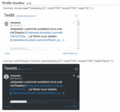 Examples of profile timelines
 -
 Examples of list timelines
 -
 Examples of likes timelines


[[Category:Twitter extensions{{#translation:}}]] [[Category:Extensions by Fandom{{#translation:}}]] Merajul Islam (talk) 13:28, 28 January 2022 (IST)
Merajul Islam
<languages /> These are templates you can use in wikitext. See also Template:Ll that developers can use in MediaWiki code.
[[Category:MediaWiki.org website{{#translation:}}]] [[Category:Template{{#translation:}}]] Merajul Islam (talk) 13:32, 28 January 2022 (IST)
Main page
Template:NOEXTERNALLANGLINKS Merajul Islam (talk) 13:32, 28 January 2022 (IST)
Merajul Islam
Open main menu Wikibooks Search Wikibooks Main Page Featured books • Wikijunior • Cookbook • Browse books • Help • Forum • Using Wikibooks
Welcome to Wikibooks, the open-content textbooks collection that anyone can edit. 3,428 books with 95,167 pages. Computing Engineering Humanities Languages Mathematics Miscellaneous Recreational activities Science Social sciences Standard curricula Wikijunior All subjects More featured books... KL Intel i386DX.jpg Ever wonder what the relationship was between the C programming language, Assembly Language, and machine code on the x86 family of microprocessors? Learn the art of disassembly and reverse engineering on the x86 platform with the x86 Disassembly wikibook! Image credit More featured children's books... TransMilenio Estacion A Caracas.svg Children can explore all the letters of the alphabet in Alphabet. Image credit
More featured recipes...
Tarbes salad.jpg
Tarbes Salad is salty, sweet, and delicious.
Image credit
More promoted shelves...
Chess board blank.svg
Shelf:Games contains books on games, and includes the subsection shelves athletic games, board games, card games, electronic games, and game design.
Image credit
More promoted shelves...
Openscad SVG.svg
Shelf:Computer programming contains books on programming, such as LaTeX, OpenSCAD User Manual, Python Programming, and Java Programming.
Image credit
More promoted shelves...
Taj Mahal in March 2004.jpg
Shelf:Languages of Asia contains books on Asian languages, such as Marathi, Bengali, Kannada, Hindi, and Sanskrit.
Image creditWikibooks is hosted by the Wikimedia Foundation, which also hosts:
Wikiversity
Wikiversity
Learning resources
Wikipedia Wikipedia Encyclopedia
Wiktionary Wiktionary Dictionary and thesaurus
Wikiquote Wikiquote Quotations
Wikisource Wikisource Documents
Wikispecies Wikispecies Species directory
Wikinews Wikinews News reports
Wikivoyage Wikivoyage Travel guide
Wikidata Wikidata Knowledge database
Wikimedia Commons Commons Media repository
Meta Wikimedia Meta Coordination
MediaWiki MediaWiki MediaWiki software
Phabricator Phabricator MediaWiki bug tracker
Wikimedia Labs Wikimedia Labs MediaWiki development
The Wikimedia Foundation is a non-profit organization that depends on your voluntarism and donations to operate. If you find Wikibooks or other projects hosted by the Wikimedia Foundation useful, please volunteer or make a donation. Your donations primarily helps to purchase server equipment, launch new projects, and develop MediaWiki—the software that makes Wikibooks possible.
Language View edit history of this page. Wikibooks Content is available under CC BY-SA 3.0 unless otherwise noted. Privacy policy Terms of UseDesktop Merajul Islam (talk) 13:34, 28 January 2022 (IST)
Submit
Open main menu Wikipedia Search View source for Islam ← Islam You do not have permission to edit this page, for the following reasons:
You are currently unable to edit Wikipedia. Editing from your IP address (116.58.202.83) has been blocked (disabled) on all Wikimedia wikis until 07:04, 4 February 2022 by Cromium (meta.wikimedia.org) for the following reason:
Long-term abuse This block began on 07:04, 28 January 2022
Your current IP address is 116.58.202.83. Please include all above details in any queries you make.
If you believe you were blocked by mistake, you can find additional information and instructions in the No open proxies global policy. Otherwise, to discuss the block please post a request for review on Meta-Wiki.
Learn more This page is currently semi-protected so that only established, registered users can edit it. Why is the page protected? While most articles can be edited by anyone, semi-protection is sometimes necessary to prevent vandalism to popular pages. The reason for protection can be found in the protection log. If there are no relevant entries in the protection log, the page may have been moved after being protected. What can I do? If you have a user account, log in first. If you do not yet have an account, you may create one; after 4 days and 10 edits, you will be able to edit semi-protected pages. Discuss this page with others. For move-protected pages, see requested moves. Request that the page's protection level be reduced. Find out more about how to get started editing Wikipedia. If you have noticed an error or have a suggestion for a simple, non-controversial change, you can submit an edit request by clicking the button below and following the instructions. An established user may then make the change on your behalf. Please check the talk page first in case the issue is already being discussed. Submit an edit request
You can view and copy the source of this page:
| Part of a series on |
| Islam |
|---|
 |
|
|
Islam (/ˈɪslɑːm/;[lower-alpha 1] Arabic: اَلْإِسْلَامُ, romanized: al-’Islām, [ɪsˈlaːm] ( listen)) is an Abrahamic monotheistic religion teaching that Muhammad is a messenger of God.[1][2] It is the world's second-largest religion with 1.9 billion followers or 24.9% of the world's population,[3][4] known as Muslims.[5] Islam teaches that God is merciful, all-powerful, and unique,[6] and has guided humanity through prophets, revealed scriptures, and natural signs.[2][7] The primary scriptures of Islam are the Quran, believed to be the verbatim word of God, as well as the teachings and practices (sunnah), in traditional accounts (hadith) of Muhammad (c. 570 – 632 CE).[8]
Muslims believe that Islam is the complete and universal version of a primordial faith that was revealed many times before through prophets such as Adam, Abraham, Moses, and Jesus.[9] Muslims consider the Quran, in Arabic, to be the unaltered and final revelation of God.[10] Like other Abrahamic religions, Islam also teaches a final judgment with the righteous rewarded in paradise and the unrighteous punished in hell.[11] Religious concepts and practices include the Five Pillars of Islam, which are obligatory acts of worship, as well as following Islamic law (sharia), which touches on virtually every aspect of life and society, from banking and welfare to women and the environment.[12][13] The cities of Mecca, Medina and Jerusalem are home to the three holiest sites in Islam.[14]
From a historical point of view, Islam originated in early 7th century CE in the Arabian Peninsula, in Mecca.[15] and by the 8th century, the Umayyad Caliphate extended from Iberia in the west to the Indus River in the east. The Islamic Golden Age refers to the period traditionally dated from the 8th century to the 13th century, during the Abbasid Caliphate, when much of the historically Muslim world was experiencing a scientific, economic, and cultural flourishing.[16][17][18] The expansion of the Muslim world involved various states and caliphates such as the Ottoman Empire, trade, and conversion to Islam by missionary activities (dawah).[19]
Most Muslims are of one of two denominations: Sunni (85–90%)[20] or Shia (10–15%),[21][22][23] and make up a majority of the population in 49 countries.[24][25] Sunni and Shia differences arose from disagreement over the succession to Muhammad and acquired broader political significance, as well as theological and juridical dimensions.[26] About 12% of Muslims live in Indonesia, the most populous Muslim-majority country;[27] 31% live in South Asia;[28] 20% in the Middle East–North Africa and 15% in sub-Saharan Africa.[29] Sizable Muslim communities can also be found in the Americas, China, and Europe.[30][31] Islam is the fastest-growing major religion in the world.[32][33]
Etymology

In Arabic, Islam (Arabic: إسلام lit. 'submission [to God]') is the verbal noun originating from the verb سلم (salama), from triliteral root س-ل-م (S-L-M), which forms a large class of words mostly relating to concepts of wholeness, submission, sincerity, safeness, and peace.[34] Islam is the verbal noun of Form IV of the root and means "submission" or "total surrender". In a religious context, it means "total surrender to the will of God".[35][36] A Muslim (Arabic: مُسْلِم), the word for a follower of Islam, is the active participle of the same verb form, and means "submitter (to God)" or "one who surrenders (to God)". The word "Islam" ("submission") sometimes has distinct connotations in its various occurrences in the Quran. Some verses stress the quality of Islam as an internal spiritual state: "Whoever God wills to guide, He opens their heart to Islam."[lower-roman 1][36]
Others describe Islam as an action of returning to God—more than just a verbal affirmation of faith.[lower-roman 2] In the Hadith of Gabriel, Islam is presented as one part of a triad that also includes imān (faith), and ihsān (excellence).[37][38]
The word "silm" (Arabic: سِلْم) in Arabic means both peace and also the religion of Islam.[39] A common linguistic phrase demonstrating its usage is "he entered into as-silm" (Arabic: دَخَلَ فِي السِّلْمِ) which means "he entered into Islam," with a connotation of finding peace by submitting one's will to the Will of God.[39] The word "Islam" can be used in a linguistic sense of submission or in a technical sense of the religion of Islam, which also is called as-silm which means peace.[39]
Islam itself was historically called Mohammedanism in the English-speaking world. This term has fallen out of use and is sometimes said to be offensive, as it suggests that a human being, rather than God, is central to Muslims' religion, parallel to Buddha in Buddhism.[40] Some authors, however, continue to use the term Mohammedanism as a technical term for the religious system as opposed to the theological concept of Islam that exists within that system.
Articles of faith
The Islamic creed (aqidah) requires belief in six articles: God, angels, books, prophets, the Day of Resurrection and in the divine decree.
God
Template:Allah The central concept of Islam is tawḥīd (Arabic:توحيد), the oneness of God. Usually thought of as a precise monotheism, but also panentheistic in Islamic mystical teachings.[41] God is seen as imcomparable and without partners such as in the Christian Trinity,[42] and associating partners to God or attributing God's attributes to others is seen as idolatory, called shirk. God is seen as transcendent of creation and so is beyond comprehension. Thus, therefore Muslims are not iconodules and do not attribute forms to God. God is instead described and referred to by several names or attributes, the most common being Ar-Rahmān (الرحمان) meaning "The Entirely Merciful," and Ar-Rahīm ( الرحيم) meaning "The Especially Merciful" which are invoked at the beginning of most chapters of the Quran.[43][44]
Islam teaches that the creation of everything in the universe was brought into being by God's command as expressed by the wording, "Be, and it is,"[lower-roman 3][45] and that the purpose of existence is to worship God.[lower-roman 4][46][47] He is viewed as a personal god[lower-roman 5][45] and there are no intermediaries, such as clergy, to contact God. Consciousness and awareness of God is referred to as Taqwa. Allāh is a term with no plural or gender being ascribed to it and is also used by Muslims and Arabic-speaking Christians and Jews in reference to God, whereas ʾilāh (Arabic: إله) is a term used for a deity or a god in general.[48] Other non-Arab Muslims might use different names as much as Allah, for instance "Tanrı" in Turkish or "Khodā" in Persian.
Angels

Belief in angels is fundamental to Islam. The Quranic word for angel (Arabic:ملك malak) derives either from Malaka, meaning "he controlled", due to their power to govern different affairs assigned to them,[49] or from the triliteral root ’-l-k, l-’-k or m-l-k with the broad meaning of a "messenger", just as its counterpart in Hebrew (malʾákh). Unlike the Hebrew word, however, the term is used exclusively for heavenly spirits of the divine world, as opposed to human messengers. The Quran refers to both angelic and human messengers as rasul instead.[50]
The Quran is the principal source for the Islamic concept of angels.[51] Some of them, such as Gabriel and Michael, are mentioned by name in the Quran; others are only referred to by their function. In hadith literature, angels are often assigned to only one specific phenomenon.[52] Angels play a significant role in the literature about the Mi'raj, where Muhammad encounters several angels during his journey through the heavens.[52] Further angels have often been featured in Islamic eschatology, theology and philosophy.[53] Duties assigned to angels include, for example, communicating revelations from God, glorifying God, recording every person's actions, and taking a person's soul at the time of death.
In Islam, just as in Judaism and Christianity, angels are often represented in anthropomorphic forms combined with supernatural images, such as wings, being of great size or wearing heavenly articles.[54] The Quran describes "Angels as His messengers with wings—two, three, or four."[lower-roman 6][55] Common characteristics for angels are their missing needs for bodily desires, such as eating and drinking.[56] Their lack of affinity to material desires is also expressed by their creation from light: angels of mercy are created from nūr ('light')[57] in opposition to the angels of punishment created from nār ('fire').[58] Muslims do not generally share the perceptions of angelic pictorial depictions, such as those found in Western art.
Books
.jpg)
The Islamic holy books are the records that most Muslims believe were dictated by God to various prophets. Muslims believe that parts of the previously revealed scriptures, the Tawrat (Torah) and the Injil (Gospel), had become distorted—either in interpretation, in text, or both.[59] The Quran (lit. "Recitation") is viewed by Muslims as the final and literal revealed word of God and is widely regarded as the finest literary work in the classical Arabic language.[60][61] Although the Quran is the last verbatim of God towards mankind, communication with God is not enclosed, but an ongoing process.[62]: Many Muslims believe that "friends of God" (ʾawliyāʾ) could communicate with God, for example, to predict future events, know God's will and interpret the Quran.[63]:
Muslims believe that the verses of the Quran were revealed to Muhammad by God through the archangel Gabriel (Jibrīl) on many occasions between 610 CE until his death in 632.[64] While Muhammad was alive, these revelations were written down by his companions (sahabah), although the prime method of transmission was orally through memorization.[65] The Quran is divided into 114 chapters (suras) which combined contain 6,236 verses (āyāt). The chronologically earlier suras, revealed at Mecca, are concerned primarily with ethical and spiritual topics. The later Medinan suras mostly discuss social and legal issues relevant to the Muslim community.[45][66]
The Quran is more concerned with moral guidance than legislation, and is considered the "sourcebook of Islamic principles and values".[67] Muslim jurists consult the hadith ('accounts'), or the written record of Prophet Muhammad's life, to both supplement the Quran and assist with its interpretation. The science of Quranic commentary and exegesis is known as tafsir.[68][69] The set of rules governing proper elocution of recitation is called tajwid. Muslims usually view "the Quran" as the original scripture as revealed in Arabic and that any translations are necessarily deficient, which are regarded only as commentaries on the Quran.[66][70]
Prophets and sunnah

Prophets (Arabic: أنبياء, anbiyāʾ) communicate with God and receive a divine message. A prophet delivering a message to a nation is called a rasul (Arabic: رسول, rasūl).[71] Muslims believe prophets are human and not divine, though some can perform miracles to prove their claim.[citation needed] According to Islam, all of God's messengers preached the message of Islam—submission to the will of God. The Quran mentions the names of numerous figures considered prophets in Islam, including Adam, Noah, Abraham, Moses and Jesus, among others.[45]
Muslims believe that God finally sent Muhammad as the last law-bearing prophet ("Seal of the prophets") to convey the divine message to the entire world (to sum up and to finalize the word of God). In Islam, the "normative" example of Muhammad's life is called the sunnah (literally "trodden path"). Muslims are encouraged to emulate Muhammad's actions in their daily lives, and the Sunnah is seen as crucial to guiding interpretation of the Quran.[72] This example is preserved in traditions known as hadith, which recount his words, his actions, and his personal characteristics. Hadith Qudsi is a sub-category of hadith, regarded as God's verbatim words quoted by Muhammad that are not part of the Quran. A hadith involves two elements: a chain of narrators, called sanad, and the actual wording, called matn. Hadiths can be classified, by studying the narration as: "authentic" or "correct" (صَحِيْح, ṣaḥīḥ); "good", hasan (حَسَن, ḥasan); or "weak" (ضَعِيْف, ḍaʻīf), among others. The Kutub al-Sittah are a collection of six books, regarded as the most authentic reports in Sunnism. Among them is Sahih al-Bukhari, often considered by Sunnis to be one of the most authentic sources after the Quran.[73][74] Another famous source of hadiths is known as The Four Books, which Shias consider as the most authentic hadith reference.[75][76][77]
Because the Quran only briefly covered the lives of biblical prophets, scholars, poets, historians, and storytellers elaborate their stories in Tales of the Prophets. Many of these scholars were also authors of commentaries on the Quran; however, unlike Quran commentaries which follow the order and structure of the Quran itself, the Tales of the Prophets told its stories of the prophets in chronological order—which makes them similar to the Jewish and Christian versions of the Bible.
Besides prophets, saints possess blessings (Arabic:بركة , "baraka") and can perform miracles (Arabic:امات, Karāmāt). Saints rank lower than prophets, and they do not intercede for people on the Day of Judgment. However, both the tombs of prophets and saints are visited frequently (Ziyarat). People would seek the advice of a saint in their quest for spiritual fulfilment. Unlike saints in Christianity, Muslim saints are usually acknowledged informal by consensus of common people, not by scholars. Unlike prophets, women like Rabia of Basra were accepted as saints.[78]
Resurrection and judgment
Belief in the "Day of Resurrection" or Yawm al-Qiyāmah (Arabic:يوم القيامة), is also crucial for Muslims. It is believed that the time of Qiyāmah is preordained by God but unknown to man. The Quran and the hadith, as well as in the commentaries of scholars, describe the trials and tribulations preceding and during the Qiyāmah. The Quran emphasizes bodily resurrection, a break from the pre-Islamic Arabian understanding of death.[79]
On Yawm al-Qiyāmah (Arabic: يوم القيامة), Muslims believe all humankind will be judged by their good and bad deeds and consigned to Jannah (paradise) or Jahannam (hell). The Quran in Surat al-Zalzalah describes this as: "So whoever does an atom's weight of good will see it. And whoever does an atom's weight of evil will see it." The Quran lists several sins that can condemn a person to hell, such as disbelief in God (كفر, kufr), and dishonesty. However, the Quran makes it clear that God will forgive the sins of those who repent if he wishes. Good deeds, like charity, prayer, and compassion towards animals,[80][81] will be rewarded with entry to heaven. Muslims view heaven as a place of joy and blessings, with Quranic references describing its features. Mystical traditions in Islam place these heavenly delights in the context of an ecstatic awareness of God.[82] Yawm al-Qiyāmah is also identified in the Quran as Yawm ad-Dīn (Arabic:يوم الدين "Day of Religion");[lower-roman 7] as-Sāʿah (Arabic:الساعة "the Last Hour");[lower-roman 8] and al-Qāriʿah (Arabic:القارعة "The Clatterer");[lower-roman 9]
Divine predestination
The concept of divine decree and destiny in Islam (Arabic: القضاء والقدر, al-qadāʾ wa l-qadar) means that every matter, good or bad, is believed to have been decreed by God. Al-qadar, meaning "power", derives from a root that means "to measure" or "calculating".[83][84] Muslims often express this belief in divine destiny with the phrase "Insha-Allah" meaning "if God wills" when speaking on future events.[85][86] In addition to loss, gain is also seen as a test of believers - whether they would still recognize that the gain originates only from God.[87]
Acts of worship
There are five obligatory acts of worship – the Shahada, the five daily prayers, the Zakat alms-giving, fasting during Ramadan and the Hajj pilgrimage – collectively known as "The Pillars of Islam" (Arkān al-Islām).[88] Apart from these, Muslims also perform other supplemental religious acts.
Testimony

The shahadah,[89] is an oath declaring belief in Islam. The expanded statement is "ʾašhadu ʾal-lā ʾilāha ʾillā-llāhu wa ʾašhadu ʾanna muħammadan rasūlu-llāh" (أشهد أن لا إله إلا الله وأشهد أن محمداً رسول الله), or, "I testify that there is no deity except God and I testify that Muhammad is the messenger of God."[90] Islam is sometimes argued to have a very simple creed with the shahada being the premise for the rest of the religion. Non-Muslims wishing to convert to Islam are required to recite the shahada in front of witnesses.[91][92][93]
Prayer

Prayer in Islam, called salah or ṣalāt (Arabic: صلاة|صلاة), is seen as a personal communication with God and consists of repeating units called rakat that include bowing and prostrating to God. Performing prayers five times a day is compulsory. The prayers are recited in the Arabic language and consist of verses from the Quran.[94] The prayers are done in direction of the Ka'bah. Salat requires ritual purity, which involves wudu (ritual wash) or occasionally, such as for new converts, ghusl (full body ritual wash). The means used to signal the prayer time is a vocal call called the adhan.
A mosque is a place of worship for Muslims, who often refer to it by its Arabic name masjid. Although the primary purpose of the mosque is to serve as a place of prayer, it is also important to the Muslim community as a place to meet and study with the Masjid an-Nabawi ("Prophetic Mosque") in Medina, Saudi Arabia, having also served as a shelter for the poor.[95] Minarets are towers used to chant the adhan.[96]
Charity
— Quran (2:177)
Zakāt (Arabic: زكاة, zakāh) is a means of welfare in a Muslim society, characterized by the giving of a fixed portion (2.5% annually)[97] of accumulated wealth by those who can afford it to help the poor or needy, such as for freeing captives, those in debt, or for (stranded) travellers, and for those employed to collect zakat.[lower-roman 10][98] It is considered a religious obligation (as opposed to supererogatory charity, known as Sadaqah) that the well-off owe to the needy because their wealth is seen as a "trust from God's bounty" and is seen as a "purification" of one's excess wealth. Conservative estimates of annual zakat are that it amounts to 15 times global humanitarian aid contributions.[99] The first Caliph, Abu Bakr, distributed zakat as one of the first examples of a guaranteed minimum income, with each man, woman and child getting 10 to 20 dirhams annually.[100]
Sadaqah means optional charity practiced as a religious duty and out of generosity.[101] Both the Quran and the hadith put much emphasis on spending money for the welfare of needy people,[102] and have urged Muslims to give more as an act of optional charity.[lower-roman 11][103] The Quran says: "Those who spend their wealth in charity day and night, secretly and openly—their reward is with their Lord."[lower-roman 12] One of the early teachings of Muhammad was that God expects men to be generous with their wealth and not to be miserly.[lower-roman 13][104] Accumulating wealth without spending it to address the needs of the poor is generally prohibited and admonished.[105] Another kind of charity in Islam is waqf, meaning a perpetual religious endowment of property.
Fasting

During the month of Ramadan, it is obligatory for Muslims to fast. The Ramadan fast (Arabic: صوم, ṣawm) precludes food and drink, as well as other forms of consumption, such as smoking, and is performed from dawn to sunset. The fast is to encourage a feeling of nearness to God by restraining oneself for God's sake from what is otherwise permissible and to think of the needy. Certain groups are exempt, including pregnant women.[106][better source needed] In addition, there are other days when fasting is supererogatory.
Pilgrimage

The obligatory Islamic pilgrimage, called the "ḥajj" (Arabic: حج), is to be done at least once a lifetime by every Muslim with the means to do so during the Islamic month of Dhu al-Hijjah. Rituals of the Hajj mostly imitate the story of the family of Abraham. Pilgrims spend a day and a night on the plains of Mina, then a day praying and worshipping in the plain of Mount Arafat, then spending a night on the plain of Muzdalifah; then moving to Jamarat, symbolically stoning the Devil,[107] then going to the city of Mecca and walking seven times around the Kaaba, which Muslims believe Abraham built as a place of worship, then walking seven times between Mount Safa and Mount Marwah recounting the steps of Abraham's wife, Hagar, while she was looking for water for her baby Ishmael in the desert before Mecca developed into a settlement.[108] All Muslim men should wear only two simple white unstitched pieces of cloth called ihram, intended to bring continuity through generations and uniformity among pilgrims despite class or origin.[109][110] Another form of pilgrimage, umrah, is supererogatory and can be undertaken at any time of the year. Medina is also a site of Islamic pilgrimage and Jerusalem, the city of many Islamic prophets, contains the Al-Aqsa Mosque, which used to be the direction of prayer before Mecca.
Quranic recitation and memorization

Muslims recite and memorize the whole or parts of the Quran as acts of virtue. Reciting the Quran with elocution (tajwid) has been described as an excellent act of worship.[111] Pious Muslims recite the whole Quran during the month of Ramadan.[112] In Muslim societies, any social program generally begins with the recitation of the Quran.[112] One who has memorized the whole Quran is called a hafiz ("memorizer") who, it is said, will be able to intercede for ten people on the Last Judgment Day.[111] Apart from this, almost every Muslim memorizes some portion of the Quran because they need to recite it during their prayers.


Supplication and remembrance
Supplication to God, called in Arabic duʿāʾ (Arabic: اَلدُّعَاءُ IPA: [duˈʕæːʔ]) has its own etiquette such as raising hands as if begging or invoking with an extended index finger.
Remebrance of God (Arabic: ذِكْر, Dhikr') refers to phrases repeated referencing God. Commonly, this includes Tahmid, declaring praise be due to God (Arabic: ٱلْحَمْدُ لِلَّٰهِ, al-Ḥamdu lillāh) during prayer or when feeling thankful, Tasbih, declaring glory to God during prayer or when in awe of something and saying 'in the name of God' (Arabic: بَسْمَلَة, basmalah) before starting an act such as eating.
History

Muhammad (610–632)
| Part of a series on |
| Muhammad |
|---|
| Muhammad circular symbol |
|
|
Born in Mecca in 571, Muhammad was orphaned early in life. New trade routes rapidly transformed Meccan society from a semi-bedouin society to commercial urban society, leaving out weaker segments of society without protection. He acquired the nickname "trustworthy" (Arabic: الامين), [113] and was sought after as a bank to safeguard valuables and an impartial arbitrator. Affected by the ills of society and after becoming financially secure as a caravan merchant, he began retreating to a cave to contemplate. During the last 22 years of his life, beginning at age 40 in 610 CE, Muhammad reported receiving revelations from God, conveyed to him through the archangel Gabriel,[114][115] thus becoming the seal of the prophets sent to the mankind according to Islamic tradition.[116][114]
During this time, while in Mecca, Muhammed preached first in secret and then in public, imploring them to abandon polytheism and worship one God. Many early converts to Islam were women, the poor, foreigners, and slaves like the first muezzin Bilal ibn Rabah al-Habashi. The Meccan elite profited from the pilgrimages to the idols of the Kaaba and felt Muhammad was destabilizing their social order by preaching about one God and that in the process he gave ideas to the poor and slaves.[117][118] Muhammad, who was accused of being a poet, a madman or possessed, presented the challenge of the Quran to imitate the like of the Quran in order to disprove him. The Meccan authorities persecuted Muhammad and his followers, including a boycott and banishment of Muhammad and his clan to starve them into withdrawing their protection of him. This resulted in the Migration to Abyssinia of some Muslims (to the Aksumite Empire).
After 12 years of the persecution of Muslims by the Meccans, Muhammad and his companions performed the Hijra ("emigration") in AD 622 to the city of Yathrib (current-day Medina). There, with the Medinan converts (the Ansar) and the Meccan migrants (the Muhajirun), Muhammad in Medina established his political and religious authority. The Constitution of Medina was signed,[lower-alpha 2] by all the tribes of Medina agreeing to defend Medina from external threats and establishing among the Muslim, Jewish, Christian, and pagan communities religious freedoms and freedom to use their own laws, security of women and the role of Medina as a sacred place barred of weapons and violence.[124] Within a few years, two battles took place against the Meccan forces: first, the Battle of Badr in 624—a Muslim victory—and then a year later, when the Meccans returned to Medina, the Battle of Uhud, which ended inconclusively.[citation needed] The Arab tribes in the rest of Arabia then formed a confederation, and during the Battle of the Trench (March–April 627) besieged Medina, intent on finishing off Islam. In 628, the Treaty of Hudaybiyyah was signed between Mecca and the Muslims and was broken by Mecca two years later. After signing the Treaty of Hudaybiyyah, many more people converted to Islam. At the same time, Meccan trade routes were cut off as Muhammad brought surrounding desert tribes under his control.[125] By 629 Muhammad was victorious in the nearly bloodless conquest of Mecca, and by the time of his death in 632 (at age 62) he had united the tribes of Arabia into a single religious polity.[126]
The earliest three generations of Muslims are known as the Salaf, with the companions of Muhammad being known as the Sahaba. Many of them, such as the largest narrator of hadith Abu Hureyrah, recorded and compiled what would constitute the sunnah.
Caliphate and civil strife (632–750)


Following Muhammad's death in 632, Muslims disagreed over who would succeed him as leader. The first four successors – Abu Bakr, Umar, Uthman ibn al-Affan and Ali ibn Abi Talib – are known in Sunni Islam as al-khulafā' ar-rāshidūn ("Rightly Guided Caliphs").[127] Abu Bakr's leadership oversaw the beginning of the compilation of the Qur'an and reunification of Arabia through the Ridda wars.[128] Under Umar, the caliphate expanded rapidly as Muslims scored major victories over the Persian and Byzantine empires.[129] Uthman was elected in 644 and oversaw the compilation of the Quran. The assassination of Uthman in 656 plunged the caliphate into the first civil war. The next caliph, Ali, fought against three separate factions in the Battle of the Camel, Battle of Siffin and Battle of Nahrawan, respectively. The Kharijites assassinated Ali in 661. To avoid further fighting, Ali's son Hasan ibn Ali signed a peace treaty abdicating to Mu'awiyah, which began the Umayyad dynasty.[130] These disputes over religious and political leadership would give rise to the Sunni-Shia schism, with the Shia believing leadership belonging to Ali and the ahl al-bayt.[131] The succession of Mu'awiyah by his son Yazid I sparked the "second civil war". During the Battle of Karbala, Husayn ibn Ali and other descendants of Muhammad were massacred; the event has been annually commemorated by Shia ever since. Sunni Islam and Shia Islam differ in some respects.[132]
The Murji'ah was an early Islamic sect that taught that people's righteousness could be judged by God alone and that wrongdoers might be considered misguided but not denounced as unbelievers.[133] They urged unity among Muslims, and their conciliatory principles made them popular. Abu Hanifa, founder of the Hanafi (c. 699–767) school of Sunni jurisprudence, was often associated with the Murji'ah.[134] In his al-Fiqh al-Akbar I he lay down probably the oldest surviving work regarding early Muslim creed, advocating respect for all the companions of Muhammad, withholding judgment regarding Uthman and Ali and predeterminism. His works were fundamental to later Sunni theology, Hanbalism being an exception.[134]
The Umayyad dynasty conquered the Maghreb, the Iberian Peninsula, Narbonnese Gaul and Sindh.[135] Local populations of Jews and indigenous Christians, persecuted as religious minorities and taxed heavily to finance the Byzantine–Sassanid Wars, often helped Muslims take over their lands from the Byzantines and Persians, resulting in exceptionally speedy conquests.[136][137]
The generation after the death of Muhammad but contemporaries of his companions are known as the Tabi'un, followed by the Tabi‘ al-Tabi‘in. The Caliph Umar ibn Abd al-Aziz set up the influential committee, The Seven Fuqaha of Medina,[138][139] headed by Qasim ibn Muhammad ibn Abi Bakr.[140] Malik ibn Anas wrote one of the earliest books on Islamic jurisprudence, the Muwatta,[141] as a consensus of the opinion of those jurists.[142][143][144]
The descendants of Muhammad's uncle Abbas ibn Abd al-Muttalib rallied discontented non-Arab converts (mawali), poor Arabs, and some Shi'a against the Umayyads and overthrew them, inaugurating the Abbasid dynasty in 750.[145][146]
The first Muslim states independent of a unified Islamic state emerged from the Berber Revolt (739/740-743).
Classical era (750–1258)

Al-Shafi'i codified a method to determine the reliability of hadith.[147] During the early Abbasid era, scholars such as Bukhari and Muslim compiled the major Sunni hadith collections while scholars like Al-Kulayni and Ibn Babawayh compiled major Shia hadith collections. The four Sunni Madh'habs, the Hanafi, Hanbali, Maliki, and Shafi'i, were established around the teachings of Abū Ḥanīfa, Ahmad ibn Hanbal, Malik ibn Anas and al-Shafi'i. In contrast, the teachings of Ja'far al-Sadiq formed the Ja'fari jurisprudence. In the 9th century, al-Shafi'i provided a theoretical basis for Islamic law and introduced its first methods by a synthesis between the proto-rationalism of Iraqi jurisprudence and the pragmatic approach of the Hejaz traditions, in his book ar-Risālah.[148] He also codified a method to determine the reliability of hadith.[147] However, Islamic law would not be codified until 1869.[149] In the 9th century Al-Tabari completed the first commentary of the Quran, that became one of the most cited commentaries in Sunni Islam, the Tafsir al-Tabari.
Some Muslims began questioning the piety of indulgence in worldly life and emphasized poverty, humility, and avoidance of sin based on renunciation of bodily desires. Ascetics such as Hasan al-Basri would inspire a movement that would evolve into Tasawwuf or Sufism.[150][151] Hasan al Basri opposed the Umayyad governors of Iraq and the violent rebellion of the Kharijites. Connected to his political dissent was his rigorist view of sin: He denied that God was the source of all human actions and emphasized responsibility and free will instead. For Hasan al Basri, although God knows people's actions, good and evil come from abuse of free will and the devil.[152][lower-alpha 3] Basran al Wasil ibn Ata (d. 748), an associate of Hasan al-Basri is usually considered the originator, along with Amr ibn Ubayd (699-761) of Mu‘tazilism, a school of thought ultimately rooted in Greek philosophy and known for upholding the doctrine of free-will.[154] However, the main doctrine, the Five Principles, is probably developed by Abu’l-Hudhayl al-Allaf (c. 753–841).[155]
Abbasid Caliphs Mamun al Rashid and Al-Mu'tasim made the Mu'tazilite theology an official creed. Ahmad ibn Hanbal opposed most of the Mu'tazilite doctrines, for which he was imprisoned and sent to an unlit Baghdad prison cell for nearly thirty months.[156] He became a representative for traditionalistic Sunni theology, trying to minimalize reason and applying to literal readings. Later Sunnis also condemned the Mutazilite idea of the creation of the Quran.[152] Al-Ash'ari and Maturidi founded the scholastic theology of Sunni Islam (kalam) Ash'arism and Maturidism, respectively.
By the end of the 9th century, Ismaili Shias spread in Iran, whereupon the city of Multan became a target of activistic Sunni politics.[157] In 930, the Ismaili group known as the Qarmatians rebelled unsuccessfully against the Abbassids, sacked Mecca and stole the Black Stone, which was eventually retrieved.[158]
With the expansion of the Abbasid Caliphate into the Sasanian Empire, Islam adapted many Hellenistic and Persian concepts, imported by thinkers of Iranian or Turkic origin.[159][160] Philosophers such as Al-Farabi (872 – 950/951) and Avicenna (c. 980 – June 1037) sought to incorporate Greek principles into Islamic theology, while others like Al-Ghazali (c. 1058 – 1111) argued against such syncretism and ultimately prevailed.[161]
This era is sometimes called the "Islamic Golden Age".[162] Avicenna pioneered the science of experimental medicine,[163] and was the first physician to conduct clinical trials.[164] His two most notable works, The Book of Healing and The Canon of Medicine, were used as standard medicinal texts in the Islamic world and later in Europe. Amongst his contributions are the discovery of the contagious nature of infectious diseases,[163] and the introducing clinical pharmacology.[165] In mathematics, the mathematician Muhammad ibn Musa al-Khwarizmi gave his name to the concept of the algorithm, while the term algebra is derived from al-jabr.[166] Public hospitals established during this time (called Bimaristan hospitals), are considered "the first hospitals" in the modern sense of the word,[167][168] and issued the first medical diplomas to license doctors.[169][170] The Guinness World Records recognizes the University of Al Karaouine, founded in 859, as the world's oldest degree-granting university.[171] The doctorate is argued to date back to the licenses to teach in Islamic law schools.[172] Standards of experimental and quantification techniques, as well as the tradition of citation,[173] were introduced. An important pioneer in this, Ibn al-Haytham (c. 965 – c. 040) is regarded as the father of the modern scientific method and often referred to as the "world's first true scientist".[174][175][176][177] The government paid scientists the equivalent salary of professional athletes today.[173] It is argued that that Al-Jahiz (776–868/869) proposed a theory of natural selection.[178][179] The Persian poet Ferdowsi (940–1019/1025) wrote his epic poem Shahnameh. Legal institutions introduced include the trust and charitable trust (Waqf).[180][181]
While the Abbasid Caliphate suffered a decline following the reign of Al-Wathiq (842–847) and Al-Mu'tadid (892–902),[182] the Mongol Empire put an end to the Abbassid dynasty in 1258.[183] During its decline, the Abbasid Caliphate disintegrated into minor states and dynasties, such as the Tulunid and the Ghaznavid dynasty. The Ghaznavid dynasty was a Muslim dynasty established by Turkic slave-soldiers from another Islamic empire, the Samanid Empire.[184] Two other Turkish tribes, the Karahanids and the Seljuks, converted to Islam during the 10th century. Later, they were subdued by the Ottomans, who share the same origin and language. The Seljuks played an important role in the revival of Sunnism when Shi'ism increased its influence. The Seljuk military leader Alp Arslan financially supported sciences and literature and established the Nezamiyeh university in Baghdad.[185]
Religious missions converted Volga Bulgaria to Islam. In the Indian Subcontinent, during the Delhi Sultanate, the Indian Islamic missionaries achieved their greatest success in terms of dawah and the number of converts to Islam.[186][187] The Delhi Sultanate is known for enthroning one of the few female rulers in Islamic history, Razia Sultana.[188] Many Muslims also went to China to trade, virtually dominating the import and export industry of the Song dynasty.[189]
Pre-Modern era (1258–18th century)

Through Muslim trade networks, the activity of Sufi orders, and the conquests of the Gunpowder Empires, Islam spread into new areas.[36][190] Conversion to Islam, however, was not a sudden abandonment of old religious practices; rather, it was typically a matter of "assimilating Islamic rituals, cosmologies, and literatures into... local religious systems",[191] as illustrated by Muhammad's appearance in Hindu folklore.[192] The Turks probably found similarities between Sufi rituals and Shaman practices.[193] Muslim Turks incorporated elements of Turkish Shamanism beliefs to Islam.[lower-alpha 4][193] Muslims in China, who were descended from earlier immigrants, were assimilated, sometimes by force, by adopting Chinese names and culture while Nanjing became an important center of Islamic study.[194][195]
While cultural influence used to radiate outward from Baghdad, after the Mongol destruction of the Abbasid Caliphate, Arab influence decreased.[196] Iran and Central Asia, enjoying increasing cross-cultural exchanges with East Asia under Mongol influence, flourished and developed more distinctively from Arab influence, such as the Timurid Renaissance under the Timurid dynasty.[197] Jalaluddin Rumi (1207 – 1273), still one of the best selling poets in America,[198][199] wrote his Persian poem Masnawi and the works of Hafez (1315 – 1390) are often considered the pinnacle of Persian poetry. Nasir al-Din al-Tusi (1201 – 1274) proposed the mathematical model that was later adopted by Copernicus unrevised in his heliocentric model and Jamshīd al-Kāshī's estimate of pi would not be surpassed for 180 years.[200] Many Muslim dynasties in India chose Persian as their court language.
Gunpowder empires consolidated much of the previously splintered territories. The Ottoman Caliphate, under the Ottoman dynasty of the Ottoman Empire, was the last caliphate of the late medieval and the early modern era. It is important to note that a symbiosis between Ottoman rulers and Sufism strongly influenced Islamic reign by the Ottomans from the beginning. According to Ottoman historiography, the legitimation of a ruler is attributed to Sheikh Edebali who interpreted a dream of Osman Gazi as God's legitimation of his reign.[201] Since Murad I's conquest of Edirne in 1362, the caliphate was claimed by the Turkish sultans of the empire.[202] During the period of Ottoman growth, claims on caliphal authority were recognized in 1517 as Selim I became the "Custodian of the Two Holy Mosques" in Mecca and Medina through the conquering and unification of Muslim lands, strengthening their claim to the caliphate in the Muslim world.[203] The Mevlevi Order and Bektashi Order had a close relation to the sultans,[204] as Sufi-mystical as well as heterodox and syncretic approaches to Islam flourished.[205][206] Under the Ottoman Empire, Islam spread to Southeast Europe.[207] In Ottoman understanding, the state's primary responsibility was to defend and extend the land of the Muslims, and to ensure security and harmony within its borders in the overarching context of orthodox Islamic practice and dynastic sovereignty.[208]
The Shia Safavid dynasty rose to power in 1501 and later conquered all of Iran.[209] At that time, the majority and oldest group among the Shia, the Zaydis, named after the great-grandson of Ali, the scholar Zayd ibn Ali, used the Hanafi jurisprudence, as did most Sunnis.[210][211][212] The ensuing conversion of Iran to Twelver Shia Islam ensured the final dominance of the Twelver sect within Shiism over the Zaidi and Ismaili sects.[213] Nader Shah, who overthrew the Safavids, attempted to improve relations with Sunnis by propagating the integration of Twelverism into Sunni Islam as a fifth madhhab, called Ja'farism.[214] However, Ja'farism failed to gain recognition from the Ottomans.[215]
In South Asia, Babur founded the Mughal Empire. The Mughals made major contributions to Islamic architecture, including the Taj Mahal and Badshahi mosque, and compiled the Fatwa Alamgiri. Mughal India surpassed Qing China to become the world's largest economy, worth 25% of world GDP,[216][217][218] with the Bengal Subah signalling the proto-industrialization and showing signs of the Industrial revolution.[219] After Mughal India's collapse, Tipu Sultan's Kingdom of Mysore based in South India, which witnessed partial establishment of sharia-based economic and military policies i.e. Fathul Mujahidin, replaced Bengal ruled by the Nawabs of Bengal as South Asia's foremost economic territory.[220][221] After Indian independence, the Nizams of Hyderabad remained as the major Muslim princely state until the Annexation of Hyderabad by the modern Republic of India.[222]
Ibn Taymiyya (1263–1328) promoted a puritanical form of Islam,[223] rejecting philosophical approaches in favor of simpler theology[223] and called to open the gates of itjihad rather than blind imitation of scholars.[224] He called for a jihad against the Crusaders, the Mongols, and those he deemed heretics.[225] His writings only played a marginal role during his lifetime.[226]
Modern era (18th – 20th centuries)

During the 18th century in Arabia, Muhammad ibn 'Abd al-Wahhab, influenced by the works of Ibn Taymiyya and Ibn al-Qayyim, founded a movement, called Wahhabi with their self-designation as Muwahiddun, to return to what he saw as unadultered Islam.[227][228] He condemned many local Islamic customs, such as visiting the grave of Muhammad or saints, as later innovations and sinful[228] and destroyed sacred rocks and trees, Sufi shrines, the tombs of Muhammad and his companions and the tomb of Husayn at Karbala, a major Shiite pilgrimage site.[229][230] He formed an alliance with the Saud family, which, by the 1920s, completed their conquest of the area that would become Saudi Arabia.[231] Ma Wanfu and Ma Debao promoted salafist movements in the nineteenth century such as Sailaifengye in China after returning from Mecca but were eventually persecuted and forced into hiding by Sufi groups.[232] Other groups sought to reform Sufism rather than reject it, with the Senusiyya and Muhammad Ahmad both waging war and establishing states in Libya and Sudan respectively.[233] In India, Shah Waliullah Dehlawi attempted a more conciliatory style against Sufism and influenced the Deobandi movement.[234] In response to the Deobandi movement, the Barelwi movement was founded as a mass movement, defending popular Sufism and reforming its practices.[235][236] The movement is famous for the celebration of the Muhammad's birthday and today, is spread across the globe.[237]
The Muslim world was generally in political decline starting the 1800s, especially regarding non-Muslim European powers. Earlier, in the fifteenth century, the Reconquista succeeded in ending the Muslim presence in Iberia. By the 19th century; the British East India Company had formally annexed the Mughal dynasty in India.[238] As a response to Western Imperialism, many intellectuals sought to reform Islam.[239] Islamic modernism, initially labelled by Western scholars as Salafiyya, embraced modern values and institutions such as democracy while being scripture-oriented.[240][241] Notable forerunners include Muhammad 'Abduh and Jamal al-Din al-Afghani.[242] Abul A'la Maududi helped influence modern political Islam.[243]
The Ottoman Empire disintegrated after World War I and the Caliphate was abolished in 1924[244] by the first President of the Turkish Republic, Mustafa Kemal Atatürk, as part of his secular reforms.[245][246] Pan-Islamists attempted to unify Muslims and competed with growing nationalist forces, such as pan-Arabism. The Organisation of Islamic Cooperation (OIC), consisting of Muslim-majority countries, was established in 1969 after the burning of the Al-Aqsa Mosque in Jerusalem.[247]
Contact with industrialized nations brought Muslim populations to new areas through economic migration. Many Muslims migrated as indentured servants (mostly from India and Indonesia) to the Caribbean, forming the largest Muslim populations by percentage in the Americas.[248] Migration from Syria and Lebanon was the biggest contributor to the Muslim population in Latin America. The resulting urbanization and increase in trade in sub-Saharan Africa brought Muslims to settle in new areas and spread their faith, likely doubling its Muslim population between 1869 and 1914.[249] Muslim immigrants began arriving largely from former colonies in several Western European nations since the 1960s, many as guest workers.
Postmodern times (20th century–present)
Forerunners of Islamic modernism influenced Islamist political movements such as the Muslim Brotherhood and related parties in the Arab world,[250] which performed well in elections following the Arab Spring,[251] Jamaat-e-Islami in South Asia and the AK Party, which has democratically been in power in Turkey for decades. In Iran, revolution replaced a secular monarchy with an Islamic state. Others such as Sayyid Rashid Rida broke away from Islamic modernists[252] and pushed against embracing what he saw as Western influence.[253] While some were quietist, others believed in violence against those opposing them even other Muslims, such as the Islamic State of Iraq and the Levant, who would even attempt to recreate the modern gold dinar as their monetary system.
In opposition to Islamic political movements, in 20th century Turkey, the military carried out coups to oust Islamist governments, and headscarves were banned in official buildings, as also happened in Tunisia.[254][255] In other places religious power was co-opted, such as in Saudi Arabia, where the state monopolized religious scholarship and are often seen as puppets of the state[256] while Egypt nationalized Al-Azhar University, previously an independent voice checking state power. Salafism was funded for it quietism.[257] Saudi Arabia campaigned against revolutionary Islamist movements in the Middle East, in opposition to Iran,[258] Turkey[259] and Qatar. Secular powers clamped down on Islamic practice such as Communist Albania, which became the first country to ban the practice of every religion,[260] and the Khmer Rouge killed about half a million Muslims as they were viewed as their primary enemy to be exterminated since they stood out and worshiped their own god.[261]
Muslim intellectuals are increasingly striving to separate scriptural Islamic beliefs from archaic cultural traditions.[262] Salafism has deepening worldwide.[263] The internet has also led to more "individualized" interpretations of Islam.[264] Liberal Muslims attempt to reconcile religious tradition with secular governance and human rights.[265][266] Women's issues receive significant weight in the modern discourse on Islam.[267] In many places, the prevalence of the hijab is growing increasingly common[268] and the percentage of Muslims favoring sharia has increased.[269]
Demographics

A 2015 demographic study reported that 24.1% of the global population, or 1.8 billion people, are Muslims.[270] In 1900, this estimate was 12.3%,[271] in 1990 it was 19.9%[29] and projections suggest the proportion will be 29.7% by 2050.[272] It has been estimated that 87–90% of Muslims are Sunni and 10–13% are Shia,[23] with a minority belonging to other sects. Approximately 49 countries are Muslim-majority,[273][274] with 62% of the world's Muslims live in Asia, and 683 million adherents in Indonesia, Pakistan, India, and Bangladesh alone.[275][276] Most estimates indicate China has approximately 20 to 30 million Muslims (1.5% to 2% of the population).[277][278] Islam in Europe is the second largest religion after Christianity in many countries, with growth rates due primarily to immigration and higher birth rates of Muslims in 2005.[279] Religious conversion has no net impact on the Muslim population growth as "the number of people who become Muslims through conversion seems to be roughly equal to the number of Muslims who leave the faith".[280] It is estimated that, by 2050, the number of Muslims will nearly equal the number of Christians around the world, "due to the young age and high fertility-rate of Muslims relative to other religious groups".[272]
Denominations
Sunni
| Part of a series on |
| Sunni Islam |
|---|
 |

Sunni Islam or Sunnism is the name for the largest denomination in Islam.[281] The term is a contraction of the phrase "ahl as-sunna wa'l-jamaat", which means "people of the sunna (the traditions of the prophet Muhammad) and the community".[282] Sunnis believe that the first four caliphs were the rightful successors to Muhammad and primarily reference six major hadith works for legal matters, while following one of the four traditional schools of jurisprudence: Hanafi, Hanbali, Maliki or Shafi'i.[13][283]
Sunni schools of theology encompass Asharism founded by Al-Ashʿarī (c. 874–936), Maturidi by Abu Mansur al-Maturidi (853–944 CE) and traditionalist theology under the leadership of Ahmad ibn Hanbal (780–855 CE). Traditionalist theology is characterized by its adherence to a literal understanding of the Quran and the Sunnah, the belief in the Quran is uncreated and eternal, and opposition to reason (kalam) in religious and ethical matters.[284] On the other hand, Maturidism asserts, scripture is not needed for basic ethics and that good and evil can be understood by reason alone,[285] but people rely on revelation, for matters beyond human's comprehension. Asharism holds that ethics can derive just from divine revelation but not from human reason. However, Asharism accepts reason regarding exegetical matters and combines Muʿtazila approaches with traditionalist ideas.[286]
In the 18th century, Muhammad ibn Abd al-Wahhab led a Salafi movement, referred by outsiders as Wahhabism, in modern-day Saudi Arabia.[287] A similar movement called Ahl al-Hadith also de-emphasized the centuries' old Sunni legal tradition, preferring to directly follow the Quran and Hadith. The Nurcu Sunni movement was by Said Nursi (1877–1960);[288] it incorporates elements of Sufism and science,[288][289] and has given rise to the Gülen movement.
Shia

Shia Islam or Shi'ism is the second-largest branch of Islam, having split doctrinally from Sunnism in the early centuries of Islam over in the designation of Abu Bakr, instead of Ali ibn Abi Talib, as the successor to the Prophet Muhammad.[290] Although there are many Shia subsects, modern Shia Islam is mainly divided into three main groupings: Twelvers (the largest and most influential group), Ismailis and Zaidi, divided along the lines of contrasting beliefs about the succession of the imams.[291]
Ibadi
Ibadi Islam or Ibadism is practised by 1.45 million Muslims around the world (~ 0.08% of all Muslims), most of them in Oman.[292] The movement rose to prominence in the Hejaz region in the 740s, when the Ibadis launched an armed insurrection against the Umayyad Caliphate. Ibadims is often associated with and viewed as a moderate variation of the Khawarij movement, though Ibadis themselves object to this classification. Unlike most Kharijite groups, Ibadism does not regard sinful Muslims as unbelievers.

Other denominations
- Quranists are Muslims who generally believe that Islamic law and guidance should only be based on the Quran, rejecting the Sunnah, thus partially or completely doubting the religious authority, reliability or authenticity of the hadith literature, which they claim are fabricated.[293] From the 19th century onward, hadith were questioned by Sayyid Ahmad Khan, Abdullah Chakralawi, Ghulam Ahmad Parwez,[294] and Muhammad Tawfīq Sidqī .[295][296] Quranists differ in the practice of Islamic rituals from other Muslims in frequency of prayer, details of prayer, zakat, fasting, or the Hajj.[293]
- Bektashi Alevism is a syncretic and heterodox local Islamic tradition, whose adherents follow the mystical (bāṭenī) teachings of Ali and Haji Bektash Veli.[297] Alevism incorporates Turkish beliefs present during the 14th century,[298] such as Shamanism and Animism, mixed with Shias and Sufi beliefs, adopted by some Turkish tribes. It has been estimated that there are 10 million to over 20 million (~ 0.5% - ~ 1% of all Muslims) Alevis worldwide.[299]
- The Ahmadiyya movement was founded by Mirza Ghulam Ahmad[300] in India in 1889.[301][lower-alpha 5] Ahmad claimed to be the "Promised Messiah" or "Imam Mahdi" of prophecy. Today the group has 10 to 20 million practitioners, but is rejected by most Muslims as heretical,[302] and Ahmadis have been subject to religious persecution and discrimination since the movement's inception.[303]
- Mahdavia is an Islamic sect that believes in a 15th-century Mahdi, Muhammad Jaunpuri.
Non-denominational Muslims
Non-denominational Muslims is an umbrella term that has been used for and by Muslims who do not belong to or do not self-identify with a specific Islamic denomination.[304][305][306] Prominent figures who refused to identify with a particular Islamic denomination have included Jamal ad-Din al-Afghani,[307] and Muhammad Ali Jinnah.[308] Recent surveys report that large proportions of Muslims in some parts of the world self-identify as "just Muslim", although there is little published analysis available regarding the motivations underlying this response.[309][310][311] The Pew Research Center reports that respondents self-identifying as "just Muslim" make up a majority of Muslims in seven countries (and a plurality in three others), with the highest proportion in Kazakhstan at 74%. At least one in five Muslims in at least 22 countries self-identify in this way.[312]
Mysticism

Sufism (Arabic: تصوف, tasawwuf), is a mystical-ascetic approach to Islam that seeks to find a direct personal experience of God. Classical Sufi scholars defined Tasawwuf as "a science whose objective is the reparation of the heart and turning it away from all else but God", through "intuitive and emotional faculties" that one must be trained to use.[313][314] Hasan al-Basri, the early Sufi ascetic often portrayed as one of the earliest Sufis,[315] emphasized fear of failing God's expectations of obedience. In contrast, later prominent Sufis, such as Mansur Al-Hallaj and Jalaluddin Rumi, emphasized religiosity based on love towards God. It is not a sect of Islam and its adherents belong to the various Muslim denominations. Ismaili Shias, whose teachings root in Gnosticism and Neo-Platonism,[316] as well as by the Illuminationist and Isfahan schools of Islamic philosophy have developed mystical interpretations of Islam.[317]
Sufis see tasawwuf as an inseparable part of Islam, just like the sharia.[318] Traditional Sufis, such as Bayazid Bastami, Jalaluddin Rumi, Haji Bektash Veli, Junaid Baghdadi, and Al-Ghazali, argued for Sufism as being based upon the tenets of Islam and the teachings of the prophet.[319][320][318] Historian Nile Green argued that Islam in the Medieval period, was more or less Sufism.[63]: Popular devotional practices such as the veneration of Sufi saints have been viewed as innovations from the original religion from followers of salafism, who have sometimes physically attacked Sufis, leading to a deterioration in Sufi–Salafi relations.
Sufi congregations form orders (tariqa) centered around a teacher (wali) who traces a spiritual chain back to Muhammad.[321] Sufis played an important role in the formation of Muslim societies through their missionary and educational activities.[150][322][323] Sufi influenced Ahle Sunnat movement or Barelvi movement defends Sufi practices and beliefs with over 200 million followers in south Asia.[324][325][326] Sufism is prominent in Central Asia,[327][328] as well as in African countries like Tunisia, Algeria, Morocco, Senegal, Chad and Niger.[312][329]
Religious law
| Part of a series on |
| Islamic jurisprudence (fiqh) |
|---|
| Islamic studies |
Sharia is the religious law forming part of the Islamic tradition.[13] It is derived from the religious precepts of Islam, particularly the Quran and the Hadith. In Arabic, the term sharīʿah refers to God's divine law and is contrasted with fiqh, which refers to its scholarly interpretations.[330][331] The manner of its application in modern times has been a subject of dispute between Muslim traditionalists and reformists.[13]
Traditional theory of Islamic jurisprudence recognizes four sources of sharia: the Quran, sunnah (Hadith and Sira), qiyas (analogical reasoning), and ijma (juridical consensus).[332] Different legal schools developed methodologies for deriving sharia rulings from scriptural sources using a process known as ijtihad.[330] Traditional jurisprudence distinguishes two principal branches of law,ʿibādāt (rituals) and muʿāmalāt (social relations), which together comprise a wide range of topics.[330] Its rulings assign actions to one of five categories called ahkam: mandatory (fard), recommended (mustahabb), permitted (mubah), abhorred (makruh), and prohibited (haram).[330][331] Some areas of sharia overlap with the Western notion of law while others correspond more broadly to living life in accordance with God's will.[331]
Historically, sharia was interpreted by independent jurists (muftis). Their legal opinions (fatwa) were taken into account by ruler-appointed judges who presided over qāḍī's courts, and by maẓālim courts, which were controlled by the ruler's council and administered criminal law.[330][331] In the modern era, sharia-based criminal laws were widely replaced by statutes inspired by European models.[331] The Ottoman Empire's 19th-century Tanzimat reforms lead to the Mecelle civil code and represented the first attempt to codify sharia.[333] While the constitutions of most Muslim-majority states contain references to sharia, its classical rules were largely retained only in personal status (family) laws.[331] Legislative bodies which codified these laws sought to modernize them without abandoning their foundations in traditional jurisprudence.[331][334] The Islamic revival of the late 20th century brought along calls by Islamist movements for complete implementation of sharia.[331][334] The role of sharia has become a contested topic around the world. There are ongoing debates whether sharia is compatible with secular forms of government, human rights, freedom of thought, and women's rights.[335][336][337]
Scholars
.jpg)
Islam, like Judaism, has no clergy in the sacerdotal sense, such as priests who mediate between God and people. However, there are many terms in Islam to refer to religiously sanctioned positions of Islam. In the broadest sense, the term ulema (Arabic: علماء) is used to describe the body of Muslim scholars who have completed several years of training and study of Islamic sciences. A jurist who interprets Islamic law is called a mufti (مفتي) and often issues legal opinions, called fatwas. A scholar of jurisprudence is called a faqih (فقيه). Someone who studies the science of hadith is called a muhaddith. A qadi is a judge in an Islamic court. Honorific titles given to scholars include sheikh, mullah, and mawlawi. Imam (إمام) is a leadership position, often used in the context of conducting Islamic worship services.
Schools of jurisprudence

A school of jurisprudence is referred to as a madhhab (Arabic: مذهب). The four major Sunni schools are the Hanafi, Maliki, Shafi'i, Hanbali madhahs while the three major Shia schools are the Ja'fari, Zaidi and Isma'ili madhahib. Each differs in their methodology, called Usul al-fiqh ("principles of jurisprudence"). The following of decisions by a religious expert without necessarily examining the decision's reasoning is called taqlid. The term ghair muqallid literally refers to those who do not use taqlid and, by extension, do not have a madhab.[338] The practice of an individual interpreting law with independent reasoning is called ijtihad.[339]
Politics
Mainstream Islamic law does not distinguish between "matters of church" and "matters of state"; the scholars function as both jurists and theologians. Currently, no government conforms to Islamic economic jurisprudence, but steps have been taken to implement some of its tenets.[340][341][342] Terms used to refer to traditionally Muslim leaders include Caliph and Sultan and terms associated with traditionally Muslim states include Caliphate, Emirate, Imamate and Khanate.
Within Islamic jurisprudence, jihad is usually taken to mean military exertion against non-Muslim combatants.[343][344] Jihad is the only form of warfare permissible in Islamic law and may be declared against illegal works, terrorists, criminal groups, rebels, apostates, and leaders or states who oppress Muslims.[345][343] Most Muslims today interpret Jihad as only a defensive form of warfare.[346] Jihad only becomes an individual duty for those vested with authority. For the rest of the populace, this happens only in the case of a general mobilization.[343] For most Twelver Shias, offensive jihad can only be declared by a divinely appointed leader of the Muslim community, and as such, is suspended since Muhammad al-Mahdi's occultation is 868 AD.[347][348]
Society
Family life

In a Muslim family, some religious ceremonies attend the birth of a child. Immediately after the birth, the words of Adhan are pronounced in the right ear of the child.[349] On the seventh day, the aqiqah ceremony is performed, in which an animal is sacrificed and its meat is distributed among the poor.[350] The child's head is shaved, and an amount of money equaling the weight of its hair is donated to the poor.[350] Apart from fulfilling the basic needs of food, shelter, and education, the parents or the elderly family members undertake teaching moral qualities, religious knowledge and religious practices to the children.[351] Marriage, which serves as the foundation of a Muslim family, is a civil contract that consists of an offer and acceptance between two qualified parties in the presence of two witnesses. The groom is required to pay a bridal gift (mahr) to the bride, as stipulated in the contract.[352] Most families in the Islamic world are monogamous.[353][354] Polyandry, a practice wherein a woman takes on two or more husbands, is prohibited in Islam.[355] However, Muslim men are allowed to practice polygyny and can have up to four wives at the same time, per Surah 4 Verse 3. A man does not need approval of his first wife for a second marriage as there is no evidence in the Qur'an or hadith to suggest this. With Muslims coming from diverse backgrounds, including 49 Muslim-majority countries, plus a strong presence as large minorities throughout the world, there are many variations on Muslim weddings. Generally, in a Muslim family, a woman's sphere of operation is the home and a man's corresponding sphere is the outside world. However, in practice, this separation is not as rigid as it appears.[356] Regarding inheritance, a son's share is double that of a daughter's.[lower-roman 14] Respecting and obeying one's parents, and taking care of them especially in their old age have been made a religious obligation.[351][357] The Quran forbids harsh and oppressive treatment of orphaned children while urging kindness and justice towards them, and rebukes those who do not honor and feed them.[lower-roman 15]
Certain religious rites are performed during and after the death of a Muslim. Those near a dying man encourage him to pronounce the Shahada as Muslims want their last word to be their profession of faith. After death, according to Islamic burial rituals, members of the same gender bath the body appropriately and enshrouded it in a threefold white garment called kafan.[358] The Salat al-Janazah ("funeral prayer") is said over the bathed and enshrouded body. Placing it on a bier, the body is first taken to a mosque where the funeral prayer is offered for the deceased and then to the graveyard for burial.
Etiquette and diet
Many practices fall in the category of adab, or Islamic etiquette. This includes greeting others with "as-salamu 'alaykum" ("peace be unto you"), saying bismillah ("in the name of God") before meals, and using only the right hand for eating and drinking. Islamic hygienic practices mainly fall into the category of personal cleanliness and health. Circumcision of male offspring is practised in Islam. Muslims are restricted in their diet. Prohibited foods include pork products, blood, carrion, and alcohol. All meat must come from a herbivorous animal slaughtered in the name of God by a Muslim, Jew, or Christian, except for game that one has hunted or fished for themself. Food permissible for Muslims is known as halal food.[359]
Character
.jpg)
The Quran and the sunnah of Muhammad prescribe a comprehensive body of moral guidelines for Muslims to be followed in their personal, social, political, and religious life. Proper moral conduct, good deeds, righteousness, and good character come within the sphere of the moral guidelines.[360] In Islam, the observance of moral virtues is always associated with religious significance because it elevates the religious status of a believer[361] and is often seen as a supererogatory act of worshiping.[362] One typical Islamic teaching on morality is that imposing a penalty on an offender in proportion to their offense is permissible and just; but forgiving the offender is better. To go one step further by offering a favor to the offender is regarded as the peak of excellence.[361] The Quran says: "Good and evil cannot be equal. Respond ˹to evil˺ with what is best, then the one you are in enmity with will be like a close friend."[lower-roman 16] Thus, a Muslim is expected to act only with good manners as bad manners and deeds earn vices.[363] The fundamental moral qualities in Islam are justice, forgiveness, righteousness, kindness, honesty, and piety.[360] Other mostly insisted moral virtues include but are not limited to charitable activities, fulfillment of promise, modesty (haya) and humility, decency in speech, tolerance, trustworthiness, patience, truthfulness, anger management, and sincerity of intention.
As a religion, Islam emphasizes the idea of having a good character as Muhammad said: "The best among you are those who have the best manners and character."[lower-roman 17] In Islam, justice is not only a moral virtue but an obligation to be fulfilled under all circumstances.[364] The Quran and the hadith describe God as being kind and merciful to His creatures, and tell people to be kind likewise. As a virtue, forgiveness is much celebrated in Islam, and is regarded as an important Muslim practice.[365]
Jihad means "to strive or struggle [in the way of God]". In its broadest sense, it is "exerting one's utmost power, efforts, endeavors, or ability in contending with an object of disapprobation". Depending on the object being a visible enemy, the Devil and aspects of one's own self (like sinful desires), different categories of jihad are defined.[366] Jihad also refers to one's striving to attain religious and moral perfection.[367][368] When used without a qualifier, jihad is understood in its military form.[366][367] Some Muslim authorities, especially among the Shia and Sufis, distinguish between the "greater jihad", which pertains to spiritual self-perfection, and the "lesser jihad", defined as warfare.[345][343]
Economics
To reduce the gap between the rich and the poor, Islamic economic jurisprudence encourages trade,[369] discourages the hoarding of wealth and outlaws interest-bearing loans (i.e. usury; Arabic: riba).[370][371] Therefore, wealth is taxed through Zakat, but trade is not taxed. Usury, which allows the rich to get richer without sharing in the risk, is forbidden in Islam. Profit-sharing and venture capital where the lender is also exposed to risk is acceptable.[372] Hoarding of food for speculation is also discouraged.[373]
The taking of land belonging to others is prohibited. The prohibition of usury and the revival of interest-based economies has resulted in the development of Islamic banking. During the time of Muhammad, any money that went to the state was immediately used to help the poor. Then, in AD 634, Umar formally established the welfare state Bayt al-Mal ("House of Wealth"), which was for the Muslim and Non-Muslim poor, needy, elderly, orphans, widows, and the disabled. The Bayt al-Maal ran for hundreds of years under the Rashidun Caliphate in the 7th century, continuing through the Umayyad period, and well into the Abbasid era. Umar also introduced child support and pensions.[374][375][376]
Calendar
Caliph Umar reportedly chose the formal beginning of the Muslim era to be the Hijra in 622 CE, which was an important turning point in Muhammad's fortunes. It is a lunar calendar with days lasting from sunset to sunset.[377] Islamic holy days fall on fixed dates of the lunar calendar, meaning they occur in different seasons in different years in the Gregorian calendar. The most important Islamic festivals are Eid al-Fitr (Arabic|عيد الف) on the 1st of Shawwal, marking the end of the fasting month Ramadan, and Eid al-Adha (Arabic|عيد الأضحى) on the 10th of Dhu al-Hijjah, coinciding with the end of the Hajj (pilgrimage).[378]
Arts
The term "Islamic culture" can be used to mean aspects of culture that pertain to the religion, such as festivals and dress code. It is also controversially used to denote the cultural aspects of traditionally Muslim people.[379] Finally, "Islamic civilization" may also refer to the aspects of the synthesized culture of the early Caliphates, including that of non-Muslims,[380] sometimes referred to as "Islamicate".
In Islamic architecture, varying cultures show influence such as North African and Spanish Islamic architecture such as the Great Mosque of Kairouan containing marble and porphyry columns from Roman and Byzantine buildings,[381] while mosques in Indonesia often have multi-tiered roofs from local Javanese styles.
Islamic art encompasses the visual arts including fields as varied as architecture, calligraphy, painting, and ceramics, among others.[382] While the making of images of animate beings has often been frowned upon in connection with laws against idolatry, this rule has been interpreted in different ways by different scholars and in different historical periods. This stricture has been used to explain the prevalence of calligraphy, tessellation, and pattern as key aspects of Islamic artistic culture.[383]
-

-

-
 14th century Great Mosque of Xi'an in China
 -
 16th century Menara Kudus Mosque in Indonesia showing Indian influence
 -

-


Derived religions
Some movements, such as the Druze,[384][385][386][387][388] Berghouata and Ha-Mim, either emerged from Islam or came to share certain beliefs with Islam, and whether each is a separate religion or a sect of Islam is sometimes controversial. Yazdânism is seen as a blend of local Kurdish beliefs and Islamic Sufi doctrine introduced to Kurdistan by Sheikh Adi ibn Musafir in the 12th century. Bábism stems from Twelver Shia passed through Siyyid 'Ali Muhammad i-Shirazi al-Bab while one of his followers Mirza Husayn 'Ali Nuri Baha'u'llah founded the Baháʼí Faith.[389] Sikhism, founded by Guru Nanak in late-fifteenth-century Punjab, incorporates aspects of both Islam and Hinduism.[390]
Criticism
.gif)
Criticism of Islam has existed since Islam's formative stages. Early criticism came from Christian authors, many of whom viewed Islam as a Christian heresy or a form of idolatry, often explaining it in apocalyptic terms.[392] Later, criticism from the Muslim world itself appeared, as well as from Jewish writers and from ecclesiastical Christians.[393][394]
Christian writers criticized Islamic salvation optimism and its carnality. Islam's sensual descriptions of paradise led many Christians to conclude that Islam was not a spiritual religion. Although sensual pleasure was also present in early Christianity, as seen in the writings of Irenaeus, the doctrines of the former Manichaean, Augustine of Hippo, led to the broad repudiation of bodily pleasure in both life and the afterlife. Ali ibn Sahl Rabban al-Tabari defended the Quranic description of paradise by asserting that the Bible also implies such ideas, such as drinking wine in the Gospel of Matthew.[395]
Defamatory images of Muhammad, derived from early 7th century depictions of the Byzantine Church,[396] appear in the 14th-century epic poem Divine Comedy by Dante Alighieri.[397] Here, Muhammad appears in the eighth circle of hell, along with Ali. Dante does not blame Islam as a whole but accuses Muhammad of schism, by establishing another religion after Christianity.[397]
Other criticisms focus on the question of human rights in modern Muslim-majority countries, and the treatment of women in Islamic law and practice.[398] In the wake of the recent multiculturalism trend, Islam's influence on the ability of Muslim immigrants in the West to assimilate has been criticized.[399] Both in his public and personal life, others objected to the morality of Muhammad, therefore also the sunnah as a role model.[400]
See also
- Outline of Islam
- Glossary of Islam
- Index of Islam-related articles
- Islamic studies
- Major religious groups
Notes
- ↑ There are ten pronunciations of Islam in English, differing in whether the first or second syllable has the stress, whether the s is /z/ or /s/, and whether the a is pronounced /ɑː/, /æ/ or (when the stress is on the first syllable) /ə/ (Merriam Webster). The most common are /ɪzˈlɑːm, ɪsˈlɑːm, ˈɪzləm, ˈɪsləm/ (Oxford English Dictionary) and /ˈɪzlɑːm, ˈɪslɑːm/ (American Heritage Dictionary).
- ↑ Watt argues that the initial agreement came about shortly after the hijra and that the document was amended at a later date—specifically after the battle of Badr (AH [anno hijra] 2, = AD 624).[119] Serjeant argues that the constitution is, in fact, eight different treaties that can be dated according to events as they transpired in Medina, with the first treaty written shortly after Muhammad's arrival.[120] See also Caetani (1905) who argue that the document is a single treaty agreed upon shortly after the hijra.[121] Wellhausen argues that it belongs to the first year of Muhammad's residence in Medina, before the battle of Badr in 2/624.[122] Even Moshe Gil, a sceptic of Islamic history, argues that it was written within five months of Muhammad's arrival in Medina. [123]
- ↑ "Hasan al Basri is often considered one of the first who rejected an angelic origin for the devil, arguing that his fall was the result of his own free-will, not God's determination. Hasan al Basri also argued that angels are incapable of sin or errors and nobler than humans and even prophets. Both early Shias and Sunnis opposed his view.[153]
- ↑ "In recent years, the idea of syncretism has been challanged. Given the lack of authority to define or enforce an Orthodox doctrine about Islam, some scholars argue there had no prescribed beliefs, only prescribed practise, in Islam before the sixtheenth century.[63]:
- ↑ A figure of 10-20 million represents approximately 1% of the Muslim population. See also: Ahmadiyya by country.
References
Citations of Qur'an and hadith
- ↑ Q6:125 Quran 6:125, Q61:7 Quran 61:7, Q39:22 Quran 39:22
- ↑ Q9:74 Quran 9:74; Quran 49:14
- ↑ Q2:117 Quran 2:117
- ↑ Q51:56 Quran 51:56
- ↑ Q2:186 Quran 2:186
- ↑ Q35:1 Quran 35:1
- ↑ Quran 1:4;
- ↑ Quran 6:31;
- ↑ Quran 101:1
- ↑ Quran 9:60. "Zakat expenditures are only for the poor and for the needy and for those employed to collect (Zakat) and for bringing hearts together and for freeing captives and for those in debt (or bonded labour) and for the cause of Allah and for the (stranded) traveller—an obligation (imposed) by Allah. And Allah is Knowing and Wise"
- ↑ Quran 2:177
- ↑ Quran 2:274
- ↑ Quran 107:1–7
- ↑ Template:Quran-usc.
- ↑ Quran 89:17–18
- ↑ Quran 41:34
- ↑ Sahih al-Bukhari, 8:73:56
Citations
- ↑ Esposito, John L. 2009. "Islam." In The Oxford Encyclopedia of the Islamic World, edited by J. L. Esposito. Oxford: Oxford University Press. ISBN 978-0-19-530513-5. (See also: quick reference.) "Profession of Faith...affirms Islam's absolute monotheism and acceptance of Muḥammad as the messenger of Allah, the last and final prophet."
- ↑ 2.0 2.1 Peters, F. E. 2009. "Allāh." In The Oxford Encyclopedia of the Islamic World, edited by J. L. Esposito. Oxford: Oxford University Press. ISBN 978-0-19-530513-5. (See also: quick reference.) "[T]he Muslims' understanding of Allāh is based...on the Qurʿān's public witness. Allāh is Unique, the Creator, Sovereign, and Judge of mankind. It is Allāh who directs the universe through his direct action on nature and who has guided human history through his prophets, Abraham, with whom he made his covenant, Moses/Moosa, Jesus/Eesa, and Muḥammad, through all of whom he founded his chosen communities, the 'Peoples of the Book.'"
- ↑ "Muslim Population By Country 2021". World Population Review. Retrieved 22 July 2021.
- ↑ "Religious Composition by Country, 2010-2050". Pew Research Center. 2 April 2015. Archived from the original on 15 June 2020. Retrieved 5 May 2020.
- ↑ "Muslim." Lexico. UK: Oxford University Press. 2020.
- ↑ Campo (2009), p. 34, "Allah".
- ↑ Özdemir, İbrahim. 2014. "Environment." In The Oxford Encyclopedia of Philosophy, Science, and Technology in Islam, edited by I. Kalin. Oxford: Oxford University Press. ISBN 978-0-19-981257-8. "When Meccan pagans demanded proofs, signs, or miracles for the existence of God, the Qurʾān's response was to direct their gaze at nature's complexity, regularity, and order. The early verses of the Qurʾān, therefore, reveal an invitation to examine and investigate the heavens and the earth, and everything that can be seen in the environment.... The Qurʾān thus makes it clear that everything in Creation is a miraculous sign of God (āyah), inviting human beings to contemplate the Creator."
- ↑ Goldman, Elizabeth. 1995. Believers: Spiritual Leaders of the World. Oxford: Oxford University Press. ISBN 978-0-19-508240-1. p. 63.
- ↑ Reeves, J. C. (2004). Bible and Qurʼān: Essays in scriptural intertextuality. Leiden: Brill. p. 177. ISBN 90-04-12726-7.
- ↑ Bennett (2010), p. 101.
- ↑ Esposito, John L. (ed.). "Eschatology". The Oxford Dictionary of Islam – via Oxford Islamic Studies Online.
- ↑ Esposito (2002b), pp. 17, 111–112, 118.
- ↑ 13.0 13.1 13.2 13.3 Coulson, Noel James. "Sharīʿah". Encyclopædia Britannica. Retrieved 17 September 2021. (See also: "sharia" via Lexico.)
- ↑ Trofimov, Yaroslav. 2008. The Siege of Mecca: The 1979 Uprising at Islam's Holiest Shrine. Knopf. New York. ISBN 978-0-307-47290-8. p. 79.
- ↑ Watt, William Montgomery (2003). Islam and the Integration of Society. Psychology Press. p. 5. ISBN 978-0-415-17587-6.
- ↑ Saliba, George. 1994. A History of Arabic Astronomy: Planetary Theories During the Golden Age of Islam. New York: New York University Press. ISBN 0-8147-8023-7. pp. 245, 250, 256–57.
- ↑ King, David A. (1983). "The Astronomy of the Mamluks". Isis. 74 (4): 531–55. doi:10.1086/353360. S2CID 144315162.
- ↑ Hassan, Ahmad Y. 1996. "Factors Behind the Decline of Islamic Science After the Sixteenth Century." Pp. 351–99 in Islam and the Challenge of Modernity, edited by S. S. Al-Attas. Kuala Lumpur: International Institute of Islamic Thought and Civilization. Archived from the original on 2 April 2015.
- ↑ Arnold, Thomas Walker. The Preaching of Islam: A History of the Propagation of the Muslim Faith. pp. 125–258.
- ↑ Denny, Frederick. 2010. Sunni Islam: Oxford Bibliographies Online Research Guide. Oxford: Oxford University Press. p. 3. "Sunni Islam is the dominant division of the global Muslim community, and throughout history it has made up a substantial majority (85 to 90 percent) of that community."
- ↑ "Field Listing :: Religions". The World Factbook. Central Intelligence Agency. Archived from the original on 6 July 2010. Retrieved 25 October 2010.
Sunni Islam accounts for over 75% of the world's Muslim population." ... "Shia Islam represents 10–15% of Muslims worldwide.
- ↑
"Sunni". Berkley Center for Religion, Peace, and World Affairs. Archived from the original on 14 June 2020. Retrieved 24 May 2020.
Sunni Islam is the largest denomination of Islam, comprising about 85% of the world's over 1.5 billion Muslims.
- ↑ 23.0 23.1 Pew Forum for Religion & Public Life (2009), p. 1. "Of the total Muslim population, 10–13% are Shia Muslims and 87–90% are Sunni Muslims."
- ↑ "Muslim Majority Countries 2021". worldpopulationreview.com. Retrieved 25 July 2021.
- ↑ The Pew Forum on Religion and Public Life. December 2012. "The Global Religious Landscape: A Report on the Size and Distribution of the World's Major Religious Groups as of 2010." DC: Pew Research Center. Article.
- ↑ Tayeb El-Hibri, Maysam J. al Faruqi (2004). "Sunni Islam". In Philip Mattar (ed.). The Encyclopedia of the Modern Middle East and North Africa (2nd ed.). MacMillan Reference.
- ↑ Pew Forum for Religion and Public Life. April 2015. "10 Countries With the Largest Muslim Populations, 2010 and 2050" (projections table). Pew Research Center.
- ↑ Pechilis, Karen; Raj, Selva J. (2013). South Asian Religions: Tradition and Today. Routledge. p. 193. ISBN 978-0-415-44851-2.
- ↑ 29.0 29.1 The Future of the Global Muslim Population (Report). Pew Research Center. 27 January 2011. Archived from the original on 9 February 2011. Retrieved 27 December 2017.
- ↑ "Islam in Russia". Al Jazeera. Anadolu News Agency. 7 March 2018. Retrieved 15 June 2021.
- ↑ "Book review: Russia's Muslim Heartlands reveals diverse population", The National, 21 April 2018, retrieved 13 January 2019
- ↑ Burke, Daniel (2 April 2015). "The world's fastest-growing religion is..." CNN. Retrieved 18 April 2015.
- ↑ Lippman, Thomas W. 7 April 2008. "No God But God." U.S. News & World Report. Retrieved 24 May 2020. "Islam is the youngest, the fastest growing, and in many ways the least complicated of the world's great monotheistic faiths. It is based on its own holy book, but it is also a direct descendant of Judaism and Christianity, incorporating some of the teachings of those religions—modifying some and rejecting others."
- ↑ "Siin." Lane's Lexicon 4. – via StudyQuran.
- ↑ Lewis, Barnard; Churchill, Buntzie Ellis (2009). Islam: The Religion and The People. Wharton School Publishing. p. 8. ISBN 978-0-13-223085-8.
- ↑ 36.0 36.1 36.2 Gardet & Jomier (2012).
- ↑ Esposito (2000), pp. 76–77.
- ↑ Mahmutćehajić, Rusmir (2006). The mosque: the heart of submission. Fordham University Press. p. 84. ISBN 978-0-8232-2584-2.
- ↑ 39.0 39.1 39.2 "What Does "Islam" Mean?". Classical Arabic. 20 June 2020. Retrieved 20 June 2020.
- ↑ Wilson, Kenneth G. The Columbia Guide to Standard American English. ISBN 0-231-06989-8. p. 291: "Muhammadan and Mohammedan are based on the name of the prophet Mohammed, and both are considered offensive."
- ↑ See:
- Esposito (2002b), pp. 74–76
- Esposito (2004), p. 22
- Griffith & Savage (2006), p. 248
- "Tawhid". Encyclopædia Britannica. Retrieved 17 September 2021.
- ↑ "Surah Al-Ma'idah - 5:73". quran.com. Retrieved 26 March 2021.
- ↑ Bentley, David (1999). The 99 Beautiful Names for God for All the People of the Book. William Carey Library. ISBN 978-0-87808-299-5.
- ↑ Ali, Kecia; Leaman, Oliver (2008). Islam : the key concepts. London: Routledge. ISBN 978-0-415-39638-7. OCLC 123136939.
- ↑ 45.0 45.1 45.2 45.3 Schimmel, Annemarie. "Islam". Encyclopædia Britannica. Retrieved 17 September 2021.
- ↑ "Human Nature and the Purpose of Existence". Patheos. Retrieved 24 May 2020.
- ↑ Leeming, David. 2005. The Oxford Companion to World Mythology. Oxford: Oxford University Press. ISBN 978-0-195-15669-0. p. 209.
- ↑ See:
- "God". Islam: Empire of Faith. PBS. Retrieved 18 December 2010.
- Fahlbusch et al (2001), "Islam and Christianity": Arabic-speaking Christians and Jews also refer to God as Allāh.
- Script error: No such module "Harvc".
- ↑ Ali, Syed Anwer. [1984] 2010. Qurʼan, the Fundamental Law of Human Life: Surat ul-Faateha to Surat-ul-Baqarah (sections 1–21). Syed Publications. p. 121.
- ↑ Burge, Stephan R. (2011). "The Angels in Sūrat al-Malāʾika: Exegeses of Q. 35:1". Journal of Qur'anic Studies. 10 (1): 50–70. doi:10.3366/E1465359109000230.
- ↑ Burge (2015), p. 23.
- ↑ 52.0 52.1 Burge (2015), p. 79.
- ↑ Burge (2015), p. 22.
- ↑ Burge (2015), pp. 97–99.
- ↑ See:
- Esposito (2002b), pp. 26–28.
- Script error: No such module "Harvc"..
- Script error: No such module "Harvc".. doi:10.1163/1573-3912_islam_COM_0642.
- ↑ Çakmak (2017), p. 140.
- ↑ See:
- "Nūr." The Concise Oxford Dictionary of World Religions. – via Encyclopedia.com.
- Script error: No such module "Harvc". doi:10.1163/1573-3912_islam_COM_0874.
- Script error: No such module "Harvc". doi:10.1163/1875-3922_q3_EQSIM_00261
- ↑ See:
- Script error: No such module "Harvc".. – via Encyclopedia.com.
- Script error: No such module "Harvc". doi:10.1163/1573-3912_islam_COM_0846.
- Script error: No such module "Harvc". doi:10.1163/1875-3922_q3_EQSIM_00156.
- McAuliffe (2003), p. 45.
- ↑ See:
- Accad (2003): According to Ibn Taymiya, although only some Muslims accept the textual veracity of the entire Bible, most Muslims will grant the veracity of most of it.
- Esposito (1998), pp. 6, 12
- Esposito (2002b), pp. 4–5
- Peters (2003), p. 9
- Script error: No such module "Harvc".
- Script error: No such module "Harvc".
- ↑ Chejne, A. (1969) The Arabic Language: Its Role in History, University of Minnesota Press, Minneapolis.
- ↑ Speicher, K. (1997) in Edzard, L., and Szyska, C. (eds.) Encounters of Words and Texts: Intercultural Studies in Honor of Stefan Wild. Georg Olms, Hildesheim, pp. 43–66.
- ↑ TY - BOOK T1 - The Cambridge Companion to Muhammad A1 - Brockopp, J.E. SN - 9780521886079 T3 - Cambridge Companions to Religion UR - https://books.google.de/books?id=aLm_R5yjcMMC Y1 - 2010 PB - Cambridge University Press ER -
- ↑ 63.0 63.1 63.2 Peacock, A.C.S. (2019). Islam, Literature and Society in Mongol Anatolia. Cambridge University Press. doi:10.1017/9781108582124. ISBN 9781108582124. S2CID 211657444.
- ↑ Esposito (2004), pp. 17–18, 21.
- ↑ Al Faruqi; Lois Ibsen (1987). "The Cantillation of the Qur'an". Asian Music (Autumn – Winter 1987): 3–4.
- ↑ 66.0 66.1 Ringgren, Helmer. "Qurʾān". Encyclopædia Britannica. Retrieved 17 September 2021. "The word Quran was invented and first used in the Qurʼan itself. There are two different theories about this term and its formation."
- ↑ Esposito (2004), p. 79.
- ↑ "Tafsīr". Encyclopædia Britannica. Retrieved 17 September 2021.
- ↑ Esposito (2004), pp. 79–81.
- ↑ See:
- Teece (2003), pp. 12–13
- Turner (2006), p. 42
- ↑ Esposito, J. L. (2003). The Oxford Dictionary of Islam. Vereinigtes Königreich: Oxford University Press, USA. p. 225
- ↑ See:
- Martin (2004), p. 666.
- Script error: No such module "Harvc".
- Script error: No such module "Harvc".
- ↑ Brown, Jonathan. 2007. The Canonization of Al-Bukhārī and Muslim: The Formation and Function of the Sunnī Ḥadīth Canon[page needed]. Leiden: Brill. ISBN 978-90-04-15839-9.
- ↑ al-Rahman, Aisha Abd, ed. 1990. Muqaddimah Ibn al-Ṣalāḥ. Cairo: Dar al-Ma'arif, 1990. pp. 160–69
- ↑ Meri, Josef W. (2005). Medieval Islamic Civilization: An Encyclopedia. USA: Routledge. ISBN 978-0-415-96690-0.
- ↑ Awliya'i, Mustafa. "The Four Books." In Outlines of the Development of the Science of Hadith 1, translated by A. Q. Qara'i. – via Al-Islam.org. Retrieved 24 May 2020.
- ↑ Rizvi, Sayyid Sa'eed Akhtar. "The Hadith §The Four Books (Al-Kutubu’l-Arb’ah)." Ch 4 in The Qur’an and Hadith. Tanzania: Bilal Muslim Mission. – via Al-Islam.org. Retrieved 24 May 2020.
- ↑ Josef W. Meri The Cult of Saints among Muslims and Jews in Medieval Syria OUP Oxford, 14.11.2002 isbn 9780191554735 pp. 60-81
- ↑ See:
- Glassé (2003), pp. 382–383, "Resurrection".
- Encyclopaedia of Islam (2nd ed.) (2012), "Avicenna". doi:10.1163/1573-3912_islam_DUM_0467: "Ibn Sīnā, Abū ʿAlī al-Ḥusayn b. ʿAbd Allāh b. Sīnā is known in the West as 'Avicenna'."
- Script error: No such module "Harvc".
- ↑ Masri, Basheer Ahmad. Animals in Islam. p. 27.
- ↑ Esposito (2011), p. 130.
- ↑ See:
- Smith (2006), p. 89; Encyclopedia of Islam and Muslim World, p. 565
- Lagasse et al. (2000), "Heaven"
- Script error: No such module "Harvc".
- "Paradise". Encyclopædia Britannica Online.
- ↑ "Andras Rajki's A. E. D. (Arabic Etymological Dictionary)". 2002. Archived from the original on 8 December 2011. Retrieved 13 November 2020.
- ↑ See:
- Cohen-Mor (2001), p. 4: "The idea of predestination is reinforced by the frequent mention of events 'being written' or 'being in a book' before they happen": Say: "Nothing will happen to us except what Allah has decreed for us..."
- Script error: No such module "Harvc".: The verb qadara literally means "to measure, to determine". Here it is used to mean that "God measures and orders his creation".
- Script error: No such module "Harvc". doi:10.1163/1573-3912_islam_COM_0407
- ↑ "Muslim beliefs - Al-Qadr". Bitesize - GCSE - Edexcel. BBC. Retrieved 13 November 2020.
- ↑ Siddiqui, Abdur Rashid; Islamic Foundation Staff (Great Britain) (2015). Qur'anic Keywords: a Reference Guide. New York: Kube Publishing. ISBN 978-0-86037-676-7. OCLC 947732907.
- ↑ Toropov, Brandon; Buckles, Luke (2004). Complete Idiot's Guide to World Religions. Alpha. ISBN 978-1592572229.
- ↑ Pillars of Islam.
- ↑ Nasr (2003), pp. 3, 39, 85, 270–272.
- ↑ Mohammad, N. 1985. "The doctrine of jihad: An introduction." Journal of Law and Religion 3(2):381–97.
- ↑ Script error: No such module "Harvc".
- ↑ Farah (1994), p. 135.
- ↑ Galonnier, Juliette. "Moving In or Moving Toward? Reconceptualizing Conversion to Islam as a Liminal Process1". Moving In and Out of Islam, edited by Karin van Nieuwkerk, New York, USA: University of Texas Press, 2021, pp. 44-66. https://doi.org/10.7560/317471-003
- ↑ See:
- Esposito (2002b), pp. 18, 19
- Hedayetullah (2006), pp. 53–55
- Kobeisy (2004), pp. 22–34
- Momen (1987), p. 178
- ↑ Mattson, Ingrid (2006). "Women, Islam, and Mosques". In R. S. Keller and R. R. Ruether (eds.). Encyclopedia of Women and Religion in North America. Volume 2, Part VII. Islam. Bloomington and Indianapolis: Indiana University Press. pp. 615–629. ISBN 978-0-253-34687-2.
- ↑ See:
- Pedersen, J., R. Hillenbrand, J. Burton-Page, et al. 2010. “Masd̲j̲id.” Encyclopedia of Islam. Leiden: Brill. Retrieved 25 May 2020.
- "Mosque". Encyclopædia Britannica. Retrieved 17 September 2021.
- ↑ Ahmed, Medani, and Sebastian Gianci. "Zakat." p. 479 in Encyclopedia of Taxation and Tax Policy.
- ↑ Ariff, Mohamed (1991). The Islamic Voluntary Sector in Southeast Asia: Islam and the Economic Development of Southeast Asia. Institute of Southeast Asian Studies. pp. 55–. ISBN 978-981-3016-07-1.
- ↑ "A faith-based aid revolution in the Muslim world". The New Humanitarian. 1 June 2012. Retrieved 24 September 2013.
- ↑ Merchant, Brian (14 November 2013). "Guaranteeing a Minimum Income Has Been a Utopian Dream for Centuries". VICE. Retrieved 3 June 2019.
- ↑ Said, Abdul Aziz; et al. (2006). Contemporary Islam: Dynamic, Not Static. Taylor & Francis. p. 145. ISBN 978-0-415-77011-8.
- ↑ Stefon (2010), p. 72.
- ↑ See:
- "Zakat". Encyclopædia Britannica. Retrieved 17 September 2021.
- McAuliffe (n.d.), "Zakat"
- Esposito (2004), p. 90
- Script error: No such module "Harvc". doi:10.1163/2214-871X_ei1_SIM_6065
- ↑ Holt, Lambton & Lewis (2000), p. 32.
- ↑ Stefon (2010), p. 93.
- ↑ "The insider's guide to Ramadan". CNN International. 25 September 2006. Retrieved 15 August 2010.
- ↑ Peters, F.E. (2009). Islam: A Guide for Jews and Christians. p. 20. ISBN 978-1-4008-2548-6. Retrieved 7 October 2014.
- ↑ See:
- Goldschmidt & Davidson (2005), p. 48
- Farah (1994), pp. 145–147
- "Hajj". Encyclopædia Britannica Online.
- ↑ Cornell, Vincent J. (2007). Voices of Islam: Voices of tradition. Greenwood Publishing Group. p. 29. ISBN 978-0-275-98733-6. Retrieved 26 August 2012.
- ↑ Glassé, Cyril; Smith, Huston (1 February 2003). The New Encyclopedia of Islam. Rowman Altamira. p. 207. ISBN 978-0-7591-0190-6. Retrieved 26 August 2012.
- ↑ 111.0 111.1 Nigosian (2004), p. 70.
- ↑ 112.0 112.1 Stefon (2010), p. 42–43.
- ↑ Esposito (2010), p. 6.
- ↑ 114.0 114.1 "Islam". History Channel. A&E Television Networks. 8 October 2019 [5 January 2018]. Retrieved 24 May 2020.
- ↑ See:
- ↑ See:
- Esposito (1998), p. 12
- Esposito (2002b), pp. 4–5
- Peters (2003), p. 9
- "Muhammad". Encyclopædia Britannica Online.
- ↑ Ünal, Ali (2006). The Qurʼan with Annotated Interpretation in Modern English. Tughra Books. pp. 1323–. ISBN 978-1-59784-000-2.
- ↑ See:
- "Slaves and Slavery." Encyclopedia of the Qur'an.
- Rabah, Bilal B. Encyclopedia of Islam.
- Holt, Lambton & Lewis (1977), p. 36.
- ↑ Watt. Muhammad at Medina. pp. 227–228.[full citation needed]
- ↑ Serjeant, R.B. "The Sunnah Jâmi'ah, Pacts with the Yathrib Jews, and the Tahrîm of Yathrib: Analysis and Translation of the Documents Comprised in the so-called 'Constitution of Medina'." in The Life of Muhammad: The Formation of the Classical Islamic World: Volume iv. Ed. Uri Rubin. Brookfield: Ashgate Publishing, 1998, p. 151 and see same article in Serjeant (1978), pp. 18 ff.
- ↑ Caetani (1905). Annali dell'Islam, Volume I. Milano: Hoepli. p. 393.
- ↑ Julius Wellhausen. Skizzen und Vorabeiten, IV, Berlin: Reimer, 1889, p. 82f.
- ↑ Moshe Gil. 1974. "The Constitution of Medina: A Reconsideration." Israel Oriental Studies 4. p. 45.
- ↑ Serjeant (1978), p. 4.
- ↑ See:
- Peters (2003), pp. 78–79, 194
- Lapidus (2002), pp. 23–28
- ↑ Script error: No such module "Harvc".
- ↑ Esposito (2003), p. [page needed], "Rightly Guided Caliphs".
- ↑ See:
- Holt & Lewis (1977), p. 57
- Hourani (2002), p. 22
- Lapidus (2002), p. 32
- Madelung (1996), p. 43
- Ṭabāṭabāʼī (1979), pp. 30–50
- ↑ See
- ↑ Holt & Lewis (1977), pp. 67–72.
- ↑ Waines (2003), p. 46.
- ↑ Harney, John (3 January 2016). "How Do Sunni and Shia Islam Differ?". The New York Times. Retrieved 4 January 2016.
- ↑ Blankinship (2008), p. 43.
- ↑ 134.0 134.1 Blankinship (2008), p. 44.
- ↑ Puchala, Donald (2003). Theory and History in International Relations. Routledge. p. 137.
- ↑ Esposito (2010), p. 38.
- ↑ Hofmann (2007), p. 86.
- ↑ Ismāʻīl ibn ʻUmar Ibn Kathīr (2012), p. 505.
- ↑ Umar Ibn Abdul Aziz By Imam Abu Muhammad Abdullah ibn Abdul Hakam died 214 AH 829 C.E. Publisher Zam Zam Publishers Karachi, pp. 54–59
- ↑ Ismāʻīl ibn ʻUmar Ibn Kathīr (2012), p. 522.
- ↑ "Al-Muwatta'". Retrieved 7 October 2014.
- ↑ Noel James Coulson (1964). History of Islamic Law. p. 103. ISBN 978-0-7486-0514-9. Retrieved 7 October 2014.
- ↑ Houtsma, M.T.; Wensinck, A.J.; Lévi-Provençal, E.; Gibb, H.A.R.; Heffening, W., eds. (1993). E.J. Brill's First Encyclopaedia of Islam, 1913-1936. Volume V: L—Moriscos (reprint ed.). Brill Publishers. pp. 207–. ISBN 978-90-04-09791-9.
- ↑ Moshe Sharon, ed. (1986). Studies in Islamic History and Civilization: In Honour of Professor David Ayalon. BRILL. p. 264. ISBN 9789652640147.
- ↑ Lapidus (2002), p. 56.
- ↑ Lewis (1993), pp. 71–83.
- ↑ 147.0 147.1 Lapidus (2002), p. 86.
- ↑ Weiss (2002), pp. xvii, 162.
- ↑ Ashk Dahlen Islamic Law, Epistemology and Modernity: Legal Philosophy in Contemporary Iran Routledge 2004 ISBN 978-1-135-94355-4
- ↑ 150.0 150.1 Schimmel, Annemarie. "Sufism". Encyclopædia Britannica. Retrieved 17 September 2021.
- ↑ Lapidus (2002), pp. 90, 91.
- ↑ 152.0 152.1 Blankinship (2008), pp. 38-39.
- ↑ Omar Hamdan Studien zur Kanonisierung des Korantextes: al-Ḥasan al-Baṣrīs Beiträge zur Geschichte des Korans Otto Harrassowitz Verlag 2006 ISBN 978-3447053495 pp. 291–292 (German)
- ↑ Blankinship (2008), p. 50.
- ↑ Blankinship (2008), pp. 47-48.
- ↑ Doi, Abdur Rahman (1984). Shariah: The Islamic Law. London: Ta-Ha Publishers. p. 110. ISBN 978-0-907461-38-8.
- ↑ Neue Fischer Weltgeschichte "Islamisierung in Zentralasien bis zur Mongolenzeit“ Band 10: Zentralasien, 2012, p. 191 (German)
- ↑ Glubb, John Bagot. "Mecca (Saudi Arabia)". Encyclopædia Britannica. Retrieved 18 September 2021.
- ↑ Morgen Witzel A History of Management Thought Taylor & Francis 2016 ISBN 978-1-317-43335-4 p. 44
- ↑ Shireen Hunter (1998) The Future of Islam and the West: Clash of Civilizations Or Peaceful Coexistence? Greenwood Publishing Group ISBN 978-0-275-96287-6 p. 44
- ↑ See:
- Lapidus (2002), p. 160
- Waines (2003), pp. 126–127
- ↑ See:
- Holt & Lewis (1977), pp. 80, 92, 105
- Holt, Lambton & Lewis (1977), pp. 661–663
- Lapidus (2002), p. 56
- Lewis (1993), p. 84
- Gardet & Jomier (2012)
- ↑ 163.0 163.1 Jacquart, Danielle (2008). "Islamic Pharmacology in the Middle Ages: Theories and Substances". European Review (Cambridge University Press) 16: 219–227.
- ↑ David W. Tschanz, MSPH, PhD (August 2003). "Arab Roots of European Medicine", Heart Views 4 (2).
- ↑ Brater, D. Craig; Daly, Walter J. (2000). "Clinical pharmacology in the Middle Ages: Principles that presage the 21st century". Clinical Pharmacology & Therapeutics. 67 (5): 447–450 [448]. doi:10.1067/mcp.2000.106465. PMID 10824622. S2CID 45980791.
- ↑ Toomer, Gerald (1990). "Al-Khwārizmī, Abu Jaʿfar Muḥammad ibn Mūsā". In Gillispie, Charles Coulston. Dictionary of Scientific Biography. 7. New York: Charles Scribner's Sons. ISBN 0-684-16962-2.
- ↑ Micheau, Françoise; Morelon, Régis (1996). "The scientific institutions in the medieval Near East". In Rāshid, Rushdī (ed.). Encyclopedia of the History of Arabic Science, Volume 3: Technology, alchemy and life sciences. CRC Press. pp. 991–992. ISBN 978-0-415-12412-6.
- ↑ "The beginnings of modern medicine: the Caliphate". Planetseed.com. Archived from the original on 15 July 2011. Retrieved 29 January 2011.
- ↑ Alatas, Syed Farid (2006). "From Jami'ah to University: Multiculturalism and Christian–Muslim Dialogue". Current Sociology. 54 (1): 112–132. doi:10.1177/0011392106058837. S2CID 144509355.
- ↑ Imamuddin, S.M. (1981). Muslim Spain 711–1492 AD. Brill Publishers. p. 169. ISBN 978-90-04-06131-6.
- ↑ Young, Mark (1998). The Guinness Book of Records. p. 242. ISBN 978-0-553-57895-9.
- ↑ Makdisi, George (April–June 1989). "Scholasticism and Humanism in Classical Islam and the Christian West". Journal of the American Oriental Society. 109 (2): 175–182 [175–177]. doi:10.2307/604423. JSTOR 604423.
- ↑ 173.0 173.1 Ahmed (2006), pp. 23, 42, 84. "Despite the fact that they did not have a quantified theory of error they were well aware that an increased number of observations qualitatively reduces the uncertainty."
- ↑ Haq, Syed (2009). "Science in Islam". Oxford Dictionary of the Middle Ages. ISSN 1703-7603. Retrieved 22 October 2014
- ↑ Toomer, G. J. (December 1964). "Review Work: Matthias Schramm (1963) Ibn Al-Haythams Weg zur Physik". Isis. 55 (4): 464. JSTOR 228328.
Schramm sums up [Ibn Al-Haytham's] achievement in the development of scientific method.
- ↑ Al-Khalili, Jim (4 January 2009). "The 'first true scientist'". BBC News. Retrieved 24 September 2013.
- ↑ Gorini, Rosanna (October 2003). "Al-Haytham the man of experience. First steps in the science of vision" (PDF). Journal of the International Society for the History of Islamic Medicine. 2 (4): 53–55. Retrieved 25 September 2008.
- ↑ Al-Khalili, Jim (30 January 2008). "It's time to herald the Arabic science that prefigure Darwin and Newton". The Guardian. Retrieved 24 September 2013.
- ↑ Al-Khalili, Jim (29 January 2008). "Science: Islam's forgotten geniuses". The Telegraph. Archived from the original on 23 July 2009. Retrieved 13 December 2011.
- ↑ Monica M. Gaudiosi (1988). The Influence of the Islamic Law of Waqf on the Development of the Trust in England: The Case of Merton College. University of Pennsylvania.[page needed]
- ↑ Hudson, A. (2003). Equity and Trusts (3rd ed.). London: Cavendish Publishing. p. 32. ISBN 1-85941-729-9.
- ↑ Anthony Parel, Ronald C. Keith Comparative Political Philosophy: Studies Under the Upas Tree Lexington Books, 2003 ISBN 978-0-7391-0610-5 p. 186
- ↑ "Abbasid Dynasty". Encyclopædia Britannica Online.
- ↑ Hamad Subani The Secret History of Iran Lulu.com 2013 ISBN 978-1-304-08289-3 74
- ↑ Andreas Graeser Zenon von Kition: Positionen u. Probleme Walter de Gruyter 1975 ISBN 978-3-11-004673-1 p. 260
- ↑ The preaching of Islam: a history of the propagation of the Muslim faith By Sir Thomas Walker Arnold, pp. 227-228
- ↑ Majumdar, Dr. R.C., History of Mediaeval Bengal, First published 1973, Reprint 2006, Tulshi Prakashani, Kolkata, ISBN 81-89118-06-4
- ↑ Bowering et al., The Princeton Encyclopedia of Islamic Political Thought, ISBN 978-0-691-13484-0, Princeton University Press
- ↑ "Islam in China". BBC. Retrieved 10 August 2011.
- ↑ "The Spread of Islam" (PDF). Retrieved 2 November 2013.
- ↑ Adas, Michael, ed. (1993). Islamic and European Expansion. Philadelphia: Temple University Press. p. 25.
- ↑ Metcalf, Barbara (2009). Islam in South Asia in Practice. Princeton University Press. p. 104.
- ↑ 193.0 193.1 Çakmak (2017), pp. 1425–1429.
- ↑ Israeli, Raphael (2002). Islam in China. p. 292. Lexington Books. ISBN 0-7391-0375-X.
- ↑ Dillon, Michael (1999). China's Muslim Hui Community. Curzon. p. 37. ISBN 978-0-7007-1026-3.
- ↑ Bulliet (2005), p. 497
- ↑ Subtelny, Maria Eva (November 1988). "Socioeconomic Bases of Cultural Patronage under the Later Timurids". International Journal of Middle East Studies. 20 (4): 479–505. doi:10.1017/S0020743800053861. Retrieved 7 November 2016.
- ↑ Haviland, Charles (30 September 2007). "The roar of Rumi – 800 years on". BBC News. Retrieved 10 August 2011.
- ↑ "Islam: Jalaluddin Rumi". BBC. 1 September 2009. Retrieved 10 August 2011.
- ↑ "Ghiyath al-Din Jamshid Mas'ud al-Kashi". University of St Andrews. 1999. Retrieved 29 December 2021.
- ↑ Jens Peter Laut Vielfalt türkischer Religionen Albert-Ludwigs-Universität Freiburg (German) p. 31
- ↑ Holt, P.M.; Lambton, Ann; Lewis, Bernard, eds. (1995). The Cambridge History of Islam: The Indian sub-continent, South-East Asia, Africa and the Muslim west. Vol. 2. Cambridge University Press. p. 320. ISBN 978-0-521-22310-2. Retrieved 13 March 2015.Template:Vn
- ↑ Drews, Robert (August 2011). "Chapter Thirty – "The Ottoman Empire, Judaism, and Eastern Europe to 1648"" (PDF). Coursebook: Judaism, Christianity and Islam, to the Beginnings of Modern Civilization. Vanderbilt University.
- ↑ Ga ́bor A ́goston, Bruce Alan Masters Encyclopedia of the Ottoman Empire Infobase Publishing 2010 ISBN 978-1-4381-1025-7 p. 540
- ↑ Algar, Ayla Esen (1 January 1992). The Dervish Lodge: Architecture, Art, and Sufism in Ottoman Turkey. University of California Press. ISBN 978-0-520-07060-8. Retrieved 29 April 2020 – via Google Books.
- ↑ Wasserstein, David J.; Ayalon, Ami (17 June 2013). Mamluks and Ottomans: Studies in Honour of Michael Winter. Routledge. ISBN 978-1-136-57917-2. Retrieved 29 April 2020 – via Google Books.
- ↑ "Ottoman Empire". Oxford Islamic Studies Online. 6 May 2008. Retrieved 26 August 2010.
- ↑ Naim Kapucu; Hamit Palabiyik (2008). Turkish Public Administration: From Tradition to the Modern Age. USAK Books. p. 77. ISBN 978-605-4030-01-9. Retrieved 11 February 2013.
- ↑ Peter B. Golden: An Introduction to the History of the Turkic Peoples; In: Osman Karatay, Ankara 2002, p. 321
- ↑ Mahmoud A. El-Gamal (2006). Islamic Finance: Law, Economics, and Practice. Cambridge University Press. p. 122. ISBN 9781139457163.
- ↑ Spencer C. Tucker; Priscilla Mary Roberts, eds. (2008). The Encyclopedia of the Arab-Israeli Conflict: A Political, Social and Military History. ABC-CLIO. p. 917. ISBN 9781851098422.
- ↑ Frederic M. Wehrey (2010). The Iraq Effect: The Middle East After the Iraq War. Rand Corporation. p. 91. ISBN 9780833047885.
- ↑ "Ismail Safavi". Encyclopædia Iranica.[full citation needed]
- ↑ Ernest Tucker (1994). "Nadir Shah and the Ja 'fari Madhhab Reconsidered". Iranian Studies. 27 (1–4): 163–179. doi:10.1080/00210869408701825. JSTOR 4310891.
- ↑ Ernest Tucker (29 March 2006). "Nāder Shāh". Encyclopædia Iranica.
- ↑ Maddison, Angus (2003): Development Centre Studies The World Economy Historical Statistics: Historical Statistics, OECD Publishing, ISBN 92-64-10414-3, pages 259–261
- ↑ Giorgio Riello, Tirthankar Roy (2009). How India Clothed the World: The World of South Asian Textiles, 1500-1850. Brill Publishers. p. 174. ISBN 978-90-474-2997-5.
- ↑ Sanjay Subrahmanyam (1998). Money and the Market in India, 1100–1700. Oxford University Press. ISBN 978-0-521-25758-9.
- ↑ Abhay Kumar Singh (2006). Modern World System and Indian Proto-industrialization: Bengal 1650-1800, (Volume 1). Northern Book Centre. ISBN 978-81-7211-201-1.
- ↑ Binita Mehta (2002). Widows, Pariahs, and Bayadères: India as Spectacle. Bucknell University Press. pp. 110–111. ISBN 978-0-8387-5455-9.
- ↑ B. N. Pande (1996). Aurangzeb and Tipu Sultan: Evaluation of Their Religious Policies. University of Michigan. ISBN 978-81-85220-38-3.
- ↑ B. Cohen (2007). Kingship and Colonialism in India's Deccan: 1850-1948. Springer Publishing. pp. 159–161. ISBN 978-0-230-60344-8.
- ↑ 223.0 223.1 Mary Hawkesworth, Maurice Kogan Encyclopedia of Government and Politics: 2-volume set Routledge 2013 ISBN 978-1-136-91332-7 pp. 270–271
- ↑ Esposito (2010), p. 150.
- ↑ Richard Gauvain Salafi Ritual Purity: In the Presence of God Routledge 2013 ISBN 978-0-7103-1356-0 p. 6
- ↑ Spevack, Aaron (2014). The Archetypal Sunni Scholar: Law, Theology, and Mysticism in the Synthesis of al-Bajuri. SUNY Press. pp. 129–130. ISBN 978-1-4384-5371-2.
- ↑ Donald Quataert The Ottoman Empire, 1700-1922 Cambridge University Press 2005 ISBN 978-0-521-83910-5 p. 50
- ↑ 228.0 228.1 Ga ́bor A ́goston, Bruce Alan Masters Encyclopedia of the Ottoman Empire Infobase Publishing 2010 ISBN 978-1-4381-1025-7 p. 260
- ↑ Esposito (2010), p. 146.
- ↑ "Graves desecrated in Mizdah". Libya Herald. 4 September 2013. Retrieved 2 November 2013.
- ↑ Nicolas Laos The Metaphysics of World Order: A Synthesis of Philosophy, Theology, and Politics Wipf and Stock Publishers 2015 ISBN 978-1-4982-0102-5 p. 177
- ↑ Rubin, Barry M. (2000). Guide to Islamist Movements. M.E. Sharpe. p. 79. ISBN 0-7656-1747-1. Retrieved 28 June 2010.
- ↑ Esposito (2010), p. 147.
- ↑ Esposito (2010), p. 149.
- ↑ Robert L. Canfield (2002). Turko-Persia in Historical Perspective. Cambridge University Press. pp. 131–. ISBN 978-0-521-52291-5.
- ↑ Sanyal, Usha (23 July 1998). "Generational Changes in the Leadership of the Ahl-e Sunnat Movement in North India during the Twentieth Century". Modern Asian Studies. 32 (3): 635–656. doi:10.1017/S0026749X98003059 – via Cambridge Core.
- ↑ "Search Results". oxfordreference.com.
- ↑ Lapidus (2002), pp. 358, 378–380, 624.
- ↑ Buzpinar, Ş. Tufan (March 2007). "Celal Nuri's Concepts of Westernization and Religion". Middle Eastern Studies. 43 (2): 247–258. doi:10.1080/00263200601114091. JSTOR 4284539. S2CID 144461915.
- ↑ Robert Rabil Salafism in Lebanon: From Apoliticism to Transnational Jihadism Georgetown University Press 2014 ISBN 978-1-62616-118-4 chapter: "Doctrine"
- ↑ Lauziere, Henri (2016). The Making of Salafism: ISLAMIC REFORM IN THE TWENTIETH CENTURY. New York, Chichester, West Sussex: Columbia University Press. pp. 231–232. ISBN 978-0-231-17550-0.
Beginning with Louis Massignon in 1919, it is true that Westerners played a leading role in labeling Islamic modernists as Salafis, even though the term was a misnomer. At the time, European and American scholars felt the need for a useful conceptual box to place Muslim figures such as Jamal al-Din al-Afghani, Muhammad Abduh, and their epigones, all of whom seemed inclined toward a scripturalist understanding of Islam but proved open to rationalism and Western modernity. They chose to adopt salafiyya—a technical term of theology, which they mistook for a reformist slogan and wrongly associated with all kinds of modernist Muslim intellectuals.
- ↑ Henri Lauzière The Making of Salafism: Islamic Reform in the Twentieth Century Columbia University Press 2015 ISBN 978-0-231-54017-9
- ↑ "Political Islam: A movement in motion". Economist Magazine. 3 January 2014. Retrieved 1 January 2014.
- ↑ "New Turkey". Al-Ahram Weekly. No. 488. 29 June – 5 July 2000. Archived from the original on 4 October 2010. Retrieved 16 May 2010.
- ↑ Mango, Andrew (26 August 2002). Ataturk: The Biography of the founder of Modern Turkey. Abrams Books. ISBN 978-1-59020-924-0. Retrieved 29 April 2020 – via Google Books.
- ↑ İnalcık, Halil (29 April 1982). "The Caliphate and Ataturk's Inkilab". Türk Tarih Kurumu. Retrieved 29 April 2020 – via Google Books.
- ↑ "Organization of the Islamic Conference". BBC News. 26 December 2010. Retrieved 24 September 2013.
- ↑ Haddad & Smith (2002), p. 271.
- ↑ Bulliet (2005), p. 722
- ↑ "Are secular forces being squeezed out of Arab Spring?". BBC News. 9 August 2011. Retrieved 10 August 2011.
- ↑ Kirkpatrick, David D. (3 December 2011). "Egypt's vote puts emphasis on split over religious rule". The New York Times. Retrieved 8 December 2011.
- ↑ Lauziere, Henri (2016). The Making of Salafism: ISLAMIC REFORM IN THE TWENTIETH CENTURY. New York, Chichester, West Sussex: Columbia University Press. p. 237. ISBN 978-0-231-17550-0.
Prior to the fall of the Ottoman Empire, leading reformers who happened to be Salafi in creed were surprisingly open-minded: although they adhered to neo-Hanbali theology. However, the aftermath of the First World War and the expansion of European colonialism paved the way for a series of shifts in thought and attitude. The experiences of Rida offer many examples... he turned against the Shi'is who dared, with reason, to express doubts about the Saudi-Wahhabi project... . Shi'is were not the only victims: Rida and his associates showed their readiness to turn against fellow Salafis who questioned some of the Wahhabis' religious interpretations.
- ↑ G. Rabil, Robert (2014). Salafism in Lebanon: From Apoliticism to Transnational Jihadism. Washington DC, USA: Georgetown University Press. pp. 32–33. ISBN 978-1-62616-116-0.
Western colonialists established in these countries political orders... that, even though not professing enmity to Islam and its institutions, left no role for Islam in society. This caused a crisis among Muslim reformists, who felt betrayed not only by the West but also by those nationalists, many of whom were brought to power by the West... Nothing reflects this crisis more than the ideological transformation of Rashid Rida (1865–1935)... He also revived the works of Ibn Taymiyah by publishing his writings and promoting his ideas. Subsequently, taking note of the cataclysmic events brought about by Western policies in the Muslim world and shocked by the abolition of the caliphate, he transformed into a Muslim intellectual mostly concerned about protecting Muslim culture, identity, and politics from Western influence. He supported a theory that essentially emphasized the necessity of an Islamic state in which the scholars of Islam would have a leading role... Rida was a forerunner of Islamist thought. He apparently intended to provide a theoretical platform for a modern Islamic state. His ideas were later incorporated into the works of Islamic scholars. Significantly, his ideas influenced none other than Hassan al-Bannah, founder of the Muslim Brotherhood in Egypt... The Muslim Brethren have taken up Rida's Islamic fundamentalism, a right-wing radical movement founded in 1928,..
- ↑ "Huge rally for Turkish secularsim". BBC News. 29 April 2011. Retrieved 6 December 2011.
- ↑ Saleh, Heba (15 October 2011). "Tunisia moves against headscarves". BBC News. Retrieved 6 December 2011.
- ↑ "Laying down the law: Islam's authority deficit". The Economist. 28 June 2007. Retrieved 15 August 2011.
- ↑ "Ultraconservative Islam on rise in Mideast". MSNBC. 18 October 2008. Retrieved 24 September 2013.
- ↑ Almukhtar, Sarah; Peçanha, Sergio; Wallace, Tim (5 January 2016). "Behind Stark Political Divisions, a More Complex Map of Sunnis and Shiites". The New York Times. Retrieved 6 January 2016.
- ↑ "Why dissidents are gathering in Istanbul". The Economist. 11 October 2018. Retrieved 6 January 2022.
- ↑ Elsie, Robert. 2000. A Dictionary of Albanian Religion, Mythology, and Folk Culture. C. Hurst & Co. ISBN 978-1-85065-570-1 p. 18.
- ↑ Perrin, Andrew (10 October 2003). "Weakness in numbers". Time. Retrieved 24 September 2013.
- ↑ Nigosian (2004), p. 41.
- ↑ Slackman, Michael (23 December 2008). "Jordanian students rebel, embracing conservative Islam". New York Times. Retrieved 15 August 2011.
- ↑ V. Šisler: The Internet and the Construction of Islamic Knowledge in Europe p. 212
- ↑ Lapidus (2002), pp. 823–830.
- ↑ Esposito (2004), pp. 118–119, 179.
- ↑ Rippin (2001), p. 288.
- ↑ Slackman, Michael (28 January 2007). "In Egypt, a new battle begins over the veil". The New York Times. Retrieved 15 August 2011.
- ↑ Beech, Hannah (22 February 2007). "Why Indonesia matters". Time. Retrieved 24 September 2013.
- ↑ Lipka, Michael, and Conrad Hackett. [2015] 6 April 2017. "Why Muslims are the world's fastest-growing religious group" (data analysis). Fact Tank. Pew Research Center.
- ↑ David B. Barrett, George T. Kurian, and Todd M. Johnson, World Christian Encyclopedia: A comparative survey of churches and religions in the modern world, Vol. 1: The world by countries: religionists, churches, ministries 2d ed. (New York: Oxford Univ. Press, 2001), 4.
- ↑ 272.0 272.1 Pew Forum for Religion & Public Life. April 2015. "The Future of World Religions: Population Growth Projections, 2010-2050." Pew Research Center. p. 70 Article.
- ↑ Pew Forum for Religion & Public Life (2009), p. 11.
- ↑ Ba-Yunus, Ilyas; Kone, Kassim (2006). Muslims in the United States. Greenwood Publishing Group. p. 172. ISBN 978-0-313-32825-1.
- ↑ "Secrets of Islam". U.S. News & World Report. Retrieved 24 September 2013. Information provided by the International Population Center, Department of Geography, San Diego State University (2005).
- ↑ Pew Forum for Religion & Public Life (2009), pp. 15, 17.
- ↑ "Explore All Countries – China". The World Factbook. Central Intelligence Agency. Retrieved 15 September 2009.
- ↑ "China (includes Hong Kong, Macau, and Tibet)". Archived Content. U.S. Department of State. Retrieved 24 September 2013.
- ↑ "Muslims in Europe: Country guide". BBC News. 23 December 2005. Retrieved 1 April 2010.
- ↑ "Conversion". The Future of the Global Muslim Population (Report). Pew Research Center. 27 January 2011.
there is no substantial net gain or loss in the number of Muslims through conversion globally; the number of people who become Muslims through conversion seems to be roughly equal to the number of Muslims who leave the faith
- ↑ "Sunni". Encyclopædia Britannica. Retrieved 17 September 2021.
- ↑ Yavuz, Yusuf Şevki (1994). Ahl as-Sunnah (in Türkçe). Vol. 10. Istanbul: Turkish Diyanet Foundation. pp. 525–530.
{{cite encyclopedia}}:|work=ignored (help) - ↑ Esposito (2003), pp. 275, 306
- ↑ Hadi Enayat Islam and Secularism in Post-Colonial Thought: A Cartography of Asadian Genealogies Springer Publishing, 30.06.2017 ISBN 978-3-319-52611-9 p.48
- ↑ Rico Isaacs, Alessandro Frigerio Theorizing Central Asian Politics: The State, Ideology and Power Springer Publishing 2018 ISBN 978-3-319-97355-5 p. 108
- ↑ Esposito (1999), p. 280.
- ↑ Richard Gauvain Salafi Ritual Purity: In the Presence of God Routledge 2013 ISBN 978-0-7103-1356-0 page 8
- ↑ 288.0 288.1 Svante E. Cornell Azerbaijan Since Independence M.E. Sharpe ISBN 9780765630049 p. 283
- ↑ Robert W. Hefner Shariʻa Politics: Islamic Law and Society in the Modern World Indiana University Press 2011 ISBN 978-0-253-22310-4 p. 170
- ↑ Newman, Andrew J. Shiʿi. Encyclopedia Britannica. Retrieved 28 December 2021.
- ↑ Newman, Andrew J. (2013). "Introduction". Twelver Shiism: Unity and Diversity in the Life of Islam, 632 to 1722. Edinburgh University Press. p. 2. ISBN 978-0-7486-7833-4. Archived from the original on 1 May 2016. Retrieved 13 October 2015.
- ↑ Robert Brenton Betts (31 July 2013). The Sunni-Shi'a Divide: Islam's Internal Divisions and Their Global Consequences. pp. 14–15. ISBN 978-1-61234-522-2. Retrieved 7 January 2015.
- ↑ 293.0 293.1 Musa, Aisha Y. (2010). "The Qur'anists". Religion Compass. 4 (1): 12–21. doi:10.1111/j.1749-8171.2009.00189.x. ISSN 1749-8171.
- ↑ Brown, Daniel W. (4 March 1999). Rethinking Tradition in Modern Islamic Thought. Cambridge University Press. pp. 7–45, 68. ISBN 978-0-521-65394-7.
- ↑ Juynboll, G. H. A. (1969). The Authenticity of the Tradition Literature: Discussions in Modern Egypt,... G.H.A. Juynboll,... Brill Archive. pp. 23–25.
- ↑ Magazine Al Manar (in Arabic).
{{cite book}}: CS1 maint: unrecognized language (link) - ↑ "BEKTĀŠĪYA – Encyclopaedia Iranica". www.iranicaonline.org.
- ↑ Jorgen S Nielsen Muslim Political Participation in Europe Edinburgh University Press 2013 ISBN 978-0-748-67753-5 page 255
- ↑ John Shindeldecker: Turkish Alevis Today: II Alevi Population Size and Distribution, PDF-Datei, See also Encyclopaedia of the Orient: Alevi, consulted on 30 May 2017.
- ↑ "Who Are the Ahmadi?". bbc.co.uk. Retrieved 6 October 2013.
- ↑ See:
- Breach of Faith. Human Rights Watch. June 2005. p. 8. Retrieved 29 March 2014.
Estimates of around 20 million would be appropriate
- Larry DeVries; Don Baker; Dan Overmyer (1 November 2011). Asian Religions in British Columbia. University of British Columbia Press. ISBN 978-0-7748-1662-5. Retrieved 29 March 2014.
The community currently numbers around 15 million spread around the world
- Campo (2009), p. 24
- "Ahmadiyya Muslims". Religion & Ethics Newsweekly. PBS. 20 January 2012. Retrieved 6 October 2013.
- Breach of Faith. Human Rights Watch. June 2005. p. 8. Retrieved 29 March 2014.
- ↑ Esposito (2004), p. 11.
- ↑ Dhume, Sadanand (1 December 2017). "Pakistan Persecutes a Muslim Minority". Wall Street Journal. ISSN 0099-9660. Retrieved 14 July 2018.
- ↑ Benakis, Theodoros (13 January 2014). "Islamophoobia in Europe!". New Europe. Brussels. Archived from the original on 31 January 2016. Retrieved 20 October 2015.
Anyone who has travelled to Central Asia knows of the non-denominational Muslims—those who are neither Shiites nor Sounites, but who accept Islam as a religion generally.
- ↑ Kirkham, Bri (2015). "Indiana Blood Center cancels 'Muslims for Life' blood drive". Archived from the original on 25 November 2015. Retrieved 21 October 2015.
Ball State Student Sadie Sial identifies as a non-denominational Muslim, and her parents belong to the Ahmadiyya Muslim Community. She has participated in multiple blood drives through the Indiana Blood Center.
- ↑ Pollack, Kenneth (2014). Unthinkable: Iran, the Bomb, and American Strategy. p. 29. ISBN 978-1-4767-3393-7.
Although many Iranian hardliners are Shi'a chauvinists, Khomeini's ideology saw the revolution as pan-Islamist, and therefore embracing Sunni, Shi'a, Sufi, and other, more nondenominational Muslims
- ↑ Cughtai, Muhammad Ikram (2005). Jamāl Al-Dīn Al-Afghāni: An Apostle of Islamic Resurgence. p. 454.
Condemning the historically prevailing trend of blindly imitating religious leaders, al- Afghani revised to identity himself with a specific sect or imam by insisting that he was just a Muslim and a scholar with his own interpretation of Islam.
- ↑ Ahmed, Khaled. "Was Jinnah a Shia or a Sunni?". The Friday Times. Archived from the original on 17 November 2011. Retrieved 23 October 2015.
- ↑ Burns, Robert (2011). Christianity, Islam, and the West. p. 55. ISBN 978-0-7618-5560-6.
40 per cent called themselves "just a Muslim" according to the Council of American-Islamic relations
- ↑ Tatari, Eren (2014). Muslims in British Local Government: Representing Minority Interests in Hackney, Newham and Tower Hamlets. p. 111. ISBN 978-90-04-27226-2.
Nineteen said that they are Sunni Muslims, six said they are just Muslim without specifying a sect, two said they are Ahmadi, and two said their families are Alevi
- ↑ Lopez, Ralph (2008). Truth in the Age of Bushism. p. 65. ISBN 978-1-4348-9615-5.
Many Iraqis take offense at reporters' efforts to identify them as Sunni or Shiite. A 2004 Iraq Centre for Research and Strategic Studies poll found the largest category of Iraqis classified themselves as "just Muslim."
- ↑ 312.0 312.1 "Chapter 1: Religious Affiliation". The World's Muslims: Unity and Diversity. Pew Research Center's Religion & Public Life Project. 9 August 2012. Retrieved 4 September 2013.
- ↑ See:
- Esposito (2003), p. 302
- Malik & Hinnells (2006), p. 3
- Turner (1998), p. 145
- Trimingham (1998), p. 1
- "Afghanistan: A Country Study – Sufism". Library of Congress Country Studies. 1997. Retrieved 18 April 2007.
- ↑ Zarruq, Ahmed, Zaineb Istrabadi, and Hamza Yusuf Hanson. 2008. The Principles of Sufism. Amal Press.
- ↑ Knysh, Alexander. 2015. Islam in Historical Perspective. Routledge. ISBN 978-1-317-34712-5. p. 214.
- ↑ Andani, Khalil. "A Survey of Ismaili Studies Part 1: Early Ismailism and Fatimid Ismailism." Religion Compass 10.8 (2016): 191-206.
- ↑ Aminrazavi, Mehdi. [2009] 2016. "Mysticism in Arabic and Islamic Philosophy." The Stanford Encyclopedia of Philosophy, edited by E. N. Zalta. Retrieved 25 May 2020.
- ↑ 318.0 318.1 Chittick (2008), pp. 3–4, 11.
- ↑ Chittick (2008), p. [page needed].
- ↑ Nasr, Seyyed Hossein (1993). An Introduction to Islamic Cosmological Doctrines. p. 192. ISBN 978-0-7914-1515-3. Retrieved 17 January 2015.
- ↑ "tariqa | Islam". Britannica.com. 4 February 2014. Retrieved 29 May 2015.
- ↑ Cook, David (4 May 2015). "Mysticism in Sufi Islam". Oxford Research Encyclopedia of Religion. doi:10.1093/acrefore/9780199340378.013.51. ISBN 978-0-19-934037-8[which?]
{{cite encyclopedia}}: CS1 maint: postscript (link) - ↑ Stoeber, Michael (3 September 2015). "The Comparative Study of Mysticism". Oxford Research Encyclopedia of Religion. doi:10.1093/acrefore/9780199340378.013.93. ISBN 978-0-19-934037-8[which?]
{{cite encyclopedia}}: CS1 maint: postscript (link) - ↑ Bowker, John (2000). The Concise Oxford Dictionary of World Religions. doi:10.1093/acref/9780192800947.001.0001. ISBN 978-0-19-280094-7.
- ↑ Sanyal, Usha (1998). "Generational Changes in the Leadership of the Ahl-e Sunnat Movement in North India during the Twentieth Century". Modern Asian Studies. 32 (3): 635–656. doi:10.1017/S0026749X98003059.
- ↑ Script error: No such module "Harvc". – via Oxford Reference.
- ↑ Alvi, Farhat. "The Significant Role of Sufism in Central Asia" (PDF).
- ↑ Johns, Anthony H (1995). "Sufism in Southeast Asia: Reflections and Reconsiderations". Journal of Southeast Asian Studies. 26 (1): 169–183. doi:10.1017/S0022463400010560. JSTOR 20071709.
- ↑ Babou, Cheikh Anta (2007). "Sufism and Religious Brotherhoods in Senegal". International Journal of African Historical Studies. 40 (1): 184–186.
- ↑ 330.0 330.1 330.2 330.3 330.4 Esposito, John L. (ed.). "Islamic Law". The Oxford Dictionary of Islam – via Oxford Islamic Studies Online.
- ↑ 331.0 331.1 331.2 331.3 331.4 331.5 331.6 331.7 Vikør, Knut S. 2014. "Sharīʿah." In The Oxford Encyclopedia of Islam and Politics, edited by E. Shahin. Oxford: Oxford University Press. Archived from the original on 4 June 2014. Retrieved 25 May 2020.
- ↑ Esposito, John L.; DeLong-Bas, Natana J. (2001). Women in Muslim Family Law. Syracuse University Press. pp. 2–. ISBN 978-0-8156-2908-5. Quote: "[...], by the ninth century, the classical theory of law fixed the sources of Islamic law at four: the Quran, the Sunnah of the Prophet, qiyas (analogical reasoning), and ijma (consensus)."
- ↑ Dahlen, Ashk. 2004. Islamic Law, Epistemology and Modernity: Legal Philosophy in Contemporary Iran. Routledge. ISBN 978-1-135-94355-4.
- ↑ 334.0 334.1 Mayer, Ann Elizabeth. 2009. "Law. Modern Legal Reform." In The Oxford Encyclopedia of the Islamic World, edited by J. L. Esposito. Oxford: Oxford University Press.
- ↑ An-Na'im, Abdullahi A. (1996). "Islamic Foundations of Religious Human Rights". In Witte, John; van der Vyver, Johan D. (eds.). Religious Human Rights in Global Perspective: Religious Perspectives. pp. 337–359. ISBN 978-90-411-0179-2.
- ↑ Hajjar, Lisa (2004). "Religion, State Power, and Domestic Violence in Muslim Societies: A Framework for Comparative Analysis". Law & Social Inquiry. 29 (1): 1–38. doi:10.1111/j.1747-4469.2004.tb00329.x. JSTOR 4092696. S2CID 145681085.
- ↑ Al-Suwaidi, J. 1995. Arab and western conceptions of democracy; in Democracy, War, and Peace in the Middle East, edited by D. Garnham and M. A. Tessler. Bloomington: Indiana University Press. ISBN 978-0-253-20939-9. see Chapters 5 and 6.[page needed]
- ↑ Bharathi, K. S. 1998. Encyclopedia of Eminent Thinkers. p. 38.
- ↑ Weiss (2002), pp. 3, 161.
- ↑ Barazangi, Nimat Hafez; Zaman, M. Raquibuz; Afzal, Omar (1996). Islamic Identity and the Struggle for Justice. University Press of Florida. ISBN 978-0-8130-1382-4.
- ↑ Amuzegar, Jahangir (1997). Iran's Economy Under the Islamic Republic By Jahangir Amuzegar. ISBN 978-1-86064-104-6. Retrieved 7 October 2014.
- ↑ Curtis, Glenn E.; Hooglund, Eric (2008). Iran: A Country Study. Government Printing Office. pp. 196–. ISBN 978-0-8444-1187-3.
- ↑ 343.0 343.1 343.2 343.3 Script error: No such module "Harvc".. doi:10.1163/1573-3912_islam_COM_0189
- ↑ Peters, Rudolph, and David Cook. 2014. "Jihād." The Oxford Encyclopedia of Islam and Politics. Oxford: Oxford University Press. ISBN 978-0-19-973935-6.
- ↑ 345.0 345.1 Firestone (1999), p. 17.
- ↑ Habeck, Mary R. Knowing the Enemy: Jihadist Ideology and the War on Terror. Yale University Press. pp. 108–109, 118.
- ↑ Sachedina (1998), pp. 105–106.
- ↑ Nasr (2003), p. 72.
- ↑ Campo (2009), p. 106.
- ↑ 350.0 350.1 Nigosian (2004), p. 120.
- ↑ 351.0 351.1 Campo (2009), p. 136.
- ↑ See:
- Waines (2003), pp. 93–96
- Esposito (2003), p. 339
- Esposito (1998), p. 79
- ↑ Newby, Gordon D. (2002). A concise encyclopedia of Islam. Oxford: Oneworld. p. 141. ISBN 978-1-85168-295-9.
- ↑ Nasr, Seyyed Hossein (2001). Islam : religion, history, and civilization. New York: HarperOne. p. 68. ISBN 978-0-06-050714-5.
- ↑ "Why Can't a Woman have 2 Husbands?". 14 Publications. Archived from the original on 23 December 2015. Retrieved 27 December 2015.
- ↑ Eaton, Gai (2000). Remembering God: Reflections on Islam. Cambridge: The Islamic Texts Society. pp. 92–93. ISBN 978-0-946621-84-2.
- ↑ Muhammad Shafi Usmani. Maariful Quran. English trans. By Muhammad Taqi Usmani
- ↑ Stefon (2010), p. 83.
- ↑ See:
- Quran 5:5
- Curtis (2005), p. 164
- Esposito (2002b), p. 111
- Ghamidi, Javed Ahmad. "Customs and Behavioral Laws". Archived from the original on 23 September 2013.
- Ghamidi, Javed Ahmad. "The Dietary Laws". Archived from the original on 2 May 2007.
- Ghamidi, Javed Ahmad. "Various types of the Prayer". Archived from the original on 23 September 2013.
- Script error: No such module "Harvc".
- ↑ 360.0 360.1 Campo (2009), p. 216.
- ↑ 361.0 361.1 Nigosian (2004), p. 116.
- ↑ Leaman (2006), p. 140.
- ↑ Campo (2009), p. 215.
- ↑ Khadduri, Majid (1984). The Islamic Conception of Justice. The Johns Hopkins University Press. p. 10. ISBN 978-0-8018-6974-7.
- ↑ Leaman (2006), p. 214.
- ↑ 366.0 366.1 Firestone (1999), pp. 17–18.
- ↑ 367.0 367.1 Afsaruddin, Asma. "Jihad". Encyclopædia Britannica. Retrieved 17 September 2021.
- ↑ See:
- Brockopp (2003), pp. 99–100
- Esposito (2003), p. 93
- ↑ See:
- ↑ Karim, Shafiel A. (2010). The Islamic Moral Economy: A Study of Islamic Money and Financial Instruments. Boca Raton, FL: Brown Walker Press. ISBN 978-1-59942-539-9.
- ↑ Gray, Joanna, and Orkun Akseli. Financial Regulation in Crisis?: The Role of Law and the Failure of Northern Rock. p. 97.
- ↑ See:
- Ibn Majah, Sunan ibn Majah III, hadith 2289
- Mababaya, p. 202
- Krichene, Noureddine. Islamic Capital Markets: Theory and Practice. p. 119.
- ↑ See:
- Abu Dawood, Sunan Abu Dawood, hadith 2015.
- Ibn Majah, Sunan ibn Majah III, hadith 2154.
- Iqbal, Zamir, Abbas Mirakhor, Noureddine Krichenne, and Hossein Askari. The Stability of Islamic Finance: Creating a Resilient Financial Environment. p. 75.
- ↑ Quddus, Syed Abdul. The Challenge of Islamic Renaissance.
- ↑ Al-Buraey, Muhammad (1985). Administrative Development: An Islamic Perspective. KPI. pp. 252–. ISBN 978-0-7103-0059-1.
- ↑ Akgündüz, Ahmed; Öztürk, Said (2011). Ottoman History: Misperceptions and Truths. IUR Press. pp. 539–. ISBN 978-90-90-26108-9. Retrieved 7 October 2014.
- ↑ "Sacred Time." Patheos. 2020.
- ↑ Script error: No such module "Harvc".
- ↑ Melikian, Souren (4 November 2011). "'Islamic' Culture: A Groundless Myth". The New York Times. Retrieved 25 November 2013.
- ↑ Esposito (2010), p. 56.
- ↑ Isichei, Elizabeth Allo (1997). A history of African societies to 1870. Cambridge: Cambridge University Press. p. 175. ISBN 978-0-521-45599-2. Retrieved 6 August 2010.
- ↑ Ettinghausen, Richard; Grabar, Oleg; Jenkins-Madina, Marilyn (2003). Islamic Art and Architecture 650-1250 (2nd ed.). Yale University Press. p. 3. ISBN 0-300-08869-8.
- ↑ Salim Ayduz; Ibrahim Kalin; Caner Dagli (2014). The Oxford Encyclopedia of Philosophy, Science, and Technology in Islam. Oxford University Press. ISBN 978-0-19-981257-8.
Figural representation is virtually unused in Islamic art because of Islam's strong antagonism of idolatry. It was important for Muslim scholars and artists to find a style of art that represented the Islamic ideals of unity (tawhid) and order without figural representation. Geometric patterns perfectly suited this goal.
- ↑ De McLaurin, Ronald (1979). The Political Role of Minority Groups in the Middle East. Michigan University Press. p. 114. ISBN 978-0-03-052596-4.
Theologically, one would have to conclude that the Druze are not Muslims. They do not accept the five pillars of Islam. In place of these principles, the Druze have instituted the seven precepts noted above...
- ↑ Hunter, Shireen (2010). The Politics of Islamic Revivalism: Diversity and Unity: Center for Strategic and International Studies (Washington, D.C.), Georgetown University. Center for Strategic and International Studies. University of Michigan Press. p. 33. ISBN 978-0-253-34549-3.
Druze - An offshoot of Shi'ism; its members are not considered Muslims by orthodox Muslims.
- ↑ D. Grafton, David (2009). Piety, Politics, and Power: Lutherans Encountering Islam in the Middle East. Wipf and Stock Publishers. p. 14. ISBN 978-1-63087-718-7.
In addition, there are several quasi-Muslim sects, in that, although they follow many of the beliefs and practices of orthodox Islam, the majority of Sunnis consider them heretical. These would be the Ahmadiyya, Druze, Ibadi, and the Yazidis.
- ↑ R. Williams, Victoria (2020). Indigenous Peoples: An Encyclopedia of Culture, History, and Threats to Survival [4 volumes]. ABC-CLIO. p. 318. ISBN 978-1-4408-6118-5.
As Druze is a nonritualistic religion without requirements to pray, fast, make pilgrimages, or observe days of rest, the Druze are not considered an Islamic people by Sunni Muslims.
- ↑ J. Stewart, Dona (2008). The Middle East Today: Political, Geographical and Cultural Perspectives. Routledge. p. 33. ISBN 978-1-135-98079-5.
Most Druze do not consider themselves Muslim. Historically they faced much persecution and kept their religious beliefs secrets.
- ↑ House of Justice, Universal. "One Common Faith". reference.bahai.org. Retrieved 1 April 2017.
- ↑ Elsberg, Constance (2003), Graceful Women. University of Tennessee Press. ISBN 978-1-57233-214-0. pp. 27–28.
- ↑ "St. John of Damascus's Critique of Islam". Writings by St John of Damascus. The Fathers of the Church. Vol. 37. Washington, DC: Catholic University of America Press. 1958. pp. 153–160. Retrieved 8 July 2019.
- ↑ Fahlbusch et al (2001), p. 759.
- ↑ Warraq, Ibn (2003). Leaving Islam: Apostates Speak Out. Prometheus Books. p. 67. ISBN 978-1-59102-068-4.
- ↑ Kammuna, Ibn (1971). Examination of the Three Faiths. Berkeley and Los Angeles: Moshe Perlmann. pp. 148–149.
- ↑ Christian Lange Paradise and Hell in Islamic Traditions Cambridge University Press, 2015 ISBN 978-0-521-50637-3 pp. 18–20
- ↑ Reeves, Minou, and P. J. Stewart. 2003. Muhammad in Europe: A Thousand Years of Western Myth-Making. NYU Press. ISBN 978-0-8147-7564-6. p. 93–96.
- ↑ 397.0 397.1 Stone, G. 2006. Dante's Pluralism and the Islamic Philosophy of Religion. Springer Publishing. ISBN 978-1-4039-8309-1. p. 132.
- ↑ Timothy Garton Ash (5 October 2006). "Islam in Europe". The New York Review of Books.
- ↑ Modood, Tariq (6 April 2006). Multiculturalism, Muslims and Citizenship: A European Approach (1st ed.). Routledge. p. 29. ISBN 978-0-415-35515-5.
- ↑ Warraq, Ibn (2000). The Quest for Historical Muhammad (1st ed.). Amherst, MA: Prometheus Books. p. 103. ISBN 978-1-57392-787-1.
Books and journals
- Accad, Martin (2003). "The Gospels in the Muslim Discourse of the Ninth to the Fourteenth Centuries: An Exegetical Inventorial Table (Part I)". Islam and Christian-Muslim Relations. 14 (1): 67–91. doi:10.1080/09596410305261. S2CID 170638096.
- Ahmed, Akbar (1999). Islam Today: A Short Introduction to the Muslim World. I.B. Tauris. ISBN 978-1-86064-257-9.
- Ahmed, Imad-ad-Dean (2006). Signs in the heavens. Vol. 2. Amana Publications. ISBN 1-59008-040-8.
- Bennett, Clinton (2010). Interpreting the Qur'an: a guide for the uninitiated. Continuum International Publishing Group. p. 101. ISBN 978-0-8264-9944-8.
- Blankinship, K. (2008). "The early creed". In T. Winter (ed.). The Cambridge Companion to Classical Islamic Theology. Cambridge Companions to Religion. Cambridge: Cambridge University Press. pp. 33–54. doi:10.1017/CCOL9780521780582.003. ISBN 9780521780582.
- Brockopp, Jonathan E. (2003). Islamic Ethics of Life: abortion, war and euthanasia. University of South Carolina Press. ISBN 978-1-57003-471-8.
- Bulliet, Richard (2005). The Earth and Its Peoples. Boston: Houghton Mifflin. ISBN 0-618-42770-8.
- Burge, Stephen (2015). Angels in Islam: Jalal al-Din al-Suyuti's al-Haba'ik fi akhbar al-mala'ik. London: Routledge. ISBN 978-1-136-50473-0.
- Çakmak, Cenap (2017). Islam: A Worldwide Encyclopedia. 4 volumes. ABC-CLIO. ISBN 978-1-61069-217-5.
- Campo, Juan E. (2009). Encyclopedia of Islam. Infobase Publishing. ISBN 978-0-8160-5454-1.
- Chittick, William C (2008). Sufism: A Beginner's Guide. ISBN 978-1-78074-052-2. Retrieved 17 January 2015.
- Cohen-Mor, Dalya (2001). A Matter of Fate: The Concept of Fate in the Arab World as Reflected in Modern Arabic Literature. Oxford University Press. ISBN 978-0-19-513398-1.
- Curtis, Patricia A. (2005). A Guide to Food Laws and Regulations. Blackwell Publishing Professional. ISBN 978-0-8138-1946-4.
- Esposito, John (1998). Islam: The Straight Path (3rd ed.). Oxford University Press. ISBN 978-0-19-511234-4.
- —, ed. (1999). The Oxford History of Islam. Oxford University Press. ISBN 978-0-19-510799-9.
- —, ed. (2000). The Oxford History of Islam. Oxford University Press. ISBN 978-0-19-510799-9.
- — (2002a). Unholy War: Terror in the Name of Islam. Oxford University Press. ISBN 978-0-19-516886-0.
- — (2002b). What Everyone Needs to Know about Islam. Oxford University Press. ISBN 978-0-19-515713-0.
- — (2005). Islam: The Straight Path (Revised 3rd ed.). Oxford University Press. ISBN 978-0-19-518266-8.
- — (2010). Islam: The Straight Path (4th ed.). Oxford University Press. ISBN 978-0-19-539600-3.
- — (2011). What Everyone Needs to Know about Islam (2nd ed.). Oxford: Oxford University Press. ISBN 978-0-19-979413-3.Lay summary
- Esposito, John; Haddad, Yvonne Yazbeck (2000). Muslims on the Americanization Path?. Oxford University Press. ISBN 978-0-19-513526-8.
- Farah, Caesar (1994). Islam: Beliefs and Observances (5th ed.). Barron's Educational Series. ISBN 978-0-8120-1853-0.
- — (2003). Islam: Beliefs and Observances (7th ed.). Barron's Educational Series. ISBN 978-0-7641-2226-2.
- Firestone, Reuven (1999). Jihad: The Origin of Holy War in Islam. Oxford University Press. ISBN 978-0-19-512580-1.
- Ghamidi, Javed (2001). Mizan (in Urdu) (1st ed.). Lahore: Daru’l-Ishraq. OCLC 52901690.
{{cite book}}: CS1 maint: unrecognized language (link) - Goldschmidt, Jr., Arthur; Davidson, Lawrence (2005). A Concise History of the Middle East (8th ed.). Westview Press. ISBN 978-0-8133-4275-7.
- Griffith, Ruth Marie; Savage, Barbara Dianne (2006). Women and Religion in the African Diaspora: Knowledge, Power, and Performance. Johns Hopkins University Press. ISBN 978-0-8018-8370-5.
- Haddad, Yvonne Yazbeck; Smith, Jane I. (2002). Muslims in the West: Visible and Invisible. Walnut Creek, CA: Altamira.
- Hawting, G. R. (2000). The First Dynasty of Islam: The Umayyad Caliphate AD 661–750. Routledge. ISBN 978-0-415-24073-4.
- Hedayetullah, Muhammad (2006). Dynamics of Islam: An Exposition. Trafford Publishing. ISBN 978-1-55369-842-5.
- Hofmann, Murad (2007). Islam and Qur'an. ISBN 978-1-59008-047-4.
- Holt, P.M.; Lewis, Bernard, eds. (1977). The Cambridge History of Islam. Vol. 1. Cambridge University Press. ISBN 978-0-521-29136-1.
- Holt, P.M.; Lambton, Ann K.S.; Lewis, Bernard, eds. (1977). The Cambridge History of Islam. Vol. 2. Cambridge University Press. ISBN 978-0-521-29137-8.
- Holt, P.M.; Lambton, Ann K.S.; Lewis, Bernard, eds. (2000). The Cambridge History of Islam. Vol. 1A. Cambridge University Press. ISBN 978-0-521-21946-4.
- Hourani, Albert (2002). A History of the Arab Peoples. Belknap Press. ISBN 978-0-674-01017-8.
- Ismāʻīl ibn ʻUmar Ibn Kathīr (2012). The Caliphate of Banu Umayyah the first Phase, Ibn Katheer, Taken from Al-Bidayah wan-Nihayah. Translated by Yoosuf Al-Hajj Ahmad. Riyadh: Maktaba Dar-us-Salam. ISBN 978-603-500-080-2.
- Kobeisy, Ahmed Nezar (2004). Counseling American Muslims: Understanding the Faith and Helping the People. Praeger Publishers. ISBN 978-0-313-32472-7.
- Kramer, Martin (1987). Shi'Ism, Resistance, and Revolution. Westview Press. ISBN 978-0-8133-0453-3.
- Lapidus, Ira (2002). A History of Islamic Societies (2nd ed.). Cambridge University Press. ISBN 978-0-521-77933-3.
- Lewis, Bernard (1984). The Jews of Islam. Routledge & Kegan Paul. ISBN 978-0-7102-0462-2.
- — (1993). The Arabs in History. Oxford University Press. ISBN 978-0-19-285258-8.
- — (1997). The Middle East. Scribner. ISBN 978-0-684-83280-7.
- — (2001). Islam in History: Ideas, People, and Events in the Middle East (2nd ed.). Open Court Publishing Company. ISBN 978-0-8126-9518-2.
- — (2003). What Went Wrong?: The Clash Between Islam and Modernity in the Middle East (reprint ed.). Harper Perennial. ISBN 978-0-06-051605-5.
- — (2004). The Crisis of Islam: Holy War and Unholy Terror. Random House, Inc., New York. ISBN 978-0-8129-6785-2.
- Madelung, Wilferd (1996). The Succession to Muhammad: A Study of the Early Caliphate. Cambridge University Press. ISBN 978-0-521-64696-3.
- Malik, Jamal; Hinnells, John R. (2006). Sufism in the West. Routledge. ISBN 978-0-415-27408-1.
- Mababaya, Mamarinta P. International Business Success in a Strange Cultural Environment (Thesis).[full citation needed]
- Menski, Werner F. (2006). Comparative Law in a Global Context: The Legal Systems of Asia and Africa. Cambridge University Press. ISBN 978-0-521-85859-5.
- Momen, Moojan (1987). An Introduction to Shi'i Islam: The History and Doctrines of Twelver Shi'ism. Yale University Press. ISBN 978-0-300-03531-5.
- Nasr, Seyed Hossein (2003). The Heart of Islam: Enduring Values for Humanity.
- Nasr, Seyed Muhammad (1994). Our Religions: The Seven World Religions Introduced by Preeminent Scholars from Each Tradition (Chapter 7). HarperCollins. ISBN 978-0-06-067700-8.
- Nigosian, Solomon Alexander (2004). Islam: Its History, Teaching, and Practices. Indiana University Press. ISBN 978-0-253-21627-4.
- Patton, Walter M. (1900). The Doctrine of Freedom in the Korân. Vol. 16. p. 129. doi:10.1086/369367. ISBN 978-90-04-10314-6. S2CID 144087031.
{{cite book}}:|journal=ignored (help) - Peters, F. E. (2003). Islam: A Guide for Jews and Christians. Princeton University Press. ISBN 978-0-691-11553-5.
- Mapping the Global Muslim Population: A Report on the Size and Distribution of the World's Muslim Population (PDF). Pew Research Center (Report). October 2009. Retrieved 25 May 2020. Overview.
- Rahman, H. U. (1999). Chronology of Islamic History, 570–1000 CE (3rd ed.). Ta-Ha Publishers Ltd.
- Rippin, Andrew (2001). Muslims: Their Religious Beliefs and Practices (2nd ed.). Routledge. ISBN 978-0-415-21781-1.
- Serjeant, R.B. (1978). "Sunnah Jami'ah, pacts with the Yathrib Jews, and the Tahrim of Yathrib". Bulletin of the School of Oriental and African Studies. 41. Cambridge University Press: 1–42. doi:10.1017/S0041977X00057761.
- Sachedina, Abdulaziz (1998). The Just Ruler in Shi'ite Islam: The Comprehensive Authority of the Jurist in Imamite Jurisprudence. Oxford University Press US. ISBN 978-0-19-511915-2.
- Siljander, Mark D., and John David Mann (2008). A Deadly Misunderstanding: a Congressman's Quest to Bridge the Muslim-Christian Divide (1st ed.). New York: HarperOne. ISBN 978-0-06-143828-8
- Smith, Jane I. (2006). The Islamic Understanding of Death and Resurrection. Oxford University Press. ISBN 978-0-19-515649-2.
- Stefon, Matt, ed. (2010). Islamic Beliefs and Practices. New York: Britannica Educational Publishing. ISBN 978-1-61530-060-0.
- Ṭabāṭabāʼī, Sayyid Mohammad Hosayn (1979). Shi'ite Islam. Translated by Nasr, Seyyed Hossein. SUNY Press. ISBN 978-0-87395-272-9.
- Teece, Geoff (2003). Religion in Focus: Islam. Franklin Watts Ltd. ISBN 978-0-7496-4796-4.
- Trimingham, John Spencer (1998). The Sufi Orders in Islam. Oxford University Press. ISBN 978-0-19-512058-5.
- Turner, Colin (2006). Islam: the Basics. London: Routledge. ISBN 978-0-415-34106-6.
- Turner, Bryan S. (1998). Weber and Islam. London: Routledge. ISBN 978-0-415-17458-9.
- Waines, David (2003). An Introduction to Islam. Cambridge University Press. ISBN 978-0-521-53906-7.
- Watt, W. Montgomery (1973). The Formative Period of Islamic Thought. University Press Edinburgh. ISBN 978-0-85224-245-2.
- — (1974). Muhammad: Prophet and Statesman (New ed.). Oxford University Press. ISBN 978-0-19-881078-0.
- Weiss, Bernard G. (2002). Studies in Islamic Legal Theory. Boston: Brill Academic publishers. ISBN 978-90-04-12066-2.
Encyclopedias and Dictionaries
- Script error: No such module "Harvc". doi:10.1163/1573-3912_islam_COM_0387
- William H. McNeill; Jerry H. Bentley; David Christian, eds. (2005). Berkshire Encyclopedia of World History. Berkshire Publishing Group. ISBN 978-0-9743091-0-1.
- Oussani, Gabriel, ed. (1911). The Catholic Encyclopedia. Vol. 10. New York: Robert Appleton Company.
- Lagasse, Paul; Goldman, Lora; Hobson, Archie; Norton, Susan R., eds. (2000). The Columbia Encyclopedia (6th ed.). Gale Group. ISBN 978-1-59339-236-9.
- Encyclopædia Britannica. Encyclopædia Britannica, Inc.
- Fahlbusch, Erwin; et al., eds. (1999). The Encyclopedia of Christianity. Vol. 1 (1st ed.). Eerdmans Publishing Company. ISBN 978-0-8028-2414-1.
- Fahlbusch, Erwin; et al., eds. (2001). The Encyclopedia of Christianity. Vol. 2. Brill Publishers. ISBN 978-90-04-11695-5.
- John Bowden, ed. (2005). Encyclopedia of Christianity (1st ed.). Oxford University Press. ISBN 978-0-19-522393-4.
- Houtsma, M.T.; Arnold, T.W.; Basset, R.; Hartmann, R., eds. (1913–1936). Encyclopaedia of Islam (1st ed.). Leiden: Brill. ISBN 978-90-04-08265-6.
- Bearman, P.J.; Bianquis, Th.; Bosworth, C.E.; van Donzel, E.; Heinrichs, W.P., eds. (2012). Encyclopaedia of Islam (2nd ed.). Leiden: Brill. ISBN 978-90-04-16121-4. ISSN 1573-3912.
{{cite encyclopedia}}:|journal=ignored (help) - Bearman, P.J.; Bianquis, Th.; Bosworth, C.E.; van Donzel, E.; Heinrichs, W.P., eds. (n.d.). Encyclopaedia of Islam Online. Brill Academic Publishers. ISSN 1573-3912.
{{cite encyclopedia}}: CS1 maint: year (link) - Martin, Richard C., ed. (2004). Encyclopedia of Islam and the Muslim World. Macmillan Reference Books. Thomson-Gale. ISBN 978-0-02-865603-8.
- McAuliffe, Jane Dammen, ed. (n.d.). Encyclopaedia of the Qur'an Online. Brill Academic Publishers.
{{cite encyclopedia}}: CS1 maint: year (link) - McAuliffe, Jane Dammen, ed. (2002). Encyclopaedia of the Qurʾān. Vol. 2. Brill Academic Publishers.
- McAuliffe, Jane Dammen, ed. (2003). Encyclopaedia of the Qurʾān. Vol. 3. Brill Academic Publishers.
- Salamone, Frank, ed. (2004). Encyclopedia of Religious Rites, Rituals, and Festivals. Routledge Encyclopedias of Religion and Society. Vol. 6 (1st ed.). Routledge. ISBN 978-0-415-94180-8. JSTOR j.ctt1jd94wq.
- Glassé, Cyril, ed. (2003). The New Encyclopedia of Islam. Revised Edition of the Concise Encyclopedia of Islam. AltaMira Press. ISBN 978-0-7591-0190-6.
- Esposito, John, ed. (2003). The Oxford Dictionary of Islam. Oxford University Press. ISBN 978-0-19-512558-0. doi:10.1093/acref/9780195125580.001.0001 – via Oxford Reference.
- Esposito, John, ed. (2004). The Oxford Dictionary of Islam. Oxford: Oxford University Press. ISBN 978-0-19-975726-8.
- Leaman, Oliver, ed. (2006). The Qur'an: An Encyclopedia. Routledge. ISBN 978-0-415-32639-1.
Further reading
- Encyclopedia of Sahih Al-Bukhari by Arabic Virtual Translation Center (New York 2019, Barnes & Noble ISBN 978-0-359-67265-3). The foundation of Islam: from revelation to tawhid.
- Abdul-Haqq, Abdiyah Akbar (1980). Sharing Your Faith with a Muslim. Minneapolis: Bethany House Publishers. N.B. Presents the genuine doctrines and concepts of Islam and of the Holy Qur'an, and this religion's affinities with Christianity and its Sacred Scriptures, in order to "dialogue" on the basis of what both faiths really teach. ISBN 0-87123-553-6
- Ahmad, Imad-ad-Dean (2008). "Islam". In Hamowy, Ronald (ed.). The Encyclopedia of Libertarianism. Thousand Oaks, CA: SAGE; Cato Institute. pp. 256–258. doi:10.4135/9781412965811.n155. ISBN 978-1-4129-6580-4. LCCN 2008009151. OCLC 750831024.
- Akyol, Mustafa (2011). Islam Without Extremes (1st ed.). W.W. Norton & Company. ISBN 978-0-393-07086-6.
- Arberry, A.J. (1996). The Koran Interpreted: A Translation (1st ed.). Touchstone. ISBN 978-0-684-82507-6.
- Cragg, Kenneth (1975). The House of Islam, in The Religious Life of Man Series. Second ed. Belmont, CA: Wadsworth Publishing Company 1975. xiii, 145 p. ISBN 0-8221-0139-4.
- Hourani, Albert (1991). Islam in European Thought. First pbk. ed. Cambridge, Eng.: Cambridge University Press, 1992, cop. 1991. xi, 199 p. ISBN 0-521-42120-9; alternative ISBN on back cover, 0-521-42120-0.
- Khan, Muhammad Muhsin; Al-Hilali Khan; Muhammad Taqi-ud-Din (1999). Noble Quran (1st ed.). Dar-us-Salam Publications. ISBN 978-9960-740-79-9.
- Khanbaghi, A, (2006). The Fire, the Star and the Cross: Minority Religions in Medieval and Early Modern Iran. I. B. Tauris.
- Khavari, Farid A. (1990). Oil and Islam: the Ticking Bomb. First ed. Malibu, Calif.: Roundtable Publications. viii, 277 p., ill. with maps and charts. ISBN 0-915677-55-5.
- Kramer, Martin, ed. (1999). The Jewish Discovery of Islam: Studies in Honor of Bernard Lewis. Syracuse University Press. ISBN 978-965-224-040-8.
- Kuban, Dogan (1974). Muslim Religious Architecture. Brill Academic Publishers. ISBN 978-90-04-03813-4.
- Lewis, Bernard (1994). Islam and the West. Oxford University Press. ISBN 978-0-19-509061-1.
- Lewis, Bernard (1996). Cultures in Conflict: Christians, Muslims, and Jews in the Age of Discovery. Oxford University Press. ISBN 978-0-19-510283-3.
- Mubarkpuri, Saifur-Rahman (2002). The Sealed Nectar: Biography of the Prophet. Dar-us-Salam Publications. ISBN 978-1-59144-071-0.
- Najeebabadi, Akbar Shah (2001). History of Islam. Dar-us-Salam Publications. ISBN 978-1-59144-034-5.
- Rahman, Fazlur (1979). Islam (2nd ed.). University of Chicago Press. ISBN 978-0-226-70281-0.
- Schimmel, Annemarie (1994). Deciphering the Signs of God: A Phenomenological Approach to Islam. State University of New York Press. ISBN 978-0-7914-1982-3.
- Tausch, Arno (2009). What 1.3 Billion Muslims Really Think: An Answer to a Recent Gallup Study, Based on the "World Values Survey". Foreword Mansoor Moaddel, Eastern Michigan University (1st ed.). Nova Science Publishers, New York. ISBN 978-1-60692-731-1.
- Tausch, Arno; Heshmati, Almas; Karoui, Hichem (2015). The political algebra of global value change. General models and implications for the Muslim world (1st ed.). New York: Nova Science Publishers. ISBN 978-1-62948-899-8. Prepublication text available at: Tausch, Arno; Heshmati, Almas; Karoui, Hichem (January 2014). "The political algebra of global value change. General models and implications for the Muslim world". ResearchGate.
- Walker, Benjamin (1998). Foundations of Islam: The Making of a World Faith. Peter Owen Publishers. ISBN 978-0-7206-1038-3.
Islam topics | |||||||||||||
|---|---|---|---|---|---|---|---|---|---|---|---|---|---|
| |||||||||||||
| |||||||||||||
| |||||||||||||
| |||||||||||||


Pages transcluded onto the current version of this page (help):
Islam (view source) (semi-protected) Template:Abbr (view source) (template editor protected) Template:About (view source) (template editor protected) Template:Allah (edit) Template:Audio (view source) (template editor protected) Template:Authority control (view source) (template editor protected) Template:Better source needed (view source) (template editor protected) Template:Catalog lookup link (view source) (template editor protected) Template:Category handler (view source) (protected) Template:Circa (view source) (template editor protected) Template:Citation (view source) (protected) Template:Citation needed (view source) (protected) Template:Cite Quran (view source) (template editor protected) Template:Cite book (view source) (protected) Template:Cite dictionary (view source) (protected) Template:Cite encyclopedia (view source) (protected) Template:Cite journal (view source) (protected) Template:Cite magazine (view source) (protected) Template:Cite news (view source) (protected) Template:Cite quran (view source) (template editor protected) Template:Cite report (view source) (template editor protected) Template:Cite thesis (view source) (template editor protected) Template:Cite web (view source) (protected) Template:Clear (view source) (template editor protected) Template:DMCA (view source) (template editor protected) Template:DOI (view source) (template editor protected) Template:Dated maintenance category (view source) (template editor protected) Template:Delink (view source) (template editor protected) Template:Doi (view source) (template editor protected) Template:Doi-inline (edit) Template:EditAtWikidata (view source) (protected) Template:Efn (view source) (template editor protected) Template:Endflatlist (view source) (template editor protected) Template:Error-small (view source) (template editor protected) Template:FULLROOTPAGENAME (view source) (template editor protected) Template:Fcn (view source) (semi-protected) Template:Fiqh (view source) (semi-protected) Template:Fix (view source) (protected) Template:Fix/category (view source) (template editor protected) Template:Flatlist (view source) (template editor protected) Template:Full citation needed (view source) (template editor protected) Template:Further (view source) (template editor protected) Template:Google books (view source) (template editor protected) Template:Hadith-usc (view source) (semi-protected) Template:Hadith USC (view source) (semi-protected) Template:Harvc (view source) (semi-protected) Template:Harvid (view source) (template editor protected) Template:Harvp (view source) (extended confirmed protected) Template:Hlist (view source) (template editor protected) Template:IPA (view source) (template editor protected) Template:IPA-ar (view source) (template editor protected) Template:IPA audio link (view source) (template editor protected) Template:IPAc-en (view source) (template editor protected) Template:ISBN (view source) (template editor protected) Template:ISSN (view source) (template editor protected) Template:Icon (view source) (template editor protected) Template:Islam (view source) (semi-protected) Template:Islam topics (view source) (semi-protected) Template:IslamicMonths sidebar (edit) Template:Islamic prophets (edit) Template:Lang-ar (view source) (template editor protected) Template:Listen (view source) (template editor protected) Template:Lit (view source) (semi-protected) Template:Literal translation (view source) (extended confirmed protected) Template:Longitem (view source) (template editor protected) Template:Longlink (view source) (template editor protected) Template:Lower (view source) (template editor protected) Template:Main (view source) (template editor protected) Template:Main other (view source) (protected) Template:Muhammad (view source) (semi-protected) Template:Muslimmonths (edit) Template:Navbox (view source) (template editor protected) Template:Navbox with collapsible groups (view source) (template editor protected) Template:Nobold (view source) (template editor protected) Template:Nobold/styles.css (view source) (template editor protected) Template:Notelist (view source) (template editor protected) Template:Nowrap (view source) (protected) Template:Ns has subpages (view source) (template editor protected) Template:Pad (view source) (template editor protected) Template:Page needed (view source) (template editor protected) Template:Pagetype (view source) (protected) Template:Pn (view source) (semi-protected) Template:Portal-inline (view source) (template editor protected) Template:Portal bar (view source) (template editor protected) Template:Pp-move (view source) (template editor protected) Template:Pp-move-indef (view source) (template editor protected) Template:Pp-semi-indef (view source) (template editor protected) Template:Quote box (view source) (template editor protected) Template:Quote box/styles.css (view source) (template editor protected) Template:Quran-usc (view source) (semi-protected) Template:R/superscript (view source) (template editor protected) Template:R/where (view source) (template editor protected) Template:Refbegin (view source) (template editor protected) Template:Refbegin/styles.css (view source) (template editor protected) Template:Refend (view source) (template editor protected) Template:Reflist (view source) (protected) Template:Reflist/styles.css (view source) (protected) Template:Religion topics (view source) (semi-protected) Template:Resize (view source) (template editor protected) Template:Rp (view source) (template editor protected) Template:SDcat (view source) (template editor protected) Template:See also (view source) (template editor protected) Template:Seealso (view source) (template editor protected) Template:SfnRef (view source) (template editor protected) Template:Sfnp (view source) (template editor protected) Template:Short description (view source) (template editor protected) Template:Short description/lowercasecheck (view source) (template editor protected) Template:Sidebar (view source) (template editor protected) Template:Sidebar with collapsible lists (view source) (template editor protected) Template:Sister project links (view source) (template editor protected) Template:Small (view source) (protected) Template:Smaller (view source) (template editor protected) Template:Startflatlist (view source) (template editor protected) Template:Str endswith (view source) (template editor protected) Template:Str left (view source) (template editor protected) Template:Subinfobox bodystyle (view source) (template editor protected) Template:Subsidebar bodystyle (view source) (template editor protected) Template:Sunni Islam (edit) Template:Sup (view source) (template editor protected) Template:Template link (view source) (protected) Template:Thin space (view source) (template editor protected) Template:Thinsp (view source) (template editor protected) Template:Tl (view source) (protected) Template:Transl (view source) (template editor protected) Template:Trim (view source) (protected) Template:URL (view source) (template editor protected) Template:Use American English (view source) (template editor protected) Template:Use dmy dates (view source) (template editor protected) Template:Verify source (view source) (template editor protected) Template:Vn (view source) (semi-protected) Template:Which (view source) (template editor protected) Template:Which? (view source) (semi-protected) Template:Wide image (view source) (template editor protected) Template:Yesno (view source) (protected) Template:Yesno-no (view source) (template editor protected) Template:Yesno-yes (view source) (template editor protected) Template:\ (view source) (template editor protected) Template:· (view source) (protected) Module:About (view source) (template editor protected) Module:Arguments (view source) (protected) Module:Authority control (view source) (template editor protected) Module:Catalog lookup link (view source) (template editor protected) Module:Category handler (view source) (protected) Module:Category handler/blacklist (view source) (protected) Module:Category handler/config (view source) (protected) Module:Category handler/data (view source) (protected) Module:Category handler/shared (view source) (protected) Module:Check for unknown parameters (view source) (template editor protected) Module:Check isxn (view source) (template editor protected) Module:Citation/CS1 (view source) (protected) Module:Citation/CS1/COinS (view source) (protected) Module:Citation/CS1/Configuration (view source) (protected) Module:Citation/CS1/Date validation (view source) (protected) Module:Citation/CS1/Identifiers (view source) (protected) Module:Citation/CS1/Utilities (view source) (protected) Module:Citation/CS1/Whitelist (view source) (protected) Module:Citation/CS1/styles.css (view source) (protected) Module:Commons link (view source) (template editor protected) Module:DecodeEncode (view source) (template editor protected) Module:Delink (view source) (template editor protected) Module:EditAtWikidata (view source) (protected) Module:Effective protection expiry (view source) (template editor protected) Module:Effective protection level (view source) (protected) Module:Error (view source) (template editor protected) Module:Exponential search (view source) (template editor protected) Module:File link (view source) (template editor protected) Module:Footnotes (view source) (template editor protected) Module:Footnotes/anchor id list (view source) (template editor protected) Module:Footnotes/anchor id list/data (view source) (template editor protected) Module:Footnotes/whitelist (view source) (template editor protected) Module:Format link (view source) (template editor protected) Module:GetParameters (view source) (template editor protected) Module:Harvc (view source) (semi-protected) Module:Hatnote (view source) (template editor protected) Module:Hatnote/styles.css (view source) (template editor protected) Module:Hatnote list (view source) (template editor protected) Module:IPAc-en (view source) (template editor protected) Module:IPAc-en/data (view source) (template editor protected) Module:IPAc-en/phonemes (view source) (template editor protected) Module:IPAc-en/pronunciation (view source) (template editor protected) Module:Icon (view source) (template editor protected) Module:Icon/data (view source) (template editor protected) Module:If preview (view source) (template editor protected) Module:If preview/configuration (view source) (template editor protected) Module:If preview/styles.css (view source) (template editor protected) Module:Labelled list hatnote (view source) (template editor protected) Module:Lang (view source) (template editor protected) Module:Lang/ISO 639 synonyms (view source) (template editor protected) Module:Lang/data (view source) (template editor protected) Module:Language/data/iana languages (view source) (template editor protected) Module:Language/data/iana regions (view source) (template editor protected) Module:Language/data/iana scripts (view source) (template editor protected) Module:Language/data/iana suppressed scripts (view source) (template editor protected) Module:Language/data/iana variants (view source) (template editor protected) Module:List (view source) (template editor protected) Module:Listen (view source) (template editor protected) Module:Namespace detect (view source) (protected) Module:Namespace detect/config (view source) (protected) Module:Namespace detect/data (view source) (protected) Module:Navbar (view source) (protected) Module:Navbar/configuration (view source) (protected) Module:Navbar/styles.css (view source) (protected) Module:Navbox (view source) (template editor protected) Module:Navbox/configuration (view source) (template editor protected) Module:Navbox/styles.css (view source) (template editor protected) Module:Navbox with collapsible groups (view source) (template editor protected) Module:No globals (view source) (protected) Module:Ns has subpages (view source) (template editor protected) Module:Pagetype (view source) (protected) Module:Pagetype/config (view source) (protected) Module:Plain text (view source) (template editor protected) Module:Portal (view source) (template editor protected) Module:Portal-inline (view source) (template editor protected) Module:Portal/images/aliases (view source) (template editor protected) Module:Portal/images/b (view source) (template editor protected) Module:Portal/images/i (view source) (template editor protected) Module:Portal/images/r (view source) (template editor protected) Module:Portal bar (view source) (template editor protected) Module:Portal bar/styles.css (view source) (template editor protected) Module:Protection banner (view source) (template editor protected) Module:Protection banner/config (view source) (template editor protected) Module:ResolveEntityId (view source) (template editor protected) Module:SDcat (view source) (template editor protected) Module:Side box (view source) (template editor protected) Module:Sidebar (view source) (template editor protected) Module:Sidebar/configuration (view source) (template editor protected) Module:Sidebar/styles.css (view source) (template editor protected) Module:Sister project links (view source) (template editor protected) Module:Sister project links/styles.css (view source) (template editor protected) Module:String (view source) (protected) Module:String2 (view source) (template editor protected) Module:TableTools (view source) (protected) Module:URL (view source) (template editor protected) Module:Unicode data (view source) (template editor protected) Module:Unicode data/scripts (view source) (template editor protected) Module:Unsubst (view source) (protected) Module:Wide image (view source) (template editor protected) Module:Yesno (view source) (protected) Return to Islam.
Wikipedia Privacy policy Terms of UseDesktop Merajul Islam (talk) 13:36, 28 January 2022 (IST)
Wikipedia:Signatures
 | This page documents Bharatpedia behavioral guideline. It is a generally accepted standard that editors should attempt to follow, though it is best treated with common sense, and occasional exceptions may apply. Any substantive edit to this page should reflect consensus. When in doubt, discuss first on the talk page. |
 | This page in a nutshell: Please sign your posts on talk pages, using four tildes (~~~~), or clicking the signature icon  on the edit toolbar. Keep the coding of your signature short, do not make the signature too large, do not embed files in it, and ensure that the end result is easily readable by virtually everybody. on the edit toolbar. Keep the coding of your signature short, do not make the signature too large, do not embed files in it, and ensure that the end result is easily readable by virtually everybody. |
| Bharatpedia guidelines | |||
|---|---|---|---|
| Behavioral | |||
|
|||
| Content | |||
| Editing | |||
|
|||
| Style | |||
| Deletion | |||
| Project content | |||
| Other | |||
Signing your posts on talk pages (normally using four tildes: ~~~~), both for the article and non-article namespaces, is required and facilitates discussion by identifying the author of a particular comment. Other users can then navigate to a talk page and address their comments to the specific, relevant user(s). Discussion is an important part of collaborative editing, because it helps all users to understand the progress and evolution of a work.
Comments posted on user talk pages, article talk pages and other discussion pages must be properly signed. Signature use that is intentionally and persistently disruptive may lead to blocks.
When editing a page, main namespace articles should not be signed, because the article is a shared work, based on the contributions of many people, and one editor should not be singled out above others.
Purpose of signatures
Signatures on Wikipedia identify you as a user and your contributions to Wikipedia. They encourage civility in discussions by identifying the author of a particular comment and the date and time at which it was made. Because of that, having an uncivil signature is strongly discouraged (in some cases, to the point of blocking the user until it is changed). In general, anything that is not allowed in a username should not be used in a signature either.
Furthermore, signatures also serve a technical purpose: various user scripts and talk-page archiving bots, including lowercase sigmabot III, rely on their time stamps to know when to archive old threads. It's because of this that it's also important to avoid overly customizing the date output of a signature, as doing so can lead to stale threads persisting long after they'd otherwise be archived.
When signatures should and should not be used
Any posts made to any type of discussion page must be signed (this does not include adding WikiProject boxes and other such administrative templates). Note that, as stated below, if you choose to edit those kinds of pages without logging in, then you should still sign your posts – regardless of whether or not you have an account. Edits to articles must not be signed, as signatures on Wikipedia are not intended to indicate ownership or authorship of any article. Instead, the page history identifies who made edits. Signatures do not translate from ~~~~ in edit summaries. In other instances when posts should not be signed, specific instructions are provided to contributors. Files used in articles, including image and sound files, should not contain any Wikipedians' signatures.
How to sign your posts
Preferred option
Standard signature
There are three ways to sign your posts:
- At the end of your comments simply type four tildes (~), like this:
~~~~. - If you are using the edit toolbar option (by default, it appears above the edit box), click the signature icon[Note 1]
 to add two hyphens and four tildes like this:
 --~~~~. - Use the reply tool or new discussion tool that are available as beta features in your user preferences. Both of these features will automatically insert a signature, without needing to add any wikicode.
The four tildes will be automatically replaced with your signature after you have published the changes, as follows:
| Wikimarkup | Resulting code | Resulting display |
|---|---|---|
~~~~
|
[[User:Example|Example]] ([[User talk:Example|talk]]) 11:09, 27 September 2026 (UTC)[Note 2]
|
Example (talk) 11:09, 27 September 2026 (UTC) |
Since typing four tildes adds the time and date to your resulting signature, this is the preferred option for signing your posts in discussions.
Note that if you choose to contribute without logging in, regardless of whether you have an account, you should still sign your posts. In this case your IP address will take the place of your username, and will link to your contributions history. Your IP address might look something like 192.0.2.213 or 2001:DB8:CEEE:21B:DB60:07FE:4277:63FF.
If, for some reason, you are not getting the above results when signing, see the SineBot Frequently Asked Questions for tips.
Other options
Using three tildes
Typing three tildes results in the following:
| Wikimarkup | Resulting code | Resulting display |
|---|---|---|
~~~
|
[[User:Example|Example]] ([[User talk:Example|talk]])
|
Example (talk) |
However, since this does not date-stamp your signature, you may wish to sign this way only when leaving general notices on your user page or user talk page. This is also a convenient shortcut (rather than typing out the full code) when you want to provide a link to your user page.
Using five tildes
Typing five tildes will convert to a date stamp with the current date and time, without adding your signature, like this:
| Wikimarkup | Resulting code | Resulting display |
|---|---|---|
~~~~~
|
11:09, 27 September 2026 (UTC)
|
11:09, 27 September 2026 (UTC) |
In general, when communicating with others, you should use one of the previous options and not only a timestamp. There are exceptions to this such as, when requesting assistance from the Third Opinion project the requested format for signing is the five tilde signature to slightly help improve neutrality from the responding volunteer, or when updating one of your submitted posts on a talk page by appending (updated ~~~~~) to your already existing signature.
In some templates, this is the preferred way to add the date.
Customizing your signature
Every editor's default signature (defined by MediaWiki:Signature) will display when ~~~~ is typed. This looks like:
Unregistered/not-logged-in users may choose to sign manually with a pseudonym or tag (e.g. anon.) as their IP address will be stored in the page history. If you choose to sign your posts in such a way, you should still finish your signature with four tildes (such as Anonymous editing as ~~~~) to aid others in reading the thread and communicating with you.
Customizing how you see your signature
To change how your signature appears to you, e.g. to make it easier to spot, without affecting how it appears to other users, you can create a personal CSS style sheet. For example, to display your username in bold white text on an orange background (like Your username), add the following to Special:MyPage/common.css, replacing Your username with your actual username:
#bodyContent a[title="User:Your username"] { background-color: #ffa500; color: #ffffff; font-weight: bold; }
When you use this technique, bright colors can help you to more quickly scan long pages that contain [[User:Your username]], including Talk pages, page histories, your watchlist, and if anyone links to you in a discussion. Colors to use for this can be researched via the Web colors article, and you can update your common.css file at any time to modify the display style.
Customizing how everyone sees your signature

Registered users can customize their signatures by going to Special:Preferences and changing the field "Signature". This changes the signature seen by everyone. It can be used to sign your posts with a nickname, or with custom formatting, or both.
This technique only applies where you have signed a page while logged in. It doesn't affect how your username appears in your watchlist, in page histories, or where someone else has linked to your user page in a discussion. When you remove or modify your signature, the change will apply to your future posts, but the signatures on your existing posts will be unchanged.
Treat as wiki markup
If you do not check the "Treat the above as wiki markup" box, the exact content you enter will be used as your signature. For example, if User:Example had set their signature to read NICKNAME, thereafter the signature (generated when they mark a post with ~~~~) would be:
Note how NICKNAME still links to User:Example.
If you do check the "Treat the above as wiki markup" box, you can describe your signature using "raw" wikitext (such as <span> and wiki-markup) which will be substituted unchanged when you sign your posts. If User:Example had set their signature to read [[User:Example|Ex@''mple'']]<sup>[[User talk:Example|t@lk]]</sup>, the signature generated by ~~~~ would be:
In this case, you are responsible yourself for linking to your user page (e.g. User:Example).
To visibly include the pipe (|) or equals (=) characters in your signature, you must escape them, or they will break templates unexpectedly when your signature is present. To escape the | symbol, use the following special code: | (including everything from the ampersand to the semi-colon). To escape the = character, use =.
Putting two or more exclamation points (!!) in a row in your signature can break tables in which your signature appears. Use ! as a substitute in order to avoid having two exclamation points in a row.
Guidelines and policies
Because these signatures are seen by everyone, be aware of the guidelines and policies summarized below:
- A customised signature should make it easy to identify your username.
- A customised signature should provide an easily identified link to your talk page. You are encouraged to also provide a link to your user page.
- Do not impersonate other users.
- Do not use images, transcluded templates, or external links in your signature.
- A distracting, confusing, or otherwise unsuitable signature may adversely affect other users. For example, some editors find that long formatting disrupts discourse on talk pages, or makes working in the edit window more difficult.
- It is common practice for a signature to resemble to some degree the username it represents.[Note 3]
- Complicated signatures contain a lot of code ("markup") that is revealed in the edit window, and can take up unnecessary amounts of narrative space, which can make both reading and editing harder.
- Always keep the time/date-stamp: these are used by bots to determine when a discussion is eligible to be archived.
Syntax guidance
If you attempt to save a signature with certain types of errors, you will see an error message. These errors can be a little tricky to diagnose, but here are some tips:
- Each opening tag must have a corresponding closing tag. Example: each
<b>needs a matching</b>. This applies to''and'''markup as well. - Tags must be "nested" correctly. Example:
<b>User:<i>Example</i></b>, not<b>User:<i>Example</b></i>. - If an opening tag appears within a wikilink, it must be closed within a wikilink. Example:
[[User:'''Example''']], not[[User:'''Example]]''' - Your signature must include a link to your user page, talk page, or contributions. (This is a technical requirement enforced by the MediaWiki software.)
Signature forgery
Template:Policy section Never use another editor's signature. Impersonating another editor by using their username or signature is forbidden. Altering the markup code of your signature to make it look substantially like another user's signature may also be considered a form of impersonation. Editing the code of your signature to link it to another editor's user page is not permitted. It is also ineffective, as the change log of the page records the IP address and (if applicable) username of all editors; as such, any impersonators can easily be caught if the signature in the diff view differs from the editor's default signature. While not an absolute requirement, it is common practice for a signature to resemble to some degree the username it represents.
If you encounter a user whose signature is disruptive or appears to be impersonating another account, it is appropriate to ask that user to consider changing their signature to meet the requirements of this policy. When making such a request, always be polite, and assume good faith. Do not immediately assume that the user has intentionally selected a disruptive or inappropriate signature. If you are asked to change your signature, please avoid interpreting a polite request as an attack. Since the success of Wikipedia is based on effective teamwork, both parties should work together to find a mutually acceptable solution.
Signature formatting has been the subject of Requests for Comment, and has also resulted in some very heated debates. In one case, a user who refused to cease using "~~~~" as their signature was required to change it by the Arbitration Committee. This is an extreme measure for refusal to cooperate with reasonable requests, and should be considered a last resort. When dealing with potentially problematic signatures, simply being polite is often sufficient and can prevent the situation from escalating into a dispute.
Appearance and color
| This section in a nutshell: Make sure that your signature is easily readable and does not cause disruption to other editors. |
Your signature must not blink, scroll, or otherwise cause inconvenience to or annoy other editors.
- Avoid markup such as
<big>and<span style="font-size: 200%;">(or more) tags (which enlarge text); this is likely to disrupt the way that surrounding text displays. - Do not add line breaks (
<br />), which can also negatively affect nearby text display. The use of non-breaking spaces to ensure that the signature displays on one line is recommended. - Be sparing with subscript and superscript. In some cases, this type of script can also affect the way that surrounding text is displayed.
- Do not make your signature so small that it is difficult to read.
- As some users have vision problems, be conscious of color and contrast issues. If you use different colors in your signature, please ensure that the result will be readable by people with color blindness, defective color vision, and other visual disabilities.[Note 4]
- Do not include horizontal rules (
----or<hr />). - Do not include
<div>...</div>s because those cause the surrounding text to make a new line.
For guidance on how to use color and other effects to customize the appearance of your signature, see this tutorial.
Font tags
<font>...</font> tags were deprecated in HTML4 and are entirely obsolete in HTML5. This means that the popular browsers may drop support for them at some point. Wikipedia is already preparing for this by delinting code project-wide through Linter. When support is finally dropped, the tags will be ignored in all signatures; any properties such as color and font family will revert to their default values. For this reason, it is recommended that you use <span>...</span> tags and CSS properties instead. For usage examples, see Wikipedia:Signature tutorial § Real-life examples. You may request additional coding assistance at Wikipedia:Help desk.
A change to your signature definition does not affect signatures created before then. Therefore, if you currently use <font>...</font> tags in your signature, switching to <span>...</span> tags now will reduce the number of your signatures (including those in the archives of talk spaces) that will render incorrectly after the browsers drop support for <font>...</font>. Moreover, refactoring old signatures from you and other users (including in archive pages) by changing <font> tags to <span> tags can help prepare the project for this eventual loss of support.
Images
Images of any kind must not be used in signatures for the following reasons.
- Excessive or large images can cause issues for users on low-performance devices or mobiles.
- A new image can be uploaded in place of the one you chose, making your signature a target for possible vandalism
- They make pages more difficult to read and scan
- They make it more difficult to copy text from a page
- They are potentially distracting from the actual content
- Images do not scale with the text, making the lines with images higher than those without them
- They clutter up the "file links" list on the respective image's page every time one signs on a different talk page
- Images in signatures give undue prominence to a given user's contribution
Length
Keep signatures short, both in display and in markup.
Extremely long signatures with a lot of HTML/wiki markup make page editing and discussion more difficult for the following reasons:
- Signatures that take up more than two or three lines in the edit window clutter the page and make it harder to distinguish posts from signatures.
- Long signatures give undue prominence to a given user's contribution.
- Signatures that occupy more space than necessary in the edit box displace meaningful comments, thus forcing editors to scroll when writing their replies.
- The presence of such long signatures in the discussion also disrupts the reading of comments when editors are formulating their replies.
The software will automatically truncate both plain and raw signatures to 255 characters of code in the Signature field. If substitution of templates or another page is used, please be careful to verify that your signature does not violate the 255-character length limit when the templates are expanded, as the software will not do this automatically.
Overriding custom signatures
Unclutter signature minimiser

If you prefer not to see other users' custom signatures, you can use the custom JavaScript module Unclutter. By default, Unclutter scans non-special non-article pages for timestamped signatures, wraps them up and replaces with a text of the form:
This technique displays the actual username to you and is extensively configurable. It doesn't affect how anyone else sees the signatures. See User:Kephir/gadgets/unclutter for more details.
While this script works in practice for most signatures found on the English Wikipedia, there are several unavoidable limitations which make Unclutter fail to recognise every possible signature. Signatures which violate policies laid out on this page may not be recognised. Unclutter is not an excuse to violate or decline to enforce the signature policy.
Using custom CSS


It's also possible to use your personal common.css style sheet to override the formatting of other users' signatures.
This allows you to decide how links to user pages should be displayed to you when you are logged-in. For example, you could highlight Your username in bold reversed mauve and Other signatures in normal mauve. This approach works by reversing a variety of commonly used signature formatting techniques, but it doesn't attempt to replace the text content of the signature. For example, if User:Example has customized their signature to read Ex@mple, changing the formatting would display Ex@mple rather than their actual name Example.
No other users will see your custom effects. You can remove or modify them at any time by changing the instructions in your style sheet. The change will apply to all pages regardless of how old they may be. For an example stylesheet, see User:Pointillist/reformat-signatures.css.
Links
Internal links
Signatures must include at least one direct internal link to your user page, user talk page, or contributions page; this allows other editors easy access to your talk page and contributions log. The lack of such a link is widely viewed as obstructive.
If, while making modifications, you accidentally disable this link, see Help:How to fix your signature. When you insert your signature on your talk page or user page, a link to that page will appear black, bold and inactive, so test your signature elsewhere, such as the sandbox.
Disruptive links
It is better to put information on your user page rather than in your signature. Brief additional internal links are generally tolerated when used to facilitate communication or to provide general information, but undesirable if seen as canvassing for some purpose.
Do not place any disruptive internal links (especially when combined with custom formatting, for example CLICK HERE!!!) in your signature.
External links
Do not include links to external websites in your signature.
Mass posting of links to a particular website is strongly discouraged on Wikipedia. Posting a link to an external website with each comment you make on a talk page could be taken as link spamming, or an attempt to improve your website's ranking on search engines (which doesn't actually work in the first place). If you want to tell other Wikipedians about a website with which you are associated, you can do so on your user page.
Transclusion of templates (or other pages)
- Transclusions of templates, Lua modules, parser functions, and TemplateStyles in signatures (like those which appear as
{{User:Name/sig}},{{#invoke:...}},{{#if:...}}or<templatestyles ... />) are forbidden for the following reasons:- Certain automated scripts (bots) are used to automatically archive particularly active talk pages. These bots read the source of the talk page, but don't transclude templates, and so don't recognize the template as a signature.
- Signature templates are vandalism targets, and will be forever, even if the user leaves the project.
- Signature templates are a small but unnecessary drain on the servers. Transcluded signatures require extra processing—whenever you change your signature source, all talk pages you have posted on must be re-cached.
- User mention notifications will not work if the mentioning user's signature is contained in a template.
- If you try to use a transcluded signature, it will automatically be converted to {{SUBST:User:Name/sig}}.
- Substitutions of templates in signatures is permissible but discouraged, as the template that is substituted may be vandalized without the user knowing.
- Users who choose to substitute their signature are required to be highly vigilant of their signature whenever they sign.
- Substitution must not be used to circumvent the normal restrictions on signature content, including the use of images, obnoxious markup, or excessive length.
Simple text signatures, which are stored along with the page content and use no more resources than the comments themselves, avoid these problems.
Categories
Signatures must not contain categories. Categorizing talk pages by who has edited them is unhelpful, and the same information can be found by using your contributions list. Many of the various edit counting utilities also provide this data.
Non-Latin usernames
Editors with non-Latin usernames are welcome to edit in Wikipedia. However, non-Latin scripts, such as Arabic, Armenian, Chinese, Cyrillic, Greek, Hebrew, Indic scripts, Japanese, Korean, Persian, Thai and others, are illegible to most other contributors of the English Wikipedia. Not everyone uses a keyboard that has immediate access to non-Latin characters, and names that cannot be pronounced may be difficult to remember. As a courtesy to the rest of the contributors, users with such usernames are encouraged to sign their posts (at least in part) with Latin characters. For an example refer to User:Παράδειγμα with the signature Παράδειγμα/Paradigma.
A signature consisting of or ending with characters from a right-to-left script will appear (in modern browsers) when viewing pages as
- --DD ,HH:MM NAME Month YYYY
e.g.,
- --18 ,23:58 שֵׁם May 2016
and similarly misordered text in the edit box. Adding a left-to-right marker symbol, at the end of the raw signature (HTML code: ‎), will resolve this. Or, if you include both Latin and a right-to-left script, such as Hebrew or Arabic, in your signature, consider putting Latin second, where it will be directly next to the timestamp.
Dealing with unsigned comments
The templates {{unsigned}} and {{unsigned IP}} can be used at the end of an unsigned comment to attach the username or IP to the comment. None of these templates automatically populates (fills in) the name or IP of the poster or the time of the post. That information is best copied from the history page and pasted into the following templates. All of the unsigned templates must be substituted.
| Wikimarkup | Resulting code | Resulting display |
|---|---|---|
{{subst:unsigned|username or IP}}
|
{{subst:unsigned|Example}}
|
— Preceding unsigned comment added by Example (talk • contribs) |
{{subst:unsigned|username or IP|date}}
|
{{subst:unsigned|Example|11:09, 27 September 2026 (UTC)}}
|
— Preceding unsigned comment added by Example (talk • contribs) 11:09, 27 September 2026 (UTC) (IST) |
{{subst:unsigned IP|IP address}}
|
{{subst:unsigned IP|127.0.0.1}}
|
— Preceding unsigned comment added by 127.0.0.1 (talk) |
{{subst:unsigned IP|IP address|date}}
|
{{subst:unsigned IP|127.0.0.1|11:09, 27 September 2026 (UTC)}}
|
— Preceding unsigned comment added by 127.0.0.1 (talk) 11:09, 27 September 2026 (UTC) (IST) |
The templates {{unsigned2}} and {{unsignedIP2}} do almost the same as {{unsigned}} and {{unsigned IP}} when used with two parameters, but the ordering of the parameters is reversed. The resulting display is the same. These templates may be useful when copying and pasting from the edit history, where the timestamp appears before the username.
| Wikimarkup | Resulting code | Resulting display |
|---|---|---|
{{subst:unsigned2|date|username or ip}}
|
{{subst:unsigned2|11:09, 27 September 2026 (UTC)|Example}}
|
— Preceding unsigned comment added by Example (talk • contribs) 11:09, 27 September 2026 (UTC) (IST) |
{{subst:unsignedIP2|date|IP address}}
|
{{subst:unsignedIP2|11:09, 27 September 2026|127.0.0.1}}
|
— Preceding unsigned comment added by 127.0.0.1 (talk) 11:09, 27 September 2026 (IST) |
The template {{xsign}} is a wrapper for {{unsigned}} and {{unsigned IP}} that will parse the username and date string copied and pasted directly from the edit history. The resulting display is the same.
| Wikimarkup | Resulting code | Resulting display |
|---|---|---|
{{subst:xsign|date/username string}}
|
{{subst:xsign|11:09, 27 September 2026 Example}}
|
— Preceding unsigned comment added by Example (talk • contribs) 11:09, 27 September 2026 (UTC) (IST) |
{{subst:xsign|date/IP string}}
|
{{subst:xsign|11:09, 27 September 2026 127.0.0.1}}
|
— Preceding unsigned comment added by 127.0.0.1 (talk) 11:09, 27 September 2026 (UTC) (IST) |
It is also a good idea to notify users, especially new users, that they should sign their comments. You may use the template {{uw-tilde}} on the user's talk page or one of the welcome messages for new users.
| Wikimarkup | Resulting code | Resulting display |
|---|---|---|
{{subst:uw-tilde}}
|
{{subst:uw-tilde}}
|
 Hello and welcome to Bharatpedia. When you add content to talk pages and Bharatpedia pages that have open discussion (but never when editing articles), please be sure to sign your posts. There are two ways to do this. Either: Hello and welcome to Bharatpedia. When you add content to talk pages and Bharatpedia pages that have open discussion (but never when editing articles), please be sure to sign your posts. There are two ways to do this. Either:
This will automatically insert a signature with your username or IP address and the time you posted the comment. This information is necessary to allow other editors to easily see who wrote what and when. Thank you. |
{{subst:uw-tilde|Article|Additional text}}
|
{{subst:uw-tilde|Article name|Comments go here.}}
|
Hello and welcome to Bharatpedia. When you add content to talk pages and Bharatpedia pages that have open discussion, such as at Article name, (but never when editing articles), please be sure to sign your posts. There are two ways to do this. Either:
This will automatically insert a signature with your username or IP address and the time you posted the comment. This information is necessary to allow other editors to easily see who wrote what and when. Comments go here. |

Also, the template {{undated}} can be used at the end of comments where the user gave their username but no timestamp:
| Wikimarkup | Resulting code | Resulting display |
|---|---|---|
{{subst:undated|date}}
|
{{subst:undated|11:09, 27 September 2026 (UTC)}}
|
— Preceding undated comment added 11:09, 27 September 2026 (UTC) |
Automatic adding of signatures
The bot SineBot signs comments on talkpages and pages in Category:Non-talk pages that are automatically signed, for unregistered users and users who have fewer than 800 edits. To re-enable autosigning of your unsigned comments, you can place {{YesAutosign}} on your user page or user talk page.
Dealing with problematic signatures
Wikipedia's Username policy describes accepted practices and behavior in naming and operating a user account on Wikipedia that apply to both usernames and signatures. A purpose of your signature is to identify you as a contributor. If your signature is unnecessarily confusing, editors may request that you change it. Our guidelines for talk page usage also permit editors to change signatures that contravene this guideline back to the standard form. An editor with a confusing signature may be blocked sooner than usual for other inappropriate behavior such as disruption or vandalism, if their confusing signature contributes to the disruption.
Signatures that link to, but do not display, the user's username (for example by signing with a nickname, as in [[User:Example|User:Nickname]] or [[User:Example|Nickname]]) can be confusing for editors (particularly newcomers). The actual username always appears in the page history, so using just the nickname on the relevant talk page can make your signed comments appear to be from a different person. Alternatives include changing your username and including your account name in addition to the username, e.g., in the form [[User:Example|User:Example]]/Nickname.
The timestamp must adhere to the system-generated format (HH:MM, D MM YYYY (UTC)) and must not be customized. This is necessary for clear communications and for archiving bots to function correctly. Timestamps that are customized may be considered disruptive and editors using them may be blocked accordingly.
Persistent failure to sign after being reminded may become disruptive and be subject to sanctions.
History
UseModWiki, the wiki software in use on the English Wikipedia from its inception to 25 January 2002, did not have markup to create a signature, so signatures had to be made manually where desired. (c.f., for example, several such signatures in this diff et al.) The modern tilde feature was a part of the earliest MediaWiki coding from mid-2001; the original developer of MediaWiki, Magnus Manske, intended it to resemble scribbled physical signatures like that of his father.[Note 5] Images in signatures have been banned since 2006, but had been discouraged beforehand.
The concept of not signing one's contributions to the main namespace has also not always been here. The first ever revision to the page WikiPedia, from 15 January 2001, indicated that "You can [write an article] anonymously or give yourself credit," and indeed several pages from early 2001 have signatures at the end of them, such as here and here.
See also
- Wikipedia:Signature tutorial
- Help:Editing shortcuts
- Template:Uw-tilde – Note for talk page for user to sign comments
- Wikipedia:Use a custom signature (essay)
- Wikipedia:Use the default signature (essay)
- Unclutter – for those tired of fancy signatures
- toolforge:signatures signature check
Notes
- ↑ If your browser is set to not show pictures, the button will be called "Your signature with timestamp". If the browser's settings don't allow JavaScript, the buttons will not appear.
- ↑ The actual code is slightly more complicated, turning the talk page link into a link to the top of one's talk page when used at one's talk page itself. It can be found at MediaWiki:Signature.
- ↑ A 2021 RfC was closed with consensus against signatures being required to correspond exactly to usernames and no consensus to require that signatures be easily recognizable to a new user as referring to the username they link to.
- ↑ The Web Content Accessibility Guidelines specify a contrast ratio of at least 4.5:1 for text, and Wikipedia:Manual of Style/Accessibility § Color requires 7:1 "where feasible". To use named CSS colors on a white background, refer to Wikipedia:Manual of Style/Accessibility/CSS colors for text on white for recommended colors. For other usage, use this Contrast ratio calculator to help determine if the colors will be visible to everyone. Signatures do not always appear on white backgrounds. Other colors for calculations range from the Monobook skin's very pale blue ( #F8FCFF ) to the closed discussion Hidden archive tan ( #F2DFCE ) title bar. Other tools for checking contrast are described at Wikipedia:Manual of Style/Accessibility § Color.
- ↑ See this Twitter exchange for further information.