





robot: Update article |
Gurushivam (talk | contribs) No edit summary |
||
| (4 intermediate revisions by 2 users not shown) | |||
| Line 1: | Line 1: | ||
{{ | {{Short description|Country in South Asia}} | ||
{{ | {{About|the country}} | ||
{{ | {{Pp-move}} | ||
{{Use | {{Protection padlock|small=yes}} | ||
{{Use dmy dates|date= | {{Use British English|date=June 2025}} | ||
{{Use dmy dates|date=June 2025}} | |||
{{Infobox country | {{Infobox country | ||
| conventional_long_name = People's Republic of Bangladesh | | conventional_long_name = People's Republic of Bangladesh | ||
| common_name = Bangladesh | | common_name = Bangladesh | ||
| native_name = | | native_name = {{native name|bn|গণপ্রজাতন্ত্রী বাংলাদেশ}}<br />{{resize|90%|{{nobold|{{transliteration|bn|Gôṇôprôjātôntrī Bāṅlādēś}}}}}} | ||
| image_flag = Flag of Bangladesh.svg | | image_flag = Flag of Bangladesh.svg | ||
| image_coat = National emblem of Bangladesh.svg | | image_coat = National emblem of Bangladesh.svg | ||
| symbol_type = Emblem | | symbol_type = [[National Emblem of Bangladesh|Emblem]] | ||
| other_symbol = {{unbulleted list |[[File:Government Seal of Bangladesh.svg|100px|Seal of the Government of Bangladesh]]}} | | other_symbol = {{unbulleted list |[[File:Government Seal of Bangladesh.svg|100px|Seal of the Government of Bangladesh]]}} | ||
| other_symbol_type = [[Government Seal of Bangladesh| | | other_symbol_type = [[Government Seal of Bangladesh|Government Seal]] | ||
| national_anthem = {{ | | national_anthem = {{lang|bn|আমার সোনার বাংলা}} ([[Bengali language|Bengali]])<br />{{transliteration|bn|[[Amar Sonar Bangla]]}}<br />"My Golden Bengal"<br /><div style="display:inline-block;margin-top:0.4em;">[[File:Amar Sonar Bangla instrumental by US Navy Band.oga|center]]</div> | ||
| image_map = {{Switcher|[[File: Bangladesh (orthographic projection).svg|frameless]]|Show globe|[[File: Bangladesh rel location map.svg |upright=1.15|frameless]]|Show map of Bangladesh|default=1}} | |||
| capital = [[Dhaka]] | | capital = [[Dhaka]] | ||
| coordinates = {{Coord|23|45|50|N|90|23|20|E|type:city_region:BD|display=inline}} | | coordinates = {{Coord|23|45|50|N|90|23|20|E|type:city_region:BD|display=inline}} | ||
| largest_city = | | largest_city = capital | ||
| languages_type = Official language <br /> {{nowrap|{{nobold|and national language}}}} | | languages_type = Official language<br />{{nowrap|{{nobold|and national language}}}} | ||
| languages = [[Bengali language|Bengali]]<ref name="bdlaws.minlaw.gov.bd">{{cite | | languages = [[Bengali language|Bengali]]<ref name="bdlaws.minlaw.gov.bd">{{cite web |url=http://bdlaws.minlaw.gov.bd/act-details-367.html |title=The Constitution of the People's Republic of Bangladesh |website=[[Ministry of Law, Justice and Parliamentary Affairs]] |access-date=1 February 2017 |archive-date=10 November 2019 |archive-url=https://web.archive.org/web/20191110101626/http://bdlaws.minlaw.gov.bd/act-details-367.html |url-status=live }}</ref><ref>{{cite web |url=http://bdlaws.minlaw.gov.bd/act-705.html |script-title=bn:বাংলা ভাষা প্রচলন আইন, ১৯৮৭ |author=<!--Not stated--> |website=bdlaws.minlaw.gov.bd |publisher=[[Ministry of Law, Justice and Parliamentary Affairs]] |trans-title=Bengali Language Implementation Act, 1987 |language=bn |access-date=7 January 2024 |archive-date=7 January 2024 |archive-url=https://web.archive.org/web/20240107175804/http://bdlaws.minlaw.gov.bd/act-705.html |url-status=live }}</ref> | ||
| religion = {{ublist |item_style=white-space:nowrap; | | | languages2_type = Other common language | ||
|0. | | religion = {{ublist |item_style=white-space:nowrap; |91.04% [[Islam in Bangladesh|Islam]] ([[State religion|official]])|7.94% [[Hinduism in Bangladesh|Hinduism]] |0.60% [[Buddhism in Bangladesh|Buddhism]] |0.30% [[Christianity in Bangladesh|Christianity]]|0.12% [[Religion in Bangladesh|other]]}} | ||
| religion_year = | | religion_year = 2022 | ||
| ethnic_groups = | | languages2 = [[Bangladeshi English|English]]<ref>{{cite journal |id={{ERIC|EJ1249887}} |last1=Ara |first1=Rowshon |title=A Foreign Language or the Second Language: The Future of English in Bangladesh |journal=International Journal of Language Education |date=March 2020 |volume=4 |issue=1 |pages=81–95 |doi=10.26858/ijole.v4i2.10458 |doi-broken-date=9 January 2026 }}</ref><ref>{{cite journal |last1=Islam |first1=Mohammad Nurul |last2=Hashim |first2=Azirah |title=Historical Evolution of English in Bangladesh |journal=Journal of Language Teaching and Research |date=2019 |volume=10 |issue=2 |page=247 |doi=10.17507/jltr.1002.05 }}</ref> | ||
| ethnic_groups = 99% [[Bengalis|Bengali]]<!--Do not modify to "Bengalis". The name of the ethnic group is "Bengali" and the people who belong to Bengali ethnicity are called "Bengalis".--> | |||
{{collapsible list | |||
| titlestyle = background:transparent;text-align:left;font-weight:normal;font-size:100%;<!--font-size 100% to prevent line break for [show]/[hide] link--> | |||
| title = 1% [[Indigenous peoples in Bangladesh|others]] | |||
| hlist = on | |||
| [[Chakma people|Chakmas]] | |||
| [[Garo people|Garos]] | |||
| [[Khasi people|Khasis]] | |||
| [[Khumi people|Khumis]] | |||
| [[Meitei people|Manipuris]] | |||
| [[Marma people|Marmas]] | |||
| [[Mizo people|Mizos]] | |||
| [[Rakhine people|Arakanese]] | |||
| [[Mru people (Mrucha)|Mrus]] | |||
| [[Santal people|Santals]] | |||
| [[Tanchangya people|Tanchangyas]] | |||
| [[Tripuri people|Tripuris]] | |||
| [[Bishnupriya people|Bishnupriyas]] | |||
}} | }} | ||
| | | ethnic_groups_ref = <ref>{{cite web |title=Ethnic population in 2022 census |url=https://sid.portal.gov.bd/sites/default/files/files/sid.portal.gov.bd/publications/01ad1ffe_cfef_4811_af97_594b6c64d7c3/PHC_Preliminary_Report_(English)_August_2022.pdf |access-date=9 June 2024 |archive-date=8 July 2024 |archive-url=https://web.archive.org/web/20240708004426/https://sid.portal.gov.bd/sites/default/files/files/sid.portal.gov.bd/publications/01ad1ffe_cfef_4811_af97_594b6c64d7c3/PHC_Preliminary_Report_(English)_August_2022.pdf |url-status=dead }}</ref> | ||
| demonym = [[Bangladeshi]] | | ethnic_groups_year = 2022 | ||
| government_type = [[Unitary | | religion_ref = <ref name="census"/> | ||
| demonym = [[Bangladeshis|Bangladeshi]] | |||
| government_type = [[Unitary parliamentary republic]] | |||
| leader_title1 = [[President of Bangladesh|President]] | | leader_title1 = [[President of Bangladesh|President]] | ||
| leader_name1 = [[ | | leader_name1 = [[Mohammed Shahabuddin]] | ||
| leader_title2 = [[Prime Minister of Bangladesh|Prime Minister]] | | leader_title2 = [[Prime Minister of Bangladesh|Prime Minister]] | ||
| leader_name2 = [[ | | leader_name2 = [[Tarique Rahman]] | ||
| leader_title3 = [[Speaker of the Jatiya Sangsad| | | leader_title3 = [[Speaker of the Jatiya Sangsad|Speaker]] | ||
| leader_name3 = [[ | | leader_name3 = [[Hafiz Uddin Ahmad]] | ||
| leader_title4 = [[Chief Justice of Bangladesh|Chief Justice]] | | leader_title4 = [[Chief Justice of Bangladesh|Chief Justice]] | ||
| leader_name4 = [[ | | leader_name4 = [[Zubayer Rahman Chowdhury]] | ||
| legislature = [[Jatiya Sangsad]] | | legislature = [[Jatiya Sangsad]] | ||
| sovereignty_note = from [[Pakistan]] | | sovereignty_note = from [[Pakistan]] | ||
| | | sovereignty_type = [[Independence of Bangladesh|Independence]] | ||
| established_date1 = 26 March 1971 | | established_event1 = [[East Bengal]] | ||
| | | established_date1 = 15 August 1947 | ||
| | | established_event2 = [[East Pakistan]] | ||
| | | established_date2 = 29 February 1956 | ||
| | | established_event3 = [[Proclamation of Bangladeshi Independence|Proclamation of independence]] | ||
| area_km2 = 148,460 <ref | | established_date3 = 26 March 1971 | ||
| area_rank = | | established_event4 = [[Provisional Government of Bangladesh|Provisional government]] | ||
| established_date4 = 10 April 1971 | |||
| established_event5 = [[Pakistani Instrument of Surrender|Victory]] in the [[Bangladesh Liberation War|Liberation War]] | |||
| established_date5 = 16 December 1971 | |||
| established_event6 = [[Constitution of Bangladesh|Current constitution]] | |||
| established_date6 = 16 December 1972 | |||
| area_km2 = 148,460<ref>{{cite web|title=Bangladesh country profile |url=https://www.bbc.com/news/world-south-asia-12650940|website=[[BBC News]] |date=4 March 2011 |access-date=18 February 2025}}</ref> | |||
| area_rank = 93rd | |||
| area_sq_mi = 57320 | | area_sq_mi = 57320 | ||
| area_label2 = Land area | | area_label2 = Land area | ||
| area_data2 = 130,170 | | area_data2 = 130,170 km<sup>2</sup><ref name="cia">{{Cite CIA World Factbook|country=Bangladesh|access-date=13 November 2021|year=2021}}</ref> | ||
| area_label3 = Water area | | area_label3 = Water area | ||
| area_data3 = 18,290 | | area_data3 = 18,290 km<sup>2</sup><ref name="cia"/> | ||
| percent_water = 6.4 | | percent_water = 6.4 | ||
| population_estimate = {{ | | population_estimate = 175,423,000<ref>{{Cite web |title=Bangladesh and the IMF |url=https://www.imf.org/en/countries/bgd |access-date=2026-05-02 |website=IMF}}</ref> | ||
| population_census = | | population_census = 169,828,911<ref name="populationcensus2022">{{cite web |title=Population and Housing Census 2022: Post Enumeration Check (PEC) Adjusted Population |url=http://bbs.portal.gov.bd/sites/default/files/files/bbs.portal.gov.bd/page/b343a8b4_956b_45ca_872f_4cf9b2f1a6e0/2023-04-18-08-42-4f13d316f798b9e5fd3a4c61eae4bfef.pdf |date=18 April 2023 |website=[[Bangladesh Bureau of Statistics]] |access-date=30 May 2023 |archive-date=30 May 2023 |archive-url=https://web.archive.org/web/20230530205648/http://bbs.portal.gov.bd/sites/default/files/files/bbs.portal.gov.bd/page/b343a8b4_956b_45ca_872f_4cf9b2f1a6e0/2023-04-18-08-42-4f13d316f798b9e5fd3a4c61eae4bfef.pdf |url-status=live }}</ref><ref>{{cite news |title=Report: 68% Bangladeshis live in villages |url=https://www.dhakatribune.com/bangladesh/332419/report-68%25-bangladeshis-live-in-villages |work=[[Dhaka Tribune]] |date=28 November 2023 |access-date=6 February 2024 |archive-date=6 February 2024 |archive-url=https://web.archive.org/web/20240206021005/https://www.dhakatribune.com/bangladesh/332419/report-68%25-bangladeshis-live-in-villages |url-status=live }}</ref> | ||
| population_estimate_year = | | population_estimate_year = 2026 | ||
| population_estimate_rank = 8th | | population_estimate_rank = 8th | ||
| population_census_year = | | population_census_year = 2022 | ||
| population_census_rank = 8th | | population_census_rank = 8th | ||
| population_density_km2 = 1, | | population_density_km2 = 1,165 | ||
| population_density_sq_mi = | | population_density_sq_mi = 3,020 | ||
| population_density_rank = | | population_density_rank = 13th | ||
| GDP_PPP = {{increase}} $1. | | GDP_PPP = {{increase}} $1.922 trillion<ref name="IMFWEO.BD">{{cite web |url=https://data.imf.org/en/Data-Explorer?datasetUrn=IMF.RES:WEO(9.0.0) |title=World Economic Outlook Database (April 2026 Edition) |publisher=[[International Monetary Fund]] |website=www.imf.org |date=14 April 2026 |access-date=19 April 2026}}</ref> | ||
| GDP_PPP_year = | | GDP_PPP_year = 2026 | ||
| GDP_PPP_rank = | | GDP_PPP_rank = 25th | ||
| GDP_PPP_per_capita = {{increase}} $ | | GDP_PPP_per_capita = {{increase}} $10,955<ref name="IMFWEO.BD" /> | ||
| GDP_PPP_per_capita_rank = | | GDP_PPP_per_capita_rank = 127th | ||
| GDP_nominal = {{increase}} $ | | GDP_nominal = {{increase}} $510.705 billion<ref name="IMFWEO.BD" /> | ||
| GDP_nominal_year = | | GDP_nominal_year = 2026 | ||
| GDP_nominal_rank = | | GDP_nominal_rank = 36th | ||
| GDP_nominal_per_capita = {{increase}} $ 2, | | GDP_nominal_per_capita = {{increase}} $2,911<ref name="IMFWEO.BD" /> | ||
| GDP_nominal_per_capita_rank = | | GDP_nominal_per_capita_rank = 142nd | ||
| Gini = | | Gini = 30.9<!--number only--> | ||
| Gini_year = | | Gini_year = 2022 | ||
| Gini_change = | | Gini_change = decrease<!--increase/decrease/steady--> | ||
| Gini_ref = <ref>{{ | | Gini_ref = <ref>{{Cite web |title=Gini index - Bangladesh |url=https://data.worldbank.org/indicator/SI.POV.GINI?locations=BD |access-date=2026-03-31 |website=World Bank}}</ref> | ||
| Gini_rank = | | Gini_rank = | ||
| HDI = 0. | | HDI = 0.685 <!--number only--> | ||
| HDI_year = | | HDI_year = 2023 <!--Please use the year to which the HDI data refers, not the publication year--> | ||
| HDI_change = increase <!--increase/decrease/steady--> | | HDI_change = increase <!--increase/decrease/steady--> | ||
| HDI_ref = <ref | | HDI_ref = <ref>{{Cite web |date=6 May 2025 |title=Human Development Report 2025 |url=https://hdr.undp.org/system/files/documents/global-report-document/hdr2025reporten.pdf|url-status=live |archive-url=https://web.archive.org/web/20250506051232/https://hdr.undp.org/system/files/documents/global-report-document/hdr2025reporten.pdf |archive-date=6 May 2025 |access-date=6 May 2025 |publisher=[[United Nations Development Programme]] |language=en}}</ref> | ||
| HDI_rank = {{ordinal| | | HDI_rank = {{ordinal|130}} | ||
| currency = [[Bangladeshi taka|Taka]] ({{lang|bn|৳}}) | | currency = [[Bangladeshi taka|Taka]] ({{lang|bn|[[৳]]}}) | ||
| currency_code = BDT | | currency_code = BDT | ||
| time_zone = [[Bangladesh Standard Time|BST]] | | time_zone = [[Bangladesh Standard Time|BST]] | ||
| utc_offset = +6 | | utc_offset = +6 | ||
| date_format = | | date_format = dd/mm/yyyy | ||
| drives_on = [[Left]] | |||
| calling_code = [[Telephone numbers in Bangladesh|+880]] | | calling_code = [[Telephone numbers in Bangladesh|+880]] | ||
| cctld = [[.bd]] | | cctld = {{ubl|[[.bd]]|{{lang|bn|[[.bangla|.বাংলা]]}}}} | ||
| area_magnitude = | | area_magnitude = | ||
| footnote = | | footnote = | ||
| Line 105: | Line 122: | ||
}} | }} | ||
{{Contains special characters|Bengali}} | {{Contains special characters|Bengali}} | ||
Bangladesh | '''Bangladesh''',{{efn|{{IPAc-en|%|b|ae|N|g|l|@|"|d|E|S|,_|%|b|A:|N|-|audio=LL-Q1860 (eng)-Flame, not lame-Bangladesh.wav}}; {{langx|bn|<!-- The following spelling is correct. If you see anything odd, your browser isn't Unicode compliant. -->বাংলাদেশ|Bāṅlādēś|engvar=gb}}, {{IPA|bn|ˈbaŋlaˌdeʃ|pron|Bn-বাংলাদেশ.oga}}}} officially the '''People's Republic of Bangladesh''',{{efn|{{langx|bn|গণপ্রজাতন্ত্রী বাংলাদেশ|Gôṇôprôjātôntrī Bāṅlādēś|engvar=gb}}, {{IPA|bn|ɡɔnopɾodʒat̪ɔnt̪ɾi‿baŋlad̪eʃ|pron|}}}} is a country in [[South Asia]]. It is the [[List of countries and dependencies by population|eighth-most populous country]] in the world and among the [[List of countries and dependencies by population density|most densely populated]] with a population of almost 176 million within an area of {{convert|148460|km2|sqmi}}.<ref>{{Cite web |title=Bangladesh and the IMF |url=https://www.imf.org/en/countries/bgd |access-date=2026-05-02 |website=IMF}}</ref> Bangladesh shares land borders with [[India]] to the north, west, and east, and [[Myanmar]] to the southeast. It has a coastline along the [[Bay of Bengal]] to its south and is separated from [[Bhutan]] and [[Nepal]] by the [[Siliguri Corridor]], and from [[China]] by the [[List of Indian states|Indian state]] of [[Sikkim]] to its north. [[Dhaka]], the capital and [[list of cities and towns in Bangladesh|largest city]], is the nation's political, financial, and cultural centre, with its most affluent neighborhood [[Gulshan Thana|Gulshan]] being among the most posh neighborhoods in [[South Asia]].<ref>{{Cite web|url=https://www.sinardaily.my/article/728620/culture/travel-amp-food/bangladesh-may-not-have-a-mega-monument-but-what-it-has-is-captivating|title=Bangladesh may not have a mega monument but what it has is captivating|first=S. D.|last=Reporter|date=12 July 2025|website=Sinar Daily}}</ref> [[Chittagong]] is the second-largest city and [[Port of Chittagong|the busiest port]] of the country. | ||
The territory of modern Bangladesh was a stronghold of many [[List of Hindu empires and dynasties|Hindu]] and [[List of Buddhist kingdoms and empires|Buddhist dynasties]] in ancient history. Following the [[Ghurid conquest of Bengal|Muslim conquest]] in 1204, the region saw [[Bengal Sultanate|Sultanate]] and [[Mughal Empire|Mughal]] rule. As the [[Bengal Subah|largest subdivision of the Mughal Empire]], the region of [[Bengal]] emerged one of the most prosperous and commercially active areas of the world, known for its [[Muslin trade in Bengal|thriving textile industry]] and agricultural productivity. The [[Battle of Plassey]] in 1757 marked the beginning of [[Bengal Presidency|British colonial rule]] for the following two centuries. In the aftermath of the [[Partition of British India|Partition of India]] in 1947, [[East Bengal]] became the eastern and most populous wing of the newly formed [[Dominion of Pakistan]] and was later renamed to [[East Pakistan]]. | |||
Following over two decades of political repression and [[institutional racism|systemic racism]] from the [[West Pakistan]]–based government, [[East Pakistan]] experienced civil unrest with the [[Non-cooperation movement (1971)|1971 non-cooperation movement]], which led to the [[Bangladesh Liberation War]] following a violent government [[Operation Searchlight|military operation]]. The [[Mukti Bahini]], with [[Indo-Pakistani war of 1971|aid and assistance from Indian forces]], waged a successful [[Revolution|armed revolution]]; and, despite the [[Bangladesh genocide]] carried out by Pakistan, Bangladesh became a [[sovereign nation]] on 16 December 1971. Post-Independence, [[Sheikh Mujibur Rahman]] led the country until his [[Assassination of Sheikh Mujibur Rahman|assassination in 1975]]. Presidency was later transferred to [[Ziaur Rahman]], who himself was [[Assassination of Ziaur Rahman|assassinated]] in 1981. The 1980s were dominated by the dictatorship of [[Hussain Muhammad Ershad]], who was overthrown in a [[1990 Bangladesh mass uprising|mass uprising]] in 1990. Following the democratisation in 1991, the [[Battle of Begums|Battle of the Begums]] between [[Khaleda Zia]] and [[Sheikh Hasina]] defined the country's politics for the next four decades. Hasina was overthrown in a [[July Uprising|mass uprising]] in August 2024. | |||
==Etymology== | Bangladesh is a unitary [[parliamentary republic]] based on the [[Westminster system]]. It is a [[middle power]] with the [[Economy of Bangladesh|second-largest economy]] in South Asia. Bangladesh is home to the [[Islam by country|fourth-largest Muslim population]] in the world. It maintains the [[Bangladesh Armed Forces|third-largest military]] in South Asia and is the largest contributor to the [[peacekeeping]] operations of the United Nations. Bangladesh consists of [[Divisions of Bangladesh|eight divisions]], [[Districts of Bangladesh|64 districts]], [[Upazila|495 sub-districts]], and [[Union councils of Bangladesh|4,578 union councils]], and is home to the [[Sundarbans|largest mangrove forest]] in the world. It has one of the largest [[Rohingya refugees in Bangladesh|refugee populations]] in the world and continues to face challenges such as endemic [[Corruption in Bangladesh|corruption]], [[Human rights in Bangladesh|human rights abuses]], [[religious violence]], [[political decay|political instability]], and adverse [[effects of climate change]]. Bangladesh is a member state of [[South Asian Association for Regional Cooperation|SAARC]] and [[Foreign relations of Bangladesh|several other international organisations]]. | ||
== Etymology == | |||
{{Main|Names of Bengal}} | {{Main|Names of Bengal}} | ||
== | The etymology of ''Bangladesh'' ("Bengali country") can be traced to the early 20th century, when Bengali patriotic songs, such as ''Aaji Bangladesher Hridoy'' by [[Rabindranath Tagore]] and ''Namo Namo Namo Bangladesh Momo'' by [[Kazi Nazrul Islam]], used the term in 1905 and 1932 respectively.<ref>{{cite web |url=http://www.geetabitan.com/lyrics/A/aaji-bangladesher-hridoy.html |title=Notation of song aaji bangladesher hridoy |access-date=10 September 2015 |archive-url=https://web.archive.org/web/20150904011316/http://www.geetabitan.com/lyrics/A/aaji-bangladesher-hridoy.html |archive-date=4 September 2015}}</ref> Starting in the 1950s, Bengali nationalists used the term in political rallies in [[East Pakistan]]. | ||
The term ''Bangla'' can refer to both the [[Bengal]] region and the [[Bengali language]]. The origins of the term ''Bangla'' are unclear, with theories pointing to a Bronze Age [[Proto-Dravidian language|proto-Dravidian]] tribe,<ref>{{cite web |url=http://memory.loc.gov/cgi-bin/query/r?frd/cstdy:@field%28DOCID+bd0014%29 |title=Bangladesh: early history, 1000 B.C.–A.D. 1202 |date=September 1988 |website=Bangladesh: A country study |publisher=[[Library of Congress]] |access-date=1 December 2014 |quote=Historians believe that Bengal, the area comprising present-day Bangladesh and the Indian state of [[West Bengal]], was settled in about 1000 B.C. by Dravidian-speaking peoples who were later known as the Bang. Their homeland bore various titles that reflected earlier tribal names, such as Vanga, Banga, Bangala, Bangal, and Bengal. |archive-url=https://web.archive.org/web/20131207010051/http://memory.loc.gov/cgi-bin/query/r?frd%2Fcstdy%3A%40field%28DOCID+bd0014%29 |url-status=live |archive-date=7 December 2013 }}</ref> and the Iron Age [[Vanga Kingdom]].<ref>{{Cite web |url=https://www.britannica.com/place/Vanga|title=Vanga | ancient kingdom, India|website=Encyclopædia Britannica|access-date=24 April 2023|archive-date=30 July 2016|archive-url=https://web.archive.org/web/20160730062030/https://www.britannica.com/place/Vanga|url-status=live}}</ref> The earliest known usage of the term is the [[Nesari|Nesari plate]] in 805 AD. The term ''Vangala Desa'' is found in 11th-century South Indian records.<ref>{{cite book |last=Keay |first=John |author-link=John Keay |year=2000 |title=India: A History |publisher=[[Atlantic Monthly Press]] |page=220 |isbn=978-0-87113-800-2 |quote=In C1020 ... launched Rajendra's great northern escapade ... peoples he defeated have been tentatively identified ... 'Vangala-desa where the rain water never stopped' sounds like a fair description of Bengal in the monsoon.}}</ref><ref name="Sen-1999">{{cite book |last=Sen |first=Sailendra Nath |year=1999 |orig-date=First published 1988 |title=Ancient Indian History and Civilization |url=https://books.google.com/books?id=Wk4_ICH_g1EC&pg=PA281 |publisher=New Age International |page=281 |isbn=978-81-224-1198-0 |access-date=25 July 2023 |archive-date=16 January 2023 |archive-url=https://web.archive.org/web/20230116111745/https://books.google.com/books?id=Wk4_ICH_g1EC&pg=PA281 |url-status=live }}</ref> The term gained official status during the [[Sultanate of Bengal]] in the 14th century.<ref name="Ahmed2004">{{cite book |last=Ahmed |first=Salahuddin |date=2004 |title=Bangladesh: Past and Present |url=https://books.google.com/books?id=Szfqq7ruqWgC&pg=PA23 |publisher=APH Publishing |page=23 |isbn=978-81-7648-469-5 |access-date=14 May 2016 |archive-date=6 February 2023 |archive-url=https://web.archive.org/web/20230206161602/https://books.google.com/books?id=Szfqq7ruqWgC&pg=PA23 |url-status=live }}</ref><ref>"But the most important development of this period was that the country for the first time received a name, ie Bangalah." [http://en.banglapedia.org/index.php?title=Islam,_Bengal Banglapedia: Islam, Bengal] {{Webarchive |url=https://web.archive.org/web/20150723091245/http://en.banglapedia.org/index.php?title=Islam,_Bengal |date=23 July 2015 }}</ref> [[Shamsuddin Ilyas Shah]] proclaimed himself as the first "[[Shah]] of Bangala" in 1342.<ref name="Ahmed2004" /> The word ''Bangāl'' became the most common name for the region during the Islamic period.<ref>{{Cite book |last=Sircar |first=D.C. |author-link=Dineshchandra Sircar |year=1971 |orig-date=First published 1960 |title=Studies in the Geography of Ancient and Medieval India |url=https://books.google.com/books?id=AqKw1Mn8WcwC |edition=2nd |publisher=Motilal Banarsidass |page=135 |isbn=978-81-208-0690-0 |access-date=19 April 2016 |archive-date=6 February 2023 |archive-url=https://web.archive.org/web/20230206161603/https://books.google.com/books?id=AqKw1Mn8WcwC |url-status=live }}</ref> 16th-century historian [[Abu'l-Fazl ibn Mubarak]] mentions in his ''[[Ain-i-Akbari]]'' that the addition of the suffix ''"al"'' came from the fact that the ancient rajahs of the land raised mounds of earth in lowlands at the foot of the hills which were called "al".<ref>Land of Two Rivers, [[Nitish Sengupta]]</ref> This is also mentioned in [[Ghulam Husain Salim]]'s [[Riyaz-us-Salatin]].<ref name="riaj">[http://persian.packhum.org/persian/pf?file=07601010&ct=11 RIYAZU-S-SALĀTĪN: A History of Bengal] {{Webarchive |url=https://web.archive.org/web/20141215055926/http://persian.packhum.org/persian/pf?file=07601010&ct=11|date=15 December 2014}}, [[Ghulam Husain Salim]], The Asiatic Society, Calcutta, 1902.</ref> | |||
[[ | |||
[[ | |||
[[ | |||
[[ | |||
[[ | |||
The Indo-Aryan suffix ''[[-desh|Desh]]'' is derived from the Sanskrit word ''deśha'', which means "land" or "country". Hence, the name ''Bangladesh'' means "Land of Bengal" or "Country of Bengal".<ref name="Sen-1999" /> | |||
== | == History == | ||
{{Main|History of Bangladesh}} | |||
=== Early history === | |||
The | The first great indigenous empire to cover the territory was the [[Maurya Empire]] ({{Circa}} 320–185 BC). Following its decline, the kingdom of [[Samatata]] arose, which was a tributary state of the [[Gupta Empire]] (ca. 319-ca. 540 AD). [[Harsha]] (606–47 AD) drew Samatata into its loosely administered political structure. The Buddhist [[Pala Empire]] ruled the region from 750 to 1150 AD. It was overthrown by the Hindu [[Sena dynasty]], which ruled the territory until the [[Muslim conquests in the Indian subcontinent|Muslim conquests]] led by [[Muhammad Bakhtiyar Khalji]] of the [[Ghurid dynasty]] in 1204.<ref>{{cite book|chapter=EARLY HISTORY, 1000 B.C.-A.D. 1202|chapter-url=https://countrystudies.us/bangladesh/4.htm|editor1-last=Heitzman|editor1-first=James|editor2-last=Worden|editor2-first=Robert|title=Bangladesh: A Country Study|url=http://countrystudies.us/bangladesh/|publisher=[[Federal Research Division]], [[Library of Congress]]|access-date=13 January 2025}}</ref> | ||
=== Medieval period === | |||
{{Main|Bengal Sultanate|Bengal Subah}} | |||
[[File:Renaldis muslin woman.jpg|thumb|A woman in [[Dhaka]] clad in fine [[Muslin trade in Bengal|Bengali muslin]], 18th century]] | |||
[[File: | |||
{{multiple image | |||
| perrow = 2 | |||
| total_width = 300 | |||
| image1 = Kusumba Mosque, Naogaon.jpg | |||
| image2 = গোয়ালদি মসজিদ 3.jpg | |||
| image3 = Bagha Shahi Mosque.jpg | |||
| image4 = Choto Shona Mosque Rajshahi.jpg | |||
| footer = Bengal Sultanate era Mosque architecture. Clockwise from upper left: Arches in [[Kusumba Mosque]], [[Goaldi Mosque]], [[Bagha Mosque]] and Pointed arches and a Bengal roof in [[Choto Sona Mosque]]. | |||
}} | |||
[[File:Hussain Shahis of Bengal.png|thumb|left|Bengal during the [[Hussain Shahi dynasty]]]] | |||
=== | Bengal was then incorporated into the [[Delhi Sultanate]] (1206–1526 AD).<ref name="islamization">{{cite book|chapter=ISLAMIZATION OF BENGAL, 1202–1757|chapter-url=https://countrystudies.us/bangladesh/5.htm|editor1-last=Heitzman|editor1-first=James|editor2-last=Worden|editor2-first=Robert|title=Bangladesh: A Country Study|url=http://countrystudies.us/bangladesh/|publisher=[[Federal Research Division]], [[Library of Congress]]|access-date=13 January 2025}}</ref> In 1341, the independent [[Bengal Sultanate]] was established by [[Fakhruddin Mubarak Shah]].<ref name="islamization"/> Two dynasties ruled the independent Sultanate of Bengal consecutively, the [[Hussain Shahi dynasty]] and the [[Ilyas Shahi dynasty]], with a brief reign of the [[House of Ganesha]]. Amidst geographic expansion and economic prosperity, it was regarded by European and Chinese visitors as the "richest country to trade with".<ref>{{cite book|last=Nanda|first=J.N.|year=2005|title=Bengal: the unique state|publisher=Concept Publishing Company|isbn=978-81-8069-149-2}}</ref>{{rp|10}} The [[Mughal Empire]] conquered Bengal in 1576.<ref name="islamization"/><ref>Raychaudhuri, Tapan; Habib, Irfan (eds). ''The Cambridge Economic History of India: Volume 1, c.1200–c.1750''. Cambridge University Press, 1982.</ref> By the 18th century, the [[Bengal Subah]] emerged as the wealthiest province of the empire and was described as the "Paradise of Countries" and the "breadbasket of India".<ref name="islamization"/> Its citizens maintained some of the best [[standard of living|standards of living]] in the world, as the region was a major global exporter and producer of cotton textiles ([[Muslin trade in Bengal|muslin]] in particular), silk and [[shipbuilding in Bangladesh|shipbuilding]].<ref name="ray">{{cite book|first=Indrajit|last=Ray|year=2011|title=Bengal Industries and the British Industrial Revolution (1757–1857)|url=https://books.google.com/books?id=CHOrAgAAQBAJ&pg=PA7|publisher=Routledge|isbn=978-1-136-82552-1|access-date=30 May 2019}}</ref>{{rp|174}} Following the decline of the Mughal Empire in the early 1700s, the region became a semi-independent state under the [[Nawabs of Bengal]], founded by [[Murshid Quli Khan]] in 1717. | ||
{{ | |||
[[ | |||
=== British colonial rule === | |||
{{Main|Bengal Presidency}} | |||
[[File:Bengal Presidency in British India with dependencies 1852.png|thumb|left|Bengal Presidency (green) in British India with dependencies (gray)]] | |||
On 23 June 1757, the state led by [[Siraj-ud-Daulah]] was defeated by the British [[East India Company]] in the [[Battle of Plassey]]—which was key in establishing colonial [[British Raj|British rule]] over Bengal and the wider Indian subcontinent. Bengal played a crucial role in the [[Industrial Revolution]] at the expense of an extraordinary [[capital flight]] and deindustrialisation following British colonial loot and the collapse of the Bengali textile industry.<ref>{{cite journal|last=Ray|first=Indrajit|title=Identifying the woes of the cotton textile industry in Bengal: tales of the nineteenth century|volume=62|number=4|pages=857–892|publisher=[[Wiley (publisher)|Wiley]]|journal=[[The Economic History Review]]|jstor=27771525|date=November 2009|doi=10.1111/j.1468-0289.2009.00444.x }}</ref><ref name="ray"/>{{rp|7–10}} The catastrophic [[Great Bengal famine of 1770]] caused between one ten million deaths,<ref>{{cite journal|last=Ghose|first=Ajit Kumar|title=Food Supply and Starvation: A Study of Famines with Reference to the Indian Sub-Continent|volume=34|number=2|pages=368–389|jstor=2662775|publisher=[[Oxford University Press]]|journal=[[Oxford Economic Papers]]|year=1982|doi=10.1093/oxfordjournals.oep.a041557 |pmid=11620403 }}</ref><ref>{{Cite book |last=Dyson |first=Tim |title=A population history of India: from the first modern people to the present day |date=2018 |publisher=Oxford University Press |isbn=978-0-19-882905-8 |edition=1st |location=Oxford |pages=80–81 |quote=However, in assessing the likely scale of the mortality ... there were no demographic data for any significant part of Bengal. Indeed, many Company administrators seldom ventured from Calcutta. The few local reports on famine deaths were for small and unrepresentative populations. Also, as we noted in Chapter 4, cultivators could be very mobile, and they often abandoned their villages at times of famine. Much of any 'depopulation' was undoubtedly caused by out-migration. In addition, birth rates tend to fall during famines, and this too would have reduced the population ... To sum up, the 1769–70 famine was certainly exceptional in terms of Bengal's experience during the eighteenth century (although crop losses from a cyclone and a shift in a river course also contributed to many famine deaths in 1787–88). It is very unlikely, however, that the 1769–70 crisis involved the deaths of 10 million people. Indeed, on Datta's assessment, even a figure of 5 million may well lie outside the plausible range. However, famine mortality and large-scale out-migration did cause significant depopulation in large parts of Bengal—from which it evidently took several years to recover. As late as 1773, Company officials regarded the revival of the province's economy as requiring substantial return-migration from adjacent territories—including the, then, independent state of Awadh.}}</ref><ref name="Irschick2018">{{citation|last=Irschick|first=Eugene F.|author-link=Eugene F. Irschick|title=A History of the New India: Past and Present|url=https://books.google.com/books?id=wqiaDwAAQBAJ&pg=PA73|year=2018|publisher=Routledge|isbn=978-1-317-43617-1|pages=73–|quote=In addition, deaths among the cultivating population were much lower than previous figures, which suggested a loss of one third of the population. Famine mortality in the Burdwan zamindari in central Bengal was not severe and agriculturists who left came back or were replaced.}}</ref> killing up to one-third of the total population of the Bengal Presidency.<ref>{{cite book|url=https://books.google.com/books?id=6iNuAAAAMAAJ|last=Peers|first=Douglas M.|year=2006|title=India under colonial rule: 1700–1885|publisher=Pearson Education|isbn=978-0-582-31738-3}}</ref>{{rp|47}} | |||
=== As part of Pakistan === | |||
{{Main|Dominion of Pakistan|East Bengal|East Pakistan}} | |||
{{further|West Pakistan|Partition of Bengal (1947)|Partition of India}} | |||
In the aftermath of [[Bengal Presidency|direct British rule]] for nearly two centuries, the borders of modern Bangladesh were established with the [[Partition of Bengal (1947)|partition of Bengal]] between India and Pakistan by the [[Radcliffe Line]]<ref>{{cite journal|last=Chatterji|first=Joya|title=The Fashioning of a Frontier: The Radcliffe Line and Bengal's Border Landscape, 1947–52|volume=33|number=1|year=1999|pages=185–242|publisher=[[Cambridge University Press]]|journal=[[Modern Asian Studies]]|doi=10.1017/S0026749X99003066 |jstor=313155}}</ref> during the [[partition of India]] on 15 August 1947, when the region became [[East Bengal]] as the eastern and most populous wing of the newly formed [[Dominion of Pakistan]]—alongside [[West Pakistan]].<ref>{{cite book|chapter=PAKISTAN PERIOD, 1947–71|chapter-url=https://countrystudies.us/bangladesh/14.htm|editor1-last=Heitzman|editor1-first=James|editor2-last=Worden|editor2-first=Robert|title=Bangladesh: A Country Study|url=http://countrystudies.us/bangladesh/|publisher=[[Federal Research Division]], [[Library of Congress]]|page=4|access-date=13 January 2025}}</ref> The western and eastern wings of the newly formed Pakistan were geographically separated by a distance of over 1,000 miles, which became the root cause of deep [[economic inequality]].<ref>{{cite journal|last=Sobhan|first=Rehman|title=The Problem of Regional Imbalance in the Economic Development of Pakistan|journal=[[Asian Survey]]|volume=2|number=5|year=1962|pages=31–37|doi=10.2307/3023445 |jstor=3023445}}</ref> Khawaja Nazimuddin was East Bengal's first [[Chief Minister of East Bengal|chief minister]] with [[Frederick Chalmers Bourne]] its governor. The [[All Pakistan Awami Muslim League]] was formed in 1949. In 1950, the [[East Bengal Legislative Assembly]] enacted [[land reform]], abolishing the Permanent Settlement and the zamindari system.<ref>[[#Baxter|Baxter]], p. 72</ref> The Awami Muslim League was renamed as a more "secular" [[Awami League]] in 1953.<ref name="LewisSagar1992">{{cite book |author1=David S. Lewis |author2=Darren J. Sagar|title=Political Parties of Asia and the Pacific: A Reference Guide |url={{GBurl|id=S4uyAAAAIAAJ}}|year=1992|publisher=Longman|isbn=978-0-582-09811-4|page=36|access-date=30 July 2017}}"its present name in December 1953"</ref> The first constituent assembly was dissolved in 1954. The [[United Front (East Pakistan)|United Front]] coalition swept aside the Muslim League in a landslide victory in the [[1954 East Bengali legislative election]]. East Bengal was renamed [[East Pakistan]] in 1956 as part of the [[One Unit Scheme]] under the [[1956 Constitution of Pakistan|new constitution]], and the province became a vital part of the [[Southeast Asia Treaty Organization]]. | |||
[[ | Amidst rising cultural and societal differences, the brutal government crackdown on the 1952 [[Bengali language movement]] to establish [[Bengali language|Bengali]] as the official language of Pakistan spurred [[Bengali nationalism]] and [[pro-democracy]] movements. Pakistan adopted a new constitution in 1956.<ref>{{cite book|chapter=The "Revolution" of Ayub Khan, 1958–66|chapter-url=https://countrystudies.us/bangladesh/15.htm|editor1-last=Heitzman|editor1-first=James|editor2-last=Worden|editor2-first=Robert|title=Bangladesh: A Country Study|url=http://countrystudies.us/bangladesh/|publisher=[[Federal Research Division]], [[Library of Congress]]|page=4|access-date=13 January 2025}}</ref> The [[Pakistan Armed Forces]] imposed [[martial law]] in 1958, following a [[1958 Pakistani coup d'état|coup d'état]], with [[Ayub Khan (general)|Ayub Khan]] establishing a dictatorship for over a decade. A new constitution was introduced in 1962, replacing the [[parliamentary system]] with a presidential and gubernatorial system (based on [[electoral college]] selection) known as "Basic Democracy".<ref>{{cite journal|jstor=4323370|title=Pakistan's Basic Democracy|last1=Sayeed|first1=Khalid B.|journal=[[Middle East Journal]]|year=1961|volume=15|issue=3|pages=249–263}}</ref> In 1962, Dhaka became the seat of the [[National Assembly of Pakistan]], a move seen as appeasing increased Bengali nationalism.<ref>{{cite book |last=Vale |first=Lawrence J. |year=2008 |title=Architecture, Power and National Identity |url={{GBurl|id=qWx9AwAAQBAJ|p=291}} |publisher=Routledge |edition=2nd |page=291 |isbn=978-1-134-72921-0 |access-date=14 May 2016}}</ref> In 1966, Awami League leader [[Sheikh Mujibur Rahman]] announced a [[six point movement|six-point movement]] for a federal parliamentary democracy. | ||
Ethnic, linguistic, and cultural discrimination was common in Pakistan's civil and military services, in which Bengalis were under-represented;<ref>{{Cite book |last1=Raic |first1=D |year=2002 |title=Statehood and the Law of Self-Determination |url={{GBurl|id=L7UOyPGYBkwC|p=336}} |publisher=Martinus Nijhoff Publishers |page=336 |isbn=978-90-411-1890-5 |access-date=20 January 2017}}</ref> leading to East Pakistan forging a distinct political identity.<ref>{{Cite book |last1=Thomas |first1=Raju G.C. |year=2003 |title=Yugoslavia Unraveled |url={{GBurl|id=9L6ZayN27PAC|p=322}} |publisher=Lexington Books |page=322 |isbn=978-0-7391-0757-7}}</ref> Authorities banned Bengali literature and music in the state media.<ref>{{cite news |author=Ahsan |first=Syed Badrul |author-link=Syed Badrul Ahsan |date=2 June 2010 |title=The sky, the mind, the ban culture |work=The Daily Star |type=Editorial |url=http://archive.thedailystar.net/newDesign/news-details.php?nid=140968 |url-status=live |access-date=11 December 2015 |archive-url=https://web.archive.org/web/20151222114353/http://archive.thedailystar.net/newDesign/news-details.php?nid=140968 |archive-date=22 December 2015}}</ref> The Pakistani government practised extensive [[economic discrimination]] against East Pakistan, including the refusal for foreign aid allocation.<ref name="google.co.nz">{{cite book |last=Muscat |first=Robert J. |year=2015 |title=Investing in Peace: How Development Aid Can Prevent or Promote Conflict |url=https://books.google.com/books?id=yZ5zCQAAQBAJ&pg=PT72 |publisher=Routledge |isbn=978-1-317-46729-8 |access-date=20 January 2017 |archive-date=4 April 2023 |archive-url=https://web.archive.org/web/20230404212613/https://books.google.com/books?id=yZ5zCQAAQBAJ&pg=PT72 |url-status=live }}</ref> Despite generating 70% of Pakistan's export revenue with jute and tea, East Pakistan received much less government spending. Notable economists from East Pakistan, including [[Rehman Sobhan]] and [[Nurul Islam (economist)|Nurul Islam]] demanded a separate foreign exchange account for the eastern wing, also pointing to the existence of two different economies within Pakistan itself, dubbed the Two-Economies Theory.<ref>{{Cite news |url=https://www.thedailystar.net/the-two-economies-thesis-road-to-the-six-points-programme-29679 |title=The Two Economies thesis: Road to the Six Points Programme |first=Nurul |last=Islam |date=22 June 2014 |work=The Daily Star |access-date=5 April 2023 |archive-date=7 November 2022 |archive-url=https://web.archive.org/web/20221107182453/https://www.thedailystar.net/the-two-economies-thesis-road-to-the-six-points-programme-29679 |url-status=live }}</ref><ref>{{Cite web |url=https://cpd.org.bd/from-two-economies-to-two-nations-my-journey-to-bangladesh/ |title=Two Economies to Two Nations: Rehman Sobhan's Journey to Bangladesh |work=CPD |date=30 August 2015 |access-date=5 April 2023 |archive-date=7 November 2022 |archive-url=https://web.archive.org/web/20221107182457/https://cpd.org.bd/from-two-economies-to-two-nations-my-journey-to-bangladesh/ |url-status=live }}</ref> The populist leader Sheikh Mujibur Rahman was arrested for treason in the [[Agartala Conspiracy Case]] and was released during the [[1969 uprising in East Pakistan]] which resulted in Ayub Khan's resignation. General [[Yahya Khan]] assumed power, reintroducing martial law. | |||
After the Pakistan Government's poor response to the [[1970 Bhola Cyclone]] which left over 500,000 people dead,<ref name="countrystudies.us1">{{cite web |url=http://countrystudies.us/bangladesh/16.htm|title=Bangladesh – Emerging Discontent, 1966–70|access-date=11 December 2015|archive-url=https://web.archive.org/web/20110623150140/http://countrystudies.us/bangladesh/16.htm|archive-date=23 June 2011|url-status=live}}</ref> [[Abdul Hamid Khan Bhashani]] a prominent political figure who had previously led multiple rebellion against the [[British Raj]] was the first ever Bengali to declare independence of East Pakistan in a massive public rally on 23 November 1970 but it was not officially recognized.<ref>{{cite web | title=Maulana Bhashani was the first to declare 'Independence' of East Pakistan - Sindh Courier | date=29 September 2022 | url=https://sindhcourier.com/maulana-bhashani-was-the-first-to-declare-independence-of-east-pakistan/ }}</ref><ref>{{cite web | title=Bangladesh's Independence: The Forgotten Declaration of 4 December | url=https://www.daily-sun.com/post/780477#:~:text=On%20that%20fateful%20day%2C%20Bhashani,government%20based%20in%20West%20Pakistan }}</ref> After the December 1970 elections, the Bengali-nationalist Awami League won 167 of 169 East Pakistani seats in the National Assembly. The League claimed the right to form a government and develop a new constitution but was strongly opposed by the Pakistani military and the [[Pakistan Peoples Party]] led by [[Zulfikar Ali Bhutto]]. | |||
The [[7 March Speech of Sheikh Mujibur Rahman|7 March Speech]] of Mujib led to a [[Non-cooperation movement (1971)|non-cooperation movement]]. The autocratic Pakistani government then initiated [[Operation Searchlight]] on 25 March 1971 in response.<ref>{{cite journal|last=Bose|first=Sarmila|title=Anatomy of Violence: Analysis of Civil War in East Pakistan in 1971|journal=[[Economic and Political Weekly]]|volume=40|number=41|year=2005|pages=4463–4471|jstor=4417267}}</ref> While Mujib was arrested by the Pakistani Army on 26 March 1971, freedom fighter Major [[Ziaur Rahman]] publicly broadcast the independence of Bangladesh on behalf of Mujib.<ref>{{cite news |url=https://www.thedailystar.net/zias-declaration-19001 | title=Zia's declaration |work=The Daily Star |date=7 April 2014 }}</ref> A nine-month-long bloody [[Bangladesh Liberation War|liberation war]] ensued, during which [[Bangladesh genocide|a genocide]] of ethnic Bengalis occurred.<ref>{{cite journal|last=Saikia|first=Yasmin|title=Beyond the Archive of Silence: Narratives of Violence of the 1971 Liberation War of Bangladesh|journal=[[History Workshop Journal]]|number=58|year=2004|volume=58 |pages=275–287|doi=10.1093/hwj/58.1.275 |jstor=25472765}}</ref> The culmination of the war established Bangladesh as a sovereign nation following [[Pakistani Instrument of Surrender|Pakistani surrender]] on 16 December 1971. | |||
=== Independent Bangladesh === | |||
The [[Constitution of Bangladesh]] was enacted on 4 November 1972.<ref>{{cite web|last1=Chakma|first1=Parbon|last2=Saumik|first2=Rafid Azad|url=https://www.thedailystar.net/law-our-rights/news/50-years-bangladesh-constitution-nutshell-3160281|title=50 Years of Bangladesh Constitution In a nutshell|work=[[The Daily Star (Bangladesh)|The Daily Star]]|date=4 November 2022|access-date=13 January 2025}}</ref> Following independence, the Mujib-led government engaged in large-scale corruption and mismanagement, leading to nationwide lawlessness and economic devastation. Efforts to establish [[BAKSAL|One-party socialism]] and a [[Bangladesh famine of 1974|large famine in 1974]] led to [[Assassination of Sheikh Mujibur Rahman|Mujib's assassination]] in 1975 following a significant decline in his popularity.<ref>{{cite book|chapter=Fall of the Bangabandhu, 1972–75|chapter-url=https://countrystudies.us/bangladesh/19.htm|editor1-last=Heitzman|editor1-first=James|editor2-last=Worden|editor2-first=Robert|title=Bangladesh: A Country Study|url=http://countrystudies.us/bangladesh/|publisher=[[Federal Research Division]], [[Library of Congress]]|access-date=13 January 2025}}</ref><ref name="gov0"/>{{rp|131}} The presidency was then transferred to [[Ziaur Rahman]], who re-established public order, industrialised agriculture, founded the [[Bangladesh Nationalist Party]] and initiated the creation of the [[South Asian Association for Regional Cooperation]].<ref>{{cite book|chapter=The Zia Regime and Its Aftermath, 1977–82|chapter-url=https://countrystudies.us/bangladesh/21.htm|editor1-last=Heitzman|editor1-first=James|editor2-last=Worden|editor2-first=Robert|title=Bangladesh: A Country Study|url=http://countrystudies.us/bangladesh/|publisher=[[Federal Research Division]], [[Library of Congress]]|access-date=13 January 2025}}</ref> Following [[Assassination of Ziaur Rahman|Rahman's assassination]] in 1981, the ensuing decade was a [[military dictatorship]] under [[Hussain Muhammad Ershad]] that saw infrastructural development, [[devolution]] reforms, privatisation of nationalised industries and the declaration of Islam as the [[state religion]] in 1988.<ref>{{cite book|chapter=THE ERSHAD PERIOD: Achieving Stability, 1982–83|chapter-url=https://countrystudies.us/bangladesh/90.htm|editor1-last=Heitzman|editor1-first=James|editor2-last=Worden|editor2-first=Robert|title=Bangladesh: A Country Study|url=http://countrystudies.us/bangladesh/|publisher=[[Federal Research Division]], [[Library of Congress]]|access-date=13 January 2025}}</ref><ref>{{cite book|chapter=Emerging Opposition, 1983–86|chapter-url=https://countrystudies.us/bangladesh/91.htm|editor1-last=Heitzman|editor1-first=James|editor2-last=Worden|editor2-first=Robert|title=Bangladesh: A Country Study|url=https://countrystudies.us/bangladesh/|publisher=[[Federal Research Division]], [[Library of Congress]]|access-date=13 January 2025}}</ref><ref>{{cite book|chapter=Relaxation of Martial Law, 1986–87|chapter-url=https://countrystudies.us/bangladesh/92.htm|editor1-last=Heitzman|editor1-first=James|editor2-last=Worden|editor2-first=Robert|title=Bangladesh: A Country Study|url=http://countrystudies.us/bangladesh/|publisher=[[Federal Research Division]], [[Library of Congress]]|access-date=13 January 2025}}</ref><ref>{{cite book|chapter=More Opposition Pressure|chapter-url=https://countrystudies.us/bangladesh/93.htm|editor1-last=Heitzman|editor1-first=James|editor2-last=Worden|editor2-first=Robert|title=Bangladesh: A Country Study|url=http://countrystudies.us/bangladesh/|publisher=[[Federal Research Division]], [[Library of Congress]]|access-date=13 January 2025}}</ref> | |||
After the [[1990 Bangladesh mass uprising|restoration]] of [[parliamentary democracy]] in [[1991 Bangladeshi general election|1991]], power alternated between [[Khaleda Zia]] of the BNP and [[Sheikh Hasina]] of the Awami League, an era dubbed the [[Battle of Begums]]—which defined Bangladesh's politics and history for 34 years until 2024.<ref>{{cite web|url=https://www.bbc.com/news/world-asia-42999503|title=Bangladesh grows tired of the Battling Begums|last=Rowlatt|first=Justin|work=[[BBC News]]|publisher=[[BBC]]|date=11 February 2018|access-date =13 January 2025}}</ref><ref name="gov0"/>{{rp|130}} Following the return of the Awami League to power after the [[2008 Bangladeshi general election|2008 general election]].<ref>{{cite web|url=https://www.voanews.com/a/a-13-2008-12-30-voa9/401556.html|title=Bangladesh's Sheikh Hasina Wins Landslide Election|date=1 November 2009|access-date=14 February 2025|publisher=[[Voice of America]]|last=Herman|first=Steve}}</ref> The country under [[Sheikh Hasina]]'s leadership saw economic progress but also witnessed [[democratic backsliding]], increasing [[authoritarianism]], endemic [[Corruption in Bangladesh|corruption]], and widespread [[Human rights in Bangladesh|human rights abuse]]s.<ref>{{cite web|last1=Ethirajan|first1=Anbarasan|last2=Wong|first2=Tessa|title=Sheikh Hasina: The pro-democracy icon who became an autocrat|url=https://www.bbc.com/news/articles/cg3ee303yxpo|date=6 August 2024|work=[[BBC News]]|publisher=[[BBC]]|access-date=15 January 2025}}</ref> According to various reports Hasina and the Awami League Government, aided by cooperation with India, organized the [[2009 Bangladesh Rifles revolt]] to kill capable army officers whom Hasina deemed a threat to her power destabilizing the [[Bangladesh Army]] and solidifying de facto one party rule.<ref>{{cite news |last1=Reporter |first1=Staff |title='Hasina, AL leaders behind BDR mutiny' |url=https://www.thedailystar.net/news/bangladesh/crime-justice/news/hasina-al-leaders-behind-bdr-mutiny-4047691 |access-date=1 December 2025 |work=The Daily Star |date=1 December 2025 |language=en}}</ref><ref>{{Cite web|title=Did India benefit from BDR mutiny? What the probe commission says|url=https://www.tbsnews.net/bangladesh/did-india-benefit-bdr-mutiny-what-probe-commission-says-1299101|website=The Business Standard|date=2025-12-01|access-date=2025-12-01|language=en}}</ref> Hasina won her second, third and fourth consecutive terms in the [[2014 Bangladeshi general election|2014]], [[2018 Bangladeshi general election|2018]] and the [[2024 Bangladeshi general election|2024 general elections]]—all of which were shams and neither [[Free and fair election|free nor fair]].<ref>{{cite web|url=https://edition.cnn.com/2014/01/06/world/asia/bangladesh-elections/index.html|title=Bangladesh ruling party wins elections marred by boycott, violence|date=6 January 2014|access-date=14 February 2025|publisher=[[CNN]]}}</ref><ref>{{cite web|url=https://www.bbc.com/news/world-asia-46718393|title=Bangladesh election: PM Sheikh Hasina wins landslide in disputed vote|date=31 December 2018|access-date=14 February 2025|work=[[BBC News]]|publisher=[[BBC]]}}</ref><ref>{{cite web|url=https://www.bbc.com/news/world-asia-67889387|title=Bangladesh election: PM Sheikh Hasina wins fourth term in controversial vote|date=8 January 2024|access-date=14 February 2025|work=[[BBC News]]|publisher=[[BBC]]|last1=Anbarasan|first1=Ethirajan|last2=Ng|first2=Kelly}}</ref> Following a [[July uprising]] against the authoritarian government, Hasina was [[Non-cooperation movement (2024)|forced to resign and flee]] to India on [[July 36|5 August 2024]].<ref>{{cite web|url=https://www.aljazeera.com/news/2024/8/5/bangladeshs-sheikh-hasina-forced-to-resign-what-happened-and-whats-next|title=Bangladesh's Sheikh Hasina forced to resign: What happened and what's next?|date=5 August 2024|access-date=14 February 2025|publisher=[[Al Jazeera]]}}</ref> An interim government was formed in August 2024, with Nobel laureate [[Muhammad Yunus]] as the [[Chief Adviser of Bangladesh|Chief Adviser]].<ref>{{cite web|url=https://www.bbc.com/news/articles/clyg7we8xvno|title=Yunus sworn in as interim Bangladesh leader|last1=Hussain|first1=Samira|last2=Drury|first2=Flora|date=8 August 2024|access-date=14 February 2025|work=[[BBC News]]|publisher=[[BBC]]}}</ref> After the [[2026 Bangladeshi general election|2026 general election]] the [[Bangladesh Nationalist Party]] (BNP) returned to power with Chairman [[Tarique Rahman]] being inaugurated as the Prime Minister of Bangladesh on 17 February 2026. [[Bangladesh Jamaat-e-Islami]] became the main opposition party.<ref>{{cite web |title=From a marginal force to opposition party: The rise of Bangladesh Jamaat-e-Islami |url=https://www.tbsnews.net/features/panorama/marginal-force-opposition-party-rise-bangladesh-jamaat-e-islami-1361786 |website=The Business Standard |access-date=19 February 2026}}</ref> | |||
Since the early 1990s, driven by [[free market]] policies and [[economic liberalisation]] measures, Bangladesh has achieved significant economic growth—emerging as one of the [[List of countries by real GDP growth rate|fastest-growing economies in the world]], driven by its large [[Textile industry in Bangladesh|textile industry]], which is the second-largest in the world.<ref>{{cite journal|last1=Bashar|first1=Omar K M R|last2=Khan|first2=Habibullah|title=Liberalisation and Growth in Bangladesh: An Empirical Investigation|volume=32|number=1|date=March 2009|pages=61–76|jstor=40795710|journal=The Bangladesh Development Studies|publisher=[[Bangladesh Institute of Development Studies]] (BIDS) |doi=10.57138/XTYK4544 }}</ref> It has emerged as the [[List of countries by GDP (nominal)|second-largest economy in South Asia]], achieving comparable nominal GDP per capita to that of neighbouring India.<ref>{{cite web|url=https://www.thedailystar.net/bangladesh/bangladesh-ranked-41st-largest-economy-in-2019-all-over-the-world-study-1684078|title=Bangladesh 2nd largest economy in South Asia|work=[[The Daily Star (Bangladesh)|The Daily Star]]|date=8 January 2019|access-date=13 January 2025}}</ref><ref>{{cite web|url=https://foreignpolicy.com/2020/10/20/india-falls-behind-bangladesh-gdp/|title=Angst and Denial in India as It's Now Officially Poorer Than Bangladesh|last=Babones|first=Salvatore|date=20 October 2020|access-date=13 January 2025|work=[[Foreign Policy]]}}</ref> Bangladesh has achieved remarkable feats in reducing its [[Poverty in Bangladesh|poverty rate]], which has gone down from 80% in 1971,<ref>{{cite web|url=https://cri.org.bd/2021/03/26/what-milestones-have-bangladesh-crossed-in-50-years/|title=What milestones have Bangladesh crossed in 50 years|date=26 March 2021|access-date=1 October 2022}}</ref> to 44.2% in 1991,<ref>{{cite web|url=https://www.worldbank.org/en/results/2018/11/15/bangladesh-reducing-poverty-and-sharing-prosperity|title=Bangladesh: Reducing Poverty and Sharing Prosperity|publisher=World Bank|access-date=1 October 2022}}</ref> and all the way down to 18.7% in 2022.<ref>{{cite news|url=https://pip.worldbank.org/country-profiles/BGD|title=Country Profile – Poverty and Inequality Platform|publisher=[[World Bank]]|access-date=9 January 2025}}</ref> Its [[List of countries by Human Development Index|Human Development Index]] growth during the 21st century was surpassed only by China.<ref>{{cite web|url=https://bangladesh.un.org/en/256074-new-directions-human-development-bangladesh|title=New directions for human development in Bangladesh|date=17 December 2023|access-date=12 February 2025|publisher=United Nations}}</ref> As part of the [[green transition]], Bangladesh's industrial sector emerged as a leader in building [[green factory|green factories]], with the country having the largest number of certified green factories in the world.<ref>{{cite web|url=https://www.tbsnews.net/supplement/green-rmg-factories-how-bangladesh-became-global-champion-939426|title=Green RMG factories: How Bangladesh became a global champion|last=Uddin|first=Jasim|date=12 September 2024|access-date=13 January 2025|work=[[Business Standard]]}}</ref> It has also given shelter to [[Rohingya refugees in Bangladesh|over a million Rohingya refugees]] fleeing the [[Rohingya genocide]] since 2017, which has strained its resources and highlighted its humanitarian commitments.<ref>{{cite web|url=https://www.unrefugees.org/news/rohingya-refugee-crisis-explained/|title=Rohingya Refugee Crisis Explained|date=22 August 2024|work=[[United Nations Commission on Human Rights]] (UNCHR)|access-date=13 January 2025}}</ref> | |||
[[ | |||
== | == Geography == | ||
{{Main| | {{Main|Geography of Bangladesh}} | ||
[[ | [[File:Map of Bangladesh-en.svg|thumb|Physical map of Bangladesh]] | ||
Bangladesh is in South Asia on the [[Bay of Bengal]]. It is surrounded almost entirely by neighbouring India, and shares a small border with [[Myanmar]] to its southeast, though it lies very close to [[Nepal]], [[Bhutan]], and China. The country is divided into three regions. Most of the country is dominated by the fertile [[Ganges Delta]], the largest river delta in the world.<ref>{{cite web |author1=Aditi Rajagopal|title=How the World's Largest Delta Might Slowly Go Under Water |url=https://www.discovery.com/nature/largest-delta-underwater|website=Discovery|date=8 February 2020|access-date=9 March 2020|archive-date=8 February 2020|archive-url=https://web.archive.org/web/20200208052815/http://www.discovery.com/nature/largest-delta-underwater|url-status=live}}</ref> The northwest and central parts of the country are formed by the [[Madhupur tract|Madhupur]] and the [[Barind Tract|Barind]] plateaus. The northeast and southeast are home to [[evergreen]] hill ranges. | |||
The Ganges delta is formed by the confluence of the Ganges (local name [[Padma River|Padma]] or ''Pôdda''), [[Brahmaputra River|Brahmaputra]] ([[Jamuna River (Bangladesh)|Jamuna]] or ''Jomuna''), and [[Meghna River|Meghna]] rivers and their tributaries. The Ganges unites with the Jamuna (main channel of the Brahmaputra) and later joins the Meghna, finally flowing into the Bay of Bengal. Bangladesh is called the "Land of Rivers",<ref>{{cite web |title=No Place Like Home – BANGLADESH: LAND OF RIVERS |url=https://ejfoundation.org/films/bangladesh-land-of-rivers |work=Environmental Justice Foundation |access-date=10 March 2020 |archive-date=30 September 2020 |archive-url=https://web.archive.org/web/20200930051647/https://ejfoundation.org/films/bangladesh-land-of-rivers |url-status=live }}</ref> as it is home to over 57 [[trans-boundary river]]s, the most of any nation-state. Water issues are politically complicated since Bangladesh is downstream of India.<ref>{{cite book |last=Suvedī |first=Sūryaprasāda |title=International watercourses law for the 21st century |publisher=[[Ashgate Publishing]] |year=2005 |pages=154–166 |isbn=978-0-7546-4527-6}}</ref> | |||
=== | Bangladesh is predominantly rich fertile flat land. Most of it is less than {{convert|12|m|ft|abbr=on}} above sea level, and it is estimated that about 10% of its land would be flooded if the sea level were to rise by {{convert|1|m|ft|abbr=on}}.<ref name="ali">{{cite journal |last=Ali |first=A. |title=Vulnerability of Bangladesh to climate change and sea level rise through tropical cyclones and storm surges |journal=Water, Air, & Soil Pollution |volume=92 |issue=1–2 |pages=171–179 |year=1996 |bibcode=1996WASP...92..171A |doi=10.1007/BF00175563 }}</ref> 12% of the country is covered by hill systems. The country's [[haor]] wetlands are of significance to global environmental science. The [[List of mountains of Bangladesh|highest point in Bangladesh]] is the [[Saka Haphong]], located near the border with Myanmar, with an elevation of {{convert|1064|m|ft|abbr=on}}.<ref name=CIA/> Previously, either [[Keokradong]] or [[Tazing Dong]] were considered the highest. | ||
{{ | |||
In Bangladesh [[forest cover]] is around 14% of the total land area, equivalent to 1,883,400 hectares (ha) of forest in 2020, down from 1,920,330 hectares (ha) in 1990. In 2020, naturally regenerating forest covered 1,725,330 hectares (ha) and planted forest covered 158,070 hectares (ha). Of the naturally regenerating forest 0% was reported to be [[primary forest]] (consisting of native tree species with no clearly visible indications of human activity) and around 33% of the forest area was found within protected areas. For the year 2015, 100% of the forest area was reported to be under [[State ownership|public ownership]].<ref>{{Cite book |url=https://openknowledge.fao.org/server/api/core/bitstreams/a6e225da-4a31-4e06-818d-ca3aeadfd635/content |title=Terms and Definitions FRA 2025 Forest Resources Assessment, Working Paper 194 |publisher=Food and Agriculture Organization of the United Nations |year=2023 |archive-date=11 September 2024 |access-date=19 September 2024 |archive-url=https://web.archive.org/web/20240911122341/https://openknowledge.fao.org/server/api/core/bitstreams/a6e225da-4a31-4e06-818d-ca3aeadfd635/content |url-status=live }}</ref><ref>{{Cite web |title=Global Forest Resources Assessment 2020, Bangladesh |url=https://fra-data.fao.org/assessments/fra/2020/BGD/home/overview |website=Food Agriculture Organization of the United Nations |access-date=19 September 2024 |archive-date=19 September 2024 |archive-url=https://web.archive.org/web/20240919133606/https://fra-data.fao.org/assessments/fra/2020/BGD/home/overview/ |url-status=live }}</ref> | |||
=== Climate === | |||
{{Main|Geography of Bangladesh#Climate|Climate change in Bangladesh}} | |||
[[File:Aerosol pollution over Northern India, Bangladesh, and Bay of Bengal.jpg|thumb|A photo from space showing the pollution over Bangladesh]] | |||
Straddling the [[Tropic of Cancer]], Bangladesh's climate is tropical, with a mild winter from October to March and a hot, humid summer from March to June. The country has never recorded an air temperature below {{convert|0|°C}}, with a record low of {{convert|1.1|°C}} in the northwest city of [[Dinajpur]] on 3 February 1905.<ref>{{cite web |url=http://kantaji.com/dinajpurmap.html |title=Map of Dinajpur |website=kantaji.com |archive-url=https://web.archive.org/web/20110713134542/http://kantaji.com/dinajpurmap.html |archive-date=13 July 2011 |access-date=17 April 2015}}</ref> A warm and humid [[monsoon]] season lasts from June to October and supplies most of the country's rainfall. Natural calamities, such as [[Floods in Bangladesh|floods]], [[tropical cyclone]]s, [[tornado]]es, and [[tidal bore]]s occur almost every year,<ref name="NatDis">{{cite book |last=Alexander |first=David E. |title= Natural Disasters |chapter-url= {{GBurl|id=gWHsuGTcF34C|p=532}}|year= 1999|publisher=Kluwer Academic Publishers |isbn=978-0-412-04751-0 |page=532 |chapter=The Third World |orig-date=1993}}</ref> combined with the effects of [[deforestation]], [[Soils retrogression and degradation|soil degradation]] and [[erosion]]. The [[List of Bangladesh tropical cyclones|cyclones]] of 1970 and 1991 were particularly devastating, the [[1991 Bangladesh cyclone|latter]] killing approximately 140,000 people.<ref>"[https://www.latimes.com/archives/la-xpm-2005-feb-27-adfg-bangla27-story.html Beset by Bay's Killer Storms, Bangladesh Prepares and Hopes] {{Webarchive|url=https://web.archive.org/web/20240902065034/https://www.latimes.com/archives/la-xpm-2005-feb-27-adfg-bangla27-story.html |date=2 September 2024 }} ". ''Los Angeles Times''. 27 February 2005</ref> | |||
In September 1998, Bangladesh saw the [[1998 Bangladesh floods|most severe flooding]] in modern history, after which two-thirds of the country went underwater, along with a death toll of 1,000.<ref name="EWG">{{cite book |last=Haggett |first=Peter |title=Encyclopedia of World Geography |chapter-url=https://books.google.com/books?id=IROIY4ONOSEC&pg=PA2634 |publisher=Marshall Cavendish |year=2002 |isbn=978-0-7614-7308-4 |oclc=46578454 |pages=2, 634 |chapter=The Indian Subcontinent |orig-date=2002 |access-date=25 July 2023 |archive-date=28 March 2024 |archive-url=https://web.archive.org/web/20240328182107/https://books.google.com/books?id=IROIY4ONOSEC&pg=PA2634 |url-status=live }}</ref> As a result of various international and national level initiatives in disaster risk reduction, the human toll and economic damage from floods and cyclones have come down over the years.<ref>{{cite news |last=Raju |first=M. N. A. |title=Disaster Preparedness for Sustainable Development in Bangladesh |url=https://www.daily-sun.com/arcprint/details/294175/Disaster-Preparedness-for-Sustainable-Development-in-Bangladesh/2018-03-10 |work=Daily Sun |date=10 March 2018 |access-date=26 September 2019 |archive-date=24 July 2021 |archive-url=https://web.archive.org/web/20210724074442/https://www.daily-sun.com/arcprint/details/294175/Disaster-Preparedness-for-Sustainable-Development-in-Bangladesh/2018-03-10}}</ref> The [[2007 South Asian floods]] ravaged areas across the country, leaving five million people displaced, with a death toll around 500.<ref>{{cite news |title=Bangladesh flood death toll nears 500, thousands ill |url=http://www.alertnet.org/thenews/newsdesk/DHA30252.htm |agency=[[Reuters]] |date=15 August 2007 |access-date=15 August 2007 |archive-date=5 February 2008 |archive-url=https://web.archive.org/web/20080205073714/http://www.alertnet.org/thenews/newsdesk/DHA30252.htm |url-status=live }}</ref> [[File:Flooding after 1991 cyclone.jpg|thumb|Flooding after the [[1991 Bangladesh cyclone]], which killed around 140,000 people]] | |||
[[ | |||
==== | ==== Climate change ==== | ||
{{ | {{Main|Climate change in Bangladesh|}} | ||
Bangladesh is recognised to be one of the countries most [[Climate change vulnerability|vulnerable to climate change]].<ref>{{Cite journal |last1=Kulp |first1=Scott A. |last2=Strauss |first2=Benjamin H.|date=29 October 2019|title=New elevation data triple estimates of global vulnerability to sea-level rise and coastal flooding|journal=Nature Communications |volume=10 |issue=1 |page=4844 |bibcode=2019NatCo..10.4844K |doi=10.1038/s41467-019-12808-z |pmc=6820795 |pmid=31664024}}</ref><ref>{{cite web |date=29 October 2019|title=Report: Flooded Future: Global vulnerability to sea level rise worse than previously understood |url=https://climatecentral.org/news/report-flooded-future-global-vulnerability-to-sea-level-rise-worse-than-previously-understood|access-date=3 November 2019|website=climatecentral.org|archive-date=2 November 2019|archive-url=https://web.archive.org/web/20191102025006/https://climatecentral.org/news/report-flooded-future-global-vulnerability-to-sea-level-rise-worse-than-previously-understood}}</ref> Over the course of a century, 508 cyclones have affected the Bay of Bengal region, 17 per cent of which are believed to have made landfall in Bangladesh.<ref>{{Cite book|last=Chaturvedi|first=Sanjay|url=https://books.google.com/books?id=UB1qDwAAQBAJ&pg=PT67|title=Climate Change and the Bay of Bengal|date=29 April 2016|publisher=Flipside Digital Content Company Inc.|isbn=978-981-4762-01-4|access-date=25 July 2023|archive-date=28 March 2024|archive-url=https://web.archive.org/web/20240328182105/https://books.google.com/books?id=UB1qDwAAQBAJ&pg=PT67#v=onepage&q&f=false|url-status=live}}</ref> [[Natural hazards]] that come from increased rainfall, rising sea levels, and tropical cyclones are expected to increase as the climate changes, each seriously affecting agriculture, water and food security, human health, and shelter.<ref>{{cite book |url=http://www.moef.gov.bd/moef.pdf|title=Bangladesh Climate Change Strategy and Action Plan, 2008 |publisher=Ministry of Environment and Forests Government of the People's Republic of Bangladesh|year=2008|isbn=978-984-8574-25-6|archive-url=https://web.archive.org/web/20091007060017/http://www.moef.gov.bd/moef.pdf|archive-date=7 October 2009}}</ref> It is estimated that by 2050, a three-foot rise in sea levels will inundate some 20 per cent of the land and displace more than 30 million people.<ref>{{cite web |last=Glennon |first=Robert|title=The Unfolding Tragedy of Climate Change in Bangladesh |url=https://blogs.scientificamerican.com/guest-blog/the-unfolding-tragedy-of-climate-change-in-bangladesh/|url-status=live|archive-url=https://web.archive.org/web/20171201040750/https://blogs.scientificamerican.com/guest-blog/the-unfolding-tragedy-of-climate-change-in-bangladesh/|archive-date=1 December 2017|access-date=23 November 2017}}</ref> To address the [[sea level rise]] threat in Bangladesh, the [[Bangladesh Delta Plan 2100]] has been launched.<ref>{{cite web |url=https://www.dutchwatersector.com/news/bangladesh-delta-plan-2100 |title=Bangladesh Delta Plan 2100|publisher=The Dutch water sector|access-date=24 September 2019|date=20 May 2019|archive-date=13 May 2023 |archive-url=https://web.archive.org/web/20230513135800/https://www.dutchwatersector.com/news/bangladesh-delta-plan-2100|url-status=live}}</ref><ref>{{cite web |url=https://www.gwp.org/globalassets/global/gwp-sas_images/gwp-sas-in-action/ldai/bdp-2100-ppt.pdf |archive-url=https://ghostarchive.org/archive/20221009/https://www.gwp.org/globalassets/global/gwp-sas_images/gwp-sas-in-action/ldai/bdp-2100-ppt.pdf |archive-date=9 October 2022 |url-status=live|title=Bangladesh Delta Plan (BDP) 2100}}</ref> | |||
=== | === Biodiversity === | ||
{{Main|Fauna of Bangladesh}} | |||
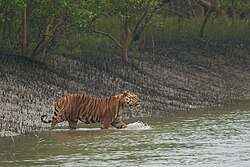
[[File:Bengal Tiger gets down in a shallow canal in Sundarban.jpg|thumb|A [[Bengal tiger]], the national animal, in the Sundarbans]] | |||
Bangladesh is located in the [[Indomalayan realm]], and lies within four terrestrial ecoregions: [[Lower Gangetic Plains moist deciduous forests]], [[Mizoram–Manipur–Kachin rain forests]], [[Sundarbans freshwater swamp forests]], and [[Sundarbans mangroves]].<ref name="DinersteinOlson2017">{{cite journal |last1=Dinerstein |first1=Eric |last2=Olson |first2=David |last3=Joshi |first3=Anup |last4=Vynne |first4=Carly |last5=Burgess |first5=Neil D. |last6=Wikramanayake |first6=Eric |last7=Hahn |first7=Nathan |last8=Palminteri |first8=Suzanne |last9=Hedao |first9=Prashant |last10=Noss |first10=Reed |last11=Hansen |first11=Matt |last12=Locke |first12=Harvey |last13=Ellis |first13=Erle C |last14=Jones |first14=Benjamin |last15=Barber |first15=Charles Victor |last16=Hayes |first16=Randy |last17=Kormos |first17=Cyril |last18=Martin |first18=Vance |last19=Crist |first19=Eileen |last20=Sechrest |first20=Wes |last21=Price |first21=Lori |last22=Baillie |first22=Jonathan E. M. |last23=Weeden |first23=Don |last24=Suckling |first24=Kierán |last25=Davis |first25=Crystal |last26=Sizer |first26=Nigel |last27=Moore |first27=Rebecca |last28=Thau |first28=David |last29=Birch |first29=Tanya |last30=Potapov |first30=Peter |last31=Turubanova |first31=Svetlana |last32=Tyukavina |first32=Alexandra |last33=de Souza |first33=Nadia |last34=Pintea |first34=Lilian |last35=Brito |first35=José C. |last36=Llewellyn |first36=Othman A. |last37=Miller |first37=Anthony G. |last38=Patzelt |first38=Annette |last39=Ghazanfar |first39=Shahina A. |last40=Timberlake |first40=Jonathan |last41=Klöser |first41=Heinz |last42=Shennan-Farpón |first42=Yara |last43=Kindt |first43=Roeland |last44=Lillesø |first44=Jens-Peter Barnekow |last45=van Breugel |first45=Paulo |last46=Graudal |first46=Lars |last47=Voge |first47=Maianna |last48=Al-Shammari |first48=Khalaf F. |last49=Saleem |first49=Muhammad|title=An Ecoregion-Based Approach to Protecting Half the Terrestrial Realm |journal=BioScience|volume=67|issue=6|year=2017|pages=534–545 |doi=10.1093/biosci/bix014 |pmid=28608869 |pmc=5451287}}</ref> Its ecology includes a long sea coastline, numerous [[List of rivers in Bangladesh|rivers and tributaries]], lakes, [[wetland]]s, evergreen forests, semi evergreen forests, hill forests, moist [[deciduous forest]]s, freshwater swamp forests and flat land with tall grass. The Bangladesh Plain is famous for its fertile [[alluvial]] soil which supports extensive cultivation. The country is dominated by lush vegetation, with villages often buried in groves of [[mango]], [[jackfruit]], [[bamboo]], [[betel nut]], [[coconut]], and [[date palm]].<ref name="global.britannica.com">[http://global.britannica.com/EBchecked/topic/51736/Bangladesh/33426/Plant-and-animal-life Bangladesh | history – geography :: Plant and animal life] {{Webarchive |url=https://web.archive.org/web/20140203195926/http://global.britannica.com/EBchecked/topic/51736/Bangladesh/33426/Plant-and-animal-life|date=3 February 2014}}. ''Encyclopædia Britannica''.</ref> The country has up to 6000 species of plant life, including 5000 flowering plants.<ref>{{cite web |url=http://www.bdhcdelhi.org/index.php/flora-fauna|title=Flora and Fauna – Bangladesh high commission in India |website=Bangladesh High Commission, New Delhi |archive-url=https://web.archive.org/web/20130820012655/http://www.bdhcdelhi.org/index.php/flora-fauna |archive-date=20 August 2013}}</ref> Water bodies and wetland systems provide a habitat for many aquatic plants. [[Nymphaeaceae|Water lilies]] and [[Nelumbo nucifera|lotuses]] grow vividly during the monsoon season. The country has [[List of protected areas of Bangladesh|60 wildlife sanctuaries]].<ref>{{cite web |year=2026|title=Protected Area Profile for Bangladesh from the World Database of Protected Areas|url=https://www.protectedplanet.net/country/BGD|access-date=22 February 2026|website=[[World Database on Protected Areas]]}}</ref> | |||
Bangladesh is home to most of the [[Sundarbans]], the world's largest [[mangrove forest]], covering an area of {{convert|6000|km2}} in the southwest littoral region. It is divided into three protected sanctuaries: the [[Sundarbans South Wildlife Sanctuary|South]], [[Sundarbans East Wildlife Sanctuary|East]], and [[Sundarbans West Wildlife Sanctuary|West]] zones. The forest is a UNESCO World Heritage Site.<ref>{{Cite web |title=The Sundarbans |url=https://whc.unesco.org/en/list/798/ |access-date=2026-02-21 |website=[[UNESCO]] |language=en}}</ref> The northeastern Sylhet region is home to haor wetlands, a unique ecosystem. It also includes [[tropical and subtropical coniferous forests]], a [[freshwater swamp forest]], and mixed deciduous forests. The southeastern Chittagong region covers evergreen and semi-evergreen hilly jungles. Central Bangladesh includes the plainland Sal forest running along with the districts of Gazipur, [[Tangail]], and [[Mymensingh]].<ref>{{Cite journal|last=Rahman |first=Mohammed Mahabubur |last2=Rahman |first2=Md. Motiur |last3=Guogang |first3=Zhang |last4=Islam |first4=Kazi Shakila |date=1 March 2010 |title=A Review of the Present Threats to Tropical Moist Deciduous Sal (Shorea Robusta) Forest Ecosystem of Central Bangladesh |url=https://journals.sagepub.com/doi/10.1177/194008291000300108 |access-date=2026-02-21 |website=[[Sage Journals]] |language=en |doi=10.1177/194008291000300108}}</ref> [[St. Martin's Island]] is the only [[coral reef]] in the country.<ref>{{Cite web |last=Kuddus |first=Abdul |date=2025-03-03 |title=Is St Martin's actually a 'coral island', what do researchers say? |url=https://en.prothomalo.com/environment/9rpuv1x2ra |access-date=2026-02-21 |website=[[Prothom Alo]] |language=en}}</ref> | |||
Bangladesh has an abundance of [[Wildlife in Bangladesh|wildlife]] in its forests, marshes, woodlands, and hills.<ref name="global.britannica.com"/> The vast majority of animals dwell within a habitat of {{convert|150000|km2}}.<ref>{{cite news |author1=Soraya Auer |author2=Anika Hossain |date=7 July 2012 |title=Lost Wards of the State |url=http://archive.thedailystar.net/magazine/2012/07/01/cover.htm|work=The Daily Star|access-date=14 February 2015 |archive-url=https://web.archive.org/web/20150214120509/http://archive.thedailystar.net/magazine/2012/07/01/cover.htm |archive-date=14 February 2015 |url-status=live}}</ref> The [[Bengal tiger]], [[clouded leopard]], [[saltwater crocodile]], [[black panther]] and [[fishing cat]] are among the chief predators in the Sundarbans.<ref>{{cite book|author=Peter Haggett|title=Encyclopedia of World Geography|url=https://books.google.com/books?id=IROIY4ONOSEC&pg=PA2620|year=2001|publisher=Marshall Cavendish|isbn=978-0-7614-7289-6|page=2620|access-date=20 January 2017|archive-date=28 March 2024|archive-url=https://web.archive.org/web/20240328182110/https://books.google.com/books?id=IROIY4ONOSEC&pg=PA2620|url-status=live}}</ref> Northern and eastern Bangladesh is home to the [[Asian elephant]], [[hoolock gibbon]], [[Asian black bear]] and [[oriental pied hornbill]].<ref name="bearprojectbd.weebly.com">{{cite web |url=http://bearprojectbd.weebly.com/bears-in-bangladesh.html|title=Bears in Bangladesh|website=Bangladesh Bear Project|access-date=14 February 2015|archive-url=https://web.archive.org/web/20150214061240/http://bearprojectbd.weebly.com/bears-in-bangladesh.html|archive-date=14 February 2015|url-status=live}}</ref> The [[chital]] deer are widely seen in southwestern woodlands. Other animals include the [[black giant squirrel]], [[capped langur]], [[Bengal fox]], [[sambar deer]], [[jungle cat]], [[king cobra]], [[wild boar]], [[mongoose]]s, [[pangolin]]s, [[Python (genus)|pythons]] and [[Asian water monitor|water monitors]]. Bangladesh has one of the largest populations of [[Irrawaddy dolphins|Irrawaddy]] and [[South Asian river dolphin|Ganges dolphins]].<ref>{{cite web |url=http://news.nationalgeographic.com/news/2009/03/090331-dolphins-found.html|title=6,000 Rare, Large River Dolphins Found in Bangladesh|work=National Geographic|date=March 2009|access-date=13 February 2015|archive-url=https://web.archive.org/web/20141012093653/http://news.nationalgeographic.com/news/2009/03/090331-dolphins-found.html|archive-date=12 October 2014}}</ref> The country has numerous species of [[amphibian]]s (53), reptiles (139), [[marine reptile]]s (19) and [[marine mammal]]s (5). It also has [[List of birds of Bangladesh|628 species of birds]].<ref>{{cite news |last1=Hossain |first1=Muhammad Selim |date=23 May 2009 |title=Conserving biodiversity must for survival |url=http://archive.thedailystar.net/newDesign/news-details.php?nid=89375 |work=The Daily Star |access-date=30 May 2015 |archive-url=https://web.archive.org/web/20150530100603/http://archive.thedailystar.net/newDesign/news-details.php?nid=89375 |archive-date=30 May 2015 |url-status=live}}</ref> | |||
Several animals became extinct in Bangladesh during the last century, including the one-horned and two-horned [[rhinoceros]] and common [[peafowl]]. The human population is concentrated in urban areas, limiting deforestation to a certain extent. Rapid urban growth has threatened natural habitats. The country has widespread environmental issues; pollution of the [[Dhaleshwari River]] by the textile industry and shrimp cultivation in Chakaria Sundarbans have both been described by academics as [[ecocide]]s.<ref>{{cite book |last1=Suny |first1=Rabby Us |last2=Sarkar |first2=Oliver Tirtho |last3=Hasan |first3=Md Abid |title=Politics of Climate Change |chapter=Political Economy of River Ecocide in Bangladesh: A Study in the Context of Dhaleshwari River |date=2023 |pages=83–103 |doi=10.1142/9789811263750_0005 |isbn=978-981-12-6374-3 }}</ref><ref>{{Cite journal |last=Zaman |first=Samia |date=7 June 2023 |title=The Bangladesh Environmental Humanities Reader: by Samina Luthfa, Mohammad Tanzimuddin Khan, and Munasir Kamal, Lanham, Lexinton Books, 2022 ISBN 978-1-4985-9913-9 and 978-1-4985-9914-6 |journal=Environmental Politics |volume=32 |issue=4 |pages=752–754 |doi=10.1080/09644016.2023.2192149 |doi-access=free}}</ref> Although many areas are protected under law, some Bangladeshi wildlife is threatened by this growth. The [[Bangladesh Environment Conservation Act]] was enacted in 1995. The government has designated several regions as [[Ecologically Critical Area]]s, including wetlands, forests, and rivers. The [[Sundarbans tiger project]] and the Bangladesh Bear Project are among the key initiatives to strengthen conservation.<ref name="bearprojectbd.weebly.com"/> It ratified the Rio [[Convention on Biological Diversity]] on 3 May 1994.<ref name="cbd.int">{{cite web |url=http://www.cbd.int/countries/profile/default.shtml?country=bd|title=Bangladesh – Country Profile|website=cbd.int|access-date=16 February 2015|archive-url=https://web.archive.org/web/20150217020013/http://www.cbd.int/countries/profile/default.shtml?country=bd|archive-date=17 February 2015|url-status=live}}</ref> {{As of|2014}}, the country was set to revise its [[Biodiversity action plan|National Biodiversity Strategy and Action Plan]].<ref name="cbd.int"/> | |||
== | == Government and politics == | ||
{{Main| | {{Main|Government of Bangladesh|Politics of Bangladesh|List of People's Republic of Bangladesh governments}} | ||
{{Multiple image | |||
| caption_align = center | |||
| total_width = 300 | |||
| image1 = Mohammed Shahabuddin official portrait.jpg | |||
| caption1 = [[Mohammed Shahabuddin]]<br /><small>[[President of Bangladesh|President]]</small> | |||
| image2 = Tarique Rahman at meeting on Farmer cards, Cabinet Division, Secretariat, Dhaka, 2026-02-23 (cropped).jpg | |||
| caption2 = [[Tarique Rahman]]<br /><small>[[Prime Minister of Bangladesh|Prime Minister]]</small> | |||
}} | |||
{{multiple image | |||
| perrow = 1 | |||
| total_width = 220 | |||
| image_style = border:none; | |||
| align = right | |||
| image1 = National Assembly of Bangladesh (10).jpg | |||
| caption1 = The [[Jatiya Sangsad Bhaban|National Parliament]] building in [[Sher-e-Bangla Nagar]], a neighbourhood named after the first [[Prime Minister of Bengal]] | |||
| image2 = Bangabhaban.jpg | |||
| caption2 = [[Bangabhaban]] (Translation: ''Bengal House'') is the [[presidential palace]] of Bangladesh. It was originally a house for the [[Viceroy of India]] and the [[List of governors of Bengal Presidency|Governor of Bengal]]. | |||
}} | |||
Bangladesh, by [[Constitution of Bangladesh|constitution]], is a [[unitary state]]<ref name="gov2"/> and a ''[[de jure]]'' [[representative democracy]] with a [[Westminster system|Westminster]]-style [[parliamentary republic|parliamentary system]]<ref name="gov0"/> that has [[universal suffrage]].<ref name="gov">{{cite journal|last=Jahan|first=Rounaq|title=The Parliament of Bangladesh: Representation and Accountability|doi=10.1080/13572334.2014.975470|year=2014|pages=250–269|journal=[[The Journal of Legislative Studies]]|volume=21|issue=2}}</ref> The [[Government of Bangladesh|government]] can be divided into three pillars: the executive, the legislative and the [[Judiciary of Bangladesh|judiciary]]. All function to ensure accountability, transparency and [[Separation of powers|checks and balances]].<ref name="gov2">{{cite web|url=https://www.thedailystar.net/rising-stars/explained/news/explained-the-branches-bangladeshs-government-3512581|title=Explained: The branches of Bangladesh's government|work=[[The Daily Star (Bangladesh)|The Daily Star]]|date=6 January 2024|access-date=20 January 2025|last=Siddiquee|first=Ayaan Shams}}</ref> Since its independence, the [[Awami League]] (AL) and the [[Bangladesh Nationalist Party]] (BNP) have remained two of the most powerful [[List of political parties in Bangladesh|political parties in Bangladesh]].<ref name="gov0">{{cite journal|last=Shah|first=Aqil|title=Democracy Deadlocked in Bangladesh|journal=[[Current History]]|volume=115|number=780|year=2016|pages=130–135|doi=10.1525/curh.2016.115.780.130 |jstor=48614157}}</ref> | |||
===Administrative | *The first pillar of the government is the executive organ, which is entrusted with the administration of the country.<ref name="gov2"/> Executive powers are largely vested in the [[Prime Minister of Bangladesh|Prime Minister]], who is the [[head of government]] and oversees the [[Cabinet of Bangladesh|cabinet]].<ref name="gov2"/> The tenure of a parliamentary government is five years. Various ministers form the bulk of the executive organ, overseeing government departments and forming policies.<ref name="gov2"/> The [[Bangladesh Civil Service|Civil Service]] assists the ministers in implementing policy.<ref name="gov2"/> All authorities unite to formulate policies, manage public services, and implement national development plans.<ref name="gov2"/> The [[President of Bangladesh|President]] is the ceremonial [[head of state]], whose powers include signing bills passed by parliament into law, maintaining the government's stability and continuity,<ref name="gov2"/> and fulfilling their duties as the commander-in-chief of the [[Bangladesh Armed Forces|Armed Forces]]<ref>{{cite web|url=http://bdlaws.minlaw.gov.bd/act-367/section-24615.html|title=61.Supreme command|work=Laws of Bangladesh|publisher=[[Legislative and Parliamentary Affairs Division]]|access-date=21 January 2025}}</ref> and the [[chancellor]] of all universities.<ref>{{cite web|url=http://bdlaws.minlaw.gov.bd/act-details-447.html|title=The Dhaka University Order, 1973 (President's Order).|work=Laws of Bangladesh|publisher=[[Legislative and Parliamentary Affairs Division]]|access-date=21 January 2025}}</ref> | ||
*The second pillar of the government is the legislative organ, also known as the [[Jatiya Sangsad]] (House of the Nation).<ref name="parliament">{{cite web|url=http://bdlaws.minlaw.gov.bd/act-367/section-24619.html|title=65. Establishment of Parliament|work=Laws of Bangladesh|publisher=[[Legislative and Parliamentary Affairs Division]]|access-date=21 January 2025}}</ref> Citizens elect the members of parliament (MPs).<ref name="gov2"/> The [[unicameral]] parliament has 350 MPs, including 300 elected on the [[first past the post]] system and 50 appointed to reserved seats for [[women's empowerment]].<ref name="parliament"/><ref>{{cite web|url=https://www.thedailystar.net/news/bangladesh/news/women-mps-reserved-seats-how-empowered-are-they-really-3601271|title=Women MPs in reserved seats: How empowered are they really?|work=[[The Daily Star (Bangladesh)|The Daily Star]]|date=4 May 2024|access-date=20 January 2025|last=Hasan|first=Rashidul}}</ref> [[Article 70 of the Constitution of Bangladesh]] forbids MPs from voting against their party.<ref>{{cite web|url=https://www.thedailystar.net/backpage/article-70-constitution-its-safeguard-democracy-1581670|title=Article 70 of Constitution: It's a safeguard for democracy|work=[[The Daily Star (Bangladesh)|The Daily Star]]|date=26 May 2018|access-date=20 January 2025}}</ref> The parliament is presided over by the [[Speaker of the Jatiya Sangsad|Speaker]], who is second in line to the president.<ref>{{cite web|url=http://bdlaws.minlaw.gov.bd/act-367/section-24603.html|title=54.Speaker to act as President during absence, etc.|work=Laws of Bangladesh|publisher=[[Legislative and Parliamentary Affairs Division]]|access-date=21 January 2025}}</ref> | |||
*The third pillar of the government is the judiciary organ, which is in charge of interpreting the law, resolving conflicts, and maintaining justice.<ref name="gov2"/> The [[Supreme Court of Bangladesh|Supreme Court]] is the highest court, separated into the [[Appellate Division, Supreme Court of Bangladesh|Appellate Division]] and the [[High Court Division, Supreme Court of Bangladesh|High Court Division]].<ref name="court">{{cite web|url=http://bdlaws.minlaw.gov.bd/act-367/part-details-203.html|title=THE JUDICIARY|work=Laws of Bangladesh|publisher=[[Legislative and Parliamentary Affairs Division]]|access-date=21 January 2025}}</ref><ref name="gov2"/> It is led by the [[Chief Justice of Bangladesh|Chief Justice]].<ref name="court"/> The judiciary has the power to assess a law's constitutionality and offer legal remedies. It protects citizens' rights, ensures the law is applied fairly, and preserves the balance of power within the government.<ref name="gov2"/> The courts have wide latitude in [[judicial review in Bangladesh|judicial review]], and judicial [[precedent]] is supported by Article 111 of the constitution.<ref>{{cite web|url=http://bdlaws.minlaw.gov.bd/act-367/section-24668.html|title=111.Binding effect of Supreme Court judgments|work=Laws of Bangladesh|publisher=[[Legislative and Parliamentary Affairs Division]]|access-date=21 January 2025}}</ref> The judiciary includes district and metropolitan courts divided into civil and criminal courts. Due to a shortage of judges, the judiciary has a large backlog.<ref>{{cite web|url=https://www.thedailystar.net/opinion/editorial/news/huge-case-backlog-only-hurting-citizens-3306391|title=Huge case backlog only hurting citizens|work=[[The Daily Star (Bangladesh)|The Daily Star]]|date=28 April 2023|access-date=20 January 2025}}</ref> | |||
According to [[International Institute for Democracy and Electoral Assistance|International IDEA]]’s Global State of Democracy (GSoD) Indices and Democracy Tracker, Bangladesh performs in the low range on overall democratic measures, with particular weaknesses in political representation, including credible elections, inclusive suffrage and elected government.<ref>{{Cite web |title=Bangladesh {{!}} The Global State of Democracy |url=https://www.idea.int/democracytracker/country/bangladesh |access-date=2025-10-16 |website=www.idea.int |language=en}}</ref><ref>{{Cite web |title=Home {{!}} The Global State of Democracy |url=https://www.idea.int/democracytracker/ |access-date=2025-10-16 |website=www.idea.int}}</ref><ref>{{Cite web |title=Global State of Democracy Indices {{!}} The Global State of Democracy |url=https://www.idea.int/democracytracker/gsod-indices |access-date=2025-10-16 |website=www.idea.int}}</ref> | |||
=== Administrative divisions === | |||
{{Main|Administrative geography of Bangladesh}} | {{Main|Administrative geography of Bangladesh}} | ||
{{Further|Divisions of Bangladesh|Districts of Bangladesh|Upazilas of Bangladesh}} | {{Further|Divisions of Bangladesh|Districts of Bangladesh|Upazilas of Bangladesh}} | ||
{{Bangladesh Divisions Image Map}} | {{Bangladesh Divisions Image Map}} | ||
Divisions are subdivided into districts (''zila''). | Bangladesh is divided into eight administrative divisions,<ref>{{cite web |url=http://www.bangladesh.gov.bd/site/view/division-list/List-of-Divisions|publisher=Bangladesh Government|title=National Web Portal of Bangladesh|date=15 September 2015|access-date=23 September 2015 |archive-url=https://web.archive.org/web/20150923061605/http://www.bangladesh.gov.bd/site/view/division-list/List-of-Divisions|archive-date=23 September 2015|url-status=live}}</ref><ref name="CIA">{{Cite CIA World Factbook|country=Bangladesh|access-date=15 May 2007 |year=2007}}</ref><ref>{{cite news |url=http://bdnews24.com/bangladesh/2010/01/25/rangpur-becomes-a-division |title=Rangpur becomes a divivion |work=bdnews24.com |date=25 January 2010 |access-date=6 August 2011 |archive-url=https://web.archive.org/web/20150903184553/http://bdnews24.com/bangladesh/2010/01/25/rangpur-becomes-a-division |archive-date=3 September 2015 |url-status=live}}</ref> each named after its headquarters: [[Barisal Division|Barisal]] (officially ''Barishal''<ref name="namechange">{{cite news |url=https://bdnews24.com/bangladesh/2018/04/02/bangladesh-changes-english-spellings-of-five-districts|title=Bangladesh changes English spellings of five districts|work=bdnews24.com|date=2 April 2018|access-date=1 October 2019 |archive-date=15 December 2020|archive-url=https://web.archive.org/web/20201215091950/https://bdnews24.com/bangladesh/2018/04/02/bangladesh-changes-english-spellings-of-five-districts|url-status=live}}</ref>), [[Chittagong Division|Chittagong]] (officially ''Chattogram''<ref name="namechange" />), [[Dhaka Division|Dhaka]], [[Khulna Division|Khulna]], [[Mymensingh Division|Mymensingh]], [[Rajshahi Division|Rajshahi]], [[Rangpur Division|Rangpur]], and [[Sylhet Division|Sylhet]]. | ||
Divisions are subdivided into districts (''zila''). Bangladesh has 64 districts, each subdivided into ''upazila'' (subdistricts) or ''thana''. The area within each police station, except for those in metropolitan areas, is divided into ''[[Union Councils of Bangladesh|unions]]'', with each union comprising multiple villages. In the metropolitan areas, police stations are divided into wards, further divided into ''mahallas''. | |||
There are no elected officials at the divisional or district levels, and the administration | There are no elected officials at the divisional or district levels, and the administration comprises only government officials. Direct elections are held in each union (or ward) for a chairperson and several members. In 1997, Parliament passed legislation reserving three seats (out of 12) in every union for women.<ref>''Local Government Act'', No. 20, 1997</ref> | ||
{| class="wikitable sortable" style="text-align: right" | {| class="wikitable sortable" style="text-align: right" | ||
| Line 271: | Line 281: | ||
|- | |- | ||
! scope="col" | [[Divisions of Bangladesh|Division]] | ! scope="col" | [[Divisions of Bangladesh|Division]] | ||
! scope="col" | | ! scope="col" | Capital | ||
! scope="col" data-sort-type="date" | Established | ! scope="col" data-sort-type="date" | Established | ||
! scope="col" | Area (km<sup>2</sup>)<br /><ref | ! scope="col" | Area (km<sup>2</sup>)<br /><ref>{{cite web |url=http://www.dghs.gov.bd/images/docs/Publicaations/HB%202016%20_2nd_edition_13_01_17.pdf |title=Health Bulletin 2016 |website=Directorate General of Health Services |page=14 |access-date=7 April 2022 |archive-url=https://web.archive.org/web/20170613050056/http://dghs.gov.bd/images/docs/Publicaations/HB%202016%20_2nd_edition_13_01_17.pdf |archive-date=13 June 2017 |url-status=live}}</ref> | ||
! scope="col" | 2021 Population <br />(projected)<ref>{{cite web |url=http://203.112.218.65:8008/WebTestApplication/userfiles/Image/PopMonographs/PopulationProjection.pdf |title=Population Projection of Bangladesh: Dynamics and Trends, | ! scope="col" | 2021 Population <br />(projected)<ref>{{cite web |url=http://203.112.218.65:8008/WebTestApplication/userfiles/Image/PopMonographs/PopulationProjection.pdf |archive-url=https://ghostarchive.org/archive/20221009/http://203.112.218.65:8008/WebTestApplication/userfiles/Image/PopMonographs/PopulationProjection.pdf |archive-date=9 October 2022 |url-status=live |title=Population Projection of Bangladesh: Dynamics and Trends, 2011–2061 |date=November 2015 |website=Bangladesh Bureau of Statistics |pages=25–28}}</ref> | ||
! scope="col" | ! scope="col" | Density<br />2021 | ||
|- | |- | ||
| style="text-align:left" | [[Barisal Division]] | | style="text-align:left" | [[Barisal Division]] | ||
| Line 320: | Line 330: | ||
|- | |- | ||
| style="text-align:left" | [[Rangpur Division]] | | style="text-align:left" | [[Rangpur Division]] | ||
| style="text-align:left" | [[Rangpur | | style="text-align:left" | [[Rangpur, Bangladesh|Rangpur]] | ||
| 25 January 2010 | | 25 January 2010 | ||
| 16,185 | | 16,185 | ||
| Line 334: | Line 344: | ||
|} | |} | ||
=== | === Foreign relations === | ||
{{ | {{Main|Foreign relations of Bangladesh}} | ||
{{multiple image | |||
| | | perrow = 1 | ||
| | | total_width = 220 | ||
| | | image_style = border:none; | ||
| | | align = right | ||
| image1 = Diplomatic relations of Bangladesh.svg | |||
| caption1 = Countries that share diplomatic relations with Bangladesh | |||
| image2 = | |||
| caption2 = | |||
}} | }} | ||
Bangladesh is considered a [[middle power]] in [[global politics]].<ref>{{cite web |url=https://thediplomat.com/2021/12/bangladesh-at-50-on-the-path-to-becoming-a-middle-power/|title=Bangladesh at 50: On the Path to Becoming a Middle Power|work=[[The Diplomat (magazine)|The Diplomat]]|date=16 December 2021 |last=Hassan |first=Asif Muztaba|access-date=26 September 2022|archive-date=26 September 2022|archive-url=https://web.archive.org/web/20220926153004/https://thediplomat.com/2021/12/bangladesh-at-50-on-the-path-to-becoming-a-middle-power/|url-status=live}}</ref> It plays an important role in the geopolitical affairs of the [[Indo-Pacific]],<ref>{{cite web |url=https://www.nbr.org/publication/understanding-the-importance-of-bangladesh-in-the-bay-of-bengal-and-the-indo-pacific/|title=Understanding the Importance of Bangladesh in the Bay of Bengal and the Indo-Pacific |last=Karim |first=Tariq A.|date=21 May 2022|publisher=[[National Bureau of Asian Research]]|access-date=26 September 2022|archive-date=26 September 2022|archive-url=https://web.archive.org/web/20220926153004/https://www.nbr.org/publication/understanding-the-importance-of-bangladesh-in-the-bay-of-bengal-and-the-indo-pacific/|url-status=live}}</ref> due to its strategic location between South and Southeast Asia.<ref>{{cite web |url=https://www.adb.org/sites/default/files/publication/156355/adbi-wp500.pdf |archive-url=https://ghostarchive.org/archive/20221009/https://www.adb.org/sites/default/files/publication/156355/adbi-wp500.pdf |archive-date=9 October 2022 |url-status=live|title=Connecting South Asia and Southeast Asia: A Bangladesh Country Study|date=September 2014|publisher=[[Asian Development Bank]]|access-date=26 September 2022|number=500 |last1=Rahman |first1=Mustafizur |last2=Moazzem |first2=Khondaker Golam |last3=Chowdhury |first3=Mehruna Islam |last4=Sehrin |first4=Farzana}}</ref> Bangladesh joined the [[Commonwealth of Nations]] in 1972 and the United Nations in 1974.<ref>{{cite web |url=https://www.thedailystar.net/backpage/news/bangladesh-enters-commonwealth-1894048 |title=Bangladesh enters Commonwealth |last=Sajen |first=Shamsuddoza|work=[[The Daily Star (Bangladesh)|The Daily Star]]|date=18 April 2020 |access-date=26 September 2022|archive-date=26 September 2022|archive-url=https://web.archive.org/web/20220926153013/https://www.thedailystar.net/backpage/news/bangladesh-enters-commonwealth-1894048|url-status=live}}</ref><ref>{{cite web |url=https://news.un.org/en/audio/2014/09/592702|title=Bangladesh marks 40 years as Member State of the UN |publisher=United Nations|date=26 September 2014|access-date=26 September 2022 |last=Chaudhury |first=Dipanjan Roy|archive-date=26 September 2022|archive-url=https://web.archive.org/web/20220926153010/https://news.un.org/en/audio/2014/09/592702|url-status=live}}</ref> It relies on multilateral diplomacy on issues like climate change, nuclear non-proliferation, trade policy and non-traditional security issues.<ref>{{cite web |url=https://rsis-ntsasia.org/roundtable-on-non-traditional-security-threats-in-the-indo-pacific-region/ | title=Roundtable on 'Non Traditional Security Threats in the Indo-Pacific Region' – NTS-Asia | date=30 August 2022 | access-date=28 September 2022 | archive-date=28 September 2022 | archive-url=https://web.archive.org/web/20220928184723/https://rsis-ntsasia.org/roundtable-on-non-traditional-security-threats-in-the-indo-pacific-region/ | url-status=live }}</ref> Bangladesh pioneered the creation of [[South Asian Association for Regional Cooperation|SAARC]], the preeminent forum for regional diplomacy on the [[Indian subcontinent]].<ref>{{cite web |url=https://www.adb.org/sites/default/files/publication/156717/adbi-dp78.pdf |archive-url=https://ghostarchive.org/archive/20221009/https://www.adb.org/sites/default/files/publication/156717/adbi-dp78.pdf |archive-date=9 October 2022 |url-status=live |last1=De |first1=Prabir |last2=Bhattacharyay |first2=Biswa N.|title=Prospects of India–Bangladesh Economic Cooperation: Implications for South Asian Regional Cooperation|publisher=[[Asian Development Bank]]|date=September 2007|access-date=27 September 2022}}</ref> It joined the [[Organisation of Islamic Cooperation|OIC]] in 1974,<ref>{{cite web |url=https://www.thedailystar.net/backpage/news/bangladesh-example-religious-harmony-oic-2064177|title=Bangladesh an example of religious harmony: OIC|work=[[The Daily Star (Bangladesh)|The Daily Star]] |date=21 March 2021|access-date=27 September 2022|archive-date=27 September 2022|archive-url=https://web.archive.org/web/20220927102404/https://www.thedailystar.net/backpage/news/bangladesh-example-religious-harmony-oic-2064177 |url-status=live}}</ref> and is a founding member of the [[D-8 Organization for Economic Cooperation|Developing-8]].<ref>{{cite web |url=https://www.thedailystar.net/news/bangladesh/news/bangladesh-receives-international-peace-award-d-8-founding-member-3085371|work=[[The Daily Star (Bangladesh)|The Daily Star]]|date=1 August 2022|access-date=27 September 2022|title=Bangladesh receives "International Peace Award" as D-8 founding member|archive-date=27 September 2022|archive-url=https://web.archive.org/web/20220927102352/https://www.thedailystar.net/news/bangladesh/news/bangladesh-receives-international-peace-award-d-8-founding-member-3085371|url-status=live}}</ref> Recently, Bangladesh has focused on promoting regional trade and transport links with support from the [[World Bank]].<ref>{{cite web |url=https://www.worldbank.org/en/news/press-release/2022/06/28/regional-trade-and-connectivity-in-south-asia-gets-more-than-1-billion-boost-from-world-bank | title=Regional Trade and Connectivity in South Asia Gets More Than $1 Billion Boost from World Bank | access-date=28 September 2022 | archive-date=28 September 2022 | archive-url=https://web.archive.org/web/20220928184718/https://www.worldbank.org/en/news/press-release/2022/06/28/regional-trade-and-connectivity-in-south-asia-gets-more-than-1-billion-boost-from-world-bank | url-status=live }}</ref> It is also [[Accession of Bangladesh to ASEAN|attempting]] to join [[ASEAN]] as one of its top foreign policy goals.<ref name=":5">{{Cite news |title=Ultimate goal is to join ASEAN as a full member |url=https://today.thefinancialexpress.com.bd/trade-market/ultimate-goal-is-to-join-asean-as-a-full-member-1743783067 |access-date=2025-07-12 |work=The Financial Express |language=en}}</ref><ref>{{Cite web |date=2024-09-05 |title=Will Bangladesh join Asean? Maritime arbitration wins favour Dhaka |url=https://www.scmp.com/week-asia/politics/article/3277348/will-bangladesh-join-asean-maritime-arbitration-wins-and-cultural-links-favour-dhaka |access-date=2025-07-17 |website=South China Morning Post |language=en}}</ref><ref>{{cite web |last=Rahman |first=Mohammad Tariqur |date=8 February 2025 |title=Perhaps: Should Bangladesh be a member of ASEAN? |url=https://apakhabartv.com/2025/02/08/perhaps/ |access-date=17 July 2025 |website=ApakhabarTV}}</ref> Dhaka hosts the headquarters of [[BIMSTEC]], an organisation that brings together [[countries dependent on the Bay of Bengal]]. | |||
[[Bangladesh–Myanmar relations|Relations]] with neighbouring Myanmar have been severely strained since 2016–2017, after over 700,000 [[Rohingya refugees in Bangladesh|Rohingya refugees]] illegally entered Bangladesh.<ref name="RohingyaHRW">{{cite web |url=https://www.hrw.org/report/2018/08/05/bangladesh-not-my-country/plight-rohingya-refugees-myanmar|title=Bangladesh Is Not My Country|publisher=[[Human Rights Watch]]|date=5 August 2018|access-date=27 September 2022|archive-date=27 September 2022|archive-url=https://web.archive.org/web/20220927102348/https://www.hrw.org/report/2018/08/05/bangladesh-not-my-country/plight-rohingya-refugees-myanmar|url-status=live}}</ref> Bangladesh's parliament, government, and civil society have been at the forefront of [[International reaction to the 2016–17 Rohingya exodus|international criticism]] against Myanmar for military operations against the Rohingya, and have demanded their [[right of return]] to [[Arakan]].<ref>{{cite web |url=https://thediplomat.com/2022/02/bangladesh-and-myanmar-resume-talks-on-rohingya-repatriation/ | title=Bangladesh and Myanmar Resume Talks on Rohingya Repatriation | access-date=28 September 2022 | archive-date=28 September 2022 | archive-url=https://web.archive.org/web/20220928184715/https://thediplomat.com/2022/02/bangladesh-and-myanmar-resume-talks-on-rohingya-repatriation/ | url-status=live }}</ref><ref>{{cite web |url=https://www.aljazeera.com/news/2022/8/17/rohingya-refugees-have-to-be-taken-back-bangladesh-pm-says|title=Bangladesh tells UN that Rohingya refugees must return to Myanmar|date=17 August 2022|publisher=[[Al Jazeera Media Network|Al Jazeera]]|access-date=27 September 2022|archive-date=26 September 2022|archive-url=https://web.archive.org/web/20220926223428/https://www.aljazeera.com/news/2022/8/17/rohingya-refugees-have-to-be-taken-back-bangladesh-pm-says|url-status=live}}</ref> | |||
Bangladesh | Bangladesh shares an important [[Bangladesh–India relations|bilateral and economic relationship]] with its largest neighbour, India,<ref>{{cite web |url=https://mea.gov.in/Portal/ForeignRelation/India_Bangladesh_MAR2021.pdf |archive-url=https://ghostarchive.org/archive/20221009/https://mea.gov.in/Portal/ForeignRelation/India_Bangladesh_MAR2021.pdf |archive-date=9 October 2022 |url-status=live|title=India-Bangladesh Bilateral Relations|date=March 2021|publisher=[[Ministry of External Affairs (India)]]|access-date=27 September 2022}}</ref> which is often strained by [[Water politics in India|water politics]] of the [[Ganges water dispute|Ganges]] and the [[Teesta River#Water sharing challenge|Teesta]],<ref>{{cite web |url=https://climate-diplomacy.org/case-studies/india-and-bangladesh-conflict-over-ganges-river | title=India and Bangladesh Conflict over the Ganges River | Climate-Diplomacy | date=January 1957 | access-date=23 October 2022 | archive-date=23 October 2022 | archive-url=https://web.archive.org/web/20221023122123/https://climate-diplomacy.org/case-studies/india-and-bangladesh-conflict-over-ganges-river | url-status=live }}</ref><ref>{{cite thesis |last=Karim |first=Sajid |date=November 2020 |title=Transboundary Water Cooperation between Bangladesh and India in the Ganges River Basin: Exploring a Benefit-sharing Approach |type=Master's |publisher=[[Uppsala University]] |url=http://www.diva-portal.org/smash/get/diva2:1499222/FULLTEXT01.pdf |archive-url=https://ghostarchive.org/archive/20221009/http://www.diva-portal.org/smash/get/diva2:1499222/FULLTEXT01.pdf |archive-date=9 October 2022 |url-status=live|access-date=27 September 2022}}</ref><ref>{{cite web |url=https://thediplomat.com/2021/04/india-must-settle-the-teesta-river-dispute-with-bangladesh-for-lasting-gains/|title=India Must Settle the Teesta River Dispute With Bangladesh for Lasting Gains|work=[[The Diplomat (magazine)|The Diplomat]]|date=9 April 2021|access-date=27 September 2022 |last=Banerji |first=Anuttama|archive-date=27 September 2022|archive-url=https://web.archive.org/web/20220927102352/https://thediplomat.com/2021/04/india-must-settle-the-teesta-river-dispute-with-bangladesh-for-lasting-gains/|url-status=live}}</ref> and the [[Deaths along the Bangladesh–India border|border killings of Bangladeshi civilians]].<ref>{{cite web |url=https://www.aa.com.tr/en/asia-pacific/unlawful-killings-along-india-border-bangladeshi-families-seek-justice/2141343 |title='Unlawful killings' along India border: Bangladeshi families seek justice|publisher=[[Anadolu Agency]]|date=11 February 2021|access-date=27 September 2022 |last=Kamruzzaman |first=Md.|archive-date=27 September 2022|archive-url=https://web.archive.org/web/20220927102348/https://www.aa.com.tr/en/asia-pacific/unlawful-killings-along-india-border-bangladeshi-families-seek-justice/2141343|url-status=live}}</ref><ref>{{cite web |url=https://archive.dhakatribune.com/bangladesh/2020/12/22/bangladesh-sees-highest-border-deaths-in-10-years|title=Bangladesh sees highest border deaths in 10 years|date=22 December 2020 |last=Anik |first=Syed Samiul Basher|work=[[Dhaka Tribune]]|access-date=27 September 2022|archive-date=27 September 2022|archive-url=https://web.archive.org/web/20220927102351/https://archive.dhakatribune.com/bangladesh/2020/12/22/bangladesh-sees-highest-border-deaths-in-10-years|url-status=live}}</ref> Bangladesh's relationship with Pakistan is problematic, mainly because Pakistan denies the 1971 [[Bangladesh genocide]].<ref>{{cite web |url=https://www.dw.com/en/should-pakistan-apologize-to-bangladesh-for-the-1971-war/a-57051549|title=Should Pakistan apologize to Bangladesh for the 1971 war?|work=[[DW News]]|publisher=[[Deutsche Welle]]|date=30 March 2021|access-date=27 September 2022 |last=Janjua |first=Haroon|archive-date=27 September 2022|archive-url=https://web.archive.org/web/20220927102348/https://www.dw.com/en/should-pakistan-apologize-to-bangladesh-for-the-1971-war/a-57051549|url-status=live}}</ref> It maintains a [[Bangladesh-China relations|warm relationship]] with China, its largest trading partner and largest arms supplier.<ref>{{cite web |url=https://www.orfonline.org/expert-speak/41935-decoding-china-bangladesh-relationship/|title=Decoding China-Bangladesh relationship |last=Bhattacharjee |first=Joyeeta|date=27 June 2018|access-date=27 September 2022|publisher=[[Observer Research Foundation]]|archive-date=27 September 2022|archive-url=https://web.archive.org/web/20220927102352/https://www.orfonline.org/expert-speak/41935-decoding-china-bangladesh-relationship/|url-status=live}}</ref> Japan is Bangladesh's largest economic aid provider, and the two have a [[Bangladesh–Japan relations|strategic and economic partnership]].<ref>{{cite web |url=https://thediplomat.com/2022/02/50-years-of-japan-bangladesh-ties-from-economic-to-strategic-partnership/|title=50 Years of Japan-Bangladesh Ties: From Economic to Strategic Partnership|work=[[The Diplomat (magazine)|The Diplomat]]|date=10 February 2022 |last=Shazzad |first=Hussain|access-date=26 September 2022|archive-date=26 September 2022|archive-url=https://web.archive.org/web/20220926153002/https://thediplomat.com/2022/02/50-years-of-japan-bangladesh-ties-from-economic-to-strategic-partnership/|url-status=live}}</ref> Political relations with Middle Eastern countries are robust.<ref>{{cite web |url=https://saudigazette.com.sa/article/38010 | title=Bangladesh and Saudi Arabia have extremely cordial relations – Rizvi | date=27 March 2013 | access-date=28 September 2022 | archive-date=28 September 2022 | archive-url=https://web.archive.org/web/20220928184720/https://saudigazette.com.sa/article/38010 | url-status=live }}</ref> Bangladesh receives 59% of its remittances from the Middle East,<ref>{{cite web |url=https://www.tbsnews.net/thoughts/middle-east-dual-shock-spillover-bangladeshs-remittance-108325 | title=Middle East dual shock spillover on Bangladesh's remittance | date=19 July 2020 | access-date=28 September 2022 | archive-date=28 September 2022 | archive-url=https://web.archive.org/web/20220928184724/https://www.tbsnews.net/thoughts/middle-east-dual-shock-spillover-bangladeshs-remittance-108325 | url-status=live }}</ref> despite poor working conditions affecting over four million [[Bangladeshis in the Middle East|Bangladeshi workers]].<ref>{{cite web |url=https://www.dhakatribune.com/bangladesh/2022/06/29/experts-middle-east-remains-key-to-bangladeshs-fortunes-in-a-changing-world|title=Experts: Middle East remains key to Bangladesh's fortunes in a changing world|date=29 June 2022|work=[[Dhaka Tribune]]|access-date=27 September 2022|archive-date=27 September 2022|archive-url=https://web.archive.org/web/20220927102351/https://www.dhakatribune.com/bangladesh/2022/06/29/experts-middle-east-remains-key-to-bangladeshs-fortunes-in-a-changing-world|url-status=live}}</ref> Bangladesh plays a major role in [[Climate change|global climate]] diplomacy as a leader of the [[Climate Vulnerable Forum]].<ref>{{cite web |url=https://study.soas.ac.uk/cop26-bangladesh-climate-diplomacy/ | title=COP26 and Bangladesh: Time to Consolidate Climate Diplomacy | work=SOAS Blog | date=11 October 2021 | access-date=28 September 2022 | archive-date=28 September 2022 | archive-url=https://web.archive.org/web/20220928184721/https://study.soas.ac.uk/cop26-bangladesh-climate-diplomacy/ | url-status=live }}</ref> | ||
=== | === Military === | ||
{{Main| | {{Main|Bangladesh Armed Forces}} | ||
{{multiple image | |||
| perrow = 1 | |||
| total_width = 220 | |||
| image_style = border:none; | |||
| align = right | |||
| image1 = Bangladeshi soldiers on a BTR-80 APC.jpg | |||
| caption1 = Bangladesh Army personnel on a [[BTR-80]] | |||
| image2 = BNS Bongobondhu2.jpg | |||
| caption2 = Bangladesh Navy [[Frigate]], [[BNS Khalid Bin Walid]] | |||
| image3 = Mikoyan MiG-29-Chengdu F-7.jpg | |||
| caption3 = Mig-29 and F-7, Fighter aircraft's of Bangladesh Air Force | |||
}} | |||
Bangladesh | The [[Bangladesh Armed Forces]] have inherited the institutional framework of the [[British military]] and the [[British Indian Army]].<ref>{{cite web |url=http://press-files.anu.edu.au/downloads/press/p33231/mobile/ch07.html|title=The Military and Democracy in Bangladesh|website=press-files.anu.edu.au|access-date=19 September 2017|archive-date=10 October 2017|archive-url=https://web.archive.org/web/20171010141253/http://press-files.anu.edu.au/downloads/press/p33231/mobile/ch07.html|url-status=live}}</ref> In 2024, the active personnel strength of the [[Bangladesh Armed Forces]] was around 230,000,<ref name="IISS">*{{cite book| title=The Military Balance 2018 |author1=International Institute for Strategic Studies |author-link1=International Institute for Strategic Studies| date=14 February 2018| publisher=[[Routledge]]| isbn=978-1-85743-955-7| ref=IISS2018}}</ref> including the Air Force (21,000) and the Navy (27,000).<ref>Including service and civilian personnel. See [https://web.archive.org/web/20120112044228/http://www.bangladeshnavy.org/glance.html Bangladesh Navy]. Retrieved 17 July 2007.</ref> In addition to traditional defence roles, the military has supported civil authorities in disaster relief and provided internal security during periods of political unrest. For many years, Bangladesh has been the world's largest contributor to [[United Nations peacekeeping|UN peacekeeping forces]].<ref>{{Cite web |date=4 April 2023 |title=Contribution of Uniformed Personnel to UN by Country and Personnel Type |url=https://peacekeeping.un.org/sites/default/files/01_contributions_to_un_peacekeeping_operations_by_country_and_post_59_february_23.pdf.pdf |access-date=12 May 2023 |publisher=United Nations|archive-date=12 May 2023 |archive-url=https://web.archive.org/web/20230512143419/https://peacekeeping.un.org/sites/default/files/01_contributions_to_un_peacekeeping_operations_by_country_and_post_59_february_23.pdf.pdf |url-status=live }}</ref> The [[military budget of Bangladesh]] accounts for 1.3% of GDP, amounting to US$4.3 billion in 2021.<ref>{{cite web |url=https://data.worldbank.org/indicator/MS.MIL.XPND.GD.ZS?locations=BD |title=Military expenditure (% of GDP) – Bangladesh |publisher=World Bank |access-date=7 February 2022 |archive-date=7 February 2022 |archive-url=https://web.archive.org/web/20220207232946/https://data.worldbank.org/indicator/MS.MIL.XPND.GD.ZS?locations=BD |url-status=live }}</ref><ref>{{cite news |last=Alif |first=Abdullah |date=11 June 2020 |title=Budget FY21: Military spending increases by Tk2,327 crore |url=https://archive.dhakatribune.com/business/economy/2020/06/11/military-spending-increases-by-tk2-327-crore |work=Dhaka Trbiune |access-date=7 February 2022 |archive-date=7 February 2022 |archive-url=https://web.archive.org/web/20220207231443/https://archive.dhakatribune.com/business/economy/2020/06/11/military-spending-increases-by-tk2-327-crore |url-status=live }}</ref> | ||
Bangladesh | The [[Bangladesh Navy]], one of the largest in the Bay of Bengal, includes a [[List of active ships of the Bangladesh Navy|fleet]] of frigates, submarines, corvettes, and other vessels. The [[Bangladesh Air Force]] has a [[List of active Bangladesh military aircraft|small fleet]] of multi-role combat aircraft. Most of Bangladesh's military equipment comes from China.<ref>{{cite news |last=Balachandran |first=P.K. |date=12 April 2017 |title=Rivals India and China woo Bangladesh with aid totalling $46 b |url=http://www.ft.lk/article/609166/Rivals-India-and-China-woo-Bangladesh-with-aid-totalling---46-b |work=[[Daily FT]] |access-date=27 July 2017 |archive-date=28 July 2017 |archive-url=https://web.archive.org/web/20170728123712/http://www.ft.lk/article/609166/Rivals-India-and-China-woo-Bangladesh-with-aid-totalling---46-b |url-status=live }}</ref> In recent years, Bangladesh and India have increased joint military exercises, high-level visits of military leaders, [[counter-terrorism]] cooperation and intelligence sharing. Bangladesh is vital to ensuring stability and security in [[northeast India]].<ref>{{cite web |url=https://www.orfonline.org/research/migration-river-management-radicalisation-66008/ |title=Migration, river management, radicalisation: What does the future hold for India-Bangladesh relations? |last=Bhattacharjee |first=Joyeeta |date=May 2020 |website=Observer Research Foundation |access-date=7 February 2022 |archive-date=7 February 2022 |archive-url=https://web.archive.org/web/20220207231444/https://www.orfonline.org/research/migration-river-management-radicalisation-66008/ |url-status=live }}</ref><ref>{{cite web |url=https://www.thedailystar.net/news-detail-206537 |title=Bangladesh and India's Northeast: A security perspective |work=The Daily Star |date=15 October 2011 |access-date=14 February 2022 |archive-date=8 February 2022 |archive-url=https://web.archive.org/web/20220208025833/https://www.thedailystar.net/news-detail-206537 |url-status=live }}</ref> | ||
Bangladesh's strategic importance in the eastern subcontinent hinges on its proximity to China, its frontier with Burma, the separation of mainland and northeast India, and its maritime territory in the Bay of Bengal.<ref>{{cite web |author=Anu Anwar, Michael Kugelman |url=https://foreignpolicy.com/2021/12/01/us-bangladesh-relations-dhaka-india-china-bri/ |title=The U.S. Should Deepen Ties With Bangladesh |work=Foreign Policy |date=1 December 2021 |access-date=14 February 2022 |archive-date=7 February 2022 |archive-url=https://web.archive.org/web/20220207162327/https://foreignpolicy.com/2021/12/01/us-bangladesh-relations-dhaka-india-china-bri/ |url-status=live }}</ref> In 2002, Bangladesh and China signed a Defence Cooperation Agreement.<ref>{{cite journal |last=Kinne |first=Brandon J. |date=15 August 2018 |title=Defense Cooperation Agreements and the Emergence of a Global Security Network |journal=International Organization |volume=72 |issue=4 |pages=799–837 |doi=10.1017/S0020818318000218 |doi-access=free }}</ref> The United States has pursued negotiations with Bangladesh on a [[Status of forces agreement]], an [[Acquisition and Cross-Servicing Agreement]] and a General Security of Military Information Agreement.<ref>{{cite journal |last=Paul |first=Bimal Kanti |year=2005 |title=Bangladeshi American Response to the 1998 Status of Forces Agreement (SOFA): An Assessment |journal=The Professional Geographer |volume=57 |issue=4 |pages=495–505 |doi=10.1111/j.1467-9272.2005.00494.x |bibcode=2005ProfG..57..495P }}</ref><ref>{{cite web |last=Ashraf |first=Nazmul |url=https://gulfnews.com/uae/us-keen-on-military-ties-with-dhaka-1.386026 |title=U.S. keen on military ties with Dhaka | Uae |work=Gulf News |date=11 May 2002 |access-date=14 February 2022 |archive-date=7 February 2022 |archive-url=https://web.archive.org/web/20220207162344/https://gulfnews.com/uae/us-keen-on-military-ties-with-dhaka-1.386026 |url-status=live }}</ref><ref>{{cite news |title=US wants 2 defence deals with Bangladesh |url=https://www.thedailystar.net/frontpage/us-wants-2-defence-deals-bangladesh-1815466 |work=The Daily Star |date=18 October 2019 |access-date=7 February 2022 |archive-date=7 February 2022 |archive-url=https://web.archive.org/web/20220207162327/https://www.thedailystar.net/frontpage/us-wants-2-defence-deals-bangladesh-1815466 |url-status=live }}</ref> In 2019, Bangladesh ratified the UN [[Treaty on the Prohibition of Nuclear Weapons]].<ref>{{cite news |title=Bangladesh ratifies nuclear weapons prohibition treaty |url=https://www.dhakatribune.com/bangladesh/government-affairs/2019/09/28/bangladesh-ratifies-nuclear-weapons-prohibition-treaty |work=Dhaka Tribune |date=28 September 2020 |access-date=15 August 2020 |archive-date=20 September 2020 |archive-url=https://web.archive.org/web/20200920163951/https://www.dhakatribune.com/bangladesh/government-affairs/2019/09/28/bangladesh-ratifies-nuclear-weapons-prohibition-treaty |url-status=live }}</ref> | |||
=== Civil society === | |||
{{Main|List of non-governmental organisations in Bangladesh}} | |||
The [[Bangladesh | Since the colonial period, Bangladesh has had a prominent [[civil society]]. There are various special interest groups, including [[non-governmental organisations]], human rights organisations, professional associations, [[chamber of commerce|chambers of commerce]], employers' associations, and trade unions.<ref>{{cite web |url=https://www.bti-project.org/en/reports/country-reports/detail/itc/BGD/ |title=Detail|website=bti-project.org|access-date=15 August 2019|archive-date=26 June 2019|archive-url=https://web.archive.org/web/20190626213607/https://www.bti-project.org/en/reports/country-reports/detail/itc/BGD/}}</ref> The [[National Human Rights Commission of Bangladesh]] was set up in 2007. Notable human rights organisations and initiatives include the [[Centre for Law and Mediation (Bangladesh)|Centre for Law and Mediation]], [[Odhikar]], the [[Alliance for Bangladesh Worker Safety]], the [[Bangladesh Environmental Lawyers Association]], the [[Bangladesh Hindu Buddhist Christian Unity Council]] and the [[War Crimes Fact Finding Committee]]. The world's largest international NGO [[BRAC (organisation)|BRAC]] is based in Bangladesh. There has been concern about the shrinking space for independent civil society in recent years.<ref>{{cite web |url=https://netra.news/2021/the-rise-and-fade-of-ngos-2357 |title=The rise and fade of NGOs?|date=26 October 2021|access-date=8 January 2022|archive-date=8 January 2022|archive-url=https://web.archive.org/web/20220108042353/https://netra.news/2021/the-rise-and-fade-of-ngos-2357}}</ref><ref>{{cite web |url=https://blogs.lse.ac.uk/internationaldevelopment/2021/10/25/bangladeshs-ngos-at-50-a-conversation-between-david-lewis-and-naomi-hossain/ |title=Bangladesh's NGOs at 50: a conversation between David Lewis and Naomi Hossain|work=LSE International Development |date=25 October 2021 |access-date=8 January 2022|archive-date=8 January 2022|archive-url=https://web.archive.org/web/20220108042356/https://blogs.lse.ac.uk/internationaldevelopment/2021/10/25/bangladeshs-ngos-at-50-a-conversation-between-david-lewis-and-naomi-hossain/|url-status=live}}</ref><ref>{{Cite news |url=https://www.dhakatribune.com/op-ed/2021/12/30/is-our-civil-society-dead|title=Is our civil society dead?|work=[[Dhaka Tribune]] |access-date=8 January 2022|archive-date=8 January 2022|archive-url=https://web.archive.org/web/20220108225153/https://www.dhakatribune.com/op-ed/2021/12/30/is-our-civil-society-dead|url-status=live}}</ref> | ||
== | === Human rights === | ||
{{Main| | {{Main|Human rights in Bangladesh}} | ||
Bangladesh | |||
[[File:R.A.B.jpg|thumb|upright|alt=Armed men in black uniforms on a street|The [[Rapid Action Battalion]] (RAB) have been widely accused of [[extrajudicial killing]]s, [[enforced disappearance]]s and human right abuses. The [[United States Department of the Treasury]] sanctioned RAB in 2021.<ref>{{cite web|url=https://www.dw.com/en/death-squad-inside-bangladeshs-rapid-action-battalion/a-65209010|last1=Caurla|first1=Christian|last2=Islam|first2=Arafatul|last3=Conrad|first3=Naomi|last4=Schülke|first4=Birgitta|title='Death squad': Inside Bangladesh's Rapid Action Battalion|work=[[DW News]]|date=3 April 2023|access-date=21 January 2025}}</ref>]] | |||
[[Torture]] is banned by the [[Constitution of Bangladesh]],<ref>{{cite web |url=http://bdlaws.minlaw.gov.bd/act-367/section-24583.html|title=The Constitution of the People's Republic of Bangladesh | 35. Protection in respect of trial and punishment|website=bdlaws.minlaw.gov.bd|access-date=8 January 2022|archive-date=8 January 2022|archive-url=https://web.archive.org/web/20220108042355/http://bdlaws.minlaw.gov.bd/act-367/section-24583.html|url-status=live}}</ref> but is rampantly used by Bangladesh's security forces. Bangladesh joined the [[Convention against Torture]] in 1998 and enacted its first anti-torture law, the [[Torture and Custodial Death (Prevention) Act]], in 2013. The first conviction under this law was announced in 2020.<ref>{{cite web |url=https://www.thedailystar.net/law-our-rights/news/jonnys-custodial-death-case-lessons-learned-the-verdict-1969413|title=Jonny's custodial death case: Lessons learned from the verdict |first=Ali |last=Mashraf|date=29 September 2020|work=The Daily Star|access-date=8 January 2022|archive-date=8 January 2022|archive-url=https://web.archive.org/web/20220108042350/https://www.thedailystar.net/law-our-rights/news/jonnys-custodial-death-case-lessons-learned-the-verdict-1969413|url-status=live}}</ref> Amnesty International [[Prisoner of conscience|Prisoners of Conscience]] from Bangladesh have included [[Saber Hossain Chowdhury]] and [[Shahidul Alam]].<ref>{{cite web |url=https://www.amnesty.org/en/documents/asa13/9065/2018/en/|title=Bangladesh: Prisoner of conscience faces prolonged detention: Shahidul Alam|date=11 September 2018|publisher=[[Amnesty International]]|access-date=8 January 2022|archive-date=8 January 2022|archive-url=https://web.archive.org/web/20220108042350/https://www.amnesty.org/en/documents/asa13/9065/2018/en/|url-status=live}}</ref><ref>{{cite press release |url=https://www.amnesty.org/en/wp-content/uploads/2021/06/asa130022003en.pdf |archive-url=https://ghostarchive.org/archive/20221009/https://www.amnesty.org/en/wp-content/uploads/2021/06/asa130022003en.pdf |archive-date=9 October 2022 |url-status=live |title=Bangladesh: Senior Awami League politician in danger of torture |date=9 January 2003 |publisher=[[Amnesty International]]}}</ref> The widely criticised [[Digital Security Act]] was repealed and replaced by the Cyber Security Act in 2023.<ref>{{Cite web|url=https://www.aljazeera.com/news/2023/8/7/bangladesh-to-tone-down-draconian-digital-security-law|title=Bangladesh to tone down 'draconian' digital security law|first=Faisal|last=Mahmud|publisher=[[Al Jazeera]]|access-date=26 February 2024|archive-date=2 September 2024|archive-url=https://web.archive.org/web/20240902065035/https://www.aljazeera.com/news/2023/8/7/bangladesh-to-tone-down-draconian-digital-security-law|url-status=live}}</ref> The repeal was welcomed by the [[International Press Institute]].<ref>{{cite web | url=https://ipi.media/bangladesh-ipi-welcomes-repeal-and-replacement-of-digital-security-act/#:~:text=This%20month%2C%20in%20response%20to,according%20to%20The%20Business%20Standard | title=Bangladesh: IPI welcomes repeal and replacement of Digital Security Act | date=18 August 2023 | access-date=26 February 2024 | archive-date=26 February 2024 | archive-url=https://web.archive.org/web/20240226201510/https://ipi.media/bangladesh-ipi-welcomes-repeal-and-replacement-of-digital-security-act/#:~:text=This%20month%2C%20in%20response%20to,according%20to%20The%20Business%20Standard | url-status=live }}</ref> | |||
[[ | |||
The [[ | |||
=== | On [[International Human Rights Day]] in December 2021, the [[United States Department of the Treasury]] announced [[Economic sanctions|sanctions]] on commanders of the [[Rapid Action Battalion]] for extrajudicial killings, torture, and other human rights abuses.<ref>{{cite web |url=https://home.treasury.gov/news/press-releases/jy0526 |title=Treasury Sanctions Perpetrators of Serious Human Rights Abuse on International Human Rights Day|website=[[United States Department of the Treasury]]|access-date=8 January 2022|archive-date=26 February 2023|archive-url=https://web.archive.org/web/20230226182610/https://home.treasury.gov/news/press-releases/jy0526|url-status=live}}</ref> [[Freedom House]] has criticised the government for human rights abuses, the crackdown on the opposition, mass media, and civil society through politicised enforcement.<ref>{{cite web |url=https://freedomhouse.org/country/bangladesh |title=Bangladesh: Country Profile |website=[[Freedom House]] |date=30 March 2022|access-date=18 February 2015|archive-date=12 February 2015 |archive-url=https://web.archive.org/web/20150212185912/https://freedomhouse.org/country/bangladesh|url-status=live}}</ref> Bangladesh is ranked "partly free" in Freedom House's ''[[Freedom in the World]]'' report,<ref>[https://freedomhouse.org/country/bangladesh Bangladesh] {{Webarchive|url=https://web.archive.org/web/20150212185912/https://freedomhouse.org/country/bangladesh |date=12 February 2015 }}. [[Freedom House]]. Retrieved 27 April 2015.</ref> but its [[press freedom]] has deteriorated from "free" to "not free" in recent years due to increasing government pressure.<ref>{{cite web |url=https://freedomhouse.org/report/freedom-world/2016/bangladesh |title=Bangladesh – Country report – Freedom in the World – 2016|website=[[Freedom House]]|access-date=12 May 2016|date=27 January 2016 |archive-date=10 June 2016|archive-url=https://web.archive.org/web/20160610020814/https://freedomhouse.org/report/freedom-world/2016/bangladesh}}</ref> According to the British [[Economist Intelligence Unit]], the country has a [[hybrid regime]]: the third of four rankings in its [[Democracy Index]].<ref>{{cite news |url=http://www.sudestada.com.uy/Content/Articles/421a313a-d58f-462e-9b24-2504a37f6b56/Democracy-index-2014.pdf |archive-url=https://ghostarchive.org/archive/20221009/http://www.sudestada.com.uy/Content/Articles/421a313a-d58f-462e-9b24-2504a37f6b56/Democracy-index-2014.pdf |archive-date=9 October 2022 |url-status=live |title=Democracy Index 2014: Democracy and its discontents |newspaper=[[The Economist]] |via=Sudestada.com.uy}}</ref> Bangladesh ranked 96th among 163 countries in the 2022 [[Global Peace Index]].<ref>{{cite web |url=https://www.visionofhumanity.org/wp-content/uploads/2022/06/GPI-2022-web.pdf |archive-url=https://ghostarchive.org/archive/20221009/https://www.visionofhumanity.org/wp-content/uploads/2022/06/GPI-2022-web.pdf |archive-date=9 October 2022 |url-status=live |title=Global Peace Index 2022 |publisher=[[Institute for Economics & Peace]] |date=June 2022 |access-date=16 June 2022 |pages=10–11}}</ref> According to National Human Rights Commission, 70% of alleged human-rights violations are committed by law-enforcement agencies.<ref>{{cite web |url= http://www.dandc.eu/en/article/bangladeshs-crisis-civil-liberties-and-human-rights |title= Clashing ideologies |author= Ridwanul Hoque |date= 5 August 2015 |publisher= D+C, development and cooperation |access-date= 21 December 2015 |archive-date= 22 December 2015 |archive-url= https://web.archive.org/web/20151222125141/http://www.dandc.eu/en/article/bangladeshs-crisis-civil-liberties-and-human-rights |url-status= live }}</ref> | ||
[[ | |||
=== | [[LGBT rights in Bangladesh|LGBT rights]] are frowned upon among social conservatives.<ref>{{cite web|url=https://www.hrw.org/news/2019/01/18/lgbt-activists-are-using-visual-arts-change-hearts-and-minds-bangladesh|last=Knight|first=Kyle|title=LGBT Activists Are Using Visual Arts to Change Hearts and Minds in Bangladesh|date=18 January 2019|publisher=[[Human Rights Watch]]|access-date=3 October 2022|archive-date=3 October 2022|archive-url=https://web.archive.org/web/20221003175319/https://www.hrw.org/news/2019/01/18/lgbt-activists-are-using-visual-arts-change-hearts-and-minds-bangladesh|url-status=live}}</ref> Homosexuality is affected by [[Section 377]] of the [[Penal Code of Bangladesh]], originally enacted by the British colonial government.<ref>{{Cite news |author=Ashif Islam Shaon |date=27 April 2016 |title=Where does Bangladesh stand on homosexuality issue? |url=http://archive.dhakatribune.com/bangladesh/2016/apr/27/where-does-bangladesh-stand-homosexuality-issue |work=Dhaka Tribune |access-date=30 May 2017 |archive-url=https://web.archive.org/web/20170605155955/http://archive.dhakatribune.com/bangladesh/2016/apr/27/where-does-bangladesh-stand-homosexuality-issue |archive-date=5 June 2017}}</ref><ref>{{cite news|url=https://www.independent.co.uk/news/world/asia/bangladesh-authorities-arrest-27-men-gay-homosexuality-muslim-country-islam-police-charge-a7744366.html|title=Bangladesh authorities arrest 27 men on suspicion of being gay|work=[[The Independent]]|date=19 May 2017|access-date=21 June 2019|archive-date=21 March 2019|archive-url=https://web.archive.org/web/20190321164257/https://www.independent.co.uk/news/world/asia/bangladesh-authorities-arrest-27-men-gay-homosexuality-muslim-country-islam-police-charge-a7744366.html|url-status=live}}</ref> The government only recognises the [[transgender]] and [[intersex]] community known as the [[Hijra (South Asia)|Hijra]].<ref>{{Cite web|url=https://www.iri.org/resources/iri-conducts-innovative-mixed-method-lgbti-study-in-bangladesh/|title=Understanding the Lives of Bangladesh's LGBTI Community|date=8 April 2021|website=International Republican Institute|access-date=26 February 2024|archive-date=8 March 2024|archive-url=https://web.archive.org/web/20240308183530/https://www.iri.org/resources/iri-conducts-innovative-mixed-method-lgbti-study-in-bangladesh/|url-status=live}}</ref><ref>{{Cite magazine|url=https://thediplomat.com/2018/01/bangladesh-adds-third-gender-option-to-voter-forms/|title=Bangladesh Adds Third Gender Option to Voter Forms|last=Shakil Bin Mushtaq|magazine=The Diplomat|access-date=15 August 2019|archive-date=2 September 2024|archive-url=https://web.archive.org/web/20240902065035/https://thediplomat.com/2018/01/bangladesh-adds-third-gender-option-to-voter-forms/|url-status=live}}</ref> According to the 2023 Global Slavery Index, an estimated 1.2 million people were enslaved in Bangladesh {{as of|2021|lc=y}}, which is among the highest in the world.<ref>{{cite web|url=https://www.walkfree.org/global-slavery-index/country-studies/bangladesh/|title=Modern slavery in Bangladesh|publisher=[[Walk Free]]|location=Perth, Western Australia|access-date=21 January 2025}}</ref> | ||
[[ | |||
=== Corruption === | |||
{{Main|Corruption in Bangladesh}} | |||
=== | Like many developing countries, [[institutional corruption]] is an issue of concern for Bangladesh. Bangladesh ranked 146th among 180 countries on [[Transparency International]]'s 2018 [[Corruption Perceptions Index]].<ref>{{cite web |url=https://www.transparency.org/cpi2018/results|title=Corruption Perceptions Index 2018 – Transparency International|publisher=[[Transparency International]]|access-date=29 January 2017|archive-date=30 January 2019|archive-url=https://web.archive.org/web/20190130053429/https://www.transparency.org/cpi2018/results}}</ref> Land administration was the sector with the most bribery in 2015,<ref>''[https://www.ti-bangladesh.org/beta3/images/2016/es_nhhs_16_en.pdf Corruption in Service Sectors: National Household Survey 2015] {{Webarchive |url=https://web.archive.org/web/20170107003918/https://www.ti-bangladesh.org/beta3/images/2016/es_nhhs_16_en.pdf |date=7 January 2017 }}'', Transparency International Bangladesh, Dhaka, 2016, p. 1</ref> followed by education,<ref>''[https://www.ti-bangladesh.org/beta3/images/2016/es_nhhs_16_en.pdf Corruption in Service Sectors: National Household Survey 2015] {{Webarchive |url=https://web.archive.org/web/20170107003918/https://www.ti-bangladesh.org/beta3/images/2016/es_nhhs_16_en.pdf |date=7 January 2017 }}'', Transparency International Bangladesh, Dhaka, 2016, p. 12</ref> police<ref>''[https://www.ti-bangladesh.org/beta3/images/2016/es_nhhs_16_en.pdf Corruption in Service Sectors: National Household Survey 2015] {{Webarchive |url=https://web.archive.org/web/20170107003918/https://www.ti-bangladesh.org/beta3/images/2016/es_nhhs_16_en.pdf |date=7 January 2017 }}'', Transparency International Bangladesh, Dhaka, 2016, p. 21</ref> and water supply.<ref>''[https://www.pbs.org/frontlineworld/stories/bribe/2009/08/bangladesh-a-dirty-deal-back-fires.html The Business of Bribes: Bangladesh: The Blowback of Corruption] {{Webarchive|url=https://web.archive.org/web/20170809062926/http://www.pbs.org/frontlineworld/stories/bribe/2009/08/bangladesh-a-dirty-deal-back-fires.html |date=9 August 2017 }}'', Public Broadcasting Services, Arlington, Virginia, 2009</ref> The [[Anti Corruption Commission Bangladesh|Anti Corruption Commission]] was formed in 2004, and was active during the [[2006–08 Bangladeshi political crisis]], indicting many leading politicians, bureaucrats and businessmen for [[Graft (politics)|graft]].<ref>{{cite web|url=http://www.u4.no/publications/overview-of-corruption-and-anti-corruption-in-bangladesh/|title=Overview of corruption and anti-corruption in Bangladesh|website=U4|access-date=9 December 2015|archive-date=8 November 2015|archive-url=https://web.archive.org/web/20151108140729/http://www.u4.no/publications/overview-of-corruption-and-anti-corruption-in-bangladesh/|url-status=live}}</ref><ref>{{cite news |title=ACC largely ineffective |url=http://www.thedailystar.net/acc-largely-ineffective-25194 |work=The Daily Star |date=21 May 2014 |access-date=1 June 2016 |archive-date=29 July 2020 |archive-url=https://web.archive.org/web/20200729013717/https://www.thedailystar.net/acc-largely-ineffective-25194 |url-status=live }}</ref><ref>{{cite web |url=http://govpoliju.com/anti-corruption-commission-and-political-government-an-evaluation-of-awami-league-regime-2009-2012/|title=Anti Corruption Commission and Political Government: An Evaluation of Awami League Regime (2009–2012) {{!}} Government and Politics, JU|website=govpoliju.com|access-date=1 June 2016|archive-date=18 November 2018 |archive-url=https://web.archive.org/web/20181118035306/http://govpoliju.com/anti-corruption-commission-and-political-government-an-evaluation-of-awami-league-regime-2009-2012/}}</ref> | ||
{{ | |||
[[ | |||
== Economy == | |||
{{Main|Economy of Bangladesh}} | |||
{{Further|List of companies of Bangladesh}} | |||
{{multiple image | |||
| perrow = 1 | |||
| total_width = 220 | |||
| image_style = border:none; | |||
| align = right | |||
| image1 = Dhaka April (33244268934).jpg | |||
| caption1 = [[Motijheel Thana|Motijheel]] in the nation's capital Dhaka is the largest [[central business district|commercial district]] in the city. | |||
| image2 = The padma bridge 04.jpg | |||
| caption2 = The [[Padma Bridge]], opened in 2022, is a [[List of road–rail bridges|road-rail bridge]] which spans the [[Padma River]]. | |||
}} | |||
Bangladesh | Bangladesh is a [[List of countries by GNI (nominal) per capita#Lower-middle-income group|lower-middle]] income [[mixed economy|mixed-market economy]].<ref>{{cite web|last=Ahmed|first=Zobaer|url=https://www.dw.com/en/bangladesh-economy-50-years-on/a-57015896|title=Bangladesh at 50: From 'basket case' to rising economic star|access-date=30 September 2022|work=[[DW News]]|publisher=[[Deutsche Welle]]|date=16 December 2021}}</ref><ref>{{cite web|url=https://www.worldbank.org/en/news/feature/2023/01/22/a-journey-together-bangladesh-and-world-bank-celebrate-historic-partnership|title=A Journey Together: Bangladesh and World Bank Celebrate Historic Partnership|publisher=[[World Bank]]|date=22 January 2023|access-date=9 January 2025|quote="Bangladesh has made enormous strides in the past 50 years – from one of the poorest nations at birth, it is now one of the fastest-growing economies."}}</ref> It has the world's [[List of countries by GDP (nominal)|36th-largest economy]] by nominal terms, and the [[List of countries by GDP (PPP)|24th-largest]] by [[purchasing power parity|PPP]]. Bangladesh has a [[labour force]] of 71.4 million,<ref>{{cite web|url=https://data.worldbank.org/indicator/SL.TLF.TOTL.IN?locations=BD|title=Labor force, total – Bangladesh|publisher=[[World Bank]]|access-date=30 September 2022}}</ref> which is the world's [[List of countries by labour force|seventh-largest]]; with an unemployment rate of 3.6% {{as of|2024|lc=y}}.<ref>{{cite web|url=https://data.worldbank.org/indicator/SL.UEM.TOTL.ZS?locations=BD|title=Unemployment, total (% of total labor force) (modeled ILO estimate) – Bangladesh|publisher=[[World Bank]]|access-date=30 September 2022}}</ref> Its [[foreign exchange reserves]], although depleting,<ref>{{cite web|url=https://en.prothomalo.com/business/local/s3knbstt64|title=Respite from fall in forex reserves, dollar market stable|work=[[Prothom Alo]]|date=19 October 2024|last=Sakib|first=Shanaullah|access-date=9 January 2025}}</ref> remain the [[List of countries by foreign exchange reserves|second-highest in South Asia]], after India. Bangladesh's [[Bangladeshi diaspora|large diaspora]] contributed roughly $27 billion in [[Remittance to Bangladesh|remittances]] in 2024.<ref>{{cite news|url=https://www.thedailystar.net/business/economy/news/remittance-hit-all-time-high-2024-3789871|title=Remittance hit all-time high in 2024|last=Hasan|first=Md Mehedi|work=[[The Daily Star (Bangladesh)|The Daily Star]]|date=2 January 2025|access-date=9 January 2025}}</ref> The [[Bangladeshi taka]] is the national currency. | ||
{{As of|2023}}, the large service sector accounts for about 51.5% of total GDP, followed by the industrial sector (34.6%), while the [[Agriculture in Bangladesh|agriculture sector]] is by far the smallest, making up only 11% of total GDP;<ref name="cia"/> despite being the largest employment sector, providing roughly half of the total workforce.<ref>{{cite web|url=https://www.thedailystar.net/news/bangladesh/news/labour-force-survey-2022-agriculture-still-main-job-generator-3283936|title=Labour Force Survey 2022: Agriculture still main job generator|last=Byron|first=Rejaul Karim|work=[[The Daily Star (Bangladesh)|The Daily Star]]|date=30 March 2023|access-date=11 January 2025}}</ref> Over 84% of the export earnings come from the [[Textile industry in Bangladesh|textile industry]].<ref>{{cite web|url=https://www.weforum.org/stories/2024/02/how-bangladesh-offers-lessons-for-sustainable-industrialization-in-africa/|last=Akinrebiyo|first=Femi|title=Bangladesh's leap from poverty to textile powerhouse offers lessons for countries in Africa|date=16 February 2024|work=[[World Economic Forum]]|access-date=11 January 2025|quote="Right now, though, 84% of Bangladeshi export revenues come from apparel alone."}}</ref> Bangladesh is the second-leading garments exporter in the world, and plays a crucial role in the global [[fast fashion]] industry, exporting to various Western fashion brands.<ref>{{cite web|url=https://www.bbc.com/news/articles/cd6ye3e8x9po|title=Fast fashion drove Bangladesh – now its troubled economy needs more|work=[[BBC News]]|date=7 September 2024|access-date=16 January 2025|last=Imandar|first=Nikhil|publisher=[[BBC]]}}</ref> It is also a major producer of [[Jute industry of Bangladesh|jute]],<ref>{{cite web|url=https://www.thedailystar.net/opinion/views/news/symbol-our-degradation-3624216|title=A symbol of our degradation|work=[[The Daily Star (Bangladesh)|The Daily Star]]|date=2 June 2024|last=Choudhury|first=Serajul Islam|access-date=9 January 2025}}</ref> [[Rice production in Bangladesh|rice]],<ref>{{cite news|url=https://en.prothomalo.com/bangladesh/bw4ldbvrb4|title=Rice production rising high in Bangladesh|last=Mahmud|first=Iftekhar|work=[[Prothom Alo]]|date=17 June 2023|access-date=9 January 2025}}</ref> [[List of fishes in Bangladesh|fish]],<ref>{{cite news|url=https://en.prothomalo.com/bangladesh/good-day-bangladesh/sk7ow1u6en|title=Bangladesh globally second in freshwater fish production|last=Mahmud|first=Iftekhar|work=[[The Daily Star (Bangladesh)|The Daily Star]]|date=10 June 2024|access-date=9 January 2025}}</ref> [[Tea production in Bangladesh|tea]],<ref>{{cite news|url=https://www.thedailystar.net/business/economy/news/long-term-plan-behind-high-tea-production-3399926|title=Long-term plan behind high tea production|last1=Chowdhury|first1=Dwoha|last2=Halder|first2=Sukanta|work=[[The Daily Star (Bangladesh)|The Daily Star]]|date=22 August 2023|access-date=9 January 2025}}</ref> and flowers.<ref>{{Cite web|url=https://www.tbsnews.net/thoughts/floriculture-lucrative-sector-bangladesh-131728|title=Floriculture: A lucrative sector in Bangladesh|date=12 September 2020|website=Business Standard|access-date=1 October 2022|archive-date=1 October 2022|archive-url=https://web.archive.org/web/20221001203926/https://www.tbsnews.net/thoughts/floriculture-lucrative-sector-bangladesh-131728|url-status=live}}</ref> Other major industries include [[Shipbuilding in Bangladesh|shipbuilding]], [[pharmaceutical industry in Bangladesh|pharmaceuticals]], [[Steel industry in Bangladesh|steel]], [[Electronics industry in Bangladesh|electronics]] and [[Leather industry in Bangladesh|leather goods]].<ref>{{cite journal|last1=Ahaduzzaman|last2=Sarkar|first2=Prottasha|last3=Anjum|first3=Aniqa|last4=Khan|first4=Easir A.|title=Overview of Major Industries in Bangladesh|date=7 December 2017|journal=Journal of Chemical Engineering|volume=30|number=1|doi=10.3329/jce.v30i1.34798|pages=51–58|doi-access=free}}</ref> China is the [[List of the largest trading partners of Bangladesh|largest trading partner]] of Bangladesh, accounting for 15% of the total trade, followed by India; which accounts for 8% of the total trade.<ref>{{cite web|last=Haroon|first=Jasim Uddin|date=11 December 2024|work=[[The Financial Express (Bangladesh)|The Financial Express]]|url=https://today.thefinancialexpress.com.bd/last-page/china-bangladeshs-top-trading-partner-in-fy24-1733855492|title=China Bangladesh's top trading partner in FY24|access-date=11 January 2025}}</ref> | |||
{{ | |||
[[ | |||
The private sector accounts for 80% of GDP compared to the dwindling role of state-owned companies.<ref>{{Cite web|url=https://www.tbsnews.net/supplement/public-sector-needs-keep-pace-private-sector-359749|title=Public sector needs to keep pace with private sector|date=20 January 2022|website=Business Standard|access-date=1 October 2022|archive-date=6 October 2022|archive-url=https://web.archive.org/web/20221006222805/https://www.tbsnews.net/supplement/public-sector-needs-keep-pace-private-sector-359749|url-status=live}}</ref> Bangladesh's economy is dominated by family-owned [[List of companies of Bangladesh|conglomerates]] and small and medium-sized businesses. Some of the largest publicly traded companies in Bangladesh include [[BEXIMCO]], [[BRAC Bank]], [[BSRM]], [[GPH Ispat]], [[Grameenphone]], [[Summit Group]], and [[Square Pharmaceuticals]].<ref>{{Cite web |url=https://www.dse.com.bd/dse30_share.php|title=DS30 Index | Dhaka Stock Exchange|website=dse.com.bd}}</ref> The [[Dhaka Stock Exchange|Dhaka]] and [[Chittagong Stock Exchange]]s are the country's twin [[capital market]]s.<ref>{{cite web|url=https://www.tbsnews.net/features/panorama/tale-two-capital-markets-883756|title=A tale of two capital markets|work=[[Business Standard]]|date=25 June 2024|last=Islam|first=Shadique Mahbub|access-date=9 January 2025}}</ref> Its [[Telecommunications in Bangladesh|telecommunications industry]] is one of the world's fastest growing, with 188.78 million cellphone subscribers at the end of November 2024.<ref>{{cite web|title=Mobile Phone Subscribers in Bangladesh|url=https://www.amtob.org.bd/home/industrystatics|access-date=9 January 2025|work=[[Association of Mobile Telecom Operators of Bangladesh|AMTOB]]}}</ref> Political instability,<ref>{{cite web|url=https://www.eiu.com/n/infrastructure-enhancements-will-underpin-growth-in-dhaka/|title=Infrastructure enhancements will underpin growth in Dhaka|date=30 September 2020|access-date=12 January 2025|work=[[Economist Intelligence Unit]]}}</ref> high inflation,<ref name="sadiq">{{cite web|last=Ahmed|first=Shakil|date=20 October 2024|title=Why is it taking so long to stabilise the economy?|access-date=12 January 2025|work=[[The Daily Star (Bangladesh)|The Daily Star]]|url=https://www.thedailystar.net/opinion/views/news/how-do-we-overcome-our-corruption-crisis-3731226}}</ref> [[Corruption in Bangladesh|endemic corruption]],<ref>{{cite web|last=Ahmed|first=Sadiq|date=22 May 2024|title=Why is it taking so long to stabilise the economy?|access-date=12 January 2025|work=[[The Daily Star (Bangladesh)|The Daily Star]]|url=https://www.thedailystar.net/opinion/views/news/why-it-taking-so-long-stabilise-the-economy-3615381}}</ref> insufficient power supplies,<ref>{{cite web|last1=Rahman|first1=Asifur|last2=Karmaker|first2=Konkon|date=11 September 2024|title=Power supply may not improve anytime soon|access-date=12 January 2025|work=[[The Daily Star (Bangladesh)|The Daily Star]]|url=https://www.thedailystar.net/opinion/views/news/how-do-we-overcome-our-corruption-crisis-3731226}}</ref> and slow implementation of reforms are major challenges to economic growth.<ref name="sadiq"/> | |||
Bangladesh | Bangladesh was ranked 106th in the [[Global Innovation Index]] in 2024 and in 2025.<ref>{{Cite web |title=Bangladesh ranking in the Global Innovation Index 2025|url=https://www.wipo.int/gii-ranking/en/bangladesh|access-date=2025-10-21 |website=www.wipo.int|language=en}}</ref> | ||
=== Energy === | |||
{{Main|Electricity sector in Bangladesh}} | |||
{{Further|Energy policy of Bangladesh|Bangladesh Power Development Board|Natural gas and petroleum in Bangladesh|Petrobangla}} | |||
{{multiple image | |||
| perrow = 1 | |||
| total_width = 220 | |||
| image_style = border:none; | |||
| align = right | |||
| image1 = Ruppur Nuclear Power Plant , Ruppur, Pabna.jpg | |||
| caption1 = The under-construction [[Rooppur Nuclear Power Plant]] at night | |||
| image2 = Moving Turbines!!.jpg | |||
| caption2 = Wind turbines on [[Kutubdia Island]] | |||
}} | |||
Bangladesh, a country experiencing daily blackouts several times a day in 2009, achieved 100% electrification by 2022.<ref>{{cite web|url=https://www.tbsnews.net/economy/how-100-electrification-changed-rural-game-384954|title=How 100% electrification changed the rural game|date=14 March 2022|website=Business Standard|access-date=1 October 2022|archive-date=4 October 2022|archive-url=https://web.archive.org/web/20221004183507/https://www.tbsnews.net/economy/how-100-electrification-changed-rural-game-384954|url-status=live}}</ref><ref>{{cite web |url=https://www.thedailystar.net/news/bangladesh/news/electricity-now-every-house-2987601 |title=Electricity now in every house |work=The Daily Star |date=22 March 2022 |access-date=2 October 2022 |archive-date=30 November 2022 |archive-url=https://web.archive.org/web/20221130005200/https://www.thedailystar.net/news/bangladesh/news/electricity-now-every-house-2987601 |url-status=live }}</ref> It is gradually transitioning to a [[green economy]] and has the largest off-grid solar power programme in the world, benefiting 20 million people.<ref>{{cite web|url=https://www.worldbank.org/en/news/press-release/2021/04/07/bangladesh-solar-home-systems-provide-clean-energy-for-20-million-people|title=Bangladesh Solar Home Systems Provide Clean Energy for 20 million People|publisher=World Bank|access-date=1 October 2022|archive-date=1 October 2022|archive-url=https://web.archive.org/web/20221001203911/https://www.worldbank.org/en/news/press-release/2021/04/07/bangladesh-solar-home-systems-provide-clean-energy-for-20-million-people|url-status=live}}</ref> An [[electric car]] called the ''Palki'' is being developed for production in the country.<ref>{{cite web |url=https://www.thedailystar.net/tech-startup/news/palki-affordable-locally-assembled-electric-vehicle-its-way-3103341 |title=Palki: An affordable locally assembled Electric Vehicle on its way |work=The Daily Star |date=26 August 2022 |access-date=2 October 2022 |archive-date=2 September 2024 |archive-url=https://web.archive.org/web/20240902065543/https://www.thedailystar.net/tech-startup/news/palki-affordable-locally-assembled-electric-vehicle-its-way-3103341 |url-status=live }}</ref> [[Biogas]] is being used to produce organic fertiliser.<ref>{{cite web |last=Mang |first=Heinz-Peter |title=Situation Analysis of Agro-Industrial Biogas Plants in Bangladesh |url=https://reeep.sreda.gov.bd/projects/2017-02-Situation-Analysis-of-Agro-Industrial-Biogas-Plants-In-Bangladesh_HPMang.pdf |archive-url=https://web.archive.org/web/20220618191038/https://reeep.sreda.gov.bd/projects/2017-02-Situation-Analysis-of-Agro-Industrial-Biogas-Plants-In-Bangladesh_HPMang.pdf |archive-date=18 June 2022 |url-status=live |access-date=12 October 2022 |website=sreeda.gov.bd}}</ref> The under-construction [[Rooppur Nuclear Power Plant]], under-construction with assistance from the Russian company [[Rosatom]], will be the first operational [[nuclear power plant]] in the country. Its first unit, out of the two total units, is expected to go into operation in 2025.<ref>{{Cite web|author=Mohiuddin|title=Rooppur nuclear power plant: Power generation deferred|work=[[Prothom Alo]]|date=19 May 2024|url=https://en.prothomalo.com/bangladesh/mens8s0lt0 |access-date=8 January 2025}}</ref> | |||
Bangladesh continues to have huge untapped reserves of natural gas, particularly in its maritime territory.<ref>{{cite web |url=http://www.geoexpro.com/articles/2021/12/natural-gas-underexplored-in-bangladesh|title=Natural Gas – Underexplored in Bangladesh?|date=15 December 2021|website=GEO ExPro|access-date=3 October 2022|archive-date=3 October 2022|archive-url=https://web.archive.org/web/20221003114124/https://www.geoexpro.com/articles/2021/12/natural-gas-underexplored-in-bangladesh}}</ref><ref>{{cite web |url=https://thediplomat.com/2014/11/bangladesh-asias-new-energy-superpower/#:~:text=With%20its%20new%20territory%2C%20Bangladesh%27s,the%20end%20of%20the%20year. |title=Bangladesh: Asia's New Energy Superpower? |access-date=3 October 2022 |archive-date=29 December 2016 |archive-url=https://web.archive.org/web/20161229123448/https://thediplomat.com/2014/11/bangladesh-asias-new-energy-superpower/#:~:text=With%20its%20new%20territory%2C%20Bangladesh%27s,the%20end%20of%20the%20year. |url-status=live }}</ref> A lack of exploration and decreasing proven reserves have forced Bangladesh to import [[LNG]] from abroad.<ref>{{Cite web|url=https://www.tbsnews.net/bangladesh/energy/imported-lng-be-24-times-more-expensive-local-gas-cpd-370075|title=Imported LNG to be 24 times more expensive than local gas: CPD|date=13 February 2022|website=Business Standard|access-date=3 October 2022|archive-date=3 October 2022|archive-url=https://web.archive.org/web/20221003114118/https://www.tbsnews.net/bangladesh/energy/imported-lng-be-24-times-more-expensive-local-gas-cpd-370075|url-status=live}}</ref><ref>{{Cite news |url=https://www.reuters.com/article/bangladesh-lng-power-idINL1N2Z10R7|title=Bangladesh halts expensive spot LNG imports despite load-shedding|work=Reuters|date=20 July 2022}}</ref><ref>{{Cite web|url=https://www.thedailystar.net/views/opinion/news/let-us-not-become-dependent-lng-import-2925721|title=Let us not become dependent on LNG import|first=Badrul|last=Imam|date=26 December 2021|work=The Daily Star|access-date=3 October 2022|archive-date=3 October 2022|archive-url=https://web.archive.org/web/20221003114121/https://www.thedailystar.net/views/opinion/news/let-us-not-become-dependent-lng-import-2925721|url-status=live}}</ref> Gas shortages were further exacerbated by the [[Russo-Ukrainian war (2022–present)|Russo-Ukrainian war]].<ref>{{Cite news|url=https://www.ft.com/content/a9b8d051-a126-469c-b1ad-b0d29a8d53eb|title=Bangladesh is being 'killed by economic conditions elsewhere in the world'|newspaper=Financial Times|location=London|date=24 August 2022|access-date=1 October 2022|archive-date=26 November 2022|archive-url=https://web.archive.org/web/20221126085309/https://www.ft.com/content/a9b8d051-a126-469c-b1ad-b0d29a8d53eb|url-status=live}}</ref> Bangladesh stopped buying [[spot price]] LNG temporarily in July 2022, despite constant load-shedding, due to a steep price hike in the global market.<ref>{{cite web|url=https://www.reuters.com/article/markets/commodities/bangladesh-halts-expensive-spot-lng-imports-despite-load-shedding-idUSL1N2Z10R7/|title=Bangladesh halts expensive spot LNG imports despite load-shedding|work=[[Reuters]]|date=20 July 2022|access-date=8 January 2025}}</ref> It restarted buying spot price LNG once again in February 2023 as prices eased.<ref>{{cite web|last1=Paul|first1=Ruma|last2=Chow|first2=Emily|url=https://www.reuters.com/business/energy/bangladesh-restart-spot-lng-buying-prices-ease-sources-2023-02-01/|title=Bangladesh to restart spot LNG buying as prices ease – sources|work=[[Reuters]]|date=1 February 2023|access-date=8 January 2025}}</ref> | |||
While [[List of government-owned companies of Bangladesh|government-owned companies in Bangladesh]] generate nearly half of Bangladesh's electricity, privately owned companies like the Summit Group and [[Orion Group (Bangladesh)|Orion Group]] are playing an increasingly important role in both generating electricity, and supplying machinery, reactors, and equipment.<ref>{{Cite web|url=https://www.ge.com/news/press-releases/summit-signs-22-year-ppa-upcoming-583-mw-gas-power-plant-ge-co-develop-plant|title=Summit signs 22-year PPA for upcoming 583 MW gas power plant; GE to co-develop plant in Bangladesh|website=GE News|access-date=23 October 2022|archive-date=23 October 2022|archive-url=https://web.archive.org/web/20221023153618/https://www.ge.com/news/press-releases/summit-signs-22-year-ppa-upcoming-583-mw-gas-power-plant-ge-co-develop-plant|url-status=live}}</ref> Bangladesh increased electricity production capacity from 5 gigawatts in 2009 to 25.5 gigawatts in 2022. It plans to further increase it to 50 [[gigawatts]] by 2041. US companies like [[Chevron Corporation|Chevron]] and [[General Electric]] supply around 55% of Bangladesh's domestic natural gas production and are among the largest investors in power projects. 80% of Bangladesh's installed gas-fired power generation capacity comes from turbines manufactured in the United States.<ref>{{cite web | url=https://www.trade.gov/country-commercial-guides/bangladesh-power-and-energy | title=Bangladesh – Power and Energy | date=20 July 2022 | access-date=5 October 2022 | archive-date=5 October 2022 | archive-url=https://web.archive.org/web/20221005062425/https://www.trade.gov/country-commercial-guides/bangladesh-power-and-energy | url-status=live }}</ref> | |||
=== | === Tourism === | ||
{{Main|Tourism in Bangladesh}} | |||
[[File:Save the sundarbans 20.jpg|thumb|The [[Sundarbans]] is the largest [[mangrove forest]] in the world.]] | |||
[[File: | |||
The [[ | The [[Tourism in Bangladesh|tourism industry]] is expanding, contributing some 3.02% of total GDP.<ref>{{cite web|last1=Byron|first1=Rejaul Karim|first2=Mahmudul|last2=Hasan|url=https://www.thedailystar.net/business/economy/industries/tourism/news/tourisms-share-302pc-gdp-2904556|title=Tourism's share 3.02% in GDP|work=[[The Daily Star (Bangladesh)|The Daily Star]]|date=28 November 2021|access-date=30 September 2022}}</ref> Bangladesh's international tourism receipts in 2019 amounted to $391 million.<ref>{{cite web|url=https://data.worldbank.org/indicator/ST.INT.RCPT.CD?locations=BD|title=International tourism, receipts (current US$) – Bangladesh|publisher=[[World Bank]]|access-date=30 September 2022}}</ref> The country has [[List of World Heritage Sites in Bangladesh|three UNESCO World Heritage Sites]] ([[Historic Mosque City of Bagerhat|the Mosque City]], [[Ruins of the Buddhist Vihara at Paharpur|the Buddhist Vihara]] and the [[Sundarbans]]) and seven [[World Heritage Site#Nominating process|tentative-list]] sites.<ref>{{cite web|url=https://whc.unesco.org/en/tentativelists/state=bd|title=Tentative Lists|access-date=6 September 2017|archive-url=https://web.archive.org/web/20120806231331/https://whc.unesco.org/en/tentativelists/state=bd|archive-date=6 August 2012|url-status=live}}</ref> The [[World Travel and Tourism Council]] (WTTC) reported in 2019 that the travel and tourism industry in Bangladesh directly generated 1,180,500 jobs in 2018 or 1.9% of the country's total employment.<ref name="2019 report">{{cite web |url=http://reports.weforum.org/pdf/ttci-2019/WEF_TTCI_2019_Profile_BGD.pdf |title=Travel & Tourism Competitiveness Index 2019 edition: Bangladesh |website=World Travel and Tourism Council|access-date=18 December 2019}}</ref> According to the same report, Bangladesh experiences around 125,000 international tourist arrivals per year.<ref name="2019 report"/> Domestic spending generated 97.7 per cent of direct travel and tourism gross domestic product (GDP) in 2012.<ref name="2013 report">{{cite web |url=http://www.wttc.org/site_media/uploads/downloads/bangladesh2013.pdf |title=Travel & Tourism Economic Impact 2013: Bangladesh |website=World Travel and Tourism Council |archive-url=https://web.archive.org/web/20131007183403/http://www.wttc.org/site_media/uploads/downloads/bangladesh2013.pdf |archive-date=7 October 2013}}</ref> | ||
== Demographics == | |||
{{Main|Demographics of Bangladesh}} | |||
{{Further|Bengalis}} | |||
{{Historical populations | |||
{{ | |source = World Bank<ref>{{cite web|url=https://data.worldbank.org/indicator/SP.POP.TOTL?locations=BD|publisher=[[World Bank]]|title=Population, total – Bangladesh|access-date=19 January 2025}}</ref> | ||
|title = Population (millions) | |||
|percentages = pagr | |||
|1960 |51,828,660 | |||
|1971 |70,276,758 | |||
|1980 |88,016,432 | |||
|1990 |111,633,717 | |||
|2000 |134,544,304 | |||
|2010 |152,201,981 | |||
|2023 |171,466,990 | |||
}} | |||
= | Bangladesh had a recorded population of 169.8 million in the [[2022 Bangladeshi census|2022 census]],<ref name="populationcensus2022"/> which rose to 171.4 million {{as of|2023|lc=y}}.<ref name="unpop">{{cite web|url=https://data.worldbank.org/indicator/SP.POP.TOTL?locations=BD|title=Population, total – Bangladesh|publisher=[[World Bank]]|access-date=4 April 2025}}</ref> It is the [[List of countries by population|eighth-most-populous country]] in the world, the [[List of Asian countries by population|fifth-most populous country]] in Asia, and the [[List of countries and dependencies by population density|most densely populated large country]] in the world, with a headline population density of 1,265 people/km<sup>2</sup> {{as of|2020|lc=y}}.<ref>{{cite web|url=https://data.worldbank.org/indicator/EN.POP.DNST?locations=BD|title=Population density (people per sq. km of land area) – Bangladesh|publisher=[[World Bank]]|access-date=4 October 2022}}</ref> Bangladesh's [[total fertility rate]] (TFR), once among the highest in the world, has experienced a dramatic decline, from 5.5 in 1985 to 3.7 in 1995, down to 1.9 in 2022,<ref>{{cite web|url=https://data.worldbank.org/indicator/SP.DYN.TFRT.IN?locations=BD|title=Fertility rate, total (births per woman) – Bangladesh|publisher=[[World Bank]]|access-date=4 October 2022}}</ref> which is below the [[sub-replacement fertility]] of 2.1.<ref>{{cite journal |last1=Bora |first1=Jayanta Kumar |last2=Saikia |first2=Nandita |last3=Kebede |first3=Endale Birhanu |last4=Lutz |first4=Wolfgang |title=Revisiting the causes of fertility decline in Bangladesh: The relative importance of female education and family planning programs |journal=Asian Population Studies |date=2023 |volume=19 |pages=81–104 |doi=10.1080/17441730.2022.2028253 |doi-access=free }}</ref> Most of the population live in rural areas, with only 40% of the population living in urban areas {{as of|2023|lc=y}}.<ref>{{cite web|url=https://data.worldbank.org/indicator/SP.URB.TOTL.IN.ZS?locations=BD|title=Urban population (% of total population) – Bangladesh|publisher=[[World Bank]]|access-date=4 October 2022}}</ref> Bangladesh has a [[median age]] of roughly 28 years, with 26% of the total population aged 14 or younger,<ref>{{cite web |url=https://data.worldbank.org/indicator/SP.POP.0014.TO.ZS?locations=BD|title=Population ages 0–14 (% of total population) – Bangladesh|publisher=[[World Bank]]|access-date=4 October 2022}}</ref> and merely 6% aged 65 and above {{as of|2023|lc=y}}.<ref>{{cite web|url=https://data.worldbank.org/indicator/SP.POP.65UP.TO.ZS?locations=BD|title=Population ages 65 and above (% of total population) – Bangladesh|publisher=[[World Bank]]|access-date=4 October 2022}}</ref> | ||
{{ | |||
Bangladesh is an [[List of countries ranked by ethnic and cultural diversity level|ethnically and culturally homogeneous society]], as [[Bengali people|Bengalis]] form 99% of the population.<ref name="cia"/> The [[Adivasi]] population includes the [[Chakma people|Chakmas]], [[Marma people|Marmas]], [[Santhal people|Santhals]], [[Mru people (Mrucha)|Mros]], [[Tanchangya people|Tanchangyas]], [[Bawm people|Bawms]], [[Tripuri people|Tripuris]], [[Khasi people|Khasis]], [[Khumi people|Khumis]], [[Kuki people|Kukis]], [[Garo people|Garos]], and [[Bisnupriya Manipuri people|Bisnupriya Manipuris]]. The Chittagong Hill Tracts region experienced unrest and an [[Chittagong Hill Tracts conflict|insurgency]] from 1975 to 1997 in an autonomy movement by its indigenous people. Although a peace accord was signed in 1997, the region [[Operation Uttaran|remains militarised]].<ref name="rashiduzzaman">{{cite journal |last=Rashiduzzaman |first=M |year=1998 |title=Bangladesh's Chittagong Hill Tracts Peace Accord: Institutional Features and Strategic Concerns |journal=Asian Survey |volume=38 |issue=7 |pages=653–70 |doi=10.2307/2645754 |jstor=2645754}}</ref> [[Urdu]]-speaking [[stranded Pakistanis]] were given citizenship by the Supreme Court in 2008.<ref>{{cite web|url=https://www.unhcr.org/news/stories/how-bangladesh-court-ruling-changed-lives-more-300000-stateless-people|title=How a Bangladesh court ruling changed the lives of more than 300,000 stateless people|last1=Shadman|first1=Onchita|last2=Schönbauer|first2=Roland|date=23 February 2015|access-date=27 January 2025}}</ref> Bangladesh also hosts over 700,000 Rohingya refugees since 2017, giving it one of the largest refugee populations in the world.<ref name="RohingyaHRW"/> | |||
=== Urban centres === | |||
{{Further|List of cities and towns in Bangladesh}} | |||
Bangladesh is the | Bangladesh's capital Dhaka and the largest city and is overseen by two city corporations that manage between them the northern and southern parts of the city. There are 13 [[List of City Corporations of Bangladesh|city corporations]] which hold mayoral elections: Dhaka South, Dhaka North, [[Chittagong]], [[Comilla]], [[Khulna]], [[Mymensingh]], [[Sylhet]], [[Rajshahi]], [[Barisal]], [[Rangpur, Bangladesh|Rangpur]], [[Gazipur, Dhaka Division|Gazipur]], [[Bogura]] and [[Narayanganj]]. Mayors are elected for five-year terms. Altogether there are 506 urban centres in Bangladesh which 43 cities have a population of more than 100,000. | ||
{{Largest cities | |||
| country = Bangladesh | |||
| stat_ref = [https://bbs.portal.gov.bd/sites/default/files/files/bbs.portal.gov.bd/page/b343a8b4_956b_45ca_872f_4cf9b2f1a6e0/2023-09-27-09-50-a3672cdf61961a45347ab8660a3109b6.pdf] | |||
| list_by_pop = | |||
| div_name = Country | |||
| div_link = Bangladesh <!-- ONLY MONOCENTRIC AREAS, WITHOUT CONURBATIONS | |||
--> | |||
| city_1 = Dhaka | pop_1 = 10,278,882 | |||
| city_2 = Chittagong | pop_2 = 3,227,246 | |||
| city_3 = Gazipur | pop_3 = 2,674,697 | |||
| city_4 = Narayanganj | pop_4 = 967,724 | |||
| city_5 = Khulna | pop_5 = 718,735 | |||
| city_6 = Rangpur, Bangladesh{{!}}Rangpur | pop_6 = 708,384 | |||
| city_7 = Mymensingh | pop_7 = 576,722 | |||
| city_8 = Rajshahi | pop_8 = 552,791 | |||
| city_9 = Sylhet | pop_9 = 532,426 | |||
| city_10 = Bogura | pop_10 =542,420 | |||
| city_11 = Comilla | pop_11 = 439,414 | |||
}} | |||
=== Language === | |||
{{Main|Languages of Bangladesh}} | |||
[[ | [[File:Shaheed Minar, Dhaka, Bangladesh.jpg|thumb|The [[Shaheed Minar, Dhaka|Shaheed Minar]], a national monument in Dhaka established to commemorate the martyrs of the 1952 [[Bengali language movement]], is a symbol of Bengali nationalism.]] | ||
The | The official and predominant language of Bangladesh is [[Bengali language|Bengali]], which is spoken by more than 99% of the population as their [[first language|native language]].<ref>{{Cite book|title=Population and Housing Census 2022: Report on Socio-Economic and Demographic Survey 2023 |url=http://nsds.bbs.gov.bd/storage/files/1/SEDS_2023_Report.pdf|date=June 2024|publisher=Bangladesh Bureau of Statistics|page=xx|isbn=978-984-35-2977-0|access-date=9 June 2024|archive-date=9 June 2024|archive-url=https://web.archive.org/web/20240609144133/http://nsds.bbs.gov.bd/storage/files/1/SEDS_2023_Report.pdf}}</ref><ref name="LOG">{{cite encyclopedia|last1=Rahim|first1=Enayetur|editor1-last=Heitzman|editor1-first=James|editor2-last=Worden|editor2-first=Robert L.|title=Ethnicity and Linguistic Diversity|encyclopedia=Bangladesh: a country study|year=1989|access-date=24 September 2022|url=http://countrystudies.us/bangladesh/29.htm|publisher=[[Federal Research Division]], [[Library of Congress]]|page=59|oclc=49223313}}</ref> Bengali is described as a [[dialect continuum]] where there are various [[Bengali dialects|dialects]] spoken throughout the country. There is a [[diglossia]] in which much of the population can understand or speak in Standard Colloquial Bengali, and in their regional dialect or language variety.<ref>{{cite news|url=https://www.thedailystar.net/supplements/amar-ekushey-2018/amago-bhasha-1537534|title=Amago Basha|last=Khan|first=Sameer Ud Dowla|date=21 February 2018|access-date=24 September 2022|work=[[The Daily Star (Bangladesh)|The Daily Star]]}}</ref> These include [[Chittagonian language|Chittagonian]] which is spoken in the southeastern region of Chittagong,<ref>{{Cite book |last=Masica |first=Colin |author-link=Colin Masica |year=1991 |title=The Indo-Aryan Languages |place= Cambridge |publisher=Cambridge University Press |page=16}} "The dialect of Chittagong, in southeast Bangladesh, is different enough to be considered a separate language."</ref> [[Noakhali language|Noakhali]] spoken in the southern district of [[Noakhali District|Noakhali]]<ref>{{citation|author=Sarwar, Fatina|title=Noakhali Dialect: Its Prospect of Standardization}}</ref><ref>{{cite journal|last=Rashel|first=Md. Mostafa|title=Phonological Analysis of Chatkhil Dialect in Noakhali District, Bangladesh|journal=Theory and Practice in Language Studies|volume=1|issue=9|date=September 2011|pages=1051–1061|doi=10.4304/tpls.1.9.1051-1061|url=http://www.academypublication.com/issues/past/tpls/vol01/09/09.html/|archive-date=15 June 2022|access-date=6 January 2025|archive-url=https://web.archive.org/web/20220615203456/http://www.academypublication.com/issues/past/tpls/vol01/09/09.html}}</ref> and [[Sylheti language|Sylheti]] spoken in the northeastern region of [[Sylhet Division|Sylhet]].<ref name="LOG"/> | ||
English plays an important role in Bangladesh's judicial and educational affairs, due to the country's history as part of the British Empire. It is widely spoken and commonly understood, and is taught as a compulsory subject in all [[List of schools in Bangladesh|schools]], [[List of colleges in Bangladesh|colleges]] and [[List of universities in Bangladesh|universities]], while the English-medium educational system is widely attended.<ref>{{cite journal |last1=Rahman |first1=Mohammad Mosiur |last2=Islam |first2=Md Shaiful |last3=Karim |first3=Abdul |last4=Chowdhury |first4=Takad Ahmed |last5=Rahman |first5=Muhammad Mushfiqur |last6=Seraj |first6=Prodhan Mahbub Ibna |last7=Singh |first7=Manjet Kaur Mehar |title=English language teaching in Bangladesh today: Issues, outcomes and implications |journal=Language Testing in Asia |date=2019 |volume=9 |article-number=9 |doi=10.1186/s40468-019-0085-8 |doi-access=free }}</ref> | |||
=== | Tribal languages, although increasingly endangered, include the [[Chakma language]], another native Eastern Indo-Aryan language, spoken by the Chakma people.<ref>{{cite thesis |last1=Chakma |first1=Sujana |title=Chakma language: survival from being extinct in Bangladesh |date=2014 |hdl=10361/3983 }}{{page needed|date=January 2026}}</ref> Others are [[Garo language|Garo]], [[Meitei language|Meitei]], [[Kokborok]] and [[Rakhine language|Rakhine]]. Among the [[Austroasiatic languages]], the most spoken is the [[Santali language]], native to the [[Santal people]].<ref>{{cite web|last1=Seung|first1=Kim|last2=Kim|first2=Amy|title=The Santali cluster in Bangladesh: a sociolinguistic survey|year=2010|url=https://www.sil.org/system/files/reapdata/85/39/32/85393268857150358467007206894440229270/silesr2010_006.pdf|issue=2010–006|publisher=[[SIL International]]|series=Survey Report|access-date=24 September 2022}}</ref> The [[Stranded Pakistanis in Bangladesh|stranded Pakistanis]] and some sections of the [[Dhakaiyas|Old Dhakaite]]s often use [[Urdu]] as their native tongue. Still, the usage of the latter remains highly reproached.<ref>{{cite web|last=Ashrafi|first=Shah Tazria |title=How the Urdu language and literature slipped into darkness in Bangladesh|url=https://www.trtworld.com/opinion/how-the-urdu-language-and-literature-slipped-into-darkness-in-bangladesh-43391|work=[[TRT World]]|date=19 January 2021|type=Opinion|access-date=24 September 2022}}</ref> | ||
{{ | |||
=== | === Religion === | ||
{{ | {{Main|Religion in Bangladesh}} | ||
{{bar box | |||
|title=Religions in Bangladesh (2022 census)<ref name="census">{{cite web |title=Population and Housing Census 2022: Preliminary Report |url=https://sid.portal.gov.bd/sites/default/files/files/sid.portal.gov.bd/publications/01ad1ffe_cfef_4811_af97_594b6c64d7c3/PHC_Preliminary_Report_(English)_August_2022.pdf |publisher=Bangladesh Bureau of Statistics |page=16 |date=August 2022 |access-date=25 September 2024 |archive-date=8 July 2024 |archive-url=https://web.archive.org/web/20240708004426/https://sid.portal.gov.bd/sites/default/files/files/sid.portal.gov.bd/publications/01ad1ffe_cfef_4811_af97_594b6c64d7c3/PHC_Preliminary_Report_(English)_August_2022.pdf |url-status=dead }}</ref> | |||
|titlebar=#Fcd116 | |||
|left1=Religion | |||
|right1=Percent | |||
|float=right | |||
|bars= | |||
{{bar percent|[[Islam in Bangladesh|Muslims]]|green|91.04}} | |||
{{bar percent|[[Hinduism in Bangladesh|Hindus]]|darkorange|7.94}} | |||
{{bar percent|[[Buddhism in Bangladesh|Buddhism]]|yellow|0.60}} | |||
{{bar percent|[[Christianity in Bangladesh|Christians]]|darkblue|0.31}} | |||
{{bar percent|Others|red|0.11}} | |||
}} | |||
Bangladesh | [[Islam in Bangladesh|Islam]] is the [[state religion]] of Bangladesh.<ref name="state religion">{{cite web |title=The Constitution of the People's Republic of Bangladesh (part I) |url=http://bdlaws.minlaw.gov.bd/act-367/section-24549.html |access-date=12 January 2025 |website=Laws of Bangladesh}}</ref> However, the [[Constitution of Bangladesh|constitution]] also upholds secularism and ensures equal rights for all religions.<ref name="secularism">{{cite web |title=The Constitution of the People's Republic of Bangladesh (part II) |url=http://bdlaws.minlaw.gov.bd/act-367/section-24560.html |access-date=12 January 2025 |website=Laws of Bangladesh}}</ref><ref name="state religion"/> Every citizen has the freedom to practice any religion. | ||
[[Islam in Bangladesh|Islam]] the largest religion across the country, being followed by about 91.1% of the population.<ref name="census"/> The vast majority of Bangladeshi citizens are [[Bengali Muslims]], adhering to [[Sunni Islam]].<ref name="state"/> The country is the third-most populous Muslim-majority state in the world and has the fourth-largest overall Muslim population.<ref>{{cite web |url=http://features.pewforum.org/muslim-population/?sort=Pop2010 |title=Muslim Population by Country |publisher=Pew Research |date=27 January 2011 |access-date=23 October 2013 |archive-url=https://web.archive.org/web/20130726201620/http://features.pewforum.org/muslim-population/?sort=Pop2010 |archive-date=26 July 2013 |url-status=live}}</ref> | |||
[[Bengali Hindus]] form the country's [[Hinduism in Bangladesh|second-largest religious minority]] and the [[Hindus#Demographics|third-largest Hindu community]] in the world. According to the [[2022 Bangladeshi census|2022 census]] Hindus form 7.95% of the total population.<ref name="state"/><ref name="census"/> In the [[2011 Bangladeshi census|2011 census]], Hindus formed 8.54% of the population. | |||
[[Buddhism in Bangladesh|Buddhism]] is the third-most followed religion, adhered to by merely 0.6% of the population.<ref name="census"/> Bangladeshi Buddhists are concentrated among the tribal ethnic groups in the [[Chittagong Hill Tracts]] and by the [[Bengali Buddhists|Bengali Buddhist]] minority across coastal Chittagong, who mostly follow the [[Theravada]] school.<ref name="state"/> | |||
[[Christianity in Bangladesh|Christianity]] is the fourth-largest religion at 0.3%, followed mainly by a small [[Bengali Christians|Bengali Christian]] minority.<ref name="census"/> 0.1% of the population practices other religions such as [[Animism]] or is [[Irreligion|irreligious]].<ref name="state">{{cite web|url=https://www.state.gov/reports/2022-report-on-international-religious-freedom/bangladesh/|title=2022 Report on International Religious Freedom: Bangladesh|work=[[United States Department of State]]|access-date=8 January 2025}}</ref> | |||
=== | === Education === | ||
{{Main| | {{Main|Education in Bangladesh}} | ||
{{multiple image | |||
{{ | | perrow = 1 | ||
| total_width = 220 | |||
| image_style = border:none; | |||
The [[ | | align = right | ||
| image1 = Bangladesh Literacy Rate (2022, Total).svg | |||
| caption1 = The [[literacy|literacy rate]] of the districts of Bangladesh | |||
| image2 = Curzon Hall - Northern Facade - University of Dhaka - Dhaka 2015-05-31 1992.JPG | |||
| caption2 = [[Curzon Hall]] of the [[University of Dhaka]] | |||
}} | }} | ||
The | The constitution states that all children shall receive free and compulsory education.<ref>{{cite web|title=The Constitution of the People's Republic of Bangladesh: Article 17 (Free and compulsory education)|url=http://bdlaws.minlaw.gov.bd/act-367/section-24565.html|website=Legislative and Parliamentary Affairs Division, Ministry of Law, Justice and Parliamentary Affairs|access-date=27 January 2025}}</ref> Education in Bangladesh is overseen by the [[Ministry of Education (Bangladesh)|Ministry of Education]]. The [[Ministry of Primary and Mass Education]] is responsible for implementing policy for primary education and state-funded schools at a local level. Primary and secondary education is [[compulsory education|compulsory]], and is financed by the state and free of charge in public schools. Bangladesh has a [[literacy rate]] of 76% as of 2021: 79% for males and 71.9% for females.<ref>{{cite web|url=https://data.worldbank.org/indicator/SE.ADT.LITR.ZS?locations=BD|title=Literacy rate, adult total (% of people ages 15 and above) – Bangladesh|publisher=[[World Bank]]|access-date=9 February 2025}}</ref><ref>{{cite web|url=https://data.worldbank.org/indicator/SE.ADT.LITR.MA.ZS?locations=BD|title=Literacy rate, adult male (% of males ages 15 and above) – Bangladesh|publisher=[[World Bank]]|access-date=9 February 2025}}</ref><ref>{{cite web|url=https://data.worldbank.org/indicator/SE.ADT.LITR.FE.ZS?locations=BD|title=Literacy rate, adult female (% of females ages 15 and above) – Bangladesh|publisher=[[World Bank]]|access-date=9 February 2025}}</ref> Its educational system is three-tiered and heavily subsidised, with the government operating many schools at the primary, secondary and higher secondary levels and subsidising many private schools. However, government expenditure in education remains among the lowest in the world, at only 1.8% of the total GDP.<ref>{{cite web|url=https://data.worldbank.org/indicator/SE.XPD.TOTL.GD.ZS?locations=BD|title=Government expenditure on education, total (% of GDP) – Bangladesh|publisher=[[World Bank]]|access-date=12 January 2025}}</ref> | ||
The education system is divided into five levels: primary (first to fifth grade), junior secondary (sixth to eighth grade), secondary (ninth and tenth grade), higher secondary (11th and 12th grade), and tertiary which is university level.<ref name="CompEd2">{{cite book |author=T. Neville Postlethwaite |title=The Encyclopedia of Comparative Education and National Systems of Education |publisher=Pergamon Press |year=1988 |isbn=978-0-08-030853-1 |page=130}}</ref> Primary level students have to pass the [[Primary Education Completion]] (PEC) exam to proceed to junior secondary. The junior secondary students then give the [[Junior School Certificate]] (JSC) exam to get enrolled in ninth grade, while tenth-grade students have to pass the [[Secondary School Certificate (Bangladesh)|Secondary School Certificate]] (SSC) exam to proceed to eleventh grade. Lastly, students have to pass the [[Higher Secondary Certificate]] (HSC) exam at grade twelve to apply for higher education or universities.<ref>{{cite journal |last1=Mamun |first1=Mohammed A. |last2=Griffiths |first2=Mark D. |title=Young Teenage Suicides in Bangladesh—Are Mandatory Junior School Certificate Exams to Blame? |journal=International Journal of Mental Health and Addiction |date=2022 |volume=20 |issue=3 |pages=1627–1631 |doi=10.1007/s11469-020-00275-3 }}</ref> | |||
[[Universities in Bangladesh|Universities]] are three general types: public (government-owned and funded by the [[University Grants Commission (Bangladesh)|University Grants Commission]]), private (privately owned universities) and international (operated and funded by international organisations). The country has 55 public,<ref>{{cite web|url=http://www.ugc-universities.gov.bd/public-universities|title=List of Public Universities|publisher=[[University Grants Commission of Bangladesh]]|access-date=9 February 2025}}</ref> 115 private<ref>{{cite web|url=http://www.ugc-universities.gov.bd/private-universities|title=List of Private Universities|publisher=[[University Grants Commission of Bangladesh]]|access-date=9 February 2025}}</ref> and 2 international universities.<ref>{{cite web|url=http://www.ugc-universities.gov.bd/international-universities|title=List of International Universities|publisher=[[University Grants Commission of Bangladesh]]|access-date=9 February 2025}}</ref> [[National University, Bangladesh|National University]] is the [[List of largest universities and university networks by enrollment|second-largest university in the world by enrolment]].<ref>{{cite web|url=https://www.tbsnews.net/thoughts/why-campus-programmes-matter-national-university-982726|title=Why on-campus programmes matter for National University|work=[[Business Standard]]|date=2 November 2024|last=Hossain|first=Shaikh Shohag}}</ref> The [[University of Dhaka]], established in 1921, is the oldest public university.<ref>{{cite web|url=https://www.thedailystar.net/youth/education/campus/news/the-conception-and-birth-dhaka-university-2121841|title=The conception and birth of Dhaka University|date=2 July 2021|access-date=9 February 2025|work=[[The Daily Star (Bangladesh)|The Daily Star]]|last=Mujib|first=Rasheek Tabassum}}</ref> [[Bangladesh University of Engineering and Technology|BUET]] is the premiere university for [[engineering education]]. The [[University of Chittagong]], established in 1966, has the largest campus.<ref>{{cite web|url=https://archive.dhakatribune.com/bangladesh/education/2017/10/19/chittagong-university-model-campus-tourism/|title=Chittagong University: A model of campus tourism|last=Mahmud|first=Tarek|date=19 October 2017|work=[[Dhaka Tribune]]|access-date=4 October 2022|archive-url=https://web.archive.org/web/20221007152843/https://archive.dhakatribune.com/bangladesh/education/2017/10/19/chittagong-university-model-campus-tourism|archive-date=7 October 2022}}</ref> [[Bangladesh University of Professionals|BUP]] is the largest public university affiliated with the armed forces.<ref>{{Cite web|date=8 April 2009|title=Bangladesh University of Professionals Act, 2009 (Act No. 30 of 2009)|url=http://bdlaws.minlaw.gov.bd/act-details-1016.html?lang=en|access-date=5 September 2021|website=bdlaws.minlaw.gov.bd}}</ref> [[Dhaka College]], established in 1841, is among the oldest educational institutes in the Indian subcontinent.<ref>{{cite web|url=https://www.thedailystar.net/weekend-read/news/dhakas-educational-heritage-3414361|title=Dhaka's educational heritage|work=[[The Daily Star (Bangladesh)|The Daily Star]]|date=9 September 2023|last1=Nand|first1=Dipan|last2=Rahaman|first2=Arafat|access-date=9 February 2025}}</ref> Medical education is provided by 39 government, 6 armed force and 68 private [[List of medical colleges in Bangladesh|medical colleges]]. All medical colleges are affiliated with the [[Ministry of Health and Family Welfare (Bangladesh)|Ministry of Health and Family Welfare]].<ref>{{cite web|url=https://www.dhakatribune.com/bangladesh/365640/three-more-medical-colleges-renamed-by-health|title=Three more medical colleges renamed by Health Ministry|date=19 November 2024|access-date=9 February 2025|work=[[Dhaka Tribune]]}}</ref> [[North South University]] is often viewed as the leading private University of the nation.<ref>{{cite web |title=Times Higher Education Rankings 2023: DU, NSU ranked top Bangladeshi universities |url=https://www.tbsnews.net/bangladesh/education/times-higher-education-rankings-2023-du-nsu-ranked-top-bangladeshi-universities |website=The Business Standard |date=12 October 2022 |access-date=19 February 2026}}</ref> | |||
=== Health === | |||
{{Main|Health in Bangladesh}} | |||
[[ | {{multiple image | ||
| perrow = 1 | |||
| total_width = 220 | |||
| image_style = border:none; | |||
| align = right | |||
| image1 = Life expectancy by WBG -Bangladesh.png | |||
| caption1 = Historical development of [[life expectancy]] in Bangladesh, displaying significant strides since independence | |||
| image2 = Child mortality rate in Bangladesh.png | |||
| caption2 = Historical development of [[child mortality]] in Bangladesh since 1990, showing a significant decrease | |||
| image3 = A community health worker conducting a survey in the Korail slum, Bangladesh (8630810827).jpg | |||
| caption3 = A community health worker conducting a survey in a slum of the capital city, Dhaka | |||
}} | |||
=== | Bangladesh, by the constitution, guarantees healthcare services as a fundamental right to all of its citizens.<ref>{{cite web|url=https://mof.portal.gov.bd/sites/default/files/files/mof.portal.gov.bd/budget_mof/b3342588_2e85_4fcb_95af_dddfdea4851b/G-1_04_127_Health%20Services_English.pdf|archive-url=https://ghostarchive.org/archive/20221009/https://mof.portal.gov.bd/sites/default/files/files/mof.portal.gov.bd/budget_mof/b3342588_2e85_4fcb_95af_dddfdea4851b/G-1_04_127_Health%20Services_English.pdf|archive-date=9 October 2022|url-status=live|title=Chapter-5 {{!}} Health Services Division|publisher=[[Ministry of Finance (Bangladesh)]]|access-date=1 October 2022}}</ref> The [[Ministry of Health and Family Welfare (Bangladesh)|Ministry of Health and Family Welfare]] is the largest institutional healthcare provider in Bangladesh,<ref name="overview">{{cite journal |author1=World Health Organization Regional Office for the Western Pacific |title=Bangladesh health system review |journal=Health Systems in Transition |date=17 July 2015 |volume=5 |issue=3 |hdl=10665/208214 |hdl-access=free }}</ref> and contains two divisions: [[Health Service Division]] and [[Medical Education And Family Welfare Division]].<ref>{{cite web|url=https://www.newagebd.net/article/11610/onelink.to/articlelist/323/Cartoon|title=Health Ministry split into 2 divisions|work=[[New Age (Bangladesh)|New Age]]|date=20 March 2017|access-date=1 October 2022}}</ref> However, healthcare facilities in Bangladesh are considered less than adequate, although they have improved as the economy has grown and poverty levels have decreased significantly.<ref name="overview"/> Bangladesh faces a severe health workforce crisis, as formally trained providers make up a small percentage of the total health workforce.<ref>{{cite journal|last1=Ahmed|first1=Syed Masud|last2=Hossain|first2=Md Awlad|last3=Chowdhury|first3=Ahmed Mushtaque Raja|last4=Bhuiya|first4=Abbas Uddin|title=The health workforce crisis in Bangladesh: shortage, inappropriate skill-mix, and inequitable distribution|date=22 January 2011|journal=[[Human Resources for Health]]|publisher=[[BioMed Central]]|volume=9|number=3|page=3|pmid=21255446|doi=10.1186/1478-4491-9-3|pmc=3037300|doi-access=free}}</ref> Significant deficiencies in the treatment practices of village doctors persist, with widespread harmful and inappropriate drug prescribing.<ref>{{cite journal |last1=Mahmood|first1=Shehrin S.|last2=Iqbal|first2=Mohammad|last3=Hanifi|first3=S M A|last4=Wahed|first4=Tania|last5=Bhuiya|first5=Abbas|title=Are 'Village Doctors' in Bangladesh a curse or a blessing?|date=6 July 2010|doi=10.1186/1472-698X-10-18|volume=10|number=18|pmid=20602805|journal=BMC International Health and Human Rights|page=18|publisher=[[BioMed Central]]|pmc=2910021|doi-access=free}}</ref> | ||
{{ | |||
{{ | |||
=== | Bangladesh's poor healthcare system suffers from severe underfunding from the government.<ref name="overview"/> {{As of|2021}}, some 2.36% of total GDP was attributed to healthcare,<ref>{{cite web|url=https://data.worldbank.org/indicator/SH.XPD.CHEX.GD.ZS?locations=BD|title=Current health expenditure (% of GDP) – Bangladesh|publisher=[[World Bank]]|access-date=1 October 2022}}</ref> and domestic general government spending on healthcare was 16.88% of the total budget,<ref>{{cite web|url=https://data.worldbank.org/indicator/SH.XPD.GHED.CH.ZS?locations=BD|title=Domestic general government health expenditure (% of current health expenditure) – Bangladesh|publisher=[[World Bank]]|access-date=1 October 2022}}</ref> while out-of-pocket expenditures made up the vast majority of the total budget, totalling roughly 73%.<ref>{{cite web|url=https://data.worldbank.org/indicator/SH.XPD.OOPC.CH.ZS?locations=BD|title=Out-of-pocket expenditure (% of current health expenditure) – Bangladesh|publisher=[[World Bank]]|access-date=1 October 2022}}</ref> Domestic private health expenditure was about 75.48% of the total healthcare expenditure.<ref>{{cite web|url=https://data.worldbank.org/indicator/SH.XPD.PVTD.CH.ZS?locations=BD|title=Domestic private health expenditure (% of current health expenditure) – Bangladesh|publisher=[[World Bank]]|access-date=4 October 2022}}</ref> There were only 5.3 doctors per 10,000 people, and about six physicians<ref>{{cite web|url=https://data.worldbank.org/indicator/SH.MED.PHYS.ZS?locations=BD|title=Physicians (per 1,000 people) – Bangladesh|publisher=[[World Bank]]|access-date=1 October 2022}}</ref> and six nurses per 1,000 people,<ref>{{cite web|url=https://data.worldbank.org/indicator/SH.MED.NUMW.P3?locations=BD|title=Nurses and midwives (per 1,000 people) – Bangladesh|publisher=[[World Bank]]|access-date=7 January 2025}}</ref> while the number of hospital beds is 9 per 1,000.<ref>{{cite journal|last1=Islam|first1=Md. Taimur|last2=Talukder|first2=Anup Kumar|last3=Siddiqui|first3=Md. Nurealam|last4=Islam|first4=Tofazzal|title=Tackling the COVID-19 pandemic: The Bangladesh perspective|journal=Journal of Public Health Research|doi=10.4081/jphr.2020.1794|date=14 October 2020|volume=9|number=4|article-number=jphr.2020.1794|pmid=33117758|pmc=7582102}}</ref><ref>{{cite web|url=https://data.worldbank.org/indicator/SH.MED.BEDS.ZS?locations=BD|title=Hospital beds (per 1,000 people) – Bangladesh|publisher=[[World Bank]]|access-date=1 October 2022}}</ref> The specialist surgical workforce was only 3 per 100,000 people,<ref>{{cite web|url=https://data.worldbank.org/indicator/SH.MED.SAOP.P5?locations=BD|title=Specialist surgical workforce (per 100,000 population) – Bangladesh|publisher=[[World Bank]]|access-date=7 January 2025}}</ref> and there were about 5 community health workers per 1,000 people.<ref>{{cite web|url=https://data.worldbank.org/indicator/SH.MED.CMHW.P3?locations=BD|title=Community health workers (per 1,000 people) – Bangladesh|publisher=[[World Bank]]|access-date=7 January 2025}}</ref> | ||
{{ | |||
[[ | |||
Roughly 60% of the population had access to [[drinking water]] in 2022.<ref>{{cite web|url=https://data.worldbank.org/indicator/SH.H2O.SMDW.ZS?locations=BD|title=People using safely managed drinking water services (% of population) – Bangladesh|publisher=[[World Bank]]|access-date=7 January 2025}}</ref> In 2002, it was estimated that half of the drinking water was polluted with [[arsenic]], exceeding levels of 10 micrograms per litre.<ref>{{cite web|url=https://www.euronews.com/green/2024/01/18/half-of-bangladeshi-drinking-water-is-polluted-with-arsenic-and-climate-change-is-making-i|title=Half of Bangladeshi drinking water is polluted with arsenic – and climate change is making it worse|work=[[Euronews]]|date=18 January 2024|access-date=7 January 2025}}</ref> Bangladesh is crippled with one of the worst air qualities in the world, mostly concentrated in the densely populated urban areas, especially the capital [[Dhaka]] and its [[Greater Dhaka|metropolitan area]].<ref>{{cite web|url=https://www.atlanticcouncil.org/blogs/energysource/bangladeshs-air-quality-is-among-the-worlds-worst-what-can-be-done/|title=Bangladesh's air quality is among the world's worst. What can be done?|date=25 June 2024|access-date=7 January 2025|work=[[Atlantic Council]]|last1=Webster|first1=Joseph|last2=Sinha|first2=Natalie|last3=Meadows|first3=Sarah}}</ref> The World Bank estimated that roughly 80,000–90,000 deaths occurred in Bangladesh due to the drastic effects of air pollution in 2019. It was second-leading cause of death and disability, costing the country roughly 4–4.4% per cent of its total GDP.<ref>{{cite web|url=https://www.worldbank.org/en/news/press-release/2022/12/03/high-air-pollution-level-is-creating-physical-and-mental-health-hazards-in-bangladesh-world-bank|title=High Air Pollution Level is Creating Physical and Mental Health Hazards in Bangladesh: World Bank|publisher=[[World Bank]]|date=4 December 2022|access-date=7 January 2025}}</ref> | |||
{{As of|2022}}, the overall life expectancy in Bangladesh at birth was 74 years (72 years for males and 76 years for females).<ref>{{cite web|url=https://data.worldbank.org/indicator/SP.DYN.LE00.IN?locations=BD|title=Life expectancy at birth, total (years) – Bangladesh|publisher=[[World Bank]]|access-date=1 October 2022}}</ref> It has a comparably high [[infant mortality]] rate (24 per 1,000 live births) and [[child mortality]] rate (29 per 1,000 live births).<ref>{{cite web|url=https://data.worldbank.org/indicator/SP.DYN.IMRT.IN?locations=BD|title=Mortality rate, infant (per 1,000 live births) – Bangladesh|publisher=[[World Bank]]|access-date=1 October 2022}}</ref><ref>{{cite web |url=https://data.worldbank.org/indicator/SH.DYN.MORT?locations=BD|title=Mortality rate, under-5 (per 1,000 live births) – Bangladesh|publisher=[[World Bank]]|access-date=1 October 2022}}</ref> {{As of|2020}}, [[Maternal death|maternal mortality]] remains high, clocking at 123 per 100,000 live births.<ref>{{cite web|url=https://data.worldbank.org/indicator/SH.STA.MMRT?locations=BD|title=Maternal mortality ratio (modeled estimate, per 100,000 live births) – Bangladesh|publisher=[[World Bank]]|access-date=1 October 2022}}</ref> Bangladesh is a key source market for [[medical tourism]] for various countries, mainly [[Medical tourism in India|India]],<ref>{{cite web|url=https://www.thedailystar.net/business/tourism/bangladesh-key-source-market-medical-tourism-1571314|title=Bangladesh a key source market for medical tourism|work=[[The Daily Star (Bangladesh)|The Daily Star]]|date=4 May 2018|access-date=4 October 2022}}</ref> due to its citizens dissatisfaction and distrust over their own healthcare system.<ref>{{cite journal|last1=Andaleeb|first1=Syed Saad|last2=Siddiqui|first2=Nazlee |first3=Shahjahan |last3=Khandakar|title=Patient satisfaction with health services in Bangladesh|volume=22|number=4|date=July 2007 |pages=263–273|doi=10.1093/heapol/czm017 |journal=[[Health Policy and Planning]]|publisher=[[Oxford University Press]]|pmid=17545252|doi-access=free}}</ref> | |||
The main causes of death are [[coronary artery disease]], stroke, and chronic [[respiratory disease]]; comprising 62% and 60% of all adult male and female deaths, respectively.<ref>{{cite journal|last1=Shawon|first1=Md. Toufiq Hassan|last2=Ashrafi|first2=Shah Ali Akbar|last3=Azad|first3=Abul Kalam|last4=Firth|first4=Sonja M.|last5=Chowdhury|first5=Hafizur|last6=Mswia|first6=Robert G.|last7=Adair|first7=Tim|last8=Riley|first8=Ian|last9=Abouzahr|first9=Carla|last10=Lopez|first10=Alan D.|title=Routine mortality surveillance to identify the cause of death pattern for out-of-hospital adult (aged 12+ years) deaths in Bangladesh: introduction of automated verbal autopsy|date=12 March 2021|journal=BMC Public Health|publisher=[[BioMed Central]]|volume=21|number=491|page=491|doi=10.1186/s12889-021-10468-7|pmid=33706739|pmc=7952220|doi-access=free}}</ref> [[Malnutrition]] is a major and persistent problem in Bangladesh, mainly affecting the rural regions, more than half of the population suffers from it. Severe acute malnutrition affects 450,000 children, while nearly 2 million children have moderate acute malnutrition. For children under the age of five, 52% are affected by [[anaemia]], 41% are [[stunted growth|stunted]], 16% are [[wasting|wasted]], and 36% are [[underweight]]. A quarter of women are underweight and around 15% have short stature, while over half also suffer from anaemia.<ref>{{cite web|url=https://www.icddrb.org/news-and-events/press-corner/media-resources/malnutrition|title=Malnutrition|publisher=[[International Centre for Diarrhoeal Disease Research, Bangladesh]] (ICDDR,B)|access-date=1 October 2022|archive-date=1 October 2022|archive-url=https://web.archive.org/web/20221001130754/https://www.icddrb.org/news-and-events/press-corner/media-resources/malnutrition}}</ref> Bangladesh was ranked 84th out of the 127 countries listed in the 2024 [[Global Hunger Index]].<ref>{{Cite web|title=Global Hunger Index Scores by 2024 GHI Rank|url=https://www.globalhungerindex.org/ranking.html|access-date=2024-12-11|website=Global Hunger Index (GHI)}}</ref> | |||
== Culture == | |||
{{Main|Culture of Bangladesh}} | |||
{{Further|Culture of Bengal|Museums in Bangladesh|List of libraries in Bangladesh}} | |||
{{ | |||
| | |||
}} | |||
=== Holidays and festivals === | |||
{{Main|Public holidays in Bangladesh|List of festivals in Bangladesh}} | |||
[[ | Traditional festivals include [[Pahela Baishakh]] (Bengali New Year), which is the major festival of Bengali culture; with widespread festivities.<ref>{{cite web|url=https://www.thedailystar.net/shout/news/the-universal-appeal-pahela-baishakh-2077693|title=The Universal Appeal of Pahela Baishakh|work=[[The Daily Star (Bangladesh)|The Daily Star]]|date=14 April 2021|access-date=16 January 2025|last=Islam|first=Hiya}}</ref> [[Pohela Falgun]] coincides with [[Valentine's Day in Bangladesh|Valentine's Day]], and is celebrated with a display of music, dance and other cultural activities.<ref>{{cite web|url=https://www.dhakatribune.com/bangladesh/dhaka/373684/du-celebrates-pohela-falgun-with-spring-festival|title=DU celebrates Pohela Falgun with spring festival|work=[[Dhaka Tribune]]|date=14 February 2025|access-date=15 February 2025}}</ref> Other festivals include [[Nabanna|Nabonno]] and Poush Parbon, which celebrate new harvests of crops.<ref>{{cite web|url=https://www.thedailystar.net/nobanno-the-old-bangla-new-year-49964|title=Nobanno: The Old Bangla New Year|work=[[The Daily Star (Bangladesh)|The Daily Star]]|date=13 November 2014|access-date=16 January 2025|last=Chowdhury|first=Asrar}}</ref> [[Shakrain]] is an annual celebration, observed by flying [[kite]]s, occurring at the end of [[Poush]], the ninth month of the [[Bengali calendar]]. The festival coincides with [[Makar Sankranti]] celebrated in India and Nepal.<ref>{{cite web|url=https://www.thedailystar.net/news-detail-170574|title=Shakrain festival|work=[[The Daily Star (Bangladesh)|The Daily Star]]|date=19 January 2011|access-date=16 January 2025}}</ref> | ||
[[File:Jatiyo Sritisoudho.jpg|thumb|Victory Day celebration at [[National Martyrs' Memorial]]]] | |||
Among religious festivals, the two biggest festivals of the Muslim majority are [[Eid al-Fitr]], which marks the end of the month of [[Ramadan]]—and [[Eid al-Adha]], which is the festival of [[sacrifice#Islam|sacrifice]].<ref>{{cite web|url=https://www.aljazeera.com/news/2020/7/31/what-is-eid-al-adha-and-how-is-it-celebrated|title=What is Eid al-Adha and how is it celebrated?|publisher=[[Al Jazeera]]|date=31 July 2020|access-date=16 January 2025}}</ref> Both Eids are celebrated with the longest streak of [[Public holidays in Bangladesh|national holidays]].<ref>{{cite web|url=https://www.thedailystar.net/news/bangladesh/governance/news/five-day-eid-vacation-two-day-holiday-durga-puja-3729086|title=Five-day Eid vacation, two-day holiday for Durga puja|work=[[The Daily Star (Bangladesh)|The Daily Star]]|date=17 October 2024|access-date=16 January 2025}}</ref> Other Muslim festivals include [[Mawlid]] (Eid-e-Milad Un Nabi),<ref>{{cite news|last=Zamir|first=Muhammad|title=Various dimensions of Mawlid or Milad-un-nabi|url=https://thefinancialexpress.com.bd/views/various-dimensions-of-mawlid-or-milad-un-nabi|access-date=15 January 2025|work=[[The Financial Express (Bangladesh)|The Financial Express]]|date=15 September 2024}}</ref> [[Ashura]] on the tenth day of [[Muharram]],<ref>{{cite web|url=https://www.tbsnews.net/bangladesh/ashura-being-observed-bangladesh-673434|title=Ashura being observed in Bangladesh|work=[[Business Standard]]|date=29 July 2023|access-date=16 January 2025}}</ref> [[Chaand Raat]],<ref>{{cite news|title=A reminiscent tour of Chaand Raat through the decades|url=https://thefinancialexpress.com.bd/lifestyle/culture/a-reminiscent-tour-of-chaand-raat-through-the-decades|access-date=15 January 2025|work=[[The Financial Express (Bangladesh)|The Financial Express]]|date=10 April 2024}}</ref> and [[Shab-e-Barat]], [[Shab-e-Meraj]], [[Night of Power|Shab-e-Qadr]] during [[Ramadan]] and [[Bishwa Ijtema]].<ref>{{cite news|title=Shab-e-Barat to be observed on March 29|url=https://www.dhakatribune.com/bangladesh/2021/03/14/shab-e-barat-to-be-observed-on-march-29|access-date=15 January 2025|work=[[Dhaka Tribune]]|date=14 March 2021}}</ref> The most celebrated Hindu festival is [[Durga Puja]].<ref>{{cite web|last=Zand|first=Sahar|url=https://www.bbc.com/travel/article/20241008-bangladeshs-devoted-idol-creators|title=The 'god makers': Bangladesh's devoted idol creators|work=[[BBC News]]|publisher=[[BBC]]|date=9 October 2024|access-date=16 January 2025}}</ref> Other major Hindu festivals include [[Krishna Janmashtami]], [[Kali Puja]], [[Saraswati Puja]], and [[Ratha Yatra]].<ref>{{cite web|url=https://en.prothomalo.com/bangladesh/dxpkrv51ga|title=Janmashtami today|work=[[Prothom Alo]]|date=26 August 2024|access-date=16 January 2025}}</ref><ref>{{cite news|title=Ratha Yatra festival begins across Bangladesh|url=https://www.dhakatribune.com/bangladesh/351359/ratha-yatra-festival-begins-across-bangladesh|access-date=15 January 2025|work=[[Dhaka Tribune]]|date=7 July 2024}}</ref> The biggest festival of the Buddhists across the country is [[Vesak|Buddha Purnima]], which marks the birth of [[Gautama Buddha]].<ref>{{cite web|url=https://www.thedailystar.net/news/bangladesh/news/buddha-purnima-today-3615671|title=Buddha Purnima today|work=[[The Daily Star (Bangladesh)|The Daily Star]]|date=22 May 2024|access-date=16 January 2025}}</ref> Among Christians, Christmas, known as [[Boro Din]], and [[Easter]] are the most widely celebrated .<ref>{{cite web|last1=Islam|first1=Tousef|last2=Gomez|first2=Rexy Jason|url=https://www.tbsnews.net/features/christmas-bangladesh-transposing-jingle-bells-memories-764026|title=Buddha Purnima today|work=[[Business Standard]]|date=25 December 2023|access-date=16 January 2025}}</ref> | |||
[[ | Patriotic national festivals include the [[Language Movement Day]], which is celebrated on 21 February in remembrance of the martyrs of the 1952 [[Bengali language movement]].<ref>{{cite web|last=Rahman|first=Mohammad Afzalur|url=https://www.thedailystar.net/supplements/amar-ekushe-2024/news/how-ekushey-was-commemorated-during-the-pakistan-period-3549101|title=How Ekushey was commemorated during the Pakistan period|work=[[The Daily Star (Bangladesh)|The Daily Star]]|date=21 February 2024|access-date=16 January 2025}}</ref> It was declared as [[International Mother Language Day]] by [[UNESCO]] in 1999.<ref>{{cite web|url=https://www.unesco.org/en/days/mother-language|title=International Mother Language Day|publisher=[[UNESCO]]|access-date=15 January 2025}}</ref> [[Independence Day (Bangladesh)|Independence Day]] is celebrated on 26 March to commemorate the [[Proclamation of Bangladeshi Independence|proclamation of independence]] from Pakistan.<ref name="star2"/> [[Victory Day (Bangladesh)|Victory Day]] is celebrated on 16 December to celebrate the victory in the [[Bangladesh Liberation War]].<ref name="star2">{{cite web|date=26 March 2024|last=Rafa|first=Amrin Tasnim|url=https://www.thedailystar.net/rising-stars/news/the-significance-bangladeshs-independence-day-and-victory-day-3575421|title=The significance of Bangladesh's Independence Day and Victory Day|work=[[The Daily Star (Bangladesh)|The Daily Star]]|access-date=15 January 2025}}</ref> Public gatherings are observed at the [[Shaheed Minar, Dhaka|Shaheed Minar]] and [[National Martyrs' Memorial]] during the three latter festivals to pay homage to the fallen martyrs.<ref>{{cite news|title=Nation set to pay homage to language martyrs tomorrow|url=https://www.tbsnews.net/bangladesh/nation-set-pay-homage-language-martyrs-tomorrow-795818|access-date=15 January 2025|work=[[The Financial Express (Bangladesh)|The Financial Express]]|date=20 February 2024}}</ref><ref>{{cite news|title=National Martyrs' Memorial ready for Independence Day observance|url=https://www.dhakatribune.com/bangladesh/307542/national-martyrs-memorial-ready-for-independence|access-date=15 January 2025|work=[[Dhaka Tribune]]|date=25 March 2023|last=Sabbir|first=Ariful Islam}}</ref> | ||
=== Literature === | |||
{{Main|Bengali literature}} | |||
{{multiple image | |||
{{ | | perrow = 1 | ||
| total_width = 220 | |||
| image_style = border:none; | |||
| align = right | |||
| image1 = Nazrul.jpg | |||
| caption1 = [[Kazi Nazrul Islam]] in Chittagong, {{circa|1926}}, the [[national poet]] of Bangladesh.<ref>{{cite web|url=https://en.prothomalo.com/bangladesh/zoogq5cu7n|title=Kazi Nazrul Islam officially recognised as national poet|date=3 January 2025|access-date=18 January 2025|work=[[Prothom Alo]]}}</ref> | |||
| image2 = Humayun ahmed gossip.jpg | |||
| caption2 = [[Humayun Ahmed]] (left), a popular author and filmmaker | |||
| image3 = | |||
| caption3 = | |||
}} | |||
The | Bengali literature forms an important part of Bengali culture. The [[Charyapada]] poems dating back to the 10th to 12th centuries are the oldest extant examples of the Bengali language.<ref>{{cite book|editor1-last=Guhathakurta|editor1-first= Meghna|editor2-last=Schendel|editor2-first=Willem van|title=The Bangladesh Reader: History, Culture, Politics|publisher=[[Duke University Press]]|year=2013|isbn=978-0-8223-5318-8}}</ref>{{rp|40}} During the [[Bengal Sultanate]], medieval Bengali writers were influenced by Arabic and [[Persian literature]].<ref>{{cite web|last=Bari|first=Sarah Anjum|title=A Tale of Two Languages: How the Persian language seeped into Bengali|work=[[The Daily Star (Bangladesh)|The Daily Star]]|date=12 April 2019|access-date=18 January 2025|url=https://www.thedailystar.net/star-weekend/longform/news/tale-two-languages-how-the-persian-language-seeped-bengali-1728421}}</ref> Milestones of the medieval age include the [[Mangal-Kāvya]]s.<ref name="run"/> The [[Vaishnava Padavali]] movement was led by writers such as [[Vidyapati]], [[Chandidas]], [[Govindadas]] and [[Balarama Dasa]]. ''[[Shreekrishna Kirtana]]'' written by Chandidas marked a particular height of poetic achievement since the Charyapadas.<ref name="run">{{cite web|url=https://www.thedailystar.net/literature/news/some-issues-medieval-bangla-literature-baru-chandidas-and-vidyapati-1855582|title=Some Issues in Medieval Bangla Literature: Baru Chandidas and Vidyapati|last=Hussain|first=Azfar|date=18 January 2020|access-date=17 January 2025|work=[[The Daily Star (Bangladesh)|The Daily Star]]}}</ref> Other important works include [[Krittibas Ojha]]'s translation of the ''[[Ramayana]]'', [[Kashiram Das]]' translation of the ''[[Mahabharata]]'', and [[Maladhar Basu]]'s translation of the ''[[Bhagavata]]''.<ref name="run"/> Writers such as [[Bipradas Pipilai]],<ref>{{cite book|editor1-last=Sengupta|editor1-first=Subodh Chandra|editor2-last=Bose|editor2-first=Anjali|year=1998|title=Sansad Bangali Charitabhidhan (Biographical dictionary) Vol I|publisher=Sahitya Samsad |language=bn|isbn=81-85626-65-0}}</ref>{{rp|349}} [[Vijay Gupta (poet)|Vijay Gupta]],<ref>{{cite book|last1=Sengupta|first1=Nitish K.|title=Land of Two Rivers: A History of Bengal from the Mahabharata to Mujib|date=2011|publisher=Penguin Books India|isbn=978-0-14-341678-4}}</ref>{{rp|104}} [[Shah Muhammad Sagir]], [[Zainuddin (poet)|Zainuddin]] and [[Abdul Hakim (poet)|Abdul Hakim]] were important figures.<ref name="run"/> [[Alaol]], considered a [[bard]], is a prolific poet of medieval period.<ref name="run"/> | ||
The [[Bengal Renaissance]] from the late 18th century to the early 20th century had a profound effect on modern Bengali literature. [[Michael Madhusudan Dutt]] invented the [[blank verse]] in Bengali literature.<ref>{{cite journal|year=2003|last=Radice|first=William|title=The Significance of Madhusudan Dutt and his Epic|journal=India International Centre Quarterly|publisher=[[India International Centre]]|jstor=23005843|pages=73–88|volume=30|number=1}}</ref> [[Mir Mosharraf Hossain]] was the first prominent Bengali Muslim writer.<ref>{{Cite book|title=Bangla Sahitye Musalman|last=Syed|first=Abdul Mannan|publisher=[[Islamic Foundation Bangladesh|Islamic Foundation]]|year=2009|isbn=978-984-06-0478-4|location=Dhaka|page=20|language=bn|script-title=bn:বাংলা সাহিত্যে মুসলমান|trans-title=Muslims in Bengali Literature|author-link=Abdul Mannan Syed}}</ref> [[Lalon]], a [[fakir]] practising [[Sufism]] and [[sādhanā]] influenced the [[baul]]s.<ref>{{cite web|url=https://www.thedailystar.net/views/opinion/news/fakir-lalon-shah-love-life-and-liberation-2199996|title=Fakir Lalon Shah: Love, life and liberation|last=Hussain|first=Azfar|date=17 October 2021|access-date=17 January 2025|work=[[The Daily Star (Bangladesh)|The Daily Star]]}}</ref> [[Sarat Chandra Chattopadhyay]] wrote about the characteristics of the Bengali society.<ref>{{cite journal|year=1981|last1=Dutt|first1=A. K.|last2=Dhussa|first2=R.|title=Novelist Sarat Chandra's Perception of his Bengali Home Region: A Literary Geographic Study|publisher=[[Springer Publishing|Springer]]|jstor=41142500|pages=429–461|volume=5|number=1|journal=[[GeoJournal]]|doi=10.1007/BF00185242 |bibcode=1981GeoJo...5...41D }}</ref> | |||
[[ | [[Rabindranath Tagore]] was the first Asian and non-European laureate of the [[Nobel Prize in Literature]].<ref>{{cite journal|year=2000|last=Jewell|first=Richard|title=The Nobel Prize: History and Canonicity|journal=The Journal of the Midwest Modern Language Association|publisher=Midwest Modern Language Association|doi=10.2307/1315120|jstor=1315120|pages=97–113|volume=33|number=1}}</ref> [[Kazi Nazrul Islam]] was a revolutionary poet who espoused political rebellion against colonialism and fascism.<ref>{{cite journal|last=Rahaman|first=Habibur|title=Kazi Nazrul Islam and Decolonisation: Poetry as a Praxis of Political Intervention and Cultural Ecology|journal=Asiatic|publisher=[[Bangabandhu Sheikh Mujibur Rahman Science and Technology University]]|pages=120–136|volume=16|number=1|date=June 2022}}</ref> [[Jibanananda Das]] was the most recognised Bengali poet after Tagore and Nazrul.<ref>{{Cite news|url=http://www.prothomalo.com/entertainment/article/703870|title=Barishale Jibanananda Mela|date=6 December 2015|work=Prothom Alo|access-date=7 June 2018|publisher=Transcom Group|location=Dhaka|language=bn|script-title=bn:বরিশালে জীবনানন্দ মেলা|trans-title=Jibanananda Fair in Barishal}}</ref> [[Begum Rokeya]] is regarded as the pioneer feminist writer of Bangladesh.<ref>{{cite journal|year=1998|last=Alam|first=S. M. Shamsul|title=Women in the Era of Modernity and Islamic Fundamentalism: The Case of Taslima Nasrin of Bangladesh|publisher=[[The University of Chicago Press]]|jstor=3175098|pages=429–461|volume=23|number=2|journal=[[Signs (journal)|Signs]]|doi=10.1086/495258 }}</ref> [[Syed Mujtaba Ali]] is noted for his [[cosmopolitanism|cosmopolitan]] views.<ref>{{cite web|url=https://www.thedailystar.net/news-detail-106359|title=Syed Mujtaba Ali|date=18 September 2009|access-date=17 January 2025|work=[[The Daily Star (Bangladesh)|The Daily Star]]}}</ref> [[Jasimuddin]] was a renowned pastoral poet, popularly called ''Palli Kabi'' (folk poet).<ref>{{cite web|url=https://www.thedailystar.net/views/opinion/news/46th-death-anniversary-jasim-uddin-more-pastoral-poet-2982236|title=More than a pastoral poet|last=Hussain|first=Azfar|date=14 March 2022|access-date=17 January 2025|work=[[The Daily Star (Bangladesh)|The Daily Star]]}}</ref> [[Farrukh Ahmad]] is considered the poet of the "Islamic Renaissance".<ref>{{cite web|url=https://www.thedailystar.net/news/the-poet-of-islamic-renaissance|title=The poet of Islamic Renaissance|date=13 June 2013|access-date=17 January 2025|work=[[The Daily Star (Bangladesh)|The Daily Star]]}}</ref> [[Syed Waliullah]] was a notable novelist.<ref name="pied"/> | ||
[[Shamsur Rahman (poet)|Shamsur Rahman]] and [[Al Mahmud]] are considered two of the greatest Bangladeshi poets to have emerged in the late 20th century. [[Ahmed Sofa]] is regarded as the most important intellectual in the post-independence era.<ref>{{cite web|title=In the circle of fire|work=[[The Daily Star (Bangladesh)|The Daily Star]]|date=29 October 2011|access-date=18 January 2025|url=https://www.thedailystar.net/news-detail-208350}}</ref> [[Sufia Kamal]] was a major feminist writer.<ref>{{cite web|url=https://www.thedailystar.net/arts-entertainment/news/feminism-activism-and-literature-the-legacy-sufia-kamal-2114669|title=Feminism, activism, and literature: The legacy of Sufia Kamal|last=Khan|first=Nahaly Nafisa|date=20 June 2021|access-date=17 January 2025|work=[[The Daily Star (Bangladesh)|The Daily Star]]}}</ref> [[Humayun Ahmed]] was the most popular author in post-Independence Bangladesh.<ref name="pied">{{cite web|last=Alim|first=Syed Fattahul|title=Pied Piper of Bangla literature|work=[[The Daily Star (Bangladesh)|The Daily Star]]|date=23 July 2012|access-date=18 January 2025|url=https://www.thedailystar.net/news-detail-243127}}</ref> [[Shahidul Zahir]] was widely acclaimed for his usage of [[magical realism]].<ref>{{cite web|url=https://www.thedailystar.net/daily-star-books/news/mundanities-magic-realism-bangladesh-revisiting-shahidul-zahirs-novellas-3081576|title=Mundanities, magic realism, Bangladesh—Shahidul Zahir's novellas|last=Tariq|first=Jahanara|date=28 July 2022|access-date=17 January 2025|work=[[The Daily Star (Bangladesh)|The Daily Star]]}}</ref> Other major writers include [[Akhteruzzaman Elias]], [[Shawkat Osman]] and [[Syed Shamsul Haq]].<ref name="pied"/> [[Selina Hossain]] is a prolific female author in the modern era.<ref>{{cite web|url=https://www.thedailystar.net/in-focus/conversation-selina-hossain-182329|title=In conversation with Selina Hossain|date=5 December 2015|access-date=17 January 2025|work=[[The Daily Star (Bangladesh)|The Daily Star]]}}</ref> [[Muhammad Zafar Iqbal]] is a pioneer science fiction writer.<ref>{{cite web|url=https://www.thedailystar.net/news/muhammad-zafar-iqbal|title=Muhammad Zafar Iqbal|last=Khan|first=Nahid|date=26 October 2023|access-date=17 January 2025|work=[[The Daily Star (Bangladesh)|The Daily Star]]}}</ref> [[Anisul Hoque]] is a popular contemporary literary figure.<ref>{{cite web|url=https://www.thedailystar.net/entertainment/theatre-arts/news/the-artist-within-anisul-hoque-3537651|title=The artist within Anisul Hoque|last=Shazu|first=Shah Alam|date=6 February 2024|access-date=17 January 2025|work=[[The Daily Star (Bangladesh)|The Daily Star]]}}</ref> The annual [[Ekushey Book Fair]] and [[Dhaka Lit Fest]], organised by the [[Bangla Academy]], are among the largest literary festivals in South Asia.<ref>{{cite web|url=https://thefinancialexpress.com.bd/views/columns/lit-fest-ekushey-boi-mela-and-our-books-1673450330|title=Lit Fest, Ekushey Boi Mela ... and our books|last=Ahsan|first=Syed Badrul|date=22 January 2023|access-date=17 January 2025|work=[[The Financial Express (Bangladesh)|The Financial Express]]}}</ref> | |||
== | === Architecture === | ||
{{Main|Architecture of Bangladesh}} | |||
{{Further|Architecture of Bengal|List of archaeological sites in Bangladesh}} | |||
{{multiple image | |||
| perrow = 1 | |||
| total_width = 220 | |||
| image_style = border:none; | |||
| align = right | |||
| image1 = Paharpur Buddhist Bihar.jpg | |||
| caption1 = [[Somapura Mahavihara]] in [[Naogaon]], a [[List of World Heritage Sites in Bangladesh|UNESCO World Heritage Site]] | |||
| image2 = Sixty Dome Mosque,Bagerhat.jpg | |||
| caption2 = The [[Sixty Dome Mosque]] in [[Bagerhat]], a [[List of World Heritage Sites in Bangladesh|UNESCO World Heritage Site]] | |||
| image3 = Ahsan Manzil-Front View.jpg | |||
| caption3 = The [[Ahsan Manzil]] in [[Old Dhaka]] | |||
}} | |||
== | The architecture of Bangladesh is intertwined with that of the [[Architecture of Bengal|Bengal region]] and the broader [[Architecture of India|Indian subcontinent]]. It is influenced by the country's [[Culture of Bangladesh|culture]], [[Religion in Bangladesh|religion]] and [[History of Bangladesh|history]].<ref>{{cite encyclopedia|url=http://www.britannica.com/EBchecked/topic/51736/Bangladesh/277578/Visual-art-and-architecture|title=Visual art and architecture in Bangladesh|encyclopedia=Encyclopædia Britannica|access-date=6 September 2009}}</ref> Hindu and Buddhist architectural remnants have been found in [[Mahasthangarh]], which dates back to the 3rd century BCE.<ref name="re">{{cite book|author=Susan L. Huntington|title=The "Påala-Sena" Schools of Sculpture|url= https://books.google.com/books?id=xLA3AAAAIAAJ|year=1984|publisher=[[Brill Publishers]]|isbn=90-04-06856-2}}</ref>{{rp|157}} [[Nandipada]] and [[Swastika]] symbols have been found on stone querns in the [[Wari-Bateshwar ruins]], which indicate the presence of [[Hinduism]] in the area during the [[Iron Age]]—from 400 to 100 BCE.<ref>{{cite journal|last1=Imam|first1=Abu|last2=Bulbul|first2=Ahmed|last3=Masood|first3=Imran|title=Religious and Auspicious Symbols Depicted on Artifacts of Wari-Bateshwar|journal=Pratnatattva|number=12|year=2006|pages=1–12|publisher=[[Jahangirnagar University]]}}</ref> The [[Somapura Mahavihara]] built under the rule of the Buddhist [[Pala Empire]] in the 8th century is an outstanding example of the pre-Islamic era.<ref>{{cite web|url=https://www.thedailystar.net/life-living/travel/news/think-youve-seen-it-all-wait-till-you-visit-8th-century-gem-bangladesh-3729731|work=[[The Daily Star (Bangladesh)|The Daily Star]]|title=Think you've seen it all? Wait till you visit this 8th-century gem in Bangladesh|date=17 October 2024|access-date=13 January 2025|last=Zarif|first=Mannan Mashhur}}</ref> Other Buddhist [[vihāra]]s include [[Shalban Bihar]] in [[Mainamati]] and [[Bikrampur Vihara]] in [[Bikrampur]].<ref name="re"/>{{rp|164–167}} Recent excavations have also uncovered new evidence of pre-Islamic smaller temples which served the Hindu, Buddhist and [[Jainism|Jain]] populations of the area.<ref name="sat"/> [[Indo-Islamic architecture]] can be seen from the 13th century, especially in the unique mosque architecture of the [[Bengal Sultanate]], an example being the [[Sixty Dome Mosque]] among others in the [[Mosque City of Bagerhat]]—which is a [[List of World Heritage Sites in Bangladesh|UNESCO World Heritage Site]].<ref>{{cite journal|last=Hasan|first=Perween|title=Sultanate Mosques and Continuity in Bengal Architecture|journal=[[Muqarnas (journal)|Muqarnas]]|volume=6|pages=58–74|year=1989|publisher=[[Brill Publishers]]|jstor=1602281|doi=10.2307/1602281}}</ref><ref name="sat">{{cite web|url=https://www.thedailystar.net/opinion/focus/news/sultanate-mughal-the-architectural-legacy-bengal-3738301|work=[[The Daily Star (Bangladesh)|The Daily Star]]|title=From Sultanate to Mughal: The Architectural Legacy of Bengal|date=28 October 2024|access-date=13 January 2025}}</ref> | ||
{{ | |||
=== | [[Mughal Bengal]] saw the spread of [[Mughal architecture]] in the region. Examples in Dhaka include the [[Bara Katra]] and [[Choto Katra]] in Old Dhaka, the [[Sat Gambuj Mosque]] in [[Mohammadpur Thana|Mohammadpur]] and the [[Musa Khan Mosque]] in [[Curzon Hall]].<ref>{{cite web|url=https://whc.unesco.org/en/tentativelists/6672/|title=Mughal Mosques in Bangladesh|publisher=[[UNESCO]]|access-date=13 January 2025}}</ref><ref>{{cite web|url=https://www.thedailystar.net/news/bangladesh/news/historic-sites-left-ruins-3006146|last=Sarkar|first=Tarun|work=[[The Daily Star (Bangladesh)|The Daily Star]]|title=Boro Katra, Chhoto Katra: Dhaka's key historic sites in ruins|date=17 April 2022|access-date=13 January 2025}}</ref> Notable Mughal-era forts include the [[Lalbagh Fort]] in [[Old Dhaka]], the [[Idrakpur Fort]] in [[Munshiganj]]—and the [[Hajiganj Fort]] and the [[Sonakanda Fort]] in [[Narayanganj]], respectively.<ref>{{cite web|url=https://whc.unesco.org/en/tentativelists/6675/|title=Mughal Forts on Fluvial Terrains in Dhaka|publisher=[[UNESCO]]|access-date=20 January 2025}}</ref> The [[Kantajew Temple]] and [[Dhakeshwari Temple]] are excellent examples of late medieval [[Hindu temple architecture]].<ref>{{cite book|editor-last=Husain|editor-first=ABM|title=Architecture: A History Through the Ages|series=Cultural Survey of Bangladesh Series|volume=2|publisher=[[Asiatic Society of Bangladesh]]|page=243|oclc=298612818}}</ref><ref>{{cite book|last=Bakshi|first=Akhil|title=Between Heaven and Hell: Travels Through Sri Lanka, Bangladesh, Bhutan, Nepal, and India: an Account of the Expedition Hands Across the Borders|year=2004|page=221|isbn=81-900862-1-9|publisher=Odyssey Books}}</ref> | ||
{{ | |||
[[ | Bengali [[vernacular architecture]] is noted for pioneering the [[bungalow]].<ref>{{cite journal|last=Groth|first=Paul|title=Making New Connections in Vernacular Architecture|journal=[[Journal of the Society of Architectural Historians]]|publisher=[[University of California Press]]|publication-date=September 1999 |volume=58 |pages=444–451|doi=10.2307/991538|jstor=991538|number=3}}</ref> [[Panam Nagar]] in [[Sonargaon]] exhibits architectural influence from the Sultanate, Mughal, British and hybrid colonial traditions.<ref>{{Cite book|last=Haque|first=AKM Muzzammil|title=Historic Sonargaon|date=February 2016|publisher=[[Bangladesh Folk Arts and Crafts Foundation]]|isbn=978-984-34-0277-6|location=Narayanganj|language=bn|script-title=bn:এতিহাসিক সোনারগাঁ}}</ref>{{rp|22}} [[Indo-Saracenic architecture]] flourished during the [[British Raj]],<ref>{{cite journal|last=Groth|first=Paul|title=Architecture and the Representation of Empire: India, 1860–1910|journal=[[Representations]]|number=6|pages=37–65|year=1984|publisher=[[University of California Press]]|jstor=2928537|doi=10.2307/2928537}}</ref> examples include the [[Curzon Hall]] of the [[University of Dhaka]], the [[Chittagong Court Building]], [[Rangpur Town Hall]] and [[Rajshahi College]]. The [[zamindar]] gentry built many palaces in the latter style, including the [[Ahsan Manzil]], the [[Baliati Zamindari|Baliati Zamnidar Bari]], the [[Tajhat Palace]], the [[Rose Garden Palace]], the [[Uttara Gonobhaban|Dighapatia Palace]], the [[Puthia Rajbari]], [[Natore Rajbari]] and the [[Mohera Zamindar Bari]]. [[Muzharul Islam]] is considered to be a pioneer of [[modern architecture|modernist movement]] in Bangladesh and South Asia.<ref>{{cite web|url=https://whc.unesco.org/en/tentativelists/6674/|title=The Architectural Works of Muzharul Islam: an Outstanding Contribution to the Modern Movement in South Asia|publisher=[[UNESCO]]|access-date=13 January 2025}}</ref> [[Louis Kahn]] is a notable foreign architect who designed the [[Jatiya Sangsad Bhaban|National Parliament Building]] in [[Sher-e-Bangla Nagar]].<ref>{{cite journal |last1=Lutolli |first1=Blerim |last2=Jashanica |first2=Kaltrina |title=Kahn's light: The measurable and the unmeasurable of the Bangladesh National Assembly Building |journal=Frontiers of Architectural Research |date=2022 |volume=11 |pages=89–102 |doi=10.1016/j.foar.2021.09.005 }}</ref> | ||
=== Visual arts, crafts and clothing === | |||
{{Main|Bangladeshi art|Sculpture of Bangladesh|Textile industry in Bangladesh}} | |||
{{Further|Muslin trade in Bengal}} | |||
{{multiple image | |||
| perrow = 1 | |||
| total_width = 220 | |||
| image_style = border:none; | |||
| align = right | |||
| image1 = Kantha (Quilt) LACMA AC1994.131.1.jpg | |||
| caption1 = Embroidery on [[Nakshi kantha]] (embroidered [[quilt]]), a centuries-old Bengali art tradition | |||
| image2 = Aparajeyo Bangla - 1979 CE - Sculpture by Syed Abdullah Khalid - University of Dhaka Campus - Dhaka 2015-05-31 2367.JPG | |||
| caption2 = ''[[Aparajeyo Bangla]]'', a sculpture dedicated to the [[Bangladesh Liberation War]], located on the campus of the University of Dhaka | |||
}} | |||
The recorded history of art in Bangladesh can be traced to the 3rd century BCE, when [[terracotta]] sculptures were made in the region. In classical antiquity, notable sculptural [[Hindu art|Hindu]], [[Jain art|Jain]], and [[Buddhist art]] developed in the [[Pala Empire]] and the [[Sena dynasty]]. The [[Bengal Sultanate]] saw [[Islamic art]] evolve since the 14th century. During the Mughal rule, [[Jamdani]], a unique design on fine [[muslin]]; was woven on Persian [[Motif (textile arts)|motif]]s in Dhaka.<ref>{{cite book |title=Historical Dictionary of the Bengalis |publisher=[[Scarecrow Press]] |isbn=978-0810-880-245 |editor1-last=Chakrabarti |editor1-first=Kunal |publication-date=22 August 2013 |editor2-last=Chakrabarti |editor2-first=Shubhra}}</ref>{{rp|239}} It was classified by UNESCO as an [[Intangible cultural heritage]] in 2013.<ref>{{cite web|url=https://ich.unesco.org/en/RL/traditional-art-of-jamdani-weaving-00879|title=Traditional art of Jamdani weaving|publisher=[[UNESCO]]|access-date=15 January 2025}}</ref> Bangladesh also produces the [[Rajshahi silk]], a fine silk renowned for its softness and ability to create sophisticated designs.<ref>{{cite encyclopedia |title=Encyclopedia of Women & Islamic Cultures |publisher=[[Brill Publishers]] |editor1-last=Najmabadi |editor1-first=Afsaneh |publication-date=19 December 2003 |volume=4 |isbn=978-90-04-11380-0 |editor2-last=Joseph |editor2-first=Suad}}</ref>{{rp|158}} [[Ivory]], [[Brassware industry in Bangladesh|brass]] and [[Pottery of Bangladesh|pottery]] has deep roots in Bangladeshi culture.<ref>{{cite encyclopedia|last=Glassie|first=Henry|author-link=Henry Glassie|editor1-last=Mills|editor1-first=Margaret A.|editor2-last=Claus|editor2-first=Peter J.|editor3-last=Diamond|editor3-first=Sarah|year=2003|encyclopedia=South Asian Folklore: An Encyclopedia : Afghanistan, Bangladesh, India, Nepal, Pakistan, Sri Lanka|title=Pottery, Bangladesh|publisher=[[Routledge]]|isbn=0-415-93919-4}}</ref>{{rp|483–485}} The [[Nakshi Kantha]], a centuries-old [[embroidery]] tradition for [[quilt]]s in Bengal, is made throughout Bangladesh.<ref>{{cite book|last=Sirajuddin|first=Muhammad|date=1992|title=Living Crafts in Bangladesh|location=Dhaka|publisher=Markup International|oclc=29737195}}</ref>{{rp|44}} | |||
The [[modern art]] movement in Bangladesh took shape in post-independence [[East Bengal]], especially with the pioneering works of [[Zainul Abedin]].<ref name="star">{{cite web|last=Hossain|first=Takir|year=2011|access-date=15 January 2015|work=[[The Daily Star (Bangladesh)|The Daily Star]]|url=https://archive.thedailystar.net/suppliments/2011/anniversary/part9/pg18.htm|title=Art movements between 1948 and 2000}}</ref> Other leading painters include [[SM Sultan]], [[Mohammad Kibria]], [[Safiuddin Ahmed]], [[Shahabuddin Ahmed (artist)|Shahabuddin Ahmed]], [[Kanak Chanpa Chakma]],<ref>{{cite news |last1=Jahangir |first1=Apurba |author-link=Apurba Jahangir |last2=Hossain |first2=Anika |date=6 March 2015 |title=A FREE SPIRIT |url=http://www.thedailystar.net/the-star/spotlight/free-spirit-5077 |access-date=15 January 2025 |work=[[The Daily Star (Bangladesh)|The Daily Star]]}}</ref> [[Qayyum Chowdhury]], [[Rashid Choudhury]], [[Quamrul Hassan]], [[Rafiqun Nabi]] and [[Syed Jahangir]].<ref name="star"/> | |||
[[ | |||
The | |||
The annual [[ | [[Novera Ahmed]] is the pioneer of modernist sculpture in Bangladesh.<ref>{{cite web|last=Sarker|first=Sujit|date=7 May 2015|access-date=15 January 2015|work=[[The Daily Star (Bangladesh)|The Daily Star]]|url=https://www.thedailystar.net/arts-entertainment/novera-pioneer-progressiveness-bangladesh-80953|title=Novera, pioneer of progressiveness in Bangladesh}}</ref> Other eminent sculptors include [[Nitun Kundu]], [[Syed Abdullah Khalid]], [[Hamiduzzaman Khan]], [[Shamim Sikder]], [[Ferdousi Priyabhashini]] and [[Abdur Razzaque (artist)|Abdur Razzaque]].<ref>{{cite web|last=Alom|first=Zahangir|date=1 June 2018|access-date=15 January 2025|work=[[The Daily Star (Bangladesh)|The Daily Star]]|url=https://online84.thedailystar.net/star-weekend/exhibition/opulent-display-sculptures-1584643|title=An opulent display of sculptures}}</ref> The annual [[Mangal Shobhajatra]] (Bengali New Year parade) organised by the [[Faculty of Fine Arts, University of Dhaka|Faculty of Fine Arts]] of the University of Dhaka on [[Pohela Boishakh]] was enlisted as an Intangible cultural heritage by UNESCO in 2016.<ref>{{cite web|url=https://ich.unesco.org/en/RL/mangal-shobhajatra-on-pahela-baishakh-01091|title=Mangal Shobhajatra on Pahela Baishakh|publisher=[[UNESCO]]|access-date=15 January 2025}}</ref> Photography as a form of art has seen rapid growth in the 21st century. [[Chobi Mela International Photography Festival|Chobi Mela]], held biennially, is considered the largest photography festival in Asia.<ref>{{cite web|last=Asad|first=Kazi Akib Bin|date=5 February 2015|access-date=15 January 2025|work=[[The Daily Star (Bangladesh)|The Daily Star]]|url=https://online84.thedailystar.net/shout/chobi-mela-viii-1219|title=CHOBI MELA VIII|quote=Festival or not, it is the single largest photography event in Asia and has been since its inception in 2000.}}</ref> | ||
=== | [[Lungi]] is the most common informal clothing for men,<ref>{{cite journal|last=Mahbub|first=Rifat|title=Re-imagining the Ambivalent: The Political Trajectory of Lungi from Pre-Colonial East Bangla to Post-Independent Bangladesh|journal=Spectrum|publisher=[[University of Dhaka]]|volume=17|number=1|year=2023|pages=47–65|doi=10.3329/spectrum.v17i1.68998|doi-access=free}}</ref> while [[kurta]] (''panjabi'') and [[pajama]] are worn by men on festivals and holidays.<ref>{{cite web|date=14 June 2016|access-date=15 January 2025|work=[[The Daily Star (Bangladesh)|The Daily Star]]|url=https://www.thedailystar.net/lifestyle/spotlight/the-panjabi-story-1238983|title=The panjabi story}}</ref> Domestically tailored [[suit (clothing)|suits]], [[neckties]] and [[trouser|pants]] are customarily worn by men at formal events, and the traditional [[sherwani]] and [[churidar]] are worn along with the [[turban]] in weddings.<ref name="arts"/> Women commonly wear the [[shalwar kameez]] accompanied by [[dupatta|orna]]; while [[sari]] is worn on more formal events.<ref name="arts">{{cite encyclopedia|url=https://www.britannica.com/place/Bangladesh|title=Bangladesh|last1=Husain|first1=Syed Sajjad|last2=Tinker|first2=Hugh Russell|encyclopedia=[[Encyclopædia Britannica]]|access-date=15 January 2024}}</ref> Some women follow [[Islamic clothing]].<ref>{{cite web|last=Kamaruzzaman|first=Md.|date=31 January 2022|access-date=15 January 2025|publisher=[[Anadolu Agency]]|url=https://www.aa.com.tr/en/asia-pacific/hijab-popularity-budding-among-educated-women-in-bangladesh/2489648|title=Hijab popularity budding among educated women in Bangladesh}}</ref> | ||
[[ | |||
=== Performing arts === | |||
{{Main|Music of Bangladesh|Dance in Bangladesh}} | |||
{{multiple image | |||
| perrow = 1 | |||
| total_width = 220 | |||
| image_style = border:none; | |||
| align = right | |||
| image1 = Bangladesh Udichi Shilpigoshthi - Chittagong University Sangsad celebrating Pohela Falgun 1423 at CU Muktomoncho (02).jpg | |||
| caption1 = Dance in celebration of [[Pohela Falgun]] at the [[University of Chittagong]] | |||
| image2 = Ektara player.jpg | |||
| caption2 = A [[baul]] playing the [[ektara]] at the shrine of [[Lalon]] in [[Kushtia]] | |||
}} | |||
[[Theatre in Bangladesh]] includes various forms with a history dating back to the 4th century CE.<ref name="Ahmed">{{cite book |last=Ahmed |first=Syed Jamil |date=2000 |title=Achinpakhi Infinity: Indigenous Theatre of Bangladesh |publisher=University Press |page=396 |isbn=978-984-05-1462-5}}</ref> It includes narrative forms, song and dance forms, supra-personae forms, performances with scroll paintings, puppet theatre and processional forms.<ref name="Ahmed"/> The [[Jatra (theatre)|Jatra]] is the most popular form of Bengali folk theatre.<ref>{{cite journal|last=Sarkar|first=Pabitra|title=Jatra: The Popular Traditional Theatre of Bengal|journal=Journal of South Asian Literature|volume=10|number=2/4|pages=87–107|year=1975|publisher=[[Michigan State University]]|jstor=40871932}}</ref> Apart from the various forms of [[Indian classical dance]]s, including the ''[[Kathakali]]'', ''[[Bharatanatyam]]'', [[Odissi]]<ref>{{cite web|last=Shahriar|first=Amir Hasan|url=https://www.thedailystar.net/arts-entertainment/event/proma-abonti-life-dedicated-odissi-dance-1487770|title=Proma Abonti – A life dedicated to Odissi dance|work=[[The Daily Star (Bangladesh)|The Daily Star]]|date=8 November 2017|access-date=15 January 2024}}</ref> and [[Manipuri dance]]s–native dance traditions have formed across the country.<ref name="arts"/> | |||
[[Music of Bangladesh]] can be classed into classical, light-classical, [[devotional music|devotional]], and [[popular music|popular]]. Classical music in Bangladesh is represented by the common forms of devotional music across the Indian subcontinent; such as the [[Hindustani classical music]] genre [[dhrupad]] and [[khayal]]. Other major forms include [[qawwali]] and [[kirtan]].<ref name="arts"/> [[Rabindra Sangeet]] and [[Nazrul geeti|Nazrul Sangeet]] retain their popularity.<ref>{{cite journal|last=Sarkar|first=Pabitra|title=Musical Literature of Bengal|journal=[[Indian Literature (journal)|Indian Literature]]|volume=16|number=14–27|pages=14–27|year=1973|publisher=[[Sahitya Akademi]]|jstor=24157426}}</ref> Native [[folk music]] features the [[baul]] mystical tradition, which was popularised by [[Lalon]] in the 18th century, and is listed by UNESCO as a [[Masterpiece of the Oral and Intangible Heritage of Humanity|Masterpiece of Intangible Cultural Heritage]].<ref name="wei">{{cite web|url=https://ich.unesco.org/en/RL/baul-songs-00107|title=Baul songs|publisher=[[UNESCO]]|access-date=15 January 2024}}</ref><ref name="alom"/> Other native lyric-based forms of folk music include [[bhatiali]], [[bhawaiya]], [[dhamail]], [[kavigan]], [[jarigan]], [[sari gan]], marfati, and [[gombhira]].<ref name="arts"/><ref name="alom"/> | |||
[[ | |||
Folk music is accompanied by instruments such as the [[ektara]], [[dotara]], [[dhol]], [[bansuri]] (a type of flute), mandira, [[khanjani]], [[sarinda (instrument)|sarinda]], [[khamak]], [[Duggi (drum)|dugdugi]], [[Jori (instrument)|juri]], jhunjhuni and [[Taal (instrument)|majira]] (a type of [[cymbal]]).<ref name="alom">{{cite web|url=https://www.thedailystar.net/supplements/naboborsho-1423/the-timeless-appeal-folk-music-1208197|title=The timeless appeal of folk music|work=[[The Daily Star (Bangladesh)|The Daily Star]]|date=14 April 2016|access-date=15 January 2025|last=Alom|first=Zahangir}}</ref> Bangladesh has a rich tradition of [[Indian classical music]], which uses instruments like the [[sitar]], tabla, [[sarod]], and [[santoor]].<ref>London, Ellen (2004). Bangladesh. Gareth Stevens Pub. p. 29. {{ISBN|0-8368-3107-1}}.</ref> Musical organisations and schools such as the [[Bangladesh Shilpakala Academy]] and [[Chhayanaut]] have played significant roles in preserving the traditions of Bengali folk music.<ref name="alom"/> | |||
[[Sabina Yasmin]] and [[Runa Laila]] are considered two of the greatest female playback singers in the country.<ref>{{cite web|url=https://www.thedailystar.net/entertainment/music/news/runa-lailas-voice-gift-god-sabina-yasmin-3171921|title=Runa Laila's voice is a gift from God: Sabina Yasmin|work=[[The Daily Star (Bangladesh)|The Daily Star]]|date=17 November 2022|access-date=15 January 2024|last=Shazu|first=Shah Alam}}</ref> [[Andrew Kishore]], another leading playback singer, is considered the "King of Playback".<ref>{{cite web|last=Reeti|first=Sadia Khalid|url=https://www.dhakatribune.com/showtime/316303/remembering-%E2%80%98playback-king%E2%80%99-andrew-kishore|title=Remembering 'Playback King' Andrew Kishore|work=[[Dhaka Tribune]]|date=5 November 2021|access-date=15 January 2024}}</ref> [[Azam Khan (singer)|Azam Khan]], nicknamed the "Pop Samrat" and the "Rock Guru", is a founding figure of [[Bangladeshi rock]].<ref>{{cite web|last=Adnin|first=Nazia|title=Remembering Azam Khan: The rock pioneer of Bangladesh|url=https://www.tbsnews.net/glitz/remembering-azam-khan-rock-pioneer-bangladesh-4918|date=28 February 2020|access-date=15 January 2024|work=[[Business Standard]]}}</ref> Musicians such as [[Ayub Bachchu]] and [[James (musician)|James]] have also gained nationwide popularity.<ref>{{Cite news |url=https://www.thedailystar.net/arts-entertainment/news/ayub-bachchu-passes-away-1648585| title=Rock's leading light goes out|work=The Daily Star| date=18 October 2018}}</ref><ref>{{cite web|last=Shahnewaz|first=Sadi Mohammad|url=https://www.thedailystar.net/showbiz/cover-story/ode-the-guru-of-bangladeshi-rock-james-1509028|title=An Ode to the Guru of Rock|work=[[The Daily Star (Bangladesh)|The Daily Star]]|date=23 December 2017|access-date=28 September 2022}}</ref> [[Shayan Chowdhury Arnob]] has been an influential figure in [[indie rock]].<ref>{{cite web|url=https://www.thedailystar.net/entertainment/music/news/arnob-unplugged-candid-insights-his-artistic-journey-3606661|title=Arnob unplugged: Candid insights into his artistic journey|date=10 May 2024|access-date=15 January 2025|work=[[The Daily Star (Bangladesh)|The Daily Star]]}}</ref> Popular pop singers in the 21st century include [[Habib Wahid]] and [[Tahsan Rahman Khan]].<ref>{{cite web|url=https://www.thedailystar.net/showbiz/cover-story/musician-habib-wahid-king-of-fusion-music-in-bangladesh-1789549|title=KING OF FUSION|work=[[The Daily Star (Bangladesh)|The Daily Star]]|date=23 November 2018|access-date=15 January 2024}}</ref><ref>{{cite web|url=https://www.thedailystar.net/arts-entertainment/interview/news/tahsan-opens-about-career-future-plans-1663867|title=TAHSAN opens up about career, future plans|work=[[The Daily Star (Bangladesh)|The Daily Star]]|date=24 August 2019|access-date=15 January 2024|last=Shahnewaz|first=Sadi Mohammad}}</ref> Influential [[Heavy metal music|heavy metal]] include [[Artcell]] and [[Warfaze]].<ref>{{cite web|url=https://www.thedailystar.net/entertainment/music/news/canada-chants-artcell-artcell-beloved-band-celebrates-25-years-3612926|title=Canada chants 'Artcell, Artcell!' as beloved band celebrates 25 years|work=[[The Daily Star (Bangladesh)|The Daily Star]]|date=18 May 2024|access-date=15 January 2024|last=Shahnewaz|first=Sadi Mohammad}}</ref><ref>{{cite web|url=https://www.thedailystar.net/entertainment/music/news/warfaze-celebrates-4-decades-concerts-worldwide-3680936|title=Warfaze celebrates 4 decades with concerts worldwide|work=[[The Daily Star (Bangladesh)|The Daily Star]]|date=19 August 2024|access-date=15 January 2024}}</ref> | |||
=== Media and cinema === | |||
{{Main|Media of Bangladesh|Cinema of Bangladesh}} | |||
=== | The history of press in Bangladesh dates back to 1860, when the first printing press was established in Dhaka.<ref name="dr">{{cite web|url=https://www.thedailystar.net/in-focus/news/purbabanga-rangabhumi-and-the-beginning-theatre-dhaka-1849873|title=Purbabanga Rangabhumi and the beginning of theatre in Dhaka|last=Quayyum|first=Dr Muhammad Abdul|work=[[The Daily Star (Bangladesh)|The Daily Star]]|date=6 January 2020 |access-date=14 January 2025}}</ref> The media in Bangladesh is diverse, competitive, commercial and profitable.<ref name="bbc1">{{cite web|url=https://downloads.bbc.co.uk/mediaaction/pdf/bangladesh.pdf|title=Country Case Study: Bangladesh|work=[[BBC Media Action]]|publisher=[[BBC]]|date=August 2012|access-date=14 January 2025}}</ref> Prominent news agencies in Bangladesh include [[Bangladesh Sangbad Sangstha]] (BSS) and [[Bdnews24.com]].<ref name="bbc">{{cite web|url=https://www.bbc.com/news/world-south-asia-12650946|title=Bangladesh media guide|work=[[BBC News]]|publisher=[[BBC]]|date=16 August 2024|access-date=14 January 2025}}</ref> Television is the most popular form of media consumption.<ref name="bbc1"/> [[Bangladesh Television]] (BTV) is the sole state-owned television network with nationwide coverage.<ref>{{cite web|url=https://www.dhakatribune.com/bangladesh/bangladesh-others/131125/the-life-and-obscurity-of-btv|title=The life and obscurity of BTV|last=Irani|first=Bilkis|date=20 November 2017|access-date=14 January 2025|work=[[Dhaka Tribune]]}}</ref> Private television networks include [[ATN Bangla]], [[Channel I]], [[NTV (Bangladeshi TV channel)|NTV]], [[RTV (Bangladeshi TV channel)|RTV]], [[Ekushey TV]], [[Ekattor TV]], [[Jamuna TV]] and [[Somoy TV]].<ref name="bbc"/> Print media is the second-most widely consumed, and newspapers are privately owned and outspoken, including [[The Daily Star (Bangladesh)|The Daily Star]], [[Dhaka Tribune]], [[The Financial Express (Bangladesh)|The Financial Express]], [[Bangladesh Pratidin]], [[Kaler Kantho]], [[Prothom Alo]], [[The Daily Ittefaq]] and [[Jugantor]].<ref name="bbc"/><ref name="bbc1"/> | ||
[[ | |||
[[ | |||
{{multiple image | |||
| perrow = 1 | |||
| total_width = 220 | |||
| image_style = border:none; | |||
| align = right | |||
| image1 = | |||
| caption1 = [[Anwar Hossain (actor)|Anwar Hossain]] playing [[Siraj-ud-Daulah]], the last independent [[Nawabs of Bengal|Nawab of Bengal]], in the 1967 film ''[[Nawab Sirajuddaula (film)|Nawab Sirajuddaulah]]'' | |||
| image2 = Headquarters of Ekushey Television, Kawran Bazar, Dhaka.jpg | |||
| caption2 = Headquarters of [[Ekushey Television]] on a high-rise in [[Kawran Bazar]], Dhaka | |||
}} | |||
[[Bangladesh Betar]] is the lone state-run radio service.<ref>{{cite news|url=https://www.thedailystar.net/news/bangladesh/news/radio-silence-bangladesh-betars-external-service-inoperative-three-years-3221291|title=Radio Silence: Bangladesh Betar's external service inoperative for three years|work=[[The Daily Star (Bangladesh)|The Daily Star]]|date=15 January 2023|access-date=14 January 2025|last1=Hossain|first1=Sajjad|last2=Rahaman|first2=Arafat}}</ref><ref name="bbc1"/> [[Radio Foorti]], [[Radio Today]], [[Radio Aamar]] and ABC Radio were popular privately owned radio stations; popularity of radio has declined significantly.<ref name="bbc"/><ref name="bbc1"/> Popular foreign media include [[BBC News]] ([[BBC Bangla]]), [[CNN]], [[VOA]] and [[Al Jazeera]].<ref name="bbc1"/> [[Indian television drama]] in particular has established a "cultural hegemony" over Bangladeshi satellite television.<ref>{{cite journal|last=Rahman|first=Anis|title=The politico-commercial nexus and its implications for television industries in Bangladesh and South Asia|volume=42|number=7–8|doi=10.1177/016344372090818|date=13 March 2020|journal=[[Media, Culture & Society]]|publisher=[[SAGE Publishers]]|pages=1153–1174|doi-broken-date=1 July 2025 }}</ref><ref name="bbc1"/> [[Freedom of the press in Bangladesh|Freedom of the press]] remains a major concern due to government attempts at censorship and the harassment of journalists. Bangladesh ranked 149th out of the 180 countries listed in the 2025 [[World Press Freedom Index]], among the lowest rankings in the world.{{Update after|2026|05|04|reason=The preceding sentence should be updated from the 2026 World Press Freedom Index.}}<ref>{{Cite web |date=2025 |title=Bangladesh |url=https://rsf.org/en/country/bangladesh |url-status=live |archive-url=https://web.archive.org/web/20250701010054/https://rsf.org/en/country/bangladesh |archive-date=1 July 2025 |access-date=6 July 2025 |website=[[Reporters Without Borders]]}}</ref> | |||
=== | The [[cinema of Bangladesh]] dates back to a screening of a [[movie camera|bioscope]] in 1898.<ref name="easmin">{{cite journal |last1=Easmin |first1=Mst. Farjana |last2=Hossain |first2=Afjal |last3=Mandal |first3=Anup Kumar |title=Determinants of Watching a Film: A Case Study on Dhallywood Film Industry, Bangladesh |journal=Asian Business Review |date=2018 |volume=8 |issue=3 |pages=131–138 |doi=10.18034/abr.v8i3.164 }}</ref>{{rp|129}}<ref name="back"/> The [[Nawab of Dhaka|Nawabs of Dhaka]] patronised the production of several [[silent film]]s from the 1900s.<ref name="back">{{cite web|url=https://www.tbsnews.net/first-anniversary/looking-back-forgotten-industry-193126|title=Looking back on a forgotten industry|last1=Tahnia|first1=Rawnak|last2=Rahman|first2=Arin|last3=Aziz|first3=Deena Afroza|last4=Reza|first4=Arafat|work=[[Business Standard]]|access-date=14 January 2024|date=28 January 2021}}</ref> Picture House, the first permanent cinema in Dhaka, began its operation during the year between 1913 and 1914.<ref name="easmin"/>{{rp|130}} ''[[Sukumari (film)|Sukumari]]'' (The Good Girl), released in 1929, was the first film produced in Bangladesh.<ref name="easmin"/>{{rp|130}} ''[[The Last Kiss (1931 film)|The Last Kiss]]'', the first full-length feature film, was released in 1931.<ref name="easmin"/>{{rp|130}}<ref name="back"/> By 1947, a total of 80 cinemas were listed.<ref name="easmin"/>{{rp|130}} The first Bengali-language film in East Pakistan, ''[[Mukh O Mukhosh]]'' (Face and Mask), was released in 1956.<ref name="easmin"/>{{rp|130}}<ref name="back"/> ''Akash ar Mati'' (Sky and Earth), released in 1959, was the second film as such. | ||
{{ | |||
[[ | The [[Bangladesh Film Development Corporation]] was founded in Dhaka as the East Pakistan Film Development Corporation in 1957–1958, as the full-service film production studio.<ref name="easmin"/>{{rp|130}}<ref name="back"/> [[Zahir Raihan]] made various influential films throughout the period, notably ''[[Kokhono Asheni]]'' in 1961, ''Shangam'' in 1964 (the first [[Color print film|colour film]] in Pakistan), and ''Jibon Theke Neowa'' in 1970.<ref name="back"/> The film industry in Dhaka positioned itself as the base for a Bengali Muslim cinema from the 1960s and onwards.<ref name="easmin"/>{{rp|130}} The first movie post-Independence, ''[[Ora Egaro Jon]]'', was directed by [[Chashi Nazrul Islam]] and released in 1972.<ref name="back"/> At the industry's peak, about 80 movies were produced each year between 1996 and 2003, a number which has constantly declined thereafter.<ref name="easmin"/>{{rp|130}}<ref name="back"/> Prominent directors include [[Khan Ataur Rahman]], [[Alamgir Kabir (film maker)|Alamgir Kabir]], [[Amjad Hossain]], [[Humayun Ahmed]], [[Morshedul Islam]], [[Tanvir Mokammel]], [[Tareque Masud]], [[Salahuddin Lavlu]] and [[Enamul Karim Nirjhar]].<ref name="easmin"/>{{rp|130}} Tareque Masud was honoured by [[FIPRESCI]] at the 2002 [[Cannes Film Festival]] for his film ''[[Matir Moina]]'' (The Clay Bird). [[Film society|Film societes]] have played a crucial role in the development of cinema in Bangladesh.<ref>{{cite web|url=https://thefinancialexpress.com.bd/views/reviews/how-film-societies-influence-cinema-1559231122|title=How film societies influence cinema|date=31 May 2019|access-date=14 January 2025|last=Sarkar|first=Shihab|work=[[The Financial Express (Bangladesh)|The Financial Express]]}}</ref> | ||
=== Cuisine === | |||
{{Main|Bangladeshi cuisine}} | |||
{{Further|Bengali cuisine}} | |||
{{ | {{multiple image | ||
| perrow = 1 | |||
| total_width = 220 | |||
| image_style = border:none; | |||
| align = right | |||
| image1 = Kala bhuna 1.jpg | |||
| caption1 = ''[[Kala bhuna]]'', a [[List of beef dishes|beef dish]] from [[Chittagong Division]] | |||
| image2 = রুই মাছের ভুনা.jpg | |||
| caption2 = [[Rohu]] curry, a fish-based dish | |||
| image3 = Morog Polao 1.jpg | |||
| caption3 = Chicken [[pilaf]] (''Morog Polao''), a traditional dish from [[Old Dhaka]] | |||
}} | |||
Bangladeshi cuisine, formed by the nation's geographic location, climate, and history—is rich and diverse.<ref name="cuisine">{{cite book |last=Osman |first=Shawkat|title=খুনতি কড়াই: Bangladeshi Cuisine |publisher=Mapin Publishing|date=16 February 2009|isbn=978-1-890-20602-4}}</ref>{{rp|14}} The staple dish is [[white rice]], which along with fish, forms the culinary base. Varieties of [[leaf vegetable]]s, potatoes, [[gourd]]s and [[lentil]]s ([[dal]]) also play an important role. [[Curry|Curries]] of beef, [[mutton]], chicken and duck are commonly consumed,<ref name="shaheda">{{cite web|last=Yesmin|first=Shaheda|url=https://www.thedailystar.net/lifestyle/spotlight/bangladesh-cuisine-part-i-delectable-and-diverse-1325551|title=Bangladesh cuisine part I – delectable and diverse|work=[[The Daily Star (Bangladesh)|The Daily Star]]|date=6 December 2016|access-date=1 October 2022|archive-date=6 December 2016|archive-url=https://web.archive.org/web/20161206142722/https://www.thedailystar.net/lifestyle/spotlight/bangladesh-cuisine-part-i-delectable-and-diverse-1325551|url-status=live}}</ref> along with multiple types of [[Bhurta|bhorta]]s (mashed vegetables),<ref>{{cite web |url=https://www.thedailystar.net/lifestyle/recipe/news/mashed-1723366 |title=MASHED |work=[[The Daily Star (Bangladesh)|The Daily Star]] |last=Huda |first=Shahana |date=2 April 2019 |access-date=2 October 2022 |quote=Bhorta is just another staple for Bengalis... |archive-date=2 October 2022 |archive-url=https://web.archive.org/web/20221002091752/https://www.thedailystar.net/lifestyle/recipe/news/mashed-1723366 |url-status=live }}</ref> ''bhajis'' ([[stir frying|stir fried]] vegetables) and [[tarkari]]s ([[curry|curried]] vegetables).<ref name="cuisine"/>{{rp|8}} Mughal-influenced dishes include [[korma]]s, kalias, [[biryani]]s, [[pilaf|pulaos]], [[Tahri (dish)|tehari]]s and [[khichuri]]s.<ref name="shaheda"/> | |||
Among the various used spices, [[turmeric]], [[fenugreek]], [[nigella]], [[coriander]], [[anise]], [[cardamom]] and [[chili powder]] are widely used; a famous spice mix is the [[panch phoron]]. Condiments and herbs used include [[red onion]]s, [[Chili pepper|green chilli]]es, garlic, [[ginger]], [[cilantro]], and [[Mentha|mint]].<ref name="cuisine"/>{{rp|12}} [[Coconut milk]], [[Mustard (condiment)|mustard paste]], [[mustard seeds]], [[mustard oil]], [[ghee]], [[South Asian pickle|achar]]s<ref name="shaheda"/> and [[chutney]]s are also widely used in the cuisine.<ref name="cuisine"/>{{rp|13–14}} | |||
[[ | |||
Fish is the main source of protein, owing to the country's riverine geography, and it is often eaten with its [[roe]]. The [[hilsa]] is the national fish and is immensely popular. Other highly consumed fishes include [[rohu]], [[Pangasius pangasius|pangas]], and [[tilapia]].<ref>{{cite journal |last1=Rahman |first1=Md. Naimur |last2=Islam |first2=Abu Reza Md Towfiqul|title=Consumer fish consumption preferences and contributing factors: empirical evidence from Rangpur city corporation, Bangladesh|pmid=33426347|doi=10.1016/j.heliyon.2020.e05864|volume=6|number=12|date=28 December 2020|journal=[[Heliyon]]|article-number=e05864 |publisher=[[Cell Press]]|doi-access=free |pmc=7779775|bibcode=2020Heliy...605864R }}</ref> [[Lobster]]s, [[shrimp]]s and [[dried fish]] (''shutki'') also play an important role in the local cuisines.<ref name="cuisine"/>{{rp|8}} In Chittagong, dishes involving beef include [[kala bhuna]] and [[mezban]], the latter being a traditionally popular feast, featuring the serving of ''mezbani gosht'', a hot and spicy beef curry.<ref name="cuisine"/>{{rp|10}}<ref name="shaheda"/><ref name="guardiancuisine">{{cite web|url=https://www.theguardian.com/world/2021/mar/21/from-kala-bhuna-to-shatkora-curry-lets-all-get-a-taste-for-bangladesh|last=Akbar|first=Ahsan|title=From kala bhuna to shatkora curry – let's all get a taste for Bangladesh|work=[[The Guardian]]|date=21 March 2021|access-date=2 October 2022|archive-date=2 September 2024|archive-url=https://web.archive.org/web/20240902070150/https://www.theguardian.com/world/2021/mar/21/from-kala-bhuna-to-shatkora-curry-lets-all-get-a-taste-for-bangladesh|url-status=live}}</ref> In Sylhet, the ''[[shatkora]]'' lemons are used to marinate dishes, a notable one is [[Beef Hatkhora|beef hatkora]].<ref name="guardiancuisine"/> Among the tribal communities in the [[Chittagong Hill Tracts]], cooking with [[bamboo shoot]]s is popular.<ref>{{cite web|url=https://www.tbsnews.net/feature/food/bamboo-shoots-now-popular-delicacy-tourists-120037|title=Bamboo shoots now a popular delicacy for tourists|work=[[Business Standard]]|date=16 August 2020|access-date=2 October 2022|archive-date=2 October 2022|archive-url=https://web.archive.org/web/20221002095316/https://www.tbsnews.net/feature/food/bamboo-shoots-now-popular-delicacy-tourists-120037|url-status=live}}</ref> Khulna is known for using ''chui jhal'' ([[piper chaba]]) in its meat-based dishes.<ref name="guardiancuisine"/><ref name="shaheda"/> ''Kalai ruti'', a type of rustic [[flatbread]], is widely consumed in [[Chapai Nawabganj]] of Rajshahi.<ref>{{cite web |url=https://www.dhakatribune.com/bangladesh/nation/198302/kalai-ruti-a-northwestern-must-eat |title=Kalai Ruti, a northwestern must eat |work=[[Dhaka Tribune]] |date=9 January 2020 |access-date=9 January 2026 }}</ref> | |||
Bangladesh has a vast spread of desserts, including [[sweets]] such as the ''[[Rasgulla|rôshogolla]]'', ''[[Ras malai|roshmalai]]'', ''[[chomchom]]'', ''[[Sandesh (confectionery)|sondesh]]'', ''[[mishti doi]]'' and ''[[Gulab jamun|kalojaam]]'', and ''[[Jalebi|jilapi]]''.<ref>{{cite web |url=https://www.thedailystar.net/star-weekend/the-concept-desserts-bangladesh-1244389|title=The Concept of Desserts in Bangladesh|work=[[The Daily Star (Bangladesh)|The Daily Star]]|date=24 June 2016|access-date=2 October 2022 |last=Karim |first=Elita}}</ref> [[Pitha]]s are traditional boiled desserts made with rice or fruits.<ref>{{cite web |url=https://www.thedailystar.net/lifestyle/deshi-mix/winter-pitha-176893|title=Winter Pitha|work=[[The Daily Star (Bangladesh)|The Daily Star]] |date=24 November 2015|access-date=2 October 2022}}</ref> [[Halwa]], [[shemai]] and [[falooda]], the latter two being a variation of [[vermicelli]]; are popular desserts during religious festivities.<ref>{{cite web |url=https://www.thedailystar.net/life-living/news/shab-e-barat-the-night-fortune-and-forgiveness-2983236|title=Shab-e-Barat: The night of fortune and forgiveness|work=[[The Daily Star (Bangladesh)|The Daily Star]] |date=15 March 2022|access-date=2 October 2022 |last=Khondokar |first=Faiza}}</ref><ref>{{cite web |url=https://www.thedailystar.net/lifestyle/aappayon/variations-vermicelli-1250221|title=Variations on Vermicelli|date=5 July 2016|work=[[The Daily Star (Bangladesh)|The Daily Star]]|access-date=24 April 2023}}</ref><ref>{{cite web|url=https://images.thedailystar.net/lifestyle/recipe/news/dinas-table-1752979|title=Dina's Table|work=[[The Daily Star (Bangladesh)|The Daily Star]]|date=4 June 2019|access-date=11 January 2025}}</ref> [[Roti|Ruti]], [[naan]], [[paratha]], [[luchi]] and [[bakarkhani]] are the main local breads.<ref>{{cite web |url=https://www.thedailystar.net/lifestyle/ls-special/bread-101-1566847|title=Bread 101|work=[[The Daily Star (Bangladesh)|The Daily Star]]|date=24 April 2018|access-date=2 October 2022 |last=Tariq |first=Jahanara}}</ref><ref name="shaheda"/> Hot [[milk tea]] is the most commonly consumed beverage in the country, being at the centre of [[Adda (South Asian)|group conversations]].<ref>{{cite web |url=https://www.thedailystar.net/lifestyle/reader%E2%80%99s-chit/coffee-lifestyle-or-just-another-alternative-tea-1503541|title=Coffee: a lifestyle or just another alternative to tea?|work=[[The Daily Star (Bangladesh)|The Daily Star]]|date=12 December 2017|access-date=1 October 2022 |last1=Amatya |first1=Suki |last2=Mahin |first2=Tamanna |last3=Sadaaf |first3=Bushra Humaira |last4=Sarkar |first4=Supriti}}</ref> [[Borhani]], [[mattha]] and [[lassi]] are popular traditionally consumed beverages.<ref>{{cite book |last1=Jyoti Prakash |first1=Tamang |title=Ethnic Fermented Foods and Alcoholic Beverages of Asia |date=2016 |publisher=Springer |isbn=978-81-322-2800-4 |pages=77–89}}</ref><ref>{{cite web |last=Sarkar |first=Supriti|title=Tis' the season (almost) for Lassi|date=13 February 2018|access-date=24 April 2023|work=[[The Daily Star (Bangladesh)|The Daily Star]] |url=https://www.thedailystar.net/lifestyle/ls-pick/tis-the-season-almost-lassi-1533559}}</ref> [[Kebab]]s are widely popular, particularly [[seekh kebab]], [[chapli kebab]], [[shami kebab]], [[chicken tikka]] and [[shashlik]], along with various types of ''chaaps''.<ref name="shaheda"/> Popular street foods include [[chotpoti]], [[jhal muri]], ''shingara'',<ref>{{cite news|url=https://www.thedailystar.net/my-dhaka/news/all-about-shingaras-3396736|title=All about shingaras|work=[[The Daily Star (Bangladesh)|The Daily Star]]|date=18 August 2023|access-date=7 June 2024}}</ref> [[samosa]] and [[Panipuri|fuchka]].<ref>{{cite news |url=https://archive.thedailystar.net/lifestyle/2010/03/02/centre.htm|title=street food 101|work=[[The Daily Star (Bangladesh)|The Daily Star]] |date=9 March 2010 |last=Haider |first=M. H.|access-date=2 October 2022}}</ref> | |||
===Sports=== | === Sports === | ||
{{Main|Sports in Bangladesh}} | {{Main|Sports in Bangladesh}} | ||
[[File:Mashrafe 2016 (9).jpg|thumb|[[Bangladesh cricket team]]]] | |||
In rural Bangladesh, several [[Bengali traditional games|traditional indigenous sports]] such as [[Kabaddi]], [[Boli Khela]], [[Lathi Khela]] and [[Nouka Baich]] remain fairly popular. While Kabaddi is the national sport,<ref>{{cite book |last=Faroqi |first=Gofran |year=2012 |chapter=Kabadi |chapter-url=http://en.banglapedia.org/index.php?title=Kabadi |editor1-last=Islam |editor1-first=Sirajul |editor1-link=Sirajul Islam |editor2-last=Jamal |editor2-first=Ahmed A. |title=Banglapedia: National Encyclopedia of Bangladesh |edition=Second |publisher=[[Asiatic Society of Bangladesh]]}}</ref> [[Cricket]] is arguably the most popular sport in the country. The [[Bangladesh national cricket team|national cricket team]] participated in their first [[Cricket World Cup]] in 1999 and the following year was granted [[Test cricket]] status. Bangladesh reached the quarter-final of the [[2015 Cricket World Cup]], the semi-final of the [[2017 ICC Champions Trophy]] and they reached the final of the [[Asia Cup]] 3 times – in 2012, 2016, and 2018. [[Shakib Al Hasan]] is widely regarded as one of the greatest [[all-rounder]]s in the history of the sport.<ref>{{Cite news |date=24 March 2020 |title=Why Shakib Al Hasan is one of cricket's greatest allrounders|publisher=[[ESPNcricinfo]] |url=https://www.espncricinfo.com/story/stats-analysis-why-shakib-al-hasan-is-one-of-cricket-s-greatest-allrounders-1219732 |access-date=23 March 2021}}</ref> In 2020, the [[Bangladesh national under-19 cricket team]] won the men's [[2020 Under-19 Cricket World Cup|Under-19 Cricket World Cup]].<ref>{{cite news|title=U19s Cricket World Cup: Bangladesh beat India in final to win first title |url=https://www.bbc.com/sport/cricket/51437334|work=BBC Sport|date=9 February 2020|access-date=9 February 2020}}</ref><ref>{{cite news |author1=Minhaz Uddin Khan|title=Young Tigers become World Champions |url=https://www.dhakatribune.com/sport/cricket/2020/02/09/u19wc-final-tilak-out-india-103-2-after-29-overs|work=Dhaka Tribune|date=9 February 2020|access-date=9 February 2020}}</ref> The [[Bangladesh national under-19 cricket team]] also won the [[Under-19 Men's Asia Cup|U-19 Asia cup]] in 2023 and 2024 consecutively.<ref>{{Cite web |date=6 December 2024 |title=Bangladesh reach second consecutive U-19 Asia Cup final with dominant win over Pakistan |url=https://www.tbsnews.net/sports/bangladesh-reach-second-consecutive-u-19-asia-cup-final-dominant-win-over-pakistan-1011861 |access-date=2025-01-05 |website=Business Standard |language=en}}</ref><ref>{{Cite web |date=8 December 2024 |title=Under-19 Asia Cup winners list: Bangladesh win second title in Dubai over India |url=https://indianexpress.com/article/sports/cricket/under-19-asia-cup-full-winners-list-india-vs-bangladesh-dubai-9713377/ |access-date=2025-01-05 |website=The Indian Express |language=en}}</ref> In 2018, the [[Bangladesh women's national cricket team]] won the [[2018 Women's Twenty20 Asia Cup]].<ref>{{cite news |url=https://www.thedailystar.net/star-live/women-asia-cup-t20-champions-2018-bangladesh-womens-cricket-team-got-victory-1590118 |title=Champions of Asia T20 Cup 2018: Bangladesh Women's Cricket Team |work=The Daily Star |date=12 June 2018 |access-date=14 August 2018 |archive-url=https://web.archive.org/web/20180829153434/https://www.thedailystar.net/star-live/women-asia-cup-t20-champions-2018-bangladesh-womens-cricket-team-got-victory-1590118 |archive-date=29 August 2018 |url-status=live}}</ref> | |||
[[File:Bangladesh National Football Team in Maldives in the SAFF Championship 2021.jpg|thumb|[[Bangladesh national football team|Bangladesh football team]]]] | |||
Bangladesh | [[Association football|Football]] is the second-most popular sport in Bangladesh, following cricket.<ref>{{Cite news |url=https://thefinancialexpress.com.bd/views/columns/football-the-game-which-makes-us-come-alive|title=Football ... the game which makes us come alive|date=14 December 2022|work=The Financial Express|type=Opinion}}</ref> The first instance of a national football team was the emergence of the [[Shadhin Bangla football team]] during the liberation war of 1971.<ref>{{Cite news |url=https://www.tbsnews.net/sports/shadhin-bangla-football-dal-team-no-other |title='Shadhin Bangla Football Dal': A team like no other |date=16 December 2019 |work=Business Standard |access-date=15 August 2022 |archive-date=15 August 2022 |archive-url=https://web.archive.org/web/20220815160845/https://www.tbsnews.net/sports/shadhin-bangla-football-dal-team-no-other |url-status=live }}</ref> On 25 July 1971, the team's captain, [[Zakaria Pintoo]], became the first person to hoist the Bangladesh flag on foreign land before their match in neighbouring India.<ref>{{Cite news |url=https://www.newagebd.net/article/133717/i-am-luckier-than-pele-zakaria-pintoo|title=I am luckier than Pele: Zakaria Pintoo|date=26 March 2021|work=New Age}}</ref> Following independence, the [[Bangladesh national football team|national football team]] made its debut in 1973 and eventually achieved the feat of participating in the [[AFC Asian Cup]] (1980), becoming only the second South Asian team to do so.<ref>{{Cite web|url=https://www.prothomalo.com/sports/football/যে-ম্যাচগুলো-'আফসোস'-বাংলাদেশের-ফুটবলে|title=যে ম্যাচগুলো 'আফসোস' বাংলাদেশের ফুটবলে|first=Niar|last=Iqbal|language=bn|work=Prothom Alo|date=6 April 2020|archive-date=10 September 2023|archive-url=https://web.archive.org/web/20230910082413/https://www.prothomalo.com/sports/football/%E0%A6%AF%E0%A7%87-%E0%A6%AE%E0%A7%8D%E0%A6%AF%E0%A6%BE%E0%A6%9A%E0%A6%97%E0%A7%81%E0%A6%B2%E0%A7%8B-%E2%80%98%E0%A6%86%E0%A6%AB%E0%A6%B8%E0%A7%8B%E0%A6%B8%E2%80%99-%E0%A6%AC%E0%A6%BE%E0%A6%82%E0%A6%B2%E0%A6%BE%E0%A6%A6%E0%A7%87%E0%A6%B6%E0%A7%87%E0%A6%B0-%E0%A6%AB%E0%A7%81%E0%A6%9F%E0%A6%AC%E0%A6%B2%E0%A7%87|url-status=live}}</ref> Bangladesh's most notable achievements in football include the [[2003 SAFF Gold Cup]] and [[Football at the 1999 South Asian Games|1999 South Asian Games]]. The [[Bangladesh women's national football team]] won the [[SAFF Women's Championship]] consecutively in 2022 and 2024.<ref>{{Cite news |title=Bangladesh retain SAFF Women's Champs title |url=https://today.thefinancialexpress.com.bd/first-page/bangladesh-retain-saff-womens-champs-title-1730307628 |access-date=2025-01-05 |work=The Financial Express |language=en|archive-date=2025-12-08|archive-url=https://web.archive.org/web/20251208052130/https://today.thefinancialexpress.com.bd/first-page/bangladesh-retain-saff-womens-champs-title-1730307628|url-status=live}}</ref> | ||
Bangladesh archers Ety Khatun and Roman Sana won several gold medals winning all the 10 [[archery]] events (both individual and team events) in the [[2019 South Asian Games]].<ref>{{Cite news |url=https://www.thedailystar.net/sports/athletics/bangladesh-win-all-10-golds-in-archery-sa-games-2019-1837909 |title=Ety, Sana complete Bangladesh's clean sweep in archery |date=9 December 2019 |work=The Daily Star}}</ref> The [[National Sports Council]] regulates 42 sporting federations.<ref>{{cite web|title=All Affiliated National Federation/Association |url=http://nsc.gov.bd/n/?cat=11 |publisher=[[National Sports Council]] |access-date=25 January 2013 |archive-url=https://web.archive.org/web/20130121160742/http://nsc.gov.bd/n/?cat=11 |archive-date=21 January 2013}}</ref> [[Chess]] is very popular in Bangladesh. Bangladesh has five grandmasters in chess. Among them, [[Niaz Murshed]] was the first grandmaster in South Asia.<ref>{{cite web|url=http://bdchessfed.com/grand-masters|title=Bangladesh Chess Federation|website=bdchessfed.com|access-date=17 January 2020|archive-date=29 January 2020|archive-url=https://web.archive.org/web/20200129112718/http://bdchessfed.com/grand-masters/}}</ref> In 2010, mountain climber [[Musa Ibrahim]] became the first Bangladeshi climber to conquer [[Mount Everest]].<ref name="dailystardetail">{{cite news |title=Musa conquers Everest |url=http://www.thedailystar.net/newDesign/news-details.php?nid=139787 |work=The Daily Star |archive-url=https://web.archive.org/web/20171027015045/https://www.thedailystar.net/news-detail-139787 |archive-date=27 October 2017 |date=24 May 2010}}</ref> [[Wasfia Nazreen]] is the first Bangladeshi climber to climb the [[Seven Summits]] and the [[K2]].<ref>{{cite web |author1=Mary Anne Potts |title=Bangladeshi Climber Shares Her Spiritual Journey for the Women of Her Country |url=https://www.nationalgeographic.com/adventure/adventure-blog/2016/05/27/bangadeshi-climber-wasfia-nazreen-shares-her-spiritual-journey-for-the-women-of-her-country/ |archive-url=https://web.archive.org/web/20191119031640/https://www.nationalgeographic.com/adventure/adventure-blog/2016/05/27/bangadeshi-climber-wasfia-nazreen-shares-her-spiritual-journey-for-the-women-of-her-country/ |archive-date=19 November 2019 |website=National Geographic |date=27 May 2016}}</ref><ref>{{cite magazine|url=https://www.thedailystar.net/life-living/news/wasfia-nazreen-becomes-first-bangladeshi-summit-k2-3076801|title=Wasfia Nazreen becomes first Bangladeshi to summit K2|magazine=[[The Daily Star (Bangladesh)|The Daily Star]]|access-date=16 January 2024|date=22 July 2022}}</ref> | |||
{{ | |||
[[ | |||
The | |||
== See also == | |||
* [[Outline of Bangladesh]]{{clear}} | |||
== | |||
[[ | |||
== | == Notes == | ||
{{ | {{notelist}} | ||
==References== | == References == | ||
{{reflist | {{reflist}} | ||
== | === Sources === | ||
* {{cite book |last=Ahmed |first=Salahuddin |year=2004 |title=Bangladesh: Past and Present |publisher=APH Publishing |isbn=978-81-7648-469-5}} | * {{cite book |last=Ahmed |first=Salahuddin |year=2004 |title=Bangladesh: Past and Present |publisher=APH Publishing |isbn=978-81-7648-469-5}} | ||
* {{cite book|ref=Baxter | * {{cite book|ref=Baxter |last=Baxter |first=Craig |author-link=Craig Baxter |year=1997 |title=Bangladesh, from a Nation to a State |publisher=Westview Press |isbn=978-0-8133-3632-9 |oclc=47885632}} | ||
|last=Baxter |first=Craig|author-link = Craig Baxter |year=1997 |title=Bangladesh, from a Nation to a State |publisher=Westview Press |isbn=978-0-8133-3632-9 | |||
|oclc=47885632}} | |||
* {{cite book |last=Lewis |first=David |year=2011 |title=Bangladesh: Politics, Economy and Civil Society |publisher=Cambridge University Press |isbn=978-1-139-50257-3}} | * {{cite book |last=Lewis |first=David |year=2011 |title=Bangladesh: Politics, Economy and Civil Society |publisher=Cambridge University Press |isbn=978-1-139-50257-3}} | ||
==Further reading== | == Further reading == | ||
{{Refbegin|30em}} | {{Refbegin|30em}} | ||
* Ahmed, Nizam. ''The Parliament of Bangladesh'' (Routledge, 2018). | * Ahmed, Nizam. ''The Parliament of Bangladesh'' (Routledge, 2018). | ||
* {{cite book |last=Ali |first=S. Mahmud |date=2010|title=Understanding Bangladesh |url= | * {{cite book |last=Ali |first=S. Mahmud |date=2010|title=Understanding Bangladesh |url={{GBurl|id=FD2KzBG1ejwC}}|publisher=Columbia University Press |isbn=978-0-231-70143-3}} | ||
* {{cite book |title= Bangladesh War: Report from Ground Zero |last= | * {{cite book |title=Bangladesh War: Report from Ground Zero |last=Ghosh |first=Manash |year=2021 |publisher=Niyogi Books |isbn=978-93-91125-37-0}} | ||
* Baxter, Craig. ''Bangladesh: From a nation to a state'' (Routledge, 2018). | * Baxter, Craig. ''Bangladesh: From a nation to a state'' (Routledge, 2018). | ||
* {{cite book |last=Bose |first=Sarmila |date=2012 |title=Dead Reckoning Memories of the 1971 Bangladesh War |publisher=Hachette UK |isbn=978-93-5009-426-6 }} | * {{cite book |last=Bose |first=Sarmila |date=2012 |title=Dead Reckoning Memories of the 1971 Bangladesh War |publisher=Hachette UK |isbn=978-93-5009-426-6 }} | ||
* {{cite book |last=Chakrabarty |first=Bidyut | date=2004 |title=The Partition of Bengal and Assam, 1932-1947: Contour of Freedom |publisher=Routledge |isbn=978-1-134-33274-8 |url= | * {{cite book |last=Chakrabarty |first=Bidyut | date=2004 |title=The Partition of Bengal and Assam, 1932-1947: Contour of Freedom |publisher=Routledge |isbn=978-1-134-33274-8 |url={{GBurl|id=in1_AgAAQBAJ}}}} | ||
* {{cite book |last=Grover |first=Verinder |date=2000 |title=Bangladesh: Government and Politics |publisher=Deep and Deep Publications |isbn=978-81-7100-928-2 }} | * {{cite book |last=Grover |first=Verinder |date=2000 |title=Bangladesh: Government and Politics |publisher=Deep and Deep Publications |isbn=978-81-7100-928-2 }} | ||
* {{cite book |editor1-last=Guhathakurta |editor1-first=Meghna |editor2-last=van Schendel |editor2-first=Willem |year=2013 |title=The Bangladesh Reader: History, Culture, Politics |publisher=Duke University Press |isbn=978-0-8223-5304-1}} | * {{cite book |editor1-last=Guhathakurta |editor1-first=Meghna |editor2-last=van Schendel |editor2-first=Willem |year=2013 |title=The Bangladesh Reader: History, Culture, Politics |publisher=Duke University Press |isbn=978-0-8223-5304-1}} | ||
* Hasnat | * {{cite book |last1=Hasnat |first1=G. N. Tanjina |last2=Kabir |first2=Md. Alamgir |last3=Hossain |first3=Md. Akhter |title=Handbook of Environmental Materials Management |chapter=Major Environmental Issues and Problems of South Asia, Particularly Bangladesh |date=2018 |pages=1–40 |doi=10.1007/978-3-319-58538-3_7-1 |isbn=978-3-319-58538-3 }} | ||
* Iftekhar Iqbal (2010) ''The Bengal Delta: Ecology, State and Social Change, 1840–1943'' (Palgrave Macmillan) {{ISBN|0-230-23183-7}} | * Iftekhar Iqbal (2010) ''The Bengal Delta: Ecology, State and Social Change, 1840–1943'' (Palgrave Macmillan) {{ISBN|0-230-23183-7}} | ||
* Islam | * {{cite journal |last1=Islam |first1=Saiful |last2=Khan |first2=Md. Ziaur Rahman |title=A Review of Energy Sector of Bangladesh |journal=Energy Procedia |date=March 2017 |volume=110 |pages=611–618 |doi=10.1016/j.egypro.2017.03.193 |bibcode=2017EnPro.110..611I }} | ||
* Jannuzi, F. Tomasson, and James T. Peach. ''The agrarian structure of Bangladesh: An impediment to development'' (Routledge, 2019). | * Jannuzi, F. Tomasson, and James T. Peach. ''The agrarian structure of Bangladesh: An impediment to development'' (Routledge, 2019). | ||
* {{cite book |last=Khan |first=Muhammad Mojlum |year=2013 |title=The Muslim Heritage of Bengal: The Lives, Thoughts and Achievements of Great Muslim Scholars, Writers and Reformers of Bangladesh and West Bengal |publisher=Kube Publishing | * {{cite book |last=Khan |first=Muhammad Mojlum |year=2013 |title=The Muslim Heritage of Bengal: The Lives, Thoughts and Achievements of Great Muslim Scholars, Writers and Reformers of Bangladesh and West Bengal |publisher=Kube Publishing |isbn=978-1-84774-052-6}} | ||
* {{cite book |last=Mookherjee |first=Nayanika |date=2015 |title=The Spectral Wound: Sexual Violence, Public Memories, and the Bangladesh War of 1971 |url= | * {{cite book |last=Mookherjee |first=Nayanika |date=2015 |title=The Spectral Wound: Sexual Violence, Public Memories, and the Bangladesh War of 1971 |url={{GBurl|id=JjUWrgEACAAJ}}|publisher=Duke University Press |isbn=978-0-8223-5949-4}} | ||
* M. Mufakharul Islam (edited) (2004) Socio-Economic History of Bangladesh: essays in memory of Professor Shafiqur Rahman, 1st Edition, Asiatic Society of Bangladesh, {{oclc|156800811}} | * M. Mufakharul Islam (edited) (2004) Socio-Economic History of Bangladesh: essays in memory of Professor Shafiqur Rahman, 1st Edition, Asiatic Society of Bangladesh, {{oclc|156800811}} | ||
* M. Mufakharul Islam (2007) ''Bengal Agriculture 1920–1946: A Quantitative Study'' (Cambridge University Press), {{ISBN|0-521-04985-7}} | * M. Mufakharul Islam (2007) ''Bengal Agriculture 1920–1946: A Quantitative Study'' (Cambridge University Press), {{ISBN|0-521-04985-7}} | ||
* Prodhan | * {{cite journal |last1=Prodhan |first1=Mohit |title=The educational system in Bangladesh and scope for improvement |journal=Journal of International Social Issues |volume=4 |issue=1 |date=2016 |pages=11–23 |url=https://www.winona.edu/socialwork/Media/Prodhan%20The%20Educational%20System%20in%20Bangladesh%20and%20Scope%20for%20Improvement.pdf }} | ||
* {{cite book |last=Raghavan |first=Srinath |year=2013 |title=1971: A Global History of the Creation of Bangladesh |publisher=Harvard University Press |isbn=978-0-674-72864-6}} | * {{cite book |last=Raghavan |first=Srinath |year=2013 |title=1971: A Global History of the Creation of Bangladesh |publisher=Harvard University Press |isbn=978-0-674-72864-6}} | ||
* {{cite book |last=Rashid |first=Haroun Er |year=1977 |title=Geography of Bangladesh | * {{cite book |last=Rashid |first=Haroun Er |year=1977 |title=Geography of Bangladesh|publisher=University Press |oclc=4638928}} | ||
* Riaz, Ali. ''Bangladesh: A political history since independence'' (Bloomsbury Publishing, 2016). | * Riaz, Ali. ''Bangladesh: A political history since independence'' (Bloomsbury Publishing, 2016). | ||
* {{cite book |last=Riaz |first=Ali |date=2010 |title=Political Islam and Governance in Bangladesh |publisher=Routledge |isbn=978-1-136-92624-2 }} | * {{cite book |last=Riaz |first=Ali |date=2010 |title=Political Islam and Governance in Bangladesh |publisher=Routledge |isbn=978-1-136-92624-2 }} | ||
* {{cite book |last1=Riaz |first1= Ali|last2=Rahman |first2= Mohammad Sajjadur |date=2016 |title=Routledge Handbook of Contemporary Bangladesh |publisher=Routledge |isbn=978-1-317-30877-5 }} | * {{cite book |last1=Riaz |first1= Ali |last2=Rahman |first2= Mohammad Sajjadur |date=2016 |title=Routledge Handbook of Contemporary Bangladesh |publisher=Routledge |isbn=978-1-317-30877-5 }} | ||
* {{cite book |last=Schendel |first=Willem van |year=2009 |title=A History of Bangladesh |publisher=Cambridge University Press |isbn=978-0-521-86174-8 }} | * {{cite book |last=Schendel |first=Willem van |year=2009 |title=A History of Bangladesh |publisher=Cambridge University Press |isbn=978-0-521-86174-8 }} | ||
* Shelley | * {{cite journal |last1=J. Shelley |first1=Israt |last2=Takahashi-Nosaka |first2=Misuzu |last3=Kano-Nakata |first3=Mana |last4=S. Haque |first4=Mohammad |last5=Inukai |first5=Yoshiaki |title=Rice Cultivation in Bangladesh: Present Scenario, Problems, and Prospects |journal=Journal of International Cooperation for Agricultural Development |date=2016 |volume=14 |doi=10.50907/jicad.14.0_20 }} | ||
* Sirajul Islam (edited) (1997) History of Bangladesh 1704–1971(Three Volumes: Vol 1: Political History, Vol 2: Economic History Vol 3: Social and Cultural History), 2nd Edition (Revised New Edition), The Asiatic Society of Bangladesh, | * Sirajul Islam (edited) (1997) History of Bangladesh 1704–1971(Three Volumes: Vol 1: Political History, Vol 2: Economic History Vol 3: Social and Cultural History), 2nd Edition (Revised New Edition), The Asiatic Society of Bangladesh, {{ISBN|984-512-337-6}} | ||
* Sirajul Islam (Chief Editor) (2003) Banglapedia: A National Encyclopedia of Bangladesh.(10 Vols. Set), (written by 1300 scholars & 22 editors) The Asiatic Society of Bangladesh, {{ISBN|984-32-0585-5}} | * Sirajul Islam (Chief Editor) (2003) Banglapedia: A National Encyclopedia of Bangladesh.(10 Vols. Set), (written by 1300 scholars & 22 editors) The Asiatic Society of Bangladesh, {{ISBN|984-32-0585-5}} | ||
* {{cite book |last1=Sisson |first1=Richard |last2=Rose |first2= Leo E|date=1991|title=War and Secession: Pakistan, India, and the Creation of Bangladesh |publisher=University of California Press |isbn= 978-0-520-07665-5}} | * {{cite book |last1=Sisson |first1=Richard |last2=Rose |first2= Leo E|date=1991|title=War and Secession: Pakistan, India, and the Creation of Bangladesh |publisher=University of California Press |isbn= 978-0-520-07665-5}} | ||
* {{cite book |last= Sogra|first= Khair Jahan|date=2014 |title=The Impact of Gender Differences on the Conflict Management Styles of Managers in Bangladesh: An Analysis |publisher=Cambridge Scholars Publishing |isbn= 978-1-4438-6854-9}} | * {{cite book |last=Sogra |first=Khair Jahan |date=2014 |title=The Impact of Gender Differences on the Conflict Management Styles of Managers in Bangladesh: An Analysis |publisher=Cambridge Scholars Publishing |isbn=978-1-4438-6854-9}} | ||
* {{cite book |last= Umar|first=Badruddin |date=2006 |title=The Emergence of Bangladesh: Rise of Bengali nationalism, 1958–1971|publisher=Oxford University Press |isbn= 978-0-19-597908-4}} | * {{cite book |last= Umar |first=Badruddin |date=2006 |title=The Emergence of Bangladesh: Rise of Bengali nationalism, 1958–1971 |publisher=Oxford University Press |isbn= 978-0-19-597908-4}} | ||
* Van Schendel, Willem. ''A history of Bangladesh'' (Cambridge University Press, 2020). | * Van Schendel, Willem. ''A history of Bangladesh'' (Cambridge University Press, 2020). | ||
* {{cite book |last=Uddin |first=Sufia M. |date=2006|title=Constructing Bangladesh: Religion, Ethnicity, and Language in an Islamic Nation |publisher=University of North Carolina Press |isbn=978-0-8078-7733-3 }} | * {{cite book |last=Uddin |first=Sufia M. |date=2006|title=Constructing Bangladesh: Religion, Ethnicity, and Language in an Islamic Nation |publisher=University of North Carolina Press |isbn=978-0-8078-7733-3 }} | ||
* {{cite book |last1=Wahid |first1=Abu N.M.. |last2=Weis |first2= Charles E |date=1996 |title=The Economy of Bangladesh: Problems and Prospects |publisher=Praeger |isbn=978-0-275-95347-8 }} | * {{cite book |last1=Wahid |first1=Abu N.M.. |last2=Weis |first2= Charles E |date=1996 |title=The Economy of Bangladesh: Problems and Prospects |publisher=Praeger |isbn=978-0-275-95347-8 }} | ||
=== Government === | |||
* [https://bangladesh.gov.bd Government] – Official website of the Government of Bangladesh | |||
* [https://bangabhaban.gov.bd Presidency] – official website of the president of Bangladesh | |||
* [https://cao.gov.bd Chief Adviser] – official website of the Chief Adviser of Bangladesh | |||
* [https://cabinet.gov.bd Cabinet] – official website of the Cabinet Division of Bangladesh | |||
* [https://www.parliament.gov.bd Parliament] – official website of the Parliament of Bangladesh | |||
* [https://www.supremecourt.gov.bd Supreme Court] – official website of the Supreme Court of Bangladesh | |||
* [http://nsds.bbs.gov.bd/en Statistics] – official website of [[Bangladesh Bureau of Statistics]] | |||
=== History === | |||
* [https://bffwt.portal.gov.bd/sites/default/files/files/bffwt.portal.gov.bd/page/e2b55969_0e0c_4337_bb4e_ddcc801df7db/History%2520of%2520Bangladesh%2520(4).docx "History"] – Bengali history at Bangladesh Freedom Fighter Welfare Trust | |||
== | === Tourism === | ||
* [https://beautifulbangladesh.gov.bd Beautiful Bangladesh] – Bangladesh's official tourism portal | |||
=== Maps === | |||
* {{ | * {{Wikiatlas}} | ||
* | * {{OSM relation|184640}} | ||
{{Refend}} | |||
== External links == | |||
{{Library resources box}} | |||
* [https://ifs.du.edu/ifs/frm_CountryProfile.aspx?Country=BD Key Development Forecasts for Bangladesh] from [[International Futures]] | |||
* [ | |||
{{Bangladesh topics}} | {{Bangladesh topics}} | ||
| Line 780: | Line 835: | ||
|list = | |list = | ||
{{Countries of Asia}} | {{Countries of Asia}} | ||
{{South Asian topics}} | |||
{{South Asian Association for Regional Cooperation|state=collapsed}} | {{South Asian Association for Regional Cooperation|state=collapsed}} | ||
{{Commonwealth of Nations}} | {{Commonwealth of Nations}} | ||
{{Organisation of Islamic Cooperation}} | {{Organisation of Islamic Cooperation}} | ||
{{D-8 Organization for Economic Cooperation}} | |||
{{Socialist rulers}} | {{Socialist rulers}} | ||
}} | }} | ||
{{Subject bar|Bangladesh|Asia|Countries|auto=yes|voy=Bangladesh}} | |||
{{Authority control}} | {{Authority control}} | ||
{{Coord|24|N|90|E|type:country_region:BD|display=title}} | |||
[[Category:Bangladesh| ]]<!--please leave the empty space as standard--> | [[Category:Bangladesh| ]]<!--please leave the empty space as standard--> | ||
[[Category:Bengal]] | [[Category:Bengal]] | ||
[[Category: | [[Category:Countries in Asia]] | ||
[[Category:Countries and territories where Bengali is an official language]] | |||
[[Category:Republics in the Commonwealth of Nations]] | [[Category:Republics in the Commonwealth of Nations]] | ||
[[Category:Developing 8 Countries member states]] | [[Category:Developing 8 Countries member states]] | ||
| Line 798: | Line 858: | ||
[[Category:Member states of the South Asian Association for Regional Cooperation]] | [[Category:Member states of the South Asian Association for Regional Cooperation]] | ||
[[Category:Member states of the United Nations]] | [[Category:Member states of the United Nations]] | ||
[[Category:South | [[Category:Countries in South Asia]] | ||
[[Category:States and territories established in 1971]] | [[Category:States and territories established in 1971]] | ||
[[Category:1971 establishments in Asia]] | [[Category:1971 establishments in Asia]] | ||
[[Category:Geographical articles missing image alternative text]] | [[Category:Geographical articles missing image alternative text]] | ||
[[Category:Member states of the BRICS Development Bank]] | |||
Latest revision as of 15:52, 4 May 2026
People's Republic of Bangladesh | |
|---|---|
| Anthem: আমার সোনার বাংলা (Bengali) Amar Sonar Bangla "My Golden Bengal" | |
| Government Seal | |
.svg)  | |
| Capital and largest city | Dhaka 23°45′50″N 90°23′20″E / 23.76389°N 90.38889°E |
| Official language and national language | Bengali[1][2] |
| Other common language | English[3][4] |
| Ethnic groups (2022)[5] | 99% Bengali |
| Religion (2022)[6] | |
| Demonym | Bangladeshi |
| Government | Unitary parliamentary republic |
| Mohammed Shahabuddin | |
| Tarique Rahman | |
• Speaker | Hafiz Uddin Ahmad |
| Zubayer Rahman Chowdhury | |
| Legislature | Jatiya Sangsad |
| Independence from Pakistan | |
| 15 August 1947 | |
| 29 February 1956 | |
| 26 March 1971 | |
| 10 April 1971 | |
• Victory in the Liberation War | 16 December 1971 |
| 16 December 1972 | |
| Area | |
• Total | 148,460[7] km2 (57,320 sq mi) (93rd) |
• Water (%) | 6.4 |
• Land area | 130,170 km2[8] |
• Water area | 18,290 km2[8] |
| Population | |
• 2026 estimate | 175,423,000[9] (8th) |
• 2022 census | 169,828,911[10][11] (8th) |
• Density | 1,165/km2 (3,017.3/sq mi) (13th) |
| GDP (PPP) | 2026 estimate |
• Total |  $1.922 trillion[12] (25th) $1.922 trillion[12] (25th) |
• Per capita | $10,955[12] (127th) |
| GDP (nominal) | 2026 estimate |
• Total | $510.705 billion[12] (36th) |
• Per capita | $2,911[12] (142nd) |
| Gini (2022) |  30.9[13] 30.9[13]medium inequality |
| HDI (2023) | 0.685[14] medium (130th) |
| Currency | Taka (৳) (BDT) |
| Time zone | UTC+6 (BST) |
| Date format | dd/mm/yyyy |
| Calling code | +880 |
| ISO 3166 code | BD |
| Internet TLD | |


Bangladesh,[lower-alpha 1] officially the People's Republic of Bangladesh,[lower-alpha 2] is a country in South Asia. It is the eighth-most populous country in the world and among the most densely populated with a population of almost 176 million within an area of 148,460 square kilometres (57,320 sq mi).[15] Bangladesh shares land borders with India to the north, west, and east, and Myanmar to the southeast. It has a coastline along the Bay of Bengal to its south and is separated from Bhutan and Nepal by the Siliguri Corridor, and from China by the Indian state of Sikkim to its north. Dhaka, the capital and largest city, is the nation's political, financial, and cultural centre, with its most affluent neighborhood Gulshan being among the most posh neighborhoods in South Asia.[16] Chittagong is the second-largest city and the busiest port of the country.
The territory of modern Bangladesh was a stronghold of many Hindu and Buddhist dynasties in ancient history. Following the Muslim conquest in 1204, the region saw Sultanate and Mughal rule. As the largest subdivision of the Mughal Empire, the region of Bengal emerged one of the most prosperous and commercially active areas of the world, known for its thriving textile industry and agricultural productivity. The Battle of Plassey in 1757 marked the beginning of British colonial rule for the following two centuries. In the aftermath of the Partition of India in 1947, East Bengal became the eastern and most populous wing of the newly formed Dominion of Pakistan and was later renamed to East Pakistan.
Following over two decades of political repression and systemic racism from the West Pakistan–based government, East Pakistan experienced civil unrest with the 1971 non-cooperation movement, which led to the Bangladesh Liberation War following a violent government military operation. The Mukti Bahini, with aid and assistance from Indian forces, waged a successful armed revolution; and, despite the Bangladesh genocide carried out by Pakistan, Bangladesh became a sovereign nation on 16 December 1971. Post-Independence, Sheikh Mujibur Rahman led the country until his assassination in 1975. Presidency was later transferred to Ziaur Rahman, who himself was assassinated in 1981. The 1980s were dominated by the dictatorship of Hussain Muhammad Ershad, who was overthrown in a mass uprising in 1990. Following the democratisation in 1991, the Battle of the Begums between Khaleda Zia and Sheikh Hasina defined the country's politics for the next four decades. Hasina was overthrown in a mass uprising in August 2024.
Bangladesh is a unitary parliamentary republic based on the Westminster system. It is a middle power with the second-largest economy in South Asia. Bangladesh is home to the fourth-largest Muslim population in the world. It maintains the third-largest military in South Asia and is the largest contributor to the peacekeeping operations of the United Nations. Bangladesh consists of eight divisions, 64 districts, 495 sub-districts, and 4,578 union councils, and is home to the largest mangrove forest in the world. It has one of the largest refugee populations in the world and continues to face challenges such as endemic corruption, human rights abuses, religious violence, political instability, and adverse effects of climate change. Bangladesh is a member state of SAARC and several other international organisations.
Etymology[edit | edit source]
The etymology of Bangladesh ("Bengali country") can be traced to the early 20th century, when Bengali patriotic songs, such as Aaji Bangladesher Hridoy by Rabindranath Tagore and Namo Namo Namo Bangladesh Momo by Kazi Nazrul Islam, used the term in 1905 and 1932 respectively.[17] Starting in the 1950s, Bengali nationalists used the term in political rallies in East Pakistan.
The term Bangla can refer to both the Bengal region and the Bengali language. The origins of the term Bangla are unclear, with theories pointing to a Bronze Age proto-Dravidian tribe,[18] and the Iron Age Vanga Kingdom.[19] The earliest known usage of the term is the Nesari plate in 805 AD. The term Vangala Desa is found in 11th-century South Indian records.[20][21] The term gained official status during the Sultanate of Bengal in the 14th century.[22][23] Shamsuddin Ilyas Shah proclaimed himself as the first "Shah of Bangala" in 1342.[22] The word Bangāl became the most common name for the region during the Islamic period.[24] 16th-century historian Abu'l-Fazl ibn Mubarak mentions in his Ain-i-Akbari that the addition of the suffix "al" came from the fact that the ancient rajahs of the land raised mounds of earth in lowlands at the foot of the hills which were called "al".[25] This is also mentioned in Ghulam Husain Salim's Riyaz-us-Salatin.[26]
The Indo-Aryan suffix Desh is derived from the Sanskrit word deśha, which means "land" or "country". Hence, the name Bangladesh means "Land of Bengal" or "Country of Bengal".[21]
History[edit | edit source]
Early history[edit | edit source]
The first great indigenous empire to cover the territory was the Maurya Empire (c. 320–185 BC). Following its decline, the kingdom of Samatata arose, which was a tributary state of the Gupta Empire (ca. 319-ca. 540 AD). Harsha (606–47 AD) drew Samatata into its loosely administered political structure. The Buddhist Pala Empire ruled the region from 750 to 1150 AD. It was overthrown by the Hindu Sena dynasty, which ruled the territory until the Muslim conquests led by Muhammad Bakhtiyar Khalji of the Ghurid dynasty in 1204.[27]
Medieval period[edit | edit source]


Bengal was then incorporated into the Delhi Sultanate (1206–1526 AD).[28] In 1341, the independent Bengal Sultanate was established by Fakhruddin Mubarak Shah.[28] Two dynasties ruled the independent Sultanate of Bengal consecutively, the Hussain Shahi dynasty and the Ilyas Shahi dynasty, with a brief reign of the House of Ganesha. Amidst geographic expansion and economic prosperity, it was regarded by European and Chinese visitors as the "richest country to trade with".[29]:10 The Mughal Empire conquered Bengal in 1576.[28][30] By the 18th century, the Bengal Subah emerged as the wealthiest province of the empire and was described as the "Paradise of Countries" and the "breadbasket of India".[28] Its citizens maintained some of the best standards of living in the world, as the region was a major global exporter and producer of cotton textiles (muslin in particular), silk and shipbuilding.[31]:174 Following the decline of the Mughal Empire in the early 1700s, the region became a semi-independent state under the Nawabs of Bengal, founded by Murshid Quli Khan in 1717.
British colonial rule[edit | edit source]

On 23 June 1757, the state led by Siraj-ud-Daulah was defeated by the British East India Company in the Battle of Plassey—which was key in establishing colonial British rule over Bengal and the wider Indian subcontinent. Bengal played a crucial role in the Industrial Revolution at the expense of an extraordinary capital flight and deindustrialisation following British colonial loot and the collapse of the Bengali textile industry.[32][31]:7–10 The catastrophic Great Bengal famine of 1770 caused between one ten million deaths,[33][34][35] killing up to one-third of the total population of the Bengal Presidency.[36]:47
As part of Pakistan[edit | edit source]
In the aftermath of direct British rule for nearly two centuries, the borders of modern Bangladesh were established with the partition of Bengal between India and Pakistan by the Radcliffe Line[37] during the partition of India on 15 August 1947, when the region became East Bengal as the eastern and most populous wing of the newly formed Dominion of Pakistan—alongside West Pakistan.[38] The western and eastern wings of the newly formed Pakistan were geographically separated by a distance of over 1,000 miles, which became the root cause of deep economic inequality.[39] Khawaja Nazimuddin was East Bengal's first chief minister with Frederick Chalmers Bourne its governor. The All Pakistan Awami Muslim League was formed in 1949. In 1950, the East Bengal Legislative Assembly enacted land reform, abolishing the Permanent Settlement and the zamindari system.[40] The Awami Muslim League was renamed as a more "secular" Awami League in 1953.[41] The first constituent assembly was dissolved in 1954. The United Front coalition swept aside the Muslim League in a landslide victory in the 1954 East Bengali legislative election. East Bengal was renamed East Pakistan in 1956 as part of the One Unit Scheme under the new constitution, and the province became a vital part of the Southeast Asia Treaty Organization.
Amidst rising cultural and societal differences, the brutal government crackdown on the 1952 Bengali language movement to establish Bengali as the official language of Pakistan spurred Bengali nationalism and pro-democracy movements. Pakistan adopted a new constitution in 1956.[42] The Pakistan Armed Forces imposed martial law in 1958, following a coup d'état, with Ayub Khan establishing a dictatorship for over a decade. A new constitution was introduced in 1962, replacing the parliamentary system with a presidential and gubernatorial system (based on electoral college selection) known as "Basic Democracy".[43] In 1962, Dhaka became the seat of the National Assembly of Pakistan, a move seen as appeasing increased Bengali nationalism.[44] In 1966, Awami League leader Sheikh Mujibur Rahman announced a six-point movement for a federal parliamentary democracy.
Ethnic, linguistic, and cultural discrimination was common in Pakistan's civil and military services, in which Bengalis were under-represented;[45] leading to East Pakistan forging a distinct political identity.[46] Authorities banned Bengali literature and music in the state media.[47] The Pakistani government practised extensive economic discrimination against East Pakistan, including the refusal for foreign aid allocation.[48] Despite generating 70% of Pakistan's export revenue with jute and tea, East Pakistan received much less government spending. Notable economists from East Pakistan, including Rehman Sobhan and Nurul Islam demanded a separate foreign exchange account for the eastern wing, also pointing to the existence of two different economies within Pakistan itself, dubbed the Two-Economies Theory.[49][50] The populist leader Sheikh Mujibur Rahman was arrested for treason in the Agartala Conspiracy Case and was released during the 1969 uprising in East Pakistan which resulted in Ayub Khan's resignation. General Yahya Khan assumed power, reintroducing martial law.
After the Pakistan Government's poor response to the 1970 Bhola Cyclone which left over 500,000 people dead,[51] Abdul Hamid Khan Bhashani a prominent political figure who had previously led multiple rebellion against the British Raj was the first ever Bengali to declare independence of East Pakistan in a massive public rally on 23 November 1970 but it was not officially recognized.[52][53] After the December 1970 elections, the Bengali-nationalist Awami League won 167 of 169 East Pakistani seats in the National Assembly. The League claimed the right to form a government and develop a new constitution but was strongly opposed by the Pakistani military and the Pakistan Peoples Party led by Zulfikar Ali Bhutto.
The 7 March Speech of Mujib led to a non-cooperation movement. The autocratic Pakistani government then initiated Operation Searchlight on 25 March 1971 in response.[54] While Mujib was arrested by the Pakistani Army on 26 March 1971, freedom fighter Major Ziaur Rahman publicly broadcast the independence of Bangladesh on behalf of Mujib.[55] A nine-month-long bloody liberation war ensued, during which a genocide of ethnic Bengalis occurred.[56] The culmination of the war established Bangladesh as a sovereign nation following Pakistani surrender on 16 December 1971.
Independent Bangladesh[edit | edit source]
The Constitution of Bangladesh was enacted on 4 November 1972.[57] Following independence, the Mujib-led government engaged in large-scale corruption and mismanagement, leading to nationwide lawlessness and economic devastation. Efforts to establish One-party socialism and a large famine in 1974 led to Mujib's assassination in 1975 following a significant decline in his popularity.[58][59]:131 The presidency was then transferred to Ziaur Rahman, who re-established public order, industrialised agriculture, founded the Bangladesh Nationalist Party and initiated the creation of the South Asian Association for Regional Cooperation.[60] Following Rahman's assassination in 1981, the ensuing decade was a military dictatorship under Hussain Muhammad Ershad that saw infrastructural development, devolution reforms, privatisation of nationalised industries and the declaration of Islam as the state religion in 1988.[61][62][63][64]
After the restoration of parliamentary democracy in 1991, power alternated between Khaleda Zia of the BNP and Sheikh Hasina of the Awami League, an era dubbed the Battle of Begums—which defined Bangladesh's politics and history for 34 years until 2024.[65][59]:130 Following the return of the Awami League to power after the 2008 general election.[66] The country under Sheikh Hasina's leadership saw economic progress but also witnessed democratic backsliding, increasing authoritarianism, endemic corruption, and widespread human rights abuses.[67] According to various reports Hasina and the Awami League Government, aided by cooperation with India, organized the 2009 Bangladesh Rifles revolt to kill capable army officers whom Hasina deemed a threat to her power destabilizing the Bangladesh Army and solidifying de facto one party rule.[68][69] Hasina won her second, third and fourth consecutive terms in the 2014, 2018 and the 2024 general elections—all of which were shams and neither free nor fair.[70][71][72] Following a July uprising against the authoritarian government, Hasina was forced to resign and flee to India on 5 August 2024.[73] An interim government was formed in August 2024, with Nobel laureate Muhammad Yunus as the Chief Adviser.[74] After the 2026 general election the Bangladesh Nationalist Party (BNP) returned to power with Chairman Tarique Rahman being inaugurated as the Prime Minister of Bangladesh on 17 February 2026. Bangladesh Jamaat-e-Islami became the main opposition party.[75]
Since the early 1990s, driven by free market policies and economic liberalisation measures, Bangladesh has achieved significant economic growth—emerging as one of the fastest-growing economies in the world, driven by its large textile industry, which is the second-largest in the world.[76] It has emerged as the second-largest economy in South Asia, achieving comparable nominal GDP per capita to that of neighbouring India.[77][78] Bangladesh has achieved remarkable feats in reducing its poverty rate, which has gone down from 80% in 1971,[79] to 44.2% in 1991,[80] and all the way down to 18.7% in 2022.[81] Its Human Development Index growth during the 21st century was surpassed only by China.[82] As part of the green transition, Bangladesh's industrial sector emerged as a leader in building green factories, with the country having the largest number of certified green factories in the world.[83] It has also given shelter to over a million Rohingya refugees fleeing the Rohingya genocide since 2017, which has strained its resources and highlighted its humanitarian commitments.[84]
Geography[edit | edit source]

Bangladesh is in South Asia on the Bay of Bengal. It is surrounded almost entirely by neighbouring India, and shares a small border with Myanmar to its southeast, though it lies very close to Nepal, Bhutan, and China. The country is divided into three regions. Most of the country is dominated by the fertile Ganges Delta, the largest river delta in the world.[85] The northwest and central parts of the country are formed by the Madhupur and the Barind plateaus. The northeast and southeast are home to evergreen hill ranges.
The Ganges delta is formed by the confluence of the Ganges (local name Padma or Pôdda), Brahmaputra (Jamuna or Jomuna), and Meghna rivers and their tributaries. The Ganges unites with the Jamuna (main channel of the Brahmaputra) and later joins the Meghna, finally flowing into the Bay of Bengal. Bangladesh is called the "Land of Rivers",[86] as it is home to over 57 trans-boundary rivers, the most of any nation-state. Water issues are politically complicated since Bangladesh is downstream of India.[87]
Bangladesh is predominantly rich fertile flat land. Most of it is less than 12 m (39 ft) above sea level, and it is estimated that about 10% of its land would be flooded if the sea level were to rise by 1 m (3.3 ft).[88] 12% of the country is covered by hill systems. The country's haor wetlands are of significance to global environmental science. The highest point in Bangladesh is the Saka Haphong, located near the border with Myanmar, with an elevation of 1,064 m (3,491 ft).[89] Previously, either Keokradong or Tazing Dong were considered the highest.
In Bangladesh forest cover is around 14% of the total land area, equivalent to 1,883,400 hectares (ha) of forest in 2020, down from 1,920,330 hectares (ha) in 1990. In 2020, naturally regenerating forest covered 1,725,330 hectares (ha) and planted forest covered 158,070 hectares (ha). Of the naturally regenerating forest 0% was reported to be primary forest (consisting of native tree species with no clearly visible indications of human activity) and around 33% of the forest area was found within protected areas. For the year 2015, 100% of the forest area was reported to be under public ownership.[90][91]
Climate[edit | edit source]

Straddling the Tropic of Cancer, Bangladesh's climate is tropical, with a mild winter from October to March and a hot, humid summer from March to June. The country has never recorded an air temperature below 0 °C (32 °F), with a record low of 1.1 °C (34.0 °F) in the northwest city of Dinajpur on 3 February 1905.[92] A warm and humid monsoon season lasts from June to October and supplies most of the country's rainfall. Natural calamities, such as floods, tropical cyclones, tornadoes, and tidal bores occur almost every year,[93] combined with the effects of deforestation, soil degradation and erosion. The cyclones of 1970 and 1991 were particularly devastating, the latter killing approximately 140,000 people.[94]
In September 1998, Bangladesh saw the most severe flooding in modern history, after which two-thirds of the country went underwater, along with a death toll of 1,000.[95] As a result of various international and national level initiatives in disaster risk reduction, the human toll and economic damage from floods and cyclones have come down over the years.[96] The 2007 South Asian floods ravaged areas across the country, leaving five million people displaced, with a death toll around 500.[97]

Climate change[edit | edit source]
Bangladesh is recognised to be one of the countries most vulnerable to climate change.[98][99] Over the course of a century, 508 cyclones have affected the Bay of Bengal region, 17 per cent of which are believed to have made landfall in Bangladesh.[100] Natural hazards that come from increased rainfall, rising sea levels, and tropical cyclones are expected to increase as the climate changes, each seriously affecting agriculture, water and food security, human health, and shelter.[101] It is estimated that by 2050, a three-foot rise in sea levels will inundate some 20 per cent of the land and displace more than 30 million people.[102] To address the sea level rise threat in Bangladesh, the Bangladesh Delta Plan 2100 has been launched.[103][104]
Biodiversity[edit | edit source]

Bangladesh is located in the Indomalayan realm, and lies within four terrestrial ecoregions: Lower Gangetic Plains moist deciduous forests, Mizoram–Manipur–Kachin rain forests, Sundarbans freshwater swamp forests, and Sundarbans mangroves.[105] Its ecology includes a long sea coastline, numerous rivers and tributaries, lakes, wetlands, evergreen forests, semi evergreen forests, hill forests, moist deciduous forests, freshwater swamp forests and flat land with tall grass. The Bangladesh Plain is famous for its fertile alluvial soil which supports extensive cultivation. The country is dominated by lush vegetation, with villages often buried in groves of mango, jackfruit, bamboo, betel nut, coconut, and date palm.[106] The country has up to 6000 species of plant life, including 5000 flowering plants.[107] Water bodies and wetland systems provide a habitat for many aquatic plants. Water lilies and lotuses grow vividly during the monsoon season. The country has 60 wildlife sanctuaries.[108]
Bangladesh is home to most of the Sundarbans, the world's largest mangrove forest, covering an area of 6,000 square kilometres (2,300 sq mi) in the southwest littoral region. It is divided into three protected sanctuaries: the South, East, and West zones. The forest is a UNESCO World Heritage Site.[109] The northeastern Sylhet region is home to haor wetlands, a unique ecosystem. It also includes tropical and subtropical coniferous forests, a freshwater swamp forest, and mixed deciduous forests. The southeastern Chittagong region covers evergreen and semi-evergreen hilly jungles. Central Bangladesh includes the plainland Sal forest running along with the districts of Gazipur, Tangail, and Mymensingh.[110] St. Martin's Island is the only coral reef in the country.[111]
Bangladesh has an abundance of wildlife in its forests, marshes, woodlands, and hills.[106] The vast majority of animals dwell within a habitat of 150,000 square kilometres (58,000 sq mi).[112] The Bengal tiger, clouded leopard, saltwater crocodile, black panther and fishing cat are among the chief predators in the Sundarbans.[113] Northern and eastern Bangladesh is home to the Asian elephant, hoolock gibbon, Asian black bear and oriental pied hornbill.[114] The chital deer are widely seen in southwestern woodlands. Other animals include the black giant squirrel, capped langur, Bengal fox, sambar deer, jungle cat, king cobra, wild boar, mongooses, pangolins, pythons and water monitors. Bangladesh has one of the largest populations of Irrawaddy and Ganges dolphins.[115] The country has numerous species of amphibians (53), reptiles (139), marine reptiles (19) and marine mammals (5). It also has 628 species of birds.[116]
Several animals became extinct in Bangladesh during the last century, including the one-horned and two-horned rhinoceros and common peafowl. The human population is concentrated in urban areas, limiting deforestation to a certain extent. Rapid urban growth has threatened natural habitats. The country has widespread environmental issues; pollution of the Dhaleshwari River by the textile industry and shrimp cultivation in Chakaria Sundarbans have both been described by academics as ecocides.[117][118] Although many areas are protected under law, some Bangladeshi wildlife is threatened by this growth. The Bangladesh Environment Conservation Act was enacted in 1995. The government has designated several regions as Ecologically Critical Areas, including wetlands, forests, and rivers. The Sundarbans tiger project and the Bangladesh Bear Project are among the key initiatives to strengthen conservation.[114] It ratified the Rio Convention on Biological Diversity on 3 May 1994.[119] As of 2014[update], the country was set to revise its National Biodiversity Strategy and Action Plan.[119]
Government and politics[edit | edit source]

.jpg)
.jpg)

Bangladesh, by constitution, is a unitary state[120] and a de jure representative democracy with a Westminster-style parliamentary system[59] that has universal suffrage.[121] The government can be divided into three pillars: the executive, the legislative and the judiciary. All function to ensure accountability, transparency and checks and balances.[120] Since its independence, the Awami League (AL) and the Bangladesh Nationalist Party (BNP) have remained two of the most powerful political parties in Bangladesh.[59]
- The first pillar of the government is the executive organ, which is entrusted with the administration of the country.[120] Executive powers are largely vested in the Prime Minister, who is the head of government and oversees the cabinet.[120] The tenure of a parliamentary government is five years. Various ministers form the bulk of the executive organ, overseeing government departments and forming policies.[120] The Civil Service assists the ministers in implementing policy.[120] All authorities unite to formulate policies, manage public services, and implement national development plans.[120] The President is the ceremonial head of state, whose powers include signing bills passed by parliament into law, maintaining the government's stability and continuity,[120] and fulfilling their duties as the commander-in-chief of the Armed Forces[122] and the chancellor of all universities.[123]
- The second pillar of the government is the legislative organ, also known as the Jatiya Sangsad (House of the Nation).[124] Citizens elect the members of parliament (MPs).[120] The unicameral parliament has 350 MPs, including 300 elected on the first past the post system and 50 appointed to reserved seats for women's empowerment.[124][125] Article 70 of the Constitution of Bangladesh forbids MPs from voting against their party.[126] The parliament is presided over by the Speaker, who is second in line to the president.[127]
- The third pillar of the government is the judiciary organ, which is in charge of interpreting the law, resolving conflicts, and maintaining justice.[120] The Supreme Court is the highest court, separated into the Appellate Division and the High Court Division.[128][120] It is led by the Chief Justice.[128] The judiciary has the power to assess a law's constitutionality and offer legal remedies. It protects citizens' rights, ensures the law is applied fairly, and preserves the balance of power within the government.[120] The courts have wide latitude in judicial review, and judicial precedent is supported by Article 111 of the constitution.[129] The judiciary includes district and metropolitan courts divided into civil and criminal courts. Due to a shortage of judges, the judiciary has a large backlog.[130]
According to International IDEA’s Global State of Democracy (GSoD) Indices and Democracy Tracker, Bangladesh performs in the low range on overall democratic measures, with particular weaknesses in political representation, including credible elections, inclusive suffrage and elected government.[131][132][133]
Administrative divisions[edit | edit source]
Template:Bangladesh Divisions Image Map
Bangladesh is divided into eight administrative divisions,[134][89][135] each named after its headquarters: Barisal (officially Barishal[136]), Chittagong (officially Chattogram[136]), Dhaka, Khulna, Mymensingh, Rajshahi, Rangpur, and Sylhet.
Divisions are subdivided into districts (zila). Bangladesh has 64 districts, each subdivided into upazila (subdistricts) or thana. The area within each police station, except for those in metropolitan areas, is divided into unions, with each union comprising multiple villages. In the metropolitan areas, police stations are divided into wards, further divided into mahallas.
There are no elected officials at the divisional or district levels, and the administration comprises only government officials. Direct elections are held in each union (or ward) for a chairperson and several members. In 1997, Parliament passed legislation reserving three seats (out of 12) in every union for women.[137]
| Division | Capital | Established | Area (km2) [138] |
2021 Population (projected)[139] |
Density 2021 |
|---|---|---|---|---|---|
| Barisal Division | Barisal | 1 January 1993 | 13,225 | 9,713,000 | 734 |
| Chittagong Division | Chittagong | 1 January 1829 | 33,909 | 34,747,000 | 1,025 |
| Dhaka Division | Dhaka | 1 January 1829 | 20,594 | 42,607,000 | 2,069 |
| Khulna Division | Khulna | 1 October 1960 | 22,284 | 18,217,000 | 817 |
| Mymensingh Division | Mymensingh | 14 September 2015 | 10,584 | 13,457,000 | 1,271 |
| Rajshahi Division | Rajshahi | 1 January 1829 | 18,153 | 21,607,000 | 1,190 |
| Rangpur Division | Rangpur | 25 January 2010 | 16,185 | 18,868,000 | 1,166 |
| Sylhet Division | Sylhet | 1 August 1995 | 12,635 | 12,463,000 | 986 |
Foreign relations[edit | edit source]

Bangladesh is considered a middle power in global politics.[140] It plays an important role in the geopolitical affairs of the Indo-Pacific,[141] due to its strategic location between South and Southeast Asia.[142] Bangladesh joined the Commonwealth of Nations in 1972 and the United Nations in 1974.[143][144] It relies on multilateral diplomacy on issues like climate change, nuclear non-proliferation, trade policy and non-traditional security issues.[145] Bangladesh pioneered the creation of SAARC, the preeminent forum for regional diplomacy on the Indian subcontinent.[146] It joined the OIC in 1974,[147] and is a founding member of the Developing-8.[148] Recently, Bangladesh has focused on promoting regional trade and transport links with support from the World Bank.[149] It is also attempting to join ASEAN as one of its top foreign policy goals.[150][151][152] Dhaka hosts the headquarters of BIMSTEC, an organisation that brings together countries dependent on the Bay of Bengal.
Relations with neighbouring Myanmar have been severely strained since 2016–2017, after over 700,000 Rohingya refugees illegally entered Bangladesh.[153] Bangladesh's parliament, government, and civil society have been at the forefront of international criticism against Myanmar for military operations against the Rohingya, and have demanded their right of return to Arakan.[154][155]
Bangladesh shares an important bilateral and economic relationship with its largest neighbour, India,[156] which is often strained by water politics of the Ganges and the Teesta,[157][158][159] and the border killings of Bangladeshi civilians.[160][161] Bangladesh's relationship with Pakistan is problematic, mainly because Pakistan denies the 1971 Bangladesh genocide.[162] It maintains a warm relationship with China, its largest trading partner and largest arms supplier.[163] Japan is Bangladesh's largest economic aid provider, and the two have a strategic and economic partnership.[164] Political relations with Middle Eastern countries are robust.[165] Bangladesh receives 59% of its remittances from the Middle East,[166] despite poor working conditions affecting over four million Bangladeshi workers.[167] Bangladesh plays a major role in global climate diplomacy as a leader of the Climate Vulnerable Forum.[168]
Military[edit | edit source]


The Bangladesh Armed Forces have inherited the institutional framework of the British military and the British Indian Army.[169] In 2024, the active personnel strength of the Bangladesh Armed Forces was around 230,000,[170] including the Air Force (21,000) and the Navy (27,000).[171] In addition to traditional defence roles, the military has supported civil authorities in disaster relief and provided internal security during periods of political unrest. For many years, Bangladesh has been the world's largest contributor to UN peacekeeping forces.[172] The military budget of Bangladesh accounts for 1.3% of GDP, amounting to US$4.3 billion in 2021.[173][174]
The Bangladesh Navy, one of the largest in the Bay of Bengal, includes a fleet of frigates, submarines, corvettes, and other vessels. The Bangladesh Air Force has a small fleet of multi-role combat aircraft. Most of Bangladesh's military equipment comes from China.[175] In recent years, Bangladesh and India have increased joint military exercises, high-level visits of military leaders, counter-terrorism cooperation and intelligence sharing. Bangladesh is vital to ensuring stability and security in northeast India.[176][177]
Bangladesh's strategic importance in the eastern subcontinent hinges on its proximity to China, its frontier with Burma, the separation of mainland and northeast India, and its maritime territory in the Bay of Bengal.[178] In 2002, Bangladesh and China signed a Defence Cooperation Agreement.[179] The United States has pursued negotiations with Bangladesh on a Status of forces agreement, an Acquisition and Cross-Servicing Agreement and a General Security of Military Information Agreement.[180][181][182] In 2019, Bangladesh ratified the UN Treaty on the Prohibition of Nuclear Weapons.[183]
Civil society[edit | edit source]
Since the colonial period, Bangladesh has had a prominent civil society. There are various special interest groups, including non-governmental organisations, human rights organisations, professional associations, chambers of commerce, employers' associations, and trade unions.[184] The National Human Rights Commission of Bangladesh was set up in 2007. Notable human rights organisations and initiatives include the Centre for Law and Mediation, Odhikar, the Alliance for Bangladesh Worker Safety, the Bangladesh Environmental Lawyers Association, the Bangladesh Hindu Buddhist Christian Unity Council and the War Crimes Fact Finding Committee. The world's largest international NGO BRAC is based in Bangladesh. There has been concern about the shrinking space for independent civil society in recent years.[185][186][187]
Human rights[edit | edit source]

Torture is banned by the Constitution of Bangladesh,[189] but is rampantly used by Bangladesh's security forces. Bangladesh joined the Convention against Torture in 1998 and enacted its first anti-torture law, the Torture and Custodial Death (Prevention) Act, in 2013. The first conviction under this law was announced in 2020.[190] Amnesty International Prisoners of Conscience from Bangladesh have included Saber Hossain Chowdhury and Shahidul Alam.[191][192] The widely criticised Digital Security Act was repealed and replaced by the Cyber Security Act in 2023.[193] The repeal was welcomed by the International Press Institute.[194]
On International Human Rights Day in December 2021, the United States Department of the Treasury announced sanctions on commanders of the Rapid Action Battalion for extrajudicial killings, torture, and other human rights abuses.[195] Freedom House has criticised the government for human rights abuses, the crackdown on the opposition, mass media, and civil society through politicised enforcement.[196] Bangladesh is ranked "partly free" in Freedom House's Freedom in the World report,[197] but its press freedom has deteriorated from "free" to "not free" in recent years due to increasing government pressure.[198] According to the British Economist Intelligence Unit, the country has a hybrid regime: the third of four rankings in its Democracy Index.[199] Bangladesh ranked 96th among 163 countries in the 2022 Global Peace Index.[200] According to National Human Rights Commission, 70% of alleged human-rights violations are committed by law-enforcement agencies.[201]
LGBT rights are frowned upon among social conservatives.[202] Homosexuality is affected by Section 377 of the Penal Code of Bangladesh, originally enacted by the British colonial government.[203][204] The government only recognises the transgender and intersex community known as the Hijra.[205][206] According to the 2023 Global Slavery Index, an estimated 1.2 million people were enslaved in Bangladesh as of 2021[update], which is among the highest in the world.[207]
Corruption[edit | edit source]
Like many developing countries, institutional corruption is an issue of concern for Bangladesh. Bangladesh ranked 146th among 180 countries on Transparency International's 2018 Corruption Perceptions Index.[208] Land administration was the sector with the most bribery in 2015,[209] followed by education,[210] police[211] and water supply.[212] The Anti Corruption Commission was formed in 2004, and was active during the 2006–08 Bangladeshi political crisis, indicting many leading politicians, bureaucrats and businessmen for graft.[213][214][215]
Economy[edit | edit source]
.jpg)

Bangladesh is a lower-middle income mixed-market economy.[216][217] It has the world's 36th-largest economy by nominal terms, and the 24th-largest by PPP. Bangladesh has a labour force of 71.4 million,[218] which is the world's seventh-largest; with an unemployment rate of 3.6% as of 2024[update].[219] Its foreign exchange reserves, although depleting,[220] remain the second-highest in South Asia, after India. Bangladesh's large diaspora contributed roughly $27 billion in remittances in 2024.[221] The Bangladeshi taka is the national currency.
As of 2023[update], the large service sector accounts for about 51.5% of total GDP, followed by the industrial sector (34.6%), while the agriculture sector is by far the smallest, making up only 11% of total GDP;[8] despite being the largest employment sector, providing roughly half of the total workforce.[222] Over 84% of the export earnings come from the textile industry.[223] Bangladesh is the second-leading garments exporter in the world, and plays a crucial role in the global fast fashion industry, exporting to various Western fashion brands.[224] It is also a major producer of jute,[225] rice,[226] fish,[227] tea,[228] and flowers.[229] Other major industries include shipbuilding, pharmaceuticals, steel, electronics and leather goods.[230] China is the largest trading partner of Bangladesh, accounting for 15% of the total trade, followed by India; which accounts for 8% of the total trade.[231]
The private sector accounts for 80% of GDP compared to the dwindling role of state-owned companies.[232] Bangladesh's economy is dominated by family-owned conglomerates and small and medium-sized businesses. Some of the largest publicly traded companies in Bangladesh include BEXIMCO, BRAC Bank, BSRM, GPH Ispat, Grameenphone, Summit Group, and Square Pharmaceuticals.[233] The Dhaka and Chittagong Stock Exchanges are the country's twin capital markets.[234] Its telecommunications industry is one of the world's fastest growing, with 188.78 million cellphone subscribers at the end of November 2024.[235] Political instability,[236] high inflation,[237] endemic corruption,[238] insufficient power supplies,[239] and slow implementation of reforms are major challenges to economic growth.[237]
Bangladesh was ranked 106th in the Global Innovation Index in 2024 and in 2025.[240]
Energy[edit | edit source]


Bangladesh, a country experiencing daily blackouts several times a day in 2009, achieved 100% electrification by 2022.[241][242] It is gradually transitioning to a green economy and has the largest off-grid solar power programme in the world, benefiting 20 million people.[243] An electric car called the Palki is being developed for production in the country.[244] Biogas is being used to produce organic fertiliser.[245] The under-construction Rooppur Nuclear Power Plant, under-construction with assistance from the Russian company Rosatom, will be the first operational nuclear power plant in the country. Its first unit, out of the two total units, is expected to go into operation in 2025.[246]
Bangladesh continues to have huge untapped reserves of natural gas, particularly in its maritime territory.[247][248] A lack of exploration and decreasing proven reserves have forced Bangladesh to import LNG from abroad.[249][250][251] Gas shortages were further exacerbated by the Russo-Ukrainian war.[252] Bangladesh stopped buying spot price LNG temporarily in July 2022, despite constant load-shedding, due to a steep price hike in the global market.[253] It restarted buying spot price LNG once again in February 2023 as prices eased.[254]
While government-owned companies in Bangladesh generate nearly half of Bangladesh's electricity, privately owned companies like the Summit Group and Orion Group are playing an increasingly important role in both generating electricity, and supplying machinery, reactors, and equipment.[255] Bangladesh increased electricity production capacity from 5 gigawatts in 2009 to 25.5 gigawatts in 2022. It plans to further increase it to 50 gigawatts by 2041. US companies like Chevron and General Electric supply around 55% of Bangladesh's domestic natural gas production and are among the largest investors in power projects. 80% of Bangladesh's installed gas-fired power generation capacity comes from turbines manufactured in the United States.[256]
Tourism[edit | edit source]

The tourism industry is expanding, contributing some 3.02% of total GDP.[257] Bangladesh's international tourism receipts in 2019 amounted to $391 million.[258] The country has three UNESCO World Heritage Sites (the Mosque City, the Buddhist Vihara and the Sundarbans) and seven tentative-list sites.[259] The World Travel and Tourism Council (WTTC) reported in 2019 that the travel and tourism industry in Bangladesh directly generated 1,180,500 jobs in 2018 or 1.9% of the country's total employment.[260] According to the same report, Bangladesh experiences around 125,000 international tourist arrivals per year.[260] Domestic spending generated 97.7 per cent of direct travel and tourism gross domestic product (GDP) in 2012.[261]
Demographics[edit | edit source]
| Year | Pop. | ±% p.a. |
|---|---|---|
| 1960 | 51,828,660 | — |
| 1971 | 70,276,758 | +2.81% |
| 1980 | 88,016,432 | +2.53% |
| 1990 | 111,633,717 | +2.41% |
| 2000 | 134,544,304 | +1.88% |
| 2010 | 152,201,981 | +1.24% |
| 2023 | 171,466,990 | +0.92% |
| Source: World Bank[262] | ||
Bangladesh had a recorded population of 169.8 million in the 2022 census,[10] which rose to 171.4 million as of 2023[update].[263] It is the eighth-most-populous country in the world, the fifth-most populous country in Asia, and the most densely populated large country in the world, with a headline population density of 1,265 people/km2 as of 2020[update].[264] Bangladesh's total fertility rate (TFR), once among the highest in the world, has experienced a dramatic decline, from 5.5 in 1985 to 3.7 in 1995, down to 1.9 in 2022,[265] which is below the sub-replacement fertility of 2.1.[266] Most of the population live in rural areas, with only 40% of the population living in urban areas as of 2023[update].[267] Bangladesh has a median age of roughly 28 years, with 26% of the total population aged 14 or younger,[268] and merely 6% aged 65 and above as of 2023[update].[269]
Bangladesh is an ethnically and culturally homogeneous society, as Bengalis form 99% of the population.[8] The Adivasi population includes the Chakmas, Marmas, Santhals, Mros, Tanchangyas, Bawms, Tripuris, Khasis, Khumis, Kukis, Garos, and Bisnupriya Manipuris. The Chittagong Hill Tracts region experienced unrest and an insurgency from 1975 to 1997 in an autonomy movement by its indigenous people. Although a peace accord was signed in 1997, the region remains militarised.[270] Urdu-speaking stranded Pakistanis were given citizenship by the Supreme Court in 2008.[271] Bangladesh also hosts over 700,000 Rohingya refugees since 2017, giving it one of the largest refugee populations in the world.[153]
Urban centres[edit | edit source]
Bangladesh's capital Dhaka and the largest city and is overseen by two city corporations that manage between them the northern and southern parts of the city. There are 13 city corporations which hold mayoral elections: Dhaka South, Dhaka North, Chittagong, Comilla, Khulna, Mymensingh, Sylhet, Rajshahi, Barisal, Rangpur, Gazipur, Bogura and Narayanganj. Mayors are elected for five-year terms. Altogether there are 506 urban centres in Bangladesh which 43 cities have a population of more than 100,000.
| Rank | Bangladesh | Pop. | Rank | Bangladesh | Pop. | ||||
|---|---|---|---|---|---|---|---|---|---|
| 1 | Dhaka | [[{{{div_1}}}]] | 10,278,882 | 11 | Comilla | [[{{{div_11}}}]] | 439,414 | ||
| 2 | Chittagong | [[{{{div_2}}}]] | 3,227,246 | ||||||
| 3 | Gazipur | [[{{{div_3}}}]] | 2,674,697 | ||||||
| 4 | Narayanganj | [[{{{div_4}}}]] | 967,724 | ||||||
| 5 | Khulna | [[{{{div_5}}}]] | 718,735 | ||||||
| 6 | Rangpur | [[{{{div_6}}}]] | 708,384 | ||||||
| 7 | Mymensingh | [[{{{div_7}}}]] | 576,722 | ||||||
| 8 | Rajshahi | [[{{{div_8}}}]] | 552,791 | ||||||
| 9 | Sylhet | [[{{{div_9}}}]] | 532,426 | ||||||
| 10 | Bogura | [[{{{div_10}}}]] | 542,420 | ||||||
Language[edit | edit source]

The official and predominant language of Bangladesh is Bengali, which is spoken by more than 99% of the population as their native language.[272][273] Bengali is described as a dialect continuum where there are various dialects spoken throughout the country. There is a diglossia in which much of the population can understand or speak in Standard Colloquial Bengali, and in their regional dialect or language variety.[274] These include Chittagonian which is spoken in the southeastern region of Chittagong,[275] Noakhali spoken in the southern district of Noakhali[276][277] and Sylheti spoken in the northeastern region of Sylhet.[273]
English plays an important role in Bangladesh's judicial and educational affairs, due to the country's history as part of the British Empire. It is widely spoken and commonly understood, and is taught as a compulsory subject in all schools, colleges and universities, while the English-medium educational system is widely attended.[278]
Tribal languages, although increasingly endangered, include the Chakma language, another native Eastern Indo-Aryan language, spoken by the Chakma people.[279] Others are Garo, Meitei, Kokborok and Rakhine. Among the Austroasiatic languages, the most spoken is the Santali language, native to the Santal people.[280] The stranded Pakistanis and some sections of the Old Dhakaites often use Urdu as their native tongue. Still, the usage of the latter remains highly reproached.[281]
Religion[edit | edit source]
Islam is the state religion of Bangladesh.[282] However, the constitution also upholds secularism and ensures equal rights for all religions.[283][282] Every citizen has the freedom to practice any religion.
Islam the largest religion across the country, being followed by about 91.1% of the population.[6] The vast majority of Bangladeshi citizens are Bengali Muslims, adhering to Sunni Islam.[284] The country is the third-most populous Muslim-majority state in the world and has the fourth-largest overall Muslim population.[285]
Bengali Hindus form the country's second-largest religious minority and the third-largest Hindu community in the world. According to the 2022 census Hindus form 7.95% of the total population.[284][6] In the 2011 census, Hindus formed 8.54% of the population.
Buddhism is the third-most followed religion, adhered to by merely 0.6% of the population.[6] Bangladeshi Buddhists are concentrated among the tribal ethnic groups in the Chittagong Hill Tracts and by the Bengali Buddhist minority across coastal Chittagong, who mostly follow the Theravada school.[284]
Christianity is the fourth-largest religion at 0.3%, followed mainly by a small Bengali Christian minority.[6] 0.1% of the population practices other religions such as Animism or is irreligious.[284]
Education[edit | edit source]
.svg)

The constitution states that all children shall receive free and compulsory education.[286] Education in Bangladesh is overseen by the Ministry of Education. The Ministry of Primary and Mass Education is responsible for implementing policy for primary education and state-funded schools at a local level. Primary and secondary education is compulsory, and is financed by the state and free of charge in public schools. Bangladesh has a literacy rate of 76% as of 2021: 79% for males and 71.9% for females.[287][288][289] Its educational system is three-tiered and heavily subsidised, with the government operating many schools at the primary, secondary and higher secondary levels and subsidising many private schools. However, government expenditure in education remains among the lowest in the world, at only 1.8% of the total GDP.[290]
The education system is divided into five levels: primary (first to fifth grade), junior secondary (sixth to eighth grade), secondary (ninth and tenth grade), higher secondary (11th and 12th grade), and tertiary which is university level.[291] Primary level students have to pass the Primary Education Completion (PEC) exam to proceed to junior secondary. The junior secondary students then give the Junior School Certificate (JSC) exam to get enrolled in ninth grade, while tenth-grade students have to pass the Secondary School Certificate (SSC) exam to proceed to eleventh grade. Lastly, students have to pass the Higher Secondary Certificate (HSC) exam at grade twelve to apply for higher education or universities.[292]
Universities are three general types: public (government-owned and funded by the University Grants Commission), private (privately owned universities) and international (operated and funded by international organisations). The country has 55 public,[293] 115 private[294] and 2 international universities.[295] National University is the second-largest university in the world by enrolment.[296] The University of Dhaka, established in 1921, is the oldest public university.[297] BUET is the premiere university for engineering education. The University of Chittagong, established in 1966, has the largest campus.[298] BUP is the largest public university affiliated with the armed forces.[299] Dhaka College, established in 1841, is among the oldest educational institutes in the Indian subcontinent.[300] Medical education is provided by 39 government, 6 armed force and 68 private medical colleges. All medical colleges are affiliated with the Ministry of Health and Family Welfare.[301] North South University is often viewed as the leading private University of the nation.[302]
Health[edit | edit source]


.jpg)
Bangladesh, by the constitution, guarantees healthcare services as a fundamental right to all of its citizens.[303] The Ministry of Health and Family Welfare is the largest institutional healthcare provider in Bangladesh,[304] and contains two divisions: Health Service Division and Medical Education And Family Welfare Division.[305] However, healthcare facilities in Bangladesh are considered less than adequate, although they have improved as the economy has grown and poverty levels have decreased significantly.[304] Bangladesh faces a severe health workforce crisis, as formally trained providers make up a small percentage of the total health workforce.[306] Significant deficiencies in the treatment practices of village doctors persist, with widespread harmful and inappropriate drug prescribing.[307]
Bangladesh's poor healthcare system suffers from severe underfunding from the government.[304] As of 2021[update], some 2.36% of total GDP was attributed to healthcare,[308] and domestic general government spending on healthcare was 16.88% of the total budget,[309] while out-of-pocket expenditures made up the vast majority of the total budget, totalling roughly 73%.[310] Domestic private health expenditure was about 75.48% of the total healthcare expenditure.[311] There were only 5.3 doctors per 10,000 people, and about six physicians[312] and six nurses per 1,000 people,[313] while the number of hospital beds is 9 per 1,000.[314][315] The specialist surgical workforce was only 3 per 100,000 people,[316] and there were about 5 community health workers per 1,000 people.[317]
Roughly 60% of the population had access to drinking water in 2022.[318] In 2002, it was estimated that half of the drinking water was polluted with arsenic, exceeding levels of 10 micrograms per litre.[319] Bangladesh is crippled with one of the worst air qualities in the world, mostly concentrated in the densely populated urban areas, especially the capital Dhaka and its metropolitan area.[320] The World Bank estimated that roughly 80,000–90,000 deaths occurred in Bangladesh due to the drastic effects of air pollution in 2019. It was second-leading cause of death and disability, costing the country roughly 4–4.4% per cent of its total GDP.[321]
As of 2022[update], the overall life expectancy in Bangladesh at birth was 74 years (72 years for males and 76 years for females).[322] It has a comparably high infant mortality rate (24 per 1,000 live births) and child mortality rate (29 per 1,000 live births).[323][324] As of 2020[update], maternal mortality remains high, clocking at 123 per 100,000 live births.[325] Bangladesh is a key source market for medical tourism for various countries, mainly India,[326] due to its citizens dissatisfaction and distrust over their own healthcare system.[327]
The main causes of death are coronary artery disease, stroke, and chronic respiratory disease; comprising 62% and 60% of all adult male and female deaths, respectively.[328] Malnutrition is a major and persistent problem in Bangladesh, mainly affecting the rural regions, more than half of the population suffers from it. Severe acute malnutrition affects 450,000 children, while nearly 2 million children have moderate acute malnutrition. For children under the age of five, 52% are affected by anaemia, 41% are stunted, 16% are wasted, and 36% are underweight. A quarter of women are underweight and around 15% have short stature, while over half also suffer from anaemia.[329] Bangladesh was ranked 84th out of the 127 countries listed in the 2024 Global Hunger Index.[330]
Culture[edit | edit source]
Holidays and festivals[edit | edit source]
Traditional festivals include Pahela Baishakh (Bengali New Year), which is the major festival of Bengali culture; with widespread festivities.[331] Pohela Falgun coincides with Valentine's Day, and is celebrated with a display of music, dance and other cultural activities.[332] Other festivals include Nabonno and Poush Parbon, which celebrate new harvests of crops.[333] Shakrain is an annual celebration, observed by flying kites, occurring at the end of Poush, the ninth month of the Bengali calendar. The festival coincides with Makar Sankranti celebrated in India and Nepal.[334]

Among religious festivals, the two biggest festivals of the Muslim majority are Eid al-Fitr, which marks the end of the month of Ramadan—and Eid al-Adha, which is the festival of sacrifice.[335] Both Eids are celebrated with the longest streak of national holidays.[336] Other Muslim festivals include Mawlid (Eid-e-Milad Un Nabi),[337] Ashura on the tenth day of Muharram,[338] Chaand Raat,[339] and Shab-e-Barat, Shab-e-Meraj, Shab-e-Qadr during Ramadan and Bishwa Ijtema.[340] The most celebrated Hindu festival is Durga Puja.[341] Other major Hindu festivals include Krishna Janmashtami, Kali Puja, Saraswati Puja, and Ratha Yatra.[342][343] The biggest festival of the Buddhists across the country is Buddha Purnima, which marks the birth of Gautama Buddha.[344] Among Christians, Christmas, known as Boro Din, and Easter are the most widely celebrated .[345]
Patriotic national festivals include the Language Movement Day, which is celebrated on 21 February in remembrance of the martyrs of the 1952 Bengali language movement.[346] It was declared as International Mother Language Day by UNESCO in 1999.[347] Independence Day is celebrated on 26 March to commemorate the proclamation of independence from Pakistan.[348] Victory Day is celebrated on 16 December to celebrate the victory in the Bangladesh Liberation War.[348] Public gatherings are observed at the Shaheed Minar and National Martyrs' Memorial during the three latter festivals to pay homage to the fallen martyrs.[349][350]
Literature[edit | edit source]


Bengali literature forms an important part of Bengali culture. The Charyapada poems dating back to the 10th to 12th centuries are the oldest extant examples of the Bengali language.[352]:40 During the Bengal Sultanate, medieval Bengali writers were influenced by Arabic and Persian literature.[353] Milestones of the medieval age include the Mangal-Kāvyas.[354] The Vaishnava Padavali movement was led by writers such as Vidyapati, Chandidas, Govindadas and Balarama Dasa. Shreekrishna Kirtana written by Chandidas marked a particular height of poetic achievement since the Charyapadas.[354] Other important works include Krittibas Ojha's translation of the Ramayana, Kashiram Das' translation of the Mahabharata, and Maladhar Basu's translation of the Bhagavata.[354] Writers such as Bipradas Pipilai,[355]:349 Vijay Gupta,[356]:104 Shah Muhammad Sagir, Zainuddin and Abdul Hakim were important figures.[354] Alaol, considered a bard, is a prolific poet of medieval period.[354]
The Bengal Renaissance from the late 18th century to the early 20th century had a profound effect on modern Bengali literature. Michael Madhusudan Dutt invented the blank verse in Bengali literature.[357] Mir Mosharraf Hossain was the first prominent Bengali Muslim writer.[358] Lalon, a fakir practising Sufism and sādhanā influenced the bauls.[359] Sarat Chandra Chattopadhyay wrote about the characteristics of the Bengali society.[360]
Rabindranath Tagore was the first Asian and non-European laureate of the Nobel Prize in Literature.[361] Kazi Nazrul Islam was a revolutionary poet who espoused political rebellion against colonialism and fascism.[362] Jibanananda Das was the most recognised Bengali poet after Tagore and Nazrul.[363] Begum Rokeya is regarded as the pioneer feminist writer of Bangladesh.[364] Syed Mujtaba Ali is noted for his cosmopolitan views.[365] Jasimuddin was a renowned pastoral poet, popularly called Palli Kabi (folk poet).[366] Farrukh Ahmad is considered the poet of the "Islamic Renaissance".[367] Syed Waliullah was a notable novelist.[368]
Shamsur Rahman and Al Mahmud are considered two of the greatest Bangladeshi poets to have emerged in the late 20th century. Ahmed Sofa is regarded as the most important intellectual in the post-independence era.[369] Sufia Kamal was a major feminist writer.[370] Humayun Ahmed was the most popular author in post-Independence Bangladesh.[368] Shahidul Zahir was widely acclaimed for his usage of magical realism.[371] Other major writers include Akhteruzzaman Elias, Shawkat Osman and Syed Shamsul Haq.[368] Selina Hossain is a prolific female author in the modern era.[372] Muhammad Zafar Iqbal is a pioneer science fiction writer.[373] Anisul Hoque is a popular contemporary literary figure.[374] The annual Ekushey Book Fair and Dhaka Lit Fest, organised by the Bangla Academy, are among the largest literary festivals in South Asia.[375]
Architecture[edit | edit source]


The architecture of Bangladesh is intertwined with that of the Bengal region and the broader Indian subcontinent. It is influenced by the country's culture, religion and history.[376] Hindu and Buddhist architectural remnants have been found in Mahasthangarh, which dates back to the 3rd century BCE.[377]:157 Nandipada and Swastika symbols have been found on stone querns in the Wari-Bateshwar ruins, which indicate the presence of Hinduism in the area during the Iron Age—from 400 to 100 BCE.[378] The Somapura Mahavihara built under the rule of the Buddhist Pala Empire in the 8th century is an outstanding example of the pre-Islamic era.[379] Other Buddhist vihāras include Shalban Bihar in Mainamati and Bikrampur Vihara in Bikrampur.[377]:164–167 Recent excavations have also uncovered new evidence of pre-Islamic smaller temples which served the Hindu, Buddhist and Jain populations of the area.[380] Indo-Islamic architecture can be seen from the 13th century, especially in the unique mosque architecture of the Bengal Sultanate, an example being the Sixty Dome Mosque among others in the Mosque City of Bagerhat—which is a UNESCO World Heritage Site.[381][380]
Mughal Bengal saw the spread of Mughal architecture in the region. Examples in Dhaka include the Bara Katra and Choto Katra in Old Dhaka, the Sat Gambuj Mosque in Mohammadpur and the Musa Khan Mosque in Curzon Hall.[382][383] Notable Mughal-era forts include the Lalbagh Fort in Old Dhaka, the Idrakpur Fort in Munshiganj—and the Hajiganj Fort and the Sonakanda Fort in Narayanganj, respectively.[384] The Kantajew Temple and Dhakeshwari Temple are excellent examples of late medieval Hindu temple architecture.[385][386]
Bengali vernacular architecture is noted for pioneering the bungalow.[387] Panam Nagar in Sonargaon exhibits architectural influence from the Sultanate, Mughal, British and hybrid colonial traditions.[388]:22 Indo-Saracenic architecture flourished during the British Raj,[389] examples include the Curzon Hall of the University of Dhaka, the Chittagong Court Building, Rangpur Town Hall and Rajshahi College. The zamindar gentry built many palaces in the latter style, including the Ahsan Manzil, the Baliati Zamnidar Bari, the Tajhat Palace, the Rose Garden Palace, the Dighapatia Palace, the Puthia Rajbari, Natore Rajbari and the Mohera Zamindar Bari. Muzharul Islam is considered to be a pioneer of modernist movement in Bangladesh and South Asia.[390] Louis Kahn is a notable foreign architect who designed the National Parliament Building in Sher-e-Bangla Nagar.[391]
Visual arts, crafts and clothing[edit | edit source]
_LACMA_AC1994.131.1.jpg)

The recorded history of art in Bangladesh can be traced to the 3rd century BCE, when terracotta sculptures were made in the region. In classical antiquity, notable sculptural Hindu, Jain, and Buddhist art developed in the Pala Empire and the Sena dynasty. The Bengal Sultanate saw Islamic art evolve since the 14th century. During the Mughal rule, Jamdani, a unique design on fine muslin; was woven on Persian motifs in Dhaka.[392]:239 It was classified by UNESCO as an Intangible cultural heritage in 2013.[393] Bangladesh also produces the Rajshahi silk, a fine silk renowned for its softness and ability to create sophisticated designs.[394]:158 Ivory, brass and pottery has deep roots in Bangladeshi culture.[395]:483–485 The Nakshi Kantha, a centuries-old embroidery tradition for quilts in Bengal, is made throughout Bangladesh.[396]:44
The modern art movement in Bangladesh took shape in post-independence East Bengal, especially with the pioneering works of Zainul Abedin.[397] Other leading painters include SM Sultan, Mohammad Kibria, Safiuddin Ahmed, Shahabuddin Ahmed, Kanak Chanpa Chakma,[398] Qayyum Chowdhury, Rashid Choudhury, Quamrul Hassan, Rafiqun Nabi and Syed Jahangir.[397]
Novera Ahmed is the pioneer of modernist sculpture in Bangladesh.[399] Other eminent sculptors include Nitun Kundu, Syed Abdullah Khalid, Hamiduzzaman Khan, Shamim Sikder, Ferdousi Priyabhashini and Abdur Razzaque.[400] The annual Mangal Shobhajatra (Bengali New Year parade) organised by the Faculty of Fine Arts of the University of Dhaka on Pohela Boishakh was enlisted as an Intangible cultural heritage by UNESCO in 2016.[401] Photography as a form of art has seen rapid growth in the 21st century. Chobi Mela, held biennially, is considered the largest photography festival in Asia.[402]
Lungi is the most common informal clothing for men,[403] while kurta (panjabi) and pajama are worn by men on festivals and holidays.[404] Domestically tailored suits, neckties and pants are customarily worn by men at formal events, and the traditional sherwani and churidar are worn along with the turban in weddings.[405] Women commonly wear the shalwar kameez accompanied by orna; while sari is worn on more formal events.[405] Some women follow Islamic clothing.[406]
Performing arts[edit | edit source]
.jpg)

Theatre in Bangladesh includes various forms with a history dating back to the 4th century CE.[407] It includes narrative forms, song and dance forms, supra-personae forms, performances with scroll paintings, puppet theatre and processional forms.[407] The Jatra is the most popular form of Bengali folk theatre.[408] Apart from the various forms of Indian classical dances, including the Kathakali, Bharatanatyam, Odissi[409] and Manipuri dances–native dance traditions have formed across the country.[405]
Music of Bangladesh can be classed into classical, light-classical, devotional, and popular. Classical music in Bangladesh is represented by the common forms of devotional music across the Indian subcontinent; such as the Hindustani classical music genre dhrupad and khayal. Other major forms include qawwali and kirtan.[405] Rabindra Sangeet and Nazrul Sangeet retain their popularity.[410] Native folk music features the baul mystical tradition, which was popularised by Lalon in the 18th century, and is listed by UNESCO as a Masterpiece of Intangible Cultural Heritage.[411][412] Other native lyric-based forms of folk music include bhatiali, bhawaiya, dhamail, kavigan, jarigan, sari gan, marfati, and gombhira.[405][412]
Folk music is accompanied by instruments such as the ektara, dotara, dhol, bansuri (a type of flute), mandira, khanjani, sarinda, khamak, dugdugi, juri, jhunjhuni and majira (a type of cymbal).[412] Bangladesh has a rich tradition of Indian classical music, which uses instruments like the sitar, tabla, sarod, and santoor.[413] Musical organisations and schools such as the Bangladesh Shilpakala Academy and Chhayanaut have played significant roles in preserving the traditions of Bengali folk music.[412]
Sabina Yasmin and Runa Laila are considered two of the greatest female playback singers in the country.[414] Andrew Kishore, another leading playback singer, is considered the "King of Playback".[415] Azam Khan, nicknamed the "Pop Samrat" and the "Rock Guru", is a founding figure of Bangladeshi rock.[416] Musicians such as Ayub Bachchu and James have also gained nationwide popularity.[417][418] Shayan Chowdhury Arnob has been an influential figure in indie rock.[419] Popular pop singers in the 21st century include Habib Wahid and Tahsan Rahman Khan.[420][421] Influential heavy metal include Artcell and Warfaze.[422][423]
Media and cinema[edit | edit source]
The history of press in Bangladesh dates back to 1860, when the first printing press was established in Dhaka.[424] The media in Bangladesh is diverse, competitive, commercial and profitable.[425] Prominent news agencies in Bangladesh include Bangladesh Sangbad Sangstha (BSS) and Bdnews24.com.[426] Television is the most popular form of media consumption.[425] Bangladesh Television (BTV) is the sole state-owned television network with nationwide coverage.[427] Private television networks include ATN Bangla, Channel I, NTV, RTV, Ekushey TV, Ekattor TV, Jamuna TV and Somoy TV.[426] Print media is the second-most widely consumed, and newspapers are privately owned and outspoken, including The Daily Star, Dhaka Tribune, The Financial Express, Bangladesh Pratidin, Kaler Kantho, Prothom Alo, The Daily Ittefaq and Jugantor.[426][425]

Bangladesh Betar is the lone state-run radio service.[428][425] Radio Foorti, Radio Today, Radio Aamar and ABC Radio were popular privately owned radio stations; popularity of radio has declined significantly.[426][425] Popular foreign media include BBC News (BBC Bangla), CNN, VOA and Al Jazeera.[425] Indian television drama in particular has established a "cultural hegemony" over Bangladeshi satellite television.[429][425] Freedom of the press remains a major concern due to government attempts at censorship and the harassment of journalists. Bangladesh ranked 149th out of the 180 countries listed in the 2025 World Press Freedom Index, among the lowest rankings in the world.[needs update][430]
The cinema of Bangladesh dates back to a screening of a bioscope in 1898.[431]:129[432] The Nawabs of Dhaka patronised the production of several silent films from the 1900s.[432] Picture House, the first permanent cinema in Dhaka, began its operation during the year between 1913 and 1914.[431]:130 Sukumari (The Good Girl), released in 1929, was the first film produced in Bangladesh.[431]:130 The Last Kiss, the first full-length feature film, was released in 1931.[431]:130[432] By 1947, a total of 80 cinemas were listed.[431]:130 The first Bengali-language film in East Pakistan, Mukh O Mukhosh (Face and Mask), was released in 1956.[431]:130[432] Akash ar Mati (Sky and Earth), released in 1959, was the second film as such.
The Bangladesh Film Development Corporation was founded in Dhaka as the East Pakistan Film Development Corporation in 1957–1958, as the full-service film production studio.[431]:130[432] Zahir Raihan made various influential films throughout the period, notably Kokhono Asheni in 1961, Shangam in 1964 (the first colour film in Pakistan), and Jibon Theke Neowa in 1970.[432] The film industry in Dhaka positioned itself as the base for a Bengali Muslim cinema from the 1960s and onwards.[431]:130 The first movie post-Independence, Ora Egaro Jon, was directed by Chashi Nazrul Islam and released in 1972.[432] At the industry's peak, about 80 movies were produced each year between 1996 and 2003, a number which has constantly declined thereafter.[431]:130[432] Prominent directors include Khan Ataur Rahman, Alamgir Kabir, Amjad Hossain, Humayun Ahmed, Morshedul Islam, Tanvir Mokammel, Tareque Masud, Salahuddin Lavlu and Enamul Karim Nirjhar.[431]:130 Tareque Masud was honoured by FIPRESCI at the 2002 Cannes Film Festival for his film Matir Moina (The Clay Bird). Film societes have played a crucial role in the development of cinema in Bangladesh.[433]
Cuisine[edit | edit source]


Bangladeshi cuisine, formed by the nation's geographic location, climate, and history—is rich and diverse.[434]:14 The staple dish is white rice, which along with fish, forms the culinary base. Varieties of leaf vegetables, potatoes, gourds and lentils (dal) also play an important role. Curries of beef, mutton, chicken and duck are commonly consumed,[435] along with multiple types of bhortas (mashed vegetables),[436] bhajis (stir fried vegetables) and tarkaris (curried vegetables).[434]:8 Mughal-influenced dishes include kormas, kalias, biryanis, pulaos, teharis and khichuris.[435]
Among the various used spices, turmeric, fenugreek, nigella, coriander, anise, cardamom and chili powder are widely used; a famous spice mix is the panch phoron. Condiments and herbs used include red onions, green chillies, garlic, ginger, cilantro, and mint.[434]:12 Coconut milk, mustard paste, mustard seeds, mustard oil, ghee, achars[435] and chutneys are also widely used in the cuisine.[434]:13–14
Fish is the main source of protein, owing to the country's riverine geography, and it is often eaten with its roe. The hilsa is the national fish and is immensely popular. Other highly consumed fishes include rohu, pangas, and tilapia.[437] Lobsters, shrimps and dried fish (shutki) also play an important role in the local cuisines.[434]:8 In Chittagong, dishes involving beef include kala bhuna and mezban, the latter being a traditionally popular feast, featuring the serving of mezbani gosht, a hot and spicy beef curry.[434]:10[435][438] In Sylhet, the shatkora lemons are used to marinate dishes, a notable one is beef hatkora.[438] Among the tribal communities in the Chittagong Hill Tracts, cooking with bamboo shoots is popular.[439] Khulna is known for using chui jhal (piper chaba) in its meat-based dishes.[438][435] Kalai ruti, a type of rustic flatbread, is widely consumed in Chapai Nawabganj of Rajshahi.[440]
Bangladesh has a vast spread of desserts, including sweets such as the rôshogolla, roshmalai, chomchom, sondesh, mishti doi and kalojaam, and jilapi.[441] Pithas are traditional boiled desserts made with rice or fruits.[442] Halwa, shemai and falooda, the latter two being a variation of vermicelli; are popular desserts during religious festivities.[443][444][445] Ruti, naan, paratha, luchi and bakarkhani are the main local breads.[446][435] Hot milk tea is the most commonly consumed beverage in the country, being at the centre of group conversations.[447] Borhani, mattha and lassi are popular traditionally consumed beverages.[448][449] Kebabs are widely popular, particularly seekh kebab, chapli kebab, shami kebab, chicken tikka and shashlik, along with various types of chaaps.[435] Popular street foods include chotpoti, jhal muri, shingara,[450] samosa and fuchka.[451]
Sports[edit | edit source]
.jpg)
In rural Bangladesh, several traditional indigenous sports such as Kabaddi, Boli Khela, Lathi Khela and Nouka Baich remain fairly popular. While Kabaddi is the national sport,[452] Cricket is arguably the most popular sport in the country. The national cricket team participated in their first Cricket World Cup in 1999 and the following year was granted Test cricket status. Bangladesh reached the quarter-final of the 2015 Cricket World Cup, the semi-final of the 2017 ICC Champions Trophy and they reached the final of the Asia Cup 3 times – in 2012, 2016, and 2018. Shakib Al Hasan is widely regarded as one of the greatest all-rounders in the history of the sport.[453] In 2020, the Bangladesh national under-19 cricket team won the men's Under-19 Cricket World Cup.[454][455] The Bangladesh national under-19 cricket team also won the U-19 Asia cup in 2023 and 2024 consecutively.[456][457] In 2018, the Bangladesh women's national cricket team won the 2018 Women's Twenty20 Asia Cup.[458]

Football is the second-most popular sport in Bangladesh, following cricket.[459] The first instance of a national football team was the emergence of the Shadhin Bangla football team during the liberation war of 1971.[460] On 25 July 1971, the team's captain, Zakaria Pintoo, became the first person to hoist the Bangladesh flag on foreign land before their match in neighbouring India.[461] Following independence, the national football team made its debut in 1973 and eventually achieved the feat of participating in the AFC Asian Cup (1980), becoming only the second South Asian team to do so.[462] Bangladesh's most notable achievements in football include the 2003 SAFF Gold Cup and 1999 South Asian Games. The Bangladesh women's national football team won the SAFF Women's Championship consecutively in 2022 and 2024.[463]
Bangladesh archers Ety Khatun and Roman Sana won several gold medals winning all the 10 archery events (both individual and team events) in the 2019 South Asian Games.[464] The National Sports Council regulates 42 sporting federations.[465] Chess is very popular in Bangladesh. Bangladesh has five grandmasters in chess. Among them, Niaz Murshed was the first grandmaster in South Asia.[466] In 2010, mountain climber Musa Ibrahim became the first Bangladeshi climber to conquer Mount Everest.[467] Wasfia Nazreen is the first Bangladeshi climber to climb the Seven Summits and the K2.[468][469]
See also[edit | edit source]
Notes[edit | edit source]
- ↑ /ˌbæŋɡləˈdɛʃ, ˌbɑːŋ-/ (
 listen); Bengali: বাংলাদেশ, romanised: Bāṅlādēś, pronounced [ˈbaŋlaˌdeʃ] [[:Media:Bn-বাংলাদেশ.oga|]] (help·info)
- ↑ Bengali: গণপ্রজাতন্ত্রী বাংলাদেশ, romanised: Gôṇôprôjātôntrī Bāṅlādēś, pronounced [ɡɔnopɾodʒat̪ɔnt̪ɾi‿baŋlad̪eʃ]
References[edit | edit source]
- ↑ "The Constitution of the People's Republic of Bangladesh". Ministry of Law, Justice and Parliamentary Affairs. Archived from the original on 10 November 2019. Retrieved 1 February 2017.
- ↑ বাংলা ভাষা প্রচলন আইন, ১৯৮৭ [Bengali Language Implementation Act, 1987]. bdlaws.minlaw.gov.bd (in Bengali). Ministry of Law, Justice and Parliamentary Affairs. Archived from the original on 7 January 2024. Retrieved 7 January 2024.
- ↑ Ara, Rowshon (March 2020). "A Foreign Language or the Second Language: The Future of English in Bangladesh". International Journal of Language Education. 4 (1): 81–95. doi:10.26858/ijole.v4i2.10458 ( (inactive $1) 9 January 2026). Template:ERIC.
{{cite journal}}: CS1 maint: DOI inactive as of January 2026 (link) - ↑ Islam, Mohammad Nurul; Hashim, Azirah (2019). "Historical Evolution of English in Bangladesh". Journal of Language Teaching and Research. 10 (2): 247. doi:10.17507/jltr.1002.05.
- ↑ "Ethnic population in 2022 census" (PDF). Archived from the original (PDF) on 8 July 2024. Retrieved 9 June 2024.
- ↑ 6.0 6.1 6.2 6.3 6.4 6.5 "Population and Housing Census 2022: Preliminary Report" (PDF). Bangladesh Bureau of Statistics. August 2022. p. 16. Archived from the original (PDF) on 8 July 2024. Retrieved 25 September 2024.
- ↑ "Bangladesh country profile". BBC News. 4 March 2011. Retrieved 18 February 2025.
- ↑ 8.0 8.1 8.2 8.3 "Bangladesh". The World Factbook (2021 ed.). Central Intelligence Agency. Retrieved 13 November 2021.
- ↑ "Bangladesh and the IMF". IMF. Retrieved 2 May 2026.
- ↑ 10.0 10.1 "Population and Housing Census 2022: Post Enumeration Check (PEC) Adjusted Population" (PDF). Bangladesh Bureau of Statistics. 18 April 2023. Archived (PDF) from the original on 30 May 2023. Retrieved 30 May 2023.
- ↑ "Report: 68% Bangladeshis live in villages". Dhaka Tribune. 28 November 2023. Archived from the original on 6 February 2024. Retrieved 6 February 2024.
- ↑ 12.0 12.1 12.2 12.3 "World Economic Outlook Database (April 2026 Edition)". www.imf.org. International Monetary Fund. 14 April 2026. Retrieved 19 April 2026.
- ↑ "Gini index - Bangladesh". World Bank. Retrieved 31 March 2026.
- ↑ "Human Development Report 2025" (PDF). United Nations Development Programme. 6 May 2025. Archived (PDF) from the original on 6 May 2025. Retrieved 6 May 2025.
- ↑ "Bangladesh and the IMF". IMF. Retrieved 2 May 2026.
- ↑ Reporter, S. D. (12 July 2025). "Bangladesh may not have a mega monument but what it has is captivating". Sinar Daily.
- ↑ "Notation of song aaji bangladesher hridoy". Archived from the original on 4 September 2015. Retrieved 10 September 2015.
- ↑ "Bangladesh: early history, 1000 B.C.–A.D. 1202". Bangladesh: A country study. Library of Congress. September 1988. Archived from the original on 7 December 2013. Retrieved 1 December 2014.
Historians believe that Bengal, the area comprising present-day Bangladesh and the Indian state of West Bengal, was settled in about 1000 B.C. by Dravidian-speaking peoples who were later known as the Bang. Their homeland bore various titles that reflected earlier tribal names, such as Vanga, Banga, Bangala, Bangal, and Bengal.
- ↑ "Vanga | ancient kingdom, India". Encyclopædia Britannica. Archived from the original on 30 July 2016. Retrieved 24 April 2023.
- ↑ Keay, John (2000). India: A History. Atlantic Monthly Press. p. 220. ISBN 978-0-87113-800-2.
In C1020 ... launched Rajendra's great northern escapade ... peoples he defeated have been tentatively identified ... 'Vangala-desa where the rain water never stopped' sounds like a fair description of Bengal in the monsoon.
- ↑ 21.0 21.1 Sen, Sailendra Nath (1999) [First published 1988]. Ancient Indian History and Civilization. New Age International. p. 281. ISBN 978-81-224-1198-0. Archived from the original on 16 January 2023. Retrieved 25 July 2023.
- ↑ 22.0 22.1 Ahmed, Salahuddin (2004). Bangladesh: Past and Present. APH Publishing. p. 23. ISBN 978-81-7648-469-5. Archived from the original on 6 February 2023. Retrieved 14 May 2016.
- ↑ "But the most important development of this period was that the country for the first time received a name, ie Bangalah." Banglapedia: Islam, Bengal Archived 23 July 2015 at the Wayback Machine
- ↑ Sircar, D.C. (1971) [First published 1960]. Studies in the Geography of Ancient and Medieval India (2nd ed.). Motilal Banarsidass. p. 135. ISBN 978-81-208-0690-0. Archived from the original on 6 February 2023. Retrieved 19 April 2016.
- ↑ Land of Two Rivers, Nitish Sengupta
- ↑ RIYAZU-S-SALĀTĪN: A History of Bengal Archived 15 December 2014 at the Wayback Machine, Ghulam Husain Salim, The Asiatic Society, Calcutta, 1902.
- ↑ Heitzman, James; Worden, Robert (eds.). "EARLY HISTORY, 1000 B.C.-A.D. 1202". Bangladesh: A Country Study. Federal Research Division, Library of Congress. Retrieved 13 January 2025.
- ↑ 28.0 28.1 28.2 28.3 Heitzman, James; Worden, Robert (eds.). "ISLAMIZATION OF BENGAL, 1202–1757". Bangladesh: A Country Study. Federal Research Division, Library of Congress. Retrieved 13 January 2025.
- ↑ Nanda, J.N. (2005). Bengal: the unique state. Concept Publishing Company. ISBN 978-81-8069-149-2.
- ↑ Raychaudhuri, Tapan; Habib, Irfan (eds). The Cambridge Economic History of India: Volume 1, c.1200–c.1750. Cambridge University Press, 1982.
- ↑ 31.0 31.1 Ray, Indrajit (2011). Bengal Industries and the British Industrial Revolution (1757–1857). Routledge. ISBN 978-1-136-82552-1. Retrieved 30 May 2019.
- ↑ Ray, Indrajit (November 2009). "Identifying the woes of the cotton textile industry in Bengal: tales of the nineteenth century". The Economic History Review. 62 (4). Wiley: 857–892. doi:10.1111/j.1468-0289.2009.00444.x. JSTOR 27771525.
- ↑ Ghose, Ajit Kumar (1982). "Food Supply and Starvation: A Study of Famines with Reference to the Indian Sub-Continent". Oxford Economic Papers. 34 (2). Oxford University Press: 368–389. doi:10.1093/oxfordjournals.oep.a041557. JSTOR 2662775. PMID 11620403.
- ↑ Dyson, Tim (2018). A population history of India: from the first modern people to the present day (1st ed.). Oxford: Oxford University Press. pp. 80–81. ISBN 978-0-19-882905-8.
However, in assessing the likely scale of the mortality ... there were no demographic data for any significant part of Bengal. Indeed, many Company administrators seldom ventured from Calcutta. The few local reports on famine deaths were for small and unrepresentative populations. Also, as we noted in Chapter 4, cultivators could be very mobile, and they often abandoned their villages at times of famine. Much of any 'depopulation' was undoubtedly caused by out-migration. In addition, birth rates tend to fall during famines, and this too would have reduced the population ... To sum up, the 1769–70 famine was certainly exceptional in terms of Bengal's experience during the eighteenth century (although crop losses from a cyclone and a shift in a river course also contributed to many famine deaths in 1787–88). It is very unlikely, however, that the 1769–70 crisis involved the deaths of 10 million people. Indeed, on Datta's assessment, even a figure of 5 million may well lie outside the plausible range. However, famine mortality and large-scale out-migration did cause significant depopulation in large parts of Bengal—from which it evidently took several years to recover. As late as 1773, Company officials regarded the revival of the province's economy as requiring substantial return-migration from adjacent territories—including the, then, independent state of Awadh.
- ↑ Irschick, Eugene F. (2018), A History of the New India: Past and Present, Routledge, pp. 73–, ISBN 978-1-317-43617-1,
In addition, deaths among the cultivating population were much lower than previous figures, which suggested a loss of one third of the population. Famine mortality in the Burdwan zamindari in central Bengal was not severe and agriculturists who left came back or were replaced.
- ↑ Peers, Douglas M. (2006). India under colonial rule: 1700–1885. Pearson Education. ISBN 978-0-582-31738-3.
- ↑ Chatterji, Joya (1999). "The Fashioning of a Frontier: The Radcliffe Line and Bengal's Border Landscape, 1947–52". Modern Asian Studies. 33 (1). Cambridge University Press: 185–242. doi:10.1017/S0026749X99003066. JSTOR 313155.
- ↑ Heitzman, James; Worden, Robert (eds.). "PAKISTAN PERIOD, 1947–71". Bangladesh: A Country Study. Federal Research Division, Library of Congress. p. 4. Retrieved 13 January 2025.
- ↑ Sobhan, Rehman (1962). "The Problem of Regional Imbalance in the Economic Development of Pakistan". Asian Survey. 2 (5): 31–37. doi:10.2307/3023445. JSTOR 3023445.
- ↑ Baxter, p. 72
- ↑ David S. Lewis; Darren J. Sagar (1992). Political Parties of Asia and the Pacific: A Reference Guide. Longman. p. 36. ISBN 978-0-582-09811-4. Retrieved 30 July 2017."its present name in December 1953"
- ↑ Heitzman, James; Worden, Robert (eds.). "The "Revolution" of Ayub Khan, 1958–66". Bangladesh: A Country Study. Federal Research Division, Library of Congress. p. 4. Retrieved 13 January 2025.
- ↑ Sayeed, Khalid B. (1961). "Pakistan's Basic Democracy". Middle East Journal. 15 (3): 249–263. JSTOR 4323370.
- ↑ Vale, Lawrence J. (2008). Architecture, Power and National Identity (2nd ed.). Routledge. p. 291. ISBN 978-1-134-72921-0. Retrieved 14 May 2016.
- ↑ Raic, D (2002). Statehood and the Law of Self-Determination. Martinus Nijhoff Publishers. p. 336. ISBN 978-90-411-1890-5. Retrieved 20 January 2017.
- ↑ Thomas, Raju G.C. (2003). Yugoslavia Unraveled. Lexington Books. p. 322. ISBN 978-0-7391-0757-7.
- ↑ Ahsan, Syed Badrul (2 June 2010). "The sky, the mind, the ban culture". The Daily Star (Editorial). Archived from the original on 22 December 2015. Retrieved 11 December 2015.
- ↑ Muscat, Robert J. (2015). Investing in Peace: How Development Aid Can Prevent or Promote Conflict. Routledge. ISBN 978-1-317-46729-8. Archived from the original on 4 April 2023. Retrieved 20 January 2017.
- ↑ Islam, Nurul (22 June 2014). "The Two Economies thesis: Road to the Six Points Programme". The Daily Star. Archived from the original on 7 November 2022. Retrieved 5 April 2023.
- ↑ "Two Economies to Two Nations: Rehman Sobhan's Journey to Bangladesh". CPD. 30 August 2015. Archived from the original on 7 November 2022. Retrieved 5 April 2023.
- ↑ "Bangladesh – Emerging Discontent, 1966–70". Archived from the original on 23 June 2011. Retrieved 11 December 2015.
- ↑ "Maulana Bhashani was the first to declare 'Independence' of East Pakistan - Sindh Courier". 29 September 2022.
- ↑ "Bangladesh's Independence: The Forgotten Declaration of 4 December".
- ↑ Bose, Sarmila (2005). "Anatomy of Violence: Analysis of Civil War in East Pakistan in 1971". Economic and Political Weekly. 40 (41): 4463–4471. JSTOR 4417267.
- ↑ "Zia's declaration". The Daily Star. 7 April 2014.
- ↑ Saikia, Yasmin (2004). "Beyond the Archive of Silence: Narratives of Violence of the 1971 Liberation War of Bangladesh". History Workshop Journal. 58 (58): 275–287. doi:10.1093/hwj/58.1.275. JSTOR 25472765.
- ↑ Chakma, Parbon; Saumik, Rafid Azad (4 November 2022). "50 Years of Bangladesh Constitution In a nutshell". The Daily Star. Retrieved 13 January 2025.
- ↑ Heitzman, James; Worden, Robert (eds.). "Fall of the Bangabandhu, 1972–75". Bangladesh: A Country Study. Federal Research Division, Library of Congress. Retrieved 13 January 2025.
- ↑ 59.0 59.1 59.2 59.3 Shah, Aqil (2016). "Democracy Deadlocked in Bangladesh". Current History. 115 (780): 130–135. doi:10.1525/curh.2016.115.780.130. JSTOR 48614157.
- ↑ Heitzman, James; Worden, Robert (eds.). "The Zia Regime and Its Aftermath, 1977–82". Bangladesh: A Country Study. Federal Research Division, Library of Congress. Retrieved 13 January 2025.
- ↑ Heitzman, James; Worden, Robert (eds.). "THE ERSHAD PERIOD: Achieving Stability, 1982–83". Bangladesh: A Country Study. Federal Research Division, Library of Congress. Retrieved 13 January 2025.
- ↑ Heitzman, James; Worden, Robert (eds.). "Emerging Opposition, 1983–86". Bangladesh: A Country Study. Federal Research Division, Library of Congress. Retrieved 13 January 2025.
- ↑ Heitzman, James; Worden, Robert (eds.). "Relaxation of Martial Law, 1986–87". Bangladesh: A Country Study. Federal Research Division, Library of Congress. Retrieved 13 January 2025.
- ↑ Heitzman, James; Worden, Robert (eds.). "More Opposition Pressure". Bangladesh: A Country Study. Federal Research Division, Library of Congress. Retrieved 13 January 2025.
- ↑ Rowlatt, Justin (11 February 2018). "Bangladesh grows tired of the Battling Begums". BBC News. BBC. Retrieved 13 January 2025.
- ↑ Herman, Steve (1 November 2009). "Bangladesh's Sheikh Hasina Wins Landslide Election". Voice of America. Retrieved 14 February 2025.
- ↑ Ethirajan, Anbarasan; Wong, Tessa (6 August 2024). "Sheikh Hasina: The pro-democracy icon who became an autocrat". BBC News. BBC. Retrieved 15 January 2025.
- ↑ Reporter, Staff (1 December 2025). "'Hasina, AL leaders behind BDR mutiny'". The Daily Star. Retrieved 1 December 2025.
- ↑ "Did India benefit from BDR mutiny? What the probe commission says". The Business Standard. 1 December 2025. Retrieved 1 December 2025.
- ↑ "Bangladesh ruling party wins elections marred by boycott, violence". CNN. 6 January 2014. Retrieved 14 February 2025.
- ↑ "Bangladesh election: PM Sheikh Hasina wins landslide in disputed vote". BBC News. BBC. 31 December 2018. Retrieved 14 February 2025.
- ↑ Anbarasan, Ethirajan; Ng, Kelly (8 January 2024). "Bangladesh election: PM Sheikh Hasina wins fourth term in controversial vote". BBC News. BBC. Retrieved 14 February 2025.
- ↑ "Bangladesh's Sheikh Hasina forced to resign: What happened and what's next?". Al Jazeera. 5 August 2024. Retrieved 14 February 2025.
- ↑ Hussain, Samira; Drury, Flora (8 August 2024). "Yunus sworn in as interim Bangladesh leader". BBC News. BBC. Retrieved 14 February 2025.
- ↑ "From a marginal force to opposition party: The rise of Bangladesh Jamaat-e-Islami". The Business Standard. Retrieved 19 February 2026.
- ↑ Bashar, Omar K M R; Khan, Habibullah (March 2009). "Liberalisation and Growth in Bangladesh: An Empirical Investigation". The Bangladesh Development Studies. 32 (1). Bangladesh Institute of Development Studies (BIDS): 61–76. doi:10.57138/XTYK4544. JSTOR 40795710.
- ↑ "Bangladesh 2nd largest economy in South Asia". The Daily Star. 8 January 2019. Retrieved 13 January 2025.
- ↑ Babones, Salvatore (20 October 2020). "Angst and Denial in India as It's Now Officially Poorer Than Bangladesh". Foreign Policy. Retrieved 13 January 2025.
- ↑ "What milestones have Bangladesh crossed in 50 years". 26 March 2021. Retrieved 1 October 2022.
- ↑ "Bangladesh: Reducing Poverty and Sharing Prosperity". World Bank. Retrieved 1 October 2022.
- ↑ "Country Profile – Poverty and Inequality Platform". World Bank. Retrieved 9 January 2025.
- ↑ "New directions for human development in Bangladesh". United Nations. 17 December 2023. Retrieved 12 February 2025.
- ↑ Uddin, Jasim (12 September 2024). "Green RMG factories: How Bangladesh became a global champion". Business Standard. Retrieved 13 January 2025.
- ↑ "Rohingya Refugee Crisis Explained". United Nations Commission on Human Rights (UNCHR). 22 August 2024. Retrieved 13 January 2025.
- ↑ Aditi Rajagopal (8 February 2020). "How the World's Largest Delta Might Slowly Go Under Water". Discovery. Archived from the original on 8 February 2020. Retrieved 9 March 2020.
- ↑ "No Place Like Home – BANGLADESH: LAND OF RIVERS". Environmental Justice Foundation. Archived from the original on 30 September 2020. Retrieved 10 March 2020.
- ↑ Suvedī, Sūryaprasāda (2005). International watercourses law for the 21st century. Ashgate Publishing. pp. 154–166. ISBN 978-0-7546-4527-6.
- ↑ Ali, A. (1996). "Vulnerability of Bangladesh to climate change and sea level rise through tropical cyclones and storm surges". Water, Air, & Soil Pollution. 92 (1–2): 171–179. Bibcode:1996WASP...92..171A. doi:10.1007/BF00175563.
- ↑ 89.0 89.1 "Bangladesh". The World Factbook (2007 ed.). Central Intelligence Agency. Retrieved 15 May 2007.
- ↑ Terms and Definitions FRA 2025 Forest Resources Assessment, Working Paper 194. Food and Agriculture Organization of the United Nations. 2023. Archived from the original on 11 September 2024. Retrieved 19 September 2024.
- ↑ "Global Forest Resources Assessment 2020, Bangladesh". Food Agriculture Organization of the United Nations. Archived from the original on 19 September 2024. Retrieved 19 September 2024.
- ↑ "Map of Dinajpur". kantaji.com. Archived from the original on 13 July 2011. Retrieved 17 April 2015.
- ↑ Alexander, David E. (1999) [1993]. "The Third World". Natural Disasters. Kluwer Academic Publishers. p. 532. ISBN 978-0-412-04751-0.
- ↑ "Beset by Bay's Killer Storms, Bangladesh Prepares and Hopes Archived 2 September 2024 at the Wayback Machine ". Los Angeles Times. 27 February 2005
- ↑ Haggett, Peter (2002) [2002]. "The Indian Subcontinent". Encyclopedia of World Geography. Marshall Cavendish. pp. 2, 634. ISBN 978-0-7614-7308-4. OCLC 46578454. Archived from the original on 28 March 2024. Retrieved 25 July 2023.
- ↑ Raju, M. N. A. (10 March 2018). "Disaster Preparedness for Sustainable Development in Bangladesh". Daily Sun. Archived from the original on 24 July 2021. Retrieved 26 September 2019.
- ↑ "Bangladesh flood death toll nears 500, thousands ill". Reuters. 15 August 2007. Archived from the original on 5 February 2008. Retrieved 15 August 2007.
- ↑ Kulp, Scott A.; Strauss, Benjamin H. (29 October 2019). "New elevation data triple estimates of global vulnerability to sea-level rise and coastal flooding". Nature Communications. 10 (1): 4844. Bibcode:2019NatCo..10.4844K. doi:10.1038/s41467-019-12808-z. PMC 6820795. PMID 31664024.
- ↑ "Report: Flooded Future: Global vulnerability to sea level rise worse than previously understood". climatecentral.org. 29 October 2019. Archived from the original on 2 November 2019. Retrieved 3 November 2019.
- ↑ Chaturvedi, Sanjay (29 April 2016). Climate Change and the Bay of Bengal. Flipside Digital Content Company Inc. ISBN 978-981-4762-01-4. Archived from the original on 28 March 2024. Retrieved 25 July 2023.
- ↑ Bangladesh Climate Change Strategy and Action Plan, 2008 (PDF). Ministry of Environment and Forests Government of the People's Republic of Bangladesh. 2008. ISBN 978-984-8574-25-6. Archived from the original (PDF) on 7 October 2009.
- ↑ Glennon, Robert. "The Unfolding Tragedy of Climate Change in Bangladesh". Archived from the original on 1 December 2017. Retrieved 23 November 2017.
- ↑ "Bangladesh Delta Plan 2100". The Dutch water sector. 20 May 2019. Archived from the original on 13 May 2023. Retrieved 24 September 2019.
- ↑ "Bangladesh Delta Plan (BDP) 2100" (PDF). Archived (PDF) from the original on 9 October 2022.
- ↑ Dinerstein, Eric; Olson, David; Joshi, Anup; Vynne, Carly; Burgess, Neil D.; Wikramanayake, Eric; Hahn, Nathan; Palminteri, Suzanne; Hedao, Prashant; Noss, Reed; Hansen, Matt; Locke, Harvey; Ellis, Erle C; Jones, Benjamin; Barber, Charles Victor; Hayes, Randy; Kormos, Cyril; Martin, Vance; Crist, Eileen; Sechrest, Wes; Price, Lori; Baillie, Jonathan E. M.; Weeden, Don; Suckling, Kierán; Davis, Crystal; Sizer, Nigel; Moore, Rebecca; Thau, David; Birch, Tanya; Potapov, Peter; Turubanova, Svetlana; Tyukavina, Alexandra; de Souza, Nadia; Pintea, Lilian; Brito, José C.; Llewellyn, Othman A.; Miller, Anthony G.; Patzelt, Annette; Ghazanfar, Shahina A.; Timberlake, Jonathan; Klöser, Heinz; Shennan-Farpón, Yara; Kindt, Roeland; Lillesø, Jens-Peter Barnekow; van Breugel, Paulo; Graudal, Lars; Voge, Maianna; Al-Shammari, Khalaf F.; Saleem, Muhammad (2017). "An Ecoregion-Based Approach to Protecting Half the Terrestrial Realm". BioScience. 67 (6): 534–545. doi:10.1093/biosci/bix014. PMC 5451287. PMID 28608869.
- ↑ 106.0 106.1 Bangladesh | history – geography :: Plant and animal life Archived 3 February 2014 at the Wayback Machine. Encyclopædia Britannica.
- ↑ "Flora and Fauna – Bangladesh high commission in India". Bangladesh High Commission, New Delhi. Archived from the original on 20 August 2013.
- ↑ "Protected Area Profile for Bangladesh from the World Database of Protected Areas". World Database on Protected Areas. 2026. Retrieved 22 February 2026.
- ↑ "The Sundarbans". UNESCO. Retrieved 21 February 2026.
- ↑ Rahman, Mohammed Mahabubur; Rahman, Md. Motiur; Guogang, Zhang; Islam, Kazi Shakila (1 March 2010). "A Review of the Present Threats to Tropical Moist Deciduous Sal (Shorea Robusta) Forest Ecosystem of Central Bangladesh". Sage Journals. doi:10.1177/194008291000300108. Retrieved 21 February 2026.
- ↑ Kuddus, Abdul (3 March 2025). "Is St Martin's actually a 'coral island', what do researchers say?". Prothom Alo. Retrieved 21 February 2026.
- ↑ Soraya Auer; Anika Hossain (7 July 2012). "Lost Wards of the State". The Daily Star. Archived from the original on 14 February 2015. Retrieved 14 February 2015.
- ↑ Peter Haggett (2001). Encyclopedia of World Geography. Marshall Cavendish. p. 2620. ISBN 978-0-7614-7289-6. Archived from the original on 28 March 2024. Retrieved 20 January 2017.
- ↑ 114.0 114.1 "Bears in Bangladesh". Bangladesh Bear Project. Archived from the original on 14 February 2015. Retrieved 14 February 2015.
- ↑ "6,000 Rare, Large River Dolphins Found in Bangladesh". National Geographic. March 2009. Archived from the original on 12 October 2014. Retrieved 13 February 2015.
- ↑ Hossain, Muhammad Selim (23 May 2009). "Conserving biodiversity must for survival". The Daily Star. Archived from the original on 30 May 2015. Retrieved 30 May 2015.
- ↑ Suny, Rabby Us; Sarkar, Oliver Tirtho; Hasan, Md Abid (2023). "Political Economy of River Ecocide in Bangladesh: A Study in the Context of Dhaleshwari River". Politics of Climate Change. pp. 83–103. doi:10.1142/9789811263750_0005. ISBN 978-981-12-6374-3.
- ↑ Zaman, Samia (7 June 2023). "The Bangladesh Environmental Humanities Reader: by Samina Luthfa, Mohammad Tanzimuddin Khan, and Munasir Kamal, Lanham, Lexinton Books, 2022 ISBN 978-1-4985-9913-9 and 978-1-4985-9914-6". Environmental Politics. 32 (4): 752–754. doi:10.1080/09644016.2023.2192149.
- ↑ 119.0 119.1 "Bangladesh – Country Profile". cbd.int. Archived from the original on 17 February 2015. Retrieved 16 February 2015.
- ↑ 120.00 120.01 120.02 120.03 120.04 120.05 120.06 120.07 120.08 120.09 120.10 120.11 Siddiquee, Ayaan Shams (6 January 2024). "Explained: The branches of Bangladesh's government". The Daily Star. Retrieved 20 January 2025.
- ↑ Jahan, Rounaq (2014). "The Parliament of Bangladesh: Representation and Accountability". The Journal of Legislative Studies. 21 (2): 250–269. doi:10.1080/13572334.2014.975470.
- ↑ "61.Supreme command". Laws of Bangladesh. Legislative and Parliamentary Affairs Division. Retrieved 21 January 2025.
- ↑ "The Dhaka University Order, 1973 (President's Order)". Laws of Bangladesh. Legislative and Parliamentary Affairs Division. Retrieved 21 January 2025.
- ↑ 124.0 124.1 "65. Establishment of Parliament". Laws of Bangladesh. Legislative and Parliamentary Affairs Division. Retrieved 21 January 2025.
- ↑ Hasan, Rashidul (4 May 2024). "Women MPs in reserved seats: How empowered are they really?". The Daily Star. Retrieved 20 January 2025.
- ↑ "Article 70 of Constitution: It's a safeguard for democracy". The Daily Star. 26 May 2018. Retrieved 20 January 2025.
- ↑ "54.Speaker to act as President during absence, etc". Laws of Bangladesh. Legislative and Parliamentary Affairs Division. Retrieved 21 January 2025.
- ↑ 128.0 128.1 "THE JUDICIARY". Laws of Bangladesh. Legislative and Parliamentary Affairs Division. Retrieved 21 January 2025.
- ↑ "111.Binding effect of Supreme Court judgments". Laws of Bangladesh. Legislative and Parliamentary Affairs Division. Retrieved 21 January 2025.
- ↑ "Huge case backlog only hurting citizens". The Daily Star. 28 April 2023. Retrieved 20 January 2025.
- ↑ "Bangladesh | The Global State of Democracy". www.idea.int. Retrieved 16 October 2025.
- ↑ "Home | The Global State of Democracy". www.idea.int. Retrieved 16 October 2025.
- ↑ "Global State of Democracy Indices | The Global State of Democracy". www.idea.int. Retrieved 16 October 2025.
- ↑ "National Web Portal of Bangladesh". Bangladesh Government. 15 September 2015. Archived from the original on 23 September 2015. Retrieved 23 September 2015.
- ↑ "Rangpur becomes a divivion". bdnews24.com. 25 January 2010. Archived from the original on 3 September 2015. Retrieved 6 August 2011.
- ↑ 136.0 136.1 "Bangladesh changes English spellings of five districts". bdnews24.com. 2 April 2018. Archived from the original on 15 December 2020. Retrieved 1 October 2019.
- ↑ Local Government Act, No. 20, 1997
- ↑ "Health Bulletin 2016" (PDF). Directorate General of Health Services. p. 14. Archived (PDF) from the original on 13 June 2017. Retrieved 7 April 2022.
- ↑ "Population Projection of Bangladesh: Dynamics and Trends, 2011–2061" (PDF). Bangladesh Bureau of Statistics. November 2015. pp. 25–28. Archived (PDF) from the original on 9 October 2022.
- ↑ Hassan, Asif Muztaba (16 December 2021). "Bangladesh at 50: On the Path to Becoming a Middle Power". The Diplomat. Archived from the original on 26 September 2022. Retrieved 26 September 2022.
- ↑ Karim, Tariq A. (21 May 2022). "Understanding the Importance of Bangladesh in the Bay of Bengal and the Indo-Pacific". National Bureau of Asian Research. Archived from the original on 26 September 2022. Retrieved 26 September 2022.
- ↑ Rahman, Mustafizur; Moazzem, Khondaker Golam; Chowdhury, Mehruna Islam; Sehrin, Farzana (September 2014). "Connecting South Asia and Southeast Asia: A Bangladesh Country Study" (PDF). Asian Development Bank. Archived (PDF) from the original on 9 October 2022. Retrieved 26 September 2022.
- ↑ Sajen, Shamsuddoza (18 April 2020). "Bangladesh enters Commonwealth". The Daily Star. Archived from the original on 26 September 2022. Retrieved 26 September 2022.
- ↑ Chaudhury, Dipanjan Roy (26 September 2014). "Bangladesh marks 40 years as Member State of the UN". United Nations. Archived from the original on 26 September 2022. Retrieved 26 September 2022.
- ↑ "Roundtable on 'Non Traditional Security Threats in the Indo-Pacific Region' – NTS-Asia". 30 August 2022. Archived from the original on 28 September 2022. Retrieved 28 September 2022.
- ↑ De, Prabir; Bhattacharyay, Biswa N. (September 2007). "Prospects of India–Bangladesh Economic Cooperation: Implications for South Asian Regional Cooperation" (PDF). Asian Development Bank. Archived (PDF) from the original on 9 October 2022. Retrieved 27 September 2022.
- ↑ "Bangladesh an example of religious harmony: OIC". The Daily Star. 21 March 2021. Archived from the original on 27 September 2022. Retrieved 27 September 2022.
- ↑ "Bangladesh receives "International Peace Award" as D-8 founding member". The Daily Star. 1 August 2022. Archived from the original on 27 September 2022. Retrieved 27 September 2022.
- ↑ "Regional Trade and Connectivity in South Asia Gets More Than $1 Billion Boost from World Bank". Archived from the original on 28 September 2022. Retrieved 28 September 2022.
- ↑ "Ultimate goal is to join ASEAN as a full member". The Financial Express. Retrieved 12 July 2025.
- ↑ "Will Bangladesh join Asean? Maritime arbitration wins favour Dhaka". South China Morning Post. 5 September 2024. Retrieved 17 July 2025.
- ↑ Rahman, Mohammad Tariqur (8 February 2025). "Perhaps: Should Bangladesh be a member of ASEAN?". ApakhabarTV. Retrieved 17 July 2025.
- ↑ 153.0 153.1 "Bangladesh Is Not My Country". Human Rights Watch. 5 August 2018. Archived from the original on 27 September 2022. Retrieved 27 September 2022.
- ↑ "Bangladesh and Myanmar Resume Talks on Rohingya Repatriation". Archived from the original on 28 September 2022. Retrieved 28 September 2022.
- ↑ "Bangladesh tells UN that Rohingya refugees must return to Myanmar". Al Jazeera. 17 August 2022. Archived from the original on 26 September 2022. Retrieved 27 September 2022.
- ↑ "India-Bangladesh Bilateral Relations" (PDF). Ministry of External Affairs (India). March 2021. Archived (PDF) from the original on 9 October 2022. Retrieved 27 September 2022.
- ↑ "India and Bangladesh Conflict over the Ganges River | Climate-Diplomacy". January 1957. Archived from the original on 23 October 2022. Retrieved 23 October 2022.
- ↑ Karim, Sajid (November 2020). Transboundary Water Cooperation between Bangladesh and India in the Ganges River Basin: Exploring a Benefit-sharing Approach (PDF) (Master's). Uppsala University. Archived (PDF) from the original on 9 October 2022. Retrieved 27 September 2022.
- ↑ Banerji, Anuttama (9 April 2021). "India Must Settle the Teesta River Dispute With Bangladesh for Lasting Gains". The Diplomat. Archived from the original on 27 September 2022. Retrieved 27 September 2022.
- ↑ Kamruzzaman, Md. (11 February 2021). "'Unlawful killings' along India border: Bangladeshi families seek justice". Anadolu Agency. Archived from the original on 27 September 2022. Retrieved 27 September 2022.
- ↑ Anik, Syed Samiul Basher (22 December 2020). "Bangladesh sees highest border deaths in 10 years". Dhaka Tribune. Archived from the original on 27 September 2022. Retrieved 27 September 2022.
- ↑ Janjua, Haroon (30 March 2021). "Should Pakistan apologize to Bangladesh for the 1971 war?". DW News. Deutsche Welle. Archived from the original on 27 September 2022. Retrieved 27 September 2022.
- ↑ Bhattacharjee, Joyeeta (27 June 2018). "Decoding China-Bangladesh relationship". Observer Research Foundation. Archived from the original on 27 September 2022. Retrieved 27 September 2022.
- ↑ Shazzad, Hussain (10 February 2022). "50 Years of Japan-Bangladesh Ties: From Economic to Strategic Partnership". The Diplomat. Archived from the original on 26 September 2022. Retrieved 26 September 2022.
- ↑ "Bangladesh and Saudi Arabia have extremely cordial relations – Rizvi". 27 March 2013. Archived from the original on 28 September 2022. Retrieved 28 September 2022.
- ↑ "Middle East dual shock spillover on Bangladesh's remittance". 19 July 2020. Archived from the original on 28 September 2022. Retrieved 28 September 2022.
- ↑ "Experts: Middle East remains key to Bangladesh's fortunes in a changing world". Dhaka Tribune. 29 June 2022. Archived from the original on 27 September 2022. Retrieved 27 September 2022.
- ↑ "COP26 and Bangladesh: Time to Consolidate Climate Diplomacy". SOAS Blog. 11 October 2021. Archived from the original on 28 September 2022. Retrieved 28 September 2022.
- ↑ "The Military and Democracy in Bangladesh". press-files.anu.edu.au. Archived from the original on 10 October 2017. Retrieved 19 September 2017.
- ↑ *International Institute for Strategic Studies (14 February 2018). The Military Balance 2018. Routledge. ISBN 978-1-85743-955-7.
- ↑ Including service and civilian personnel. See Bangladesh Navy. Retrieved 17 July 2007.
- ↑ "Contribution of Uniformed Personnel to UN by Country and Personnel Type" (PDF). United Nations. 4 April 2023. Archived (PDF) from the original on 12 May 2023. Retrieved 12 May 2023.
- ↑ "Military expenditure (% of GDP) – Bangladesh". World Bank. Archived from the original on 7 February 2022. Retrieved 7 February 2022.
- ↑ Alif, Abdullah (11 June 2020). "Budget FY21: Military spending increases by Tk2,327 crore". Dhaka Trbiune. Archived from the original on 7 February 2022. Retrieved 7 February 2022.
- ↑ Balachandran, P.K. (12 April 2017). "Rivals India and China woo Bangladesh with aid totalling $46 b". Daily FT. Archived from the original on 28 July 2017. Retrieved 27 July 2017.
- ↑ Bhattacharjee, Joyeeta (May 2020). "Migration, river management, radicalisation: What does the future hold for India-Bangladesh relations?". Observer Research Foundation. Archived from the original on 7 February 2022. Retrieved 7 February 2022.
- ↑ "Bangladesh and India's Northeast: A security perspective". The Daily Star. 15 October 2011. Archived from the original on 8 February 2022. Retrieved 14 February 2022.
- ↑ Anu Anwar, Michael Kugelman (1 December 2021). "The U.S. Should Deepen Ties With Bangladesh". Foreign Policy. Archived from the original on 7 February 2022. Retrieved 14 February 2022.
- ↑ Kinne, Brandon J. (15 August 2018). "Defense Cooperation Agreements and the Emergence of a Global Security Network". International Organization. 72 (4): 799–837. doi:10.1017/S0020818318000218.
- ↑ Paul, Bimal Kanti (2005). "Bangladeshi American Response to the 1998 Status of Forces Agreement (SOFA): An Assessment". The Professional Geographer. 57 (4): 495–505. Bibcode:2005ProfG..57..495P. doi:10.1111/j.1467-9272.2005.00494.x.
- ↑ Ashraf, Nazmul (11 May 2002). "U.S. keen on military ties with Dhaka | Uae". Gulf News. Archived from the original on 7 February 2022. Retrieved 14 February 2022.
- ↑ "US wants 2 defence deals with Bangladesh". The Daily Star. 18 October 2019. Archived from the original on 7 February 2022. Retrieved 7 February 2022.
- ↑ "Bangladesh ratifies nuclear weapons prohibition treaty". Dhaka Tribune. 28 September 2020. Archived from the original on 20 September 2020. Retrieved 15 August 2020.
- ↑ "Detail". bti-project.org. Archived from the original on 26 June 2019. Retrieved 15 August 2019.
- ↑ "The rise and fade of NGOs?". 26 October 2021. Archived from the original on 8 January 2022. Retrieved 8 January 2022.
- ↑ "Bangladesh's NGOs at 50: a conversation between David Lewis and Naomi Hossain". LSE International Development. 25 October 2021. Archived from the original on 8 January 2022. Retrieved 8 January 2022.
- ↑ "Is our civil society dead?". Dhaka Tribune. Archived from the original on 8 January 2022. Retrieved 8 January 2022.
- ↑ Caurla, Christian; Islam, Arafatul; Conrad, Naomi; Schülke, Birgitta (3 April 2023). "'Death squad': Inside Bangladesh's Rapid Action Battalion". DW News. Retrieved 21 January 2025.
- ↑ "The Constitution of the People's Republic of Bangladesh | 35. Protection in respect of trial and punishment". bdlaws.minlaw.gov.bd. Archived from the original on 8 January 2022. Retrieved 8 January 2022.
- ↑ Mashraf, Ali (29 September 2020). "Jonny's custodial death case: Lessons learned from the verdict". The Daily Star. Archived from the original on 8 January 2022. Retrieved 8 January 2022.
- ↑ "Bangladesh: Prisoner of conscience faces prolonged detention: Shahidul Alam". Amnesty International. 11 September 2018. Archived from the original on 8 January 2022. Retrieved 8 January 2022.
- ↑ "Bangladesh: Senior Awami League politician in danger of torture" (PDF) (Press release). Amnesty International. 9 January 2003. Archived (PDF) from the original on 9 October 2022.
- ↑ Mahmud, Faisal. "Bangladesh to tone down 'draconian' digital security law". Al Jazeera. Archived from the original on 2 September 2024. Retrieved 26 February 2024.
- ↑ "Bangladesh: IPI welcomes repeal and replacement of Digital Security Act". 18 August 2023. Archived from the original on 26 February 2024. Retrieved 26 February 2024.
- ↑ "Treasury Sanctions Perpetrators of Serious Human Rights Abuse on International Human Rights Day". United States Department of the Treasury. Archived from the original on 26 February 2023. Retrieved 8 January 2022.
- ↑ "Bangladesh: Country Profile". Freedom House. 30 March 2022. Archived from the original on 12 February 2015. Retrieved 18 February 2015.
- ↑ Bangladesh Archived 12 February 2015 at the Wayback Machine. Freedom House. Retrieved 27 April 2015.
- ↑ "Bangladesh – Country report – Freedom in the World – 2016". Freedom House. 27 January 2016. Archived from the original on 10 June 2016. Retrieved 12 May 2016.
- ↑ "Democracy Index 2014: Democracy and its discontents" (PDF). The Economist. Archived (PDF) from the original on 9 October 2022 – via Sudestada.com.uy.
- ↑ "Global Peace Index 2022" (PDF). Institute for Economics & Peace. June 2022. pp. 10–11. Archived (PDF) from the original on 9 October 2022. Retrieved 16 June 2022.
- ↑ Ridwanul Hoque (5 August 2015). "Clashing ideologies". D+C, development and cooperation. Archived from the original on 22 December 2015. Retrieved 21 December 2015.
- ↑ Knight, Kyle (18 January 2019). "LGBT Activists Are Using Visual Arts to Change Hearts and Minds in Bangladesh". Human Rights Watch. Archived from the original on 3 October 2022. Retrieved 3 October 2022.
- ↑ Ashif Islam Shaon (27 April 2016). "Where does Bangladesh stand on homosexuality issue?". Dhaka Tribune. Archived from the original on 5 June 2017. Retrieved 30 May 2017.
- ↑ "Bangladesh authorities arrest 27 men on suspicion of being gay". The Independent. 19 May 2017. Archived from the original on 21 March 2019. Retrieved 21 June 2019.
- ↑ "Understanding the Lives of Bangladesh's LGBTI Community". International Republican Institute. 8 April 2021. Archived from the original on 8 March 2024. Retrieved 26 February 2024.
- ↑ Shakil Bin Mushtaq. "Bangladesh Adds Third Gender Option to Voter Forms". The Diplomat. Archived from the original on 2 September 2024. Retrieved 15 August 2019.
- ↑ "Modern slavery in Bangladesh". Perth, Western Australia: Walk Free. Retrieved 21 January 2025.
- ↑ "Corruption Perceptions Index 2018 – Transparency International". Transparency International. Archived from the original on 30 January 2019. Retrieved 29 January 2017.
- ↑ Corruption in Service Sectors: National Household Survey 2015 Archived 7 January 2017 at the Wayback Machine, Transparency International Bangladesh, Dhaka, 2016, p. 1
- ↑ Corruption in Service Sectors: National Household Survey 2015 Archived 7 January 2017 at the Wayback Machine, Transparency International Bangladesh, Dhaka, 2016, p. 12
- ↑ Corruption in Service Sectors: National Household Survey 2015 Archived 7 January 2017 at the Wayback Machine, Transparency International Bangladesh, Dhaka, 2016, p. 21
- ↑ The Business of Bribes: Bangladesh: The Blowback of Corruption Archived 9 August 2017 at the Wayback Machine, Public Broadcasting Services, Arlington, Virginia, 2009
- ↑ "Overview of corruption and anti-corruption in Bangladesh". U4. Archived from the original on 8 November 2015. Retrieved 9 December 2015.
- ↑ "ACC largely ineffective". The Daily Star. 21 May 2014. Archived from the original on 29 July 2020. Retrieved 1 June 2016.
- ↑ "Anti Corruption Commission and Political Government: An Evaluation of Awami League Regime (2009–2012) | Government and Politics, JU". govpoliju.com. Archived from the original on 18 November 2018. Retrieved 1 June 2016.
- ↑ Ahmed, Zobaer (16 December 2021). "Bangladesh at 50: From 'basket case' to rising economic star". DW News. Deutsche Welle. Retrieved 30 September 2022.
- ↑ "A Journey Together: Bangladesh and World Bank Celebrate Historic Partnership". World Bank. 22 January 2023. Retrieved 9 January 2025.
Bangladesh has made enormous strides in the past 50 years – from one of the poorest nations at birth, it is now one of the fastest-growing economies.
- ↑ "Labor force, total – Bangladesh". World Bank. Retrieved 30 September 2022.
- ↑ "Unemployment, total (% of total labor force) (modeled ILO estimate) – Bangladesh". World Bank. Retrieved 30 September 2022.
- ↑ Sakib, Shanaullah (19 October 2024). "Respite from fall in forex reserves, dollar market stable". Prothom Alo. Retrieved 9 January 2025.
- ↑ Hasan, Md Mehedi (2 January 2025). "Remittance hit all-time high in 2024". The Daily Star. Retrieved 9 January 2025.
- ↑ Byron, Rejaul Karim (30 March 2023). "Labour Force Survey 2022: Agriculture still main job generator". The Daily Star. Retrieved 11 January 2025.
- ↑ Akinrebiyo, Femi (16 February 2024). "Bangladesh's leap from poverty to textile powerhouse offers lessons for countries in Africa". World Economic Forum. Retrieved 11 January 2025.
Right now, though, 84% of Bangladeshi export revenues come from apparel alone.
- ↑ Imandar, Nikhil (7 September 2024). "Fast fashion drove Bangladesh – now its troubled economy needs more". BBC News. BBC. Retrieved 16 January 2025.
- ↑ Choudhury, Serajul Islam (2 June 2024). "A symbol of our degradation". The Daily Star. Retrieved 9 January 2025.
- ↑ Mahmud, Iftekhar (17 June 2023). "Rice production rising high in Bangladesh". Prothom Alo. Retrieved 9 January 2025.
- ↑ Mahmud, Iftekhar (10 June 2024). "Bangladesh globally second in freshwater fish production". The Daily Star. Retrieved 9 January 2025.
- ↑ Chowdhury, Dwoha; Halder, Sukanta (22 August 2023). "Long-term plan behind high tea production". The Daily Star. Retrieved 9 January 2025.
- ↑ "Floriculture: A lucrative sector in Bangladesh". Business Standard. 12 September 2020. Archived from the original on 1 October 2022. Retrieved 1 October 2022.
- ↑ Ahaduzzaman; Sarkar, Prottasha; Anjum, Aniqa; Khan, Easir A. (7 December 2017). "Overview of Major Industries in Bangladesh". Journal of Chemical Engineering. 30 (1): 51–58. doi:10.3329/jce.v30i1.34798.
- ↑ Haroon, Jasim Uddin (11 December 2024). "China Bangladesh's top trading partner in FY24". The Financial Express. Retrieved 11 January 2025.
- ↑ "Public sector needs to keep pace with private sector". Business Standard. 20 January 2022. Archived from the original on 6 October 2022. Retrieved 1 October 2022.
- ↑ "DS30 Index | Dhaka Stock Exchange". dse.com.bd.
- ↑ Islam, Shadique Mahbub (25 June 2024). "A tale of two capital markets". Business Standard. Retrieved 9 January 2025.
- ↑ "Mobile Phone Subscribers in Bangladesh". AMTOB. Retrieved 9 January 2025.
- ↑ "Infrastructure enhancements will underpin growth in Dhaka". Economist Intelligence Unit. 30 September 2020. Retrieved 12 January 2025.
- ↑ 237.0 237.1 Ahmed, Shakil (20 October 2024). "Why is it taking so long to stabilise the economy?". The Daily Star. Retrieved 12 January 2025.
- ↑ Ahmed, Sadiq (22 May 2024). "Why is it taking so long to stabilise the economy?". The Daily Star. Retrieved 12 January 2025.
- ↑ Rahman, Asifur; Karmaker, Konkon (11 September 2024). "Power supply may not improve anytime soon". The Daily Star. Retrieved 12 January 2025.
- ↑ "Bangladesh ranking in the Global Innovation Index 2025". www.wipo.int. Retrieved 21 October 2025.
- ↑ "How 100% electrification changed the rural game". Business Standard. 14 March 2022. Archived from the original on 4 October 2022. Retrieved 1 October 2022.
- ↑ "Electricity now in every house". The Daily Star. 22 March 2022. Archived from the original on 30 November 2022. Retrieved 2 October 2022.
- ↑ "Bangladesh Solar Home Systems Provide Clean Energy for 20 million People". World Bank. Archived from the original on 1 October 2022. Retrieved 1 October 2022.
- ↑ "Palki: An affordable locally assembled Electric Vehicle on its way". The Daily Star. 26 August 2022. Archived from the original on 2 September 2024. Retrieved 2 October 2022.
- ↑ Mang, Heinz-Peter. "Situation Analysis of Agro-Industrial Biogas Plants in Bangladesh" (PDF). sreeda.gov.bd. Archived (PDF) from the original on 18 June 2022. Retrieved 12 October 2022.
- ↑ Mohiuddin (19 May 2024). "Rooppur nuclear power plant: Power generation deferred". Prothom Alo. Retrieved 8 January 2025.
- ↑ "Natural Gas – Underexplored in Bangladesh?". GEO ExPro. 15 December 2021. Archived from the original on 3 October 2022. Retrieved 3 October 2022.
- ↑ "Bangladesh: Asia's New Energy Superpower?". Archived from the original on 29 December 2016. Retrieved 3 October 2022.
- ↑ "Imported LNG to be 24 times more expensive than local gas: CPD". Business Standard. 13 February 2022. Archived from the original on 3 October 2022. Retrieved 3 October 2022.
- ↑ "Bangladesh halts expensive spot LNG imports despite load-shedding". Reuters. 20 July 2022.
- ↑ Imam, Badrul (26 December 2021). "Let us not become dependent on LNG import". The Daily Star. Archived from the original on 3 October 2022. Retrieved 3 October 2022.
- ↑ "Bangladesh is being 'killed by economic conditions elsewhere in the world'". Financial Times. London. 24 August 2022. Archived from the original on 26 November 2022. Retrieved 1 October 2022.
- ↑ "Bangladesh halts expensive spot LNG imports despite load-shedding". Reuters. 20 July 2022. Retrieved 8 January 2025.
- ↑ Paul, Ruma; Chow, Emily (1 February 2023). "Bangladesh to restart spot LNG buying as prices ease – sources". Reuters. Retrieved 8 January 2025.
- ↑ "Summit signs 22-year PPA for upcoming 583 MW gas power plant; GE to co-develop plant in Bangladesh". GE News. Archived from the original on 23 October 2022. Retrieved 23 October 2022.
- ↑ "Bangladesh – Power and Energy". 20 July 2022. Archived from the original on 5 October 2022. Retrieved 5 October 2022.
- ↑ Byron, Rejaul Karim; Hasan, Mahmudul (28 November 2021). "Tourism's share 3.02% in GDP". The Daily Star. Retrieved 30 September 2022.
- ↑ "International tourism, receipts (current US$) – Bangladesh". World Bank. Retrieved 30 September 2022.
- ↑ "Tentative Lists". Archived from the original on 6 August 2012. Retrieved 6 September 2017.
- ↑ 260.0 260.1 "Travel & Tourism Competitiveness Index 2019 edition: Bangladesh" (PDF). World Travel and Tourism Council. Retrieved 18 December 2019.
- ↑ "Travel & Tourism Economic Impact 2013: Bangladesh" (PDF). World Travel and Tourism Council. Archived from the original (PDF) on 7 October 2013.
- ↑ "Population, total – Bangladesh". World Bank. Retrieved 19 January 2025.
- ↑ "Population, total – Bangladesh". World Bank. Retrieved 4 April 2025.
- ↑ "Population density (people per sq. km of land area) – Bangladesh". World Bank. Retrieved 4 October 2022.
- ↑ "Fertility rate, total (births per woman) – Bangladesh". World Bank. Retrieved 4 October 2022.
- ↑ Bora, Jayanta Kumar; Saikia, Nandita; Kebede, Endale Birhanu; Lutz, Wolfgang (2023). "Revisiting the causes of fertility decline in Bangladesh: The relative importance of female education and family planning programs". Asian Population Studies. 19: 81–104. doi:10.1080/17441730.2022.2028253.
- ↑ "Urban population (% of total population) – Bangladesh". World Bank. Retrieved 4 October 2022.
- ↑ "Population ages 0–14 (% of total population) – Bangladesh". World Bank. Retrieved 4 October 2022.
- ↑ "Population ages 65 and above (% of total population) – Bangladesh". World Bank. Retrieved 4 October 2022.
- ↑ Rashiduzzaman, M (1998). "Bangladesh's Chittagong Hill Tracts Peace Accord: Institutional Features and Strategic Concerns". Asian Survey. 38 (7): 653–70. doi:10.2307/2645754. JSTOR 2645754.
- ↑ Shadman, Onchita; Schönbauer, Roland (23 February 2015). "How a Bangladesh court ruling changed the lives of more than 300,000 stateless people". Retrieved 27 January 2025.
- ↑ Population and Housing Census 2022: Report on Socio-Economic and Demographic Survey 2023 (PDF). Bangladesh Bureau of Statistics. June 2024. p. xx. ISBN 978-984-35-2977-0. Archived from the original (PDF) on 9 June 2024. Retrieved 9 June 2024.
- ↑ 273.0 273.1 Rahim, Enayetur (1989). "Ethnicity and Linguistic Diversity". In Heitzman, James; Worden, Robert L. (eds.). Bangladesh: a country study. Federal Research Division, Library of Congress. p. 59. OCLC 49223313. Retrieved 24 September 2022.
- ↑ Khan, Sameer Ud Dowla (21 February 2018). "Amago Basha". The Daily Star. Retrieved 24 September 2022.
- ↑ Masica, Colin (1991). The Indo-Aryan Languages. Cambridge: Cambridge University Press. p. 16. "The dialect of Chittagong, in southeast Bangladesh, is different enough to be considered a separate language."
- ↑ Sarwar, Fatina, Noakhali Dialect: Its Prospect of Standardization
- ↑ Rashel, Md. Mostafa (September 2011). "Phonological Analysis of Chatkhil Dialect in Noakhali District, Bangladesh". Theory and Practice in Language Studies. 1 (9): 1051–1061. doi:10.4304/tpls.1.9.1051-1061. Archived from the original on 15 June 2022. Retrieved 6 January 2025.
- ↑ Rahman, Mohammad Mosiur; Islam, Md Shaiful; Karim, Abdul; Chowdhury, Takad Ahmed; Rahman, Muhammad Mushfiqur; Seraj, Prodhan Mahbub Ibna; Singh, Manjet Kaur Mehar (2019). "English language teaching in Bangladesh today: Issues, outcomes and implications". Language Testing in Asia. 9 9. doi:10.1186/s40468-019-0085-8.
- ↑ Chakma, Sujana (2014). Chakma language: survival from being extinct in Bangladesh (Thesis). hdl:10361/3983.[page needed]
- ↑ Seung, Kim; Kim, Amy (2010). "The Santali cluster in Bangladesh: a sociolinguistic survey" (PDF). Survey Report. SIL International. Retrieved 24 September 2022.
- ↑ Ashrafi, Shah Tazria (19 January 2021). "How the Urdu language and literature slipped into darkness in Bangladesh". TRT World (Opinion). Retrieved 24 September 2022.
- ↑ 282.0 282.1 "The Constitution of the People's Republic of Bangladesh (part I)". Laws of Bangladesh. Retrieved 12 January 2025.
- ↑ "The Constitution of the People's Republic of Bangladesh (part II)". Laws of Bangladesh. Retrieved 12 January 2025.
- ↑ 284.0 284.1 284.2 284.3 "2022 Report on International Religious Freedom: Bangladesh". United States Department of State. Retrieved 8 January 2025.
- ↑ "Muslim Population by Country". Pew Research. 27 January 2011. Archived from the original on 26 July 2013. Retrieved 23 October 2013.
- ↑ "The Constitution of the People's Republic of Bangladesh: Article 17 (Free and compulsory education)". Legislative and Parliamentary Affairs Division, Ministry of Law, Justice and Parliamentary Affairs. Retrieved 27 January 2025.
- ↑ "Literacy rate, adult total (% of people ages 15 and above) – Bangladesh". World Bank. Retrieved 9 February 2025.
- ↑ "Literacy rate, adult male (% of males ages 15 and above) – Bangladesh". World Bank. Retrieved 9 February 2025.
- ↑ "Literacy rate, adult female (% of females ages 15 and above) – Bangladesh". World Bank. Retrieved 9 February 2025.
- ↑ "Government expenditure on education, total (% of GDP) – Bangladesh". World Bank. Retrieved 12 January 2025.
- ↑ T. Neville Postlethwaite (1988). The Encyclopedia of Comparative Education and National Systems of Education. Pergamon Press. p. 130. ISBN 978-0-08-030853-1.
- ↑ Mamun, Mohammed A.; Griffiths, Mark D. (2022). "Young Teenage Suicides in Bangladesh—Are Mandatory Junior School Certificate Exams to Blame?". International Journal of Mental Health and Addiction. 20 (3): 1627–1631. doi:10.1007/s11469-020-00275-3.
- ↑ "List of Public Universities". University Grants Commission of Bangladesh. Retrieved 9 February 2025.
- ↑ "List of Private Universities". University Grants Commission of Bangladesh. Retrieved 9 February 2025.
- ↑ "List of International Universities". University Grants Commission of Bangladesh. Retrieved 9 February 2025.
- ↑ Hossain, Shaikh Shohag (2 November 2024). "Why on-campus programmes matter for National University". Business Standard.
- ↑ Mujib, Rasheek Tabassum (2 July 2021). "The conception and birth of Dhaka University". The Daily Star. Retrieved 9 February 2025.
- ↑ Mahmud, Tarek (19 October 2017). "Chittagong University: A model of campus tourism". Dhaka Tribune. Archived from the original on 7 October 2022. Retrieved 4 October 2022.
- ↑ "Bangladesh University of Professionals Act, 2009 (Act No. 30 of 2009)". bdlaws.minlaw.gov.bd. 8 April 2009. Retrieved 5 September 2021.
- ↑ Nand, Dipan; Rahaman, Arafat (9 September 2023). "Dhaka's educational heritage". The Daily Star. Retrieved 9 February 2025.
- ↑ "Three more medical colleges renamed by Health Ministry". Dhaka Tribune. 19 November 2024. Retrieved 9 February 2025.
- ↑ "Times Higher Education Rankings 2023: DU, NSU ranked top Bangladeshi universities". The Business Standard. 12 October 2022. Retrieved 19 February 2026.
- ↑ "Chapter-5 | Health Services Division" (PDF). Ministry of Finance (Bangladesh). Archived (PDF) from the original on 9 October 2022. Retrieved 1 October 2022.
- ↑ 304.0 304.1 304.2 World Health Organization Regional Office for the Western Pacific (17 July 2015). "Bangladesh health system review". Health Systems in Transition. 5 (3). hdl:10665/208214.
- ↑ "Health Ministry split into 2 divisions". New Age. 20 March 2017. Retrieved 1 October 2022.
- ↑ Ahmed, Syed Masud; Hossain, Md Awlad; Chowdhury, Ahmed Mushtaque Raja; Bhuiya, Abbas Uddin (22 January 2011). "The health workforce crisis in Bangladesh: shortage, inappropriate skill-mix, and inequitable distribution". Human Resources for Health. 9 (3). BioMed Central: 3. doi:10.1186/1478-4491-9-3. PMC 3037300. PMID 21255446.
- ↑ Mahmood, Shehrin S.; Iqbal, Mohammad; Hanifi, S M A; Wahed, Tania; Bhuiya, Abbas (6 July 2010). "Are 'Village Doctors' in Bangladesh a curse or a blessing?". BMC International Health and Human Rights. 10 (18). BioMed Central: 18. doi:10.1186/1472-698X-10-18. PMC 2910021. PMID 20602805.
- ↑ "Current health expenditure (% of GDP) – Bangladesh". World Bank. Retrieved 1 October 2022.
- ↑ "Domestic general government health expenditure (% of current health expenditure) – Bangladesh". World Bank. Retrieved 1 October 2022.
- ↑ "Out-of-pocket expenditure (% of current health expenditure) – Bangladesh". World Bank. Retrieved 1 October 2022.
- ↑ "Domestic private health expenditure (% of current health expenditure) – Bangladesh". World Bank. Retrieved 4 October 2022.
- ↑ "Physicians (per 1,000 people) – Bangladesh". World Bank. Retrieved 1 October 2022.
- ↑ "Nurses and midwives (per 1,000 people) – Bangladesh". World Bank. Retrieved 7 January 2025.
- ↑ Islam, Md. Taimur; Talukder, Anup Kumar; Siddiqui, Md. Nurealam; Islam, Tofazzal (14 October 2020). "Tackling the COVID-19 pandemic: The Bangladesh perspective". Journal of Public Health Research. 9 (4) jphr.2020.1794. doi:10.4081/jphr.2020.1794. PMC 7582102. PMID 33117758.
- ↑ "Hospital beds (per 1,000 people) – Bangladesh". World Bank. Retrieved 1 October 2022.
- ↑ "Specialist surgical workforce (per 100,000 population) – Bangladesh". World Bank. Retrieved 7 January 2025.
- ↑ "Community health workers (per 1,000 people) – Bangladesh". World Bank. Retrieved 7 January 2025.
- ↑ "People using safely managed drinking water services (% of population) – Bangladesh". World Bank. Retrieved 7 January 2025.
- ↑ "Half of Bangladeshi drinking water is polluted with arsenic – and climate change is making it worse". Euronews. 18 January 2024. Retrieved 7 January 2025.
- ↑ Webster, Joseph; Sinha, Natalie; Meadows, Sarah (25 June 2024). "Bangladesh's air quality is among the world's worst. What can be done?". Atlantic Council. Retrieved 7 January 2025.
- ↑ "High Air Pollution Level is Creating Physical and Mental Health Hazards in Bangladesh: World Bank". World Bank. 4 December 2022. Retrieved 7 January 2025.
- ↑ "Life expectancy at birth, total (years) – Bangladesh". World Bank. Retrieved 1 October 2022.
- ↑ "Mortality rate, infant (per 1,000 live births) – Bangladesh". World Bank. Retrieved 1 October 2022.
- ↑ "Mortality rate, under-5 (per 1,000 live births) – Bangladesh". World Bank. Retrieved 1 October 2022.
- ↑ "Maternal mortality ratio (modeled estimate, per 100,000 live births) – Bangladesh". World Bank. Retrieved 1 October 2022.
- ↑ "Bangladesh a key source market for medical tourism". The Daily Star. 4 May 2018. Retrieved 4 October 2022.
- ↑ Andaleeb, Syed Saad; Siddiqui, Nazlee; Khandakar, Shahjahan (July 2007). "Patient satisfaction with health services in Bangladesh". Health Policy and Planning. 22 (4). Oxford University Press: 263–273. doi:10.1093/heapol/czm017. PMID 17545252.
- ↑ Shawon, Md. Toufiq Hassan; Ashrafi, Shah Ali Akbar; Azad, Abul Kalam; Firth, Sonja M.; Chowdhury, Hafizur; Mswia, Robert G.; Adair, Tim; Riley, Ian; Abouzahr, Carla; Lopez, Alan D. (12 March 2021). "Routine mortality surveillance to identify the cause of death pattern for out-of-hospital adult (aged 12+ years) deaths in Bangladesh: introduction of automated verbal autopsy". BMC Public Health. 21 (491). BioMed Central: 491. doi:10.1186/s12889-021-10468-7. PMC 7952220. PMID 33706739.
- ↑ "Malnutrition". International Centre for Diarrhoeal Disease Research, Bangladesh (ICDDR,B). Archived from the original on 1 October 2022. Retrieved 1 October 2022.
- ↑ "Global Hunger Index Scores by 2024 GHI Rank". Global Hunger Index (GHI). Retrieved 11 December 2024.
- ↑ Islam, Hiya (14 April 2021). "The Universal Appeal of Pahela Baishakh". The Daily Star. Retrieved 16 January 2025.
- ↑ "DU celebrates Pohela Falgun with spring festival". Dhaka Tribune. 14 February 2025. Retrieved 15 February 2025.
- ↑ Chowdhury, Asrar (13 November 2014). "Nobanno: The Old Bangla New Year". The Daily Star. Retrieved 16 January 2025.
- ↑ "Shakrain festival". The Daily Star. 19 January 2011. Retrieved 16 January 2025.
- ↑ "What is Eid al-Adha and how is it celebrated?". Al Jazeera. 31 July 2020. Retrieved 16 January 2025.
- ↑ "Five-day Eid vacation, two-day holiday for Durga puja". The Daily Star. 17 October 2024. Retrieved 16 January 2025.
- ↑ Zamir, Muhammad (15 September 2024). "Various dimensions of Mawlid or Milad-un-nabi". The Financial Express. Retrieved 15 January 2025.
- ↑ "Ashura being observed in Bangladesh". Business Standard. 29 July 2023. Retrieved 16 January 2025.
- ↑ "A reminiscent tour of Chaand Raat through the decades". The Financial Express. 10 April 2024. Retrieved 15 January 2025.
- ↑ "Shab-e-Barat to be observed on March 29". Dhaka Tribune. 14 March 2021. Retrieved 15 January 2025.
- ↑ Zand, Sahar (9 October 2024). "The 'god makers': Bangladesh's devoted idol creators". BBC News. BBC. Retrieved 16 January 2025.
- ↑ "Janmashtami today". Prothom Alo. 26 August 2024. Retrieved 16 January 2025.
- ↑ "Ratha Yatra festival begins across Bangladesh". Dhaka Tribune. 7 July 2024. Retrieved 15 January 2025.
- ↑ "Buddha Purnima today". The Daily Star. 22 May 2024. Retrieved 16 January 2025.
- ↑ Islam, Tousef; Gomez, Rexy Jason (25 December 2023). "Buddha Purnima today". Business Standard. Retrieved 16 January 2025.
- ↑ Rahman, Mohammad Afzalur (21 February 2024). "How Ekushey was commemorated during the Pakistan period". The Daily Star. Retrieved 16 January 2025.
- ↑ "International Mother Language Day". UNESCO. Retrieved 15 January 2025.
- ↑ 348.0 348.1 Rafa, Amrin Tasnim (26 March 2024). "The significance of Bangladesh's Independence Day and Victory Day". The Daily Star. Retrieved 15 January 2025.
- ↑ "Nation set to pay homage to language martyrs tomorrow". The Financial Express. 20 February 2024. Retrieved 15 January 2025.
- ↑ Sabbir, Ariful Islam (25 March 2023). "National Martyrs' Memorial ready for Independence Day observance". Dhaka Tribune. Retrieved 15 January 2025.
- ↑ "Kazi Nazrul Islam officially recognised as national poet". Prothom Alo. 3 January 2025. Retrieved 18 January 2025.
- ↑ Guhathakurta, Meghna; Schendel, Willem van, eds. (2013). The Bangladesh Reader: History, Culture, Politics. Duke University Press. ISBN 978-0-8223-5318-8.
- ↑ Bari, Sarah Anjum (12 April 2019). "A Tale of Two Languages: How the Persian language seeped into Bengali". The Daily Star. Retrieved 18 January 2025.
- ↑ 354.0 354.1 354.2 354.3 354.4 Hussain, Azfar (18 January 2020). "Some Issues in Medieval Bangla Literature: Baru Chandidas and Vidyapati". The Daily Star. Retrieved 17 January 2025.
- ↑ Sengupta, Subodh Chandra; Bose, Anjali, eds. (1998). Sansad Bangali Charitabhidhan (Biographical dictionary) Vol I (in Bengali). Sahitya Samsad. ISBN 81-85626-65-0.
- ↑ Sengupta, Nitish K. (2011). Land of Two Rivers: A History of Bengal from the Mahabharata to Mujib. Penguin Books India. ISBN 978-0-14-341678-4.
- ↑ Radice, William (2003). "The Significance of Madhusudan Dutt and his Epic". India International Centre Quarterly. 30 (1). India International Centre: 73–88. JSTOR 23005843.
- ↑ Syed, Abdul Mannan (2009). Bangla Sahitye Musalman বাংলা সাহিত্যে মুসলমান [Muslims in Bengali Literature] (in Bengali). Dhaka: Islamic Foundation. p. 20. ISBN 978-984-06-0478-4.
- ↑ Hussain, Azfar (17 October 2021). "Fakir Lalon Shah: Love, life and liberation". The Daily Star. Retrieved 17 January 2025.
- ↑ Dutt, A. K.; Dhussa, R. (1981). "Novelist Sarat Chandra's Perception of his Bengali Home Region: A Literary Geographic Study". GeoJournal. 5 (1). Springer: 429–461. Bibcode:1981GeoJo...5...41D. doi:10.1007/BF00185242. JSTOR 41142500.
- ↑ Jewell, Richard (2000). "The Nobel Prize: History and Canonicity". The Journal of the Midwest Modern Language Association. 33 (1). Midwest Modern Language Association: 97–113. doi:10.2307/1315120. JSTOR 1315120.
- ↑ Rahaman, Habibur (June 2022). "Kazi Nazrul Islam and Decolonisation: Poetry as a Praxis of Political Intervention and Cultural Ecology". Asiatic. 16 (1). Bangabandhu Sheikh Mujibur Rahman Science and Technology University: 120–136.
- ↑ "Barishale Jibanananda Mela" বরিশালে জীবনানন্দ মেলা [Jibanananda Fair in Barishal]. Prothom Alo (in Bengali). Dhaka: Transcom Group. 6 December 2015. Retrieved 7 June 2018.
- ↑ Alam, S. M. Shamsul (1998). "Women in the Era of Modernity and Islamic Fundamentalism: The Case of Taslima Nasrin of Bangladesh". Signs. 23 (2). The University of Chicago Press: 429–461. doi:10.1086/495258. JSTOR 3175098.
- ↑ "Syed Mujtaba Ali". The Daily Star. 18 September 2009. Retrieved 17 January 2025.
- ↑ Hussain, Azfar (14 March 2022). "More than a pastoral poet". The Daily Star. Retrieved 17 January 2025.
- ↑ "The poet of Islamic Renaissance". The Daily Star. 13 June 2013. Retrieved 17 January 2025.
- ↑ 368.0 368.1 368.2 Alim, Syed Fattahul (23 July 2012). "Pied Piper of Bangla literature". The Daily Star. Retrieved 18 January 2025.
- ↑ "In the circle of fire". The Daily Star. 29 October 2011. Retrieved 18 January 2025.
- ↑ Khan, Nahaly Nafisa (20 June 2021). "Feminism, activism, and literature: The legacy of Sufia Kamal". The Daily Star. Retrieved 17 January 2025.
- ↑ Tariq, Jahanara (28 July 2022). "Mundanities, magic realism, Bangladesh—Shahidul Zahir's novellas". The Daily Star. Retrieved 17 January 2025.
- ↑ "In conversation with Selina Hossain". The Daily Star. 5 December 2015. Retrieved 17 January 2025.
- ↑ Khan, Nahid (26 October 2023). "Muhammad Zafar Iqbal". The Daily Star. Retrieved 17 January 2025.
- ↑ Shazu, Shah Alam (6 February 2024). "The artist within Anisul Hoque". The Daily Star. Retrieved 17 January 2025.
- ↑ Ahsan, Syed Badrul (22 January 2023). "Lit Fest, Ekushey Boi Mela ... and our books". The Financial Express. Retrieved 17 January 2025.
- ↑ "Visual art and architecture in Bangladesh". Encyclopædia Britannica. Retrieved 6 September 2009.
- ↑ 377.0 377.1 Susan L. Huntington (1984). The "Påala-Sena" Schools of Sculpture. Brill Publishers. ISBN 90-04-06856-2.
- ↑ Imam, Abu; Bulbul, Ahmed; Masood, Imran (2006). "Religious and Auspicious Symbols Depicted on Artifacts of Wari-Bateshwar". Pratnatattva (12). Jahangirnagar University: 1–12.
- ↑ Zarif, Mannan Mashhur (17 October 2024). "Think you've seen it all? Wait till you visit this 8th-century gem in Bangladesh". The Daily Star. Retrieved 13 January 2025.
- ↑ 380.0 380.1 "From Sultanate to Mughal: The Architectural Legacy of Bengal". The Daily Star. 28 October 2024. Retrieved 13 January 2025.
- ↑ Hasan, Perween (1989). "Sultanate Mosques and Continuity in Bengal Architecture". Muqarnas. 6. Brill Publishers: 58–74. doi:10.2307/1602281. JSTOR 1602281.
- ↑ "Mughal Mosques in Bangladesh". UNESCO. Retrieved 13 January 2025.
- ↑ Sarkar, Tarun (17 April 2022). "Boro Katra, Chhoto Katra: Dhaka's key historic sites in ruins". The Daily Star. Retrieved 13 January 2025.
- ↑ "Mughal Forts on Fluvial Terrains in Dhaka". UNESCO. Retrieved 20 January 2025.
- ↑ Husain, ABM (ed.). Architecture: A History Through the Ages. Cultural Survey of Bangladesh Series. Vol. 2. Asiatic Society of Bangladesh. p. 243. OCLC 298612818.
- ↑ Bakshi, Akhil (2004). Between Heaven and Hell: Travels Through Sri Lanka, Bangladesh, Bhutan, Nepal, and India: an Account of the Expedition Hands Across the Borders. Odyssey Books. p. 221. ISBN 81-900862-1-9.
- ↑ Groth, Paul (September 1999). "Making New Connections in Vernacular Architecture". Journal of the Society of Architectural Historians. 58 (3). University of California Press: 444–451. doi:10.2307/991538. JSTOR 991538.
- ↑ Haque, AKM Muzzammil (February 2016). Historic Sonargaon এতিহাসিক সোনারগাঁ (in Bengali). Narayanganj: Bangladesh Folk Arts and Crafts Foundation. ISBN 978-984-34-0277-6.
- ↑ Groth, Paul (1984). "Architecture and the Representation of Empire: India, 1860–1910". Representations (6). University of California Press: 37–65. doi:10.2307/2928537. JSTOR 2928537.
- ↑ "The Architectural Works of Muzharul Islam: an Outstanding Contribution to the Modern Movement in South Asia". UNESCO. Retrieved 13 January 2025.
- ↑ Lutolli, Blerim; Jashanica, Kaltrina (2022). "Kahn's light: The measurable and the unmeasurable of the Bangladesh National Assembly Building". Frontiers of Architectural Research. 11: 89–102. doi:10.1016/j.foar.2021.09.005.
- ↑ Chakrabarti, Kunal; Chakrabarti, Shubhra, eds. (22 August 2013). Historical Dictionary of the Bengalis. Scarecrow Press. ISBN 978-0810-880-245.
- ↑ "Traditional art of Jamdani weaving". UNESCO. Retrieved 15 January 2025.
- ↑ Najmabadi, Afsaneh; Joseph, Suad, eds. (19 December 2003). Encyclopedia of Women & Islamic Cultures. Vol. 4. Brill Publishers. ISBN 978-90-04-11380-0.
- ↑ Glassie, Henry (2003). "Pottery, Bangladesh". In Mills, Margaret A.; Claus, Peter J.; Diamond, Sarah (eds.). South Asian Folklore: An Encyclopedia : Afghanistan, Bangladesh, India, Nepal, Pakistan, Sri Lanka. Routledge. ISBN 0-415-93919-4.
- ↑ Sirajuddin, Muhammad (1992). Living Crafts in Bangladesh. Dhaka: Markup International. OCLC 29737195.
- ↑ 397.0 397.1 Hossain, Takir (2011). "Art movements between 1948 and 2000". The Daily Star. Retrieved 15 January 2015.
- ↑ Jahangir, Apurba; Hossain, Anika (6 March 2015). "A FREE SPIRIT". The Daily Star. Retrieved 15 January 2025.
- ↑ Sarker, Sujit (7 May 2015). "Novera, pioneer of progressiveness in Bangladesh". The Daily Star. Retrieved 15 January 2015.
- ↑ Alom, Zahangir (1 June 2018). "An opulent display of sculptures". The Daily Star. Retrieved 15 January 2025.
- ↑ "Mangal Shobhajatra on Pahela Baishakh". UNESCO. Retrieved 15 January 2025.
- ↑ Asad, Kazi Akib Bin (5 February 2015). "CHOBI MELA VIII". The Daily Star. Retrieved 15 January 2025.
Festival or not, it is the single largest photography event in Asia and has been since its inception in 2000.
- ↑ Mahbub, Rifat (2023). "Re-imagining the Ambivalent: The Political Trajectory of Lungi from Pre-Colonial East Bangla to Post-Independent Bangladesh". Spectrum. 17 (1). University of Dhaka: 47–65. doi:10.3329/spectrum.v17i1.68998.
- ↑ "The panjabi story". The Daily Star. 14 June 2016. Retrieved 15 January 2025.
- ↑ 405.0 405.1 405.2 405.3 405.4 Husain, Syed Sajjad; Tinker, Hugh Russell. "Bangladesh". Encyclopædia Britannica. Retrieved 15 January 2024.
- ↑ Kamaruzzaman, Md. (31 January 2022). "Hijab popularity budding among educated women in Bangladesh". Anadolu Agency. Retrieved 15 January 2025.
- ↑ 407.0 407.1 Ahmed, Syed Jamil (2000). Achinpakhi Infinity: Indigenous Theatre of Bangladesh. University Press. p. 396. ISBN 978-984-05-1462-5.
- ↑ Sarkar, Pabitra (1975). "Jatra: The Popular Traditional Theatre of Bengal". Journal of South Asian Literature. 10 (2/4). Michigan State University: 87–107. JSTOR 40871932.
- ↑ Shahriar, Amir Hasan (8 November 2017). "Proma Abonti – A life dedicated to Odissi dance". The Daily Star. Retrieved 15 January 2024.
- ↑ Sarkar, Pabitra (1973). "Musical Literature of Bengal". Indian Literature. 16 (14–27). Sahitya Akademi: 14–27. JSTOR 24157426.
- ↑ "Baul songs". UNESCO. Retrieved 15 January 2024.
- ↑ 412.0 412.1 412.2 412.3 Alom, Zahangir (14 April 2016). "The timeless appeal of folk music". The Daily Star. Retrieved 15 January 2025.
- ↑ London, Ellen (2004). Bangladesh. Gareth Stevens Pub. p. 29. ISBN 0-8368-3107-1.
- ↑ Shazu, Shah Alam (17 November 2022). "Runa Laila's voice is a gift from God: Sabina Yasmin". The Daily Star. Retrieved 15 January 2024.
- ↑ Reeti, Sadia Khalid (5 November 2021). "Remembering 'Playback King' Andrew Kishore". Dhaka Tribune. Retrieved 15 January 2024.
- ↑ Adnin, Nazia (28 February 2020). "Remembering Azam Khan: The rock pioneer of Bangladesh". Business Standard. Retrieved 15 January 2024.
- ↑ "Rock's leading light goes out". The Daily Star. 18 October 2018.
- ↑ Shahnewaz, Sadi Mohammad (23 December 2017). "An Ode to the Guru of Rock". The Daily Star. Retrieved 28 September 2022.
- ↑ "Arnob unplugged: Candid insights into his artistic journey". The Daily Star. 10 May 2024. Retrieved 15 January 2025.
- ↑ "KING OF FUSION". The Daily Star. 23 November 2018. Retrieved 15 January 2024.
- ↑ Shahnewaz, Sadi Mohammad (24 August 2019). "TAHSAN opens up about career, future plans". The Daily Star. Retrieved 15 January 2024.
- ↑ Shahnewaz, Sadi Mohammad (18 May 2024). "Canada chants 'Artcell, Artcell!' as beloved band celebrates 25 years". The Daily Star. Retrieved 15 January 2024.
- ↑ "Warfaze celebrates 4 decades with concerts worldwide". The Daily Star. 19 August 2024. Retrieved 15 January 2024.
- ↑ Quayyum, Dr Muhammad Abdul (6 January 2020). "Purbabanga Rangabhumi and the beginning of theatre in Dhaka". The Daily Star. Retrieved 14 January 2025.
- ↑ 425.0 425.1 425.2 425.3 425.4 425.5 425.6 "Country Case Study: Bangladesh" (PDF). BBC Media Action. BBC. August 2012. Retrieved 14 January 2025.
- ↑ 426.0 426.1 426.2 426.3 "Bangladesh media guide". BBC News. BBC. 16 August 2024. Retrieved 14 January 2025.
- ↑ Irani, Bilkis (20 November 2017). "The life and obscurity of BTV". Dhaka Tribune. Retrieved 14 January 2025.
- ↑ Hossain, Sajjad; Rahaman, Arafat (15 January 2023). "Radio Silence: Bangladesh Betar's external service inoperative for three years". The Daily Star. Retrieved 14 January 2025.
- ↑ Rahman, Anis (13 March 2020). "The politico-commercial nexus and its implications for television industries in Bangladesh and South Asia". Media, Culture & Society. 42 (7–8). SAGE Publishers: 1153–1174. doi:10.1177/016344372090818 ( (inactive $1) 1 July 2025).
{{cite journal}}: CS1 maint: DOI inactive as of July 2025 (link) - ↑ "Bangladesh". Reporters Without Borders. 2025. Archived from the original on 1 July 2025. Retrieved 6 July 2025.
- ↑ 431.00 431.01 431.02 431.03 431.04 431.05 431.06 431.07 431.08 431.09 Easmin, Mst. Farjana; Hossain, Afjal; Mandal, Anup Kumar (2018). "Determinants of Watching a Film: A Case Study on Dhallywood Film Industry, Bangladesh". Asian Business Review. 8 (3): 131–138. doi:10.18034/abr.v8i3.164.
- ↑ 432.0 432.1 432.2 432.3 432.4 432.5 432.6 432.7 Tahnia, Rawnak; Rahman, Arin; Aziz, Deena Afroza; Reza, Arafat (28 January 2021). "Looking back on a forgotten industry". Business Standard. Retrieved 14 January 2024.
- ↑ Sarkar, Shihab (31 May 2019). "How film societies influence cinema". The Financial Express. Retrieved 14 January 2025.
- ↑ 434.0 434.1 434.2 434.3 434.4 434.5 Osman, Shawkat (16 February 2009). খুনতি কড়াই: Bangladeshi Cuisine. Mapin Publishing. ISBN 978-1-890-20602-4.
- ↑ 435.0 435.1 435.2 435.3 435.4 435.5 435.6 Yesmin, Shaheda (6 December 2016). "Bangladesh cuisine part I – delectable and diverse". The Daily Star. Archived from the original on 6 December 2016. Retrieved 1 October 2022.
- ↑ Huda, Shahana (2 April 2019). "MASHED". The Daily Star. Archived from the original on 2 October 2022. Retrieved 2 October 2022.
Bhorta is just another staple for Bengalis...
- ↑ Rahman, Md. Naimur; Islam, Abu Reza Md Towfiqul (28 December 2020). "Consumer fish consumption preferences and contributing factors: empirical evidence from Rangpur city corporation, Bangladesh". Heliyon. 6 (12) e05864. Cell Press. Bibcode:2020Heliy...605864R. doi:10.1016/j.heliyon.2020.e05864. PMC 7779775. PMID 33426347.
- ↑ 438.0 438.1 438.2 Akbar, Ahsan (21 March 2021). "From kala bhuna to shatkora curry – let's all get a taste for Bangladesh". The Guardian. Archived from the original on 2 September 2024. Retrieved 2 October 2022.
- ↑ "Bamboo shoots now a popular delicacy for tourists". Business Standard. 16 August 2020. Archived from the original on 2 October 2022. Retrieved 2 October 2022.
- ↑ "Kalai Ruti, a northwestern must eat". Dhaka Tribune. 9 January 2020. Retrieved 9 January 2026.
- ↑ Karim, Elita (24 June 2016). "The Concept of Desserts in Bangladesh". The Daily Star. Retrieved 2 October 2022.
- ↑ "Winter Pitha". The Daily Star. 24 November 2015. Retrieved 2 October 2022.
- ↑ Khondokar, Faiza (15 March 2022). "Shab-e-Barat: The night of fortune and forgiveness". The Daily Star. Retrieved 2 October 2022.
- ↑ "Variations on Vermicelli". The Daily Star. 5 July 2016. Retrieved 24 April 2023.
- ↑ "Dina's Table". The Daily Star. 4 June 2019. Retrieved 11 January 2025.
- ↑ Tariq, Jahanara (24 April 2018). "Bread 101". The Daily Star. Retrieved 2 October 2022.
- ↑ Amatya, Suki; Mahin, Tamanna; Sadaaf, Bushra Humaira; Sarkar, Supriti (12 December 2017). "Coffee: a lifestyle or just another alternative to tea?". The Daily Star. Retrieved 1 October 2022.
- ↑ Jyoti Prakash, Tamang (2016). Ethnic Fermented Foods and Alcoholic Beverages of Asia. Springer. pp. 77–89. ISBN 978-81-322-2800-4.
- ↑ Sarkar, Supriti (13 February 2018). "Tis' the season (almost) for Lassi". The Daily Star. Retrieved 24 April 2023.
- ↑ "All about shingaras". The Daily Star. 18 August 2023. Retrieved 7 June 2024.
- ↑ Haider, M. H. (9 March 2010). "street food 101". The Daily Star. Retrieved 2 October 2022.
- ↑ Faroqi, Gofran (2012). "Kabadi". In Islam, Sirajul; Jamal, Ahmed A. (eds.). Banglapedia: National Encyclopedia of Bangladesh (Second ed.). Asiatic Society of Bangladesh.
- ↑ "Why Shakib Al Hasan is one of cricket's greatest allrounders". ESPNcricinfo. 24 March 2020. Retrieved 23 March 2021.
- ↑ "U19s Cricket World Cup: Bangladesh beat India in final to win first title". BBC Sport. 9 February 2020. Retrieved 9 February 2020.
- ↑ Minhaz Uddin Khan (9 February 2020). "Young Tigers become World Champions". Dhaka Tribune. Retrieved 9 February 2020.
- ↑ "Bangladesh reach second consecutive U-19 Asia Cup final with dominant win over Pakistan". Business Standard. 6 December 2024. Retrieved 5 January 2025.
- ↑ "Under-19 Asia Cup winners list: Bangladesh win second title in Dubai over India". The Indian Express. 8 December 2024. Retrieved 5 January 2025.
- ↑ "Champions of Asia T20 Cup 2018: Bangladesh Women's Cricket Team". The Daily Star. 12 June 2018. Archived from the original on 29 August 2018. Retrieved 14 August 2018.
- ↑ "Football ... the game which makes us come alive". The Financial Express (Opinion). 14 December 2022.
- ↑ "'Shadhin Bangla Football Dal': A team like no other". Business Standard. 16 December 2019. Archived from the original on 15 August 2022. Retrieved 15 August 2022.
- ↑ "I am luckier than Pele: Zakaria Pintoo". New Age. 26 March 2021.
- ↑ Iqbal, Niar (6 April 2020). "যে ম্যাচগুলো 'আফসোস' বাংলাদেশের ফুটবলে". Prothom Alo (in Bengali). Archived from the original on 10 September 2023.
- ↑ "Bangladesh retain SAFF Women's Champs title". The Financial Express. Archived from the original on 8 December 2025. Retrieved 5 January 2025.
- ↑ "Ety, Sana complete Bangladesh's clean sweep in archery". The Daily Star. 9 December 2019.
- ↑ "All Affiliated National Federation/Association". National Sports Council. Archived from the original on 21 January 2013. Retrieved 25 January 2013.
- ↑ "Bangladesh Chess Federation". bdchessfed.com. Archived from the original on 29 January 2020. Retrieved 17 January 2020.
- ↑ "Musa conquers Everest". The Daily Star. 24 May 2010. Archived from the original on 27 October 2017.
- ↑ Mary Anne Potts (27 May 2016). "Bangladeshi Climber Shares Her Spiritual Journey for the Women of Her Country". National Geographic. Archived from the original on 19 November 2019.
- ↑ "Wasfia Nazreen becomes first Bangladeshi to summit K2". The Daily Star. 22 July 2022. Retrieved 16 January 2024.
Sources[edit | edit source]
- Ahmed, Salahuddin (2004). Bangladesh: Past and Present. APH Publishing. ISBN 978-81-7648-469-5.
- Baxter, Craig (1997). Bangladesh, from a Nation to a State. Westview Press. ISBN 978-0-8133-3632-9. OCLC 47885632.
- Lewis, David (2011). Bangladesh: Politics, Economy and Civil Society. Cambridge University Press. ISBN 978-1-139-50257-3.
Further reading[edit | edit source]
- Ahmed, Nizam. The Parliament of Bangladesh (Routledge, 2018).
- Ali, S. Mahmud (2010). Understanding Bangladesh. Columbia University Press. ISBN 978-0-231-70143-3.
- Ghosh, Manash (2021). Bangladesh War: Report from Ground Zero. Niyogi Books. ISBN 978-93-91125-37-0.
- Baxter, Craig. Bangladesh: From a nation to a state (Routledge, 2018).
- Bose, Sarmila (2012). Dead Reckoning Memories of the 1971 Bangladesh War. Hachette UK. ISBN 978-93-5009-426-6.
- Chakrabarty, Bidyut (2004). The Partition of Bengal and Assam, 1932-1947: Contour of Freedom. Routledge. ISBN 978-1-134-33274-8.
- Grover, Verinder (2000). Bangladesh: Government and Politics. Deep and Deep Publications. ISBN 978-81-7100-928-2.
- Guhathakurta, Meghna; van Schendel, Willem, eds. (2013). The Bangladesh Reader: History, Culture, Politics. Duke University Press. ISBN 978-0-8223-5304-1.
- Hasnat, G. N. Tanjina; Kabir, Md. Alamgir; Hossain, Md. Akhter (2018). "Major Environmental Issues and Problems of South Asia, Particularly Bangladesh". Handbook of Environmental Materials Management. pp. 1–40. doi:10.1007/978-3-319-58538-3_7-1. ISBN 978-3-319-58538-3.
- Iftekhar Iqbal (2010) The Bengal Delta: Ecology, State and Social Change, 1840–1943 (Palgrave Macmillan) ISBN 0-230-23183-7
- Islam, Saiful; Khan, Md. Ziaur Rahman (March 2017). "A Review of Energy Sector of Bangladesh". Energy Procedia. 110: 611–618. Bibcode:2017EnPro.110..611I. doi:10.1016/j.egypro.2017.03.193.
- Jannuzi, F. Tomasson, and James T. Peach. The agrarian structure of Bangladesh: An impediment to development (Routledge, 2019).
- Khan, Muhammad Mojlum (2013). The Muslim Heritage of Bengal: The Lives, Thoughts and Achievements of Great Muslim Scholars, Writers and Reformers of Bangladesh and West Bengal. Kube Publishing. ISBN 978-1-84774-052-6.
- Mookherjee, Nayanika (2015). The Spectral Wound: Sexual Violence, Public Memories, and the Bangladesh War of 1971. Duke University Press. ISBN 978-0-8223-5949-4.
- M. Mufakharul Islam (edited) (2004) Socio-Economic History of Bangladesh: essays in memory of Professor Shafiqur Rahman, 1st Edition, Asiatic Society of Bangladesh, OCLC 156800811
- M. Mufakharul Islam (2007) Bengal Agriculture 1920–1946: A Quantitative Study (Cambridge University Press), ISBN 0-521-04985-7
- Prodhan, Mohit (2016). "The educational system in Bangladesh and scope for improvement" (PDF). Journal of International Social Issues. 4 (1): 11–23.
- Raghavan, Srinath (2013). 1971: A Global History of the Creation of Bangladesh. Harvard University Press. ISBN 978-0-674-72864-6.
- Rashid, Haroun Er (1977). Geography of Bangladesh. University Press. OCLC 4638928.
- Riaz, Ali. Bangladesh: A political history since independence (Bloomsbury Publishing, 2016).
- Riaz, Ali (2010). Political Islam and Governance in Bangladesh. Routledge. ISBN 978-1-136-92624-2.
- Riaz, Ali; Rahman, Mohammad Sajjadur (2016). Routledge Handbook of Contemporary Bangladesh. Routledge. ISBN 978-1-317-30877-5.
- Schendel, Willem van (2009). A History of Bangladesh. Cambridge University Press. ISBN 978-0-521-86174-8.
- J. Shelley, Israt; Takahashi-Nosaka, Misuzu; Kano-Nakata, Mana; S. Haque, Mohammad; Inukai, Yoshiaki (2016). "Rice Cultivation in Bangladesh: Present Scenario, Problems, and Prospects". Journal of International Cooperation for Agricultural Development. 14. doi:10.50907/jicad.14.0_20.
- Sirajul Islam (edited) (1997) History of Bangladesh 1704–1971(Three Volumes: Vol 1: Political History, Vol 2: Economic History Vol 3: Social and Cultural History), 2nd Edition (Revised New Edition), The Asiatic Society of Bangladesh, ISBN 984-512-337-6
- Sirajul Islam (Chief Editor) (2003) Banglapedia: A National Encyclopedia of Bangladesh.(10 Vols. Set), (written by 1300 scholars & 22 editors) The Asiatic Society of Bangladesh, ISBN 984-32-0585-5
- Sisson, Richard; Rose, Leo E (1991). War and Secession: Pakistan, India, and the Creation of Bangladesh. University of California Press. ISBN 978-0-520-07665-5.
- Sogra, Khair Jahan (2014). The Impact of Gender Differences on the Conflict Management Styles of Managers in Bangladesh: An Analysis. Cambridge Scholars Publishing. ISBN 978-1-4438-6854-9.
- Umar, Badruddin (2006). The Emergence of Bangladesh: Rise of Bengali nationalism, 1958–1971. Oxford University Press. ISBN 978-0-19-597908-4.
- Van Schendel, Willem. A history of Bangladesh (Cambridge University Press, 2020).
- Uddin, Sufia M. (2006). Constructing Bangladesh: Religion, Ethnicity, and Language in an Islamic Nation. University of North Carolina Press. ISBN 978-0-8078-7733-3.
- Wahid, Abu N.M..; Weis, Charles E (1996). The Economy of Bangladesh: Problems and Prospects. Praeger. ISBN 978-0-275-95347-8.
Government[edit | edit source]
- Government – Official website of the Government of Bangladesh
- Presidency – official website of the president of Bangladesh
- Chief Adviser – official website of the Chief Adviser of Bangladesh
- Cabinet – official website of the Cabinet Division of Bangladesh
- Parliament – official website of the Parliament of Bangladesh
- Supreme Court – official website of the Supreme Court of Bangladesh
- Statistics – official website of Bangladesh Bureau of Statistics
History[edit | edit source]
- "History" – Bengali history at Bangladesh Freedom Fighter Welfare Trust
Tourism[edit | edit source]
- Beautiful Bangladesh – Bangladesh's official tourism portal
Maps[edit | edit source]
 Wikimedia Atlas of Bangladesh
 Geographic data related to Bangladesh at OpenStreetMap
External links[edit | edit source]
| Library resources about Bangladesh |
.svg)


Lua error in Module:Sister_project_links at line 463: attempt to index field 'wikibase' (a nil value).
- Pages with Bengali IPA
- Pages using the JsonConfig extension
- Pages using contains special characters for widely supported languages
- Bangladesh
- Bengal
- Countries in Asia
- Countries and territories where Bengali is an official language
- Republics in the Commonwealth of Nations
- Developing 8 Countries member states
- Former British colonies and protectorates in Asia
- Least developed countries
- Member states of the Commonwealth of Nations
- Member states of the Organisation of Islamic Cooperation
- Member states of the South Asian Association for Regional Cooperation
- Member states of the United Nations
- Countries in South Asia
- States and territories established in 1971
- 1971 establishments in Asia
- Geographical articles missing image alternative text
- Member states of the BRICS Development Bank