




WikiDwarfBOT (talk | contribs) Cleanup: Source modification. |
enhanced layout for clarity |
||
| Line 1: | Line 1: | ||
{{Short description| | {{Short description|Chief Minister of West Bengal from 1950 to 1962}} | ||
{{Use Indian English|date=November 2025}} | |||
{{Use Indian English|date= | {{Use dmy dates|date=November 2025}} | ||
{{Use dmy dates|date= | |||
{{Infobox officeholder | {{Infobox officeholder | ||
| name = Bidhan Chandra Roy | | name = Bidhan Chandra Roy | ||
| native_name_lang = | | native_name = | ||
| image = | | native_name_lang = bn | ||
| image = Photograph of Dr. Bidhan Chandra Roy, 2nd Chief Minister of West Bengal.jpg | |||
| image_size = 250px | | image_size = 250px | ||
| caption = | | caption = | ||
| alt = Portrait of Bidhan Chandra Roy | | alt = Portrait of Bidhan Chandra Roy | ||
| | | order1 = 2nd | ||
| | | office1 = Premier of West Bengal | ||
| | | governor1 = [[Chakravarti Rajagopalachari]]<br /> [[Kailash Nath Katju]] | ||
| | | term_start1 = 23 January 1948 | ||
| | | term_end1 = 25 January 1950 | ||
| | | predecessor1 = [[Prafulla Chandra Ghosh]] | ||
| | | successor1 = ''Position abolished''<br /> (himself as [[Chief Minister of West Bengal]]) | ||
| | | order2 = 1st | ||
| | | office2 = Chief Minister of West Bengal | ||
| | | governor2 = [[Kailash Nath Katju]]<br /> [[Harendra Coomar Mookerjee]]<br /> [[Phani Bhusan Chakravartti]] ''(acting)''<br /> [[Padmaja Naidu]] | ||
| | | term_start2 = 26 January 1950 | ||
| | | term_end2 = 1 July 1962 | ||
| | | predecessor2 = ''Office established''<br /> (himself as [[Premier of West Bengal]]) | ||
| | | successor2 = [[Prafulla Chandra Sen]] | ||
| | | office3 = [[West Bengal Legislative Assembly|Member of West Bengal Legislative Assembly]] | ||
| | | term4 = May 1962 – 1 July 1962 | ||
| | | constituency4 = [[Chowranghee (Vidhan Sabha constituency)|Chowranghee]] | ||
| | | predecessor4 = [[Bijoy Singh Nahar]] | ||
| | | successor4 = [[Siddhartha Shankar Ray]] | ||
| | | term3 = 1952–1962 | ||
| constituency3 = [[Bowbazar (Vidhan Sabha constituency)|Bowbazar]] | |||
| predecessor3 = ''Constituency established'' | |||
| successor3 = [[Bijoy Singh Nahar]] | |||
| office5 = [[Mayors of Kolkata|5th Mayor of Kolkata]] | |||
| term_start5 = 5 April 1931 | |||
| term_end5 = 9 April 1933 | |||
| predecessor5 = [[Subhas Chandra Bose]] | |||
| successor5 = [[Santosh Kumar Basu]] | |||
| office6 = Member of [[Bengal Legislative Council]]{{br}}for [[Barrackpore]] | |||
| term6 = 1925 {{nbnd}} 1929 | |||
| predecessor6 = [[Surendranath Banerjee]] | |||
| birth_date = {{Birth date|df=yes|1882|7|1}} | | birth_date = {{Birth date|df=yes|1882|7|1}} | ||
| birth_place = [[Patna]], [[Bengal Presidency]], [[British India]] | | birth_place = [[Patna]], [[Bengal Presidency]], [[British India]] (present-day [[Bihar]], India) | ||
| death_date = {{death date and age|df=yes|1962|7|1|1882|7|1}} | | death_date = {{death date and age|df=yes|1962|7|1|1882|7|1}} | ||
| death_place = [[Kolkata]], [[West Bengal]], | | death_place = [[Calcutta]] (present-day [[Kolkata]]), [[West Bengal]], India | ||
| party = [[Indian National Congress]] | | party = [[Indian National Congress]] | ||
| residence = [[Kolkata]], West Bengal, India | | residence = [[Kolkata]], West Bengal, India | ||
| parents = | | parents = | ||
| alma_mater = | | alma_mater = [[Medical College and Hospital, Kolkata]]<br/>[[St Bartholomew's Hospital]] | ||
| profession = {{hlist| | | profession = {{hlist|Physician & Surgeon|Politician }} | ||
| awards = [[Bharat Ratna]] (1961) | | awards = [[Bharat Ratna]] (1961) | ||
| signature = Signature of Bidhan Chandra Roy.svg | | signature = Signature of Bidhan Chandra Roy.svg | ||
| Line 46: | Line 56: | ||
}} | }} | ||
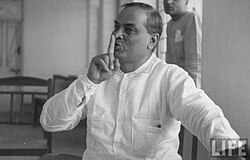
''' | '''Bidhan Chandra Roy''' (1 July 1882 – 1 July 1962) was an Indian physician and politician who served as [[List of Chief Ministers of West Bengal|Chief Minister of West Bengal]] from 1950 until his death in 1962. He played a key role in the founding of several institutions and cities like [[Bidhannagar|Salt Lake]] (now a part of [[Bidhannagar Municipal Corporation]]),<ref>{{cite news|url=https://www.telegraphindia.com/west-bengal/back-to-the-beginning-on-the-50th-year-of-the-landfill-heres-the-story-of-how-salt-lake-came-into-being/cid/396434|work=[[The Telegraph (India)|The Telegraph]]|date=10 August 2012|title=Back to the beginning – On the 50th year of the landfill, here's the story of how Salt Lake came into being }}</ref> [[Kalyani, West Bengal|Kalyani]], [[Durgapur]] and [[Ashoknagar Kalyangarh]]. | ||
In India, the [[National Doctors' Day]] is celebrated in his memory every year on 1 July. He was awarded the [[Bharat Ratna]], India's highest civilian honour in 1961.<ref>{{cite news|url=https://www.firstpost.com/india/national-doctors-day-all-you-need-to-know-about-dr-bidhan-chandra-roy-10851091.html|work=Firstpost|date=1 July 2022|accessdate=1 July 2022|title=National Doctors' Day: All you need to know about Dr Bidhan Chandra Roy}}</ref> | In India, the [[National Doctors' Day#India|National Doctors' Day]] is celebrated in his memory every year on 1 July. He was awarded the [[Bharat Ratna]], India's highest civilian honour in 1961.<ref>{{cite news|url=https://www.firstpost.com/india/national-doctors-day-all-you-need-to-know-about-dr-bidhan-chandra-roy-10851091.html|work=Firstpost|date=1 July 2022|accessdate=1 July 2022|title=National Doctors' Day: All you need to know about Dr Bidhan Chandra Roy}}</ref> | ||
==Early life and education== | ==Early life and education== | ||
Bidhan Chandra Roy was born on 1 July 1882 to a [[ | [[File:Dr. Bidhan Chandra Roy in 1911.jpg|thumb|180px|left|Bidhan Chandra Roy in 1911]] | ||
Bidhan Chandra Roy was born on 1 July 1882 to a [[Bengali Kayastha]] family in [[Bankipore]] in [[Patna]], where his father, Prakash Chandra Roy coming from a wealthy family of [[Satkhira]], [[Khulna]] district, [[Bengal Presidency]] (now in [[Bangladesh]]), was serving as an excise inspector. His mother, Aghorkamini Devi, was religious and a devoted social worker.<ref>{{Cite news|url=http://evirtualguru.com/biography-of-bharat-ratna-dr-bidhan-chandra-roy-complete-biography-for-class-10-class-12-and-graduation-and-other-classes/|title=Biography of Bharat Ratna "Dr. Bidhan Chandra Roy" complete biography for Class 10, Class 12 and Graduation and other classes.|date=1 February 2018|work=eVirtualGuru|access-date=1 September 2018}}</ref> Roy was the youngest of five siblings, with 2 sisters (Susharbashini and Sarojini) and 2 brothers(Subodh and Sadhan). His parents were ardent [[Brahmo Samaj]]ists.<ref>{{Cite book|url=http://krishikosh.egranth.ac.in/bitstream/1/20290/1/2851.pdf|title=Dr. B. C. Roy|last=Thomas|first=K.P.|publisher=Atulya Ghosh, West Bengal Pradesh Congress Committee|year=1955|location=Calcutta|access-date=1 September 2018|archive-url=https://web.archive.org/web/20180902011916/http://krishikosh.egranth.ac.in/bitstream/1/20290/1/2851.pdf|archive-date=2 September 2018|url-status=dead}}</ref> | |||
Prakash Chandra was a descendant of the family of [[Pratapaditya|Maharaja Pradapaditya]], the rebel Hindu king of [[Jessore District|Jessore]], but did not inherit much wealth from his [[ | Prakash Chandra was a descendant of the family of [[Pratapaditya|Maharaja Pradapaditya]], the rebel Hindu king of [[Jessore District|Jessore]], but did not inherit much wealth from his [[ancestor]]s. He earned a moderate salary for most part of Roy's childhood, but he and Aghorkamini supported the education and upbringing of both their own children and a number of other poor children, mostly orphans.<ref name=":2">{{Cite book |author=Nandalal Bhattacharya |url=https://books.google.com/books?id=0OeXw4AYVusC&pg=PA16 |title=''Karmajogi Bidhanchandra (Life of Bidhan Chandra Roy)'' |publisher=Grantha-tirtha |year=2004 |page=15 & 16 |language=Bengali}}</ref> | ||
Roy left Patna in June 1901 to study at the [[Medical College and Hospital, Kolkata]]. While at medical school, he came upon an inscription which read, "Whatever thy hands findeth to do, do it with thy might."<ref name=":3">{{Cite web|url=https://www.indiatoday.in/education-today/gk-current-affairs/story/remembering-dr-bidhan-chandra-roy-1021823-2017-07-01|title=Remembering Dr Bidhan Chandra Roy: Facts about the doctor who dedicated his life to the profession of medicine|website=India Today|date=1 July 2017}}</ref> These words became a lifelong source of inspiration for him.<ref name=":0">{{Cite web|url=http://www.iloveindia.com/indian-heroes/bidhan-chandra-roy.html|title=Bidhan Chandra Roy Biography – Bidhan Chandra Roy Childhood, Life, Profile, Timeline|website=www.iloveindia.com|access-date=25 August 2018|archive-date=25 April 2021|archive-url=https://web.archive.org/web/20210425031928/http://www.iloveindia.com/indian-heroes/bidhan-chandra-roy.html|url-status=dead}}</ref> | |||
Intending to enroll at [[St Bartholomew's Hospital]] to complete further studies in medicine, | Intending to enroll at [[St Bartholomew's Hospital]] to complete further studies in medicine, Roy left for Britain in February 1909 with {{INR}}1,200. The then dean of St. Bartholomew's Hospital was reluctant to accept an Asian student and rejected his application.<ref>{{Cite web|url=https://greatrulers.com/books/dr-bidhan-chandra-roy--biography-and-life-history|title=Dr Bidhan Chandra Roy -Biography and Life History {{!}} Great Rulers|website=greatrulers.com|access-date=27 August 2018|archive-url=https://web.archive.org/web/20180828001729/https://greatrulers.com/books/dr-bidhan-chandra-roy--biography-and-life-history|archive-date=28 August 2018|url-status=dead}}</ref> Roy submitted several additional applications until the dean, after 30 admission requests, admitted him.<ref>{{Cite web|url=https://thewire.in/culture/when-indias-national-doctor-was-denied-service-by-an-american-restaurant|title=When India's 'National Doctor' Was Denied Service By an American Restaurant|website=The Wire|access-date=28 August 2018}}</ref> | ||
==Career== | ==Career== | ||
[[File:Dr. | [[File:Dr._Bidhan_Chandra_Roy_in_1943.jpg|right|200px|thumb|Roy in 1943]] | ||
Upon returning to India, Roy joined the '''Provincial Health Service'''. In addition to a private practice, he served as a nurse when necessary. He taught at the [[Medical College and Hospital, Kolkata]] and later at the [[Nil Ratan Sircar Medical College and Hospital|Campbell Medical School]] (now [[NRS Medical College]]) and the [[R. G. Kar Medical College and Hospital|Carmichael Medical College]]<ref name=":0" /> (now [[R. G. Kar Medical College]]). He served as the first president of '''Cardiological Society of India''' from 1948 to 1950.<ref>{{Cite web |title=Past President – CSI |url=https://csi.org.in/presidents?page=1 |access-date=28 November 2022 |website=csi.org.in}}</ref> | |||
Roy believed that [[swaraj]] (the call to action for India's freedom) would remain a dream unless the people were healthy and strong in mind and body. He made contributions to the organisation of medical education. He played an important role in the establishment of the Jadavpur T.B. Hospital, Chittaranjan Seva Sadan, [[Kamla Nehru Memorial Hospital|Kamala Nehru Memorial Hospital]], [[Victoria Institution (College | Roy believed that [[swaraj]] (the call to action for India's freedom) would remain a dream unless the people were healthy and strong in mind and body. He made contributions to the organisation of medical education. He played an important role in the establishment of the Jadavpur T.B. Hospital, Chittaranjan Seva Sadan, [[Kamla Nehru Memorial Hospital|Kamala Nehru Memorial Hospital]], [[Victoria Institution (College)]], and [[Chittaranjan National Cancer Institute|Chittaranjan Cancer Hospital]]. In 1926, the Chittaranjan Seva Sadan for women and children was opened by Roy.<ref name=":9">{{Cite web|url=https://www.thoughtoftheday98.com/2021/07/dr-bidhan-chandra-roy-biography.html|title=''Dr Bidhan Chandra Roy Biography: डॉ. बिधान चंद्र राय जीवन परिचय''|language=Hindi|author=Sumit Kumar|publisher=Sumit-Kumar|year=2021}}</ref> | ||
Roy was also [[Mahatma Gandhi]]'s personal doctor and friend. | |||
Roy | In 1925, Roy ran for elections from the [[Barrackpore]] constituency as an independent candidate for the [[British Bengal Legislative Council|Bengal Legislative Council]] and defeated the "Grand Old Man of Bengal", [[Surendranath Banerjee]]. Though an independent, he voted with the [[Swaraj Party]] (the Parliamentary wing of the [[Congress party]] in the 1920s). As early as 1925, Roy tabled a resolution recommending a study of the causes of pollution in [[Hooghly River|Hooghly]] and suggested measures to prevent pollution in the future.<ref name=":3" /> | ||
Roy was elected to the [[All India Congress Committee]] in 1928. Roy conducted [[Civil disobedience movement|Civil Disobedience]] in Bengal in 1929 and prompted [[Pandit Motilal Nehru]] to nominate him as a member of the [[Congress Working Committee]] (CWC) in 1930. The CWC was declared an unlawful assembly and Roy along with other members of the committee were arrested on 26 August 1930 and detained at [[Alipore Jail|Alipore Central Jail]]. | |||
During the [[Salt March|Dandi March]] in 1931, many members of the [[Calcutta Corporation]] were imprisoned. Congress requested Roy to remain out of prison and discharge the duties of the Corporation. He served as the [[Alderman]] of the Corporation from 1930 to 1931 and as the [[Mayor of Calcutta]] from 1931 to 1933. Under him, the Corporation expanded schemes for free education, free medical aid, improved roads and lighting, and water supply. He set up a framework for dispensing grant-in-aid to hospitals and charitable [[dispensaries]].<ref name=":3" /> | |||
In 1942, [[Rangoon]] fell to the Japanese bombing and caused an exodus from Calcutta fearing a Japanese invasion. Roy, then serving as the Vice-Chancellor of the [[University of Calcutta]], acquired air-raid shelters for schools and college students to have their classes in, and provided relief for students, teachers and employees alike. | |||
== | ==Chief Minister of West Bengal== | ||
The Congress Party proposed Roy's name for | The Congress Party proposed Roy's name for Premier of West Bengal. Although Roy sought to continue with his profession, he accepted the position and took office on 23 January 1948 upon Gandhi's advice. Bengal at the time had been torn by [[communal violence]], shortage of food, unemployment and a large flow of [[refugee]]s in the wake of the creation of [[East Pakistan]]. In an address to the people of West Bengal, Roy said:<ref name=":1">{{Cite news |date=30 June 2016 |title=Bengal's physician chief minister – The Statesman |work=The Statesman |url=https://www.thestatesman.com/opinion/bengal-s-physician-chief-minister-151414.html |access-date=26 August 2018}}</ref> | ||
{{blockquote|We have the ability and if, with faith in our future, we exert ourselves with determination, nothing, I am sure, no obstacles, however formidable or insurmountable they may appear at present, can stop our progress... (if we) all work unitedly, keeping our vision clear and with a firm grasp of our problems.}} | {{blockquote|We have the ability and if, with faith in our future, we exert ourselves with determination, nothing, I am sure, no obstacles, however formidable or insurmountable they may appear at present, can stop our progress... (if we) all work unitedly, keeping our vision clear and with a firm grasp of our problems.}} | ||
The | On 26 January 1950, Roy took oath as the first Chief Minister of West Bengal in [[Independent India]]. Under his leadership, the Congress party won the legislative assembly elections in West Bengal in [[1952 West Bengal Legislative Assembly election|1952]] and [[1957 West Bengal Legislative Assembly election|1957]]. | ||
The 22-member Sarkar Committee, headed by industrialist [[Nalini Ranjan Sarkar]], recommended the formation of technical institutions for higher education in India. Roy successfully petitioned then Prime Minister [[Jawaharlal Nehru]] to setup the first institute in West Bengal, on the grounds that the state had the highest concentration of industries at that time. The Indian Institute of Technology Kharagpur was thus established in May 1950, with Roy serving as the first chairman of the board of Governors.<ref>{{Cite web |date=15 October 2024 |title=About IIT Kharagpur |url=https://www.iitkgp.ac.in/about-iitkgp-history |access-date=15 October 2024 |website=IIT Kharagpur}}</ref> | |||
He was credited for the development of cities like [[Bidhannagar]], [[Kalyani, West Bengal|Kalyani]], and [[Durgapur]], which were crucial for the growth of [[Economy of West Bengal|West Bengal's economy]] at a time when it was ravaged by the ill consequences of [[Partition of India|partition]].<ref name=":3" /><ref name=":4" /> | |||
==Death== | |||
Bidhan Chandra Roy died on 1 July 1962, coincidentally on his 80th birthday. His house was later converted into a nursing home named after his mother, Aghorkamini Devi. He had also constituted a trust for his properties at [[Patna]] to carry out social service, with eminent nationalist [[Ganga Sharan Singh (Sinha)]] being its first trustee.<ref>{{cite book|title=Dr. Rajendra Prasad, Correspondence and Select Documents: 1934–1937|last=Choudhary|first=Valmiki|publisher=Allied Publishers|year=1984|isbn=978-81-7023-002-1|page=[https://archive.org/details/drrajendraprasad0000pras/page/133 133]|url=https://archive.org/details/drrajendraprasad0000pras/page/133}}</ref> | |||
The [[Dr. B. C. Roy Award|B.C. Roy National Award]] was instituted in 1962<ref>{{Cite web|url=https://www.mciindia.org/CMS/awards/dr-b-c-roy-award|title=Dr. B.C. Roy Award {{!}} MCI India|website=www.mciindia.org|access-date=28 August 2018|archive-date=28 August 2018|archive-url=https://web.archive.org/web/20180828071416/https://www.mciindia.org/CMS/awards/dr-b-c-roy-award|url-status=dead}}</ref> in | ==Legacy== | ||
[[File:Dr._Bidhan_Chandra_Roy_statue.jpg|thumb|150px|Bidhan Chandra Roy statue in [[Bidhannagar|Salt Lake City]]]] | |||
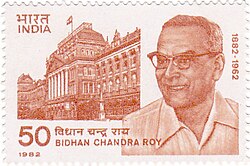
[[File:Bidhan Chandra Roy 1982 stamp of India.jpg|thumb|150px|A commemorative post stamp of Dr. Roy, published by [[India Post]].]] | |||
[[File:Statue of Dr. B. C. Roy.jpg|thumb|150px|Statue of Dr. B. C. Roy in [[Howrah]] city]] | |||
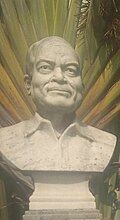
[[File:Bust of Bidhan Chandra Roy in Kolkata.jpg|thumb|150px|Bust of Roy at Bidhan Shishu Udyan in [[Ultadanga]]]] | |||
The Indian Government honoured Roy with the [[Bharat Ratna]] on 4 February 1961. | |||
The [[Dr. B. C. Roy Award|B.C. Roy National Award]] was instituted in 1962<ref>{{Cite web|url=https://www.mciindia.org/CMS/awards/dr-b-c-roy-award|title=Dr. B.C. Roy Award {{!}} MCI India|website=www.mciindia.org|access-date=28 August 2018|archive-date=28 August 2018|archive-url=https://web.archive.org/web/20180828071416/https://www.mciindia.org/CMS/awards/dr-b-c-roy-award|url-status=dead}}</ref> in his memory and has been awarded annually since 1976. The award recognises excellent contributions in the areas of medicine, politics, science, philosophy, literature and arts. The Dr. B. C. Roy Memorial Library and Reading Room for Children in the Children's Book Trust, New Delhi, was opened in 1967. Today, his private papers are part of the Archives at the [[Nehru Memorial Museum & Library]], at [[Teen Murti House]], Delhi.<ref>{{Cite web|url=http://www.nehrumemorial.nic.in/en/archives.html|title=Archives|last=NMML|website=www.nehrumemorial.nic.in|access-date=26 August 2018|archive-date=26 July 2020|archive-url=https://web.archive.org/web/20200726224938/http://www.nehrumemorial.nic.in/en/archives.html|url-status=dead}}</ref><ref>{{Cite web|url=https://www.dailyrounds.org/rounds/indias-iconic-doctor-dr-bidhan-chandra-roy|title=India's Iconic Doctor: Dr. Bidhan Chandra Roy{{!}} DailyRounds|website=www.dailyrounds.org|access-date=26 August 2018|archive-url=https://web.archive.org/web/20180826214416/https://www.dailyrounds.org/rounds/indias-iconic-doctor-dr-bidhan-chandra-roy|archive-date=26 August 2018|url-status=dead}}</ref> | |||
India celebrates National Doctors' Day on 1 July every year to honour his birthday and deathday.<ref name=":4">{{Cite web |last=Pakrasi |first=Susmita |date=30 June 2021 |title=National Doctors' Day on July |url=https://www.hindustantimes.com/india-news/national-doctors-day-on-july-1-history-and-significance-101625011035886.html |access-date=15 October 2024 |website=The Hindustan Times}}</ref> | |||
=== In Bollywood === | |||
In the superhit movie [[Bawarchi]], [[Rajesh Khanna]] who played the role of protagonist Raghu, is talented traditional Indian cook who is surprisingly a philosopher, singer, composer, [[dance instructor]] and mathematician. In the movie, Raghu speaks to have attained these skills and traits through working with different Indian public figures including Bidhan Chandra Roy to name a few. | |||
==See also== | ==See also== | ||
*[[B.C. Roy Trophy]] | *[[B.C. Roy Trophy]] | ||
*[[Bidhannagar]] | |||
==References== | ==References== | ||
{{Reflist}} | {{Reflist}} | ||
{{commons category|Bidhan Chandra Roy}} | |||
{{Wikiquote}} | |||
{{s-start}} | {{s-start}} | ||
{{s-off}} | {{s-off}} | ||
| Line 103: | Line 131: | ||
}} | }} | ||
{{s-end}} | {{s-end}} | ||
{{Indian National Congress}} | |||
{{Chief Ministers of West Bengal}} | {{Chief Ministers of West Bengal}} | ||
{{Indian independence movement}} | {{Indian independence movement}} | ||
| Line 117: | Line 146: | ||
[[Category:Bengali Hindus]] | [[Category:Bengali Hindus]] | ||
[[Category:Medical College and Hospital, Kolkata alumni]] | [[Category:Medical College and Hospital, Kolkata alumni]] | ||
[[Category:University of Calcutta alumni]] | [[Category:University of Calcutta alumni]] | ||
[[Category:Academic staff of the University of Calcutta]] | [[Category:Academic staff of the University of Calcutta]] | ||
[[Category:Indian city founders]] | [[Category:Indian city founders]] | ||
| Line 125: | Line 152: | ||
[[Category:Brahmos]] | [[Category:Brahmos]] | ||
[[Category:Medical College and Hospital, Kolkata]] | [[Category:Medical College and Hospital, Kolkata]] | ||
[[Category:Chief | [[Category:Chief ministers of West Bengal]] | ||
[[Category:20th-century Indian medical doctors]] | [[Category:20th-century Indian medical doctors]] | ||
[[Category:Indian National Congress politicians from West Bengal]] | [[Category:Indian National Congress politicians from West Bengal]] | ||
[[Category:Indian independence activists from Bengal]] | [[Category:Indian independence activists from Bengal]] | ||
[[Category:Politicians from Kolkata]] | [[Category:Politicians from Kolkata]] | ||
[[Category:People from Patna district]] | [[Category:People from Patna district]] | ||
[[Category:Vice | [[Category:Vice-chancellors of the University of Calcutta]] | ||
[[Category:Prisoners and detainees of British India]] | [[Category:Prisoners and detainees of British India]] | ||
[[Category:Mayors of Kolkata]] | [[Category:Mayors of Kolkata]] | ||
[[Category:Chief ministers from Indian National Congress]] | [[Category:Chief ministers from Indian National Congress]] | ||
[[Category:Scientists from Kolkata]] | [[Category:Scientists from Kolkata]] | ||
[[Category:20th-century | [[Category:West Bengal MLAs 1951–1957]] | ||
[[Category:West Bengal MLAs 1957–1962]] | |||
[[Category:West Bengal MLAs 1962–1967]] | |||
[[Category:Alumni of the Medical College of St Bartholomew's Hospital]] | |||
[[Category:20th-century mayors of places in India]] | |||
Latest revision as of 03:11, 25 January 2026
Bidhan Chandra Roy | |
|---|---|
 | |
| 2nd Premier of West Bengal | |
| In office 23 January 1948 – 25 January 1950 | |
| Governor | Chakravarti Rajagopalachari Kailash Nath Katju |
| Preceded by | Prafulla Chandra Ghosh |
| Succeeded by | Position abolished (himself as Chief Minister of West Bengal) |
| 1st Chief Minister of West Bengal | |
| In office 26 January 1950 – 1 July 1962 | |
| Governor | Kailash Nath Katju Harendra Coomar Mookerjee Phani Bhusan Chakravartti (acting) Padmaja Naidu |
| Preceded by | Office established (himself as Premier of West Bengal) |
| Succeeded by | Prafulla Chandra Sen |
| Member of West Bengal Legislative Assembly | |
| In office 1952–1962 | |
| Preceded by | Constituency established |
| Succeeded by | Bijoy Singh Nahar |
| Constituency | Bowbazar |
| In office May 1962 – 1 July 1962 | |
| Preceded by | Bijoy Singh Nahar |
| Succeeded by | Siddhartha Shankar Ray |
| Constituency | Chowranghee |
| 5th Mayor of Kolkata | |
| In office 5 April 1931 – 9 April 1933 | |
| Preceded by | Subhas Chandra Bose |
| Succeeded by | Santosh Kumar Basu |
| Member of Bengal Legislative Councilfor Barrackpore | |
| In office 1925 Template:Nbnd 1929 | |
| Preceded by | Surendranath Banerjee |
| Personal details | |
| Born | 1 July 1882 Patna, Bengal Presidency, British India (present-day Bihar, India) |
| Died | 1 July 1962 (aged 80) Calcutta (present-day Kolkata), West Bengal, India |
| Political party | Indian National Congress |
| Residence | Kolkata, West Bengal, India |
| Alma mater | Medical College and Hospital, Kolkata St Bartholomew's Hospital |
| Profession |
|
| Awards | Bharat Ratna (1961) |
| Signature |  |
Bidhan Chandra Roy (1 July 1882 – 1 July 1962) was an Indian physician and politician who served as Chief Minister of West Bengal from 1950 until his death in 1962. He played a key role in the founding of several institutions and cities like Salt Lake (now a part of Bidhannagar Municipal Corporation),[1] Kalyani, Durgapur and Ashoknagar Kalyangarh.
In India, the National Doctors' Day is celebrated in his memory every year on 1 July. He was awarded the Bharat Ratna, India's highest civilian honour in 1961.[2]
Early life and education[edit | edit source]

Bidhan Chandra Roy was born on 1 July 1882 to a Bengali Kayastha family in Bankipore in Patna, where his father, Prakash Chandra Roy coming from a wealthy family of Satkhira, Khulna district, Bengal Presidency (now in Bangladesh), was serving as an excise inspector. His mother, Aghorkamini Devi, was religious and a devoted social worker.[3] Roy was the youngest of five siblings, with 2 sisters (Susharbashini and Sarojini) and 2 brothers(Subodh and Sadhan). His parents were ardent Brahmo Samajists.[4]
Prakash Chandra was a descendant of the family of Maharaja Pradapaditya, the rebel Hindu king of Jessore, but did not inherit much wealth from his ancestors. He earned a moderate salary for most part of Roy's childhood, but he and Aghorkamini supported the education and upbringing of both their own children and a number of other poor children, mostly orphans.[5]
Roy left Patna in June 1901 to study at the Medical College and Hospital, Kolkata. While at medical school, he came upon an inscription which read, "Whatever thy hands findeth to do, do it with thy might."[6] These words became a lifelong source of inspiration for him.[7]
Intending to enroll at St Bartholomew's Hospital to complete further studies in medicine, Roy left for Britain in February 1909 with ₹1,200. The then dean of St. Bartholomew's Hospital was reluctant to accept an Asian student and rejected his application.[8] Roy submitted several additional applications until the dean, after 30 admission requests, admitted him.[9]
Career[edit | edit source]

Upon returning to India, Roy joined the Provincial Health Service. In addition to a private practice, he served as a nurse when necessary. He taught at the Medical College and Hospital, Kolkata and later at the Campbell Medical School (now NRS Medical College) and the Carmichael Medical College[7] (now R. G. Kar Medical College). He served as the first president of Cardiological Society of India from 1948 to 1950.[10]
Roy believed that swaraj (the call to action for India's freedom) would remain a dream unless the people were healthy and strong in mind and body. He made contributions to the organisation of medical education. He played an important role in the establishment of the Jadavpur T.B. Hospital, Chittaranjan Seva Sadan, Kamala Nehru Memorial Hospital, Victoria Institution (College), and Chittaranjan Cancer Hospital. In 1926, the Chittaranjan Seva Sadan for women and children was opened by Roy.[11]
Roy was also Mahatma Gandhi's personal doctor and friend.
In 1925, Roy ran for elections from the Barrackpore constituency as an independent candidate for the Bengal Legislative Council and defeated the "Grand Old Man of Bengal", Surendranath Banerjee. Though an independent, he voted with the Swaraj Party (the Parliamentary wing of the Congress party in the 1920s). As early as 1925, Roy tabled a resolution recommending a study of the causes of pollution in Hooghly and suggested measures to prevent pollution in the future.[6]
Roy was elected to the All India Congress Committee in 1928. Roy conducted Civil Disobedience in Bengal in 1929 and prompted Pandit Motilal Nehru to nominate him as a member of the Congress Working Committee (CWC) in 1930. The CWC was declared an unlawful assembly and Roy along with other members of the committee were arrested on 26 August 1930 and detained at Alipore Central Jail.
During the Dandi March in 1931, many members of the Calcutta Corporation were imprisoned. Congress requested Roy to remain out of prison and discharge the duties of the Corporation. He served as the Alderman of the Corporation from 1930 to 1931 and as the Mayor of Calcutta from 1931 to 1933. Under him, the Corporation expanded schemes for free education, free medical aid, improved roads and lighting, and water supply. He set up a framework for dispensing grant-in-aid to hospitals and charitable dispensaries.[6]
In 1942, Rangoon fell to the Japanese bombing and caused an exodus from Calcutta fearing a Japanese invasion. Roy, then serving as the Vice-Chancellor of the University of Calcutta, acquired air-raid shelters for schools and college students to have their classes in, and provided relief for students, teachers and employees alike.
Chief Minister of West Bengal[edit | edit source]
The Congress Party proposed Roy's name for Premier of West Bengal. Although Roy sought to continue with his profession, he accepted the position and took office on 23 January 1948 upon Gandhi's advice. Bengal at the time had been torn by communal violence, shortage of food, unemployment and a large flow of refugees in the wake of the creation of East Pakistan. In an address to the people of West Bengal, Roy said:[12]
We have the ability and if, with faith in our future, we exert ourselves with determination, nothing, I am sure, no obstacles, however formidable or insurmountable they may appear at present, can stop our progress... (if we) all work unitedly, keeping our vision clear and with a firm grasp of our problems.
On 26 January 1950, Roy took oath as the first Chief Minister of West Bengal in Independent India. Under his leadership, the Congress party won the legislative assembly elections in West Bengal in 1952 and 1957.
The 22-member Sarkar Committee, headed by industrialist Nalini Ranjan Sarkar, recommended the formation of technical institutions for higher education in India. Roy successfully petitioned then Prime Minister Jawaharlal Nehru to setup the first institute in West Bengal, on the grounds that the state had the highest concentration of industries at that time. The Indian Institute of Technology Kharagpur was thus established in May 1950, with Roy serving as the first chairman of the board of Governors.[13]
He was credited for the development of cities like Bidhannagar, Kalyani, and Durgapur, which were crucial for the growth of West Bengal's economy at a time when it was ravaged by the ill consequences of partition.[6][14]
Death[edit | edit source]
Bidhan Chandra Roy died on 1 July 1962, coincidentally on his 80th birthday. His house was later converted into a nursing home named after his mother, Aghorkamini Devi. He had also constituted a trust for his properties at Patna to carry out social service, with eminent nationalist Ganga Sharan Singh (Sinha) being its first trustee.[15]
Legacy[edit | edit source]


The Indian Government honoured Roy with the Bharat Ratna on 4 February 1961.
The B.C. Roy National Award was instituted in 1962[16] in his memory and has been awarded annually since 1976. The award recognises excellent contributions in the areas of medicine, politics, science, philosophy, literature and arts. The Dr. B. C. Roy Memorial Library and Reading Room for Children in the Children's Book Trust, New Delhi, was opened in 1967. Today, his private papers are part of the Archives at the Nehru Memorial Museum & Library, at Teen Murti House, Delhi.[17][18]
India celebrates National Doctors' Day on 1 July every year to honour his birthday and deathday.[14]
In Bollywood[edit | edit source]
In the superhit movie Bawarchi, Rajesh Khanna who played the role of protagonist Raghu, is talented traditional Indian cook who is surprisingly a philosopher, singer, composer, dance instructor and mathematician. In the movie, Raghu speaks to have attained these skills and traits through working with different Indian public figures including Bidhan Chandra Roy to name a few.
See also[edit | edit source]
References[edit | edit source]
- ↑ "Back to the beginning – On the 50th year of the landfill, here's the story of how Salt Lake came into being". The Telegraph. 10 August 2012.
- ↑ "National Doctors' Day: All you need to know about Dr Bidhan Chandra Roy". Firstpost. 1 July 2022. Retrieved 1 July 2022.
- ↑ "Biography of Bharat Ratna "Dr. Bidhan Chandra Roy" complete biography for Class 10, Class 12 and Graduation and other classes". eVirtualGuru. 1 February 2018. Retrieved 1 September 2018.
- ↑ Thomas, K.P. (1955). Dr. B. C. Roy (PDF). Calcutta: Atulya Ghosh, West Bengal Pradesh Congress Committee. Archived from the original (PDF) on 2 September 2018. Retrieved 1 September 2018.
- ↑ Nandalal Bhattacharya (2004). Karmajogi Bidhanchandra (Life of Bidhan Chandra Roy) (in Bengali). Grantha-tirtha. p. 15 & 16.
- ↑ 6.0 6.1 6.2 6.3 "Remembering Dr Bidhan Chandra Roy: Facts about the doctor who dedicated his life to the profession of medicine". India Today. 1 July 2017.
- ↑ 7.0 7.1 "Bidhan Chandra Roy Biography – Bidhan Chandra Roy Childhood, Life, Profile, Timeline". www.iloveindia.com. Archived from the original on 25 April 2021. Retrieved 25 August 2018.
- ↑ "Dr Bidhan Chandra Roy -Biography and Life History | Great Rulers". greatrulers.com. Archived from the original on 28 August 2018. Retrieved 27 August 2018.
- ↑ "When India's 'National Doctor' Was Denied Service By an American Restaurant". The Wire. Retrieved 28 August 2018.
- ↑ "Past President – CSI". csi.org.in. Retrieved 28 November 2022.
- ↑ Sumit Kumar (2021). "Dr Bidhan Chandra Roy Biography: डॉ. बिधान चंद्र राय जीवन परिचय" (in Hindi). Sumit-Kumar.
{{cite web}}: CS1 maint: unrecognized language (link) - ↑ "Bengal's physician chief minister – The Statesman". The Statesman. 30 June 2016. Retrieved 26 August 2018.
- ↑ "About IIT Kharagpur". IIT Kharagpur. 15 October 2024. Retrieved 15 October 2024.
- ↑ 14.0 14.1 Pakrasi, Susmita (30 June 2021). "National Doctors' Day on July". The Hindustan Times. Retrieved 15 October 2024.
- ↑ Choudhary, Valmiki (1984). Dr. Rajendra Prasad, Correspondence and Select Documents: 1934–1937. Allied Publishers. p. 133. ISBN 978-81-7023-002-1.
- ↑ "Dr. B.C. Roy Award | MCI India". www.mciindia.org. Archived from the original on 28 August 2018. Retrieved 28 August 2018.
- ↑ NMML. "Archives". www.nehrumemorial.nic.in. Archived from the original on 26 July 2020. Retrieved 26 August 2018.
- ↑ "India's Iconic Doctor: Dr. Bidhan Chandra Roy| DailyRounds". www.dailyrounds.org. Archived from the original on 26 August 2018. Retrieved 26 August 2018.
| Political offices | ||
|---|---|---|
| Preceded by Prafulla Chandra Ghosh |
Chief Minister of West Bengal 1948–1962 |
Succeeded by President's Rule |

Bharat Ratna laureates | ||
|---|---|---|
| 1954–1960 |
|  |
| 1961–1980 |
| |
| 1981–2000 |
| |
| 2001–2019 |
| |
Members of the West Bengal Legislative Assembly from Medinipur division | ||
|---|---|---|
|  | |


Members of the West Bengal Legislative Assembly from Presidency division | ||
|---|---|---|
|  | |
- Pages using the JsonConfig extension
- 1882 births
- 1962 deaths
- Bengali Hindus
- Medical College and Hospital, Kolkata alumni
- University of Calcutta alumni
- Academic staff of the University of Calcutta
- Indian city founders
- Recipients of the Bharat Ratna
- Brahmos
- Medical College and Hospital, Kolkata
- Chief ministers of West Bengal
- 20th-century Indian medical doctors
- Indian National Congress politicians from West Bengal
- Indian independence activists from Bengal
- Politicians from Kolkata
- People from Patna district
- Vice-chancellors of the University of Calcutta
- Prisoners and detainees of British India
- Mayors of Kolkata
- Chief ministers from Indian National Congress
- Scientists from Kolkata
- West Bengal MLAs 1951–1957
- West Bengal MLAs 1957–1962
- West Bengal MLAs 1962–1967
- Alumni of the Medical College of St Bartholomew's Hospital
- 20th-century mayors of places in India