


Created page with "{{Distinguish|Ambedkar Nagar, Jodhpur|Ambedkar Nagar district}} {{Use dmy dates|date=September 2019}} {{Use Indian English|date=September 2019}} {{Infobox settlement | na..." |
No edit summary |
||
| (3 intermediate revisions by 3 users not shown) | |||
| Line 1: | Line 1: | ||
{{ | {{redirect| Dr. Ambedkar Nagar|other places|List of things named after B. R. Ambedkar#Places}} | ||
{{Use dmy dates|date=September 2019}} | {{Use dmy dates|date=September 2019}} | ||
{{Use Indian English|date=September 2019}} | {{Use Indian English|date=September 2019}} | ||
| Line 14: | Line 14: | ||
| map_alt = | | map_alt = | ||
| map_caption = | | map_caption = | ||
| pushpin_map = India Madhya Pradesh# | | pushpin_map = India Madhya Pradesh#India | ||
| pushpin_label_position = right | | pushpin_label_position = right | ||
| pushpin_map_alt = | | pushpin_map_alt = | ||
| Line 20: | Line 20: | ||
| coordinates = {{coord|22.55|N|75.76|E|display=inline,title}} | | coordinates = {{coord|22.55|N|75.76|E|display=inline,title}} | ||
| subdivision_type = Country | | subdivision_type = Country | ||
| subdivision_name = | | subdivision_name = India | ||
| subdivision_type1 = [[States and territories of India|State]] | | subdivision_type1 = [[States and territories of India|State]] | ||
| subdivision_name1 = [[Madhya Pradesh]] | | subdivision_name1 = [[Madhya Pradesh]] | ||
| Line 37: | Line 37: | ||
| elevation_m = 556 | | elevation_m = 556 | ||
| population_total = 85023 | | population_total = 85023 | ||
| population_as_of = 2011 | | population_as_of = 2011 | ||
| population_rank = | | population_rank = | ||
| population_density_km2 = auto | | population_density_km2 = auto | ||
| Line 55: | Line 55: | ||
| footnotes = | | footnotes = | ||
}} | }} | ||
Some articles in popular literature state that 'MHOW' stands for '''M'''ilitary '''H'''eadquarters '''O'''f '''W''' | '''Mhow''', officially '''Dr. Ambedkar Nagar''', is a town in the [[Indore district]] in [[Madhya Pradesh]] state of India. It is located {{convert|23|km|mi|0}} south-west of [[Indore]] city, towards [[Mumbai]] on the old [[National Highway 3 (India)|-Agra Mumbai Road]]. It is the birthplace of the social and political reformer and the chairman of the Constitution Drafting Committee [[B. R. Ambedkar]] who was also independent India's first law minister. In 2003, the Government of Madhya Pradesh renamed the town ''Dr. Ambedkar Nagar'' in honour of Dr B R Ambedkar <ref>{{cite news|url=https://timesofindia.indiatimes.com/india/Mhow-city-renamed-as-Dr-Ambedkar-Nagar/articleshow/48434.cms|archive-url=https://web.archive.org/web/20121023043527/http://articles.timesofindia.indiatimes.com/2003-06-28/india/27179994_1_bhopal-notification-madhya-pradesh-government|url-status=live|archive-date=23 October 2012|location=[[Bhopal]]|work=[[The Times of India]]|title=Mhow town renamed as Dr Ambedkar Nagar|date=28 June 2003|access-date=21 October 2017}}</ref> | ||
==Etymology== | |||
Some articles in popular literature state that 'MHOW' stands for '''M'''ilitary '''H'''eadquarters '''O'''f '''W'''arfare. However, this is a [[backronym]], and there is no proof to support the theory that the name of the cantonment town comes from the acronym. | |||
==History== | ==History== | ||
This cantonment town was founded in 1818 by [[John Malcolm]] as a result of the Treaty of Mandsaur between the English and the [[Holkar]]s who were the [[Maratha]] [[Maharaja]]s of | This cantonment town was founded in 1818 by [[John Malcolm]] as a result of the [[Treaty of Mandsaur]] between the English and the [[House of Holkar|Holkar]]s who were the [[Maratha Empire|Maratha]] [[Maharaja]]s of Indore. John Malcolm's forces had defeated the Holkars of the [[Maratha Empire|Maratha Confederacy]] at the [[Battle of Mahidpur]] on 21 December 1817. It was after this battle that the capital of the Holkars moved from the town of [[Maheshwar]] on the banks of the [[Narmada]] to Indore. | ||
Mhow used to be the headquarters of the [[5th (Mhow) Division]] of the [[Southern Command (India)|Southern Command]] during the [[British Raj]]. Today this small town is associated with the [[Indian Army]] and with | Mhow used to be the headquarters of the [[5th (Mhow) Division]] of the [[Southern Command (India)|Southern Command]] during the [[British Raj]]. Today this small town is associated with the [[Indian Army]] and with [[B. R. Ambedkar]] who was born there. | ||
Mhow was a meter gauge railway district headquarters during the British Raj and | Mhow was a meter gauge railway district headquarters during the British Raj and after 1947.<ref>Bombay Baroda and Central India Railway (B.B.& C.I. Railway) which later got incorporated in Western Railway.</ref> Mhow now has a broad gauge connection with Indore, regular train services to Khandwa. are yet to commence. The metre gauge rail traffic in the Dr Ambedkar Nagar (Mhow) Railway Station is now history. | ||
According to [[Hinduism|Hindu]] religious texts, [[Janapav]] Kuti near Mhow is said to be the birthplace{{citation needed|date= March 2015}} of [[Parashurama]], an avatar of [[Vishnu]]. | According to [[Hinduism|Hindu]] religious texts, [[Janapav]] Kuti near Mhow is said to be the birthplace{{citation needed|date= March 2015}} of Lord [[Parashurama]], an avatar of Lord [[Vishnu]]. | ||
== Climate == | == Climate == | ||
Temperatures may go as high as 43 degrees Celsius during summers and as low as 4 degrees Celsius during winter. {{Citation needed|date=June 2021}} | |||
==Demographics== | ==Demographics== | ||
{{As of|2011}} India | {{As of|2011}} India census,<ref>{{Cite web|url=http://www.census2011.co.in/data/town/802275-mhow-cantt-madhya-pradesh.html|title = Mhow Cantt Cantonment Board City Population Census 2011-2021 | Madhya Pradesh}}</ref> Mhow had a population of 85,023. Males constitute 54% of the population and females 46%. Mhow has an average literacy rate of 72%, higher than the national average of 59.5%; male literacy is 78%, and female literacy is 65%. The Mhow Cantt Cantonment Board has population of 81,702 of which 43,888 are males while 37,814 are females as per report released by Census India 2011. | ||
The population of children aged 0-6 is 9308 which is 11.39% of total population of Mhow Cantt (CB). In Mhow Cantt Cantonment Board, the female sex ratio is 862 against state average of 931. Moreover, the child sex ratio in Mhow Cantt is around 908 compared to Madhya Pradesh state average of 918. The literacy rate of Mhow Cantt city is 85.78%; higher than the state average of 69.32%. In Mhow Cantt, male literacy is around 90.42% while the female literacy rate is 80.37%. | |||
== Cantonment == | == Cantonment == | ||
{{more citations needed section|date=August 2019}} | {{more citations needed section|date=August 2019}} | ||
As early as 1818, the | As early as 1818, the Bengal Presidency Army has had a presence in Mhow. Up until World War II, Mhow was the headquarters of the [[5th (Mhow) Division|5th Division]] of the Southern Army. According to local legend, [[Winston Churchill]] also spent a few months in Mhow when he was a [[Subaltern (military)|subaltern]] serving with his regiment in India. The house on the mall where he is supposed to have lived, gradually crumbled due to neglect and age. It was pulled down and a jogger's park has been built on its grounds by the Infantry School. | ||
Mhow houses three premier training institutions of the Indian Army; The Infantry School, The [[Military College of Telecommunication Engineering]] (MCTE) and The [[Army War College, Mhow|Army War College]]. | Mhow houses three premier training institutions of the Indian Army; The Infantry School, The [[Military College of Telecommunication Engineering]] (MCTE) and The [[Army War College, Mhow|Army War College]]. | ||
In addition to these institutes, Mhow is where Army Training Command or ARTRAC was born. ARTRAC was based in Mhow from 1991 to 1994, before it shifted to Shimla ([[Himachal Pradesh]]). At that time its General Officer Commanding in Chief (GOC-in-C) was Lt. General [[Shankar Roy Chowdhary]] who went on to become the Chief of Army Staff (COAS). Its first GOC-in-C was Lt. General A.S. Kalkat who had earlier commanded the Indian Peace Keeping Force (IPKF) in Sri Lanka. ARTRAC | In addition to these institutes, Mhow is where Army Training Command or ARTRAC was born. ARTRAC was based in Mhow from 1991 to 1994, before it shifted to Shimla ([[Himachal Pradesh]]). At that time its General Officer Commanding in Chief (GOC-in-C) was Lt. General [[Shankar Roy Chowdhary]] who went on to become the Chief of Army Staff (COAS). Its first GOC-in-C was Lt. General A.S. Kalkat who had earlier commanded the Indian Peace Keeping Force (IPKF) in Sri Lanka. ARTRAC functioned from the old 19th century building of the present day Army Public School Mhow. This was used as All Arms Wing of MCTE for many decades. It was originally built and used as the British Military Hospital (BMH). The building is no longer in use and is being preserved as a heritage building. | ||
===The Infantry School=== | ===The Infantry School=== | ||
The Infantry School is a training establishment of the [[Indian Army]]. It is responsible for the training of officers and infantry. The Commando Wing of this school is in [[Belgaum]], [[Karnataka]]. The Army Marksmanship Unit (AMU) is a part of the Infantry School and has produced many medal winning shooters. Field Marshal [[Sam Manekshaw]] was the first Indian Commandant of this school | The Infantry School is a training establishment of the [[Indian Army]]. It is responsible for the training of officers and infantry. The Commando Wing of this school is in [[Belgaum]], [[Karnataka]]. The Army Marksmanship Unit (AMU) is a part of the Infantry School and has produced many medal winning shooters. Field Marshal [[Sam Manekshaw]] was the first Indian Commandant of this school from 1955 to 1956 when he was a Brigadier. The present Commandant is Lt Gen Gajendra Joshi. | ||
Commandant Lt Gen | |||
===Military College of Telecommunication Engineering (MCTE)=== | ===Military College of Telecommunication Engineering (MCTE)=== | ||
The first training institution in Mhow, MCTE was known as the School of Signals till 1967. It is the alma mater of the Corps of Signals. MCTE conducts telecommunications and information technology courses for officers, JCOS, NCOs and soldiers of the Indian Army. Officers and men from other countries also attend courses there. It also trains gentlemen cadets for a bachelor's degree in engineering at the Cadets Training Wing (CTW). On completion of their training, most of the cadets get commissioned into the Indian Army's Corps of Signals, however, some are also commissioned into other branches. | The first training institution in Mhow, MCTE was known as the School of Signals till 1967. It is the alma mater of the Corps of Signals. MCTE conducts telecommunications and information technology courses for officers, JCOS, NCOs and soldiers of the Indian Army. Officers and men from other countries also attend courses there. It also trains gentlemen cadets for a bachelor's degree in engineering at the Cadets Training Wing (CTW). On completion of their training, most of the cadets get commissioned into the Indian Army's Corps of Signals, however, some are also commissioned into other branches. Indian Army has also set up a Quantum Computing and an Artificial Intelligence centre at MCTE.{{fact|date=March 2022}} | ||
Commandant | The present Commandant is Lt Gen Praveen Bakshi. | ||
===The Army War College=== | ===The Army War College=== | ||
| Line 98: | Line 99: | ||
The college was originally established as the College of Combat at Mhow on 1 April 1971. It was spun out of the Infantry School, Mhow. It continued to operate from the campus of the Infantry School until 1988, when the college moved to its new campus. In 2003, the college was renamed as the Army War College, Mhow. | The college was originally established as the College of Combat at Mhow on 1 April 1971. It was spun out of the Infantry School, Mhow. It continued to operate from the campus of the Infantry School until 1988, when the college moved to its new campus. In 2003, the college was renamed as the Army War College, Mhow. | ||
The | The college mainly conducts three courses—the Junior Command (JC) course, the Senior Command (SC) course and the Higher Command (HC) course. The former [[Chief of the Army Staff (India)|Chiefs of Army Staff (COAS)]] General K. Sundarji and General V. N. Sharma have served as the Commandant of the college. The present commandant is Lt Gen H S Sahi. | ||
==Government and politics== | ==Government and politics== | ||
Mhow has one seat in the State Legislative Assembly (the Vidhan Sabha). The first elected MLA (Member of Legislative Assembly) was [[R.C. Jall]] ([[Indian National Congress]]) who belonged to the [[Parsi]] community. | Mhow has one seat in the [[Madhya Pradesh Legislative Assembly|State Legislative Assembly]] (the Vidhan Sabha). The first elected MLA (Member of Legislative Assembly) was [[R.C. Jall]] ([[Indian National Congress]]) who belonged to the [[Parsi]] community. | ||
Since 2018, the MLA from Mhow is Ms [[Usha Thakur]] of the [[BJP]]. Previous MLAs: [[Kailash Vijayvargiya]] of the [[BJP]] and [[Antar Singh Darbar]] of the Indian National Congress who joined the [[BJP]] after the [[2023 Madhya Pradesh Legislative Assembly election|2023 Vidhan Sabha elections]]. | |||
Until 2009, Mhow Tehsil was part of the Indore Lok Sabha constituency. Under the delimitation exercise carried out all over the nation, Mhow is now in the [[Dhar]] Parliamentary constituency though it continues to be in Indore district for administrative purposes. | |||
The current Lok Sabha MP for the Dhar constituency (which is reserved for Scheduled Tribes) is [[Savitri Thakur]] of the [[BJP]]. | |||
She was elected in the 2024 general election to the 18th Lok Sabha. Thakur is also currently the Union Minister of State for Women and Child Development. | |||
Mhow (and the rest of MP) went to the polls on Monday 25 November 2013. Mhow recorded what could well be its highest ever turnout in a Vidhan Sabha election - 78.11%. Total number of voters 220,553. As per Mhow Control Room: Men constitute 79.34% and Women 76.76% with Overall - 78.11%. | Mhow (and the rest of MP) went to the polls on Monday 25 November 2013. Mhow recorded what could well be its highest ever turnout in a Vidhan Sabha election - 78.11%. Total number of voters 220,553. As per Mhow Control Room: Men constitute 79.34% and Women 76.76% with Overall - 78.11%. | ||
On 8 December 2013 [[Kailash Vijayvargiya]] of the | On 8 December 2013 [[Kailash Vijayvargiya]] of the BJP was declared the winner from Mhow Vidhan Sabha constituency. He defeated Antar Singh Darbar of the Indian National Congress. | ||
On 11 December 2018 [[Usha Thakur]] of the | On 11 December 2018 [[Usha Thakur]] of the BJP was declared the winner from Mhow Vidhan Sabha constituency. She defeated Antar Singh Darbar of the Indian National Congress. | ||
Rajendra Harshwal was the first vice chairman of MHOW cantonment for BJP. | [[Rajendra Harshwal]] was the first vice chairman of MHOW cantonment for [[Bharatiya Janata Party]],BJP. In 1999, he became the first leader from Mhow to be elected as district president of the [[Bharatiya Janata Yuva Morcha]],[[Indore]]. He has served three terms as a state minister in the [[Government of Madhya Pradesh]].<ref>{{cite news |title=Forest Development Corporation Vice Chairman injured |url=https://www.oneindia.com/2006/07/29/forest-development-corporation-vice-chairman-injured-1154174792.html |access-date=18 April 2021 |work=One India |date=29 July 2006 |language=en}}</ref> | ||
== Tourism == | == Tourism == | ||
| Line 122: | Line 126: | ||
* [[Patalpani waterfall]] | * [[Patalpani waterfall]] | ||
* [[Janapav]] hill Temple | * [[Janapav]] hill Temple | ||
*[[Christ Church, Mhow]] | |||
*[[Jam Gate|JamGate]] | |||
=== Janapav=== | === Janapav=== | ||
{{main|Janapav}} | {{main|Janapav}} | ||
The river [[Chambal River|Chambal]] which flows through the dacoit infested areas of northern India is said to begin at the hill of Janapav which is in a village named Kuti, around 15 km from Mhow town. On top of the hill of Janapav is a temple and ashram. According to local legend this used to be the ashram of [[Jamadagni]], the father of [[Parashurama]] (an [[Avatar]] or reincarnation of [[Vishnu]], the Hindu God of sustenance). A mela, or religious fair, is held at Kuti every year on the auspicious day of Kartik Purnima - the first full moon after [[Diwali]], which is also celebrated as [[Guru Nanak]]'s birthday by the [[Sikh]] community - and people from villages far and near come to pray and pay their obeisance. The next day the same mela shifts to the Balaji temple in Badgonda village. | The river [[Chambal River|Chambal]] which flows through the dacoit infested areas of northern India is said to begin at the hill of Janapav which is in a village named Kuti, around 15 km from Mhow town. On top of the hill of Janapav is a temple and ashram. According to local legend this used to be the ashram of [[Jamadagni]], the father of [[Parashurama]] (an [[Avatar]] or reincarnation of [[Vishnu]], the Hindu God of sustenance). A mela, or religious fair, is held at Kuti every year on the auspicious day of [[Kartika Purnima|Kartik Purnima]] - the first full moon after [[Diwali]], which is also celebrated as [[Guru Nanak]]'s birthday by the [[Sikh]] community - and people from villages far and near come to pray and pay their obeisance. The next day the same mela shifts to the Balaji temple in Badgonda village. | ||
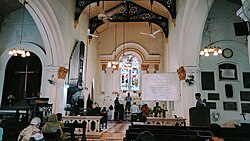
[[File:Christ_Church_Mhow_Service_2021.jpg|thumb|A Sunday Service at the historical [[Christ Church, Mhow]]]] | |||
The river Gambhir which eventually joins the Kshipra - the river on whose banks the ancient, holy city of [[Ujjain]] is built - also begins at the hill of Janapav. From there it flows north towards Mhow. | |||
=== Infantry Research Center & Museum - Mhow=== | |||
[[File:Infantry_Research_Center_%26_Museum_-_Mhow.png|thumb|[[Infantry Research Center & Museum - Mhow ]]|alt=|150x150px|left]] | |||
A world-class and one of its kind Indian Army Museum showcasing the history, courage, valour, and sacrifices of the Infantry as the ultimate cutting-edge combat arm, has been established at Mhow. | |||
== Transport == | == Transport == | ||
| Line 136: | Line 147: | ||
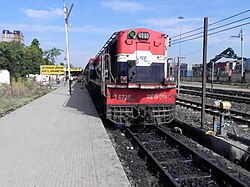
The cost of the gauge conversion would be about Rs.1421.25 crore and Mhow has [[YDM-4]] Metre Gauge(M.G) locomotives in [[Ratlam]] diesel loco shed.{{Clarify|date=May 2017}} | The cost of the gauge conversion would be about Rs.1421.25 crore and Mhow has [[YDM-4]] Metre Gauge(M.G) locomotives in [[Ratlam]] diesel loco shed.{{Clarify|date=May 2017}} | ||
The Patalpani Kalakund Ghat Section will function as a heritage railway from 25 December 2018. | The Patalpani Kalakund Ghat Section will function as a heritage railway from 25 December 2018. | ||
The nearest airport is [[Devi Ahilya Bai Holkar Airport]] of Indore. | |||
== In popular culture == | == In popular culture == | ||
| Line 143: | Line 156: | ||
* ''Last Post At Mhow'' by Arthur Hawkey; London: Jarrolds, 1969; Non fiction | * ''Last Post At Mhow'' by Arthur Hawkey; London: Jarrolds, 1969; Non fiction | ||
* ''Chinnery's Hotel'' by Jaysinh Birjepatil; Ravi Dayal Publishers (India); 2005; fiction | * ''Chinnery's Hotel'' by Jaysinh Birjepatil; Ravi Dayal Publishers (India); 2005; fiction | ||
* ''The compound microscope'' by Dr. Ratna Gosain; 2020 non-fiction book | |||
There are references to Mhow in the works of [[Rudyard Kipling]]: | There are references to Mhow in the works of [[Rudyard Kipling]]: | ||
* His poem "The Ladies" | * His poem "The Ladies" | ||
* A reference to the train from Ajmer to Mhow in Chapter 1 of ''The Man Who | * A reference to the train from Ajmer to Mhow in Chapter 1 of ''[[The Man Who Would Be King]]'' (1888) | ||
* A reference to Mhow in chapter 11 of ''Kim'' | * A reference to Mhow in chapter 11 of ''[[Kim (novel)|Kim]]'' (1901) | ||
== Notable people == | == Notable people == | ||
* [[B.R. Ambedkar]], Indian politician and architect of India's constitution, was born in Mhow. His father Ramji Maloji Sakpal was posted here as a Subedar Major in a battalion of the British [[Indian Army]]'s [[Mahar Regiment]]. A memorial to Dr. Ambedkar in the shape of a Buddhist [[stupa]] | * [[B.R. Ambedkar]], Indian politician and architect of India's constitution, was born in Mhow. His father Ramji Maloji Sakpal was posted here as a Subedar Major in a battalion of the British [[Indian Army]]'s [[Mahar Regiment]]. A memorial to Dr. Ambedkar in the shape of a Buddhist [[stupa]] has been built at a spot where his father's quarters used to be. It is located by the Mhow-Mandleshwar Highway (State Highway 1) and is in the Kali Paltan area of Mhow. It is known as Bhim Janmsthali. | ||
* Dr. [[Catherine Arnott]], a female British medical doctor and suffragette born in Mhow. She worked in the Mure Memorial Hospital, [[Lady Dufferin Hospital]] in [[Karachi]] and Jaswant Hospital for Women in Jodhpur | |||
* [[Shankar Lakshman]], Indian hockey goalkeeper from Mhow ([[Indore]]) | * [[Shankar Lakshman]], Indian hockey goalkeeper from Mhow ([[Indore]]) | ||
* Subedar Major [[Vijay Kumar (sport shooter)]], AVSM, SM (Retd) of the 16th Battalion Dogra Regiment, Indian Army won a silver medal at the London Olympics 2012 in the | * Subedar Major [[Vijay Kumar (sport shooter)]], AVSM, SM (Retd) of the 16th Battalion Dogra Regiment, Indian Army won a silver medal at the London Olympics 2012 in the 25 m rapid-fire pistol event. He had been posted at the Army Marksmanship Unit (AMU) Mhow from 2003 till 2017. | ||
*[[Kishan Lal]], captain of Indian Hockey Team which won gold at the 1948 London Olympics belonged to Mhow. In the domestic circuit he played for the Indian Railways. | *[[Kishan Lal]], captain of Indian Hockey Team which won gold at the 1948 London Olympics belonged to Mhow. In the domestic circuit he played for the Indian Railways. | ||
* In August 2004 Col (then Major) [[Rajyavardhan Singh Rathore]] of the Grenadier Regiment won a silver medal in the shooting event of the Athens Olympics. At that time Major (now Col) Rathore was posted to the Army Marksmanship Unit (AMU) Mhow. | * In August 2004 Col (then Major) [[Rajyavardhan Singh Rathore]] of the Grenadier Regiment won a silver medal in the shooting event of the Athens Olympics. At that time Major (now Col) Rathore was posted to the Army Marksmanship Unit (AMU) Mhow. | ||
* [[Mukesh Kumar (golfer)|Mukesh Kumar]], eminent golfer belongs to Mhow. | * [[Mukesh Kumar (golfer)|Mukesh Kumar]], eminent golfer belongs to Mhow. | ||
* The English cricketer and footballer [[Denis Compton]] was stationed in Mhow during World War II and he had played cricket for the Holkar (Indore) team in the [[Ranji Trophy]] (India's National Cricket Championship). | * The English cricketer and footballer [[Denis Compton]] was stationed in Mhow during World War II and he had played cricket for the Holkar (Indore) team in the [[Ranji Trophy]] (India's National Cricket Championship). | ||
* [[Adela Florence Nicolson]], pen name Laurence Hope (1865-1904) a leading poet of the late 19th century and early 20th century lived in Mhow from | * [[Adela Florence Nicolson]], pen name Laurence Hope (1865-1904) a leading poet of the late 19th century and early 20th century lived in Mhow from 1895 to 1900 with her husband Major General Malcolm Hassels Nicolson of the Bombay Presidency Army. | ||
* [[Violet Jacob]] Scottish writer and illustrator was in Mhow from 1895 to 1900 when her husband Major Arthur Otway Jacob was posted here. Her book Diaries and letters from India 1895–1900 is about her years in Mhow. She visited Mhow again in the 1920s. | * [[Violet Jacob]] Scottish writer and illustrator was in Mhow from 1895 to 1900 when her husband Major Arthur Otway Jacob was posted here. Her book Diaries and letters from India 1895–1900 is about her years in Mhow. She visited Mhow again in the 1920s. | ||
* [[Qamar Qureshi]], a wildlife scientist and a former faculty member at the [[Wildlife Institute of India]] (WII), Dehradun, is from Mhow. He has led and collaborated on major national wildlife projects, including the All India Tiger Monitoring Project, utilising GIS and remote sensing to assess tiger distribution and habitat use. He is known for his work in landscape ecology, tiger ecology, and the conservation of the Ganges and Brahmaputra river dolphin, among other areas. His work extends to understanding human-wildlife interaction and contributing to conservation policies and status assessments for many endangered species. | |||
* [[Dorothy Gill]], opera singer and actress was born in Mhow | * [[Dorothy Gill]], opera singer and actress was born in Mhow | ||
* [[J. G. Greig]], Cricketer, born in Mhow | * [[J. G. Greig]], Cricketer, born in Mhow | ||
* [[Rajeev John George]] (1970–2005): A housing rights activist | * [[Rajeev John George]] (1970–2005): A housing rights activist | ||
* [[Cyrus Sahukar]], actor, ex vj for [[MTV India]] born in Mhow | |||
== Universities and colleges == | == Universities and colleges in the Tehsil== | ||
* [[Dr. B.R. Ambedkar University of Social Sciences]] | * [[Dr. B.R. Ambedkar University of Social Sciences]] | ||
* [[Army War College, Mhow]] | * [[Army War College, Mhow]] | ||
* [[Military College of Telecommunication Engineering]] | * [[Military College of Telecommunication Engineering]] | ||
* [[College of Veterinary Sciences and Animal Husbandry, Mhow]] | * [[College of Veterinary Sciences and Animal Husbandry, Mhow]] | ||
*[[IIT Indore]] | |||
*[[IIM Indore]] | |||
==References== | ==References== | ||
| Line 186: | Line 202: | ||
[[Category:Mhow| ]] | [[Category:Mhow| ]] | ||
[[Category:B. R. Ambedkar]] | [[Category:B. R. Ambedkar]] | ||
[[Category:Cities in Malwa]] | [[Category:Cities in Malwa]] | ||
[[Category:Cantonments of India]] | [[Category:Cantonments of India]] | ||
[[Category:Cantonments of British India]] | [[Category:Cantonments of British India]] | ||
[[Category:Cities and towns in Indore district]] | [[Category:Cities and towns in Indore district]] | ||
Latest revision as of 22:43, 13 March 2026
Mhow
Mahu | |
|---|---|
Cantonment Town | |
| Dr. Ambedkar Nagar | |
 Bhim Janmabhoomi, Dr. Babasaheb Ambedkar Memorial Mhow | |
  Mhow Location of Mhow in Madhya Pradesh  Mhow Mhow (India) | |
| Coordinates: 22°33′N 75°46′E / 22.55°N 75.76°E | |
| Country | India |
| State | Madhya Pradesh |
| District | Indore |
| Named for | B. R. Ambedkar |
| Government | |
| • Body | Indore Metropolitan Region |
| Elevation | 556 m (1,824 ft) |
| Population (2011) | |
| • Total | 85,023 |
| Language | |
| • Official | Hindi[1] |
| Time zone | UTC+5:30 (IST) |
| PIN | 453441 |
| Telephone code | 07324 |
Mhow, officially Dr. Ambedkar Nagar, is a town in the Indore district in Madhya Pradesh state of India. It is located 23 kilometres (14 mi) south-west of Indore city, towards Mumbai on the old -Agra Mumbai Road. It is the birthplace of the social and political reformer and the chairman of the Constitution Drafting Committee B. R. Ambedkar who was also independent India's first law minister. In 2003, the Government of Madhya Pradesh renamed the town Dr. Ambedkar Nagar in honour of Dr B R Ambedkar [2]
Etymology[edit | edit source]
Some articles in popular literature state that 'MHOW' stands for Military Headquarters Of Warfare. However, this is a backronym, and there is no proof to support the theory that the name of the cantonment town comes from the acronym.
History[edit | edit source]
This cantonment town was founded in 1818 by John Malcolm as a result of the Treaty of Mandsaur between the English and the Holkars who were the Maratha Maharajas of Indore. John Malcolm's forces had defeated the Holkars of the Maratha Confederacy at the Battle of Mahidpur on 21 December 1817. It was after this battle that the capital of the Holkars moved from the town of Maheshwar on the banks of the Narmada to Indore.
Mhow used to be the headquarters of the 5th (Mhow) Division of the Southern Command during the British Raj. Today this small town is associated with the Indian Army and with B. R. Ambedkar who was born there.
Mhow was a meter gauge railway district headquarters during the British Raj and after 1947.[3] Mhow now has a broad gauge connection with Indore, regular train services to Khandwa. are yet to commence. The metre gauge rail traffic in the Dr Ambedkar Nagar (Mhow) Railway Station is now history.
According to Hindu religious texts, Janapav Kuti near Mhow is said to be the birthplace[citation needed] of Lord Parashurama, an avatar of Lord Vishnu.
Climate[edit | edit source]
Temperatures may go as high as 43 degrees Celsius during summers and as low as 4 degrees Celsius during winter. [citation needed]
Demographics[edit | edit source]
As of 2011[update] India census,[4] Mhow had a population of 85,023. Males constitute 54% of the population and females 46%. Mhow has an average literacy rate of 72%, higher than the national average of 59.5%; male literacy is 78%, and female literacy is 65%. The Mhow Cantt Cantonment Board has population of 81,702 of which 43,888 are males while 37,814 are females as per report released by Census India 2011.
The population of children aged 0-6 is 9308 which is 11.39% of total population of Mhow Cantt (CB). In Mhow Cantt Cantonment Board, the female sex ratio is 862 against state average of 931. Moreover, the child sex ratio in Mhow Cantt is around 908 compared to Madhya Pradesh state average of 918. The literacy rate of Mhow Cantt city is 85.78%; higher than the state average of 69.32%. In Mhow Cantt, male literacy is around 90.42% while the female literacy rate is 80.37%.
Cantonment[edit | edit source]
 | This section needs more citations. (August 2019) |
As early as 1818, the Bengal Presidency Army has had a presence in Mhow. Up until World War II, Mhow was the headquarters of the 5th Division of the Southern Army. According to local legend, Winston Churchill also spent a few months in Mhow when he was a subaltern serving with his regiment in India. The house on the mall where he is supposed to have lived, gradually crumbled due to neglect and age. It was pulled down and a jogger's park has been built on its grounds by the Infantry School.
Mhow houses three premier training institutions of the Indian Army; The Infantry School, The Military College of Telecommunication Engineering (MCTE) and The Army War College.
In addition to these institutes, Mhow is where Army Training Command or ARTRAC was born. ARTRAC was based in Mhow from 1991 to 1994, before it shifted to Shimla (Himachal Pradesh). At that time its General Officer Commanding in Chief (GOC-in-C) was Lt. General Shankar Roy Chowdhary who went on to become the Chief of Army Staff (COAS). Its first GOC-in-C was Lt. General A.S. Kalkat who had earlier commanded the Indian Peace Keeping Force (IPKF) in Sri Lanka. ARTRAC functioned from the old 19th century building of the present day Army Public School Mhow. This was used as All Arms Wing of MCTE for many decades. It was originally built and used as the British Military Hospital (BMH). The building is no longer in use and is being preserved as a heritage building.
The Infantry School[edit | edit source]
The Infantry School is a training establishment of the Indian Army. It is responsible for the training of officers and infantry. The Commando Wing of this school is in Belgaum, Karnataka. The Army Marksmanship Unit (AMU) is a part of the Infantry School and has produced many medal winning shooters. Field Marshal Sam Manekshaw was the first Indian Commandant of this school from 1955 to 1956 when he was a Brigadier. The present Commandant is Lt Gen Gajendra Joshi.
Military College of Telecommunication Engineering (MCTE)[edit | edit source]
The first training institution in Mhow, MCTE was known as the School of Signals till 1967. It is the alma mater of the Corps of Signals. MCTE conducts telecommunications and information technology courses for officers, JCOS, NCOs and soldiers of the Indian Army. Officers and men from other countries also attend courses there. It also trains gentlemen cadets for a bachelor's degree in engineering at the Cadets Training Wing (CTW). On completion of their training, most of the cadets get commissioned into the Indian Army's Corps of Signals, however, some are also commissioned into other branches. Indian Army has also set up a Quantum Computing and an Artificial Intelligence centre at MCTE.[citation needed] The present Commandant is Lt Gen Praveen Bakshi.
The Army War College[edit | edit source]
Army War College, Mhow (AWC) is a tactical training and research institution of the Indian Army. It develops and evaluates concepts and doctrines for tactics and logistics. The college trains about 1,200 officers, as well as paramilitary forces each year.
The college was originally established as the College of Combat at Mhow on 1 April 1971. It was spun out of the Infantry School, Mhow. It continued to operate from the campus of the Infantry School until 1988, when the college moved to its new campus. In 2003, the college was renamed as the Army War College, Mhow.
The college mainly conducts three courses—the Junior Command (JC) course, the Senior Command (SC) course and the Higher Command (HC) course. The former Chiefs of Army Staff (COAS) General K. Sundarji and General V. N. Sharma have served as the Commandant of the college. The present commandant is Lt Gen H S Sahi.
Government and politics[edit | edit source]
Mhow has one seat in the State Legislative Assembly (the Vidhan Sabha). The first elected MLA (Member of Legislative Assembly) was R.C. Jall (Indian National Congress) who belonged to the Parsi community.
Since 2018, the MLA from Mhow is Ms Usha Thakur of the BJP. Previous MLAs: Kailash Vijayvargiya of the BJP and Antar Singh Darbar of the Indian National Congress who joined the BJP after the 2023 Vidhan Sabha elections.
Until 2009, Mhow Tehsil was part of the Indore Lok Sabha constituency. Under the delimitation exercise carried out all over the nation, Mhow is now in the Dhar Parliamentary constituency though it continues to be in Indore district for administrative purposes.
The current Lok Sabha MP for the Dhar constituency (which is reserved for Scheduled Tribes) is Savitri Thakur of the BJP. She was elected in the 2024 general election to the 18th Lok Sabha. Thakur is also currently the Union Minister of State for Women and Child Development.
Mhow (and the rest of MP) went to the polls on Monday 25 November 2013. Mhow recorded what could well be its highest ever turnout in a Vidhan Sabha election - 78.11%. Total number of voters 220,553. As per Mhow Control Room: Men constitute 79.34% and Women 76.76% with Overall - 78.11%.
On 8 December 2013 Kailash Vijayvargiya of the BJP was declared the winner from Mhow Vidhan Sabha constituency. He defeated Antar Singh Darbar of the Indian National Congress.
On 11 December 2018 Usha Thakur of the BJP was declared the winner from Mhow Vidhan Sabha constituency. She defeated Antar Singh Darbar of the Indian National Congress.
Rajendra Harshwal was the first vice chairman of MHOW cantonment for Bharatiya Janata Party,BJP. In 1999, he became the first leader from Mhow to be elected as district president of the Bharatiya Janata Yuva Morcha,Indore. He has served three terms as a state minister in the Government of Madhya Pradesh.[5]
Tourism[edit | edit source]

Tourist spots in and around Mhow include:
- Bhim Janmabhoomi, a memorial
- Patalpani waterfall
- Janapav hill Temple
- Christ Church, Mhow
- JamGate
Janapav[edit | edit source]
The river Chambal which flows through the dacoit infested areas of northern India is said to begin at the hill of Janapav which is in a village named Kuti, around 15 km from Mhow town. On top of the hill of Janapav is a temple and ashram. According to local legend this used to be the ashram of Jamadagni, the father of Parashurama (an Avatar or reincarnation of Vishnu, the Hindu God of sustenance). A mela, or religious fair, is held at Kuti every year on the auspicious day of Kartik Purnima - the first full moon after Diwali, which is also celebrated as Guru Nanak's birthday by the Sikh community - and people from villages far and near come to pray and pay their obeisance. The next day the same mela shifts to the Balaji temple in Badgonda village.

The river Gambhir which eventually joins the Kshipra - the river on whose banks the ancient, holy city of Ujjain is built - also begins at the hill of Janapav. From there it flows north towards Mhow.
Infantry Research Center & Museum - Mhow[edit | edit source]

A world-class and one of its kind Indian Army Museum showcasing the history, courage, valour, and sacrifices of the Infantry as the ultimate cutting-edge combat arm, has been established at Mhow.
Transport[edit | edit source]
_Passenger.jpg)
The railway station, a meter gauge line, was founded in the 1870s as part of the Holkar State Railway. Mhow was connected to Indore and Khandwa by metre gauge railway lines. On 18 January 2008, the work of broad gauge track between Mhow-Indore was completed in 2016 and the services are currently active. On the other side the work is in progress for the gauge conversion to Khandwa. The cost of the gauge conversion would be about Rs.1421.25 crore and Mhow has YDM-4 Metre Gauge(M.G) locomotives in Ratlam diesel loco shed.[clarification needed] The Patalpani Kalakund Ghat Section will function as a heritage railway from 25 December 2018.
The nearest airport is Devi Ahilya Bai Holkar Airport of Indore.
In popular culture[edit | edit source]
Some books about Mhow include:
- Diaries and letters from India, 1895-1900 by Violet Jacob; Non fiction
- Last Post At Mhow by Arthur Hawkey; London: Jarrolds, 1969; Non fiction
- Chinnery's Hotel by Jaysinh Birjepatil; Ravi Dayal Publishers (India); 2005; fiction
- The compound microscope by Dr. Ratna Gosain; 2020 non-fiction book
There are references to Mhow in the works of Rudyard Kipling:
- His poem "The Ladies"
- A reference to the train from Ajmer to Mhow in Chapter 1 of The Man Who Would Be King (1888)
- A reference to Mhow in chapter 11 of Kim (1901)
Notable people[edit | edit source]
- B.R. Ambedkar, Indian politician and architect of India's constitution, was born in Mhow. His father Ramji Maloji Sakpal was posted here as a Subedar Major in a battalion of the British Indian Army's Mahar Regiment. A memorial to Dr. Ambedkar in the shape of a Buddhist stupa has been built at a spot where his father's quarters used to be. It is located by the Mhow-Mandleshwar Highway (State Highway 1) and is in the Kali Paltan area of Mhow. It is known as Bhim Janmsthali.
- Dr. Catherine Arnott, a female British medical doctor and suffragette born in Mhow. She worked in the Mure Memorial Hospital, Lady Dufferin Hospital in Karachi and Jaswant Hospital for Women in Jodhpur
- Shankar Lakshman, Indian hockey goalkeeper from Mhow (Indore)
- Subedar Major Vijay Kumar (sport shooter), AVSM, SM (Retd) of the 16th Battalion Dogra Regiment, Indian Army won a silver medal at the London Olympics 2012 in the 25 m rapid-fire pistol event. He had been posted at the Army Marksmanship Unit (AMU) Mhow from 2003 till 2017.
- Kishan Lal, captain of Indian Hockey Team which won gold at the 1948 London Olympics belonged to Mhow. In the domestic circuit he played for the Indian Railways.
- In August 2004 Col (then Major) Rajyavardhan Singh Rathore of the Grenadier Regiment won a silver medal in the shooting event of the Athens Olympics. At that time Major (now Col) Rathore was posted to the Army Marksmanship Unit (AMU) Mhow.
- Mukesh Kumar, eminent golfer belongs to Mhow.
- The English cricketer and footballer Denis Compton was stationed in Mhow during World War II and he had played cricket for the Holkar (Indore) team in the Ranji Trophy (India's National Cricket Championship).
- Adela Florence Nicolson, pen name Laurence Hope (1865-1904) a leading poet of the late 19th century and early 20th century lived in Mhow from 1895 to 1900 with her husband Major General Malcolm Hassels Nicolson of the Bombay Presidency Army.
- Violet Jacob Scottish writer and illustrator was in Mhow from 1895 to 1900 when her husband Major Arthur Otway Jacob was posted here. Her book Diaries and letters from India 1895–1900 is about her years in Mhow. She visited Mhow again in the 1920s.
- Qamar Qureshi, a wildlife scientist and a former faculty member at the Wildlife Institute of India (WII), Dehradun, is from Mhow. He has led and collaborated on major national wildlife projects, including the All India Tiger Monitoring Project, utilising GIS and remote sensing to assess tiger distribution and habitat use. He is known for his work in landscape ecology, tiger ecology, and the conservation of the Ganges and Brahmaputra river dolphin, among other areas. His work extends to understanding human-wildlife interaction and contributing to conservation policies and status assessments for many endangered species.
- Dorothy Gill, opera singer and actress was born in Mhow
- J. G. Greig, Cricketer, born in Mhow
- Rajeev John George (1970–2005): A housing rights activist
- Cyrus Sahukar, actor, ex vj for MTV India born in Mhow
Universities and colleges in the Tehsil[edit | edit source]
- Dr. B.R. Ambedkar University of Social Sciences
- Army War College, Mhow
- Military College of Telecommunication Engineering
- College of Veterinary Sciences and Animal Husbandry, Mhow
- IIT Indore
- IIM Indore
References[edit | edit source]
- ↑ "52nd Report of the Commissioner for Linguistic Minorities in India" (PDF). nclm.nic.in. Ministry of Minority Affairs. Archived from the original (PDF) on 25 May 2017. Retrieved 21 July 2019.
- ↑ "Mhow town renamed as Dr Ambedkar Nagar". The Times of India. Bhopal. 28 June 2003. Archived from the original on 23 October 2012. Retrieved 21 October 2017.
- ↑ Bombay Baroda and Central India Railway (B.B.& C.I. Railway) which later got incorporated in Western Railway.
- ↑ "Mhow Cantt Cantonment Board City Population Census 2011-2021 | Madhya Pradesh".
- ↑ "Forest Development Corporation Vice Chairman injured". One India. 29 July 2006. Retrieved 18 April 2021.
External links[edit | edit source]
- Chisholm, Hugh, ed. (1911). . Encyclopædia Britannica (11th ed.). Cambridge University Press.
- Mhow cantonment
- Mhow Ki Khabrein - A blog dedicated to Mhow