
robot: Import article using Special:Import |
CleanupBot (talk | contribs) m Robot: Replacing encoded entity with character |
||
| (One intermediate revision by one other user not shown) | |||
| Line 1: | Line 1: | ||
'''Punjabi folk music''' ( | {{Short description|none}} <!-- This short description is INTENTIONALLY "none" - please see WP:SDNONE before you consider changing it! --> | ||
[[File:Two wandering jogis from Punjab, 1875.jpg|thumb|Two wandering jogis from Punjab, ca.1875]]{{Punjabis}} | |||
'''Punjabi folk music''' ({{langx|pa|پنجابی لوک موسیقی}}, {{langx|pa|ਪੰਜਾਬੀ ਲੋਕ ਸੰਗੀਤ}} or '''Punjabi Folk''') is the [[traditional music]] on the traditional musical instruments of the [[Punjab region]] of the [[Indian subcontinent]].<ref name="ap">{{cite book | title=Folk music and musical instruments of Punjab | publisher=Mapin Publishers | author=Pande, Alka | year=1999 | page=[https://archive.org/details/folkmusicmusical00pand/page/128 128] | isbn=1-890206-15-6 | url-access=registration | url=https://archive.org/details/folkmusicmusical00pand/page/128 }}</ref><ref name="pdlv">{{cite book | title=Punjab Da Lok Virsa | publisher=[[Punjabi University, Patiala|Punjabi University]] | author=Thind, Karnail Singh | year=2002|edition=reprint | location=[[Patiala]] | page=231 | isbn=81-7380-223-8}}</ref> There is a great repertoire of music from the time of birth through the different stages of joy and sorrow till death.<ref name="sp">{{cite web | url=http://www.sadapunjab.com/cv/Literature_On_Punjab/PUNJAB/The_Music_Of_Punjab/index0.html | title=The Music of Punjab | publisher=SadaPunjab.com | access-date=May 22, 2012 | archive-url=https://web.archive.org/web/20101206114609/http://www.sadapunjab.com/cv/Literature_On_Punjab/PUNJAB/The_Music_Of_Punjab/index0.html | archive-date=December 6, 2010 | url-status=dead }}</ref> The folk music invokes the traditions as well as the hardworking nature, bravery and many more things that the [[Punjabi people|people of Punjab]] get from its gateway-to-India geographical location. Due to the large area with many sub-regions, the folk music has minor lingual differences but invokes the same feelings. The sub-regions [[Bar Region|Bar]], [[Malwa (Punjab)|Malwa]], [[Doaba]], [[Majha]], [[Pothohar]], and hills areas, have numerous folk songs.<ref name="s">{{cite web | url=http://www.sabhyachar.com/geet.php | title=ਪੰਜਾਬ ਦੇ ਲੋਕ-ਗੀਤ | website=sabhyachar.com | language=pa | access-date=May 22, 2012 | archive-date=May 28, 2012 | archive-url=https://web.archive.org/web/20120528194302/http://www.sabhyachar.com/geet.php | url-status=dead }}</ref> | |||
Punjabi dance OP [[Bhangra (music)|Bhangra]] music which is a genre of Punjabi modern music invented in Britain by the Punjabi diaspora. | Punjabi dance OP [[Bhangra (music)|Bhangra]] music which is a genre of Punjabi modern music invented in Britain by the Punjabi diaspora. | ||
| Line 8: | Line 10: | ||
=== Melody === | === Melody === | ||
Some songs like [[Heer Ranjha|Heer]] and [[Mirza Sahiban|Mirza]] are sung using the traditional compositions. | Some songs like [[Heer Ranjha|Heer]] and [[Mirza Sahiban|Mirza]] are sung using the traditional compositions. | ||
== Folk songs == | == Folk songs == | ||
| Line 20: | Line 21: | ||
==== Life-cycle rituals ==== | ==== Life-cycle rituals ==== | ||
A large part of Punjabi folk songs presents the picture of incidents from birth to death<ref name=s/> relations, relatives also including the songs on other occasions, festivals and fairs. The songs by women represents their soft feelings, nature, hobbies and lower social status in limited circle while the songs by men represents their freedom, strength and hardworking. The folk songs starts from the birth of a child then name ceremony, marriage, relations, relatives and much more. There are many songs on the different stages of a marriage like Suhag, Ghorhian, Sehra, Sithnian. Suhag is related to bride while Ghorhian and Sehra are related to groom. A daughter's feelings have a special place in the Punjabi folk songs in which she address to his father asking to find her a better home, good people (in-laws) and many more. By length and mood, the different kinds of songs includes Suhag,<ref name="ti">{{cite news | url=http://www.tribuneindia.com/2011/20111001/ldh1.htm#8 | title=Punjab heritage comes alive on concluding day | date=October 1, 2011 | work=[[The Tribune (Chandigarh)|The Tribune]] | access-date=May 22, 2012 | location=[[Ludhiana]]}}</ref> Ghorhian, Bolian,<ref name="ti1">{{cite news | url=http://www.tribuneindia.com/1999/99may21/cth2.htm | title=Power failure hits show | date=May 21, 1999 | work=[[The Tribune (Chandigarh)|The Tribune]] | access-date=May 22, 2012 | location=[[Chandigarh]]}}</ref> Tappe,<ref name="ti2">{{cite news | url=http://www.tribuneindia.com/2011/20110219/aplus.htm | title=Two plays staged | date=February 19, 2011 | work=[[The Tribune (Chandigarh)|The Tribune]] | access-date=May 22, 2012 | location=[[Amritsar]]}}</ref> Sithnian,<ref name=sipp>{{cite book | title=Studies in Punjabi poetry | publisher=Vikas | author=Maini, Darshan Singh | year=1979 | page=158 | isbn=0-7069-0709-4}}</ref> Chhand,<ref name="hodl">{{cite book | title=History of Dogri literature | publisher=[[Sahitya Akademi]] | author=Shivnath | year=1976 | page=194}}</ref> Heara, Lorian etc.<ref name=pdlv/><ref name=s/> | A large part of Punjabi folk songs presents the picture of incidents from birth to death<ref name=s/> relations, relatives also including the songs on other occasions, festivals and fairs. The songs by women represents their soft feelings, nature, hobbies and lower social status in limited circle while the songs by men represents their freedom, strength and hardworking. The folk songs starts from the birth of a child then name ceremony, marriage, relations, relatives and much more. There are many songs on the different stages of a marriage like Suhag, Ghorhian, Sehra, Sithnian. Suhag is related to bride while Ghorhian and Sehra are related to groom. A daughter's feelings have a special place in the Punjabi folk songs in which she address to his father asking to find her a better home, good people (in-laws) and many more. By length and mood, the different kinds of songs includes Suhag,<ref name="ti">{{cite news | url=http://www.tribuneindia.com/2011/20111001/ldh1.htm#8 | title=Punjab heritage comes alive on concluding day | date=October 1, 2011 | work=[[The Tribune (Chandigarh)|The Tribune]] | access-date=May 22, 2012 | location=[[Ludhiana]]}}</ref> Ghorhian, Bolian,<ref name="ti1">{{cite news | url=http://www.tribuneindia.com/1999/99may21/cth2.htm | title=Power failure hits show | date=May 21, 1999 | work=[[The Tribune (Chandigarh)|The Tribune]] | access-date=May 22, 2012 | location=[[Chandigarh]]}}</ref> Tappe,<ref name="ti2">{{cite news | url=http://www.tribuneindia.com/2011/20110219/aplus.htm | title=Two plays staged | date=February 19, 2011 | work=[[The Tribune (Chandigarh)|The Tribune]] | access-date=May 22, 2012 | location=[[Amritsar]]}}</ref> Sithnian,<ref name=sipp>{{cite book | title=Studies in Punjabi poetry | publisher=Vikas | author=Maini, Darshan Singh | year=1979 | page=158 | isbn=0-7069-0709-4}}</ref> Chhand,<ref name="hodl">{{cite book | title=History of Dogri literature | publisher=[[Sahitya Akademi]] | author=Shivnath | year=1976 | page=194}}</ref> Heara, Lorian, etc.<ref name=pdlv/><ref name=s/> | ||
==== Fairs and festivals ==== | ==== Fairs and festivals ==== | ||
Every festive occasion has music associated with it.<ref name=sp/> [[Lohri]] and [[Maghi]] are associated with the change of season while [[ | Every festive occasion has music associated with it.<ref name=sp/> [[Lohri]] and [[Maghi]] are associated with the change of season while [[Vaisakhi]] is a harvest festival. Men dance [[Bhangra (dance)|Bhangra]] and women dance [[Giddha]]. The month of [[Sawan]] is one of great joy for females in which they celebrate the festival of [[Teeyan]].<ref name=sp/> The married ones come back to their parents' home and meet their family and friends and in an open ground they dance Giddha. They wear colorful dresses like [[Phulkari]], and adorn their hands with [[Mehndi]] and glass bangles. | ||
=== Types of textual themes === | === Types of textual themes === | ||
| Line 34: | Line 35: | ||
==== Religious ==== | ==== Religious ==== | ||
{{Main page|Sikh music}} | |||
Songs about worship, religious ceremonies and festivals represents the religious feelings. | Songs about worship, religious ceremonies and festivals represents the religious feelings. | ||
| Line 57: | Line 59: | ||
*[[Folk dances of Punjab]] | *[[Folk dances of Punjab]] | ||
*[[Punjabi people]] | *[[Punjabi people]] | ||
*[[Punjabi folklore]] | |||
*[[Punjabi folk religion]] | |||
== References == | == References == | ||
| Line 67: | Line 71: | ||
:Nayyar, Adam. 2000. "Punjab." In ''The Garland Encyclopedia of World Music, Vol. 5, South Asia: The Indian Subcontinent'', ed. by Allison Arnold. New York; London: Garland. | :Nayyar, Adam. 2000. "Punjab." In ''The Garland Encyclopedia of World Music, Vol. 5, South Asia: The Indian Subcontinent'', ed. by Allison Arnold. New York; London: Garland. | ||
:Nijhawan, Michael. 2006. ''Dhadi Darbar''. New Delhi: Oxford University Press. | :Nijhawan, Michael. 2006. ''Dhadi Darbar''. New Delhi: Oxford University Press. | ||
:Pande, Alka. 1999. ''Folk Music & Musical Instruments of Punjab''. Middletown, NJ: Grantha Corporation. | :Pande, Alka. 1999. ''Folk Music & Musical Instruments of Punjab''. Middletown, NJ: Grantha Corporation. | ||
:Schreffler, Gibb. 2004. "Vernacular Music and Dance of Punjab." ''Journal of Punjab Studies'' 11(2). | :Schreffler, Gibb. 2004. "Vernacular Music and Dance of Punjab." ''Journal of Punjab Studies'' 11(2). | ||
:Schreffler, Gibb. 2011. "Music and Musicians in Punjab." ''Journal of Punjab Studies'' 18(1/2). | :Schreffler, Gibb. 2011. "Music and Musicians in Punjab." ''Journal of Punjab Studies'' 18(1/2). | ||
| Line 75: | Line 79: | ||
{{Punjab, India}} | {{Punjab, India}} | ||
[[Category:Punjabi folk music| ]] | |||
[[Category:Punjabi music]] | [[Category:Punjabi music]] | ||
[[Category:Indian folk music]] | [[Category:Indian folk music|Punjab]] | ||
[[Category:Pakistani folk music]] | [[Category:Pakistani folk music|Punjab]] | ||
Latest revision as of 09:53, 22 March 2026

| Part of a series on |
| Punjabis |
|---|
 |
|
Error creating thumbnail: File missing Punjab portal |

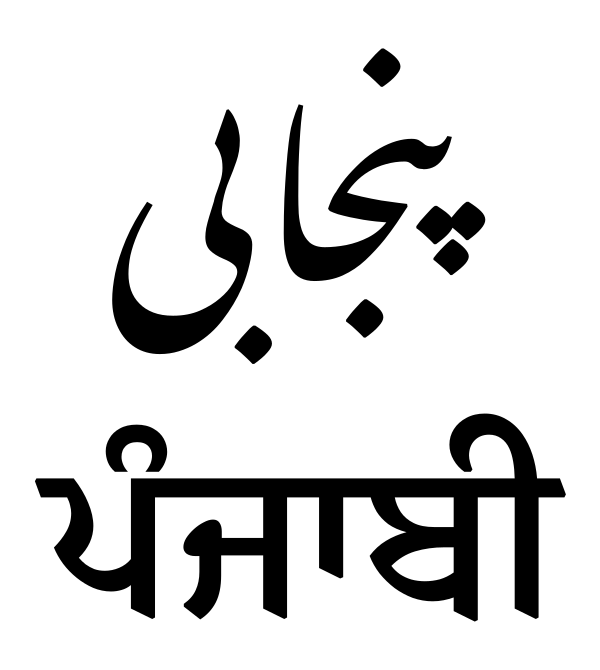
Punjabi folk music (Script error: The function "langx" does not exist., Script error: The function "langx" does not exist. or Punjabi Folk) is the traditional music on the traditional musical instruments of the Punjab region of the Indian subcontinent.[1][2] There is a great repertoire of music from the time of birth through the different stages of joy and sorrow till death.[3] The folk music invokes the traditions as well as the hardworking nature, bravery and many more things that the people of Punjab get from its gateway-to-India geographical location. Due to the large area with many sub-regions, the folk music has minor lingual differences but invokes the same feelings. The sub-regions Bar, Malwa, Doaba, Majha, Pothohar, and hills areas, have numerous folk songs.[4] Punjabi dance OP Bhangra music which is a genre of Punjabi modern music invented in Britain by the Punjabi diaspora.
General features of musical style[edit | edit source]
Rhythm[edit | edit source]
The rhythm of Punjabi folk music is very simple.[5] unlike the rhythms of Bhangra music which are generally complex
Melody[edit | edit source]
Some songs like Heer and Mirza are sung using the traditional compositions.
Folk songs[edit | edit source]
Punjab has folk songs on birth, marriage, funeral, death, love, separation, beauty, social and economical status, village lifestyle, food, nature, bravery, folklores and folktales, folk romances, folk and historical heroes, festivals and many more.[2] The songs of professional castes of Punjab are also included in the folk songs. They can be divided into the following categories:
Occasion for singing[edit | edit source]
Controversy[edit | edit source]
Punjabi folk music is associated with a traditional lifestyle and culture. Many of the themes associated with the songs of today, which are mostly relevant in Bhangra songs, involve the promotion of the ills of Punjabi society such as the caste system and substance abuse as well as superstitious beliefs. Many revolutions in Punjab such as the Sikh revolution were in direct opposition of Punjabi folk songs.[citation needed]
Life-cycle rituals[edit | edit source]
A large part of Punjabi folk songs presents the picture of incidents from birth to death[4] relations, relatives also including the songs on other occasions, festivals and fairs. The songs by women represents their soft feelings, nature, hobbies and lower social status in limited circle while the songs by men represents their freedom, strength and hardworking. The folk songs starts from the birth of a child then name ceremony, marriage, relations, relatives and much more. There are many songs on the different stages of a marriage like Suhag, Ghorhian, Sehra, Sithnian. Suhag is related to bride while Ghorhian and Sehra are related to groom. A daughter's feelings have a special place in the Punjabi folk songs in which she address to his father asking to find her a better home, good people (in-laws) and many more. By length and mood, the different kinds of songs includes Suhag,[6] Ghorhian, Bolian,[7] Tappe,[8] Sithnian,[9] Chhand,[10] Heara, Lorian, etc.[2][4]
Fairs and festivals[edit | edit source]
Every festive occasion has music associated with it.[3] Lohri and Maghi are associated with the change of season while Vaisakhi is a harvest festival. Men dance Bhangra and women dance Giddha. The month of Sawan is one of great joy for females in which they celebrate the festival of Teeyan.[3] The married ones come back to their parents' home and meet their family and friends and in an open ground they dance Giddha. They wear colorful dresses like Phulkari, and adorn their hands with Mehndi and glass bangles.
Types of textual themes[edit | edit source]
Romantic[edit | edit source]
Jugni, Mahia, Tappe, Jindua, Dhola, Kafian, Dohre, Bolian, Sadda, Jhokan and the folk romances of Punjab region like Heer Ranjha, Mirza Sahiban, Sohni Mahiwal, Sassi Punnun are main folk love songs.[1][2][3] Heer and Mirza are sung using traditional compositions.
Heroic[edit | edit source]
In heroic or bravery, the folk song includes about the Punjabi heroes like Dulla Bhatti,[11][12] Raja Rasalu, Jagga Jatt, S. Bhagat Singh, S. Udham Singh, Sucha Soorma[13] and Jeona Morh.[4]
Religious[edit | edit source]
Songs about worship, religious ceremonies and festivals represents the religious feelings.
Sikhism is closely related with music.[3] The sixth Sikh guru, Guru Hargobind, established the singers called Dhadis to sing the Gurbani, Vaars (English: heroic ballads) and other folk genres using the normally two folk instruments, Dhad and Sarangi.[3]
The other religions like Islam have Qawwalis, Naats and Hamds and Hinduism have Bhajans and Punjabi have Punjabi songs.
Instruments[edit | edit source]

Punjabi singers may sing unaccompanied or along with such traditional instruments as dhol, tumbi, dhadd, sarangi, gharha, gagar, chimta, or algoze,[1][2][3] Iktara, Bugchu, Chhaine, Kainchi, Sapp, Kato.
See also[edit | edit source]
- Punjabi language
- Music of Punjab
- Bhangra (music)
- Folk instruments of Punjab
- Folk dances of Punjab
- Punjabi people
- Punjabi folklore
- Punjabi folk religion
References[edit | edit source]
- ↑ 1.0 1.1 1.2 Pande, Alka (1999). Folk music and musical instruments of Punjab. Mapin Publishers. p. 128. ISBN 1-890206-15-6.
- ↑ 2.0 2.1 2.2 2.3 2.4 Thind, Karnail Singh (2002). Punjab Da Lok Virsa (reprint ed.). Patiala: Punjabi University. p. 231. ISBN 81-7380-223-8.
- ↑ 3.0 3.1 3.2 3.3 3.4 3.5 3.6 "The Music of Punjab". SadaPunjab.com. Archived from the original on December 6, 2010. Retrieved May 22, 2012.
- ↑ 4.0 4.1 4.2 4.3 "ਪੰਜਾਬ ਦੇ ਲੋਕ-ਗੀਤ". sabhyachar.com (in ਪੰਜਾਬੀ). Archived from the original on May 28, 2012. Retrieved May 22, 2012.
- ↑ Sharma, Manorma (2009). Musical heritage of India. p. 228.
- ↑ "Punjab heritage comes alive on concluding day". The Tribune. Ludhiana. October 1, 2011. Retrieved May 22, 2012.
- ↑ "Power failure hits show". The Tribune. Chandigarh. May 21, 1999. Retrieved May 22, 2012.
- ↑ "Two plays staged". The Tribune. Amritsar. February 19, 2011. Retrieved May 22, 2012.
- ↑ Maini, Darshan Singh (1979). Studies in Punjabi poetry. Vikas. p. 158. ISBN 0-7069-0709-4.
- ↑ Shivnath (1976). History of Dogri literature. Sahitya Akademi. p. 194.
- ↑ "Lahore's Crumbling Gateways". The Tribune. January 8, 2012. Retrieved May 22, 2012.
- ↑ "'Dulla Bhatti' traces heroic deeds of folk character". The Tribune. Amritsar. January 13, 2010. Retrieved May 22, 2012.
- ↑ "The all-pervading spirit". The Tribune. January 20, 1999. Retrieved May 22, 2012.
Further reading[edit | edit source]
- Bedi, Sohindar Singh. 1971. Folklore of the Punjab. New Delhi: National Book Trust.
- Lybarger, Lowell H. 2011. "Hereditary Musician Groups of Pakistani Punjab." Journal of Punjab Studies 18(1/2).
- Nahar Singh. 2011. "Suhāg and Ghoṛīāṅ: Culture's Elucidation in a Female Voice." Journal of Punjab Studies 18(1/2).
- Nayyar, Adam. 2000. "Punjab." In The Garland Encyclopedia of World Music, Vol. 5, South Asia: The Indian Subcontinent, ed. by Allison Arnold. New York; London: Garland.
- Nijhawan, Michael. 2006. Dhadi Darbar. New Delhi: Oxford University Press.
- Pande, Alka. 1999. Folk Music & Musical Instruments of Punjab. Middletown, NJ: Grantha Corporation.
- Schreffler, Gibb. 2004. "Vernacular Music and Dance of Punjab." Journal of Punjab Studies 11(2).
- Schreffler, Gibb. 2011. "Music and Musicians in Punjab." Journal of Punjab Studies 18(1/2).
- Schreffler, Gibb. 2011. "Western Punjabi Song Forms: Māhīā and Ḍholā." Journal of Punjab Studies 18(1/2).
- Thuhi, Hardial. 2011. "The Folk Dhadi Genre." Trans. by Gibb Schreffler. Journal of Punjab Studies 18(1/2).
- Thuhi, Hardial. 2011. "The Tumba-Algoza Ballad Tradition." Trans. by Gibb Schreffler. Journal of Punjab Studies 18(1/2).
| Topics |  | |
|---|---|---|
| Administration | ||
| Culture |
| |
| Divisions |
| |
| Districts | ||
| Major Cities | ||