

| Yadav | |
|---|---|
| Ahir | |
| Kuladevta (male) | Lord Krishna |
| Kuladevi (female) | Maa Vidyavashini |
| Languages | Hindi, Urdu, Haryanvi, Punjabi, Telugu, Tamil, Gujarati, Rajasthani, Bhojpuri, Marwari, Kannada, Odia, Bengali |
| Populated states | Uttar Pradesh, Punjab, Rajasthan, Gujarat, Himachal Pradesh, Haryana, Andhra Pradesh, Tamil Nadu, Telangana, West Bengal, Assam, Odisha Bihar, Jharkhand, Delhi, Karnataka, Kerala, Madhya Pradesh |
| Lineage | Yaduvanshi Ahir |
Yadav is a traditionally peasant-pastoral community of India and Nepal. The term "Yadav" is now commonly used as a surname by members of communities such as Ahirs, Golas, and Gavlis. At present people from this community are chiefly engaged in agriculture, military services, and also in cattle herding.
Origins[edit | edit source]
In mythology[edit | edit source]
The term Yadav (or sometimes Yadava) has been interpreted to mean a descendant of Yadu, who is a mythological king.[1]
Using "very broad generalisations", Jayant Gadkari says that it is "almost certain" from analysis of the Puranas that Andhaka, Vrishni, Satvata and Abhira were collectively known as Yadavas and worshipped Krishna. Gadkari further notes of these ancient works that "It is beyond dispute that each of the Puranas consists of legends and myths ... but what is important is that, within that framework [a] certain value system is propounded".[2]
Lucia Michelutti notes that
At the core of the Yadav community lies a specific folk theory of descent, according to which Yadav castes are said to descend from the Yadu dynasty (hence the label Yadav) to which Krishna (a Kshatriya) belonged. ... [there is] a strong belief amongst them that all Yadavs belong to Krishna's line of descent, the Yadav subdivisions of today being the outcome of a fission of an original and undifferentiated group.[3]
Historians such as P. M. Chandorkar have used epigraphical and similar evidence to argue that Ahirs and Gavlis are representative of the ancient Yadavas and Abhiras mentioned in Sanskrit works.[4]
In practice[edit | edit source]

There are several communities that coalesce to form the Yadavs. Christophe Jaffrelot has remarked that
The term 'Yadav' covers many castes which initially had different names: Ahir in the Hindi belt, Punjab and Gujarat, Gavli in Maharashtra, Golla in Andhra Pradesh and Karnataka etc.[5]
However, Jaffrelot has also said that most of the modern Yadavs are cultivators, mainly engaged in tilling the land, and less than one third of the population are occupied in raising cattle or the milk business.[6]
M. S. A. Rao had earlier expressed the same opinion as Jaffrelot, and noted that the traditional association with cattle, together with the belief in descent from Yadu, defines the community.[1] According to David Mandelbaum, the association of the Yadav (and their constituent castes, Ahir and Gwala) with cattle has impacted on their commonly viewed ritual status (varna) as Shudra, although the community's members often claim the higher status of Kshatriya. The Shudra status is explained by the nomadic nature of herdsmen, which constrained the ability of other groups in the varna system to validate the adherence to practices of ritual purity; by their involvement in castration of the animals, which was considered to be a ritually polluting act; and because the sale of milk, as opposed to personal use thereof, was thought to represent economic gain from a sacrosanct product.
According to Lucia Michelutti:
... Yadavs constantly trace their caste predispositions and skills to descent, and in doing so they affirm their distinctiveness as a caste. For them, caste is not just appellation but quality of blood (Yalman 1969: 87, in Gupta 2000: 82). This view is not recent. The Ahirs (today Yadavs) had a lineage view of caste (Fox 1971; Unnithan-Kumar 1997) that was based on a strong ideological model of descent. This descent-based kinship structure was also linked to a specific Kshatriya and their religious tradition centred on Krishna mythology and pastoral warrior hero-god cults.[7]
Yadavs in modern India[edit | edit source]

Occupational background, location and social status[edit | edit source]
The Yadavs mostly live in Northern India, and particularly in Haryana, Uttar Pradesh and Bihar.[8][9] Traditionally, they were a elite[10][11] pastoral caste. Their traditional occupations changed over time and for many years Yadavs have been primarily involved in cultivation,[12] although Michelutti has noted a "recurrent pattern" since the 1950s whereby economic advancement has progressed through involvement in cattle-related business to transportation and thence to construction. Employment with the army and the police have been other traditional occupations in northern India, and more recently government employment in that region has also become significant. She believes that positive discrimination measures and gains as a consequence of land reform legislation have been important factors in at least some areas.[13]
Lucia Michelutti notes that
Colonial ethnographers left a legacy of hundreds of pages of ethnographic and ethnological details which portray the Ahir/Yadavs as "Kshatriyas", "martial" and "wealthy".[14]
J. S. Alter notes that in North India the majority of the wrestlers are of the Yadav caste. He explains this as being due to their involvement in the milk business and dairy farms, which thus provides easy access to the milk and ghee deemed to be essential to a good diet.[15]
Although the Yadavs have formed a fairly significant proportion of the population in various areas, including 11% of that of Bihar in 1931, their interest in pastoral activities was not traditionally matched by ownership of land and consequently they were not a "dominant caste". Their traditional position, which Jaffrelot describes as "low caste peasants", also militated against any dominant role. Their involvement in pastoralism accounts for a traditional view of Yadavs as being peaceful, while their particular association with cows has a special significance in Hinduism, as do their beliefs regarding Krishna.[12] Against this image, Russell and Lal, writing in 1916, called the Ahir subdivision uncouth, although it is unclear whether their comments were based entirely on proverbial stories, on observation or on both.[16] Tilak Gupta said that this view persisted in modern times in Bihar, where the Yadav were viewed in highly negative terms by other groups.[17] However, Michelutti observed, these very same people acknowledge and coveted their political influence, connections and abilities.[18]
The Yadavs have, however, demonstrated a feature, driven by their more notable members, that shares a similarity with other Indian communities. Mandelbaum has noted that
As the families of a jāti, in sufficient number, accrue a strong power base, and as their leading men become united enough to move together for higher status, they typically step up their efforts to improve their jāti customs. They try to abandon demeaning practices and to adopt purer and more prestigious ways. They usually want to drop the old name for a better one.[9]
In Bihar, the political advancement of Yadavs didn't improve their relative marginalisation in other fields. The spread of education among the community remained less as compared to more advanced Other Backward Castes like Awadhia Kurmi, Koeri and Bania. The attachment of Yadavs with the pastoral activities has been responsible behind their lower position in caste hierarchy as compared to owner cultivator castes among the OBCs. In areas where the communal ownership of land prevailed, trespassing into the fields by Yadav cattle herders to feed the cattle remained the part of their daily struggle for survival. Since such communal lands were mostly appropriated by village landlords, the caste occupation of Yadavs brought them in conflict with latter, and such skirmishes gave a militant and aggressive edge to the community's character. This followed their portrayal as "uncultured brutes" in the elitist discourses, which largely mirrors extreme backwardness still prevalent in large section of this community. The attempt to move up in the social ladder also remained evident in the nature of community and in due course of time "thriftiness" was observed to be a phenomenon, where they tried to save and buy small plot of lands, to be classified as owner cultivators.[19]
All-India Yadav Mahasabha[edit | edit source]
The All-India Yadav Mahasabha (AIYM) was founded at Allahabad in 1924 by a meeting of disparate local groups from Bihar, Punjab and what is now Uttar Pradesh.[20][21] Although the AIYM was initially organised by V. K. Khedakar, it was Rao Balbir Singh who developed it and this coincided with a period – during the 1920s and 1930s – when similar Sanskritisation movements elsewhere in the country were on the wane. The program included campaigning in favour of teetotalism and vegetarianism, both of which were features of higher-ranking castes, as well as promoting self-education and promoting the adoption of the "Yadav" name.[8] It also sought to encourage the British Raj to recruit Yadavs as officers in the army and sought to modernise community practices such as reducing the financial burden dowries and increasing the acceptable age of marriage. Furthermore, the AIYM encouraged the more wealthy members of the community to donate to good causes, such as for the funding of scholarships, temples, educational institutions and intra-community communications.[8][22]
The Yadav belief in their superiority impacted on their campaigning. In 1930, the Yadavs of Bihar joined with the Kurmi and Koeri agriculturalists to enter local elections. They lost badly but in 1934 the three communities formed the Triveni Sangh political party, which allegedly had a million dues-paying members by 1936. However, the organisation was hobbled by competition from the Congress-backed Backward Class Federation, which was formed around the same time, and by co-option of community leaders by the Congress party. The Triveni Sangh suffered badly in the 1937 elections, although it did win in some areas. Aside from an inability to counter the superior organisational ability of the higher castes who opposed it, the unwillingness of the Yadavs to renounce their belief that they were natural leaders and that the Kurmi were somehow inferior was a significant factor in the lack of success. Similar problems beset a later planned caste union, the Raghav Samaj, with the Koeris.[23]
In the post-colonial period, according to Michelutti, it was the process of yadavisation and the concentration on two core aims – increasing the demographic coverage and campaigning for improved protection under the positive discrimination scheme for Backward Classes – that has been a singular feature of the AIYM, although it continues its work in other areas such as promotion of vegetarianism and teetotalism. Their proposals have included measures designed to increase the number of Yadavs employed or selected by political and public organisations on the grounds of their numerical strength, including as judges, government ministers and regional governors. By 2003 the AIYM had expanded to cover seventeen states and Michelutti believed it to be the only organisation of its type that crossed both linguistic and cultural lines. It continues to update its literature, including websites, to further its belief that all claimed descendants of Krishna are Yadav. It has become a significant political force.[24]
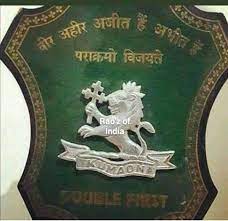
The campaign demanding that the army of the Raj should recruit Yadavs as officers resurfaced in the 1960s. Well-reported bravery during fighting in the Himalayas in 1962, notably by the 13th Kumaon company of Ahirs, led to a campaign by the AIYM demanding the creation of a specific Yadav regiment.[22]
Post-Independence[edit | edit source]

Mandelbaum has commented on how the community basks in the reflected glory of those members who achieve success, that "Yadav publications proudly cite not only their mythical progenitors and their historical Rajas, but also contemporaries who have become learned scholars, rich industrialists, and high civil servants." He notes that this trait can also be seen among other caste groups.[25]
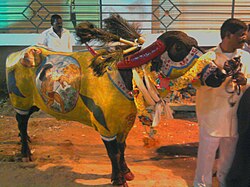
The Sadar festival is celebrated annually by the Yadav community in Hyderabad, following the day of Diwali. Community members parade, dancing around their best buffalo bulls, which have been colourfully decorated with flowers and paint.[26]
Classification[edit | edit source]
The Yadavs are included in the Other Backward Classes (OBCs) category in the Indian states of Bihar,[27] Chhattisgarh,[28] Delhi,[29] Haryana,[30] Jharkhand,[31] Karnataka,[32] Madhya Pradesh,[33] Odisha,[34] Rajasthan,[35] Uttar Pradesh,[36] and West Bengal.[37] In 2001, the Social Justice Committee in Uttar Pradesh reported over-representation of some OBCs, particularly Yadavs, in public offices; it suggested creating sub categories within the OBC category.[38] The outcome of this was that the Yadav/Ahir became the only group listed in Part A of a three-part OBC classification system.[39]
Yadavs in Nepal[edit | edit source]
The Central Bureau of Statistics of Nepal classifies the Yadav as a subgroup within the broader social group of Madheshi Other Caste.[40] At the time of the 2011 Nepal census, 1,054,458 people (4.0% of the population of Nepal) were Yadav. The frequency of Yadavs by province was as follows:
- Madhesh Province (14.8%)
- Lumbini Province (4.1%)
- Koshi Province (1.3%)
- Bagmati Province (0.2%)
- Gandaki Province (0.0%)
- Karnali Province (0.0%)
- Sudurpashchim Province (0.0%)
The frequency of Yadavs of Nepal was higher than national average (4.0%) in the following districts:[41]
- Siraha (24.4%)
- Dhanusha (17.5%)
- Saptari (15.8%)
- Sarlahi (15.5%)
- Mahottari (15.2%)
- Rautahat (12.2%)
- Bara (10.5%)
- Kapilvastu (10.2%)
- Rupandehi (7.4%)
- Parsa (6.6%)
- Parasi (5.8%)
- Banke (4.7%)
- Sunsari (4.3%)
Notable people[edit | edit source]
See also[edit | edit source]
Notes[edit | edit source]
References[edit | edit source]
- ↑ 1.0 1.1 Rao, M. S. A. (1979). Social movements and social transformation: a study of two backward classes movements in India. Macmillan. p. 124. ISBN 9780836421330.
- ↑ Gadkari, Jayant (1996). Society and religion: from Rugveda to Puranas. Bombay: Popular Prakashan. pp. 179, 183–184. ISBN 978-81-7154-743-2.
- ↑ Michelutti, Lucia (February 2004). ""We (Yadavs) are a caste of politicians": Caste and modern politics in a north Indian town". Contributions to Indian Sociology. 38 (1–2): 49. doi:10.1177/006996670403800103. S2CID 144951057.(subscription required)
- ↑ Guha, Sumit (2006). Environment and Ethnicity in India, 1200-1991. University of Cambridge. p. 47. ISBN 978-0-521-02870-7.
- ↑ Cite error: Invalid
<ref>tag; no text was provided for refs namedJaffrelot2003p187 - ↑ Jaffrelot, Christophe (2003). India's silent revolution: the rise of the lower castes in North India. London: C. Hurst & Co. p. 188. ISBN 978-1-85065-670-8.
- ↑ Gupta, Dipankar; Michelutti, Lucia (2004). "2. 'We (Yadavs) are a caste of politicians': Caste and modern politics in a north Indian town". In Dipankar Gupta (ed.). Caste in Question: Identity or hierarchy?. Vol. Contributions to Indian Sociology. New Delhi, California, London: Sage Publications. pp. 48/Lucia Michelutti. ISBN 0-7619-3324-7.
- ↑ 8.0 8.1 8.2 Jaffrelot, Christophe (2003). India's silent revolution: the rise of the lower castes in North India. London: C. Hurst & Co. p. 196. ISBN 978-1-85065-670-8. Retrieved 2011-08-16.
- ↑ 9.0 9.1 Mandelbaum, David Goodman (1970). Society in India. Vol. 2. Berkeley: University of California Press. p. 442. ISBN 978-0-520-01623-1.
- ↑ Luce, Edward (2008). In Spite of the Gods: The Rise of Modern India. Random House Digital, Inc. p. 133. ISBN 978-1-4000-7977-3. Quote: "The Yadavs are one of India's largest 'Other Backward Classes,' a government term that covers most of India's Sudra castes. Yadavs are the traditional cowherd caste of North India and are relatively low down on the traditional pecking order, but not as low as the untouchable Mahars or Chamars."
- ↑ Michelutti, Lucia (2004), "'We (Yadavs) are a caste of politicians': Caste and modern politics in a north Indian town", Contributions to Indian Sociology, 38 (1–2): 43–71, doi:10.1177/006996670403800103, S2CID 144951057 Quote: "The Yadavs were traditionally a low-to-middle-ranking cluster of pastoral-peasant castes that have become a significant political force in Uttar Pradesh (and other northern states like Bihar) in the last thirty years."
- ↑ 12.0 12.1 Jaffrelot, Christophe (2003). India's silent revolution: the rise of the lower castes in North India. London: C. Hurst & Co. p. 188. ISBN 978-1-85065-670-8.
- ↑ Michelutti, Lucia (February 2004). ""We (Yadavs) are a caste of politicians": Caste and modern politics in a north Indian town". Contributions to Indian Sociology. 38 (1–2): 52–53. doi:10.1177/006996670403800103. S2CID 144951057.(subscription required)
- ↑ Michelutti, Lucia (2002). "Sons of Krishna: the politics of Yadav community formation in a North Indian town" (PDF). p. 83. Retrieved 13 September 2019.
- ↑ Michelutti, Lucia (2012). "Wrestling with (Body) Politics: Understanding 'Goonda' Political Styles in North India". In Price, Pamela; Ruud, Arild Engelsen (eds.). Power and Influence in India: Bosses, Lords and Captains: Exploring the Political in South Asia. Routledge. p. 55. ISBN 978-1-13619-799-4.
- ↑ Russell, R. V.; Lal, Raj Bahadur Hira (1916). Tribes and Castes of the Central Provinces of India. Vol. 2. London: Macmillan. p. 37.
- ↑ Gupta, Tilak D. (27 June 1992). "Yadav Ascendancy in Bihar Politics". Economic and Political Weekly. 27 (26): 1304–1306. JSTOR 4398537.(subscription required)
- ↑ Michelutti. "Wrestling with (body) politics: understanding 'goonda' political styles in North India". Quote:"I saw many high-caste people, who refer to Yadavs as goondas in a disapproving fashion using their 'services'. Their connections, political influence and abilities are thus practically acknowledged. By the end of the fieldwork the same non-Yadav informants who advise me of not going around with politicians asked me to use my 'Yadav contacts' to help them to get their telephone line sorted out, to get a taxi-licence or to speed up a court case.". Retrieved 27 October 2011.
- ↑ Gupta., Tilak D. (1992). ""Yadav Ascendancy in Bihar Politics."". Economic and Political Weekly. 27 (26): 1304–06. JSTOR 4398537.
- ↑ Cite error: Invalid
<ref>tag; no text was provided for refs namedMandelbaum1970p443 - ↑ Cite error: Invalid
<ref>tag; no text was provided for refs namedJaffrelot2003pp194-196 - ↑ 22.0 22.1 Cite error: Invalid
<ref>tag; no text was provided for refs namedMandelbaum1970p444 - ↑ Jaffrelot, Christophe (2003). India's silent revolution: the rise of the lower castes in North India. London: C. Hurst & Co. p. 197. ISBN 978-1-85065-670-8. Retrieved 2011-08-16.
- ↑ Michelutti, Lucia (February 2004). ""We (Yadavs) are a caste of politicians": Caste and modern politics in a north Indian town". Contributions to Indian Sociology. 38 (1–2): 50–51. doi:10.1177/006996670403800103. S2CID 144951057.(subscription required)
- ↑ Mandelbaum, David Goodman (1970). Society in India. Vol. 2. Berkeley: University of California Press. p. 485. ISBN 978-0-520-01623-1. Retrieved 2011-08-25.
- ↑ "Traditional Sadar Festival Celebrated". The Hindu. Hyderabad. 7 November 2010. Retrieved 26 September 2012.
- ↑ "CENTRAL LIST OF OBCs FOR THE STATE OF BIHAR" (PDF), National Commission of Backward Classes, Government of India, retrieved 28 October 2011 (Serial Number 104)
- ↑ "CENTRAL LIST OF OTHER BACKWARD CLASSES: CHHATISGARH" (PDF), National Commission of Backward Classes, Government of India, retrieved 28 October 2011 (Serial Number 1)
- ↑ "CENTRAL LIST OF OTHER BACKWARD CLASSES: DELHI" (PDF), National Commission of Backward Classes, Government of India, retrieved 28 October 2011 (Serial Number 3)
- ↑ "CENTRAL LIST OF OTHER BACKWARD CLASSES: HARYANA" (PDF), National Commission of Backward Classes, Government of India, retrieved 28 October 2011 (Serial Number 29)
- ↑ "CENTRAL LIST OF OTHER BACKWARD CLASSES: JHARKHAND" (PDF), National Commission of Backward Classes, Government of India, retrieved 28 October 2011 (Serial Number 118)
- ↑ "CENTRAL LIST OF OTHER BACKWARD CLASSES: KARNATAKA" (PDF), National Commission of Backward Classes, Government of India, retrieved 28 October 2011 (Serial Number 58)
- ↑ "CENTRAL LIST OF OTHER BACKWARD CLASSES: MADHYA PRADESH" (PDF), National Commission of Backward Classes, Government of India, retrieved 28 October 2011 (Serial Number 1)
- ↑ "CENTRAL LIST OF OBCs FOR THE STATE OF ORISSA" (PDF), National Commission of Backward Classes, Government of India, retrieved 28 October 2011 (Serial Number 43)
- ↑ "CENTRAL LIST OF OBCs FOR THE STATE OF RAJASTHAN" (PDF), National Commission of Backward Classes, Government of India, retrieved 28 October 2011 (Serial Number 1)
- ↑ "CENTRAL LIST OF OBCs FOR THE STATE OF UTTAR PRADESH" (PDF), National Commission of Backward Classes, Government of India, retrieved 28 October 2011 (Serial Number 1)
- ↑ "CENTRAL LIST OF OBCs FOR THE STATE OF WEST BENGAL" (PDF), National Commission of Backward Classes, Government of India, retrieved 28 October 2011 (Serial Number 3)
- ↑ Jeffery, Roger; Jeffrey, Craig; Lerche, Jens (2014). Development Failure and Identity Politics in Uttar Pradesh. SAGE Publications India. p. 43. ISBN 9789351501800.
- ↑ Verma, Anil K. (2007). "Backward-Caste Politics in Uttar Pradesh: An Analysis of the Samajwadi Party". In Pai, Sudha (ed.). Political process in Uttar Pradesh: identity, economic reforms, and governance. Pearson Education India. p. 160. ISBN 978-81-317-0797-5.
- ↑ Population Monograph of Nepal, Volume II [1]
- ↑ 2011 Nepal Census, District Level Detail Report
| |||||||||||||||||||||||||||
| |||||||||||||||||||||||||||
| |||||||||||||||||||||||||||
