


No edit summary |
No edit summary |
||
| Line 11: | Line 11: | ||
| names = | | names = | ||
| related = | | related = | ||
*''Khofri'' ([[Lower Assam]], India) | |||
*''Chattri'' ([[Terai]], Nepal) | |||
*''Mathal'' ([[Bangladesh]]) | |||
*''Talari'' ([[Orissa]], India) | |||
*''[[Nón lá]]'' ([[Vietnam]]) | *''[[Nón lá]]'' ([[Vietnam]]) | ||
*''Do'un'' ([[Cambodia]]) | *''Do'un'' ([[Cambodia]]) | ||
| Line 17: | Line 21: | ||
*''dǒulì'' ([[China]]) | *''dǒulì'' ([[China]]) | ||
}} | }} | ||
'''Jaapi''' or '''Japi''' ([[Bodo language|Bodo]]: Khofri) is an [[Asian conical hat]]. It is made from tightly woven [[bamboo]] and/or cane and ''tokou paat'' ([[Trachycarpus martianus]]) a large, [[Palm (plant)|palm]] leaf. The word ''jaapi'' derives from ''jaap'' meaning a bundle of ''tokou'' leaves. In the past, plain jaapis were used by ordinary people in Assam and by farmers for protection from the sun, while ornate decorative jaapis were worn as a status symbol by the royalty and nobility. Decorative ''sorudoi jaapi'' are made with intricate cloth designs (primarily red, white, green, blue, and black) that are integrated into the weaving. | '''Jaapi''' or '''Japi''' ([[Bodo language|Bodo]]: Khofri) is an [[Asian conical hat]]. It is made from tightly woven [[bamboo]] and/or cane and ''tokou paat'' ([[Trachycarpus martianus]]) a large, [[Palm (plant)|palm]] leaf. The word ''jaapi'' derives from ''jaap'' meaning a bundle of ''tokou'' leaves. In the past, plain jaapis were used by ordinary people in Assam and by farmers for protection from the sun, while ornate decorative jaapis were worn as a status symbol by the royalty and nobility. Decorative ''sorudoi jaapi'' are made with intricate cloth designs (primarily red, white, green, blue, and black) that are integrated into the weaving. The upper metal component attached to the top of a jaapi is known in Assamese as ''sula'' (Assamese: চূলা), described as a metal, cap-like ornament fixed to the top of the jaapi.<ref>{{cite web |title=চূলা |url=https://www.xobdo.org/dic/%E0%A6%9A%E0%A7%82%E0%A6%B2%E0%A6%BE |website=Xobdo |access-date=14 June 2026}}</ref> The ''Sula'' of Japis used by royalty and nobles were made of silver and gold.<ref>Bhuyan, S.K, "Satsari Assam Buranji,p.199</ref> Besides East and Southeast Asia, rain hats, similar to Jaapi, are spread throughout East India and Nepal, including [[Bengal]], [[Terai]], [[Chhattisgarh]] and [[Odisha]]. Tribes of [[Arunachal Pradesh]] like [[Mishmi people|Mishmi]] and [[Adi people|Adi]] also wear similar traditional headgear made of bamboo or cane. | ||
[[File:Tribal Rain hat Chattisgarh.png|thumb|Rain hat worn in tribal areas of Chattisgarh, similar to Japi.]] | |||
==History== | ==History== | ||
The | The earliest recorded evidence for the use of the conical hat as a royal item is found in accounts of the [[Chutia kingdom]]. During negotiations with the Ahom king [[Suhungmung]] in 1523, the Chutia king offered among his presents an object mentioned as ''kup ngiun chon kham'' in the Tai-Ahom text. Golap Chandra Barua translated the object as a "silver lipped umbrella (Japi)".<ref name="Chutia-Japi">"Then the Sutiyâ king desired to send silver and gold lipped Jâpi (''Kup-ngiun-kham''), gold bracelets (''Mao-kham''), gold basket (''Liu-kham''), gold box (''Khup-kham''), gold foot bangles (''Khu-tin-kham''), gold pirâ (''Kham-ku''), horse (''Ma''), elephant (''Chang-pai''), and two Âroans (''Phra-nun'') and Xorais (''Phun'') to the Ahom king." {{harvcol|Jacquesson|p=12}}; {{harvcol|Barua|1939|p=56}}; [https://archive.org/details/in.ernet.dli.2015.452171/page/n59/mode/1up?q=%E0%A6%9C%E0%A6%BE%E0%A6%AA%E0%A6%BF Goswami, Hemchandra, ''Purani Asam Buranji'', "সোণৰ খাপৰ চিকন জাপি এটা", p. 41]; [https://books.google.co.in/books?id=YELHow5lP9kC&focus=searchwithinvolume&q=%E0%A6%9C%E0%A6%BE%E0%A6%AA%E0%A6%BF Mahanta, S., ''Assam Buranji'', D.H.A.S., 1945, p. 9]; Bhuyan, S. K., ''Deodhai Assam Buranji'', "সোণৰ পাত বন্ধা জাপি ১ টা", p. 17; {{harvcol|Khanikar|1991|p=100}}.</ref> Barua's ''Ahom-Assamese-English Dictionary'' independently defines the Ahom word ''kup'' as "a wicker hat serving as an umbrella".<ref>{{cite book |last=Barua |first=Golap Chandra |title=Ahom-Assamese-English Dictionary |publisher=Assam Administration |location=Calcutta |year=1920 |page=17 |url=https://archive.org/details/ahom-assamese-english_dictionary |quote=A wicker hat serving as an umbrella.}}</ref>{{EFN|Comparable terms are used for ordinary woven conical hats elsewhere in the Tai-speaking world. In Thailand, ''ngop'' (งอบ) is described as an agricultural hat constructed with woven bamboo strips and used for protection from the sun and rain, while ''kub'' or ''kup'' (กุบ/กุ๊บ) are recorded as regional names for this type of headgear in northern Thailand.<ref>{{cite web |title=งอบ: ภูมิปัญญาไม่ร้อนหัวของชาวนาไทย ที่หมวกอื่นทำไม่ได้ |website=Ramkhamhaeng University Library |date=25 November 2025 |url=https://www.lib.ru.ac.th/onlineexhibition/?p=18925 |language=th}}</ref> The traditional Lao ''koup'' is similarly a conical hat made on a bamboo frame and associated particularly with agricultural work and protection from the weather.<ref>{{cite web |title=The Traditional Conical Hat of Laos |website=Phoenix Voyages |url=https://phoenixvoyages.com/the-traditional-conical-hat-of-laos/}}</ref> Thai sources describe these forms as agricultural or protective headgear rather than royal regalia; documented Thai royal headgear instead includes a separate crown tradition, represented by the ''Phra Maha Phichai Mongkut'' or Great Crown of Victory, one of the principal regalia of kingship.<ref>{{cite web |title=Wan Chatra Mongkol: Thai Coronation Day |website=Thailand Foundation |date=4 May 2024 |url=https://thailandfoundation.or.th/th/wan-chatra-mongkol-thai-coronation-day-%E0%B8%A7%E0%B8%B1%E0%B8%99%E0%B8%89%E0%B8%B1%E0%B8%95%E0%B8%A3%E0%B8%A1%E0%B8%87%E0%B8%84%E0%B8%A5/}}</ref>}} The parallel Assamese chronicle traditions likewise identify the object explicitly as a ''japi'', describing it variously as ''সোণৰ পাত বন্ধা জাপি'' ("a japi bound or faced with gold leaf") and ''সোণৰ খাপৰ চিকন জাপি'' ("a fine/beautiful japi with a gold layer/casing").<ref name="Chutia-Japi"/> In both descriptions, the object itself remains a ''japi'', while the gold qualifies its ornamentation or covering: ''পাত বন্ধা'' refers to binding or facing with gold leaf or sheet, whereas ''খাপ'' can denote a covering, casing, or layer.<ref>{{cite book | ||
|last=Bronson | |||
|first=Miles | |||
|title=A Dictionary in Assamese and English | |||
|publisher=American Baptist Mission Press | |||
|location=Sibsagar | |||
|year=1867 | |||
|page=139 | |||
|url=https://archive.org/details/adictionaryinas00brongoog | |||
|quote=খাপ ... খলপা ...a layer or division of things placed one above another.}}</ref> After the annexation of [[Sadiya]] in 1524, the Ahom king received further treasure and booty which included japis.{{sfn|Mahanta|1945|p=10}} In 1524–25, the Ahom king presented some of the silver japis obtained from the Chutia king, together with other gifts, to Phukloimung, a chief from [[Mongkawng]],{{efn|Mongkawng was a [[Shan people|Shan]] polity in present-day [[Kachin State]] of [[Myanmar]] (called Nora in the [[Buranji]]s)}} during negotiations following his attack on Sadiya. Barua's translation records twenty "Japis (hats) with silver tips" being presented to Phukloimung,<ref>{{harvcol|Barua|1939|p=58}}</ref> while the ''Deodhai Assam Buranji'' describes another version of the gift as "ৰূপৰ চূলাৰে জাপি দুটা" (two japis with silver ''sula'').<ref>Bhuyan, S. K., ''Deodhai Assam Buranji'', "পাছে আমাৰ ৰজাদেৱে দিলে ফুক্লইমুং নৰাৰজালৈ নাংখামপই নামে কন্যা এজনী, ধন্যবাদ হাতী এটা, ৰূপৰ চূলাৰে জাপি দুটা।"</ref>{{sfn|Bhuyan|1960|p=62}} | |||
Precious-metal fittings continued to be recorded on objects explicitly identified as ''japis'' in the Ahom chronicles. Later descriptions of Ahom court attire state that the Buragohain, Borgohain and Borpatragohain used ''Pani Japis'' and ''Tupi Japis'' with gold ''sula'', whereas the Borphukan used japis with silver ''sula''.<ref>Bhuyan, S. K., ''Satsari Assam Buranji'', p. 199.</ref> The use of gold or silver in the description of a royal object therefore did not necessarily alter the category of the object being named. The same Ahom sources refer to royal umbrellas presented by the Chutia king as ''chong-kham'' ("gold umbrella") and ''chong-ngiun'' ("silver umbrella").<ref>{{harvcol|Jacquesson|p=9}}</ref> A later royal "gold umbrella" associated with [[Supatphaa|Gadadhar Singha]] which is preserved at Bengenaati Satra in Majuli<ref>{{cite web |title=Satras of Assam |publisher=Department of Tourism, Government of Assam |url=https://tourismcorporation.assam.gov.in/portlet-sub-innerpage/satras-of-assam-0 |quote=Bengena-ati also preserves the royal gold umbrella and gilded robe belonging to the Ahom king Swargadeo Gadadhar Singha.}}</ref> is essentially a gold-plated folding wooden umbrella. Together with the explicit references to japis furnished with gold or silver ''sula'', these examples show a broader tradition of describing court objects by their precious-metal coverings, fittings or ornamentation. | |||
During the Ahom period, the ''Jaapi-hajiya Khel'', the occupational guild responsible for making japis, was monopolised by [[Chutia people|Chutias]].<ref>"The Chutias were engaged in all kind of technical jobs of the Ahom kingdom. For example, the Khanikar Khel (guild of engineers) was always manneed by the Sutiyas. The Jaapi-Hajiya Khel (guild for making Jaapis) was also monopolished by them." {{harvcol|Dutta|1985|p=30}}</ref> Apart from this, the [[Baro-Bhuyan]]s of Central Assam are also said to have used japis. According to the ''Satsari Buranji'', the Ahom kings adopted the ''Tongali'', ''Hasoti'' and ''Tokou-patia Japi'' from the Baro-Bhuyans.{{sfn|Bhuyan|1960|p=135}} | |||
== Regional context == | |||
The ''jaapi'' belongs to a wider tradition of woven bamboo-and-leaf headgear used by agricultural communities across eastern and northeastern India. | |||
===Rain hats of Northeast India=== | |||
File: | [[File:Tiyuh Mishmi hat.png|thumb|The traditional Tiyuh hat of Miju [[Mishmi people|Mishmi]] tribe.]] | ||
Among the [[Boro people|Boros]], a comparable rain protector is known as the ''khophri''.<ref>[https://bododimasaarchive.org/node/1700 Bodo tribe Khofri hat from Udalguri district]</ref> It is made from split bamboo, with dried wild leaves placed between the woven layers and its edges reinforced with cane or bamboo. Traditionally worn by both men and women, it is particularly associated with work such as tilling, transplanting rice and preparing paddy fields during the rainy season.<ref>{{cite thesis | |||
|last=Narzary | |||
|first=Sibisan | |||
|title=Material Culture of the Boros: With Special Reference to Cultivation | |||
|type=M.Phil. dissertation | |||
|publisher=Bodoland University | |||
|location=Kokrajhar | |||
|year=2019 | |||
|pages=37–39 | |||
|url=https://repository.tribal.gov.in/bitstream/123456789/74194/1/IIPA_2019_dissertaion_0028.pdf | |||
|access-date=19 July 2026 | |||
}}</ref> Among the Bodos, a Kherai ritual dance known as ''Khopri Sibnai'' involves a large headgear made from bamboo strips and dried leaves; the dancer also carries a shield and sword.<ref>{{cite journal | |||
|last=Hajowary | |||
|first=Tapasi | |||
|title=The Dance Forms of a Doudini in Kherai Festival of the Bodos of Assam: An Analytical Study from Religious Perspective | |||
|journal=ShodhKosh: Journal of Visual and Performing Arts | |||
|year=2022 | |||
|volume=3 | |||
|issue=2 | |||
|page=24 | |||
|doi=10.29121/shodhkosh.v3.i2.2022.148 | |||
|quote=This dance is also known as Khopri Sibnai dance. Khopri is a large head gear made of bamboo strips and dried leaves. | |||
|doi-access=free | |||
}}</ref> It is said that [[Bishnu Prasad Rabha]] introduced the Jaapi dance into Bihu through the film ''Joymoti'', drawing from tribal dances including the Bodo ''Khofri Sibnai Mwsanai''.<ref>{{cite news | |||
|last=Nayak | |||
|first=Arunav Kumar | |||
|title=Bishnu Rabha: The Man and the Legend | |||
|work=The Sentinel | |||
|date=20 June 2024 | |||
|url=https://www.sentinelassam.com/more-news/editorial/bishnu-rabha-the-man-and-the-legend | |||
|access-date=21 July 2026 | |||
}}</ref> | |||
Related forms are found elsewhere in Northeast India. The [[Monpa people|Monpas]] of [[Arunachal Pradesh]] use a shallow conical hat formed from two woven layers with dried banana-stem material inserted for waterproofing.<ref>{{cite web | |||
|title=Bamboo and Cane Culture of Meghalaya | |||
|url=https://ignca.gov.in/divisionss/janapada-sampada/northeastern-regional-centre/bamboo-and-cane-culture-of-meghalaya/ | |||
|publisher=[[Indira Gandhi National Centre for the Arts]] | |||
|access-date=19 July 2026 | |||
}}</ref><ref>{{cite web | |||
|title=Bamboo and Cane Culture of Arunachal Pradesh | |||
|url=https://ignca.gov.in/divisionss/janapada-sampada/northeastern-regional-centre/introduction-bamboo-and-cane-culture-of-arunachal-pradesh/ | |||
|publisher=[[Indira Gandhi National Centre for the Arts]] | |||
|access-date=19 July 2026 | |||
}}</ref> The [[Adi people|Adi]], including the Galo or formerly Adi-Gallong groups, also manufacture several forms of coiled cane headgear. The ''bolup'', for example, consists of a sturdy semi-elliptical bowl surrounded by a horizontal, boat-shaped rim, although such hats function principally as protective or decorative headgear rather than as broad agricultural rain hats. The [[Mishmi people|Mishmis]] of eastern Arunachal Pradesh likewise have a tradition of woven cane and bamboo hats. Ethnographic collections record hats belonging to the Mishmi and Idu Mishmi communities, while documentation supported by the Department of Tourism of Arunachal Pradesh identifies cane-hat making as part of the Idu Mishmis' wider traditions of bamboo weaving.<ref>{{cite web |title=Traditional Cane Hats of the Idu Mishmis |url=https://artsandculture.google.com/asset/traditional-cane-hats-of-the-idu-mishmis/NQEyU29kMygBzA |website=[[Google Arts & Culture]] |publisher=Banglanatak |year=2022 |access-date=19 July 2026 }}</ref> | |||
File: | ===Rain hats of eastern and central South Asia=== | ||
[[File:Rain hat Chattisgarh.png|thumb|Khumri Rain hat from Chattisgarh]] | |||
Comparable agricultural rain hats also occur farther west and south in eastern India as well as the Terai region of Nepal. Among the [[Tharu people]] of the [[Terai]] in southern Nepal, a broad bamboo-and-dried-leaf field hat or parasol known as the ''chattri'' is worn while cultivating paddy. Resting on the head like a hands-free umbrella, it protects the wearer from both monsoon rain and the sun.<ref>{{cite web |title=7 Nepali topi types used in Nepal besides Dhaka topi |url=https://english.onlinekhabar.com/nepali-topi-types.html |website=Onlinekhabar English |date=2 January 2022 |access-date=19 July 2026 }}</ref><ref>{{cite web |title=Tharu Essentials That Built a Culture: Inside Traditional Life in Bardiya |url=https://bardiyanaturelodge.com/tharu-essentials-that-built-a-culture-inside-traditional-life-in-bardiya/ |website=Bardiya Nature Lodge |access-date=19 July 2026 }}</ref> Nineteenth-century descriptions of Tharu material life also mention the use of umbrellas made from leaves as protection from the sun.<ref>{{cite book |title=Gazetteer of the Province of Oudh |volume=2 |year=1877 |publisher=Government Press |location=Lucknow }}</ref> Among the Chuktia Bhunjia people of [[Odisha]], the ''chhatel'' or ''mayer'' is a broad, flat conical rain hood made by enclosing layers of [[Bauhinia vahlii|siali leaves]] between two interlaced bamboo frames; it was traditionally used while sowing and transplanting paddy.<ref>{{cite journal | |||
|last1=Sabar | |||
|first1=Bhubaneswar | |||
|last2=Pradhan | |||
|first2=Paramatap | |||
|title=Material Culture of Chuktia Bhunjia Tribes of Odisha: An Anthropological Interpretation | |||
|journal=Man in India | |||
|year=2025 | |||
|volume=105 | |||
|issue=1–2 | |||
|page=60 | |||
|url=https://www.arfjournals.com/image/catalog/Journals%20Papers/MII/2025/No.%201-2%20%282025%29/3-Material%20Culture%20of%20Bhunjia%20Tribe.pdf | |||
|access-date=19 July 2026 | |||
}}</ref> Bamboo-and-leaf rain hats known as ''palari'' in [[Ganjam district|Ganjam]] and ''chhatur'' in [[Kalahandi district|Kalahandi]] are similarly worn by farmers, labourers and herders; comparable forms have been reported across eastern India.<ref>{{cite web | |||
|last=Sainath | |||
|first=P. | |||
|author-link=P. Sainath | |||
|title=Make in India – with bamboos and leaves | |||
|url=https://ruralindiaonline.org/article/make-in-india---with-bamboos-and-leaves | |||
|website=[[People's Archive of Rural India]] | |||
|date=6 July 2017 | |||
|access-date=19 July 2026 | |||
}}</ref> In neighbouring [[Bangladesh]], a bamboo agricultural hat called the ''mathal'' is also traditionally used in farm work.<ref>{{cite encyclopedia | |||
|last=Banu | |||
|first=Zinat Mahrukh | |||
|title=Bamboo Craft | |||
|encyclopedia=[[Banglapedia]] | |||
|url=https://en.banglapedia.org/index.php/Bamboo_Craft | |||
|access-date=19 July 2026 | |||
}}</ref> Comparable rainwear was formerly used among the Adivasi communities of [[Bastar]] in present-day [[Chhattisgarh]]. Local rain hats called ''chettris'', together with leaf raincoats called ''sonas'', were made from dried [[Shorea robusta|sal]] leaves and worn when travelling to village markets during rainfall.<ref>{{cite report |title=Investment Opportunities in Chhattisgarh |chapter=Tribal Life |pages=18–19 |publisher=Government of Chhattisgarh }}</ref> In other parts of central India, ethnographic collections record the ''khumari'' or ''khumri'', described as a traditional rain hat, together with related rain shields or raincoats known as ''khumri'' or ''chhateli''.<ref>{{cite book |last1=Mohanta |first1=Basanta Kumar |last2=Tripathy |first2=Byomakesh |chapter=Role of Ethnographic Museum of IGNTU, Amarkantak for Conservation of the Tribal Cultural Heritage of Central India |title=Recent Researches on the Tribes of Central India |volume=2 |year=2016 |publisher=Aayu Publications |location=New Delhi |pages=484–494 |isbn=978-93-85161-18-6 }}</ref> Mahul leaves continue to be used locally in Chhattisgarh to improvise hats that protect cattle herders from heavy rain.<ref>{{cite news |last=Niyogi |first=Deepanwita Gita |title=Forest Dweller on Growing Up With Mahul Leaves |url=https://www.thequint.com/news/india/photos-chhattisgarh-tribal-mahul-leaf-hat-man-tiger-reserve |work=The Quint |date=16 September 2023 |access-date=19 July 2026 }}</ref> | |||
These regional forms share the use of locally available bamboo, cane and leaves, layered construction for waterproofing, and an association with cultivation under monsoon conditions. The Assamese ''jaapi'' developed its own distinctive varieties and acquired additional courtly, ceremonial and decorative functions within Assam. | |||
==Cultural symbol== | ==Cultural symbol== | ||
| Line 48: | Line 141: | ||
* Tupi/Varun japi: Used in rain as protective hats. | * Tupi/Varun japi: Used in rain as protective hats. | ||
{{div col end}} | {{div col end}} | ||
==Gallery== | |||
<gallery mode> | |||
File:Varun Japi.jpg|Upper metal part of an ancient Varun (Tupi) Japi known as ''Sula'', used during the rule of Sutiya kings, kept in the Gharmora Satra. | |||
File:Jaapi.jpg|Sarudaya jaapi. | |||
File:Japi.JPG|A jaapi at Kalakhetra, Guwahati. | |||
File:Jaapi,Dhemaji.jpg|Jaapis made in Dhemaji. | |||
File:Talari rain hat Orissa.jpg|Rain hat called Talari worn in Orissa, similar to Japi. | |||
File:Nepal Rain Hat.png|Rain hat in Terai region of Nepal, similar to Japi. | |||
File:Mathal Rain hat.png|Rain hat, similar to Japi, called Mathal worn in Bengal region. | |||
</gallery> | |||
==See also== | ==See also== | ||
| Line 61: | Line 165: | ||
{{reflist}} | {{reflist}} | ||
== | ==Notes== | ||
{{notelist}} | |||
==Bibliography== | |||
{{refbegin}} | |||
* {{Citation |last=Dutta |first=Sristidhar |title=The Mataks and their Kingdom |publisher=Chugh Publications |place=Allahabad |year=1985}} | * {{Citation |last=Dutta |first=Sristidhar |title=The Mataks and their Kingdom |publisher=Chugh Publications |place=Allahabad |year=1985}} | ||
* {{citation|last=Khanikar|first=S|title=Chutia Jaatir Itihax aru Luko-Sanskriti|year=1991}} | *{{citation|last=Khanikar|first=S|title=Chutia Jaatir Itihax aru Luko-Sanskriti|year=1991}} | ||
*{{citation|last=Barua|first=G.C|title=Ahom Buranji|year=1939|url=https://archive.org/details/in.ernet.dli.2015.450867/page/56/mode/1up}} | |||
* {{citation|last=Bhuyan|first=Surjya K.|title=Satsari Buranji|url=https://archive.org/details/in.ernet.dli.2015.452953/page/n86/mode/1up|year=1960}} | * {{citation|last=Bhuyan|first=Surjya K.|title=Satsari Buranji|url=https://archive.org/details/in.ernet.dli.2015.452953/page/n86/mode/1up|year=1960}} | ||
* {{citation|last=Jacquesson|first=Francois|title=Ahom Buranji Translation : Chutia-Ahom wars|url=https://archive.org/details/ahom-buranji-translations | |||
}} | |||
* {{citation|last=Handoo|first=Jawaharlal|title=Folklore in the Changing Times|url=https://books.google.com/books?id=i8VuAAAAMAAJ&q=Japi+is+a+traditional+symbol+of+Assamese+folk+culture|publisher=Indhira Gandhhi Rashtriya Manav Sangrahalaya|year=2003|location=Original from Indiana University}} | * {{citation|last=Handoo|first=Jawaharlal|title=Folklore in the Changing Times|url=https://books.google.com/books?id=i8VuAAAAMAAJ&q=Japi+is+a+traditional+symbol+of+Assamese+folk+culture|publisher=Indhira Gandhhi Rashtriya Manav Sangrahalaya|year=2003|location=Original from Indiana University}} | ||
* {{citation |last=Mahanta |first=S |title=Assam Buranji.D.H.A.S. |url=https://books.google.com/books?id=YELHow5lP9kC |year=1945}} | * {{citation |last=Mahanta |first=S |title=Assam Buranji.D.H.A.S. |url=https://books.google.com/books?id=YELHow5lP9kC |year=1945}} | ||
{{refend}} | |||
{{Hats}} | {{Hats}} | ||
Revision as of 17:40, 23 September 2026
 A jaapi | |
| Related instruments | |
|---|---|
|
Jaapi or Japi (Bodo: Khofri) is an Asian conical hat. It is made from tightly woven bamboo and/or cane and tokou paat (Trachycarpus martianus) a large, palm leaf. The word jaapi derives from jaap meaning a bundle of tokou leaves. In the past, plain jaapis were used by ordinary people in Assam and by farmers for protection from the sun, while ornate decorative jaapis were worn as a status symbol by the royalty and nobility. Decorative sorudoi jaapi are made with intricate cloth designs (primarily red, white, green, blue, and black) that are integrated into the weaving. The upper metal component attached to the top of a jaapi is known in Assamese as sula (Assamese: চূলা), described as a metal, cap-like ornament fixed to the top of the jaapi.[1] The Sula of Japis used by royalty and nobles were made of silver and gold.[2] Besides East and Southeast Asia, rain hats, similar to Jaapi, are spread throughout East India and Nepal, including Bengal, Terai, Chhattisgarh and Odisha. Tribes of Arunachal Pradesh like Mishmi and Adi also wear similar traditional headgear made of bamboo or cane.

History
The earliest recorded evidence for the use of the conical hat as a royal item is found in accounts of the Chutia kingdom. During negotiations with the Ahom king Suhungmung in 1523, the Chutia king offered among his presents an object mentioned as kup ngiun chon kham in the Tai-Ahom text. Golap Chandra Barua translated the object as a "silver lipped umbrella (Japi)".[3] Barua's Ahom-Assamese-English Dictionary independently defines the Ahom word kup as "a wicker hat serving as an umbrella".[4]Template:EFN The parallel Assamese chronicle traditions likewise identify the object explicitly as a japi, describing it variously as সোণৰ পাত বন্ধা জাপি ("a japi bound or faced with gold leaf") and সোণৰ খাপৰ চিকন জাপি ("a fine/beautiful japi with a gold layer/casing").[3] In both descriptions, the object itself remains a japi, while the gold qualifies its ornamentation or covering: পাত বন্ধা refers to binding or facing with gold leaf or sheet, whereas খাপ can denote a covering, casing, or layer.[5] After the annexation of Sadiya in 1524, the Ahom king received further treasure and booty which included japis.[6] In 1524–25, the Ahom king presented some of the silver japis obtained from the Chutia king, together with other gifts, to Phukloimung, a chief from Mongkawng,[lower-alpha 1] during negotiations following his attack on Sadiya. Barua's translation records twenty "Japis (hats) with silver tips" being presented to Phukloimung,[7] while the Deodhai Assam Buranji describes another version of the gift as "ৰূপৰ চূলাৰে জাপি দুটা" (two japis with silver sula).[8][9]
Precious-metal fittings continued to be recorded on objects explicitly identified as japis in the Ahom chronicles. Later descriptions of Ahom court attire state that the Buragohain, Borgohain and Borpatragohain used Pani Japis and Tupi Japis with gold sula, whereas the Borphukan used japis with silver sula.[10] The use of gold or silver in the description of a royal object therefore did not necessarily alter the category of the object being named. The same Ahom sources refer to royal umbrellas presented by the Chutia king as chong-kham ("gold umbrella") and chong-ngiun ("silver umbrella").[11] A later royal "gold umbrella" associated with Gadadhar Singha which is preserved at Bengenaati Satra in Majuli[12] is essentially a gold-plated folding wooden umbrella. Together with the explicit references to japis furnished with gold or silver sula, these examples show a broader tradition of describing court objects by their precious-metal coverings, fittings or ornamentation.
During the Ahom period, the Jaapi-hajiya Khel, the occupational guild responsible for making japis, was monopolised by Chutias.[13] Apart from this, the Baro-Bhuyans of Central Assam are also said to have used japis. According to the Satsari Buranji, the Ahom kings adopted the Tongali, Hasoti and Tokou-patia Japi from the Baro-Bhuyans.[14]
Regional context
The jaapi belongs to a wider tradition of woven bamboo-and-leaf headgear used by agricultural communities across eastern and northeastern India.
Rain hats of Northeast India

Among the Boros, a comparable rain protector is known as the khophri.[15] It is made from split bamboo, with dried wild leaves placed between the woven layers and its edges reinforced with cane or bamboo. Traditionally worn by both men and women, it is particularly associated with work such as tilling, transplanting rice and preparing paddy fields during the rainy season.[16] Among the Bodos, a Kherai ritual dance known as Khopri Sibnai involves a large headgear made from bamboo strips and dried leaves; the dancer also carries a shield and sword.[17] It is said that Bishnu Prasad Rabha introduced the Jaapi dance into Bihu through the film Joymoti, drawing from tribal dances including the Bodo Khofri Sibnai Mwsanai.[18]
Related forms are found elsewhere in Northeast India. The Monpas of Arunachal Pradesh use a shallow conical hat formed from two woven layers with dried banana-stem material inserted for waterproofing.[19][20] The Adi, including the Galo or formerly Adi-Gallong groups, also manufacture several forms of coiled cane headgear. The bolup, for example, consists of a sturdy semi-elliptical bowl surrounded by a horizontal, boat-shaped rim, although such hats function principally as protective or decorative headgear rather than as broad agricultural rain hats. The Mishmis of eastern Arunachal Pradesh likewise have a tradition of woven cane and bamboo hats. Ethnographic collections record hats belonging to the Mishmi and Idu Mishmi communities, while documentation supported by the Department of Tourism of Arunachal Pradesh identifies cane-hat making as part of the Idu Mishmis' wider traditions of bamboo weaving.[21]
Rain hats of eastern and central South Asia

Comparable agricultural rain hats also occur farther west and south in eastern India as well as the Terai region of Nepal. Among the Tharu people of the Terai in southern Nepal, a broad bamboo-and-dried-leaf field hat or parasol known as the chattri is worn while cultivating paddy. Resting on the head like a hands-free umbrella, it protects the wearer from both monsoon rain and the sun.[22][23] Nineteenth-century descriptions of Tharu material life also mention the use of umbrellas made from leaves as protection from the sun.[24] Among the Chuktia Bhunjia people of Odisha, the chhatel or mayer is a broad, flat conical rain hood made by enclosing layers of siali leaves between two interlaced bamboo frames; it was traditionally used while sowing and transplanting paddy.[25] Bamboo-and-leaf rain hats known as palari in Ganjam and chhatur in Kalahandi are similarly worn by farmers, labourers and herders; comparable forms have been reported across eastern India.[26] In neighbouring Bangladesh, a bamboo agricultural hat called the mathal is also traditionally used in farm work.[27] Comparable rainwear was formerly used among the Adivasi communities of Bastar in present-day Chhattisgarh. Local rain hats called chettris, together with leaf raincoats called sonas, were made from dried sal leaves and worn when travelling to village markets during rainfall.[28] In other parts of central India, ethnographic collections record the khumari or khumri, described as a traditional rain hat, together with related rain shields or raincoats known as khumri or chhateli.[29] Mahul leaves continue to be used locally in Chhattisgarh to improvise hats that protect cattle herders from heavy rain.[30]
These regional forms share the use of locally available bamboo, cane and leaves, layered construction for waterproofing, and an association with cultivation under monsoon conditions. The Assamese jaapi developed its own distinctive varieties and acquired additional courtly, ceremonial and decorative functions within Assam.
Cultural symbol
Today the jaapi is an important symbol of Assam and its culture. It is used during Bihu dance, as protection against the elements, offered as a sign of respect in ceremonies, and placed as a decorative item around the house especially in the walls as a welcome sign.[31][32]
Types
- Sorudoi japi: Used by women, especially brides.
- Bordoi japi: Used by royalty since ancient times (Kamrupa).
- Panidoi/Haluwa japi: Used by farmers in fields.
- Garakhiya japi: Used by cattle herders.
- Pitha japi: Used as hoods, sometimes during cultivation.
- Tupi/Varun japi: Used in rain as protective hats.
Gallery
-
 Upper metal part of an ancient Varun (Tupi) Japi known as Sula, used during the rule of Sutiya kings, kept in the Gharmora Satra.
 -
 Sarudaya jaapi.
 -
 A jaapi at Kalakhetra, Guwahati.
 -
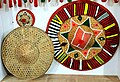 Jaapis made in Dhemaji.
 -
 Rain hat called Talari worn in Orissa, similar to Japi.
 -
 Rain hat in Terai region of Nepal, similar to Japi.
 -
 Rain hat, similar to Japi, called Mathal worn in Bengal region.


See also
References
- ↑ "চূলা". Xobdo. Retrieved 14 June 2026.
- ↑ Bhuyan, S.K, "Satsari Assam Buranji,p.199
- ↑ 3.0 3.1 "Then the Sutiyâ king desired to send silver and gold lipped Jâpi (Kup-ngiun-kham), gold bracelets (Mao-kham), gold basket (Liu-kham), gold box (Khup-kham), gold foot bangles (Khu-tin-kham), gold pirâ (Kham-ku), horse (Ma), elephant (Chang-pai), and two Âroans (Phra-nun) and Xorais (Phun) to the Ahom king." (Jacquesson:12); (Barua 1939:56); Goswami, Hemchandra, Purani Asam Buranji, "সোণৰ খাপৰ চিকন জাপি এটা", p. 41; Mahanta, S., Assam Buranji, D.H.A.S., 1945, p. 9; Bhuyan, S. K., Deodhai Assam Buranji, "সোণৰ পাত বন্ধা জাপি ১ টা", p. 17; (Khanikar 1991:100).
- ↑ Barua, Golap Chandra (1920). Ahom-Assamese-English Dictionary. Calcutta: Assam Administration. p. 17.
A wicker hat serving as an umbrella.
- ↑ Bronson, Miles (1867). A Dictionary in Assamese and English. Sibsagar: American Baptist Mission Press. p. 139.
খাপ ... খলপা ...a layer or division of things placed one above another.
- ↑ Mahanta 1945, p. 10.
- ↑ (Barua 1939:58)
- ↑ Bhuyan, S. K., Deodhai Assam Buranji, "পাছে আমাৰ ৰজাদেৱে দিলে ফুক্লইমুং নৰাৰজালৈ নাংখামপই নামে কন্যা এজনী, ধন্যবাদ হাতী এটা, ৰূপৰ চূলাৰে জাপি দুটা।"
- ↑ Bhuyan 1960, p. 62.
- ↑ Bhuyan, S. K., Satsari Assam Buranji, p. 199.
- ↑ (Jacquesson:9)
- ↑ "Satras of Assam". Department of Tourism, Government of Assam.
Bengena-ati also preserves the royal gold umbrella and gilded robe belonging to the Ahom king Swargadeo Gadadhar Singha.
- ↑ "The Chutias were engaged in all kind of technical jobs of the Ahom kingdom. For example, the Khanikar Khel (guild of engineers) was always manneed by the Sutiyas. The Jaapi-Hajiya Khel (guild for making Jaapis) was also monopolished by them." (Dutta 1985:30)
- ↑ Bhuyan 1960, p. 135.
- ↑ Bodo tribe Khofri hat from Udalguri district
- ↑ Narzary, Sibisan (2019). Material Culture of the Boros: With Special Reference to Cultivation (PDF) (M.Phil. dissertation). Kokrajhar: Bodoland University. pp. 37–39. Retrieved 19 July 2026.
- ↑ Hajowary, Tapasi (2022). "The Dance Forms of a Doudini in Kherai Festival of the Bodos of Assam: An Analytical Study from Religious Perspective". ShodhKosh: Journal of Visual and Performing Arts. 3 (2): 24. doi:10.29121/shodhkosh.v3.i2.2022.148.
This dance is also known as Khopri Sibnai dance. Khopri is a large head gear made of bamboo strips and dried leaves.
- ↑ Nayak, Arunav Kumar (20 June 2024). "Bishnu Rabha: The Man and the Legend". The Sentinel. Retrieved 21 July 2026.
- ↑ "Bamboo and Cane Culture of Meghalaya". Indira Gandhi National Centre for the Arts. Retrieved 19 July 2026.
- ↑ "Bamboo and Cane Culture of Arunachal Pradesh". Indira Gandhi National Centre for the Arts. Retrieved 19 July 2026.
- ↑ "Traditional Cane Hats of the Idu Mishmis". Google Arts & Culture. Banglanatak. 2022. Retrieved 19 July 2026.
- ↑ "7 Nepali topi types used in Nepal besides Dhaka topi". Onlinekhabar English. 2 January 2022. Retrieved 19 July 2026.
- ↑ "Tharu Essentials That Built a Culture: Inside Traditional Life in Bardiya". Bardiya Nature Lodge. Retrieved 19 July 2026.
- ↑ Gazetteer of the Province of Oudh. Vol. 2. Lucknow: Government Press. 1877.
- ↑ Sabar, Bhubaneswar; Pradhan, Paramatap (2025). "Material Culture of Chuktia Bhunjia Tribes of Odisha: An Anthropological Interpretation" (PDF). Man in India. 105 (1–2): 60. Retrieved 19 July 2026.
- ↑ Sainath, P. (6 July 2017). "Make in India – with bamboos and leaves". People's Archive of Rural India. Retrieved 19 July 2026.
- ↑ Banu, Zinat Mahrukh. "Bamboo Craft". Banglapedia. Retrieved 19 July 2026.
- ↑ "Tribal Life". Investment Opportunities in Chhattisgarh (Report). Government of Chhattisgarh. pp. 18–19.
- ↑ Mohanta, Basanta Kumar; Tripathy, Byomakesh (2016). "Role of Ethnographic Museum of IGNTU, Amarkantak for Conservation of the Tribal Cultural Heritage of Central India". Recent Researches on the Tribes of Central India. Vol. 2. New Delhi: Aayu Publications. pp. 484–494. ISBN 978-93-85161-18-6.
- ↑ Niyogi, Deepanwita Gita (16 September 2023). "Forest Dweller on Growing Up With Mahul Leaves". The Quint. Retrieved 19 July 2026.
- ↑ Handoo 2003, p. 46.
- ↑ Assam General Knowledge. Bright Publications. p. 98. ISBN 9788171994519.
Notes
- ↑ Mongkawng was a Shan polity in present-day Kachin State of Myanmar (called Nora in the Buranjis)
Bibliography
- Dutta, Sristidhar (1985), The Mataks and their Kingdom, Allahabad: Chugh Publications
- Khanikar, S (1991), Chutia Jaatir Itihax aru Luko-Sanskriti
- Barua, G.C (1939), Ahom Buranji
- Bhuyan, Surjya K. (1960), Satsari Buranji
- Jacquesson, Francois, Ahom Buranji Translation : Chutia-Ahom wars
- Handoo, Jawaharlal (2003), Folklore in the Changing Times, Original from Indiana University: Indhira Gandhhi Rashtriya Manav Sangrahalaya
- Mahanta, S (1945), Assam Buranji.D.H.A.S.
Template:Hats Template:Clothing
