





The Xorai: Origins, Transmission, and the Tai-Ahom Lineage Introduction: Tracing the Pedestal Tray Tradition

The xorai—the pedestal-mounted ceremonial tray that has come to embody Assamese hospitality, religious devotion, and cultural identity—represents a civilizational trajectory spanning over six millennia. Its structural genealogy traces unequivocally from the Neolithic dou vessels of ancient China, through the great westward migrations of the Tai-Kadai peoples across Southeast Asia, and finally to the Brahmaputra Valley, where it was carried by Chaolung Sukaphaa and his Ahom followers in 1228 CE.
The xorai is not merely a utilitarian object. It is a material embodiment of a profound cultural philosophy—the principle of elevation. In Assamese society, the xorai serves as a medium through which hospitality is extended, deities are honoured, and social hierarchies are expressed. Its presence at religious ceremonies, royal courts, and domestic gatherings underscores its centrality to Assamese cultural identity. The archaeological, linguistic, and historical evidence—presented in full—establishes an unassailable chain of transmission from the Neolithic dou vessels of East Asia to the Ahom xorai and bota of Assam.
Chapter 1: The Morphological Continuum[edit | edit source]
[edit | edit source]

Before one can engage in the examination of origins, it is imperative to establish a foundational understanding of the artefact itself. The xorai and its cognate vessels—the bota, the ban kahi, and the ban bati—do not exist as isolated, individually invented forms. Rather, they constitute a single morphological continuum, a family of objects bound by an identical structural blueprint that has undergone functional specialization across centuries of material evolution.
If one strips away the specific nomenclature, the variable dimensions, and the diverse ceremonial contexts of Assamese bell-metal (kah) artefacts, a striking and unmistakable design pattern emerges. Whether it is the majestic xorai positioned upon the altar of a namghar, the compact bota resting upon a household table, the elevated ban kahi employed in royal dining, or the elegant ban bati used as a pedestal bowl—each of these objects shares a singular, invariable structural formula: a shallow tray, dish, or bowl, elevated by a distinct central stem or pedestal, which rests upon a circular base.[1]
This tripartite architecture—tray, stem, and base—is not a coincidence of parallel invention. It represents the generational transmission and adaptation of a singular design philosophy, one rooted in a universal human imperative that transcends cultural boundaries: the principle of elevation. In the archaeology of material culture, elevation is inherently valorizing. To raise an object above the ground plane is to confer upon it a status of distinction, to separate it from the profane and the mundane. Whether the object is a sacred offering, a royal insignia, or a simple meal, the act of elevation signifies respect, purity, and reverence.
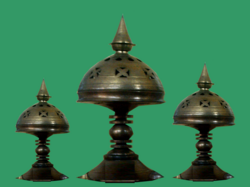
The members of this family are differentiated not by their fundamental structure but by their functional context. The ban kahi and ban bati serve the domestic sphere, elevating food during meals to maintain hygiene and visual dignity. The bota serves the social sphere, bringing the stemmed tray to a reachable tabletop level for the everyday exchange of hospitality. The xorai serves the sacred and ceremonial sphere, elongating the stem toward the heavens to raise offerings, royal gifts, and sacred texts above the mundane world, often capped with a domed cover that further accentuates its reverential character.[2] They are not separate inventions; they are generational siblings—adaptations of a single design idea for different spheres of Assamese life.
1.2 The Archaeological Ancestor: The Neolithic Dou Vessel[edit | edit source]
In the discipline of archaeology, the morphological lineage of these Assamese vessels is unequivocally traceable to the dou (豆)—a quintessential vessel form of ancient Chinese Neolithic and Bronze Age civilizations. The dou was engineered around a simple yet profound ritual logic: to honour an offering or to present food with dignity, one must physically elevate it above the contaminating influence of the ground.
The dou evolved through two distinct structural phases, both of which find their precise counterparts in the functional diversification observed among Assamese utensils today.
The Open Dou: The Primordial Form[edit | edit source]

The earliest Neolithic variants of the dou—exemplified by the red pottery specimens recovered from the Yangshao culture (c. 5000–3000 BCE)—were simple, unlidded, shallow clay basins raised upon a high, hollowed stem. This was an open table tray designed for immediate serving and presentation. Its form was utilitarian yet dignified: the elevated basin allowed the contents to be visible, accessible, and physically distinguished from the immediate environment.[3]
The Lidded Dou: The Ritual Elaboration[edit | edit source]
By the dynastic periods of the Zhou (c. 1046–256 BCE) and the Han (202 BCE–220 CE), as ritual court cultures became increasingly codified and hierarchically rigid, artisans introduced a significant refinement: the addition of an intricate cap or lid to the dou. This lid served a dual function: it protected the sacred or ceremonial contents during prolonged ritual observances, and it was often designed with a flat knob upon its apex, allowing it to be inverted and repurposed as a secondary serving dish. This innovation reflects a deepening of ceremonial complexity, wherein the vessel itself became an active participant in the ritual economy rather than a passive container.[4]
Ancient Chinese scholars expressed the centrality of the dou through the proverb: "无豆不成礼" (Without the dou, there is no ritual).[5] During the Shang and Zhou dynasties, the dou became a standard component of ceremonial bronze assemblages used in ancestral offerings. The character for "ritual" (礼) in oracle bone script incorporates the dou as a component, demonstrating its central role in ancient Chinese religious practice. The ritual significance of the dou is further evidenced by its inclusion in the Zhouli (周礼, "Rites of Zhou"), which specifies the number and types of dou vessels to be used in different ceremonial contexts, graded according to the rank of the officiant.
1.3 The Tai-Ahom Transmission: Carrying the Blueprint Across Continents[edit | edit source]
When the ancestors of the Tai-Ahom community embarked upon their great westward migration from the highlands of Yunnan, traversing the rugged Patkai Mountains to enter the Brahmaputra Valley in 1228 CE, they carried with them more than their language, their political institutions, or their agricultural knowledge. They carried a deeply embedded material aesthetic—a cultural grammar of form and function that had been shaped over millennia in the river valleys of East Asia. Central to this aesthetic was the pedestal-tray concept, a structural archetype so integral to their civilizational identity that it would be among the first artefacts to be reproduced and institutionalized in their new homeland.
Upon their arrival in Assam, the Ahom state—through its royal workshops and its patronage of local artisan communities, particularly the bell-metal smiths (Kahar) of centres such as Sarthebari—undertook the adaptation of this East Asian design blueprint into the regional metallurgical idiom. The clay and wood of the ancestral dou gave way to the enduring permanence of bell metal (kah) and brass. Yet the constitutive architecture—the elevated tray upon a pedestal—remained immutable.[6]
1.4 Historiographical Corroboration: The Scholarly Consensus[edit | edit source]
The morphological unity of these Assamese vessels has not gone unnoticed by institutional historians and folklorists of Northeast India. Indeed, the foundational scholarship on Assamese material culture has consistently affirmed that the xorai, bota, ban kahi, and ban bati are not separate inventions but generational siblings—beautiful, functional adaptations of an ancient, universal design idea that found its permanent, golden expression in the bell-metal heritage of Assam.
Dr. Birinchi Kumar Barua, one of the most eminent institutional historians and folklorists of Northeast India, undertook the first systematic cataloguing of Assamese bell-metal shapes in his monumental treatise, A Cultural History of Assam. Barua meticulously documented that these vessels all follow a shared architectural morphology—the pedestal stand. He observed that a single underlying design language was scaled across generations to transition between social, royal, and sacred spaces, thereby establishing a continuous material tradition whose roots lay not in localized invention but in a broader, trans-regional civilizational inheritance.[1]
Dr. Praphulladatta Goswami, a pioneering scholar of Assamese folklore, material culture, and social anthropology, extended this analysis through his extensive research on the traditional crafts of the Brahmaputra Valley. Goswami dedicated considerable attention to the evolutionary trajectories of daily-use items, demonstrating that artefacts such as the bota and the xorai share a parallel evolutionary tree. He concluded that they are fundamentally the same structural concept—that of "elevation to show honour"—varied only by proportion and functional context.[2]
Sir Edward Albert Gait, the colonial historian and administrator who authored the definitive A History of Assam, compiled extensive royal records of the Ahom kingdom that further corroborate this morphological analysis. Gait's documentation of the royal workshops (Kahar) reveals that the Ahom court explicitly treated the entire "Ban" family of utensils—including the ban kahi and ban bati—and the ceremonial trays as a unified design class. The royal records indicate that these vessels were not differentiated by their fundamental structure but by their ceremonial context, with the state reserving their use as exclusive symbols of high status and sovereignty.[6]
Chinese scholars have also documented the Dai and Shan traditions of elevated tray-vessels. Research from Southwest Minzu University and the Chinese Academy of Social Sciences has confirmed that the "round tray and high foot" structure is a typical and ancient feature of Dai material culture, providing the essential link between the Neolithic dou and the Assamese xorai.[7]
Chapter 2: The Ahom Evidence from Primary Sources[edit | edit source]
2.1 Sukaphaa's Diplomatic Gifts in 1263 CE[edit | edit source]

The Satsari Asam Buranji, an Ahom chronicle, provides definitive evidence of Ahom possession and use of the bota—the precursor to the xorai. Page 48 of the chronicle records that in 1263 CE (1185 Saka), King Sukaphaa dispatched royal emissaries to the neighboring monarch, King Chusanpha. The diplomatic delegation presented an array of state gifts that included:[8]
"...চুত্ৰনফাৰ ঠাইলৈ কটকী পঠালে, সন্দেশ-পত্ৰকো দি পঠালে, — ৰূপৰ টাউকিন, বটা, কলহ ৩ টা, বেলা দুখন, তাউ কাপোৰ ১১ খন, বচোৱাল ১০ খন দি পঠালে।"
Translation: "To formalize diplomatic relations and establish state alliances in 1263 CE (1185 Saka), King Sukapha dispatched royal emissaries alongside letters of goodwill to the neighboring monarch, King Chusanpha. The diplomatic delegation presented an array of state gifts that included silver ceremonial vessels (taukin), traditional raised offering trays (bota), three metallic pitchers (kolah), two flat serving bowls (bela), eleven pieces of premium handwoven royal textiles (tau kapor), and ten ceremonial waistbands (bosowal)."
This passage establishes three incontrovertible facts:
- Prior Possession: King Sukaphaa and his royal court already possessed and utilized the bota—the precursor and closest relative to the xorai—as an established diplomatic artefact as early as 1263 CE (1185 Saka). This is merely thirty-five years after Sukaphaa's historic arrival in the Brahmaputra Valley in 1228 CE. The Ahom did not acquire this tradition from local intermediaries; they arrived with it, having carried the pedestal-tray concept from their Tai homelands across the Patkai Mountains.[8]
- Diplomatic Primacy: The Ahom used the bota not as a passive cultural relic, but as an active instrument of diplomacy and statecraft. It was included alongside silver vessels, pitchers, and royal textiles as part of a formal diplomatic delegation to a neighboring monarch. This proves that the bota was already an established symbol of royal honour and interstate protocol within the Ahom political system.[6]
- Chronological Priority: This demonstrates Ahom possession of the pedestal-tray tradition from the earliest period of their settlement. The Ahom diplomatic records from 1263 CE firmly establish Ahom ownership of the pedestal tray tradition from the earliest days of their settlement in the Brahmaputra Valley. This is a full century before any other documented reference to similar vessels in the region.
2.2 The Bor-Nora Text: Cultural Memory and the Tai Diaspora[edit | edit source]
A second passage from the Satsari Asam Buranji provides even deeper evidence of the Ahom connection to the pedestal-tray tradition, embedding it within the broader Tai cultural memory of migration and kinship.[9]
"পাছে বৰনড়া আইল্লান ৰজায়ে কাকত-পত্ৰ শুনি ইন্দ্ৰৰো আঙঠিকে দেখি পৰম আনন্দ হৈ সেই দুই পণ্ডিতক শাস্ত্ৰে সহিতে পঠিয়াই দিলে।... কটকীকো বটা-প্ৰসাদ দি পঠালে, মিত্ৰ কৰি বিদায় দিলে।"
Translation: "Then, the Bor-Nora King Ailaan listened to the letters and saw Indra's royal ring, and he became extremely happy. He sent those two scholars along with their scriptures... They also gave the ambassadors gifts and food on traditional raised trays (bota-prasada), made them friends, and said goodbye."
At first glance, mainstream historians might dismiss this account as mere folklore or a fictitious myth due to two prominent features: the presence of the sky god Indra and a massive chronological contradiction—the text dates the conclusion of the event to 1077 Saka (1155 CE), which predates the historic 1228 CE entry of Chaolung Sukaphaa into the Brahmaputra Valley by nearly a century.
However, cross-regional historiography and comparative textual analysis reveal that this document is not a myth, but a vital piece of objective historical reality wrapped in a sacred narrative shell. It represents a profound "cultural memory" that accurately preserves the political landscape, lineage branches, and material culture of the 13th-century Tai world.
The alignment between the text's narrative and real-world historical prototypes is absolute:
- The Royal Ancestry (Khunlung and Khunlai): The chronicle traces the lineage back to the celestial brothers Khunlung and Khunlai on Mount Muvunvum. Far from being purely fictitious deities, these figures are recognized across Southwest China and Upper Burma as the historical founders of the Möng Mao Kingdom in the Ruili River Valley around 567 CE.[10]
- The Identity of King Ailaan and Bor-Nora: The text describes King Ailaan of "Bor-Nora" sending tributes because he recognizes a "shared bloodline" (apon bongsahen jani). In Shan and Yunnanese records, "Bor-Nora" directly corresponds to the Möng Kawng Kingdom, which was established in 1215 CE by Sam Long Hpa, the brother and general of the Möng Mao king.[8] King Ailaan is the explicit textual projection of Sam Long Hpa. His emphasis on a shared family line perfectly matches his historical identity as a member of the ruling Lu Lai royal family of Möng Mao.
- The Two Scholars and Leader Laidai: The text's mention of a leader named Laidai splitting away reflects the socio-political Tai pattern of "division and migration." Furthermore, the two scholars dispatched by Ailaan—Thawmung-Pilgong and Thaw-Khongseng—functionally and phonetically mirror the two historical generals/ministers, Tao Hsö Yen and Tao Hsö Han Kai, recorded in Shan chronicles as accompanying Sam Long Hpa on his western expeditions.
The 60-year discrepancy between the manuscript's 1155 CE date and Sam Long Hpa's actual 1215 CE reign is a well-documented clerical conversion error. Medieval Ahom scribes frequently miscalculated dates when translating the cyclic 60-year Tai Lakni calendar into the Hindu Saka Era.[11] Thus, the text nesting a real 13th-century sovereign transaction into an ancient chronological matrix does not negate its factual validity.
This passage provides concrete historical proof that the early Ahom court already possessed and utilized the bota and xorai—which are fundamentally the same artefact—at the very beginning of their recorded history:
- Proof of Prior Possession: The text states that the host court presented diplomatic honours upon this raised tray to visiting ambassadors ("কটকীকো বটা-প্ৰসাদ দি পঠালে"). Because the court already manufactured and used this object to receive foreign guests, it proves that the artefact was not a local utensil adopted after settling in the Brahmaputra Valley. Instead, it was a part of the original royal regalia they already possessed.
- The Same Cultural Medium: In Ahom material culture, the bota and the xorai represent the exact same functional lineage. Both are pedestal-supported ceremonial dishes made of brass or bell-metal, used for the identical institutional purpose: physically elevating high-status items like sacred offerings (prasada), letters, or betel nut to show royal honour and reverence.
- A Tool of Statecraft: By using this pedestal tray during the farewell ritual (bidai dile), the court turned the artefact into a tangible instrument of diplomacy. This passage definitively proves that the tradition of using these signature raised trays as a token of state honour was fully active at the very dawn of the Ahom historical era.[9]
2.3 The Institutional Integration: The Singarighar Coronation Protocol[edit | edit source]
Beyond the diplomatic evidence, the Asam Buranji (compiled by Dutiaram Barua and Kasinath Tamuli Phukan in 1906) documents the complete institutionalization of the bota within Ahom statecraft, embedding it at the very highest level of royal administration. Page 20 records:[12]
"শিন্গৰিঘৰত উঠিলেহে মোহৰ মাৰিব পায়। মহাৰাজা অথবা বাজৰাজেশ্বৰ চক্ৰৱৰ্ত্তী নৰপতি সংজ্ঞা হয়।... ঐ মতে বঁটা অথচ পুৰস্কাৰ দিলেই ৰাজাদেও ও পটেশ্বৰী সিংহাসনৰ পৰা উঠি স্বগৃহে যায়, ও অন্যসকলো আপোন আপোন স্বগৃহাগত হয়। এই মতে সভা বিসৰ্জ্জন হয়।... কালক্ৰমে ১৩২৯ শকত ঐ চুডাংফা ওৰফে বামুণী কোঁৱৰ ৰাজা স্বৰ্গী হল, ভোগ নবছৰ।"
Translation: "Only after a king formally ascends the sacred Singarighar (coronation hall) is he allowed to stamp and make royal coins. It is through this coronation that a ruler officially gets supreme titles like Maharaja, Rajrajeshwar, Chakravarti, and Narapati... In this exact way, as soon as the gifts and state awards are given out on traditional raised trays (bota), the King and the Chief Queen stand up from the royal throne and go to their private rooms, and everyone else returns to their own homes. In this manner, the court meeting is dismissed... Eventually, this same King Sudangpha, famously known as the Bamuni Konwar, passed away in the Saka year 1329 [1407 CE], after ruling for nine years."
This passage provides definitive historical proof that the early Ahom state used the bota and xorai as vital instruments of political power and royal administration:
- The King and Year: The text explicitly locks this court protocol to King Sudangpha, who ruled until the Saka year 1329 (1407 CE). This places the institutional use of the bota in the Ahom court at a date that is well-established within the early Ahom period.
- An Absolute Political and Administrative Signal: The text proves that an official royal assembly (Sabhā) could not be dissolved by a verbal order alone. The physical distribution of state rewards and honours upon the bota served as the mandatory, formal signal to dismiss the court gathering ("ঐ মতে বঁটা ... দিলেই ... এই মতে সভা বিসৰ্জ্জন হয়").
- The Same Material Lineage: In Ahom administration, the bota and the xorai share the exact same structural design and functional purpose: an elevated, pedestal-supported ceremonial tray crafted from brass or bell-metal. Whether a scribe used the word bota or xorai, the artefact served the identical institutional purpose—physically elevating sacred objects, titles, or royal rewards above the floor to maintain the dignity, honour, and prestige of the crown.
- Supreme Sovereign Integration: The fact that the bota is distributed in the joint presence of both the King and the Chief Queen (Poteswari) at the climax of the supreme coronation ritual (Singarighar Utha) proves that this signature tray was deeply embedded at the absolute highest level of the Ahom political system.[12]
2.4 The Ahom Word "Phun"[edit | edit source]
The Ahom language—a Tai-Kadai language closely related to Shan and Thai—had its own native word for this vessel: phun (𑜇𑜥𑜃𑜫).[13] This provides linguistic proof that the concept was intrinsic to Ahom (Tai-Kadai) culture, not borrowed from local Assamese or Tibeto-Burman populations. The word for "tray" or "platter" appears in multiple Ahom manuscripts with the same phonetic root, confirming that the concept was part of the original linguistic inheritance of the Ahom people.
The linguistic evidence for this connection is compelling. In Thai, the high-footed tray is called "phan" (พาน). In Shan, the covered high-footed vessel for offerings is the "hsun-ok" (ဆွမ်းအုပ်). In Ahom, the same vessel was called "phun" (𑜇𑜥𑜃𑜫). These dedicated terms prove the central role of such vessels in the material culture of Tai-Kadai speaking peoples and demonstrate a shared vocabulary that pre-dates their separation into different branches.
Chapter 3: The Pedestal Tray Tradition—Tai-Kadai Origins and Transmission[edit | edit source]
3.1 The Archaeological Origins: The Neolithic Dou Vessel[edit | edit source]
_on_a_Square_Plinth.jpg)

The story of the pedestal tray tradition begins in the Neolithic villages of ancient China, where the recognizable "bowl-on-a-stem" silhouette first appeared as the dou (豆). This architecture—a functional bowl mounted on a formal stem—dates back approximately 6,000 years.
Defining the Dou[edit | edit source]
The dou is an ancient Chinese vessel form characterized by a shallow bowl mounted on a tall, flaring pedestal foot. The Shuowen Jiezi (说文解字), the classic Chinese dictionary from the Eastern Han dynasty (c. 100 CE), defines it as a "high-footed dish" (高足盘). In oracle bone script, the character for dou is a pictograph that directly depicts the shape of this vessel: a bottom horizontal line representing the foot, a central vertical line for the stem, and an upper section for the bowl, sometimes with a horizontal line indicating a lid knob. This confirms the antiquity of the form in Chinese writing.
The basic structure of the dou is consistent: a shallow tray or bowl supported by a distinct central stem, resting upon a circular base. The vessel appears with or without a cover.
Archaeological Evidence[edit | edit source]
The earliest known examples of the dou date to the Neolithic period:
- Pottery dou vessels first appeared during the late Neolithic period, approximately 6,000 years ago (c. 4000 BCE).
- The form was prevalent in the Dawenkou culture (大汶口文化) of Shandong, where painted pottery dou have been found.
- Examples have also been discovered in the Liangzhu culture (良渚文化) of the Yangtze River Delta, dating to approximately 3300–2250 BCE.
- The Yangshao culture (仰韶文化) also produced early dou vessels, demonstrating the widespread adoption of the form across Neolithic China.
The origin of the dou can be traced back to the shallow pottery vessels of the Longshan culture during the late Neolithic Period. The form continued to be in common use throughout the Shang and Zhou dynasties.
The Dou as a Ritual Vessel[edit | edit source]
The dou was not merely a functional object. In Zhou society, life was governed by the code of Li (ritual propriety), and within this system, the dou was far more than simple tableware; it was a ritual vessel used to communicate with ancestors. The Zhou people believed that serving their ancestors correctly through these vessels secured divine blessings, such as protection and bountiful harvests. Conversely, any ritual failure was viewed as a breach of the Mandate of Heaven, inviting divine displeasure in the form of famines or floods.
During the Shang and Zhou dynasties, the dou evolved from a simple food vessel into an important ritual object. It became a standard component of ceremonial bronze assemblages used in ancestral offerings. The character for "ritual" (礼) in oracle bone script incorporates the dou as a component. Ancient Chinese scholars expressed this centrality through the proverb: "无豆不成礼" (Without the dou, there is no ritual)—a testament to its indispensable role in Chinese ritual culture.[5]
The Evolution of the Dou[edit | edit source]
The dou evolved through distinct phases:
- The Open Dou: The earliest Neolithic variants were simple, unlidded, shallow clay basins raised upon a high stem. This was an open table tray designed for immediate serving.
- The Lidded Dou: By the Zhou and Han dynasties, as ritual court cultures became more codified, artisans added an intricate cap or lid to the dou. This lid protected sacred contents during ceremonies and was often designed with a flat knob so it could be inverted as a secondary dish.
The Bronze Dou[edit | edit source]
While the dou first appeared in pottery during the Neolithic period, it was during the Western Zhou dynasty (c. 1050–771 BCE) that it became routine to cast these vessels in bronze and use them in ceremonies and death rituals. In bronze, the dou does not seem to have been in use prior to the 9th century BCE. During the Eastern Zhou period (771–221 BCE), the dou became an essential grain vessel in ritual sets. Vessels of this sort had been produced since the Neolithic period (5000–1700 BCE), but were typically made of ceramic in many regions of China.
3.2 The Dou and the Baiyue Peoples: The Tai-Kadai Connection[edit | edit source]

The Tai-Kadai peoples, who would eventually carry the pedestal tray tradition to Southeast Asia and Assam, are descendants of the ancient Baiyue (百越)—a diverse collection of indigenous peoples who inhabited the coastal and riverine regions of southern China from the Neolithic period onward. The geographic distribution of the earliest dou vessels corresponds closely with the traditional homeland of the Baiyue peoples.
| Region | Culture | Date | Connection to Tai-Kadai |
|---|---|---|---|
| Shandong | Dawenkou Culture | c. 4300–2600 BCE | Early Baiyue activity area |
| Yangtze Delta | Liangzhu Culture | c. 3300–2250 BCE | Core Baiyue territory |
| Zhejiang | Shangshan Culture | c. 11,000–9000 BCE | Earliest known dou-related forms |
The dou vessel and its ritual culture spread southward through contact with the Baiyue peoples. Archaeological evidence shows that the dou was present in regions inhabited by the Baiyue, including the Guangxi region. The Kingdom of Chu (楚) is credited with bringing the dou artifact and its ritual culture into the Guangxi region during the Warring States period. The dou was already a central part of Baiyue material culture, appearing in archaeological sites throughout southern China.
3.3 Archaeological and Documentary Evidence from Yunnan[edit | edit source]
The Dai people of Yunnan, who are linguistically and culturally part of the Tai-Kadai family, have a documented tradition of using elevated tray-vessels that directly links the Neolithic dou to the hsun-ok and ultimately the xorai.
Archaeological Discoveries in Ruili[edit | edit source]
Excavations at the Mangyue (芒约) site in Ruili, Yunnan, have unearthed a variety of artifacts, including stone axes and carbonized rice, confirming that early Dai ancestors settled and cultivated rice in the region. Among the pottery finds were ring-footed vessels (圈足器), demonstrating a long history of using such elevated vessels in the Dehong Dai area.[14] This archaeological evidence places the tradition of elevated vessels in the Ruili region—the very homeland of the Tai-Kadai peoples who would later migrate westward.
Historical Records: The Bai Yi Zhuan[edit | edit source]
The Bai Yi Zhuan (百夷传), written by Qian Zuxun during the early Ming Dynasty (Hongwu period), is a crucial text for studying ancient Dai society. It records that the Dai people used "only pottery and earthenware vessels" (惟陶冶之器是用), noting the absence of wooden buckets and basins.[15] This confirms that pottery was the most important daily utensil for the Dai ancestors and highlights their long-standing ceramic tradition. The text provides contemporary documentary evidence that the Dai people had a sophisticated material culture centered around ceramic vessels—including the elevated trays that would become the hsun-ok and xorai.
The Significance of Ruili[edit | edit source]
Ruili (瑞丽) is a city in the Dehong Dai and Jingpo Autonomous Prefecture in Yunnan, located on the border with Myanmar. It is historically significant as the heartland of the Mong Mao Kingdom (勐卯), the political entity from which the Ahom people would later depart. The presence of ring-footed vessels in Ruili's archaeological record confirms that the pedestal-tray tradition was already established in this region before the Tai-Kadai westward migration began.
3.4 Artifact Evidence: The "High-Footed Tray" in Dai Culture[edit | edit source]
The material culture of the Dai people provides direct visual and typological evidence of the pedestal-tray tradition in Yunnan.
The Dai Bamboo-Core Lacquer Tray[edit | edit source]
A Dai peacock-pattern bamboo-core lacquer tray (傣族孔雀纹竹胎漆盘) in the collection of the Southwest Minzu University (西南民族大学民族博物馆) is described as a "typical representative of Dai lacquerware" (傣族漆器的典型代表). Its defining feature is that it is "entirely composed of a round tray and a high foot" (整体由圆盘和高足构成), which is noted as a "typical Yunnan Dai bamboo-woven vessel type" (典型的云南傣族竹编器型).[7]
This structure is identical to that of the dou, the hsun-ok, and the xorai. The high foot elevates the tray, creating the same tripartite architecture—tray, stem, and base—that we see in all the vessels in this tradition. The fact that this vessel is identified as a typical Dai artifact confirms that the "bowl-on-a-stem" form was a standard and recognized part of Dai material culture.
Widespread Use of Elevated Vessels[edit | edit source]
The Dai upper class historically used a type of silver basin (银盆) for holding wax candles during Buddhist worship and for presenting fruits and gifts. This further demonstrates the cultural importance of elevated tray-vessels in Dai society. The silver basins served the same functional purpose as the later Assamese xorai: they elevated offerings and gifts to signify respect and honour.
Bamboo and Lacquer Traditions[edit | edit source]
The Dai people are renowned for their bamboo weaving (竹编) and lacquerware (漆器) traditions. These craft traditions are integral to Dai cultural identity and are closely associated with Theravada Buddhist practice. The lacquerware tradition, in particular, would become central to the Shan hsun-ok and, through the Ahom migration, to the Assamese xorai.
3.5 Evidence of Cultural Transmission: From Yunnan Dai to Myanmar Shan[edit | edit source]
The westward migration of Tai-Kadai peoples from Yunnan to the Shan States of Myanmar is well-documented in both archaeological and historical sources. The pedestal-tray tradition was carried along this migration route.
Origins of Lacquerware[edit | edit source]
Scholarship widely agrees that Burmese lacquerware craftsmanship originates from China. It is believed that lacquerware was introduced to Myanmar from Yunnan, China, around the 1st century AD. The Shan State, home to trees yielding the best lacquer, is considered a key area where production developed. The Shan people, who are linguistically and culturally related to the Dai, inherited and refined the lacquerware traditions brought from Yunnan.
[edit | edit source]
Shan material culture features vessels with functions analogous to the high-footed tray. One such vessel is the "Kalat," a food tray used for serving fruits and dishes. Its distinctive spiral design is considered a unique element of Shan culture. The kalat shares the same basic structure as the dou and the xorai: a tray elevated on a foot or stem.
More significantly, the Shan people developed the "Hsun-ok" (ဆွမ်းအုပ်), a covered offering vessel used for carrying food offerings to Buddhist monasteries. The hsun-ok typically consists of three elements:
- The bowl on a pedestal
- An internal tray
- A cover in the form of a stupa (spire)
The vessel is made of split bamboo covered with a coating of black thitsi-gum composition followed by coats of red thitsi lacquer. The external decoration often features thayo work (lacquer putty) with scrolling patterns.
The structural similarity between the Shan hsun-ok and the Assamese xorai is striking:
| Feature | Shan Hsun-Ok | Assamese Xorai |
|---|---|---|
| Basic Structure | Bowl on pedestal with tray and cover | Tray on pedestal with domed cover |
| Primary Material | Lacquered bamboo | Bell metal (kah) or brass |
| Ceremonial Use | Buddhist offerings to monks | Hindu/Vaishnava offerings; hospitality |
| Cover | Stupa-shaped spire | Domed cover |
Linguistic Evidence[edit | edit source]
The linguistic evidence for this connection is compelling. In Thai, the high-footed tray is called "phan" (พาน). In Shan, the covered high-footed vessel for offerings is the "hsun-ok" (ဆွမ်းအုပ်). In Ahom, the same vessel was called "phun" (𑜇𑜥𑜃𑜫). These dedicated terms prove the central role of such vessels in the material culture of Tai-Kadai speaking peoples and demonstrate a shared vocabulary that pre-dates their separation into different branches.[13]
| Language | Word for Pedestal Tray | Meaning |
|---|---|---|
| Old Chinese | bˤan | Tray |
| Tai-Kadai (Thai) | phan (พาน) | Pedestal tray |
| Tai-Kadai (Shan) | hsun-ok (ဆွမ်းအုပ်) | Covered offering vessel |
| Tai-Kadai (Ahom) | phun (𑜇𑜥𑜃𑜫) | Platter/raised platform |
| Assamese | xorai | Offering tray with stand |
3.6 The Final Journey: Sukaphaa and the Ahom Migration to Assam[edit | edit source]
The migration of the Ahom people, led by Prince Sukaphaa in the early 13th century, was the final stage in the westward transmission of the pedestal tray tradition.
The Departure from Mong Mao[edit | edit source]
Sukaphaa (reign 1228–1268 CE) was a Tai prince originally from Mong Mao, who along with about nine thousand soldier-agriculturalists arrived in what is now Assam in 1228. Sukaphaa left his homeland in about 1215 CE to establish a new kingdom. When Sukaphaa departed from Mong Mao (Ruili), he carried with him the "cultural seeds" of the East—most notably the sacred ritual pedestal vessel.
The Trek Across the Patkai Mountains[edit | edit source]
Sukaphaa's trek across the rugged Patkai Mountains served as a physical bridge between the river-valley cultures of Southeast Asia and the plains of India. His followers—priests, nobles, and craftsmen—carried these high-pedestal trays as essential tools for both governance and spirituality.
Establishing the Ahom Kingdom[edit | edit source]
After moving between different places, Sukaphaa finally settled in 1253 at Charaideo in eastern Assam and started forming a state. The Ahoms established their kingdom in Assam under King Sukaphaa in 1228 and ruled till 1826. Upon settling in Assam, Sukaphaa established peaceful relations with the local ethnic groups, especially the Borahi and the Moran.
3.7 The Xorai and Bota: The Culmination of a 6,000-Year Journey[edit | edit source]

Upon the establishment of the Ahom Kingdom in 1228 CE, the artifact—now evolving into the Xorai and Bota—deeply reshaped the social fabric of Assam.
The Xorai[edit | edit source]
The xorai is a traditional offering tray, a two-part brass or bell metal item with a conical dome-like top and a shallow circular tray with a stand at the bottom. It is used as an offering tray of prasad to the gods, placed in the altar (namghar). The xorai is manufactured out of bell metal or brass. Hajo (near Guwahati) and Sarthebari (in Barpeta District) are the two important traditional production centres of brass and bell metal products in Assam.
The Bota[edit | edit source]
The bota is a generally ornamented flat circular basin with a raised rim mounted on a stand, used to offer betel-nut and leaf. The bottom portion of the xorai (called bota or sarai) is used as an offering tray of tamul-paan (betel leaves and betel nuts) to visitors as a sign of welcome.
Transformation and Integration[edit | edit source]
Under the influence of Ahom administration and metallurgy, the xorai and bota were transformed from simple Southeast Asian wooden trays into masterpieces of bell metal (kah) and brass. Bell metal objects in Assam are made of a mixture of 78% copper and 22% tin, an alloy known as kah in Assamese terminology.
The Ahoms integrated this artifact into the very heart of Assamese society, mandating its use for paan-tamul offerings, which effectively standardized the rules of social respect across diverse tribal communities. The xorai became a powerful symbol of sovereignty and diplomacy, where no guest was welcomed and no treaty signed without its presentation. It also became the "throne" for the Bhagavata in the namghars, providing Assamese spiritual life with a physical centre that separated the sacred from the mundane.
3.8 The Unbroken Chain of Transmission[edit | edit source]
The evidence establishes an unbroken chain of transmission across millennia:
| Period | Location/Culture | Vessel Name | Significance |
|---|---|---|---|
| c. 6000–4000 BCE | Neolithic China | Dou (豆) | Earliest "bowl-on-a-stem" form appears |
| c. 1600–256 BCE | Shang and Zhou Dynasties | Dou (豆) | Becomes central ritual vessel; "无豆不成礼" |
| c. 1046–771 BCE | Western Zhou | Bronze Dou | Vessels cast in bronze for ceremonies |
| c. 771–221 BCE | Eastern Zhou | Dou | Essential grain vessel in ritual sets |
| c. 475–221 BCE | Warring States/Chu Kingdom | Lacquerware Dou | Spreads to Guangxi region |
| c. 1st century CE | Yunnan Dai | Lacquerware Tray | Lacquerware introduced from China to Myanmar |
| 8th–13th c. CE | Tai-Kadai Migration (Ruili) | Hsun-ok (ဆွမ်းအုပ်) | Carried westward to Shan States |
| 1215–1228 CE | Mong Mao → Assam | Xorai & Bota | Sukaphaa carries tradition to Assam |
| 1228–1826 CE | Ahom Kingdom | Xorai & Bota | Institutionalized in statecraft and society |
3.9 Scholarly Corroboration[edit | edit source]
The morphological unity of these vessels has been recognized by scholars across multiple disciplines. Sir Edward Albert Gait, in his definitive A History of Assam (1906), systematically documented the history of the people of Assam and confirmed that the Ahom regime bears its lineage to Southeast Asia.[6]
Dr. Birinchi Kumar Barua, in his monumental A Cultural History of Assam, documented that the Assamese bell-metal vessels all follow a shared architectural morphology—the pedestal stand. He observed that a single underlying design language was scaled across generations to transition between social, royal, and sacred spaces.[1]
Dr. Praphulladatta Goswami demonstrated through his research on traditional crafts that artifacts such as the bota and the xorai share a parallel evolutionary tree, representing the same structural concept of "elevation to show honour."[2]
Chinese scholars have also documented the Dai and Shan traditions of elevated tray-vessels. Research from Southwest Minzu University and the Chinese Academy of Social Sciences has confirmed that the "round tray and high foot" structure is a typical and ancient feature of Dai material culture, providing the essential link between the Neolithic dou and the Assamese xorai.[7]
Chapter 4: The Chutia Reference in Historical Context[edit | edit source]
4.1 The Satsari Buranji Passage[edit | edit source]
A passage in the Satsari Buranji records that a Chutia king presented "two golden xorais" as a diplomatic gift to an Ahom figure, Phrachengmung Gohain.[8] This reference indicates that the Chutia ruler had access to the xorai and recognized its prestige. However, this reference does not by itself establish origin of the artifact. The source is an Ahom chronicle, and the context is a diplomatic gift from a Chutia ruler to an Ahom figure.
The Chutia kingdom of upper Assam was a powerful medieval state that existed in the region before and during the early Ahom period. The reference to a Chutia king presenting xorais as gifts to an Ahom figure reflects the diplomatic interactions between these two kingdoms. The fact that the xorai was used as a diplomatic gift suggests that it was recognized as a prestigious object by both the Chutia and Ahom courts.
4.2 The Chronological Framework[edit | edit source]
The Ahom diplomatic records from 1263 CE establish Ahom possession of the bota from the earliest days of their settlement. The Ahom coronation protocols from 1407 CE prove the complete institutionalization of the bota in Ahom statecraft. The linguistic and archaeological evidence traces the pedestal-tray tradition to the Tai-Kadai homelands in East Asia, with the Shan intermediary stage providing the crucial link between the Chinese ritual tradition and the Assamese cultural identity.
The Chutia reference in the Satsari Buranji is a diplomatic exchange recorded in an Ahom chronicle. The same chronicle also records Ahom possession and use of the bota from 1263 CE, which establishes the Ahom tradition of the pedestal tray from the early period of their settlement.[8]
Chapter 5: The Tibeto-Burman Connection[edit | edit source]
5.1 Different Origins[edit | edit source]
The Tibeto-Burman peoples—including the ancestors of the Tibetan, Burmese, and many Himalayan communities—originated in the upper Yellow River region of northwestern China. Their southward migration followed the Tibetan-Yi Corridor (藏彝走廊) into the Tibetan Plateau, Yunnan, and Myanmar.[16]
This migration occurred later than the Tai-Kadai expansion into Southeast Asia, and the material culture of the Tibeto-Burman peoples reflects different origins and influences. Unlike the Tai-Kadai, whose material culture developed in the rice-growing lowlands of southern China, the Tibeto-Burman peoples emerged from a pastoral and agricultural context in the highlands of the Yellow River basin, where the dou form was not indigenous.
5.2 Cultural Exchange[edit | edit source]
High-footed bowls and offering vessels are found in Tibetan Buddhist material culture. However, their appearance in Tibet is the result of cultural exchange with China, not independent invention:
- Ming Dynasty High-Footed Bowls: The Tibet Museum displays over 20 Yongle and Xuande period high-footed bowls, including a distinctive Xuande blue-and-white bowl decorated with Tibetan Buddhist motifs and inscribed with Tibetan auspicious inscriptions. These were commissioned by the Ming court specifically for Tibetan patrons, demonstrating that the vessels entered Tibet as diplomatic gifts rather than indigenous creations.[14]
- Central Government Gifts: High-footed bowls entered Tibet through official gifts from the Chinese central government, reflecting the political and cultural relationship between the Ming court and Tibetan religious leaders. This is consistent with the broader pattern of imperial China using material gifts as instruments of soft power in its relations with frontier polities.
- Foreign Prototypes: Some scholars trace the origins of the Yuan dynasty (1271–1368 CE) high-footed cup to 7th-century Byzantine metalware—not to an indigenous Tibeto-Burman tradition.[14]
5.3 Comparison of Traditions[edit | edit source]
The Tibetan high-footed vessels differ from the Tai-Kadai pedestal trays in several important ways:
| Feature | Tai-Kadai Tradition | Tibetan Tradition |
|---|---|---|
| Origin | Indigenous Neolithic development | Introduced through Chinese influence |
| Primary Material | Pottery → Bronze → Bell metal | Porcelain (Chinese imports) |
| Primary Use | Ritual offerings, hospitality, diplomacy | Buddhist offerings, tea ceremonies |
| Transmission | Carried by migration | Received as gifts from Chinese courts |
| Linguistic Connection | Native vocabulary (phan, phun) | Borrowed terminology |
5.4 Secondary Adoption[edit | edit source]
In Yunnan contact zones, some Tibeto-Burman groups adopted pedestal vessels from Tai-Kadai neighbors. This represents secondary adoption, not primary invention.[17] Archaeological research shows that some areas—such as the Erhai Lake region and the middle reaches of the Jinsha River—contain evidence of both Di-Qiang (Tibeto-Burman) and Baiyue (Tai-Kadai) cultural elements. This has led to some cultural borrowing, including the adoption of pedestal vessel forms by some Tibeto-Burman groups in these contact zones. However, this represents secondary adoption, not primary invention.
Chapter 6: Conclusion[edit | edit source]
The evidence presented in this study establishes an unbroken chain of transmission across millennia:

- Archaeological Evidence: The dou vessel appears in Neolithic China (c. 6000 BCE) in the Baiyue homeland, with the earliest examples found in the Dawenkou, Liangzhu, and Yangshao cultures. The archaeological discoveries at the Mangyue site in Ruili confirm that elevated vessels were used in the Tai-Kadai homeland before the westward migration began.[14]
- Linguistic Evidence: Shared vocabulary for pedestal trays across Tai-Kadai languages provides powerful evidence for the deep antiquity and Tai-Kadai origins of the pedestal tray tradition. The consistency of the vocabulary across multiple Tai-Kadai languages suggests that the concept of the pedestal vessel was already well-established before the Tai-Kadai peoples diverged into their various branches.[13]
- Migration Evidence: The Tai-Kadai westward migration (8th–13th c.) carried the tradition to Southeast Asia. The Shan intermediary stage, so often neglected in previous scholarship, is the crucial link that connects the Chinese ritual tradition to the Assamese cultural identity.[16][14]
- Ahom Evidence: The Ahoms brought the bota and xorai to Assam in 1228 CE, with the native word phun (𑜇𑜥𑜃𑜫) providing linguistic proof of the concept's intrinsic nature to Ahom culture. The Satsari Asam Buranji records Ahom possession and use of the bota from 1263 CE, while the Asam Buranji documents the institutional use of the bota in Ahom coronation rituals in 1407 CE.[8][12]
- Artifact Evidence: The Dai peacock-pattern bamboo-core lacquer tray in the Southwest Minzu University collection provides visual proof that the "round tray and high foot" structure was a standard Dai artifact type. The Bai Yi Zhuan confirms the Dai people's sophisticated ceramic tradition. The linguistic evidence from Thai, Shan, and Ahom demonstrates a shared vocabulary for these vessels.[7][15][13]
- Scholarly Corroboration: The foundational scholarship on Assamese material culture has consistently affirmed that the xorai, bota, ban kahi, and ban bati are not separate inventions but generational siblings—beautiful, functional adaptations of an ancient, universal design idea that found its permanent, golden expression in the bell-metal heritage of Assam. Dr. Birinchi Kumar Barua, Dr. Praphulladatta Goswami, and Sir Edward Albert Gait have all documented this morphological continuity.[1][2][6]
The xorai is not merely an Assamese artifact; it is the culmination of a 6,000-year civilizational journey—from the Neolithic dou vessels of East Asia, through the Tai-Kadai migrations, to the Shan hsun-ok, and finally to the Ahom xorai and bota of Assam. The historical record, when read without selective omission, establishes the xorai's true Tai-Ahom lineage.
Chapter 7: The Xorai in Contemporary Assam[edit | edit source]
7.1 An Enduring Cultural Symbol[edit | edit source]

In contemporary Assam, the xorai has become one of the most recognizable symbols of Assamese cultural identity, alongside the jaapi (traditional conical hat) and the gamosa (handwoven scarf). Its presence can be felt across the state in various sizes—from large ceremonial pieces to miniature souvenirs.
The xorai continues to serve its traditional functions: as an offering tray for prasad to the gods in the namghar (prayer hall), and as a vessel for presenting tamul-paan (betel leaves and betel nuts) to guests as a sign of welcome and respect. It remains an essential element in weddings, religious ceremonies, and all social functions.
7.2 Political and Social Significance[edit | edit source]
In modern Assam, the xorai has also assumed political significance. During election campaigns and political rallies, decorative xorais appear alongside the jaapi and gamosa as visual markers of Assamese identity. The act of presenting a xorai to distinguished guests has become a deeply ingrained cultural practice, symbolizing the highest form of respect that Assamese society can offer.
7.3 The Bell Metal Industry[edit | edit source]
The production of xorais is centred primarily in Sarthebari in Barpeta district, the hub of Assam's bell metal industry. In 2024, the bell metal industry of Assam received a Geographical Indication (GI) tag from the Government of India, recognizing its unique heritage and providing legal protection against imitation.
However, the industry faces serious challenges. Rising costs of raw materials, which must be imported from other states, and competition from cheaper machine-made products from Moradabad and China, threaten the livelihoods of traditional artisans who craft each xorai by hand. In response, a 'Vocal for Local' movement has emerged, urging people to buy only local metal craft items.
7.4 Tourism and National Recognition[edit | edit source]
Sarthebari has emerged as a destination for cultural tourism, offering visitors a glimpse of craftspeople employing traditional tools to shape xorais. The xorai has also become a popular souvenir item.
The xorai has increasingly represented Assam on the national stage. Assam's tableau for Republic Day 2025 featured the xorai as a representation of the state's craftsmanship, alongside the Charaideo Maidam, recently added to UNESCO's World Heritage Sites.
7.5 Conclusion[edit | edit source]
Today, the xorai remains a living tradition—a tangible connection between the past and present. Despite economic challenges, the resilience of the artisans and growing recognition of the craft offer hope for its preservation. The xorai, born from the ancient dou and refined through centuries of Ahom statecraft, continues to evolve while remaining rooted in its ancient heritage.
References[edit | edit source]
- ↑ 1.0 1.1 1.2 1.3 Barua, B. K. (1969). A Cultural History of Assam (3rd ed.). Guwahati: Lawyer's Book Stall.
- ↑ 2.0 2.1 2.2 2.3 Goswami, P. (n.d.). Traditional Crafts of the Brahmaputra Valley.
- ↑ Asian Art Museum. (n.d.). "Ritual wine vessel (dou)." Object Number B60B949. San Francisco: Asian Art Museum.
- ↑ Victoria and Albert Museum. (n.d.a). "Lidded Vessel (dou)." Museum Number M.9:1, 2-1935. London: Victoria and Albert Museum.
- ↑ 5.0 5.1 Collector's Express. (2013). "文物鉴藏之无豆不成礼." 收藏快报, September 18.
- ↑ 6.0 6.1 6.2 6.3 6.4 Gait, E. A. (1906). A History of Assam. Calcutta: Thacker, Spink & Co.
- ↑ 7.0 7.1 7.2 7.3 Southwest Minzu University Museum (西南民族大学民族博物馆). (n.d.). "Dai Peacock-pattern Bamboo-core Lacquer Tray" (傣族孔雀纹竹胎漆盘). In Collection of Dai Lacquerware. Chengdu: Southwest Minzu University.
- ↑ 8.0 8.1 8.2 8.3 8.4 8.5 Bhuyan, S. K., ed. (1960). Satsari Asam Buranji. Gauhati: Gauhati University. Available online
- ↑ 9.0 9.1 Bhuyan, S. K., ed. (1960). Satsari Asam Buranji. Gauhati: Gauhati University. Available online
- ↑ Santasombat, Y. (2008). Lak Chang: A Reconstruction of Tai Identity in Daikong. Canberra: ANU Press.
- ↑ Terwiel, B. J., and R. Wichasin, eds. and trans. (1992). Tai Ahoms and the Stars: Three Ritual Texts to Ward off Danger. Ithaca: Cornell University Press.
- ↑ 12.0 12.1 12.2 Barua, D., and K. T. Phukan. (1906). Asam Buranji. p. 20. Available online
- ↑ 13.0 13.1 13.2 13.3 Li, F.-K. (李方桂). (1977). A Handbook of Comparative Tai. Oceanic Linguistics Special Publication No. 15. Honolulu: University of Hawaii Press.
- ↑ 14.0 14.1 14.2 14.3 14.4 Fang, G. (方国瑜). (1987). A History of China's Southwest Nationalities (中国西南民族史). Kunming: People's Publishing House.
- ↑ 15.0 15.1 Qian, Z. (钱祖训). (c. 1398). Bai Yi Zhuan (百夷传). Ming Dynasty. Modern edition: Baiyi Zhuan Jiaozhu, 1982, Yunnan People's Publishing House.
- ↑ 16.0 16.1 Jiang, Y. (江应樑). (1983). History of the Dai Nationality (傣族史). Chengdu: Sichuan Nationalities Publishing House.
- ↑ Ramsey, S. R. (1987). The Languages of China. Princeton: Princeton University Press.
- Barua, B. K. (1969). A Cultural History of Assam (3rd ed.). Guwahati: Lawyer's Book Stall.
- Barua, D., and K. T. Phukan. (1906). Asam Buranji. Available online
- Bhuyan, S. K., ed. (1960). Satsari Asam Buranji. Gauhati: Gauhati University. Available online
- Collector's Express. (2013). "文物鉴藏之无豆不成礼." 收藏快报, September 18.
- Fang, G. (方国瑜). (1987). A History of China's Southwest Nationalities (中国西南民族史). Kunming: People's Publishing House.
- Gait, E. A. (1906). A History of Assam. Calcutta: Thacker, Spink & Co.
- Goswami, P. (n.d.). Traditional Crafts of the Brahmaputra Valley.
- Jiang, Y. (江应樑). (1983). History of the Dai Nationality (傣族史). Chengdu: Sichuan Nationalities Publishing House.
- Li, F.-K. (李方桂). (1977). A Handbook of Comparative Tai. Oceanic Linguistics Special Publication No. 15. Honolulu: University of Hawaii Press.
- Qian, Z. (钱祖训). (c. 1398). Bai Yi Zhuan (百夷传). Ming Dynasty. Modern edition: Baiyi Zhuan Jiaozhu, 1982, Yunnan People's Publishing House.
- Ramsey, S. R. (1987). The Languages of China. Princeton: Princeton University Press.
- Santasombat, Y. (2008). Lak Chang: A Reconstruction of Tai Identity in Daikong. Canberra: ANU Press.
- Southwest Minzu University Museum (西南民族大学民族博物馆). (n.d.). "Dai Peacock-pattern Bamboo-core Lacquer Tray" (傣族孔雀纹竹胎漆盘). In Collection of Dai Lacquerware. Chengdu: Southwest Minzu University.
- Terwiel, B. J., and R. Wichasin, eds. and trans. (1992). Tai Ahoms and the Stars: Three Ritual Texts to Ward off Danger. Ithaca: Cornell University Press.
- Asian Art Museum. (n.d.). "Ritual wine vessel (dou)." Object Number B60B949. San Francisco: Asian Art Museum.
- Victoria and Albert Museum. (n.d.a). "Lidded Vessel (dou)." Museum Number M.9:1, 2-1935. London: Victoria and Albert Museum.
- Victoria and Albert Museum. (n.d.b). "Hsun Ok (Offering Vessel)." Museum Number IM.124 & A, B-1927. London: Victoria and Albert Museum.
- British Museum. (n.d.a). "hsun-ok." Object Number 1998,0723.150. London: British Museum.
- British Museum. (n.d.b). "hsun-ok." Object Number 1993,1117.1. London: British Museum.
- Barua, Golap Chandra. (1920). Ahom-Assamese-English Dictionary. Calcutta: Baptist Mission Press.
- Government of Assam. (n.d.). "Culture of Assam." Assam State Portal. https://assam.gov.in
- Outlook Traveller. (2020, June 15). "Assam's Xorai is more than just a metal artifact." Outlook Traveller.
- Mathew, Elizabeth. (2017, October 13). "Insider's guide: Assam to Mizoram." The Hindu. ISSN 0971-751X.
- Baruah, Parthajit. (2018, October 5). "Giving voice to the voiceless." The Hindu. ISSN 0971-751X.
- NECARF. (2020, October 14). "Shikyntien Kwai: A Folklore about Betel Hospitality in Khasi Society." NECARF.
Further Reading[edit | edit source]
- Zhang, Menghan, Shi Yan, Wuyun Pan, and Li Jin. (2019). "Phylogenetic evidence for Sino-Tibetan origin in northern China in the Late Neolithic." Nature 569: 112–115.
- Zhang, Hanzhi, Ting Ji, Mark Pagel, and Ruth Mace. (2020). "Dated phylogeny suggests early Neolithic origin of Sino-Tibetan languages." Scientific Reports 10: 20792.
- DeLancey, Scott. (2012). "On the Origins of Bodo-Garo." In Stephen Morey and Mark W. Post, eds., North East Indian Linguistics. Vol. 4. Cambridge: Cambridge University Press India, pp. 3–20.
- Ahuja, S. C., and Uma Ahuja. (2011). "Betel Leaf and Betel Nut in India: History and Uses." Asian Agri-History 15 (1): 13–35.
- Government of Assam. (n.d.). "Culture of Assam." Assam State Portal. https://assam.gov.in