

imported>Ira Leviton m Fixed typos found with Wikipedia:Typo_Team/moss. |
LizetteGoble (talk | contribs) m enhanced lead also and updated info |
||
| Line 1: | Line 1: | ||
{{short description|Type of Sari}} | {{short description|Type of Sari}} | ||
{{Use dmy dates|date=January 2026}} | |||
{{Use dmy dates|date= | |||
{{Use Indian English|date=February 2019}} | {{Use Indian English|date=February 2019}} | ||
[[File: | [[File:Sambalpuri saree1.jpg|thumb|alt=sambalpuri saree design|right|200px|An intricate ''bandha'' ([[Odisha Ikat|Ikat]]) weave of Sambalpuri sari]] | ||
[[File:Sambalpuri saree pallu.jpg|thumb|alt=mayur design sambalpuri saree pallu|right|200px|An intricate weave of Sambalpuri sari pallu]] | |||
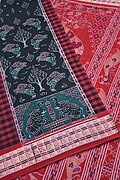
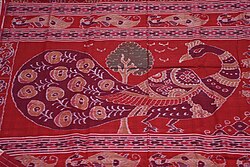
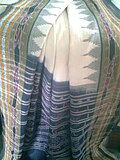
[[File: | A '''Sambalpuri sari''' is a traditional handwoven ''bandha'' ([[Odisha Ikat|ikat]]) [[sari]] (locally called ''"sambalpuri bandha"'' sadhi or saree) wherein the warp and the weft are tie-dyed before weaving. It is a [[handloom sari]] produced in the [[Sambalpur district|Sambalpur]], [[Bargarh district|Bargarh]], [[Balangir district|Balangir]], [[Boudh district|Boudh]] and [[Sonepur district|Sonepur]] districts of [[Odisha]], India. Sambalpuri saris incorporate traditional motifs like [[shankha]] ([[Conch]]), [[chakra]] (wheel), phula ([[flower]]), all of which have deep symbolism with the native Odia culture. The colours red, black and white represents Lord Kaalia [[Jagannath|(Jagannatha)]]'s face colour. | ||
A '''Sambalpuri sari''' is a traditional handwoven [[ikat]] | |||
The sari is a traditional female garment in the [[Indian subcontinent]] consisting of a strip of unstitched cloth ranging from four to nine meters in length that is draped over the body in various styles.<ref name= Roshan>Alkazi, Roshan (1983) "Ancient Indian costume", Art Heritage; Ghurye (1951) "Indian costume", Popular book depot (Bombay); Boulanger, Chantal; (1997)</ref> | |||
==The Sambalpuri | These saris first became popular outside the state when the late Prime Minister [[Indira Gandhi]] started wearing them. In the 1980s and 1990s they became popular across India.<ref>[https://www.urmiweaves.com/blogs/news/how-sambalpuri-cotton-sarees-are-suitable-for-all-seasons"How sambalpuri sarees are suitable for all season"] {{Webarchive|url=https://web.archive.org/web/20220113164102/https://www.urmiweaves.com/blogs/news/how-sambalpuri-cotton-sarees-are-suitable-for-all-seasons |date=13 January 2022 }} ''[[Hindustan Times]]'', 5 September 2009.</ref> The handloom silk saris manufactured in [[Sambalpur]] and [[Berhampur]] (Berhampur Patta) in [[Odisha]] were included in the [[Government of India]]'s [[Geographical Indication]]s (GI) registry to protect the livelihoods of the artisans.<ref>[https://web.archive.org/web/20121107091314/http://www.hindu.com/2009/03/08/stories/2009030850440200.htm "'Sambalpuri saree' and 'Berhampuri pattu' to get GI recognition soon"] ''[[The Hindu]]'', 8 March 2009.</ref><ref>[http://nopr.niscair.res.in/contents/jipr_toc/2006/JIPR%2011%282%29%20%28IPR%20News%29.pdf "Sambalpuri saree set to be protected"] [[NISCAIR]] Online Periodicals Repository, March 2006.</ref> | ||
==Variations== | |||
{{multiple image | {{multiple image | ||
| align = left | | align = left | ||
| Line 23: | Line 23: | ||
| footer = Two versions of Jagannath iconography | | footer = Two versions of Jagannath iconography | ||
}} | }} | ||
[[File:Sambalpuri bandha.jpg|right|200px|thumb|Sambalpuri baandha sari]] | [[File:Sambalpuri bandha.jpg|right|200px|thumb|Sambalpuri baandha sari]] | ||
[[File:Sambhalpuri Saree (Blue).jpg|thumb|Sambhalpuri Saree]] | |||
[[File: | |||
Varieties of the Sambalpuri sari include Sonepuri, Pasapali, Bomkai, Barpali, and Bapta saris, which are in high demand. Most of them have been named after their places of origin and are popularly known as ''Pata''. | |||
Paintings on Tussar saris depicting [[Mathura]] Vijay, Raslila and [[Ayodhya]] Vijay owe their origin to ‘Raghurajpur patta paintings’. | |||
== Fabric and design == | == Fabric and design == | ||
[[File:Sambhalpuri Saree (Red).jpg|thumb|Sambhalpuri Saree (Red)]] | |||
Baandha fabric is created using a [[tie-dye]] technique. The yarns are tied according to the desired patterns to prevent absorption of dyes, and then dyed. The yarns or set of yarns so produced is called 'Baandha'. The unique feature of this form of designing is that the designs are reflected almost identically on both | Baandha fabric is created using a [[tie-dye]] technique. The yarns are tied according to the desired patterns to prevent absorption of dyes, and then dyed.<ref>{{Cite web|url=https://www.bsmjsambalpuri.in/2023/02/a-glimpse-at-sambalpuri-saree-of-odisha.html|title = A glimpse at Sambalpuri Saree of Odisha}}</ref> The yarns or set of yarns so produced is called 'Baandha'. The unique feature of this form of designing is that the designs are reflected almost identically on both sides of the fabric. Once the fabric is dyed it can never be bleached into another colour.<ref>{{Cite web|url=https://nidhishekhawat.hatenablog.com/entry/2020/02/13/170702|title = The History of Indian Sarees: A Legacy for Centuries| date=13 February 2020 }}</ref> | ||
= | |||
The salient feature of these saris is the traditional craftsmanship of the 'Bandhakala'- the [[Tie-dye]] art reflected in their intricate weaves, also known as Sambalpuri "[[Ikkat]]". In this technique, the threads are first tie-dyed and later woven into a fabric, with the entire process taking many weeks. | |||
This versatile technique enables a craftsman to weave colourful designs, patterns and images into a fabric capable of inspiring a thought or conveying a message. Traditionally, craftsmen created Baandhas with images of flora or fauna or with geometrical patterns. More recently,{{When|date=February 2011}} new types of Baandha depicting portrait, landscape and flower pods are being designed. | |||
It is believed that this art migrated to Western Odisha along with the Bhulia community who fled [[Northern India]] in the year [[1192 AD]] after the fall of the [[Chouhan]] empire at the hands of the [[Mughals]]. Since then and up to the year 1925 it flourished in [[Western Odisha]] in a limited number of designs and in vegetable colours and consisted mostly of saris used by the womenfolk of the [[Odisha]]. | |||
== Production == | |||
{{promotional|section|date=February 2020}} | |||
Today the Baandha fabric is popularly known by its geographical and cultural name ''[[Sambalpur]]<nowiki/>i'' owing to the pioneering efforts of Sri Radhashyam Meher, who brought about a radical improvement in the skills of the craftsmen and the quality of the products. Other master craftsmen who contributed to the development of Sambalpuri textiles were [[Padma Shri|Padmashree]] [[Kailash Chandra Meher]], Padmashree [[Kunja Bihari Meher]], ''Padmashree Chatrubhuja Meher'' and ''Padmashree Krutharth Acharya'', Handloom Technologist Mr. Ramkrishna Meher. Sambalpuri textiles today include furnishing materials, dress materials and saris in silk, cotton and [[mercerised cotton]] in a variety of colours and many different designs. Baandha craftsmen are also masters of the 'extra warp' and 'extra weft' style of designing which can be seen in almost all forms of Baandha textiles. | |||
== | The factory production of Sambalpuri saris has negatively impacted traditional handloom artisans.<ref>{{cite web |last1=Bharat |first1=E. T. V. |title=It Takes A Month to Weave, But A Day to Print: Existential Angst Of Sambalpuri Saree Weavers |url=https://www.etvbharat.com/en/!state/sambalpur-odisha-weavers-cry-foul-as-machine-made-low-cost-fabric-replace-handwoven-products-enn25020605115 |website=ETV Bharat News |language=en |date=6 February 2025}}</ref> | ||
== Important handloom clusters of Odisha == | == Important handloom clusters of Odisha == | ||
{{unreferenced section|date=November 2021}} | |||
{| class="wikitable sortable" | {| class="wikitable sortable" | ||
|- | |- | ||
| Line 82: | Line 79: | ||
==External links== | ==External links== | ||
{{commons category|Sambalpuri sari}} | {{commons category|Sambalpuri sari}} | ||
* [ | * [https://www.urmiweaves.com/blogs/news/how-sambalpuri-cotton-sarees-are-suitable-for-all-seasons] | ||
{{Saree}} | {{Saree}} | ||
| Line 91: | Line 88: | ||
[[Category:Geographical indications in Odisha]] | [[Category:Geographical indications in Odisha]] | ||
[[Category: | [[Category:Culture of Odisha]] | ||
[[Category:Figured fabrics]] | [[Category:Figured fabrics]] | ||
[[Category:Handloom sarees]] | [[Category:Handloom sarees]] | ||
Latest revision as of 09:25, 10 January 2026


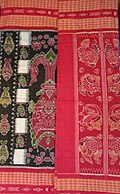
A Sambalpuri sari is a traditional handwoven bandha (ikat) sari (locally called "sambalpuri bandha" sadhi or saree) wherein the warp and the weft are tie-dyed before weaving. It is a handloom sari produced in the Sambalpur, Bargarh, Balangir, Boudh and Sonepur districts of Odisha, India. Sambalpuri saris incorporate traditional motifs like shankha (Conch), chakra (wheel), phula (flower), all of which have deep symbolism with the native Odia culture. The colours red, black and white represents Lord Kaalia (Jagannatha)'s face colour.
The sari is a traditional female garment in the Indian subcontinent consisting of a strip of unstitched cloth ranging from four to nine meters in length that is draped over the body in various styles.[1]
These saris first became popular outside the state when the late Prime Minister Indira Gandhi started wearing them. In the 1980s and 1990s they became popular across India.[2] The handloom silk saris manufactured in Sambalpur and Berhampur (Berhampur Patta) in Odisha were included in the Government of India's Geographical Indications (GI) registry to protect the livelihoods of the artisans.[3][4]
Variations[edit | edit source]


.jpg)
Varieties of the Sambalpuri sari include Sonepuri, Pasapali, Bomkai, Barpali, and Bapta saris, which are in high demand. Most of them have been named after their places of origin and are popularly known as Pata. Paintings on Tussar saris depicting Mathura Vijay, Raslila and Ayodhya Vijay owe their origin to ‘Raghurajpur patta paintings’.
Fabric and design[edit | edit source]
.jpg)
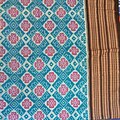
Baandha fabric is created using a tie-dye technique. The yarns are tied according to the desired patterns to prevent absorption of dyes, and then dyed.[5] The yarns or set of yarns so produced is called 'Baandha'. The unique feature of this form of designing is that the designs are reflected almost identically on both sides of the fabric. Once the fabric is dyed it can never be bleached into another colour.[6]
The salient feature of these saris is the traditional craftsmanship of the 'Bandhakala'- the Tie-dye art reflected in their intricate weaves, also known as Sambalpuri "Ikkat". In this technique, the threads are first tie-dyed and later woven into a fabric, with the entire process taking many weeks.
This versatile technique enables a craftsman to weave colourful designs, patterns and images into a fabric capable of inspiring a thought or conveying a message. Traditionally, craftsmen created Baandhas with images of flora or fauna or with geometrical patterns. More recently,[when?] new types of Baandha depicting portrait, landscape and flower pods are being designed.
It is believed that this art migrated to Western Odisha along with the Bhulia community who fled Northern India in the year 1192 AD after the fall of the Chouhan empire at the hands of the Mughals. Since then and up to the year 1925 it flourished in Western Odisha in a limited number of designs and in vegetable colours and consisted mostly of saris used by the womenfolk of the Odisha.
Production[edit | edit source]
 | This section contains promotional content. (February 2020) |
Today the Baandha fabric is popularly known by its geographical and cultural name Sambalpuri owing to the pioneering efforts of Sri Radhashyam Meher, who brought about a radical improvement in the skills of the craftsmen and the quality of the products. Other master craftsmen who contributed to the development of Sambalpuri textiles were Padmashree Kailash Chandra Meher, Padmashree Kunja Bihari Meher, Padmashree Chatrubhuja Meher and Padmashree Krutharth Acharya, Handloom Technologist Mr. Ramkrishna Meher. Sambalpuri textiles today include furnishing materials, dress materials and saris in silk, cotton and mercerised cotton in a variety of colours and many different designs. Baandha craftsmen are also masters of the 'extra warp' and 'extra weft' style of designing which can be seen in almost all forms of Baandha textiles.
The factory production of Sambalpuri saris has negatively impacted traditional handloom artisans.[7]
Important handloom clusters of Odisha[edit | edit source]
 |
| Serial No. | Category of cluster | Name of district | Name of cluster | Number of clusters |
|---|---|---|---|---|
| 1 | A | Bargarh | Attabira, Bargarh, Bheden, Barpali, Bijepur, Padampur, Sohela, Bhatli | 8 |
| 2 | A | Subarnapur/Sonepur | Birmaharajpur, Sonepur, Ulunda, Binika | 4 |
| 3 | A | Boudh | Boudh | 1 |
| 4 | B | Balangir | Patnagarh, Agalpur, Bangamunda | 3 |
| 5 | B | Nuapada | Khariar (Sinapali) | 1 |
| 6 | B | Sambalpur | Rengali | 1 |
Further reading[edit | edit source]
- The Orissan art of weaving, by Kesabachandra Mehera, Publisher: Keshab Chandra Meher, 1995.
- Indian ikat textiles, V & A Museum Indian Art Series. by Rosemary Crill, Victoria and Albert Museum. V & A Publications, 1998. ISBN 1851772421.
References[edit | edit source]
- ↑ Alkazi, Roshan (1983) "Ancient Indian costume", Art Heritage; Ghurye (1951) "Indian costume", Popular book depot (Bombay); Boulanger, Chantal; (1997)
- ↑ "How sambalpuri sarees are suitable for all season" Archived 13 January 2022 at the Wayback Machine Hindustan Times, 5 September 2009.
- ↑ "'Sambalpuri saree' and 'Berhampuri pattu' to get GI recognition soon" The Hindu, 8 March 2009.
- ↑ "Sambalpuri saree set to be protected" NISCAIR Online Periodicals Repository, March 2006.
- ↑ "A glimpse at Sambalpuri Saree of Odisha".
- ↑ "The History of Indian Sarees: A Legacy for Centuries". 13 February 2020.
- ↑ Bharat, E. T. V. (6 February 2025). "It Takes A Month to Weave, But A Day to Print: Existential Angst Of Sambalpuri Saree Weavers". ETV Bharat News.
External links[edit | edit source]
| Dance |
| ||||||
|---|---|---|---|---|---|---|---|
| Music | |||||||
| Play, theatre and puppetry |
| ||||||
| Wedding | |||||||
| Festivals | |||||||
| Martial arts | |||||||
| Handlooms | |||||||
| Arts and Handicrafts |
| ||||||
| Architecture | |||||||
| Calendar (Panjika) | |||||||


