
imported>Narky Blert dab-needed tag |
m improve formatting further and corrected details |
||
| Line 1: | Line 1: | ||
{{Short description|Indian cable railway (1907–1963)}} | |||
{{Use dmy dates|date=April 2017}} | {{Use dmy dates|date=April 2017}} | ||
{{Use Indian English|date=April 2017}} | {{Use Indian English|date=April 2017}} | ||
{{Infobox rail line | |||
| box_width = | |||
| name = Cochin State Forest Tramway | |||
| other_name = | |||
| native_name = | |||
| native_name_lang = | |||
| color = | |||
| logo = | |||
| logo_width = | |||
| logo_alt = | |||
| image = Cochin State Forest Tramway - Part of the main line with empty train on a grade. (Scientific American, 26 February 1910, p. 184-185).jpg | |||
| image_width = | |||
| image_alt = | |||
| caption = [[Zig zag (railway)|Switchback]] on the main line | |||
| type = [[Tramway (industrial)|Tramway]] | |||
| system = | |||
| status = closed | |||
| locale = [[Palakkad District|Palakkad]] and [[Thrissur District]]s, [[Kingdom of Cochin|State of Cochin]] | |||
| start = [[Parambikulam Wildlife Sanctuary]] | |||
| end = [[Chalakudy]] | |||
| stations = 16 | |||
| routes = | |||
| daily_ridership = | |||
| ridership2 = | |||
| planopen = <!--{{Start date|YYYY|MM|DD|df=y}}--> | |||
| open = {{Start date|1907|df=y}} | |||
| yearcommenced = {{Start date|1905|10|03|df=y}} | |||
| yearcompleted = <!--{{Start date|YYYY|MM|DD|df=y}}--> | |||
| close = {{Start date|1963|df=y}} | |||
| event1label = | |||
| event1 = | |||
| event2label = | |||
| event2 = | |||
| event3label = | |||
| event3 = | |||
| owner = | |||
| operator = | |||
| character = | |||
| depot = | |||
| stock = | |||
| linelength_km = 79.5 | |||
| linelength_mi = | |||
| linelength = | |||
| tracklength_km = | |||
| tracklength_mi = | |||
| tracklength = | |||
| tracks = | |||
| gauge = {{Track gauge|1000mm|allk=on}} | |||
| old_gauge = | |||
| load_gauge = | |||
| minradius = | |||
| racksystem = | |||
| routenumber = | |||
| linenumber = | |||
| electrification = | |||
| speed_km/h = | |||
| speed_mph = | |||
| speed = | |||
| signalling = | |||
| elevation_m = | |||
| elevation_ft = | |||
| elevation = | |||
| website = | |||
| map = [[File:Map of the Cochin State (Register No 949, Litho Print, Survey & Land Records Office, Trichun, 1117) In Census of India, 1941, Vol XIX, Cochin by B V K Menon, Census Commissioner, Cochin, printed 1944 (retouched).jpg|250px]]<br/>The line in 1944 {{Cochin State Forest Tramway }} | |||
| map_name = | |||
| map_state = | |||
| embedded = | |||
}} | |||
{{Infobox company | {{Infobox company | ||
|name = | |name = | ||
|location_city = [[Chalakudy]] | |||
|location_city = [[Chalakudy]] | |||
|location_country = [[India]] | |location_country = [[India]] | ||
|key_people = [[Rama Varma XV]] | |||
|products = [[Teak]] and [[Rosewood]] | |||
|key_people = [[Rama Varma XV | |revenue = Rs 17.5 lakhs | ||
|products = [[Teak]] and [[Rosewood | |||
|revenue = Rs 17.5 lakhs | |||
|operating_income = Rs 2 lakhs | |operating_income = Rs 2 lakhs | ||
}} | }} | ||
The '''Cochin State Forest Tramway''' was a {{RailGauge|1000mm|allk=on}}<ref>[http://irfca.org/articles/CochinStateForestTramwayJournal.doc "Journal on the Cochin State Forest Tramway."] (*.doc file) Retrieved on 10 September 2020.</ref><ref name="empire">{{cite news | |||
The '''Cochin State Forest Tramway''' was a {{RailGauge|1000mm|allk=on}}<ref>[http://irfca.org/articles/CochinStateForestTramwayJournal.doc "Journal on the Cochin State Forest Tramway."] (*.doc file) Retrieved on 10 September 2020.</ref><ref name="empire">{{cite | |url=http://www.hindu.com/2010/01/04/stories/2010010455160600.htm |last1=Prabhakaran |first1=G. | ||
|url=http://www.hindu.com/2010/01/04/stories/2010010455160600.htm | |||
|title=Tramway to a trade empire | |title=Tramway to a trade empire | ||
|archive-url=https://web.archive.org/web/20140517120602/http://www.hindu.com/2010/01/04/stories/2010010455160600.htm | |archive-url=https://web.archive.org/web/20140517120602/http://www.hindu.com/2010/01/04/stories/2010010455160600.htm | ||
| Line 40: | Line 90: | ||
}}</ref><ref>{{cite web | }}</ref><ref>{{cite web | ||
|url=http://newindianexpress.com/states/kerala/article1410735.ece | |url=http://newindianexpress.com/states/kerala/article1410735.ece | ||
|archive-url=https://web.archive.org/web/20140517140257/http://www.newindianexpress.com/states/kerala/article1410735.ece | |||
|url-status=dead | |||
|archive-date=17 May 2014 | |||
|title=Public to get glimpses of the marvel of erstwhile tramway | |title=Public to get glimpses of the marvel of erstwhile tramway | ||
|publisher=The New Indian Express | |publisher=The New Indian Express | ||
|access-date=2013-03-17}}</ref> [[ | |access-date=2013-03-17}}</ref> [[cable railway]] line that ran from the [[Parambikulam Wildlife Sanctuary]] in [[Palakkad District]] to the town of [[Chalakudy]] in [[Thrissur District]] in India. Operating from 1907 to 1963, it served the [[Kingdom of Cochin|State of Cochin]] and brought prosperity by enabling the transport of [[teak]] and [[rosewood]] from the forest into town. These goods could then be exported abroad.<ref name="empire"/> | ||
==History== | ==History== | ||
===Inception=== | ===Inception=== | ||
The idea of a forest tramway was put forward by J.C. Kolhoff, first Conservator of Forests of the city of [[Kochi|Cochin]], and was implemented by V. Alwar Chetty, a forest officer on special duty. British officers Haldwell and Floukes performed the initial survey and route. R.E. Haffield was the first tramway engineer who cleared the forests and laid down the lines. The tramway was built during the rule of [[Rama Varma XV]], [[Maharaja of Cochin]] (1895 to 1914).<ref name="empire"/> Sir [[Oliver Russell, 2nd Baron Ampthill]], the [[Governor of Madras]], inaugurated its construction on 3 October 1905. The tramway began operating in 1907. On 26 June 1907, the [[Maharaja of Cochin]] passed the Cochin Forest Tramway Act, which provided for the protection and management of the tramway. | |||
The idea of a forest tramway was put forward by J.C. Kolhoff, first Conservator of Forests of the city of [[Kochi|Cochin]], and was implemented by V. Alwar Chetty, a forest officer on special duty. British officers Haldwell and Floukes performed the initial survey and route. R.E. Haffield was the first tramway engineer who cleared the forests and laid down the lines. The tramway was built during the rule of [[Rama Varma XV]], [[Maharaja of Cochin]] (1895 to 1914).<ref name="empire"/> | |||
===Tram routes=== | ===Tram routes=== | ||
The tramway was divided into three sections: the first started from [[Chalakudy]] and ended at Anapantham, covering a length of 21 miles; the second ran from Kavalai to [[Pothupara]], covering six miles; and the third ran from Komalapara to Chinnar, covering 22.5 miles. The total length of tramway was 49.5 miles (79.5 km).<ref name="empire"/> | |||
The tramway was divided into three sections: the first started from [[Chalakudy]] and ended at Anapantham, covering a length of 21 miles; the second ran from Kavalai to Pothupara, covering six miles; and the third ran from Komalapara to Chinnar, covering 22.5 miles. The total length of tramway was 49.5 miles (79.5 km).<ref name="empire"/> | |||
===Machinery=== | ===Machinery=== | ||
| Line 110: | Line 109: | ||
===Demise=== | ===Demise=== | ||
In 1926, the special finance committee recommended the abolition of the tramway, but was rejected by the Government in 1928. Another special committee was set up in 1950 under the chairmanship of the Chief Conservator of Forests, which recommended discontinuing of the tramway. In 1953, another commission was appointed but given the report that tramway should be revived at any cost. Finally in 1963, after serving 56 years and making modern [[Cochin Port]] a present-day commercial harbour and [[Cochin]] City, the economic hub, the Cochin State Forest Tramway was abolished on the basis of a special finance committee report. | In 1926, the special finance committee recommended the abolition of the tramway, but was rejected by the Government in 1928. Another special committee was set up in 1950 under the chairmanship of the Chief Conservator of Forests, which recommended discontinuing of the tramway. In 1953, another commission was appointed but given the report that tramway should be revived at any cost. Finally in 1963, after serving 56 years and making modern [[Cochin Port]] a present-day commercial harbour and [[Cochin]] City, the economic hub, the Cochin State Forest Tramway was abolished on the basis of a special finance committee report.<ref name="empire"/> | ||
The staff was absorbed in various departments of Government. | The staff was absorbed in various departments of Government. | ||
==Legacy== | ==Legacy== | ||
[[ | The tramway was an engineering wonder in that period for [[South India]]. The money was used for building ports, bridges, roads, colleges, schools, etc. [[Cochin Port]], a major port on the [[Arabian Sea]] – [[Indian Ocean]] sea-route, was constructed by the earnings from the tramway. [[Willingdon Island]], which was created during construction of [[Cochin Port]], was also bankrolled by tramway revenues.<ref name="empire"/> | ||
<gallery> | |||
Rama Varma XV of Cochin.JPG| [[Rama Varma XV]] was the brain behind the idea of Cochin State Forest Tramway | |||
Cochin State Forest Tramway - Incline 02.jpg| A section of the Tramway without locomotives | |||
Cochin State Forest Tramway - Incline.jpg| Steep incline section of the Tram | |||
Kochi City-sizzling port-W.ISLAND, that's created by Lord Bristow.jpg| [[Cochin Port]], the cherry in [[Kerala]]'s growth, was constructed from the earnings of the tramway | |||
</gallery> | |||
==References== | ==References== | ||
{{Reflist|30em}} | {{Reflist|30em}} | ||
==Further reading== | |||
* {{cite periodical |last1=Jackson |first1=Harold V. |title=The Cochin State Forest Tramway |magazine=The Industrial Railway Record |date=August 1971 |issue=38 |pages=104-105 |url=http://www.irsociety.co.uk/Archives/38/Cochin.htm |publisher=www.irsociety.co.uk}} | |||
* Travel article: [https://archive.today/20130411143944/http://traveller.outlookindia.com/issuecontent1.aspx?id=150&flag=issuehome "Forest Track", ''Outlook Traveller'' (November 2006).] Text and photographs by Sanjiv Valsan "The mountain route of the long forgotten Cochin State Forest Tramway is reborn as a jungle trail." | |||
* {{cite book |last1=Joseph |first1=Sebastian |title=Cochin forests and the British techno-ecological imperialism in India |date=2016 |publisher=Primus |location=Delhi |isbn=9789384082659}} | |||
** From [[Union Christian College, Aluva|UC College, Aluva]], Department of History: [https://web.archive.org/web/20110511044446/http://uccollege.edu.in/history/news/cochin-forests-and-the-british/ An extract from the "Environmental History" chapter of Dr. Sebastian Joseph's 2010 thesis, ''Cochin Forests and the British''], submitted as part of the Kerala Council for Historical Research's (KCHR) Post-Doctoral Fellowship. The thesis was the basis of above 2016 book. | |||
==External links== | ==External links== | ||
* | * {{URL|https://zenodo.org/record/1923056/files/article.pdf|Edward Harran 26 February 2010}} | ||
* | * {{URL|1=https://www.youtube.com/watch?v=9L2j5HFW-k8|2=A short film about the Tram line}} | ||
{{Trams in India}} | {{Trams in India}} | ||
| Line 132: | Line 140: | ||
[[Category:Tram transport in India]] | [[Category:Tram transport in India]] | ||
[[Category:Metre gauge railways in India]] | [[Category:Metre-gauge railways in India]] | ||
[[Category:Defunct railway companies of India]] | [[Category:Defunct railway companies of India]] | ||
[[Category:Transport in Palakkad district]] | [[Category:Transport in Palakkad district]] | ||
Latest revision as of 00:34, 9 February 2025
| Cochin State Forest Tramway | |||
|---|---|---|---|
.jpg) Switchback on the main line | |||
| Overview | |||
| Status | closed | ||
| Locale | Palakkad and Thrissur Districts, State of Cochin | ||
| Termini | Parambikulam Wildlife Sanctuary Chalakudy | ||
| Stations | 16 | ||
| Service | |||
| Type | Tramway | ||
| History | |||
| Commenced | 3 October 1905 | ||
| Opened | 1907 | ||
| Closed | 1963 | ||
| Technical | |||
| Line length | 79.5 km (49.4 mi) | ||
| Track gauge | 1,000 mm (3 ft 3+3⁄8 in) metre gauge | ||
| |||
_In_Census_of_India,_1941,_Vol_XIX,_Cochin_by_B_V_K_Menon,_Census_Commissioner,_Cochin,_printed_1944_(retouched).jpg)
| Headquarters | , |
|---|---|
Key people | Rama Varma XV |
| Products | Teak and Rosewood |
| Revenue | Rs 17.5 lakhs |
| Rs 2 lakhs |
The Cochin State Forest Tramway was a 1,000 mm (3 ft 3+3⁄8 in) metre gauge[1][2][3] cable railway line that ran from the Parambikulam Wildlife Sanctuary in Palakkad District to the town of Chalakudy in Thrissur District in India. Operating from 1907 to 1963, it served the State of Cochin and brought prosperity by enabling the transport of teak and rosewood from the forest into town. These goods could then be exported abroad.[2]
History[edit | edit source]
Inception[edit | edit source]
The idea of a forest tramway was put forward by J.C. Kolhoff, first Conservator of Forests of the city of Cochin, and was implemented by V. Alwar Chetty, a forest officer on special duty. British officers Haldwell and Floukes performed the initial survey and route. R.E. Haffield was the first tramway engineer who cleared the forests and laid down the lines. The tramway was built during the rule of Rama Varma XV, Maharaja of Cochin (1895 to 1914).[2] Sir Oliver Russell, 2nd Baron Ampthill, the Governor of Madras, inaugurated its construction on 3 October 1905. The tramway began operating in 1907. On 26 June 1907, the Maharaja of Cochin passed the Cochin Forest Tramway Act, which provided for the protection and management of the tramway.
Tram routes[edit | edit source]
The tramway was divided into three sections: the first started from Chalakudy and ended at Anapantham, covering a length of 21 miles; the second ran from Kavalai to Pothupara, covering six miles; and the third ran from Komalapara to Chinnar, covering 22.5 miles. The total length of tramway was 49.5 miles (79.5 km).[2]
Machinery[edit | edit source]
Chalakudy used to house the tramway workshop and timber yard. The section had two locomotives to pull the trucks and saloons. The locomotives, rolling stock and machinery for the tramway were supplied by Orenstein and Koppel of Germany. P&W MacLennan of the U.K. supplied the bridges and culverts. K.R. Menon was the last tramway engineer. The tramway system had double lines and worked on rollers and cables. Empty wagons were rolled up while loaded wagons were pushed down along the other rails.[4]
Demise[edit | edit source]
In 1926, the special finance committee recommended the abolition of the tramway, but was rejected by the Government in 1928. Another special committee was set up in 1950 under the chairmanship of the Chief Conservator of Forests, which recommended discontinuing of the tramway. In 1953, another commission was appointed but given the report that tramway should be revived at any cost. Finally in 1963, after serving 56 years and making modern Cochin Port a present-day commercial harbour and Cochin City, the economic hub, the Cochin State Forest Tramway was abolished on the basis of a special finance committee report.[2] The staff was absorbed in various departments of Government.
Legacy[edit | edit source]
The tramway was an engineering wonder in that period for South India. The money was used for building ports, bridges, roads, colleges, schools, etc. Cochin Port, a major port on the Arabian Sea – Indian Ocean sea-route, was constructed by the earnings from the tramway. Willingdon Island, which was created during construction of Cochin Port, was also bankrolled by tramway revenues.[2]
-
 Rama Varma XV was the brain behind the idea of Cochin State Forest Tramway
 -
 A section of the Tramway without locomotives
 -
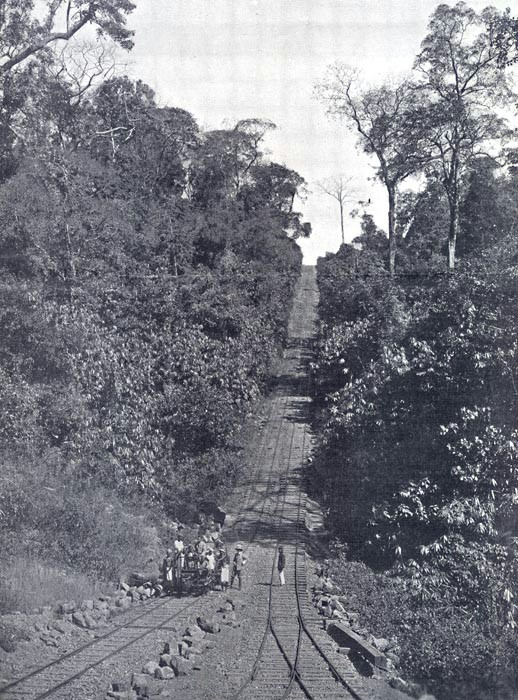 Steep incline section of the Tram
 -
 Cochin Port, the cherry in Kerala's growth, was constructed from the earnings of the tramway


References[edit | edit source]
- ↑ "Journal on the Cochin State Forest Tramway." (*.doc file) Retrieved on 10 September 2020.
- ↑ 2.0 2.1 2.2 2.3 2.4 2.5 Prabhakaran, G. (4 January 2010). "Tramway to a trade empire". The Hindu. Archived from the original on 17 May 2014. Retrieved 11 September 2020.
- ↑ "Public to get glimpses of the marvel of erstwhile tramway". The New Indian Express. Archived from the original on 17 May 2014. Retrieved 17 March 2013.
- ↑ Edward Harran: "The Cochin Forest Railway. In: Scientific American," 26 February 1910, p. 184-185. Retrieved 10 September 2020.
Further reading[edit | edit source]
- Template:Cite periodical
- Travel article: "Forest Track", Outlook Traveller (November 2006). Text and photographs by Sanjiv Valsan "The mountain route of the long forgotten Cochin State Forest Tramway is reborn as a jungle trail."
- Joseph, Sebastian (2016). Cochin forests and the British techno-ecological imperialism in India. Delhi: Primus. ISBN 9789384082659.
- From UC College, Aluva, Department of History: An extract from the "Environmental History" chapter of Dr. Sebastian Joseph's 2010 thesis, Cochin Forests and the British, submitted as part of the Kerala Council for Historical Research's (KCHR) Post-Doctoral Fellowship. The thesis was the basis of above 2016 book.