


Ajay Kumar (talk | contribs) Created a new article |
small update citations for clarity further and cleaned formatting |
||
| Line 1: | Line 1: | ||
{{Infobox deity | {{Redirect|Iraniyan|the Tamil film|Iraniyan (film)}} | ||
{{Short description|Asura in Hindu mythology}} | |||
{{Use dmy dates|date=January 2016}} | |||
{{Use Indian English|date=January 2016}}{{Infobox deity | |||
| type = hindu | | type = hindu | ||
| image = Hiranyakasipu About to Decapitate Prahlada, Folio from a Bhagavata Purana (Ancient Stories of the Lord)_LACMA M.88.227.jpg | | image = Hiranyakasipu About to Decapitate Prahlada, Folio from a Bhagavata Purana (Ancient Stories of the Lord)_LACMA M.88.227.jpg | ||
| caption = 18th century painting depicting Hiranyakashipu seated on a throne, trying to kill his son, Prahlada (left). | | caption = 18th century painting depicting Hiranyakashipu seated on a throne, trying to kill his son, Prahlada (left). | ||
| consort = Kayadhu | | consort = Kayadhu/Kamala | ||
| weapon = Mace | | weapon = Mace | ||
| affiliation = [[Asura]] | | affiliation = [[Asura]], [[Daitya]] | ||
| father = [[Kashyapa]] | | father = [[Kashyapa]] | ||
| mother = [[Diti]] | | mother = [[Diti]] | ||
| children = [[Prahlada]], | | children = | ||
| siblings = [[Hiranyaksha]] ( | * '''Son:'''[[Prahlada]], Saṃhrāda, Anuhlada, Hlada, Shibi, and Bashkala from Kayadhu | ||
* '''Daughters''': Divyadevi and Paulami (wives of sage [[Bhrigu]]) and Simhika from Kayadhu | |||
| siblings = [[Hiranyaksha]] (younger brother), [[Holika]] (younger sister) | |||
}} | }} | ||
{{Hinduism}} | {{Hinduism}} | ||
'''Hiranyakashipu''' ({{ | '''Hiranyakashipu''' ({{Langx|sa|हिरण्यकशिपु}}, {{IAST3|Hiraṇyakaśipu}}), was a [[daitya]] king of the [[asura]]s in the [[Puranas]].<ref>Nurturing Child and Adolescent Spirituality: Perspectives from the World's Religious Traditions, p. 20, Karen-Marie Yust, Aostre N. Johnson, Sandy Eisenberg Sasso, Rowman & Littlefield</ref> | ||
In [[ | In [[Hinduism]], Hiranyakashipu's younger brother, [[Hiranyaksha]], was slain by the [[Varaha]] (boar) [[avatar]] of [[Vishnu]]. Angered by this, Hiranyakashipu decided to gain a boon of invulnerability by performing [[Tapas (Indian religions)|tapas]] to propitiate [[Brahma]]. After his subjugation of the [[Trailokya|three worlds]],<ref>{{Cite book |last=Hudson |first=D. Dennis |url=https://books.google.com/books?id=0IE8DwAAQBAJ&pg=PA185 |title=The Body of God: An Emperor's Palace for Krishna in Eighth-Century Kanchipuram |date=2008-09-25 |publisher=Oxford University Press, USA |isbn=978-0-19-536922-9 |pages=185 |language=en}}</ref> he was slain by the [[Narasimha]] (man-lion) avatar of Vishnu.<ref>{{cite book|title=India through the ages|url=https://archive.org/details/indiathroughages00mada|last=Gopal|first=Madan|year= 1990| page= 734|editor=K.S. Gautam|publisher=Publication Division, Ministry of Information and Broadcasting, Government of India}}</ref> | ||
== Etymology == | == Etymology == | ||
Hiranyakashipu literally translates to " | Hiranyakashipu literally translates to "person desiring wealth and material comforts" (''hiranya'' "gold" ''kashipu'' "soft bed"), and is often interpreted as depicting one who is fond of wealth and sensual comforts. In the [[Puranas]], however, it is also stated the name was derived from a golden throne called 'Hiranyakashipu' the asura sat in or nearby during the [[Agnicayana|atiratra]] (soma) sacrifice.<ref>{{Cite book |last=G.V.Tagare |url=https://archive.org/details/BrahmandaPuranaG.V.TagarePart2 |title=Brahmanda Purana - English Translation - Part 2 of 5 |date=1958 |pages=[https://archive.org/details/BrahmandaPuranaG.V.TagarePart2/page/n36 426] (5.4-5)}}</ref> | ||
==Legend== | ==Legend== | ||
| Line 27: | Line 28: | ||
=== Birth === | === Birth === | ||
{{main|Jaya-Vijaya}} | {{main|Jaya-Vijaya}} | ||
According to | According to the [[Bhagavata Purana]], Hiranyakashipu and Hiranyaksha are Vishnu's gatekeepers Jaya and Vijaya, born on earth as the result of a curse from the [[Four Kumaras]]. In the ''[[Satya Yuga]]'', Hiranyakashipu and Hiranyaksha – together called the ''Hiranya''s – were born to [[Diti]] (a daughter of [[Daksha]]) and sage [[Kashyapa]]. It is said that [[asura]]s were born to them as a result of their union at the time of dusk, which was said to be an inauspicious time for such a deed.<ref>{{cite book|author = Mani, Vettam|title = Puranic Encyclopaedia: A Comprehensive Dictionary With Special Reference to the Epic and Puranic Literature|url = https://archive.org/details/puranicencyclopa00maniuoft|publisher = Motilal Banarsidass|year = 1975|location = Delhi|isbn = 0-8426-0822-2|page = [https://archive.org/details/puranicencyclopa00maniuoft/page/314 314]}}</ref> | ||
=== | === Austerities and Boons === | ||
[[File:Hiranyakashipu penance.jpg|thumb|Illustration based on Canto 7, Chapter 3 of the Bhagvata Purana, showing Hiranyakashipu performing severe penance to please Brahma. His penance has started a fire, seen on the left. ]] | |||
[[File:Devas approach Vishnu to requesting him to control Hiranya kashipu.jpg|thumb|Devas approach Vishnu requesting Him to control Hiranyakashipu]] | [[File:Devas approach Vishnu to requesting him to control Hiranya kashipu.jpg|thumb|Devas approach Vishnu requesting Him to control Hiranyakashipu]] | ||
After Hiranyakashipu's younger brother Hiranyaksha | After Hiranyakashipu's younger brother, Hiranyaksha, was slain by the hands of the [[Varaha]] avatar of Vishnu, Hiranyakashipu came to hate Vishnu. He decided to kill him by gaining a boon of invulnerability from Brahma. Hiranyakashipu traveled to the valley of the [[Mount Mandara|Mandara Mountain]], where he began an extreme form of penance. He stood motionless with his arms raised upward and his gaze fixed toward the sky. The [[Harivaṃśa|Harivamsha Purana]] states that Hiranyakashyipu did severe austerities for 11,500 years while observing the vow of silence in water.<ref>{{Cite web |last=Vyasa |first=Veda |title=A Prose English Translation of Harivamsha |url=https://www.gutenberg.org/files/61937/61937-h/61937-h.htm#chapter-xli-the-incarnations-of-vishnu |access-date=2025-12-14 |website=file:///htdocs/ebookmaker/cache/20200425205750/harivamsa.rst |language=en}}</ref> As Hiranyakashipu remained immobile for so long, his body became enveloped by grass, bamboo, and an anthill. Ants and other insects consumed his skin, flesh, fat, and blood, leaving only his skeleton. Despite this, his life force continued to circulate within his bones. Over time, his austerities became so intense that a blazing fire emanated from his head. This heat spread throughout the three worlds, causing the abode of the devas to tremble. This forced the devas to abandon their abodes and seek help from Brahma.<ref>{{Cite web |title=Srimad Bhagavatam: Canto 7 - Chapter 3 |url=https://www.srimadbhagavatam.org/canto7/chapter3.html |access-date=2025-12-14 |website=www.srimadbhagavatam.org}}</ref><ref>{{Cite web |title=CHAPTER THREE |url=https://vedabase.io/en/library/sb/7/3/ |archive-url=https://web.archive.org/web/20241119065420/https://vedabase.io/en/library/sb/7/3/ |archive-date=19 November 2024 |access-date=2025-12-14 |website=vedabase.io |language=en |url-status=live }}</ref> | ||
Hiranyakashipu's plan seemed to work initially, with Brahma becoming pleased by Hiranyakashipu's austerities.<ref>[http://srimadbhagavatam.com/7/4/1/en1 Bhag-P 7.4.1] {{webarchive|url=https://web.archive.org/web/20070926234834/http://srimadbhagavatam.com/7/4/1/en1 |date=26 September 2007 }} "Lord Brahma was very much satisfied by Hiranyakasipu's austerities, which were difficult to perform"</ref> Brahma appeared before Hiranyakashipu and offered him a boon of his choice. But when Hiranyakashipu asked for immortality, Brahma refused. Hiranyakashipu then made the following request: | |||
<blockquote> | <blockquote> | ||
O my lord, O best of the givers of benediction, if you will kindly grant me the benediction I desire, please let me not meet death from any of the living entities created by you. | O my lord, O best of the givers of benediction, if you will kindly grant me the benediction I desire, please let me not meet death from any of the living entities created by you. | ||
| Line 39: | Line 41: | ||
Grant me that I not die within any residence or outside any residence, during the daytime or at night, nor on the ground or in the sky. Grant me that my death not be brought by any being created by you, nor by any weapon, nor by any human being or animal. | Grant me that I not die within any residence or outside any residence, during the daytime or at night, nor on the ground or in the sky. Grant me that my death not be brought by any being created by you, nor by any weapon, nor by any human being or animal. | ||
Grant me that I not meet the death from any entity, living or nonliving. Grant me, further, that I not be killed by any demigod or demon or by any great snake from the lower planets. Since no one can kill you in the battlefield, you have no competitor. Therefore, grant me the benediction that I too may have no rival. Give me sole lordship over all the living entities and presiding deities, and give me all the glories obtained by that position. Furthermore, give me all the mystic powers attained by long austerities and the practice of yoga, for these cannot be lost at any time.<ref>[http://srimadbhagavatam.com/7/3/en1 Bhag-P, Canto 7] {{webarchive|url=https://web.archive.org/web/20070926234959/http://srimadbhagavatam.com/7/3/en1 |date=26 September 2007 }} 7.3.35–38</ref> | Grant me that I not meet the death from any entity, living or nonliving. Grant me, further, that I not be killed by any demigod or demon, or by any great snake from the lower planets. Since no one can kill you in the battlefield, you have no competitor. Therefore, grant me the benediction that I too may have no rival. Give me sole lordship over all the living entities and presiding deities, and give me all the glories obtained by that position. Furthermore, give me all the mystic powers attained by long austerities and the practice of yoga, for these cannot be lost at any time.<ref>[http://srimadbhagavatam.com/7/3/en1 Bhag-P, Canto 7] {{webarchive|url=https://web.archive.org/web/20070926234959/http://srimadbhagavatam.com/7/3/en1 |date=26 September 2007 }} 7.3.35–38</ref> | ||
</blockquote> | </blockquote> | ||
The [[Shiva Purana]] mentions the boon with a slight variation, where Hiranyakashipu asked Brahma that he would be invulnerable to weapons, thunderbolts, mountains, trees, missiles, water, fire, or any creature created by him.<ref>{{Cite web |title=The Siva Purana: 4 Parts in Set (AITM Vols. 1 to 4) |url=https://www.motilalbanarsidass.com/products/the-siva-purana-4-volumes-j-l-shastri |access-date=2025-12-14 |website=Motilal Banarsidass |language=en}}</ref> | |||
After receiving the boons, Hiranyakashipu felt invincible and conquered the [[Trailokya|three worlds]], assuming the throne of [[Indra]].<ref>{{Cite web |last=www.wisdomlib.org |date=2012-06-29 |title=Hiranyakashipu, Hiraṇyakaśipu, Hiranya-kashipu: 14 definitions |url=https://www.wisdomlib.org/definition/hiranyakashipu#purana |access-date=2022-11-22 |website=www.wisdomlib.org |language=en}}</ref> According to the [[Skanda Purana]], Hiranyakashipu ruled the universe for 107.28 million years, or 24.8 yugas.<ref>{{Cite book |last=Leviton |first=Richard |url=https://books.google.com/books?id=59pkEQAAQBAJ&dq=Hiranyakashipu+ruled+the+universe+for+107.28+million+years,&pg=PT416 |title=Mythopoieic Planet: Notes from a Project for Designing the Earth |date=2025-06-08 |publisher=iUniverse |isbn=978-1-6632-7347-5 |language=en}}</ref> | |||
=== Death === | === Death === | ||
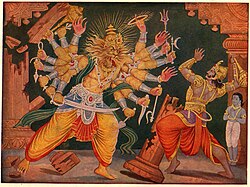
[[File:God Narasimha.jpg|thumb|350px|Hiranyakashipu wielding a mace against Narasimha]] | [[File:God Narasimha.jpg|thumb|350px|Hiranyakashipu wielding a mace against Narasimha]] | ||
While Hiranyakashipu was performing | While Hiranyakashipu was performing tapas to be granted these boons, [[Indra]] and other [[Deva (Hinduism)|devas]] attacked his home,<ref>[http://srimadbhagavatam.com/7/7/6/en1 Bhag-P 7.7.6] {{webarchive|url=https://web.archive.org/web/20070926235042/http://srimadbhagavatam.com/7/7/6/en1 |date=26 September 2007 }} "The victorious demigods plundered the palace of Hiranyakasipu, the King of the demons, and destroyed everything within it. Then Indra, King of heaven, arrested my mother, the Queen"</ref> seizing the opportunity in his absence. In response the [[rishi|divine sage]] [[Narada]] intervened to protect Hiranyakashipu's wife Kayadhu,<ref>{{cite web |url=http://srimadbhagavatam.com/7/7/summary/en1 |title=Srimad Bhagavatam Canto 7 Chapter 7 |access-date=2008-08-13 |url-status=dead |archive-url=https://web.archive.org/web/20071012063732/http://srimadbhagavatam.com/7/7/summary/en1 |archive-date=12 October 2007 |df=dmy-all }} "When Hiranyakasipu left his kingdom and went to the mountain known as Mandaracala to execute severe austerities, all the demons scattered. Hiranyakashipu's wife, Kayadhu (Leelavati), was pregnant at that time."</ref> whom he described as 'sinless'.<ref>[http://srimadbhagavatam.com/7/7/8/en1 Bhag-P 7.7.8] {{webarchive|url=https://web.archive.org/web/20070926234945/http://srimadbhagavatam.com/7/7/8/en1 |date=26 September 2007 }} "Narada Muni said: O Indra, King of the demigods, this woman is certainly sinless. You should not drag her off in this merciless way. O greatly fortunate one, this chaste woman is the wife of another. You must immediately release her."</ref> Narada took responsibility of her in his hermitage, and while she was under his guidance, her unborn child (Hiranyakashipu's son) [[Prahlada]] became influenced by the spiritual instructions of the sage while still in his mother's womb. Later, growing as a child, Prahlada began to reap the harvest of Narada's prenatal training and gradually became recognised as a devout follower of Vishnu, much to his father's anguish.<ref>[http://srimadbhagavatam.com/7/8/6/en1 Bhag-P 7.8.6] {{webarchive|url=https://web.archive.org/web/20121208035748/http://srimadbhagavatam.com/7/8/6/en1 |date=8 December 2012 }}</ref> | ||
Hiranyakashipu eventually became so angry and upset at his son's devotion to Vishnu (whom he saw as his mortal enemy) that he decided that he must kill him,<ref>[http://srimadbhagavatam.com/7/8/3-4/en1 Bhag-P 7.8.3–4] {{webarchive|url=https://web.archive.org/web/20070926235015/http://srimadbhagavatam.com/7/8/3-4/en1 |date=26 September 2007 }} "Thus he finally decided to kill his son Prahlada. Hiranyakashipu was by nature very cruel, and feeling insulted, he began hissing like a snake trampled upon by someone's foot."</ref> but each time he attempted to kill the boy, Prahlada was protected by Vishnu's mystical power. When asked, Prahlada | Hiranyakashipu eventually became so angry and upset at his son's devotion to Vishnu (whom he saw as his mortal enemy) that he decided that he must kill him,<ref>[http://srimadbhagavatam.com/7/8/3-4/en1 Bhag-P 7.8.3–4] {{webarchive|url=https://web.archive.org/web/20070926235015/http://srimadbhagavatam.com/7/8/3-4/en1 |date=26 September 2007 }} "Thus he finally decided to kill his son Prahlada. Hiranyakashipu was by nature very cruel, and feeling insulted, he began hissing like a snake trampled upon by someone's foot."</ref> but each time he attempted to kill the boy, Prahlada was protected by Vishnu's mystical power. When asked, Prahlada refused to acknowledge his father as the supreme lord of the universe, and claimed that Vishnu was all-pervading and omnipresent. To which Hiranyakashipu points to a nearby pillar and asked if 'his Vishnu' is in it: | ||
<blockquote> "O most unfortunate Prahlada, you have always described a supreme being other than me, a supreme being who is above everything, who is the controller of everyone, and who is all-pervading. But where is He? If He is everywhere, then why is He not present before me in this pillar?"<ref>[http://srimadbhagavatam.com/7/8/12/en1 Bhag-P 7.8.12] {{webarchive|url=https://web.archive.org/web/20130926130524/http://srimadbhagavatam.com/7/8/12/en1 |date=26 September 2013 }}</ref></blockquote> | <blockquote> "O most unfortunate Prahlada, you have always described a supreme being other than me, a supreme being who is above everything, who is the controller of everyone, and who is all-pervading. But where is He? If He is everywhere, then why is He not present before me in this pillar?"<ref>[http://srimadbhagavatam.com/7/8/12/en1 Bhag-P 7.8.12] {{webarchive|url=https://web.archive.org/web/20130926130524/http://srimadbhagavatam.com/7/8/12/en1 |date=26 September 2013 }}</ref></blockquote> | ||
| Line 62: | Line 60: | ||
Prahlada then answered, "He is in the pillar, just as he is in the slightest dust." Hiranyakashipu, unable to control his anger, smashed the pillar with his mace. A tumultuous sound was heard, and Vishnu in the form of [[Narasimha]] appeared from the broken pillar and moved to attack Hiranyakashipu in defence of Prahlada. | Prahlada then answered, "He is in the pillar, just as he is in the slightest dust." Hiranyakashipu, unable to control his anger, smashed the pillar with his mace. A tumultuous sound was heard, and Vishnu in the form of [[Narasimha]] appeared from the broken pillar and moved to attack Hiranyakashipu in defence of Prahlada. | ||
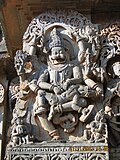
Narasimha had appeared in | Narasimha had appeared in circumstances that would allow him to slay the asura king. Hiranyakashipu could not be killed by human, deva, or animal, but Narasimha was none of these, as he was an incarnate that was part human and part animal. He attacked Hiranyakashipu at twilight (when it is neither day nor night) on the threshold of a courtyard (neither indoors nor outdoors), and placed the asura on his thighs (neither earth nor in the air). Using his claws (neither living nor non-living things), he disemboweled and killed the asura.<ref>[http://srimadbhagavatam.com/7/8/29/en1 Bhag-P 7.8.29] {{webarchive|url=https://web.archive.org/web/20070926235028/http://srimadbhagavatam.com/7/8/29/en1 |date=26 September 2007 }} "Lord Nrisimhadeva placed the demon on His lap, supporting him with His thighs, and in the doorway of the assembly hall the Lord very easily tore the demon to pieces with the nails of His hand."</ref> | ||
Alternative Puranic accounts, like the [[Harivaṃśa|Harivamsha]], describe Narasimha arriving to slay Hiranyakashipu accompanied by an attendant named Omkara. In these versions, Narasimha does not emerge from a pillar but instead enters Hiranyakashipu's assembly hall alongside Omkara. Despite Prahlad's attempts to persuade his father that Narasimha is none other than Vishnu, Hiranyakashipu dismisses the warning, leading to a violent battle between Narasimha and the demon king. The [[Kurma Purana]] has a related variant in which Prahlada initially confronts Narasimha upon his father's command but later learns and accepts his divinity. In both versions. Prahlada's efforts to convince Hiranyakashipu fail, and Hiranyakashipu is slain in battle by Narasimha.<ref>{{Cite journal |last=Jaiswal |first=Suvira |date=1973 |title=Evolution of the Narasimha Legend and Its Possible Sources |url=https://www.jstor.org/stable/44138607 |journal=Proceedings of the Indian History Congress |volume=34 |pages=140–151 |jstor=44138607 |issn=2249-1937}}</ref> | |||
Even after Hiranyakashipu's death, none of the gods and the demigods present were able to placate Narasimha's fury. So, all the gods and goddesses called his consort, the goddess [[Lakshmi]], but she was also unable to do so. Then, at the request of Brahma, Prahlada was presented before Narasimha, who was finally calmed by the prayers of his devotee.<ref>[http://srimadbhagavatam.com/7/9/en1 Bhag-P 7.9] {{webarchive|url=https://web.archive.org/web/20121208025259/http://srimadbhagavatam.com/7/9/en1|date=8 December 2012}}</ref> | |||
===Redemption=== | |||
According to the Bhagavata Purana, after the death of Hiranyakashipu, Narasimha expresses affection toward Prahlada and offers him boons, which Prahlada declines for himself. Instead, Prahlada requests a benediction for his slain father, asking that Hiranyakashipu be freed from the consequences of his faults and transgressions.<ref>{{cite book |last1=Gupta |first1=Ravi M. |last2=Valpey |first2=Kenneth R. |editor1-last=Gupta |editor1-first=Ravi M. |editor2-last=Valpey |editor2-first=Kenneth R. |title=The Bhagavata Purana: Sacred Text and Living Tradition |publisher=Columbia University Press |location=New York |year=2013 |isbn=978-0-231-14998-3 |page=29}}</ref> Narasimha assures Prahlada that Hiranyakashipu has already been purified, both through his kinship with Prahlada, described as a model devotee, and through contact with Narasimha’s own divine body at the moment of his death.{{sfn|Gupta|Valpey|2013|p=29}} Gupta and Valpey identify this episode as answering the primary interlocutor of the Bhagavata Purana, King [[Parikṣit]]’s question about why God appears partial to devotees while acting with hostility toward the asuras. The text resolves the tension by asserting that divine hostility functions as a mode of purification: through direct contact with God, even his enemies are sanctified and admitted into [[Vaikuntha]].{{sfn|Gupta|Valpey|2013|p=30}} | |||
== Hiranyakashipu in the Uttara Ramayana == | |||
In the Uttara Kanda of the [[Ramayana]], Hiranyakashipu is referenced through an episode involving his great-grandson [[Mahabali]]. While touring the netherworlds (Patalalokas), [[Ravana]] meets Mahabali, who resides in Sutalaloka following his surrender to Vishnu's [[Vamana|Vamana avatar.]] During their discussion, Mahabali draws Ravana's attention to a massive jeweled earring (kundala) lying nearby, identifying it as an ornament once worn by his ancestor Hiranyakashipu. Mahabali asks Ravana to lift the earring. Ravana is unable to move it and collapses under its weight. Mahabali explains that the earring fell to the ground when Hiranyakashipu was killed by Vishnu's Narasimha avatar and implies that if Ravana cannot even move the earrings of Hiranyakashipu, he cannot hope to win against the deity (Vishnu) who destroyed him.<ref>{{Cite web |last=www.wisdomlib.org |date=2020-09-28 |title=Ravana's Meeting with Bali [Chapter 23b] |url=https://www.wisdomlib.org/hinduism/book/the-ramayana-of-valmiki/d/doc424785.html |access-date=2025-12-14 |website=www.wisdomlib.org |language=en}}</ref><ref>{{Cite web |title=Ram7 24 - AncientVoice |url=https://ancientvoice.wikidot.com/src-vrm:ram7-24 |access-date=2025-12-14 |website=ancientvoice.wikidot.com}}</ref><ref>{{Cite book |last=Books |first=Kausiki |url=https://books.google.com/books?id=kxBYEAAAQBAJ |title=Valmiki Ramayana: Uttara Kanda: English translation only without Slokas |date=2021-12-21 |publisher=Kausiki Books |language=en}}</ref> | |||
==Location identification== | |||
{{anchor | Location | Identification}} | |||
[[Banmankhi#Tourism|Narsimha Temple at Sikligarh Dharhara]] in [[Purnia district]] of [[Bihar]] state of India has the 1411 long ''Manikya [[stambha]]'' (pillar), from which the Lord Vishnu manifested Narsimha (half lion and half man) avatara. This temple complex has ruins which is said to be the fort of Hiranyakashipu and a cave where Lord Shiva is said to have meditated. The temple has a unique tradition, after [[Holika Dahan]] (Holi bonfire) at the temple the ashes are sprayed in the air as the sign of victory of good over evil, and people play Holi with the Holika Dahan bonfire ashes and this tradition is locally called the '''dhurkhel''' (hindi: ''धुरखेल'').<ref name=dhurkhel>[https://www.msn.com/hi-in/news/other/%E0%A4%86%E0%A4%9C-%E0%A4%95%E0%A4%B9-%E0%A4%82-%E0%A4%B9%E0%A5%88-%E0%A4%B9-%E0%A4%B0%E0%A4%A3%E0%A5%8D%E0%A4%AF%E0%A4%95%E0%A4%B6%E0%A5%8D%E0%A4%AF%E0%A4%AA-%E0%A4%95-%E0%A4%95-%E0%A4%B2-%E0%A4%9C%E0%A4%B9-%E0%A4%82-%E0%A4%B9-%E0%A4%B2-%E0%A4%95-%E0%A4%A8%E0%A5%87-%E0%A4%95-%E0%A4%AA%E0%A5%8D%E0%A4%B0%E0%A4%B9%E0%A5%8D%E0%A4%B2-%E0%A4%A6-%E0%A4%95-%E0%A4%9C%E0%A4%B2-%E0%A4%A8%E0%A5%87-%E0%A4%95-%E0%A4%95-%E0%A4%B6-%E0%A4%B6-%E0%A4%87%E0%A4%B8-%E0%A4%96%E0%A4%82%E0%A4%AD%E0%A5%87-%E0%A4%B8%E0%A5%87-%E0%A4%A8-%E0%A4%95%E0%A4%B2%E0%A5%87-%E0%A4%A5%E0%A5%87-%E0%A4%A8%E0%A4%B0%E0%A4%B8-%E0%A4%82%E0%A4%B9-%E0%A4%AD%E0%A4%97%E0%A4%B5-%E0%A4%A8/ar-AA1XpJYD भारत कर रहा एक और युद्ध की तैयारी, हम बातचीत के लिए तैयार; पाकिस्तानी राष्ट्रपति बोले], MSN News, 3 March 2026.</ref> | |||
==Holi== | ==Holi== | ||
One of Hiranyakashipu's attempts to kill his son Prahlada was to have him sit on a burning [[pyre]] with his aunt [[Holika]]. Holika had a special boon that prevented her from being harmed by fire. Prahlada chanted Vishnu's name and in the battle of good against evil, Holika was burnt down but nothing happened to Prahlada. The survival of Prahlada is celebrated in Hinduism as the festival of [[Holi]].<ref>{{Cite web | One of Hiranyakashipu's attempts to kill his son Prahlada was to have him sit on a burning [[pyre]] with his aunt [[Holika]]. Holika had a special boon that prevented her from being harmed by fire. Prahlada chanted Vishnu's name and in the battle of good against evil, Holika was burnt down but nothing happened to Prahlada. The survival of Prahlada is celebrated in Hinduism as the festival of [[Holi]].<ref>{{Cite web |date=21 December 2016 |title=Holika Dahan 2019 - Information, Muhurat and Prahlad Story |url=https://fastread.in/explore.php?infoID=2821 |website=Fastread}}</ref><ref>{{Cite web|url=http://www.holifestival.org/legend-holika-prahlad.html|title=The Legend of Holika & Prahlad, True Story Behind Holika & Prahlad}}</ref> | ||
==See also== | ==See also== | ||
{{commons category}} | {{commons category}} | ||
*[[Bhagavata Purana]] | *[[Bhagavata Purana]] | ||
*[[Narasimha]] | |||
*[[Prahlada]] | |||
*[[Vishnu Purana]] | *[[Vishnu Purana]] | ||
Latest revision as of 08:18, 4 March 2026
| Hiranyakashipu | |
|---|---|
_LACMA_M.88.227.jpg) 18th century painting depicting Hiranyakashipu seated on a throne, trying to kill his son, Prahlada (left). | |
| Affiliation | Asura, Daitya |
| Weapon | Mace |
| Personal information | |
| Parents | |
| Siblings | Hiranyaksha (younger brother), Holika (younger sister) |
| Consort | Kayadhu/Kamala |
| Children | |
| Part of a series on |
| Hinduism |
|---|
 |


Hiranyakashipu (Sanskrit: हिरण्यकशिपु, IAST: Hiraṇyakaśipu), was a daitya king of the asuras in the Puranas.[1]
In Hinduism, Hiranyakashipu's younger brother, Hiranyaksha, was slain by the Varaha (boar) avatar of Vishnu. Angered by this, Hiranyakashipu decided to gain a boon of invulnerability by performing tapas to propitiate Brahma. After his subjugation of the three worlds,[2] he was slain by the Narasimha (man-lion) avatar of Vishnu.[3]
Etymology[edit | edit source]
Hiranyakashipu literally translates to "person desiring wealth and material comforts" (hiranya "gold" kashipu "soft bed"), and is often interpreted as depicting one who is fond of wealth and sensual comforts. In the Puranas, however, it is also stated the name was derived from a golden throne called 'Hiranyakashipu' the asura sat in or nearby during the atiratra (soma) sacrifice.[4]
Legend[edit | edit source]
Birth[edit | edit source]
According to the Bhagavata Purana, Hiranyakashipu and Hiranyaksha are Vishnu's gatekeepers Jaya and Vijaya, born on earth as the result of a curse from the Four Kumaras. In the Satya Yuga, Hiranyakashipu and Hiranyaksha – together called the Hiranyas – were born to Diti (a daughter of Daksha) and sage Kashyapa. It is said that asuras were born to them as a result of their union at the time of dusk, which was said to be an inauspicious time for such a deed.[5]
Austerities and Boons[edit | edit source]


After Hiranyakashipu's younger brother, Hiranyaksha, was slain by the hands of the Varaha avatar of Vishnu, Hiranyakashipu came to hate Vishnu. He decided to kill him by gaining a boon of invulnerability from Brahma. Hiranyakashipu traveled to the valley of the Mandara Mountain, where he began an extreme form of penance. He stood motionless with his arms raised upward and his gaze fixed toward the sky. The Harivamsha Purana states that Hiranyakashyipu did severe austerities for 11,500 years while observing the vow of silence in water.[6] As Hiranyakashipu remained immobile for so long, his body became enveloped by grass, bamboo, and an anthill. Ants and other insects consumed his skin, flesh, fat, and blood, leaving only his skeleton. Despite this, his life force continued to circulate within his bones. Over time, his austerities became so intense that a blazing fire emanated from his head. This heat spread throughout the three worlds, causing the abode of the devas to tremble. This forced the devas to abandon their abodes and seek help from Brahma.[7][8]
Hiranyakashipu's plan seemed to work initially, with Brahma becoming pleased by Hiranyakashipu's austerities.[9] Brahma appeared before Hiranyakashipu and offered him a boon of his choice. But when Hiranyakashipu asked for immortality, Brahma refused. Hiranyakashipu then made the following request:
O my lord, O best of the givers of benediction, if you will kindly grant me the benediction I desire, please let me not meet death from any of the living entities created by you.
Grant me that I not die within any residence or outside any residence, during the daytime or at night, nor on the ground or in the sky. Grant me that my death not be brought by any being created by you, nor by any weapon, nor by any human being or animal.
Grant me that I not meet the death from any entity, living or nonliving. Grant me, further, that I not be killed by any demigod or demon, or by any great snake from the lower planets. Since no one can kill you in the battlefield, you have no competitor. Therefore, grant me the benediction that I too may have no rival. Give me sole lordship over all the living entities and presiding deities, and give me all the glories obtained by that position. Furthermore, give me all the mystic powers attained by long austerities and the practice of yoga, for these cannot be lost at any time.[10]
The Shiva Purana mentions the boon with a slight variation, where Hiranyakashipu asked Brahma that he would be invulnerable to weapons, thunderbolts, mountains, trees, missiles, water, fire, or any creature created by him.[11]
After receiving the boons, Hiranyakashipu felt invincible and conquered the three worlds, assuming the throne of Indra.[12] According to the Skanda Purana, Hiranyakashipu ruled the universe for 107.28 million years, or 24.8 yugas.[13]
Death[edit | edit source]

While Hiranyakashipu was performing tapas to be granted these boons, Indra and other devas attacked his home,[14] seizing the opportunity in his absence. In response the divine sage Narada intervened to protect Hiranyakashipu's wife Kayadhu,[15] whom he described as 'sinless'.[16] Narada took responsibility of her in his hermitage, and while she was under his guidance, her unborn child (Hiranyakashipu's son) Prahlada became influenced by the spiritual instructions of the sage while still in his mother's womb. Later, growing as a child, Prahlada began to reap the harvest of Narada's prenatal training and gradually became recognised as a devout follower of Vishnu, much to his father's anguish.[17]
Hiranyakashipu eventually became so angry and upset at his son's devotion to Vishnu (whom he saw as his mortal enemy) that he decided that he must kill him,[18] but each time he attempted to kill the boy, Prahlada was protected by Vishnu's mystical power. When asked, Prahlada refused to acknowledge his father as the supreme lord of the universe, and claimed that Vishnu was all-pervading and omnipresent. To which Hiranyakashipu points to a nearby pillar and asked if 'his Vishnu' is in it:
"O most unfortunate Prahlada, you have always described a supreme being other than me, a supreme being who is above everything, who is the controller of everyone, and who is all-pervading. But where is He? If He is everywhere, then why is He not present before me in this pillar?"[19]

Prahlada then answered, "He is in the pillar, just as he is in the slightest dust." Hiranyakashipu, unable to control his anger, smashed the pillar with his mace. A tumultuous sound was heard, and Vishnu in the form of Narasimha appeared from the broken pillar and moved to attack Hiranyakashipu in defence of Prahlada.
Narasimha had appeared in circumstances that would allow him to slay the asura king. Hiranyakashipu could not be killed by human, deva, or animal, but Narasimha was none of these, as he was an incarnate that was part human and part animal. He attacked Hiranyakashipu at twilight (when it is neither day nor night) on the threshold of a courtyard (neither indoors nor outdoors), and placed the asura on his thighs (neither earth nor in the air). Using his claws (neither living nor non-living things), he disemboweled and killed the asura.[20]
Alternative Puranic accounts, like the Harivamsha, describe Narasimha arriving to slay Hiranyakashipu accompanied by an attendant named Omkara. In these versions, Narasimha does not emerge from a pillar but instead enters Hiranyakashipu's assembly hall alongside Omkara. Despite Prahlad's attempts to persuade his father that Narasimha is none other than Vishnu, Hiranyakashipu dismisses the warning, leading to a violent battle between Narasimha and the demon king. The Kurma Purana has a related variant in which Prahlada initially confronts Narasimha upon his father's command but later learns and accepts his divinity. In both versions. Prahlada's efforts to convince Hiranyakashipu fail, and Hiranyakashipu is slain in battle by Narasimha.[21]
Even after Hiranyakashipu's death, none of the gods and the demigods present were able to placate Narasimha's fury. So, all the gods and goddesses called his consort, the goddess Lakshmi, but she was also unable to do so. Then, at the request of Brahma, Prahlada was presented before Narasimha, who was finally calmed by the prayers of his devotee.[22]
Redemption[edit | edit source]
According to the Bhagavata Purana, after the death of Hiranyakashipu, Narasimha expresses affection toward Prahlada and offers him boons, which Prahlada declines for himself. Instead, Prahlada requests a benediction for his slain father, asking that Hiranyakashipu be freed from the consequences of his faults and transgressions.[23] Narasimha assures Prahlada that Hiranyakashipu has already been purified, both through his kinship with Prahlada, described as a model devotee, and through contact with Narasimha’s own divine body at the moment of his death.[24] Gupta and Valpey identify this episode as answering the primary interlocutor of the Bhagavata Purana, King Parikṣit’s question about why God appears partial to devotees while acting with hostility toward the asuras. The text resolves the tension by asserting that divine hostility functions as a mode of purification: through direct contact with God, even his enemies are sanctified and admitted into Vaikuntha.[25]
Hiranyakashipu in the Uttara Ramayana[edit | edit source]
In the Uttara Kanda of the Ramayana, Hiranyakashipu is referenced through an episode involving his great-grandson Mahabali. While touring the netherworlds (Patalalokas), Ravana meets Mahabali, who resides in Sutalaloka following his surrender to Vishnu's Vamana avatar. During their discussion, Mahabali draws Ravana's attention to a massive jeweled earring (kundala) lying nearby, identifying it as an ornament once worn by his ancestor Hiranyakashipu. Mahabali asks Ravana to lift the earring. Ravana is unable to move it and collapses under its weight. Mahabali explains that the earring fell to the ground when Hiranyakashipu was killed by Vishnu's Narasimha avatar and implies that if Ravana cannot even move the earrings of Hiranyakashipu, he cannot hope to win against the deity (Vishnu) who destroyed him.[26][27][28]
Location identification[edit | edit source]
Narsimha Temple at Sikligarh Dharhara in Purnia district of Bihar state of India has the 1411 long Manikya stambha (pillar), from which the Lord Vishnu manifested Narsimha (half lion and half man) avatara. This temple complex has ruins which is said to be the fort of Hiranyakashipu and a cave where Lord Shiva is said to have meditated. The temple has a unique tradition, after Holika Dahan (Holi bonfire) at the temple the ashes are sprayed in the air as the sign of victory of good over evil, and people play Holi with the Holika Dahan bonfire ashes and this tradition is locally called the dhurkhel (hindi: धुरखेल).[29]
Holi[edit | edit source]
One of Hiranyakashipu's attempts to kill his son Prahlada was to have him sit on a burning pyre with his aunt Holika. Holika had a special boon that prevented her from being harmed by fire. Prahlada chanted Vishnu's name and in the battle of good against evil, Holika was burnt down but nothing happened to Prahlada. The survival of Prahlada is celebrated in Hinduism as the festival of Holi.[30][31]
See also[edit | edit source]
Footnotes[edit | edit source]
- ↑ Nurturing Child and Adolescent Spirituality: Perspectives from the World's Religious Traditions, p. 20, Karen-Marie Yust, Aostre N. Johnson, Sandy Eisenberg Sasso, Rowman & Littlefield
- ↑ Hudson, D. Dennis (25 September 2008). The Body of God: An Emperor's Palace for Krishna in Eighth-Century Kanchipuram. Oxford University Press, USA. p. 185. ISBN 978-0-19-536922-9.
- ↑ Gopal, Madan (1990). K.S. Gautam (ed.). India through the ages. Publication Division, Ministry of Information and Broadcasting, Government of India. p. 734.
- ↑ G.V.Tagare (1958). Brahmanda Purana - English Translation - Part 2 of 5. pp. 426 (5.4-5).
- ↑ Mani, Vettam (1975). Puranic Encyclopaedia: A Comprehensive Dictionary With Special Reference to the Epic and Puranic Literature. Delhi: Motilal Banarsidass. p. 314. ISBN 0-8426-0822-2.
- ↑ Vyasa, Veda. "A Prose English Translation of Harivamsha". file:///htdocs/ebookmaker/cache/20200425205750/harivamsa.rst. Retrieved 14 December 2025.
- ↑ "Srimad Bhagavatam: Canto 7 - Chapter 3". www.srimadbhagavatam.org. Retrieved 14 December 2025.
- ↑ "CHAPTER THREE". vedabase.io. Archived from the original on 19 November 2024. Retrieved 14 December 2025.
- ↑ Bhag-P 7.4.1 Archived 26 September 2007 at the Wayback Machine "Lord Brahma was very much satisfied by Hiranyakasipu's austerities, which were difficult to perform"
- ↑ Bhag-P, Canto 7 Archived 26 September 2007 at the Wayback Machine 7.3.35–38
- ↑ "The Siva Purana: 4 Parts in Set (AITM Vols. 1 to 4)". Motilal Banarsidass. Retrieved 14 December 2025.
- ↑ www.wisdomlib.org (29 June 2012). "Hiranyakashipu, Hiraṇyakaśipu, Hiranya-kashipu: 14 definitions". www.wisdomlib.org. Retrieved 22 November 2022.
- ↑ Leviton, Richard (8 June 2025). Mythopoieic Planet: Notes from a Project for Designing the Earth. iUniverse. ISBN 978-1-6632-7347-5.
- ↑ Bhag-P 7.7.6 Archived 26 September 2007 at the Wayback Machine "The victorious demigods plundered the palace of Hiranyakasipu, the King of the demons, and destroyed everything within it. Then Indra, King of heaven, arrested my mother, the Queen"
- ↑ "Srimad Bhagavatam Canto 7 Chapter 7". Archived from the original on 12 October 2007. Retrieved 13 August 2008. "When Hiranyakasipu left his kingdom and went to the mountain known as Mandaracala to execute severe austerities, all the demons scattered. Hiranyakashipu's wife, Kayadhu (Leelavati), was pregnant at that time."
- ↑ Bhag-P 7.7.8 Archived 26 September 2007 at the Wayback Machine "Narada Muni said: O Indra, King of the demigods, this woman is certainly sinless. You should not drag her off in this merciless way. O greatly fortunate one, this chaste woman is the wife of another. You must immediately release her."
- ↑ Bhag-P 7.8.6 Archived 8 December 2012 at the Wayback Machine
- ↑ Bhag-P 7.8.3–4 Archived 26 September 2007 at the Wayback Machine "Thus he finally decided to kill his son Prahlada. Hiranyakashipu was by nature very cruel, and feeling insulted, he began hissing like a snake trampled upon by someone's foot."
- ↑ Bhag-P 7.8.12 Archived 26 September 2013 at the Wayback Machine
- ↑ Bhag-P 7.8.29 Archived 26 September 2007 at the Wayback Machine "Lord Nrisimhadeva placed the demon on His lap, supporting him with His thighs, and in the doorway of the assembly hall the Lord very easily tore the demon to pieces with the nails of His hand."
- ↑ Jaiswal, Suvira (1973). "Evolution of the Narasimha Legend and Its Possible Sources". Proceedings of the Indian History Congress. 34: 140–151. ISSN 2249-1937. JSTOR 44138607.
- ↑ Bhag-P 7.9 Archived 8 December 2012 at the Wayback Machine
- ↑ Gupta, Ravi M.; Valpey, Kenneth R. (2013). Gupta, Ravi M.; Valpey, Kenneth R. (eds.). The Bhagavata Purana: Sacred Text and Living Tradition. New York: Columbia University Press. p. 29. ISBN 978-0-231-14998-3.
- ↑ Gupta & Valpey 2013, p. 29.
- ↑ Gupta & Valpey 2013, p. 30.
- ↑ www.wisdomlib.org (28 September 2020). "Ravana's Meeting with Bali [Chapter 23b]". www.wisdomlib.org. Retrieved 14 December 2025.
- ↑ "Ram7 24 - AncientVoice". ancientvoice.wikidot.com. Retrieved 14 December 2025.
- ↑ Books, Kausiki (21 December 2021). Valmiki Ramayana: Uttara Kanda: English translation only without Slokas. Kausiki Books.
- ↑ भारत कर रहा एक और युद्ध की तैयारी, हम बातचीत के लिए तैयार; पाकिस्तानी राष्ट्रपति बोले, MSN News, 3 March 2026.
- ↑ "Holika Dahan 2019 - Information, Muhurat and Prahlad Story". Fastread. 21 December 2016.
- ↑ "The Legend of Holika & Prahlad, True Story Behind Holika & Prahlad".
| Preceded by Hiranyaksha |
Daityas - |
Succeeded by Prahlad |
Hindu deities and texts | ||
|---|---|---|
| Gods |  | |
| Goddesses | ||
| Other deities | ||
| Texts | ||