




Ajay Kumar (talk | contribs) Created a new article |
Renaldo97D (talk | contribs) No edit summary |
||
| Line 1: | Line 1: | ||
{{ | {{short description|none}} | ||
{{Use dmy dates|date=March 2022}} | {{Use dmy dates|date=March 2022}} | ||
This article lists the traditional festivals and other cultural events in the [[Odisha]] region of India. Odisha celebrates 13 festivals in 12 months as the saying goes ''Bāra Māsare Tera Parba''<ref>{{cite web|title=Prathamastami that celebrates firstborns |url=https://www.dailypioneer.com/2020/state-editions/prathamastami-that-celebrates-firstborns.html |website=The Pioneer |date=9 December 2020 }}</ref> ({{Translation|''Thirteen festivals in twelve months''}}). | |||
This article lists the traditional festivals and other cultural events in the [[Odisha]] region of India. Odisha celebrates 13 festivals in 12 months as the saying goes ''Bāra Māsare Tera Parba''<ref>{{cite web|title=Prathamastami that celebrates firstborns |url=https://www.dailypioneer.com/2020/state-editions/prathamastami-that-celebrates-firstborns.html |website=The Pioneer |date=9 December 2020 }}</ref> ({{ | |||
==Major festivals== | ==Major festivals== | ||
| Line 13: | Line 11: | ||
[[File:Chaudhury Bazar Chandi Medha.jpg|thumb|A Durga idol in [[Cuttack]] with a [[tarakasi]] crown.]] | [[File:Chaudhury Bazar Chandi Medha.jpg|thumb|A Durga idol in [[Cuttack]] with a [[tarakasi]] crown.]] | ||
[[Durga Puja]] (ଦୁର୍ଗା ପୂଜା) occurs in the month of [[Ashvin]] (October and September). It is a 10-day-long festival. During the period, goddess [[Durga]] is worshipped in [[ | [[Durga Puja]] (ଦୁର୍ଗା ପୂଜା) occurs in the month of [[Ashvin]] (October and September). It is a 10-day-long festival. During the period, goddess [[Durga]] is worshipped in [[Shakta pithas]] or temporary shrines called [[pandal]]s. [[Navratri]] refers to the first nine days of the festival. The nine forms of Durga, [[Navadurga]], are worshipped during these nine days. Navratri begins on the [[Prathama (day)|Prathama]] (first bright day) [[Paksha]] (lunar fortnight) of the Ashvin month. It also marks the end of the rainy season according to the traditional calendar. The [[asura]], [[Mahishasura]], was killed by Durga on the tenth day according to Hindu mythology. The final five days are considered especially important.<ref name=durgapuja1>{{cite web|url=http://www.odisha.gov.in/portal/LIWPL/event_archive/Events_Archives/Durga_Puja.pdf |title=Durga Puja |date=September 2013 |publisher=[[East Coast Railway]] |access-date=8 August 2014 |url-status=dead |archive-url=https://web.archive.org/web/20140810043612/http://www.odisha.gov.in/portal/LIWPL/event_archive/Events_Archives/Durga_Puja.pdf |archive-date=10 August 2014}}</ref> | ||
The Durga Puja of [[Cuttack]] is notable for its usage of silver and gold [[tarakasi]] (filigree) work on the crown of the idols and also on the pandals. The city Cuttack attracts many tourists during this period of the year. Special trains are run during this time to cater to the rise in tourist traffic.<ref name=durgapuja1/> After the worship in Cuttack, on the tenth day of [[Vijayadashami]], the idols are taken out in extravagant processions and are immersed in the [[Kathajodi]] river.<ref name=durgapuja2>{{cite web |title=Durga Puja |url=http://orissa.gov.in/festivals/pujas.htm |publisher=[[Government of Odisha]] |access-date=8 August 2014 |url-status=dead |archive-url=https://web.archive.org/web/20081030070412/http://orissa.gov.in/festivals/pujas.htm |archive-date=30 October 2008}}</ref> | The Durga Puja of [[Cuttack]] is notable for its usage of silver and gold [[tarakasi]] (filigree) work on the crown of the idols and also on the pandals. The city Cuttack attracts many tourists during this period of the year. Special trains are run during this time to cater to the rise in tourist traffic.<ref name=durgapuja1/> After the worship in Cuttack, on the tenth day of [[Vijayadashami]], the idols are taken out in extravagant processions and are immersed in the [[Kathajodi]] river.<ref name=durgapuja2>{{cite web |title=Durga Puja |url=http://orissa.gov.in/festivals/pujas.htm |publisher=[[Government of Odisha]] |access-date=8 August 2014 |url-status=dead |archive-url=https://web.archive.org/web/20081030070412/http://orissa.gov.in/festivals/pujas.htm |archive-date=30 October 2008}}</ref> | ||
==== Kali Puja ==== | ==== Kali Puja ==== | ||
[[Kali Puja]] occurs in the month of Ashvin (October). It is celebrated after [[Durga Puja in Odisha|Durga Puja]] ends. It is to commemorate the legendary tale of Goddess Kali dancing in anger and stepping over Lord Shiva & to celebrate the triumph of good over evil. It is considered a big festival in the northern districts of Odisha, such as [[Kendujhar]].<ref>{{Cite web|url=https://timesofindia.indiatimes.com/city/bhubaneswar/Kali-in-chains-at-Keonjhar-shrine/articleshow/25280143.cms|title=Kali in chains at Keonjhar shrine |website=The Times of India|access-date=21 March 2019}}</ref> In particularly [[kendujhar]] district a week long [[mela]] goes on during [[Kali Puja]]. After the week is over the idol of Goddess [[Kali]] is taken on a grand procession and then submerged in a [[holy river]] or any water body nearby.<ref>{{Cite web|url= | [[Kali Puja]] occurs in the month of Ashvin (October). It is celebrated after [[Durga Puja in Odisha|Durga Puja]] ends. It is to commemorate the legendary tale of Goddess Kali dancing in anger and stepping over Lord Shiva & to celebrate the triumph of good over evil. It is considered a big festival in the northern districts of Odisha, such as [[Kendujhar]].<ref>{{Cite web|url=https://timesofindia.indiatimes.com/city/bhubaneswar/Kali-in-chains-at-Keonjhar-shrine/articleshow/25280143.cms|title=Kali in chains at Keonjhar shrine |website=The Times of India|access-date=21 March 2019}}</ref> In particularly [[kendujhar]] district a week long [[mela]] goes on during [[Kali Puja]]. After the week is over the idol of Goddess [[Kali]] is taken on a grand procession and then submerged in a [[holy river]] or any water body nearby.<ref>{{Cite web|url=https://www.newindianexpress.com/states/odisha/2018/nov/11/silver-city-bids-adieu-to-goddess-kali-1896726.html|title=Silver City bids adieu to Goddess Kali|website=The New Indian Express|access-date=21 March 2019}}</ref> | ||
====Kumar Purnima==== | ====Kumar Purnima==== | ||
{{main|Kumar Purnima}} | {{main|Kumar Purnima}} | ||
[[Kumar Purnima]] (କୁମାର ପୂର୍ଣିମା) occurs on the first full moon day of the month of Ashvin. It is primarily celebrated by unmarried girls who pray for a handsome husband. According to the belief, the handsome god [[Kartikeya]] also known as Kumar was born on this day. Girls also play traditional games like ''puchi'' on this day and wear new clothes .<ref name=kumar1>{{cite web|title=Kumar Purnima|url=http://www.odisha.gov.in/portal/LIWPL/event_archive/Events_Archives/101Kumar_Purnima.pdf|publisher=[[Government of Odisha]]|access-date=8 August 2014}}</ref> | [[Kumar Purnima]] (କୁମାର ପୂର୍ଣିମା) occurs on the first full moon day of the month of Ashvin. It is primarily celebrated by unmarried girls who pray for a handsome husband. According to the belief, the handsome god [[Kartikeya]] also known as Kumar was born on this day. Girls also play traditional games like ''puchi'' on this day and wear new clothes.<ref name=kumar1>{{cite web|title=Kumar Purnima|url=http://www.odisha.gov.in/portal/LIWPL/event_archive/Events_Archives/101Kumar_Purnima.pdf|publisher=[[Government of Odisha]]|access-date=8 August 2014}}</ref> | ||
====Deepabali==== | ====Deepabali==== | ||
| Line 55: | Line 53: | ||
{{main|Prathamastami}} | {{main|Prathamastami}} | ||
[[File:Enduri.jpg|thumb|[[Enduri Pitha]] which is prepared on Prathamastami.]] | [[File:Enduri.jpg|thumb|[[Enduri Pitha]] which is prepared on Prathamastami.]] | ||
On [[Prathamastami]] (ପ୍ରଥମାଷ୍ଟମୀ), households pray for the long life of the | On [[Prathamastami]] (ପ୍ରଥମାଷ୍ଟମୀ), households pray for the long life of the firstborns. [[Enduri Pitha]] is a special delicacy which is prepared for this occasion.<ref name=Prathamashtami1>{{cite news|title=Oriyas prefer 'Enduri Pitha' on 'Prathamashtami'|url=http://www.thehindu.com/todays-paper/tp-national/tp-otherstates/oriyas-prefer-enduri-pitha-on-prathamashtami/article923205.ece|access-date=8 August 2014|work=[[The Hindu]]|date=30 November 2010}}</ref> It has the cultural significance that first born were usually expected to take over as the family head. It falls on the eighth day of [[Margasira]] month.<ref name=Prathamastami2>{{cite web|title=Prathamastami |url=http://www.odisha.gov.in/portal/LIWPL/event_archive/Events_Archives/113Prathamastami.pdf |publisher=[[Government of Odisha]] |access-date=8 August 2014 |url-status=dead |archive-url=https://web.archive.org/web/20160304113815/http://www.odisha.gov.in/portal/LIWPL/event_archive/Events_Archives/113Prathamastami.pdf |archive-date=4 March 2016}}</ref> | ||
===Spring=== | ===Spring=== | ||
| Line 71: | Line 69: | ||
====Dola Purnima and Holi==== | ====Dola Purnima and Holi==== | ||
{{main| | {{main|Dola Jatra purnima}} | ||
It also known as [[ | |||
It also known as [[Dola Jatra purnima|Dola Yatra]] ({{langx|or|ଦୋଳ ଯାତ୍ରା}}, a five-day long Dola Purnima festival celebrated with pomp and fervor across the state. Followed by Dola Purnima comes [[Holi]]. On this day, the [[Odia calendar]] becomes ready and is offered to the deity [[Jagannath]], who is also known as "Dolagovinda".<ref name="dolapurnima">{{cite web|title=Dola Purnima |url=http://www.odisha.gov.in/portal/LIWPL/event_archive/Events_Archives/55Dola_Purnima.pdf |publisher=[[Government of Odisha]] |access-date=8 August 2014 |url-status=dead |archive-url=https://web.archive.org/web/20140810080713/http://www.odisha.gov.in/portal/LIWPL/event_archive/Events_Archives/55Dola_Purnima.pdf |archive-date=10 August 2014}}</ref> | |||
The celebration is mostly celebrated in Villages where Idols of [[Krishna]] and [[Radha]] come to a common place. | The celebration is mostly celebrated in Villages where Idols of [[Krishna]] and [[Radha]] come to a common place. | ||
| Line 85: | Line 84: | ||
{{See also|Ganesh Chaturthi}} | {{See also|Ganesh Chaturthi}} | ||
[[Ganesh Chaturthi]] (ଗଣେଶ ଚତୁର୍ଥୀ) is celebrated as the birthday of the god [[ | [[Ganesh Chaturthi]] (ଗଣେଶ ଚତୁର୍ଥୀ) is celebrated as the birthday of the god [[Ganesh]], usually in August. It is primarily observed by educational institutes and students. The god is offered [[Prasad (food offering)|prasad]] like [[modak]] and [[laddu]] in [[pandal]]s. Students may also offer writing utensils and notebooks, which are used by them after the festival. During the festival, student do not undertake any study related activity. After [[Ganesh Visarjan]], study activities are resumed.<ref name=ganesha>{{cite web|title=Ganesh Chaturthi |url=http://www.odisha.gov.in/portal/LIWPL/event_archive/Events_Archives/92Ganesha_Chaturthi.pdf |publisher=[[Government of Odisha]] |access-date=8 August 2014 |url-status=dead |archive-url=https://web.archive.org/web/20160304074655/http://www.odisha.gov.in/portal/LIWPL/event_archive/Events_Archives/92Ganesha_Chaturthi.pdf |archive-date=4 March 2016}}</ref> | ||
==Regional festivals== | ==Regional festivals== | ||
| Line 94: | Line 93: | ||
====Raja Parba==== | ====Raja Parba==== | ||
{{Main|Raja Parba}} | {{Main|Raja Parba}} | ||
[[Raja Parba]] (ରଜ ପର୍ବ) is a three-day festival celebrated in the coastal districts in [[Ashadha]] month starting with the first day of the month. It usually falls mid-June. This is festival dedicated to [[Bhūmi|Basu-mata]], the Earth goddess. During this period, no agricultural activities occur to allow the goddess to rest. The first day is called ''pahila raja'', the second day is proper ''raja'' and third day is called ''basi raja''.(Bhuin Na a na/ ଭୂଇଁ ନଅଣ) All the agricultural weapons got Wash and worshipped this day. Girls play on various types of [[swing (seat)|swings]]. People exchange [[pitha]]s among relatives and friends. Raja is also called Mithuna Sankranti. In places it is celebrated for four days and is known as Basumata Puja.<ref name=Raja>{{cite web|title=Raja Sankranti|url=http://www.odishatourism.gov.in/portal/Festivals/ReligiousFestivals/RajaSankranti.aspx|publisher=Odisha Tourism, Government of Odisha|access-date=24 February 2015}}</ref><ref name=DampenRaja>{{cite news|title=Rain likely to dampen Raja festival spirit|url=http://www.thehindu.com/todays-paper/tp-national/tp-otherstates/rain-likely-to-dampen-raja-festival-spirit/article4813357.ece|access-date=24 February 2015|work=[[The Hindu]]|date=14 June 2013}}</ref><ref name=Raja2>{{cite web |title=Raja Sankranti : The Festival of Swings |url=http://orissa.gov.in/e-magazine/Orissareview/june2006/engpdf/122-123.pdf |publisher=[[Government of Odisha]] |access-date=24 February 2015 |date=June 2006 |url-status=dead |archive-url=https://web.archive.org/web/20131101185928/http://orissa.gov.in/e-magazine/Orissareview/june2006/engpdf/122-123.pdf |archive-date=1 November 2013}}</ref> | [[Raja Parba]] (ରଜ ପର୍ବ) is a three-day festival celebrated in the coastal districts in [[Ashadha]] month starting with the first day of the month. It usually falls mid-June. This is festival dedicated to [[Bhūmi|Basu-mata]], the Earth goddess. During this period, no agricultural activities occur to allow the goddess to rest. The first day is called ''pahila raja'', the second day is proper ''raja'' and third day is called ''basi raja''.(Bhuin Na a na/ ଭୂଇଁ ନଅଣ) All the agricultural weapons got Wash and worshipped this day. Girls play on various types of [[swing (seat)|swings]]. People exchange [[pitha]]s among relatives and friends. Raja is also called Mithuna Sankranti. In places it is celebrated for four days and is known as Basumata Puja.<ref name=Raja>{{cite web|title=Raja Sankranti|url=http://www.odishatourism.gov.in/portal/Festivals/ReligiousFestivals/RajaSankranti.aspx|publisher=Odisha Tourism, Government of Odisha|access-date=24 February 2015|archive-date=24 February 2015|archive-url=https://archive.today/20150224071424/http://www.odishatourism.gov.in/portal/Festivals/ReligiousFestivals/RajaSankranti.aspx|url-status=dead}}</ref><ref name=DampenRaja>{{cite news|title=Rain likely to dampen Raja festival spirit|url=http://www.thehindu.com/todays-paper/tp-national/tp-otherstates/rain-likely-to-dampen-raja-festival-spirit/article4813357.ece|access-date=24 February 2015|work=[[The Hindu]]|date=14 June 2013}}</ref><ref name=Raja2>{{cite web |title=Raja Sankranti : The Festival of Swings |url=http://orissa.gov.in/e-magazine/Orissareview/june2006/engpdf/122-123.pdf |publisher=[[Government of Odisha]] |access-date=24 February 2015 |date=June 2006 |url-status=dead |archive-url=https://web.archive.org/web/20131101185928/http://orissa.gov.in/e-magazine/Orissareview/june2006/engpdf/122-123.pdf |archive-date=1 November 2013}}</ref> | ||
====Bali Jatra/Kartika Purnima==== | ====Bali Jatra/Kartika Purnima==== | ||
| Line 103: | Line 102: | ||
===Central Odisha=== | ===Central Odisha=== | ||
====Gajalaxmi Puja==== | ====Gajalaxmi Puja==== | ||
The [[ | [[File:ଢେଙ୍କାନାଳ ଗଜଲକ୍ଷ୍ମୀ ପୂଜା.jpg|thumb|Dhenkanal's Gajalaxmi Puja]] | ||
The [[:or:ଲକ୍ଷ୍ମୀ_ପୂଜା|Gaja-Lakshmi Puja]] (ଗଜଲକ୍ଷ୍ମୀ ପୂଜା) is celebrated primarily in [[Dhenkanal, India|Dhenkanal]] and [[Kendrapara]] town.[https://odishatv.in/odisha/body-slider/celebrations-of-gajalaxmi-puja-begin-with-fervor-across-odisha-245927] {{Webarchive|url=https://web.archive.org/web/20191021094826/https://odishatv.in/odisha/body-slider/celebrations-of-gajalaxmi-puja-begin-with-fervor-across-odisha-245927 |date=21 October 2019 }} It is an 11-day festival dedicated to Goddess [[Lakshmi]], which begins on [[Kumar Purnima]].<ref name="laxmi">{{cite news|url=http://timesofindia.indiatimes.com/city/bhubaneswar/Dhenkanal-gears-up-for-Laxmi-Puja/articleshow/16998200.cms|title=Dhenkanal gears up for Laxmi Puja|access-date=13 August 2014|date=29 October 2012|work=[[The Times of India]]}}</ref> | |||
Dhenkanal's Gajalaxmi Puja is a major and famous festival of Odisha. It is an important part of the cultural identity not only of Dhenkanal district but of the entire state of Odisha. Every year, this puja begins on the full moon day of the Ashwina month, which is also known as Kumar Purnima, and is celebrated with great pomp and grandeur for about 11 days. During this time, the entire city of Dhenkanal remains immersed in a spiritual and festive atmosphere. | |||
===Western Odisha=== | ===Western Odisha=== | ||
====Nuakhai==== | ====Nuakhai==== | ||
{{main|Nuakhai}} | {{main|Nuakhai}} | ||
[[Nuakhai]] (ନୂଆ ଖାଇ) is particularly celebrated in the Sambalpuri cultural region. It is celebrated to welcome the new [[paddy field|paddy]] (ଧାନ) harvest. It falls on the day after [[Ganesh Chaturthi]]. In various regions, priests calculate the [[tithi]] and offer the new grains to the local goddesses at | |||
[[Nuakhai]] (ନୂଆ ଖାଇ) is particularly celebrated in the Sambalpuri cultural region. It is celebrated to welcome the new [[paddy field|paddy]] (ଧାନ) harvest. It falls on the day after [[Ganesh Chaturthi]]. In various regions, priests calculate the [[tithi]] and offer the new grains to the local goddesses at a precise auspicious moment. People on this occasional greet each other with the words "''Nuakhai Juhar''". At evening, folk dance and song events may be organized which are called "''Nuakhai Bhetghat''".<ref name=nuakhai>{{cite web|title=Nuakhai |url=http://www.odisha.gov.in/portal/LIWPL/event_archive/Events_Archives/93Nuakhai.pdf |publisher=[[Government of Odisha]] |access-date=8 August 2014 |url-status=dead |archive-url=https://web.archive.org/web/20140810082410/http://www.odisha.gov.in/portal/LIWPL/event_archive/Events_Archives/93Nuakhai.pdf |archive-date=10 August 2014}}</ref> | |||
====Sitalasasthi==== | ====Sitalasasthi==== | ||
{{main|Sitalsasthi}} | {{main|Sitalsasthi}} | ||
[[Sitalsasthi]] is celebrated to observe the marriage of god [[Shiva]] and [[Parvati]]. One of the devotees acts as the parent of Shiva and another devotee acts as the parent of Parvati. The devotee acting as the father of the god travels to the goddess's house with a bundle of [[sal tree]] leaves to make a proposal. After the marriage is fixed, deities of the locality and general public are invited to the ceremony. The general public also financially contributes to the ceremony. Sitalasasthi is also celebrated in many parts of South | |||
[[Sitalsasthi]] is celebrated to observe the marriage of god [[Shiva]] and [[Parvati]]. One of the devotees acts as the parent of Shiva and another devotee acts as the parent of Parvati. The devotee acting as the father of the god travels to the goddess's house with a bundle of [[sal tree]] leaves to make a proposal. After the marriage is fixed, deities of the locality and general public are invited to the ceremony. The general public also financially contributes to the ceremony. Sitalasasthi is also celebrated in many parts of South Ddisha mainly in [[Ganjam district]] and [[Brahmapur, Odisha|Brahmapur]].<ref name=sitalsasthi>{{cite news|title=Sambalpur in festive mood for Sital Sasthi|url=http://www.newindianexpress.com/states/odisha/Sambalpur-in-festive-mood-for-Sital-Sasthi/2013/06/10/article1628458.ece|archive-url=https://web.archive.org/web/20130613045440/http://newindianexpress.com/states/odisha/Sambalpur-in-festive-mood-for-Sital-Sasthi/2013/06/10/article1628458.ece|url-status=dead|archive-date=13 June 2013|access-date=8 August 2014|work=[[The New Indian Express]]|date=10 June 2013}}</ref> The marriage ceremony is undertaken on the sixth day of [[Jyeshtha (month)|Jyeshtha]] month. Various artists including eunuchs perform street performances during the festival.<ref name=sixthday>{{cite news|title=Rituals start for divine marriage in Sambalpur|url=http://timesofindia.indiatimes.com/city/bhubaneswar/Rituals-start-for-divine-marriage-in-Sambalpur/articleshow/35741345.cms|access-date=8 August 2014|work=[[The Times of India]]|date=30 May 2014}}</ref><ref name=eunuchs>{{cite news|title=Eunuchs put up impressive show|url=http://timesofindia.indiatimes.com/city/bhubaneswar/Eunuchs-put-up-impressive-show/articleshow/36092698.cms|access-date=8 August 2014|work=[[The Times of India]]|date=5 June 2014}}</ref> | |||
====Dhanu Jatra==== | ====Dhanu Jatra==== | ||
{{main|Dhanu Jatra}} | {{main|Dhanu Jatra}} | ||
[[File:Dhanu jatra.jpg|thumb|An actor playing king [[Kamsa|Kansa]] during [[Dhanu Jatra]]]] | |||
[[Dhanu Jatra]] is a large-scale [[Historical reenactment|reenactment]] of the reign and death of the [[asura]] king [[Kamsa|Kansa]] which takes place annually in [[Bargarh]]. During the period of 1 to 11 January, the town of Bargarh is assumed to be the mythical city of [[Mathura]]. The neighboring settlements also take up names from the [[Mahabharata]]. The district collector and police superintendent also pretend to be employees of Kansa. The festival begins with the marriage of Vasudeva and [[Devaki]]. Ambapalli village is treated as [[Gokul|Gopapur]]. During the festival, an actor pretending to be Kansa issues social messages which are contrary to mythical character.<ref name=dhanu1>{{cite news|title=Bargarh gears up for Dhanu Yatra|url=http://www.thehindu.com/todays-paper/tp-national/tp-otherstates/bargarh-gears-up-for-dhanu-yatra/article1399914.ece|access-date=8 August 2014|work=[[The Hindu]]|date=23 December 2008}}</ref><ref name=dhanu2>{{cite news|title=Dhanu Yatra gets under way|url=http://www.thehindu.com/todays-paper/tp-national/tp-otherstates/dhanu-yatra-gets-under-way/article2765589.ece|access-date=8 August 2014|work=[[The Hindu]]|date=1 January 2012}}</ref> | [[Dhanu Jatra]] is a large-scale [[Historical reenactment|reenactment]] of the reign and death of the [[asura]] king [[Kamsa|Kansa]] which takes place annually in [[Bargarh]]. During the period of 1 to 11 January, the town of Bargarh is assumed to be the mythical city of [[Mathura]]. The neighboring settlements also take up names from the [[Mahabharata]]. The district collector and police superintendent also pretend to be employees of Kansa. The festival begins with the marriage of Vasudeva and [[Devaki]]. Ambapalli village is treated as [[Gokul|Gopapur]]. During the festival, an actor pretending to be Kansa issues social messages which are contrary to mythical character.<ref name=dhanu1>{{cite news|title=Bargarh gears up for Dhanu Yatra|url=http://www.thehindu.com/todays-paper/tp-national/tp-otherstates/bargarh-gears-up-for-dhanu-yatra/article1399914.ece|access-date=8 August 2014|work=[[The Hindu]]|date=23 December 2008}}</ref><ref name=dhanu2>{{cite news|title=Dhanu Yatra gets under way|url=http://www.thehindu.com/todays-paper/tp-national/tp-otherstates/dhanu-yatra-gets-under-way/article2765589.ece|access-date=8 August 2014|work=[[The Hindu]]|date=1 January 2012}}</ref> | ||
| Line 124: | Line 129: | ||
* [http://myodia.com/category/festvals-of-odisha/ Festivvals of Odisha] | * [http://myodia.com/category/festvals-of-odisha/ Festivvals of Odisha] | ||
* [https://www.odiaweb.in/top-5-best-place-to-visit-to-celebrate-maha-shivaratri-in-odisha/ Maha Shivaratri in Odisha] | * [https://www.odiaweb.in/top-5-best-place-to-visit-to-celebrate-maha-shivaratri-in-odisha/ Maha Shivaratri in Odisha] | ||
{{Odisha}} | {{Odisha}} | ||
| Line 131: | Line 134: | ||
{{DEFAULTSORT:Festivals Of Odisha}} | {{DEFAULTSORT:Festivals Of Odisha}} | ||
[[Category:Odisha-related lists]] | |||
[[Category:Odisha-related lists | |||
[[Category:Festivals in Odisha]] | [[Category:Festivals in Odisha]] | ||
Latest revision as of 06:14, 29 December 2025
This article lists the traditional festivals and other cultural events in the Odisha region of India. Odisha celebrates 13 festivals in 12 months as the saying goes Bāra Māsare Tera Parba[1] (transl. Thirteen festivals in twelve months).
Major festivals[edit | edit source]
This section lists festivals which are celebrated throughout Odisha.
Autumn[edit | edit source]
Durga Puja[edit | edit source]

Durga Puja (ଦୁର୍ଗା ପୂଜା) occurs in the month of Ashvin (October and September). It is a 10-day-long festival. During the period, goddess Durga is worshipped in Shakta pithas or temporary shrines called pandals. Navratri refers to the first nine days of the festival. The nine forms of Durga, Navadurga, are worshipped during these nine days. Navratri begins on the Prathama (first bright day) Paksha (lunar fortnight) of the Ashvin month. It also marks the end of the rainy season according to the traditional calendar. The asura, Mahishasura, was killed by Durga on the tenth day according to Hindu mythology. The final five days are considered especially important.[2]
The Durga Puja of Cuttack is notable for its usage of silver and gold tarakasi (filigree) work on the crown of the idols and also on the pandals. The city Cuttack attracts many tourists during this period of the year. Special trains are run during this time to cater to the rise in tourist traffic.[2] After the worship in Cuttack, on the tenth day of Vijayadashami, the idols are taken out in extravagant processions and are immersed in the Kathajodi river.[3]
Kali Puja[edit | edit source]
Kali Puja occurs in the month of Ashvin (October). It is celebrated after Durga Puja ends. It is to commemorate the legendary tale of Goddess Kali dancing in anger and stepping over Lord Shiva & to celebrate the triumph of good over evil. It is considered a big festival in the northern districts of Odisha, such as Kendujhar.[4] In particularly kendujhar district a week long mela goes on during Kali Puja. After the week is over the idol of Goddess Kali is taken on a grand procession and then submerged in a holy river or any water body nearby.[5]
Kumar Purnima[edit | edit source]
Kumar Purnima (କୁମାର ପୂର୍ଣିମା) occurs on the first full moon day of the month of Ashvin. It is primarily celebrated by unmarried girls who pray for a handsome husband. According to the belief, the handsome god Kartikeya also known as Kumar was born on this day. Girls also play traditional games like puchi on this day and wear new clothes.[6]
Deepabali[edit | edit source]
Deepabali (ଦୀପାବଳି) is celebrated on Kartik Amavasya.[7]
The families remember their forefathers by burning jute stalks and call upon them for blessing with the Badabadua verse:[8]
Bada badua ho,
andhara re aasa,
alua re jaa.
Mahaprasad khai
Baaisi pahaacha re gada gadu thaa.
ବଡ଼ ବଡୁଆ ହୋ,
ଅନ୍ଧାରରେ ଆସ,
ଆଲୁଅରେ ଯାଅ,
ମହାପ୍ରସାଦ ଖାଇ
ବାଇଶି ପାହାଚ ରେ ଗଡ଼ା ଗଡୁଥାଅ।
O forefathers,
come to us in this dark evening,
we light your way to heaven.
Having Mahaprasad,
May you attain salvation on the 22 steps of the Jagannath temple of Puri.[7]
In some parts of the state, Kali Puja is also celebrated on the same day.[7]
Winter[edit | edit source]
Prathamastami[edit | edit source]

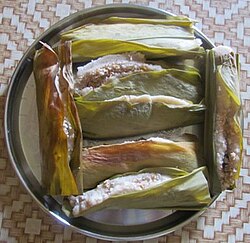
On Prathamastami (ପ୍ରଥମାଷ୍ଟମୀ), households pray for the long life of the firstborns. Enduri Pitha is a special delicacy which is prepared for this occasion.[9] It has the cultural significance that first born were usually expected to take over as the family head. It falls on the eighth day of Margasira month.[10]
Spring[edit | edit source]
Vasant Panchami[edit | edit source]
Vasanta Panchami (ବସନ୍ତ ପଞ୍ଚମୀ) occurs on the fifth day of the first lunar fortnight of Magha month (Magha Shukla Panchami), which usually falls in January or February. It is also observed as Saraswati Puja (ସରସ୍ୱତୀ ପୂଜା). Saraswati is the goddess of knowledge and wisdom in Hinduism. Traditionally, children get their letters on this day. Many educational institutions also observe the festival. It also marks the arrival of spring.[11][12]
Maha Shivaratri[edit | edit source]

Maha Shivaratri (ମହା ଶିବରାତ୍ରି) is celebrated on the 13th night or 14th day on the waning lunar fortnight in the Phalguna month. It usually falls in February or March. It is considered the night on which Shiva perform the Tandava dance. It is observed by fasting by adherents, especially. Married women pray for the well-being of their spouses. Unmarried women may pray for an ideal husband. Shiva temples are visited on this day and night. Bael fruit and leaves are offered to the god, who is worshiped in the form of a lingam. Worshipers may hold an all-night jagarana and break their fast the next morning.[13]
Shivaratri is celebrated in major Shaivite temples like Lingaraja temple, Kapilash Temple, and Mukteswar temple. Shivaratri is also important to ascetics as Shiva is considered an ascetic god. Ascetics may partake in drinks like Thandai on this day.[13]
Dola Purnima and Holi[edit | edit source]
It also known as Dola Yatra (Odia: ଦୋଳ ଯାତ୍ରା, a five-day long Dola Purnima festival celebrated with pomp and fervor across the state. Followed by Dola Purnima comes Holi. On this day, the Odia calendar becomes ready and is offered to the deity Jagannath, who is also known as "Dolagovinda".[14] The celebration is mostly celebrated in Villages where Idols of Krishna and Radha come to a common place.
Summer[edit | edit source]
Ratha Yatra[edit | edit source]

Ratha Yatra (ରଥଯାତ୍ରା) is an annual Hindu festival which originated in Puri in Odisha. The festival is celebrated all over Odisha on the 2nd day of dark fortnight the lunar month of Ashadha (Asadha Sukla Dutiya) usually in June/July. The festival involves transporting of the idols of the deities Jagannatha, Balabhadra and Subhadra on giant chariot from the Jagannath Temple to the Gundicha Temple. The chariots are pulled by devotees with ropes. After nine days, the idols are returned. The 2014 festival in Puri was attended by 900000 people.[15][16]
Monsoon[edit | edit source]
Ganesh Chaturthi[edit | edit source]
Ganesh Chaturthi (ଗଣେଶ ଚତୁର୍ଥୀ) is celebrated as the birthday of the god Ganesh, usually in August. It is primarily observed by educational institutes and students. The god is offered prasad like modak and laddu in pandals. Students may also offer writing utensils and notebooks, which are used by them after the festival. During the festival, student do not undertake any study related activity. After Ganesh Visarjan, study activities are resumed.[17]
Regional festivals[edit | edit source]
This section lists festivals which are specific to a region.
Coastal Odisha[edit | edit source]
Raja Parba[edit | edit source]
Raja Parba (ରଜ ପର୍ବ) is a three-day festival celebrated in the coastal districts in Ashadha month starting with the first day of the month. It usually falls mid-June. This is festival dedicated to Basu-mata, the Earth goddess. During this period, no agricultural activities occur to allow the goddess to rest. The first day is called pahila raja, the second day is proper raja and third day is called basi raja.(Bhuin Na a na/ ଭୂଇଁ ନଅଣ) All the agricultural weapons got Wash and worshipped this day. Girls play on various types of swings. People exchange pithas among relatives and friends. Raja is also called Mithuna Sankranti. In places it is celebrated for four days and is known as Basumata Puja.[18][19][20]
Bali Jatra/Kartika Purnima[edit | edit source]

Bali Jatra (ବାଲି ଯାତ୍ରା) is celebrated to mark the voyages made by ancient sea traders from Odisha to Bali. It falls on the day of Kartik Purnima. On this day, miniatures of the boats called boitas are released in ponds, rivers and the sea. The festival is celebrated for a week all across the state.[21] A major annual trade fair is also held in Cuttack.[22]
Central Odisha[edit | edit source]
Gajalaxmi Puja[edit | edit source]

The Gaja-Lakshmi Puja (ଗଜଲକ୍ଷ୍ମୀ ପୂଜା) is celebrated primarily in Dhenkanal and Kendrapara town.[1] Archived 21 October 2019 at the Wayback Machine It is an 11-day festival dedicated to Goddess Lakshmi, which begins on Kumar Purnima.[23]
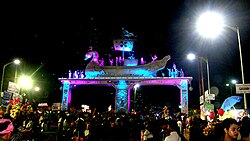
Dhenkanal's Gajalaxmi Puja is a major and famous festival of Odisha. It is an important part of the cultural identity not only of Dhenkanal district but of the entire state of Odisha. Every year, this puja begins on the full moon day of the Ashwina month, which is also known as Kumar Purnima, and is celebrated with great pomp and grandeur for about 11 days. During this time, the entire city of Dhenkanal remains immersed in a spiritual and festive atmosphere.
Western Odisha[edit | edit source]
Nuakhai[edit | edit source]
Nuakhai (ନୂଆ ଖାଇ) is particularly celebrated in the Sambalpuri cultural region. It is celebrated to welcome the new paddy (ଧାନ) harvest. It falls on the day after Ganesh Chaturthi. In various regions, priests calculate the tithi and offer the new grains to the local goddesses at a precise auspicious moment. People on this occasional greet each other with the words "Nuakhai Juhar". At evening, folk dance and song events may be organized which are called "Nuakhai Bhetghat".[24]
Sitalasasthi[edit | edit source]
Sitalsasthi is celebrated to observe the marriage of god Shiva and Parvati. One of the devotees acts as the parent of Shiva and another devotee acts as the parent of Parvati. The devotee acting as the father of the god travels to the goddess's house with a bundle of sal tree leaves to make a proposal. After the marriage is fixed, deities of the locality and general public are invited to the ceremony. The general public also financially contributes to the ceremony. Sitalasasthi is also celebrated in many parts of South Ddisha mainly in Ganjam district and Brahmapur.[25] The marriage ceremony is undertaken on the sixth day of Jyeshtha month. Various artists including eunuchs perform street performances during the festival.[26][27]
Dhanu Jatra[edit | edit source]

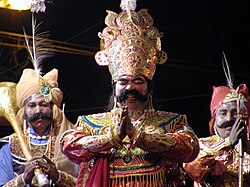
Dhanu Jatra is a large-scale reenactment of the reign and death of the asura king Kansa which takes place annually in Bargarh. During the period of 1 to 11 January, the town of Bargarh is assumed to be the mythical city of Mathura. The neighboring settlements also take up names from the Mahabharata. The district collector and police superintendent also pretend to be employees of Kansa. The festival begins with the marriage of Vasudeva and Devaki. Ambapalli village is treated as Gopapur. During the festival, an actor pretending to be Kansa issues social messages which are contrary to mythical character.[28][29]
References[edit | edit source]
- ↑ "Prathamastami that celebrates firstborns". The Pioneer. 9 December 2020.
- ↑ 2.0 2.1 "Durga Puja" (PDF). East Coast Railway. September 2013. Archived from the original (PDF) on 10 August 2014. Retrieved 8 August 2014.
- ↑ "Durga Puja". Government of Odisha. Archived from the original on 30 October 2008. Retrieved 8 August 2014.
- ↑ "Kali in chains at Keonjhar shrine". The Times of India. Retrieved 21 March 2019.
- ↑ "Silver City bids adieu to Goddess Kali". The New Indian Express. Retrieved 21 March 2019.
- ↑ "Kumar Purnima" (PDF). Government of Odisha. Retrieved 8 August 2014.
- ↑ 7.0 7.1 7.2 "Deepabali" (PDF). Government of Odisha. Archived from the original (PDF) on 23 January 2015. Retrieved 17 September 2014.
- ↑ "Thousands chant 'Bada Badua Ho' in Puri". The Pioneer (newspaper). 5 November 2005. Retrieved 17 September 2014.
- ↑ "Oriyas prefer 'Enduri Pitha' on 'Prathamashtami'". The Hindu. 30 November 2010. Retrieved 8 August 2014.
- ↑ "Prathamastami" (PDF). Government of Odisha. Archived from the original (PDF) on 4 March 2016. Retrieved 8 August 2014.
- ↑ "Vasant Panchami" (PDF). Government of India. Retrieved 8 August 2014.
- ↑ "Odisha: Fairs and Festivals". Know India. Government of India. Archived from the original on 23 September 2014. Retrieved 8 August 2014.
- ↑ 13.0 13.1 "Mahashiva Ratri" (PDF). Government of Odisha. Archived from the original (PDF) on 27 March 2014. Retrieved 8 August 2014.
- ↑ "Dola Purnima" (PDF). Government of Odisha. Archived from the original (PDF) on 10 August 2014. Retrieved 8 August 2014.
- ↑ "Sea of humanity at Puri Rath Yatra". The Hindu. 30 June 2014. Retrieved 24 February 2015.
- ↑ "A glimpse of the Vamana, the dwarf or Lord Jagannath". Government of Odisha. Archived from the original on 24 February 2015. Retrieved 24 February 2015.
- ↑ "Ganesh Chaturthi" (PDF). Government of Odisha. Archived from the original (PDF) on 4 March 2016. Retrieved 8 August 2014.
- ↑ "Raja Sankranti". Odisha Tourism, Government of Odisha. Retrieved 24 February 2015.
{{cite web}}: CS1 maint: deprecated archival service (link) - ↑ "Rain likely to dampen Raja festival spirit". The Hindu. 14 June 2013. Retrieved 24 February 2015.
- ↑ "Raja Sankranti : The Festival of Swings" (PDF). Government of Odisha. June 2006. Archived from the original (PDF) on 1 November 2013. Retrieved 24 February 2015.
- ↑ "Odisha celebrates glorious maritime past". The Hindu. 19 November 2013. Retrieved 8 August 2014.
- ↑ "Lakhs turn up for Bali Yatra on opening day". The Hindu. 22 November 2010. Retrieved 8 August 2014.
- ↑ "Dhenkanal gears up for Laxmi Puja". The Times of India. 29 October 2012. Retrieved 13 August 2014.
- ↑ "Nuakhai" (PDF). Government of Odisha. Archived from the original (PDF) on 10 August 2014. Retrieved 8 August 2014.
- ↑ "Sambalpur in festive mood for Sital Sasthi". The New Indian Express. 10 June 2013. Archived from the original on 13 June 2013. Retrieved 8 August 2014.
- ↑ "Rituals start for divine marriage in Sambalpur". The Times of India. 30 May 2014. Retrieved 8 August 2014.
- ↑ "Eunuchs put up impressive show". The Times of India. 5 June 2014. Retrieved 8 August 2014.
- ↑ "Bargarh gears up for Dhanu Yatra". The Hindu. 23 December 2008. Retrieved 8 August 2014.
- ↑ "Dhanu Yatra gets under way". The Hindu. 1 January 2012. Retrieved 8 August 2014.


