




->Ost316 m Disambiguated: hunting lodge → Jagdschloss |
Aaqibjavaid (talk | contribs) added references additionally and updated info |
||
| Line 1: | Line 1: | ||
{{ | {{Short description|Museum complex in New Delhi, Delhi, India}} | ||
{{for-multi|other places known as Flagstaff House|Flagstaff House (disambiguation)|the Indian bilingual dacoit western action-adventure film|Teen Murti (1984 film)}} | |||
{{Use dmy dates|date=October 2020}} | {{Use dmy dates|date=October 2020}} | ||
{{Use Indian English|date=February 2016}} | {{Use Indian English|date=February 2016}} | ||
{{Infobox building | {{Infobox building | ||
| name | | name = Teen Murti Bhavan | ||
| native_name | | native_name = | ||
| former_names | | former_names = Flagstaff House | ||
| alternate_names | | alternate_names = | ||
| image | | image = Teen murti bhawan 22.jpg | ||
| alt | | alt = | ||
| caption | | caption = Residence of India's first Prime minister, Pt. [[Jawaharlal Nehru]] | ||
| | | pushpin_map = | ||
| altitude | | altitude = | ||
| building_type | | building_type = | ||
| architectural_style | | architectural_style = | ||
| structural_system | | structural_system = | ||
| cost | | cost = | ||
| ren_cost | | ren_cost = | ||
| location | | location = Teen Murti Haifa Road | ||
| address | | address = [[New Delhi]], [[Delhi]]-110011, [[India]] | ||
| client | | client = [[Pradhanmantri Sangrahalaya]] | ||
| owner | | owner = [[Government of India]] | ||
| current_tenants | | current_tenants = | ||
| landlord | | landlord = | ||
| coordinates | | coordinates = {{coord|28.602608|N|77.198774|E|region:IN-DL_type:landmark_scale:50|display=inline, title}} | ||
| | | construction_start_date = | ||
| completion_date | | completion_date = 1930 | ||
| inauguration_date | | inauguration_date = | ||
| renovation_date | | renovation_date = | ||
| | | demolished_date = | ||
| destruction_date | | destruction_date = | ||
| height | | height = | ||
| diameter | | diameter = | ||
| other_dimensions | | known_for = * [[Pradhanmantri Sangrahalaya]] | ||
| floor_count | * [[Prime Ministers' Museum and Library Society]] | ||
| floor_area | * Former [[Prime Minister's Office (India)|Prime Minister's Office]] | ||
| main_contractor | * [[Nehru Planetarium]] | ||
| architect | | other_dimensions = | ||
| architecture_firm | | floor_count = | ||
| structural_engineer | | floor_area = | ||
| services_engineer | | main_contractor = | ||
| civil_engineer | | architect = [[Robert Tor Russell]] | ||
| other_designers | | architecture_firm = | ||
| quantity_surveyor | | structural_engineer = | ||
| awards | | services_engineer = | ||
| ren_architect | | civil_engineer = | ||
| ren_firm | | other_designers = | ||
| ren_str_engineer | | quantity_surveyor = | ||
| ren_serv_engineer | | awards = | ||
| ren_civ_engineer | | ren_architect = | ||
| ren_oth_designers | | ren_firm = | ||
| ren_qty_surveyor | | ren_str_engineer = | ||
| ren_awards | | ren_serv_engineer = | ||
| references | | ren_civ_engineer = | ||
| ren_oth_designers = | |||
| ren_qty_surveyor = | |||
| ren_awards = | |||
| references = | |||
}} | }} | ||
The '''Teen Murti Bhavan''' (''Teen Murti House''; formerly known as '''Flagstaff House''') is | The '''Teen Murti Bhavan''' (''Teen Murti House''; formerly known as '''Flagstaff House''') is a building and former residence in [[New Delhi]]. It was built by the [[British Raj]] and became the residence of the first [[Prime Minister of India]], [[Jawaharlal Nehru]], who stayed there for 16 years until his death on 27 May 1964. It was designed by [[Robert Tor Russell]], the British architect of [[Connaught Place, New Delhi|Connaught Place]] and of the Eastern and Western Courts on [[Janpath]] during the British Raj. | ||
Teen Murti Bhavan was built in 1930 as part of the new imperial capital of India, New Delhi, as the residence of the [[Commander-in-Chief, India|Commander-in-Chief]] of the [[British Indian Army]].<ref>{{cite news|title=Architectural marvels for the new capital|url=http://www.hindustantimes.com/News-Feed/newdelhi/Architectural-marvels-for-the-new-capital/Article1-723169.aspx|work=Hindustan Times|date=20 July 2011|url-status=dead|archive-url=https://web.archive.org/web/20141102085932/http://www.hindustantimes.com/News-Feed/newdelhi/Architectural-marvels-for-the-new-capital/Article1-723169.aspx|archive-date=2 November 2014}}</ref> This imposing structure covers a massive area of 12 hectares and was carved out of white stone and stucco to give it its signature look. The main entrance into the grounds of Teen Murti Bhavan is located on Teen Murti Marg, which was formerly called Roberts Road. | |||
Also contained within the complex are the | Prime Minister [[Indira Gandhi]] converted the residence into a museum. Today, Teen Murti Bhavan houses various institutions including the [[Prime Ministers' Museum and Library Society]], which runs under the Indian [[Ministry of Culture (India)|Ministry of Culture]], and the [[Pradhan Mantri Sangrahalaya]], a memorial and museum to honour the [[List of prime ministers of India|Prime Ministers of India]]. The complex also houses the offices of the Jawaharlal Nehru Memorial Fund, established in 1964 under the chairmanship of [[S. Radhakrishnan]], [[President of India]]. Teen Murti Bhavan also contains a number of mementos from various nations including England, Nepal, Somalia, China and others. Each memento represents a notable resource of each nation. The foundation also awards the Jawaharlal Nehru Memorial Fellowship, established in 1968.<ref>[http://www.jnmf.in/history.html History] Jawaharlal Nehru Memorial Fund, Official website.</ref> | ||
Also contained within the complex are the Centre for Contemporary Studies and the [[Nehru Planetarium]] which opened in 1984. | |||
==Etymology== | ==Etymology== | ||
[[File:Teenmurtidelhi.jpg|thumb|180px|right|Teen Murti (''three statues'') Memorial built in 1922, outside Teen Murti Bhavan, which gives the building its name]] | [[File:Teenmurtidelhi.jpg|thumb|180px|right|Teen Murti (''three statues'') Memorial built in 1922, outside Teen Murti Bhavan, which gives the building its name]] | ||
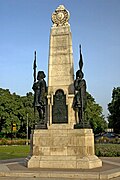
The house is named after the Teen [[Murti]] (literally "three statues") Memorial by British sculptor, Leonard Jennings, which stands on the road junction in front of its extensive grounds. The memorial comprises life-size statues of three soldiers, and was built in 1922 in the memory of the Indian | The house is named after the Teen [[Murti]] (literally "three statues") Memorial by British sculptor, Leonard Jennings, which stands on the road junction in front of its extensive grounds. The memorial comprises life-size statues of three soldiers, and was built in 1922 in the memory of the Indian regiments named after the three [[Indian princely states]] from where they were raised, namely the Jodhpur Horse from [[Jodhpur State]], the Hyderabad Horse from [[Hyderabad State]], and the Mysore Horse from [[Mysore State]], who participated in World War I with the British [[15th (Imperial Service) Cavalry Brigade]] in [[Haifa]], which was then part of the [[Ottoman Empire]]. | ||
While soldiers from Jodhpur and Mysore took field in the actual war, those from Hyderabad were employed in maintaining communication channels and serving the injured. The Jodhpur soldiers led by Major Dalpat Singh Shekhawat were at the forefront and won the Haifa war with the help of Mysore and Hyderabad forces. Major Shekhawat died fighting at Haifa. He is known as Hero of Haifa.<ref name=ht13>{{cite web | title = Steeped in history, a three-statue salute to erstwhile princely states|work= Hindustan Times | url = https://www.hindustantimes.com/delhi-news/steeped-in-history-a-three-statue-salute-to-erstwhile-princely-states/story-sbsI8NvwOdp8aSSsVUjT3M.html |date=13 April 2013| access-date = 24 September 2013}}</ref> | While soldiers from Jodhpur and Mysore took field in the actual war, those from Hyderabad were employed in maintaining communication channels and serving the injured. The Jodhpur soldiers led by Major [[Dalpat Singh Shekhawat]] were at the forefront and won the Haifa war with the help of Mysore and Hyderabad forces. Major Shekhawat died fighting at Haifa. He is known as Hero of Haifa.<ref name=ht13>{{cite web | title = Steeped in history, a three-statue salute to erstwhile princely states|work= Hindustan Times | url = https://www.hindustantimes.com/delhi-news/steeped-in-history-a-three-statue-salute-to-erstwhile-princely-states/story-sbsI8NvwOdp8aSSsVUjT3M.html |date=13 April 2013| access-date = 24 September 2013}}</ref> | ||
==History== | ==History== | ||
| Line 71: | Line 78: | ||
[[File:Nehru-Planetarium-New-Delhi-6.JPG|thumb|left|[[Nehru Planetarium#Nehru Planetarium.2C New Delhi|Nehru Planetarium, New Delhi]]]] | [[File:Nehru-Planetarium-New-Delhi-6.JPG|thumb|left|[[Nehru Planetarium#Nehru Planetarium.2C New Delhi|Nehru Planetarium, New Delhi]]]] | ||
In 1911 the decision was made to transfer the winter capital of British India from Calcutta to Delhi (Simla remained the summer capital for the remainder of colonial rule). The slow, decades-long process of constructing the imperial complex in New Delhi commenced shortly thereafter. | In 1911, the decision was made to transfer the winter capital of British India from Calcutta to Delhi ([[Simla]] remained the summer capital for the remainder of colonial rule). The slow, decades-long process of constructing the imperial complex in New Delhi commenced shortly thereafter. | ||
Inaugurated as 'Flagstaff House' in 1930, the building was the winter headquarters and residence of the [[Commander-in-Chief, India|Commander-in-Chief]] of Forces in India who maintained unified command of the | Inaugurated as 'Flagstaff House' in 1930, the building was the winter headquarters and residence of the [[Commander-in-Chief, India|Commander-in-Chief]] of Forces in India who maintained unified command of the British Indian Army, [[British Army]], and princely states forces. The road on which it stood was named after [[Frederick Roberts, 1st Earl Roberts|the 1st Earl Roberts]], the Commander-in-Chief for over seven years between 1885 and 1893. | ||
After independence in August 1947, the house became the year-round official residence and | After independence in August 1947, the house became the year-round [[official residence]] and workplace of the Prime Minister, and [[Field marshal (United Kingdom)|Field Marshal]] [[Claude Auchinleck|Sir Claude Auchinleck]] relocated. | ||
Following Jawarharlal's Nehru's death in office in May 1964, the house was converted into a national memorial to him comprising a library and a museum. Today, in a ground floor room of the Nehru Museum, his [[South Block]] office in the Ministry of External Affairs has been 'recreated' with the same furniture and other articles he used, along with several mementos, objects and manuscripts. | Following Jawarharlal's Nehru's death in office in May 1964, the house was converted into a national memorial to him comprising a library and a museum. Today, in a ground floor room of the Nehru Museum, his [[South Block]] office in the Ministry of External Affairs has been 'recreated' with the same furniture and other articles he used, along with several mementos, objects and manuscripts. | ||
The complex has headquarters of Jawaharlal Nehru Memorial Fund, established in November 1964, Nehru Memorial Library, and also the [[Jawaharlal Nehru Fellowship]].<ref name=ht13/> The [[Nehru Memorial Museum and Library|Nehru Memorial Library]] is one of the finest ones for information on modern Indian history. Started in 1966, it functioned from the main building itself, till its present building was inaugurated within the complex grounds, in 1974. | The complex has the headquarters of the Jawaharlal Nehru Memorial Fund, established in November 1964, Nehru Memorial Library, and also the [[Jawaharlal Nehru Fellowship]].<ref name=ht13/> The [[Nehru Memorial Museum and Library|Nehru Memorial Library]] is one of the finest ones for information on modern Indian history. Started in 1966, it functioned from the main building itself, till its present building was inaugurated within the complex grounds, in 1974. | ||
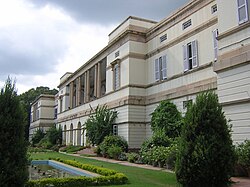
Situated in a | Situated in a 12-hectare estate,<ref name=ht13/> the building is constructed of white stone and [[stucco]], and faces the south side of Viceroy's House, known since 1950 as [[Rashtrapati Bhavan, New Delhi|Rashtrapati Bhavan]] (President's House). It has an arched entrance, recessed windows, and the first floor has a pillared [[veranda]] on the back of the building, which overlooks the lawns. | ||
[[File:Teen Murti Bhavan in New Delhi.jpg|thumb|left|''Teen Murti Bhavan'', with pillared [[veranda]] overlooking the back lawn.]] | [[File:Teen Murti Bhavan in New Delhi.jpg|thumb|left|''Teen Murti Bhavan'', with pillared [[veranda]] overlooking the back lawn.]] | ||
[[File:Firoze Shah hunting lounge 3.JPG|right|thumb|140px|Sikargah or Kushak Mahal, 14th-century hunting lodge built by [[Firoz Shah Tughlaq]].]] | [[File:Firoze Shah hunting lounge 3.JPG|right|thumb|140px|Sikargah or Kushak Mahal, 14th-century hunting lodge built by [[Firoz Shah Tughlaq]].]] | ||
One of the four [[Nehru Planetarium]]s in India, is also situated in Teen Murti House grounds. It was inaugurated by the then Prime Minister (and Nehru's daughter), [[Indira Gandhi]], on 6 February 1984. The planetarium's sky theatre is used for screening shows and as a gallery.<ref>{{cite web |title=Nehru Planetarium|url=http://pib.nic.in/feature/feyr2001/foct2001/f171020012.html |date=October 2001 |publisher=Press Information Bureau, Govt. of India }}</ref> The planetarium was reopened in September 2010, after renovations worth Rs. 11 crore, ahead of the [[2010 Commonwealth Games]] and received Queen's Baton. It now has 'Definiti optical star projector "Megastar" that can show 2 million stars.<ref>{{cite news |last=Tankha |first=Madhur |date=30 September 2010 |title=Nehru Planetarium ready to receive the Queen's Baton | One of the four [[Nehru Planetarium]]s in India, is also situated in Teen Murti House grounds. It was inaugurated by the then Prime Minister (and Nehru's daughter), [[Indira Gandhi]], on 6 February 1984. The planetarium's sky theatre is used for screening shows and as a gallery.<ref>{{cite web |title=Nehru Planetarium|url=http://pib.nic.in/feature/feyr2001/foct2001/f171020012.html |date=October 2001 |publisher=Press Information Bureau, Govt. of India }}</ref> The planetarium was reopened in September 2010, after renovations worth Rs. 11 crore, ahead of the [[2010 Commonwealth Games]] and received Queen's Baton. It now has 'Definiti optical star projector "Megastar" that can show 2 million stars.<ref>{{cite news |last=Tankha |first=Madhur |date=30 September 2010 |title=Nehru Planetarium ready to receive the Queen's Baton |url=http://www.hindu.com/2010/09/30/stories/2010093054610200.htm |work=[[The Hindu]] |archive-url=https://web.archive.org/web/20101012102329/http://www.hindu.com/2010/09/30/stories/2010093054610200.htm |archive-date=12 October 2010 |url-status=dead |access-date=10 April 2021}}</ref> | ||
Close to the Nehru Planetarium within the Bhavan complex, stands the ''Shikargah'', also known as Kushak Mahal, the [[Jagdschloss|hunting lodge]] of 14th-century ruler of the [[Sultanate of Delhi]], [[Firoz Shah Tughlaq]] (r. 1351–1388 AD). Built on a high platform of [[rubble masonry]] accessed by stairs, the near square structure contains three open bays, containing arches, with each bay further divided into three compartments. Firoz Shah's fort, [[Firoz Shah Kotla]] was situated far away on the banks of Yamuna River. Though, the 1912 map of Delhi shows a stream flowing near it towards the Yamuna.<ref> | Close to the Nehru Planetarium within the Bhavan complex, stands the ''Shikargah'', also known as Kushak Mahal, the [[Jagdschloss|hunting lodge]] of 14th-century ruler of the [[Sultanate of Delhi]], [[Firoz Shah Tughlaq]] (r. 1351–1388 AD). Built on a high platform of [[rubble masonry]] accessed by stairs, the near square structure contains three open bays, containing arches, with each bay further divided into three compartments. Firoz Shah's fort, [[Firoz Shah Kotla]] was situated far away on the banks of Yamuna River. Though, the 1912 map of Delhi shows a stream flowing near it towards the Yamuna.<ref> | ||
{{cite web | title = Maps help relive old Delhi charms|work=Hindustan Times| url = http://www.hindustantimes.com/India-news/NewDelhi/Maps-help-relive-old-Delhi-charms/Article1-1047850.aspx| archive-url = https://web.archive.org/web/20130421064417/http://www.hindustantimes.com/India-news/NewDelhi/Maps-help-relive-old-Delhi-charms/Article1-1047850.aspx| url-status = dead| archive-date = 21 April 2013|date=21 April 2013| access-date = 24 September 2013}}</ref> The monument is today protected by [[Archaeological Survey of India]] (ASI), and the nearby Kushak Road is named after it.<ref>{{cite news |title=Indian cavalry's victorious trysts with India's history |url=http://www.asianage.com/ideas/indian-cavalry-s-victorious-trysts-india-s-history-453 |work=[[The Asian Age]] |date=6 December 2011 |url-status=dead |archive-url=https://web.archive.org/web/20120119043942/http://www.asianage.com/ideas/indian-cavalry-s-victorious-trysts-india-s-history-453 |archive-date=19 January 2012 }}</ref><ref>{{cite news |last=Khandekar |first=Nivedita |date=4 August 2012 |title=King's resort in the wild |url=http://www.hindustantimes.com/India-news/NewDelhi/King-s-resort-in-the-wild/Article1-908406.aspx |work=[[Hindustan Times]] |url-status=dead |archive-url=https://web.archive.org/web/20130617092823/http://www.hindustantimes.com/India-news/NewDelhi/King-s-resort-in-the-wild/Article1-908406.aspx |archive-date=17 June 2013 |access-date=10 April 2021}}</ref> | {{cite web | title = Maps help relive old Delhi charms|work=Hindustan Times| url = http://www.hindustantimes.com/India-news/NewDelhi/Maps-help-relive-old-Delhi-charms/Article1-1047850.aspx| archive-url = https://web.archive.org/web/20130421064417/http://www.hindustantimes.com/India-news/NewDelhi/Maps-help-relive-old-Delhi-charms/Article1-1047850.aspx| url-status = dead| archive-date = 21 April 2013|date=21 April 2013| access-date = 24 September 2013}}</ref> The monument is today protected by [[Archaeological Survey of India]] (ASI), and the nearby Kushak Road is named after it.<ref>{{cite news |title=Indian cavalry's victorious trysts with India's history |url=http://www.asianage.com/ideas/indian-cavalry-s-victorious-trysts-india-s-history-453 |work=[[The Asian Age]] |date=6 December 2011 |url-status=dead |archive-url=https://web.archive.org/web/20120119043942/http://www.asianage.com/ideas/indian-cavalry-s-victorious-trysts-india-s-history-453 |archive-date=19 January 2012 }}</ref><ref>{{cite news |last=Khandekar |first=Nivedita |date=4 August 2012 |title=King's resort in the wild |url=http://www.hindustantimes.com/India-news/NewDelhi/King-s-resort-in-the-wild/Article1-908406.aspx |work=[[Hindustan Times]] |url-status=dead |archive-url=https://web.archive.org/web/20130617092823/http://www.hindustantimes.com/India-news/NewDelhi/King-s-resort-in-the-wild/Article1-908406.aspx |archive-date=17 June 2013 |access-date=10 April 2021}}</ref> | ||
==References== | ==References== | ||
{{reflist}} | {{reflist}} | ||
{{Jawaharlal Nehru}} | {{Jawaharlal Nehru}} | ||
| Line 115: | Line 109: | ||
[[Category:Biographical museums in India]] | [[Category:Biographical museums in India]] | ||
[[Category:Prime ministerial residences]] | [[Category:Prime ministerial residences]] | ||
[[Category:20th-century architecture in India]] | |||
[[Category:Government Houses of the British Empire and Commonwealth]] | |||
Latest revision as of 15:10, 26 March 2026
| Teen Murti Bhavan | |
|---|---|
 Residence of India's first Prime minister, Pt. Jawaharlal Nehru | |
| Former names | Flagstaff House |
| General information | |
| Location | Teen Murti Haifa Road |
| Address | New Delhi, Delhi-110011, India |
| Coordinates | 28°36′09″N 77°11′56″E / 28.602608°N 77.198774°E |
| Completed | 1930 |
| Client | Pradhanmantri Sangrahalaya |
| Owner | Government of India |
| Design and construction | |
| Architect | Robert Tor Russell |
| Known for | |
The Teen Murti Bhavan (Teen Murti House; formerly known as Flagstaff House) is a building and former residence in New Delhi. It was built by the British Raj and became the residence of the first Prime Minister of India, Jawaharlal Nehru, who stayed there for 16 years until his death on 27 May 1964. It was designed by Robert Tor Russell, the British architect of Connaught Place and of the Eastern and Western Courts on Janpath during the British Raj.
Teen Murti Bhavan was built in 1930 as part of the new imperial capital of India, New Delhi, as the residence of the Commander-in-Chief of the British Indian Army.[1] This imposing structure covers a massive area of 12 hectares and was carved out of white stone and stucco to give it its signature look. The main entrance into the grounds of Teen Murti Bhavan is located on Teen Murti Marg, which was formerly called Roberts Road.
Prime Minister Indira Gandhi converted the residence into a museum. Today, Teen Murti Bhavan houses various institutions including the Prime Ministers' Museum and Library Society, which runs under the Indian Ministry of Culture, and the Pradhan Mantri Sangrahalaya, a memorial and museum to honour the Prime Ministers of India. The complex also houses the offices of the Jawaharlal Nehru Memorial Fund, established in 1964 under the chairmanship of S. Radhakrishnan, President of India. Teen Murti Bhavan also contains a number of mementos from various nations including England, Nepal, Somalia, China and others. Each memento represents a notable resource of each nation. The foundation also awards the Jawaharlal Nehru Memorial Fellowship, established in 1968.[2]
Also contained within the complex are the Centre for Contemporary Studies and the Nehru Planetarium which opened in 1984.
Etymology[edit | edit source]

The house is named after the Teen Murti (literally "three statues") Memorial by British sculptor, Leonard Jennings, which stands on the road junction in front of its extensive grounds. The memorial comprises life-size statues of three soldiers, and was built in 1922 in the memory of the Indian regiments named after the three Indian princely states from where they were raised, namely the Jodhpur Horse from Jodhpur State, the Hyderabad Horse from Hyderabad State, and the Mysore Horse from Mysore State, who participated in World War I with the British 15th (Imperial Service) Cavalry Brigade in Haifa, which was then part of the Ottoman Empire.
While soldiers from Jodhpur and Mysore took field in the actual war, those from Hyderabad were employed in maintaining communication channels and serving the injured. The Jodhpur soldiers led by Major Dalpat Singh Shekhawat were at the forefront and won the Haifa war with the help of Mysore and Hyderabad forces. Major Shekhawat died fighting at Haifa. He is known as Hero of Haifa.[3]
History[edit | edit source]

In 1911, the decision was made to transfer the winter capital of British India from Calcutta to Delhi (Simla remained the summer capital for the remainder of colonial rule). The slow, decades-long process of constructing the imperial complex in New Delhi commenced shortly thereafter.
Inaugurated as 'Flagstaff House' in 1930, the building was the winter headquarters and residence of the Commander-in-Chief of Forces in India who maintained unified command of the British Indian Army, British Army, and princely states forces. The road on which it stood was named after the 1st Earl Roberts, the Commander-in-Chief for over seven years between 1885 and 1893.
After independence in August 1947, the house became the year-round official residence and workplace of the Prime Minister, and Field Marshal Sir Claude Auchinleck relocated.
Following Jawarharlal's Nehru's death in office in May 1964, the house was converted into a national memorial to him comprising a library and a museum. Today, in a ground floor room of the Nehru Museum, his South Block office in the Ministry of External Affairs has been 'recreated' with the same furniture and other articles he used, along with several mementos, objects and manuscripts.
The complex has the headquarters of the Jawaharlal Nehru Memorial Fund, established in November 1964, Nehru Memorial Library, and also the Jawaharlal Nehru Fellowship.[3] The Nehru Memorial Library is one of the finest ones for information on modern Indian history. Started in 1966, it functioned from the main building itself, till its present building was inaugurated within the complex grounds, in 1974.
Situated in a 12-hectare estate,[3] the building is constructed of white stone and stucco, and faces the south side of Viceroy's House, known since 1950 as Rashtrapati Bhavan (President's House). It has an arched entrance, recessed windows, and the first floor has a pillared veranda on the back of the building, which overlooks the lawns.


One of the four Nehru Planetariums in India, is also situated in Teen Murti House grounds. It was inaugurated by the then Prime Minister (and Nehru's daughter), Indira Gandhi, on 6 February 1984. The planetarium's sky theatre is used for screening shows and as a gallery.[4] The planetarium was reopened in September 2010, after renovations worth Rs. 11 crore, ahead of the 2010 Commonwealth Games and received Queen's Baton. It now has 'Definiti optical star projector "Megastar" that can show 2 million stars.[5]
Close to the Nehru Planetarium within the Bhavan complex, stands the Shikargah, also known as Kushak Mahal, the hunting lodge of 14th-century ruler of the Sultanate of Delhi, Firoz Shah Tughlaq (r. 1351–1388 AD). Built on a high platform of rubble masonry accessed by stairs, the near square structure contains three open bays, containing arches, with each bay further divided into three compartments. Firoz Shah's fort, Firoz Shah Kotla was situated far away on the banks of Yamuna River. Though, the 1912 map of Delhi shows a stream flowing near it towards the Yamuna.[6] The monument is today protected by Archaeological Survey of India (ASI), and the nearby Kushak Road is named after it.[7][8]
References[edit | edit source]
- ↑ "Architectural marvels for the new capital". Hindustan Times. 20 July 2011. Archived from the original on 2 November 2014.
- ↑ History Jawaharlal Nehru Memorial Fund, Official website.
- ↑ 3.0 3.1 3.2 "Steeped in history, a three-statue salute to erstwhile princely states". Hindustan Times. 13 April 2013. Retrieved 24 September 2013.
- ↑ "Nehru Planetarium". Press Information Bureau, Govt. of India. October 2001.
- ↑ Tankha, Madhur (30 September 2010). "Nehru Planetarium ready to receive the Queen's Baton". The Hindu. Archived from the original on 12 October 2010. Retrieved 10 April 2021.
- ↑ "Maps help relive old Delhi charms". Hindustan Times. 21 April 2013. Archived from the original on 21 April 2013. Retrieved 24 September 2013.
- ↑ "Indian cavalry's victorious trysts with India's history". The Asian Age. 6 December 2011. Archived from the original on 19 January 2012.
- ↑ Khandekar, Nivedita (4 August 2012). "King's resort in the wild". Hindustan Times. Archived from the original on 17 June 2013. Retrieved 10 April 2021.