




Kamal Guha (talk | contribs) Bihar Buddhist sites template added |
m fix structure further and updated info |
||
| Line 2: | Line 2: | ||
{{Use dmy dates|date=August 2018}} | {{Use dmy dates|date=August 2018}} | ||
{{Use Indian English|date=August 2018}} | {{Use Indian English|date=August 2018}} | ||
{{Infobox | {{Infobox ancient site | ||
| name | |name = Vaishali | ||
|native_name = | |||
| native_name | |alternate_name = | ||
| | |image = {{Photomontage | ||
| | | photo1a = N-BR-69 Raja Vishal Garh (5).jpg | ||
| photo1a = | |||
| photo2a = N-BR-68 Relic Stupa Vaishali (2).jpg | | photo2a = N-BR-68 Relic Stupa Vaishali (2).jpg | ||
| photo3a = | | photo3a = Ashoka pillar at Vaishali, Bihar, India.jpg | ||
| spacing = 4 | | spacing = 4 | ||
| color_border = Black | | color_border = Black | ||
| Line 17: | Line 15: | ||
| size = 270 | | size = 270 | ||
}} | }} | ||
| | |caption = Fort of Raja Visala, The Buddha's [[Relic Stupa of Vaishali]], [[Pillars of Ashoka|Asoka pillar at Kolhua]] | ||
|map_type = | |||
| | |map_alt = | ||
| | |relief = | ||
| | |coordinates = {{coord|25.99|N|85.13|E|display=inline,title}} | ||
|region = [[India]] | |||
|type = Settlement | |||
| coordinates | |part_of = | ||
| | |length = | ||
|width = | |||
|area = | |||
| | |height = | ||
| | |builder = | ||
| | |material = | ||
| | |built = c. 5th century BCE | ||
| | |abandoned = c. 600 CE<ref name=Prasad2015>{{cite book |last1=Prasad |first1=Kameshwar |title=The Glory that was Vaisali (From the Earliest Times to C. 600 C.E.) |date=2015 |publisher=K. P. Jayaswal Research Institute, Patna |isbn=9788189785062 |pages=52 |url=https://books.google.com/books?id=BJatjwEACAAJ&q=The+Glory+that+was+Vaisali+(From+the+Earliest+Times+to+C.+600+C.E.)}}</ref> | ||
| | |epochs = | ||
| | |cultures = [[Licchavis of Vaishali]] | ||
| | |dependency_of = | ||
| | |occupants = | ||
| | |event = | ||
| | |excavations = | ||
| | |archaeologists = | ||
| | |condition = In ruins | ||
| | |ownership = | ||
| | |management = | ||
| | |public_access = | ||
|website = | |||
| | |notes = | ||
| | |||
| | |||
| | |||
| | |||
| | |||
| | |||
| | |||
| | |||
| | |||
| | |||
| website | |||
| | |||
}} | }} | ||
{{BuddhasHolySites}} | {{BuddhasHolySites}} | ||
'''Vaishali''', '''Vesali''' or '''Vaiśālī''' was | '''Vaishali''', '''Vesali''' or '''Vaiśālī''' was an ancient city and today an archaeological site located north of [[Patna]] in present-day [[Bihar]], [[India]]. It is also a [[Jain]] and [[Buddhist]] pilgrimage site.<ref name=Beer>Robert Beer, ''The Encyclopaedia of Tibetan Symbols and Motifs''. Boston: Shambhala, 1991.</ref><ref name=Lars/> As an archaeological site it is spread over a group of modern villages located within the Vaishali District in [[Tirhut Division]].<ref name= Prasad2015 /><ref>{{Cite web|url=http://tirhut-muzaffarpur.bih.nic.in/Default.htm|title=Tirhut Division|website=tirhut-muzaffarpur.bih.nic.in|access-date=26 December 2019|archive-date=16 March 2015|archive-url=https://web.archive.org/web/20150316011819/http://tirhut-muzaffarpur.bih.nic.in/|url-status=dead}}</ref><ref>{{cite web|last=Thakur |first=Ripunjay Kumar |date=1 March 2022|title=Historical Geography of Early Medieval Mithila: From Videha to Tirhut.|url=https://www.academia.edu/72670545|publisher=New Archaeological & Genological Society, Kanpur, India|issn=2348-8301|access-date=21 August 2025}}</ref> | ||
It was the capital city of the [[Vajjika League]] | It was the capital city of the [[Vajjika League]] considered one of the first examples of a [[republic]] that dates from c. 6th century BCE. [[Gautama Buddha]] preached his last sermon before his [[mahaparinirvana]] in {{Circa|544 BCE}}, and Vaishali is also home to two important stupas directly related to the Buddha, the [[Relic Stupa of Vaishali]], which is said to contain the ashes of the Buddha,<ref name=Lars>{{cite book |last1=Fogelin |first1=Lars |title=An Archaeological History of Indian Buddhism |date=2015 |publisher=Oxford University Press |isbn=9780199948239 |page=85}}</ref><ref>{{cite book |last1=Lahiri |first1=Nayanjot |title=Ashoka in Ancient India |date=2015 |publisher=Harvard University Press |isbn=9780674057777 |pages=246–247}}</ref><ref name=Beer/> The 24th and last [[Tirthankara]] of Jainism, [[Mahavira]], was born in ''Kundagrama'' which has been identified as a suburb of the city of Vaishali and he was therefore referred to as ''Vesālie''.{{sfn|Sharma|1968|pp=159–166|loc=''The Nāyas''}} | ||
In 383 BCE the [[Second Buddhist council]] was convened here by King [[Kalashoka]].<ref>{{cite book|title=Students' Britannica India, Volumes 1-5|last=Hoiberg|first=Dale|author2=Indu Ramchandani|year=2000|publisher=Popular Prakashan|isbn=0-85229-760-2|page=208|url=https://books.google.com/books?id=DPP7O3nb3g0C&q=Vaishali&pg=PA208|access-date=28 June 2021|archive-date=4 May 2021|archive-url=https://web.archive.org/web/20210504210844/https://books.google.com/books?id=DPP7O3nb3g0C&q=Vaishali&pg=PA208|url-status=live}}</ref><ref>{{cite book|title=A history of India|last=Kulke|first=Hermann|author2=Dietmar Rothermund|year=2004|publisher=Routledge|isbn=0-415-32919-1|page=57|url=https://books.google.com/books?id=TPVq3ykHyH4C&q=Vaishali&pg=PA57|access-date=28 June 2021|archive-date=28 June 2021|archive-url=https://web.archive.org/web/20210628154435/https://books.google.com/books?id=TPVq3ykHyH4C&q=Vaishali&pg=PA57|url-status=live}}</ref> It also contains one of the best-preserved of the [[Pillars of Ashoka]] from the 3rd century BCE, topped by a single [[Asiatic lion]]. | |||
The city finds mention in the travel accounts of Chinese explorers, [[Faxian]] (4th century CE) and [[Xuanzang]] (7th century CE), which were later used in 1861 by British archaeologist [[Alexander Cunningham]] to first identify Vaiśālī with the present village of [[Basarh]] in [[Vaishali District]] | The city finds mention in the travel accounts of Chinese explorers, [[Faxian]] (4th century CE) and [[Xuanzang]] (7th century CE), which were later used in 1861 by British archaeologist [[Alexander Cunningham]] to first identify Vaiśālī with the present village of [[Basarh]] in the [[Vaishali District]] of [[Bihar]].<ref>{{cite book |author=Janice Leoshko |title=Sacred Traces: British Explorations of Buddhism in South Asia |url=https://books.google.com/books?id=gS4rDwAAQBAJ&pg=PA74 |year=2017 |publisher=Taylor & Francis |isbn=978-1-351-55030-7 |page=74 |access-date=28 June 2021 |archive-date=27 June 2021 |archive-url=https://web.archive.org/web/20210627185240/https://books.google.com/books?id=gS4rDwAAQBAJ&pg=PA74 |url-status=live }}</ref><ref>{{cite book |author=Dilip Kumar |title=Archaeology of Vaishali |url=https://books.google.com/books?id=zLq1AAAAIAAJ |year=1986 |publisher=Ramanand Vidya Bhawan |oclc=18520132 |page=36 |isbn=9788185205083 |access-date=28 June 2021 |archive-date=27 June 2021 |archive-url=https://web.archive.org/web/20210627185215/https://books.google.com/books?id=zLq1AAAAIAAJ |url-status=live }}</ref> Since 2010, parts of the Vaishali archaeological site including the relic stupa and Asokan pillar have been considered a tentative site under the [[UNESCO]] [[World Heritage Sites]] list, in the category of the [[Silk Road sites in India]].<ref name= "UNESCO" /> | ||
==Etymology== | ==Etymology== | ||
Vaishali derives its name from [[King Vishal]] of the [[Mahabharata]] age.<ref>{{cite web |title=Vaishali |url=https://tourism.bihar.gov.in/en/destinations/vaishali |website=tourism.bihar.gov.in |access-date=6 February 2021 |language=en |archive-date=18 January 2021 |archive-url=https://web.archive.org/web/20210118022159/https://tourism.bihar.gov.in/en/destinations/vaishali |url-status=live }}</ref> | Vaishali derives its name from [[King Vishal]] of the [[Mahabharata]] age.<ref>{{cite web |title=Vaishali |url=https://tourism.bihar.gov.in/en/destinations/vaishali |website=tourism.bihar.gov.in |access-date=6 February 2021 |language=en |archive-date=18 January 2021 |archive-url=https://web.archive.org/web/20210118022159/https://tourism.bihar.gov.in/en/destinations/vaishali |url-status=live }}</ref> | ||
==History== | ==History== | ||
===Monarchy period=== | |||
References to what has been termed the "monarchy period" of Vaishali come from literary sources including the [[Puranas]] and give an indication of the early [[Indo-Aryan peoples|Indo-Aryan]] expansion eastwards in to the Gangetic plains.{{sfn|Mishra|1962|p=8}} These sources detail that [[Vaivasvata Manu]] descendants settled and ruled in the region Vaishali starting with a King named Nābhānediṣṭha who is said to have founded the city. Traditional sources consider him to be a contemporary of [[Dasaratha]], father of one of the greatest Kings during Treta Yuga [[Lord Rama]], who is one avatars of Lord [[Vishnu]]. They belonged to the line of the [[Ikshvaku]] dynasty or the Sun Dynasty during ancient time in Bharat. | |||
===Republic period=== | |||
{{See also|Vajjika League}} | |||
[[File:Mahajanapadas (c. 500 BCE).png|left|thumb|200px|The [[Vajjika League|Vajji]] or Vrijji [[Mahajanapada]], 600 BCE.]] | [[File:Mahajanapadas (c. 500 BCE).png|left|thumb|200px|The [[Vajjika League|Vajji]] or Vrijji [[Mahajanapada]], 600 BCE.]] | ||
[[File:Ablution bath, Vaishali.jpg|left|thumb|200px|''Abhishek Pushkarini'', the coronation tank, near Buddha Relic Stupa, Vaishali]] | [[File:Ablution bath, Vaishali.jpg|left|thumb|200px|''Abhishek Pushkarini'', the coronation tank, near Buddha Relic Stupa, Vaishali]] | ||
The [[Vajjika League]] was likely established at some point between the Kosalan conquest of [[Varanasi|Kasi]] and the [[Magadha]]n conquest of [[Anga]] which would place it around the 6th century BCE.{{sfn|Mishra|1962|p=98}} | |||
The Vajjika League was located on the territory of the former Mahā-Videha kingdom founded by the tribe of the [[Videha|Vaideha]]s, an Indo-Aryan tribe in the eastern Gangetic plain in the [[Greater Magadha]] cultural region.<ref name="Levman">{{cite journal |last=Levman |first=Bryan G. |date=2014 |title=Cultural Remnants of the Indigenous Peoples in the Buddhist Scriptures |url=https://www.researchgate.net/publication/276914202 |journal=Buddhist Studies Review |volume=30 |issue=2 |pages=145–180 |doi=10.1558/bsrv.v30i2.145 |access-date=4 June 2022|doi-access=free }}</ref><ref>{{Cite book |url=http://dx.doi.org/10.1163/ej.9789004157194.i-416 |title=Bronkhorst, J. (2007). Greater Magadha, Studies in the culture of Early India, p. 6. Leiden, Boston, MA: Brill.|year=2007|doi=10.1163/ej.9789004157194.i-416|last1=Bronkhorst|first1=Johannes|isbn=9789047419655}}</ref> Around 800 BCE the Mahā-Videha ("greater Videha") kingdom was established between the [[Gandaki River|Sadānirā]] river in the west, the [[Koshi River|Kauśikī]] river in the east, the [[Ganges]] river in the south, and the [[Himalayas|Himālaya mountains]] in the north.{{sfn|Sharma|1968|p=136-158}} | |||
Shortly before or during the lifetime of the [[Gautama Buddha|Buddha]], around the 7th or 6th century BCE, the Mahā-Videha kingdom was invaded by the [[Licchavi (tribe)|Licchavikas]], an [[Indo-Aryan peoples|Indo-Aryan]] tribe who temporarily occupied the Vaideha capital of [[Mithila (ancient city)|Mithilā]], from where they could best administer the territory of Videha. The consequence of the occupation of Videha by the republican Licchavikas was that the Licchavikas relatively peacefully overthrew the already weakened Vaideha monarchical system and replaced it by a republican system.{{sfn|Sharma|1968|p=85-135}}{{sfn|Sharma|1968|p=136-158}} | |||
Facing the rising power of [[Magadha (Mahajanapada)|Magadha]] to the south of the Ganges, the Licchavikas established their republic in the southern part of the former Videha kingdom and moved their political centre to the until then marginal location of Vesālī, which the Licchavikas turned into their largest city as well as their capital and stronghold. Meanwhile, the new Videha republic existed in a limited territory centred around Mithilā and located to the north of Licchavi. Many members of the Vaideha aristocracy who had submitted to the Licchavikas joined them in moving to Vesālī, and therefore became members of the Licchavika ruling aristocratic Assembly.{{sfn|Sharma|1968|p=85-135}}{{sfn|Sharma|1968|p=136-158}} | |||
Once settled around Vesālī, the Licchavikas formed a state organised as a [[Gaṇasaṅgha|{{Transliteration|sa|gaṇasaṅgha}}]] (an [[aristocracy|aristocratic]] [[republic]]). The Licchavikas themselves henceforth became the leading power within the territory of the former Mahā-Videha kingdom, with the Licchavika Assembly holding the sovereign and supreme rights over this territory.{{sfn|Sharma|1968|p=136-158}} The Licchavikas founded the Vajjika League as a temporary league led by themselves, and named after the [[Vajji (tribe)|Vajji]] tribe proper, who had been the most powerful tribe in the region of Vesālī and were one of the constituent tribes of the league, within which they held their own sovereign rights.{{sfn|Sharma|1968|p=83}}{{sfn|Sharma|1968|p=149}} | |||
The Videha republic was ruled by an Assembly of the [[Kshatriya|{{Transliteration|sa|kṣatriya}}]]s residing in and around Mithilā, and governing in the name of the Licchavika Assembly: the Videha republic was thus under significant influence of the Licchavi republic, and it joined the Vajjika League, within which it had limited autonomy concerning their domestic administration under the supervision of Licchavi, who fully controlled Vaideha foreign policy.{{sfn|Sharma|1968|p=85-135}}{{sfn|Sharma|1968|p=136-158}} The [[Nāya|Nāyika]]s, who were a sub-group of the Vaidehas who formed an independent tribe, were another constituent republic of the Licchavi-led Vajjika League, and hence they held autonomy in matters of internal policy while their war and foreign policies were handled by the Vajjika League. The Licchavikas and the [[Malla (tribe)|Mallaka]]s were considered to be the republican states of [[Kingdom of Kashi|Kāsī]]-[[Kosala]] by Jain sources, and both Mallaka republics joined the Licchavi-led Vajjika League to deal with danger they might have faced in common during periods of instability, and within which they held friendly relations with the Licchavikas, the Vaidehas, and the Nāyikas who were the other members of this league, although occasional quarrels did break out between these republics. Unlike the other confederate tribes such as the Vaidehas and Nāyikas, who had no sovereign rights of their own because they were dependencies of Licchavi, the Mallakas maintained their own sovereign rights within the Vajjika League.{{sfn|Sharma|1968|p=85-135}}{{sfn|Sharma|1968|p=169-181}} | |||
During the 6th century BCE, the {{Transliteration|sa|Gaṇa Mukhya}} ("head of the republic") of the Licchavikas, that is the head of state of the Licchavikas and of their Council, was [[Chetaka|Ceṭaka]] or Ceḍaga, which also made him the head of the Council of the Vajjika League.{{sfn|Sharma|1968|p=85-135}} Ceḍaga's sister [[Trishala|Trisalā]] was married to the Nāyika {{Transliteration|sa|Gaṇa Mukhya}} [[Siddhartha of Kundagrama|Siddhārtha]], with this marriage having been contracted because of Siddhārtha's political importance due to the important geographical location close to Vesālī of the Nāya tribe he headed, as well as due to Siddhārtha's membership in the Vajjika Council. The son of Siddhārtha and Trisalā, that is Ceḍaga's nephew, was [[Mahavira|Mahāvīra]], the 24th [[Jainism|Jain]] [[Tirthankara|Tīrthaṅkara]].{{sfn|Sharma|1968|p=159-168}} Ceṭaka became an adept of the teachings of his nephew [[Mahavira|Mahāvīra]] and adopted [[Jainism]], thus making the Licchavika and Vajjika capital of Vesālī a bastion of Jainism, and his sixth daughter, [[Sujyeṣṭhā]], became a Jain nun,{{sfn|Deo|1956|p=71}} while the diplomatic marriages of his other daughters to various leaders, in turn, contributed to the spreading of Jainism across northern South Asia:{{sfn|Jain|1974|p=67}} [[Prabhāvatī]] was married to the king [[Udāyana]] of [[Sindhu-Sauvīra]];{{sfn|Sikdar|1964|p=388-464}}{{sfn|Deo|1956|p=71}} [[Padmāvatī]] was married to king [[Dadhivāhana]] of [[Anga|Aṅga]];{{sfn|Deo|1956|p=71}} [[Mṛgāvatī]] was married to the king [[Śatānīka]] of [[Vatsa]], with their son being the famous [[Udayana (king)|Udayana]];{{sfn|Sikdar|1964|p=388-464}}{{sfn|Deo|1956|p=71}} [[Śivā]] was married to king [[Pradyota]] of [[Avanti (Ancient India)|Avanti]]; {{sfn|Jain|1974|p=66}}{{sfn|Deo|1956|p=71}} [[Jyeṣṭhā]] was married to Ceṭaka's nephew, [[Nandivardhana of Kundagrama|Nandivardhana]] of Kuṇḍagāma, who was the son of Trisalā and the elder brother of Mahāvīra;{{sfn|Deo|1956|p=71}} [[Cellaṇā]] was married to the king [[Bimbisara|Bimbisāra]] of [[Magadha (Mahajanapada)|Magadha]].{{sfn|Sharma|1968|p=159-168}}{{sfn|Deo|1956|p=71}} | |||
After the death of the Buddha, the Licchavikas, the Mallakas, and the [[Sakya (tribe)|Sakya]]s claimed shares of his relics while the Vaidehas and the Nāyikas did not appear among the list of states claiming a share because they were dependencies of the Licchavikas without their own sovereignty, and therefore could not put forth their own claim while Licchavi could.{{sfn|Sharma|1968|p=136-158}} | |||
By the time [[Xuanzang]] visited Vaiśālī in the early 7th century, it was on the decline: he wrote of it that "the capital is ruined" and "it may be called a village or town" (as opposed to a city).<ref name="Chattopadhyaya 1994">{{cite book |last1=Chattopadhyaya |first1=Brajadulal |author-link=Brajadulal Chattopadhyaya |title=The Making of Early Medieval India |date=1994 |publisher=Oxford University Press |location=New Delhi |isbn=0-19-564076-4 |url=https://ia801503.us.archive.org/28/items/in.ernet.dli.2015.117938/2015.117938.The-Making-Of-Early-Medieval-India.pdf |access-date=17 July 2023}}</ref>{{rp|150}} | By the time [[Xuanzang]] visited Vaiśālī in the early 7th century, it was on the decline: he wrote of it that "the capital is ruined" and "it may be called a village or town" (as opposed to a city).<ref name="Chattopadhyaya 1994">{{cite book |last1=Chattopadhyaya |first1=Brajadulal |author-link=Brajadulal Chattopadhyaya |title=The Making of Early Medieval India |date=1994 |publisher=Oxford University Press |location=New Delhi |isbn=0-19-564076-4 |url=https://ia801503.us.archive.org/28/items/in.ernet.dli.2015.117938/2015.117938.The-Making-Of-Early-Medieval-India.pdf |access-date=17 July 2023}}</ref>{{rp|150}} | ||
==Visits of the Buddha to Vaiśālī== | ===Visits of the Buddha to Vaiśālī=== | ||
<!-- "Wat Phra Dhammakaya#Propagation in the city" links here --> | <!-- "Wat Phra Dhammakaya#Propagation in the city" links here --> | ||
[[File:Buddhist Altar, Vaishali.jpg|left|220px|thumb|A Buddhist shrine amidst the Vihara, Vaiśālī]] | [[File:Buddhist Altar, Vaishali.jpg|left|220px|thumb|A Buddhist shrine amidst the Vihara, Vaiśālī]] | ||
Vaishali is well known for its close association with the Buddha. After leaving Kapilavastu for renunciation, Prince Siddhartha came to Vaishali first and undertook his initial spiritual training from [[Uddaka Rāmaputta]] (Rāmaputra Udraka) and [[Āḷāra Kālāma]]. After the Enlightenment the Buddha frequently visited Vaishali. He organized the [[sangha]] on the pattern of Vaishalian democracy. It was here that he first allowed females to join the sangha, initiating his maternal aunt [[Mahaprajapati]] Gautami into the order. His last [[vassa|Varshavasa]] (rainy season resort) was here and he announced his approaching [[Mahaparinirvana]] (the final departure from the world) just three months in advance. Before leaving for Kusinagara, where he died, he left his alms-bowl (Bhiksha-Patra) here with the people of Vaishali.<ref>{{cite journal |last1=Brown |first1=Robert |title=Telling the Story in Art of the Monkey's Gift of Honey to the Buddha |journal=Bulletin of the Asia Institute |date=2009 |volume=23 |pages=43–52 |jstor=24049422 |url=https://www.jstor.org/stable/24049422}}</ref> | Vaishali is well known for its close association with the Buddha. After leaving Kapilavastu for renunciation, Prince Siddhartha came to Vaishali first and undertook his initial spiritual training from [[Uddaka Rāmaputta]] (Rāmaputra Udraka) and [[Āḷāra Kālāma]]. After the Enlightenment the Buddha frequently visited Vaishali. He organized the [[sangha]] on the pattern of Vaishalian democracy. It was here that he first allowed females to join the sangha, initiating his maternal aunt [[Mahaprajapati]] Gautami into the order. His last [[vassa|Varshavasa]] (rainy season resort) was here and he announced his approaching [[Mahaparinirvana]] (the final departure from the world) just three months in advance. Before leaving for Kusinagara, where he died, he left his alms-bowl (Bhiksha-Patra) here with the people of Vaishali.<ref>{{cite journal |last1=Brown |first1=Robert |title=Telling the Story in Art of the Monkey's Gift of Honey to the Buddha |journal=Bulletin of the Asia Institute |date=2009 |volume=23 |pages=43–52 |jstor=24049422 |url=https://www.jstor.org/stable/24049422}}</ref> | ||
==Jainism at Vaishali== | ===Jainism at Vaishali=== | ||
[[File:Kundpur_seal.jpg|150px|thumb|right|Prince Vardhaman (Lord Mahavira) used this seal after the Judgement]] | [[File:Kundpur_seal.jpg|150px|thumb|right|Prince Vardhaman (Lord Mahavira) used this seal after the Judgement]] | ||
The [[ | The [[Śvetāmbara]]s state that the final [[Tirthankara]], [[Mahavira|Lord Mahavira]], was born and raised in Kshatriyakund district, Vaiśālī to King [[Siddhartha of Kundagrama|Siddhartha]] and Queen [[Trishala]]. According to the [[Jain text]] ''[[Uttarapurāṇa]]'', | ||
[[King Chetaka]] ruled as a [[Republic]]an [[President (government title)|President]] in Vaishali and was a | [[King Chetaka]] ruled as a [[Republic]]an [[President (government title)|President]] in Vaishali and was a famed ruler. He is also mentioned as a staunch follower of [[Jainism]].{{sfn|Pannalal Jain|2015|p=482}} According to the text, Chetaka had ten sons and seven daughters. His sister Priyakarini (also known as [[Trishala]]) was married to [[Siddhartha of Kundagrama|Siddhartha]] of the [[Nāya]] clan.{{sfn|Pannalal Jain|2015|p=482}} His daughter Chellana married [[Shrenik]] (also known as [[Bimbisara]]).{{sfn|Pannalal Jain|2015|p=484}} As per Indologist [[Hermann Jacobi]], [[Mahavira|Vardhaman Mahavira's]] mother Trishala was the sister of [[King Chetaka]].{{sfn|Sunavala|1934|p=52}} | ||
== | ==Archaeological sites== | ||
{| | {| | ||
|[[File:Anandastupa.jpg|200px|thumb|Ānanda Stupa, with an [[Asokan pillar]] at Kolhua, Vaiśālī]] | |[[File:Anandastupa.jpg|200px|thumb|Ānanda Stupa, with an [[Asokan pillar]] at Kolhua, Vaiśālī]] | ||
|[[File:Buddha's ashes Stupa, Vaishali, Bihar.jpg|200px|thumb|Buddha's ashes Stupa built by the | |[[File:Buddha's ashes Stupa, Vaishali, Bihar.jpg|200px|thumb|Buddha's ashes Stupa built by the [[Licchavi (tribe)|Licchavis]], Vaiśālī]] | ||
|[[File:N-BR-69 Raja Vishal Garh (1).jpg|200px|thumb|Ruins known locally as "Raja Vishal ke Garh"]] | |||
|} | |} | ||
===Relic stupa=== | ===Relic stupa=== | ||
{{Main|Relic Stupa of Vaishali}} | |||
The relic stupa is one of the archaeological finds in Vaishali. Here the [[Licchavi (tribe)|Licchavi]]s reverentially encased one of the eight portions of the [[Buddha]]'s relics, which they received after the Mahaparinirvana. After his last discourse the Buddha set out for [[Kushinagar]], but the Licchavis kept following him. The Buddha gave them his alms bowl but they still refused to return. He then created an illusion of a river in spate which compelled them to go back. This site can be identified with Deora in modern [[Kesariya]] village, where [[Ashoka]] later built a stupa.<ref>{{cite journal |last1=Roy |first1=Sita Ran |title=A Note on Ancient Architecture of Vaisali |journal=Proceedings of the Indian History Congress |date=1968 |volume=30 |pages=49–52 |jstor=44141446 |url=https://www.jstor.org/stable/44141446}}</ref> | |||
As per recent research, the relic stupa is potentially one of the earliest archaeologically known stupas.<ref | As per recent research, the relic stupa is potentially one of the earliest archaeologically known stupas.<ref name="Lars"/> | ||
=== | ===Fort of Raja Vishal=== | ||
A group of ruins near the modern villages of Basarh have been termed by locals as "Raja Vishal ke Garh". Earlier excavations have found objects datedable to the [[Northern Black Polished Ware]] period from 500 BCE to 200 BCE and it is believed to be the remains of a citadel of palace during the [[Vajjika League]] period. The citadel and likely Vaishali itself was deserted by the period of the [[Later Gupta dynasty]] around 600 CE.{{sfn|Prasad Sinha|1961|p=3-4}} The historian, [[Nayanjot Lahiri]] dates the remains to the sixth century BCE.<ref>{{cite book |last1=Lahiri |first1=Nayanjot |title=Ashoka in Ancient India |date=2015 |publisher=Harvard University Press |isbn=9780674915251 |page=246 |url=https://books.google.com/books?id=JaVRCgAAQBAJ&dq=garh+of+raja+visala&pg=PT298}}</ref> | |||
=== | ===Kolhua=== | ||
Excavations by the [[Archaeological Survey of India]] at Vaishali revealed the remains of Kutagarshala, a swastika-shaped monastery, a tank, votive stupas, miniature shrines, a main stupa, and an [[Pillars of Ashoka|Ashokan pillar]], spanning from the Mauryan (3rd century B.C.) to post-Gupta (7th century A.D.) periods. | |||
The 11-meter polished sandstone pillar known locally as "Lat," topped with a lion capital, is likely one of Ashoka's earliest pillars and features Gupta-era inscriptions but no edicts. A brick stupa commemorating the monkey chief's offering of honey to Buddha was initially built during the Mauryan era, expanded with a circumambulatory path in the Kushan period, and further modified during Gupta times.<ref name="UNESCO">{{cite web |title=Silk Road Sites in India |url=https://whc.unesco.org/en/tentativelists/5492/ |website=UNESCO |publisher=UNESCO World Heritage Centre}}</ref> | |||
===World Peace Pagoda | Nearby is the brick-lined, seven-tiered tank called ‘Markat-Hrad,’ believed to have been dug by monkeys for Buddha, measuring approximately 65 by 35 meters with bathing ghats. Kutagarshala, Buddha's seasonal residence, underwent three construction phases—from a small Chaitya (Sunga-Kushana) to a grand temple (Gupta) and finally a monastery with partition walls (post-Gupta).<ref name= "UNESCO" /> | ||
The Gupta-period swastika-shaped monastery, possibly for nuns, contains twelve rooms around a central courtyard, an eastern entrance, and a toilet. Artifacts such as semi-precious beads, terracotta figures, seals, inscribed pottery, and a unique terracotta crowned monkey found here are exhibited at the local ASI museum.<ref name= "UNESCO" /> | |||
==World Peace Pagoda== | |||
[[File:Visva santi stupa, vaishali bihar.jpg|thumb|150px|Visva Santi Stupa]] | [[File:Visva santi stupa, vaishali bihar.jpg|thumb|150px|Visva Santi Stupa]] | ||
Next to the coronation tank stands the Japanese temple and the ''Viśvā Śānti Stūpa'' ([[Peace Pagoda|World Peace Pagoda]]) built by the Japanese [[Nichiren Buddhism|Nichiren Buddhist]] sect [[Nipponzan-Myōhōji]]. A small part of the Buddha's relics found in Vaiśālī have been enshrined in the foundation and in the chhatra of the Stupa. | Next to the coronation tank stands the Japanese temple and the ''Viśvā Śānti Stūpa'' ([[Peace Pagoda|World Peace Pagoda]]) built by the Japanese [[Nichiren Buddhism|Nichiren Buddhist]] sect [[Nipponzan-Myōhōji]]. A small part of the Buddha's relics found in Vaiśālī have been enshrined in the foundation and in the chhatra of the Stupa. | ||
| Line 121: | Line 125: | ||
==Recent development== | ==Recent development== | ||
*In February 2019, Chief Minister of | *In February 2019, Chief Minister of Bihar [[Nitish Kumar]] laid the foundation stone of [[Buddha Samyak Darshan Museum and Memorial Stupa]] to house [[Buddha]] relics.<ref>{{cite news |last1=Kumar |first1=Madan |title=Nitish Kumar launches work for Buddha museum and stupa in Vaishali {{!}} Patna News - Times of India |url=https://timesofindia.indiatimes.com/city/patna/nitish-launches-work-for-buddha-museum-and-stupa-in-vaishali/articleshow/68068848.cms?from=mdr |access-date=26 December 2019 |work=The Times of India |date=20 February 2019 |language=en |archive-date=28 June 2021 |archive-url=https://web.archive.org/web/20210628154508/https://timesofindia.indiatimes.com/city/patna/nitish-launches-work-for-buddha-museum-and-stupa-in-vaishali/articleshow/68068848.cms?from=mdr |url-status=live }}</ref> | ||
*In September 2020, | *In September 2020, Prime Minister of India [[Narendra Modi]] inaugurated the Vaishali Railway station. This rail line now connects the city with [[Hajipur]] and [[Patna]].<ref>[https://www.constructionweekonline.in/15094-pm-modi-inaugurates-kosi-rail-mega-bridge-and-12-railway-projects-in-bihar PM inaugurates 12 railway projects in Bihar] {{Webarchive|url=https://web.archive.org/web/20210628154445/https://www.constructionweekonline.in/15094-pm-modi-inaugurates-kosi-rail-mega-bridge-and-12-railway-projects-in-bihar |date=28 June 2021 }} constructionweekonline.in</ref> | ||
==Historical figures from Vaishali== | ==Historical figures from Vaishali== | ||
| Line 129: | Line 133: | ||
* [[Mahavira]], the 24th [[Tirthankara]] of Jainism. Born into a royal [[kshatriya]] family in what is now [[Vaishali district]] of Bihar. He abandoned all worldly possessions at the age of 30 and became an ascetic. He is considered a slightly older contemporary of the Buddha.<ref name="Dutt2013">{{cite book|author=Romesh Chunder Dutt|title=A History of Civilisation in Ancient India: Based on Sanscrit Literature: Volume I|url=https://books.google.com/books?id=udv7AQAAQBAJ&pg=PA382|date=5 November 2013|publisher=Routledge|isbn=978-1-136-38189-8|pages=382–383}}</ref> | * [[Mahavira]], the 24th [[Tirthankara]] of Jainism. Born into a royal [[kshatriya]] family in what is now [[Vaishali district]] of Bihar. He abandoned all worldly possessions at the age of 30 and became an ascetic. He is considered a slightly older contemporary of the Buddha.<ref name="Dutt2013">{{cite book|author=Romesh Chunder Dutt|title=A History of Civilisation in Ancient India: Based on Sanscrit Literature: Volume I|url=https://books.google.com/books?id=udv7AQAAQBAJ&pg=PA382|date=5 November 2013|publisher=Routledge|isbn=978-1-136-38189-8|pages=382–383}}</ref> | ||
* [[Chetaka]], King and ruler of the [[Vajjika League]] which had its capital in Vaishali.<ref name="Singh2008">{{cite book|author=Upinder Singh|title=A History of Ancient and Early Medieval India: From the Stone Age to the 12th Century|url=https://books.google.com/books?id=Pq2iCwAAQBAJ|year=2008|publisher=Pearson Education India|isbn=978-81-317-1677-9|pages=260–263}}</ref> | * [[Chetaka]], King and ruler of the [[Vajjika League]] which had its capital in Vaishali.<ref name="Singh2008">{{cite book|author=Upinder Singh|title=A History of Ancient and Early Medieval India: From the Stone Age to the 12th Century|url=https://books.google.com/books?id=Pq2iCwAAQBAJ|year=2008|publisher=Pearson Education India|isbn=978-81-317-1677-9|pages=260–263}}</ref> | ||
* [[Vimalakirti]], the central figure of the [[Vimalakirti Sutra]] and a lay practitioner of Buddhism.<ref>{{cite book|title=The Holy Teaching of Vimalakīrti: A Mahāyāna Scripture|url=https://books.google.com/books?id=n4K7p6XSpSYC&pg=PA146-IA2|year=1991|publisher=Motilal Banarsidass Publ.|isbn=978-81-208-0874-4|page=20}}</ref> | * [[Vimalakirti]], the central figure of the [[Vimalakirti Sutra]] and a lay practitioner of Buddhism.<ref>{{cite book|title=The Holy Teaching of Vimalakīrti: A Mahāyāna Scripture|url=https://books.google.com/books?id=n4K7p6XSpSYC&pg=PA146-IA2|year=1991|publisher=Motilal Banarsidass Publ.|isbn=978-81-208-0874-4|page=20}}</ref> | ||
* [[Gayadhara]], 11th century Buddhist master and scholar <ref>{{cite journal |last1=Jayaswal |first1=KP |title=Lost Sanskrit Works recovered from Tibet |journal=Maha Bodhi and the United Buddhist World |date=1937 |volume=45 |pages=89–101 |url=https://archive.org/details/in.ernet.dli.2015.529727/page/n97/mode/2up?q=vaisali}}</ref><ref>{{cite book |title=Selected Essays of Rahul Sankrityayan |date=1984 |publisher=People's Publishing House |page=9|url=https://books.google.com/books?id=WEQEAAAAYAAJ&q=gayadhara+vaishali}}</ref> | |||
==See also== | ==See also== | ||
| Line 143: | Line 146: | ||
{{Reflist}} | {{Reflist}} | ||
== | ==Bibliography== | ||
* {{cite book |title=Archaeology of Vaishali|last=Kumar|first=Dilip|year=1986|publisher=Ramanand Vidya Bhawan}} | * {{cite book |title=Archaeology of Vaishali|last=Kumar|first=Dilip|year=1986|publisher=Ramanand Vidya Bhawan}} | ||
* {{cite book |title=Vaishali and the Indianization of Arakan|last=Singer |first=Noel.F. |year=2008|publisher=APH Publishing|isbn=978-81-313-0405-1|url=https://books.google.com/books?id=LXw9pgWvFxUC&q=Vaishali&pg=PA28 }} | * {{cite book |title=Vaishali and the Indianization of Arakan|last=Singer |first=Noel.F. |year=2008|publisher=APH Publishing|isbn=978-81-313-0405-1|url=https://books.google.com/books?id=LXw9pgWvFxUC&q=Vaishali&pg=PA28 }} | ||
*{{cite book |last1=Mishra |first1=Yogendra |title=An Early History of Vaiśālī: From the Earliest Times to the Fall of the Vajjian Republic, Circa 484 B.C. |date=1962 |publisher=Motilal Banarsidass |url=https://books.google.com/books?id=EL9HAAAAMAAJ}} | |||
*{{cite book |last1=Prasad Sinha |first1=Bindeshwari |title=Vaiśālī Excavations, 1958-1962 |date=1961 |publisher=Directorate of Archaeology and Museums |url=https://books.google.com/books?id=8chouQAACAAJ&q=Vaisali+excavations+(1958+-+1962)}} | |||
* {{cite book |last1=Nath Prasad |first1=Birendra |title=Rethinking Bihar and Bengal: History, Culture and Religion |chapter=Urbanization in Early Historic Vaiśālī, c. 600 BCE-400 CE|date=2021 |publisher=Routledge |isbn=9781000465099 |url=https://books.google.com/books?id=Lbk6EAAAQBAJ&q=The+Glory+that+was+Vaiśālī}} | |||
* {{cite book |last=Deo |first=Shantaram Bhalchandra |date=1956 |title=History of Jaina Monachism from Inscriptions and Literature |url= |location=[[Pune]], [[India]] |publisher=[[Deccan College Post-Graduate and Research Institute]] |isbn=978-9-333-68377-7 }} | |||
* {{cite book |last=Jain |first=Kailash Chand |author-link= |date=1974 |title=Lord Mahāvīra and His Times |url=https://archive.org/details/in.ernet.dli.2015.72385 |location=[[Delhi]], [[India]] |publisher=[[Motilal Banarsidass]] |page=66 |isbn=978-8-120-80805-8}} | |||
* {{cite book |last=Sharma |first=J. P. |author-link= |date=1968 |title=Republics in Ancient India, C. 1500 B.C.-500 B.C. |url= |location=[[Leiden]], [[Netherlands]] |publisher=[[Brill Publishers|E. J. Brill]] |page= |isbn=978-9-004-02015-3 }} | |||
* {{cite book |last=Sikdar |first=Jogendra Chandra |author-link= |date=1964 |title=Studies in the Bhagawatīsūtra |url= |location=[[Muzaffarpur]], [[Bihar]], [[India]] |publisher=Research Institute of Prakrit, Jainology & Ahimsa |pages=388–464 |isbn= }} | |||
* {{citation |author= Pannalal Jain|title= Uttarapurāṇa of Āchārya Guṇabhadra |date=2015 |publisher= [[Bhartiya Jnanpith]] |author-link=Pannalal Jain |isbn=978-81-263-1738-7 }} | |||
* {{citation |last=Sunavala|first=A.J.|title=Adarsha Sadhu: An Ideal Monk.|date=1934|publisher=Cambridge University Press|isbn=9781107623866|edition=First paperback edition, 2014|url=https://books.google.com/books?id=ilFkAgAAQBAJ|access-date=1 September 2015 }} | |||
==External links== | ==External links== | ||
| Line 153: | Line 165: | ||
{{Suttas|Vesali|varanasi|mn/mn.105.than.html#vesali Sunakkhatta Sutta - To Sunakkhatta|mn/mn.012.ntbb.html#vesali Maha-sihanada Sutta - The Great Discourse on the Lion's Roar}} | {{Suttas|Vesali|varanasi|mn/mn.105.than.html#vesali Sunakkhatta Sutta - To Sunakkhatta|mn/mn.012.ntbb.html#vesali Maha-sihanada Sutta - The Great Discourse on the Lion's Roar}} | ||
{{Vaishali district topics }} | {{Vaishali district topics }} | ||
{{Buddhism topics}} | {{Buddhism topics}} | ||
{{Tirhut Division topics}} | {{Tirhut Division topics}} | ||
| Line 163: | Line 174: | ||
[[Category:Ancient Indian cities]] | [[Category:Ancient Indian cities]] | ||
[[Category:Former populated places in India]] | [[Category:Former populated places in India]] | ||
[[Category:Archaeological sites in Bihar]] | [[Category:Archaeological sites in Bihar]] | ||
[[Category:Former | [[Category:Former capitals in India]] | ||
[[Category:Buddhist sites in Bihar]] | [[Category:Buddhist sites in Bihar]] | ||
[[Category:Mauryan art]] | [[Category:Mauryan art]] | ||
[[Category:Edicts of Ashoka]] | [[Category:Edicts of Ashoka]] | ||
[[Category:Indo-Aryan archaeological sites]] | [[Category:Indo-Aryan archaeological sites]] | ||
[[Category:Vaishali district]] | [[Category:Vaishali district]] | ||
[[Category:Vajjika League]] | |||
[[Category:Licchavis]] | |||
Latest revision as of 15:39, 25 March 2026
.jpg) .jpg)  Fort of Raja Visala, The Buddha's Relic Stupa of Vaishali, Asoka pillar at Kolhua | |
| Region | India |
|---|---|
| Coordinates | 25°59′N 85°08′E / 25.99°N 85.13°E |
| Type | Settlement |
| History | |
| Founded | c. 5th century BCE |
| Abandoned | c. 600 CE[1] |
| Cultures | Licchavis of Vaishali |
| Site notes | |
| Condition | In ruins |
| Pilgrimage to |
| Buddha's Holy Sites |
|---|
 |
| The Four Main Sites |
| Four Additional Sites |
| Other Sites |
| Later Sites |
Vaishali, Vesali or Vaiśālī was an ancient city and today an archaeological site located north of Patna in present-day Bihar, India. It is also a Jain and Buddhist pilgrimage site.[2][3] As an archaeological site it is spread over a group of modern villages located within the Vaishali District in Tirhut Division.[1][4][5]
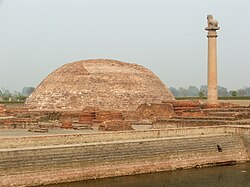
It was the capital city of the Vajjika League considered one of the first examples of a republic that dates from c. 6th century BCE. Gautama Buddha preached his last sermon before his mahaparinirvana in c. 544 BCE, and Vaishali is also home to two important stupas directly related to the Buddha, the Relic Stupa of Vaishali, which is said to contain the ashes of the Buddha,[3][6][2] The 24th and last Tirthankara of Jainism, Mahavira, was born in Kundagrama which has been identified as a suburb of the city of Vaishali and he was therefore referred to as Vesālie.[7]
In 383 BCE the Second Buddhist council was convened here by King Kalashoka.[8][9] It also contains one of the best-preserved of the Pillars of Ashoka from the 3rd century BCE, topped by a single Asiatic lion.
The city finds mention in the travel accounts of Chinese explorers, Faxian (4th century CE) and Xuanzang (7th century CE), which were later used in 1861 by British archaeologist Alexander Cunningham to first identify Vaiśālī with the present village of Basarh in the Vaishali District of Bihar.[10][11] Since 2010, parts of the Vaishali archaeological site including the relic stupa and Asokan pillar have been considered a tentative site under the UNESCO World Heritage Sites list, in the category of the Silk Road sites in India.[12]
Etymology[edit | edit source]
Vaishali derives its name from King Vishal of the Mahabharata age.[13]
History[edit | edit source]
Monarchy period[edit | edit source]
References to what has been termed the "monarchy period" of Vaishali come from literary sources including the Puranas and give an indication of the early Indo-Aryan expansion eastwards in to the Gangetic plains.[14] These sources detail that Vaivasvata Manu descendants settled and ruled in the region Vaishali starting with a King named Nābhānediṣṭha who is said to have founded the city. Traditional sources consider him to be a contemporary of Dasaratha, father of one of the greatest Kings during Treta Yuga Lord Rama, who is one avatars of Lord Vishnu. They belonged to the line of the Ikshvaku dynasty or the Sun Dynasty during ancient time in Bharat.
Republic period[edit | edit source]
.png)

The Vajjika League was likely established at some point between the Kosalan conquest of Kasi and the Magadhan conquest of Anga which would place it around the 6th century BCE.[15]
The Vajjika League was located on the territory of the former Mahā-Videha kingdom founded by the tribe of the Vaidehas, an Indo-Aryan tribe in the eastern Gangetic plain in the Greater Magadha cultural region.[16][17] Around 800 BCE the Mahā-Videha ("greater Videha") kingdom was established between the Sadānirā river in the west, the Kauśikī river in the east, the Ganges river in the south, and the Himālaya mountains in the north.[18]
Shortly before or during the lifetime of the Buddha, around the 7th or 6th century BCE, the Mahā-Videha kingdom was invaded by the Licchavikas, an Indo-Aryan tribe who temporarily occupied the Vaideha capital of Mithilā, from where they could best administer the territory of Videha. The consequence of the occupation of Videha by the republican Licchavikas was that the Licchavikas relatively peacefully overthrew the already weakened Vaideha monarchical system and replaced it by a republican system.[19][18]
Facing the rising power of Magadha to the south of the Ganges, the Licchavikas established their republic in the southern part of the former Videha kingdom and moved their political centre to the until then marginal location of Vesālī, which the Licchavikas turned into their largest city as well as their capital and stronghold. Meanwhile, the new Videha republic existed in a limited territory centred around Mithilā and located to the north of Licchavi. Many members of the Vaideha aristocracy who had submitted to the Licchavikas joined them in moving to Vesālī, and therefore became members of the Licchavika ruling aristocratic Assembly.[19][18]
Once settled around Vesālī, the Licchavikas formed a state organised as a gaṇasaṅgha (an aristocratic republic). The Licchavikas themselves henceforth became the leading power within the territory of the former Mahā-Videha kingdom, with the Licchavika Assembly holding the sovereign and supreme rights over this territory.[18] The Licchavikas founded the Vajjika League as a temporary league led by themselves, and named after the Vajji tribe proper, who had been the most powerful tribe in the region of Vesālī and were one of the constituent tribes of the league, within which they held their own sovereign rights.[20][21]
The Videha republic was ruled by an Assembly of the kṣatriyas residing in and around Mithilā, and governing in the name of the Licchavika Assembly: the Videha republic was thus under significant influence of the Licchavi republic, and it joined the Vajjika League, within which it had limited autonomy concerning their domestic administration under the supervision of Licchavi, who fully controlled Vaideha foreign policy.[19][18] The Nāyikas, who were a sub-group of the Vaidehas who formed an independent tribe, were another constituent republic of the Licchavi-led Vajjika League, and hence they held autonomy in matters of internal policy while their war and foreign policies were handled by the Vajjika League. The Licchavikas and the Mallakas were considered to be the republican states of Kāsī-Kosala by Jain sources, and both Mallaka republics joined the Licchavi-led Vajjika League to deal with danger they might have faced in common during periods of instability, and within which they held friendly relations with the Licchavikas, the Vaidehas, and the Nāyikas who were the other members of this league, although occasional quarrels did break out between these republics. Unlike the other confederate tribes such as the Vaidehas and Nāyikas, who had no sovereign rights of their own because they were dependencies of Licchavi, the Mallakas maintained their own sovereign rights within the Vajjika League.[19][22]
During the 6th century BCE, the Gaṇa Mukhya ("head of the republic") of the Licchavikas, that is the head of state of the Licchavikas and of their Council, was Ceṭaka or Ceḍaga, which also made him the head of the Council of the Vajjika League.[19] Ceḍaga's sister Trisalā was married to the Nāyika Gaṇa Mukhya Siddhārtha, with this marriage having been contracted because of Siddhārtha's political importance due to the important geographical location close to Vesālī of the Nāya tribe he headed, as well as due to Siddhārtha's membership in the Vajjika Council. The son of Siddhārtha and Trisalā, that is Ceḍaga's nephew, was Mahāvīra, the 24th Jain Tīrthaṅkara.[23] Ceṭaka became an adept of the teachings of his nephew Mahāvīra and adopted Jainism, thus making the Licchavika and Vajjika capital of Vesālī a bastion of Jainism, and his sixth daughter, Sujyeṣṭhā, became a Jain nun,[24] while the diplomatic marriages of his other daughters to various leaders, in turn, contributed to the spreading of Jainism across northern South Asia:[25] Prabhāvatī was married to the king Udāyana of Sindhu-Sauvīra;[26][24] Padmāvatī was married to king Dadhivāhana of Aṅga;[24] Mṛgāvatī was married to the king Śatānīka of Vatsa, with their son being the famous Udayana;[26][24] Śivā was married to king Pradyota of Avanti; [27][24] Jyeṣṭhā was married to Ceṭaka's nephew, Nandivardhana of Kuṇḍagāma, who was the son of Trisalā and the elder brother of Mahāvīra;[24] Cellaṇā was married to the king Bimbisāra of Magadha.[23][24]
After the death of the Buddha, the Licchavikas, the Mallakas, and the Sakyas claimed shares of his relics while the Vaidehas and the Nāyikas did not appear among the list of states claiming a share because they were dependencies of the Licchavikas without their own sovereignty, and therefore could not put forth their own claim while Licchavi could.[18]
By the time Xuanzang visited Vaiśālī in the early 7th century, it was on the decline: he wrote of it that "the capital is ruined" and "it may be called a village or town" (as opposed to a city).[28]:150
Visits of the Buddha to Vaiśālī[edit | edit source]

Vaishali is well known for its close association with the Buddha. After leaving Kapilavastu for renunciation, Prince Siddhartha came to Vaishali first and undertook his initial spiritual training from Uddaka Rāmaputta (Rāmaputra Udraka) and Āḷāra Kālāma. After the Enlightenment the Buddha frequently visited Vaishali. He organized the sangha on the pattern of Vaishalian democracy. It was here that he first allowed females to join the sangha, initiating his maternal aunt Mahaprajapati Gautami into the order. His last Varshavasa (rainy season resort) was here and he announced his approaching Mahaparinirvana (the final departure from the world) just three months in advance. Before leaving for Kusinagara, where he died, he left his alms-bowl (Bhiksha-Patra) here with the people of Vaishali.[29]
Jainism at Vaishali[edit | edit source]

The Śvetāmbaras state that the final Tirthankara, Lord Mahavira, was born and raised in Kshatriyakund district, Vaiśālī to King Siddhartha and Queen Trishala. According to the Jain text Uttarapurāṇa, King Chetaka ruled as a Republican President in Vaishali and was a famed ruler. He is also mentioned as a staunch follower of Jainism.[30] According to the text, Chetaka had ten sons and seven daughters. His sister Priyakarini (also known as Trishala) was married to Siddhartha of the Nāya clan.[30] His daughter Chellana married Shrenik (also known as Bimbisara).[31] As per Indologist Hermann Jacobi, Vardhaman Mahavira's mother Trishala was the sister of King Chetaka.[32]
Archaeological sites[edit | edit source]
 |
 |
.jpg) |
Relic stupa[edit | edit source]
The relic stupa is one of the archaeological finds in Vaishali. Here the Licchavis reverentially encased one of the eight portions of the Buddha's relics, which they received after the Mahaparinirvana. After his last discourse the Buddha set out for Kushinagar, but the Licchavis kept following him. The Buddha gave them his alms bowl but they still refused to return. He then created an illusion of a river in spate which compelled them to go back. This site can be identified with Deora in modern Kesariya village, where Ashoka later built a stupa.[33]
As per recent research, the relic stupa is potentially one of the earliest archaeologically known stupas.[3]
Fort of Raja Vishal[edit | edit source]
A group of ruins near the modern villages of Basarh have been termed by locals as "Raja Vishal ke Garh". Earlier excavations have found objects datedable to the Northern Black Polished Ware period from 500 BCE to 200 BCE and it is believed to be the remains of a citadel of palace during the Vajjika League period. The citadel and likely Vaishali itself was deserted by the period of the Later Gupta dynasty around 600 CE.[34] The historian, Nayanjot Lahiri dates the remains to the sixth century BCE.[35]
Kolhua[edit | edit source]
Excavations by the Archaeological Survey of India at Vaishali revealed the remains of Kutagarshala, a swastika-shaped monastery, a tank, votive stupas, miniature shrines, a main stupa, and an Ashokan pillar, spanning from the Mauryan (3rd century B.C.) to post-Gupta (7th century A.D.) periods. The 11-meter polished sandstone pillar known locally as "Lat," topped with a lion capital, is likely one of Ashoka's earliest pillars and features Gupta-era inscriptions but no edicts. A brick stupa commemorating the monkey chief's offering of honey to Buddha was initially built during the Mauryan era, expanded with a circumambulatory path in the Kushan period, and further modified during Gupta times.[12]
Nearby is the brick-lined, seven-tiered tank called ‘Markat-Hrad,’ believed to have been dug by monkeys for Buddha, measuring approximately 65 by 35 meters with bathing ghats. Kutagarshala, Buddha's seasonal residence, underwent three construction phases—from a small Chaitya (Sunga-Kushana) to a grand temple (Gupta) and finally a monastery with partition walls (post-Gupta).[12]
The Gupta-period swastika-shaped monastery, possibly for nuns, contains twelve rooms around a central courtyard, an eastern entrance, and a toilet. Artifacts such as semi-precious beads, terracotta figures, seals, inscribed pottery, and a unique terracotta crowned monkey found here are exhibited at the local ASI museum.[12]
World Peace Pagoda[edit | edit source]

Next to the coronation tank stands the Japanese temple and the Viśvā Śānti Stūpa (World Peace Pagoda) built by the Japanese Nichiren Buddhist sect Nipponzan-Myōhōji. A small part of the Buddha's relics found in Vaiśālī have been enshrined in the foundation and in the chhatra of the Stupa.
The Vaishali Museum was established in 1971 by the Archaeological Survey of India to preserve and display the antiquities found during the exploration of sites around ancient Vaishali.
Recent development[edit | edit source]
- In February 2019, Chief Minister of Bihar Nitish Kumar laid the foundation stone of Buddha Samyak Darshan Museum and Memorial Stupa to house Buddha relics.[36]
- In September 2020, Prime Minister of India Narendra Modi inaugurated the Vaishali Railway station. This rail line now connects the city with Hajipur and Patna.[37]
Historical figures from Vaishali[edit | edit source]

- Mahavira, the 24th Tirthankara of Jainism. Born into a royal kshatriya family in what is now Vaishali district of Bihar. He abandoned all worldly possessions at the age of 30 and became an ascetic. He is considered a slightly older contemporary of the Buddha.[38]
- Chetaka, King and ruler of the Vajjika League which had its capital in Vaishali.[39]
- Vimalakirti, the central figure of the Vimalakirti Sutra and a lay practitioner of Buddhism.[40]
- Gayadhara, 11th century Buddhist master and scholar [41][42]
See also[edit | edit source]

References[edit | edit source]
- ↑ 1.0 1.1 Prasad, Kameshwar (2015). The Glory that was Vaisali (From the Earliest Times to C. 600 C.E.). K. P. Jayaswal Research Institute, Patna. p. 52. ISBN 9788189785062.
- ↑ 2.0 2.1 Robert Beer, The Encyclopaedia of Tibetan Symbols and Motifs. Boston: Shambhala, 1991.
- ↑ 3.0 3.1 3.2 Fogelin, Lars (2015). An Archaeological History of Indian Buddhism. Oxford University Press. p. 85. ISBN 9780199948239.
- ↑ "Tirhut Division". tirhut-muzaffarpur.bih.nic.in. Archived from the original on 16 March 2015. Retrieved 26 December 2019.
- ↑ Thakur, Ripunjay Kumar (1 March 2022). "Historical Geography of Early Medieval Mithila: From Videha to Tirhut". New Archaeological & Genological Society, Kanpur, India. ISSN 2348-8301. Retrieved 21 August 2025.
- ↑ Lahiri, Nayanjot (2015). Ashoka in Ancient India. Harvard University Press. pp. 246–247. ISBN 9780674057777.
- ↑ Sharma 1968, pp. 159–166, The Nāyas.
- ↑ Hoiberg, Dale; Indu Ramchandani (2000). Students' Britannica India, Volumes 1-5. Popular Prakashan. p. 208. ISBN 0-85229-760-2. Archived from the original on 4 May 2021. Retrieved 28 June 2021.
- ↑ Kulke, Hermann; Dietmar Rothermund (2004). A history of India. Routledge. p. 57. ISBN 0-415-32919-1. Archived from the original on 28 June 2021. Retrieved 28 June 2021.
- ↑ Janice Leoshko (2017). Sacred Traces: British Explorations of Buddhism in South Asia. Taylor & Francis. p. 74. ISBN 978-1-351-55030-7. Archived from the original on 27 June 2021. Retrieved 28 June 2021.
- ↑ Dilip Kumar (1986). Archaeology of Vaishali. Ramanand Vidya Bhawan. p. 36. ISBN 9788185205083. OCLC 18520132. Archived from the original on 27 June 2021. Retrieved 28 June 2021.
- ↑ 12.0 12.1 12.2 12.3 "Silk Road Sites in India". UNESCO. UNESCO World Heritage Centre.
- ↑ "Vaishali". tourism.bihar.gov.in. Archived from the original on 18 January 2021. Retrieved 6 February 2021.
- ↑ Mishra 1962, p. 8.
- ↑ Mishra 1962, p. 98.
- ↑ Levman, Bryan G. (2014). "Cultural Remnants of the Indigenous Peoples in the Buddhist Scriptures". Buddhist Studies Review. 30 (2): 145–180. doi:10.1558/bsrv.v30i2.145. Retrieved 4 June 2022.
- ↑ Bronkhorst, Johannes (2007). Bronkhorst, J. (2007). Greater Magadha, Studies in the culture of Early India, p. 6. Leiden, Boston, MA: Brill. doi:10.1163/ej.9789004157194.i-416. ISBN 9789047419655.
- ↑ 18.0 18.1 18.2 18.3 18.4 18.5 Sharma 1968, p. 136-158.
- ↑ 19.0 19.1 19.2 19.3 19.4 Sharma 1968, p. 85-135.
- ↑ Sharma 1968, p. 83.
- ↑ Sharma 1968, p. 149.
- ↑ Sharma 1968, p. 169-181.
- ↑ 23.0 23.1 Sharma 1968, p. 159-168.
- ↑ 24.0 24.1 24.2 24.3 24.4 24.5 24.6 Deo 1956, p. 71.
- ↑ Jain 1974, p. 67.
- ↑ 26.0 26.1 Sikdar 1964, p. 388-464.
- ↑ Jain 1974, p. 66.
- ↑ Chattopadhyaya, Brajadulal (1994). The Making of Early Medieval India (PDF). New Delhi: Oxford University Press. ISBN 0-19-564076-4. Retrieved 17 July 2023.
- ↑ Brown, Robert (2009). "Telling the Story in Art of the Monkey's Gift of Honey to the Buddha". Bulletin of the Asia Institute. 23: 43–52. JSTOR 24049422.
- ↑ 30.0 30.1 Pannalal Jain 2015, p. 482.
- ↑ Pannalal Jain 2015, p. 484.
- ↑ Roy, Sita Ran (1968). "A Note on Ancient Architecture of Vaisali". Proceedings of the Indian History Congress. 30: 49–52. JSTOR 44141446.
- ↑ Prasad Sinha 1961, p. 3-4.
- ↑ Lahiri, Nayanjot (2015). Ashoka in Ancient India. Harvard University Press. p. 246. ISBN 9780674915251.
- ↑ Kumar, Madan (20 February 2019). "Nitish Kumar launches work for Buddha museum and stupa in Vaishali | Patna News - Times of India". The Times of India. Archived from the original on 28 June 2021. Retrieved 26 December 2019.
- ↑ PM inaugurates 12 railway projects in Bihar Archived 28 June 2021 at the Wayback Machine constructionweekonline.in
- ↑ Romesh Chunder Dutt (5 November 2013). A History of Civilisation in Ancient India: Based on Sanscrit Literature: Volume I. Routledge. pp. 382–383. ISBN 978-1-136-38189-8.
- ↑ Upinder Singh (2008). A History of Ancient and Early Medieval India: From the Stone Age to the 12th Century. Pearson Education India. pp. 260–263. ISBN 978-81-317-1677-9.
- ↑ The Holy Teaching of Vimalakīrti: A Mahāyāna Scripture. Motilal Banarsidass Publ. 1991. p. 20. ISBN 978-81-208-0874-4.
- ↑ Jayaswal, KP (1937). "Lost Sanskrit Works recovered from Tibet". Maha Bodhi and the United Buddhist World. 45: 89–101.
- ↑ Selected Essays of Rahul Sankrityayan. People's Publishing House. 1984. p. 9.
Bibliography[edit | edit source]
- Kumar, Dilip (1986). Archaeology of Vaishali. Ramanand Vidya Bhawan.
- Singer, Noel.F. (2008). Vaishali and the Indianization of Arakan. APH Publishing. ISBN 978-81-313-0405-1.
- Mishra, Yogendra (1962). An Early History of Vaiśālī: From the Earliest Times to the Fall of the Vajjian Republic, Circa 484 B.C. Motilal Banarsidass.
- Prasad Sinha, Bindeshwari (1961). Vaiśālī Excavations, 1958-1962. Directorate of Archaeology and Museums.
- Nath Prasad, Birendra (2021). "Urbanization in Early Historic Vaiśālī, c. 600 BCE-400 CE". Rethinking Bihar and Bengal: History, Culture and Religion. Routledge. ISBN 9781000465099.
- Deo, Shantaram Bhalchandra (1956). History of Jaina Monachism from Inscriptions and Literature. Pune, India: Deccan College Post-Graduate and Research Institute. ISBN 978-9-333-68377-7.
- Jain, Kailash Chand (1974). Lord Mahāvīra and His Times. Delhi, India: Motilal Banarsidass. p. 66. ISBN 978-8-120-80805-8.
- Sharma, J. P. (1968). Republics in Ancient India, C. 1500 B.C.-500 B.C. Leiden, Netherlands: E. J. Brill. ISBN 978-9-004-02015-3.
- Sikdar, Jogendra Chandra (1964). Studies in the Bhagawatīsūtra. Muzaffarpur, Bihar, India: Research Institute of Prakrit, Jainology & Ahimsa. pp. 388–464.
- Pannalal Jain (2015), Uttarapurāṇa of Āchārya Guṇabhadra, Bhartiya Jnanpith, ISBN 978-81-263-1738-7
- Sunavala, A.J. (1934), Adarsha Sadhu: An Ideal Monk. (First paperback edition, 2014 ed.), Cambridge University Press, ISBN 9781107623866, retrieved 1 September 2015
External links[edit | edit source]
Template:Ppn Template:RBK Template:Suttas

