

CleanupBot (talk | contribs) m clean up |
m improve intro for clarity |
||
| Line 1: | Line 1: | ||
{{short description|Pilgrimage in Indian religions}} | {{short description|Pilgrimage in Indian religions}} | ||
{{other uses|Yatra (disambiguation)|Jatra (disambiguation)}} | |||
{{more citations needed|date=December 2023}} | |||
{{italic title}} | |||
{{Contains special characters|Indic}} | {{Contains special characters|Indic}} | ||
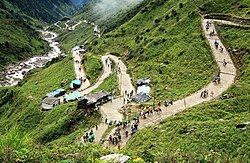
[[File:Kedarnathroute.jpg|thumb|[[Pilgrimage]] to [[Kedarnath]]]] | [[File:Kedarnathroute.jpg|thumb|[[Pilgrimage]] to [[Kedarnath]]]] | ||
{{Hinduism}} | |||
''' | '''''Yatra''''' ({{langx|sa|यात्रा|lit=journey, procession}}, {{IAST3|Yātrā}}), in [[Indian religion|Indian-origin religions]], Hinduism, Buddhism, [[Jainism]] and [[Sikhism]], generally means a pilgrimage<ref>{{Cite web|title=Pada Yatra: Foot Pilgrimage from Jaffna to Kataragama|url=http://padayatra.org/|access-date=2021-10-03|website=padayatra.org|archive-date=2021-10-15|archive-url=https://web.archive.org/web/20211015141938/http://padayatra.org/|url-status=live}}</ref> to holy places such as confluences of [[River#Sacred rivers|sacred rivers]], [[Sacred mountains#India|sacred mountains]], places associated with Hindu epics such as the [[Mahabharata]] and [[Ramayana]], and [[Hindu pilgrimage sites in India|other sacred pilgrimage sites]].<ref>{{cite book | last =Juergensmeyer | first =Mark | author-link =Mark Juergensmeyer | title =The Oxford Handbook of Global Religions | publisher =Oxford University Press | year =2006 | location =U.S. | isbn =0-19-513798-1 }}</ref> Visiting a sacred place is believed by the pilgrim to purify the self and bring one closer to the divine.<ref>{{cite book | last =Timothy | first =Dallen J. |author2=Daniel H. Olsen | title =Tourism, Religion and Spiritual Journeys | publisher =Routledge | year =2006 | isbn =0-415-35445-5 }}</ref> The journey itself is as important as the destination, and the hardships of travel serve as an act of devotion in themselves.<ref name="fowler">{{cite book|title=Hinduism: Beliefs and Practices|chapter=Yatra: Pilgrimage|last=Fowler|first=Jeaneane D.|publisher=[[Sussex Academic Press]]|year=1997|isbn=1-898723-60-5}}</ref> | ||
''' | A '''{{IAST|tīrtha-yātrā}}''' is a [[pilgrimage]] to a [[Tirtha and Kshetra|sacred site]].<ref name=":0" /> '''Yatri''' is the term for anyone who undertakes the yatra.<ref name=":0" /> | ||
In present times, yatras are highly organized affairs, with specialized | In present times, yatras are highly organized affairs, with specialized tourism companies catering to yatris. State governments are sometimes involved in the organization of annual yatras, stipulating numbers, registering yatris, and regulating yatri traffic.<ref>{{cite web|url=http://kashmirdivision.nic.in/about/services/amryatra.htm|title=Amarnath Yatra|publisher=Office of Divisional Commissioner, [[Jammu and Kashmir (state)|Jammu and Kashmir]] Government|url-status=dead|archive-url=https://web.archive.org/web/20071019102903/http://kashmirdivision.nic.in/about/services/amryatra.htm|archive-date=2007-10-19}}</ref><ref>{{cite book|chapter-url= https://books.google.com/books?id=tG0fnF0VRk0C&q=yatra+%22state+government%22&pg=PA94| title=Social, Cultural and Economic History of Himachal Pradesh|chapter=Holy ''Chhari'' or Manimahesh Yatra|last=Singh Ahluwalia|first=Manjit| year=1998|publisher=Indus Publishing|isbn=81-7387-089-6}}</ref> The Hindu sacred month of ''[[Shravana (month)|Shravan]]'' is also the time of the annual [[Kanwar Yatra]], the annual pilgrimage devotees of [[Shiva]], known as ''Kanwaria'', make to Hindu pilgrimage places of [[Haridwar]], [[Gaumukh]] and [[Gangotri]] in [[Uttarakhand]] to obtain water from the [[Ganges River]]. In 2003, 55 lakh (5.5 million) pilgrims visited Haridwar.<ref name="fr">{{cite magazine |url=http://www.hinduonnet.com/fline/fl2117/stories/20040827000206600.htm|title=SPOTLIGHT: The long walk for worship|volume=21|issue=17|date=August 14–27, 2004|magazine =[[Frontline (magazine)|Frontline]] |url-status=usurped|archive-url=https://web.archive.org/web/20100806091502/http://www.hinduonnet.com/fline/fl2117/stories/20040827000206600.htm|archive-date=2010-08-06}}</ref> Other [[Tirtha (Hinduism)|Tirtha]] pilgrimages are [[Char Dham]] Yatra, which involves [[Badrinath]], [[Kedarnath]], [[Gangotri]], and [[Yamunotri]]; [[Amarnath yatra]] in [[Jammu and Kashmir (state)|Jammu and Kashmir]]. | ||
There are numerous | There are numerous pilgrimage sites in India<ref>{{Cite web|title=List of Pilgrimage Sites in India|url=https://www.culturalindia.net/indian-pilgrimage/|access-date=2021-10-03|website=culturalindia.net|archive-date=2021-10-03|archive-url=https://web.archive.org/web/20211003085400/https://www.culturalindia.net/indian-pilgrimage/|url-status=live}}</ref> and [[Hindu pilgrimage sites|elsewhere]]. | ||
==Types of yatras == | ==Types of yatras == | ||
Reasons for going on a yatra may be in response to one's prayers being fulfilled.<ref>{{Cite book |last=Eck |first=Diana L. |url=https://www.google.com/books/edition/India/PyC4o7i9tnEC?hl=en&gbpv=0 |title=India: A Sacred Geography |date=2013-03-26 |publisher=Harmony/Rodale/Convergent |isbn=978-0-385-53192-4 |pages=9 |language=en}}</ref> | |||
In order of importance, in India there are 7 [[Sapta Puri]] holy cities, 4 Dhams ([[Char Dham]]) and 12 [[Jyotirlinga|Jyotirlings]] devoted to [[Shiva]], 51 [[Shakti Pitha]]s devoted to the feminine manifestation of the god, and the important [[Rama]] circuit ([[Ayodhya]], [[Chitrakoot, Madhya Pradesh#Places of tourist importance|Chitrakoot]], [[Hampi]] and [[Rameswaram]]) and Krishna circuit ([[Vraja Parikrama|Braj]], [[48 kos parikrama of Kurukshetra|Kurukshetra]] and [[Dwarka]]). | |||
''' | '''Holiest cities:''' [[Sapta Puri]] are [[Ayodhya]], [[Mathura]], [[Haridwar]], [[Varanasi]], [[Kanchipuram]], [[Ujjain]] and [[Dwarka]].{{citation needed|date=October 2024}} [[Kurukshetra]], includes [[Jyotisar]] where [[Bhagavad Gita]] was revealed, is another holy city.{{citation needed|date=October 2024}} | ||
'''Holy | '''Holy rivers:''' The [[ghat]]s of holiest rivers are sacred, including [[Ganges]], [[Yamuna]], [[Sarasvati River]] ([[Ghaggar-Hakra River|Ghaggar River]]), [[Narmada]] etc.{{citation needed|date=October 2024}} | ||
'''Holy | '''Holy mountains:''' such as [[Mount Kailash]],<ref>{{Cite news|last=Sengar|first=Resham|title=Mount Kailash facts: mindboggling things you may not know about Shiva's home|url=https://timesofindia.indiatimes.com/travel/destinations/mount-kailash-facts-mindboggling-things-you-may-not-know-about-lord-shivas-home/as61220500.cms |date= Nov 8, 2019 |access-date=2021-10-03|newspaper=The Times of India|archive-date=2021-08-05|archive-url=https://web.archive.org/web/20210805003202/https://timesofindia.indiatimes.com/travel/destinations/mount-kailash-facts-mindboggling-things-you-may-not-know-about-lord-shivas-home/as61220500.cms|url-status=live}}</ref> [[Badrinath]], [[Kedarnath]], [[Gangotri]], and [[Yamunotri]], [[Bandarpunch|Sarasvatotri]], etc. | ||
'''Holy [[Tirtha (Hinduism)|tirtha]]s (places):''' such as [[Char Dham]] and [[Himalaya]]n [[Chota Char Dham]] ([[Badrinath]], [[Kedarnath]], [[Gangotri]], and [[Yamunotri]]),<ref>{{Cite web |title=Char Dham Yatra 2025 - Chardham Yatra Travel Guide 2025 - Char Dham Yatra Tour |url=https://www.sacredyatra.com/ |url-status=live |archive-url=https://web.archive.org/web/20210919121232/https://www.sacredyatra.com/ |archive-date=2021-09-19 |access-date=2021-10-03 |website=sacredyatra.com}}</ref> and [[Varanasi]], [[Prayagraj]], [[Haridwar]]-[[Rishikesh]], [[Mathura]]-[[Vrindavan]], [[Ayodhya]], [[Ujjain]], [[Dwarka]] and [[Rameswaram]].<ref>{{Cite news|last=ANI|date=2017-07-27|title="Sacred" Rameswaram gave India one of its most famous sons: PM Modi|work=Business Standard India|url=https://www.business-standard.com/article/news-ani/sacred-rameswaram-gave-india-one-of-its-most-famous-sons-pm-modi-117072700622_1.html|access-date=2021-10-03|archive-date=2021-10-03|archive-url=https://web.archive.org/web/20211003085359/https://www.business-standard.com/article/news-ani/sacred-rameswaram-gave-india-one-of-its-most-famous-sons-pm-modi-117072700622_1.html|url-status=live}}</ref> See also [[Tirtha and Kshetra]]. | |||
[[Shakambhari]] temple Saharanpur, Uttar Pradesh | |||
* Sacred river circuit: Yatra to and [[parikrama]] of sacred rivers include [[Ganges]], [[Yamuna]], [[Sarasvati]], [[Narmada River|Narmada]], etc. | * Sacred river circuit: Yatra to and [[parikrama]] of sacred rivers include [[Ganges]], [[Yamuna]], [[Sarasvati]], [[Narmada River|Narmada]], etc. | ||
'''Holy | '''Holy fairs and [[List of Hindu festivals|Hindu festivals]]:''' The [[Kumbh Mela]] (the "pitcher festival") is one of the holiest of Hindu pilgrimages that is held four times every 12 years<ref>{{Cite web|title=Maha Kumbh 2021 - Haridwar Kumbh Mela 2021 India|url=https://www.kumbhamela.net/|access-date=2021-10-03|website= kumbhamela.net|archive-date=2021-10-03|archive-url=https://web.archive.org/web/20211003085400/https://www.kumbhamela.net/|url-status=live}}</ref> rotating among the four cities of [[Prayagraj]], [[Haridwar]], [[Nashik]], and [[Ujjain]]. The [[Mahamaham]] in temple town of [[Kumbakonam]] is also celebrated once in 12 years. Annual [[Gita Mahotsav]] at [[Kurukshetra]], [[Shravani Mela]] at [[Deoghar]], and [[Pitru Paksha#When and where|Pitrapaksha Mela]] at [[Gaya, India|Gaya]] are also notable holy fairs. | ||
'''Holy | '''Holy temples:''' Examples are the [[Char Dham]] of [[Rameswaram]], [[Dwarka]], [[Puri]] and [[Badrinath]]; [[Katra, Jammu and Kashmir|Katra]], home to the [[Vaishno Devi]] temple; [[Puri]] home to [[Vaishnavism|Vaishnava]] [[Jagannath]] temple and [[Rath Yatra]] celebration;<ref>{{Cite web|title=SHRI MATA VAISHNO DEVI SHRINE BOARD {{!}} Official Website|url=https://www.maavaishnodevi.org/|access-date=2021-10-03|website= maavaishnodevi.org|archive-date=2019-08-16|archive-url=https://web.archive.org/web/20190816065328/https://www.maavaishnodevi.org/|url-status=live}}</ref> [[Tirumala - Tirupati|Tirumala – Tirupati]], home to the [[Tirumala Venkateswara Temple]]; [[Sabarimala]] home to [[Ayyappan|Swami Ayyappan]]; the 108 [[Divya Desam]]s; the [[Shakti Peethas]]; the twelve [[Jyotirlingas|Maha Jyotirlingas]]; the seven [[Sapta Puri]]; the [[Pancha Bhoota Stalam]]. | ||
'''Holy processions:''' 'Yatra' can also be described as a procession, or any festival which figures a procession, such as [[Kanwar Yatra]] and [[Rath Yatra]]. In Rath Yatra, chariots are pulled in parade down the streets of [[Puri (city)|Puri]] in [[Orissa, India|Orissa]]. In modern times the word can be used to denote marches or demonstrations, for political, environmental or societal causes.<ref>{{cite news|url=http://www.thesouthasian.org/archives/2006/jal_adhikar_yatra_takes_off.html|title=Jal Adhikar Yatra Takes Off|date=September 10, 2006|publisher=The South Asian}}</ref><ref>{{cite news|url=http://www.thehindubusinessline.com/2005/10/03/stories/2005100302571300.htm|title='Save Noyyal Yatra' draws good crowd|date=October 3, 2005|publisher=[[The Hindu]] Business Line|access-date=2008-02-26|archive-url=https://web.archive.org/web/20090607215048/http://www.thehindubusinessline.com/2005/10/03/stories/2005100302571300.htm|archive-date=2009-06-07|url-status=dead}}</ref><ref>{{cite news|url=http://www.whiteband.org/media/gcap-news/archives/gcapnews.2007-07-03.0004416740|title=India's rally for Right to Education - Shiksha Adhikar Yatra|date=July 3, 2007|publisher=[[Global Call to Action Against Poverty]]|url-status=dead|archive-url=https://web.archive.org/web/20080719163450/http://www.whiteband.org/media/gcap-news/archives/gcapnews.2007-07-03.0004416740/|archive-date=July 19, 2008}}</ref> The terms '[[wikt:jatra|jatra]]' and '[[zatra]]' are derived from yatra. | '''Holy processions:''' 'Yatra' can also be described as a procession, or any festival which figures a procession, such as [[Kanwar Yatra]] and [[Rath Yatra]]. In Rath Yatra, chariots are pulled in parade down the streets of [[Puri (city)|Puri]] in [[Orissa, India|Orissa]]. In modern times the word can be used to denote marches or demonstrations, for political, environmental or societal causes.<ref>{{cite news|url=http://www.thesouthasian.org/archives/2006/jal_adhikar_yatra_takes_off.html|title=Jal Adhikar Yatra Takes Off|date=September 10, 2006|publisher=The South Asian|access-date=February 26, 2008 |url-status=dead |archive-url=https://web.archive.org/web/20080829164755/http://www.thesouthasian.org/archives/2006/jal_adhikar_yatra_takes_off.html |archive-date= Aug 29, 2008 }}</ref><ref>{{cite news|url=http://www.thehindubusinessline.com/2005/10/03/stories/2005100302571300.htm|title='Save Noyyal Yatra' draws good crowd|date=October 3, 2005|publisher=[[The Hindu]] Business Line|access-date=2008-02-26|archive-url=https://web.archive.org/web/20090607215048/http://www.thehindubusinessline.com/2005/10/03/stories/2005100302571300.htm|archive-date=2009-06-07|url-status=dead}}</ref><ref>{{cite news|url=http://www.whiteband.org/media/gcap-news/archives/gcapnews.2007-07-03.0004416740|title=India's rally for Right to Education - Shiksha Adhikar Yatra|date=July 3, 2007|publisher=[[Global Call to Action Against Poverty]]|url-status=dead|archive-url=https://web.archive.org/web/20080719163450/http://www.whiteband.org/media/gcap-news/archives/gcapnews.2007-07-03.0004416740/|archive-date=July 19, 2008}}</ref> The terms '[[wikt:jatra|jatra]]' and '[[zatra]]' are derived from yatra. | ||
'''Holy | '''Holy deities: ''' [[kuladevata|Kuladaivat]] Hindu families have their own family patron deity.<ref>{{Cite web|title=Frequently Asked Questions on Kuladev and Kuldevi|url=https://www.hindujagruti.org/hinduism/hindu-gods/goddess-durga/faq-kuldevi|access-date=2021-10-03|website=Hindu Janajagruti Samiti|language=en-US|archive-date=2021-10-03|archive-url=https://web.archive.org/web/20211003085400/https://www.hindujagruti.org/hinduism/hindu-gods/goddess-durga/faq-kuldevi|url-status=live}}</ref> This deity is common to a lineage, a clan or a locality. | ||
'''[[Samadhi (shrine)|Samadhis]] (shrines) of [[Sadhu]]s (Saints):''' [[Alandi]], Samadhi of Dnyaneshwar: [[Mantralayam]], samadhi of [[Raghavendra Tirtha]], [[Belur Math]] which enshrine that Holy remains of [[Sri Ramakrishna]], [[Sri Sarada Devi]], [[Swami Vivekananda]] Puri, and other direct Disciples of Sri Ramakrishna, [[Tulsi Ghat]], [[Varanasi]] where Saint [[Tulsidas]] left his mortal coil, Samadhi Mandir of Saint [[Kabir]] at [[Gorakhpur]], near [[Varanasi]], Panchaganga Ghat, Varanasi where [[Trailanga Swami]] lived and left his mortal body, Karar Ashram, [[Puri]] where [[Swami Sri Yukteswar Giri]], attained the Mahasamadhi.<ref>Yogananda, Paramahansa (1997). Autobiography of a Yogi, 1997 Anniversary Edition p. 383. Self-Realization Fellowship (Founded by Yogananda) http://www.yogananda-srf.org/,</ref> | '''[[Samadhi (shrine)|Samadhis]] (shrines) of [[Sadhu]]s (Saints):''' [[Alandi]], Samadhi of Dnyaneshwar: [[Mantralayam]], samadhi of [[Raghavendra Tirtha]], [[Belur Math]] which enshrine that Holy remains of [[Sri Ramakrishna]], [[Sri Sarada Devi]], [[Swami Vivekananda]] Puri, and other direct Disciples of Sri Ramakrishna, [[Tulsi Ghat]], [[Varanasi]] where Saint [[Tulsidas]] left his mortal coil, Samadhi Mandir of Saint [[Kabir]] at [[Gorakhpur]], near [[Varanasi]], Panchaganga Ghat, Varanasi where [[Trailanga Swami]] lived and left his mortal body, Karar Ashram, [[Puri]] where [[Swami Sri Yukteswar Giri]], attained the Mahasamadhi.<ref>Yogananda, Paramahansa (1997). Autobiography of a Yogi, 1997 Anniversary Edition p. 383. Self-Realization Fellowship (Founded by Yogananda) http://www.yogananda-srf.org/ {{Webarchive|url=https://web.archive.org/web/20201218022612/http://www.yogananda-srf.org/ |date=2020-12-18 }},</ref> | ||
==Important national pilgrimage circuits of Indic-religions== | ==Important national pilgrimage circuits of Indic-religions== | ||
{{anchor | Circuit | Circuits | National circuit | National yatra | Rashtriya yatra | National Yatra | Rashtriya Yatra | Yatra circuit | Yatra Circuit }} | {{anchor | Circuit | Circuits | National circuit | National yatra | Rashtriya yatra | National Yatra | Rashtriya Yatra | Yatra circuit | Yatra Circuit }} | ||
A yatra or pilgrimage across a much larger area covering multiple faraway cities or sites, related to a specific deity or theme, are called the "circuit". Three most important Hindu-Buddhist "Rahtriya yatra" (national pilgrimage circuit) are related to the important figures such as Rama, Krishna, Buddha, and Guru Nanak, where they had personally visited are as follows. | |||
* [[Hindu pilgrimage sites|Hindu circuit]], many of which are also related to [[List of Hindu empires and dynasties|greatest Hindu empires and dynasties]]. | |||
** Fairs and [[List of Hindu festivals|festivals]] | |||
*** [[Kumbh Mela]] | |||
**** [[Barahachhetra]] – a semi-Kumbh Mela in Sunsari Nepal | |||
**** [[Mahamaham]] – the Tamil Kumbh Mela | |||
*** [[Gita Mahotsav]] | |||
*** [[Maghi]] – a Sikh festival recognised by [[Guru Amar Das]] | |||
*** [[Pushkaram]] – the river festivals of Karnataka, Andhra Pradesh and Telangana | |||
*** [[Pushkar Fair]] – the springtime fair in Rajasthan, includes the tradition of a dip in the Pushkar lake | |||
** [[Krishna]] circuit: <br>This prikarma entails the [[Vraja Parikrama]], [[48 kos parikrama of Kurukshetra]], [[Dwarka]], [[Bhalka]] (place of death of Krishna). | |||
** [[Rama]] circuit – [[Ram Van Gaman Path]]: <br>This prikarma entails [[Ayodhya]], [[Chitrakoot, Madhya Pradesh#Places of tourist importance|Chitrakoot]], [[Hampi]] and [[Rameswaram]]. | |||
** [[Sapta Puri]], 7 holiest Hindu cities in India viz. [[Ayodhya]], [[Mathura]], [[Haridwar]], [[Varanasi]], [[Kanchipuram]], [[Ujjain]], [[Dwarka]]. | |||
** [[Shakti Pitha]]s | |||
** [[Shiva]] circuits | |||
*** [[Char Dham]], holiest pilgrimage circuit of 4 sites viz. Badrinath, Dwaraka, Puri and Rameswaram. | |||
*** [[Chota Char Dham]], smaller pilgrimage circuit of 4 sites in Uttarakhand viz. Yamunotri, Gangotri, Kedarnath, and Badrinath. | |||
*** [[Jyotirlinga|Maha Jyotirlinga]], 12 holiest Shiva lingam temples in India. | |||
*** [[Mount Kailash]] and [[Lake Manasarovar]] yatra circuit. | |||
* Buddha circuit: <br>These prikarma entails the following: | |||
** [[List of places where Gautama Buddha stayed|places Lord Buddha stayed]], | |||
** [[Buddhist pilgrimage sites]] in [[Buddhist pilgrimage sites in India|India]] and [[Buddhist pilgrimage sites in Nepal|Nepal]] which cover prominent historic Buddhist sites at [[Lumbini]], [[Bodh Gaya]], [[Sarnath]], [[Sravasti]] ([[Jetavana]]), [[Rajgir Hills]], [[Kurukshetra]] ([[Bodh Stupa]] on bank of [[Brahma Sarovar]], pilgrimage undertaken by Buddha), [[Sugh Ancient Mound|Shrughna]] ([[Yamunanagar]], vihara visited by Buddha for sermon), [[Adi Badri, Haryana|Adi Badri]] (saraswati udgam sthal and vihara visited by Buddha), [[Parinirvana Stupa]] (place of death and [[nirvana]] of Buddha at [[Kushinagar]], and [[Sankissa]]. | |||
** [[Buddhism in Japan|Japan]] has but many Buddhism related pilgrim yatras, such as [[Shikoku Pilgrimage]], eighty-eight temples pilgrimage in the Shikoku island, [[Japan 100 Kannon Pilgrimage]]. | |||
* Sikh circuit: <br>This prikarma entails the following: | * Sikh circuit: <br>This prikarma entails the following: | ||
** [[Panj Takht]], namely [[Golden Temple]], [[Takht Sri Patna Sahib]], [[Hazur Sahib|Nanded Hazur Sahib]], [[Takht Sri Damdama Sahib|Takht Sri Damdama Sahib Bhatinda]], and [[Anandpur Sahib]]. | ** [[Panj Takht]], namely [[Golden Temple]], [[Takht Sri Patna Sahib]], [[Hazur Sahib|Nanded Hazur Sahib]], [[Takht Sri Damdama Sahib|Takht Sri Damdama Sahib Bhatinda]], and [[Anandpur Sahib]]. | ||
** [[Guru Nanak]]'s birth and death places at [[Gurdwara Janam Asthan]] and [[Kartarpur Corridor]] (both in Pakistan | ** [[Guru Nanak]]'s birth and death places at [[Gurdwara Janam Asthan]] and [[Kartarpur Corridor]] (both in Pakistan), his travels called [[Guru Nanak#Odysseys (Udasis)|udasi]]. | ||
** Martyrs's places at [[Gurudwara Sis Ganj Sahib]] and [[Fatehgarh Sahib]] of martyrdom of [[Guru Tegh Bahadur]] and children of Guru Gobind Singh respectively by Muslim rulers for refusing to convert to Islam | ** Martyrs's places at [[Gurudwara Sis Ganj Sahib]] and [[Fatehgarh Sahib]] of martyrdom of [[Guru Tegh Bahadur]] and children of Guru Gobind Singh respectively by Muslim rulers for refusing to convert to Islam. | ||
** Place of pilgrims by Sikh Gurus: [[Kurukshetra]], [[Kapal Mochan]], [[Paonta Sahib]], etc. | ** Place of pilgrims by Sikh Gurus: [[Kurukshetra]], [[Kapal Mochan]], [[Paonta Sahib]], etc. | ||
** Capitals of important Sikh states: [[Lahore]] (capital of largest Sikh state of Maharaja [[Ranjit Singh]]) and [[Lohgarh (Bilaspur)|Lohgarh]] (capital of Sikh state founded by Baba [[Banda Bahadur]] in Yamunanagar). | ** Capitals of important Sikh states: [[Lahore]] (capital of largest Sikh state of Maharaja [[Ranjit Singh]]) and [[Lohgarh (Bilaspur)|Lohgarh]] (capital of Sikh state founded by Baba [[Banda Bahadur]] in Yamunanagar). | ||
** [[Fateh Burj]] at Chapar Chiri where Banda bahadur defeated mughals in [[Battle of Chappar Chiri]] and avenged murder of Sikh gurus and their children. | ** [[Fateh Burj]] at Chapar Chiri where Banda bahadur defeated mughals in [[Battle of Chappar Chiri]] and avenged murder of Sikh gurus and their children. | ||
* Jain circuit: | |||
** Many of the [[List of Jain temples|Jain tirthas]] are related to the [[Tirthankara]], or | |||
** they are among the newly constructed [[List of largest Jain temples|largest Jain temples]]. | |||
==Famous yatras== | ==Famous yatras== | ||
| Line 70: | Line 83: | ||
===48 kos parikrama of Kurukshetra === | ===48 kos parikrama of Kurukshetra === | ||
[[File:48_kos_parikrama.jpg|thumb|240x180px|right|48 kos parikrama route related to | {{Main|48 kos parikrama}} | ||
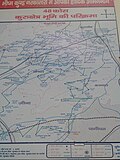
[[File:48_kos_parikrama.jpg|thumb|240x180px|right|48 kos parikrama route related to Krishna and Mahabharata in and around Kurukshetra in Haryana]] | |||
[[48 kos parikrama of Kurukshetra]], phrase meaning a 48 [[Kos (unit)|kos]] circumambulation [[parikrama]] of various [[Mahabharata]]-related and other pilgrimage sites, around the holy city of [[Kurukshetra]] in the state of [[Haryana]], India.<ref>{{cite web |url=http://www.kurukshetra.nic.in/MAPs/ReligiousMap/map.jpg |title=Kurukshetra map |website=kurukshetra.nic.in |access-date=24 July 2016 |archive-url=https://web.archive.org/web/20160625103022/http://www.kurukshetra.nic.in/MAPs/ReligiousMap/map.jpg |archive-date=25 June 2016 |url-status=dead |df=dmy-all }}</ref><ref name="hartour">{{cite web | url=http://haryanatourism.gov.in/showpage.aspx?contentid=5106 | title=Haryana Tourism | access-date=24 July 2016 | archive-date=10 August 2016 | archive-url=https://web.archive.org/web/20160810011703/http://haryanatourism.gov.in/showpage.aspx?contentid=5106 | url-status=live }}</ref><ref name="cmhry">{{cite web | url=http://haryanacmoffice.gov.in/newsupdates/details/id/737 | title=Development of all pilgrimage sites located within a radius of 48 kos (miles) of Kurukshetra would be carried out | date=11 October 2015 | publisher=Chief Minister's Office, Haryana | access-date=24 July 2016 | archive-date=27 July 2016 | archive-url=https://web.archive.org/web/20160727083349/http://haryanacmoffice.gov.in/newsupdates/details/id/737 | url-status=live }}</ref><ref name="harekrsna">{{cite web | url=http://www.harekrsna.com/sun/features/05-12/features2460.htm | title=The 48 Kos Kurukshetra Region | publisher=harekrsna.com | access-date=24 July 2016 | archive-date=27 July 2016 | archive-url=https://web.archive.org/web/20160727020355/http://www.harekrsna.com/sun/features/05-12/features2460.htm | url-status=live }}</ref> Within Kurukshetra, along with Brahma Sarovar, other important sites are [[Jyotisar]] (place of ''"Gitaupadesha"'' – the first [[Upadeśa]] or discourse of [[Bhagavad Gita]] by Krishna)<ref>[http://www.kurukshetra.nic.in/tour/Religious/tirath/Kurukshetra/014-joytisar/index.htm Jyotisar] {{Webarchive|url=https://web.archive.org/web/20180419185214/http://kurukshetra.nic.in/tour/Religious/tirath/Kurukshetra/014-joytisar/index.htm |date=2018-04-19 }} Kurukshetra district website.</ref><ref>{{cite web | title = Jyotisar | publisher = [[Haryana Tourism Corporation Limited]] | url = http://haryanatourism.gov.in/showpage.aspx?contentid=5326 | access-date = 2014-08-08 | archive-date = 2017-02-15 | archive-url = https://web.archive.org/web/20170215035251/http://haryanatourism.gov.in/showpage.aspx?contentid=5326 | url-status = live }}</ref> and [[Sannihit Sarovar]] ([[Hindu genealogy registers at Kurukshetra, Haryana|Hindu genealogy registers of Kurukshetra]] are kept here).<ref>{{cite web| title = Tirath in Kurukshetra - Sannehit Sarovar| publisher = Kurukshetra district website| url = http://www.kurukshetra.nic.in/tour/Religious/tirath/Kurukshetra/011-sanhitsarovar/index.htm| access-date = 2014-08-08| archive-date = 2014-08-06| archive-url = https://web.archive.org/web/20140806210713/http://www.kurukshetra.nic.in/tour/Religious/tirath/Kurukshetra/011-sanhitsarovar/index.htm| url-status = dead}}</ref> Since this is a site associated with the Mahabharata, it is an important place of pilgrimage for Hindus. It is one of 3 main pilgrimage sites related to ''"Krishna"'' circuit. The other two being, ''"[[Vraja Parikrama|Braj parikarma]]"'' in [[Mathura]], [[Uttar Pradesh]] and "''[[Dwarkadhish Temple#Pilgrimage|Dwarka parkarma]]''" (Dwarkadish yatra) at [[Dwarkadhish Temple]] in [[Gujarat]]. | |||
===84 Kosi Parikrama=== | |||
The 84-Kosi Yatra is a tradition in Hindu religion that has been there for thousands of years with the belief that it gives deliverance to the performer from the cycle of 84-Lakh Yonis (the cycle of birth and death). According to Hindu belief, the king of Ayodhya performed the "yagna" in the "treta period" at a place in Makhurha in Basti district of [[Uttar Pradesh]] which included circumnavigating the six districts in the region. Some religious leaders believe that the right place to start the parikrama should be Basti instead of Ayodhya. According to some, the dates for 84-Kosi Yatra are fixed and takes place in the month of [[Chaitra]]. | |||
=== | ===Mithila Madhya Parikrama=== | ||
{{Main| Mithila Madhya Parikrama}} | |||
[[Mithila Madhya Parikrama]] is an annual fifteen days journey of the central part of ancient [[Mithila (region)|Mithila]]. It is the ancient circular circuit of the capital city of Mithila. In [[Treta Yuga]], [[Rama|Lord Rama]] and Princess [[Sita]] took a circle journey of the capital of Mithila after their marriage in the court of King [[Janaka]] in Mithila. This Yatra is held every year in the month of [[Falgun]] in Hindu calendar. | |||
=== Sitamarhi Dham Parikrama === | |||
{{Main|Sitamarhi Dham Parikrama}} | |||
Sitamarhi Dham Parikrama is an annual nineteen days spiritual journey of some Hindu religious destinations in the region of the Sitamarhi district. It is organised to aware the importance of the Janaki Navami festival. | |||
===Amarnath Yatra=== | ===Amarnath Yatra=== | ||
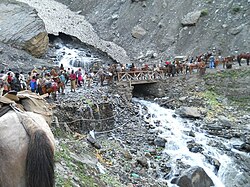
[[File:Amarnath yatra.jpg|thumb|Pilgrims crossing a narrow bridge to the holy shrine of Amarnath | [[File:Amarnath yatra.jpg|thumb|Pilgrims crossing a narrow bridge to the holy shrine of Amarnath]] | ||
The [[Amarnath Temple]] in Jammu and Kashmir is dedicated to Shiva, one of the trinity of gods. The temple is on [[Amarnath Peak]], and is among the most famous shrines in Hinduism. Every year inside the main Amarnath cave an ice Shiva [[lingam]] forms, along with two other ice formations representing Ganesha and Parvati. Amarnath yatra is held every year to pay homage to Shiva and Parvati. The temple is a very popular yatra destination for Hindus; about four lakh people visit during the season. | The [[Amarnath Temple]] in Jammu and Kashmir is dedicated to Shiva, one of the trinity of gods. The temple is on [[Amarnath Peak]], and is among the most famous shrines in Hinduism. Every year inside the main Amarnath cave an ice Shiva [[lingam]] forms, along with two other ice formations representing Ganesha and Parvati. Amarnath yatra is held every year to pay homage to Shiva and Parvati. The temple is a very popular yatra destination for Hindus; about four lakh people visit during the season. | ||
===Brij Yatra=== | ===Brij Yatra=== | ||
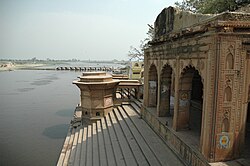
[[File:KesiGhat_River.JPG|thumb|240x180px|right|Kesi Ghat in vrindavan in the Yamuna River | [[File:KesiGhat_River.JPG|thumb|240x180px|right|Kesi Ghat in vrindavan in the Yamuna River]] | ||
[[Vraja Parikrama]] circuit of pilgrimage was formally established by the 16th century [[sadhu]]s of [[Sampradaya#Vaishnava sampradayas|vaishnava sampradaya]] with fixed routes, itinerary and rituals. The circuit covers is spread across 2500 km<sup>2</sup> area with 84 [[Kos (unit)|kos]] or 300 km long periphery extending 10 km to east and 50 km to north and west. Braj has two main types of pilgrimage circuits, the traditional longer ''"Braj Yatra"'' encompassing the whole circuit, and the other shorter significantly modified contemporary point-to-point pilgrimage to visit the main sites at Mathura, Vrindavan, [[Gokul]], [[Govardhan]]. The former, longer traditional pilgrimage route, also includes additional sacred sites [[Nandgaon, Uttar Pradesh|Nandgaon]] and [[Barsana]] with travel on foot.<ref name=janet1>Janet Cochrane, 2008, [https://books.google.com | [[Vraja Parikrama]] circuit of pilgrimage was formally established by the 16th century [[sadhu]]s of [[Sampradaya#Vaishnava sampradayas|vaishnava sampradaya]] with fixed routes, itinerary and rituals. The circuit covers is spread across 2500 km<sup>2</sup> area with 84 [[Kos (unit)|kos]] or 300 km long periphery extending 10 km to east and 50 km to north and west. Braj has two main types of pilgrimage circuits, the traditional longer ''"Braj Yatra"'' encompassing the whole circuit, and the other shorter significantly modified contemporary point-to-point pilgrimage to visit the main sites at Mathura, Vrindavan, [[Gokul]], [[Govardhan]]. The former, longer traditional pilgrimage route, also includes additional sacred sites [[Nandgaon, Uttar Pradesh|Nandgaon]] and [[Barsana]] with travel on foot.<ref name=janet1>Janet Cochrane, 2008, [https://books.google.com/books?id=LC4c7i3WrPgC&dq=Braj+region+covers+haryana+and+rajasthan&pg=PA249 Asian Tourism: Growth and Change] {{Webarchive|url=https://web.archive.org/web/20230407145723/https://books.google.com/books?id=LC4c7i3WrPgC&dq=Braj+region+covers+haryana+and+rajasthan&pg=PA249 |date=2023-04-07 }}, page 249.</ref> | ||
===Char Dham Yatra=== | ===Char Dham Yatra=== | ||
The [[Chardham]] | The [[Chardham]] or "four divine abodes" includes four major pilgrimage places in India. These include [[Badrinath]] in the Himalayas, [[Dwarka]] in the west, [[Jagannath Puri]] in the east, and [[Rameshwaram]] in the south.<ref name=":0">{{Cite book |last=Lochtefeld |first=James G. |url=https://books.google.com/books?id=AbWazgEACAAJ |title=The Illustrated Encyclopedia of Hinduism: A-M |date=2002 |publisher=Rosen |isbn=978-0-8239-3179-8 |pages=182, 229, 330-331, 699-700, 780 |language=en}}</ref> The Char Dham is often considered the most revered sites for Hindus that have to be visited in one's lifetime. There is a [[Chota Char Dham]] as well includes Yamunotri, Gangotri, Badrinath, and [[Kedarnath]] situated in [[Garhwal Himalayas]]. | ||
===Deoghar Yatra=== | ===Deoghar Yatra=== | ||
[[Deoghar]] means abode of the gods and goddesses. It is also known as Baidyanath Dham or Baba Dham situated on the eastern side of [[Jharkhand]]. | [[Deoghar]] means abode of the gods and goddesses. It is also known as Baidyanath Dham or Baba Dham situated on the eastern side of [[Jharkhand]]. The [[Baidyanath]] Temple is located here containing one of the twelve Shiva [[Jyothirlingam]]s in India.<ref name=":0" /> The pilgrims carry the holy water of holy river Ganges from [[Sultanganj]]'s and offered to the Jyotirlingam of Shiva at Deoghar. These pilgrims called Kanwariya, reciting Bol Bam on the way of walk 109 km, The march of Kanwariya start during the holy month of Shravan the wet season each year in India. [[Shraavana#Shravani Mela|Shravani Mela]] is the most celebrated 30-day festival in [[Baidyanath Temple]] Temple of Jharkhand. | ||
===Kailash-Mansarovar Yatra=== | ===Kailash-Mansarovar Yatra=== | ||
[[Lake Manasarovar|Mansarovar]] is a fresh-water lake in [[Tibet]] near Mount [[Kailash]], and both are places of pilgrimage attracting religious people from India and neighboring countries. The mountain is considered a sacred place in four religions: Hinduism, Buddhism, [[Jainism]], and [[Bon]]. According to Hindu mythology mount Kailash is the abode of Shiva and circumambulating Mount Kailash on foot is a holy ritual. Another lake called Lake [[Rakshastal]] lying close to the west of Lake Manasarovar and The Great Mount Kailash. These lakes are the source of the [[Brahmaputra]] River and the [[Karnali River]], a tributary of the river Ganges. | [[Lake Manasarovar|Mansarovar]] is a fresh-water lake in [[Tibet]] near Mount [[Kailash]], and both are places of pilgrimage attracting religious people from India and neighboring countries. The mountain is considered a sacred place in four religions: Hinduism, Buddhism, [[Jainism]], and [[Bon]]. According to Hindu mythology mount Kailash is the abode of Shiva and circumambulating Mount Kailash on foot is a holy ritual.<ref name=":0" /> Another lake called Lake [[Rakshastal]] lying close to the west of Lake Manasarovar and The Great Mount Kailash. These lakes are the source of the [[Brahmaputra]] River and the [[Karnali River]], a tributary of the river Ganges. | ||
===Kanwar Yatra=== | ===Kanwar Yatra=== | ||
{{Main|Kanwar Yatra}} | |||
The [[Kanwar Yatra]] is an annual pilgrimage of devotees of Shiva, known as ''Kānwarias'', to Hindu pilgrimage places of Haridwar, Gaumukh and Gangotri in Uttarakhand and Sultanganj in Bihar to fetch holy waters of Ganges River. Millions of participants gather sacred water from the Ganga and carry it across hundreds of miles to dispense as offerings in their local Śhiva shrines, or specific temples such as Pura Mahadeva and Augharnath temple in Meerut, and Kashi Vishwanath, Baidyanath, and Deoghar in Jharkhand.<ref>{{Cite book|title=Uprising of the Fools|last=Singh|first=Vikash|publisher=Stanford University Press|year=2017}}</ref> | The [[Kanwar Yatra]] is an annual pilgrimage of devotees of Shiva, known as ''Kānwarias'', to Hindu pilgrimage places of Haridwar, Gaumukh and Gangotri in Uttarakhand and Sultanganj in Bihar to fetch holy waters of Ganges River. Millions of participants gather [[Sacred waters|sacred water]] from the Ganga and carry it across hundreds of miles to dispense as offerings in their local Śhiva shrines, or specific temples such as Pura Mahadeva and Augharnath temple in Meerut, and Kashi Vishwanath, Baidyanath, and Deoghar in Jharkhand.<ref>{{Cite book|title=Uprising of the Fools|last=Singh|first=Vikash|publisher=Stanford University Press|year=2017}}</ref> | ||
=== | ===Kashi yatra=== | ||
{{Main|Kashi Yatra}} | |||
At [[Kashi Yatra]], it is customary for every Hindu to undergo | At [[Kashi Yatra]], it is customary for every Hindu to undergo Kashi yatra on barefoot. Pilgrims also visit [[Gaya district|Gaya]] to do [[Gaya Shraddha]] to their ancestors. Details regarding how to perform various rituals, the greatness of Kashi Kshetra.<ref>{{cite web|url=https://www.deccanherald.com/exclusives/kumbh-mela-diaries-varanasi-717844.html|title=Kumbh Mela Diaries: Varanasi|access-date=2019-08-01|archive-date=2019-08-01|archive-url=https://web.archive.org/web/20190801171437/https://www.deccanherald.com/exclusives/kumbh-mela-diaries-varanasi-717844.html|url-status=live}}</ref> Importance of Kashi yatra is said in '''Kasi-Khand''' of [[Skanda Purana]].{{clarify|date=November 2018}} | ||
===Pandharpur yatra of Maharashtra=== | ===Pandharpur yatra of Maharashtra=== | ||
| Line 115: | Line 138: | ||
===Ratha Yatra=== | ===Ratha Yatra=== | ||
Among the [[Ratha Yatra]] at various sacred sites, the most popular one is [[Ratha Yatra (Puri)|Jagannath Rath jatra]] at Puri in Odisha. Other popular Rath Yatras are [[Dhamrai Jagannath Roth]], [[Rathayatra of Mahesh]], [[Ratha Yatra#Manipur|Manipur Ratha Yatra]] in Manipur which was started in 19th century and [[Ratha Yatra# | {{Main|Ratha Yatra}} | ||
Among the [[Ratha Yatra]] at various sacred sites, the most popular one is [[Ratha Yatra (Puri)|Jagannath Rath jatra]] at Puri in Odisha. Other popular Rath Yatras are [[Dhamrai Jagannath Roth]], [[Rathayatra of Mahesh]], [[Ratha Yatra#Manipur|Manipur Ratha Yatra]] in Manipur which was started in 19th century and [[Ratha Yatra#ISKCON|ISKCON Ratha Yatra]] in more than 100 places across the world. | |||
The Festival of Chariots of [[Jagannatha]] is held every year at Puri in the state of Orissa. The ten-day ratha yatra commemorates | The Festival of Chariots of [[Jagannatha]] is held every year at Puri in the state of Orissa. The ten-day ratha yatra commemorates Jagannath's annual visit to Gundicha Mata's temple a short distance away. Thousands of pilgrims come to Puri during the festival with a desire to help pull Jagannath's chariot with ropes. This is the only day when devotees who are normally not allowed in the temple premises, such as non-Hindus and foreigners, can get their glimpse of the deities. | ||
==Gallery== | ==Gallery== | ||
<gallery widths="216px" heights="162px" perrow="3"> | <gallery widths="216px" heights="162px" perrow="3"> | ||
File:Amarnath Yatra Camp.jpg|[[Amarnath Temple# | File:Satrunjaya Stairway.jpg|Pilgrims climbing the stairs of [[Shatrunjaya]] Maha Tirth | ||
File:Amarnath Yatra Camp.jpg|[[Amarnath Temple#Yatra (pilgrimage) details and routes|Amarnath Yatra]] camp | |||
File:Buddha Amarnath Yatra procession, Poonch.jpg|Buddha Amarnath Yatra procession, Poonch | File:Buddha Amarnath Yatra procession, Poonch.jpg|Buddha Amarnath Yatra procession, Poonch | ||
</gallery> | </gallery> | ||
| Line 131: | Line 156: | ||
*[[Parikrama]] | *[[Parikrama]] | ||
*[[Religious tourism in India]] | *[[Religious tourism in India]] | ||
*[[Tirtha and Kshetra]] | *[[Tirtha and Kshetra]] | ||
| Line 143: | Line 167: | ||
{{Worship in Hinduism}} | {{Worship in Hinduism}} | ||
Spiritual Yatra Packages | |||
[[Category:Hindu pilgrimages| ]] | [[Category:Hindu pilgrimages| ]] | ||
[[Category:Pilgrimage in India]] | [[Category:Pilgrimage in India]] | ||
Latest revision as of 07:04, 16 February 2026
 | This article needs more citations. (December 2023) |


| Part of a series on |
| Hinduism |
|---|
 |


Yatra (Sanskrit: यात्रा, lit. 'journey, procession', IAST: Yātrā), in Indian-origin religions, Hinduism, Buddhism, Jainism and Sikhism, generally means a pilgrimage[1] to holy places such as confluences of sacred rivers, sacred mountains, places associated with Hindu epics such as the Mahabharata and Ramayana, and other sacred pilgrimage sites.[2] Visiting a sacred place is believed by the pilgrim to purify the self and bring one closer to the divine.[3] The journey itself is as important as the destination, and the hardships of travel serve as an act of devotion in themselves.[4]
A tīrtha-yātrā is a pilgrimage to a sacred site.[5] Yatri is the term for anyone who undertakes the yatra.[5]
In present times, yatras are highly organized affairs, with specialized tourism companies catering to yatris. State governments are sometimes involved in the organization of annual yatras, stipulating numbers, registering yatris, and regulating yatri traffic.[6][7] The Hindu sacred month of Shravan is also the time of the annual Kanwar Yatra, the annual pilgrimage devotees of Shiva, known as Kanwaria, make to Hindu pilgrimage places of Haridwar, Gaumukh and Gangotri in Uttarakhand to obtain water from the Ganges River. In 2003, 55 lakh (5.5 million) pilgrims visited Haridwar.[8] Other Tirtha pilgrimages are Char Dham Yatra, which involves Badrinath, Kedarnath, Gangotri, and Yamunotri; Amarnath yatra in Jammu and Kashmir.
There are numerous pilgrimage sites in India[9] and elsewhere.
Types of yatras[edit | edit source]
Reasons for going on a yatra may be in response to one's prayers being fulfilled.[10]
In order of importance, in India there are 7 Sapta Puri holy cities, 4 Dhams (Char Dham) and 12 Jyotirlings devoted to Shiva, 51 Shakti Pithas devoted to the feminine manifestation of the god, and the important Rama circuit (Ayodhya, Chitrakoot, Hampi and Rameswaram) and Krishna circuit (Braj, Kurukshetra and Dwarka).
Holiest cities: Sapta Puri are Ayodhya, Mathura, Haridwar, Varanasi, Kanchipuram, Ujjain and Dwarka.[citation needed] Kurukshetra, includes Jyotisar where Bhagavad Gita was revealed, is another holy city.[citation needed]
Holy rivers: The ghats of holiest rivers are sacred, including Ganges, Yamuna, Sarasvati River (Ghaggar River), Narmada etc.[citation needed]
Holy mountains: such as Mount Kailash,[11] Badrinath, Kedarnath, Gangotri, and Yamunotri, Sarasvatotri, etc.
Holy tirthas (places): such as Char Dham and Himalayan Chota Char Dham (Badrinath, Kedarnath, Gangotri, and Yamunotri),[12] and Varanasi, Prayagraj, Haridwar-Rishikesh, Mathura-Vrindavan, Ayodhya, Ujjain, Dwarka and Rameswaram.[13] See also Tirtha and Kshetra. Shakambhari temple Saharanpur, Uttar Pradesh
- Sacred river circuit: Yatra to and parikrama of sacred rivers include Ganges, Yamuna, Sarasvati, Narmada, etc.
Holy fairs and Hindu festivals: The Kumbh Mela (the "pitcher festival") is one of the holiest of Hindu pilgrimages that is held four times every 12 years[14] rotating among the four cities of Prayagraj, Haridwar, Nashik, and Ujjain. The Mahamaham in temple town of Kumbakonam is also celebrated once in 12 years. Annual Gita Mahotsav at Kurukshetra, Shravani Mela at Deoghar, and Pitrapaksha Mela at Gaya are also notable holy fairs.
Holy temples: Examples are the Char Dham of Rameswaram, Dwarka, Puri and Badrinath; Katra, home to the Vaishno Devi temple; Puri home to Vaishnava Jagannath temple and Rath Yatra celebration;[15] Tirumala – Tirupati, home to the Tirumala Venkateswara Temple; Sabarimala home to Swami Ayyappan; the 108 Divya Desams; the Shakti Peethas; the twelve Maha Jyotirlingas; the seven Sapta Puri; the Pancha Bhoota Stalam.
Holy processions: 'Yatra' can also be described as a procession, or any festival which figures a procession, such as Kanwar Yatra and Rath Yatra. In Rath Yatra, chariots are pulled in parade down the streets of Puri in Orissa. In modern times the word can be used to denote marches or demonstrations, for political, environmental or societal causes.[16][17][18] The terms 'jatra' and 'zatra' are derived from yatra.
Holy deities: Kuladaivat Hindu families have their own family patron deity.[19] This deity is common to a lineage, a clan or a locality.
Samadhis (shrines) of Sadhus (Saints): Alandi, Samadhi of Dnyaneshwar: Mantralayam, samadhi of Raghavendra Tirtha, Belur Math which enshrine that Holy remains of Sri Ramakrishna, Sri Sarada Devi, Swami Vivekananda Puri, and other direct Disciples of Sri Ramakrishna, Tulsi Ghat, Varanasi where Saint Tulsidas left his mortal coil, Samadhi Mandir of Saint Kabir at Gorakhpur, near Varanasi, Panchaganga Ghat, Varanasi where Trailanga Swami lived and left his mortal body, Karar Ashram, Puri where Swami Sri Yukteswar Giri, attained the Mahasamadhi.[20]
Important national pilgrimage circuits of Indic-religions[edit | edit source]
A yatra or pilgrimage across a much larger area covering multiple faraway cities or sites, related to a specific deity or theme, are called the "circuit". Three most important Hindu-Buddhist "Rahtriya yatra" (national pilgrimage circuit) are related to the important figures such as Rama, Krishna, Buddha, and Guru Nanak, where they had personally visited are as follows.
- Hindu circuit, many of which are also related to greatest Hindu empires and dynasties.
- Fairs and festivals
- Kumbh Mela
- Barahachhetra – a semi-Kumbh Mela in Sunsari Nepal
- Mahamaham – the Tamil Kumbh Mela
- Gita Mahotsav
- Maghi – a Sikh festival recognised by Guru Amar Das
- Pushkaram – the river festivals of Karnataka, Andhra Pradesh and Telangana
- Pushkar Fair – the springtime fair in Rajasthan, includes the tradition of a dip in the Pushkar lake
- Kumbh Mela
- Krishna circuit:
This prikarma entails the Vraja Parikrama, 48 kos parikrama of Kurukshetra, Dwarka, Bhalka (place of death of Krishna). - Rama circuit – Ram Van Gaman Path:
This prikarma entails Ayodhya, Chitrakoot, Hampi and Rameswaram. - Sapta Puri, 7 holiest Hindu cities in India viz. Ayodhya, Mathura, Haridwar, Varanasi, Kanchipuram, Ujjain, Dwarka.
- Shakti Pithas
- Shiva circuits
- Char Dham, holiest pilgrimage circuit of 4 sites viz. Badrinath, Dwaraka, Puri and Rameswaram.
- Chota Char Dham, smaller pilgrimage circuit of 4 sites in Uttarakhand viz. Yamunotri, Gangotri, Kedarnath, and Badrinath.
- Maha Jyotirlinga, 12 holiest Shiva lingam temples in India.
- Mount Kailash and Lake Manasarovar yatra circuit.
- Fairs and festivals
- Buddha circuit:
These prikarma entails the following:- places Lord Buddha stayed,
- Buddhist pilgrimage sites in India and Nepal which cover prominent historic Buddhist sites at Lumbini, Bodh Gaya, Sarnath, Sravasti (Jetavana), Rajgir Hills, Kurukshetra (Bodh Stupa on bank of Brahma Sarovar, pilgrimage undertaken by Buddha), Shrughna (Yamunanagar, vihara visited by Buddha for sermon), Adi Badri (saraswati udgam sthal and vihara visited by Buddha), Parinirvana Stupa (place of death and nirvana of Buddha at Kushinagar, and Sankissa.
- Japan has but many Buddhism related pilgrim yatras, such as Shikoku Pilgrimage, eighty-eight temples pilgrimage in the Shikoku island, Japan 100 Kannon Pilgrimage.
- Sikh circuit:
This prikarma entails the following:- Panj Takht, namely Golden Temple, Takht Sri Patna Sahib, Nanded Hazur Sahib, Takht Sri Damdama Sahib Bhatinda, and Anandpur Sahib.
- Guru Nanak's birth and death places at Gurdwara Janam Asthan and Kartarpur Corridor (both in Pakistan), his travels called udasi.
- Martyrs's places at Gurudwara Sis Ganj Sahib and Fatehgarh Sahib of martyrdom of Guru Tegh Bahadur and children of Guru Gobind Singh respectively by Muslim rulers for refusing to convert to Islam.
- Place of pilgrims by Sikh Gurus: Kurukshetra, Kapal Mochan, Paonta Sahib, etc.
- Capitals of important Sikh states: Lahore (capital of largest Sikh state of Maharaja Ranjit Singh) and Lohgarh (capital of Sikh state founded by Baba Banda Bahadur in Yamunanagar).
- Fateh Burj at Chapar Chiri where Banda bahadur defeated mughals in Battle of Chappar Chiri and avenged murder of Sikh gurus and their children.
- Jain circuit:
- Many of the Jain tirthas are related to the Tirthankara, or
- they are among the newly constructed largest Jain temples.
Famous yatras[edit | edit source]
48 kos parikrama of Kurukshetra[edit | edit source]

48 kos parikrama of Kurukshetra, phrase meaning a 48 kos circumambulation parikrama of various Mahabharata-related and other pilgrimage sites, around the holy city of Kurukshetra in the state of Haryana, India.[21][22][23][24] Within Kurukshetra, along with Brahma Sarovar, other important sites are Jyotisar (place of "Gitaupadesha" – the first Upadeśa or discourse of Bhagavad Gita by Krishna)[25][26] and Sannihit Sarovar (Hindu genealogy registers of Kurukshetra are kept here).[27] Since this is a site associated with the Mahabharata, it is an important place of pilgrimage for Hindus. It is one of 3 main pilgrimage sites related to "Krishna" circuit. The other two being, "Braj parikarma" in Mathura, Uttar Pradesh and "Dwarka parkarma" (Dwarkadish yatra) at Dwarkadhish Temple in Gujarat.
84 Kosi Parikrama[edit | edit source]
The 84-Kosi Yatra is a tradition in Hindu religion that has been there for thousands of years with the belief that it gives deliverance to the performer from the cycle of 84-Lakh Yonis (the cycle of birth and death). According to Hindu belief, the king of Ayodhya performed the "yagna" in the "treta period" at a place in Makhurha in Basti district of Uttar Pradesh which included circumnavigating the six districts in the region. Some religious leaders believe that the right place to start the parikrama should be Basti instead of Ayodhya. According to some, the dates for 84-Kosi Yatra are fixed and takes place in the month of Chaitra.
Mithila Madhya Parikrama[edit | edit source]
Mithila Madhya Parikrama is an annual fifteen days journey of the central part of ancient Mithila. It is the ancient circular circuit of the capital city of Mithila. In Treta Yuga, Lord Rama and Princess Sita took a circle journey of the capital of Mithila after their marriage in the court of King Janaka in Mithila. This Yatra is held every year in the month of Falgun in Hindu calendar.
Sitamarhi Dham Parikrama[edit | edit source]
Sitamarhi Dham Parikrama is an annual nineteen days spiritual journey of some Hindu religious destinations in the region of the Sitamarhi district. It is organised to aware the importance of the Janaki Navami festival.
Amarnath Yatra[edit | edit source]

The Amarnath Temple in Jammu and Kashmir is dedicated to Shiva, one of the trinity of gods. The temple is on Amarnath Peak, and is among the most famous shrines in Hinduism. Every year inside the main Amarnath cave an ice Shiva lingam forms, along with two other ice formations representing Ganesha and Parvati. Amarnath yatra is held every year to pay homage to Shiva and Parvati. The temple is a very popular yatra destination for Hindus; about four lakh people visit during the season.
Brij Yatra[edit | edit source]

Vraja Parikrama circuit of pilgrimage was formally established by the 16th century sadhus of vaishnava sampradaya with fixed routes, itinerary and rituals. The circuit covers is spread across 2500 km2 area with 84 kos or 300 km long periphery extending 10 km to east and 50 km to north and west. Braj has two main types of pilgrimage circuits, the traditional longer "Braj Yatra" encompassing the whole circuit, and the other shorter significantly modified contemporary point-to-point pilgrimage to visit the main sites at Mathura, Vrindavan, Gokul, Govardhan. The former, longer traditional pilgrimage route, also includes additional sacred sites Nandgaon and Barsana with travel on foot.[28]
Char Dham Yatra[edit | edit source]
The Chardham or "four divine abodes" includes four major pilgrimage places in India. These include Badrinath in the Himalayas, Dwarka in the west, Jagannath Puri in the east, and Rameshwaram in the south.[5] The Char Dham is often considered the most revered sites for Hindus that have to be visited in one's lifetime. There is a Chota Char Dham as well includes Yamunotri, Gangotri, Badrinath, and Kedarnath situated in Garhwal Himalayas.
Deoghar Yatra[edit | edit source]
Deoghar means abode of the gods and goddesses. It is also known as Baidyanath Dham or Baba Dham situated on the eastern side of Jharkhand. The Baidyanath Temple is located here containing one of the twelve Shiva Jyothirlingams in India.[5] The pilgrims carry the holy water of holy river Ganges from Sultanganj's and offered to the Jyotirlingam of Shiva at Deoghar. These pilgrims called Kanwariya, reciting Bol Bam on the way of walk 109 km, The march of Kanwariya start during the holy month of Shravan the wet season each year in India. Shravani Mela is the most celebrated 30-day festival in Baidyanath Temple Temple of Jharkhand.
Kailash-Mansarovar Yatra[edit | edit source]
Mansarovar is a fresh-water lake in Tibet near Mount Kailash, and both are places of pilgrimage attracting religious people from India and neighboring countries. The mountain is considered a sacred place in four religions: Hinduism, Buddhism, Jainism, and Bon. According to Hindu mythology mount Kailash is the abode of Shiva and circumambulating Mount Kailash on foot is a holy ritual.[5] Another lake called Lake Rakshastal lying close to the west of Lake Manasarovar and The Great Mount Kailash. These lakes are the source of the Brahmaputra River and the Karnali River, a tributary of the river Ganges.
Kanwar Yatra[edit | edit source]
The Kanwar Yatra is an annual pilgrimage of devotees of Shiva, known as Kānwarias, to Hindu pilgrimage places of Haridwar, Gaumukh and Gangotri in Uttarakhand and Sultanganj in Bihar to fetch holy waters of Ganges River. Millions of participants gather sacred water from the Ganga and carry it across hundreds of miles to dispense as offerings in their local Śhiva shrines, or specific temples such as Pura Mahadeva and Augharnath temple in Meerut, and Kashi Vishwanath, Baidyanath, and Deoghar in Jharkhand.[29]
Kashi yatra[edit | edit source]
At Kashi Yatra, it is customary for every Hindu to undergo Kashi yatra on barefoot. Pilgrims also visit Gaya to do Gaya Shraddha to their ancestors. Details regarding how to perform various rituals, the greatness of Kashi Kshetra.[30] Importance of Kashi yatra is said in Kasi-Khand of Skanda Purana.[clarification needed]
Pandharpur yatra of Maharashtra[edit | edit source]
Pandharpur yatra is one of the most popular festivals in India.[citation needed] The annual yatra to the famous Vithoba temple at Pandharpur is held every year during the month of June and July. Thousands of pilgrims come to Pandharpur carrying litters with the images of Jñāneśvar from Alandi, Tukaram from Dehu, Eknath from Paithan, and Nivruttinath from Trimbakeshwar. These pilgrims are referred to as Varkaris.
Ratha Yatra[edit | edit source]
Among the Ratha Yatra at various sacred sites, the most popular one is Jagannath Rath jatra at Puri in Odisha. Other popular Rath Yatras are Dhamrai Jagannath Roth, Rathayatra of Mahesh, Manipur Ratha Yatra in Manipur which was started in 19th century and ISKCON Ratha Yatra in more than 100 places across the world.
The Festival of Chariots of Jagannatha is held every year at Puri in the state of Orissa. The ten-day ratha yatra commemorates Jagannath's annual visit to Gundicha Mata's temple a short distance away. Thousands of pilgrims come to Puri during the festival with a desire to help pull Jagannath's chariot with ropes. This is the only day when devotees who are normally not allowed in the temple premises, such as non-Hindus and foreigners, can get their glimpse of the deities.
Gallery[edit | edit source]
-
 Pilgrims climbing the stairs of Shatrunjaya Maha Tirth
 -
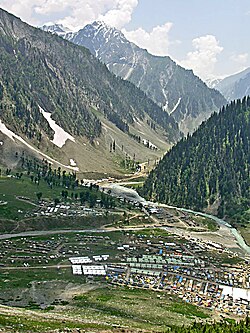 Amarnath Yatra camp
 -
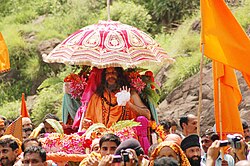 Buddha Amarnath Yatra procession, Poonch


See also[edit | edit source]
- Hindu pilgrimage sites in India
- List of Hindu festivals
- Padayatra
- Parikrama
- Religious tourism in India
- Tirtha and Kshetra
References[edit | edit source]
- ↑ "Pada Yatra: Foot Pilgrimage from Jaffna to Kataragama". padayatra.org. Archived from the original on 2021-10-15. Retrieved 2021-10-03.
- ↑ Juergensmeyer, Mark (2006). The Oxford Handbook of Global Religions. U.S.: Oxford University Press. ISBN 0-19-513798-1.
- ↑ Timothy, Dallen J.; Daniel H. Olsen (2006). Tourism, Religion and Spiritual Journeys. Routledge. ISBN 0-415-35445-5.
- ↑ Fowler, Jeaneane D. (1997). "Yatra: Pilgrimage". Hinduism: Beliefs and Practices. Sussex Academic Press. ISBN 1-898723-60-5.
- ↑ 5.0 5.1 5.2 5.3 5.4 Lochtefeld, James G. (2002). The Illustrated Encyclopedia of Hinduism: A-M. Rosen. pp. 182, 229, 330–331, 699–700, 780. ISBN 978-0-8239-3179-8.
- ↑ "Amarnath Yatra". Office of Divisional Commissioner, Jammu and Kashmir Government. Archived from the original on 2007-10-19.
- ↑ Singh Ahluwalia, Manjit (1998). "Holy Chhari or Manimahesh Yatra". Social, Cultural and Economic History of Himachal Pradesh. Indus Publishing. ISBN 81-7387-089-6.
- ↑ "SPOTLIGHT: The long walk for worship". Frontline. Vol. 21, no. 17. August 14–27, 2004. Archived from the original on 2010-08-06.
- ↑ "List of Pilgrimage Sites in India". culturalindia.net. Archived from the original on 2021-10-03. Retrieved 2021-10-03.
- ↑ Eck, Diana L. (2013-03-26). India: A Sacred Geography. Harmony/Rodale/Convergent. p. 9. ISBN 978-0-385-53192-4.
- ↑ Sengar, Resham (Nov 8, 2019). "Mount Kailash facts: mindboggling things you may not know about Shiva's home". The Times of India. Archived from the original on 2021-08-05. Retrieved 2021-10-03.
- ↑ "Char Dham Yatra 2025 - Chardham Yatra Travel Guide 2025 - Char Dham Yatra Tour". sacredyatra.com. Archived from the original on 2021-09-19. Retrieved 2021-10-03.
- ↑ ANI (2017-07-27). ""Sacred" Rameswaram gave India one of its most famous sons: PM Modi". Business Standard India. Archived from the original on 2021-10-03. Retrieved 2021-10-03.
- ↑ "Maha Kumbh 2021 - Haridwar Kumbh Mela 2021 India". kumbhamela.net. Archived from the original on 2021-10-03. Retrieved 2021-10-03.
- ↑ "SHRI MATA VAISHNO DEVI SHRINE BOARD | Official Website". maavaishnodevi.org. Archived from the original on 2019-08-16. Retrieved 2021-10-03.
- ↑ "Jal Adhikar Yatra Takes Off". The South Asian. September 10, 2006. Archived from the original on Aug 29, 2008. Retrieved February 26, 2008.
- ↑ "'Save Noyyal Yatra' draws good crowd". The Hindu Business Line. October 3, 2005. Archived from the original on 2009-06-07. Retrieved 2008-02-26.
- ↑ "India's rally for Right to Education - Shiksha Adhikar Yatra". Global Call to Action Against Poverty. July 3, 2007. Archived from the original on July 19, 2008.
- ↑ "Frequently Asked Questions on Kuladev and Kuldevi". Hindu Janajagruti Samiti. Archived from the original on 2021-10-03. Retrieved 2021-10-03.
- ↑ Yogananda, Paramahansa (1997). Autobiography of a Yogi, 1997 Anniversary Edition p. 383. Self-Realization Fellowship (Founded by Yogananda) http://www.yogananda-srf.org/ Archived 2020-12-18 at the Wayback Machine,
- ↑ "Kurukshetra map". kurukshetra.nic.in. Archived from the original on 25 June 2016. Retrieved 24 July 2016.
- ↑ "Haryana Tourism". Archived from the original on 10 August 2016. Retrieved 24 July 2016.
- ↑ "Development of all pilgrimage sites located within a radius of 48 kos (miles) of Kurukshetra would be carried out". Chief Minister's Office, Haryana. 11 October 2015. Archived from the original on 27 July 2016. Retrieved 24 July 2016.
- ↑ "The 48 Kos Kurukshetra Region". harekrsna.com. Archived from the original on 27 July 2016. Retrieved 24 July 2016.
- ↑ Jyotisar Archived 2018-04-19 at the Wayback Machine Kurukshetra district website.
- ↑ "Jyotisar". Haryana Tourism Corporation Limited. Archived from the original on 2017-02-15. Retrieved 2014-08-08.
- ↑ "Tirath in Kurukshetra - Sannehit Sarovar". Kurukshetra district website. Archived from the original on 2014-08-06. Retrieved 2014-08-08.
- ↑ Janet Cochrane, 2008, Asian Tourism: Growth and Change Archived 2023-04-07 at the Wayback Machine, page 249.
- ↑ Singh, Vikash (2017). Uprising of the Fools. Stanford University Press.
- ↑ "Kumbh Mela Diaries: Varanasi". Archived from the original on 2019-08-01. Retrieved 2019-08-01.


External links[edit | edit source]
Spiritual Yatra Packages