




CleanupBot (talk | contribs) m clean up, typos fixed: pavillion → pavilion |
small changes |
||
| Line 1: | Line 1: | ||
{{short description| | {{short description|Indian mystic poet-saint of the Bhakti movement}} | ||
{{ | {{protection padlock|small=yes}} | ||
{{Use dmy dates|date= | {{Use Indian English|date=September 2025}} | ||
{{Use dmy dates|date=September 2025}} | |||
{{Infobox Hindu leader | {{Infobox Hindu leader | ||
| name = Ravidas | |||
| name | | image = Bhagat Ravidas at work as a shoemaker. Folio from a series featuring Bhakti saints. Master of the first generation after Manaku and Nainsukh of Guler, Pahari region, ca.1800–1810.jpg | ||
| religion = | |||
| image | | alias = Raidas, Rohidas, Ruhi Dass, Robidas, Bhagat Ravidas, Guru Ravidas | ||
| alias | | influences = [[Ramananda]], [[Advaita Vedanta]], [[Ramanandi Sampradaya]], [[Vaishnavism]], [[Sufism]] | ||
| influenced | | influenced = [[Meera Bai]], [[Rani]] Jhala, [[Bhagat Pipa|Raja Pipa]], [[Sikandar Lodhi|Raja Sikandar Lodhi]], [[Guru Nanak]], [[Raja]] Bahadur Shah, Rani Ratan Kunwar, Raja Naagar Mall, [[Shardha Ram Phillauri|Pandit Shardha Ram]], Raja Chandar Partap, Bibi Bhanmati, [[Ganga Ram Viakarni|Pandit Ganga Ram]], Ram Lal, Raja Bain Singh, [[Rana Sanga]], Raja Chandrahans, [[Kabir]], [[Bhagat Trilochan]], Guru Sadhna Sehan | ||
| known_for | | known_for = Venerated as a ''[[Guru]]'' and having hymns included in the [[Guru Granth Sahib]], central figure of the [[Ravidassia]] | ||
| caption | | caption = Ravidas at work as a shoemaker. Folio from a series featuring Bhakti saints. Master of the first generation after Manaku and Nainsukh of Guler, Pahari region, c. 1800–1810 | ||
| birth_date | | birth_date = | ||
| birth_place | | birth_place = [[Banaras]], [[Delhi Sultanate]] (present-day [[Varanasi]], [[Uttar Pradesh]], India) | ||
| birth_name | | birth_name = | ||
| death_date | | death_date = | ||
| death_place | | death_place = Banaras, Delhi Sultanate (present-day Varanasi, Uttar Pradesh, India) | ||
| | | father = | ||
| spouse | | mother = | ||
| children | | spouse = Lona Devi | ||
| relatives | | children = 1 | ||
| relatives = | |||
| occupation | | occupation = Poet, leather craftsman, ''satguru'' (spiritual teacher) | ||
}} | }} | ||
{{Ravidassia}}{{Sikhism sidebar}} | {{Ravidassia}} | ||
'''Ravidas''' or '''Raidas''' was an Indian mystic poet-saint of the [[Bhakti movement]] during the 15th to 16th century CE.<ref name=jameslraidas/><ref name=encyclopediabritraidas/> Venerated as a ''[[guru]]'' (teacher) in the modern regions of [[Uttar Pradesh]], [[Bihar]], [[Rajasthan]], [[Gujarat]], [[Maharashtra]], [[Madhya Pradesh]], [[ | {{Hinduism}} | ||
{{Sikhism sidebar}} | |||
'''Ravidas''' or '''Raidas''' was an Indian mystic poet-saint of the [[Bhakti movement]] during the 15th to 16th century CE.<ref name=jameslraidas /><ref name=encyclopediabritraidas /> Venerated as a ''[[guru]]'' (spiritual teacher) in the modern regions of [[Uttar Pradesh]], [[Bihar]], [[Rajasthan]], [[Gujarat]], [[Maharashtra]], [[Madhya Pradesh]], [[Punjab]], and [[Haryana]], he was a poet, social reformer and spiritual figure. | |||
The life details of Ravidas are uncertain and contested. | The life details of Ravidas are uncertain and contested. Some scholars believe he was born in 1433 CE. <!-- But some Scholars believe he was born in 1377 CE and dead in 1528 CE. (note: removed pending sourcing. Lived 151 years? source it) --> He taught removal of social divisions of [[caste system in India|caste]] and gender, and promoted unity in the pursuit of personal spiritual freedom. | ||
Ravidas's devotional verses were included in the [[Sikhism|Sikh]] scriptures known as ''[[Guru Granth Sahib]]''.<ref name=encyclopediabritraidas/><ref>Callewaert and Friedlander, ''The Life and Works of Ravidass Ji'', Manohar, Delhi, 1992, quoted in Gavin Flood, ''An Introduction to Hinduism'', Cambridge 1996.</ref> The ''Panch Vani'' text of the [[Dadu Dayal|Dadu | Ravidas's devotional verses were included in the [[Sikhism|Sikh]] scriptures known as ''[[Guru Granth Sahib]]''.<ref name=encyclopediabritraidas /><ref>Callewaert and Friedlander, ''The Life and Works of Ravidass Ji'', Manohar, Delhi, 1992, quoted in Gavin Flood, ''An Introduction to Hinduism'', Cambridge 1996.</ref> The ''Panch Vani'' text of the [[Dadu Dayal|Dadu Panthi]] tradition within [[Hinduism]] also includes numerous poems of Ravidas.<ref name=jameslraidas /> He is also the central figure within the [[Ravidassia]] [[Panth|religious movement]]. | ||
Mainstream Sikhs consider him to be a ''[[bhagat]]'' whilst break-away Ravidassias consider him to be a ''[[guru]]''.<ref>{{Cite book |title=Gurus and Media: Sound, image, machine, text and the digital |date=25 September 2023 |publisher=UCL Press |isbn=9781800085541 |pages=224–225}}</ref> | |||
Ravidas | == Dates == | ||
The details of Ravidas's life are not well known. The birth date Ravidas has been a subject of discussion among scholars and devotees, as historical records from the 14th–15th century are limited. Different traditions and sources provide varying years for his birth.Some scholars{{Who|date=January 2023}} state he was born in 1377 CE and died in 1528 CE in [[Banaras]] at the age of 151 years.<ref name=":0">{{Cite book |last=Sharma |first=Arvind |title=The Study of Hinduism |year=2003 |publisher=The University of South Carolina Press |isbn=1-57003-449-4 |pages=229}}</ref> Others, such as [[Amaresh Datta]], claim he was born in 1267 and died in 1335.<ref name=":62">{{Cite book |last=Datta |first=Amaresh |title=Encyclopaedia of Indian Literature: A-Devo, Volume 1 |publisher=Sahitya Akademi |year=1987 |isbn=9788126018031 |pages=79 |quote=}}</ref> | |||
The | The Rajput princess and Bhakti saint, [[Mira Bai]] (1498–1547 CE), is recorded in multiple traditions as a devoted disciple of Ravidas. This disciple-guru relationship, mentioned in historical and literary sources, indicates that Ravidass must have been alive after 1498 CE and actively guiding his followers when Mirabai reached adulthood, around the time of her marriage in 1516. The connection between Ravidas and Mirabai helps scholars place his lifetime within the late 15th and early 16th centuries.<ref>{{cite book |last1=Upadhyaya |first1=K. N. |title=Guru Ravidas, Life and Teachings |date=1982 |publisher=Radha Soami Satsang Beas |page=7 |url=https://books.google.com/books?id=RylyAAAAIAAJ&q=death+is+his++disciple+Mirabai |access-date=19 September 2025 |language=en}}</ref> | ||
==Regional variation in names== | |||
He is remembered by many names across regions, traditions, and languages. These variations reflect affection, honorifics, and local pronunciations. Ravidas is the most common form, especially in [[Hindi Belt|Hindi-speaking regions]], Ramdas has been used by followers who migrated from [[West Pakistan]].,<ref name=":Term">{{cite book |last1=General |first1=India Office of the Registrar |title=Census of India, 1961 |date=1962 |publisher=Manager of Publications |url=https://books.google.com/books?id=wrfUAAAAMAAJ&q=word+Ravidasia |access-date=19 September 2025 |language=en}}</ref><ref name=":Term1">{{cite book |last1=Barstow |first1=A. E. |title=Handbook on Sikhs |date=1989 |publisher=Uppal Publishing House |isbn=978-81-85024-54-7 |url=https://books.google.com/books?id=RcMKAQAAIAAJ&q=Namabansis |access-date=19 September 2025 |language=en}}</ref> Raidas is widely used in [[Uttar Pradesh]], [[Madhya Pradesh]], and [[Bihar]], Ruhidas/Ruidas is the common pronunciation in [[Bengal]] and [[Eastern India]] and [[Rohidas]] is used in [[Maharashtra]], [[Karnataka]] and [[Gujarat]].<ref>{{cite book |last1=Singh |first1=Darshan |title=Glimpses of Indian History |date=1978 |publisher=Panjab Prakashan |url=https://books.google.com/books?id=sasBAAAAMAAJ&q=raidas,+ruidas+and+rohidas |access-date=17 September 2025 |language=en}}</ref> | |||
The term ''[[Ramdasia]]'' is merely a corruption of the word ''Ravidasia.''<ref name=":Term">{{cite book |last1=General |first1=India Office of the Registrar |title=Census of India, 1961 |date=1962 |publisher=Manager of Publications |url=https://books.google.com/books?id=wrfUAAAAMAAJ&q=word+Ravidasia |access-date=19 September 2025 |language=en}}</ref><ref name=":Term1">{{cite book |last1=Barstow |first1=A. E. |title=Handbook on Sikhs |date=1989 |publisher=Uppal Publishing House |isbn=978-81-85024-54-7 |url=https://books.google.com/books?id=RcMKAQAAIAAJ&q=Namabansis |access-date=19 September 2025 |language=en}}</ref> In [[Punjab]], both the words Ramdasia and Ravidasia are also used interchangeably, although these also have regional context. The word Ramdasia is largely used in [[Puadh]] and [[Malwa (Punjab)|Malwa]], while Ravidasia is predominantly used in [[Doaba]].<ref>{{cite news |title=Punjab's dalit conundrum: A look into Sikhs' caste identity |url=https://timesofindia.indiatimes.com/city/chandigarh/punjabs-dalit-conundrum-a-look-into-sikhs-caste-identity/articleshow/86607310.cms |access-date=17 September 2025 |work=The Times of India |date=30 September 2021}}</ref><ref name="Ramdasia / Ravidassia Sikhs ( titles which are often used interchangeably to refer to the same people )">{{cite book |last1=Upadhya |first1=Carol |last2=Rutten |first2=Mario |last3=Koskimaki |first3=Leah |title=Provincial Globalization in India: Transregional Mobilities and Development Politics |date=27 June 2018 |publisher=Routledge |isbn=978-1-351-63107-5 |url=https://books.google.com/books?id=QDBiDwAAQBAJ&dq=ramdasia+and+ravidassia+are+also+used+interchangeably&pg=RA1-PT173 |access-date=19 September 2025 |language=en}}</ref> | |||
Followers of Ravidas are known by different names in different regions, depending on history, migration, and local linguistic or social contexts. [[Ravidassias]] is the most common and widely accepted name today, especially after the Vienna incident when many followers began identifying as a distinct religious community, [[Ramdasia]] is for Sikh Chamar followers, Rohidasi is for those in regions like Maharashtra, Karnataka, Gujarat, and Rajasthan, who revere Ravidas as their spiritual guide, and [[Ravived]] is mainly for those in [[Mauritius]]. | |||
== Biography == | |||
Ravidas was born in the village of [[Sir Gobardhan]]pur, near [[Varanasi]] in what is now Uttar Pradesh, [[India]]. His birthplace is now known as [[Shri Guru Ravidass Janam Asthan]]. His birthday is celebrated as [[Ravidas Jayanti]] and important temple is [[Ravidas Temple]]. Mata Kalsi was his mother, and his father was Santokh Dass.<ref name="eosravidas">{{cite web |url=http://www.learnpunjabi.org/eos/index.aspx |title=Ravidas |author=Hardev Bahri |editor=Harbans Singh |display-editors=etal |website=Encyclopaedia of Sikhism |publisher=Punjabi University Patiala |access-date=11 February 2017}}</ref> His parents belonged to a leather-working [[Chamar]] community, an [[Untouchable caste|untouchable]] caste.<ref name="jameslraidas" /><ref name="encyclopediabritraidas">{{cite encyclopedia |title=Ravidas: Indian mystic and poet |url=http://www.britannica.com/EBchecked/topic/1350770/Ravidas |access-date=10 August 2009 |encyclopedia=Encyclopædia Britannica}}</ref> While his original occupation was leather work, he began to spend most of his time in spiritual pursuits at the banks of the [[Ganges]]. Thereafter he spent most of his life in the company of [[Sufi]] saints, [[Sadhu]]s and ascetics.<ref name="eosravidas" /> At the age of 12, Ravidas was married off to Lona Devi. They had a son, Vijay Dass.<ref>{{cite book |last1=Trisharan |first1=Dr Vijay Kumar |title=Mahakavi Ravidas Samaj Chetna Ke Agradut |date=2008 |publisher=Gautam Book Center |isbn=978-81-87733-14-0 |page=34 |url=https://books.google.com/books?id=53tgHL6a8TkC&dq=Sant+Ravidas+Lona+devi+Vijay+das&pg=PA34 |language=hi}}</ref><ref>{{cite book |last1=Ji |first1=Jagatguru Ravidaas |title=Amritwani Ravidaas Ji Maharaj |date=1 February 2017 |publisher=Shri Guru Ravidass Janam Asthan Mandir Seer Govardhanpur, Varanasi (U.P.) |page=291 |url=https://books.google.com/books?id=YEF9EAAAQBAJ&dq=Sant+Ravidas+Lona+devi+Vijay+das&pg=PA291 |language=hi}}{{dead link|date=December 2023 |bot=InternetArchiveBot |fix-attempted=yes }}</ref> | |||
<ref name="Callewaert">Callewaert, Winand. (2003), Pilgrims, Patrons, and Place: Localizing Sanctity in Asian Religions (Editors: Phyllis Granoff and Koichi Shinohara), [[University of British Columbia Press]], {{ISBN|978-0774810395}}, pages 203-223</ref> | The text ''Anantadas Parcai'' is one of the earliest surviving [[Biography|biographies]] of various Bhakti movement poets which describes the birth of Ravidas.<ref name=winnandraidas>{{cite book |last1=Callewaert |first1=Winnand |title=The Hagiographies of Anantadas: The Bhakti Poets of North India |date=2013 |publisher=Routledge |isbn=978-1-136-12002-2 |pages=307, 1–23 |url=https://books.google.com/books?id=TGoyMpvyHbgC&q=The+Hagiographies+of+Anantadas:+The+Bhakti+Poets+of+North+India,+Routledge+raidas |language=en}}</ref> | ||
Medieval era texts, such as the ''[[Bhaktamal]]'' suggest that Ravidas was the disciple of the [[Brahmin]] ''bhakti''-poet [[Ramananda]].<ref name=pande>{{cite book |last1=Pande |first1=Rekha |title=Divine Sounds from the Heart—Singing Unfettered in their Own Voices: The Bhakti Movement and its Women Saints (12th to 17th Century) |date=2010 |publisher=Cambridge Scholars Publishing |isbn=978-1-4438-2525-2 |pages=76–77 |url=https://books.google.com/books?id=mYEnBwAAQBAJ |access-date=25 August 2019 |language=en}}</ref><ref name=lorenzen>[[David Lorenzen]] (1996), Praises to a Formless God: Nirguni Texts from North India, State University of New York Press, {{ISBN|978-0791428054}}, page 268</ref> He is traditionally considered as [[Kabir]]'s younger contemporary.<ref name=jameslraidas>James Lochtefeld (2002), The Illustrated Encyclopedia of Hinduism: N-Z, [[Rosen Publishing]], {{ISBN|978-0823931804}}, page 569</ref> | |||
However, the medieval text ''[[Ratnavali]]'' says Ravidas gained his spiritual knowledge from Ramananda and was a follower of the [[Ramanandi Sampradaya]] tradition.<ref name=pande /><ref name=lorenzen /><ref>{{cite book |title=Sant Ravidas Ratnawali |author=Mamta Jha |year=2013 |publisher=prabhat prakashan |page=12}}</ref> | |||
His ideas and fame grew over his lifetime, and texts suggest Brahmins used to bow before him.<ref name=encyclopediabritraidas /> He travelled extensively, visiting Hindu pilgrimage sites in [[Andhra Pradesh]], [[Maharashtra]], [[Gujarat]], [[Rajasthan]], and those in the [[Himalayas]]. He abandoned ''saguna'' (with attributes, image) forms of supreme beings, and focused on the ''nirguna'' (without attributes, abstract) form of supreme beings.<ref name=eosravidas /> As his poetic hymns in regional languages inspired others, people from various background sought his teachings and guidance.<ref name=eosravidas /> | |||
[[File:Fresco artwork depicting a lifestory of Bhagat Ravidas from Pothi-Mala, Guru Harsahai, Punjab.jpg|thumb|Fresco artwork depicting a [[Sakhi|lifestory]] of Ravidas from Pothi-Mala, [[Guru Har Sahai]], Punjab]] | |||
Most scholars believe that Ravidas met [[Guru Nanak]], the founder of [[Sikhism]].<ref name=encyclopediabritraidas /> He is revered in the [[Sikhs|Sikh]] scripture, and 41 of Ravidas' poems are included in the [[Guru Granth Sahib]]. These poems are one of the oldest attested source of his ideas and literary works.<ref name=jameslraidas /><ref name=encyclopediabritraidas /> Another substantial source of legends and stories about the life of Ravidas is the [[hagiography]] in the Sikh tradition, the ''Premambodha''.<ref name=friedlandermyths /> This text, composed over 170 years after Ravidas' death, in 1693, includes him as one of the seventeen saints of Indian religious tradition.<ref name=friedlandermyths /> The 17th-century Nabhadas's [[Bhaktamal]], and the ''Parcais'' of Anantadas, both contain chapters on Ravidas.<ref>Winnand Callewaert (2000), The Hagiographies of Anantadas: The Bhakti Poets of North India, Routledge, {{ISBN|978-0700713318}}, pages 1-4</ref> Other than these, the scriptures and texts of Sikh tradition and the Hindu Dadupanthi traditions, most other written sources about the life of Ravidas, including by the Ravidasi (followers of Ravidas), were composed in the early 20th century, or about 400 years after his death.<ref name=friedlandermyths /><ref name="Callewaert">Callewaert, Winand. (2003), Pilgrims, Patrons, and Place: Localizing Sanctity in Asian Religions (Editors: Phyllis Granoff and Koichi Shinohara), [[University of British Columbia Press]], {{ISBN|978-0774810395}}, pages 203-223</ref> | |||
Text, called the ''Parcaīs'' (or ''Parchais''), included Ravidas among the [[Sant (religion)|sants]] whose biography and poems were included. Over time new manuscripts of ''Parcais of Anantadas'' were reproduced, some in different local languages of India.<ref name="Callewaert" /> Winnand Callewaert notes that some 30 manuscripts of Anantadas's hagiography on Ravidas have been found in different parts of India.<ref name=winnandintro>Winnand Callewaert (2000), The Hagiographies of Anantadas: The Bhakti Poets of North India, Routledge, {{ISBN|978-0700713318}}, pages 303-307</ref> Of these four manuscripts are complete, collated and have been dated to 1662, 1665, 1676 and 1687. The first three are close with some morphological variants without affecting the meaning, but the 1687 version systematically inserts verses into the text, at various locations, with caste-related statements, new claims of Brahmins persecuting Ravidas, notes on the untouchability of Ravidas, claims of Kabir giving Ravidas ideas, ridicules of nirguni and saguni ideas, and such text corruption:<ref>Winnand Callewaert (2000), The Hagiographies of Anantadas: The Bhakti Poets of North India, [[Routledge]], {{ISBN|978-0700713318}}, pages 316-334</ref> Callewaert considers the 1676 version as the standard version, his critical edition of Ravidas's hagiography excludes all these insertions, and he remarks that the cleaner critical version of Anantadas's ''parcais'' suggests that there is more in common in the ideas of bhakti movement's Ravidas, Kabir and Sen than previously thought.<ref name=winnandintro /> | |||
Khare similarly has questioned the textual sources on Ravidas, and mentions there are few "readily available and reliable textual sources on the Hindu and Untouchable treatment of Ravidas."<ref name=khareintro>Ravindra S Khare (1985), The Untouchable as Himself, Cambridge University Press, {{ISBN|978-0521263146}}, pages 41-47</ref> | Khare similarly has questioned the textual sources on Ravidas, and mentions there are few "readily available and reliable textual sources on the Hindu and Untouchable treatment of Ravidas."<ref name=khareintro>Ravindra S Khare (1985), The Untouchable as Himself, Cambridge University Press, {{ISBN|978-0521263146}}, pages 41-47</ref> | ||
== Literary works == | == Literary works == | ||
The Adi Granth and the ''Panchvani'' of the Hindu warrior-ascetic group [[Dadu Dayal|Dadupanthi]] are the two oldest attested sources of the literary works of | The Adi Granth and the ''Panchvani'' of the Hindu warrior-ascetic group [[Dadu Dayal|Dadupanthi]] are the two oldest attested sources of the literary works of Ravidas.<ref name=jameslraidas /> In the Adi Granth, forty one of Ravidas's poems are included, and he is one of thirty six contributors to this foremost canonical scripture of Sikhism.<ref name=pashaurasingh>Pashaura Singh (2012), Fighting Words: Religion, Violence, and the Interpretation of Sacred Texts (Editor: John Renard), University of California Press, {{ISBN|978-0520274198}}, pages 202-207</ref><ref name=gschauhan>GS Chauhan (2009), Bani Of Bhagats, Hemkunt Press, {{ISBN|978-8170103561}}, pages 41-55</ref> This compilation of poetry in Adi Granth responds to, among other things, issues of dealing with conflict and tyranny, war and resolution, and willingness to dedicate one's life to the right cause.<ref name=pashaurasingh /> Ravidas's poetry covers topics such as the definition of a just state where there are no second or third class unequal citizens, the need for dispassion, and who is a real [[Yoga|Yogi]].<ref name=gschauhan /><ref>J Kaur (2005), [https://www.jstor.org/stable/41856155 The Concept of Peace and the Guru Granth Sahib], The Indian Journal of Political Science, Volume 66, Number 3, pages 649-660</ref> | ||
Jeffrey Ebbesen notes that, just like other Bhakti saint-poets of India and some cases of Western literature authorship, many poems composed by later era Indian poets have been attributed to Ravidas, as an act of reverence, even though Ravidas has had nothing to do with these poems or ideas expressed therein.<ref>Jeffrey Ebbesen (1995), Literary India: Comparative Studies in Aesthetics, Colonialism, and Culture (Editors: Patrick Colm Hogan, Lalita Pandit), State University of New York Press, {{ISBN|978-0791423950}}, pages 53-55</ref> | Jeffrey Ebbesen notes that, just like other Bhakti saint-poets of India and some cases of Western literature authorship, many poems composed by later era Indian poets have been attributed to Ravidas, as an act of reverence, even though Ravidas has had nothing to do with these poems or ideas expressed therein.<ref>Jeffrey Ebbesen (1995), Literary India: Comparative Studies in Aesthetics, Colonialism, and Culture (Editors: Patrick Colm Hogan, Lalita Pandit), State University of New York Press, {{ISBN|978-0791423950}}, pages 53-55</ref> | ||
=== Ravidas literature on symbolism === | === Ravidas literature on symbolism === | ||
Peter Friedlander states that Ravidas' hagiographies, though authored long after he died, depict a struggle within the Indian society, where Ravidas' life gives the means to express a variety of social and spiritual themes.<ref name=friedlandermyths/> At one level, it depicts a struggle between the then prevalent heterodox communities and the orthodox Brahminical tradition. At another level, the legends are an inter-communal, inter-religious struggle with an underlying search and desire for social unity. At yet another level, states Friedlander, the stories describe the spiritual struggle of an individual unto self.<ref name=friedlandermyths>Peter Friedlander (1996), Myth and Mythmaking: Continuous Evolution in Indian Tradition (Editor: Julia Leslie), Routledge, {{ISBN|978-0700703036}}, pages 106-114</ref> | Peter Friedlander states that Ravidas' hagiographies, though authored long after he died, depict a struggle within the Indian society, where Ravidas' life gives the means to express a variety of social and spiritual themes.<ref name=friedlandermyths /> At one level, it depicts a struggle between the then prevalent heterodox communities and the orthodox Brahminical tradition. At another level, the legends are an inter-communal, inter-religious struggle with an underlying search and desire for social unity. At yet another level, states Friedlander, the stories describe the spiritual struggle of an individual unto self.<ref name=friedlandermyths>Peter Friedlander (1996), Myth and Mythmaking: Continuous Evolution in Indian Tradition (Editor: Julia Leslie), Routledge, {{ISBN|978-0700703036}}, pages 106-114</ref> | ||
There is no historical evidence to verify the [[historicity]] in these hagiographies, which range from Ravidas's struggle with Hindu Brahmins,<ref>Peter Friedlander (1996), Myth and Mythmaking: Continuous Evolution in Indian Tradition (Editor: Julia Leslie), Routledge, {{ISBN|978-0700703036}}, pages 109-110</ref> to his struggle with Muslim Sultan [[Sikander Lodi]].<ref>Peter Friedlander (1996), Myth and Mythmaking: Continuous Evolution in Indian Tradition (Editor: Julia Leslie), Routledge, {{ISBN|978-0700703036}}, pages 108, 112-117</ref> Friedlander states that the stories reflect the social dynamics that influenced the composers of the hagiographies during the 17th- to 20th-century. These are legends where Ravidas is victorious because of divine intervention with miracles such as making a stone float in water, or making river [[Ganges]] to reverse course and flow upstream.<ref name=friedlandermyths/> | There is no historical evidence to verify the [[historicity]] in these hagiographies, which range from Ravidas's struggle with Hindu Brahmins,<ref>Peter Friedlander (1996), Myth and Mythmaking: Continuous Evolution in Indian Tradition (Editor: Julia Leslie), Routledge, {{ISBN|978-0700703036}}, pages 109-110</ref> to his struggle with Muslim Sultan [[Sikander Lodi]].<ref>Peter Friedlander (1996), Myth and Mythmaking: Continuous Evolution in Indian Tradition (Editor: Julia Leslie), Routledge, {{ISBN|978-0700703036}}, pages 108, 112-117</ref> Friedlander states that the stories reflect the social dynamics that influenced the composers of the hagiographies during the 17th- to 20th-century. These are legends where Ravidas is victorious because of divine intervention with miracles such as making a stone float in water, or making river [[Ganges]] to reverse course and flow upstream.<ref name=friedlandermyths /> | ||
[[David Lorenzen]] similarly states that poetry attributed to Ravidas, and championed by Ravidasi from the 17th- through the 20th-century, have a strong anti-Brahminical and anti-communal theme.<ref name=lorenzenravidasi/> The legends, suggests Lorenzen, cannot be separated from the power and political situation of this era, and they reflect a strong element of social and religious dissent by groups marginalised during a period when Indian society was under the Islamic rule and later the colonial rule.<ref name=lorenzenravidasi>David Lorenzen (1995), Bhakti Religion in North India: Community Identity and Political Action, State University of New York Press, {{ISBN|978-0791420256}}, pages 105-116, 292-303</ref><ref name=neeti/> | [[David Lorenzen]] similarly states that poetry attributed to Ravidas, and championed by Ravidasi from the 17th- through the 20th-century, have a strong anti-Brahminical and anti-communal theme.<ref name=lorenzenravidasi /> The legends, suggests Lorenzen, cannot be separated from the power and political situation of this era, and they reflect a strong element of social and religious dissent by groups marginalised during a period when Indian society was under the Islamic rule and later the colonial rule.<ref name=lorenzenravidasi>David Lorenzen (1995), Bhakti Religion in North India: Community Identity and Political Action, State University of New York Press, {{ISBN|978-0791420256}}, pages 105-116, 292-303</ref><ref name=neeti /> | ||
== Philosophy == | == Philosophy == | ||
The songs of Ravidas discuss ''[[Bhakti movement#Philosophy: Nirguna and Saguna Brahman|Nirguna-Saguna]]'' themes, as well as ideas that are at the foundation of Nath [[Yoga (philosophy)|Yoga]] philosophy of Hinduism.<ref name=peterheehs/> He frequently mentions the term ''Sahaj'', a mystical state where there is a union of the truths of the many and the one.<ref name=peterheehs/> | [[File:Manuscript folio painting of Bhagats Ravidas (left) and Kabir (right) seated under a tree.jpg|thumb|Manuscript folio painting of Ravidas (left) and [[Kabir]] (right) seated under a tree]] | ||
The songs of Ravidas discuss ''[[Bhakti movement#Philosophy: Nirguna and Saguna Brahman|Nirguna-Saguna]]{{Broken anchor|date=25 March 2024|bot=User:Cewbot/log/20201008/configuration|reason= The anchor (Philosophy: Nirguna and Saguna Brahman) [[Special:Diff/1189756029|has been deleted]].}}'' themes, as well as ideas that are at the foundation of Nath [[Yoga (philosophy)|Yoga]] philosophy of Hinduism.<ref name=peterheehs /> He frequently mentions the term ''Sahaj'', a mystical state where there is a union of the truths of the many and the one.<ref name=peterheehs /> | |||
{{Blockquote| | {{Blockquote| | ||
| Line 82: | Line 97: | ||
the knower is absorbed. | the knower is absorbed. | ||
</poem> | </poem> | ||
|Ravidas|Translated by Winand Callewaert and Peter Friedlander<ref name=peterheehs/>}} | | Ravidas|Translated by Winand Callewaert and Peter Friedlander<ref name=peterheehs />}} | ||
David Lorenzen states Ravidas's poetry is imbued with themes of boundless loving devotion to God, wherein this divine is envisioned as ''Nirguna''.<ref>David Lorenzen (1995), Bhakti Religion in North India: Community Identity and Political Action, State University of New York Press, {{ISBN|978-0791420256}}, page 107</ref> In the Sikh tradition, the themes of [[Nanak]]'s poetry are very broadly similar to the ''Nirgun bhakti'' ideas of Ravidas and other leading north Indian saint-poets.<ref name=neeti>Neeti M Sadarangani (2004), Bhakti Poetry in Medieval India: Its Inception, Cultural Encounter and Impact, Swarup & Sons, {{ISBN|978-8176254366}}, pages i-xv, 115, 55-60, 72-76</ref><ref>Christopher Shackle (2014), The Oxford Handbook of Sikh Studies (Editors: Pashaura Singh, Louis E. Fenech), Oxford University Press, {{ISBN|978-0199699308}}, page 111</ref> Most postmodern scholars, states Karen Pechilis, consider Ravidas's ideas to belong to the ''Nirguna'' philosophy within the Bhakti movement.<ref>Karen Pechilis Prentiss (2014), The Embodiment of Bhakti, Oxford University Press, {{ISBN|978-0195351903}}, page 21</ref> | David Lorenzen states Ravidas's poetry is imbued with themes of boundless loving devotion to God, wherein this divine is envisioned as ''Nirguna''.<ref>David Lorenzen (1995), Bhakti Religion in North India: Community Identity and Political Action, State University of New York Press, {{ISBN|978-0791420256}}, page 107</ref> In the Sikh tradition, the themes of [[Nanak]]'s poetry are very broadly similar to the ''Nirgun bhakti'' ideas of Ravidas and other leading north Indian saint-poets.<ref name=neeti>Neeti M Sadarangani (2004), Bhakti Poetry in Medieval India: Its Inception, Cultural Encounter and Impact, Swarup & Sons, {{ISBN|978-8176254366}}, pages i-xv, 115, 55-60, 72-76</ref><ref>Christopher Shackle (2014), The Oxford Handbook of Sikh Studies (Editors: Pashaura Singh, Louis E. Fenech), Oxford University Press, {{ISBN|978-0199699308}}, page 111</ref> Most postmodern scholars, states Karen Pechilis, consider Ravidas's ideas to belong to the ''Nirguna'' philosophy within the Bhakti movement.<ref>Karen Pechilis Prentiss (2014), The Embodiment of Bhakti, Oxford University Press, {{ISBN|978-0195351903}}, page 21</ref> | ||
===Monistic Brahman or Anthropomorphic God=== | === Monistic Brahman or Anthropomorphic God === | ||
Multiple manuscripts found in [[Rajasthan]] and [[Uttar Pradesh]], dated to be from the 18th and 19th centuries, contain a | Multiple manuscripts found in [[Rajasthan]] and [[Uttar Pradesh]], dated to be from the 18th and 19th centuries, contain a debate between [[Kabir]] and Ravidas on the nature of the Absolute, more specifically whether the [[Brahman]] (Ultimate Reality, Eternal Truth) is monistic Oneness or a separate anthropomorphic incarnate.<ref name=lorenzenmon /> Kabir argues for the former. Ravidas, in contrast, argues from the latter premise to the effect that both are one.<ref name=lorenzenmon /> In these manuscripts, Kabir initially prevails, Ravidas accepts that Brahman is monistic, but till the end Kabir didn't accept worshipping a divine [[avatar]] (''sagun'' conception).<ref name=lorenzenmon>[[David Lorenzen]] (1996), Praises to a Formless God: Nirguni Texts from North India, State University of New York Press, {{ISBN|978-0791428054}}, pages 169-170</ref> | ||
===One man: two divergent claims on his views and philosophy=== | === One man: two divergent claims on his views and philosophy === | ||
Ravindra Khare states that there are two divergent versions that emerge from the study of texts relating to Ravidas's philosophy.<ref>Ravindra S Khare (1985), The Untouchable as Himself, Cambridge University Press, {{ISBN|978-0521263146}}, pages 41, 46</ref> The 17th century [[Bhaktamal]] text by Nabhadas provides one version, while the 20th-century texts by [[Dalit]]s provide another.<ref name=khareintro/> | [[File:Detail of Bhagat Ravidas from a mural at Gurdwara Baba Atal in Amritsar.jpg|thumb|Detail of Ravidas (wearing green) from a mural at [[Gurdwara Baba Atal]] in [[Amritsar]], circa 19th century]] | ||
Ravindra Khare states that there are two divergent versions that emerge from the study of texts relating to Ravidas's philosophy.<ref>Ravindra S Khare (1985), The Untouchable as Himself, Cambridge University Press, {{ISBN|978-0521263146}}, pages 41, 46</ref> The 17th century [[Bhaktamal]] text by Nabhadas provides one version, while the 20th-century texts by [[Dalit]]s provide another.<ref name=khareintro /> | |||
According to Bhaktamal text, Ravidas was of pure speech, capable of resolving spiritual doubts of those who held discussions with him, was unafraid to state his humble origins and real caste.<ref name=khare17century/> Further, the Bhaktamal text states that Ravidas' | According to Bhaktamal text, Ravidas was of pure speech, capable of resolving spiritual doubts of those who held discussions with him, was unafraid to state his humble origins and real caste.<ref name=khare17century /> Further, the Bhaktamal text states that Ravidas' teachings agreed with [[Vedas|Vedic]] and ancient scriptures, he subscribed to [[Nonduality (spirituality)|nondualism]], discussed spiritual ideas and philosophy with everyone including Brahmins without gender or caste discrimination, and his abilities reflected an individual who had reached the inner content state of the highest [[Sannyasa|ascetic]].<ref name=khare17century>Ravindra S Khare (1985), The Untouchable as Himself, Cambridge University Press, {{ISBN|978-0521263146}}, pages 41-45</ref> | ||
The 20th-century version, prevalent in the texts of Dalit community, concurs with the parts about pure speech and resolving spiritual doubts.<ref name=khare20century/> However, they differ in the rest. The texts and the prevalent beliefs of the Dalit community hold that Ravidas rejected the Hindu Vedas, he was opposed by the Brahmins and resisted by the caste Hindus as well as Hindu ascetics throughout his life, and that some members of the Dalit community have believed Ravidas was an idol worshipper (saguni bhakti saint) while other 20th century texts assert that Ravidas rejected idolatry.<ref name=khare20century>Ravindra S Khare (1985), The Untouchable as Himself, Cambridge University Press, {{ISBN|978-0521263146}}, pages 46-53, 163-164</ref> For example, the following hymn of Ravidas, present in Guru Granth Sahib, support such claims where he rejects Vedas and the belief that taking a ritualistic bath can make someone pure. | The 20th-century version, prevalent in the texts of Dalit community, concurs with the parts about pure speech and resolving spiritual doubts.<ref name=khare20century /> However, they differ in the rest. The texts and the prevalent beliefs of the Dalit community hold that Ravidas rejected the Hindu Vedas, he was opposed by the Brahmins and resisted by the caste Hindus as well as Hindu ascetics throughout his life, and that some members of the Dalit community have believed Ravidas was an idol worshipper (saguni bhakti saint) while other 20th century texts assert that Ravidas rejected idolatry.<ref name=khare20century>Ravindra S Khare (1985), The Untouchable as Himself, Cambridge University Press, {{ISBN|978-0521263146}}, pages 46-53, 163-164</ref> For example, the following hymn of Ravidas, present in Guru Granth Sahib, support such claims where he rejects Vedas and the belief that taking a ritualistic bath can make someone pure. | ||
{{ | {{Blockquote|<poem>One may distinguish between good and evil actions, and listen to the [[Vedas]] and the [[Purana]]s, but doubt still persists. Skepticism continually dwells in the heart, so who can eradicate [[Hankaar|egotistical pride]]? Outwardly, he washes with water, but deep within, his heart is tarnished by all sorts of vices. So how can he become pure? His method of purification is like that of an elephant, covering himself with dust right after his bath!</poem>|Ravidas|Guru Granth Sahib 346<ref>{{cite web |url=http://www.srigranth.org/servlet/gurbani.gurbani?Action=Page&Param=346 |title=Sri Granth: Sri Guru Granth Sahib |website=.srigranth.org |access-date=2 March 2022}}</ref>}} | ||
His spiritual teacher Ramananda was a Brahmin and his disciple Mirabai was a Rajput princess.<ref>{{cite book |last1=Macauliffe |first1=Max Arthur |title=The Sikh Religion: Its Gurus, Sacred Writings and Authors |date=28 March 2013 |publisher=Cambridge University Press |isbn=978-1-108-05548-2 |page=100 |url=https://books.google.com/books?id=5B0JEN2ct94C&dq=gaur+brahman&pg=PA100 |quote=Ramanand, a Gaur Brahman, was born at Maicot}}</ref><ref>{{cite book |last1=Harlan |first1=Lindsey |title=Religion and Rajput Women: The Ethic of Protection in Contemporary Narratives |date=21 June 2024 |publisher=Univ of California Press |isbn=978-0-520-41512-6 |page=206 |url=https://books.google.com/books?id=WEkOEQAAQBAJ&pg=PA206 |quote=On the other hand, they say that they admire Mira as a Rajput woman because of her exceptionally good character.}}</ref> | |||
== Legacy == | == Legacy == | ||
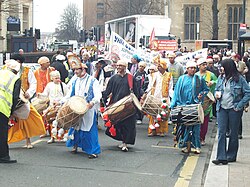
[[File:RavidasiBedford2.JPG|thumb|A procession in Bedford, the United Kingdom by Ravidasias to mark the birthday of Ravidas.]] | [[File:RavidasiBedford2.JPG|thumb|A procession in Bedford, the United Kingdom by Ravidasias to mark the birthday of Ravidas.]] | ||
=== Ravidassia=== | === Ravidassia === | ||
The difference between the [[Ravidassia]] and Sikhism, as described by a post made by Shri Guru Ravidass Temple in Ontario is as follows: | [[File:Gurdwara Guru Ravidass, Nasinu, Fiji.jpg|thumb|Gurdwara Guru Ravidass, Nasinu, Fiji Established in 1939]] | ||
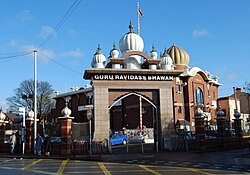
<blockquote>We, as Ravidassias have different traditions. We are not Sikhs. Even though, we give utmost respect to 10 gurus and Guru Granth Sahib, Guru Ravidass Ji is our supreme. There is no command for us to follow the declaration that there is no Guru after Guru Granth Sahib. We respect Guru Granth Sahib because it has our guru Ji's teachings and teachings of other religious figures who have spoken against caste system, spread the message of NAAM and equality. As per our traditions, we give utmost respect to contemporary gurus also who are carrying forward the message of Guru Ravidass Ji.<ref>Ram, R. (2009). Ravidass, Dera Sachkhand Ballan and the Question of Dalit Identity in Punjab. ''JPS'', ''16''(1), 2.</ref></blockquote>The Ravidassia religion is a spin-off religion from Sikhism, formed in the 21st century, by the followers of Ravidas's teachings. It was formed following a 2009 [[Vienna temple attack|attack on a Ravidassia temple]] in Vienna by Sikh | [[File:Gurdwara Guru Ravidass Bhavan, Birmingham.jpg|thumb|Gurdwara Guru Ravidass Bhavan, Birmingham]] | ||
[[File:Gurdwara_Guru_Ravidass_Temple,_Pittsburgh.jpg|thumb|Gurdwara Guru Ravidass Temple, Pittsburg, California]] | |||
The difference between the [[Ravidassia]] and Sikhism, as described by a post made by Shri Guru Ravidass Temple in Ontario is as follows: | |||
<blockquote>We, as Ravidassias have different traditions. We are not Sikhs. Even though, we give utmost respect to 10 gurus and Guru Granth Sahib, Guru Ravidass Ji is our supreme. There is no command for us to follow the declaration that there is no Guru after Guru Granth Sahib. We respect Guru Granth Sahib because it has our guru Ji's teachings and teachings of other religious figures who have spoken against caste system, spread the message of NAAM and equality. As per our traditions, we give utmost respect to contemporary gurus also who are carrying forward the message of Guru Ravidass Ji.<ref>Ram, R. (2009). Ravidass, Dera Sachkhand Ballan and the Question of Dalit Identity in Punjab. ''JPS'', ''16''(1), 2.</ref></blockquote>The Ravidassia religion is a spin-off religion from Sikhism, formed in the 21st century, by the followers of Ravidas's teachings. It was formed following a 2009 [[Vienna temple attack|attack on a Ravidassia temple]] in Vienna by Sikh militants leading to the death of deputy head [[Ramanand Dass]] and 16 others injured, where after the movement declared itself to be a religion fully separated from Sikhism.{{refn|<ref name="ravidassiareligion1" /><ref>{{Cite book |last=Singh |first=Pashaura |url=https://books.google.com/books?id=7YwNAwAAQBAJ&pg=PA88 |title=The Oxford Handbook of Sikh Studies |publisher=Oxford University Press |pages=88 |isbn=978-0-19-100411-7 |year=2014 |quote=Recently, the Sikh radicals' attack on the head of Dera Sachkhand Bhallan and his deputy in Vienna on 24 May 2009 for allegedly violating the Sikh Rehat Maryada at Ravidas gurdwaras across the world culminated in widespread violence in the Jalandhar Doab.}}</ref><ref>{{Cite book |last1=Borup |first1=Jørn |url=https://books.google.com/books?id=FMG0DwAAQBAJ&pg=PA154 |title=Religious Diversity in Asia |last2=Fibiger |first2=Marianne Qvortrup |last3=Kühle |first3=Lene |date=1 October 2019 |publisher=BRILL |isbn=978-90-04-41581-2 |pages=154 |language=en |quote=The Vienna incident of 24th May 2009 became a watershed for the Dera Sachkhand Ballan, when two sants of the Dera, Baba Ramanand Das and Baba Niranjan Das, who were travelling to Europe on their regular tours, were attacked by some radical Sikh group while attending a Ravidassia religious congregation.}}</ref><ref>{{Cite book |last=Jakobsh |first=Doris R. |url=https://books.google.com/books?id=INdIBAAAQBAJ |title=Religious Radicalization and Securitization in Canada and Beyond |publisher=University of Toronto Press |pages=177 |isbn=978-1-4426-1436-9 |year=2014}}</ref><ref>{{Cite news |date=25 May 2009 |title=Austrian Sikh temple attack sparks riots in India |language=en |work=Reuters |url=https://www.reuters.com/article/us-austria-shooting-idUSTRE54O0WV20090525 |access-date=1 March 2022}}</ref><ref>{{Cite news |last=Ashirwad |first=Ajoy |date=19 June 2009 |title=Inflamed passions |url=https://frontline.thehindu.com/other/article30187272.ece |access-date=1 March 2022 |work=Frontline |language=en |quote=The riots were sparked off by an attack on Sant Niranjan Dass, the head of the Jalandhar-based Dera Sachkhand, and his deputy Rama Nand on May 24 at the Shri Guru Ravidass Gurdwara in Vienna where they had gone to attend a religious function. A group of Sikhs armed with firearms and swords attacked them at the gurdwara, injuring both; Rama Nand later died. The Austrian police said the attack that left some 15 others injured had clearly been planned.}}</ref>}} The Ravidassia religion compiled a new holy book, ''[[Amritbani Guru Ravidass Ji]]''. Based entirely on the writings and teaching of Ravidas, it contains 240 hymns. Niranjan Dass is the head of Dera Sachkhand Ballan.<ref name="ravidassiareligion1">{{cite news |url=https://timesofindia.indiatimes.com/india/Punjab-sect-declares-new-religion/articleshow/5521656.cms |archive-url=https://web.archive.org/web/20110811033035/http://articles.timesofindia.indiatimes.com/2010-02-01/india/28118439_1_dera-head-dera-sachkhand-ballan-sant-ramanand |url-status=live |archive-date=11 August 2011 |work=[[The Times of India]] |title=Punjab sect declares new religion |date=1 February 2010}}</ref> | |||
Kathryn Lum summarises the dynamics behind the separation of Ravidassia and Sikhism, and its focus on Ravidas, as follows: | Kathryn Lum summarises the dynamics behind the separation of Ravidassia and Sikhism, and its focus on Ravidas, as follows: | ||
| Line 110: | Line 130: | ||
Ravidasia believe that the best way forward for Chamars is to claim and assert their own identity. For this more independent camp, Sikhism is viewed as obstructing the full development of the Chamar community as a quam (separate religion and nation), as envisioned by the Ad Dharm (original people) movement. According to these separatist Ravidasias, the only way for Chamars to progress is to pursue an independent religious path focused exclusively on the figure of Guru Ravidas.|Kathryn Lum|''Sikhs in Europe''<ref>Kathryn Lum (2011), Sikhs in Europe: Migration, Identities, and Representations (Editors: Knut A Jacobsen and Kristina Myrvold), Ashgate, {{ISBN|978-1409424345}}, page 186</ref>}} | Ravidasia believe that the best way forward for Chamars is to claim and assert their own identity. For this more independent camp, Sikhism is viewed as obstructing the full development of the Chamar community as a quam (separate religion and nation), as envisioned by the Ad Dharm (original people) movement. According to these separatist Ravidasias, the only way for Chamars to progress is to pursue an independent religious path focused exclusively on the figure of Guru Ravidas.|Kathryn Lum|''Sikhs in Europe''<ref>Kathryn Lum (2011), Sikhs in Europe: Migration, Identities, and Representations (Editors: Knut A Jacobsen and Kristina Myrvold), Ashgate, {{ISBN|978-1409424345}}, page 186</ref>}} | ||
===Places of worship=== | === Places of worship === | ||
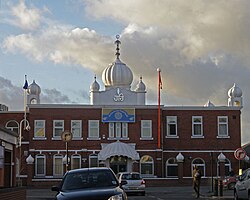
[[File:Shri Guru Ravidass Temple in the UK.jpg|thumb|Guru Ravidass temple, Foleshill, UK.]] | [[File:Shri Guru Ravidass Temple in the UK.jpg|thumb|Guru Ravidass temple, Foleshill, UK.]] | ||
Ravidas is revered as a saint and well respected by his believers. He is considered by his devotees as someone who was the living symbol of religious protest, and not as the spiritual symbol of any ultimate unifying cultural principle.<ref>Ravindra S Khare (1985), The Untouchable as Himself, Cambridge University Press, {{ISBN|978-0521263146}}, pages 48-49, 41-53</ref> | Ravidas is revered as a saint and well respected by his believers. He is considered by his devotees as someone who was the living symbol of religious protest, and not as the spiritual symbol of any ultimate unifying cultural principle.<ref>Ravindra S Khare (1985), The Untouchable as Himself, Cambridge University Press, {{ISBN|978-0521263146}}, pages 48-49, 41-53</ref> The most revered religious shrine of Ravidas is the Shri Guru Ravidass Janam Asthan Mandir in Seer Goverdhanpur, Varanasi (Uttar Pradesh, India), which is believed to be the birthplace of the saint. The temple, built in the early 20th century with contributions from the Ravidassia community across India and abroad, has grown into the spiritual center of Ravidas’s followers. It houses his memorial, prayer hall, and a museum dedicated to his teachings. Each year, especially on [[Guru Ravidass Jayanti]] (his birth anniversary, celebrated on Magh Purnima), hundreds of thousands of devotees from India and the diaspora gather there for prayers, kirtans, and community celebrations. The shrine symbolises his message of equality, unity, and devotion to God, cutting across caste and social barriers. Apart from Varanasi, other important shrines include gurdwaras and temples dedicated to him in Punjab (such as in Ballan near Jalandhar, the Dera Sachkhand Ballan).<ref>{{cite news |title=Sant Ravidas birthplace turns mini-Punjab as thousands flock city to celebrate saint's b'day |url=https://timesofindia.indiatimes.com/city/varanasi/sant-ravidas-birthplace-turns-mini-punjab-as-thousands-flock-city-to-celebrate-saints-bday/articleshow/118188996.cms |access-date=17 September 2025 |work=The Times of India |date=13 February 2025}}</ref> | ||
Beyond India, Ravidassias have built significant temples in the United Kingdom, the United States, Canada, Australia, New Zealand, and parts of Europe, including Austria, France, Germany, Greece, the Netherlands, and Italy. These shrines function not only as places of worship but also as cultural and social hubs, hosting religious ceremonies, festivals, educational programs, and community services. They symbolise the global spread of Ravidas’s message of equality, devotion, and social justice, while helping the Ravidassia diaspora maintain their spiritual and cultural identity.<ref>{{cite book |last1=Singh |first1=Pashaura |last2=Mandair |first2=Arvind-Pal Singh |title=The Sikh World |date=1 May 2023 |publisher=Taylor & Francis |isbn=978-0-429-84838-4 |url=https://books.google.com/books?id=dem9EAAAQBAJ&dq=ravidass+temples+across+world&pg=PT522 |access-date=17 September 2025 |language=en}}</ref><ref>{{cite news |title=Sikhs opened their temple doors to Oroville Dam evacuees — and strangers came pouring in |url=https://www.latimes.com/nation/la-me-sikh-temples-oroville-evacuees-2017-story.html |access-date=17 September 2025 |work=Los Angeles Times |date=15 February 2017}}</ref> | |||
=== Politics === | === Politics === | ||
[[File:Prime Minister Narendra Modi offers prayers at Shri Guru Ravidas Janmsthan Mandir, Seer Goverdhanpur (2).jpg|thumb|Prime Minister [[Narendra Modi]] offers prayers at Shri Guru Ravidas Janmsthan Mandir]] | [[File:Prime Minister Narendra Modi offers prayers at Shri Guru Ravidas Janmsthan Mandir, Seer Goverdhanpur (2).jpg|thumb|left|Prime Minister [[Narendra Modi]] offers prayers at Shri Guru Ravidas Janmsthan Mandir]] | ||
A political party was founded in India in 2012 by the followers of Ravidass, with the word Begumpura (''Be-gam-pura'', or "land without sorrow"), a term coined in a poem by Ravidas. The term means the city where there is no suffering or fear, and all are equal.<ref>{{Cite book|last=Omvedt|first=Gail|title=Seeking Begumpura : The Social Vision of Anticaste Intellectuals|publisher=Navayana|year=2009|isbn=978-8189059453}}</ref> | [[File:Canadian Prime Minister Justin Trudeau at Guru Ravidass Temple, Vancouver.jpg|thumb|left|Canadian Prime Minister [[Justin Trudeau]] at Guru Ravidass Temple, Vancouver]] | ||
A political party was founded in India in 2012 by the followers of Ravidass, with the word Begumpura (''Be-gam-pura'', or "land without sorrow"), a term coined in a poem by Ravidas. The term means the city where there is no suffering or fear, and all are equal.<ref>{{Cite book |last=Omvedt |first=Gail |title=Seeking Begumpura : The Social Vision of Anticaste Intellectuals |publisher=Navayana |year=2009 |isbn=978-8189059453}}</ref> | |||
The significance of the Guru Ravidass's Jayanti can be identified from the move of the Election Commission of India when they postponed the Punjab general assembly election, which was an unprecedented and rare move in the history of India.<ref>{{cite news |last1=Today |first1=Telangana |title=Political parties welcome EC's decision to postpone Punjab polls |url=https://telanganatoday.com/political-parties-welcome-ecs-decision-to-postpone-punjab-polls |access-date=17 September 2025 |work=Telangana Today |date=17 January 2022 |language=en}}</ref> | |||
When then-CM [[Mayawati]] attempted to create a beautiful park at the birthplace of Ravidas in Seer Gowardhanpur in 1997, the temple's political significance grew. The BSP leader gave a golden palanquin to the shrine and participated in Ravidas Jayanti festivities while serving as chief minister in 2008.Later, as part of their Dalit outreach efforts, representatives from all parties began to visit the Ravidas temple.In 2016 and 2019, PM [[Narendra Modi]] also participated in the Ravidas Jayanti festivities.Following his attendance at the Ravidas Jayanti festivities in 2018, Chief Minister [[Yogi Adityanath]] made numerous visits to the temple to observe its progress.On 6 May 2019, Mayawati and SP chief [[Akhilesh Yadav]] hosted a rally for their SP-BSP grand alliance in preparation for parliamentary elections at the temple's satsang field.<ref>{{cite news |title=Powerhouse of Dalit politics, Ravidas temple to impact polls in Uttar Pradesh, Punjab |url=https://timesofindia.indiatimes.com/city/varanasi/dalit-politics-powerhouse-ravidas-temple-to-affect-up-punjab-polls/articleshow/89107271.cms |access-date=17 September 2025 |work=The Times of India |date=25 January 2022}}</ref> | |||
During the 2022 Punjab Assembly elections, Ravidas's birthplace, Varanasi, became the political capital of India. Leaders from different political parties, such as Rahul Gandhi, Priyanka Gandhi, Yogi Adityanath, Akhilesh Yadav, Charanjit Singh Channi, and many more, paid obeisance to Ravidass at his temple. The prime minister also visited Guru Ravidas Dham Temple, Karol Bagh, amid the political campaign to woo voters from the Ravidassia community.<ref>{{cite news |title=BJP, Congress target UP, Punjab elections on the occasion of Guru Ravidas Jayanti |url=https://www.indiatoday.in/india/story/guru-ravidas-jayanti-temple-visit-narendra-modi-rahul-gandhi-up-punjab-elections-1913978-2022-02-16 |access-date=17 September 2025 |work=India Today |date=16 February 2022 |language=en}}</ref> | |||
== | Prior to the parliamentary elections in Canada, former Prime Minister [[Justin Trudeau]] also paid a visit to the Guru Ravidass Temples in Vancouver and Montreal, where he expressed gratitude for the sacrifices made by the congregation and society members. During his visit, Mr. Trudeau discussed the principles of "equality" that Ravidass advocated, stating that Canada shares these principles.<ref>{{cite news |last1=Mall |first1=posted by: Rattan |title=Trudeau's historical visit to Guru Ravidass Community Center in Burnaby {{!}} Indo-Canadian Voice |url=https://voiceonline.com/trudeaus-historical-visit-to-guru-ravidass-community-center-in-burnaby/ |access-date=17 September 2025 |date=16 December 2024 |language=en-CA}}</ref> | ||
==Art and | === Ravidas and Meera Bai === | ||
• [[Sant Ravidas Ki Amar Kahani]] | According to hagiographies and oral traditions, Mira Bai, the Rajput princess of Mewar and saint-poetess devoted to Krishna, is often described as a disciple of Ravidas (Raidas). She met Ravidas during her early spiritual quest. She considered him her guru (spiritual teacher) and is believed to have received spiritual initiation (diksha) from him.<ref>{{cite book |last1=Vishwananda |first1=Paramahamsa |title=Just Love: A Journey into the Heart of God: A Compilation of Talks by Paramahamsa Vishwananda |date=12 July 2021 |publisher=Bhakti Marga Publications |isbn=978-3-96343-080-0 |url=https://books.google.com/books?id=lGg4EAAAQBAJ&dq=mira+bai+ravidas&pg=PT31 |access-date=17 September 2025 |language=en}}</ref> | ||
There is a small ''[[chhatri]]'' (pavilion) in front of [[Kumbha Shyam Temple, Chittorgarh|Meera's temple]] in [[Chittorgarh district]] of [[Rajasthan]] which bears Ravidas' engraved foot print.<ref>{{cite book |last1=Singh |first1=Mahendra |title=Dalit's Inheritance in Hindu Religion |date=2006 |publisher=Gyan Publishing House |isbn=978-81-7835-517-7 |url=https://books.google.com/books?id=2xSZqwkA5VwC&dq=ravidas+foot+print+in+chittorgarh&pg=PA126 |access-date=29 August 2024 |language=en}}</ref><ref>[http://www.ghumakkar.com/2009/08/24/chittaurgarh-fort-an-enigma-with-a-thin-line-between-history-and-mythology-i/ ''Chittauragarh Fort: An Enigma with a Thin Line between History and Mythology''] {{Webarchive|url=https://web.archive.org/web/20131013173904/http://www.ghumakkar.com/2009/08/24/chittaurgarh-fort-an-enigma-with-a-thin-line-between-history-and-mythology-i/ |date=13 October 2013 }}. 24 August 2009, Ghumakkar.com</ref><ref>{{cite web |last1=Khamesra |first1=Manish |title=Meera Bai : The Saint, poetess and the rebel queen of Chittorgarh |url=https://manishjaishree.com/saint-meera-bai/ |website=Manish Jaishree |access-date=29 August 2024 |date=29 April 2014}}</ref> Legends link him as the ''guru'' of [[Mirabai]], another major Bhakti movement poet.<ref name=peterheehs>Peter Heehs (2002), Indian Religions: A Historical Reader of Spiritual Expression and Experience, New York University Press, {{ISBN|978-0814736500}}, pages 368-370</ref><ref>{{cite news |title=Guru Ravidas, seer, social reformer |url=https://www.thehindu.com/society/faith/guru-ravidas-seer-social-reformer/article67884907.ece |access-date=29 August 2024 |work=The Hindu |date=25 February 2024 |language=en-IN}}</ref> | |||
Queen Mira Bai composed a song dedicated to Ravidas where she mentioned him as her ''guru''. | |||
<poem> | |||
Sadguru sant mile Ravidas | |||
Mira devaki kare vandana aas | |||
Jin chetan kahya dhann Bhagavan Ravidas | |||
</poem> | |||
– "I got a guru in the form of sant Ravidas, there by obtaining life's fulfillment."<ref>{{cite book |last1=Shri |first1=Satya |title=Demystifying Brahminism and Re-Inventing Hinduism: Volume 1 - Demystifying Brahminism |date=23 January 2017 |publisher=Notion Press |isbn=978-1-946515-54-4 |url=https://books.google.com/books?id=mMf1DQAAQBAJ&dq=mira+and+ravidass&pg=PT533 |access-date=29 August 2024 |language=en}}</ref> | |||
== Gallery == | |||
<gallery> | |||
File:Detail of Bhagat Ravidas from a painting of a gathering of holy men of different faiths, by Mir Kalan Khan, ca.1770–75.jpg|Detail of Ravidas from a painting of a gathering of holy men of different faiths, by Mir Kalan Khan, ca.1770–75 | |||
File:Guru Ravidas.jpg|Modern painting of Ravidas | |||
File:Ravidas 2001 stamp of India.jpg|Ravidas on 2001 Indian commemorative stamp. | |||
</gallery> | |||
== Art and films == | |||
• ''[[Sant Ravidas Ki Amar Kahani]]'' | |||
== See also == | == See also == | ||
* [[Dalit Buddhist movement]] | * [[Dalit Buddhist movement]] | ||
==References== | == References == | ||
{{reflist}} | {{reflist}} | ||
== External links == | == External links == | ||
* [http://www.shrigururavidasji.com/ Shri Guru Ravidas Ji] | * [http://www.shrigururavidasji.com/ Shri Guru Ravidas Ji] | ||
* {{cite web |title=Peter Friedlander |url=https://researchportalplus.anu.edu.au/en/persons/peter-friedlander |website=The Australian National University |access-date=28 August 2024}} | |||
{{Sant Mat}} | {{Sant Mat}} | ||
| Line 151: | Line 189: | ||
{{DEFAULTSORT:Guru Ravidas}} | {{DEFAULTSORT:Guru Ravidas}} | ||
[[Category:Ravidassia]] | [[Category:Ravidassia]] | ||
[[Category:15th-century Hindus]] | |||
[[Category:15th-century Indian poets]] | |||
[[Category:16th-century Hindus]] | |||
[[Category:16th-century Indian poets]] | |||
[[Category:Dalit Hindu saints]] | |||
[[Category:Indian Hindu spiritual teachers]] | [[Category:Indian Hindu spiritual teachers]] | ||
[[Category:Indian male poets]] | [[Category:Indian male poets]] | ||
[[Category:Medieval Hindu religious leaders]] | |||
[[Category:Poets from Uttar Pradesh]] | |||
[[Category:Sant Mat gurus]] | [[Category:Sant Mat gurus]] | ||
[[Category:Scholars from Varanasi]] | |||
[[Category:Sikh Bhagats]] | |||
[[Category:Vaishnava saints]] | |||
[[Category:Year of birth unknown]] | [[Category:Year of birth unknown]] | ||
Latest revision as of 16:33, 31 January 2026
Ravidas | |
|---|---|
 Ravidas at work as a shoemaker. Folio from a series featuring Bhakti saints. Master of the first generation after Manaku and Nainsukh of Guler, Pahari region, c. 1800–1810 | |
| Other names | Raidas, Rohidas, Ruhi Dass, Robidas, Bhagat Ravidas, Guru Ravidas |
| Personal | |
| Born | |
| Died | Banaras, Delhi Sultanate (present-day Varanasi, Uttar Pradesh, India) |
| Spouse | Lona Devi |
| Children | 1 |
| Known for | Venerated as a Guru and having hymns included in the Guru Granth Sahib, central figure of the Ravidassia |
| Other names | Raidas, Rohidas, Ruhi Dass, Robidas, Bhagat Ravidas, Guru Ravidas |
| Occupation | Poet, leather craftsman, satguru (spiritual teacher) |
| Senior posting | |
Influenced by
| |
Influenced
| |
| Part of a series on the |
| Ravidassia religion |
|---|
 |
| Beliefs and practices |
| Temples |
| Scriptures |
| Holy Places |
| Founder |
| Sants |
| Festivals |
| Symbols |
 Hinduism portal Hinduism portal |
| Part of a series on |
| Hinduism |
|---|
 |

| Part of a series on |
| Sikhism |
|---|
 |
Ravidas or Raidas was an Indian mystic poet-saint of the Bhakti movement during the 15th to 16th century CE.[1][2] Venerated as a guru (spiritual teacher) in the modern regions of Uttar Pradesh, Bihar, Rajasthan, Gujarat, Maharashtra, Madhya Pradesh, Punjab, and Haryana, he was a poet, social reformer and spiritual figure.
The life details of Ravidas are uncertain and contested. Some scholars believe he was born in 1433 CE. He taught removal of social divisions of caste and gender, and promoted unity in the pursuit of personal spiritual freedom.
Ravidas's devotional verses were included in the Sikh scriptures known as Guru Granth Sahib.[2][3] The Panch Vani text of the Dadu Panthi tradition within Hinduism also includes numerous poems of Ravidas.[1] He is also the central figure within the Ravidassia religious movement.
Mainstream Sikhs consider him to be a bhagat whilst break-away Ravidassias consider him to be a guru.[4]
Dates[edit | edit source]
The details of Ravidas's life are not well known. The birth date Ravidas has been a subject of discussion among scholars and devotees, as historical records from the 14th–15th century are limited. Different traditions and sources provide varying years for his birth.Some scholars[who?] state he was born in 1377 CE and died in 1528 CE in Banaras at the age of 151 years.[5] Others, such as Amaresh Datta, claim he was born in 1267 and died in 1335.[6]
The Rajput princess and Bhakti saint, Mira Bai (1498–1547 CE), is recorded in multiple traditions as a devoted disciple of Ravidas. This disciple-guru relationship, mentioned in historical and literary sources, indicates that Ravidass must have been alive after 1498 CE and actively guiding his followers when Mirabai reached adulthood, around the time of her marriage in 1516. The connection between Ravidas and Mirabai helps scholars place his lifetime within the late 15th and early 16th centuries.[7]
Regional variation in names[edit | edit source]
He is remembered by many names across regions, traditions, and languages. These variations reflect affection, honorifics, and local pronunciations. Ravidas is the most common form, especially in Hindi-speaking regions, Ramdas has been used by followers who migrated from West Pakistan.,[8][9] Raidas is widely used in Uttar Pradesh, Madhya Pradesh, and Bihar, Ruhidas/Ruidas is the common pronunciation in Bengal and Eastern India and Rohidas is used in Maharashtra, Karnataka and Gujarat.[10]
The term Ramdasia is merely a corruption of the word Ravidasia.[8][9] In Punjab, both the words Ramdasia and Ravidasia are also used interchangeably, although these also have regional context. The word Ramdasia is largely used in Puadh and Malwa, while Ravidasia is predominantly used in Doaba.[11][12]
Followers of Ravidas are known by different names in different regions, depending on history, migration, and local linguistic or social contexts. Ravidassias is the most common and widely accepted name today, especially after the Vienna incident when many followers began identifying as a distinct religious community, Ramdasia is for Sikh Chamar followers, Rohidasi is for those in regions like Maharashtra, Karnataka, Gujarat, and Rajasthan, who revere Ravidas as their spiritual guide, and Ravived is mainly for those in Mauritius.
Biography[edit | edit source]
Ravidas was born in the village of Sir Gobardhanpur, near Varanasi in what is now Uttar Pradesh, India. His birthplace is now known as Shri Guru Ravidass Janam Asthan. His birthday is celebrated as Ravidas Jayanti and important temple is Ravidas Temple. Mata Kalsi was his mother, and his father was Santokh Dass.[13] His parents belonged to a leather-working Chamar community, an untouchable caste.[1][2] While his original occupation was leather work, he began to spend most of his time in spiritual pursuits at the banks of the Ganges. Thereafter he spent most of his life in the company of Sufi saints, Sadhus and ascetics.[13] At the age of 12, Ravidas was married off to Lona Devi. They had a son, Vijay Dass.[14][15]
The text Anantadas Parcai is one of the earliest surviving biographies of various Bhakti movement poets which describes the birth of Ravidas.[16]
Medieval era texts, such as the Bhaktamal suggest that Ravidas was the disciple of the Brahmin bhakti-poet Ramananda.[17][18] He is traditionally considered as Kabir's younger contemporary.[1]
However, the medieval text Ratnavali says Ravidas gained his spiritual knowledge from Ramananda and was a follower of the Ramanandi Sampradaya tradition.[17][18][19]
His ideas and fame grew over his lifetime, and texts suggest Brahmins used to bow before him.[2] He travelled extensively, visiting Hindu pilgrimage sites in Andhra Pradesh, Maharashtra, Gujarat, Rajasthan, and those in the Himalayas. He abandoned saguna (with attributes, image) forms of supreme beings, and focused on the nirguna (without attributes, abstract) form of supreme beings.[13] As his poetic hymns in regional languages inspired others, people from various background sought his teachings and guidance.[13]

Most scholars believe that Ravidas met Guru Nanak, the founder of Sikhism.[2] He is revered in the Sikh scripture, and 41 of Ravidas' poems are included in the Guru Granth Sahib. These poems are one of the oldest attested source of his ideas and literary works.[1][2] Another substantial source of legends and stories about the life of Ravidas is the hagiography in the Sikh tradition, the Premambodha.[20] This text, composed over 170 years after Ravidas' death, in 1693, includes him as one of the seventeen saints of Indian religious tradition.[20] The 17th-century Nabhadas's Bhaktamal, and the Parcais of Anantadas, both contain chapters on Ravidas.[21] Other than these, the scriptures and texts of Sikh tradition and the Hindu Dadupanthi traditions, most other written sources about the life of Ravidas, including by the Ravidasi (followers of Ravidas), were composed in the early 20th century, or about 400 years after his death.[20][22]
Text, called the Parcaīs (or Parchais), included Ravidas among the sants whose biography and poems were included. Over time new manuscripts of Parcais of Anantadas were reproduced, some in different local languages of India.[22] Winnand Callewaert notes that some 30 manuscripts of Anantadas's hagiography on Ravidas have been found in different parts of India.[23] Of these four manuscripts are complete, collated and have been dated to 1662, 1665, 1676 and 1687. The first three are close with some morphological variants without affecting the meaning, but the 1687 version systematically inserts verses into the text, at various locations, with caste-related statements, new claims of Brahmins persecuting Ravidas, notes on the untouchability of Ravidas, claims of Kabir giving Ravidas ideas, ridicules of nirguni and saguni ideas, and such text corruption:[24] Callewaert considers the 1676 version as the standard version, his critical edition of Ravidas's hagiography excludes all these insertions, and he remarks that the cleaner critical version of Anantadas's parcais suggests that there is more in common in the ideas of bhakti movement's Ravidas, Kabir and Sen than previously thought.[23]
Khare similarly has questioned the textual sources on Ravidas, and mentions there are few "readily available and reliable textual sources on the Hindu and Untouchable treatment of Ravidas."[25]
Literary works[edit | edit source]
The Adi Granth and the Panchvani of the Hindu warrior-ascetic group Dadupanthi are the two oldest attested sources of the literary works of Ravidas.[1] In the Adi Granth, forty one of Ravidas's poems are included, and he is one of thirty six contributors to this foremost canonical scripture of Sikhism.[26][27] This compilation of poetry in Adi Granth responds to, among other things, issues of dealing with conflict and tyranny, war and resolution, and willingness to dedicate one's life to the right cause.[26] Ravidas's poetry covers topics such as the definition of a just state where there are no second or third class unequal citizens, the need for dispassion, and who is a real Yogi.[27][28]
Jeffrey Ebbesen notes that, just like other Bhakti saint-poets of India and some cases of Western literature authorship, many poems composed by later era Indian poets have been attributed to Ravidas, as an act of reverence, even though Ravidas has had nothing to do with these poems or ideas expressed therein.[29]
Ravidas literature on symbolism[edit | edit source]
Peter Friedlander states that Ravidas' hagiographies, though authored long after he died, depict a struggle within the Indian society, where Ravidas' life gives the means to express a variety of social and spiritual themes.[20] At one level, it depicts a struggle between the then prevalent heterodox communities and the orthodox Brahminical tradition. At another level, the legends are an inter-communal, inter-religious struggle with an underlying search and desire for social unity. At yet another level, states Friedlander, the stories describe the spiritual struggle of an individual unto self.[20]
There is no historical evidence to verify the historicity in these hagiographies, which range from Ravidas's struggle with Hindu Brahmins,[30] to his struggle with Muslim Sultan Sikander Lodi.[31] Friedlander states that the stories reflect the social dynamics that influenced the composers of the hagiographies during the 17th- to 20th-century. These are legends where Ravidas is victorious because of divine intervention with miracles such as making a stone float in water, or making river Ganges to reverse course and flow upstream.[20]
David Lorenzen similarly states that poetry attributed to Ravidas, and championed by Ravidasi from the 17th- through the 20th-century, have a strong anti-Brahminical and anti-communal theme.[32] The legends, suggests Lorenzen, cannot be separated from the power and political situation of this era, and they reflect a strong element of social and religious dissent by groups marginalised during a period when Indian society was under the Islamic rule and later the colonial rule.[32][33]
Philosophy[edit | edit source]
_and_Kabir_(right)_seated_under_a_tree.jpg)
The songs of Ravidas discuss Nirguna-Saguna[broken anchor] themes, as well as ideas that are at the foundation of Nath Yoga philosophy of Hinduism.[34] He frequently mentions the term Sahaj, a mystical state where there is a union of the truths of the many and the one.[34]
Raidas says, what shall I sing?
Singing, singing I am defeated.
How long shall I consider and proclaim:
absorb the self into the Self?
This experience is such,
that it defies all description.
I have met the Lord,
Who can cause me harm?
Hari in everything, everything in Hari –
For him who knows Hari and the sense of self,
no other testimony is needed:
the knower is absorbed.— Ravidas, Translated by Winand Callewaert and Peter Friedlander[34]
David Lorenzen states Ravidas's poetry is imbued with themes of boundless loving devotion to God, wherein this divine is envisioned as Nirguna.[35] In the Sikh tradition, the themes of Nanak's poetry are very broadly similar to the Nirgun bhakti ideas of Ravidas and other leading north Indian saint-poets.[33][36] Most postmodern scholars, states Karen Pechilis, consider Ravidas's ideas to belong to the Nirguna philosophy within the Bhakti movement.[37]
Monistic Brahman or Anthropomorphic God[edit | edit source]
Multiple manuscripts found in Rajasthan and Uttar Pradesh, dated to be from the 18th and 19th centuries, contain a debate between Kabir and Ravidas on the nature of the Absolute, more specifically whether the Brahman (Ultimate Reality, Eternal Truth) is monistic Oneness or a separate anthropomorphic incarnate.[38] Kabir argues for the former. Ravidas, in contrast, argues from the latter premise to the effect that both are one.[38] In these manuscripts, Kabir initially prevails, Ravidas accepts that Brahman is monistic, but till the end Kabir didn't accept worshipping a divine avatar (sagun conception).[38]
One man: two divergent claims on his views and philosophy[edit | edit source]

Ravindra Khare states that there are two divergent versions that emerge from the study of texts relating to Ravidas's philosophy.[39] The 17th century Bhaktamal text by Nabhadas provides one version, while the 20th-century texts by Dalits provide another.[25]
According to Bhaktamal text, Ravidas was of pure speech, capable of resolving spiritual doubts of those who held discussions with him, was unafraid to state his humble origins and real caste.[40] Further, the Bhaktamal text states that Ravidas' teachings agreed with Vedic and ancient scriptures, he subscribed to nondualism, discussed spiritual ideas and philosophy with everyone including Brahmins without gender or caste discrimination, and his abilities reflected an individual who had reached the inner content state of the highest ascetic.[40]
The 20th-century version, prevalent in the texts of Dalit community, concurs with the parts about pure speech and resolving spiritual doubts.[41] However, they differ in the rest. The texts and the prevalent beliefs of the Dalit community hold that Ravidas rejected the Hindu Vedas, he was opposed by the Brahmins and resisted by the caste Hindus as well as Hindu ascetics throughout his life, and that some members of the Dalit community have believed Ravidas was an idol worshipper (saguni bhakti saint) while other 20th century texts assert that Ravidas rejected idolatry.[41] For example, the following hymn of Ravidas, present in Guru Granth Sahib, support such claims where he rejects Vedas and the belief that taking a ritualistic bath can make someone pure.
One may distinguish between good and evil actions, and listen to the Vedas and the Puranas, but doubt still persists. Skepticism continually dwells in the heart, so who can eradicate egotistical pride? Outwardly, he washes with water, but deep within, his heart is tarnished by all sorts of vices. So how can he become pure? His method of purification is like that of an elephant, covering himself with dust right after his bath!
— Ravidas, Guru Granth Sahib 346[42]
His spiritual teacher Ramananda was a Brahmin and his disciple Mirabai was a Rajput princess.[43][44]
Legacy[edit | edit source]

Ravidassia[edit | edit source]


The difference between the Ravidassia and Sikhism, as described by a post made by Shri Guru Ravidass Temple in Ontario is as follows:
We, as Ravidassias have different traditions. We are not Sikhs. Even though, we give utmost respect to 10 gurus and Guru Granth Sahib, Guru Ravidass Ji is our supreme. There is no command for us to follow the declaration that there is no Guru after Guru Granth Sahib. We respect Guru Granth Sahib because it has our guru Ji's teachings and teachings of other religious figures who have spoken against caste system, spread the message of NAAM and equality. As per our traditions, we give utmost respect to contemporary gurus also who are carrying forward the message of Guru Ravidass Ji.[45]
The Ravidassia religion is a spin-off religion from Sikhism, formed in the 21st century, by the followers of Ravidas's teachings. It was formed following a 2009 attack on a Ravidassia temple in Vienna by Sikh militants leading to the death of deputy head Ramanand Dass and 16 others injured, where after the movement declared itself to be a religion fully separated from Sikhism.[52] The Ravidassia religion compiled a new holy book, Amritbani Guru Ravidass Ji. Based entirely on the writings and teaching of Ravidas, it contains 240 hymns. Niranjan Dass is the head of Dera Sachkhand Ballan.[46]
Kathryn Lum summarises the dynamics behind the separation of Ravidassia and Sikhism, and its focus on Ravidas, as follows:
Ravidasia believe that the best way forward for Chamars is to claim and assert their own identity. For this more independent camp, Sikhism is viewed as obstructing the full development of the Chamar community as a quam (separate religion and nation), as envisioned by the Ad Dharm (original people) movement. According to these separatist Ravidasias, the only way for Chamars to progress is to pursue an independent religious path focused exclusively on the figure of Guru Ravidas.
— Kathryn Lum, Sikhs in Europe[53]
Places of worship[edit | edit source]

Ravidas is revered as a saint and well respected by his believers. He is considered by his devotees as someone who was the living symbol of religious protest, and not as the spiritual symbol of any ultimate unifying cultural principle.[54] The most revered religious shrine of Ravidas is the Shri Guru Ravidass Janam Asthan Mandir in Seer Goverdhanpur, Varanasi (Uttar Pradesh, India), which is believed to be the birthplace of the saint. The temple, built in the early 20th century with contributions from the Ravidassia community across India and abroad, has grown into the spiritual center of Ravidas’s followers. It houses his memorial, prayer hall, and a museum dedicated to his teachings. Each year, especially on Guru Ravidass Jayanti (his birth anniversary, celebrated on Magh Purnima), hundreds of thousands of devotees from India and the diaspora gather there for prayers, kirtans, and community celebrations. The shrine symbolises his message of equality, unity, and devotion to God, cutting across caste and social barriers. Apart from Varanasi, other important shrines include gurdwaras and temples dedicated to him in Punjab (such as in Ballan near Jalandhar, the Dera Sachkhand Ballan).[55]
Beyond India, Ravidassias have built significant temples in the United Kingdom, the United States, Canada, Australia, New Zealand, and parts of Europe, including Austria, France, Germany, Greece, the Netherlands, and Italy. These shrines function not only as places of worship but also as cultural and social hubs, hosting religious ceremonies, festivals, educational programs, and community services. They symbolise the global spread of Ravidas’s message of equality, devotion, and social justice, while helping the Ravidassia diaspora maintain their spiritual and cultural identity.[56][57]
Politics[edit | edit source]
.jpg)

A political party was founded in India in 2012 by the followers of Ravidass, with the word Begumpura (Be-gam-pura, or "land without sorrow"), a term coined in a poem by Ravidas. The term means the city where there is no suffering or fear, and all are equal.[58]
The significance of the Guru Ravidass's Jayanti can be identified from the move of the Election Commission of India when they postponed the Punjab general assembly election, which was an unprecedented and rare move in the history of India.[59]
When then-CM Mayawati attempted to create a beautiful park at the birthplace of Ravidas in Seer Gowardhanpur in 1997, the temple's political significance grew. The BSP leader gave a golden palanquin to the shrine and participated in Ravidas Jayanti festivities while serving as chief minister in 2008.Later, as part of their Dalit outreach efforts, representatives from all parties began to visit the Ravidas temple.In 2016 and 2019, PM Narendra Modi also participated in the Ravidas Jayanti festivities.Following his attendance at the Ravidas Jayanti festivities in 2018, Chief Minister Yogi Adityanath made numerous visits to the temple to observe its progress.On 6 May 2019, Mayawati and SP chief Akhilesh Yadav hosted a rally for their SP-BSP grand alliance in preparation for parliamentary elections at the temple's satsang field.[60]
During the 2022 Punjab Assembly elections, Ravidas's birthplace, Varanasi, became the political capital of India. Leaders from different political parties, such as Rahul Gandhi, Priyanka Gandhi, Yogi Adityanath, Akhilesh Yadav, Charanjit Singh Channi, and many more, paid obeisance to Ravidass at his temple. The prime minister also visited Guru Ravidas Dham Temple, Karol Bagh, amid the political campaign to woo voters from the Ravidassia community.[61]
Prior to the parliamentary elections in Canada, former Prime Minister Justin Trudeau also paid a visit to the Guru Ravidass Temples in Vancouver and Montreal, where he expressed gratitude for the sacrifices made by the congregation and society members. During his visit, Mr. Trudeau discussed the principles of "equality" that Ravidass advocated, stating that Canada shares these principles.[62]
Ravidas and Meera Bai[edit | edit source]
According to hagiographies and oral traditions, Mira Bai, the Rajput princess of Mewar and saint-poetess devoted to Krishna, is often described as a disciple of Ravidas (Raidas). She met Ravidas during her early spiritual quest. She considered him her guru (spiritual teacher) and is believed to have received spiritual initiation (diksha) from him.[63]
There is a small chhatri (pavilion) in front of Meera's temple in Chittorgarh district of Rajasthan which bears Ravidas' engraved foot print.[64][65][66] Legends link him as the guru of Mirabai, another major Bhakti movement poet.[34][67]
Queen Mira Bai composed a song dedicated to Ravidas where she mentioned him as her guru.
Sadguru sant mile Ravidas
Mira devaki kare vandana aas
Jin chetan kahya dhann Bhagavan Ravidas
– "I got a guru in the form of sant Ravidas, there by obtaining life's fulfillment."[68]
Gallery[edit | edit source]
-
 Detail of Ravidas from a painting of a gathering of holy men of different faiths, by Mir Kalan Khan, ca.1770–75
 -
 Modern painting of Ravidas
 -
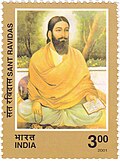 Ravidas on 2001 Indian commemorative stamp.


Art and films[edit | edit source]
See also[edit | edit source]
References[edit | edit source]
- ↑ 1.0 1.1 1.2 1.3 1.4 1.5 James Lochtefeld (2002), The Illustrated Encyclopedia of Hinduism: N-Z, Rosen Publishing, ISBN 978-0823931804, page 569
- ↑ 2.0 2.1 2.2 2.3 2.4 2.5 "Ravidas: Indian mystic and poet". Encyclopædia Britannica. Retrieved 10 August 2009.
- ↑ Callewaert and Friedlander, The Life and Works of Ravidass Ji, Manohar, Delhi, 1992, quoted in Gavin Flood, An Introduction to Hinduism, Cambridge 1996.
- ↑ Gurus and Media: Sound, image, machine, text and the digital. UCL Press. 25 September 2023. pp. 224–225. ISBN 9781800085541.
- ↑ Sharma, Arvind (2003). The Study of Hinduism. The University of South Carolina Press. p. 229. ISBN 1-57003-449-4.
- ↑ Datta, Amaresh (1987). Encyclopaedia of Indian Literature: A-Devo, Volume 1. Sahitya Akademi. p. 79. ISBN 9788126018031.
- ↑ Upadhyaya, K. N. (1982). Guru Ravidas, Life and Teachings. Radha Soami Satsang Beas. p. 7. Retrieved 19 September 2025.
- ↑ 8.0 8.1 General, India Office of the Registrar (1962). Census of India, 1961. Manager of Publications. Retrieved 19 September 2025.
- ↑ 9.0 9.1 Barstow, A. E. (1989). Handbook on Sikhs. Uppal Publishing House. ISBN 978-81-85024-54-7. Retrieved 19 September 2025.
- ↑ Singh, Darshan (1978). Glimpses of Indian History. Panjab Prakashan. Retrieved 17 September 2025.
- ↑ "Punjab's dalit conundrum: A look into Sikhs' caste identity". The Times of India. 30 September 2021. Retrieved 17 September 2025.
- ↑ Upadhya, Carol; Rutten, Mario; Koskimaki, Leah (27 June 2018). Provincial Globalization in India: Transregional Mobilities and Development Politics. Routledge. ISBN 978-1-351-63107-5. Retrieved 19 September 2025.
- ↑ 13.0 13.1 13.2 13.3 Hardev Bahri. Harbans Singh; et al. (eds.). "Ravidas". Encyclopaedia of Sikhism. Punjabi University Patiala. Retrieved 11 February 2017.
- ↑ Trisharan, Dr Vijay Kumar (2008). Mahakavi Ravidas Samaj Chetna Ke Agradut (in हिन्दी). Gautam Book Center. p. 34. ISBN 978-81-87733-14-0.
- ↑ Ji, Jagatguru Ravidaas (1 February 2017). Amritwani Ravidaas Ji Maharaj (in हिन्दी). Shri Guru Ravidass Janam Asthan Mandir Seer Govardhanpur, Varanasi (U.P.). p. 291.[permanent dead link]
- ↑ Callewaert, Winnand (2013). The Hagiographies of Anantadas: The Bhakti Poets of North India. Routledge. pp. 307, 1–23. ISBN 978-1-136-12002-2.
- ↑ 17.0 17.1 Pande, Rekha (2010). Divine Sounds from the Heart—Singing Unfettered in their Own Voices: The Bhakti Movement and its Women Saints (12th to 17th Century). Cambridge Scholars Publishing. pp. 76–77. ISBN 978-1-4438-2525-2. Retrieved 25 August 2019.
- ↑ 18.0 18.1 David Lorenzen (1996), Praises to a Formless God: Nirguni Texts from North India, State University of New York Press, ISBN 978-0791428054, page 268
- ↑ Mamta Jha (2013). Sant Ravidas Ratnawali. prabhat prakashan. p. 12.
- ↑ 20.0 20.1 20.2 20.3 20.4 20.5 Peter Friedlander (1996), Myth and Mythmaking: Continuous Evolution in Indian Tradition (Editor: Julia Leslie), Routledge, ISBN 978-0700703036, pages 106-114
- ↑ Winnand Callewaert (2000), The Hagiographies of Anantadas: The Bhakti Poets of North India, Routledge, ISBN 978-0700713318, pages 1-4
- ↑ 22.0 22.1 Callewaert, Winand. (2003), Pilgrims, Patrons, and Place: Localizing Sanctity in Asian Religions (Editors: Phyllis Granoff and Koichi Shinohara), University of British Columbia Press, ISBN 978-0774810395, pages 203-223
- ↑ 23.0 23.1 Winnand Callewaert (2000), The Hagiographies of Anantadas: The Bhakti Poets of North India, Routledge, ISBN 978-0700713318, pages 303-307
- ↑ Winnand Callewaert (2000), The Hagiographies of Anantadas: The Bhakti Poets of North India, Routledge, ISBN 978-0700713318, pages 316-334
- ↑ 25.0 25.1 Ravindra S Khare (1985), The Untouchable as Himself, Cambridge University Press, ISBN 978-0521263146, pages 41-47
- ↑ 26.0 26.1 Pashaura Singh (2012), Fighting Words: Religion, Violence, and the Interpretation of Sacred Texts (Editor: John Renard), University of California Press, ISBN 978-0520274198, pages 202-207
- ↑ 27.0 27.1 GS Chauhan (2009), Bani Of Bhagats, Hemkunt Press, ISBN 978-8170103561, pages 41-55
- ↑ J Kaur (2005), The Concept of Peace and the Guru Granth Sahib, The Indian Journal of Political Science, Volume 66, Number 3, pages 649-660
- ↑ Jeffrey Ebbesen (1995), Literary India: Comparative Studies in Aesthetics, Colonialism, and Culture (Editors: Patrick Colm Hogan, Lalita Pandit), State University of New York Press, ISBN 978-0791423950, pages 53-55
- ↑ Peter Friedlander (1996), Myth and Mythmaking: Continuous Evolution in Indian Tradition (Editor: Julia Leslie), Routledge, ISBN 978-0700703036, pages 109-110
- ↑ Peter Friedlander (1996), Myth and Mythmaking: Continuous Evolution in Indian Tradition (Editor: Julia Leslie), Routledge, ISBN 978-0700703036, pages 108, 112-117
- ↑ 32.0 32.1 David Lorenzen (1995), Bhakti Religion in North India: Community Identity and Political Action, State University of New York Press, ISBN 978-0791420256, pages 105-116, 292-303
- ↑ 33.0 33.1 Neeti M Sadarangani (2004), Bhakti Poetry in Medieval India: Its Inception, Cultural Encounter and Impact, Swarup & Sons, ISBN 978-8176254366, pages i-xv, 115, 55-60, 72-76
- ↑ 34.0 34.1 34.2 34.3 Peter Heehs (2002), Indian Religions: A Historical Reader of Spiritual Expression and Experience, New York University Press, ISBN 978-0814736500, pages 368-370
- ↑ David Lorenzen (1995), Bhakti Religion in North India: Community Identity and Political Action, State University of New York Press, ISBN 978-0791420256, page 107
- ↑ Christopher Shackle (2014), The Oxford Handbook of Sikh Studies (Editors: Pashaura Singh, Louis E. Fenech), Oxford University Press, ISBN 978-0199699308, page 111
- ↑ Karen Pechilis Prentiss (2014), The Embodiment of Bhakti, Oxford University Press, ISBN 978-0195351903, page 21
- ↑ 38.0 38.1 38.2 David Lorenzen (1996), Praises to a Formless God: Nirguni Texts from North India, State University of New York Press, ISBN 978-0791428054, pages 169-170
- ↑ Ravindra S Khare (1985), The Untouchable as Himself, Cambridge University Press, ISBN 978-0521263146, pages 41, 46
- ↑ 40.0 40.1 Ravindra S Khare (1985), The Untouchable as Himself, Cambridge University Press, ISBN 978-0521263146, pages 41-45
- ↑ 41.0 41.1 Ravindra S Khare (1985), The Untouchable as Himself, Cambridge University Press, ISBN 978-0521263146, pages 46-53, 163-164
- ↑ "Sri Granth: Sri Guru Granth Sahib". .srigranth.org. Retrieved 2 March 2022.
- ↑ Macauliffe, Max Arthur (28 March 2013). The Sikh Religion: Its Gurus, Sacred Writings and Authors. Cambridge University Press. p. 100. ISBN 978-1-108-05548-2.
Ramanand, a Gaur Brahman, was born at Maicot
- ↑ Harlan, Lindsey (21 June 2024). Religion and Rajput Women: The Ethic of Protection in Contemporary Narratives. Univ of California Press. p. 206. ISBN 978-0-520-41512-6.
On the other hand, they say that they admire Mira as a Rajput woman because of her exceptionally good character.
- ↑ Ram, R. (2009). Ravidass, Dera Sachkhand Ballan and the Question of Dalit Identity in Punjab. JPS, 16(1), 2.
- ↑ 46.0 46.1 "Punjab sect declares new religion". The Times of India. 1 February 2010. Archived from the original on 11 August 2011.
- ↑ Singh, Pashaura (2014). The Oxford Handbook of Sikh Studies. Oxford University Press. p. 88. ISBN 978-0-19-100411-7.
Recently, the Sikh radicals' attack on the head of Dera Sachkhand Bhallan and his deputy in Vienna on 24 May 2009 for allegedly violating the Sikh Rehat Maryada at Ravidas gurdwaras across the world culminated in widespread violence in the Jalandhar Doab.
- ↑ Borup, Jørn; Fibiger, Marianne Qvortrup; Kühle, Lene (1 October 2019). Religious Diversity in Asia. BRILL. p. 154. ISBN 978-90-04-41581-2.
The Vienna incident of 24th May 2009 became a watershed for the Dera Sachkhand Ballan, when two sants of the Dera, Baba Ramanand Das and Baba Niranjan Das, who were travelling to Europe on their regular tours, were attacked by some radical Sikh group while attending a Ravidassia religious congregation.
- ↑ Jakobsh, Doris R. (2014). Religious Radicalization and Securitization in Canada and Beyond. University of Toronto Press. p. 177. ISBN 978-1-4426-1436-9.
- ↑ "Austrian Sikh temple attack sparks riots in India". Reuters. 25 May 2009. Retrieved 1 March 2022.
- ↑ Ashirwad, Ajoy (19 June 2009). "Inflamed passions". Frontline. Retrieved 1 March 2022.
The riots were sparked off by an attack on Sant Niranjan Dass, the head of the Jalandhar-based Dera Sachkhand, and his deputy Rama Nand on May 24 at the Shri Guru Ravidass Gurdwara in Vienna where they had gone to attend a religious function. A group of Sikhs armed with firearms and swords attacked them at the gurdwara, injuring both; Rama Nand later died. The Austrian police said the attack that left some 15 others injured had clearly been planned.
- ↑ [46][47][48][49][50][51]
- ↑ Kathryn Lum (2011), Sikhs in Europe: Migration, Identities, and Representations (Editors: Knut A Jacobsen and Kristina Myrvold), Ashgate, ISBN 978-1409424345, page 186
- ↑ Ravindra S Khare (1985), The Untouchable as Himself, Cambridge University Press, ISBN 978-0521263146, pages 48-49, 41-53
- ↑ "Sant Ravidas birthplace turns mini-Punjab as thousands flock city to celebrate saint's b'day". The Times of India. 13 February 2025. Retrieved 17 September 2025.
- ↑ Singh, Pashaura; Mandair, Arvind-Pal Singh (1 May 2023). The Sikh World. Taylor & Francis. ISBN 978-0-429-84838-4. Retrieved 17 September 2025.
- ↑ "Sikhs opened their temple doors to Oroville Dam evacuees — and strangers came pouring in". Los Angeles Times. 15 February 2017. Retrieved 17 September 2025.
- ↑ Omvedt, Gail (2009). Seeking Begumpura : The Social Vision of Anticaste Intellectuals. Navayana. ISBN 978-8189059453.
- ↑ Today, Telangana (17 January 2022). "Political parties welcome EC's decision to postpone Punjab polls". Telangana Today. Retrieved 17 September 2025.
- ↑ "Powerhouse of Dalit politics, Ravidas temple to impact polls in Uttar Pradesh, Punjab". The Times of India. 25 January 2022. Retrieved 17 September 2025.
- ↑ "BJP, Congress target UP, Punjab elections on the occasion of Guru Ravidas Jayanti". India Today. 16 February 2022. Retrieved 17 September 2025.
- ↑ Mall, posted by: Rattan (16 December 2024). "Trudeau's historical visit to Guru Ravidass Community Center in Burnaby | Indo-Canadian Voice". Retrieved 17 September 2025.
- ↑ Vishwananda, Paramahamsa (12 July 2021). Just Love: A Journey into the Heart of God: A Compilation of Talks by Paramahamsa Vishwananda. Bhakti Marga Publications. ISBN 978-3-96343-080-0. Retrieved 17 September 2025.
- ↑ Singh, Mahendra (2006). Dalit's Inheritance in Hindu Religion. Gyan Publishing House. ISBN 978-81-7835-517-7. Retrieved 29 August 2024.
- ↑ Chittauragarh Fort: An Enigma with a Thin Line between History and Mythology Archived 13 October 2013 at the Wayback Machine. 24 August 2009, Ghumakkar.com
- ↑ Khamesra, Manish (29 April 2014). "Meera Bai : The Saint, poetess and the rebel queen of Chittorgarh". Manish Jaishree. Retrieved 29 August 2024.
- ↑ "Guru Ravidas, seer, social reformer". The Hindu. 25 February 2024. Retrieved 29 August 2024.
- ↑ Shri, Satya (23 January 2017). Demystifying Brahminism and Re-Inventing Hinduism: Volume 1 - Demystifying Brahminism. Notion Press. ISBN 978-1-946515-54-4. Retrieved 29 August 2024.
External links[edit | edit source]
- Shri Guru Ravidas Ji
- "Peter Friedlander". The Australian National University. Retrieved 28 August 2024.
| Philosophy |
|  | |||||||||||||||
|---|---|---|---|---|---|---|---|---|---|---|---|---|---|---|---|---|---|
| Texts |
| ||||||||||||||||
| Deities |
| ||||||||||||||||
| Practices |
| ||||||||||||||||
| Related | |||||||||||||||||
- Pages using the JsonConfig extension
- Pages with broken anchors
- Ravidassia
- 15th-century Hindus
- 15th-century Indian poets
- 16th-century Hindus
- 16th-century Indian poets
- Dalit Hindu saints
- Indian Hindu spiritual teachers
- Indian male poets
- Medieval Hindu religious leaders
- Poets from Uttar Pradesh
- Sant Mat gurus
- Scholars from Varanasi
- Sikh Bhagats
- Vaishnava saints