




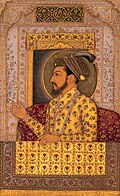
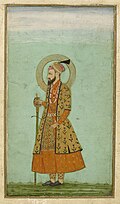
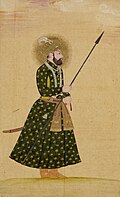
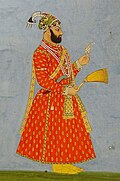
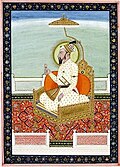
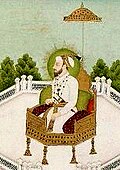


No edit summary Tags: Mobile edit Mobile web edit |
LucasRowan (talk | contribs) slightly updated intro after review and added references per sources |
||
| Line 1: | Line 1: | ||
{{Short description|1526–1857 empire in South Asia}} | {{Short description|1526–1857 empire in South Asia}} | ||
{{distinguish|text=the [[Mongol Empire]] or [[Moghulistan]]}} | {{Hatnote group|{{distinguish|text=the [[Mongol Empire]] or [[Moghulistan]]}} | ||
{{ | {{Other uses|Mughal (disambiguation)}} | ||
}} | |||
{{Use Indian English|date=July 2016}} | {{pp-semi-indef}} | ||
{{Use Indian English|date=July 2016}} | |||
{{Use dmy dates|date=June 2021}} | {{Use dmy dates|date=June 2021}} | ||
{{Infobox former country | {{Infobox former country | ||
| conventional_long_name = Mughal Empire | | conventional_long_name = Mughal Empire<!--Do not change to any "official name" without establishing the prevalence of the name in sources.--> | ||
| image_flag = | | image_flag = | ||
| religion = [[ | | flag_caption = | ||
| ethnic_groups = | |||
| religion = {{udl|wrap= | |||
; State religion: | |||
: [[Islam]]{{efn|[[Islamic schools and branches|Branch]]: [[Sunni Islam|Sunni]] | |||
: School of [[Fiqh|jurisprudence]]: [[Hanafi]]}}<br />[[Din-i Ilahi]] (1582–1605) | |||
; Others: | |||
: [[Hinduism]] (majority), [[Sikhism]] and more | |||
}} | }} | ||
| era = Early modern | | era = Early modern | ||
| status = [[Empire]] | | status = [[Empire]] | ||
| | | other_symbol = | ||
| other_symbol_type = | |||
| government_type = [[Monarchy]] | |||
| life_span = {{circa|1526–1857}} | |||
| life_span = 1526–1857 | |||
| year_start = 1526 | | year_start = 1526 | ||
| year_end = 1857 | | year_end = 1857 | ||
| event_start = [[First Battle of Panipat]] | | event_start = [[First Battle of Panipat]] | ||
| date_start = 21 April | | date_start = 21 April | ||
| event_end = [[Siege of Delhi]] | | event_end = [[Siege of Delhi]] | ||
| date_end = 21 September | | date_end = 21 September | ||
| event_post = Mughal | | event_post = [[Mughal Emperor]] exiled to [[British Burma]] | ||
| date_post = 1858 | | date_post = 7 October 1858 | ||
| event1 = | | event1 = [[Sur Empire|Mughal Interregnum]] | ||
| date_event1 = | | date_event1 = 17 May 1540 – 22 June 1555 | ||
| event2 = [[Second Battle of Panipat]] | | event2 = [[Second Battle of Panipat]] | ||
| date_event2 = 5 November 1556 | | date_event2 = 5 November 1556 | ||
| event3 = [[ | | event3 = [[Mughal–Afghan Wars]] | ||
| date_event3 = | | date_event3 = 21 April 1526 – 3 April 1752 | ||
| event4 = [[ | | event4 = [[Deccan wars]] | ||
| date_event4 = | | date_event4 = 1680–1707 | ||
| | | event6 = [[Nader Shah's invasion of India]] | ||
| | | date_event6 = 1738–1740 | ||
| p1 = Delhi Sultanate | | p1 = Delhi Sultanate | ||
| p2 = Sur Empire | | p2 = Sur Empire | ||
| | | p3 = Regional Sultanates of India | ||
| | | p4 = Deccan sultanates | ||
| | | s1 = British Raj | ||
| | | today = {{ubl|[[India]] | [[Pakistan]] | [[Bangladesh]] | [[Afghanistan]]}} | ||
| image_map = Mughal Empire, | | image_map = {{Switcher|[[File:Mughal Empire, 1530.png|upright=1.15|frameless]]|The Mughal Empire in 1530|[[File:Mughal Empire, 1605.png|upright=1.15|frameless]]|The Mughal Empire in 1605|[[File:Mughal Empire, 1707.png|upright=1.15|frameless]]|The Mughal Empire in 1707|default=3}} | ||
| | | map_width = 250px | ||
| image_map_alt = Mughal | | image_map_alt = Mughal | ||
| capital = {{ubli | |||
| capital = {{ | | [[Agra]] (1526–1530; {{nwr|1560–1571;}} {{nwr|1598–1648}}) | ||
| [[Delhi]] (1530–1540; {{nwr|1639–1857}}) | |||
| [[Fatehpur Sikri]] (1571–1585) | |||
| [[Lahore]] (1586–1598){{sfn|Sinopoli|1994|p=294}} | |||
}} | |||
| | | common_languages = ''See [[Languages of South Asia]]'' | ||
| official_languages = [[Persian language|Persian]] | |||
| currency = [[Rupee]], [[History of the taka|Taka]], [[Dam (Indian coin)|dam]]{{sfn|Richards|1995|pp=73–74}} | |||
| leader1 = [[Babur]] | |||
| leader2 = [[Bahadur Shah II]] | |||
| year_leader1 = 1526–1530 (first) | |||
| year_leader2 = 1837–1857 (last) | |||
| title_leader = [[Mughal emperors|Emperor]] | |||
| currency = [[Rupee]], [[History of the taka|Taka]], [[Dam (Indian coin)|dam]] | | title_representative = [[Vakil of the Mughal Empire|Vicegerent]] | ||
| leader1 = [[Babur]] | | year_representative1 = 1526–1540 (first) | ||
| leader2 = [[Bahadur Shah II]] | | representative1 = [[Mir Khalifa]] | ||
| year_leader1 = 1526–1530 | | year_representative2 = 1794–1818 (last) | ||
| year_leader2 = 1837–1857 | | representative2 = [[Daulat Rao Sindhia]] | ||
| title_leader = [[Mughal emperors|Emperor]] | |||
| title_deputy = [[List of Mughal grand viziers|Grand Vizier]] | | title_deputy = [[List of Mughal grand viziers|Grand Vizier]] | ||
| deputy1 = [[Mir Khalifa]] | |||
| deputy1 = [[Mir Khalifa]] | | year_deputy1 = 1526–1540 (first) | ||
| | | deputy2 = [[Asaf-ud-Daula]] | ||
| deputy2 = [[Asaf-ud-Daula]] (last) | | year_deputy2 = 1775–1797 (last) | ||
| | | stat_year1 = {{Circa|1600}}<ref name="Roy134">{{Harvard citation no brackets|Roy|2015|p=134}} "Around circa 1600, the Mughal Empire controlled 3.2 million square kilometres with a population of about 150 million."</ref> | ||
| | | stat_area1 = 3,200,000 | ||
| | | stat_area2 = 4,000,000 | ||
| | | stat_year2 = 1690<ref name="TurchinAdams2006">{{Cite journal |last1=Turchin |first1=Peter |last2=Adams |first2=Jonathan M. |last3=Hall |first3=Thomas D. |year=2006 |title=East–West Orientation of Historical Empires and Modern States |journal=Journal of World-Systems Research |volume=12 |issue=2 |pages=219–229 |doi=10.5195/JWSR.2006.369 |issn=1076-156X |doi-access=free}}</ref><ref name="Taagepera">{{Cite journal |last=Rein Taagepera |author-link=Rein Taagepera |date=September 1997 |title=Expansion and Contraction Patterns of Large Polities: Context for Russia |url=http://www.escholarship.org/uc/item/3cn68807 |journal=[[International Studies Quarterly]] |volume=41 |issue=3 |pages=475–504 |doi=10.1111/0020-8833.00053 |jstor=2600793 |access-date=6 July 2019 |archive-date=19 November 2018 |archive-url=https://web.archive.org/web/20181119114740/https://escholarship.org/uc/item/3cn68807 |url-status=live |issn = 0020-8833 |url-access=subscription }}</ref><ref name="OxfordArea">{{Cite book|last1=Bang|first1=Peter Fibiger|url=https://books.google.com/books?id=9mkLEAAAQBAJ&pg=PA92|title=The Oxford World History of Empire: Volume One: The Imperial Experience|last2=Bayly|first2=C. A.|last3=Scheidel|first3=Walter|year=2020|publisher=Oxford University Press|isbn=978-0-19-977311-4|pages=92–94|language=en}}</ref> | ||
| | | stat_year3 = {{Circa|1600}} | ||
| | | stat_year4 = {{Circa|1700}} | ||
| | | stat_pop3 = 150,000,000<ref name="Roy134" /> | ||
| | | stat_pop4 = 158,400,000<ref name="borocz" /><ref>{{cite book |last=Dyson |first=Tim |title=A Population History of India: From the First Modern People to the Present Day |year=2018 |publisher=Oxford University Press |pages=70–71 |isbn=978-0-19-256430-6 |quote=We have seen that there is considerable uncertainty about the size of India's population c.1595. Serious assessments vary from 116 to 145 million (with an average of 125 million). However, the true figure even could even be outside of this range. Accordingly, while it seems likely that the population grew over the 17th century, it is unlikely that we will ever have a good idea of its size in 1707.}}</ref> | ||
| | |||
}} | }} | ||
The '''Mughal Empire''' was an [[Early modern period|early modern]] empire that ruled most of the [[Indian subcontinent]]. At its peak, the empire stretched from the outer fringes of the [[Indus River]] Basin in the west, northern [[Afghanistan]] in the northwest, and [[Kashmir]] in the north, to the [[highland]]s of present-day [[Assam]] and [[Bangladesh]] in the east, and the uplands of the [[Deccan Plateau]] in [[South India]].<ref name="Stein2010-12">{{harvnb|Stein|2010|pp=159–}}. Quote: "The realm so defined and governed was a vast territory of some {{convert|750000|sqmi|km2|disp=sqbr}}, ranging from the frontier with Central Asia in northern Afghanistan to the northern uplands of the Deccan plateau, and from the Indus basin on the west to the Assamese highlands in the east."</ref><ref>{{Cite book |last=Richards |first=John F. |url=https://books.google.com/books?id=4evztAEACAAJ |title=The Mughal Empire |date=2012-03-28 |publisher=Cambridge University Press |isbn=978-0-511-58406-0 |language=en}}</ref> | |||
The Mughal Empire is conventionally said to have been founded in 1526 by [[Babur]], a ruler from what is now [[Uzbekistan]], who with the help of the neighbouring [[Safavid Iran|Safavid]] and [[Ottoman Empire]]s,<ref name="Gilbert2017">{{Citation |last=Gilbert |first=Marc Jason |title=South Asia in World History |url=https://books.google.com/books?id=1dhKDgAAQBAJ&pg=PA75 |year=2017 |publisher=Oxford University Press |page=62 |isbn=978-0-19-066137-3 |access-date=15 July 2019}} Quote: "Babur then adroitly gave the Ottomans his promise not to attack them in return for their military aid, which he received in the form of the newest of battlefield inventions, the matchlock gun and cast cannons, as well as instructors to train his men to use them."</ref> defeated the [[sultan of Delhi]], [[Ibrahim Lodi]], in the [[First Battle of Panipat]] and swept down the plains of [[North India]]. The Mughal imperial structure, however, is sometimes dated to 1600, to the rule of Babur's grandson, [[Akbar]].<ref name="Stein2010">{{harvnb|Stein|2010|pp=159–}}. Quote: "Another possible date for the beginning of the Mughal regime is 1600, when the institutions that defined the regime were set firmly in place and when the heartland of the empire was defined; both of these were the accomplishment of Babur's grandson Akbar."</ref> This imperial structure lasted until 1720, shortly after the death of the last major emperor, [[Aurangzeb]],<ref name="Stein2010-1">{{harvnb|Stein|2010|pp=159–}}. Quote: "The imperial career of the Mughal house is conventionally reckoned to have ended in 1707 when the emperor Aurangzeb, a fifth-generation descendant of Babur, died. His fifty-year reign began in 1658 with the Mughal state seeming as strong as ever or even stronger. But in Aurangzeb's later years the state was brought to the brink of destruction, over which it toppled within a decade and a half after his death; by 1720 imperial Mughal rule was largely finished and an epoch of two imperial centuries had closed."</ref><ref>{{harvnb|Richards|1995|p=xv}}. Quote: "By the latter date (1720) the essential structure of the centralized state was disintegrated beyond repair."</ref> during whose reign the empire also achieved its maximum geographical extent. Reduced subsequently to the region in and around Old Delhi by 1760, the empire was formally dissolved by the [[British Raj]] after the [[Indian Rebellion of 1857]]. | |||
The Mughal Empire is conventionally said to have been founded in 1526 by [[Babur]], a | |||
Although the Mughal Empire was created and sustained by military warfare,<ref name="Stein2010-2">{{ | Although the Mughal Empire was created and sustained by military warfare,<ref name="Stein2010-2">{{harvnb|Stein|2010|pp=159–}}. Quote: "The vaunting of such progenitors pointed up the central character of the Mughal regime as a warrior state: it was born in war and it was sustained by war until the eighteenth century, when warfare destroyed it."</ref><ref name="Robb2011">{{harvnb|Robb|2011|pp=108–}}. Quote: "The Mughal state was geared for war and succeeded while it won its battles. It controlled territory partly through its network of strongholds, from its fortified capitals in Agra, Delhi or Lahore, which defined its heartlands, to the converted and expanded forts of Rajasthan and the Deccan. The emperor's will be frequently enforced in battle. Hundreds of army scouts were an important source of information. But the empire's administrative structure too was defined by and directed at war. Local military checkpoints or thanas kept order. Directly appointed imperial military and civil commanders (faujdars) controlled the cavalry and infantry, or the administration, in each region. The peasantry in turn were often armed, able to provide supporters for regional powers, and liable to rebellion on their account: continual pacification was required of the rulers."</ref><ref name="Gilbert2017-2">{{Citation |last=Gilbert |first=Marc Jason |title=South Asia in World History |url=https://books.google.com/books?id=1dhKDgAAQBAJ&pg=PA75 |pages=75– |year=2017 |publisher=Oxford University Press |isbn=978-0-19-066137-3 |access-date=15 July 2019 |archive-date=22 September 2023 |archive-url=https://web.archive.org/web/20230922031915/https://books.google.com/books?id=1dhKDgAAQBAJ&pg=PA75 |url-status=live }} Quote: "With Safavid and Ottoman aid, the Mughals would soon join these two powers in a triumvirate of warrior-driven, expansionist, and both militarily and bureaucratically efficient early modern states, now often called "gunpowder empires" due to their common proficiency is using such weapons to conquer lands they sought to control."</ref> it did not vigorously suppress the cultures and peoples it came to rule; rather, it equalised and placated them through new administrative practices,{{sfn|Asher|Talbot|2006|p=115}}{{sfn|Robb|2011|pp=99–100}} and diverse ruling elites, leading to more efficient, centralised, and standardised rule.{{sfn|Asher|Talbot|2006|pp=152–}} The basis of the empire's collective wealth was agricultural taxes, implemented by the third Mughal emperor, Akbar.<ref name="Stein2010-3">{{harvnb|Stein|2010|pp=164–}}. Quote: "The resource base of Akbar's new order was land revenue"</ref><ref name="AsherTalbot2006-1">{{harvnb|Asher|Talbot|2006|pp=158–}}. Quote: "The Mughal empire was based in the interior of a large land mass and derived the vast majority of its revenues from agriculture."</ref> These taxes, which amounted to well over half the output of a peasant cultivator,<ref name="Stein2010-4">{{harvnb|Stein|2010|pp=164–}}. Quote: "... well over half of the output from the fields in his realm, after the costs of production had been met, is estimated to have been taken from the peasant producers by way of official taxes and unofficial exactions. Moreover, payments were exacted in money, and this required a well regulated silver currency."</ref> were paid in the well-regulated silver currency,{{sfn|Asher|Talbot|2006|pp=152–}} and allowed peasants and artisans to enter larger markets.<ref name="AsherTalbot2006-3">{{harvnb|Asher|Talbot|2006|pp=152–}}. Quote: "His stipulation that land taxes be paid in cash forced peasants into market networks, where they could obtain the necessary money, while the standardization of imperial currency made the exchange of goods for money easier."</ref> | ||
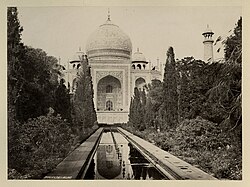
The relative peace maintained by the empire during much of the 17th century was a factor in India's economic expansion.<ref name="AsherTalbot2006-4">{{ | The relative peace maintained by the empire during much of the 17th century was a factor in India's economic expansion.<ref name="AsherTalbot2006-4">{{harvnb|Asher|Talbot|2006|pp=152–}}. Quote: "Above all, the long period of relative peace ushered in by Akbar's power, and maintained by his successors, contributed to India's economic expansion."</ref> The burgeoning European presence in the Indian Ocean and an increasing demand for Indian raw and finished products generated much wealth for the Mughal court.<ref name="AsherTalbot2006-5">{{harvnb|Asher|Talbot|2006|pp=186–}}. Quote: "As the European presence in India grew, their demands for Indian goods and trading rights increased, thus bringing even greater wealth to the already flush Indian courts."</ref> There was [[conspicuous consumption]] among the Mughal elite,<ref name="AsherTalbot2006-6">{{harvnb|Asher|Talbot|2006|pp=186–}}. Quote: "The elite spent more and more money on luxury goods and sumptuous lifestyles, and the rulers built entire new capital cities at times."</ref> resulting in greater patronage of [[Mughal painting|painting]], literary forms, textiles, and [[Mughal architecture|architecture]], especially during the reign of [[Shah Jahan]].<ref name="AsherTalbot2006-7">{{harvnb|Asher|Talbot|2006|pp=186–}}. Quote: "All these factors resulted in greater patronage of the arts, including textiles, paintings, architecture, jewellery, and weapons to meet the ceremonial requirements of kings and princes."</ref> Among the Mughal [[UNESCO World Heritage Sites]] in South Asia are [[Agra Fort]], [[Fatehpur Sikri]], [[Red Fort]], [[Humayun's Tomb]], [[Lahore Fort]], [[Shalamar Gardens, Lahore|Shalamar Gardens]], and the [[Taj Mahal]], which has been described as "the jewel of Muslim art in India, and one of the universally admired masterpieces of the world's heritage".<ref name="Centre" /> | ||
== Name == | == Name == | ||
The word ''Mughal'' (also spelled ''Mogul''<ref name="persianatemogul">{{Cite book |last=John Walbridge |title=God and Logic in Islam: The Caliphate of Reason |page=165 |quote=Persianate Mogul Empire.}}</ref> or ''Moghul'' in English) is the Indo-Persian form of [[Mongols|''Mongol'']]. However, the Mughal dynasty's early followers were Chagatai Turks and not Mongols.<ref name="Hodgson" /><ref name="Canfield">{{Cite book |last=Canfield |first=Robert L. |url=https://books.google.com/books?id=g3JhKNSk8tQC&pg=PA20 |title=Turko-Persia in Historical Perspective |publisher=Cambridge University Press |year=2002 |isbn=978-0-521-52291-5 |page=20}}</ref> The term ''Mughal'' was applied to them in India by association with the Mongols and to distinguish them from the Afghan elite who ruled the Delhi Sultanate.<ref name="Hodgson">{{Cite book |last=Hodgson |first=Marshall G. S. |author-link=Marshall Hodgson |url=https://books.google.com/books?id=COOGFSH_jUkC&pg=PA62 |title=The Venture of Islam |publisher=University of Chicago Press |year=2009 |isbn=978-0-226-34688-5 |volume=3 |page=62}}</ref> In the West, the term [[Mughal emperors|''Mughal'']] was used for the emperor and, by extension, the empire as a whole.<ref name="Fontana">{{Cite book |last=Fontana|first=Michela|url=https://books.google.com/books?id=MVZU1sAQ8H4C&pg=PA32|title=Matteo Ricci: A Jesuit in the Ming Court|publisher=Rowman & Littlefield Publishers|year=2011|isbn=978-1-4422-0588-8|page=32|access-date=19 October 2015|archive-date=22 September 2023|archive-url=https://web.archive.org/web/20230922033421/https://books.google.com/books?id=MVZU1sAQ8H4C&pg=PA32|url-status=live}}</ref> The term remains disputed by [[Indologists]].<ref name="RA">{{Cite book |last1=Huskin |first1=Frans Husken |url=https://books.google.com/books?id=IVhUAQAAQBAJ&pg=PA104 |title=Reading Asia: New Research in Asian Studies |last2=Dick van der Meij |publisher=Routledge |year=2004 |isbn=978-1-136-84377-8 |page=104}}</ref> In [[Marshall Hodgson|Marshall Hodgson's]] view, the dynasty should be called ''Timurid''/''Timuri'' or ''Indo-Timurid''.<ref name="Hodgson" /> | |||
The | The closest to an official name for the empire was ''[[Hindustan]]'', which was documented in the [[Ain-i-Akbari]].<ref name="Vanina">{{Cite book |last=Vanina |first=Eugenia |url=https://books.google.com/books?id=yriGbWNAF5EC&pg=PA47 |title=Medieval Indian Mindscapes: Space, Time, Society, Man |publisher=Primus Books |year=2012 |isbn=978-93-80607-19-1 |page=47 |author-link=Eugenia Vanina |access-date=19 October 2015 |archive-date=22 September 2023 |archive-url=https://web.archive.org/web/20230922033421/https://books.google.com/books?id=yriGbWNAF5EC&pg=PA47 |url-status=live}}</ref> Mughal administrative records also refer to the empire as "dominion of Hindustan" ({{Transliteration|fa|Wilāyat-i-Hindustān}}),<ref>{{Cite book |last1=Hardy |first1=P. |editor-last=Levtzion |editor-first=Nehemia |chapter=Modern European and Muslim Explanations of Conversion to Islam in South Asia: A Preliminary Survey of the Literature |title=Conversion to Islam |url=https://books.google.com/books?id=37nXAAAAMAAJ&q=bilad+-+i+Hind+(+the+country+of+Hind+)+,+wilayat+-+i+Hindustan+(+the+dominion+of+Hindustan+)+,+sultanat+-+i |year=1979 |publisher=Holmes & Meier |page=69 |isbn=978-0-8419-0343-2 |access-date=19 March 2023 |archive-date=3 April 2023 |archive-url=https://web.archive.org/web/20230403231614/https://books.google.com/books?id=37nXAAAAMAAJ&q=bilad+-+i+Hind+(+the+country+of+Hind+)+,+wilayat+-+i+Hindustan+(+the+dominion+of+Hindustan+)+,+sultanat+-+i |url-status=live}}</ref> "country of Hind" ({{Transliteration|fa|Bilād-i-Hind}}), "Sultanate of Al-Hind" ({{Transliteration|fa|Salṭanat(i) al-Hindīyyah}}) as observed in the epitaph of Emperor [[Aurangzeb]]<ref>{{cite web |url=http://www.asiaurangabad.in/pdf/Tourist/Tomb_of_Aurangzeb-_Khulatabad.pdf |title=Name of the Monument/ site: Tomb of Aurangzeb |website=asiaurangabad.in |archive-url=https://web.archive.org/web/20150923175254/http://www.asiaurangabad.in/pdf/Tourist/Tomb_of_Aurangzeb-_Khulatabad.pdf |archive-date=23 September 2015}}</ref> or endonymous identification from emperor [[Bahadur Shah Zafar]] as "Land of Hind" ({{Transliteration|ur|Hindostān}}) in [[Hindustani language|Hindustani]].<ref>{{Cite book |last1=Parvez |first1=Aslam |title=The life & poetry of Bahadur Shah Zafar |last2=Fārūqī |first2=At̤har |date=2017 |publisher=Hay House India |isbn=978-93-85827-47-1 |location=New Delhi, India |oclc=993093699}}</ref><ref>{{cite web |url=https://indianhistorycollective.com/what-was-hindustan-hindustani-subcontinentofindia-politicalmap-geographynow-geographygames-mughalempire-mughalarchitecture-architecture-hindoostanmap/ |title=What Happened to 'Hindustan'? |website=Indian History Collective}}</ref> Contemporary Chinese chronicles referred to the empire as ''Hindustan'' ({{Transliteration|zh|ISO|Héndūsītǎn}}).<ref>{{Cite book |last=Mosca |first=Matthew |url=https://books.google.com/books?id=Zvmix_k1XDcC&pg=PA94 |title=From Frontier Policy to Foreign Policy: The Question of India and the Transformation of Geopolitics in Qing China |date=2013 |publisher=Stanford University Press |isbn=978-0-8047-8538-9 |pages=78–94 |language=en |access-date=7 November 2023 |archive-date=7 November 2023 |archive-url=https://web.archive.org/web/20231107203141/https://books.google.com/books?id=Zvmix_k1XDcC&pg=PA94 |url-status=live}}</ref> | ||
The Mughal designation for their dynasty was ''Gurkani'' ({{Transliteration|fa|Gūrkāniyān}}), a reference to their descent from the Turco-Mongol conqueror [[Timur]], who took the title {{Transliteration|fa|Gūrkān}} 'son-in-law' after his marriage to a [[Chinggisid]] princess.<ref name="Thackston2">{{Cite book |last=Zahir ud-Din Mohammad |title=The Baburnama: Memoirs of Babur, Prince and Emperor |title-link=Baburnama |publisher=Modern Library |year=2002 |isbn=978-0-375-76137-9 |editor-last=Thackston, Wheeler M. |editor-link=Wheeler Thackston |location=New York |page=[https://archive.org/details/babarinizam00babu/page/ xlvi] |quote=In India the dynasty always called itself Gurkani, after Temür's title Gurkân, the Persianized form of the Mongolian {{lang|mn-Latn|kürägän}}, 'son-in-law,' a title he assumed after his marriage to a Genghisid princess. |author-link=Babur}}</ref> | |||
== History == | == History == | ||
{{ | {{See also|Mughal dynasty}} | ||
===Babur and Humayun (1526–1556)=== | === Babur and Humayun (1526–1556) === | ||
{{Main|Babur|Humayun}} | {{Main|Babur|Humayun}} | ||
{{multiple image|perrow=2|total_width=400|caption_align=center | |||
| align = right | |||
| direction =horizontal | |||
| image1 = Humayun and Babur (Late Shah Jahan Album) Babur detail.jpg | |||
| image2 = Joppen map-India in 1525 published 1907 by Longmans.jpg | |||
| footer=Portrait of Babur in the ''[[:Commons:Category:Late Shah Jahan Album|Late Shah Jahan Album]]'',<ref>{{cite web |title=Babur and Humayun with Courtiers, from the Late Shah Jahan Album |url=https://asia-archive.si.edu/object/S1986.401/ |website=Smithsonian's National Museum of Asian Art|quote=The first Mughal emperor, Babur, who reigned from 1526 to 1530, is shown seated on the right with his son and successor, Humayun.}}</ref> and map of India in 1525 just before the onset of Mughal rule | |||
}} | |||
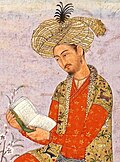
The Mughal Empire was founded by Babur (reigned 1526–1530), a Central Asian ruler who was descended from the [[Turco-Mongol tradition|Turco-Mongol]] conqueror [[Timur]] (the founder of the [[Timurid Empire]]) on his father's side, and from [[Genghis Khan]] on his mother's side.<ref name="Berndl">{{Cite book |last=Berndl |first=Klaus |title=National Geographic Visual History of the World |publisher=National Geographic Society |year=2005 |isbn=978-0-7922-3695-5 |pages=318–320}}</ref> Paternally, Babur belonged to the [[Turkification|Turkicised]] [[Barlas]] tribe of [[Mongol]] origin.<ref>Gérard Chaliand, ''A Global History of War: From Assyria to the Twenty-First Century'', [[University of California Press]], California 2014, p. 151</ref> Ousted from his ancestral domains in Central Asia, Babur turned to India to satisfy his ambitions.<ref>{{Cite book |last=Bayley |first=Christopher |title=The European Emergence. The Mughals Ascendant |date=1990 |isbn=0-7054-0982-1 |page=151|publisher=Time-Life Books }}</ref> He established himself in [[Kabul]] and then pushed steadily southward into India from [[Afghanistan]] through the [[Khyber Pass]].<ref name="Berndl" /> Babur's forces defeated [[Ibrahim Lodi]], [[Delhi Sultanate|Sultan of Delhi]], in the [[First Battle of Panipat]] in 1526. Through his use of firearms and cannons, he was able to shatter Ibrahim's armies despite being at a numerical disadvantage,{{sfn|Richards|1995|p=8}}{{sfn|Asher|Talbot|2006|p=116}} expanding his dominion up to the mid [[Indo-Gangetic Plain]].{{sfn|Asher|Talbot|2006|p=117}} After the battle, the centre of Mughal power shifted to [[Agra]].{{sfn|Richards|1995|p=8}} In the decisive [[Battle of Khanwa]], fought near Agra a year later, the Timurid forces of Babur defeated the combined [[Rajput]] armies of [[Rana Sanga]] of [[Kingdom of Mewar|Mewar]], with his native cavalry employing traditional flanking tactics.{{sfn|Richards|1995|p=8}}{{sfn|Asher|Talbot|2006|p=116}} | |||
===Akbar to Aurangzeb (1556–1707)=== | The preoccupation with wars and military campaigns, however, did not allow the new emperor to consolidate the gains he had made in India.<ref>{{Cite book |last=Bayley |first=Christopher |title=The European Emergence. The Mughals Ascendant |date=1990 |isbn=0-7054-0982-1 |page=154|publisher=Time-Life Books }}</ref> The instability of the empire became evident under his son, [[Humayun]] (reigned 1530–1556), who was forced into exile in Persia by the rebellious [[Sher Shah Suri]] (reigned 1540–1545).<ref name="Berndl" /> Humayun's exile in Persia established diplomatic ties between the [[Safavid dynasty|Safavid]] and Mughal courts and led to increasing Persian cultural influence in the later restored Mughal Empire.{{sfn|Majumdar|1974|pp=59, 65}} Humayun's triumphant return from Persia in 1555 restored Mughal rule in some parts of India, but he died in an accident the next year.{{sfn|Richards|1995|p=12}} | ||
=== Akbar to Aurangzeb (1556–1707) === | |||
{{Main|Akbar|Jahangir|Shah Jahan|Aurangzeb}} | {{Main|Akbar|Jahangir|Shah Jahan|Aurangzeb}} | ||
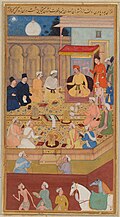
[[File:Jesuits at Akbar's court.jpg|thumb|upright|left|[[Akbar]] holds a religious assembly of different faiths in the [[Ibadat Khana]] in Fatehpur Sikri.]] | [[File:Jesuits at Akbar's court.jpg|thumb|upright|left|[[Akbar]] holds a religious assembly of different faiths in the [[Ibadat Khana]] in Fatehpur Sikri.]] | ||
[[Akbar]] (reigned 1556–1605) was born Jalal-ud-din Muhammad<ref>{{ | [[Akbar]] (reigned 1556–1605) was born Jalal-ud-din Muhammad<ref>{{cite encyclopedia |title=Akbar |encyclopedia=Encyclopædia Britannica |date= |year= |last=Ballhatchet |first=Kenneth A. |author-link=Kenneth A. Ballhatchet |url=https://www.britannica.com/biography/Akbar |access-date=17 July 2017 |archive-date=25 May 2023 |archive-url=https://web.archive.org/web/20230525120830/https://www.britannica.com/biography/Akbar |url-status=live}}</ref> in the [[Umarkot Fort]],<ref>{{Cite book |last=Smith |first=Vincent Arthur |url=https://archive.org/details/cu31924024056503/page/n34/mode/1up |title=Akbar the Great Mogul, 1542–1605 |location=Oxford |publisher=The Clarendon Press |year=1917 |pages=13–14 |author-link=Vincent Arthur Smith}}</ref> to Humayun and his wife [[Hamida Banu Begum]], a [[Persian people|Persian]] princess.<ref>{{Cite book |last=Begum |first=Gulbadan |url=https://archive.org/details/historyofhumayun00gulbrich |title=The History of Humāyūn (Humāyūn-Nāma) |publisher=Royal Asiatic Society |year=1902 |pages=[https://archive.org/details/historyofhumayun00gulbrich/page/237 237]–239 |translator-last=Beveridge |translator-first=Annette S. |author-link=Gulbadan Begum |translator-link=Annette Beveridge}}</ref> Akbar succeeded to the throne under a regent, [[Bairam Khan]], who helped consolidate the Mughal Empire in India.{{sfn|Stein|2010|p=162}} Through warfare, Akbar was able to extend the empire in all directions and controlled almost the entire Indian subcontinent north of the [[Godavari River]].{{sfn|Asher|Talbot|2006|p=128}}<!--bsn?--> He created a new ruling elite loyal to him, implemented a modern administration, and encouraged cultural developments. He increased trade with European trading companies.<ref name="Berndl" /> India developed a strong and stable economy, leading to commercial expansion and economic development.{{citation needed|date=July 2019}} Akbar allowed freedom of religion at his court and attempted to resolve socio-political and cultural differences in his empire by establishing a new religion, [[Din-i-Ilahi]], with strong characteristics of a ruler cult.<ref name="Berndl" /> He left his son an internally stable state, which was in the midst of its golden age, but before long signs of political weakness would emerge.<ref name="Berndl" /><!--close paraphrasing--> | ||
[[Jahangir]] (born Salim,<ref name="Mohammada" /> reigned 1605–1627) was born to Akbar and his wife [[Mariam-uz-Zamani]], an Indian | [[Jahangir]] (born Salim,<ref name="Mohammada" /> reigned 1605–1627) was born to Akbar and his wife [[Mariam-uz-Zamani]], an Indian princess.<ref>{{Cite book |last=Gilbert |first=Marc Jason |url=https://books.google.com/books?id=7OQWDgAAQBAJ&pg=PA79 |title=South Asia in World History |publisher=[[Oxford University Press]] |year=2017 |isbn=978-0-19-976034-3 |page=79 |access-date=22 August 2017 |archive-date=22 September 2023 |archive-url=https://web.archive.org/web/20230922033918/https://books.google.com/books?id=7OQWDgAAQBAJ&pg=PA79 |url-status=live }}</ref> Salim was named after the Indian Sufi saint, [[Salim Chishti]].<ref>{{Cite book |last=Muhammad-Hadi |title=Preface to The Jahangirnama |year=1999 |publisher=Oxford University Press |isbn=978-0-19-512718-8 |page=4 |translator-last=Thackston |translator-first=Wheeler M. |translator-link=Wheeler Thackston}}</ref><ref>{{Cite book |last=Jahangir, Emperor of Hindustan |title=The Jahangirnama: Memoirs of Jahangir, Emperor of India |year=1999 |publisher=Oxford University Press |isbn=978-0-19-512718-8 |page=65 |translator-last=Thackston |translator-first=Wheeler M. |translator-link=Wheeler Thackston}}</ref> He "was addicted to opium, neglected the affairs of the state, and came under the influence of rival court cliques".<ref name="Berndl" /> Jahangir distinguished himself from Akbar by making substantial efforts to gain the support of the Islamic religious establishment. One way he did this was by bestowing many more ''madad-i-ma'ash'' (tax-free personal land revenue grants given to religiously learned or spiritually worthy individuals) than Akbar had.<ref>{{Cite book |last=Faruqui |first=Munis D. |title=The Princes of the Mughal Empire, 1504–1719 |publisher=Cambridge University Press |year=2012 |isbn=978-1-107-02217-1 |pages=268–269}}</ref> In contrast to Akbar, Jahangir came into conflict with non-Muslim religious leaders, notably the [[Sikh]] guru [[Guru Arjan|Arjan]], whose execution was the first of many conflicts between the Mughal Empire and the Sikh community.{{sfn|Robb|2011|pp=97–98}}{{sfn|Asher|Talbot|2006|p=267}}<ref name="BBC Sikhs">{{Cite web |date=30 September 2009 |title=BBC – Religions – Sikhism: Origins of Sikhism |url=https://www.bbc.co.uk/religion/religions/sikhism/history/history_1.shtml |access-date=19 February 2021 |website=BBC |language=en-GB |archive-date=17 August 2018 |archive-url=https://web.archive.org/web/20180817220705/http://www.bbc.co.uk/religion/religions/sikhism/history/history_1.shtml |url-status=live }}</ref> | ||
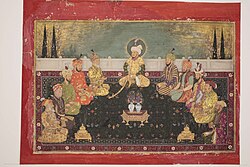
[[File:Khalili Collection Islamic Art mss 0874.3.jpg|thumb|right|Group portrait of Mughal rulers, from [[Babur]] to [[Aurangzeb]], with the Mughal ancestor [[Timur]] seated in the middle. On the left: [[Shah Jahan]], [[Akbar]] and Babur, with Abu Sa'id of Samarkand and Timur's son, [[Miran Shah]]. On the right: Aurangzeb, [[Jahangir]] and [[Humayun]], and two of Timur's other offspring [[Umar Shaikh Mirza I|Umar Shaykh]] and [[Muhammad Sultan Mirza|Muhammad Sultan]]. Created {{circa|1707–12}}]] | [[File:Khalili Collection Islamic Art mss 0874.3.jpg|thumb|right|Group portrait of Mughal rulers, from [[Babur]] to [[Aurangzeb]], with the Mughal ancestor [[Timur]] seated in the middle. On the left: [[Shah Jahan]], [[Akbar]] and Babur, with Abu Sa'id of Samarkand and Timur's son, [[Miran Shah]]. On the right: Aurangzeb, [[Jahangir]] and [[Humayun]], and two of Timur's other offspring [[Umar Shaikh Mirza I|Umar Shaykh]] and [[Muhammad Sultan Mirza|Muhammad Sultan]]. Created {{circa|1707–12}}.]] | ||
[[Shah Jahan]] (reigned 1628–1658) was born to Jahangir and his wife [[Jagat Gosain]] | [[Shah Jahan]] (reigned 1628–1658) was born to Jahangir and his wife [[Jagat Gosain]].<ref name="Mohammada">{{Cite book |last=Mohammada |first=Malika |url=https://books.google.com/books?id=dwzbYvQszf4C&pg=PA300 |title=The Foundations of the Composite Culture in India |publisher=Aakar Books |year=2007 |isbn=978-81-89833-18-3 |page=300}}</ref> His reign ushered in the golden age of [[Mughal architecture]].<ref>{{Cite book |last=Mehta |first=Jaswant Lal |title=Advanced Study in the History of Medieval India |publisher=Sterling Publishers Pvt. Ltd |year=1984 |isbn=978-81-207-1015-3 |edition=2nd |volume=II |page=59 |language=en |oclc=1008395679 |orig-year=First published 1981}}</ref> During the reign of Shah Jahan, the splendour of the Mughal court reached its peak, as exemplified by the [[Taj Mahal]]. The cost of maintaining the court, however, began to exceed the revenue coming in.<ref name="Berndl" /> Shah Jahan extended the Mughal Empire to the [[Deccan Plateau|Deccan]] by ending the [[Ahmadnagar Sultanate]] and forcing the [[Sultanate of Bijapur|Adil Shahis]] and [[Sultanate of Golconda|Qutb Shahis]] to pay tribute.<ref>{{Cite book |last=Singhal |first=Damodar P. |url=https://books.google.com/books?id=ag4BAAAAMAAJ&q=annexed+tribute |title=A History of the Indian People |publisher=Methuen |year=1983 |isbn=978-0-413-48730-8 |page=193 |access-date=4 May 2021 |archive-date=22 September 2023 |archive-url=https://web.archive.org/web/20230922033919/https://books.google.com/books?id=ag4BAAAAMAAJ&q=annexed+tribute |url-status=live}}</ref> | ||
Shah Jahan's eldest son, the liberal [[Dara Shikoh]], became regent in 1658, as a result of his father's illness. | Shah Jahan's eldest son, the liberal [[Dara Shikoh]], became regent in 1658, as a result of his father's illness.<ref name="Berndl"/> Dara championed a syncretistic Hindu-Muslim culture, emulating his great-grandfather Akbar.<ref>[https://books.google.com/books?id=H-k9oc9xsuAC&dq=Dara+Shikoh&pg=PA194 Dara Shikoh] {{Webarchive|url=https://web.archive.org/web/20230403231619/https://books.google.com/books?id=H-k9oc9xsuAC&dq=Dara+Shikoh&pg=PA194 |date=3 April 2023 }} ''Medieval Islamic Civilization: An Encyclopedia'', by Josef W. Meri, Jere L Bacharach. Routledge, 2005. {{ISBN|0-415-96690-6}}. pp. 195–196.</ref> With the support of the Islamic orthodoxy, however, a younger son of Shah Jahan, [[Aurangzeb]] ({{Reign|1658|1707}}), seized the throne. Aurangzeb defeated Dara in 1659 and had him executed.<ref name="Berndl" /> Although Shah Jahan fully recovered from his illness, Aurangzeb kept Shah Jahan imprisoned until he died in 1666.{{sfn|Truschke|2017|p=68}} Aurangzeb brought the empire to its greatest territorial extent,<ref>{{EI3|title=Awrangzīb|url=https://referenceworks.brill.com/display/entries/EI3O/COM-23859.xml|first=Munis D.|last=Faruqui|date=2011|doi=10.1163/1573-3912_ei3_COM_23859}}</ref> and oversaw an increase in the Islamicisation of the Mughal state. He encouraged conversion to Islam, reinstated the ''[[jizya]]'' on non-Muslims, and compiled the ''[[Fatawa 'Alamgiri]]'', a collection of Islamic law. Aurangzeb also ordered the execution of the Sikh guru [[Guru Tegh Bahadur|Tegh Bahadur]], leading to the militarisation of the Sikh community.{{sfn|Robb|2011|p=98}}{{sfn|Asher|Talbot|2006|p=267}}<ref name="BBC Sikhs" /> From the imperial perspective, conversion to Islam integrated local elites into the king's vision of a network of shared identity that would join disparate groups throughout the empire in obedience to the Mughal emperor.<ref>{{Cite book |last=Abhishek Kaicker |url=https://books.google.com/books?id=sNQBEAAAQBAJ&dq=Sayyids+Of+Barha&pg=PA160 |title=The King and the People: Sovereignty and Popular Politics in Mughal Delhi |year=2020 |publisher=Oxford University Press |isbn=978-0-19-007067-0 |page=160 |access-date=19 March 2023 |archive-date=3 April 2023 |archive-url=https://web.archive.org/web/20230403224903/https://books.google.com/books?id=sNQBEAAAQBAJ&dq=Sayyids+Of+Barha&pg=PA160 |url-status=live}}</ref> He led campaigns from 1682 in the Deccan,<ref name="EI2"/> annexing its remaining Muslim powers of Bijapur and Golconda,{{sfn|Richards|1995|pp=220–222}}<ref name="EI2"/> though engaged in a [[Deccan wars|prolonged conflict]] in the region which had a ruinous effect on the empire.{{sfn|Richards|1995|p=252}}<!--<ref>{{Cite book |last=Sarkar Jadunath |url=http://archive.org/details/in.ernet.dli.2015.537063 |title=A Short History Of Aurangzib |year=1928}}</ref>{{page number|date=September 2024}}--> The campaigns took a toll on the Mughal treasury, and Aurangzeb's absence led to a severe decline in governance, while stability and economic output in the Mughal Deccan plummeted.{{sfn|Richards|1995|p=252}} | ||
Aurangzeb is considered | Aurangzeb is considered the most controversial Mughal emperor,{{sfn|Asher|Talbot|2006|p=225}} with some historians arguing his religious conservatism and intolerance undermined the stability of Mughal society,<ref name="Berndl" /> while other historians question this, noting that he financed or patronised the building of non-Muslim institutions,<ref name="Copland2013">{{cite book|last1=Copeland|first1=Ian|last2=Mabbett|first2=Ian|last3=Roy|first3=Asim|last4=Brittlebank|first4=Kate|last5=Bowles|first5=Adam|title=A History of State and Religion in India|location=London and New York|publisher=Routledge|year=2012|isbn=978-0-415-58066-3|pages=118, 119, 154|quote=(p. 154) Even Aurengzeb, stereotyped in the popular imagination a staunch Islamic revivalist with deep anti-Hindu inclinations, was, as we demonstrated in Chapter 5, as much a sponsor of temples as a destroyer of them, and, when required, a patron of Brahmans besides (p. 119) ... the same applied to the issue of temple destruction. ... such acts of this nature occurred during the era of the Sultanate were carried out for reasons of political expediency, not as a result of religious zeal, and this was also the case under the Mughals. Even Aurengzeb, infamous in the old historiography as a destroyer of temples actually built many more temples than he destroyed. (p. 118) Like most rulers on the subcontinent, the Mughals patronised both Muslim and non-Muslim institutions. They financed the building of mosques and the funding of temples alike.}}</ref> employed significantly more [[Hindus]] in his imperial bureaucracy than his predecessors did, and opposed bigotry against Hindus and [[Shia Muslims]].{{sfn|Truschke|2017|p=58}} | ||
===<span id='Decline'>Decline (1707–1857)</span>=== | === <span id='Decline'>Decline (1707–1857)</span> === | ||
{{ | {{main|Decline of the Mughal Empire}} | ||
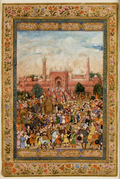
[[File:Farrukhsiyar Procession in front of the Great Mosque of Delhi.png|Delhi under the puppet-emperor [[Farrukhsiyar]]. Effective power was held by the [[Sayyid Brothers]].|thumb|left]] | |||
Aurangzeb's son, [[Bahadur Shah I]], repealed the religious policies of his father and attempted to reform the administration. "However, after he died in 1712, the Mughal dynasty began to sink into chaos and violent feuds. In 1719 alone, four emperors successively ascended the throne",<ref name="Berndl" /> as figureheads under the rule of a brotherhood of nobles belonging to the [[Islam in India|Indian Muslim]] caste known as the [[Barha Dynasty|Sadaat-e-Bara]], whose leaders, the [[Sayyid Brothers]], became the de facto sovereigns of the empire.<ref>{{Cite book |last=Audrey Truschke |url=https://books.google.com/books?id=rOcSEAAAQBAJ&dq=sayyid+brothers+figureheads&pg=PT146 |title=the Language of History: Sanskrit Narratives of Indo-Muslim Rule |year=2021 |publisher=Columbia University Press |isbn=978-0-231-55195-3 |access-date=19 March 2023 |archive-date=3 April 2023 |archive-url=https://web.archive.org/web/20230403222119/https://books.google.com/books?id=rOcSEAAAQBAJ&dq=sayyid+brothers+figureheads&pg=PT146 |url-status=live }}</ref><ref>{{Cite book |last=Muhammad Yasin |url=https://books.google.com/books?id=Rz16lub2uRgC&q=sayyid+barha+brotherhood |title=A Social History of Islamic India, 1605–1748 |year=1958 |publisher=Upper India Publishing House |page=18 |quote=became virtual rulers and 'de facto' sovereigns when they began to make and unmake emperors. They had developed a sort of common brotherhood among themselves |access-date=27 March 2023 |archive-date=3 April 2023 |archive-url=https://web.archive.org/web/20230403224905/https://books.google.com/books?id=Rz16lub2uRgC&q=sayyid+barha+brotherhood |url-status=live }}</ref> | |||
Meanwhile, some regional polities within the increasingly fragmented Mughal Empire | During the reign of [[Muhammad Shah]] (reigned 1719–1748), the empire began to break up, and vast tracts of central India passed from Mughal to [[Maratha Confederacy|Maratha]] hands. As the Mughals tried to suppress the independence of [[Nizam-ul-Mulk, Asaf Jah I]] in the Deccan, he encouraged the Marathas to invade central and northern India.<ref>{{Cite book |last=Columbia University Press |url=https://books.google.com/books?id=YkqsAgAAQBAJ&dq=nizam+encouraged+marathas+invade+india&pg=PA285 |title=Columbia Chronologies of Asian History and Culture |year=2000 |publisher=Columbia University Press |isbn=978-0-231-11004-4 |page=285 |access-date=19 March 2023 |archive-date=3 April 2023 |archive-url=https://web.archive.org/web/20230403224905/https://books.google.com/books?id=YkqsAgAAQBAJ&dq=nizam+encouraged+marathas+invade+india&pg=PA285 |url-status=live }}</ref><ref>{{Cite book |last=Richard M. Eaton |editor-first1=Richard M. |editor-first2=Munis D. |editor-first3=David |editor-first4=Sunil |editor-last1=Eaton |editor-last2=Faruqui |editor-last3=Gilmartin |editor-last4=Kumar |title=Expanding Frontiers in South Asian and World History Essays in Honour of John F. Richards |year=2013 |publisher=Cambridge University Press |page=21 |doi=10.1017/CBO9781107300002 |isbn=978-1-107-03428-0 |url=https://www.cambridge.org/core/books/expanding-frontiers-in-south-asian-and-world-history/6A9546851A81FD60D6641F75F60956DD |quote="I consider all this army (Marathas) as my own.....I will enter into an understanding with them and entrust the Mulukgiri(raiding) on that side of the Narmada to them."}}</ref><ref>{{Cite journal |last=Pagadi |first=Setu Madhavarao |author-link=Setumadhavarao Pagadi |title=Maratha-Nizam Relations : Nizam-Ul-Mulk's Letters |journal=Annals of the Bhandarkar Oriental Research Institute |volume=51 |issue=1/4 |year=1970 |page=94 |quote=The Mughal court was hostile to Nizam-ul-Mulk..... Nizam did not interfere with the Maratha activities in Malwa and Gujarat.....Nizam-ul-Mulk considered the Maratha army...|url=https://archive.org/details/maratha-nizam-relations-nizam-ul-mulk-s-letters}}</ref> The [[Nader Shah's invasion of India|Indian campaign]] of [[Nader Shah]], who had previously reestablished [[Afsharid Iran|Iranian]] [[suzerainty]] over most of West Asia, the Caucasus, and Central Asia, culminated with the [[Sack of Delhi]] shattering the remnants of Mughal power and prestige, and taking off all the accumulated Mughal treasury. The Mughals could no longer finance the huge armies with which they had formerly enforced their rule. Many of the empire's elites now sought to control their affairs and broke away to form independent kingdoms.<ref>{{cite book|author=Salma Ahmed Farooqui|date=2011|title=A Comprehensive History of Medieval India: Twelfth to the Mid-eighteenth Century|publisher=Pearson Education India |location= |page=309 |url=https://books.google.com/books?id=sxhAtCflwOMC&q=Mughal+empire+got+reduced+to+a+small+kingdom |access-date= |isbn=978-8131732021 |issn= |oclc=|quote=Even more disturbing was the fact that the assertion of independence had spread to other part of the empire too, and the governors of Hyderabad, Bengal and Awadh soon established independent kingdoms as well.}}</ref> But lip service continued to be paid to the Mughal Emperor as the highest manifestation of sovereignty. Not only the Muslim gentry, but the Maratha, Hindu, and Sikh leaders took part in ceremonial acknowledgements of the emperor as the sovereign of India.<ref name="MSA2">{{Cite book |last1=Bose |first1=Sugata |url=https://archive.org/details/modernsouthasiah00bose |title=Modern South Asia: History, Culture, Political Economy |last2=Jalal |first2=Ayesha |publisher=Routledge |year=2004 |isbn=978-0-203-71253-5 |edition=2nd |page=[https://archive.org/details/modernsouthasiah00bose/page/41 41] |author-link=Sugata Bose |author-link2=Ayesha Jalal |url-access=registration}}</ref> | ||
Meanwhile, some regional polities within the increasingly fragmented Mughal Empire involved themselves and the state in global conflicts, leading only to defeat and loss of territory during conflicts such as the [[Carnatic wars]] and [[Bengal War]].{{citation needed|date=July 2024}} | |||
[[File:Joppen map-India in 1751 published 1907 by Longmans.jpg|thumb|right|The remnants of the empire in 1751]] | [[File:Joppen map-India in 1751 published 1907 by Longmans.jpg|thumb|right|The remnants of the empire in 1751]] | ||
The Mughal Emperor [[Shah Alam II]] (1759–1806) made futile attempts to reverse the Mughal decline | The Mughal Emperor [[Shah Alam II]] (1759–1806) made futile attempts to reverse the Mughal decline. [[Sack of Delhi (1757)|Delhi was sacked]] by the Afghans, and when the [[Third Battle of Panipat]] was fought between the Maratha Empire and the [[Durrani Empire|Afghans]] (led by [[Ahmad Shah Durrani]]) in 1761, in which the Afghans were victorious, the emperor had ignominiously taken temporary refuge with the British to the east. In 1771, the Marathas [[Capture of Delhi (1771)|recaptured Delhi]] from the [[Kingdom of Rohilkhand|Rohillas]], and in 1784 the Marathas officially became the protectors of the emperor in Delhi,<ref name="Rathod1994">{{Cite book |last=Rathod |first=N.G. |url=https://books.google.com/books?id=uPq640stHJ0C&pg=PA8 |title=The Great Maratha Mahadaji Scindia |publisher=Sarup & Sons |year=1994 |isbn=978-81-85431-52-9 |location=New Delhi |page=8}}</ref> a state of affairs that continued until the [[Second Anglo-Maratha War]]. Thereafter, the [[British East India Company]] became the protectors of the Mughal dynasty in Delhi.<ref name="MSA2" /> The British East India Company took control of the former Mughal province of Bengal-Bihar in 1793 after it abolished local rule (Nizamat) that lasted until 1858, marking the beginning of the British colonial era over the Indian subcontinent. By 1857 a considerable part of former Mughal India was under the East India Company's control. After a crushing defeat in the [[Indian Rebellion of 1857]] which he nominally led, the last Mughal emperor, [[Bahadur Shah Zafar]], was deposed by the British East India Company and exiled in 1858 to [[Rangoon]], Burma.<ref name="Conermann2015">{{cite encyclopedia |title=Mughal Empire |encyclopedia=Encyclopedia of Early Modern History Online |year=2015 |last=Conermann |first=Stephan |publisher=Brill |url=https://referenceworks.brill.com/display/entries/EMHO/COM-024206.xml?rskey=YrXHKP |access-date=2022-03-28 |doi=10.1163/2352-0272_emho_COM_024206|url-access=subscription }}</ref> | ||
[[File:Portrait of Bahadur Shah II as calligrapher. Delhi, ca. 1850, Royal Ontario Museum, Toronto. - копия.jpg|thumb|right|upright|Portrait of Bahadur Shah | |||
[[File:Portrait of Bahadur Shah II as calligrapher. Delhi, ca. 1850, Royal Ontario Museum, Toronto. - копия.jpg|thumb|right|upright|Portrait of [[Bahadur Shah Zafar]]]] | |||
=== Causes of decline === | === Causes of decline === | ||
Historians have offered numerous | Historians have offered numerous accounts of the several factors involved in the rapid collapse of the Mughal Empire between 1707 and 1720, after a century of growth and prosperity. A succession of short-lived incompetent and weak rulers, and civil wars over the succession, created political instability at the centre. The Mughals appeared virtually unassailable during the 17th century, but, once gone, their [[imperial overstretch]] became clear, and the situation could not be recovered. The seemingly innocuous European trading companies, such as the [[British East Indies Company]], played no real part in the initial decline; they were still racing to get permission from the Mughal rulers to establish trades and factories in India.<ref>{{cite book |author1=Kirsten McKenzie |author2=Robert Aldrich |title=The Routledge History of Western Empires |date=2013 |publisher=Taylor & Francis |isbn=9781317999874 |page=333 |url=https://books.google.com/books?id=qFRJAgAAQBAJ |access-date=14 March 2024 |language=En |format=ebook}}</ref> | ||
In fiscal terms, the throne lost the revenues needed to pay its chief officers, the emirs (nobles) and their entourages. The emperor lost authority as the widely scattered imperial officers lost confidence in the central authorities and made their deals with local men of influence. The imperial army bogged down in long, futile wars against the more aggressive [[Maratha Empire|Marathas]], and lost its fighting spirit. Finally came a series of violent political feuds over control of the throne. After the execution of [[Farrukhsiyar|Emperor Farrukhsiyar]] in 1719, local Mughal successor states took power in region after region.<ref>{{Cite journal |last=Richards |first=J.F. |year=1981 |title=Mughal State Finance and the Premodern World Economy |journal=Comparative Studies in Society and History |volume=23 |issue=2 |pages=285–308 |doi=10.1017/s0010417500013311 |jstor=178737 |s2cid=154809724}}</ref> | |||
== | == Administration and state == | ||
{{Main|Government of the Mughal Empire}} | |||
[[ | [[File:Joppen map-India in 1605 published 1907 by Longmans.jpg|thumb|right|India in 1605 and the end of emperor Akbar's reign; the map shows the different [[subah]]s, or provinces, of his administration.]] | ||
The Mughal Empire had a highly centralised, bureaucratic government, most of which was instituted during the rule of the third Mughal emperor, Akbar.<ref name="Robinson2009">{{Citation |last=Robinson |first=Francis |title=Mughal Empire |url=https://www.oxfordreference.com/view/10.1093/acref/9780195305135.001.0001/acref-9780195305135-e-0549 |year=2009 |access-date=2022-03-28 |archive-url=https://web.archive.org/web/20220329002419/https://www.oxfordreference.com/view/10.1093/acref/9780195305135.001.0001/acref-9780195305135-e-0549 |url-status=live |publisher=Oxford University Press |language=en |doi=10.1093/acref/9780195305135.001.0001 |isbn=978-0-19-530513-5 |archive-date=29 March 2022 |encyclopedia=The Oxford Encyclopedia of the Islamic World|url-access=subscription }}</ref><ref name="EI2">{{Citation |last1=Burton-Page |first1=J. |title=Mug̲h̲als |date=2012-04-24 |url=https://referenceworks.brillonline.com/entries/encyclopaedia-of-islam-2/*-COM_0778 |encyclopedia=Encyclopaedia of Islam |edition=2nd |access-date=2022-03-31 |publisher=Brill |language=en |doi=10.1163/1573-3912_islam_com_0778 |last2=Islam |first2=Riazul |last3=Athar Ali |first3=M. |last4=Moosvi |first4=Shireen |last5=Moreland |first5=W. H. |last6=Bosworth |first6=C. E. |last7=Schimmel |first7=Annemarie |last8=Koch |first8=Ebba |last9=Hall |first9=Margaret |archive-date=31 March 2022 |archive-url=https://web.archive.org/web/20220331173633/https://referenceworks.brillonline.com/entries/encyclopaedia-of-islam-2/*-COM_0778 |url-status=live|url-access=subscription }}</ref> The central government was headed by the Mughal emperor; immediately beneath him were four ministries. The finance/revenue ministry, headed by an official called a ''[[Divan|diwan]]'', was responsible for controlling revenues from the empire's territories, calculating tax revenues, and using this information to distribute assignments. The ministry of the military (army/intelligence) was headed by an official titled ''[[mir bakhshi]]'', who was in charge of military organisation, messenger service, and the ''[[mansabdari]]'' system. The ministry in charge of law/religious patronage was the responsibility of the ''sadr as-sudr,'' who appointed judges and managed charities and stipends. Another ministry was dedicated to the imperial household and public works, headed by the ''mir saman''. Of these ministers, the ''diwan'' held the most importance, and typically acted as the ''[[Grand Vizier of the Mughal Empire|wazir]]'' (prime minister) of the empire.<ref name="Conermann2015" /><ref name="Robinson2009" /><ref>{{Cite book |last=Gladden |first=E.N. |url=https://books.google.com/books?id=PgGaDwAAQBAJ |title=A History of Public Administration Volume II: From the Eleventh Century to the Present Day |date=2019 |publisher=Routledge |isbn=978-0-429-42321-5 |pages=234–236}}</ref> | |||
=== Administrative divisions === | === Administrative divisions === | ||
The empire was divided into ''[[Subah | [[File:A moderate-sized scan of the map.jpg|thumb|[[Ain-i-Akbari]] Subah, by Wilkinson, 1815]] | ||
The empire was divided into ''[[Subah]]'' (provinces), each of which was headed by a provincial governor called a ''[[Subahdar|subadar]].'' The structure of the central government was mirrored at the provincial level; each ''suba'' had its own ''[[Bakhshi (Mughal Empire)|bakhshi]]'', ''sadr as-sudr'', and finance minister that reported directly to the central government rather than the ''subahdar''. ''Subas'' were subdivided into administrative units known as ''[[Sarkar (administrative division)|sarkars]],'' which were further divided into groups of villages known as ''[[pargana]]s''. The Mughal government in the ''pargana'' consisted of a Muslim judge and local tax collector.<ref name="Conermann2015" /><ref name="Robinson2009" /> ''Parganas'' were the basic administrative unit of the Mughal Empire.<ref>{{cite book |last=Michael |first=Bernardo A. |title=Statemaking and Territory in South Asia |year=2012 |page=67 |publisher=Anthem Press |doi=10.7135/upo9780857285324.005 |isbn=978-0-85728-532-4}}</ref> | |||
Mughal administrative divisions were not static. Territories were often rearranged and reconstituted for better administrative control, and to extend cultivation. For example, a ''sarkar'' could turn into a ''subah'', and '' | Mughal administrative divisions were not static. Territories were often rearranged and reconstituted for better administrative control, and to extend cultivation. For example, a ''sarkar'' could turn into a ''subah'', and ''Parganas'' were often transferred between ''sarkars''. The hierarchy of division was ambiguous sometimes, as a territory could fall under multiple overlapping jurisdictions. Administrative divisions were also vague in their geography—the Mughal state did not have enough resources or authority to undertake detailed land surveys, and hence the geographical limits of these divisions were not formalised and maps were not created. The Mughals instead recorded detailed statistics about each division, to assess the territory's capacity for revenue, based on simpler land surveys.<ref>{{cite book |last=Michael |first=Bernardo A. |title=Statemaking and Territory in South Asia |year=2012 |pages=69, 75, 77–78 |publisher=Anthem Press |doi=10.7135/upo9780857285324.005 |isbn=978-0-85728-532-4}}</ref> | ||
=== Capitals === | === Capitals === | ||
The Mughals had multiple imperial capitals, established throughout their rule. These were the cities of [[Agra]], [[Delhi]], [[Lahore]], and [[Fatehpur Sikri]]. Power often shifted back and forth between these capitals.{{sfn|Sinopoli|1994|pp=294–295}} Sometimes this was necessitated by political and military demands, but shifts also occurred for ideological reasons (for example, Akbar's establishment of Fatehpur Sikri), or even simply because the cost of establishing a new capital was marginal.{{sfn|Sinopoli|1994|pp=304–305}} Situations where two simultaneous capitals existed happened multiple times in Mughal history. Certain cities also served as short-term, provincial capitals, as was the case with Aurangzeb's shift to [[Aurangabad]] in the [[Deccan]].{{sfn|Sinopoli|1994|pp=294–295}} [[Kabul]] was the [[summer capital]] of Mughals from 1526 to 1681.<ref>{{Cite journal |last=Samrin |first=Farah |year=2005 |title=The City of Kabul Under the Mughals |url=https://www.jstor.org/stable/44145943 |journal=Proceedings of the Indian History Congress |volume=66 |page=1307 |jstor=44145943 |access-date=14 December 2021 |archive-date=29 June 2021 |archive-url=https://web.archive.org/web/20210629170711/https://www.jstor.org/stable/44145943 |url-status=live }}</ref> | |||
The Mughals had multiple imperial capitals, established | |||
The imperial camp, used for military expeditions and royal tours, also served as a kind of mobile, "de facto" administrative capital. From the time of Akbar, Mughal camps were huge in scale, accompanied by numerous personages associated with the royal court, as well as soldiers and labourers. All administration and governance | The imperial camp, used for military expeditions and royal tours, also served as a kind of mobile, "de facto" administrative capital. From the time of Akbar, Mughal camps were huge in scale, accompanied by numerous personages associated with the royal court, as well as soldiers and labourers. All administration and governance were carried out within them. The Mughal Emperors spent a significant portion of their ruling period within these camps.{{sfn|Sinopoli|1994|pp=296 & 298}} | ||
After Aurangzeb, the Mughal capital definitively became the walled city of [[Shahjahanabad]] ( | After Aurangzeb, the Mughal capital definitively became the walled city of [[Shahjahanabad]] (Old Delhi).<ref>{{Cite book |last=Bosworth |first=Clifford Edmund |author-link=Clifford Edmund Bosworth |title=Historic cities of the Islamic world |year=2008 |publisher=Brill |isbn=978-90-04-15388-2 |page=127 |oclc=231801473}}</ref> | ||
=== Law === | === Law === | ||
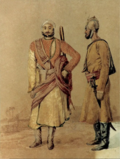
[[File:Police Chuprasi, Delhi.png|Police in Delhi under Bahadur Shah II, 1842|thumb]] | [[File:Police Chuprasi, Delhi.png|Police in Delhi under Bahadur Shah II, 1842|thumb]] | ||
The Mughal Empire's legal system was context-specific and evolved | The Mughal Empire's legal system was context-specific and evolved throughout the empire's rule. Being a Muslim state, the empire employed ''[[fiqh]]'' (Islamic jurisprudence) and therefore the fundamental institutions of Islamic law such as those of the ''[[qadi]]'' (judge), ''[[mufti]]'' (jurisconsult), and ''[[muhtasib]]'' (censor and market supervisor) were well-established in the Mughal Empire. However, the dispensation of justice also depended on other factors, such as administrative rules, local customs, and political convenience. This was due to Persianate influences on Mughal ideology and the fact that the Mughal Empire governed a non-Muslim majority.<ref name="Chatterjee2019">{{Citation |last=Chatterjee |first=Nandini |title=Courts of law, Mughal |date=2019-12-01 |url=https://referenceworks.brillonline.com/entries/encyclopaedia-of-islam-3/*-COM_25171 |encyclopedia=Encyclopaedia of Islam, Three |access-date=2021-12-13 |publisher=Brill |language=en |doi=10.1163/1573-3912_ei3_com_25171 |archive-date=13 December 2021 |archive-url=https://web.archive.org/web/20211213060747/https://referenceworks.brillonline.com/entries/encyclopaedia-of-islam-3/*-COM_25171 |url-status=live|url-access=subscription }}</ref> Scholar Mouez Khalfaoui notes that legal institutions in the Mughal Empire systemically suffered from the corruption of local judges.<ref name="Khalfaoui" /> | ||
==== Legal ideology ==== | ==== Legal ideology ==== | ||
The Mughal Empire followed the Sunni [[Hanafi]] system of jurisprudence. In its early years, the empire relied on Hanafi legal references inherited from its predecessor, the Delhi Sultanate. These included the ''[[al-Hidayah]]'' (the best guidance) and the ''Fatawa al-Tatarkhaniyya'' (religious decisions of the Emire Tatarkhan). During the Mughal Empire's peak, the ''[[Fatawa 'Alamgiri]]'' was commissioned by Emperor Aurangzeb. This compendium of Hanafi law sought to serve as a central reference for the Mughal state that dealt with the specifics of the South Asian context.<ref>{{Cite web|last=Khalfaoui|first=Mouez|title=Mughal Empire and Law|url=http://www.oxfordislamicstudies.com/print/opr/t349/e0066|website=Oxford Islamic Studies Online}}</ref> | The Mughal Empire followed the Sunni [[Hanafi]] system of jurisprudence. In its early years, the empire relied on Hanafi legal references inherited from its predecessor, the Delhi Sultanate. These included the ''[[al-Hidayah]]'' (the best guidance) and the ''Fatawa al-Tatarkhaniyya'' (religious decisions of the Emire Tatarkhan). During the Mughal Empire's peak, the ''[[Fatawa 'Alamgiri]]'' was commissioned by Emperor Aurangzeb. This compendium of Hanafi law sought to serve as a central reference for the Mughal state that dealt with the specifics of the South Asian context.<ref name="Khalfaoui">{{Cite web |last=Khalfaoui |first=Mouez |title=Mughal Empire and Law |url=http://www.oxfordislamicstudies.com/print/opr/t349/e0066 |website=Oxford Islamic Studies Online |access-date=13 December 2021 |archive-date=13 December 2021 |archive-url=https://web.archive.org/web/20211213062301/http://www.oxfordislamicstudies.com/print/opr/t349/e0066 |url-status=dead}}</ref> | ||
The Mughal Empire also drew on | The Mughal Empire also drew on Persian notions of kingship. Particularly, this meant that the Mughal emperor was considered the supreme authority on legal affairs.<ref name="Chatterjee2019" /> | ||
==== Courts of law ==== | ==== Courts of law ==== | ||
Various kinds of courts existed in the Mughal | Various kinds of courts existed in the Mughal Empire. One such court was that of the ''qadi''. The Mughal ''qadi'' was responsible for dispensing justice; this included settling disputes, judging people for crimes, and dealing with inheritances and orphans. The ''qadi'' also had additional importance in documents, as the seal of the ''qadi'' was required to validate deeds and tax records. ''Qadis'' did not constitute a single position, but made up a hierarchy. For example, the most basic kind was the ''[[pargana]]'' (district) ''qadi''. More prestigious positions were those of the ''qadi al-quddat'' (judge of judges) who accompanied the mobile imperial camp, and the ''qadi-yi lashkar'' (judge of the army).<ref name="Chatterjee2019" /> ''Qadis'' were usually appointed by the emperor or the ''sadr-us-sudr'' (chief of charities).<ref name="Chatterjee2019" /><ref>{{Citation |last=Conermann |first=Stephan |title=Mughal Empire |date=2015-08-04 |url=https://referenceworks.brillonline.com/entries/encyclopedia-of-early-modern-history-online/*-COM_024206 |encyclopedia=Encyclopedia of Early Modern History Online |access-date=2022-03-25 |publisher=Brill |language=en |doi=10.1163/2352-0272_emho_com_024206 |archive-date=26 March 2022 |archive-url=https://web.archive.org/web/20220326064353/https://referenceworks.brillonline.com/entries/encyclopedia-of-early-modern-history-online/*-COM_024206 |url-status=live |url-access=subscription }}</ref> The jurisdiction of the ''qadi'' was availed by Muslims and non-Muslims alike.<ref>{{Cite journal |last=Chatterjee |first=Nandini |year=2014 |title=Reflections on Religious Difference and Permissive Inclusion in Mughal Law |url=http://dx.doi.org/10.1017/jlr.2014.20 |journal=Journal of Law and Religion |volume=29 |issue=3 |pages=396–415 |doi=10.1017/jlr.2014.20 |issn=0748-0814 |s2cid=143513602 |hdl-access=free |hdl=10871/15975 |access-date=13 December 2021 |archive-date=22 September 2023 |archive-url=https://web.archive.org/web/20230922034448/https://www.cambridge.org/core/journals/journal-of-law-and-religion/article/abs/reflections-on-religious-difference-and-permissive-inclusion-in-mughal-law/88E6D627704E165E241C0D3C165E3FDA |url-status=live |url-access=subscription }}</ref> | ||
The ''[[jagirdar]]'' (local tax collector) was another kind of official | The ''[[jagirdar]]'' (local tax collector) was another kind of official approach, especially for high-stakes cases. Subjects of the Mughal Empire also took their grievances to the courts of superior officials, who held more authority and punitive power than the local ''qadi''. Such officials included the ''[[kotwal]]'' (local police), the ''[[faujdar]]'' (an officer controlling multiple districts and troops of soldiers), and the most powerful, the ''[[subahdar]]'' (provincial governor). In some cases, the emperor dispensed justice directly.<ref name="Chatterjee2019" /> Jahangir was known to have installed a "chain of justice" in the [[Agra Fort]] that any aggrieved subject could shake to get the attention of the emperor and bypass the inefficacy of officials.<ref>{{Cite book |last=Eaton |first=Richard M. |author-link=Richard M. Eaton |title=India in the Persianate Age : 1000–1765 |publisher=University of California Press |year=2019 |isbn=978-0-520-97423-4 |page=272 |oclc=1243310832}}</ref> | ||
Self-regulating tribunals operating at the community or village level were common, but sparse documentation of them exists. For example, it is unclear how ''[[panchayats]]'' (village councils) operated in the Mughal era.<ref name=" | Self-regulating tribunals operating at the community or village level were common, but sparse documentation of them exists. For example, it is unclear how ''[[panchayats]]'' (village councils) operated in the Mughal era.<ref name="Chatterjee2019" /> | ||
== Economy == | == Economy == | ||
{{ | {{Main|Economy of the Mughal Empire}} | ||
The | The Mughal economy was large and prosperous.<ref name="Schmidt2015">{{Cite book |last=Schmidt |first=Karl J. |url=https://books.google.com/books?id=BqdzCQAAQBAJ&pg=PA100 |title=An Atlas and Survey of South Asian History |publisher=Routledge |year=2015 |isbn=978-1-317-47681-8 |pages=100– |access-date=9 August 2017 |archive-date=22 September 2023 |archive-url=https://web.archive.org/web/20230922034442/https://books.google.com/books?id=BqdzCQAAQBAJ&pg=PA100 |url-status=live }}</ref><ref name="Maddison2003">{{Cite book |last=Maddison |first=Angus |url=https://books.google.com/books?id=rHJGz3HiJbcC&pg=PA256 |title=Development Centre Studies The World Economy Historical Statistics: Historical Statistics |publisher=OECD Publishing |year=2003 |isbn=978-92-64-10414-3 |pages=256– |author-link=Angus Maddison |access-date=9 August 2017 |archive-date=20 January 2023 |archive-url=https://web.archive.org/web/20230120082500/https://books.google.com/books?id=rHJGz3HiJbcC&pg=PA256 |url-status=live }}</ref> India was producing 24.5% of the world's manufacturing output up until 1750.<ref name="Williamson">[[Jeffrey G. Williamson]] & David Clingingsmith, [http://www.lse.ac.uk/economicHistory/Research/GEHN/GEHNPDF/Conf7_Williamson.pdf India's Deindustrialization in the 18th and 19th Centuries] {{Webarchive|url=https://web.archive.org/web/20170329075904/http://www.lse.ac.uk/economicHistory/Research/GEHN/GEHNPDF/Conf7_Williamson.pdf |date=29 March 2017 }}, Global Economic History Network, [[London School of Economics]]</ref><ref name="Maddison2003" /> Mughal India's economy has been described as a form of [[proto-industrialisation]], like that of 18th-century Western Europe before the [[Industrial Revolution]].<ref name="voss" /> | ||
Modern historians and researchers generally agree that the character of the Mughal Empire's economic policy resembles the [[laissez-faire]] system in dealing with trade and billions to achieve the economic ends.{{sfn|J.J.L. Gommans|2002|p=75}}{{sfn|Streusand|2018|p="...Mughal rulers pursued a more laissez-faire economic approach, benefiting from the prosperity of..."}}<ref>{{cite book |editor1-last=A. Bayly |editor1-first=C. |editor2-last=Fibiger Bang |editor2-first=Peter |editor3-last=Scheidel |editor3-first=Walter |title=The Oxford World History of Empire Volume Two: The History of Empires |date=2020 |publisher=Oxford University Press |isbn=9780197532775 |page=775 |url=https://books.google.com/books?id=1GkLEAAAQBAJ |access-date=18 April 2024 |language=En}}</ref>{{sfn|Ali|2008}} | |||
The Mughals were responsible for building an extensive road system and creating a uniform currency.{{sfn|Richards|1995|pp=185–204}} The empire had an extensive road network, which was vital to the economic infrastructure, built by a [[public works]] department set up by the Mughals which designed, constructed and maintained roads linking towns and cities across the empire, making trade easier to conduct.<ref name="Schmidt2015" /> | |||
The Mughals | |||
The main base of the empire's collective wealth was agricultural taxes, instituted by the third Mughal emperor, Akbar.<ref name="Stein2010-3" /><ref name="AsherTalbot2006-1" /> These taxes, which amounted to well over half the output of a peasant cultivator,<ref name="Stein2010-4" /> were paid in the well-regulated silver currency,{{sfn|Asher|Talbot|2006|pp=152–}} and caused peasants and artisans to enter larger markets.<ref name="AsherTalbot2006-3" /> In circa 1595, Modern historians estimated the state's annual revenues of the Mughal Empire were around 99,000,000 rupees.{{sfn|Jorge Flores|2015|p=73}} | |||
=== | === Coinage === | ||
{{Main|Mughal currency}} | |||
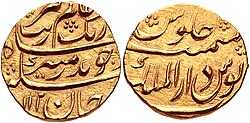
[[File:Coin of Aurangzeb, minted in Kabul.jpg|thumb|right|Coin of Aurangzeb, minted in Kabul, dated 1691/2.]] | |||
The Mughals adopted and standardised the [[rupee]] (''rupiya'', or silver) and [[Dam (Indian coin)|dam]] (copper) currencies introduced by [[Sur Empire|Sur]] Emperor [[Sher Shah Suri]] during his brief rule.<ref>{{Cite web |title=Picture of original Mughal ''rupiya'' introduced by Sher Shah Suri |url=http://www.rbi.org.in/currency/museum/c-mogul.html |url-status=dead |archive-url=https://web.archive.org/web/20021005231609/http://www.rbi.org.in/currency/museum/c-mogul.html |archive-date=5 October 2002 |access-date=4 August 2017}}</ref> The Mughals minted coins with high purity, never dropping below 96%, and without [[debasement]] until the 1720s.<ref name="Richards2003">{{Cite book |last=Richards |first=John F. |url=https://books.google.com/books?id=i85noYD9C0EC&pg=PA27 |title=The Unending Frontier: An Environmental History of the Early Modern World |publisher=University of California Press |year=2003 |isbn=978-0-520-93935-6 |pages=27– |author-link=John F. Richards |access-date=9 August 2017 |archive-date=22 September 2023 |archive-url=https://web.archive.org/web/20230922034459/https://books.google.com/books?id=i85noYD9C0EC&pg=PA27 |url-status=live }}</ref> | |||
Despite India having its stocks of gold and silver, the Mughals produced minimal gold of their own but mostly minted coins from imported [[bullion]], as a result of the empire's strong export-driven economy, with global demand for Indian agricultural and industrial products drawing a steady stream of [[precious metal]]s into India.{{sfn|Richards|1995}} | |||
=== | === Labour === | ||
The historian Shireen Moosvi estimates that in terms of contributions to the Mughal economy, in the late 16th century, the primary sector contributed 52%, the secondary sector 18% and the tertiary sector 29%; the secondary sector contributed a higher percentage than in early 20th-century [[British India]], where the secondary sector only contributed 11% to the economy.{{sfn|Moosvi|2015|p=433}} In terms of the urban-rural divide, 18% of Mughal India's labour force were urban and 82% were rural, contributing 52% and 48% to the economy, respectively.<ref>{{Cite book |last=Maddison |first=Angus |url=https://books.google.com/books?id=7UOKB3RwDQIC&pg=PA33 |title=Class Structure and Economic Growth: India and Pakistan Since the Moghuls |publisher=[[Taylor & Francis]] |year=1971 |isbn=978-0-415-38259-5 |page=33 |author-link=Angus Maddison |access-date=22 August 2017 |archive-date=22 September 2023 |archive-url=https://web.archive.org/web/20230922035024/https://books.google.com/books?id=7UOKB3RwDQIC&pg=PA33 |url-status=live }}</ref> | |||
According to Moosvi, Mughal India had a per-capita income, in terms of wheat, 1.24% higher in the late 16th century than British India did in the early 20th century.{{sfn|Moosvi|2015|p=432}} This income, however, would have to be revised downwards if manufactured goods, like clothing, would be considered. Compared to food per capita, expenditure on clothing was much smaller though, so relative income between 1595 and 1596 should be comparable to 1901–1910.{{sfn|Moosvi|2015|p=450}} However, in a system where wealth was hoarded by elites, wages were depressed for [[manual labour]].<ref name="moosvi" /> While [[slavery]] also existed, it was limited largely to household servants.<ref name="moosvi">{{Cite journal |last=Moosvi |first=Shireen |date=December 2011 |title=The World of Labour in Mughal India (c. 1500–1750) |journal=International Review of Social History |volume=56 |issue=S19 |pages=245–261 |doi=10.1017/S0020859011000526 |doi-access=free}}</ref> | |||
=== Agriculture === | |||
Indian agricultural production increased under the Mughal Empire.<ref name="Schmidt2015" /> A variety of crops were grown, including food crops such as wheat, rice, and [[barley]], and non-food [[cash crop]]s such as cotton, [[Indigofera tinctoria|indigo]] and [[opium]]. By the mid-17th century, Indian cultivators began to extensively grow two new crops from the Americas, maize and tobacco.<ref name="Schmidt2015" /> | |||
Mughal | The Mughal administration emphasised the [[agrarian reform]] that began under the non-Mughal emperor Sher Shah Suri, which Akbar adopted and furthered with more reforms. The civil administration was organised hierarchically based on merit, with promotions based on performance.<ref>{{Cite book |last1=Pagaza |first1=Ignacio |title=Winning the Needed Change: Saving Our Planet Earth |last2=Argyriades |first2=Demetrios |publisher=IOS Press |year=2009 |isbn=978-1-58603-958-5 |page=129}}</ref> The Mughal government funded the building of [[irrigation]] systems across the empire, which produced much higher [[crop yield]]s and increased the net revenue base, leading to increased agricultural production.<ref name="Schmidt2015" /> | ||
A major Mughal reform introduced by Akbar was a new land revenue system called ''zabt''. He replaced the [[tribute]] system, previously common in India and used by [[Tokugawa Japan]] at the time, with a monetary tax system based on a uniform currency.<ref name="Richards2003" /> The revenue system was biased in favour of higher value cash crops such as cotton, indigo, [[sugar cane]], tree crops, and opium, providing state incentives to grow cash crops, in addition to rising market demand.{{sfn|Richards|1995}} Under the ''zabt'' system, the Mughals also conducted extensive [[cadastral surveying]] to assess the area of land under [[plough]] cultivation, with the Mughal state encouraging greater land cultivation by offering tax-free periods to those who brought new land under cultivation.<ref name="Richards2003" /> The expansion of agriculture and cultivation continued under later Mughal emperors, including Aurangzeb.<ref name="Ludden96">{{Cite book |last=Ludden |first=David |url=https://books.google.com/books?id=eHi62S7vZlsC&pg=PA96 |title=An Agrarian History of South Asia |publisher=[[Cambridge University Press]] |year=1999 |isbn=978-0-521-36424-9 |page=96 |access-date=29 April 2019 |archive-date=22 September 2023 |archive-url=https://web.archive.org/web/20230922034936/https://books.google.com/books?id=eHi62S7vZlsC&pg=PA96 |url-status=live}}</ref> | |||
Mughal agriculture was in some ways advanced compared to European agriculture at the time, exemplified by the common use of the [[seed drill]] among Indian peasants before its adoption in Europe.{{sfn|Habib|Kumar|Raychaudhuri|1987|p=214}} Geared sugar [[Roller mill|rolling mills]] first appeared in Mughal India, using the principle of rollers as well as [[worm gear]]ing, by the 17th century.<ref>[[Irfan Habib]] (2011), [https://books.google.com/books?id=K8kO4J3mXUAC&pg=PA53 ''Economic History of Medieval India, 1200–1500'', p. 53] {{Webarchive|url=https://web.archive.org/web/20230922034936/https://books.google.com/books?id=K8kO4J3mXUAC&pg=PA53 |date=22 September 2023 }}, [[Pearson Education]]</ref> | |||
=== Industrial manufacturing === | |||
{{see|Mughal Karkhanas}} | |||
South Asia during the Mughal's rule was a very fertile ground for manufacturing technologies coveted by the Europeans before the [[Industrial Revolution]].{{sfn|Andrew de la Garza|2016|pp=114-115}} Up until 1750, India produced about 25% of the world's industrial output.<ref name="williamson">{{Cite web |last=[[Jeffrey G. Williamson]], David Clingingsmith |date=August 2005 |title=India's Deindustrialization in the 18th and 19th Centuries |url=http://www.tcd.ie/Economics/staff/orourkek/Istanbul/JGWGEHNIndianDeind.pdf |access-date=18 May 2017 |publisher=[[Harvard University]] |archive-date=13 December 2016 |archive-url=https://web.archive.org/web/20161213044056/http://www.tcd.ie/Economics/staff/orourkek/Istanbul/JGWGEHNIndianDeind.pdf |url-status=live }}</ref> | |||
====Textile | [[Manufactured goods]] and cash crops from the Mughal Empire were sold throughout the world.<ref name="Schmidt2015" /> The growth of manufacturing industries in the Indian subcontinent during the Mughal era in the 17th–18th centuries has been referred to as a form of [[proto-industrialisation]], similar to 18th-century Western Europe before the Industrial Revolution.<ref name="voss">{{Cite book |last=Roy |first=Tirthankar |title=The Ashgate Companion to the History of Textile Workers, 1650–2000 |publisher=[[Ashgate Publishing]] |year=2010 |isbn=978-0-7546-6428-4 |editor-last=Lex Heerma van Voss |page=255 |chapter=The Long Globalization and Textile Producers in India |author-link=Tirthankar Roy |editor-last2=Els Hiemstra-Kuperus |editor-last3=Elise van Nederveen Meerkerk |chapter-url=https://books.google.com/books?id=f95ljbhfjxIC&pg=PA255 |access-date=15 August 2017 |archive-date=2 July 2023 |archive-url=https://web.archive.org/web/20230702121931/https://books.google.com/books?id=f95ljbhfjxIC&pg=PA255 |url-status=live }}</ref> | ||
In [[early modern Europe]], there was significant demand for products from Mughal India, particularly cotton textiles, as well as goods such as spices, peppers, [[indigo]], silks, and [[saltpetre]] (for use in [[munitions]]).<ref name="Schmidt2015" /> [[1650–1700 in Western European fashion|European fashion]], for example, became increasingly dependent on Mughal Indian textiles and silks.<ref name="Prakash">[[Om Prakash (historian)|Om Prakash]], "[http://link.galegroup.com/apps/doc/CX3447600139/WHIC?u=seat24826&xid=6b597320 Empire, Mughal] {{Webarchive|url=https://web.archive.org/web/20221118051038/https://go.gale.com/ps/i.do?p=WHIC&u=seat24826&id=GALE%7B%7B%21%7D%7DCX3447600139&v=2.1&it=r&asid=6b597320 |date=18 November 2022 }}", ''History of World Trade Since 1450'', edited by [[John J. McCusker]], vol. 1, Macmillan Reference US, 2006, pp. 237–240, ''World History in Context''. Retrieved 3 August 2017</ref> | |||
==== Textile industry ==== | |||
{{See also|Muslin trade in Bengal|Mughal clothing}} | |||
[[File:Renaldis muslin woman.jpg|thumb|Muslim Lady Reclining or An Indian Girl with a Hookah, painted in Dacca, 18th century.]] | |||
The [[ | The largest manufacturing industry in the Mughal Empire was [[textile manufacturing]], particularly cotton textile manufacturing, which included the production of [[piece goods]], [[calico]]s, and [[muslin]]s. The cotton [[textile industry]] was responsible for a large part of the empire's international trade.<ref name="Schmidt2015" /> India had a 25% share of the global textile trade in the early 18th century,<ref>[[Angus Maddison]] (1995), ''Monitoring the World Economy, 1820–1992'', [[OECD]], p. 30</ref> and it represented the most important manufactured goods in world trade in the 18th century.<ref name="Parthasarathi">{{Citation |title=Why Europe Grew Rich and Asia Did Not: Global Economic Divergence, 1600–1850 |page=2 |year=2011 |publisher=Cambridge University Press |isbn=978-1-139-49889-0 |given=Prasannan |surname=Parthasarathi}}</ref> The most important centre of cotton production was the Bengal province, particularly around its capital city of [[Dhaka]].<ref name="Eaton">Richard Maxwell Eaton (1996), [https://books.google.com/books?id=gKhChF3yAOUC&pg=PA202 ''The Rise of Islam and the Bengal Frontier, 1204–1760'', p. 202] {{Webarchive|url=https://web.archive.org/web/20230404212612/https://books.google.com/books?id=gKhChF3yAOUC&pg=PA202 |date=4 April 2023 }}, [[University of California Press]]</ref> | ||
The production of cotton was advanced by the diffusion of the [[spinning wheel]] across India shortly before the Mughal era, lowering the costs of yarn and helping to increase demand for cotton. The diffusion of the [[spinning wheel]] and the incorporation of the [[worm gear]] and [[Crank (mechanism)|crank]] handle into the roller [[cotton gin]] led to greatly expanded Indian cotton textile production during the Mughal era.<ref>[[Irfan Habib]] (2011), [https://books.google.com/books?id=K8kO4J3mXUAC&pg=PA54 ''Economic History of Medieval India, 1200–1500'', p. 54] {{Webarchive|url=https://web.archive.org/web/20230922035433/https://books.google.com/books?id=K8kO4J3mXUAC&pg=PA54 |date=22 September 2023 }}, [[Pearson Education]]</ref> | |||
=== | === Bengal Subah === | ||
{{Main|Bengal Subah}} | |||
{{See also|Muslin trade in Bengal}} | |||
[[File:Boro Katra 4 by Ashif Siddique.jpg|thumb|Ruins of the [[Bara Katra|Great Caravanserai]] in [[Dhaka]]]] | |||
The Bengal Subah province was especially prosperous from the time of its takeover by the Mughals in 1590 until the British East India Company seized control in 1757.<ref>{{Cite journal |last=Roy |first=Tirthankar |author-link=Tirthankar Roy |date=November 2011 |title=Where is Bengal? Situating an Indian Region in the Early Modern World Economy |journal=Past & Present |issue=213 |pages=115–146 |doi=10.1093/pastj/gtr009}}</ref> Historian [[C. A. Bayly]] wrote that it was probably the Mughal Empire's wealthiest province.<ref>{{Cite book |last=Bayly |first=C. A. |url=https://books.google.com/books?id=fX2zMfWqIzMC&pg=PA51 |title=Indian Society and the Making of the British Empire |publisher=Cambridge University Press |year=1988 |isbn=978-0-521-38650-0 |series=The New Cambridge History of India |volume=II.1 |page=51 |author-link=Christopher Bayly |access-date=8 February 2023 |archive-date=8 February 2023 |archive-url=https://web.archive.org/web/20230208030846/https://books.google.com/books?id=fX2zMfWqIzMC&pg=PA51 |url-status=live }}</ref> Domestically, much of India depended on Bengali products such as rice, silks and cotton textiles. Overseas, Europeans depended on Bengali products such as cotton textiles, silks, and opium.<ref name="Prakash" /> The province was a leading producer of grains, salt, fruits, liquors and wines, precious metals and ornaments.<ref name="Nanda-2005">{{Cite book |last=Nanda |first=J. N. |url=https://books.google.com/books?id=HsV3cYAvGEEC |title=Bengal: The Unique State |publisher=Concept Publishing Company |year=2005 |page=10 |isbn=978-81-8069-149-2 |access-date=5 May 2016 |archive-date=22 September 2023 |archive-url=https://web.archive.org/web/20230922035433/https://books.google.com/books?id=HsV3cYAvGEEC |url-status=live }}</ref> | |||
===Bengal | After 150 years of rule by Mughal [[viceroy]]s, Bengal gained de facto independence as a dominion under [[Murshid Quli Khan]], the first [[Nawab of Bengal]] in 1717.<ref>{{Cite book |last=Nitish K |first=Sengupta |title=Land of Two Rivers A History of Bengal from the Mahabharata to Mujib |publisher=Penguin Books India |isbn=9780143416784 |publication-date=2011 |pages=16}}</ref> The Nawabs permitted European companies to set up trading posts across the region, which regarded Bengal as the richest place for trade.<ref name="Nanda-2005" /> | ||
==== Shipbuilding industry ==== | |||
Mughal India had a large shipbuilding industry, which was also largely centred in the Bengal province. Economic historian Indrajit Ray estimates the shipbuilding output of Bengal during the sixteenth and seventeenth centuries at 223,250 tons annually, compared with 23,061 tons produced in nineteen colonies in North America from 1769 to 1771.<ref name="ray174">{{Cite book |last=Ray |first=Indrajit |url=https://books.google.com/books?id=CHOrAgAAQBAJ&pg=PA174 |title=Bengal Industries and the British Industrial Revolution (1757–1857) |publisher=Routledge |year=2011 |isbn=978-1-136-82552-1 |pages=174}}</ref> He also assesses ship repairing as very advanced in Bengal.<ref name="ray174" /> | |||
== Demographics == | == Demographics == | ||
{{See also|Demographics of India# | {{See also|Demographics of India#History}} | ||
=== Population === | === Population === | ||
India's population growth accelerated under the Mughal Empire, with an unprecedented economic and demographic upsurge which boosted the Indian population by 60%<ref name="mcevedy184">{{Cite book |last1=Colin McEvedy |url=http://www.arabgeographers.net/up/uploads/14299936761.pdf#page=92 |title=Atlas of World Population History |last2=Richard Jones | | India's population growth accelerated under the Mughal Empire, with an unprecedented economic and demographic upsurge which boosted the Indian population by 60%<ref name="mcevedy184">{{Cite book |last1=Colin McEvedy |url=http://www.arabgeographers.net/up/uploads/14299936761.pdf#page=92 |title=Atlas of World Population History |last2=Richard Jones |year=1978 |publisher=[[Facts on File]] |location=New York |pages=184–185 |author-link=Colin McEvedy |access-date=7 August 2017 |archive-date=12 November 2020 |archive-url=https://web.archive.org/web/20201112011124/http://www.arabgeographers.net/up/uploads/14299936761.pdf#page=92 |url-status=live }}</ref> to 253% in 200 years during 1500–1700.<ref name="maddison236">[[Angus Maddison]] (2001), ''[[The World Economy: Historical Statistics|The World Economy: A Millennial Perspective]]'', [http://theunbrokenwindow.com/Development/MADDISON%20The%20World%20Economy--A%20Millennial.pdf#page=237 p. 236] {{Webarchive|url=https://web.archive.org/web/20201111170118/http://theunbrokenwindow.com/Development/MADDISON%20The%20World%20Economy--A%20Millennial.pdf#page=237 |date=11 November 2020 }}, [[OECD Development Centre]]</ref> The Indian population had a faster growth during the Mughal era than at any known point in [[Indian history]] before the Mughal era.<ref name="Maddison2003" /><ref name="mcevedy184" /> By the time of Aurangzeb's reign, there were a total of 455,698 villages in the Mughal Empire.{{sfn|Habib|Kumar|Raychaudhuri|1987|p=170}} | ||
The following table gives population estimates for the Mughal Empire, compared to the total population of | The following table gives population estimates for the Mughal Empire, compared to the total population of South Asia including the regions of modern [[India]], [[Pakistan]], and [[Bangladesh]], and compared to the [[world population]]: | ||
{| class="wikitable sortable" | {| class="wikitable sortable" | ||
| Line 269: | Line 262: | ||
! scope="col" data-sort-type="number" | Mughal Empire <br /> population | ! scope="col" data-sort-type="number" | Mughal Empire <br /> population | ||
! scope="col" data-sort-type="number" | Total Indian <br /> population | ! scope="col" data-sort-type="number" | Total Indian <br /> population | ||
! scope="col" data-sort-type="number" | % of | ! scope="col" data-sort-type="number" | % of South Asian <br /> population | ||
! scope="col" data-sort-type="number" | World <br /> population | ! scope="col" data-sort-type="number" | World <br /> population | ||
! scope="col" data-sort-type="number" | % of world <br /> population | ! scope="col" data-sort-type="number" | % of world <br /> population | ||
| Line 281: | Line 274: | ||
|- | |- | ||
| 1600 | | 1600 | ||
| style="text-align: right;" | {{formatnum:115000000}} | | style="text-align: right;" | {{formatnum:115000000}}{{sfn|Habib|Kumar|Raychaudhuri|1987|p=170}} | ||
| style="text-align: right;" | {{formatnum:130000000}}<ref name="mcevedy184" /> | | style="text-align: right;" | {{formatnum:130000000}}<ref name="mcevedy184" /> | ||
| style="text-align: right;" | 89 | | style="text-align: right;" | 89 | ||
| Line 288: | Line 281: | ||
|- | |- | ||
| 1700 | | 1700 | ||
| style="text-align: right;" | {{formatnum:158400000}}<ref name="borocz">{{Cite book |last=József Böröcz |url=https://books.google.com/books?id=d0SPAgAAQBAJ&pg=PA21 |title=The European Union and Global Social Change | | | style="text-align: right;" | {{formatnum:158400000}}<ref name="borocz">{{Cite book |last=József Böröcz |url=https://books.google.com/books?id=d0SPAgAAQBAJ&pg=PA21 |title=The European Union and Global Social Change |year=2009 |publisher=[[Routledge]] |isbn=978-1-135-25580-0 |page=21 |author-link=József Böröcz |access-date=26 June 2017}}</ref> | ||
| style="text-align: right;" | {{formatnum:160000000}}<ref name="mcevedy184" /> | | style="text-align: right;" | {{formatnum:160000000}}<ref name="mcevedy184" /> | ||
| style="text-align: right;" | 99 | | style="text-align: right;" | 99 | ||
| Line 295: | Line 288: | ||
|} | |} | ||
There was a notable presence of the [[Jewish]] [[diaspora]] in the Mughal empire. The Jewish community in the empire engaged in trading jewelry and precious stones.<ref name="IshratAlam">{{cite journal | |||
|author= Ishrat Alam |url=https://www.jstor.org/stable/44144741 | |||
|title= Jewish Merchants In The Mughal Empire | |||
|year=2004 | |||
|journal= Proceedings of the Indian History Congress | |||
|volume= 65 | |||
|pages=267–275 | |||
|jstor=44144741 | |||
|access-date=18 August 2025 | |||
}}</ref> [[Sarmad Kashani]] engaged in religious activities in the Mughal court.<ref name="Fischel">{{cite journal | |||
|author= Walter Joseph Fischel |url=https://doi.org/10.2307/3622197 | |||
|title= Jews and Judaism at the Court of the Moghul Emperors in Medieval India | |||
|year=1948 | |||
|journal= Proceedings of the American Academy for Jewish Research | |||
|volume= 18 | |||
|pages=139-140, 151-152, 159-161 | |||
|access-date=18 August 2025 | |||
|doi= 10.2307/3622197 | |||
|jstor=3622197 | |||
|url-access=subscription}}</ref> | |||
=== Urbanisation === | |||
According to [[Irfan Habib]], cities and towns boomed under the Mughal Empire, which had a relatively high degree of urbanisation for its time, with 15% of its population living in urban centres.<ref name="Eraly2007">{{Cite book |last=Eraly |first=Abraham |url=https://books.google.com/books?id=Zpa8gyGW_twC&pg=PA5 |title=The Mughal World: Life in India's Last Golden Age |publisher=Penguin Books India |year=2007 |isbn=978-0-14-310262-5 |pages=5– |author-link=Abraham Eraly}}</ref> This was higher than the percentage of the urban population in contemporary Europe at the time and higher than that of [[British Raj|British India]] in the 19th century;<ref name="Eraly2007" /> the level of urbanisation in Europe did not reach 15% until the 19th century.<ref>{{Cite book |last=Malanima |first=Paolo |url=https://books.google.com/books?id=C1Ej4VEPwSgC&pg=PA244 |title=Pre-Modern European Economy: One Thousand Years (10th–19th Centuries) |publisher=[[Brill Publishers]] |year=2009 |isbn=978-90-04-17822-9 |page=244 |author-link=Paolo Malanima}}</ref> | |||
Under Akbar's reign in 1600, the Mughal Empire's urban population was up to 17 million people, 15% of the empire's total population. This was larger than the entire urban population in Europe at the time, and even a century later in 1700, the urban population of England, Scotland and Wales did not exceed 13% of its total population,{{sfn|Habib|Kumar|Raychaudhuri|1987|p=170}} while British India had an urban population that was under 13% of its total population in 1800 and 9% in 1881, a decline from the earlier Mughal era.{{sfn|Habib|Kumar|Raychaudhuri|1987|p=165}} By 1700, Mughal India had an urban population of 23 million people, larger than British India's urban population of 22.3 million in 1871.<ref>{{Cite web |last1=Broadberry |first1=Stephen |last2=Gupta |first2=Bishnupriya |year=2010 |title=Indian GDP before 1870: Some preliminary estimates and a comparison with Britain |url=http://www2.warwick.ac.uk/fac/soc/economics/staff/sbroadberry/wp/indiangdppre1870v4.pdf#page=23 |url-status=dead |archive-url=https://web.archive.org/web/20201111210739/https://warwick.ac.uk/fac/soc/economics/staff/sbroadberry/wp/indiangdppre1870v4.pdf#page=23 |archive-date=11 November 2020 |access-date=12 October 2015 |publisher=[[Warwick University]] |page=23}}</ref> | |||
Those estimates were criticised by [[Tim Dyson]], who considers them exaggerations. According to Dyson, urbanisation of the Mughal Empire was less than 9%.<ref>{{Cite book |last=Dyson |first=Tim |title=A Population History of India: From the First Modern People to the Present Day |year=2018 |pages=63–65}}</ref> | |||
Cities acted as markets for the sale of goods, and provided homes for a variety of merchants, traders, shopkeepers, artisans, moneylenders, weavers, craftspeople, officials, and religious figures.<ref name="Schmidt2015" /> However, | The historian [[Nizamuddin Ahmad]] (1551–1621) reported that, under Akbar's reign, there were 120 large cities and 3200 townships.<ref name="Eraly2007" /> Several cities in India had a population between a quarter-million and half-million people,<ref name="Eraly2007" /> with larger cities including [[Agra]] (in [[Agra Subah]]) with up to 800,000 people, [[Lahore]] (in [[Lahore Subah]]) with up to 700,000 people,{{sfn|Habib|Kumar|Raychaudhuri|1987|p=171}} [[Dhaka]] (in [[Bengal Subah]]) with over 1 million people,<ref>{{cite journal |last1=Rob |first1=Md. Abdur |last2=Asaduzzaman |first2=Md. |date=December 1997 |title=Historical Growth of Urbanization in Dhaka City |journal=Social Science Review |publisher=[[Dhaka University]] |volume=14 |issue=2 |page=126}}</ref> and Delhi (in [[Delhi Subah]]) with over 600,000 people.<ref name="Moosvi2008">{{Cite book |last=Moosvi |first=Shireen |url=https://books.google.com/books?id=IhpuAAAAMAAJ |title=People, Taxation, and Trade in Mughal India |publisher=Oxford University Press |year=2008 |isbn=978-0-19-569315-7 |page=131}}</ref> | ||
Cities acted as markets for the sale of goods, and provided homes for a variety of merchants, traders, shopkeepers, artisans, moneylenders, weavers, craftspeople, officials, and religious figures.<ref name="Schmidt2015" /> However, several cities were military and political centres, rather than manufacturing or commerce centres.<ref name="Chaudhuri2008">{{Cite journal |last=Chaudhuri |first=K. N. |year=2008 |title=Some Reflections on the Town and Country in Mughal India |journal=Modern Asian Studies |volume=12 |issue=1 |pages=77–96 |doi=10.1017/S0026749X00008155 |s2cid=146558617 |issn=0026-749X}}</ref> | |||
== Culture == | == Culture == | ||
{{See also|Indo-Persian culture||}} | {{See also|Indo-Persian culture||}} | ||
[[File:Mushafi-ghulam-hamdani.png|thumb|250px|[[Ghulam Hamdani Mushafi]], the poet first believed to have coined the name "''Urdu''" around 1780 AD for a language that went by a multiplicity of names before his time.<ref> | [[File:Mushafi-ghulam-hamdani.png|thumb|250px|[[Ghulam Hamdani Mushafi]], the poet first believed to have coined the name "''Urdu''" around 1780 AD for a language that went by a multiplicity of names before his time.<ref>{{cite book |last=Faruqi |first=Shamsur Rahman |author-link=Shamsur Rahman Faruqi |editor-last=Pollock |editor-first=Sheldon |editor-link=Sheldon Pollock|chapter=A Long History of Urdu Literary Culture, Part 1 |title=Literary Cultures in History |year=2003 |publisher=University of California Press |page=806 |isbn=0-520-22821-9}}</ref>]] | ||
The Mughal Empire was definitive in the early-modern and modern periods of South Asian history, with its legacy in India, Pakistan, Bangladesh and Afghanistan seen in cultural contributions such as: | |||
Generally, classical historiographies depicted the Mughal Empire's origin as a sedentarised agrarian society. However, modern historians such as [[André Wink]], [[Jos J. L. Gommans]], [[Anatoly Khazanov]], Thomas J. Barfield, and others, argued the Mughals originated from nomadic culture.{{sfn|Kaushik Roy|Peter Lorge|2014|p=146}} [[Pius Malekandathil]] argued instead that although it was true that the Mughal had their origin as nomadic civilisation, they became more sendentarised as time passed, as exemplified by their military tradition.<ref>{{cite book |author1=Pius Malekandathil |author1-link=Pius Malekandathil |title=The Indian Ocean in the Making of Early Modern India |year=2016 |publisher=Routledge |isbn=978-1351997454 |page=194 |edition=Illustrated |url=https://books.google.com/books?id=-WEPDQAAQBAJ |access-date=19 July 2024 |quote=...Mughal army shed most of its post-nomadic...}}</ref> The Mughal Empire was definitive in the early-modern and modern periods of South Asian history, with its legacy in India, Pakistan, Bangladesh and Afghanistan seen in cultural contributions such as: | |||
[[File:Mir Taqi Mir 1786.jpg|thumb|Mir Taqi Mir, an Urdu poet of the 18th century Mughal Empire]] | [[File:Mir Taqi Mir 1786.jpg|thumb|Mir Taqi Mir, an Urdu poet of the 18th century Mughal Empire]] | ||
[[File:Taj mahal (1870s).jpg|thumb|The Taj Mahal in the 1870s]] | [[File:Taj mahal (1870s).jpg|thumb|The Taj Mahal in the 1870s]] | ||
* Centralised imperial rule that consolidated the smaller polities of South Asia.<ref>{{Cite encyclopedia |title=Mughal Empire – MSN Encarta |url=http://encarta.msn.com/encyclopedia_761564252/mughal_empire.html |url-status=dead |archive-url=https://web.archive.org/web/20091028022520/http://encarta.msn.com/encyclopedia_761564252/Mughal_Empire.html |archive-date=28 October 2009}}</ref> | * Centralised imperial rule that consolidated the smaller polities of South Asia.<ref>{{Cite encyclopedia |title=Mughal Empire – MSN Encarta |url=http://encarta.msn.com/encyclopedia_761564252/mughal_empire.html |url-status=dead |archive-url=https://web.archive.org/web/20091028022520/http://encarta.msn.com/encyclopedia_761564252/Mughal_Empire.html |archive-date=28 October 2009}}</ref> | ||
* The amalgamation of [[Persian art]] and literature with [[Indian art]].<ref | * The amalgamation of [[Persian art]] and literature with [[Indian art]].<ref>{{Cite web |title=Indo-Persian Literature Conference: SOAS: North Indian Literary Culture (1450–1650) |url=http://www.soas.ac.uk/southasia/research/nilc/indopersian/ |access-date=28 November 2012 |website=SOAS |archive-date=23 September 2009 |archive-url=https://web.archive.org/web/20090923222924/http://www.soas.ac.uk/southasia/research/nilc/indopersian/ |url-status=dead }}</ref> | ||
[[File:Badshahi Mosque, Lahore. King's Mosque.jpg|thumb|Badshahi Mosque, [[Lahore, Punjab]], Pakistan]] | [[File:Badshahi Mosque, Lahore. King's Mosque.jpg|thumb|Badshahi Mosque, [[Lahore, Punjab]], Pakistan]] | ||
* The development of [[Mughlai cuisine]], an amalgamation of South Asian, Iranian and Central Asian culinary styles. | * The development of [[Mughlai cuisine]], an amalgamation of South Asian, Iranian and Central Asian culinary styles. | ||
* The development of [[Mughal clothing]], | * The development of [[Mughal clothing]], jewellery and fashion, utilising richly decorated fabrics such as muslin, silk, brocade and velvet. | ||
* The Persian | * The influence of the Persian language over [[Old Hindi]] led to the development of the [[Hindustani language]].<ref>{{Cite web |title=Islam: Mughal Empire (1500s, 1600s) |url=https://www.bbc.co.uk/religion/religions/islam/history/mughalempire_1.shtml |access-date=10 June 2018 |website=Religions |publisher=BBC |archive-date=13 August 2018 |archive-url=https://web.archive.org/web/20180813212912/http://www.bbc.co.uk/religion/religions/islam/history/mughalempire_1.shtml |url-status=live}}</ref> | ||
* The introduction of sophisticated Iranian-style waterworks and horticulture through [[Mughal gardens|Mughal gardening]].<ref>{{Cite journal |last=Fatma |first=Sadaf |year=2012 |title=Waterworks in Mughal Gardens |journal=Proceedings of the Indian History Congress |volume=73 |pages=1268–1278 |jstor=44156328}}</ref> | * The introduction of sophisticated Iranian-style waterworks and horticulture through [[Mughal gardens|Mughal gardening]].<ref>{{Cite journal |last=Fatma |first=Sadaf |year=2012 |title=Waterworks in Mughal Gardens |journal=Proceedings of the Indian History Congress |volume=73 |pages=1268–1278 |jstor=44156328}}</ref> | ||
* The introduction of [[Turkish bath]]s into the Indian subcontinent. | * The introduction of [[Turkish bath]]s into the Indian subcontinent. | ||
* The evolution and refinement of [[Mughal architecture|Mughal]] and [[Indian architecture]] and in turn, the development of later Rajput and Sikh palatial architecture. A famous Mughal landmark is the [[Taj Mahal]]. | * The evolution and refinement of [[Mughal architecture|Mughal]] and [[Indian architecture]], and, in turn, the development of later Rajput and Sikh palatial architecture. A famous Mughal landmark is the [[Taj Mahal]]. | ||
* The development of the [[Pehlwani]] style of [[Indian wrestling]], a combination of Indian [[malla-yuddha]] and Persian [[varzesh-e bastani]].<ref name="Alter1992a">{{Cite journal |last=Alter |first=Joseph S. |date=May 1992 |title=The ''sannyasi'' and the Indian Wrestler: The Anatomy of a Relationship |journal=American Ethnologist |volume=19 |issue=2 |pages=317–336 |doi=10.1525/ae.1992.19.2.02a00070 |issn=0094-0496}}</ref><ref name="Alter1992b">{{Cite book |last=Alter |first=Joseph S. |url=https://archive.org/details/wrestlersbodyide00alte |title=The Wrestler's Body: Identity and Ideology in North India |publisher=University of California Press |year=1992 |isbn=978-0-520-07697-6 |page=[https://archive.org/details/wrestlersbodyide00alte/page/n1 2] |quote=Wrestling in modern India is a synthesis of two different traditions: the Persian form of the art brought into South Asia by the Moguls, and an indigenous Hindu form. |author-link=Joseph Alter |url-access=limited}}</ref> | * The development of the [[Pehlwani]] style of [[Indian wrestling]], a combination of Indian [[malla-yuddha]] and Persian [[varzesh-e bastani]].<ref name="Alter1992a">{{Cite journal |last=Alter |first=Joseph S. |date=May 1992 |title=The ''sannyasi'' and the Indian Wrestler: The Anatomy of a Relationship |journal=American Ethnologist |volume=19 |issue=2 |pages=317–336 |doi=10.1525/ae.1992.19.2.02a00070 |issn=0094-0496}}</ref><ref name="Alter1992b">{{Cite book |last=Alter |first=Joseph S. |url=https://archive.org/details/wrestlersbodyide00alte |title=The Wrestler's Body: Identity and Ideology in North India |publisher=University of California Press |year=1992 |isbn=978-0-520-07697-6 |page=[https://archive.org/details/wrestlersbodyide00alte/page/n1 2] |quote=Wrestling in modern India is a synthesis of two different traditions: the Persian form of the art brought into South Asia by the Moguls, and an indigenous Hindu form. |author-link=Joseph Alter |url-access=limited}}</ref> | ||
* The construction of [[Maktab (education)|Maktab]] schools, where youth were taught the [[Quran]] and [[Sharia|Islamic law]] such as the ''[[Fatawa 'Alamgiri]]'' in their indigenous languages. | * The construction of [[Maktab (education)|Maktab]] schools, where youth were taught the [[Quran]] and [[Sharia|Islamic law]] such as the ''[[Fatawa 'Alamgiri]]'' in their indigenous languages. | ||
* The development of [[Hindustani classical music]],<ref>{{Cite news |date=8 February 2000 |title=Mughal influence on Indian music |work=[[The Hindu]] |url=https://www.thehindu.com/todays-paper/tp-miscellaneous/tp-others/mughal-influence-on-indian-music/article28000731.ece |access-date=5 April 2019 | * The development of [[Hindustani classical music]],<ref>{{Cite news |date=8 February 2000 |title=Mughal influence on Indian music |work=[[The Hindu]] |url=https://www.thehindu.com/todays-paper/tp-miscellaneous/tp-others/mughal-influence-on-indian-music/article28000731.ece |access-date=5 April 2019 |archive-date=26 December 2019 |archive-url=https://web.archive.org/web/20191226071050/https://www.thehindu.com/todays-paper/tp-miscellaneous/tp-others/mughal-influence-on-indian-music/article28000731.ece |url-status=live }}</ref> and instruments such as the [[sitar]]. | ||
[[File:Fatehput Sikiri Buland Darwaza gate 2010.jpg|thumb|[[Buland Darwaza]] in Fatehpur Sikiri, Agra, India]] | [[File:Fatehput Sikiri Buland Darwaza gate 2010.jpg|thumb|[[Buland Darwaza]] in Fatehpur Sikiri, Agra, India]] | ||
=== Customs === | |||
The procession of marriage among the royals of the Mughal Empire was recorded with many reports of extravagant gifts. One occasion was during the marriage of a son of emperor [[Akbar]], [[Jahangir|Salim]], with the daughter of a ruler of [[Bijapur]], [[Bhagwant Das|Raja Bhagwant Das]], where the gift presented by Bhagwant Das consisted of many horses, 100 elephants, many male and female slaves of [[Habesha peoples|Abyssinian]], Caucasian, and native Indian origins, who brought with them various gold and silver utensils as [[dowry]].<ref>{{cite book |author1=Harbans Mukhia |author1-link=Harbans Mukhia |title=The Mughals of India |date=2008 |publisher=John Wiley & Sons |isbn=978-0470758151 |page=150 |url=https://books.google.com/books?id=rxHTBQAAQBAJ |access-date=11 July 2024 |language=En}}</ref> | |||
=== Architecture === | === Architecture === | ||
{{Main | {{Main|Mughal architecture|Yakhchāl}} | ||
The Mughals made a major contribution to the [[Indian subcontinent]] with the development of their | |||
The Mughals made a major contribution to the [[Indian subcontinent]] with the development of their distinctive architectural style. This style was derived from earlier [[Indo-Islamic architecture]] as well as from [[Iranian architecture|Iranian]] and [[Architecture of Central Asia|Central Asian]] architecture (particularly [[Timurid architecture]]), while incorporating further influences from [[Hindu architecture]].<ref name="Petersen1996">{{Cite book |last=Petersen |first=Andrew |title=Dictionary of Islamic architecture |publisher=Routledge |year=1996 |isbn=9781134613663 |location= |pages=199–205 |chapter=Mughals}}</ref><ref>{{cite book |last=Asher |first=Catherine Blanshard |url=https://books.google.com/books?id=3ctLNvx68hIC&pg=PA349 |title=Architecture of Mughal India |publisher=[[Cambridge University Press]] |year=1992 |isbn=9780521267281 |series=The New Cambridge History of India, Part I |volume=4 |pages=1–2, 15–17 |language=en}}</ref> [[Mughal architecture]] is distinguished, among other things, by [[Onion dome|bulbous domes]], [[Pointed arch|ogive arches]], carefully-composed and polished façades, and the use of hard red sandstone and marble as construction materials.<ref name="Petersen1996" /><ref>{{Cite book |last= |first= |url=https://books.google.com/books?id=un4WcfEASZwC |title=The Grove Encyclopedia of Islamic Art and Architecture |publisher=Oxford University Press |year=2009 |isbn=9780195309911 |editor-last=Bloom |editor-first=Jonathan M. |volume=1 |location= |pages=182 |language=en |chapter=Architecture |editor-last2=Blair |editor-first2=Sheila S.}}</ref> | |||
Furthermore, [[William Dalrymple]] mentioned that during the final days of the Mughal [[Siege of Delhi|fall of Delhi]] in 1857, an [[Ice house (building)|ice house]] structure existed in Delhi.<ref>{{cite book |author1=William Dalrymple |author1-link=William Dalrymple |title=The Last Mughal: The Fall of Delhi, 1857 |publisher=A&C Black |isbn=978-1408806883 |year=2009 |url=https://books.google.com/books?id=wYW5J-jQn8QC |access-date=23 July 2024 |quote=... Ice House in which Zahir was sheltering...}}</ref> Emperor Shah Jahan has recorded establishing an ice-house in [[Sirmaur district|Sirmaur]], north of Delhi.<ref>{{cite book |author1=Keshavlal H. Kamdar |title=History of the Mughal Rule in India, 1526-1761 |year=1933 |publisher=M. C. Kothari |page=141 |url=https://books.google.com/books?id=pA4dAAAAMAAJ |access-date=8 August 2024}}</ref> | |||
Many monuments were built during the Mughal era by the Muslim emperors, especially [[Shah Jahan]], including the [[Taj Mahal]]—a [[UNESCO World Heritage Site]] considered "the jewel of Muslim art in India and one of the universally admired masterpieces of the world's heritage",<ref name="Centre">{{Cite web|url=https://whc.unesco.org/en/list/252/|title=Taj Mahal|first=UNESCO World Heritage|last=Centre|website=UNESCO World Heritage Centre|access-date=7 May 2020|archive-date=1 February 2018|archive-url=https://web.archive.org/web/20180201133603/https://whc.unesco.org/en/list/252|url-status=live}}</ref> attracting 7–8 million unique visitors a year. The palaces, tombs, [[Mughal garden|gardens]] and forts built by the dynasty stand today in [[Agra]], [[Aurangabad, Maharashtra|Aurangabad]], [[Delhi]], [[Dhaka]], [[Fatehpur Sikri]], [[Jaipur]], [[Lahore]], [[Kabul]], [[Sheikhupura]], and many other cities of India, Pakistan, Afghanistan, and Bangladesh,<ref>{{Cite book |last1=Ross Marlay |title=Patriots and Tyrants: Ten Asian Leaders |last2=Clark D. Neher |year=1999 |publisher=Rowman & Littlefield |isbn=978-0-8476-8442-7 |page=269}}</ref> such as:[[File:1. লালবাগের কেল্লা.jpg|thumb|[[Lalbagh Fort]] aerial view in Dhaka, Bangladesh]] | |||
{| class="wikitable" | {| class="wikitable" | ||
|+ | |+ | ||
| Line 339: | Line 363: | ||
|- | |- | ||
|valign=top| | |valign=top| | ||
*[[Taj Mahal]] in Agra, India | * [[Taj Mahal]] in Agra, India | ||
*[[Agra Fort]] in Agra, India | * [[Agra Fort]] in Agra, India | ||
*[[Buland Darwaza]] in Agra, India | * [[Buland Darwaza]] in Agra, India | ||
*[[Akbar's tomb]] in Sikandra, India | * [[Akbar's tomb]] in Sikandra, India | ||
*[[Tomb of Mariam-uz-Zamani]] in Sikandra, India | * [[Tomb of Mariam-uz-Zamani]] in Sikandra, India | ||
*[[Humayun's Tomb]] in Delhi, India | * [[Humayun's Tomb]] in Delhi, India | ||
*[[Jama Masjid, Delhi|Jama Masjid]] in Delhi, India | * [[Jama Masjid, Delhi|Jama Masjid]] in Delhi, India | ||
*[[Red Fort]] in Delhi, India | * [[Red Fort]] in Delhi, India | ||
*[[Sunder Nursery]] in Delhi, India | * [[Sunder Nursery]] in Delhi, India | ||
*[[Purana Qila]] in Delhi, India | * [[Purana Qila]] in Delhi, India | ||
*[[Sher Mandal]] in Delhi, India | * [[Sher Mandal]] in Delhi, India | ||
*[[Pinjore Gardens]] in Pinjore, India | * [[Pinjore Gardens]] in Pinjore, India | ||
*[[Shalimar Bagh, Srinagar|Shalimar Bagh]] in Srinagar, India | * [[Shalimar Bagh, Srinagar|Shalimar Bagh]] in Srinagar, India | ||
*[[Nishat Bagh]] in Srinagar, India | * [[Nishat Bagh]] in Srinagar, India | ||
*[[Chashme Shahi|Chasma Shahi]] in Srinagar, India | * [[Chashme Shahi|Chasma Shahi]] in Srinagar, India | ||
*[[Pari Mahal]] in Srinagar, India | * [[Pari Mahal]] in Srinagar, India | ||
*[[Verinag | * [[Verinag]] Gardens in Srinagar, India | ||
*[[Allahabad Fort]] in Prayagraj, India | * [[Allahabad Fort]] in Prayagraj, India | ||
*[[Shahi Bridge]] in Jaunpur, India | * [[Shahi Bridge]] in Jaunpur, India | ||
*[[Bibi Ka Maqbara]] in Aurangabad, India | * [[Bibi Ka Maqbara]] in Aurangabad, India | ||
*[[Kos Minar]] in Haryana, India | * [[Kos Minar]] in Haryana, India | ||
*Baoli Ghaus Ali Shah in Farrukhnagar, India | * Baoli Ghaus Ali Shah in Farrukhnagar, India | ||
|valign=top| | |valign=top| | ||
*[[Badshahi Mosque|Badshahi Masjid]] in Lahore, Pakistan | * [[Badshahi Mosque|Badshahi Masjid]] in Lahore, Pakistan | ||
*[[Shalimar Gardens, Lahore|Shalimar Gardens]] in Lahore, Pakistan | * [[Shalimar Gardens, Lahore|Shalimar Gardens]] in Lahore, Pakistan | ||
*[[Lahore Fort]] in Lahore, Pakistan | * [[Lahore Fort]] in Lahore, Pakistan | ||
*[[Shahi Hammam]] in Lahore, Pakistan | * [[Shahi Hammam]] in Lahore, Pakistan | ||
*[[Wazir Khan Mosque]] in Lahore, Pakistan | * [[Wazir Khan Mosque]] in Lahore, Pakistan | ||
*[[Tomb of Jahangir]] in Lahore, Pakistan | * [[Tomb of Jahangir]] in Lahore, Pakistan | ||
*[[Tomb of Anarkali]] in Lahore, Pakistan | * [[Tomb of Anarkali]] in Lahore, Pakistan | ||
*[[Tomb of Nur Jahan]] in Lahore, Pakistan | * [[Tomb of Nur Jahan]] in Lahore, Pakistan | ||
*[[Tomb of Asif Khan]] in Lahore, Pakistan | * [[Tomb of Asif Khan]] in Lahore, Pakistan | ||
*[[Begum Shahi Mosque]] in Lahore, Pakistan | * [[Begum Shahi Mosque]] in Lahore, Pakistan | ||
*[[Akbari Sarai]] in Lahore, Pakistan | * [[Akbari Sarai]] in Lahore, Pakistan | ||
*[[Hiran Minar]] in Sheikhpura, Pakistan | * [[Hiran Minar]] in Sheikhpura, Pakistan | ||
*[[Mahabat Khan Mosque]] in Peshawar, Pakistan | * [[Mahabat Khan Mosque]] in Peshawar, Pakistan | ||
*[[Shahi Eid Gah Mosque]] in Multan, Pakistan | * [[Shahi Eid Gah Mosque]] in Multan, Pakistan | ||
*[[Masum Shah|Mausoleum of Masum Shah]] in Sukkur, Pakistan | * [[Masum Shah|Mausoleum of Masum Shah]] in Sukkur, Pakistan | ||
*[[Losar Baoli]] in Taxila, Pakistan | * [[Losar Baoli]] in Taxila, Pakistan | ||
*[[Makli Necropolis]] in Thatta, Pakistan | * [[Makli Necropolis]] in Thatta, Pakistan | ||
*[[Shah Jahan Mosque, Thatta|Shah Jahan Mosque]] in Thatta, Pakistan | * [[Shah Jahan Mosque, Thatta|Shah Jahan Mosque]] in Thatta, Pakistan | ||
|valign=top| | |valign=top| | ||
*[[Dhanmondi Shahi Eidgah|Mughal Eidgah]] in Dhaka, Bangladesh | * [[Dhanmondi Shahi Eidgah|Mughal Eidgah]] in Dhaka, Bangladesh | ||
*[[Lalbagh Fort]] in Dhaka, Bangladesh | * [[Lalbagh Fort]] in Dhaka, Bangladesh | ||
*[[Sylhet Shahi Eidgah|Shahi Eidgah]] in Sylhet, Bangladesh | * [[Sylhet Shahi Eidgah|Shahi Eidgah]] in Sylhet, Bangladesh | ||
*[[Mughal Tahakhana]] in Chapai Nawabganj, Bangladesh | * [[Mughal Tahakhana]] in Chapai Nawabganj, Bangladesh | ||
*[[Sat Gambuj Mosque]] in Dhaka, Bangladesh | * [[Sat Gambuj Mosque]] in Dhaka, Bangladesh | ||
*[[Masjid-e-Siraj ud-Daulah]] in Chittagong, Bangladesh | * [[Masjid-e-Siraj ud-Daulah]] in Chittagong, Bangladesh | ||
*[[Allakuri Mosque|Allakuri Masjid]] in Dhaka, Bangladesh | * [[Allakuri Mosque|Allakuri Masjid]] in Dhaka, Bangladesh | ||
*[[Chawk Mosque|Chawkbazar Shahi Masjid]] in Dhaka, Bangladesh | * [[Chawk Mosque, Dhaka|Chawkbazar Shahi Masjid]] in Dhaka, Bangladesh | ||
*[[Laldighi Mosque|Laldighi Masjid]] in Rangpur, Bangladesh | * [[Laldighi Mosque|Laldighi Masjid]] in Rangpur, Bangladesh | ||
*[[Khan Mohammad Mridha Mosque|Khan Mohammad Mridha Masjid]] in Dhaka, Bangladesh | * [[Khan Mohammad Mridha Mosque|Khan Mohammad Mridha Masjid]] in Dhaka, Bangladesh | ||
*[[Wali Khan Mosque|Wali Khan Masjid]] in Chittagong, Bangladesh | * [[Wali Khan Mosque|Wali Khan Masjid]] in Chittagong, Bangladesh | ||
*[[Shaista Khan Mosque|Shaista Khan Masjid]], in Dhaka, Bangladesh | * [[Shaista Khan Mosque|Shaista Khan Masjid]], in Dhaka, Bangladesh | ||
*[[Musa Khan Mosque|Musa Khan Masjid]], in Dhaka, Bangladesh | * [[Musa Khan Mosque|Musa Khan Masjid]], in Dhaka, Bangladesh | ||
*[[Shahbaz Khan Mosque|Shahbaz Khan Masjid]], in Dhaka, Bangladesh | * [[Shahbaz Khan Mosque|Shahbaz Khan Masjid]], in Dhaka, Bangladesh | ||
*[[Kartalab Khan Mosque|Kartalab Khan Masjid]] in Dhaka, Bangladesh | * [[Kartalab Khan Mosque|Kartalab Khan Masjid]] in Dhaka, Bangladesh | ||
*[[Azimpur Mosque|Azimpur Masjid]] in Dhaka, Bangladesh | * [[Azimpur Mosque|Azimpur Masjid]] in Dhaka, Bangladesh | ||
*[[Goaldi Mosque|Goaldi Masjid]] in Sonargaon, Bangladesh | * [[Goaldi Mosque|Goaldi Masjid]] in Sonargaon, Bangladesh | ||
*[[Atia Mosque|Atia Masjid]] in Tangail, Bangladesh | * [[Atia Mosque|Atia Masjid]] in Tangail, Bangladesh | ||
*[[Arifile Mosque|Arifail Masjid]] in Brahmanbaria, Bangladesh | * [[Arifile Mosque|Arifail Masjid]] in Brahmanbaria, Bangladesh | ||
*[[Bajra Shahi Mosque|Bazra Shahi Masjid]] in Noakhali, Bangladesh | * [[Bajra Shahi Mosque|Bazra Shahi Masjid]] in Noakhali, Bangladesh | ||
*[[Mosjidkur Mosque|Masjid Kur]] in Khulna, Bangladesh | * [[Mosjidkur Mosque|Masjid Kur]] in Khulna, Bangladesh | ||
*[[Nayabad Mosque|Nayabad Masjid]] in Dinajpur, Bangladesh | * [[Nayabad Mosque|Nayabad Masjid]] in Dinajpur, Bangladesh | ||
*[[Ghayebi Dighi Masjid]] in Sylhet, Bangladesh | * [[Ghayebi Dighi Masjid]] in Sylhet, Bangladesh | ||
*[[Hussaini Dalan]] in Dhaka, Bangladesh | * [[Hussaini Dalan]] in Dhaka, Bangladesh | ||
*[[Bara Katra]] in Dhaka, Bangladesh | * [[Bara Katra]] in Dhaka, Bangladesh | ||
*[[Hajiganj Fort]] in Narayanganj, Bangladesh | * [[Hajiganj Fort]] in Narayanganj, Bangladesh | ||
*[[Idrakpur Fort]] in Munshiganj, Bangladesh | * [[Idrakpur Fort]] in Munshiganj, Bangladesh | ||
*[[Choto Katra]] in Dhaka, Bangladesh | * [[Choto Katra]] in Dhaka, Bangladesh | ||
*[[Sonakanda Fort]] in Narayanganj, Bangladesh | * [[Sonakanda Fort]] in Narayanganj, Bangladesh | ||
|valign=top| | |valign=top| | ||
*[[Gardens of Babur|Bagh-e-Babur]] in Kabul, Afghanistan | * [[Gardens of Babur|Bagh-e-Babur]] in Kabul, Afghanistan | ||
*Shahjahani Mosque in Kabul, Afghanistan | * Shahjahani Mosque in Kabul, Afghanistan | ||
|} | |} | ||
=== Art and literature === | === Art and literature === | ||
{{Main|Mughal painting|Mughal clothing}} | {{Main|Mughal painting|Mughal clothing}} | ||
The literary works Akbar and Jahangir ordered to be illustrated ranged from epics like the ''[[Razmnama]]'' (a Persian translation of the Hindu epic, the ''[[Mahabharata]]'') to historical memoirs or biographies of the dynasty such as the ''[[Baburnama]]'' and ''[[Akbarnama]]'', and ''[[Tuzk-e-Jahangiri]]''. Richly | [[File:Finial in the Form of a Parrot, Mughal empire.jpeg|thumb|left|250px|Finial in the form of a parrot, Mughal Empire, 17th century]] | ||
The [[Mughal painting|Mughal artistic tradition]], mainly expressed in painted miniatures, as well as small luxury objects, was eclectic, borrowing from Iranian, Indian, Chinese and Renaissance European stylistic and thematic elements.<ref>Crill, Rosemary, and Jariwala, Kapil. ''The Indian Portrait, 1560–1860'', pp. 23–27, [[National Portrait Gallery, London|National Portrait Gallery]], London, 2010, {{ISBN|978-1855144095}}; [[Milo Beach|Beach, Milo Cleveland]] (1987), ''Early Mughal painting'', Harvard University Press, pp. 33–37, {{ISBN|978-0-674-22185-7}}, [https://books.google.com/books?id=MmcoF12hi3AC&pg=PA33 google books] {{Webarchive|url=https://web.archive.org/web/20230326164801/https://books.google.com/books?id=MmcoF12hi3AC&pg=PA33 |date=26 March 2023 }}</ref> Mughal emperors often took in Iranian bookbinders, illustrators, painters and calligraphers from the Safavid court due to the commonalities of their Timurid styles, and due to the Mughal affinity for Iranian art and calligraphy.<ref>{{Cite journal |last=Soucek |first=Priscilla |year=1987 |title=Persian Artists in Mughal India: Influences and Transformations |journal=Muqarnas |volume=4 |pages=166–181 |doi=10.2307/1523102 |jstor=1523102}}</ref> Miniatures commissioned by the Mughal emperors initially focused on large projects illustrating books with eventful historical scenes and court life, but later included more single images for albums, with portraits and animal paintings displaying a profound appreciation for the serenity and beauty of the natural world.<ref>{{Cite journal |last=Blunt |first=Wilfrid |year=1948 |title=The Mughal Painters of Natural History |journal=The Burlington Magazine |volume=90 |issue=539 |pages=48–50 |jstor=869792}}</ref> For example, Emperor Jahangir commissioned brilliant artists such as [[Ustad Mansur]] to realistically portray unusual flora and fauna throughout the empire. | |||
The literary works Akbar and Jahangir ordered to be illustrated ranged from epics like the ''[[Razmnama]]'' (a Persian translation of the Hindu epic, the ''[[Mahabharata]]'') to historical memoirs or biographies of the dynasty such as the ''[[Baburnama]]'' and ''[[Akbarnama]]'', and ''[[Tuzk-e-Jahangiri]]''. Richly finished albums (''[[muraqqa]]'') decorated with calligraphy and artistic scenes were mounted onto pages with decorative borders and then bound with covers of stamped and gilded or painted and lacquered leather.<ref>{{Cite web |last=Sardar |first=Marika |date=October 2003 |title=The Art of the Mughals After 1600 |url=https://www.metmuseum.org/toah/hd/mugh_2/hd_mugh_2.htm |archive-url=https://web.archive.org/web/20190204014635/https://www.metmuseum.org/toah/hd/mugh_2/hd_mugh_2.htm |archive-date=4 February 2019 |website=The MET}}</ref> Aurangzeb (1658–1707) was never an enthusiastic patron of painting, largely for religious reasons, and took a turn away from the pomp and ceremonial of the court around 1668, after which he probably commissioned no more paintings.<ref>Losty, J. P. Roy, Malini (eds), ''Mughal India: Art, Culture and Empire'', 2013, pp. 147, 149, British Library, {{ISBN|978-0712358705}}</ref>[[File:India, Mughal, early 17th century - An Illuminated Folio from the Royal Manuscript of the Farhang-i Jahangiri ( - 2013.318.a - Cleveland Museum of Art.tif|thumb|right|upright|Folio from ''[[Farhang-i-Jahangiri]],'' a Persian dictionary compiled during the Mughal era.]] | |||
=== Language === | === Language === | ||
{{Main|Persian language in the Indian subcontinent|Persian and Urdu|Hindustani language}} | {{Main|Persian language in the Indian subcontinent|Persian and Urdu|Hindustani language}} | ||
Though the Mughals were of [[Turko-Mongol]] origin, their reign enacted the revival and height of the [[Persian language]] in the Indian subcontinent, and by the end of the 16th-century Turki (Chagatai) was understood by relatively few at court.{{sfn|Seyller|2011|p=329}} Accompanied by literary patronage was the institutionalisation of Persian as an official and courtly language; this led to Persian reaching nearly the status of a first language for many inhabitants of Mughal India.<ref>{{Citation |chapter=2. The Culture and Politics of Persian in Precolonial Hindustan |year=2019 |url=http://dx.doi.org/10.1525/9780520926738-007 |title=Literary Cultures in History |pages=158–167 |publisher=University of California Press |doi=10.1525/9780520926738-007 |isbn=978-0-520-92673-8 |s2cid=226770775 |access-date=2021-07-26 |archive-date=22 September 2023 |archive-url=https://web.archive.org/web/20230922035426/https://www.degruyter.com/document/doi/10.1525/9780520926738-007/html |url-status=live|url-access=subscription }}</ref><ref>{{Citation |last1=Abidi |first1=S. A. H. |chapter=Persian in South Asia |url=http://dx.doi.org/10.1017/cbo9780511619069.007 |title=Language in South Asia |pages=105 |place=Cambridge |publisher=Cambridge University Press |isbn=978-0-511-61906-9 |access-date=2021-07-26 |last2=Gargesh |first2=Ravinder |editor1-first=Braj B |editor1-last=Kachru |editor2-first=Yamuna |editor2-last=Kachru |editor3-first=S. N |editor3-last=Sridhar |year=2008 |doi=10.1017/cbo9780511619069.007 |archive-date=22 September 2023 |archive-url=https://web.archive.org/web/20230922035429/https://www.cambridge.org/core/books/abs/language-in-south-asia/persian-in-south-asia/3D0A3CA09533E586A7375FAA51D5BEE8 |url-status=live|url-access=subscription }}</ref> Historian [[Muzaffar Alam]] argues that the Mughals used Persian purposefully as the vehicle of an overarching [[Indo-Persian]] political culture, to unite their diverse empire.<ref>{{Cite book |last=Alam |first=Muzaffar |title=The languages of political Islam : India 1200–1800 |year=2004 |publisher=University of Chicago Press |isbn=0-226-01100-3 |pages=134, 144 |oclc=469379391}}</ref> Persian had a profound impact on the languages of South Asia; one such language, today known as [[Hindustani language|Hindustani]], developed in the imperial capital of Delhi in the late Mughal era. It began to be used as a literary language in the Mughal court from the reign of [[Shah Jahan]], who described it as the language of his ''[[dastan]]s'' (prose romances) and replaced Persian as the informal language of the Muslim elite.<ref>{{cite book |last1=Faruqi |first1=Shamsur Rahman |author-link=Shamsur Rahman Faruqi |editor-last=Pollock |editor-first=Sheldon |year=2003 |chapter=A Long History of Urdu Literary Culture, Part 1: Naming and Placing a Literary Culture |title=Literary Cultures in History |publisher=University of California Press |pages=807–808, 811 |doi=10.1525/9780520926738-019 |isbn=978-0-520-22821-4 |s2cid=226765648}}</ref><ref>{{cite encyclopedia |title=Urdu |encyclopedia=Encyclopaedia Iranica |date=6 August 2014 |last=Matthews |first=David |author-link=David Matthews (academic) |url=https://iranicaonline.org/articles/urdu |access-date=26 July 2021 |archive-date=29 April 2011 |archive-url=https://web.archive.org/web/20110429160516/http://www.iranicaonline.org/articles/urdu |url-status=live}}</ref> According to contemporary poet [[Mir Taqi Mir]], "Urdu was the language of Hindustan by the authority of the King."<ref>{{cite book |url=https://books.google.com/books?id=OQ6fCwAAQBAJ&dq=sayyids+amroha+court&pg=PT223 |title=Delhi:Pages From a Forgotten History |author=Arthur Dudney |year=2015 |publisher=Hay House |isbn=978-93-84544-31-7 |access-date=19 May 2023 |archive-date=9 June 2023 |archive-url=https://web.archive.org/web/20230609122644/https://books.google.com/books?id=OQ6fCwAAQBAJ&dq=sayyids+amroha+court&pg=PT223 |url-status=live}}</ref><ref>{{cite book |title=Life, Times and Poetry of Mir |url=https://books.google.com/books?id=W5yfAgAAQBAJ&dq=urdu+authority+of+the+king&pg=PA4 |author=S. R. Sharma · |page=4 |year=2014 |publisher=Partridge Publishing |isbn=978-1-4828-1478-1 |access-date=19 May 2023 |archive-date=16 July 2023 |archive-url=https://web.archive.org/web/20230716061500/https://books.google.com/books?id=W5yfAgAAQBAJ&dq=urdu+authority+of+the+king&pg=PA4 |url-status=live}}</ref>{{self-published inline|date=February 2026}} | |||
== Military == | == Military == | ||
{{ | {{Further|Army of the Mughal Empire|Mughal weapons|Mughal artillery}} | ||
=== Gunpowder warfare === | === Gunpowder warfare === | ||
[[File:Officer of the Mughal Army, c.1585 (colour litho).jpg|thumb|Mughal [[matchlock]] rifle, 16th century | [[File:Officer of the Mughal Army, c.1585 (colour litho).jpg|thumb|Mughal [[matchlock]] rifle, 16th century]] | ||
{{See also|Gunpowder empires|History of gunpowder#India and the Mughal Empire|l2=History of gunpowder: India and the Mughal Empire}}Mughal India was one of the three Islamic [[gunpowder empires]], along with the [[Ottoman Empire]] and [[Safavid Persia]].<ref name="Hodgson" / | {{See also|Gunpowder empires|History of gunpowder#India and the Mughal Empire|l2=History of gunpowder: India and the Mughal Empire}}Mughal India was one of the three Islamic [[gunpowder empires]], along with the [[Ottoman Empire]] and [[Safavid Persia]].<ref name="Hodgson" />{{sfn|Streusand|2011}}<ref>{{Cite web |last=Charles T. Evans |title=The Gunpowder Empires |url=http://novaonline.nvcc.edu/eli/evans/his112/Notes/Gunpowder.html |access-date=28 December 2010 |publisher=Northern Virginia Community College |archive-date=26 May 2011 |archive-url=https://web.archive.org/web/20110526092248/http://novaonline.nvcc.edu/eli/evans/his112/Notes/Gunpowder.html |url-status=live }}</ref> By the time he was invited by [[Lodi dynasty|Lodi]] governor of [[Lahore]], [[Daulat Khan Lodi|Daulat Khan]], to support his rebellion against Lodi [[Sultan]] [[Ibrahim Lodi|Ibrahim Khan]], [[Babur]] was familiar with [[gunpowder]] [[firearm]]s and [[field artillery]], and a method for deploying them. Babur had employed Ottoman expert [[Ustad Ali Quli]], who showed Babur the standard Ottoman formation—artillery and firearm-equipped infantry protected by wagons in the centre and the [[mounted archer]]s on both wings. Babur used this formation at the [[First Battle of Panipat]] in 1526, where the [[Afghan (ethnonym)|Afghan]] and [[Rajput]] forces loyal to the [[Delhi Sultanate]], though superior in numbers but without the gunpowder weapons, were defeated. The decisive victory of the Timurid forces is one reason opponents rarely met Mughal princes in pitched battles throughout the empire's history.{{sfn|Streusand|2011|p=255}} In India, guns made of [[bronze]] were recovered from [[Kozhikode|Calicut]] (1504) and [[Diu, India|Diu]] (1533).<ref name="Partington226">{{cite book |last=Partington |first=James Riddick |title=A History of Greek Fire and Gunpowder |url=https://archive.org/details/historyofgreekfi00part/page/226 |page=[https://archive.org/details/historyofgreekfi00part/page/226 226] |year=1999 |orig-year=First published 1960 |place=Baltimore |publisher=Johns Hopkins University Press |isbn=978-0-8018-5954-0 |author-link=J. R. Partington}}</ref> [[Fathullah Shirazi]] ({{Circa|1582}}), a Persian polymath and mechanical engineer who worked for Akbar, developed an early multi-gun shot. As opposed to the [[polybolos]] and [[repeating crossbow]]s used earlier in [[ancient Greece]] and China, respectively, Shirazi's rapid-firing gun had multiple [[gun barrel]]s that fired [[hand cannon]]s loaded with gunpowder. It may be considered a version of a [[volley gun]].<ref name="Fathullah Shirazi">{{Cite journal |last=Bag |first=A.K. |year=2005 |title=Fathullah Shirazi: Cannon, Multi-barrel Gun and Yarghu |journal=Indian Journal of History of Science |volume=40 |issue=3 |pages=431–436 |issn=0019-5235}}</ref>[[File:The Padshahnama, imperial court guards and nobles.jpg|thumb|Mughal [[musketeer]], 17th century]] | ||
By the 17th century, Indians were manufacturing a diverse variety of firearms; large guns, in particular, became visible in [[Tanjore]], [[Dacca]], [[Bijapur]] and [[Murshidabad]].<ref>{{cite book |last=Partington |first=James Riddick |title=A History of Greek Fire and Gunpowder |url=https://archive.org/details/historyofgreekfi00part/page/225 |page=[https://archive.org/details/historyofgreekfi00part/page/225 225] |year=1999 |orig-year=First published 1960 |place=Baltimore |publisher=Johns Hopkins University Press |isbn=978-0-8018-5954-0}}</ref> | |||
=== Rocketry and explosives === | |||
In the sixteenth century, [[Akbar]] was the first to initiate and use metal cylinder [[rocket]]s known as ''bans'', particularly against [[war elephant]]s, during the battle of Sanbal.<ref>{{cite journal |author1=Swati Shiwal |author2=Dolamani Sahu |year=2022 |title=Political History of the Mughals: Influence on South Asia |journal=IJRTS Journal of Research |volume=23 |issue=23 |page=113 |url=https://ijrtspublications.org/fileserve.php?FID=235 |access-date=16 July 2024 |language=en |issn=2347-6117}}</ref><ref>{{cite AV media |people=[[Andrew Lambert]] and narrator Stephen Kemble |date=6 November 2008 |title=Ancient Discoveries: Ancient Tank Tech |time= |location= |publisher=History Channel |quote=Mughal Emperor Akbar ... in this battle a rocket hits one of the elephants and the inevitable happens, he stampedes, the other elephants stampede, a very large Gujarati army is defeated by a much smaller Mughal army}}</ref> In 1657, the [[Army of the Mughal Empire|Mughal Army]] used rockets during the [[siege of Bidar]].<ref name="Yazdani15">{{cite book |author1=Ghulam Yazdani |title=Bidar: Its History and Monuments |publisher=Motilal Banarsidass |isbn=8120810716 |page=15 |edition=1 |year=1995}}</ref> Prince Aurangzeb's forces discharged rockets and [[grenade]]s while scaling the walls. Sidi Marjan was mortally wounded when a rocket struck his large gunpowder depot, and after twenty-seven days of hard fighting, [[Bidar]] was captured by the Mughals.<ref name="Yazdani15" /> | |||
===Rocketry and explosives=== | |||
In the sixteenth century, [[Akbar]] was the first to initiate and use metal cylinder [[rocket]]s known as ''bans'', particularly against [[war elephant]]s, during the | |||
In ''A History of Greek Fire and Gunpowder'', [[James Riddick Partington]] described Indian rockets and [[Explosive weapon|explosive]] [[Land mine|mines]]:<ref name="Partington226" /> | In ''A History of Greek Fire and Gunpowder'', [[James Riddick Partington]] described Indian rockets and [[Explosive weapon|explosive]] [[Land mine|mines]]:<ref name="Partington226" /> | ||
<blockquote>The Indian war rockets ... were formidable weapons before such rockets were used in Europe. They had bam-boo rods, a rocket | <blockquote>The Indian war rockets ... were formidable weapons before such rockets were used in Europe. They had bam-boo rods, a rocket body lashed to the rod and iron points. They were directed at the target and fired by lighting the fuse, but the trajectory was rather erratic. The use of mines and counter-mines with explosive charges of gunpowder is mentioned for the times of Akbar and [[Jahangir]].</blockquote> | ||
== Science == | == Science == | ||
A new curriculum for the [[madrasa]]s that stressed the importance of ''uloom-i-muqalat'' (Rational Sciences) and introduced new subjects such as [[geometry]], medicine, philosophy, and mathematics. The new curriculum produced a series of eminent scholars, engineers and architects.<ref>Khan, Nasir Raza. Art and Architectural Traditions of India and Iran: Commonality and Diversity. Routledge, 2022.</ref><ref>{{cite book |author1=Nasir Raza Khan |title=Art and Architectural Traditions of India and Iran Commonality and Diversity |date=2022 |publisher=Routledge India |isbn=9781032134819 |url=https://www.routledge.com/Art-and-Architectural-Traditions-of-India-and-Iran-Commonality-and-Diversity/Khan/p/book/9781032134819 |access-date=20 March 2024 |quote=... Shirazi and others revised the syllabi of the madrasas. In the new syllabi ...}}</ref> | |||
=== Astronomy === | === Astronomy === | ||
{{See also|Astronomy in the medieval Islamic world|Indian astronomy}} | {{See also|Astronomy in the medieval Islamic world|Indian astronomy}} | ||
{{cite check|date=March 2026|section|reason=Written by an editor later banned for persistently misrepresenting sources. Only one sentence is fully supported by the sources, four are partially supported, and three are entirely unsupported. Needs a rewrite from the ground up, as does corresponding section of [[Indian astronomy]].}} | |||
[[File:Jantar Mantar. New Delhi (Misra Yantra). 2010.jpg|thumb|250x250px|[[Jantar Mantar]] in Delhi, built by [[Sawai Jai Singh|Jai Singh II]]]] | |||
While there appears to have been little concern for [[theoretical astronomy]], Mughal [[astronomers]] made advances in [[observational astronomy]] and produced some ''[[Zij]]'' treatises. Humayun built a personal [[observatory]] near Delhi. According to [[Sulaiman Nadvi]], Jahangir and Shah Jahan intended to build observatories too, but were unable to do so. The [[astronomical instruments]] and observational techniques used at the Mughal observatories were mainly derived from [[Astronomy in the medieval Islamic world|Islamic astronomy]].<ref name="Sharma">{{Citation |last=Sharma |first=Virendra Nath |title=Sawai Jai Singh and His Astronomy |url=https://archive.org/details/sawaijaisinghandhisastronomyvirendranathsharmamlbd_214_/page/n1/mode/2up |pages=8–9 |year=1995 |publisher=[[Motilal Banarsidass]] Publ. |isbn=978-81-208-1256-7}}</ref><ref name="Baber">{{Citation |last=Baber |first=Zaheer |title=The Science of Empire: Scientific Knowledge, Civilization, and Colonial Rule in India |pages=82–89 |year=1996 |publisher=[[State University of New York Press]] |isbn=978-0-7914-2919-8}}</ref> In the 17th century, the Mughal Empire saw a synthesis between Islamic and [[Hindu astronomy]], where Islamic observational instruments were combined with [[Indian mathematics|Hindu computational]] techniques.<ref name="Sharma" /><ref name="Baber" /> | |||
During the decline of the Mughal Empire, the Hindu king [[Jai Singh II of Amber]] continued the work of Mughal [[astronomy]]. In the early 18th century, he built several large observatories called [[Jantar Mantar|Yantra Mandirs]], to rival [[Ulugh Beg]]'s [[Samarkand]] [[Ulugh Beg Observatory|observatory]], and to improve on the earlier Hindu computations in the ''[[Surya Siddhanta|Siddhantas]]'' and Islamic observations in ''[[Zij-i-Sultani]]''. The instruments he used were influenced by Islamic astronomy, while the computational techniques were derived from Hindu astronomy.<ref name="Sharma" /><ref name="Baber" /> | |||
=== Metallurgy === | |||
{{See also|History of metallurgy in the Indian subcontinent|Mughal Karkhanas}} | |||
=== | |||
{{See also| | |||
[[ | [[File:Mughal Celestial Globe.jpg|thumb|200px|Celestial Globe by [[Muhammad Saleh Thattvi]], c.1663<ref>{{Cite web |title=A Celestial Globe, Made by Mughal Astrolabist Muhammad Salih of Thatta, Dated 1074 AH/1663 AD |url=https://www.orientalartauctions.com/object/artothe30798-a-celestial-globe-made-by-mughal-astrolabist-muhammad-salih-of-thatta-dated-1074-ah-1663-ad |access-date=2024-06-18 |website=www.orientalartauctions.com}}</ref>]]The society within the Mughal Empire operated the ''Karkhanas'', which functioned as workshops for craftsmen. These Karkhanas were producing arms, ammunition, and also various items for the court and emperor's need such as clothes, shawls, turbans, jewelry, gold and silverware, perfumes, medicines, carpets, beddings, tents, and for the imperial stable-harnesses for the horses in irons, copper and other metals.<ref>{{Cite book |last=Verma |first=Tripta |url=https://books.google.com/books?id=IRntAAAAMAAJ |title=Karkhanas Under the Mughals, from Akbar to Aurangzeb: A Study in Economic Development |date=1994 |publisher=Pragati Publications |isbn=978-81-7307-021-1 |location= |pages=18 |language=en}}</ref><ref>{{Cite book |last=Sharma |first=Sri Ram |url=https://books.google.com/books?id=7kQ5AQAAIAAJ |title=Mughal Government and Administration |date=1951 |publisher=Hind Kitabs |isbn= |location= |pages=61 |language=en}}</ref><ref>{{Cite journal |last=Sumit |title=An Eighteenth Century Survey of Jaipur "Chhapakhana" Based on Jaipur "Karkhanajat" Records |date=2012 |url=https://www.jstor.org/stable/44156233 |journal=Proceedings of the Indian History Congress |volume=73 |pages=421–430 |jstor=44156233 |issn=2249-1937}}</ref> | ||
Another aspect of the remarkable invention in Mughal India is the [[Lost-wax casting|lost-wax cast]], hollow, seamless, [[celestial globe]]. It was invented in [[Kashmir]] by Ali Kashmiri ibn Luqman in 998 [[Anno Hegirae|AH]] (1589–90 CE). Twenty other such [[globe]]s were later produced in [[Lahore]] and Kashmir during the Mughal Empire. Before they were rediscovered in the 1980s, it was believed by modern [[metallurgists]] to be technically impossible to produce hollow metal globes without any [[wikt:seam|seams]].<ref>[[Savage-Smith, Emilie]] (1985), ''Islamicate Celestial Globes: Their History, Construction, and Use'', Smithsonian Institution Press, Washington, DC</ref> | |||
A 17th-century celestial globe was also made by Diya' ad-din Muhammad in Lahore, 1668 (now in Pakistan).<ref>{{Cite web |title=Celestial globe |url=https://www.nms.ac.uk/explore-our-collections/collection-search-results/ |access-date=2020-10-15 |website=National Museums Scotland |language=en |archive-date=14 June 2020 |archive-url=https://web.archive.org/web/20200614075903/https://www.nms.ac.uk/explore-our-collections/collection-search-results/ |url-status=live}}</ref> | |||
== | == List of emperors == | ||
{{ | {{Main|List of emperors of the Mughal Empire}} | ||
{| style="width:100%;" class="wikitable" | {| style="width:100%;" class="wikitable" | ||
! style="width:8%;"| Portrait | ! style="width:8%;"| Portrait | ||
! style="width:12%;"| | ! style="width:12%;"| Titular Name | ||
! style="width:18%;"| Birth Name | ! style="width:18%;"| Birth Name | ||
! style="width:9%;"| Birth | ! style="width:9%;"| Birth | ||
| Line 482: | Line 498: | ||
! style="width:13%;"| Death | ! style="width:13%;"| Death | ||
|- | |- | ||
| style="text-align:center;"|1 [[File:Babur | | style="text-align:center;"|1 [[File:Idealized portrait of Babur (1483-1530) in Persian style, painted circa 1605-1615 in India (British Museum 1921,1011,0.3).jpg|frameless|106x106px]] | ||
| style="text-align:center;"|'''Babur<br>{{Uninastaliq|بابر}}''' | | style="text-align:center;"|'''Babur<br />{{Uninastaliq|بابر}}''' | ||
| style="text-align:center;"|[[Babur|Zahir al-Din Muhammad]]<br>{{Uninastaliq| | | style="text-align:center;"|[[Babur|Zahir al-Din Muhammad]]<br />{{Uninastaliq|ظهیر الدین محمد}} | ||
| style="text-align:center;"|14 February 1483 [[Andijan, Uzbekistan | | style="text-align:center;"|14 February 1483 [[Andijan]], Uzbekistan | ||
| style="text-align:center;"| 20 April 1526 – 26 December 1530 | | style="text-align:center;"| 20 April 1526 – 26 December 1530 | ||
| style="text-align:center;"|26 December 1530 (aged 47) [[Agra, India | | style="text-align:center;"|26 December 1530 (aged 47) [[Agra]], India | ||
|- | |- | ||
| style="text-align:center;"|2 [[File:Humayun | | style="text-align:center;"|2 [[File:Darbar of Humayun, detail, Humayun. Akbarnama, 1602-4, British Library.png|104x104px]] | ||
| style="text-align:center;"|'''Humayun<br>{{Uninastaliq| | | style="text-align:center;"|'''Humayun<br />{{Uninastaliq|همایوں}}''' | ||
| style="text-align:center;"|[[Humayun|Nasir al-Din Muhammad]]<br>{{Uninastaliq|نصیر الدین محمد}} | | style="text-align:center;"|[[Humayun|Nasir al-Din Muhammad]]<br />{{Uninastaliq|نصیر الدین محمد}} | ||
| style="text-align:center;"|6 March 1508 [[Kabul, Afghanistan | | style="text-align:center;"|6 March 1508 [[Kabul]], Afghanistan | ||
| style="text-align:center;"|26 December 1530 – 17 May 1540 | | style="text-align:center;"|26 December 1530 – 17 May 1540 | ||
22 February 1555 – 27 January 1556 | 22 February 1555 – 27 January 1556 | ||
(10 years 3 months 25 days) | (10 years 3 months 25 days) | ||
| style="text-align:center;"|27 January 1556 (aged 47) | | style="text-align:center;"|27 January 1556 (aged 47) Delhi, India | ||
|- | |- | ||
| style="text-align:center;"|3 [[File: | | style="text-align:center;"|3 [[File:Govardhan. Akbar With Lion and Calf ca. 1630, Metmuseum (cropped).jpg|80px]] | ||
| style="text-align:center;"|'''Akbar | | style="text-align:center;"|'''Akbar<br />{{Uninastaliq|اکبر}}''' | ||
| style="text-align:center;"|[[Akbar|Jalal al-Din Muhammad]]<br>{{Uninastaliq|جلال الدین محمد}} | | style="text-align:center;"|[[Akbar|Jalal al-Din Muhammad]]<br />{{Uninastaliq|جلال الدین محمد}} | ||
| style="text-align:center;"|15 October 1542 [[Umerkot | | style="text-align:center;"|15 October 1542 [[Umerkot]], Pakistan | ||
| style="text-align:center;"|11 February 1556 – 27 October 1605 | | style="text-align:center;"|11 February 1556 – 27 October 1605 | ||
(49 years 9 months 0 days) | (49 years 9 months 0 days) | ||
| style="text-align:center;"|27 October 1605 (aged 63) | | style="text-align:center;"|27 October 1605 (aged 63) Agra, India | ||
|- | |- | ||
| style="text-align:center;"|4 [[File:Jahangircrop.jpeg|107x107px]] | | style="text-align:center;"|4 [[File:Jahangircrop.jpeg|107x107px]] | ||
| style="text-align:center;"|'''Jahangir<br>{{Uninastaliq| | | style="text-align:center;"|'''Jahangir<br />{{Uninastaliq|جهانگیر}}''' | ||
| style="text-align:center;"|[[Jahangir|Nur al-Din Muhammad]]<br>{{Uninastaliq| نور الدین محمد}} | | style="text-align:center;"|[[Jahangir|Nur al-Din Muhammad]]<br />{{Uninastaliq| نور الدین محمد}} | ||
| style="text-align:center;"|31 August 1569 | | style="text-align:center;"|31 August 1569 Agra, India | ||
| style="text-align:center;"|3 November 1605 – 28 October 1627 | | style="text-align:center;"|3 November 1605 – 28 October 1627 | ||
(21 years 11 months 23 days) | (21 years 11 months 23 days) | ||
| style="text-align:center;"|28 October 1627 (aged 58) [[ | | style="text-align:center;"|28 October 1627 (aged 58) [[Bhimber|Bhimber, Azad Kashmir]], [[Pakistan]]<ref name="Allan 1934 p. 398">{{cite book |last1=Allan |first1=J. |last2=Haig |first2=Sir T. Wolsely |last3=Dodwell |first3=H. H. |editor-last=Dodwell |editor-first=H. H. |editor-link=H. H. Dodwell |year=1934 |title=The Cambridge Shorter History of India |url=https://books.google.com/books?id=9_48AAAAIAAJ&pg=PA398 |publisher=Cambridge University Press |page=398}}</ref> | ||
|- | |- | ||
| style="text-align:center;"|5 [[File:Shah Jahan of Mughal empire.jpg|130x130px]] | | style="text-align:center;"|5 [[File:Shah Jahan of Mughal empire.jpg|130x130px]] | ||
| style="text-align:center;"|'''Shah Jahan<br>{{Uninastaliq|شاہ | | style="text-align:center;"|'''Shah Jahan<br />{{Uninastaliq|شاہ جهان}}''' | ||
| style="text-align:center;"|[[Shah Jahan|Shihab al-Din Muhammad]]<br>{{Uninastaliq| | | style="text-align:center;"|[[Shah Jahan|Shihab al-Din Muhammad]]<br />{{Uninastaliq|شهاب الدین محمد}} | ||
| style="text-align:center;"|5 January 1592 [[Lahore, Pakistan | | style="text-align:center;"|5 January 1592 [[Lahore]], Pakistan | ||
| style="text-align:center;"|19 January 1628 – 31 July 1658 | | style="text-align:center;"|19 January 1628 – 31 July 1658 | ||
(30 years 8 months 25 days) | (30 years 8 months 25 days) | ||
| style="text-align:center;"|22 January 1666 (aged 74) | | style="text-align:center;"|22 January 1666 (aged 74) Agra, India | ||
|- | |- | ||
| style="text-align:center;"|6 [[File:The Emperor Aurangzeb Alamgir.jpg|80px]] | | style="text-align:center;"|6 [[File:The Emperor Aurangzeb Alamgir.jpg|80px]] | ||
| style="text-align:center;"| '''Aurangzeb<br> {{Uninastaliq|اورنگزیب }}''' | | style="text-align:center;"| '''Aurangzeb<br /> {{Uninastaliq|اورنگزیب }}''' | ||
'''Alamgir<br>{{Uninastaliq|عالمگیر}}''' | '''Alamgir<br />{{Uninastaliq|عالمگیر}}''' | ||
| style="text-align:center;"|[[Muhi al-Din Muhammad]] <br>{{Uninastaliq|محی الدین محمد}} | | style="text-align:center;"|[[Muhi al-Din Muhammad]] <br />{{Uninastaliq|محی الدین محمد}} | ||
| style="text-align:center;"|3 November 1618 [[Gujarat, India | | style="text-align:center;"|3 November 1618 [[Gujarat]], India | ||
| style="text-align:center;"|31 July 1658 – 3 March 1707 | | style="text-align:center;"|31 July 1658 – 3 March 1707 | ||
(48 years 7 months 0 days) | (48 years 7 months 0 days) | ||
| style="text-align:center;"|3 March 1707 (aged 88) Ahmednagar, India | | style="text-align:center;"|3 March 1707 (aged 88) [[Ahmednagar]], India | ||
|- | |- | ||
| style="text-align:center;"|7 [[File:Azam shah (cropped).jpg|125x125px]] | | style="text-align:center;"|7 [[File:Azam shah (cropped).jpg|125x125px]] | ||
| style="text-align:center;"|'''Azam Shah<br>{{Uninastaliq| اعظم | | style="text-align:center;"|'''Azam Shah<br />{{Uninastaliq|اعظم شاه}}''' | ||
| style="text-align:center;"|[[Azam Shah|Qutb al-Din Muhammad]]<br>{{Uninastaliq|قطب الدين محمد}} | | style="text-align:center;"|[[Azam Shah|Qutb al-Din Muhammad]]<br />{{Uninastaliq|قطب الدين محمد}} | ||
| style="text-align:center;"|28 June 1653 [[Burhanpur]], | | style="text-align:center;"|28 June 1653 [[Burhanpur]], India | ||
| style="text-align:center;"|14 March 1707 – 20 June 1707 | | style="text-align:center;"|14 March 1707 – 20 June 1707 | ||
| style="text-align:center;"|20 June 1707 (aged 53) | | style="text-align:center;"|20 June 1707 (aged 53) Agra, India | ||
|- | |- | ||
| style="text-align:center;"|8 [[File:Bahadur Shah I of India.jpg|80px]] | | style="text-align:center;"|8 [[File:Bahadur Shah I of India.jpg|80px]] | ||
| style="text-align:center;"|'''Bahadur Shah<br>{{Uninastaliq| | | style="text-align:center;"|'''Bahadur Shah<br />{{Uninastaliq|بهادر شاہ}}''' | ||
| style="text-align:center;"|[[Bahadur Shah I|Qutb al-Din Muhammad]]<br>{{Uninastaliq|قطب الدین محمد }} | | style="text-align:center;"|[[Bahadur Shah I|Qutb al-Din Muhammad]]<br />{{Uninastaliq|قطب الدین محمد }} | ||
| style="text-align:center;"|14 October 1643 | | style="text-align:center;"|14 October 1643 Burhanpur, India | ||
| style="text-align:center;"|19 June 1707 – 27 February 1712 | | style="text-align:center;"|19 June 1707 – 27 February 1712 | ||
(4 years, 253 days) | (4 years, 253 days) | ||
| style="text-align:center;"|27 February 1712 (aged 68) | | style="text-align:center;"|27 February 1712 (aged 68) Lahore, Pakistan | ||
|- | |- | ||
| style="text-align:center;"|9 [[File:Jahandar Shah | | style="text-align:center;"|9 [[File:Jahandar Shah, Mughal Emperor..jpg|131x131px]] | ||
| style="text-align:center;"|'''Jahandar Shah<br>{{Uninastaliq| | | style="text-align:center;"|'''Jahandar Shah<br />{{Uninastaliq|جهاندار شاہ}}''' | ||
| style="text-align:center;"|[[Jahandar Shah|Muiz al-Din Muhammad]] <br>{{Uninastaliq|معز الدین محمد }} | | style="text-align:center;"|[[Jahandar Shah|Muiz al-Din Muhammad]] <br />{{Uninastaliq|معز الدین محمد }} | ||
| style="text-align:center;"|9 May 1661 Deccan, India | | style="text-align:center;"|9 May 1661 Deccan, India | ||
| style="text-align:center;"|27 February 1712 – 11 February 1713 | | style="text-align:center;"|27 February 1712 – 11 February 1713 | ||
(0 years, 350 days) | (0 years, 350 days) | ||
| style="text-align:center;"|12 February 1713 (aged 51) | | style="text-align:center;"|12 February 1713 (aged 51) Delhi, India | ||
|- | |- | ||
| style="text-align:center;"|10[[File:Farrukhsiyar of India.jpg|80px]] | | style="text-align:center;"|10[[File:Farrukhsiyar of India.jpg|80px]] | ||
| style="text-align:center;"|'''Farrukh Siyar<br>{{Uninastaliq|فرخ سیر}}''' | | style="text-align:center;"|'''Farrukh Siyar<br />{{Uninastaliq|فرخ سیر}}''' | ||
| style="text-align:center;"|[[Farrukhsiyar|Muin al-Din Muhammad]] <br>{{Uninastaliq|موئن الدین محمد}}<br /><small>Puppet King Under the [[Sayyid Brothers|Sayyids of Barha]]</small> | | style="text-align:center;"|[[Farrukhsiyar|Muin al-Din Muhammad]] <br />{{Uninastaliq|موئن الدین محمد}}<br /><small>Puppet King Under the [[Sayyid Brothers|Sayyids of Barha]]</small> | ||
| style="text-align:center;"|20 August 1685 [[Aurangabad, India | | style="text-align:center;"|20 August 1685 [[Aurangabad]], India | ||
| style="text-align:center;"|11 January 1713 – 28 February 1719 | | style="text-align:center;"|11 January 1713 – 28 February 1719 | ||
(6 years, 48 days) | (6 years, 48 days) | ||
| style="text-align:center;"|19 April 1719 (aged 33) | | style="text-align:center;"|19 April 1719 (aged 33) Delhi, India | ||
|- | |- | ||
| style="text-align:center;"|11[[File:Rafi ud-Darajat of India.jpg|80px]] | | style="text-align:center;"|11[[File:Rafi ud-Darajat of India.jpg|80px]] | ||
| style="text-align:center;"|'''Rafi ud-Darajat<br>{{Uninastaliq|رفیع الدرجات}}''' | | style="text-align:center;"|'''Rafi ud-Darajat<br />{{Uninastaliq|رفیع الدرجات}}''' | ||
| style="text-align:center;"|[[Rafi ud-Darajat|Shams al-Din Muhammad]]<br>{{Uninastaliq|شمس الدین محمد}}<br /><small>Puppet King Under the [[Sayyid Brothers|Sayyids of Barha]]</small> | | style="text-align:center;"|[[Rafi ud-Darajat|Shams al-Din Muhammad]]<br />{{Uninastaliq|شمس الدین محمد}}<br /><small>Puppet King Under the [[Sayyid Brothers|Sayyids of Barha]]</small> | ||
| style="text-align:center;"|1 December 1699 | | style="text-align:center;"|1 December 1699 | ||
| style="text-align:center;"|28 February 1719 – 6 June 1719 | | style="text-align:center;"|28 February 1719 – 6 June 1719 | ||
(0 years, 98 days) | (0 years, 98 days) | ||
| style="text-align:center;"|6 June 1719 (aged 19) | | style="text-align:center;"|6 June 1719 (aged 19) Agra, India | ||
|- | |- | ||
| style="text-align:center;"|12[[File:Shah Jahan II of India.jpg|80px]] | | style="text-align:center;"|12[[File:Shah Jahan II of India.jpg|80px]] | ||
| style="text-align:center;"|'''Shah Jahan II<br>{{Uninastaliq|شاہ | | style="text-align:center;"|'''Shah Jahan II<br />{{Uninastaliq|شاہ جهان دوم}}''' | ||
| style="text-align:center;"|[[Shah Jahan II|Rafi al-Din Muhammad]] <br>{{Uninastaliq|رفع الدين محمد}}<br /><small>Puppet King Under the [[Sayyid Brothers|Sayyids of Barha]]</small> | | style="text-align:center;"|[[Shah Jahan II|Rafi al-Din Muhammad]] <br />{{Uninastaliq|رفع الدين محمد}}<br /><small>Puppet King Under the [[Sayyid Brothers|Sayyids of Barha]]</small> | ||
| style="text-align:center;"|5 January 1696 | | style="text-align:center;"|5 January 1696 | ||
| style="text-align:center;"|6 June 1719 – 17 September 1719 | | style="text-align:center;"|6 June 1719 – 17 September 1719 | ||
(0 years, 105 days) | (0 years, 105 days) | ||
| style="text-align:center;"|18 September 1719 (aged 23) | | style="text-align:center;"|18 September 1719 (aged 23) Agra, India | ||
|- | |- | ||
| style="text-align:center;"|13[[File:Muhammad Shah of India.jpg|80px]] | | style="text-align:center;"|13[[File:Muhammad Shah of India.jpg|80px]] | ||
| style="text-align:center;"|'''Muhammad Shah<br>{{Uninastaliq|محمد | | style="text-align:center;"|'''Muhammad Shah<br />{{Uninastaliq|محمد شاه}}''' | ||
| style="text-align:center;"|[[Muhammad Shah|Nasir al-Din Muhammad]] <br>{{Uninastaliq|نصیر الدین محمد}} | | style="text-align:center;"|[[Muhammad Shah|Nasir al-Din Muhammad]] <br />{{Uninastaliq|نصیر الدین محمد}} | ||
| style="text-align:center;"|7 August 1702 [[Ghazni | | style="text-align:center;"|7 August 1702 [[Ghazni]], Afghanistan | ||
| style="text-align:center;"|27 September 1719 – 26 April 1748 | | style="text-align:center;"|27 September 1719 – 26 April 1748 | ||
(28 years, 212 days) | (28 years, 212 days) | ||
| style="text-align:center;"|26 April 1748 (aged 45) | | style="text-align:center;"|26 April 1748 (aged 45) Delhi, India | ||
|- | |- | ||
| style="text-align:center;"|14[[File:Ahmad Shah Bahadur of India.jpg|80px]] | | style="text-align:center;"|14[[File:Ahmad Shah Bahadur of India.jpg|80px]] | ||
| style="text-align:center;"|'''Ahmad Shah Bahadur<br>{{Uninastaliq|احمد شاہ | | style="text-align:center;"|'''Ahmad Shah Bahadur<br />{{Uninastaliq|احمد شاہ بهادر}}''' | ||
| style="text-align:center;"|[[Ahmad Shah Bahadur|Mujahid al-Din Muhammad]] <br>{{Uninastaliq| | | style="text-align:center;"|[[Ahmad Shah Bahadur|Mujahid al-Din Muhammad]] <br />{{Uninastaliq|مجاهد الدین محمد}} | ||
| style="text-align:center;"|23 December 1725 | | style="text-align:center;"|23 December 1725 Delhi, India | ||
| style="text-align:center;"|29 April 1748 – 2 June 1754 | | style="text-align:center;"|29 April 1748 – 2 June 1754 | ||
(6 years, 37 days) | (6 years, 37 days) | ||
| style="text-align:center"|1 January 1775 (aged 49) | | style="text-align:center"|1 January 1775 (aged 49) Delhi, India | ||
|- | |- | ||
| style="text-align:center;"|15[[File:Alamgir II of India.jpg|80px]] | | style="text-align:center;"|15[[File:Alamgir II of India.jpg|80px]] | ||
| style="text-align:center;"|'''Alamgir II<br>{{Uninastaliq|عالمگیر دوم}}''' | | style="text-align:center;"|'''Alamgir II<br />{{Uninastaliq|عالمگیر دوم}}''' | ||
| style="text-align:center;"|[[Alamgir II|Aziz al-Din Muhammad]] <br>{{Uninastaliq|عزیز اُلدین محمد}} | | style="text-align:center;"|[[Alamgir II|Aziz al-Din Muhammad]] <br />{{Uninastaliq|عزیز اُلدین محمد}} | ||
| style="text-align:center;"|6 June 1699 | | style="text-align:center;"|6 June 1699 Burhanpur, India | ||
| style="text-align:center;"|3 June 1754 – 29 November 1759 | | style="text-align:center;"|3 June 1754 – 29 November 1759 | ||
(5 years, 180 days) | (5 years, 180 days) | ||
| Line 607: | Line 623: | ||
|- | |- | ||
| style="text-align:center;"|16[[File:Shah Jahan III of India.jpg|80px]] | | style="text-align:center;"|16[[File:Shah Jahan III of India.jpg|80px]] | ||
| style="text-align:center;"|'''Shah Jahan III<br>{{Uninastaliq| | | style="text-align:center;"|'''Shah Jahan III<br />{{Uninastaliq|شاه جهان سوم}}''' | ||
| style="text-align:center;"|[[Shah Jahan III|Muhi al-Millat]] <br>{{Uninastaliq|محی | | style="text-align:center;"|[[Shah Jahan III|Muhi al-Millat]] <br />{{Uninastaliq|محی الملت}} | ||
| style="text-align:center;"|1711 | | style="text-align:center;"|1711 | ||
| style="text-align:center;"|10 December 1759 – 10 October 1760 | | style="text-align:center;"|10 December 1759 – 10 October 1760 | ||
| Line 615: | Line 631: | ||
|- | |- | ||
| style="text-align:center;"|17[[File:Ali Gauhar of India.jpg|80px]] | | style="text-align:center;"|17[[File:Ali Gauhar of India.jpg|80px]] | ||
| style="text-align:center;"|'''Shah Alam II<br>{{Uninastaliq| | | style="text-align:center;"|'''Shah Alam II<br />{{Uninastaliq|شاه عالم دوم}}''' | ||
| style="text-align:center;"|[[Shah Alam II|Jalal al-Din Muhammad Ali Gauhar]] <br>{{Uninastaliq|جلال الدین علی | | style="text-align:center;"|[[Shah Alam II|Jalal al-Din Muhammad Ali Gauhar]] <br />{{Uninastaliq|جلال الدین علی گوهر}} | ||
| style="text-align:center;"|25 June 1728 | | style="text-align:center;"|25 June 1728 Delhi, India | ||
| style="text-align:center;"|10 October 1760 – 31 July 1788 | | style="text-align:center;"|10 October 1760 – 31 July 1788 | ||
(27 years, 301 days) | (27 years, 301 days) | ||
| style="text-align:center;"|19 November 1806 (aged 78) | | style="text-align:center;"|19 November 1806 (aged 78) Delhi, India | ||
|- | |- | ||
| style="text-align:center;"|18[[File:Mughal Emperor Mahmud Shah Bahadur.jpg|80px]] | | style="text-align:center;"|18[[File:Mughal Emperor Mahmud Shah Bahadur.jpg|80px]] | ||
| style="text-align:center;"|'''Shah | | style="text-align:center;"|'''Jahan Shah<br />{{Uninastaliq|جهان شاه}}''' | ||
| style="text-align:center;"|[[Mahmud Shah Bahadur|Bidar Bakht Mahmud Shah Bahadur Jahan Shah]]<br>{{Uninastaliq| بیدار بخت محمود شاه بهادر | | style="text-align:center;"|[[Mahmud Shah Bahadur|Bidar Bakht Mahmud Shah Bahadur Jahan Shah]]<br />{{Uninastaliq| بیدار بخت محمود شاه بهادر جهان شاہ }}<br /><small>Puppet King Under Ghulam Qadir Rogilla</small> | ||
| style="text-align:center;"|1749 | | style="text-align:center;"|1749 Delhi, India | ||
| style="text-align:center;"|31 July 1788 – 11 October 1788 | | style="text-align:center;"|31 July 1788 – 11 October 1788 | ||
(63 days) | (63 days) | ||
| style="text-align:center;"|1790 (aged 40–41) | | style="text-align:center;"|1790 (aged 40–41) Delhi, India | ||
|- | |- | ||
| style="text-align:center;"|17[[File:Ali Gauhar of India.jpg|80px]] | | style="text-align:center;"|17[[File:Ali Gauhar of India.jpg|80px]] | ||
| style="text-align:center;"|'''Shah Alam II<br>{{Uninastaliq| | | style="text-align:center;"|'''Shah Alam II<br />{{Uninastaliq|شاه عالم دوم}}''' | ||
| style="text-align:center;"|[[Shah Alam II|Jalal al-Din Muhammad Ali Gauhar]] <br>{{Uninastaliq|جلال الدین علی | | style="text-align:center;"|[[Shah Alam II|Jalal al-Din Muhammad Ali Gauhar]] <br />{{Uninastaliq|جلال الدین علی گوهر}}<br /><small>Puppet monarch under the [[Maratha Confederacy]]</small> | ||
| style="text-align:center;"|25 June 1728 | | style="text-align:center;"|25 June 1728 Delhi, India | ||
| style="text-align:center;"|16 October 1788 – 19 November 1806 | | style="text-align:center;"|16 October 1788 – 19 November 1806 | ||
(18 years, 339 days) | (18 years, 339 days) | ||
| style="text-align:center;"|19 November 1806 (aged 78) | | style="text-align:center;"|19 November 1806 (aged 78) Delhi, India | ||
|- | |- | ||
| style="text-align:center;"|19[[File:Akbar Shah II of India.jpg|80px]] | | style="text-align:center;"|19[[File:Akbar Shah II of India.jpg|80px]] | ||
| style="text-align:center;"|'''Akbar Shah II<br>{{Uninastaliq|اکبر | | style="text-align:center;"|'''Akbar Shah II<br />{{Uninastaliq|اکبر شاه دوم}}''' | ||
| style="text-align:center;"|[[Akbar II|Muin al-Din Muhammad]] <br>{{Uninastaliq|میرزا اکبر}}<br /><small>Puppet King under the [[East India Company]]</small> | | style="text-align:center;"|[[Akbar II|Muin al-Din Muhammad]] <br />{{Uninastaliq|میرزا اکبر}}<br /><small>Puppet King under the [[East India Company]]</small> | ||
| style="text-align:center;"|22 April 1760 [[Mukundpur | | style="text-align:center;"|22 April 1760 [[Mukundpur]], India | ||
| style="text-align:center;"|19 November 1806 – 28 September 1837 | | style="text-align:center;"|19 November 1806 – 28 September 1837 | ||
(30 years, 321 days) | (30 years, 321 days) | ||
| style="text-align:center;"|28 September 1837 (aged 77) | | style="text-align:center;"|28 September 1837 (aged 77) Delhi, India | ||
|- | |- | ||
| style="text-align:center;"|20[[File:Bahadur Shah II of India.jpg|80px]] | | style="text-align:center;"|20[[File:Bahadur Shah II of India.jpg|80px]] | ||
| style="text-align:center;"|'''Bahadur Shah II Zafar<br>{{Uninastaliq| | | style="text-align:center;"|'''Bahadur Shah II Zafar<br />{{Uninastaliq|بهادر شاه ظفر}}''' | ||
| style="text-align:center;"|[[Bahadur Shah II|Abu Zafar Siraj al-Din Muhammad]] <br>{{Uninastaliq|ابو ظفر سراج اُلدین محمد}} | | style="text-align:center;"|[[Bahadur Shah II|Abu Zafar Siraj al-Din Muhammad]] <br />{{Uninastaliq|ابو ظفر سراج اُلدین محمد}} | ||
| style="text-align:center;"|24 October 1775 | | style="text-align:center;"|24 October 1775 Delhi, India | ||
| style="text-align:center;"|28 September 1837 – 21 September 1857 | | style="text-align:center;"|28 September 1837 – 21 September 1857 | ||
(19 years, 360 days) | (19 years, 360 days) | ||
| Line 656: | Line 672: | ||
== See also == | == See also == | ||
* [[ | * [[History of India]] | ||
* [[Flags of the Mughal Empire]] | * [[Flags of the Mughal Empire]] | ||
* [[Mughal | * [[Foreign relations of the Mughal Empire]] | ||
* [[List of Mongol states]] | * [[List of Mongol states]] | ||
* [[Mughal-Mongol genealogy]] | * [[Mughal-Mongol genealogy]] | ||
* [[Islam in South Asia]] | * [[Islam in South Asia]] | ||
*[[ | * [[NCERT textbook controversies]] | ||
== References == | == References == | ||
===Footnotes=== | === Footnotes === | ||
{{notelist}} | {{notelist}} | ||
===Citations=== | === Citations === | ||
{{reflist}} | {{reflist}} | ||
=== Sources === | |||
{{refbegin}} | |||
* {{Cite book |last=Roy |first=Kaushik |url=https://books.google.com/books/about/Warfare_in_Pre_British_India_1500BCE_to.html?id=xx7ICQAAQBAJ |title=Warfare in Pre-British India – 1500BCE to 1740CE |date=2015-06-03 |publisher=Routledge |isbn=978-1-317-58692-0 |language=en}} | |||
* {{cite journal |first1=M. Athar |last1=Ali |title=The Mughal Polity – A Critique of Revisionist Approaches |journal=Modern Asian Studies |date=2008 |volume=27 |issue=5 |pages=699–710 |url=https://www.cambridge.org/core/journals/modern-asian-studies/article/abs/mughal-politya-critique-of-revisionist-approaches/8C348F349F9B687B91B10C53E76F9B29 |access-date=18 April 2024 |publisher=Cambridge University Press |doi=10.1017/S0026749X00001256 |language=En |issn=1469-8099|url-access=subscription }} | |||
* {{cite book |author1=Andrew de la Garza |title=The Mughal Empire at War Babur, Akbar and the Indian Military Revolution, 1500-1605 |date=2016 |publisher=Taylor & Francis |isbn=978-1-317-24531-5 |url=https://books.google.com/books?id=OGERDAAAQBAJ |access-date=6 December 2023 |language=En}} | |||
* {{Cite book |last1=Asher |first1=Catherine B. |title=India before Europe |last2=Talbot |first2=Cynthia |year=2006 |publisher=Cambridge University Press |isbn=0-521-80904-5 |oclc=61303480}} | |||
<!--* {{Cite book |last=Conan |first=Michel |url=https://books.google.com/books?id=U-NDmuj9I8cC&pg=PA235 |title=Middle East Garden Traditions: Unity and Diversity : Questions, Methods and Resources in a Multicultural Perspective |publisher=Dumbarton Oaks |year=2007 |isbn=978-0-88402-329-6 |access-date=13 June 2019 |archive-date=22 September 2023 |archive-url=https://web.archive.org/web/20230922035948/https://books.google.com/books?id=U-NDmuj9I8cC&pg=PA235 |url-status=live }}--> | |||
* {{cite book |author1=J.J.L. Gommans |title=Mughal Warfare Indian Frontiers and Highroads to Empire 1500–1700 |date=2002 |publisher=Taylor & Francis |isbn=9781134552757 |url=https://books.google.com/books?id=UZWBAgAAQBAJ |access-date=18 April 2024 |language=En |archive-date=2 January 2011 |archive-url=https://web.archive.org/web/20110102093702/http://www.questia.com/PM.qst?a=o&d=102714757 |url-status=dead }} | |||
* {{Cite book |first1=Irfan |last1=Habib |url=http://www.hkrdb.kar.nic.in/documents/Downloads/Good%20Reads/The%20Cambridge%20Economic%20History%20of%20India,%20Volume%201.pdf |title=The Cambridge Economic History of India |first2=Dharma |last2=Kumar |first3=Tapan |last3=Raychaudhuri |publisher=[[Cambridge University Press]] |year=1987 |volume=1 |author-link=Irfan Habib |author-link2=Dharma Kumar |author-link3=Tapan Raychaudhuri |access-date=11 August 2017 }} | |||
* {{cite book |author1=Jorge Flores |title=The Mughal Padshah: A Jesuit Treatise on Emperor Jahangir's Court and Household |date=2015 |publisher=Brill |isbn=978-9004307537 |page=74 |series=Volume 6 of Rulers & Elites |url=https://books.google.com/books?id=o3XsCgAAQBAJ |access-date=13 July 2024 |language=En}} | |||
* {{cite book |author1=Kaushik Roy |author2=Peter Lorge |title=Chinese and Indian Warfare - From the Classical Age to 1870 |year=2014 |publisher=Taylor & Francis |isbn=978-1-317-58710-1 |url=https://books.google.com/books?id=627fBQAAQBAJ |access-date=5 December 2023 |language=En |format=ebook |page=196}} | |||
* {{Cite book |last=Majumdar |first=R.C. |year=1974 |title=The Mughul Empire |publisher=Bharatiya Vidya Bhavan |author-link=R.C. Majumdar|url=https://archive.org/details/mughal-empire-r.-c.-majumdar-1974}} | |||
* {{Cite book |last=Moosvi |first=Shireen |url=https://books.google.com/books?id=gAFuAAAAMAAJ |title=The economy of the Mughal Empire, c. 1595: a statistical study |publisher=Oxford University Press |year=2015 |isbn=978-0-19-908549-1 |edition=2nd |orig-year=First published 1987 |access-date=13 June 2019 |archive-date=22 September 2023 |archive-url=https://web.archive.org/web/20230922035948/https://books.google.com/books?id=gAFuAAAAMAAJ |url-status=live }} | |||
<!--* {{Cite book |last=Morier |first=James |title=The Monthly Magazine |publisher=R. Phillips |year=1812 |volume=34 |chapter=A journey through Persia, Armenia and Asia Minor |chapter-url=https://books.google.com/books?id=dyMAAAAAYAAJ&pg=PA601 |access-date=19 October 2015 |archive-date=22 September 2023 |archive-url=https://web.archive.org/web/20230922035948/https://books.google.com/books?id=dyMAAAAAYAAJ&pg=PA601 |url-status=live }}--> | |||
* {{Cite book |last=Richards |first=John F. |url=https://books.google.com/books?id=HHyVh29gy4QC&pg=PA202 |title=The Mughal Empire |publisher=Cambridge University Press |year=1995 |isbn=978-0-521-56603-2 |author-link=John F. Richards }} | |||
* {{Citation |last=Robb |first=Peter |title=A History of India |year=2011 |publisher=Macmillan International Higher Education |isbn=978-0-230-34424-2 |url=https://books.google.com/books?id=GJNKEAAAQBAJ}} | |||
<!--* {{Cite book |last=Rutherford |first=Alex |url=https://books.google.com/books?id=d-kYo3g5LnAC&pg=PT6 |title=Empire of the Moghul: Brothers at War: Brothers at War |publisher=Headline |year=2010 |isbn=978-0-7553-8326-9 |access-date=10 June 2019 |archive-date=22 September 2023 |archive-url=https://web.archive.org/web/20230922040139/https://books.google.com/books?id=d-kYo3g5LnAC&pg=PT6 |url-status=live }}--> | |||
* {{cite journal |title=A Mughal Manuscript of the "Diwan" of Nawa'i |first=John |last=Seyller |journal=Artibus Asiae |volume=71 |year=2011 |issue=2 |pages=325–334 }} | |||
* {{Cite journal |last=Sinopoli |first=Carla M. |year=1994 |title=Monumentality and Mobility in Mughal Capitals |url=https://www.jstor.org/stable/42928323 |journal=Asian Perspectives |volume=33 |issue=2 |pages=293–308 |issn=0066-8435 |jstor=42928323 |access-date=11 June 2021 |archive-date=1 May 2022 |archive-url=https://web.archive.org/web/20220501200000/https://www.jstor.org/stable/42928323 |url-status=live }} | |||
* {{Citation |last1=Stein |first1=Burton |author-link=Burton Stein |editor-last=Arnold |editor-first=David |editor-link=David Arnold (historian) |year=2010 |orig-year=First published 1998 |title=A History of India |url=https://archive.org/details/a-history-of-india-second-edition-2010 |edition=2nd |publisher=John Wiley & Sons |isbn=978-1-4051-9509-6}}. | |||
* {{Cite book |last=Streusand |first=Douglas E. |title=Islamic Gunpowder Empires: Ottomans, Safavids, and Mughals |url=https://archive.org/details/islamicgunpowder0000stre |url-access=registration |publisher=Westview Press |year=2011 |isbn=978-0-8133-1359-7 |location=Philadelphia}} | |||
* {{cite book |last1=Streusand |first1=Douglas E. |title=Islamic Gunpowder Empires Ottomans, Safavids, and Mughals |date=2018 |publisher=Taylor & Francis |isbn=9780429979217 |url=https://books.google.com/books?id=j6HsDwAAQBAJ |access-date=24 April 2024 }} | |||
* {{Cite book |last=Truschke |first=Audrey |url=https://books.google.com/books?id=oUUkDwAAQBAJ |title=Aurangzeb: The Life and Legacy of India's Most Controversial King |publisher=[[Stanford University Press]] |year=2017 |isbn=978-1-5036-0259-5}} | |||
{{refend}} | |||
== Further reading == | == Further reading == | ||
{{Refbegin|40em}} | {{Refbegin|40em}} | ||
* Alam, Muzaffar. ''Crisis of Empire in Mughal North India: Awadh & the Punjab, 1707–48'' (1988) | * Alam, Muzaffar. ''Crisis of Empire in Mughal North India: Awadh & the Punjab, 1707–48'' (1988) | ||
* {{Citation |last=Ali |first=M. Athar |title=The Passing of Empire: The Mughal Case |journal=Modern Asian Studies |volume=9 |issue=3 |pages=385–396 |year=1975 |doi=10.1017/s0026749x00005825 |jstor=311728|s2cid=143861682 }}, on the causes of its collapse | * {{Citation |last=Ali |first=M. Athar |title=The Passing of Empire: The Mughal Case |journal=Modern Asian Studies |volume=9 |issue=3 |pages=385–396 |year=1975 |doi=10.1017/s0026749x00005825 |jstor=311728 |s2cid=143861682}}, on the causes of its collapse | ||
* Black, Jeremy. "The Mughals Strike Twice", ''History Today'' (April 2012) 62#4 pp. 22–26. full text online | * Black, Jeremy. "The Mughals Strike Twice", ''History Today'' (April 2012) 62#4 pp. 22–26. full text online | ||
* {{Citation |last=Blake |first=Stephen P. |title=The Patrimonial-Bureaucratic Empire of the Mughals |date=November 1979 |journal=Journal of Asian Studies |volume=39 |issue=1 |pages=77–94 |doi=10.2307/2053505 |jstor=2053505|s2cid=154527305 | * {{Citation |last=Blake |first=Stephen P. |title=The Patrimonial-Bureaucratic Empire of the Mughals |date=November 1979 |journal=Journal of Asian Studies |volume=39 |issue=1 |pages=77–94 |doi=10.2307/2053505 |jstor=2053505 |s2cid=154527305}} | ||
* Dale, Stephen F. ''The Muslim Empires of the Ottomans, Safavids and Mughals'' (Cambridge U.P. 2009) | * Dale, Stephen F. ''The Muslim Empires of the Ottomans, Safavids and Mughals'' (Cambridge U.P. 2009) | ||
* {{Cite book |last=Dalrymple, William |url=https://books.google.com/books?id=zlEDvkhEmL8C |title=The Last Mughal: The Fall of a Dynasty : Delhi, 1857 |publisher=Random House Digital, Inc. |year=2007 |isbn= | * {{Cite book |last=Dalrymple, William |url=https://books.google.com/books?id=zlEDvkhEmL8C |title=The Last Mughal: The Fall of a Dynasty : Delhi, 1857 |publisher=Random House Digital, Inc. |year=2007 |isbn=978-0-307-26739-9}} | ||
* {{Citation |last=Faruqui |first=Munis D. |title=The Forgotten Prince: Mirza Hakim and the Formation of the Mughal Empire in India |journal=Journal of the Economic and Social History of the Orient |volume=48 |issue=4 |pages=487–523 |year=2005 |doi=10.1163/156852005774918813 |jstor=25165118}}, on Akbar and his brother | * {{Citation |last=Faruqui |first=Munis D. |title=The Forgotten Prince: Mirza Hakim and the Formation of the Mughal Empire in India |journal=Journal of the Economic and Social History of the Orient |volume=48 |issue=4 |pages=487–523 |year=2005 |doi=10.1163/156852005774918813 |jstor=25165118}}, on Akbar and his brother | ||
* Gordon, S. ''[[The New Cambridge History of India]], II, 4: The Marathas 1600–1818'' (Cambridge, 1993). | * Gordon, S. ''[[The New Cambridge History of India]], II, 4: The Marathas 1600–1818'' (Cambridge, 1993). | ||
* Habib, Irfan. ''Atlas of the Mughal Empire: Political and Economic Maps'' (1982). | * Habib, Irfan. ''Atlas of the Mughal Empire: Political and Economic Maps'' (1982). | ||
* {{Cite book |url=https://books.google.com/books?id=uzOmy2y0Zh4C |title=A History of Modern India, 1480–1950 | | * {{Cite book |url=https://books.google.com/books?id=uzOmy2y0Zh4C |title=A History of Modern India, 1480–1950 |year=2004 |publisher=Anthem Press |isbn=978-1-84331-004-4 |editor-last=Markovits |editor-first=Claude |edition=2nd |location=London |orig-year=First published 1994 as ''Histoire de l'Inde Moderne'' |access-date=19 October 2015 |archive-date=22 September 2023 |archive-url=https://web.archive.org/web/20230922040049/https://books.google.com/books?id=uzOmy2y0Zh4C |url-status=live}} | ||
* {{Citation |last1=Metcalf |first1=B. |title=A Concise History of Modern India |url=https://books.google.com/books?id=iuESgYNYPl0C |year=2006 |edition=2nd |publisher=[[Cambridge University Press]] |isbn=978-0-521-68225-1 |last2=Metcalf |first2=T.R. |author-link=Barbara Metcalf |author-link2=Thomas R. Metcalf | * {{Citation |last1=Metcalf |first1=B. |title=A Concise History of Modern India |url=https://books.google.com/books?id=iuESgYNYPl0C |year=2006 |edition=2nd |publisher=[[Cambridge University Press]] |isbn=978-0-521-68225-1 |last2=Metcalf |first2=T.R. |author-link=Barbara Metcalf |author-link2=Thomas R. Metcalf |access-date=19 October 2015 |archive-date=2 July 2023 |archive-url=https://web.archive.org/web/20230702122602/https://books.google.com/books?id=iuESgYNYPl0C |url-status=live}} | ||
* {{Cite book |last=Majumdar, Ramesh Chandra |url=https://books.google.com/books?id=hmagAAAAMAAJ |title=The Mughul Empire |publisher=B.V. Bhavan |year=1974}} | * {{Cite book |last=Majumdar, Ramesh Chandra |url=https://books.google.com/books?id=hmagAAAAMAAJ |title=The Mughul Empire |publisher=B.V. Bhavan |year=1974}} | ||
* {{Citation |last=Richards |first=J.F. |title=Mughal State Finance and the Premodern World Economy |date=April 1981 |journal=Comparative Studies in Society and History |volume=23 |issue=2 |pages=285–308 |doi=10.1017/s0010417500013311 |jstor=178737|s2cid=154809724 }} | * {{Citation |last=Richards |first=J.F. |title=Mughal State Finance and the Premodern World Economy |date=April 1981 |journal=Comparative Studies in Society and History |volume=23 |issue=2 |pages=285–308 |doi=10.1017/s0010417500013311 |jstor=178737 |s2cid=154809724}} | ||
* {{Citation |last=Robb |first=P. |title=A History of India |year=2001 |publisher= | * {{Citation |last=Robb |first=P. |title=A History of India |year=2001 |location=London |publisher=Palgrave |isbn=978-0-333-69129-8}} | ||
* Srivastava, Ashirbadi Lal. ''The Mughul Empire, 1526–1803'' (1952) online. | * Srivastava, Ashirbadi Lal. ''The Mughul Empire, 1526–1803'' (1952) online. | ||
=== Culture === | === Culture === | ||
* Berinstain, V. ''Mughal India: Splendour of the Peacock Throne'' (London, 1998). | * Berinstain, V. ''Mughal India: Splendour of the Peacock Throne'' (London, 1998). | ||
* Busch, Allison. ''Poetry of Kings: The Classical Hindi Literature of Mughal India'' (2011) [https://www.amazon.com/Poetry-Kings-Classical-Literature-Research/dp/0199765928/ref=sr_1_2?s=books&ie=UTF8&qid=1339157925&sr=1-2 excerpt and text search] | * Busch, Allison. ''Poetry of Kings: The Classical Hindi Literature of Mughal India'' (2011) [https://www.amazon.com/Poetry-Kings-Classical-Literature-Research/dp/0199765928/ref=sr_1_2?s=books&ie=UTF8&qid=1339157925&sr=1-2 excerpt and text search] {{Webarchive|url=https://web.archive.org/web/20160529164539/http://www.amazon.com/Poetry-Kings-Classical-Literature-Research/dp/0199765928/ref=sr_1_2?s=books&ie=UTF8&qid=1339157925&sr=1-2 |date=29 May 2016 }} | ||
* {{cite journal |last1=Parodi |first1=Laura E. |title=Kabul, a Forgotten Mughal Capital: Gardens, City, and Court at the Turn of the Sixteenth Century |journal=Muqarnas Online | | * {{cite journal |last1=Parodi |first1=Laura E. |title=Kabul, a Forgotten Mughal Capital: Gardens, City, and Court at the Turn of the Sixteenth Century |journal=Muqarnas Online |year=2021 |volume=38 |issue=1 |pages=113–153 |doi=10.1163/22118993-00381P05 |s2cid=245040517}} | ||
* {{Cite book |last1=Diana Preston |url=https://archive.org/details/tajmahalpassiong00pres |title=Taj Mahal: Passion and Genius at the Heart of the Moghul Empire |last2=Michael Preston | | * {{Cite book |last1=Diana Preston |url=https://archive.org/details/tajmahalpassiong00pres |title=Taj Mahal: Passion and Genius at the Heart of the Moghul Empire |last2=Michael Preston |year=2007 |publisher=Walker & Company |isbn=978-0-8027-1673-6 |url-access=registration}} | ||
* [[Annemarie Schimmel|Schimmel, Annemarie]]. ''The Empire of the Great Mughals: History, Art and Culture'' (Reaktion 2006) | * [[Annemarie Schimmel|Schimmel, Annemarie]]. ''The Empire of the Great Mughals: History, Art and Culture'' (Reaktion 2006) | ||
* {{Cite book |last=Welch, S.C. |url=http://libmma.contentdm.oclc.org/cdm/compoundobject/collection/p15324coll10/id/114935/rec/401 |title=The Emperors' album: images of Mughal India |publisher=The [[Metropolitan Museum of Art]] |year=1987 |isbn=978-0-87099-499-9 |location=New York |display-authors=etal}} | * {{Cite book |last=Welch, S.C. |url=http://libmma.contentdm.oclc.org/cdm/compoundobject/collection/p15324coll10/id/114935/rec/401 |title=The Emperors' album: images of Mughal India |publisher=The [[Metropolitan Museum of Art]] |year=1987 |isbn=978-0-87099-499-9 |location=New York |display-authors=etal |access-date=9 October 2013 |archive-date=27 September 2018 |archive-url=https://web.archive.org/web/20180927100257/http://libmma.contentdm.oclc.org/cdm/compoundobject/collection/p15324coll10/id/114935/rec/401 |url-status=live}} | ||
=== Society and economy === | === Society and economy === | ||
* {{Citation |last=Chaudhuri |first=K.N. |title=Some Reflections on the Town and Country in Mughal India |journal=Modern Asian Studies |volume=12 |issue=1 |pages=77–96 |year=1978 |doi=10.1017/s0026749x00008155 |jstor=311823|s2cid=146558617 }} | * {{Citation |last=Chaudhuri |first=K.N. |title=Some Reflections on the Town and Country in Mughal India |journal=Modern Asian Studies |volume=12 |issue=1 |pages=77–96 |year=1978 |doi=10.1017/s0026749x00008155 |jstor=311823 |s2cid=146558617}} | ||
* Habib, Irfan. ''Atlas of the Mughal Empire: Political and Economic Maps'' (1982). | * Habib, Irfan. ''Atlas of the Mughal Empire: Political and Economic Maps'' (1982). | ||
* Habib, Irfan. ''Agrarian System of Mughal India'' (1963, revised edition 1999). | * Habib, Irfan. ''Agrarian System of Mughal India'' (1963, revised edition 1999). | ||
* {{cite book |author1=J. C. Sharman |title=Empires of the Weak: The Real Story of European Expansion and the Creation of the New World Order |date=2019 |publisher=Princeton University Press |isbn=978-0691182797 |language=En}} | |||
* {{Citation |last=Heesterman |first=J.C. |title=The Social Dynamics of the Mughal Empire: A Brief Introduction |journal=Journal of the Economic and Social History of the Orient |volume=47 |issue=3 |pages=292–297 |year=2004 |doi=10.1163/1568520041974729 |jstor=25165051}} | * {{Citation |last=Heesterman |first=J.C. |title=The Social Dynamics of the Mughal Empire: A Brief Introduction |journal=Journal of the Economic and Social History of the Orient |volume=47 |issue=3 |pages=292–297 |year=2004 |doi=10.1163/1568520041974729 |jstor=25165051}} | ||
* {{Citation |last=Khan |first=Iqtidar Alam |title=The Middle Classes in the Mughal Empire |journal=Social Scientist |volume=5 |issue=1 |pages=28–49 |year=1976 |doi=10.2307/3516601 |jstor=3516601}} | * {{Citation |last=Khan |first=Iqtidar Alam |title=The Middle Classes in the Mughal Empire |journal=Social Scientist |volume=5 |issue=1 |pages=28–49 |year=1976 |doi=10.2307/3516601 |jstor=3516601}} | ||
* {{cite book |series=世界の歴史14 |title=ムガル帝国から英領インドへ |trans-title=From the Mughal Empire to British India |author1=Masanori Sato (佐藤正哲) |author2=Nariaki Nakazato (中里成章) |author3=Tsukasa Mizushima (水島司) |publisher=中央公論社 |year=1998 |url=https://www.kinokuniya.co.jp/f/dsg-01-9784122051263 |language=Ja}} | |||
** second publishment {{cite book |title=ムガル帝国から英領インドへ |trans-title=From the Mughal Empire to British India |series=Chuokoron-Shinsha World History 14 |year=2009}} | |||
* Rothermund, Dietmar. ''An Economic History of India: From Pre-Colonial Times to 1991'' (1993) | * Rothermund, Dietmar. ''An Economic History of India: From Pre-Colonial Times to 1991'' (1993) | ||
* {{cite book |author1=Oleg Igorevich Krassov |author1-link=Oleg Krassov |title=Land Law in Asian Countries |date=2022 |publisher=Norma |isbn=9785001562566 |page=75 |url=https://books.google.com/books?id=lSaJEAAAQBAJ |access-date=18 April 2024 |language=En |format=ebook}} | |||
=== Primary sources === | === Primary sources === | ||
* {{Cite book |last=Bernier |first=Francois |url=https://archive.org/stream/travelsinmogulem00bernuoft#page/ii/mode/2up |title=Travels in the Mogul Empire, A.D. 1656–1668 |publisher=Archibald Constable | * {{Cite book |last=Bernier |first=Francois |url=https://archive.org/stream/travelsinmogulem00bernuoft#page/ii/mode/2up |title=Travels in the Mogul Empire, A.D. 1656–1668 |location=London |publisher=Archibald Constable |year=1891 |author-link=François Bernier}} | ||
* Hiro, Dilip, ed, ''Journal of Emperor Babur'' (Penguin Classics 2007) | * Hiro, Dilip, ed, ''Journal of Emperor Babur'' (Penguin Classics 2007) | ||
** ''The Baburnama: Memoirs of Babur, Prince and Emperor'' ed. by W.M. Thackston Jr. (2002); this was the first autobiography in Islamic literature | ** ''The Baburnama: Memoirs of Babur, Prince and Emperor'' ed. by W.M. Thackston Jr. (2002); this was the first autobiography in Islamic literature | ||
* Jackson, A.V. et al., eds. ''History of India'' (1907) v. 9. Historic accounts of India by foreign travellers, classic, oriental, and occidental, by A.V.W. Jackson [https://archive.org/details/historyofindia09jackiala online edition] | * Jackson, A.V. et al., eds. ''History of India'' (1907) v. 9. Historic accounts of India by foreign travellers, classic, oriental, and occidental, by A.V.W. Jackson [https://archive.org/details/historyofindia09jackiala online edition] | ||
* {{Cite book |last=Jouher |url=https://archive.org/stream/tezkerehalvakiat00jawhuoft#page/n7/mode/2up |title=The Tezkereh al vakiat or Private Memoirs of the Moghul Emperor Humayun Written in the Persian language by Jouher A confidential domestic of His Majesty |publisher=John Murray | * {{Cite book |last=Jouher |url=https://archive.org/stream/tezkerehalvakiat00jawhuoft#page/n7/mode/2up |title=The Tezkereh al vakiat or Private Memoirs of the Moghul Emperor Humayun Written in the Persian language by Jouher A confidential domestic of His Majesty |location=London |publisher=John Murray |others=Translated by Major Charles Stewart |year=1832}} | ||
=== Older histories === | === Older histories === | ||
* Elliot, Sir H.M., Edited by Dowson, John. ''[[The History of India, as Told by Its Own Historians. The Muhammadan Period]]''; published by London Trubner Company 1867–1877. (Online Copy at [[Packard Humanities Institute]] – Other Persian Texts in Translation; historical books: Author List and Title List) | * Elliot, Sir H.M., Edited by Dowson, John. ''[[The History of India, as Told by Its Own Historians. The Muhammadan Period]]''; published by London Trubner Company 1867–1877. (Online Copy at [[Packard Humanities Institute]] – Other Persian Texts in Translation; historical books: Author List and Title List) | ||
* {{Cite book |last=Adams |first=W.H. Davenport |url=https://archive.org/stream/warriorsofcresce00adamuoft#page/n9/mode/2up |title=Warriors of the Crescent |publisher= | * {{Cite book |last=Adams |first=W.H. Davenport |url=https://archive.org/stream/warriorsofcresce00adamuoft#page/n9/mode/2up |title=Warriors of the Crescent |location=London |publisher=Hutchinson |year=1893}} | ||
* {{Cite book |last=Holden |first=Edward Singleton |url=https://archive.org/stream/mogulemperorsofh00hold#page/n9/mode/2up |title=The Mogul emperors of Hindustan, A.D. 1398–A.D. 1707 | | * {{Cite book |last=Holden |first=Edward Singleton |url=https://archive.org/stream/mogulemperorsofh00hold#page/n9/mode/2up |title=The Mogul emperors of Hindustan, A.D. 1398–A.D. 1707 |location=New York |publisher=C. Scribner's Sons |year=1895 |author-link=Edward Singleton Holden}} | ||
* {{Cite book |last=Malleson |first=G.B. |url=https://archive.org/stream/akbarriseofmugha00mallrich#page/n5/mode/2up |title=Akbar and the rise of the Mughal empire |publisher= | * {{Cite book |last=Malleson |first=G.B. |url=https://archive.org/stream/akbarriseofmugha00mallrich#page/n5/mode/2up |title=Akbar and the rise of the Mughal empire |location=Oxford |publisher=Clarendon Press |year=1896}} | ||
* {{Cite book |last1=Manucci |first1=Niccolao |url=https://archive.org/stream/historyofmoguldy00manurich#page/n5/mode/2up |title=History of the Mogul dynasty in India, 1399–1657 |last2=tr. from French by [[François Catrou]] |publisher= | * {{Cite book |last1=Manucci |first1=Niccolao |url=https://archive.org/stream/historyofmoguldy00manurich#page/n5/mode/2up |title=History of the Mogul dynasty in India, 1399–1657 |last2=tr. from French by [[François Catrou]] |location=London |publisher=J.M. Richardson |year=1826 |author-link=Niccolao Manucci}} | ||
* {{Cite book |last=Lane-Poole |first=Stanley |url=https://archive.org/stream/historyofindia04jackuoft#page/n9/mode/2up |title=History of India: From Reign of Akbar the Great to the Fall of Moghul Empire (Vol. 4) |publisher= | * {{Cite book |last=Lane-Poole |first=Stanley |url=https://archive.org/stream/historyofindia04jackuoft#page/n9/mode/2up |title=History of India: From Reign of Akbar the Great to the Fall of Moghul Empire (Vol. 4) |location=London |publisher=Grolier society |year=1906 |author-link=Stanley Lane-Poole}} | ||
* {{Cite book |last1=Manucci |first1=Niccolao |url=https://archive.org/stream/storiadomogororm01manuuoft#page/n7/mode/2up |title=Storia do Mogor; or, Mogul India 1653–1708, Vol. 1 |last2=tr. by [[William Irvine (historian)|William Irvine]] |publisher= | * {{Cite book |last1=Manucci |first1=Niccolao |url=https://archive.org/stream/storiadomogororm01manuuoft#page/n7/mode/2up |title=Storia do Mogor; or, Mogul India 1653–1708, Vol. 1 |last2=tr. by [[William Irvine (historian)|William Irvine]] |location=London |publisher=J. Murray |year=1907 |author-link=Niccolao Manucci}} | ||
* {{Cite book |last1=Manucci |first1=Niccolao |url=https://archive.org/stream/storiadomogororm02manuuoft#page/n7/mode/2up |title=Storia do Mogor; or, Mogul India 1653–1708, Vol. 2 |last2=tr. by William Irvine |publisher= | * {{Cite book |last1=Manucci |first1=Niccolao |url=https://archive.org/stream/storiadomogororm02manuuoft#page/n7/mode/2up |title=Storia do Mogor; or, Mogul India 1653–1708, Vol. 2 |last2=tr. by William Irvine |location=London |publisher=J. Murray |year=1907 |author-link=Niccolao Manucci}} | ||
* {{Cite book |last1=Manucci |first1=Niccolao |url=https://archive.org/stream/storiadomogororm03manuuoft#page/n9/mode/2up |title=Storia do Mogor; or, Mogul India 1653–1708, Vol. 3 |last2=tr. by William Irvine |publisher= | * {{Cite book |last1=Manucci |first1=Niccolao |url=https://archive.org/stream/storiadomogororm03manuuoft#page/n9/mode/2up |title=Storia do Mogor; or, Mogul India 1653–1708, Vol. 3 |last2=tr. by William Irvine |location=London |publisher=J. Murray |year=1907 |author-link=Niccolao Manucci}} | ||
* {{Cite book |last=Owen |first=Sidney J |url=https://archive.org/stream/fallofmogulempir00owenuoft#page/n5/mode/2up |title=The Fall of the Mogul Empire |publisher= | * {{Cite book |last=Owen |first=Sidney J |url=https://archive.org/stream/fallofmogulempir00owenuoft#page/n5/mode/2up |title=The Fall of the Mogul Empire |location=London |publisher=J. Murray |year=1912}} | ||
{{Refend}} | {{Refend}} | ||
== External links == | == External links == | ||
{{ | {{sister project links|voy=Mughal Empire|n=no|d=yes}} | ||
* [http://www.mughalindia.co.uk/index.html Mughal India] an interactive experience from the [[British Museum]] | * [http://www.mughalindia.co.uk/index.html Mughal India] an interactive experience from the [[British Museum]] | ||
* [https://www.bbc.co.uk/programmes/p004y27h The Mughal Empire], BBC Radio 4 discussion with Sanjay Subrahmanyam, Susan Stronge & Chandrika Kaul (''In Our Time'', 26 February 2004) | * [https://www.bbc.co.uk/programmes/p004y27h The Mughal Empire], BBC Radio 4 discussion with Sanjay Subrahmanyam, Susan Stronge & Chandrika Kaul (''In Our Time'', 26 February 2004) | ||
* [https://www.bbc.co.uk/programmes/b05wq1fh Sunil Khilnani's "Akbar"], From BBC Radio 4's Incarnations: India in 50 Lives. | |||
{{Mughal Empire}} | {{Mughal Empire}} | ||
{{Empires}} | |||
{{Agra district}} | {{Agra district}} | ||
{{Authority control}} | {{Authority control}} | ||
| Line 754: | Line 785: | ||
[[Category:States and territories established in 1526]] | [[Category:States and territories established in 1526]] | ||
[[Category:States and territories disestablished in 1857]] | [[Category:States and territories disestablished in 1857]] | ||
[[Category: | [[Category:Former monarchies in Afghan history]] | ||
[[Category: | [[Category:Early modern history of India]] | ||
[[Category:1526 establishments in | [[Category:1526 establishments in Asia]] | ||
[[Category:1857 disestablishments in | [[Category:1857 disestablishments in Asia]] | ||
[[Category: | [[Category:Former monarchies of India]] | ||
[[Category:Former monarchies in Pakistani history]] | |||
Revision as of 17:51, 21 March 2026
Mughal Empire | |||||||||||||||
|---|---|---|---|---|---|---|---|---|---|---|---|---|---|---|---|
| c. 1526–1857 | |||||||||||||||
   | |||||||||||||||
| Status | Empire | ||||||||||||||
| Capital |
| ||||||||||||||
| Official languages | Persian | ||||||||||||||
| Common languages | See Languages of South Asia | ||||||||||||||
| Religion | Template:Udl | ||||||||||||||
| Government | Monarchy | ||||||||||||||
| Emperor | |||||||||||||||
• 1526–1530 (first) | Babur | ||||||||||||||
• 1837–1857 (last) | Bahadur Shah II | ||||||||||||||
| Vicegerent | |||||||||||||||
• 1526–1540 (first) | Mir Khalifa | ||||||||||||||
• 1794–1818 (last) | Daulat Rao Sindhia | ||||||||||||||
| Grand Vizier | |||||||||||||||
• 1526–1540 (first) | Mir Khalifa | ||||||||||||||
• 1775–1797 (last) | Asaf-ud-Daula | ||||||||||||||
| Historical era | Early modern | ||||||||||||||
| 21 April 1526 | |||||||||||||||
| 17 May 1540 – 22 June 1555 | |||||||||||||||
| 5 November 1556 | |||||||||||||||
| 21 April 1526 – 3 April 1752 | |||||||||||||||
| 1680–1707 | |||||||||||||||
| 1738–1740 | |||||||||||||||
| 21 September 1857 | |||||||||||||||
• Mughal Emperor exiled to British Burma | 7 October 1858 | ||||||||||||||
| Area | |||||||||||||||
| c. 1600[2] | 3,200,000 km2 (1,200,000 sq mi) | ||||||||||||||
| 1690[3][4][5] | 4,000,000 km2 (1,500,000 sq mi) | ||||||||||||||
| Population | |||||||||||||||
• c. 1600 | 150,000,000[2] | ||||||||||||||
• c. 1700 | 158,400,000[6][7] | ||||||||||||||
| Currency | Rupee, Taka, dam[8] | ||||||||||||||
| |||||||||||||||
| Today part of | |||||||||||||||

The Mughal Empire was an early modern empire that ruled most of the Indian subcontinent. At its peak, the empire stretched from the outer fringes of the Indus River Basin in the west, northern Afghanistan in the northwest, and Kashmir in the north, to the highlands of present-day Assam and Bangladesh in the east, and the uplands of the Deccan Plateau in South India.[9][10]
The Mughal Empire is conventionally said to have been founded in 1526 by Babur, a ruler from what is now Uzbekistan, who with the help of the neighbouring Safavid and Ottoman Empires,[11] defeated the sultan of Delhi, Ibrahim Lodi, in the First Battle of Panipat and swept down the plains of North India. The Mughal imperial structure, however, is sometimes dated to 1600, to the rule of Babur's grandson, Akbar.[12] This imperial structure lasted until 1720, shortly after the death of the last major emperor, Aurangzeb,[13][14] during whose reign the empire also achieved its maximum geographical extent. Reduced subsequently to the region in and around Old Delhi by 1760, the empire was formally dissolved by the British Raj after the Indian Rebellion of 1857.
Although the Mughal Empire was created and sustained by military warfare,[15][16][17] it did not vigorously suppress the cultures and peoples it came to rule; rather, it equalised and placated them through new administrative practices,[18][19] and diverse ruling elites, leading to more efficient, centralised, and standardised rule.[20] The basis of the empire's collective wealth was agricultural taxes, implemented by the third Mughal emperor, Akbar.[21][22] These taxes, which amounted to well over half the output of a peasant cultivator,[23] were paid in the well-regulated silver currency,[20] and allowed peasants and artisans to enter larger markets.[24]
The relative peace maintained by the empire during much of the 17th century was a factor in India's economic expansion.[25] The burgeoning European presence in the Indian Ocean and an increasing demand for Indian raw and finished products generated much wealth for the Mughal court.[26] There was conspicuous consumption among the Mughal elite,[27] resulting in greater patronage of painting, literary forms, textiles, and architecture, especially during the reign of Shah Jahan.[28] Among the Mughal UNESCO World Heritage Sites in South Asia are Agra Fort, Fatehpur Sikri, Red Fort, Humayun's Tomb, Lahore Fort, Shalamar Gardens, and the Taj Mahal, which has been described as "the jewel of Muslim art in India, and one of the universally admired masterpieces of the world's heritage".[29]
Name
The word Mughal (also spelled Mogul[30] or Moghul in English) is the Indo-Persian form of Mongol. However, the Mughal dynasty's early followers were Chagatai Turks and not Mongols.[31][32] The term Mughal was applied to them in India by association with the Mongols and to distinguish them from the Afghan elite who ruled the Delhi Sultanate.[31] In the West, the term Mughal was used for the emperor and, by extension, the empire as a whole.[33] The term remains disputed by Indologists.[34] In Marshall Hodgson's view, the dynasty should be called Timurid/Timuri or Indo-Timurid.[31]
The closest to an official name for the empire was Hindustan, which was documented in the Ain-i-Akbari.[35] Mughal administrative records also refer to the empire as "dominion of Hindustan" (Wilāyat-i-Hindustān),[36] "country of Hind" (Bilād-i-Hind), "Sultanate of Al-Hind" (Salṭanat(i) al-Hindīyyah) as observed in the epitaph of Emperor Aurangzeb[37] or endonymous identification from emperor Bahadur Shah Zafar as "Land of Hind" (Hindostān) in Hindustani.[38][39] Contemporary Chinese chronicles referred to the empire as Hindustan (Héndūsītǎn).[40]
The Mughal designation for their dynasty was Gurkani (Gūrkāniyān), a reference to their descent from the Turco-Mongol conqueror Timur, who took the title Gūrkān 'son-in-law' after his marriage to a Chinggisid princess.[41]
History
Babur and Humayun (1526–1556)
_Babur_detail.jpg)

The Mughal Empire was founded by Babur (reigned 1526–1530), a Central Asian ruler who was descended from the Turco-Mongol conqueror Timur (the founder of the Timurid Empire) on his father's side, and from Genghis Khan on his mother's side.[43] Paternally, Babur belonged to the Turkicised Barlas tribe of Mongol origin.[44] Ousted from his ancestral domains in Central Asia, Babur turned to India to satisfy his ambitions.[45] He established himself in Kabul and then pushed steadily southward into India from Afghanistan through the Khyber Pass.[43] Babur's forces defeated Ibrahim Lodi, Sultan of Delhi, in the First Battle of Panipat in 1526. Through his use of firearms and cannons, he was able to shatter Ibrahim's armies despite being at a numerical disadvantage,[46][47] expanding his dominion up to the mid Indo-Gangetic Plain.[48] After the battle, the centre of Mughal power shifted to Agra.[46] In the decisive Battle of Khanwa, fought near Agra a year later, the Timurid forces of Babur defeated the combined Rajput armies of Rana Sanga of Mewar, with his native cavalry employing traditional flanking tactics.[46][47]
The preoccupation with wars and military campaigns, however, did not allow the new emperor to consolidate the gains he had made in India.[49] The instability of the empire became evident under his son, Humayun (reigned 1530–1556), who was forced into exile in Persia by the rebellious Sher Shah Suri (reigned 1540–1545).[43] Humayun's exile in Persia established diplomatic ties between the Safavid and Mughal courts and led to increasing Persian cultural influence in the later restored Mughal Empire.[50] Humayun's triumphant return from Persia in 1555 restored Mughal rule in some parts of India, but he died in an accident the next year.[51]
Akbar to Aurangzeb (1556–1707)

Akbar (reigned 1556–1605) was born Jalal-ud-din Muhammad[52] in the Umarkot Fort,[53] to Humayun and his wife Hamida Banu Begum, a Persian princess.[54] Akbar succeeded to the throne under a regent, Bairam Khan, who helped consolidate the Mughal Empire in India.[55] Through warfare, Akbar was able to extend the empire in all directions and controlled almost the entire Indian subcontinent north of the Godavari River.[56] He created a new ruling elite loyal to him, implemented a modern administration, and encouraged cultural developments. He increased trade with European trading companies.[43] India developed a strong and stable economy, leading to commercial expansion and economic development.[citation needed] Akbar allowed freedom of religion at his court and attempted to resolve socio-political and cultural differences in his empire by establishing a new religion, Din-i-Ilahi, with strong characteristics of a ruler cult.[43] He left his son an internally stable state, which was in the midst of its golden age, but before long signs of political weakness would emerge.[43]
Jahangir (born Salim,[57] reigned 1605–1627) was born to Akbar and his wife Mariam-uz-Zamani, an Indian princess.[58] Salim was named after the Indian Sufi saint, Salim Chishti.[59][60] He "was addicted to opium, neglected the affairs of the state, and came under the influence of rival court cliques".[43] Jahangir distinguished himself from Akbar by making substantial efforts to gain the support of the Islamic religious establishment. One way he did this was by bestowing many more madad-i-ma'ash (tax-free personal land revenue grants given to religiously learned or spiritually worthy individuals) than Akbar had.[61] In contrast to Akbar, Jahangir came into conflict with non-Muslim religious leaders, notably the Sikh guru Arjan, whose execution was the first of many conflicts between the Mughal Empire and the Sikh community.[62][63][64]

Shah Jahan (reigned 1628–1658) was born to Jahangir and his wife Jagat Gosain.[57] His reign ushered in the golden age of Mughal architecture.[65] During the reign of Shah Jahan, the splendour of the Mughal court reached its peak, as exemplified by the Taj Mahal. The cost of maintaining the court, however, began to exceed the revenue coming in.[43] Shah Jahan extended the Mughal Empire to the Deccan by ending the Ahmadnagar Sultanate and forcing the Adil Shahis and Qutb Shahis to pay tribute.[66]
Shah Jahan's eldest son, the liberal Dara Shikoh, became regent in 1658, as a result of his father's illness.[43] Dara championed a syncretistic Hindu-Muslim culture, emulating his great-grandfather Akbar.[67] With the support of the Islamic orthodoxy, however, a younger son of Shah Jahan, Aurangzeb (r. 1658–1707), seized the throne. Aurangzeb defeated Dara in 1659 and had him executed.[43] Although Shah Jahan fully recovered from his illness, Aurangzeb kept Shah Jahan imprisoned until he died in 1666.[68] Aurangzeb brought the empire to its greatest territorial extent,[69] and oversaw an increase in the Islamicisation of the Mughal state. He encouraged conversion to Islam, reinstated the jizya on non-Muslims, and compiled the Fatawa 'Alamgiri, a collection of Islamic law. Aurangzeb also ordered the execution of the Sikh guru Tegh Bahadur, leading to the militarisation of the Sikh community.[70][63][64] From the imperial perspective, conversion to Islam integrated local elites into the king's vision of a network of shared identity that would join disparate groups throughout the empire in obedience to the Mughal emperor.[71] He led campaigns from 1682 in the Deccan,[72] annexing its remaining Muslim powers of Bijapur and Golconda,[73][72] though engaged in a prolonged conflict in the region which had a ruinous effect on the empire.[74] The campaigns took a toll on the Mughal treasury, and Aurangzeb's absence led to a severe decline in governance, while stability and economic output in the Mughal Deccan plummeted.[74]
Aurangzeb is considered the most controversial Mughal emperor,[75] with some historians arguing his religious conservatism and intolerance undermined the stability of Mughal society,[43] while other historians question this, noting that he financed or patronised the building of non-Muslim institutions,[76] employed significantly more Hindus in his imperial bureaucracy than his predecessors did, and opposed bigotry against Hindus and Shia Muslims.[77]
Decline (1707–1857)

Aurangzeb's son, Bahadur Shah I, repealed the religious policies of his father and attempted to reform the administration. "However, after he died in 1712, the Mughal dynasty began to sink into chaos and violent feuds. In 1719 alone, four emperors successively ascended the throne",[43] as figureheads under the rule of a brotherhood of nobles belonging to the Indian Muslim caste known as the Sadaat-e-Bara, whose leaders, the Sayyid Brothers, became the de facto sovereigns of the empire.[78][79]
During the reign of Muhammad Shah (reigned 1719–1748), the empire began to break up, and vast tracts of central India passed from Mughal to Maratha hands. As the Mughals tried to suppress the independence of Nizam-ul-Mulk, Asaf Jah I in the Deccan, he encouraged the Marathas to invade central and northern India.[80][81][82] The Indian campaign of Nader Shah, who had previously reestablished Iranian suzerainty over most of West Asia, the Caucasus, and Central Asia, culminated with the Sack of Delhi shattering the remnants of Mughal power and prestige, and taking off all the accumulated Mughal treasury. The Mughals could no longer finance the huge armies with which they had formerly enforced their rule. Many of the empire's elites now sought to control their affairs and broke away to form independent kingdoms.[83] But lip service continued to be paid to the Mughal Emperor as the highest manifestation of sovereignty. Not only the Muslim gentry, but the Maratha, Hindu, and Sikh leaders took part in ceremonial acknowledgements of the emperor as the sovereign of India.[84]
Meanwhile, some regional polities within the increasingly fragmented Mughal Empire involved themselves and the state in global conflicts, leading only to defeat and loss of territory during conflicts such as the Carnatic wars and Bengal War.[citation needed]

The Mughal Emperor Shah Alam II (1759–1806) made futile attempts to reverse the Mughal decline. Delhi was sacked by the Afghans, and when the Third Battle of Panipat was fought between the Maratha Empire and the Afghans (led by Ahmad Shah Durrani) in 1761, in which the Afghans were victorious, the emperor had ignominiously taken temporary refuge with the British to the east. In 1771, the Marathas recaptured Delhi from the Rohillas, and in 1784 the Marathas officially became the protectors of the emperor in Delhi,[85] a state of affairs that continued until the Second Anglo-Maratha War. Thereafter, the British East India Company became the protectors of the Mughal dynasty in Delhi.[84] The British East India Company took control of the former Mughal province of Bengal-Bihar in 1793 after it abolished local rule (Nizamat) that lasted until 1858, marking the beginning of the British colonial era over the Indian subcontinent. By 1857 a considerable part of former Mughal India was under the East India Company's control. After a crushing defeat in the Indian Rebellion of 1857 which he nominally led, the last Mughal emperor, Bahadur Shah Zafar, was deposed by the British East India Company and exiled in 1858 to Rangoon, Burma.[86]

Causes of decline
Historians have offered numerous accounts of the several factors involved in the rapid collapse of the Mughal Empire between 1707 and 1720, after a century of growth and prosperity. A succession of short-lived incompetent and weak rulers, and civil wars over the succession, created political instability at the centre. The Mughals appeared virtually unassailable during the 17th century, but, once gone, their imperial overstretch became clear, and the situation could not be recovered. The seemingly innocuous European trading companies, such as the British East Indies Company, played no real part in the initial decline; they were still racing to get permission from the Mughal rulers to establish trades and factories in India.[87]
In fiscal terms, the throne lost the revenues needed to pay its chief officers, the emirs (nobles) and their entourages. The emperor lost authority as the widely scattered imperial officers lost confidence in the central authorities and made their deals with local men of influence. The imperial army bogged down in long, futile wars against the more aggressive Marathas, and lost its fighting spirit. Finally came a series of violent political feuds over control of the throne. After the execution of Emperor Farrukhsiyar in 1719, local Mughal successor states took power in region after region.[88]
Administration and state

The Mughal Empire had a highly centralised, bureaucratic government, most of which was instituted during the rule of the third Mughal emperor, Akbar.[89][72] The central government was headed by the Mughal emperor; immediately beneath him were four ministries. The finance/revenue ministry, headed by an official called a diwan, was responsible for controlling revenues from the empire's territories, calculating tax revenues, and using this information to distribute assignments. The ministry of the military (army/intelligence) was headed by an official titled mir bakhshi, who was in charge of military organisation, messenger service, and the mansabdari system. The ministry in charge of law/religious patronage was the responsibility of the sadr as-sudr, who appointed judges and managed charities and stipends. Another ministry was dedicated to the imperial household and public works, headed by the mir saman. Of these ministers, the diwan held the most importance, and typically acted as the wazir (prime minister) of the empire.[86][89][90]
Administrative divisions

The empire was divided into Subah (provinces), each of which was headed by a provincial governor called a subadar. The structure of the central government was mirrored at the provincial level; each suba had its own bakhshi, sadr as-sudr, and finance minister that reported directly to the central government rather than the subahdar. Subas were subdivided into administrative units known as sarkars, which were further divided into groups of villages known as parganas. The Mughal government in the pargana consisted of a Muslim judge and local tax collector.[86][89] Parganas were the basic administrative unit of the Mughal Empire.[91]
Mughal administrative divisions were not static. Territories were often rearranged and reconstituted for better administrative control, and to extend cultivation. For example, a sarkar could turn into a subah, and Parganas were often transferred between sarkars. The hierarchy of division was ambiguous sometimes, as a territory could fall under multiple overlapping jurisdictions. Administrative divisions were also vague in their geography—the Mughal state did not have enough resources or authority to undertake detailed land surveys, and hence the geographical limits of these divisions were not formalised and maps were not created. The Mughals instead recorded detailed statistics about each division, to assess the territory's capacity for revenue, based on simpler land surveys.[92]
Capitals
The Mughals had multiple imperial capitals, established throughout their rule. These were the cities of Agra, Delhi, Lahore, and Fatehpur Sikri. Power often shifted back and forth between these capitals.[93] Sometimes this was necessitated by political and military demands, but shifts also occurred for ideological reasons (for example, Akbar's establishment of Fatehpur Sikri), or even simply because the cost of establishing a new capital was marginal.[94] Situations where two simultaneous capitals existed happened multiple times in Mughal history. Certain cities also served as short-term, provincial capitals, as was the case with Aurangzeb's shift to Aurangabad in the Deccan.[93] Kabul was the summer capital of Mughals from 1526 to 1681.[95]
The imperial camp, used for military expeditions and royal tours, also served as a kind of mobile, "de facto" administrative capital. From the time of Akbar, Mughal camps were huge in scale, accompanied by numerous personages associated with the royal court, as well as soldiers and labourers. All administration and governance were carried out within them. The Mughal Emperors spent a significant portion of their ruling period within these camps.[96]
After Aurangzeb, the Mughal capital definitively became the walled city of Shahjahanabad (Old Delhi).[97]
Law

The Mughal Empire's legal system was context-specific and evolved throughout the empire's rule. Being a Muslim state, the empire employed fiqh (Islamic jurisprudence) and therefore the fundamental institutions of Islamic law such as those of the qadi (judge), mufti (jurisconsult), and muhtasib (censor and market supervisor) were well-established in the Mughal Empire. However, the dispensation of justice also depended on other factors, such as administrative rules, local customs, and political convenience. This was due to Persianate influences on Mughal ideology and the fact that the Mughal Empire governed a non-Muslim majority.[98] Scholar Mouez Khalfaoui notes that legal institutions in the Mughal Empire systemically suffered from the corruption of local judges.[99]
Legal ideology
The Mughal Empire followed the Sunni Hanafi system of jurisprudence. In its early years, the empire relied on Hanafi legal references inherited from its predecessor, the Delhi Sultanate. These included the al-Hidayah (the best guidance) and the Fatawa al-Tatarkhaniyya (religious decisions of the Emire Tatarkhan). During the Mughal Empire's peak, the Fatawa 'Alamgiri was commissioned by Emperor Aurangzeb. This compendium of Hanafi law sought to serve as a central reference for the Mughal state that dealt with the specifics of the South Asian context.[99]
The Mughal Empire also drew on Persian notions of kingship. Particularly, this meant that the Mughal emperor was considered the supreme authority on legal affairs.[98]
Courts of law
Various kinds of courts existed in the Mughal Empire. One such court was that of the qadi. The Mughal qadi was responsible for dispensing justice; this included settling disputes, judging people for crimes, and dealing with inheritances and orphans. The qadi also had additional importance in documents, as the seal of the qadi was required to validate deeds and tax records. Qadis did not constitute a single position, but made up a hierarchy. For example, the most basic kind was the pargana (district) qadi. More prestigious positions were those of the qadi al-quddat (judge of judges) who accompanied the mobile imperial camp, and the qadi-yi lashkar (judge of the army).[98] Qadis were usually appointed by the emperor or the sadr-us-sudr (chief of charities).[98][100] The jurisdiction of the qadi was availed by Muslims and non-Muslims alike.[101]
The jagirdar (local tax collector) was another kind of official approach, especially for high-stakes cases. Subjects of the Mughal Empire also took their grievances to the courts of superior officials, who held more authority and punitive power than the local qadi. Such officials included the kotwal (local police), the faujdar (an officer controlling multiple districts and troops of soldiers), and the most powerful, the subahdar (provincial governor). In some cases, the emperor dispensed justice directly.[98] Jahangir was known to have installed a "chain of justice" in the Agra Fort that any aggrieved subject could shake to get the attention of the emperor and bypass the inefficacy of officials.[102]
Self-regulating tribunals operating at the community or village level were common, but sparse documentation of them exists. For example, it is unclear how panchayats (village councils) operated in the Mughal era.[98]
Economy
The Mughal economy was large and prosperous.[103][104] India was producing 24.5% of the world's manufacturing output up until 1750.[105][104] Mughal India's economy has been described as a form of proto-industrialisation, like that of 18th-century Western Europe before the Industrial Revolution.[106]
Modern historians and researchers generally agree that the character of the Mughal Empire's economic policy resembles the laissez-faire system in dealing with trade and billions to achieve the economic ends.[107][108][109][110]
The Mughals were responsible for building an extensive road system and creating a uniform currency.[111] The empire had an extensive road network, which was vital to the economic infrastructure, built by a public works department set up by the Mughals which designed, constructed and maintained roads linking towns and cities across the empire, making trade easier to conduct.[103]
The main base of the empire's collective wealth was agricultural taxes, instituted by the third Mughal emperor, Akbar.[21][22] These taxes, which amounted to well over half the output of a peasant cultivator,[23] were paid in the well-regulated silver currency,[20] and caused peasants and artisans to enter larger markets.[24] In circa 1595, Modern historians estimated the state's annual revenues of the Mughal Empire were around 99,000,000 rupees.[112]
Coinage

The Mughals adopted and standardised the rupee (rupiya, or silver) and dam (copper) currencies introduced by Sur Emperor Sher Shah Suri during his brief rule.[113] The Mughals minted coins with high purity, never dropping below 96%, and without debasement until the 1720s.[114]
Despite India having its stocks of gold and silver, the Mughals produced minimal gold of their own but mostly minted coins from imported bullion, as a result of the empire's strong export-driven economy, with global demand for Indian agricultural and industrial products drawing a steady stream of precious metals into India.[115]
Labour
The historian Shireen Moosvi estimates that in terms of contributions to the Mughal economy, in the late 16th century, the primary sector contributed 52%, the secondary sector 18% and the tertiary sector 29%; the secondary sector contributed a higher percentage than in early 20th-century British India, where the secondary sector only contributed 11% to the economy.[116] In terms of the urban-rural divide, 18% of Mughal India's labour force were urban and 82% were rural, contributing 52% and 48% to the economy, respectively.[117]
According to Moosvi, Mughal India had a per-capita income, in terms of wheat, 1.24% higher in the late 16th century than British India did in the early 20th century.[118] This income, however, would have to be revised downwards if manufactured goods, like clothing, would be considered. Compared to food per capita, expenditure on clothing was much smaller though, so relative income between 1595 and 1596 should be comparable to 1901–1910.[119] However, in a system where wealth was hoarded by elites, wages were depressed for manual labour.[120] While slavery also existed, it was limited largely to household servants.[120]
Agriculture
Indian agricultural production increased under the Mughal Empire.[103] A variety of crops were grown, including food crops such as wheat, rice, and barley, and non-food cash crops such as cotton, indigo and opium. By the mid-17th century, Indian cultivators began to extensively grow two new crops from the Americas, maize and tobacco.[103]
The Mughal administration emphasised the agrarian reform that began under the non-Mughal emperor Sher Shah Suri, which Akbar adopted and furthered with more reforms. The civil administration was organised hierarchically based on merit, with promotions based on performance.[121] The Mughal government funded the building of irrigation systems across the empire, which produced much higher crop yields and increased the net revenue base, leading to increased agricultural production.[103]
A major Mughal reform introduced by Akbar was a new land revenue system called zabt. He replaced the tribute system, previously common in India and used by Tokugawa Japan at the time, with a monetary tax system based on a uniform currency.[114] The revenue system was biased in favour of higher value cash crops such as cotton, indigo, sugar cane, tree crops, and opium, providing state incentives to grow cash crops, in addition to rising market demand.[115] Under the zabt system, the Mughals also conducted extensive cadastral surveying to assess the area of land under plough cultivation, with the Mughal state encouraging greater land cultivation by offering tax-free periods to those who brought new land under cultivation.[114] The expansion of agriculture and cultivation continued under later Mughal emperors, including Aurangzeb.[122]
Mughal agriculture was in some ways advanced compared to European agriculture at the time, exemplified by the common use of the seed drill among Indian peasants before its adoption in Europe.[123] Geared sugar rolling mills first appeared in Mughal India, using the principle of rollers as well as worm gearing, by the 17th century.[124]
Industrial manufacturing
South Asia during the Mughal's rule was a very fertile ground for manufacturing technologies coveted by the Europeans before the Industrial Revolution.[125] Up until 1750, India produced about 25% of the world's industrial output.[126]
Manufactured goods and cash crops from the Mughal Empire were sold throughout the world.[103] The growth of manufacturing industries in the Indian subcontinent during the Mughal era in the 17th–18th centuries has been referred to as a form of proto-industrialisation, similar to 18th-century Western Europe before the Industrial Revolution.[106]
In early modern Europe, there was significant demand for products from Mughal India, particularly cotton textiles, as well as goods such as spices, peppers, indigo, silks, and saltpetre (for use in munitions).[103] European fashion, for example, became increasingly dependent on Mughal Indian textiles and silks.[127]
Textile industry

The largest manufacturing industry in the Mughal Empire was textile manufacturing, particularly cotton textile manufacturing, which included the production of piece goods, calicos, and muslins. The cotton textile industry was responsible for a large part of the empire's international trade.[103] India had a 25% share of the global textile trade in the early 18th century,[128] and it represented the most important manufactured goods in world trade in the 18th century.[129] The most important centre of cotton production was the Bengal province, particularly around its capital city of Dhaka.[130]
The production of cotton was advanced by the diffusion of the spinning wheel across India shortly before the Mughal era, lowering the costs of yarn and helping to increase demand for cotton. The diffusion of the spinning wheel and the incorporation of the worm gear and crank handle into the roller cotton gin led to greatly expanded Indian cotton textile production during the Mughal era.[131]
Bengal Subah

The Bengal Subah province was especially prosperous from the time of its takeover by the Mughals in 1590 until the British East India Company seized control in 1757.[132] Historian C. A. Bayly wrote that it was probably the Mughal Empire's wealthiest province.[133] Domestically, much of India depended on Bengali products such as rice, silks and cotton textiles. Overseas, Europeans depended on Bengali products such as cotton textiles, silks, and opium.[127] The province was a leading producer of grains, salt, fruits, liquors and wines, precious metals and ornaments.[134]
After 150 years of rule by Mughal viceroys, Bengal gained de facto independence as a dominion under Murshid Quli Khan, the first Nawab of Bengal in 1717.[135] The Nawabs permitted European companies to set up trading posts across the region, which regarded Bengal as the richest place for trade.[134]
Shipbuilding industry
Mughal India had a large shipbuilding industry, which was also largely centred in the Bengal province. Economic historian Indrajit Ray estimates the shipbuilding output of Bengal during the sixteenth and seventeenth centuries at 223,250 tons annually, compared with 23,061 tons produced in nineteen colonies in North America from 1769 to 1771.[136] He also assesses ship repairing as very advanced in Bengal.[136]
Demographics
Population
India's population growth accelerated under the Mughal Empire, with an unprecedented economic and demographic upsurge which boosted the Indian population by 60%[137] to 253% in 200 years during 1500–1700.[138] The Indian population had a faster growth during the Mughal era than at any known point in Indian history before the Mughal era.[104][137] By the time of Aurangzeb's reign, there were a total of 455,698 villages in the Mughal Empire.[139]
The following table gives population estimates for the Mughal Empire, compared to the total population of South Asia including the regions of modern India, Pakistan, and Bangladesh, and compared to the world population:
| Year | Mughal Empire population |
Total Indian population |
% of South Asian population |
World population |
% of world population |
|---|---|---|---|---|---|
| 1500 | — | 100,000,000[137] | — | 425,000,000[140] | — |
| 1600 | 115,000,000[139] | 130,000,000[137] | 89 | 579,000,000[140] | 20 |
| 1700 | 158,400,000[6] | 160,000,000[137] | 99 | 679,000,000[140] | 23 |
There was a notable presence of the Jewish diaspora in the Mughal empire. The Jewish community in the empire engaged in trading jewelry and precious stones.[141] Sarmad Kashani engaged in religious activities in the Mughal court.[142]
Urbanisation
According to Irfan Habib, cities and towns boomed under the Mughal Empire, which had a relatively high degree of urbanisation for its time, with 15% of its population living in urban centres.[143] This was higher than the percentage of the urban population in contemporary Europe at the time and higher than that of British India in the 19th century;[143] the level of urbanisation in Europe did not reach 15% until the 19th century.[144]
Under Akbar's reign in 1600, the Mughal Empire's urban population was up to 17 million people, 15% of the empire's total population. This was larger than the entire urban population in Europe at the time, and even a century later in 1700, the urban population of England, Scotland and Wales did not exceed 13% of its total population,[139] while British India had an urban population that was under 13% of its total population in 1800 and 9% in 1881, a decline from the earlier Mughal era.[145] By 1700, Mughal India had an urban population of 23 million people, larger than British India's urban population of 22.3 million in 1871.[146]
Those estimates were criticised by Tim Dyson, who considers them exaggerations. According to Dyson, urbanisation of the Mughal Empire was less than 9%.[147]
The historian Nizamuddin Ahmad (1551–1621) reported that, under Akbar's reign, there were 120 large cities and 3200 townships.[143] Several cities in India had a population between a quarter-million and half-million people,[143] with larger cities including Agra (in Agra Subah) with up to 800,000 people, Lahore (in Lahore Subah) with up to 700,000 people,[148] Dhaka (in Bengal Subah) with over 1 million people,[149] and Delhi (in Delhi Subah) with over 600,000 people.[150]
Cities acted as markets for the sale of goods, and provided homes for a variety of merchants, traders, shopkeepers, artisans, moneylenders, weavers, craftspeople, officials, and religious figures.[103] However, several cities were military and political centres, rather than manufacturing or commerce centres.[151]
Culture

Generally, classical historiographies depicted the Mughal Empire's origin as a sedentarised agrarian society. However, modern historians such as André Wink, Jos J. L. Gommans, Anatoly Khazanov, Thomas J. Barfield, and others, argued the Mughals originated from nomadic culture.[153] Pius Malekandathil argued instead that although it was true that the Mughal had their origin as nomadic civilisation, they became more sendentarised as time passed, as exemplified by their military tradition.[154] The Mughal Empire was definitive in the early-modern and modern periods of South Asian history, with its legacy in India, Pakistan, Bangladesh and Afghanistan seen in cultural contributions such as:

.jpg)
- Centralised imperial rule that consolidated the smaller polities of South Asia.[155]
- The amalgamation of Persian art and literature with Indian art.[156]

- The development of Mughlai cuisine, an amalgamation of South Asian, Iranian and Central Asian culinary styles.
- The development of Mughal clothing, jewellery and fashion, utilising richly decorated fabrics such as muslin, silk, brocade and velvet.
- The influence of the Persian language over Old Hindi led to the development of the Hindustani language.[157]
- The introduction of sophisticated Iranian-style waterworks and horticulture through Mughal gardening.[158]
- The introduction of Turkish baths into the Indian subcontinent.
- The evolution and refinement of Mughal and Indian architecture, and, in turn, the development of later Rajput and Sikh palatial architecture. A famous Mughal landmark is the Taj Mahal.
- The development of the Pehlwani style of Indian wrestling, a combination of Indian malla-yuddha and Persian varzesh-e bastani.[159][160]
- The construction of Maktab schools, where youth were taught the Quran and Islamic law such as the Fatawa 'Alamgiri in their indigenous languages.
- The development of Hindustani classical music,[161] and instruments such as the sitar.

Customs
The procession of marriage among the royals of the Mughal Empire was recorded with many reports of extravagant gifts. One occasion was during the marriage of a son of emperor Akbar, Salim, with the daughter of a ruler of Bijapur, Raja Bhagwant Das, where the gift presented by Bhagwant Das consisted of many horses, 100 elephants, many male and female slaves of Abyssinian, Caucasian, and native Indian origins, who brought with them various gold and silver utensils as dowry.[162]
Architecture
The Mughals made a major contribution to the Indian subcontinent with the development of their distinctive architectural style. This style was derived from earlier Indo-Islamic architecture as well as from Iranian and Central Asian architecture (particularly Timurid architecture), while incorporating further influences from Hindu architecture.[163][164] Mughal architecture is distinguished, among other things, by bulbous domes, ogive arches, carefully-composed and polished façades, and the use of hard red sandstone and marble as construction materials.[163][165]
Furthermore, William Dalrymple mentioned that during the final days of the Mughal fall of Delhi in 1857, an ice house structure existed in Delhi.[166] Emperor Shah Jahan has recorded establishing an ice-house in Sirmaur, north of Delhi.[167]
Many monuments were built during the Mughal era by the Muslim emperors, especially Shah Jahan, including the Taj Mahal—a UNESCO World Heritage Site considered "the jewel of Muslim art in India and one of the universally admired masterpieces of the world's heritage",[29] attracting 7–8 million unique visitors a year. The palaces, tombs, gardens and forts built by the dynasty stand today in Agra, Aurangabad, Delhi, Dhaka, Fatehpur Sikri, Jaipur, Lahore, Kabul, Sheikhupura, and many other cities of India, Pakistan, Afghanistan, and Bangladesh,[168] such as:

| India | Pakistan | Bangladesh | Afghanistan |
|---|---|---|---|
|
|
|
|
Art and literature

The Mughal artistic tradition, mainly expressed in painted miniatures, as well as small luxury objects, was eclectic, borrowing from Iranian, Indian, Chinese and Renaissance European stylistic and thematic elements.[169] Mughal emperors often took in Iranian bookbinders, illustrators, painters and calligraphers from the Safavid court due to the commonalities of their Timurid styles, and due to the Mughal affinity for Iranian art and calligraphy.[170] Miniatures commissioned by the Mughal emperors initially focused on large projects illustrating books with eventful historical scenes and court life, but later included more single images for albums, with portraits and animal paintings displaying a profound appreciation for the serenity and beauty of the natural world.[171] For example, Emperor Jahangir commissioned brilliant artists such as Ustad Mansur to realistically portray unusual flora and fauna throughout the empire.
The literary works Akbar and Jahangir ordered to be illustrated ranged from epics like the Razmnama (a Persian translation of the Hindu epic, the Mahabharata) to historical memoirs or biographies of the dynasty such as the Baburnama and Akbarnama, and Tuzk-e-Jahangiri. Richly finished albums (muraqqa) decorated with calligraphy and artistic scenes were mounted onto pages with decorative borders and then bound with covers of stamped and gilded or painted and lacquered leather.[172] Aurangzeb (1658–1707) was never an enthusiastic patron of painting, largely for religious reasons, and took a turn away from the pomp and ceremonial of the court around 1668, after which he probably commissioned no more paintings.[173]
Language
Though the Mughals were of Turko-Mongol origin, their reign enacted the revival and height of the Persian language in the Indian subcontinent, and by the end of the 16th-century Turki (Chagatai) was understood by relatively few at court.[174] Accompanied by literary patronage was the institutionalisation of Persian as an official and courtly language; this led to Persian reaching nearly the status of a first language for many inhabitants of Mughal India.[175][176] Historian Muzaffar Alam argues that the Mughals used Persian purposefully as the vehicle of an overarching Indo-Persian political culture, to unite their diverse empire.[177] Persian had a profound impact on the languages of South Asia; one such language, today known as Hindustani, developed in the imperial capital of Delhi in the late Mughal era. It began to be used as a literary language in the Mughal court from the reign of Shah Jahan, who described it as the language of his dastans (prose romances) and replaced Persian as the informal language of the Muslim elite.[178][179] According to contemporary poet Mir Taqi Mir, "Urdu was the language of Hindustan by the authority of the King."[180][181][self-published source?]
Military
Gunpowder warfare
.jpg)
Mughal India was one of the three Islamic gunpowder empires, along with the Ottoman Empire and Safavid Persia.[31][182][183] By the time he was invited by Lodi governor of Lahore, Daulat Khan, to support his rebellion against Lodi Sultan Ibrahim Khan, Babur was familiar with gunpowder firearms and field artillery, and a method for deploying them. Babur had employed Ottoman expert Ustad Ali Quli, who showed Babur the standard Ottoman formation—artillery and firearm-equipped infantry protected by wagons in the centre and the mounted archers on both wings. Babur used this formation at the First Battle of Panipat in 1526, where the Afghan and Rajput forces loyal to the Delhi Sultanate, though superior in numbers but without the gunpowder weapons, were defeated. The decisive victory of the Timurid forces is one reason opponents rarely met Mughal princes in pitched battles throughout the empire's history.[184] In India, guns made of bronze were recovered from Calicut (1504) and Diu (1533).[185] Fathullah Shirazi (c. 1582), a Persian polymath and mechanical engineer who worked for Akbar, developed an early multi-gun shot. As opposed to the polybolos and repeating crossbows used earlier in ancient Greece and China, respectively, Shirazi's rapid-firing gun had multiple gun barrels that fired hand cannons loaded with gunpowder. It may be considered a version of a volley gun.[186]

By the 17th century, Indians were manufacturing a diverse variety of firearms; large guns, in particular, became visible in Tanjore, Dacca, Bijapur and Murshidabad.[187]
Rocketry and explosives
In the sixteenth century, Akbar was the first to initiate and use metal cylinder rockets known as bans, particularly against war elephants, during the battle of Sanbal.[188][189] In 1657, the Mughal Army used rockets during the siege of Bidar.[190] Prince Aurangzeb's forces discharged rockets and grenades while scaling the walls. Sidi Marjan was mortally wounded when a rocket struck his large gunpowder depot, and after twenty-seven days of hard fighting, Bidar was captured by the Mughals.[190]
In A History of Greek Fire and Gunpowder, James Riddick Partington described Indian rockets and explosive mines:[185]
The Indian war rockets ... were formidable weapons before such rockets were used in Europe. They had bam-boo rods, a rocket body lashed to the rod and iron points. They were directed at the target and fired by lighting the fuse, but the trajectory was rather erratic. The use of mines and counter-mines with explosive charges of gunpowder is mentioned for the times of Akbar and Jahangir.
Science
A new curriculum for the madrasas that stressed the importance of uloom-i-muqalat (Rational Sciences) and introduced new subjects such as geometry, medicine, philosophy, and mathematics. The new curriculum produced a series of eminent scholars, engineers and architects.[191][192]
Astronomy
 | This section possibly contains inappropriate or misinterpreted citations that do not verify the text. The reason given is: Written by an editor later banned for persistently misrepresenting sources. Only one sentence is fully supported by the sources, four are partially supported, and three are entirely unsupported. Needs a rewrite from the ground up, as does corresponding section of Indian astronomy. (March 2026) |
._2010.jpg)
While there appears to have been little concern for theoretical astronomy, Mughal astronomers made advances in observational astronomy and produced some Zij treatises. Humayun built a personal observatory near Delhi. According to Sulaiman Nadvi, Jahangir and Shah Jahan intended to build observatories too, but were unable to do so. The astronomical instruments and observational techniques used at the Mughal observatories were mainly derived from Islamic astronomy.[193][194] In the 17th century, the Mughal Empire saw a synthesis between Islamic and Hindu astronomy, where Islamic observational instruments were combined with Hindu computational techniques.[193][194]
During the decline of the Mughal Empire, the Hindu king Jai Singh II of Amber continued the work of Mughal astronomy. In the early 18th century, he built several large observatories called Yantra Mandirs, to rival Ulugh Beg's Samarkand observatory, and to improve on the earlier Hindu computations in the Siddhantas and Islamic observations in Zij-i-Sultani. The instruments he used were influenced by Islamic astronomy, while the computational techniques were derived from Hindu astronomy.[193][194]
Metallurgy

The society within the Mughal Empire operated the Karkhanas, which functioned as workshops for craftsmen. These Karkhanas were producing arms, ammunition, and also various items for the court and emperor's need such as clothes, shawls, turbans, jewelry, gold and silverware, perfumes, medicines, carpets, beddings, tents, and for the imperial stable-harnesses for the horses in irons, copper and other metals.[196][197][198]
Another aspect of the remarkable invention in Mughal India is the lost-wax cast, hollow, seamless, celestial globe. It was invented in Kashmir by Ali Kashmiri ibn Luqman in 998 AH (1589–90 CE). Twenty other such globes were later produced in Lahore and Kashmir during the Mughal Empire. Before they were rediscovered in the 1980s, it was believed by modern metallurgists to be technically impossible to produce hollow metal globes without any seams.[199] A 17th-century celestial globe was also made by Diya' ad-din Muhammad in Lahore, 1668 (now in Pakistan).[200]
List of emperors
| Portrait | Titular Name | Birth Name | Birth | Reign | Death |
|---|---|---|---|---|---|
1 _in_Persian_style,_painted_circa_1605-1615_in_India_(British_Museum_1921,1011,0.3).jpg)
|
Babur بابر |
Zahir al-Din Muhammad ظهیر الدین محمد |
14 February 1483 Andijan, Uzbekistan | 20 April 1526 – 26 December 1530 | 26 December 1530 (aged 47) Agra, India |
2 
|
Humayun همایوں |
Nasir al-Din Muhammad نصیر الدین محمد |
6 March 1508 Kabul, Afghanistan | 26 December 1530 – 17 May 1540
22 February 1555 – 27 January 1556 (10 years 3 months 25 days) |
27 January 1556 (aged 47) Delhi, India |
3 .jpg)
|
Akbar اکبر |
Jalal al-Din Muhammad جلال الدین محمد |
15 October 1542 Umerkot, Pakistan | 11 February 1556 – 27 October 1605
(49 years 9 months 0 days) |
27 October 1605 (aged 63) Agra, India |
4 
|
Jahangir جهانگیر |
Nur al-Din Muhammad نور الدین محمد |
31 August 1569 Agra, India | 3 November 1605 – 28 October 1627
(21 years 11 months 23 days) |
28 October 1627 (aged 58) Bhimber, Azad Kashmir, Pakistan[201] |
5 
|
Shah Jahan شاہ جهان |
Shihab al-Din Muhammad شهاب الدین محمد |
5 January 1592 Lahore, Pakistan | 19 January 1628 – 31 July 1658
(30 years 8 months 25 days) |
22 January 1666 (aged 74) Agra, India |
6 
|
Aurangzeb اورنگزیب Alamgir |
Muhi al-Din Muhammad محی الدین محمد |
3 November 1618 Gujarat, India | 31 July 1658 – 3 March 1707
(48 years 7 months 0 days) |
3 March 1707 (aged 88) Ahmednagar, India |
7 .jpg)
|
Azam Shah اعظم شاه |
Qutb al-Din Muhammad قطب الدين محمد |
28 June 1653 Burhanpur, India | 14 March 1707 – 20 June 1707 | 20 June 1707 (aged 53) Agra, India |
8 
|
Bahadur Shah بهادر شاہ |
Qutb al-Din Muhammad قطب الدین محمد |
14 October 1643 Burhanpur, India | 19 June 1707 – 27 February 1712
(4 years, 253 days) |
27 February 1712 (aged 68) Lahore, Pakistan |
9 
|
Jahandar Shah جهاندار شاہ |
Muiz al-Din Muhammad معز الدین محمد |
9 May 1661 Deccan, India | 27 February 1712 – 11 February 1713
(0 years, 350 days) |
12 February 1713 (aged 51) Delhi, India |
10
|
Farrukh Siyar فرخ سیر |
Muin al-Din Muhammad موئن الدین محمد Puppet King Under the Sayyids of Barha |
20 August 1685 Aurangabad, India | 11 January 1713 – 28 February 1719
(6 years, 48 days) |
19 April 1719 (aged 33) Delhi, India |
11
|
Rafi ud-Darajat رفیع الدرجات |
Shams al-Din Muhammad شمس الدین محمد Puppet King Under the Sayyids of Barha |
1 December 1699 | 28 February 1719 – 6 June 1719
(0 years, 98 days) |
6 June 1719 (aged 19) Agra, India |
12
|
Shah Jahan II شاہ جهان دوم |
Rafi al-Din Muhammad رفع الدين محمد Puppet King Under the Sayyids of Barha |
5 January 1696 | 6 June 1719 – 17 September 1719
(0 years, 105 days) |
18 September 1719 (aged 23) Agra, India |
13
|
Muhammad Shah محمد شاه |
Nasir al-Din Muhammad نصیر الدین محمد |
7 August 1702 Ghazni, Afghanistan | 27 September 1719 – 26 April 1748
(28 years, 212 days) |
26 April 1748 (aged 45) Delhi, India |
14
|
Ahmad Shah Bahadur احمد شاہ بهادر |
Mujahid al-Din Muhammad مجاهد الدین محمد |
23 December 1725 Delhi, India | 29 April 1748 – 2 June 1754
(6 years, 37 days) |
1 January 1775 (aged 49) Delhi, India |
15
|
Alamgir II عالمگیر دوم |
Aziz al-Din Muhammad عزیز اُلدین محمد |
6 June 1699 Burhanpur, India | 3 June 1754 – 29 November 1759
(5 years, 180 days) |
29 November 1759 (aged 60) Kotla Fateh Shah, India |
16
|
Shah Jahan III شاه جهان سوم |
Muhi al-Millat محی الملت |
1711 | 10 December 1759 – 10 October 1760
(282 days) |
1772 (aged 60–61) |
17
|
Shah Alam II شاه عالم دوم |
Jalal al-Din Muhammad Ali Gauhar جلال الدین علی گوهر |
25 June 1728 Delhi, India | 10 October 1760 – 31 July 1788
(27 years, 301 days) |
19 November 1806 (aged 78) Delhi, India |
18
|
Jahan Shah جهان شاه |
Bidar Bakht Mahmud Shah Bahadur Jahan Shah بیدار بخت محمود شاه بهادر جهان شاہ Puppet King Under Ghulam Qadir Rogilla |
1749 Delhi, India | 31 July 1788 – 11 October 1788
(63 days) |
1790 (aged 40–41) Delhi, India |
| 17
|
Shah Alam II شاه عالم دوم |
Jalal al-Din Muhammad Ali Gauhar جلال الدین علی گوهر Puppet monarch under the Maratha Confederacy |
25 June 1728 Delhi, India | 16 October 1788 – 19 November 1806
(18 years, 339 days) |
19 November 1806 (aged 78) Delhi, India |
19
|
Akbar Shah II اکبر شاه دوم |
Muin al-Din Muhammad میرزا اکبر Puppet King under the East India Company |
22 April 1760 Mukundpur, India | 19 November 1806 – 28 September 1837
(30 years, 321 days) |
28 September 1837 (aged 77) Delhi, India |
20
|
Bahadur Shah II Zafar بهادر شاه ظفر |
Abu Zafar Siraj al-Din Muhammad ابو ظفر سراج اُلدین محمد |
24 October 1775 Delhi, India | 28 September 1837 – 21 September 1857
(19 years, 360 days) |
7 November 1862 (aged 87) Rangoon, Myanmar |
See also
- History of India
- Flags of the Mughal Empire
- Foreign relations of the Mughal Empire
- List of Mongol states
- Mughal-Mongol genealogy
- Islam in South Asia
- NCERT textbook controversies
References
Footnotes
Citations
- ↑ Sinopoli 1994, p. 294.
- ↑ 2.0 2.1 Roy 2015, p. 134 "Around circa 1600, the Mughal Empire controlled 3.2 million square kilometres with a population of about 150 million."
- ↑ Turchin, Peter; Adams, Jonathan M.; Hall, Thomas D. (2006). "East–West Orientation of Historical Empires and Modern States". Journal of World-Systems Research. 12 (2): 219–229. doi:10.5195/JWSR.2006.369. ISSN 1076-156X.
- ↑ Rein Taagepera (September 1997). "Expansion and Contraction Patterns of Large Polities: Context for Russia". International Studies Quarterly. 41 (3): 475–504. doi:10.1111/0020-8833.00053. ISSN 0020-8833. JSTOR 2600793. Archived from the original on 19 November 2018. Retrieved 6 July 2019.
- ↑ Bang, Peter Fibiger; Bayly, C. A.; Scheidel, Walter (2020). The Oxford World History of Empire: Volume One: The Imperial Experience. Oxford University Press. pp. 92–94. ISBN 978-0-19-977311-4.
- ↑ 6.0 6.1 József Böröcz (2009). The European Union and Global Social Change. Routledge. p. 21. ISBN 978-1-135-25580-0. Retrieved 26 June 2017.
- ↑ Dyson, Tim (2018). A Population History of India: From the First Modern People to the Present Day. Oxford University Press. pp. 70–71. ISBN 978-0-19-256430-6.
We have seen that there is considerable uncertainty about the size of India's population c.1595. Serious assessments vary from 116 to 145 million (with an average of 125 million). However, the true figure even could even be outside of this range. Accordingly, while it seems likely that the population grew over the 17th century, it is unlikely that we will ever have a good idea of its size in 1707.
- ↑ Richards 1995, pp. 73–74.
- ↑ Stein 2010, pp. 159–. Quote: "The realm so defined and governed was a vast territory of some 750,000 square miles [1,900,000 km2], ranging from the frontier with Central Asia in northern Afghanistan to the northern uplands of the Deccan plateau, and from the Indus basin on the west to the Assamese highlands in the east."
- ↑ Richards, John F. (28 March 2012). The Mughal Empire. Cambridge University Press. ISBN 978-0-511-58406-0.
- ↑ Gilbert, Marc Jason (2017), South Asia in World History, Oxford University Press, p. 62, ISBN 978-0-19-066137-3, retrieved 15 July 2019 Quote: "Babur then adroitly gave the Ottomans his promise not to attack them in return for their military aid, which he received in the form of the newest of battlefield inventions, the matchlock gun and cast cannons, as well as instructors to train his men to use them."
- ↑ Stein 2010, pp. 159–. Quote: "Another possible date for the beginning of the Mughal regime is 1600, when the institutions that defined the regime were set firmly in place and when the heartland of the empire was defined; both of these were the accomplishment of Babur's grandson Akbar."
- ↑ Stein 2010, pp. 159–. Quote: "The imperial career of the Mughal house is conventionally reckoned to have ended in 1707 when the emperor Aurangzeb, a fifth-generation descendant of Babur, died. His fifty-year reign began in 1658 with the Mughal state seeming as strong as ever or even stronger. But in Aurangzeb's later years the state was brought to the brink of destruction, over which it toppled within a decade and a half after his death; by 1720 imperial Mughal rule was largely finished and an epoch of two imperial centuries had closed."
- ↑ Richards 1995, p. xv. Quote: "By the latter date (1720) the essential structure of the centralized state was disintegrated beyond repair."
- ↑ Stein 2010, pp. 159–. Quote: "The vaunting of such progenitors pointed up the central character of the Mughal regime as a warrior state: it was born in war and it was sustained by war until the eighteenth century, when warfare destroyed it."
- ↑ Robb 2011, pp. 108–. Quote: "The Mughal state was geared for war and succeeded while it won its battles. It controlled territory partly through its network of strongholds, from its fortified capitals in Agra, Delhi or Lahore, which defined its heartlands, to the converted and expanded forts of Rajasthan and the Deccan. The emperor's will be frequently enforced in battle. Hundreds of army scouts were an important source of information. But the empire's administrative structure too was defined by and directed at war. Local military checkpoints or thanas kept order. Directly appointed imperial military and civil commanders (faujdars) controlled the cavalry and infantry, or the administration, in each region. The peasantry in turn were often armed, able to provide supporters for regional powers, and liable to rebellion on their account: continual pacification was required of the rulers."
- ↑ Gilbert, Marc Jason (2017), South Asia in World History, Oxford University Press, pp. 75–, ISBN 978-0-19-066137-3, archived from the original on 22 September 2023, retrieved 15 July 2019 Quote: "With Safavid and Ottoman aid, the Mughals would soon join these two powers in a triumvirate of warrior-driven, expansionist, and both militarily and bureaucratically efficient early modern states, now often called "gunpowder empires" due to their common proficiency is using such weapons to conquer lands they sought to control."
- ↑ Asher & Talbot 2006, p. 115.
- ↑ Robb 2011, pp. 99–100.
- ↑ 20.0 20.1 20.2 Asher & Talbot 2006, pp. 152–.
- ↑ 21.0 21.1 Stein 2010, pp. 164–. Quote: "The resource base of Akbar's new order was land revenue"
- ↑ 22.0 22.1 Asher & Talbot 2006, pp. 158–. Quote: "The Mughal empire was based in the interior of a large land mass and derived the vast majority of its revenues from agriculture."
- ↑ 23.0 23.1 Stein 2010, pp. 164–. Quote: "... well over half of the output from the fields in his realm, after the costs of production had been met, is estimated to have been taken from the peasant producers by way of official taxes and unofficial exactions. Moreover, payments were exacted in money, and this required a well regulated silver currency."
- ↑ 24.0 24.1 Asher & Talbot 2006, pp. 152–. Quote: "His stipulation that land taxes be paid in cash forced peasants into market networks, where they could obtain the necessary money, while the standardization of imperial currency made the exchange of goods for money easier."
- ↑ Asher & Talbot 2006, pp. 152–. Quote: "Above all, the long period of relative peace ushered in by Akbar's power, and maintained by his successors, contributed to India's economic expansion."
- ↑ Asher & Talbot 2006, pp. 186–. Quote: "As the European presence in India grew, their demands for Indian goods and trading rights increased, thus bringing even greater wealth to the already flush Indian courts."
- ↑ Asher & Talbot 2006, pp. 186–. Quote: "The elite spent more and more money on luxury goods and sumptuous lifestyles, and the rulers built entire new capital cities at times."
- ↑ Asher & Talbot 2006, pp. 186–. Quote: "All these factors resulted in greater patronage of the arts, including textiles, paintings, architecture, jewellery, and weapons to meet the ceremonial requirements of kings and princes."
- ↑ 29.0 29.1 Centre, UNESCO World Heritage. "Taj Mahal". UNESCO World Heritage Centre. Archived from the original on 1 February 2018. Retrieved 7 May 2020.
- ↑ John Walbridge. God and Logic in Islam: The Caliphate of Reason. p. 165.
Persianate Mogul Empire.
- ↑ 31.0 31.1 31.2 31.3 Hodgson, Marshall G. S. (2009). The Venture of Islam. Vol. 3. University of Chicago Press. p. 62. ISBN 978-0-226-34688-5.
- ↑ Canfield, Robert L. (2002). Turko-Persia in Historical Perspective. Cambridge University Press. p. 20. ISBN 978-0-521-52291-5.
- ↑ Fontana, Michela (2011). Matteo Ricci: A Jesuit in the Ming Court. Rowman & Littlefield Publishers. p. 32. ISBN 978-1-4422-0588-8. Archived from the original on 22 September 2023. Retrieved 19 October 2015.
- ↑ Huskin, Frans Husken; Dick van der Meij (2004). Reading Asia: New Research in Asian Studies. Routledge. p. 104. ISBN 978-1-136-84377-8.
- ↑ Vanina, Eugenia (2012). Medieval Indian Mindscapes: Space, Time, Society, Man. Primus Books. p. 47. ISBN 978-93-80607-19-1. Archived from the original on 22 September 2023. Retrieved 19 October 2015.
- ↑ Hardy, P. (1979). "Modern European and Muslim Explanations of Conversion to Islam in South Asia: A Preliminary Survey of the Literature". In Levtzion, Nehemia (ed.). Conversion to Islam. Holmes & Meier. p. 69. ISBN 978-0-8419-0343-2. Archived from the original on 3 April 2023. Retrieved 19 March 2023.
- ↑ "Name of the Monument/ site: Tomb of Aurangzeb" (PDF). asiaurangabad.in. Archived from the original (PDF) on 23 September 2015.
- ↑ Parvez, Aslam; Fārūqī, At̤har (2017). The life & poetry of Bahadur Shah Zafar. New Delhi, India: Hay House India. ISBN 978-93-85827-47-1. OCLC 993093699.
- ↑ "What Happened to 'Hindustan'?". Indian History Collective.
- ↑ Mosca, Matthew (2013). From Frontier Policy to Foreign Policy: The Question of India and the Transformation of Geopolitics in Qing China. Stanford University Press. pp. 78–94. ISBN 978-0-8047-8538-9. Archived from the original on 7 November 2023. Retrieved 7 November 2023.
- ↑ Zahir ud-Din Mohammad (2002). Thackston, Wheeler M. (ed.). The Baburnama: Memoirs of Babur, Prince and Emperor. New York: Modern Library. p. xlvi. ISBN 978-0-375-76137-9.
In India the dynasty always called itself Gurkani, after Temür's title Gurkân, the Persianized form of the Mongolian kürägän, 'son-in-law,' a title he assumed after his marriage to a Genghisid princess.
- ↑ "Babur and Humayun with Courtiers, from the Late Shah Jahan Album". Smithsonian's National Museum of Asian Art.
The first Mughal emperor, Babur, who reigned from 1526 to 1530, is shown seated on the right with his son and successor, Humayun.
- ↑ 43.00 43.01 43.02 43.03 43.04 43.05 43.06 43.07 43.08 43.09 43.10 43.11 Berndl, Klaus (2005). National Geographic Visual History of the World. National Geographic Society. pp. 318–320. ISBN 978-0-7922-3695-5.
- ↑ Gérard Chaliand, A Global History of War: From Assyria to the Twenty-First Century, University of California Press, California 2014, p. 151
- ↑ Bayley, Christopher (1990). The European Emergence. The Mughals Ascendant. Time-Life Books. p. 151. ISBN 0-7054-0982-1.
- ↑ 46.0 46.1 46.2 Richards 1995, p. 8.
- ↑ 47.0 47.1 Asher & Talbot 2006, p. 116.
- ↑ Asher & Talbot 2006, p. 117.
- ↑ Bayley, Christopher (1990). The European Emergence. The Mughals Ascendant. Time-Life Books. p. 154. ISBN 0-7054-0982-1.
- ↑ Majumdar 1974, pp. 59, 65.
- ↑ Richards 1995, p. 12.
- ↑ Ballhatchet, Kenneth A. "Akbar". Encyclopædia Britannica. Archived from the original on 25 May 2023. Retrieved 17 July 2017.
- ↑ Smith, Vincent Arthur (1917). Akbar the Great Mogul, 1542–1605. Oxford: The Clarendon Press. pp. 13–14.
- ↑ Begum, Gulbadan (1902). The History of Humāyūn (Humāyūn-Nāma). Translated by Beveridge, Annette S. Royal Asiatic Society. pp. 237–239.
- ↑ Stein 2010, p. 162.
- ↑ Asher & Talbot 2006, p. 128.
- ↑ 57.0 57.1 Mohammada, Malika (2007). The Foundations of the Composite Culture in India. Aakar Books. p. 300. ISBN 978-81-89833-18-3.
- ↑ Gilbert, Marc Jason (2017). South Asia in World History. Oxford University Press. p. 79. ISBN 978-0-19-976034-3. Archived from the original on 22 September 2023. Retrieved 22 August 2017.
- ↑ Muhammad-Hadi (1999). Preface to The Jahangirnama. Translated by Thackston, Wheeler M. Oxford University Press. p. 4. ISBN 978-0-19-512718-8.
- ↑ Jahangir, Emperor of Hindustan (1999). The Jahangirnama: Memoirs of Jahangir, Emperor of India. Translated by Thackston, Wheeler M. Oxford University Press. p. 65. ISBN 978-0-19-512718-8.
- ↑ Faruqui, Munis D. (2012). The Princes of the Mughal Empire, 1504–1719. Cambridge University Press. pp. 268–269. ISBN 978-1-107-02217-1.
- ↑ Robb 2011, pp. 97–98.
- ↑ 63.0 63.1 Asher & Talbot 2006, p. 267.
- ↑ 64.0 64.1 "BBC – Religions – Sikhism: Origins of Sikhism". BBC. 30 September 2009. Archived from the original on 17 August 2018. Retrieved 19 February 2021.
- ↑ Mehta, Jaswant Lal (1984) [First published 1981]. Advanced Study in the History of Medieval India. Vol. II (2nd ed.). Sterling Publishers Pvt. Ltd. p. 59. ISBN 978-81-207-1015-3. OCLC 1008395679.
- ↑ Singhal, Damodar P. (1983). A History of the Indian People. Methuen. p. 193. ISBN 978-0-413-48730-8. Archived from the original on 22 September 2023. Retrieved 4 May 2021.
- ↑ Dara Shikoh Archived 3 April 2023 at the Wayback Machine Medieval Islamic Civilization: An Encyclopedia, by Josef W. Meri, Jere L Bacharach. Routledge, 2005. ISBN 0-415-96690-6. pp. 195–196.
- ↑ Truschke 2017, p. 68.
- ↑ Faruqui, Munis D. (2011). "Awrangzīb". In Fleet, Kate; Krämer, Gudrun; Matringe, Denis; Nawas, John; Rowson, Everett (eds.). Encyclopaedia of Islam, THREE. Brill Online. doi:10.1163/1573-3912_ei3_COM_23859. ISSN 1873-9830.
- ↑ Robb 2011, p. 98.
- ↑ Abhishek Kaicker (2020). The King and the People: Sovereignty and Popular Politics in Mughal Delhi. Oxford University Press. p. 160. ISBN 978-0-19-007067-0. Archived from the original on 3 April 2023. Retrieved 19 March 2023.
- ↑ 72.0 72.1 72.2 Burton-Page, J.; Islam, Riazul; Athar Ali, M.; Moosvi, Shireen; Moreland, W. H.; Bosworth, C. E.; Schimmel, Annemarie; Koch, Ebba; Hall, Margaret (24 April 2012), "Mug̲h̲als", Encyclopaedia of Islam (2nd ed.), Brill, doi:10.1163/1573-3912_islam_com_0778, archived from the original on 31 March 2022, retrieved 31 March 2022
- ↑ Richards 1995, pp. 220–222.
- ↑ 74.0 74.1 Richards 1995, p. 252.
- ↑ Asher & Talbot 2006, p. 225.
- ↑ Copeland, Ian; Mabbett, Ian; Roy, Asim; Brittlebank, Kate; Bowles, Adam (2012). A History of State and Religion in India. London and New York: Routledge. pp. 118, 119, 154. ISBN 978-0-415-58066-3.
(p. 154) Even Aurengzeb, stereotyped in the popular imagination a staunch Islamic revivalist with deep anti-Hindu inclinations, was, as we demonstrated in Chapter 5, as much a sponsor of temples as a destroyer of them, and, when required, a patron of Brahmans besides (p. 119) ... the same applied to the issue of temple destruction. ... such acts of this nature occurred during the era of the Sultanate were carried out for reasons of political expediency, not as a result of religious zeal, and this was also the case under the Mughals. Even Aurengzeb, infamous in the old historiography as a destroyer of temples actually built many more temples than he destroyed. (p. 118) Like most rulers on the subcontinent, the Mughals patronised both Muslim and non-Muslim institutions. They financed the building of mosques and the funding of temples alike.
- ↑ Truschke 2017, p. 58.
- ↑ Audrey Truschke (2021). the Language of History: Sanskrit Narratives of Indo-Muslim Rule. Columbia University Press. ISBN 978-0-231-55195-3. Archived from the original on 3 April 2023. Retrieved 19 March 2023.
- ↑ Muhammad Yasin (1958). A Social History of Islamic India, 1605–1748. Upper India Publishing House. p. 18. Archived from the original on 3 April 2023. Retrieved 27 March 2023.
became virtual rulers and 'de facto' sovereigns when they began to make and unmake emperors. They had developed a sort of common brotherhood among themselves
- ↑ Columbia University Press (2000). Columbia Chronologies of Asian History and Culture. Columbia University Press. p. 285. ISBN 978-0-231-11004-4. Archived from the original on 3 April 2023. Retrieved 19 March 2023.
- ↑ Richard M. Eaton (2013). Eaton, Richard M.; Faruqui, Munis D.; Gilmartin, David; Kumar, Sunil (eds.). Expanding Frontiers in South Asian and World History Essays in Honour of John F. Richards. Cambridge University Press. p. 21. doi:10.1017/CBO9781107300002. ISBN 978-1-107-03428-0.
I consider all this army (Marathas) as my own.....I will enter into an understanding with them and entrust the Mulukgiri(raiding) on that side of the Narmada to them.
- ↑ Pagadi, Setu Madhavarao (1970). "Maratha-Nizam Relations : Nizam-Ul-Mulk's Letters". Annals of the Bhandarkar Oriental Research Institute. 51 (1/4): 94.
The Mughal court was hostile to Nizam-ul-Mulk..... Nizam did not interfere with the Maratha activities in Malwa and Gujarat.....Nizam-ul-Mulk considered the Maratha army...
- ↑ Salma Ahmed Farooqui (2011). A Comprehensive History of Medieval India: Twelfth to the Mid-eighteenth Century. Pearson Education India. p. 309. ISBN 978-8131732021.
Even more disturbing was the fact that the assertion of independence had spread to other part of the empire too, and the governors of Hyderabad, Bengal and Awadh soon established independent kingdoms as well.
- ↑ 84.0 84.1 Bose, Sugata; Jalal, Ayesha (2004). Modern South Asia: History, Culture, Political Economy (2nd ed.). Routledge. p. 41. ISBN 978-0-203-71253-5.
- ↑ Rathod, N.G. (1994). The Great Maratha Mahadaji Scindia. New Delhi: Sarup & Sons. p. 8. ISBN 978-81-85431-52-9.
- ↑ 86.0 86.1 86.2 Conermann, Stephan (2015). "Mughal Empire". Encyclopedia of Early Modern History Online. Brill. doi:10.1163/2352-0272_emho_COM_024206. Retrieved 28 March 2022.
- ↑ Kirsten McKenzie; Robert Aldrich (2013). The Routledge History of Western Empires (ebook). Taylor & Francis. p. 333. ISBN 9781317999874. Retrieved 14 March 2024.
- ↑ Richards, J.F. (1981). "Mughal State Finance and the Premodern World Economy". Comparative Studies in Society and History. 23 (2): 285–308. doi:10.1017/s0010417500013311. JSTOR 178737. S2CID 154809724.
- ↑ 89.0 89.1 89.2 Robinson, Francis (2009), "Mughal Empire", The Oxford Encyclopedia of the Islamic World, Oxford University Press, doi:10.1093/acref/9780195305135.001.0001, ISBN 978-0-19-530513-5, archived from the original on 29 March 2022, retrieved 28 March 2022
- ↑ Gladden, E.N. (2019). A History of Public Administration Volume II: From the Eleventh Century to the Present Day. Routledge. pp. 234–236. ISBN 978-0-429-42321-5.
- ↑ Michael, Bernardo A. (2012). Statemaking and Territory in South Asia. Anthem Press. p. 67. doi:10.7135/upo9780857285324.005. ISBN 978-0-85728-532-4.
- ↑ Michael, Bernardo A. (2012). Statemaking and Territory in South Asia. Anthem Press. pp. 69, 75, 77–78. doi:10.7135/upo9780857285324.005. ISBN 978-0-85728-532-4.
- ↑ 93.0 93.1 Sinopoli 1994, pp. 294–295.
- ↑ Sinopoli 1994, pp. 304–305.
- ↑ Samrin, Farah (2005). "The City of Kabul Under the Mughals". Proceedings of the Indian History Congress. 66: 1307. JSTOR 44145943. Archived from the original on 29 June 2021. Retrieved 14 December 2021.
- ↑ Sinopoli 1994, pp. 296 & 298.
- ↑ Bosworth, Clifford Edmund (2008). Historic cities of the Islamic world. Brill. p. 127. ISBN 978-90-04-15388-2. OCLC 231801473.
- ↑ 98.0 98.1 98.2 98.3 98.4 98.5 Chatterjee, Nandini (1 December 2019), "Courts of law, Mughal", Encyclopaedia of Islam, Three, Brill, doi:10.1163/1573-3912_ei3_com_25171, archived from the original on 13 December 2021, retrieved 13 December 2021
- ↑ 99.0 99.1 Khalfaoui, Mouez. "Mughal Empire and Law". Oxford Islamic Studies Online. Archived from the original on 13 December 2021. Retrieved 13 December 2021.
- ↑ Conermann, Stephan (4 August 2015), "Mughal Empire", Encyclopedia of Early Modern History Online, Brill, doi:10.1163/2352-0272_emho_com_024206, archived from the original on 26 March 2022, retrieved 25 March 2022
- ↑ Chatterjee, Nandini (2014). "Reflections on Religious Difference and Permissive Inclusion in Mughal Law". Journal of Law and Religion. 29 (3): 396–415. doi:10.1017/jlr.2014.20. hdl:10871/15975. ISSN 0748-0814. S2CID 143513602. Archived from the original on 22 September 2023. Retrieved 13 December 2021.
- ↑ Eaton, Richard M. (2019). India in the Persianate Age : 1000–1765. University of California Press. p. 272. ISBN 978-0-520-97423-4. OCLC 1243310832.
- ↑ 103.0 103.1 103.2 103.3 103.4 103.5 103.6 103.7 103.8 Schmidt, Karl J. (2015). An Atlas and Survey of South Asian History. Routledge. pp. 100–. ISBN 978-1-317-47681-8. Archived from the original on 22 September 2023. Retrieved 9 August 2017.
- ↑ 104.0 104.1 104.2 Maddison, Angus (2003). Development Centre Studies The World Economy Historical Statistics: Historical Statistics. OECD Publishing. pp. 256–. ISBN 978-92-64-10414-3. Archived from the original on 20 January 2023. Retrieved 9 August 2017.
- ↑ Jeffrey G. Williamson & David Clingingsmith, India's Deindustrialization in the 18th and 19th Centuries Archived 29 March 2017 at the Wayback Machine, Global Economic History Network, London School of Economics
- ↑ 106.0 106.1 Roy, Tirthankar (2010). "The Long Globalization and Textile Producers in India". In Lex Heerma van Voss; Els Hiemstra-Kuperus; Elise van Nederveen Meerkerk (eds.). The Ashgate Companion to the History of Textile Workers, 1650–2000. Ashgate Publishing. p. 255. ISBN 978-0-7546-6428-4. Archived from the original on 2 July 2023. Retrieved 15 August 2017.
- ↑ J.J.L. Gommans 2002, p. 75.
- ↑ Streusand 2018, p. "...Mughal rulers pursued a more laissez-faire economic approach, benefiting from the prosperity of...".
- ↑ A. Bayly, C.; Fibiger Bang, Peter; Scheidel, Walter, eds. (2020). The Oxford World History of Empire Volume Two: The History of Empires. Oxford University Press. p. 775. ISBN 9780197532775. Retrieved 18 April 2024.
- ↑ Ali 2008.
- ↑ Richards 1995, pp. 185–204.
- ↑ Jorge Flores 2015, p. 73.
- ↑ "Picture of original Mughal rupiya introduced by Sher Shah Suri". Archived from the original on 5 October 2002. Retrieved 4 August 2017.
- ↑ 114.0 114.1 114.2 Richards, John F. (2003). The Unending Frontier: An Environmental History of the Early Modern World. University of California Press. pp. 27–. ISBN 978-0-520-93935-6. Archived from the original on 22 September 2023. Retrieved 9 August 2017.
- ↑ 115.0 115.1 Richards 1995.
- ↑ Moosvi 2015, p. 433.
- ↑ Maddison, Angus (1971). Class Structure and Economic Growth: India and Pakistan Since the Moghuls. Taylor & Francis. p. 33. ISBN 978-0-415-38259-5. Archived from the original on 22 September 2023. Retrieved 22 August 2017.
- ↑ Moosvi 2015, p. 432.
- ↑ Moosvi 2015, p. 450.
- ↑ 120.0 120.1 Moosvi, Shireen (December 2011). "The World of Labour in Mughal India (c. 1500–1750)". International Review of Social History. 56 (S19): 245–261. doi:10.1017/S0020859011000526.
- ↑ Pagaza, Ignacio; Argyriades, Demetrios (2009). Winning the Needed Change: Saving Our Planet Earth. IOS Press. p. 129. ISBN 978-1-58603-958-5.
- ↑ Ludden, David (1999). An Agrarian History of South Asia. Cambridge University Press. p. 96. ISBN 978-0-521-36424-9. Archived from the original on 22 September 2023. Retrieved 29 April 2019.
- ↑ Habib, Kumar & Raychaudhuri 1987, p. 214.
- ↑ Irfan Habib (2011), Economic History of Medieval India, 1200–1500, p. 53 Archived 22 September 2023 at the Wayback Machine, Pearson Education
- ↑ Andrew de la Garza 2016, pp. 114-115.
- ↑ Jeffrey G. Williamson, David Clingingsmith (August 2005). "India's Deindustrialization in the 18th and 19th Centuries" (PDF). Harvard University. Archived (PDF) from the original on 13 December 2016. Retrieved 18 May 2017.
- ↑ 127.0 127.1 Om Prakash, "Empire, Mughal Archived 18 November 2022 at the Wayback Machine", History of World Trade Since 1450, edited by John J. McCusker, vol. 1, Macmillan Reference US, 2006, pp. 237–240, World History in Context. Retrieved 3 August 2017
- ↑ Angus Maddison (1995), Monitoring the World Economy, 1820–1992, OECD, p. 30
- ↑ Parthasarathi, Prasannan (2011), Why Europe Grew Rich and Asia Did Not: Global Economic Divergence, 1600–1850, Cambridge University Press, p. 2, ISBN 978-1-139-49889-0
- ↑ Richard Maxwell Eaton (1996), The Rise of Islam and the Bengal Frontier, 1204–1760, p. 202 Archived 4 April 2023 at the Wayback Machine, University of California Press
- ↑ Irfan Habib (2011), Economic History of Medieval India, 1200–1500, p. 54 Archived 22 September 2023 at the Wayback Machine, Pearson Education
- ↑ Roy, Tirthankar (November 2011). "Where is Bengal? Situating an Indian Region in the Early Modern World Economy". Past & Present (213): 115–146. doi:10.1093/pastj/gtr009.
- ↑ Bayly, C. A. (1988). Indian Society and the Making of the British Empire. The New Cambridge History of India. Vol. II.1. Cambridge University Press. p. 51. ISBN 978-0-521-38650-0. Archived from the original on 8 February 2023. Retrieved 8 February 2023.
- ↑ 134.0 134.1 Nanda, J. N. (2005). Bengal: The Unique State. Concept Publishing Company. p. 10. ISBN 978-81-8069-149-2. Archived from the original on 22 September 2023. Retrieved 5 May 2016.
- ↑ Nitish K, Sengupta (2011). Land of Two Rivers A History of Bengal from the Mahabharata to Mujib. Penguin Books India. p. 16. ISBN 9780143416784.
- ↑ 136.0 136.1 Ray, Indrajit (2011). Bengal Industries and the British Industrial Revolution (1757–1857). Routledge. p. 174. ISBN 978-1-136-82552-1.
- ↑ 137.0 137.1 137.2 137.3 137.4 Colin McEvedy; Richard Jones (1978). Atlas of World Population History (PDF). New York: Facts on File. pp. 184–185. Archived (PDF) from the original on 12 November 2020. Retrieved 7 August 2017.
- ↑ Angus Maddison (2001), The World Economy: A Millennial Perspective, p. 236 Archived 11 November 2020 at the Wayback Machine, OECD Development Centre
- ↑ 139.0 139.1 139.2 Habib, Kumar & Raychaudhuri 1987, p. 170.
- ↑ 140.0 140.1 140.2 Jean-Noël Biraben, 1980, "An Essay Concerning Mankind's Evolution", Population, Selected Papers, Vol. 4, pp. 1–13
- ↑ Ishrat Alam (2004). "Jewish Merchants In The Mughal Empire". Proceedings of the Indian History Congress. 65: 267–275. JSTOR 44144741. Retrieved 18 August 2025.
- ↑ Walter Joseph Fischel (1948). "Jews and Judaism at the Court of the Moghul Emperors in Medieval India". Proceedings of the American Academy for Jewish Research. 18: 139–140, 151–152, 159–161. doi:10.2307/3622197. JSTOR 3622197. Retrieved 18 August 2025.
- ↑ 143.0 143.1 143.2 143.3 Eraly, Abraham (2007). The Mughal World: Life in India's Last Golden Age. Penguin Books India. pp. 5–. ISBN 978-0-14-310262-5.
- ↑ Malanima, Paolo (2009). Pre-Modern European Economy: One Thousand Years (10th–19th Centuries). Brill Publishers. p. 244. ISBN 978-90-04-17822-9.
- ↑ Habib, Kumar & Raychaudhuri 1987, p. 165.
- ↑ Broadberry, Stephen; Gupta, Bishnupriya (2010). "Indian GDP before 1870: Some preliminary estimates and a comparison with Britain" (PDF). Warwick University. p. 23. Archived from the original (PDF) on 11 November 2020. Retrieved 12 October 2015.
- ↑ Dyson, Tim (2018). A Population History of India: From the First Modern People to the Present Day. pp. 63–65.
- ↑ Habib, Kumar & Raychaudhuri 1987, p. 171.
- ↑ Rob, Md. Abdur; Asaduzzaman, Md. (December 1997). "Historical Growth of Urbanization in Dhaka City". Social Science Review. 14 (2). Dhaka University: 126.
- ↑ Moosvi, Shireen (2008). People, Taxation, and Trade in Mughal India. Oxford University Press. p. 131. ISBN 978-0-19-569315-7.
- ↑ Chaudhuri, K. N. (2008). "Some Reflections on the Town and Country in Mughal India". Modern Asian Studies. 12 (1): 77–96. doi:10.1017/S0026749X00008155. ISSN 0026-749X. S2CID 146558617.
- ↑ Faruqi, Shamsur Rahman (2003). "A Long History of Urdu Literary Culture, Part 1". In Pollock, Sheldon (ed.). Literary Cultures in History. University of California Press. p. 806. ISBN 0-520-22821-9.
- ↑ Kaushik Roy & Peter Lorge 2014, p. 146.
- ↑ Pius Malekandathil (2016). The Indian Ocean in the Making of Early Modern India (Illustrated ed.). Routledge. p. 194. ISBN 978-1351997454. Retrieved 19 July 2024.
...Mughal army shed most of its post-nomadic...
- ↑ Mughal Empire – MSN Encarta. Archived from the original on 28 October 2009.
- ↑ "Indo-Persian Literature Conference: SOAS: North Indian Literary Culture (1450–1650)". SOAS. Archived from the original on 23 September 2009. Retrieved 28 November 2012.
- ↑ "Islam: Mughal Empire (1500s, 1600s)". Religions. BBC. Archived from the original on 13 August 2018. Retrieved 10 June 2018.
- ↑ Fatma, Sadaf (2012). "Waterworks in Mughal Gardens". Proceedings of the Indian History Congress. 73: 1268–1278. JSTOR 44156328.
- ↑ Alter, Joseph S. (May 1992). "The sannyasi and the Indian Wrestler: The Anatomy of a Relationship". American Ethnologist. 19 (2): 317–336. doi:10.1525/ae.1992.19.2.02a00070. ISSN 0094-0496.
- ↑ Alter, Joseph S. (1992). The Wrestler's Body: Identity and Ideology in North India. University of California Press. p. 2. ISBN 978-0-520-07697-6.
Wrestling in modern India is a synthesis of two different traditions: the Persian form of the art brought into South Asia by the Moguls, and an indigenous Hindu form.
- ↑ "Mughal influence on Indian music". The Hindu. 8 February 2000. Archived from the original on 26 December 2019. Retrieved 5 April 2019.
- ↑ Harbans Mukhia (2008). The Mughals of India. John Wiley & Sons. p. 150. ISBN 978-0470758151. Retrieved 11 July 2024.
- ↑ 163.0 163.1 Petersen, Andrew (1996). "Mughals". Dictionary of Islamic architecture. Routledge. pp. 199–205. ISBN 9781134613663.
- ↑ Asher, Catherine Blanshard (1992). Architecture of Mughal India. The New Cambridge History of India, Part I. Vol. 4. Cambridge University Press. pp. 1–2, 15–17. ISBN 9780521267281.
- ↑ Bloom, Jonathan M.; Blair, Sheila S., eds. (2009). "Architecture". The Grove Encyclopedia of Islamic Art and Architecture. Vol. 1. Oxford University Press. p. 182. ISBN 9780195309911.
- ↑ William Dalrymple (2009). The Last Mughal: The Fall of Delhi, 1857. A&C Black. ISBN 978-1408806883. Retrieved 23 July 2024.
... Ice House in which Zahir was sheltering...
- ↑ Keshavlal H. Kamdar (1933). History of the Mughal Rule in India, 1526-1761. M. C. Kothari. p. 141. Retrieved 8 August 2024.
- ↑ Ross Marlay; Clark D. Neher (1999). Patriots and Tyrants: Ten Asian Leaders. Rowman & Littlefield. p. 269. ISBN 978-0-8476-8442-7.
- ↑ Crill, Rosemary, and Jariwala, Kapil. The Indian Portrait, 1560–1860, pp. 23–27, National Portrait Gallery, London, 2010, ISBN 978-1855144095; Beach, Milo Cleveland (1987), Early Mughal painting, Harvard University Press, pp. 33–37, ISBN 978-0-674-22185-7, google books Archived 26 March 2023 at the Wayback Machine
- ↑ Soucek, Priscilla (1987). "Persian Artists in Mughal India: Influences and Transformations". Muqarnas. 4: 166–181. doi:10.2307/1523102. JSTOR 1523102.
- ↑ Blunt, Wilfrid (1948). "The Mughal Painters of Natural History". The Burlington Magazine. 90 (539): 48–50. JSTOR 869792.
- ↑ Sardar, Marika (October 2003). "The Art of the Mughals After 1600". The MET. Archived from the original on 4 February 2019.
- ↑ Losty, J. P. Roy, Malini (eds), Mughal India: Art, Culture and Empire, 2013, pp. 147, 149, British Library, ISBN 978-0712358705
- ↑ Seyller 2011, p. 329.
- ↑ "2. The Culture and Politics of Persian in Precolonial Hindustan", Literary Cultures in History, University of California Press, 2019, pp. 158–167, doi:10.1525/9780520926738-007, ISBN 978-0-520-92673-8, S2CID 226770775, archived from the original on 22 September 2023, retrieved 26 July 2021
- ↑ Abidi, S. A. H.; Gargesh, Ravinder (2008), "Persian in South Asia", in Kachru, Braj B; Kachru, Yamuna; Sridhar, S. N (eds.), Language in South Asia, Cambridge: Cambridge University Press, p. 105, doi:10.1017/cbo9780511619069.007, ISBN 978-0-511-61906-9, archived from the original on 22 September 2023, retrieved 26 July 2021
- ↑ Alam, Muzaffar (2004). The languages of political Islam : India 1200–1800. University of Chicago Press. pp. 134, 144. ISBN 0-226-01100-3. OCLC 469379391.
- ↑ Faruqi, Shamsur Rahman (2003). "A Long History of Urdu Literary Culture, Part 1: Naming and Placing a Literary Culture". In Pollock, Sheldon (ed.). Literary Cultures in History. University of California Press. pp. 807–808, 811. doi:10.1525/9780520926738-019. ISBN 978-0-520-22821-4. S2CID 226765648.
- ↑ Matthews, David (6 August 2014). "Urdu". Encyclopaedia Iranica. Archived from the original on 29 April 2011. Retrieved 26 July 2021.
- ↑ Arthur Dudney (2015). Delhi:Pages From a Forgotten History. Hay House. ISBN 978-93-84544-31-7. Archived from the original on 9 June 2023. Retrieved 19 May 2023.
- ↑ S. R. Sharma · (2014). Life, Times and Poetry of Mir. Partridge Publishing. p. 4. ISBN 978-1-4828-1478-1. Archived from the original on 16 July 2023. Retrieved 19 May 2023.
- ↑ Streusand 2011.
- ↑ Charles T. Evans. "The Gunpowder Empires". Northern Virginia Community College. Archived from the original on 26 May 2011. Retrieved 28 December 2010.
- ↑ Streusand 2011, p. 255.
- ↑ 185.0 185.1 Partington, James Riddick (1999) [First published 1960]. A History of Greek Fire and Gunpowder. Baltimore: Johns Hopkins University Press. p. 226. ISBN 978-0-8018-5954-0.
- ↑ Bag, A.K. (2005). "Fathullah Shirazi: Cannon, Multi-barrel Gun and Yarghu". Indian Journal of History of Science. 40 (3): 431–436. ISSN 0019-5235.
- ↑ Partington, James Riddick (1999) [First published 1960]. A History of Greek Fire and Gunpowder. Baltimore: Johns Hopkins University Press. p. 225. ISBN 978-0-8018-5954-0.
- ↑ Swati Shiwal; Dolamani Sahu (2022). "Political History of the Mughals: Influence on South Asia". IJRTS Journal of Research. 23 (23): 113. ISSN 2347-6117. Retrieved 16 July 2024.
- ↑ Andrew Lambert and narrator Stephen Kemble (6 November 2008). Ancient Discoveries: Ancient Tank Tech. History Channel.
Mughal Emperor Akbar ... in this battle a rocket hits one of the elephants and the inevitable happens, he stampedes, the other elephants stampede, a very large Gujarati army is defeated by a much smaller Mughal army
- ↑ 190.0 190.1 Ghulam Yazdani (1995). Bidar: Its History and Monuments (1 ed.). Motilal Banarsidass. p. 15. ISBN 8120810716.
- ↑ Khan, Nasir Raza. Art and Architectural Traditions of India and Iran: Commonality and Diversity. Routledge, 2022.
- ↑ Nasir Raza Khan (2022). Art and Architectural Traditions of India and Iran Commonality and Diversity. Routledge India. ISBN 9781032134819. Retrieved 20 March 2024.
... Shirazi and others revised the syllabi of the madrasas. In the new syllabi ...
- ↑ 193.0 193.1 193.2 Sharma, Virendra Nath (1995), Sawai Jai Singh and His Astronomy, Motilal Banarsidass Publ., pp. 8–9, ISBN 978-81-208-1256-7
- ↑ 194.0 194.1 194.2 Baber, Zaheer (1996), The Science of Empire: Scientific Knowledge, Civilization, and Colonial Rule in India, State University of New York Press, pp. 82–89, ISBN 978-0-7914-2919-8
- ↑ "A Celestial Globe, Made by Mughal Astrolabist Muhammad Salih of Thatta, Dated 1074 AH/1663 AD". www.orientalartauctions.com. Retrieved 18 June 2024.
- ↑ Verma, Tripta (1994). Karkhanas Under the Mughals, from Akbar to Aurangzeb: A Study in Economic Development. Pragati Publications. p. 18. ISBN 978-81-7307-021-1.
- ↑ Sharma, Sri Ram (1951). Mughal Government and Administration. Hind Kitabs. p. 61.
- ↑ Sumit (2012). "An Eighteenth Century Survey of Jaipur "Chhapakhana" Based on Jaipur "Karkhanajat" Records". Proceedings of the Indian History Congress. 73: 421–430. ISSN 2249-1937. JSTOR 44156233.
- ↑ Savage-Smith, Emilie (1985), Islamicate Celestial Globes: Their History, Construction, and Use, Smithsonian Institution Press, Washington, DC
- ↑ "Celestial globe". National Museums Scotland. Archived from the original on 14 June 2020. Retrieved 15 October 2020.
- ↑ Allan, J.; Haig, Sir T. Wolsely; Dodwell, H. H. (1934). Dodwell, H. H. (ed.). The Cambridge Shorter History of India. Cambridge University Press. p. 398.
Sources
- Roy, Kaushik (3 June 2015). Warfare in Pre-British India – 1500BCE to 1740CE. Routledge. ISBN 978-1-317-58692-0.
- Ali, M. Athar (2008). "The Mughal Polity – A Critique of Revisionist Approaches". Modern Asian Studies. 27 (5). Cambridge University Press: 699–710. doi:10.1017/S0026749X00001256. ISSN 1469-8099. Retrieved 18 April 2024.
- Andrew de la Garza (2016). The Mughal Empire at War Babur, Akbar and the Indian Military Revolution, 1500-1605. Taylor & Francis. ISBN 978-1-317-24531-5. Retrieved 6 December 2023.
- Asher, Catherine B.; Talbot, Cynthia (2006). India before Europe. Cambridge University Press. ISBN 0-521-80904-5. OCLC 61303480.
- J.J.L. Gommans (2002). Mughal Warfare Indian Frontiers and Highroads to Empire 1500–1700. Taylor & Francis. ISBN 9781134552757. Archived from the original on 2 January 2011. Retrieved 18 April 2024.
- Habib, Irfan; Kumar, Dharma; Raychaudhuri, Tapan (1987). The Cambridge Economic History of India (PDF). Vol. 1. Cambridge University Press. Retrieved 11 August 2017.
- Jorge Flores (2015). The Mughal Padshah: A Jesuit Treatise on Emperor Jahangir's Court and Household. Volume 6 of Rulers & Elites. Brill. p. 74. ISBN 978-9004307537. Retrieved 13 July 2024.
- Kaushik Roy; Peter Lorge (2014). Chinese and Indian Warfare - From the Classical Age to 1870 (ebook). Taylor & Francis. p. 196. ISBN 978-1-317-58710-1. Retrieved 5 December 2023.
- Majumdar, R.C. (1974). The Mughul Empire. Bharatiya Vidya Bhavan.
- Moosvi, Shireen (2015) [First published 1987]. The economy of the Mughal Empire, c. 1595: a statistical study (2nd ed.). Oxford University Press. ISBN 978-0-19-908549-1. Archived from the original on 22 September 2023. Retrieved 13 June 2019.
- Richards, John F. (1995). The Mughal Empire. Cambridge University Press. ISBN 978-0-521-56603-2.
- Robb, Peter (2011), A History of India, Macmillan International Higher Education, ISBN 978-0-230-34424-2
- Seyller, John (2011). "A Mughal Manuscript of the "Diwan" of Nawa'i". Artibus Asiae. 71 (2): 325–334.
- Sinopoli, Carla M. (1994). "Monumentality and Mobility in Mughal Capitals". Asian Perspectives. 33 (2): 293–308. ISSN 0066-8435. JSTOR 42928323. Archived from the original on 1 May 2022. Retrieved 11 June 2021.
- Stein, Burton (2010) [First published 1998], Arnold, David (ed.), A History of India (2nd ed.), John Wiley & Sons, ISBN 978-1-4051-9509-6.
- Streusand, Douglas E. (2011). Islamic Gunpowder Empires: Ottomans, Safavids, and Mughals. Philadelphia: Westview Press. ISBN 978-0-8133-1359-7.
- Streusand, Douglas E. (2018). Islamic Gunpowder Empires Ottomans, Safavids, and Mughals. Taylor & Francis. ISBN 9780429979217. Retrieved 24 April 2024.
- Truschke, Audrey (2017). Aurangzeb: The Life and Legacy of India's Most Controversial King. Stanford University Press. ISBN 978-1-5036-0259-5.
Further reading
- Alam, Muzaffar. Crisis of Empire in Mughal North India: Awadh & the Punjab, 1707–48 (1988)
- Ali, M. Athar (1975), "The Passing of Empire: The Mughal Case", Modern Asian Studies, 9 (3): 385–396, doi:10.1017/s0026749x00005825, JSTOR 311728, S2CID 143861682, on the causes of its collapse
- Black, Jeremy. "The Mughals Strike Twice", History Today (April 2012) 62#4 pp. 22–26. full text online
- Blake, Stephen P. (November 1979), "The Patrimonial-Bureaucratic Empire of the Mughals", Journal of Asian Studies, 39 (1): 77–94, doi:10.2307/2053505, JSTOR 2053505, S2CID 154527305
- Dale, Stephen F. The Muslim Empires of the Ottomans, Safavids and Mughals (Cambridge U.P. 2009)
- Dalrymple, William (2007). The Last Mughal: The Fall of a Dynasty : Delhi, 1857. Random House Digital, Inc. ISBN 978-0-307-26739-9.
- Faruqui, Munis D. (2005), "The Forgotten Prince: Mirza Hakim and the Formation of the Mughal Empire in India", Journal of the Economic and Social History of the Orient, 48 (4): 487–523, doi:10.1163/156852005774918813, JSTOR 25165118, on Akbar and his brother
- Gordon, S. The New Cambridge History of India, II, 4: The Marathas 1600–1818 (Cambridge, 1993).
- Habib, Irfan. Atlas of the Mughal Empire: Political and Economic Maps (1982).
- Markovits, Claude, ed. (2004) [First published 1994 as Histoire de l'Inde Moderne]. A History of Modern India, 1480–1950 (2nd ed.). London: Anthem Press. ISBN 978-1-84331-004-4. Archived from the original on 22 September 2023. Retrieved 19 October 2015.
- Metcalf, B.; Metcalf, T.R. (2006), A Concise History of Modern India (2nd ed.), Cambridge University Press, ISBN 978-0-521-68225-1, archived from the original on 2 July 2023, retrieved 19 October 2015
- Majumdar, Ramesh Chandra (1974). The Mughul Empire. B.V. Bhavan.
- Richards, J.F. (April 1981), "Mughal State Finance and the Premodern World Economy", Comparative Studies in Society and History, 23 (2): 285–308, doi:10.1017/s0010417500013311, JSTOR 178737, S2CID 154809724
- Robb, P. (2001), A History of India, London: Palgrave, ISBN 978-0-333-69129-8
- Srivastava, Ashirbadi Lal. The Mughul Empire, 1526–1803 (1952) online.
Culture
- Berinstain, V. Mughal India: Splendour of the Peacock Throne (London, 1998).
- Busch, Allison. Poetry of Kings: The Classical Hindi Literature of Mughal India (2011) excerpt and text search Archived 29 May 2016 at the Wayback Machine
- Parodi, Laura E. (2021). "Kabul, a Forgotten Mughal Capital: Gardens, City, and Court at the Turn of the Sixteenth Century". Muqarnas Online. 38 (1): 113–153. doi:10.1163/22118993-00381P05. S2CID 245040517.
- Diana Preston; Michael Preston (2007). Taj Mahal: Passion and Genius at the Heart of the Moghul Empire. Walker & Company. ISBN 978-0-8027-1673-6.
- Schimmel, Annemarie. The Empire of the Great Mughals: History, Art and Culture (Reaktion 2006)
- Welch, S.C.; et al. (1987). The Emperors' album: images of Mughal India. New York: The Metropolitan Museum of Art. ISBN 978-0-87099-499-9. Archived from the original on 27 September 2018. Retrieved 9 October 2013.
Society and economy
- Chaudhuri, K.N. (1978), "Some Reflections on the Town and Country in Mughal India", Modern Asian Studies, 12 (1): 77–96, doi:10.1017/s0026749x00008155, JSTOR 311823, S2CID 146558617
- Habib, Irfan. Atlas of the Mughal Empire: Political and Economic Maps (1982).
- Habib, Irfan. Agrarian System of Mughal India (1963, revised edition 1999).
- J. C. Sharman (2019). Empires of the Weak: The Real Story of European Expansion and the Creation of the New World Order. Princeton University Press. ISBN 978-0691182797.
- Heesterman, J.C. (2004), "The Social Dynamics of the Mughal Empire: A Brief Introduction", Journal of the Economic and Social History of the Orient, 47 (3): 292–297, doi:10.1163/1568520041974729, JSTOR 25165051
- Khan, Iqtidar Alam (1976), "The Middle Classes in the Mughal Empire", Social Scientist, 5 (1): 28–49, doi:10.2307/3516601, JSTOR 3516601
- Masanori Sato (佐藤正哲); Nariaki Nakazato (中里成章); Tsukasa Mizushima (水島司) (1998). ムガル帝国から英領インドへ [From the Mughal Empire to British India]. 世界の歴史14 (in 日本語). 中央公論社.
- second publishment ムガル帝国から英領インドへ [From the Mughal Empire to British India]. Chuokoron-Shinsha World History 14. 2009.
- Rothermund, Dietmar. An Economic History of India: From Pre-Colonial Times to 1991 (1993)
- Oleg Igorevich Krassov (2022). Land Law in Asian Countries (ebook). Norma. p. 75. ISBN 9785001562566. Retrieved 18 April 2024.
Primary sources
- Bernier, Francois (1891). Travels in the Mogul Empire, A.D. 1656–1668. London: Archibald Constable.
- Hiro, Dilip, ed, Journal of Emperor Babur (Penguin Classics 2007)
- The Baburnama: Memoirs of Babur, Prince and Emperor ed. by W.M. Thackston Jr. (2002); this was the first autobiography in Islamic literature
- Jackson, A.V. et al., eds. History of India (1907) v. 9. Historic accounts of India by foreign travellers, classic, oriental, and occidental, by A.V.W. Jackson online edition
- Jouher (1832). The Tezkereh al vakiat or Private Memoirs of the Moghul Emperor Humayun Written in the Persian language by Jouher A confidential domestic of His Majesty. Translated by Major Charles Stewart. London: John Murray.
Older histories
- Elliot, Sir H.M., Edited by Dowson, John. The History of India, as Told by Its Own Historians. The Muhammadan Period; published by London Trubner Company 1867–1877. (Online Copy at Packard Humanities Institute – Other Persian Texts in Translation; historical books: Author List and Title List)
- Adams, W.H. Davenport (1893). Warriors of the Crescent. London: Hutchinson.
- Holden, Edward Singleton (1895). The Mogul emperors of Hindustan, A.D. 1398–A.D. 1707. New York: C. Scribner's Sons.
- Malleson, G.B. (1896). Akbar and the rise of the Mughal empire. Oxford: Clarendon Press.
- Manucci, Niccolao; tr. from French by François Catrou (1826). History of the Mogul dynasty in India, 1399–1657. London: J.M. Richardson.
- Lane-Poole, Stanley (1906). History of India: From Reign of Akbar the Great to the Fall of Moghul Empire (Vol. 4). London: Grolier society.
- Manucci, Niccolao; tr. by William Irvine (1907). Storia do Mogor; or, Mogul India 1653–1708, Vol. 1. London: J. Murray.
- Manucci, Niccolao; tr. by William Irvine (1907). Storia do Mogor; or, Mogul India 1653–1708, Vol. 2. London: J. Murray.
- Manucci, Niccolao; tr. by William Irvine (1907). Storia do Mogor; or, Mogul India 1653–1708, Vol. 3. London: J. Murray.
- Owen, Sidney J (1912). The Fall of the Mogul Empire. London: J. Murray.
External links
- Mughal India an interactive experience from the British Museum
- The Mughal Empire, BBC Radio 4 discussion with Sanjay Subrahmanyam, Susan Stronge & Chandrika Kaul (In Our Time, 26 February 2004)
- Sunil Khilnani's "Akbar", From BBC Radio 4's Incarnations: India in 50 Lives.
- Pages using the JsonConfig extension
- Mughal Empire
- States and territories established in 1526
- States and territories disestablished in 1857
- Former monarchies in Afghan history
- Early modern history of India
- 1526 establishments in Asia
- 1857 disestablishments in Asia
- Former monarchies of India
- Former monarchies in Pakistani history