m Removed empty portal template using script |
Surojit098 (talk | contribs) quick adjust details per standard format and cleaned formatting |
||
| Line 1: | Line 1: | ||
{{Short description|15th-century Indian Vaishnavite saint | {{Short description|15th-century Indian Vaishnavite Hindu saint}} | ||
{{redirect|Krishna Chaitanya|the Telugu lyricist|Krishna Chaitanya (lyricist)}} | {{redirect|Krishna Chaitanya|the Telugu lyricist|Krishna Chaitanya (lyricist)}} | ||
{{redirect|Shri Chaitanya Mahaprabhu|the 1954 Hindi film|Shri Chaitanya Mahaprabhu (film)}} | {{redirect|Shri Chaitanya Mahaprabhu|the 1954 Hindi film|Shri Chaitanya Mahaprabhu (film)}} | ||
{{ | {{Multiple issues|{{Expert needed|1=Hinduism|reason=expansion of theological influence/reviewing citations|date=October 2025}} | ||
{{ | {{More citations needed|date=October 2025}}}} | ||
{{Use dmy dates|date= | {{Use Indian English|date=February 2024}} | ||
{{Use dmy dates|date=February 2024}} | |||
{{Infobox Hindu leader | {{Infobox Hindu leader | ||
| name = Chaitanya Mahaprabhu | | name = Chaitanya Mahaprabhu | ||
| image = | | image = Chaitanya Mahaprabhu in Dhameswar Mahaprabhu temple 6.jpg | ||
| religion = [[Hinduism]] | | religion = [[Hinduism]] | ||
| caption = Chaitanya Mahaprabhu | | caption = Wooden [[murti]] of Chaitanya Mahaprabhu as Dhāmeśvara, Nabadwip<ref name=":0" /> | ||
| birth_date = {{birth date|1486|2| | | birth_date = {{birth date|1486|2|28|df=y}} | ||
| birth_place = [[Nabadwip]], [[Bengal Sultanate]]<br />{{small|(present-day [[West Bengal]], India)}} | | birth_place = [[Nabadwip]], [[Bengal Sultanate]]<br />{{small|(present-day [[West Bengal]], India)}} | ||
| birth_name = | | birth_name = Vishvambhara Mishra | ||
| death_date = {{death date and age|1534|6|14|1486|2| | | death_date = {{death date and age|1534|6|14|1486|2|28|df=yes}} | ||
| death_place = [[Puri]], [[Gajapati | | death_place = [[Puri]], [[Gajapati Empire]]<br />{{small|(present-day [[Odisha]], India)}} | ||
| spouse = Lakshmi Priya (first wife) and [[Vishnupriya]] | | spouse = Lakshmi Priya (first wife) and [[Vishnupriya]] | ||
| guru = Swami Isvara Puri (mantra guru); Swami Kesava Bharati (sannyas guru) | | guru = Swami Isvara Puri (mantra guru); Swami Kesava Bharati (sannyas guru) | ||
| philosophy = [[Bhakti yoga]], [[Achintya Bheda Abheda]] | | philosophy = [[Bhakti yoga]], [[Achintya Bheda Abheda]] | ||
| known_for = Expounded [[Gaudiya Vaishnavism]], [[kirtan]] | | known_for = Expounded [[Gaudiya Vaishnavism]], [[kirtan]] | ||
| founder = [[Gaudiya Vaishnavism]]<br />[[Achintya Bheda Abheda]] | | founder = [[Gaudiya Vaishnavism]]<br/>[[Achintya Bheda Abheda]] | ||
| father = | | father = | ||
| mother = | | mother = | ||
| Line 29: | Line 29: | ||
}} | }} | ||
{{Vaishnavism}} | {{Vaishnavism}} | ||
{{Hinduism}} | {{Hinduism}} | ||
'''Chaitanya Mahaprabhu''' ({{ | '''Chaitanya Mahaprabhu''' ({{langx|bn|মহাপ্রভু শ্রীচৈতন্য দেব}}; {{langx|sa|चैतन्य महाप्रभु|Caitanya Mahāprabhu}}), born '''Vishvambhara Mishra''' ({{IAST3|Viśvambhara Miśra}}<ref name="Banglapedia Chaitanya"/>) (28 February 1486 – 14 June 1534{{sfn|Delmonico|2007|loc=p. 549: "The form of Vaishnavism inspired by the sixteenth-century saint-reformer Shri Krishna Chaitanya (1486–1533 C.E.) rested heavily upon a belief in the purifying and salvific powers of the names of God, whose fullest self-revelation Chaitanya believed to be Krishna"}}), was an Indian [[Hindus|Hindu]] saint from [[Bengal]] and the founder of [[Gaudiya Vaishnavism]]. Chaitanya Mahaprabhu's mode of worshipping [[Krishna]] with [[bhajan]]-[[kirtan]] and dance influenced [[Vaishnavism]] in [[Bengal]]. | ||
He is considered the chief proponent of the Vedantic philosophy of [[Achintya Bheda Abheda]]. The concept of inconceivable difference in non-difference, known as achintya-bhedabheda, was explained later by [[Jiva Goswami]] in his book Bhagavat Sandharbha,{{sfn|Dasa|2007|loc=pp. 377-378: "The Bhagavat Sandarbha [...] describes the concept of Bhagavan alluded to in Bhagavata 1.2.11. Jiva explains [...] [t]he relation between Bhagavan and His potency is one of inconceivable difference in non-difference, known as achintya-bhedabheda. It is in recognition of the nature of this relation that Chaitanya’s philosophy is called Achintya bhedaabheda-vada"}} and in his Sarva-samvadini.{{sfn|Gupta|2007|loc=p. 46, footnote 30: "[I]n the Sarva-samvadini, [J]iva Gosvami lists the names of different teachers and their schools of Vedanta, and then concludes by saying, 'sva-mate tu acintya-bhedabhedah,' 'but my view is acintya-bhedabheda'"}}{{sfn|Krsna Dasa, T.|2022|loc="[Jiva Goswami in his] Sarva-samvadini [commenting] Anuccheda 77 and 78 of the Paramatma Sandarbha [states that:] 'It is well known that Gautama, Kaṇāda, Jaimini, Kapila and Patañjali, as well as śrī-rāmānuja and śrī-madhvācārya’s accept bheda alone. To us, acintya-bheda-abheda alone is acceptable, because the substantive is endowed with acintya śaktis' "}} | |||
Mahaprabhu founded [[Gaudiya Vaishnavism]]. He expounded [[Bhakti yoga]] and popularised the chanting of the [[Hare Krishna (mantra)|Hare Krishna Maha-mantra]].<ref>[http://www.scsmath.com/docs/chaitanya_mahaprabhu.html Sri Chaitanya Mahaprabhu] {{Webarchive|url=https://web.archive.org/web/20171228155252/http://scsmath.com/docs/chaitanya_mahaprabhu.html |date=28 December 2017 }} "He spread the [[Yuga Dharma|Yuga-dharma]] as the practice for attainment of pure love for [[Radha]]-[[Krishna]]. That process is Harinam-Sankirtan, or the congregational chanting of the Holy Names of Krishna "Hare Krishna Hare Krishna Krishna Krishna Hare Hare, Hare Rama Hare Rama Rama Rama Hare Hare"</ref> He composed the ''[[Shikshashtakam]]'' (eight devotional prayers). | |||
[[ | |||
[[ | Chaitanya is sometimes called [[Gauranga]] ({{IAST3|Gaurāṅga}}) or '''Gaura''' due to his molten gold–like complexion.<ref>[http://www.deccanherald.com/deccanherald/Mar122006/finearts1054102006310.asp In the Name of the Lord (Deccan Herald)] "He was also given the name of ‘Gora’ because of his extremely fair complexion." {{webarchive |url=https://web.archive.org/web/20061207225342/http://www.deccanherald.com/deccanherald/Mar122006/finearts1054102006310.asp |date=7 December 2006 }}</ref> His birthday is celebrated as [[Gaura-purnima]].<ref>{{cite web|url=http://www.krishna.com/node/1407|title=Gaura Purnima|publisher=www.krishna.com|access-date=16 December 2008|archive-date=12 March 2008|archive-url=https://web.archive.org/web/20080312140828/http://www.krishna.com/node/1407|url-status=live}}</ref><ref>[https://givegita.com/sri-chaitanya Sri Gaura Purnima] {{Webarchive|url=https://web.archive.org/web/20201001230238/https://givegita.com/sri-chaitanya |date=1 October 2020 }}"givegita.com"</ref> He is also called '''Nimai''' because he was born underneath a [[Neem]] tree.<ref>[https://archive.org/details/Krishna-Chaitanya-Mission KCM Archive]"They named Him Nimai, as he was born under a neem tree." {{Webarchive|url=https://web.archive.org/web/20080424064200/http://www.archive.org/details/Krishna-Chaitanya-Mission |date=24 April 2008 }}</ref> | ||
==Life== | |||
The religious hagiographies of Gauḍīya sampradāya are the only sources available for the reconstruction of Caitanya's life. These texts (in [[Sanskrit]] and [[Bengali language|Bengali]]), consider Caitanya to be an ''avatāra'' of Kr̥ṣṇa, [[Svayam Bhagavan|Svayaṁ Bhagavān]], [[Radha Krishna|Rādhā-Kr̥ṣṇa]] (joint and separate), [[Nārāyaṇa]], [[Viṣṇu]], and [[Jagannātha]]. A canonical narrative was established in early 1600s through the ''Caitanya Caritāmr̥ta'' of Kr̥ṣṇadāsa Kavirāja, which is regarded within the tradition as the "final word" on Gauḍīya history and theology.<ref>{{cite book |last=Stewart |first=Tony |title=Oxford Bibliographies Online in Hinduism |date=2014 |chapter=Caitanya}}</ref> | |||
Chaitanya was born in a [[Brahmin]] family as Viśvambhara Miśra aka Nimāi, the second son of Jagannātha Miśra and his wife Śacī Devī, the daughter of Nilambara Chakrabarti, both [[Brahmin]]s of [[Sylhet]] region.<ref name="Banglapedia Chaitanya">{{cite Banglapedia|article=Chaitanya, Sri|author=Stewart, Tony K}}</ref> Jagannātha Miśra's family were from the village of [[Golapganj Upazila|Dhakadakshin]] in [[Sylhet District]] (now in [[Bangladesh]]), where the ruins of their ancestral home still survive.{{Sfn|Sen|1922|p=125}}{{sfn|Nair|2007|p=87}}<ref name=":0">{{Cite book |last=Valpey |first=Kenneth |title=Brill's Encyclopedia of Hinduism Online |publisher=Brill |year=2018 |editor-last=Jacobsen |editor-first=Knut A. |chapter=Caitanya |editor-last2=Basu |editor-first2=Helene |editor-last3=Malinar |editor-first3=Angelika |editor-last4=Narayanan |editor-first4=Vasudha}}</ref> Hagiographies describe his birth as a divine event and state that it predicted his future mission of propagating ''harināma saṃkīrtana'' in [[Kali Yuga]].<ref name=":0" /> | |||
While still a student, his father died, and he soon married Lakṣmīpriyā. He travelled to east Bengal to become a scholar and support his family, but his wife died in his absence. He then married [[Vishnupriya|Viṣnupriyā]], the daughter of paṇḍit Sanātana Miśra. Viśhvambara, also known as Nimāi Paṇḍit, was a promising Sanskrit scholar and is said to have once defeated [[Keshav Kashmiri|Keśava Bhaṭṭa]] of the [[Nimbarka Sampradaya|Nimbārka]] school in a debate on Sanskrit prosody, an example of his "superhuman erudition".<ref name=":0" /> | |||
Around 1508-1509, he left Nabadvip for Gaya to perform [[śrāddha]], a ritual homage to his dead father. There, he met an ascetic named Īśvara Purī, who initiated him using a mantra for [[Krishna|Kr̥ṣṇa]] worship. Gaudiya texts describe that after this meeting Viśvambhara abandoned all scholarly and domestic pursuits, developing an intense desire to hear and speak about Krishna. Within a year he took a vow of ''saṃnyāsa'' (renunciation) from his guru, Keśava Bhāratī, and changed his name to Kr̥ṣṇa Caitanya. His mother then asked him to at least live in the city of Puri so that he would not be too far from Bengal.<ref name=":0" /> | |||
''' | After his [[Renunciate|renunciation]], Caitanya spent his time teaching Kr̥ṣṇa bhakti and engaging in communal ''saṁkīrtana''. Hagiographies describe debates with followers of [[Advaita Vedanta|Advaita Vedānta]] and other theological opponents in form of ''digvijaya'' (conquest through debate). He spent two months in Vrindavan in c. 1515, where he instructed [[Sanatana Goswami|Sanātana Gosvāmī]] and [[Rupa Goswami|Rūpa Gosvāmī]]. He spent the last two decades of his life in Puri, where his ecstatic seizures yearning for Kr̥ṣṇa and his consorts, mainly Rādhā, intensified. He died in c. 1528-1534.<ref name=":0" /> | ||
==Teachings== | |||
{{main|Gaudiya Vaishnavism#Philosophical concepts}} | |||
The ''Śikṣāṣṭaka'' is the only work accepted to be composed by Caitanya. The poem expounds upon the subjects of ''harināmajapa'', ''saṁkīrtana'', the relationship between individual souls and Kr̥ṣṇa, devotional submission to Kr̥ṣṇa, and Caitanya's personal ''virahabhakti''. Scholars debate the extent to which Caitanya played in the development of the complex Gauḍīya Vaiṣṇava theology.<ref name=":0" /> | |||
According to Murari Gupta, one of Caitanya's close associates, Caitanya taught that ''[[Kirtan|kirtana]]'' (chanting God's name) is the most effective spiritual practice in the Kali Age. He first gathered the community for ''kirtana'' in Srivasa's courtyard.{{Sfn|Stewart|2010|p=102, 108}} Caitanya revealed bhakti as the primary means to approach Krishna, and he appointed the Goswamis, such as [[Srinivasa Acarya]] and [[Narottama Dasa]], to gather and compose texts explaining this devotion.{{Sfn|Stewart|2010|p=5}} | |||
According to [[Dinesh Chandra Sen]]'s analysis, Caitanya's teaching is centered on ''prema'' (divine love), described in Vaishnava texts as progressing through different spiritual phases.{{Sfn|Sen|1922|p=266-276}} Sen also states that Caitanya integrated compassionate service and taught that devotion to God is higher than social distinctions, quoting Caitanya's words "The moment that you say you love God, all human beings will be your brethren; there will be no Brahmin, no Sudra".{{Sfn|Sen|1922|p=276-283}} | |||
== Biographies == | |||
: | '''Works on Chaitanya:'''{{sfn|Mukherjee|1999|pp=65–66, 174, 280}}{{sfn|Manring|2005|pp=34–42, 44}}<ref>[https://shodhganga.inflibnet.ac.in/bitstream/10603/127571/14/14_chapter%206.pdf PDF] {{Webarchive|url=https://web.archive.org/web/20200626032050/https://shodhganga.inflibnet.ac.in/bitstream/10603/127571/14/14_chapter%206.pdf |date=26 June 2020 }}.{{cite book |author-last=Mamoni |author-first=Sarma |title=History of Vaishnavite cultures in Assam and Bengal a comparative study |url=http://hdl.handle.net/10603/127571 |chapter=Chapter 14 |date=2015 |pages=253–255 |hdl=10603/127571 |quote=Note, Sarma Mamoni is a researcher at Gauhati University under Chakraborty Amalendu. }}</ref> | ||
* ''Krsna-Caitanya- | * ''Krsna-Caitanya-Caritamrta'' ({{c.}} 1513 or 1536–1540; Sanskrit): By [[Murari Gupta]]. Known as a ''kadcha'' or chronicle. Chaitanya's Navadwipa ''līla'' and each ''panca-tattva'' presented as a form of the Lord. Caitanya went for the first time to Murari's house at Navadwipa. Murari's standing and reputation for learning gave his biographical materials great weight in the Vaishnava community. This ''Kadcha'' (notes) became the guiding lines for other biographers. | ||
: By | |||
* '' | * ''Kadcha'' or chronicle (Sanskrit): By [[Svarupa Damodara]]. He was the personal secretary of Chaitanya. Details the life of Caitanya. | ||
: By | |||
* '' | * ''Govindadaser Kadcha'' (Bengali): By Govinda Dāsa who accompanied Chaitanya on his tour of Deccan. This poem describes their experiences on the journey and some imaginary events in the life of Chaitanya as well as his ideas and philosophy. It is another significant biographical work, but it was regarded as controversial because of the authenticity. | ||
: By | |||
* ''[[Chaitanya | * ''[[Chaitanya Bhagavata]]'' ({{c.}} 1535 or 1546–1550; Bengali): By [[Vrindavana Dasa Thakura]]. Three parts: ''Adi-Khanda'', ''Mādhya-Khanda'', and ''Antya-Khanda''. Chaitanya's earlier life, activities, early movement in Navadwip. | ||
: By [[ | |||
* ''Caitanya- | * ''Krsna-Caitanya-caritra-mahakavya'' ({{c.}} 1535): By Kavi Karnapura (Paramanand Sen). | ||
: By | |||
* '' | * ''Krsna-Caitanya-candrodaya-natakam'' ({{c.}} 1535 – 1570s): By Kavi Karnapura. Based on Murari Gupta's ''Krsna-Caitanya-Caritamrta''. When Karnapura was a small child, he interacted with Chaitanya personally. | ||
: By | |||
* '' | * ''Caitanya-candrodaya-natakam'' ({{c.}} 1538 or 1540 or 1572 or 1579; Sanskrit): By Kavi Karnapura (Paramanand Sen). Dramatic play in ten acts of Chaitanya's life. | ||
: By | |||
* '' | * ''Caitanya-caritāmṛta-kavya'' ({{c.}} 1542 – late 1500s; Sanskrit): By Kavi Karnapura (Paramanand Sen). A long biographical poem on Chaitanya's life and acts. | ||
: By Kavi Karnapura (Paramanand Sen). | |||
* ''Chaitanya- | * ''[[Chaitanya Charitamrita|Caitanya-caritāmṛta]]'' ({{c.}} 1557 or 1580 or 1615; Bengali): By [[Krishnadasa Kaviraja]]. Three parts: ''Adi-lila'', ''Madhya-lila'', and ''Antya-lila''. Massive authoritative composition of Chaitanya's biography and teachings. According to Manring, he draws liberally from previous writers (poets, theologians and biographers) as he deems correct, omitting Kavi Karnapura's works perceived as threatening [[Rupa Goswami|Rupa's]] authority. | ||
: By | |||
* '' | * ''Caitanya-Mangala'' ({{c.}} 1560 or late 1500s; Bengali): By Jayananda. Nine parts: ''Adikhanda'', ''Nadiyakhanda'', ''Vairagyakhanda'', ''Sannyaskhanda'', ''Utkalkhanda'', ''Prakashkhanda'', ''Tirthakhanda'', ''Vijaykhanda'', and ''Uttarkhanda''. Biographical poem in the form of a narrative play focused on Chaitanya's godly image. It is the only work in which his death is mentioned. Introduction mentions several previous biographers, of whom only Vrindavan is known. Written for the common people (not devotees). | ||
: By | |||
* '' | * ''[[Chaitanya Mangala]]'' ({{c.}} 1560–66 or 1575): By Lochana Dasa ({{aka}} Trilocan Dasa). Four parts: ''Sutrakhanda'', ''Adikhanda'', ''Madhyakhanda'', and ''Antyakhanda''. A narrative play depicting Chaitanya's childhood activities and his human side without highlighting any divine matters to make it popular. Influenced by Murari Gupta's ''Krsna-Caitanya-Caritamrta'' and Vrindavana Dasa Thakura's ''Chaitanya Bhagavata'' as well as the ''[[Mahabharata]]'' and different ''[[Puranas]]''. | ||
: By | |||
* '' | * ''Chaitanya-chandrodaya-kaumudi'' (Bengali): By Premadas (Purushottam Mishra). A verse adaptation to Kavi Karnapura's ''Caitanya-candrodaya-natakam'' drama. | ||
: By | |||
* '' | * ''Gaura-ganoddesha-dipika'' ({{c.}} 1576): By Kavi Karnapura (Paramanand Sen). | ||
: By | |||
* '' | * ''Chaitanya-samhita'' (Bengali): By Bhagirath Bandhu. Work follows the tradition of agama or tantric texts in its presentation as a story told by Shiva to his spouse. | ||
: | |||
* '' | * ''Chaitanya-vilasa'' ({{c.}} 1500s; Odia): By Madhava Dasa. A short poetical work in ten sections dealing with the life of Chaitanya. The poet probably came into contact with the saint when the latter came to Puri. | ||
: By | |||
* '' | * ''Gauranga-vijay'' ({{c.}} 1500s): By Chundamani dasa. Biographical epic, believed to have been written in three volumes, only part of the first volume still exists. It contains some information about Chaitanya, Nityananda and Madhavendra Puri not found elsewhere. | ||
: By | |||
* '' | * ''Sriman-mahaprabhor-asta-kaliya-lila-smarana-mangala-stotram'' ({{c.}} late 1600s; Sanskrit): By [[Visvanatha Chakravarti]]. Eleven ''sutras'' (seed verses) describing the eternal eight-fold daily pastimes of the fair-complexioned Lord. | ||
: By [[ | |||
* '' | * ''Sri Gauranga-Lilamrta'' ({{c.}} late 1600s – 1700s; Bengali): By Krishna Dasa (disciple of Visvanatha Chakravarti). Expounded on his guru's eleven ''sutras'', often quoting verses from Vrindavana Dasa Thakura's ''Chaitanya Bhagavata'', plus songs by Narahari Ghanashyama (author of Bhakti-Ratnakara) and Lochana Dasa (author of Chaitanya-Mangala). | ||
: By | |||
* '' | * ''Caitanya-upanisad:'' A book that is a part of the ''[[Atharvaveda]]'' which offers overwhelming evidence of Chaitanya's identity as the Supreme Lord and ''Yuga Avatara''. | ||
* ''[[Chaitanya Charitamrita|Sri Caitanya-caranamrta Bhasva]]'' (1887): By Srila Bhaktivinoda Thakura. Commentary on an original handwritten manuscript of the ''Caitanya-upanisad'' from one pandita, Madhusudana Maharaja, of Sambala-Pura. | |||
* ''Amrita-pravaha-bhashya'' ({{c.}} late 1800s – early 1900s; Sanskrit): By [[Bhaktivinoda Thakur]]. Commentary on ''Caitanya-upanisad''. | |||
* ''[[Chaitanya Charitamrita|Anubhāsya]]'' (1915): By [[Bhaktisiddhanta Sarasvati]]. Commentary on Krishnadasa Kaviraja's ''Caitanya-caritāmṛta'' | |||
* ''[[Chaitanya Charitamrita|Śrī Caitanya-caritāmṛta]]'' (1974; English): By [[A. C. Bhaktivedanta Swami Prabhupada|A. C. Bhaktivedanta Swami]] in English with original Bengali and Sanskrit. Commentary on Krishnadasa Kaviraja's ''Caitanya-caritāmṛta'', based on Bhaktivinoda Thakur's ''Amrita-pravaha-bhashya'' and Bhaktisiddhanta Sarasvati's ''Anubhāsya'' commentaries. | |||
* ''[[Krishna-Chaitanya, His Life and His Teachings (book)|Krishna-Caitanya, His Life and His Teachings]]'' (2014; English; {{ISBN|978-91-981318-1-9}}): By [[Walther Eidlitz]], originally written in German - ''Kṛṣṇa-Caitanya: sein Leben und seine Lehre,'' and published by [https://libris.kb.se/bib/650114?tab2=subj Stockholm University], 1968, as a part of the scientific series "Stockholm studies in comparative religion". | |||
==Cultural legacy== | |||
{{See also|Bengal Renaissance}} | |||
Chaitanya has influenced the cultural legacy in [[Bengal]], [[Odisha]] and [[Manipur]],{{Citation needed|date=November 2025}} with many residents performing daily worship to him as an avatar of Krishna. Some attribute to him a Renaissance in Bengal,{{Citation needed|date=November 2025}} different from the more well-known 19th-century [[Bengal Renaissance]]. Salimullah Khan (b. 1958), a noted Bangladeshi linguist, maintains, "Sixteenth-century is the time of Chaitanya Dev, and it is the beginning of Modernism in Bengal. The concept of 'humanity' that came into fruition is contemporaneous with that of Europe".{{Citation needed|date=November 2025}} | |||
[[ | |||
== | |||
{{ | |||
Chaitanya | |||
Chaitanya' | Noted Bengali biographical film on Chaitanya, ''[[Nilachaley Mahaprabhu]]'' (1957), was directed by Kartik Chattopadhyay (1912–1989).<ref name="SurGoswami1999">{{cite book|last1=Sur|first1=Ansu|last2=Goswami|first2=Abhijit|title=Bengali Film Directory|url=https://books.google.com/books?id=R-hkAAAAMAAJ|page=96|year=1999|publisher=Nandan, West Bengal Film Centre}}</ref> A Bengali film based on Chaitanya's demise, ''[[Lawho Gouranger Naam Rey]]'' (2025), is directed by [[Srijit Mukherji]].<ref>{{cite news |last1=Chakraborty |first1=Shamayita |title=Parambrata to play Gourango in Srijit's next; will also sing in the film |url=https://timesofindia.indiatimes.com/entertainment/bengali/movies/news/parambrata-to-play-gourango-in-srijits-next-will-also-sing-in-the-film/articleshow/84485145.cms |access-date=31 March 2022 |work=The Times of India |date=16 July 2021 |language=en |archive-date=31 March 2022 |archive-url=https://web.archive.org/web/20220331172159/https://timesofindia.indiatimes.com/entertainment/bengali/movies/news/parambrata-to-play-gourango-in-srijits-next-will-also-sing-in-the-film/articleshow/84485145.cms |url-status=live }}</ref> | ||
== Image gallery == | |||
<gallery widths="200" heights="200" mode="packed"> | |||
File:Chaitanya dances with followers.jpg|Kisangarh painting of Chaitanya dancing in a puddle of his own tears, surrounded by followers, c. 1750. | |||
File:Chaitanya with dog - Indian Museum, Kolkata R.14277 S.223.jpg|Chaitanya with a dog, Murshidabad, 19th century CE | |||
File:Yogapith, Mayapur.jpg|alt=A white ornate structure with a pyramidal pointed dome standing on the bank of a pond and surrounded by trees|Yogapith temple at Chaitanya Mahaprabhu's birthsite established in the 1880s by [[Bhaktivinoda Thakur]] in [[Mayapur]], [[West Bengal]] | |||
File:Chaitanya sankirtan.jpg|Nineteenth century lithograph by Calcutta Art Studio of Caitanya and [[Nityananda|Nityānanda]] performing a ''[[kirtan]]'' in the streets of Nabadwip, Bengal. | |||
File:Chaitanya Deva listening to the Bhagabata - History of Bengali Language and Literature.png|Pratap Rudra bowing to Chaitanya, an early 20th century print copy of a painting held by the family of [[Maharaja Nandakumar]], Zamindars of Kunjaghata | |||
File:Idols of Sri Sri Radha Madhava, Jagannath, Balarama, Subhadra and Chaitanya Mahaprabhu at the Temple of the Vedic Planetarium (ISKCON Mayapur) in Mayapur, Nadia, West Bengal, India.jpg|Deities of Sri Sri Radha Madhava, Jagannath, Balarama, Subhadra and Chaitanya Mahaprabhu (in middle), at the ISKCON Durgapur Temple. | |||
Idols of Sri Sri Radha Madhava, Jagannath, Balarama, Subhadra and Chaitanya Mahaprabhu at the Temple of the Vedic Planetarium (ISKCON Mayapur) in Mayapur, Nadia, West Bengal, India.jpg| | |||
</gallery> | </gallery> | ||
==See also== | ==See also== | ||
| Line 204: | Line 136: | ||
{{Reflist|colwidth=30em}} | {{Reflist|colwidth=30em}} | ||
== | == Sources == | ||
{{columns-list| | {{columns-list| | ||
<!-- Add citations below; sort surnames alphabetically. --> | <!-- Add citations below; sort surnames alphabetically. --> | ||
| Line 221: | Line 153: | ||
|pages=135–160 | |pages=135–160 | ||
|isbn=978-1-138-56179-3 | |isbn=978-1-138-56179-3 | ||
|ref=None | |||
}} | }} | ||
* {{cite book |last=Dasa|first=Satyanarayana|year=2007 |chapter=The Six Sandharbhas of Jiva Gosvami |title=Krishna: A Sourcebook|pages=373–408 |publisher=Oxford University Press, USA |isbn= 978-0-19-514891-6|url=https://ia903407.us.archive.org/5/items/Pushtimarg/Bryant_Edwin_F._%28editor%29_-_Krishna__A_Sourcebook.pdf}} | |||
* {{cite book |last=Delmonico |first=Neal|year=2007 |chapter=Chaitanya Vaishnavism and the Holy Names|title=Krishna: A Sourcebook|pages=549–575 |publisher=Oxford University Press, USA |isbn= 978-0-19-514891-6|url=https://ia903407.us.archive.org/5/items/Pushtimarg/Bryant_Edwin_F._%28editor%29_-_Krishna__A_Sourcebook.pdf}} | |||
* {{cite book|last=Gupta|first=Ravi M.|year=2007|title=The Caitanya Vaisnava Vedanta of Jiva Gosvami: When knowledge meets devotion|url=https://a91d4da009214563389d-2291296bddf53d3482c090e6456303db.ssl.cf1.rackcdn.com/TheChaitanyaVaishnavaVedanta1464788607923.pdf|publisher=Routledge|isbn= 978-0-415-40548-5}} | |||
* {{cite encyclopedia | * {{cite encyclopedia | ||
|last1=Jones |first1=Constance A. | |last1=Jones |first1=Constance A. | ||
| Line 233: | Line 169: | ||
|publisher=[[Infobase Publishing|Facts On File]] | |publisher=[[Infobase Publishing|Facts On File]] | ||
|isbn=978-0-8160-5458-9 | |isbn=978-0-8160-5458-9 | ||
|ref=None | |||
}} | }} | ||
*{{cite web |url=https://bhaktitattva.com/2022/06/29/sri-jiva-goswami-coins-the-term-acintya-bheda-abheda/ |title=Śrī Jīva Goswami coins the term 'acintya bheda-abheda' |author=Krsna Dasa, T. |date=June 29, 2022 |website=The Krishna Bhakti site |publisher= |access-date=July 25, 2025 |quote=}} | |||
*{{citation | |||
|last = Modi | |||
|first = Narendra | |||
|author-link = Narendra Modi | |||
|title = PM addresses program marking 150th anniversary of Srila Prabhupada Ji | |||
|date = 8 February 2024 | |||
|url = https://www.narendramodi.in/prime-minister-narendra-modi-addresses-programme-on-150th-anniversary-of-srila-prabhupada-ji-at-bharat-mandapam-579097 | |||
|access-date = 15 February 2024 | |||
|ref=None | |||
}} | |||
* {{cite book | * {{cite book | ||
|last=Manring |first=Rebecca J. | |last=Manring |first=Rebecca J. | ||
| Line 244: | Line 194: | ||
|isbn=0-231-12954-8 | |isbn=0-231-12954-8 | ||
}} | }} | ||
* {{Cite book |last=Sen |first=Dinesh Chandra |url=http://archive.org/details/chaitanyahisage00senduoft |title=Chaitanya and his age |date=1922 |publisher=Calcutta, Univ. of Calcutta |others=Robarts - University of Toronto}} | |||
* {{cite book | * {{cite book | ||
|last=Mukherjee |first=Sujit | |last=Mukherjee |first=Sujit | ||
| Line 272: | Line 223: | ||
|publisher=[[Columbia University Press]] | |publisher=[[Columbia University Press]] | ||
|isbn=0-231-12256-X | |isbn=0-231-12256-X | ||
|ref=None | |||
}} | }} | ||
* {{Cite book |last=Stewart |first=Tony K. |url=https://academic.oup.com/book/32857 |title=The Final Word: The Caitanya Caritamrita and the Grammar of Religious Tradition |date=2010-03-01 |publisher=Oxford University Press |isbn=978-0-19-539272-2 |doi=10.1093/acprof:oso/9780195392722.001.0001}} | |||
<!-- Add citations above; sort surnames alphabetically. --> | <!-- Add citations above; sort surnames alphabetically. --> | ||
}} | }} | ||
==Further reading== | ==Further reading== | ||
{{columns-list| | {{columns-list| | ||
| Line 330: | Line 282: | ||
|last=Sarkar |first=Jadunath |author-link=Jadunath Sarkar | |last=Sarkar |first=Jadunath |author-link=Jadunath Sarkar | ||
|year=1913 | |year=1913 | ||
|title=Chaitanya's Pilgrimages and Teachings - From his contemporary | |title=Chaitanya's Pilgrimages and Teachings - From his contemporary Bengali biography the Chaitanya-charit-amrita: Madhya-lila | ||
|url=https://archive.org/details/chaitanyaspilgri018817mbp/page/n1/mode/2up | |url=https://archive.org/details/chaitanyaspilgri018817mbp/page/n1/mode/2up | ||
|location=Calcutta | |location=Calcutta | ||
| Line 356: | Line 308: | ||
Please be cautious adding more external links. | Please be cautious adding more external links. | ||
Bharatpedia is not a collection of links and should not be used for advertising. | |||
Excessive or inappropriate links will be removed. | Excessive or inappropriate links will be removed. | ||
| Line 366: | Line 318: | ||
the Open Directory Project (dmoz.org) and link there using {{Dmoz}}. | the Open Directory Project (dmoz.org) and link there using {{Dmoz}}. | ||
--> | --> | ||
{{Sister project links|Chaitanya Mahaprabhu|display=Chaitanya Mahaprabhu|wikt=no|v=no|voy=no|n=no|b=no|author=no|d=Q870262}} | |||
* {{Internet Archive author}} | * {{Internet Archive author}} | ||
* {{Internet Archive author|name=Chaitanya}} | * {{Internet Archive author|name=Chaitanya}} | ||
| Line 372: | Line 325: | ||
* [http://www.CauseOfAllCauses.com/upanisad.htm Caitanya Upanisad] | * [http://www.CauseOfAllCauses.com/upanisad.htm Caitanya Upanisad] | ||
* [http://www.CauseOfAllCauses.com/bhagavat.htm Caitanya Bhagavata Biography] | * [http://www.CauseOfAllCauses.com/bhagavat.htm Caitanya Bhagavata Biography] | ||
* [http://www. | * [http://www.purebhakti.com/mission/bhakti-is-love-mainmenu-75/799-life-of-sri-chaitanya-mahaprabhu.html Life of Sri Chaitanya Mahaprabhu] {{Webarchive|url=https://web.archive.org/web/20180712011418/http://www.purebhakti.com/mission/bhakti-is-love-mainmenu-75/799-life-of-sri-chaitanya-mahaprabhu.html |date=12 July 2018 }} | ||
* [http://veda.harekrsna.cz/encyclopedia/caitanya.htm Scriptural Statements/Predictions regarding Caitanya Mahaprabhu's birth] | * [http://veda.harekrsna.cz/encyclopedia/caitanya.htm Scriptural Statements/Predictions regarding Caitanya Mahaprabhu's birth] | ||
* [http://hpb.narod.ru/SreeChaitanyaHWBM.html Lord Gouranga and His Message of Devotion] (theosophical.ca) | * [http://hpb.narod.ru/SreeChaitanyaHWBM.html Lord Gouranga and His Message of Devotion] (theosophical.ca) | ||
| Line 379: | Line 331: | ||
* [https://learn.culturalindia.net/chaitanya-mahaprabhu.html at ''Chaitaniya mahaprabhu biography''] | * [https://learn.culturalindia.net/chaitanya-mahaprabhu.html at ''Chaitaniya mahaprabhu biography''] | ||
* [https://www.thegaudiyatreasuresofbengal.com/2020/06/21/who-is-lord-chaitanya-the-hare-krishna-movement/ Who is Lord Chaitanya?] | * [https://www.thegaudiyatreasuresofbengal.com/2020/06/21/who-is-lord-chaitanya-the-hare-krishna-movement/ Who is Lord Chaitanya?] | ||
{{Caitanya sampradaya}} | {{Caitanya sampradaya}} | ||
{{Authority control}} | |||
{{Portal bar|Hinduism|India|Religion|Biography|Philosophy}} | |||
{{DEFAULTSORT:Mahaprabhu, Chaitanya}} | {{DEFAULTSORT:Mahaprabhu, Chaitanya}} | ||
[[Category:Chaitanya Mahaprabhu| ]] | |||
[[Category:1486 births]] | [[Category:1486 births]] | ||
[[Category: | [[Category:1534 deaths]] | ||
[[Category:16th-century Hindu religious leaders]] | [[Category:16th-century Hindu religious leaders]] | ||
[[Category:Bengali Hindus]] | [[Category:Bengali Hindus]] | ||
| Line 408: | Line 361: | ||
[[Category:Scholars from Odisha]] | [[Category:Scholars from Odisha]] | ||
[[Category:People from Nadia district]] | [[Category:People from Nadia district]] | ||
[[Category:People from Sylhet District]] | |||
[[Category:Scholars from West Bengal]] | [[Category:Scholars from West Bengal]] | ||
[[Category:Bengali Hindu saints]] | [[Category:Bengali Hindu saints]] | ||
[[Category:Brahmins who fought against discrimination]] | [[Category:Brahmins who fought against discrimination]] | ||
[[Category:Anti-caste activists]] | [[Category:Anti-caste activists]] | ||
[[Category:People from the Bengal Sultanate]] | |||
Revision as of 09:30, 10 March 2026
 | This article has multiple issues. Please help improve it or discuss these issues on the talk page. (Learn how and when to remove these template messages)
|

Chaitanya Mahaprabhu | |
|---|---|
 | |
| Personal | |
| Born | Vishvambhara Mishra 28 February 1486 |
| Died | 14 June 1534 (aged 48) |
| Religion | Hinduism |
| Spouse | Lakshmi Priya (first wife) and Vishnupriya |
| Known for | Expounded Gaudiya Vaishnavism, kirtan |
| Founder of | Gaudiya Vaishnavism Achintya Bheda Abheda |
| Philosophy | Bhakti yoga, Achintya Bheda Abheda |
| Religious career | |
| Guru | Swami Isvara Puri (mantra guru); Swami Kesava Bharati (sannyas guru) |
Disciples
| |
| Literary works | Shikshashtakam |
| Part of a series on |
| Vaishnavism |
|---|
 |
 Hinduism portal Hinduism portal |
| Part of a series on |
| Hinduism |
|---|
 |

Chaitanya Mahaprabhu (Script error: The function "langx" does not exist.; Script error: The function "langx" does not exist.), born Vishvambhara Mishra (IAST: Viśvambhara Miśra[2]) (28 February 1486 – 14 June 1534[3]), was an Indian Hindu saint from Bengal and the founder of Gaudiya Vaishnavism. Chaitanya Mahaprabhu's mode of worshipping Krishna with bhajan-kirtan and dance influenced Vaishnavism in Bengal.
He is considered the chief proponent of the Vedantic philosophy of Achintya Bheda Abheda. The concept of inconceivable difference in non-difference, known as achintya-bhedabheda, was explained later by Jiva Goswami in his book Bhagavat Sandharbha,[4] and in his Sarva-samvadini.[5][6]
Mahaprabhu founded Gaudiya Vaishnavism. He expounded Bhakti yoga and popularised the chanting of the Hare Krishna Maha-mantra.[7] He composed the Shikshashtakam (eight devotional prayers).
Chaitanya is sometimes called Gauranga (IAST: Gaurāṅga) or Gaura due to his molten gold–like complexion.[8] His birthday is celebrated as Gaura-purnima.[9][10] He is also called Nimai because he was born underneath a Neem tree.[11]
Life
The religious hagiographies of Gauḍīya sampradāya are the only sources available for the reconstruction of Caitanya's life. These texts (in Sanskrit and Bengali), consider Caitanya to be an avatāra of Kr̥ṣṇa, Svayaṁ Bhagavān, Rādhā-Kr̥ṣṇa (joint and separate), Nārāyaṇa, Viṣṇu, and Jagannātha. A canonical narrative was established in early 1600s through the Caitanya Caritāmr̥ta of Kr̥ṣṇadāsa Kavirāja, which is regarded within the tradition as the "final word" on Gauḍīya history and theology.[12]
Chaitanya was born in a Brahmin family as Viśvambhara Miśra aka Nimāi, the second son of Jagannātha Miśra and his wife Śacī Devī, the daughter of Nilambara Chakrabarti, both Brahmins of Sylhet region.[2] Jagannātha Miśra's family were from the village of Dhakadakshin in Sylhet District (now in Bangladesh), where the ruins of their ancestral home still survive.[13][14][1] Hagiographies describe his birth as a divine event and state that it predicted his future mission of propagating harināma saṃkīrtana in Kali Yuga.[1]
While still a student, his father died, and he soon married Lakṣmīpriyā. He travelled to east Bengal to become a scholar and support his family, but his wife died in his absence. He then married Viṣnupriyā, the daughter of paṇḍit Sanātana Miśra. Viśhvambara, also known as Nimāi Paṇḍit, was a promising Sanskrit scholar and is said to have once defeated Keśava Bhaṭṭa of the Nimbārka school in a debate on Sanskrit prosody, an example of his "superhuman erudition".[1]
Around 1508-1509, he left Nabadvip for Gaya to perform śrāddha, a ritual homage to his dead father. There, he met an ascetic named Īśvara Purī, who initiated him using a mantra for Kr̥ṣṇa worship. Gaudiya texts describe that after this meeting Viśvambhara abandoned all scholarly and domestic pursuits, developing an intense desire to hear and speak about Krishna. Within a year he took a vow of saṃnyāsa (renunciation) from his guru, Keśava Bhāratī, and changed his name to Kr̥ṣṇa Caitanya. His mother then asked him to at least live in the city of Puri so that he would not be too far from Bengal.[1]
After his renunciation, Caitanya spent his time teaching Kr̥ṣṇa bhakti and engaging in communal saṁkīrtana. Hagiographies describe debates with followers of Advaita Vedānta and other theological opponents in form of digvijaya (conquest through debate). He spent two months in Vrindavan in c. 1515, where he instructed Sanātana Gosvāmī and Rūpa Gosvāmī. He spent the last two decades of his life in Puri, where his ecstatic seizures yearning for Kr̥ṣṇa and his consorts, mainly Rādhā, intensified. He died in c. 1528-1534.[1]
Teachings
The Śikṣāṣṭaka is the only work accepted to be composed by Caitanya. The poem expounds upon the subjects of harināmajapa, saṁkīrtana, the relationship between individual souls and Kr̥ṣṇa, devotional submission to Kr̥ṣṇa, and Caitanya's personal virahabhakti. Scholars debate the extent to which Caitanya played in the development of the complex Gauḍīya Vaiṣṇava theology.[1]
According to Murari Gupta, one of Caitanya's close associates, Caitanya taught that kirtana (chanting God's name) is the most effective spiritual practice in the Kali Age. He first gathered the community for kirtana in Srivasa's courtyard.[15] Caitanya revealed bhakti as the primary means to approach Krishna, and he appointed the Goswamis, such as Srinivasa Acarya and Narottama Dasa, to gather and compose texts explaining this devotion.[16]
According to Dinesh Chandra Sen's analysis, Caitanya's teaching is centered on prema (divine love), described in Vaishnava texts as progressing through different spiritual phases.[17] Sen also states that Caitanya integrated compassionate service and taught that devotion to God is higher than social distinctions, quoting Caitanya's words "The moment that you say you love God, all human beings will be your brethren; there will be no Brahmin, no Sudra".[18]
Biographies
Works on Chaitanya:[19][20][21]
- Krsna-Caitanya-Caritamrta (c. 1513 or 1536–1540; Sanskrit): By Murari Gupta. Known as a kadcha or chronicle. Chaitanya's Navadwipa līla and each panca-tattva presented as a form of the Lord. Caitanya went for the first time to Murari's house at Navadwipa. Murari's standing and reputation for learning gave his biographical materials great weight in the Vaishnava community. This Kadcha (notes) became the guiding lines for other biographers.
- Kadcha or chronicle (Sanskrit): By Svarupa Damodara. He was the personal secretary of Chaitanya. Details the life of Caitanya.
- Govindadaser Kadcha (Bengali): By Govinda Dāsa who accompanied Chaitanya on his tour of Deccan. This poem describes their experiences on the journey and some imaginary events in the life of Chaitanya as well as his ideas and philosophy. It is another significant biographical work, but it was regarded as controversial because of the authenticity.
- Chaitanya Bhagavata (c. 1535 or 1546–1550; Bengali): By Vrindavana Dasa Thakura. Three parts: Adi-Khanda, Mādhya-Khanda, and Antya-Khanda. Chaitanya's earlier life, activities, early movement in Navadwip.
- Krsna-Caitanya-caritra-mahakavya (c. 1535): By Kavi Karnapura (Paramanand Sen).
- Krsna-Caitanya-candrodaya-natakam (c. 1535 – 1570s): By Kavi Karnapura. Based on Murari Gupta's Krsna-Caitanya-Caritamrta. When Karnapura was a small child, he interacted with Chaitanya personally.
- Caitanya-candrodaya-natakam (c. 1538 or 1540 or 1572 or 1579; Sanskrit): By Kavi Karnapura (Paramanand Sen). Dramatic play in ten acts of Chaitanya's life.
- Caitanya-caritāmṛta-kavya (c. 1542 – late 1500s; Sanskrit): By Kavi Karnapura (Paramanand Sen). A long biographical poem on Chaitanya's life and acts.
- Caitanya-caritāmṛta (c. 1557 or 1580 or 1615; Bengali): By Krishnadasa Kaviraja. Three parts: Adi-lila, Madhya-lila, and Antya-lila. Massive authoritative composition of Chaitanya's biography and teachings. According to Manring, he draws liberally from previous writers (poets, theologians and biographers) as he deems correct, omitting Kavi Karnapura's works perceived as threatening Rupa's authority.
- Caitanya-Mangala (c. 1560 or late 1500s; Bengali): By Jayananda. Nine parts: Adikhanda, Nadiyakhanda, Vairagyakhanda, Sannyaskhanda, Utkalkhanda, Prakashkhanda, Tirthakhanda, Vijaykhanda, and Uttarkhanda. Biographical poem in the form of a narrative play focused on Chaitanya's godly image. It is the only work in which his death is mentioned. Introduction mentions several previous biographers, of whom only Vrindavan is known. Written for the common people (not devotees).
- Chaitanya Mangala (c. 1560–66 or 1575): By Lochana Dasa (a.k.a. Trilocan Dasa). Four parts: Sutrakhanda, Adikhanda, Madhyakhanda, and Antyakhanda. A narrative play depicting Chaitanya's childhood activities and his human side without highlighting any divine matters to make it popular. Influenced by Murari Gupta's Krsna-Caitanya-Caritamrta and Vrindavana Dasa Thakura's Chaitanya Bhagavata as well as the Mahabharata and different Puranas.
- Chaitanya-chandrodaya-kaumudi (Bengali): By Premadas (Purushottam Mishra). A verse adaptation to Kavi Karnapura's Caitanya-candrodaya-natakam drama.
- Gaura-ganoddesha-dipika (c. 1576): By Kavi Karnapura (Paramanand Sen).
- Chaitanya-samhita (Bengali): By Bhagirath Bandhu. Work follows the tradition of agama or tantric texts in its presentation as a story told by Shiva to his spouse.
- Chaitanya-vilasa (c. 1500s; Odia): By Madhava Dasa. A short poetical work in ten sections dealing with the life of Chaitanya. The poet probably came into contact with the saint when the latter came to Puri.
- Gauranga-vijay (c. 1500s): By Chundamani dasa. Biographical epic, believed to have been written in three volumes, only part of the first volume still exists. It contains some information about Chaitanya, Nityananda and Madhavendra Puri not found elsewhere.
- Sriman-mahaprabhor-asta-kaliya-lila-smarana-mangala-stotram (c. late 1600s; Sanskrit): By Visvanatha Chakravarti. Eleven sutras (seed verses) describing the eternal eight-fold daily pastimes of the fair-complexioned Lord.
- Sri Gauranga-Lilamrta (c. late 1600s – 1700s; Bengali): By Krishna Dasa (disciple of Visvanatha Chakravarti). Expounded on his guru's eleven sutras, often quoting verses from Vrindavana Dasa Thakura's Chaitanya Bhagavata, plus songs by Narahari Ghanashyama (author of Bhakti-Ratnakara) and Lochana Dasa (author of Chaitanya-Mangala).
- Caitanya-upanisad: A book that is a part of the Atharvaveda which offers overwhelming evidence of Chaitanya's identity as the Supreme Lord and Yuga Avatara.
- Sri Caitanya-caranamrta Bhasva (1887): By Srila Bhaktivinoda Thakura. Commentary on an original handwritten manuscript of the Caitanya-upanisad from one pandita, Madhusudana Maharaja, of Sambala-Pura.
- Amrita-pravaha-bhashya (c. late 1800s – early 1900s; Sanskrit): By Bhaktivinoda Thakur. Commentary on Caitanya-upanisad.
- Anubhāsya (1915): By Bhaktisiddhanta Sarasvati. Commentary on Krishnadasa Kaviraja's Caitanya-caritāmṛta
- Śrī Caitanya-caritāmṛta (1974; English): By A. C. Bhaktivedanta Swami in English with original Bengali and Sanskrit. Commentary on Krishnadasa Kaviraja's Caitanya-caritāmṛta, based on Bhaktivinoda Thakur's Amrita-pravaha-bhashya and Bhaktisiddhanta Sarasvati's Anubhāsya commentaries.
- Krishna-Caitanya, His Life and His Teachings (2014; English; ISBN 978-91-981318-1-9): By Walther Eidlitz, originally written in German - Kṛṣṇa-Caitanya: sein Leben und seine Lehre, and published by Stockholm University, 1968, as a part of the scientific series "Stockholm studies in comparative religion".
Cultural legacy
Chaitanya has influenced the cultural legacy in Bengal, Odisha and Manipur,[citation needed] with many residents performing daily worship to him as an avatar of Krishna. Some attribute to him a Renaissance in Bengal,[citation needed] different from the more well-known 19th-century Bengal Renaissance. Salimullah Khan (b. 1958), a noted Bangladeshi linguist, maintains, "Sixteenth-century is the time of Chaitanya Dev, and it is the beginning of Modernism in Bengal. The concept of 'humanity' that came into fruition is contemporaneous with that of Europe".[citation needed]
Noted Bengali biographical film on Chaitanya, Nilachaley Mahaprabhu (1957), was directed by Kartik Chattopadhyay (1912–1989).[22] A Bengali film based on Chaitanya's demise, Lawho Gouranger Naam Rey (2025), is directed by Srijit Mukherji.[23]
Image gallery
-
 Kisangarh painting of Chaitanya dancing in a puddle of his own tears, surrounded by followers, c. 1750.
 -
 Chaitanya with a dog, Murshidabad, 19th century CE
 -
 Yogapith temple at Chaitanya Mahaprabhu's birthsite established in the 1880s by Bhaktivinoda Thakur in Mayapur, West Bengal
 -
 Nineteenth century lithograph by Calcutta Art Studio of Caitanya and Nityānanda performing a kirtan in the streets of Nabadwip, Bengal.
 -
 Pratap Rudra bowing to Chaitanya, an early 20th century print copy of a painting held by the family of Maharaja Nandakumar, Zamindars of Kunjaghata
 -
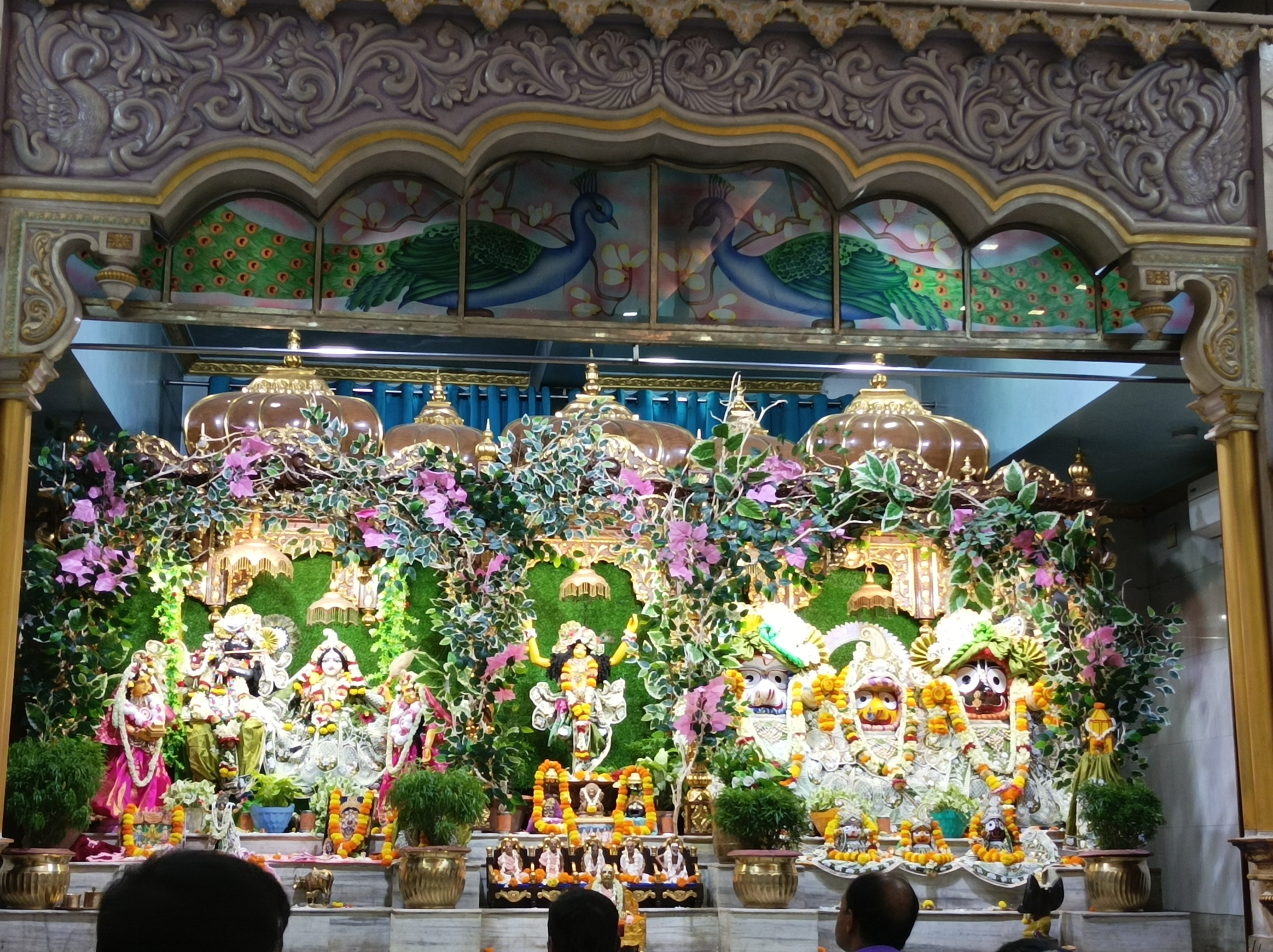 Deities of Sri Sri Radha Madhava, Jagannath, Balarama, Subhadra and Chaitanya Mahaprabhu (in middle), at the ISKCON Durgapur Temple.


_in_Mayapur,_Nadia,_West_Bengal,_India.jpg)
See also
References
- ↑ 1.0 1.1 1.2 1.3 1.4 1.5 1.6 Valpey, Kenneth (2018). "Caitanya". In Jacobsen, Knut A.; Basu, Helene; Malinar, Angelika; Narayanan, Vasudha (eds.). Brill's Encyclopedia of Hinduism Online. Brill.
- ↑ 2.0 2.1 Stewart, Tony K (2012). "Chaitanya, Sri". In Islam, Sirajul; Miah, Sajahan; Khanam, Mahfuza; Ahmed, Sabbir (eds.). Banglapedia: the National Encyclopedia of Bangladesh (Online ed.). Dhaka, Bangladesh: Banglapedia Trust, Asiatic Society of Bangladesh. ISBN 984-32-0576-6. OCLC 52727562. Retrieved 9 August 2026.
- ↑ Dasa 2007, pp. 377-378: "The Bhagavat Sandarbha [...] describes the concept of Bhagavan alluded to in Bhagavata 1.2.11. Jiva explains [...] [t]he relation between Bhagavan and His potency is one of inconceivable difference in non-difference, known as achintya-bhedabheda. It is in recognition of the nature of this relation that Chaitanya’s philosophy is called Achintya bhedaabheda-vada".
- ↑ Gupta 2007, p. 46, footnote 30: "[I]n the Sarva-samvadini, [J]iva Gosvami lists the names of different teachers and their schools of Vedanta, and then concludes by saying, 'sva-mate tu acintya-bhedabhedah,' 'but my view is acintya-bhedabheda'".
- ↑ Krsna Dasa, T. 2022, "[Jiva Goswami in his] Sarva-samvadini [commenting] Anuccheda 77 and 78 of the Paramatma Sandarbha [states that:] 'It is well known that Gautama, Kaṇāda, Jaimini, Kapila and Patañjali, as well as śrī-rāmānuja and śrī-madhvācārya’s accept bheda alone. To us, acintya-bheda-abheda alone is acceptable, because the substantive is endowed with acintya śaktis' ".
- ↑ Sri Chaitanya Mahaprabhu Archived 28 December 2017 at the Wayback Machine "He spread the Yuga-dharma as the practice for attainment of pure love for Radha-Krishna. That process is Harinam-Sankirtan, or the congregational chanting of the Holy Names of Krishna "Hare Krishna Hare Krishna Krishna Krishna Hare Hare, Hare Rama Hare Rama Rama Rama Hare Hare"
- ↑ In the Name of the Lord (Deccan Herald) "He was also given the name of ‘Gora’ because of his extremely fair complexion." Archived 7 December 2006 at the Wayback Machine
- ↑ "Gaura Purnima". www.krishna.com. Archived from the original on 12 March 2008. Retrieved 16 December 2008.
- ↑ Sri Gaura Purnima Archived 1 October 2020 at the Wayback Machine"givegita.com"
- ↑ KCM Archive"They named Him Nimai, as he was born under a neem tree." Archived 24 April 2008 at the Wayback Machine
- ↑ Stewart, Tony (2014). "Caitanya". Oxford Bibliographies Online in Hinduism.
- ↑ Sen 1922, p. 125.
- ↑ Nair 2007, p. 87.
- ↑ Stewart 2010, p. 102, 108.
- ↑ Stewart 2010, p. 5.
- ↑ Sen 1922, p. 266-276.
- ↑ Sen 1922, p. 276-283.
- ↑ Mukherjee 1999, pp. 65–66, 174, 280.
- ↑ Manring 2005, pp. 34–42, 44.
- ↑ PDF Archived 26 June 2020 at the Wayback Machine.Mamoni, Sarma (2015). "Chapter 14". History of Vaishnavite cultures in Assam and Bengal a comparative study. pp. 253–255. hdl:10603/127571.
Note, Sarma Mamoni is a researcher at Gauhati University under Chakraborty Amalendu.
- ↑ Sur, Ansu; Goswami, Abhijit (1999). Bengali Film Directory. Nandan, West Bengal Film Centre. p. 96.
- ↑ Chakraborty, Shamayita (16 July 2021). "Parambrata to play Gourango in Srijit's next; will also sing in the film". The Times of India. Archived from the original on 31 March 2022. Retrieved 31 March 2022.
Sources
- Carney, Gerald T. (2020). "Baba Premananda Bharati: His trajectory into and through Bengal Vaiṣṇavism to the West". In Sardella, Ferdinando; Wong, Lucian (eds.). The Legacy of Vaiṣṇavism in Colonial Bengal. Routledge Hindu Studies Series. Milton, Oxon; New York: Routledge. pp. 135–160. ISBN 978-1-138-56179-3.
- Dasa, Satyanarayana (2007). "The Six Sandharbhas of Jiva Gosvami". Krishna: A Sourcebook (PDF). Oxford University Press, USA. pp. 373–408. ISBN 978-0-19-514891-6.
- Delmonico, Neal (2007). "Chaitanya Vaishnavism and the Holy Names". Krishna: A Sourcebook (PDF). Oxford University Press, USA. pp. 549–575. ISBN 978-0-19-514891-6.
- Gupta, Ravi M. (2007). The Caitanya Vaisnava Vedanta of Jiva Gosvami: When knowledge meets devotion (PDF). Routledge. ISBN 978-0-415-40548-5.
- Jones, Constance A.; Ryan, James D. (2007). "Encyclopedia of Hinduism". In Melton, J. Gordon (ed.). Encyclopedia of World Religions. New York: Facts On File. ISBN 978-0-8160-5458-9.
- Krsna Dasa, T. (29 June 2022). "Śrī Jīva Goswami coins the term 'acintya bheda-abheda'". The Krishna Bhakti site. Retrieved 25 July 2025.
- Modi, Narendra (8 February 2024), PM addresses program marking 150th anniversary of Srila Prabhupada Ji, retrieved 15 February 2024
- Manring, Rebecca J. (2005). "Chapter 2: Advaita Acarya: A New Imminence". Reconstructing Tradition: Advaita Ācārya and Gauḍīya Vaiṣṇavism at the Cusp of the Twentieth Century. New York: Columbia University Press. ISBN 0-231-12954-8.
- Sen, Dinesh Chandra (1922). Chaitanya and his age. Robarts - University of Toronto. Calcutta, Univ. of Calcutta.
- Mukherjee, Sujit (1999). A Dictionary of Indian Literature: Volume One, Beginnings-1850. New Delhi: Orient Longman. ISBN 81-250-1453-5.
- Nair, K. K. (2007). Sages Through Ages – Volume II: India's Heritage. AuthorHouse. ISBN 978-1-4208-7802-8.
- Sherbow, Paul H. (2004). "Chapter 9: A.C. Bhaktivedanta Swami's Preaching in the Context of Gaudiya Vaishnavism". In Bryant, Edwin F.; Ekstrand, Maria L. (eds.). The Hare Krishna Movement: The Postcharismatic Fate of a Religious Transplant. New York: Columbia University Press. ISBN 0-231-12256-X.
- Stewart, Tony K. (1 March 2010). The Final Word: The Caitanya Caritamrita and the Grammar of Religious Tradition. Oxford University Press. doi:10.1093/acprof:oso/9780195392722.001.0001. ISBN 978-0-19-539272-2.
Further reading
- Dae, (Romesh Chunder Dutt) Ar Cy (1877). The Literature of Bengal: Being an Attempt to Trace the Progress of the National Mind in Its Various Aspects, as Reflected in the Nation's Literature from the Earliest Times to the Present Day with Copious Extracts from the Best Writers. Calcutta: I. C. Bose & Co. pp. 66–81.
- Dasa, Shukavak N. (1999). Hindu Encounter with Modernity: Kedarnath Datta Bhaktivinoda, Vaiṣṇava Theologian (revised, illustrated ed.). Los Angeles, CA: Sanskrit Religions Institute. ISBN 1-889756-30-X. Retrieved 31 January 2014.
- Fuller, Jason Dale (2005). Religion, class, and power: Bhaktivinode Thakur and the transformation of religious authority among the Gaudīya Vaishnavas in nineteenth-century Bengal (Ph.D.). University of Pennsylvania. UMI Microform 3179733. Retrieved 8 June 2014.
- Manna, Sandipan (2013). In Search of a Forgotten Mahatma: Kalachand Vidyalankar (1st ed.). Kalyani Foundation. ISBN 978-81-927505-4-5.[citation not found]
- Rosen, Steven (1988). India's Spiritual Renaissance: The Life and Times of Lord Chaitanya. Folk Books. ISBN 0-9619763-0-6.
- Sarkar, Jadunath (1913). Chaitanya's Pilgrimages and Teachings - From his contemporary Bengali biography the Chaitanya-charit-amrita: Madhya-lila. Calcutta: Brahmo Mission Press.
- Wilkins, William Joseph (1913) [1882]. Hindu Mythology, Vedic and Purānic (3rd ed.). Calcutta: London Missionary Society. pp. 260–262.
External links
- Works by or about Chaitanya Mahaprabhu at Internet Archive
- Error in Template:Internet Archive author: Chaitanya doesn't exist.
- Gaudiya Vaishnavism – The Tradition of Chaitanya
- Caitanya Upanisad
- Caitanya Bhagavata Biography
- Life of Sri Chaitanya Mahaprabhu Archived 12 July 2018 at the Wayback Machine
- Scriptural Statements/Predictions regarding Caitanya Mahaprabhu's birth
- Lord Gouranga and His Message of Devotion (theosophical.ca)
- YogPeeth, Mayapur, Navadvipa – The birthplace of Sri Caitanya Mahaprabhu
- at Chaitaniya mahaprabhu biography
- Who is Lord Chaitanya?