




<ref> added |
Mrrajrumel (talk | contribs) brief cleaned up section per sources per standard format |
||
| Line 1: | Line 1: | ||
{{Short description|Indo-Aryan ethnolinguistic group}} | |||
{{pp-move}} | |||
{{Use British English|date=December 2025}} | |||
{{Use dmy dates|date=December 2015}} | |||
{{Redirect|Odias||Odia (disambiguation){{!}}Odia}} | {{Redirect|Odias||Odia (disambiguation){{!}}Odia}} | ||
{{Infobox ethnic group | {{Infobox ethnic group | ||
| group = Odias | | group = Odias | ||
| native_name = ଓଡ଼ିଆ ଲୋକ | | native_name = ଓଡ଼ିଆ ଲୋକ<br/>Odiā Lōka | ||
| native_name_lang = od | | native_name_lang = od | ||
| flag = | | flag = | ||
| | | image = Odissi in a Group.jpg | ||
| region1 = {{IND}} | | image_caption = Dancers performing [[odissi]] | ||
| pop1 = | | population = 40 million | ||
| region1 = {{IND}} | |||
| pop1 = 38,033,000 (2011) | |||
| langs = [[Odia language|Odia]] | |||
| religions = '''Predominantly''':<br />[[File:Om.svg|15px]] [[Hinduism]]<br />'''Minorities''':<br />{{hlist|[[File:Christian cross.svg|12px]] [[Christianity]]|[[File:Allah-green.svg|15px]] [[Islam]] | |||
|[[File:Jain Prateek Chihna.svg|12px]] [[Jainism]]|[[File:Dharma Wheel.svg|18px]] [[Buddhism]] and others}} | |||
| related_groups = [[Indo-Aryan people]], [[Bengalis]] | |||
| langs = [[Odia language|Odia]] | |||
| religions = '''Predominantly''':<br>[[File:Om.svg|15px]] [[Hinduism]]<br>'''Minorities''':<br>{{hlist|[[File: | |||
}} | }} | ||
{{Infobox ethnonym|root=ଓଡ଼ିଆ Odiā|person=Odiā|people=Odiā Lōka|language=[[Odia language|Odiā]]|country=[[Odisha]] <br> [[Kalinga (region)|Kalinga]] (hist.)}} | |||
{{ | The '''Odia''' ({{lang|or|ଓଡ଼ିଆ}}), formerly spelled '''Oriya''', are an [[Indo-Aryan peoples|Indo-Aryan]] [[ethno-linguistic group]] native to the Indian state of [[Odisha]] who speak the [[Odia language]]. They constitute a majority in the eastern coastal state, with significant minority populations existing in the neighboring states of [[Andhra Pradesh]], [[Chhattisgarh]], [[Jharkhand]] and [[West Bengal]].<ref>{{Cite book|url=https://books.google.com/books?id=abNDLZQ6quYC&pg=PA233|title=Ethnic Groups of South Asia and the Pacific: An Encyclopedia|isbn=9781598846591|last1=Minahan|first1=James|year=2012|publisher=Bloomsbury Academic }}</ref> Odia is the 9th most spoken language in India.<ref>{{Cite web |date=2019-11-13 |title=Census of India Website : Office of the Registrar General & Census Commissioner, India |url=http://www.censusindia.gov.in/2011census/C-17.html |access-date=2025-04-08 |archive-url=https://web.archive.org/web/20191113211224/http://www.censusindia.gov.in/2011census/C-17.html |archive-date=13 November 2019 }}</ref> Modern-day Odisha was made from the [[Odia language|Odia-speaking]] part of then–[[Bihar and Orissa Province]], Odia-speaking areas of [[Madras Presidency]], Odia-speaking areas of [[Central Provinces and Berar]] and Odia-speaking Gadajats (Odia Princely states).<ref>{{Cite web |title=Provinces of British India |url=https://www.worldstatesmen.org/India_BrProvinces.htm |access-date=2025-04-08 |website=www.worldstatesmen.org}}</ref> The first linguistic movement started in 1886 and with the successful efforts of Madhusudan Das, the Father of Odia nationalism, Odisha became the first state to be created on a linguistic basis.<ref>{{Cite web |date=2013-11-12 |title=The Telegraph - Calcutta (Kolkata) {{!}} Orissa {{!}} Born of linguistic pride |url=http://www.telegraphindia.com/1110401/jsp/orissa/story_13795031.jsp |access-date=2025-04-08 |website=archive.ph |archive-date=12 November 2013 |archive-url=https://archive.today/20131112115802/http://www.telegraphindia.com/1110401/jsp/orissa/story_13795031.jsp |url-status=bot: unknown }}</ref> | ||
The '''Odia''' ({{lang|or|ଓଡ଼ିଆ}}), formerly spelled ''' | |||
== | |||
== History == | == History == | ||
{{Main|History of Odisha}} | {{Main|History of Odisha}} | ||
'''<big>Ancient period</big>''' | |||
[[File:Udaygiri and Khandagiri Cave - 1.jpg|thumb|'''Udaygiri and Khandagiri Cave - 1''']] | |||
According to political scientist Sudama Misra, the Kalinga [[janapada]] originally comprised the area covered by the [[Puri district|Puri]] and [[Ganjam district|Ganjam]] districts.<ref>{{Cite book |last=Miśra |first=Sudāmā |url=https://books.google.com/books?id=Dua1AAAAIAAJ |title=Janapada State in Ancient India |date=1973 |publisher=Bhāratīya Vidyā Prakāśana |language=en}}</ref> | |||
According to some scriptures ([[Mahabharata]] and some [[Puranas]]), a king Bali, the [[Vairocana]] and the son of Sutapa, had no sons. So, he requested the sage, Dirghatamas, to bless him with sons. The sage is said to have begotten five sons through his wife, the queen Sudesna.<ref>{{Cite book |last=Patil |first=Rajaram D. K. |url=https://books.google.com/books?id=Jmnm-smZm6oC&dq=bali+sudesna&pg=PA46 |title=Cultural History From The Vayu Purana |date=1973 |publisher=Motilal Banarsidass Publishers |isbn=978-81-208-2085-2 |language=en}}</ref> The princes were named [[Anga#Origin of name|Anga]], [[Vanga kingdom#References in the Mahabharata|Vanga]], [[Kalinga (Mahabharata)|Kalinga]], [[Suhma kingdom#References in Mahabharata|Sumha]] and [[Pundra kingdom#References in Mahabharata|Pundra]].<ref>{{Citation |title=History of Odisha |date=2024-12-03 |work=Bharatpedia |url=https://en.Bharatpedia.org/wiki/History_of_Odisha#cite_note-7500BC-3 |access-date=2024-12-09 |language=en}}</ref> The princes later founded kingdoms named after themselves. The prince Vanga founded [[Vanga kingdom]], in the current day region of [[Bangladesh]] and part of [[West Bengal]]. The prince Kalinga founded the kingdom of [[Kalinga (historical kingdom)|Kalinga]], in the current day region of coastal Odisha, including the North Sircars.<ref>{{Citation |title=History of Odisha |date=2024-12-03 |work=Bharatpedia |url=https://en.Bharatpedia.org/wiki/History_of_Odisha#cite_note-enHindu-5 |access-date=2024-12-09 |language=en}}</ref> | |||
[[ | |||
The Mahabharata also mentions Kalinga several more times. Srutayudha, the king of Kalinga, son of [[Varuna]] and river Parnasa, had joined the [[Kaurava]] camp in the [[Kurukshetra War]]. He had been given a divine [[Gada (mace)|mace]] by his father on request of his mother, which protected him as long as he wielded it. But, Varuna had warned his son, that using it on a non-combatant will cause the death of the wielder himself. In the frenzy of battle, harried by [[Arjuna]]'s arrows, he made the mistake of launching it at Krishna, Arjuna's charioteer, who was unarmed. The mace bounced off Krishna and killed Srutayudha. The archer who killed [[Krishna]], Jara Savara, and [[Ekalavya]] are said to have belonged to the [[Sabar people]] of Odisha.<ref>{{Cite book |last=Pati |first=Rabindra Nath |url=https://books.google.com/books?id=_5seKkk3GkIC&pg=PA97 |title=Family Planning |date=2008 |publisher=APH Publishing |isbn=978-81-313-0352-8 |language=en}}</ref> | |||
[[ | |||
In the Buddhist text, Mahagovinda Suttanta, Kalinga and its ruler, Sattabhu, have been mentioned.<ref>{{Cite book |last=Raychaudhuri |first=Hemchandra |url=https://books.google.com/books?id=h1KObc_qaXYC&dq=Mahagovinda+Suttanta+kalinga&pg=PA75 |title=Political History of Ancient India: From the Accession of Parikshit to the Extinction of the Gupta Dynasty |date=2006 |publisher=Cosmo Publications |isbn=978-81-307-0291-9 |language=en}}</ref> | |||
In the 6th century ''sutrakara'' (chronicler), Baudhayana, mentions Kalinga as not yet being influenced by Vedic traditions. He also warns his people from visiting Kalinga (among other kingdoms), saying one who visits it must perform penance.<ref>{{Cite book |last=Chatterjee |first=Suhas |url=https://books.google.com/books?id=KItocaxbibUC&pg=PA68 |title=Indian Civilization and Culture |date=1998 |publisher=M.D. Publications Pvt. Ltd. |isbn=978-81-7533-083-2 |language=en}}</ref>[[File:Lingaraj Temple, Bhubaneswar, Odisha 2.jpg|thumb|Lingaraj Temple, Bhubaneswar.]] | |||
===Medieval period=== | |||
The [[Shailodbhava dynasty]] ruled the region from the sixth to the eighth century. They built the [[Parashurameshvara Temple]] in the 7th century, which is the oldest known temple in Bhubaneswar. They ruled Odisha from the 8th to the 10th century. They built several Buddhist monasteries and temples, including [[Lalitgiri]], [[Udayagiri, Odisha|Udayagiri]] and [[Baitala Deula]]. The [[Keshari dynasty]] ruled from the 9th to the 12th century. The [[Lingaraj Temple]], [[Mukteshvara Temple, Bhubaneswar|Mukteshvara Temple]] and [[Rajarani Temple]] in Bhubaneswar were constructed during the [[Bhauma-Kara dynasty]].<ref>{{cite book |first=Walter |last=Smith |title=The Mukteśvara Temple in Bhubaneswar |url=https://books.google.com/books?id=y0MQmNx8g2gC |year=1994 |publisher=Motilal Banarsidass |isbn=978-81-208-0793-8 |page=27}}</ref> They were introduced as a new style of architecture in Odisha, and the dynasty's rule shifted from [[Buddhism]] to [[Brahmanism]].{{sfn|Smith|1994|p=26}} | |||
[[File:19s Bengal province map.jpg|thumb|Undivided Odisha and Bihar states.]] | |||
== | ===Modern period === | ||
Odisha remained an independent regional power until the early 16th century. It was conquered by the [[Mughal Empire|Mughals]] under [[Akbar]] in 1568 and was thereafter subject to a succession of Mughal and [[Maratha Empire|Maratha]] rule before coming under [[Company rule in India|British control]] in 1803.<ref>{{Cite news|url=https://www.dailypioneer.com/2019/state-editions/book-by-british-ics-officer-covers----orissa--as-a-whole.html|title=Book by British ICS officer covers 'Orissa' as a whole|website=dailypioneer|author=GYANENENDRA NATH MITRA|date=25 December 2019|access-date=25 December 2019}}</ref> | |||
In 1817, a combination of high taxes, administrative malpractice by the ''[[zamindar]]s'' and dissatisfaction with the new land laws led to a [[Paik Rebellion|revolt against Company rule]] breaking out, which many Odias participated in. The rebels were led by General [[Bakshi Jagabandhu|Jagabandhu Bidyadhara Mohapatra Bhramarbara Raya]].<ref name="Mahmud1994">{{cite book|author=Sayed Jafar Mahmud|title=Pillars of Modern India 1757-1947|url=https://books.google.com/books?id=w8XPyBqxwX8C&pg=PA10|access-date=10 February 2013|year=1994|publisher=APH Publishing|isbn=978-81-7024-586-5|page=10}}</ref><ref>{{cite news| url = https://www.thehindu.com/todays-paper/tp-national/paika-bidroha-to-be-named-as-1st-war-of-independence/article19909264.ece| title = 'Paika Bidroha' to be named as 1st War of Independence - NATIONAL - The Hindu| website = [[The Hindu]]| date = 23 October 2017}}</ref> | |||
Under Maratha control, major Odia regions were transferred to the rulers of Bengal that resulted in successive decline of the language over the course of time in vast regions that stretched until today's [[Midnapore district|Midnapore]] district of West Bengal.<ref>{{cite book | last=Sengupta | first=N. | title=Land of Two Rivers: A History of Bengal from the Mahabharata to Mujib | url=https://books.google.com/books?id=TI8GQioaoL4C | publisher=Penguin Books Limited | year=2011 | isbn=978-81-8475-530-5 }}</ref>{{Better source needed|date=January 2023}} | |||
Odisha became a separate province and the first officially recognized language-based state of India in 1936, after the amalgamation of the Odia regions from [[Bihar and Orissa Province]], [[Madras Presidency]] and [[Chhattisgarh Division]] was successfully executed. 26 Odia [[princely state]]s, including [[Seraikela Kharsawan district|Sadheikala-Kharasuan]] in today's [[Jharkhand]], also signed a merger with the newly formed state, while many major Odia-speaking areas were left out due to political incompetence.<ref>{{Cite book|url=https://books.google.com/books?id=DsXLDAAAQBAJ&pg=PA86|title=Language Policy and Education in India: Documents, contexts and debates|isbn=9781134878246|access-date=25 December 2019|last1=Sridhar|first1=M.|last2=Mishra|first2=Sunita|date=5 August 2016|publisher=Routledge }}</ref> | |||
==Communities== | ==Communities== | ||
The Odia people are subdivided into several communities such as the [[Utkala Brahmin]], [[Karan (caste)|Karan]], [[Khandayat (caste)|Khandayat]], [[Kayastha|Kayasth]], [[Gopal (caste)|Gopal]], [[Komati (caste)|Kumuti]], [[Chasa caste|Chasa]], [[Dumal]], [[Bania (caste)|Bania]], [[Bhulia]], [[Kansabanik|Kansari]], [[Kuilta]], [[Gudia (caste)|Gudia]], [[Patra (caste)|Patara]], [[Tanti]], [[Teli]], [[Viswakarma (caste)|Badhei]], [[Kamar (caste)|Kamara]], [[Barika (caste)|Barika]], [[Mali (caste)|Mali]], [[Kumhar|Kumbhar]], [[Sundhi]], [[Jalia Kaibarta|Keuta]], [[Dhobi|Dhoba]], [[Bhoi|Bauri]], [[Kandara]], [[Domba]], [[Pano (caste)|Pano]], Hadi.<ref name="BehuraMohanty2005">{{cite book|author1=Nab Kishore Behura|author2=Ramesh P. Mohanty|title=Family Welfare in India: A Cross-cultural Study|url=https://books.google.com/books?id=o6Gz0ZDw7PQC&pg=PA49|year=2005|publisher=Discovery Publishing House|isbn=978-81-7141-920-3|pages=49–}}</ref> etc. | |||
, [[ | |||
, [[Gudia (caste)|Gudia]], [[Patra (caste)|Patara]], [[Tanti]], [[Teli]], Badhei, [[Kamar (caste)| | |||
== | == Culture == | ||
{{Main| | {{Main|Culture of Odisha}} | ||
'''<big>Religion</big>''' | |||
[[File:Gita Govinda (Song of the Cowherd) Manuscript LACMA M.71.1.33.jpg|thumb|gita govinda manuscript]] | |||
In its long history, Odisha has had a continuous tradition of [[dharmic religions]] especially [[Hinduism]], [[Buddhism]] and [[Jainism]]. [[Ashoka]]'s conquest of [[Kalinga (historical kingdom)|Kalinga (India)]] made Buddhism a principal religion in the state which led to the establishment of numerous [[Stupas]] and non religion learning centres. During [[Kharavela]]'s reign [[Jainism]] found prominence. However, by the middle of the 9th century CE there was a revival of [[Hinduism]] as attested by numerous temples such as Mukteshwara, Lingaraja, Jagannath and Konark, which were erected starting from the late 7th century CE. Part of the revival in Hinduism was due to [[Adi Shankaracharya]] who proclaimed [[Puri]] to be one of the four holiest places or ''[[Char Dham]]'' for Hinduism. Odisha has, therefore, a syncretic mixture of the three dharmic religions as attested by the fact that the [[Jagannath Temple]] in Puri is considered to be holy by [[Hindus]], Buddhists and [[Hindus|Jains]]. | |||
Presently, the majority of people in the state of Odisha are [[Hindus]]. As per the census of 2001, Odisha is the third largest Hindu-populated state (as a percentage of population) in India. However, while Odisha is predominantly Hindu it is not monolithic. There is a rich cultural heritage in the state owing to the Hindu faith. For example, Odisha is home to several Hindu saints. [[Bhima Bhoi|Sant Bhima Bhoi]] was a leader of the [[Mahima Religion|Mahima sect movement]], [[Sarala Dasa]], was the translator of the epic [[Mahabharata]] in Odia, Chaitanya Dasa was a [[Vaishnavism|Buddhistic-Vaishnava]] and writer of the ''Nirguna Mahatmya'', [[Jayadeva]] was the author of the ''[[Gita Govinda]]'' and is recognized by the Sikhs as one of their most important bhagats. Swami Laxmananda Saraswati is a modern-day Hindu saint of [[Adivasi]] heritage. | |||
[[ | |||
There is also a small but significant community of Odia Muslims, who are mostly descendants of indigenous converts and migrants from northern and eastern India. With a population of roughly 1 million, Muslims in Odisha live significantly in Jajapur and Bhadrak districts.<ref>{{Cite web |title=Orissa Hindu Muslim Population |url=https://www.census2011.co.in/data/religion/state/21-orissa.html |access-date=2025-04-05 |website=www.census2011.co.in}}</ref> Majority of Muslims are Sunnis, followed by Shias which also include Khoja and Dawoodi Bohras.<ref>{{Cite book |last=Weekes |first=Richard V. |url=https://books.google.com/books?id=dQ3FEAAAQBAJ |title=Muslim Peoples [2 Volumes]: A World Ethnographic Survey |date=1984-12-21 |publisher=Bloomsbury Academic |isbn=978-0-313-23392-0 |language=en}}</ref><ref>{{cite web |title=The Influence of Sufism and Shia Traditions in Odisha |url=https://magazines.odisha.gov.in/Orissareview/2014/July/engpdf/42-46.pdf |accessdate=2025-04-06 |publisher=Orissa Review}}</ref> Historically, Sufi mysticism and traditions have significantly influenced Odisha's cultural and spiritual heritage.<ref>{{cite web |title=The Influence of Sufism and Shia Traditions in Odisha |url=https://magazines.odisha.gov.in/Orissareview/2014/July/engpdf/42-46.pdf |accessdate=2025-04-06 |publisher=Orissa Review}}</ref> | |||
=== Architecture === | === Architecture === | ||
{{ | {{Main|kalinga architecture}} | ||
[[File:700 CE Mukhalingeswara Temples Group, Kalinga architecture, Mukhalingam, Andhra Pradesh - 111.jpg|thumb|700 CE Mukhalingeswara Temples Group, Kalinga architecture, Mukhalingam, Andhra Pradesh - 111]] | |||
[[File:Mukteswar Temple Detail.jpg|thumb|Mukteswar Temple (Kalinga Architecture)]] | |||
[[File:Udayagiri Caves - Hathi Gumpha.jpg|thumb|Udayagiri Caves - Hathi Gumpha]] | |||
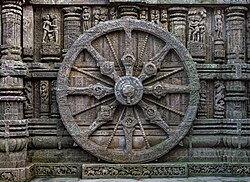
[[File:Stone wheel engraved in the 13th century built Konark Sun Temple in Orissa, India.jpg|thumb|Stone wheel engraved in the 13th century built Konark Sun Temple in Orissa, India]] | |||
The '''Kaḷinga architectural style''' is a style of [[Hindu architecture]] which flourished in the ancient [[Kalinga (historical kingdom)|Kalinga]] previously known as [[Utkal]] and in present eastern Indian state of [[Odisha]]. The style consists of three distinct types of temples: Rekha Deula, Pidha Deula and Khakhara Deula. The former two are associated with [[Vishnu]], [[Surya]] and [[Shiva]] temples while the third is mainly with [[Chamunda]] and [[Durga]] temples. The Rekha Deula and Khakhara Deula houses are the [[sanctum sanctorum]] while the Pidha Deula constitutes outer dancing and offering halls. | |||
=== Cuisine === | === Cuisine === | ||
{{Main|Cuisine of Odisha}} | {{Main|Cuisine of Odisha}} | ||
Seafood and sweets dominate Odia cuisine. Rice is the staple cereal and is eaten throughout the day. Popular Odia dishes are [[ | |||
[[File:Chena poda.jpg|thumb|Chena poda a sweet delicacy from Odisha.]] | |||
Seafood and sweets dominate Odia cuisine. Rice is the staple cereal and is eaten throughout the day. Popular Odia dishes are [[rasagolla]], [[rasabali]], [[chhena poda]], [[chhena kheeri]], [[chhena jalebi]], chenna jhilli, [[chhenagaja]], [[khira sagara]], [[Dalma (dish)|dalma]], tanka torani and [[pakhala]].<ref>{{Cite news|url=https://odishanewsinsight.com/features/cuisine-of-odisha/|title=Cuisine Of Odisha|website=odishanewsinsight|date=16 November 2019|access-date=18 January 2020}}</ref><ref>{{Cite news|url=https://www.aninews.in/news/lifestyle/food/odia-delicacies-in-bengalurus-first-ama-odia-bhoji-to-tickle-taste-buds20200112200631/|title=Odia delicacies in Bengaluru's first 'Ama Odia Bhoji' to tickle taste buds|website=aninews|date=12 January 2020|access-date=18 January 2020}}</ref> | |||
=== Festivals === | === Festivals === | ||
{{Main|Festivals of Odisha}} | {{Main|Festivals of Odisha}} | ||
A wide variety of festivals are celebrated throughout the year; There is a saying in Odia, ‘Baarah maase, terah | '''<big>Ratha yatra</big>''' | ||
[[File:Rath Yatra Puri 07-11027.jpg|thumb|Rath Yatra festival in Puri, Odisha.]] | |||
A stunning example of Kalinga architecture is the Jagannath Temple, which was constructed in the twelfth century by King Anantavarman Chodaganga Deva. The goddesses Subhadra, Balabhadra, and Lord Jagannath reside in this hallowed shrine. The festival of Ratha Yatra, which draws pilgrims and visitors from all over the world, is closely linked to the history of the Jagannath Temple. | |||
[[File:Puri Rath Yatra by Fergusson.jpg|thumb|Ratha yatra festival in Puri by Fegursson.]] | |||
A wide variety of festivals are celebrated throughout the year; There is a saying in Odia, ‘Baarah maase, terah parba’, that there are 13 festivals in a year. Well known festivals that are popular among the Odia people include the [[Ratha Yatra]], [[Durga Puja]], [[Raja (festival)|Raja]], [[Maha Shivratri]], [[Kartika Purnima]], [[Dola Purnima]], [[Ganesh Puja]], [[Chandan Yatra]], [[Snana Yatra]], [[Makar Mela]], [[Chhau Festival]], and [[Nuakhai]].<ref>{{Cite news |date=2 December 2018 |title=The tenacious people of Odisha |url=https://telanganatoday.com/tenacious-people-odisha |url-status=dead |archive-url=https://web.archive.org/web/20190405221401/https://telanganatoday.com/tenacious-people-odisha |archive-date=5 April 2019 |access-date=18 January 2020 |website=telanganatoday}}</ref> | |||
=== Religion === | === Religion === | ||
Odisha is one of the most religiously homogeneous states in India. More than 94% of the people are followers of Hinduism.<ref name="census2011">{{cite web|title=Population by religion community – 2011|url=http://www.censusindia.gov.in/2011census/C-01/DDW00C-01%20MDDS.XLS|website=Census of India, 2011|publisher=The Registrar General & Census Commissioner, India|archiveurl=https://web.archive.org/web/20150825155850/http://www.censusindia.gov.in/2011census/C-01/DDW00C-01%20MDDS.XLS|archivedate=25 August 2015}}</ref> Hinduism in Odisha is more significant due to the specific Jagannath culture followed by Odia Hindus. The practices of the [[Jagannath]] sect is popular in the state and the annual | [[File:Ratha Yatra Praha 2019.jpg|thumb|Lord Jagannath with his siblings.]] | ||
Odisha is one of the most religiously and ethnically homogeneous states in India. More than 94% of the people are followers of Hinduism.<ref name="census2011">{{cite web|title=Population by religion community – 2011|url=http://www.censusindia.gov.in/2011census/C-01/DDW00C-01%20MDDS.XLS|website=Census of India, 2011|publisher=The Registrar General & Census Commissioner, India|archiveurl=https://web.archive.org/web/20150825155850/http://www.censusindia.gov.in/2011census/C-01/DDW00C-01%20MDDS.XLS|archivedate=25 August 2015}}</ref> Hinduism in Odisha is more significant due to the specific Jagannath culture followed by Odia Hindus due to independent rule of Odia [[Hindu king]]s. Hinduism flourished in the eastern coastal region under patronage of the Hindu kings: arts, literature, maritime trade, vedic rituals were given importance. The practices of the [[Jagannath]] sect is popular in the state and the annual Ratha Yatra in Puri draws pilgrims from across India.<ref>{{Cite news|url=https://thenewleam.com/2018/07/lord-jagannaths-rathyatra-as-a-marker-of-odia-identity/|title=Lord Jagannath's Rathyatra as a Marker of Odia Identity|website=thenewleam|date=23 July 2018|access-date=18 January 2020}}</ref> | |||
== Notable people == | == Notable people == | ||
{{See also|List of people from Odisha}} | {{See also|List of people from Odisha}} | ||
{{div col|colwidth= | {{div col|colwidth=35em}} | ||
<!---♦♦♦ Only add a person to this list if they already have their own article on the English | <!---♦♦♦ Only add a person to this list if they already have their own article on the English Bharatpedia ♦♦♦---> | ||
<!---♦♦♦ Please keep the list in alphabetical order by LAST NAME ♦♦♦---> | <!---♦♦♦ Please keep the list in alphabetical order by LAST NAME ♦♦♦---> | ||
* | * {{annotated link |Achyutananda Dasa}} | ||
* | * {{annotated link |Binayak Acharya}} | ||
* [[ | * {{annotated link |Afzal-ul Amin}} | ||
* [[ | * {{annotated link |Subroto Bagchi}} | ||
* [[Bhagabat Behera | * [[Sadhabas]] - Traders and Merchants from Odisha( Kalinga) | ||
* | * [[Kaundinya I]] - Kalingan Merchant & second monarch of [[Funan]] | ||
* | * [[Madhusudan Das]] - Founder of Orissa Art Wares in 1898 and Utkal Tannery in 1905 | ||
* [[ | * [[Biju Patnaik]] - Founder of Kalinga tubes, Kalinga Airlines, Kalinga Iron work, Kalinga Refractories and the Kalinga, a daily Odia newspaper | ||
* [[ | * {{annotated link |Bhikari Bal}} | ||
* {{annotated link |Hemananda Biswal}} | |||
* [[ | * {{annotated link |Bhagabat Behera}} | ||
* | * {{annotated link |Chakradhar Behera}} | ||
* | * {{annotated link |Chandi Prasad Mohanty}} | ||
* | * {{annotated link |Sanatan Mahakud}} | ||
* | * {{annotated link |Krishna Beura}} | ||
* | * {{annotated link |Kadambini Mohakud}} | ||
* | * [[Achyuta Samanta]] - Founder, KIIT Group | ||
* | * [[Soumya Ranjan Patnaik]] - Founder, Sambad Group | ||
* | * Dr [[ Swarup Ranjan Mishra]] - Founder, Mediheal Group of Hospitals, [[Kenya]] & 1st Odia MP of Kenya, from [[Kesses Constituency]] | ||
* | * Dr [[Ramakanta Panda]] - Founder, Asian Heart Institute & Asian Hospitals | ||
* | * {{annotated link |Dutee Chand}} | ||
* | * {{annotated link |Nabakrushna Choudhuri}} | ||
* | * {{annotated link |Ashok Das}} | ||
* | * {{annotated link |Bibhusita Das}} | ||
* | * {{annotated link |Bidhu Bhusan Das}} | ||
* | * {{annotated link |Bishwanath Das}} | ||
* | * {{annotated link |Gopabandhu Das}} | ||
* | * {{annotated link |Madhusudan Das}} | ||
* | * {{annotated link |Manoj Das}} | ||
* | * {{annotated link |Nandita Das}} | ||
* | * {{annotated link |Prabhat Nalini Das}} | ||
* | * {{annotated link |Shaktikanta Das}} | ||
* | * {{annotated link |Anil Dash}} | ||
* | * {{annotated link |Rajendra Narayan Singh Deo}} | ||
* | * {{annotated link |Giridhar Gamang}} | ||
* | * {{annotated link |Hussain Rabi Gandhi}} | ||
* | * {{annotated link |Biswabhusan Harichandan}} | ||
* | * {{annotated link |Mehmood Hussain}} | ||
* | * {{annotated link |Binod Kanungo}} | ||
* | * {{annotated link |Madhu Sudan Kanungo}} | ||
* | * {{annotated link |Indrajit Mahanty}} | ||
* | * {{annotated link |Jayanta Mahapatra}} | ||
* | * {{annotated link |Harekrushna Mahatab}} | ||
* | * {{annotated link |Lalit Mansingh}} | ||
* | * {{annotated link |Chaturbhuj Meher}} | ||
* | * {{annotated link |Gangadhar Meher}} | ||
* | * {{annotated link |Kailash Chandra Meher}} | ||
* | * {{annotated link |Kunja Bihari Meher}} | ||
* | * {{annotated link |Sadhu Meher}} | ||
* | * {{annotated link |Atharuddin Mohammed}} | ||
* | * {{annotated link |Pramod Kumar Mishra}} | ||
* | * {{annotated link |Sabyasachi Mishra}} | ||
* | * {{annotated link |Baidyanath Misra}} | ||
* | * {{annotated link |B. K. Misra}} | ||
* | * {{annotated link |Dipak Misra}} | ||
* | * {{annotated link |Ranganath Misra}} | ||
* | * {{annotated link |Tapan Misra}} | ||
* | * {{annotated link |Biren Mitra}} | ||
* | * {{annotated link |Sayeed Mohammed}} | ||
* | * {{annotated link |Anubhav Mohanty}} | ||
* | * {{annotated link |Baisali Mohanty}} | ||
* | * {{annotated link |Debashish Mohanty}} | ||
* | * {{annotated link |Surendra Mohanty}} | ||
* | * {{annotated link |Uttam Mohanty}} | ||
* | * {{annotated link |Bibhu Mohapatra}} | ||
* | * {{annotated link |Kelucharan Mohapatra}} | ||
* | * {{annotated link |Sona Mohapatra}} | ||
* | * {{annotated link |Arabinda Muduli}} | ||
* | * {{annotated link |Droupadi Murmu}} | ||
* | * {{annotated link |Srabani Nanda}} | ||
* | * {{annotated link |Bibhuti Bhushan Nayak}} | ||
* {{annotated link |Pragyan Ojha}} | |||
* | * {{annotated link |Nila Madhab Panda}} | ||
* | * {{annotated link |Arun K. Pati}} | ||
* | * {{annotated link |Biju Patnaik}} | ||
* | * {{annotated link |Janaki Ballabh Patnaik}} | ||
* | * {{annotated link |Jayanti Patnaik}} | ||
* | * {{annotated link |Naveen Patnaik}} | ||
* | * {{annotated link |Sudarshan Patnaik}} | ||
* | * {{annotated link |Sambit Patra}} | ||
* | * {{annotated link |Devdutt Pattanaik}} | ||
<!---♦♦♦ Only add a person to this list if they already have their own article on the English | * {{annotated link |Dharmendra Pradhan}} | ||
* {{annotated link |Manasi Pradhan}} | |||
* {{annotated link |S.N. Pradhan}} | |||
* {{annotated link |Tapan Kumar Pradhan}} | |||
* {{annotated link |Ramakanta Rath}} | |||
* {{annotated link |Nilamani Routray}} | |||
* {{annotated link |Sarojini Sahoo}} | |||
* {{annotated link |Archita Sahu}} | |||
* {{annotated link |Jairam Samal}} | |||
* {{annotated link |Debasish Samantray}} | |||
* {{annotated link |Biplab Samantray}} | |||
* {{annotated link |Pratap Chandra Sarangi}} | |||
* {{annotated link |Nandini Satpathy}} | |||
* {{annotated link |Fakir Mohan Senapati}} | |||
* {{annotated link |Sadashiva Tripathy}} | |||
* {{annotated link |Bijaya Kumar Sahoo}} | |||
<!---♦♦♦ Only add a person to this list if they already have their own article on the English Bharatpedia ♦♦♦---> | |||
<!---♦♦♦ Please keep the list in alphabetical order by LAST NAME ♦♦♦---> | <!---♦♦♦ Please keep the list in alphabetical order by LAST NAME ♦♦♦---> | ||
{{div col end}} | {{div col end}} | ||
==See also== | ==See also== | ||
*[[ | *[[Odia diaspora]] | ||
*[[Folk dance forms of Odisha]] | |||
*[[Odia language]] | |||
*[[Arts of Odisha]] | |||
*[[Kalinga architecture]] | |||
*[[Cinema of Odisha]] | |||
==References== | ==References== | ||
| Line 247: | Line 214: | ||
{{Odisha}} | {{Odisha}} | ||
[[Category:People from Odisha| ]] | |||
[[Category:Indo-Aryan peoples]] | [[Category:Indo-Aryan peoples]] | ||
[[Category:Ethnic groups in India]] | [[Category:Ethnic groups in India]] | ||
Revision as of 17:30, 27 March 2026
ଓଡ଼ିଆ ଲୋକ Odiā Lōka | |
|---|---|
 Dancers performing odissi | |
| Total population | |
| 40 million | |
| Regions with significant populations | |
 India India | 38,033,000 (2011) |
| Languages | |
| Odia | |
| Religion | |
Predominantly: Hinduism HinduismMinorities:
| |
| Related ethnic groups | |
| Indo-Aryan people, Bengalis | |


| ଓଡ଼ିଆ Odiā | |
|---|---|
| Person | Odiā |
| People | Odiā Lōka |
| Language | Odiā |
| Country | Odisha Kalinga (hist.) |
The Odia (ଓଡ଼ିଆ), formerly spelled Oriya, are an Indo-Aryan ethno-linguistic group native to the Indian state of Odisha who speak the Odia language. They constitute a majority in the eastern coastal state, with significant minority populations existing in the neighboring states of Andhra Pradesh, Chhattisgarh, Jharkhand and West Bengal.[1] Odia is the 9th most spoken language in India.[2] Modern-day Odisha was made from the Odia-speaking part of then–Bihar and Orissa Province, Odia-speaking areas of Madras Presidency, Odia-speaking areas of Central Provinces and Berar and Odia-speaking Gadajats (Odia Princely states).[3] The first linguistic movement started in 1886 and with the successful efforts of Madhusudan Das, the Father of Odia nationalism, Odisha became the first state to be created on a linguistic basis.[4]
History
Ancient period

According to political scientist Sudama Misra, the Kalinga janapada originally comprised the area covered by the Puri and Ganjam districts.[5]
According to some scriptures (Mahabharata and some Puranas), a king Bali, the Vairocana and the son of Sutapa, had no sons. So, he requested the sage, Dirghatamas, to bless him with sons. The sage is said to have begotten five sons through his wife, the queen Sudesna.[6] The princes were named Anga, Vanga, Kalinga, Sumha and Pundra.[7] The princes later founded kingdoms named after themselves. The prince Vanga founded Vanga kingdom, in the current day region of Bangladesh and part of West Bengal. The prince Kalinga founded the kingdom of Kalinga, in the current day region of coastal Odisha, including the North Sircars.[8]
The Mahabharata also mentions Kalinga several more times. Srutayudha, the king of Kalinga, son of Varuna and river Parnasa, had joined the Kaurava camp in the Kurukshetra War. He had been given a divine mace by his father on request of his mother, which protected him as long as he wielded it. But, Varuna had warned his son, that using it on a non-combatant will cause the death of the wielder himself. In the frenzy of battle, harried by Arjuna's arrows, he made the mistake of launching it at Krishna, Arjuna's charioteer, who was unarmed. The mace bounced off Krishna and killed Srutayudha. The archer who killed Krishna, Jara Savara, and Ekalavya are said to have belonged to the Sabar people of Odisha.[9]
In the Buddhist text, Mahagovinda Suttanta, Kalinga and its ruler, Sattabhu, have been mentioned.[10]
In the 6th century sutrakara (chronicler), Baudhayana, mentions Kalinga as not yet being influenced by Vedic traditions. He also warns his people from visiting Kalinga (among other kingdoms), saying one who visits it must perform penance.[11]

Medieval period
The Shailodbhava dynasty ruled the region from the sixth to the eighth century. They built the Parashurameshvara Temple in the 7th century, which is the oldest known temple in Bhubaneswar. They ruled Odisha from the 8th to the 10th century. They built several Buddhist monasteries and temples, including Lalitgiri, Udayagiri and Baitala Deula. The Keshari dynasty ruled from the 9th to the 12th century. The Lingaraj Temple, Mukteshvara Temple and Rajarani Temple in Bhubaneswar were constructed during the Bhauma-Kara dynasty.[12] They were introduced as a new style of architecture in Odisha, and the dynasty's rule shifted from Buddhism to Brahmanism.[13]

Modern period
Odisha remained an independent regional power until the early 16th century. It was conquered by the Mughals under Akbar in 1568 and was thereafter subject to a succession of Mughal and Maratha rule before coming under British control in 1803.[14]
In 1817, a combination of high taxes, administrative malpractice by the zamindars and dissatisfaction with the new land laws led to a revolt against Company rule breaking out, which many Odias participated in. The rebels were led by General Jagabandhu Bidyadhara Mohapatra Bhramarbara Raya.[15][16]
Under Maratha control, major Odia regions were transferred to the rulers of Bengal that resulted in successive decline of the language over the course of time in vast regions that stretched until today's Midnapore district of West Bengal.[17][better source needed]
Odisha became a separate province and the first officially recognized language-based state of India in 1936, after the amalgamation of the Odia regions from Bihar and Orissa Province, Madras Presidency and Chhattisgarh Division was successfully executed. 26 Odia princely states, including Sadheikala-Kharasuan in today's Jharkhand, also signed a merger with the newly formed state, while many major Odia-speaking areas were left out due to political incompetence.[18]
Communities
The Odia people are subdivided into several communities such as the Utkala Brahmin, Karan, Khandayat, Kayasth, Gopal, Kumuti, Chasa, Dumal, Bania, Bhulia, Kansari, Kuilta, Gudia, Patara, Tanti, Teli, Badhei, Kamara, Barika, Mali, Kumbhar, Sundhi, Keuta, Dhoba, Bauri, Kandara, Domba, Pano, Hadi.[19] etc.
Culture
Religion
_Manuscript_LACMA_M.71.1.33.jpg)
In its long history, Odisha has had a continuous tradition of dharmic religions especially Hinduism, Buddhism and Jainism. Ashoka's conquest of Kalinga (India) made Buddhism a principal religion in the state which led to the establishment of numerous Stupas and non religion learning centres. During Kharavela's reign Jainism found prominence. However, by the middle of the 9th century CE there was a revival of Hinduism as attested by numerous temples such as Mukteshwara, Lingaraja, Jagannath and Konark, which were erected starting from the late 7th century CE. Part of the revival in Hinduism was due to Adi Shankaracharya who proclaimed Puri to be one of the four holiest places or Char Dham for Hinduism. Odisha has, therefore, a syncretic mixture of the three dharmic religions as attested by the fact that the Jagannath Temple in Puri is considered to be holy by Hindus, Buddhists and Jains.
Presently, the majority of people in the state of Odisha are Hindus. As per the census of 2001, Odisha is the third largest Hindu-populated state (as a percentage of population) in India. However, while Odisha is predominantly Hindu it is not monolithic. There is a rich cultural heritage in the state owing to the Hindu faith. For example, Odisha is home to several Hindu saints. Sant Bhima Bhoi was a leader of the Mahima sect movement, Sarala Dasa, was the translator of the epic Mahabharata in Odia, Chaitanya Dasa was a Buddhistic-Vaishnava and writer of the Nirguna Mahatmya, Jayadeva was the author of the Gita Govinda and is recognized by the Sikhs as one of their most important bhagats. Swami Laxmananda Saraswati is a modern-day Hindu saint of Adivasi heritage.
There is also a small but significant community of Odia Muslims, who are mostly descendants of indigenous converts and migrants from northern and eastern India. With a population of roughly 1 million, Muslims in Odisha live significantly in Jajapur and Bhadrak districts.[20] Majority of Muslims are Sunnis, followed by Shias which also include Khoja and Dawoodi Bohras.[21][22] Historically, Sufi mysticism and traditions have significantly influenced Odisha's cultural and spiritual heritage.[23]
Architecture


The Kaḷinga architectural style is a style of Hindu architecture which flourished in the ancient Kalinga previously known as Utkal and in present eastern Indian state of Odisha. The style consists of three distinct types of temples: Rekha Deula, Pidha Deula and Khakhara Deula. The former two are associated with Vishnu, Surya and Shiva temples while the third is mainly with Chamunda and Durga temples. The Rekha Deula and Khakhara Deula houses are the sanctum sanctorum while the Pidha Deula constitutes outer dancing and offering halls.
Cuisine

Seafood and sweets dominate Odia cuisine. Rice is the staple cereal and is eaten throughout the day. Popular Odia dishes are rasagolla, rasabali, chhena poda, chhena kheeri, chhena jalebi, chenna jhilli, chhenagaja, khira sagara, dalma, tanka torani and pakhala.[24][25]
Festivals
Ratha yatra

A stunning example of Kalinga architecture is the Jagannath Temple, which was constructed in the twelfth century by King Anantavarman Chodaganga Deva. The goddesses Subhadra, Balabhadra, and Lord Jagannath reside in this hallowed shrine. The festival of Ratha Yatra, which draws pilgrims and visitors from all over the world, is closely linked to the history of the Jagannath Temple.

A wide variety of festivals are celebrated throughout the year; There is a saying in Odia, ‘Baarah maase, terah parba’, that there are 13 festivals in a year. Well known festivals that are popular among the Odia people include the Ratha Yatra, Durga Puja, Raja, Maha Shivratri, Kartika Purnima, Dola Purnima, Ganesh Puja, Chandan Yatra, Snana Yatra, Makar Mela, Chhau Festival, and Nuakhai.[26]
Religion

Odisha is one of the most religiously and ethnically homogeneous states in India. More than 94% of the people are followers of Hinduism.[27] Hinduism in Odisha is more significant due to the specific Jagannath culture followed by Odia Hindus due to independent rule of Odia Hindu kings. Hinduism flourished in the eastern coastal region under patronage of the Hindu kings: arts, literature, maritime trade, vedic rituals were given importance. The practices of the Jagannath sect is popular in the state and the annual Ratha Yatra in Puri draws pilgrims from across India.[28]
Notable people
- Achyutananda Dasa – 16th-century Indian devotional poet
- Binayak Acharya – Indian politician
- Afzal-ul Amin – Indian politician and social worker (1915-1983)
- Subroto Bagchi – Indian entrepreneur and business leader
- Sadhabas - Traders and Merchants from Odisha( Kalinga)
- Kaundinya I - Kalingan Merchant & second monarch of Funan
- Madhusudan Das - Founder of Orissa Art Wares in 1898 and Utkal Tannery in 1905
- Biju Patnaik - Founder of Kalinga tubes, Kalinga Airlines, Kalinga Iron work, Kalinga Refractories and the Kalinga, a daily Odia newspaper
- Bhikari Bal
- Hemananda Biswal
- Bhagabat Behera – Indian politician from Odisha (1940-2002)
- Chakradhar Behera – Revolutionary from Odisha, India
- Chandi Prasad Mohanty
- Sanatan Mahakud – Indian politician
- Krishna Beura – Indian playback singer
- Kadambini Mohakud – Cricketer
- Achyuta Samanta - Founder, KIIT Group
- Soumya Ranjan Patnaik - Founder, Sambad Group
- Dr Swarup Ranjan Mishra - Founder, Mediheal Group of Hospitals, Kenya & 1st Odia MP of Kenya, from Kesses Constituency
- Dr Ramakanta Panda - Founder, Asian Heart Institute & Asian Hospitals
- Dutee Chand – Indian sprinter
- Nabakrushna Choudhuri
- Ashok Das
- Bibhusita Das – Indian marine engineer
- Bidhu Bhusan Das
- Bishwanath Das – Indian politician, lawyer, and philanthropist
- Gopabandhu Das – Indian writer (1877–1928)
- Madhusudan Das
- Manoj Das – Indian author
- Nandita Das – Indian actress, director
- Prabhat Nalini Das
- Shaktikanta Das – Indian bureaucrat (born 1957)
- Anil Dash
- Rajendra Narayan Singh Deo
- Giridhar Gamang
- Hussain Rabi Gandhi – Indian writer and politician (born 1948)
- Biswabhusan Harichandan – Indian politician
- Mehmood Hussain – Indian filmmaker
- Binod Kanungo – Encyclopedia compiler
- Madhu Sudan Kanungo
- Indrajit Mahanty – Chief Justice of Rajasthan High Court
- Jayanta Mahapatra – Indian poet (1928–2023)
- Harekrushna Mahatab – Indian politician (1899 – 1987)
- Lalit Mansingh
- Chaturbhuj Meher
- Gangadhar Meher – A renowned Odia poet of the 19th century
- Kailash Chandra Meher – Indian artist and painter
- Kunja Bihari Meher
- Sadhu Meher – Indian actor, director, and producer
- Atharuddin Mohammed
- Pramod Kumar Mishra – 13th Principal Secretary to the Prime Minister of India (born 1948)
- Sabyasachi Mishra – Indian film actor (born 1985)
- Baidyanath Misra – Indian economist, educationist, author, and administrator (1920–2019)
- B. K. Misra – Neurosurgeon
- Dipak Misra
- Ranganath Misra – 21st Chief Justice of India
- Tapan Misra – Indian scientist
- Biren Mitra – Indian politician
- Sayeed Mohammed
- Anubhav Mohanty – Odia actor and politician
- Baisali Mohanty – Odissi dancer
- Debashish Mohanty – Indian cricketer (born 1976)
- Surendra Mohanty – Odia writer, politician
- Uttam Mohanty – Odia actor
- Bibhu Mohapatra
- Kelucharan Mohapatra
- Sona Mohapatra – Indian singer
- Arabinda Muduli
- Droupadi Murmu – President of India since 2022
- Srabani Nanda – Indian sprinter
- Bibhuti Bhushan Nayak – Indian journalist (born 1965)
- Pragyan Ojha – former Indian cricketer – was an Indian cricketer
- Nila Madhab Panda – Indian film director
- Arun K. Pati – Indian physicist
- Biju Patnaik – Indian politician, aviator, and businessman
- Janaki Ballabh Patnaik – Politician from Odisha, India (1927–2015)
- Jayanti Patnaik – Indian parliamentarian and social worker
- Naveen Patnaik – Indian politician (born 1946)
- Sudarshan Patnaik
- Sambit Patra – Indian politician (born 1974)
- Devdutt Pattanaik – Indian mythologist and writer (born 1970)
- Dharmendra Pradhan – Indian politician (born 1969)
- Manasi Pradhan
- S.N. Pradhan – Director general of police
- Tapan Kumar Pradhan – Indian writer
- Ramakanta Rath – Indian poet from Odisha
- Nilamani Routray – Indian politician
- Sarojini Sahoo – Indian (Odia) Writer
- Archita Sahu – Indian actress and model
- Jairam Samal
- Debasish Samantray – Indian cricketer
- Biplab Samantray – Indian cricketer
- Pratap Chandra Sarangi – Indian politician
- Nandini Satpathy – Indian politician (1931–2006)
- Fakir Mohan Senapati – Indian Odia author
- Sadashiva Tripathy
- Bijaya Kumar Sahoo – Indian educationalist (1963–2021)
See also
- Odia diaspora
- Folk dance forms of Odisha
- Odia language
- Arts of Odisha
- Kalinga architecture
- Cinema of Odisha
References
- ↑ Minahan, James (2012). Ethnic Groups of South Asia and the Pacific: An Encyclopedia. Bloomsbury Academic. ISBN 9781598846591.
- ↑ "Census of India Website : Office of the Registrar General & Census Commissioner, India". 13 November 2019. Archived from the original on 13 November 2019. Retrieved 8 April 2025.
- ↑ "Provinces of British India". www.worldstatesmen.org. Retrieved 8 April 2025.
- ↑ "The Telegraph - Calcutta (Kolkata) | Orissa | Born of linguistic pride". archive.ph. 12 November 2013. Retrieved 8 April 2025.
{{cite web}}: CS1 maint: deprecated archival service (link) - ↑ Miśra, Sudāmā (1973). Janapada State in Ancient India. Bhāratīya Vidyā Prakāśana.
- ↑ Patil, Rajaram D. K. (1973). Cultural History From The Vayu Purana. Motilal Banarsidass Publishers. ISBN 978-81-208-2085-2.
- ↑ "History of Odisha", Bharatpedia, 3 December 2024, retrieved 9 December 2024
- ↑ "History of Odisha", Bharatpedia, 3 December 2024, retrieved 9 December 2024
- ↑ Pati, Rabindra Nath (2008). Family Planning. APH Publishing. ISBN 978-81-313-0352-8.
- ↑ Raychaudhuri, Hemchandra (2006). Political History of Ancient India: From the Accession of Parikshit to the Extinction of the Gupta Dynasty. Cosmo Publications. ISBN 978-81-307-0291-9.
- ↑ Chatterjee, Suhas (1998). Indian Civilization and Culture. M.D. Publications Pvt. Ltd. ISBN 978-81-7533-083-2.
- ↑ Smith, Walter (1994). The Mukteśvara Temple in Bhubaneswar. Motilal Banarsidass. p. 27. ISBN 978-81-208-0793-8.
- ↑ Smith 1994, p. 26.
- ↑ GYANENENDRA NATH MITRA (25 December 2019). "Book by British ICS officer covers 'Orissa' as a whole". dailypioneer. Retrieved 25 December 2019.
- ↑ Sayed Jafar Mahmud (1994). Pillars of Modern India 1757-1947. APH Publishing. p. 10. ISBN 978-81-7024-586-5. Retrieved 10 February 2013.
- ↑ "'Paika Bidroha' to be named as 1st War of Independence - NATIONAL - The Hindu". The Hindu. 23 October 2017.
- ↑ Sengupta, N. (2011). Land of Two Rivers: A History of Bengal from the Mahabharata to Mujib. Penguin Books Limited. ISBN 978-81-8475-530-5.
- ↑ Sridhar, M.; Mishra, Sunita (5 August 2016). Language Policy and Education in India: Documents, contexts and debates. Routledge. ISBN 9781134878246. Retrieved 25 December 2019.
- ↑ Nab Kishore Behura; Ramesh P. Mohanty (2005). Family Welfare in India: A Cross-cultural Study. Discovery Publishing House. pp. 49–. ISBN 978-81-7141-920-3.
- ↑ "Orissa Hindu Muslim Population". www.census2011.co.in. Retrieved 5 April 2025.
- ↑ Weekes, Richard V. (21 December 1984). Muslim Peoples [2 Volumes]: A World Ethnographic Survey. Bloomsbury Academic. ISBN 978-0-313-23392-0.
- ↑ "The Influence of Sufism and Shia Traditions in Odisha" (PDF). Orissa Review. Retrieved 6 April 2025.
- ↑ "The Influence of Sufism and Shia Traditions in Odisha" (PDF). Orissa Review. Retrieved 6 April 2025.
- ↑ "Cuisine Of Odisha". odishanewsinsight. 16 November 2019. Retrieved 18 January 2020.
- ↑ "Odia delicacies in Bengaluru's first 'Ama Odia Bhoji' to tickle taste buds". aninews. 12 January 2020. Retrieved 18 January 2020.
- ↑ "The tenacious people of Odisha". telanganatoday. 2 December 2018. Archived from the original on 5 April 2019. Retrieved 18 January 2020.
- ↑ "Population by religion community – 2011". Census of India, 2011. The Registrar General & Census Commissioner, India. Archived from the original on 25 August 2015.
- ↑ "Lord Jagannath's Rathyatra as a Marker of Odia Identity". thenewleam. 23 July 2018. Retrieved 18 January 2020.


