

Ajay Kumar (talk | contribs) Created a new article |
Blshastri2 (talk | contribs) slightly enhance section for clarity to improve readability |
||
| Line 1: | Line 1: | ||
{{short description| | {{short description|8th century BCE Indian sage and philosopher}} | ||
{{EngvarB|date=May 2015}} | {{EngvarB|date=May 2015}} | ||
{{Use dmy dates|date=May 2015}} | {{Use dmy dates|date=May 2015}} | ||
| Line 9: | Line 8: | ||
| honors = [[Rishi]] | | honors = [[Rishi]] | ||
| spouse = [[Maitreyi]], Katyayani | | spouse = [[Maitreyi]], Katyayani | ||
| philosophy = [[ | | philosophy = [[Upanishad]] | ||
| influences = [[Aruni]] | | influences = [[Aruni]] | ||
| notable_ideas = [[Neti neti]] | | notable_ideas = [[Neti neti]] | ||
| birth_place = [[Videha | | birth_place = [[Videha]] | ||
| birth_date = Fifth day during waxing phase of moon in Phalgun Hindu month | | birth_date = Fifth day during the waxing phase of moon in Phalgun Hindu month | ||
| home_town = | | home_town = [[Jagban]] | ||
| region = [[Mithila region]] | | region = [[Mithila region]] | ||
| disciples = [[Janaka]] | | disciples = [[Janaka]] | ||
| honorific prefix = [[Brahmistha]] | |||
}} | }} | ||
{{See also|Yajnavalkya Ashram}}{{Hinduism}} | {{See also|Yajnavalkya Ashram}}{{Hinduism}} | ||
'''Yajnavalkya''' or '''Yagyavalkya''' ({{ | '''Yajnavalkya''' or '''Yagyavalkya''' ({{langx|sa|याज्ञवल्क्य}}, [[International Alphabet of Sanskrit Transliteration|IAST]]:{{IAST|Yājñavalkya}}) is a [[Hindu]] Vedic sage prominently mentioned in the [[Brihadaranyaka Upanishad]] (c. 700 BCE) and [[Taittiriya Upanishad|''Tattiriya Upanishad'']].<ref name=staal3>{{cite book|author=Frits Staal|author-link=Frits Staal|title=Discovering the Vedas: Origins, Mantras, Rituals, Insights|url=https://books.google.com/books?id=HcE23SjLX8sC&pg=PA3| year=2008|publisher= Penguin Books |isbn= 978-0-14-309986-4|page=3}}, '''Quote:''' "Yajnavalkya, a Vedic sage, taught..."</ref>{{sfn|Olivelle|1998|pp=3, 52–71}}<ref name=benami9>Ben-Ami Scharfstein (1998), ''A comparative history of world philosophy: from the Upanishads to Kant'', Albany: State University of New York Press, pp. 9-11</ref><ref name=olivelle7thcen>{{harvnb|Olivelle|1998|p=xxxvi with footnote 20}}</ref> Yajnavalkya proposes and debates [[metaphysics|metaphysical]] questions about the nature of existence, consciousness and impermanence, and expounds the [[epistemology|epistemic]] doctrine of [[neti neti]] ("not this, not this") to discover the [[Brahman|universal Self]] and [[Ātman (Hinduism)|Ātman]].<ref name="Ganeri2007p27">{{cite book|author= Jonardon Ganeri|title= The Concealed Art of the Soul: Theories of Self and Practices of Truth in Indian Ethics and Epistemology|url= https://books.google.com/books?id=5dITDAAAQBAJ&pg=PA27| year=2007|publisher= Oxford University Press|isbn= 978-0-19-920241-6|pages=27–28, 33–35}}</ref> Texts attributed to him include the ''[[Yajnavalkya Smriti]]'', ''[[Yoga Yajnavalkya]]'' and some texts of the [[Vedanta]] school.<ref name=fisher55/><ref>{{cite book|author=Patrick Olivelle|title=The Asrama System: The History and Hermeneutics of a Religious Institution|url=https://books.google.com/books?id=RYkPtXiXRYcC |year=1993|publisher=Oxford University Press|isbn=978-0-19-534478-3|pages=92 with footnote 63, 144, 163}}</ref> He is also mentioned in the ''[[Mahabharata]]'' as well as various [[Puranas]], [[Brahmana]]s and [[Aranyaka]]s.<ref name=fisher55/><ref name="mandliklvi" /><ref name=":1" /> | ||
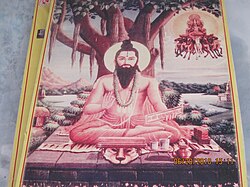
[[File:Imagery of Sage Yagnavalkya.JPG|thumb|Imagery of Sage Yagnavalkya kept at [[Buddinni]] village in Karnataka]] | |||
==Name== | |||
The name Yajnavalkya is derived from ''[[yajna]]'', which connotes ritual.<ref name="staal3" /> | |||
==Depiction in texts== | |||
Yajnavalkya was a pupil of Vaisampayana and the compiler of the ''Shukla Yajurveda Samhita''.<ref name=":2">{{Cite journal |last=Divanji |first=P. C. |date=1953 |title=Bṛhad-Yogi Yājñavalkya-Smṛti and Yoga Yājñavalkya |url=https://www.jstor.org/stable/41784838 |journal=Annals of the Bhandarkar Oriental Research Institute |volume=34 |issue=1/4 |pages=27 |issn=0378-1143 |jstor=41784838}}</ref> Yajnavalkya was the pupil of [[Uddālaka Āruṇi]], and belongs to [[Kuru kingdom|Kuru]].<ref name=":0">{{Cite book|last1=Macdonell|first1=Arthur Anthony|title=Vedic Index of Names and Subjects|last2=Keith|first2=Arthur Berriedale|publisher=John Murray|year=1912|volume=II|pages=189|language=}}</ref><ref>{{Cite book |last=Bharadwaj |first=O. P. |url=http://archive.org/details/in.gov.ignca.78825 |title=Ancient Kuruksetra |date=1991}}</ref> | |||
Within both the ''Sukla Yajur Veda'' and the ''Brihadaranyaka Upanishad'', he is depicted as being blunt, provocative and sarcastic.{{sfn|Yajnavalkya|2019|p=VII}} In the first verse of the [[Yājñavalkya Smṛti|''Yajnavalkya Smriti'']], Yajnavalkya is described as the "yogesvara: meaning "the king of yogis."{{sfn|Yajnavalkya|2019|p=XIII}} | |||
Yajnavalkya plays a central position in a debate known as [[Bahudakshina Yajna]] hosted by [[Janaka|King Janaka]] in [[Mithila (region)|Mithila]], Videha, which is in the Southern Nepal near Janakpur, where Yajnavalkya defeats philosophers from all around the country.{{sfn|Yajnavalkya|2019|p=}} The debate ended with [[Gārgī Vāchaknavī|Gargi]], a female scholar and one of the nine gems of [[Court of King Janaka|King Janaka’s court]], clearly asserting Yajnavalkya as the most superior brahmin of them all.<ref name=":4">{{Cite journal |last=Jain |first=Ayushi |date=December 2018 |title=Comprehending Queer: An Analysis of Gender Identities in Indian Literature |journal=Research Chronicler |volume=VI |issue=XII}}</ref><ref name=":5">{{Cite journal |last=Grinshpon |first=Yohanan |date=1998 |title=The Upaniṣadic Story and the Hidden "Vidyā"; Personality and Possession in the Bṛhadāraṇyakopaniṣad |url=https://www.jstor.org/stable/23496368 |journal=Journal of Indian Philosophy |volume=26 |issue=5 |pages=373–385 |doi=10.1023/A:1004366418482 |jstor=23496368 |issn=0022-1791|url-access=subscription }}</ref> | |||
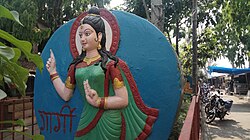
[[File:Gargi Vachaknavi.jpg|thumb|Memorial Statue of [[Gārgī Vāchaknavī|Gargi]] at the complex of [[Uchhaith|Uchchaith Bhagawati Mandir]]]] | |||
In the ''Brihadaranyaka Upanishad'', a set of dialogues portrays Yajnavalkya as having two wives, [[Maitreyi]] and Katyayani.{{sfn|Pechilis|2004|pp=11–15}} Maitreyi, as opposed to Katyayani, was more intrigued to gain spiritual knowledge.<ref name=":5" /> Maitreyi was known as a brahmavadini, a discusser of Brahman.<ref name=":6">{{Cite journal |last=Lindquist |first=Steven E. |date=2008 |title=Gender at Janaka's Court: Women in the Br̥hadāraṇyaka Upaniṣad Reconsidered |url=https://www.jstor.org/stable/23497306 |journal=Journal of Indian Philosophy |volume=36 |issue=3 |pages=405–426 |doi=10.1007/s10781-008-9035-y |jstor=23497306 |issn=0022-1791|url-access=subscription }}</ref> Katyayani is merely described as "striprajna," which translates to "woman-like knowledge;" this can be interpreted as one who is well-versed in traditionally females roles.<ref name=":6" /> While Yajnavalkya and Katyayani lived in contented domesticity, Maitreyi studied metaphysics and engaged in theological dialogues with her husband in addition to "making self-inquiries of introspection."{{sfn|Pechilis|2004|pp=11–15}}<ref name="muir246">John Muir, {{Google books|VPMfAAAAMAAJ|Metrical Translations from Sanskrit Writers|page=251}}, page 246–251</ref> In contrast to the ''Brihadaranyaka Upanishad'', the epic ''[[Mahabharata]]'' states Maitreyi is a young beauty who is an Advaita scholar but never marries.<ref name="muir251">John Muir, {{Google books|VPMfAAAAMAAJ|Metrical Translations from Sanskrit Writers|page=251}}, pp. 251–253</ref> | |||
Scharfstein considers Yajnavalkya to be one of the [[History of philosophy|earliest philosophers]] in [[recorded history]].<ref name="benami9" /> Yajnavalkya is credited by Witzel for coining the term ''[[Advaita]]'' (non-duality of Atman and Brahman).<ref name="Staal2008p365">{{cite book|author=Frits Staal|title=Discovering the Vedas: Origins, Mantras, Rituals, Insights |url= https://books.google.com/books?id=HcE23SjLX8sC&pg=PA365 |year=2008| publisher=Penguin Books |isbn=978-0-14-309986-4|page=365 note 159}}</ref> The ideas attributed to him for renunciation of worldly attachments have been important to Hindu [[sannyasa]] traditions.<ref name=":1">{{cite book|author=Patrick Olivelle|title=The Samnyasa Upanisads: Hindu Scriptures on Asceticism and Renunciation|url=https://books.google.com/books?id=fB8uneM7q1cC |year=1992|publisher=Oxford University Press|isbn=978-0-19-536137-7|pages=92, 140–146}}</ref> | |||
==Scriptural references== | |||
Yajnavalkya is associated with several major ancient texts in Sanskrit, namely the ''[[Shukla Yajurveda]]'', the ''[[Shatapatha Brahmana]]'', the ''Brihadaranyaka Upanishad'', the ''Taittiriya Upanishad'', the [[Dharmasastra|dharma sastra]] named ''[[Yājñavalkya Smṛti]]'', ''Vriddha Yajnavalkya'', and ''Brihad Yajnavalkya''.<ref name="fisher55">I Fisher (1984), Yajnavalkya in the Sruti traditions of the Veda, ''Acta Orientalia'', Volume 45, pages 55–87</ref> He is also mentioned in the ''Mahabharata,'' Puranas,<ref name="mandliklvi">Vishwanath Narayan Mandlik, {{Google book|3AwYAAAAYAAJ|The Vyavahára Mayúkha, in Original, with an English Translation}}, pages lvi, xlviii–lix</ref>{{sfn|White|2014|pp=xiii, xvi}} as well as in ancient [[Jainism]] texts such as the ''[[Isibhasiyaim]]''.<ref>Hajime Nakamura (1968), Yajnavalkya and other Upanishadic thinkers in a Jain tradition, The Adyar Library Bulletin, Volume 31–32, pages 214–228</ref> In the Jainism text Isibhasiyaim, the sage Yajnavalkya is also known as ''Jannavakka''.<ref>{{Cite book |last=Mahopadhyaya Vinayasagar |url=https://archive.org/details/in.ernet.dli.2015.346406 |title=Isibhasiyaim Suttaim (rishibhashit Sutra) |pages=46}}</ref> | |||
=== ''Taittiriya Upanishad'' === | |||
Yajnavalkya is referenced within the ''Taittiriya Upanishad''.<ref name=":7">{{Cite journal |last=Sethumadhavan |first=TN |date=October 27, 2011 |title=Free Translation & Brief Explanation |url=http://www.jedisimon.com/ACQUA%20DI%20LUCE/Beings/TAITTIRIYA-UPANISHAD-TNS-COMPLETE.pdf |website=Esamskriti.com}}</ref> Once, the guru Vaisampayana got angry with Yajnavalkya, who was one of his leading disciples.<ref name=":7" /> He demanded that Yajnavalkya give back all of his knowledge he had learned from him. With such instructions, Yajnavalkya vomited all of the knowledge.<ref name=":7" /> The guru then instructed his other disciples to take the form of partridges (i.e., taittiriya birds) and consume what was regurgitated.<ref name=":7" /> This story is why the Upanishad was named the Taittiriya Upanishad.<ref name=":7" /> The story is meant to show Yajnavalkya’s genius.<ref name=":7" /> Yajnavalkya was also said to have taken the guru’s knowledge and to have added his own insight.<ref name=":7" /> Seeing such knowledge, the guru was pleased and instructed his other disciples to learn from Yajnavalkya.<ref name=":7" /> When a student has absorbed any knowledge and when he gives it out, it becomes more palatable to the other students who did not understand it directly from the teacher’s learned discourse. Seeing that the delivery of Yājñavalkya was masterly, the teacher in appreciation, asked the other students of the class to absorb it like ‘sparrows’, which they did.<ref>{{Cite book |last=Chinmayananda |first=Swami |url=https://www.google.co.in/books/edition/TAITTIRIYA_UPANISHAD/sAgrDwAAQBAJ?hl=en |title=TAITTIRIYA UPANISHAD |date=2014 |publisher=Central Chinmaya Mission Trust |isbn=978-81-7597-622-1 |language=en}}</ref> A student is encouraged to be active for a thirst of knowledge like Taittiriya birds through this metaphor.<ref name=":7" /> | |||
=== ''Brihadaranyanka Upanishad'' === | |||
The ''[[Brihadaranyaka Upanishad]]'' is dated at c. 700 BCE.<ref name="olivelle7thcen" /><ref>{{cite book |author=Ben-Ami Scharfstein |url=https://books.google.com/books?id=iZQy2lu70bwC&pg=PA56 |title=A Comparative History of World Philosophy: From the Upanishads to Kant |publisher=State University of New York Press |year=1998 |isbn=978-0-7914-3683-7 |pages=56–57}}</ref> The ''Brihadaranyaka Upanishad'' is known for highlighting Yajnavalkya’s magnetic personality, focusing on his self-confidence.<ref name=":5" /> | |||
Yajnavalkya plays a central position within the ''Brihadaranyaka Upanisad'', which is a part of the ''Sukla Yajur Veda''.{{sfn|Yajnavalkya|2019|p=}} The scripture details one of the most famous debates in Hindu texts in the presence of King Janaka in Mithila, Videha, which is in the east of India, where Yajnavalkya defeats philosophers from all around the country.<ref>{{Cite journal |last=Vanita |first=Ruth |date=2003 |title=The Self Is Not Gendered: Sulabha's Debate with King Janaka |url=https://www.jstor.org/stable/4316972 |journal=NWSA Journal |volume=15 |issue=2 |pages=76–93 |doi=10.2979/NWS.2003.15.2.76 |doi-broken-date=1 July 2025 |jstor=4316972 |issn=1040-0656|url-access=subscription }}</ref>{{sfn|Yajnavalkya|2019|p=}} | |||
In the first story of the ''Brihadaranyak Upanisad'', King Janaka hosts a sacrifice known as [[Bahudakshina Yajna]], where he is willing to donate one thousand cows with gold horns to the best brahmin called as [[Brahmistha]].<ref name=":5" /> Yajnavalkya immediately orders his disciple Samasrava to take the cows to his home. This causes an uproar in the palace amongst the other sages, led by [[Ashvala|Asvala]], who wondered why Yajnavalkya proclaimed himself as the greatest.<ref name=":5" /> Yajnavalkya responds saying that he does not claim himself to be the greatest ''Brahmistha'' and whoever the greatest Brahmistha is should indeed be honoured. Yajnavalkya says he merely just wanted the cows.<ref name=":5" /> This leads to a philosophical debate amongst the sages, in which Yajnavalkya defeats each opponent who faces him by rightly answering their questions.<ref name=":5" /> Some of the key participants of the debate include [[Ashvala|Asvala]], [[Uddālaka Āruṇi|Uddalaka Aruni]], [[Bhujyu]], [[Shakalya|Sakalya]], [[Artabhaga]], [[Ushasta]], [[Kahoda|Kahola]] and others, many who are well known within other Hindu literature.<ref name=":5" /> | |||
Gargi later appears in two sections of the debate in sections 3.6 and 3.8 of the ''Brihadaranyaka Upanisad''. Gargi was a female scholar and she was one of the nine gems of King Janaka’s court.<ref name=":6" /> In 3.6, Gargi successively asks about what is the support or cause of different elements in the world, setting up a hierarchical ordering of the world.<ref name=":6" /> Gargi finally asks about the support of [[Brahman]]. Yajnavalkya responds, "Do not, O Gargi, question too much, lest your head should fall off. You are questioning too much about a deity whom we should not ask too much."<ref name=":4" /> | |||
Yajnavalkya threatens Gargi not to ask what is beyond Brahman.<ref name=":6" /> Gargi becomes silent. Yajnavalkya intended to explain that one cannot question who is the support of that which is the support of everything.<ref name=":6" /> Yajnavalkya’s threat is not produced out coercion to halt the asking of complex questions, but to end a discussion that had become finite, which Gargi had not realized yet.<ref name=":6" /> | |||
In 3.8, Gargi asks a final series of questions to Yajnavalkya proclaiming that if he can answer these questions, no other brahmin could beat him in this debate.<ref name=":6" /> This time, it is seen that Gargi’s rhetoric has shifted; rather than asking questions impetuously or over-eagerly like that in 3.6, Gargi’s questioning becomes more pointed and focused at reaching the pinnacle of the debate through a final test.<ref name=":6" /> She first asks, "That which is above the sky, that which is below earth, that which is between the sky and earth, and that which people call the past, present, and future – [what is the support of this all]?"<ref name=":6" /> Yajnavalkya responds by saying that the support of this is space.<ref name=":6" /> Gargi then asks what is the support of space. Yajnavalkya responds by discussing the metaphysical element known as Akshar (''Brihadaryanka Upanishad'' 3.8.8-9), or that which is imperishable.<ref name=":6" /><ref>{{Cite web |title=Eastern Book Company—Practical Lawyer |url=https://www.ebc-india.com/lawyer/articles/2005_7_3.htm#:~:text=On%20the%20other%20hand%20the,Prayaschit%20which%20deals%20with%20penance |access-date=2024-06-03 |website=www.ebc-india.com}}</ref> Yajnavalkya says, "This imperishable, Gargi, is the seer but isn’t seen; is the hearer, but isn’t heard; is the thinker, but isn’t thought of; is the perceiver, but isn’t perceived. Other than this, there is no seer. Other than this, there is no hearer. Other than this, there is no thinker. Other than this, there is no perceiver."<ref name=":6" /> | |||
Gargi’s scholarship is depicted through the fact that she is the first person in the entire debate to discuss the concept of Brahman.<ref name=":6" /> The debate ends when Gargi, a female scholar, clearly asserts Yajnavalkya as the most superior of them all.<ref name=":5" /> | |||
In the fourth chapter of the ''Brihadaranyaka Upanisad'', Yajnavalkya decides to renounce and leave his family.<ref name=":6" /> At that time, Yajnavalkya’s wife, Maitreyi, inquires about the concept of the soul to Yajnavalkya.<ref name=":6" /> Maitreiyi, was also very wise and scholarly.<ref name=":8">{{Cite journal |last=Banerjee |first=Sudeep |date=2008 |title=Where Knowledge Is Free |url=https://www.jstor.org/stable/27644287 |journal=Social Scientist |volume=36 |issue=7/8 |pages=29–36 |jstor=27644287 |issn=0970-0293}}</ref> She had once asked Yajnavalkya if she would become immortal with all the wealth in the world, in which Yajnavalkya responded with a denial. She then preaches, “"What should I do with that by which I do not become immortal?"<ref name=":8" /> | |||
The ''Brihadaranyaka Upanisad'' is one of the first texts to depict women in religious debate.<ref name=":6" /> Both Gargi and Maitreyi discuss the deepest spiritual topics of the ''Brihadaranyaka Upanisad'', namely about Brahman and the atman, showing their knowledge and curiosity.<ref name=":6" /> | |||
== Works == | |||
== | === ''Sukla Yajur Veda'' === | ||
Yajnavalkya was the seer of who received the [[Shukla Yajurveda]] from the Divine.{{sfn|Yajnavalkya|2019|p=}} Thus, he is known as the founder of the Sukla Yujurveda tradition.{{sfn|Yajnavalkya|2019|p=}} Yajnavalkya himself mentions, “Anyone who desires to master yoga should know the Aranyaka that I received from the sun as well as the yoga treatise that I proclaimed.” (Yajnavalkya Smriti 3.110).{{sfn|Yajnavalkya|2019|p=}} | |||
=== ''Yajnavalkya Smriti'' === | |||
The ''[[Yājñavalkya Smṛti|Yagnavalkya Smriti]]'' provides instructions to people of all walks of life, including brahmins.<ref name=":9">{{Cite journal |last=L. |first=B. |date=1932 |editor-last=Jayaswal |editor-first=K. P. |title=Manu and Yājñavalkya |url=https://www.jstor.org/stable/754205 |journal=Journal of Comparative Legislation and International Law |volume=14 |issue=4 |pages=291–295 |jstor=754205 |issn=1479-5949}}</ref> It is written as a discourse from Yajnavalka to his sagely disciples about the laws or dharmas of society.{{sfn|Yajnavalkya|2019|p=}} The scripture is broken into three sections discussing: (1) achara (i.e., behavior), (2) vyavahara (i.e., legal procedure), and (3) prayascita (i.e., atonement).<ref>{{Cite web |title=Eastern Book Company—Practical Lawyer |url=https://www.ebc-india.com/lawyer/articles/2005_7_3.htm#:~:text=On%20the%20other%20hand%20the,Prayaschit%20which%20deals%20with%20penance |access-date=2024-06-03 |website=www.ebc-india.com}}</ref> In the second section, Yagnavalkya breaks down the entire court process into four steps: plaint, plea, evidence and verdict.{{sfn|Yajnavalkya|2019|p=}} In the third section, Yajnavalkya claims that through prayascita, the soul and the world are pleased. (''Yajnavalkya Smriti'' 3.20).<ref name=":7" /> | |||
The ''Yajnavalkya Smriti'' is often comparable to a priorly written dharma sastra, the ''Manu Smriti''.<ref>{{Cite journal |last=Chemburkar |first=Jaya |date=1989 |title=Prāyaścitta (expiation) and Daṇḍa (punishment): A Study |url=https://www.jstor.org/stable/41693462 |journal=Annals of the Bhandarkar Oriental Research Institute |volume=70 |issue=1/4 |pages=89–101 |jstor=41693462 |issn=0378-1143}}</ref> Both the Manu Smriti and ''Yajnavalkya Smriti'' are considered the ultimate sources of Hindu Law, however, Yagnavalkya’s smriti was considered more authoritative than that of Manu’s.<ref name=":9" /> Although both works are similar, Yajnavalkya places less emphasis on rigidity and more focus on practicality.<ref name=":2" /> Yajnavalkya’s smriti is also more precise and organized than that of Manu’s. The British also considered the ''Yajnavalkya Smriti'' the basis of what they called “the Hindu Law.”{{sfn|Yajnavalkya|2019|p=}} | |||
The | The ''Yajnavalkya Smriti'' became even more well-known through a commentary written on it by Vijnaneshvara called the ''Mitakshara'' in the mid-twelfth century.{{sfn|Yajnavalkya|2019|p=}} | ||
== | === ''Yoga Yajnavalkya'' === | ||
The ''[[Yoga Yajnavalkya]]'' is a commentary by Yajnavalkya on the knowledge of Yoga.<ref name=":2" /> | |||
The actual author of ''Yoga Yajnavalkya'' text was probably someone who lived many centuries after the Vedic sage Yajnavalkya.{{sfn|Larson|Bhattacharya|2008|pp= 476–477}} Ian Whicher, a professor of Religion at the University of Manitoba, states that the author of ''Yoga Yajnavalkya'' may be an ancient Yajnavalkya, but this Yajnavalkya is not to be confused with the Vedic-era Yajnavalkya "who is revered in Hinduism for ''Brihadaranyaka Upanishad''".<ref>Ian Whicher (1999), The Integrity of the Yoga Darsana: A Reconsideration of Classical Yoga, State University of New York Press, {{ISBN|978-0791438152}}, pages 27, 315–316 with notes</ref> | |||
{{sfn|Larson|Bhattacharya|2008|pp= 476–477}} Ian Whicher, a professor of Religion at the University of Manitoba, states that the author of ''Yoga Yajnavalkya'' may be an ancient Yajnavalkya, but this Yajnavalkya is not to be confused with the Vedic-era Yajnavalkya "who is revered in Hinduism for ''Brihadaranyaka Upanishad''".<ref>Ian Whicher (1999), The Integrity of the Yoga Darsana: A Reconsideration of Classical Yoga, State University of New York Press, {{ISBN|978-0791438152}}, pages 27, 315–316 with notes</ref> | |||
According to [[Vishwanath Narayan Mandlik]], these references to Yajnavalkya in other texts, in addition to the eponymous ''Yoga Yajnavalkya'', may be | According to [[Vishwanath Narayan Mandlik]], these references to Yajnavalkya in other texts, in addition to the eponymous ''Yoga Yajnavalkya'', may be two different sages with the same name.<ref name="mandliklvi" /> | ||
==Ideas== | == Ideas == | ||
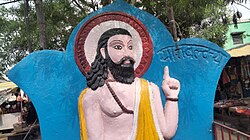
[[File:Yajnavalkya.jpg|thumb|'''Statue of Yajnavalkya''' at the entrance of [[Uchhaith|Uchchaith Bhagawati Mandir]] near [[Benipatti]] town in the [[Madhubani district]] of the [[Mithila (region)|Mithila region]] in Bihar]] | |||
===On karma and rebirth=== | ===On karma and rebirth=== | ||
One of the early expositions of [[karma]] and rebirth theories | One of the early expositions of [[karma]] and rebirth theories appears in the discussions of Yajnavalkya.<ref>{{cite journal | last=Hock | first=Hans Henrich | title=The Yajnavalkya Cycle in the Brhad Aranyaka Upanisad | journal=Journal of the American Oriental Society | publisher=American Oriental Society | volume=122 | issue=2 | year=2002 | pages=278–286 | doi=10.2307/3087621 | jstor=3087621 }}</ref> | ||
{{Blockquote| | {{Blockquote| | ||
<poem> | <poem> | ||
Now as a man is like this or like that, | |||
according as he acts and according as he behaves, so will he be; | |||
a man of good acts will become good, a man of bad acts, bad; | |||
he becomes pure by pure deeds, bad by bad deeds; | |||
And here they say that a person consists of desires, | |||
and as is his desire, so is his will; | |||
and as is his will, so is his deed; | |||
and whatever deed he does, that he will reap. | |||
</poem> | </poem> | ||
|''[[Brihadaranyaka Upanishad]] 4.4.5-6''|<ref>[https://web.archive.org/web/20130413042723/http://berkleycenter.georgetown.edu/resources/quotes/brihadaranyaka-upanishad-4-4-5-6 Brihadaranyaka Upanishad 4.4.5-6] Berkley Center for Religion Peace & World Affairs, Georgetown University (2012)</ref>}} | |''[[Brihadaranyaka Upanishad]] 4.4.5-6''|<ref>[https://web.archive.org/web/20130413042723/http://berkleycenter.georgetown.edu/resources/quotes/brihadaranyaka-upanishad-4-4-5-6 Brihadaranyaka Upanishad 4.4.5-6] Berkley Center for Religion Peace & World Affairs, Georgetown University (2012)</ref>}} | ||
| Line 60: | Line 104: | ||
===On spiritual liberation=== | ===On spiritual liberation=== | ||
The section 4.3 of the ''Brihadaranyaka Upanishad'' is attributed to Yajnavalkya, and | The section 4.3 of the ''Brihadaranyaka Upanishad'' is attributed to Yajnavalkya. It has a dialogue between [[Janaka]] and Yajnavalkya exploring the nature of the Atman in different states of consciousness and existence, including wakefulness, dream, deep sleep, death, migration, and final liberation. It discusses the premises of [[moksha]] (liberation, freedom), and provides some of its most studied hymns. Paul Deussen calls it, "unique in its richness and warmth of presentation", with profoundness that retains its full worth in modern times.<ref>Paul Deussen, Sixty Upanishads of the Veda, Volume 1, Motilal Banarsidass, {{ISBN|978-8120814684}}, page 482</ref> | ||
=== On the light of man === | === On the light of man === | ||
When asked by [[Janaka|King Janaka]],"What is the light of man?" he replies, "The sun, O King; for, having the sun alone for his light, man sits, moves about, does his work, and returns." Then the king asks, "When the sun sets, what is the light of man?" He replies, "The moon indeed is his light; for, having the moon alone for his light, man sits, moves about, does his work, and returns." Then the king asks, "When the sun has set, O Yajnavalkya, and the moon has set, what is the light of man ?" He replies, "Fire indeed is his light; for, having fire alone for his light, man sits, moves about, does his work, and returns." Then the king asks, "When the sun has set, O Yajnavalkya, and the moon has set, and the fire is gone out, what is then the light of man?" He replies, "Sound indeed is his light; for, having sound alone for his light, man sits, moves about, does his work, and returns. Therefore, O King, when one cannot see even one's own hand, yet when a sound is raised, one goes towards it." Then the king asks, "When the sun has set, O Yajnaavalkya, and the moon has set, and the fire is gone out, and the sound hushed, what is then the light of man?" He replies, "The Self indeed is his light; for, having the Self alone as his light, man sits, moves about, does his work, and returns."<ref>{{Cite book|last=Müller|first=F. Max (Friedrich Max)|url=http://archive.org/details/upanishads02ml|title=The Upanishads|date=1879–84|publisher=Oxford, The Clarendon press|others=Princeton Theological Seminary Library|pages=162–163}}</ref> | When asked by [[Janaka|King Janaka]],"What is the light of man?" he replies, "The sun, O King; for, having the sun alone for his light, man sits, moves about, does his work, and returns." Then the king asks, "When the sun sets, what is the light of man?" He replies, "The moon indeed is his light; for, having the moon alone for his light, man sits, moves about, does his work, and returns." Then the king asks, "When the sun has set, O Yajnavalkya, and the moon has set, what is the light of man ?" He replies, "Fire indeed is his light; for, having fire alone for his light, man sits, moves about, does his work, and returns." Then the king asks, "When the sun has set, O Yajnavalkya, and the moon has set, and the fire is gone out, what is then the light of man?" He replies, "Sound indeed is his light; for, having sound alone for his light, man sits, moves about, does his work, and returns. Therefore, O King, when one cannot see even one's own hand, yet when a sound is raised, one goes towards it." Then the king asks, "When the sun has set, O Yajnaavalkya, and the moon has set, and the fire is gone out, and the sound hushed, what is then the light of man?" He replies, "The Self indeed is his light; for, having the Self alone as his light, man sits, moves about, does his work, and returns."<ref>{{Cite book|last=Müller|first=F. Max (Friedrich Max)|url=http://archive.org/details/upanishads02ml|title=The Upanishads|date=1879–84|publisher=Oxford, The Clarendon press|others=Princeton Theological Seminary Library|pages=162–163}}</ref> | ||
=== On | === On the self === | ||
He describes the self by a series of negations and says it is not, not (neti, neti) - not graspable, not destructible, not attached, not disturbed by anything good or bad done by himself. He then says, he who knows this truth remains "controlled, at peace, patient and full of faith" and "everyone comes to be his self" and "he becomes the self of everyone"<ref>{{Cite book|last=Scharfstein|first=Ben-Ami|url=https://books.google.com/books?id=iZQy2lu70bwC&pg=PA56|title=A Comparative History of World Philosophy: From the Upanishads to Kant|date=1998-01-01|publisher=SUNY Press|isbn=978-0-7914-3683-7|pages=64|language=en}}</ref>{{sfn|Olivelle|1998|p=52}} | He describes the self by a series of negations and says it is not, not (neti, neti) - not graspable, not destructible, not attached, not disturbed by anything good or bad done by himself. He then says, he who knows this truth remains "controlled, at peace, patient and full of faith" and "everyone comes to be his self" and "he becomes the self of everyone"<ref>{{Cite book|last=Scharfstein|first=Ben-Ami|url=https://books.google.com/books?id=iZQy2lu70bwC&pg=PA56|title=A Comparative History of World Philosophy: From the Upanishads to Kant|date=1998-01-01|publisher=SUNY Press|isbn=978-0-7914-3683-7|pages=64|language=en}}</ref>{{sfn|Olivelle|1998|p=52}} | ||
=== On | === On dreams === | ||
Yajnavalkya believed that dreams are active projections of the self. To him, this is evidence that dreaming shares the creative nature of Reality in itself.<ref>{{Cite book|last=Scharfstein|first=Ben-Ami|url=https://books.google.com/books?id=iZQy2lu70bwC&pg=PA56|title=A Comparative History of World Philosophy: From the Upanishads to Kant|date=1998-01-01|publisher=SUNY Press|isbn=978-0-7914-3683-7|pages=63|language=en}}</ref> | |||
===On love and soul=== | ===On love and soul=== | ||
The Maitreyi-Yajnavalkya dialogue | The Maitreyi-Yajnavalkya dialogue in the ''[[Brihadaranyaka Upanishad]]'' states that love is driven by "love for oneself (''ātman''),"{{sfn|Olivelle|1998|p=28}} and discusses the nature of Atman and Brahman and their [[Monism|unity]],{{Sfn|Hino|1991|pp=94–95}} which forms the core of later [[Advaita Vedanta|Advaita philosophy]].{{sfn|Brereton|2006|pp=323–345}} The dialogue has survived in two manuscript [[recension]]s from the [[Madhyandina Shakha|Madhyamdina]] and [[Kanva Shakha|Kanva]] [[Shakha|Vedic schools]]. Although they have significant literary differences, they share the same philosophical theme.{{sfn|Brereton|2006|pp=323–45}} | ||
This dialogue appears in several Hindu texts; the earliest is in chapter 2.4 – and modified in chapter 4.5 – of the ''Brihadaranyaka Upanishad'', one of the principal and oldest [[Upanishads]].{{Sfn|Marvelly|2011|p=43}}{{sfn|Hume|1967|pp=98–102, 146–48}} Adi Shankara, a scholar of the influential [[Advaita Vedanta]] school of Hindu philosophy, wrote in his ''Brihadaranyakopanishad bhashya'' that the purpose of the Maitreyi-Yajnavalkya dialogue in chapter 2.4 of the ''Brihadaranyaka Upanishad'' is to highlight the importance of the knowledge of Atman and Brahman, and to understand their oneness.{{Sfn|Hino|1991|pp=5–6, 94}}<ref>{{cite book|author=Paul Deussen|title=The System of the Vedanta: According to Badarayana's Brahma-Sutras and Shankara's Commentary thereon|url=https://books.google.com/books?id=DI7cCgAAQBAJ |year=2015|publisher=KB Classics Reprint|isbn=978-1-5191-1778-6 |pages=173–174 }}</ref> According to Shankara, the dialogue suggests renunciation is prescribed in the ''[[Sruti]]'' (vedic texts of Hinduism), as a means to knowledge of the Brahman and Atman.{{Sfn|Hino|1991|pp=54–59, 94–95, 145–149}} He adds, that the pursuit of self-knowledge is considered important in the ''Sruti'' because the Maitreyi dialogue is repeated in chapter 4.5 as a "logical finale" to the discussion of Brahman in the Upanishad.{{Sfn|Hino|1991|p=5}} | This dialogue appears in several Hindu texts; the earliest is in chapter 2.4 – and modified in chapter 4.5 – of the ''Brihadaranyaka Upanishad'', one of the principal and oldest [[Upanishads]].{{Sfn|Marvelly|2011|p=43}}{{sfn|Hume|1967|pp=98–102, 146–48}} Adi Shankara, a scholar of the influential [[Advaita Vedanta]] school of Hindu philosophy, wrote in his ''Brihadaranyakopanishad bhashya'' that the purpose of the Maitreyi-Yajnavalkya dialogue in chapter 2.4 of the ''Brihadaranyaka Upanishad'' is to highlight the importance of the knowledge of Atman and Brahman, and to understand their oneness.{{Sfn|Hino|1991|pp=5–6, 94}}<ref>{{cite book|author=Paul Deussen|title=The System of the Vedanta: According to Badarayana's Brahma-Sutras and Shankara's Commentary thereon|url=https://books.google.com/books?id=DI7cCgAAQBAJ |year=2015|publisher=KB Classics Reprint|isbn=978-1-5191-1778-6 |pages=173–174 }}</ref> According to Shankara, the dialogue suggests renunciation is prescribed in the ''[[Sruti]]'' (vedic texts of Hinduism), as a means to knowledge of the Brahman and Atman.{{Sfn|Hino|1991|pp=54–59, 94–95, 145–149}} He adds, that the pursuit of self-knowledge is considered important in the ''Sruti'' because the Maitreyi dialogue is repeated in chapter 4.5 as a "logical finale" to the discussion of Brahman in the Upanishad.{{Sfn|Hino|1991|p=5}} | ||
| Line 84: | Line 128: | ||
|''Brihadaranyaka Upanishad'' 2.4.5b{{sfn|Deussen|2010|p=435}}}} | |''Brihadaranyaka Upanishad'' 2.4.5b{{sfn|Deussen|2010|p=435}}}} | ||
=== On dharma === | |||
In Yajnavalkya Smriti, Yajnavalkya emphasizes the plurality of dharma, drawing from multiple sources including the Vedas, recollections, righteous conduct, self-satisfaction, and desire rooted in right intention. He introduces the idea that fulfilling desires with the right intention is part of dharma, a departure from previous texts. Yajnavalkya emphasizes the significance of gift-giving (''dana'') and yoga in dharma, considering them central practices. He suggests that those who understand the self hold superior knowledge of dharma. Yajnavalkya categorizes dharma into three divisions, covering everyday life, royal conduct, and extraordinary circumstances. He recognizes that not all dharma originates from Vedic sources; some are derived from worldly customs or enforced by rulers.{{Sfn|Yajnavalkya|2019|p=xxvi-xxviii}} | |||
==See also== | ==See also== | ||
| Line 94: | Line 139: | ||
*[[Ashtavakra]] | *[[Ashtavakra]] | ||
*[[Yajnavalkya Ashram]] | *[[Yajnavalkya Ashram]] | ||
*[[Durwakshat Mantra]] | |||
== References == | == References == | ||
| Line 105: | Line 151: | ||
<!-- H --> | <!-- H --> | ||
*{{cite book|last= Hino |first=Shoun |title=Suresvara's Vartika On Yajnavalkya'S-Maitreyi Dialogue|url=https://books.google.com/books?id=dvcrBnKaIgEC |year =1991 |publisher=Motilal Banarsidass |isbn=978-81-208-0729-7 |edition=2nd}} | *{{cite book|last= Hino |first=Shoun |title=Suresvara's Vartika On Yajnavalkya'S-Maitreyi Dialogue|url=https://books.google.com/books?id=dvcrBnKaIgEC |year =1991 |publisher=Motilal Banarsidass |isbn=978-81-208-0729-7 |edition=2nd}} | ||
*{{cite book|url=https://archive.org/stream/thirteenprincipa028442mbp#page/n121/mode/2up|title= Brihadaranyaka Upanishad|first= Robert|last= Hume |publisher= (Translator), Oxford University Press|year=1967 | *<!-- J --><!-- K -->{{cite book|url=https://archive.org/stream/thirteenprincipa028442mbp#page/n121/mode/2up|title= Brihadaranyaka Upanishad|first= Robert|last= Hume |publisher= (Translator), Oxford University Press|year=1967}} | ||
<!-- L --> | <!-- L --> | ||
* {{cite book|last1=Larson |first1= Gerald James|last2=Bhattacharya |first2=Ram Shankar|year= 2008|title=The Encyclopedia of Indian Philosophies: Yoga: India's philosophy of meditation|publisher= Motilal Banarsidass|isbn= 978-81-208-3349-4|url= https://books.google.com/books?id=p6pURGdBBmIC}} | * {{cite book|last1=Larson |first1= Gerald James|last2=Bhattacharya |first2=Ram Shankar|year= 2008|title=The Encyclopedia of Indian Philosophies: Yoga: India's philosophy of meditation|publisher= Motilal Banarsidass|isbn= 978-81-208-3349-4|url= https://books.google.com/books?id=p6pURGdBBmIC}} | ||
| Line 118: | Line 160: | ||
* {{Cite book |last=Olivelle |first=Patrick |url=https://books.google.com/books?id=f9-2jV7sRuEC |title=Upaniṣads |date=1998 |publisher=Oxford University Press |isbn=978-0-19-283576-5 |language=en}} | * {{Cite book |last=Olivelle |first=Patrick |url=https://books.google.com/books?id=f9-2jV7sRuEC |title=Upaniṣads |date=1998 |publisher=Oxford University Press |isbn=978-0-19-283576-5 |language=en}} | ||
<!-- P --> | <!-- P --> | ||
*{{cite book|first= Karen|last= Pechilis|year= 2004|title= The Graceful Guru: Hindu Female Gurus in India and the United States|publisher= Oxford University Press|isbn= 978-0-19-514537-3 | *<!-- T -->{{cite book|first= Karen|last= Pechilis|year= 2004|title= The Graceful Guru: Hindu Female Gurus in India and the United States|publisher= Oxford University Press|isbn= 978-0-19-514537-3}} | ||
<!-- W --> | <!-- W --> | ||
*{{cite book|last= White |first=David Gordon |title=The "Yoga Sutra of Patanjali": A Biography|url=https://books.google.com/books?id=0ZGrAgAAQBAJ |year=2014 |publisher=Princeton University Press|isbn=978-0691143774}} | *{{cite book|last= White |first=David Gordon |title=The "Yoga Sutra of Patanjali": A Biography|url=https://books.google.com/books?id=0ZGrAgAAQBAJ |year=2014 |publisher=Princeton University Press|isbn=978-0691143774}} | ||
*{{cite book |author=Yajnavalkya |url=https://books.google.com/books?id=gLH_swEACAAJ |title=Yajnavalkya - A Treatise on Dharma |publisher=Harvard University Press |year=2019 |isbn=978-0-674-27706-9 |editor=Patrick Olivelle |series=Murty Classical Library of India 20 |pages=vii-xxxvii |translator=Patrick Olivelle}} | |||
==External links== | ==External links== | ||
{{Commons category|Yajnavalkya}} | |||
{{Wikiquote}} | {{Wikiquote}} | ||
* {{Gutenberg author | id=24967}} | * {{Gutenberg author | id=24967}} | ||
| Line 140: | Line 182: | ||
[[Category:7th-century BC people]] | [[Category:7th-century BC people]] | ||
[[Category:8th-century BC people]] | [[Category:8th-century BC people]] | ||
[[Category: | [[Category:People from Videha]] | ||
[[Category:Rishis]] | [[Category:Rishis]] | ||
[[Category:Ancient Indian philosophers]] | [[Category:Ancient Indian philosophers]] | ||
| Line 148: | Line 190: | ||
[[Category:7th-century BC mathematicians]] | [[Category:7th-century BC mathematicians]] | ||
[[Category:Maithil Brahmin]] | [[Category:Maithil Brahmin]] | ||
[[Category:Upanishadic people]] | [[Category:Upanishadic people]] | ||
[[Category:8th-century BC Hindus]] | [[Category:8th-century BC Hindus]] | ||
[[Category:7th-century BC Hindus]] | [[Category:7th-century BC Hindus]] | ||
Latest revision as of 09:34, 26 March 2026
Yajnavalkya | |
|---|---|
 Yajnavalkya teaches Brahma Vidya to King Janaka | |
| Personal | |
| Born | Fifth day during the waxing phase of moon in Phalgun Hindu month |
| Religion | Hinduism |
| Home town | Jagban |
| Spouse | Maitreyi, Katyayani |
| Region | Mithila region |
| Notable idea(s) | Neti neti |
| Philosophy | Upanishad |
| Religious career | |
Disciples
| |
Influenced by
| |
| Honors | Rishi |
| Part of a series on |
| Hinduism |
|---|
 |


Yajnavalkya or Yagyavalkya (Sanskrit: याज्ञवल्क्य, IAST:Yājñavalkya) is a Hindu Vedic sage prominently mentioned in the Brihadaranyaka Upanishad (c. 700 BCE) and Tattiriya Upanishad.[1][2][3][4] Yajnavalkya proposes and debates metaphysical questions about the nature of existence, consciousness and impermanence, and expounds the epistemic doctrine of neti neti ("not this, not this") to discover the universal Self and Ātman.[5] Texts attributed to him include the Yajnavalkya Smriti, Yoga Yajnavalkya and some texts of the Vedanta school.[6][7] He is also mentioned in the Mahabharata as well as various Puranas, Brahmanas and Aranyakas.[6][8][9]

Name[edit | edit source]
The name Yajnavalkya is derived from yajna, which connotes ritual.[1]
Depiction in texts[edit | edit source]
Yajnavalkya was a pupil of Vaisampayana and the compiler of the Shukla Yajurveda Samhita.[10] Yajnavalkya was the pupil of Uddālaka Āruṇi, and belongs to Kuru.[11][12]
Within both the Sukla Yajur Veda and the Brihadaranyaka Upanishad, he is depicted as being blunt, provocative and sarcastic.[13] In the first verse of the Yajnavalkya Smriti, Yajnavalkya is described as the "yogesvara: meaning "the king of yogis."[14]
Yajnavalkya plays a central position in a debate known as Bahudakshina Yajna hosted by King Janaka in Mithila, Videha, which is in the Southern Nepal near Janakpur, where Yajnavalkya defeats philosophers from all around the country.[15] The debate ended with Gargi, a female scholar and one of the nine gems of King Janaka’s court, clearly asserting Yajnavalkya as the most superior brahmin of them all.[16][17]

In the Brihadaranyaka Upanishad, a set of dialogues portrays Yajnavalkya as having two wives, Maitreyi and Katyayani.[18] Maitreyi, as opposed to Katyayani, was more intrigued to gain spiritual knowledge.[17] Maitreyi was known as a brahmavadini, a discusser of Brahman.[19] Katyayani is merely described as "striprajna," which translates to "woman-like knowledge;" this can be interpreted as one who is well-versed in traditionally females roles.[19] While Yajnavalkya and Katyayani lived in contented domesticity, Maitreyi studied metaphysics and engaged in theological dialogues with her husband in addition to "making self-inquiries of introspection."[18][20] In contrast to the Brihadaranyaka Upanishad, the epic Mahabharata states Maitreyi is a young beauty who is an Advaita scholar but never marries.[21]
Scharfstein considers Yajnavalkya to be one of the earliest philosophers in recorded history.[3] Yajnavalkya is credited by Witzel for coining the term Advaita (non-duality of Atman and Brahman).[22] The ideas attributed to him for renunciation of worldly attachments have been important to Hindu sannyasa traditions.[9]
Scriptural references[edit | edit source]
Yajnavalkya is associated with several major ancient texts in Sanskrit, namely the Shukla Yajurveda, the Shatapatha Brahmana, the Brihadaranyaka Upanishad, the Taittiriya Upanishad, the dharma sastra named Yājñavalkya Smṛti, Vriddha Yajnavalkya, and Brihad Yajnavalkya.[6] He is also mentioned in the Mahabharata, Puranas,[8][23] as well as in ancient Jainism texts such as the Isibhasiyaim.[24] In the Jainism text Isibhasiyaim, the sage Yajnavalkya is also known as Jannavakka.[25]
Taittiriya Upanishad[edit | edit source]
Yajnavalkya is referenced within the Taittiriya Upanishad.[26] Once, the guru Vaisampayana got angry with Yajnavalkya, who was one of his leading disciples.[26] He demanded that Yajnavalkya give back all of his knowledge he had learned from him. With such instructions, Yajnavalkya vomited all of the knowledge.[26] The guru then instructed his other disciples to take the form of partridges (i.e., taittiriya birds) and consume what was regurgitated.[26] This story is why the Upanishad was named the Taittiriya Upanishad.[26] The story is meant to show Yajnavalkya’s genius.[26] Yajnavalkya was also said to have taken the guru’s knowledge and to have added his own insight.[26] Seeing such knowledge, the guru was pleased and instructed his other disciples to learn from Yajnavalkya.[26] When a student has absorbed any knowledge and when he gives it out, it becomes more palatable to the other students who did not understand it directly from the teacher’s learned discourse. Seeing that the delivery of Yājñavalkya was masterly, the teacher in appreciation, asked the other students of the class to absorb it like ‘sparrows’, which they did.[27] A student is encouraged to be active for a thirst of knowledge like Taittiriya birds through this metaphor.[26]
Brihadaranyanka Upanishad[edit | edit source]
The Brihadaranyaka Upanishad is dated at c. 700 BCE.[4][28] The Brihadaranyaka Upanishad is known for highlighting Yajnavalkya’s magnetic personality, focusing on his self-confidence.[17]
Yajnavalkya plays a central position within the Brihadaranyaka Upanisad, which is a part of the Sukla Yajur Veda.[15] The scripture details one of the most famous debates in Hindu texts in the presence of King Janaka in Mithila, Videha, which is in the east of India, where Yajnavalkya defeats philosophers from all around the country.[29][15]
In the first story of the Brihadaranyak Upanisad, King Janaka hosts a sacrifice known as Bahudakshina Yajna, where he is willing to donate one thousand cows with gold horns to the best brahmin called as Brahmistha.[17] Yajnavalkya immediately orders his disciple Samasrava to take the cows to his home. This causes an uproar in the palace amongst the other sages, led by Asvala, who wondered why Yajnavalkya proclaimed himself as the greatest.[17] Yajnavalkya responds saying that he does not claim himself to be the greatest Brahmistha and whoever the greatest Brahmistha is should indeed be honoured. Yajnavalkya says he merely just wanted the cows.[17] This leads to a philosophical debate amongst the sages, in which Yajnavalkya defeats each opponent who faces him by rightly answering their questions.[17] Some of the key participants of the debate include Asvala, Uddalaka Aruni, Bhujyu, Sakalya, Artabhaga, Ushasta, Kahola and others, many who are well known within other Hindu literature.[17]
Gargi later appears in two sections of the debate in sections 3.6 and 3.8 of the Brihadaranyaka Upanisad. Gargi was a female scholar and she was one of the nine gems of King Janaka’s court.[19] In 3.6, Gargi successively asks about what is the support or cause of different elements in the world, setting up a hierarchical ordering of the world.[19] Gargi finally asks about the support of Brahman. Yajnavalkya responds, "Do not, O Gargi, question too much, lest your head should fall off. You are questioning too much about a deity whom we should not ask too much."[16]
Yajnavalkya threatens Gargi not to ask what is beyond Brahman.[19] Gargi becomes silent. Yajnavalkya intended to explain that one cannot question who is the support of that which is the support of everything.[19] Yajnavalkya’s threat is not produced out coercion to halt the asking of complex questions, but to end a discussion that had become finite, which Gargi had not realized yet.[19]
In 3.8, Gargi asks a final series of questions to Yajnavalkya proclaiming that if he can answer these questions, no other brahmin could beat him in this debate.[19] This time, it is seen that Gargi’s rhetoric has shifted; rather than asking questions impetuously or over-eagerly like that in 3.6, Gargi’s questioning becomes more pointed and focused at reaching the pinnacle of the debate through a final test.[19] She first asks, "That which is above the sky, that which is below earth, that which is between the sky and earth, and that which people call the past, present, and future – [what is the support of this all]?"[19] Yajnavalkya responds by saying that the support of this is space.[19] Gargi then asks what is the support of space. Yajnavalkya responds by discussing the metaphysical element known as Akshar (Brihadaryanka Upanishad 3.8.8-9), or that which is imperishable.[19][30] Yajnavalkya says, "This imperishable, Gargi, is the seer but isn’t seen; is the hearer, but isn’t heard; is the thinker, but isn’t thought of; is the perceiver, but isn’t perceived. Other than this, there is no seer. Other than this, there is no hearer. Other than this, there is no thinker. Other than this, there is no perceiver."[19]
Gargi’s scholarship is depicted through the fact that she is the first person in the entire debate to discuss the concept of Brahman.[19] The debate ends when Gargi, a female scholar, clearly asserts Yajnavalkya as the most superior of them all.[17]
In the fourth chapter of the Brihadaranyaka Upanisad, Yajnavalkya decides to renounce and leave his family.[19] At that time, Yajnavalkya’s wife, Maitreyi, inquires about the concept of the soul to Yajnavalkya.[19] Maitreiyi, was also very wise and scholarly.[31] She had once asked Yajnavalkya if she would become immortal with all the wealth in the world, in which Yajnavalkya responded with a denial. She then preaches, “"What should I do with that by which I do not become immortal?"[31]
The Brihadaranyaka Upanisad is one of the first texts to depict women in religious debate.[19] Both Gargi and Maitreyi discuss the deepest spiritual topics of the Brihadaranyaka Upanisad, namely about Brahman and the atman, showing their knowledge and curiosity.[19]
Works[edit | edit source]
Sukla Yajur Veda[edit | edit source]
Yajnavalkya was the seer of who received the Shukla Yajurveda from the Divine.[15] Thus, he is known as the founder of the Sukla Yujurveda tradition.[15] Yajnavalkya himself mentions, “Anyone who desires to master yoga should know the Aranyaka that I received from the sun as well as the yoga treatise that I proclaimed.” (Yajnavalkya Smriti 3.110).[15]
[edit | edit source]
The Yagnavalkya Smriti provides instructions to people of all walks of life, including brahmins.[32] It is written as a discourse from Yajnavalka to his sagely disciples about the laws or dharmas of society.[15] The scripture is broken into three sections discussing: (1) achara (i.e., behavior), (2) vyavahara (i.e., legal procedure), and (3) prayascita (i.e., atonement).[33] In the second section, Yagnavalkya breaks down the entire court process into four steps: plaint, plea, evidence and verdict.[15] In the third section, Yajnavalkya claims that through prayascita, the soul and the world are pleased. (Yajnavalkya Smriti 3.20).[26]
The Yajnavalkya Smriti is often comparable to a priorly written dharma sastra, the Manu Smriti.[34] Both the Manu Smriti and Yajnavalkya Smriti are considered the ultimate sources of Hindu Law, however, Yagnavalkya’s smriti was considered more authoritative than that of Manu’s.[32] Although both works are similar, Yajnavalkya places less emphasis on rigidity and more focus on practicality.[10] Yajnavalkya’s smriti is also more precise and organized than that of Manu’s. The British also considered the Yajnavalkya Smriti the basis of what they called “the Hindu Law.”[15]
The Yajnavalkya Smriti became even more well-known through a commentary written on it by Vijnaneshvara called the Mitakshara in the mid-twelfth century.[15]
[edit | edit source]
The Yoga Yajnavalkya is a commentary by Yajnavalkya on the knowledge of Yoga.[10]
The actual author of Yoga Yajnavalkya text was probably someone who lived many centuries after the Vedic sage Yajnavalkya.[35] Ian Whicher, a professor of Religion at the University of Manitoba, states that the author of Yoga Yajnavalkya may be an ancient Yajnavalkya, but this Yajnavalkya is not to be confused with the Vedic-era Yajnavalkya "who is revered in Hinduism for Brihadaranyaka Upanishad".[36]
According to Vishwanath Narayan Mandlik, these references to Yajnavalkya in other texts, in addition to the eponymous Yoga Yajnavalkya, may be two different sages with the same name.[8]
Ideas[edit | edit source]

On karma and rebirth[edit | edit source]
One of the early expositions of karma and rebirth theories appears in the discussions of Yajnavalkya.[37]
Now as a man is like this or like that,
according as he acts and according as he behaves, so will he be;
a man of good acts will become good, a man of bad acts, bad;
he becomes pure by pure deeds, bad by bad deeds;
And here they say that a person consists of desires,
and as is his desire, so is his will;
and as is his will, so is his deed;
and whatever deed he does, that he will reap.— Brihadaranyaka Upanishad 4.4.5-6, [38]
Max Muller and Paul Deussen, in their respective translations, describe the Upanishad's view of "Soul, Self" and "free, liberated state of existence" as, "[Self] is imperishable, for he cannot perish; he is unattached, for he does not attach himself; unfettered, he does not suffer, he does not fail. He is beyond good and evil, and neither what he has done, nor what he has omitted to do, affects him. (...) He therefore who knows it [reached self-realization], becomes quiet, subdued, satisfied, patient, and collected. He sees self in Self, sees all as Self. Evil does not overcome him, he overcomes all evil. Evil does not burn him, he burns all evil. Free from evil, free from spots, free from doubt, he became Atman-Brâhmana; this is the Brahma-world, O King, thus spoke Yajnavalkya."[39][40]
On spiritual liberation[edit | edit source]
The section 4.3 of the Brihadaranyaka Upanishad is attributed to Yajnavalkya. It has a dialogue between Janaka and Yajnavalkya exploring the nature of the Atman in different states of consciousness and existence, including wakefulness, dream, deep sleep, death, migration, and final liberation. It discusses the premises of moksha (liberation, freedom), and provides some of its most studied hymns. Paul Deussen calls it, "unique in its richness and warmth of presentation", with profoundness that retains its full worth in modern times.[41]
On the light of man[edit | edit source]
When asked by King Janaka,"What is the light of man?" he replies, "The sun, O King; for, having the sun alone for his light, man sits, moves about, does his work, and returns." Then the king asks, "When the sun sets, what is the light of man?" He replies, "The moon indeed is his light; for, having the moon alone for his light, man sits, moves about, does his work, and returns." Then the king asks, "When the sun has set, O Yajnavalkya, and the moon has set, what is the light of man ?" He replies, "Fire indeed is his light; for, having fire alone for his light, man sits, moves about, does his work, and returns." Then the king asks, "When the sun has set, O Yajnavalkya, and the moon has set, and the fire is gone out, what is then the light of man?" He replies, "Sound indeed is his light; for, having sound alone for his light, man sits, moves about, does his work, and returns. Therefore, O King, when one cannot see even one's own hand, yet when a sound is raised, one goes towards it." Then the king asks, "When the sun has set, O Yajnaavalkya, and the moon has set, and the fire is gone out, and the sound hushed, what is then the light of man?" He replies, "The Self indeed is his light; for, having the Self alone as his light, man sits, moves about, does his work, and returns."[42]
On the self[edit | edit source]
He describes the self by a series of negations and says it is not, not (neti, neti) - not graspable, not destructible, not attached, not disturbed by anything good or bad done by himself. He then says, he who knows this truth remains "controlled, at peace, patient and full of faith" and "everyone comes to be his self" and "he becomes the self of everyone"[43][44]
On dreams[edit | edit source]
Yajnavalkya believed that dreams are active projections of the self. To him, this is evidence that dreaming shares the creative nature of Reality in itself.[45]
On love and soul[edit | edit source]
The Maitreyi-Yajnavalkya dialogue in the Brihadaranyaka Upanishad states that love is driven by "love for oneself (ātman),"[46] and discusses the nature of Atman and Brahman and their unity,[47] which forms the core of later Advaita philosophy.[48] The dialogue has survived in two manuscript recensions from the Madhyamdina and Kanva Vedic schools. Although they have significant literary differences, they share the same philosophical theme.[49]
This dialogue appears in several Hindu texts; the earliest is in chapter 2.4 – and modified in chapter 4.5 – of the Brihadaranyaka Upanishad, one of the principal and oldest Upanishads.[50][51] Adi Shankara, a scholar of the influential Advaita Vedanta school of Hindu philosophy, wrote in his Brihadaranyakopanishad bhashya that the purpose of the Maitreyi-Yajnavalkya dialogue in chapter 2.4 of the Brihadaranyaka Upanishad is to highlight the importance of the knowledge of Atman and Brahman, and to understand their oneness.[52][53] According to Shankara, the dialogue suggests renunciation is prescribed in the Sruti (vedic texts of Hinduism), as a means to knowledge of the Brahman and Atman.[54] He adds, that the pursuit of self-knowledge is considered important in the Sruti because the Maitreyi dialogue is repeated in chapter 4.5 as a "logical finale" to the discussion of Brahman in the Upanishad.[55]
Concluding his dialogue on the "inner self", or soul, Yajnavalkaya tells Maitreyi:[50]
One should indeed see, hear, understand and meditate over the Self, O Maitreyi;
indeed, he who has seen, heard, reflected and understood the Self – by him alone the whole world comes to be known.— Brihadaranyaka Upanishad 2.4.5b[56]
On dharma[edit | edit source]
In Yajnavalkya Smriti, Yajnavalkya emphasizes the plurality of dharma, drawing from multiple sources including the Vedas, recollections, righteous conduct, self-satisfaction, and desire rooted in right intention. He introduces the idea that fulfilling desires with the right intention is part of dharma, a departure from previous texts. Yajnavalkya emphasizes the significance of gift-giving (dana) and yoga in dharma, considering them central practices. He suggests that those who understand the self hold superior knowledge of dharma. Yajnavalkya categorizes dharma into three divisions, covering everyday life, royal conduct, and extraordinary circumstances. He recognizes that not all dharma originates from Vedic sources; some are derived from worldly customs or enforced by rulers.[57]
See also[edit | edit source]
- Neti neti
- Ancient Mithila University
- Janaka of Videha
- Gargi Vachaknavi
- Uddalaka Aruni
- Ashtavakra
- Yajnavalkya Ashram
- Durwakshat Mantra
References[edit | edit source]
- ↑ 1.0 1.1 Frits Staal (2008). Discovering the Vedas: Origins, Mantras, Rituals, Insights. Penguin Books. p. 3. ISBN 978-0-14-309986-4., Quote: "Yajnavalkya, a Vedic sage, taught..."
- ↑ Olivelle 1998, pp. 3, 52–71.
- ↑ 3.0 3.1 Ben-Ami Scharfstein (1998), A comparative history of world philosophy: from the Upanishads to Kant, Albany: State University of New York Press, pp. 9-11
- ↑ 4.0 4.1 Olivelle 1998, p. xxxvi with footnote 20
- ↑ Jonardon Ganeri (2007). The Concealed Art of the Soul: Theories of Self and Practices of Truth in Indian Ethics and Epistemology. Oxford University Press. pp. 27–28, 33–35. ISBN 978-0-19-920241-6.
- ↑ 6.0 6.1 6.2 I Fisher (1984), Yajnavalkya in the Sruti traditions of the Veda, Acta Orientalia, Volume 45, pages 55–87
- ↑ Patrick Olivelle (1993). The Asrama System: The History and Hermeneutics of a Religious Institution. Oxford University Press. pp. 92 with footnote 63, 144, 163. ISBN 978-0-19-534478-3.
- ↑ 8.0 8.1 8.2 Vishwanath Narayan Mandlik, The Vyavahára Mayúkha, in Original, with an English Translation at Google Books, pages lvi, xlviii–lix
- ↑ 9.0 9.1 Patrick Olivelle (1992). The Samnyasa Upanisads: Hindu Scriptures on Asceticism and Renunciation. Oxford University Press. pp. 92, 140–146. ISBN 978-0-19-536137-7.
- ↑ 10.0 10.1 10.2 Divanji, P. C. (1953). "Bṛhad-Yogi Yājñavalkya-Smṛti and Yoga Yājñavalkya". Annals of the Bhandarkar Oriental Research Institute. 34 (1/4): 27. ISSN 0378-1143. JSTOR 41784838.
- ↑ Macdonell, Arthur Anthony; Keith, Arthur Berriedale (1912). Vedic Index of Names and Subjects. Vol. II. John Murray. p. 189.
- ↑ Bharadwaj, O. P. (1991). Ancient Kuruksetra.
- ↑ 16.0 16.1 Jain, Ayushi (December 2018). "Comprehending Queer: An Analysis of Gender Identities in Indian Literature". Research Chronicler. VI (XII).
- ↑ 17.0 17.1 17.2 17.3 17.4 17.5 17.6 17.7 17.8 Grinshpon, Yohanan (1998). "The Upaniṣadic Story and the Hidden "Vidyā"; Personality and Possession in the Bṛhadāraṇyakopaniṣad". Journal of Indian Philosophy. 26 (5): 373–385. doi:10.1023/A:1004366418482. ISSN 0022-1791. JSTOR 23496368.
- ↑ 18.0 18.1 Pechilis 2004, pp. 11–15.
- ↑ 19.00 19.01 19.02 19.03 19.04 19.05 19.06 19.07 19.08 19.09 19.10 19.11 19.12 19.13 19.14 19.15 19.16 19.17 Lindquist, Steven E. (2008). "Gender at Janaka's Court: Women in the Br̥hadāraṇyaka Upaniṣad Reconsidered". Journal of Indian Philosophy. 36 (3): 405–426. doi:10.1007/s10781-008-9035-y. ISSN 0022-1791. JSTOR 23497306.
- ↑ John Muir, Metrical Translations from Sanskrit Writers, p. 251, at Google Books, page 246–251
- ↑ John Muir, Metrical Translations from Sanskrit Writers, p. 251, at Google Books, pp. 251–253
- ↑ Frits Staal (2008). Discovering the Vedas: Origins, Mantras, Rituals, Insights. Penguin Books. p. 365 note 159. ISBN 978-0-14-309986-4.
- ↑ White 2014, pp. xiii, xvi.
- ↑ Hajime Nakamura (1968), Yajnavalkya and other Upanishadic thinkers in a Jain tradition, The Adyar Library Bulletin, Volume 31–32, pages 214–228
- ↑ Mahopadhyaya Vinayasagar. Isibhasiyaim Suttaim (rishibhashit Sutra). p. 46.
- ↑ 26.00 26.01 26.02 26.03 26.04 26.05 26.06 26.07 26.08 26.09 Sethumadhavan, TN (27 October 2011). "Free Translation & Brief Explanation" (PDF). Esamskriti.com.
- ↑ Chinmayananda, Swami (2014). TAITTIRIYA UPANISHAD. Central Chinmaya Mission Trust. ISBN 978-81-7597-622-1.
- ↑ Ben-Ami Scharfstein (1998). A Comparative History of World Philosophy: From the Upanishads to Kant. State University of New York Press. pp. 56–57. ISBN 978-0-7914-3683-7.
- ↑ Vanita, Ruth (2003). "The Self Is Not Gendered: Sulabha's Debate with King Janaka". NWSA Journal. 15 (2): 76–93. doi:10.2979/NWS.2003.15.2.76 ( (inactive $1) 1 July 2025). ISSN 1040-0656. JSTOR 4316972.
{{cite journal}}: CS1 maint: DOI inactive as of July 2025 (link) - ↑ "Eastern Book Company—Practical Lawyer". www.ebc-india.com. Retrieved 3 June 2024.
- ↑ 31.0 31.1 Banerjee, Sudeep (2008). "Where Knowledge Is Free". Social Scientist. 36 (7/8): 29–36. ISSN 0970-0293. JSTOR 27644287.
- ↑ 32.0 32.1 L., B. (1932). Jayaswal, K. P. (ed.). "Manu and Yājñavalkya". Journal of Comparative Legislation and International Law. 14 (4): 291–295. ISSN 1479-5949. JSTOR 754205.
- ↑ "Eastern Book Company—Practical Lawyer". www.ebc-india.com. Retrieved 3 June 2024.
- ↑ Chemburkar, Jaya (1989). "Prāyaścitta (expiation) and Daṇḍa (punishment): A Study". Annals of the Bhandarkar Oriental Research Institute. 70 (1/4): 89–101. ISSN 0378-1143. JSTOR 41693462.
- ↑ Larson & Bhattacharya 2008, pp. 476–477.
- ↑ Ian Whicher (1999), The Integrity of the Yoga Darsana: A Reconsideration of Classical Yoga, State University of New York Press, ISBN 978-0791438152, pages 27, 315–316 with notes
- ↑ Hock, Hans Henrich (2002). "The Yajnavalkya Cycle in the Brhad Aranyaka Upanisad". Journal of the American Oriental Society. 122 (2). American Oriental Society: 278–286. doi:10.2307/3087621. JSTOR 3087621.
- ↑ Brihadaranyaka Upanishad 4.4.5-6 Berkley Center for Religion Peace & World Affairs, Georgetown University (2012)
- ↑ Paul Deussen, Sixty Upanishads of the Veda, Volume 1, Motilal Banarsidass, ISBN 978-8120814684, pages 475-507
- ↑ Max Muller, Brihadaranyaka Upanishad 4.3-4, Oxford University Press, pages 161-181 with footnotes
- ↑ Paul Deussen, Sixty Upanishads of the Veda, Volume 1, Motilal Banarsidass, ISBN 978-8120814684, page 482
- ↑ Müller, F. Max (Friedrich Max) (1879–84). The Upanishads. Princeton Theological Seminary Library. Oxford, The Clarendon press. pp. 162–163.
- ↑ Scharfstein, Ben-Ami (1 January 1998). A Comparative History of World Philosophy: From the Upanishads to Kant. SUNY Press. p. 64. ISBN 978-0-7914-3683-7.
- ↑ Olivelle 1998, p. 52.
- ↑ Scharfstein, Ben-Ami (1 January 1998). A Comparative History of World Philosophy: From the Upanishads to Kant. SUNY Press. p. 63. ISBN 978-0-7914-3683-7.
- ↑ Olivelle 1998, p. 28.
- ↑ Hino 1991, pp. 94–95.
- ↑ Brereton 2006, pp. 323–345.
- ↑ Brereton 2006, pp. 323–45.
- ↑ 50.0 50.1 Marvelly 2011, p. 43.
- ↑ Hume 1967, pp. 98–102, 146–48.
- ↑ Hino 1991, pp. 5–6, 94.
- ↑ Paul Deussen (2015). The System of the Vedanta: According to Badarayana's Brahma-Sutras and Shankara's Commentary thereon. KB Classics Reprint. pp. 173–174. ISBN 978-1-5191-1778-6.
- ↑ Hino 1991, pp. 54–59, 94–95, 145–149.
- ↑ Hino 1991, p. 5.
- ↑ Deussen 2010, p. 435.
Bibliography[edit | edit source]
- Brereton, Joel P. (2006). "The Composition of the Maitreyī Dialogue in the Brhadāraṇyaka Upaniṣad". Journal of the American Oriental Society. 126 (3). JSTOR 20064512.
- Deussen, Paul (2010). Sixty Upanishads of the Veda. Motilal Banarsidass. ISBN 978-81-208-1468-4.
- Hino, Shoun (1991). Suresvara's Vartika On Yajnavalkya'S-Maitreyi Dialogue (2nd ed.). Motilal Banarsidass. ISBN 978-81-208-0729-7.
- Hume, Robert (1967). Brihadaranyaka Upanishad. (Translator), Oxford University Press.
- Larson, Gerald James; Bhattacharya, Ram Shankar (2008). The Encyclopedia of Indian Philosophies: Yoga: India's philosophy of meditation. Motilal Banarsidass. ISBN 978-81-208-3349-4.
- Marvelly, Paula (2011). Women of Wisdom. Oxford: Osprey Publishing. ISBN 978-1-78028-367-8.
- Yoga Yajnavalkya. Translated by Mohan, A. G. (2nd ed.). Svastha Yoga. 2013. ISBN 978-9810716486.
- Olivelle, Patrick (1998). Upaniṣads. Oxford University Press. ISBN 978-0-19-283576-5.
- Pechilis, Karen (2004). The Graceful Guru: Hindu Female Gurus in India and the United States. Oxford University Press. ISBN 978-0-19-514537-3.
- White, David Gordon (2014). The "Yoga Sutra of Patanjali": A Biography. Princeton University Press. ISBN 978-0691143774.
- Yajnavalkya (2019). Patrick Olivelle (ed.). Yajnavalkya - A Treatise on Dharma. Murty Classical Library of India 20. Translated by Patrick Olivelle. Harvard University Press. pp. vii–xxxvii. ISBN 978-0-674-27706-9.
External links[edit | edit source]
- Works by Yajnavalkya at Project Gutenberg
- Works by or about Yajnavalkya at Internet Archive
- Sukla Yajur Veda from http://www.shuklayajurveda.org
- Yogeeswara Yagnavalkya
| Philosophy |
|  | |||||||||||||||
|---|---|---|---|---|---|---|---|---|---|---|---|---|---|---|---|---|---|
| Texts |
| ||||||||||||||||
| Deities |
| ||||||||||||||||
| Practices |
| ||||||||||||||||
| Related | |||||||||||||||||
- Pages using the JsonConfig extension
- 7th-century BC people
- 8th-century BC people
- People from Videha
- Rishis
- Ancient Indian philosophers
- Scholars from Bihar
- 8th-century BC Indian philosophers
- 7th-century BC Indian philosophers
- 7th-century BC mathematicians
- Maithil Brahmin
- Upanishadic people
- 8th-century BC Hindus
- 7th-century BC Hindus