


m robot: Create/update articles. If there is a mistake please report on my talk page. |
m expanded content further |
||
| Line 1: | Line 1: | ||
{{Use dmy dates|date=January 2020}} | {{Use dmy dates|date=January 2020}} | ||
{{Use Indian English|date=January 2020}} | {{Use Indian English|date=January 2020}} | ||
{{Infobox | {{short description|Indian naval officer}} | ||
{{Infobox officeholder | |||
| office1 = 6th [[Chief of Naval Staff (India)|Chief of the Naval Staff]] | |||
| termstart1 = 28 February 1970 | |||
| termend1 =28 February 1973 | |||
| president1 = [[V. V. Giri]] | |||
| primeminister1 = [[Indira Gandhi]] | |||
| predecessor1 = [[Adhar Kumar Chatterji]] | |||
| successor1 = [[Sourendra Nath Kohli]] | |||
| honorific_prefix = [[Admiral (India)|Admiral]] | | honorific_prefix = [[Admiral (India)|Admiral]] | ||
| name = S M Nanda | | name = S M Nanda | ||
| Line 7: | Line 15: | ||
| birth_date = {{birth date|1915|10|10|df=yes}} | | birth_date = {{birth date|1915|10|10|df=yes}} | ||
| death_date = {{death date and age|2009|5|11|1915|10|10|df=y}} | | death_date = {{death date and age|2009|5|11|1915|10|10|df=y}} | ||
| birth_place = [[ | | birth_place = [[Manora, Karachi|Manora]], [[Karachi]], [[British India]] | ||
| death_place = [[New Delhi]], [[India]] | | death_place = [[New Delhi]], [[India]] | ||
| placeofburial = | | placeofburial = | ||
| image = | | image = File:Admiral SM Nanda.jpg | ||
| image_size = 250 | | image_size = 250 | ||
| caption = Admiral Nanda | | caption = Admiral Nanda as Chief of Naval Staff | ||
| nickname = Charles | | nickname = Charles | ||
| allegiance = {{flag|British India}} (1941–1947) <br />{{flag|India}} (1947–1973) | | allegiance = {{flag|British India}} (1941–1947)<br />{{flag|India}} (1947–1973) | ||
| branch = {{navy|British India}} (1941–1947) <br /> {{navy|India}} (1947–1973) | | branch = {{navy|British India}} (1941–1947)<br />{{navy|India|naval-1950}} (1947–1973) | ||
| serviceyears = 1941–1973 | | serviceyears = 1941–1973 | ||
| rank = [[File:IN_Admiral_Shoulder_curl.png|20px]] [[File:14-Indian Navy-ADM.svg|20px]] | | rank = [[File:IN_Admiral_Shoulder_curl.png|20px]] [[File:14-Indian Navy-ADM.svg|20px]] | ||
| Line 21: | Line 29: | ||
| commands = {{unbulleted list| [[Chief of the Naval Staff (India)|Chief of the Naval Staff]] | [[Western Naval Command]] | [[Western Fleet (India)|Indian Fleet]] | {{ship|INS|Mysore|C60}} | 12th Frigate Squadron | {{ship|INS|Jamuna|U21}} | {{ship|INS|Ranjit|1949}} }} | | commands = {{unbulleted list| [[Chief of the Naval Staff (India)|Chief of the Naval Staff]] | [[Western Naval Command]] | [[Western Fleet (India)|Indian Fleet]] | {{ship|INS|Mysore|C60}} | 12th Frigate Squadron | {{ship|INS|Jamuna|U21}} | {{ship|INS|Ranjit|1949}} }} | ||
| unit = | | unit = | ||
| battles = {{unbulleted list| [[World War II]] | [[ | | battles = {{unbulleted list| [[World War II]] | [[Annexation of Goa]] | [[Indo-Pakistani War of 1965]] | [[Indo-Pakistani War of 1971]]}} | ||
| awards = [[Padma Vibhushan]]<br/>[[Param Vishisht Seva Medal]]<br/>[[Ati Vishisht Seva Medal]] | | awards = [[Padma Vibhushan]]<br/>[[Param Vishisht Seva Medal]]<br/>[[Ati Vishisht Seva Medal]] | ||
| | | occupation = Chairman and Managing Director [[Shipping Corporation of India]]<br/>Member of the Board of Directors, Crown Corporation | ||
}} | }} | ||
[[Admiral (India)|Admiral]] '''Sardarilal Mathradas 'Charles' Nanda''' | [[Admiral (India)|Admiral]] '''Sardarilal Mathradas''' "'''Charles'''" '''Nanda''', [[Param Vishisht Seva Medal|PVSM]], [[Ati Vishisht Seva Medal|AVSM]] (10 October 1915 – 11 May 2009) was an [[Indian Navy]] [[admiral]] who served as the 6th [[Chief of the Naval Staff (India)|Chief of the Naval Staff]] from 1 March 1970 until 28 February 1973.<ref name=telegraph-obit>{{cite web | url = https://www.telegraph.co.uk/news/obituaries/military-obituaries/naval-obituaries/5551938/Admiral-Sardarilal-Nanda.html | title = Naval Obituaries: Admiral Sardarilal Nanda | publisher = The Telegraph | date = 2009-06-16 | access-date = 2011-07-20 | archive-date = 14 February 2018 | archive-url = https://web.archive.org/web/20180214175422/http://www.telegraph.co.uk/news/obituaries/military-obituaries/naval-obituaries/5551938/Admiral-Sardarilal-Nanda.html | url-status = live }}</ref> He led the Indian Navy during the [[Indo-Pakistani War of 1971]] and successfully executed a [[naval blockade]] of both [[West Pakistan|West]] and [[East Pakistan]], helping India achieve an overwhelming victory during the war.<ref>{{cite web | url = http://www.expressindia.com/news/fullstory.php?newsid=28239 | title = The man who bombed Karachi | publisher = [[Indian Express]] | access-date = 2007-02-07 | archive-date = 25 September 2012 | archive-url = https://web.archive.org/web/20120925002419/http://www.expressindia.com/news/fullstory.php?newsid=28239 | url-status = live }}</ref> For the important role he played in the war, the [[Government of India]] awarded him the [[Padma Vibhushan]], India's second-highest civilian award.<ref name="pvb-india"/> Nanda is recognised as one of the most notable commanders in the history of the Indian Navy. | ||
Born in [[Manora, Karachi]], [[Sind Province (1936–1955)|Sind | Born in [[Manora, Karachi]], in the [[Sind Province (1936–1955)|Sind Province]] of British India, Nanda joined the Royal Indian Naval Volunteer Reserve in 1941. During [[World War II]], he served onboard HMIS ''Travancore'' and as an instructor at the signals school in {{HMIS|Talwar}}. After the war, he served on board {{ship|HMIS|Narbada|U40}} which was based out of Japan as part of the British occupation forces. He subsequently served as the communication officer of {{ship|HMIS|Cauvery|U10}}. | ||
Following the [[Independence of India]], he was appointed executive officer of ''Cauvery'', and in 1948, was appointed first lieutenant of the [[flagship]] {{ship|HMIS|Delhi|C74}}. In 1949, he was appointed director of personnel services at NHQ and in 1950 took command of the [[R-class destroyer (1916)|R-class destroyer]] | Following the [[Independence of India]], he was appointed executive officer of ''Cauvery'', and in 1948, was appointed first lieutenant of the [[flagship]] {{ship|HMIS|Delhi|C74}}. In 1949, he was appointed director of personnel services at NHQ and in 1950 took command of the [[R-class destroyer (1916)|R-class destroyer]] {{ship|INS|Ranjit|1949}}, which represented India at the [[Coronation of Elizabeth II|coronation review of the fleet]]. Nanda subsequently commanded the {{sclass|Black Swan|sloop|1}} {{ship|INS|Jamuna|U21}} and the 16th frigate squadron. In 1954, he was appointed [[Chief of Personnel (India)|Chief of Personnel]] and constituted commodore 2nd class in September 1956. Appointed the [[ship commissioning|commissioning]] [[commanding officer]] of the new flagship of the Navy, the [[Crown Colony-class cruiser]] {{ship|INS|Mysore|C60}}, he commissioned the ship in August 1957 at Birkenhead. In 1958, he took over as the Director General [[Naval Dockyard (Bombay)|Naval Dockyard Expansion Scheme]]. After attending the [[Imperial Defence College]] in 1962, he returned to India and was appointed [[Chief of Materiel (India)|Chief of Materiel]] at NHQ. | ||
Promoted to flag rank in May 1962, Nanda was appointed the [[Deputy Chief of the Naval Staff (India)|Deputy Chief of the Naval Staff]]. As DCNS, he played an important role in the development of Goa as a naval base. In 1964, he took over as the managing director of [[Mazagon Dock Limited]]. | Promoted to flag rank in May 1962, Nanda was appointed the [[Deputy Chief of the Naval Staff (India)|Deputy Chief of the Naval Staff]]. As DCNS, he played an important role in the development of [[Goa]] as a naval base. In 1964, he took over as the managing director of [[Mazagon Dock Limited]]. In 1966, he was appointed [[Flag Officer Commanding Indian Fleet]] and then Flag Officer Bombay in 1968. The Bombay command was upgraded and Nanda took over as the first [[Flag Officer Commanding-in-Chief Western Naval Command]] in the rank of vice admiral. On 1 March 1970, he took command as the seventh Chief of the Naval Staff. Under his command, the Navy attacked Karachi with missile boats and bombarded ports in East Pakistan with aircraft of {{INS|Vikrant|1961|6}}, apart from successfully enforcing naval blockades on two fronts. He was awarded the Padma Vibhushan, the second-highest civilian award, and awards for distinguished service – the Param Vishisht Seva Medal and the Ati Vishisht Seva Medal. | ||
In 1966, he was appointed [[Flag Officer Commanding Indian Fleet]] and then Flag Officer Bombay in 1968. The Bombay command was upgraded and Nanda took over as the first [[Flag Officer Commanding-in-Chief Western Naval Command]] in the rank of vice admiral. On 1 March 1970, he took command as the seventh Chief of the Naval Staff. Under his command, the Navy attacked Karachi with missile boats and bombarded ports in East Pakistan with aircraft of {{INS|Vikrant|1961|6}}, apart from successfully enforcing naval blockades on two fronts. He was awarded the Padma Vibhushan, the second highest civilian award, and awards for distinguished service – the Param Vishisht Seva Medal and the Ati Vishisht Seva Medal. | |||
==Early life and education== | ==Early life and education== | ||
Nanda was born on 10 October 1915 to Mathra Das, an office superintendent at the workshop of the Port Trust in Manora, and Pooran Devi. His parents were from villages near [[Gujranwala]] in the [[Punjab Province (British India)|Punjab Province]].{{sfn|Nanda|2004|pp=18–20}} He was born in a [[Punjabi Hindu]] [[Khatri]] family.<ref>{{Cite book|last=Puri|first=Baij Nath|title=The Khatris, a Socio-cultural Study.|publisher=M.N. Publishers and Distributors.|year=1988|pages=175–176}}</ref> He was raised on [[Manora Island]] at the entrance to the [[Port of Karachi]].<ref name=telegraph-obit/><ref name=rediff-karachi>{{cite web | url = http://www.rediff.com/news/2007/jan/18inter.htm | title = Karachi burned for seven days | publisher = [[Rediff]] | date = 2007-01-18}}</ref> He was the eldest of seven children – three boys and four girls. He attended a primary school on the island and then the N J High School in Karachi. He worked for the Port and Pilotage department at Manora after finishing his schooling.{{sfn|Nanda|2004|pp=18–20}} | Nanda was born on 10 October 1915 to Mathra Das, an office superintendent at the workshop of the Port Trust in [[Manora, Karachi|Manora]], [[Karachi]] and Pooran Devi. His parents were from villages near [[Gujranwala]] in the [[Punjab Province (British India)|Punjab Province]].{{sfn|Nanda|2004|pp=18–20}} He was born in a [[Punjabi Hindu]] [[Khatri]] family.<ref>{{Cite book|last=Puri|first=Baij Nath|title=The Khatris, a Socio-cultural Study.|publisher=M.N. Publishers and Distributors.|year=1988|pages=175–176}}</ref> He was raised on [[Manora Island]] at the entrance to the [[Port of Karachi]].<ref name=telegraph-obit/><ref name=rediff-karachi>{{cite web | url = http://www.rediff.com/news/2007/jan/18inter.htm | title = Karachi burned for seven days | publisher = [[Rediff]] | date = 2007-01-18 | access-date = 2 June 2009 | archive-date = 16 December 2008 | archive-url = https://web.archive.org/web/20081216074815/http://www.rediff.com/news/2007/jan/18inter.htm | url-status = live }}</ref> He was the eldest of seven children – three boys and four girls. He attended a primary school on the island and then the N J High School in Karachi. He worked for the Port and Pilotage department at Manora after finishing his schooling.{{sfn|Nanda|2004|pp=18–20}} | ||
After the outbreak of [[World War II]], he applied for a commission in the Royal Indian Naval Volunteer Reserve (RINVR). He appeared before a selection board in [[Bombay]] in September 1941. Successful in the written test and the interview, he was commissioned in the RINVR on 11 October 1941 as an [[acting sub-lieutenant]] in the Executive Branch.{{sfn|Nanda|2004|pp=27–31}} | After the outbreak of [[World War II]], he applied for a commission in the Royal Indian Naval Volunteer Reserve (RINVR). He appeared before a selection board in [[Bombay]] in September 1941. Successful in the written test and the interview, he was commissioned in the RINVR on 11 October 1941 as an [[acting sub-lieutenant]] in the Executive Branch.{{sfn|Nanda|2004|pp=27–31}} | ||
| Line 42: | Line 49: | ||
==Naval career== | ==Naval career== | ||
===Early career=== | ===Early career=== | ||
Nanda started his career with a training course for six months on the ''Deepawati''. He was then sent to [[Calcutta]] for his next assignment. At Calcutta, he was asked to go to [[Khulna]] and take command of a [[Steamboat|river steamer]] and patrol the [[Sundarbans]]. In June 1942, he was selected for a specialist communications course at {{HMIS|Talwar}}, the Signals School in [[Colaba]], Bombay. After the course, he served as the signals officer on board the [[minesweeper]] HMIS ''Travancore''.{{sfn|Nanda|2004|pp=35–41}} In October 1942, he was promoted to the acting rank of [[Lieutenant (navy)|lieutenant]] and appointed | Nanda started his career with a training course for six months on the ''Deepawati''. He was then sent to [[Calcutta]] for his next assignment. At Calcutta, he was asked to go to [[Khulna]] and take command of a [[Steamboat|river steamer]] and patrol the [[Sundarbans]]. In June 1942, he was selected for a specialist communications course at {{HMIS|Talwar}}, the Signals School in [[Colaba]], Bombay. After the course, he served as the signals officer on board the [[minesweeper]] HMIS ''Travancore''.{{sfn|Nanda|2004|pp=35–41}} In October 1942, he was promoted to the acting rank of [[Lieutenant (navy)|lieutenant]] and appointed an instructor at the Signals School.<ref name="Navy List">{{cite book |title=The Navy List: July 1945 |publisher=HM Government, UK |date=1945 |pages=2114 |chapter=Officers of the Royal Indian Naval Volunteer Reserve }}</ref> After the end of the war, he stayed in the Navy despite rapid, large-scale demobilisation. He appeared before a selection board in [[Lonavala]] on 31 October 1945. | ||
Nanda was serving at the Signals School at HMIS ''Talwar'' when the [[Royal Indian Navy mutiny]] broke out in February 1946. The mutiny first started at HMIS ''Talwar'' and spread to ships and other shore establishments.<ref>{{cite web |url= | Nanda was serving at the Signals School at HMIS ''Talwar'' when the [[Royal Indian Navy mutiny]] broke out in February 1946. The mutiny first started at HMIS ''Talwar'' and spread to ships and other shore establishments.<ref>{{cite web |url=https://api.parliament.uk/historic-hansard/commons/1946/feb/22/royal-indian-navy-mutiny |title=Royal Indian Navy (Mutiny) |work=[[Hansard|Parliamentary Debates (Hansard)]] |date=22 February 1946 |access-date=7 June 2012 |archive-date=2 March 2022 |archive-url=https://web.archive.org/web/20220302144430/https://api.parliament.uk/historic-hansard/commons/1946/feb/22/royal-indian-navy-mutiny |url-status=live }}</ref> The mutiny was called off after the sailors met with [[Sardar Vallabhbhai Patel]]. He was asked by the sailors to accompany them, which he did.{{sfn|Nanda|2004|p=54}} | ||
In June 1946, he was posted to the [[sloop]] {{ship|HMIS|Narbada|U40}}, which was to sail for [[Japan]] from [[Madras]]. The ship was based out of [[Kure, Hiroshima]], as part of the British occupation forces and was later transferred to [[Sasebo, Nagasaki]], as part of the US occupation forces. On 19 October 1946 he was granted a permanent commission in the [[Royal Indian Navy]] (RIN) as a Lieutenant with backdated seniority of 10 October 1940.{{sfn|Nanda|2004|pp=54–58}} In January 1947, he was appointed communications officer of the sloop {{ship|HMIS|Cauvery|U10}}, then deployed at Karachi. | In June 1946, he was posted to the [[sloop]] {{ship|HMIS|Narbada|U40}}, which was to sail for [[Japan]] from [[Madras]]. The ship was based out of [[Kure, Hiroshima]], as part of the British occupation forces and was later transferred to [[Sasebo, Nagasaki]], as part of the US occupation forces. On 19 October 1946 he was granted a permanent commission in the [[Royal Indian Navy]] (RIN) as a Lieutenant with backdated seniority of 10 October 1940.{{sfn|Nanda|2004|pp=54–58}} In January 1947, he was appointed communications officer of the sloop {{ship|HMIS|Cauvery|U10}}, then deployed at Karachi. | ||
| Line 61: | Line 68: | ||
In December 1956, he was appointed the [[ship commissioning|commissioning]] [[commanding officer]] of {{ship|INS|Mysore|C60}}. The [[Crown Colony-class cruiser]] {{ship|HMS|Nigeria|60}} was being refitted and modernised in [[Birkenhead]], [[Liverpool]], to be commissioned as the ''Mysore''. He spent a few months in UK preparing his crew. INS ''Mysore'' was commissioned on 29 August 1957 by the [[List of High Commissioners of India to the United Kingdom|High Commissioner of India to the United Kingdom]] [[Vijaya Lakshmi Pandit]]. Nanda took the ship to the [[Mediterranean]] and subsequently paid an official visit to the port of [[Split, Croatia|Split]] in [[Socialist Federal Republic of Yugoslavia]]. He called on President [[Josip Broz Tito]] at his home in the [[Brioni Islands]]. Returning to India, Nanda and the ''Mysore'' were welcomed by the entire [[Western Fleet (India)|Indian Fleet]], commanded by the first Indian Fleet Commander Rear Admiral Ram Dass Katari. Katari's flag was transferred from INS Delhi to INS Mysore, thus becoming the new flagship of the Indian Fleet.{{sfn|Singh|1991|p=80}} The Prime Minister Jawaharlal Nehru visited the ship at Bombay and hosted a dinner on board with the [[Governor of Maharashtra]] [[Ali Yavar Jung]], the [[Minister of Defence (India)|Minister of Defence]] [[V. K. Krishna Menon]], [[Chief Minister of Maharashtra]] [[Vasantrao Naik]] being present.<ref>{{cite web |title=PRIME MINISTER TO VISIT FLAGSHIP INS MYSORE |url=http://pibarchive.nic.in/archive/ArchiveSecondPhase/DEFENCE/1959-JAN-DEC-DEFENCE/PDF/DEF-1958-03-22_175.pdf |website=pibarchive.nic.in |date=22 March 1958}}</ref> After visiting the ports in India, Nanda took the ship to a goodwill visit to [[China]] and Japan in the summer of 1958. She called at [[Singapore]], [[Hong Kong]], [[Shanghai]] and [[Yokohama]]. On the return passage, she called at [[Haiphong]]. Before leaving India for the goodwill visit, Nanda had been selected to attend the [[Imperial Defence College]] (IDC) and was to embark for the UK after completing the visit. Instead he was informed after departing from Haiphong that his deputation to IDC stood cancelled.{{sfn|Nanda|2004|pp=94–100}} | In December 1956, he was appointed the [[ship commissioning|commissioning]] [[commanding officer]] of {{ship|INS|Mysore|C60}}. The [[Crown Colony-class cruiser]] {{ship|HMS|Nigeria|60}} was being refitted and modernised in [[Birkenhead]], [[Liverpool]], to be commissioned as the ''Mysore''. He spent a few months in UK preparing his crew. INS ''Mysore'' was commissioned on 29 August 1957 by the [[List of High Commissioners of India to the United Kingdom|High Commissioner of India to the United Kingdom]] [[Vijaya Lakshmi Pandit]]. Nanda took the ship to the [[Mediterranean]] and subsequently paid an official visit to the port of [[Split, Croatia|Split]] in [[Socialist Federal Republic of Yugoslavia]]. He called on President [[Josip Broz Tito]] at his home in the [[Brioni Islands]]. Returning to India, Nanda and the ''Mysore'' were welcomed by the entire [[Western Fleet (India)|Indian Fleet]], commanded by the first Indian Fleet Commander Rear Admiral Ram Dass Katari. Katari's flag was transferred from INS Delhi to INS Mysore, thus becoming the new flagship of the Indian Fleet.{{sfn|Singh|1991|p=80}} The Prime Minister Jawaharlal Nehru visited the ship at Bombay and hosted a dinner on board with the [[Governor of Maharashtra]] [[Ali Yavar Jung]], the [[Minister of Defence (India)|Minister of Defence]] [[V. K. Krishna Menon]], [[Chief Minister of Maharashtra]] [[Vasantrao Naik]] being present.<ref>{{cite web |title=PRIME MINISTER TO VISIT FLAGSHIP INS MYSORE |url=http://pibarchive.nic.in/archive/ArchiveSecondPhase/DEFENCE/1959-JAN-DEC-DEFENCE/PDF/DEF-1958-03-22_175.pdf |website=pibarchive.nic.in |date=22 March 1958}}</ref> After visiting the ports in India, Nanda took the ship to a goodwill visit to [[China]] and Japan in the summer of 1958. She called at [[Singapore]], [[Hong Kong]], [[Shanghai]] and [[Yokohama]]. On the return passage, she called at [[Haiphong]]. Before leaving India for the goodwill visit, Nanda had been selected to attend the [[Imperial Defence College]] (IDC) and was to embark for the UK after completing the visit. Instead he was informed after departing from Haiphong that his deputation to IDC stood cancelled.{{sfn|Nanda|2004|pp=94–100}} | ||
Personally selected by the Defence Minister V K Krishna Menon, Nanda took over as the Director General [[Naval Dockyard (Bombay)|Naval Dockyard Expansion Scheme]] (DG-NDES) on 1 October 1958. He undertook a major expansion of the dockyard.<ref>{{cite news |title=Part I-Section 4: Ministry of Defence (Navy Branch) |page=13 |date=16 January 1960 |publisher=The Gazette of India}}</ref> He extended the dimensions of the cruiser dock to accommodate the aircraft carrier {{ship|HMS|Hercules|R49}} being acquired from the UK. This resulted in tremendous advantage for the Indian Navy. For distinguished service during his tenure as DG-NDES, Nanda was awarded the [[Ati Vishisht Seva Medal]] in 1961.<ref>{{cite web |title=Republic Day Awards |url=http://pibarchive.nic.in/archive/ArchiveSecondPhase/DEFENCE/1961-JAN-DEC-DEFENCE/PDF/DEF-1961-01-25_048.pdf |website=pibarchive.nic.in |date=25 January 1961}}</ref> In June 1960, he was appointed Officer on Special Duty (OSD) at Naval HQ.{{sfn|Nanda|2004|pp=106–109}} Nanda was selected to attend the [[Imperial Defence College]] and embarked for the UK in early 1961. After completing the year-long course, he returned to India and was appointed [[Chief of Materiel (India)|Chief of Materiel]] (COM) in February 1962.{{sfn|Abidi|Sharma|2007|p=25}} | Personally selected by the Defence Minister V K Krishna Menon, Nanda took over as the Director General [[Naval Dockyard (Bombay)|Naval Dockyard Expansion Scheme]] (DG-NDES) on 1 October 1958. He undertook a major expansion of the dockyard.<ref>{{cite news |title=Part I-Section 4: Ministry of Defence (Navy Branch) |page=13 |date=16 January 1960 |publisher=The Gazette of India}}</ref> He extended the dimensions of the cruiser dock to accommodate the aircraft carrier {{ship|HMS|Hercules|R49}} being acquired from the UK. This resulted in tremendous advantage for the Indian Navy. For distinguished service during his tenure as DG-NDES, Nanda was awarded the [[Ati Vishisht Seva Medal]] in 1961.<ref>{{cite web |title=Republic Day Awards |url=http://pibarchive.nic.in/archive/ArchiveSecondPhase/DEFENCE/1961-JAN-DEC-DEFENCE/PDF/DEF-1961-01-25_048.pdf |website=pibarchive.nic.in |date=25 January 1961 |access-date=7 May 2020 |archive-date=21 July 2020 |archive-url=https://web.archive.org/web/20200721083758/http://pibarchive.nic.in/archive/ArchiveSecondPhase/DEFENCE/1961-JAN-DEC-DEFENCE/PDF/DEF-1961-01-25_048.pdf |url-status=live }}</ref> In June 1960, he was appointed Officer on Special Duty (OSD) at Naval HQ.{{sfn|Nanda|2004|pp=106–109}} Nanda was selected to attend the [[Imperial Defence College]] and embarked for the UK in early 1961. After completing the year-long course, he returned to India and was appointed [[Chief of Materiel (India)|Chief of Materiel]] (COM) in February 1962.{{sfn|Abidi|Sharma|2007|p=25}} | ||
===Flag rank=== | ===Flag rank=== | ||
In May 1962, Nanda was promoted to the acting rank of [[rear admiral]] and appointed [[Deputy Chief of the Naval Staff (India)|Deputy Chief of Naval Staff]].<ref name="Ag RAdm">{{cite news |title=Part I-Section 4: Ministry of Defence (Navy Branch) |page=207 |date=15 June 1963 |publisher=The Gazette of India}}</ref><ref>{{cite web |title=NEW DEPUTY CHIEF OF NAVAL STAFF |url=http://pibarchive.nic.in/archive/ArchiveSecondPhase/DEFENCE/1962-JAN-DEC-DEFENCE/PDF/DEF-1962-05-14_188.pdf |website=pibarchive.nic.in |date=14 May 1962}}</ref> As DCNS, he was instrumental in obtaining permission and clearance from the [[Government of India]] (GOI) for the naval development of the port at [[Goa]], which was recently [[Annexation of Goa|annexed]]. Given the difficulty India had in negotiating the purchase of {{INS|Vikrant|1961|6}} from the UK, Nanda supported the acquisition of equipment from the [[Soviet Union]]. Promoted to substantive rear-admiral on 16 June 1964,<ref name="Substantive RAdm">{{cite news |title=Part I-Section 4: Ministry of Defence (Navy Branch) |page=383 |date=19 September 1964 |publisher=The Gazette of India}}</ref> Nanda was appointed [[managing director]] of [[Mazagon Dock Limited]] in December 1964. | In May 1962, Nanda was promoted to the acting rank of [[rear admiral]] and appointed [[Deputy Chief of the Naval Staff (India)|Deputy Chief of Naval Staff]].<ref name="Ag RAdm">{{cite news |title=Part I-Section 4: Ministry of Defence (Navy Branch) |page=207 |date=15 June 1963 |publisher=The Gazette of India}}</ref><ref>{{cite web |title=NEW DEPUTY CHIEF OF NAVAL STAFF |url=http://pibarchive.nic.in/archive/ArchiveSecondPhase/DEFENCE/1962-JAN-DEC-DEFENCE/PDF/DEF-1962-05-14_188.pdf |website=pibarchive.nic.in |date=14 May 1962 |access-date=7 May 2020 |archive-date=1 February 2020 |archive-url=https://web.archive.org/web/20200201183737/http://pibarchive.nic.in/archive/ArchiveSecondPhase/DEFENCE/1962-JAN-DEC-DEFENCE/PDF/DEF-1962-05-14_188.pdf |url-status=live }}</ref> As DCNS, he was instrumental in obtaining permission and clearance from the [[Government of India]] (GOI) for the naval development of the port at [[Goa]], which was recently [[Annexation of Goa|annexed]]. Given the difficulty India had in negotiating the purchase of {{INS|Vikrant|1961|6}} from the UK, Nanda supported the acquisition of equipment from the [[Soviet Union]]. Promoted to substantive rear-admiral on 16 June 1964,<ref name="Substantive RAdm">{{cite news |title=Part I-Section 4: Ministry of Defence (Navy Branch) |page=383 |date=19 September 1964 |publisher=The Gazette of India}}</ref> Nanda was appointed [[managing director]] of [[Mazagon Dock Limited]] in December 1964. | ||
He undertook preparations for the construction of {{sclass|Nilgiri|frigate|1||1972}}s, the first major naval vessels to be constructed in India. After a 18-month tenure, he handed over charge to Rear Admiral [[Benjamin Abraham Samson]] in May 1966. Shortly afterwards, in October, the [[keel]] of the first frigate {{ship|INS|Nilgiri|F33}} was [[keel laying|laid]].{{sfn|Nanda|2004|pp=139–144}} For his distinguished service as MD of Mazagon Dock, he was awarded the [[Param Vishisht Seva Medal]] in January 1966.<ref>{{cite web |title=VISHISHT SEVA MEDAL CLASS I FOR NINE OFFICERS |url=http://pibarchive.nic.in/archive/ArchiveSecondPhase/DEFENCE/1966-JAN-JUNE-MIN-OF-DEFENCE/PDF/DEF-1966-01-26_079.pdf |website=pibarchive.nic.in |date=26 January 1966}}</ref> | He undertook preparations for the construction of {{sclass|Nilgiri|frigate|1||1972}}s, the first major naval vessels to be constructed in India. After a 18-month tenure, he handed over charge to Rear Admiral [[Benjamin Abraham Samson]] in May 1966. Shortly afterwards, in October, the [[keel]] of the first frigate {{ship|INS|Nilgiri|F33}} was [[keel laying|laid]].{{sfn|Nanda|2004|pp=139–144}} For his distinguished service as MD of Mazagon Dock, he was awarded the [[Param Vishisht Seva Medal]] in January 1966.<ref>{{cite web |title=VISHISHT SEVA MEDAL CLASS I FOR NINE OFFICERS |url=http://pibarchive.nic.in/archive/ArchiveSecondPhase/DEFENCE/1966-JAN-JUNE-MIN-OF-DEFENCE/PDF/DEF-1966-01-26_079.pdf |website=pibarchive.nic.in |date=26 January 1966}}</ref> | ||
On 1 June 1966, Nanda took command of the [[Western Fleet (India)|Indian Fleet]] as the [[Flag Officer Commanding Indian Fleet]] at Bombay.<ref>{{cite web |title=ADMIRAL NANDA TO COMMAND INDIAN FLEET |url=http://pibarchive.nic.in/archive/ArchiveSecondPhase/DEFENCE/1966-JAN-JUNE-MIN-OF-DEFENCE/PDF/DEF-1966-05-24_242.pdf |website=pibarchive.nic.in |date=24 May 1966}}</ref> Flying his flag, the fleet visited the [[Persian Gulf]] in April 1967. The {{INS|Vikrant|1961|6}} visited [[Bahrain]] and [[Kuwait]], while her escorts {{ship|INS|Trishul|F143}} and {{ship|INS|Talwar|F140}} visited [[Abadan]] and [[Basra]]. The [[fleet tanker]] [[Deepak-class oiler|INS ''Deepak'']] joined the fleet under Nanda.{{sfn|Nanda|2004|pp=150–151}} | On 1 June 1966, Nanda took command of the [[Western Fleet (India)|Indian Fleet]] as the [[Flag Officer Commanding Indian Fleet]] at Bombay.<ref>{{cite web |title=ADMIRAL NANDA TO COMMAND INDIAN FLEET |url=http://pibarchive.nic.in/archive/ArchiveSecondPhase/DEFENCE/1966-JAN-JUNE-MIN-OF-DEFENCE/PDF/DEF-1966-05-24_242.pdf |website=pibarchive.nic.in |date=24 May 1966 |access-date=8 May 2020 |archive-date=2 February 2020 |archive-url=https://web.archive.org/web/20200202090508/http://pibarchive.nic.in/archive/ArchiveSecondPhase/DEFENCE/1966-JAN-JUNE-MIN-OF-DEFENCE/PDF/DEF-1966-05-24_242.pdf |url-status=live }}</ref> Flying his flag, the fleet visited the [[Persian Gulf]] in April 1967. The {{INS|Vikrant|1961|6}} visited [[Bahrain]] and [[Kuwait]], while her escorts {{ship|INS|Trishul|F143}} and {{ship|INS|Talwar|F140}} visited [[Abadan]] and [[Basra]]. The [[fleet tanker]] [[Deepak-class oiler|INS ''Deepak'']] joined the fleet under Nanda.{{sfn|Nanda|2004|pp=150–151}} | ||
Nanda took over as Flag Officer Bombay (FOB) on 1 February 1968. In March 1968, the reorganisation of the Navy took place. Posts were upgraded and created at the Naval HQ as well as the naval commands. Nanda was promoted to the rank of [[Vice Admiral (India)|vice admiral]] and became the first Flag Officer Commanding-in-Chief (FOC-in-C) [[Western Naval Command]].<ref>{{cite web |title=Reorganisation of Naval Commands |url=http://pibarchive.nic.in/archive/ArchiveSecondPhase/DEFENCE/1968-JAN-APR-DEFENCE/PDF/DEF-1968-03-02_089.pdf |website=pibarchive.nic.in |format=2 March 1968}}</ref><ref>{{cite web |title=UPGRADATIONS IN DEFENCE SERVICES APPOINTMENTS |url=http://pibarchive.nic.in/archive/ArchiveSecondPhase/DEFENCE/1968-JAN-APR-DEFENCE/PDF/DEF-1968-03-01_081.pdf |website=pibarchive.nic.in |date=1 March 1968}}</ref><ref name="VAdm">{{cite news |title=Part I-Section 4: Ministry of Defence (Navy Branch) |page=245 |date=23 March 1968 |work=The Gazette of India}}</ref> Nanda organised the Navy Week in December 1969 which culminated with the review of the Indian Naval Fleet by [[President of India|President]] [[V. V. Giri]]. A successful event, it raised the navy's profile in Bombay. The Navy Week involved the businessmen, industrialists, [[Bollywood|Bollywood stars]] and the society at large. Funds were raised and a Sailors' home and an Officers' Mess was also built.{{sfn|Nanda|2004|pp=156–160}} | Nanda took over as Flag Officer Bombay (FOB) on 1 February 1968. In March 1968, the reorganisation of the Navy took place. Posts were upgraded and created at the Naval HQ as well as the naval commands. Nanda was promoted to the rank of [[Vice Admiral (India)|vice admiral]] and became the first Flag Officer Commanding-in-Chief (FOC-in-C) [[Western Naval Command]].<ref>{{cite web |title=Reorganisation of Naval Commands |url=http://pibarchive.nic.in/archive/ArchiveSecondPhase/DEFENCE/1968-JAN-APR-DEFENCE/PDF/DEF-1968-03-02_089.pdf |website=pibarchive.nic.in |format=2 March 1968 |access-date=8 May 2020 |archive-date=2 February 2020 |archive-url=https://web.archive.org/web/20200202192454/http://pibarchive.nic.in/archive/ArchiveSecondPhase/DEFENCE/1968-JAN-APR-DEFENCE/PDF/DEF-1968-03-02_089.pdf |url-status=live }}</ref><ref>{{cite web |title=UPGRADATIONS IN DEFENCE SERVICES APPOINTMENTS |url=http://pibarchive.nic.in/archive/ArchiveSecondPhase/DEFENCE/1968-JAN-APR-DEFENCE/PDF/DEF-1968-03-01_081.pdf |website=pibarchive.nic.in |date=1 March 1968 |access-date=8 May 2020 |archive-date=2 February 2020 |archive-url=https://web.archive.org/web/20200202090259/http://pibarchive.nic.in/archive/ArchiveSecondPhase/DEFENCE/1968-JAN-APR-DEFENCE/PDF/DEF-1968-03-01_081.pdf |url-status=live }}</ref><ref name="VAdm">{{cite news |title=Part I-Section 4: Ministry of Defence (Navy Branch) |page=245 |date=23 March 1968 |work=The Gazette of India}}</ref> Nanda organised the Navy Week in December 1969 which culminated with the review of the Indian Naval Fleet by [[President of India|President]] [[V. V. Giri]]. A successful event, it raised the navy's profile in Bombay. The Navy Week involved the businessmen, industrialists, [[Bollywood|Bollywood stars]] and the society at large. Funds were raised and a Sailors' home and an Officers' Mess was also built.{{sfn|Nanda|2004|pp=156–160}} | ||
===Chief of Naval Staff=== | ===Chief of Naval Staff=== | ||
In November 1969, the GOI decided to appoint Nanda as the next CNS in succession to Admiral [[Adhar Kumar Chatterji]].<ref>{{cite web |title=VICE-ADMIRAL NANDA NEXT CHIEF OF NAVAL STAFF |url=http://pibarchive.nic.in/archive/ArchiveSecondPhase/DEFENCE/1969-JULY-DEC-MIN-OF-DEFENCE-VOL-2/PDF/DEF-1969-11-15_219.pdf |website=pibarchive.nic.in |date=15 November 1969}}</ref> On 1 March 1970, Nanda took command as the 7th Chief of the Naval Staff of the Indian Navy.<ref name="Adm">{{cite news |title=Part I-Section 4: Ministry of Defence (Navy Branch) |page=703 |date=6 June 1970 |work=The Gazette of India}}</ref> The 1962 [[Sino-Indian War]] was largely fought over the Himalayas and the Navy did not have a major role. During the [[Indo-Pakistani War of 1965]], the Navy was ordered to stay within Indian waters. When the [[Pakistan Navy]] bombarded [[Dwarka]], Nanda recognised the need to raise the Navy's profile and capabilities. He was determined to change the mindset of the service from defence to attack.<ref>{{Cite news|url=https://www.telegraph.co.uk/news/obituaries/military-obituaries/naval-obituaries/5551938/Admiral-Sardarilal-Nanda.html|title=Admiral Sardarilal Nanda|work=The Telegraph}}</ref> He got the opportunity to demonstrate this capability the following year during the war with Pakistan. | [[File:nandagoh.jpg|right|thumb|300px|Admiral Nanda reviewing an [[honour guard]] at INS Adyar in 1972.]] | ||
In November 1969, the GOI decided to appoint Nanda as the next CNS in succession to Admiral [[Adhar Kumar Chatterji]].<ref>{{cite web |title=VICE-ADMIRAL NANDA NEXT CHIEF OF NAVAL STAFF |url=http://pibarchive.nic.in/archive/ArchiveSecondPhase/DEFENCE/1969-JULY-DEC-MIN-OF-DEFENCE-VOL-2/PDF/DEF-1969-11-15_219.pdf |website=pibarchive.nic.in |date=15 November 1969}}</ref> On 1 March 1970, Nanda took command as the 7th Chief of the Naval Staff of the Indian Navy.<ref name="Adm">{{cite news |title=Part I-Section 4: Ministry of Defence (Navy Branch) |page=703 |date=6 June 1970 |work=The Gazette of India}}</ref> The 1962 [[Sino-Indian War]] was largely fought over the Himalayas and the Navy did not have a major role. During the [[Indo-Pakistani War of 1965]], the Navy was ordered to stay within Indian waters. When the [[Pakistan Navy]] bombarded [[Dwarka]], Nanda recognised the need to raise the Navy's profile and capabilities. He was determined to change the mindset of the service from defence to attack.<ref>{{Cite news|url=https://www.telegraph.co.uk/news/obituaries/military-obituaries/naval-obituaries/5551938/Admiral-Sardarilal-Nanda.html|title=Admiral Sardarilal Nanda|work=The Telegraph|access-date=2 April 2018|archive-date=14 February 2018|archive-url=https://web.archive.org/web/20180214175422/http://www.telegraph.co.uk/news/obituaries/military-obituaries/naval-obituaries/5551938/Admiral-Sardarilal-Nanda.html|url-status=live}}</ref> He got the opportunity to demonstrate this capability the following year during the war with Pakistan. | |||
====Indo-Pakistani War of 1971==== | ====Indo-Pakistani War of 1971==== | ||
| Line 82: | Line 90: | ||
[[File:PM with the three Chiefs, 1971.jpg|300px|thumb|Prime Minister of India, Indira Gandhi congratulating the Chiefs of the three services, [[General (India)|General]] [[Sam Manekshaw]], [[Admiral (India)|Admiral]] SM Nanda and [[Air Chief Marshal (India)|Air Chief Marshal]] [[Pratap Chandra Lal|PC Lal]].]] | [[File:PM with the three Chiefs, 1971.jpg|300px|thumb|Prime Minister of India, Indira Gandhi congratulating the Chiefs of the three services, [[General (India)|General]] [[Sam Manekshaw]], [[Admiral (India)|Admiral]] SM Nanda and [[Air Chief Marshal (India)|Air Chief Marshal]] [[Pratap Chandra Lal|PC Lal]].]] | ||
His strategy against [[West Pakistan]] was to strike hard against Pakistan's main port of Karachi.<ref name=telegraph-obit/> He is recognized as the mastermind behind [[Operation Trident (Indo-Pakistani War of 1971)|Operation Trident]] and [[Operation Python]].<ref name=toi-dies>{{cite news|url=http://articles.timesofindia.indiatimes.com/2009-05-13/india/28206433_1_indian-navy-s-m-nanda-admiral-sureesh-mehta|archive-url=https://archive.today/20130103234407/http://articles.timesofindia.indiatimes.com/2009-05-13/india/28206433_1_indian-navy-s-m-nanda-admiral-sureesh-mehta|url-status=dead|archive-date=2013-01-03|title=Former Naval chief S M Nanda dies|date=2009-05-13|work=[[The Times of India]]|access-date=2011-11-22}}</ref> The plan for the operations included towing the limited-range {{sclass|Vidyut|missile boat|1}}s, primarily designed for coastal defence, to about {{convert|250|nmi|km}} south of Karachi during the day, out of range of the [[Pakistan Air Force]] aircraft.<ref name=is-bhan>{{cite news | url = http://www.indiastrategic.in/topstories548.htm | title = Indian Navy's War Hero passes away: Cmde Babru Yadav led the Missile Boat Attack on Karachi in 1971 | publisher=India Strategic | date=April 2010 | access-date=2011-07-21}}</ref> The missile boats then closed in on Karachi port at night and attacked naval targets as well as the oil tank farm at Keamari. Operation Trident was successfully executed on 4 December 1971, sinking the Pakistan Navy destroyer {{ship|PNS|Khaibar|1956|6}}, minesweeper {{ship|PNS|Muhafiz||6}}, an ammunition-carrying ship MV ''Venus Challenger'' and irreparably damaging another destroyer {{ship|PNS|Shah Jahan|DD-962|6}} as well as destroying numerous oil storage tanks. [[Operation Python]] was again successfully carried out on 8 December 1971. | His strategy against [[West Pakistan]] was to strike hard against Pakistan's main port of Karachi.<ref name=telegraph-obit/> He is recognized as the mastermind behind [[Operation Trident (Indo-Pakistani War of 1971)|Operation Trident]] and [[Operation Python]].<ref name=toi-dies>{{cite news|url=http://articles.timesofindia.indiatimes.com/2009-05-13/india/28206433_1_indian-navy-s-m-nanda-admiral-sureesh-mehta|archive-url=https://archive.today/20130103234407/http://articles.timesofindia.indiatimes.com/2009-05-13/india/28206433_1_indian-navy-s-m-nanda-admiral-sureesh-mehta|url-status=dead|archive-date=2013-01-03|title=Former Naval chief S M Nanda dies|date=2009-05-13|work=[[The Times of India]]|access-date=2011-11-22}}</ref> The plan for the operations included towing the limited-range {{sclass|Vidyut|missile boat|1}}s, primarily designed for coastal defence, to about {{convert|250|nmi|km}} south of Karachi during the day, out of range of the [[Pakistan Air Force]] aircraft.<ref name=is-bhan>{{cite news | url = http://www.indiastrategic.in/topstories548.htm | title = Indian Navy's War Hero passes away: Cmde Babru Yadav led the Missile Boat Attack on Karachi in 1971 | publisher = India Strategic | date = April 2010 | access-date = 2011-07-21 | archive-date = 4 October 2011 | archive-url = https://web.archive.org/web/20111004174807/http://www.indiastrategic.in/topstories548.htm | url-status = live }}</ref> The missile boats then closed in on Karachi port at night and attacked naval targets as well as the oil tank farm at Keamari. Operation Trident was successfully executed on 4 December 1971, sinking the Pakistan Navy destroyer {{ship|PNS|Khaibar|1956|6}}, minesweeper {{ship|PNS|Muhafiz||6}}, an ammunition-carrying ship MV ''Venus Challenger'' and irreparably damaging another destroyer {{ship|PNS|Shah Jahan|DD-962|6}} as well as destroying numerous oil storage tanks. [[Operation Python]] was again successfully carried out on 8 December 1971. | ||
On the Eastern front, Nanda made the decision to deploy the aircraft carrier INS ''Vikrant'' into the shallower waters of the Gulf of Bengal off [[Dhaka]], to prevent the risk of a submarine attack. When concerns were raised about Vikrant's boilers being cracked, he took personal responsibility for the risk of a boiler explosion and [[aircraft catapult|catapult]] failure on the carrier. His gambit paid off, as Vikrant was able to successfully enforce the blockade of East Pakistan without any such damage to the carrier. | On the Eastern front, Nanda made the decision to deploy the aircraft carrier INS ''Vikrant'' into the shallower waters of the Gulf of Bengal off [[Dhaka]], to prevent the risk of a submarine attack. When concerns were raised about Vikrant's boilers being cracked, he took personal responsibility for the risk of a boiler explosion and [[aircraft catapult|catapult]] failure on the carrier. His gambit paid off, as Vikrant was able to successfully enforce the blockade of East Pakistan without any such damage to the carrier. | ||
The war lasted less than a fortnight and saw more than 90,000 Pakistani soldiers taken prisoner. It ended with the unconditional surrender of Pakistan's eastern half and resulted in the birth of Bangladesh as a new nation.{{Sfn|Singh|2005|pp=210–211}} In addition to the POWs, Pakistan suffered 6,000 casualties against India's 2,000.<ref name="Three Indian Blunders in the 1971 War">{{cite web|author1=Athale, Anil|title=Three Indian blunders in the 1971 war|url=http://www.rediff.com/news/slide-show/slide-show-1-three-indian-blunders-in-the-1971-war/20111212.htm|website=Rediff|access-date=27 November 2016|date=12 December 2011|url-status=live|archive-url=https://web.archive.org/web/20161123073209/http://www.rediff.com/news/slide-show/slide-show-1-three-indian-blunders-in-the-1971-war/20111212.htm|archive-date=23 November 2016}}</ref> The success of the naval blockades on two fronts is considered one of the primary factors in India's overwhelming victory during the war. For his services to the nation, he was awarded the [[Padma Vibhushan]] in January 1972.<ref name=telegraph-obit/><ref name=pvb-india>{{Cite web|url=http://india.gov.in/myindia/padmavibhushan_awards_list1.php|title = National Portal of India}}</ref><ref>{{cite web |title=Press Communique |url=http://pibarchive.nic.in/archive/ArchiveSecondPhase/RASHTRAPATI%20BHAWAN/1972-JAN-MAY-RASHTRPATI-BHVAN/PDF/RPB-1972-01-15_030.pdf |website=pibarchive.nic.in |date=15 January 1972}}</ref> | The war lasted less than a fortnight and saw more than 90,000 Pakistani soldiers taken prisoner. It ended with the unconditional surrender of Pakistan's eastern half and resulted in the birth of Bangladesh as a new nation.{{Sfn|Singh|2005|pp=210–211}} In addition to the POWs, Pakistan suffered 6,000 casualties against India's 2,000.<ref name="Three Indian Blunders in the 1971 War">{{cite web|author1=Athale, Anil|title=Three Indian blunders in the 1971 war|url=http://www.rediff.com/news/slide-show/slide-show-1-three-indian-blunders-in-the-1971-war/20111212.htm|website=Rediff|access-date=27 November 2016|date=12 December 2011|url-status=live|archive-url=https://web.archive.org/web/20161123073209/http://www.rediff.com/news/slide-show/slide-show-1-three-indian-blunders-in-the-1971-war/20111212.htm|archive-date=23 November 2016}}</ref> The success of the naval blockades on two fronts is considered one of the primary factors in India's overwhelming victory during the war. For his services to the nation, he was awarded the [[Padma Vibhushan]] in January 1972.<ref name=telegraph-obit/><ref name=pvb-india>{{Cite web|url=http://india.gov.in/myindia/padmavibhushan_awards_list1.php|title=National Portal of India|access-date=19 July 2007|archive-date=27 April 2009|archive-url=https://web.archive.org/web/20090427005511/http://india.gov.in/myindia/padmavibhushan_awards_list1.php|url-status=live}}</ref><ref>{{cite web |title=Press Communique |url=http://pibarchive.nic.in/archive/ArchiveSecondPhase/RASHTRAPATI%20BHAWAN/1972-JAN-MAY-RASHTRPATI-BHVAN/PDF/RPB-1972-01-15_030.pdf |website=pibarchive.nic.in |date=15 January 1972}}</ref> | ||
The citation for the Padma Vibhushan reads as follows:{{sfn|Nanda|2004}} | |||
{{Quotation| | |||
{{center|'''CITATION'''<br /> | |||
'''Admiral Sardarilal Mathradas Nanda, PVSM'''<br />}} | |||
Admiral Sardarilal Mathradas Nanda, Chief of the Naval Staff, India, since 1" March 1970, has forged the Indian Navy into an efficient striking force and brought it to the pinnacle of its achievement during the recent conflict with Pakistan. | |||
Admiral Nanda personally directed the re-organisation of the Indian Navy and guided the training of its officers and men. Under his able direction the Pakistan fleet was contained in its harbours and prevented from hitting at our shupping and at our ports. | |||
The Western Fleet mounted two daring attacks, in which ports and shore installations at Karachi were severely damaged and the strength of the Pakistani fleet was seriously crippled. | |||
The Pakistani Naval craft in Bangla Desh and the Bay of Bengal were severely mauled. The Pakistani occupation forces were cut off from their sources of supply and their escape routes were effectively sealed. | |||
The Eastern Fleet provided close support to the combined operations in Bangla Desh and to the liberation struggle. | |||
Admiral Nanda's strategy made it possible for the Indian Navy to dominate both the Bay of Bengal and the Arabian Sea off the Pakistani coast. Pakistani ports were effectively blocked and a number of ships carrying contraband to Pakistan were intercepted. Our own ports remained open to all merchant shipping and the plans of the Pakistani Navy to interfere with our merchant shipping on high seas were effectively frustrated.|sign=|source=}} | |||
==Post-retirement== | ==Post-retirement== | ||
| Line 92: | Line 110: | ||
==Personal life== | ==Personal life== | ||
At the age of 21, Nanda was married to Sumitra, a lady chosen by his parents. The marriage was harmonious and lasted all their lives, during which they were fated to suffer many vicissitudes together, ranging from the [[partition of India]] which uprooted them from their native land, to the heights of honour when Nanda became chief of the Indian Navy. The couple were the parents of several children, including a son, [[Suresh Nanda]] (ex-naval officer and businessman) and Beena Mehra, wife of Major Pradeep Kumar Mehra, | At the age of 21, Nanda was married to Sumitra, a lady chosen by his parents. The marriage was harmonious and lasted all their lives, during which they were fated to suffer many vicissitudes together, ranging from the [[partition of India]] which uprooted them from their native land, to the heights of honour when Nanda became chief of the Indian Navy. The couple were the parents of several children, including a son, [[Suresh Nanda]] (ex-naval officer and businessman) and Beena Mehra, wife of Major Pradeep Kumar Mehra, an army officer and polo enthusiast who founded and ran Usha Stud Farm on the outskirts of Delhi. | ||
Nanda suffered a personal tragedy | Nanda suffered a personal tragedy on 2 January 2002 when his daughter Beena, her husband and their daughter Radhika were killed in a helicopter crash while flying from [[Mussourie]] to [[Dehradun Airport]] after attending a New Year's Day party. Their other two daughters, Ameeta and Devika, survived since they were not on the helicopter; Ameeta Mehra now runs Usha Stud Farm.{{sfn|Nanda|2004|pp=32–33}} | ||
==Controversies== | ==Controversies== | ||
Following his retirement, Nanda took an executive role with Crown Corporation, an arms trading firm headed by his son [[Suresh Nanda]], which specialized in supply of imported weapons to the Indian Armed Forces.<ref name=teleindia>{{cite news | url = http://www.telegraphindia.com/1090513/jsp/nation/story_10956579.jsp | title = 'The man who bombed Karachi' dead | publisher = The Telegraph India | date=2009-05-13 | access-date=2011-07-21}}</ref> The organization was surrounded by a controversy when [[Tehelka#Operation West End|Operation West End]] a sting-operation which aimed to expose corruption between India's defence ministry and Crown Corporation. The allegation on Admiral Nanda's son, [[Suresh Nanda]], was closed by CBI when no evidence was found.<ref>{{Cite news|title=CBI closes Barak scandal case for lack of evidence|work=The Times of India|url=https://timesofindia.indiatimes.com/india/CBI-closes-Barak-scandal-case-for-lack-of-evidence/articleshow/27199226.cms}}</ref> | Following his retirement, Nanda took an executive role with Crown Corporation, an arms trading firm headed by his son [[Suresh Nanda]], which specialized in supply of imported weapons to the Indian Armed Forces.<ref name=teleindia>{{cite news | url = http://www.telegraphindia.com/1090513/jsp/nation/story_10956579.jsp | archive-url = https://web.archive.org/web/20090516034158/http://www.telegraphindia.com/1090513/jsp/nation/story_10956579.jsp | url-status = dead | archive-date = 16 May 2009 | title = 'The man who bombed Karachi' dead | publisher = The Telegraph India | date=2009-05-13 | access-date=2011-07-21}}</ref> The organization was surrounded by a controversy when [[Tehelka#Operation West End|Operation West End]] a sting-operation which aimed to expose corruption between India's defence ministry and Crown Corporation. The allegation on Admiral Nanda's son, [[Suresh Nanda]], was closed by CBI when no evidence was found.<ref>{{Cite news|title=CBI closes Barak scandal case for lack of evidence|work=The Times of India|url=https://timesofindia.indiatimes.com/india/CBI-closes-Barak-scandal-case-for-lack-of-evidence/articleshow/27199226.cms|access-date=5 May 2020|archive-date=9 July 2024|archive-url=https://web.archive.org/web/20240709105210/https://timesofindia.indiatimes.com/india/CBI-closes-Barak-scandal-case-for-lack-of-evidence/articleshow/27199226.cms|url-status=live}}</ref> | ||
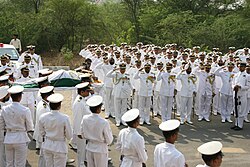
[[File:The Chief of Naval Staff, Admiral Sureesh Mehta along with other senior officers paying salute to Admiral S.M. Nanda, at Brar Square, in New Delhi on May 12, 2009.jpg|thumb|right|300px|CNS Adm Sureesh Mehta and other Naval Officers paying tribute to Adm Nanda.]] | [[File:The Chief of Naval Staff, Admiral Sureesh Mehta along with other senior officers paying salute to Admiral S.M. Nanda, at Brar Square, in New Delhi on May 12, 2009.jpg|thumb|right|300px|CNS Adm Sureesh Mehta and other Naval Officers paying tribute to Adm Nanda.]] | ||
Another incident that caused turmoil in the family was the [[1999 Delhi hit-and-run case]], which involved Admiral Nanda's grandson Sanjeev Nanda. Sanjeev Nanda was found guilty by the [[Supreme Court of India]].<ref>{{cite web |last1=Correspondent |first1=Legal |title=BMW hit-and-run: Court slaps Rs. 50 lakh fine on Nanda |url=https://www.thehindu.com/news/national/BMW-hit-and-run-Court-slaps-Rs.-50-lakh-fine-on-Nanda/article12677698.ece |website=The Hindu |language=en-IN |date=3 August 2012}}</ref> The accident and the trial attracted a lot of media attention and became one of the cases that exemplified middle class India's frustration with rich and powerful people being able to circumvent the law.<ref>{{cite web |title=BMW case: Six lives would have been saved if Sanjeev Nanda showed mercy, says Supreme Court |url=https://www.ndtv.com/india-news/bmw-case-six-lives-would-have-been-saved-if-sanjeev-nanda-showed-mercy-says-supreme-court-495315 |website=NDTV.com}}</ref> | Another incident that caused turmoil in the family was the [[1999 Delhi hit-and-run case]], which involved Admiral Nanda's grandson Sanjeev Nanda. Sanjeev Nanda was found guilty by the [[Supreme Court of India]].<ref>{{cite web |last1=Correspondent |first1=Legal |title=BMW hit-and-run: Court slaps Rs. 50 lakh fine on Nanda |url=https://www.thehindu.com/news/national/BMW-hit-and-run-Court-slaps-Rs.-50-lakh-fine-on-Nanda/article12677698.ece |website=The Hindu |language=en-IN |date=3 August 2012 |access-date=8 May 2020 |archive-date=14 March 2021 |archive-url=https://web.archive.org/web/20210314174837/https://www.thehindu.com/news/national/BMW-hit-and-run-Court-slaps-Rs.-50-lakh-fine-on-Nanda/article12677698.ece |url-status=live }}</ref> The accident and the trial attracted a lot of media attention and became one of the cases that exemplified middle class India's frustration with rich and powerful people being able to circumvent the law.<ref>{{cite web |title=BMW case: Six lives would have been saved if Sanjeev Nanda showed mercy, says Supreme Court |url=https://www.ndtv.com/india-news/bmw-case-six-lives-would-have-been-saved-if-sanjeev-nanda-showed-mercy-says-supreme-court-495315 |website=NDTV.com |access-date=8 May 2020 |archive-date=29 December 2023 |archive-url=https://web.archive.org/web/20231229201217/https://www.ndtv.com/india-news/bmw-case-six-lives-would-have-been-saved-if-sanjeev-nanda-showed-mercy-says-supreme-court-495315 |url-status=live }}</ref> | ||
==Later years and death== | ==Later years and death== | ||
In the later years of his life, Nanda wrote his autobiography titled ''The Man Who Bombed Karachi: A Memoir.''<ref>{{Cite book|title=The Man Who Bombed Karachi: A Memoir|date=October 2015|publisher=HarperCollins Publishers India|isbn=9788172235628}}</ref> The book provides an insider's account and the reminisces how India adapted an inventive strategy to defeat Pakistan, and the 32 years of his naval career.<ref>{{Cite book|title=The Man Who Bombed Karachi: A Memoir {{!}} Hardcover|id={{ASIN|8172235623|country=in}}}}</ref> Nanda participated in interviews on Indian War Heroes, a popular one being the interview by Sushil Sharma in 1997. His tactics in India's victory is still being discussed by channels on YouTube and Indian websites. | In the later years of his life, Nanda wrote his autobiography titled ''The Man Who Bombed Karachi: A Memoir.''<ref>{{Cite book|title=The Man Who Bombed Karachi: A Memoir|date=October 2015|publisher=HarperCollins Publishers India|isbn=9788172235628}}</ref> The book provides an insider's account and the reminisces how India adapted an inventive strategy to defeat Pakistan, and the 32 years of his naval career.<ref>{{Cite book|title=The Man Who Bombed Karachi: A Memoir {{!}} Hardcover|id={{ASIN|8172235623|country=in}}}}</ref> Nanda participated in interviews on Indian War Heroes, a popular one being the interview by Sushil Sharma in 1997. His tactics in India's victory is still being discussed by channels on YouTube and Indian websites. | ||
Admiral Nanda died in [[New Delhi]] on 11 May 2009 at the age of 93. He was survived by his wife Sumitra Nanda (died Feb 2011), son [[Suresh Nanda]] and grandchildren. His funeral was marked with full [[military funeral|military honours]] at Brar Square Crematorium in New Delhi and was attended by top brass of Armed Forces.<ref name=toi-death>{{cite web | url = http://articles.timesofindia.indiatimes.com/2009-05-12/india/28190910_1_indo-pak-war-admiral-s-m-nanda-chief-of-naval-staff | archive-url = https://web.archive.org/web/20120913043308/http://articles.timesofindia.indiatimes.com/2009-05-12/india/28190910_1_indo-pak-war-admiral-s-m-nanda-chief-of-naval-staff | url-status = dead | archive-date = 2012-09-13 | title= Former Naval chief Admiral S M Nanda passes away | date=2009-05-12 | work = [[The Times of India]] | access-date=2011-07-21}}</ref> [[The Telegraph (Kolkata)|The Telegraph]] however wrote that it was not as well attended as his naval career mandated.<ref name=telegraph-obit/> | Admiral Nanda died in [[New Delhi]] on 11 May 2009 at the age of 93. He was survived by his wife Sumitra Nanda (died Feb 2011), son [[Suresh Nanda]] and grandchildren. His funeral was marked with full [[military funeral|military honours]] at Brar Square Crematorium in New Delhi and was attended by top brass of the Armed Forces.<ref name=toi-death>{{cite web | url = http://articles.timesofindia.indiatimes.com/2009-05-12/india/28190910_1_indo-pak-war-admiral-s-m-nanda-chief-of-naval-staff | archive-url = https://web.archive.org/web/20120913043308/http://articles.timesofindia.indiatimes.com/2009-05-12/india/28190910_1_indo-pak-war-admiral-s-m-nanda-chief-of-naval-staff | url-status = dead | archive-date = 2012-09-13 | title= Former Naval chief Admiral S M Nanda passes away | date=2009-05-12 | work = [[The Times of India]] | access-date=2011-07-21}}</ref> [[The Telegraph (Kolkata)|The Telegraph]] however wrote that it was not as well attended as his naval career mandated.<ref name=telegraph-obit/> | ||
==Awards== | ==Awards== | ||
| Line 150: | Line 168: | ||
|} | |} | ||
Source:<ref>{{cite web |url=https://mobile.twitter.com/srikantkesnur/status/1392180530813145092/photo/4 | Source:<ref>{{cite tweet |number=1392180530813145092 |user=srikantkesnur |title=…was the architect of Indian Navy's spectacular show… |archive-date=May 11, 2021 |archive-url=https://web.archive.org/web/20210511181135/https://twitter.com/srikantkesnur/status/1392180530813145092 |url-status=live |access-date=June 13, 2023 |lang=en |url=https://mobile.twitter.com/srikantkesnur/status/1392180530813145092/photo/4}}</ref> | ||
==Dates of rank== | ==Dates of rank== | ||
| Line 156: | Line 174: | ||
! Insignia !! Rank !! Component !! Date of rank | ! Insignia !! Rank !! Component !! Date of rank | ||
|- | |- | ||
|align="center" |[[File: | |align="center" |[[File:British Royal Navy OF-1b-collected.svg|70px]] || [[Sub-lieutenant]] || [[Royal Indian Navy]] || 11 October 1941 (acting){{sfn|Nanda|2004|p=31}} | ||
|- | |- | ||
|align="center" |[[File: | |align="center" |[[File:British Royal Navy OF-2-collected.svg|70px]] || [[Lieutenant (navy)|Lieutenant]] || [[Royal Indian Navy]] || 11 October 1942 (acting)<ref name="Navy List" /><br/>19 October 1946 (substantive){{sfn|Nanda|2004|p=54}} | ||
|- | |- | ||
|align="center" |[[File: | |align="center" |[[File:British Royal Navy OF-3-collected.svg|70px]] || [[Lieutenant commander]] || [[Royal Indian Navy]] || 1948 (acting)<br/>30 June 1949 (substantive) | ||
|- | |- | ||
|align="center" |[[File: | |align="center" |[[File:British Royal Navy OF-4-collected.svg|70px]] || [[Commander]] || [[Royal Indian Navy]] || 30 June 1949 (acting) | ||
|- | |- | ||
|align="center" |[[File:09-Indian_Navy-CDR.svg|35px]][[File:British_Royal_Navy_(sleeves)_OF-4.svg|35px]] || [[Commander]] || [[Indian Navy]] || 26 January 1950 (recommissioning and change in insignia)<ref name="insignia_designs">{{cite web|title=New Designs of Crests and Badges in the Services|url=http://pibarchive.nic.in/archive/ArchiveFirstPhase/HOME%20AFFAIRS/1950/HOM-1950-01-06_484.pdf|website=Press Information Bureau of India – Archive|url-status=live|archive-url=https://web.archive.org/web/20170808193914/http://pib.nic.in/archive/docs/DVD_38/ACC%20NO%20807-BR/HOM-1950-01-06_484.pdf|archive-date=8 August 2017}}</ref><br/>31 December 1950 (substantive)<ref name="ag Cdr"/> | |align="center" |[[File:09-Indian_Navy-CDR.svg|35px]][[File:British_Royal_Navy_(sleeves)_OF-4.svg|35px]] || [[Commander]] || [[Indian Navy]] || 26 January 1950 (recommissioning and change in insignia)<ref name="insignia_designs">{{cite web|title=New Designs of Crests and Badges in the Services|url=http://pibarchive.nic.in/archive/ArchiveFirstPhase/HOME%20AFFAIRS/1950/HOM-1950-01-06_484.pdf|website=Press Information Bureau of India – Archive|url-status=live|archive-url=https://web.archive.org/web/20170808193914/http://pib.nic.in/archive/docs/DVD_38/ACC%20NO%20807-BR/HOM-1950-01-06_484.pdf|archive-date=8 August 2017}}</ref><br/>31 December 1950 (substantive)<ref name="ag Cdr"/> | ||
| Line 194: | Line 212: | ||
{{s-start}} | {{s-start}} | ||
{{s-mil}} | {{s-mil}} | ||
{{s-bef|before=[[Benjamin Abraham Samson]]}} | |||
{{s-ttl|title=[[Chief of Personnel (India)|Chief of Personnel]]|years=1954–1956}} | |||
{{s-aft|after=[[G. S. Kapoor]]}} | |||
{{s-new|reason=First holder}} | |||
{{s-ttl|title=[[Commanding Officer]] {{INS|Mysore|C60|6}}|years=1956–1958}} | |||
{{s-aft|after=[[Sourendra Nath Kohli]]}} | |||
{{s-bef|before=B N Lele}} | |||
{{s-ttl|title=[[Chief of Materiel (India)|Chief of Materiel]]|years=1962–1962}} | |||
{{s-aft|after=C L Bhandari}} | |||
{{s-bef|before=[[Adhar Kumar Chatterji]]}} | {{s-bef|before=[[Adhar Kumar Chatterji]]}} | ||
{{s-ttl|title=[[Chief of the Naval Staff (India)|Chief of the Naval Staff]]|years= | {{s-ttl|title=[[Deputy Chief of the Naval Staff (India)|Deputy Chief of the Naval Staff]]|years=1962–1964}} | ||
{{s-aft|after=[[Sourendra Nath Kohli]]}} | {{s-aft|rows=2|after=[[Sourendra Nath Kohli]]}} | ||
{{s-bef|before=[[Benjamin Abraham Samson]]}} | |||
{{s-ttl|title=[[Flag Officer Commanding Indian Fleet]]|years=1966–1967}} | |||
{{s-bef|before=R S David}} | |||
{{s-ttl|title=[[Western Naval Command#List of Commanders|Flag Officer Bombay]]|years=1967–1968}} | |||
{{s-non|reason=Office abolished}} | |||
{{s-new|reason=Office created}} | {{s-new|reason=Office created}} | ||
{{s-ttl|title=[[Flag Officer Commanding-in-Chief Western Naval Command]]|years= | {{s-ttl|title=[[Flag Officer Commanding-in-Chief Western Naval Command]]|years=1968–1970}} | ||
{{s-aft|after=[[Nilakanta Krishnan]]}} | {{s-aft|after=[[Nilakanta Krishnan]]}} | ||
{{s-bef|before=[[Adhar Kumar Chatterji]]}} | {{s-bef|before=[[Adhar Kumar Chatterji]]}} | ||
{{s-ttl|title=[[ | {{s-ttl|title=[[Chief of the Naval Staff (India)|Chief of the Naval Staff]]|years=1970–1973}} | ||
{{s-aft|after=[[Sourendra Nath Kohli]]}} | {{s-aft|after=[[Sourendra Nath Kohli]]}} | ||
{{s-bef|before=[[ | {{s-gov}} | ||
{{s-ttl|title=[[ | {{s-bef|before=[[Chandrika Prasad Srivastava]]}} | ||
{{s-aft|after= | {{s-ttl|title=Chairman and Managing Director, [[Shipping Corporation of India]]|years=1974–1977}} | ||
{{s-aft|after=Krishan Dev}} | |||
{{s-end}} | {{s-end}} | ||
| Line 232: | Line 254: | ||
[[Category:Royal Indian Navy officers]] | [[Category:Royal Indian Navy officers]] | ||
[[Category:Flag Officers Commanding Indian Fleet]] | [[Category:Flag Officers Commanding Indian Fleet]] | ||
[[Category:Deputy | [[Category:Deputy chiefs of Naval Staff (India)]] | ||
[[Category:Indian military personnel of the | [[Category:Indian military personnel of the India–Pakistan war of 1971]] | ||
[[Category:Military personnel from Punjab, India]] | [[Category:Military personnel from Punjab, India]] | ||
[[Category:Admirals of the | [[Category:Admirals of the India–Pakistan war of 1971]] | ||
[[Category:Recipients of the Param Vishisht Seva Medal]] | [[Category:Recipients of the Param Vishisht Seva Medal]] | ||
[[Category: | [[Category:Graduates of the Royal College of Defence Studies]] | ||
[[Category:Chiefs of Materiel (India)]] | [[Category:Chiefs of Materiel (India)]] | ||
[[Category:Chiefs of Personnel (India)]] | [[Category:Chiefs of Personnel (India)]] | ||
[[Category:People from Punjab Province (British India)]] | |||
[[Category:Punjabi Hindus]] | |||
Latest revision as of 12:23, 19 March 2026
S M Nanda | |
|---|---|
 Admiral Nanda as Chief of Naval Staff | |
| 6th Chief of the Naval Staff | |
| In office 28 February 1970 – 28 February 1973 | |
| President | V. V. Giri |
| Prime Minister | Indira Gandhi |
| Preceded by | Adhar Kumar Chatterji |
| Succeeded by | Sourendra Nath Kohli |
| Personal details | |
| Born | 10 October 1915 Manora, Karachi, British India |
| Died | 11 May 2009 (aged 93) New Delhi, India |
| Occupation | Chairman and Managing Director Shipping Corporation of India Member of the Board of Directors, Crown Corporation |
| Awards | Padma Vibhushan Param Vishisht Seva Medal Ati Vishisht Seva Medal |
| Nickname(s) | Charles |
| Military service | |
| Allegiance |  British India (1941–1947) British India (1941–1947) India (1947–1973) India (1947–1973) |
| Branch/service |  Royal Indian Navy (1941–1947) Royal Indian Navy (1941–1947) Indian Navy (1947–1973) Indian Navy (1947–1973) |
| Years of service | 1941–1973 |
| Rank |   Admiral
 |
| Commands | |
| Battles/wars | |
Admiral Sardarilal Mathradas "Charles" Nanda, PVSM, AVSM (10 October 1915 – 11 May 2009) was an Indian Navy admiral who served as the 6th Chief of the Naval Staff from 1 March 1970 until 28 February 1973.[1] He led the Indian Navy during the Indo-Pakistani War of 1971 and successfully executed a naval blockade of both West and East Pakistan, helping India achieve an overwhelming victory during the war.[2] For the important role he played in the war, the Government of India awarded him the Padma Vibhushan, India's second-highest civilian award.[3] Nanda is recognised as one of the most notable commanders in the history of the Indian Navy.
Born in Manora, Karachi, in the Sind Province of British India, Nanda joined the Royal Indian Naval Volunteer Reserve in 1941. During World War II, he served onboard HMIS Travancore and as an instructor at the signals school in HMIS Talwar. After the war, he served on board HMIS Narbada (U40) which was based out of Japan as part of the British occupation forces. He subsequently served as the communication officer of HMIS Cauvery (U10).
Following the Independence of India, he was appointed executive officer of Cauvery, and in 1948, was appointed first lieutenant of the flagship HMIS Delhi (C74). In 1949, he was appointed director of personnel services at NHQ and in 1950 took command of the R-class destroyer INS Ranjit (1949), which represented India at the coronation review of the fleet. Nanda subsequently commanded the -class sloop INS Jamuna (U21) and the 16th frigate squadron. In 1954, he was appointed Chief of Personnel and constituted commodore 2nd class in September 1956. Appointed the commissioning commanding officer of the new flagship of the Navy, the Crown Colony-class cruiser INS Mysore (C60), he commissioned the ship in August 1957 at Birkenhead. In 1958, he took over as the Director General Naval Dockyard Expansion Scheme. After attending the Imperial Defence College in 1962, he returned to India and was appointed Chief of Materiel at NHQ.
Promoted to flag rank in May 1962, Nanda was appointed the Deputy Chief of the Naval Staff. As DCNS, he played an important role in the development of Goa as a naval base. In 1964, he took over as the managing director of Mazagon Dock Limited. In 1966, he was appointed Flag Officer Commanding Indian Fleet and then Flag Officer Bombay in 1968. The Bombay command was upgraded and Nanda took over as the first Flag Officer Commanding-in-Chief Western Naval Command in the rank of vice admiral. On 1 March 1970, he took command as the seventh Chief of the Naval Staff. Under his command, the Navy attacked Karachi with missile boats and bombarded ports in East Pakistan with aircraft of INS Vikrant, apart from successfully enforcing naval blockades on two fronts. He was awarded the Padma Vibhushan, the second-highest civilian award, and awards for distinguished service – the Param Vishisht Seva Medal and the Ati Vishisht Seva Medal.
Early life and education[edit | edit source]
Nanda was born on 10 October 1915 to Mathra Das, an office superintendent at the workshop of the Port Trust in Manora, Karachi and Pooran Devi. His parents were from villages near Gujranwala in the Punjab Province.[4] He was born in a Punjabi Hindu Khatri family.[5] He was raised on Manora Island at the entrance to the Port of Karachi.[1][6] He was the eldest of seven children – three boys and four girls. He attended a primary school on the island and then the N J High School in Karachi. He worked for the Port and Pilotage department at Manora after finishing his schooling.[4]
After the outbreak of World War II, he applied for a commission in the Royal Indian Naval Volunteer Reserve (RINVR). He appeared before a selection board in Bombay in September 1941. Successful in the written test and the interview, he was commissioned in the RINVR on 11 October 1941 as an acting sub-lieutenant in the Executive Branch.[7]
[edit | edit source]
Early career[edit | edit source]
Nanda started his career with a training course for six months on the Deepawati. He was then sent to Calcutta for his next assignment. At Calcutta, he was asked to go to Khulna and take command of a river steamer and patrol the Sundarbans. In June 1942, he was selected for a specialist communications course at HMIS Talwar, the Signals School in Colaba, Bombay. After the course, he served as the signals officer on board the minesweeper HMIS Travancore.[8] In October 1942, he was promoted to the acting rank of lieutenant and appointed an instructor at the Signals School.[9] After the end of the war, he stayed in the Navy despite rapid, large-scale demobilisation. He appeared before a selection board in Lonavala on 31 October 1945.
Nanda was serving at the Signals School at HMIS Talwar when the Royal Indian Navy mutiny broke out in February 1946. The mutiny first started at HMIS Talwar and spread to ships and other shore establishments.[10] The mutiny was called off after the sailors met with Sardar Vallabhbhai Patel. He was asked by the sailors to accompany them, which he did.[11]
In June 1946, he was posted to the sloop HMIS Narbada (U40), which was to sail for Japan from Madras. The ship was based out of Kure, Hiroshima, as part of the British occupation forces and was later transferred to Sasebo, Nagasaki, as part of the US occupation forces. On 19 October 1946 he was granted a permanent commission in the Royal Indian Navy (RIN) as a Lieutenant with backdated seniority of 10 October 1940.[12] In January 1947, he was appointed communications officer of the sloop HMIS Cauvery (U10), then deployed at Karachi.
Post-Independence[edit | edit source]
After the partition of India, the Cauvery was assigned to India and she set sail for Bombay. The British officers embarked for England and Nanda was appointed executive officer of the ship. HMIS Kistna (U46) and Cauvery commanded by Commander Ram Dass Katari and Commander Reggie Sawhney respectively made two trips to the United Kingdom. This was because the cruiser HMS Achilles (70) was being purchased by India and renamed HMIS Delhi and the crew was to be transported.[13] In 1948, he was promoted to the acting rank of lieutenant commander and appointed first lieutenant of HMIS Delhi (C74) under the command of Captain H.N.S. Brown, with Commander Ram Dass Katari as his executive officer.[1] To train for this appointment, he was ordered to join the Mediterranean Fleet. He served on board the aircraft carrier HMS Triumph (R16) and subsequently on the cruiser HMS Newcastle (C76).[14]
HMIS Delhi was commissioned on 5 July 1948 by the High Commissioner of India to the United Kingdom V. K. Krishna Menon. On her way to India, she called at Portsmouth, Portland, Gibraltar and Malta. The Prime Minister of India Jawaharlal Nehru himself welcomed the ship at Bombay.[15] She went on a cruise round the coasts of India, calling at Karwar, Cochin, Trincomalee, Madras, Vizag, Calcutta, Port Blair, Colombo and Calicut before returning to Bombay.[16] In May 1949, she left on her Indian Ocean cruise. She called at Victoria, Seychelles, Port Louis in Mauritius, Dar es Salaam in Tanzania and Mombasa in Kenya. The cruise to the Indian Ocean republics and East Africa generated a tremendous amount of goodwill.[17][18]
On 30 June 1949, at the end of the goodwill mission, Nanda was promoted substantive lieutenant-commander and to the acting rank of Commander.[19] He was appointed director of personnel services (DPS) at Naval headquarters.[20] Nanda was promoted to substantive commander on 31 December 1950.[21] He served as the DPS for about two years. On 10 October 1951, he took command of the R-class destroyer, INS Ranjit (1949).[22] The Ranjit was part of the 11th Destroyer Squadron commanded by Captain Ram Dass Katari. The other two ships in the squadron were INS Rajput (D141) and INS Rana (1942).[23] Nanda took the ship on a goodwill cruise to Singapore, Saigon, Jakarta and other ports in Indonesia like Bali. In Jakarta, he called on and was received by the first President of Indonesia, Sukarno.[24]
In early 1952, Princess Elizabeth and Prince Philip, Duke of Edinburgh set out for a tour of Australia and New Zealand by way of Kenya. The Rajput and the Ranjit were nominated to escort the HMY Britannia from Mombasa to Australia.[25] With the death of King George VI, this was cancelled. To commemorate the Coronation of Elizabeth II, a massive Coronation review of the fleet was held at Portsmouth. The flagship INS Delhi, commanded by Captain Adhar Kumar Chatterji, destroyer INS Ranjit, commanded by Nanda, and the frigate INS Tir (K256), commanded by Commander Nilakanta Krishnan, represented India at the review.[26] A naval armada consisting of ships from the Indian Navy, Royal Navy, Royal Australian Navy and the Royal New Zealand Navy sailed from Portsmouth to Gibraltar. The fleet carried out exercises along the way and was under the command of Lord Mountbatten. The Ranjit under Nanda acquitted itself well during these exercises. Subsequently, the Indian ships continued conducting exercises with the Mediterranean Fleet. They sailed from Gibraltar to Malta, the Greek islands and to Istanbul.[27]
Nanda took command of INS Jamuna (U21) on 31 August 1953 after returning to Bombay. He was also appointed Captain (F) 12th Frigate Squadron. On 15 February 1954, he was promoted to the acting rank of captain and appointed CAPBRAX (captain naval barracks) and commanding officer of INS Angre. After a short stint, he was transferred back to Naval Headquarters as Chief of Personnel (COP) in September 1954. He was promoted to substantive captain on 31 December 1954.[28] He served as the COP for about two and a half years. In September 1956, he was promoted to commodore 2nd Class.[29]
In December 1956, he was appointed the commissioning commanding officer of INS Mysore (C60). The Crown Colony-class cruiser HMS Nigeria (60) was being refitted and modernised in Birkenhead, Liverpool, to be commissioned as the Mysore. He spent a few months in UK preparing his crew. INS Mysore was commissioned on 29 August 1957 by the High Commissioner of India to the United Kingdom Vijaya Lakshmi Pandit. Nanda took the ship to the Mediterranean and subsequently paid an official visit to the port of Split in Socialist Federal Republic of Yugoslavia. He called on President Josip Broz Tito at his home in the Brioni Islands. Returning to India, Nanda and the Mysore were welcomed by the entire Indian Fleet, commanded by the first Indian Fleet Commander Rear Admiral Ram Dass Katari. Katari's flag was transferred from INS Delhi to INS Mysore, thus becoming the new flagship of the Indian Fleet.[30] The Prime Minister Jawaharlal Nehru visited the ship at Bombay and hosted a dinner on board with the Governor of Maharashtra Ali Yavar Jung, the Minister of Defence V. K. Krishna Menon, Chief Minister of Maharashtra Vasantrao Naik being present.[31] After visiting the ports in India, Nanda took the ship to a goodwill visit to China and Japan in the summer of 1958. She called at Singapore, Hong Kong, Shanghai and Yokohama. On the return passage, she called at Haiphong. Before leaving India for the goodwill visit, Nanda had been selected to attend the Imperial Defence College (IDC) and was to embark for the UK after completing the visit. Instead he was informed after departing from Haiphong that his deputation to IDC stood cancelled.[32]
Personally selected by the Defence Minister V K Krishna Menon, Nanda took over as the Director General Naval Dockyard Expansion Scheme (DG-NDES) on 1 October 1958. He undertook a major expansion of the dockyard.[33] He extended the dimensions of the cruiser dock to accommodate the aircraft carrier HMS Hercules (R49) being acquired from the UK. This resulted in tremendous advantage for the Indian Navy. For distinguished service during his tenure as DG-NDES, Nanda was awarded the Ati Vishisht Seva Medal in 1961.[34] In June 1960, he was appointed Officer on Special Duty (OSD) at Naval HQ.[35] Nanda was selected to attend the Imperial Defence College and embarked for the UK in early 1961. After completing the year-long course, he returned to India and was appointed Chief of Materiel (COM) in February 1962.[36]
Flag rank[edit | edit source]
In May 1962, Nanda was promoted to the acting rank of rear admiral and appointed Deputy Chief of Naval Staff.[37][38] As DCNS, he was instrumental in obtaining permission and clearance from the Government of India (GOI) for the naval development of the port at Goa, which was recently annexed. Given the difficulty India had in negotiating the purchase of INS Vikrant from the UK, Nanda supported the acquisition of equipment from the Soviet Union. Promoted to substantive rear-admiral on 16 June 1964,[39] Nanda was appointed managing director of Mazagon Dock Limited in December 1964. He undertook preparations for the construction of -class frigates, the first major naval vessels to be constructed in India. After a 18-month tenure, he handed over charge to Rear Admiral Benjamin Abraham Samson in May 1966. Shortly afterwards, in October, the keel of the first frigate INS Nilgiri (F33) was laid.[40] For his distinguished service as MD of Mazagon Dock, he was awarded the Param Vishisht Seva Medal in January 1966.[41]
On 1 June 1966, Nanda took command of the Indian Fleet as the Flag Officer Commanding Indian Fleet at Bombay.[42] Flying his flag, the fleet visited the Persian Gulf in April 1967. The INS Vikrant visited Bahrain and Kuwait, while her escorts INS Trishul (F143) and INS Talwar (F140) visited Abadan and Basra. The fleet tanker INS Deepak joined the fleet under Nanda.[43]
Nanda took over as Flag Officer Bombay (FOB) on 1 February 1968. In March 1968, the reorganisation of the Navy took place. Posts were upgraded and created at the Naval HQ as well as the naval commands. Nanda was promoted to the rank of vice admiral and became the first Flag Officer Commanding-in-Chief (FOC-in-C) Western Naval Command.[44][45][46] Nanda organised the Navy Week in December 1969 which culminated with the review of the Indian Naval Fleet by President V. V. Giri. A successful event, it raised the navy's profile in Bombay. The Navy Week involved the businessmen, industrialists, Bollywood stars and the society at large. Funds were raised and a Sailors' home and an Officers' Mess was also built.[47]
[edit | edit source]

In November 1969, the GOI decided to appoint Nanda as the next CNS in succession to Admiral Adhar Kumar Chatterji.[48] On 1 March 1970, Nanda took command as the 7th Chief of the Naval Staff of the Indian Navy.[49] The 1962 Sino-Indian War was largely fought over the Himalayas and the Navy did not have a major role. During the Indo-Pakistani War of 1965, the Navy was ordered to stay within Indian waters. When the Pakistan Navy bombarded Dwarka, Nanda recognised the need to raise the Navy's profile and capabilities. He was determined to change the mindset of the service from defence to attack.[50] He got the opportunity to demonstrate this capability the following year during the war with Pakistan.
Indo-Pakistani War of 1971[edit | edit source]
The Indo-Pakistani War of 1971 was sparked by the Bangladesh Liberation war, a conflict between the traditionally dominant West Pakistanis and the majority East Pakistanis. In 1970, East Pakistanis demanded autonomy for the state, but the Pakistani government failed to satisfy these demands and, in early 1971, a demand for secession took root in East Pakistan. In March, the Pakistan Armed Forces launched a fierce campaign to curb the secessionists, the latter including soldiers and police from East Pakistan. Thousands of East Pakistanis died, and nearly ten million refugees fled to West Bengal, an adjacent Indian state. In April, India decided to assist in the formation of the new nation of Bangladesh.[51]
Nanda was instrumental in framing India's Naval strategy during the war. He feigned a defensive deployment southeast towards the Andaman Islands, instead moving his Eastern fleet northwards into the Bay of Bengal and enforcing a naval blockade against East Pakistan.

His strategy against West Pakistan was to strike hard against Pakistan's main port of Karachi.[1] He is recognized as the mastermind behind Operation Trident and Operation Python.[52] The plan for the operations included towing the limited-range -class missile boats, primarily designed for coastal defence, to about 250 nautical miles (460 km) south of Karachi during the day, out of range of the Pakistan Air Force aircraft.[53] The missile boats then closed in on Karachi port at night and attacked naval targets as well as the oil tank farm at Keamari. Operation Trident was successfully executed on 4 December 1971, sinking the Pakistan Navy destroyer PNS Khaibar, minesweeper PNS Muhafiz, an ammunition-carrying ship MV Venus Challenger and irreparably damaging another destroyer PNS Shah Jahan as well as destroying numerous oil storage tanks. Operation Python was again successfully carried out on 8 December 1971.
On the Eastern front, Nanda made the decision to deploy the aircraft carrier INS Vikrant into the shallower waters of the Gulf of Bengal off Dhaka, to prevent the risk of a submarine attack. When concerns were raised about Vikrant's boilers being cracked, he took personal responsibility for the risk of a boiler explosion and catapult failure on the carrier. His gambit paid off, as Vikrant was able to successfully enforce the blockade of East Pakistan without any such damage to the carrier.
The war lasted less than a fortnight and saw more than 90,000 Pakistani soldiers taken prisoner. It ended with the unconditional surrender of Pakistan's eastern half and resulted in the birth of Bangladesh as a new nation.[54] In addition to the POWs, Pakistan suffered 6,000 casualties against India's 2,000.[55] The success of the naval blockades on two fronts is considered one of the primary factors in India's overwhelming victory during the war. For his services to the nation, he was awarded the Padma Vibhushan in January 1972.[1][3][56] The citation for the Padma Vibhushan reads as follows:[57]
CITATION
Admiral Sardarilal Mathradas Nanda, PVSMAdmiral Sardarilal Mathradas Nanda, Chief of the Naval Staff, India, since 1" March 1970, has forged the Indian Navy into an efficient striking force and brought it to the pinnacle of its achievement during the recent conflict with Pakistan. Admiral Nanda personally directed the re-organisation of the Indian Navy and guided the training of its officers and men. Under his able direction the Pakistan fleet was contained in its harbours and prevented from hitting at our shupping and at our ports. The Western Fleet mounted two daring attacks, in which ports and shore installations at Karachi were severely damaged and the strength of the Pakistani fleet was seriously crippled. The Pakistani Naval craft in Bangla Desh and the Bay of Bengal were severely mauled. The Pakistani occupation forces were cut off from their sources of supply and their escape routes were effectively sealed. The Eastern Fleet provided close support to the combined operations in Bangla Desh and to the liberation struggle.
Admiral Nanda's strategy made it possible for the Indian Navy to dominate both the Bay of Bengal and the Arabian Sea off the Pakistani coast. Pakistani ports were effectively blocked and a number of ships carrying contraband to Pakistan were intercepted. Our own ports remained open to all merchant shipping and the plans of the Pakistani Navy to interfere with our merchant shipping on high seas were effectively frustrated.
Post-retirement[edit | edit source]
Nanda retired from the Indian Navy on 30 August 1973.[58] He was appointed chairman and managing director (CMD) of the largest shipping company in India, the Shipping Corporation of India (SCI) in May 1974.[59]
Personal life[edit | edit source]
At the age of 21, Nanda was married to Sumitra, a lady chosen by his parents. The marriage was harmonious and lasted all their lives, during which they were fated to suffer many vicissitudes together, ranging from the partition of India which uprooted them from their native land, to the heights of honour when Nanda became chief of the Indian Navy. The couple were the parents of several children, including a son, Suresh Nanda (ex-naval officer and businessman) and Beena Mehra, wife of Major Pradeep Kumar Mehra, an army officer and polo enthusiast who founded and ran Usha Stud Farm on the outskirts of Delhi.
Nanda suffered a personal tragedy on 2 January 2002 when his daughter Beena, her husband and their daughter Radhika were killed in a helicopter crash while flying from Mussourie to Dehradun Airport after attending a New Year's Day party. Their other two daughters, Ameeta and Devika, survived since they were not on the helicopter; Ameeta Mehra now runs Usha Stud Farm.[60]
Controversies[edit | edit source]
Following his retirement, Nanda took an executive role with Crown Corporation, an arms trading firm headed by his son Suresh Nanda, which specialized in supply of imported weapons to the Indian Armed Forces.[61] The organization was surrounded by a controversy when Operation West End a sting-operation which aimed to expose corruption between India's defence ministry and Crown Corporation. The allegation on Admiral Nanda's son, Suresh Nanda, was closed by CBI when no evidence was found.[62]

Another incident that caused turmoil in the family was the 1999 Delhi hit-and-run case, which involved Admiral Nanda's grandson Sanjeev Nanda. Sanjeev Nanda was found guilty by the Supreme Court of India.[63] The accident and the trial attracted a lot of media attention and became one of the cases that exemplified middle class India's frustration with rich and powerful people being able to circumvent the law.[64]
Later years and death[edit | edit source]
In the later years of his life, Nanda wrote his autobiography titled The Man Who Bombed Karachi: A Memoir.[65] The book provides an insider's account and the reminisces how India adapted an inventive strategy to defeat Pakistan, and the 32 years of his naval career.[66] Nanda participated in interviews on Indian War Heroes, a popular one being the interview by Sushil Sharma in 1997. His tactics in India's victory is still being discussed by channels on YouTube and Indian websites.
Admiral Nanda died in New Delhi on 11 May 2009 at the age of 93. He was survived by his wife Sumitra Nanda (died Feb 2011), son Suresh Nanda and grandchildren. His funeral was marked with full military honours at Brar Square Crematorium in New Delhi and was attended by top brass of the Armed Forces.[67] The Telegraph however wrote that it was not as well attended as his naval career mandated.[1]
Awards[edit | edit source]
    
| ||||
    
| ||||
   
| ||||
   
| ||||
 
|
Source:[68]
Dates of rank[edit | edit source]
| Insignia | Rank | Component | Date of rank |
|---|---|---|---|
 |
Sub-lieutenant | Royal Indian Navy | 11 October 1941 (acting)[69] |
 |
Lieutenant | Royal Indian Navy | 11 October 1942 (acting)[9] 19 October 1946 (substantive)[11] |
 |
Lieutenant commander | Royal Indian Navy | 1948 (acting) 30 June 1949 (substantive) |
 |
Commander | Royal Indian Navy | 30 June 1949 (acting) |
 _OF-4.svg) |
Commander | Indian Navy | 26 January 1950 (recommissioning and change in insignia)[70] 31 December 1950 (substantive)[19] |
 _OF-5.svg) |
Captain | Indian Navy | 15 February 1954 (acting)[71] 31 December 1954[28] |
 _OF-6.svg) |
Commodore | Indian Navy | September 1956 (2nd class)[29] February 1962 (substantive)[36] |
 _OF-7.svg) |
Rear admiral | Indian Navy | 14 May 1962 (acting)[37] 16 June 1964 (substantive)[39] |
 _OF-8.svg) |
Vice admiral | Indian Navy | 1 March 1968[46] |
_OF-9.svg) |
Admiral | Indian Navy | 1 March 1970[49] |
See also[edit | edit source]
References[edit | edit source]
- ↑ 1.0 1.1 1.2 1.3 1.4 1.5 "Naval Obituaries: Admiral Sardarilal Nanda". The Telegraph. 16 June 2009. Archived from the original on 14 February 2018. Retrieved 20 July 2011.
- ↑ "The man who bombed Karachi". Indian Express. Archived from the original on 25 September 2012. Retrieved 7 February 2007.
- ↑ 3.0 3.1 "National Portal of India". Archived from the original on 27 April 2009. Retrieved 19 July 2007.
- ↑ 4.0 4.1 Nanda 2004, pp. 18–20.
- ↑ Puri, Baij Nath (1988). The Khatris, a Socio-cultural Study. M.N. Publishers and Distributors. pp. 175–176.
- ↑ "Karachi burned for seven days". Rediff. 18 January 2007. Archived from the original on 16 December 2008. Retrieved 2 June 2009.
- ↑ Nanda 2004, pp. 27–31.
- ↑ Nanda 2004, pp. 35–41.
- ↑ "Royal Indian Navy (Mutiny)". Parliamentary Debates (Hansard). 22 February 1946. Archived from the original on 2 March 2022. Retrieved 7 June 2012.
- ↑ 11.0 11.1 Nanda 2004, p. 54.
- ↑ Nanda 2004, pp. 54–58.
- ↑ Nanda 2004, p. 61.
- ↑ Nanda 2004, pp. 63–67.
- ↑ Singh 1986, pp. 70–71.
- ↑ "PIB (Defence Wing)" (PDF). pibarchive.nic.in. 13 October 1948.
- ↑ "HMIS Delhi's Indian Ocean cruise" (PDF). pibarchive.nic.in. 27 April 1949.
- ↑ "H.M.I.S. DELHI RECEIVES GREAT WELCOME IN MAURITIUS" (PDF). pibarchive.nic.in. 30 May 1949.
- ↑ 19.0 19.1 "Part I-Section 4: Ministry of Defence (Navy Branch)". The Gazette of India. 9 July 1949. p. 953.
- ↑ Nanda 2004, p. 75.
- ↑ "Part I-Section 4: Ministry of Defence (Navy Branch)". The Gazette of India. 13 January 1951. p. 8.
- ↑ "NEW COMMANDING OFFICERS FOR IN DESTROYER FLOTILLA" (PDF). pibarchive.nic.in. 12 November 1951.
- ↑ "CAPTAIN KATARI TO TAKE COMMAND OF DESTROYER FLOTILLA" (PDF). pibarchive.nic.in. 26 November 1951.
- ↑ Nanda 2004, pp. 78–79.
- ↑ "IN DESTROYERS FOR ROYAL ESCORT" (PDF). pibarchive.nic.in. 18 December 1951.
- ↑ Katari 1983.
- ↑ Nanda 2004, pp. 78–81.
- ↑ 28.0 28.1 "Part I-Section 4: Ministry of Defence (Navy Branch)". The Gazette of India. 15 January 1955. p. 15.
- ↑ 29.0 29.1 "Part I-Section 4: Ministry of Defence (Navy Branch)". The Gazette of India. 27 April 1957. p. 107.
- ↑ Singh 1991, p. 80.
- ↑ "PRIME MINISTER TO VISIT FLAGSHIP INS MYSORE" (PDF). pibarchive.nic.in. 22 March 1958.
- ↑ Nanda 2004, pp. 94–100.
- ↑ "Part I-Section 4: Ministry of Defence (Navy Branch)". The Gazette of India. 16 January 1960. p. 13.
- ↑ "Republic Day Awards" (PDF). pibarchive.nic.in. 25 January 1961. Archived (PDF) from the original on 21 July 2020. Retrieved 7 May 2020.
- ↑ Nanda 2004, pp. 106–109.
- ↑ 36.0 36.1 Abidi & Sharma 2007, p. 25.
- ↑ 37.0 37.1 "Part I-Section 4: Ministry of Defence (Navy Branch)". The Gazette of India. 15 June 1963. p. 207.
- ↑ "NEW DEPUTY CHIEF OF NAVAL STAFF" (PDF). pibarchive.nic.in. 14 May 1962. Archived (PDF) from the original on 1 February 2020. Retrieved 7 May 2020.
- ↑ 39.0 39.1 "Part I-Section 4: Ministry of Defence (Navy Branch)". The Gazette of India. 19 September 1964. p. 383.
- ↑ Nanda 2004, pp. 139–144.
- ↑ "VISHISHT SEVA MEDAL CLASS I FOR NINE OFFICERS" (PDF). pibarchive.nic.in. 26 January 1966.
- ↑ "ADMIRAL NANDA TO COMMAND INDIAN FLEET" (PDF). pibarchive.nic.in. 24 May 1966. Archived (PDF) from the original on 2 February 2020. Retrieved 8 May 2020.
- ↑ Nanda 2004, pp. 150–151.
- ↑ "Reorganisation of Naval Commands" (2 March 1968). pibarchive.nic.in. Archived (PDF) from the original on 2 February 2020. Retrieved 8 May 2020.
- ↑ "UPGRADATIONS IN DEFENCE SERVICES APPOINTMENTS" (PDF). pibarchive.nic.in. 1 March 1968. Archived (PDF) from the original on 2 February 2020. Retrieved 8 May 2020.
- ↑ 46.0 46.1 "Part I-Section 4: Ministry of Defence (Navy Branch)". The Gazette of India. 23 March 1968. p. 245.
- ↑ Nanda 2004, pp. 156–160.
- ↑ "VICE-ADMIRAL NANDA NEXT CHIEF OF NAVAL STAFF" (PDF). pibarchive.nic.in. 15 November 1969.
- ↑ 49.0 49.1 "Part I-Section 4: Ministry of Defence (Navy Branch)". The Gazette of India. 6 June 1970. p. 703.
- ↑ "Admiral Sardarilal Nanda". The Telegraph. Archived from the original on 14 February 2018. Retrieved 2 April 2018.
- ↑ "Indo-Pakistani War of 1971". Global Security. Archived from the original on 26 November 2016. Retrieved 27 November 2016.
- ↑ "Former Naval chief S M Nanda dies". The Times of India. 13 May 2009. Retrieved 22 November 2011.
{{cite news}}: CS1 maint: deprecated archival service (link) - ↑ "Indian Navy's War Hero passes away: Cmde Babru Yadav led the Missile Boat Attack on Karachi in 1971". India Strategic. April 2010. Archived from the original on 4 October 2011. Retrieved 21 July 2011.
- ↑ Singh 2005, pp. 210–211.
- ↑ Athale, Anil (12 December 2011). "Three Indian blunders in the 1971 war". Rediff. Archived from the original on 23 November 2016. Retrieved 27 November 2016.
- ↑ "Press Communique" (PDF). pibarchive.nic.in. 15 January 1972.
- ↑ Nanda 2004.
- ↑ "Part I-Section 4: Ministry of Defence (Navy Branch)" (PDF). The Gazette of India. 30 March 1974. p. 397.
- ↑ "ADMIRAL S.M. NANDA TAKES OVER AS SCI CHAIRMAN" (PDF). pibarchive.nic.in. 27 May 1974.
- ↑ Nanda 2004, pp. 32–33.
- ↑ "'The man who bombed Karachi' dead". The Telegraph India. 13 May 2009. Archived from the original on 16 May 2009. Retrieved 21 July 2011.
- ↑ "CBI closes Barak scandal case for lack of evidence". The Times of India. Archived from the original on 9 July 2024. Retrieved 5 May 2020.
- ↑ Correspondent, Legal (3 August 2012). "BMW hit-and-run: Court slaps Rs. 50 lakh fine on Nanda". The Hindu. Archived from the original on 14 March 2021. Retrieved 8 May 2020.
{{cite web}}:|last1=has generic name (help) - ↑ "BMW case: Six lives would have been saved if Sanjeev Nanda showed mercy, says Supreme Court". NDTV.com. Archived from the original on 29 December 2023. Retrieved 8 May 2020.
- ↑ The Man Who Bombed Karachi: A Memoir. HarperCollins Publishers India. October 2015. ISBN 9788172235628.
- ↑ The Man Who Bombed Karachi: A Memoir | Hardcover. ASIN 8172235623.
- ↑ "Former Naval chief Admiral S M Nanda passes away". The Times of India. 12 May 2009. Archived from the original on 13 September 2012. Retrieved 21 July 2011.
- ↑ @srikantkesnur (11 May 2021). "…was the architect of Indian Navy's spectacular show…" (Tweet). Archived from the original on 11 May 2021. Retrieved 13 June 2023 – via Twitter.
- ↑ Nanda 2004, p. 31.
- ↑ "New Designs of Crests and Badges in the Services" (PDF). Press Information Bureau of India – Archive. Archived (PDF) from the original on 8 August 2017.
- ↑ Nanda 2004, p. 85.
Bibliography[edit | edit source]
- Nanda, S.M. (2004), The man who bombed Karachi, HarperCollins Publishers India, ISBN 978-8172235628
- Singh, Satyindra (1986), Under two ensigns: The Indian Navy, 1945–1950, Oxford & IBH Pub. Co, ISBN 978-8120400948
- Singh, Satyindra (1991), Blueprint to bluewater: The Indian Navy, 1951–65, Lancer International, ISBN 978-8170621485
- Abidi, S Sartaj Alam; Sharma, Satinder (2007), Services Chiefs of India, Northern Book Centre, ISBN 978-8172111625
- Katari, Ram Dass (1983), A Sailor Remembers, Vikas, ISBN 9780706920642
| Military offices | ||
|---|---|---|
| Preceded by Benjamin Abraham Samson |
Chief of Personnel 1954–1956 |
Succeeded by G. S. Kapoor |
| New title First holder
|
Commanding Officer INS Mysore 1956–1958 |
Succeeded by Sourendra Nath Kohli |
| Preceded by B N Lele |
Chief of Materiel 1962–1962 |
Succeeded by C L Bhandari |
| Preceded by Adhar Kumar Chatterji |
Deputy Chief of the Naval Staff 1962–1964 |
Succeeded by Sourendra Nath Kohli |
| Preceded by Benjamin Abraham Samson |
Flag Officer Commanding Indian Fleet 1966–1967 | |
| Preceded by R S David |
Flag Officer Bombay 1967–1968 |
Office abolished |
| New title Office created
|
Flag Officer Commanding-in-Chief Western Naval Command 1968–1970 |
Succeeded by Nilakanta Krishnan |
| Preceded by Adhar Kumar Chatterji |
Chief of the Naval Staff 1970–1973 |
Succeeded by Sourendra Nath Kohli |
| Government offices | ||
| Preceded by Chandrika Prasad Srivastava |
Chairman and Managing Director, Shipping Corporation of India 1974–1977 |
Succeeded by Krishan Dev |
| Chief of the Naval Staff and Commander-in-Chief, Indian Navy (1950-1955) |  | |
|---|---|---|
| Chief of the Naval Staff (1955–present) |
(incumbent) | |
**Seconded from the Royal Navy | ||


- Pages using the JsonConfig extension
- 1915 births
- 2009 deaths
- Recipients of the Padma Vibhushan in civil service
- Chiefs of the Naval Staff (India)
- Indian Navy admirals
- Royal Indian Navy officers
- Flag Officers Commanding Indian Fleet
- Deputy chiefs of Naval Staff (India)
- Indian military personnel of the India–Pakistan war of 1971
- Military personnel from Punjab, India
- Admirals of the India–Pakistan war of 1971
- Recipients of the Param Vishisht Seva Medal
- Graduates of the Royal College of Defence Studies
- Chiefs of Materiel (India)
- Chiefs of Personnel (India)
- People from Punjab Province (British India)
- Punjabi Hindus