





m Removed empty portal template using script |
Rozella5628 (talk | contribs) m Expanded content with additional details |
||
| Line 1: | Line 1: | ||
{{ | {{Short description|Series of Indian banknotes}} | ||
{{ | {{for|the preceding notes demonetised in 2016|Mahatma Gandhi Series}} | ||
{{ | {{Use Indian English|date=November 2016}} | ||
[[File: | {{Use dmy dates|date=November 2016}} | ||
[[File:India, 200 INR, 2018, obverse.jpg |right|thumb| Indian 200-rupee note issued in 2017]] | |||
The '''Mahatma Gandhi New Series''' of banknotes are issued by the [[Reserve Bank of India]] (RBI) as the [[legal tender]] of the [[Indian rupee]] ({{INR}}), intended to replace the [[Mahatma Gandhi Series]] of banknotes. Announced on 8 November 2016, it followed the [[Indian 500 and 1000 rupee note demonetisation|demonetisation of {{INR}}500 and {{INR}}1000 banknotes]] of the original Mahatma Gandhi Series. Similar to the preceding series of banknotes, the obverse of the Mahatma Gandhi New Series banknotes also prominently displays the portrait of [[Mahatma Gandhi]]. The logo of [[Swachh Bharat Abhiyan]] is also printed on the back of the banknotes of this series. | The '''Mahatma Gandhi New Series''' of banknotes are issued by the [[Reserve Bank of India]] (RBI) as the [[legal tender]] of the [[Indian rupee]] ({{INR}}), intended to replace the [[Mahatma Gandhi Series]] of banknotes. Announced on 8 November 2016, it followed the [[Indian 500 and 1000 rupee note demonetisation|demonetisation of {{INR}}500 and {{INR}}1000 banknotes]] of the original Mahatma Gandhi Series. Similar to the preceding series of banknotes, the obverse of the Mahatma Gandhi New Series banknotes also prominently displays the portrait of [[Mahatma Gandhi]]. The logo of [[Swachh Bharat Abhiyan]] is also printed on the back of the banknotes of this series. | ||
The first banknotes issued in the New Series were the denominations of {{INR}} 500 and {{INR}} 2000, and are in circulation since 10 November 2016.<ref name=2000RBI>{{cite web|title=Issue of ₹ 2000 Banknotes|url=https://www.rbi.org.in/Scripts/BS_PressReleaseDisplay.aspx?prid=38522|website=Reserve Bank of India|accessdate=8 November 2016|date=8 November 2016}}</ref><ref name=2000RBI2>{{cite web|title=Issue of ₹ 2000 banknotes with inset letter 'R'|url=https://www.rbi.org.in/Scripts/BS_PressReleaseDisplay.aspx?prid=38523|website=Reserve Bank of India|accessdate=8 November 2016|date=8 November 2016}}</ref><ref name=500RBI>{{cite web|title=Issue of ₹ 500 banknotes inset letter 'E' in Mahatma Gandhi (New) Series|url=https://rbi.org.in/Scripts/BS_PressReleaseDisplay.aspx?prid=38524|website=Reserve Bank of India|accessdate=9 November 2016|date=8 November 2016}}</ref><ref> | ==History== | ||
The first banknotes issued in the New Series were the denominations of {{INR}}500 and {{INR}}2000, and are in circulation since 10 November 2016. While the {{INR}}500 note is still being printed, the {{INR}}2000 note was last issued date 2017.<ref name=2000RBI>{{cite web|title=Issue of ₹ 2000 Banknotes|url=https://www.rbi.org.in/Scripts/BS_PressReleaseDisplay.aspx?prid=38522|website=Reserve Bank of India|accessdate=8 November 2016|date=8 November 2016}}</ref><ref name=2000RBI2>{{cite web|title=Issue of ₹ 2000 banknotes with inset letter 'R'|url=https://www.rbi.org.in/Scripts/BS_PressReleaseDisplay.aspx?prid=38523|website=Reserve Bank of India|accessdate=8 November 2016|date=8 November 2016}}</ref><ref name=500RBI>{{cite web|title=Issue of ₹ 500 banknotes inset letter 'E' in Mahatma Gandhi (New) Series|url=https://rbi.org.in/Scripts/BS_PressReleaseDisplay.aspx?prid=38524|website=Reserve Bank of India|accessdate=9 November 2016|date=8 November 2016}}</ref> | |||
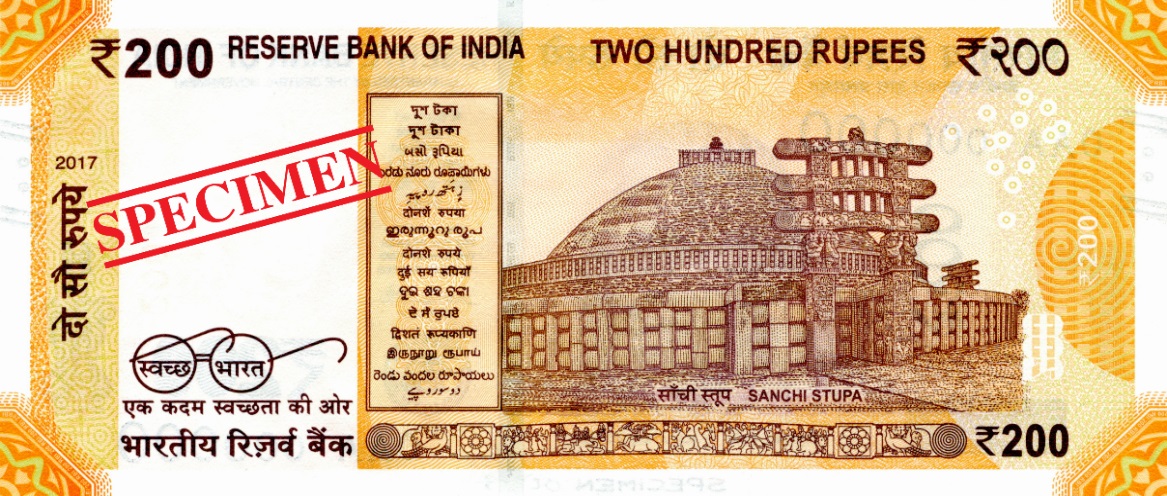
The RBI announced on 18 August 2017 that it would soon issue a new {{INR}}50 note.<ref name=inr50>[https://www.rbi.org.in/Scripts/BS_PressReleaseDisplay.aspx?prid=41412 RBI Introduces ₹ 50 banknote in Mahatma Gandhi (New) Series]</ref> The RBI announced the specifications of the new denomination of the ₹200 note in the Mahatma Gandhi New Series, bearing the signature of Dr. [[Urjit R. Patel]], [[Governor of the Reserve Bank of India]], on 25 August 2017.<ref name=inr200>[http://economictimes.indiatimes.com/news/economy/policy/rbi-to-issue-rs-200-note-tomorrow-here-is-how-it-looks/articleshow/60205741.cms RBI to issue Rs 200 note tomorrow. Here is how it looks]</ref> | |||
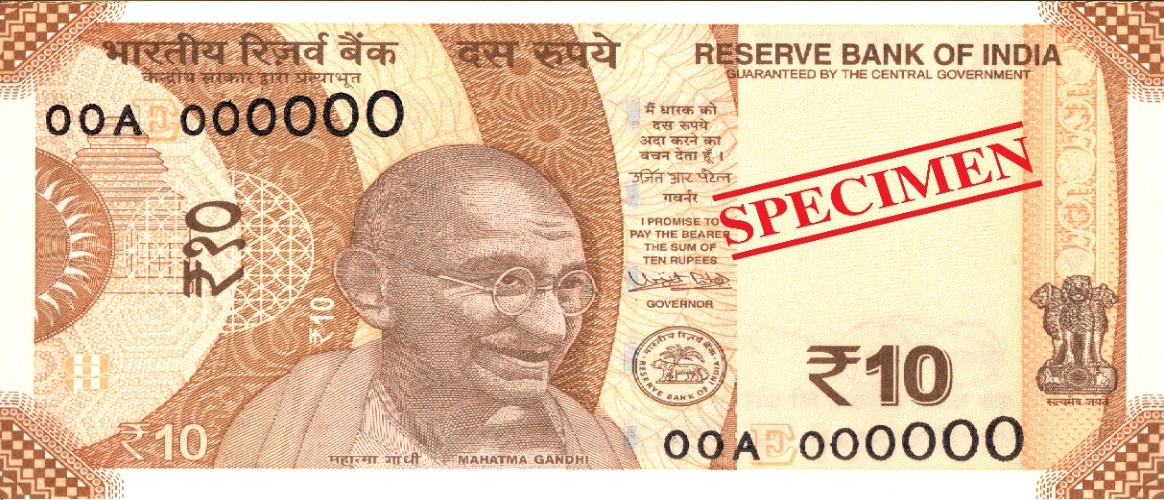
The | The Reserve Bank of India has also issued {{INR}}10 denomination banknotes in the Mahatma Gandhi New Series.<ref name=inr10>[https://www.rbi.org.in/scripts/FS_PressRelease.aspx?prid=42782&fn=2753 RBI Introduces ₹ 10 banknote in Mahatma Gandhi (New) Series]</ref> The new denomination has on the reverse a motif of the Sun Temple in Konark, depicting the country's cultural heritage. The base colour of the note is [[Shades of brown#Chocolate|Chocolate brown]]. | ||
The | The RBI announced on 19 July 2018 that it would shortly issue a new {{INR}}100 note.<ref name=inr100>{{Cite web|title = RBI to Issue New Design ₹ 100 Denomination Banknote|url = https://rbi.org.in/Scripts/BS_PressReleaseDisplay.aspx?prid=44533|website=rbi.org.in|accessdate = 2018-07-19}}</ref> The new denomination has on the reverse a motif of the [[Rani ki vav|Rani Ki Vav]] (the Queen's Stepwell), a UNESCO World Heritage site in Patan in [[Gujarat]], depicting India's cultural heritage. The base colour of the note is [[Lavender (color)|Lavender]]. | ||
The | The Reserve Bank of India announced on 26 April 2019 that it would shortly issue a new {{INR}}20 note.<ref name="20RBIAnnoucement">{{Cite web|title = RBI Introduces ₹ 20 banknote in Mahatma Gandhi (New) Series|url = https://www.rbi.org.in/scripts/FS_PressRelease.aspx?prid=46913&fn=2753|website=rbi.org.in|accessdate = 2019-04-27}}</ref> The new denomination has on the reverse a motif of [[Ellora Caves]], a UNESCO World Heritage site in [[Aurangabad District, Maharashtra|Aurangabad district]], [[Maharashtra]], depicting India's cultural heritage, continuing with the theme in the Mahatma Gandhi New Series banknotes. | ||
In May 2023, the Reserve Bank of India announced its decision to withdraw the ₹2,000 notes from circulation. Until 30 September 2023 they could be exchanged (to a maximum of 20,000 {{INR}} in any single transaction) or deposited in bank accounts. Despite these measures, the notes remain legal tender.<ref>{{Cite web |title=Rs 2,000 Notes To Be Scrapped, Exchange Them By This Date, Will Remain Legal Tender |url=https://www.ndtv.com/india-news/rs-2-000-notes-to-be-withdrawn-from-circulation-exchange-them-by-september-30-2023-says-rbi-4049268 |access-date=2023-05-19 |website=NDTV.com |archive-date=19 May 2023 |archive-url=https://web.archive.org/web/20230519135315/https://www.ndtv.com/india-news/rs-2-000-notes-to-be-withdrawn-from-circulation-exchange-them-by-september-30-2023-says-rbi-4049268 |url-status=live}}</ref><ref>{{Cite news |date=2023-05-19 |title=RBI on 2000 Rupee note: RBI to withdraw Rs 2,000 notes from circulation; notes will continue to be legal tender |work=The Times of India |url=https://timesofindia.indiatimes.com/india/rbi-to-withdraw-rs-2000-currency-notes-from-circulation-notes-will-continue-to-be-legal-tender-till-september-30/articleshow/100360257.cms?from=mdr |access-date=2023-05-19 |issn=0971-8257 |archive-date=19 May 2023 |archive-url=https://web.archive.org/web/20230519141752/https://timesofindia.indiatimes.com/india/rbi-to-withdraw-rs-2000-currency-notes-from-circulation-notes-will-continue-to-be-legal-tender-till-september-30/articleshow/100360257.cms?from=mdr |url-status=live }}</ref> | |||
==Security features== | ==Security features== | ||
{{multiple image | {{multiple image | ||
| align = right | | align = right | ||
| Line 21: | Line 28: | ||
| width1 = 200 | | width1 = 200 | ||
| alt1 = | | alt1 = | ||
| caption1 = The obverse design of the series was based on this photograph of Gandhi and [[Lord Pethick-Lawrence]]. | | caption1 = The obverse design of the series was based on this 1946 photograph of Gandhi and [[Lord Pethick-Lawrence]]. | ||
| image2 = Gandhi smiling R.jpg | | image2 = Gandhi smiling R.jpg | ||
| width2 = 120 | | width2 = 120 | ||
| Line 30: | Line 37: | ||
The security features of the Mahatma Gandhi New Series banknotes are as follows:<ref name=2000RBI /><ref name=2000RBI2 /><ref name=500RBI /> | The security features of the Mahatma Gandhi New Series banknotes are as follows:<ref name=2000RBI /><ref name=2000RBI2 /><ref name=500RBI /> | ||
* See-through registration device: Consisting of the numeral denomination at the lower left part of the notes on the front and at the lower right of the notes on the back. Used for the {{INR}}10, {{INR}}20, {{INR}}50, {{INR}}100, {{INR}}200, {{INR}}500 and {{INR}} | * See-through registration device: Consisting of the numeral denomination at the lower left part of the notes on the front and at the lower right of the notes on the back. Used for the {{INR}}10, {{INR}}20, {{INR}}50, {{INR}}100, {{INR}}200,{{INR}}500 and {{INR}}2000. | ||
* Novel numbering: A set of six digit serial numbers that increase in size from left to right. These serial numbers are located on the top left and bottom right side on the front of the notes. | * Novel numbering: A set of six digit serial numbers that increase in size from left to right. These serial numbers are located on the top left and bottom right side on the front of the notes. | ||
* Latent image: Located on the lower left part of the note's front, when tilted, the denomination is seen within the panel near the left side of the portrait of Mahatma Gandhi. Used for the {{INR}}10, {{INR}}20, {{INR}}50, {{INR}}100, {{INR}}200, {{INR}}500 and {{INR}} | * Latent image: Located on the lower left part of the note's front, when tilted, the denomination is seen within the panel near the left side of the portrait of Mahatma Gandhi. Used for the {{INR}}10, {{INR}}20, {{INR}}50, {{INR}}100, {{INR}}200, {{INR}}500 and {{INR}}2000. | ||
* Denominational numeral: Located on the left side of the front of the notes, the denominational number is rendered in [[Devanagari|Devanagari script]] ({{INR}}१०, {{INR}}२०, {{INR}}५०, {{INR}}१००, {{INR}}२००, {{INR}}५०० | * Denominational numeral: Located on the left side of the front of the notes, the denominational number is rendered in [[Devanagari|Devanagari script]] ({{INR}}१०, {{INR}}२०, {{INR}}५०, {{INR}}१००, {{INR}}२००, {{INR}}५०० and {{INR}}२०००). This raised some controversies.<ref>{{cite news|last1=Sharma|first1=Apoorva|title=Using Devanagari Numerals on New Currency Dishonours a Historic Compromise|url=https://thewire.in/82530/using-devanagari-numerals-on-new-currency-dishonours-a-historic-compromise/|accessdate=2017-09-03|work=The Wire|date=2016-11-25}}</ref> | ||
* Microprinting: Microprinted elements consisting of the letters "RBI" and its corresponding denominations are located on the left side of the note. Used on the {{INR}}10, {{INR}}20, {{INR}}50, {{INR}}100, {{INR}}200, {{INR}}500 and {{INR}} | * Microprinting: Microprinted elements consisting of the letters "RBI" and its corresponding denominations are located on the left side of the note. Used on the {{INR}}10, {{INR}}20, {{INR}}50, {{INR}}100, {{INR}}200, {{INR}}500 and {{INR}}2000 notes. | ||
* [[Intaglio printing]] of the portrait of Mahatma Gandhi. | * [[Intaglio printing]] of the portrait of Mahatma Gandhi. | ||
* Windowed security thread: Located on the front of the notes, the windowed security thread on the {{INR}}10, {{INR}}20, {{INR}}50, {{INR}}100, {{INR}}200, {{INR}}500 and {{INR}} | * Windowed security thread: Located on the front of the notes, the windowed security thread on the {{INR}}10, {{INR}}20, {{INR}}50, {{INR}}100, {{INR}}200, {{INR}}500 and {{INR}}2000 notes contain colour-shifting elements and inscriptions of India in Hindi. When the notes are tilted, the colour of the security threads changes from green to blue. | ||
* Angular lines: A series of lines placed on both the left and right side of the front of the notes, these angular lines are utilized to help those with visual impairments in identifying the notes. Used on the {{INR}}100, {{INR}}200, {{INR}}500 and {{INR}} | * Angular lines: A series of lines placed on both the left and right side of the front of the notes, these angular lines are utilized to help those with visual impairments in identifying the notes. Used on the {{INR}}100, {{INR}}200, {{INR}}500 and {{INR}}2000 notes. | ||
==Banknotes== | ==Banknotes== | ||
{| class="wikitable" style="text-align:center" | {| class="wikitable" style="text-align:center" | ||
! colspan=" | ! colspan="11" |Mahatma Gandhi (New) Series | ||
|- | |- | ||
! colspan="2" |Image | ! colspan="2" |Image | ||
| Line 51: | Line 57: | ||
! colspan="3" |Description | ! colspan="3" |Description | ||
! rowspan="2" |Date of Issue | ! rowspan="2" |Date of Issue | ||
! rowspan="2" |Date of Withdrawal | |||
! rowspan="2" |Year | |||
|- | |- | ||
!Obverse | !Obverse | ||
| Line 64: | Line 72: | ||
| [[Shades of brown#Chocolate|Chocolate brown]] | | [[Shades of brown#Chocolate|Chocolate brown]] | ||
| rowspan="7" |[[Mahatma Gandhi]] | | rowspan="7" |[[Mahatma Gandhi]] | ||
| [[Konark Sun Temple]] | | [[Konark Sun Temple|Sun Temple, Konark, Odisha]] | ||
| rowspan="7" |[[Mahatma Gandhi]] and electrotype denomination | | rowspan="7" |[[Mahatma Gandhi]] and electrotype denomination | ||
| 5 January 2018<ref name=inr10 /> | | 5 January 2018<ref name=inr10 /> | ||
| rowspan="6" | ''Current'' | |||
| 2017- | |||
|- | |- | ||
| align="right" bgcolor="#fff" |[[File:India_new_20_INR,_MG_series,_2019,_obverse.jpg|129x63px]] | | align="right" bgcolor="#fff" |[[File:India_new_20_INR,_MG_series,_2019,_obverse.jpg|129x63px]] | ||
| Line 72: | Line 82: | ||
| style="text-align:center" | [[Indian 20-rupee note|{{INR}}20]] | | style="text-align:center" | [[Indian 20-rupee note|{{INR}}20]] | ||
| 129 mm × 63 mm | | 129 mm × 63 mm | ||
| [[ | | [[Chartreuse (color)|Greenish Yellow]] | ||
| [[Ellora Caves]] | | [[Kailasa Temple, Ellora|Ellora Caves, Verul, Maharashtra]] | ||
| 26 April 2019<ref name="20RBIAnnoucement"/> | | 26 April 2019<ref name="20RBIAnnoucement"/> | ||
| 2019- | |||
|- | |- | ||
| align="right" bgcolor="#fff" |[[File:India new 50 INR, MG series, 2018, obverse.jpg|x66px]] | | align="right" bgcolor="#fff" |[[File:India new 50 INR, MG series, 2018, obverse.jpg|x66px]] | ||
| Line 80: | Line 91: | ||
| style="text-align:center" |[[Indian 50-rupee note|{{INR}}50]] | | style="text-align:center" |[[Indian 50-rupee note|{{INR}}50]] | ||
| 135 mm × 66 mm | | 135 mm × 66 mm | ||
| [[Shades of | | [[Shades of blue|Fluorescent Blue]] | ||
| [[Hampi | | [[Hampi|Hampi with Chariot, Karnataka]] | ||
| 18 August 2017<ref name=inr50 /> | | 18 August 2017<ref name=inr50 /> | ||
| 2017- | |||
|- | |- | ||
| align="right" bgcolor="#fff" |[[File:India new 100 INR, Mahatma Gandhi New Series, 2018, obverse.png|x66px]] | | align="right" bgcolor="#fff" |[[File:India new 100 INR, Mahatma Gandhi New Series, 2018, obverse.png|x66px]] | ||
| Line 89: | Line 101: | ||
| 142 mm × 66 mm | | 142 mm × 66 mm | ||
| [[Lavender (color)|Lavender]] | | [[Lavender (color)|Lavender]] | ||
| [[Rani | | [[Rani Ki Vav|Rani Ki Vav, Gujarat]] | ||
| 19 July 2018<ref name=inr100 /> | | 19 July 2018<ref name=inr100 /> | ||
| 2018- | |||
|- | |- | ||
| align="right" bgcolor="#fff" |[[File:India, 200 INR, 2018, obverse.jpg|x66px]] | | align="right" bgcolor="#fff" |[[File:India, 200 INR, 2018, obverse.jpg|x66px]] | ||
| Line 96: | Line 109: | ||
|style="text-align:center" |[[Indian 200-rupee note|{{INR}}200]] | |style="text-align:center" |[[Indian 200-rupee note|{{INR}}200]] | ||
| 146 mm × 66 mm | | 146 mm × 66 mm | ||
| [[Shades of yellow | | [[Shades of yellow|Bright Yellow]] | ||
| [[ | | [[Sanchi Stupa|Sanchi Stupa, Madhya Pradesh]] | ||
| 25 August 2017<ref name=inr200 /> | | 25 August 2017<ref name=inr200 /> | ||
| 2017- | |||
|- | |- | ||
| align="right" bgcolor="#fff" |[[File:India new 500 INR, MG series, 2016, obverse.jpg|x66px]] | | align="right" bgcolor="#fff" |[[File:India new 500 INR, MG series, 2016, obverse.jpg|x66px]] | ||
| Line 105: | Line 119: | ||
| 150 mm × 66 mm | | 150 mm × 66 mm | ||
| [[Shades of gray#Stone gray|Stone Grey]]<ref name=500RBI/> | | [[Shades of gray#Stone gray|Stone Grey]]<ref name=500RBI/> | ||
| [[Red Fort]] | | [[Red Fort|Red Fort, Delhi]] | ||
| 10 November 2016 | | rowspan="2" | 10 November 2016 | ||
| 2016- | |||
|- | |- | ||
| align="right" bgcolor="#fff" |[[File:India new 2000 INR, MG series, 2016, obverse.jpg|x66px]] | | align="right" bgcolor="#fff" |[[File:India new 2000 INR, MG series, 2016, obverse.jpg|x66px]] | ||
| Line 114: | Line 129: | ||
| [[Magenta]] | | [[Magenta]] | ||
| [[Mars Orbiter Mission|Mangalyaan]] | | [[Mars Orbiter Mission|Mangalyaan]] | ||
| | | 30 September 2023 (Still Legal Tender) | ||
| 2016–2017 | |||
|- | |- | ||
| colspan=" | | colspan="11" style="text-align:left;" |'''{{Standard banknote table notice|BrE=Y}}''' | ||
|} | |} | ||
===Languages=== | ===Languages=== | ||
Each banknote has its amount written in 17 languages. On the obverse, the denomination is written in [[English language|English]] and [[Hindi]]. On the reverse is a language panel that displays the denomination of the note in 15 of the 22 [[List of official languages of India|official languages of India]]. The languages are displayed in alphabetical order. Languages included on the panel are [[Assamese language|Assamese]], [[Bengali language|Bengali]], [[Gujarati language|Gujarati]], [[Kannada]], [[Kashmiri language|Kashmiri]], [[Konkani language|Konkani]], [[Malayalam]], [[Marathi language|Marathi]], [[Nepali language|Nepali]], [[Odia language|Odia]], [[Punjabi language|Punjabi]], [[Sanskrit]], [[Tamil language|Tamil]], [[Telugu language|Telugu]] and [[Urdu]]. | |||
Each banknote has its amount written in 17 languages. On the obverse, the denomination is written in [[English language|English]] and [[Hindi]]. On the reverse is a language panel | |||
{| class="wikitable" style="text-align:center" | {| class="wikitable" style="text-align:center" | ||
|+ | |+ | ||
! colspan="11" |Denominations in [[Languages with official status in India| | ! colspan="11" |Denominations in [[Languages with official status in India|union level official languages]] (At below either ends) | ||
|- | |||
|- | |- | ||
!Language | !Language | ||
| Line 134: | Line 150: | ||
|[[Hindi]] || {{lang|hi|दस रुपये}} || {{lang|hi|बीस रुपये}} || {{lang|hi|पचास रुपये}} || {{lang|hi|एक सौ रुपये}} || {{lang|hi|दो सौ रुपये}} || {{lang|hi|पाँच सौ रुपये}} || {{lang|hi|दो हज़ार रुपये}} | |[[Hindi]] || {{lang|hi|दस रुपये}} || {{lang|hi|बीस रुपये}} || {{lang|hi|पचास रुपये}} || {{lang|hi|एक सौ रुपये}} || {{lang|hi|दो सौ रुपये}} || {{lang|hi|पाँच सौ रुपये}} || {{lang|hi|दो हज़ार रुपये}} | ||
|- | |- | ||
! colspan="11" |Denominations in 15 [[Languages with official status in India# | ! colspan="11" |Denominations in 15 [[Languages with official status in India#Schedule|state level/other official languages]] (As seen on the language panel) | ||
|- | |- | ||
| [[Assamese language|Assamese]] || {{lang|as|দহ টকা}} || {{lang|as|বিছ টকা}} || {{lang|as|পঞ্চাশ টকা}} || {{lang|as|এশ টকা}} || {{lang|as|দুইশ টকা}} || {{lang|as|পাঁচশ টকা}} || {{lang|as|দুহেজাৰ টকা}} | | [[Assamese language|Assamese]] || {{lang|as|দহ টকা}} || {{lang|as|বিছ টকা}} || {{lang|as|পঞ্চাশ টকা}} || {{lang|as|এশ টকা}} || {{lang|as|দুইশ টকা}} || {{lang|as|পাঁচশ টকা}} || {{lang|as|দুহেজাৰ টকা}} | ||
| Line 142: | Line 158: | ||
| [[Gujarati script|Gujarati]] || {{lang|gu|દસ રૂપિયા}} || {{lang|gu|વીસ રૂપિયા}} || {{lang|gu|પચાસ રૂપિયા}} || {{lang|gu|એક સો રૂપિયા}} || {{lang|gu|બસો રૂપિયા}} || {{lang|gu|પાંચ સો રૂપિયા}} || {{lang|gu|બે હજાર રૂપિયા}} | | [[Gujarati script|Gujarati]] || {{lang|gu|દસ રૂપિયા}} || {{lang|gu|વીસ રૂપિયા}} || {{lang|gu|પચાસ રૂપિયા}} || {{lang|gu|એક સો રૂપિયા}} || {{lang|gu|બસો રૂપિયા}} || {{lang|gu|પાંચ સો રૂપિયા}} || {{lang|gu|બે હજાર રૂપિયા}} | ||
|- | |- | ||
| [[Kannada]] || {{lang|kn|ಹತ್ತು ರೂಪಾಯಿಗಳು}} || {{lang|kn|ಇಪ್ಪತ್ತು ರೂಪಾಯಿಗಳು}} || {{lang|kn|ಐವತ್ತು ರೂಪಾಯಿಗಳು}} || {{lang|kn| | | [[Kannada]] || {{lang|kn|ಹತ್ತು ರೂಪಾಯಿಗಳು}} || {{lang|kn|ಇಪ್ಪತ್ತು ರೂಪಾಯಿಗಳು}} || {{lang|kn|ಐವತ್ತು ರೂಪಾಯಿಗಳು}} || {{lang|kn|ನೂರು ರೂಪಾಯಿಗಳು}} || {{lang|kn|ಎರಡು ನೂರು ರೂಪಾಯಿಗಳು}} | ||
|{{lang|kn|ಐದು ನೂರು ರೂಪಾಯಿಗಳು}} || {{lang|kn|ಎರಡು ಸಾವಿರ ರೂಪಾಯಿಗಳು}} | |{{lang|kn|ಐದು ನೂರು ರೂಪಾಯಿಗಳು}} || {{lang|kn|ಎರಡು ಸಾವಿರ ರೂಪಾಯಿಗಳು}} | ||
|- | |- | ||
| Line 149: | Line 165: | ||
| [[Konkani language|Konkani]] || {{lang|kok|धा रुपया}} || {{lang|kok|वीस रुपया}} || {{lang|kok|पन्नास रुपया}} || {{lang|kok|शंबर रुपया}} || {{lang|kok|दोनशें रुपया}} || {{lang|kok|पाचशें रुपया}} || {{lang|kok|दोन हजार रुपया}} | | [[Konkani language|Konkani]] || {{lang|kok|धा रुपया}} || {{lang|kok|वीस रुपया}} || {{lang|kok|पन्नास रुपया}} || {{lang|kok|शंबर रुपया}} || {{lang|kok|दोनशें रुपया}} || {{lang|kok|पाचशें रुपया}} || {{lang|kok|दोन हजार रुपया}} | ||
|- | |- | ||
| [[Malayalam]] || {{lang|ml|പത്തു രൂപ}} || {{lang|ml| | | [[Malayalam]] || {{lang|ml|പത്തു രൂപ}} || {{lang|ml|ഇരുപതു രൂപ}} || {{lang|ml|അൻപതു രൂപ}} || {{lang|ml|നൂറു രൂപ}} || {{lang|ml|ഇരുന്നൂറു രൂപ}} || {{lang|ml|അഞ്ഞൂറു രൂപ}} || {{lang|ml|രണ്ടായിരം രൂപ}} | ||
|- | |- | ||
| [[Marathi language|Marathi]] || {{lang|mr|दहा रुपये}} || {{lang|mr|वीस रुपये}} || {{lang|mr|पन्नास रुपये}} || {{lang|mr|शंभर रुपये}} || {{lang|mr|दोनशे रुपये}} || {{lang|mr|पाचशे रुपये}} || {{lang|mr|दोन हजार रुपये}} | | [[Marathi language|Marathi]] || {{lang|mr|दहा रुपये}} || {{lang|mr|वीस रुपये}} || {{lang|mr|पन्नास रुपये}} || {{lang|mr|शंभर रुपये}} || {{lang|mr|दोनशे रुपये}} || {{lang|mr|पाचशे रुपये}} || {{lang|mr|दोन हजार रुपये}} | ||
| Line 155: | Line 171: | ||
| [[Nepali language|Nepali]] || {{lang|ne|दस रुपियाँ}} || {{lang|ne|बीस रुपियाँ}} || {{lang|ne|पचास रुपियाँ}} || {{lang|ne|एक सय रुपियाँ}} || {{lang|ne|दुई सय रुपियाँ}} || {{lang|ne|पाँच सय रुपियाँ}} || {{lang|ne|दुई हजार रुपियाँ}} | | [[Nepali language|Nepali]] || {{lang|ne|दस रुपियाँ}} || {{lang|ne|बीस रुपियाँ}} || {{lang|ne|पचास रुपियाँ}} || {{lang|ne|एक सय रुपियाँ}} || {{lang|ne|दुई सय रुपियाँ}} || {{lang|ne|पाँच सय रुपियाँ}} || {{lang|ne|दुई हजार रुपियाँ}} | ||
|- | |- | ||
| [[Odia language|Odia]] || {{lang|or|ଦଶ ଟଙ୍କା}} || {{lang|or| | | [[Odia language|Odia]] || {{lang|or|ଦଶ ଟଙ୍କା}} || {{lang|or|କୋଡ଼ିଏ ଟଙ୍କା}}|| {{lang|or|ପଚାଶ ଟଙ୍କା}} || {{lang|or|ଏକ ଶତ ଟଙ୍କା}} || {{lang|or|ଦୁଇ ଶହ ଟଙ୍କା}} || {{lang|or|ପାଞ୍ଚ ଶତ ଟଙ୍କା}} || {{lang|or|ଦୁଇ ହଜାର ଟଙ୍କା}} | ||
|- | |- | ||
| [[Punjabi language|Punjabi]] || {{lang|pa|ਦਸ ਰੁਪਏ}} || {{lang|pa|ਵੀਹ ਰੁਪਏ}} || {{lang|pa|ਪੰਜਾਹ ਰੁਪਏ}} || {{lang|pa|ਇਕ ਸੌ ਰੁਪਏ}} || {{lang|pa|ਦੋ ਸੌ ਰੁਪਏ}} ||{{lang|pa|ਪੰਜ ਸੌ ਰੁਪਏ}} || {{lang|pa|ਦੋ ਹਜ਼ਾਰ ਰੁਪਏ}} | | [[Punjabi language|Punjabi]] || {{lang|pa|ਦਸ ਰੁਪਏ}} || {{lang|pa|ਵੀਹ ਰੁਪਏ}} || {{lang|pa|ਪੰਜਾਹ ਰੁਪਏ}} || {{lang|pa|ਇਕ ਸੌ ਰੁਪਏ}} || {{lang|pa|ਦੋ ਸੌ ਰੁਪਏ}} ||{{lang|pa|ਪੰਜ ਸੌ ਰੁਪਏ}} || {{lang|pa|ਦੋ ਹਜ਼ਾਰ ਰੁਪਏ}} | ||
| Line 163: | Line 179: | ||
| [[Tamil language|Tamil]] || {{lang|ta|பத்து ரூபாய்}} || {{lang|ta|இருபது ரூபாய்}} || {{lang|ta|ஐம்பது ரூபாய்}} || {{lang|ta|நூறு ரூபாய்}} || {{lang|ta|இருநூறு ரூபாய்}} || {{lang|ta|ஐந்நூறு ரூபாய்}} || {{lang|ta|இரண்டாயிரம் ரூபாய்}} | | [[Tamil language|Tamil]] || {{lang|ta|பத்து ரூபாய்}} || {{lang|ta|இருபது ரூபாய்}} || {{lang|ta|ஐம்பது ரூபாய்}} || {{lang|ta|நூறு ரூபாய்}} || {{lang|ta|இருநூறு ரூபாய்}} || {{lang|ta|ஐந்நூறு ரூபாய்}} || {{lang|ta|இரண்டாயிரம் ரூபாய்}} | ||
|- | |- | ||
| [[Telugu language|Telugu]] | | [[Telugu language|Telugu]] ||{{lang|te|పది రూపాయలు}} || {{lang|te|ఇరవై రూపాయలు}} ||{{lang|te|యాభై రూపాయలు}} || {{lang|te|వంద రూపాయలు}}||{{lang|te|రెండు వందల రూపాయలు}} || {{lang|te|ఐదువందల రూపాయలు}} || {{lang|te|రెండు వేల రూపాయలు}} | ||
|- | |- | ||
| [[Urdu language|Urdu]] || {{nq|{{lang|ur|دس روپیے}}}}|| {{nq|{{lang|ur|بیس روپیے}}}}|| {{nq|{{lang|ur|پچاس روپیے}}}}|| {{nq|{{lang|ur| سو روپیے}}}}|| {{nq|{{lang|ur|دو سو روپیے}}}}||{{nq|{{lang|ur|پانچ سو روپیے}}}}|| {{nq|{{lang|ur|دو ہزار روپیے}}}} | | [[Urdu language|Urdu]] || {{nq|{{lang|ur|دس روپیے}}}}|| {{nq|{{lang|ur|بیس روپیے}}}}|| {{nq|{{lang|ur|پچاس روپیے}}}}|| {{nq|{{lang|ur| سو روپیے}}}}|| {{nq|{{lang|ur|دو سو روپیے}}}}||{{nq|{{lang|ur|پانچ سو روپیے}}}}|| {{nq|{{lang|ur|دو ہزار روپیے}}}} | ||
|- | |||
|} | |} | ||
==See also== | ==See also== | ||
{{Portal|India|Money|Numismatics}} | |||
*[[Lion Capital Series]] | |||
*[[Mahatma Gandhi Series]] | |||
*[[List of artistic depictions of Mahatma Gandhi]] | *[[List of artistic depictions of Mahatma Gandhi]] | ||
| Line 176: | Line 196: | ||
{{Indian currency}} | {{Indian currency}} | ||
{{Mohandas K. Gandhi}} | |||
[[Category:2016 establishments in India]] | |||
[[Category:Memorials to Mahatma Gandhi]] | [[Category:Memorials to Mahatma Gandhi]] | ||
[[Category:Banknotes of India]] | [[Category:Banknotes of India]] | ||
[[Category:Portraits on banknotes]] | [[Category:Portraits on banknotes]] | ||
Latest revision as of 16:16, 13 March 2026

The Mahatma Gandhi New Series of banknotes are issued by the Reserve Bank of India (RBI) as the legal tender of the Indian rupee (₹), intended to replace the Mahatma Gandhi Series of banknotes. Announced on 8 November 2016, it followed the demonetisation of ₹500 and ₹1000 banknotes of the original Mahatma Gandhi Series. Similar to the preceding series of banknotes, the obverse of the Mahatma Gandhi New Series banknotes also prominently displays the portrait of Mahatma Gandhi. The logo of Swachh Bharat Abhiyan is also printed on the back of the banknotes of this series.
History[edit | edit source]
The first banknotes issued in the New Series were the denominations of ₹500 and ₹2000, and are in circulation since 10 November 2016. While the ₹500 note is still being printed, the ₹2000 note was last issued date 2017.[1][2][3]
The RBI announced on 18 August 2017 that it would soon issue a new ₹50 note.[4] The RBI announced the specifications of the new denomination of the ₹200 note in the Mahatma Gandhi New Series, bearing the signature of Dr. Urjit R. Patel, Governor of the Reserve Bank of India, on 25 August 2017.[5]
The Reserve Bank of India has also issued ₹10 denomination banknotes in the Mahatma Gandhi New Series.[6] The new denomination has on the reverse a motif of the Sun Temple in Konark, depicting the country's cultural heritage. The base colour of the note is Chocolate brown.
The RBI announced on 19 July 2018 that it would shortly issue a new ₹100 note.[7] The new denomination has on the reverse a motif of the Rani Ki Vav (the Queen's Stepwell), a UNESCO World Heritage site in Patan in Gujarat, depicting India's cultural heritage. The base colour of the note is Lavender.
The Reserve Bank of India announced on 26 April 2019 that it would shortly issue a new ₹20 note.[8] The new denomination has on the reverse a motif of Ellora Caves, a UNESCO World Heritage site in Aurangabad district, Maharashtra, depicting India's cultural heritage, continuing with the theme in the Mahatma Gandhi New Series banknotes.
In May 2023, the Reserve Bank of India announced its decision to withdraw the ₹2,000 notes from circulation. Until 30 September 2023 they could be exchanged (to a maximum of 20,000 ₹ in any single transaction) or deposited in bank accounts. Despite these measures, the notes remain legal tender.[9][10]
Security features[edit | edit source]


The security features of the Mahatma Gandhi New Series banknotes are as follows:[1][2][3]
- See-through registration device: Consisting of the numeral denomination at the lower left part of the notes on the front and at the lower right of the notes on the back. Used for the ₹10, ₹20, ₹50, ₹100, ₹200,₹500 and ₹2000.
- Novel numbering: A set of six digit serial numbers that increase in size from left to right. These serial numbers are located on the top left and bottom right side on the front of the notes.
- Latent image: Located on the lower left part of the note's front, when tilted, the denomination is seen within the panel near the left side of the portrait of Mahatma Gandhi. Used for the ₹10, ₹20, ₹50, ₹100, ₹200, ₹500 and ₹2000.
- Denominational numeral: Located on the left side of the front of the notes, the denominational number is rendered in Devanagari script (₹१०, ₹२०, ₹५०, ₹१००, ₹२००, ₹५०० and ₹२०००). This raised some controversies.[11]
- Microprinting: Microprinted elements consisting of the letters "RBI" and its corresponding denominations are located on the left side of the note. Used on the ₹10, ₹20, ₹50, ₹100, ₹200, ₹500 and ₹2000 notes.
- Intaglio printing of the portrait of Mahatma Gandhi.
- Windowed security thread: Located on the front of the notes, the windowed security thread on the ₹10, ₹20, ₹50, ₹100, ₹200, ₹500 and ₹2000 notes contain colour-shifting elements and inscriptions of India in Hindi. When the notes are tilted, the colour of the security threads changes from green to blue.
- Angular lines: A series of lines placed on both the left and right side of the front of the notes, these angular lines are utilized to help those with visual impairments in identifying the notes. Used on the ₹100, ₹200, ₹500 and ₹2000 notes.
Banknotes[edit | edit source]
| Mahatma Gandhi (New) Series | ||||||||||
|---|---|---|---|---|---|---|---|---|---|---|
| Image | Value | Dimensions (millimetres) | Main colour | Description | Date of Issue | Date of Withdrawal | Year | |||
| Obverse | Reverse | Obverse | Reverse | Watermark | ||||||

|

|
₹10 | 123 mm × 63 mm | Chocolate brown | Mahatma Gandhi | Sun Temple, Konark, Odisha | Mahatma Gandhi and electrotype denomination | 5 January 2018[6] | Current | 2017- |

|

|
₹20 | 129 mm × 63 mm | Greenish Yellow | Ellora Caves, Verul, Maharashtra | 26 April 2019[8] | 2019- | |||

|

|
₹50 | 135 mm × 66 mm | Fluorescent Blue | Hampi with Chariot, Karnataka | 18 August 2017[4] | 2017- | |||

|

|
₹100 | 142 mm × 66 mm | Lavender | Rani Ki Vav, Gujarat | 19 July 2018[7] | 2018- | |||
|
|

|
₹200 | 146 mm × 66 mm | Bright Yellow | Sanchi Stupa, Madhya Pradesh | 25 August 2017[5] | 2017- | |||

|

|
₹500 | 150 mm × 66 mm | Stone Grey[3] | Red Fort, Delhi | 10 November 2016 | 2016- | |||

|

|
₹2000 | 166 mm × 66 mm | Magenta | Mangalyaan | 30 September 2023 (Still Legal Tender) | 2016–2017 | |||
| For table standards, see the banknote specification table. | ||||||||||
Languages[edit | edit source]
Each banknote has its amount written in 17 languages. On the obverse, the denomination is written in English and Hindi. On the reverse is a language panel that displays the denomination of the note in 15 of the 22 official languages of India. The languages are displayed in alphabetical order. Languages included on the panel are Assamese, Bengali, Gujarati, Kannada, Kashmiri, Konkani, Malayalam, Marathi, Nepali, Odia, Punjabi, Sanskrit, Tamil, Telugu and Urdu.
| Denominations in union level official languages (At below either ends) | ||||||||||
|---|---|---|---|---|---|---|---|---|---|---|
| Language | ₹10 | ₹20 | ₹50 | ₹100 | ₹200 | ₹500 | ₹2000 | |||
| English | Ten rupees | Twenty rupees | Fifty rupees | One Hundred rupees | Two hundred rupees | Five hundred rupees | Two thousand rupees | |||
| Hindi | दस रुपये | बीस रुपये | पचास रुपये | एक सौ रुपये | दो सौ रुपये | पाँच सौ रुपये | दो हज़ार रुपये | |||
| Denominations in 15 state level/other official languages (As seen on the language panel) | ||||||||||
| Assamese | দহ টকা | বিছ টকা | পঞ্চাশ টকা | এশ টকা | দুইশ টকা | পাঁচশ টকা | দুহেজাৰ টকা | |||
| Bengali | দশ টাকা | কুড়ি টাকা | পঞ্চাশ টাকা | একশ টাকা | দুইশ টাকা | পাঁচশ টাকা | দুই হাজার টাকা | |||
| Gujarati | દસ રૂપિયા | વીસ રૂપિયા | પચાસ રૂપિયા | એક સો રૂપિયા | બસો રૂપિયા | પાંચ સો રૂપિયા | બે હજાર રૂપિયા | |||
| Kannada | ಹತ್ತು ರೂಪಾಯಿಗಳು | ಇಪ್ಪತ್ತು ರೂಪಾಯಿಗಳು | ಐವತ್ತು ರೂಪಾಯಿಗಳು | ನೂರು ರೂಪಾಯಿಗಳು | ಎರಡು ನೂರು ರೂಪಾಯಿಗಳು | ಐದು ನೂರು ರೂಪಾಯಿಗಳು | ಎರಡು ಸಾವಿರ ರೂಪಾಯಿಗಳು | |||
| Kashmiri | دٔہ رۄپیہِ | وُہ رۄپیہِ | پَنٛژاہ رۄپیہِ | ہَتھ رۄپیہِ | زٕ ہَتھ رۄپیہِ | پانٛژھ ہَتھ رۄپیہِ | زٕ ساس رۄپیہِ | |||
| Konkani | धा रुपया | वीस रुपया | पन्नास रुपया | शंबर रुपया | दोनशें रुपया | पाचशें रुपया | दोन हजार रुपया | |||
| Malayalam | പത്തു രൂപ | ഇരുപതു രൂപ | അൻപതു രൂപ | നൂറു രൂപ | ഇരുന്നൂറു രൂപ | അഞ്ഞൂറു രൂപ | രണ്ടായിരം രൂപ | |||
| Marathi | दहा रुपये | वीस रुपये | पन्नास रुपये | शंभर रुपये | दोनशे रुपये | पाचशे रुपये | दोन हजार रुपये | |||
| Nepali | दस रुपियाँ | बीस रुपियाँ | पचास रुपियाँ | एक सय रुपियाँ | दुई सय रुपियाँ | पाँच सय रुपियाँ | दुई हजार रुपियाँ | |||
| Odia | ଦଶ ଟଙ୍କା | କୋଡ଼ିଏ ଟଙ୍କା | ପଚାଶ ଟଙ୍କା | ଏକ ଶତ ଟଙ୍କା | ଦୁଇ ଶହ ଟଙ୍କା | ପାଞ୍ଚ ଶତ ଟଙ୍କା | ଦୁଇ ହଜାର ଟଙ୍କା | |||
| Punjabi | ਦਸ ਰੁਪਏ | ਵੀਹ ਰੁਪਏ | ਪੰਜਾਹ ਰੁਪਏ | ਇਕ ਸੌ ਰੁਪਏ | ਦੋ ਸੌ ਰੁਪਏ | ਪੰਜ ਸੌ ਰੁਪਏ | ਦੋ ਹਜ਼ਾਰ ਰੁਪਏ | |||
| Sanskrit | दश रूप्यकाणि | विंशती रूप्यकाणि | पञ्चाशत् रूप्यकाणि | शतं रूप्यकाणि | द्विशतं रूप्यकाणि | पञ्चशतं रूप्यकाणि | द्विसहस्रं रूप्यकाणि | |||
| Tamil | பத்து ரூபாய் | இருபது ரூபாய் | ஐம்பது ரூபாய் | நூறு ரூபாய் | இருநூறு ரூபாய் | ஐந்நூறு ரூபாய் | இரண்டாயிரம் ரூபாய் | |||
| Telugu | పది రూపాయలు | ఇరవై రూపాయలు | యాభై రూపాయలు | వంద రూపాయలు | రెండు వందల రూపాయలు | ఐదువందల రూపాయలు | రెండు వేల రూపాయలు | |||
| Urdu | دس روپیے | بیس روپیے | پچاس روپیے | سو روپیے | دو سو روپیے | پانچ سو روپیے | دو ہزار روپیے | |||
See also[edit | edit source]

References[edit | edit source]
- ↑ 1.0 1.1 "Issue of ₹ 2000 Banknotes". Reserve Bank of India. 8 November 2016. Retrieved 8 November 2016.
- ↑ 2.0 2.1 "Issue of ₹ 2000 banknotes with inset letter 'R'". Reserve Bank of India. 8 November 2016. Retrieved 8 November 2016.
- ↑ 3.0 3.1 3.2 "Issue of ₹ 500 banknotes inset letter 'E' in Mahatma Gandhi (New) Series". Reserve Bank of India. 8 November 2016. Retrieved 9 November 2016.
- ↑ 4.0 4.1 RBI Introduces ₹ 50 banknote in Mahatma Gandhi (New) Series
- ↑ 5.0 5.1 RBI to issue Rs 200 note tomorrow. Here is how it looks
- ↑ 6.0 6.1 RBI Introduces ₹ 10 banknote in Mahatma Gandhi (New) Series
- ↑ 7.0 7.1 "RBI to Issue New Design ₹ 100 Denomination Banknote". rbi.org.in. Retrieved 19 July 2018.
- ↑ 8.0 8.1 "RBI Introduces ₹ 20 banknote in Mahatma Gandhi (New) Series". rbi.org.in. Retrieved 27 April 2019.
- ↑ "Rs 2,000 Notes To Be Scrapped, Exchange Them By This Date, Will Remain Legal Tender". NDTV.com. Archived from the original on 19 May 2023. Retrieved 19 May 2023.
- ↑ "RBI on 2000 Rupee note: RBI to withdraw Rs 2,000 notes from circulation; notes will continue to be legal tender". The Times of India. 19 May 2023. ISSN 0971-8257. Archived from the original on 19 May 2023. Retrieved 19 May 2023.
- ↑ Sharma, Apoorva (25 November 2016). "Using Devanagari Numerals on New Currency Dishonours a Historic Compromise". The Wire. Retrieved 3 September 2017.