


imported>WikiLinuz ce |
m Article updated with improved flow |
||
| Line 1: | Line 1: | ||
{{Short description|Hindu deity}} | |||
{{Use dmy dates|date=October 2016}} | {{Use dmy dates|date=October 2016}} | ||
{{Use Indian English|date=October 2016}} | {{Use Indian English|date=October 2016}} | ||
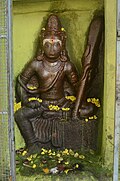
[[File:Mahakuta Lakulisha.jpg|thumb|Lakulisha at Sangameshvara Temple at Mahakuta, Karnataka ([[Chalukya dynasty|Chalukya]], 7th century CE). His 5th–10th century ithyphallic statues{{refn|group=note|name="pha_illus"}} are also found in seated yogi position in [[Rajasthan]], [[Uttar Pradesh]] and elsewhere.<ref>{{cite book|author=Cynthia Packert Atherton|title=The Sculpture of Early Medieval Rajasthan|url=https://books.google.com/books?id=ZkxXK5wFob4C|year=1997|publisher=BRILL|isbn=90-04-10789-4|pages=92–97, 102–103|access-date=2 April 2017|archive-url=https://web.archive.org/web/20170402173857/https://books.google.com/books?id=ZkxXK5wFob4C|archive-date=2 April 2017|url-status=live}}</ref>]] | [[File:Mahakuta Lakulisha.jpg|thumb|Lakulisha at Sangameshvara Temple at Mahakuta, Karnataka ([[Chalukya dynasty|Chalukya]], 7th century CE). His 5th–10th century ithyphallic statues{{refn|group=note|name="pha_illus"}} are also found in seated yogi position in [[Rajasthan]], [[Uttar Pradesh]] and elsewhere.<ref>{{cite book|author=Cynthia Packert Atherton|title=The Sculpture of Early Medieval Rajasthan|url=https://books.google.com/books?id=ZkxXK5wFob4C|year=1997|publisher=BRILL|isbn=90-04-10789-4|pages=92–97, 102–103|access-date=2 April 2017|archive-url=https://web.archive.org/web/20170402173857/https://books.google.com/books?id=ZkxXK5wFob4C|archive-date=2 April 2017|url-status=live}}</ref>]] | ||
'''Lakulisha''' ({{ | '''Lakulisha''' ({{langx|sa|लकुलीश}} {{IAST3|Lakulīśa}}) (Etymology: लगुड (staff) or लकुट (mace) + ईश (lord) = meaning, the lord with a staff or mace or club or stick) was a prominent [[Shaivism|Shaivite]] revivalist, reformist and preceptor of the doctrine of the [[Pashupata Shaivism|Pashupata]]s, one of the oldest sects of Shaivism. | ||
According to some scholars, Lakulisha | According to some scholars, Lakulisha was the founder of the Pashupata sect. Others argue that the Pashupata doctrine was already in existence before Lakulisha, and he was only its first formal [[preceptor]]. | ||
According to a tradition stated in the ''[[Linga Purana]]'', Lakulisha is considered as the 28th and the last [[avatar]] of [[Shiva]] and the propounder of [[Yoga]] system. | According to a tradition stated in the ''[[Linga Purana]]'', Lakulisha is considered as the 28th and the last [[avatar]] of [[Shiva]] and the propounder of the [[Yoga]] system. In this tradition, Lakulisha had four disciples: Kaurushya, [[Garga (sage)|Garga]], [[Mitra]] and Kushika. According to another tradition mentioned in the ''Avanti Khanda'' of the ''[[Skanda Purana]]'', Lakulisha and his four disciples installed a [[Lingam|linga]] at [[Ujjain|Mahakalavana]], which was then known as ''Kayavarohaneshvara''.<ref>Joshi, N.P. (1981). ''Regional Trends in some of the Mediaeval Brahmanical Sculptures of Malwa'' in M.D. Khare (ed.) ''Malwa through the Ages'', Bhopal: Directorate of Archaeology & Museums, Govt. of M.P., p.112</ref> The ''[[Kurma Purana]]'' (Chapter 53), the ''[[Vayu Purana]]'' (Chapter 23), and the ''Linga Purana'' (Chapter 24) predicted that Shiva (Maheshvara) would appear in the form of a wandering monk called 'Lakulin' or 'Nakulisha', and that he would have four disciples named Kushika, Garga, Mitra, and Kanrushya, who would re-establish the cult of [[Pashupati]] and would therefore be called Pashupata(s). Lakulisha was the fruition of these divine predictions. According to ''Vayu Purana'' V. 1.23.202-214, Lakulisha was a contemporary of [[Vyasa]] and [[Krishna]], and was the 28th incarnation of Rudra (Shiva). | ||
According to another tradition mentioned in the ''Avanti Khanda'' of the ''[[Skanda Purana]]'', Lakulisha and his four disciples | |||
==Life== | ==Life== | ||
Lakulisha | {{Unreferenced section|date=May 2024}} | ||
Lakulisha was born in the village of Karavan on the bank of [[Narmada River|Narmada]] in [[Gujarat]] and propagated Saivism<ref>{{Cite book |author-link=R. G. Bhandarkar |title=Vaishnavism, Saivism and Minor Religious Systems |publisher=Strassburg |year=1913}}</ref>. It has been maintained that Lakulisha's thesis conflicted with that of [[Makkhali Gosala|Gosala]], and Lakulisha opposed [[Jainism]] and particularly [[Buddhism]]. Lakulisha is said to have restored practices of [[Hatha yoga]] and [[Tantra|Tantrism]], as well as the cosmological theories of the [[Samkhya]] and the duality associated with Samkhya tenets<ref>{{Cite book |title=An Introduction to Hinduism |author-link2=Gavin Flood |publisher=Cambridge University Press |year=1996}}</ref>. | |||
==Historicity== | ==Historicity== | ||
[[File:Inscribed Pillar - Recording Installation of Two Shiva Lingas by Udita Acharya in the Reign of Chandragupta Vikramaditya - 380 CE - Rangeshwar Temple - ACCN 29-1931 - Government Museum - Mathura (detail).jpg|thumb|Early Gupta relief on the [[Lakulisa Mathura Pillar Inscription|Lakulisa pillar]], inscribed [[Gupta era]] "year 61", 380 CE.]] | [[File:Inscribed Pillar - Recording Installation of Two Shiva Lingas by Udita Acharya in the Reign of Chandragupta Vikramaditya - 380 CE - Rangeshwar Temple - ACCN 29-1931 - Government Museum - Mathura (detail).jpg|thumb|Early Gupta relief on the [[Lakulisa Mathura Pillar Inscription|Lakulisa pillar]], inscribed [[Gupta era]] "year 61", 380 CE.]] | ||
A pillar erected by [[Chandragupta II]] at Mathura in 380 CE states that a ‘Guruvayatana’ (Abode of the Gurus) was established by Uditacharya, who was 4th in descent from a teacher of the [[Pashupata Shaivism|Pashupata]] sect named Parashara, who in turn was 6th in descent from Kushika. If this Kushika is one of the four disciples of Lakulisha described in the ''Linga Purana'', the latter must have existed around 125 CE. | |||
The epigraphist [[John Faithfull Fleet]] contends that in North India, [[Kushan Empire|Kushana]] emperors like [[Huvishka]] (140 CE) replaced the pictures of [[Hercules]] on their coins with ones of Shiva, and of [[Heracles]] with images of Lakulisha.<ref>John Faithfull Fleet ‘Siva as Lakulisa’ JRASGBI : 1907, p. 419-427</ref> | |||
In the 4th century CE, beginning with the reign of [[Chandragupta II]], icons and representations of Lakulisha have been frequently found. They portray him as a naked [[yogi]] with a staff in his left hand and a [[citron]] (matulinga) in his right, either standing or seated in the [[Lotus position|lotus posture]]. At about the beginning of the 11th century, the Lakulisha cult shifted its activities to southern India. | |||
A sect of Pasupata [[Asceticism|ascetics]], founded by Lakulisa (or Nahulisa), is attested by inscriptions from the 5th century and is among the earliest of the sectarian religious orders of Shaivite Hinduism. | |||
==Sculpture context== | |||
The penile erection representation illustrates the centrality of the energetic principle of '''''Urdhva Retas''''' ({{langx|sa|ऊर्ध्वरेतस्}} {{IAST3|Ūrdhvaretas}}, lit. "ascent of vital energies or fluid") practice of [[Brahmacharya]] or [[Celibacy#Hinduism|celibacy]]<ref name="govind52">Ghurye, G.S., 1952. Ascetic Origins. Sociological Bulletin, 1(2), pp.162-184.</ref> and the upward flow of energy in spiritual pursuits, contrary to fertility or release of vital energies.{{sfn|Kramrisch|1994|p=26}}<ref name="0x32">Pensa, Corrado. "Some Internal and Comparative Problems in the Field of Indian Religions." Problems and Methods of the History of Religions. Brill, 1972. 102-122</ref><ref name="abha70">{{cite book|title=The Tantric Tradition|author=Swami Agehananda Bharati|year=1970|isbn=0877282536|publisher=Red Wheel/Weiser|page=294}}</ref><ref name="urdhvaretas">{{cite web|url=https://www.wisdomlib.org/definition/urdhvaretas|website=www.wisdomlib.org|title=Urdhvaretas, Urdhvaretās, Ūrdhvaretas, Urdhva-retas: 7 definitions|date=9 September 2014 }}</ref>{{sfn|Kramrisch|1994|p=26}}<ref name="abha70" /> Controlling the vital fluid, the seminal fluid, is thought to retain<!--?--> control of all passions and the achievement of desirelessness through the practice of [[Asceticism]] and [[Sādhanā|Yogic Sadhana]], leading to supreme mystical cognition or [[Samadhi|samādhi]].{{sfn|Kramrisch|1994|p=26}}<ref name="abha70" /> Lakulisha stands on top of an [[Apasmara]] (demon dwarf), who symbolizes spiritual ignorance, greed, sensual desires or ''[[Kama]]'' and nonsensical speech on the spiritual path, hence must be subdued in spiritual pursuits.<ref name=rao227>{{cite book |author=T. A. Gopinatha Rao |title=Elements of Hindu Iconography |url=https://books.google.com/books?id=e7mP3kDzGuoC |year=1997 |publisher=Motilal Banarsidass |isbn=978-81-208-0877-5 |pages=223–229, 237}}</ref><ref>[http://www.artic.edu/aic/collections/artwork/24548 Shiva as Lord of the Dance (Nataraja), Chola period, c. 10th/11th century] [[The Art Institute of Chicago]], United States</ref><ref name="Arundhati2002">{{cite book|author=P. Arundhati|title=Annapurna : A Bunch of Flowers of Indian Culture|url=https://books.google.com/books?id=cfK2LoH_j54C&pg=PA40 |year=2002|publisher=Concept |isbn=978-81-7022-897-4|pages=40–45}}</ref> | |||
The ''Urdhva linga'' ({{IAST3|ūrdhvaliṅga}}), pointing upward, conveys not only the retention of the seed once "stirred" but its upward condition, "through the spinal cord to the brain", retaining its integrity as 'creative substance', while being transformed and absorbed mentally as [[Bodhicitta]], the "thought of Awakening".{{sfn|Kramrisch|1994|p=238}}<ref name="0x32" /> The symbol of the ascent and transmutation of vital (sexual) energy into mental power, a channeling of the procreative into creative faculty, is artistically seen as [[Tantra|tantric realization]] in [[Mukhalinga]] or "face-linga", the two overlapping components forming a visual unity, according to [[Stella Kramrisch]].{{refn|group=note|Furthermore, the phallic shape, standing erect, always negates its function as an organ of procreation. Rather, the shape or pictorial representation is conveying that, the seed was channeled upward, not ejected for the sake of generation, but was reversed, retained and absorbed for regeneration as creative energy.{{sfn|Kramrisch|1994|p=555}}}}{{sfn|Kramrisch|1994|p=238}} | |||
The | |||
In Kramrisch's view, the pictorial rendering of the ascent of the vital energy should not be mistaken for fertility or sexuality.{{sfn|Kramrisch|1994|p=26}} Lakulisa, who is an ascetic manifestation of [[Shiva]], is seen in later peninsular Indian scriptures, whose ithyphallic aspects connotes asceticism and conserved procreative potentialities (Brahmacharya), rather than mere eroticism.{{sfn|Srinivasan|2004|p=434}}<ref>O'Flaherty, Wendy Doniger. "Asceticism and Sexuality in the Mythology of Śiva. Part I." ''History of Religions'' 8, no. 4 (1969): 300-37. Accessed September 7, 2021. http://www.jstor.org/stable/1062019.</ref> The ithyphallic representation of the erect shape connotes the very opposite in this context, as it stands for "seminal retention"<!--Do not change this, it's a direct quote-->, and represents Lakulisha as "he stands for the complete control of the senses, and for the supreme carnal renunciation".{{sfn|Kramrisch|1994|p=218}}<ref name="0x32"/> In the path of Brahmacharya, Asceticism or [[Sannyasa]], the yogi does not deny sexual urges, but transforms sexual energy and directs it away from procreation and pleasure towards intuited wisdom, [[Moksha|freedom]] and [[Ānanda (Hindu philosophy)|bliss]].{{sfn|Kramrisch|1994|p=218}}<ref name="0x32"/> | |||
==Influence on philosophy and religion== | ==Influence on philosophy and religion== | ||
[[File:Lakulisha Badami.jpg|thumb|Lakulisha among his four disciples Kusika, Garga, Mitra, and Kaurushya, rock-cut stone relief, Cave Temple No. 2 at Badami, Karnataka, Early Chalukya dynasty, second half of the 6th century CE]] | [[File:Lakulisha Badami.jpg|thumb|Lakulisha among his four disciples Kusika, Garga, Mitra, and Kaurushya, rock-cut stone relief, Cave Temple No. 2 at Badami, Karnataka, Early Chalukya dynasty, second half of the 6th century CE]] | ||
M. R. Sakhare argues in ''The History and Philosophy of Lingayat Religion'' that the influence of Lakulisha was immense and spread rapidly, first in the north and then in the south of India. The Shaivite revival, supported by the [[Nagas of Padmavati|Bharashiva Nagas]] of [[Mathura]] and [[Vakataka dynasty]] in central and northern India, gradually spread in the south under the impetus of artisan class Shaiva mystics, the [[Nayanars]].{{Citation needed|date=May 2024}} | |||
==Teachings== | ==Teachings== | ||
Lakulisha Pashupata has been identified | Lakulisha Pashupata has been identified with the [[Bhedabheda|Bhedābheda]] tradition, which combines [[Dualism (Indian philosophy)|dualistic]] and non-dualistic [[monism]], and his teachings had a strong emphasis on the [[yoga]] system. The principal text of the Pashupata sect, the [[Pashupata-sutra|{{IAST|Pāśupata Sūtra}}]], is attributed to Lakulisha. The manuscripts of this text and a commentary on it, the {{IAST| Pañcārtha Bhāṣya}} by [[Kaundinya]] (c. 500 CE), were discovered in 1930. The {{IAST |Pāśupata Sūtra}} formalizes various canons of the Pashupata sect, and contains the basic theology of the sect. However, the authorship of Lakulisha over the Pashupata [[Sutra|sutras]] have been a subject of debate. The Pashupata sutras are of an archaic character and do not bear the name of any author. Though certain traditions mention Lakulisha as the author, there is nothing to support this in the form of internal written evidence from the Sutras. Even, Kaundinya’s commentary only states: | ||
The principal text of the Pashupata sect, the {{IAST |Pāśupata Sūtra}} is attributed to Lakulisha. The manuscripts of this text and a commentary | |||
However, the authorship of Lakulisha over the Pashupata sutras have been a subject of debate. The Pashupata sutras are of an archaic character and do not bear the name of any author. Though certain traditions mention Lakulisha as the author, there is nothing to support this in the form of internal written evidence from the Sutras. Even, | |||
" ... Tatha shishta pramanyat kamitvad ajatatvach cha, | " ... Tatha shishta pramanyat kamitvad ajatatvach cha, Manushya-rupi bhagavan brahmana-kayam asthaya kayavatarane avatirna iti | Tatha padbhyam ujjayinim praptah.." | ||
Manushya-rupi bhagavan brahmana-kayam asthaya kayavatarane avatirna iti | | |||
Tatha padbhyam ujjayinim praptah.." | |||
("Shiva incarnated in the form of a human being by entering the body of a deceased Brahmana in the [village of] Kayavatara, thereafter wandered to Ujjain.") | |||
This account matches those narrated in the Puranas and the Karvana Mahatmya where Lakulisha incarnates in Kayavarohana (Karvan) village. However, unlike the latter accounts, the name Lakulisha is never mentioned, even though in the subsequent lines Kaundinya mentions that Shiva as the Brahmana imparted Shastra to the student Kushika. Only in subsequent Pashupata texts, Ratna Tika and Gana Karika, a clear mention of Lakulisha as the founder of the Pashupata system | This account matches those narrated in the [[Puranas]] and the Karvana Mahatmya, where Lakulisha incarnates in [[Kayavarohan|Kayavarohana]] (Karvan) village. However, unlike the latter accounts, the name Lakulisha is never mentioned, even though in the subsequent lines Kaundinya mentions that [[Shiva]] as the Brahmana imparted [[Shastra]] to the student Kushika. Only in the subsequent [[Pashupata Shaivism|Pashupata]] texts, ''Ratna Tika'' and ''Gana Karika'', does a clear mention of Lakulisha as the founder of the Pashupata system appear. This raises questions regarding Lakulisha being the actual composer of the sutras. | ||
Notwithstanding | Notwithstanding the authorship of the sutras, the philosophical doctrine of the Pashupata(s) as enunciated by Lakulisha are called "Ishvara Kartri Vadaha (the creative power of the sovereign being)", which was first found to be quoted later by [[Adi Shankara]]charya in commentary on the [[Brahma Sutras]] (3.2.37). An analysis of it is found in one of the main Pashupata texts, the ''Gana Karika'' of Haradatta, and its commentary by Kaundinya called Panchartha Bhashya (commentary of the five subjects). [[Ramanuja]] attributed this philosophy to the tradition of the [[Kalamukha]](s), the sect of "Black Faces" to which Lakulisha belonged. This Nakulisha Pashupata doctrine is divided into six parts, known as: Karana (cause), Karya (work/task), Kala (divisibility), Vidhi (method), Yoga (union), and Dukhanta (the end of suffering). | ||
An analysis of it is found in one of the main Pashupata texts, the Gana Karika of Haradatta, and its commentary by Kaundinya called Panchartha Bhashya (commentary of the five subjects). [[Ramanuja]] attributed this philosophy to the tradition of the [[Kalamukha]](s), the sect of "Black Faces" to which Lakulisha belonged. | |||
This Nakulisha Pashupata doctrine is divided into six parts, known as: | |||
According to some scholars, Lakulisha modified the [[Maheshwara]] doctrine by putting different interpretations on all | According to some scholars, Lakulisha modified the [[Parameshvara (epithet)|Maheshwara]] doctrine by putting different interpretations on all five main concepts in that doctrine and placed special emphasis on the different kinds of behaviour to be adopted at each of the five stages, in their progress from initiation to the attainment of the unlimited powers of knowing, willing and acting on the terrestrial place. The doctrines of the Lakulisha Pashupatas are explained at length in [[Sāyaṇa|Sayana Madhava]]'s ''Sarva Darshana Sangraha'' (p. 108, [[Edward Byles Cowell|Cowell]] & Gough) [https://archive.org/details/Sarva-Darsana-Samgraha.by.Madhavacharya-Vidyaranya.tr.by.E.B.Cowell Sarva-Darsana-Samgraha by Sayana-Madhava – Tr. by E.B. Cowell]. | ||
The doctrines of the Lakulisha Pashupatas are explained at length in [[ | |||
==Iconography and images== | ==Iconography and images== | ||
[[File:Stone sculpt NMND -13.JPG|thumb|right|Statue of Lakulisha, [[Gurjara-Pratihara|Pratihara]], 9th century CE.]] | [[File:Stone sculpt NMND -13.JPG|thumb|right|Statue of Lakulisha, [[Gurjara-Pratihara|Pratihara]], 9th century CE.]] | ||
[[File:Lakulisha.jpg|thumb|Lakulisha carving on the outer walls of Kudavelly Sangameswara temple at Alampur, Telangana built by Pulakesi I, circa 540 CE - 566 CE.]] | [[File:Lakulisha.jpg|thumb|Lakulisha carving on the outer walls of Kudavelly Sangameswara temple at Alampur, Telangana built by Pulakesi I, circa 540 CE - 566 CE.]] | ||
Lakulisha has been deified as an incarnation of Shiva, and is represented in front of the linga in the 6th to 8th centuries and also in the medieval period in temples of [[Kayavarohana]] and Timberva in Gujarat.<ref>D.R. Bhandarkar, "Lakulisa", in Archaeological Survey of India, Annual Report 1906-7, Calcutta, 1909, pp. 179-92, figures 4, 5.</ref><ref>U.P. Shah, "Lakulisa: Saivite Saint" in Discourses on Siva, ed. Michael W. Meister, figs. 85-87.</ref> These icons are some more examples of iconic, image-lingas. D.R. Bhandarkar | Lakulisha has been deified as an incarnation of Shiva, and is represented in front of the linga in the 6th to 8th centuries and also in the medieval period in temples of [[Kayavarohan|Kayavarohana]] and Timberva in Gujarat.<ref>D.R. Bhandarkar, "Lakulisa", in Archaeological Survey of India, Annual Report 1906-7, Calcutta, 1909, pp. 179-92, figures 4, 5.</ref><ref>U.P. Shah, "Lakulisa: Saivite Saint" in Discourses on Siva, ed. Michael W. Meister, figs. 85-87.</ref> These icons are some more examples of iconic, image-lingas. D.R. Bhandarkar mentions that the image in the sanctum of the Lakulishvara temple in Karvan is "the conjoint figure of Brahmeshvara and Lakulisha, confirming the statement of the Mahatmya that Lakulisha merged himself with Brahmeshvara".<ref>{{Cite book |last=Asiatic Society of Bombay |url=http://archive.org/details/journalasiatics16bombgoog |title=Journal of the Asiatic Society of Bombay |date=1841 |publisher=[Bombay] : Asiatic Society of Bombay |others=University of Michigan}}</ref> Brahmeshvara refers to the Shiva-linga. Lakulisha was identified with Mahesha (Shiva) in the Karvan Mahatmya and in iconographical programmes of several temples of Orissa and Rajasthan. So the images of Lakulisha conjoint with the linga, like other image-lingas, combine both the ''sakala'' (with form, manifest) and ''nishkala'' (formless, unmanifest) aspects of Shiva. | ||
Lakulisha images have also been found in [[Saurashtra (region)|Saurastra]], Gujarat, and also in some parts of the eastern India. Some of the images depict Lakulisha as a naked yogi and he carries prayer beads, a club, a cup of human skull. Lakulisha is shown as accompanied by animals. Almost all of | Lakulisha images have also been found in [[Saurashtra (region)|Saurastra]], Gujarat, and also in some parts of the eastern India. Some of the images depict Lakulisha as a naked yogi and he carries prayer beads, a club, a cup of human skull. Lakulisha is shown as accompanied by animals. Almost all of Lakulisha's images appear as ''urdhav-linga'' (with an [[Erection|erect penis]]){{refn|group=note|name="pha_illus"}} but neither symbolizing fertility nor sexuality, but the refined energetic principles ('''Urdhva Retas''') during ''Sāyaṇa'' or Asceticism.{{sfn|Kramrisch|1994|p=26}}<ref name="abha70"/><ref name="Rao1993p63">{{cite book|author=T. A. Gopinatha Rao|title=Elements of Hindu Iconography, Volume 2|url=https://books.google.com/books?id=e7mP3kDzGuoC |year=1993|publisher=Motilal Banarsidass |isbn=978-81-208-0877-5|pages=63–67}}</ref> | ||
Image of Lakulisha have been found depicted on the walls of the large hall at [[Elephanta Caves]], suggesting that the caves may have been associated with Pashupata Shaivism.<ref>[https://books.google.com/books?id=H3lUIIYxWkEC | Image of Lakulisha have been found depicted on the walls of the large hall at [[Elephanta Caves]], suggesting that the caves may have been associated with Pashupata Shaivism.<ref>[https://books.google.com/books?id=H3lUIIYxWkEC&dq=chandragupta+lakulisha&pg=PA514 A History of Ancient and Early Medieval India: From the Stone Age to the 12th Century, Upinder Singh (2008)]</ref> Icons of Lakulisha have also been found on the Laxmaneswar group of temples at [[Bhubaneswar]], namely, the Satrughneswar, Bharateswar and Laxmaneswara temples. | ||
[[File:Lakulisa temple.jpg|thumb|right|Rock-cut temple with bas relief of Lakulisha in the left, [[Pandya]], 7th century CE.]] | |||
[[File:Arittapatti temples and surroundings JEG5816.JPG|thumb|right|[[Bas relief]] of Lakulisha, [[Pandya]], 7th century CE.]] | |||
A rock-cut Shiva temple with bas reliefs of [[Ganesha|Ganapati]] and Lakulisa, carved by the seventh century [[Pandya dynasty|Pandyas]], is located at Arittapatti near [[Madurai]]. This temple is maintained by the Archeological Department of [[Tamil Nadu]]. | |||
Lakulisha carvings are also found on Kudavelly Sangameswara and Balabrahmeswara Swamy temples at Alampur, Gadwal Jogulamba district, Telangana. | Lakulisha carvings are also found on Kudavelly Sangameswara and Balabrahmeswara Swamy temples at Alampur, Gadwal Jogulamba district, Telangana. | ||
| Line 79: | Line 73: | ||
{{reflist|group=note|refs= | {{reflist|group=note|refs= | ||
{{refn|group=note|name="pha_illus"| | {{refn|group=note|name="pha_illus"| | ||
The ithyphallic representation of the erect shape connotes the very opposite in this context.{{sfn|Kramrisch|1994|p=218}} It contextualize "seminal retention" or practice of [[Celibacy#Hinduism|celibacy]]<ref name="govind52">Ghurye, G.S., 1952. Ascetic Origins. Sociological Bulletin, 1(2), pp.162-184.</ref> (illustration of ''Urdhva Retas''){{sfn|Kramrisch|1994|p=26}}<ref name="brill72">Pensa, Corrado. "Some Internal and Comparative Problems in the Field of Indian Religions." Problems and Methods of the History of Religions. Brill, 1972. 102-122.</ref> | The ithyphallic representation of the erect shape connotes the very opposite in this context.{{sfn|Kramrisch|1994|p=218}} It contextualize "seminal retention" or practice of [[Celibacy#Hinduism|celibacy]]<ref name="govind52">Ghurye, G.S., 1952. Ascetic Origins. Sociological Bulletin, 1(2), pp.162-184.</ref> (illustration of ''Urdhva Retas''),{{sfn|Kramrisch|1994|p=26}}<ref name="brill72">Pensa, Corrado. "Some Internal and Comparative Problems in the Field of Indian Religions." Problems and Methods of the History of Religions. Brill, 1972. 102-122.</ref> and represents Lakulisha as "he stands for complete complete control of the senses, and for the supreme carnal renunciation".{{sfn|Kramrisch|1994|p=218}}}} | ||
}} | }} | ||
| Line 88: | Line 82: | ||
* Daniélou, Alain. "Shaiva Oracles and Predictions on the Cycles of History and the Destiny of Mankind" [https://web.archive.org/web/20110928124145/http://www.alaindanielou.org/While-the-Gods-Play.html] | * Daniélou, Alain. "Shaiva Oracles and Predictions on the Cycles of History and the Destiny of Mankind" [https://web.archive.org/web/20110928124145/http://www.alaindanielou.org/While-the-Gods-Play.html] | ||
* Sharpe, Elizabeth, Shiva or The Past of India, Luzac & Co, London, (1930). | * Sharpe, Elizabeth, Shiva or The Past of India, Luzac & Co, London, (1930). | ||
*Satya Prakash, et al., "Cultural contours of India: Dr. Satya Prakash felicitation volume" [https://books.google.com/books?id=nKJiBUFrmfoC | *Satya Prakash, et al., "Cultural contours of India: Dr. Satya Prakash felicitation volume" [https://books.google.com/books?id=nKJiBUFrmfoC&dq=urdhva+linga&pg=RA1-PA176] | ||
*Divanji, P. C.; Lakulisha of Karvan and his Pasupata Cult; in Gautam Patel et al. (Ed.); Contribution of Gujarat to Sanskrit Literature (Dr. M. I. Prajapati Felicitation Volume); Dr. M. I. Prajapati Sastipurti Sanman Samiti; Patan (Gujarat); (1998). | *Divanji, P. C.; Lakulisha of Karvan and his Pasupata Cult; in Gautam Patel et al. (Ed.); Contribution of Gujarat to Sanskrit Literature (Dr. M. I. Prajapati Felicitation Volume); Dr. M. I. Prajapati Sastipurti Sanman Samiti; Patan (Gujarat); (1998). | ||
*Bhandarkar, D. R. "An Eklingji stone inscription and the origin and history of the Lakulisa sect", ''Journal of the Bombay Branch of the Royal Asiatic Society'' : 22 (1908), p. 151-167.[https://archive.org/stream/journalasiatics16bombgoog/journalasiatics16bombgoog_djvu.txt] | *Bhandarkar, D. R. "An Eklingji stone inscription and the origin and history of the Lakulisa sect", ''Journal of the Bombay Branch of the Royal Asiatic Society'' : 22 (1908), p. 151-167.[https://archive.org/stream/journalasiatics16bombgoog/journalasiatics16bombgoog_djvu.txt] | ||
* {{cite book |last=Kramrisch |first=Stella |title=The Presence of Śiva |year=1994 |publisher=Princeton University Press |location=Princeton, New Jersey |isbn=978-0691019307 |url-access=registration |url=https://archive.org/details/presenceofsivamy00skra}} | |||
* {{cite book|first=Sharada|last=Srinivasan|title=World Archaeology|chapter=Shiva as 'cosmic dancer': On Pallava origins for the Nataraja bronze|doi=10.1080/1468936042000282726821|volume=36|year=2004|issue=3|pages=432–450 |publisher=The Journal of Modern Craft|s2cid=26503807 }} | |||
==External links== | ==External links== | ||
*[http://www.hinduismtoday.com/modules/smartsection/item.php?com_mode=flat&com_order=1&itemid=3246 Pashupata Shaivism] | *[http://www.hinduismtoday.com/modules/smartsection/item.php?com_mode=flat&com_order=1&itemid=3246 Pashupata Shaivism] | ||
*[http://www.kamakotimandali.com/advaita/pashupatasiddhanta.html Pashupata Siddhant of Lakulisha] | *[http://www.kamakotimandali.com/advaita/pashupatasiddhanta.html Pashupata Siddhant of Lakulisha] {{Webarchive|url=https://web.archive.org/web/20200218041453/http://www.kamakotimandali.com/advaita/pashupatasiddhanta.html |date=18 February 2020 }} | ||
* [http://www.lakulishyoga.com Lakulish Yoga] | * [http://www.lakulishyoga.com Lakulish Yoga] | ||
| Line 102: | Line 97: | ||
[[Category:Forms of Shiva]] | [[Category:Forms of Shiva]] | ||
[[Category:Shaivite religious leaders]] | [[Category:Indian Shaivite religious leaders]] | ||
[[Category:Indian Hindu monks]] | |||
[[Category:Indian Hindu yogis]] | |||
[[Category:2nd-century philosophers]] | [[Category:2nd-century philosophers]] | ||
[[Category:Hindu reformers]] | [[Category:Hindu reformers]] | ||
[[Category:Hindu philosophers and theologians]] | [[Category:Hindu philosophers and theologians]] | ||
[[Category:People considered avatars by their followers]] | [[Category:People considered avatars by their followers]] | ||
[[Category:Phallic symbols]] | |||
[[Category:Sanskrit writers]] | [[Category:Sanskrit writers]] | ||
Latest revision as of 14:25, 23 February 2026

Lakulisha (Sanskrit: लकुलीश IAST: Lakulīśa) (Etymology: लगुड (staff) or लकुट (mace) + ईश (lord) = meaning, the lord with a staff or mace or club or stick) was a prominent Shaivite revivalist, reformist and preceptor of the doctrine of the Pashupatas, one of the oldest sects of Shaivism.
According to some scholars, Lakulisha was the founder of the Pashupata sect. Others argue that the Pashupata doctrine was already in existence before Lakulisha, and he was only its first formal preceptor.
According to a tradition stated in the Linga Purana, Lakulisha is considered as the 28th and the last avatar of Shiva and the propounder of the Yoga system. In this tradition, Lakulisha had four disciples: Kaurushya, Garga, Mitra and Kushika. According to another tradition mentioned in the Avanti Khanda of the Skanda Purana, Lakulisha and his four disciples installed a linga at Mahakalavana, which was then known as Kayavarohaneshvara.[2] The Kurma Purana (Chapter 53), the Vayu Purana (Chapter 23), and the Linga Purana (Chapter 24) predicted that Shiva (Maheshvara) would appear in the form of a wandering monk called 'Lakulin' or 'Nakulisha', and that he would have four disciples named Kushika, Garga, Mitra, and Kanrushya, who would re-establish the cult of Pashupati and would therefore be called Pashupata(s). Lakulisha was the fruition of these divine predictions. According to Vayu Purana V. 1.23.202-214, Lakulisha was a contemporary of Vyasa and Krishna, and was the 28th incarnation of Rudra (Shiva).
Life[edit | edit source]
 |
Lakulisha was born in the village of Karavan on the bank of Narmada in Gujarat and propagated Saivism[3]. It has been maintained that Lakulisha's thesis conflicted with that of Gosala, and Lakulisha opposed Jainism and particularly Buddhism. Lakulisha is said to have restored practices of Hatha yoga and Tantrism, as well as the cosmological theories of the Samkhya and the duality associated with Samkhya tenets[4].
Historicity[edit | edit source]
.jpg)
A pillar erected by Chandragupta II at Mathura in 380 CE states that a ‘Guruvayatana’ (Abode of the Gurus) was established by Uditacharya, who was 4th in descent from a teacher of the Pashupata sect named Parashara, who in turn was 6th in descent from Kushika. If this Kushika is one of the four disciples of Lakulisha described in the Linga Purana, the latter must have existed around 125 CE.
The epigraphist John Faithfull Fleet contends that in North India, Kushana emperors like Huvishka (140 CE) replaced the pictures of Hercules on their coins with ones of Shiva, and of Heracles with images of Lakulisha.[5]
In the 4th century CE, beginning with the reign of Chandragupta II, icons and representations of Lakulisha have been frequently found. They portray him as a naked yogi with a staff in his left hand and a citron (matulinga) in his right, either standing or seated in the lotus posture. At about the beginning of the 11th century, the Lakulisha cult shifted its activities to southern India.
A sect of Pasupata ascetics, founded by Lakulisa (or Nahulisa), is attested by inscriptions from the 5th century and is among the earliest of the sectarian religious orders of Shaivite Hinduism.
Sculpture context[edit | edit source]
The penile erection representation illustrates the centrality of the energetic principle of Urdhva Retas (Sanskrit: ऊर्ध्वरेतस् IAST: Ūrdhvaretas, lit. "ascent of vital energies or fluid") practice of Brahmacharya or celibacy[6] and the upward flow of energy in spiritual pursuits, contrary to fertility or release of vital energies.[7][8][9][10][7][9] Controlling the vital fluid, the seminal fluid, is thought to retain control of all passions and the achievement of desirelessness through the practice of Asceticism and Yogic Sadhana, leading to supreme mystical cognition or samādhi.[7][9] Lakulisha stands on top of an Apasmara (demon dwarf), who symbolizes spiritual ignorance, greed, sensual desires or Kama and nonsensical speech on the spiritual path, hence must be subdued in spiritual pursuits.[11][12][13]
The Urdhva linga (IAST: ūrdhvaliṅga), pointing upward, conveys not only the retention of the seed once "stirred" but its upward condition, "through the spinal cord to the brain", retaining its integrity as 'creative substance', while being transformed and absorbed mentally as Bodhicitta, the "thought of Awakening".[14][8] The symbol of the ascent and transmutation of vital (sexual) energy into mental power, a channeling of the procreative into creative faculty, is artistically seen as tantric realization in Mukhalinga or "face-linga", the two overlapping components forming a visual unity, according to Stella Kramrisch.[note 2][14]
In Kramrisch's view, the pictorial rendering of the ascent of the vital energy should not be mistaken for fertility or sexuality.[7] Lakulisa, who is an ascetic manifestation of Shiva, is seen in later peninsular Indian scriptures, whose ithyphallic aspects connotes asceticism and conserved procreative potentialities (Brahmacharya), rather than mere eroticism.[16][17] The ithyphallic representation of the erect shape connotes the very opposite in this context, as it stands for "seminal retention", and represents Lakulisha as "he stands for the complete control of the senses, and for the supreme carnal renunciation".[18][8] In the path of Brahmacharya, Asceticism or Sannyasa, the yogi does not deny sexual urges, but transforms sexual energy and directs it away from procreation and pleasure towards intuited wisdom, freedom and bliss.[18][8]
Influence on philosophy and religion[edit | edit source]

M. R. Sakhare argues in The History and Philosophy of Lingayat Religion that the influence of Lakulisha was immense and spread rapidly, first in the north and then in the south of India. The Shaivite revival, supported by the Bharashiva Nagas of Mathura and Vakataka dynasty in central and northern India, gradually spread in the south under the impetus of artisan class Shaiva mystics, the Nayanars.[citation needed]
Teachings[edit | edit source]
Lakulisha Pashupata has been identified with the Bhedābheda tradition, which combines dualistic and non-dualistic monism, and his teachings had a strong emphasis on the yoga system. The principal text of the Pashupata sect, the Pāśupata Sūtra, is attributed to Lakulisha. The manuscripts of this text and a commentary on it, the Pañcārtha Bhāṣya by Kaundinya (c. 500 CE), were discovered in 1930. The Pāśupata Sūtra formalizes various canons of the Pashupata sect, and contains the basic theology of the sect. However, the authorship of Lakulisha over the Pashupata sutras have been a subject of debate. The Pashupata sutras are of an archaic character and do not bear the name of any author. Though certain traditions mention Lakulisha as the author, there is nothing to support this in the form of internal written evidence from the Sutras. Even, Kaundinya’s commentary only states:
" ... Tatha shishta pramanyat kamitvad ajatatvach cha, Manushya-rupi bhagavan brahmana-kayam asthaya kayavatarane avatirna iti | Tatha padbhyam ujjayinim praptah.."
("Shiva incarnated in the form of a human being by entering the body of a deceased Brahmana in the [village of] Kayavatara, thereafter wandered to Ujjain.")
This account matches those narrated in the Puranas and the Karvana Mahatmya, where Lakulisha incarnates in Kayavarohana (Karvan) village. However, unlike the latter accounts, the name Lakulisha is never mentioned, even though in the subsequent lines Kaundinya mentions that Shiva as the Brahmana imparted Shastra to the student Kushika. Only in the subsequent Pashupata texts, Ratna Tika and Gana Karika, does a clear mention of Lakulisha as the founder of the Pashupata system appear. This raises questions regarding Lakulisha being the actual composer of the sutras.
Notwithstanding the authorship of the sutras, the philosophical doctrine of the Pashupata(s) as enunciated by Lakulisha are called "Ishvara Kartri Vadaha (the creative power of the sovereign being)", which was first found to be quoted later by Adi Shankaracharya in commentary on the Brahma Sutras (3.2.37). An analysis of it is found in one of the main Pashupata texts, the Gana Karika of Haradatta, and its commentary by Kaundinya called Panchartha Bhashya (commentary of the five subjects). Ramanuja attributed this philosophy to the tradition of the Kalamukha(s), the sect of "Black Faces" to which Lakulisha belonged. This Nakulisha Pashupata doctrine is divided into six parts, known as: Karana (cause), Karya (work/task), Kala (divisibility), Vidhi (method), Yoga (union), and Dukhanta (the end of suffering).
According to some scholars, Lakulisha modified the Maheshwara doctrine by putting different interpretations on all five main concepts in that doctrine and placed special emphasis on the different kinds of behaviour to be adopted at each of the five stages, in their progress from initiation to the attainment of the unlimited powers of knowing, willing and acting on the terrestrial place. The doctrines of the Lakulisha Pashupatas are explained at length in Sayana Madhava's Sarva Darshana Sangraha (p. 108, Cowell & Gough) Sarva-Darsana-Samgraha by Sayana-Madhava – Tr. by E.B. Cowell.
Iconography and images[edit | edit source]


Lakulisha has been deified as an incarnation of Shiva, and is represented in front of the linga in the 6th to 8th centuries and also in the medieval period in temples of Kayavarohana and Timberva in Gujarat.[19][20] These icons are some more examples of iconic, image-lingas. D.R. Bhandarkar mentions that the image in the sanctum of the Lakulishvara temple in Karvan is "the conjoint figure of Brahmeshvara and Lakulisha, confirming the statement of the Mahatmya that Lakulisha merged himself with Brahmeshvara".[21] Brahmeshvara refers to the Shiva-linga. Lakulisha was identified with Mahesha (Shiva) in the Karvan Mahatmya and in iconographical programmes of several temples of Orissa and Rajasthan. So the images of Lakulisha conjoint with the linga, like other image-lingas, combine both the sakala (with form, manifest) and nishkala (formless, unmanifest) aspects of Shiva.
Lakulisha images have also been found in Saurastra, Gujarat, and also in some parts of the eastern India. Some of the images depict Lakulisha as a naked yogi and he carries prayer beads, a club, a cup of human skull. Lakulisha is shown as accompanied by animals. Almost all of Lakulisha's images appear as urdhav-linga (with an erect penis)[note 1] but neither symbolizing fertility nor sexuality, but the refined energetic principles (Urdhva Retas) during Sāyaṇa or Asceticism.[7][9][22]
Image of Lakulisha have been found depicted on the walls of the large hall at Elephanta Caves, suggesting that the caves may have been associated with Pashupata Shaivism.[23] Icons of Lakulisha have also been found on the Laxmaneswar group of temples at Bhubaneswar, namely, the Satrughneswar, Bharateswar and Laxmaneswara temples.


A rock-cut Shiva temple with bas reliefs of Ganapati and Lakulisa, carved by the seventh century Pandyas, is located at Arittapatti near Madurai. This temple is maintained by the Archeological Department of Tamil Nadu.
Lakulisha carvings are also found on Kudavelly Sangameswara and Balabrahmeswara Swamy temples at Alampur, Gadwal Jogulamba district, Telangana.
See also[edit | edit source]
| Part of a series on |
| Shaivism |
|---|
 |
 Hinduism portal Hinduism portal |
| Part of a series on |
| Hinduism |
|---|
 |

Notes[edit | edit source]
- ↑ Cynthia Packert Atherton (1997). The Sculpture of Early Medieval Rajasthan. BRILL. pp. 92–97, 102–103. ISBN 90-04-10789-4. Archived from the original on 2 April 2017. Retrieved 2 April 2017.
- ↑ Joshi, N.P. (1981). Regional Trends in some of the Mediaeval Brahmanical Sculptures of Malwa in M.D. Khare (ed.) Malwa through the Ages, Bhopal: Directorate of Archaeology & Museums, Govt. of M.P., p.112
- ↑ Vaishnavism, Saivism and Minor Religious Systems. Strassburg. 1913.
- ↑ An Introduction to Hinduism. Cambridge University Press. 1996.
- ↑ John Faithfull Fleet ‘Siva as Lakulisa’ JRASGBI : 1907, p. 419-427
- ↑ Ghurye, G.S., 1952. Ascetic Origins. Sociological Bulletin, 1(2), pp.162-184.
- ↑ 7.0 7.1 7.2 7.3 7.4 Kramrisch 1994, p. 26.
- ↑ 8.0 8.1 8.2 8.3 Pensa, Corrado. "Some Internal and Comparative Problems in the Field of Indian Religions." Problems and Methods of the History of Religions. Brill, 1972. 102-122
- ↑ 9.0 9.1 9.2 9.3 Swami Agehananda Bharati (1970). The Tantric Tradition. Red Wheel/Weiser. p. 294. ISBN 0877282536.
- ↑ "Urdhvaretas, Urdhvaretās, Ūrdhvaretas, Urdhva-retas: 7 definitions". www.wisdomlib.org. 9 September 2014.
- ↑ T. A. Gopinatha Rao (1997). Elements of Hindu Iconography. Motilal Banarsidass. pp. 223–229, 237. ISBN 978-81-208-0877-5.
- ↑ Shiva as Lord of the Dance (Nataraja), Chola period, c. 10th/11th century The Art Institute of Chicago, United States
- ↑ P. Arundhati (2002). Annapurna : A Bunch of Flowers of Indian Culture. Concept. pp. 40–45. ISBN 978-81-7022-897-4.
- ↑ 14.0 14.1 Kramrisch 1994, p. 238.
- ↑ Kramrisch 1994, p. 555.
- ↑ Srinivasan 2004, p. 434.
- ↑ O'Flaherty, Wendy Doniger. "Asceticism and Sexuality in the Mythology of Śiva. Part I." History of Religions 8, no. 4 (1969): 300-37. Accessed September 7, 2021. http://www.jstor.org/stable/1062019.
- ↑ 18.0 18.1 Kramrisch 1994, p. 218.
- ↑ D.R. Bhandarkar, "Lakulisa", in Archaeological Survey of India, Annual Report 1906-7, Calcutta, 1909, pp. 179-92, figures 4, 5.
- ↑ U.P. Shah, "Lakulisa: Saivite Saint" in Discourses on Siva, ed. Michael W. Meister, figs. 85-87.
- ↑ Asiatic Society of Bombay (1841). Journal of the Asiatic Society of Bombay. University of Michigan. [Bombay] : Asiatic Society of Bombay.
{{cite book}}: CS1 maint: publisher location (link) - ↑ T. A. Gopinatha Rao (1993). Elements of Hindu Iconography, Volume 2. Motilal Banarsidass. pp. 63–67. ISBN 978-81-208-0877-5.
- ↑ A History of Ancient and Early Medieval India: From the Stone Age to the 12th Century, Upinder Singh (2008)
- ↑ 1.0 1.1 The ithyphallic representation of the erect shape connotes the very opposite in this context.[1] It contextualize "seminal retention" or practice of celibacy[2] (illustration of Urdhva Retas),[3][4] and represents Lakulisha as "he stands for complete complete control of the senses, and for the supreme carnal renunciation".[1]
- ↑ Furthermore, the phallic shape, standing erect, always negates its function as an organ of procreation. Rather, the shape or pictorial representation is conveying that, the seed was channeled upward, not ejected for the sake of generation, but was reversed, retained and absorbed for regeneration as creative energy.[15]
References[edit | edit source]
- Choubey, M.C. Lakuliśa in Indian Art and Culture, Sharada Publishing House, New Delhi, ISBN 81-85616-44-2 (1997)
- Dallapiccola, Anna. Dictionary of Hindu Lore and Legend (ISBN 0-500-51088-1)
- Daniélou, Alain. "Shaiva Oracles and Predictions on the Cycles of History and the Destiny of Mankind" [1]
- Sharpe, Elizabeth, Shiva or The Past of India, Luzac & Co, London, (1930).
- Satya Prakash, et al., "Cultural contours of India: Dr. Satya Prakash felicitation volume" [2]
- Divanji, P. C.; Lakulisha of Karvan and his Pasupata Cult; in Gautam Patel et al. (Ed.); Contribution of Gujarat to Sanskrit Literature (Dr. M. I. Prajapati Felicitation Volume); Dr. M. I. Prajapati Sastipurti Sanman Samiti; Patan (Gujarat); (1998).
- Bhandarkar, D. R. "An Eklingji stone inscription and the origin and history of the Lakulisa sect", Journal of the Bombay Branch of the Royal Asiatic Society : 22 (1908), p. 151-167.[3]
- Kramrisch, Stella (1994). The Presence of Śiva. Princeton, New Jersey: Princeton University Press. ISBN 978-0691019307.
- Srinivasan, Sharada (2004). "Shiva as 'cosmic dancer': On Pallava origins for the Nataraja bronze". World Archaeology. Vol. 36. The Journal of Modern Craft. pp. 432–450. doi:10.1080/1468936042000282726821. S2CID 26503807.
External links[edit | edit source]
- Pashupata Shaivism
- Pashupata Siddhant of Lakulisha Archived 18 February 2020 at the Wayback Machine
- Lakulish Yoga
Hindu deities and texts | ||
|---|---|---|
| Gods |  | |
| Goddesses | ||
| Other deities | ||
| Texts | ||
- ↑ 1.0 1.1 Kramrisch 1994, p. 218.
- ↑ Ghurye, G.S., 1952. Ascetic Origins. Sociological Bulletin, 1(2), pp.162-184.
- ↑ Kramrisch 1994, p. 26.
- ↑ Pensa, Corrado. "Some Internal and Comparative Problems in the Field of Indian Religions." Problems and Methods of the History of Religions. Brill, 1972. 102-122.
- Pages using the JsonConfig extension
- Articles needing additional references from May 2024
- Forms of Shiva
- Indian Shaivite religious leaders
- Indian Hindu monks
- Indian Hindu yogis
- 2nd-century philosophers
- Hindu reformers
- Hindu philosophers and theologians
- People considered avatars by their followers
- Phallic symbols
- Sanskrit writers