



>Aujoz m corrected "one of the only" to "one of the few" to fix grammar |
Ahad Sabri (talk | contribs) m Refined content and updated sections |
||
| Line 1: | Line 1: | ||
{{short description|Rama's brother in epic Ramayana}} | |||
{{About|a figure from the Ramayana|a figure from the Mahabharata|Bharata (Mahabharata)|other uses|Bharat (disambiguation)}} | |||
{{Use dmy dates|date=June 2025}} | |||
{{Use American English|date=June 2025}} | |||
{{DISPLAYTITLE:Bharata (''Ramayana'')}} | {{DISPLAYTITLE:Bharata (''Ramayana'')}} | ||
{{Infobox deity | {{Infobox deity | ||
| type = Hindu | | type = Hindu | ||
| god_of = | |||
| image = File:Alone, Bharat worships the sandals.jpg | | image = File:Alone, Bharat worships the sandals.jpg | ||
| caption = Bharata places Rama's [[paduka]] ( | | caption = Bharata places Rama's [[paduka]] (sandals) on the throne | ||
Bharata, the Prince of [[Ayodhya]]. | |||
The king of [[Gandhara]] and [[Kamboj]] region. | |||
| affiliation = [[Avatar]] of [[Panchajanya]] of [[Vishnu]] | |||
| name = Bharata | | name = Bharata | ||
| dynasty = [[Raghuvamsha]]-[[Suryavamsha]] | |||
| dynasty = [[ | |||
| father = [[Dasharatha]] | | father = [[Dasharatha]] | ||
| mother = [[Kaikeyi]] | | mother = [[Kaikeyi]] | ||
| spouse = [[Mandavi]] | | spouse = [[Mandavi]] | ||
| children = [[Taksha]] | | children = {{unbulleted list|[[Taksha]]|[[Pushkala]]<ref name="Dutt">[http://www.sacred-texts.com/hin/dutt/ramaconc.htm Ramayana – Conclusion], translated by Romesh C. Dutt (1899)</ref>}} | ||
| siblings = [[Rama]] (half-brother) | | siblings = {{unbulleted list|[[Rama]] (half-brother) | [[Lakshmana]] (half-brother) | [[Shatrughna]] (half-brother)}} | ||
| parents = [[Dasharatha]] (father) | | parents = {{unbulleted list|[[Dasharatha]] (father) | [[Kaikeyi]] (mother)| [[Kausalya]] (step-mother)| [[Sumitra]] (step-mother)}} | ||
| texts = ''[[Ramayana]]'' and [[Versions of Ramayana|its other versions]] | |||
| texts = [[Ramayana]] and [[Versions of Ramayana|its other versions]] | | avatar_birth = [[Ayodhya]], [[Kosala]] (present-day [[Uttar Pradesh]], India) | ||
| | | avatar_end = [[Ghaghara|Sarayu River]], Ayodhya, Kosala (present-day Uttar Pradesh, India) | ||
| | |||
}} | }} | ||
'''[[Ayodhya|Bharata]]''' is a | '''Bharata''' ({{langx|sa|भरत}} {{IAST3|Bharata}}) is the younger brother of [[Rama]] in Hindu epic ''[[Ramayana]]'', and the regent of [[Ayodhya (Ramayana)|Ayodhya]] during Rama's exile. Bharata is considered as an incarnation of the [[Panchajanya]] of god [[Vishnu]], and was married to [[Mandavi]].<ref name="Naidu">{{Cite news|last=Naidu|first=S. Shankar Raju|url=https://books.google.com/books?id=okVXAAAAMAAJ&q=Sudarshana|title=A comparative study of Kamba Ramayanam and Tulasi Ramayan|author2=Kampar, Tulasīdāsa|work=Shank|publisher=University of Madras|year=1971|pages=44,148|access-date=21 December 2009}}</ref> | ||
Bharata is regarded for his devotion towards his elder brother Rama. He went against his mother and refused the throne of Ayodhya while elder brother, Rama, was exiled. Bharata also lived a life in exile, in [[Nandigram, Ayodhya]], till Rama, Sita and Lakshmana returned to Ayodhya. He is mostly worshipped in [[Kerala]].<ref name="Dutt"/> | |||
He ruled over [[Gandhara]] and [[Kamboj]] region. | |||
== Etymology == | |||
The name Bharata is of [[Sanskrit]] origin. His name means "one to be [or being] maintained".<ref>Monier Monier-Williams, [http://www.ibiblio.org/sripedia/ebooks/mw/0700/mw__0780.html भरत], Sanskrit English Dictionary with Etymology, Oxford University Press, page 747</ref> | |||
==Legend== | |||
===Birth and early life=== | |||
King [[Dasharatha]] of [[Ayodhya (Ramayana)|Ayodhya]] had three wives: [[Kausalya]], [[Kaikeyi]], and [[Sumitra]]. Bharata was born to Kaikeyi, while [[Rama]] was born to Kausalya, and [[Lakshmana]] and [[Shatrughna]] were born to Sumitra.<ref name="Mani">{{cite book|author = Mani, Vettam|title = Puranic Encyclopaedia: A Comprehensive Dictionary With Special Reference to the Epic and Puranic Literature|url = https://archive.org/details/puranicencyclopa00maniuoft|publisher = Motilal Banarsidass|year = 1975|location = Delhi|isbn = 978-0-8426-0822-0|author-link =Vettam Mani|pages=[https://archive.org/details/puranicencyclopa00maniuoft/page/448 448]-9}}</ref> In the ''Ramayana'', he is described as an incarnation of [[Panchajanya]]. While Lakshmana was a loyalist of Rama, his twin, Shatrughna, was a loyalist of Bharata.<ref>{{cite book |title=Śrīgargasaṃhitā: Kīrtibhāṣāsārasahitā |date=2000 |publisher=Vyāsa Bālābakṣa Śodhasaṃsthāna |url=https://books.google.com/books?id=r3PXAAAAMAAJ&q=%E0%A4%A8%E0%A4%BE%E0%A4%97%E0%A4%B2%E0%A4%95%E0%A5%8D%E0%A4%B7%E0%A5%8D%E0%A4%AE%E0%A5%80 |language=sa}}</ref> | |||
=== Marriage to Mandavi === | |||
[[File:The marriage of Bharata and Mandavi (6125129180).jpg|thumb|The marriage ceremony of Bharata and Mandavi]] | |||
After Rama won the [[svayamvara]] of [[Sita]], their marriage was fixed. King Dasharatha arrived in Mithila for his son's wedding and noticed that Lakshmana had feelings for [[Urmila]], but according to tradition, Bharata and [[Mandavi]] were to marry first.<ref>{{cite book|author=Praśānta Guptā|url=https://books.google.com/books?id=RazqpUWg3KYC&pg=PA32|title=Vālmīkī Rāmāyaṇa|publisher=Dreamland Publications|year=1998|isbn=9788173012549|pages=32}}</ref><ref>{{Cite book|last=Dawar|first=Sonalini Chaudhry|url=https://books.google.com/books?id=NxFPAQAAMAAJ&q=Bharata|title=Ramayana, the Sacred Epic of Gods and Demons|date=2006|publisher=Om Books International|isbn=9788187107675|language=en}}</ref> King Dasharatha then arranged for Bharata to marry Mandavi and Shatrughna to marry [[Shrutakirti]], allowing Lakshmana to marry Urmila. Ultimately, all four sisters married the four brothers, strengthening the alliance between the two kingdoms. Bharata and Mandavi had two sons named [[Taksha]] and [[Pushkala]].<ref>{{Cite book|last=Debroy|first=Bibek|url=https://books.google.com/books?id=6oQlAQAAIAAJ&q=Bharata|title=The History of Puranas|date=2005|publisher=Bharatiya Kala Prakashan|isbn=978-81-8090-062-4|language=en}}</ref> | |||
=== Rama's exile and regency === | |||
Prior to Dasharatha's attempt to abdicate and hand over the throne to Rama, Bharata had left for the kingdom of [[Kekaya Kingdom|Kekaya]] along with Shatrughna; his grandfather, King [[Ashwapati|Ashvapati]], had requested his presence, as he had been ill. During his absence, his mother Kaikeyi, under the influence of her maid [[Manthara]], invoked two of the boons granted to her by Dasharatha, forcing him to overturn his decision for Rama to ascend the throne. Under duress, Dashratha named Bharata as his heir, and banished Rama from his kingdom for a period of fourteen years. Rama complied to his father's bidding, departing Ayodhya to live in Chitrakuta, accompanied by his wife Sita and half-brother Lakshmana.<ref>{{Cite book |last=Kishore |first=B. R. |url=https://books.google.com/books?id=hMdJ1MhRaXEC&pg=PA42 |title=Ramayana |date=2007 |publisher=Diamond Pocket Books (P) Ltd. |isbn=978-81-7182-070-2 |pages=42 |language=en}}</ref> Soon after the departure of Rama, Dasharatha died of grief.<ref>{{Cite book |last=Dalal |first=Roshen |url=https://books.google.com/books?id=87k0AwAAQBAJ&dq=dasharatha+died&pg=PT386 |title=The Religions of India: A Concise Guide to Nine Major Faiths |date=18 April 2014 |publisher=Penguin UK |isbn=978-81-8475-396-7 |pages=386 |language=en}}</ref> Upon returning to Ayodhya, Bharata and Shatrughana were mortified to learn the events that had transpired in their absence. Bharata grew estranged from his mother and attempted to recall Rama, Sita, and Lakshmana from their exile. | |||
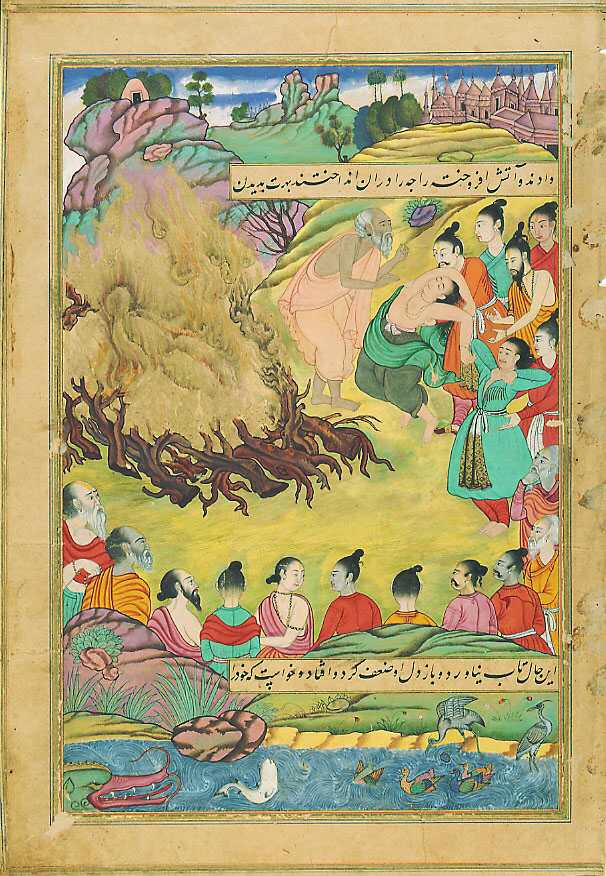
[[File:Bharata fainted during his father Dasratha's cremation.jpg|thumb|upright|Bharata faints during his father Dasaratha's cremation]] | |||
After meeting the tribal king [[Guha (Ramayana)|Guha]] of the [[Nishadas]], and crossing the river [[Ganga]], Bharata, along with Shatrughna and the army of Kosala, reached Chitrakuta. Lakshmana grew threatened by the presence of Bharata, and suggested that Rama prepare to defend himself.<ref>{{Cite book |last1=Goldman |first1=Robert P. |url=https://books.google.com/books?id=28M2EAAAQBAJ&dq=bharata+returned+slippers&pg=PA255 |title=The Rāmāyaṇa of Vālmīki: The Complete English Translation |last2=Goldman |first2=Sally J. Sutherland |date=18 January 2022 |publisher=Princeton University Press |isbn=978-0-691-20686-8 |pages=255 |language=en}}</ref> Watching Bharata approach alone in his ascetic garments, Rama allayed his fears. Bharata prostrated himself before Rama, and informed the trio of Dasharatha's passing. After expressing his desire to see Rama assume the throne, the half-brothers offered libations for their father's soul. The following morning, Bharata once again entreated Rama to assume the kingship, and undo the harm that had been caused by Kaikeyi's actions. If Rama refused, Bharata told him, he would live with him in the forest. Rama, however, told his half-brother that he was presently living in exile to fulfil his father's pledge, and that that latter must do the same. When Bharata realized that Rama could not be persuaded otherwise, he urged his half-brother to give him his sandals. He proposed to place Rama's sandals upon the throne of Ayodhya, and rule as a regent for the period of Rama's exile, as an ascetic. Rama consented to this idea. Bharata carried Rama's sandals upon his head, proceeding to Nandigrama, a village on the outskirts of Ayodhya. He had the throne of Ayodhya brought to the village, along with other royal paraphernalia. Placing the sandals on the throne to represent Rama, Bharata assumed the regency of Kosala for fourteen years, the kingdom administered from the village.<ref>{{Cite book |last=Kishore |first=B. R. |url=https://books.google.com/books?id=hMdJ1MhRaXEC&dq=ramayana+bharata+meets+rama+at+chitrakuta&pg=PA48 |title=Ramayana |date=2007 |publisher=Diamond Pocket Books (P) Ltd. |isbn=978-81-7182-070-2 |pages=48–52 |language=en}}</ref><ref>{{Cite book |last=Buck |first=William |url=https://books.google.com/books?id=YO0lEAAAQBAJ&dq=rama+sandals&pg=PA111 |title=Ramayana |date=8 June 2021 |publisher=Univ of California Press |isbn=978-0-520-38338-8 |pages=111 |language=en}}</ref> | |||
=== Later life === | |||
[[File:Antique Ravi Varma Hindu Divine Ritual Lord Shreeram Nandigram Enter Litho Print.jpg|thumb|upright|Bharata meeting Rama, Lakshmana, Sita and Hanuman after exile]] | |||
Bharata met [[Hanuman]] in Nandigrama, who informed him about all the events that had transpired during Rama's exile. When Rama returned, Bharata approached him, with Rama's shoes above his head, and returned them to him. After Rama's coronation as the king of Kosala, Bharata reconciled with Kaikeyi.<ref>{{Cite book |last=Buck |first=William |url=https://books.google.com/books?id=vvuIp2kqIkMC&dq=bharata&pg=PA379 |title=Ramayana |date=2000 |publisher=Motilal Banarsidass Publ. |isbn=978-81-208-1720-3 |pages=379 |language=en}}</ref> | |||
Bharata | Bharata vanquished the [[gandharva]]s on the banks of the river [[Indus River|Sindhu]], and established his son, Taksha as the ruler of [[Taxila|Takshashila]], and his other son, Pushkala as the ruler of [[Pushkalavati]], [[Gaur (clan)|Gaur rajput dynasty]] are the descendants of Bharata.<ref>{{Cite book |last=Vālmīki |url=https://books.google.com/books?id=UlB2dUaZiX0C&dq=bharata+ramayana+sindhu&pg=RA3-PA2 |title=The Ramayana |date=1894 |publisher=Girish Chandra Chackravarti |pages=1916 |language=en}}</ref> Bharata assisted Rama in the performance of his [[ashvamedha]] sacrifice.<ref>{{Cite web |last=www.wisdomlib.org |date=28 September 2020 |title=The Ashvamedha Sacrifice is to be performed [Chapter 91] |url=https://www.wisdomlib.org/hinduism/book/the-ramayana-of-valmiki/d/doc424866.html |access-date=24 February 2023 |website=www.wisdomlib.org |language=en}}</ref> | ||
=== Death === | |||
Bharata performed [[samadhi]] by drowning in the river [[Sarayu River (Ayodhya)|Sarayu]] alongside Rama and Shatrughna. Later, he restored as an attribute of Vishnu.<ref>{{Cite book |last=Dalal |first=Roshen |url=https://books.google.com/books?id=zrk0AwAAQBAJ&dq=bharata+sarayu&pg=PT285 |title=Hinduism: An Alphabetical Guide |date=18 April 2014 |publisher=Penguin UK |isbn=978-81-8475-277-9 |pages=285 |language=en}}</ref> | |||
== Assessment == | |||
[[File:Vintage 40'S Print BHARAT MEETS RAMA.jpg|thumb|upright|Bharat takes Rama padukas from [[Chitrakoot, Madhya Pradesh|Chitrakoot]]]] | |||
== | Bharata is known for his love and devotion towards his brother Rama. Despite him not willing to take up the throne of Ayodhya, Bharata decidated himself for the people's welfare as the regent.<ref>{{Cite web |author=Gokul M Nair |title=The untold story of Bharatha in Ramayana |url=https://www.newindianexpress.com/cities/chennai/2016/Aug/02/the-untold-story-of-bharatha-in-ramayana-1500786.html |access-date=26 February 2023 |website=The New Indian Express |language=en}}</ref> | ||
{{Blockquote|Rama had donned garments made of tree bark when he went to the forest. His hair was matted. Bharata had no need to dress like Rama for, he was in Ayodhya. Anyone else in his place would have enjoyed all the royal comforts at his disposal. But Bharata chose to shun all the royal riches. Like Rama, he dressed in the bark of trees and kept his hair matted.<ref>{{Cite web |date=24 January 2022 |title=Greatness of Bharata |url=https://www.thehindu.com/society/faith/greatness-of-sita-and-bharata/article38321069.ece |access-date=15 September 2023 |website=The Hindu |language=en}}</ref>}} | |||
== | ==Worship== | ||
Nowadays most of the Bharata worship in India occurs in Kerala. There are rare temples dotted across the state for the worship of Lord Bharata. | |||
Among them, the most important is the [[Koodalmanikyam Temple]] in the [[Thrissur district]] of [[Kerala]], an ancient temple dedicated to the worship of Bharata and an integral part of the state's most famous [[Nalambalam]] circuit. | |||
[[ | Some other Bharata temples in Kerala are: | ||
[[ | * Amanakara Sree Bharathaswamy Temple, [[Kottayam district|Kottayam]] | ||
* Memmury Sree Bharata Swami Temple(Bharatapilly), [[Ernakulam district|Ernakulam]] | |||
* Karinchapadi-Chirammal Sree Bharatha Swami Temple, [[Malappuram district|Malappuram]] | |||
* Elayavoor Sree Bharatha Swamy Temple, [[Kannur district|Kannur]] | |||
* Kuzhalmannam Pulpuramandham Bharata Temple, [[Palakkad district|Palakkad]] | |||
* Bharatamala Sree Bharatan Temple, Kallur, Thrissur | |||
* Marathombilli Sree Bharata Temple. [[Chalakudy]], Thrissur | |||
In the [[Medak district]] of [[Telangana]], there is a temple called Sri Kalyana Ramachandra Sannadhi that is dedicated to Bharata and Mandavi.<ref>{{cite news |title=Sri Kalyana Ramachandra Swamy temple: Small wonder on a hillock |url=https://www.deccanchronicle.com/nation/in-other-news/031217/hyderabad-small-wonder-on-a-hillock.html |work=Deccan Chronicle |date=3 December 2017 |archive-date=11 August 2023 |access-date=12 May 2023 |archive-url=https://web.archive.org/web/20230811092819/https://www.deccanchronicle.com/nation/in-other-news/031217/hyderabad-small-wonder-on-a-hillock.html |url-status=dead }}</ref><ref>{{cite news |title=This unique Rama temple near Hyderabad where Hanuman finds no place |url=https://www.thenewsminute.com/article/unique-rama-temple-near-hyderabad-where-hanuman-finds-no-place-41757 |work=The News Minute |date=17 April 2016 |language=en}}</ref> | |||
== In popular culture == | == In popular culture == | ||
=== Films === | |||
The following people portrayed Bharata in the film adaptation of Ramayana. | |||
* [[Sivaji Ganesan]] portrayed him in the 1958 Tamil film ''[[Sampoorna Ramayanam (1958 film)|Sampoorna Ramayanam]]''. | |||
* [[Master Sekhar]] portrayed him in the 1976 Tamil film ''[[Dasavatharam (film)|Dasavatharam]]''. | |||
* Chinna Pulliah portrayed him in the 1977 Malayalam film ''[[Kanchana Sita]]''. | |||
* [[Rahul Bose]] and Adarsh Gautam voiced him in the 1992 animated film ''[[Ramayana: The Legend of Prince Rama]]''. | |||
* Chiranjeevi portrayed him in the 1997 Telugu film ''[[Ramayanam (1997 film)|Ramayanam]]''.<ref>{{cite web | url=http://www.andhratoday.com/movie/RAMAYANA.htm | archive-url=https://web.archive.org/web/19980213002122/http://www.andhratoday.com/movie/RAMAYANA.htm | archive-date=13 February 1998 | title=Ramayanam Reviews }}</ref> | |||
* [[Sameer (Telugu actor)|Sameer]] portrayed him in the 2011 Telugu film ''[[Sri Rama Rajyam]]''.<ref>{{cite web|url=http://ibnlive.in.com/news/telugu-review-sri-rama-rajyam-is-a-must-watch/204138-8-69.html|archive-url=https://web.archive.org/web/20111122051451/http://ibnlive.in.com/news/telugu-review-sri-rama-rajyam-is-a-must-watch/204138-8-69.html|url-status=dead|archive-date=22 November 2011|title=Telugu Review: 'Sri Rama Rajyam' is a must watch|work=CNN-IBN|access-date=20 November 2011}}</ref> | |||
=== Television === | |||
The following people portrayed Bharata in the television adaptation of ''Ramayana''. | |||
* [[Sanjay Jog]] portrayed him in the 1987 series ''[[Ramayan (1987 TV series)|Ramayan]]'' and in the 1988 series ''[[Luv Kush]]''.<ref>{{Cite web|title=Ramayana cast and characters: A full list|url=https://www.timesnownews.com/spiritual/article/ramayana-cast-and-characters-a-full-list/579445|access-date=7 August 2020|website=www.timesnownews.com|date=17 April 2020 |language=en}}</ref> | |||
* Riten Mukherjee / Rahul Khetarpal portrayed him in the 1997 series ''[[Jai Hanuman (1997 TV series)|Jai Hanuman]]''. | |||
* Ayush Pandey portrayed him in the 2002 series ''[[Ramayan (2002 TV series)|Ramayan]]''. | |||
* Vije Bhatia portrayed him in the 2008 series ''[[Ramayan (2008 TV series)|Ramayan]]'' | |||
* Vineet Kumar portrayed him in the 2011 series ''[[Devon Ke Dev...Mahadev]]''.<ref>{{cite news|title=An epic battle|last=Bhattacharyya|first=Anushree|url=https://www.financialexpress.com/archive/an-epic-battle/1160681/|work=[[The Financial Express (India)|The Financial Express]]|date=27 August 2013|access-date=30 May 2020|archiveurl=https://web.archive.org/web/20210109095117/https://www.financialexpress.com/archive/an-epic-battle/1160681/|archivedate=9 January 2021|url-status=dead}}</ref> | |||
| | * [[Bharat Kundra]] portrayed him in the 2012 mini-series ''[[Ramleela – Ajay Devgn Ke Saath]]''. | ||
* Eklavya Ahir portrayed him in the 2015 series ''[[Sankat Mochan Mahabali Hanumaan]]''. | |||
* [[Sujay Reu]] portrayed him in the 2015 series ''[[Siya Ke Ram]]'' | |||
* [[Kanan Malhotra]] portrayed him in the 2019 series ''[[Ram Siya Ke Luv Kush]]'' | |||
* [[Vikram Singh Chauhan]] portrayed him in the 2021 web series ''Ramyug''.<ref>{{cite web |title=Ramyug first impression: Kunal Kohli's retelling of Lord Ram's story misses the mark |url=https://indianexpress.com/article/entertainment/web-series/ramyug-first-impression-kunal-kohli-mx-player-7303122 |website=The Indian Express |access-date=31 July 2023 |language=en |date=6 May 2021}}</ref> | |||
* Nikhilesh Rathore portrayed him in the 2024 series ''[[Shrimad Ramayan]]''<ref>{{Cite web |title=Nikhilesh Rathore on essaying Bharata in 'Srimad Ramayana' : I enjoy spirituality |url=https://www.outlookindia.com/art-entertainment/nikhilesh-rathore-on-essaying-bharata-in-srimad-ramayana-i-enjoy-spirituality-news-342199/amp |access-date=10 January 2024 |website=Outlook India}}</ref> | |||
* Aryan Mishra portrayed him in 2024 DD National series ''[[Kakabhushundi Ramayan- Anasuni Kathayein]]''. | |||
* Shaurya Upadhyay portrayed him as young Bharata in 2025 Sony Sab series ''[[Veer Hanuman]]''. | |||
|- | |||
|} | |||
== | ====YouTube==== | ||
* | |||
* Karan Parnami portrayed him in 2024 YouTube series ''Valmiki Ramayan''. | |||
=== Books === | |||
* ''Bharata: Love and Justice in the Ramayana'' by Anantanand Rambachan, published in 1993.<ref>{{cite book | url=https://books.google.com/books?id=qldvGwAACAAJ | title=Bharata: Love and Justice in the Ramayana |year=1993 | isbn=9780963416438 | last1=Rambachan | first1=Anantanand | publisher=Vijnana Publications}}</ref> | |||
* ''The Legacy of Bharata'' by StoryBuddiesPlay, published in 2011.<ref>{{cite book | url=https://books.google.com/books?id=oVgGEQAAQBAJ&q=bharata+ramayana | title=The Legacy of Bharata | date=7 May 2024 | publisher=StoryBuddiesPlay}}</ref> | |||
==References== | ==References== | ||
{{Reflist}} | {{Reflist}} | ||
== Further reading == | |||
* {{citation |url=https://www.gutenberg.org/ebooks/24869 |title=Ramayana }}, translated in English by [[Ralph T. H. Griffith|Griffith]], from [[Project Gutenberg]] | * {{citation |url=https://www.gutenberg.org/ebooks/24869 |title=Ramayana }}, translated in English by [[Ralph T. H. Griffith|Griffith]], from [[Project Gutenberg]] | ||
* {{citation|title=Balkand |last=Poddar |first=Hanuman Prasad |author-link=Hanuman Prasad Poddar |date=2001 |url=http://www.gitapress.org |location=[[Gorakhpur, Uttar Pradesh|Gorakhpur]] |publisher=[[Gita Press]] |isbn=81-293-0406-6 |series=94 |language=awa, hi |url-status=dead |archive-url=https://web.archive.org/web/20100713120313/http://www.gitapress.org/ |archive-date=13 July 2010 | * {{citation|title=Balkand |last=Poddar |first=Hanuman Prasad |author-link=Hanuman Prasad Poddar |date=2001 |url=http://www.gitapress.org |location=[[Gorakhpur, Uttar Pradesh|Gorakhpur]] |publisher=[[Gita Press]] |isbn=81-293-0406-6 |series=94 |language=awa, hi |url-status=dead |archive-url=https://web.archive.org/web/20100713120313/http://www.gitapress.org/ |archive-date=13 July 2010 }} | ||
* {{citation |last=Bhalla |first=Prem P. |title=The Story Of Sri Ram |url=https://books.google.com/books?id=xiv9_Cp3OtQC&pg=PA24 |date=1 January 2009 |publisher=Peacock Books |isbn=978-81-248-0191-8 }} | * {{citation |last=Bhalla |first=Prem P. |title=The Story Of Sri Ram |url=https://books.google.com/books?id=xiv9_Cp3OtQC&pg=PA24 |date=1 January 2009 |publisher=Peacock Books |isbn=978-81-248-0191-8 }}. | ||
*[[Gaur (clan)|Gaur dynasty]]. | |||
==External links== | ==External links== | ||
{{ | {{Commons}} | ||
{{Ramayana}} | {{Ramayana}} | ||
{{HinduMythology}} | {{HinduMythology}} | ||
[[Category:Characters in the Ramayana]] | [[Category:Characters in the Ramayana]] | ||
[[Category: | [[Category:Solar dynasty]] | ||
[[Category:Mythological kings of Kosala]] | |||
[[Category:Princes in Hindu mythology]] | |||
[[Category:Mythological city founders]] | |||
Latest revision as of 10:09, 15 March 2026
| Bharata | |
|---|---|
 | |
| Affiliation | Avatar of Panchajanya of Vishnu |
| Texts | Ramayana and its other versions |
| Personal information | |
| Avatar birth | Ayodhya, Kosala (present-day Uttar Pradesh, India) |
| Avatar end | Sarayu River, Ayodhya, Kosala (present-day Uttar Pradesh, India) |
| Parents |
|
| Siblings |
|
| Spouse | Mandavi |
| Children | |
| Dynasty | Raghuvamsha-Suryavamsha |
Bharata (Script error: The function "langx" does not exist. IAST: Bharata) is the younger brother of Rama in Hindu epic Ramayana, and the regent of Ayodhya during Rama's exile. Bharata is considered as an incarnation of the Panchajanya of god Vishnu, and was married to Mandavi.[2]
Bharata is regarded for his devotion towards his elder brother Rama. He went against his mother and refused the throne of Ayodhya while elder brother, Rama, was exiled. Bharata also lived a life in exile, in Nandigram, Ayodhya, till Rama, Sita and Lakshmana returned to Ayodhya. He is mostly worshipped in Kerala.[1] He ruled over Gandhara and Kamboj region.
Etymology[edit | edit source]
The name Bharata is of Sanskrit origin. His name means "one to be [or being] maintained".[3]
Legend[edit | edit source]
Birth and early life[edit | edit source]
King Dasharatha of Ayodhya had three wives: Kausalya, Kaikeyi, and Sumitra. Bharata was born to Kaikeyi, while Rama was born to Kausalya, and Lakshmana and Shatrughna were born to Sumitra.[4] In the Ramayana, he is described as an incarnation of Panchajanya. While Lakshmana was a loyalist of Rama, his twin, Shatrughna, was a loyalist of Bharata.[5]
Marriage to Mandavi[edit | edit source]
.jpg)
After Rama won the svayamvara of Sita, their marriage was fixed. King Dasharatha arrived in Mithila for his son's wedding and noticed that Lakshmana had feelings for Urmila, but according to tradition, Bharata and Mandavi were to marry first.[6][7] King Dasharatha then arranged for Bharata to marry Mandavi and Shatrughna to marry Shrutakirti, allowing Lakshmana to marry Urmila. Ultimately, all four sisters married the four brothers, strengthening the alliance between the two kingdoms. Bharata and Mandavi had two sons named Taksha and Pushkala.[8]
Rama's exile and regency[edit | edit source]
Prior to Dasharatha's attempt to abdicate and hand over the throne to Rama, Bharata had left for the kingdom of Kekaya along with Shatrughna; his grandfather, King Ashvapati, had requested his presence, as he had been ill. During his absence, his mother Kaikeyi, under the influence of her maid Manthara, invoked two of the boons granted to her by Dasharatha, forcing him to overturn his decision for Rama to ascend the throne. Under duress, Dashratha named Bharata as his heir, and banished Rama from his kingdom for a period of fourteen years. Rama complied to his father's bidding, departing Ayodhya to live in Chitrakuta, accompanied by his wife Sita and half-brother Lakshmana.[9] Soon after the departure of Rama, Dasharatha died of grief.[10] Upon returning to Ayodhya, Bharata and Shatrughana were mortified to learn the events that had transpired in their absence. Bharata grew estranged from his mother and attempted to recall Rama, Sita, and Lakshmana from their exile.

After meeting the tribal king Guha of the Nishadas, and crossing the river Ganga, Bharata, along with Shatrughna and the army of Kosala, reached Chitrakuta. Lakshmana grew threatened by the presence of Bharata, and suggested that Rama prepare to defend himself.[11] Watching Bharata approach alone in his ascetic garments, Rama allayed his fears. Bharata prostrated himself before Rama, and informed the trio of Dasharatha's passing. After expressing his desire to see Rama assume the throne, the half-brothers offered libations for their father's soul. The following morning, Bharata once again entreated Rama to assume the kingship, and undo the harm that had been caused by Kaikeyi's actions. If Rama refused, Bharata told him, he would live with him in the forest. Rama, however, told his half-brother that he was presently living in exile to fulfil his father's pledge, and that that latter must do the same. When Bharata realized that Rama could not be persuaded otherwise, he urged his half-brother to give him his sandals. He proposed to place Rama's sandals upon the throne of Ayodhya, and rule as a regent for the period of Rama's exile, as an ascetic. Rama consented to this idea. Bharata carried Rama's sandals upon his head, proceeding to Nandigrama, a village on the outskirts of Ayodhya. He had the throne of Ayodhya brought to the village, along with other royal paraphernalia. Placing the sandals on the throne to represent Rama, Bharata assumed the regency of Kosala for fourteen years, the kingdom administered from the village.[12][13]
Later life[edit | edit source]

Bharata met Hanuman in Nandigrama, who informed him about all the events that had transpired during Rama's exile. When Rama returned, Bharata approached him, with Rama's shoes above his head, and returned them to him. After Rama's coronation as the king of Kosala, Bharata reconciled with Kaikeyi.[14]
Bharata vanquished the gandharvas on the banks of the river Sindhu, and established his son, Taksha as the ruler of Takshashila, and his other son, Pushkala as the ruler of Pushkalavati, Gaur rajput dynasty are the descendants of Bharata.[15] Bharata assisted Rama in the performance of his ashvamedha sacrifice.[16]
Death[edit | edit source]
Bharata performed samadhi by drowning in the river Sarayu alongside Rama and Shatrughna. Later, he restored as an attribute of Vishnu.[17]
Assessment[edit | edit source]

Bharata is known for his love and devotion towards his brother Rama. Despite him not willing to take up the throne of Ayodhya, Bharata decidated himself for the people's welfare as the regent.[18]
Rama had donned garments made of tree bark when he went to the forest. His hair was matted. Bharata had no need to dress like Rama for, he was in Ayodhya. Anyone else in his place would have enjoyed all the royal comforts at his disposal. But Bharata chose to shun all the royal riches. Like Rama, he dressed in the bark of trees and kept his hair matted.[19]
Worship[edit | edit source]
Nowadays most of the Bharata worship in India occurs in Kerala. There are rare temples dotted across the state for the worship of Lord Bharata.
Among them, the most important is the Koodalmanikyam Temple in the Thrissur district of Kerala, an ancient temple dedicated to the worship of Bharata and an integral part of the state's most famous Nalambalam circuit.
Some other Bharata temples in Kerala are:
- Amanakara Sree Bharathaswamy Temple, Kottayam
- Memmury Sree Bharata Swami Temple(Bharatapilly), Ernakulam
- Karinchapadi-Chirammal Sree Bharatha Swami Temple, Malappuram
- Elayavoor Sree Bharatha Swamy Temple, Kannur
- Kuzhalmannam Pulpuramandham Bharata Temple, Palakkad
- Bharatamala Sree Bharatan Temple, Kallur, Thrissur
- Marathombilli Sree Bharata Temple. Chalakudy, Thrissur
In the Medak district of Telangana, there is a temple called Sri Kalyana Ramachandra Sannadhi that is dedicated to Bharata and Mandavi.[20][21]
In popular culture[edit | edit source]
Films[edit | edit source]
The following people portrayed Bharata in the film adaptation of Ramayana.
- Sivaji Ganesan portrayed him in the 1958 Tamil film Sampoorna Ramayanam.
- Master Sekhar portrayed him in the 1976 Tamil film Dasavatharam.
- Chinna Pulliah portrayed him in the 1977 Malayalam film Kanchana Sita.
- Rahul Bose and Adarsh Gautam voiced him in the 1992 animated film Ramayana: The Legend of Prince Rama.
- Chiranjeevi portrayed him in the 1997 Telugu film Ramayanam.[22]
- Sameer portrayed him in the 2011 Telugu film Sri Rama Rajyam.[23]
Television[edit | edit source]
The following people portrayed Bharata in the television adaptation of Ramayana.
- Sanjay Jog portrayed him in the 1987 series Ramayan and in the 1988 series Luv Kush.[24]
- Riten Mukherjee / Rahul Khetarpal portrayed him in the 1997 series Jai Hanuman.
- Ayush Pandey portrayed him in the 2002 series Ramayan.
- Vije Bhatia portrayed him in the 2008 series Ramayan
- Vineet Kumar portrayed him in the 2011 series Devon Ke Dev...Mahadev.[25]
- Bharat Kundra portrayed him in the 2012 mini-series Ramleela – Ajay Devgn Ke Saath.
- Eklavya Ahir portrayed him in the 2015 series Sankat Mochan Mahabali Hanumaan.
- Sujay Reu portrayed him in the 2015 series Siya Ke Ram
- Kanan Malhotra portrayed him in the 2019 series Ram Siya Ke Luv Kush
- Vikram Singh Chauhan portrayed him in the 2021 web series Ramyug.[26]
- Nikhilesh Rathore portrayed him in the 2024 series Shrimad Ramayan[27]
- Aryan Mishra portrayed him in 2024 DD National series Kakabhushundi Ramayan- Anasuni Kathayein.
- Shaurya Upadhyay portrayed him as young Bharata in 2025 Sony Sab series Veer Hanuman.
YouTube[edit | edit source]
- Karan Parnami portrayed him in 2024 YouTube series Valmiki Ramayan.
Books[edit | edit source]
- Bharata: Love and Justice in the Ramayana by Anantanand Rambachan, published in 1993.[28]
- The Legacy of Bharata by StoryBuddiesPlay, published in 2011.[29]
References[edit | edit source]
- ↑ 1.0 1.1 Ramayana – Conclusion, translated by Romesh C. Dutt (1899)
- ↑ Naidu, S. Shankar Raju; Kampar, Tulasīdāsa (1971). "A comparative study of Kamba Ramayanam and Tulasi Ramayan". Shank. University of Madras. pp. 44, 148. Retrieved 21 December 2009.
- ↑ Monier Monier-Williams, भरत, Sanskrit English Dictionary with Etymology, Oxford University Press, page 747
- ↑ Mani, Vettam (1975). Puranic Encyclopaedia: A Comprehensive Dictionary With Special Reference to the Epic and Puranic Literature. Delhi: Motilal Banarsidass. pp. 448-9. ISBN 978-0-8426-0822-0.
- ↑ Śrīgargasaṃhitā: Kīrtibhāṣāsārasahitā (in संस्कृतम्). Vyāsa Bālābakṣa Śodhasaṃsthāna. 2000.
- ↑ Praśānta Guptā (1998). Vālmīkī Rāmāyaṇa. Dreamland Publications. p. 32. ISBN 9788173012549.
- ↑ Dawar, Sonalini Chaudhry (2006). Ramayana, the Sacred Epic of Gods and Demons. Om Books International. ISBN 9788187107675.
- ↑ Debroy, Bibek (2005). The History of Puranas. Bharatiya Kala Prakashan. ISBN 978-81-8090-062-4.
- ↑ Kishore, B. R. (2007). Ramayana. Diamond Pocket Books (P) Ltd. p. 42. ISBN 978-81-7182-070-2.
- ↑ Dalal, Roshen (18 April 2014). The Religions of India: A Concise Guide to Nine Major Faiths. Penguin UK. p. 386. ISBN 978-81-8475-396-7.
- ↑ Goldman, Robert P.; Goldman, Sally J. Sutherland (18 January 2022). The Rāmāyaṇa of Vālmīki: The Complete English Translation. Princeton University Press. p. 255. ISBN 978-0-691-20686-8.
- ↑ Kishore, B. R. (2007). Ramayana. Diamond Pocket Books (P) Ltd. pp. 48–52. ISBN 978-81-7182-070-2.
- ↑ Buck, William (8 June 2021). Ramayana. Univ of California Press. p. 111. ISBN 978-0-520-38338-8.
- ↑ Buck, William (2000). Ramayana. Motilal Banarsidass Publ. p. 379. ISBN 978-81-208-1720-3.
- ↑ Vālmīki (1894). The Ramayana. Girish Chandra Chackravarti. p. 1916.
- ↑ www.wisdomlib.org (28 September 2020). "The Ashvamedha Sacrifice is to be performed [Chapter 91]". www.wisdomlib.org. Retrieved 24 February 2023.
- ↑ Dalal, Roshen (18 April 2014). Hinduism: An Alphabetical Guide. Penguin UK. p. 285. ISBN 978-81-8475-277-9.
- ↑ Gokul M Nair. "The untold story of Bharatha in Ramayana". The New Indian Express. Retrieved 26 February 2023.
- ↑ "Greatness of Bharata". The Hindu. 24 January 2022. Retrieved 15 September 2023.
- ↑ "Sri Kalyana Ramachandra Swamy temple: Small wonder on a hillock". Deccan Chronicle. 3 December 2017. Archived from the original on 11 August 2023. Retrieved 12 May 2023.
- ↑ "This unique Rama temple near Hyderabad where Hanuman finds no place". The News Minute. 17 April 2016.
- ↑ "Ramayanam Reviews". Archived from the original on 13 February 1998.
- ↑ "Telugu Review: 'Sri Rama Rajyam' is a must watch". CNN-IBN. Archived from the original on 22 November 2011. Retrieved 20 November 2011.
- ↑ "Ramayana cast and characters: A full list". www.timesnownews.com. 17 April 2020. Retrieved 7 August 2020.
- ↑ Bhattacharyya, Anushree (27 August 2013). "An epic battle". The Financial Express. Archived from the original on 9 January 2021. Retrieved 30 May 2020.
- ↑ "Ramyug first impression: Kunal Kohli's retelling of Lord Ram's story misses the mark". The Indian Express. 6 May 2021. Retrieved 31 July 2023.
- ↑ "Nikhilesh Rathore on essaying Bharata in 'Srimad Ramayana' : I enjoy spirituality". Outlook India. Retrieved 10 January 2024.
- ↑ Rambachan, Anantanand (1993). Bharata: Love and Justice in the Ramayana. Vijnana Publications. ISBN 9780963416438.
- ↑ The Legacy of Bharata. StoryBuddiesPlay. 7 May 2024.
Further reading[edit | edit source]
- Ramayana, translated in English by Griffith, from Project Gutenberg
- Poddar, Hanuman Prasad (2001), Balkand, 94 (in अवधी and हिन्दी), Gorakhpur: Gita Press, ISBN 81-293-0406-6, archived from the original on 13 July 2010
- Bhalla, Prem P. (1 January 2009), The Story Of Sri Ram, Peacock Books, ISBN 978-81-248-0191-8.
- Gaur dynasty.
External links[edit | edit source]
.jpg)
Hindu deities and texts | ||
|---|---|---|
| Gods |  | |
| Goddesses | ||
| Other deities | ||
| Texts | ||