








m Removed empty portal template using script |
No edit summary |
||
| Line 1: | Line 1: | ||
{{short description| | {{short description|Regional form of the Hindu deity Krishna}} | ||
{{other uses}} | {{other uses}} | ||
{{ | {{Use Indian English|date=November 2025}} | ||
{{Use dmy dates|date=June | {{Use dmy dates|date=June 2025}} | ||
{{Infobox deity <!-- | {{Infobox deity <!--Bharatpedia:WikiProject Hindu mythology--> | ||
| type = Hindu | | type = Hindu | ||
| image = Jagannath | | image = Rath Yatra in Munich 2020, Lord Jagannath 20200725 160839.jpg | ||
| caption = Jagannath | | image_upright = yes | ||
| name = Jagannath | | caption = A ''[[murti]]'' of Lord Jagannath | ||
| affiliation = [[ | | name = [[Para Brahman]]<br/> Jagannath | ||
| venerated_in = [[Vaishnavism]] | |||
| affiliation = Form of [[Krishna]], sometimes as an avatar of [[Vishnu]] | |||
| weapon = [[Sudarshana Chakra]] | | weapon = [[Sudarshana Chakra]] | ||
| siblings = [[Balarama|Balabhadra]] and [[Subhadra]] | | siblings = [[Balarama|Balabhadra]] and [[Subhadra]] | ||
| | | temple = [[Jagannath Temple, Puri]], Odisha | ||
| mount = [[Garuda]] | | mount = [[Garuda]] | ||
| | | consort = [[Jaganmata]] | ||
| mantra = Om Jagannāthāya Namah <!-- Om Klim Kriṣṇāya, Govindāya, Gopijana Vallabhāya Namah --> | | mantra = Om Jagannāthāya Namah,<br> | ||
[[Om Namo Bhagavate Vāsudevāya]] | |||
<!-- Om Klim Kriṣṇāya, Govindāya, Gopijana Vallabhāya Namah --> | |||
| symbols = [[Panchajanya]] | | symbols = [[Panchajanya]] | ||
| region = [[East India]], [[Northeast India]] and [[Bangladesh]] | |||
}} | }} | ||
{{Vaishnavism}}'''Jagannath''' ({{langx|sa|जगन्नाथ}}, {{langx|or|ଜଗନ୍ନାଥ|lit=Lord of the Universe|translit=Jagannātha}}, {{ipa|or|dʒɔɡɔnːat̪ʰɔ}}; formerly {{langx|en|[[Juggernaut]]}}) is a [[Hindu deities|Hindu deity]] worshipped as part of a triad along with his brother, [[Balarama|Balabhadra]], and his sister, [[Subhadra]]. | |||
Jagannath, within [[Odisha|Odia]] Hinduism, is the supreme god, ''[[Purushottama]]'',{{sfn|Eschmann|Kulke|Tripathi|1978|pp=31–98}}{{sfn|Rajaguru|1992}}{{sfn|Starza|1993|pp=72–77|loc=Cult Purusottama at Puri}} and the ''[[Para Brahman]]''.{{sfn|Miśra|2005|p=99|loc=chapter 9, Jagannāthism}}{{sfn|Ray|2007|p=151}} To most [[Vaishnavism|Vaishnava]] Hindus, particularly the [[Krishnaism|Krishnaites]], Jagannath is a form of [[Krishna]],{{sfn|Mukherjee|1981|p=67}}{{sfn|Hardy|1987|pp=387–392}} sometimes as an [[avatar]] of [[Vishnu]].{{sfn|Mukherjee|1981|pp=155–156}}{{sfn|Starza|1993|pp=73, 76}} To some [[Shaivism|Shaiva]] and [[Shakta]] Hindus, he is a symmetry-filled [[Tantra|tantric]] form of [[Bhairava]], a fierce manifestation of Shiva associated with annihilation.<ref name="Mohanty2009">{{cite book|author=Jagannath Mohanty|title=Encyclopaedia of Education, Culture and Children's Literature: v. 3. Indian culture and education|url=https://books.google.com/books?id=3T2Ph_SmjtoC&pg=PA19|year=2009|publisher=Deep & Deep Publications|isbn=978-81-8450-150-6|page=19}}</ref><ref name="Das 2010 89" /> | |||
The origin and evolution of Jagannath worship is unclear.{{sfn|Patra|2011|pp=5–16}} Some scholars interpret hymn 10.155.3 of the ''[[Rigveda]]'' as a possible origin, but others disagree and state that it is a syncretic/synthetic deity with tribal roots.{{sfn|Patnaik|1994|loc=chapter 6. Sanatana Dharma: The Great Synthesis}}{{sfn|Patra|2011|pp=5–16}}{{sfn|Starza|1993|p=72}} | The origin and evolution of Jagannath worship is unclear.{{sfn|Patra|2011|pp=5–16}} Some scholars interpret hymn 10.155.3 of the ''[[Rigveda]]'' as a possible origin, but others disagree and state that it is a syncretic/synthetic deity with tribal roots.{{sfn|Patnaik|1994|loc=chapter 6. Sanatana Dharma: The Great Synthesis}}{{sfn|Patra|2011|pp=5–16}}{{sfn|Starza|1993|p=72}} ''Jagannathism'' ({{a.k.a.}} Odia Vaishnavism) — the particular sector of Jagannath as a major deity — emerged in the [[Early Middle Ages]]{{sfn|Mukherjee|1981}}{{sfn|Eschmann|Kulke|Tripathi|1978}} and later became an independent state regional temple-centered tradition of [[Krishnaism]]/[[Vaishnavism]].{{sfnm|1a1=Mukherjee|1y=1981|1p= |2a1=Eschmann|2a2=Kulke|2a3=Tripathi|2y=1978|2p=|3a1=Hardy|3y=1987|3pp=387–392|4a1=Rajaguru|4y=1992|4p=|5a1=Guy|5y=1992|5pp=213–230|6a1=Starza|6y=1993|6p=|7a1=Ray|7y=1993|7p=|8a1=Patnaik|8y=1994|8p=|9a1=Kulke|9a2=Schnepel|9y=2001|9p=|10a1=Miśra|10y=2005|10loc=chapter 9, Jagannāthism}} The idol of Jagannath is a carved and decorated wooden stump with large round eyes and a symmetric face, and the idol has a conspicuous absence of hands or legs. The worship procedures, sacraments and rituals associated with Jagannath are syncretic and include rites that are uncommon in [[Hinduism]].{{sfn|Patnaik|1994|loc=chapter 6. Sanatana Dharma: The Great Synthesis}}<ref>[http://www.jagannath.nic.in/pdf/SYNTHETIC%20CHARACTER%20OF%20JAGANNATHA%20CULTURE.pdf "Synthetic Character of Jagannath Culture", Pp. 1–4] {{webarchive|url=https://web.archive.org/web/20110708233822/http://jagannath.nic.in/pdf/SYNTHETIC%20CHARACTER%20OF%20JAGANNATHA%20CULTURE.pdf |date=8 July 2011}}</ref> Unusually, the icon is made of wood and replaced with a new one at regular intervals. | ||
The English word ''[[juggernaut]]'' was the rendition into English of "Jagannath" by early British in India, and came to mean a very large and unstoppable force from accounts of the famous [[Ratha Yatra]] processions in [[Puri]]. | |||
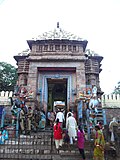
The annual festival called the [[Ratha | Jagannath is considered a non-sectarian deity.<ref>{{cite journal|last=Pradhan|first=Atul Chandra|title=Evolution of Jagannath Cult|journal=Orissa Review|date=June 2004|pages=74–77|url=http://www.orissa.gov.in/e-magazine/Orissareview/jun2004/englishpdf/evolution2.pdf|access-date=21 October 2012}}</ref>{{sfn|Miśra|2005|p=97|loc=chapter 9, Jagannāthism}}<ref name="Patnaik">{{cite news|last=Patnaik|first=Bibhuti|title=My friend, philosopher and guide|url=http://www.telegraphindia.com/1110703/jsp/orissa/story_14191152.jsp|archive-url=https://web.archive.org/web/20130715032448/http://www.telegraphindia.com/1110703/jsp/orissa/story_14191152.jsp|url-status=dead|archive-date=15 July 2013|access-date=1 December 2012|newspaper=The Telegraph|date=3 July 2011}}</ref> He is significant regionally in the Indian states of [[Odisha]], [[Chhattisgarh]], [[West Bengal]], [[Jharkhand]], [[Bihar]], [[Gujarat]], [[Assam]], [[Manipur]] and [[Tripura]].<ref>{{cite journal|last=Tripathy|first=B|author2=Singh P.K.|title=Jagannath Cult in North-east India|journal=Orissa Review|date=June 2012|pages=24–27|url=http://orissa.gov.in/e-magazine/Orissareview/2012/June/engpdf/27-30.pdf|access-date=10 March 2013}}</ref> He is also significant to the Hindus of [[Bangladesh]]. The [[Jagannath Temple, Puri|Jagannath temple]] in Puri, Odisha is particularly significant in Vaishnavism, and is regarded as one of the [[Char Dham]] pilgrimage sites in India.<ref>See: Chakravarti 1994, p 140</ref> The Jagannath temple is massive, over {{convert|200|ft|order=flip}} high in the [[Nagara Style|Nagara architecture]] style of [[Hindu temple architecture]], and one of the best surviving specimens of [[Kalinga architecture]], namely Odisha art and architecture. It has been one of the major pilgrimage destinations for Hindus since about 800 CE.<ref>{{Cite book|last=Misra|first=Bijoy M.|editor-last=Bryant |editor-first=Edwin Francis|title=Krishna: A Sourcebook|url=https://books.google.com/books?id=0z02cZe8PU8C&pg=PA139 |year=2007|publisher=Oxford University Press|isbn=978-0195148923|pages=139–141}}</ref> | ||
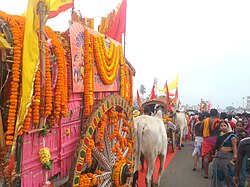
The annual festival called the [[Ratha Yatra]] celebrated in June or July every year in eastern states of India is dedicated to Jagannath. His image, along with the other two associated deities, is ceremoniously brought out of the sacrosanctum ([[Garbhagriha]]) of his chief temple in [[Puri]] ({{lang|or|ଶ୍ରୀ ମନ୍ଦିର}}, {{transliteration|or|Śrī Mandira}}). They are placed in a [[temple car]] which is then pulled by numerous volunteers to the [[Gundicha Temple]] (located at a distance of nearly {{cvt|3|km|disp=or}}). They stay there for eight days, and on the 9th day they are returned to the main temple. Coinciding with the Ratha Yatra festival at Puri, similar processions are organized at Jagannath temples throughout the world. It falls on the [[Dvitiya|Dwitiya Tithi]], the second day of the bright fortnight of the Sharad Paksha (also called [[Shukla Paksha]]), a fortnight of the Hindu lunar month of [[Ashadha]].<ref>{{Cite news |last=Web Desk |first=Express |date=7 July 2024 |title=Jagannatha Rath Yatra 2024: Date, history, significance and ritual; all you need to know |url=https://indianexpress.com/article/trending/jagannatha-rath-yatra-2024-date-history-significance-and-ritual-all-you-need-to-know-9434392/ |access-date= |work=The Indian Express}}</ref><ref>{{Cite news |last=Agnihotri |first=Akanksha |date=8 July 2024 |title=Jagannath Rath Yatra 2024: Date, timings, history, significance, rituals and all you need to know |url=https://www.hindustantimes.com/lifestyle/festivals/jagannath-rath-yatra-2024-date-timings-history-significance-rituals-and-all-you-need-to-know-101720332296445.html |work=www.hindustantimes.com/}}</ref> During the festive public procession of Jagannath in Puri, hundreds of thousands of devotees visit Puri to see Jagannath in chariot.<ref>{{cite book|first=James G. |last=Lochtefeld|title=The Illustrated Encyclopedia of Hinduikm: N-Z|url=https://archive.org/details/illustratedencyc0000loch|url-access=registration|year= 2002|publisher= Rosen Publishing|isbn=978-0-8239-3180-4|page=[https://archive.org/details/illustratedencyc0000loch/page/n123 567]}}</ref> | |||
==Etymology== | ==Etymology== | ||
[[File: | [[File:Jagannath during 2011.jpg|thumb|Idol of Jagannath, 2011]] | ||
''Jagannath'' is a [[Sanskrit]] word, compounded of ''jagat'' meaning "universe" and ''nātha'' meaning "Master" or "Lord". Thus, ''Jagannath'' means "lord of the universe".{{sfn|Eschmann|Kulke|Tripathi|1978|p=537}}<ref>{{cite web |url= http://orissa.gov.in/e-magazine/Orissareview/2009/July/engpdf/july-09-1.pdf#page=13|title=Lord Jagannath Symbol of National Integration|first= Basanta Kumar |last=Das |work=Orissa Review |year=2009 |quote=The term Jagannath etymologically means the Lord of the Universe |access-date=10 December 2012}}</ref> | ''Jagannath'' is a [[Sanskrit]] word, compounded of ''jagat'' meaning "universe" and ''nātha'' meaning "Master" or "Lord". Thus, ''Jagannath'' means "lord of the universe".{{sfn|Eschmann|Kulke|Tripathi|1978|p=537}}<ref>{{cite web |url= http://orissa.gov.in/e-magazine/Orissareview/2009/July/engpdf/july-09-1.pdf#page=13|title=Lord Jagannath Symbol of National Integration|first= Basanta Kumar |last=Das |work=Orissa Review |year=2009 |quote=The term Jagannath etymologically means the Lord of the Universe |access-date=10 December 2012}}</ref> | ||
{{quote box|width=20em|align=right|Jagannatha, according to them is a generic term, not unique, as much as Lokanatha or Avalokiteswara. ln fact, the name Jagannatha could be applied to any Deity which is considered supreme.|— [[Surendra Mohanty]]|Lord Jagannatha: the microcosm of Indian spiritual culture<ref>[[Surendra Mohanty|Mohanty, Surendra]]. [https://books.google.com/books?id=XNIXAAAAIAAJ Lord Jagannatha: the microcosm of Indian spiritual culture], p. 93. Orissa Sahitya Academy (1982)</ref>}} | {{quote box | ||
| width = 20em | |||
| align = right|Jagannatha, according to them is a generic term, not unique, as much as [[Lokanātha|Lokanatha]] or [[Avalokiteśvara|Avalokiteswara]]. ln fact, the name Jagannatha could be applied to any Deity which is considered supreme.|— [[Surendra Mohanty]]|Lord Jagannatha: the microcosm of Indian spiritual culture<ref>[[Surendra Mohanty|Mohanty, Surendra]]. [https://books.google.com/books?id=XNIXAAAAIAAJ Lord Jagannatha: the microcosm of Indian spiritual culture], p. 93. Orissa Sahitya Academy (1982)</ref> | |||
}} | |||
In the [[Odia language]], ''Jagannath'' is linked to other names, such as ''Jagā'' (ଜଗା) or ''Jagabandhu'' (ଜଗବନ୍ଧୁ) ("Friend of the Universe"). Both names derive from ''Jagannath''. Further, on the basis of the physical appearance of the deity, names like '' | In the [[Odia language]], ''Jagannath'' is linked to other names, such as ''Jagā'' ({{lang|or|ଜଗା}}) or ''Jagabandhu'' ({{lang|or|ଜଗବନ୍ଧୁ}}) ("Friend of the Universe"). Both names derive from ''Jagannath''. Further, on the basis of the physical appearance of the deity, names like ''Kāḷiā'' ({{lang|or|କାଳିଆ}}) ("The Black-coloured Lord", but which can also mean "the Timely One"), ''Dārubrahma'' ({{lang|or|ଦାରୁବ୍ରହ୍ମ}}) ("The Sacred Wood-Riddle"), ''Dāruēdebatā'' ({{lang|or|ଦାରୁ ଦେବତା}} "The wooden god"), ''Cakā Ākhi'' ({{lang|or|ଚକା ଆଖି}}) or ''Cakā Nayana'' ({{lang|or|ଚକା ନୟନ}} "with round eyes"), ''Cakā Ḍōḷā'' ({{lang|or|ଚକା ଡୋଳା}} "with round pupils") are also in vogue.<ref>{{cite web |url= http://www.lordjagannath.co.in/j_names.htm |title= LordJagannath.Co.in: Lord Jagannath (Names) |work=lordjagannath.co.in |year=2010|quote=Different names of Shree Jagannath|access-date=10 December 2012}}</ref><ref>{{Cite web | url=http://www.harekrsna.com/sun/features/03-08/features970.htm | title=The Sampradaya Sun – Independent Vaisnava News – Feature Stories – March 2008}}</ref><ref>{{cite web |url= http://puriwaves.nirmalya.in/feature-article/64-names-of-lord-jagannath-around-odisha |title=64 Names of Lord Jagannath Around Odisha | PURIWAVES |work=puriwaves.nirmalya.in |quote=Sri Jagannath is being worshipped throughout Orissa over thirty districts in 64 names. |access-date=11 December 2012}}</ref> | ||
According to Dina Krishna Joshi, the word may have origins in the tribal word ''Kittung'' of the [[Sora people]] (Savaras). This hypothesis states that the Vedic people as they settled into tribal regions adopted the tribal words and called the deity Jagannath.<ref name="Joshi 2007 80–84">{{cite journal|last=Joshi|first=Dina Krishna|title=Lord Jagannath: the tribal deity|journal=Orissa Review|date=June–July 2007|pages=80–84|url=http://orissa.gov.in/e-magazine/Orissareview/june_july-2007/engpdf/Pages80-84.pdf|access-date=21 October 2012}}</ref> According to O.M. Starza, this is unlikely because ''Kittung'' is phonetically unrelated, and the ''Kittung'' tribal deity is produced from burnt wood and looks very different from Jagannath.{{sfn|Starza|1993|pp=65–67 with footnotes}} | According to Dina Krishna Joshi, the word may have origins in the tribal word ''[[Kittung]]'' of the [[Sora people]] (Savaras). This hypothesis states that the Vedic people as they settled into tribal regions adopted the tribal words and called the deity Jagannath.<ref name="Joshi 2007 80–84">{{cite journal|last=Joshi|first=Dina Krishna|title=Lord Jagannath: the tribal deity|journal=Orissa Review|date=June–July 2007|pages=80–84|url=http://orissa.gov.in/e-magazine/Orissareview/june_july-2007/engpdf/Pages80-84.pdf|access-date=21 October 2012}}</ref> According to O. M. Starza, this is unlikely because ''Kittung'' is phonetically unrelated, and the ''Kittung'' tribal deity is produced from burnt wood and looks very different from Jagannath.{{sfn|Starza|1993|pp=65–67 with footnotes}} | ||
==Iconography== | ==Iconography== | ||
| Line 53: | Line 61: | ||
| footer = Two versions of Jagannath iconography | | footer = Two versions of Jagannath iconography | ||
}} | }} | ||
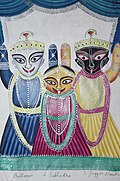
The icon of Jagannath in his temples is a brightly painted, rough-hewn log of ''neem'' wood.<ref>{{cite book|author1=Wendy Doniger|author2=Merriam-Webster, In|title=Merriam-Webster's Encyclopedia of World Religions|url=https://archive.org/details/isbn_9780877790440 |url-access=registration|year=1999|publisher=Merriam-Webster|isbn=978-0-87779-044-0|page=[https://archive.org/details/isbn_9780877790440/page/547 547]}}</ref> The image consists of a square flat head, a pillar that represents his face merging with the chest. The icon lacks a neck, ears, and limbs, is identified by a large circular face symbolizing someone who is '' | The icon of Jagannath in his temples is a brightly painted, rough-hewn log of ''[[neem]]'' wood.<ref>{{cite book|author1=Wendy Doniger|author2=Merriam-Webster, In|title=Merriam-Webster's Encyclopedia of World Religions|url=https://archive.org/details/isbn_9780877790440 |url-access=registration|year=1999|publisher=Merriam-Webster|isbn=978-0-87779-044-0|page=[https://archive.org/details/isbn_9780877790440/page/547 547]}}</ref> The image consists of a square flat head, a pillar that represents his face merging with the chest. The icon lacks a neck, ears, and limbs, is identified by a large circular face symbolizing someone who is ''anādi'' (without beginning) and ''ananta'' (without end).<ref>{{cite book|author=Santilata Dei|title=Vaiṣṇavism in Orissa|url=https://books.google.com/books?id=Q0kdAAAAMAAJ|year=1988|publisher=Punthi |isbn=978-81-85094-14-4|pages=58–59}}</ref> Within this face are two big symmetric circular eyes with no eyelids, one eye symbolizing the sun and the other the moon, features traceable in 17th-century paintings. He is shown with an ''[[Urdhva Pundra]]'', the Vaishnava U-shaped mark on his forehead. His dark colour and other facial features are an abstraction of the cosmic form of the Hindu god Krishna, states Starza.{{sfn|Starza|1993|pp=48–52}} In some contemporary Jagannath temples, two stumps pointing forward in an embracing position represent his hands. In some exceptional medieval and modern era paintings in museums outside India (such as in [[Berlin]]), states Starza, Jagannath is shown fully anthropomorphised but with the traditional abstract mask face.{{sfn|Starza|1993|pp=48–52}} | ||
The typical icon of Jagannath is unlike other deities found in Hinduism who are predominantly anthropomorphic. However, aniconic forms of Hindu deities are not uncommon. For example, Shiva is often represented in the form of a Shiva [[linga]]. In most Jagannath temples in the eastern states of India, and all his major temples such as the Puri, Odisha, Jagannath is included with his brother Balabhadra and sister Subhadra. Apart from the principal companion deities, Jagannath icon shows a [[Sudarshana Chakra]] and sometimes under the umbrella cover of multiheaded Sesha Naga, both linking him to [[Vishnu]]. | The typical icon of Jagannath is unlike other deities found in Hinduism who are predominantly anthropomorphic. However, aniconic forms of Hindu deities are not uncommon. For example, Shiva is often represented in the form of a Shiva [[linga]]. In most Jagannath temples in the eastern states of India, and all his major temples such as the Puri, Odisha, Jagannath is included with his brother [[Balarama|Balabhadra]] and sister [[Subhadra]]. Apart from the principal companion deities, the Jagannath icon shows a [[Sudarshana Chakra]] and sometimes under the umbrella cover of multiheaded [[Shesha|Sesha Naga]], both linking him to [[Vishnu]]. | ||
[[File:Nabakalebar - 2015.jpg|thumb|Jagannath icons are produced from wood. They are replaced every 8 or 12 or 19 years. Above: logs in transport to prepare the Jagannath icon.]] | [[File:Nabakalebar - 2015.jpg|thumb|Jagannath icons are produced from wood. They are replaced every 8 or 12 or 19 years. Above: logs in transport to prepare the Jagannath icon.]] | ||
When shown with Balabhadra and Subhadra, he is identifiable from his circular eyes compared to the oval or almond shape of the other two abstract icons. Further, his icon is dark, while Balabhadra's face is white, and Subhadra's icon is yellow. The third difference is the flat head of Jagannath icon, compared to semi-circular carved heads of the other two.<ref name=donaldson779>{{cite book|author=Thomas E. Donaldson|title=Tantra and Śākta Art of Orissa|url=https://books.google.com/books?id=2otOAAAAYAAJ|year=2002|publisher=DK Printworld|isbn=978-81-246-0198-3|pages=779–780}}</ref>{{refn|group=note|The shape of Balabhadra's head, also called Balarama or Baladeva, varies in some temples between somewhat flat and semi-circular.<ref name=donaldson779/>}} They are accompanied by the Sudarshana Chakra, the iconic weapon of Vishnu. It is approximately the same height as Balabhadra, is red in colour, carved from a wooden pillar and clothed, unlike its traditional representation as a chakra in other Vishnu temples.<ref name="Pattanaik 2002 58–60">{{cite journal|last=Pattanaik|first=Shibasundar|title=Sudarsan of Lord Jagannath|journal=Orissa Review|date=July 2002|pages=58–60|url=http://orissa.gov.in/e-magazine/Orissareview/2008/July-2008/engpdf/58_Sudarsan_of_Lord_Jagannath.pdf|access-date=27 November 2012}}</ref> Jagannath iconography, when he is depicted without companions, shows only his face, neither arms nor torso. This form is sometimes called Patita Pavana,<ref name="The origin of Patita Pavana">{{cite web|title=The origin of Patita Pavana|url=http://www.gopaljiu.org/excerpts/kk_13_patita-pavana_pp_6-9.pdf|work=Sri Krishna Kathamrita|publisher=Sri Gopaljiu|access-date=30 November 2012|archive-date=18 September 2017|archive-url=https://web.archive.org/web/20170918082809/http://gopaljiu.org/excerpts/kk_13_patita-pavana_pp_6-9.pdf|url-status=dead}}</ref> or ''Dadhi Vaman''.<ref>{{cite news|last=Das|first=Madhavananda|title=The Story of Gopal Jiu|url=http://www.vnn.org/editorials/ET0406/ET08-8635.html|access-date=27 November 2012|newspaper=Vaishnav News|date=8 June 2004|url-status=dead|archive-url=https://web.archive.org/web/20100913150950/http://www.vnn.org/editorials/ET0406/ET08-8635.html|archive-date=13 September 2010}}</ref> | When shown with Balabhadra and Subhadra, he is identifiable from his circular eyes compared to the oval or almond shape of the other two abstract icons. Further, his icon is dark, while Balabhadra's face is white, and Subhadra's icon is yellow. The third difference is the flat head of Jagannath icon, compared to semi-circular carved heads of the other two.<ref name=donaldson779>{{cite book|author=Thomas E. Donaldson|title=Tantra and Śākta Art of Orissa|url=https://books.google.com/books?id=2otOAAAAYAAJ|year=2002|publisher=DK Printworld|isbn=978-81-246-0198-3|pages=779–780}}</ref>{{refn|group=note|The shape of Balabhadra's head, also called Balarama or Baladeva, varies in some temples between somewhat flat and semi-circular.<ref name=donaldson779/>}} They are accompanied by the Sudarshana Chakra, the iconic weapon of Vishnu. It is approximately the same height as Balabhadra, is red in colour, carved from a wooden pillar and clothed, unlike its traditional representation as a chakra in other Vishnu temples.<ref name="Pattanaik 2002 58–60">{{cite journal|last=Pattanaik|first=Shibasundar|title=Sudarsan of Lord Jagannath|journal=Orissa Review|date=July 2002|pages=58–60|url=http://orissa.gov.in/e-magazine/Orissareview/2008/July-2008/engpdf/58_Sudarsan_of_Lord_Jagannath.pdf|access-date=27 November 2012}}</ref> Jagannath iconography, when he is depicted without companions, shows only his face, neither arms nor torso. This form is sometimes called ''[[Patita Pavana]]'',<ref name="The origin of Patita Pavana">{{cite web|title=The origin of Patita Pavana|url=http://www.gopaljiu.org/excerpts/kk_13_patita-pavana_pp_6-9.pdf|work=Sri Krishna Kathamrita|publisher=Sri Gopaljiu|access-date=30 November 2012|archive-date=18 September 2017|archive-url=https://web.archive.org/web/20170918082809/http://gopaljiu.org/excerpts/kk_13_patita-pavana_pp_6-9.pdf|url-status=dead}}</ref> or ''Dadhi Vaman''.<ref>{{cite news|last=Das|first=Madhavananda|title=The Story of Gopal Jiu|url=http://www.vnn.org/editorials/ET0406/ET08-8635.html|access-date=27 November 2012|newspaper=Vaishnav News|date=8 June 2004|url-status=dead|archive-url=https://web.archive.org/web/20100913150950/http://www.vnn.org/editorials/ET0406/ET08-8635.html|archive-date=13 September 2010}}</ref> | ||
The ''[[murti]]s'' of Jagannath, Balabhadra, Subhadra and Sudarshana Chakra are made of ''[[Azadirachta indica|neem]]'' wood.<ref>{{cite web|author=Vaishnava. Cz|title=Jagannatha Puri|url=http://www.bvml.org/photoessays/jagannathapuri/index.html|publisher=Bhakti Vedanta Memorial Library|access-date=27 November 2012|archive-date=14 October 2012|archive-url=https://web.archive.org/web/20121014040237/http://bvml.org/photoessays/jagannathapuri/index.html|url-status=dead}}</ref> Neem wood is chosen because the [[Bhavishya Purana]] declares it to be the most auspicious wood from which to make Vishnu ''murtis''.<ref name="Sricon"/> The idol of | The images are unique in being made of wood, since most Hindu ''murtis'' are made of stone or metal.{{sfn|Misra|2007}} The ''[[murti]]s'' of Jagannath, Balabhadra, Subhadra and Sudarshana Chakra are made of ''[[Azadirachta indica|neem]]'' wood.<ref>{{cite web|author=Vaishnava. Cz|title=Jagannatha Puri|url=http://www.bvml.org/photoessays/jagannathapuri/index.html|publisher=Bhakti Vedanta Memorial Library|access-date=27 November 2012|archive-date=14 October 2012|archive-url=https://web.archive.org/web/20121014040237/http://bvml.org/photoessays/jagannathapuri/index.html|url-status=dead}}</ref> Neem wood is chosen because the [[Bhavishya Purana]] declares it to be the most auspicious wood from which to make Vishnu ''murtis''.<ref name="Sricon">{{cite journal |last=Chowdhury |first=Janmejay |title=Iconography of Jagannath |url=http://orissa.gov.in/e-magazine/Srimandir/srimandirenglish/Epdf/Ech6.pdf |journal=Srimandir |pages=21–23 |access-date=27 November 2012}}</ref> The idol of Jagannatha, Balabhadra, Subhadra and Sudarshana is re-painted every week in the Jagannatha Temple, Puri. It is replaced with a newly carved image every 12 or 19 years approximately, or more precisely according to the luni-solar [[Hindu calendar]] when its month of Asadha occurs twice in the same year.<ref>{{cite book |author1=Peter J. Claus |author2=Sarah Diamond |author3=Margaret Ann Mills |title=South Asian Folklore: An Encyclopedia |url=https://books.google.com/books?id=ienxrTPHzzwC&pg=PA515|year=2003|publisher=Taylor & Francis|isbn=978-0-415-93919-5|page=515}}</ref> | ||
===Attributes=== | ===Attributes=== | ||
In the Jagannath tradition (Odia Vaishnavism), | In the Jagannath tradition (Odia Vaishnavism), Jagannath is most frequently identified with an abstract form of [[Krishna]] as the supreme deity.{{sfn|Mukherjee|1981|p=67}}{{sfn|Hardy|1987|pp=387–392}}<ref name="Srinivasan2011">{{cite book |author=Srinivasan |title=Hinduism For Dummies |url=https://books.google.com/books?id=br61gYKt5Q0C&pg=PA96 |year=2011 |publisher=John Wiley & Sons |isbn=978-1-118-11077-5 |page=96}}</ref> | ||
Jagannath is considered as equivalent to the Hindu metaphysical concepts of [[Brahman]]/[[Para Brahman]] and [[Purushottama]]/Shunya Purusha, wherein he then is the Avatarī, i.e., the cause and equivalence of all avatars and the infinite existence in space and time.{{sfn|Eschmann|Kulke|Tripathi|1978|pp=31–98}}{{sfn|Rajaguru|1992}}{{sfn|Starza|1993|pp=72–77|loc=Cult Purusottama at Puri}}{{sfn|Patnaik|2005|pp=111–119}}{{sfn|Miśra|2005|p=99|loc=chapter 9, Jagannāthism}}<ref name="Mishra">{{cite news |last=Mishra|first=Kabi|title=He is the infinite Brahman|url=http://www.telegraphindia.com/1110703/jsp/orissa/story_14191119.jsp|archive-url=https://web.archive.org/web/20150528135924/http://www.telegraphindia.com/1110703/jsp/orissa/story_14191119.jsp|url-status=dead|archive-date=28 May 2015|access-date=1 December 2012|newspaper=The Telegraph, Kolkata|date=3 July 2011}}</ref> According to author Dipti Ray in ''Prataparudra Deva'', the Suryavamsi King of Odisha: | Jagannath is considered as equivalent to the Hindu metaphysical concepts of [[Brahman]]/[[Para Brahman]] and [[Purushottama]]/Shunya Purusha, wherein he then is the Avatarī, i.e., the cause and equivalence of all avatars and the infinite existence in space and time.{{sfn|Eschmann|Kulke|Tripathi|1978|pp=31–98}}{{sfn|Rajaguru|1992}}{{sfn|Starza|1993|pp=72–77|loc=Cult Purusottama at Puri}}{{sfn|Patnaik|2005|pp=111–119}}{{sfn|Miśra|2005|p=99|loc=chapter 9, Jagannāthism}}<ref name="Mishra">{{cite news |last=Mishra|first=Kabi|title=He is the infinite Brahman|url=http://www.telegraphindia.com/1110703/jsp/orissa/story_14191119.jsp|archive-url=https://web.archive.org/web/20150528135924/http://www.telegraphindia.com/1110703/jsp/orissa/story_14191119.jsp|url-status=dead|archive-date=28 May 2015|access-date=1 December 2012|newspaper=The Telegraph, Kolkata|date=3 July 2011}}</ref> According to author Dipti Ray in ''Prataparudra Deva'', the Suryavamsi King of Odisha: | ||
| Line 71: | Line 79: | ||
In the Jagannath tradition, he has the attributes of all the avatars of Krishna/Vishnu. This belief is celebrated by dressing him and worshipping him as different avatars on special occasions.<ref name="Bengal1825">{{cite book|author=Asiatic Society of Bengal|title=Asiatic researches or transactions of the Society instituted in Bengal, for inquiring into the history and antiquities, the arts, sciences, and literature, of Asia|url=https://books.google.com/books?id=nyZFAAAAcAAJ&pg=PA319|year=1825|page=319}}</ref> The Puranas relate that the [[Narasimha]] Avatar of Vishnu appeared from a wooden pillar. It is therefore believed that Jagannath is worshipped as a wooden ''murti'' or Daru Brahma with the Shri Narasimha hymn dedicated to the Narasimha Avatar.<ref>{{cite journal|last=Dash|first=Durgamadhab|title=Place of Chakratirtha in the cult of Lord Jagannath|journal=Orissa Review|date=June 2007|url=http://orissa.gov.in/e-magazine/Orissareview/june_july-2007/engpdf/June_july_2007.pdf|access-date=27 November 2012}}</ref> Every year in the month of [[Bhadra (Hindu calendar)|Bhadra]], Jagannath is dressed and decorated in the form of the [[Vamana]] avatar of Vishnu.<ref name="Mishra"/> Jagannath appeared in the form of [[Rama]], another avatar of Vishnu, to [[Tulsidas]], who worshipped him as [[Rama]] and called him Raghunath during his visit to [[Puri]] in the 16th century.<ref name="Mohanty 2005 109–110">{{cite journal|last=Mohanty|first=Tarakanta|title=Lord Jagannath in the form of Lord Raghunath and Lord Jadunath|journal=Orissa Review|date=July 2005|pages=109–110|url=http://orissa.gov.in/e-magazine/Orissareview/jul2005/engpdf/lord_raghunath_jadunath.pdf|access-date=28 November 2012}}</ref>{{sfn|Patra|2011|pp=4–18}} | In the Jagannath tradition, he has the attributes of all the avatars of Krishna/Vishnu. This belief is celebrated by dressing him and worshipping him as different avatars on special occasions.<ref name="Bengal1825">{{cite book|author=Asiatic Society of Bengal|title=Asiatic researches or transactions of the Society instituted in Bengal, for inquiring into the history and antiquities, the arts, sciences, and literature, of Asia|url=https://books.google.com/books?id=nyZFAAAAcAAJ&pg=PA319|year=1825|page=319}}</ref> The Puranas relate that the [[Narasimha]] Avatar of Vishnu appeared from a wooden pillar. It is therefore believed that Jagannath is worshipped as a wooden ''murti'' or Daru Brahma with the Shri Narasimha hymn dedicated to the Narasimha Avatar.<ref>{{cite journal|last=Dash|first=Durgamadhab|title=Place of Chakratirtha in the cult of Lord Jagannath|journal=Orissa Review|date=June 2007|url=http://orissa.gov.in/e-magazine/Orissareview/june_july-2007/engpdf/June_july_2007.pdf|access-date=27 November 2012}}</ref> Every year in the month of [[Bhadra (Hindu calendar)|Bhadra]], Jagannath is dressed and decorated in the form of the [[Vamana]] avatar of Vishnu.<ref name="Mishra"/> Jagannath appeared in the form of [[Rama]], another avatar of Vishnu, to [[Tulsidas]], who worshipped him as [[Rama]] and called him Raghunath during his visit to [[Puri]] in the 16th century.<ref name="Mohanty 2005 109–110">{{cite journal|last=Mohanty|first=Tarakanta|title=Lord Jagannath in the form of Lord Raghunath and Lord Jadunath|journal=Orissa Review|date=July 2005|pages=109–110|url=http://orissa.gov.in/e-magazine/Orissareview/jul2005/engpdf/lord_raghunath_jadunath.pdf|access-date=28 November 2012}}</ref>{{sfn|Patra|2011|pp=4–18}} | ||
Sometimes one regards him as one of the avatars (incarnations) of Krishna (i.e., Buddha-Jagannath) or Vishnu (i.e., Vamana).{{sfn|Mukherjee|1981|pp=155–156}}{{sfn|Starza|1993|pp=73, 76}}<ref name="Asiatic Journal">{{cite book |title=Asiatic Journal |url=https://archive.org/details/asiaticjournala44unkngoog |year=1841 |publisher=Parbury, Allen, and Company |pages=[https://archive.org/details/asiaticjournala44unkngoog/page/n243 233]–}}</ref> His name does not appear in the traditional [[Dashavatara]] (ten avatars) of Vishnu,<ref name= Wilkins>{{cite book | author = Wilkins, William Joseph | year = 1900 | title = Hindu Mythology, Vedic and Puranic| url = http://www.sacred-texts.com/hin/hmvp/hmvp30.htm| isbn = 978-81-7120-226-3 | publisher = Elibron Classics | location = London}}</ref> though in certain [[Odia literature]], Jagannath has been treated as the avatar of Krishna, as a substitute for or the equivalent of the avatar [[Gautama Buddha in Hinduism|Buddha]] from Dashavatara.{{sfn|Mukherjee|1981|pp=155–156}}{{sfn|Patnaik|2005|pp=111–119}} | Sometimes one regards him as one of the avatars (incarnations) of Krishna (i.e., Buddha-Jagannath) or Vishnu (i.e., Vamana).{{sfn|Mukherjee|1981|pp=155–156}}{{sfn|Starza|1993|pp=73, 76}}<ref name="Asiatic Journal">{{cite book |title=Asiatic Journal |url=https://archive.org/details/asiaticjournala44unkngoog |year=1841 |publisher=Parbury, Allen, and Company |pages=[https://archive.org/details/asiaticjournala44unkngoog/page/n243 233]–}}</ref> His name does not appear in the traditional [[Dashavatara]] (ten avatars) of Vishnu,<ref name= Wilkins>{{cite book | author = Wilkins, William Joseph | year = 1900 | title = Hindu Mythology, Vedic and Puranic| url = http://www.sacred-texts.com/hin/hmvp/hmvp30.htm| isbn = 978-81-7120-226-3 | publisher = Elibron Classics | location = London}}</ref> though in certain [[Odia literature]], Jagannath has been treated as the avatar of Krishna, as a substitute for or the equivalent of the avatar [[Gautama Buddha in Hinduism|Buddha]] from [[Dashavatara]].{{sfn|Mukherjee|1981|pp=155–156}}{{sfn|Patnaik|2005|pp=111–119}} | ||
===Tantric deity=== | ===Tantric deity=== | ||
Outside | Outside Vaishnava tradition, Jagannath is considered the epitome of [[Tantra|Tantric]] worship.<ref name="Siṃhadeba2001">{{cite book|author=Jitāmitra Prasāda Siṃhadeba|title=Tāntric Art of Orissa|url=https://books.google.com/books?id=k2jr3_rSEysC&pg=PA146|year=2001|publisher=Gyan Books|isbn=978-81-7835-041-7|page=146}}</ref> The symmetry in iconography, the use of mandalas and geometric patterns in its rites support the tantric connection proposal.{{sfn|Patra|2011|pp=8–10, 17–18}} | ||
Jagannath is venerated as [[Bhairava]] or | Jagannath is venerated as [[Bhairava]] or [[Shiva]], the consort of the goddess [[Vimala Temple|Vimala]], by [[Shaivites]] and [[Shakta]] sects.<ref name="Mohanty2009"/> The priests of Jagannath Temple at Puri belong to the Shakta sect, although the Vaishnava sect's influence predominates.{{sfn|Starza|1993|pp=64}} As part of the triad, [[Balabhadra]] is also considered to be Shiva and [[Subhadra]], a manifestation of [[Durga]].{{sfn|Lochtefeld|2002|p=665}} In the [[Markandeya Purana]] the sage [[Markandeya]] declared that Purushottama Jagannath and [[Shiva]] are one.<ref>{{cite web|title=Index of 16 Purans|year=2009|location=Markandeya|pages=18, 19|url=https://www.scribd.com/doc/17775667/Index-of-16-Hindu-Puranas|access-date=17 February 2022|archive-date=1 September 2014|archive-url=https://web.archive.org/web/20140901222938/http://www.scribd.com/doc/17775667/Index-of-16-Hindu-Puranas|url-status=dead}}</ref> Jagannath in his Hathi Besha or Gaja Besha (elephant form) has been venerated by devotees like [[Ganpati Bappa|Ganapati Bappa]] of [[Maharashtra]] as [[Ganesh]]a.<ref name="Mohanty 2005 109–110"/> | ||
==Origins== | ==Origins== | ||
===Skanda | ===Skanda Purana=== | ||
According to the ''Purushottama Kshetra Mahatmya'' (<ref name="Andriaensen">{{citation |first1=R. |last1=Andriaensen |first2=Hans T.|last2=Bakker|first3=H.|last3=Isaacson|title=Towards a Critical Edition of the ''Skandapurana'' |date=October 1994|jstor=24655548 }}</ref><ref>{{cite book |url=https://books.google.com/books?id=CLN0F7GGecsC |chapter-url=https://archive.org/details/origin-and-growth-of-the-puranic-text-corpus-with-special-reference-to-the-skand/page/n15/mode/2up?view=theater |first=Hans T.|last=Bakker|title=Origin and Growth of the Purāṇic Text Corpus |chapter=The Structure of the Varanasimahatmya in Skandapurana 26-31 |publisher=[[Motilal Banarsidass]] |year=2004 |isbn= 978-8120820494 }}</ref>{{sfn|Bakker|2004|loc= [https://archive.org/details/origin-and-growth-of-the-puranic-text-corpus-with-special-reference-to-the-skand/page/16/mode/2up?view=theater Three Chapters of Saiva Material Added to the Earliest Known Recension of the Skanda Purana)]}}) of the ''[[Skanda Purana]]'', the deity Yama requested Vishnu to disappear from the region of Purushottama Kshetra, dissatisfied with the direct salvation of those who lived in the region. Vishnu agreed to do so. [[Indradyumna]], the king of [[Avanti (Ancient India)|Avanti]], grew interested in venerating the deity [[Neela Madhava|Nilamadhava]], made of sapphire.<ref>{{Cite book |last=Books |first=Kausiki |url=https://books.google.com/books?id=VPxLEAAAQBAJ&dq=Nilamadhava+refulgent+skanda+purana&pg=PT4 |title=Skanda Purana: Vaishnava Khanda: Purushottama Kshetra Mahatmya: English Translation only without Slokas |date=2021-10-24 |publisher=Kausiki Books |pages=4 |language=en}}</ref> He is described to have sent the younger brother of his royal priest, or sometimes a minister, Vidyapati, to locate the site of the deity's [[Murti|image]] in the [[Nilachal|Nilagiri]] region. Regional folklore states that the priest was welcomed by Vishvavasu, the chieftain of the Savara people. During the duration of his stay in the chieftain's house, the latter's daughter, Lalita, fell in love with him. Upon the chieftain's request, Vidyapati married her. He noticed that the chieftain would leave the house every evening, and only return the following noon. At his urging, Lalita revealed to him that these were her father's visits to the shrine of Nilamadhava, whose location was held secret within the community. Vidyapati persuaded his wife to ask Vishvavasu to take him along to see the image of the deity.<ref>{{Cite book |last=Knapp |first=Stephen |url=https://books.google.com/books?id=djI5mL2qeocC&dq=Vidyapati+Lalita+blindfold&pg=PT217 |title=Spiritual India Handbook |date=2009-01-01 |publisher=Jaico Publishing House |isbn=978-81-8495-024-3 |pages=217 |language=en}}</ref> The chieftain agreed to take Vidyapati with him, but on the condition that he be blindfolded during the journey so that the shrine's location remained undisclosed. Lalita helped her husband devise a plan:<ref>{{Cite book |last=Rosen |first=Steven |url=https://books.google.com/books?id=4IrQkw5x2o4C&dq=Vidyapati+Lalita+blindfold&pg=PA210 |title=Vaisnavism |date=1994-11-30 |publisher=Motilal Banarsidass Publ. |isbn=978-81-208-1235-2 |pages=210 |language=en}}</ref> Vidyapati brought a bag of mustard seeds with him, scattering them all along the path to the shrine present in a cave, bearing witness to the deep blue image of Nilamadhava.<ref>{{Cite book |last=Choudhury |first=Pranab Chandra Roy |url=https://books.google.com/books?id=eoTiOp3pkk4C&dq=nila+madhava+biswabasu&pg=PA204 |title=Best Loved Folk Tales of India |date=August 1999 |publisher=Sterling Publishers Pvt. Ltd |isbn=978-81-207-1660-5 |pages=204 |language=en}}</ref><ref>{{Cite book |last=Knapp |first=Stephen |url=https://books.google.com/books?id=d1JJCgAAQBAJ&dq=Vidyapati+Lalita+blindfold&pg=PT250 |title=Seeing Spiritual India: A Guide to Temples, Holy Sites, Festivals and Traditions |date=2008-05-29 |publisher=iUniverse |isbn=978-0-595-61452-3 |pages=250 |language=en}}</ref> Returning to Avanti, he reported his discovery of the shrine to Indradyumna. After a few months, following the mustards seeds that had since germinated into plants, the king and his retinue travelled to the shrine, unable to locate the image. After praying to Vishnu for three days and nights, they heard the deity's voice thunder from the heavens, rebuking them for their scheme and informing them of his omnipresence. He announced that he would manifest as a ''dāru'' (wooden image) floating by the sea. He instructed them to construct a new [[Jagannath Temple, Puri|temple]] upon a mountain that stood beside the seashore for his worship.<ref>{{Cite book |url=https://books.google.com/books?id=yw2BDwAAQBAJ&dq=Vidyapati+Lalita&pg=PA130 |title=Urmi: The Journal of the Odisha Society of Americas 49th Convention: For Annual Convention Held in 2017 at Dearborn, Michigan |publisher=Odisha Society of the Americas |pages=129–132 |language=en}}</ref> | |||
[[File:Rath Yatra Puri 2007 11071 crop.jpg|thumb|2007 Jagannath Chariot Festival in [[Puri]], Odisha]] | |||
In the ''Skanda Purana'', by the time Vidyapati returned to inform the king of the site of the shrine, a great storm had buried the image of Nilamadhava under the sand. Despite his best attempts, the king was unable to locate the image. Upon the counsel of the sage divinity [[Narada]], Indradyumna constructed a new temple, and performed a thousand [[Ashvamedha|ashvamedha yajnas]] at the site. Receiving guidance in the form of a divine dream, a great tree floating in the sea was felled and used to create the three wooden images of the temple, those of Jagannatha, [[Balarama]], and [[Subhadra]]. The king travelled to [[Brahmaloka]] to invite [[Brahma]] to inaugurate the temple. With the passage of time, a king named Gala claimed to have been the temple's real architect, but with the return of Indradyumna to earth, he withdrew this claim. After Brahma had inaugurated the temple, Indradyumna returned to Brahmaloka, entrusting the upkeep of the site to Gala.<ref>{{Cite book |last=Parmeshwaranand |first=Swami |url=https://books.google.com/books?id=6F0ZIBIL2ZAC&dq=indradyumna+Avanti&pg=PA322 |title=Encyclopaedic Dictionary of Puranas |date=2001 |publisher=Sarup & Sons |isbn=978-81-7625-226-3 |pages=322 |language=en}}</ref><ref>{{Cite book |last=Silva |first=Jose Carlos Gomes da |url=https://books.google.com/books?id=yChREAAAQBAJ&dq=Nilamadhava+sapphire&pg=PA129 |title=The Cult of Jagannatha: Myths and Rituals |date=2010-01-01 |publisher=Motilal Banarsidass |isbn=978-81-208-3462-0 |pages=129 |language=en}}</ref> | |||
In [[Nepal]], a [[Skanda Purana]] manuscripts dated to 9th century CE have been discovered. However, a comparison shows that the 9th century CE document is entirely different from versions of Skanda Purana that have been circulating in the [[Indian subcontinent]] after the 12th century. The various Khandas in modern Skanda Purana have all been found in manuscripts after 12th century.<ref name="Andriaensen"/>{{sfn|Bakker|2004|loc= [https://archive.org/details/origin-and-growth-of-the-puranic-text-corpus-with-special-reference-to-the-skand/page/16/mode/2up?view=theater Three Chapters of Saiva Material Added to the Earliest Known Recension of the Skanda Purana)]}} | |||
===Vedic origin=== | |||
In hymn 10.155.3 of the ''[[Rig veda|Rigveda]]'', there is mention of a ''daru'' (wooden log) floating in the ocean as ''apurusham''.{{sfn|Patra|2011|pp=5–16}}<ref name="Rig Veda">{{cite book|title=Rig Veda|publisher=Wikisource |url= https://en.wikisource.org/wiki/The_Rig_Veda/Mandala_10/Hymn_155 |author=Ralph TH Griffith }} verse 10.155.3; [https://sa.wikisource.org/wiki/ऋग्वेद:_सूक्तं_१०.१५५ Quote]: अदो '''यद्दारु''' प्लवते सिन्धोः पारे '''अपूरुषम्''' । तदा रभस्व दुर्हणो तेन गच्छ परस्तरम् ॥३॥</ref> Acharya [[Sayana]] interpreted the term ''apurusham'' as same as ''Purushottama'' and this ''Dara'' wood log being an inspiration for Jagannath, thus placing the origin of Jagannath in 2nd millennium BCE. Other scholars refute this interpretation stating that the correct context of the hymn is "Alakshmi Stava" of Arayi.{{sfn|Patra|2011|pp=5–16}} | |||
According to Bijoy Misra, Puri natives do call Jagannatha as Purushottama, consider driftwood a savior symbol, and later Hindu texts of the region describe the Supreme Being as ever present in everything, pervasive in all animate and inanimate things. Therefore, while the Vedic connection is subject to interpretation, the overlap in the ideas exist.{{sfn|Misra|2007}} | |||
According to Vishnu Puran, ''Purushottama Kshetra'' was in the ocean. The modern location was identified as ''Purushottama Kshetra'' later.<ref>{{Citation |last=Dash |first= Kailash Chandra|url=https://magazines.odisha.gov.in/Orissareview/2018/Jun-July/engpdf/59-65.pdf |title=Antiquity of the Purushottama Kshetra |publisher=Government of Odisha |date=July 2018 |location=Bhubaneshwar }}</ref> According to a copper plate grant by Rajaraja Deva III (father of [[Anangabhima Deva III]]), ''Lord Purushottama'' was in the ocean and [[Chodaganga Deva]] constructed a suitable temple for him.<ref>{{Citation |last=Pal |first=Dr. Bharati|url=https://magazines.odisha.gov.in/orissareview/2017/June/engpdf/137-138.pdf |title=Lord Purushottama Jagannatha and Anantavarmana Chodagangadeva |publisher=Government of Odisha |date=June 2017 |location=Bhubaneshwar |page=2 }}</ref> | |||
===Buddhist origins=== | |||
[[File:Three Buddhist symbols in Sanchi.png|thumb|Three Buddhist symbols in the upper panel, east face, of the left pillar of the southern gateway at [[Sanchi]]. [[Alexander Cunningham]] examined a sketch of these three symbols and believed the modern Jagannath and his siblings are based on this [[Triratna]] symbol of Buddha, Dhamma and Sangha.<ref>{{Cite book |last=Cunningham |first=Alexander|url=https://books.google.com/books?id=V6G0zgEACAAJ |title=The Bhilsa Topes |section=CHAPTER XXVII: Symbols of Buddha, Dharma and Sangha - Part 10 |section-url=https://books.google.com/books?id=r_gWAAAAYAAJ&pg=PA358 |publisher=Creative Media Partners, LLC |date=September 2021 |orig-year=1854 |isbn=978-1013407505 }}</ref><ref>{{Cite book |last=Cunningham |first=Alexander|url=https://books.google.com/books?id=FBqfzgEACAAJ |title=The Stupa of Bharhut |section=F-OBJECTS OF WORSHIP: II.Uddesika or Monuments - 3. Tri-Ratna Symbol |section-url=https://books.google.com/books?id=B6NY-kwovjMC&pg=PA111 |publisher=Gyan Publishing House |year=2021 |orig-year=1879 |isbn=978-8121226509 }}</ref> [[Harekrushna Mahatab]] also believes the idol triad to be the wooden transformation of the Buddhist Triratna.{{sfn|Mansinha|2021|loc= [https://archive.org/details/dli.bengal.10689.13018/page/n83/mode/2up?view=theater Chapter VIII. The Post Sarala Period – A Period of Experiments: I. The Buddhist Influence - ''The Metaphysical Poets''] |p=72}} But Starza argues that these Buddhist symbols bear little resemblance to the modern Jagannath triad.{{sfn|Starza|1993|pp=55–56}}]] | |||
Theories suggesting [[Buddhism|Buddhist]] origins of Jagannatha stems from the [[relic]] worship associated with Jagannatha, a concept integral to Buddhism but alien to Hinduism. For example, there exists an unexamined relic in the Jagannath shrine in Puri,{{sfn|Starza|1993|pp=58–59 with footnotes}} and the local legends state that the shrine relic contains a tooth of [[Gautama Buddha]] – a feature common to many cherished Theravada Buddhist shrines in and outside India.{{sfn|Misra|2007}}<ref>{{cite book|author=Ananda Abeysekara|title=Colors of the Robe: Religion, Identity, and Difference |url=https://books.google.com/books?id=Y2BXV9zQwAwC&pg=PA148 |year=2002|publisher=University of South Carolina Press|isbn=978-1-57003-467-1|pages=148–149}}</ref><ref>{{Cite book |last=Ganguly |first= Mano Mohan|url=https://archive.org/details/in.ernet.dli.2015.536395/page/n483/mode/2up?view=theater |title=Orissa And Her Remains - Ancient And Mediaeval |publisher=Gyan Publishing House |orig-date=1912 |year=1986 |location=Puri |page=400 |isbn=978-8121200646 }}</ref><ref>{{Citation |last=Patel |first=C.B. |url=https://www.scribd.com/doc/130476638/OldJagannathTemplePuriBuddhistSomavamsiConnections-pdf |title=Oldest Jagannath Temple of Puri: The Buddhist and Somavamsi Connections |publisher=[[Government of Odisha]] |date=July 2003 |location=Bhubaneswar |page=2 }}</ref> Buddhism anciently prevailed in Odisha as appears from the Buddhist remains still existing. The idols of Jagannatha is believed to contain the bones of Krishna even though it forms no part of the Brahmanical religion to collect and adore dead men's bones while it is a most meritorious act among the Buddhists to collect and preserve the relics of departed saints, and the places that contain them are esteemed peculiarly holy.<ref>{{Citation |last=Stevenson |first=J.|url=https://archive.org/details/jstor-25207562/page/n7/mode/2up?view=theater |title=On the Intermixture of Buddhism with Brahmanism in the Religion of the Hindus of the Dekkan |journal=Journal of the Royal Asiatic Society of Great Britain and Ireland |publisher=[[Royal Asiatic Society]] |date=21 November 1840 |volume=7 |issue=1 |pages=1–8 |location=London |jstor=25207562 }}</ref> In Buddhism, preserving [[cetiya]] or skeletal parts such as "Buddha's tooth" or relics of dead saints is a thriving tradition. The existence of these legends, state some scholars such as Stevenson, suggests that Jagannath may have a Buddhist origin.{{sfn|Starza|1993|pp=58–59 with footnotes}} In ancient times, the place of Purī was known as Danta-Pura, i.e., the city where the sacred tooth of Buddha has been preserved.{{sfn|Kar|2020|p=70}} | |||
[[Swami Vivekananda]] in his book [[Lectures from Colombo to Almora]] mentioned that Jagannath temple was once a Buddhist temple.<ref>{{Cite book |last=Joshi |first=Lal Mani |title=Aspects of Buddhism in Indian History |section=IV. The Buddhist Contribution to Indian Civilization:Education |section-url=https://archive.org/details/aspectsofbuddhis0000lmjo/page/38/mode/2up?view=theater |publisher=Buddhist Publication Society |year=1973 |location=Colombo |page=45 |isbn=9788189524760}}</ref><ref>{{Cite book |last=Vivekananda |first=Swami |url=https://books.google.com/books?id=KcEOEQAAQBAJ&q=jagannath |title=Lectures From Colombo To Almora |publisher=Double9 Books |orig-year=1897 |date=October 2023 |location=Delhi |page=124 |isbn=9789359393476}}</ref><ref>{{Cite web |last=Biswas |first=A K |url=https://mainstreamweekly.net/article7334.html |title=Did Ambedkar Appreciate Puri's Jagannath? |publisher=Mainstream Weekly |date=22 July 2017 }}</ref> | |||
Another evidence that links Jagannath to Buddhism is the ''[[Ratha-Yatra]]'' festival for Jagannath, the stupa-like shape of the temple and a dharmachakra-like discus (''chakra'') at the top of the spire. The major annual procession festival has many features found in the [[Mahayana Buddhism]] traditions.{{sfn|Misra|2007|p=141}} [[Faxian]] (c. 400 CE), the ancient Chinese pilgrim and visitor to India wrote about a Buddhist procession in his memoir, and this has very close resemblances with the Jagannath festivities. Further the season in which the ''Ratha-Yatra'' festival is observed is about the same time when the historic public processions welcomed Buddhist monks for their temporary, annual monsoon-season retirement.<ref>{{Cite web |last=Sircar |first=Jawhar|url=https://thewire.in/religion/jagannath-rath-yatra-odisha-hinduism |title=The Jagannath Rath Yatra Is a Reminder of How Inclusive Hinduism Can Be |publisher=The Wire (India) |date=22 July 2018 }}</ref><ref>{{Cite book |last=Skykes |first=Lieutenant-Colonel William Henry |url=https://books.google.com/books?id=KDXbJagkdUAC&pg=PA59 |title=Notes on the Religious, Moral, and Political State of India Before the Mahomedan Invasion |publisher=Kessinger Publishing Co |orig-year=1841 |date=March 2009 |location=London |page=59 |isbn=978-1104197568}}</ref> | |||
There is no distinction of caste inside the Jagganath temple, many day-to-day services (Vidhis) of Lord Jagannatha owe their origin either to Jainism or to Buddhism or the combination of both, the local legends link the idols with aboriginal tribes and the ''daitapatis'' (servitors) claim to be descendants of the aboriginals. Majority of rituals are based on [[Oddiyana#Odisha|Oddiyana]] Tantras which are the refined versions of Mahayana Tantras as well as Shabari Tantras which are evolved from [[Tantric Buddhism]] and tribal believes respectively.<ref>{{Citation |last=Kanungo |first=Archana|url=https://magazines.odisha.gov.in/Orissareview/2013/jul/engpdf/58-67.pdf |title=Unity in Diversity: The Uniqueness of Jagannath Culture of Odisha |publisher=Government of Odisha |date=July 2013 |location=Bhubaneshwar }}</ref><ref name="Olsen2004">{{cite book|last=Olsen|first=Brad|title=Sacred Places Around the World: 108 Destinations|section=India and the Sub-Continent: Holy Cities of India|section-url={{Google books|Ua0_7HPGMqkC|page=91|keywords=|text=|plainurl=yes}}|date=February 2004|publisher=Consortium of Collective Consciousness|isbn=978-1888729108|page=91 }}</ref> According to Starza, these practices are also connected to [[Tantra|Tantric]] practices.{{sfn|Starza|1993|pp=59}} | |||
Buddha was assimilated as Vishnu's ninth avatar in ''Vishnu Puran'' as a divinely incarnated purveyor of illusion. It states that Vishnu's descent as the ''Buddhavatara'' was accomplished so that the wicked and demonic could be only further misled away from the truth in ''kali yuga''. This assimilation and the consequent "disingenuous interpretation" or rationale for his inclusion aptly articulate the considerable ambivalence characteristic of Hindu attitudes towards Buddhism, "undermining his historicity", to "make him an appendage" of the Vaisnava mythic hierarchy.{{sfn|Holt|2008|p=18–21}}{{sfn|Coulter|2013|p=109}}{{sfn|Srinivasan|2011|p=182}}{{sfn|Jones|Ryan|2006|p=96}}{{sfn|Doniger O'Flaherty|1988|p=188}} But in the opening chapter of his [[Gita Govinda]], the poet [[Jayadeva]] claims that Vishnu reincarnated as the Buddha to condemn the animal sacrifices prevalent in Vedic times.{{sfn|Lochtefeld|2002|loc= [https://archive.org/details/JamesLochtefeldTheIllustratedEncyclopediaOfHinduism/page/n157/mode/2up?view=theater Buddha Avatar]|p=128}} In the Jagannath cult, Jagannath is sometimes represented as the ninth avatar of Vishnu substituting Buddha, when it could have been substituted for any other avatar.{{sfn|Kar|2020|p=77-78}}<ref>{{Cite book |last1=Klaproth |first1=Julius Von |last2=Rémusat |first2=Abel |url=https://books.google.com/books?id=n9lAvQEACAAJ |title=The Pilgrimage of Fa Hian |section=CHAPTER XXVII - Note(3)|section-url=https://archive.org/details/pilgrimageoffahi00faxi/page/258/mode/2up?view=theater|publisher=Creative Media Partners, LLC |date=11 October 2018 |orig-year=1848 |location=Sheridan, Wyoming |isbn=978-0342257140 }}</ref><ref>{{Cite book |last=Mukherjee |first=Prabhat | date=August 1986 |orig-year=1940 |title=The History of Medieval Vaishnavism in Orissa |url=https://books.google.com/books?id=K7DvAAAACAAJ |publisher=Manohar Publications |isbn=9780836417548 |section=Chaitanya - As the Incarnation of Buddha-Jagannath |section-url=https://archive.org/details/in.ernet.dli.2015.282185/page/n165/mode/2up?view=theater}}</ref>{{sfn|Starza|1993|pp=55}} Buddha is even now called Jagannath in [[Buddhism in Nepal|Nepalese Buddhism]].<ref>{{Citation |last=Barik |first=Pabitra Mohan|url=https://magazines.odisha.gov.in/orissareview/jul2005/engpdf/jainism_budhism_in_joga-culture.pdf |title=Jainism and Buddhism in Jagannath Culture |date=July 2005 |location=Bhubaneshwar|page=2 }}</ref> | |||
The association of Jagannath with the ninth avatar Buddha continued until 15th century. In a [[Kabir panth]] scripture Laxmanbodh in Kabir Sagar by [[Dharamdas#Spiritual journey|Dharamdas]], disciple of [[Kabir]], Jagannath is identified as a form of Buddha.<ref name=B00KTG6DLK>{{Cite book |last=युगलानन्द |first=स्वामी |title=कबीर सागर (सम्पूर्ण 11 भाग) |publisher=खेमराज श्रीकृष्णदास |year=2013|asin=B00KTG6DLK }}</ref> | |||
{{Blockquote | |||
|text=[[Kali Yuga]] has come. I am established as Buddha. Jagannath is my name. I am established with this method.{{sfn|युगलानन्द|2013|loc= [https://archive.org/details/giTY_kabir-sagar-complete-11-volumes-khemraj/page/n721/mode/2up?view=theater लक्ष्मणबोध - श्रीकृष्ण वचन]}}{{refn|group=note|Original: <nowiki>अब कलिथुग बेठेगा सोई । बौद्ध थापना हमरो होई ॥ | |||
जगन्नाथ मम नाम है सोई । हमरी थापना यहि विधि होई॥</nowiki>}}}} | |||
{{Blockquote | |||
|text=In the form of Ram he killed Ravana. In the form of Krishna he defeated Kansha. Jagannath came in the form of Buddha. And so he has lots of divine play.{{sfn|युगलानन्द|2013|loc= [https://archive.org/details/giTY_kabir-sagar-complete-11-volumes-khemraj/page/n1089/mode/2up?view=theater श्रीअमरमूल - सद्गुरु वचन]}}{{refn|group=note|Original: <nowiki>राम रूप होय रावन मारा । कृष्ण रूप होयकंस पछारा ॥ | |||
बौध रूप जगन्नाथ ओतारा । लीला बहुत भांति सम्हारा ॥</nowiki>}}}} | |||
According to Starza, these manifestations of the Jagannath cult, such as the supposed tooth relic of Buddha, the ''Ratha-Yatra'', the absence of caste rules in the temple, and the identification of Jagannath with the Buddha, are not sufficient to establish a Buddhist origin of the worship of Jagannath.{{sfn|Starza|1993|p=57}} | |||
[[Indrabhuti]], the ancient Buddhist king of [[Oddiyana#Odisha|Oddiyana]], describes Jagannath as a Buddhist deity in ''[[Jnanasiddhi|Jñānasiddhi]]''. This is the oldest known direct mention of the deity.<ref>{{Cite web |last=Nayak |first=Dr. Ganeswar |url=https://ddceutkal.ac.in/Syllabus/MA_history/Paper_15.pdf |title=History of Odisha (From earliest times to 1434 A.D) |publisher=[[Utkal University]] |location=Bhubaneshwar |date=11 March 2014 |page=107 }}</ref> | |||
{{Blockquote | |||
|text=Pranipatya Jagannatham Sarvajina Vararchitam. | |||
Sarva Buddha Mayam Siddhi Vyapinam Gaganopamam.<ref>{{cite web|title=JÑĀNASIDDHI|url=https://www.dsbcproject.org/canon-text/content/860/2988|year=2019|publisher=Digital Sanskrit Buddhist Canon}}</ref>}} | |||
Abhinav Patra argues that it has not been historically ascertained whether the deity Jagannath as worshipped by Indrabhuti was just a coincidental homonym with the present Jagannath or referred to the same deity.{{sfn|Patra|2011|p=7}} | |||
The | The 10th century era text [[Kubjika#Kubjikāmatatantra|Kubjikāmatatantra]], mentions ''[[Biraja Temple|Biraja]]'' (ancient capital of [[Utkala kingdom|Utkala]]<ref>{{Cite book |last=Sahu |first=Nabin Kumar|url=https://books.google.com/books?id=a8MBAAAAMAAJ |title=Utkal University History Of Orissa: Volume I - From the Earliest Time Up to 500 A.D. |publisher=Utkal University |section=CHAPTER II: HISTORICAL GEOGRAPHY - Capital of Utkala |section-url=https://archive.org/details/utkaluniversityh0000nksa/page/107/mode/2up?view=theater |year=1964 |location=Bhubaneshwar |oclc=1179182033 |pages=107–110}}</ref>) as the goddess of Oddiyana, with which Indrabhuti's son [[Padmasambhava]] is associated with. The ''[[Lotus Sutra|Saddharmapundarika]]'' records a prophecy in which the Lord assures [[Śāriputra]], that he would be in a distant future time a Buddha under the name of Padmaprabha, and that his place of enlightenment would be Biraja. Padmasambhava and Tārā, along with other deities are invoked in an inscription of 25 lines incised in nail-headed characters of the late 8th-9th century on the back of an image of [[Avalokiteśvara]]/[[Karuṇā#Mahayana Buddhism|Mahākaruṇā]] at [[Udayagiri Caves|Udaygiri]] not far from [[Jajpur]], which states that a ''stupa'' with a relic inside and dwelt in by the [[Tathāgata]] was set up on that very spot. The stupa is believed to have contained the relics of Padmasambhava. Though the site is only partially excavated, at least one stupa has been unearthed. According to Nabin Kumar Sahu, this mass of evidence, supports the belief that Indrabhuti was the king of Odisha which is same as Oddiyana or Odra-''pitha'', of which the main deities are Jagganath and Viraja.<ref>{{Cite book |last=Donaldson |first= Thomas E.|url=https://books.google.com/books?id=DbxE8zOuRbUC&pg=PA11 |title=Iconography of the Buddhist sculpture of Orissa Volume 1 |publisher=[[Indira Gandhi National Centre for the Arts]] |year=2001 |location=London |page=11 |isbn=978-8170173755 }}</ref><ref>{{Cite book |last=Sahu |first=Nabin Kumar|url=https://books.google.com/books?id=4GMEAAAAYAAJ |title=Buddhism in Orissa |chapter=IX. Tantric Buddhism in Orissa: (A) The Uddiyana Pitha |chapter-url=https://archive.org/details/buddhism-in-orissa-1958/page/141/mode/2up?view=theater |publisher=Utkal University |year=1958 |location=Bhubaneshwar |oclc=1391872675 |pages=141–155 }}</ref> | ||
Some scholars argue that evidences of Jagannatha's Buddhist nature are found from medieval [[Odia literature]]. Many medieval Odia poets suggest to their readers, that they wrote their books on the commands of a formless god-like personality, identifying the Buddhist principles of ''[[Śūnyatā|Śūnya]]'' (The great void) and ''Alekha'' (The formless one) with Jagannath himself. The idols of Jagannath triad are not anthropomorphic like [[Murti|Hindu idols]], but instead are stumps of wood with crude symbolic facial features and stumpy obtrusions for limbs.{{sfn|Mansinha|2021|loc= [https://archive.org/details/dli.bengal.10689.13018/page/n81/mode/2up?view=theater Chapter VIII. The Post Sarala Period – A Period of Experiments: I. The Buddhist Influence - ''The Metaphysical Poets'']}} | |||
Odia poet [[Sarala Dasa]] of 15th century in his Mahabharata, describes Lord Jagannatha as a form of Buddha.<ref>{{Cite web |last=Das |first=Satyabrata|url=https://magazines.odisha.gov.in/orissareview/2008/July-2008/engpdf/48_Sri_Krsna-Jagannath.pdf |title=Sri Krsna - Jagannath Consciousness: Vyasa - Jayadeva - Sarala Dasa |publisher=Government of Odisha |date=July 2008 |location=Bhubaneshwar }}</ref> | |||
{{Blockquote | |||
|text=He remains in the throne inside the temple, holding the Conch and Discus in the form of Buddha.{{refn|group=note|Original: <nowiki>ଦେଉଳ ଭିତରେ ସିଂହ୍ରାସନେ ବିଜେ ହୋଇ ବଉଦ୍ଧ ରୁପରେ ପ୍ରଭୁ ଶଙ୍ଗଚକ୍ର ବହି |</nowiki>}}}} | |||
{{Blockquote | {{Blockquote | ||
|text= | |text=Salute thee Sri Jagannath the revered One whose domain is the Blue Hills, he sits pretty as Sri Buddha there in the Blue Cavern.{{refn|group=note|Original: <nowiki>ବନ୍ଦଇ ଶ୍ରୀ ଜଗନ୍ନାଥ ବଇକୁଣ୍ଠବାସୀ ବୌଦ୍ଧରୁପେ ନୀଲଗିରି ଶିଖେ ଅଛ ବସି |</nowiki>}}}} | ||
}} | |||
{{Blockquote | {{Blockquote | ||
|text= | |text=There comes Sri Jagannath as Buddha to liberate the Mankind...{{refn|group=note|Original: <nowiki>ସଂସାରଜନ୍ମକୁ ତରିବା ନିମନ୍ତେ ବୁଦ୍ଧରୂପରେ ବିଜେ ଅଛେ ଜଗନ୍ନାଥେ |</nowiki>}} | ||
|author=Sarala Dasa<ref name="Das 2015 91">{{Cite book |last=Das |first=Suryanarayan |title=ଜଗନ୍ନାଥ ମନ୍ଦିର ଓ ଜଗନ୍ନାଥ ତତ୍ତ୍ୱ |section=ସପ୍ତମ ରରିଛେଦ: ଜଗନ୍ନାଥ ଓ ବୁଦ୍ଧ |section-url=https://archive.org/details/jagannatha-mandir-o-jagannath-tattwa-1966/page/n101/mode/2up |publisher=ଫ୍ରେଣ୍ଡସ ପବ୍ଲିଶର୍ସ|year=2015 |orig-year=1966 |location=Cuttack |asin=B08SBVZDYK |asin-tld=in |page=91 }}</ref>}} | |||
}} | <!-- I changed this line "Odia poet Sarala Dasa of 15th century in his Mahabharata describes Buddha as one of the ten incarnations of Vishnu" to this line: Odia poet Sarala Dasa of 15th century in his Mahabharata describes Jagannatha as Buddha. The corresponding note which has the line from the Odia poetry which says the exact same thing was not reflected in the main body previously. The poetry identifies Jagannatha with Buddha and NOT Buddha as one of the ten avataras of Vishnu which the previous main body of the text claimed. I have also block quoted the lines from the reference in the main body so as to eliminate confusion for the readers... --> | ||
<!-- I changed this line Odia poet Sarala Dasa of 15th century in his Mahabharata describes Buddha as one of the ten incarnations of Vishnu to this line: Odia poet Sarala Dasa of 15th century in his Mahabharata describes Jagannatha as Buddha. The corresponding note which has the line from the Odia poetry which says the exact same thing was not reflected in the main body previously. The poetry identifies Jagannatha with Buddha and NOT Buddha as one of the ten avataras of Vishnu which the previous main body of the text claimed. I have also block quoted the lines from the reference in the main body so as to eliminate confusion for the readers... --> | At another part in [[Adi Parva]] he also says: Glory be to Rama-Krishna-Brahma as Subhadra and to the great soul Buddha... Satyabrata Das believes this to be the wonderful integration of all faiths.{{sfn|Das|2008|p=2}} | ||
===Jain origins=== | ===Jain origins=== | ||
Pandit Nilakantha Das suggested that Jagannath was a deity of [[Jain]] origin because of the appending of ''Nath'' to many Jain [[Tirthankar]]s.<ref>{{cite book|last=Mohanty|first=Jagannath|title=Indian Culture and Education|year=2009|publisher=Deep& Deep|isbn=978-81-8450-150-6|page=5|url=https://books.google.com/books?id=3T2Ph_SmjtoC&q=nilakantha+das+jagannath&pg=PA5}}</ref> He felt Jagannath meant the 'World personified' in the Jain context and was derived from ''Jinanath''. Evidence of the Jain terminology such as of [[Kaivalya]], which means [[moksha]] or salvation, is found in the Jagannath tradition.<ref name="Barik 2005 36">{{cite journal|last=Barik|first=P M|title=Jainism and Buddhism in Jagannath culture|journal=Orissa Review|date=July 2005|pages=36|url=http://orissa.gov.in/e-magazine/Orissareview/jul2005/engpdf/jainism_budhism_in_joga-culture.pdf|access-date=29 November 2012}}</ref> Similarly, the twenty two steps leading to the temple, called the ''Baisi Pahacha'', have been proposed as symbolic reverence for the first 22 of the 24 Tirthankaras of Jainism.{{sfn|Patra|2011|pp=8–10, 17–18}} | Pandit Nilakantha Das suggested that Jagannath was a deity of [[Jain]] origin because of the appending of ''Nath'' to many Jain [[Tirthankar]]s.<ref>{{cite book|last=Mohanty|first=Jagannath|title=Indian Culture and Education|year=2009|publisher=Deep& Deep|isbn=978-81-8450-150-6|page=5|url=https://books.google.com/books?id=3T2Ph_SmjtoC&q=nilakantha+das+jagannath&pg=PA5}}</ref> He felt Jagannath meant the 'World personified' in the Jain context and was derived from ''Jinanath''. Evidence of the Jain terminology such as of [[Kaivalya]], which means [[moksha]] or salvation, is found in the Jagannath tradition.<ref name="Barik 2005 36">{{cite journal|last=Barik|first=P M|title=Jainism and Buddhism in Jagannath culture|journal=Orissa Review|date=July 2005|pages=36|url=http://orissa.gov.in/e-magazine/Orissareview/jul2005/engpdf/jainism_budhism_in_joga-culture.pdf|access-date=29 November 2012}}</ref> Similarly, the twenty two steps leading to the temple, called the ''Baisi Pahacha'', have been proposed as symbolic reverence for the first 22 of the 24 Tirthankaras of Jainism.{{sfn|Patra|2011|pp=8–10, 17–18}} | ||
According to Annirudh Das, the original Jagannath deity was influenced by Jainism and is none other than the ''Jina'' of Kalinga taken to [[Magadha]] by [[Mahapadma Nanda]].<ref>{{cite book|last=Das|first=Aniruddha|title=Jagannath and Nepal|pages=9–10}}</ref> The theory of Jain origins is supported by the Jain [[Hathigumpha inscription]]. It mentions the worship of a relic memorial in Khandagiri-Udayagiri, on the Kumara hill. This location is stated to be same as the Jagannath temple site. However, states Starza, a Jain text mentions the Jagannath shrine was restored by Jains, but the authenticity and date of this text is unclear.{{sfn|Starza|1993|pp=62–63 with footnotes}} | According to Annirudh Das, the original Jagannath deity was influenced by Jainism and is none other than the ''Jina'' of Kalinga taken to [[Magadha (Mahajanapada)|Magadha]] by [[Mahapadma Nanda]].<ref>{{cite book|last=Das|first=Aniruddha|title=Jagannath and Nepal|pages=9–10}}</ref> The theory of Jain origins is supported by the Jain [[Hathigumpha inscription]]. It mentions the worship of a relic memorial in Khandagiri-Udayagiri, on the Kumara hill. This location is stated to be same as the Jagannath temple site. However, states Starza, a Jain text mentions the Jagannath shrine was restored by Jains, but the authenticity and date of this text is unclear.{{sfn|Starza|1993|pp=62–63 with footnotes}} | ||
Another circumstantial evidence supporting the Jain origins proposal is the discovery of Jain images inside as well as near the massive Puri temple complex, including those carved into the walls. However, this could also be a later addition, or suggestive of tolerance, mutual support or close relationship between the Jains and the Hindus.{{sfn|Starza|1993|pp=62–63 with footnotes}} | |||
According to Starza, the Jain influence on the Jagannath tradition is difficult to assess given the sketchy uncertain evidence. Nothing establishes that the Jagannath tradition has a Jain origin.{{sfn|Starza|1993|pp=62–63 with footnotes}} | |||
=== Vaishnava origins === | === Vaishnava origins === | ||
[[File:Dadhivaman deity.png|thumb|An old Dadhivaman deity in [[Kendrapara]], [[Odisha]]. [[Bhaktivinoda Thakur|Shrila Bhakti Vinod Thakur]]'s great forefather [[Krishnananda Dutta Chaudhury|Krishnanada]] started worshipping this deity in mid-14th century AD. ]] | [[File:Dadhivaman deity.png|thumb|An old Dadhivaman deity in [[Kendrapara]], [[Odisha]]. [[Bhaktivinoda Thakur|Shrila Bhakti Vinod Thakur]]'s great forefather [[Krishnananda Dutta Chaudhury|Krishnanada]] started worshipping this deity in mid-14th century AD. ]] | ||
The Vaishnava origin theories rely on the iconographic details and the typical presence of the triad of deities, | The Vaishnava origin theories rely on the iconographic details and the typical presence of the triad of deities, based on original scriptures of Hinduism. The colors, state the scholars of the Vaishnava origin theory, link to black-colored Krishna and white-colored Balarama. They add that the goddess originally was Ekanamsa (Durga of Shaiva-Shakti tradition, sister of Krishna through his foster family). She was later renamed to Shubhadra (Lakshmi) per Vaishnava terminology for the divine feminine.{{sfn|Starza|1993|pp=63–64 with footnotes}} | ||
It is certainly true that the Vaishnava Hindus in the eastern region of India worshipped the triad of Balarama, Ekanamsa and Krishna. There are many scriptural references to support the same. Further, in many Jagannath temples of central and eastern regions of India, the Shiva icons such as the [[Lingam|Linga-yoni]] are reverentially incorporated, since Lord Shiva is a Vaishnav according to the conclusion of Srimad Bhagavatam, he protects Sri Jagannath Temple from external calamities, just like he does so in his form of Hanuman for the palace of Sri Ram.{{sfn|Starza|1993|pp=63–64 with footnotes}} | |||
===Tribal origins=== | ===Tribal origins=== | ||
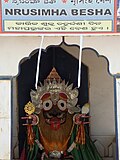
[[File:Nrusimha Besha.JPG|thumb|Jagannath in the [[Narasimha]] or Nrusingha Besha in [[Jagannath Temple, Koraput|Koraput]] ]] | [[File:Nrusimha Besha.JPG|thumb|Jagannath in the [[Narasimha]] or Nrusingha Besha in [[Jagannath Temple, Koraput|Koraput]] ]] | ||
The tribal origin theories rely on circumstantial evidence and inferences such as the Jagannath icon is non-anthropomorphic and non-zoomorphic.<ref name="Joshi 2007 80–84"/> The hereditary priests in the Jagannath tradition of Hinduism include non-Brahmin servitors, called ''Daitas'', which may be an adopted grandfathered practice with tribal roots. The use of wood as a construction material for the Jagannath icons may also be a tribal practice that continued when Hindus adopted prior practices and merged them with their Vedic abstractions.<ref name="Sricon" | The tribal origin theories rely on circumstantial evidence and inferences such as the Jagannath icon is non-anthropomorphic and non-zoomorphic.<ref name="Joshi 2007 80–84"/> The hereditary priests in the Jagannath tradition of Hinduism include non-Brahmin servitors, called ''Daitas'', which may be an adopted grandfathered practice with tribal roots. The use of wood as a construction material for the Jagannath icons may also be a tribal practice that continued when Hindus adopted prior practices and merged them with their Vedic abstractions.<ref name="Sricon"/> The ''Daitas'' are Hindu, but believed to have been the ancient tribe of ''Sabaras'' (also spelled ''Soras''). They continue to have special privileges such as being the first to view the new replacement images of Jagannath carved from wood approximately every 12 years. Further, this group is traditionally accepted to have the exclusive privilege of serving the principal meals and offerings to Jagannath and his associate deities.{{sfn|Starza|1993|pp=65–67 with footnotes}}{{sfn|Misra|2007}} | ||
According to [[Verrier Elwin]] | According to [[Verrier Elwin]], Jagannatha in a local legend was a tribal deity who was coopted by a Brahmin priest.<ref name=elwin597>{{cite book|last=Elwin|first=Verrier|title=The Religion of an Indian Tribe|year=1955|publisher=Oxford University Press (Reprint)|page=597}}</ref> The original tribal deity, states Elwin, was ''Kittung'' which too is made from wood. According to the Polish Indologist Olgierd M. Starza, this is an interesting parallel but a flawed one because the ''Kittung'' deity is produced by burning a piece of wood and too different in its specifics to be the origin of Jagannath.{{sfn|Starza|1993|pp=65–67 with footnotes}} According to another proposal by [[Stella Kramrisch]], log as a symbol of ''Anga pen'' deity is found in central Indian tribes and they have used it to represent features of the Hindu goddess [[Kali]] with it. However, states Starza, this theory is weak because the ''Anga pen'' features a bird or snake like attached head along with other details that make the tribal deity unlike the Jagannath.{{sfn|Starza|1993|pp=65–67 with footnotes}} | ||
{{multiple image | {{multiple image | ||
| align = left | | align = left | ||
| image1 = Jagannatha.svg | | image1 = Jagannatha.svg | ||
| width1 = 200 | | width1 = 200 | ||
| alt1 = | | alt1 = | ||
| caption1 = | | caption1 = | ||
| image2 = 'A close up of Narasimha face.jpg | | image2 = 'A close up of Narasimha face.jpg | ||
| width2 = 134 | | width2 = 134 | ||
| alt2 = | | alt2 = | ||
| caption2 = | | caption2 = | ||
| footer = Jagannath (left) may have roots in [[Narasimha]]{{sfn|Starza|1993|pp=67–70 with footnotes}} (right, man-lion avatar of Vishnu who fights evil demon and ends religious persecution).<ref>{{cite book|author=Gavin D. Flood|title=An Introduction to Hinduism|url=https://archive.org/details/introductiontohi0000floo|url-access=registration|year=1996|publisher=Cambridge University Press|isbn=978-0-521-43878-0|page=[https://archive.org/details/introductiontohi0000floo/page/111 111]}}</ref> | | footer = Jagannath (left) may have roots in [[Narasimha]]{{sfn|Starza|1993|pp=67–70 with footnotes}} (right, man-lion avatar of Vishnu who fights evil demon and ends religious persecution).<ref>{{cite book|author=Gavin D. Flood|title=An Introduction to Hinduism|url=https://archive.org/details/introductiontohi0000floo|url-access=registration|year=1996|publisher=Cambridge University Press|isbn=978-0-521-43878-0|page=[https://archive.org/details/introductiontohi0000floo/page/111 111]}}</ref> | ||
}} | }} | ||
Some scholars such as Kulke and Tripathi have proposed tribal deities such as Stambhesveri or Kambhesvari to be a possible contributor to the Jagannath triad.{{sfn|Starza|1993|pp=67–70 with footnotes}} However, according to Starza, these are not really tribal deities, but Shaiva deities adopted by tribes in eastern states of India. Yet another proposal for tribal origins is through the medieval era cult of Lakshmi-[[Narasimha]].{{sfn|Starza|1993|pp=67–70 with footnotes}} This hypothesis relies on the unusual flat head, curved mouth and large eyes of Jagannath, which may be an attempt to abstract an image of a lion's head ready to attack. While the tribal Narasimha theory is attractive states Starza, a weakness of this proposal is that the abstract Narasimha representation in the form does not appear similar to the images of Narasimha in nearby [[Konark]] and [[Kalinga (historical region)|Kalinga]] temple artworks.{{sfn|Starza|1993|pp=67–70 with footnotes}} | Some scholars such as Kulke and Tripathi have proposed tribal deities such as Stambhesveri or Kambhesvari to be a possible contributor to the Jagannath triad.{{sfn|Starza|1993|pp=67–70 with footnotes}} However, according to Starza, these are not really tribal deities, but Shaiva deities adopted by tribes in eastern states of India. Yet another proposal for tribal origins is through the medieval era cult of Lakshmi-[[Narasimha]].{{sfn|Starza|1993|pp=67–70 with footnotes}} This hypothesis relies on the unusual flat head, curved mouth and large eyes of Jagannath, which may be an attempt to abstract an image of a lion's head ready to attack. While the tribal Narasimha theory is attractive states Starza, a weakness of this proposal is that the abstract Narasimha representation in the form does not appear similar to the images of Narasimha in nearby [[Konark]] and [[Kalinga (historical region)|Kalinga]] temple artworks.{{sfn|Starza|1993|pp=67–70 with footnotes}} | ||
| Line 195: | Line 186: | ||
===Syncretic origins=== | ===Syncretic origins=== | ||
According to H.S. Patnaik and others, Jagannath is a syncretic/synthetic deity that combined aspects of major faiths like [[Shaivism]], [[Shaktism]], [[Vaishnavism]], [[Jainism]], and [[Buddhism]]. | According to H.S. Patnaik and others, Jagannath is a syncretic/synthetic deity that combined aspects of major faiths like [[Shaivism]], [[Shaktism]], [[Vaishnavism]], [[Jainism]], and [[Buddhism]].{{sfn|Patnaik|1994|loc=chapter 6. Sanatana Dharma: The Great Synthesis}}{{sfn|Miśra|2005|p=97|loc=chapter 9, Jagannāthism}}<ref name="Patnaik"/>{{sfn|Mukherjee|1981|pp=1–2}} [[Krishnaism|Krishnaite]] sampradayas, as example, Gaudiya Vaishnavas, have identified him strongly with Krishna.{{sfn|Hardy|1987|pp=387–392}}<ref name="Bryant 2007 142">{{cite book|last=Bryant|first=Edwin F|title=Krishna: A Sourcebook|year=2007|publisher=Oxford University Press|isbn=978-0195148916|page=142}}</ref> In Gaudiya Vaishnava tradition, Balabhadra is the elder brother [[Balaram]]a, Jagannath is the younger brother [[Krishna]], and Subhadra is the youngest sister.<ref name="Das 2010 89"/> | ||
Balabhadra considered the elder brother of Jagannath is sometimes identified with and worshipped as [[Shiva]].<ref name="Bryant 2007 142"/> Subhadra now considered Jagannath's sister has also been considered as a deity who used to be [[Brahma]].<ref name="Bryant 2007 142"/><ref name="History of deities">{{cite web|title=History of deities|url=http://jagannath.nic.in/histdaities.asp|publisher=Jagannath temple, Puri administration|access-date=2 December 2012|url-status=dead|archive-url=https://web.archive.org/web/20130402173714/http://jagannath.nic.in/histdaities.asp|archive-date=2 April 2013}}</ref> Finally the fourth deity, Sudarshana [[Chakra]] symbolizes the wheel of the sun's chariot, a syncretic absorption of the | Balabhadra, considered the elder brother of Jagannath, is sometimes identified with and worshipped as [[Shiva]].<ref name="Bryant 2007 142"/> Subhadra now considered Jagannath's sister has also been considered as a deity who used to be [[Brahma]].<ref name="Bryant 2007 142"/><ref name="History of deities">{{cite web|title=History of deities|url=http://jagannath.nic.in/histdaities.asp|publisher=Jagannath temple, Puri administration|access-date=2 December 2012|url-status=dead|archive-url=https://web.archive.org/web/20130402173714/http://jagannath.nic.in/histdaities.asp|archive-date=2 April 2013}}</ref> Finally the fourth deity, Sudarshana [[Chakra]] symbolizes the wheel of the sun's chariot, a syncretic absorption of the Saura ([[Surya]]-centric) tradition of Hinduism. The conglomerate of Jagannath, Balabhadra, Subhadra, and Sudarshana Chakra worshipped together on a common platform are called the Chaturdhamurti or the "four-fold form".<ref>{{cite journal|last=Behera|first=Prajna Paramita|title=The Pillars of Homage to Lord Jagannatha|journal=Orissa Review|date=June 2004|pages =65|url=http://orissa.gov.in/e-magazine/Orissareview/jun2004/englishpdf/pillar.pdf |access-date=2 December 2012}}</ref> | ||
O.M. Starza states that the Jagannath Ratha Yatra may have evolved from the syncretism of procession rituals for Shiva lingas, Vaishnava pillars, and tribal folk festivities.{{Sfn|Starza|1993|pp=70, 97, 105}} The [[Shaivism|Shaiva]] element in the tradition of Jagannath overlap with the rites and doctrines of [[Tantrism]] and [[Shaktism]]. According to the Shaivas, Jagannath is Bhairava.<ref name="OR-CultOfJ">{{cite web |url=http://orissa.gov.in/e-magazine/Orissareview/2012/June/engpdf/44-47.pdf |title=The Cult of Jagannath |first=Rabindra Kumar |last=Behuria |publisher=Orissa Review |pages=42–43 |date=June 2012 | access-date=28 April 2013}}</ref> The [[Shiva Purana]] mentions Jagannatha as one of the 108 names of Shiva.<ref>{{cite web |author=Shiva Purana |title=Shiva Shahasranama |url=http://www.harekrsna.de/1000Shiva.htm |website=harekrsna.de |access-date=27 March 2019 |ref=(Book IV), Chapter 35, 1-133}}</ref> The Tantric literary texts identify Jagannath with Mahabhairava.<ref name="Das 2010 89">{{cite book|last=Das|first=Suryanarayan|title=Lord Jagannath|year=2010|publisher=Sanbun|isbn=978-93-80213-22-4|page=89|url=https://books.google.com/books?id=gFn8wSDfSxEC&q=jagannath+as++jain&pg=PA82}}</ref> Another evidence that supports syncretism thesis is the fact that Jagannath sits on the abstract tantric symbols of the [[Shri Yantra]]. Further, his Shri Chakra ("holy wheel") is worshipped in the [[Bījamantra|bijamantra]] 'klim', which is also the bijamantra of Kali or Shakti. The representation of Balarama as [[Shesha | O.M. Starza states that the Jagannath Ratha Yatra may have evolved from the syncretism of procession rituals for Shiva lingas, Vaishnava pillars, and tribal folk festivities.{{Sfn|Starza|1993|pp=70, 97, 105}} The [[Shaivism|Shaiva]] element in the tradition of Jagannath overlap with the rites and doctrines of [[Tantrism]] and [[Shaktism]]. According to the Shaivas, Jagannath is Bhairava.<ref name="OR-CultOfJ">{{cite web |url=http://orissa.gov.in/e-magazine/Orissareview/2012/June/engpdf/44-47.pdf |title=The Cult of Jagannath |first=Rabindra Kumar |last=Behuria |publisher=Orissa Review |pages=42–43 |date=June 2012 | access-date=28 April 2013}}</ref> The [[Shiva Purana]] mentions Jagannatha as one of the [[108 names of Shiva]].<ref>{{cite web |author=Shiva Purana |title=Shiva Shahasranama |url=http://www.harekrsna.de/1000Shiva.htm |website=harekrsna.de |access-date=27 March 2019 |ref=(Book IV), Chapter 35, 1-133}}</ref> The Tantric literary texts identify Jagannath with Mahabhairava.<ref name="Das 2010 89">{{cite book|last=Das|first=Suryanarayan|title=Lord Jagannath|year=2010|publisher=Sanbun|isbn=978-93-80213-22-4|page=89|url=https://books.google.com/books?id=gFn8wSDfSxEC&q=jagannath+as++jain&pg=PA82}}</ref> Another evidence that supports syncretism thesis is the fact that Jagannath sits on the abstract tantric symbols of the [[Shri Yantra]]. Further, his Shri Chakra ("holy wheel") is worshipped in the [[Bījamantra|bijamantra]] 'klim', which is also the bijamantra of Kali or Shakti. The representation of Balarama as [[Shesha]]naga or Sankarsana bears testimony to the influence of Shaivism on the cult of Jagannath. The third deity, Devi Subhadra, who represents the Sakti element is still worshipped with the Bhuvaneshvari Mantra.<ref name="OR-CultOfJ"/> | ||
The Tantric texts claim Jagannath to their own, to be Bhairava, and his companion to be the same as [[Vimala Temple|goddess Vimala]] is the Shakti. The offerings of Jagannath becomes ''mahaprasad'' only after it is re-offered to goddess Vimala. Similarly, different Tantric features of yantras have been engraved on the Ratna vedi, where Jagannath, Balabhadra, and Subhadra are set up. The [[Kalika Purana]] depicts Jagannath as a Tantric deity.<ref name="OR-CultOfJ"/> According to Avinash Patra, the rituals and special place accepted for non-Brahmin ''Daitas'' priests in Jagannath tradition, who co-exist and work together with Brahmin priests suggests that there was a synthesis of tribal and Brahmanical traditions.{{sfn|Patra|2011|pp=17–18}} | The Tantric texts claim Jagannath to their own, to be Bhairava, and his companion to be the same as [[Vimala Temple|goddess Vimala]] is the Shakti. The offerings of Jagannath becomes ''mahaprasad'' only after it is re-offered to goddess Vimala. Similarly, different Tantric features of yantras have been engraved on the Ratna vedi, where Jagannath, Balabhadra, and Subhadra are set up. The [[Kalika Purana]] depicts Jagannath as a Tantric deity.<ref name="OR-CultOfJ"/> According to Avinash Patra, the rituals and special place accepted for non-Brahmin ''Daitas'' priests in Jagannath tradition, who co-exist and work together with Brahmin priests suggests that there was a synthesis of tribal and Brahmanical traditions.{{sfn|Patra|2011|pp=17–18}} | ||
According to the Jain version, the image of Jagannath (black colour) represents sunya, Subhadra symbolises creative energy and Balabhadra (white colour) represents the phenomenal universe. All these images have evolved from the Nila Madhava, the ancient Kalinga Jina. The "Sudarshana Chakra" is contended to be the Hindu name of the [[Dharma Chakra]] of Jaina symbol. {{citation needed|date=June 2017}} | According to the Jain version, the image of Jagannath (black colour) represents sunya, Subhadra symbolises creative energy and Balabhadra (white colour) represents the phenomenal universe. All these images have evolved from the Nila Madhava, the ancient Kalinga Jina. The "Sudarshana Chakra" is contended to be the Hindu name of the [[Dharma Chakra]] of Jaina symbol.{{citation needed|date=June 2017}} | ||
In the words of the historian [[Jadunath Sarkar]]:<ref>{{cite book|last=Siṃhadeba|first=Jitāmitra Prasāda|title=Tāntric Art of Orissa|year=2001|publisher=Kalpaz Publications|location=Evolution of tantra in Orissa|isbn=978-81-7835-041-7|page=145|url=https://books.google.com/books?id=k2jr3_rSEysC&q=jagannath&pg=PA146}}</ref> | In the words of the historian [[Jadunath Sarkar]]:<ref>{{cite book|last=Siṃhadeba|first=Jitāmitra Prasāda|title=Tāntric Art of Orissa|year=2001|publisher=Kalpaz Publications|location=Evolution of tantra in Orissa|isbn=978-81-7835-041-7|page=145|url=https://books.google.com/books?id=k2jr3_rSEysC&q=jagannath&pg=PA146}}</ref> | ||
| Line 209: | Line 200: | ||
===Transformation from unitary icon to triad=== | ===Transformation from unitary icon to triad=== | ||
[[File:Shri Jagannatha.jpg|alt=|left|thumb| | [[File:Shri Jagannatha.jpg|alt=|left|thumb|Jagannath with Balabhadra and Subhadra]] | ||
The [[Madala Panji]] observes that Nila Madhava transformed into Jagannath and was worshipped alone as a unitary figure, not as the part of a triad. It is significant to note that the early epigraphic and literary sources refer only to a unitary deity [[Purushottama]] Jagannath.<ref name="Tripathy 2012 30">{{cite journal|last=Tripathy|first=Manorama|title=A Reassessment of the origin of the Jagannath cult of Puri|journal=Orissa Review|date=June 2012|pages=30|url=http://orissa.gov.in/e-magazine/Orissareview/2012/June/engpdf/31-39.pdf|access-date=4 December 2012}}</ref> The Sanskrit play "Anargharaghava" composed by Murari mentioned only Purushottama Jagannath and his consort Lakshmi with no references to | The [[Madala Panji]] observes that Nila Madhava transformed into Jagannath and was worshipped alone as a unitary figure, not as the part of a triad. It is significant to note that the early epigraphic and literary sources refer only to a unitary deity [[Purushottama]] Jagannath.<ref name="Tripathy 2012 30">{{cite journal|last=Tripathy|first=Manorama|title=A Reassessment of the origin of the Jagannath cult of Puri|journal=Orissa Review|date=June 2012|pages=30|url=http://orissa.gov.in/e-magazine/Orissareview/2012/June/engpdf/31-39.pdf|access-date=4 December 2012}}</ref> The Sanskrit play "Anargharaghava" composed by Murari mentioned only Purushottama Jagannath and his consort [[Lakshmi]] with no references to Balabhadra and Subhadra.<ref name="Tripathy 2012 30"/> The Dasgoba copper plated inscription dating to 1198 also mentions only Purushottama Jagannath in the context that the Puri temple had been originally built by Ganga king [[Anantavarman Chodaganga]] (1078–1147) for Vishnu and Lakshmi.<ref name="Tripathy 2012 30"/> These sources are silent on the existence of Balabhadra and Subhadra. Such state of affairs has led to arguments that Purushottama was the original deity and Balabhadra and Subhadra were subsequently drawn in as additions to a unitary figure and formed a triad. | ||
[[File:Balarama, Subhadra and Jagannath in the temple at Puri, with Wellcome V0017732.jpg|thumb|right|Balarama, Subhadra and Jagannath in the temple at Puri, with many human and sacred figures, buildings and animals. Oil painting by a painter of Puri, Orissa, ca. 1880/1910.]] | [[File:Balarama, Subhadra and Jagannath in the temple at Puri, with Wellcome V0017732.jpg|thumb|right|Balarama, Subhadra and Jagannath in the temple at Puri, with many human and sacred figures, buildings and animals. Oil painting by a painter of Puri, Orissa, ca. 1880/1910.]] | ||
During the rule of Anangabhima III [1211–1239], Balabhadra and Subhadra find the earliest known mention in the Pataleshwara inscription of 1237 CE.<ref name="Tripathy 2012 30"/> According to the German Indologist Kulke, Anangibhima III was the originator of the triad of Jagannath, Balabhadra, and Subhadra suggesting that Balabhadra was added after | During the rule of [[Anangabhima Deva III|Anangabhima III]] [1211–1239], Balabhadra and Subhadra find the earliest known mention in the Pataleshwara inscription of 1237 CE.<ref name="Tripathy 2012 30"/> According to the German Indologist Kulke, Anangibhima III was the originator of the triad of Jagannath, Balabhadra, and Subhadra suggesting that Balabhadra was added after Lakshmi's transformation into Subhadra. | ||
==Theology== | ==Theology== | ||
The [[theology]] and rituals associated with the Jagannatha tradition combine Vedic, Puranic and tantric themes. He is the Vedic-Puranic [[Purushottama]] (lit.: the Upper Person),{{sfn|Rajaguru|1992}}{{sfn|Starza|1993|pp=72–77|loc=Cult Purusottama at Puri}} as well as the Puranic [[Narayana]] and the tantric [[Bhairava]]. | The [[theology]] and rituals associated with the Jagannatha tradition combine Vedic, Puranic and tantric themes. He is the Vedic-Puranic [[Purushottama]] (lit.: the Upper Person),{{sfn|Rajaguru|1992}}{{sfn|Starza|1993|pp=72–77|loc=Cult Purusottama at Puri}} as well as the Puranic [[Narayana]] and the tantric [[Bhairava]].{{sfn|Misra|2007}} According to the ''Vishnudharma Purana'' (ca. 4th century), Krishna is worshipped in the form of Purushottama in Odra (Odisha).{{sfn|Starza|1993|p=76}} He is same as the metaphysical [[Para Brahman]], the form of Krishna that prevades as abstract ''kāla'' (time) in Vaishnava thought. He is abstraction which can be inferred and felt but not seen, just like time. Jagannath is ''chaitanya'' (consciousness), and his companion Subhadra represent [[Shakti]] (energy) while Balabhadra represents [[Jnana]] (knowledge).{{sfn|Misra|2007}} According to Salabega, the Jagannath tradition assimilates the theologies found in Vaishnavism, Shaivism, Shaktism, Buddhism, Yoga and Tantra traditions.{{sfn|Sālabega|1998|pp=13–14}} | ||
The Jagannath theology overlaps with those of Krishna. For example, the 17th-century Odia classic ''Rasa kallola'' by Dina Krushna opens with a praise to Jagannath, then recites the story of Krishna with an embedded theology urging the pursuit of knowledge, love and devotion to realize the divine in everything.{{sfn|Dalal|2010|p=341}} The 13th-century ''Jagannatha vijaya'' in Kannada language by Rudrabhatta is a mixed prose and poetry style text which is predominantly about Krishna. It includes a canto that explains that "Hari (Vishnu), Hara (Shiva) and Brahma" are aspects of the same supreme soul. Its theology, like the Odia text, centers around supreme light being same as "love in the heart".{{sfn|Dalal|2010|p=347}} The 15th-century Bhakti scholar [[Shankaradeva]] of [[Assam]] became a devotee of Jagannatha in 1481, and wrote love and compassion inspired plays about Jagannatha-Krishna that influenced the region and remain popular in Assam and Manipur.{{sfn|Dalal|2010|pp=373–374}} | The Jagannath theology overlaps with those of Krishna. For example, the 17th-century Odia classic ''Rasa kallola'' by Dina Krushna opens with a praise to Jagannath, then recites the story of Krishna with an embedded theology urging the pursuit of knowledge, love and devotion to realize the divine in everything.{{sfn|Dalal|2010|p=341}} The 13th-century ''Jagannatha vijaya'' in Kannada language by Rudrabhatta is a mixed prose and poetry style text which is predominantly about Krishna. It includes a canto that explains that "Hari (Vishnu), Hara (Shiva) and Brahma" are aspects of the same supreme soul. Its theology, like the Odia text, centers around supreme light being same as "love in the heart".{{sfn|Dalal|2010|p=347}} The 15th-century Bhakti scholar [[Shankaradeva]] of [[Assam]] became a devotee of Jagannatha in 1481, and wrote love and compassion inspired plays about Jagannatha-Krishna that influenced the region and remain popular in Assam and Manipur.{{sfn|Dalal|2010|pp=373–374}} | ||
The medieval era Odia scholars such as Ananta, Achyutananda and Chaitanya described the theology of Jagannath as the "personification of the Shunya, or the void", but not entirely in the form of Shunyata of Buddhism. They state Jagannath as "Shunya Brahma", or alternatively as "Nirguna Purusha" (or "abstract personified cosmos"). Vishnu avatars are descend from this Shunya Brahma into human form to keep dharma.{{sfn|Patnaik|2005|pp=111–119}}{{sfn|Dalal|2010|p=388}} | The medieval era Odia scholars such as Ananta, Achyutananda and Chaitanya described the theology of Jagannath as the "personification of the Shunya, or the void", but not entirely in the form of Shunyata of Buddhism. They state Jagannath as "Shunya Brahma", or alternatively as "Nirguna Purusha" (or "abstract personified cosmos"). Vishnu avatars are descend from this Shunya Brahma into human form to keep dharma.{{sfn|Patnaik|2005|pp=111–119}}{{sfn|Dalal|2010|p=388}} | ||
=== ''Jagannath Dev’s Name in Every Month'' === | |||
Source:<ref>{{Cite web |last=Sengupta |first=Minakshi |date=June 11, 2025 |title=Jagannath Dev's Name in Every Month: Divine Significance, Myths & Scriptural Truth |url=https://www.storywire.co.in/2025/06/jagannath-dev-names-in-every-month-with-meaning-myths-references-and-modern-significance.html |access-date=June 15, 2025 |website=Story Teller}}</ref> | |||
''January (Magha) – Padma Nabha'' | |||
''February (Phalguna) – Purushottama'' | |||
''March (Chaitra) – Satya Narayana'' | |||
''April (Vaishakha) – Madhava'' | |||
''May (Jyestha) – Sri Hari'' | |||
''June (Ashadha) – Jagannatha'' | |||
''July (Shravana) – Vamandeva'' | |||
''August (Bhadrapada) – Sridhara'' | |||
''September (Ashwin) – Raghunatha'' | |||
''October (Kartika) – Damodara'' | |||
''November (Margashirsha) – Vasudeva'' | |||
''December (Pausha) – Ananta Narayana'' | |||
==In Hindu texts and traditions== | ==In Hindu texts and traditions== | ||
===Vaishnavite version=== | ===Vaishnavite version=== | ||
The Skanda Purana and [[Brahma Purana]] have attributed the creation of the Jagannathpuri during the reign of [[Indradyumna]], a pious king and an ascetic who ruled from [[Ujjain]].<ref>{{cite web|url=https://epaper.thestatesman.com/m5/3725372/Dainik-Statesman/28TH-JUNE-2023 | The Skanda Purana and [[Brahma Purana]] have attributed the creation of the Jagannathpuri during the reign of [[Indradyumna]], a pious king and an ascetic who ruled from [[Ujjain]].<ref>{{cite web|url=https://epaper.thestatesman.com/m5/3725372/Dainik-Statesman/28TH-JUNE-2023|title=পুরীধাম ও জগন্নাথদেবের ব্রহ্মরূপ বৃত্তান্ত|page=4|language=bn|date=28 June 2023|access-date=28 June 2023|website=dainikstatesmannews.com|publisher=[[Dainik Statesman]] (The Statesman Group)|location=Kolkata|first=Yogabrata|last=Chakraborty|trans-title=Puridham and the tale of lord Jagannath's legendary 'Bramharup'|archive-url=https://web.archive.org/web/20230628053933/https://epaper.thestatesman.com/m5/3725372/Dainik-Statesman/28TH-JUNE-2023#page/1/1|archive-date=28 June 2023|url-status=bot: unknown}}</ref> According to the second legend, associated with the [[Vaishnava]]s, when Krishna ended the purpose of his Avatar with the illusionary death by Jara and his "mortal" remains were left to decay, some pious people saw the body, collected the bones and preserved them in a box. They remained in the box till it was brought to the attention of Indradyumna by Lord Vishnu himself who directed him to create the image or a murti of Jagannath from a log and consecrate the bones of Krishna in its belly. Then King Indradyumna appointed [[Vishwakarma]], the architect of gods and a divine carpenter, to carve the murti of the deity from a log that would eventually wash up on the shore at Puri. Indradyumna commissioned Vishwakarma, who is also said to be the divine god himself in disguise. Vishwakarma accepted the commission on the condition that he could complete the work undisturbed and in private.<ref name="Deshpande2005">{{cite book | last = Deshpande| first = Aruna | title = India: A Divine Destination| publisher = Crest Publishing House | year = 2005 <!-- | location = Delhi --> | isbn = 978-81-242-0556-3 |page=203}}</ref> | ||
Everyone was anxious about the divine work, including | Everyone was anxious about the divine work, including King Indradyumna. After a fortnight of waiting, the king, anxious to see the deity, could not control his eagerness and visited the site where Vishwakarma was working. Soon enough, Vishwakarma became very upset and left the carving of the idol unfinished; the images were without hands and feet. The king was very perturbed by this development and appealed to Brahma for help. Brahma promised the King that the images which were carved would be deified as carved and would become famous. Following this promise, Indradyumna organized a function to formally deify the images and invited all gods to be present for the occasion. Brahma presided over the religions function as the chief priest and brought life (soul) to the image and fixed (opened) its eyes. This resulted in the images becoming famous and worshipped at Jagannath Puri in the well-known Jagannath Temple as a Kshetra (pilgrimage centre). It is, however, believed that the original images are in a pond near the temple.<ref name="Deshpande2005"/> | ||
=== | ===Ramayana and Mahabharata=== | ||
According to Prabhat Nanda, the [[Valmiki]] ''[[Ramayana]]'' mentions Jagannath.<ref name="Nanda 2007 110–111">{{cite book|last=Nanda|first=Prabhat Kumar|title=Shree Jagannath and Shree Ram | According to Prabhat Nanda, the [[Valmiki]] ''[[Ramayana]]'' mentions Jagannath.<ref name="Nanda 2007 110–111">{{cite book|last=Nanda|first=Prabhat Kumar|title=Shree Jagannath and Shree Ram |date=June–July 2007|pages=110–111|publisher=Sanbun Publishers |url=https://books.google.com/books?id=gFn8wSDfSxEC&pg=PA26 |access-date=28 November 2012|isbn=9789380213224}}</ref> Some believe that the mythical place where King [[Janaka|Janak]] performed a [[yajna]] and tilled land to obtain [[Sita]] is the same as the area in which the Gundicha temple is situated in Puri, according to Suryanarayan Das.<ref name="Das 2010 13">{{cite book|last=Das|first= Suryanarayan|title= Lord Jagannath|year= 2010|publisher= Sanbun|isbn=978-93-80213-22-4|page =13|url= https://books.google.com/books?id=gFn8wSDfSxEC&pg=PA26 }}</ref> The [[Mahabharata]], states Das, describes King [[Indradyumna]]'s Ashvamedh Yajna and the advent of the four deities of the Jagannath cult.<ref name="Das 2010 13"/> | ||
===Sarala Dasa Mahabharata version=== | ===Sarala Dasa Mahabharata version=== | ||
| Line 242: | Line 259: | ||
[[File:Ashwadwara (Horse Gate) of Jagannath temple, Puri.JPG|thumb|The Ashwadwara at [[Jagannath Temple, Puri|Puri]] with the statue of Jagannath on a white horse and Balabhadra on a black horse]] | [[File:Ashwadwara (Horse Gate) of Jagannath temple, Puri.JPG|thumb|The Ashwadwara at [[Jagannath Temple, Puri|Puri]] with the statue of Jagannath on a white horse and Balabhadra on a black horse]] | ||
On the road, Jagannath and Balabhadra grew thirsty and | On the road, Jagannath and Balabhadra grew thirsty and met a milkmaid Manika, who gave them butter-milk/yogurt Instead of paying her dues, Balabhadra gave her a ring telling her to claim her dues from King Purushottam. Later, King Purushottam himself passed by with his army. At Adipur near [[Chilika]] lake, Manika stopped the king for the unpaid cost of yogurt consumed by His army's two leading soldiers riding on black and white horses. She produced the gold ring as evidence. King Purusottam Deva identified the ring as that of Jagannath. Considering this a sign of divine support for his campaign, the king enthusiastically led the expedition. | ||
In the war between the army of Kalinga inspired by the Divine support of Jagannath and of the army of Kanchi, Purushottam Deva led his army to victory. King Purusottam brought back the Princess Padmavati of Kanchi to Puri. To avenge his humiliation, he ordered his minister to get the princess married to a sweeper.<ref>{{cite book|title=Purushottam Dev and Padmavati|publisher=Amar Chitra Katha|url=http://www.amarchitrakatha.com/epics-and-mythology/purushottam-dev-and-padmavati-768|access-date=17 February 2022|archive-date=4 May 2012|archive-url=https://web.archive.org/web/20120504164303/http://www.amarchitrakatha.com/epics-and-mythology/purushottam-dev-and-padmavati-768|url-status=dead}}</ref> The minister waited for the annual Ratha Yatra when the King ceremonially sweeps Jagannath's chariot. He offered the princess in marriage to King Purusottam, calling the King a Royal sweeper of God. The King then married the Princess. The Gajapati King also brought back images of [[ | In the war between the army of Kalinga inspired by the Divine support of Jagannath and of the army of Kanchi, Purushottam Deva led his army to victory. King Purusottam brought back the Princess Padmavati of Kanchi to Puri. To avenge his humiliation, he ordered his minister to get the princess married to a sweeper.<ref>{{cite book|title=Purushottam Dev and Padmavati|publisher=Amar Chitra Katha|url=http://www.amarchitrakatha.com/epics-and-mythology/purushottam-dev-and-padmavati-768|access-date=17 February 2022|archive-date=4 May 2012|archive-url=https://web.archive.org/web/20120504164303/http://www.amarchitrakatha.com/epics-and-mythology/purushottam-dev-and-padmavati-768|url-status=dead}}</ref> The minister waited for the annual Ratha Yatra when the King ceremonially sweeps Jagannath's chariot. He offered the princess in marriage to King Purusottam, calling the King a Royal sweeper of God. The King then married the Princess. The Gajapati King also brought back images of [[Uchchhishta Ganapati|Uchchhishta Ganesh]] (Bhanda Ganesh or Kamada Ganesh) and enshrined them in the Kanchi Ganesh shrine at the Jagannath Temple in Puri. | ||
This myth has been recounted by Mohanty.{{Sfn|Mohanty|1980|p=7}} J.P. Das {{Sfn|Das|1982|p=120}} notes that this story is mentioned in a Madala panji chronicle of the Jagannath Temple of Puri, in relation to Gajapati Purushottama. At any rate, the story was popular soon after Purushottama's reign, as a text of the first half of the 16th century mentions a Kanchi Avijana scene in the Jagannath temple. There is currently a prominent relief in the ''[[jaga mohan]]'' (prayer hall) of the [[Jagannath Temple, Puri|Jagannath temple]] of Puri that depicts this scene. | This myth has been recounted by Mohanty.{{Sfn|Mohanty|Buhler|1980|p=7}} J.P. Das{{Sfn|Das|1982|p=120}} notes that this story is mentioned in a Madala panji chronicle of the Jagannath Temple of Puri, in relation to Gajapati Purushottama. At any rate, the story was popular soon after Purushottama's reign, as a text of the first half of the 16th century mentions a Kanchi Avijana scene in the Jagannath temple. There is currently a prominent relief in the ''[[jaga mohan]]'' (prayer hall) of the [[Jagannath Temple, Puri|Jagannath temple]] of Puri that depicts this scene. | ||
In modern culture, Kanchi Vijaya is a major motif in [[Odissi dance]].<ref>{{cite web|title=Guruji's Compositions:Dance and Drama|url=http://www.srjan.com/dancedrama.aspx|work=of Kelucharan Mohapatra|publisher=Srjan|access-date=30 November 2012|url-status=dead|archive-url=https://web.archive.org/web/20121029132340/http://www.srjan.com/dancedrama.aspx|archive-date=29 October 2012}}</ref> | In modern culture, Kanchi Vijaya is a major motif in [[Odissi dance]].<ref>{{cite web|title=Guruji's Compositions:Dance and Drama|url=http://www.srjan.com/dancedrama.aspx|work=of Kelucharan Mohapatra|publisher=Srjan|access-date=30 November 2012|url-status=dead|archive-url=https://web.archive.org/web/20121029132340/http://www.srjan.com/dancedrama.aspx|archive-date=29 October 2012}}</ref> | ||
| Line 252: | Line 269: | ||
In [[Odia literature]], the Kanchi conquest (Kanchi Kaveri) has significant bearing, in medieval literature romanticized as the epic '''Kanchi Kaveri''' by [[Purushottama Dasa]] in the 17th century and a work by the same name by Maguni Dasa.<ref>{{cite book|last=Mukherjee|first=Sujit|title=Dictionary of Indian Literature One: Beginnings - 1850|year=1999|publisher=Orient Longman|isbn=978-81-250-1453-9|page=163|url=https://books.google.com/books?id=YCJrUfVtZxoC&q=kanchi+kaveri&pg=PA163}}</ref> The first [[Odia language|Odia]] drama written by [[Ramashankar Ray]], the father of [[Odia language|Odia]] drama in 1880 is ''Kanchi Kaveri''.<ref>{{cite book|last=Datta|first=Amaresh|title=Encyclopaedia of Indian Literature: devraj to jyoti|year=1988|publisher=Sahitya Akademi|isbn=978-81-260-1194-0|page=1091|url=https://books.google.com/books?id=zB4n3MVozbUC&q=kanchi+kaveri&pg=PA1091}}</ref> | In [[Odia literature]], the Kanchi conquest (Kanchi Kaveri) has significant bearing, in medieval literature romanticized as the epic '''Kanchi Kaveri''' by [[Purushottama Dasa]] in the 17th century and a work by the same name by Maguni Dasa.<ref>{{cite book|last=Mukherjee|first=Sujit|title=Dictionary of Indian Literature One: Beginnings - 1850|year=1999|publisher=Orient Longman|isbn=978-81-250-1453-9|page=163|url=https://books.google.com/books?id=YCJrUfVtZxoC&q=kanchi+kaveri&pg=PA163}}</ref> The first [[Odia language|Odia]] drama written by [[Ramashankar Ray]], the father of [[Odia language|Odia]] drama in 1880 is ''Kanchi Kaveri''.<ref>{{cite book|last=Datta|first=Amaresh|title=Encyclopaedia of Indian Literature: devraj to jyoti|year=1988|publisher=Sahitya Akademi|isbn=978-81-260-1194-0|page=1091|url=https://books.google.com/books?id=zB4n3MVozbUC&q=kanchi+kaveri&pg=PA1091}}</ref> | ||
The Kanchi Kingdom has been identified as the historical [[Vijayanagara Empire|Vijayanagar Kingdom]]. As per historical records, Gajapati Purushottam Deva's expedition towards [[Virupaksha Raya II]]'s [[Vijayanagara Empire|Kanchi (Vijayanagar) Kingdom]] started during 1476 with Govinda Bhanjha as commander-in-chief. According to J. P. Das, the historicity of Kanchi conquest event is not certain.{{Sfn|Das|1982|p=120-121}}{{ | The Kanchi Kingdom has been identified as the historical [[Vijayanagara Empire|Vijayanagar Kingdom]]. As per historical records, Gajapati Purushottam Deva's expedition towards [[Virupaksha Raya II]]'s [[Vijayanagara Empire|Kanchi (Vijayanagar) Kingdom]] started during 1476 with Govinda Bhanjha as commander-in-chief. According to J. P. Das, the historicity of Kanchi conquest event is not certain.{{Sfn|Das|1982|p=120-121}}{{verify source|date=June 2017}} | ||
===Early Vaishnava traditions=== | ===Early Vaishnava traditions=== | ||
Vaishnavism is considered a more recent tradition in [[Odisha]], being historically traceable to the [[Early Middle Ages]].{{sfn|Eschmann|Kulke|Tripathi|1978}}{{sfn|Mukherjee|1981}}<ref name="Panigrahi 1995 320">{{cite book|last=Panigrahi|first=K.C.|title=History of Orissa|year=1995|publisher=Kitab Mahal|page=320}}</ref> Already, according to the ''Vishnudharma Purana'' (ca. 4th century), Krishna is woshipped in the form of Purushottama in Odra (Odisha).{{sfn|Starza|1993|p=76}} | Vaishnavism is considered a more recent tradition in [[Odisha]], being historically traceable to the [[Early Middle Ages]].{{sfn|Eschmann|Kulke|Tripathi|1978}}{{sfn|Mukherjee|1981}}<ref name="Panigrahi 1995 320">{{cite book|last=Panigrahi|first=K.C.|title=History of Orissa|year=1995|publisher=Kitab Mahal|page=320}}</ref> Already, according to the ''Vishnudharma Purana'' (ca. 4th century), Krishna is woshipped in the form of Purushottama in Odra (Odisha).{{sfn|Starza|1993|p=76}} | ||
[[ | [[Ramanuja]], the great Vaishnav reformer, visited Puri between 1107 and 1111 converting the King Ananatavarman Chodaganga from Shaivism to Vaishnavism.<ref name="Mittal Publications">{{cite book|first=K.K. |last=Kusuman|title=A Panorama of Indian Culture: Professor A. Sreedhara Menon Felicitation Volume|year=1990|publisher=Mittal Publications|page=166|url=https://books.google.com/books?id=z4JqgSUSXDsC&q=guru+nanak+jagannath+puri&pg=PA167|isbn=9788170992141}}</ref> At Puri he founded the Ramanuja Math for propagating Vaishnavism in Odisha. The [[Alarnatha Mandira|Alarnatha Temple]] stands testimony to his stay in Odisha. Since the 12th century, under the influence of Ramanuja, Jagannath culture was increasingly identified with Vaishnavism.{{sfn|Mukherjee|1981|pp=155–156}} | ||
Under the rule of the Eastern Gangas, Vaishnavism became the predominant faith in Odisha.{{sfn|Ray|2007|p=149}} Odia Vaishnavism gradually centred on Jagannath as the principal deity. Sectarian differences were eliminated by assimilating deities of Shaivism, Shaktism and Buddhism in the Jagannath Pantheon.<ref name="Panigrahi 1995 320"/> The Ganga Kings respected all the ten avatars of Vishnu, considering Jagannath as the cause of all the avatars. | Under the rule of the Eastern Gangas, Vaishnavism became the predominant faith in Odisha.{{sfn|Ray|2007|p=149}} Odia Vaishnavism gradually centred on Jagannath as the principal deity. Sectarian differences were eliminated by assimilating deities of Shaivism, Shaktism, and Buddhism in the Jagannath Pantheon.<ref name="Panigrahi 1995 320"/> The Ganga Kings respected all the ten avatars of Vishnu, considering Jagannath as the cause of all the avatars. | ||
The Vaishnava saint [[Nimbarkacharya]] visited Puri, establishing the Radhavallav Matha in 1268.<ref name="Mittal Publications"/> The famous poet [[Jayadeva]] was a follower of Nimbaraka | The Vaishnava saint [[Nimbarkacharya]] visited Puri, establishing the Radhavallav Matha in 1268.<ref name="Mittal Publications"/> The famous poet [[Jayadeva]] was a follower of Nimbaraka, with a focus on Radha and Krishna. Jayadev's composition ''[[Gita Govinda]]'' put a new emphasis on the concept of [[Radha]] and Krishna in East Indian Vaishnavism. And the [[Jagannath Temple, Puri]] became a place where for the first time the famous Krishnaite poem ''Gita Govinda'' was introduced into the liturgy.<ref name="Sahoo1988">{{cite encyclopedia |surname=Sahoo |given=K.C. |title=Gitagovinda (Influence: Oriya) |encyclopedia=Encyclopaedia of Indian Literature: Devraj to Jyoti |editor=Amaresh Datta |year=1988 |volume=2 |place=New Delhi |publisher=[[Sahitya Akademi]] |url=https://books.google.com/books?id=zB4n3MVozbUC&q=PA1419 |pages=1419–1421 |isbn=81-260-1194-7}}</ref> This idea soon became popular. Sarala Dasa in his adaptation of the Mahabharat thought of Jagannath as the universal being equating him with [[Gautama Buddha in Hinduism|Buddha]] and Krishna. He considered Buddha-Jagannath as one of the avatars of Krishna.{{sfn|Mukherjee|1981|pp=155–156}} Sometimes Jagannath is venerated as [[Vamana]], the avatar of Vishnu.{{sfn|Starza|1993|pp=73, 76}}<ref>{{cite web |url=http://orissa.gov.in/e-magazine/Orissareview/june2006/engpdf/51-53.pdf |title=Jagannath—The Epitome of Supreme Lord Vishnu |author=Jayanti Rath}}</ref> | ||
In the 16th century, the worship of [[Gopal (Krishna)]], associated with Jagannath, already flourished in Odisha. Thus the raja Languliya Narasimha Deva installed the image called ''[[Gopinath (god)|Gopinath]]'' with eight figures of [[gopi]]. | In the 16th century, the worship of [[Gopal (Krishna)]], associated with Jagannath, had already flourished in Odisha. Thus the raja Languliya Narasimha Deva installed the image called ''[[Gopinath (god)|Gopinath]]'' with eight figures of [[gopi]]. During [[Ratha Yatra (Puri)|Hera-Panchami]] festival, Jagannath is regarded as Krishna.{{sfn|Mukherjee|1981|pp=66–67}}{{sfn|Rajaguru|1992|loc=vol 2, part 2.18. The Cult of Gopal Krsna or gopinatha}} | ||
===Chaitanya Mahaprabhu and Gaudiya Vaishnavism=== | ===Chaitanya Mahaprabhu and Gaudiya Vaishnavism=== | ||
[[Gaudiya Vaishnavism]] | [[Gaudiya Vaishnavism]] is a [[Vaishnavism|Vaishnava]] religious movement founded by [[Chaitanya Mahaprabhu]] in the 16th century. "Gaudiya" refers to the ''[[Gauda region]]'' (present day [[Bengal]]/[[Bangladesh]]) with Vaishnavism meaning "the worship of the monotheistic Deity or Supreme Personality of Godhead, often addressed as [[Krishna]], [[Narayana]] or [[Vishnu]]".{{Citation needed|date=February 2024}} | ||
The focus of Gaudiya Vaishnavism is the devotional worship (''[[bhakti]]'') of Krishna, as ''[[Svayam Bhagavan]]'' or the Original Supreme Personality of Godhead.<ref>"All of the above-mentioned incarnations are either plenary portions or portions of the plenary portions of the Lord, but Lord Shri Krishna is the original Personality of Godhead." Bhagavat Purana 1:3:28</ref> | The focus of Gaudiya Vaishnavism is the devotional worship (''[[bhakti]]'') of Krishna, as ''[[Svayam Bhagavan]]'' or the Original Supreme Personality of Godhead.<ref>"All of the above-mentioned incarnations are either plenary portions or portions of the plenary portions of the Lord, but Lord Shri Krishna is the original Personality of Godhead." Bhagavat Purana 1:3:28</ref> | ||
Jagannath is widely revered in [[Bengal]]. The event of the | Jagannath is widely revered in [[Bengal]]. The event of the Ratha Yatra is celebrated in [[West Bengal]], and the day also marks the beginning of preparations for Bengal's biggest religious festival, the [[Durga Puja]]. The popularity of Jagannath among Bengalis is attributed to [[Chaitanya Mahaprabhu]]. Chaitanya Mahaprabhu emphasised bhakti and encouraged the identification of Jagannath with Krishna.<ref name="Bryant 2007 142" /> He spent the last 20 years of his life in Puri dedicating it to the ecstatic worship of Jagannath, whom he considered a form of Krishna.<ref name="Kulke 2004 150">{{cite book|last=Kulke|first=Herman|title=A History of India, 4th edition|year=2004|publisher=Routledge|isbn=978-0-415-32920-0|page=150|url=https://books.google.com/books?id=V73N8js5ZgAC&pg=PA150}}</ref> Mahaprabhu propagated the [[Sankirtan]] movement which laid great emphasis on chanting God's name in Puri. He converted noted scholars like Sarvabhauma Bhattacharya to his philosophy. He left a great influence on the then king of [[Odisha]], Prataprudra Deva, and the people of Odisha.<ref>{{cite book|last=Bryant|first=Edwin Francis|title=The Hare Krishna Movement: The Postcharismatic Fate of a Religious Transplant|year=2004|publisher=Columbia University Press|pages=68–71|url=https://books.google.com/books?id=mBMxPdgrBhoC&q=chaitanya+mahaprabhu&pg=PA65|isbn=9780231508438}}</ref> According to tradition, Chaitanya Mahaprabhu is said to have merged with the idol of Jagannath in Puri after his death.<ref name="Kulke 2004 150" /> | ||
===The ISKCON movement=== | |||
[[File:Bhaktivedanta Swami with Jagannath in Golden Gate Park, February 1967.jpg|thumb|Shrila Prabhupada in Golden Gate Park with Jagannath deity to his right, February, 1967]] | |||
===The ISKCON | [[A. C. Bhaktivedanta Swami Prabhupada]], the founder of ISKCON, selected Jagannath as one of the forms of Krishna to install in ISKCON temples around the world.<ref>{{cite book|last=Waghorne|first=J.P.|title=Diaspora of the Gods:Modern Hindu Temples in an Urban Middle-Class World|year=2004|publisher=Oxford University Press|page=32|url=https://books.google.com/books?id=QBLFbfUrsDIC&q=jagannath++iskcon&pg=PA32|isbn=9780198035572}}</ref> ISKCON has promoted Jagannath throughout the world. Annual Ratha Yatra festival is now celebrated by ISKCON in many cities in the West where they are popular attractions.<ref name="Melton 2007">{{cite book|last=Melton|first=Gordon|title=The Encyclopedia of Religious Phenomena|year=2007|publisher=Visible Ink Press|location=Jagannath|url=https://books.google.com/books?id=SOldV3dVOoUC&q=jagannath++iskcon&pg=PT374|isbn=9781578592593}}</ref> ISKCON devotees worship Jagannath and take part in the Ratha Yatra in memory of Chaitanya Mahaprabhu spending 18 years in Puri worshipping Jagannath and taking an active part in the Ratha Yatra.<ref>{{cite book|last=Bromley|first=David|title=Krishna Consciousness in West|year=1989|publisher=Bucknell University Press|page=161|url=https://books.google.com/books?id=F-EuD3M2QYoC&q=jagannath+iskcon&pg=PA161|isbn=9780838751442}}</ref> | ||
[[File:Bhaktivedanta Swami with Jagannath in Golden Gate Park, February 1967.jpg|thumb|Shrila Prabhupada in Golden Gate Park with Jagannath deity to his right | |||
===Jagannath in Shaktism=== | ===Jagannath in Shaktism=== | ||
Jagannath is considered the combination of 5 Gods Vishnu, Shiva, [[Surya]], Ganesh and [[Durga]] by Shaktas. When Jagannath has his divine slumber (Sayana Yatra) he is believed to assume the aspect of Durga. According to the "Niladri Mahodaya"<ref name="Simhadeba 2001 133">{{cite book|last=Simhadeba|first=J.P.|title=Tantric Art of Orissa|year=2001|publisher=Gyan Books|page=133|url=https://books.google.com/books?id=k2jr3_rSEysC&q=vimala+jagannath&pg=PA133|isbn=9788178350417}}</ref> Idol of Jagannath is placed on the Chakra [[Yantra]], the idol of Balabhadra on the Shankha Yantra and the idol of Subhadra on the Padma Yantra. | Jagannath is considered the combination of 5 Gods Vishnu, Shiva, [[Surya]], Ganesh and [[Durga]] by Shaktas. When Jagannath has his divine slumber (Sayana Yatra) he is believed to assume the aspect of Durga. According to the "Niladri Mahodaya"<ref name="Simhadeba 2001 133">{{cite book|last=Simhadeba|first=J.P.|title=Tantric Art of Orissa|year=2001|publisher=Gyan Books|page=133|url=https://books.google.com/books?id=k2jr3_rSEysC&q=vimala+jagannath&pg=PA133|isbn=9788178350417}}</ref> Idol of Jagannath is placed on the Chakra [[Yantra]], the idol of Balabhadra on the Shankha Yantra and the idol of Subhadra on the Padma Yantra. | ||
==Jagannath and other religions== | ==Jagannath and other religions== | ||
===Jagannath and Buddhism=== | |||
Among the believers of Jagannath, Jagannath is sometimes represented as the ninth avatar of Vishnu substituting Buddha.<ref>{{Cite book |last1=Klaproth |first1=Julius Von |url=https://books.google.com/books?id=n9lAvQEACAAJ |title=The Pilgrimage of Fa Hian |last2=Rémusat |first2=Abel |date=11 October 2018 |publisher=Creative Media Partners, LLC |isbn=978-0342257140 |location=Sheridan, Wyoming |pages=261 |section=CHAPTER XXVII - Note(3) |orig-year=1848 |section-url=https://archive.org/details/pilgrimageoffahi00faxi/page/258/mode/2up?view=theater}}</ref><ref>{{Cite book |last=Mukherjee |first=Prabhat |url=https://books.google.com/books?id=K7DvAAAACAAJ |title=The History of Medieval Vaishnavism in Orissa |date=August 1986 |publisher=Manohar Publications |isbn=9780836417548 |section=Chaitanya - As the Incarnation of Buddha-Jagannath |orig-year=1940 |section-url=https://archive.org/details/in.ernet.dli.2015.282185/page/n165/mode/2up?view=theater}}</ref>{{sfn|Starza|1993|pp=55}} Buddha is called Jagannath in Nepalese Buddhism.<ref>{{Citation |last=Barik |first=Pabitra Mohan |title=Jainism and Buddhism in Jagannath Culture |date=July 2005 |page=2 |url=https://magazines.odisha.gov.in/orissareview/jul2005/engpdf/jainism_budhism_in_joga-culture.pdf |location=Bhubaneshwar}}</ref><ref>{{Cite book |last=Kar |first=Karunakar |url=http://oaob.nitrkl.ac.in/56/ |title=ଆଶ୍ଚର୍ଯ୍ୟ ଚର୍ଜାଚୟ |publisher=ଓଡିଶା ସାହିତ୍ୟ ଏକାଡେମୀ |year=1969 |location=Bhubaneshwar}}</ref> | |||
Odia poet [[Sarala Dasa]] of 15th century in his Mahabharata, describes Lord Jagannatha as a form of Buddha:{{Blockquote | |||
|text=He remains in the throne inside the temple, holding the Conch and Discus in the form of Buddha.{{refn|group=note|Original: <nowiki>ଦେଉଳ ଭିତରେ ସିଂହ୍ରାସନେ ବିଜେ ହୋଇ ବଉଦ୍ଧ ରୁପରେ ପ୍ରଭୁ ଶଙ୍ଗଚକ୍ର ବହି |</nowiki>}}}} | |||
{{Blockquote | |||
|text=Salute thee Sri Jagannath the revered One whose domain is the Blue Hills, he sits pretty as Sri Buddha there in the Blue Cavern.{{refn|group=note|Original: <nowiki>ବନ୍ଦଇ ଶ୍ରୀ ଜଗନ୍ନାଥ ବଇକୁଣ୍ଠବାସୀ ବୌଦ୍ଧରୁପେ ନୀଲଗିରି ଶିଖେ ଅଛ ବସି |</nowiki>}}}} | |||
{{Blockquote | |||
|text=There comes Sri Jagannath as Buddha to liberate the Mankind...{{refn|group=note|Original: <nowiki>ସଂସାରଜନ୍ମକୁ ତରିବା ନିମନ୍ତେ ବୁଦ୍ଧରୂପରେ ବିଜେ ଅଛେ ଜଗନ୍ନାଥେ |</nowiki>}} | |||
|author=Sarala Dasa<ref name="Das 2015 91">{{Cite book |last=Das |first=Suryanarayan |title=ଜଗନ୍ନାଥ ମନ୍ଦିର ଓ ଜଗନ୍ନାଥ ତତ୍ତ୍ୱ |section=ସପ୍ତମ ରରିଛେଦ: ଜଗନ୍ନାଥ ଓ ବୁଦ୍ଧ |section-url=https://archive.org/details/jagannatha-mandir-o-jagannath-tattwa-1966/page/n101/mode/2up |publisher=ଫ୍ରେଣ୍ଡସ ପବ୍ଲିଶର୍ସ|year=2015 |orig-year=1966 |location=Cuttack |asin=B08SBVZDYK |asin-tld=in |page=91 }}</ref>{{sfn|Das|2008}}{{page needed|date=July 2025}}{{refn|group=note|At another part in Adi Parva he also says: Glory be to Rama Krsna Brahmaa as Subhadra and to the great soul Buddha ... | |||
Satyabrata Das believes this to be the wonderful integration of all faiths.{{sfn|Das|2008|p=2}}}}}} | |||
<!-- I changed this line "Odia poet Sarala Dasa of 15th century in his Mahabharata describes Buddha as one of the ten incarnations of Vishnu" to this line: Odia poet Sarala Dasa of 15th century in his Mahabharata describes Jagannatha as Buddha. The corresponding note which has the line from the Odia poetry which says the exact same thing was not reflected in the main body previously. The poetry identifies Jagannatha with Buddha and NOT Buddha as one of the ten avataras of Vishnu which the previous main body of the text claimed. I have also block quoted the lines from the reference in the main body so as to eliminate confusion for the readers... --> | |||
In a [[Kabirpanth]] scripture Laxmanbodh in Kabir Sagar by [[Dharamdas#Spiritual journey|Dharamdas]], disciple of [[Kabir]], Jagannath is identified as a form of Buddha.<ref name=B00KTG6DLK /> | |||
{{Blockquote | |||
|text=[[Kali Yuga]] has come. I am established as Buddha. Jagannath is my name. I am established with this method.{{sfn|युगलानन्द|2013|loc= [https://archive.org/details/giTY_kabir-sagar-complete-11-volumes-khemraj/page/n721/mode/2up?view=theater लक्ष्मणबोध - श्रीकृष्ण वचन]}}{{refn|group=note|Original: <nowiki>अब कलिथुग बेठेगा सोई । बौद्ध थापना हमरो होई ॥ | |||
जगन्नाथ मम नाम है सोई । हमरी थापना यहि विधि होई॥</nowiki>}}}} | |||
{{Blockquote | |||
|text=In the form of Ram he killed Ravana. In the form of Krishna he defeated Kansha. Jagannath came in the form of Buddha. And so he has lots of divine play.{{sfn|युगलानन्द|2013|loc= [https://archive.org/details/giTY_kabir-sagar-complete-11-volumes-khemraj/page/n1089/mode/2up?view=theater श्रीअमरमूल - सद्गुरु वचन]}}{{refn|group=note|Original: <nowiki>राम रूप होय रावन मारा । कृष्ण रूप होयकंस पछारा ॥ | |||
बौध रूप जगन्नाथ ओतारा । लीला बहुत भांति सम्हारा ॥</nowiki>}}}} | |||
===Jagannath and Islam=== | ===Jagannath and Islam=== | ||
| Line 293: | Line 330: | ||
===Jagannath and Sikhism=== | ===Jagannath and Sikhism=== | ||
{{multiple image | {{multiple image | ||
| align = right | | align = right | ||
| image1 = Koh-i-Noor old version copy.jpg | | image1 = Koh-i-Noor old version copy.jpg | ||
| width1 = 200 | | width1 = 200 | ||
| alt1 = | | alt1 = | ||
| caption1 = | | caption1 = | ||
| image2 = MaharajaRanjitSIngh - L Massard.gif | | image2 = MaharajaRanjitSIngh - L Massard.gif | ||
| width2 = 123 | | width2 = 123 | ||
| alt2 = | | alt2 = | ||
| caption2 = | | caption2 = | ||
| footer = The Sikh emperor [[Ranjit Singh]] revered Jagannath. He bequeathed the Koh-i-noor diamond (left) to the Jagannath temple in Puri.<ref>{{cite book|author=Isabel Burton|title=Arabia, Egypt, India: A Narrative of Travel|url=https://books.google.com/books?id=egyyNGelXQcC |year= 2012|publisher= Cambridge University Press|isbn= 978-1-108-04642-8|page=168}}</ref> | | footer = The Sikh emperor [[Ranjit Singh]], claimed by some to have revered Jagannath. He allegedly bequeathed the Koh-i-noor diamond (left) to the Jagannath temple in Puri.<ref>{{cite book|author=Isabel Burton|title=Arabia, Egypt, India: A Narrative of Travel|url=https://books.google.com/books?id=egyyNGelXQcC |year= 2012|publisher= Cambridge University Press|isbn= 978-1-108-04642-8|page=168}}</ref> | ||
}} | }} | ||
In 1506 <ref name="orgov">http://www.orissa.gov.in/e-magazine/orissareview/2012/Feb-March/engpdf/1-6.pdf | In 1506<ref name="orgov">{{Cite web| title=The Jagannath Temple and the Sikh Arti | author=Anil Dhir | url=http://www.orissa.gov.in/e-magazine/orissareview/2012/Feb-March/engpdf/1-6.pdf | archive-url=https://web.archive.org/web/20150924062002/http://www.orissa.gov.in/e-magazine/orissareview/2012/Feb-March/engpdf/1-6.pdf | archive-date=2015-09-24}}</ref> or 1508<ref name="barusahib">{{Cite web|url=http://www.barusahib.org/Assets/Publications/Natures_Own_Arti.pdf |title = Home|date = 13 November 2013}}</ref><ref name="sikh-heritage">http://www.sikh-heritage.co.uk/Scriptures/Guru%20Granth/Guru%20Granth.htm {{Dead link|date=February 2022}}</ref> [[Guru Nanak]], the founder of [[Sikhism]], made a pilgrimage to Puri to visit to Jagannath<ref name="books.google.co.in">{{cite book|author=K.K. Kusuman|title=A Panorama of Indian Culture: Professor A. Sreedhara Menon Felicitation Volume|year=1990|publisher=Mittal Publications|page=167|url=https://books.google.com/books?id=z4JqgSUSXDsC&pg=PA167 |isbn=9788170992141}}</ref> during his journey (called "udaasi") to east India.<ref name="orgov"/><ref name="barusahib"/> The [[Sikh]] [[Aarti]] [[Gagan mein thaal|Gagan mai thaal]] was recited by him<ref>[http://www.livehindustan.com/news/tayaarinews/tayaarinews/article1-story-67-67-199585.html गुरु नानक देव और उनके द्वारा प्रवर्तित मार्ग] {{Webarchive|url=https://web.archive.org/web/20140503184921/http://www.livehindustan.com/news/tayaarinews/tayaarinews/article1-story-67-67-199585.html |date=3 May 2014 }}. ''www.livehindusthan.com'' {{in lang|hi}}.</ref> at the revered [[Jagannath Temple, Puri]]. This arti is sung (not performed with platter and lamps etc.) daily after recitation of [[Rehraas Sahib]] & [[Ardās]] at the [[Harmandir Sahib]], [[Amritsar]] and at most Gurudwara sahibs. | ||
Later Sikh gurus like [[Guru Teg Bahadur]] also visited Jagannath Puri.<ref>{{cite book|last=S.S. Johar|first=University of Wisconsin--Madison Center for South Asian Studies|title=Guru Tegh Bahadur|year=1975|publisher=Abhinav Publications|page=149|url=https://books.google.com/books?id=dFomYOVXsAkC&pg=PA149|isbn=9788170170303}}</ref> Maharaja [[Ranjit Singh]] the famous 19th-century Sikh ruler of Punjab held great respect in Jagannath, willed his most prized possession the [[Koh-i-Noor]] diamond to Jagannath in [[Puri]], while on his deathbed in 1839.<ref name="ReferenceA">''The Real Ranjit Singh''; by Fakir Syed Waheeduddin, published by Punjabi University, {{ISBN|81-7380-778-7}}, 1 Jan 2001, 2nd ed.</ref> | Later Sikh gurus like [[Guru Teg Bahadur]] also visited Jagannath Puri.<ref>{{cite book|last=S.S. Johar|first=University of Wisconsin--Madison Center for South Asian Studies|title=Guru Tegh Bahadur|year=1975|publisher=Abhinav Publications|page=149|url=https://books.google.com/books?id=dFomYOVXsAkC&pg=PA149|isbn=9788170170303}}</ref> It is said that Maharaja [[Ranjit Singh]] the famous 19th-century Sikh ruler of Punjab held great respect in Jagannath, and allegedly willed his most prized possession, the [[Koh-i-Noor]] diamond, to Jagannath in [[Puri]], while on his deathbed in 1839.<ref name="ReferenceA">''The Real Ranjit Singh''; by Fakir Syed Waheeduddin, published by Punjabi University, {{ISBN|81-7380-778-7}}, 1 Jan 2001, 2nd ed.</ref> | ||
=== Jagannath and Christianity === | === Jagannath and Christianity === | ||
[[File:Claudius Buchanan00.jpg|thumb|Claudius Buchanan's writings on "Juggernaut" were the first introduction of Indian religions to the American audience, and one that originated and constructed intercultural misunderstanding.<ref name="altman30"/><ref name=gribbin297/>]] | [[File:Claudius Buchanan00.jpg|thumb|Claudius Buchanan's writings on "Juggernaut" were the first introduction of Indian religions to the American audience, and one that originated and constructed intercultural misunderstanding.<ref name="altman30"/><ref name=gribbin297/>]] | ||
For Christian missionaries who arrived through the ports of eastern states of India such as [[Calcutta]] in the 18th- and 19th-centuries, Jagannath was the "core of idolatry" and the target of "an all-out attack".{{sfn|Kulke|Schnepel|2001|pp=159–160}} Jagannath, called ''Juggernaut'' by the Christian missionary [[Claudius Buchanan]], was through Buchanan's letters the initial introduction in America of Hinduism, which he | For Christian missionaries who arrived through the ports of eastern states of India such as [[Calcutta]] in the 18th- and 19th-centuries, Jagannath was the "core of idolatry" and the target of "an all-out attack".{{sfn|Kulke|Schnepel|2001|pp=159–160}} Jagannath, called ''Juggernaut'' by the Christian missionary [[Claudius Buchanan]], was through Buchanan's letters the initial introduction in America of Hinduism, which he spelled as "Hindoo". According to Michael J. Altman, a professor of Religious Studies, Buchanan presented Hinduism to the American audience, through ''Juggernaut'', as a "bloody, violent, superstitious and backward religious system" that needs to be eliminated and substituted with the Christian gospel.<ref name="altman30"/> He described ''Juggernaut'' with Biblical terminology for his audience, called him the [[Moloch]], and his shrine as [[Golgatha]] – the place where Jesus Christ was crucified, but with the difference that the "Juggernaut tradition" was of endless meaningless bloodshed, fabricating allegations that children were sacrificed in the "valley of idolatrous blood shed to false gods".<ref name="altman30"/> In his letters, states Altman, Buchanan "constructed an image of Juggernaut as the diametric opposite of Christianity".<ref name="altman30">{{cite book|author=Michael J. Altman|title=Heathen, Hindoo, Hindu: American Representations of India, 1721-1893|url=https://books.google.com/books?id=UhonDwAAQBAJ |year=2017|publisher=Oxford University Press|isbn=978-0-19-065492-4|pages=30–33}}</ref> | ||
These views are picked up in [[Letitia Elizabeth Landon]]'s posthumous poetical illustration to The Temple of Juggernaut,<ref>{{cite book|last =Landon|first=Letitia Elizabeth|title=Fisher's Drawing Room Scrap Book, 1840|url=https://play.google.com/books/reader?id=5lQFAAAAQAAJ&pg=GBS.PA20-IA6|section=poetical illustration|page=22|year=1839|publisher=Fisher, Son & Co.}}{{cite book|last =Landon|first=Letitia Elizabeth|title=Fisher's Drawing Room Scrap Book, 1840|url=https://play.google.com/books/reader?id=5lQFAAAAQAAJ&pg=GBS.PA20-IA8|section=picture|year=1839|publisher=Fisher, Son & Co.}}</ref> a picture by [[Alfred Gomersal Vickers]]. However, she counters them not so much with hostility, as with the Christian doctrine of 'Faith, Hope, and Love'. | |||
{{wikisource|Letitia Elizabeth Landon (L. E. L.) in Fisher's Drawing Room Scrap Book, 1840/The Temple of Juggernaut|The Temple of Juggernaut, picture by A. G. Vickers, poetical illustration<br>by L. E. L.}} | |||
In his book ''Christian Researches in Asia'', published in 1811,<ref>{{cite book|last=Buchanan|first=Claudius|title=Researches in Asia with Notices of the Translation of the Scriptures into the Oriental Languages|date=1811}}</ref> Buchanan built on this theme and added licentiousness to it. He called hymns in language he did not know nor could read as "obscene stanzas", art works on temple walls as "indecent emblems", and described "Juggernaut" and Hinduism to his American readers as the religion of disgusting Moloch and false gods. Buchanan writings formed the "first images of Indian religions" to the American evangelical audience in early 19th-century, was promoted by American magazines such as [[The Panoplist]] and his book on "Juggernaut" attracted enough reader demand that it was republished in numerous editions.<ref name="altman30"/> Buchanan's writings on "Juggernaut" influenced the American imagination of Indian religions for another 50 years, formed the initial impressions and served as a template for reports by other missionaries who followed Buchanan in India for most of the 19th century.<ref name="altman30"/> According to William Gribbin and other scholars, Buchanan's Juggernaut metaphor is a troublesome example of intercultural misunderstanding and constructed identity.<ref name=gribbin297>{{cite journal | last=Gribbin | first=William | title=The juggernaut metaphor in American rhetoric | journal=Quarterly Journal of Speech | volume=59 | issue=3 | year=1973 | doi=10.1080/00335637309383178 | pages=297–303}}</ref><ref>S. Behera (2007), ''Essentialising the Jagannath cult: a discourse on self and other'', Journal of Comparative Literature and Aesthetics, Volume 30, Number 1-2, pages 51-53</ref><ref>Nancy Gardner Cassels (1972), The Compact and the Pilgrim Tax: The Genesis of East India Company Social Policy, Canadian Journal of History, Volume 7, Number 1, pages 45-48</ref> | In his book ''Christian Researches in Asia'', published in 1811,<ref>{{cite book|last=Buchanan|first=Claudius|title=Researches in Asia with Notices of the Translation of the Scriptures into the Oriental Languages|date=1811}}</ref> Buchanan built on this theme and added licentiousness to it. He called hymns in language he did not know nor could read as "obscene stanzas", art works on temple walls as "indecent emblems", and described "Juggernaut" and Hinduism to his American readers as the religion of disgusting Moloch and false gods. Buchanan writings formed the "first images of Indian religions" to the American evangelical audience in early 19th-century, was promoted by American magazines such as [[The Panoplist]] and his book on "Juggernaut" attracted enough reader demand that it was republished in numerous editions.<ref name="altman30"/> Buchanan's writings on "Juggernaut" influenced the American imagination of Indian religions for another 50 years, formed the initial impressions and served as a template for reports by other missionaries who followed Buchanan in India for most of the 19th century.<ref name="altman30"/> According to William Gribbin and other scholars, Buchanan's Juggernaut metaphor is a troublesome example of intercultural misunderstanding and constructed identity.<ref name=gribbin297>{{cite journal | last=Gribbin | first=William | title=The juggernaut metaphor in American rhetoric | journal=Quarterly Journal of Speech | volume=59 | issue=3 | year=1973 | doi=10.1080/00335637309383178 | pages=297–303}}</ref><ref>S. Behera (2007), ''Essentialising the Jagannath cult: a discourse on self and other'', Journal of Comparative Literature and Aesthetics, Volume 30, Number 1-2, pages 51-53</ref><ref>Nancy Gardner Cassels (1972), The Compact and the Pilgrim Tax: The Genesis of East India Company Social Policy, Canadian Journal of History, Volume 7, Number 1, pages 45-48</ref> Ujaan Ghosh, however, argues that these misrepresentations of "Juggernaut" and the deity's demonization were not homogeneous throughout the nineteenth century. Gradually global perception of the deity were more humanized. Several European authors, such as [[William Wilson Hunter|W.W. Hunter]] and [[James Fergusson (architect)|James Fergusson]] went to great lengths to revise Buchanan's perception and presented a more humane version of Jagannatha to British and American audience.<ref>{{Cite journal |last=Ghosh |first=Ujaan |date=August 2018 |title=Chariots of the Gods: The Many Histories of Jagannath, "Juggernaut," and the Rathayatra in the Nineteenth Century |url=https://www.journals.uchicago.edu/doi/10.1086/697934 |journal=History of Religions |language=en |volume=58 |issue=1 |pages=64–88 |doi=10.1086/697934 |issn=0018-2710|url-access=subscription }}</ref> | ||
Due to persistent attacks from non-Indic religions, even to this day, devotees of only [[Dharmic religions]] are allowed entry in the [[Jagannatha Puri|Jagannath puri temple]].<ref>{{Cite news|url=https://economictimes.indiatimes.com/news/politics-and-nation/sc-urges-jagannath-temple-to-allow-entry-of-non-hindus/articleshow/64877985.cms|title=SC urges Jagannath temple to allow entry of non-Hindus|newspaper=The Economic Times|last1=Rautray|first1=Samanwaya}}</ref><ref> | Due to persistent attacks from non-Indic religions, even to this day, devotees of only [[Dharmic religions]] are allowed entry in the [[Jagannatha Puri|Jagannath puri temple]].<ref>{{Cite news|url=https://economictimes.indiatimes.com/news/politics-and-nation/sc-urges-jagannath-temple-to-allow-entry-of-non-hindus/articleshow/64877985.cms|title=SC urges Jagannath temple to allow entry of non-Hindus|newspaper=The Economic Times|last1=Rautray|first1=Samanwaya}}</ref><ref>{{Cite web |title=Wayback Machine |url=https://magazines.odisha.gov.in/Orissareview/2012/June/engpdf/110-115.pdf |archive-url=https://web.archive.org/web/20241004230424/https://magazines.odisha.gov.in/Orissareview/2012/June/engpdf/110-115.pdf |archive-date=2024-10-04 |access-date=2025-10-09 |website=magazines.odisha.gov.in}}</ref> | ||
==Influence== | ==Influence== | ||
[[File:1 icon Hare Krishna Jagannath Krsna abstract symbol.jpg|thumb|The Jagannath symbol is a part of the Krishna iconography in [[ISKCON]] events around the world.]] | [[File:1 icon Hare Krishna Jagannath Krsna abstract symbol.jpg|thumb|The Jagannath symbol is a part of the Krishna iconography in [[ISKCON]] events around the world.]] | ||
[[File:Jaggerynauth, Kalighat Painting.jpg|thumb|Jagannath, Subhadra and Balabhadra in Kalighat Painting]] | |||
The English traveller William Burton visited the Jagannath temple. According to Avinash Patra, Burton made absurd observations in 1633 that are inconsistent with all historical and contemporary records, such as the image of Jagannatha being "a serpent, with seven heads".{{sfn|Patra|2011|pp=5–9}} Burton described it as "the mirror of all wickedness and idolatry" to the Europeans, an introduction of Hinduism as "monstrous paganism" to early travellers to the Indian subcontinent. [[Jean-Baptiste Tavernier]] never saw the Puri temple icon and its decorations, but described the jewelry worn by the idol from hearsay accounts.{{sfn|Patra|2011|pp=5–9}} [[François Bernier]] mentioned the Puri chariot festival, in his 1667 memoir, but did not describe the icon of Jagannath raising the question whether he was able to see it.{{sfn|Patra|2011|pp=5–9}} | The English traveller William Burton visited the Jagannath temple. According to Avinash Patra, Burton made absurd observations in 1633 that are inconsistent with all historical and contemporary records, such as the image of Jagannatha being "a serpent, with seven heads".{{sfn|Patra|2011|pp=5–9}} Burton described it as "the mirror of all wickedness and idolatry" to the Europeans, an introduction of Hinduism as "monstrous paganism" to early travellers to the Indian subcontinent. [[Jean-Baptiste Tavernier]] never saw the Puri temple icon and its decorations, but described the jewelry worn by the idol from hearsay accounts.{{sfn|Patra|2011|pp=5–9}} [[François Bernier]] mentioned the Puri chariot festival, in his 1667 memoir, but did not describe the icon of Jagannath raising the question whether he was able to see it.{{sfn|Patra|2011|pp=5–9}} | ||
According to Kanungo, states Goldie Osuri, the Jagannath tradition has been a means of legitimizing royalty.<ref name="Osuri2013p55"/> Codaganga, a benevolent ruler of the Kalinga region (now [[Odisha]] and nearby regions), built the extant Puri temple. Kanungo states that this endeavor was an attempt by him to establish his agency, and he extrapolates this practice into late medieval and modern era developments.<ref name="Osuri2013p55"/> According to him, Muslim rulers attempted to control it for the same motivation, thereafter the Marathas, then East India Company and then the British crown over the colonial era | According to Kanungo, states Goldie Osuri, the Jagannath tradition has been a means of legitimizing royalty.<ref name="Osuri2013p55"/> Codaganga, a benevolent ruler of the Kalinga region (now [[Odisha]] and nearby regions), built the extant Puri temple. Kanungo states that this endeavor was an attempt by him to establish his agency, and he extrapolates this practice into late medieval and modern era developments.<ref name="Osuri2013p55"/> According to him, Muslim rulers attempted to control it for the same motivation, thereafter the Marathas, then East India Company and then the British crown over the colonial era sought to legitimize its influence and hegemonic control in the region by appropriating control over the Jagannath temple and affiliating themselves with the deities.<ref name="Osuri2013p55">{{cite book|author=Goldie Osuri|title=Religious Freedom in India: Sovereignty and (anti) Conversion|url=https://books.google.com/books?id=8lz0Mg3xx9sC&pg=PA55|year=2013|publisher=Routledge|isbn=978-0-415-66557-5|pages=55–56}}</ref> | ||
Jagannath became an influential figure and icon for power and politics during the 19th-century colonialism and Christian missionary activity, states Osuri.<ref name="Osuri2013p55"/> The British government initially took over the control and management of major Jagannath temples, to collect fees and Pilgrim Tax from Hindu who arrived from all over the Indian subcontinent to visit.<ref>{{cite journal | last=Ingham | first=Kenneth | title=The English Evangelicals and the Pilgrim Tax in India, 1800–1862 | journal=The Journal of Ecclesiastical History | volume=3 | issue=2 | year=1952 | doi=10.1017/s0022046900028426 | pages=191–200| s2cid=163518878 }}</ref>{{refn|group=note|Claudius Buchanan mentions the Pilgrim Tax was collected from Hindus after they had walked very long distances, for many weeks, to visit the Puri temple. Anyone refusing to pay would be denied entry to the city.<ref>{{cite book|author=Claudius Buchanan|title=Christian Researches in Asia, Ninth edition|url=https://books.google.com/books?id=2EVfAAAAcAAJ&pg=PA1|year=1812|publisher=T. Cadell & W. Davies|pages=20–21}}</ref>}}{{refn|group=note|The pilgrim tax was not a British invention, and was a religious tax on Hindus introduced by the Muslim rulers during the Mughal era.<ref name="cassels17"/>}} In contrast, Christian missionaries strongly opposed the British government association with Jagannath temple because its connected the government with [[idolatry]], or the "worship of false god". Between 1856 and 1863, the British government accepted the missionary demand and handed over the Jagannath temples to the Hindus.<ref name="Osuri2013p55"/><ref>{{cite book|author=James Peggs|title=Pilgrim Tax in India: The Great Temple in Orissa, Second edition|url=https://books.google.com/books?id=ASFYAAAAcAAJ|year=1830|publisher=London: Seely, Fleet-Street}}</ref> According to Cassels and Mukherjee, the British rule documents suggest that the handing over was more motivated by the growing Hindu agitation against the Pilgrim Tax that they considered as discriminatory targeting based on religion, and rising corruption among the British officials and their Indian assistants, in the handling of collected tax.<ref>{{cite book|author1=Nancy Gardner Cassels|author2=Sri Prabhat Mukherjee|title=Pilgrim Tax and Temple Scandals: A Critical Study of the Important Jagannath Temple Records During British Rule|url= https://books.google.com/books?id=E293AAAAMAAJ|year= 2000|publisher= Orchid|isbn=978-974-8304-72-4|pages= 96–108}}</ref><ref>{{cite book|author=N. Chatterjee|title=The Making of Indian Secularism: Empire, Law and Christianity, 1830-1960 |url=https://books.google.com/books?id=vCOGDAAAQBAJ&pg=PA58 |year= 2011|publisher= Palgrave Macmillan|isbn= 978-0-230-29808-8|pages=58–67}}</ref> | Jagannath became an influential figure and icon for power and politics during the 19th-century colonialism and Christian missionary activity, states Osuri.<ref name="Osuri2013p55"/> The British government initially took over the control and management of major Jagannath temples, to collect fees and Pilgrim Tax from Hindu who arrived from all over the Indian subcontinent to visit.<ref>{{cite journal | last=Ingham | first=Kenneth | title=The English Evangelicals and the Pilgrim Tax in India, 1800–1862 | journal=The Journal of Ecclesiastical History | volume=3 | issue=2 | year=1952 | doi=10.1017/s0022046900028426 | pages=191–200| s2cid=163518878 }}</ref>{{refn|group=note|Claudius Buchanan mentions the Pilgrim Tax was collected from Hindus after they had walked very long distances, for many weeks, to visit the Puri temple. Anyone refusing to pay would be denied entry to the city.<ref>{{cite book|author=Claudius Buchanan|title=Christian Researches in Asia, Ninth edition|url=https://books.google.com/books?id=2EVfAAAAcAAJ&pg=PA1|year=1812|publisher=T. Cadell & W. Davies|pages=20–21}}</ref>}}{{refn|group=note|The pilgrim tax was not a British invention, and was a religious tax on Hindus introduced by the Muslim rulers during the Mughal era.<ref name="cassels17"/>}} In contrast, Christian missionaries strongly opposed the British government association with Jagannath temple because its connected the government with [[idolatry]], or the "worship of false god". Between 1856 and 1863, the British government accepted the missionary demand and handed over the Jagannath temples to the Hindus.<ref name="Osuri2013p55"/><ref>{{cite book|author=James Peggs|title=Pilgrim Tax in India: The Great Temple in Orissa, Second edition|url=https://books.google.com/books?id=ASFYAAAAcAAJ|year=1830|publisher=London: Seely, Fleet-Street}}</ref> According to Cassels and Mukherjee, the British rule documents suggest that the handing over was more motivated by the growing Hindu agitation against the Pilgrim Tax that they considered as discriminatory targeting based on religion, and rising corruption among the British officials and their Indian assistants, in the handling of collected tax.<ref>{{cite book|author1=Nancy Gardner Cassels|author2=Sri Prabhat Mukherjee|title=Pilgrim Tax and Temple Scandals: A Critical Study of the Important Jagannath Temple Records During British Rule|url= https://books.google.com/books?id=E293AAAAMAAJ|year= 2000|publisher= Orchid|isbn=978-974-8304-72-4|pages= 96–108}}</ref><ref>{{cite book|author=N. Chatterjee|title=The Making of Indian Secularism: Empire, Law and Christianity, 1830-1960 |url=https://books.google.com/books?id=vCOGDAAAQBAJ&pg=PA58 |year= 2011|publisher= Palgrave Macmillan|isbn= 978-0-230-29808-8|pages=58–67}}</ref> | ||
| Line 332: | Line 370: | ||
==Festivals== | ==Festivals== | ||
{{main|List of festivals observed at Jagannatha Temple, Puri}} | {{main|List of festivals observed at Jagannatha Temple, Puri}} | ||
A large number of traditional festivals are observed by the devotees of Jagannath. Out of those numerous festivals, thirteen are important.<ref>{{cite web |url=http://nilachakra.org/Temple/festivals.htm |title=Festivals of Lord Sri Jagannath |work=nilachakra.org |year=2010 |quote=By large 13 festivals are celebrated at Lord Jagannath Temple |access-date=3 July 2012 |url-status=dead |archive-url=https://web.archive.org/web/20121022015102/http://nilachakra.org/Temple/festivals.htm |archive-date=22 October 2012}}</ref> | A large number of traditional festivals are observed by the devotees of Jagannath. Out of those numerous festivals, thirteen are important.<ref>{{cite web |url=http://nilachakra.org/Temple/festivals.htm |title=Festivals of Lord Sri Jagannath |work=nilachakra.org |year=2010 |quote=By large 13 festivals are celebrated at Lord Jagannath Temple |access-date=3 July 2012 |url-status=dead |archive-url=https://web.archive.org/web/20121022015102/http://nilachakra.org/Temple/festivals.htm |archive-date=22 October 2012}}</ref> | ||
| Line 337: | Line 376: | ||
# [[Snana Yatra]] | # [[Snana Yatra]] | ||
# [[Ratha Yatra]] or Shri Gundicha Yatra | # [[Ratha Yatra]] or Shri Gundicha Yatra | ||
# Shri Hari | # Shri Hari Sayana | ||
# | # Utthapana Yatra | ||
# Parswa | # Parswa Paribartana | ||
# | # Dakhyinayana Yatra | ||
# | # Prarabana Yatra | ||
# | # Pusyabhisheka | ||
# [[Uttarayana | # [[Uttarayana]] | ||
# [[ | # [[Dol Purnima|Dola Jatra]] | ||
# | # Damanaka Chaturdasi<ref>{{cite web |url= http://www.jagannathtemplepuri.com/article/id/726/damanaka-chaturdasi |title=Damanaka Chaturdasi - Jagannath Temple |work=jagannathtemplepuri.com|quote=This falls in the month of Chaitra. On this day, the deities pay a visit to the garden of the celebrated Jagannath Vallabha Matha where they pick-up the tender leaves of the Dayanaa unnoticed by anybody. |access-date=21 December 2012}}</ref> | ||
# [[Chandan Yatra]] | # [[Chandan Yatra]] | ||
| Line 352: | Line 391: | ||
===Ratha Yatra=== | ===Ratha Yatra=== | ||
{{main|Ratha Yatra (Puri)}} | {{main|Ratha Yatra (Puri)}} | ||
The | The Jagannatha triad are usually worshipped in the sanctum of the temple, but once during the month of [[Asadha]] (rainy season of [[Odisha]], usually falling on the month of June or July), they are brought out onto the Bada Danda (Puri's main high street) and travel 3 km to the Shri [[Gundicha Temple]], in huge chariots, allowing the public to have [[Darśana|Darshan]] (i.e., holy view). This festival is known as Ratha Yatra, meaning the festival (''yatra'') of the chariots (''ratha''). The ''rathas'' are huge wheeled wooden structures, which are built anew every year and are pulled by the devotees. The chariot for Jagannath is approximately {{convert|45|ft|order=flip}} high and {{convert|35|sqft|order=flip}} and takes about 2 months to construct.{{Sfn|Starza|1993|p=16}} The artists and painters of Puri decorate the cars and paint flower petals etc. on the wheels, the wood-carved charioteer and horses, and the inverted lotuses on the wall behind the throne.{{Sfn|Das|1982|p=40}} The huge chariot of Jagannath pulled during Ratha Yatra is the etymological origin of the English word ''[[juggernaut]]''.<ref>{{cite web|title=Juggernaut, definition and meaning|url=http://www.merriam-webster.com/dictionary/juggernaut|publisher=Merriam Webster Dictionary|access-date=28 November 2012}}</ref> The Ratha Yatra is also termed as the Shri Gundicha Yatra. | ||
The most significant ritual associated with the Ratha Yatra is the ''chhera pahara''. During the festival, the [[Gajapati Kingdom|Gajapati king]] wears the outfit of a sweeper and sweeps all around the deities and chariots in the ''Chera Pahara'' (Sweeping with water) ritual. The Gajapati king cleanses the road before the chariots with a gold-handled broom and sprinkles sandalwood water and powder with utmost devotion. As per the custom, although the Gajapati king has been considered the most exalted person in the [[Kalinga (historical region)|Kalingan]] kingdom, still he renders the menial service to Jagannath. This ritual signified that under the lordship of Jagannath, there is no distinction between the powerful sovereign, the Gajapati king, and the most humble devotee.<ref>{{cite news |last=Karan |first=Jajati |title=Lord Jagannath yatra to begin soon |url=http://ibnlive.in.com/news/world-twenty20-west-indies-thrash-australia-by-74-runs-will-face-sri-lanka-in-the-final/68263-13.html |archive-url=https://archive.today/20130629121328/http://ibnlive.in.com/news/world-twenty20-west-indies-thrash-australia-by-74-runs-will-face-sri-lanka-in-the-final/68263-13.html |url-status=dead |archive-date=29 June 2013 |access-date=28 November 2012 |newspaper=IBN Live |date=4 July 2008}}</ref> | The most significant ritual associated with the Ratha Yatra is the ''chhera pahara''. During the festival, the [[Gajapati Kingdom|Gajapati king]] wears the outfit of a sweeper and sweeps all around the deities and chariots in the ''Chera Pahara'' (Sweeping with water) ritual. The Gajapati king cleanses the road before the chariots with a gold-handled broom and sprinkles sandalwood water and powder with utmost devotion. As per the custom, although the Gajapati king has been considered the most exalted person in the [[Kalinga (historical region)|Kalingan]] kingdom, still he renders the menial service to Jagannath. This ritual signified that under the lordship of Jagannath, there is no distinction between the powerful sovereign, the Gajapati king, and the most humble devotee.<ref>{{cite news |last=Karan |first=Jajati |title=Lord Jagannath yatra to begin soon |url=http://ibnlive.in.com/news/world-twenty20-west-indies-thrash-australia-by-74-runs-will-face-sri-lanka-in-the-final/68263-13.html |archive-url=https://archive.today/20130629121328/http://ibnlive.in.com/news/world-twenty20-west-indies-thrash-australia-by-74-runs-will-face-sri-lanka-in-the-final/68263-13.html |url-status=dead |archive-date=29 June 2013 |access-date=28 November 2012 |newspaper=IBN Live |date=4 July 2008}}</ref> | ||
| Line 365: | Line 404: | ||
The observance of the Ratha Yatra of Jagannath dates back to the period of the Puranas.{{citation needed|date=September 2018}} Vivid descriptions of this festival are found in Brahma Purana, Padma Purana and Skanda Purana. Kapila Samhita also refers to Ratha Yatra. During the [[Mughal Empire|Moghul]] period, King Ramsingh of Jaipur, Rajasthan, has also been described as organizing the Ratha Yatra in the 18th century. In Odisha, kings of [[Mayurbhanj District|Mayurbhanj]] and [[Parlakhemundi]] also organized the Ratha Yatra, though the most grand festival in terms of scale and popularity takes place at Puri. | The observance of the Ratha Yatra of Jagannath dates back to the period of the Puranas.{{citation needed|date=September 2018}} Vivid descriptions of this festival are found in Brahma Purana, Padma Purana and Skanda Purana. Kapila Samhita also refers to Ratha Yatra. During the [[Mughal Empire|Moghul]] period, King Ramsingh of Jaipur, Rajasthan, has also been described as organizing the Ratha Yatra in the 18th century. In Odisha, kings of [[Mayurbhanj District|Mayurbhanj]] and [[Parlakhemundi]] also organized the Ratha Yatra, though the most grand festival in terms of scale and popularity takes place at Puri. | ||
In fact, Starza{{sfn|Starza|1993|p=133}} notes that the ruling [[Eastern Ganga Dynasty|Ganga dynasty]] instituted the Ratha Yatra at the completion of the great temple around 1150. This festival was one of those Hindu festivals that was reported to the Western world very early. [[Friar Odoric]] of Pordenone visited India in 1316–1318, some 20 years after [[Marco Polo]] had dictated the account of his travels while in a [[Genoa|Genovese]] prison.{{Sfn|Mitter|1977|p=10}} In his own account of 1321, Odoric reported how the people put the "[[cult image|idol]]s" on chariots, and the king and queen and all the people drew them from the "church" with song and music.{{Sfn|Starza|1993|p=129}} {{Sfn|Das|1982|p=48}} | In fact, Starza{{sfn|Starza|1993|p=133}} notes that the ruling [[Eastern Ganga Dynasty|Ganga dynasty]] instituted the Ratha Yatra at the completion of the great temple around 1150. This festival was one of those Hindu festivals that was reported to the Western world very early. [[Friar Odoric]] of Pordenone visited India in 1316–1318, some 20 years after [[Marco Polo]] had dictated the account of his travels while in a [[Genoa|Genovese]] prison.{{Sfn|Mitter|1977|p=10}} In his own account of 1321, Odoric reported how the people put the "[[cult image|idol]]s" on chariots, and the king and queen and all the people drew them from the "church" with song and music.{{Sfn|Starza|1993|p=129}}{{Sfn|Das|1982|p=48}} | ||
==Temples== | ==Temples== | ||
{{main|Jagannath Temple (disambiguation)}} | {{main|Jagannath Temple (disambiguation)}} | ||
''Besides the only temple described below, there are many temples in India, three more in Bangladesh and one in Nepal.'' | ''Besides the only temple described below, there are many temples in India, three more in Bangladesh and one in Nepal.'' | ||
{{multiple image | {{multiple image | ||
| align = right | | align = right | ||
| image1 = Puri, India, ca. 1915 (IMP-CSCNWW33-OS14-69).jpg | | image1 = Puri, India, ca. 1915 (IMP-CSCNWW33-OS14-69).jpg | ||
| width1 = 177 | | width1 = 177 | ||
| alt1 = | | alt1 = | ||
| caption1 = | | caption1 = | ||
| image2 = PURI JAGANATHA TEMPLE, PURI, ORISSA, INDIA, ASIA.jpg | | image2 = PURI JAGANATHA TEMPLE, PURI, ORISSA, INDIA, ASIA.jpg | ||
| width2 = 160 | | width2 = 160 | ||
| alt2 = | | alt2 = | ||
| caption2 = | | caption2 = | ||
| footer = The Jagannath temple in Puri, [[Odisha]]. It is a major historic Hindu pilgrimage site. Left: An artist's sketch in 1915. | | footer = The Jagannath temple in Puri, [[Odisha]]. It is a major historic Hindu pilgrimage site. Left: An artist's sketch in 1915. | ||
}} | }} | ||
The [[Jagannath Temple, Puri|Temple of Jagannath at Puri]] is one of the major Hindu temples in India. The temple is built in the [[Kalinga (historical region)|Kalinga]] style of architecture, with the [[Pancharatha]] (Five chariots) type consisting of two anurathas, two konakas and one ratha. Jagannath temple is a pancharatha with well-developed pagas. 'Gajasimhas' (elephant lions) carved in recesses of the pagas, the 'Jhampasimhas' (Jumping lions) are also placed properly. The perfect pancharatha temple developed into a Nagara-rekha temple with unique Oriya style of subdivisions like the Pada, Kumbha, Pata, Kani and Vasanta. The Vimana or the apsidal structure consists of several sections superimposed one over other, tapering to the top where the [[Amalaka]]shila and Kalasa are placed.<ref>{{cite web|title=Architecture of Jagannath temple|url=http://www.jagannath.nic.in/architecture.asp|publisher=Jagannath temple, Puri|access-date=28 November 2012|url-status=dead|archive-url=https://web.archive.org/web/20121120171916/http://jagannath.nic.in/architecture.asp|archive-date=20 November 2012}}</ref> | The [[Jagannath Temple, Puri|Temple of Jagannath at Puri]] is one of the major Hindu temples in India. The temple is built in the [[Kalinga (historical region)|Kalinga]] style of architecture, with the [[Pancharatha]] (Five chariots) type consisting of two anurathas, two konakas and one ratha. Jagannath temple is a pancharatha with well-developed pagas. 'Gajasimhas' (elephant lions) carved in recesses of the pagas, the 'Jhampasimhas' (Jumping lions) are also placed properly. The perfect pancharatha temple developed into a Nagara-rekha temple with unique Oriya style of subdivisions like the Pada, Kumbha, Pata, Kani and Vasanta. The Vimana or the apsidal structure consists of several sections superimposed one over other, tapering to the top where the [[Amalaka]]shila and Kalasa are placed.<ref>{{cite web|title=Architecture of Jagannath temple|url=http://www.jagannath.nic.in/architecture.asp|publisher=Jagannath temple, Puri|access-date=28 November 2012|url-status=dead|archive-url=https://web.archive.org/web/20121120171916/http://jagannath.nic.in/architecture.asp|archive-date=20 November 2012}}</ref> | ||
| Line 388: | Line 429: | ||
# Mukhashala (Frontal porch); | # Mukhashala (Frontal porch); | ||
# [[Nata mandir]]/Natamandapa, which is also known as the [[Jaga mohan]], (Audience Hall/Dancing Hall), and | # [[Nata mandir]]/Natamandapa, which is also known as the [[Jaga mohan]], (Audience Hall/Dancing Hall), and | ||
# Bhoga Mandapa (Offerings Hall).<ref>{{cite web |url= http://www.7wonders.org/wonders/asia/india/puri/jagannath-temple.aspx |title=Jagannath Temple, India - 7 wonders |work=7wonders.org |year=2012 |quote=The temple is divided into four chambers: Bhogmandir, Natamandir, Jagamohana and Deul |access-date=3 July 2012}}</ref> | # Bhoga Mandapa (Offerings Hall).<ref>{{cite web |url=http://www.7wonders.org/wonders/asia/india/puri/jagannath-temple.aspx |title=Jagannath Temple, India - 7 wonders |work=7wonders.org |year=2012 |quote=The temple is divided into four chambers: Bhogmandir, Natamandir, Jagamohana and Deul |access-date=3 July 2012 |archive-date=12 June 2012 |archive-url=https://web.archive.org/web/20120612083058/http://www.7wonders.org/wonders/asia/india/puri/jagannath-temple.aspx |url-status=dead }}</ref> | ||
[[File:1 Jagganath temple Ranchi Jharkhand.jpg|thumb|left|The Jagganath temple in Ranchi, [[Jharkhand]]]] | [[File:1 Jagganath temple Ranchi Jharkhand.jpg|thumb|left|The Jagganath temple in Ranchi, [[Jharkhand]]]] | ||
| Line 415: | Line 456: | ||
===Bibliography=== | ===Bibliography=== | ||
{{Refbegin|30em}} | {{Refbegin|30em}} | ||
* {{cite book |last=Coulter |first=Charles Russell |year=2013 |title=Encyclopedia of Ancient Deities |publisher=Routledge |isbn=978-1-135-96390-3 |url=https://books.google.com/books?id=sEIngqiKOugC&pg=PA109}} | |||
* {{cite encyclopedia |surname=Dalal |given=Roshen |title=Hinduism: An Alphabetical Guide |year=2010 |url={{Google books|DH0vmD8ghdMC|page=|keywords=|text=|plainurl=yes}} |place=New Delhi |publisher=Penguin Books India |isbn=978-0-14-341421-6 }} | * {{cite encyclopedia |surname=Dalal |given=Roshen |title=Hinduism: An Alphabetical Guide |year=2010 |url={{Google books|DH0vmD8ghdMC|page=|keywords=|text=|plainurl=yes}} |place=New Delhi |publisher=Penguin Books India |isbn=978-0-14-341421-6 }} | ||
* Das, Bikram. ''Domain of Jagannath - A Historical Study'', BR Publishing Corporation. | * Das, Bikram. ''Domain of Jagannath - A Historical Study'', BR Publishing Corporation. | ||
| Line 420: | Line 462: | ||
* Das, M.N., ed. (1977). ''Sidelights on History and Culture of Orissa''. Cuttack. | * Das, M.N., ed. (1977). ''Sidelights on History and Culture of Orissa''. Cuttack. | ||
* Das, Suryanarayan (2010). ''[https://books.google.com/books?id=gFn8wSDfSxEC Jagannath Through the Ages]'', Sanbun Publishers, New Delhi. | * Das, Suryanarayan (2010). ''[https://books.google.com/books?id=gFn8wSDfSxEC Jagannath Through the Ages]'', Sanbun Publishers, New Delhi. | ||
* {{Citation |last=Doniger O'Flaherty |first=Wendy |year=1988 |title=The Origins of Evil in Hindu Mythology |publisher=Motilal Banarsidass Publ.}} | |||
* {{cite book |editor-surname1=Eschmann |editor-given1=Anncharlott |editor-link1=Anncharlott Eschmann |editor-surname2=Kulke |editor-given2=Hermann |editor-link2=Hermann Kulke |editor-surname3=Tripathi |editor-given3=Gaya Charan |year=1978 |orig-year=Rev. ed. 2014 |title=The Cult of Jagannath and the regional tradition of Orissa |series=South Asian Studies, 8 |publisher=Manohar |place=New Delhi |url={{Google books|rnlCAAAAYAAJ|page=|keywords=|text=|plainurl=yes}} |isbn=9788173046179 }} | * {{cite book |editor-surname1=Eschmann |editor-given1=Anncharlott |editor-link1=Anncharlott Eschmann |editor-surname2=Kulke |editor-given2=Hermann |editor-link2=Hermann Kulke |editor-surname3=Tripathi |editor-given3=Gaya Charan |year=1978 |orig-year=Rev. ed. 2014 |title=The Cult of Jagannath and the regional tradition of Orissa |series=South Asian Studies, 8 |publisher=Manohar |place=New Delhi |url={{Google books|rnlCAAAAYAAJ|page=|keywords=|text=|plainurl=yes}} |isbn=9788173046179 }} | ||
* {{cite journal|last=Guy |first=John |title=New evidence for the Jagannatha sect in seventeenth century Nepal | journal=[[Journal of the Royal Asiatic Society]] |volume=2 |date=1992 |series=3rd Ser. |issue=2 |pages=213–230 |doi=10.1017/S135618630000239X|s2cid=162316166 }} | * {{cite journal|last=Guy |first=John |title=New evidence for the Jagannatha sect in seventeenth century Nepal | journal=[[Journal of the Royal Asiatic Society]] |volume=2 |date=1992 |series=3rd Ser. |issue=2 |pages=213–230 |doi=10.1017/S135618630000239X|s2cid=162316166 }} | ||
* {{cite encyclopedia |year=1987 |surname=Hardy |given=Friedhelm E. |author-link=Friedhelm Hardy |title=Kṛṣṇaism |editor=Mircea Eliade |editor-link=Mircea Eliade |encyclopedia=The Encyclopedia of Religion |pages=387–392 |place=New York |publisher=MacMillan |volume=8 |isbn=978-0-02897-135-3 |url=https://www.encyclopedia.com/environment/encyclopedias-almanacs-transcripts-and-maps/krsnaism |via=[[Encyclopedia.com]] }} | * {{cite encyclopedia |year=1987 |surname=Hardy |given=Friedhelm E. |author-link=Friedhelm Hardy |title=Kṛṣṇaism |editor=Mircea Eliade |editor-link=Mircea Eliade |encyclopedia=The Encyclopedia of Religion |pages=387–392 |place=New York |publisher=MacMillan |volume=8 |isbn=978-0-02897-135-3 |url=https://www.encyclopedia.com/environment/encyclopedias-almanacs-transcripts-and-maps/krsnaism |via=[[Encyclopedia.com]] }} | ||
* {{cite book |last=Holt |first=John Clifford |year=2004 |title=The Buddhist Viṣṇu: Religious Transformation, Politics, and Culture |publisher=Columbia University Press}} | |||
* {{cite book |last=Holt |first=John Clifford |year=2008 |title=The Buddhist Viṣṇu: Religious Transformation, Politics, and Culture |publisher=Motilal Banarsidass |isbn=978-81-208-3269-5 |url=https://books.google.com/books?id=RvuDlhpvvHwC&pg=PA18}} | |||
* {{cite book |editor-last1=Holt |editor-first1=John Clifford |editor-last2=Kinnard |editor-first2=Jacob N. |editor-last3=Walters |editor-first3=Jonathan S. |year=2012 |title=Constituting Communities: Theravada Buddhism and the Religious Cultures of South and Southeast Asia |publisher=SUNY Press |isbn=9780791487051 |url=https://books.google.com/books?id=PnnG8sclrdYC&q=Buddha+avatar&pg=PA111}} | |||
* Hunter, W.W. Orissa: ''The Vicissitudes of an Indian Province under Native and British Rule'', Vol. I, Chapter-III, 1872. | * Hunter, W.W. Orissa: ''The Vicissitudes of an Indian Province under Native and British Rule'', Vol. I, Chapter-III, 1872. | ||
* {{cite book |last1=Jones |first1=Constance |last2=Ryan |first2=James D. |year=2006 |title=Encyclopedia of Hinduism |publisher=Infobase |isbn=978-0-8160-7564-5 |url=https://books.google.com/books?id=OgMmceadQ3gC&pg=PA96}} | |||
* {{cite book |editor-surname1=Kulke |editor-given1=Hermann |editor-link1=Hermann Kulke |editor-surname2=Schnepel |editor-given2=Burkhard |title=Jagannath Revisited: Studying Society, Religion, and the State in Orissa |series=Studies in Orissan society, culture, and history, 1 |year=2001 |isbn=978-81-7304-386-4 |url={{Google books|JIzXAAAAMAAJ|page=|keywords=|text=|plainurl=yes}} |place=New Delhi |publisher=Manohar }} | * {{cite book |editor-surname1=Kulke |editor-given1=Hermann |editor-link1=Hermann Kulke |editor-surname2=Schnepel |editor-given2=Burkhard |title=Jagannath Revisited: Studying Society, Religion, and the State in Orissa |series=Studies in Orissan society, culture, and history, 1 |year=2001 |isbn=978-81-7304-386-4 |url={{Google books|JIzXAAAAMAAJ|page=|keywords=|text=|plainurl=yes}} |place=New Delhi |publisher=Manohar }} | ||
* [[Hermann Kulke|Kulke, Hermann]] in ''The Anthropology of Values'', Berger Peter (ed.): Yayati Kesari revisted, Dorling Kindrsley Pvt. Ltd., (2010). | * [[Hermann Kulke|Kulke, Hermann]] in ''The Anthropology of Values'', Berger Peter (ed.): Yayati Kesari revisted, Dorling Kindrsley Pvt. Ltd., (2010). | ||
* {{Citation |last=Leyden |first=Rudolf von |year=1982 |title=Ganjifa: The Playing Cards of India |publisher=The Victoria and Albert Museum |isbn=978-09052-0-9173}} | |||
* Mahapatra, G.N.: ''Jagannath in History and Religious Tradition'', Calcutta, 1982. | * Mahapatra, G.N.: ''Jagannath in History and Religious Tradition'', Calcutta, 1982. | ||
* Mahapatra, K.N.: ''Antiquity of Jagannath Puri as a place of pilgrimage'', OHRJ, Vol. III, No.1, April, 1954, p. 17. | * Mahapatra, K.N.: ''Antiquity of Jagannath Puri as a place of pilgrimage'', OHRJ, Vol. III, No.1, April, 1954, p. 17. | ||
| Line 434: | Line 482: | ||
* {{citation|last=Mitter|first=P.|year=1977|title=Much Maligned Monsters: A History of European Reactions to Indian Art|publisher=University of Chicago Press|isbn=9780226532394|url={{Google books|Mv59F9FoY2MC|page=|keywords=|text=|plainurl=yes}}}} | * {{citation|last=Mitter|first=P.|year=1977|title=Much Maligned Monsters: A History of European Reactions to Indian Art|publisher=University of Chicago Press|isbn=9780226532394|url={{Google books|Mv59F9FoY2MC|page=|keywords=|text=|plainurl=yes}}}} | ||
* Mohanty, A. B. (Ed.): ''Madala Panji'', Utkal University reprinted, Bhubaneswar, 2001. | * Mohanty, A. B. (Ed.): ''Madala Panji'', Utkal University reprinted, Bhubaneswar, 2001. | ||
* Mohanty | * {{cite book |last1=Mohanty |first1=B.C. |last2=Buhler |first2=Alfred |chapter=Patachitras of Orissa |title=Study of Contemporary Textile Crafts of India |location=Ahmedabad, India |publisher=Calico Museum of Textiles |date=1980}} | ||
* Mohapatra, Bishnu N. ''Ways of 'Belonging': The Kanchi Kaveri Legend and the Construction of Oriya Identity'', Studies in History, 12, 2, n.s., pp. 204–221, Sage Publications, New Delhi (1996). | * Mohapatra, Bishnu N. ''Ways of 'Belonging': The Kanchi Kaveri Legend and the Construction of Oriya Identity'', Studies in History, 12, 2, n.s., pp. 204–221, Sage Publications, New Delhi (1996). | ||
* {{cite book |surname=Mukherjee |given=Prabhat |title=The History of Medieval Vaishnavism in Orissa |year=1981 |orig-year=1940 |publisher=Asian Educational Services |place=New Delhi |isbn=8120602293 |url={{Google books|7LFzfbhmJcMC|page=|keywords=|text=|plainurl=yes}} }} | * {{cite book |surname=Mukherjee |given=Prabhat |title=The History of Medieval Vaishnavism in Orissa |year=1981 |orig-year=1940 |publisher=Asian Educational Services |place=New Delhi |isbn=8120602293 |url={{Google books|7LFzfbhmJcMC|page=|keywords=|text=|plainurl=yes}} }} | ||
| Line 446: | Line 494: | ||
* {{cite book |surname=Rajaguru |given=S.N. |title=Inscriptions of Jagannath Temple and Origin of Sri Purusottam Jagannath |year=1992 |volume=1–2 |place=Puri |publisher=[[Shri Jagannath Sanskrit Vishvavidyalaya]] |url=https://www.exoticindiaart.com/book/details/inscriptions-of-temples-of-puri-and-origin-of-sri-purusottama-jagannath-in-2-volumes-bound-in-one-rare-book-NAC960/ }} | * {{cite book |surname=Rajaguru |given=S.N. |title=Inscriptions of Jagannath Temple and Origin of Sri Purusottam Jagannath |year=1992 |volume=1–2 |place=Puri |publisher=[[Shri Jagannath Sanskrit Vishvavidyalaya]] |url=https://www.exoticindiaart.com/book/details/inscriptions-of-temples-of-puri-and-origin-of-sri-purusottama-jagannath-in-2-volumes-bound-in-one-rare-book-NAC960/ }} | ||
* Ray, B. C., Aioswarjya Kumar Das, ed. (2010). ''[https://books.google.com/books?id=sQHc3v_qC10C&dq=daru+Plavate+sayana&pg=PA3 Tribals of Orissa: The changing Socio-Economic Profile]'', Centre for Advanced Studies in History and Culture, Bhubaneswar. | * Ray, B. C., Aioswarjya Kumar Das, ed. (2010). ''[https://books.google.com/books?id=sQHc3v_qC10C&dq=daru+Plavate+sayana&pg=PA3 Tribals of Orissa: The changing Socio-Economic Profile]'', Centre for Advanced Studies in History and Culture, Bhubaneswar. | ||
* {{cite book| | * {{cite book|last=Ray |first=Bidyut Lata |title=Studies in Jagannatha Cult |year=1993 |publisher=Classical Publishing Company |place=New Delhi}} | ||
* {{cite book |surname=Ray |given=Dipti |title=Prataparudradeva, the Last Great Suryavamsi King of Orissa (A.D. 1497 to A.D. 1540) |year=2007 |publisher=Northern Book Centre |url={{Google books|to_U9I6Ol9wC|page=|keywords=|text=|plainurl=yes}} |isbn=9788172111953 }} | * {{cite book |surname=Ray |given=Dipti |title=Prataparudradeva, the Last Great Suryavamsi King of Orissa (A.D. 1497 to A.D. 1540) |year=2007 |publisher=Northern Book Centre |url={{Google books|to_U9I6Ol9wC|page=|keywords=|text=|plainurl=yes}} |isbn=9788172111953 }} | ||
* Sahu, N.K.: ''Buddhism in Orissa'', Utkal University, 1958. | * Sahu, N.K.: ''Buddhism in Orissa'', Utkal University, 1958. | ||
| Line 456: | Line 504: | ||
* Starza-Majewski, Olgierd M. L: ''The Jagannatha temple at Puri and its Deities'', Amsterdam, 1983. | * Starza-Majewski, Olgierd M. L: ''The Jagannatha temple at Puri and its Deities'', Amsterdam, 1983. | ||
* Upadhyay, Arun Kumar: ''Vedic View of Jagannath: Series of Centre of Excellence in Traditional Shastras'' :10, Rashtriya Sanskrita Vidyapeetha, Tirupati-517507, AP. [2006] | * Upadhyay, Arun Kumar: ''Vedic View of Jagannath: Series of Centre of Excellence in Traditional Shastras'' :10, Rashtriya Sanskrita Vidyapeetha, Tirupati-517507, AP. [2006] | ||
* {{Cite book |last=Mansinha |first=Mayadhar |url=https://books.google.com/books?id=fMC5zgEACAAJ |title=History of Oriya Literature |publisher=Creative Media Partners, LLC |date=10 September 2021 |orig-year=1960|location=Sheridan, Wyoming |isbn=978-1015025486 }} | |||
* {{Cite journal |last=Kar |first=Sasmita |url=https://www.academia.edu/113450202 |title=Assimilation and Integration of Buddha Consciousness in the Cult of Lord Jagannātha | |||
|publisher=Indian Council of Philosophical Research |date=30 January 2020 |journal=Journal of Indian Council of Philosophical Research |volume=37 |pages=67–82 |location=New Delhi |doi=10.1007/s40961-020-00190-x|issn=0970-7794 }} | |||
{{refend}} | {{refend}} | ||
==External links== | ==External links== | ||
{{commons category|Jagannath}} | |||
{{Americana Poster|Jagannath}} | {{Americana Poster|Jagannath}} | ||
* [https://www.wisdomlib.org/hinduism/book/the-skanda-purana/d/doc370720.html Puruṣottama-kṣetra-māhātmya, Skanda Purana] | * [https://www.wisdomlib.org/hinduism/book/the-skanda-purana/d/doc370720.html Puruṣottama-kṣetra-māhātmya, Skanda Purana] | ||
| Line 468: | Line 519: | ||
* [http://rathjatra.nic.in/ Ratha Yatra] | * [http://rathjatra.nic.in/ Ratha Yatra] | ||
* [https://web.archive.org/web/20130719004253/http://www.demotix.com/news/2242602/136th-jagannath-yatra-2013-ahmedabad-city-gujarat-begins-today 136th Jagannath Temple Ratha Yatra in Ahmedabad, Gujarat] | * [https://web.archive.org/web/20130719004253/http://www.demotix.com/news/2242602/136th-jagannath-yatra-2013-ahmedabad-city-gujarat-begins-today 136th Jagannath Temple Ratha Yatra in Ahmedabad, Gujarat] | ||
* [https:// | * [https://www.google.com/maps/@19.8046193,85.8193112,3a,75y,275.12h,83.01t/data=!3m6!1e1!3m4!1sAF1QipOSoOv73JbJAKBMyrQ-l8hUnoOMoNpo7KZmHgJj!2e10!7i5376!8i2688 Street View around Jagannath Temple] | ||
* [https://pratibhabooks.com/product/mahaprabhu-sri-jagannatha-the-lord-of-universe/ Mahaprabhu Sri Jagannatha The Lord of Universe (Paperback Edition)] | * [https://pratibhabooks.com/product/mahaprabhu-sri-jagannatha-the-lord-of-universe/ Mahaprabhu Sri Jagannatha The Lord of Universe (Paperback Edition)] | ||
| Line 476: | Line 527: | ||
{{Authority control}} | {{Authority control}} | ||
{{Portal bar| Hinduism|India}} | |||
[[Category:Jagannath| ]] | [[Category:Jagannath| ]] | ||
Revision as of 21:50, 3 March 2026
| Para Brahman Jagannath | |
|---|---|
 A murti of Lord Jagannath | |
| Venerated in | Vaishnavism |
| Affiliation | Form of Krishna, sometimes as an avatar of Vishnu |
| Mantra | Om Jagannāthāya Namah, Om Namo Bhagavate Vāsudevāya |
| Weapon | Sudarshana Chakra |
| Symbols | Panchajanya |
| Mount | Garuda |
| Region | East India, Northeast India and Bangladesh |
| Temple | Jagannath Temple, Puri, Odisha |
| Personal information | |
| Siblings | Balabhadra and Subhadra |
| Consort | Jaganmata |
| Part of a series on |
| Vaishnavism |
|---|
 |
 Hinduism portal Hinduism portal |
Jagannath (Sanskrit: जगन्नाथ, Odia: ଜଗନ୍ନାଥ, romanized: Jagannātha, lit. 'Lord of the Universe', Odia pronunciation: [dʒɔɡɔnːat̪ʰɔ]; formerly English: Juggernaut) is a Hindu deity worshipped as part of a triad along with his brother, Balabhadra, and his sister, Subhadra.
Jagannath, within Odia Hinduism, is the supreme god, Purushottama,[1][2][3] and the Para Brahman.[4][5] To most Vaishnava Hindus, particularly the Krishnaites, Jagannath is a form of Krishna,[6][7] sometimes as an avatar of Vishnu.[8][9] To some Shaiva and Shakta Hindus, he is a symmetry-filled tantric form of Bhairava, a fierce manifestation of Shiva associated with annihilation.[10][11]
The origin and evolution of Jagannath worship is unclear.[12] Some scholars interpret hymn 10.155.3 of the Rigveda as a possible origin, but others disagree and state that it is a syncretic/synthetic deity with tribal roots.[13][12][14] Jagannathism (Template:A.k.a. Odia Vaishnavism) — the particular sector of Jagannath as a major deity — emerged in the Early Middle Ages[15][16] and later became an independent state regional temple-centered tradition of Krishnaism/Vaishnavism.[17] The idol of Jagannath is a carved and decorated wooden stump with large round eyes and a symmetric face, and the idol has a conspicuous absence of hands or legs. The worship procedures, sacraments and rituals associated with Jagannath are syncretic and include rites that are uncommon in Hinduism.[13][18] Unusually, the icon is made of wood and replaced with a new one at regular intervals.
The English word juggernaut was the rendition into English of "Jagannath" by early British in India, and came to mean a very large and unstoppable force from accounts of the famous Ratha Yatra processions in Puri.
Jagannath is considered a non-sectarian deity.[19][20][21] He is significant regionally in the Indian states of Odisha, Chhattisgarh, West Bengal, Jharkhand, Bihar, Gujarat, Assam, Manipur and Tripura.[22] He is also significant to the Hindus of Bangladesh. The Jagannath temple in Puri, Odisha is particularly significant in Vaishnavism, and is regarded as one of the Char Dham pilgrimage sites in India.[23] The Jagannath temple is massive, over 61 metres (200 ft) high in the Nagara architecture style of Hindu temple architecture, and one of the best surviving specimens of Kalinga architecture, namely Odisha art and architecture. It has been one of the major pilgrimage destinations for Hindus since about 800 CE.[24]
The annual festival called the Ratha Yatra celebrated in June or July every year in eastern states of India is dedicated to Jagannath. His image, along with the other two associated deities, is ceremoniously brought out of the sacrosanctum (Garbhagriha) of his chief temple in Puri (ଶ୍ରୀ ମନ୍ଦିର, Śrī Mandira). They are placed in a temple car which is then pulled by numerous volunteers to the Gundicha Temple (located at a distance of nearly 3 km or 1.9 mi). They stay there for eight days, and on the 9th day they are returned to the main temple. Coinciding with the Ratha Yatra festival at Puri, similar processions are organized at Jagannath temples throughout the world. It falls on the Dwitiya Tithi, the second day of the bright fortnight of the Sharad Paksha (also called Shukla Paksha), a fortnight of the Hindu lunar month of Ashadha.[25][26] During the festive public procession of Jagannath in Puri, hundreds of thousands of devotees visit Puri to see Jagannath in chariot.[27]
Etymology

Jagannath is a Sanskrit word, compounded of jagat meaning "universe" and nātha meaning "Master" or "Lord". Thus, Jagannath means "lord of the universe".[28][29]
— Surendra Mohanty, Lord Jagannatha: the microcosm of Indian spiritual culture[30]
In the Odia language, Jagannath is linked to other names, such as Jagā (ଜଗା) or Jagabandhu (ଜଗବନ୍ଧୁ) ("Friend of the Universe"). Both names derive from Jagannath. Further, on the basis of the physical appearance of the deity, names like Kāḷiā (କାଳିଆ) ("The Black-coloured Lord", but which can also mean "the Timely One"), Dārubrahma (ଦାରୁବ୍ରହ୍ମ) ("The Sacred Wood-Riddle"), Dāruēdebatā (ଦାରୁ ଦେବତା "The wooden god"), Cakā Ākhi (ଚକା ଆଖି) or Cakā Nayana (ଚକା ନୟନ "with round eyes"), Cakā Ḍōḷā (ଚକା ଡୋଳା "with round pupils") are also in vogue.[31][32][33]
According to Dina Krishna Joshi, the word may have origins in the tribal word Kittung of the Sora people (Savaras). This hypothesis states that the Vedic people as they settled into tribal regions adopted the tribal words and called the deity Jagannath.[34] According to O. M. Starza, this is unlikely because Kittung is phonetically unrelated, and the Kittung tribal deity is produced from burnt wood and looks very different from Jagannath.[35]
Iconography


The icon of Jagannath in his temples is a brightly painted, rough-hewn log of neem wood.[36] The image consists of a square flat head, a pillar that represents his face merging with the chest. The icon lacks a neck, ears, and limbs, is identified by a large circular face symbolizing someone who is anādi (without beginning) and ananta (without end).[37] Within this face are two big symmetric circular eyes with no eyelids, one eye symbolizing the sun and the other the moon, features traceable in 17th-century paintings. He is shown with an Urdhva Pundra, the Vaishnava U-shaped mark on his forehead. His dark colour and other facial features are an abstraction of the cosmic form of the Hindu god Krishna, states Starza.[38] In some contemporary Jagannath temples, two stumps pointing forward in an embracing position represent his hands. In some exceptional medieval and modern era paintings in museums outside India (such as in Berlin), states Starza, Jagannath is shown fully anthropomorphised but with the traditional abstract mask face.[38]
The typical icon of Jagannath is unlike other deities found in Hinduism who are predominantly anthropomorphic. However, aniconic forms of Hindu deities are not uncommon. For example, Shiva is often represented in the form of a Shiva linga. In most Jagannath temples in the eastern states of India, and all his major temples such as the Puri, Odisha, Jagannath is included with his brother Balabhadra and sister Subhadra. Apart from the principal companion deities, the Jagannath icon shows a Sudarshana Chakra and sometimes under the umbrella cover of multiheaded Sesha Naga, both linking him to Vishnu.

When shown with Balabhadra and Subhadra, he is identifiable from his circular eyes compared to the oval or almond shape of the other two abstract icons. Further, his icon is dark, while Balabhadra's face is white, and Subhadra's icon is yellow. The third difference is the flat head of Jagannath icon, compared to semi-circular carved heads of the other two.[39][note 1] They are accompanied by the Sudarshana Chakra, the iconic weapon of Vishnu. It is approximately the same height as Balabhadra, is red in colour, carved from a wooden pillar and clothed, unlike its traditional representation as a chakra in other Vishnu temples.[40] Jagannath iconography, when he is depicted without companions, shows only his face, neither arms nor torso. This form is sometimes called Patita Pavana,[41] or Dadhi Vaman.[42]
The images are unique in being made of wood, since most Hindu murtis are made of stone or metal.[43] The murtis of Jagannath, Balabhadra, Subhadra and Sudarshana Chakra are made of neem wood.[44] Neem wood is chosen because the Bhavishya Purana declares it to be the most auspicious wood from which to make Vishnu murtis.[45] The idol of Jagannatha, Balabhadra, Subhadra and Sudarshana is re-painted every week in the Jagannatha Temple, Puri. It is replaced with a newly carved image every 12 or 19 years approximately, or more precisely according to the luni-solar Hindu calendar when its month of Asadha occurs twice in the same year.[46]
Attributes
In the Jagannath tradition (Odia Vaishnavism), Jagannath is most frequently identified with an abstract form of Krishna as the supreme deity.[6][7][47]
Jagannath is considered as equivalent to the Hindu metaphysical concepts of Brahman/Para Brahman and Purushottama/Shunya Purusha, wherein he then is the Avatarī, i.e., the cause and equivalence of all avatars and the infinite existence in space and time.[1][2][3][48][4][49] According to author Dipti Ray in Prataparudra Deva, the Suryavamsi King of Odisha:
In Prataparudradeva's time Odia poets accepted Sarala Dasa's idea and expressed in their literary works as all the Avataras of Vishnu (Jagannath) manifest from him and after their cosmic play dissolute (bilaya) in him (Jagannath). According to them Jagannath is Sunnya Purusa, Nirakar and Niranjan who is ever present in Nilachala to do cosmic play ... The five Vaishnavite Sakhas ["Comrades"] of Orissa during Prataparudradeva's time expounded in their works the idea that Jagannath (Purushottama) is Purna Brahman from whom other Avataras like Rama, Krishna, etc., took their birth for lilas in this universe and at the end would merge in the self of Purna Brahman.
— Dipti Ray[5]
In the Jagannath tradition, he has the attributes of all the avatars of Krishna/Vishnu. This belief is celebrated by dressing him and worshipping him as different avatars on special occasions.[50] The Puranas relate that the Narasimha Avatar of Vishnu appeared from a wooden pillar. It is therefore believed that Jagannath is worshipped as a wooden murti or Daru Brahma with the Shri Narasimha hymn dedicated to the Narasimha Avatar.[51] Every year in the month of Bhadra, Jagannath is dressed and decorated in the form of the Vamana avatar of Vishnu.[49] Jagannath appeared in the form of Rama, another avatar of Vishnu, to Tulsidas, who worshipped him as Rama and called him Raghunath during his visit to Puri in the 16th century.[52][53]
Sometimes one regards him as one of the avatars (incarnations) of Krishna (i.e., Buddha-Jagannath) or Vishnu (i.e., Vamana).[8][9][54] His name does not appear in the traditional Dashavatara (ten avatars) of Vishnu,[55] though in certain Odia literature, Jagannath has been treated as the avatar of Krishna, as a substitute for or the equivalent of the avatar Buddha from Dashavatara.[8][48]
Tantric deity
Outside Vaishnava tradition, Jagannath is considered the epitome of Tantric worship.[56] The symmetry in iconography, the use of mandalas and geometric patterns in its rites support the tantric connection proposal.[57]
Jagannath is venerated as Bhairava or Shiva, the consort of the goddess Vimala, by Shaivites and Shakta sects.[10] The priests of Jagannath Temple at Puri belong to the Shakta sect, although the Vaishnava sect's influence predominates.[58] As part of the triad, Balabhadra is also considered to be Shiva and Subhadra, a manifestation of Durga.[59] In the Markandeya Purana the sage Markandeya declared that Purushottama Jagannath and Shiva are one.[60] Jagannath in his Hathi Besha or Gaja Besha (elephant form) has been venerated by devotees like Ganapati Bappa of Maharashtra as Ganesha.[52]
Origins
Skanda Purana
According to the Purushottama Kshetra Mahatmya ([61][62][63]) of the Skanda Purana, the deity Yama requested Vishnu to disappear from the region of Purushottama Kshetra, dissatisfied with the direct salvation of those who lived in the region. Vishnu agreed to do so. Indradyumna, the king of Avanti, grew interested in venerating the deity Nilamadhava, made of sapphire.[64] He is described to have sent the younger brother of his royal priest, or sometimes a minister, Vidyapati, to locate the site of the deity's image in the Nilagiri region. Regional folklore states that the priest was welcomed by Vishvavasu, the chieftain of the Savara people. During the duration of his stay in the chieftain's house, the latter's daughter, Lalita, fell in love with him. Upon the chieftain's request, Vidyapati married her. He noticed that the chieftain would leave the house every evening, and only return the following noon. At his urging, Lalita revealed to him that these were her father's visits to the shrine of Nilamadhava, whose location was held secret within the community. Vidyapati persuaded his wife to ask Vishvavasu to take him along to see the image of the deity.[65] The chieftain agreed to take Vidyapati with him, but on the condition that he be blindfolded during the journey so that the shrine's location remained undisclosed. Lalita helped her husband devise a plan:[66] Vidyapati brought a bag of mustard seeds with him, scattering them all along the path to the shrine present in a cave, bearing witness to the deep blue image of Nilamadhava.[67][68] Returning to Avanti, he reported his discovery of the shrine to Indradyumna. After a few months, following the mustards seeds that had since germinated into plants, the king and his retinue travelled to the shrine, unable to locate the image. After praying to Vishnu for three days and nights, they heard the deity's voice thunder from the heavens, rebuking them for their scheme and informing them of his omnipresence. He announced that he would manifest as a dāru (wooden image) floating by the sea. He instructed them to construct a new temple upon a mountain that stood beside the seashore for his worship.[69]

In the Skanda Purana, by the time Vidyapati returned to inform the king of the site of the shrine, a great storm had buried the image of Nilamadhava under the sand. Despite his best attempts, the king was unable to locate the image. Upon the counsel of the sage divinity Narada, Indradyumna constructed a new temple, and performed a thousand ashvamedha yajnas at the site. Receiving guidance in the form of a divine dream, a great tree floating in the sea was felled and used to create the three wooden images of the temple, those of Jagannatha, Balarama, and Subhadra. The king travelled to Brahmaloka to invite Brahma to inaugurate the temple. With the passage of time, a king named Gala claimed to have been the temple's real architect, but with the return of Indradyumna to earth, he withdrew this claim. After Brahma had inaugurated the temple, Indradyumna returned to Brahmaloka, entrusting the upkeep of the site to Gala.[70][71]
In Nepal, a Skanda Purana manuscripts dated to 9th century CE have been discovered. However, a comparison shows that the 9th century CE document is entirely different from versions of Skanda Purana that have been circulating in the Indian subcontinent after the 12th century. The various Khandas in modern Skanda Purana have all been found in manuscripts after 12th century.[61][63]
Vedic origin
In hymn 10.155.3 of the Rigveda, there is mention of a daru (wooden log) floating in the ocean as apurusham.[12][72] Acharya Sayana interpreted the term apurusham as same as Purushottama and this Dara wood log being an inspiration for Jagannath, thus placing the origin of Jagannath in 2nd millennium BCE. Other scholars refute this interpretation stating that the correct context of the hymn is "Alakshmi Stava" of Arayi.[12]
According to Bijoy Misra, Puri natives do call Jagannatha as Purushottama, consider driftwood a savior symbol, and later Hindu texts of the region describe the Supreme Being as ever present in everything, pervasive in all animate and inanimate things. Therefore, while the Vedic connection is subject to interpretation, the overlap in the ideas exist.[43]
According to Vishnu Puran, Purushottama Kshetra was in the ocean. The modern location was identified as Purushottama Kshetra later.[73] According to a copper plate grant by Rajaraja Deva III (father of Anangabhima Deva III), Lord Purushottama was in the ocean and Chodaganga Deva constructed a suitable temple for him.[74]
Buddhist origins

Theories suggesting Buddhist origins of Jagannatha stems from the relic worship associated with Jagannatha, a concept integral to Buddhism but alien to Hinduism. For example, there exists an unexamined relic in the Jagannath shrine in Puri,[79] and the local legends state that the shrine relic contains a tooth of Gautama Buddha – a feature common to many cherished Theravada Buddhist shrines in and outside India.[43][80][81][82] Buddhism anciently prevailed in Odisha as appears from the Buddhist remains still existing. The idols of Jagannatha is believed to contain the bones of Krishna even though it forms no part of the Brahmanical religion to collect and adore dead men's bones while it is a most meritorious act among the Buddhists to collect and preserve the relics of departed saints, and the places that contain them are esteemed peculiarly holy.[83] In Buddhism, preserving cetiya or skeletal parts such as "Buddha's tooth" or relics of dead saints is a thriving tradition. The existence of these legends, state some scholars such as Stevenson, suggests that Jagannath may have a Buddhist origin.[79] In ancient times, the place of Purī was known as Danta-Pura, i.e., the city where the sacred tooth of Buddha has been preserved.[84]
Swami Vivekananda in his book Lectures from Colombo to Almora mentioned that Jagannath temple was once a Buddhist temple.[85][86][87]
Another evidence that links Jagannath to Buddhism is the Ratha-Yatra festival for Jagannath, the stupa-like shape of the temple and a dharmachakra-like discus (chakra) at the top of the spire. The major annual procession festival has many features found in the Mahayana Buddhism traditions.[88] Faxian (c. 400 CE), the ancient Chinese pilgrim and visitor to India wrote about a Buddhist procession in his memoir, and this has very close resemblances with the Jagannath festivities. Further the season in which the Ratha-Yatra festival is observed is about the same time when the historic public processions welcomed Buddhist monks for their temporary, annual monsoon-season retirement.[89][90]
There is no distinction of caste inside the Jagganath temple, many day-to-day services (Vidhis) of Lord Jagannatha owe their origin either to Jainism or to Buddhism or the combination of both, the local legends link the idols with aboriginal tribes and the daitapatis (servitors) claim to be descendants of the aboriginals. Majority of rituals are based on Oddiyana Tantras which are the refined versions of Mahayana Tantras as well as Shabari Tantras which are evolved from Tantric Buddhism and tribal believes respectively.[91][92] According to Starza, these practices are also connected to Tantric practices.[93]
Buddha was assimilated as Vishnu's ninth avatar in Vishnu Puran as a divinely incarnated purveyor of illusion. It states that Vishnu's descent as the Buddhavatara was accomplished so that the wicked and demonic could be only further misled away from the truth in kali yuga. This assimilation and the consequent "disingenuous interpretation" or rationale for his inclusion aptly articulate the considerable ambivalence characteristic of Hindu attitudes towards Buddhism, "undermining his historicity", to "make him an appendage" of the Vaisnava mythic hierarchy.[94][95][96][97][98] But in the opening chapter of his Gita Govinda, the poet Jayadeva claims that Vishnu reincarnated as the Buddha to condemn the animal sacrifices prevalent in Vedic times.[99] In the Jagannath cult, Jagannath is sometimes represented as the ninth avatar of Vishnu substituting Buddha, when it could have been substituted for any other avatar.[100][101][102][103] Buddha is even now called Jagannath in Nepalese Buddhism.[104]
The association of Jagannath with the ninth avatar Buddha continued until 15th century. In a Kabir panth scripture Laxmanbodh in Kabir Sagar by Dharamdas, disciple of Kabir, Jagannath is identified as a form of Buddha.[105]
Kali Yuga has come. I am established as Buddha. Jagannath is my name. I am established with this method.[106][note 2]
In the form of Ram he killed Ravana. In the form of Krishna he defeated Kansha. Jagannath came in the form of Buddha. And so he has lots of divine play.[107][note 3]
According to Starza, these manifestations of the Jagannath cult, such as the supposed tooth relic of Buddha, the Ratha-Yatra, the absence of caste rules in the temple, and the identification of Jagannath with the Buddha, are not sufficient to establish a Buddhist origin of the worship of Jagannath.[108]
Indrabhuti, the ancient Buddhist king of Oddiyana, describes Jagannath as a Buddhist deity in Jñānasiddhi. This is the oldest known direct mention of the deity.[109]
Pranipatya Jagannatham Sarvajina Vararchitam. Sarva Buddha Mayam Siddhi Vyapinam Gaganopamam.[110]
Abhinav Patra argues that it has not been historically ascertained whether the deity Jagannath as worshipped by Indrabhuti was just a coincidental homonym with the present Jagannath or referred to the same deity.[111]
The 10th century era text Kubjikāmatatantra, mentions Biraja (ancient capital of Utkala[112]) as the goddess of Oddiyana, with which Indrabhuti's son Padmasambhava is associated with. The Saddharmapundarika records a prophecy in which the Lord assures Śāriputra, that he would be in a distant future time a Buddha under the name of Padmaprabha, and that his place of enlightenment would be Biraja. Padmasambhava and Tārā, along with other deities are invoked in an inscription of 25 lines incised in nail-headed characters of the late 8th-9th century on the back of an image of Avalokiteśvara/Mahākaruṇā at Udaygiri not far from Jajpur, which states that a stupa with a relic inside and dwelt in by the Tathāgata was set up on that very spot. The stupa is believed to have contained the relics of Padmasambhava. Though the site is only partially excavated, at least one stupa has been unearthed. According to Nabin Kumar Sahu, this mass of evidence, supports the belief that Indrabhuti was the king of Odisha which is same as Oddiyana or Odra-pitha, of which the main deities are Jagganath and Viraja.[113][114]
Some scholars argue that evidences of Jagannatha's Buddhist nature are found from medieval Odia literature. Many medieval Odia poets suggest to their readers, that they wrote their books on the commands of a formless god-like personality, identifying the Buddhist principles of Śūnya (The great void) and Alekha (The formless one) with Jagannath himself. The idols of Jagannath triad are not anthropomorphic like Hindu idols, but instead are stumps of wood with crude symbolic facial features and stumpy obtrusions for limbs.[115]
Odia poet Sarala Dasa of 15th century in his Mahabharata, describes Lord Jagannatha as a form of Buddha.[116]
He remains in the throne inside the temple, holding the Conch and Discus in the form of Buddha.[note 4]
Salute thee Sri Jagannath the revered One whose domain is the Blue Hills, he sits pretty as Sri Buddha there in the Blue Cavern.[note 5]
There comes Sri Jagannath as Buddha to liberate the Mankind...[note 6]
— Sarala Dasa[117]
At another part in Adi Parva he also says: Glory be to Rama-Krishna-Brahma as Subhadra and to the great soul Buddha... Satyabrata Das believes this to be the wonderful integration of all faiths.[118]
Jain origins
Pandit Nilakantha Das suggested that Jagannath was a deity of Jain origin because of the appending of Nath to many Jain Tirthankars.[119] He felt Jagannath meant the 'World personified' in the Jain context and was derived from Jinanath. Evidence of the Jain terminology such as of Kaivalya, which means moksha or salvation, is found in the Jagannath tradition.[120] Similarly, the twenty two steps leading to the temple, called the Baisi Pahacha, have been proposed as symbolic reverence for the first 22 of the 24 Tirthankaras of Jainism.[57]
According to Annirudh Das, the original Jagannath deity was influenced by Jainism and is none other than the Jina of Kalinga taken to Magadha by Mahapadma Nanda.[121] The theory of Jain origins is supported by the Jain Hathigumpha inscription. It mentions the worship of a relic memorial in Khandagiri-Udayagiri, on the Kumara hill. This location is stated to be same as the Jagannath temple site. However, states Starza, a Jain text mentions the Jagannath shrine was restored by Jains, but the authenticity and date of this text is unclear.[122]
Another circumstantial evidence supporting the Jain origins proposal is the discovery of Jain images inside as well as near the massive Puri temple complex, including those carved into the walls. However, this could also be a later addition, or suggestive of tolerance, mutual support or close relationship between the Jains and the Hindus.[122]
According to Starza, the Jain influence on the Jagannath tradition is difficult to assess given the sketchy uncertain evidence. Nothing establishes that the Jagannath tradition has a Jain origin.[122]

The Vaishnava origin theories rely on the iconographic details and the typical presence of the triad of deities, based on original scriptures of Hinduism. The colors, state the scholars of the Vaishnava origin theory, link to black-colored Krishna and white-colored Balarama. They add that the goddess originally was Ekanamsa (Durga of Shaiva-Shakti tradition, sister of Krishna through his foster family). She was later renamed to Shubhadra (Lakshmi) per Vaishnava terminology for the divine feminine.[123]
It is certainly true that the Vaishnava Hindus in the eastern region of India worshipped the triad of Balarama, Ekanamsa and Krishna. There are many scriptural references to support the same. Further, in many Jagannath temples of central and eastern regions of India, the Shiva icons such as the Linga-yoni are reverentially incorporated, since Lord Shiva is a Vaishnav according to the conclusion of Srimad Bhagavatam, he protects Sri Jagannath Temple from external calamities, just like he does so in his form of Hanuman for the palace of Sri Ram.[123]
Tribal origins

The tribal origin theories rely on circumstantial evidence and inferences such as the Jagannath icon is non-anthropomorphic and non-zoomorphic.[34] The hereditary priests in the Jagannath tradition of Hinduism include non-Brahmin servitors, called Daitas, which may be an adopted grandfathered practice with tribal roots. The use of wood as a construction material for the Jagannath icons may also be a tribal practice that continued when Hindus adopted prior practices and merged them with their Vedic abstractions.[45] The Daitas are Hindu, but believed to have been the ancient tribe of Sabaras (also spelled Soras). They continue to have special privileges such as being the first to view the new replacement images of Jagannath carved from wood approximately every 12 years. Further, this group is traditionally accepted to have the exclusive privilege of serving the principal meals and offerings to Jagannath and his associate deities.[35][43]
According to Verrier Elwin, Jagannatha in a local legend was a tribal deity who was coopted by a Brahmin priest.[124] The original tribal deity, states Elwin, was Kittung which too is made from wood. According to the Polish Indologist Olgierd M. Starza, this is an interesting parallel but a flawed one because the Kittung deity is produced by burning a piece of wood and too different in its specifics to be the origin of Jagannath.[35] According to another proposal by Stella Kramrisch, log as a symbol of Anga pen deity is found in central Indian tribes and they have used it to represent features of the Hindu goddess Kali with it. However, states Starza, this theory is weak because the Anga pen features a bird or snake like attached head along with other details that make the tribal deity unlike the Jagannath.[35]


Some scholars such as Kulke and Tripathi have proposed tribal deities such as Stambhesveri or Kambhesvari to be a possible contributor to the Jagannath triad.[125] However, according to Starza, these are not really tribal deities, but Shaiva deities adopted by tribes in eastern states of India. Yet another proposal for tribal origins is through the medieval era cult of Lakshmi-Narasimha.[125] This hypothesis relies on the unusual flat head, curved mouth and large eyes of Jagannath, which may be an attempt to abstract an image of a lion's head ready to attack. While the tribal Narasimha theory is attractive states Starza, a weakness of this proposal is that the abstract Narasimha representation in the form does not appear similar to the images of Narasimha in nearby Konark and Kalinga temple artworks.[125]
In contemporary Odisha, there are many Dadhivaman temples with a wooden pillar god, and this may be same as Jagannath.[127]
Syncretic origins
According to H.S. Patnaik and others, Jagannath is a syncretic/synthetic deity that combined aspects of major faiths like Shaivism, Shaktism, Vaishnavism, Jainism, and Buddhism.[13][20][21][128] Krishnaite sampradayas, as example, Gaudiya Vaishnavas, have identified him strongly with Krishna.[7][129] In Gaudiya Vaishnava tradition, Balabhadra is the elder brother Balarama, Jagannath is the younger brother Krishna, and Subhadra is the youngest sister.[11]
Balabhadra, considered the elder brother of Jagannath, is sometimes identified with and worshipped as Shiva.[129] Subhadra now considered Jagannath's sister has also been considered as a deity who used to be Brahma.[129][130] Finally the fourth deity, Sudarshana Chakra symbolizes the wheel of the sun's chariot, a syncretic absorption of the Saura (Surya-centric) tradition of Hinduism. The conglomerate of Jagannath, Balabhadra, Subhadra, and Sudarshana Chakra worshipped together on a common platform are called the Chaturdhamurti or the "four-fold form".[131]
O.M. Starza states that the Jagannath Ratha Yatra may have evolved from the syncretism of procession rituals for Shiva lingas, Vaishnava pillars, and tribal folk festivities.[132] The Shaiva element in the tradition of Jagannath overlap with the rites and doctrines of Tantrism and Shaktism. According to the Shaivas, Jagannath is Bhairava.[133] The Shiva Purana mentions Jagannatha as one of the 108 names of Shiva.[134] The Tantric literary texts identify Jagannath with Mahabhairava.[11] Another evidence that supports syncretism thesis is the fact that Jagannath sits on the abstract tantric symbols of the Shri Yantra. Further, his Shri Chakra ("holy wheel") is worshipped in the bijamantra 'klim', which is also the bijamantra of Kali or Shakti. The representation of Balarama as Sheshanaga or Sankarsana bears testimony to the influence of Shaivism on the cult of Jagannath. The third deity, Devi Subhadra, who represents the Sakti element is still worshipped with the Bhuvaneshvari Mantra.[133]
The Tantric texts claim Jagannath to their own, to be Bhairava, and his companion to be the same as goddess Vimala is the Shakti. The offerings of Jagannath becomes mahaprasad only after it is re-offered to goddess Vimala. Similarly, different Tantric features of yantras have been engraved on the Ratna vedi, where Jagannath, Balabhadra, and Subhadra are set up. The Kalika Purana depicts Jagannath as a Tantric deity.[133] According to Avinash Patra, the rituals and special place accepted for non-Brahmin Daitas priests in Jagannath tradition, who co-exist and work together with Brahmin priests suggests that there was a synthesis of tribal and Brahmanical traditions.[135]
According to the Jain version, the image of Jagannath (black colour) represents sunya, Subhadra symbolises creative energy and Balabhadra (white colour) represents the phenomenal universe. All these images have evolved from the Nila Madhava, the ancient Kalinga Jina. The "Sudarshana Chakra" is contended to be the Hindu name of the Dharma Chakra of Jaina symbol.[citation needed]
In the words of the historian Jadunath Sarkar:[136]
The diverse religions of Orissa in all ages have tended to gravitate towards and finally merged into the Jagannath worship, at least in theory.
Transformation from unitary icon to triad

The Madala Panji observes that Nila Madhava transformed into Jagannath and was worshipped alone as a unitary figure, not as the part of a triad. It is significant to note that the early epigraphic and literary sources refer only to a unitary deity Purushottama Jagannath.[137] The Sanskrit play "Anargharaghava" composed by Murari mentioned only Purushottama Jagannath and his consort Lakshmi with no references to Balabhadra and Subhadra.[137] The Dasgoba copper plated inscription dating to 1198 also mentions only Purushottama Jagannath in the context that the Puri temple had been originally built by Ganga king Anantavarman Chodaganga (1078–1147) for Vishnu and Lakshmi.[137] These sources are silent on the existence of Balabhadra and Subhadra. Such state of affairs has led to arguments that Purushottama was the original deity and Balabhadra and Subhadra were subsequently drawn in as additions to a unitary figure and formed a triad.

During the rule of Anangabhima III [1211–1239], Balabhadra and Subhadra find the earliest known mention in the Pataleshwara inscription of 1237 CE.[137] According to the German Indologist Kulke, Anangibhima III was the originator of the triad of Jagannath, Balabhadra, and Subhadra suggesting that Balabhadra was added after Lakshmi's transformation into Subhadra.
Theology
The theology and rituals associated with the Jagannatha tradition combine Vedic, Puranic and tantric themes. He is the Vedic-Puranic Purushottama (lit.: the Upper Person),[2][3] as well as the Puranic Narayana and the tantric Bhairava.[43] According to the Vishnudharma Purana (ca. 4th century), Krishna is worshipped in the form of Purushottama in Odra (Odisha).[138] He is same as the metaphysical Para Brahman, the form of Krishna that prevades as abstract kāla (time) in Vaishnava thought. He is abstraction which can be inferred and felt but not seen, just like time. Jagannath is chaitanya (consciousness), and his companion Subhadra represent Shakti (energy) while Balabhadra represents Jnana (knowledge).[43] According to Salabega, the Jagannath tradition assimilates the theologies found in Vaishnavism, Shaivism, Shaktism, Buddhism, Yoga and Tantra traditions.[139]
The Jagannath theology overlaps with those of Krishna. For example, the 17th-century Odia classic Rasa kallola by Dina Krushna opens with a praise to Jagannath, then recites the story of Krishna with an embedded theology urging the pursuit of knowledge, love and devotion to realize the divine in everything.[140] The 13th-century Jagannatha vijaya in Kannada language by Rudrabhatta is a mixed prose and poetry style text which is predominantly about Krishna. It includes a canto that explains that "Hari (Vishnu), Hara (Shiva) and Brahma" are aspects of the same supreme soul. Its theology, like the Odia text, centers around supreme light being same as "love in the heart".[141] The 15th-century Bhakti scholar Shankaradeva of Assam became a devotee of Jagannatha in 1481, and wrote love and compassion inspired plays about Jagannatha-Krishna that influenced the region and remain popular in Assam and Manipur.[142]
The medieval era Odia scholars such as Ananta, Achyutananda and Chaitanya described the theology of Jagannath as the "personification of the Shunya, or the void", but not entirely in the form of Shunyata of Buddhism. They state Jagannath as "Shunya Brahma", or alternatively as "Nirguna Purusha" (or "abstract personified cosmos"). Vishnu avatars are descend from this Shunya Brahma into human form to keep dharma.[48][143]
Jagannath Dev’s Name in Every Month
Source:[144]
January (Magha) – Padma Nabha
February (Phalguna) – Purushottama
March (Chaitra) – Satya Narayana
April (Vaishakha) – Madhava
May (Jyestha) – Sri Hari
June (Ashadha) – Jagannatha
July (Shravana) – Vamandeva
August (Bhadrapada) – Sridhara
September (Ashwin) – Raghunatha
October (Kartika) – Damodara
November (Margashirsha) – Vasudeva
December (Pausha) – Ananta Narayana
In Hindu texts and traditions
The Skanda Purana and Brahma Purana have attributed the creation of the Jagannathpuri during the reign of Indradyumna, a pious king and an ascetic who ruled from Ujjain.[145] According to the second legend, associated with the Vaishnavas, when Krishna ended the purpose of his Avatar with the illusionary death by Jara and his "mortal" remains were left to decay, some pious people saw the body, collected the bones and preserved them in a box. They remained in the box till it was brought to the attention of Indradyumna by Lord Vishnu himself who directed him to create the image or a murti of Jagannath from a log and consecrate the bones of Krishna in its belly. Then King Indradyumna appointed Vishwakarma, the architect of gods and a divine carpenter, to carve the murti of the deity from a log that would eventually wash up on the shore at Puri. Indradyumna commissioned Vishwakarma, who is also said to be the divine god himself in disguise. Vishwakarma accepted the commission on the condition that he could complete the work undisturbed and in private.[146]
Everyone was anxious about the divine work, including King Indradyumna. After a fortnight of waiting, the king, anxious to see the deity, could not control his eagerness and visited the site where Vishwakarma was working. Soon enough, Vishwakarma became very upset and left the carving of the idol unfinished; the images were without hands and feet. The king was very perturbed by this development and appealed to Brahma for help. Brahma promised the King that the images which were carved would be deified as carved and would become famous. Following this promise, Indradyumna organized a function to formally deify the images and invited all gods to be present for the occasion. Brahma presided over the religions function as the chief priest and brought life (soul) to the image and fixed (opened) its eyes. This resulted in the images becoming famous and worshipped at Jagannath Puri in the well-known Jagannath Temple as a Kshetra (pilgrimage centre). It is, however, believed that the original images are in a pond near the temple.[146]
Ramayana and Mahabharata
According to Prabhat Nanda, the Valmiki Ramayana mentions Jagannath.[147] Some believe that the mythical place where King Janak performed a yajna and tilled land to obtain Sita is the same as the area in which the Gundicha temple is situated in Puri, according to Suryanarayan Das.[148] The Mahabharata, states Das, describes King Indradyumna's Ashvamedh Yajna and the advent of the four deities of the Jagannath cult.[148]
Sarala Dasa Mahabharata version
Sarala Dasa, the great Odia poet of the 15th century while praising Jagannath as the saviour of mankind considered him both as a form of Buddha as well as a manifestation of Krishna.[149]
Kanchi conquest
One of the most popular legends associated with Jagannath is that of Kanchi Avijana (or "Conquest of Kanchi"), also termed as "Kanchi-Kaveri". According to the legends,[150] the daughter of the King of Kanchi was betrothed to the Gajapati of Puri. When the Kanchi King witnessed the Gajapati King sweeping the area in front of where the chariots of Jagannath, Balabhadra and Subhadra were kept during Ratha yatra, he was aghast. Considering the act of sweeping unworthy of a King, the King of Kanchi declined the marriage proposal, refusing to marry his daughter to a 'Sweeper'. Gajapati Purushottam Deva, felt deeply insulted at this and attacked the Kingdom of Kanchin to avenge his honour. His attack was unsuccessful and his army defeated by the Kanchi Army.
Upon defeat, the Gajapati King Purushottam Deva returned and prayed to Jagannath, the God of land of Kalinga before planning a second campaign to Kanchi. Moved by his prayers, Jagannath and Balabhadra, left their temple in Puri and started an expedition to Kanchi on horseback. It is said that Jagannath rode on a white horse and Balabhadra on a black horse. The legend has such a powerful impact on the Oriya culture that the simple mention of white horse-black horse evokes the imagery of Kanchi conquest of the God in devotees minds.
_of_Jagannath_temple,_Puri.JPG)
On the road, Jagannath and Balabhadra grew thirsty and met a milkmaid Manika, who gave them butter-milk/yogurt Instead of paying her dues, Balabhadra gave her a ring telling her to claim her dues from King Purushottam. Later, King Purushottam himself passed by with his army. At Adipur near Chilika lake, Manika stopped the king for the unpaid cost of yogurt consumed by His army's two leading soldiers riding on black and white horses. She produced the gold ring as evidence. King Purusottam Deva identified the ring as that of Jagannath. Considering this a sign of divine support for his campaign, the king enthusiastically led the expedition.
In the war between the army of Kalinga inspired by the Divine support of Jagannath and of the army of Kanchi, Purushottam Deva led his army to victory. King Purusottam brought back the Princess Padmavati of Kanchi to Puri. To avenge his humiliation, he ordered his minister to get the princess married to a sweeper.[151] The minister waited for the annual Ratha Yatra when the King ceremonially sweeps Jagannath's chariot. He offered the princess in marriage to King Purusottam, calling the King a Royal sweeper of God. The King then married the Princess. The Gajapati King also brought back images of Uchchhishta Ganesh (Bhanda Ganesh or Kamada Ganesh) and enshrined them in the Kanchi Ganesh shrine at the Jagannath Temple in Puri.
This myth has been recounted by Mohanty.[152] J.P. Das[153] notes that this story is mentioned in a Madala panji chronicle of the Jagannath Temple of Puri, in relation to Gajapati Purushottama. At any rate, the story was popular soon after Purushottama's reign, as a text of the first half of the 16th century mentions a Kanchi Avijana scene in the Jagannath temple. There is currently a prominent relief in the jaga mohan (prayer hall) of the Jagannath temple of Puri that depicts this scene.
In modern culture, Kanchi Vijaya is a major motif in Odissi dance.[154]
In Odia literature, the Kanchi conquest (Kanchi Kaveri) has significant bearing, in medieval literature romanticized as the epic Kanchi Kaveri by Purushottama Dasa in the 17th century and a work by the same name by Maguni Dasa.[155] The first Odia drama written by Ramashankar Ray, the father of Odia drama in 1880 is Kanchi Kaveri.[156]
The Kanchi Kingdom has been identified as the historical Vijayanagar Kingdom. As per historical records, Gajapati Purushottam Deva's expedition towards Virupaksha Raya II's Kanchi (Vijayanagar) Kingdom started during 1476 with Govinda Bhanjha as commander-in-chief. According to J. P. Das, the historicity of Kanchi conquest event is not certain.[157][verification needed]
Vaishnavism is considered a more recent tradition in Odisha, being historically traceable to the Early Middle Ages.[16][15][158] Already, according to the Vishnudharma Purana (ca. 4th century), Krishna is woshipped in the form of Purushottama in Odra (Odisha).[138]
Ramanuja, the great Vaishnav reformer, visited Puri between 1107 and 1111 converting the King Ananatavarman Chodaganga from Shaivism to Vaishnavism.[159] At Puri he founded the Ramanuja Math for propagating Vaishnavism in Odisha. The Alarnatha Temple stands testimony to his stay in Odisha. Since the 12th century, under the influence of Ramanuja, Jagannath culture was increasingly identified with Vaishnavism.[8]
Under the rule of the Eastern Gangas, Vaishnavism became the predominant faith in Odisha.[160] Odia Vaishnavism gradually centred on Jagannath as the principal deity. Sectarian differences were eliminated by assimilating deities of Shaivism, Shaktism, and Buddhism in the Jagannath Pantheon.[158] The Ganga Kings respected all the ten avatars of Vishnu, considering Jagannath as the cause of all the avatars.
The Vaishnava saint Nimbarkacharya visited Puri, establishing the Radhavallav Matha in 1268.[159] The famous poet Jayadeva was a follower of Nimbaraka, with a focus on Radha and Krishna. Jayadev's composition Gita Govinda put a new emphasis on the concept of Radha and Krishna in East Indian Vaishnavism. And the Jagannath Temple, Puri became a place where for the first time the famous Krishnaite poem Gita Govinda was introduced into the liturgy.[161] This idea soon became popular. Sarala Dasa in his adaptation of the Mahabharat thought of Jagannath as the universal being equating him with Buddha and Krishna. He considered Buddha-Jagannath as one of the avatars of Krishna.[8] Sometimes Jagannath is venerated as Vamana, the avatar of Vishnu.[9][162]
In the 16th century, the worship of Gopal (Krishna), associated with Jagannath, had already flourished in Odisha. Thus the raja Languliya Narasimha Deva installed the image called Gopinath with eight figures of gopi. During Hera-Panchami festival, Jagannath is regarded as Krishna.[163][164]
Gaudiya Vaishnavism is a Vaishnava religious movement founded by Chaitanya Mahaprabhu in the 16th century. "Gaudiya" refers to the Gauda region (present day Bengal/Bangladesh) with Vaishnavism meaning "the worship of the monotheistic Deity or Supreme Personality of Godhead, often addressed as Krishna, Narayana or Vishnu".[citation needed]
The focus of Gaudiya Vaishnavism is the devotional worship (bhakti) of Krishna, as Svayam Bhagavan or the Original Supreme Personality of Godhead.[165]
Jagannath is widely revered in Bengal. The event of the Ratha Yatra is celebrated in West Bengal, and the day also marks the beginning of preparations for Bengal's biggest religious festival, the Durga Puja. The popularity of Jagannath among Bengalis is attributed to Chaitanya Mahaprabhu. Chaitanya Mahaprabhu emphasised bhakti and encouraged the identification of Jagannath with Krishna.[129] He spent the last 20 years of his life in Puri dedicating it to the ecstatic worship of Jagannath, whom he considered a form of Krishna.[166] Mahaprabhu propagated the Sankirtan movement which laid great emphasis on chanting God's name in Puri. He converted noted scholars like Sarvabhauma Bhattacharya to his philosophy. He left a great influence on the then king of Odisha, Prataprudra Deva, and the people of Odisha.[167] According to tradition, Chaitanya Mahaprabhu is said to have merged with the idol of Jagannath in Puri after his death.[166]
The ISKCON movement

A. C. Bhaktivedanta Swami Prabhupada, the founder of ISKCON, selected Jagannath as one of the forms of Krishna to install in ISKCON temples around the world.[168] ISKCON has promoted Jagannath throughout the world. Annual Ratha Yatra festival is now celebrated by ISKCON in many cities in the West where they are popular attractions.[169] ISKCON devotees worship Jagannath and take part in the Ratha Yatra in memory of Chaitanya Mahaprabhu spending 18 years in Puri worshipping Jagannath and taking an active part in the Ratha Yatra.[170]
Jagannath in Shaktism
Jagannath is considered the combination of 5 Gods Vishnu, Shiva, Surya, Ganesh and Durga by Shaktas. When Jagannath has his divine slumber (Sayana Yatra) he is believed to assume the aspect of Durga. According to the "Niladri Mahodaya"[171] Idol of Jagannath is placed on the Chakra Yantra, the idol of Balabhadra on the Shankha Yantra and the idol of Subhadra on the Padma Yantra.
Jagannath and other religions
Jagannath and Buddhism
Among the believers of Jagannath, Jagannath is sometimes represented as the ninth avatar of Vishnu substituting Buddha.[172][173][103] Buddha is called Jagannath in Nepalese Buddhism.[174][175]
Odia poet Sarala Dasa of 15th century in his Mahabharata, describes Lord Jagannatha as a form of Buddha:
He remains in the throne inside the temple, holding the Conch and Discus in the form of Buddha.[note 7]
Salute thee Sri Jagannath the revered One whose domain is the Blue Hills, he sits pretty as Sri Buddha there in the Blue Cavern.[note 8]
There comes Sri Jagannath as Buddha to liberate the Mankind...[note 9]
In a Kabirpanth scripture Laxmanbodh in Kabir Sagar by Dharamdas, disciple of Kabir, Jagannath is identified as a form of Buddha.[105]
Kali Yuga has come. I am established as Buddha. Jagannath is my name. I am established with this method.[106][note 11]
In the form of Ram he killed Ravana. In the form of Krishna he defeated Kansha. Jagannath came in the form of Buddha. And so he has lots of divine play.[107][note 12]
Jagannath and Islam
During the Delhi Sultanate and Mughal Empire era, Jagannath temples were one of the targets of the Muslim armies. Firuz Tughlaq, for example raided Odisha and desecrated the Jagannath temple according to his court historians.[177] Odisha was one of the last eastern regions to fall into the control of Sultanates and Mughal invasion, and they were among the earliest to declare independence and break away. According to Starza, the Jagannath images were the targets of the invaders, and a key religious symbol that the rulers would protect and hide away in forests from the aggressors.[178] However, the Muslims were not always destructive. For example, during the rule of Akbar, the Jagannath tradition flourished.[178] However, states Starza, "Muslim attacks on the Puri temple became serious after the death of Akbar, continued intermittently throughout the reign of Jahangir".[178]
The local Hindu rulers evacuated and hid the images of Jagannath and other deities many times between 1509 and 1734 CE, to "protect them from Muslim zeal" for destruction. During Aurangzeb's time, an image was seized, shown to the emperor and then destroyed in Bijapur, but it is unclear if that image was of Jagannath.[178] Muslim rulers did not destroy the Jagannath temple complex because it was a source of substantial treasury revenue through the collection of pilgrim tax collected from Hindus visiting it on their pilgrimage.[179]
Jagannath and Sikhism


In 1506[181] or 1508[182][183] Guru Nanak, the founder of Sikhism, made a pilgrimage to Puri to visit to Jagannath[184] during his journey (called "udaasi") to east India.[181][182] The Sikh Aarti Gagan mai thaal was recited by him[185] at the revered Jagannath Temple, Puri. This arti is sung (not performed with platter and lamps etc.) daily after recitation of Rehraas Sahib & Ardās at the Harmandir Sahib, Amritsar and at most Gurudwara sahibs.
Later Sikh gurus like Guru Teg Bahadur also visited Jagannath Puri.[186] It is said that Maharaja Ranjit Singh the famous 19th-century Sikh ruler of Punjab held great respect in Jagannath, and allegedly willed his most prized possession, the Koh-i-Noor diamond, to Jagannath in Puri, while on his deathbed in 1839.[187]
Jagannath and Christianity

For Christian missionaries who arrived through the ports of eastern states of India such as Calcutta in the 18th- and 19th-centuries, Jagannath was the "core of idolatry" and the target of "an all-out attack".[190] Jagannath, called Juggernaut by the Christian missionary Claudius Buchanan, was through Buchanan's letters the initial introduction in America of Hinduism, which he spelled as "Hindoo". According to Michael J. Altman, a professor of Religious Studies, Buchanan presented Hinduism to the American audience, through Juggernaut, as a "bloody, violent, superstitious and backward religious system" that needs to be eliminated and substituted with the Christian gospel.[188] He described Juggernaut with Biblical terminology for his audience, called him the Moloch, and his shrine as Golgatha – the place where Jesus Christ was crucified, but with the difference that the "Juggernaut tradition" was of endless meaningless bloodshed, fabricating allegations that children were sacrificed in the "valley of idolatrous blood shed to false gods".[188] In his letters, states Altman, Buchanan "constructed an image of Juggernaut as the diametric opposite of Christianity".[188]
These views are picked up in Letitia Elizabeth Landon's posthumous poetical illustration to The Temple of Juggernaut,[191] a picture by Alfred Gomersal Vickers. However, she counters them not so much with hostility, as with the Christian doctrine of 'Faith, Hope, and Love'.
In his book Christian Researches in Asia, published in 1811,[192] Buchanan built on this theme and added licentiousness to it. He called hymns in language he did not know nor could read as "obscene stanzas", art works on temple walls as "indecent emblems", and described "Juggernaut" and Hinduism to his American readers as the religion of disgusting Moloch and false gods. Buchanan writings formed the "first images of Indian religions" to the American evangelical audience in early 19th-century, was promoted by American magazines such as The Panoplist and his book on "Juggernaut" attracted enough reader demand that it was republished in numerous editions.[188] Buchanan's writings on "Juggernaut" influenced the American imagination of Indian religions for another 50 years, formed the initial impressions and served as a template for reports by other missionaries who followed Buchanan in India for most of the 19th century.[188] According to William Gribbin and other scholars, Buchanan's Juggernaut metaphor is a troublesome example of intercultural misunderstanding and constructed identity.[189][193][194] Ujaan Ghosh, however, argues that these misrepresentations of "Juggernaut" and the deity's demonization were not homogeneous throughout the nineteenth century. Gradually global perception of the deity were more humanized. Several European authors, such as W.W. Hunter and James Fergusson went to great lengths to revise Buchanan's perception and presented a more humane version of Jagannatha to British and American audience.[195]
Due to persistent attacks from non-Indic religions, even to this day, devotees of only Dharmic religions are allowed entry in the Jagannath puri temple.[196][197]
Influence


The English traveller William Burton visited the Jagannath temple. According to Avinash Patra, Burton made absurd observations in 1633 that are inconsistent with all historical and contemporary records, such as the image of Jagannatha being "a serpent, with seven heads".[198] Burton described it as "the mirror of all wickedness and idolatry" to the Europeans, an introduction of Hinduism as "monstrous paganism" to early travellers to the Indian subcontinent. Jean-Baptiste Tavernier never saw the Puri temple icon and its decorations, but described the jewelry worn by the idol from hearsay accounts.[198] François Bernier mentioned the Puri chariot festival, in his 1667 memoir, but did not describe the icon of Jagannath raising the question whether he was able to see it.[198]
According to Kanungo, states Goldie Osuri, the Jagannath tradition has been a means of legitimizing royalty.[199] Codaganga, a benevolent ruler of the Kalinga region (now Odisha and nearby regions), built the extant Puri temple. Kanungo states that this endeavor was an attempt by him to establish his agency, and he extrapolates this practice into late medieval and modern era developments.[199] According to him, Muslim rulers attempted to control it for the same motivation, thereafter the Marathas, then East India Company and then the British crown over the colonial era sought to legitimize its influence and hegemonic control in the region by appropriating control over the Jagannath temple and affiliating themselves with the deities.[199]
Jagannath became an influential figure and icon for power and politics during the 19th-century colonialism and Christian missionary activity, states Osuri.[199] The British government initially took over the control and management of major Jagannath temples, to collect fees and Pilgrim Tax from Hindu who arrived from all over the Indian subcontinent to visit.[200][note 13][note 14] In contrast, Christian missionaries strongly opposed the British government association with Jagannath temple because its connected the government with idolatry, or the "worship of false god". Between 1856 and 1863, the British government accepted the missionary demand and handed over the Jagannath temples to the Hindus.[199][202] According to Cassels and Mukherjee, the British rule documents suggest that the handing over was more motivated by the growing Hindu agitation against the Pilgrim Tax that they considered as discriminatory targeting based on religion, and rising corruption among the British officials and their Indian assistants, in the handling of collected tax.[203][204]
To colonial era Hindu nationalists in the late 19th-century and 20th-century, Jagannath became a unifying symbol which combined their religion, social and cultural heritage into a political cause of self-rule and freedom movement.[205]
Festivals
A large number of traditional festivals are observed by the devotees of Jagannath. Out of those numerous festivals, thirteen are important.[206]
- Niladri Mahodaya
- Snana Yatra
- Ratha Yatra or Shri Gundicha Yatra
- Shri Hari Sayana
- Utthapana Yatra
- Parswa Paribartana
- Dakhyinayana Yatra
- Prarabana Yatra
- Pusyabhisheka
- Uttarayana
- Dola Jatra
- Damanaka Chaturdasi[207]
- Chandan Yatra
Ratha Yatra is most significant of all festivals of Jagannath.
Ratha Yatra
The Jagannatha triad are usually worshipped in the sanctum of the temple, but once during the month of Asadha (rainy season of Odisha, usually falling on the month of June or July), they are brought out onto the Bada Danda (Puri's main high street) and travel 3 km to the Shri Gundicha Temple, in huge chariots, allowing the public to have Darshan (i.e., holy view). This festival is known as Ratha Yatra, meaning the festival (yatra) of the chariots (ratha). The rathas are huge wheeled wooden structures, which are built anew every year and are pulled by the devotees. The chariot for Jagannath is approximately 14 metres (45 ft) high and 3.3 square metres (35 sq ft) and takes about 2 months to construct.[208] The artists and painters of Puri decorate the cars and paint flower petals etc. on the wheels, the wood-carved charioteer and horses, and the inverted lotuses on the wall behind the throne.[209] The huge chariot of Jagannath pulled during Ratha Yatra is the etymological origin of the English word juggernaut.[210] The Ratha Yatra is also termed as the Shri Gundicha Yatra.
The most significant ritual associated with the Ratha Yatra is the chhera pahara. During the festival, the Gajapati king wears the outfit of a sweeper and sweeps all around the deities and chariots in the Chera Pahara (Sweeping with water) ritual. The Gajapati king cleanses the road before the chariots with a gold-handled broom and sprinkles sandalwood water and powder with utmost devotion. As per the custom, although the Gajapati king has been considered the most exalted person in the Kalingan kingdom, still he renders the menial service to Jagannath. This ritual signified that under the lordship of Jagannath, there is no distinction between the powerful sovereign, the Gajapati king, and the most humble devotee.[211]
Chera pahara is held on two days, on the first day of the Ratha Yatra, when the deities are taken to the garden house at Mausi Maa Temple and again on the last day of the festival, when the deities are ceremoniously brought back to the Shri Mandir.
As per another ritual, when the deities are taken out from the Shri Mandir to the chariots in Pahandi vijay, disgruntled devotees hold a right to offer kicks, slaps and make derogatory remarks to the images, and Jagannath behaves like a commoner.
In the Ratha Yatra, the three deities are taken from the Jagannath Temple in the chariots to the Gundicha Temple, where they stay for seven days. Thereafter, the deities again ride the chariots back to Shri Mandir in bahuda yatra. On the way back, the three chariots stop at the Mausi Maa Temple and the deities are offered poda pitha, a kind of baked cake which are generally consumed by the poor sections only.
The observance of the Ratha Yatra of Jagannath dates back to the period of the Puranas.[citation needed] Vivid descriptions of this festival are found in Brahma Purana, Padma Purana and Skanda Purana. Kapila Samhita also refers to Ratha Yatra. During the Moghul period, King Ramsingh of Jaipur, Rajasthan, has also been described as organizing the Ratha Yatra in the 18th century. In Odisha, kings of Mayurbhanj and Parlakhemundi also organized the Ratha Yatra, though the most grand festival in terms of scale and popularity takes place at Puri.
In fact, Starza[212] notes that the ruling Ganga dynasty instituted the Ratha Yatra at the completion of the great temple around 1150. This festival was one of those Hindu festivals that was reported to the Western world very early. Friar Odoric of Pordenone visited India in 1316–1318, some 20 years after Marco Polo had dictated the account of his travels while in a Genovese prison.[213] In his own account of 1321, Odoric reported how the people put the "idols" on chariots, and the king and queen and all the people drew them from the "church" with song and music.[214][215]
Temples
Besides the only temple described below, there are many temples in India, three more in Bangladesh and one in Nepal.
.jpg)

The Temple of Jagannath at Puri is one of the major Hindu temples in India. The temple is built in the Kalinga style of architecture, with the Pancharatha (Five chariots) type consisting of two anurathas, two konakas and one ratha. Jagannath temple is a pancharatha with well-developed pagas. 'Gajasimhas' (elephant lions) carved in recesses of the pagas, the 'Jhampasimhas' (Jumping lions) are also placed properly. The perfect pancharatha temple developed into a Nagara-rekha temple with unique Oriya style of subdivisions like the Pada, Kumbha, Pata, Kani and Vasanta. The Vimana or the apsidal structure consists of several sections superimposed one over other, tapering to the top where the Amalakashila and Kalasa are placed.[216]
Temple of Jagannath at Puri has four distinct sectional structures, namely -
- Deula or Vimana (Sanctum sanctorum) where the triad deities are lodged on the ratnavedi (Throne of Pearls);
- Mukhashala (Frontal porch);
- Nata mandir/Natamandapa, which is also known as the Jaga mohan, (Audience Hall/Dancing Hall), and
- Bhoga Mandapa (Offerings Hall).[217]

The temple is built on an elevated platform, as compared to Lingaraja temple and other temples belonging to this type. This is the first temple in the history of Kalingaan temple architecture where all the chambers like Jagamohana, Bhogamandapa and Natyamandapa were built along with the main temple. There are miniature shrines on the three outer sides of the main temple.
The Deula consists of a tall shikhara (dome) housing the sanctum sanctorum (garbhagriha). A pillar made of fossilized wood is used for placing lamps as offering. The Lion Gate (Singhadwara) is the main gate to the temple, guarded by two guardian deities Jaya and Vijaya. A 16-sided, 11-metre-high (36 ft) granite monolithic columnar pillar known as the Aruna Stambha (Solar Pillar) bearing Aruna, the charioteer of Surya, faces the Lion Gate. This column was brought here from the Sun temple of Konark.
There is a temple situated in Mahesh, Serampore in West Bengal, which is famous for Rathayatra of Mahesh.
The temple's historical records Madala panji maintains that the temple was originally built by King Yayati of the Somavamsi dynasty on the site of the present shrine. However, the historians question the veracity and historicity of the Madala Panji. As per historians, the Deula and the Mukhashala were built in the 12th century by Ganga King Anangabheemadeva, the grandson of Anantavarman Chodaganga and the Natamandapa and Bhogamandapa were constructed subsequently during the reign of Gajapati Purushottama Deva (1462–1491) and Prataprudra Deva (1495–1532) respectively. According to Madala Panji, the outer prakara was built by Gajapati Kapilendradeva (1435–1497). The inner prakara called the Kurma bedha (Tortoise encompassment) was built by Purushottama Deva.
See also
Notes
- ↑ The shape of Balabhadra's head, also called Balarama or Baladeva, varies in some temples between somewhat flat and semi-circular.[39]
- ↑ Original: अब कलिथुग बेठेगा सोई । बौद्ध थापना हमरो होई ॥ जगन्नाथ मम नाम है सोई । हमरी थापना यहि विधि होई॥
- ↑ Original: राम रूप होय रावन मारा । कृष्ण रूप होयकंस पछारा ॥ बौध रूप जगन्नाथ ओतारा । लीला बहुत भांति सम्हारा ॥
- ↑ Original: ଦେଉଳ ଭିତରେ ସିଂହ୍ରାସନେ ବିଜେ ହୋଇ ବଉଦ୍ଧ ରୁପରେ ପ୍ରଭୁ ଶଙ୍ଗଚକ୍ର ବହି |
- ↑ Original: ବନ୍ଦଇ ଶ୍ରୀ ଜଗନ୍ନାଥ ବଇକୁଣ୍ଠବାସୀ ବୌଦ୍ଧରୁପେ ନୀଲଗିରି ଶିଖେ ଅଛ ବସି |
- ↑ Original: ସଂସାରଜନ୍ମକୁ ତରିବା ନିମନ୍ତେ ବୁଦ୍ଧରୂପରେ ବିଜେ ଅଛେ ଜଗନ୍ନାଥେ |
- ↑ Original: ଦେଉଳ ଭିତରେ ସିଂହ୍ରାସନେ ବିଜେ ହୋଇ ବଉଦ୍ଧ ରୁପରେ ପ୍ରଭୁ ଶଙ୍ଗଚକ୍ର ବହି |
- ↑ Original: ବନ୍ଦଇ ଶ୍ରୀ ଜଗନ୍ନାଥ ବଇକୁଣ୍ଠବାସୀ ବୌଦ୍ଧରୁପେ ନୀଲଗିରି ଶିଖେ ଅଛ ବସି |
- ↑ Original: ସଂସାରଜନ୍ମକୁ ତରିବା ନିମନ୍ତେ ବୁଦ୍ଧରୂପରେ ବିଜେ ଅଛେ ଜଗନ୍ନାଥେ |
- ↑ At another part in Adi Parva he also says: Glory be to Rama Krsna Brahmaa as Subhadra and to the great soul Buddha ... Satyabrata Das believes this to be the wonderful integration of all faiths.[118]
- ↑ Original: अब कलिथुग बेठेगा सोई । बौद्ध थापना हमरो होई ॥ जगन्नाथ मम नाम है सोई । हमरी थापना यहि विधि होई॥
- ↑ Original: राम रूप होय रावन मारा । कृष्ण रूप होयकंस पछारा ॥ बौध रूप जगन्नाथ ओतारा । लीला बहुत भांति सम्हारा ॥
- ↑ Claudius Buchanan mentions the Pilgrim Tax was collected from Hindus after they had walked very long distances, for many weeks, to visit the Puri temple. Anyone refusing to pay would be denied entry to the city.[201]
- ↑ The pilgrim tax was not a British invention, and was a religious tax on Hindus introduced by the Muslim rulers during the Mughal era.[179]
References
- ↑ 1.0 1.1 Eschmann, Kulke & Tripathi 1978, pp. 31–98.
- ↑ 2.0 2.1 2.2 Rajaguru 1992.
- ↑ 3.0 3.1 3.2 Starza 1993, pp. 72–77, Cult Purusottama at Puri.
- ↑ 4.0 4.1 Miśra 2005, p. 99, chapter 9, Jagannāthism.
- ↑ 5.0 5.1 Ray 2007, p. 151.
- ↑ 6.0 6.1 Mukherjee 1981, p. 67.
- ↑ 7.0 7.1 7.2 Hardy 1987, pp. 387–392.
- ↑ 8.0 8.1 8.2 8.3 8.4 Mukherjee 1981, pp. 155–156.
- ↑ 9.0 9.1 9.2 Starza 1993, pp. 73, 76.
- ↑ 10.0 10.1 Jagannath Mohanty (2009). Encyclopaedia of Education, Culture and Children's Literature: v. 3. Indian culture and education. Deep & Deep Publications. p. 19. ISBN 978-81-8450-150-6.
- ↑ 11.0 11.1 11.2 Das, Suryanarayan (2010). Lord Jagannath. Sanbun. p. 89. ISBN 978-93-80213-22-4.
- ↑ 12.0 12.1 12.2 12.3 Patra 2011, pp. 5–16.
- ↑ 13.0 13.1 13.2 Patnaik 1994, chapter 6. Sanatana Dharma: The Great Synthesis.
- ↑ Starza 1993, p. 72.
- ↑ 15.0 15.1 Mukherjee 1981.
- ↑ 16.0 16.1 Eschmann, Kulke & Tripathi 1978.
- ↑ Mukherjee 1981; Eschmann, Kulke & Tripathi 1978; Hardy 1987, pp. 387–392; Rajaguru 1992; Guy 1992, pp. 213–230; Starza 1993; Ray 1993; Patnaik 1994; Kulke & Schnepel 2001; Miśra 2005, chapter 9, Jagannāthism.
- ↑ "Synthetic Character of Jagannath Culture", Pp. 1–4 Archived 8 July 2011 at the Wayback Machine
- ↑ Pradhan, Atul Chandra (June 2004). "Evolution of Jagannath Cult" (PDF). Orissa Review: 74–77. Retrieved 21 October 2012.
- ↑ 20.0 20.1 Miśra 2005, p. 97, chapter 9, Jagannāthism.
- ↑ 21.0 21.1 Patnaik, Bibhuti (3 July 2011). "My friend, philosopher and guide". The Telegraph. Archived from the original on 15 July 2013. Retrieved 1 December 2012.
- ↑ Tripathy, B; Singh P.K. (June 2012). "Jagannath Cult in North-east India" (PDF). Orissa Review: 24–27. Retrieved 10 March 2013.
- ↑ See: Chakravarti 1994, p 140
- ↑ Misra, Bijoy M. (2007). Bryant, Edwin Francis (ed.). Krishna: A Sourcebook. Oxford University Press. pp. 139–141. ISBN 978-0195148923.
- ↑ Web Desk, Express (7 July 2024). "Jagannatha Rath Yatra 2024: Date, history, significance and ritual; all you need to know". The Indian Express.
- ↑ Agnihotri, Akanksha (8 July 2024). "Jagannath Rath Yatra 2024: Date, timings, history, significance, rituals and all you need to know". www.hindustantimes.com/.
- ↑ Lochtefeld, James G. (2002). The Illustrated Encyclopedia of Hinduikm: N-Z. Rosen Publishing. p. 567. ISBN 978-0-8239-3180-4.
- ↑ Eschmann, Kulke & Tripathi 1978, p. 537.
- ↑ Das, Basanta Kumar (2009). "Lord Jagannath Symbol of National Integration" (PDF). Orissa Review. Retrieved 10 December 2012.
The term Jagannath etymologically means the Lord of the Universe
- ↑ Mohanty, Surendra. Lord Jagannatha: the microcosm of Indian spiritual culture, p. 93. Orissa Sahitya Academy (1982)
- ↑ "LordJagannath.Co.in: Lord Jagannath (Names)". lordjagannath.co.in. 2010. Retrieved 10 December 2012.
Different names of Shree Jagannath
- ↑ "The Sampradaya Sun – Independent Vaisnava News – Feature Stories – March 2008".
- ↑ "64 Names of Lord Jagannath Around Odisha | PURIWAVES". puriwaves.nirmalya.in. Retrieved 11 December 2012.
Sri Jagannath is being worshipped throughout Orissa over thirty districts in 64 names.
- ↑ 34.0 34.1 Joshi, Dina Krishna (June–July 2007). "Lord Jagannath: the tribal deity" (PDF). Orissa Review: 80–84. Retrieved 21 October 2012.
- ↑ 35.0 35.1 35.2 35.3 Starza 1993, pp. 65–67 with footnotes.
- ↑ Wendy Doniger; Merriam-Webster, In (1999). Merriam-Webster's Encyclopedia of World Religions. Merriam-Webster. p. 547. ISBN 978-0-87779-044-0.
- ↑ Santilata Dei (1988). Vaiṣṇavism in Orissa. Punthi. pp. 58–59. ISBN 978-81-85094-14-4.
- ↑ 38.0 38.1 Starza 1993, pp. 48–52.
- ↑ 39.0 39.1 Thomas E. Donaldson (2002). Tantra and Śākta Art of Orissa. DK Printworld. pp. 779–780. ISBN 978-81-246-0198-3.
- ↑ Pattanaik, Shibasundar (July 2002). "Sudarsan of Lord Jagannath" (PDF). Orissa Review: 58–60. Retrieved 27 November 2012.
- ↑ "The origin of Patita Pavana" (PDF). Sri Krishna Kathamrita. Sri Gopaljiu. Archived from the original (PDF) on 18 September 2017. Retrieved 30 November 2012.
- ↑ Das, Madhavananda (8 June 2004). "The Story of Gopal Jiu". Vaishnav News. Archived from the original on 13 September 2010. Retrieved 27 November 2012.
- ↑ 43.0 43.1 43.2 43.3 43.4 43.5 Misra 2007.
- ↑ Vaishnava. Cz. "Jagannatha Puri". Bhakti Vedanta Memorial Library. Archived from the original on 14 October 2012. Retrieved 27 November 2012.
- ↑ 45.0 45.1 Chowdhury, Janmejay. "Iconography of Jagannath" (PDF). Srimandir: 21–23. Retrieved 27 November 2012.
- ↑ Peter J. Claus; Sarah Diamond; Margaret Ann Mills (2003). South Asian Folklore: An Encyclopedia. Taylor & Francis. p. 515. ISBN 978-0-415-93919-5.
- ↑ Srinivasan (2011). Hinduism For Dummies. John Wiley & Sons. p. 96. ISBN 978-1-118-11077-5.
- ↑ 48.0 48.1 48.2 Patnaik 2005, pp. 111–119.
- ↑ 49.0 49.1 Mishra, Kabi (3 July 2011). "He is the infinite Brahman". The Telegraph, Kolkata. Archived from the original on 28 May 2015. Retrieved 1 December 2012.
- ↑ Asiatic Society of Bengal (1825). Asiatic researches or transactions of the Society instituted in Bengal, for inquiring into the history and antiquities, the arts, sciences, and literature, of Asia. p. 319.
- ↑ Dash, Durgamadhab (June 2007). "Place of Chakratirtha in the cult of Lord Jagannath" (PDF). Orissa Review. Retrieved 27 November 2012.
- ↑ 52.0 52.1 Mohanty, Tarakanta (July 2005). "Lord Jagannath in the form of Lord Raghunath and Lord Jadunath" (PDF). Orissa Review: 109–110. Retrieved 28 November 2012.
- ↑ Patra 2011, pp. 4–18.
- ↑ Asiatic Journal. Parbury, Allen, and Company. 1841. pp. 233–.
- ↑ Wilkins, William Joseph (1900). Hindu Mythology, Vedic and Puranic. London: Elibron Classics. ISBN 978-81-7120-226-3.
- ↑ Jitāmitra Prasāda Siṃhadeba (2001). Tāntric Art of Orissa. Gyan Books. p. 146. ISBN 978-81-7835-041-7.
- ↑ 57.0 57.1 Patra 2011, pp. 8–10, 17–18.
- ↑ Starza 1993, pp. 64.
- ↑ Lochtefeld 2002, p. 665.
- ↑ "Index of 16 Purans". Markandeya. 2009. pp. 18, 19. Archived from the original on 1 September 2014. Retrieved 17 February 2022.
- ↑ 61.0 61.1 Andriaensen, R.; Bakker, Hans T.; Isaacson, H. (October 1994), Towards a Critical Edition of the Skandapurana, JSTOR 24655548
- ↑ Bakker, Hans T. (2004). "The Structure of the Varanasimahatmya in Skandapurana 26-31". Origin and Growth of the Purāṇic Text Corpus. Motilal Banarsidass. ISBN 978-8120820494.
- ↑ 63.0 63.1 Bakker 2004, Three Chapters of Saiva Material Added to the Earliest Known Recension of the Skanda Purana).
- ↑ Books, Kausiki (24 October 2021). Skanda Purana: Vaishnava Khanda: Purushottama Kshetra Mahatmya: English Translation only without Slokas. Kausiki Books. p. 4.
- ↑ Knapp, Stephen (1 January 2009). Spiritual India Handbook. Jaico Publishing House. p. 217. ISBN 978-81-8495-024-3.
- ↑ Rosen, Steven (30 November 1994). Vaisnavism. Motilal Banarsidass Publ. p. 210. ISBN 978-81-208-1235-2.
- ↑ Choudhury, Pranab Chandra Roy (August 1999). Best Loved Folk Tales of India. Sterling Publishers Pvt. Ltd. p. 204. ISBN 978-81-207-1660-5.
- ↑ Knapp, Stephen (29 May 2008). Seeing Spiritual India: A Guide to Temples, Holy Sites, Festivals and Traditions. iUniverse. p. 250. ISBN 978-0-595-61452-3.
- ↑ Urmi: The Journal of the Odisha Society of Americas 49th Convention: For Annual Convention Held in 2017 at Dearborn, Michigan. Odisha Society of the Americas. pp. 129–132.
- ↑ Parmeshwaranand, Swami (2001). Encyclopaedic Dictionary of Puranas. Sarup & Sons. p. 322. ISBN 978-81-7625-226-3.
- ↑ Silva, Jose Carlos Gomes da (1 January 2010). The Cult of Jagannatha: Myths and Rituals. Motilal Banarsidass. p. 129. ISBN 978-81-208-3462-0.
- ↑ Ralph TH Griffith. Rig Veda. Wikisource. verse 10.155.3; Quote: अदो यद्दारु प्लवते सिन्धोः पारे अपूरुषम् । तदा रभस्व दुर्हणो तेन गच्छ परस्तरम् ॥३॥
- ↑ Dash, Kailash Chandra (July 2018), Antiquity of the Purushottama Kshetra (PDF), Bhubaneshwar: Government of Odisha
- ↑ Pal, Dr. Bharati (June 2017), Lord Purushottama Jagannatha and Anantavarmana Chodagangadeva (PDF), Bhubaneshwar: Government of Odisha, p. 2
- ↑ Cunningham, Alexander (September 2021) [1854]. "CHAPTER XXVII: Symbols of Buddha, Dharma and Sangha - Part 10". The Bhilsa Topes. Creative Media Partners, LLC. ISBN 978-1013407505.
- ↑ Cunningham, Alexander (2021) [1879]. "F-OBJECTS OF WORSHIP: II.Uddesika or Monuments - 3. Tri-Ratna Symbol". The Stupa of Bharhut. Gyan Publishing House. ISBN 978-8121226509.
- ↑ Mansinha 2021, p. 72, Chapter VIII. The Post Sarala Period – A Period of Experiments: I. The Buddhist Influence - The Metaphysical Poets.
- ↑ Starza 1993, pp. 55–56.
- ↑ 79.0 79.1 Starza 1993, pp. 58–59 with footnotes.
- ↑ Ananda Abeysekara (2002). Colors of the Robe: Religion, Identity, and Difference. University of South Carolina Press. pp. 148–149. ISBN 978-1-57003-467-1.
- ↑ Ganguly, Mano Mohan (1986) [1912]. Orissa And Her Remains - Ancient And Mediaeval. Puri: Gyan Publishing House. p. 400. ISBN 978-8121200646.
- ↑ Patel, C.B. (July 2003), Oldest Jagannath Temple of Puri: The Buddhist and Somavamsi Connections, Bhubaneswar: Government of Odisha, p. 2
- ↑ Stevenson, J. (21 November 1840), "On the Intermixture of Buddhism with Brahmanism in the Religion of the Hindus of the Dekkan", Journal of the Royal Asiatic Society of Great Britain and Ireland, 7 (1), London: Royal Asiatic Society: 1–8, JSTOR 25207562
- ↑ Kar 2020, p. 70.
- ↑ Joshi, Lal Mani (1973). "IV. The Buddhist Contribution to Indian Civilization:Education". Aspects of Buddhism in Indian History. Colombo: Buddhist Publication Society. p. 45. ISBN 9788189524760.
- ↑ Vivekananda, Swami (October 2023) [1897]. Lectures From Colombo To Almora. Delhi: Double9 Books. p. 124. ISBN 9789359393476.
- ↑ Biswas, A K (22 July 2017). "Did Ambedkar Appreciate Puri's Jagannath?". Mainstream Weekly.
- ↑ Misra 2007, p. 141.
- ↑ Sircar, Jawhar (22 July 2018). "The Jagannath Rath Yatra Is a Reminder of How Inclusive Hinduism Can Be". The Wire (India).
- ↑ Skykes, Lieutenant-Colonel William Henry (March 2009) [1841]. Notes on the Religious, Moral, and Political State of India Before the Mahomedan Invasion. London: Kessinger Publishing Co. p. 59. ISBN 978-1104197568.
- ↑ Kanungo, Archana (July 2013), Unity in Diversity: The Uniqueness of Jagannath Culture of Odisha (PDF), Bhubaneshwar: Government of Odisha
- ↑ Olsen, Brad (February 2004). "India and the Sub-Continent: Holy Cities of India". Sacred Places Around the World: 108 Destinations. Consortium of Collective Consciousness. p. 91. ISBN 978-1888729108.
- ↑ Starza 1993, pp. 59.
- ↑ Holt 2008, p. 18–21.
- ↑ Coulter 2013, p. 109.
- ↑ Srinivasan 2011, p. 182.
- ↑ Jones & Ryan 2006, p. 96.
- ↑ Doniger O'Flaherty 1988, p. 188.
- ↑ Lochtefeld 2002, p. 128, Buddha Avatar.
- ↑ Kar 2020, p. 77-78.
- ↑ Klaproth, Julius Von; Rémusat, Abel (11 October 2018) [1848]. "CHAPTER XXVII - Note(3)". The Pilgrimage of Fa Hian. Sheridan, Wyoming: Creative Media Partners, LLC. ISBN 978-0342257140.
- ↑ Mukherjee, Prabhat (August 1986) [1940]. "Chaitanya - As the Incarnation of Buddha-Jagannath". The History of Medieval Vaishnavism in Orissa. Manohar Publications. ISBN 9780836417548.
- ↑ 103.0 103.1 Starza 1993, pp. 55.
- ↑ Barik, Pabitra Mohan (July 2005), Jainism and Buddhism in Jagannath Culture (PDF), Bhubaneshwar, p. 2
{{citation}}: CS1 maint: location missing publisher (link) - ↑ 105.0 105.1 युगलानन्द, स्वामी (2013). कबीर सागर (सम्पूर्ण 11 भाग). खेमराज श्रीकृष्णदास. ASIN B00KTG6DLK.
- ↑ 106.0 106.1 युगलानन्द 2013, लक्ष्मणबोध - श्रीकृष्ण वचन.
- ↑ 107.0 107.1 युगलानन्द 2013, श्रीअमरमूल - सद्गुरु वचन.
- ↑ Starza 1993, p. 57.
- ↑ Nayak, Dr. Ganeswar (11 March 2014). "History of Odisha (From earliest times to 1434 A.D)" (PDF). Bhubaneshwar: Utkal University. p. 107.
- ↑ "JÑĀNASIDDHI". Digital Sanskrit Buddhist Canon. 2019.
- ↑ Patra 2011, p. 7.
- ↑ Sahu, Nabin Kumar (1964). "CHAPTER II: HISTORICAL GEOGRAPHY - Capital of Utkala". Utkal University History Of Orissa: Volume I - From the Earliest Time Up to 500 A.D. Bhubaneshwar: Utkal University. pp. 107–110. OCLC 1179182033.
- ↑ Donaldson, Thomas E. (2001). Iconography of the Buddhist sculpture of Orissa Volume 1. London: Indira Gandhi National Centre for the Arts. p. 11. ISBN 978-8170173755.
- ↑ Sahu, Nabin Kumar (1958). "IX. Tantric Buddhism in Orissa: (A) The Uddiyana Pitha". Buddhism in Orissa. Bhubaneshwar: Utkal University. pp. 141–155. OCLC 1391872675.
- ↑ Mansinha 2021, Chapter VIII. The Post Sarala Period – A Period of Experiments: I. The Buddhist Influence - The Metaphysical Poets.
- ↑ Das, Satyabrata (July 2008). "Sri Krsna - Jagannath Consciousness: Vyasa - Jayadeva - Sarala Dasa" (PDF). Bhubaneshwar: Government of Odisha.
- ↑ 117.0 117.1 Das, Suryanarayan (2015) [1966]. "ସପ୍ତମ ରରିଛେଦ: ଜଗନ୍ନାଥ ଓ ବୁଦ୍ଧ". ଜଗନ୍ନାଥ ମନ୍ଦିର ଓ ଜଗନ୍ନାଥ ତତ୍ତ୍ୱ. Cuttack: ଫ୍ରେଣ୍ଡସ ପବ୍ଲିଶର୍ସ. p. 91. ASIN B08SBVZDYK.
- ↑ 118.0 118.1 Das 2008, p. 2.
- ↑ Mohanty, Jagannath (2009). Indian Culture and Education. Deep& Deep. p. 5. ISBN 978-81-8450-150-6.
- ↑ Barik, P M (July 2005). "Jainism and Buddhism in Jagannath culture" (PDF). Orissa Review: 36. Retrieved 29 November 2012.
- ↑ Das, Aniruddha. Jagannath and Nepal. pp. 9–10.
- ↑ 122.0 122.1 122.2 Starza 1993, pp. 62–63 with footnotes.
- ↑ 123.0 123.1 Starza 1993, pp. 63–64 with footnotes.
- ↑ Elwin, Verrier (1955). The Religion of an Indian Tribe. Oxford University Press (Reprint). p. 597.
- ↑ 125.0 125.1 125.2 125.3 Starza 1993, pp. 67–70 with footnotes.
- ↑ Gavin D. Flood (1996). An Introduction to Hinduism. Cambridge University Press. p. 111. ISBN 978-0-521-43878-0.
- ↑ Mohanty, P.C. (June 2012). "Jagannath temples of Ganjam" (PDF). Odisha Review: 113–118. Retrieved 29 November 2012.
- ↑ Mukherjee 1981, pp. 1–2.
- ↑ 129.0 129.1 129.2 129.3 Bryant, Edwin F (2007). Krishna: A Sourcebook. Oxford University Press. p. 142. ISBN 978-0195148916.
- ↑ "History of deities". Jagannath temple, Puri administration. Archived from the original on 2 April 2013. Retrieved 2 December 2012.
- ↑ Behera, Prajna Paramita (June 2004). "The Pillars of Homage to Lord Jagannatha" (PDF). Orissa Review: 65. Retrieved 2 December 2012.
- ↑ Starza 1993, pp. 70, 97, 105.
- ↑ 133.0 133.1 133.2 Behuria, Rabindra Kumar (June 2012). "The Cult of Jagannath" (PDF). Orissa Review. pp. 42–43. Retrieved 28 April 2013.
- ↑ Shiva Purana. "Shiva Shahasranama". harekrsna.de. Retrieved 27 March 2019.
- ↑ Patra 2011, pp. 17–18.
- ↑ Siṃhadeba, Jitāmitra Prasāda (2001). Tāntric Art of Orissa. Evolution of tantra in Orissa: Kalpaz Publications. p. 145. ISBN 978-81-7835-041-7.
- ↑ 137.0 137.1 137.2 137.3 Tripathy, Manorama (June 2012). "A Reassessment of the origin of the Jagannath cult of Puri" (PDF). Orissa Review: 30. Retrieved 4 December 2012.
- ↑ 138.0 138.1 Starza 1993, p. 76.
- ↑ Sālabega 1998, pp. 13–14.
- ↑ Dalal 2010, p. 341.
- ↑ Dalal 2010, p. 347.
- ↑ Dalal 2010, pp. 373–374.
- ↑ Dalal 2010, p. 388.
- ↑ Sengupta, Minakshi (11 June 2025). "Jagannath Dev's Name in Every Month: Divine Significance, Myths & Scriptural Truth". Story Teller. Retrieved 15 June 2025.
- ↑ Chakraborty, Yogabrata (28 June 2023). "পুরীধাম ও জগন্নাথদেবের ব্রহ্মরূপ বৃত্তান্ত" [Puridham and the tale of lord Jagannath's legendary 'Bramharup']. dainikstatesmannews.com (in Bengali). Kolkata: Dainik Statesman (The Statesman Group). p. 4. Archived from the original on 28 June 2023. Retrieved 28 June 2023.
{{cite web}}: CS1 maint: bot: original URL status unknown (link) - ↑ 146.0 146.1 Deshpande, Aruna (2005). India: A Divine Destination. Crest Publishing House. p. 203. ISBN 978-81-242-0556-3.
- ↑ Nanda, Prabhat Kumar (June–July 2007). Shree Jagannath and Shree Ram. Sanbun Publishers. pp. 110–111. ISBN 9789380213224. Retrieved 28 November 2012.
- ↑ 148.0 148.1 Das, Suryanarayan (2010). Lord Jagannath. Sanbun. p. 13. ISBN 978-93-80213-22-4.
- ↑ Das, Suryanarayan (2010). Lord Jagannath. Sanbun. p. 26. ISBN 978-93-80213-22-4.
- ↑ Das, Suryanarayan (2010). Lord Jagannath. Sanbun. pp. 163–165. ISBN 978-93-80213-22-4.
- ↑ Purushottam Dev and Padmavati. Amar Chitra Katha. Archived from the original on 4 May 2012. Retrieved 17 February 2022.
- ↑ Mohanty & Buhler 1980, p. 7.
- ↑ Das 1982, p. 120.
- ↑ "Guruji's Compositions:Dance and Drama". of Kelucharan Mohapatra. Srjan. Archived from the original on 29 October 2012. Retrieved 30 November 2012.
- ↑ Mukherjee, Sujit (1999). Dictionary of Indian Literature One: Beginnings - 1850. Orient Longman. p. 163. ISBN 978-81-250-1453-9.
- ↑ Datta, Amaresh (1988). Encyclopaedia of Indian Literature: devraj to jyoti. Sahitya Akademi. p. 1091. ISBN 978-81-260-1194-0.
- ↑ Das 1982, p. 120-121.
- ↑ 158.0 158.1 Panigrahi, K.C. (1995). History of Orissa. Kitab Mahal. p. 320.
- ↑ 159.0 159.1 Kusuman, K.K. (1990). A Panorama of Indian Culture: Professor A. Sreedhara Menon Felicitation Volume. Mittal Publications. p. 166. ISBN 9788170992141.
- ↑ Ray 2007, p. 149.
- ↑ Sahoo, K.C. (1988). "Gitagovinda (Influence: Oriya)". In Amaresh Datta (ed.). Encyclopaedia of Indian Literature: Devraj to Jyoti. Vol. 2. New Delhi: Sahitya Akademi. pp. 1419–1421. ISBN 81-260-1194-7.
- ↑ Jayanti Rath. "Jagannath—The Epitome of Supreme Lord Vishnu" (PDF).
- ↑ Mukherjee 1981, pp. 66–67.
- ↑ Rajaguru 1992, vol 2, part 2.18. The Cult of Gopal Krsna or gopinatha.
- ↑ "All of the above-mentioned incarnations are either plenary portions or portions of the plenary portions of the Lord, but Lord Shri Krishna is the original Personality of Godhead." Bhagavat Purana 1:3:28
- ↑ 166.0 166.1 Kulke, Herman (2004). A History of India, 4th edition. Routledge. p. 150. ISBN 978-0-415-32920-0.
- ↑ Bryant, Edwin Francis (2004). The Hare Krishna Movement: The Postcharismatic Fate of a Religious Transplant. Columbia University Press. pp. 68–71. ISBN 9780231508438.
- ↑ Waghorne, J.P. (2004). Diaspora of the Gods:Modern Hindu Temples in an Urban Middle-Class World. Oxford University Press. p. 32. ISBN 9780198035572.
- ↑ Melton, Gordon (2007). The Encyclopedia of Religious Phenomena. Jagannath: Visible Ink Press. ISBN 9781578592593.
- ↑ Bromley, David (1989). Krishna Consciousness in West. Bucknell University Press. p. 161. ISBN 9780838751442.
- ↑ Simhadeba, J.P. (2001). Tantric Art of Orissa. Gyan Books. p. 133. ISBN 9788178350417.
- ↑ Klaproth, Julius Von; Rémusat, Abel (11 October 2018) [1848]. "CHAPTER XXVII - Note(3)". The Pilgrimage of Fa Hian. Sheridan, Wyoming: Creative Media Partners, LLC. p. 261. ISBN 978-0342257140.
- ↑ Mukherjee, Prabhat (August 1986) [1940]. "Chaitanya - As the Incarnation of Buddha-Jagannath". The History of Medieval Vaishnavism in Orissa. Manohar Publications. ISBN 9780836417548.
- ↑ Barik, Pabitra Mohan (July 2005), Jainism and Buddhism in Jagannath Culture (PDF), Bhubaneshwar, p. 2
{{citation}}: CS1 maint: location missing publisher (link) - ↑ Kar, Karunakar (1969). ଆଶ୍ଚର୍ଯ୍ୟ ଚର୍ଜାଚୟ. Bhubaneshwar: ଓଡିଶା ସାହିତ୍ୟ ଏକାଡେମୀ.
- ↑ Das 2008.
- ↑ Satish Chandra (2004). Medieval India: From Sultanat to the Mughals-Delhi Sultanat (1206-1526). Mushilal Manoharlal. pp. 216–217. ISBN 978-81-241-1064-5.
- ↑ 178.0 178.1 178.2 178.3 Starza 1993, pp. 146–147.
- ↑ 179.0 179.1 Nancy Gardner Cassels (1988). Religion and Pilgrim Tax Under the Company Raj. Riverdale. pp. 17–22. ISBN 978-0-913215-26-5.
- ↑ Isabel Burton (2012). Arabia, Egypt, India: A Narrative of Travel. Cambridge University Press. p. 168. ISBN 978-1-108-04642-8.
- ↑ 181.0 181.1 Anil Dhir. "The Jagannath Temple and the Sikh Arti" (PDF). Archived from the original (PDF) on 24 September 2015.
- ↑ 182.0 182.1 "Home". 13 November 2013.
- ↑ http://www.sikh-heritage.co.uk/Scriptures/Guru%20Granth/Guru%20Granth.htm [dead link]
- ↑ K.K. Kusuman (1990). A Panorama of Indian Culture: Professor A. Sreedhara Menon Felicitation Volume. Mittal Publications. p. 167. ISBN 9788170992141.
- ↑ गुरु नानक देव और उनके द्वारा प्रवर्तित मार्ग Archived 3 May 2014 at the Wayback Machine. www.livehindusthan.com (in Hindi).
- ↑ S.S. Johar, University of Wisconsin--Madison Center for South Asian Studies (1975). Guru Tegh Bahadur. Abhinav Publications. p. 149. ISBN 9788170170303.
- ↑ The Real Ranjit Singh; by Fakir Syed Waheeduddin, published by Punjabi University, ISBN 81-7380-778-7, 1 Jan 2001, 2nd ed.
- ↑ 188.0 188.1 188.2 188.3 188.4 188.5 Michael J. Altman (2017). Heathen, Hindoo, Hindu: American Representations of India, 1721-1893. Oxford University Press. pp. 30–33. ISBN 978-0-19-065492-4.
- ↑ 189.0 189.1 Gribbin, William (1973). "The juggernaut metaphor in American rhetoric". Quarterly Journal of Speech. 59 (3): 297–303. doi:10.1080/00335637309383178.
- ↑ Kulke & Schnepel 2001, pp. 159–160.
- ↑ Landon, Letitia Elizabeth (1839). "poetical illustration". Fisher's Drawing Room Scrap Book, 1840. Fisher, Son & Co. p. 22.Landon, Letitia Elizabeth (1839). "picture". Fisher's Drawing Room Scrap Book, 1840. Fisher, Son & Co.
- ↑ Buchanan, Claudius (1811). Researches in Asia with Notices of the Translation of the Scriptures into the Oriental Languages.
- ↑ S. Behera (2007), Essentialising the Jagannath cult: a discourse on self and other, Journal of Comparative Literature and Aesthetics, Volume 30, Number 1-2, pages 51-53
- ↑ Nancy Gardner Cassels (1972), The Compact and the Pilgrim Tax: The Genesis of East India Company Social Policy, Canadian Journal of History, Volume 7, Number 1, pages 45-48
- ↑ Ghosh, Ujaan (August 2018). "Chariots of the Gods: The Many Histories of Jagannath, "Juggernaut," and the Rathayatra in the Nineteenth Century". History of Religions. 58 (1): 64–88. doi:10.1086/697934. ISSN 0018-2710.
- ↑ Rautray, Samanwaya. "SC urges Jagannath temple to allow entry of non-Hindus". The Economic Times.
- ↑ "Wayback Machine" (PDF). magazines.odisha.gov.in. Archived from the original (PDF) on 4 October 2024. Retrieved 9 October 2025.
{{cite web}}: Cite uses generic title (help) - ↑ 198.0 198.1 198.2 Patra 2011, pp. 5–9.
- ↑ 199.0 199.1 199.2 199.3 199.4 Goldie Osuri (2013). Religious Freedom in India: Sovereignty and (anti) Conversion. Routledge. pp. 55–56. ISBN 978-0-415-66557-5.
- ↑ Ingham, Kenneth (1952). "The English Evangelicals and the Pilgrim Tax in India, 1800–1862". The Journal of Ecclesiastical History. 3 (2): 191–200. doi:10.1017/s0022046900028426. S2CID 163518878.
- ↑ Claudius Buchanan (1812). Christian Researches in Asia, Ninth edition. T. Cadell & W. Davies. pp. 20–21.
- ↑ James Peggs (1830). Pilgrim Tax in India: The Great Temple in Orissa, Second edition. London: Seely, Fleet-Street.
- ↑ Nancy Gardner Cassels; Sri Prabhat Mukherjee (2000). Pilgrim Tax and Temple Scandals: A Critical Study of the Important Jagannath Temple Records During British Rule. Orchid. pp. 96–108. ISBN 978-974-8304-72-4.
- ↑ N. Chatterjee (2011). The Making of Indian Secularism: Empire, Law and Christianity, 1830-1960. Palgrave Macmillan. pp. 58–67. ISBN 978-0-230-29808-8.
- ↑ Goldie Osuri (2013). Religious Freedom in India: Sovereignty and (anti) Conversion. Routledge. pp. 56–57. ISBN 978-0-415-66557-5.
- ↑ "Festivals of Lord Sri Jagannath". nilachakra.org. 2010. Archived from the original on 22 October 2012. Retrieved 3 July 2012.
By large 13 festivals are celebrated at Lord Jagannath Temple
- ↑ "Damanaka Chaturdasi - Jagannath Temple". jagannathtemplepuri.com. Retrieved 21 December 2012.
This falls in the month of Chaitra. On this day, the deities pay a visit to the garden of the celebrated Jagannath Vallabha Matha where they pick-up the tender leaves of the Dayanaa unnoticed by anybody.
- ↑ Starza 1993, p. 16.
- ↑ Das 1982, p. 40.
- ↑ "Juggernaut, definition and meaning". Merriam Webster Dictionary. Retrieved 28 November 2012.
- ↑ Karan, Jajati (4 July 2008). "Lord Jagannath yatra to begin soon". IBN Live. Retrieved 28 November 2012.
{{cite news}}: CS1 maint: deprecated archival service (link) - ↑ Starza 1993, p. 133.
- ↑ Mitter 1977, p. 10.
- ↑ Starza 1993, p. 129.
- ↑ Das 1982, p. 48.
- ↑ "Architecture of Jagannath temple". Jagannath temple, Puri. Archived from the original on 20 November 2012. Retrieved 28 November 2012.
- ↑ "Jagannath Temple, India - 7 wonders". 7wonders.org. 2012. Archived from the original on 12 June 2012. Retrieved 3 July 2012.
The temple is divided into four chambers: Bhogmandir, Natamandir, Jagamohana and Deul
Bibliography
- Coulter, Charles Russell (2013). Encyclopedia of Ancient Deities. Routledge. ISBN 978-1-135-96390-3.
- Dalal, Roshen (2010). Hinduism: An Alphabetical Guide. New Delhi: Penguin Books India. ISBN 978-0-14-341421-6.
- Das, Bikram. Domain of Jagannath - A Historical Study, BR Publishing Corporation.
- Das, J. P. (1982), Puri Paintings: the Chitrakara and his Work, New Delhi: Arnold Heinemann
{{citation}}: CS1 maint: publisher location (link) - Das, M.N., ed. (1977). Sidelights on History and Culture of Orissa. Cuttack.
- Das, Suryanarayan (2010). Jagannath Through the Ages, Sanbun Publishers, New Delhi.
- Doniger O'Flaherty, Wendy (1988), The Origins of Evil in Hindu Mythology, Motilal Banarsidass Publ.
- Eschmann, Anncharlott; Kulke, Hermann; Tripathi, Gaya Charan, eds. (1978) [Rev. ed. 2014]. The Cult of Jagannath and the regional tradition of Orissa. South Asian Studies, 8. New Delhi: Manohar. ISBN 9788173046179.
- Guy, John (1992). "New evidence for the Jagannatha sect in seventeenth century Nepal". Journal of the Royal Asiatic Society. 3rd Ser. 2 (2): 213–230. doi:10.1017/S135618630000239X. S2CID 162316166.
- Hardy, Friedhelm E. (1987). "Kṛṣṇaism". In Mircea Eliade (ed.). The Encyclopedia of Religion. Vol. 8. New York: MacMillan. pp. 387–392. ISBN 978-0-02897-135-3 – via Encyclopedia.com.
- Holt, John Clifford (2004). The Buddhist Viṣṇu: Religious Transformation, Politics, and Culture. Columbia University Press.
- Holt, John Clifford (2008). The Buddhist Viṣṇu: Religious Transformation, Politics, and Culture. Motilal Banarsidass. ISBN 978-81-208-3269-5.
- Holt, John Clifford; Kinnard, Jacob N.; Walters, Jonathan S., eds. (2012). Constituting Communities: Theravada Buddhism and the Religious Cultures of South and Southeast Asia. SUNY Press. ISBN 9780791487051.
- Hunter, W.W. Orissa: The Vicissitudes of an Indian Province under Native and British Rule, Vol. I, Chapter-III, 1872.
- Jones, Constance; Ryan, James D. (2006). Encyclopedia of Hinduism. Infobase. ISBN 978-0-8160-7564-5.
- Kulke, Hermann; Schnepel, Burkhard, eds. (2001). Jagannath Revisited: Studying Society, Religion, and the State in Orissa. Studies in Orissan society, culture, and history, 1. New Delhi: Manohar. ISBN 978-81-7304-386-4.
- Kulke, Hermann in The Anthropology of Values, Berger Peter (ed.): Yayati Kesari revisted, Dorling Kindrsley Pvt. Ltd., (2010).
- Leyden, Rudolf von (1982), Ganjifa: The Playing Cards of India, The Victoria and Albert Museum, ISBN 978-09052-0-9173
- Mahapatra, G.N.: Jagannath in History and Religious Tradition, Calcutta, 1982.
- Mahapatra, K.N.: Antiquity of Jagannath Puri as a place of pilgrimage, OHRJ, Vol. III, No.1, April, 1954, p. 17.
- Mahapatra, R.P.: Jaina Monuments of Orissa, New Delhi, 1984.
- Mishra, K.C.: The Cult of Jagannath, Firma K.L. Mukhopadhyaya, Calcutta, 1971.
- Mishra, K.C.: The Cult of Jagannath, Calcutta, 1971.
- Miśra, Narayan (2005). Durga Nandan Mishra (ed.). Annals and Antiquities of the Temple of Jagannātha. New Delhi: Sarup & Sons. ISBN 81-7625-747-8.
- Mitter, P. (1977), Much Maligned Monsters: A History of European Reactions to Indian Art, University of Chicago Press, ISBN 9780226532394
- Mohanty, A. B. (Ed.): Madala Panji, Utkal University reprinted, Bhubaneswar, 2001.
- Mohanty, B.C.; Buhler, Alfred (1980). "Patachitras of Orissa". Study of Contemporary Textile Crafts of India. Ahmedabad, India: Calico Museum of Textiles.
- Mohapatra, Bishnu N. Ways of 'Belonging': The Kanchi Kaveri Legend and the Construction of Oriya Identity, Studies in History, 12, 2, n.s., pp. 204–221, Sage Publications, New Delhi (1996).
- Mukherjee, Prabhat (1981) [1940]. The History of Medieval Vaishnavism in Orissa. New Delhi: Asian Educational Services. ISBN 8120602293.
- Nayak, Ashutosh (1999). Sri Jagannath Parbaparbani Sebapuja (Oriya), Cuttack.
- Padhi, B.M.: Daru Devata (Oriya), Cuttack, 1964.
- Panda, L.K.: Saivism in Orissa, New Delhi, 1985.
- Patnaik, Himanshu S. (1994). Jagannath: His Temple, Cult and Festivals. New Delhi: Aryan Books International. ISBN 81-7305-051-1.
- Patnaik, N. (2006). Sacred Geography of Puri: Structure and Organisation and Cultural Role of a Pilgrim Centre, ISBN 81-7835-477-2
- Patnaik, Tandra (2005). Śūnya Puruṣa: Bauddha Vaiṣṇavism of Orissa. DK Printworld. ISBN 978-81-246-0345-1.
- Patra, Avinash (2011). Maria Joseph (Vishnupriya Dasi) (ed.). Origin & Antiquity of the Cult of Lord Jagannath. Oxford: Oxford University weekly Journal. Archived from the original on 23 June 2011. Retrieved 20 February 2023. Alt URL
- Rajaguru, S.N. (1992). Inscriptions of Jagannath Temple and Origin of Sri Purusottam Jagannath. Vol. 1–2. Puri: Shri Jagannath Sanskrit Vishvavidyalaya.
- Ray, B. C., Aioswarjya Kumar Das, ed. (2010). Tribals of Orissa: The changing Socio-Economic Profile, Centre for Advanced Studies in History and Culture, Bhubaneswar.
- Ray, Bidyut Lata (1993). Studies in Jagannatha Cult. New Delhi: Classical Publishing Company.
- Ray, Dipti (2007). Prataparudradeva, the Last Great Suryavamsi King of Orissa (A.D. 1497 to A.D. 1540). Northern Book Centre. ISBN 9788172111953.
- Sahu, N.K.: Buddhism in Orissa, Utkal University, 1958.
- Sālabega (1998). White Whispers: Selected Poems of Salabega. Sahitya Akademi. ISBN 978-81-260-0483-6.
- Siṃhadeba, Jitāmitra Prasāda: Tāntric art of Orissa
- Singh, N.K.: Encyclopaedia of Hinduism, Volume 1.
- Sircar, D.C. (1965). Indian Epigraphy, New Delhi: Motilal Banarsidass.
- Starza, O. M. (1993). The Jagannatha Temple at Puri: Its Architecture, Art and Cult. Studies in South Asian culture, 15. Leiden; New York; Köln: Brill. ISBN 90-04-09673-6.
- Starza-Majewski, Olgierd M. L: The Jagannatha temple at Puri and its Deities, Amsterdam, 1983.
- Upadhyay, Arun Kumar: Vedic View of Jagannath: Series of Centre of Excellence in Traditional Shastras :10, Rashtriya Sanskrita Vidyapeetha, Tirupati-517507, AP. [2006]
- Mansinha, Mayadhar (10 September 2021) [1960]. History of Oriya Literature. Sheridan, Wyoming: Creative Media Partners, LLC. ISBN 978-1015025486.
- Kar, Sasmita (30 January 2020). "Assimilation and Integration of Buddha Consciousness in the Cult of Lord Jagannātha". Journal of Indian Council of Philosophical Research. 37. New Delhi: Indian Council of Philosophical Research: 67–82. doi:10.1007/s40961-020-00190-x. ISSN 0970-7794.
External links
- Puruṣottama-kṣetra-māhātmya, Skanda Purana
- Shri Jaganath, Official website Archived 19 June 2009 at the Wayback Machine
- Shri Jaganath Temple at Puri
- Shri Jagannath Dham, Puri
- Detailed description of Ratha Yatra festival of Jagannath
- Ratha Yatra
- 136th Jagannath Temple Ratha Yatra in Ahmedabad, Gujarat
- Street View around Jagannath Temple
- Mahaprabhu Sri Jagannatha The Lord of Universe (Paperback Edition)
Jagannath worship | |||||||
|---|---|---|---|---|---|---|---|
| Deities |  | ||||||
| Temples |
| ||||||
| Festivals | |||||||
| Texts | |||||||
| Devotees | |||||||
| See also | |||||||

| Forms |  | |
|---|---|---|
| Consorts | ||
| Other relatives | ||
| Worship | ||
| Holy sites | ||
| Epigraphy | ||
| Texts | ||
| See also | ||

