






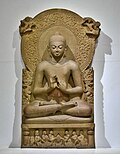
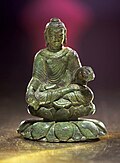
Tags: Mobile edit Mobile web edit |
No edit summary |
||
| Line 1: | Line 1: | ||
{{Short description|Ancient Indian empire (c. 3rd century CE – 575 CE)}} | {{Short description|Ancient Indian empire (c. 3rd century CE – 575 CE)}} | ||
{{Infobox country | |||
{{Infobox | |||
| conventional_long_name = Gupta Empire | | conventional_long_name = Gupta Empire | ||
| common_name = | | common_name = | ||
| era = | | native_name = | ||
| year_start = | | era = Classical India | ||
| year_end = | | year_start = {{Circa|240}} | ||
| event1 = Coronation of Chandragupta I | |||
| date_event1 = 26 February 320<ref name="a006">{{cite web | last=Smith | first=Vincent A | title=Chapter 11 – The Gupta Empire and the Western Satraps: Chandragupta I to Kumaragupta I | website=The Public's Library and Digital Archive | url=https://www.ibiblio.org/britishraj/Jackson2/chapter11.html | access-date=14 July 2024}}</ref> | |||
| event2 = Gupta-Saka Wars | |||
| date_event2 = {{Circa|375–385}} | |||
<ref name="goyal1967">{{cite book|last=Goyal|first=SR|title=History of the Imperial Guptas|year=1967|page=367|url=https://archive.org/details/goyal-1967/page/367/mode/1up}}</ref> | |||
| event3 = Gupta-Kidarite Conflicts | |||
| date_event3 = {{Circa|390–450}}<ref name="dani1996">{{cite book|last1=Dani|first1=Ahmad Hasan|last2=Litvinsky|first2=BA|title=History of Civilizations of Central Asia: The Crossroads of Civilizations, A.D. 250 to 750|year=1996|publisher=UNESCO|pages=151–152}}</ref> | |||
| event4 = Gupta-Hunnic Wars | |||
| date_event4 = {{Circa|460–500}}<ref name="majumdar1981">{{cite book|last=Majumdar|first=R.C.|title=A Comprehensive History of India: Pt. 1. A.D. 300–985|year=1981|publisher=Indian History Congress/People's Publishing House|page=64}}</ref><ref name="dani1999">{{cite book|last=Dani|first=Ahmad Hasan|title=History of Civilizations of Central Asia|year=1999|publisher=Motilal Banarsidass|page=221}}</ref> | |||
| year_end = {{Circa|579}}<ref name="goyal1967" /> | |||
| status = [[Empire]] | | status = [[Empire]] | ||
| p1 = | | p1 = Western Satraps | ||
| | | p2 = Nagas of Padmavati | ||
| | | p3 = Pañcāla | ||
| | | p4 = Arjunayanas | ||
| | | p5 = Yaudheya | ||
| | | p6 = Mahameghavahana dynasty | ||
| | | p7 = Murunda dynasty | ||
| | | p8 = Kushano-Sasanian Kingdom | ||
| s1 = Later Guptas | | s1 = Later Guptas | ||
| s2 = Kingdom of Valabhi | |||
| s2 = | | s3 = Vardhana dynasty{{!}}Kingdom of Thanesar | ||
| s4 = Gurjaradesa{{!}}Gurjara kingdoms | |||
| s3 | | s5 = Aulikaras | ||
| s6 = Maukhari Dynasty | |||
| today = <!-- This field should not be used if there are more than four entries --> | |||
| image_map = {{Switcher|[[File:South Asia historical AD375 EN.svg|upright=1.15|250px|frameless]]|Approximate extent of the Gupta territories (pink) in 375 CE| | |||
[[File:South Asia historical AD450 EN.svg|upright=1.15|250px|frameless]]|Approximate extent of the Gupta territories (pink) in 450 CE}} | |||
| capital = {{ubl | |||
| [[Pataliputra]]<ref name="Chakrabarty" /> | |||
| [[Ayodhya]] (after 455)<ref name=AyodhyaKasi/><ref name=MookerjiAyodhKasi/><ref name=BakkerAyodhya/> | |||
| | |||
| | |||
| | |||
| today = | |||
| | |||
{{ | |||
{{ | |||
}} | }} | ||
| | | common_languages = [[Sanskrit]] (literary and academic)<br />[[Prakrit]] (vernacular) | ||
| religion = {{unbulleted list|[[Vaishnavism| Vaishnav Hinduism]] (official)<ref name="GuptaReligion">'''Gupta's patronized sects''' | |||
| | *Hinduism [Vaishnavism] : | ||
**{{Cite book |last=Sharma |first=Tej Ram |url=https://archive.org/details/personalgeograph00sharuoft/page/112/mode/1up |title=Personal and geographical names in the Gupta inscriptions |date=1978 |location=Delhi |publisher=Concept |page=112 |quote=An indication of the leaning of the Gupta kings towards Vaisnavism is clear from the Garuda emblem of the Guptas. The Gupta monarchs also used the title 'Paramabhāgavata' i.e.; the devout devotee of Visnu, in their imperial records.}} | |||
**{{Cite book |last=Bakker |first=Hans T. |url=https://books.google.com/books?id=uDxTzQEACAAJ |title=The Alkhan: A Hunnic People in South Asia |date=12 March 2020 |publisher=Barkhuis |isbn=978-94-93194-00-7 |page=73 |language=en |quote=On the south banks of the Bina, the building of a religious complex dedicated to Vishnu, the Empire’s tutelary deity, had expanded under Budhagupta.}} | |||
*Buddhism [Mahayana] : | |||
**{{Cite book|url=http://archive.org/details/buddhism0000gane_e7c3 |title=Buddhism |page=17 |last=Ganeri |first=Anita |date=2007 |publisher=Franklin Watts |isbn=978-0-7496-6979-9 |quote=Gupta Empire at its height (5th-6th centuries) connected with the development of Mahayana Buddhism with the development of Tantric Buddhism.}} | |||
**{{cite book |last=Singh |first=Upinder |title=A History of Ancient and Early Medieval India: From the Stone Age to the 12th Century |year=2008 |publisher=Pearson Education India |page=521 |isbn=978-81-317-1677-9 |url=https://books.google.com/books?id=H3lUIIYxWkEC&pg=PA521 |quote=While the Gupta kings are generally linked with the promotion of Brahmanical cults, some of them extended patronage to Buddhism as well. Paramartha, a Buddhist scholar of the period, states that king Vikramaditya sent his queen and prince Baladitya to study under the tutelage of the famous Buddhist monk and scholar Vasubandhu.[...] Narasimhagupta became a Buddhist monk and gave up his life through dhyana (meditation). Kumaragupta I and Budhagupta may have built monasteries at Nalanda. }} | |||
*Jainism | |||
**{{citation needed|date=February 2025}} | |||
</ref>|[[Buddhism]]<ref name="GuptaReligion"/>|[[Jainism]]<ref name="GuptaReligion"/> | |||
}} | }} | ||
| demonym = | | demonym = | ||
| government_type = Monarchy | | government_type = [[Monarchy]] | ||
| | | area_km2 = | ||
| title_leader = [[ | | area_rank = | ||
| currency = [[Dinar]]a (gold coins)<br/>[[Rupee|Rupaka]] (silver coins)<br/>[[Karshapana]] (copper coins)<br/>[[Cowries]] | |||
| title_leader = [[List of Gupta emperors|Maharajadhiraja]]{{efn|The first two kings were titled ''[[Maharaja]]'', all others were titled ''[[Maharajadhiraja]]''.}} | |||
| leader1 = [[Gupta (king)|Gupta]] (first) | | leader1 = [[Gupta (king)|Gupta]] (first) | ||
| year_leader1 = {{Circa| | | year_leader1 = {{Circa|240|280}} | ||
| leader2 = [[Vishnugupta (Gupta Empire)|Vishnugupta]] | | year_leader2 = {{Circa|540|550}} | ||
| leader2 = [[Vishnugupta (Gupta Empire)|Vishnugupta]] (last) | |||
| stat_year1 = 400 est. | | stat_year1 = 400 est. | ||
| stat_area1 = | | stat_area1 = 3500000 | ||
| ref_area1 = <ref name="Turchin223">{{Cite journal |last1=Turchin |first1=Peter |last2=Adams |first2=Jonathan M. |last3=Hall |first3=Thomas D |date=December 2006 |title=East-West Orientation of Historical Empires |journal=Journal of World-Systems Research |volume=12 |issue=2 |page=223 |issn=1076-156X |doi=10.5195/JWSR.2006.369|doi-access=free }}</ref>{{break}}(high-end estimate of peak area) | | ref_area1 = <ref name="Turchin223">{{Cite journal |last1=Turchin |first1=Peter |last2=Adams |first2=Jonathan M. |last3=Hall |first3=Thomas D |date=December 2006 |title=East-West Orientation of Historical Empires |journal=Journal of World-Systems Research |volume=12 |issue=2 |page=223 |issn=1076-156X |doi=10.5195/JWSR.2006.369|doi-access=free }}</ref><ref name="OxfordArea">{{Cite book|last1=Bang|first1=Peter Fibiger|url=https://books.google.com/books?id=9mkLEAAAQBAJ&pg=PA92|title=The Oxford World History of Empire: Volume One: The Imperial Experience|last2=Bayly|first2=C. A.|last3=Scheidel|first3=Walter|year=2020|publisher=Oxford University Press|isbn=978-0-19-977311-4|pages=92–94|language=en}}</ref> {{break}}(high-end estimate of peak area) | ||
| stat_year2 = 440 est. | | stat_year2 = 440 est. | ||
| stat_area2 = | | stat_area2 = 1700000 | ||
| ref_area2 = <ref name="Taagepera">{{Cite journal |last=Taagepera |first=Rein |year=1979 |title=Size and Duration of Empires: Growth-Decline Curves, 600 B.C. to 600 A.D |journal=Social Science History |volume=3 |issue=3/4 |page=121 |doi=10.2307/1170959 |jstor=1170959}}</ref>{{break}}(low-end estimate of peak area) | | ref_area2 = <ref name="Taagepera">{{Cite journal |last=Taagepera |first=Rein |year=1979 |title=Size and Duration of Empires: Growth-Decline Curves, 600 B.C. to 600 A.D |journal=Social Science History |volume=3 |issue=3/4 |page=121 |doi=10.2307/1170959 |jstor=1170959}}</ref>{{break}}(low-end estimate of peak area) | ||
| stat_pop3 = 75,000,000<ref>{{cite web|url=https://www.academia.edu/38602317|title=Growth of World Population, GDP and GDP Per Capita before 1820|author=Angus Maddison|date=2001|page=238}}</ref> | |||
| stat_year3 = 5th century | |||
}} | }} | ||
The '''Gupta Empire''' was an Indian empire during the classical period of the [[Indian subcontinent]] which existed from the mid 3rd century to mid 6th century CE. At its zenith, the dynasty ruled over an empire that spanned much of the northern Indian subcontinent.<ref name=gd>{{Cite web |date=29 October 2009 |title=Gupta Dynasty |url=http://encarta.msn.com/encyclopedia_761571624/Gupta_Dynasty.html |access-date=30 November 2024 |archive-url=https://web.archive.org/web/20091029013809/http://encarta.msn.com/encyclopedia_761571624/Gupta_Dynasty.html |archive-date=29 October 2009 |quote="The dynasty controlled an empire stretching across north India at its peak in the 5th century."}}</ref> This period has been considered as the [[Golden Age of India]] by some historians,<ref>N. Jayapalan, ''History of India'', Vol. I, (Atlantic Publishers, 2001), 130.</ref> although this characterisation has been disputed by others.{{#tag:ref|According to [[D. N. Jha]], caste distinctions became more entrenched and rigid during this time, as prosperity and the favour of the law accrued the top of the social scale, while the lower orders were degraded further.<ref>{{Cite book |title=Ancient India in Historical Outline |last=Jha |first=D.N. |publisher=Manohar Publishers and Distributors |year=2002 |isbn=978-81-7304-285-0 |location=Delhi |pages=149–73}}</ref>|group=note}}<ref>{{harvnb|Pletcher|2011|p=90}}: "Historians once regarded the Gupta period (c.320–540) as the classical age of India [...] It was also thought to have been an age of material prosperity, particularly among the urban elite [...] Some of these assumptions have been questioned by more-extensive studies of the post-Mauryan, pre-Gupta period. Archaeological evidence from the earlier [[Kushan Empire|Kushan]] levels suggests greater material prosperity, to such a degree that some historians argue for an urban decline in the Gupta period."</ref>{{sfn|Stein|2010|p=86-87}} The ruling dynasty of the empire was founded by [[Gupta (king)|Gupta]].<ref>{{Cite book |last=V.D |first=Mahajan |url=https://books.google.com/books?id=7TJlDwAAQBAJ&dq=sri+gupta&pg=PA360 |title=Ancient India |publisher=S. Chand Publishing |isbn=978-93-5253-132-5 |language=en}}</ref> | |||
The high points of this period are the great cultural developments which took place primarily during the reigns of [[Samudragupta]], [[Chandragupta II]] and [[Kumaragupta I]]. Many [[Hinduism|Hindu]] [[Hindu epics|epics]] and [[Hindu literature|literary]] sources, such as the ''[[Mahabharata]]'' and ''[[Ramayana]]'', were canonised during this period.<ref>[https://www.britannica.com/EBchecked/topic/249590/Gupta-dynasty Gupta dynasty (Indian dynasty)] {{webarchive|url=https://web.archive.org/web/20100330100325/https://www.britannica.com/EBchecked/topic/249590/Gupta-dynasty |date=30 March 2010 }}. Britannica Online Encyclopedia. Retrieved 21 November 2011.</ref> The Gupta period produced scholars such as [[Kalidasa]],<ref>{{Cite book |url=https://archive.org/details/indiahistory00keay/page/151 |title=India: A history |last=Keay |first=John |publisher=Atlantic Monthly Press |year=2000 |isbn=978-0-87113-800-2 |pages=[https://archive.org/details/indiahistory00keay/page/151 151–52] |quote=Kalidasa wrote ... with excellence which, by unanimous consent, justifies the inevitable comparisons with Shakespeare ... When and where Kalidasa lived remains a mystery. He acknowledges no links with the Guptas; he may not even have coincided with them ... but the poet's vivid awareness of the terrain of the entire subcontinent argues strongly for a Guptan provenance. |author-link=John Keay }}</ref> [[Aryabhata]], [[Varahamihira]] and [[Vatsyayana]], who made significant advancements in many academic fields.{{sfn|Vidya Dhar Mahajan|1990|p=540}}<ref name="Keay">{{harvnb|Keay|2000|p=[https://archive.org/details/indiahistory00keay/page/132 132]|ps=: "The great era of all that is deemed classical in Indian literature, art and science was now dawning. It was this crescendo of creativity and scholarship, as much as ... political achievements of the Guptas, which would make their age so golden."}}</ref><ref>[https://www.britannica.com/EBchecked/topic-art/285248/1960/The-Gupta-empire-at-the-end-of-the-4th-century Gupta dynasty: empire in 4th century] {{webarchive|url=https://web.archive.org/web/20100330103811/https://www.britannica.com/EBchecked/topic-art/285248/1960/The-Gupta-empire-at-the-end-of-the-4th-century |date=30 March 2010 }}. Britannica Online Encyclopedia. Retrieved 21 November 2011.</ref> [[History of science and technology in the Indian subcontinent|Science]] and political administration reached new heights during the [[Gupta era]].<ref name="Keay"/> The period, sometimes described as ''[[Pax Gupta]]'', gave rise to achievements in architecture, sculpture, and painting that "set standards of form and taste [that] determined the whole subsequent course of art, not only in [[Indian subcontinent|India]] but far beyond her borders".{{sfn|J.C. Harle|1994|p=87}} Strong trade ties also made the region an important cultural centre and established the region as a base that would influence nearby kingdoms and regions in India and [[Southeast Asia]].{{citation needed|date=December 2024}} The [[Puranas]], earlier long poems on a variety of subjects, are also thought to have been committed to written texts around this period.{{sfn|J.C. Harle|1994|p=87}}<ref name="Dikshitar 1993">{{Cite book|last=Dikshitar|first=V. R. Ramachandra|url=https://books.google.com/books?id=KP_DTtd6kJEC&pg=PA199|title=The Gupta Polity|date=1993|publisher=Motilal Banarsidass Publ.|isbn=978-81-208-1024-2|language=en|access-date=1 July 2020|archive-date=2 August 2020|archive-url=https://web.archive.org/web/20200802225920/https://books.google.com/books?id=KP_DTtd6kJEC&pg=PA199|url-status=live}}</ref> Hinduism was followed by the rulers and the Brahmins flourished in the Gupta empire but the Guptas were tolerant towards people of other faiths as well.<ref>{{cite book |last1=Sen |first1=Sailendra Nath |title=Ancient Indian History and Civilization |url=https://books.google.com/books?id=Wk4_ICH_g1EC&q=indus |publisher=New Age International |year=1999 |orig-year=First published 1988 |edition=2nd |isbn=978-81-224-1198-0 |page=227 |access-date=30 August 2020 |archive-date=7 May 2021 |archive-url=https://web.archive.org/web/20210507000807/https://www.google.com/books/edition/Ancient_Indian_History_and_Civilization/Wk4_ICH_g1EC?hl=en&gbpv=1&bsq=indus |url-status=live}}</ref> | |||
The high points of this period are the great cultural developments which took place primarily during the reigns of Samudragupta, Chandragupta II and Kumaragupta I. Many [[Hinduism|Hindu]] [[Hindu epics|epics]] and [[Hindu literature|literary]] sources, such as [[Mahabharata]] and [[Ramayana]], were canonised during this period.<ref>[https://www.britannica.com/EBchecked/topic/249590/Gupta-dynasty Gupta dynasty (Indian dynasty)] {{webarchive|url=https://web.archive.org/web/20100330100325/https://www.britannica.com/EBchecked/topic/249590/Gupta-dynasty |date=30 March 2010 }}. Britannica Online Encyclopedia. Retrieved 21 November 2011.</ref> The Gupta period produced scholars such as [[Kalidasa]],<ref>{{Cite book |url=https://archive.org/details/indiahistory00keay/page/151 |title=India: A history |last=Keay |first=John |publisher=Atlantic Monthly Press |year=2000 |isbn=978-0-87113-800-2 |pages=[https://archive.org/details/indiahistory00keay/page/151 151–52] |quote=Kalidasa wrote ... with | |||
The empire eventually died out because of factors such as substantial loss of territory and imperial authority caused by their own erstwhile feudatories, as well as the invasion by the [[Huna people]]s ([[Kidarites]] and [[Alchon Huns]]) from [[Central Asia]].{{sfn|Ashvini Agrawal|1989|pp=264–69}}<ref name="Rene">{{Cite book |title=The Empire of the Steppes |last=Grousset |first=Rene |publisher=Rutgers University Press |year=1970 |isbn=978-0-8135-1304-1 |page=[https://archive.org/details/empireofsteppesh00prof/page/69 69] |url=https://archive.org/details/empireofsteppesh00prof/page/69 }}</ref> After the collapse of the Gupta Empire in the 6th century, India was again ruled by numerous regional kingdoms. | The empire eventually died out because of factors such as substantial loss of territory and imperial authority caused by their own erstwhile feudatories, as well as the invasion by the [[Huna people]]s ([[Kidarites]] and [[Alchon Huns]]) from [[Central Asia]].{{sfn|Ashvini Agrawal|1989|pp=264–69}}<ref name="Rene">{{Cite book |title=The Empire of the Steppes |last=Grousset |first=Rene |publisher=Rutgers University Press |year=1970 |isbn=978-0-8135-1304-1 |page=[https://archive.org/details/empireofsteppesh00prof/page/69 69] |url=https://archive.org/details/empireofsteppesh00prof/page/69 }}</ref> After the collapse of the Gupta Empire in the 6th century, India was again ruled by numerous regional kingdoms. | ||
| Line 112: | Line 78: | ||
{{Main|Origin of the Gupta dynasty}} | {{Main|Origin of the Gupta dynasty}} | ||
{{Gupta Empire}} | {{Gupta Empire}} | ||
Guptas were originally from [[Magadha]].<ref>{{Citation |last=Mackay |first=James |title=The Complete Illustrated Guide to Coins & Coin Collecting |date=2006 |publisher=Hermes House |isbn=978-0-681-45952-6 |url=https://archive.org/details/isbn_9780681459526/page/29/mode/1up |quote=A Magadha (Bihar) kingdom, with its capital at Patna, emerged in the late 3rd century AD under Srigupta founder of a dynasty that lasted for 300 years. His grandson, Chandragupta 1 (305-25), created the splendid Gupta Empire.}}</ref><ref>{{Citation |last=Brown |first=C. J. |title=Coins of India |date=1999 |publisher=Asian Educational Services |isbn=978-81-206-0345-5 |url=https://books.google.com/books?id=O-d497CKID0C |quote=The territory which the Guptas are first found ruling lay near Pāțaliputra, the modern Patna; it was much enlarged by one Gupta, on the decline of the Kushāņa power in its eastern territories}}</ref><ref>{{Citation |last=Gupta |first=L.C. |title=Silver coins of Sri Gupta |date=1994 |url=https://books.google.com/books?id=sTVmAAAAMAAJ |quote=...the historicity of Sri Gupta's political career around Magadha}}</ref><ref>{{Citation |last=Higham |first=Charles |title=Encyclopedia of Ancient Asian Civilizations |date=2014 |publisher=Infobase |isbn=978-1-4381-0996-1 |url=https://books.google.com/books?id=H1c1UIEVH9gC |quote=The Gupta empire had its genesis under King Srigupta (270-290 C.E.), who ruled one of the many small kingdoms in the Ganga (Ganges) Valley in India from his capital at Pataliputra}}</ref><ref>{{Citation |last=Ishikawa |first=Ken |title=The Global Connections of Gandhāran Art |date=2020 |publisher=Classical Art Research Centre |isbn=978-1-78969-696-7 |url=https://books.google.com/books?id=JZf6DwAAQBAJ |quote=Ruling from the Magadha Kingdom in the lower Gangetic Valley, the imperial Guptas were the second pan-Indian state in history}}</ref><ref>{{Citation |last=Thapar |first=Romila |title=The Past Before Us |date=2013 |publisher=Harvard University Press |isbn=978-0-674-72652-9 |url=https://books.google.com/books?id=ScYJAQAAQBAJ |quote=There is some evidence of interest during the Gupta period in forms created during Mauryan times. This may have arisen from a curiosity about antecedent dynasties and their artifacts, originating in approximately the same area in which the beginnings of Gupta power were located. For both the Mauryas and the Guptas, Pāțaliputra was an important city.}}</ref><ref>{{Citation |last=Hart-Davis |first=Adam |title=History |date=2010 |publisher=DK |isbn=978-0-7566-6596-8 |url=https://books.google.com/books?id=UZo0AwEACAAJ |quote=the region of Magadha gave birth to another great dynasty and empire, the Guptas }}</ref><ref>{{Citation |last=Kumar Maity |first=Sachindra |title=The Imperial Guptas and Their Times |date=1975 |url=https://books.google.com/books?id=1XI_AAAAMAAJ |quote=the founder of this dynasty was Mahārāja Sri Gupta who was apparently a subordinate ruler and ruling somewhere near Magadha.}}</ref><ref>{{harvnb|Keay|2000|p=[https://archive.org/details/indiahistory00keay/page/134/mode/1up 134]|ps=: "Sri Gupta was probably not a Buddhist but was raja of some minor polity near or within erstwhile Magadha."}}</ref><ref>{{Citation |last=Jha |first=D. N. |title=Ancient India: In Historical Outline |date=1998 |publisher=Manohar Publishers & Distributors |isbn=978-81-7304-266-9 |url=https://books.google.com/books?id=tUluAAAAMAAJ |quote=Guptas... political control in the region of Magadha.}}</ref>{{excessive citations inline|date=June 2025}} | |||
The first evidence of Gupta connection with Magadha comes from a foreign source. The Chinese traveller [[Yijing (monk)|I-tsing]], who came to India in A.D. 672 heard of Mahārāja Śrī-Gupta (Che-li-ki-to) who built a temple near [[Mṛgaśikhāvana|Mrigaśikhāvana]] for Chinese pilgrims and endowed it with 24 villages.<ref>{{cite book |author=Radhakumud Mookerji |author-link=Radhakumud Mookerji |title=The Gupta Empire|url=https://books.google.com/books?id=uYXDB2gIYbwC |publisher=Motilal Banarsidass Publ. |year=1989 |isbn=81-208-0089-3 |page=11}}</ref>{{sfn|H.C. Raychaudhuri|1923|p=271}} | |||
Recent numismatic research suggests that [[Sri Gupta]], traditionally regarded as the founder of the Gupta dynasty, likely ruled as an independent monarch in the [[Magadha]] region during the late 3rd century CE. A hoard of over one hundred silver coins bearing the legend "Śrī Gupta" in Brahmi script, along with a portrait bust, have been discovered in [[Bihar]], particularly in the [[Hajipur]]–[[Muzaffarpur district|Muzaffarpur]] region, a core area of ancient [[Magadha]]. These coins, uniform in typology and silver standard, reflect deliberate state issuance rather than imitation or forgery. Scholars argue that this coinage indicates Sri Gupta's sovereign authority, issued to meet local economic demands following the decline of the [[Kushan Empire|Kushans]] and to assert political identity. The use of the title [[Maharaja]]—also common among other independent tribal states of the period—further supports his autonomous status. Moreover, the later marriage alliance between [[Chandra Gupta I]] and the [[Licchavis of Vaishali|Lichchhavi]] princess [[Kumaradevi]] likely reflects the already elevated position of the Gupta family, established during the reigns of [[Sri Gupta]] and his son [[Ghatotkacha]]. This interpretation places the origin of the Gupta Empire firmly within a local [[Magadha]]n context, grounded in both political independence and early monetary sovereignty.<ref>{{cite book | |||
| last1 = Gupta | |||
| first1 = L.C. | |||
| last2 = Mangalam | |||
| first2 = S.J. | |||
| title = Silver Coins of Sri Gupta | |||
| publisher = Numismatic Society of Hyderabad | |||
| year = 1994 | |||
| location = Hyderabad | |||
| url = https://books.google.com/books?id=sTVmAAAAMAAJ | |||
| access-date = 20 June 2025 | |||
}}</ref> | |||
According to one theory, they originated in the present-day lower-Doab region of [[Uttar Pradesh]],<ref>{{cite book |last1=Chakrabarti |first1=K. |editor1-last=Guand-da |editor1-first=Zhang |editor2-last=Litvinsky |editor2-first=B. |editor3-last=Shabani Samghabadi |editor3-first=R. |chapter=The Gupta Kingdom |title=History of Civilizations of Central Asia: The crossroads of civilizations, A.D. 250 to 750 |url=https://unesdoc.unesco.org/ark:/48223/pf0000104612?posInSet=1&queryId=a6dad7c3-cad4-47e1-a5ef-49a1cd6d31f9 |year=1996 |publisher=UNESCO |volume=III |page=188 |isbn=978-92-3-103211-0 |quote=On the basis of ... historians have now come to accept the lower doab region as the original homeland of the Guptas |access-date=24 July 2017}}</ref><ref group=lower-alpha name="GuptaOrigin"/> where most of the inscriptions and coin hoards of the early Gupta emperors have been discovered.{{sfn|Dilip Kumar Ganguly|1987|p=14}}{{sfn|Tej Ram Sharma|1989|p=39}} The recently found silver coin of [[Gupta (king)|Sri Gupta]] in Uttar Pradesh further attest the origin of Guptas around [[Varanasi|Kāśī]]–[[Kannauj]] region and his rule was only limited to Kāśī (present day [[Varanasi]]).{{sfn|Kumar|2024|p=196}} There also remains a possibility that this Śrīgupta coin was issued by another king.{{sfn|Kumar|2024|p=198}} | |||
Another theory locates the Gupta homeland in the present-day [[Bengal]] region in Ganges basin, based on the account of the 7th-century Chinese Buddhist monk [[Yijing (monk)|Yijing]]. According to Yijing, king Che-li-ki-to (identified with the dynasty's founder ''Shri'' [[Gupta (king)|Gupta]]) built a temple for Chinese pilgrims near Mi-li-kia-si-kia-po-no (apparently a transcription of [[Mṛgaśikhāvana|Mriga-shikha-vana]]). Yijing states that this temple was located more than 40 ''[[yojana]]s'' east of [[Nalanda]], which would mean it was situated somewhere in the modern Bengal region.{{sfn|Dilip Kumar Ganguly|1987|pp=7–11}} Another proposal is that the early Gupta kingdom extended from Prayaga in the west to northern Bengal in the east.{{sfn|Dilip Kumar Ganguly|1987|p=12}} | |||
The Gupta records do not mention the dynasty's [[varna in Hinduism|varna]] (social class).{{sfn|Tej Ram Sharma|1989|p=44}} Some historians, such as [[A.S. Altekar]], have theorised that they were of [[Vaishya]] origin, as certain ancient Indian texts prescribe the name "Gupta" for the members of the Vaishya varna.{{sfn|Ashvini Agrawal|1989|p=82}}{{sfn|Tej Ram Sharma|1989|p=42}} According to historian [[Ram Sharan Sharma|R. S. Sharma]], the Vaishyas – who were traditionally associated with trade – may have become rulers after resisting oppressive taxation by the previous rulers.<ref>{{Cite book |url=https://books.google.com/books?id=i_sIE1sO5kwC&pg=PA69 |title=Early Medieval Indian Society: A Study in Feudalisation |last=R. S. Sharma |publisher=Orient Longman |year=2003 |isbn=9788125025238 |access-date=26 June 2019 |archive-date=26 March 2021 |archive-url=https://web.archive.org/web/20210326214745/https://books.google.com/books?id=i_sIE1sO5kwC&pg=PA69 |url-status=live }}</ref> Critics of the Vaishya-origin theory point out that the suffix Gupta features in the names of several non-Vaishyas before as well as during the Gupta period,{{sfn|R.C. Majumdar|1981|p=4}} and the dynastic name "Gupta" may have simply derived from the name of the dynasty's first king [[Gupta (king)|Gupta]].{{sfn|Tej Ram Sharma|1989|p=40}} Some scholars, such as [[S. R. Goyal]], theorise that the Guptas were [[Brahmins]], because they had matrimonial relations with Brahmins, but others reject this evidence as inconclusive.{{sfn|Tej Ram Sharma|1989|pp=43–44}} Based on the [[Pune]] and Riddhapur inscriptions of the Gupta princess [[Prabhavatigupta]], some scholars believe that the name of her paternal [[gotra]] (clan) was "Dharana", but an alternative reading of these inscriptions suggests that Dharana was the ''gotra'' of her mother Kuberanaga.{{sfn|Ashvini Agrawal|1989|p=83}} | |||
==History== | ==History== | ||
| Line 124: | Line 104: | ||
=== Early rulers === | === Early rulers === | ||
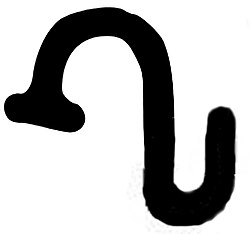
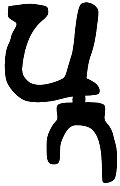
Gupta ([[Gupta script]]: [[File:Gupta allahabad gu.jpg|14px]]<sub>[[File:Gupta allahabad pt.jpg|12px]]</sub> ''gu-pta'', {{floruit|late 3rd century CE}}) is the earliest known king of the Gupta dynasty. Different historians variously date the beginning of his reign from the mid-to-late 3rd century CE.{{sfn|Tej Ram Sharma|1989|pp=49–55}}{{sfn|Ashvini Agrawal|1989|p=86}} Gupta founded the Gupta Empire {{Circa|240}}-280 CE, and was succeeded by his son, [[Ghatotkacha (king)|Ghatotkacha]], {{Circa|280}}-319 CE, followed by Ghatotkacha's son, [[Chandragupta I]], {{Circa|319}}-335 CE. "Che-li-ki-to", the name of a king mentioned by the 7th century Chinese Buddhist monk [[Yijing (monk)|Yijing]], is believed to be a transcription of "[[Shri]]-Gupta" ([[IAST]]: Śrigupta), "Shri" being an honorific prefix.{{sfn|Ashvini Agrawal|1989|pp=84–85}} According to Yijing, this king built a temple for Chinese Buddhist pilgrims near "Mi-li-kia-si-kia-po-no" (believed to be a transcription of [[Mṛgaśikhāvana]]).{{sfn|Ashvini Agrawal|1989|pp=79–81}}{{Relevance inline|date=December 2024}} | |||
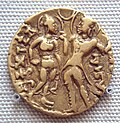
[[File:Queen Kumaradevi and King Chandragupta I on a coin of their son Samudragupta 350 380 CE.jpg|thumb|Queen Kumaradevi and King [[Chandragupta I]], depicted on a gold coin|left]] | [[File:Queen Kumaradevi and King Chandragupta I on a coin of their son Samudragupta 350 380 CE.jpg|thumb|Queen Kumaradevi and King [[Chandragupta I]], depicted on a gold coin|left]] | ||
In the [[Allahabad Pillar]] inscription, Gupta and his successor Ghatotkacha are described as ''[[Maharaja]]'' (" | In the [[Allahabad Pillar]] inscription, Gupta and his successor Ghatotkacha are described as ''[[Maharaja]]'' ("Great King"), while the next king Chandragupta I is called a [[Maharajadhiraja]] ("[[King of Kings|King of Great Kings]]"). In the later period, the title ''Maharaja'' was used by feudatory rulers, which has led to suggestions that Gupta and Ghatotkacha were vassals (possibly of the [[Kushan Empire]]).{{sfn|Ashvini Agrawal|1989|p=85}} However, there are several instances of paramount sovereigns using the title ''Maharaja'', in both pre-Gupta and post-Gupta periods, so this cannot be said with certainty. That said, there is no doubt that Gupta and Ghatotkacha held a lower status and were less powerful than Chandragupta I.{{sfn|R.C. Majumdar|1981|pp=6–7}} | ||
Chandragupta I married the [[ | Chandragupta I married the [[Licchavis of Nepal|Licchavi]] princess Kumaradevi, which may have helped him extend his political power and dominions, enabling him to adopt the prestigious title ''Maharajadhiraja''.{{sfn|R.C. Majumdar|1981|p=10}} According to the dynasty's official records, he was succeeded by his son [[Samudragupta]]. However, the discovery of the coins issued by a Gupta emperor named [[Kacha (king)|Kacha]] have led to some debate on this topic: according to one theory, Kacha was another name for Samudragupta; another possibility is that Kacha was a rival claimant to the throne.{{sfn|Tej Ram Sharma|1989|p=71}} | ||
===Samudragupta=== | ===Samudragupta=== | ||
{{Main|Samudragupta}} | {{Main|Samudragupta}} | ||
[[File:Maharaja Sri Gupta inscription on the Allahabad pillar Samudragupta inscription.jpg|thumb|280px|[[Gupta script]] inscription ''Maharaja Sri Gupta'' [[File:Gupta allahabad m.svg|11px]] [[File:Gupta allahabad haa.jpg|11px]] [[File:Gupta allahabad raa.jpg|11px]] [[File:Gupta allahabad j.svg|12px]] [[File:Gupta allahabad shrii.jpg|14px]] [[File:Gupta allahabad gu.jpg|14px]]<sub>[[File:Gupta allahabad pt.jpg|12px]]</sub> ("Great King, Lord Gupta"), mentioning the first ruler of the dynasty, king [[Gupta (king)|Gupta]]. Inscription by [[Samudragupta]] on the [[Allahabad Pillar]], where Samudragupta presents king Gupta as his great-grandfather. Dated circa 350 CE.<ref>[[:File:Allahabad stone pillar inscription of Samudragupta.jpg|Full inscription]], {{Cite book |url=https://archive.org/details/in.ernet.dli.2015.49403 |title=Corpus Inscriptionum Indicarum Vol. 3 |last=Fleet |first=John Faithfull |date=1888 |pages=[https://archive.org/details/in.ernet.dli.2015.49403/page/n197 1]–17}}</ref>|right]] | |||
Samudragupta succeeded his father around 335 or 350 CE, and ruled until {{Circa|375}}.{{sfn|Tej Ram Sharma|1989|pp=51–52}} The Allahabad Pillar inscription, composed by his courtier [[Harisena]], credits him with extensive conquests.{{sfn|Ashvini Agrawal|1989|pp=106–07}} The inscription asserts that Samudragupta uprooted 8 kings of [[Āryāvarta]], the northern region, including the [[Nagas of Padmavati|Nagas]].{{sfn|Ashvini Agrawal|1989|p=114}} It further claims that he subjugated all the kings of the forest region, which was most probably located in central India.{{sfn|Ashvini Agrawal|1989|p=117}} It also credits him with defeating 12 rulers of [[Dakshinapatha]], the southern region: the exact identification of several of these kings is debated among modern scholars,{{sfn|Ashvini Agrawal|1989|p=107}} but it is clear that these kings ruled areas located on the eastern coast of India.{{sfn|Ashvini Agrawal|1989|p=112}} The inscription suggests that Samudragupta advanced as far as the [[Pallava dynasty|Pallava]] kingdom in the south, and defeated Vishnugopa, the Pallava regent of [[Kanchipuram|Kanchi]].{{sfn|Ashvini Agrawal|1989|p=110}} During this southern campaign, Samudragupta most probably passed through the forest tract of central India, reached the eastern coast in present-day [[Odisha]], and then marched south along the coast of the [[Bay of Bengal]].{{sfn|Tej Ram Sharma|1989|pp=80–81}} | |||
The Allahabad Pillar inscription mentions that rulers of several frontier kingdoms and tribal [[Aristocracy|aristocracies]] paid Samudragupta tributes, obeyed his orders, and performed obeisance before him.{{sfn|Tej Ram Sharma|1989|p=84}}{{sfn|Upinder Singh|2017|p=343}} These polities and tribes included [[Samatata]], [[Davaka]], [[Kamarupa]], [[Licchavis of Nepal|Nepal]], [[Katyuri kings|Karttripura]],{{sfn|Ashvini Agrawal|1989|pp=112–18}} [[Malavas]], [[Arjunayanas]], [[Yaudheyas]], [[Madra Kingdom|Madrakas]], and [[Abhira dynasty|Abhiras]].{{sfn|Upinder Singh|2017|p=343}} | |||
The inscription also mentions that several foreign kings tried to please Samudragupta by personal attendance, offered him their daughters in marriage (or according to another interpretation, gifted him maidens{{sfn|Ashvini Agrawal|1989|p=125}}), and sought the use of the [[Garuda]]-depicting Gupta seal for administering their own territories.{{sfn|Shankar Goyal|2001|p=168}} However, this is likely an exaggeration, and Samudragupta's panegyrist appears to have described acts of diplomacy as ones of subservience. For example, the King of [[Anuradhapura kingdom|Simhala]] is listed among these foreign rulers, but it is known that from Chinese sources that the Simhala king [[Sirimeghavanna of Anuradhapura|Meghavarna]] merely sent presents to the Gupta emperor requesting his permission to build a Buddhist monastery; he did not express subservience.{{sfn|Tej Ram Sharma|1989|p=90}} | |||
Samudragupta appears to have been [[Vaishnavite]], as attested by his Eran inscription,{{sfn|Tej Ram Sharma|1989|p=68}}{{sfn|R.C. Majumdar|1981|p=32}} and performed several [[Brahmanism|Brahmanical]] ceremonies.{{sfn|Tej Ram Sharma|1989|p=91}} The Gupta records credit him with making generous donations of cows and gold.{{sfn|Tej Ram Sharma|1989|p=68}} He performed the [[Ashvamedha]] ritual (horse sacrifice), which was used by the ancient Indian kings to prove their imperial sovereignty, and issued gold coins (see [[#Coinage|Coinage]] below) to mark this performance.{{sfn|Ashvini Agrawal|1989|pp=125–26}} | Samudragupta appears to have been [[Vaishnavite]], as attested by his [[Eran]] inscription,{{sfn|Tej Ram Sharma|1989|p=68}}{{sfn|R.C. Majumdar|1981|p=32}} and performed several [[Brahmanism|Brahmanical]] ceremonies.{{sfn|Tej Ram Sharma|1989|p=91}} The Gupta records credit him with making generous donations of cows and gold.{{sfn|Tej Ram Sharma|1989|p=68}} He performed the [[Ashvamedha]] ritual (horse sacrifice), which was used by the ancient Indian kings and emperors to prove their imperial sovereignty, and issued gold coins (see [[#Coinage|Coinage]] below) to mark this performance.{{sfn|Ashvini Agrawal|1989|pp=125–26}} | ||
The Allahabad Pillar inscription presents Samudragupta as a wise king and strict administrator, who was also compassionate enough to help the poor and the helpless.{{sfn|Tej Ram Sharma|1989|pp=91, 94}} It also alludes to the king's talents as a musician and a poet, and calls him the "king of poets".{{sfn|R.C. Majumdar|1981|p=31}} Such claims are corroborated by Samudragupta's gold coins, which depict him playing a [[ancient veena|veena]].{{sfn|Tej Ram Sharma|1989|p=94}} | The Allahabad Pillar inscription presents Samudragupta as a wise king and strict administrator, who was also compassionate enough to help the poor and the helpless.{{sfn|Tej Ram Sharma|1989|pp=91, 94}} It also alludes to the king's talents as a musician and a poet, and calls him the "king of poets".{{sfn|R.C. Majumdar|1981|p=31}} Such claims are corroborated by Samudragupta's gold coins, which depict him playing a [[ancient veena|veena]].{{sfn|Tej Ram Sharma|1989|p=94}} | ||
Samudragupta appears to have directly controlled a large part of the [[Indo-Gangetic Plain]] in present-day India, as well as a substantial part of central India.{{sfn|R.C. Majumdar|1981|pp=23, 27}} | Samudragupta appears to have directly controlled a large part of the [[Indo-Gangetic Plain]] in present-day India, as well as a substantial part of central India.{{sfn|R.C. Majumdar|1981|pp=23, 27}} His empire comprised a number of monarchical and tribal tributary states of northern India, and of the south-eastern coastal region of India.{{sfn|R.C. Majumdar|1981|p=22}}{{sfn|Ashvini Agrawal|1989|p=112}} | ||
=== Ramagupta === | === Ramagupta === | ||
[[File:Standing_Buddha_Installed_by_Buddist_Monk_Yasadinna_-_Circa_5th_Century_CE_-_Jamalpur_Mound_-_ACCN_00-A-5_-_Government_Museum_Mathura_Golden_background.jpg|thumb|upright|Standing [[Buddha]] in red sandstone, [[Art of Mathura]], Gupta period circa 5th century CE. [[Mathura Museum]]<ref>{{cite book |last1=Smith |first1=Vincent Arthur |title=A history of fine art in India and Ceylon, from the earliest times to the present day |date=1911 |publisher= | [[File:Standing_Buddha_Installed_by_Buddist_Monk_Yasadinna_-_Circa_5th_Century_CE_-_Jamalpur_Mound_-_ACCN_00-A-5_-_Government_Museum_Mathura_Golden_background.jpg|thumb|upright|Standing [[Buddha]] in red sandstone, [[Art of Mathura]], Gupta period {{circa|5th century CE}}. [[Mathura Museum]]<ref>{{cite book |last1=Smith |first1=Vincent Arthur |title=A history of fine art in India and Ceylon, from the earliest times to the present day |date=1911 |location=Oxford |publisher=Clarendon Press |pages=[https://archive.org/details/historyoffineart00smit/page/170 170]–171 |url=https://archive.org/details/historyoffineart00smit}}</ref>]] | ||
{{Main|Ramagupta}} | {{Main|Ramagupta}} | ||
Ramagupta is known from a sixth-century play, the ''[[Devichandragupta]]'', in which he surrenders his | |||
Ramagupta is known from a sixth-century play, the ''[[Devichandragupta]]'', in which he surrenders his queen to the enemy [[Saka]]s, forcing his brother Chandragupta to sneak into the enemy camp to rescue her and kill the Saka king. The historicity of these events is unclear, but Ramagupta's existence is confirmed by three [[Jainism|Jain]] statues found at [[Durjanpur]], with inscriptions referring to him as the ''Maharajadhiraja''. A large number of his copper coins also have been found from the [[Eran]]-[[Vidisha]] region and classified in five distinct types, which include the ''Garuda'',{{sfn|Ashvini Agrawal|1989|pp=153–59}} ''Garudadhvaja'', ''lion'' and ''border legend'' types. The [[Brahmi]] legends on these coins are written in the early Gupta style.<ref>{{Cite book |url=https://books.google.com/books?id=chGrJUMarHoC&pg=PA120 |title=Indian Numismatic Studies |last=Bajpai |first=K.D. |publisher=Abhinav Publications |year=2004 |isbn=978-81-7017-035-8 |location=New Delhi |pages=120–21 |access-date=25 October 2015 |archive-date=4 May 2016 |archive-url=https://web.archive.org/web/20160504160827/https://books.google.com/books?id=chGrJUMarHoC&pg=PA120 |url-status=live }}</ref> | |||
===Chandragupta II "Vikramaditya"=== | ===Chandragupta II "Vikramaditya"=== | ||
{{Main|Chandragupta II}} | {{Main|Chandragupta II}} | ||
According to the Gupta records, | |||
According to the Gupta records, among his sons, Samudragupta nominated prince Chandragupta II, born of queen [[Dattadevi]], as his successor. Chandragupta II, ''Vikramaditya'' (Brave as the Sun), ruled from 375 until 415. He married a Kadamba princess of [[Kuntala country|Kuntala]] and of Naga lineage (''Nāgakulotpannnā''), Kuberanaga. His daughter [[Prabhavatigupta]] from this Naga queen was married to [[Rudrasena II]], the [[Vakataka]] king of [[Deccan Plateau|Deccan]].{{sfn|H.C. Raychaudhuri|1923|p=489}} His son Kumaragupta I was married to a Kadamba princess of the Karnataka region. Chandragupta II expanded his realm westwards, defeating the Saka [[Western Kshatrapas]] of [[Malwa]], [[History of Gujarat|Gujarat]] and [[Saurashtra (region)|Saurashtra]] in a campaign lasting until 409. His main opponent [[Rudrasimha III]] was defeated by 395, and he crushed the Bengal chiefdoms. This extended his control from coast to coast, established a second capital at [[Ujjain]] and was the high point of the empire.{{citation needed|date=July 2020}} Kuntala inscriptions indicate rule of Chandragupta II in [[Kuntala country]] of [[History of Karnataka|Karnataka]].<ref>{{Cite web|url=http://archive.org/details/in.ernet.dli.2015.107941|title=Annual Report Of Mysore 1886 To 1903|via=Internet Archive}}</ref> [[Sacred Rock of Hunza|Hunza inscription]] also indicate that Chandragupta was able to rule north western Indian subcontinent and proceeded to conquer [[Balkh]], although some scholars have also disputed the identity of the Gupta emperor.<ref>{{Cite book|last=Singh|first=Upinder|url=https://books.google.com/books?id=H3lUIIYxWkEC&q=upinder+singh|title=A History of Ancient and Early Medieval India: From the Stone Age to the 12th Century|date=2008|publisher=Pearson Education India|isbn=978-81-317-1120-0|pages=480|language=en|access-date=3 May 2021|archive-date=18 March 2022|archive-url=https://web.archive.org/web/20220318043350/https://books.google.com/books?id=H3lUIIYxWkEC&q=upinder+singh|url-status=live}}</ref> [[Chalukya dynasty|Chalukya]] king [[Vikramaditya VI]] (r. 1076 – 1126 CE) mentions Chandragupta with his title and states: "Why should the glory of the Kings Vikramaditya and Nanda be a hindrance any longer? He with a loud command abolished that (era), which has the name of Saka, and made that (era) which has the Chalukya counting".<ref>{{Cite book|last=Barua|first=Benimadhab|url=http://archive.org/details/in.ernet.dli.2015.103481|title=Old Brahmi Inscriptions In The Udayagiri And Khandagiri Caves|date=1929}}</ref> | |||
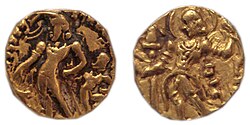
[[Image:Two Gold coins of Chandragupta II.jpg|thumb|right|Gold coins of [[Chandragupta II]]]] | [[Image:Two Gold coins of Chandragupta II.jpg|thumb|right|Gold coins of [[Chandragupta II]]]] | ||
Despite the creation of the empire through war, | Despite the creation of the empire through war, his reign is remembered for its very influential style of [[Hindu art]], [[Hindu literature|literature]], [[Hindu culture|culture]] and [[Hindu science|science]]. Some excellent works of Hindu art such as the panels at the [[Dashavatara Temple, Deogarh|Dashavatara Temple]] in [[Deogarh, Uttar Pradesh|Deogarh]] serve to illustrate the magnificence of Gupta art during his reign. Above all, it was the synthesis of elements that gave Gupta art its distinctive flavour. During this period, the Guptas were supportive of thriving [[Buddhism|Buddhist]] and [[Jain]] cultures as well, and for this reason, there is also a long history of non-Hindu [[Gupta period art]]. In particular, Gupta period Buddhist art was to be influential in most of East and Southeast Asia. Many advances were recorded by the Chinese scholar and traveller [[Faxian]] in his diary and published afterwards. | ||
The court of Chandragupta was made even more illustrious by the fact that it was graced by the ''Navaratna'' (Nine Jewels), a group of nine who excelled in the literary arts. | The court of Chandragupta II was made even more illustrious by the fact that it was graced by the ''Navaratna'' (Nine Jewels), a group of nine who excelled in the literary arts. Among these men was [[Kālidāsa]], whose works dwarfed the works of many other literary geniuses, not only in his own age but in the years to come. Kalidasa was mainly known for his subtle exploitation of the ''shringara'' (romantic) element in his verse. | ||
==== | ====Campaigns against foreign tribes==== | ||
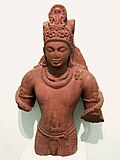
[[File:Vishnu sculpture.jpg|thumb|upright|Sculpture of Vishnu (red sandstone), 5th century CE.]] | [[File:Vishnu sculpture.jpg|thumb|upright|Sculpture of Vishnu (red sandstone), 5th century CE.]] | ||
The 4th century [[Sanskrit]] poet [[Kalidasa]] credits Chandragupta Vikramaditya with conquering about twenty-one kingdoms, both in and outside India. After finishing his campaign in East and West India, Vikramaditya (Chandragupta II) proceeded northwards, subjugated the [[Parasika]] | The 4th century [[Sanskrit]] poet [[Kalidasa]] credits Chandragupta Vikramaditya with conquering about twenty-one kingdoms, both in and outside India. After finishing his campaign in East and West India, Vikramaditya (Chandragupta II) proceeded northwards, subjugated the [[Parasika kingdom|Parasika]], then the [[Huna people|Huna]] and [[Kambojas|Kamboja]] tribes located in the west and east [[Oxus]] valleys respectively. Thereafter, the king proceeded into the [[Himalaya]] mountains to reduce the mountain tribes of the [[Kinnara kingdom|Kinnaras]], [[Kiratas]], as well as India proper.<ref name="Raghu Vamsa v 4.60–75">Raghu Vamsa v 4.60–75</ref>{{primary source inline|date=August 2016}} In one of his works Kalidasa also credits him with the removal of the [[Saka]]s from the country. He wrote 'Wasn't it Vikramaditya who drove the Sakas out from the lovely city of [[Ujjain]]?'.<ref>{{Cite book|last=Wolpert|first=Stanley|title=India|publisher=Oxford University Press|year=1993}}</ref> | ||
The ''Brihatkathamanjari'' of the [[ | The ''Brihatkathamanjari'' of the [[Kashmiris|Kashmiri]] writer [[Kshemendra]] states, King Vikramaditya (Chandragupta II) had "unburdened the sacred earth of the [[barbarian]]s like the Sakas, [[Mleccha]]s, [[Kambojas]], [[Yavana|Greek]]s, [[Tushara kingdom|Tusharas]], [[Parasika kingdom|Saka-Greeks]], [[Huna people|Hunas]], and others, by annihilating these sinful Mlecchas completely".<ref>ata shrivikramadityo helya nirjitakhilah Mlechchana Kamboja. Yavanan neechan Hunan Sabarbran Tushara. Parsikaanshcha tayakatacharan vishrankhalan hatya bhrubhangamatreyanah bhuvo bharamavarayate (Brahata Katha, 10/1/285-86, Kshmendra).</ref>{{primary source inline|date=August 2016}}<ref>Kathasritsagara 18.1.76–78</ref><ref>Cf:"In the story contained in Kathasarit-sagara, king Vikarmaditya is said to have destroyed all the barbarous tribes such as the Kambojas, Yavanas, Hunas, Tokharas and the, National Council of Teachers of English Committee on Recreational Reading – Sanskrit language.</ref>{{unreliable source?|date=August 2016}} | ||
====Faxian==== | ====Faxian==== | ||
[[Faxian]], a Chinese [[Buddhist]], was one of the pilgrims who visited India during the reign of the Gupta emperor [[Chandragupta II]]. He started his journey from China in 399 and reached India in 405. During his stay in India up to 411, he went on a pilgrimage to [[Mathura]], [[Kannauj]], [[Kapilavastu (ancient city)|Kapilavastu]], [[Kushinagar]], [[Vaishali (ancient city)|Vaishali]], [[Pataliputra]], [[Varanasi|Kashi]], and [[Rajagriha]], and made careful observations about the empire's conditions. Faxian was pleased with the mildness of administration. The | [[Faxian]], a Chinese [[Buddhist monk]], was one of the pilgrims who visited India during the reign of the Gupta emperor [[Chandragupta II]]. He started his journey from China in 399 <small>CE</small> and reached India in 405 <small>CE</small>. During his stay in India up to 411 <small>CE</small>, he went on a pilgrimage to [[Mathura]], [[Kannauj]], [[Kapilavastu (ancient city)|Kapilavastu]], [[Kushinagar]], [[Vaishali (ancient city)|Vaishali]], [[Pataliputra]], [[Varanasi|Kashi]], and [[Rajagriha]], and made careful observations about the empire's conditions. Faxian was pleased with the mildness of administration. The penal code was mild, and offences were punished by fines only.<!-- How were these "fines" enforced if not paid? More fines?! Seems implausible. --> From his accounts, the Gupta Empire was a prosperous period. His writings form one of the most important sources for the history of this period.<ref name="Fa-hsien 1886">{{Cite book|last1=Fa-hsien|url=http://archive.org/details/recordofbuddhist00fahsuoft|title=A record of Buddhistic kingdoms; being an account by the Chinese monk Fâ-Hien of his travels in India and Ceylon, A.D. 399–414, in search of the Buddhist books of discipline. Translated and annotated with a Corean recension of the Chinese text|translator-last1=Legge|translator-first1=James|date=1886|publisher=Oxford Clarendon Press}}</ref> | ||
Faxian on reaching [[Mathura]] comments––<blockquote>"The snow and heat are finely tempered, and there is neither hoarfrost nor snow. The people are numerous and happy. They have not to register their households. Only those who cultivate the royal land have to pay (a portion of) the gain from it. If they want to go, they go. If they want to stay on, they stay on. The king governs without decapitation or (other) corporal punishments. Criminals are simply fined according to circumstances. Even in cases of repeated attempts at wicked rebellion, they only have their right-hand cut off. The king's bodyguards & attendants all have salaries. Throughout the whole country, the people do not kill any living creature, not drink any intoxicating liquor, nor eat onions or garlic."<ref name="Fa-hsien 1886"/></blockquote> | Faxian on reaching [[Mathura]] comments––<blockquote>"The snow and heat are finely tempered, and there is neither hoarfrost nor snow. The people are numerous and happy. They have not to register their households. Only those who cultivate the royal land have to pay (a portion of) the gain from it. If they want to go, they go. If they want to stay on, they stay on. The king governs without decapitation or (other) corporal punishments. Criminals are simply fined according to circumstances. Even in cases of repeated attempts at wicked rebellion, they only have their right-hand cut off. The king's bodyguards & attendants all have salaries. Throughout the whole country, the people do not kill any living creature, not drink any intoxicating liquor, nor eat onions or garlic."<ref name="Fa-hsien 1886"/></blockquote> | ||
| Line 179: | Line 156: | ||
===Kumaragupta I=== | ===Kumaragupta I=== | ||
{{Main|Kumaragupta I}} | {{Main|Kumaragupta I}} | ||
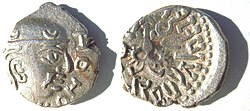
[[File:Silver Coin of Kumaragupta I.jpg|thumb|upright=1.5|Silver coin of the Gupta | |||
<br />''Obv'': Bust of king with crescents, with traces of corrupt Greek script. | [[File:Silver Coin of Kumaragupta I.jpg|thumb|upright=1.5|Silver coin of the Gupta Emperor [[Kumaragupta I]] (Coin of his Western territories, design derived from the [[Western Satraps]]). | ||
<br />''Obv'': Bust of king with crescents, with traces of corrupt Greek script.<ref>"Evidence of the conquest of Saurastra during the reign of [[Chandragupta II]] is to be seen in his rare silver coins which are more directly imitated from those of the [[Western Satraps]]... they retain some traces of the old inscriptions in Greek characters, while on the reverse, they substitute the Gupta type (a peacock) for the chaitya with crescent and star." in Rapson "A catalogue of Indian coins in the British Museum. The Andhras etc...", p. cli</ref> | |||
<br />''Rev'': [[Garuda]] standing facing with spread wings. Brahmi legend: ''Parama-bhagavata [[rajadhiraja]] Sri Kumaragupta Mahendraditya''.<ref>{{cite book |last1=Virji |first1=krishnakumari J. |title=Ancient History Of Saurashtra |date=1952 |page=225 |url=https://archive.org/details/in.ernet.dli.2015.57287/page/n249/mode/2up}}</ref>]] | <br />''Rev'': [[Garuda]] standing facing with spread wings. Brahmi legend: ''Parama-bhagavata [[rajadhiraja]] Sri Kumaragupta Mahendraditya''.<ref>{{cite book |last1=Virji |first1=krishnakumari J. |title=Ancient History Of Saurashtra |date=1952 |page=225 |url=https://archive.org/details/in.ernet.dli.2015.57287/page/n249/mode/2up}}</ref>]] | ||
Chandragupta II was succeeded by his second son [[Kumara Gupta I|Kumaragupta I]], born of ''Mahadevi'' Dhruvasvamini. Kumaragupta I assumed the title, ''Mahendraditya''.{{sfn|Ashvini Agrawal|1989|pp=191–200}} He ruled until 455. Towards the end of his reign a tribe in the [[Narmada]] valley, the [[Pushyamitras]], rose in power to threaten the empire. The [[Kidarites]] as well probably confronted the Gupta Empire towards the end of the rule of Kumaragupta I, as his son [[Skandagupta]] mentions in the [[Bhitari pillar inscription of Skandagupta|Bhitari pillar inscription]] his efforts at reshaping a country in disarray, through reorganisation and military victories over the | Chandragupta II was succeeded by his second son [[Kumara Gupta I|Kumaragupta I]], born of ''Mahadevi'' Dhruvasvamini. Kumaragupta I assumed the title, ''Mahendraditya''.{{sfn|Ashvini Agrawal|1989|pp=191–200}} He ruled until 455. Towards the end of his reign a tribe in the [[Narmada]] valley, the [[Pushyamitras]], rose in power to threaten the empire. The [[Kidarites]] as well probably confronted the Gupta Empire towards the end of the rule of Kumaragupta I, as his son [[Skandagupta]] mentions in the [[Bhitari pillar inscription of Skandagupta|Bhitari pillar inscription]] his efforts at reshaping a country in disarray, through reorganisation and military victories over the Pushyamitras and the [[Hunas]].<ref>{{cite book |last1=Chakrabarti |first1=K. |editor1-last=Guand-da |editor1-first=Zhang |editor2-last=Litvinsky |editor2-first=B. |editor3-last=Shabani Samghabadi |editor3-first=R. |chapter=The Gupta Kingdom |title=History of Civilizations of Central Asia: The crossroads of civilizations, A.D. 250 to 750 |url=https://unesdoc.unesco.org/ark:/48223/pf0000104612?posInSet=1&queryId=a6dad7c3-cad4-47e1-a5ef-49a1cd6d31f9 |year=1996 |publisher=UNESCO |volume=III |page=191 |isbn=978-92-3-103211-0}}</ref> | ||
He was the founder of [[Nalanda (university)|Nalanda University]] which on 15 July 2016 was declared as a UNESCO world heritage site.<ref>{{Cite news |url=http://travelnewsindia.com/nalanda-university-ruins/ |title=Nalanda University Ruins {{!}} Nalanda Travel Guide {{!}} Ancient Nalanda Site |date=5 October 2016 |work=Travel News India |access-date=20 February 2017 |archive-url=https://web.archive.org/web/20170211075258/http://travelnewsindia.com/nalanda-university-ruins/ |archive-date=11 February 2017 |language=en-US |url-status=live}}</ref> Kumaragupta I was also a worshipper of [[Kartikeya]]. | He was the founder of [[Nalanda (university)|Nalanda University]] which on 15 July 2016 was declared as a [[UNESCO world heritage site]].<ref>{{Cite news |url=http://travelnewsindia.com/nalanda-university-ruins/ |title=Nalanda University Ruins {{!}} Nalanda Travel Guide {{!}} Ancient Nalanda Site |date=5 October 2016 |work=Travel News India |access-date=20 February 2017 |archive-url=https://web.archive.org/web/20170211075258/http://travelnewsindia.com/nalanda-university-ruins/ |archive-date=11 February 2017 |language=en-US |url-status=live}}</ref> Kumaragupta I was also a worshipper of [[Kartikeya]]. | ||
===Skandagupta=== | ===Skandagupta=== | ||
{{Main|Skandagupta}} | {{Main|Skandagupta}} | ||
He repelled a ''Huna'' attack around 455 CE, but the expense of the wars drained the empire's resources and contributed to its decline. The Bhitari Pillar inscription of [[Skandagupta]], the successor of Chandragupta, recalls the near | [[Skandagupta]], son and successor of Kumaragupta I is generally considered to be the last of the great Gupta emperors. He assumed the titles of ''Vikramaditya'' and ''Kramaditya''.{{sfn|H.C. Raychaudhuri|1923|p=510}} He defeated the Pushyamitra threat, but then was faced with invading [[Kidarites]] (sometimes described as the [[Hephthalite]]s or "White Huns", known in India as the [[Huna (people)|Sweta Huna]]), from the northwest. | ||
He repelled a ''Huna'' attack around 455 CE, but the expense of the wars drained the empire's resources and contributed to its decline. The Bhitari Pillar inscription of [[Skandagupta]], the successor of Chandragupta, recalls the near annihilation of the Gupta Empire following the attacks of the [[Kidarites]].<ref name="Hyun">The Huns, Hyun Jin Kim, Routledge, 2015 [https://books.google.com/books?id=mcf4CgAAQBAJ&pg=PT50 pp. 50–]</ref> The Kidarites seem to have retained the western part of the Gupta Empire.<ref name="Hyun" /> | |||
Skandagupta died in 467 and was succeeded by his agnate brother [[Purugupta]].{{sfn|H.C. Raychaudhuri|1923|p=516}} | Skandagupta died in 467 and was succeeded by his agnate brother [[Purugupta]].{{sfn|H.C. Raychaudhuri|1923|p=516}} | ||
===Decline of the empire=== | ===Decline of the empire=== | ||
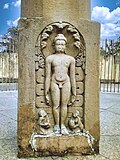
[[File:Kakandi.jpg|thumb|upright|[[Jain]] [[tirthankara]] relief [[Parshvanatha]] on [[Kahaum pillar]] erected by Skandagupta<ref>{{ | [[File:Kakandi.jpg|thumb|upright|[[Jain]] [[tirthankara]] relief [[Parshvanatha]] on [[Kahaum pillar]] erected by person named Madra during the reign of Skandagupta<ref>{{cite book |last1=Sharma |first1=Tej Ram |title=Personal and Geographic Names in Gupta Inscriptions |date=1978 |page=93 |url=https://www.rarebooksocietyofindia.org/book_archive/196174216674_10151812362491675.pdf}}</ref>]] | ||
Following Skandagupta's death, the empire was clearly in decline,<ref>Sachchidananda Bhattacharya, ''Gupta dynasty'', ''A dictionary of Indian history'', (George Braziller, Inc., 1967), 393.</ref> and the later Gupta coinage indicates their loss of control over much of western India after 467–469.<ref name= | Following Skandagupta's death, the empire was clearly in decline,<ref>Sachchidananda Bhattacharya, ''Gupta dynasty'', ''A dictionary of Indian history'', (George Braziller, Inc., 1967), 393.</ref> and the later Gupta coinage indicates their loss of control over much of western India after 467–469.<ref name=gd/> Skandagupta was followed by [[Purugupta]] (467–473), [[Kumaragupta II]] (473–476), [[Budhagupta]] (476–495), [[Narasimhagupta]] (495–530), [[Kumaragupta III]] (530–540), [[Vishnugupta (Gupta Empire)|Vishnugupta]] (540–550), two lesser known kings namely, [[Vainyagupta]] and [[Bhanugupta]]. | ||
In the | In the late 490's the [[Alchon Huns]] under [[Toramana]] and [[Mihirakula]] broke through the Gupta defences in the northwest, and much of the empire in the northwest was overrun by the Huns by 500. According to some scholars the empire disintegrated under the attacks of [[Toramana]] and his successor [[Mihirakula]].<ref>"The Alchon Huns....established themselves as overlords of northwestern India, and directly contributed to the downfall of the Guptas" in {{Cite book|last=Neelis|first=Jason|url=https://books.google.com/books?id=GB-JV2eOr2UC&pg=PA162|title=Early Buddhist Transmission and Trade Networks: Mobility and Exchange Within and Beyond the Northwestern Borderlands of India|date=2010|publisher=BRILL|isbn=9789004181595|page=162|language=en|access-date=20 May 2019|archive-date=3 January 2022|archive-url=https://web.archive.org/web/20220103112749/https://books.google.com/books?id=GB-JV2eOr2UC&pg=PA162|url-status=live}}</ref><ref>{{Citation|last=Bakker|first=Hans|title=Monuments of Hope, Gloom and Glory in the Age of the Hunnic Wars: 50 years that changed India (484–534)|url=https://www.knaw.nl/en/news/publications/monuments-of-hope-gloom-and-glory|year=2017|at=Section 4|publisher=Royal Netherlands Academy of Arts and Sciences|isbn=978-90-6984-715-3|access-date=20 May 2019|archive-date=11 January 2020|archive-url=https://web.archive.org/web/20200111041719/https://www.knaw.nl/en/news/publications/monuments-of-hope-gloom-and-glory|url-status=live}}</ref> It appears from inscriptions that the Guptas, although their power was much diminished, continued to resist the Huns. The Hun invader Toramana was defeated by [[Bhanugupta]] in 510.<ref>Ancient Indian History and Civilization by Sailendra Nath Sen p. 220</ref><ref>Encyclopaedia of Indian Events & Dates by S B. Bhattacherje p. A15</ref> The Huns were defeated and driven out of India in 528 by King [[Yashodharman]] from Malwa, and possibly Gupta emperor [[Narasimhagupta]].<ref name="Columbia Encyclopedia">''Columbia Encyclopedia''</ref> | ||
These invasions, although only spanning a few decades, had long term effects on India, and in a sense brought an end to [[Classical India|Classical Indian civilisation]].<ref name="Eraly">The First Spring: The Golden Age of India by Abraham Eraly [https://books.google.com/books?id=te1sqTzTxD8C&pg=PA48 pp. 48–] {{Webarchive|url=https://web.archive.org/web/20200105092116/https://books.google.com/books?id=te1sqTzTxD8C&pg=PA48 |date=5 January 2020 }}</ref> Soon after the invasions, the Gupta Empire, already weakened by these invasions and the rise of local rulers such as [[Yashodharman]], ended as well.<ref>Ancient Indian History and Civilization by Sailendra Nath Sen [https://books.google.com/books?id=Wk4_ICH_g1EC&pg=PA221 p. 221]</ref> Following the invasions, northern India was left in disarray, with numerous smaller Indian powers emerging after the crumbling of the Guptas.<ref>A Comprehensive History Of Ancient India [https://books.google.com/books?id=gE7udqBkACwC&pg=PA174 p. 174]</ref> The Huna invasions are said to have seriously damaged India's trade with [[Europe]] and [[Central Asia]].<ref name="Eraly" /> In particular, [[Indo-Roman trade relations]], which the Gupta Empire had greatly benefited from. The Guptas had been exporting numerous luxury products such as [[silk]], leather goods, fur, iron products, [[ivory]], [[pearl]], and pepper from centres such as [[Nasik]], [[Paithan]], [[Pataliputra]], and [[Benares]]. The Huna invasion probably disrupted these trade relations and the tax revenues that came with them. | These invasions, although only spanning a few decades, had long term effects on India, and in a sense brought an end to [[Classical India|Classical Indian civilisation]].<ref name="Eraly">The First Spring: The Golden Age of India by Abraham Eraly [https://books.google.com/books?id=te1sqTzTxD8C&pg=PA48 pp. 48–] {{Webarchive|url=https://web.archive.org/web/20200105092116/https://books.google.com/books?id=te1sqTzTxD8C&pg=PA48 |date=5 January 2020 }}</ref> Soon after the invasions, the Gupta Empire, already weakened by these invasions and the rise of local rulers such as [[Yashodharman]], ended as well.<ref>Ancient Indian History and Civilization by Sailendra Nath Sen [https://books.google.com/books?id=Wk4_ICH_g1EC&pg=PA221 p. 221]</ref> Following the invasions, northern India was left in disarray, with numerous smaller Indian powers emerging after the crumbling of the Guptas.<ref>A Comprehensive History Of Ancient India [https://books.google.com/books?id=gE7udqBkACwC&pg=PA174 p. 174]</ref> The Huna invasions are said to have seriously damaged India's trade with [[Europe]] and [[Central Asia]].<ref name="Eraly" /> In particular, [[Indo-Roman trade relations]], which the Gupta Empire had greatly benefited from. The Guptas had been exporting numerous luxury products such as [[silk]], leather goods, fur, iron products, [[ivory]], [[pearl]], and pepper from centres such as [[Nasik]], [[Paithan]], [[Pataliputra]], and [[Benares]]. The Huna invasion probably disrupted these trade relations and the tax revenues that came with them.{{citation needed|date=December 2024}} | ||
Furthermore, Indian urban culture was left in decline, and [[Buddhism]], gravely weakened by the destruction of monasteries and the killing of monks by the hand of the vehemently anti-Buddhist [[Shaivism|Shaivist]] Mihirakula, started to collapse.<ref name="Eraly" /> Great centres of learning were destroyed, such as the city of [[Taxila]], bringing cultural regression.<ref name="Eraly" /> During their rule of 60 years, the Alchons are said to have altered the hierarchy of ruling families and the Indian [[Caste system in India|caste system]]. For example, the Hunas are often said to have become the precursors of the [[Rajputs]].<ref name="Eraly" /> | Furthermore, Indian urban culture was left in decline, and [[Buddhism]], gravely weakened by the destruction of monasteries and the killing of monks by the hand of the vehemently anti-Buddhist [[Shaivism|Shaivist]] Huna king [[Mihirakula]], started to collapse.<ref name="Eraly" /> Great centres of learning were destroyed, such as the city of [[Taxila]], bringing cultural regression.<ref name="Eraly" /> During their rule of 60 years, the Alchons are said to have altered the hierarchy of ruling families and the Indian [[Caste system in India|caste system]]. For example, the Hunas are often said to have become the precursors of the [[Rajputs]].<ref name="Eraly" /> | ||
{{South Asia in 600 CE||{{center|1=Political fragmentation of South Asia after the retreat of the [[Alchon Huns]] to the northwest and the end of the Gupta Empire, {{Circa|600 CE}}<ref>{{cite book |last1=Schwartzberg |first1=Joseph E. |title=A Historical atlas of South Asia |date=1978 |publisher=University of Chicago Press |location=Chicago |pages=26, 146 |isbn=0226742210 |url=https://dsal.uchicago.edu/reference/schwartzberg/pager.html?object=063 |access-date=18 April 2022 |archive-date=6 February 2022 |archive-url=https://web.archive.org/web/20220206162650/https://dsal.uchicago.edu/reference/schwartzberg/pager.html?object=063 |url-status=live }}</ref>}}}} | {{South Asia in 600 CE||{{center|1=Political fragmentation of South Asia after the retreat of the [[Alchon Huns]] to the northwest and the end of the Gupta Empire, {{Circa|600 CE}}<ref>{{cite book |last1=Schwartzberg |first1=Joseph E. |title=A Historical atlas of South Asia |date=1978 |publisher=University of Chicago Press |location=Chicago |pages=26, 146 |isbn=0226742210 |url=https://dsal.uchicago.edu/reference/schwartzberg/pager.html?object=063 |access-date=18 April 2022 |archive-date=6 February 2022 |archive-url=https://web.archive.org/web/20220206162650/https://dsal.uchicago.edu/reference/schwartzberg/pager.html?object=063 |url-status=live }}</ref>}}}} | ||
The succession of the 6th-century Guptas is not entirely clear, but the tail end recognised ruler of the dynasty's main line was | The succession of the 6th-century Guptas is not entirely clear, but the tail end recognised ruler of the dynasty's main line was King [[Vishnugupta (Gupta Empire)|Vishnugupta]], reigning from 540 to 550. In addition to the Huna invasion, the factors, which contribute to the decline of the empire include competition from the [[Vakatakas]] and the rise of [[Yashodharman]] in [[Malwa]].<ref name="singh3">{{Cite book |url=https://books.google.com/books?id=H3lUIIYxWkEC |title=A History of Ancient and Early Medieval India: From the Stone Age to the 12th Century |last=Singh |first=Upinder |publisher=Pearson Education |year=2008 |isbn=978-81-317-1677-9 |location=New Delhi |page=480 |access-date=25 October 2015 |archive-date=20 December 2016 |archive-url=https://web.archive.org/web/20161220004242/https://books.google.com/books?id=H3lUIIYxWkEC |url-status=live }}</ref> | ||
The last known inscription by a Gupta emperor is from the reign of Vishnugupta (the | The last known inscription by a Gupta emperor is from the reign of Vishnugupta (the [[Damudarpur]] copper-plate inscription),<ref>Corpus Inscriptionum Indicarum Vol.3 (inscriptions of the Early Gupta emperors) [https://archive.org/details/in.ernet.dli.2015.108395 p. 362]</ref> in which he makes a land grant in the area of [[Kotivarsha]] ([[Bangarh]] in [[West Bengal]]) in 542/543 CE.<ref name="Davidson">Indian Esoteric Buddhism: Social History of the Tantric Movement by Ronald M. Davidson [https://books.google.com/books?id=n_VquVQvnBwC&pg=PA31 p. 31] {{Webarchive|url=https://web.archive.org/web/20200107154342/https://books.google.com/books?id=n_VquVQvnBwC&pg=PA31 |date=7 January 2020 }}</ref> This follows the occupation of most of northern and central India by the [[Aulikara]] King Yashodharman {{Circa|532 CE}}.<ref name="Davidson" /> | ||
Archaeologist Shanker Sharma concluded, based on a 2019 study, that the cause of the Gupta Empire's downfall was a devastating flood which happened around the middle of the 6th century in [[History of Uttar Pradesh|Uttar Pradesh]] and [[History of Bihar|Bihar]].{{citation needed|date=December 2024}} | |||
===Post-Gupta successor dynasties=== | ===Post-Gupta successor dynasties=== | ||
In the heart of the former Gupta Empire, in the Gangetic region, the Guptas were succeeded by the [[Maukhari dynasty]] and the [[Pushyabhuti dynasty]].<ref name="HPR">{{cite book |last1=Ray |first1=Himanshu Prabha |title=Negotiating Cultural Identity: Landscapes in Early Medieval South Asian History |date=2019 |publisher=Taylor & Francis |isbn=9781000227932 |pages=161–164 |url=https://books.google.com/books?id=qkyfDwAAQBAJ&pg=PT163 |language=en |access-date=27 September 2022 |archive-date=20 May 2022 |archive-url=https://web.archive.org/web/20220520170328/https://books.google.com/books?id=qkyfDwAAQBAJ&pg=PT163 |url-status=live }}</ref> The coinage of the Maukharis and Pushyabhutis followed the silver coin type of the Guptas, with portrait of the ruler in profile (although facing in the reverse direction compared to the Guptas, a possible symbol of antagonism)<ref name="RST">{{cite book |last1=Tripathi |first1=Rama S. |title=History of Kanauj: To the Moslem Conquest |date=1989 |publisher=Motilal Banarsidass Publ. |isbn=9788120804043 |page=45 Note 1 |url=https://books.google.com/books?id=2Tnh2QjGhMQC&pg=PA45 |language=en |access-date=27 September 2022 |archive-date=17 April 2022 |archive-url=https://web.archive.org/web/20220417230246/https://books.google.com/books?id=2Tnh2QjGhMQC&pg=PA45 |url-status=live }}</ref> and the peacock on the reverse, the Brahmi legend being kept except for the name of the ruler.<ref name="HPR"/> | In the heart of the former Gupta Empire, in the Gangetic region, the Guptas were succeeded by the [[Maukhari dynasty]] and the [[Pushyabhuti dynasty]].<ref name="HPR">{{cite book |last1=Ray |first1=Himanshu Prabha |title=Negotiating Cultural Identity: Landscapes in Early Medieval South Asian History |date=2019 |publisher=Taylor & Francis |isbn=9781000227932 |pages=161–164 |url=https://books.google.com/books?id=qkyfDwAAQBAJ&pg=PT163 |language=en |access-date=27 September 2022 |archive-date=20 May 2022 |archive-url=https://web.archive.org/web/20220520170328/https://books.google.com/books?id=qkyfDwAAQBAJ&pg=PT163 |url-status=live }}</ref> The coinage of the Maukharis and Pushyabhutis followed the silver coin type of the Guptas, with portrait of the ruler in profile (although facing in the reverse direction compared to the Guptas, a possible symbol of antagonism)<ref name="RST">{{cite book |last1=Tripathi |first1=Rama S. |title=History of Kanauj: To the Moslem Conquest |date=1989 |publisher=Motilal Banarsidass Publ. |isbn=9788120804043 |page=45 Note 1 |url=https://books.google.com/books?id=2Tnh2QjGhMQC&pg=PA45 |language=en |access-date=27 September 2022 |archive-date=17 April 2022 |archive-url=https://web.archive.org/web/20220417230246/https://books.google.com/books?id=2Tnh2QjGhMQC&pg=PA45 |url-status=live }}</ref> and the peacock on the reverse, the Brahmi legend being kept except for the name of the ruler.<ref name="HPR"/> | ||
In the western regions, they were succeeded by | In the western regions, they were succeeded by [[Gurjaradesa]], the [[Gurjara-Pratihara dynasty|Gurjara-Pratiharas]], and later the [[Chaulukya dynasty|Chaulukya]]-[[Paramara dynasty|Paramara]] dynasties, who issued so-called [[Indo-Sasanian coinage]], on the model of the [[Sasanian coinage|coinage of the Sasanian Empire]], which had been introduced in India by the Alchon Huns.<ref name="HPR"/> | ||
==Military | == Military == | ||
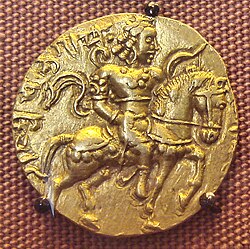
[[File: ChandraguptaIIOnHorse.jpg|thumb|An 8 gm gold coin featuring [[Chandragupta II]] astride a caparisoned horse with a bow in his left hand<ref>*{{British-Museum-db|1910,0403.26|3137724}}</ref>]] | [[File: ChandraguptaIIOnHorse.jpg|thumb|An 8 gm gold coin featuring [[Chandragupta II]] astride a caparisoned horse with a bow in his left hand<ref>*{{British-Museum-db|1910,0403.26|3137724}}</ref>]] | ||
The utilisation of horse archers in the Gupta period is evidenced on the coinage of [[Chandragupta II]], [[Kumaragupta I]] and Prakasaditya (postulated to be [[Purugupta]])<ref>{{Cite book |url=https://books.google.com/books?id=Hud2_Ie3T94C |title=The Imperial Guptas and Their Times |last=Ganguly |first=Dilip Kumar |date=1987 |publisher=Abhinav Publications |isbn=9788170172222 |page=92 |access-date=29 August 2018 |archive-date=14 August 2020 |archive-url=https://web.archive.org/web/20200814151215/https://books.google.com/books?id=Hud2_Ie3T94C |url-status=live }}</ref> that depicts the | In contrast to the [[Maurya Empire]], the Guptas introduced several military innovations to Indian warfare. Chief among these was the use of [[siege engine]]s, heavy [[Mounted archery|cavalry archers]] and heavy sword cavalry. [[Heavy cavalry]] formed the core of the Gupta Army and were supported by the traditional Indian Army elements of [[war elephant]]s and [[light infantry]].<ref>{{Cite book |url=https://books.google.com/books?id=Wu7ZoAEACAAJ |title=Warfare in Pre-British India, 1500 BCE to 1740 CE |last=Roy |first=Kaushik |date=2015 |publisher=Routledge |isbn=978-1-315-74270-0 |page=56 |access-date=8 August 2020 |archive-date=9 July 2021 |archive-url=https://web.archive.org/web/20210709184256/https://books.google.com/books?id=Wu7ZoAEACAAJ |url-status=live }}</ref> | ||
The utilisation of horse archers in the Gupta period is evidenced on the coinage of [[Chandragupta II]], [[Kumaragupta I]] and Prakasaditya (postulated to be [[Purugupta]])<ref>{{Cite book |url=https://books.google.com/books?id=Hud2_Ie3T94C |title=The Imperial Guptas and Their Times |last=Ganguly |first=Dilip Kumar |date=1987 |publisher=Abhinav Publications |isbn=9788170172222 |page=92 |access-date=29 August 2018 |archive-date=14 August 2020 |archive-url=https://web.archive.org/web/20200814151215/https://books.google.com/books?id=Hud2_Ie3T94C |url-status=live }}</ref> that depicts the kings as horse-archers.<ref>{{Cite book |url=https://books.google.com/books?id=Wu7ZoAEACAAJ |title=Warfare in Pre-British India, 1500 BCE to 1740 CE |last=Roy |first=Kaushik |date=2015 |publisher=Routledge |isbn=978-1-315-74270-0 |page=57 |access-date=8 August 2020 |archive-date=9 July 2021 |archive-url=https://web.archive.org/web/20210709184256/https://books.google.com/books?id=Wu7ZoAEACAAJ |url-status=live }}</ref><ref>{{Cite book |url=https://archive.org/stream/in.ernet.dli.2015.110150/2015.110150.The-Military-System-In-Ancient-India_djvu.txt |title=The military system in ancient India |last=Majumdar |first=Bimal Kanti |date=1960 |publisher=Firma K.L. Mukhopadhyay |edition=2 |page=118}}</ref> | |||
There is a paucity of contemporary sources detailing the tactical operations of the Imperial Gupta Army. The best extant information comes from the Sanskrit mahakavya (epic poem) [[Raghuvaṃśa]] written by the Classical Sanskrit writer and dramatist [[Kalidasa]]. Many modern scholars put forward the view that Kalidasa lived from the reign of Chandragupta II to the reign of [[Skandagupta]]<ref>{{Cite book |url=https://books.google.com/books?id=sueiThBrP4gC&pg=PA1 |title=Kālidāsa; Date, Life, and Works |last=Vasudev Vishnu Mirashi and Narayan Raghunath Navlekar |publisher=Popular Prakashan |year=1969 |isbn=9788171544684 |pages=1–35}}</ref><ref>Ram Gopal. p.14</ref><ref>{{Cite book |url=https://books.google.com/books?id=N8fBQ5vH34gC&pg=PR7 |title=Works of Kālidāsa |last=C. R. Devadhar |publisher=[[Motilal Banarsidass]] |year=1999 |isbn=9788120800236 |volume=1 |pages=vii–viii}}</ref><ref>{{cite book |author=Gaurīnātha Śāstrī |year=1987 |title=A Concise History of Classical Sanskrit Literature |publisher=Motilal Banarsidass |pages=77–78 |isbn=978-81-208-0027-4}}</ref> and that the campaigns of Raghu – his protagonist in the Raghuvaṃśa – reflect those of Chandragupta II.<ref>{{Cite book |url=https://books.google.com/books?id=Wu7ZoAEACAAJ |title=Warfare in Pre-British India, 1500 BCE to 1740 CE |last=Roy |first=Kaushik |date=2015 |publisher=Routledge |isbn=978-1-315-74270-0 |page=58 |access-date=8 August 2020 |archive-date=9 July 2021 |archive-url=https://web.archive.org/web/20210709184256/https://books.google.com/books?id=Wu7ZoAEACAAJ |url-status=live }}</ref> In Canto IV of the Raghuvamsa, Kalidasa relates how the king's forces clash against the powerful, cavalry-centric, forces of the Persians and later the Yavanas (probably Huns) in the North-West. Here he makes special mention of the use horse-archers in the king's army and that the horses needed much rest after the hotly contested battles.<ref>{{Cite book |url=https://archive.org/details/raghuvamsaofkali00kliduoft/page/112 |title=The Raghuvamsa of Kalidasa |last=Kale |first=Moreshwar Ramchandra |date=1922 |publisher=P.S. Rege |location=Canto IV}}</ref> The five arms of the Gupta military included infantry, cavalry, [[Ratha|chariotry]], [[War elephant|elephantry]] and [[History of the Indian Navy|ships]]. ''Gunaighar'' copper plate inscription of [[Vainyagupta|Vainya Gupta]] mentions ships but not chariots.<ref>{{Cite journal |author=Bimal Kanti Majumdar |year=1949 |title=Military Pursuits and National Defence Under the Second Magadhan Empire |journal=Proceedings of the Indian History Congress |volume=12 |pages=105–109 |jstor=44140516}}</ref> | |||
==Religion== | ==Religion== | ||
[[File:Buddha in Sarnath Museum (Dhammajak Mutra).jpg|thumb|upright|[[Dharmachakra Pravartana Buddha at Sarnath]] from the Gupta era, 5th century CE]] | [[File:Buddha in Sarnath Museum (Dhammajak Mutra).jpg|thumb|upright|[[Dharmachakra Pravartana Buddha at Sarnath]] from the Gupta era, 5th century CE]] | ||
The Guptas were traditionally a [[Hindu]] dynasty.<ref name="Singh">A History of Ancient and Early Medieval India by Upinder Singh [https://books.google.com/books?id=H3lUIIYxWkEC&pg=PA521 p. 521]</ref> They were [[ | The Guptas were traditionally a [[Hindu]] dynasty.<ref name="Singh">A History of Ancient and Early Medieval India by Upinder Singh [https://books.google.com/books?id=H3lUIIYxWkEC&pg=PA521 p. 521]</ref> They were patronizers of [[Brahmanism]]<ref>{{Cite book |last=St-pierre |first=Paul |title=In Translation – Reflections, Refractions, Transformations |publisher=John Benjamins Publishing Company |year=2007 |page=159}}</ref><ref>{{Cite book |last=Wangu |first=Madhu Bazaz |title=Images of Indian Goddesses |publisher=Abhinav Publications |year=2003 |page=97}}</ref><ref>{{Cite book |last=O'Brien-Kop |first=Karen |title=Rethinking 'Classical Yoga' and Buddhism |publisher=Bloomsbury Publishing |year=2021 |page=151}}</ref><ref>{{Cite book |last=Bala |first=Poonam |title=Medicine and Medical Policies in India |publisher=Lexington Books |year=2007 |page=37}}</ref> and allowed followers of [[Buddhism]] and [[Jainism]] to practice their religions.<ref name="Mookerji">The Gupta Empire by Radhakumud Mookerji [https://books.google.com/books?id=uYXDB2gIYbwC&pg=PA133 pp. 133–] {{Webarchive|url=https://web.archive.org/web/20191217042651/https://books.google.com/books?id=uYXDB2gIYbwC&pg=PA133 |date=17 December 2019 }}</ref> [[Sanchi]] remained an important centre of Buddhism.<ref name="Mookerji" /> [[Kumaragupta I]] (455 <small>CE</small>) is said to have founded [[Nalanda]].<ref name="Mookerji" /> Modern genetic studies indicate that it was during the Gupta period that Indian caste groups ceased to intermarry (started practising/enforcing [[endogamy]]).<ref>{{Cite web|url=https://arstechnica.com/science/2016/01/the-caste-system-has-left-its-mark-on-indians-genomes/|title=The caste system has left its mark on Indians' genomes|first=Annalee|last=Newitz|date=25 January 2016|website=Ars Technica|access-date=8 June 2021|archive-date=8 June 2021|archive-url=https://web.archive.org/web/20210608015347/https://arstechnica.com/science/2016/01/the-caste-system-has-left-its-mark-on-indians-genomes/|url-status=live}}</ref> | ||
Some later rulers however seem to have especially promoted [[Buddhism]]. [[Narasimhagupta Baladitya]] ({{Circa|495}}–?), according to contemporary writer [[Paramartha]], was brought up under the influence of the [[Mahayanist]] philosopher, [[Vasubandhu]].<ref name="Singh" /> He built a [[sangharama]] at [[Nalanda]] and also a {{convert|300|feet|abbr=on}} high [[vihara]] with a [[Buddha statue]] within which, according to [[Xuanzang]], resembled the "great Vihara built under the [[Bodhi tree]]". According to the ''[[Manjushrimulakalpa]]'' ({{Circa|800 CE}}), King Narasimhsagupta became a Buddhist monk, and left the world through meditation ([[Dhyāna in Buddhism|Dhyana]]).<ref name="Singh" /> The Chinese monk [[Xuanzang]] also noted that Narasimhagupta Baladitya's son, Vajra, who commissioned a sangharama as well, "possessed a heart firm in faith".<ref name="sankalia">{{Cite book |url=https://books.google.com/books?id=ZOVtAAAAMAAJ |title=The University of Nālandā |last=Sankalia |first=Hasmukhlal Dhirajlal |publisher=B.G. Paul & Co. |year=1934 |author-link=Hasmukh Dhirajlal Sankalia |oclc=30352807 |access-date=27 July 2017 |archive-date=10 March 2017 |archive-url=https://web.archive.org/web/20170310231324/https://books.google.com/books?id=ZOVtAAAAMAAJ |url-status=live }}</ref>{{rp|45}}<ref name="sdutt">{{Cite book |url=https://books.google.com/books?id=lxRHYFd0fB4C |title=Buddhist Monks And Monasteries of India: Their History And Contribution To Indian Culture |last=Sukumar Dutt |publisher=George Allen and Unwin Ltd, London |year=1988 |isbn=978-81-208-0498-2 |orig-year=First published in 1962 |access-date=27 July 2017 |archive-date=10 March 2017 |archive-url=https://web.archive.org/web/20170310232744/https://books.google.com/books?id=lxRHYFd0fB4C |url-status=live }}</ref>{{rp|330}} | |||
==Administration== | |||
{{Continental Asia in 420 CE|left|The Gupta Empire and other polities {{Circa|420 CE}}.||Map of the Gupta Empire circa 420 CE.png}} | |||
A study of the epigraphical records of the Gupta Empire shows that there was a hierarchy of administrative divisions from top to bottom. It was divided into 26 provinces, which were called ''Bhukti'', ''Desha'' or ''Rajya''. Provinces were also divided into ''[[vishaya]]s'' or ''pradeshas'' (districts) and put under the control of ''Vishayapati''s (district [[Pati (title)|lords]]). A ''Vishayapati'' administered the ''Vishaya'' with the help of the ''Adhikarana'' (council of representatives), which comprised four representatives: ''Nagarasreshesthi'', ''Sarthavaha'', ''Prathamakulika'' and ''Prathama Kayastha''. A part of the ''Vishaya'' was called ''Vithi''.{{sfn|Vidya Dhar Mahajan|1990|pp=530–31}} The Gupta also had trading links with the [[Sasanian Empire|Sassanid]] and [[Byzantine Empire|Byzantine]] Empires.{{Citation needed|date=July 2019}} The four-fold varna system was observed under the Gupta period but occupations were not rigidly constrained by caste. Some Brahmins followed non-Brahmanical professions. Kshatriyas were often involved in trade and commerce.<ref>{{cite book |last1=Sen |first1=Sailendra Nath |title=Ancient Indian History and Civilization |url=https://books.google.com/books?id=Wk4_ICH_g1EC&pg=PG235 |year=1999 |orig-year=First published 1988 |edition=2nd |publisher=New Age International |isbn=978-81-224-1198-0 |page=235}}</ref> | |||
=== Urban centres === | |||
Gupta administration proved to be highly conducive for the rapid growth of urban centres. The principal and original capital of the Gupta Empire is regarded to be [[Pataliputra]]<ref name="Chakrabarty">{{Citation |last=Chakrabarty |first=Dilip K. |title=The Re-emergence of the Gangetic Orbit and the Regional Power Centres C. AD 300 to C. AD 800 |date=2010-10-18 |work=The Geopolitical Orbits of Ancient India |editor-last= |editor-first= |url=https://books.google.com/books?id=EIAyDwAAQBAJ|access-date= |publisher=Oxford University Press |isbn=978-0199088324 |quote=Magadha and its capital Pataliputra come back into focus under the Gupta dynasty. Initially, the dynasty establishes its base by coming into a matrimonial alliance with the Lichchhavis of Vaisali or north Bihar. At this stage, it is likely that the Gupta power was stretched along the northern and southern banks of the Ganga in modern Bihar.}}</ref> | |||
In the fifth century, the capital was moved to [[Ayodhya]] under either [[Kumaragupta]] or [[Skandagupta]].<ref name=AyodhyaKasi>{{cite book|quote=The importance of this identification lies in the fact that it proves that the immediate successors of Skanda Gupta had a capital at Ayodhyā probably till the rise of the Maukharis. If the spurious Gayā plate is to be believed Ayodhyā was the seat of a Gupta jaya-skandhāvāra, or 'camp of victory,' as early as the time of Samudra Gupta. The principal capital of Bālāditya and his successors appears to have been Kāśī.|first=Hemchandra|last=Raychaudhuri|url=https://books.google.com/books?id=h1KObc_qaXYC|title=Political History of Ancient India|page=496|date=2006|publisher=Cosmo Publications |isbn=978-81-307-0291-9 }}</ref><ref name=MookerjiAyodhKasi>{{cite book|quote=the successors of Chandra Gupta II set up their capital at Ayodhyā. It also appears from the Sarnath Stone inscription of Prakațāditya (Fleet, No. 79) that they had another capital at Kāśī.|first=Radhakumud |last=Mookerji|url=https://books.google.com/books?id=uYXDB2gIYbwC|title=The Gupta Empire|page=52|date=1989|publisher=Motilal Banarsidass Publ. |isbn=978-81-208-0089-2 }}</ref><ref name=BakkerAyodhya>{{cite journal |author=Hans T. Bakker |author-link=Hans T. Bakker |title=The rise of Ayodhya as a place of pilgrimage |journal=Indo-Iranian Journal |volume=24 |number=2 |year=1982 |doi=10.1163/000000082790081267 |s2cid=161957449 |page=105 |quote=During the reign of either the emperor Kumāragupta or, more probably, that of his successor Skandagupta (AD 455–467), the capital of the empire was moved from Pāțaliputra to Ayodhyā...}}</ref> [[Chandragupta Vikramaditya]] took personal interest in the development of [[Ujjain]] as a major cultural center after its conquest.<ref>{{Cite journal |last=Dandekar |first=R. N. |date=1960 |title=Some Aspects of the Gupta Civilization: Economic Conditions |url=https://www.jstor.org/stable/42929739 |journal=Bulletin of the Deccan College Research Institute |volume=20 |issue=1/4 |pages=108–115 |jstor=42929739 |issn=0045-9801}}</ref> [[Kāśī]] is sometimes considered by some scholars to have been a capital, either as the original capital,<ref>{{Cite book |last=Kumar |first=Sanjeev |url=https://books.google.com/books?id=mN0UEQAAQBAJ |title=Treasures of the Gupta Empire: A Numismatic History of the Golden Age of India |date=18 July 2024 |publisher=Archaeopress Publishing Ltd |isbn=978-1-80327-796-7 |edition=2nd |page=196 |language=en |quote=In the Allahabad Pillar Inscription, line 28, Śrīgupta is referred to as "the prosperous Mahārāja Śrīgupta." As a minor ruler of a small territory primarily centered around Kāśī (present day Vārāņasī), it is possible that he would have issued only coins in silver for local consumption.}}</ref> the principal late 6th-century capital<ref name=AyodhyaKasi/> or a minor later capital.<ref name=MookerjiAyodhKasi/> The Chinese author [[Faxian]] described [[Magadha (Mahajanapada)|Magadha]] as a prosperous country with rich towns and large populations. | |||
==<span id='Legacy of the Gupta Empire'>Legacy</span>== | |||
=== Mathematics === | |||
[[Indian mathematics]] flourished in the Gupta Empire.<ref>{{Cite journal |last=Yau |first=Shing-Tung |date=2013 |title=The Past, Present and Future of Mathematics in China and India |url=http://dx.doi.org/10.4310/iccm.2013.v1.n2.a11 |journal=Notices of the International Congress of Chinese Mathematicians |volume=1 |issue=2 |pages=95–108 |doi=10.4310/iccm.2013.v1.n2.a11 |issn=2326-4810}}</ref> The [[Indian numerals]] which were the first [[positional]] [[base 10]] [[numeral systems]] in the world originated from Gupta India. The [[Surya Siddhanta]] contains the Sine table.<ref>{{Cite book |last=Deva Shastri |first=Pundit Bapu |title=Translation of the Surya Siddhanta |year=1861 |pages=15–16}}</ref> [[Aryabhata]] wrote the ''[[Aryabhatiya]]'', making significant contributions to mathematics including developing a [[Place value system]], an approximation of π of 4 decimal places, trigonometric functions, and [[Squared triangular number]]s.<ref>{{cite book |author=George. Ifrah |title=A Universal History of Numbers: From Prehistory to the Invention of the Computer |date=1998 |publisher=John Wiley & Sons |location=London}}</ref><ref>{{cite book |last=Boyer |first=Carl B. |author-link=Carl Benjamin Boyer |url=https://archive.org/details/historyofmathema00boye/page/207 |title=A History of Mathematics |date=1991 |publisher=John Wiley & Sons, Inc. |isbn=0-471-54397-7 |edition=Second |page=[https://archive.org/details/historyofmathema00boye/page/207 207] |chapter=The Mathematics of the Hindus |quote=He gave more elegant rules for the sum of the squares and cubes of an initial segment of the positive integers. The sixth part of the product of three quantities consisting of the number of terms, the number of terms plus one, and twice the number of terms plus one is the sum of the squares. The square of the sum of the series is the sum of the cubes. |chapter-url=https://archive.org/details/historyofmathema00boye}}</ref> [[Varāhamihira]] wrote the ''[[Pancha-siddhantika|Pancha Siddhanta]]'' developing various formulas relating [[sine and cosine]] functions.{{sfn|A.M. Shastri|1991|p=4}} [[Yativṛṣabha]] made contributions on units of measurement.<ref name="Ikeyama 2007 1251">{{Citation |last=Ikeyama |first=Setsuro |title=Yativṛṣabha |date=2007 |pages=1251 |editor-last=Hockey |editor-first=Thomas |url=https://doi.org/10.1007/978-0-387-30400-7_1513 |access-date=5 May 2021 |place=New York, NY |publisher=Springer |language=en |doi=10.1007/978-0-387-30400-7_1513 |isbn=978-0-387-30400-7 |editor2-last=Trimble |editor2-first=Virginia |editor3-last=Williams |editor3-first=Thomas R. |editor4-last=Bracher |editor4-first=Katherine |encyclopedia=The Biographical Encyclopedia of Astronomers|url-access=subscription }}</ref> [[Virahanka]] described [[Fibonacci sequence|Fibonacci numbers]].<ref>{{cite journal |last1=Singh |first1=Parmanand |date=1985 |title=The so-called fibonacci numbers in ancient and medieval India |journal=Historia Mathematica |volume=12 |issue=3 |pages=229–244 |doi=10.1016/0315-0860(85)90021-7 |doi-access=free}}</ref><ref name="Ikeyama 2007 1251"/> | |||
=== Astronomy === | |||
[[Indian astronomy]] also saw progress in this era. The [[Hindu calendar#Weekday/Vāsara|names of the seven days in a week]] appeared at the start of the Gupta period based on [[Hindu deities]] and [[Navagraha|planets]] corresponding to the Roman names.<ref name="Dalal2010p89">{{cite book |author=Roshen Dalal |url=https://books.google.com/books?id=DH0vmD8ghdMC |title=Hinduism: An Alphabetical Guide |publisher=Penguin Books |year=2010 |isbn=978-0-14-341421-6 |page=89}}</ref> [[Aryabhata]] made several contributions such as assigning the start of each day to midnight.<ref name="Hayashi08Aryabhata">Hayashi (2008), ''Aryabhata I''</ref> the earth's rotation on its axis, westward motion of the stars.<ref name="Hayashi08Aryabhata" /> Aryabhata also mentioned that reflected sunlight is the cause behind the shining of the Moon.<ref name="Hayashi08Aryabhata" /> In his book, Aryabhata, he suggested that the Earth was sphere, containing a circumference of 24,835 miles (39,967 km).<ref>Indian Astronomy. (2013). In D. Leverington, ''Encyclopedia of the history of Astronomy and Astrophysics''. Cambridge, United Kingdom: Cambridge University Press. Retrieved from http://search.credoreference.com/content/entry/cupaaa/indian_astronomy/0</ref> [[Varāhamihira]] approximates the method for determination of the meridian direction from any three positions of the shadow using a [[gnomon]].<ref name="abraham08">Abraham (2008)</ref> | |||
< | === Medicine === | ||
The [[Sushruta Samhita]], which is a Sanskrit redaction text on all of the major concepts of [[Ayurveda]] medicine with innovative chapters on surgery, dates to the Gupta period.<ref>{{cite journal |last1=Champaneria |first1=Manish C. |last2=Workman |first2=Adrienne D. |last3=Gupta |first3=Subhas C. |date=July 2014 |title=Sushruta: Father of Plastic Surgery |journal=Annals of Plastic Surgery |volume=73 |issue=1 |pages=2–7 |doi=10.1097/SAP.0b013e31827ae9f5 |pmid=23788147}}</ref> | |||
File: | === Metallurgy and Engineering === | ||
[[File:Smiling Buddha (4995358503).jpg|thumb|upright|The Gupta bronze [[Helgö Buddha]] reached [[Sweden]] along the [[Silk Road]], between the 6th and 8th century CE.<ref>{{cite book |last1=Hicks |first1=Dan |last2=Beaudry |first2=Mary C. |title=The Oxford Handbook of Material Culture Studies |date=2 September 2010 |publisher=OUP Oxford |isbn=978-0-19-921871-4 |page=230 |url=https://books.google.com/books?id=soqnmu9-rnMC&pg=PA230 |language=en}}</ref>]] | |||
</ | The [[Iron pillar of Delhi|Iron Pillar of Delhi]] is highly resistant to [[corrosion]] .<ref name="home.iitk.ac.in2">[http://home.iitk.ac.in/%7Ebala/journalpaper/journal/journalpaper_17.pdf ''On the Corrosion Resistance of the Delhi Iron Pillar''], R. Balasubramaniam, ''Corrosion Science'', Volume 42 (2000) pp. 2103 to 2129. ''Corrosion Science'' is a publication specialized in corrosion science and engineering.</ref><ref name="Springer">{{cite book |author1=Yoshio Waseda |url=https://books.google.com/books?id=E_clmVK12YsC&q=iron+pillar+not+corrosive&pg=PR7 |title=Characterization of corrosion products on steel surfaces |author2=Shigeru Suzuki |publisher=Springer |year=2006 |isbn=978-3-540-35177-1 |page=vii}}</ref> The corrosion resistance results from an even layer of [[Water of crystallization|crystalline]] [[iron(III)]] hydrogen phosphate [[hydrate]] forming on the high-[[phosphorus]]-content iron, which serves to protect it from the effects of the corrosion<ref name="home.iitk.ac.in2"/><ref name="Springer"/> The earliest evidence of the [[cotton gin]] was found in the fifth century, in the form of [[Buddhist]] paintings depicting a single-roller gin in the [[Ajanta Caves]].<ref name="LakGin">[[Cotton gin#Lakwete|Lakwete]], 1–6.</ref> The gins consisted of a single roller made of iron or wood and a flat piece of stone or wood.<ref name="LakGin" /> | ||
== | === Education === | ||
Various [[Mahavihara]] operated throughout the Gupta Empire serving as centuries of education.<ref>''Buddhist Monks And Monasteries Of India: Their History And Contribution To Indian Culture.'' by Dutt, Sukumar. George Allen and Unwin Ltd, London 1962. pg 352-3</ref> Nalanda played a vital role in promoting the patronage of arts and academics during the 5th and 6th century CE.<ref>{{Cite journal |last=Ingalls |first=Daniel H. H. |date=1976 |title=Kālidāsa and the Attitudes of the Golden Age |url=https://www.jstor.org/stable/599886 |journal=Journal of the American Oriental Society |volume=96 |issue=1 |pages=15–26 |doi=10.2307/599886 |issn=0003-0279 |jstor=599886|url-access=subscription }}</ref> | |||
== | === Literature === | ||
{{ | The highest point of [[Sanskrit literature]] is also said to have belonged to this period.<ref name="CR_2005">{{cite book |author=Chandra Rajan |url=https://books.google.com/books?id=v0RWnRKTWp0C&pg=PT267 |title=The Loom Of Time |publisher=Penguin UK |year=2005 |isbn=9789351180104 |pages=268–274}}</ref> [[Harisena]] was an early writer of [[Kāvya]] poetry.<ref name="Keith1966">{{cite book |last=Keith |first=Arthur Berriedale |url=https://books.google.com/books?id=2uiAAAAAIAAJ |title=A History of Sanskrit literature |publisher=Oxford University Press |year=1966 |pages=76–7}}</ref> his works include ''Apabramsa Dharmapariksa'', ''Karpuraprakara'' (''Suktavall''), the medical treatise ''Jagatsundari-Yogamaladhikara'', ''Yasodharacanta'', ''Astahnikakatha'' and ''Brhatkathakosa''.<ref name="Sharma1989">{{cite book |last=Sharma |first=Tej Ram |url=https://books.google.com/books?id=fWVZWjNAcAgC&pg=PA90 |title=A Political History of the Imperial Guptas: From Gupta to Skandagupta |publisher=Concept Publishing Company |year=1989 |isbn=978-81-7022-251-4 |page=90}}</ref> [[Amarasimha]] wrote various on Sanskrit grammar.<ref name="Rice19702">''Amarakosha'' compiled by [[Benjamin L. Rice|B. L. Rice]], edited by N. Balasubramanya, 1970, page X</ref> [[Kalidasa]], a playwright, wrote plays such as the [[Abhijnanashakuntalam]] and [[Shakuntala (play)|Shakuntala]].<ref>{{cite book |last=Kālidāsa |url=https://books.google.com/books?id=6miC3HNB90oC |title=The Recognition of Sakuntala: A Play In Seven Acts |publisher=Oxford University Press |year=2001 |isbn=9780191606090 |pages=ix |access-date=14 January 2016 |archive-url=https://web.archive.org/web/20201022174122/https://books.google.com/books?id=6miC3HNB90oC |archive-date=22 October 2020 |url-status=live}}</ref> [[Bhartṛhari]] published major works including the ''[[Trikāṇḍī]]'' and ''[[Śatakatraya]].<ref>{{Cite book |last=Cornille |first=Catherine |url= |title=The Wiley-Blackwell Companion to Inter-Religious Dialogue |date=8 June 2020 |publisher=John Wiley & Sons |isbn=978-1-119-57259-6 |pages=199 |language=en}}</ref>'' | ||
[[Chess]] is said to have developed in this period | === Leisure === | ||
[[Chess]] is said to have developed in this period.<ref>{{cite book | |||
| last=Murray | | last=Murray | ||
| first=H.J.R. | | first=H.J.R. | ||
| author-link=H. J. R. Murray | | author-link=H. J. R. Murray | ||
| title=A History of Chess | | title=A History of Chess | ||
| publisher= | | publisher=Oxford University Press | ||
| year= | | year=1962 | ||
| | | orig-year=First published 1913 | ||
| oclc=13472872 | | oclc=13472872 | ||
| url=https://archive.org/details/historyofchess00murr | | url=https://archive.org/details/historyofchess00murr | ||
}}</ref> | }}</ref> Its early form in the 6th century, ''[[chaturanga|{{IAST|caturaṅga}}]]'', which translates as "four divisions [of the military]" ([[infantry]], [[cavalry]], [[Ratha|chariotry]], and [[war elephant|elephantry]]), was represented by the pieces that would evolve into the modern pawn, knight, rook, and bishop respectively. Doctors also invented several medical instruments, and even performed surgical operations. The ancient Gupta text [[Kama Sutra]] by the Indian scholar [[Vatsyayana]] is widely considered to be the standard work on [[human sexual behaviour]] in Sanskrit literature. | ||
=== Art and architecture === | |||
{{Main|Gupta art}} | |||
<gallery mode="packed" style="font-size:88%; line-height:130%; border-bottom:1px #aaa solid;" heights="200"> | <gallery mode="packed" style="font-size:88%; line-height:130%; border-bottom:1px #aaa solid;" heights="200"> | ||
Sanchi_temple_17.jpg|A [[tetrastyle]] [[prostyle]] | Sanchi_temple_17.jpg|A [[tetrastyle]] [[prostyle]] Gupta period temple at [[Sanchi]] besides the Apsidal hall with [[Maurya]] foundation, an example of [[Buddhist architecture]] and [[Hindu architecture]].<ref>Harle, 111;</ref>{{failed verification|date=March 2023}}{{sfn|Rowland|1967|pp=219-220}}{{sfn|Michell|1988|p=94}} 5th century CE. | ||
File:KITLV 87946 - Unknown - Pataini temple in British India - 1897.tif|[[Pataini temple]] is a Jain temple built during the Gupta period. | File:KITLV 87946 - Unknown - Pataini temple in British India - 1897.tif|[[Pataini temple]] is a Jain temple built during the Gupta period. | ||
</gallery> | </gallery> | ||
The Gupta period is generally regarded as a classic peak of North [[Indian art]] for all the major religious groups. Although painting was evidently widespread, the surviving works are almost all religious | The Gupta period is generally regarded as a classic peak of North [[Indian art]] for all the major religious groups. Although painting was evidently widespread, the surviving works are almost all religious sculptures. The period saw the emergence of the iconic carved stone deity in Hindu art, as well as the Buddha-figure and [[Jain]] ''[[tirthankara]]'' figures, the latter often on a very large scale. The two great centres of sculpture were [[Mathura]] and [[Gandhara]], the latter the centre of [[Greco-Buddhist art]]. Both exported sculpture to other parts of northern India. | ||
The most famous remaining monuments in a broadly Gupta style, the caves at [[Ajanta Caves|Ajanta]], [[Elephanta Caves|Elephanta]], and [[Ellora Caves|Ellora]] (respectively Buddhist, Hindu, and mixed including Jain) were in fact produced under later dynasties, but primarily reflect the monumentality and balance of | The most famous remaining monuments in a broadly Gupta style, the caves at [[Ajanta Caves|Ajanta]], [[Elephanta Caves|Elephanta]], and [[Ellora Caves|Ellora]] (respectively Buddhist, Hindu, and mixed including Jain) were in fact produced under later dynasties, but primarily reflect the monumentality and balance of Gupta style. Ajanta contains by far the most significant survivals of painting from this and the surrounding periods, showing a mature form which had probably had a long development, mainly in painting palaces.{{sfn|J.C. Harle|1994|pp=118–22, 123–26, 129–35}} The Hindu [[Udayagiri Caves]] actually record connections with the dynasty and its ministers,{{sfn|J.C. Harle|1994|pp=92–97}} and the [[Vishnu Temple, Deogarh|Dashavatara Temple]] at [[Deogarh, Uttar Pradesh|Deogarh]] is a major temple, one of the earliest to survive, with important sculpture.{{sfn|J.C. Harle|1994|pp=113–14}} | ||
<gallery widths="170" heights="170"> | <gallery widths="170" heights="170"> | ||
| Line 279: | Line 271: | ||
File:Ajanta Padmapani.jpg|Painting of [[Padmapani]] Cave 1 at [[Ajanta Caves|Ajanta]] | File:Ajanta Padmapani.jpg|Painting of [[Padmapani]] Cave 1 at [[Ajanta Caves|Ajanta]] | ||
File:Mukhalinga.JPG|The [[Shiva]] ''[[mukhalinga]]'' (faced-[[lingam]]) from the [[Bhumara Temple]] | File:Mukhalinga.JPG|The [[Shiva]] ''[[mukhalinga]]'' (faced-[[lingam]]) from the [[Bhumara Temple]] | ||
File:Nalraja fort chilapata. | File:Nalraja fort chilapata.jpg|Nalrajar Garh fortification wall in [[Chilapata Forests]], [[West Bengal]], is one of the last surviving fortification remains from the Gupta period, currently 5–7 m high | ||
File:Nalanda University India ruins.jpg|[[Nalanda University]] was first established under Gupta Empire | File:Nalanda University India ruins.jpg|[[Nalanda University]] was first established under Gupta Empire | ||
File:Gupt kalin mandir bhitargaon.jpg|[[Bhitargaon|Bitargaon temple]] from the Gupta period provide one of the earliest examples of pointed arches anywhere in the world | File:Gupt kalin mandir bhitargaon.jpg|[[Bhitargaon|Bitargaon temple]] from the Gupta period provide one of the earliest examples of pointed arches anywhere in the world | ||
| Line 286: | Line 278: | ||
</gallery> | </gallery> | ||
== | == Family tree and list of rulers == | ||
{{main|List of Gupta emperors}} | |||
== See also == | == See also == | ||
{{Portal bar|India|History}} | |||
{{ | {{History of India|File:Meister_des_Mahâjanaka_Jâtaka_001.jpg}} | ||
* [[Abhira-Gupta dynasty (Nepal)]] | |||
* [[Gupta | |||
* [[Uchchhakalpa dynasty]] | * [[Uchchhakalpa dynasty]] | ||
* [[Pax Gupta]] | |||
{{clear}} | {{clear}} | ||
==Notes== | |||
{{reflist|group=note}} | |||
{{notelist|group=lower-alpha|35em|refs= | |||
<ref group=lower-alpha name="GuptaOrigin"> | |||
<span id="GuptaOriginNote"></span> | |||
'''Gupta's origin:''' | |||
*Bihar : | |||
**{{harvtxt|Chakrabarty|2010|p=70}}: "Magadha and its capital Pataliputra come back into focus under the Gupta dynasty. Initially, the dynasty establishes its base by coming into a matrimonial alliance with the Lichchhavis of Vaisali or north Bihar. At this stage, it is likely that the Gupta power was stretched along the northern and southern banks of the Ganga in modern Bihar." | |||
**{{harvtxt|Mackay|2006|p=29}}: "A Magadha (Bihar) kingdom, with its capital at Patna, emerged in the late 3rd century AD under Srigupta founder of a dynasty that lasted for 300 years. His grandson, Chandragupta 1 (305-25), created the splendid Gupta Empire." | |||
**{{harvtxt|Brown|1999|p=41}}: "The territory which the Guptas are first found ruling lay near Pāțaliputra, the modern Patna; it was much enlarged by one Gupta, on the decline of the Kushāņa power in its eastern territories." | |||
**{{harvtxt|Higham|2014|p=121}}: "The Gupta empire had its genesis under King Srigupta (270-290 C.E.), who ruled one of the many small kingdoms in the Ganga (Ganges) Valley in India from his capital at Pataliputra." | |||
**{{harvtxt|Thapar|2013|p=360}}: "There is some evidence of interest during the Gupta period in forms created during Mauryan times. This may have arisen from a curiosity about antecedent dynasties and their artifacts, originating in approximately the same area in which the beginnings of Gupta power were located. For both the Mauryas and the Guptas, Pāțaliputra was an important city." | |||
*Magadha : | |||
**{{harvtxt|Gupta|1994|p=8}}: "the historicity of Sri Gupta's political career around Magadha." | |||
**{{harvtxt|Ishikawa|2020|p=156}}: "Ruling from the Magadha Kingdom in the lower Gangetic Valley, the imperial Guptas were the second pan-Indian state in history." | |||
**{{harvtxt|Hart-Davis|2010|p=125}}: "the region of Magadha gave birth to another great dynasty and empire, the Guptas." | |||
**{{harvtxt|Kumar Maity|1975|p=7}}: "the founder of this dynasty was Mahārāja Sri Gupta who was apparently a subordinate ruler and ruling somewhere near Magadha." | |||
**{{harvtxt|Keay|2000|p=134}}: "Sri Gupta was probably not a Buddhist but was raja of some minor polity near or within erstwhile Magadha." | |||
**{{harvtxt|Jha|1998|p=148}}: "Guptas... political control in the region of Magadha." | |||
**{{harvtxt|Bemmann|2015|p=659}}: "The royal dynasty of the Gupta had its origin in the central Ganges plain." | |||
*Uttar Pradesh : | |||
** {{harvtxt|Agrawal|2016|p=1}}: "The origin has been variously traced to Magadha in Bihar, Murshidabad in West Bengal, and eastern Uttar Pradesh. [....] The last two identifications are based on the account of the travels of the Chinese pilgrim Yijing (I-Tsing), who visited India in the last quarter of the 7th century. He states that a king named Che-li-ki-to (Shri-Gupta) built a temple for the Chinese pilgrims at a place called Mi-li-kia-si-kia-po-no. According to the translation given by S. Beal, it was located 40 stages east of Nalanda when traveling along the Ganges, which would bring one to the Murshidabad district of West Bengal. However, this can easily be ruled out as the Puranas do not include West Bengal in early possessions of the Guptas. In the Allahabad Pillar inscription of Samudragupta, Bengal is described as a frontier kingdom. There is no evidence of Gupta rule in Bengal before the beginning of the 5th century. On the basis of the same account of the Chinese traveler, Mi-li-kia-si-kia-po-no has been identified with Mrigashikhavana (Sarnath), [....] This is vouched for by the recent discovery of an inscribed image of the Buddhist goddess Hariti from Sarnath, installed by King Gupta." | |||
** {{harvtxt|Goyal|1967|pp=44–52}}: "We ourselves have tackled the problem of the original home of the Guptas from an entirely different angle, and out approach has led us to conclude that they originally belonged to the eastern part of the U. P. [...] This conclusion is consonant with the facts that at least two hoards of the Gupta gold coins and five out of the eight inscriptions of the early Gupta period including the famous prasasti of Samudragupta, have been found crowded at or in the vicinity of Prayaga alone." | |||
** {{harvtxt|Kumar|2024|p=1}}: "The original home of the Guptas was the Kāśī–Kannauj region, Uttar Pradesh. Sealings and coins attributed to Śrīgupta have been found mostly in the Uttar Pradesh, Haryana, and Punjāb region." | |||
**{{harvtxt|Khandalavala|1991|p=1}}: "The progenitor of this dynasty was one named Gupta whose territory probably existed in the districts of Varanasi and Ghazipur." | |||
** {{harvtxt|Sharma|1989|pp=39–40}}: "The cumulative evidence so far available supports the theory that some region in Uttar Pradesh, most probably Eastern Uttar Pradesh, was the original home of the Guptas." | |||
** {{Citation |last=Sharma |first=R.S. |title=India's Ancient Past |year=2007 |publisher=Oxford University Press |isbn=978-0-19-568785-9 |page=242 |quote=UP therefore seems to have been the place from where the Guptas operated and fanned out in different directions. Probably with their centre of power at Prayag.}} | |||
**{{harvtxt|Zhang|1996|p=26}}: "Many authorities on Gupta history believe that they came from Magadha or northern Bengal... historians have now come to accept the lower Doab region as the original home of the Guptas." | |||
*Bengal : | |||
**{{harvtxt|Ganguly|1987|p=19}}: "The Guptas, as is evident from the aforesaid discussion, laid the foundation of their kingdom in what was called the Magadha-[[Varendra|Varendra region]] in ancient times." | |||
</ref> | |||
}} | |||
== References == | == References == | ||
| Line 412: | Line 327: | ||
=== Bibliography === | === Bibliography === | ||
{{Refbegin|30em}} | {{Refbegin|30em}} | ||
* {{Cite book |last=Agrawal |first=Ashvini |title=Rise and Fall of the Imperial Guptas |date=1989 |publisher=Motilal Banarsidass Publ. |isbn=978-81-208-0592-7 |url=https://books.google.com/books?id=hRjC5IaJ2zcC }} | |||
* {{Cite encyclopedia |last=Agrawal |first=Ashvini |title=Gupta Empire |date=2016 |encyclopedia=The Encyclopedia of Empire |pages=1–11 |publisher=John Wiley & Sons, Ltd |isbn=978-1-118-45507-4 |doi=10.1002/9781118455074.wbeoe251 |url=https://onlinelibrary.wiley.com/doi/abs/10.1002/9781118455074.wbeoe251 |url-access=subscription }} | |||
* {{Cite book |last=Khandalavala |first=Karl J. |title=The Golden Age Gupta Art: Empire, Province, and Influence |date=1991 |publisher=Marg Publications |isbn=978-81-85026-14-5 |url=https://books.google.com/books?id=P_HVAAAAMAAJ }} | |||
* {{Cite book |last=Bemmann |first=Jan |title=Complexity of Interaction Along the Eurasian Steppe Zone in the First Millennium CE |date=2015 |publisher=Vor- und Frühgeschichtliche Archäologie |chapter=The Gupta Empire in the Face of the Hun Threat: Parallels to the Late Roman Empire? |pages=659–669 |url=https://www.academia.edu/34556231 }} | |||
* {{cite book |author=Ashvini Agrawal |title=Rise and Fall of the Imperial Guptas |url=https://books.google.com/books?id=hRjC5IaJ2zcC&pg=PA315 |year=1989 |publisher=Motilal Banarsidass |isbn=978-81-208-0592-7 |access-date=29 August 2018 |archive-date=8 January 2020 |archive-url=https://web.archive.org/web/20200108040744/https://books.google.com/books?id=hRjC5IaJ2zcC&pg=PA315 |url-status=live }} | * {{cite book |author=Ashvini Agrawal |title=Rise and Fall of the Imperial Guptas |url=https://books.google.com/books?id=hRjC5IaJ2zcC&pg=PA315 |year=1989 |publisher=Motilal Banarsidass |isbn=978-81-208-0592-7 |access-date=29 August 2018 |archive-date=8 January 2020 |archive-url=https://web.archive.org/web/20200108040744/https://books.google.com/books?id=hRjC5IaJ2zcC&pg=PA315 |url-status=live }} | ||
* {{cite book |author=Dilip Kumar Ganguly |title=The Imperial Guptas and Their Times |url=https://books.google.com/books?id=Hud2_Ie3T94C&pg=PP1 |year=1987 |publisher=Abhinav |isbn=978-81-7017-222-2 |access-date=29 August 2018 |archive-date=8 January 2020 |archive-url=https://web.archive.org/web/20200108201608/https://books.google.com/books?id=Hud2_Ie3T94C&pg=PP1 |url-status=live }} | * {{cite book |author=Dilip Kumar Ganguly |title=The Imperial Guptas and Their Times |url=https://books.google.com/books?id=Hud2_Ie3T94C&pg=PP1 |year=1987 |publisher=Abhinav |isbn=978-81-7017-222-2 |access-date=29 August 2018 |archive-date=8 January 2020 |archive-url=https://web.archive.org/web/20200108201608/https://books.google.com/books?id=Hud2_Ie3T94C&pg=PP1 |url-status=live }} | ||
* {{cite book |author=H.C. Raychaudhuri |author-link=Hem Chandra Raychaudhuri |title=Political History of Ancient India: From the Accession of Parikshit to the Extinction of the Gupta Dynasty |url=https://archive.org/details/politicalhistory00raycuoft |publisher=University of Calcutta | * {{cite book |author=H.C. Raychaudhuri |author-link=Hem Chandra Raychaudhuri |title=Political History of Ancient India: From the Accession of Parikshit to the Extinction of the Gupta Dynasty |url=https://archive.org/details/politicalhistory00raycuoft |publisher=University of Calcutta |year=1923}} | ||
* {{cite book |author=J.C. Harle |title=The Art and Architecture of the Indian Subcontinent |url=https://archive.org/details/artarchitectureo00harl |url-access=registration |year=1994 |publisher=Yale University Press |isbn=978-0-300-06217-5 }} | * {{cite book |author=J.C. Harle |title=The Art and Architecture of the Indian Subcontinent |url=https://archive.org/details/artarchitectureo00harl |url-access=registration |year=1994 |publisher=Yale University Press |isbn=978-0-300-06217-5 }} | ||
* {{cite book |author=R.C. Majumdar |author-link=R. C. Majumdar |title=A Comprehensive History of India |volume=3, Part I: A.D. 300-985 |url=https://books.google.com/books?id=mRBuAAAAMAAJ |year=1981 |publisher=Indian History Congress / People's Publishing House |oclc=34008529 |pages=17–52 }} | * {{cite book |author=R.C. Majumdar |author-link=R. C. Majumdar |title=A Comprehensive History of India |volume=3, Part I: A.D. 300-985 |url=https://books.google.com/books?id=mRBuAAAAMAAJ |year=1981 |publisher=Indian History Congress / People's Publishing House |oclc=34008529 |pages=17–52 }} | ||
| Line 421: | Line 340: | ||
* {{cite book |last1=Rowland |first1=Benjamin |title=The Art and Architecture of India: Buddhist, Hindu, Jain |url=https://archive.org/details/artarchitectureo0000rowl_r2z2/page/n5/mode/2up |url-access=registration |year=1967 |orig-year=First published 1953 |edition=3rd |publisher=Penguin Books |isbn=978-0-14-056102-9}} | * {{cite book |last1=Rowland |first1=Benjamin |title=The Art and Architecture of India: Buddhist, Hindu, Jain |url=https://archive.org/details/artarchitectureo0000rowl_r2z2/page/n5/mode/2up |url-access=registration |year=1967 |orig-year=First published 1953 |edition=3rd |publisher=Penguin Books |isbn=978-0-14-056102-9}} | ||
* {{cite book |author=Shankar Goyal |title=Problems of Ancient Indian History: New Perspectives and Perceptions |url=https://books.google.com/books?id=ZSVuAAAAMAAJ |year=2001 |publisher=Book Enclave |isbn=978-81-87036-66-1 |access-date=13 December 2018 |archive-date=11 January 2020 |archive-url=https://web.archive.org/web/20200111224901/https://books.google.com/books?id=ZSVuAAAAMAAJ |url-status=live }} | * {{cite book |author=Shankar Goyal |title=Problems of Ancient Indian History: New Perspectives and Perceptions |url=https://books.google.com/books?id=ZSVuAAAAMAAJ |year=2001 |publisher=Book Enclave |isbn=978-81-87036-66-1 |access-date=13 December 2018 |archive-date=11 January 2020 |archive-url=https://web.archive.org/web/20200111224901/https://books.google.com/books?id=ZSVuAAAAMAAJ |url-status=live }} | ||
* {{cite book |author=A.M. Shastri |author-link=Ajay Mitra Shastri |title=Varāhamihira and His Times |year=1991 |publisher=Kusumanjali |oclc=28644897 |url=https://books.google.com/books?id=Mf0MAQAAMAAJ }} | |||
* {{cite book |author=Tej Ram Sharma |title=A Political History of the Imperial Guptas: From Gupta to Skandagupta |url=https://books.google.com/books?id=fWVZWjNAcAgC&pg=PA50 |year=1989 |publisher=Concept |isbn=978-81-7022-251-4 |access-date=29 August 2018 |archive-date=13 January 2020 |archive-url=https://web.archive.org/web/20200113155014/https://books.google.com/books?id=fWVZWjNAcAgC&pg=PA50 |url-status=live }} | * {{cite book |author=Tej Ram Sharma |title=A Political History of the Imperial Guptas: From Gupta to Skandagupta |url=https://books.google.com/books?id=fWVZWjNAcAgC&pg=PA50 |year=1989 |publisher=Concept |isbn=978-81-7022-251-4 |access-date=29 August 2018 |archive-date=13 January 2020 |archive-url=https://web.archive.org/web/20200113155014/https://books.google.com/books?id=fWVZWjNAcAgC&pg=PA50 |url-status=live }} | ||
* {{cite book |author=Vidya Dhar Mahajan |author-link=Vidya Dhar Mahajan |year=1990 |title=A History of India |url=https://books.google.com/books?id=CJ2UAAAACAAJ |publisher=State Mutual Book & Periodical Service |isbn=978-0-7855-1191-5 |access-date=29 August 2018 |archive-date=10 January 2020 |archive-url=https://web.archive.org/web/20200110060325/https://books.google.com/books?id=CJ2UAAAACAAJ |url-status=live }} | * {{cite book |author=Vidya Dhar Mahajan |author-link=Vidya Dhar Mahajan |year=1990 |title=A History of India |url=https://books.google.com/books?id=CJ2UAAAACAAJ |publisher=State Mutual Book & Periodical Service |isbn=978-0-7855-1191-5 |access-date=29 August 2018 |archive-date=10 January 2020 |archive-url=https://web.archive.org/web/20200110060325/https://books.google.com/books?id=CJ2UAAAACAAJ |url-status=live }} | ||
* {{cite book |author=Upinder Singh |author-link=Upinder Singh |title=Political Violence in Ancient India |url=https://books.google.com/books?id=dYM4DwAAQBAJ&pg=PA343 |year=2017 |publisher=Harvard University Press |isbn=978-0-674-98128-7 |access-date=13 December 2018 |archive-date=10 January 2020 |archive-url=https://web.archive.org/web/20200110123751/https://books.google.com/books?id=dYM4DwAAQBAJ&pg=PA343 |url-status=live }} | * {{cite book |author=Upinder Singh |author-link=Upinder Singh |title=Political Violence in Ancient India |url=https://books.google.com/books?id=dYM4DwAAQBAJ&pg=PA343 |year=2017 |publisher=Harvard University Press |isbn=978-0-674-98128-7 |access-date=13 December 2018 |archive-date=10 January 2020 |archive-url=https://web.archive.org/web/20200110123751/https://books.google.com/books?id=dYM4DwAAQBAJ&pg=PA343 |url-status=live }} | ||
* {{citation|last=Stein|first=B.|author-link=Burton Stein|editor-last=Arnold|editor-first=D.|year=2010 |title=A History of India|edition=2nd|publisher=[[Wiley-Blackwell]]|place=Oxford|isbn=978-1-4051-9509-6 |url=https://books.google.com/books?id=QY4zdTDwMAQC}} | * {{citation|last=Stein|first=B.|author-link=Burton Stein|editor-last=Arnold|editor-first=D.|year=2010 |title=A History of India|edition=2nd|publisher=[[Wiley-Blackwell]]|place=Oxford|isbn=978-1-4051-9509-6 |url=https://books.google.com/books?id=QY4zdTDwMAQC}} | ||
* {{Cite book |last=Zhang |first=Guang-da |title=History of Civilizations of Central Asia: The Crossroads of Civilization: A.D. 250 to 750 |date=31 December 1996 |publisher=UNESCO Publishing |isbn=978-92-3-103211-0 |url=https://books.google.com/books?id=883OZBe2sMYC }} | |||
{{Refend}} | {{Refend}} | ||
==External links== | ==External links== | ||
{{EB1911 poster|Gupta}} | {{EB1911 poster|Gupta}} | ||
{{Wikiquote}} | |||
*{{Commons category-inline|Gupta Empire}} | |||
* [http://coinindia.com/galleries-gupta.html Coins of Gupta Empire] | * [http://coinindia.com/galleries-gupta.html Coins of Gupta Empire] | ||
| Line 440: | Line 358: | ||
{{Authority control}} | {{Authority control}} | ||
{{DEFAULTSORT:Gupta Empire}} | |||
[[Category:Gupta Empire| ]] | [[Category:Gupta Empire| ]] | ||
[[Category:3rd-century establishments in India]] | |||
[[Category:6th-century disestablishments in India]] | |||
[[Category:Dynasties of India]] | |||
[[Category:Hindu states]] | [[Category:Hindu states]] | ||
[[Category: | [[Category:States and territories established in the 240s]] | ||
[[Category:States and territories disestablished in the 570s]] | |||
[[Category:History of Uttar Pradesh]] | |||
[[Category:History of India]] | |||
[[Category:States and territories | [[Category:Prayagraj]] | ||
[[Category: | [[Category:Ayodhya]] | ||
[[Category: | [[Category:Ancient Indian dynasties]] | ||
[[Category: | |||
[[Category: | |||
[[Category: | |||
Revision as of 07:48, 12 March 2026
Gupta Empire | |
|---|---|
| c. 240–c. 579[1] | |
  | |
| Status | Empire |
| Capital | |
| Common languages | Sanskrit (literary and academic) Prakrit (vernacular) |
| Religion | |
| Government | Monarchy |
| Maharajadhiraja[lower-alpha 1] | |
• c. 240 – c. 280 | Gupta (first) |
• c. 540 – c. 550 | Vishnugupta (last) |
| Historical era | Classical India |
• Established | c. 240 |
• Coronation of Chandragupta I | 26 February 320[7] |
• Gupta-Saka Wars | c. 375–385 [1] |
• Gupta-Kidarite Conflicts | c. 390–450[8] |
• Gupta-Hunnic Wars | c. 460–500[9][10] |
• Disestablished | c. 579[1] |
| Area | |
| 400 est.[11][12] (high-end estimate of peak area) | 3,500,000 km2 (1,400,000 sq mi) |
| 440 est.[13] (low-end estimate of peak area) | 1,700,000 km2 (660,000 sq mi) |
| Population | |
• 5th century | 75,000,000[14] |
| Currency | Dinara (gold coins) Rupaka (silver coins) Karshapana (copper coins) Cowries |

The Gupta Empire was an Indian empire during the classical period of the Indian subcontinent which existed from the mid 3rd century to mid 6th century CE. At its zenith, the dynasty ruled over an empire that spanned much of the northern Indian subcontinent.[15] This period has been considered as the Golden Age of India by some historians,[16] although this characterisation has been disputed by others.[note 1][18][19] The ruling dynasty of the empire was founded by Gupta.[20]
The high points of this period are the great cultural developments which took place primarily during the reigns of Samudragupta, Chandragupta II and Kumaragupta I. Many Hindu epics and literary sources, such as the Mahabharata and Ramayana, were canonised during this period.[21] The Gupta period produced scholars such as Kalidasa,[22] Aryabhata, Varahamihira and Vatsyayana, who made significant advancements in many academic fields.[23][24][25] Science and political administration reached new heights during the Gupta era.[24] The period, sometimes described as Pax Gupta, gave rise to achievements in architecture, sculpture, and painting that "set standards of form and taste [that] determined the whole subsequent course of art, not only in India but far beyond her borders".[26] Strong trade ties also made the region an important cultural centre and established the region as a base that would influence nearby kingdoms and regions in India and Southeast Asia.[citation needed] The Puranas, earlier long poems on a variety of subjects, are also thought to have been committed to written texts around this period.[26][27] Hinduism was followed by the rulers and the Brahmins flourished in the Gupta empire but the Guptas were tolerant towards people of other faiths as well.[28]
The empire eventually died out because of factors such as substantial loss of territory and imperial authority caused by their own erstwhile feudatories, as well as the invasion by the Huna peoples (Kidarites and Alchon Huns) from Central Asia.[29][30] After the collapse of the Gupta Empire in the 6th century, India was again ruled by numerous regional kingdoms.
Origin
| Gupta Empire 320 CE–550 CE | ||||||||||||||||||||||||||||||||||||
|---|---|---|---|---|---|---|---|---|---|---|---|---|---|---|---|---|---|---|---|---|---|---|---|---|---|---|---|---|---|---|---|---|---|---|---|---|
|
||||||||||||||||||||||||||||||||||||

Guptas were originally from Magadha.[31][32][33][34][35][36][37][38][39][40][excessive citations] The first evidence of Gupta connection with Magadha comes from a foreign source. The Chinese traveller I-tsing, who came to India in A.D. 672 heard of Mahārāja Śrī-Gupta (Che-li-ki-to) who built a temple near Mrigaśikhāvana for Chinese pilgrims and endowed it with 24 villages.[41][42]
Recent numismatic research suggests that Sri Gupta, traditionally regarded as the founder of the Gupta dynasty, likely ruled as an independent monarch in the Magadha region during the late 3rd century CE. A hoard of over one hundred silver coins bearing the legend "Śrī Gupta" in Brahmi script, along with a portrait bust, have been discovered in Bihar, particularly in the Hajipur–Muzaffarpur region, a core area of ancient Magadha. These coins, uniform in typology and silver standard, reflect deliberate state issuance rather than imitation or forgery. Scholars argue that this coinage indicates Sri Gupta's sovereign authority, issued to meet local economic demands following the decline of the Kushans and to assert political identity. The use of the title Maharaja—also common among other independent tribal states of the period—further supports his autonomous status. Moreover, the later marriage alliance between Chandra Gupta I and the Lichchhavi princess Kumaradevi likely reflects the already elevated position of the Gupta family, established during the reigns of Sri Gupta and his son Ghatotkacha. This interpretation places the origin of the Gupta Empire firmly within a local Magadhan context, grounded in both political independence and early monetary sovereignty.[43]
According to one theory, they originated in the present-day lower-Doab region of Uttar Pradesh,[44][lower-alpha 2] where most of the inscriptions and coin hoards of the early Gupta emperors have been discovered.[45][46] The recently found silver coin of Sri Gupta in Uttar Pradesh further attest the origin of Guptas around Kāśī–Kannauj region and his rule was only limited to Kāśī (present day Varanasi).[47] There also remains a possibility that this Śrīgupta coin was issued by another king.[48]
Another theory locates the Gupta homeland in the present-day Bengal region in Ganges basin, based on the account of the 7th-century Chinese Buddhist monk Yijing. According to Yijing, king Che-li-ki-to (identified with the dynasty's founder Shri Gupta) built a temple for Chinese pilgrims near Mi-li-kia-si-kia-po-no (apparently a transcription of Mriga-shikha-vana). Yijing states that this temple was located more than 40 yojanas east of Nalanda, which would mean it was situated somewhere in the modern Bengal region.[49] Another proposal is that the early Gupta kingdom extended from Prayaga in the west to northern Bengal in the east.[50]
The Gupta records do not mention the dynasty's varna (social class).[51] Some historians, such as A.S. Altekar, have theorised that they were of Vaishya origin, as certain ancient Indian texts prescribe the name "Gupta" for the members of the Vaishya varna.[52][53] According to historian R. S. Sharma, the Vaishyas – who were traditionally associated with trade – may have become rulers after resisting oppressive taxation by the previous rulers.[54] Critics of the Vaishya-origin theory point out that the suffix Gupta features in the names of several non-Vaishyas before as well as during the Gupta period,[55] and the dynastic name "Gupta" may have simply derived from the name of the dynasty's first king Gupta.[56] Some scholars, such as S. R. Goyal, theorise that the Guptas were Brahmins, because they had matrimonial relations with Brahmins, but others reject this evidence as inconclusive.[57] Based on the Pune and Riddhapur inscriptions of the Gupta princess Prabhavatigupta, some scholars believe that the name of her paternal gotra (clan) was "Dharana", but an alternative reading of these inscriptions suggests that Dharana was the gotra of her mother Kuberanaga.[58]
History
Early rulers
Gupta (Gupta script: 
 gu-pta, fl. late 3rd century CE) is the earliest known king of the Gupta dynasty. Different historians variously date the beginning of his reign from the mid-to-late 3rd century CE.[59][60] Gupta founded the Gupta Empire c. 240-280 CE, and was succeeded by his son, Ghatotkacha, c. 280-319 CE, followed by Ghatotkacha's son, Chandragupta I, c. 319-335 CE. "Che-li-ki-to", the name of a king mentioned by the 7th century Chinese Buddhist monk Yijing, is believed to be a transcription of "Shri-Gupta" (IAST: Śrigupta), "Shri" being an honorific prefix.[61] According to Yijing, this king built a temple for Chinese Buddhist pilgrims near "Mi-li-kia-si-kia-po-no" (believed to be a transcription of Mṛgaśikhāvana).[62][relevant?]

In the Allahabad Pillar inscription, Gupta and his successor Ghatotkacha are described as Maharaja ("Great King"), while the next king Chandragupta I is called a Maharajadhiraja ("King of Great Kings"). In the later period, the title Maharaja was used by feudatory rulers, which has led to suggestions that Gupta and Ghatotkacha were vassals (possibly of the Kushan Empire).[63] However, there are several instances of paramount sovereigns using the title Maharaja, in both pre-Gupta and post-Gupta periods, so this cannot be said with certainty. That said, there is no doubt that Gupta and Ghatotkacha held a lower status and were less powerful than Chandragupta I.[64]
Chandragupta I married the Licchavi princess Kumaradevi, which may have helped him extend his political power and dominions, enabling him to adopt the prestigious title Maharajadhiraja.[65] According to the dynasty's official records, he was succeeded by his son Samudragupta. However, the discovery of the coins issued by a Gupta emperor named Kacha have led to some debate on this topic: according to one theory, Kacha was another name for Samudragupta; another possibility is that Kacha was a rival claimant to the throne.[66]
Samudragupta


 ("Great King, Lord Gupta"), mentioning the first ruler of the dynasty, king Gupta. Inscription by Samudragupta on the Allahabad Pillar, where Samudragupta presents king Gupta as his great-grandfather. Dated circa 350 CE.[67]
Samudragupta succeeded his father around 335 or 350 CE, and ruled until c. 375.[68] The Allahabad Pillar inscription, composed by his courtier Harisena, credits him with extensive conquests.[69] The inscription asserts that Samudragupta uprooted 8 kings of Āryāvarta, the northern region, including the Nagas.[70] It further claims that he subjugated all the kings of the forest region, which was most probably located in central India.[71] It also credits him with defeating 12 rulers of Dakshinapatha, the southern region: the exact identification of several of these kings is debated among modern scholars,[72] but it is clear that these kings ruled areas located on the eastern coast of India.[73] The inscription suggests that Samudragupta advanced as far as the Pallava kingdom in the south, and defeated Vishnugopa, the Pallava regent of Kanchi.[74] During this southern campaign, Samudragupta most probably passed through the forest tract of central India, reached the eastern coast in present-day Odisha, and then marched south along the coast of the Bay of Bengal.[75]
The Allahabad Pillar inscription mentions that rulers of several frontier kingdoms and tribal aristocracies paid Samudragupta tributes, obeyed his orders, and performed obeisance before him.[76][77] These polities and tribes included Samatata, Davaka, Kamarupa, Nepal, Karttripura,[78] Malavas, Arjunayanas, Yaudheyas, Madrakas, and Abhiras.[77]
The inscription also mentions that several foreign kings tried to please Samudragupta by personal attendance, offered him their daughters in marriage (or according to another interpretation, gifted him maidens[79]), and sought the use of the Garuda-depicting Gupta seal for administering their own territories.[80] However, this is likely an exaggeration, and Samudragupta's panegyrist appears to have described acts of diplomacy as ones of subservience. For example, the King of Simhala is listed among these foreign rulers, but it is known that from Chinese sources that the Simhala king Meghavarna merely sent presents to the Gupta emperor requesting his permission to build a Buddhist monastery; he did not express subservience.[81]
Samudragupta appears to have been Vaishnavite, as attested by his Eran inscription,[82][83] and performed several Brahmanical ceremonies.[84] The Gupta records credit him with making generous donations of cows and gold.[82] He performed the Ashvamedha ritual (horse sacrifice), which was used by the ancient Indian kings and emperors to prove their imperial sovereignty, and issued gold coins (see Coinage below) to mark this performance.[85]
The Allahabad Pillar inscription presents Samudragupta as a wise king and strict administrator, who was also compassionate enough to help the poor and the helpless.[86] It also alludes to the king's talents as a musician and a poet, and calls him the "king of poets".[87] Such claims are corroborated by Samudragupta's gold coins, which depict him playing a veena.[88]
Samudragupta appears to have directly controlled a large part of the Indo-Gangetic Plain in present-day India, as well as a substantial part of central India.[89] His empire comprised a number of monarchical and tribal tributary states of northern India, and of the south-eastern coastal region of India.[90][73]
Ramagupta

Ramagupta is known from a sixth-century play, the Devichandragupta, in which he surrenders his queen to the enemy Sakas, forcing his brother Chandragupta to sneak into the enemy camp to rescue her and kill the Saka king. The historicity of these events is unclear, but Ramagupta's existence is confirmed by three Jain statues found at Durjanpur, with inscriptions referring to him as the Maharajadhiraja. A large number of his copper coins also have been found from the Eran-Vidisha region and classified in five distinct types, which include the Garuda,[92] Garudadhvaja, lion and border legend types. The Brahmi legends on these coins are written in the early Gupta style.[93]
Chandragupta II "Vikramaditya"
According to the Gupta records, among his sons, Samudragupta nominated prince Chandragupta II, born of queen Dattadevi, as his successor. Chandragupta II, Vikramaditya (Brave as the Sun), ruled from 375 until 415. He married a Kadamba princess of Kuntala and of Naga lineage (Nāgakulotpannnā), Kuberanaga. His daughter Prabhavatigupta from this Naga queen was married to Rudrasena II, the Vakataka king of Deccan.[94] His son Kumaragupta I was married to a Kadamba princess of the Karnataka region. Chandragupta II expanded his realm westwards, defeating the Saka Western Kshatrapas of Malwa, Gujarat and Saurashtra in a campaign lasting until 409. His main opponent Rudrasimha III was defeated by 395, and he crushed the Bengal chiefdoms. This extended his control from coast to coast, established a second capital at Ujjain and was the high point of the empire.[citation needed] Kuntala inscriptions indicate rule of Chandragupta II in Kuntala country of Karnataka.[95] Hunza inscription also indicate that Chandragupta was able to rule north western Indian subcontinent and proceeded to conquer Balkh, although some scholars have also disputed the identity of the Gupta emperor.[96] Chalukya king Vikramaditya VI (r. 1076 – 1126 CE) mentions Chandragupta with his title and states: "Why should the glory of the Kings Vikramaditya and Nanda be a hindrance any longer? He with a loud command abolished that (era), which has the name of Saka, and made that (era) which has the Chalukya counting".[97]

Despite the creation of the empire through war, his reign is remembered for its very influential style of Hindu art, literature, culture and science. Some excellent works of Hindu art such as the panels at the Dashavatara Temple in Deogarh serve to illustrate the magnificence of Gupta art during his reign. Above all, it was the synthesis of elements that gave Gupta art its distinctive flavour. During this period, the Guptas were supportive of thriving Buddhist and Jain cultures as well, and for this reason, there is also a long history of non-Hindu Gupta period art. In particular, Gupta period Buddhist art was to be influential in most of East and Southeast Asia. Many advances were recorded by the Chinese scholar and traveller Faxian in his diary and published afterwards.
The court of Chandragupta II was made even more illustrious by the fact that it was graced by the Navaratna (Nine Jewels), a group of nine who excelled in the literary arts. Among these men was Kālidāsa, whose works dwarfed the works of many other literary geniuses, not only in his own age but in the years to come. Kalidasa was mainly known for his subtle exploitation of the shringara (romantic) element in his verse.
Campaigns against foreign tribes

The 4th century Sanskrit poet Kalidasa credits Chandragupta Vikramaditya with conquering about twenty-one kingdoms, both in and outside India. After finishing his campaign in East and West India, Vikramaditya (Chandragupta II) proceeded northwards, subjugated the Parasika, then the Huna and Kamboja tribes located in the west and east Oxus valleys respectively. Thereafter, the king proceeded into the Himalaya mountains to reduce the mountain tribes of the Kinnaras, Kiratas, as well as India proper.[98][non-primary source needed] In one of his works Kalidasa also credits him with the removal of the Sakas from the country. He wrote 'Wasn't it Vikramaditya who drove the Sakas out from the lovely city of Ujjain?'.[99]
The Brihatkathamanjari of the Kashmiri writer Kshemendra states, King Vikramaditya (Chandragupta II) had "unburdened the sacred earth of the barbarians like the Sakas, Mlecchas, Kambojas, Greeks, Tusharas, Saka-Greeks, Hunas, and others, by annihilating these sinful Mlecchas completely".[100][non-primary source needed][101][102][unreliable source?]
Faxian
Faxian, a Chinese Buddhist monk, was one of the pilgrims who visited India during the reign of the Gupta emperor Chandragupta II. He started his journey from China in 399 CE and reached India in 405 CE. During his stay in India up to 411 CE, he went on a pilgrimage to Mathura, Kannauj, Kapilavastu, Kushinagar, Vaishali, Pataliputra, Kashi, and Rajagriha, and made careful observations about the empire's conditions. Faxian was pleased with the mildness of administration. The penal code was mild, and offences were punished by fines only. From his accounts, the Gupta Empire was a prosperous period. His writings form one of the most important sources for the history of this period.[103]
Faxian on reaching Mathura comments––
"The snow and heat are finely tempered, and there is neither hoarfrost nor snow. The people are numerous and happy. They have not to register their households. Only those who cultivate the royal land have to pay (a portion of) the gain from it. If they want to go, they go. If they want to stay on, they stay on. The king governs without decapitation or (other) corporal punishments. Criminals are simply fined according to circumstances. Even in cases of repeated attempts at wicked rebellion, they only have their right-hand cut off. The king's bodyguards & attendants all have salaries. Throughout the whole country, the people do not kill any living creature, not drink any intoxicating liquor, nor eat onions or garlic."[103]
Kumaragupta I

Obv: Bust of king with crescents, with traces of corrupt Greek script.[104]
Rev: Garuda standing facing with spread wings. Brahmi legend: Parama-bhagavata rajadhiraja Sri Kumaragupta Mahendraditya.[105]
Chandragupta II was succeeded by his second son Kumaragupta I, born of Mahadevi Dhruvasvamini. Kumaragupta I assumed the title, Mahendraditya.[106] He ruled until 455. Towards the end of his reign a tribe in the Narmada valley, the Pushyamitras, rose in power to threaten the empire. The Kidarites as well probably confronted the Gupta Empire towards the end of the rule of Kumaragupta I, as his son Skandagupta mentions in the Bhitari pillar inscription his efforts at reshaping a country in disarray, through reorganisation and military victories over the Pushyamitras and the Hunas.[107]
He was the founder of Nalanda University which on 15 July 2016 was declared as a UNESCO world heritage site.[108] Kumaragupta I was also a worshipper of Kartikeya.
Skandagupta
Skandagupta, son and successor of Kumaragupta I is generally considered to be the last of the great Gupta emperors. He assumed the titles of Vikramaditya and Kramaditya.[109] He defeated the Pushyamitra threat, but then was faced with invading Kidarites (sometimes described as the Hephthalites or "White Huns", known in India as the Sweta Huna), from the northwest.
He repelled a Huna attack around 455 CE, but the expense of the wars drained the empire's resources and contributed to its decline. The Bhitari Pillar inscription of Skandagupta, the successor of Chandragupta, recalls the near annihilation of the Gupta Empire following the attacks of the Kidarites.[110] The Kidarites seem to have retained the western part of the Gupta Empire.[110]
Skandagupta died in 467 and was succeeded by his agnate brother Purugupta.[111]
Decline of the empire

Following Skandagupta's death, the empire was clearly in decline,[113] and the later Gupta coinage indicates their loss of control over much of western India after 467–469.[15] Skandagupta was followed by Purugupta (467–473), Kumaragupta II (473–476), Budhagupta (476–495), Narasimhagupta (495–530), Kumaragupta III (530–540), Vishnugupta (540–550), two lesser known kings namely, Vainyagupta and Bhanugupta.
In the late 490's the Alchon Huns under Toramana and Mihirakula broke through the Gupta defences in the northwest, and much of the empire in the northwest was overrun by the Huns by 500. According to some scholars the empire disintegrated under the attacks of Toramana and his successor Mihirakula.[114][115] It appears from inscriptions that the Guptas, although their power was much diminished, continued to resist the Huns. The Hun invader Toramana was defeated by Bhanugupta in 510.[116][117] The Huns were defeated and driven out of India in 528 by King Yashodharman from Malwa, and possibly Gupta emperor Narasimhagupta.[118]
These invasions, although only spanning a few decades, had long term effects on India, and in a sense brought an end to Classical Indian civilisation.[119] Soon after the invasions, the Gupta Empire, already weakened by these invasions and the rise of local rulers such as Yashodharman, ended as well.[120] Following the invasions, northern India was left in disarray, with numerous smaller Indian powers emerging after the crumbling of the Guptas.[121] The Huna invasions are said to have seriously damaged India's trade with Europe and Central Asia.[119] In particular, Indo-Roman trade relations, which the Gupta Empire had greatly benefited from. The Guptas had been exporting numerous luxury products such as silk, leather goods, fur, iron products, ivory, pearl, and pepper from centres such as Nasik, Paithan, Pataliputra, and Benares. The Huna invasion probably disrupted these trade relations and the tax revenues that came with them.[citation needed]
Furthermore, Indian urban culture was left in decline, and Buddhism, gravely weakened by the destruction of monasteries and the killing of monks by the hand of the vehemently anti-Buddhist Shaivist Huna king Mihirakula, started to collapse.[119] Great centres of learning were destroyed, such as the city of Taxila, bringing cultural regression.[119] During their rule of 60 years, the Alchons are said to have altered the hierarchy of ruling families and the Indian caste system. For example, the Hunas are often said to have become the precursors of the Rajputs.[119]
Template:South Asia in 600 CE The succession of the 6th-century Guptas is not entirely clear, but the tail end recognised ruler of the dynasty's main line was King Vishnugupta, reigning from 540 to 550. In addition to the Huna invasion, the factors, which contribute to the decline of the empire include competition from the Vakatakas and the rise of Yashodharman in Malwa.[122]
The last known inscription by a Gupta emperor is from the reign of Vishnugupta (the Damudarpur copper-plate inscription),[123] in which he makes a land grant in the area of Kotivarsha (Bangarh in West Bengal) in 542/543 CE.[124] This follows the occupation of most of northern and central India by the Aulikara King Yashodharman c. 532 CE.[124]
Archaeologist Shanker Sharma concluded, based on a 2019 study, that the cause of the Gupta Empire's downfall was a devastating flood which happened around the middle of the 6th century in Uttar Pradesh and Bihar.[citation needed]
Post-Gupta successor dynasties
In the heart of the former Gupta Empire, in the Gangetic region, the Guptas were succeeded by the Maukhari dynasty and the Pushyabhuti dynasty.[125] The coinage of the Maukharis and Pushyabhutis followed the silver coin type of the Guptas, with portrait of the ruler in profile (although facing in the reverse direction compared to the Guptas, a possible symbol of antagonism)[126] and the peacock on the reverse, the Brahmi legend being kept except for the name of the ruler.[125]
In the western regions, they were succeeded by Gurjaradesa, the Gurjara-Pratiharas, and later the Chaulukya-Paramara dynasties, who issued so-called Indo-Sasanian coinage, on the model of the coinage of the Sasanian Empire, which had been introduced in India by the Alchon Huns.[125]
Military

In contrast to the Maurya Empire, the Guptas introduced several military innovations to Indian warfare. Chief among these was the use of siege engines, heavy cavalry archers and heavy sword cavalry. Heavy cavalry formed the core of the Gupta Army and were supported by the traditional Indian Army elements of war elephants and light infantry.[128]
The utilisation of horse archers in the Gupta period is evidenced on the coinage of Chandragupta II, Kumaragupta I and Prakasaditya (postulated to be Purugupta)[129] that depicts the kings as horse-archers.[130][131]
There is a paucity of contemporary sources detailing the tactical operations of the Imperial Gupta Army. The best extant information comes from the Sanskrit mahakavya (epic poem) Raghuvaṃśa written by the Classical Sanskrit writer and dramatist Kalidasa. Many modern scholars put forward the view that Kalidasa lived from the reign of Chandragupta II to the reign of Skandagupta[132][133][134][135] and that the campaigns of Raghu – his protagonist in the Raghuvaṃśa – reflect those of Chandragupta II.[136] In Canto IV of the Raghuvamsa, Kalidasa relates how the king's forces clash against the powerful, cavalry-centric, forces of the Persians and later the Yavanas (probably Huns) in the North-West. Here he makes special mention of the use horse-archers in the king's army and that the horses needed much rest after the hotly contested battles.[137] The five arms of the Gupta military included infantry, cavalry, chariotry, elephantry and ships. Gunaighar copper plate inscription of Vainya Gupta mentions ships but not chariots.[138]
Religion
.jpg)
The Guptas were traditionally a Hindu dynasty.[139] They were patronizers of Brahmanism[140][141][142][143] and allowed followers of Buddhism and Jainism to practice their religions.[144] Sanchi remained an important centre of Buddhism.[144] Kumaragupta I (455 CE) is said to have founded Nalanda.[144] Modern genetic studies indicate that it was during the Gupta period that Indian caste groups ceased to intermarry (started practising/enforcing endogamy).[145]
Some later rulers however seem to have especially promoted Buddhism. Narasimhagupta Baladitya (c. 495–?), according to contemporary writer Paramartha, was brought up under the influence of the Mahayanist philosopher, Vasubandhu.[139] He built a sangharama at Nalanda and also a 300 ft (91 m) high vihara with a Buddha statue within which, according to Xuanzang, resembled the "great Vihara built under the Bodhi tree". According to the Manjushrimulakalpa (c. 800 CE), King Narasimhsagupta became a Buddhist monk, and left the world through meditation (Dhyana).[139] The Chinese monk Xuanzang also noted that Narasimhagupta Baladitya's son, Vajra, who commissioned a sangharama as well, "possessed a heart firm in faith".[146]:45[147]:330
Administration
Template:Continental Asia in 420 CE
A study of the epigraphical records of the Gupta Empire shows that there was a hierarchy of administrative divisions from top to bottom. It was divided into 26 provinces, which were called Bhukti, Desha or Rajya. Provinces were also divided into vishayas or pradeshas (districts) and put under the control of Vishayapatis (district lords). A Vishayapati administered the Vishaya with the help of the Adhikarana (council of representatives), which comprised four representatives: Nagarasreshesthi, Sarthavaha, Prathamakulika and Prathama Kayastha. A part of the Vishaya was called Vithi.[148] The Gupta also had trading links with the Sassanid and Byzantine Empires.[citation needed] The four-fold varna system was observed under the Gupta period but occupations were not rigidly constrained by caste. Some Brahmins followed non-Brahmanical professions. Kshatriyas were often involved in trade and commerce.[149]
Urban centres
Gupta administration proved to be highly conducive for the rapid growth of urban centres. The principal and original capital of the Gupta Empire is regarded to be Pataliputra[2] In the fifth century, the capital was moved to Ayodhya under either Kumaragupta or Skandagupta.[3][4][5] Chandragupta Vikramaditya took personal interest in the development of Ujjain as a major cultural center after its conquest.[150] Kāśī is sometimes considered by some scholars to have been a capital, either as the original capital,[151] the principal late 6th-century capital[3] or a minor later capital.[4] The Chinese author Faxian described Magadha as a prosperous country with rich towns and large populations.
Legacy
Mathematics
Indian mathematics flourished in the Gupta Empire.[152] The Indian numerals which were the first positional base 10 numeral systems in the world originated from Gupta India. The Surya Siddhanta contains the Sine table.[153] Aryabhata wrote the Aryabhatiya, making significant contributions to mathematics including developing a Place value system, an approximation of π of 4 decimal places, trigonometric functions, and Squared triangular numbers.[154][155] Varāhamihira wrote the Pancha Siddhanta developing various formulas relating sine and cosine functions.[156] Yativṛṣabha made contributions on units of measurement.[157] Virahanka described Fibonacci numbers.[158][157]
Astronomy
Indian astronomy also saw progress in this era. The names of the seven days in a week appeared at the start of the Gupta period based on Hindu deities and planets corresponding to the Roman names.[159] Aryabhata made several contributions such as assigning the start of each day to midnight.[160] the earth's rotation on its axis, westward motion of the stars.[160] Aryabhata also mentioned that reflected sunlight is the cause behind the shining of the Moon.[160] In his book, Aryabhata, he suggested that the Earth was sphere, containing a circumference of 24,835 miles (39,967 km).[161] Varāhamihira approximates the method for determination of the meridian direction from any three positions of the shadow using a gnomon.[162]
Medicine
The Sushruta Samhita, which is a Sanskrit redaction text on all of the major concepts of Ayurveda medicine with innovative chapters on surgery, dates to the Gupta period.[163]
Metallurgy and Engineering
.jpg)
The Iron Pillar of Delhi is highly resistant to corrosion .[165][166] The corrosion resistance results from an even layer of crystalline iron(III) hydrogen phosphate hydrate forming on the high-phosphorus-content iron, which serves to protect it from the effects of the corrosion[165][166] The earliest evidence of the cotton gin was found in the fifth century, in the form of Buddhist paintings depicting a single-roller gin in the Ajanta Caves.[167] The gins consisted of a single roller made of iron or wood and a flat piece of stone or wood.[167]
Education
Various Mahavihara operated throughout the Gupta Empire serving as centuries of education.[168] Nalanda played a vital role in promoting the patronage of arts and academics during the 5th and 6th century CE.[169]
Literature
The highest point of Sanskrit literature is also said to have belonged to this period.[170] Harisena was an early writer of Kāvya poetry.[171] his works include Apabramsa Dharmapariksa, Karpuraprakara (Suktavall), the medical treatise Jagatsundari-Yogamaladhikara, Yasodharacanta, Astahnikakatha and Brhatkathakosa.[172] Amarasimha wrote various on Sanskrit grammar.[173] Kalidasa, a playwright, wrote plays such as the Abhijnanashakuntalam and Shakuntala.[174] Bhartṛhari published major works including the Trikāṇḍī and Śatakatraya.[175]
Leisure
Chess is said to have developed in this period.[176] Its early form in the 6th century, caturaṅga, which translates as "four divisions [of the military]" (infantry, cavalry, chariotry, and elephantry), was represented by the pieces that would evolve into the modern pawn, knight, rook, and bishop respectively. Doctors also invented several medical instruments, and even performed surgical operations. The ancient Gupta text Kama Sutra by the Indian scholar Vatsyayana is widely considered to be the standard work on human sexual behaviour in Sanskrit literature.
Art and architecture
-
![A tetrastyle prostyle Gupta period temple at Sanchi besides the Apsidal hall with Maurya foundation, an example of Buddhist architecture and Hindu architecture.[177][failed verification][178][179] 5th century CE.](https://upload.wikimedia.org/wikipedia/commons/1/1f/Sanchi_temple_17.jpg?utm_source=commons.wikimedia.org&utm_campaign=imageinfo&utm_content=original) A tetrastyle prostyle Gupta period temple at Sanchi besides the Apsidal hall with Maurya foundation, an example of Buddhist architecture and Hindu architecture.[177][failed verification][178][179] 5th century CE.
A tetrastyle prostyle Gupta period temple at Sanchi besides the Apsidal hall with Maurya foundation, an example of Buddhist architecture and Hindu architecture.[177][failed verification][178][179] 5th century CE. -
Pataini temple is a Jain temple built during the Gupta period.
![A tetrastyle prostyle Gupta period temple at Sanchi besides the Apsidal hall with Maurya foundation, an example of Buddhist architecture and Hindu architecture.[177][failed verification][178][179] 5th century CE.](/wiki/File:Sanchi_temple_17.jpg)
The Gupta period is generally regarded as a classic peak of North Indian art for all the major religious groups. Although painting was evidently widespread, the surviving works are almost all religious sculptures. The period saw the emergence of the iconic carved stone deity in Hindu art, as well as the Buddha-figure and Jain tirthankara figures, the latter often on a very large scale. The two great centres of sculpture were Mathura and Gandhara, the latter the centre of Greco-Buddhist art. Both exported sculpture to other parts of northern India.
The most famous remaining monuments in a broadly Gupta style, the caves at Ajanta, Elephanta, and Ellora (respectively Buddhist, Hindu, and mixed including Jain) were in fact produced under later dynasties, but primarily reflect the monumentality and balance of Gupta style. Ajanta contains by far the most significant survivals of painting from this and the surrounding periods, showing a mature form which had probably had a long development, mainly in painting palaces.[180] The Hindu Udayagiri Caves actually record connections with the dynasty and its ministers,[181] and the Dashavatara Temple at Deogarh is a major temple, one of the earliest to survive, with important sculpture.[182]
-

-
 Buddha from Sarnath, 5–6th century CE
 -
 The Colossal trimurti at the Elephanta Caves
 -

-

-
 Nalrajar Garh fortification wall in Chilapata Forests, West Bengal, is one of the last surviving fortification remains from the Gupta period, currently 5–7 m high
 -
 Nalanda University was first established under Gupta Empire
 -
 Bitargaon temple from the Gupta period provide one of the earliest examples of pointed arches anywhere in the world
 -
 Ajanta caves from Gupta era
 -
 Krishna fighting the horse demon Keshi, 5th century


.jpg)
Family tree and list of rulers
See also

| History of India |
|---|
 |
| Timeline |
Notes
- ↑ The first two kings were titled Maharaja, all others were titled Maharajadhiraja.
- ↑
Gupta's origin:
- Bihar :
- Chakrabarty (2010, p. 70): "Magadha and its capital Pataliputra come back into focus under the Gupta dynasty. Initially, the dynasty establishes its base by coming into a matrimonial alliance with the Lichchhavis of Vaisali or north Bihar. At this stage, it is likely that the Gupta power was stretched along the northern and southern banks of the Ganga in modern Bihar."
- Mackay (2006, p. 29): "A Magadha (Bihar) kingdom, with its capital at Patna, emerged in the late 3rd century AD under Srigupta founder of a dynasty that lasted for 300 years. His grandson, Chandragupta 1 (305-25), created the splendid Gupta Empire."
- Brown (1999, p. 41): "The territory which the Guptas are first found ruling lay near Pāțaliputra, the modern Patna; it was much enlarged by one Gupta, on the decline of the Kushāņa power in its eastern territories."
- Higham (2014, p. 121): "The Gupta empire had its genesis under King Srigupta (270-290 C.E.), who ruled one of the many small kingdoms in the Ganga (Ganges) Valley in India from his capital at Pataliputra."
- Thapar (2013, p. 360): "There is some evidence of interest during the Gupta period in forms created during Mauryan times. This may have arisen from a curiosity about antecedent dynasties and their artifacts, originating in approximately the same area in which the beginnings of Gupta power were located. For both the Mauryas and the Guptas, Pāțaliputra was an important city."
- Magadha :
- Gupta (1994, p. 8): "the historicity of Sri Gupta's political career around Magadha."
- Ishikawa (2020, p. 156): "Ruling from the Magadha Kingdom in the lower Gangetic Valley, the imperial Guptas were the second pan-Indian state in history."
- Hart-Davis (2010, p. 125): "the region of Magadha gave birth to another great dynasty and empire, the Guptas."
- Kumar Maity (1975, p. 7): "the founder of this dynasty was Mahārāja Sri Gupta who was apparently a subordinate ruler and ruling somewhere near Magadha."
- Keay (2000, p. 134): "Sri Gupta was probably not a Buddhist but was raja of some minor polity near or within erstwhile Magadha."
- Jha (1998, p. 148): "Guptas... political control in the region of Magadha."
- Bemmann (2015, p. 659): "The royal dynasty of the Gupta had its origin in the central Ganges plain."
- Uttar Pradesh :
- Agrawal (2016, p. 1): "The origin has been variously traced to Magadha in Bihar, Murshidabad in West Bengal, and eastern Uttar Pradesh. [....] The last two identifications are based on the account of the travels of the Chinese pilgrim Yijing (I-Tsing), who visited India in the last quarter of the 7th century. He states that a king named Che-li-ki-to (Shri-Gupta) built a temple for the Chinese pilgrims at a place called Mi-li-kia-si-kia-po-no. According to the translation given by S. Beal, it was located 40 stages east of Nalanda when traveling along the Ganges, which would bring one to the Murshidabad district of West Bengal. However, this can easily be ruled out as the Puranas do not include West Bengal in early possessions of the Guptas. In the Allahabad Pillar inscription of Samudragupta, Bengal is described as a frontier kingdom. There is no evidence of Gupta rule in Bengal before the beginning of the 5th century. On the basis of the same account of the Chinese traveler, Mi-li-kia-si-kia-po-no has been identified with Mrigashikhavana (Sarnath), [....] This is vouched for by the recent discovery of an inscribed image of the Buddhist goddess Hariti from Sarnath, installed by King Gupta."
- Goyal (1967, pp. 44–52): "We ourselves have tackled the problem of the original home of the Guptas from an entirely different angle, and out approach has led us to conclude that they originally belonged to the eastern part of the U. P. [...] This conclusion is consonant with the facts that at least two hoards of the Gupta gold coins and five out of the eight inscriptions of the early Gupta period including the famous prasasti of Samudragupta, have been found crowded at or in the vicinity of Prayaga alone."
- Kumar (2024, p. 1): "The original home of the Guptas was the Kāśī–Kannauj region, Uttar Pradesh. Sealings and coins attributed to Śrīgupta have been found mostly in the Uttar Pradesh, Haryana, and Punjāb region."
- Khandalavala (1991, p. 1): "The progenitor of this dynasty was one named Gupta whose territory probably existed in the districts of Varanasi and Ghazipur."
- Sharma (1989, pp. 39–40): "The cumulative evidence so far available supports the theory that some region in Uttar Pradesh, most probably Eastern Uttar Pradesh, was the original home of the Guptas."
- Sharma, R.S. (2007), India's Ancient Past, Oxford University Press, p. 242, ISBN 978-0-19-568785-9,
UP therefore seems to have been the place from where the Guptas operated and fanned out in different directions. Probably with their centre of power at Prayag.
- Zhang (1996, p. 26): "Many authorities on Gupta history believe that they came from Magadha or northern Bengal... historians have now come to accept the lower Doab region as the original home of the Guptas."
- Bengal :
- Ganguly (1987, p. 19): "The Guptas, as is evident from the aforesaid discussion, laid the foundation of their kingdom in what was called the Magadha-Varendra region in ancient times."
- Bihar :
References
- ↑ 1.0 1.1 Goyal, SR (1967). History of the Imperial Guptas. p. 367.
- ↑ 2.0 2.1 Chakrabarty, Dilip K. (2010-10-18), "The Re-emergence of the Gangetic Orbit and the Regional Power Centres C. AD 300 to C. AD 800", The Geopolitical Orbits of Ancient India, Oxford University Press, ISBN 978-0199088324,
Magadha and its capital Pataliputra come back into focus under the Gupta dynasty. Initially, the dynasty establishes its base by coming into a matrimonial alliance with the Lichchhavis of Vaisali or north Bihar. At this stage, it is likely that the Gupta power was stretched along the northern and southern banks of the Ganga in modern Bihar.
{{citation}}: CS1 maint: work parameter with ISBN (link) - ↑ 3.0 3.1 3.2 Raychaudhuri, Hemchandra (2006). Political History of Ancient India. Cosmo Publications. p. 496. ISBN 978-81-307-0291-9.
The importance of this identification lies in the fact that it proves that the immediate successors of Skanda Gupta had a capital at Ayodhyā probably till the rise of the Maukharis. If the spurious Gayā plate is to be believed Ayodhyā was the seat of a Gupta jaya-skandhāvāra, or 'camp of victory,' as early as the time of Samudra Gupta. The principal capital of Bālāditya and his successors appears to have been Kāśī.
- ↑ 4.0 4.1 4.2 Mookerji, Radhakumud (1989). The Gupta Empire. Motilal Banarsidass Publ. p. 52. ISBN 978-81-208-0089-2.
the successors of Chandra Gupta II set up their capital at Ayodhyā. It also appears from the Sarnath Stone inscription of Prakațāditya (Fleet, No. 79) that they had another capital at Kāśī.
- ↑ 5.0 5.1 Hans T. Bakker (1982). "The rise of Ayodhya as a place of pilgrimage". Indo-Iranian Journal. 24 (2): 105. doi:10.1163/000000082790081267. S2CID 161957449.
During the reign of either the emperor Kumāragupta or, more probably, that of his successor Skandagupta (AD 455–467), the capital of the empire was moved from Pāțaliputra to Ayodhyā...
- ↑ 6.0 6.1 6.2 Gupta's patronized sects
- Hinduism [Vaishnavism] :
- Sharma, Tej Ram (1978). Personal and geographical names in the Gupta inscriptions. Delhi: Concept. p. 112.
An indication of the leaning of the Gupta kings towards Vaisnavism is clear from the Garuda emblem of the Guptas. The Gupta monarchs also used the title 'Paramabhāgavata' i.e.; the devout devotee of Visnu, in their imperial records.
- Bakker, Hans T. (12 March 2020). The Alkhan: A Hunnic People in South Asia. Barkhuis. p. 73. ISBN 978-94-93194-00-7.
On the south banks of the Bina, the building of a religious complex dedicated to Vishnu, the Empire's tutelary deity, had expanded under Budhagupta.
- Sharma, Tej Ram (1978). Personal and geographical names in the Gupta inscriptions. Delhi: Concept. p. 112.
- Buddhism [Mahayana] :
- Ganeri, Anita (2007). Buddhism. Franklin Watts. p. 17. ISBN 978-0-7496-6979-9.
Gupta Empire at its height (5th-6th centuries) connected with the development of Mahayana Buddhism with the development of Tantric Buddhism.
- Singh, Upinder (2008). A History of Ancient and Early Medieval India: From the Stone Age to the 12th Century. Pearson Education India. p. 521. ISBN 978-81-317-1677-9.
While the Gupta kings are generally linked with the promotion of Brahmanical cults, some of them extended patronage to Buddhism as well. Paramartha, a Buddhist scholar of the period, states that king Vikramaditya sent his queen and prince Baladitya to study under the tutelage of the famous Buddhist monk and scholar Vasubandhu.[...] Narasimhagupta became a Buddhist monk and gave up his life through dhyana (meditation). Kumaragupta I and Budhagupta may have built monasteries at Nalanda.
- Ganeri, Anita (2007). Buddhism. Franklin Watts. p. 17. ISBN 978-0-7496-6979-9.
- Jainism
- Hinduism [Vaishnavism] :
- ↑ Smith, Vincent A. "Chapter 11 – The Gupta Empire and the Western Satraps: Chandragupta I to Kumaragupta I". The Public's Library and Digital Archive. Retrieved 14 July 2024.
- ↑ Dani, Ahmad Hasan; Litvinsky, BA (1996). History of Civilizations of Central Asia: The Crossroads of Civilizations, A.D. 250 to 750. UNESCO. pp. 151–152.
- ↑ Majumdar, R.C. (1981). A Comprehensive History of India: Pt. 1. A.D. 300–985. Indian History Congress/People's Publishing House. p. 64.
- ↑ Dani, Ahmad Hasan (1999). History of Civilizations of Central Asia. Motilal Banarsidass. p. 221.
- ↑ Turchin, Peter; Adams, Jonathan M.; Hall, Thomas D (December 2006). "East-West Orientation of Historical Empires". Journal of World-Systems Research. 12 (2): 223. doi:10.5195/JWSR.2006.369. ISSN 1076-156X.
- ↑ Bang, Peter Fibiger; Bayly, C. A.; Scheidel, Walter (2020). The Oxford World History of Empire: Volume One: The Imperial Experience. Oxford University Press. pp. 92–94. ISBN 978-0-19-977311-4.
- ↑ Taagepera, Rein (1979). "Size and Duration of Empires: Growth-Decline Curves, 600 B.C. to 600 A.D". Social Science History. 3 (3/4): 121. doi:10.2307/1170959. JSTOR 1170959.
- ↑ Angus Maddison (2001). "Growth of World Population, GDP and GDP Per Capita before 1820". p. 238.
- ↑ 15.0 15.1 "Gupta Dynasty". 29 October 2009. Archived from the original on 29 October 2009. Retrieved 30 November 2024.
The dynasty controlled an empire stretching across north India at its peak in the 5th century.
- ↑ N. Jayapalan, History of India, Vol. I, (Atlantic Publishers, 2001), 130.
- ↑ Jha, D.N. (2002). Ancient India in Historical Outline. Delhi: Manohar Publishers and Distributors. pp. 149–73. ISBN 978-81-7304-285-0.
- ↑ Pletcher 2011, p. 90: "Historians once regarded the Gupta period (c.320–540) as the classical age of India [...] It was also thought to have been an age of material prosperity, particularly among the urban elite [...] Some of these assumptions have been questioned by more-extensive studies of the post-Mauryan, pre-Gupta period. Archaeological evidence from the earlier Kushan levels suggests greater material prosperity, to such a degree that some historians argue for an urban decline in the Gupta period."
- ↑ Stein 2010, p. 86-87.
- ↑ V.D, Mahajan. Ancient India. S. Chand Publishing. ISBN 978-93-5253-132-5.
- ↑ Gupta dynasty (Indian dynasty) Archived 30 March 2010 at the Wayback Machine. Britannica Online Encyclopedia. Retrieved 21 November 2011.
- ↑ Keay, John (2000). India: A history. Atlantic Monthly Press. pp. 151–52. ISBN 978-0-87113-800-2.
Kalidasa wrote ... with excellence which, by unanimous consent, justifies the inevitable comparisons with Shakespeare ... When and where Kalidasa lived remains a mystery. He acknowledges no links with the Guptas; he may not even have coincided with them ... but the poet's vivid awareness of the terrain of the entire subcontinent argues strongly for a Guptan provenance.
- ↑ Vidya Dhar Mahajan 1990, p. 540.
- ↑ 24.0 24.1 Keay 2000, p. 132: "The great era of all that is deemed classical in Indian literature, art and science was now dawning. It was this crescendo of creativity and scholarship, as much as ... political achievements of the Guptas, which would make their age so golden."
- ↑ Gupta dynasty: empire in 4th century Archived 30 March 2010 at the Wayback Machine. Britannica Online Encyclopedia. Retrieved 21 November 2011.
- ↑ 26.0 26.1 J.C. Harle 1994, p. 87.
- ↑ Dikshitar, V. R. Ramachandra (1993). The Gupta Polity. Motilal Banarsidass Publ. ISBN 978-81-208-1024-2. Archived from the original on 2 August 2020. Retrieved 1 July 2020.
- ↑ Sen, Sailendra Nath (1999) [First published 1988]. Ancient Indian History and Civilization (2nd ed.). New Age International. p. 227. ISBN 978-81-224-1198-0. Archived from the original on 7 May 2021. Retrieved 30 August 2020.
- ↑ Ashvini Agrawal 1989, pp. 264–69.
- ↑ Grousset, Rene (1970). The Empire of the Steppes. Rutgers University Press. p. 69. ISBN 978-0-8135-1304-1.
- ↑ Mackay, James (2006), The Complete Illustrated Guide to Coins & Coin Collecting, Hermes House, ISBN 978-0-681-45952-6,
A Magadha (Bihar) kingdom, with its capital at Patna, emerged in the late 3rd century AD under Srigupta founder of a dynasty that lasted for 300 years. His grandson, Chandragupta 1 (305-25), created the splendid Gupta Empire.
- ↑ Brown, C. J. (1999), Coins of India, Asian Educational Services, ISBN 978-81-206-0345-5,
The territory which the Guptas are first found ruling lay near Pāțaliputra, the modern Patna; it was much enlarged by one Gupta, on the decline of the Kushāņa power in its eastern territories
- ↑ Gupta, L.C. (1994), Silver coins of Sri Gupta,
...the historicity of Sri Gupta's political career around Magadha
- ↑ Higham, Charles (2014), Encyclopedia of Ancient Asian Civilizations, Infobase, ISBN 978-1-4381-0996-1,
The Gupta empire had its genesis under King Srigupta (270-290 C.E.), who ruled one of the many small kingdoms in the Ganga (Ganges) Valley in India from his capital at Pataliputra
- ↑ Ishikawa, Ken (2020), The Global Connections of Gandhāran Art, Classical Art Research Centre, ISBN 978-1-78969-696-7,
Ruling from the Magadha Kingdom in the lower Gangetic Valley, the imperial Guptas were the second pan-Indian state in history
- ↑ Thapar, Romila (2013), The Past Before Us, Harvard University Press, ISBN 978-0-674-72652-9,
There is some evidence of interest during the Gupta period in forms created during Mauryan times. This may have arisen from a curiosity about antecedent dynasties and their artifacts, originating in approximately the same area in which the beginnings of Gupta power were located. For both the Mauryas and the Guptas, Pāțaliputra was an important city.
- ↑ Hart-Davis, Adam (2010), History, DK, ISBN 978-0-7566-6596-8,
the region of Magadha gave birth to another great dynasty and empire, the Guptas
- ↑ Kumar Maity, Sachindra (1975), The Imperial Guptas and Their Times,
the founder of this dynasty was Mahārāja Sri Gupta who was apparently a subordinate ruler and ruling somewhere near Magadha.
- ↑ Keay 2000, p. 134: "Sri Gupta was probably not a Buddhist but was raja of some minor polity near or within erstwhile Magadha."
- ↑ Jha, D. N. (1998), Ancient India: In Historical Outline, Manohar Publishers & Distributors, ISBN 978-81-7304-266-9,
Guptas... political control in the region of Magadha.
- ↑ Radhakumud Mookerji (1989). The Gupta Empire. Motilal Banarsidass Publ. p. 11. ISBN 81-208-0089-3.
- ↑ H.C. Raychaudhuri 1923, p. 271.
- ↑ Gupta, L.C.; Mangalam, S.J. (1994). Silver Coins of Sri Gupta. Hyderabad: Numismatic Society of Hyderabad. Retrieved 20 June 2025.
- ↑ Chakrabarti, K. (1996). "The Gupta Kingdom". In Guand-da, Zhang; Litvinsky, B.; Shabani Samghabadi, R. (eds.). History of Civilizations of Central Asia: The crossroads of civilizations, A.D. 250 to 750. Vol. III. UNESCO. p. 188. ISBN 978-92-3-103211-0. Retrieved 24 July 2017.
On the basis of ... historians have now come to accept the lower doab region as the original homeland of the Guptas
- ↑ Dilip Kumar Ganguly 1987, p. 14.
- ↑ Tej Ram Sharma 1989, p. 39.
- ↑ Kumar 2024, p. 196.
- ↑ Kumar 2024, p. 198.
- ↑ Dilip Kumar Ganguly 1987, pp. 7–11.
- ↑ Dilip Kumar Ganguly 1987, p. 12.
- ↑ Tej Ram Sharma 1989, p. 44.
- ↑ Ashvini Agrawal 1989, p. 82.
- ↑ Tej Ram Sharma 1989, p. 42.
- ↑ R. S. Sharma (2003). Early Medieval Indian Society: A Study in Feudalisation. Orient Longman. ISBN 9788125025238. Archived from the original on 26 March 2021. Retrieved 26 June 2019.
- ↑ R.C. Majumdar 1981, p. 4.
- ↑ Tej Ram Sharma 1989, p. 40.
- ↑ Tej Ram Sharma 1989, pp. 43–44.
- ↑ Ashvini Agrawal 1989, p. 83.
- ↑ Tej Ram Sharma 1989, pp. 49–55.
- ↑ Ashvini Agrawal 1989, p. 86.
- ↑ Ashvini Agrawal 1989, pp. 84–85.
- ↑ Ashvini Agrawal 1989, pp. 79–81.
- ↑ Ashvini Agrawal 1989, p. 85.
- ↑ R.C. Majumdar 1981, pp. 6–7.
- ↑ R.C. Majumdar 1981, p. 10.
- ↑ Tej Ram Sharma 1989, p. 71.
- ↑ Full inscription, Fleet, John Faithfull (1888). Corpus Inscriptionum Indicarum Vol. 3. pp. 1–17.
- ↑ Tej Ram Sharma 1989, pp. 51–52.
- ↑ Ashvini Agrawal 1989, pp. 106–07.
- ↑ Ashvini Agrawal 1989, p. 114.
- ↑ Ashvini Agrawal 1989, p. 117.
- ↑ Ashvini Agrawal 1989, p. 107.
- ↑ 73.0 73.1 Ashvini Agrawal 1989, p. 112.
- ↑ Ashvini Agrawal 1989, p. 110.
- ↑ Tej Ram Sharma 1989, pp. 80–81.
- ↑ Tej Ram Sharma 1989, p. 84.
- ↑ 77.0 77.1 Upinder Singh 2017, p. 343.
- ↑ Ashvini Agrawal 1989, pp. 112–18.
- ↑ Ashvini Agrawal 1989, p. 125.
- ↑ Shankar Goyal 2001, p. 168.
- ↑ Tej Ram Sharma 1989, p. 90.
- ↑ 82.0 82.1 Tej Ram Sharma 1989, p. 68.
- ↑ R.C. Majumdar 1981, p. 32.
- ↑ Tej Ram Sharma 1989, p. 91.
- ↑ Ashvini Agrawal 1989, pp. 125–26.
- ↑ Tej Ram Sharma 1989, pp. 91, 94.
- ↑ R.C. Majumdar 1981, p. 31.
- ↑ Tej Ram Sharma 1989, p. 94.
- ↑ R.C. Majumdar 1981, pp. 23, 27.
- ↑ R.C. Majumdar 1981, p. 22.
- ↑ Smith, Vincent Arthur (1911). A history of fine art in India and Ceylon, from the earliest times to the present day. Oxford: Clarendon Press. pp. 170–171.
- ↑ Ashvini Agrawal 1989, pp. 153–59.
- ↑ Bajpai, K.D. (2004). Indian Numismatic Studies. New Delhi: Abhinav Publications. pp. 120–21. ISBN 978-81-7017-035-8. Archived from the original on 4 May 2016. Retrieved 25 October 2015.
- ↑ H.C. Raychaudhuri 1923, p. 489.
- ↑ "Annual Report Of Mysore 1886 To 1903" – via Internet Archive.
- ↑ Singh, Upinder (2008). A History of Ancient and Early Medieval India: From the Stone Age to the 12th Century. Pearson Education India. p. 480. ISBN 978-81-317-1120-0. Archived from the original on 18 March 2022. Retrieved 3 May 2021.
- ↑ Barua, Benimadhab (1929). Old Brahmi Inscriptions In The Udayagiri And Khandagiri Caves.
- ↑ Raghu Vamsa v 4.60–75
- ↑ Wolpert, Stanley (1993). India. Oxford University Press.
- ↑ ata shrivikramadityo helya nirjitakhilah Mlechchana Kamboja. Yavanan neechan Hunan Sabarbran Tushara. Parsikaanshcha tayakatacharan vishrankhalan hatya bhrubhangamatreyanah bhuvo bharamavarayate (Brahata Katha, 10/1/285-86, Kshmendra).
- ↑ Kathasritsagara 18.1.76–78
- ↑ Cf:"In the story contained in Kathasarit-sagara, king Vikarmaditya is said to have destroyed all the barbarous tribes such as the Kambojas, Yavanas, Hunas, Tokharas and the, National Council of Teachers of English Committee on Recreational Reading – Sanskrit language.
- ↑ 103.0 103.1 Fa-hsien (1886). A record of Buddhistic kingdoms; being an account by the Chinese monk Fâ-Hien of his travels in India and Ceylon, A.D. 399–414, in search of the Buddhist books of discipline. Translated and annotated with a Corean recension of the Chinese text. Translated by Legge, James. Oxford Clarendon Press.
- ↑ "Evidence of the conquest of Saurastra during the reign of Chandragupta II is to be seen in his rare silver coins which are more directly imitated from those of the Western Satraps... they retain some traces of the old inscriptions in Greek characters, while on the reverse, they substitute the Gupta type (a peacock) for the chaitya with crescent and star." in Rapson "A catalogue of Indian coins in the British Museum. The Andhras etc...", p. cli
- ↑ Virji, krishnakumari J. (1952). Ancient History Of Saurashtra. p. 225.
- ↑ Ashvini Agrawal 1989, pp. 191–200.
- ↑ Chakrabarti, K. (1996). "The Gupta Kingdom". In Guand-da, Zhang; Litvinsky, B.; Shabani Samghabadi, R. (eds.). History of Civilizations of Central Asia: The crossroads of civilizations, A.D. 250 to 750. Vol. III. UNESCO. p. 191. ISBN 978-92-3-103211-0.
- ↑ "Nalanda University Ruins | Nalanda Travel Guide | Ancient Nalanda Site". Travel News India. 5 October 2016. Archived from the original on 11 February 2017. Retrieved 20 February 2017.
- ↑ H.C. Raychaudhuri 1923, p. 510.
- ↑ 110.0 110.1 The Huns, Hyun Jin Kim, Routledge, 2015 pp. 50–
- ↑ H.C. Raychaudhuri 1923, p. 516.
- ↑ Sharma, Tej Ram (1978). Personal and Geographic Names in Gupta Inscriptions (PDF). p. 93.
- ↑ Sachchidananda Bhattacharya, Gupta dynasty, A dictionary of Indian history, (George Braziller, Inc., 1967), 393.
- ↑ "The Alchon Huns....established themselves as overlords of northwestern India, and directly contributed to the downfall of the Guptas" in Neelis, Jason (2010). Early Buddhist Transmission and Trade Networks: Mobility and Exchange Within and Beyond the Northwestern Borderlands of India. BRILL. p. 162. ISBN 9789004181595. Archived from the original on 3 January 2022. Retrieved 20 May 2019.
- ↑ Bakker, Hans (2017), Monuments of Hope, Gloom and Glory in the Age of the Hunnic Wars: 50 years that changed India (484–534), Royal Netherlands Academy of Arts and Sciences, Section 4, ISBN 978-90-6984-715-3, archived from the original on 11 January 2020, retrieved 20 May 2019
- ↑ Ancient Indian History and Civilization by Sailendra Nath Sen p. 220
- ↑ Encyclopaedia of Indian Events & Dates by S B. Bhattacherje p. A15
- ↑ Columbia Encyclopedia
- ↑ 119.0 119.1 119.2 119.3 119.4 The First Spring: The Golden Age of India by Abraham Eraly pp. 48– Archived 5 January 2020 at the Wayback Machine
- ↑ Ancient Indian History and Civilization by Sailendra Nath Sen p. 221
- ↑ A Comprehensive History Of Ancient India p. 174
- ↑ Singh, Upinder (2008). A History of Ancient and Early Medieval India: From the Stone Age to the 12th Century. New Delhi: Pearson Education. p. 480. ISBN 978-81-317-1677-9. Archived from the original on 20 December 2016. Retrieved 25 October 2015.
- ↑ Corpus Inscriptionum Indicarum Vol.3 (inscriptions of the Early Gupta emperors) p. 362
- ↑ 124.0 124.1 Indian Esoteric Buddhism: Social History of the Tantric Movement by Ronald M. Davidson p. 31 Archived 7 January 2020 at the Wayback Machine
- ↑ 125.0 125.1 125.2 Ray, Himanshu Prabha (2019). Negotiating Cultural Identity: Landscapes in Early Medieval South Asian History. Taylor & Francis. pp. 161–164. ISBN 9781000227932. Archived from the original on 20 May 2022. Retrieved 27 September 2022.
- ↑ Tripathi, Rama S. (1989). History of Kanauj: To the Moslem Conquest. Motilal Banarsidass Publ. p. 45 Note 1. ISBN 9788120804043. Archived from the original on 17 April 2022. Retrieved 27 September 2022.
- ↑ *Template:British-Museum-db
- ↑ Roy, Kaushik (2015). Warfare in Pre-British India, 1500 BCE to 1740 CE. Routledge. p. 56. ISBN 978-1-315-74270-0. Archived from the original on 9 July 2021. Retrieved 8 August 2020.
- ↑ Ganguly, Dilip Kumar (1987). The Imperial Guptas and Their Times. Abhinav Publications. p. 92. ISBN 9788170172222. Archived from the original on 14 August 2020. Retrieved 29 August 2018.
- ↑ Roy, Kaushik (2015). Warfare in Pre-British India, 1500 BCE to 1740 CE. Routledge. p. 57. ISBN 978-1-315-74270-0. Archived from the original on 9 July 2021. Retrieved 8 August 2020.
- ↑ Majumdar, Bimal Kanti (1960). The military system in ancient India (2 ed.). Firma K.L. Mukhopadhyay. p. 118.
- ↑ Vasudev Vishnu Mirashi and Narayan Raghunath Navlekar (1969). Kālidāsa; Date, Life, and Works. Popular Prakashan. pp. 1–35. ISBN 9788171544684.
- ↑ Ram Gopal. p.14
- ↑ C. R. Devadhar (1999). Works of Kālidāsa. Vol. 1. Motilal Banarsidass. pp. vii–viii. ISBN 9788120800236.
- ↑ Gaurīnātha Śāstrī (1987). A Concise History of Classical Sanskrit Literature. Motilal Banarsidass. pp. 77–78. ISBN 978-81-208-0027-4.
- ↑ Roy, Kaushik (2015). Warfare in Pre-British India, 1500 BCE to 1740 CE. Routledge. p. 58. ISBN 978-1-315-74270-0. Archived from the original on 9 July 2021. Retrieved 8 August 2020.
- ↑ Kale, Moreshwar Ramchandra (1922). The Raghuvamsa of Kalidasa. Canto IV: P.S. Rege.
- ↑ Bimal Kanti Majumdar (1949). "Military Pursuits and National Defence Under the Second Magadhan Empire". Proceedings of the Indian History Congress. 12: 105–109. JSTOR 44140516.
- ↑ 139.0 139.1 139.2 A History of Ancient and Early Medieval India by Upinder Singh p. 521
- ↑ St-pierre, Paul (2007). In Translation – Reflections, Refractions, Transformations. John Benjamins Publishing Company. p. 159.
- ↑ Wangu, Madhu Bazaz (2003). Images of Indian Goddesses. Abhinav Publications. p. 97.
- ↑ O'Brien-Kop, Karen (2021). Rethinking 'Classical Yoga' and Buddhism. Bloomsbury Publishing. p. 151.
- ↑ Bala, Poonam (2007). Medicine and Medical Policies in India. Lexington Books. p. 37.
- ↑ 144.0 144.1 144.2 The Gupta Empire by Radhakumud Mookerji pp. 133– Archived 17 December 2019 at the Wayback Machine
- ↑ Newitz, Annalee (25 January 2016). "The caste system has left its mark on Indians' genomes". Ars Technica. Archived from the original on 8 June 2021. Retrieved 8 June 2021.
- ↑ Sankalia, Hasmukhlal Dhirajlal (1934). The University of Nālandā. B.G. Paul & Co. OCLC 30352807. Archived from the original on 10 March 2017. Retrieved 27 July 2017.
- ↑ Sukumar Dutt (1988) [First published in 1962]. Buddhist Monks And Monasteries of India: Their History And Contribution To Indian Culture. George Allen and Unwin Ltd, London. ISBN 978-81-208-0498-2. Archived from the original on 10 March 2017. Retrieved 27 July 2017.
- ↑ Vidya Dhar Mahajan 1990, pp. 530–31.
- ↑ Sen, Sailendra Nath (1999) [First published 1988]. Ancient Indian History and Civilization (2nd ed.). New Age International. p. 235. ISBN 978-81-224-1198-0.
- ↑ Dandekar, R. N. (1960). "Some Aspects of the Gupta Civilization: Economic Conditions". Bulletin of the Deccan College Research Institute. 20 (1/4): 108–115. ISSN 0045-9801. JSTOR 42929739.
- ↑ Kumar, Sanjeev (18 July 2024). Treasures of the Gupta Empire: A Numismatic History of the Golden Age of India (2nd ed.). Archaeopress Publishing Ltd. p. 196. ISBN 978-1-80327-796-7.
In the Allahabad Pillar Inscription, line 28, Śrīgupta is referred to as "the prosperous Mahārāja Śrīgupta." As a minor ruler of a small territory primarily centered around Kāśī (present day Vārāņasī), it is possible that he would have issued only coins in silver for local consumption.
- ↑ Yau, Shing-Tung (2013). "The Past, Present and Future of Mathematics in China and India". Notices of the International Congress of Chinese Mathematicians. 1 (2): 95–108. doi:10.4310/iccm.2013.v1.n2.a11. ISSN 2326-4810.
- ↑ Deva Shastri, Pundit Bapu (1861). Translation of the Surya Siddhanta. pp. 15–16.
- ↑ George. Ifrah (1998). A Universal History of Numbers: From Prehistory to the Invention of the Computer. London: John Wiley & Sons.
- ↑ Boyer, Carl B. (1991). "The Mathematics of the Hindus". A History of Mathematics (Second ed.). John Wiley & Sons, Inc. p. 207. ISBN 0-471-54397-7.
He gave more elegant rules for the sum of the squares and cubes of an initial segment of the positive integers. The sixth part of the product of three quantities consisting of the number of terms, the number of terms plus one, and twice the number of terms plus one is the sum of the squares. The square of the sum of the series is the sum of the cubes.
- ↑ A.M. Shastri 1991, p. 4.
- ↑ 157.0 157.1 Ikeyama, Setsuro (2007), "Yativṛṣabha", in Hockey, Thomas; Trimble, Virginia; Williams, Thomas R.; Bracher, Katherine (eds.), The Biographical Encyclopedia of Astronomers, New York, NY: Springer, p. 1251, doi:10.1007/978-0-387-30400-7_1513, ISBN 978-0-387-30400-7, retrieved 5 May 2021
- ↑ Singh, Parmanand (1985). "The so-called fibonacci numbers in ancient and medieval India". Historia Mathematica. 12 (3): 229–244. doi:10.1016/0315-0860(85)90021-7.
- ↑ Roshen Dalal (2010). Hinduism: An Alphabetical Guide. Penguin Books. p. 89. ISBN 978-0-14-341421-6.
- ↑ 160.0 160.1 160.2 Hayashi (2008), Aryabhata I
- ↑ Indian Astronomy. (2013). In D. Leverington, Encyclopedia of the history of Astronomy and Astrophysics. Cambridge, United Kingdom: Cambridge University Press. Retrieved from http://search.credoreference.com/content/entry/cupaaa/indian_astronomy/0
- ↑ Abraham (2008)
- ↑ Champaneria, Manish C.; Workman, Adrienne D.; Gupta, Subhas C. (July 2014). "Sushruta: Father of Plastic Surgery". Annals of Plastic Surgery. 73 (1): 2–7. doi:10.1097/SAP.0b013e31827ae9f5. PMID 23788147.
- ↑ Hicks, Dan; Beaudry, Mary C. (2 September 2010). The Oxford Handbook of Material Culture Studies. OUP Oxford. p. 230. ISBN 978-0-19-921871-4.
- ↑ 165.0 165.1 On the Corrosion Resistance of the Delhi Iron Pillar, R. Balasubramaniam, Corrosion Science, Volume 42 (2000) pp. 2103 to 2129. Corrosion Science is a publication specialized in corrosion science and engineering.
- ↑ 166.0 166.1 Yoshio Waseda; Shigeru Suzuki (2006). Characterization of corrosion products on steel surfaces. Springer. p. vii. ISBN 978-3-540-35177-1.
- ↑ 167.0 167.1 Lakwete, 1–6.
- ↑ Buddhist Monks And Monasteries Of India: Their History And Contribution To Indian Culture. by Dutt, Sukumar. George Allen and Unwin Ltd, London 1962. pg 352-3
- ↑ Ingalls, Daniel H. H. (1976). "Kālidāsa and the Attitudes of the Golden Age". Journal of the American Oriental Society. 96 (1): 15–26. doi:10.2307/599886. ISSN 0003-0279. JSTOR 599886.
- ↑ Chandra Rajan (2005). The Loom Of Time. Penguin UK. pp. 268–274. ISBN 9789351180104.
- ↑ Keith, Arthur Berriedale (1966). A History of Sanskrit literature. Oxford University Press. pp. 76–7.
- ↑ Sharma, Tej Ram (1989). A Political History of the Imperial Guptas: From Gupta to Skandagupta. Concept Publishing Company. p. 90. ISBN 978-81-7022-251-4.
- ↑ Amarakosha compiled by B. L. Rice, edited by N. Balasubramanya, 1970, page X
- ↑ Kālidāsa (2001). The Recognition of Sakuntala: A Play In Seven Acts. Oxford University Press. pp. ix. ISBN 9780191606090. Archived from the original on 22 October 2020. Retrieved 14 January 2016.
- ↑ Cornille, Catherine (8 June 2020). The Wiley-Blackwell Companion to Inter-Religious Dialogue. John Wiley & Sons. p. 199. ISBN 978-1-119-57259-6.
- ↑ Murray, H.J.R. (1962) [First published 1913]. A History of Chess. Oxford University Press. OCLC 13472872.
- ↑ Harle, 111;
- ↑ Rowland 1967, pp. 219-220.
- ↑ Michell 1988, p. 94.
- ↑ J.C. Harle 1994, pp. 118–22, 123–26, 129–35.
- ↑ J.C. Harle 1994, pp. 92–97.
- ↑ J.C. Harle 1994, pp. 113–14.

Bibliography
- Agrawal, Ashvini (1989). Rise and Fall of the Imperial Guptas. Motilal Banarsidass Publ. ISBN 978-81-208-0592-7.
- Agrawal, Ashvini (2016). "Gupta Empire". The Encyclopedia of Empire. John Wiley & Sons, Ltd. pp. 1–11. doi:10.1002/9781118455074.wbeoe251. ISBN 978-1-118-45507-4.
- Khandalavala, Karl J. (1991). The Golden Age Gupta Art: Empire, Province, and Influence. Marg Publications. ISBN 978-81-85026-14-5.
- Bemmann, Jan (2015). "The Gupta Empire in the Face of the Hun Threat: Parallels to the Late Roman Empire?". Complexity of Interaction Along the Eurasian Steppe Zone in the First Millennium CE. Vor- und Frühgeschichtliche Archäologie. pp. 659–669.
- Ashvini Agrawal (1989). Rise and Fall of the Imperial Guptas. Motilal Banarsidass. ISBN 978-81-208-0592-7. Archived from the original on 8 January 2020. Retrieved 29 August 2018.
- Dilip Kumar Ganguly (1987). The Imperial Guptas and Their Times. Abhinav. ISBN 978-81-7017-222-2. Archived from the original on 8 January 2020. Retrieved 29 August 2018.
- H.C. Raychaudhuri (1923). Political History of Ancient India: From the Accession of Parikshit to the Extinction of the Gupta Dynasty. University of Calcutta.
- J.C. Harle (1994). The Art and Architecture of the Indian Subcontinent. Yale University Press. ISBN 978-0-300-06217-5.
- R.C. Majumdar (1981). A Comprehensive History of India. Vol. 3, Part I: A.D. 300-985. Indian History Congress / People's Publishing House. pp. 17–52. OCLC 34008529.
- Michell, George (1988) [First published 1977]. The Hindu Temple: An Introduction to its Meaning and Forms. University of Chicago Press. ISBN 978-0-226-53230-1.
- Pletcher, Kenneth (2011). The History of India. Britannica Educational Publishing. ISBN 978-1-61530-201-7.
- Rowland, Benjamin (1967) [First published 1953]. The Art and Architecture of India: Buddhist, Hindu, Jain (3rd ed.). Penguin Books. ISBN 978-0-14-056102-9.
- Shankar Goyal (2001). Problems of Ancient Indian History: New Perspectives and Perceptions. Book Enclave. ISBN 978-81-87036-66-1. Archived from the original on 11 January 2020. Retrieved 13 December 2018.
- A.M. Shastri (1991). Varāhamihira and His Times. Kusumanjali. OCLC 28644897.
- Tej Ram Sharma (1989). A Political History of the Imperial Guptas: From Gupta to Skandagupta. Concept. ISBN 978-81-7022-251-4. Archived from the original on 13 January 2020. Retrieved 29 August 2018.
- Vidya Dhar Mahajan (1990). A History of India. State Mutual Book & Periodical Service. ISBN 978-0-7855-1191-5. Archived from the original on 10 January 2020. Retrieved 29 August 2018.
- Upinder Singh (2017). Political Violence in Ancient India. Harvard University Press. ISBN 978-0-674-98128-7. Archived from the original on 10 January 2020. Retrieved 13 December 2018.
- Stein, B. (2010), Arnold, D. (ed.), A History of India (2nd ed.), Oxford: Wiley-Blackwell, ISBN 978-1-4051-9509-6
- Zhang, Guang-da (31 December 1996). History of Civilizations of Central Asia: The Crossroads of Civilization: A.D. 250 to 750. UNESCO Publishing. ISBN 978-92-3-103211-0.
External links
| |||||||||||||||||||||||||||||||||||||||||||||||||||||||||||||||||||||||||||||||||||||||||||||||||||||||||||||||||||||||||||||||||||||||||||||||||||||||||||||||||||||||||||
- Pages using the JsonConfig extension
- Citation overkill
- Gupta Empire
- 3rd-century establishments in India
- 6th-century disestablishments in India
- Dynasties of India
- Hindu states
- States and territories established in the 240s
- States and territories disestablished in the 570s
- History of Uttar Pradesh
- History of India
- Prayagraj
- Ayodhya
- Ancient Indian dynasties