







m Removing protection template from an unprotected page |
WikiDwarfBOT (talk | contribs) Cleanup: |
||
| Line 1: | Line 1: | ||
{{Short description| | {{Short description|Primary antagonist in the Hindu epic Ramayana}} | ||
{{Redirect|Ravan}} | {{Redirect-several|Ravan}} | ||
{{More citations needed|date=April 2015}} | {{More citations needed|date=April 2015}} | ||
{{Use Indian English|date=July 2013}} | {{Use Indian English|date=July 2013}} | ||
{{Use dmy dates|date=November 2020}} | {{Use dmy dates|date=November 2020}} | ||
| Line 10: | Line 7: | ||
| type = hindu | | type = hindu | ||
| image = Ravana British Museum.jpg | | image = Ravana British Museum.jpg | ||
| alt = A | | alt = A sculpture of Ravana with several heads and over a dozen arms | ||
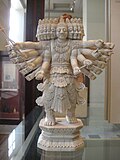
| caption = Sculpture of Ravana from the 18th century CE | | caption = Sculpture of the rakshasa Ravana from the 18th century CE | ||
| successor = [[Vibhishana]] (King of Lanka) | | successor = [[Vibhishana]] (King of Lanka) | ||
| predecessor = [[Kubera]] (King of Lanka) | | predecessor = [[Kubera]] (King of Lanka) | ||
| siblings = [[Kumbhakarna]], [[Vibhishana]], [[Khara (Ramayana)|Khara]], [[ | | siblings = [[Kumbhakarna]], [[Vibhishana]], [[Khara (Ramayana)|Khara]], [[Dushana (Ramayana)|Dushana]], [[Ahiravana]], [[Shurpanakha]] | ||
| father = [[Vishrava]] | | father = [[Vishrava]] | ||
| mother = [[Kaikashi]] | | mother = [[Kaikashi]] | ||
| Line 25: | Line 22: | ||
| Devanagari = रावण | | Devanagari = रावण | ||
| Sanskrit_transliteration = Rāvaṇa | | Sanskrit_transliteration = Rāvaṇa | ||
| Tamil = ராவணன் | |||
}} | }} | ||
{{Hinduism}} | {{Hinduism}} | ||
'''Ravana''' ({{IPAc-en|ˈ|r|ɑː|v|ə|n|ə}};<ref>{{cite | '''Ravana''' ({{IPAc-en|ˈ|r|ɑː|v|ə|n|ə}};<ref>{{cite encyclopedia |title=Ravana |dictionary=[[Random House Webster's Unabridged Dictionary]] |url=http://dictionary.reference.com/browse/ravana}}</ref> {{Lang-sa|रावण}}, {{IAST3|Rāvaṇa}}, {{IPA-sa|ˈraːʋɐɳɐ|pron}}) is a multi-headed [[rakshasa]] (demon) king<ref>{{cite encyclopedia |last=Cartwright |first=Mark |title=Ravana |encyclopedia=[[World History Encyclopedia]] |url=https://www.worldhistory.org/Ravana/ |access-date=26 February 2021}}</ref> of the island of [[Lanka]], and the chief antagonist in the [[Hindu epic]] [[Ramayana]].<ref>{{cite book |author=Wheeler, James Talboys |year=1869 |title=The History of India from the Earliest Ages |volume=II The Rámáyana and the Vedic period |publisher=N. Trubner & Co. |page=281 |url=https://books.google.com/books?id=xzAQAAAAYAAJ&pg=PA281}}</ref><ref>{{cite book |author=Brown, Nathan Robert |title=The Mythology of Supernatural: The signs and symbols behind the popular TV show |url=https://books.google.com/books?id=1lR_UXIkBfgC&q=ravana+rakshasa&pg=PT43 |date=2 August 2011 |publisher=Berkley Boulevard books, Newwork |isbn=9781101517529 |access-date=12 May 2020}}</ref> In the Ramayana, Ravana is described as the eldest son of sage [[Vishrava]] and [[Kaikesi]]. He abducted Prince [[Rama]]'s wife, [[Sita]], and took her to his kingdom of [[Lanka]], where he held her in the [[Ashok Vatika|Ashoka Vatika]].<ref>{{cite web |title=Sunderkand explanation |website=sunderkandsatsangsamuh.org |url=http://www.sunderkandsatsangsamuh.org/Sunderkand_Explanation.pdf |access-date=12 May 2020}}</ref> Rama, with the support of [[vanara]] King [[Sugriva]] and his army of vanaras, launched an invasion against Ravana in Lanka. Ravana was subsequently slain, and Rama rescued his beloved wife Sita.<ref>{{cite web |author=Das, Subhamoy |title=The Ramayana |quote=Summary by Stephen Knapp |website=Learn Religions |url=https://www.learnreligions.com/the-ramayana-summary-by-stephen-knapp-4092441 |access-date=12 May 2020}}</ref><ref>{{cite encyclopedia |title=Ravana |encyclopedia=[[Encyclopædia Britannica]] |url=https://www.britannica.com/topic/Ravana |access-date=12 May 2020}}</ref> | ||
Ravana is widely portrayed as being an evil character, though he is also a learned scholar. He was well-versed in the six [[shastra]]s and the four [[Vedas]].{{citation needed|date=September 2021}} Ravana is also considered to be the most revered devotee of [[Shiva]]. Images of Ravana are often seen associated with Shiva at temples. He also appears in the Buddhist [[Mahayana]] text [[Laṅkāvatāra Sūtra]], in Buddhist Ramayanas and [[Jataka tales|Jatakas]], as well as in [[Rama in Jainism|Jain Ramayanas]]. In some [[Hindu scriptures|scriptures]], he is depicted as one of [[Vishnu]]'s cursed doorkeepers.<ref name=Pankaj-2019-07-31-Stsmn/> | |||
Ravana is widely portrayed | |||
== Etymology == | == Etymology == | ||
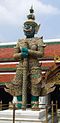
[[File:Ravanan - King of Lanka.jpg|thumbnail|left|150px|Statue of Ravana at [[Koneswaram Temple|Koneswaram Hindu Temple]], [[Sri Lanka]]]] | [[File:Ravanan - King of Lanka.jpg|thumbnail|left|150px|Statue of Ravana at [[Koneswaram Temple|Koneswaram Hindu Temple]], [[Sri Lanka]]]] | ||
The word | The word Rāvaṇa ([[Sanskrit language|Sanskrit]]: रावण) means "roaring" (active), the opposite of [[Vaiśravaṇa]] which means to "hear distinctly" (passive).<ref name="Aiyangar Narayan 1909 p.413">Aiyangar Narayan (1909) "Essays On Indo-Aryan Mythology-Vol.", p.413</ref><ref name="sanskrit-lexicon.uni-koeln.de">{{Cite web |url=https://www.sanskrit-lexicon.uni-koeln.de/cgi-bin/monier/serveimg.pl?file=/scans/MWScan/MWScanjpg/mw1026-vaivarNika.jpg |title=Cologne Scan |website=sanskrit-lexicon.uni-koeln.de}}</ref> Both Ravana and Vaiśravaṇa, who is commonly known as [[Kubera]], are considered to be [[patronymic]]s derived from "sons of [[Vishrava]]".<ref name="Aiyangar Narayan 1909 p.413"/><ref name="sanskrit-lexicon.uni-koeln.de"/><ref>{{Cite book |title=The Rāmāyaṇa of Vālmīki: An Epic of Ancient India. Ayodhyākāṇḍa |date=25 April 2007 |publisher=Motilal Banarsidass Publishers |isbn=9788120831636 |page=30 |url=https://books.google.com/books?id=YJGRP-otpdIC&pg=PA530 |via=Google Books}}</ref><ref>{{cite book |last=Hopkins |first=Edward Washburn |author-link=Edward Washburn Hopkins |year=1915 |title=Epic Mythology |place=Strassburg, DE |publisher=K.J. Trübner |page = 142 |url=https://archive.org/stream/epicmythology00hopkuoft#page/n147/mode/2up/search/Kubera}}</ref> | ||
Ravana was a title later taken on by Dashānana, and it means "the one with ten (dasha) faces (anana)". Further, roravana is Sanskrit for "loud roaring." In Abhinava Gupta's Krama Shaiva scripture, yāsām rāvanam is used as an expression to mean people who are truly aware of the materialism of their environment.{{Citation needed|date=February 2022}} | |||
Ravana has many other popular names | Ravana has many other popular names such as Dasis Ravana, Dasis Sakvithi Maha Ravana, Dashaanan, Ravula, Lankapati, Lankeshwar, Lankeshwaran, Ravanasura, Ravanaeshwaran, and Eela Vendhar.<ref>{{cite web|title=10 Names of Ravana |website=LifeStalker |url=http://www.lifestalker.com/2014/10/the-10-names-of-ravana.html |access-date=2021-05-18 |language=en}}</ref> | ||
== Iconography == | == Iconography == | ||
Ravana is depicted and described as having ten heads, although | Ravana is depicted and described as having ten heads, although he is sometimes shown with only nine heads since he cut one off to convince Shiva.<ref>{{Cite web |date=2015-10-26 |title=When Ravana tore his head and a hand to apologize to Lord Shiva |url=https://www.mensxp.com/special-features/today/28124-when-ravana-tore-his-head-and-a-hand-to-apologize-to-lord-shiva.html |access-date=2022-05-05 |website=www.mensxp.com |language=en-IN}}</ref> He is described as a devout follower of Shiva, a great scholar, a capable ruler, and a maestro of the [[Veena]]. Ravana is also depicted as the author of the ''Ravana Samhita'', a book on [[Hindu astrology]], and the ''Arka Prakasham'', a book on [[Siddha medicine]] and treatment. Ravana possessed a thorough knowledge of [[Siddha]] and [[political science]]. He is said to have possessed the nectar of immortality, which was stored inside his belly thanks to a celestial boon from [[Brahma]].<ref>{{cite book |title=Ramayana |author=[[Valmiki]]}} {{cite book |title=[[Ramcharitmanas]] |author=[[Tulsidas]] |editor1=Vibhishana, Lanka Kanda |editor2=Samvaad, Rama }}</ref>{{page needed|date=July 2020}} | ||
== Life and legends == | == Life and legends == | ||
=== Birth === | === Birth === | ||
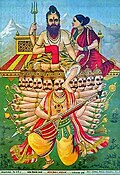
Ravana was born to the | [[File:Ravi Varma-Ravana Sita Jathayu.jpg|thumb|The abduction of Sita]] | ||
Ravana was born to the sage [[Vishrava]] and the [[Rakshasa]] princess [[Kaikesi]] in [[Treta Yuga]]. Villagers from [[Bisrakh]] in [[Uttar Pradesh]] claim that Bisrakh was named after Vishrava, and that Ravana was born there.<ref>{{Cite magazine |author=Dutta, Prabhash K. |date=10 October 2016 |title=Did you know? Ravana was born in Greater Noida West |magazine=India Today |url=https://www.indiatoday.in/india/story/ravana-greater-noida-demon-king-delhi-ncr-bishrakh-dussehra-345906-2016-10-10 |access-date=2 July 2020 |lang=en}}</ref> However, according to [[Hela (people)|Hela]] historical sources and folklore, Ravana was born in Lanka, where he later became king.<ref>{{Cite web |date=2016-10-11 |title=Unknown Interesting Hidden Mythological Facts About Ravana |url=https://shiprocket.social/blog/lesser-known-facts-ravana-raavan/ |access-date=2022-05-05 |website=Shiprocket Social Blog |language=en-US}}</ref> | |||
Ravana's grandfather | Ravana's paternal grandfather, the sage [[Pulastya]],<ref>{{Cite journal|last=Rajarajan|first=R.K.K.|year=2018|title=Woven Threads of the Rāmāyaṇa The Early Āḻvārs on Brahmā and Rāvaṇa|url=https://www.academia.edu/37599459|journal=Romanian Journal of Indian Studies|volume=2|pages=9–45}}</ref> was one of the ten [[Prajapati]]s, or mind-born sons of [[Brahma]], and one of the [[Saptarishi]] (Seven Great Sages Rishi) in the first [[Manvantara]] (age of [[Manu (Hinduism)|Manu]]). His maternal grandfather was [[Sumali]] (or Sumalaya), the king of the Rakshasas and the son of Sukesha. Sumali had ten sons and four daughters. Sumali wished for Kaikesi to marry the most powerful being in the mortal world, so as to produce an exceptional heir. He rejected the kings of the world, as they were less powerful than him. Kaikesi searched among the sages and finally chose Vishrava, the father of Kubera. Ravana and his siblings were born to the couple and they completed their education from their father, with Ravana being a great scholar of the Vedas.{{citation needed|date=February 2022}} | ||
=== Boon | === Boon from Brahma === | ||
Ravana and his two brothers | Ravana and his two brothers, [[Kumbhakarna]] and [[Vibhishana]], performed penance on Mount Gokarna for 11,000 years and won boons from Brahma. Ravana was blessed with a boon that would make him invincible to all the creations of Brahma, except for humans.<ref>{{Cite web |last=Manglik |first=Reshu |date=29 September 2017 |title=Happy Dussehra 2017: 11 important facts to know about Ravana, primary antagonist of epic Ramayana |website=indiatvnews.com |url=https://www.indiatvnews.com/lifestyle/books-culture-dussehra-2017-king-ravana-important-facts-from-ramayana-403950 |access-date=14 July 2020 |language=en}}</ref> He also received weapons, a chariot, as well as the ability to shapeshift from Brahma.{{Citation needed|date=February 2022}} According to the ''Ramayana'', demigods approached Brahma since Ravana was causing harm on Earth. Lord Vishnu appeared and gave blessings that he will incarnate as a human (Rama) and kill Ravana since his invincibility boon did not include humans.<ref>{{Cite book |last=Rosen |first=Steven |url=https://www.worldcat.org/oclc/70775665 |title=Essential Hinduism |date=2006 |publisher=Praeger |isbn=0-275-99006-0 |location=Westport, Conn. |pages=68–69 |oclc=70775665}}</ref> | ||
=== Devotee of Shiva === | === Devotee of Shiva === | ||
{{See also|Ravananugraha}} | {{See also|Ravananugraha}} | ||
[[File:RavanKailashAndolan.jpg|left|thumb|255x255px|Ravananugraha theme]] | [[File:RavanKailashAndolan.jpg|left|thumb|255x255px|Ravananugraha theme]] | ||
One of the most popular images of Shiva is called "Ravananugraha", which was popular in the [[Gupta era]] | One of the most popular images of Shiva is called "Ravananugraha", which was popular in the [[Gupta era]]. It depicts Ravana beneath [[Mount Kailash]] playing a veena made out of his head and hands, and strings made out of his tendons, while Shiva and Parvati sit on top of the mountain.<ref name="kala">Kala pp. 38–42</ref>{{full citation needed|date=July 2022|reason=no such ref "Kala"}} According to scriptures, Ravana once tried to lift Mount Kailash, but Shiva pushed the mountain into place and trapped Ravana beneath it. For a thousand years, the imprisoned Ravana sang [[Shiva Tandava Stotra]], a hymn in praise of Shiva, who finally blessed him and granted him an invincible sword and a powerful [[linga]] (Shiva's iconic symbol, Atmalinga) to worship.<ref>{{cite web |author=Rathore, Vinod |date=29 June 2020 |title=Know the unique story of Ravana's devotion to Shiva |website=News Track |url=https://english.newstracklive.com/news/ravan-shiv-bhakti-ravan-and-shiv-katha-hindi-me-sc91-nu612-ta272-1103191-1.html |access-date=14 July 2020 |language=en}}</ref><ref name="kala"/> | ||
{{clear left}} | {{clear left}} | ||
=== Family === | === Family === | ||
[[File:COLLECTIE TROPENMUSEUM Reliëf op de aan Brahma gewijde tempel op de Candi Lara Jonggrang oftewel het Prambanan tempelcomplex TMnr 10016175.jpg|thumb|right|Queen [[Mandodari]] and the women of Lanka mourning the death of Ravana. Bas-relief of 9th century [[Prambanan]] | [[File:COLLECTIE TROPENMUSEUM Reliëf op de aan Brahma gewijde tempel op de Candi Lara Jonggrang oftewel het Prambanan tempelcomplex TMnr 10016175.jpg|thumb|right|Queen [[Mandodari]] and the women of Lanka mourning the death of Ravana. Bas-relief of 9th century [[Prambanan]] Temple, Java, Indonesia]]Ravana's parents were the sage [[Vishrava]] (son of [[Pulastya]]) and [[List of characters in Ramayana#Kaikashi|Kaikesi]] (daughter of [[Sumali]] and [[Tataka]] or [[Ketumati (Ramayana)|Ketumati]]). Ravana had ten maternal uncles and three maternal aunts. [[List of characters in Ramayana#Dhumraksha|Dhumraksha]], [[Prahastha]], [[Akampana]], [[Maricha]], and [[Subahu]], a few of his maternal uncles, were generals in the Lanka army. [[Kaikesi]]'s father, [[Sumali]], was instrumental in making Ravana the king of Lanka by advising him to receive boons from Brahma, defeat Kubera, and establish [[rakshasa]] rule in the [[Trailokya|three worlds]].<ref name="Mittal-2006-p200">{{cite book |last=Mittal |first=J.P. |url=https://books.google.com/books?id=b7gOBW8oDFgC&pg=PA200 |title=History of Ancient India (a new version: From 7300 BC to 4250 BC |date=2006 |publisher=Atlantic Publishers & Dist |isbn=978-81-269-0615-4 |page=200 |language=en}}</ref> | ||
Ravana's granduncle was [[Malyavan]], who opposed the war with Rama and Lakshmana. He also had another granduncle named Mali who was killed by [[Vishnu]].<ref name="Mittal-2006-p200" /> | |||
Ravana had seven brothers and two sisters, named [[Kubera]], [[Kumbhakarna]], [[Vibhishana]], [[Khara (Ramayana)|Khara]], [[Dushana]], [[Ahiravan]], Kumbhini, Sahastra Ravana, and [[Shurpanakha]]. | |||
Ravana had three wives, [[Mandodari]], the daughter of the celestial architect [[Mayasura|Maya]], Dhanyamalini, and a third wife. His sons from his three wives were [[Indrajit|Meghanada]], [[Atikaya]], [[Akshayakumara]], [[Narantaka]], [[Devantaka]], [[Trishira]], and [[Prahasta]]. | |||
=== Priestly ministers === | === Priestly ministers === | ||
Ravana is said | In some accounts, Ravana is said to have had Shukracharya, the priest of the Asuras, as his minister, and in other accounts, [[Brihaspati]], the priest of the Devas.{{citation needed|date=February 2022}} | ||
One | One account narrates how Ravana ordered Brihaspati to recite the Chandi stava (mantras of Chandi), more specifically the Devi Mahatmya, in order to stave off defeat. According to the Krttivasa text, Ravana arranged for a peaceful [[yajna]], and invited Brihaspati to start the recitation of Chandi.<ref>{{cite book |first=Shanti Lal |last=Nagar |title=Genesis and Evolution of the Rāma Kathā in Indian Art, Thought, Literature, and Culture: From the earliest period to modern times |volume=2}}</ref>{{full citation needed|date=July 2022|reason=publisher, date, page}} | ||
[[File:Mani Madhava Chakyar as Ravana.jpg|Ravana in [[Sanskrit]] drama of [[Kerala]], India- [[Kutiyattam]]. Artist: Guru ''Nātyāchārya'' [[Māni Mādhava Chākyār]] | [[File:Mani Madhava Chakyar as Ravana.jpg|Ravana in [[Sanskrit]] drama of [[Kerala]], India- [[Kutiyattam]]. Artist: Guru ''Nātyāchārya'' [[Māni Mādhava Chākyār]]<ref> | ||
{{cite book | {{cite book | ||
| author = Chākyār, Māni Mādhava | author-link = Māni Mādhava Chākyār | | author = Chākyār, Māni Mādhava | author-link = Māni Mādhava Chākyār | ||
| Line 104: | Line 83: | ||
== Other legends == | == Other legends == | ||
=== | === Vishnu's cursed doorkeeper === | ||
In the [[Bhagavata Purana]], Ravana and his brother | In the [[Bhagavata Purana]], Ravana and his brother [[Kumbhakarna]] are said to be reincarnations of [[Jaya-Vijaya|Jaya and Vijaya]], gatekeepers at [[Vaikuntha]] (the abode of [[Vishnu]]), and were cursed to be born on Earth for their insolence.<ref name=":0">{{cite book |last=Ninan |first=M.M. |date=2008-06-23 |df=dmy-all |title=The Development of Hinduism |publisher=Madathil Mammen Ninan |isbn=978-1-4382-2820-4 |pages=241 |language=en |url=https://books.google.com/books?id=-8RTZcjg9awC&dq=Ravana+Kumbhakarna+cursed+born+on+earth&pg=PA241}}</ref> | ||
These gatekeepers refused entry to the [[Catursana|Sanatha Kumara]] monks | These gatekeepers refused entry to the [[Catursana|Sanatha Kumara]] monks who, because of their powers and austerity, appeared as young children. For their insolence, the monks cursed them to be expelled from [[Vaikuntha]] and to be born on Earth.<ref name=":0" /><ref name="Pankaj-2019-07-31-Stsmn" /> | ||
Vishnu agreed that they should be punished. | Vishnu agreed that they should be punished and gave them two options. First, that they could be born seven times as normal mortals and devotees of Vishnu, or strong and three times as powerful, but as enemies of Vishnu. Eager to be back with the Lord, they chose the latter option. The curse of the first birth was fulfilled by [[Hiranyakashipu]] and his brother [[Hiranyaksha]] in [[Satya Yuga]], when they were both vanquished by earlier avatars of Vishnu (Hiranyaksha by [[Varaha]], and Hiranyakashipu by [[Narasimha]]). Ravana and his brother Kumbhakarna were born to fulfill the curse in their second birth as enemies of Vishnu in [[Treta Yuga]]. The curse of the third birth was fulfilled by [[Dantavakra]] and [[Sisupala|Shishupala]] in the [[Dvapara Yuga]], when they both were slain by [[Krishna]], the eighth avatar.<ref name=Pankaj-2019-07-31-Stsmn>{{cite news |author=Pankaj, Bhavana |date=31 July 2019 |title=Where Ravana is Vishnu's true Bhakta |newspaper=The Statesman |url=https://www.thestatesman.com/religion/ravana-vishnus-true-bhakta-1502783704.html |access-date=1 July 2020 |language=en}}</ref> | ||
=== Conflict with other kings and Asuras === | === Conflict with other kings and Asuras === | ||
Ravana had gotten into | Throughout his life, Ravana had gotten into conflict with several major Asuras.{{Citation needed|date=February 2022}} In [[Maheshwar]], Madhya Pradesh, he is said to have fought and lost to [[Kartavirya Arjuna]]. Ravana was vanquished by the [[Ikshvaku]] King [[Mandhata]], an ancestor of [[Rama]], as well as by the sage [[Kapila]]. In the Ramayana, he fought [[Vali (Ramayana)|Vali]], the [[Kishkindha]] king, but was defeated by him because of his boon to obtain half the strength of anyone he fought.<ref>{{cite book |author=Vālmīki |url=https://books.google.com/books?id=mkSzznK3VuEC&q=vali+vs+ravana&pg=PA371 |title=The Concise Rāmāyaṇa of Vālmīki |date=January 1988 |publisher=SUNY Press |isbn=978-0-88706-862-1 |editor-last=Venkatesananda |editor-first=Swami |language=en}}</ref> He also fought with the [[Nivatakavachas]], descendants of [[Prahlada]], but struck an alliance with them after being unable to defeat them. | ||
Once, upon hearing a discourse from Sage [[Sanatkumara]], Ravana attempted to invade [[Vaikuntha]]. Only Ravana managed to enter Vaikuntha's capital, Shwetadwipa, where he was hopelessly outmatched by the inhabitants and was forced to retreat. | |||
He killed Anaranya, the king of [[Ayodhya]], although he cursed Ravana to be slain by Rama. | |||
Ravana had wrestled his brother [[Kubera]] for the [[Vimana|Pushpaka Vimana]]. | |||
He also fought Marutta (Chakravarti King of Ushiraviga), Gadhi ([[Vishwamitra]]'s father), [[Dushyanta]] ([[Bharata (Mahabharata)|Bharata]]'s father), Suratha (King of [[Vidarbha]]), Gaya (Chakravarti king of Dharmaranya), and [[Paurava]] (King of [[Anga]]). | |||
== Worship and temples == | == Worship and temples == | ||
| Line 132: | Line 105: | ||
=== Worship === | === Worship === | ||
Ravana is worshipped as one of Shiva's most revered followers,<ref name="spectrum"/> and he is even worshipped in some Shiva temples.<ref name = "spectrum">{{cite news |url=http://www.tribuneindia.com/2007/20071021/spectrum/society1.htm |title=Ravana has his temples, too |newspaper=The Sunday Tribune |department=Spectrum |date=21 October 2007}}</ref><ref>{{cite book |author=Vachaspati, S. |title=Ravana Brahma |year=2005 |publisher=Rudrakavi Sahitya Peetham, Gandhi Nagar |place=Tenali, India |language=English}}</ref><ref>{{cite book |author=Dave, Kamalesh Kumar |year=2008 |title=Dashanan |publisher=Akshaya Jyotish Anusandan Kendra |place=[[Jodhpur]], India |language=Hindi}}</ref> | |||
Ravana is worshiped by the Kanyakubja Brahmins of the Vidisha region, who see him as a savior and a sign of prosperity, claiming Ravana was also a Kanyakubja Brahmin. Thousands of [[Kanyakubja]] [[Brahmin]]s of the village Ravangram of Netaran, in the [[Vidisha]] District of [[Madhya Pradesh]], perform daily [[Puja (Hinduism)|puja]] in the Ravana temple and offer naivedyam or [[bhog]] (a ritual of sacrifice to the gods). | |||
King Shiv Shankar built a Ravana temple in [[Kanpur]], [[Uttar Pradesh]]. The Ravana temple is open once a year, on the day of [[Dashehra|Dashera]], to perform puja for the welfare of Ravana.<ref>{{cite news |first=Faiz |last=Siddiqui |date=10 October 2016 |title=A temple where demon king has his day |newspaper=[[The Times of India]] |url=https://timesofindia.indiatimes.com/city/kanpur/A-temple-where-demon-king-has-his-day/articleshow/54772663.cms |access-date=14 September 2018}}</ref> | |||
Ravana is also worshiped by Hindus of [[Bisrakh]], who claim their town to be his birthplace.<ref>{{cite news |title=Only the elderly come to mourn Ravana in 'birthplace' Bisrakh |date=4 October 2014 |newspaper=[[The Indian Express]] |url=http://indianexpress.com/article/cities/delhi/only-the-elderly-come-to-mourn-ravana-in-birthplace-bisrakh/ |access-date=14 June 2016}}</ref> | Ravana is also worshiped by Hindus of [[Bisrakh]], who claim their town to be his birthplace.<ref>{{cite news |title=Only the elderly come to mourn Ravana in 'birthplace' Bisrakh |date=4 October 2014 |newspaper=[[The Indian Express]] |url=http://indianexpress.com/article/cities/delhi/only-the-elderly-come-to-mourn-ravana-in-birthplace-bisrakh/ |access-date=14 June 2016}}</ref> | ||
The Sachora Brahmins of Gujarat | The Sachora Brahmins of Gujarat claim to be descendants of Ravana, and sometimes have "Ravan" as their surnames.<ref>{{cite book |title=People of India |volume=4: A–G |publisher=Oxford University Press |page=3061}}</ref> | ||
Saraswat Brahmins from Mathura claim Ravana as a saraswat Brahmin as per his lineage.<ref>{{cite news |title=Mathura lawyer seeks ban on burning of Ravana effigies |date=26 September 2017 |newspaper=[[The Indian Express]] |url=https://indianexpress.com/article/india/mathura-lawyer-seeks-ban-on-burning-of-ravana-effigies-4862479/}}</ref><ref>{{cite magazine |author=Qureshi, Siraj |date=12 October 2016 |title=A Dussehra without burning Ravana: This Brahmin community in Agra wants an end to practice |magazine=[[India Today]] |url=https://www.indiatoday.in/india/story/raavan-vijay-dashmi-agra-saraswat-caste-brahmins-346178-2016-10-12}}</ref> | |||
There | There has also been reference to "Ravani", the lineage of Upadhyaya Yasastrata II, who was of the Gautama gotra and Acharya Vasudatta's son, and described as "born of Ravani".<ref>{{cite journal |title={{grey|[no title cited]}} |journal=Indian Culture: Journal of the Indian Research Institute |volume=15 |publisher=I.B. Corporation}}</ref>{{full citation needed|date=July 2022|reason=author, title, issue, page(s)}} | ||
The [[Gondi people]] of central India claim to be descendants of Ravana, and | The [[Gondi people]] of central India claim to be descendants of Ravana, and have temples for him, his wife Mandodari, and their son Meghnad. They also state that Ravana was an ancient Gond king, the tenth ''dharmaguru'' of their tribe, and the eighteenth lingo (divine teacher). Annually on [[Dussehra]], the Gondis from the village of [[Paraswadi]] carry an image of Ravana riding on an elephant in a procession.<ref>{{cite news |author=Rashid, Omar |date=24 October 2015 |title=Celebrating Ravan |newspaper=[[The Hindu]] |url=https://www.thehindu.com/features/magazine/omar-rashid-on-ravan-worship/article7799972.ece}}</ref> | ||
=== Temples === | === Temples === | ||
The following temples in India are for Ravana as a Shiva Bhakta. | |||
* Dashanan Temple, Kanpur, Uttar Pradesh<ref name=IndiaTV-2016-10-11>{{cite news |title=Five temples of Ravana in India where demon king is worshipped |date=11 October 2016 |publisher=India TV |url=https://www.indiatvnews.com/news/india-five-temples-of-ravana-in-india-where-demon-king-is-worshipped-351861}}</ref> | * Dashanan Temple, Kanpur, Uttar Pradesh<ref name=IndiaTV-2016-10-11>{{cite news |title=Five temples of Ravana in India where demon king is worshipped |date=11 October 2016 |publisher=India TV |url=https://www.indiatvnews.com/news/india-five-temples-of-ravana-in-india-where-demon-king-is-worshipped-351861}}</ref> | ||
* Ravana | * Ravana Temple, Bisrakh, Greater Noida, Uttar Pradesh<ref name=IndiaTV-2016-10-11/> | ||
* Kakinada Ravana | * Kakinada Ravana Temple, Andhra Pradesh<ref name=IndiaTV-2016-10-11/> | ||
* Ravangram Ravana Temple, Vidisha, Madhya Pradesh<ref name=IndiaTV-2016-10-11/> | * Ravangram Ravana Temple, Vidisha, Madhya Pradesh<ref name=IndiaTV-2016-10-11/> | ||
* Mandsaur, Madhya Pradesh<ref name=IndiaTV-2016-10-11/> | * Mandsaur, Madhya Pradesh<ref name=IndiaTV-2016-10-11/> | ||
* Mandore Ravan Temple, Jodhpur<ref name="Native Planet">{{cite web |title=Unique Ravana temples in India |date=27 April 2018 |website=Native Planet |department=Travel guide |url=https://www.nativeplanet.com/travel-guide/unique-ravana-temples-in-india-001812.html}}</ref> | * Mandore Ravan Temple, Jodhpur<ref name="Native Planet">{{cite web |title=Unique Ravana temples in India |date=27 April 2018 |website=Native Planet |department=Travel guide |url=https://www.nativeplanet.com/travel-guide/unique-ravana-temples-in-india-001812.html}}</ref> | ||
* Baijanath Temple, Kangra | * Baijanath Temple, Kangra District, Himachal Pradesh<ref name="Native Planet"/> | ||
== Influence on culture and art == | == Influence on culture and art == | ||
[[File:Hanuman and Ravana in Tholu Bommalata, the shadow puppet tradition of Andhra Pradesh, India.JPG|thumb|270px|Ravana with [[Hanuman]] in ''[[tholu bommalata]]'', a [[shadow puppet]] tradition of [[Andhra Pradesh]], India]] | [[File:Hanuman and Ravana in Tholu Bommalata, the shadow puppet tradition of Andhra Pradesh, India.JPG|thumb|270px|Ravana with [[Hanuman]] in ''[[tholu bommalata]]'', a [[shadow puppet]] tradition of [[Andhra Pradesh]], India]] | ||
[[File:Ravana Carnival.jpg|thumb|203x203px|A carnival of Ravana]] | [[File:Ravana Carnival.jpg|thumb|203x203px|A carnival of Ravana]] | ||
=== Ravana-Dahan (burning effigy of Ravana) === | === Ravana-Dahan (burning effigy of Ravana) === | ||
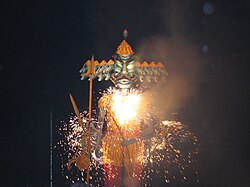
[[File:Ravana_fizzles.jpg|thumb|An effigy of Ravana with burning sparklers on [[Dusshera]]. ''Dashehra Diwali Mela'' in Manchester, England, 2006 | [[File:Ravana_fizzles.jpg|thumb|An effigy of Ravana with burning sparklers on [[Dusshera]]. ''Dashehra Diwali Mela'' in Manchester, England, 2006]] | ||
Effigies of Ravana are burned on [[Vijayadashami]] in many places throughout India | Effigies of Ravana are burned on [[Vijayadashami]] in many places throughout India to symbolize Rama's triumph over evil.<ref>{{cite news |title=Dussehra 2018: What is the significance Of Ravana Dahan? |website=NDTV.com |department=Dehli news |url=https://www.ndtv.com/delhi-news/ravana-dahan-2018-what-is-the-significance-of-ravana-dahan-1934573 |access-date=1 July 2020}}</ref> | ||
=== Ravanahatha === | === Ravanahatha === | ||
According to mythology, the ''[[ravanahatha]]'', an ancient bowed [[string instrument]], was created by Ravana and is still used as a Rajasthani folk instrument.<ref>{{cite news |title=Sri Lankan revives Ravana's musical instrument |date=9 March 2008 |website=[[The Island (Sri Lanka)|The Island]] |place=Sri Lanka |url=http://www.island.lk/2008/03/09/news11.html}}</ref> | |||
== In other religions == | == In other religions == | ||
=== | In the Rin-spuns-pa Tibetan Ramayana, it is prophesied that Ravana will return as the Buddha incarnation of Vishnu in Kali Yuga. | ||
The Arunachal Pradesh Tai Khamti Ramayana (Phra Chow Lamang) shows Rama as a Bodhisattva who was reborn so Ravana could torture him. | |||
In the Laotian Buddhist text [[Phra Lak Phra Lam]], Rama is a Bodhisattva and the embodiment of virtues, while Ravana is a Brahmin ("''mahabrahma''") son of Virulaha who is highly materialistic.{{Citation needed|date=February 2022}} | |||
In the Cambodian Buddhist text [[Reamker|Preah Ream]], Buddha is an incarnation of Rama and Ravana is a rakshasa.{{Citation needed|date=February 2022}} | |||
In the Thai Buddhist text [[Ramakien]], Ravana is a rakshasa<ref>{{Cite book|title=Prachi Darshan|last=Vyas|first=Lallan Prasad|pages=98}}</ref> known as "Thotsakan" (ทศกัณฐ์, from Sanskrit दशकण्ठ, Daśakaṇṭha, "ten necks"), and is depicted with green skin.{{Citation needed|date=February 2022}} | |||
In the [[Karandavyuha Sutra]], [[Yama]] asks if the visitor in hell (Avalokitesvara), whom he hasn't seen yet, is a god or a demon, and whether he is Vishnu, [[Maheśvara (Buddhism)|Mahesvara]], or the rakshasa Ravana. | |||
=== Jainism === | |||
{{Further|Salakapurusa}} | {{Further|Salakapurusa}} | ||
[[Jain]] accounts vary from the traditional Hindu accounts of | [[Jain]] accounts vary from the traditional Hindu accounts of the Ramayana. The incidents are placed at the time of the 20th [[Tirthankara]], [[Munisuvrata]]. In Jainism, both Rama and Ravana were devout Jains.<ref>{{cite book |last=Sharma |first=S.R. |year=1940 |title=Jainism and Karnataka Culture |publisher=Karnatak Historical Research Society |location=Dharwar, IN |page=76 }}</ref> Ravana was a [[Vidyadhara]] king who had magical powers,<ref>{{cite book |last=Dalal |first=Roshen |year=2010 |title=Hinduism: An alphabetical guide |publisher=[[Penguin Books]] India |page=338 |isbn=9780143414216 |url=https://books.google.com/books?id=DH0vmD8ghdMC}}</ref> and Lakshmana, not Rama, was the one who ultimately killed Ravana.<ref>{{cite book |last=Ramanujan |first=A.K. |year=1991 |editor=Paula Richman |title=Many Rāmāyaṇas: The diversity of a narrative tradition in south Asia |page=35 |publisher=University of California Press |isbn=978-0-520-07589-4 |chapter=Three hundred Rāmāyaṇas: Five examples and Three thoughts on Translation |chapter-url=https://books.google.com/books?id=XkifYfljHP4C}}</ref> | ||
=== Dravidian movement === | === Dravidian movement === | ||
[[Pulavar Kuzhanthai]]'s Ravana Kaaviyam | [[Pulavar Kuzhanthai]]'s Ravana Kaaviyam is a [[panegyric]] on Ravana that is made up of 3,100 poetic stanzas in which Ravana is the hero. The book was released in 1946, and was subsequently banned by India's [[Indian National Congress|Congress]] led government. The ban was later lifted in 1971.<ref>{{cite magazine |author=Pandian, M.S.S. |date=2 November 1998 |title=Ravana as antidote |magazine=Outlook India |url=https://www.outlookindia.com/magazine/story/ravana-as-antidote/206446 |access-date=20 June 2019 |archive-url=https://web.archive.org/web/20180116135407/https://www.outlookindia.com/magazine/story/ravana-as-antidote/206446 |archive-date=2018}}</ref><ref>{{cite magazine |author=Nalankilli, Thanjai |date=April 2006 |title=Censorship of Dravidian voices in Tamil Nadu (India) in 1948, 1949 |magazine=Tamil Tribune |url=http://www.tamiltribune.com/06/0401.html |url-status=dead <!-- presumed --> |archive-url=https://web.archive.org/web/20180108182839/http://www.tamiltribune.com/06/0401.html |archive-date=8 January 2018}}</ref><ref>{{cite web |last=Sivapriyan |first=E.T.B. |title=Ram Temple: Tamilians praise Ravana on ''Twitter'' |newspaper=[[Deccan Herald]] |date=5 August 2020 |url=https://www.deccanherald.com/national/ram-temple-tamilians-praise-ravana-on-twitter-869883.html |access-date=21 November 2021}}</ref> | ||
==In popular culture== | |||
Sri Lanka named its first satellite [[Raavana 1]] after Ravana.<ref>{{cite web |last=Yamunan |first=Sruthisagar |date=6 July 2019 |title=Why Sri Lanka named its first-ever satellite after Ravana |website=Scroll.in |url=https://scroll.in/article/929015/why-sri-lanka-named-its-first-ever-satellite-after-ravana |access-date=2 July 2020 |language=en-US}}</ref> | |||
=== Films === | === Films === | ||
| Line 189: | Line 170: | ||
!Title | !Title | ||
!Played by | !Played by | ||
!Year | |||
!Language | |||
|- | |||
|[[Bhookailas (1940 film)]] | |||
|[[Subbaiah Naidu]] | |||
|1940 | |||
|Telugu | |||
|- | |- | ||
|''[[Rambaan]]'' | |''[[Rambaan]]'' | ||
|Chandra Mohan | |Chandra Mohan | ||
|1948 | |||
|Hindi | |||
|- | |- | ||
|[[Sampoorna Ramayanam (1958 film)|''Sampoorna Ramayanam'']] | |[[Sampoorna Ramayanam (1958 film)|''Sampoorna Ramayanam'']] | ||
|[[T. K. Bhagavathi]] | |[[T. K. Bhagavathi]] | ||
|1958 | |||
|Tamil | |||
|- | |- | ||
|''[[Sampoorna Ramayana]]'' | |''[[Sampoorna Ramayana]]'' | ||
|[[B. M. Vyas]] | |[[B. M. Vyas]] | ||
|1961 | |||
|Hindi | |||
|- | |||
|[[Bhookailas (1958 film)]] | |||
|[[N. T. Rama Rao]] | |||
|1958 | |||
|Telugu | |||
|- | |- | ||
|''[[Sita Rama Kalyanam (1961 film)|Sita Rama Kalyanam]]'' | |''[[Sita Rama Kalyanam (1961 film)|Sita Rama Kalyanam]]'' | ||
|[[N. T. Rama Rao]] | |[[N. T. Rama Rao]] | ||
|1961 | |||
|Telugu | |||
|- | |- | ||
|''[[Indrajeet (Sati Sulochana)]]'' | |''[[Indrajeet (Sati Sulochana)]]'' | ||
|[[S. V. Ranga Rao]] | |[[S. V. Ranga Rao]] | ||
|1961 | |||
|Telugu | |||
|- | |||
|[[Sampoorna Ramayanam (1971 film)]] | |||
|[[S. V. Ranga Rao]] | |||
|1971 | |||
|Telugu | |||
|- | |- | ||
|[[Sita Kalyanam (1976 film)|''Sita Kalyanam'']] | |[[Sita Kalyanam (1976 film)|''Sita Kalyanam'']] | ||
|[[Kaikala Satyanarayana]] | |[[Kaikala Satyanarayana]] | ||
|1976 | |||
|Telugu | |||
|- | |- | ||
|[[Bajrangbali (film)|''Bajrangbali'']] | |[[Bajrangbali (film)|''Bajrangbali'']] | ||
|[[Prem Nath]] | |[[Prem Nath]] | ||
|1976 | |||
|Hindi | |||
|- | |- | ||
|''[[Sri Rama Pattabhishekam]]'' | |''[[Sri Rama Pattabhishekam]]'' | ||
|[[N. T. Rama Rao]] | |[[N. T. Rama Rao]] | ||
|1978 | |||
|Telugu | |||
|- | |||
|[[Brahmarshi Viswamitra]] | |||
|[[N. T. Rama Rao]] | |||
|1991 | |||
|Telugu | |||
|- | |- | ||
|''[[Ramayana: The Legend of Prince Rama]]'' | |''[[Ramayana: The Legend of Prince Rama]]'' | ||
|[[Amrish Puri]] (voice) | |[[Amrish Puri]] (voice) | ||
|1992 | |||
|English | |||
|- | |- | ||
|[[Ramayanam (1996 film)|''Ramayanam'']] | |[[Ramayanam (1996 film)|''Ramayanam'']] | ||
|[[Swathi Baalineni]] | |[[Swathi Baalineni]] | ||
|1996 | |||
|Telugu | |||
|- | |- | ||
|[[Raavanan (2010 film)|''Raavanan'']] | |[[Raavanan (2010 film)|''Raavanan'']] | ||
|[[Vikram (actor)|Vikram]] (Based on Ravana's character) | |[[Vikram (actor)|Vikram]] (Based on Ravana's character) | ||
|2010 | |||
|Tamil | |||
|- | |- | ||
|''[[Ramayana: The Epic]]'' | |''[[Ramayana: The Epic]]'' | ||
|[[Ashutosh Rana]] (voice) | |[[Ashutosh Rana]] (voice) | ||
|2010 | |||
|Hindi | |||
|- | |- | ||
|''[[Adipurush]]'' | |''[[Adipurush]]'' | ||
|[[Saif Ali Khan]] | |[[Saif Ali Khan]] | ||
|2023 | |||
|Multi | |||
|} | |} | ||
| Line 287: | Line 316: | ||
|[[Ravana (TV Derana)|''Ravana'']]||[[Januka Rajapaksha]]||[[TV Derana]]||Sri Lanka | |[[Ravana (TV Derana)|''Ravana'']]||[[Januka Rajapaksha]]||[[TV Derana]]||Sri Lanka | ||
|} | |} | ||
=== Web series === | |||
* [[The Legend of Hanuman]] – [[Sharad Kelkar]] | |||
== See also == | == See also == | ||
* [[Asura]] | * [[Asura]] | ||
* [[Bull Demon King]] | |||
* [[Daitya]] | * [[Daitya]] | ||
* [[Danava (Hinduism)]] | * [[Danava (Hinduism)]] | ||
* [[Keibu Keioiba]] | |||
* [[Raksasa]] | * [[Raksasa]] | ||
==References== | |||
==References== | |||
{{reflist|25em}} | {{reflist|25em}} | ||
| Line 304: | Line 335: | ||
* {{cite book |last=Doniger |first=Wendy |author-link=Wendy Doniger |year=1993 |title=Purana Perennis: Reciprocity and transformation in Hindu and Jaina texts |publisher=[[SUNY Press]] |isbn=9780791413814 |url=https://books.google.com/books?id=-kZFzHCuiFAC |via=Google Books}} | * {{cite book |last=Doniger |first=Wendy |author-link=Wendy Doniger |year=1993 |title=Purana Perennis: Reciprocity and transformation in Hindu and Jaina texts |publisher=[[SUNY Press]] |isbn=9780791413814 |url=https://books.google.com/books?id=-kZFzHCuiFAC |via=Google Books}} | ||
* {{cite book |last=Udayakumar |first=S.P. |year=2005 |title=Presenting the Past: Anxious history and ancient future in Hindutva India |publisher=Greenwood Publishing Group}} | * {{cite book |last=Udayakumar |first=S.P. |year=2005 |title=Presenting the Past: Anxious history and ancient future in Hindutva India |publisher=Greenwood Publishing Group}} | ||
| Line 310: | Line 340: | ||
== External links == | == External links == | ||
* {{cite web |title=Rawana the Historical King of Heladiwa |website=Ramayana Research |url=http://www.ramayanaresearch.com/rawana.html |archive-url=https://web.archive.org/web/20130708195310/http://www.ramayanaresearch.com/rawana.html |archive-date=2013-07-08}} | * {{cite web |title=Rawana the Historical King of Heladiwa |website=Ramayana Research |url=http://www.ramayanaresearch.com/rawana.html |archive-url=https://web.archive.org/web/20130708195310/http://www.ramayanaresearch.com/rawana.html |archive-date=2013-07-08}} | ||
Revision as of 04:11, 22 July 2023
 | This article needs more citations. (April 2015) |
| Ravana | |
|---|---|
 Sculpture of the rakshasa Ravana from the 18th century CE | |
| Devanagari | रावण |
| Sanskrit transliteration | Rāvaṇa |
| Affiliation | The King of Lanka, Rakshasa |
| Predecessor | Kubera (King of Lanka) |
| Successor | Vibhishana (King of Lanka) |
| Abode | Lanka |
| Mount | Pushpaka chariot |
| Texts | Ramayana and its versions |
| Personal information | |
| Parents | |
| Siblings | Kumbhakarna, Vibhishana, Khara, Dushana, Ahiravana, Shurpanakha |
| Spouse | |
| Children | Indrajit, Atikaya, Akshayakumara, Narantaka, Devantaka, Trishira |
| Part of a series on |
| Hinduism |
|---|
 |


Ravana (/ˈrɑːvənə/;[1] Sanskrit: रावण, IAST: Rāvaṇa, pronounced [ˈraːʋɐɳɐ]) is a multi-headed rakshasa (demon) king[2] of the island of Lanka, and the chief antagonist in the Hindu epic Ramayana.[3][4] In the Ramayana, Ravana is described as the eldest son of sage Vishrava and Kaikesi. He abducted Prince Rama's wife, Sita, and took her to his kingdom of Lanka, where he held her in the Ashoka Vatika.[5] Rama, with the support of vanara King Sugriva and his army of vanaras, launched an invasion against Ravana in Lanka. Ravana was subsequently slain, and Rama rescued his beloved wife Sita.[6][7]
Ravana is widely portrayed as being an evil character, though he is also a learned scholar. He was well-versed in the six shastras and the four Vedas.[citation needed] Ravana is also considered to be the most revered devotee of Shiva. Images of Ravana are often seen associated with Shiva at temples. He also appears in the Buddhist Mahayana text Laṅkāvatāra Sūtra, in Buddhist Ramayanas and Jatakas, as well as in Jain Ramayanas. In some scriptures, he is depicted as one of Vishnu's cursed doorkeepers.[8]
Etymology

The word Rāvaṇa (Sanskrit: रावण) means "roaring" (active), the opposite of Vaiśravaṇa which means to "hear distinctly" (passive).[9][10] Both Ravana and Vaiśravaṇa, who is commonly known as Kubera, are considered to be patronymics derived from "sons of Vishrava".[9][10][11][12]
Ravana was a title later taken on by Dashānana, and it means "the one with ten (dasha) faces (anana)". Further, roravana is Sanskrit for "loud roaring." In Abhinava Gupta's Krama Shaiva scripture, yāsām rāvanam is used as an expression to mean people who are truly aware of the materialism of their environment.[citation needed]
Ravana has many other popular names such as Dasis Ravana, Dasis Sakvithi Maha Ravana, Dashaanan, Ravula, Lankapati, Lankeshwar, Lankeshwaran, Ravanasura, Ravanaeshwaran, and Eela Vendhar.[13]
Iconography
Ravana is depicted and described as having ten heads, although he is sometimes shown with only nine heads since he cut one off to convince Shiva.[14] He is described as a devout follower of Shiva, a great scholar, a capable ruler, and a maestro of the Veena. Ravana is also depicted as the author of the Ravana Samhita, a book on Hindu astrology, and the Arka Prakasham, a book on Siddha medicine and treatment. Ravana possessed a thorough knowledge of Siddha and political science. He is said to have possessed the nectar of immortality, which was stored inside his belly thanks to a celestial boon from Brahma.[15][page needed]
Life and legends
Birth

Ravana was born to the sage Vishrava and the Rakshasa princess Kaikesi in Treta Yuga. Villagers from Bisrakh in Uttar Pradesh claim that Bisrakh was named after Vishrava, and that Ravana was born there.[16] However, according to Hela historical sources and folklore, Ravana was born in Lanka, where he later became king.[17]
Ravana's paternal grandfather, the sage Pulastya,[18] was one of the ten Prajapatis, or mind-born sons of Brahma, and one of the Saptarishi (Seven Great Sages Rishi) in the first Manvantara (age of Manu). His maternal grandfather was Sumali (or Sumalaya), the king of the Rakshasas and the son of Sukesha. Sumali had ten sons and four daughters. Sumali wished for Kaikesi to marry the most powerful being in the mortal world, so as to produce an exceptional heir. He rejected the kings of the world, as they were less powerful than him. Kaikesi searched among the sages and finally chose Vishrava, the father of Kubera. Ravana and his siblings were born to the couple and they completed their education from their father, with Ravana being a great scholar of the Vedas.[citation needed]
Boon from Brahma
Ravana and his two brothers, Kumbhakarna and Vibhishana, performed penance on Mount Gokarna for 11,000 years and won boons from Brahma. Ravana was blessed with a boon that would make him invincible to all the creations of Brahma, except for humans.[19] He also received weapons, a chariot, as well as the ability to shapeshift from Brahma.[citation needed] According to the Ramayana, demigods approached Brahma since Ravana was causing harm on Earth. Lord Vishnu appeared and gave blessings that he will incarnate as a human (Rama) and kill Ravana since his invincibility boon did not include humans.[20]
Devotee of Shiva

One of the most popular images of Shiva is called "Ravananugraha", which was popular in the Gupta era. It depicts Ravana beneath Mount Kailash playing a veena made out of his head and hands, and strings made out of his tendons, while Shiva and Parvati sit on top of the mountain.[21][full citation needed] According to scriptures, Ravana once tried to lift Mount Kailash, but Shiva pushed the mountain into place and trapped Ravana beneath it. For a thousand years, the imprisoned Ravana sang Shiva Tandava Stotra, a hymn in praise of Shiva, who finally blessed him and granted him an invincible sword and a powerful linga (Shiva's iconic symbol, Atmalinga) to worship.[22][21]
Family

Ravana's parents were the sage Vishrava (son of Pulastya) and Kaikesi (daughter of Sumali and Tataka or Ketumati). Ravana had ten maternal uncles and three maternal aunts. Dhumraksha, Prahastha, Akampana, Maricha, and Subahu, a few of his maternal uncles, were generals in the Lanka army. Kaikesi's father, Sumali, was instrumental in making Ravana the king of Lanka by advising him to receive boons from Brahma, defeat Kubera, and establish rakshasa rule in the three worlds.[23]
Ravana's granduncle was Malyavan, who opposed the war with Rama and Lakshmana. He also had another granduncle named Mali who was killed by Vishnu.[23]
Ravana had seven brothers and two sisters, named Kubera, Kumbhakarna, Vibhishana, Khara, Dushana, Ahiravan, Kumbhini, Sahastra Ravana, and Shurpanakha.
Ravana had three wives, Mandodari, the daughter of the celestial architect Maya, Dhanyamalini, and a third wife. His sons from his three wives were Meghanada, Atikaya, Akshayakumara, Narantaka, Devantaka, Trishira, and Prahasta.
Priestly ministers
In some accounts, Ravana is said to have had Shukracharya, the priest of the Asuras, as his minister, and in other accounts, Brihaspati, the priest of the Devas.[citation needed]
One account narrates how Ravana ordered Brihaspati to recite the Chandi stava (mantras of Chandi), more specifically the Devi Mahatmya, in order to stave off defeat. According to the Krttivasa text, Ravana arranged for a peaceful yajna, and invited Brihaspati to start the recitation of Chandi.[24][full citation needed]

Other legends
Vishnu's cursed doorkeeper
In the Bhagavata Purana, Ravana and his brother Kumbhakarna are said to be reincarnations of Jaya and Vijaya, gatekeepers at Vaikuntha (the abode of Vishnu), and were cursed to be born on Earth for their insolence.[26]
These gatekeepers refused entry to the Sanatha Kumara monks who, because of their powers and austerity, appeared as young children. For their insolence, the monks cursed them to be expelled from Vaikuntha and to be born on Earth.[26][8]
Vishnu agreed that they should be punished and gave them two options. First, that they could be born seven times as normal mortals and devotees of Vishnu, or strong and three times as powerful, but as enemies of Vishnu. Eager to be back with the Lord, they chose the latter option. The curse of the first birth was fulfilled by Hiranyakashipu and his brother Hiranyaksha in Satya Yuga, when they were both vanquished by earlier avatars of Vishnu (Hiranyaksha by Varaha, and Hiranyakashipu by Narasimha). Ravana and his brother Kumbhakarna were born to fulfill the curse in their second birth as enemies of Vishnu in Treta Yuga. The curse of the third birth was fulfilled by Dantavakra and Shishupala in the Dvapara Yuga, when they both were slain by Krishna, the eighth avatar.[8]
Conflict with other kings and Asuras
Throughout his life, Ravana had gotten into conflict with several major Asuras.[citation needed] In Maheshwar, Madhya Pradesh, he is said to have fought and lost to Kartavirya Arjuna. Ravana was vanquished by the Ikshvaku King Mandhata, an ancestor of Rama, as well as by the sage Kapila. In the Ramayana, he fought Vali, the Kishkindha king, but was defeated by him because of his boon to obtain half the strength of anyone he fought.[27] He also fought with the Nivatakavachas, descendants of Prahlada, but struck an alliance with them after being unable to defeat them.
Once, upon hearing a discourse from Sage Sanatkumara, Ravana attempted to invade Vaikuntha. Only Ravana managed to enter Vaikuntha's capital, Shwetadwipa, where he was hopelessly outmatched by the inhabitants and was forced to retreat.
He killed Anaranya, the king of Ayodhya, although he cursed Ravana to be slain by Rama.
Ravana had wrestled his brother Kubera for the Pushpaka Vimana.
He also fought Marutta (Chakravarti King of Ushiraviga), Gadhi (Vishwamitra's father), Dushyanta (Bharata's father), Suratha (King of Vidarbha), Gaya (Chakravarti king of Dharmaranya), and Paurava (King of Anga).
Worship and temples

Worship
Ravana is worshipped as one of Shiva's most revered followers,[28] and he is even worshipped in some Shiva temples.[28][29][30]
Ravana is worshiped by the Kanyakubja Brahmins of the Vidisha region, who see him as a savior and a sign of prosperity, claiming Ravana was also a Kanyakubja Brahmin. Thousands of Kanyakubja Brahmins of the village Ravangram of Netaran, in the Vidisha District of Madhya Pradesh, perform daily puja in the Ravana temple and offer naivedyam or bhog (a ritual of sacrifice to the gods).
King Shiv Shankar built a Ravana temple in Kanpur, Uttar Pradesh. The Ravana temple is open once a year, on the day of Dashera, to perform puja for the welfare of Ravana.[31]
Ravana is also worshiped by Hindus of Bisrakh, who claim their town to be his birthplace.[32]
The Sachora Brahmins of Gujarat claim to be descendants of Ravana, and sometimes have "Ravan" as their surnames.[33]
Saraswat Brahmins from Mathura claim Ravana as a saraswat Brahmin as per his lineage.[34][35]
There has also been reference to "Ravani", the lineage of Upadhyaya Yasastrata II, who was of the Gautama gotra and Acharya Vasudatta's son, and described as "born of Ravani".[36][full citation needed]
The Gondi people of central India claim to be descendants of Ravana, and have temples for him, his wife Mandodari, and their son Meghnad. They also state that Ravana was an ancient Gond king, the tenth dharmaguru of their tribe, and the eighteenth lingo (divine teacher). Annually on Dussehra, the Gondis from the village of Paraswadi carry an image of Ravana riding on an elephant in a procession.[37]
Temples
The following temples in India are for Ravana as a Shiva Bhakta.
- Dashanan Temple, Kanpur, Uttar Pradesh[38]
- Ravana Temple, Bisrakh, Greater Noida, Uttar Pradesh[38]
- Kakinada Ravana Temple, Andhra Pradesh[38]
- Ravangram Ravana Temple, Vidisha, Madhya Pradesh[38]
- Mandsaur, Madhya Pradesh[38]
- Mandore Ravan Temple, Jodhpur[39]
- Baijanath Temple, Kangra District, Himachal Pradesh[39]
Influence on culture and art


Ravana-Dahan (burning effigy of Ravana)

Effigies of Ravana are burned on Vijayadashami in many places throughout India to symbolize Rama's triumph over evil.[40]
Ravanahatha
According to mythology, the ravanahatha, an ancient bowed string instrument, was created by Ravana and is still used as a Rajasthani folk instrument.[41]
In other religions
In the Rin-spuns-pa Tibetan Ramayana, it is prophesied that Ravana will return as the Buddha incarnation of Vishnu in Kali Yuga.
The Arunachal Pradesh Tai Khamti Ramayana (Phra Chow Lamang) shows Rama as a Bodhisattva who was reborn so Ravana could torture him.
In the Laotian Buddhist text Phra Lak Phra Lam, Rama is a Bodhisattva and the embodiment of virtues, while Ravana is a Brahmin ("mahabrahma") son of Virulaha who is highly materialistic.[citation needed]
In the Cambodian Buddhist text Preah Ream, Buddha is an incarnation of Rama and Ravana is a rakshasa.[citation needed]
In the Thai Buddhist text Ramakien, Ravana is a rakshasa[42] known as "Thotsakan" (ทศกัณฐ์, from Sanskrit दशकण्ठ, Daśakaṇṭha, "ten necks"), and is depicted with green skin.[citation needed]
In the Karandavyuha Sutra, Yama asks if the visitor in hell (Avalokitesvara), whom he hasn't seen yet, is a god or a demon, and whether he is Vishnu, Mahesvara, or the rakshasa Ravana.
Jainism
Jain accounts vary from the traditional Hindu accounts of the Ramayana. The incidents are placed at the time of the 20th Tirthankara, Munisuvrata. In Jainism, both Rama and Ravana were devout Jains.[43] Ravana was a Vidyadhara king who had magical powers,[44] and Lakshmana, not Rama, was the one who ultimately killed Ravana.[45]
Dravidian movement
Pulavar Kuzhanthai's Ravana Kaaviyam is a panegyric on Ravana that is made up of 3,100 poetic stanzas in which Ravana is the hero. The book was released in 1946, and was subsequently banned by India's Congress led government. The ban was later lifted in 1971.[46][47][48]
In popular culture
Sri Lanka named its first satellite Raavana 1 after Ravana.[49]
Films
| Title | Played by | Year | Language |
|---|---|---|---|
| Bhookailas (1940 film) | Subbaiah Naidu | 1940 | Telugu |
| Rambaan | Chandra Mohan | 1948 | Hindi |
| Sampoorna Ramayanam | T. K. Bhagavathi | 1958 | Tamil |
| Sampoorna Ramayana | B. M. Vyas | 1961 | Hindi |
| Bhookailas (1958 film) | N. T. Rama Rao | 1958 | Telugu |
| Sita Rama Kalyanam | N. T. Rama Rao | 1961 | Telugu |
| Indrajeet (Sati Sulochana) | S. V. Ranga Rao | 1961 | Telugu |
| Sampoorna Ramayanam (1971 film) | S. V. Ranga Rao | 1971 | Telugu |
| Sita Kalyanam | Kaikala Satyanarayana | 1976 | Telugu |
| Bajrangbali | Prem Nath | 1976 | Hindi |
| Sri Rama Pattabhishekam | N. T. Rama Rao | 1978 | Telugu |
| Brahmarshi Viswamitra | N. T. Rama Rao | 1991 | Telugu |
| Ramayana: The Legend of Prince Rama | Amrish Puri (voice) | 1992 | English |
| Ramayanam | Swathi Baalineni | 1996 | Telugu |
| Raavanan | Vikram (Based on Ravana's character) | 2010 | Tamil |
| Ramayana: The Epic | Ashutosh Rana (voice) | 2010 | Hindi |
| Adipurush | Saif Ali Khan | 2023 | Multi |
Television
| Title | Played by | Channel | Country |
|---|---|---|---|
| Ramayan | Arvind Trivedi[50] | DD National | India |
| Bharat Ek Khoj | Om Puri[51] | DD National | |
| Jai Hanuman | Anil Yadav | DD Metro | |
| Vishnu Puran | Nimai Bali | Zee TV DD National | |
| Ramayan | Surendra Pal | Zee TV | |
| Raavan[52] | Narendra Jha | Zee TV | |
| Ramayan | Akhilendra Mishra[53] | NDTV Imagine | |
| Jai Jai Jai Bajrang Bali | Nimai Bali | Sahara One | |
| Devon Ke Dev...Mahadev | Tarun Khanna[54] | Life OK | |
| Ramayan | Sachin Tyagi | Zee TV | |
| Ramleela – Ajay Devgn Ke Saath | Aman Verma | Life OK | |
| Siya Ke Ram | Karthik Jayaram[54] | Star Plus | |
| Sankat Mochan Mahabali Hanumaan | Aarya Babbar / Saurav Gurjar | Sony Entertainment Television | |
| Vighnaharta Ganesha | Paras Chhabra[53] | Sony Entertainment Television | |
| Ram Siya Ke Luv Kush | Shalin Bhanot | Colors TV | |
| Ravana | Januka Rajapaksha | TV Derana | Sri Lanka |
Web series
See also
References
- ↑ "Ravana". Random House Webster's Unabridged Dictionary.
- ↑ Cartwright, Mark. "Ravana". World History Encyclopedia. Retrieved 26 February 2021.
- ↑ Wheeler, James Talboys (1869). The History of India from the Earliest Ages. Vol. II The Rámáyana and the Vedic period. N. Trubner & Co. p. 281.
- ↑ Brown, Nathan Robert (2 August 2011). The Mythology of Supernatural: The signs and symbols behind the popular TV show. Berkley Boulevard books, Newwork. ISBN 9781101517529. Retrieved 12 May 2020.
- ↑ "Sunderkand explanation" (PDF). sunderkandsatsangsamuh.org. Retrieved 12 May 2020.
- ↑ Das, Subhamoy. "The Ramayana". Learn Religions. Retrieved 12 May 2020.
Summary by Stephen Knapp
- ↑ "Ravana". Encyclopædia Britannica. Retrieved 12 May 2020.
- ↑ 8.0 8.1 8.2 Pankaj, Bhavana (31 July 2019). "Where Ravana is Vishnu's true Bhakta". The Statesman. Retrieved 1 July 2020.
- ↑ 9.0 9.1 Aiyangar Narayan (1909) "Essays On Indo-Aryan Mythology-Vol.", p.413
- ↑ 10.0 10.1 "Cologne Scan". sanskrit-lexicon.uni-koeln.de.
- ↑ The Rāmāyaṇa of Vālmīki: An Epic of Ancient India. Ayodhyākāṇḍa. Motilal Banarsidass Publishers. 25 April 2007. p. 30. ISBN 9788120831636 – via Google Books.
- ↑ Hopkins, Edward Washburn (1915). Epic Mythology. Strassburg, DE: K.J. Trübner. p. 142.
- ↑ "10 Names of Ravana". LifeStalker. Retrieved 18 May 2021.
- ↑ "When Ravana tore his head and a hand to apologize to Lord Shiva". www.mensxp.com. 26 October 2015. Retrieved 5 May 2022.
- ↑ Valmiki. Ramayana. Tulsidas. Vibhishana, Lanka Kanda; Samvaad, Rama (eds.). Ramcharitmanas.
- ↑ Dutta, Prabhash K. (10 October 2016). "Did you know? Ravana was born in Greater Noida West". India Today. Retrieved 2 July 2020.
- ↑ "Unknown Interesting Hidden Mythological Facts About Ravana". Shiprocket Social Blog. 11 October 2016. Retrieved 5 May 2022.
- ↑ Rajarajan, R.K.K. (2018). "Woven Threads of the Rāmāyaṇa The Early Āḻvārs on Brahmā and Rāvaṇa". Romanian Journal of Indian Studies. 2: 9–45.
- ↑ Manglik, Reshu (29 September 2017). "Happy Dussehra 2017: 11 important facts to know about Ravana, primary antagonist of epic Ramayana". indiatvnews.com. Retrieved 14 July 2020.
- ↑ Rosen, Steven (2006). Essential Hinduism. Westport, Conn.: Praeger. pp. 68–69. ISBN 0-275-99006-0. OCLC 70775665.
- ↑ 21.0 21.1 Kala pp. 38–42
- ↑ Rathore, Vinod (29 June 2020). "Know the unique story of Ravana's devotion to Shiva". News Track. Retrieved 14 July 2020.
- ↑ 23.0 23.1 Mittal, J.P. (2006). History of Ancient India (a new version: From 7300 BC to 4250 BC. Atlantic Publishers & Dist. p. 200. ISBN 978-81-269-0615-4.
- ↑ Nagar, Shanti Lal. Genesis and Evolution of the Rāma Kathā in Indian Art, Thought, Literature, and Culture: From the earliest period to modern times. Vol. 2.
- ↑ Chākyār, Māni Mādhava (1996). Nātyakalpadrumam. New Delhi, IN: Sangeet Natak Akademi. p. 6.
- ↑ 26.0 26.1 Ninan, M.M. (23 June 2008). The Development of Hinduism. Madathil Mammen Ninan. p. 241. ISBN 978-1-4382-2820-4.
- ↑ Vālmīki (January 1988). Venkatesananda, Swami (ed.). The Concise Rāmāyaṇa of Vālmīki. SUNY Press. ISBN 978-0-88706-862-1.
- ↑ 28.0 28.1 "Ravana has his temples, too". Spectrum. The Sunday Tribune. 21 October 2007.
- ↑ Vachaspati, S. (2005). Ravana Brahma. Tenali, India: Rudrakavi Sahitya Peetham, Gandhi Nagar.
- ↑ Dave, Kamalesh Kumar (2008). Dashanan (in Hindi). Jodhpur, India: Akshaya Jyotish Anusandan Kendra.
{{cite book}}: CS1 maint: unrecognized language (link) - ↑ Siddiqui, Faiz (10 October 2016). "A temple where demon king has his day". The Times of India. Retrieved 14 September 2018.
- ↑ "Only the elderly come to mourn Ravana in 'birthplace' Bisrakh". The Indian Express. 4 October 2014. Retrieved 14 June 2016.
- ↑ People of India. Vol. 4: A–G. Oxford University Press. p. 3061.
- ↑ "Mathura lawyer seeks ban on burning of Ravana effigies". The Indian Express. 26 September 2017.
- ↑ Qureshi, Siraj (12 October 2016). "A Dussehra without burning Ravana: This Brahmin community in Agra wants an end to practice". India Today.
- ↑ "[no title cited]". Indian Culture: Journal of the Indian Research Institute. 15. I.B. Corporation.
- ↑ Rashid, Omar (24 October 2015). "Celebrating Ravan". The Hindu.
- ↑ 38.0 38.1 38.2 38.3 38.4 "Five temples of Ravana in India where demon king is worshipped". India TV. 11 October 2016.
- ↑ 39.0 39.1 "Unique Ravana temples in India". Travel guide. Native Planet. 27 April 2018.
- ↑ "Dussehra 2018: What is the significance Of Ravana Dahan?". Dehli news. NDTV.com. Retrieved 1 July 2020.
- ↑ "Sri Lankan revives Ravana's musical instrument". The Island. Sri Lanka. 9 March 2008.
- ↑ Vyas, Lallan Prasad. Prachi Darshan. p. 98.
- ↑ Sharma, S.R. (1940). Jainism and Karnataka Culture. Dharwar, IN: Karnatak Historical Research Society. p. 76.
- ↑ Dalal, Roshen (2010). Hinduism: An alphabetical guide. Penguin Books India. p. 338. ISBN 9780143414216.
- ↑ Ramanujan, A.K. (1991). "Three hundred Rāmāyaṇas: Five examples and Three thoughts on Translation". In Paula Richman (ed.). Many Rāmāyaṇas: The diversity of a narrative tradition in south Asia. University of California Press. p. 35. ISBN 978-0-520-07589-4.
- ↑ Pandian, M.S.S. (2 November 1998). "Ravana as antidote". Outlook India. Archived from the original on 2018. Retrieved 20 June 2019.
{{cite magazine}}: Check date values in:|archive-date=(help) - ↑ Nalankilli, Thanjai (April 2006). "Censorship of Dravidian voices in Tamil Nadu (India) in 1948, 1949". Tamil Tribune. Archived from the original on 8 January 2018.
- ↑ Sivapriyan, E.T.B. (5 August 2020). "Ram Temple: Tamilians praise Ravana on Twitter". Deccan Herald. Retrieved 21 November 2021.
- ↑ Yamunan, Sruthisagar (6 July 2019). "Why Sri Lanka named its first-ever satellite after Ravana". Scroll.in. Retrieved 2 July 2020.
- ↑ "Arvind Trivedi Did Not Want to Play Ravan in Ramayan But This Veteran Actor Convinced Him". News18. 21 April 2020.
- ↑ Jain, Madhu (30 September 1988). "Bharat Ek Khoj: The making of most extravagant serial ever". India Today.
- ↑ "Zee TV enters new genre with 'Ravan' on Saturdays at 9". Indiantelevision.com. 16 November 2006.
- ↑ 53.0 53.1 "These actors who played Raavan role in Ramayana". News Track. 11 April 2020.
- ↑ 54.0 54.1 "Ravan number 1: Why these actors would play Ravan over Ram anyday". The Times of India.
Bibliography
- Doniger, Wendy (1993). Purana Perennis: Reciprocity and transformation in Hindu and Jaina texts. SUNY Press. ISBN 9780791413814 – via Google Books.
- Udayakumar, S.P. (2005). Presenting the Past: Anxious history and ancient future in Hindutva India. Greenwood Publishing Group.
External links
- "Rawana the Historical King of Heladiwa". Ramayana Research. Archived from the original on 8 July 2013.
| Preceded by Kubera |
Emperor of Lanka | Succeeded by Vibhisana |
.jpg)


