






m robot: Update article |
WikiDwarfBOT (talk | contribs) Cleanup: |
||
| Line 2: | Line 2: | ||
{{for|the cricketer|Nitish Kumar (cricketer)}} | {{for|the cricketer|Nitish Kumar (cricketer)}} | ||
{{Use Indian English|date=December 2019}} | {{Use Indian English|date=December 2019}} | ||
{{Use dmy dates|date= | {{Use dmy dates|date=August 2022}} | ||
{{Infobox officeholder | {{Infobox officeholder | ||
| name = Nitish Kumar | | name = Nitish Kumar | ||
| honorific-suffix = | | honorific-suffix = | ||
| image = | | image = File:Nitish Kumar in February 2007.jpg | ||
| nickname = | | nickname = | ||
| birth_date = {{Birth date and age|1951|03|01|df=y}} | | birth_date = {{Birth date and age|1951|03|01|df=y}} | ||
| birth_place = [[Bakhtiarpur]], [[Bihar]], [[India]] | | birth_place = [[Bakhtiarpur]], [[Bihar]], [[India]] | ||
| alma_mater = [[National Institute of Technology, Patna]] ([[Bachelor of Engineering| | | alma_mater = [[National Institute of Technology, Patna]] ([[Bachelor of Engineering|BE]]) | ||
| death_date = | | death_date = | ||
| death_place = | | death_place = | ||
| constituency = | | constituency = | ||
| profession = | | profession = | ||
| party = [[Janata Dal (United)]] | | party = [[Janata Dal (United)]] | ||
| otherparty = [[National Democratic Alliance]] (2003-2013 | | otherparty = [[United Progressive Alliance]] (2022-present; 2015-2017) | ||
| spouse = Manju Sinha | [[Mahagathbandhan (Bihar)]] (2022-present; 2015-2017)<br/>[[National Democratic Alliance]] (2017-2022; 2003-2013)<br/>[[Samata Party]] (until 2005) <br/> [[Janata Dal]] (1989–1994) | ||
| spouse = {{marriage|Manju Sinha|1973|2007|reason=died}} | |||
| children = Nishant Kumar (son) | | children = Nishant Kumar (son) | ||
| | | office = 22nd [[Chief Minister of Bihar]] | ||
| | | governor = {{ubl|[[Keshari Nath Tripathi]]|[[Ram Nath Kovind]]|[[Satya Pal Malik]]|[[Lalji Tandon]]|[[Phagu Chauhan]]}} | ||
| | | term_start = 22 February 2015 | ||
|[[ | | term_end = | ||
| | | predecessor = [[Jitan Ram Manjhi]] | ||
| term_end1 = | | successor = | ||
| | | term_end1 = 20 May 2014 | ||
| | | successor1 = [[Jitan Ram Manjhi]] | ||
| | | term_start1 = 24 November 2005 | ||
| predecessor1 = [[President's rule]] | |||
| term_start3 = 3 March 2000 | | term_start3 = 3 March 2000 | ||
| term_end3 = 10 March 2000 | | term_end3 = 10 March 2000 | ||
| predecessor3 = [[Rabri Devi]] | | predecessor3 = [[Rabri Devi]] | ||
| successor3 = [[Rabri Devi]] | | successor3 = [[Rabri Devi]] | ||
| office4 = [[Ministry of Railways (India)|Union Minister of Railways]] | | office4 = [[Ministry of Railways (India)|Union Minister of Railways]] | ||
| term_start4 = 20 March 2001 | | term_start4 = 20 March 2001 | ||
| Line 71: | Line 69: | ||
| website = | | website = | ||
| signature = Signature of Nitish Kumar.svg | | signature = Signature of Nitish Kumar.svg | ||
| deputy = {{ubl|[[Tejashwi Yadav]]- (until 26 July 2017 and from 10 August 2022)|[[Sushil Kumar Modi]]-(27 July 2017-16 November 2020)|[[Tarkishore Prasad]] and [[Renu Devi]]-(16 November 2020-9 August 2022) | |||
| deputy1 = [[Sushil Kumar Modi]] (until 16 June 2013)}} | |||
| caption = Kumar in 2007 | |||
}} | }} | ||
'''Nitish Kumar''' (born 1 March 1951) is an Indian politician, who is serving as | '''Nitish Kumar''' (born 1 March 1951) is an Indian politician, who is serving as 22nd [[Chief Minister of Bihar]] since 22 February 2015, having previous held the office from 2005 to 2014 and for a short period in 2000. He is the leader of the [[Janata Dal (United)]], who previously he has also served as a Union Minister as the [[Samata Party]] member.<ref>{{cite news |agency=PTI |url=https://www.firstpost.com/politics/nitish-kumar-sworn-in-as-cm-for-sixth-time-a-look-at-the-life-of-the-chanakya-of-bihar-politics-3861789.html |title=Nitish Kumar sworn-in as CM for sixth time: A look at the life of the 'Chanakya of Bihar politics' |work=Firstpost |date=27 July 2017 |access-date=2 January 2019 |archive-date=16 December 2018 |archive-url=https://web.archive.org/web/20181216003725/https://www.firstpost.com/politics/nitish-kumar-sworn-in-as-cm-for-sixth-time-a-look-at-the-life-of-the-chanakya-of-bihar-politics-3861789.html |url-status=live }}</ref>He was member of the [[Samata Party]] until 2005 and [[Janata Dal]] from 1989 to 1994. Kumar first entered politics as a member of the [[Janata Dal]], becoming an MLA in 1985. A socialist, Kumar founded the [[Samata Party]] in 1994 along with [[George Fernandes]]. In 1996 he was elected to the [[Lok Sabha]], and served as a Union Minister in the government of [[Atal Bihari Vajpayee]], with his party joining the [[National Democratic Alliance]]. In 2003 his party merged into the Janata Dal (United), and Kumar became its leader. In [[October 2005 Bihar Legislative Assembly election|2005]], the NDA won a majority in the [[Bihar Legislative Assembly]], and Kumar became chief minister heading a coalition with the [[Bharatiya Janata Party]]. | ||
In the [[2010 Bihar Legislative Assembly election|2010 state elections]], the governing coalition won re-election in a [[landslide victory|landslide]]. In June 2013, Kumar broke with the BJP after [[Narendra Modi]] was named as their candidate for prime minister, and formed the [[Mahagathbandhan (Bihar)|Mahagathbandhan]], a coalition with the [[Rashtriya Janata Dal]] and [[Indian National Congress]] and joined in [[United Progressive Alliance]]. On 17 May 2014, Kumar resigned as chief minister after the party suffered severe losses in the [[2014 Indian general election]], and was replaced by [[Jitan Ram Manjhi]]. However, he attempted to return as chief minister in February 2015, sparking a [[2015 Bihar political crisis|political crisis]] that eventually saw Manjhi resign and Kumar become chief minister again. Later that year, the Mahagathbandhan won a large majority in the [[2015 Bihar Legislative Assembly election|state elections]]. In 2017, Kumar broke with the RJD over corruption allegations and returned to the NDA, leading another coalition with the BJP; at the [[2020 Bihar Legislative Assembly election|2020 state elections]] his government was narrowly reelected. In August 2022 Kumar left the NDA, rejoining the Mahagathbandhan (Grand Alliance) and UPA.<ref name="quiting-nda-2022">{{cite news |title=Nitish Kumar rejoins Grand Alliance in Bihar after quitting NDA for the second time |url=https://scroll.in/latest/1030117/nitish-kumar-rejoins-grand-alliance-in-bihar-after-quitting-nda-for-the-second-time |access-date=2022-08-09 |work=Scroll.in |date=2022-08-09 |archive-date=20 August 2022 |archive-url=https://web.archive.org/web/20220820130149/https://scroll.in/latest/1030117/nitish-kumar-rejoins-grand-alliance-in-bihar-after-quitting-nda-for-the-second-time |url-status=live }}</ref><ref>{{Cite web |title=Nitish Kumar hits reset, reunites with RJD; oath today {{!}} Top Points |url=https://www.indiatoday.in/india/story/bihar-political-crisis-nitish-kumar-dumps-bjp-reunited-rjd-tejashwi-yadav-grand-alliance-government-1985934-2022-08-09 |access-date=2022-10-07 |website=India Today |language=en |archive-date=7 October 2022 |archive-url=https://web.archive.org/web/20221007074621/https://www.indiatoday.in/india/story/bihar-political-crisis-nitish-kumar-dumps-bjp-reunited-rjd-tejashwi-yadav-grand-alliance-government-1985934-2022-08-09 |url-status=live }}</ref> | |||
[[ | |||
On 17 May 2014, Kumar resigned | |||
==Early life== | ==Early life== | ||
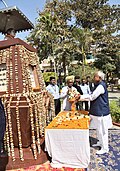
Kumar was born on 1 March 1951 in [[Bakhtiarpur]], Bihar. His father, Kaviraj Ram Lakhan Singh, was an [[Ayurveda|ayurvedic practitioner]]; his mother was Parmeshwari Devi.{{ | [[File:Nitish Kumar paying tribute to Manju Sinha.jpg|thumb|Nitish Kumar paying tribute to the statue his wife Manju Sinha.<ref>{{cite web|url=https://state.bihar.gov.in/main/cache/1/Smart%20City/Heartfelt%20tribute%20paid%20to%20late%20Manju%20Sinha%20on%20her%20birth%20anniversary/2.jpg|title=Nitish Kumar paying tribute to Manju Sinha|website=Government of Bihar|accessdate=1 April 2023|archive-date=1 April 2023|archive-url=https://web.archive.org/web/20230401171608/https://state.bihar.gov.in/main/cache/1/Smart%20City/Heartfelt%20tribute%20paid%20to%20late%20Manju%20Sinha%20on%20her%20birth%20anniversary/2.jpg|url-status=live}}</ref>]] | ||
Kumar was born on 1 March 1951 in [[Bakhtiarpur]], Bihar. His father, Kaviraj Ram Lakhan Singh, was an [[Ayurveda|ayurvedic practitioner]]; his mother was Parmeshwari Devi from [[Nepal]].<ref>{{cite web|url=https://www.jagranjosh.com/general-knowledge/nitish-kumar-1605036925-1|title=Biography of Nitish Kumar|website=jagranjosh|accessdate=5 July 2022|archive-date=5 July 2022|archive-url=https://web.archive.org/web/20220705191131/https://www.jagranjosh.com/general-knowledge/nitish-kumar-1605036925-1|url-status=live}}</ref> Nitish belongs to [[Kurmi]] agricultural caste.<ref>{{cite book|last=Kumar|first=Sanjay|title=Post mandal politics in Bihar:Changing electoral patterns|publisher=SAGE publication|isbn=978-93-528-0585-3|url=https://books.google.com/books?id=2zhODwAAQBAJ&pg=PA71|date=5 June 2018|access-date=16 September 2020|archive-date=5 July 2022|archive-url=https://web.archive.org/web/20220705191705/https://books.google.com/books?id=2zhODwAAQBAJ&pg=PA71|url-status=live}}</ref><ref name="bio">{{cite news |url=https://m.timesofindia.com/city/patna/cm-to-attend-nit-p-alumni-meet-on-feb-3/articleshow/67678893.cms |title=Chief Minister of Bihar |newspaper=The Times of India |date=24 January 2019 |publisher=Government of Bihar |access-date=29 January 2019 |archive-date=31 March 2022 |archive-url=https://web.archive.org/web/20220331223755/https://m.timesofindia.com/city/patna/cm-to-attend-nit-p-alumni-meet-on-feb-3/articleshow/67678893.cms |url-status=live }}</ref> His nickname is 'Munna'.<ref>{{cite web|url=https://www.ndtv.com/india-news/happy-birthday-nitish-kumar-10-interesting-facts-about-bihar-chief-minister-1818587|title=Nitish Kumar's Nickname Is 'Munna': 10 Facts About Bihar Chief Minister On His Birthday|access-date=4 September 2022|archive-date=4 September 2022|archive-url=https://web.archive.org/web/20220904091546/https://www.ndtv.com/india-news/happy-birthday-nitish-kumar-10-interesting-facts-about-bihar-chief-minister-1818587|url-status=live}}</ref><ref>{{cite web|url=https://www.ndtv.com/india-news/munna-se-nitish-in-poll-bound-bihar-a-comic-starring-the-chief-minister-774570|title='Munna Se Nitish': In Poll-Bound Bihar, a Comic Starring the Chief Minister|access-date=4 September 2022|archive-date=4 September 2022|archive-url=https://web.archive.org/web/20220904091552/https://www.ndtv.com/india-news/munna-se-nitish-in-poll-bound-bihar-a-comic-starring-the-chief-minister-774570|url-status=live}}</ref> | |||
He has earned a degree in Electrical Engineering <ref>{{Cite | He has earned a degree in Electrical Engineering <ref>{{Cite news|title=Nitish Kumar|newspaper=The Times of India |date=24 January 2019 |url=https://timesofindia.indiatimes.com/city/patna/cm-to-attend-nit-p-alumni-meet-on-feb-3/articleshow/67678893.cms|access-date=31 March 2022|archive-date=31 March 2022|archive-url=https://web.archive.org/web/20220331192319/https://timesofindia.indiatimes.com/city/patna/cm-to-attend-nit-p-alumni-meet-on-feb-3/articleshow/67678893.cms|url-status=live}}</ref> from Bihar College of Engineering (now [[NIT Patna]]) in 1972.<ref name="ht20150818"/> He joined the [[Bihar State Power Holding Company Limited|Bihar State Electricity Board]], half-heartedly, and later moved into politics.<ref>{{cite web|url=https://www.deccanherald.com/national/east-and-northeast/the-many-sides-of-sushasan-babu-1134772.html|title=The many sides of 'sushasan babu'|website=Deccan Herald|accessdate=16 April 2023|archive-date=10 August 2022|archive-url=https://web.archive.org/web/20220810024915/https://www.deccanherald.com/national/east-and-northeast/the-many-sides-of-sushasan-babu-1134772.html|url-status=live}}</ref><ref>{{cite news | url=http://timesofindia.indiatimes.com/home/sunday-toi/special-report/I-dream-of-the-old-glory-days-of-Bihar/articleshow/11323112.cms | work=The Times Of India | title=I dream of the old glory days of Bihar | date=1 January 2012 | access-date=21 October 2018 | archive-date=15 April 2019 | archive-url=https://web.archive.org/web/20190415131521/https://timesofindia.indiatimes.com/home/sunday-toi/special-report/I-dream-of-the-old-glory-days-of-Bihar/articleshow/11323112.cms | url-status=live }}</ref> He married Manju Kumari Sinha (1955-2007) on 22 February 1973 and the couple has one son.<ref name="bio"/> Manju Sinha died in New Delhi on 14 May 2007 due to pneumonia.<ref>{{Cite web |date=14 May 2007 |title=Nitish Kumar's wife passes away in Delhi |url=https://www.hindustantimes.com/india/nitish-kumar-s-wife-passes-away-in-delhi/story-W6jz9FvoNtuKkb772mo5zH.html |website=Hindustan Times |access-date=4 October 2020 |archive-date=7 October 2020 |archive-url=https://web.archive.org/web/20201007170437/https://www.hindustantimes.com/india/nitish-kumar-s-wife-passes-away-in-delhi/story-W6jz9FvoNtuKkb772mo5zH.html |url-status=live }}</ref> | ||
== | ==Political career== | ||
Kumar belongs to a [[socialist]] class of politicians. During his early years as a politician he was associated with [[Ram Manohar Lohia]], [[Satyendra Narayan Sinha|S. N. Sinha]], [[Karpuri Thakur]], and [[V. P. Singh]].<ref name="ht20150818">{{cite news | Kumar belongs to a [[socialist]] class of politicians. During his early years as a politician he was associated with [[Ram Manohar Lohia]], [[Satyendra Narayan Sinha|S. N. Sinha]], [[Karpuri Thakur]], and [[V. P. Singh]].<ref name="ht20150818">{{cite news | ||
|url= http://www.hindustantimes.com/india-news/bihar-elections-the-leaders-who-matter-the-most/article1-1378907.aspx | |url=http://www.hindustantimes.com/india-news/bihar-elections-the-leaders-who-matter-the-most/article1-1378907.aspx | ||
|title=Bihar leader-Mr. Nitish Kumar | |title=Bihar leader-Mr. Nitish Kumar | ||
|work=Hindustan Times | |work=Hindustan Times | ||
|date=18 August 2015 | |date=18 August 2015 | ||
|access-date=18 August 2015}}</ref><ref>{{cite web | |access-date=18 August 2015 | ||
|archive-date=17 August 2015 | |||
|archive-url=https://web.archive.org/web/20150817201004/http://www.hindustantimes.com/india-news/bihar-elections-the-leaders-who-matter-the-most/article1-1378907.aspx | |||
|url-status=dead | |||
}}</ref><ref>{{cite web | |||
|url=http://polityindia.com/index.php?option=com_content&view=article&id=192:a-politician-other-politicians-should-emulate-&catid=13:article&Itemid=61 | |url=http://polityindia.com/index.php?option=com_content&view=article&id=192:a-politician-other-politicians-should-emulate-&catid=13:article&Itemid=61 | ||
|title=A Politician other Politicians should Emulate! | |title=A Politician other Politicians should Emulate! | ||
|publisher=Polityindia.com | |publisher=Polityindia.com | ||
|date=18 January 2011 | |date=18 January 2011 | ||
|access-date=17 September 2012}}</ref> Kumar participated in Jayaprakash Narayan's movement between 1974 and 1977<ref>{{cite web|url=https://www.thehinducentre.com/the-arena/current-issues/article25188707.ece|title= Jayaprakash Narayan- His Journey & Movements|website=www.thehinducentre.com|access-date=12 November 2019}}</ref> and joined the Janata party headed by [[Satyendra Narayan Sinha|Satyendra Narain Sinha]].<ref>{{cite book|url=https:// | |access-date=17 September 2012 | ||
|archive-date=30 March 2012 | |||
|archive-url=https://web.archive.org/web/20120330154556/http://polityindia.com/index.php?option=com_content&view=article&id=192:a-politician-other-politicians-should-emulate-&catid=13:article&Itemid=61 | |||
|url-status=live | |||
}}</ref> Kumar participated in Jayaprakash Narayan's movement between 1974 and 1977<ref>{{cite web|url=https://www.thehinducentre.com/the-arena/current-issues/article25188707.ece|title=Jayaprakash Narayan- His Journey & Movements|website=www.thehinducentre.com|access-date=12 November 2019|archive-date=7 June 2020|archive-url=https://web.archive.org/web/20200607121135/https://www.thehinducentre.com/the-arena/current-issues/article25188707.ece|url-status=live}}</ref> and joined the Janata party headed by [[Satyendra Narayan Sinha|Satyendra Narain Sinha]].<ref>{{cite book |url=https://books.google.com/books?id=MEzIDAAAQBAJ&dq=Nitish+Kumar+joined+Janata+party&pg=PP4 |title=Nitish Kumar |first=A.K |last=Gandhi |date=January 0101 |publisher=Prabhat Prakashan |isbn=9788184304718 |access-date=4 August 2020 |archive-date=6 August 2022 |archive-url=https://web.archive.org/web/20220806221252/https://www.google.com/books/edition/Nitish_Kumar/MEzIDAAAQBAJ?hl=en&gbpv=1&dq=Nitish+Kumar+joined+Janata+party&pg=PP4&printsec=frontcover |url-status=live }}</ref> | |||
Kumar fought and first time won his election to the state assembly from [[Harnaut (Vidhan Sabha constituency)|Harnaut]] in 1985. In the initial years, Lalu Prasad Yadav was backed by Kumar as leader of the opposition in Bihar Assembly in the year 1989 but Kumar later switched his loyalty to BJP in 1996, after winning his first [[Lok Sabha]] seat from [[Barh]]. | Kumar fought and first time won his election to the state assembly from [[Harnaut (Vidhan Sabha constituency)|Harnaut]] in 1985. In the initial years, Lalu Prasad Yadav was backed by Kumar as leader of the opposition in Bihar Assembly in the year 1989 but Kumar later switched his loyalty to BJP in 1996, after winning his first [[Lok Sabha]] seat from [[Barh]].<ref name="TOI"/> | ||
The Janata Dal had survived the splits in past when leaders like Kumar and George Fernandes defected to form the [[Samata Party]] in 1994, but it remained a baseless party after the decision of Yadav to form [[Rashtriya Janata Dal]] in 1997. The second split took place prior to Rabri Devi assuming power which resulted in Janata Dal having only two leaders of any consequence in it, namely [[Sharad Yadav]] and [[Ram Vilas Paswan]]. Paswan was regarded as the rising leader of Dalits and had the credit of winning his elections with unprecedented margins. His popularity reached to the national level when he was awarded the post of Minister of Railways in the [[United Front (India)|United Front]] government in 1996 and was subsequently made the leader of Lok Sabha. His outreach was witnessed in the western [[Uttar Pradesh]] too, when his followers organised an impressive rally at the behest of a newly floated organisation called ''Dalit Panthers''.<ref>{{cite book|author1=Paranjoy Guha Thakurta|url=https://books.google.com/books?id=ur6GAwAAQBAJ&pg=PA296|title=Divided We Stand: India in a Time of Coalitions|author2=Shankar Raghuraman|publisher=SAGE Publications India|year=2007|isbn=978-8132101642|pages=296–297|access-date=18 December 2020}}</ref> | The [[Janata Dal]] had survived the splits in past when leaders like Kumar and [[George Fernandes]] defected to form the [[Samata Party]] in 1994, but it remained a baseless party after the decision of [[Lalu Prasad Yadav]] to form [[Rashtriya Janata Dal]] in 1997. The second split took place prior to [[Rabri Devi]] assuming power which resulted in Janata Dal having only two leaders of any consequence in it, namely [[Sharad Yadav]] and [[Ram Vilas Paswan]]. Paswan was regarded as the rising leader of Dalits and had the credit of winning his elections with unprecedented margins. His popularity reached to the national level when he was awarded the post of Minister of Railways in the [[United Front (India)|United Front]] government in 1996 and was subsequently made the leader of Lok Sabha. His outreach was witnessed in the western [[Uttar Pradesh]] too, when his followers organised an impressive rally at the behest of a newly floated organisation called ''Dalit Panthers''.<ref>{{cite book|author1=Paranjoy Guha Thakurta|url=https://books.google.com/books?id=ur6GAwAAQBAJ&pg=PA296|title=Divided We Stand: India in a Time of Coalitions|author2=Shankar Raghuraman|publisher=SAGE Publications India|year=2007|isbn=978-8132101642|pages=296–297|access-date=18 December 2020|archive-date=6 August 2022|archive-url=https://web.archive.org/web/20220806221252/https://books.google.com/books?id=ur6GAwAAQBAJ&pg=PA296|url-status=live}}</ref> | ||
Sharad Yadav was also a veteran socialist leader but without any massive support base. In the 1998 Parliamentary elections, the Samata Party and Janata Dal, which was in a much weaker position after the formation of [[Rashtriya Janata Dal|RJD]] ended up eating each other's vote base. This made Kumar merge both the parties to form [[Janata Dal (United)]].<ref>{{cite book|author1=M. Govinda Rao|url=https://books.google.com/books?id=0_bzCAAAQBAJ&pg=PT170|title=The Making of Miracles in Indian States: Andhra Pradesh, Bihar, and Gujarat|author2=Arvind Panagariya|publisher=Oxford University Press|year=2015|isbn=978-0190236649|page=170|access-date=18 December 2020}}</ref> | Sharad Yadav was also a veteran socialist leader but without any massive support base. In the 1998 Parliamentary elections, the [[Samata Party]] and Janata Dal, which was in a much weaker position after the formation of [[Rashtriya Janata Dal|RJD]] ended up eating each other's vote base. This made Kumar merge both the parties to form [[Janata Dal (United)]].<ref>{{cite book|author1=M. Govinda Rao|url=https://books.google.com/books?id=0_bzCAAAQBAJ&pg=PT170|title=The Making of Miracles in Indian States: Andhra Pradesh, Bihar, and Gujarat|author2=Arvind Panagariya|publisher=Oxford University Press|year=2015|isbn=978-0190236649|page=170|access-date=18 December 2020|archive-date=6 August 2022|archive-url=https://web.archive.org/web/20220806221252/https://books.google.com/books?id=0_bzCAAAQBAJ&pg=PT170|url-status=live}}</ref> | ||
In 1999 | In [[1999 Indian general election|1999 Lok Sabha elections]] Rashtriya Janata Dal received a setback at the hand of [[Bharatiya Janata Party|BJP]]+[[Janata Dal (United)|JD(U)]] combine. The new coalition emerged leading in 199 out of 324 assembly constituencies and it was widely believed that in the [[2000 Bihar Legislative Assembly election|forthcoming election to Bihar state assembly]], the Lalu-Rabri rule will come to an end. The RJD had fought the election in an alliance with the Congress but the coalition didn't work making state leadership of Congress believe that the maligned image of Lalu Prasad after his name was drawn in the [[Fodder Scam]] had eroded his support base. Consequently, Congress decided to fight the [[2000 Bihar Legislative Assembly election|2000 assembly elections]] alone.<ref name="Sanjay2"/> | ||
The RJD had to be satisfied with the communist parties as coalition partners but the seat-sharing conundrum in the camp of [[National Democratic Alliance]] made Kumar pull his Samta Party out of the Sharad Yadav and Ram Vilas Paswan faction of the Janata Dal. | The RJD had to be satisfied with the communist parties as coalition partners but the seat-sharing conundrum in the camp of [[National Democratic Alliance]] made Kumar pull his Samta Party out of the Sharad Yadav and Ram Vilas Paswan faction of the Janata Dal. | ||
Differences also arose between the BJP and Kumar as the latter wanted to be projected as the Chief Minister of Bihar but the former was not in favour. Even Paswan also wanted to be a [[Chief Minister|CM]] face. The Muslims and OBCs were too divided in their opinion. A section of Muslims, which included the poor communities like Pasmanda were of the view that | Differences also arose between the BJP and Kumar as the latter wanted to be projected as the Chief Minister of Bihar but the former was not in favour. Even Paswan also wanted to be a [[Chief Minister|CM]] face. The Muslims and OBCs were too divided in their opinion. A section of Muslims, which included the poor communities like Pasmanda were of the view that Yadav only strengthened upper Muslims like Shaikh, Sayyid and Pathans and they were in search of new options.<ref name="Sanjay2">{{cite book|author=Sanjay Kumar|title=Post-Mandal Politics in Bihar: Changing Electoral Patterns|publisher=SAGE publishing India|year=2018|isbn=978-9352805860|pages=85–86|chapter=Re-emergence of RJD: elections of 2000|access-date=19 December 2020|chapter-url=https://books.google.com/books?id=IVxODwAAQBAJ&pg=PT85|archive-date=6 August 2022|archive-url=https://web.archive.org/web/20220806221253/https://books.google.com/books?id=IVxODwAAQBAJ&pg=PT85|url-status=live}}</ref> | ||
Yadav also alienated other dominant backward castes like [[Koeri]] and [[Kurmi]] since his projection as the saviour of Muslims. It is argued by Sanjay Kumar that the belief that, "the dominant OBCs like the twin caste of Koeri-Kurmi will ask for share in power if he seeks their support while the Muslims will remain satisfied with the protection during communal riots only" made Yadav neglect them. Moreover, the divisions in both the camps made the political atmosphere in the state a charged one in which many parties were fighting against each other with no visible frontiers. JD(U) and BJP were fighting against each other on some of the seats and so was the Samta Party. The [[2000 Bihar Legislative Assembly election|result]] was a setback for the BJP, which in media campaigns was emerging with a massive victory. RJD emerged as the single largest party and with the political manoeuvring of Lalu Yadav, [[Rabri Devi]] was sworn in as the Chief Minister again.<ref>{{cite web|url=https://www.firstpost.com/india/rjd-silver-jubilee-high-and-low-points-the-bihar-party-went-through-in-the-last-25-years-9779821.html|website=Firstpost|title=RJD silver jubilee: High and low points the Bihar party went through in last 25 years|date=5 July 2021|access-date=4 September 2022|archive-date=4 September 2022|archive-url=https://web.archive.org/web/20220904090224/https://www.firstpost.com/india/rjd-silver-jubilee-high-and-low-points-the-bihar-party-went-through-in-the-last-25-years-9779821.html|url-status=live}}</ref> The media largely failed to gauge the ground level polarisation in Bihar.<ref name="Sanjay2" /> According to Sanjay Kumar: | |||
{{Blockquote|there can be no doubt about one thing that the upper-caste media was always anti-Lalu and it was either not aware of the ground level polarisation in Bihar, or deliberately ignored it. If the election result did not appear as a setback for RJD, it was largely because of the bleak picture painted by the media. Against this background, RJD's defeat had appeared like a victory.<ref name="Sanjay">{{cite book|chapter-url=https://books.google.com/books?id=IVxODwAAQBAJ&pg=PT85|title=Post-Mandal Politics in Bihar: Changing Electoral Patterns|chapter=Re-emergence of RJD: elections of 2000|author=Sanjay Kumar|publisher=SAGE publishing India|year=2018|isbn=978-9352805860|pages=85–86|access-date=19 December 2020|archive-date=6 August 2022|archive-url=https://web.archive.org/web/20220806221253/https://books.google.com/books?id=IVxODwAAQBAJ&pg=PT85|url-status=live}}</ref>}} Even after serving imprisonment in connection with the 1997 scam, Lalu seemed to relish his role as the lower-caste jester. He argued that corruption charges against him and his family were the conspiracy of the upper-caste bureaucracy and media elites threatened by the rise of peasant cultivator castes. | |||
In [[2004 Indian general election|2004 General elections]], Lalu's RJD had outperformed other state-based parties by winning 26 Lok Sabha seats in Bihar. He was awarded the post of [[Minister of Railways (India)|Union Railway minister]] but the rising aspirations of the extremely backward castes unleashed by him resulted in JD(U) and BJP led coalition to defeat his party in [[October 2005 Bihar Legislative Assembly election|2005 Bihar Assembly elections]].<ref name=":0">{{cite book|author=Jason A. Kirk|url=https://books.google.com/books?id=07ONmXvnb2oC&pg=PA129|title=India and the World Bank: The Politics of Aid and Influence|publisher=Anthem Press|year=2010|isbn=978-0857289513|page=129|access-date=20 December 2020|archive-date=6 August 2022|archive-url=https://web.archive.org/web/20220806221253/https://books.google.com/books?id=07ONmXvnb2oC&pg=PA129|url-status=live}}</ref> | |||
===Kumar as Union Minister=== | |||
[[File:The Union Minister for Railways Shri Nitish Kumar entering Parliament to present Interim Railway Budget (2004-05) in New Delhi on January 30, 2004.jpg|thumb| [[Ministry of Railways (India)|Union Minister for Railways]] Shri Nitish Kumar entering Parliament to present Interim Railway Budget (2004-05) in New Delhi on 30 January 2004]] | |||
Nitish was briefly, the [[Ministry of Railways (India)|Union Minister for Railways]] and Minister for Surface Transport and later, the [[Ministry of Agriculture (India)|Minister for Agriculture]] in 1998–99, in the NDA government of [[Atal Bihari Vajpayee]]. In August 1999, he resigned following the [[Gaisal train disaster]], for which he took responsibility as a minister.<ref>{{cite web|url=https://zeenews.india.com/bihar/know-how-many-times-nitish-kumar-resigned-from-govt-in-past-2027323.html|title=Know how many times Nitish Kumar resigned from govt in past|website=Zee News|accessdate=16 July 2022|archive-date=16 July 2022|archive-url=https://web.archive.org/web/20220716213142/https://zeenews.india.com/bihar/know-how-many-times-nitish-kumar-resigned-from-govt-in-past-2027323.html|url-status=live}}</ref> However, in his short stint as Railway Minister, he brought in widespread reforms, such as internet ticket booking facility in 2002,<ref>[http://www.thehindu.com/2002/08/04/stories/2002080401231000.htm Railway online booking through credit cards]{{dead link|date=April 2021|bot=medic}}{{cbignore|bot=medic}}</ref><ref>{{Cite web |url=http://www.outlookindia.com/newswire/story/railway-reservation-through-internet/73655 |title=Railway Reservation through internet |access-date=25 April 2017 |archive-date=26 April 2017 |archive-url=https://web.archive.org/web/20170426151416/http://www.outlookindia.com/newswire/story/railway-reservation-through-internet/73655 |url-status=live }}</ref> opening a record number of railway ticket booking counters and introducing the [[tatkal scheme]] for instant booking. | |||
Later that year, he rejoined the Union Cabinet as Minister for Agriculture. From 2001 to May 2004, he was – again – the Union Minister for Railways.<ref>{{cite web|url=https://www.livehindustan.com/bihar/story-political-journey-of-nitish-kumar-6th-time-becomes-chief-minister-of-bihar-1204747.html|title=राजनीतिक सफर: बिहार के CM नीतीश कुमार के बारे में जानिए सब कुछ|website=livehindustan.com|accessdate=17 March 2023|archive-date=17 March 2023|archive-url=https://web.archive.org/web/20230317050556/https://www.livehindustan.com/bihar/story-political-journey-of-nitish-kumar-6th-time-becomes-chief-minister-of-bihar-1204747.html|url-status=live}}</ref> In the 2004 Lok Sabha elections, he contested elections from two places, when he was elected from [[Nalanda]] but lost from his traditional constituency, [[Barh]].<ref>{{cite web |url=http://www.rediff.com/election/2004/may/13nitish.htm |title=Nitish Kumar voted out of Barh, wins in Nalanda |work=rediff.com |date=13 May 2004 |access-date=23 December 2012 |archive-date=21 February 2014 |archive-url=https://web.archive.org/web/20140221170834/http://www.rediff.com/election/2004/may/13nitish.htm |url-status=live }}</ref> | |||
==Administration== | |||
===Law and order reform=== | |||
One of the biggest challenge before Kumar after becoming [[Chief Minister]], during his first term, was deteriorated law and order situation of the state. There were many organised criminal gangs active in the state and [[kidnapping]] was considered as the biggest criminal activity. Besides this, the challenge of [[Naxalite–Maoist insurgency|left wing extremism]] in some of the backward areas of the state was also persisting for a long time. Kumar brought the [[Arms Act, 1959|Arms Act]], and special courts were set up to expedite the process of conviction of those held under this act. Bringing of the Arms Act and stringent implementation brought two way benefits for the Government; first, it became easy for the police to arrest a criminal and second, the use of lethal weapons became prohibited.<ref name="Singh Santosh">{{cite book|url=https://books.google.com/books?id=SVu8CgAAQBAJ&pg=PT239|pages=239–241|last=Singh|first=Santosh|year=2015|title=Ruled Or Misruled: Story and Destiny of Bihar|place=India|publisher=[[Bloomsbury Publishing]]|isbn=9789385436420|access-date=14 March 2023|archive-date=16 April 2023|archive-url=https://web.archive.org/web/20230416110120/https://books.google.com/books?id=SVu8CgAAQBAJ&pg=PT239|url-status=live}}</ref> | |||
Kumar also recruited the retired [[Indian Army|army officials]] and soldiers to create a special wing of Police called Special Auxiliary Police (SAP), in order to deal with the [[Naxalite–Maoist insurgency|Maoist challenge]] in the state. It brought some kind of economic engagement for the retired military personnels, and at the same time, made available professionally trained [[commando]]s for the [[Bihar Police]] at low budgetry expense. These commandos were better than the [[police constable]]s recruited by the state, in order to deal with the extremists. They just needed special category of weapons, which was provided by the state under Kumar. The retired [[intelligence officer]]s were also recruited to form a investigation department, called "Special Vigilance Unit" (SVU). This body dealt with the offences at the level of high level government officials. For acquisition of property of the accused during trial, ''Bihar Special Court Act 2009'' was brought, which became effective since 2010. The SVU remained a successful idea in dealing with corruption at the higher level of [[bureaucracy]]. One of the first case before it was the trial of former [[Director General of Police]], Narayan Mishra, who was held for several corruption charges against him.<ref name="Singh Santosh"/> | |||
In order to recruit only the qualified candidates in the state Police, the reform in recruitment examination was also brought. Kumar introduced the "Carbon Copy system" in the written examination, which was to be held to recruit the new entrants. In order to prevent tampering of the examination copy, the original copy marked by the candidate was sent directly to the strong room after the examination. The evaluators used to get only the Carbon Copy, and in case of any discrepancy, the original copy was matched with the Carbon Copy evaluated by the evaluators. Further, a permanent recruitment examination was also made compulsory and the physical examination was made qualifying in determining merit, for selection to [[constabulary]]. In the tenure of Chief Ministers prior to Kumar, only physical examination was deciding factor in selecting the constables. This system was prone to [[corruption]] and [[Cronyism|favoritism]].<ref name="Singh Santosh"/> | |||
The push to the [[speedy trial]] under Kumar's government brought results within a short period of time, and in 2006 itself, a total of 6,839 offenders were convicted. There witnessed a massive drop in cases registered under the Arms act in the forthcoming terms of Kumar as the Chief Minister. It declined to just 495 by the end of 2010 from 1609 in 2006. According to one opinion, the massive decline was a result of fleeing of many criminals from the state, in order to seek refuse in the [[terai]] region of [[Nepal]] as well as eschewing of crime by others to become [[good samaritan]]s.<ref>{{cite book|url=https://books.google.com/books?id=rT2xWp_iTCYC&pg=PA240|page=|last=Sinha|first=Arun|year=2011|title=Nitish Kumar and the Rise of Bihar|place=India|publisher=Viking|isbn=9780670084593|access-date=14 March 2023|archive-date=16 April 2023|archive-url=https://web.archive.org/web/20230416110127/https://books.google.com/books?id=rT2xWp_iTCYC&pg=PA240|url-status=live}}</ref> | |||
{{ | [[File:Nitish Kumar and Tejaswi Yadav inaugurating Bihar Police office.jpg|thumb|Nitish Kumar and Tejaswi Yadav inaugurating the office building of Bihar Police in 2023.]] | ||
Kumar's government also took step to empower the [[District Magistrate]] to apprehend the officials taking bribe in order to reduce corruption. One of the major problem of the prison system of Bihar was laxity available to criminals to operate cell phones from the jail. Many a times, organised crime were planned from within the premise of Bihar's prison. The government took step to fix [[Mobile phone jammer]]s in jails, to prohibit the gangsters from operating cell phones. Bihar also actively enforced the All India Prison reforms program, outlined by [[Supreme Court of India]] in a judgement, in order to reform the entire operating system of jails. It included reducing the number of inmates to be included in a particular prison, a step, which was necessary to prevent the overcrowding.<ref>{{cite book|url=https://books.google.com/books?id=0_bzCAAAQBAJ&pg=PT178|pages=178–180|last=Rao|first=M G|year=2015|title=The Making of Miracles in Indian States: Andhra Pradesh, Bihar, and Gujarat|place=United States|publisher=[[Oxford University Press]]|isbn=978-0-19-023664-9|access-date=14 March 2023|archive-date=8 April 2023|archive-url=https://web.archive.org/web/20230408074122/https://books.google.com/books?id=0_bzCAAAQBAJ&pg=PT178|url-status=live}}</ref> | |||
In order to break the link of the prisoners with the jail authorities, Kumar's government took step like periodically transferring the dreaded criminals, who were convicted in large number of criminal cases from one prison to more secure cells located in [[Bhagalpur]] and [[Beur Central Jail|Beur]]. One of the significant example of this include, the transfer of Ajay Kanu, a [[naxalite]], who was prime accused in "[[2005 Jahanabad prison attack|2005 Jahanabad Jail Break case]]", to Beur Jail. In 2022, gangsters like [[Rakesh Mahto]], who was leader of crime syndicate being organised from [[Muzaffarpur]], was also transferred from Muzaffarpur to Bhagalpur Jail, in a high security [[Prison cell]].<ref>{{cite web|url=https://www.jagran.com/bihar/bhagalpur-jehanabad-jailbreak-case-mastermind-hardcore-naxalite-ajay-kanu-now-in-patna-beur-jail-sent-secretly-from-bhagalpur-22774634.html|title=जहानाबाद जेलब्रेक कांड : मास्टरमाइंड हार्डकोर नक्सली अजय कानू अब पटना बेऊर जेल में, भागलपुर से गोपनीय तरीके से भेजा|website=Dainik Jagaran|accessdate=13 March 2023|archive-date=13 March 2023|archive-url=https://web.archive.org/web/20230313175807/https://www.jagran.com/bihar/bhagalpur-jehanabad-jailbreak-case-mastermind-hardcore-naxalite-ajay-kanu-now-in-patna-beur-jail-sent-secretly-from-bhagalpur-22774634.html|url-status=live}}</ref> Other example, which is part of this routine procedure is of [[Rashtriya Janata Dal]] Member of [[Bihar Legislative Council]], [[Ritlal Yadav]], who had numerous cases of [[extortion]] and murder against him.<ref>{{cite web|url=https://www.telegraphindia.com/bihar/shift-order-for-44-beur-jail-inmates/cid/1310903|title=Shift order for 44 Beur jail inmates|website=The Telegraph|accessdate=13 March 2023|archive-date=13 March 2023|archive-url=https://web.archive.org/web/20230313181012/https://www.telegraphindia.com/bihar/shift-order-for-44-beur-jail-inmates/cid/1310903|url-status=live}}</ref> | |||
== | ===Consolidation of Extremely Backward Castes=== | ||
[[ | Kumar had dual challenge of keeping his core political base of [[Koeri]]s, [[Kurmi]]s and Extremely Backward Castes together with a section of upper castes. The [[National Democratic Alliance]], of which Kumar's party was a part, was relying upon the support of a section of upper caste. The share of this section in the political power structure was making it difficult for Kumar to carry on his program of [[social justice]], specially with respect to consolidation of 'Extremely Backward Castes' (EBC). This group comprised the lower backwards– the castes other than the Koeri, Kurmi, Yadav and Bania. Kumar's government brought the idea of 50% reservation for the women in the [[Panchayati raj in India|Panchayati Raj]] institutions at all level. This plan also included 20% reservation in these bodies for the members of Extremely Backward Castes. These quotas, which were given separately to already existing quotas for [[Schedule Caste]]s and [[Schedule Tribe]]s in local bodies, led to political consolidation of Extremely Backward Castes.<ref name=Sammdar>{{cite book|isbn=131712538X|title=Government of Peace Social Governance Security and the Problematic of Peace|url=https://books.google.com/books?id=Ew2rCwAAQBAJ&pg=PA197|publisher=Taylor & Francis|language=English|editor=Ranabir Samaddar|pages=197–198|access-date=11 April 2023|archive-date=11 April 2023|archive-url=https://web.archive.org/web/20230411184709/https://books.google.co.in/books?id=Ew2rCwAAQBAJ&pg=PA197&dq=|url-status=live}}</ref> | ||
The reservation to this section of society brought a massive increase in their representation in the three tier Panchayati Raj system. There were many representatives of the EBCs for the post of [[Mukhi]]ya, Pramukhs of Panchayat Samiti as well as President of [[District council (India)|Zila Parishad]]. The membership of this social group in Panchyat Samiti and Zila Parishad also increased.<ref name=Sammdar/> Kumar's government also announced a scheme of 50% reservation in state judicial services, within this, the EBCs were given 21% share as against the Other Backward Class, which was given 12% share. The Schedule Castes were also given 16% share of this 50% reservation pie. The step was intended to bring more and more candidates from these social groups in lower judiciary.<ref>{{cite web|url=https://www.indiatoday.in/india/story/nitish-cabinet-declares-50-per-cent-reservation-in-bihar-judicial-services-359840-2016-12-27|title=Nitish cabinet declares 50 per cent reservation in Bihar judicial services|website=India Today|accessdate=12 April 2023|archive-date=12 April 2023|archive-url=https://web.archive.org/web/20230412210734/https://www.indiatoday.in/india/story/nitish-cabinet-declares-50-per-cent-reservation-in-bihar-judicial-services-359840-2016-12-27|url-status=live}}</ref> | |||
==Chief Minister of Bihar== | ==Tenure as Chief Minister of Bihar== | ||
[[ | Kumar is a member of the [[Janata Dal (United)]] political party. As the chief minister, he appointed more than 100,000 school teachers, ensured that doctors worked in primary health centres, electrified many villages,<ref name="sify1">{{cite news | ||
Nitish Kumar and | |url=http://sify.com/news/fullstory.php?a=jfbn4Ebeibj&title=Nitish_Kumar_s_development_agenda_makes_waves_in_Bihar&?vsv=TopHP3 | ||
|archive-url=https://web.archive.org/web/20150524065254/http://www.sify.com/news/fullstory.php?a=jfbn4Ebeibj&title=Nitish_Kumar_s_development_agenda_makes_waves_in_Bihar&%3fvsv=TopHP3 | |||
|url-status=dead | |||
|archive-date=24 May 2015 | |||
|title=Nitish Kumar's development agenda makes waves in Bihar | |||
|date=1 May 2009|department=Lok Sabha Elections 2009 | |||
|work=Sify News | |||
|access-date=26 May 2009}}</ref> paved roads, cut female illiteracy by half, turned around a lawless state by cracking down on criminals and doubled the income of the average Bihari.<ref>{{cite web|last1=Antholis|first1=William|title=New Players on the World Stage: Chinese Provinces and Indian States|url=http://www.brookings.edu/research/essays/2013/new-players-on-the-world-stage#section4|publisher=Brookings Institution|date=22 October 2013|access-date=12 November 2015|archive-date=13 January 2016|archive-url=https://web.archive.org/web/20160113190312/http://www.brookings.edu/research/essays/2013/new-players-on-the-world-stage#section4|url-status=live}}</ref> | |||
=== First term ( | === First term (2000) === | ||
In March 2000, Nitish was elected [[Chief Minister of Bihar]] for the first time at the behest of the Vajpayee Government in the centre. NDA and allies had 151 MLAs whereas Lalu Prasad Yadav had 159 MLAs in the 324 member house. Both alliances were less than the majority mark that is 163. Nitish resigned before he could prove his numbers in the house.<ref>{{Cite web |last=Kumar |first=Abhay |date=2019 | In March 2000, Nitish was elected [[Chief Minister of Bihar]] for the first time at the behest of the Vajpayee Government in the centre.<ref>{{Cite web |title=From the archives (2000) {{!}} When Nitish Kumar became Bihar CM for first time |url=https://www.indiatoday.in/india-today-insight/story/from-the-archives-2000-when-nitish-kumar-became-bihar-cm-for-first-time-1985894-2022-08-09 |access-date=2022-10-07 |website=India Today |language=en |archive-date=4 September 2022 |archive-url=https://web.archive.org/web/20220904085537/https://www.indiatoday.in/india-today-insight/story/from-the-archives-2000-when-nitish-kumar-became-bihar-cm-for-first-time-1985894-2022-08-09 |url-status=live }}</ref> NDA and allies had 151 MLAs whereas Lalu Prasad Yadav had 159 MLAs in the 324 member house. Both alliances were less than the majority mark that is 163. Nitish resigned before he could prove his numbers in the house.<ref>{{Cite web |last=Kumar |first=Abhay |date=24 November 2019 |title=March 2000: When Nitish quit as CM, before floor test |url=https://www.deccanherald.com/national/national-politics/march-2000-when-nitish-quit-as-cm-before-floor-test-779422.html |access-date=29 March 2022 |website=Deccan Herald |language=en |archive-date=7 April 2020 |archive-url=https://web.archive.org/web/20200407134118/https://www.deccanherald.com/national/national-politics/march-2000-when-nitish-quit-as-cm-before-floor-test-779422.html |url-status=live }}</ref><ref>{{Cite web |url=https://www.indiatoday.in/magazine/nation/story/20000320-nitish-kumars-government-in-bihar-not-outvoted-as-much-as-outmanoeuvred-by-laloo-yadav-777236-2000-03-20 |title=Outvoted as much as outmanoeuvred by Laloo Yadav |access-date=7 April 2020 |archive-date=7 April 2020 |archive-url=https://web.archive.org/web/20200407134118/https://www.indiatoday.in/magazine/nation/story/20000320-nitish-kumars-government-in-bihar-not-outvoted-as-much-as-outmanoeuvred-by-laloo-yadav-777236-2000-03-20 |url-status=live }}</ref> He lasted 7 days in the post.<ref>{{cite news |url=https://www.thehindu.com/news/national/other-states/nitish-kumars-swinging-affections-for-bjp-and-rjd/article65751235.ece |title=Nitish Kumar's wavering affections for BJP and RJD |newspaper=The Hindu |date=9 August 2022 |last1=Nair |first1=Sobhana K. |access-date=4 September 2022 |archive-date=4 September 2022 |archive-url=https://web.archive.org/web/20220904090016/https://www.thehindu.com/news/national/other-states/nitish-kumars-swinging-affections-for-bjp-and-rjd/article65751235.ece |url-status=live }}</ref> | ||
=== Second term (2005–2010) === | === Second term (2005–2010) === | ||
[[File:The Chief Minister of Bihar, Shri Nitish Kumar discussing with the Prime Minister, Dr. Manmohan Singh about the relief operations on flood-affected areas, in Bihar, August 28, 2008.jpg|thumb| | |||
Nitish Kumar and [[Lalu Prasad Yadav]] discussing with the Prime Minister, [[Manmohan Singh]] about the relief operations on flood-affected areas, in Bihar, 28 August 2008.]] | |||
After victory in [[October 2005 Bihar Legislative Assembly election|2005 Bihar Assembly elections]], Kumar a leader of OBC [[Kurmi]] caste was sworn in as the chief minister. During Lalu's time, backward caste candidates came to dominate the Bihar assembly claiming half of the seats in it and it was the aspiration of this powerful social community that led to friction among the united backwards, leading to the rise of Kumar who made both social justice and development as his political theme.<ref name=":0" /> | After victory in [[October 2005 Bihar Legislative Assembly election|2005 Bihar Assembly elections]], Kumar a leader of OBC [[Kurmi]] caste was sworn in as the chief minister. During Lalu's time, backward caste candidates came to dominate the Bihar assembly claiming half of the seats in it and it was the aspiration of this powerful social community that led to friction among the united backwards, leading to the rise of Kumar who made both social justice and development as his political theme.<ref name=":0" /> | ||
=== Third term (2010–2014) === | === Third term (2010–2014) === | ||
Kumar's government also initiated bicycle and meal programs. | Kumar's government also initiated bicycle and meal programs. Giving bicycles to girls who stayed in school resulted in the state getting a huge number of girls into schools and a reduction in school dropout rates.<ref>{{cite news | url=https://www.economist.com/blogs/asiaview/2010/11/indias_poorest_state%26fsrc%3Dnwl | newspaper=The Economist | title=A triumph in Bihar | date=25 November 2010 | access-date=13 July 2017 | archive-date=4 March 2016 | archive-url=https://web.archive.org/web/20160304041612/http://www.economist.com/blogs/asiaview/2010/11/indias_poorest_state%26fsrc%3Dnwl | url-status=live }}</ref> | ||
In 2010, Kumar's party swept back to power along with its then allies, the [[Bharatiya Janata Party]], and he again became Chief Minister.{{ | In 2010, Kumar's party swept back to power along with its then allies, the [[Bharatiya Janata Party]], and he again became Chief Minister.<ref name="TOI">{{cite news|url=https://timesofindia.indiatimes.com/city/patna/nitish-kumars-political-journey-from-a-socialist-leader-to-saffron-ally/articleshow/79158616.cms|title=Nitish Kumar's political journey: From a socialist leader to saffron ally|website=Times of India|date=12 November 2020 |accessdate=16 July 2022|archive-date=16 July 2022|archive-url=https://web.archive.org/web/20220716214026/https://timesofindia.indiatimes.com/city/patna/nitish-kumars-political-journey-from-a-socialist-leader-to-saffron-ally/articleshow/79158616.cms|url-status=live}}</ref> The alliance won 206 seats, while the RJD won 22.<ref>{{cite news |date=25 November 2010 |title=Nitish sweeps Bihar polls; Cong crushed, Lalu eclipsed |work=The Times of India |url=http://articles.timesofindia.indiatimes.com/2010-11-25/india/28213318_1_nitish-kumar-bihar-hands-bihar-assembly-elections |url-status=dead |archive-url=https://web.archive.org/web/20130714235847/http://articles.timesofindia.indiatimes.com/2010-11-25/india/28213318_1_nitish-kumar-bihar-hands-bihar-assembly-elections |archive-date=14 July 2013}}</ref> For the first time, electorates witnessed high turnout of women and young voters, while this was declared as the fairest election in Bihar, with no bloodshed or poll violence.<ref>{{cite web |date=24 November 2010 |title=A landslide sweep for JD(U)-BJP combine in Bihar |url=http://indiatoday.intoday.in/story/a-landslide-sweep-for-jdubjp-combine-in-bihar/1/121031.html |access-date=17 September 2012 |publisher=India Today |archive-date=19 July 2012 |archive-url=https://web.archive.org/web/20120719053039/http://indiatoday.intoday.in/story/a-landslide-sweep-for-jdubjp-combine-in-bihar/1/121031.html |url-status=live }}</ref> | ||
====Resignation==== | ====Resignation==== | ||
On 17 May 2014, Kumar submitted his resignation to the [[Governor of Bihar]], a day after his party fared poorly in the 2014 Lok Sabha elections, winning just 2 seats against 20 seats in the previous election. | On 17 May 2014, Kumar submitted his resignation to the [[Governor of Bihar]], a day after his party fared poorly in the 2014 Lok Sabha elections, winning just 2 seats against 20 seats in the previous election.<ref name="TOI"/> Kumar resigned, taking the moral responsibility of his party's poor performance in the election, and [[Jitan Ram Manjhi]] took over.<ref name="bp">{{cite web|title=Nitish Kumar resigns as the Chief Minister of Bihar|url=http://news.biharprabha.com/2014/05/nitish-kumar-resigns-as-the-chief-minister-of-bihar/|work=IANS|publisher=news.biharprabha.com|access-date=17 May 2014|archive-date=17 May 2014|archive-url=https://web.archive.org/web/20140517161946/http://news.biharprabha.com/2014/05/nitish-kumar-resigns-as-the-chief-minister-of-bihar/|url-status=live}}</ref> | ||
=== Fourth term (2015 - 2020) === | === Fourth term (2015 - 2020) === | ||
{{external media| video1 =[https://youtube.com/watch?v=fRqFLycqiU0 Fir se ek bar ho Bihar me Bahar ho, fir se ek bar ho Nitishe Kumar ho] Offical song of Nitish Kumar's election campaign for 2015 Bihar Assembly elections. }} | |||
Kumar again became Chief Minister on 22 February 2015, | Kumar again became Chief Minister on 22 February 2015, on the backdrop of upcoming [[2015 Bihar Legislative Assembly election]], considered to be his toughest election to date.<ref>{{cite web|url=http://scroll.in/article/745887/frenemies-nitish-kumar-and-lalu-yadav-finally-reach-breakthrough-in-seat-sharing-talks|title=Frenemies Nitish Kumar and Lalu Yadav finally reach breakthrough in seat-sharing talks|access-date=3 August 2015|archive-date=6 August 2015|archive-url=https://web.archive.org/web/20150806001342/http://scroll.in/article/745887/frenemies-nitish-kumar-and-lalu-yadav-finally-reach-breakthrough-in-seat-sharing-talks|url-status=live}}</ref><ref>{{cite web|url=http://www.huffingtonpost.in/nitish-kumar-/bihar-elections-2015-impa_b_7917778.html|title=Why The Upcoming Election In Bihar Is Critical For The State And Beyond|access-date=3 August 2015|archive-date=5 August 2015|archive-url=https://web.archive.org/web/20150805012447/http://www.huffingtonpost.in/nitish-kumar-/bihar-elections-2015-impa_b_7917778.html|url-status=live}}</ref> His JD(U), along with RJD and Congress, formed the Mahagathbandhan (Grand Alliance) to counter the BJP in Bihar.<ref>{{cite news| url=http://www.abplive.in/india/2015/02/22/article508925.ece/My-priority-is-to-work-for-Bihars-development-Nitish-Kumar| work=ABP News| title=Nitish Kumar returns as Bihar CM| url-status=dead| archive-url=https://web.archive.org/web/20150223084835/http://www.abplive.in/india/2015/02/22/article508925.ece/My-priority-is-to-work-for-Bihars-development-Nitish-Kumar| archive-date=23 February 2015| df=dmy-all}}</ref> | ||
Kumar campaigned aggressively during the elections for the Grand Alliance, countering the allegations raised by Narendra Modi and the BJP.<ref>{{cite news|last1=Sajjad|first1=Mohammad|title=How Nitish Kumar and Lalu Yadav won Bihar|url=http://www.rediff.com/news/column/how-nitish-kumar-and-lalu-yadav-won-bihar/20151108.htm|access-date=9 November 2015|work=rediff.com|date=8 November 2015}}</ref> The Grand Alliance won the Assembly election by a margin of 178 over the BJP and its allies, | Kumar campaigned aggressively during the elections for the Grand Alliance, countering the allegations raised by Narendra Modi and the BJP.<ref>{{cite news|last1=Sajjad|first1=Mohammad|title=How Nitish Kumar and Lalu Yadav won Bihar|url=http://www.rediff.com/news/column/how-nitish-kumar-and-lalu-yadav-won-bihar/20151108.htm|access-date=9 November 2015|work=rediff.com|date=8 November 2015|archive-date=9 November 2015|archive-url=https://web.archive.org/web/20151109033835/http://www.rediff.com/news/column/how-nitish-kumar-and-lalu-yadav-won-bihar/20151108.htm|url-status=live}}</ref> The Grand Alliance won the Assembly election by a margin of 178 over the BJP and its allies, with RJD emerging as the largest party with 80 seats and JD(U) placed second with 71.<ref>{{cite web|url=http://indiatoday.intoday.in/story/nitish-kumar-wont-contest-polls-will-devote-time-for-campaigning-rabri-devi/1/455939.html|title=Won't contest Bihar polls, will devote time for campaigning, says Nitish Kumar|access-date=3 August 2015|archive-date=8 August 2015|archive-url=https://web.archive.org/web/20150808234934/http://indiatoday.intoday.in/story/nitish-kumar-wont-contest-polls-will-devote-time-for-campaigning-rabri-devi/1/455939.html|url-status=live}}</ref><ref>{{cite web|url=http://economictimes.indiatimes.com/news/politics-and-nation/wont-contest-bihar-elections-nitish-kumar/articleshow/48329857.cms|title=Won't contest Bihar elections: Nitish Kumar|access-date=3 August 2015|archive-date=6 August 2015|archive-url=https://web.archive.org/web/20150806022358/http://economictimes.indiatimes.com/news/politics-and-nation/wont-contest-bihar-elections-nitish-kumar/articleshow/48329857.cms|url-status=live}}</ref> Kumar was sworn in as Chief Minister on 20 November 2015 for a record fifth time and Tejashwi Yadav became [[Deputy Chief Minister of Bihar]].<ref name="TOI"/> | ||
Kumar's campaign was managed by the Indian Political Action Committee (I-PAC) who were hired to managed the campaign for JD(U).<ref>{{Cite news|url=https://www.news18.com/news/politics/how-ipac-made-it-click-for-nitish-kumar-in-bihar-1162279.html|title=How IPAC made it click for Nitish Kumar in Bihar|work=News18|access-date=2018- | Kumar's campaign was managed by the Indian Political Action Committee (I-PAC) who were hired to managed the campaign for JD(U).<ref>{{Cite news|url=https://www.news18.com/news/politics/how-ipac-made-it-click-for-nitish-kumar-in-bihar-1162279.html|title=How IPAC made it click for Nitish Kumar in Bihar|work=News18|access-date=29 September 2018|archive-date=29 September 2018|archive-url=https://web.archive.org/web/20180929155935/https://www.news18.com/news/politics/how-ipac-made-it-click-for-nitish-kumar-in-bihar-1162279.html|url-status=live}}</ref> I-PAC designed the campaign strategy which included reaching out to a larger set of voters through innovative campaigns, including sending hundreds of branded cycles for outreach,<ref>{{Cite news|url=https://www.thequint.com/news/politics/how-prashant-kishors-team-swung-the-elections-for-nitish-kumar|title=How Prashant Kishor's Team Swung the Elections for Nitish Kumar|work=The Quint|access-date=29 September 2018|language=en|archive-date=29 September 2018|archive-url=https://web.archive.org/web/20180929155655/https://www.thequint.com/news/politics/how-prashant-kishors-team-swung-the-elections-for-nitish-kumar|url-status=live}}</ref> Har Ghar Dastak (door-to-door outreach)<ref>{{Cite news|url=https://indianexpress.com/article/india/india-others/sunday-story-the-leader-and-his-machine/|title=Sunday Story: The Leader and his machine|date=5 July 2015|work=The Indian Express|access-date=29 September 2018|language=en-US|archive-date=29 September 2018|archive-url=https://web.archive.org/web/20180929210039/https://indianexpress.com/article/india/india-others/sunday-story-the-leader-and-his-machine/|url-status=live}}</ref> and the DNA campaign.<ref>{{Cite news |last=Murty |first=B Vijay |date=8 November 2015 |title=Prashant Kishor: Man behind Modi LS campaign crafts Nitish win |language=en |work=Hindustan Times |url=https://www.hindustantimes.com/india/prashant-kishor-man-behind-modi-ls-campaign-crafts-nitish-win/story-fgqyNqnz6MSVwerb86OHdJ.html |access-date=29 September 2018 |archive-date=29 September 2018 |archive-url=https://web.archive.org/web/20180929155634/https://www.hindustantimes.com/india/prashant-kishor-man-behind-modi-ls-campaign-crafts-nitish-win/story-fgqyNqnz6MSVwerb86OHdJ.html |url-status=live }}</ref> | ||
====Mahagathbandhan breakup==== | ====Mahagathbandhan breakup==== | ||
[[File:The Prime Minister, Shri Narendra Modi visiting the Bihar Museum, in Patna on October 14, 2017. The Chief Minister of Bihar, Shri Nitish Kumar is also seen.jpg|thumb|Chief Minister of Bihar Nitish Kumar with Prime Minister [[Narendra Modi]] in 2017.]] | |||
When corruption charges were levelled against [[Tejashwi Yadav]], the Deputy Chief Minister, Kumar asked for him to resign from the cabinet. The [[Rashtriya Janata Dal]] refused to do so, and therefore Kumar resigned on 26 July 2017, thus ending the Grand Alliance.<ref name="TOI"/> He joined the principal opposition, the NDA, and came back to power within a few hours.<ref>{{Cite news|url=http://indianexpress.com/article/india/nitish-kumar-resigns-as-bihar-chief-minister-tejashwi-yadav-lalu-yadav-grand-alliance-jdu-meeting-governor-4768045/|title=Nitish Kumar resigns as Bihar Chief Minister, says had become 'difficult for me to work'|date=26 July 2017|work=The Indian Express|access-date=26 July 2017|archive-date=26 July 2017|archive-url=https://web.archive.org/web/20170726153636/http://indianexpress.com/article/india/nitish-kumar-resigns-as-bihar-chief-minister-tejashwi-yadav-lalu-yadav-grand-alliance-jdu-meeting-governor-4768045/|url-status=live}}</ref> | |||
=== Fifth term (2020–2022) === | |||
Capitalising on his 15 years consecutive terms as Chief Minister, Kumar highlighted various achievements and developments and listed various schemes carried out by his government and finally managed to get over a tightly contested election. NDA managed to get majority in Legislature Assembly by winning 125 seats as compared to Mahagathbandhan's 110 seats.<ref>{{Cite web |date=11 November 2020 |title=NDA retains power in Bihar with 125 seats |url=https://www.thehindubusinessline.com/news/nda-retains-power-in-bihar-elections/article33071525.ece |access-date=9 August 2022 |website=www.thehindubusinessline.com |language=en |archive-date=9 August 2022 |archive-url=https://web.archive.org/web/20220809142336/https://www.thehindubusinessline.com/news/nda-retains-power-in-bihar-elections/article33071525.ece |url-status=live }}</ref> He was sworn in as Bihar Chief Minister for seventh time in 20 years in the presence of top leaders of NDA.<ref>{{cite news |title=Nitish Kumar sworn in as Bihar Chief Minister for the seventh time in 20 years |url=https://theprint.in/politics/nitish-kumar-sworn-in-as-bihar-chief-minister-for-the-seventh-time-in-20-years/545540/ |access-date=22 February 2021 |publisher=ThePrint |date=16 November 2020 |archive-date=6 August 2022 |archive-url=https://web.archive.org/web/20220806221254/https://theprint.in/politics/nitish-kumar-sworn-in-as-bihar-chief-minister-for-the-seventh-time-in-20-years/545540/ |url-status=live }}</ref> | |||
== | On 9 August 2022, Kumar resigned as chief minister and removed his party from the NDA, announcing that his party had rejoined the Mahagathbandhan, and would form a governing coalition with the RJD and INC.<ref>{{cite news |url=https://www.hindustantimes.com/india-news/bihar-jd-u-rjd-congress-realign-after-two-months-of-secret-discussions-101660071006846.html |title=Bihar: JD(U), RJD, Congress realign after two months of secret discussions |date=10 August 2022 |access-date=10 August 2022 |website=[[The Hindustan Times]] |archive-date=9 August 2022 |archive-url=https://web.archive.org/web/20220809205143/https://www.hindustantimes.com/india-news/bihar-jd-u-rjd-congress-realign-after-two-months-of-secret-discussions-101660071006846.html |url-status=live }}</ref> | ||
=== Sixth Term (2022 - present) === | |||
On 9 August 2022, Kumar broke the alliance with the BJP and resigned as chief minister and revoked his party from the NDA, announcing that his party had rejoined the [[Mahagathbandhan (Bihar)|Mahagathbandhan]], comprising [[Rashtriya Janata Dal|RJD]], [[Indian National Congress|INC]], [[Communist Party of India (Marxist)|CPI]] and other independents, and would form a governing coalition. On 10 August he sworn in as the chief minister of the state for the eighth time in 22 years.<ref>{{cite news |date=10 August 2022 |title=Bihar: JD(U), RJD, Congress realign after two months of secret discussions |website=[[The Hindustan Times]] |url=https://www.hindustantimes.com/india-news/bihar-jd-u-rjd-congress-realign-after-two-months-of-secret-discussions-101660071006846.html |access-date=10 August 2022 |archive-date=9 August 2022 |archive-url=https://web.archive.org/web/20220809205143/https://www.hindustantimes.com/india-news/bihar-jd-u-rjd-congress-realign-after-two-months-of-secret-discussions-101660071006846.html |url-status=live }}</ref> [[Bihar caste-based survey 2023]] started in his sixth term.<ref>{{cite news|url= https://timesofindia.indiatimes.com/t10-january-21-2023/6-let-the-caste-count-begin/articleshow/97181146.cms|title= Let the caste count begin|newspaper= The Times of India|date= 20 January 2023|access-date= 16 April 2023|archive-date= 20 March 2023|archive-url= https://web.archive.org/web/20230320103836/https://timesofindia.indiatimes.com/t10-january-21-2023/6-let-the-caste-count-begin/articleshow/97181146.cms|url-status= live}}</ref> | |||
==Biographies== | ==Biographies== | ||
[[File:CM Nitish Kumar Governor Nikhil Deputy CM tejaswi yadav.jpg|thumb|Nitish Kumar with [[Kerala]] Governor Nikhil Kumar and Deputy CM [[Tejashwi Yadav]].]] | [[File:CM Nitish Kumar Governor Nikhil Deputy CM tejaswi yadav.jpg|thumb|Nitish Kumar with [[Kerala]] Governor Nikhil Kumar and Deputy CM [[Tejashwi Yadav]].]] | ||
*[[Sankarshan Thakur]] authored ''Single Man: The Life and Times of Nitish Kumar of Bihar''.<ref> | *[[Sankarshan Thakur]] authored ''Single Man: The Life and Times of Nitish Kumar of Bihar''.<ref>{{Cite web |url=http://www.rediff.com/news/slide-show/slide-show-1-when-nitish-cancelled-the-modi-dinner/20140228.htm |title=When Nitish Kumar canceled the Modi dinner |access-date=5 March 2014 |archive-date=5 March 2014 |archive-url=https://web.archive.org/web/20140305104712/http://www.rediff.com/news/slide-show/slide-show-1-when-nitish-cancelled-the-modi-dinner/20140228.htm |url-status=live }}</ref> | ||
*Arun Sinha has authored a book titled ''Nitish Kumar and The Rise of Bihar''.<ref>{{cite news| url=http://www.thehindu.com/books/the-man-who-transformed-bihar/article3013622.ece | location=Chennai, India | work=The Hindu | first=T. | last=Ramakrishnan | title=The man who transformed Bihar | date=19 March 2012}}</ref> | *Arun Sinha has authored a book titled ''Nitish Kumar and The Rise of Bihar''.<ref>{{cite news | url=http://www.thehindu.com/books/the-man-who-transformed-bihar/article3013622.ece | location=Chennai, India | work=The Hindu | first=T. | last=Ramakrishnan | title=The man who transformed Bihar | date=19 March 2012 | access-date=5 March 2014 | archive-date=13 January 2016 | archive-url=https://web.archive.org/web/20160113190311/http://www.thehindu.com/books/the-man-who-transformed-bihar/article3013622.ece | url-status=live }}</ref> | ||
==Awards and recognition== | ==Awards and recognition== | ||
* Anuvrat Puraskar, by Shwetambar Terapanthi Mahasabha (Jain organisation), for enforcing total prohibition on liquor in Bihar, 2017 | * Anuvrat Puraskar, by Shwetambar Terapanthi Mahasabha (Jain organisation), for enforcing total prohibition on liquor in Bihar, 2017 | ||
* JP Memorial Award, Nagpur's Manav Mandir, 2013<ref>{{cite news|url=http://timesofindia.indiatimes.com/home/The-day-Patil-took-oath-of-office-on-Friday-he-honoured-Nitish-with-the-JP-Memorial-Award-on-behalf-of-Nagpurs-Manav-Mandir-/articleshow/19150828.cms |title=The day Patil took oath of office on Friday he honoured Nitish with the JP Memorial Award on behalf of Nagpur's Manav Mandir. |work=The Times of India |date=23 March 2013 |access-date=2018- | * JP Memorial Award, Nagpur's Manav Mandir, 2013<ref>{{cite news |url=http://timesofindia.indiatimes.com/home/The-day-Patil-took-oath-of-office-on-Friday-he-honoured-Nitish-with-the-JP-Memorial-Award-on-behalf-of-Nagpurs-Manav-Mandir-/articleshow/19150828.cms |title=The day Patil took oath of office on Friday he honoured Nitish with the JP Memorial Award on behalf of Nagpur's Manav Mandir. |work=The Times of India |date=23 March 2013 |access-date=21 October 2018 |archive-date=22 February 2018 |archive-url=https://web.archive.org/web/20180222054232/https://timesofindia.indiatimes.com/home/The-day-Patil-took-oath-of-office-on-Friday-he-honoured-Nitish-with-the-JP-Memorial-Award-on-behalf-of-Nagpurs-Manav-Mandir-/articleshow/19150828.cms |url-status=live }}</ref> | ||
* Ranked 77th in ''[[Foreign Policy Magazine]]''{{'}} top 100 global thinkers 2012<ref>{{cite news|title=Nitish Kumar in Foreign Policy's top 100 global thinkers|url=http://indiatoday.intoday.in/story/nitish-kumar-foreign-policy-top-100-global-thinkers/1/234869.html|access-date=14 June 2016|publisher=indiatoday.intoday.in}}</ref> | * Ranked 77th in ''[[Foreign Policy Magazine]]''{{'}} top 100 global thinkers 2012<ref>{{cite news|title=Nitish Kumar in Foreign Policy's top 100 global thinkers|url=http://indiatoday.intoday.in/story/nitish-kumar-foreign-policy-top-100-global-thinkers/1/234869.html|access-date=14 June 2016|publisher=indiatoday.intoday.in|archive-date=13 August 2016|archive-url=https://web.archive.org/web/20160813120812/http://indiatoday.intoday.in/story/nitish-kumar-foreign-policy-top-100-global-thinkers/1/234869.html|url-status=live}}</ref> | ||
* [[XLRI]], Jamshedpur Sir Jehangir Ghandy Medal for Industrial & Social Peace 2011<ref>{{cite web|author=Our Bureau |url=http://www.thehindubusinessline.com/industry-and-economy/economy/article1571232.ece |title=Business Line : Industry & Economy / Economy : XLRI to fete Nitish Kumar |publisher=Thehindubusinessline.com |access-date=17 September 2012}}</ref> | * [[XLRI]], Jamshedpur Sir Jehangir Ghandy Medal for Industrial & Social Peace 2011<ref>{{cite web |author=Our Bureau |url=http://www.thehindubusinessline.com/industry-and-economy/economy/article1571232.ece |title=Business Line : Industry & Economy / Economy : XLRI to fete Nitish Kumar |publisher=Thehindubusinessline.com |access-date=17 September 2012 |archive-date=6 August 2022 |archive-url=https://web.archive.org/web/20220806221256/https://www.thehindubusinessline.com/economy/ |url-status=live }}</ref> | ||
* "MSN Indian of the Year 2010"<ref>{{cite web |url=http://news.in.msn.com/national/article.aspx?cp-documentid=4719413 |title=MSN Indian Of The Year: Nitish Kumar |publisher=News.in.msn.com |date=20 December 2010 |access-date=17 September 2012 |archive-url=https://web.archive.org/web/20120615165648/http://news.in.msn.com/national/article.aspx?cp-documentid=4719413 |archive-date=15 June 2012 |url-status=dead }}</ref> | * "MSN Indian of the Year 2010"<ref>{{cite web |url=http://news.in.msn.com/national/article.aspx?cp-documentid=4719413 |title=MSN Indian Of The Year: Nitish Kumar |publisher=News.in.msn.com |date=20 December 2010 |access-date=17 September 2012 |archive-url=https://web.archive.org/web/20120615165648/http://news.in.msn.com/national/article.aspx?cp-documentid=4719413 |archive-date=15 June 2012 |url-status=dead }}</ref> | ||
* [[NDTV Indian of the Year]] – Politics, 2010<ref>{{cite web|author=NDTV Indian of the Year: The winners |url=http://www.ndtv.com/video/shows/indian-of-the-year/ndtv-s-indian-of-the-year-awards-2010-191081 |title=NDTV Indian of the Year: The winners |publisher=NDTV.com |date=18 February 2011 |access-date=17 September 2012}}</ref> | * [[NDTV Indian of the Year]] – Politics, 2010<ref>{{cite web |author=NDTV Indian of the Year: The winners |url=http://www.ndtv.com/video/shows/indian-of-the-year/ndtv-s-indian-of-the-year-awards-2010-191081 |title=NDTV Indian of the Year: The winners |publisher=NDTV.com |date=18 February 2011 |access-date=17 September 2012 |archive-date=9 August 2016 |archive-url=https://web.archive.org/web/20160809001542/http://www.ndtv.com/video/shows/indian-of-the-year/ndtv-s-indian-of-the-year-awards-2010-191081 |url-status=live }}</ref> | ||
* ''[[Forbes]]''{{'}} "India's Person of the Year", 2010<ref>{{cite news| url=https://www.forbes.com/2011/01/03/forbes-india-person-of-the-year-nitish-kumar.html | work=Forbes | title=A Person of the Year: Nitish Kumar | date=3 January 2011}}</ref> | * ''[[Forbes]]''{{'}} "India's Person of the Year", 2010<ref>{{cite news | url=https://www.forbes.com/2011/01/03/forbes-india-person-of-the-year-nitish-kumar.html | work=Forbes | title=A Person of the Year: Nitish Kumar | date=3 January 2011 | access-date=6 September 2017 | archive-date=8 September 2017 | archive-url=https://web.archive.org/web/20170908192605/https://www.forbes.com/2011/01/03/forbes-india-person-of-the-year-nitish-kumar.html | url-status=live }}</ref> | ||
* [[CNN-IBN]] "Indian of the Year Award" – Politics, 2010<ref>[https://web.archive.org/web/20101216084407/http://ibnlive.in.com/videos/137243/cnnibn-ioty-in-politics-nitish-kumar.html Nitish Kumar, CNN IBN Indian of the year-2010]</ref> | * [[CNN-IBN]] "Indian of the Year Award" – Politics, 2010<ref>[https://web.archive.org/web/20101216084407/http://ibnlive.in.com/videos/137243/cnnibn-ioty-in-politics-nitish-kumar.html Nitish Kumar, CNN IBN Indian of the year-2010]</ref> | ||
* NDTV Indian of the Year – Politics, 2009<ref>{{cite web|url=http://www.ndtv.com/news/videos/video_player.php?id=1204670 |title=News " Videos |publisher=NDTV |access-date=2012- | * NDTV Indian of the Year – Politics, 2009<ref>{{cite web |url=http://www.ndtv.com/news/videos/video_player.php?id=1204670 |title=News " Videos |publisher=NDTV |access-date=17 September 2012 |archive-date=28 February 2010 |archive-url=https://web.archive.org/web/20100228163905/http://www.ndtv.com/news/videos/video_player.php?id=1204670 |url-status=live }}</ref> | ||
* ''Economics Times'' "Business Reformer of the Year 2009"<ref>{{cite news| url=http://economictimes.indiatimes.com/articleshow/4931000.cms |work=The Times Of India |location=India | title=Features | date=25 August 2009}}</ref> | * ''Economics Times'' "Business Reformer of the Year 2009"<ref>{{cite news | url=http://economictimes.indiatimes.com/articleshow/4931000.cms | work=The Times Of India | location=India | title=Features | date=25 August 2009 | access-date=23 October 2010 | archive-date=21 February 2018 | archive-url=https://web.archive.org/web/20180221163346/https://economictimes.indiatimes.com/articleshow/4931000.cms | url-status=live }}</ref> | ||
* Polio Eradication Championship Award 2009, by Rotary International<ref>{{cite news| url=http://timesofindia.indiatimes.com/city/patna/Awards-galore-for-Nitish/articleshow/7153302.cms |work=The Times Of India |location=India | title=Awards galore for Nitish |date=24 December 2010}}</ref> | * Polio Eradication Championship Award 2009, by Rotary International<ref>{{cite news | url=http://timesofindia.indiatimes.com/city/patna/Awards-galore-for-Nitish/articleshow/7153302.cms | work=The Times Of India | location=India | title=Awards galore for Nitish | date=24 December 2010 | access-date=24 December 2010 | archive-date=9 November 2018 | archive-url=https://web.archive.org/web/20181109184404/https://timesofindia.indiatimes.com/city/patna/Awards-galore-for-Nitish/articleshow/7153302.cms | url-status=live }}</ref> | ||
* [[CNN-IBN]] Great Indian of the Year – Politics, 2008<ref>[http://www.indianoftheyear.com/index08.php Indian Of The Year 2008 - Politics Winner Nitish Kumar] {{webarchive|url=https://web.archive.org/web/20110713025026/http://www.indianoftheyear.com/index08.php |date=13 July 2011 }}</ref> | * [[CNN-IBN]] Great Indian of the Year – Politics, 2008<ref>[http://www.indianoftheyear.com/index08.php Indian Of The Year 2008 - Politics Winner Nitish Kumar] {{webarchive|url=https://web.archive.org/web/20110713025026/http://www.indianoftheyear.com/index08.php |date=13 July 2011 }}</ref> | ||
* The Best [[Chief Minister]],<ref>{{cite web|url=http://ibnlive.in.com/features/rday/stateofthenation/cm.php |title=IBN |publisher=Ibnlive.in.com |access-date=2012 | * The Best [[Chief Minister]],<ref>{{cite web|url=http://ibnlive.in.com/features/rday/stateofthenation/cm.php |title=IBN |publisher=Ibnlive.in.com |access-date=17 September 2012 |url-status=dead |archive-url=https://web.archive.org/web/20120424025902/http://ibnlive.in.com/features/rday/stateofthenation/cm.php |archive-date=24 April 2012 }}</ref> according to the [[CNN-IBN]] and ''[[Hindustan Times]]'' State of the Nation Poll 2007 | ||
==Positions held== | ==Positions held== | ||
| Line 196: | Line 228: | ||
|- | |- | ||
|1980 | |1980 | ||
|Contested from Harnaut again, this time on Janata Party (Secular) ticket. But he lost again.<ref>{{cite web |url=https://www.elections.in/bihar/assembly-constituencies/1980-election-results.html |title = Bihar Assembly Election Results in 1980}}</ref> | |Contested from Harnaut again, this time on Janata Party (Secular) ticket. But he lost again.<ref>{{cite web |url=https://www.elections.in/bihar/assembly-constituencies/1980-election-results.html |title=Bihar Assembly Election Results in 1980 |access-date=18 November 2020 |archive-date=12 June 2021 |archive-url=https://web.archive.org/web/20210612193957/https://www.elections.in/bihar/assembly-constituencies/1980-election-results.html |url-status=live }}</ref> | ||
| | | | ||
|- | |- | ||
| Line 318: | Line 350: | ||
|as 35th Chief Minister of Bihar<br /> | |as 35th Chief Minister of Bihar<br /> | ||
|- | |- | ||
|27 July 2017 - | |27 July 2017 - November 2020 | ||
|Chief Minister, Bihar | |Chief Minister, Bihar | ||
|as 36th Chief Minister of Bihar | |as 36th Chief Minister of Bihar | ||
| Line 325: | Line 357: | ||
|Elected to Bihar Vidhan Parishad, third term | |Elected to Bihar Vidhan Parishad, third term | ||
|- | |- | ||
|November 2020 | |November 2020 - Incumbent | ||
|Chief Minister, Bihar | |Chief Minister, Bihar | ||
|as 37th Chief Minister of Bihar | |as 37th Chief Minister of Bihar | ||
|} | |} | ||
== | |||
==See also== | |||
*[[List of politicians from Bihar]] | *[[List of politicians from Bihar]] | ||
*[[Ganga Water Lift Project]] | |||
==References== | ==References== | ||
| Line 336: | Line 370: | ||
==External links== | ==External links== | ||
* {{Official website|http://nitishspeaks.blogspot.in/|name=Official Blog}} | * {{Official website|http://nitishspeaks.blogspot.in/|name=Official Blog}} | ||
* {{Official website|http://gov.bih.nic.in/Governance/NitishKumar.htm|name=Nitish Kumar Website at Government of Bihar}} | * {{Official website|http://gov.bih.nic.in/Governance/NitishKumar.htm|name=Nitish Kumar Website at Government of Bihar}} | ||
| Line 364: | Line 398: | ||
[[Category:Living people]] | [[Category:Living people]] | ||
[[Category:People from Nalanda]] | [[Category:People from Nalanda]] | ||
[[Category: | [[Category:India MPs 2004–2009]] | ||
[[Category:Chief Ministers of Bihar]] | [[Category:Chief Ministers of Bihar]] | ||
[[Category:Janata Dal politicians]] | [[Category:Janata Dal politicians]] | ||
| Line 372: | Line 406: | ||
[[Category:Agriculture Ministers of India]] | [[Category:Agriculture Ministers of India]] | ||
[[Category:V. P. Singh administration]] | [[Category:V. P. Singh administration]] | ||
[[Category: | [[Category:India MPs 1989–1991]] | ||
[[Category: | [[Category:India MPs 1991–1996]] | ||
[[Category: | [[Category:India MPs 1996–1997]] | ||
[[Category: | [[Category:India MPs 1998–1999]] | ||
[[Category: | [[Category:India MPs 1999–2004]] | ||
[[Category:Members of the Bihar Legislative Council]] | [[Category:Members of the Bihar Legislative Council]] | ||
[[Category:Lok Dal politicians]] | [[Category:Lok Dal politicians]] | ||
Revision as of 03:37, 22 July 2023
Nitish Kumar | |
|---|---|
 Kumar in 2007 | |
| 22nd Chief Minister of Bihar | |
| Assumed office 22 February 2015 | |
| Governor | |
| Deputy |
|
| Preceded by | Jitan Ram Manjhi |
| In office 24 November 2005 – 20 May 2014 | |
| Preceded by | President's rule |
| Succeeded by | Jitan Ram Manjhi |
| In office 3 March 2000 – 10 March 2000 | |
| Preceded by | Rabri Devi |
| Succeeded by | Rabri Devi |
| Union Minister of Railways | |
| In office 20 March 2001 – 21 May 2004 | |
| Prime Minister | Atal Bihari Vajpayee |
| Preceded by | Mamata Banerjee |
| Succeeded by | Lalu Prasad Yadav |
| In office 19 March 1998 – 5 August 1999 | |
| Prime Minister | Atal Bihari Vajpayee |
| Preceded by | Ram Vilas Paswan |
| Succeeded by | Mamata Banerjee |
| Union Minister of Agriculture | |
| In office 27 May 2000 – 21 July 2001 | |
| Prime Minister | Atal Bihari Vajpayee |
| Preceded by | Atal Bihari Vajpayee |
| Succeeded by | Sunder Lal Patwa |
| In office 22 November 1999 – 3 March 2000 | |
| Prime Minister | Atal Bihari Vajpayee |
| Preceded by | Sunder Lal Patwa |
| Succeeded by | Ajit Singh |
| Union Minister of Surface Transport | |
| In office 13 October 1999 – 22 November 1999 | |
| Prime Minister | Atal Bihari Vajpayee |
| Preceded by | M. Thambidurai |
| Succeeded by | Jaswant Singh |
| In office 14 April 1998 – 5 August 1999 | |
| Prime Minister | Atal Bihari Vajpayee |
| Preceded by | Jaswant Singh |
| Succeeded by | Rajnath Singh |
| Personal details | |
| Born | 1 March 1951 Bakhtiarpur, Bihar, India |
| Political party | Janata Dal (United) |
| Other political affiliations | United Progressive Alliance (2022-present; 2015-2017)
Mahagathbandhan (Bihar) (2022-present; 2015-2017) National Democratic Alliance (2017-2022; 2003-2013) Samata Party (until 2005) Janata Dal (1989–1994) |
| Spouse(s) | Manju Sinha
( m. 1973; died 2007) |
| Children | Nishant Kumar (son) |
| Alma mater | National Institute of Technology, Patna (BE) |
| Signature |  |
Nitish Kumar (born 1 March 1951) is an Indian politician, who is serving as 22nd Chief Minister of Bihar since 22 February 2015, having previous held the office from 2005 to 2014 and for a short period in 2000. He is the leader of the Janata Dal (United), who previously he has also served as a Union Minister as the Samata Party member.[1]He was member of the Samata Party until 2005 and Janata Dal from 1989 to 1994. Kumar first entered politics as a member of the Janata Dal, becoming an MLA in 1985. A socialist, Kumar founded the Samata Party in 1994 along with George Fernandes. In 1996 he was elected to the Lok Sabha, and served as a Union Minister in the government of Atal Bihari Vajpayee, with his party joining the National Democratic Alliance. In 2003 his party merged into the Janata Dal (United), and Kumar became its leader. In 2005, the NDA won a majority in the Bihar Legislative Assembly, and Kumar became chief minister heading a coalition with the Bharatiya Janata Party.
In the 2010 state elections, the governing coalition won re-election in a landslide. In June 2013, Kumar broke with the BJP after Narendra Modi was named as their candidate for prime minister, and formed the Mahagathbandhan, a coalition with the Rashtriya Janata Dal and Indian National Congress and joined in United Progressive Alliance. On 17 May 2014, Kumar resigned as chief minister after the party suffered severe losses in the 2014 Indian general election, and was replaced by Jitan Ram Manjhi. However, he attempted to return as chief minister in February 2015, sparking a political crisis that eventually saw Manjhi resign and Kumar become chief minister again. Later that year, the Mahagathbandhan won a large majority in the state elections. In 2017, Kumar broke with the RJD over corruption allegations and returned to the NDA, leading another coalition with the BJP; at the 2020 state elections his government was narrowly reelected. In August 2022 Kumar left the NDA, rejoining the Mahagathbandhan (Grand Alliance) and UPA.[2][3]
Early life

Kumar was born on 1 March 1951 in Bakhtiarpur, Bihar. His father, Kaviraj Ram Lakhan Singh, was an ayurvedic practitioner; his mother was Parmeshwari Devi from Nepal.[5] Nitish belongs to Kurmi agricultural caste.[6][7] His nickname is 'Munna'.[8][9]
He has earned a degree in Electrical Engineering [10] from Bihar College of Engineering (now NIT Patna) in 1972.[11] He joined the Bihar State Electricity Board, half-heartedly, and later moved into politics.[12][13] He married Manju Kumari Sinha (1955-2007) on 22 February 1973 and the couple has one son.[7] Manju Sinha died in New Delhi on 14 May 2007 due to pneumonia.[14]
Political career
Kumar belongs to a socialist class of politicians. During his early years as a politician he was associated with Ram Manohar Lohia, S. N. Sinha, Karpuri Thakur, and V. P. Singh.[11][15] Kumar participated in Jayaprakash Narayan's movement between 1974 and 1977[16] and joined the Janata party headed by Satyendra Narain Sinha.[17]
Kumar fought and first time won his election to the state assembly from Harnaut in 1985. In the initial years, Lalu Prasad Yadav was backed by Kumar as leader of the opposition in Bihar Assembly in the year 1989 but Kumar later switched his loyalty to BJP in 1996, after winning his first Lok Sabha seat from Barh.[18]
The Janata Dal had survived the splits in past when leaders like Kumar and George Fernandes defected to form the Samata Party in 1994, but it remained a baseless party after the decision of Lalu Prasad Yadav to form Rashtriya Janata Dal in 1997. The second split took place prior to Rabri Devi assuming power which resulted in Janata Dal having only two leaders of any consequence in it, namely Sharad Yadav and Ram Vilas Paswan. Paswan was regarded as the rising leader of Dalits and had the credit of winning his elections with unprecedented margins. His popularity reached to the national level when he was awarded the post of Minister of Railways in the United Front government in 1996 and was subsequently made the leader of Lok Sabha. His outreach was witnessed in the western Uttar Pradesh too, when his followers organised an impressive rally at the behest of a newly floated organisation called Dalit Panthers.[19]
Sharad Yadav was also a veteran socialist leader but without any massive support base. In the 1998 Parliamentary elections, the Samata Party and Janata Dal, which was in a much weaker position after the formation of RJD ended up eating each other's vote base. This made Kumar merge both the parties to form Janata Dal (United).[20]
In 1999 Lok Sabha elections Rashtriya Janata Dal received a setback at the hand of BJP+JD(U) combine. The new coalition emerged leading in 199 out of 324 assembly constituencies and it was widely believed that in the forthcoming election to Bihar state assembly, the Lalu-Rabri rule will come to an end. The RJD had fought the election in an alliance with the Congress but the coalition didn't work making state leadership of Congress believe that the maligned image of Lalu Prasad after his name was drawn in the Fodder Scam had eroded his support base. Consequently, Congress decided to fight the 2000 assembly elections alone.[21]
The RJD had to be satisfied with the communist parties as coalition partners but the seat-sharing conundrum in the camp of National Democratic Alliance made Kumar pull his Samta Party out of the Sharad Yadav and Ram Vilas Paswan faction of the Janata Dal. Differences also arose between the BJP and Kumar as the latter wanted to be projected as the Chief Minister of Bihar but the former was not in favour. Even Paswan also wanted to be a CM face. The Muslims and OBCs were too divided in their opinion. A section of Muslims, which included the poor communities like Pasmanda were of the view that Yadav only strengthened upper Muslims like Shaikh, Sayyid and Pathans and they were in search of new options.[21]
Yadav also alienated other dominant backward castes like Koeri and Kurmi since his projection as the saviour of Muslims. It is argued by Sanjay Kumar that the belief that, "the dominant OBCs like the twin caste of Koeri-Kurmi will ask for share in power if he seeks their support while the Muslims will remain satisfied with the protection during communal riots only" made Yadav neglect them. Moreover, the divisions in both the camps made the political atmosphere in the state a charged one in which many parties were fighting against each other with no visible frontiers. JD(U) and BJP were fighting against each other on some of the seats and so was the Samta Party. The result was a setback for the BJP, which in media campaigns was emerging with a massive victory. RJD emerged as the single largest party and with the political manoeuvring of Lalu Yadav, Rabri Devi was sworn in as the Chief Minister again.[22] The media largely failed to gauge the ground level polarisation in Bihar.[21] According to Sanjay Kumar:
there can be no doubt about one thing that the upper-caste media was always anti-Lalu and it was either not aware of the ground level polarisation in Bihar, or deliberately ignored it. If the election result did not appear as a setback for RJD, it was largely because of the bleak picture painted by the media. Against this background, RJD's defeat had appeared like a victory.[23]
Even after serving imprisonment in connection with the 1997 scam, Lalu seemed to relish his role as the lower-caste jester. He argued that corruption charges against him and his family were the conspiracy of the upper-caste bureaucracy and media elites threatened by the rise of peasant cultivator castes.
In 2004 General elections, Lalu's RJD had outperformed other state-based parties by winning 26 Lok Sabha seats in Bihar. He was awarded the post of Union Railway minister but the rising aspirations of the extremely backward castes unleashed by him resulted in JD(U) and BJP led coalition to defeat his party in 2005 Bihar Assembly elections.[24]
Kumar as Union Minister
_in_New_Delhi_on_January_30,_2004.jpg)
Nitish was briefly, the Union Minister for Railways and Minister for Surface Transport and later, the Minister for Agriculture in 1998–99, in the NDA government of Atal Bihari Vajpayee. In August 1999, he resigned following the Gaisal train disaster, for which he took responsibility as a minister.[25] However, in his short stint as Railway Minister, he brought in widespread reforms, such as internet ticket booking facility in 2002,[26][27] opening a record number of railway ticket booking counters and introducing the tatkal scheme for instant booking.
Later that year, he rejoined the Union Cabinet as Minister for Agriculture. From 2001 to May 2004, he was – again – the Union Minister for Railways.[28] In the 2004 Lok Sabha elections, he contested elections from two places, when he was elected from Nalanda but lost from his traditional constituency, Barh.[29]
Administration
Law and order reform
One of the biggest challenge before Kumar after becoming Chief Minister, during his first term, was deteriorated law and order situation of the state. There were many organised criminal gangs active in the state and kidnapping was considered as the biggest criminal activity. Besides this, the challenge of left wing extremism in some of the backward areas of the state was also persisting for a long time. Kumar brought the Arms Act, and special courts were set up to expedite the process of conviction of those held under this act. Bringing of the Arms Act and stringent implementation brought two way benefits for the Government; first, it became easy for the police to arrest a criminal and second, the use of lethal weapons became prohibited.[30]
Kumar also recruited the retired army officials and soldiers to create a special wing of Police called Special Auxiliary Police (SAP), in order to deal with the Maoist challenge in the state. It brought some kind of economic engagement for the retired military personnels, and at the same time, made available professionally trained commandos for the Bihar Police at low budgetry expense. These commandos were better than the police constables recruited by the state, in order to deal with the extremists. They just needed special category of weapons, which was provided by the state under Kumar. The retired intelligence officers were also recruited to form a investigation department, called "Special Vigilance Unit" (SVU). This body dealt with the offences at the level of high level government officials. For acquisition of property of the accused during trial, Bihar Special Court Act 2009 was brought, which became effective since 2010. The SVU remained a successful idea in dealing with corruption at the higher level of bureaucracy. One of the first case before it was the trial of former Director General of Police, Narayan Mishra, who was held for several corruption charges against him.[30]
In order to recruit only the qualified candidates in the state Police, the reform in recruitment examination was also brought. Kumar introduced the "Carbon Copy system" in the written examination, which was to be held to recruit the new entrants. In order to prevent tampering of the examination copy, the original copy marked by the candidate was sent directly to the strong room after the examination. The evaluators used to get only the Carbon Copy, and in case of any discrepancy, the original copy was matched with the Carbon Copy evaluated by the evaluators. Further, a permanent recruitment examination was also made compulsory and the physical examination was made qualifying in determining merit, for selection to constabulary. In the tenure of Chief Ministers prior to Kumar, only physical examination was deciding factor in selecting the constables. This system was prone to corruption and favoritism.[30]
The push to the speedy trial under Kumar's government brought results within a short period of time, and in 2006 itself, a total of 6,839 offenders were convicted. There witnessed a massive drop in cases registered under the Arms act in the forthcoming terms of Kumar as the Chief Minister. It declined to just 495 by the end of 2010 from 1609 in 2006. According to one opinion, the massive decline was a result of fleeing of many criminals from the state, in order to seek refuse in the terai region of Nepal as well as eschewing of crime by others to become good samaritans.[31]

Kumar's government also took step to empower the District Magistrate to apprehend the officials taking bribe in order to reduce corruption. One of the major problem of the prison system of Bihar was laxity available to criminals to operate cell phones from the jail. Many a times, organised crime were planned from within the premise of Bihar's prison. The government took step to fix Mobile phone jammers in jails, to prohibit the gangsters from operating cell phones. Bihar also actively enforced the All India Prison reforms program, outlined by Supreme Court of India in a judgement, in order to reform the entire operating system of jails. It included reducing the number of inmates to be included in a particular prison, a step, which was necessary to prevent the overcrowding.[32]
In order to break the link of the prisoners with the jail authorities, Kumar's government took step like periodically transferring the dreaded criminals, who were convicted in large number of criminal cases from one prison to more secure cells located in Bhagalpur and Beur. One of the significant example of this include, the transfer of Ajay Kanu, a naxalite, who was prime accused in "2005 Jahanabad Jail Break case", to Beur Jail. In 2022, gangsters like Rakesh Mahto, who was leader of crime syndicate being organised from Muzaffarpur, was also transferred from Muzaffarpur to Bhagalpur Jail, in a high security Prison cell.[33] Other example, which is part of this routine procedure is of Rashtriya Janata Dal Member of Bihar Legislative Council, Ritlal Yadav, who had numerous cases of extortion and murder against him.[34]
Consolidation of Extremely Backward Castes
Kumar had dual challenge of keeping his core political base of Koeris, Kurmis and Extremely Backward Castes together with a section of upper castes. The National Democratic Alliance, of which Kumar's party was a part, was relying upon the support of a section of upper caste. The share of this section in the political power structure was making it difficult for Kumar to carry on his program of social justice, specially with respect to consolidation of 'Extremely Backward Castes' (EBC). This group comprised the lower backwards– the castes other than the Koeri, Kurmi, Yadav and Bania. Kumar's government brought the idea of 50% reservation for the women in the Panchayati Raj institutions at all level. This plan also included 20% reservation in these bodies for the members of Extremely Backward Castes. These quotas, which were given separately to already existing quotas for Schedule Castes and Schedule Tribes in local bodies, led to political consolidation of Extremely Backward Castes.[35]
The reservation to this section of society brought a massive increase in their representation in the three tier Panchayati Raj system. There were many representatives of the EBCs for the post of Mukhiya, Pramukhs of Panchayat Samiti as well as President of Zila Parishad. The membership of this social group in Panchyat Samiti and Zila Parishad also increased.[35] Kumar's government also announced a scheme of 50% reservation in state judicial services, within this, the EBCs were given 21% share as against the Other Backward Class, which was given 12% share. The Schedule Castes were also given 16% share of this 50% reservation pie. The step was intended to bring more and more candidates from these social groups in lower judiciary.[36]
Tenure as Chief Minister of Bihar
Kumar is a member of the Janata Dal (United) political party. As the chief minister, he appointed more than 100,000 school teachers, ensured that doctors worked in primary health centres, electrified many villages,[37] paved roads, cut female illiteracy by half, turned around a lawless state by cracking down on criminals and doubled the income of the average Bihari.[38]
First term (2000)
In March 2000, Nitish was elected Chief Minister of Bihar for the first time at the behest of the Vajpayee Government in the centre.[39] NDA and allies had 151 MLAs whereas Lalu Prasad Yadav had 159 MLAs in the 324 member house. Both alliances were less than the majority mark that is 163. Nitish resigned before he could prove his numbers in the house.[40][41] He lasted 7 days in the post.[42]
Second term (2005–2010)

After victory in 2005 Bihar Assembly elections, Kumar a leader of OBC Kurmi caste was sworn in as the chief minister. During Lalu's time, backward caste candidates came to dominate the Bihar assembly claiming half of the seats in it and it was the aspiration of this powerful social community that led to friction among the united backwards, leading to the rise of Kumar who made both social justice and development as his political theme.[24]
Third term (2010–2014)
Kumar's government also initiated bicycle and meal programs. Giving bicycles to girls who stayed in school resulted in the state getting a huge number of girls into schools and a reduction in school dropout rates.[43]
In 2010, Kumar's party swept back to power along with its then allies, the Bharatiya Janata Party, and he again became Chief Minister.[18] The alliance won 206 seats, while the RJD won 22.[44] For the first time, electorates witnessed high turnout of women and young voters, while this was declared as the fairest election in Bihar, with no bloodshed or poll violence.[45]
Resignation
On 17 May 2014, Kumar submitted his resignation to the Governor of Bihar, a day after his party fared poorly in the 2014 Lok Sabha elections, winning just 2 seats against 20 seats in the previous election.[18] Kumar resigned, taking the moral responsibility of his party's poor performance in the election, and Jitan Ram Manjhi took over.[46]
Fourth term (2015 - 2020)
 Fir se ek bar ho Bihar me Bahar ho, fir se ek bar ho Nitishe Kumar ho Offical song of Nitish Kumar's election campaign for 2015 Bihar Assembly elections. Fir se ek bar ho Bihar me Bahar ho, fir se ek bar ho Nitishe Kumar ho Offical song of Nitish Kumar's election campaign for 2015 Bihar Assembly elections. |
Kumar again became Chief Minister on 22 February 2015, on the backdrop of upcoming 2015 Bihar Legislative Assembly election, considered to be his toughest election to date.[47][48] His JD(U), along with RJD and Congress, formed the Mahagathbandhan (Grand Alliance) to counter the BJP in Bihar.[49]
Kumar campaigned aggressively during the elections for the Grand Alliance, countering the allegations raised by Narendra Modi and the BJP.[50] The Grand Alliance won the Assembly election by a margin of 178 over the BJP and its allies, with RJD emerging as the largest party with 80 seats and JD(U) placed second with 71.[51][52] Kumar was sworn in as Chief Minister on 20 November 2015 for a record fifth time and Tejashwi Yadav became Deputy Chief Minister of Bihar.[18]
Kumar's campaign was managed by the Indian Political Action Committee (I-PAC) who were hired to managed the campaign for JD(U).[53] I-PAC designed the campaign strategy which included reaching out to a larger set of voters through innovative campaigns, including sending hundreds of branded cycles for outreach,[54] Har Ghar Dastak (door-to-door outreach)[55] and the DNA campaign.[56]
Mahagathbandhan breakup

When corruption charges were levelled against Tejashwi Yadav, the Deputy Chief Minister, Kumar asked for him to resign from the cabinet. The Rashtriya Janata Dal refused to do so, and therefore Kumar resigned on 26 July 2017, thus ending the Grand Alliance.[18] He joined the principal opposition, the NDA, and came back to power within a few hours.[57]
Fifth term (2020–2022)
Capitalising on his 15 years consecutive terms as Chief Minister, Kumar highlighted various achievements and developments and listed various schemes carried out by his government and finally managed to get over a tightly contested election. NDA managed to get majority in Legislature Assembly by winning 125 seats as compared to Mahagathbandhan's 110 seats.[58] He was sworn in as Bihar Chief Minister for seventh time in 20 years in the presence of top leaders of NDA.[59]
On 9 August 2022, Kumar resigned as chief minister and removed his party from the NDA, announcing that his party had rejoined the Mahagathbandhan, and would form a governing coalition with the RJD and INC.[60]
Sixth Term (2022 - present)
On 9 August 2022, Kumar broke the alliance with the BJP and resigned as chief minister and revoked his party from the NDA, announcing that his party had rejoined the Mahagathbandhan, comprising RJD, INC, CPI and other independents, and would form a governing coalition. On 10 August he sworn in as the chief minister of the state for the eighth time in 22 years.[61] Bihar caste-based survey 2023 started in his sixth term.[62]
Biographies
- Sankarshan Thakur authored Single Man: The Life and Times of Nitish Kumar of Bihar.[63]
- Arun Sinha has authored a book titled Nitish Kumar and The Rise of Bihar.[64]
Awards and recognition
- Anuvrat Puraskar, by Shwetambar Terapanthi Mahasabha (Jain organisation), for enforcing total prohibition on liquor in Bihar, 2017
- JP Memorial Award, Nagpur's Manav Mandir, 2013[65]
- Ranked 77th in Foreign Policy Magazine' top 100 global thinkers 2012[66]
- XLRI, Jamshedpur Sir Jehangir Ghandy Medal for Industrial & Social Peace 2011[67]
- "MSN Indian of the Year 2010"[68]
- NDTV Indian of the Year – Politics, 2010[69]
- Forbes' "India's Person of the Year", 2010[70]
- CNN-IBN "Indian of the Year Award" – Politics, 2010[71]
- NDTV Indian of the Year – Politics, 2009[72]
- Economics Times "Business Reformer of the Year 2009"[73]
- Polio Eradication Championship Award 2009, by Rotary International[74]
- CNN-IBN Great Indian of the Year – Politics, 2008[75]
- The Best Chief Minister,[76] according to the CNN-IBN and Hindustan Times State of the Nation Poll 2007
Positions held
| Period | Positions | Note |
|---|---|---|
| 1977 | Contested first assembly elections on a Janata Party ticket from Harnaut but lost | |
| 1980 | Contested from Harnaut again, this time on Janata Party (Secular) ticket. But he lost again.[77] | |
| 1985–89 | Member, Bihar Legislative Assembly, from Harnaut | First term in Legislative Assembly |
| 1986–87 | Member, Committee on Petitions, Bihar Legislative Assembly | |
| 1987–88 | President, Yuva Lok Dal, Bihar | |
| 1987–89 | Member, Committee on Public Undertakings, Bihar Legislative Assembly. | |
| 1989 | Secretary-General, Janata Dal, Bihar | |
| 1989 | Elected to 9th Lok Sabha from Barh | First term in Lok Sabha |
| 1989 - 16 July 1990 | Member, House Committee | Resigned |
| April 1990–November 1990 | Union Minister of State, Agriculture and Co-operation | |
| 1991 | Re-elected to 10th Lok Sabha | 2nd term in Lok Sabha |
| 1991–93 | General-Secretary, Janata Dal. Deputy Leader of Janata Dal in Parliament |
|
| 17 December 1991 – 10 May 1996 | Member, Railway Convention Committee | |
| 8 April 1993 – 10 May 1996 | Chairman, Committee on Agriculture | |
| 1996 | Re-elected to 11th Lok Sabha. Member, Committee on Estimates. Member, General Purposes Committee. Member, Joint Committee on the Constitution (Eighty-first Amendment Bill, 1996) |
Third term in Lok Sabha |
| 1996–98 | Member, Committee on Defence | |
| 1998 | Re-elected to 12th Lok Sabha | 4th term in Lok Sabha |
| 19 March 1998 – 5 August 1999 | Union Cabinet Minister, Railways | |
| 14 April 1998 – 5 August 1999 | Union Cabinet Minister, Surface Transport (additional charge) | |
| 1999 | Re-elected to 13th Lok Sabha | 5th term in Lok Sabha |
| 13 October 1999 – 22 November 1999 | Union Cabinet Minister, Surface Transport | |
| 22 November 1999 – 3 March 2000 | Union Cabinet Minister, Agriculture | |
| 3 March 2000 – 10 March 2000 | Chief Minister, Bihar | as 29th Chief Minister of Bihar, only for 7 days |
| 27 May 2000 – 20 March 2001 | Union Cabinet Minister, Agriculture | |
| 20 March 2001 – 21 July 2001 | Union Cabinet Minister, Agriculture, with an additional charge of Railways | |
| 22 July 2001 – 21 May 2004 | Union Cabinet Minister, Railways | |
| 2004 | Re-elected to 14th Lok Sabha, from Nalanda. Member, Committee on Coal & Steel. Member, General Purposes Committee. Member, Committee of Privileges. Leader Janata Dal (U) Parliamentary Party, Lok Sabha |
6th term in Lok Sabha |
| 24 November 2005 – 24 November 2010 | Chief Minister, Bihar | as 31st Chief Minister of Bihar |
| 2006 | Elected to Bihar Vidhan Parishad (Legislative Council) | |
| 26 November 2010 – 17 May 2014 | Chief Minister, Bihar | as 32nd Chief Minister of Bihar |
| 22 February 2015 – 19 November 2015 | Chief Minister, Bihar | as 34th Chief Minister of Bihar |
| 20 November 2015 – 26 July 2017 | Chief Minister, Bihar | as 35th Chief Minister of Bihar |
| 27 July 2017 - November 2020 | Chief Minister, Bihar | as 36th Chief Minister of Bihar |
| 2018 | Elected to Bihar Vidhan Parishad, third term | |
| November 2020 - Incumbent | Chief Minister, Bihar | as 37th Chief Minister of Bihar |
See also
References
- ↑ "Nitish Kumar sworn-in as CM for sixth time: A look at the life of the 'Chanakya of Bihar politics'". Firstpost. PTI. 27 July 2017. Archived from the original on 16 December 2018. Retrieved 2 January 2019.
- ↑ "Nitish Kumar rejoins Grand Alliance in Bihar after quitting NDA for the second time". Scroll.in. 9 August 2022. Archived from the original on 20 August 2022. Retrieved 9 August 2022.
- ↑ "Nitish Kumar hits reset, reunites with RJD; oath today | Top Points". India Today. Archived from the original on 7 October 2022. Retrieved 7 October 2022.
- ↑ "Nitish Kumar paying tribute to Manju Sinha". Government of Bihar. Archived from the original on 1 April 2023. Retrieved 1 April 2023.
- ↑ "Biography of Nitish Kumar". jagranjosh. Archived from the original on 5 July 2022. Retrieved 5 July 2022.
- ↑ Kumar, Sanjay (5 June 2018). Post mandal politics in Bihar:Changing electoral patterns. SAGE publication. ISBN 978-93-528-0585-3. Archived from the original on 5 July 2022. Retrieved 16 September 2020.
- ↑ 7.0 7.1 "Chief Minister of Bihar". The Times of India. Government of Bihar. 24 January 2019. Archived from the original on 31 March 2022. Retrieved 29 January 2019.
- ↑ "Nitish Kumar's Nickname Is 'Munna': 10 Facts About Bihar Chief Minister On His Birthday". Archived from the original on 4 September 2022. Retrieved 4 September 2022.
- ↑ "'Munna Se Nitish': In Poll-Bound Bihar, a Comic Starring the Chief Minister". Archived from the original on 4 September 2022. Retrieved 4 September 2022.
- ↑ "Nitish Kumar". The Times of India. 24 January 2019. Archived from the original on 31 March 2022. Retrieved 31 March 2022.
- ↑ 11.0 11.1 "Bihar leader-Mr. Nitish Kumar". Hindustan Times. 18 August 2015. Archived from the original on 17 August 2015. Retrieved 18 August 2015.
- ↑ "The many sides of 'sushasan babu'". Deccan Herald. Archived from the original on 10 August 2022. Retrieved 16 April 2023.
- ↑ "I dream of the old glory days of Bihar". The Times Of India. 1 January 2012. Archived from the original on 15 April 2019. Retrieved 21 October 2018.
- ↑ "Nitish Kumar's wife passes away in Delhi". Hindustan Times. 14 May 2007. Archived from the original on 7 October 2020. Retrieved 4 October 2020.
- ↑ "A Politician other Politicians should Emulate!". Polityindia.com. 18 January 2011. Archived from the original on 30 March 2012. Retrieved 17 September 2012.
- ↑ "Jayaprakash Narayan- His Journey & Movements". www.thehinducentre.com. Archived from the original on 7 June 2020. Retrieved 12 November 2019.
- ↑ Gandhi, A.K (January 0101). Nitish Kumar. Prabhat Prakashan. ISBN 9788184304718. Archived from the original on 6 August 2022. Retrieved 4 August 2020.
{{cite book}}: Check date values in:|date=(help) - ↑ 18.0 18.1 18.2 18.3 18.4 "Nitish Kumar's political journey: From a socialist leader to saffron ally". Times of India. 12 November 2020. Archived from the original on 16 July 2022. Retrieved 16 July 2022.
- ↑ Paranjoy Guha Thakurta; Shankar Raghuraman (2007). Divided We Stand: India in a Time of Coalitions. SAGE Publications India. pp. 296–297. ISBN 978-8132101642. Archived from the original on 6 August 2022. Retrieved 18 December 2020.
- ↑ M. Govinda Rao; Arvind Panagariya (2015). The Making of Miracles in Indian States: Andhra Pradesh, Bihar, and Gujarat. Oxford University Press. p. 170. ISBN 978-0190236649. Archived from the original on 6 August 2022. Retrieved 18 December 2020.
- ↑ 21.0 21.1 21.2 Sanjay Kumar (2018). "Re-emergence of RJD: elections of 2000". Post-Mandal Politics in Bihar: Changing Electoral Patterns. SAGE publishing India. pp. 85–86. ISBN 978-9352805860. Archived from the original on 6 August 2022. Retrieved 19 December 2020.
- ↑ "RJD silver jubilee: High and low points the Bihar party went through in last 25 years". Firstpost. 5 July 2021. Archived from the original on 4 September 2022. Retrieved 4 September 2022.
- ↑ Sanjay Kumar (2018). "Re-emergence of RJD: elections of 2000". Post-Mandal Politics in Bihar: Changing Electoral Patterns. SAGE publishing India. pp. 85–86. ISBN 978-9352805860. Archived from the original on 6 August 2022. Retrieved 19 December 2020.
- ↑ 24.0 24.1 Jason A. Kirk (2010). India and the World Bank: The Politics of Aid and Influence. Anthem Press. p. 129. ISBN 978-0857289513. Archived from the original on 6 August 2022. Retrieved 20 December 2020.
- ↑ "Know how many times Nitish Kumar resigned from govt in past". Zee News. Archived from the original on 16 July 2022. Retrieved 16 July 2022.
- ↑ Railway online booking through credit cards[dead link]
- ↑ "Railway Reservation through internet". Archived from the original on 26 April 2017. Retrieved 25 April 2017.
- ↑ "राजनीतिक सफर: बिहार के CM नीतीश कुमार के बारे में जानिए सब कुछ". livehindustan.com. Archived from the original on 17 March 2023. Retrieved 17 March 2023.
- ↑ "Nitish Kumar voted out of Barh, wins in Nalanda". rediff.com. 13 May 2004. Archived from the original on 21 February 2014. Retrieved 23 December 2012.
- ↑ 30.0 30.1 30.2 Singh, Santosh (2015). Ruled Or Misruled: Story and Destiny of Bihar. India: Bloomsbury Publishing. pp. 239–241. ISBN 9789385436420. Archived from the original on 16 April 2023. Retrieved 14 March 2023.
- ↑ Sinha, Arun (2011). Nitish Kumar and the Rise of Bihar. India: Viking. ISBN 9780670084593. Archived from the original on 16 April 2023. Retrieved 14 March 2023.
- ↑ Rao, M G (2015). The Making of Miracles in Indian States: Andhra Pradesh, Bihar, and Gujarat. United States: Oxford University Press. pp. 178–180. ISBN 978-0-19-023664-9. Archived from the original on 8 April 2023. Retrieved 14 March 2023.
- ↑ "जहानाबाद जेलब्रेक कांड : मास्टरमाइंड हार्डकोर नक्सली अजय कानू अब पटना बेऊर जेल में, भागलपुर से गोपनीय तरीके से भेजा". Dainik Jagaran. Archived from the original on 13 March 2023. Retrieved 13 March 2023.
- ↑ "Shift order for 44 Beur jail inmates". The Telegraph. Archived from the original on 13 March 2023. Retrieved 13 March 2023.
- ↑ 35.0 35.1 Ranabir Samaddar (ed.). Government of Peace Social Governance Security and the Problematic of Peace. Taylor & Francis. pp. 197–198. ISBN 131712538X. Archived from the original on 11 April 2023. Retrieved 11 April 2023.
- ↑ "Nitish cabinet declares 50 per cent reservation in Bihar judicial services". India Today. Archived from the original on 12 April 2023. Retrieved 12 April 2023.
- ↑ "Nitish Kumar's development agenda makes waves in Bihar". Lok Sabha Elections 2009. Sify News. 1 May 2009. Archived from the original on 24 May 2015. Retrieved 26 May 2009.
- ↑ Antholis, William (22 October 2013). "New Players on the World Stage: Chinese Provinces and Indian States". Brookings Institution. Archived from the original on 13 January 2016. Retrieved 12 November 2015.
- ↑ "From the archives (2000) | When Nitish Kumar became Bihar CM for first time". India Today. Archived from the original on 4 September 2022. Retrieved 7 October 2022.
- ↑ Kumar, Abhay (24 November 2019). "March 2000: When Nitish quit as CM, before floor test". Deccan Herald. Archived from the original on 7 April 2020. Retrieved 29 March 2022.
- ↑ "Outvoted as much as outmanoeuvred by Laloo Yadav". Archived from the original on 7 April 2020. Retrieved 7 April 2020.
- ↑ Nair, Sobhana K. (9 August 2022). "Nitish Kumar's wavering affections for BJP and RJD". The Hindu. Archived from the original on 4 September 2022. Retrieved 4 September 2022.
- ↑ "A triumph in Bihar". The Economist. 25 November 2010. Archived from the original on 4 March 2016. Retrieved 13 July 2017.
- ↑ "Nitish sweeps Bihar polls; Cong crushed, Lalu eclipsed". The Times of India. 25 November 2010. Archived from the original on 14 July 2013.
- ↑ "A landslide sweep for JD(U)-BJP combine in Bihar". India Today. 24 November 2010. Archived from the original on 19 July 2012. Retrieved 17 September 2012.
- ↑ "Nitish Kumar resigns as the Chief Minister of Bihar". IANS. news.biharprabha.com. Archived from the original on 17 May 2014. Retrieved 17 May 2014.
- ↑ "Frenemies Nitish Kumar and Lalu Yadav finally reach breakthrough in seat-sharing talks". Archived from the original on 6 August 2015. Retrieved 3 August 2015.
- ↑ "Why The Upcoming Election In Bihar Is Critical For The State And Beyond". Archived from the original on 5 August 2015. Retrieved 3 August 2015.
- ↑ "Nitish Kumar returns as Bihar CM". ABP News. Archived from the original on 23 February 2015.
- ↑ Sajjad, Mohammad (8 November 2015). "How Nitish Kumar and Lalu Yadav won Bihar". rediff.com. Archived from the original on 9 November 2015. Retrieved 9 November 2015.
- ↑ "Won't contest Bihar polls, will devote time for campaigning, says Nitish Kumar". Archived from the original on 8 August 2015. Retrieved 3 August 2015.
- ↑ "Won't contest Bihar elections: Nitish Kumar". Archived from the original on 6 August 2015. Retrieved 3 August 2015.
- ↑ "How IPAC made it click for Nitish Kumar in Bihar". News18. Archived from the original on 29 September 2018. Retrieved 29 September 2018.
- ↑ "How Prashant Kishor's Team Swung the Elections for Nitish Kumar". The Quint. Archived from the original on 29 September 2018. Retrieved 29 September 2018.
- ↑ "Sunday Story: The Leader and his machine". The Indian Express. 5 July 2015. Archived from the original on 29 September 2018. Retrieved 29 September 2018.
- ↑ Murty, B Vijay (8 November 2015). "Prashant Kishor: Man behind Modi LS campaign crafts Nitish win". Hindustan Times. Archived from the original on 29 September 2018. Retrieved 29 September 2018.
- ↑ "Nitish Kumar resigns as Bihar Chief Minister, says had become 'difficult for me to work'". The Indian Express. 26 July 2017. Archived from the original on 26 July 2017. Retrieved 26 July 2017.
- ↑ "NDA retains power in Bihar with 125 seats". www.thehindubusinessline.com. 11 November 2020. Archived from the original on 9 August 2022. Retrieved 9 August 2022.
- ↑ "Nitish Kumar sworn in as Bihar Chief Minister for the seventh time in 20 years". ThePrint. 16 November 2020. Archived from the original on 6 August 2022. Retrieved 22 February 2021.
- ↑ "Bihar: JD(U), RJD, Congress realign after two months of secret discussions". The Hindustan Times. 10 August 2022. Archived from the original on 9 August 2022. Retrieved 10 August 2022.
- ↑ "Bihar: JD(U), RJD, Congress realign after two months of secret discussions". The Hindustan Times. 10 August 2022. Archived from the original on 9 August 2022. Retrieved 10 August 2022.
- ↑ "Let the caste count begin". The Times of India. 20 January 2023. Archived from the original on 20 March 2023. Retrieved 16 April 2023.
- ↑ "When Nitish Kumar canceled the Modi dinner". Archived from the original on 5 March 2014. Retrieved 5 March 2014.
- ↑ Ramakrishnan, T. (19 March 2012). "The man who transformed Bihar". The Hindu. Chennai, India. Archived from the original on 13 January 2016. Retrieved 5 March 2014.
- ↑ "The day Patil took oath of office on Friday he honoured Nitish with the JP Memorial Award on behalf of Nagpur's Manav Mandir". The Times of India. 23 March 2013. Archived from the original on 22 February 2018. Retrieved 21 October 2018.
- ↑ "Nitish Kumar in Foreign Policy's top 100 global thinkers". indiatoday.intoday.in. Archived from the original on 13 August 2016. Retrieved 14 June 2016.
- ↑ Our Bureau. "Business Line : Industry & Economy / Economy : XLRI to fete Nitish Kumar". Thehindubusinessline.com. Archived from the original on 6 August 2022. Retrieved 17 September 2012.
- ↑ "MSN Indian Of The Year: Nitish Kumar". News.in.msn.com. 20 December 2010. Archived from the original on 15 June 2012. Retrieved 17 September 2012.
- ↑ NDTV Indian of the Year: The winners (18 February 2011). "NDTV Indian of the Year: The winners". NDTV.com. Archived from the original on 9 August 2016. Retrieved 17 September 2012.
- ↑ "A Person of the Year: Nitish Kumar". Forbes. 3 January 2011. Archived from the original on 8 September 2017. Retrieved 6 September 2017.
- ↑ Nitish Kumar, CNN IBN Indian of the year-2010
- ↑ "News " Videos". NDTV. Archived from the original on 28 February 2010. Retrieved 17 September 2012.
- ↑ "Features". The Times Of India. India. 25 August 2009. Archived from the original on 21 February 2018. Retrieved 23 October 2010.
- ↑ "Awards galore for Nitish". The Times Of India. India. 24 December 2010. Archived from the original on 9 November 2018. Retrieved 24 December 2010.
- ↑ Indian Of The Year 2008 - Politics Winner Nitish Kumar Archived 13 July 2011 at the Wayback Machine
- ↑ "IBN". Ibnlive.in.com. Archived from the original on 24 April 2012. Retrieved 17 September 2012.
- ↑ "Bihar Assembly Election Results in 1980". Archived from the original on 12 June 2021. Retrieved 18 November 2020.
External links
| Political offices | ||
|---|---|---|
| Preceded by Rabri Devi |
Chief Minister of Bihar 3 March 2000 – 10 March 2000 |
Succeeded by Rabri Devi |
| Preceded by President's rule |
Chief Minister of Bihar 24 November 2005 – 17 May 2014 |
Succeeded by Jitan Ram Manjhi |
| Preceded by Jitan Ram Manjhi |
Chief Minister of Bihar 22 February 2015 – |
Succeeded by incumbent |


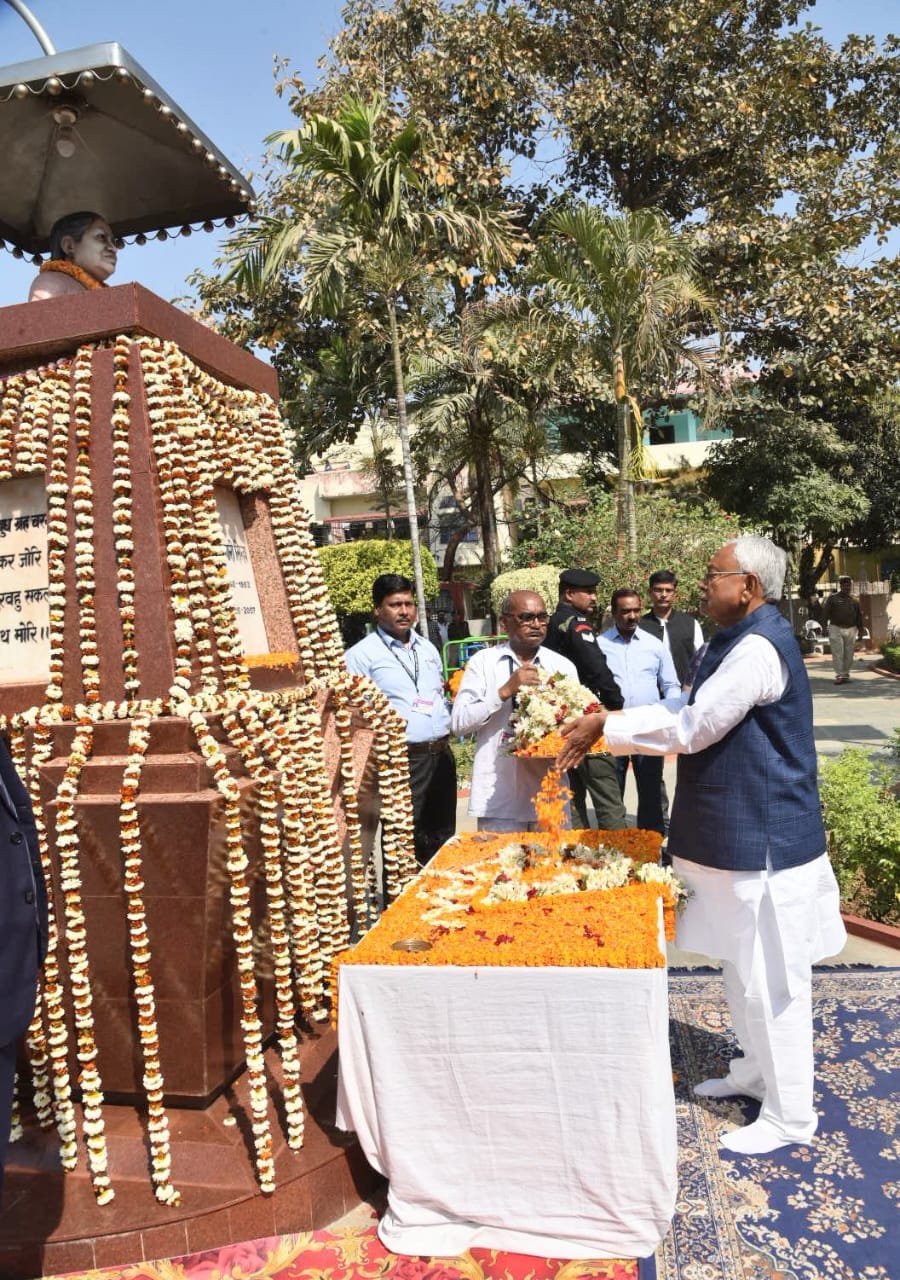

- Pages using the JsonConfig extension
- Nitish Kumar
- 1951 births
- Living people
- People from Nalanda
- India MPs 2004–2009
- Chief Ministers of Bihar
- Janata Dal politicians
- Janata Dal (United) politicians
- Lok Sabha members from Bihar
- Railway Ministers of India
- Agriculture Ministers of India
- V. P. Singh administration
- India MPs 1989–1991
- India MPs 1991–1996
- India MPs 1996–1997
- India MPs 1998–1999
- India MPs 1999–2004
- Members of the Bihar Legislative Council
- Lok Dal politicians