



CleanupBot (talk | contribs) m →top: robot: remove incorrect protection templates |
robot: Create/update articles in Category:Hindu gods. |
||
| Line 1: | Line 1: | ||
{{short description|Hindu architect of the gods}} | |||
{{short description|Hindu | |||
{{about|the Hindu god|the Indian caste|Vishwakarma (caste)}} | {{about|the Hindu god|the Indian caste|Vishwakarma (caste)}} | ||
{{Use dmy dates|date=June 2018}} | {{Use dmy dates|date=June 2018}} | ||
{{Infobox deity<!--Wikipedia:WikiProject Hindu mythology--> | {{Infobox deity<!--Wikipedia:WikiProject Hindu mythology--> | ||
| type | | type = Hindu | ||
| image | | image = Vishvakarman, the architect of the universe.jpg | ||
| name | | name = Vishvakarma | ||
| affiliation = [[Deva (Hinduism)|Deva]] | | affiliation = [[Deva (Hinduism)|Deva]] | ||
| deity_of | | deity_of = Architect of the [[Deva (Hinduism)|devas]]<ref>{{cite web | url=https://www.wisdomlib.org/definition/vishvakarma | title=Vishvakarma, Viśhwakarmā, Viśhwakarma, Vishwakarman, Viśhwakarman, Vishwa-karman: 26 definitions | date=19 December 2011 }}</ref> | ||
| abode | | abode = [[Svarga]] | ||
| mantra | | mantra = Om Vishwakarmane Namah | ||
| weapon | | weapon = [[Weighing scale|Scale]], [[Kamandalu]], book, [[hammer]] and [[chisel]] | ||
| consort | | consort = [[Ghritachi]] or [[Gayatri]] or three wives — Rati, Prapti and Nandi. | ||
| caption | | caption = Depiction of Vishvakarma | ||
| mount | | mount = {{ubl|[[Goose]] | [[Elephant]]}} | ||
| children | | children = [[Sanjna]], [[Trisiras|Vishvarupa]], Barhismati, Chitrangada, [[Nala (Ramayana)|Nala]] | ||
}} | }} | ||
''' | '''Vishvakarma''' or '''Vishvakarman''' ({{lang-sa|विश्वकर्मा|Viśvakarmā|all maker}}) is a craftsman deity and the divine architect of the [[Deva (Hinduism)|devas]] in contemporary [[Hinduism]]. In the early texts, the craftsman deity was known as [[Tvastar]] and the word "Vishvakarma" was originally used as an epithet for any powerful deity. However, in many later traditions, Vishvakarma became the name of the craftsman god.<ref name = Anc>{{Cite book|last1=Coulter|first1=Charles Russell|url=https://books.google.com/books?id=VWxekbhM1yEC&q=visvakarma&pg=PT1134|title=Encyclopedia of Ancient Deities|last2=Turner|first2=Patricia|date=2013-07-04|publisher=Routledge|isbn=978-1-135-96397-2|language=en}}</ref> | ||
Vishvakarma crafted all of the chariots of the [[Deva (Hinduism)|devas]] and weapons including the ''[[Vajra]]'' of the god [[Indra]].<ref>Coomaraswamy (1979), p. 79.</ref> Vishvakarma was related to the sun god [[Surya]] through his daughter [[Saranyu|Samjna]]. According to the legend, when Samjna left her house due to Surya's energy, Vishvakarma reduced the energy and created various other weapons using it. Vishvakarma also built various cities like [[Lanka]], [[Dvārakā|Dvaraka]], and [[Indraprastha]].<ref name="Anc" /> According to the epic ''[[Ramayana]]'', the ''[[vanara]]'' (forest-man or monkey) [[Nala (Ramayana)|Nala]] was the son of Vishvakarma, created to aid the avatar [[Rama]]. | |||
==Literature and legends== | ==Literature and legends== | ||
===Vedas=== | ===Vedas=== | ||
{{See also|Tvastar}} | {{See also|Tvastar}} | ||
{{Hinduism}} | {{Hinduism}} | ||
The term Visvakarman was originally used as an epithet for any supreme god<ref>{{cite web|title=Vishvakarman {{!}} Hindu mythology|url=https://www.britannica.com/topic/Vishvakarman|website=Encyclopedia Britannica|language=en}}</ref> and as an attribute of [[Indra]] and the [[Surya|Sun]]. The name Visvakarman occurs five times in the tenth book of the Rigveda. The two hymns of the Rigveda identify Visvakarman as all-seeing, and having eyes, faces, arms and feet on every side and also has wings. [[Brahma]], the | The term Visvakarman was originally used as an epithet for any supreme god<ref>{{cite web|title=Vishvakarman {{!}} Hindu mythology|url=https://www.britannica.com/topic/Vishvakarman|website=Encyclopedia Britannica|language=en}}</ref> and as an attribute of [[Indra]] and the [[Surya|Sun]]. The name Visvakarman occurs five times in the tenth book of the Rigveda. The two hymns of the Rigveda identify Visvakarman as all-seeing, and having eyes, faces, arms and feet on every side and also has wings. [[Brahma]], the god of creation, who is four-faced and four-armed resembles him in these aspects. He is represented as being the source of all prosperity, swift in his thoughts and titled a seer, priest, and lord of speech.<ref>{{cite book|last=Macdonell|first=Arthur Anthony|title=Vedic Mythology|date=1898|publisher=Motilal Banarsidass|isbn=978-8-12081-113-3|url={{googlebooks|b7Meabtj8mcC|page=41|plainurl=y}}|page=41|language=en}}</ref> | ||
[[File:Cambogia, vishvakarman, l'architetto divino, periodo angkor, xiii secolo ca.jpg|thumb|Cambodian idol of Vishvakarma]] | |||
According to some parts of the ''[[Rigveda]]'', | According to some parts of the ''[[Rigveda]]'', Vishvakarma was the personification of ultimate reality, the abstract creative power inherent in deities, living and non-living being in this universe.<ref>{{cite journal|title=Vishvakarman – Oxford Reference|url=http://www.oxfordreference.com/view/10.1093/oi/authority.20110803120038316|language=en}}</ref> He is considered to be the fifth monotheistic God concept: He is both The Architect and The Divine Engineer of The Universe from before the advent of time.<ref>{{cite book|last=Sprochi|first=Amanda K.|editor-last=Melton|editor-first=J. Gordon|title=Religious Celebrations: L-Z|date=2011|location=Santa Barbara, CA|publisher=ABC-CLIO|isbn=978-1-59884-205-0|url={{googlebooks|KDU30Ae4S4cC|page=908|plainurl=y}}|page=908|language=en}}</ref> | ||
The later parts of the Rigveda reveals efforts to find a satisfactory answer to the mysteries regarding the origin of the universe, the creation hymns present in these parts of the Rigveda mention individual creator gods as opposed to the collection of gods and their chiefs ([[Indra]], [[Varuna]], [[Agni]], etc.) creating the world.<ref>{{cite book|last=Dhavamony|first=Mariasusai|title=Classical Hinduism|date=1982|publisher=Gregorian Biblical BookShop|isbn=978-8-87652-482-0|url={{googlebooks|DD0w_IMFA8gC|page=48|plainurl=y}}|page=48|language=en}}</ref> | The later parts of the Rigveda reveals efforts to find a satisfactory answer to the mysteries regarding the origin of the universe, the creation hymns present in these parts of the Rigveda mention individual creator gods as opposed to the collection of gods and their chiefs ([[Indra]], [[Varuna]], [[Agni]], etc.) creating the world.<ref>{{cite book|last=Dhavamony|first=Mariasusai|title=Classical Hinduism|date=1982|publisher=Gregorian Biblical BookShop|isbn=978-8-87652-482-0|url={{googlebooks|DD0w_IMFA8gC|page=48|plainurl=y}}|page=48|language=en}}</ref> | ||
| Line 36: | Line 34: | ||
In the [[historical Vedic religion]], the role of Vishvakarma as the builder of gods is attributed to [[Tvastar]].<ref>{{Cite book|url=https://books.google.com/books?id=VWxekbhM1yEC&q=visvakarma&pg=PT1134|title = Encyclopedia of Ancient Deities|isbn = 9781135963972|last1 = Coulter|first1 = Charles Russell|last2 = Turner|first2 = Patricia|date = 4 July 2013}}</ref> Vedic Vishvakarman is identified with [[Prajapati]] rather than [[Tvastar|''Tvaṣṭṛ'']].<ref name=":1">{{Cite book|last=Monier-Williams|first=Monier|title=A Sanskrit-English Dictionary: Etymologically and Philologically Arranged with Special Reference to Cognate Indo-European Languages|publisher=Oxford University Press|year=1899|pages=994}}</ref><ref>{{cite book|last=Macdonell|first=Arthur Anthony|title=Vedic Mythology|year=1897|publisher=Oxford University Press|page=118}}</ref> In later mythology, Vishvakarman is sometimes identified with ''Tvaṣṭṛ'' and is a craftsman deity.<ref name=":0">[[Monier-Williams]] (1899) p. 994.</ref> | In the [[historical Vedic religion]], the role of Vishvakarma as the builder of gods is attributed to [[Tvastar]].<ref>{{Cite book|url=https://books.google.com/books?id=VWxekbhM1yEC&q=visvakarma&pg=PT1134|title = Encyclopedia of Ancient Deities|isbn = 9781135963972|last1 = Coulter|first1 = Charles Russell|last2 = Turner|first2 = Patricia|date = 4 July 2013}}</ref> Vedic Vishvakarman is identified with [[Prajapati]] rather than [[Tvastar|''Tvaṣṭṛ'']].<ref name=":1">{{Cite book|last=Monier-Williams|first=Monier|title=A Sanskrit-English Dictionary: Etymologically and Philologically Arranged with Special Reference to Cognate Indo-European Languages|publisher=Oxford University Press|year=1899|pages=994}}</ref><ref>{{cite book|last=Macdonell|first=Arthur Anthony|title=Vedic Mythology|year=1897|publisher=Oxford University Press|page=118}}</ref> In later mythology, Vishvakarman is sometimes identified with ''Tvaṣṭṛ'' and is a craftsman deity.<ref name=":0">[[Monier-Williams]] (1899) p. 994.</ref> | ||
==Iconography | ==Iconography== | ||
{{multiple image | {{multiple image | ||
| image1 = Bishowkarma Statue.jpg | | image1 = Bishowkarma Statue.jpg | ||
| Line 50: | Line 48: | ||
== Family == | == Family == | ||
Parentage of Vishvakarma differs in many other texts. In the [[Nirukta]] and [[Brahmana]]s he is stated to be the son of Bhuvana. In the [[Mahabharata]] and [[Harivamsa|Harivansha]], he is the son of Vasu Prabhāsa and Yoga-siddhā. In the [[Puranas]], he is the son of Vāstu or sometimes, [[Brahma]]. Vishvakarma is the father of three daughters named Barhishmati, [[Sanjna|Samjna]] and Chitrangada, as well as five sons.<ref>{{Cite book|url=https://books.google.com/books?id=9v1OAQAAIAAJ&q=vishwakarma+Chitrangada|title=The Sacred Scriptures of India|date=2009|publisher=Anmol Publications|isbn=978-81-261-3630-8|language=en}}</ref> In [[Vamana Purana]], Vishvakarma is presented as the husband of the celestial nymph [[Ghritachi]].<ref name=":1" /> When identified with Tvastar, Vishvakarma is also described to be the father of a son named [[Trisiras|Vishvarupa]].<ref>{{Cite book|last1=Debroy|first1=Bibek|url=https://books.google.com/books?id=jXoRAQAAIAAJ&q=vishvakarma+vishvarupa|title=The Holy Puranas|last2=Debroy|first2=Dipavali|date=2002|publisher=B.R. Publishing Corporation|isbn=978-81-7646-299-0|language=en}}</ref> | |||
[[File: | ==Vishvakarma Puja== | ||
[[File:Jinjia Temple.jpg|thumb|left|Vishvakarma Temple in [[Jinja, Uganda|Jinja]], [[Uganda]]]] | |||
[[File:Vishwakarma Temple | [[File:Machilipatnam Vishwakarma Temple 9.jpg|thumb|Vishvakarma Temple at Machilipatnam, Andhra Pradesh]] | ||
[[File:Vishwakarma Temple, Lohgarh, Zirakpur (Near Chandigarh).jpeg|thumb|Vishvakarma Temple, Lohgarh, Zirakpur (Near Chandigarh)]] | |||
* '' | Among those who celebrate Vishwakarma's birthday, it is celebrated on two days under different names: | ||
* ''Rishi Panchami Dinam''. "Rishi Panchami Dinam" literally means ‘the day of the solidarity of five rishis.’ Those who celebrate this day believe that | * ''Vishvakarma Puja''. "Vishvakarma Puja" always celebrated in India on the 17/18 September of every Year.<ref>{{cite web|url=https://www.calendarlabs.com/holidays/hindu/vishwakarma-puja.php|title=Vishwakarma Puja in Hindu Calendar}}</ref> | ||
* ''Rishi Panchami Dinam''. "Rishi Panchami Dinam" literally means ‘the day of the solidarity of five rishis.’ Those who celebrate this day believe that Vishvakarma did not have a birthday like the mortals but only a commemoration day in which his five children (supposedly five ''rishis'') came together to declare their solidarity and pray to their illustrious father. This day follows the rules of the [[Hindu calendar]] and changes with every year. The five groups among the [[Vishwakarma (caste)|Vishvakarma community]] also celebrate this as an auspicious day in commemoration of their patron god at present.<ref>Achary, Subramanian Matathinkal (1995).</ref> | |||
==See also== | ==See also== | ||
*[[Vishwakarma Day]] | *[[Vishwakarma Day|Vishvakarma Day]] | ||
*[[Suthar]] | *[[Suthar]] | ||
*Rajgir karigar | *Rajgir karigar | ||
*[[Acharya]] | *[[Acharya]] | ||
*[[Barhai]] | *[[Barhai]] | ||
*[[Vishwakarma (caste)]] | *[[Vishwakarma (caste)|Vishvakarma (caste)]] | ||
*[[Tarkhan]] | *[[Tarkhan]] | ||
*[[Lohar]] | *[[Lohar]] | ||
*[[Daksha]] | *[[Daksha]] | ||
*[[Great Architect of the Universe]] | |||
*[[Kami (caste)]] | *[[Kami (caste)]] | ||
*[[Shilpa Shastras]] | *[[Shilpa Shastras]] | ||
*[[Great Architect of the Universe]] | *[[Great Architect of the Universe]] | ||
*[[ | *[[Tvashtr|Tvastar]] | ||
*[[Vishwakarmas]] | *[[Vishwakarmas]] | ||
*''[[The Poem of Angkor Wat]]'' | |||
==Bibliography== | ==Bibliography== | ||
| Line 93: | Line 90: | ||
==Further reading== | ==Further reading== | ||
* Dr G Gnanananda, " | * Dr G Gnanananda, "Vishvakarma Darshana-Vishawakarma Volume-1 (2008), "Sanskriti Sahithya Pratisthana, Bangalore Publications" | ||
* Dr G Gnanananda, " | * Dr G Gnanananda, "Vishvakarma Darshana-Hiranyagarbha Volume-2 (2009), "Sanskriti Sahithya Pratisthana, Bangalore Publications" | ||
* Dr G Gnanananda, " | * Dr G Gnanananda, "Vishvakarma Darshana-Rhubugalu Volume-3 (2010), "Sanskriti Sahithya Pratisthana, Bangalore Publications" | ||
* {{cite book|last=Raina|first=M. K.|year=1999|contribution=The Divine Creativity: The Mythical Paradigm and Lord Visvakarma|editor-last=Stein|editor-first=M. I.|title=Creativity's Global Correspondents – 1999|publisher=Winslow Press|place=Florida|pages=75–82|url=http://www.amcreativityassoc.org/ACA%20Press/Global%20Correspondents/Global_1999.pdf|url-status=dead|archive-url=https://web.archive.org/web/20070226165221/http://www.amcreativityassoc.org/ACA%20Press/Global%20Correspondents/Global_1999.pdf|archive-date=26 February 2007}} | * {{cite book|last=Raina|first=M. K.|year=1999|contribution=The Divine Creativity: The Mythical Paradigm and Lord Visvakarma|editor-last=Stein|editor-first=M. I.|title=Creativity's Global Correspondents – 1999|publisher=Winslow Press|place=Florida|pages=75–82|url=http://www.amcreativityassoc.org/ACA%20Press/Global%20Correspondents/Global_1999.pdf|url-status=dead|archive-url=https://web.archive.org/web/20070226165221/http://www.amcreativityassoc.org/ACA%20Press/Global%20Correspondents/Global_1999.pdf|archive-date=26 February 2007}} | ||
==External links== | ==External links== | ||
{{Commons category}} | {{Commons category}} | ||
* [https://www.vishwakarmasamaj.com | * [https://www.vishwakarmasamaj.com Vishvakarma Samaj] | ||
{{Hinduism_footer small}} | {{Hinduism_footer small}} | ||
Revision as of 14:54, 16 January 2023
| Vishvakarma | |
|---|---|
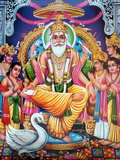
 Depiction of Vishvakarma | |
| Affiliation | Deva |
| Abode | Svarga |
| Mantra | Om Vishwakarmane Namah |
| Weapon | Scale, Kamandalu, book, hammer and chisel |
| Mount | |
| Personal information | |
| Consort | Ghritachi or Gayatri or three wives — Rati, Prapti and Nandi. |
| Children | Sanjna, Vishvarupa, Barhismati, Chitrangada, Nala |
Vishvakarma or Vishvakarman (Sanskrit: विश्वकर्मा, romanized: Viśvakarmā, lit. 'all maker') is a craftsman deity and the divine architect of the devas in contemporary Hinduism. In the early texts, the craftsman deity was known as Tvastar and the word "Vishvakarma" was originally used as an epithet for any powerful deity. However, in many later traditions, Vishvakarma became the name of the craftsman god.[2]
Vishvakarma crafted all of the chariots of the devas and weapons including the Vajra of the god Indra.[3] Vishvakarma was related to the sun god Surya through his daughter Samjna. According to the legend, when Samjna left her house due to Surya's energy, Vishvakarma reduced the energy and created various other weapons using it. Vishvakarma also built various cities like Lanka, Dvaraka, and Indraprastha.[2] According to the epic Ramayana, the vanara (forest-man or monkey) Nala was the son of Vishvakarma, created to aid the avatar Rama.
Literature and legends
Vedas
| Part of a series on |
| Hinduism |
|---|
 |


The term Visvakarman was originally used as an epithet for any supreme god[4] and as an attribute of Indra and the Sun. The name Visvakarman occurs five times in the tenth book of the Rigveda. The two hymns of the Rigveda identify Visvakarman as all-seeing, and having eyes, faces, arms and feet on every side and also has wings. Brahma, the god of creation, who is four-faced and four-armed resembles him in these aspects. He is represented as being the source of all prosperity, swift in his thoughts and titled a seer, priest, and lord of speech.[5]

According to some parts of the Rigveda, Vishvakarma was the personification of ultimate reality, the abstract creative power inherent in deities, living and non-living being in this universe.[6] He is considered to be the fifth monotheistic God concept: He is both The Architect and The Divine Engineer of The Universe from before the advent of time.[7]
The later parts of the Rigveda reveals efforts to find a satisfactory answer to the mysteries regarding the origin of the universe, the creation hymns present in these parts of the Rigveda mention individual creator gods as opposed to the collection of gods and their chiefs (Indra, Varuna, Agni, etc.) creating the world.[8]
In the historical Vedic religion, the role of Vishvakarma as the builder of gods is attributed to Tvastar.[9] Vedic Vishvakarman is identified with Prajapati rather than Tvaṣṭṛ.[10][11] In later mythology, Vishvakarman is sometimes identified with Tvaṣṭṛ and is a craftsman deity.[12]
Iconography

.jpg)
Vishvakarma's iconography varies drastically from one region to another, though all picture him with creation tools. In the most popular depiction, he is depicted as an aged and wise man, with four arms. He has white beard and is accompanied by his vahana, hamsa (goose or swan), which scholars believe that these suggest his association with the creator god Brahma. Usually, he is seated on a throne and his sons standing near him. This form of Vishvakarma is mainly found in the Western and North Western parts of India.[13]
Contradictory to the above account, the idols of Vishvakarma in the eastern parts of India depict him as a young muscular man. He has black moustache and is not accompanied by his sons. An elephant is his vahana, suggesting his association with Indra or Brihaspati.[13]
Family
Parentage of Vishvakarma differs in many other texts. In the Nirukta and Brahmanas he is stated to be the son of Bhuvana. In the Mahabharata and Harivansha, he is the son of Vasu Prabhāsa and Yoga-siddhā. In the Puranas, he is the son of Vāstu or sometimes, Brahma. Vishvakarma is the father of three daughters named Barhishmati, Samjna and Chitrangada, as well as five sons.[14] In Vamana Purana, Vishvakarma is presented as the husband of the celestial nymph Ghritachi.[10] When identified with Tvastar, Vishvakarma is also described to be the father of a son named Vishvarupa.[15]
Vishvakarma Puja


.jpeg)
Among those who celebrate Vishwakarma's birthday, it is celebrated on two days under different names:
- Vishvakarma Puja. "Vishvakarma Puja" always celebrated in India on the 17/18 September of every Year.[16]
- Rishi Panchami Dinam. "Rishi Panchami Dinam" literally means ‘the day of the solidarity of five rishis.’ Those who celebrate this day believe that Vishvakarma did not have a birthday like the mortals but only a commemoration day in which his five children (supposedly five rishis) came together to declare their solidarity and pray to their illustrious father. This day follows the rules of the Hindu calendar and changes with every year. The five groups among the Vishvakarma community also celebrate this as an auspicious day in commemoration of their patron god at present.[17]
See also
- Vishvakarma Day
- Suthar
- Rajgir karigar
- Acharya
- Barhai
- Vishvakarma (caste)
- Tarkhan
- Lohar
- Daksha
- Great Architect of the Universe
- Kami (caste)
- Shilpa Shastras
- Great Architect of the Universe
- Tvastar
- Vishwakarmas
- The Poem of Angkor Wat
Bibliography
- Achary, Subramanian Matathinkal (1995): Visvakarmajar Rigvedathil, Sawraj Printing and Publishing Company, Aluva.
- Coomaraswamy, Ananda K. Ananda Coomaraswamy (1979): Medieval Sinhalese Art, Pantheon Books Inc., New York.
- Monier-Williams (1899): [1]
- Pattanaik, Devdutt Devdutt Pattanaik (2009): 7 Secrets from Hindu Calendar Art. Westland, India. ISBN 978-81-89975-67-8.
- Padhi, Bibhu & Padhi, Minakshi Bibhu Padhi (1998): Indian Philosophy and Religion: A Reader's Guide (3rd ed.). D.K. Printworld. ISBN 978-8-12460-116-7.
- Borad, Siddharth & Om, Dr. Jayshree (2020): The Ancient Science of Vastu. BlueRose. ISBN 978-93-90030-07-1.
![[1]](https://www.sanskrit-lexicon.uni-koeln.de/cgi-bin/serveimg.pl?file=/scans/MWScan/MWScanjpg/mw0994-vizvavyApti.jpg)
References
- ↑ "Vishvakarma, Viśhwakarmā, Viśhwakarma, Vishwakarman, Viśhwakarman, Vishwa-karman: 26 definitions". 19 December 2011.
- ↑ 2.0 2.1 Coulter, Charles Russell; Turner, Patricia (4 July 2013). Encyclopedia of Ancient Deities. Routledge. ISBN 978-1-135-96397-2.
- ↑ Coomaraswamy (1979), p. 79.
- ↑ "Vishvakarman | Hindu mythology". Encyclopedia Britannica.
- ↑ Macdonell, Arthur Anthony (1898). [[[:Template:Googlebooks]] Vedic Mythology]. Motilal Banarsidass. p. 41. ISBN 978-8-12081-113-3.
{{cite book}}: Check|url=value (help) - ↑ "Vishvakarman – Oxford Reference".
{{cite journal}}: Cite journal requires|journal=(help) - ↑ Sprochi, Amanda K. (2011). Melton, J. Gordon (ed.). [[[:Template:Googlebooks]] Religious Celebrations: L-Z]. Santa Barbara, CA: ABC-CLIO. p. 908. ISBN 978-1-59884-205-0.
{{cite book}}: Check|url=value (help) - ↑ Dhavamony, Mariasusai (1982). [[[:Template:Googlebooks]] Classical Hinduism]. Gregorian Biblical BookShop. p. 48. ISBN 978-8-87652-482-0.
{{cite book}}: Check|url=value (help) - ↑ Coulter, Charles Russell; Turner, Patricia (4 July 2013). Encyclopedia of Ancient Deities. ISBN 9781135963972.
- ↑ 10.0 10.1 Monier-Williams, Monier (1899). A Sanskrit-English Dictionary: Etymologically and Philologically Arranged with Special Reference to Cognate Indo-European Languages. Oxford University Press. p. 994.
- ↑ Macdonell, Arthur Anthony (1897). Vedic Mythology. Oxford University Press. p. 118.
- ↑ Monier-Williams (1899) p. 994.
- ↑ 13.0 13.1 Jacobsen, Knut A.; Myrvold, Kristina (15 January 2019). Religion and Technology in India: Spaces, Practices and Authorities. Routledge. ISBN 978-1-351-20477-4.
- ↑ The Sacred Scriptures of India. Anmol Publications. 2009. ISBN 978-81-261-3630-8.
- ↑ Debroy, Bibek; Debroy, Dipavali (2002). The Holy Puranas. B.R. Publishing Corporation. ISBN 978-81-7646-299-0.
- ↑ "Vishwakarma Puja in Hindu Calendar".
- ↑ Achary, Subramanian Matathinkal (1995).
Further reading
- Dr G Gnanananda, "Vishvakarma Darshana-Vishawakarma Volume-1 (2008), "Sanskriti Sahithya Pratisthana, Bangalore Publications"
- Dr G Gnanananda, "Vishvakarma Darshana-Hiranyagarbha Volume-2 (2009), "Sanskriti Sahithya Pratisthana, Bangalore Publications"
- Dr G Gnanananda, "Vishvakarma Darshana-Rhubugalu Volume-3 (2010), "Sanskriti Sahithya Pratisthana, Bangalore Publications"
- Raina, M. K. (1999). "The Divine Creativity: The Mythical Paradigm and Lord Visvakarma". In Stein, M. I. (ed.). Creativity's Global Correspondents – 1999 (PDF). Florida: Winslow Press. pp. 75–82. Archived from the original (PDF) on 26 February 2007.
External links
Hindu deities and texts | ||
|---|---|---|
| Gods |  | |
| Goddesses | ||
| Other deities | ||
| Texts | ||