

>WikiCleanerBot m v2.04b - Bot T20 CW#61 - Fix errors for CW project (Reference before punctuation) |
imported>Homogenie m →History: Wikilinks |
||
| Line 31: | Line 31: | ||
|religion = [[Hinduism]] | |religion = [[Hinduism]] | ||
|government_type = Monarchy | |government_type = Monarchy | ||
|leader1 = [[ | |leader1 = [[Biswa Singha]] | ||
|year_leader1 = 1515–1540 | |year_leader1 = 1515–1540 | ||
|leader2 = [[Nara Narayan]] | |leader2 = [[Nara Narayan]] | ||
| Line 41: | Line 41: | ||
}} | }} | ||
{{Assam History}} | {{Assam History}} | ||
The '''Koch dynasty''' (Pron:kɒʧ), | The '''Koch dynasty''' (Pron:kɒʧ), (1515-1949) ruled parts of eastern [[Indian subcontinent]] in present-day [[Assam]] and [[Bengal]]. The dynasty came to power in the erstwhile [[Kamata kingdom]] which had emerged from the decaying [[Kamarupa kingdom]].<ref>{{Harvcol|Nath|1989|pp=2–11}}</ref><ref>"[[Kamarupa]] was reorganized as a new state. 'Kamata' by name with Kamatapur as capital. The exact time when the change was made is uncertain. But possibly it had been made by Sandhya (c1250-1270) as a safeguard against mounting dangers from the east and the west. Its control on the eastern regions beyond the Manah (Manas river) was lax." {{harv|Sarkar|1992|pp=40–41}}</ref> The founder king, [[Biswa Singha]], belonged to the [[Koch people]] on his mother's side and the [[Mech people]] on his father's side. Under his sons [[Nara Narayan]] and [[Chilarai]] the dynasty reached its zenith. The dynasty forked for the first time into two major branches that controlled [[Cooch Behar State|Koch Bihar]] and [[Koch Hajo]]. Koch Bihar became a vassal of the [[Mughal Empire|Mughal]]s, whereas Koch Hajo came under [[Ahom kingdom|Ahom]] control and was subsequently absorbed. Koch Bihar became a princely state during British rule and was absorbed after Indian independence. The third branch of this dynasty at Khaspur disappeared into the [[Kachari kingdom]]. | ||
==History== | ==History== | ||
===Historical background=== | ===Historical background=== | ||
{{main|Kamata kingdom}} | {{main|Kamata kingdom}} | ||
After the fall of the [[Pala dynasty (Kamarupa)|Pala dynasty]] of [[Kamarupa]], the kingdom fractured into different domains in the 12th century. | After the fall of the [[Pala dynasty (Kamarupa)|Pala dynasty]] of [[Kamarupa]], the kingdom fractured into different domains in the 12th century. Sandhya, a ruler of Kamarupanagara ([[Guwahati]]) moved his capital further west to present-day [[North Bengal]] in the middle of the 13th century and the domain he ruled over came to be called [[Kamata kingdom]].<ref>{{harv|Gogoi|2002|p=17}}</ref> The Koch dynasty was one of several tribal formations that developed into statehoods around 15th century in [[northeast India]]—[[Ahom kingdom|Ahom]], [[Chutia kingdom|Chutia]], [[Dimasa kingdom|Dimasa]], [[Twipra kingdom|Tripura]], [[Manipur kingdom|Manipur]], etc.<ref>{{harvtxt|Guha|1983|p=5}}</ref> The buffer region, between the eastern kingdoms and Kamata was the domain of the [[Baro-Bhuyan]]s chieftains. [[Alauddin Husain Shah]] of Gaur defeated [[Nilambar of Kamata|Nilambar]] of Kamata in 1498, occupied the region and placed his son, Daniyal in charge. Within a few years, the Baro-Bhuyans, led by one Harup Narayan of the Brahmaputra valley defeated, captured and executed Daniyal, and the region lapsed into Bhuyan confederate rule.<ref>{{Harvcol|Nath|1989|pp=21}}</ref> | ||
Meanwhile, an alliance was formed when a [[Mech tribe|Mech]] chief, | Meanwhile, an alliance was formed when a [[Mech tribe|Mech]] chief, Hariya Mandal, married two sisters Hira and Jira, the daughters of Hajo, a [[Koch people|Koch]] chief. Hariya Mandal's domain was in Chikna Mountains situated between the [[Sankosh River]] and the [[Champabati River]] in [[Kokrajhar district|Kokrajhar]] district of [[Undivided Goalpara district]] of [[Assam]]. Bisu,<ref>"The original name of Bishwa Singha was Bisu..{{harvcol|Nath|1989|p=16}}</ref> who was to later become [[Biswa Singha]],<ref>the Koches were adapted to tribal ways of living at the time and Bisu's family members largely cultivated cottons on the hills. However when he acquired power to control the surrounding situation, the Brahmanas as pointed out by Gait, soon found him out and Hinduised him and his family, and called him Biswa Singha..{{harvcol|Gogoi|2002|p=18}}</ref> was born to the [[Mech people|Mech]] father and the [[Koch people|Koch]] mother, Hariya and Hira respectively.<ref>"..it becomes clear that Biswa Singha's father was a Mech and mother was a Koch and both the tribes were "rude" and "impure", hence non-Aryan or non-Hinduised." {{harvcol|Nath|1989|p=17}}</ref> Later, Brahman pundits created a legend that lord [[Shiva|Siva]] was the father of Biswa Singha<ref name="Urban2009_82">{{harvcol|Urban|2009|p=82}}</ref> to accord legitimacy to the ruler. | ||
===Beginning of the Koch dynasty=== | ===Beginning of the Koch dynasty=== | ||
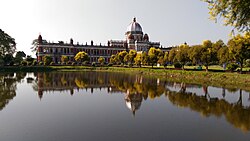
[[File:Coochbehar palace.jpg|left|thumb|150x150px|<div style="text-align: center;"><small>''[[Cooch Behar Palace]]''</small></div>]] | [[File:Coochbehar palace.jpg|left|thumb|150x150px|<div style="text-align: center;"><small>''[[Cooch Behar Palace]]''</small></div>]] | ||
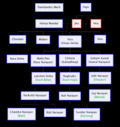
[[File:OriginOfKochDynasty.png|thumb|right|450px|<div style="text-align: center;"><small>''Origin of the Koch dynasty, based on the Darrang Raja Vamsavali''</small><ref>{{Harvcol|Sarkar|1992|p=91}}</ref></div>]] | [[File:OriginOfKochDynasty.png|thumb|right|450px|<div style="text-align: center;"><small>''Origin of the Koch dynasty, based on the Darrang Raja Vamsavali''</small><ref>{{Harvcol|Sarkar|1992|p=91}}</ref></div>]] | ||
According to J N Sarkar, | According to J N Sarkar, Biswa Singha belonged to one of the dominant Koch tribes,<ref>{{Harvcol|Sarkar|1992|p=69}}</ref> which were a collection of [[Mongoloid]] tribes.<ref>{{Harvcol|Sarkar1992|p=69f}}. "Minjahuddin found the features of the Koch, Mech, and Tharu tribes similar to a south Siberian tribe. Bryan Hodgson (JASB) xviii (2) 1849, 704-5, classes the Koches with the [[Bodo people|Bodo]] and Dhimal tribes. Buchanan agrees. Dalton takes them to be Dravidian. But Risley thinks they represented a fusion of Mongoloid and Dravidian stock, with the later predominating. According to Waddell Mongoloid type of Koches predominated in Assam."</ref><ref>{{Harvcol|Nath|1989|pp=2–3}}</ref> When Bisu, as Biswa Singha was then known, acquired power, the Brahmins found him out and conferred on him the status of the Kshatriya varna; and the subsequent interaction with Brahmans lead to the Hinduization of his tribesmen.<ref>{{harv|Gogoi|2002|p=18}}</ref> The earliest known ancestor of Biswa Singha was his father Hariya Mandal,<ref>{{Harvcol|Sarkar|1992|p=70f}}</ref> from the Chiknabari village in [[Undivided Goalpara district]], the head of the twelve most powerful [[Mech tribe|Mech]] families. Hariya Mandal was married to Jira and Hira, daughters of a [[Koch people|Koch]] chief named Hajo, after whom [[Koch Hajo]] was named. Biswa Singha was the son of Haria Mandal and Hira.<ref>"..it becomes clear that Biswa Singha's father was a Mech and mother was a Koch and both the tribes were "rude" and "impure", hence non-Aryan or non-Hinduised." {{harvcol|Nath|1989|p=17}}</ref> | ||
===Consolidation of power=== | ===Consolidation of power=== | ||
Biswa Singha sought the alliance of tribal (Koch, Garo and Mech) chiefs<ref>"...Dimarua, Panbari, Beltola, Rani, Moirapur, Borduar, Bholagram, Pantanduar, Chaigaon, Bogaduar, Bongaon, Baku, Luki, Hengerabari. Biswa Singha received the allegiance of these states including those of Darrang, Karaibari, Atiabari, Kamtabari, and Balrampur." {{Harvcol|Nath|1989|pp=23–24}}</ref> against the more powerful Baro-Bhuyans and began his campaign around 1509.<ref>{{Harvcol|Nath|1989|pp=28–29}}</ref> Successively, he defeated the Bhuyans of Ouguri, Jhargaon, Karnapur, Phulaguri, Bijni and Pandunath (Pandu, in [[Guwahati]]).<ref>"It is stated that Biswa Singha subjugated the ''Bar Bhuyan'' then the ''Saru Bhuyan'' and then the Bhuyan of Ouguri. After this he defeated the ''Daivajnya Chuti Bhuyan'' and thereafter Kusum Bhuyan, Dihala Bhuyan, Kalia Bhuyan and the Bhuyans of Jhargaon, Kabilash Bhuyan, the Bhuyans of Karnapur, Phulaguri, and Bijni, and finally Pratap Rai Bhuyan of Pandunath, Guwahati. The ''Gurucaritas'' also mention Gandhanva Rai, the Bhuyan of Banduka and Sriram Khan of Sajalagram." {{harvcol|Nath|1989|p=24}}</ref> He was particularly stretched by the Bhuyan of Karnapur, and could defeat him only by a stratagem during [[Bihu]]. After subjugating the petty rulers, he announced himself the king of Kamata bounded on the east by Barnadi river and on the west by the Karatoya river<ref name="Nath1989">{{Harvcol|Nath|1989|pp=23–24}}</ref> in the year 1515.<ref>{{Harvcol|Nath|1989|pp=28}}</ref> He moved his capital from Chikana to Kamatapur (also called Kantapur) which is just a few miles southeast of the present-day Cooch Behar town.<ref>{{Harvcol|Nath|1989|pp=35}}</ref> | |||
Biswa Singha's two sons, Naranarayan and Shukladhwaj ([[Chilarai]]), the king and the commander-in-chief of the army respectively, took the kingdom to its zenith. Nara Narayan made Raghudev, the son of Chilarai, the governor of [[Koch Hajo]], the eastern portion of the country. After the death of Nara Narayan, Raghudev declared independence. The division of the Kamata kingdom into [[Cooch Behar State|Koch Bihar]] and [[Koch Hajo]] was permanent. | |||
Nara Narayan was impressed by the [[bhakti]] saint [[Srimanta Sankardeva]] who became a member of his court in the last three years of his life and who established a [[Satra (Ekasarana Dharma)|Satra]] in the kingdom. | Nara Narayan was impressed by the [[bhakti]] saint [[Srimanta Sankardeva]] who became a member of his court in the last three years of his life and who established a [[Satra (Ekasarana Dharma)|Satra]] in the kingdom. | ||
| Line 70: | Line 70: | ||
=== Rulers of Koch Bihar === | === Rulers of Koch Bihar === | ||
{{further|Cooch Behar State}} | {{further|Cooch Behar State}} | ||
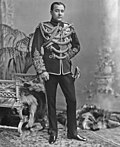
[[File: | [[File:Shri Sir Nripendra Narayan, Maharaja of Cooch Behar.jpg|right|thumb|[[Nripendra Narayan|Maharaja Nripendra Narayan]] of Cooch Bihar]] | ||
* Lakshmi Narayan | * Lakshmi Narayan | ||
* Bir Narayan | * Bir Narayan | ||
| Line 85: | Line 84: | ||
* Harendra Narayan | * Harendra Narayan | ||
* Shivendra Narayan | * Shivendra Narayan | ||
* Narendra Narayan | * [[Narendra Narayan]] | ||
* [[Nripendra Narayan]]<ref>{{cite web|url=http://www.rvondeh.dircon.co.uk/cooch1.html|title=Princess Daisy of Pless: The Happy Years. An exhibition at Castle Pless|website=www.rvondeh.dircon.co.uk}}</ref> | * [[Nripendra Narayan]]<ref>{{cite web|url=http://www.rvondeh.dircon.co.uk/cooch1.html|title=Princess Daisy of Pless: The Happy Years. An exhibition at Castle Pless|website=www.rvondeh.dircon.co.uk}}</ref> | ||
* [[Rajendra Narayan|Rajendra Narayan II]] | * [[Rajendra Narayan|Rajendra Narayan II]] | ||
| Line 138: | Line 137: | ||
=== Rulers of Khaspur === | === Rulers of Khaspur === | ||
The Barak valley was obtained by [[Chilarai]] in 1562<ref name="bhatta94begend">"The Khaspur state originated with Chilarai's invasion in 1562 AD and remained in existence till 1745 when it merged with the Dimasa state of Maibong." {{harvcol|Bhattacharjee|1994|p=71}}</ref> from the [[Twipra kingdom]] during his expedition when he subjugated most of the major rulers in [[Northeast India]] and established the Khaspur state with a garrison at Brahmapur, that eventually came to be called Khaspur (Brahmapur→Kochpur→Khaspur). The Koch rule began with the appointment of Kamal Narayan (step-brother of Chilarai and Naranarayan) as the Dewan a couple of years after the establishment of the garrison.<ref name="ReferenceA">{{harvcol|Bhattacharjee|1994|p=71}}</ref> Kamalnarayan established eighteen clans of Koch families that took hereditary roles in the state of Khaspur and who came to be known as Dheyans (after Dewan).<ref>{{harvcol|Bhattacharjee|1994|p=72}}</ref> The independent rule of the Khaspur rulers ended in 1745 when it merged with the [[ | The Barak valley was obtained by [[Chilarai]] in 1562<ref name="bhatta94begend">"The Khaspur state originated with Chilarai's invasion in 1562 AD and remained in existence till 1745 when it merged with the Dimasa state of Maibong." {{harvcol|Bhattacharjee|1994|p=71}}</ref> from the [[Twipra kingdom]] during his expedition when he subjugated most of the major rulers in [[Northeast India]] and established the Khaspur state with a garrison at Brahmapur, that eventually came to be called Khaspur (Brahmapur→Kochpur→Khaspur). The Koch rule began with the appointment of Kamal Narayan (step-brother of Chilarai and Naranarayan) as the Dewan a couple of years after the establishment of the garrison.<ref name="ReferenceA">{{harvcol|Bhattacharjee|1994|p=71}}</ref> Kamalnarayan established eighteen clans of Koch families that took hereditary roles in the state of Khaspur and who came to be known as Dheyans (after Dewan).<ref>{{harvcol|Bhattacharjee|1994|p=72}}</ref> The independent rule of the Khaspur rulers ended in 1745 when it merged with the [[Dimasa Kingdom|Kachari kingdom]].<ref name="bhatta94begend"/> | ||
The rulers of the Koch kingdom at Khaspur were:<ref name="ReferenceA"/> | The rulers of the Koch kingdom at Khaspur were:<ref name="ReferenceA"/> | ||
* Kamal Narayan (Gohain Kamal, son of | * Kamal Narayan (Gohain Kamal, son of Biswa Singha, governor of Khaspur) | ||
* Udita Narayan (declared independence of Khaspur in 1590) | * Udita Narayan (declared independence of Khaspur in 1590) | ||
* Vijay Narayana | * Vijay Narayana | ||
Revision as of 19:13, 29 August 2021
Koch Kingdom Koch Dynasty | |||||||||
|---|---|---|---|---|---|---|---|---|---|
| 1515–1949 | |||||||||
 Flag of Cooch Behar[citation needed] | |||||||||
 Historical map of Cooch Behar | |||||||||
| Status | Kingdom | ||||||||
| Capital | Chikana Kamatapur | ||||||||
| Common languages | Rajbanshi[citation needed] Assamese[citation needed] Sanskrit (for religious and court usage) | ||||||||
| Religion | Hinduism | ||||||||
| Government | Monarchy | ||||||||
| Maharaja | |||||||||
• 1515–1540 | Biswa Singha | ||||||||
• 1540–1587 | Nara Narayan | ||||||||
• 1922-1947 | Jagaddipendra Narayan | ||||||||
| Historical era | Medieval India | ||||||||
• Established | 1515 | ||||||||
• Disestablished | 1949 | ||||||||
| |||||||||


| Part of a series on the |
| History of Assam |
|---|
 |
| Categories |
The Koch dynasty (Pron:kɒʧ), (1515-1949) ruled parts of eastern Indian subcontinent in present-day Assam and Bengal. The dynasty came to power in the erstwhile Kamata kingdom which had emerged from the decaying Kamarupa kingdom.[1][2] The founder king, Biswa Singha, belonged to the Koch people on his mother's side and the Mech people on his father's side. Under his sons Nara Narayan and Chilarai the dynasty reached its zenith. The dynasty forked for the first time into two major branches that controlled Koch Bihar and Koch Hajo. Koch Bihar became a vassal of the Mughals, whereas Koch Hajo came under Ahom control and was subsequently absorbed. Koch Bihar became a princely state during British rule and was absorbed after Indian independence. The third branch of this dynasty at Khaspur disappeared into the Kachari kingdom.
History
Historical background
After the fall of the Pala dynasty of Kamarupa, the kingdom fractured into different domains in the 12th century. Sandhya, a ruler of Kamarupanagara (Guwahati) moved his capital further west to present-day North Bengal in the middle of the 13th century and the domain he ruled over came to be called Kamata kingdom.[3] The Koch dynasty was one of several tribal formations that developed into statehoods around 15th century in northeast India—Ahom, Chutia, Dimasa, Tripura, Manipur, etc.[4] The buffer region, between the eastern kingdoms and Kamata was the domain of the Baro-Bhuyans chieftains. Alauddin Husain Shah of Gaur defeated Nilambar of Kamata in 1498, occupied the region and placed his son, Daniyal in charge. Within a few years, the Baro-Bhuyans, led by one Harup Narayan of the Brahmaputra valley defeated, captured and executed Daniyal, and the region lapsed into Bhuyan confederate rule.[5]
Meanwhile, an alliance was formed when a Mech chief, Hariya Mandal, married two sisters Hira and Jira, the daughters of Hajo, a Koch chief. Hariya Mandal's domain was in Chikna Mountains situated between the Sankosh River and the Champabati River in Kokrajhar district of Undivided Goalpara district of Assam. Bisu,[6] who was to later become Biswa Singha,[7] was born to the Mech father and the Koch mother, Hariya and Hira respectively.[8] Later, Brahman pundits created a legend that lord Siva was the father of Biswa Singha[9] to accord legitimacy to the ruler.
Beginning of the Koch dynasty


According to J N Sarkar, Biswa Singha belonged to one of the dominant Koch tribes,[11] which were a collection of Mongoloid tribes.[12][13] When Bisu, as Biswa Singha was then known, acquired power, the Brahmins found him out and conferred on him the status of the Kshatriya varna; and the subsequent interaction with Brahmans lead to the Hinduization of his tribesmen.[14] The earliest known ancestor of Biswa Singha was his father Hariya Mandal,[15] from the Chiknabari village in Undivided Goalpara district, the head of the twelve most powerful Mech families. Hariya Mandal was married to Jira and Hira, daughters of a Koch chief named Hajo, after whom Koch Hajo was named. Biswa Singha was the son of Haria Mandal and Hira.[16]
Consolidation of power
Biswa Singha sought the alliance of tribal (Koch, Garo and Mech) chiefs[17] against the more powerful Baro-Bhuyans and began his campaign around 1509.[18] Successively, he defeated the Bhuyans of Ouguri, Jhargaon, Karnapur, Phulaguri, Bijni and Pandunath (Pandu, in Guwahati).[19] He was particularly stretched by the Bhuyan of Karnapur, and could defeat him only by a stratagem during Bihu. After subjugating the petty rulers, he announced himself the king of Kamata bounded on the east by Barnadi river and on the west by the Karatoya river[20] in the year 1515.[21] He moved his capital from Chikana to Kamatapur (also called Kantapur) which is just a few miles southeast of the present-day Cooch Behar town.[22]
Biswa Singha's two sons, Naranarayan and Shukladhwaj (Chilarai), the king and the commander-in-chief of the army respectively, took the kingdom to its zenith. Nara Narayan made Raghudev, the son of Chilarai, the governor of Koch Hajo, the eastern portion of the country. After the death of Nara Narayan, Raghudev declared independence. The division of the Kamata kingdom into Koch Bihar and Koch Hajo was permanent.
Nara Narayan was impressed by the bhakti saint Srimanta Sankardeva who became a member of his court in the last three years of his life and who established a Satra in the kingdom.
Kings
Rulers of undivided Koch kingdom
- Biswa Singha (1515-1540)
- Nara Narayan (1540-1586)
Rulers of Koch Bihar

- Lakshmi Narayan
- Bir Narayan
- Pran Narayan
- Basudev Narayan
- Mahindra Narayan
- Roop Narayan
- Upendra Narayan
- Devendra Narayan
- Dhairjendra Narayan
- Rajendra Narayan
- Dharendra Narayan
- Harendra Narayan
- Shivendra Narayan
- Narendra Narayan
- Nripendra Narayan[23]
- Rajendra Narayan II
- Jitendra Narayan (father of Gayatri Devi)
- Jagaddipendra Narayan
- Virajdendra Narayan
Rulers of Koch Hajo
- Raghudev (son of Chilarai, nephew of Nara Narayan)
- Parikshit Narayan
Rulers of Darrang
Parikshit Narayana was attacked by the Mughals stationed at Dhaka in alliance with Lakshmi Narayan of Koch Bihar in 1612. His kingdom Koch Hajo, bounded by Sankosh River in the west and Barnadi river in the east, was occupied by the end of that year. Parikshit Narayan was sent to Delhi for an audience with the Mughal Emperor, but his brother Balinarayan escaped and took refuge in the Ahom kingdom. The region to the east of Barnadi and up to the Bharali river was under the control of some Baro-Bhuyan chieftains, but they were soon removed by the Mughals. In 1615 the Mughals, under Syed Hakim and Syed Aba Bakr, attacked the Ahoms but were repelled back to the Barnadi river. The Ahom king, Prataap Singha, then established Balinarayan as a vassal in the newly acquired region between Barnadi and Bharali rivers, and called it Darrang. Balinarayan's descendants continued to rule the region till it was annexed by the British in 1826.[24]
- Balinarayan (brother of Parikshit Narayan)
- Mahendra Narayan
- Chandra Narayan
- Surya Narayan
Rulers of Beltola
| Outline of South Asian history |
|---|
_without_national_boundaries.svg) |
- Gaj Narayan Dev (brother of Parikshit Narayan, ruler of Koch Hajo, brother of Balinarayan, first Koch ruler of Darrang).
- Shivendra Narayan Dev (Son of Gaj Narayan)
- Gandharva Narayan Dev (Son of Shivendra Narayan)
- Uttam Narayan Dev (Son of Gandharva Narayan Dev)
- Dhwaja Narayan Dev (Son of Uttam Narayan Dev)
- Jay Narayan Dev (Son of Dhwaja Narayan Dev)
- Lambodar Narayan Dev (Son of Jay Narayan Dev)
- Lokpal Narayan Dev (Son of Lambodar Narayan Dev)
- Amrit Narayan Dev (Son of Lokpal Narayan Dev)
- Chandra Narayan Dev (Son of Lokpal Narayan Dev) (died 1910 CE)
- Rajendra Narayan Dev (Son of Chandra Narayan Dev) (died 1937 CE)
- Lakshmipriya Devi (wife of Rajendra Narayan Dev) (reign:1937-1947 CE died: 1991 CE)
Rulers of Bijni
The Bijni rulers reigned between the Sankosh and the Manas rivers, the region immediately to the east of Koch Bihar.
- Chandra Narayan (son of Parikshit Narayan)
- Joy Narayan
- Shiv Narayan
- Bijoy Narayan
- Mukunda Narayan
- Haridev Narayan
- Balit Narayan
- Indra Narayan
- Amrit Narayan
- Kumud Narayan
- Jogendra Narayan
- Bhairabendra Narayan
Rulers of Khaspur
The Barak valley was obtained by Chilarai in 1562[25] from the Twipra kingdom during his expedition when he subjugated most of the major rulers in Northeast India and established the Khaspur state with a garrison at Brahmapur, that eventually came to be called Khaspur (Brahmapur→Kochpur→Khaspur). The Koch rule began with the appointment of Kamal Narayan (step-brother of Chilarai and Naranarayan) as the Dewan a couple of years after the establishment of the garrison.[26] Kamalnarayan established eighteen clans of Koch families that took hereditary roles in the state of Khaspur and who came to be known as Dheyans (after Dewan).[27] The independent rule of the Khaspur rulers ended in 1745 when it merged with the Kachari kingdom.[25]
The rulers of the Koch kingdom at Khaspur were:[26]
- Kamal Narayan (Gohain Kamal, son of Biswa Singha, governor of Khaspur)
- Udita Narayan (declared independence of Khaspur in 1590)
- Vijay Narayana
- Dhir Narayana
- Mahendra Narayana
- Ranjit
- Nara Singha
- Bhim Singha (his only issue, daughter Kanchani, married a prince of Kachari kingdom, and Khaspur merged with the Kachari kingdom.)
See also
Gallery
-
Shri Sir Nripendra Narayan, Maharaja of Cooch Behar.
-
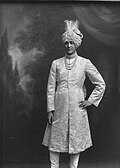 H.H. Maharaja Shri Sir Jitendra Narayan Bhup Bahadur, Maharaja of Cooch-Behar, KCSI, 1913.

Notes
- ↑ (Nath 1989:2–11)
- ↑ "Kamarupa was reorganized as a new state. 'Kamata' by name with Kamatapur as capital. The exact time when the change was made is uncertain. But possibly it had been made by Sandhya (c1250-1270) as a safeguard against mounting dangers from the east and the west. Its control on the eastern regions beyond the Manah (Manas river) was lax." (Sarkar 1992, pp. 40–41)
- ↑ (Gogoi 2002, p. 17)
- ↑ Guha (1983, p. 5)
- ↑ (Nath 1989:21)
- ↑ "The original name of Bishwa Singha was Bisu..(Nath 1989:16)
- ↑ the Koches were adapted to tribal ways of living at the time and Bisu's family members largely cultivated cottons on the hills. However when he acquired power to control the surrounding situation, the Brahmanas as pointed out by Gait, soon found him out and Hinduised him and his family, and called him Biswa Singha..(Gogoi 2002:18)
- ↑ "..it becomes clear that Biswa Singha's father was a Mech and mother was a Koch and both the tribes were "rude" and "impure", hence non-Aryan or non-Hinduised." (Nath 1989:17)
- ↑ (Urban 2009:82)
- ↑ (Sarkar 1992:91)
- ↑ (Sarkar 1992:69)
- ↑ (Sarkar1992:69f). "Minjahuddin found the features of the Koch, Mech, and Tharu tribes similar to a south Siberian tribe. Bryan Hodgson (JASB) xviii (2) 1849, 704-5, classes the Koches with the Bodo and Dhimal tribes. Buchanan agrees. Dalton takes them to be Dravidian. But Risley thinks they represented a fusion of Mongoloid and Dravidian stock, with the later predominating. According to Waddell Mongoloid type of Koches predominated in Assam."
- ↑ (Nath 1989:2–3)
- ↑ (Gogoi 2002, p. 18)
- ↑ (Sarkar 1992:70f)
- ↑ "..it becomes clear that Biswa Singha's father was a Mech and mother was a Koch and both the tribes were "rude" and "impure", hence non-Aryan or non-Hinduised." (Nath 1989:17)
- ↑ "...Dimarua, Panbari, Beltola, Rani, Moirapur, Borduar, Bholagram, Pantanduar, Chaigaon, Bogaduar, Bongaon, Baku, Luki, Hengerabari. Biswa Singha received the allegiance of these states including those of Darrang, Karaibari, Atiabari, Kamtabari, and Balrampur." (Nath 1989:23–24)
- ↑ (Nath 1989:28–29)
- ↑ "It is stated that Biswa Singha subjugated the Bar Bhuyan then the Saru Bhuyan and then the Bhuyan of Ouguri. After this he defeated the Daivajnya Chuti Bhuyan and thereafter Kusum Bhuyan, Dihala Bhuyan, Kalia Bhuyan and the Bhuyans of Jhargaon, Kabilash Bhuyan, the Bhuyans of Karnapur, Phulaguri, and Bijni, and finally Pratap Rai Bhuyan of Pandunath, Guwahati. The Gurucaritas also mention Gandhanva Rai, the Bhuyan of Banduka and Sriram Khan of Sajalagram." (Nath 1989:24)
- ↑ (Nath 1989:23–24)
- ↑ (Nath 1989:28)
- ↑ (Nath 1989:35)
- ↑ "Princess Daisy of Pless: The Happy Years. An exhibition at Castle Pless". www.rvondeh.dircon.co.uk.
- ↑ (Nath 1989:102–104)
- ↑ 25.0 25.1 "The Khaspur state originated with Chilarai's invasion in 1562 AD and remained in existence till 1745 when it merged with the Dimasa state of Maibong." (Bhattacharjee 1994:71)
- ↑ 26.0 26.1 (Bhattacharjee 1994:71)
- ↑ (Bhattacharjee 1994:72)
References
- Urban, Hugh (2009), The Power of Tantra: Religion, Sexuality and the Politics of South Asian Studies, Bloomsbury Publishing, ISBN 9780857715869
- Jacquesson, François (2008). "Discovering Boro-Garo" (PDF). History of an Analytical and Descriptive Linguistic Category.
- Bhattacharjee, J B (1994), "Pre-colonial Political Structure of Barak Valley", in Sangma, Milton S (ed.), Essays on North-east India: Presented in Memory of Professor V. Venkata Rao, New Delhi: Indus Publishing Company, pp. 61–85
- Gogoi, Jahnabi (2002), Agrarian system of medieval Assam, Concept Publishing Company, New Delhi
- Nath, D. (1989), History of the Koch Kingdom, C. 1515-1615, Mittal Publications, pp. 5–6, ISBN 8170991099
- Sarkar, J N (1992), "Chapter IV: Early Rulers of Koch Bihar", in Barpujari, H. K. (ed.), The Comprehensive History of Assam, vol. 2, Guwahati: Assam Publication Board
- Royal History of Koch Bihar, retrieved 5 December 2007