





QWLDesiree (talk | contribs) minor changes |
|||
| Line 1: | Line 1: | ||
{{ | {{Short description|Country in South Asia}} | ||
{{ | {{Redirect|Ceylon}} | ||
{{Redirect|Ilangai}} | |||
{{Use | {{Pp-vandalism|small=yes}} | ||
{{Use dmy dates|date= | {{Use British English|date=June 2022}} | ||
{{Use dmy dates|date=October 2025}} | |||
{{Infobox country | {{Infobox country | ||
| conventional_long_name = Democratic Socialist Republic of<br>Sri Lanka | | conventional_long_name = Democratic Socialist Republic of<br />Sri Lanka | ||
| common_name = Sri Lanka | | common_name = Sri Lanka | ||
| native_name = {{ubl|{{native name|si|ශ්රී ලංකා ප්රජාතාන්ත්රික සමාජවාදී ජනරජය|italics=off}} | | native_name = {{ubl|{{native name|si|ශ්රී ලංකා ප්රජාතාන්ත්රික සමාජවාදී ජනරජය|italics=off}} | ||
| {{native name|ta|இலங்கை சனநாயக சோசலிசக் குடியரசு|italics=off}} | |||
| {{Infobox | |||
| subbox = yes | | subbox = yes | ||
| bodystyle = font-size: | | bodystyle = font-size:0.85rem;font-weight:normal; | ||
| rowclass1 = mergedrow | | rowclass1 = mergedrow | ||
| label1 = [[Sinhala language|Sinhala]]: | | label1 = [[Sinhala language|Sinhala]]: | ||
| data1 = {{transliteration|si|ISO|Śrī Laṅkā Prajātāntrika Samājavādī Janarajaya}} | | data1 = {{transliteration|si|ISO|Śrī Laṅkā Prajātāntrika Samājavādī Janarajaya}} | ||
| rowclass2 = mergedrow | | rowclass2 = mergedrow | ||
| label2 = [[Tamil language|Tamil]]: | | label2 = [[Tamil language|Tamil]]: | ||
| data2 = {{transliteration|ta|ISO|Ilaṅkai | | data2 = {{transliteration|ta|ISO|Ilaṅkai Caṉanāyaka Cōcalicak Kuṭiyaracu}} | ||
}} | }}}} | ||
| image_flag = Flag of Sri Lanka.svg | | image_flag = Flag of Sri Lanka.svg | ||
| image_coat = Emblem of Sri Lanka.svg | | image_coat = Emblem of Sri Lanka.svg | ||
| coa_size = 70 | | coa_size = 70 | ||
| symbol_type = Emblem | | symbol_type = Emblem | ||
| national_anthem = "[[Sri Lanka Matha]]"<br />ශ්රී ලංකා මාතා (Sinhala)<br />தாயே இலங்கை (Tamil)<br>({{Langx|en|"Mother Sri Lanka"}})<br /><div style="display:inline-block;margin-top:0.4em;">[[File:Sri Lankan national anthem, performed by the United States Navy Band.oga|center]]</div> | |||
| national_anthem = "[[Sri Lanka Matha]]"<br />({{ | |||
| image_map = Sri Lanka (orthographic projection).svg | | image_map = Sri Lanka (orthographic projection).svg | ||
| capital = {{ubl|[[Sri Jayawardenepura Kotte]] (legislative)<ref>{{cite encyclopedia |title=Sri Jayewardenepura Kotte |url=https://www.britannica.com/place/Sri-Jayewardenepura-Kotte |encyclopedia=[[Encyclopædia Britannica]] |access-date=12 May 2020 |archive-date=17 June 2020 |archive-url=https://web.archive.org/web/20200617044803/https://www.britannica.com/place/Sri-Jayewardenepura-Kotte |url-status=live }}</ref>|[[Colombo]] (executive and judicial)<ref>{{cite encyclopedia |title=Colombo |url=https://www.britannica.com/place/Colombo |encyclopedia=[[Encyclopædia Britannica]] |access-date=12 May 2020 |archive-date=6 March 2023 |archive-url=https://web.archive.org/web/20230306022806/https://www.britannica.com/place/Colombo |url-status=live }}</ref><br />{{Coord|6|56|N|79|52|E|type:city}}}} | |||
| capital = {{ubl|[[Sri Jayawardenepura Kotte]] (legislative)<ref>{{cite | |||
| largest_city = [[Colombo]] | | largest_city = [[Colombo]] | ||
| | | languages_type = '''Official languages'''<br/>and recognised national languages | ||
| languages = {{hlist|[[Sinhala language|Sinhala]]|[[Tamil language|Tamil]]<ref>{{cite web |title=Official Languages Policy |url=http://www.languagesdept.gov.lk/web/index.php?option=com_content&view=article&id=38&Itemid=163&lang=en |website=languagesdept.gov.lk |publisher=Department of Official Languages |access-date=20 May 2021 |archive-date=12 April 2021 |archive-url=https://web.archive.org/web/20210412193905/http://languagesdept.gov.lk/web/index.php?option=com_content&view=article&id=38&Itemid=163&lang=en |url-status=dead }}</ref>}} | |||
| languages_sub = yes | | languages_sub = yes | ||
| languages2_type = Recognised | | languages2_type = Recognised language | ||
| languages2 = [[Sri Lankan English|English]] | | languages2 = [[Sri Lankan English|English]] | ||
| ethnic_groups = {{ | | ethnic_groups = {{ubli|74.1% [[Sinhalese people|Sinhalese]]|12.3% [[Sri Lankan Tamils]]|{{nowrap|10.5% [[Sri Lankan Moors]]}}|2.8% [[Indian Tamils of Sri Lanka|Indian Tamils]]|0.3% other}} | ||
| ethnic_groups_year = | | ethnic_groups_year = 2024<ref>{{cite web |url=https://www.statistics.gov.lk//Resource/en/Population/CPH_2024/Population_Preliminary_Report.pdf|date=30 October 2025 |publisher=The Department of Census and Statistics, Sri Lanka |access-date=30 October 2025 |title=BASIC POPULATION INFORMATION by Districts and Divisional Secretary Divisions}}</ref> | ||
| religion = {{nowrap| | | religion = {{ubli|{{nowrap|69.8% [[Buddhism in Sri Lanka|Buddhism]] ([[State religion|official]])}}|12.6% [[Hinduism in Sri Lanka|Hinduism]]|10.7% [[Islam in Sri Lanka|Islam]]|6.9% [[Christianity in Sri Lanka|Christianity]]|0.1% other/none}} | ||
| religion_year = | | religion_year = 2024 | ||
| demonym = Sri Lankan | | demonym = Sri Lankan | ||
| government_type = | | government_type = Unitary [[semi-presidential republic]]<ref>{{cite web |title=Constitution of Sri Lanka |url=https://www.parliament.lk/files/pdf/constitution.pdf |website=[[Parliament of Sri Lanka]] |access-date=24 October 2022 |archive-date=26 August 2020 |archive-url=https://web.archive.org/web/20200826023910/http://parliament.lk/files/pdf/constitution.pdf |url-status=live }}</ref> | ||
| leader_title1 = [[President of Sri Lanka|President]] | | leader_title1 = [[President of Sri Lanka|President]] | ||
| leader_name1 = [[ | | leader_name1 = [[Anura Kumara Dissanayake]] | ||
| leader_title2 = [[Prime Minister of Sri Lanka|Prime Minister]] | | leader_title2 = [[Prime Minister of Sri Lanka|Prime Minister]] | ||
| leader_name2 = [[ | | leader_name2 = [[Harini Amarasuriya]] | ||
| leader_title3 = [[Speaker of the Parliament of Sri Lanka|Speaker of the Parliament]] | | leader_title3 = [[Speaker of the Parliament of Sri Lanka|Speaker of the Parliament]] | ||
| leader_name3 = [[ | | leader_name3 = [[Jagath Wickramaratne]] | ||
| leader_title4 = [[Chief Justice of Sri Lanka|Chief Justice]] | | leader_title4 = [[Chief Justice of Sri Lanka|Chief Justice]] | ||
| leader_name4 = [[ | | leader_name4 = [[Padman Surasena]] | ||
| legislature = [[Parliament of Sri Lanka|Parliament]] | | legislature = [[Parliament of Sri Lanka|Parliament]] | ||
| sovereignty_type = [[History of Sri Lanka|Formation]] | | sovereignty_type = [[History of Sri Lanka|Formation]] | ||
| established_event1 = [[Sinhala | | established_event1 = [[Sinhala Kingdom]] established<ref>De Silva, K. M. (1981). A History of Sri Lanka. University of California Press. {{ISBN|978-0-19-561655-2}}. A History of Sri Lanka.</ref> | ||
| established_date1 = 543 BCE | | established_date1 = 543 BCE | ||
| established_event2 = [[ | | established_event2 = [[Anuradhapura period]] | ||
| established_date2 = | | established_date2 = 377 BCE – 1017 CE | ||
| established_event3 = [[ | | established_event3 = [[Polonnaruwa period]] | ||
| established_date3 = | | established_date3 = 1017–1232 | ||
| established_event4 = [[ | | established_event4 = [[Transitional period of Sri Lanka|Transitional period]] | ||
| established_date4 = | | established_date4 = 1232–1592 | ||
| established_event5 = [[ | | established_event5 = [[Kandyan period]] | ||
| established_date5 = | | established_date5 = 1592–1815 | ||
| established_event6 = [[ | | established_event6 = [[British Ceylon period]] | ||
| established_date6 = | | established_date6 = 1815–1948 | ||
| established_event7 | | established_event7 = [[Independence Day (Sri Lanka)|Independence]] | ||
| established_date7 = 4 February 1948 | |||
| established_event8 = [[Republic]] | |||
| established_date8 = 22 May 1972 | |||
| established_event9 = [[Constitution of Sri Lanka|Current constitution]] | |||
| established_date9 = 7 September 1978 | |||
| area_km2 = 67,240 | |||
<ref>{{cite web|title=Recalculation of Country Extent|author=Survey Department of Sri Lanka|date=2 August 2024|url=https://survey.gov.lk/sdweb/pdf/latestpost/Recalculation%20of%20Country%20Extent_to%20WEB.pdf}}</ref> | |||
| area_rank = 120th | |||
| area_sq_mi = 25,962 <!--Do not remove per [[WP:MOSNUM]]--> | |||
| | |||
| | |||
| | |||
| | |||
| | |||
| area_km2 = | |||
| area_rank = 120th | |||
| area_sq_mi = 25, | |||
| percent_water = 4.4 | | percent_water = 4.4 | ||
| population_estimate = | | population_estimate = 23,300,000<ref>{{cite web |title=Sri Lanka Population |url=https://www.worldometers.info/world-population/sri-lanka-population/|website=Worldometer.info|access-date=6 January 2026}}</ref> | ||
| population_census = | | population_census = 21,781,800<ref>{{cite web |title=Basic Population Information by Districts and Divisional Secretary Divisions |url=https://www.statistics.gov.lk/Resource/en/Population/CPH_2024/Population_Preliminary_Report.pdf |website=Department of Census and Statistics |access-date=1 November 2025}}</ref> | ||
| population_estimate_year = | | population_estimate_year = 2026 | ||
| population_estimate_rank = 60th | | population_estimate_rank = 60th | ||
| population_census_year = | | population_census_year = 2024 | ||
| population_density_km2 = 337.7 | | population_density_km2 = 337.7 | ||
| population_density_rank = 36th | |||
| population_density_rank = | | GDP_PPP = {{increase}}$342.6 billion <ref name="IMFDataMapperLKA">{{cite web |title=Sri Lanka - IMF DataMapper |url=https://www.imf.org/external/datamapper/profile/LKA |publisher=International Monetary Fund |access-date=23 April 2025}}</ref> | ||
| GDP_PPP = {{ | | GDP_PPP_year = 2025 | ||
| GDP_PPP_year = | | GDP_PPP_rank = 62nd | ||
| GDP_PPP_rank = | | GDP_PPP_per_capita = {{increase}} $15,632 <ref name="WB_GDP_PCAP_PPP">{{cite web |url=https://data.worldbank.org/indicator/NY.GDP.PCAP.PP.CD?locations=LK | ||
| GDP_PPP_per_capita = {{ | |title=GDP per capita, PPP (current international $) – Sri Lanka | ||
| GDP_PPP_per_capita_rank = | |publisher=World Bank | ||
| GDP_nominal = {{ | |website=data.worldbank.org | ||
| GDP_nominal_year = | |access-date=30 July 2025}}</ref> | ||
| GDP_nominal_rank = | | GDP_PPP_per_capita_rank = 111th | ||
| GDP_nominal_per_capita = {{ | | GDP_nominal = {{increase}} $98.9 billion<ref name="Sri Lanka GDP 2025">{{cite web |title=National Account Estimates 2025 |url=https://www.cbsl.gov.lk/sites/default/files/cbslweb_documents/statistics/national_account_estimates_2025_annual_e.pdf |publisher=[[Central Bank of Sri Lanka]] |website=www.cbsl.gov.lk |access-date=19 March 2025}}</ref> | ||
| GDP_nominal_per_capita_rank = | | GDP_nominal_year = 2025 | ||
| GDP_nominal_rank = 71st | |||
| GDP_nominal_per_capita = {{increase}} $4,516 | |||
| GDP_nominal_per_capita_rank = 120th | |||
| Gini = 39.8 <!--number only--> | | Gini = 39.8 <!--number only--> | ||
| Gini_year = | | Gini_year = 2023 | ||
| Gini_change = <!--increase/decrease/steady--> | | Gini_change = decrease <!--increase/decrease/steady--> | ||
| Gini_ref = <ref name="wb-gini">{{cite web |url=https://data.worldbank.org/indicator/SI.POV.GINI?locations=LK |title=Gini Index |publisher=World Bank}}</ref> | | Gini_ref = <ref name="wb-gini">{{cite web |url=https://data.worldbank.org/indicator/SI.POV.GINI?locations=LK |title=Gini Index |publisher=World Bank |access-date=24 May 2018 |archive-date=19 May 2023 |archive-url=https://web.archive.org/web/20230519204956/https://data.worldbank.org/indicator/SI.POV.GINI?locations=LK |url-status=live }}</ref> | ||
| HDI = 0.776 <!--number only--> | |||
| HDI = 0. | | HDI_year = 2023 <!--Please use the year to which the HDI year data refers, not the publication year--> | ||
| HDI_year = | | HDI_change = decrease<!--increase/decrease/steady--> | ||
| HDI_change = | | HDI_ref = <ref name="HDI">{{Cite web |date=6 May 2025 |title=Human Development Report 2025 |url=https://hdr.undp.org/system/files/documents/global-report-document/hdr2025reporten.pdf|url-status=live |archive-url=https://web.archive.org/web/20250506051232/https://hdr.undp.org/system/files/documents/global-report-document/hdr2025reporten.pdf |archive-date=6 May 2025 |access-date=6 May 2025 |publisher=[[United Nations Development Programme]] |language=en}}</ref> | ||
| HDI_ref = <ref name="HDI">{{ | | HDI_rank = 89th | ||
| HDI_rank = | | currency = [[Sri Lankan rupee]] ([[Sri Lankan rupee|Rs]]) | ||
| currency = [[Sri Lankan rupee]] (Rs) | |||
| currency_code = LKR | | currency_code = LKR | ||
| time_zone = [[Sri Lanka Standard Time|SLST]] | | time_zone = [[Sri Lanka Standard Time|SLST]] | ||
| utc_offset = +5:30 | | utc_offset = +5:30 | ||
| drives_on = Left | | drives_on = Left | ||
| calling_code = [[Telephone numbers in Sri Lanka|+94]] | | calling_code = [[Telephone numbers in Sri Lanka|+94]] | ||
| iso3166code = LK | | iso3166code = LK | ||
| cctld = {{hlist|[[.lk]] | [[.ලංකා]] | [[.இலங்கை]]}} | | cctld = {{hlist|[[.lk]]|[[.ලංකා]]|[[.இலங்கை]]}} | ||
| official_website = {{URL|https://www.gov.lk|gov.lk}} | | official_website = {{URL|https://www.gov.lk|gov.lk}} | ||
}} | }} | ||
{{Contains special characters| | {{Contains special characters|Sinhalese}} | ||
Sri Lanka | '''Sri Lanka''',{{efn|[[British English|UK]]: {{IPAc-en|s|r|i|_|ˈ|l|æ|ŋ|k|ə|,_|ʃ|r|iː|_|-}}, [[American English|US]]: {{IPAc-en|audio=En-us-Sri Lanka.ogg|-|_|ˈ|l|ɑː|ŋ|k|ə}}; {{langx|si|ශ්‍රී ලංකා|Śrī Laṅkā|translit-std=ISO|engvar=in}} ({{IPA|si|ʃriː laŋkaː|IPA}}); {{langx|ta|இலங்கை|Ilaṅkai|translit-std=ISO|engvar=in}} ({{IPA|ta|ilaŋɡaj|IPA}}).}} officially the '''Democratic Socialist Republic of Sri Lanka''', formerly known as '''Ceylon''',{{efn|Many names have been used to refer to the island, with Ceylon being used post-independence and still in use in some cases. For other names, see [[Names of Sri Lanka]].}} is an [[island country]] in [[South Asia]]. It is located in the [[Indian Ocean]], southwest of the [[Bay of Bengal]], and is separated from [[India]] by the [[Gulf of Mannar]] and the [[Palk Strait]]. Sri Lanka shares a [[maritime border]] with the [[Maldives]] to the southwest and India to the northwest, and lies across the Bay of Bengal from [[Bangladesh]] and [[Myanmar]] to the northeast and the [[Andaman and Nicobar Islands]] of India to the east. Its capital is [[Sri Jayawardenepura Kotte]], while [[Colombo]] is its [[List of cities in Sri Lanka|largest city]] and the political, financial and cultural centre. Sri Lanka's [[Demographics of Sri Lanka|population is 22 million]]; with the [[Sinhalese people]], who speak the [[Sinhala language]], forming the vast majority—while [[Tamil language|Tamil]] is spoken by the [[Sri Lankan Tamils|large Tamil minority]]. Other long-established ethnic groups include the [[Sri Lankan Moors|Moors]], [[Indian Tamils of Sri Lanka|Indian Tamils]], [[Burgher people|Burghers]], [[Sri Lankan Malays|Malays]], [[Chinese people in Sri Lanka|Chinese]], and [[Vedda]].<ref>{{cite encyclopedia |url=https://www.britannica.com/topic/Vedda |title=Vedda |encyclopedia=[[Encyclopædia Britannica]] |access-date=15 July 2014 |archive-date=6 September 2015 |archive-url=https://web.archive.org/web/20150906024458/http://www.britannica.com/topic/Vedda |url-status=live }}</ref> | ||
The island has a documented history of over 3,000 years, with evidence of prehistoric human settlement dating back 125,000 years.<ref name="histr">{{Cite book |chapter-url=https://books.google.com/books?id=PD8DseEWyuoC |title=Urbanization and sustainability in Asia: case studies of good practice |author=Roberts, Brian |chapter=Sri Lanka: Introduction |year=2006 |publisher=Asian Development Bank |isbn=978-971-561-607-2}}</ref> Sri Lanka has been given [[Names of Sri Lanka|various names]] throughout its long history, with Ceylon most notably being used prior to its independence. The earliest known [[Buddhism in Sri Lanka|Buddhist writings in the island]], known collectively as the [[Pali Canon]], date back to [[Fourth Theravāda Council|29 BCE]].<ref>{{cite book |url=https://books.google.com/books?id=62KQpPX1oVkC&pg=PA69 |title=Essential Buddhism: A Complete Guide to Beliefs and Practices |author=Jack Maguire |date=2001 |publisher=Simon and Schuster |isbn=978-0-671-04188-5 |page=69 |quote=... the Pali canon of Theravada is the earliest known collection of Buddhist writings ...}}</ref><ref>{{cite web |url=http://www.buddhanet.net/e-learning/dharmadata/fdd16.htm |title=Religions – Buddhism: Theravada Buddhism |date=2 October 2002 |publisher=BBC |access-date=18 February 2012 |archive-date=6 March 2012 |archive-url=https://web.archive.org/web/20120306115250/http://www.buddhanet.net/e-learning/dharmadata/fdd16.htm |url-status=live }}</ref> Sri Lanka, owing to its strategic geographical location, played a role as a major trading hub, and was well known to explorers across the world as early as the [[Anuradhapura period]]. The [[Portuguese Empire]] established [[Portuguese Ceylon|a colony]] in the sixteenth century, during a period of [[Crisis of the Sixteenth Century|political upheaval]] in the [[Kingdom of Kotte]] where it also faced attacks from neighboring [[Sinhala kingdom|kingdoms]] of [[Kingdom of Kandy|Kandy]] and [[Kingdom of Sitawaka|Sitawaka]]. Following the [[Sinhalese–Portuguese War]], the [[Dutch colonial empire]] controlled the [[Dutch Ceylon|coastal areas]]. By the early 19th century, the [[British Empire]] established a [[British Ceylon|colony on the island]], which lasted until 1948. The early 20th century saw the rise of nationalist movements and [[Sri Lankan independence movement|increasing calls for independence]]. In 1948, Sri Lanka gained independence as the [[Dominion of Ceylon]], eventually becoming a [[republic]] in 1972. Sri Lanka's recent history has been marred by a [[Sri Lankan civil war|prolonged civil war]] between the Tamil separatist militant organisation of [[Liberation Tigers of Tamil Eelam]] and the [[Sri Lankan Armed Forces]], which lasted from 1983 to 2009, and ended with the [[Eelam War IV|defeat of the separatists]].<ref>[https://www.reuters.com/article/us-srilanka-war-sb-idUSTRE54D1GR20090518 Reuters Sri Lanka wins civil war, says kills rebel leader] {{Webarchive|url=https://web.archive.org/web/20151016032645/http://www.reuters.com/article/2009/05/18/us-srilanka-war-sb-idUSTRE54D1GR20090518 |date=16 October 2015 }} [[Reuters]] (18 May 2009). Retrieved 18 November 2012.</ref> | |||
Sri Lanka | In the 21st century, Sri Lanka has emerged as a [[developing country]], with a strategically important geographical location in the Indian Ocean, with its deep harbors giving it significant geopolitical leverage as a major trading post from the ancient [[Maritime Silk Road]].<ref name="silkr">{{Cite book |chapter-url=https://books.google.com/books?id=xmNuAAAAMAAJ |title=Sri Lanka and the silk road of the sea |chapter=Sri Lankan Role in the Maritime Silk Route |page=21 |year=1990 |isbn=978-955-9043-02-7 |author=Bandaranayake, Senake|publisher=Sri Lanka National Commission for Unesco and the Central Cultural Fund }}</ref><ref>British Prime Minister Winston Churchill described the moment a Japanese fleet prepared to invade Sri Lanka as "the most dangerous and distressing moment of the entire conflict". – ''Commonwealth Air Training Program Museum'', [http://www.airmuseum.ca/mag/0410.html The Saviour of Ceylon] {{Webarchive|url=https://web.archive.org/web/20071022152654/http://www.airmuseum.ca/mag/0410.html |date=22 October 2007 }}</ref><ref>{{cite web |url=http://www.localhistories.org/srilanka.html |title=A Brief History of Sri Lanka |website=localhistories.org |access-date=14 August 2017 |archive-date=23 July 2014 |archive-url=https://web.archive.org/web/20140723124255/http://www.localhistories.org/srilanka.html |url-status=live }}</ref> It has the [[List of countries by Human Development Index|highest level of human development in South Asia]] and the [[List of countries by GDP (nominal) per capita|second-highest GDP per capita]] in the region. Sri Lanka has a long history of International engagement and cooperation, and is a member of several international organisations—including [[South Asian Association for Regional Cooperation|SAARC]], the [[Group of 77|G77]], the [[Non-Aligned Movement]] and the [[Commonwealth of Nations]]. | ||
== Toponymy == | == Toponymy == | ||
{{Main|Names of Sri Lanka}} | {{Main|Names of Sri Lanka}} | ||
In antiquity, Sri Lanka was known to travellers by a variety of names. According to the ''[[Mahāvaṃsa]]'', the legendary [[Prince Vijaya]] named the island [[Kingdom of Tambapanni|Tambapaṇṇĩ]] ("[[Copper (color)|copper-red]] hands" or "copper-red earth"), because his followers' hands were reddened by the [[red soil]] of the area where he landed.<ref>{{cite book |author=Nanda Pethiyagoda Wanasundera |title=Sri Lanka |url=https://books.google.com/books?id=1Ts1khhfXm8C&pg=PA26 |year=2002 |publisher=Marshall Cavendish |isbn=978-0-7614-1477-3 |page=26}}</ref><ref name="JMS_1997">{{cite book |author=John M. Senaveratna |title=The story of the Sinhalese from the most ancient times up to the end of "the Mahavansa" or Great dynasty |publisher=Asian Educational Services |date=1997 |page=11 |isbn=978-81-206-1271-6 |url=https://books.google.com/books?id=X9TeEcMi0e0C&pg=PA11+}}</ref> In [[Hindu mythology]], the term [[Lanka|''Lankā'']] ("Island") appears but it is unknown whether it refers to the | In antiquity, Sri Lanka was known to travellers by a variety of names. According to the ''[[Mahāvaṃsa]]'', the legendary [[Prince Vijaya]] named the island [[Kingdom of Tambapanni|Tambapaṇṇĩ]] ("[[Copper (color)|copper-red]] hands" or "copper-red earth"), because his followers' hands were reddened by the [[red soil]] of the area where he landed.<ref>{{cite book |author=Nanda Pethiyagoda Wanasundera |title=Sri Lanka |url=https://books.google.com/books?id=1Ts1khhfXm8C&pg=PA26 |year=2002 |publisher=Marshall Cavendish |isbn=978-0-7614-1477-3 |page=26}}</ref><ref name="JMS_1997">{{cite book |author=John M. Senaveratna |title=The story of the Sinhalese from the most ancient times up to the end of "the Mahavansa" or Great dynasty |publisher=Asian Educational Services |date=1997 |page=11 |isbn=978-81-206-1271-6 |url=https://books.google.com/books?id=X9TeEcMi0e0C&pg=PA11+}}</ref> In [[Hindu mythology]], the term [[Lanka|''Lankā'']] ("Island") appears but it is unknown whether it refers to the island. The Tamil term [[Eelam]] ({{Langx|ta|ஈழம்|translit=īḻam|engvar=in}}) was used to designate the whole island in [[Sangam literature]].<ref>{{Cite book |url=https://books.google.com/books?id=zS4OAQAAMAAJ |title=Encyclopedia of the world's minorities |last=Skutsch |first=Carl |date=2005 |publisher=Routledge |isbn=978-1-57958-470-2 |language=en |access-date=15 September 2017 |archive-date=31 March 2023 |archive-url=https://web.archive.org/web/20230331023929/https://books.google.com/books?id=zS4OAQAAMAAJ |url-status=live }}</ref><ref>{{Cite book |url=https://books.google.com/books?id=d_anEcoRJIQC&pg=PT105 |title=Autonomy and Ethnic Conflict in South and South-East Asia |last=Ganguly |first=Rajat |date=20 May 2013 |publisher=Routledge |isbn=978-1-136-31188-8 |language=en}}</ref> The island was known [[Chola conquest of Anuradhapura|under Chola rule]] as ''Mummudi Cholamandalam'' ("realm of the [[Three Crowned Kings|three crowned]] Cholas").<ref>{{Cite book |title=Art of the Imperial Cholas |last=Dehejia |first=Vidya |date=18 October 1990 |publisher=[[Columbia University Press]] |isbn=978-0-231-51524-5 |pages=51 |language=en}}</ref> | ||
[[Ancient Greek]] geographers called it ''[[Taprobana|Taprobanā]]'' ({{ | [[Ancient Greek]] geographers called it ''[[Taprobana|Taprobanā]]'' ({{langx|grc|Ταπροβανᾶ}}) or ''Taprobanē'' ({{lang|grc|Ταπροβανῆ}})<ref>{{cite web |url=http://www.rootsweb.ancestry.com/~lkawgw/slm-taprobane.htm |title=In Search of Taprobane: the Western discovery and mapping of Ceylon |author=Abeydeera, Ananda |access-date=17 October 2015 |archive-date=10 October 2017 |archive-url=https://web.archive.org/web/20171010151116/http://www.rootsweb.ancestry.com/~lkawgw/slm-taprobane.htm |url-status=live }}</ref> from the word ''Tambapanni''. The Arabs and Persians referred to it as ''Sarandīb'' (the origin of the word "[[serendipity]]") from [[Sanskrit]] ''Siṃhaladvīpaḥ''.<ref>{{cite web |url=http://dsalsrv02.uchicago.edu/cgi-bin/philologic/contextualize.pl?p.0.hobson.994549 |title=Hobson-Jobson |publisher=Dsalsrv02.uchicago.edu |date=1 September 2001 |access-date=15 August 2018 |archive-date=27 February 2019 |archive-url=https://web.archive.org/web/20190227225430/http://dsalsrv02.uchicago.edu/cgi-bin/philologic/contextualize.pl?p.0.hobson.994549 |url-status=dead }}</ref><ref>{{cite web |url=https://www.thefreedictionary.com/serendipity |title=Serendipity – definition of serendipity by The Free Dictionary |publisher=Thefreedictionary.com |date=10 November 2017 |access-date=15 August 2018 |archive-date=13 October 2018 |archive-url=https://web.archive.org/web/20181013192621/https://www.thefreedictionary.com/serendipity |url-status=live }}</ref> ''Ceilão'', the name given to Sri Lanka by the Portuguese when they arrived in 1505,<ref>{{cite web |last1=Rajasingham |first1=K. T. |title=Sri Lanka: The untold story |url=http://www.atimes.com/ind-pak/CH11Df02.html |website=[[Asia Times]] |access-date=25 May 2022 |archive-url=https://web.archive.org/web/20010814202127/http://atimes.com/ind-pak/CH11Df02.html |archive-date=14 August 2001 |date=11 August 2001 |url-status=usurped}}</ref> was transliterated into English as ''Ceylon''.<ref>{{cite web |url=http://www.glue.umd.edu/~pkd/sl/facts/name_origin.html |title=Etymologies of Lanka, Serendib, Taprobane and Ceylon |author=Zubair, Lareef |archive-url=https://web.archive.org/web/20070422115208/http://www.glue.umd.edu/~pkd/sl/facts/name_origin.html |archive-date=22 April 2007}}</ref> As a British [[crown colony]], the island was known as Ceylon; it achieved independence as the [[Dominion of Ceylon]] in 1948. | ||
The country is now known in Sinhala as ''{{transliteration|si|ISO|Śrī Laṅkā}}'' ({{ | The country is now known in Sinhala as ''{{transliteration|si|ISO|Śrī Laṅkā}}'' ({{langx|si|ශ්‍රී ලංකා}}) and in Tamil as ''{{transliteration|ta|ISO|Ilaṅkai}}'' ({{langx|ta|இலங்கை}}, {{IPA|ta|iˈlaŋɡaɪ|IPA}}). In 1972, its formal name was changed to "Free, Sovereign and Independent Republic of Sri Lanka". Later, on 7 September 1978, it was changed to the "Democratic Socialist Republic of Sri Lanka".<ref>{{cite web |url=http://hrlibrary.umn.edu/research/srilanka/constitutions/1978%20Constitution.pdf |title=The Constitution of the Democratic Socialist Republic of Sri Lanka |publisher=University of Minnesota Human Rights Library |date=7 September 1978 |access-date=24 October 2020 |archive-date=2 December 2020 |archive-url=https://web.archive.org/web/20201202031113/http://hrlibrary.umn.edu/research/srilanka/constitutions/1978%20Constitution.pdf |url-status=live }}</ref><ref>{{Cite journal |title=Chapter I – The People, The State And Sovereignty |journal=The Constitution of the Democratic Socialist Republic of Sri Lanka |url=http://www.priu.gov.lk/Cons/1978Constitution/Chapter_01_Amd.html |access-date=15 July 2014 |url-status=dead |archive-url=https://web.archive.org/web/20140531083515/http://www.priu.gov.lk/Cons/1978Constitution/Chapter_01_Amd.html |archive-date=31 May 2014 }}</ref> As the name Ceylon still appears in the names of a number of organisations, the Sri Lankan government announced in 2011 a plan to rename all those over which it has authority.<ref>{{cite news |author=Haviland, Charles |url=https://www.bbc.co.uk/news/world-south-asia-12099596 |title=Sri Lanka erases colonial name, Ceylon |publisher=[[BBC]] |date=1 January 2011 |access-date=22 June 2018 |archive-date=1 February 2018 |archive-url=https://web.archive.org/web/20180201204129/http://www.bbc.co.uk/news/world-south-asia-12099596 |url-status=live }}</ref> | ||
== History == | == History == | ||
| Line 154: | Line 134: | ||
=== Prehistory === | === Prehistory === | ||
{{Main|Prehistory of Sri Lanka}} | {{Main|Prehistory of Sri Lanka}} | ||
The | The pre-history of Sri Lanka goes back 125,000 years and possibly even as far back as 500,000 years.<ref name="pps">{{cite web |author=Deraniyagala, Siran U. |title=Pre and Protohistoric settlement in Sri Lanka |series=XIII U. I. S. P. P. Congress Proceedings – Forli, 8–14 September 1996 |work=International Union of Prehistoric and Protohistoric Sciences |url=http://www.lankalibrary.com/geo/dera1.html |access-date=15 July 2014 |archive-date=20 August 2017 |archive-url=https://web.archive.org/web/20170820080625/http://lankalibrary.com/geo/dera1.html |url-status=live }}</ref> The era spans the [[Palaeolithic]], [[Mesolithic]], and early [[Iron Age]]s. Among the [[Paleolithic]] human settlements discovered in Sri Lanka, [[Fa Hien Cave|Pahiyangala]] (37,000 BP), named after the [[Chinese people|Chinese]] traveller [[Bhikkhu|monk]] [[Faxian]];<ref>{{cite web |url=https://www.angelfire.com/in4/visitsl/prehistoric/pahiyagala/pahiyangala.htm |title=Pahiyangala (Fa-Hiengala) Caves |work=[[Angelfire]] |access-date=15 July 2014 |archive-date=2 September 2017 |archive-url=https://web.archive.org/web/20170902171134/http://www.angelfire.com/in4/visitsl/prehistoric/pahiyagala/pahiyangala.htm |url-status=live }}</ref> [[Batadombalena]] (28,500 BP);<ref name="btd">{{Cite book |author=Kennedy, Kenneth A.R., Disotell, T.W., Roertgen, J., Chiment, J., Sherry, J. |title=Ancient Ceylon 6: Biological anthropology of upper Pleistocene hominids from Sri Lanka: Batadomba Lena and Beli Lena caves |pages=165–265}}</ref> and [[Belilena]] (12,000 BP) are the most important. In these caves, archaeologists have found the remains of [[anatomy|anatomically]] modern [[humans]] which they have named [[Balangoda Man]], and other evidence<ref>{{Harvnb|De Silva|1981|pp=6–7}}</ref> suggesting that they may have engaged in [[agriculture]] and kept domestic dogs for driving game.<ref>{{cite book |author=Deraniyagal, Siran |title=The Prehistory of Sri Lanka |publisher=[[Department of Archaeological Survey]] |year=1992 |place=[[Colombo]] | page=454 |isbn=978-955-9159-00-1 |url=https://books.google.com/books?id=ZihuAAAAMAAJ}}</ref> | ||
The earliest inhabitants of Sri Lanka were likely ancestors of the [[Vedda people]],<ref>{{cite web |url=http://www.lankalibrary.com/geo/dera2.html |title=Early Man and the Rise of Civilisation in Sri Lanka: the Archaeological Evidence |author=Deraniyagala, S.U. |work=lankalibrary.com |access-date=15 July 2014 |archive-date=5 January 2014 |archive-url=https://web.archive.org/web/20140105134736/http://www.lankalibrary.com/geo/dera2.html |url-status=live }}</ref> an indigenous people numbering approximately 2,500 living in modern-day Sri Lanka. | |||
One of the first written references to the island is found in the Indian [[Epic poetry|epic]] [[Ramayana]], which provides details of a kingdom named ''[[Lanka]]'' that was created by the divine sculptor [[Vishwakarma|Vishvakarma]] for [[Kubera]], the God of Wealth.<ref>{{Cite book |author=Keshavadas, Sant |title=Ramayana at a Glance |publisher=Motilal Banarsidass |year=1988 |isbn=978-81-208-0545-3 |url=https://books.google.com/books?id=3XIatVGyjmQC}}</ref> It is said that Kubera was overthrown by his [[rakshasa]] stepbrother, [[Ravana]].<ref name="parkrsl">{{Cite book |author=Parker, H. |title=Ancient Ceylon |publisher=Asian Educational Services |year=1992 |page=7 |isbn=978-81-206-0208-3 |url=https://books.google.com/books?id=Nk8xpkY0bqEC}}</ref> | During the protohistoric period (1000–500 BCE) Sri Lanka was culturally united with southern India,<ref>{{cite web |url=https://frontline.thehindu.com/other/article30208096.ece |title=Reading the past in a more inclusive way – Interview with Dr. Sudharshan Seneviratne |work=[[Frontline (magazine)|Frontline]] (2006) |date=26 January 2006 |access-date=18 September 2020 |archive-date=26 November 2021 |archive-url=https://web.archive.org/web/20211126024531/https://frontline.thehindu.com/other/article30208096.ece |url-status=live }}</ref> and shared the same megalithic burials, [[Black and red ware culture|pottery]], iron technology, farming techniques and [[megalithic graffiti symbols|megalithic graffiti]].<ref name="Seneviratne">{{cite book |last=Seneviratne |first=Sudharshan |title=Social base of early Buddhism in south east India and Sri Lanka |date=1984}}</ref><ref name="Karunaratne">{{cite book |last=Karunaratne |first=Priyantha |title=Secondary state formation during the early iron age on the island of Sri Lanka : the evolution of a periphery |date=2010}}</ref> This cultural complex spread from southern India along with Dravidian clans such as the [[Velir]], prior to the migration of [[Prakrit]] speakers.<ref>Robin Conningham – Anuradhapura – The British-Sri Lankan Excavations at Anuradhapura Salgaha Watta | ||
Volumes 1 and 2 (1999/2006)</ref><ref>{{Cite journal |last=Seneviratne |first=Sudarshan |year=1989 |title=Pre-state chieftains and servants of the state: a case study of Parumaka |url=http://dlib.pdn.ac.lk/archive/handle/123456789/2078 |language=en |journal=The Sri Lanka Journal of the Humanities |access-date=19 February 2021 |archive-date=15 August 2021 |archive-url=https://web.archive.org/web/20210815201049/http://dlib.pdn.ac.lk/archive/handle/123456789/2078 |url-status=live }}</ref><ref name="Seneviratne" /> | |||
One of the first written references to the island is found in the Indian [[Epic poetry|epic]] [[Ramayana]], which provides details of a kingdom named ''[[Lanka]]'' that was created by the divine sculptor [[Vishwakarma|Vishvakarma]] for [[Kubera]], the God of Wealth.<ref>{{Cite book |author=Keshavadas, Sant |title=Ramayana at a Glance |publisher=Motilal Banarsidass |year=1988 |isbn=978-81-208-0545-3 |url=https://books.google.com/books?id=3XIatVGyjmQC}}</ref> It is said that Kubera was overthrown by his [[rakshasa]] stepbrother, [[Ravana]].<ref name="parkrsl">{{Cite book |author=Parker, H. |title=Ancient Ceylon |publisher=[[Asian Educational Services]] |year=1992 |page=7 |isbn=978-81-206-0208-3 |url=https://books.google.com/books?id=Nk8xpkY0bqEC}}</ref> | |||
=== Ancient history === | === Ancient history === | ||
{{Main|Pre Anuradhapura period|Anuradhapura period}} | {{Main|Pre-Anuradhapura period|Anuradhapura period}} | ||
[[File:Ptolemy's Taprobana.jpg|thumb|left|[[Ptolemy's world map]] of Ceylon, first century CE, in a 1535 publication]] | [[File:Ptolemy's Taprobana.jpg|thumb|left|[[Ptolemy's world map]] of Ceylon, first century CE, in a 1535 publication]] | ||
According to the ''[[ | According to the ''[[Mahāvaṃsa]]'', a [[Pali|Pāḷi]] chronicle written in the 5th century CE, the original inhabitants of Sri Lanka are said to be the [[Yaksha]]s and [[Naga people (Lanka)|Nagas]]. Sinhalese history traditionally starts in 543 BCE with the arrival of [[Prince Vijaya]], a semi-legendary prince who sailed with 700 followers to Sri Lanka, after being expelled from [[Vanga kingdom]] (present-day [[Bengal]]).<ref>{{cite web |url=http://mahavamsa.org/mahavamsa/original-version/06-coming-vijaya/ |title=The Coming of Vijaya |work=The Mahavamsa |date=8 October 2011 |access-date=16 October 2015 |archive-date=30 October 2015 |archive-url=https://web.archive.org/web/20151030084837/http://mahavamsa.org/mahavamsa/original-version/06-coming-vijaya/ |url-status=live }}</ref> He established the [[Kingdom of Tambapanni]], near modern-day [[Mannar, Sri Lanka|Mannar]]. Vijaya (Singha) is the first of the approximately [[List of Sri Lankan monarchs|189 monarchs of Sri Lanka]] described in chronicles such as the ''[[Dīpavaṃsa]]'', ''Mahāvaṃsa'', ''[[Cūḷavaṃsa]]'', and ''Rājāvaliya''.<ref>{{cite web |url=https://www.worldgenweb.org/lkawgw/gen3000.html |title=Vijaya (Singha) and the Lankan Monarchs – Family #3000 |work=[[Ancestry.com]] |access-date=15 July 2014 |archive-date=24 Feb 2026 |archive-url=https://ghostarchive.org/archive/cl7tD |url-status=live }}</ref> | ||
Once [[Prakrit]] speakers had attained dominance on the island, the [[ | Once [[Prakrit]] speakers had attained dominance on the island, the ''[[Mahāvaṃsa]]'' further recounts the later migration of royal brides and service castes from the Tamil [[Pandya kingdom]] to the [[Anuradhapura kingdom]] in the early historic period.<ref>{{cite web |url=https://mahavamsa.org/mahavamsa/original-version/07-consecrating-vijaya/ |title=The Consecrating of Vijaya |work=Mahavamsa |date=8 October 2011 |access-date=27 January 2021 |archive-date=20 June 2023 |archive-url=https://web.archive.org/web/20230620071000/https://mahavamsa.org/mahavamsa/original-version/07-consecrating-vijaya/ |url-status=live }}</ref> | ||
[[File:Buda de Avukana - 01.jpg|thumb|upright=1.1|The [[Avukana Buddha statue]], a {{convert|12|m|ft|adj=mid|-tall}} standing Buddha statue from the reign of [[Dhatusena of Anuradhapura]], 5th century]] | [[File:Buda de Avukana - 01.jpg|thumb|upright=1.1|The [[Avukana Buddha statue]], a {{convert|12|m|ft|adj=mid|-tall}} standing Buddha statue from the reign of [[Dhatusena of Anuradhapura]], 5th century]] | ||
The [[Anuradhapura period]] (377 BCE{{snd}}1017 CE) began with the establishment of the [[Anuradhapura | The [[Anuradhapura period]] (377 BCE{{snd}}1017 CE) began with the establishment of the [[Anuradhapura kingdom]] in 380 BCE during the reign of [[Pandukabhaya]]. Thereafter, Anuradhapura served as the capital city of the country for nearly 1,400 years.<ref>{{cite web |url=http://www.worldheritagesite.org/sites/anuradhapura.html |archive-url=https://web.archive.org/web/20040107085324/http://www.worldheritagesite.org/sites/anuradhapura.html |url-status=dead |archive-date=7 January 2004 |title=World Heritage site: Anuradhapura |work=worldheritagesite.org |access-date=15 July 2014 }}</ref> Ancient Sri Lankans excelled at building certain types of [[Ancient constructions of Sri Lanka|structures]] such as [[Sri Lankan irrigation network|tanks]], [[Stupa|dagobas]] and palaces.<ref>{{cite web |url=https://mysrilankaholidays.com/ancient-sinhalese-irrigation.html |title=Waterworld: Ancient Sinhalese Irrigation |work=mysrilankaholidays.com |access-date=15 July 2014 |archive-date=26 June 2014 |archive-url=https://web.archive.org/web/20140626105945/http://www.mysrilankaholidays.com/ancient-sinhalese-irrigation.html |url-status=live }}</ref> Society underwent a major transformation during the reign of [[Devanampiya Tissa]], with the arrival of Buddhism from India. In 250 BCE,<ref>{{cite web |url=http://www.accesstoinsight.org/lib/authors/perera/wheel100.html#preface |title=Buddhism in Sri Lanka: A Short History |author=Perera H. R. |work=accesstoinsight.org |access-date=15 July 2014 |archive-date=22 April 2007 |archive-url=https://web.archive.org/web/20070422013525/http://www.accesstoinsight.org/lib/authors/perera/wheel100.html#preface |url-status=live }}</ref> [[Mahinda (Buddhist monk)|Mahinda]], a [[bhikkhu]] and the son of the [[Maurya Empire|Mauryan]] Emperor [[Ashoka]] arrived in [[Mihintale]] carrying the message of Buddhism.<ref name="Macmillan1">{{cite book |author=Holt, John Clifford |contribution=Sri Lanka |year=2004 |title=Macmillan Encyclopedia of Buddhism |editor=Buswell, Robert E. Jr. |pages=795–799 |publisher=Macmillan Reference |isbn=978-0-8160-5459-6 |url=https://books.google.com/books?id=5dxCHAAACAAJ}}</ref> His mission won over the monarch, who embraced the faith and propagated it throughout the [[Sinhalese people|Sinhalese population]].<ref name="mahav1">{{cite web |url=http://mahavamsa.org/2008/05/king-devanampiya-tissa-306-bc/ |title=King Devanampiya Tissa (306 BC – 266 BC) |work=[[Mahāvaṃsa]] |date=28 May 2008 |access-date=15 July 2014 |archive-date=14 August 2014 |archive-url=https://web.archive.org/web/20140814102643/http://mahavamsa.org/2008/05/king-devanampiya-tissa-306-bc/ |url-status=live }}</ref> | ||
Succeeding kingdoms of Sri Lanka would maintain many [[schools of Buddhism|Buddhist schools]] and monasteries and support the propagation of Buddhism into other countries in | Succeeding kingdoms of Sri Lanka would maintain many [[schools of Buddhism|Buddhist schools]] and monasteries and support the propagation of Buddhism into other countries in Southeast Asia. Sri Lankan Bhikkhus studied in India's famous ancient Buddhist University of [[Nalanda]], which was destroyed by [[Muhammad Bakhtiyar Khalji|Bakhtiyar Khalji]]. It is probable that many of the scriptures from Nalanda are preserved in Sri Lanka's many monasteries and that the written form of the [[Tripiṭaka]], including Sinhalese Buddhist literature, were part of the University of Nalanda.<ref>{{cite web |url=http://www.buddhanet.net/e-learning/buddhistworld/lanka-txt.htm |title=Buddhism in Sri Lanka |work=buddhanet.net |access-date=15 July 2014 |archive-date=21 February 2013 |archive-url=https://web.archive.org/web/20130221072955/http://www.buddhanet.net/e-learning/buddhistworld/lanka-txt.htm |url-status=live }}</ref> In 245 BCE, [[bhikkhunī]] [[Sanghamitta]] arrived with the [[Jaya Sri Maha Bodhi]] tree, which is considered to be a sapling from the historical [[Bodhi Tree]] under which [[Gautama Buddha]] became enlightened.<ref>{{Harvnb|Paw|p=6}}</ref> It is considered the oldest human-planted tree (with a continuous historical record) in the world. ([[Bodhivaṃsa]])<ref>{{cite book |last1=Evans |first1=Julian |title=Plantation Forestry in the Tropics: Tree Planting for Industrial, Social, Environmental, and Agroforestry Purposes |date=1992 |publisher=Clarendon Press |isbn=9780198542575 |page=26 |url=https://books.google.com/books?id=h1oF-88qKRsC |access-date=11 May 2022}}</ref> | ||
Sri Lanka experienced the first of many foreign invasions during the reign of [[Suratissa of Anuradhapura|Suratissa]], who was defeated by two horse traders named [[Sena and Guttika]] from | Sri Lanka experienced the first of many foreign invasions during the reign of [[Suratissa of Anuradhapura|Suratissa]], who was defeated by two horse traders named [[Sena and Guttika]] from South India.<ref name="mahav1" /> The next invasion came immediately in 205 BCE by a [[Chola]] named [[Elara (monarch)|Elara]], who overthrew [[Asela of Anuradhapura|Asela]] and ruled the country for 44 years. [[Dutugamunu]], the eldest son of the southern regional sub-king, [[Kavan Tissa, Prince of Ruhuna|Kavan Tissa]], defeated Elara in the [[Battle of Vijithapura]]. During its two and a half millennia of existence, the [[Sinhala kingdom]] was invaded at least eight times by neighbouring South Indian dynasties such as the [[Chola dynasty|Chola]], [[Pandya dynasty|Pandya]], and [[Pallava dynasty|Pallava]].{{citation needed|date=April 2023}} There also were incursions by the kingdoms of [[Kalinga (region)|Kalinga]] (modern [[Odisha]]) and from the [[Malay Peninsula]] as well.{{citation needed|date=April 2023}} | ||
[[File:Sigiriya.jpg|thumb|left|The [[Sigiriya]] ("Lion Rock"), a rock fortress and city, built by King [[Kashyapa I of Anuradhapura|Kashyapa]] (477–495 CE) as a new more defensible capital. It was also used as a Buddhist monastery after the capital was moved back to [[Anuradhapura]].]] | [[File:Sigiriya.jpg|thumb|left|The [[Sigiriya]] ("Lion Rock"), a rock fortress and city, built by King [[Kashyapa I of Anuradhapura|Kashyapa]] (477–495 CE) as a new more defensible capital. It was also used as a Buddhist monastery after the capital was moved back to [[Anuradhapura]].]] | ||
The [[Fourth | The [[Fourth Theravāda Council]] was held at the [[Anuradhapura Maha Viharaya]] in Sri Lanka under the patronage of [[Valagamba]] in 25 BCE. The council was held in response to a year in which the harvests in Sri Lanka were particularly poor and many [[bhikkhu|Buddhist monks]] subsequently died of starvation. Because the [[Pali Canon]] was at that time [[oral literature]] maintained in several recensions by ''dhammabhāṇaka''s ([[dharma]] reciters), the surviving monks recognised the danger of not writing it down so that even if some of the monks whose duty it was to study and remember parts of the Canon for later generations died, the teachings would not be lost.{{sfn | Buswell | Lopez | 2013 | p=200}} After the council, [[palm-leaf manuscript]]s containing the completed Canon were taken to other countries such as [[Burma]], [[Thailand]], [[Cambodia]] and [[Laos]]. | ||
Sri Lanka was the first Asian country known to have a female ruler: [[Anula of Anuradhapura]] (r. 47–42 BCE).<ref name="sigiriya12">{{cite web |title=The History of Ceylon |work=sltda.gov.lk |url=http://www.sltda.gov.lk/history |access-date=15 July 2014 |url-status=dead |archive-url=https://web.archive.org/web/20140808014733/http://www.sltda.gov.lk/history |archive-date=8 August 2014 }}</ref> Sri Lankan monarchs undertook some remarkable construction projects such as [[Sigiriya]], the so-called "Fortress in the Sky", built during the reign of [[Kashyapa I | Sri Lanka was the first Asian country known to have a female ruler: [[Anula of Anuradhapura]] (r. 47–42 BCE).<ref name="sigiriya12">{{cite web |title=The History of Ceylon |work=sltda.gov.lk |url=http://www.sltda.gov.lk/history |access-date=15 July 2014 |url-status=dead |archive-url=https://web.archive.org/web/20140808014733/http://www.sltda.gov.lk/history |archive-date=8 August 2014 }}</ref> Sri Lankan monarchs undertook some remarkable construction projects such as [[Sigiriya]], the so-called "Fortress in the Sky", built during the reign of [[Kashyapa I]], who ruled between 477 and 495. The Sigiriya rock fortress is surrounded by an extensive network of ramparts and moats. Inside this protective enclosure were gardens, ponds, pavilions, palaces and other structures.<ref name="Ponnamperuma 2013">{{cite book |last=Ponnamperuma |first=Senani |title=Story of Sigiriya |year=2013 |publisher=Panique Pty Ltd |location=Melbourne |isbn=978-0-9873451-1-0 |url=https://books.google.com/books?id=25zxmgEACAAJ}}</ref><ref name="Bandaranayake 1999">{{cite book |last=Bandaranayake |first=Senake |title=Sigiriya: City, Palace, and Royal Gardens |year=1999 |publisher=Central Cultural Fund, Ministry of Cultural Affairs |location=Colombo |isbn=978-955-613-111-6 |url=https://books.google.com/books?id=vw9uAAAAMAAJ}}</ref> | ||
In 993 CE, the invasion of [[Chola dynasty|Chola emperor]] [[Rajaraja I]] forced the then Sinhalese ruler [[ | In 993 CE, the invasion of [[Chola dynasty|Chola emperor]] [[Rajaraja I]] forced the then Sinhalese ruler [[Mahinda V]] to flee to the southern part of Sri Lanka. Taking advantage of this situation, [[Rajendra I]], son of Rajaraja I, launched a large invasion in 1017. Mahinda V was captured and taken to India, and the Cholas [[Chola conquest of Anuradhapura|sacked the city of Anuradhapura]] causing the fall of [[Anuradhapura kingdom]]. Subsequently, they moved the capital to [[Polonnaruwa]].<ref name="Siriweera 2004, p. 44">{{cite book |last=Siriweera |first=W. I. |title=A Study of the Economic History of Pre Modern Sri Lanka |publisher=Vikas Publishing House |year=1994 |isbn=978-0-7069-7621-2 |pages=44–45 |url=https://books.google.com/books?id=OubsAAAAMAAJ |access-date=24 July 2018 |archive-date=6 January 2024 |archive-url=https://web.archive.org/web/20240106105344/https://books.google.com/books?id=OubsAAAAMAAJ |url-status=live }}</ref> | ||
=== Post-classical period === | === Post-classical period === | ||
{{Main|Polonnaruwa period|Transitional period of Sri Lanka}} | {{Main|Polonnaruwa period|Transitional period of Sri Lanka}} | ||
Following a 17-year-long campaign, [[Vijayabahu I of Polonnaruwa|Vijayabahu I]] successfully drove the Chola out of Sri Lanka in 1070, reuniting the country for the first time in over a century.<ref>Codrington, [http://lakdiva.org/codrington/chap04.html Ch. 4]</ref><ref>{{cite web |url=http://www.localhistories.org/srilanka.html |title=A Brief History of Sri Lanka |author=Lambert, Tim |work=localhistories.org |access-date=15 July 2014}}</ref> Upon his request, ordained monks were sent from [[Burma]] to Sri Lanka to re-establish Buddhism, which had almost disappeared from the country during the Chola reign.<ref>{{cite journal |title=Relations between Ceylon and Burma in the 11th Century AD |volume=23 |pages=93–95 |author=Bokay, Mon |journal=Artibus Asiae. Supplementum |year=1966 |publisher=Artibus Asiae Publishers |jstor=1522637 |doi=10.2307/1522637 }}</ref> During the medieval period, Sri Lanka was divided into three sub-territories, namely, [[Principality of Ruhuna|Ruhunu]], Pihiti and [[Maya Rata|Maya]].<ref>{{cite web |url=http://lakdiva.org/coins/medievallanka/1153_1186_parakramabahu~i_Em.html |title=Ancient Irrigation Works |work=lakdiva.org |access-date=15 July 2014 |archive-date=2 November 2013 |archive-url=https://web.archive.org/web/20131102152939/http://lakdiva.org/coins/medievallanka/1153_1186_parakramabahu~i_Em.html |url-status=dead }}</ref> | |||
Following a 17-year-long campaign, [[Vijayabahu I of Polonnaruwa|Vijayabahu I]] successfully drove the Chola out of Sri Lanka in 1070, reuniting the country for the first time in over a century.<ref>Codrington, [http://lakdiva.org/codrington/chap04.html Ch. 4] {{Webarchive|url=https://web.archive.org/web/20160807212106/http://lakdiva.org/codrington/chap04.html |date=7 August 2016 }}</ref><ref>{{cite web |url=http://www.localhistories.org/srilanka.html |title=A Brief History of Sri Lanka |author=Lambert, Tim |work=localhistories.org |access-date=15 July 2014 |archive-date=23 July 2014 |archive-url=https://web.archive.org/web/20140723124255/http://www.localhistories.org/srilanka.html |url-status=live }}</ref> Upon his request, ordained monks were sent from [[Burma]] to Sri Lanka to re-establish Buddhism, which had almost disappeared from the country during the Chola reign.<ref>{{cite journal |title=Relations between Ceylon and Burma in the 11th Century AD |volume=23 |pages=93–95 |author=Bokay, Mon |journal=Artibus Asiae. Supplementum |year=1966 |publisher=Artibus Asiae Publishers |jstor=1522637 |doi=10.2307/1522637 |issn = 1423-0526 }}</ref> During the medieval period, Sri Lanka was divided into three sub-territories, namely, [[Principality of Ruhuna|Ruhunu]], Pihiti and [[Maya Rata|Maya]].<ref>{{cite web |url=http://lakdiva.org/coins/medievallanka/1153_1186_parakramabahu~i_Em.html |title=Ancient Irrigation Works |work=lakdiva.org |access-date=15 July 2014 |archive-date=2 November 2013 |archive-url=https://web.archive.org/web/20131102152939/http://lakdiva.org/coins/medievallanka/1153_1186_parakramabahu~i_Em.html |url-status=dead }}</ref> | |||
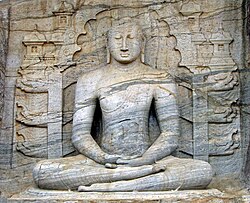
[[File:Gal Viharaya 02.jpg|thumb|The seated image of [[Gal Vihara]] in [[Polonnaruwa]], 12th century, which depicts the [[List of mudras (yoga)|dhyana mudra]], shows signs of [[Mahayana]] influence.]] | [[File:Gal Viharaya 02.jpg|thumb|The seated image of [[Gal Vihara]] in [[Polonnaruwa]], 12th century, which depicts the [[List of mudras (yoga)|dhyana mudra]], shows signs of [[Mahayana]] influence.]] | ||
Sri Lanka's [[Sri Lankan irrigation network|irrigation system]] was extensively expanded during the reign of [[Parakramabahu I of Polonnaruwa|Parākramabāhu the Great]] (1153–1186).<ref name="ethniccr">{{cite book |title=Sri Lankan Ethnic Crisis: Towards a Resolution |author=Herath, R. B. |year=2002 |publisher=Trafford Publishing |isbn=978-1-55369-793-0 |quote=Parakramabahu 1 further extended the system to the highest resplendent peak of hydraulic civilization of the country's history. |page=19 |url=https://books.google.com/books?id=jzMCzJxJBpsC}}</ref> This period is considered as a time when Sri Lanka was at the height of its power.<ref>{{cite book |title=Journal of the Royal Asiatic Society of Great Britain and Ireland: Volume 7 |year=1875 |publisher=[[Cambridge University Press]] for the Royal Asiatic Society |place=[[Cambridge]] | quote=... and when at the height of its prosperity, during the long and glorious reign of Parakramabahu the Great ... |page=152 |url=https://books.google.com/books?id=rPo78i8KrlEC}}</ref><ref>{{cite journal |last=Beveridge |first=H. |year=1894 |url=https://books.google.com/books?id=VRngAAAAMAAJ&pg=PA324 |title=The Site of Karna Suvarna |journal=Journal of the Asiatic Society of Bengal |volume=62 |quote=His [Parakramabahu's] reign is described by Tumour as having been the most martial, enterprising, and glorious in Singhalese history. |page=324 |via=Google Books}}</ref> He built 1,470 reservoirs – the highest number by any ruler in Sri Lanka's history – repaired 165 dams, 3,910 canals, 163 major reservoirs, and 2,376 mini-reservoirs.<ref name="ethniccr1" /> His most famous construction is the [[Parakrama Samudra]],<ref>{{cite web |url=http://www.ilec.or.jp/database/asi/asi-45.html |title=Parakrama Samudra |publisher=International Lake Environment Committee |url-status=dead |archive-url=https://web.archive.org/web/20110605083015/http://www.ilec.or.jp/database/asi/asi-45.html |archive-date=5 June 2011}}</ref> the largest irrigation project of medieval Sri Lanka. Parākramabāhu's reign is memorable for two major campaigns – in the south of India as part of a Pandyan war of succession, and a punitive strike against the kings of Ramanna ([[Myanmar|Burma]]) for various perceived insults to Sri Lanka.<ref>{{cite web |url=http://srilankanheritage.com/index.php?option=com_content&view=article&id=28&Itemid=32&lang=en |title=ParakramaBahu I: 1153–1186 |work=lakdiva.org |url-status=dead |archive-url=https://web.archive.org/web/20140204034638/http://srilankanheritage.com/index.php?option=com_content&view=article&id=28&Itemid=32&lang=en |archive-date=4 February 2014}}</ref> | Sri Lanka's [[Sri Lankan irrigation network|irrigation system]] was extensively expanded during the reign of [[Parakramabahu I of Polonnaruwa|Parākramabāhu the Great]] (1153–1186).<ref name="ethniccr">{{cite book |title=Sri Lankan Ethnic Crisis: Towards a Resolution |author=Herath, R. B. |year=2002 |publisher=Trafford Publishing |isbn=978-1-55369-793-0 |quote=Parakramabahu 1 further extended the system to the highest resplendent peak of hydraulic civilization of the country's history. |page=19 |url=https://books.google.com/books?id=jzMCzJxJBpsC |access-date=24 July 2018 |archive-date=6 January 2024 |archive-url=https://web.archive.org/web/20240106105345/https://books.google.com/books?id=jzMCzJxJBpsC |url-status=live }}</ref> This period is considered as a time when Sri Lanka was at the height of its power.<ref>{{cite book |title=Journal of the Royal Asiatic Society of Great Britain and Ireland: Volume 7 |year=1875 |publisher=[[Cambridge University Press]] for the Royal Asiatic Society |place=[[Cambridge]] |quote=... and when at the height of its prosperity, during the long and glorious reign of Parakramabahu the Great ... |page=152 |url=https://books.google.com/books?id=rPo78i8KrlEC |access-date=20 June 2015 |archive-date=6 January 2024 |archive-url=https://web.archive.org/web/20240106105344/https://books.google.com/books?id=rPo78i8KrlEC |url-status=live }}</ref><ref>{{cite journal |last=Beveridge |first=H. |year=1894 |url=https://books.google.com/books?id=VRngAAAAMAAJ&pg=PA324 |title=The Site of Karna Suvarna |journal=Journal of the Asiatic Society of Bengal |volume=62 |quote=His [Parakramabahu's] reign is described by Tumour as having been the most martial, enterprising, and glorious in Singhalese history. |page=324 |via=Google Books |access-date=29 September 2020 |archive-date=6 January 2024 |archive-url=https://web.archive.org/web/20240106105344/https://books.google.com/books?id=VRngAAAAMAAJ&pg=PA324#v=onepage&q&f=false |url-status=live }}</ref> He built 1,470 reservoirs – the highest number by any ruler in Sri Lanka's history – repaired 165 dams, 3,910 canals, 163 major reservoirs, and 2,376 mini-reservoirs.<ref name="ethniccr1" /> His most famous construction is the [[Parakrama Samudra]],<ref>{{cite web |url=http://www.ilec.or.jp/database/asi/asi-45.html |title=Parakrama Samudra |publisher=International Lake Environment Committee |url-status=dead |archive-url=https://web.archive.org/web/20110605083015/http://www.ilec.or.jp/database/asi/asi-45.html |archive-date=5 June 2011}}</ref> the largest irrigation project of medieval Sri Lanka. Parākramabāhu's reign is memorable for two major campaigns – in the south of India as part of a Pandyan war of succession, and a punitive strike against the kings of Ramanna ([[Myanmar|Burma]]) for various perceived insults to Sri Lanka.<ref>{{cite web |url=http://srilankanheritage.com/index.php?option=com_content&view=article&id=28&Itemid=32&lang=en |title=ParakramaBahu I: 1153–1186 |work=lakdiva.org |url-status=dead |archive-url=https://web.archive.org/web/20140204034638/http://srilankanheritage.com/index.php?option=com_content&view=article&id=28&Itemid=32&lang=en |archive-date=4 February 2014}}</ref> | ||
After his demise, Sri Lanka gradually decayed in power. In 1215, [[Kalinga Magha]], an invader with uncertain origins, identified as the founder of the Jaffna kingdom, invaded and captured the [[Kingdom of Polonnaruwa]]. He sailed from [[Kalinga (historical region)|Kalinga]]<ref name="ethniccr1">{{cite book |title=Sri Lankan Ethnic Crisis: Towards a Resolution |author=Herath, R.B. |year=2002 |publisher=Trafford Publishing |isbn=978-1-55369-793-0 |pages=18–21 |url=https://books.google.com/books?id=jzMCzJxJBpsC}}</ref> 690 nautical miles on 100 large ships with a 24,000 strong army. Unlike previous invaders, he [[Looting|looted]], ransacked and destroyed everything in the ancient Anuradhapura and Polonnaruwa Kingdoms beyond recovery.<ref>{{cite book |title=Security dilemma of a small state, Part 1 |author=Jayasekera, P.V.J. |year=1992 |publisher=Institute for International Studies [[University of Peradeniya]], Sri Lanka |place=[[Peradeniya]] | isbn=978-81-7003-148-2 |quote=..His invasion in 1215 was more or less a looting expedition.. |page=25 |url=https://books.google.com/books?id=VRngAAAAMAAJ}}</ref> His priorities in ruling were to extract as much as possible from the land and overturn as many of the traditions of [[Rajarata]] as possible. His reign saw the massive migration of native [[Sinhalese people]] to the south and west of Sri Lanka, and into the mountainous interior, in a bid to escape his power.<ref name="Nadarajan, V p. 72">Nadarajan, V ''History of Ceylon Tamils'', p. 72</ref><ref name="Indrapala, K p. 16">Indrapala, K ''Early Tamil Settlements in Ceylon'', p. 16</ref> | After his demise, Sri Lanka gradually decayed in power. In 1215, [[Kalinga Magha]], an invader with uncertain origins, identified as the founder of the Jaffna kingdom, invaded and captured the [[Kingdom of Polonnaruwa]]. He sailed from [[Kalinga (historical region)|Kalinga]]<ref name="ethniccr1">{{cite book |title=Sri Lankan Ethnic Crisis: Towards a Resolution |author=Herath, R.B. |year=2002 |publisher=Trafford Publishing |isbn=978-1-55369-793-0 |pages=18–21 |url=https://books.google.com/books?id=jzMCzJxJBpsC |access-date=24 July 2018 |archive-date=6 January 2024 |archive-url=https://web.archive.org/web/20240106105345/https://books.google.com/books?id=jzMCzJxJBpsC |url-status=live }}</ref> 690 nautical miles on 100 large ships with a 24,000 strong army. Unlike previous invaders, he [[Looting|looted]], ransacked and destroyed everything in the ancient [[Anuradhapura kingdom|Anuradhapura]] and [[Kingdom of Polonnaruwa|Polonnaruwa]] Kingdoms beyond recovery.<ref>{{cite book |title=Security dilemma of a small state, Part 1 |author=Jayasekera, P.V.J. |year=1992 |publisher=Institute for International Studies [[University of Peradeniya]], Sri Lanka |place=[[Peradeniya]] |isbn=978-81-7003-148-2 |quote=..His invasion in 1215 was more or less a looting expedition.. |page=25 |url=https://books.google.com/books?id=VRngAAAAMAAJ |access-date=29 September 2020 |archive-date=6 January 2024 |archive-url=https://web.archive.org/web/20240106105345/https://books.google.com/books?id=VRngAAAAMAAJ |url-status=live }}</ref> His priorities in ruling were to extract as much as possible from the land and overturn as many of the traditions of [[Rajarata]] as possible. His reign saw the massive migration of native [[Sinhalese people]] to the south and west of Sri Lanka, and into the mountainous interior, in a bid to escape his power.<ref name="Nadarajan, V p. 72">Nadarajan, V ''History of Ceylon Tamils'', p. 72</ref><ref name="Indrapala, K p. 16">Indrapala, K ''Early Tamil Settlements in Ceylon'', p. 16</ref> | ||
Sri Lanka never really recovered from the effects of Kalinga Magha's invasion. King Vijayabâhu III, who led the resistance, brought the kingdom to [[Kingdom of Dambadeniya|Dambadeniya]]. The north, in the meanwhile, eventually evolved into the [[Jaffna kingdom]].<ref name="Nadarajan, V p. 72" /><ref name="Indrapala, K p. 16" /> The Jaffna kingdom never came under the rule of any kingdom of the south except on one occasion; in 1450, following the conquest led by king [[Parakramabahu VI of Kotte|Parâkramabâhu VI]]'s adopted son, [[Bhuvanaikabahu VI of Kotte|Prince Sapumal]].<ref>{{cite book |author=Gnanaprakasar, Swamy |title=A Critical History of Jaffna |publisher=Asian Educational Services |year=2003 |place=[[New Delhi]] | page=122 |isbn=978-81-206-1686-8 |url=https://books.google.com/books?id=o9H53Sldfv8C}}</ref> He ruled the North from 1450 to 1467 CE.<ref>{{cite book |author=Holt, John Clifford |title=Buddha in the Crown: Avalokitesvara in the Buddhist Traditions of Sri Lanka |publisher=[[Oxford University Press]] | year=1991 |page=304 |isbn=978-0-19-506418-6 |url=https://books.google.com/books?id=eDbnCwAAQBAJ}}</ref> | Sri Lanka never really recovered from the effects of Kalinga Magha's invasion. King Vijayabâhu III, who led the resistance, brought the kingdom to [[Kingdom of Dambadeniya|Dambadeniya]]. The north, in the meanwhile, eventually evolved into the [[Jaffna kingdom]].<ref name="Nadarajan, V p. 72" /><ref name="Indrapala, K p. 16" /> The Jaffna kingdom never came under the rule of any kingdom of the south except on one occasion; in 1450, following the conquest led by king [[Parakramabahu VI of Kotte|Parâkramabâhu VI]]'s adopted son, [[Bhuvanaikabahu VI of Kotte|Prince Sapumal]].<ref>{{cite book |author=Gnanaprakasar, Swamy |title=A Critical History of Jaffna |publisher=Asian Educational Services |year=2003 |place=[[New Delhi]] |page=122 |isbn=978-81-206-1686-8 |url=https://books.google.com/books?id=o9H53Sldfv8C |access-date=24 July 2018 |archive-date=6 January 2024 |archive-url=https://web.archive.org/web/20240106105345/https://books.google.com/books?id=o9H53Sldfv8C |url-status=live }}</ref> He ruled the North from 1450 to 1467 CE.<ref>{{cite book |author=Holt, John Clifford |title=Buddha in the Crown: Avalokitesvara in the Buddhist Traditions of Sri Lanka |publisher=[[Oxford University Press]] |year=1991 |page=304 |isbn=978-0-19-506418-6 |url=https://books.google.com/books?id=eDbnCwAAQBAJ |access-date=24 July 2018 |archive-date=6 January 2024 |archive-url=https://web.archive.org/web/20240106105345/https://books.google.com/books?id=eDbnCwAAQBAJ |url-status=live }}</ref> | ||
The next three centuries starting from 1215 were marked by kaleidoscopically shifting collections of capitals in south and central Sri Lanka, including Dambadeniya, [[Yapahuwa]], [[Gampola]], [[Raigama]], [[Kingdom of Kotte|Kotte]],<ref name="HC">Codrington, [http://lakdiva.org/codrington/chap06.html Ch. 6]</ref> [[Kingdom of Sitawaka|Sitawaka]], and finally, [[Kingdom of Kandy|Kandy]]. In 1247, the Malay kingdom of [[Tambralinga]] which was a vassal of | The next three centuries starting from 1215 were marked by kaleidoscopically shifting collections of capitals in south and central Sri Lanka, including Dambadeniya, [[Yapahuwa]], [[Gampola]], [[Raigama]], [[Kingdom of Kotte|Kotte]],<ref name="HC">Codrington, [http://lakdiva.org/codrington/chap06.html Ch. 6] {{Webarchive|url=https://web.archive.org/web/20071210180428/http://lakdiva.org/codrington/chap06.html |date=10 December 2007 }}</ref> [[Kingdom of Sitawaka|Sitawaka]], and finally, [[Kingdom of Kandy|Kandy]]. In 1247, the Malay kingdom of [[Tambralinga]] which was a vassal of [[Sri Vijaya]] led by their king [[Chandrabhanu]]<ref>India's interaction with Southeast Asia, by Govind Chandra Pande p.286</ref> briefly invaded Sri Lanka from [[Insular Southeast Asia]]. They were then expelled by the South Indian Pandyan dynasty.<ref>{{Cite book |author=Craig J. Reynolds |title=Power, Protection and Magic in Thailand: The Cosmos of a Southern Policeman |publisher=ANU Press |year=2019 |pages=74–75}}</ref> However, this temporary invasion reinforced the steady flow of the presence of various [[Austronesian people|Austronesian]] merchant ethnic groups, from [[Sri Lankan Malays|Sumatrans]] (Indonesia) to [[Philippines–Sri Lanka relations|Lucoes]] (Philippines) into Sri Lanka which occurred since 200 BCE.<ref>[https://press-files.anu.edu.au/downloads/press/p69411/pdf/book.pdf "Astronesians Historical and Comparative Perspectives" Page 146] {{Webarchive|url=https://web.archive.org/web/20220524202017/https://press-files.anu.edu.au/downloads/press/p69411/pdf/book.pdf |date=24 May 2022 }} "Annual trade between China and India through the Malacca Straits had opened by about 200 BCE. Perhaps by that time Austronesian sailors were regularly carrying cloves and cinnamon to India and Sri Lanka, and perhaps even as far as the coast of Africa in boats with outriggers. Certainly they have left numerous traces in canoe design, rigs, outriggers and fishing techniques, and a mention in Greek literature (Christie 1957)."</ref> Chinese admiral [[Zheng He]] and his naval expeditionary force landed at Galle, Sri Lanka in 1409 and got into [[Ming-Kotte War|battle]] with the local king [[Vira Alakesvara of Gampola]]. Zheng He captured King Vira Alakesvara and later released him.<ref>{{cite web |publisher=Geoff Wade, 2005 |url=http://www.epress.nus.edu.sg/msl/entry/1778?hl=%22Zheng+He%22 |title=South East Aisa in Ming Shi-lu |access-date=13 April 2015 |archive-date=23 June 2015 |archive-url=https://web.archive.org/web/20150623012455/http://epress.nus.edu.sg/msl/entry/1778?hl=%22Zheng+He%22 |url-status=dead}}</ref><ref>{{cite magazine |magazine=National Geographic |url=http://ngm.nationalgeographic.com/ngm/0507/feature2/map.html |archive-url=https://web.archive.org/web/20071218063244/http://ngm.nationalgeographic.com/ngm/0507/feature2/map.html |url-status=dead |archive-date=18 December 2007 |title=Voyages of Zheng He 1405–1433 |access-date=13 April 2015}}</ref><ref>{{cite web |publisher=Columbia University |url=http://afe.easia.columbia.edu/special/china_1000ce_mingvoyages.htm |title=Ming Voyages |access-date=13 April 2015 |archive-date=6 March 2010 |archive-url=https://web.archive.org/web/20100306203037/http://afe.easia.columbia.edu/special/china_1000ce_mingvoyages.htm |url-status=live }}</ref><ref>{{cite web |publisher=aramco world |url=https://www.saudiaramcoworld.com/issue/200504/the.admiral.zheng.he.htm |title=Admiral Zheng He |access-date=13 April 2015 |archive-url=https://web.archive.org/web/20141031051234/https://www.saudiaramcoworld.com/issue/200504/the.admiral.zheng.he.htm |archive-date=31 October 2014 |url-status=dead }}</ref> Zheng He erected the [[Galle Trilingual Inscription]], a stone tablet at [[Galle]] written in three [[languages]] ([[Chinese language|Chinese]], [[Tamil language|Tamil]], and [[Persian language|Persian]]), to commemorate his visit.<ref>{{cite web |publisher=lankalibrary forum |url=http://www.lankalibrary.com/phpBB/viewtopic.php?t=1022 |title=The trilingual inscription of Admiral Zheng He |access-date=13 April 2015 |archive-url=https://web.archive.org/web/20150620165307/http://www.lankalibrary.com/phpBB/viewtopic.php?t=1022 |archive-date=20 June 2015 |url-status=dead}}</ref><ref>{{cite web |publisher=world heritage site |url=http://www.worldheritagesite.org/tags/tag622.html |archive-url=https://web.archive.org/web/20100412063521/http://www.worldheritagesite.org/tags/tag622.html |url-status=dead |archive-date=12 April 2010 |title=Zheng He |access-date=13 April 2015 }}</ref> The [[stele]] was discovered by S. H. Thomlin at Galle in 1911 and is now preserved in the [[National Museum of Colombo|Colombo National Museum]]. | ||
=== Early modern period === | === Early modern period === | ||
{{Main|Kandyan period}} | {{Main|Kandyan period}} | ||
{{See also|Portuguese Ceylon|Dutch Ceylon|British Ceylon | |||
{{See also|Portuguese Ceylon|Dutch Ceylon|British Ceylon}} | |||
[[File:SpilbergenVimala.jpg|thumb|left|A 17th-century engraving of [[Dutch colonial empire|Dutch]] explorer [[Joris van Spilbergen]] meeting with King Vimaladharmasuriya in 1602]] | [[File:SpilbergenVimala.jpg|thumb|left|A 17th-century engraving of [[Dutch colonial empire|Dutch]] explorer [[Joris van Spilbergen]] meeting with King Vimaladharmasuriya in 1602]] | ||
[[File:Laor Sri Lanka Map (Cropped).jpg|thumb|left|alt=A 1595 map of Sri Lanka created by Dutch cartographer [[Petrus Plancius]]|A 1595 map of Sri Lanka created by [[Dutch colonial empire|Dutch]] cartographer [[Petrus Plancius]]]] | [[File:Laor Sri Lanka Map (Cropped).jpg|thumb|left|alt=A 1595 map of Sri Lanka created by Dutch cartographer [[Petrus Plancius]]|A 1595 map of Sri Lanka created by [[Dutch colonial empire|Dutch]] cartographer [[Petrus Plancius]]]] | ||
The early modern period of Sri Lanka begins with the arrival of | The early modern period of Sri Lanka begins with the arrival of Portuguese soldier and explorer [[Lourenço de Almeida]], the son of [[Francisco de Almeida]], in 1505.<ref name="francal">{{cite web |url=http://www.thondaman.org/srilankanhistory.html |title=Sri Lanka History |publisher=Thondaman Foundation |access-date=22 August 2011 |archive-date=11 January 2012 |archive-url=https://web.archive.org/web/20120111082707/http://www.thondaman.org/srilankanhistory.html |url-status=live }}</ref> In 1517, the Portuguese built a fort at the port city of [[Colombo]] and gradually extended their control over the coastal areas. In 1592, after decades of intermittent warfare with the Portuguese, [[Vimaladharmasuriya I]] moved his kingdom to the inland city of [[Kingdom of Kandy|Kandy]], a location he thought more secure from attack.<ref name="isl23">{{cite web |url=http://www.island.lk/2005/08/27/satmag1.html |title=King Wimaladharmasuriya |work=S.B. Karalliyadde – The Island |access-date=15 July 2014 |archive-date=26 November 2013 |archive-url=https://web.archive.org/web/20131126054442/http://www.island.lk/2005/08/27/satmag1.html |url-status=dead }}</ref> In 1619, succumbing to attacks by the [[Portuguese Empire|Portuguese]], the independent existence of the [[Jaffna kingdom]] came to an end.<ref>{{Cite book |author=Knox, Robert |author-link=Robert Knox (sailor) |year=1681 |title=An Historical Relation of the Island Ceylon |pages=19–47 |publisher=Reprint. Asian Educational Services |place=London |title-link=An Historical Relation of the Island Ceylon}}</ref> | ||
During the reign of the [[ | During the reign of the [[Rajasinha II]], Dutch explorers arrived on the island. In 1638, the king signed a [[Kandyan Treaty of 1638|treaty]] with the [[Dutch East India Company]] to get rid of the Portuguese who ruled most of the coastal areas.<ref>{{cite book |title=The Dutch in Ceylon: an account of their early visits to the island, their conquests, and their rule over the maritime regions during a century and a half |url=https://books.google.com/books?id=h2mkUharg6AC |author=Anthonisz, Richard Gerald |publisher=Asian Educational Services |year=2003 |isbn=978-81-206-1845-9 |pages=37–43}}</ref> The following [[Dutch–Portuguese War]] resulted in a Dutch victory, with Colombo falling into Dutch hands by 1656. The Dutch remained in the areas they had captured, thereby violating the treaty they had signed in 1638. The [[Burgher people]], a distinct ethnic group, emerged as a result of intermingling between the Dutch and native Sri Lankans in this period.<ref>{{cite book |chapter-url=https://books.google.com/books?id=47wCTCJX9X4C |title=Being "Dutch" in the Indies: a history of creolisation and empire, 1500–1920 |author=Bosma, U. |publisher=University of Michigan |year=2008 |isbn=978-0-89680-261-2 |chapter=1 |access-date=20 June 2015 |archive-date=6 January 2024 |archive-url=https://web.archive.org/web/20240106105859/https://books.google.com/books?id=47wCTCJX9X4C |url-status=live }}</ref> | ||
The Kingdom of Kandy was the last independent monarchy of Sri Lanka.<ref name="kandyk">{{cite web |url=http://sundaytimes.lk/070304/KandyTimes/514_kt1.html |title=A kingdom is born, a kingdom is lost |work=The Sunday Times |access-date=15 July 2014}}</ref> In 1595, Vimaladharmasurya brought the sacred [[Relic of the tooth of the Buddha|Tooth Relic]]—the traditional symbol of royal and religious authority amongst the [[Sinhalese people|Sinhalese]]—to Kandy and built the [[Temple of the Tooth]].<ref name="kandyk" /> In spite of on-going intermittent warfare with Europeans, the kingdom survived. Later, a crisis of succession emerged in Kandy upon king [[Vira Narendra Sinha | The Kingdom of Kandy was the last independent monarchy of Sri Lanka.<ref name="kandyk">{{cite web |url=http://sundaytimes.lk/070304/KandyTimes/514_kt1.html |title=A kingdom is born, a kingdom is lost |work=The Sunday Times |access-date=15 July 2014 |archive-date=24 July 2014 |archive-url=https://web.archive.org/web/20140724004438/http://www.sundaytimes.lk/070304/KandyTimes/514_kt1.html |url-status=live }}</ref> In 1595, Vimaladharmasurya brought the sacred [[Relic of the tooth of the Buddha|Tooth Relic]]—the traditional symbol of royal and religious authority amongst the [[Sinhalese people|Sinhalese]]—to Kandy and built the [[Temple of the Tooth]].<ref name="kandyk" /> In spite of on-going intermittent warfare with Europeans, the kingdom survived. Later, a crisis of succession emerged in Kandy upon king [[Vira Narendra Sinha ]]'s death in 1739. He was married to a [[Telugu language|Telugu]]-speaking [[Nayaks of Madurai|Nayakkar]] princess from South India ([[Madurai]]) and was childless by her.<ref name="kandyk" /> | ||
Eventually, with the support of [[ | Eventually, with the support of [[bhikkhu]] Weliwita Sarankara and ignoring the right of ''"Unambuwe Bandara"'', the crown passed to the brother of one of Narendrasinha's princesses, overlooking Narendrasinha's own son by a Sinhalese [[Concubinage|concubine]].<ref>{{cite book |title=Language, Religion, and Ethnic Assertiveness: The Growth of Sinhalese Nationalism in Sri Lanka |author=Dharmadasa, K.N.O. |publisher=University of Michigan Press |year=1992 |isbn=978-0-472-10288-4 |pages=8–12 |url=https://books.google.com/books?id=x8NQrTmjpRcC |access-date=24 July 2018 |archive-date=6 January 2024 |archive-url=https://web.archive.org/web/20240106105900/https://books.google.com/books?id=x8NQrTmjpRcC |url-status=live }}</ref> The new king was crowned [[Sri Vijaya Rajasinha]] later that year. Kings of the Nayakkar dynasty launched several attacks on Dutch controlled areas, which proved to be unsuccessful.<ref>Codrington, [http://lakdiva.org/codrington/chap09.html Ch. 9] {{Webarchive|url=https://web.archive.org/web/20150613031731/http://lakdiva.org/codrington/chap09.html |date=13 June 2015 }}</ref> | ||
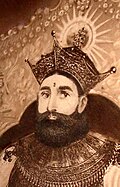
During the [[ | [[File:Sri Vikrama Rajasinha.jpg|thumb|upright=0.7|[[Sri Vikrama Rajasinha]] of Kandy, the last ruling native Sri Lankan monarch]] | ||
During the [[French Revolutionary Wars]], fearing that French control of the Netherlands might deliver Sri Lanka to the French, the [[British Empire]] occupied the coastal areas of the island (which they called the colony of [[British Ceylon]]) with little difficulty in 1796.<ref name="colvoyg">{{cite web |url=http://www.colonialvoyage.com/trincomalee-first-british-occupation-definitive-dutch-surrender/|title=The first British occupation and the definitive Dutch surrender |work=colonialvoyage.com |date=18 February 2014 |access-date=11 October 2025 |archive-date=11 October 2015 |archive-url=https://web.archive.org/web/20151011023258/http://www.colonialvoyage.com/trincomalee-first-british-occupation-definitive-dutch-surrender/ |url-status=live|publisher=Marco Ramerini}}</ref> Two years later, in 1798, [[Sri Rajadhi Rajasinha]], third of the four Nayakkar kings of Sri Lanka, died of a fever. Following his death, a nephew of Rajadhi Rajasinha, eighteen-year-old Kannasamy, was crowned.<ref name="scnsl">{{cite web |url=http://www.scenicsrilanka.com/history-of-sri-lanka-1948.html |title=History of Sri Lanka and significant World events from 1796 AD to 1948 |work=scenicsrilanka.com |access-date=15 July 2014 |url-status=dead |archive-url=https://web.archive.org/web/20131102055412/http://www.scenicsrilanka.com/history-of-sri-lanka-1948.html |archive-date=2 November 2013}}</ref> The young king, now named [[Sri Vikrama Rajasinha]], faced a [[British Empire|British]] invasion in 1803 but successfully retaliated. The First Kandyan War ended in a stalemate.<ref name="scnsl" /> | |||
By then the entire coastal area was under the [[British East India Company]] as a result of the [[Treaty of Amiens]]. On 14 February 1815, [[Kingdom of Kandy|Kandy]] was occupied by the British in the [[ | By then the entire coastal area was under the [[British East India Company]] as a result of the [[Treaty of Amiens]]. On 14 February 1815, [[Kingdom of Kandy|Kandy]] was occupied by the British in the [[Second Kandyan War]], ending Sri Lanka's independence.<ref name="scnsl" /> Sri Vikrama Rajasinha, the last native monarch of Sri Lanka, was exiled to India.<ref>Codrington, [http://lakdiva.org/codrington/chap11.html Ch. 11] {{Webarchive|url=https://web.archive.org/web/20150621214254/http://lakdiva.org/codrington/chap11.html |date=21 June 2015 }}</ref> The [[Kandyan Convention]] formally ceded the entire country to the British Empire. Attempts by Sri Lankan noblemen to undermine British power in 1818 during the [[Great Rebellion of 1817–1818|Uva Rebellion]] were thwarted by [[governors of British Ceylon|Governor]] [[Robert Brownrigg]].<ref name="keppetipola">{{cite web |url=http://www.lankalibrary.com/geo/keppetipola2.htm |title=Keppetipola and the Uva Rebellion |work=lankalibrary.com |access-date=15 July 2014 |archive-date=26 November 2013 |archive-url=https://web.archive.org/web/20131126125830/http://www.lankalibrary.com/geo/keppetipola2.htm |url-status=live }}</ref> | ||
The beginning of the modern period of Sri Lanka is marked by the [[ | The beginning of the modern period of Sri Lanka is marked by the [[Colebrooke–Cameron Commission|Colebrooke–Cameron reforms]] of 1833.<ref name="corankel" /> They introduced a [[Utilitarianism|utilitarian]] and [[Liberalism|liberal]] political culture to the country based on the [[rule of law]] and amalgamated the Kandyan and maritime provinces as a single unit of government.<ref name="corankel" /> An [[Executive Council of Ceylon|executive council]] and a [[Legislative Council of Ceylon|legislative council]] were established, later becoming the foundation of a representative legislature. By this time, experiments with [[coffee]] plantations were largely successful.<ref name="Nubin 2002 115">{{Harvnb|Nubin|2002|p=115}}</ref> | ||
Soon, coffee became the primary commodity export of Sri Lanka. Falling coffee prices as a result of the [[Panic of 1847|depression of 1847]] stalled economic development and prompted the governor to introduce a series of taxes on firearms, dogs, shops, boats, etc., and to reintroduce a form of ''rajakariya'', requiring six days free labour on roads or payment of a cash equivalent.<ref name="Nubin 2002 115" /> These harsh measures antagonised the locals, and [[Matale | Soon, coffee became the primary commodity export of Sri Lanka. Falling coffee prices as a result of the [[Panic of 1847|depression of 1847]] stalled economic development and prompted the governor to introduce a series of taxes on firearms, dogs, shops, boats, etc., and to reintroduce a form of ''rajakariya'', requiring six days free labour on roads or payment of a cash equivalent.<ref name="Nubin 2002 115" /> These harsh measures antagonised the locals, and [[Matale rebellion|another rebellion]] broke out in 1848.<ref name="matale1">{{cite web |url=http://www.lankalibrary.com/geo/gongalegoda.htm |title=Gongale Goda Banda (1809–1849) : The leader of the 1848 rebellion |work=Wimalaratne, K.D.G. |access-date=15 July 2014 |archive-date=26 November 2013 |archive-url=https://web.archive.org/web/20131126130118/http://www.lankalibrary.com/geo/gongalegoda.htm |url-status=live }}</ref> A devastating leaf disease, ''[[Hemileia vastatrix]]'', struck the coffee plantations in 1869, destroying the entire industry within fifteen years.<ref>{{cite book |author=Lennox A. Mills |title=Ceylon Under British Rule, 1795–1932 |url=https://books.google.com/books?id=YyHG9ZKl3bwC&pg=PA246 |year=1965|publisher=Psychology Press |page=246 |isbn=978-0-7146-2019-0 |access-date=20 June 2015 |archive-date=6 January 2024 |archive-url=https://web.archive.org/web/20240106105900/https://books.google.com/books?id=YyHG9ZKl3bwC&pg=PA246 |url-status=live }}</ref> The British quickly found a replacement: abandoning coffee, they began cultivating tea instead. [[Tea production in Sri Lanka]] thrived in the following decades. Large-scale rubber plantations began in the early 20th century. | ||
[[File:Kandyan Chiefs in 1905.JPG|upright=1.4|thumb|left|British appointed [[Native headmen of Ceylon|Kandyan chief headmen]] in 1905.]] | [[File:Kandyan Chiefs in 1905.JPG|upright=1.4|thumb|left|British appointed [[Native headmen of Ceylon|Kandyan chief headmen]] in 1905.]] | ||
By the end of the 19th century, a new educated [[social class]] transcending race and [[caste]] arose through British attempts to staff the [[Ceylon Civil Service]] and the legal, educational, engineering, and medical professions with natives.<ref>{{Harvnb|Nubin|2002|pp=116–117}}</ref> New leaders represented the various ethnic groups of the population in the [[Legislative Council of Ceylon|Ceylon Legislative Council]] on a communal basis. Buddhist and Hindu | By the end of the 19th century, a new educated [[social class]] transcending race and [[caste]] arose through British attempts to staff the [[Ceylon Civil Service]] and the legal, educational, engineering, and medical professions with natives.<ref>{{Harvnb|Nubin|2002|pp=116–117}}</ref> New leaders represented the various ethnic groups of the population in the [[Legislative Council of Ceylon|Ceylon Legislative Council]] on a communal basis. Buddhist and Hindu revivalists reacted against [[Christian missionary]] activities.<ref>{{cite book |url=https://books.google.com/books?id=Q11ID2xfqD8C |author=Bond, George D. |title=The Buddhist revival in Sri Lanka: Religious tradition, reinterpretation and response |publisher=Motilal Banarsidass Publications |year=1992 |pages=11–22 |isbn=978-81-208-1047-1 |access-date=20 June 2015 |archive-date=6 January 2024 |archive-url=https://web.archive.org/web/20240106105900/https://books.google.com/books?id=Q11ID2xfqD8C |url-status=live }}</ref><ref name="tamlwk">{{cite web |url=http://www.tamilweek.com/Cutting_edge_hindu_revivalism_0625.html |title=Cutting edge of Hindu revivalism in Jaffna |date=25 June 2006 |work=Balachandran, P.K. |access-date=18 September 2011 |archive-date=4 March 2016 |archive-url=https://web.archive.org/web/20160304134643/http://www.tamilweek.com/Cutting_edge_hindu_revivalism_0625.html |url-status=dead }}</ref> The first two decades in the 20th century are noted by the unique harmony among Sinhalese and [[Tamils|Tamil]] political leadership, which has since been lost.<ref>{{Harvnb|De Silva|1981|p=387}}</ref> | ||
The [[1906 malaria outbreak in Ceylon]] actually started in the early 1900s, but the first case was documented in 1906. | The [[1906 malaria outbreak in Ceylon]] actually started in the early 1900s, but the first case was documented in 1906. | ||
| Line 229: | Line 213: | ||
In 1919, major Sinhalese and Tamil political organisations united to form the Ceylon National Congress, under the leadership of [[Ponnambalam Arunachalam]],<ref>{{Harvnb|De Silva|1981|p=386}}</ref> pressing colonial masters for more constitutional reforms. But without massive popular support, and with the governor's encouragement for "communal representation" by creating a "Colombo seat" that dangled between Sinhalese and Tamils, the Congress lost momentum towards the mid-1920s.<ref>{{Harvnb|De Silva|1981|pp=389–395}}</ref> | In 1919, major Sinhalese and Tamil political organisations united to form the Ceylon National Congress, under the leadership of [[Ponnambalam Arunachalam]],<ref>{{Harvnb|De Silva|1981|p=386}}</ref> pressing colonial masters for more constitutional reforms. But without massive popular support, and with the governor's encouragement for "communal representation" by creating a "Colombo seat" that dangled between Sinhalese and Tamils, the Congress lost momentum towards the mid-1920s.<ref>{{Harvnb|De Silva|1981|pp=389–395}}</ref> | ||
The [[Donoughmore Constitution|Donoughmore reforms]] of 1931 repudiated the communal representation and introduced [[Universal suffrage|universal adult franchise]] (the franchise stood at 4% before the reforms). This step was strongly criticised by the Tamil political leadership, who realised that they would be reduced to a minority in the newly created [[State Council of Ceylon]], which succeeded the legislative council.<ref name="tamllib">{{cite web |url= | The [[Donoughmore Constitution|Donoughmore reforms]] of 1931 repudiated the communal representation and introduced [[Universal suffrage|universal adult franchise]] (the franchise stood at 4% before the reforms). This step was strongly criticised by the Tamil political leadership, who realised that they would be reduced to a minority in the newly created [[State Council of Ceylon]], which succeeded the legislative council.<ref name="tamllib">{{cite web |url=https://tamilelibrary.org/teli/slhist.html |title=Chronology of events related to Tamils in Sri Lanka (1500–1948) |work=Hellmann-Rajanayagam, Dagmar |publisher=[[National University of Malaysia]] |access-date=15 July 2014 |archive-date=3 March 2016 |archive-url=https://web.archive.org/web/20160303194411/http://www.tamilelibrary.org/teli/slhist.html |url-status=live }}</ref><ref>{{Harvnb|De Silva|1981|p=423}}</ref> In 1937, Tamil leader [[G. G. Ponnambalam]] demanded a 50–50 representation (50% for the Sinhalese and 50% for other ethnic groups) in the State Council. However, this demand was not met by the [[Soulbury Commission|Soulbury reforms]] of 1944–45. | ||
=== Contemporary history === | === Contemporary history === | ||
{{Main|History of Sri Lanka (1948–present)}} | {{Main|History of Sri Lanka (1948–present)}} | ||
{{See also|Sri Lankan independence movement|Sri Lankan Civil War}} | {{See also|Sri Lankan independence movement|Sri Lankan Civil War}} | ||
[[File:SL Independence.jpg|thumb|The formal ceremony marking the start of self-rule, with the opening of the first parliament at [[Independence Square, Colombo|Independence Square]]]] | [[File:SL Independence.jpg|thumb|The formal ceremony marking the start of self-rule, with the opening of the first parliament at [[Independence Square, Colombo|Independence Square]]]] | ||
[[File:J. R. | [[File:J. R. Jayawardene, President of the Democratic Socialist Republic of Sri Lanka on June 20, 1984.jpg|thumb|197x197px|J. R. Jayewardene was the most influential political figure of Sri Lanka in the 1970s and 1980s.]] | ||
The Soulbury constitution ushered in [[Dominion of Ceylon|dominion status]], with independence proclaimed on 4 February 1948.<ref name="countrst68">{{cite web |url=http://countrystudies.us/sri-lanka/21.htm |title=Sinhalese Parties |work=[[Library of Congress Country Studies]] |access-date=15 July 2014 |archive-date=1 April 2014 |archive-url=https://web.archive.org/web/20140401001002/http://countrystudies.us/sri-lanka/21.htm |url-status=live }}</ref> [[Don Stephen Senanayake|D. S. Senanayake]] became the first [[Prime Minister of Sri Lanka|Prime Minister of Ceylon]].<ref name="DS">{{cite web |url=http://countrystudies.us/sri-lanka/68.htm |title=Sinhalese Parties |work=[[Library of Congress Country Studies]] |access-date=15 July 2014 |archive-date=21 August 2014 |archive-url=https://web.archive.org/web/20140821135521/http://countrystudies.us/sri-lanka/68.htm |url-status=live }}</ref> Prominent [[Tamils|Tamil]] leaders including Ponnambalam and [[Arunachalam Mahadeva]] joined his cabinet.<ref name="tamllib" /><ref>{{Harvnb|Nubin|2002|pp=121–122}}</ref> The [[Royal Navy|British Royal Navy]] remained stationed at [[Trincomalee]] until 1956. A countrywide [[1953 Ceylonese Hartal|popular demonstration]] against withdrawal of the rice rations resulted in the resignation of prime minister [[Dudley Senanayake]].<ref name="islnksd">{{cite web |url=http://www.island.lk/2008/08/16/satmag1.html |title=Bandaranaike and Hartal of 1953 |author=Weerakoon, Batty |work=The Island |access-date=15 July 2014 |archive-date=26 November 2013 |archive-url=https://web.archive.org/web/20131126054816/http://www.island.lk/2008/08/16/satmag1.html |url-status=dead }}</ref> | |||
[[S. W. R. D. Bandaranaike]] was elected prime minister in 1956. His three-year rule had a profound influence through his self-proclaimed role of "defender of the besieged Sinhalese culture".<ref>{{Harvnb|Nubin|2002|p=123}}</ref> He introduced the controversial [[Sinhala Only Act]], recognising [[Sinhala language|Sinhala]] as the only official language of the government. Although partially reversed in 1958, the bill posed a grave concern for the Tamil community, which perceived in it a threat to their language and culture.<ref name="FW">{{Cite book |author=Ganguly, Šumit |editor=Brown, Michael E. |title=Fighting Words: language policy and ethnic relations in Asia |publisher=The MIT Press |year=2003 |pages=136–138 |url=https://books.google.com/books?id=fcoDezu1ABoC |isbn=978-0-262-52333-2 |access-date=15 July 2014 |archive-date=6 January 2024 |archive-url=https://web.archive.org/web/20240106105901/https://books.google.com/books?id=fcoDezu1ABoC |url-status=live }}</ref><ref name="AV">{{Cite book |editor1=Schmid, Bettina |editor2=Schroeder, Ingo |title=Anthropology of Violence and Conflict |publisher=Routledge |year=2001 |page=185 |url=https://books.google.com/books?id=Rx-1MdUlzaUC |isbn=978-0-415-22905-0 |access-date=15 July 2014}}</ref><ref name="a1">{{cite news |title=Sri Lanka Profile |url=https://www.bbc.co.uk/news/world-south-asia-12004081 |work=BBC News |date=5 November 2013 |access-date=22 June 2018 |archive-date=14 June 2022 |archive-url=https://web.archive.org/web/20220614231749/https://www.bbc.co.uk/news/world-south-asia-12004081 |url-status=live }}</ref> | |||
The [[Illankai Tamil Arasu Kachchi|Federal Party]] (FP) launched a movement of non-violent resistance ([[satyagraha]]) against the bill, which prompted Bandaranaike to reach an agreement ([[Bandaranaike–Chelvanayakam Pact]]) with [[S. J. V. Chelvanayakam]], leader of the FP, to resolve the looming ethnic conflict.<ref>{{cite book |author=Peebles, Patrick |url=https://books.google.com/books?id=SxO0eISluqEC |title=The History of Sri Lanka |publisher=Greenwood Press |date=2006 |pages=109–111 |isbn=978-0-313-33205-0 |access-date=20 June 2015 |archive-date=6 January 2024 |archive-url=https://web.archive.org/web/20240106105903/https://books.google.com/books?id=SxO0eISluqEC |url-status=live }}</ref> The pact proved ineffective in the face of ongoing protests by opposition and the Buddhist clergy. The bill, together with various government [[Sri Lankan state-sponsored colonisation schemes|colonisation schemes]], contributed much towards the political rancour between Sinhalese and Tamil political leaders.<ref>{{cite web |title=Staff profile: Jonathan Spencer |publisher=University of Edinburgh |url=http://www.sps.ed.ac.uk/staff/social_anthropology/spencer_jonathan |access-date=15 July 2014 |author-link=University of Edinburgh |archive-date=8 August 2017 |archive-url=https://web.archive.org/web/20170808052143/http://www.sps.ed.ac.uk/staff/social_anthropology/spencer_jonathan |url-status=dead }}</ref> Bandaranaike was [[S. W. R. D. Bandaranaike#Assassination|assassinated]] by an extremist Buddhist monk in 1959.<ref>{{cite web |url=http://www.atimes.com/ind-pak/Cl01Df05.html |archive-url=https://web.archive.org/web/20011220212820/http://atimes.com/ind-pak/Cl01Df05.html |url-status=unfit |archive-date=20 December 2001 |title=Sri Lanka: The untold story – Assassination of Bandaranaike |work=Rajasingham, K. T. |year=2002 |access-date=15 July 2014}}</ref> | |||
The [[Illankai Tamil Arasu Kachchi|Federal Party]] (FP) launched a movement of non-violent resistance ([[satyagraha]]) against the bill, which prompted Bandaranaike to reach an agreement ([[Bandaranaike–Chelvanayakam Pact]]) with [[S. J. V. Chelvanayakam]], leader of the FP, to resolve the looming ethnic conflict.<ref>{{cite book |author=Peebles, Patrick |url=https://books.google.com/books?id=SxO0eISluqEC |title=The History of Sri Lanka |publisher=Greenwood Press |date=2006 |pages=109–111 |isbn=978-0-313-33205-0}}</ref> The pact proved ineffective in the face of ongoing protests by opposition and the Buddhist clergy. The bill, together with various government [[Sri Lankan state-sponsored colonisation schemes|colonisation schemes]], contributed much towards the political rancour between Sinhalese and Tamil political leaders.<ref>{{cite web |title=Staff profile: Jonathan Spencer |publisher=University of Edinburgh |url=http://www.sps.ed.ac.uk/staff/social_anthropology/spencer_jonathan |access-date=15 July 2014 |author-link=University of Edinburgh |archive-date=8 August 2017 |archive-url=https://web.archive.org/web/20170808052143/http://www.sps.ed.ac.uk/staff/social_anthropology/spencer_jonathan |url-status=dead }}</ref> Bandaranaike was [[S. W. R. D. Bandaranaike#Assassination|assassinated]] by an extremist Buddhist monk in 1959.<ref>{{cite web |url=http://www.atimes.com/ind-pak/Cl01Df05.html |archive-url=https://web.archive.org/web/20011220212820/http://atimes.com/ind-pak/Cl01Df05.html |url-status=unfit |archive-date=20 December 2001 |title=Sri Lanka: The untold story – Assassination of Bandaranaike |work=Rajasingham, K. T. |year=2002 |access-date=15 July 2014}}</ref> | |||
{{multiple image |total_width=220 | {{multiple image |total_width=220 | ||
| Line 247: | Line 231: | ||
| align = left | | align = left | ||
| caption_align = center | | caption_align = center | ||
| image1 = Her Majesty | | image1 = Her Majesty Queen Elizabeth II (1959).jpg | ||
|caption1=[[Elizabeth II]]<br /><small>Queen of Ceylon</small> | |caption1=[[Elizabeth II]]<br /><small>[[Monarchy of Ceylon (1948–1972)|Queen of Ceylon]]</small> | ||
|image2= Sirimavo Bandaranaike, Prime Minister of Ceylon 1960 (cropped).PNG | |image2= Sirimavo Bandaranaike, Prime Minister of Ceylon 1960 (cropped).PNG | ||
|caption2=[[Sirimavo Bandaranaike]]<br /><small>Prime Minister</small> | |caption2=[[Sirimavo Bandaranaike]]<br /><small>Prime Minister</small> | ||
| Line 254: | Line 238: | ||
}} | }} | ||
[[Sirimavo Bandaranaike]], the widow of Bandaranaike, took office as prime minister in 1960, and withstood an [[1962 Ceylonese coup d'état attempt|attempted coup d'état]] in 1962. During her second term as prime minister, the government instituted socialist economic policies, strengthening ties with the [[Soviet Union]] and China, while promoting a policy of non-alignment. In 1971, Ceylon experienced a [[1971 JVP insurrection|Marxist insurrection]], which was quickly suppressed. In 1972, the country became a [[republic]] named Sri Lanka, repudiating its dominion status. Prolonged minority grievances and the use of communal emotionalism as an election campaign weapon by both Sinhalese and Tamil leaders abetted a fledgling Tamil militancy in the north during the 1970s.<ref>{{Harvnb|Nubin|2002|pp=128–129}}</ref> The [[policy of standardisation]] by the Sirimavo government to rectify disparities created in university | [[Sirimavo Bandaranaike]], the widow of Bandaranaike, took office as prime minister in 1960, and withstood an [[1962 Ceylonese coup d'état attempt|attempted coup d'état]] in 1962. During her second term as prime minister, the government instituted socialist economic policies, strengthening ties with the [[Soviet Union]] and China, while promoting a policy of non-alignment. In 1971, Ceylon experienced a [[1971 JVP insurrection|Marxist insurrection]], which was quickly suppressed. In 1972, the country became a [[republic]] named Sri Lanka, repudiating its dominion status. Prolonged minority grievances and the use of communal emotionalism as an election campaign weapon by both Sinhalese and Tamil leaders abetted a fledgling Tamil militancy in the north during the 1970s.<ref>{{Harvnb|Nubin|2002|pp=128–129}}</ref> The [[policy of standardisation]] by the Sirimavo government to rectify disparities created in university enrolment, which was in essence an [[affirmative action]] to assist geographically disadvantaged students to obtain tertiary education,<ref name="affrmact">{{cite web |url=http://www.ices.lk/publications/esr/articles_jul97/Esr-kmdesilva.PDF |pages=248–254 |title=Affirmative Action Policies: The Sri Lankan Experience |author1=De Silva |author2=K. M. |date=July 1997 |publisher=International Centre for Ethnic Studies |url-status=dead |archive-url=https://web.archive.org/web/20110930154652/http://www.ices.lk/publications/esr/articles_jul97/Esr-kmdesilva.PDF |archive-date=30 September 2011}}</ref> resulted in reducing the proportion of Tamil students at university level and acted as the immediate catalyst for the rise of militancy.<ref>{{cite book |author=Jayasuriya, J.E. |title=Education in the Third World |publisher=Indian Institute of Education |year=1981 |place=[[Pune]] | oclc=7925123}}</ref><ref>{{cite web |url=http://tamilnation.co/forum/sivaram/940508eelam_history.htm |title=The Exclusive Right to Write Eelam History |author=Taraki Sivaram |date=May 1994 |publisher=Tamil Nation |author-link=Taraki Sivaram |access-date=20 August 2011 |archive-date=19 November 2011 |archive-url=https://web.archive.org/web/20111119055553/http://tamilnation.co/forum/sivaram/940508eelam_history.htm |url-status=live }}</ref> The assassination of [[Jaffna]] [[Mayor]] [[Alfred Duraiyappah]] in 1975 by the [[Liberation Tigers of Tamil Eelam]] (LTTE) marked a crisis point.<ref name="Hoffman139">{{Cite book |author=Hoffman, Bruce |title=Inside Terrorism |publisher=[[Columbia University Press]] |place=New York |year=2006 |page=139 |isbn=978-0-231-12699-1 |url=https://books.google.com/books?id=_ayrAgAAQBAJ |access-date=24 July 2018 |archive-date=6 January 2024 |archive-url=https://web.archive.org/web/20240106105902/https://books.google.com/books?id=_ayrAgAAQBAJ |url-status=live }}</ref><ref name="rohang">{{cite web |url=http://www.padippakam.com/document/srilankan_gov/gov002.pdf |title=International and Regional Implications of the Sri Lankan Tamil Insurgency |author=Rohan Gunaratna |date=December 1998 |author-link=Rohan Gunaratna |access-date=17 October 2015 |archive-date=1 January 2016 |archive-url=https://web.archive.org/web/20160101122924/http://www.padippakam.com/document/srilankan_gov/gov002.pdf |url-status=live }}</ref> | ||
The government of [[J. R. Jayawardene]] swept to power in 1977, defeating the | The government of [[J. R. Jayawardene]] swept to power in 1977, defeating the [[United Front (Sri Lanka)|United Front]] government.<ref name="attms">{{cite web |url=http://www.atimes.com/ind-pak/DA26Df04.html |archive-url=https://web.archive.org/web/20020213090010/http://www.atimes.com/ind-pak/DA26Df04.html |url-status=unfit |archive-date=13 February 2002 |title=Tamil militancy – a manifestation |author=Rajasingham, K.T. |year=2002 |access-date=15 July 2014}}</ref> Jayawardene introduced a [[Constitution of Sri Lanka|new constitution]], together with a [[free-market economy]] and a powerful [[Executive president|executive presidency]] modelled after that of France. It made Sri Lanka the first [[South Asia]]n country to [[Liberalism|liberalise]] its economy.<ref name="filbrn" /> Beginning in [[Four Four Bravo|1983]], ethnic tensions were manifested in an [[Sri Lankan civil war|on-and-off insurgency]] against the government by the LTTE. An [[Four Four Bravo|LTTE attack on 13 soldiers]] resulted in the start of a civil war, and in response anti-Tamil [[Black July|race riots]] took place, allegedly backed by [[Sinhalese Buddhist nationalism|Sinhalese hard-line]] ministers, which resulted in more than 150,000 Tamil civilians fleeing the island, seeking asylum in other countries.<ref name="Remembering">{{cite news |title=Remembering Sri Lanka's Black July – BBC News |url=https://www.bbc.com/news/world-asia-23402727 |website=BBC News |access-date=20 October 2015 |date=23 July 2013 |archive-date=22 March 2021 |archive-url=https://web.archive.org/web/20210322023421/https://www.bbc.com/news/world-asia-23402727 |url-status=live }}</ref><ref name="lkwbblk">{{cite web |url=http://www.lankaweb.com/news/items/2010/04/27/the-black-july-1983-that-created-a-collective-trauma/ |title=The Black July 1983 that Created a Collective Trauma |work=Jayatunge, Ruwan M. |publisher=LankaWeb |year=2010 |access-date=15 July 2014 |archive-date=3 July 2014 |archive-url=https://web.archive.org/web/20140703213952/http://www.lankaweb.com/news/items/2010/04/27/the-black-july-1983-that-created-a-collective-trauma/ |url-status=live }}</ref> | ||
Lapses in foreign policy resulted in India strengthening the Tigers by providing arms and training.<ref name="sndaytst">{{cite news |url=http://sundaytimes.lk/970119/plus4.html |title=LTTE: the Indian connection |newspaper=Sunday Times |year=1997 |access-date=15 July 2014}}</ref><ref>{{cite news |url=http://www.expressindia.com/ie/daily/19971212/34650923.html |title=Uppermost in our minds was to save the Gandhis' name |newspaper=Express India |year=1997 |url-status=dead |archive-url=https://web.archive.org/web/20070811204127/http://www.expressindia.com/ie/daily/19971212/34650923.html |archive-date=11 August 2007}}</ref><ref>{{cite web |url=http://www.srilankaguardian.org/2009/07/for-firmer-and-finer-international.html |title=For firmer and finer International Relations |work=Wijesinghe, Sarath |access-date=15 July 2014}}</ref> In 1987, the [[Indo-Sri Lanka Accord]] was signed and the [[Indian Peace Keeping Force]] (IPKF) was deployed in northern Sri Lanka to stabilise the region by neutralising the LTTE.<ref name="Stokke2000a">{{Cite journal |author=Stokke, K. |author2=Ryntveit, A.K. |year=2000 |title=The Struggle for Tamil Eelam in Sri Lanka |journal=Growth and Change: A Journal of Urban and Regional Policy |volume=31 |issue=2 |pages=285–304 |doi=10.1111/0017-4815.00129}}</ref> The same year, the [[Janatha Vimukthi Peramuna|JVP]] launched its [[1987–89 JVP Insurrection|second insurrection]] in Southern Sri Lanka,<ref name="secninsr">{{Cite book |author=Gunaratna, Rohan |title=Sri Lanka's Ethnic Crisis and National Security |publisher=South Asian Network on Conflict Research |place=[[Colombo]] | year=1998 |page=353 |isbn=978-955-8093-00-9 |url=https://books.google.com/books?id=YpnhAAAACAAJ |author-link=Rohan Gunaratna}}</ref> necessitating redeployment of the IPKF in 1990.<ref name="atimes">{{cite web |url=http://www.atimes.com/ind-pak/DC09Df04.html |archive-url=https://web.archive.org/web/20020416181258/http://www.atimes.com/ind-pak/DC09Df04.html |url-status=unfit |archive-date=16 April 2002 |title=Chapter 30: Whirlpool of violence, Sri Lanka: The Untold Story |work=Asia Times |year=2002 |access-date=15 July 2014}}</ref> In October 1990, the LTTE [[Expulsion of Muslims from the Northern province by LTTE|expelled Sri Lankan Moors]] (Muslims by religion) from northern Sri Lanka.<ref name="slnp">{{cite web |url=http://www.lankanewspapers.com/news/2008/11/35271_space.html |title=1990, The War Year if Ethnic Cleansing of the Muslims From North and the East of Sri Lanka |publisher=lankanewspapers.com |year=2008 |access-date=21 May 2015 |url-status=dead |archive-url=https://web.archive.org/web/20160305012159/http://www.lankanewspapers.com/news/2008/11/35271_space.html |archive-date=5 March 2016 }}</ref> In 2002, the Sri Lankan government and LTTE signed a Norwegian-mediated ceasefire agreement.<ref name="a1" /> | Lapses in foreign policy resulted in India strengthening the Tigers by providing arms and training.<ref name="sndaytst">{{cite news |url=http://sundaytimes.lk/970119/plus4.html |title=LTTE: the Indian connection |newspaper=Sunday Times |year=1997 |access-date=15 July 2014 |archive-date=15 September 2014 |archive-url=https://web.archive.org/web/20140915053716/http://sundaytimes.lk/970119/plus4.html |url-status=live }}</ref><ref>{{cite news |url=http://www.expressindia.com/ie/daily/19971212/34650923.html |title=Uppermost in our minds was to save the Gandhis' name |newspaper=Express India |year=1997 |url-status=dead |archive-url=https://web.archive.org/web/20070811204127/http://www.expressindia.com/ie/daily/19971212/34650923.html |archive-date=11 August 2007}}</ref><ref>{{cite web |url=http://www.srilankaguardian.org/2009/07/for-firmer-and-finer-international.html |title=For firmer and finer International Relations |work=Wijesinghe, Sarath |access-date=15 July 2014 |archive-date=1 February 2014 |archive-url=https://web.archive.org/web/20140201181154/http://www.srilankaguardian.org/2009/07/for-firmer-and-finer-international.html |url-status=live }}</ref> In 1987, the [[Indo-Sri Lanka Accord]] was signed and the [[Indian Peace Keeping Force]] (IPKF) was deployed in northern Sri Lanka to stabilise the region by neutralising the LTTE.<ref name="Stokke2000a">{{Cite journal |author=Stokke, K. |author2=Ryntveit, A.K. |year=2000 |title=The Struggle for Tamil Eelam in Sri Lanka |journal=Growth and Change: A Journal of Urban and Regional Policy |volume=31 |issue=2 |pages=285–304 |doi=10.1111/0017-4815.00129|bibcode=2000GroCh..31..285S }}</ref> The same year, the [[Janatha Vimukthi Peramuna|JVP]] launched its [[1987–89 JVP Insurrection|second insurrection]] in Southern Sri Lanka,<ref name="secninsr">{{Cite book |author=Gunaratna, Rohan |title=Sri Lanka's Ethnic Crisis and National Security |publisher=South Asian Network on Conflict Research |place=[[Colombo]] |year=1998 |page=353 |isbn=978-955-8093-00-9 |url=https://books.google.com/books?id=YpnhAAAACAAJ |author-link=Rohan Gunaratna |access-date=24 July 2018 |archive-date=6 January 2024 |archive-url=https://web.archive.org/web/20240106105902/https://books.google.com/books?id=YpnhAAAACAAJ |url-status=live }}</ref> necessitating redeployment of the IPKF in 1990.<ref name="atimes">{{cite web |url=http://www.atimes.com/ind-pak/DC09Df04.html |archive-url=https://web.archive.org/web/20020416181258/http://www.atimes.com/ind-pak/DC09Df04.html |url-status=unfit |archive-date=16 April 2002 |title=Chapter 30: Whirlpool of violence, Sri Lanka: The Untold Story |work=Asia Times |year=2002 |access-date=15 July 2014}}</ref> In October 1990, the LTTE [[Expulsion of Muslims from the Northern province by LTTE|expelled Sri Lankan Moors]] (Muslims by religion) from northern Sri Lanka.<ref name="slnp">{{cite web |url=http://www.lankanewspapers.com/news/2008/11/35271_space.html |title=1990, The War Year if Ethnic Cleansing of the Muslims From North and the East of Sri Lanka |publisher=lankanewspapers.com |year=2008 |access-date=21 May 2015 |url-status=dead |archive-url=https://web.archive.org/web/20160305012159/http://www.lankanewspapers.com/news/2008/11/35271_space.html |archive-date=5 March 2016 }}</ref> In 2002, the Sri Lankan government and LTTE signed a Norwegian-mediated ceasefire agreement.<ref name="a1" /> | ||
The [[2004 Indian Ocean earthquake and tsunami|2004 Asian tsunami]] killed over 30,000 and displaced over 500,000 people in Sri Lanka.<ref name="BBC News 2005">{{cite web | title=US presidents in tsunami aid plea | website=BBC News | date=3 January 2005 | url=http://news.bbc.co.uk/1/hi/world/asia-pacific/4143459.stm#map | access-date=20 December 2021}}</ref><ref name="wsws1">{{cite web|url=http://www.wsws.org/articles/2005/dec2005/sri2-d29.shtml|title=One year after the tsunami, Sri Lankan survivors still live in squalour|publisher=World Socialist Web Site|date=29 December 2005|access-date=24 December 2012|archive-date=23 November 2012|archive-url=https://web.archive.org/web/20121123063125/http://www.wsws.org/articles/2005/dec2005/sri2-d29.shtml|url-status=live | The [[2004 Indian Ocean earthquake and tsunami|2004 Asian tsunami]] killed over 30,000 and displaced over 500,000 people in Sri Lanka.<ref name="BBC News 2005">{{cite web | title=US presidents in tsunami aid plea | website=BBC News | date=3 January 2005 | url=http://news.bbc.co.uk/1/hi/world/asia-pacific/4143459.stm#map | access-date=20 December 2021 | archive-date=20 December 2021 | archive-url=https://web.archive.org/web/20211220175054/http://news.bbc.co.uk/1/hi/world/asia-pacific/4143459.stm#map | url-status=live }}</ref><ref name="wsws1">{{cite web|url=http://www.wsws.org/articles/2005/dec2005/sri2-d29.shtml|title=One year after the tsunami, Sri Lankan survivors still live in squalour|publisher=World Socialist Web Site|date=29 December 2005|access-date=24 December 2012|archive-date=23 November 2012|archive-url=https://web.archive.org/web/20121123063125/http://www.wsws.org/articles/2005/dec2005/sri2-d29.shtml|url-status=live}}</ref> | ||
From 1985 to 2006, the Sri Lankan government and Tamil insurgents held four rounds of peace talks without success. Both LTTE and the government resumed fighting in 2006, and the government officially backed out of the ceasefire in 2008.<ref name="a1" /> In 2009, under the [[President of Sri Lanka|Presidency]] of [[Mahinda Rajapaksa]], the [[Sri Lanka Armed Forces]] defeated the LTTE, bringing an end to the 26 year long civil war on 19 May 2009,<ref>{{cite news |url=https://www.theguardian.com/world/2009/may/18/tamil-tigers-killed-sri-lanka |title=Sri Lanka declares end to war with Tamil Tigers |work=The Guardian |date=19 May 2009 |access-date=18 August 2011 |location=London |first1=Matthew |last1=Weaver |first2=Gethin |last2=Chamberlain |archive-date=6 September 2013 |archive-url=https://web.archive.org/web/20130906141729/http://www.theguardian.com/world/2009/may/18/tamil-tigers-killed-sri-lanka |url-status=live }}</ref><ref>{{cite news |last1=McDonald |first1=Mark |title=Tamil Tigers Confirm Death of Their Leader |url=https://www.nytimes.com/2009/05/26/world/asia/26lanka.html |access-date=11 April 2022 |work=[[The New York Times]] |date=25 May 2009 |archive-date=11 April 2022 |archive-url=https://web.archive.org/web/20220411014251/https://www.nytimes.com/2009/05/26/world/asia/26lanka.html |url-status=live }}</ref><ref>{{cite news|date=24 May 2009|title=Tamil Tigers confirm leader's death|work=[[Al Jazeera English]]|url=http://english.aljazeera.net/news/asia/2009/05/2009524124042406562.html|access-date=24 May 2009|archive-date=25 May 2009|archive-url=https://web.archive.org/web/20090525011712/http://english.aljazeera.net/news/asia/2009/05/2009524124042406562.html|url-status=live}}</ref><ref>{{cite news|date=24 May 2009|title=Tamil Tigers admit leader is dead|work=[[BBC News]]|url=http://news.bbc.co.uk/2/hi/south_asia/8066129.stm|access-date=24 May 2009|archive-date=25 May 2009|archive-url=https://web.archive.org/web/20090525011643/http://news.bbc.co.uk/2/hi/south_asia/8066129.stm|url-status=live}}</ref> and re-established control of the entire country by the Sri Lankan Government.<ref>{{cite news |url=https://www.theguardian.com/world/2009/may/18/tamil-tigers-killed-sri-lanka |title=Sri Lanka declares end to war with Tamil Tigers |work=The Guardian |date=19 May 2009 |place=London |first1=Matthew |last1=Weaver |first2=Gethin |last2=Chamberlain |access-date=16 December 2016 |archive-date=6 September 2013 |archive-url=https://web.archive.org/web/20130906141729/http://www.theguardian.com/world/2009/may/18/tamil-tigers-killed-sri-lanka |url-status=live }}</ref> Overall, between 60,000 and 100,000 people were killed during the course of the 26 year long conflict.<ref name="ABC200509">{{cite news |title=Up to 100,000 killed in Sri Lanka's civil war: UN |url=http://www.abc.net.au/news/2009-05-20/up-to-100000-killed-in-sri-lankas-civil-war-un/1689524 |newspaper=[[Australian Broadcasting Corporation|ABC Australia]] |date=20 May 2009 |access-date=17 October 2015 |archive-date=23 September 2018 |archive-url=https://web.archive.org/web/20180923153656/http://www.abc.net.au/news/2009-05-20/up-to-100000-killed-in-sri-lankas-civil-war-un/1689524 |url-status=live }}</ref><ref>{{cite news |title=Sri Lanka |url=http://topics.nytimes.com/top/news/international/countriesandterritories/srilanka/index.html?scp=1-spot&sq=sri%20lanka&st=cse |work=[[The New York Times]] |first=Erik |last=Olsen |access-date=15 July 2014 |archive-date=4 August 2014 |archive-url=https://web.archive.org/web/20140804092738/http://topics.nytimes.com/top/news/international/countriesandterritories/srilanka/index.html?scp=1-spot&sq=sri%20lanka&st=cse |url-status=live }}</ref> | |||
[[2019 Sri Lanka Easter bombings]] carried out by the terrorist group [[National Thowheeth Jama'ath]] on 21 April 2019 resulted in the brutal death of 261 innocent people.<ref name="timeline">{{Cite web|url=http://www.sundaytimes.lk/190428/columns/easter-sunday-massacres-where-do-we-go-from-here-347090.html|title=Easter Sunday massacres: Where do we go from here?|access-date=12 March 2023|archive-date=28 April 2019|archive-url=https://web.archive.org/web/20190428182021/http://www.sundaytimes.lk/190428/columns/easter-sunday-massacres-where-do-we-go-from-here-347090.html|url-status=live}}</ref> On 26 April 2019 an anti [[Sainthamaruthu shootout|terrorist operation]] was carried out against the National Thowheeth Jama'ath by the [[Sri Lanka Army]] with the operation being successful and National Thowheeth Jama'ath's insurgency ending.<ref>{{cite news|url=https://www.reuters.com/article/us-sri-lanka-blasts-hospital-idUSKCN1S5113|title=Wife, daughter of Sri Lanka bombings mastermind will survive blast:...|newspaper=Reuters|date=29 April 2019|access-date=24 May 2019|via=www.reuters.com|archive-date=21 May 2019|archive-url=https://web.archive.org/web/20190521204214/https://www.reuters.com/article/us-sri-lanka-blasts-hospital-idUSKCN1S5113|url-status=live}}</ref><ref>{{cite web|url=http://www.adaderana.lk/news/54693/15-bodies-including-children-found-at-blast-site-in-sainthamaruthu|title=15 bodies including children found at blast site in Sainthamaruthu|website=adaderana.lk|access-date=24 May 2019|archive-date=28 April 2019|archive-url=https://web.archive.org/web/20190428081702/http://www.adaderana.lk/news/54693/15-bodies-including-children-found-at-blast-site-in-sainthamaruthu|url-status=live}}</ref><ref>{{cite web|url=http://www.hirunews.lk/215282/15-bodies-found-from-site-of-shootout-and-explosions-in-saindamaradu6-suicide-bombers-among-them|title=15 bodies found from site of shootout and explosions in Saindamaradu;6 Suicide bombers among them|website=Hiru News|access-date=29 April 2019|archive-date=28 April 2019|archive-url=https://web.archive.org/web/20190428081706/http://www.hirunews.lk/215282/15-bodies-found-from-site-of-shootout-and-explosions-in-saindamaradu6-suicide-bombers-among-them|url-status=live}}</ref> | |||
[[File:Anti-government protest in Sri Lanka 2022.jpg|thumb|[[2022 Sri Lankan protests|Sri Lankans protesting]] in front of the [[Presidential Secretariat (Sri Lanka)|Presidential Secretariat]] in Colombo, 13 April 2022]] | |||
Economic troubles in Sri Lanka began in 2019, when a [[2019–present Sri Lankan economic crisis|severe economic crisis]] occurred caused by rapidly increasing foreign debt, massive government budget deficits due to tax cuts, falling foreign remittances, a food crisis caused by mandatory organic farming along with a ban on chemical fertilisers, and a multitude of other factors.<ref>{{Cite web |date=23 April 2022 |title=Everything to Know About Sri Lanka's Economic Crisis |url=https://www.borgenmagazine.com/sri-lankas-economic-crisis/ |access-date=15 May 2022 |website=BORGEN |language=en-US |archive-date=19 May 2022 |archive-url=https://web.archive.org/web/20220519130407/https://www.borgenmagazine.com/sri-lankas-economic-crisis/ |url-status=live }}</ref> The Sri Lankan Government officially declared the ongoing crisis to be the worst [[Economy of Sri Lanka|economic crisis in the country]] in 73 years.<ref>{{Cite web |date=30 April 2021 |title=Sri Lanka declares worst economic downturn in 73 years |url=https://www.france24.com/en/live-news/20210430-sri-lanka-declares-worst-economic-downturn-in-73-years |url-status=live |archive-url=https://web.archive.org/web/20211015180503/https://www.france24.com/en/live-news/20210430-sri-lanka-declares-worst-economic-downturn-in-73-years |archive-date=15 October 2021 |access-date=27 June 2021 |website=France 24 |language=en}}</ref> In August 2021, a food emergency was declared.<ref>{{Cite web |date=31 August 2021 |others=Agence France-Presse |title=Sri Lanka declares food emergency as forex crisis worsens |url=https://www.indiatoday.in/world/story/sri-lanka-declares-food-emergency-forex-crisis-1847478-2021-08-31 |access-date=6 April 2022 |website=India Today |language=en |archive-date=6 April 2022 |archive-url=https://web.archive.org/web/20220406094041/https://www.indiatoday.in/world/story/sri-lanka-declares-food-emergency-forex-crisis-1847478-2021-08-31 |url-status=live }}</ref> In June 2022, Prime Minister [[Ranil Wickremesinghe]] declared the collapse of the Sri Lankan economy in parliament.<ref>{{Cite web |title=Sri Lanka's PM says its debt-laden economy has 'collapsed' |url=https://news.sky.com/story/sri-lankas-pm-says-its-debt-laden-economy-has-collapsed-12638329 |url-status=live |archive-url=https://web.archive.org/web/20220622094829/https://news.sky.com/story/sri-lankas-pm-says-its-debt-laden-economy-has-collapsed-12638329 |archive-date=22 June 2022 |access-date=22 June 2022 |website=Sky News |language=en}}</ref> The crisis resulted in Sri Lanka defaulting on its $51 billion sovereign debt for the first time in its history, along with double-digit inflation, a crippling energy crisis that led to approximately 15 hour power cuts, severe fuel shortages leading to the suspension of fuel to all non-essential vehicles, and more such economic disorder.<ref>{{cite news |title=Sri Lanka becomes first Asia-Pacific country in decades to default on foreign debt |url=https://www.newswire.lk/2022/05/19/sri-lanka-becomes-first-asia-pacific-country-in-decades-to-default-on-foreign-debt/ |access-date=19 May 2022 |work=NewsWire |date=19 May 2022 |archive-date=19 May 2022 |archive-url=https://web.archive.org/web/20220519121627/https://www.newswire.lk/2022/05/19/sri-lanka-becomes-first-asia-pacific-country-in-decades-to-default-on-foreign-debt/ |url-status=live }}</ref><ref>{{Cite web |date=11 April 2022 |title=Sri Lanka to reduce power cut duration from April 18 as rains start – PUCSL |url=https://economynext.com/sri-lanka-to-reduce-power-cut-duration-from-april-18-as-rains-start-pucsl-92927 |access-date=28 April 2022 |website=EconomyNext |language=en |archive-date=6 July 2022 |archive-url=https://web.archive.org/web/20220706194528/https://economynext.com/sri-lanka-to-reduce-power-cut-duration-from-april-18-as-rains-start-pucsl-92927/ |url-status=live }}</ref> Due to the crisis, massive [[2022 Sri Lankan protests|street protests]] erupted all over the country, with protesters demanding the resignation of the President [[Gotabaya Rajapaksa]]. The protests culminated with the storming and siege of the [[President's House, Colombo|President's House]] on 9 July 2022, and resulted in President Gotabaya Rajapaksa fleeing to Singapore<ref>{{Cite web|date=9 July 2022|title=Sri Lanka protesters break into President's House as thousands rally|url=https://www.cnn.com/2022/07/09/asia/sri-lanka-protest-president-saturday-intl-hnk/index.html|access-date=9 July 2022|website=CNN|archive-date=15 July 2022|archive-url=https://web.archive.org/web/20220715132642/https://www.cnn.com/2022/07/09/asia/sri-lanka-protest-president-saturday-intl-hnk/index.html|url-status=live}}</ref> and later emailing his resignation to parliament, formally announcing his resignation and making him the first Sri Lankan president to resign in the middle of his term.<ref>{{cite news |title=President Gotabaya Rajapaksa Resigns – letter sent to Speaker of Parliament |url=https://www.hirunews.lk/english/309987/president-gotabaya-rajapaksa-resigns-letter-sent-to-speaker-of-parliament |access-date=14 July 2022 |work=Hiru News |date=14 July 2022 |archive-date=14 July 2022 |archive-url=https://web.archive.org/web/20220714134628/https://www.hirunews.lk/english/309987/president-gotabaya-rajapaksa-resigns-letter-sent-to-speaker-of-parliament |url-status=live }}</ref> On the same day the President's House was stormed, protesters besieged and stormed the [[115 Fifth Lane|private residence of the prime minister]] and burnt it down.<ref>{{Cite web |date=9 July 2022 |title=Sri Lankan crisis: Protesters set PM Ranil Wickremesinghe's residence on fire |url=https://www.hindustantimes.com/world-news/protesters-set-sri-lankan-pm-ranil-wickremesinghe-s-residence-on-fire-101657381849320.html |access-date=9 July 2022 |website=Hindustan Times News |language=en |archive-date=13 July 2022 |archive-url=https://web.archive.org/web/20220713064308/https://www.hindustantimes.com/world-news/protesters-set-sri-lankan-pm-ranil-wickremesinghe-s-residence-on-fire-101657381849320.html |url-status=live }}</ref> | |||
After [[Parliament of Sri Lanka|Parliament]] elected the new president as [[Ranil Wickremesinghe]] on [[2022 Sri Lankan presidential election|20 July 2022]], Wickremesinghe took oath as the ninth President of Sri Lanka.<ref>{{Cite web|url=https://www.indiatoday.in/world/story/ranil-wickremesinghe-takes-oath-as-sri-lankan-president-video-1978092-2022-07-21|title=Ranil Wickremesinghe takes oath as President of Sri Lanka|website=indiatoday.in|date=21 July 2022|access-date=29 July 2023|archive-date=25 March 2023|archive-url=https://web.archive.org/web/20230325190951/https://www.indiatoday.in/world/story/ranil-wickremesinghe-takes-oath-as-sri-lankan-president-video-1978092-2022-07-21|url-status=live}}</ref> He implemented various economic reforms in efforts to stabilise Sri Lanka's economy, which has shown slight improvement since.<ref>{{cite news | url=https://www.thehindu.com/news/international/sri-lanka-cuts-policy-rates-to-reduce-inflation-and-boost-economic-recovery/article66919025.ece | title=Sri Lanka cuts policy rates to reduce inflation and boost economic recovery | newspaper=The Hindu | date=June 2023 | access-date=6 October 2023 | archive-date=27 September 2023 | archive-url=https://web.archive.org/web/20230927194156/https://www.thehindu.com/news/international/sri-lanka-cuts-policy-rates-to-reduce-inflation-and-boost-economic-recovery/article66919025.ece | url-status=live }}</ref><ref>{{Cite web|url=https://www.imf.org/en/News/Articles/2024/03/01/022224oped-srilanka-economic-reform-program-is-starting-to-work|title=Sri Lanka's Economic Reform Program is Starting to Work—Keep at It for a Full Recovery|website=IMF}}</ref> On 23 September 2024, [[Anura Kumara Dissanayake]] was sworn in as Sri Lanka's new president after winning the presidential [[2024 Sri Lankan presidential election|election]] as a left-wing candidate.<ref>{{cite news |title=Anura Kumara Dissanayake sworn in as Sri Lanka's president |url=https://www.bbc.com/news/articles/cqxr03x4dvzo |work=www.bbc.com}}</ref> On 14 November 2024, President Anura Kumara Dissanayake's [[National People's Power]] (NPP), a left-leaning alliance, received a two-thirds majority in parliament in Sri Lankan [[2024 Sri Lankan parliamentary election|parliamentary election.]]<ref>{{cite news |title=Sri Lanka: Left-leaning leader's coalition secures landslide victory |url=https://www.bbc.com/news/articles/crr9n2w0lyzo |work=www.bbc.com}}</ref> | |||
== Geography == | == Geography == | ||
{{Main|Geography of Sri Lanka}} | {{Main|Geography of Sri Lanka}} | ||
[[File:Topography Sri Lanka.jpg|thumb|upright|alt=A roughly oval island with a mountainous centre|Topographic map of Sri Lanka]] | [[File:Topography Sri Lanka.jpg|thumb|upright|alt=A roughly oval island with a mountainous centre|Topographic map of Sri Lanka]] | ||
Sri Lanka, an island in [[South Asia | Sri Lanka, an island in [[South Asia]], lies on the [[Indian Plate]], a major [[plate tectonics|tectonic plate]] that was formerly part of the [[Indo-Australian Plate]].<ref>{{cite web |author1=Seth Stein |title=The January 26, 2001 Bhuj Earthquake and the Diffuse Western Boundary of the Indian Plate |url=https://www.earth.northwestern.edu/public/emile/PDF/EAO147.pdf |website=earth.northwestern.edu |access-date=16 November 2018 |archive-date=11 April 2019 |archive-url=https://web.archive.org/web/20190411211629/https://www.earth.northwestern.edu/public/emile/PDF/EAO147.pdf |url-status=live }}</ref> It is in the Indian Ocean southwest of the [[Bay of Bengal]], between latitudes [[5th parallel north|5°]] and [[10th parallel north|10° N]], and longitudes [[79th meridian east|79°]] and [[82nd meridian east|82° E]].<ref>{{cite web |url=http://jyotisha.00it.com/Lankaco.htm |title=Geographic Coordinates for Sri Lanka Towns and Villages |publisher=jyotisha.00it.com |access-date=15 July 2014 |archive-date=20 July 2014 |archive-url=https://web.archive.org/web/20140720060903/http://jyotisha.00it.com/Lankaco.htm |url-status=live }}</ref> Sri Lanka is separated from the mainland portion of the [[Indian subcontinent]] by the [[Gulf of Mannar]] and [[Palk Strait]]. According to [[Hindu mythology]], a land bridge existed between the Indian mainland and Sri Lanka. It now amounts to only a [[Adam's Bridge|chain of limestone shoals]] remaining above [[sea level]].<ref>{{cite news |url=http://news.bbc.co.uk/2/hi/south_asia/6996621.stm |title=Gods row minister offers to quit |publisher=BBC |date=15 September 2007 |access-date=16 September 2007 |archive-date=5 February 2015 |archive-url=https://web.archive.org/web/20150205062935/http://news.bbc.co.uk/2/hi/south_asia/6996621.stm |url-status=live }}</ref> Legends claim that it was passable on foot up to 1480 CE, until [[cyclone]]s deepened the channel.<ref name="Garg1992">{{cite book |author=Garg, Ganga Ram |title=Encyclopaedia of the Hindu World |volume=A–Aj |year=1992 |publisher=South Asia Books |place=New Delhi |isbn=978-81-261-3489-2 |page=142 |chapter=Adam's Bridge}}</ref><ref>{{cite web |url=http://www.rediff.com/news/2007/jul/04spec.htm |title=Ramar Sethu, a world heritage centre? |work=Rediff.com |access-date=15 July 2014 |archive-date=14 February 2014 |archive-url=https://web.archive.org/web/20140214082353/http://www.rediff.com/news/2007/jul/04spec.htm |url-status=live }}</ref> Portions are still as shallow as {{convert|1|m|ft|sigfig=1}}, hindering navigation.<ref>{{cite encyclopedia |title=Adam's Bridge |encyclopedia=[[Encyclopædia Britannica]] |url=https://www.britannica.com/place/Adams-Bridge |access-date=21 December 2015 |archive-date=13 January 2008 |archive-url=https://web.archive.org/web/20080113002452/https://www.britannica.com/eb/article-9003680 |url-status=live }}</ref> The island consists mostly of flat to rolling coastal plains, with mountains rising only in the south-central part. The highest point is [[Pidurutalagala]], reaching {{convert|2524|m|ft|0}} above sea level. | ||
[[File:Sri Paada1.JPG|thumb|A view of [[Adam's Peak|Sripada]] from [[Maskeliya]]]] | [[File:Sri Paada1.JPG|thumb|A view of [[Adam's Peak|Sripada]] from [[Maskeliya]]]] | ||
Sri Lanka has 103 rivers. The longest of these is the [[Mahaweli River]], extending {{convert|335|km|mi|0}}.<ref>{{Cite book |author=Aves, Edward |year=2003 |title=Sri Lanka |publisher=Footprint Travel Guides |page=372 |place=London |isbn=978-1-903471-78-4 |url=https://books.google.com/books?id=E_kbgCvVm4UC}}</ref> These waterways give rise to 51 natural waterfalls of {{convert|10|m}} or more. The highest is [[Bambarakanda Falls]], with a height of {{convert|263|m|ft|0}}.<ref>{{cite web |url=http://www.lonelyplanet.com/sri-lanka |title=Introducing Sri Lanka |publisher=[[Lonely Planet]] | access-date=15 July 2014}}</ref> Sri Lanka's coastline is {{cvt|1,585|km}} long.<ref name="unep">{{cite web |url=http://www.rrcap.unep.org/pub/soe/srilanka_coastal.pdf |page=86 |title=Depletion of coastal resources |publisher=[[United Nations Environment Programme]] | url-status=dead |archive-url=https://web.archive.org/web/20120331091614/http://www.rrcap.unep.org/pub/soe/srilanka_coastal.pdf |archive-date=31 March 2012 }}</ref> Sri Lanka claims an [[exclusive economic zone]] extending 200 [[nautical mile]]s, which is approximately 6.7 times Sri Lanka's land area. The coastline and adjacent waters support highly productive marine ecosystems such as [[Fringing reef|fringing]] [[coral reef]]s and shallow beds of coastal and [[Estuary|estuarine]] [[seagrass]]es.<ref name="faosl">{{cite web |url= | Sri Lanka has 103 rivers. The longest of these is the [[Mahaweli River]], extending {{convert|335|km|mi|0}}.<ref>{{Cite book |author=Aves, Edward |year=2003 |title=Sri Lanka |publisher=Footprint Travel Guides |page=372 |place=London |isbn=978-1-903471-78-4 |url=https://books.google.com/books?id=E_kbgCvVm4UC}}</ref> These waterways give rise to 51 natural waterfalls of {{convert|10|m}} or more. The highest is [[Bambarakanda Falls]], with a height of {{convert|263|m|ft|0}}.<ref>{{cite web |url=http://www.lonelyplanet.com/sri-lanka |title=Introducing Sri Lanka |publisher=[[Lonely Planet]] |access-date=15 July 2014 |archive-date=17 July 2014 |archive-url=https://web.archive.org/web/20140717232921/http://www.lonelyplanet.com/sri-lanka |url-status=live }}</ref> Sri Lanka's coastline is {{cvt|1,585|km}} long.<ref name="unep">{{cite web |url=http://www.rrcap.unep.org/pub/soe/srilanka_coastal.pdf |page=86 |title=Depletion of coastal resources |publisher=[[United Nations Environment Programme]] | url-status=dead |archive-url=https://web.archive.org/web/20120331091614/http://www.rrcap.unep.org/pub/soe/srilanka_coastal.pdf |archive-date=31 March 2012 }}</ref> Sri Lanka claims an [[exclusive economic zone]] extending 200 [[nautical mile]]s, which is approximately 6.7 times Sri Lanka's land area. The coastline and adjacent waters support highly productive marine ecosystems such as [[Fringing reef|fringing]] [[coral reef]]s and shallow beds of coastal and [[Estuary|estuarine]] [[seagrass]]es.<ref name="faosl">{{cite web |url=https://www.fao.org/docrep/X5627E/x5627e09.htm |title=5 Coral Reefs of Sri Lanka: Current Status And Resource Management |publisher=[[Food and Agriculture Organization]] |access-date=15 July 2014 |archive-date=7 March 2018 |archive-url=https://web.archive.org/web/20180307052654/http://www.fao.org/docrep/x5627e/x5627e09.htm |url-status=live }}</ref> | ||
Sri Lanka has 45 [[Estuary|estuaries]] and 40 [[lagoon]]s.<ref name="unep" /> Sri Lanka's [[mangrove]] ecosystem spans over 7,000 [[hectare]]s and played a vital role in buffering the force of the waves in the [[2004 Indian Ocean earthquake and tsunami|2004 Indian Ocean tsunami]].<ref name="iucnas">{{cite web |url=http://www.elanguages.org/files/144094 |title=Information Brief on Mangroves in Sri Lanka |publisher=[[International Union for Conservation of Nature]] | access-date=15 July 2014}}</ref> The island is rich in minerals such as [[ilmenite]], [[feldspar]], [[graphite]], [[silica]], [[kaolin]], [[mica]] and [[thorium]].<ref name="minr">{{cite web |url=http://www.indexmundi.com/minerals/?country=lk&product=graphite&graph=production |title=Sri Lanka Graphite Production by Year |publisher=indexmundi.com |year=2009 |access-date=15 July 2014}}</ref><ref name="thor">{{cite web |url=http://www.asiantribune.com/node/13747 |title=Availability of sizeable deposits of thorium in Sri Lanka |work=[[Tissa Vitharana]] | year=2008 |access-date=15 July 2014 |archive-date=24 December 2013 |archive-url=https://web.archive.org/web/20131224104852/http://www.asiantribune.com/node/13747 |url-status=dead}}</ref> Existence of [[petroleum]] and gas in the Gulf of Mannar has also been confirmed, and the extraction of recoverable quantities is underway.<ref name="prdssl">{{cite web |url=http://www.prds-srilanka.com/pdfs/Sri_Lanka_Seismic_EIA_Final_Report.pdf |pages=iv–vii |title=Three Dimensional Seismic Survey for Oil Exploration in Block SL-2007-01-001 in Gulf of Mannar–Sri Lanka |publisher=Cairn Lanka |year=2009 |access-date=15 July 2014 |archive-date=26 November 2013 |archive-url=https://web.archive.org/web/20131126072118/http://www.prds-srilanka.com/pdfs/Sri_Lanka_Seismic_EIA_Final_Report.pdf |url-status= | Sri Lanka has 45 [[Estuary|estuaries]] and 40 [[lagoon]]s.<ref name="unep" /> Sri Lanka's [[mangrove]] ecosystem spans over 7,000 [[hectare]]s and played a vital role in buffering the force of the waves in the [[2004 Indian Ocean earthquake and tsunami|2004 Indian Ocean tsunami]].<ref name="iucnas">{{cite web |url=http://www.elanguages.org/files/144094 |title=Information Brief on Mangroves in Sri Lanka |publisher=[[International Union for Conservation of Nature]] |access-date=15 July 2014 |archive-date=26 November 2013 |archive-url=https://web.archive.org/web/20131126103137/http://www.elanguages.org/files/144094 |url-status=dead }}</ref> The island is rich in minerals such as [[ilmenite]], [[feldspar]], [[graphite]], [[silica]], [[kaolin]], [[mica]] and [[thorium]].<ref name="minr">{{cite web |url=http://www.indexmundi.com/minerals/?country=lk&product=graphite&graph=production |title=Sri Lanka Graphite Production by Year |publisher=indexmundi.com |year=2009 |access-date=15 July 2014 |archive-date=5 February 2015 |archive-url=https://web.archive.org/web/20150205010400/http://www.indexmundi.com/minerals/?country=lk&product=graphite&graph=production |url-status=live }}</ref><ref name="thor">{{cite web |url=http://www.asiantribune.com/node/13747 |title=Availability of sizeable deposits of thorium in Sri Lanka |work=[[Tissa Vitharana]] | year=2008 |access-date=15 July 2014 |archive-date=24 December 2013 |archive-url=https://web.archive.org/web/20131224104852/http://www.asiantribune.com/node/13747 |url-status=dead}}</ref> Existence of [[petroleum]] and gas in the Gulf of Mannar has also been confirmed, and the extraction of recoverable quantities is underway.<ref name="prdssl">{{cite web |url=http://www.prds-srilanka.com/pdfs/Sri_Lanka_Seismic_EIA_Final_Report.pdf |pages=iv–vii |title=Three Dimensional Seismic Survey for Oil Exploration in Block SL-2007-01-001 in Gulf of Mannar–Sri Lanka |publisher=Cairn Lanka |year=2009 |access-date=15 July 2014 |archive-date=26 November 2013 |archive-url=https://web.archive.org/web/20131126072118/http://www.prds-srilanka.com/pdfs/Sri_Lanka_Seismic_EIA_Final_Report.pdf |url-status=usurped }}</ref> | ||
=== Climate === | === Climate === | ||
{{ | {{See also|Geography of Sri Lanka#Climate}} | ||
[[File:Koppen-Geiger Map LKA present.svg|thumb|left|Sri Lanka map of Köppen climate classification]] | [[File:Koppen-Geiger Map LKA present.svg|thumb|left|Sri Lanka map of Köppen climate classification]] | ||
The climate is [[Tropical climate|tropical]] and warm because of moderating effects of ocean winds. Mean temperatures range from {{convert|17|°C|°F|1}} in the [[Central Highlands of Sri Lanka| | The climate is [[Tropical climate|tropical]] and warm because of moderating effects of ocean winds. Mean temperatures range from {{convert|17|°C|°F|1}} in the [[Central Highlands of Sri Lanka|Central Highlands]], where frost may occur for several days in the winter, to a maximum of {{convert|33|C|F|1|abbr=on}} in low-altitude areas. Average yearly temperatures range from {{convert|28|°C|°F|1|abbr=on}} to nearly {{convert|31|°C|°F|1|abbr=on}}. Day and night temperatures may vary by {{convert|14|C-change|F-change|0|abbr=on}} to {{convert|18|C-change|F-change|0|abbr=on}}.<ref>{{cite web |url=http://www.mysrilanka.com/travel/theland/climate.htm |title=Climate & Seasons: Sri Lanka |website=mysrilanka.com |access-date=15 July 2014 |archive-date=10 October 2017 |archive-url=https://web.archive.org/web/20171010151923/http://www.mysrilanka.com/travel/theland/climate.htm |url-status=live }}</ref> | ||
The rainfall pattern is influenced by [[monsoon]] winds from the Indian Ocean and Bay of Bengal. The "wet zone" and some of the windward slopes of the central highlands receive up to {{convert|2500|mm|in|1}} of rain each year, but the leeward slopes in the east and northeast receive little rain. Most of the east, southeast, and northern parts of Sri Lanka constitute the "dry zone", which receives between {{convert|1200|and|1900|mm|in|abbr=on}} of rain annually.<ref>{{cite web |url=http://www.mysrilanka.com/travel/theland/rainfall.htm |title=Sri Lanka Rainfall |work=mysrilanka.com |access-date=15 July 2014}}</ref> | The rainfall pattern is influenced by [[monsoon]] winds from the Indian Ocean and Bay of Bengal. The "wet zone" and some of the windward slopes of the central highlands receive up to {{convert|2500|mm|in|1}} of rain each year, but the leeward slopes in the east and northeast receive little rain. Most of the east, southeast, and northern parts of Sri Lanka constitute the "dry zone", which receives between {{convert|1200|and|1900|mm|in|abbr=on}} of rain annually.<ref>{{cite web |url=http://www.mysrilanka.com/travel/theland/rainfall.htm |title=Sri Lanka Rainfall |work=mysrilanka.com |access-date=15 July 2014 |archive-date=2 November 2013 |archive-url=https://web.archive.org/web/20131102072708/http://www.mysrilanka.com/travel/theland/rainfall.htm |url-status=live }}</ref> | ||
The arid northwest and southeast coasts receive the least rain at {{convert|800|to|1200|mm|in|abbr=on}} per year. Periodic squalls occur and sometimes [[tropical cyclone]]s bring overcast skies and rains to the southwest, northeast, and eastern parts of the island. Humidity is typically higher in the southwest and mountainous areas and depends on the seasonal patterns of rainfall.<ref>{{cite web |url=http://www.climatetemp.info/sri-lanka/ |title=Sri Lanka Climate Guide |publisher=climatetemp.info |url-status=dead |archive-url=https://web.archive.org/web/20120625222627/http://www.climatetemp.info/sri-lanka/ |archive-date=25 June 2012}}</ref> An increase in average rainfall coupled with heavier rainfall events has resulted in recurrent flooding and related damages to infrastructure, utility supply and the urban economy.<ref>[http://cdkn.org/resource/integrating-urban-agriculture-and-forestry-into-climate-change-action-plans-lessons-from-sri-lanka/ Integrating urban agriculture and forestry into climate change action plans: Lessons from Sri Lanka], Marielle Dubbeling, the RUAF Foundation, 2014</ref> | The arid northwest and southeast coasts receive the least rain at {{convert|800|to|1200|mm|in|abbr=on}} per year. Periodic squalls occur and sometimes [[tropical cyclone]]s bring overcast skies and rains to the southwest, northeast, and eastern parts of the island. Humidity is typically higher in the southwest and mountainous areas and depends on the seasonal patterns of rainfall.<ref>{{cite web |url=http://www.climatetemp.info/sri-lanka/ |title=Sri Lanka Climate Guide |publisher=climatetemp.info |url-status=dead |archive-url=https://web.archive.org/web/20120625222627/http://www.climatetemp.info/sri-lanka/ |archive-date=25 June 2012}}</ref> An increase in average rainfall coupled with heavier rainfall events has resulted in recurrent flooding and related damages to infrastructure, utility supply and the urban economy.<ref>[http://cdkn.org/resource/integrating-urban-agriculture-and-forestry-into-climate-change-action-plans-lessons-from-sri-lanka/ Integrating urban agriculture and forestry into climate change action plans: Lessons from Sri Lanka] {{Webarchive|url=https://web.archive.org/web/20140714214438/http://cdkn.org/resource/integrating-urban-agriculture-and-forestry-into-climate-change-action-plans-lessons-from-sri-lanka/ |date=14 July 2014 }}, Marielle Dubbeling, the RUAF Foundation, 2014</ref> | ||
=== Flora and fauna === | === Flora and fauna === | ||
{{Main|Environment of Sri Lanka|Wildlife of Sri Lanka}} | {{Main|Environment of Sri Lanka|Wildlife of Sri Lanka}} | ||
{{See also|List of mammals of Sri Lanka|List of birds of Sri Lanka}} | {{See also|List of mammals of Sri Lanka|List of birds of Sri Lanka}} | ||
[[File:Elephas maximus maximus - 01.jpg|thumb|The [[Sri Lankan elephant]] is one of three recognised [[subspecies]] of the [[Asian elephant]]. The 2011 elephant census estimated a population of 5,879.<ref>{{cite web |url= | [[File:Elephas maximus maximus - 01.jpg|thumb|The [[Sri Lankan elephant]] is one of three recognised [[subspecies]] of the [[Asian elephant]]. The 2011 elephant census estimated a population of 5,879.<ref>{{cite web |url=https://www.voanews.com/a/sri-lanka-survey-finds-more-elephants-than-expected-129086673/167947.html |title=Sri Lanka Survey Finds More Elephants Than Expected |date=2 September 2011 |publisher=[[Voice of America]] | access-date=15 September 2011 |archive-url=https://web.archive.org/web/20120129112134/http://www.voanews.com/english/news/asia/Sri-Lanka-Survey-Finds-More-Elephants-Than-Expected-129086673.html |archive-date=29 January 2012 |url-status=live}}</ref>]] | ||
[[Western Ghats]] of India and Sri Lanka were included among the first 18 global [[biodiversity hotspot]]s due to high levels of species endemism. The number of biodiversity hotspots has now increased to 34.<ref name="Current Science">{{cite journal |last1=Gunawardene |first1=N. R. |last2=Daniels |first2=A. E. D. |last3=Gunatilleke |first3=I. A. U. N. |last4=Gunatilleke |first4=C. V. S. |last5=Karunakaran |first5=P. V. |last6=Nayak |first6=K. |last7=Prasad |first7=S. |last8=Puyravaud |first8=P. |last9=Ramesh |first9=B. R. |last10=Subramanian |first10=K. A |last11=Vasanthy |first11=G. |title=A brief overview of the Western Ghats—Sri Lanka biodiversity hotspot |journal=Current Science |date=10 December 2007 |volume=93 |issue=11 |pages=1567–1572 |url=http://wgbis.ces.iisc.ernet.in/biodiversity/sahyadri_enews/newsletter/issue53/bibliography/115-a-brief-overview-of-the-western-ghats.PDF |access-date=16 November 2020}}</ref> Sri Lanka has the highest biodiversity per unit area among Asian countries for flowering plants and all vertebrate groups except birds.<ref name="mahindapala">{{cite book |last1=Mahindapala |first1=R. |editor1-last=Carew-Reid |editor1-first=J. |title=Biodiversity Planning in Asia |date=2002 |publisher=IUCN |location=Gland, Switzerland |isbn=2-8317-0643-2 |page=451 |url=http://www.icem.com.au/documents/biodiversity/bioplan/sri_lanka.pdf |chapter=Sri Lanka}}</ref> A remarkably high proportion of the species among its flora and fauna, 27% of the 3,210 flowering plants and 22% of the mammals, are [[Endemism|endemic]].<ref>{{cite web |url=http://news.mongabay.com/2006/1106-interview_ranil.html |archive-url=https://web.archive.org/web/20140723163108/http://news.mongabay.com/2006/1106-interview_ranil.html |url-status=dead |archive-date=23 July 2014 |title=An interview with Dr. Ranil Senanayake, chairman of Rainforest Rescue International |work=news.mongabay.com |access-date=15 July 2014 }}</ref> Sri Lanka supports a rich avifauna of that stands at 453 species and this | The [[Western Ghats]] of India and Sri Lanka were included among the first 18 global [[biodiversity hotspot]]s due to high levels of species endemism. The number of biodiversity hotspots has now increased to 34.<ref name="Current Science">{{cite journal |last1=Gunawardene |first1=N. R. |last2=Daniels |first2=A. E. D. |last3=Gunatilleke |first3=I. A. U. N. |last4=Gunatilleke |first4=C. V. S. |last5=Karunakaran |first5=P. V. |last6=Nayak |first6=K. |last7=Prasad |first7=S. |last8=Puyravaud |first8=P. |last9=Ramesh |first9=B. R. |last10=Subramanian |first10=K. A |last11=Vasanthy |first11=G. |title=A brief overview of the Western Ghats—Sri Lanka biodiversity hotspot |journal=Current Science |date=10 December 2007 |volume=93 |issue=11 |pages=1567–1572 |url=http://wgbis.ces.iisc.ernet.in/biodiversity/sahyadri_enews/newsletter/issue53/bibliography/115-a-brief-overview-of-the-western-ghats.PDF |access-date=16 November 2020 |archive-date=18 January 2021 |archive-url=https://web.archive.org/web/20210118022902/http://wgbis.ces.iisc.ernet.in/biodiversity/sahyadri_enews/newsletter/issue53/bibliography/115-a-brief-overview-of-the-western-ghats.PDF |url-status=live }}</ref> Sri Lanka has the highest biodiversity per unit area among Asian countries for flowering plants and all vertebrate groups except birds.<ref name="mahindapala">{{cite book |last1=Mahindapala |first1=R. |editor1-last=Carew-Reid |editor1-first=J. |title=Biodiversity Planning in Asia |date=2002 |publisher=IUCN |location=Gland, Switzerland |isbn=2-8317-0643-2 |page=451 |url=http://www.icem.com.au/documents/biodiversity/bioplan/sri_lanka.pdf |chapter=Sri Lanka |access-date=17 November 2020 |archive-date=7 April 2021 |archive-url=https://web.archive.org/web/20210407151019/http://www.icem.com.au/documents/biodiversity/bioplan/sri_lanka.pdf |url-status=live }}</ref> A remarkably high proportion of the species among its flora and fauna, 27% of the 3,210 flowering plants and 22% of the mammals, are [[Endemism|endemic]].<ref>{{cite web |url=http://news.mongabay.com/2006/1106-interview_ranil.html |archive-url=https://web.archive.org/web/20140723163108/http://news.mongabay.com/2006/1106-interview_ranil.html |url-status=dead |archive-date=23 July 2014 |title=An interview with Dr. Ranil Senanayake, chairman of Rainforest Rescue International |work=news.mongabay.com |access-date=15 July 2014 }}</ref> Sri Lanka supports a rich avifauna of that stands at 453 species and this includes 240 species of birds that are known to breed in the country. [[List of endemic birds of Sri Lanka|33 species]] are accepted by some ornithologists as endemic while some ornithologists consider only 27 are endemic and the remaining six are considered as proposed endemics.<ref name="redlist2012">{{cite book |last1=Weerakoon |first1=D. K. |last2=Gunawardena |first2=K. |editor1-last=Weerakoon |editor1-first=D. K. |editor2-last=Wijesundara |editor2-first=S. |title=The National Red List 2012 of Sri Lanka; Conservation Status of the Fauna and Flora |date=2012 |publisher=Ministry of Environment |location=Colombo, Sri Lanka |isbn=978-955-0-03355-3 |page=114 |url=https://www.cea.lk/web/images/pdf/redlist2012.pdf |chapter=The Taxonomy and Conservation Status of Birds in Sri Lanka |access-date=18 November 2020 |archive-date=13 July 2018 |archive-url=https://web.archive.org/web/20180713202136/http://cea.lk/web/images/pdf/redlist2012.pdf |url-status=live }}</ref> Sri Lanka's protected areas are administered by two government bodies: The [[Department of Forest Conservation (Sri Lanka)|Department of Forest Conservation]] and the [[Department of Wildlife Conservation (Sri Lanka)|Department of Wildlife Conservation]]. Department of Wildlife Conservation administers 61 wildlife sanctuaries, 22 national parks, four nature reserves, three strict nature reserves, and one jungle corridor; while Department of Forest Conservation oversees 65 conservation forests and one national heritage wilderness area. 26.5% of the country's land area is legally protected. This is a higher percentage of protected areas when compared to the rest of Asia.<ref>{{cite journal |last1=Senevirathna |first1=H.M.M.C. |last2=Perera |first2=P.K.P. |title=Wildlife Viewing Preferences of Visitors to Sri Lanka's National Parks: Implications for Visitor Management and Sustainable Tourism Planning |journal=Journal of Tropical Forestry and Environment |year=2013 |volume=2 |issue=3 |pages=1–10 |doi=10.31357/JTFE.V3I2.1838 |s2cid=58915438 |doi-access=free}}</ref> | ||
Sri Lanka contains four terrestrial ecoregions: [[Sri Lanka lowland rain forests]], [[Sri Lanka montane rain forests]], [[Sri Lanka dry-zone dry evergreen forests]], and [[Deccan thorn scrub forests]].<ref name="DinersteinOlson2017">{{cite journal |last1=Dinerstein |first1=Eric |last2=Olson |first2=David |last3=Joshi |first3=Anup |last4=Vynne |first4=Carly |last5=Burgess |first5=Neil D. |last6=Wikramanayake |first6=Eric |last7=Hahn |first7=Nathan |last8=Palminteri |first8=Suzanne |last9=Hedao |first9=Prashant|last10=Noss|first10=Reed |last11=Hansen |first11=Matt |last12=Locke |first12=Harvey |last13=Ellis |first13=Erle C |last14=Jones |first14=Benjamin |last15=Barber |first15=Charles Victor |last16=Hayes |first16=Randy |last17=Kormos |first17=Cyril |last18=Martin |first18=Vance |last19=Crist |first19=Eileen|last20=Sechrest|first20=Wes |last21=Price |first21=Lori |last22=Baillie |first22=Jonathan E. M. |last23=Weeden |first23=Don |last24=Suckling |first24=Kierán |last25=Davis |first25=Crystal |last26=Sizer |first26=Nigel |last27=Moore |first27=Rebecca |last28=Thau |first28=David |last29=Birch |first29=Tanya|last30=Potapov|first30=Peter |last31=Turubanova |first31=Svetlana |last32=Tyukavina |first32=Alexandra |last33=de Souza |first33=Nadia |last34=Pintea |first34=Lilian |last35=Brito |first35=José C. |last36=Llewellyn |first36=Othman A. |last37=Miller |first37=Anthony G. |last38=Patzelt |first38=Annette |last39=Ghazanfar |first39=Shahina A.|last40=Timberlake|first40=Jonathan |last41=Klöser |first41=Heinz |last42=Shennan-Farpón |first42=Yara |last43=Kindt |first43=Roeland |last44=Lillesø |first44=Jens-Peter Barnekow |last45=van Breugel |first45=Paulo |last46=Graudal |first46=Lars |last47=Voge |first47=Maianna |last48=Al-Shammari |first48=Khalaf F. |last49=Saleem |first49=Muhammad |display-authors=1 |title=An Ecoregion-Based Approach to Protecting Half the Terrestrial Realm |journal=BioScience |volume=67 |issue=6 |year=2017 |pages=534–545 |issn=0006-3568|doi=10.1093/biosci/bix014 |pmid=28608869 |pmc=5451287 |doi-access=free}}</ref> Flowering [[acacia]]s flourish on the arid [[Jaffna Peninsula]]. Among the trees of the dry-land forests are valuable species such as [[Chloroxylon|satinwood]], [[ebony]], [[Mesua ferrea|ironwood]], [[mahogany]] and [[teak]]. The wet zone is a tropical evergreen forest with tall trees, broad foliage, and a dense undergrowth of vines and creepers. Subtropical evergreen forests resembling those of temperate climates flourish in the higher altitudes.<ref>{{cite web |url=http://earthtrends.wri.org/pdf_library/country_profiles/for_cou_144.PDF |title=Forests, Grasslands, and Drylands – Sri Lanka |page=4 |url-status=dead |archive-url=https://web.archive.org/web/20071027053304/http://earthtrends.wri.org/pdf_library/country_profiles/for_cou_144.pdf |archive-date=27 October 2007}}</ref> | Sri Lanka contains four terrestrial ecoregions: [[Sri Lanka lowland rain forests]], [[Sri Lanka montane rain forests]], [[Sri Lanka dry-zone dry evergreen forests]], and [[Deccan thorn scrub forests]].<ref name="DinersteinOlson2017">{{cite journal |last1=Dinerstein |first1=Eric |last2=Olson |first2=David |last3=Joshi |first3=Anup |last4=Vynne |first4=Carly |last5=Burgess |first5=Neil D. |last6=Wikramanayake |first6=Eric |last7=Hahn |first7=Nathan |last8=Palminteri |first8=Suzanne |last9=Hedao |first9=Prashant|last10=Noss|first10=Reed |last11=Hansen |first11=Matt |last12=Locke |first12=Harvey |last13=Ellis |first13=Erle C |last14=Jones |first14=Benjamin |last15=Barber |first15=Charles Victor |last16=Hayes |first16=Randy |last17=Kormos |first17=Cyril |last18=Martin |first18=Vance |last19=Crist |first19=Eileen|last20=Sechrest|first20=Wes |last21=Price |first21=Lori |last22=Baillie |first22=Jonathan E. M. |last23=Weeden |first23=Don |last24=Suckling |first24=Kierán |last25=Davis |first25=Crystal |last26=Sizer |first26=Nigel |last27=Moore |first27=Rebecca |last28=Thau |first28=David |last29=Birch |first29=Tanya|last30=Potapov|first30=Peter |last31=Turubanova |first31=Svetlana |last32=Tyukavina |first32=Alexandra |last33=de Souza |first33=Nadia |last34=Pintea |first34=Lilian |last35=Brito |first35=José C. |last36=Llewellyn |first36=Othman A. |last37=Miller |first37=Anthony G. |last38=Patzelt |first38=Annette |last39=Ghazanfar |first39=Shahina A.|last40=Timberlake|first40=Jonathan |last41=Klöser |first41=Heinz |last42=Shennan-Farpón |first42=Yara |last43=Kindt |first43=Roeland |last44=Lillesø |first44=Jens-Peter Barnekow |last45=van Breugel |first45=Paulo |last46=Graudal |first46=Lars |last47=Voge |first47=Maianna |last48=Al-Shammari |first48=Khalaf F. |last49=Saleem |first49=Muhammad |display-authors=1 |title=An Ecoregion-Based Approach to Protecting Half the Terrestrial Realm |journal=BioScience |volume=67 |issue=6 |year=2017 |pages=534–545 |issn=0006-3568|doi=10.1093/biosci/bix014 |pmid=28608869 |pmc=5451287 |doi-access=free}}</ref> Flowering [[acacia]]s flourish on the arid [[Jaffna Peninsula]]. Among the trees of the dry-land forests are valuable species such as [[Chloroxylon|satinwood]], [[ebony]], [[Mesua ferrea|ironwood]], [[mahogany]] and [[teak]]. The wet zone is a tropical evergreen forest with tall trees, broad foliage, and a dense undergrowth of vines and creepers. Subtropical evergreen forests resembling those of temperate climates flourish in the higher altitudes.<ref>{{cite web |url=http://earthtrends.wri.org/pdf_library/country_profiles/for_cou_144.PDF |title=Forests, Grasslands, and Drylands – Sri Lanka |page=4 |url-status=dead |archive-url=https://web.archive.org/web/20071027053304/http://earthtrends.wri.org/pdf_library/country_profiles/for_cou_144.pdf |archive-date=27 October 2007}}</ref> | ||
[[File:Rainbirder - Leopard (1).jpg|thumb|left|The [[Sri Lankan leopard]] (''Panthera pardus kotiya'') is an [[endangered species|endangered]] subspecies of [[leopard]] native to Sri Lanka.]] | [[File:Rainbirder - Leopard (1).jpg|thumb|left|The [[Sri Lankan leopard]] (''Panthera pardus kotiya'') is an [[endangered species|endangered]] subspecies of [[leopard]] native to Sri Lanka.]] | ||
[[Yala National Park]] in the southeast protects herds of elephant, deer, and peacocks. The [[Wilpattu National Park]] in the northwest, the largest national park, preserves the habitats of many water birds such as storks, pelicans, ibis, and spoonbills. The island has four [[Nature reserve|biosphere reserves]]: [[Bundala National Park|Bundala]], [[Hurulu Forest Reserve]], the [[Kanneliya-Dediyagala-Nakiyadeniya]], and [[Sinharaja Forest Reserve|Sinharaja]].<ref name="unesco biosphere reserves">{{cite web |url=http://www.unesco.org/mabdb/br/brdir/directory/contact.asp?code=SRL |title=Sri Lanka |date=1 September 2006 |publisher=[[UNESCO]]}}</ref> Sinharaja is home to 26 endemic birds and 20 rainforest species, including the elusive [[red-faced malkoha]], the [[green-billed coucal]] and the [[Sri Lanka blue magpie]]. The untapped genetic potential of Sinharaja flora is enormous. Of the 211 woody trees and lianas within the reserve, 139 (66%) are endemic. The total vegetation density, including trees, shrubs, herbs, and seedlings, has been estimated at 240,000 individuals per hectare. The Minneriya National Park borders the [[Minneriya Tank]], which is an important source of water for elephants inhabiting the surrounding forests. Dubbed "The Gathering", the congregation of elephants can be seen on the tank-bed in the late dry season (August to October) as the surrounding water sources steadily disappear. The park also encompasses a range of micro-habitats which include classic dry zone tropical monsoonal evergreen forest, thick stands of giant bamboo, hilly pastures (patanas), and grasslands (talawas).<ref name="Minneriya">{{cite web |url=http://trabanatours.com/locations/minneriya/ |title=Minneriya National Park |publisher=trabanatours.com |access-date=15 July 2014 |archive-date=16 May 2014 |archive-url=https://web.archive.org/web/20140516114439/http://trabanatours.com/locations/minneriya/ |url-status= | [[Yala National Park]] in the southeast protects herds of elephant, deer, and peacocks. The [[Wilpattu National Park]] in the northwest, the largest national park, preserves the habitats of many water birds such as storks, pelicans, ibis, and spoonbills. The island has four [[Nature reserve|biosphere reserves]]: [[Bundala National Park|Bundala]], [[Hurulu Forest Reserve]], the [[Kanneliya-Dediyagala-Nakiyadeniya]], and [[Sinharaja Forest Reserve|Sinharaja]].<ref name="unesco biosphere reserves">{{cite web |url=http://www.unesco.org/mabdb/br/brdir/directory/contact.asp?code=SRL |title=Sri Lanka |date=1 September 2006 |publisher=[[UNESCO]] |access-date=21 May 2009 |archive-date=4 December 2010 |archive-url=https://web.archive.org/web/20101204011828/http://www.unesco.org/mabdb/br/brdir/directory/contact.asp?code=SRL |url-status=live }}</ref> Sinharaja is home to 26 endemic birds and 20 rainforest species, including the elusive [[red-faced malkoha]], the [[green-billed coucal]] and the [[Sri Lanka blue magpie]]. The untapped genetic potential of Sinharaja flora is enormous. Of the 211 woody trees and lianas within the reserve, 139 (66%) are endemic. The total vegetation density, including trees, shrubs, herbs, and seedlings, has been estimated at 240,000 individuals per hectare. The Minneriya National Park borders the [[Minneriya Tank]], which is an important source of water for elephants inhabiting the surrounding forests. Dubbed "The Gathering", the congregation of elephants can be seen on the tank-bed in the late dry season (August to October) as the surrounding water sources steadily disappear. The park also encompasses a range of micro-habitats which include classic dry zone tropical monsoonal evergreen forest, thick stands of giant bamboo, hilly pastures (patanas), and grasslands (talawas).<ref name="Minneriya">{{cite web |url=http://trabanatours.com/locations/minneriya/ |title=Minneriya National Park |publisher=trabanatours.com |access-date=15 July 2014 |archive-date=16 May 2014 |archive-url=https://web.archive.org/web/20140516114439/http://trabanatours.com/locations/minneriya/ |url-status=usurped}}</ref> | ||
[[File:Rhododendron arboreum zeylanicum flower.jpg|thumb|Maha rath mala (''Rhododendron arboreum'' ssp. ''zeylanicum'') is a rare sub-species of ''[[Rhododendron arboreum]]'' found in [[Central Highlands of Sri Lanka]].]] | [[File:Rhododendron arboreum zeylanicum flower.jpg|thumb|Maha rath mala (''Rhododendron arboreum'' ssp. ''zeylanicum'') is a rare sub-species of ''[[Rhododendron arboreum]]'' found in [[Central Highlands of Sri Lanka]].]] | ||
During the Mahaweli Program of the 1970s and 1980s in northern Sri Lanka, the government set aside four areas of land totalling {{convert|1900|km2|sqmi|abbr=on}} as national parks. Statistics of Sri Lanka's forest cover show rapid deforestation from 1956 to 2010. In 1956, 44.2 percent of the country's land area had forest cover. Forest cover depleted rapidly in recent decades; 29.6 percent in 1999, 28.7 percent in 2010.<ref name="forests">{{cite journal |last1=Ranagalage |first1=M. |last2=Gunarathna |first2=M. H. J. P. |last3=Surasinghe |first3=T. D. |last4=Dissanayake |first4=D. M. S. L. G. |last5=Simwanda |first5=M. |last6=Murayama |first6=Y. |last7=Morimoto |first7=T. |last8=Phiri |first8=D. |last9=Nyirenda |first9=V. R. |last10=Premakantha |first10=K. T. |last11=Sathurusinghe |first11=A. |title=Multi-Decadal Forest-Cover Dynamics in the Tropical Realm: Past Trends and Policy Insights for Forest Conservation in Dry Zone of Sri Lanka |journal=Forests |date=1 August 2020 |volume=11 |issue=8 |pages=836 |doi=10.3390/f11080836 |url=https://www.mdpi.com/1999-4907/11/8/836/pdf |doi-access=free}}</ref> | During the Mahaweli Program of the 1970s and 1980s in northern Sri Lanka, the government set aside four areas of land totalling {{convert|1900|km2|sqmi|abbr=on}} as national parks. Statistics of Sri Lanka's forest cover show rapid deforestation from 1956 to 2010. In 1956, 44.2 percent of the country's land area had forest cover. Forest cover depleted rapidly in recent decades; 29.6 percent in 1999, 28.7 percent in 2010.<ref name="forests">{{cite journal |last1=Ranagalage |first1=M. |last2=Gunarathna |first2=M. H. J. P. |last3=Surasinghe |first3=T. D. |last4=Dissanayake |first4=D. M. S. L. G. |last5=Simwanda |first5=M. |last6=Murayama |first6=Y. |last7=Morimoto |first7=T. |last8=Phiri |first8=D. |last9=Nyirenda |first9=V. R. |last10=Premakantha |first10=K. T. |last11=Sathurusinghe |first11=A. |title=Multi-Decadal Forest-Cover Dynamics in the Tropical Realm: Past Trends and Policy Insights for Forest Conservation in Dry Zone of Sri Lanka |journal=Forests |date=1 August 2020 |volume=11 |issue=8 |pages=836 |doi=10.3390/f11080836 |url=https://www.mdpi.com/1999-4907/11/8/836/pdf |doi-access=free |bibcode=2020Fore...11..836R |access-date=25 November 2020 |archive-date=6 January 2024 |archive-url=https://web.archive.org/web/20240106110416/https://mdpi-res.com/d_attachment/forests/forests-11-00836/article_deploy/forests-11-00836-v2.pdf?version=1596439027 |url-status=live |hdl=2241/0002003128 |hdl-access=free }}</ref> | ||
== Government and politics == | == Government and politics == | ||
{{ | {{Main|Government of Sri Lanka|Politics of Sri Lanka}} | ||
{{ | |||
{{See also|Constitution of Sri Lanka}} | |||
[[File:Old Parliament Building, Colombo.JPG|thumb|The [[Old Parliament Building, Colombo|old Sri Lankan Parliament building]], near the [[Galle Face Green]] in Colombo. It now serves as the [[Presidential Secretariat (Sri Lanka)|Presidential Secretariat]]'s headquarters.]] | [[File:Old Parliament Building, Colombo.JPG|thumb|The [[Old Parliament Building, Colombo|old Sri Lankan Parliament building]], near the [[Galle Face Green]] in Colombo. It now serves as the [[Presidential Secretariat (Sri Lanka)|Presidential Secretariat]]'s headquarters.]] | ||
Sri Lanka is a [[Democracy|democratic]] [[republic]] and a [[unitary state]] which is governed by a [[semi-presidential system]].<ref name="constnt">{{cite web |title=Chapter 1 – The People, The State and Sovereignty |url=http://www.priu.gov.lk/Cons/1978Constitution/Chapter_01_Amd.html |url-status=dead |archive-url=https://web.archive.org/web/20140531083515/http://www.priu.gov.lk/Cons/1978Constitution/Chapter_01_Amd.html |archive-date=31 May 2014 |access-date=15 July 2014 |work=The Official Website of the Government of Sri Lanka}}</ref> Sri Lanka is the oldest democracy in Asia.<ref>{{cite book |author=Norton, James H.K. |title=India and South Asia |publisher=[[McGraw-Hill]] | place=United States |isbn=978-0-07-243298-5 |year=2001}}</ref> Most provisions of the constitution can be amended by a [[Supermajority|two-thirds majority]] in [[Parliament of Sri Lanka|parliament]]. The amendment of [[Entrenched clause|certain | Sri Lanka is a [[Democracy|democratic]] [[republic]] and a [[unitary state]] which is governed by a [[semi-presidential system]].<ref name="constnt">{{cite web |title=Chapter 1 – The People, The State and Sovereignty |url=http://www.priu.gov.lk/Cons/1978Constitution/Chapter_01_Amd.html |url-status=dead |archive-url=https://web.archive.org/web/20140531083515/http://www.priu.gov.lk/Cons/1978Constitution/Chapter_01_Amd.html |archive-date=31 May 2014 |access-date=15 July 2014 |work=The Official Website of the Government of Sri Lanka}}</ref> Sri Lanka is the oldest democracy in Asia.<ref>{{cite book |author=Norton, James H.K. |title=India and South Asia |publisher=[[McGraw-Hill]] | place=United States |isbn=978-0-07-243298-5 |year=2001}}</ref> Most provisions of the constitution can be amended by a [[Supermajority|two-thirds majority]] in [[Parliament of Sri Lanka|parliament]]. The amendment of [[Entrenched clause|certain fundamental features]], including clauses on national symbols, religion, term limits, the reference to Sri Lanka as a unitary state, and the entrenchment mechanism itself, requires both a two-thirds majority in Parliament and approval in a nationwide [[referendum]].<ref name=":0">{{Cite web |last=Walpola |first=Thilina |date=15 July 2024 |title=Creating confusion about a crystal-clear Article 83 (b) |url=https://island.lk/creating-confusion-about-a-crystal-clear-article-83-b/ |access-date=19 November 2024 |language=en-US}}</ref><ref>{{Cite web |title=Op-ed: Are there limits to amending Sri Lanka's constitution? |url=https://constitutionnet.org/news/op-ed-are-there-limits-amending-sri-lankas-constitution |access-date=20 November 2024 |website=ConstitutionNet |language=en}}</ref> The Constitution of Sri Lanka officially declares it to be a [[socialist state]].<ref>{{cite constitution|article=Preamble|section=Preamble|country=the Democratic Socialist Republic of Sri Lanka|language=|ratified=7 September 1978|url=http://www.priu.gov.lk/Cons/1978Constitution/Preamble.html|access-date=}}</ref> | ||
In common with many democracies, the Sri Lankan government has three branches: | In common with many democracies, the Sri Lankan government has three branches: | ||
* '''Executive''': The [[President of Sri Lanka]] is the [[head of state]]; the [[Commander-in-chief|commander in chief]] of the armed forces; [[Chief executive (gubernatorial)|chief executive]], and is popularly elected for a five-year term.<ref>{{cite web |title=The Executive Presidency |url=http://www.priu.gov.lk/execpres/Indexep.html |url-status=dead |archive-url=https://web.archive.org/web/20140921054039/http://www.priu.gov.lk/execpres/Indexep.html |archive-date=21 September 2014 |access-date=15 July 2014 |work=The Official Website of the Government of Sri Lanka}}</ref> The president heads the [[cabinet (government)|cabinet]] and appoints [[minister (government)|ministers]] from elected [[Member of parliament|members of parliament]].<ref>{{cite web |date=20 November 2003 |title=The Constitution of Sri Lanka – Contents |url=http://www.priu.gov.lk/Cons/1978Constitution/CONTENTS.html |url-status=dead |archive-url=https://web.archive.org/web/20141118180853/http://www.priu.gov.lk/Cons/1978Constitution/CONTENTS.html |archive-date=18 November 2014 |work=The Official Website of the Government of Sri Lanka}}</ref> The president is immune from legal proceedings while in the office with respect to any acts done or omitted to be done by him or her in either an official or private capacity.<ref>{{cite web |title=Presidential Immunity |url=http://www.constitution.lk/static_pages/view/26 |publisher=constitution.lk}}{{dead link|date=July 2017|bot=InternetArchiveBot|fix-attempted=yes}}</ref> Following the passage of the [[Nineteenth Amendment to the Constitution of Sri Lanka|19th amendment to the constitution]] in 2015, the president has two terms, which previously stood at no term limit. | * '''Executive''': The [[President of Sri Lanka]] is the [[head of state]]; the [[Commander-in-chief|commander in chief]] of the armed forces; [[Chief executive (gubernatorial)|chief executive]], and is popularly elected for a five-year term.<ref>{{cite web |title=The Executive Presidency |url=http://www.priu.gov.lk/execpres/Indexep.html |url-status=dead |archive-url=https://web.archive.org/web/20140921054039/http://www.priu.gov.lk/execpres/Indexep.html |archive-date=21 September 2014 |access-date=15 July 2014 |work=The Official Website of the Government of Sri Lanka}}</ref> The president heads the [[cabinet (government)|cabinet]] and appoints [[minister (government)|ministers]] from elected [[Member of parliament|members of parliament]].<ref>{{cite web |date=20 November 2003 |title=The Constitution of Sri Lanka – Contents |url=http://www.priu.gov.lk/Cons/1978Constitution/CONTENTS.html |url-status=dead |archive-url=https://web.archive.org/web/20141118180853/http://www.priu.gov.lk/Cons/1978Constitution/CONTENTS.html |archive-date=18 November 2014 |work=The Official Website of the Government of Sri Lanka}}</ref> The president is immune from legal proceedings while in the office with respect to any acts done or omitted to be done by him or her in either an official or private capacity.<ref>{{cite web |title=Presidential Immunity |url=http://www.constitution.lk/static_pages/view/26 |publisher=constitution.lk}}{{dead link|date=July 2017|bot=InternetArchiveBot|fix-attempted=yes}}</ref> Following the passage of the [[Nineteenth Amendment to the Constitution of Sri Lanka|19th amendment to the constitution]] in 2015, the president has two terms, which previously stood at no term limit. | ||
* '''Legislative''': The [[Parliament of Sri Lanka]] is a [[Unicameralism|unicameral]] 225-member legislature with 196 members elected from 22 multi-seat constituencies and 29 elected by [[proportional representation]].<ref>{{cite web |title=Evolution of the Parliamentary System |url=http://www.parliament.lk/about_us/evolution.jsp |url-status=dead |archive-url=https://web.archive.org/web/20100616221401/http://www.parliament.lk/about_us/evolution.jsp |archive-date=16 June 2010 |publisher=[[Parliament of Sri Lanka]]}}</ref> Members are elected by universal suffrage for a five-year term. The president may summon, suspend, or end a legislative session and dissolve Parliament | * '''Legislative''': The [[Parliament of Sri Lanka]] is a [[Unicameralism|unicameral]] 225-member legislature with 196 members elected from 22 multi-seat constituencies and 29 elected by [[proportional representation]].<ref>{{cite web |title=Evolution of the Parliamentary System |url=http://www.parliament.lk/about_us/evolution.jsp |url-status=dead |archive-url=https://web.archive.org/web/20100616221401/http://www.parliament.lk/about_us/evolution.jsp |archive-date=16 June 2010 |publisher=[[Parliament of Sri Lanka]]}}</ref> Members are elected by universal suffrage for a five-year term. The president may summon, suspend, or end a legislative session and dissolve Parliament anytime after four and a half years. The parliament reserves the power to make all laws.<ref name="parliam">{{cite web |title=The Legislative Power of Parliament |url=http://www.parliament.lk/functions/legislative_power.jsp |url-status=dead |archive-url=https://web.archive.org/web/20100616221100/http://www.parliament.lk/functions/legislative_power.jsp |archive-date=16 June 2010 |publisher=[[Parliament of Sri Lanka]]}}</ref> The president's deputy and [[head of government]], the [[Prime Minister of Sri Lanka|prime minister]], leads the [[ruling party]] in parliament and shares many executive responsibilities, mainly in domestic affairs. | ||
[[File:Supreme Court Colombo.jpg|thumb|The Supreme Court of Sri Lanka, Colombo]] | [[File:Supreme Court Colombo.jpg|thumb|The Supreme Court of Sri Lanka, Colombo]] | ||
* '''Judicial''': Sri Lanka's judiciary consists of a [[Supreme Court of Sri Lanka|Supreme Court]] | * '''Judicial''': Sri Lanka's judiciary consists of a [[Supreme Court of Sri Lanka|Supreme Court]]—the highest and final superior court of record,<ref name="parliam" /> a Court of Appeal, High Courts, and a number of subordinate courts. The highly complex legal system reflects diverse cultural influences.<ref name="unpanh">{{cite web |title=Sri Lanka public administration |url=http://unpan1.un.org/intradoc/groups/public/documents/un/unpan023242.pdf |access-date=15 July 2014 |publisher=[[United Nations Public Administration Network]] |page=2 |archive-date=2 November 2013 |archive-url=https://web.archive.org/web/20131102055202/http://unpan1.un.org/intradoc/groups/public/documents/un/unpan023242.pdf |url-status=dead }}</ref> Criminal law is based almost entirely on [[English law|British law]]. Basic civil law derives from [[Roman-Dutch law]]. Laws pertaining to marriage, divorce, and inheritance are [[Common law|communal]].<ref name="lawsd">{{cite web |title=Background Note: Sri Lanka |newspaper=U.S. Department of State |url=https://2009-2017.state.gov/r/pa/ei/bgn/5249.htm |access-date=15 July 2014 |publisher=[[United States Department of State]] |archive-date=4 June 2019 |archive-url=https://web.archive.org/web/20190604192233/https://2009-2017.state.gov/r/pa/ei/bgn/5249.htm |url-status=live }}</ref> Because of ancient customary practices and religion, the Sinhala customary law (Kandyan law), the [[Thesavalamai]], and [[Sharia]] law are followed in special cases.<ref name="custmryl">{{cite web |title=Sri Lanka Society & Culture: Customs, Rituals & Traditions |url=http://www.lankalibrary.com/rit.html |access-date=15 July 2014 |publisher=lankalibrary.com |archive-date=18 June 2014 |archive-url=https://web.archive.org/web/20140618224748/http://www.lankalibrary.com/rit.html |url-status=live }}</ref> The president appoints judges to the Supreme Court, the Court of Appeal, and the High Courts. A judicial service commission, composed of the [[Chief Justice of Sri Lanka|chief justice]] and two Supreme Court judges, appoints, transfers, and dismisses lower court judges. | ||
=== Politics === | === Politics === | ||
{{Main|Politics of Sri Lanka|Elections in Sri Lanka}} | {{Main|Politics of Sri Lanka}} | ||
{{See also|Elections in Sri Lanka}} | |||
{{Sri Lankan symbols}} | {{Sri Lankan symbols}} | ||
The current political culture in Sri Lanka is a contest between two rival coalitions led by the [[Centre-left politics|centre-left]] and [[Progressivism|progressive]] [[United People's Freedom Alliance]] (UPFA), an offspring of [[Sri Lanka Freedom Party]] (SLFP), and the comparatively [[Right-wing politics|right-wing]] and pro-[[Capitalism|capitalist]] [[United National Party]] (UNP).<ref>{{Harvnb|Nubin|2002|p=95}}</ref> Sri Lanka is essentially a multi-party democracy with many smaller Buddhist, socialist, and Tamil nationalist political parties. As of July 2011, the number of registered political parties in the country is 67.<ref>{{cite web |url=http://www.slelections.gov.lk/pp.html |archive-url=https://web.archive.org/web/20110919123154/http://www.slelections.gov.lk/pp.html |url-status=dead |archive-date=19 September 2011 |title=Political Parties in Sri Lanka |publisher=Department of Election, Sri Lanka |date=July 2011 |access-date=23 August 2011 }}</ref> Of these, the [[Lanka Sama Samaja Party]] (LSSP), established in 1935, is the oldest.<ref>{{cite web |url=http://archives.dailynews.lk/2010/12/18/fea01.asp |title=Sri Lanka's oldest political party |work=Daily News |date=18 December 2010}}</ref> | The current political culture in Sri Lanka is a contest between two rival coalitions led by the [[Centre-left politics|centre-left]] and [[Progressivism|progressive]] [[United People's Freedom Alliance]] (UPFA), an offspring of [[Sri Lanka Freedom Party]] (SLFP), and the comparatively [[Right-wing politics|right-wing]] and pro-[[Capitalism|capitalist]] [[United National Party]] (UNP). After 2018, two major political parties split from these two parties: The [[Samagi Jana Balawegaya]] split from the UNP, and the [[Sri Lanka Podujana Peramuna]] split from the UPFA. The third wing party [[Janatha Vimukthi Peramuna]] has gained popularity since 2022.<ref>{{Harvnb|Nubin|2002|p=95}}</ref> | ||
Sri Lanka is essentially a multi-party democracy with many smaller Buddhist, socialist, and Tamil nationalist political parties. As of July 2011, the number of registered political parties in the country is 67.<ref>{{cite web |url=http://www.slelections.gov.lk/pp.html |archive-url=https://web.archive.org/web/20110919123154/http://www.slelections.gov.lk/pp.html |url-status=dead |archive-date=19 September 2011 |title=Political Parties in Sri Lanka |publisher=Department of Election, Sri Lanka |date=July 2011 |access-date=23 August 2011 }}</ref> Of these, the [[Lanka Sama Samaja Party]] (LSSP), established in 1935, is the oldest.<ref>{{cite web |url=http://archives.dailynews.lk/2010/12/18/fea01.asp |title=Sri Lanka's oldest political party |work=Daily News |date=18 December 2010 |access-date=27 July 2014 |archive-date=24 August 2014 |archive-url=https://web.archive.org/web/20140824024913/http://archives.dailynews.lk/2010/12/18/fea01.asp |url-status=live }}</ref> | |||
The UNP, established by D. S. Senanayake in 1946, was until recently the largest single political party.<ref name="unpl">{{cite web |url=http://www.unplanka.com/ |title=UNP: The Story of the Major Tradition |publisher=unplanka.com |access-date=15 July 2014 |url-status=dead |archive-url=https://web.archive.org/web/20140518080126/http://unplanka.com/ |archive-date=18 May 2014}}</ref> It is the only political group which had representation in all parliaments since independence.<ref name="unpl" /> SLFP was founded by [[S. W. R. D. Bandaranaike]] in July 1951.<ref name="slfps">{{cite web |url=http://archives.dailynews.lk/2009/11/16/fea03.asp |title=Charting a new course for Sri Lanka's success |work=Daily News |date=16 November 2009}}</ref> SLFP registered its first victory in 1956, defeating the ruling UNP in the [[1956 Ceylonese parliamentary election|1956 Parliamentary election]].<ref name="slfps" /> Following the parliamentary election in [[July 1960 Ceylonese parliamentary election|July 1960]], [[Sirimavo Bandaranaike]] became the prime minister and the world's first elected [[List of elected and appointed female heads of state and government|female head of government]].<ref name="bbcsirimavo">{{cite news |url=http://news.bbc.co.uk/onthisday/hi/dates/stories/july/20/newsid_2784000/2784527.stm |title=Ceylon chooses world's first woman PM |publisher=BBC |date=20 July 1960}}</ref> | The UNP, established by D. S. Senanayake in 1946, was until recently the largest single political party.<ref name="unpl">{{cite web |url=http://www.unplanka.com/ |title=UNP: The Story of the Major Tradition |publisher=unplanka.com |access-date=15 July 2014 |url-status=dead |archive-url=https://web.archive.org/web/20140518080126/http://unplanka.com/ |archive-date=18 May 2014}}</ref> It is the only political group which had representation in all parliaments since independence.<ref name="unpl" /> SLFP was founded by [[S. W. R. D. Bandaranaike]] in July 1951.<ref name="slfps">{{cite web |url=http://archives.dailynews.lk/2009/11/16/fea03.asp |title=Charting a new course for Sri Lanka's success |work=Daily News |date=16 November 2009 |access-date=27 July 2014 |archive-date=20 February 2014 |archive-url=https://web.archive.org/web/20140220161248/http://archives.dailynews.lk/2009/11/16/fea03.asp |url-status=live }}</ref> SLFP registered its first victory in 1956, defeating the ruling UNP in the [[1956 Ceylonese parliamentary election|1956 Parliamentary election]].<ref name="slfps" /> Following the parliamentary election in [[July 1960 Ceylonese parliamentary election|July 1960]], [[Sirimavo Bandaranaike]] became the prime minister and the world's first elected [[List of elected and appointed female heads of state and government|female head of government]].<ref name="bbcsirimavo">{{cite news |url=http://news.bbc.co.uk/onthisday/hi/dates/stories/july/20/newsid_2784000/2784527.stm |title=Ceylon chooses world's first woman PM |publisher=BBC |date=20 July 1960 |access-date=7 September 2011 |archive-date=7 March 2016 |archive-url=https://web.archive.org/web/20160307032617/http://news.bbc.co.uk/onthisday/hi/dates/stories/july/20/newsid_2784000/2784527.stm |url-status=live }}</ref> | ||
[[G. G. Ponnambalam]], the [[Sri Lankan Tamil nationalism|Tamil nationalist]] counterpart of S. W. R. D. Bandaranaike,<ref name="socs">{{cite book |url=https://books.google.com/books?id=m4Y9AAAAYAAJ |author=Society of Jesus in India |title=New review, Volume 23 |publisher=Macmillan and co. ltd. |place=India | page=78 |year=1946}}</ref> founded the [[All Ceylon Tamil Congress]] (ACTC) in 1944. Objecting to Ponnambalam's cooperation with D. S. Senanayake, a dissident group led by [[S. J. V. Chelvanayakam|S.J.V. Chelvanayakam]] broke away in 1949 and formed the [[Illankai Tamil Arasu Kachchi]] (ITAK), also known as the Federal Party, becoming the main Tamil political party in Sri Lanka for next two decades.<ref name="poltitak">{{cite book |url=https://books.google.com/books?id=MLqmdDp3l0oC |first1=Lakshman|last1=W. D.|author-link2=Clem Tisdell|last2=Tisdell|first2=Clem| title=Sri Lanka's development since independence: socio-economic perspectives and analyses |publisher=[[Nova Publishers]] | place=[[New York City|New York]] | page=80 |isbn=978-1-56072-784-2 |year=2000}}</ref> The Federal Party advocated a more aggressive stance toward the Sinhalese.<ref name="postcolhist">{{cite web |url=http://www.lankalibrary.com/geo/postcolonial_history.htm |title=Sri Lanka: Post Colonial History |publisher=Lanka Library |access-date=15 July 2014}}</ref> With the constitutional reforms of 1972, the ACTC and ITAK created the Tamil United Front (later [[Tamil United Liberation Front]]). Following a period of turbulence as Tamil militants rose to power in the late 1970s, these Tamil political parties were succeeded in October 2001 by the [[Tamil National Alliance]].<ref name="postcolhist" /><ref name="tnas">{{cite news |url=http://www.asiantribune.com/news/2011/02/24/sri-lanka-tamil-national-alliance-denies-having-talks-buddhist-prelates |title=Sri Lanka Tamil National Alliance denies having talks with Buddhist prelates |newspaper=[[Asian Tribune]] | date=24 February 2011}}</ref> [[Janatha Vimukthi Peramuna]], a [[Marxism–Leninism|Marxist–Leninist]] political party founded by [[Rohana Wijeweera]] in 1965, serves as a third force in the current political context.<ref name="jvpnew">{{cite web |url=http://socialsciences-ejournal.org/SP%2012.%20Shathasiri.pdf |page=139 |title=Revolutionary Idealism and Parliamentary Politics |publisher=Asia-Pacific Journal of Social Sciences |date=December 2010 |url-status=dead |archive-url=https://web.archive.org/web/20110920090225/http://socialsciences-ejournal.org/SP%2012.%20Shathasiri.pdf |archive-date=20 September 2011}}</ref> It endorses leftist policies which are more radical than the traditionalist leftist politics of the LSSP and the [[Communist Party of Sri Lanka|Communist Party]].<ref name="postcolhist" /> Founded in 1981, the [[Sri Lanka Muslim Congress]] is the largest Muslim political party in Sri Lanka.<ref name="muslcon">{{cite web |url=http://www.sangam.org/2011/02/SL_Muslims.php?uid=4258 |title=Sri Lankan Muslims: Between ethno-nationalism and the global ummah |work=Dennis B. McGilvray|publisher=[[Association for the Study of Ethnicity and Nationalism]] | date=January 2011 }}</ref> | [[G. G. Ponnambalam]], the [[Sri Lankan Tamil nationalism|Tamil nationalist]] counterpart of S. W. R. D. Bandaranaike,<ref name="socs">{{cite book |url=https://books.google.com/books?id=m4Y9AAAAYAAJ |author=Society of Jesus in India |title=New review, Volume 23 |publisher=Macmillan and co. ltd. |place=India |page=78 |year=1946 |access-date=20 June 2015 |archive-date=6 January 2024 |archive-url=https://web.archive.org/web/20240106110417/https://books.google.com/books?id=m4Y9AAAAYAAJ |url-status=live }}</ref> founded the [[All Ceylon Tamil Congress]] (ACTC) in 1944. Objecting to Ponnambalam's cooperation with D. S. Senanayake, a dissident group led by [[S. J. V. Chelvanayakam|S.J.V. Chelvanayakam]] broke away in 1949 and formed the [[Illankai Tamil Arasu Kachchi]] (ITAK), also known as the Federal Party, becoming the main Tamil political party in Sri Lanka for the next two decades.<ref name="poltitak">{{cite book|url=https://books.google.com/books?id=MLqmdDp3l0oC|first1=Lakshman|last1=W. D.|author-link2=Clem Tisdell|last2=Tisdell|first2=Clem|title=Sri Lanka's development since independence: socio-economic perspectives and analyses|publisher=[[Nova Publishers]]|place=[[New York City|New York]]|page=80|isbn=978-1-56072-784-2|year=2000|access-date=20 June 2015|archive-date=6 January 2024|archive-url=https://web.archive.org/web/20240106110417/https://books.google.com/books?id=MLqmdDp3l0oC|url-status=live}}</ref> The Federal Party advocated a more aggressive stance toward the Sinhalese.<ref name="postcolhist">{{cite web |url=http://www.lankalibrary.com/geo/postcolonial_history.htm |title=Sri Lanka: Post Colonial History |publisher=Lanka Library |access-date=15 July 2014 |archive-date=26 November 2013 |archive-url=https://web.archive.org/web/20131126130640/http://www.lankalibrary.com/geo/postcolonial_history.htm |url-status=live }}</ref> With the constitutional reforms of 1972, the ACTC and ITAK created the Tamil United Front (later [[Tamil United Liberation Front]]). Following a period of turbulence as Tamil militants rose to power in the late 1970s, these Tamil political parties were succeeded in October 2001 by the [[Tamil National Alliance]].<ref name="postcolhist" /><ref name="tnas">{{cite news |url=http://www.asiantribune.com/news/2011/02/24/sri-lanka-tamil-national-alliance-denies-having-talks-buddhist-prelates |title=Sri Lanka Tamil National Alliance denies having talks with Buddhist prelates |newspaper=[[Asian Tribune]] |date=24 February 2011 |access-date=23 August 2011 |archive-date=4 March 2016 |archive-url=https://web.archive.org/web/20160304123053/http://www.asiantribune.com/news/2011/02/24/sri-lanka-tamil-national-alliance-denies-having-talks-buddhist-prelates |url-status=live }}</ref> [[Janatha Vimukthi Peramuna]], a [[Marxism–Leninism|Marxist–Leninist]] political party founded by [[Rohana Wijeweera]] in 1965, serves as a third force in the current political context.<ref name="jvpnew">{{cite web |url=http://socialsciences-ejournal.org/SP%2012.%20Shathasiri.pdf |page=139 |title=Revolutionary Idealism and Parliamentary Politics |publisher=Asia-Pacific Journal of Social Sciences |date=December 2010 |url-status=dead |archive-url=https://web.archive.org/web/20110920090225/http://socialsciences-ejournal.org/SP%2012.%20Shathasiri.pdf |archive-date=20 September 2011}}</ref> It endorses leftist policies which are more radical than the traditionalist leftist politics of the LSSP and the [[Communist Party of Sri Lanka|Communist Party]].<ref name="postcolhist" /> Founded in 1981, the [[Sri Lanka Muslim Congress]] is the largest Muslim political party in Sri Lanka.<ref name="muslcon">{{cite web |url=http://www.sangam.org/2011/02/SL_Muslims.php?uid=4258 |title=Sri Lankan Muslims: Between ethno-nationalism and the global ummah |work=Dennis B. McGilvray |publisher=[[Association for the Study of Ethnicity and Nationalism]] |date=January 2011 |access-date=29 April 2012 |archive-date=6 March 2016 |archive-url=https://web.archive.org/web/20160306194038/http://www.sangam.org/2011/02/SL_Muslims.php?uid=4258 |url-status=live }}</ref> | ||
President [[Mahinda Rajapaksa]] lost the [[2015 Sri Lankan presidential election|2015 presidential elections]], ending his ten-year presidency. However, his successor as Sri Lankan President, [[Maithripala Sirisena]], decided not to seek re-election in 2019.<ref>{{cite news |title=Sri Lanka President Sirisena abandons re-election bid |url=https://www.straitstimes.com/asia/south-asia/sri-lanka-president-sirisena-abandons-re-election-bid |work=The Straits Times |date=6 October 2019 |language=en}}</ref> The Rajapaksa family regained power in November [[2019 Sri Lankan presidential election|2019 presidential elections]] when Mahinda's younger brother and former wartime defence chief [[Gotabaya Rajapaksa]] won the election, and he was later sworn in as the new president of Sri Lanka.<ref>{{Cite news |url=https://www.economist.com/asia/2020/03/05/sri-lankas-ruling-party-calls-an-election-hoping-for-a-landslide |title=Sri Lanka's ruling party calls an election, hoping for a landslide |date=5 March 2020 |newspaper=The Economist}}</ref><ref>{{Cite web |url=https://www.nytimes.com/2019/11/17/world/asia/sri-lanka-Gotabaya-Rajapaksa-election.html |title=Gotabaya Rajapaksa Wins Sri Lanka Presidential Election |first1=Dharisha |last1=Bastians |first2=Kai |last2=Schultz |date=17 November 2019 |work=The New York Times}}</ref> Their firm grip of power was consolidated in the [[2020 Sri Lankan parliamentary election|parliamentary elections]] in August 2020. The family's political party, [[Sri Lanka People's Front]] (known by its Sinhala initials SLPP), obtained a landslide victory and a clear majority in the parliament. Five members of the Rajapaksa family won seats in the new parliament. Former president Mahinda Rajapaksa became the new prime minister.<ref>{{Cite web |url=https://www.aljazeera.com/news/2020/8/9/mahinda-rajapaksa-sworn-in-as-sri-lankas-pm-after-record-victory |title=Mahinda Rajapaksa sworn in as Sri Lanka's PM |publisher=Al Jazeera}}</ref> | President [[Mahinda Rajapaksa]] lost the [[2015 Sri Lankan presidential election|2015 presidential elections]], ending his ten-year presidency. However, his successor as Sri Lankan President, [[Maithripala Sirisena]], decided not to seek re-election in 2019.<ref>{{cite news |title=Sri Lanka President Sirisena abandons re-election bid |url=https://www.straitstimes.com/asia/south-asia/sri-lanka-president-sirisena-abandons-re-election-bid |work=The Straits Times |date=6 October 2019 |language=en |access-date=23 November 2021 |archive-date=23 November 2021 |archive-url=https://web.archive.org/web/20211123143110/https://www.straitstimes.com/asia/south-asia/sri-lanka-president-sirisena-abandons-re-election-bid |url-status=live }}</ref> The Rajapaksa family regained power in November [[2019 Sri Lankan presidential election|2019 presidential elections]] when Mahinda's younger brother and former wartime defence chief [[Gotabaya Rajapaksa]] won the election, and he was later sworn in as the new president of Sri Lanka.<ref>{{Cite news |url=https://www.economist.com/asia/2020/03/05/sri-lankas-ruling-party-calls-an-election-hoping-for-a-landslide |title=Sri Lanka's ruling party calls an election, hoping for a landslide |date=5 March 2020 |newspaper=The Economist |access-date=3 March 2021 |archive-date=9 March 2021 |archive-url=https://web.archive.org/web/20210309095940/https://www.economist.com/asia/2020/03/05/sri-lankas-ruling-party-calls-an-election-hoping-for-a-landslide |url-status=live }}</ref><ref>{{Cite web |url=https://www.nytimes.com/2019/11/17/world/asia/sri-lanka-Gotabaya-Rajapaksa-election.html |title=Gotabaya Rajapaksa Wins Sri Lanka Presidential Election |first1=Dharisha |last1=Bastians |first2=Kai |last2=Schultz |date=17 November 2019 |work=The New York Times |access-date=3 March 2021 |archive-date=4 March 2021 |archive-url=https://web.archive.org/web/20210304005105/https://www.nytimes.com/2019/11/17/world/asia/sri-lanka-Gotabaya-Rajapaksa-election.html |url-status=live }}</ref> Their firm grip of power was consolidated in the [[2020 Sri Lankan parliamentary election|parliamentary elections]] in August 2020. The family's political party, [[Sri Lanka People's Front]] (known by its Sinhala initials SLPP), obtained a landslide victory and a clear majority in the parliament. Five members of the Rajapaksa family won seats in the new parliament. Former president Mahinda Rajapaksa became the new prime minister.<ref>{{Cite web |url=https://www.aljazeera.com/news/2020/8/9/mahinda-rajapaksa-sworn-in-as-sri-lankas-pm-after-record-victory |title=Mahinda Rajapaksa sworn in as Sri Lanka's PM |publisher=Al Jazeera |access-date=3 March 2021 |archive-date=7 March 2021 |archive-url=https://web.archive.org/web/20210307092414/https://www.aljazeera.com/news/2020/8/9/mahinda-rajapaksa-sworn-in-as-sri-lankas-pm-after-record-victory |url-status=live }}</ref> | ||
In 2022, a [[2022 Sri Lankan political crisis|political crisis]] started due to the power struggle between [[President of Sri Lanka|President]] [[Gotabaya Rajapaksa]] and the [[Parliament of Sri Lanka]]. The crisis was fuelled by [[2022 Sri Lankan protests|anti-government protests and demonstrations by the public]] and also due to the worsening [[economy of Sri Lanka]] since 2019. The anti-government sentiment across various parts of Sri Lanka has triggered unprecedented political instability, creating shockwaves in the political arena.<ref>{{Cite web |title=Rajapaksa Clan Losing Grip on Power in Sri Lanka |url=https://thediplomat.com/2022/04/rajapaksa-clan-losing-grip-on-power-in-sri-lanka/ |access-date=2022 | In 2022, a [[2022 Sri Lankan political crisis|political crisis]] started due to the power struggle between [[President of Sri Lanka|President]] [[Gotabaya Rajapaksa]] and the [[Parliament of Sri Lanka]]. The crisis was fuelled by [[2022 Sri Lankan protests|anti-government protests and demonstrations by the public]] and also due to the worsening [[economy of Sri Lanka]] since 2019. The anti-government sentiment across various parts of Sri Lanka has triggered unprecedented political instability, creating shockwaves in the political arena.<ref>{{Cite web |title=Rajapaksa Clan Losing Grip on Power in Sri Lanka |url=https://thediplomat.com/2022/04/rajapaksa-clan-losing-grip-on-power-in-sri-lanka/ |access-date=10 April 2022 |website=thediplomat.com |language=en-US |archive-date=30 April 2022 |archive-url=https://web.archive.org/web/20220430192710/https://thediplomat.com/2022/04/rajapaksa-clan-losing-grip-on-power-in-sri-lanka/ |url-status=live }}</ref> | ||
On July | On 20 July 2022, [[Ranil Wickremesinghe]] was elected as the ninth President via a [[2022 Sri Lankan presidential election|parliamentarian election]].<ref>{{cite news |last1=Jayasinghe |first1=Uditha |last2=Pal |first2=Alasdair |last3=Ghoshal |first3=Devjyot |title=Sri Lanka gets new president in six-time PM Wickremesinghe |url=https://www.reuters.com/world/asia-pacific/sri-lanka-could-tip-back-chaos-if-six-time-pm-voted-president-2022-07-20/ |work=Reuters |date=21 July 2022 |language=en |access-date=29 September 2022 |archive-date=29 September 2022 |archive-url=https://web.archive.org/web/20220929043828/https://www.reuters.com/world/asia-pacific/sri-lanka-could-tip-back-chaos-if-six-time-pm-voted-president-2022-07-20/ |url-status=live }}</ref> President Ranil Wickremesinghe was defeated by left-leaning [[Anura Kumara Dissanayake]] in 2024 presidential [[2024 Sri Lankan presidential election|elections]].<ref>{{cite news |title=New Sri Lanka President Anura Kumara Dissanayake sworn in – DW – 09/23/2024 |url=https://www.dw.com/en/new-sri-lanka-president-anura-kumara-dissanayake-sworn-in/a-70297993 |work=dw.com |language=en}}</ref> | ||
== Administrative divisions == | === Administrative divisions === | ||
{{Main|Administrative divisions of Sri Lanka}} | {{Main|Administrative divisions of Sri Lanka}} | ||
For administrative purposes, Sri Lanka is divided into nine [[Provinces of Sri Lanka|provinces]]<ref>{{cite web |url=http://www.priu.gov.lk/Cons/1978Constitution/Schedle_8_Amd.html |title=The Constitution of Sri Lanka – Eighth Schedule |publisher=Priu.gov.lk |access-date=15 July 2014 |url-status=dead |archive-url=https://web.archive.org/web/20141016025856/http://www.priu.gov.lk/Cons/1978Constitution/Schedle_8_Amd.html |archive-date=16 October 2014 }}</ref> and twenty-five [[Districts of Sri Lanka|districts]].<ref>{{cite web |url=http://www.priu.gov.lk/Cons/1978Constitution/Schedle_1_Amd.html |title=The Constitution of Sri Lanka – First Schedule |publisher=Priu.gov.lk |access-date=15 July 2014 |url-status=dead |archive-url=https://web.archive.org/web/20141016025819/http://www.priu.gov.lk/Cons/1978Constitution/Schedle_1_Amd.html |archive-date=16 October 2014 }}</ref> | For administrative purposes, Sri Lanka is divided into nine [[Provinces of Sri Lanka|provinces]]<ref>{{cite web |url=http://www.priu.gov.lk/Cons/1978Constitution/Schedle_8_Amd.html |title=The Constitution of Sri Lanka – Eighth Schedule |publisher=Priu.gov.lk |access-date=15 July 2014 |url-status=dead |archive-url=https://web.archive.org/web/20141016025856/http://www.priu.gov.lk/Cons/1978Constitution/Schedle_8_Amd.html |archive-date=16 October 2014 }}</ref> and twenty-five [[Districts of Sri Lanka|districts]].<ref>{{cite web |url=http://www.priu.gov.lk/Cons/1978Constitution/Schedle_1_Amd.html |title=The Constitution of Sri Lanka – First Schedule |publisher=Priu.gov.lk |access-date=15 July 2014 |url-status=dead |archive-url=https://web.archive.org/web/20141016025819/http://www.priu.gov.lk/Cons/1978Constitution/Schedle_1_Amd.html |archive-date=16 October 2014 }}</ref> | ||
=== Provinces === | ==== Provinces ==== | ||
Provinces in Sri Lanka have existed since the 19th century, but they had no legal status until 1987 when the 13th Amendment of the 1978 constitution established provincial councils after several decades of increasing demand for a [[Devolution|decentralisation]] of the government.<ref name="official">{{cite web |url=http://www.priu.gov.lk/ProvCouncils/ProvicialCouncils.html |title=Provincial Councils |work=The Official Website of the Government of Sri Lanka |date=3 September 2010 |url-status=dead |archive-url=https://web.archive.org/web/20090707214924/http://www.priu.gov.lk/ProvCouncils/ProvicialCouncils.html |archive-date=7 July 2009 }}</ref> Each provincial council is an autonomous body not under the authority of any ministry. Some of its functions had been undertaken by central government ministries, departments, corporations, and statutory authorities,<ref name="official" /> but authority over land and police is not as a rule given to provincial councils.<ref name="landpolc">{{cite news |url=http://www.indianexpress.com/news/lanka-heads-for-collision-course-with-india/802524/ |title=Lanka heads for collision course with India: Report |newspaper=The Indian Express |date=12 June 2011}}</ref><ref name="landpolc2">{{cite web |url=http://www.peace-srilanka.org/index.php?option=com_content&view=article&id=296:accepting-reality-and-building-trust&catid=1:latest&Itemid=121 |archive-url=https://web.archive.org/web/20101006012934/http://www.peace-srilanka.org/index.php?option=com_content&view=article&id=296%3Aaccepting-reality-and-building-trust&catid=1%3Alatest&Itemid=121 |url-status=dead |archive-date=6 October 2010 |title=Accepting reality and building trust |work=Jehan Perera |publisher=peace-srilanka.org |date=14 September 2010 }}</ref> Between 1989 and 2006, the Northern and Eastern provinces were temporarily merged to form the [[North Eastern Province, Sri Lanka|North-East Province]].<ref name="lnpx">{{cite web |url=http://www.lankanewspapers.com/news/2006/10/8947.html |title=North-East merger illegal: SC |publisher=LankaNewspapers.com |date=17 October 2006 |url-status=dead |archive-url=https://web.archive.org/web/20090524142033/http://www.lankanewspapers.com/news/2006/10/8947.html |archive-date=24 May 2009 }}</ref><ref name="norteastn">{{cite web |url=http://southasiaanalysis.org/%5Cnotes4%5Cnote344.html |title=North East De-merger-At What Cost? Update No. 107 |work=Hariharan, R. |publisher=southasiaanalysis.org |date=19 October 2010 |archive-url=https://web.archive.org/web/20100613022544/http://southasiaanalysis.org/notes4/note344.html |archive-date=13 June 2010}}</ref> Prior to 1987, all administrative tasks for the provinces were handled by a district-based civil service which had been in place since colonial times. Now each province is administered by a directly elected provincial council: | Provinces in Sri Lanka have existed since the 19th century, but they had no legal status until 1987 when the 13th Amendment of the 1978 constitution established provincial councils after several decades of increasing demand for a [[Devolution|decentralisation]] of the government.<ref name="official">{{cite web |url=http://www.priu.gov.lk/ProvCouncils/ProvicialCouncils.html |title=Provincial Councils |work=The Official Website of the Government of Sri Lanka |date=3 September 2010 |url-status=dead |archive-url=https://web.archive.org/web/20090707214924/http://www.priu.gov.lk/ProvCouncils/ProvicialCouncils.html |archive-date=7 July 2009 }}</ref> Each provincial council is an autonomous body not under the authority of any ministry. Some of its functions had been undertaken by central government ministries, departments, corporations, and statutory authorities,<ref name="official" /> but authority over land and police is not as a rule given to provincial councils.<ref name="landpolc">{{cite news |url=http://www.indianexpress.com/news/lanka-heads-for-collision-course-with-india/802524/ |title=Lanka heads for collision course with India: Report |newspaper=The Indian Express |date=12 June 2011}}</ref><ref name="landpolc2">{{cite web |url=http://www.peace-srilanka.org/index.php?option=com_content&view=article&id=296:accepting-reality-and-building-trust&catid=1:latest&Itemid=121 |archive-url=https://web.archive.org/web/20101006012934/http://www.peace-srilanka.org/index.php?option=com_content&view=article&id=296%3Aaccepting-reality-and-building-trust&catid=1%3Alatest&Itemid=121 |url-status=dead |archive-date=6 October 2010 |title=Accepting reality and building trust |work=Jehan Perera |publisher=peace-srilanka.org |date=14 September 2010 }}</ref> Between 1989 and 2006, the Northern and Eastern provinces were temporarily merged to form the [[North Eastern Province, Sri Lanka|North-East Province]].<ref name="lnpx">{{cite web |url=http://www.lankanewspapers.com/news/2006/10/8947.html |title=North-East merger illegal: SC |publisher=LankaNewspapers.com |date=17 October 2006 |url-status=dead |archive-url=https://web.archive.org/web/20090524142033/http://www.lankanewspapers.com/news/2006/10/8947.html |archive-date=24 May 2009 }}</ref><ref name="norteastn">{{cite web |url=http://southasiaanalysis.org/%5Cnotes4%5Cnote344.html |title=North East De-merger-At What Cost? Update No. 107 |work=Hariharan, R. |publisher=southasiaanalysis.org |date=19 October 2010 |url-status=usurped |archive-url=https://web.archive.org/web/20100613022544/http://southasiaanalysis.org/notes4/note344.html |archive-date=13 June 2010}}</ref> Prior to 1987, all administrative tasks for the provinces were handled by a district-based civil service which had been in place since colonial times. Now each province is administered by a directly elected provincial council: | ||
{{Sri Lankan Provinces and districts|float=left}} | {{Sri Lankan Provinces and districts|float=left}} | ||
{| class="sortable wikitable" style="text-align:left; font-size:85%;" | {| class="sortable wikitable" style="text-align:left; font-size:85%;" | ||
|- style="font-size:100%; text-align:right;" | |- style="font-size:100%; text-align:right;" | ||
! style="width:160px;"| [[Provinces of Sri Lanka|Province]] !! style="width:85px;" | Capital !! style="width:75px;" | Area<br />(km<sup>2</sup>) !! style="width:70px;" | Population ( | ! style="width:160px;"| [[Provinces of Sri Lanka|Province]] !! style="width:85px;" | Capital !! style="width:75px;" | Area<br />(km<sup>2</sup>) !! style="width:70px;" | Population (2024)<ref>{{cite web |title=Population|url=https://www.statistics.gov.lk//Resource/en/Population/CPH_2024/CPH2024_Preliminary_Report.pdf |website=www.statistics.gov.lk |publisher=Department of Census and Statistics|access-date=17 May 2025 |date=2024 }}</ref> !! style="width:100px;"| Density<br />(Persons per km<sup>2</sup>) !! style="width:100px;" | Provincial GDP share (%) (2023)<ref>{{cite web |title=Provincial Gross Domestic Product (PGDP) - 2023 |url=https://www.cbsl.gov.lk/sites/default/files/cbslweb_documents/press/pr/press_20241220_pgdp_2023_e.pdf |website=cbsl.gov.lk |publisher=Central Bank of Sri Lanka |access-date=12 February 2025 |date=2024 }}</ref> !! style="width:100px;" | Sri Lanka Prosperity Index (2021)<ref>{{cite web |title=Sri Lanka Prosperity Index - 2021 |url=https://www.cbsl.gov.lk/sites/default/files/cbslweb_documents/press/pr/press_20221230_sri_lanka_prosperity_index_2021_e.pdf |website=cbsl.gov.lk |publisher=Central Bank of Sri Lanka |access-date=26 September 2023 |date=2022 |archive-date=30 March 2023 |archive-url=https://web.archive.org/web/20230330010354/https://www.cbsl.gov.lk/sites/default/files/cbslweb_documents/press/pr/press_20221230_sri_lanka_prosperity_index_2021_e.pdf |url-status=live }}</ref> | ||
|- | |- | ||
| [[Central Province, Sri Lanka|Central]] || [[Kandy]] || style="text-align:right"|5,674 || style="text-align:right"|2, | | [[Central Province, Sri Lanka|Central]] || [[Kandy]] || style="text-align:right"|5,674 || style="text-align:right"|2,712,804 || style="text-align:right"| 453 || style="text-align:right"|10.3 || style="text-align:right"|0.559 | ||
|- | |- | ||
| [[Eastern Province, Sri Lanka|Eastern]] || [[Trincomalee]] || style="text-align:right"|9,996 || style="text-align:right"|1, | | [[Eastern Province, Sri Lanka|Eastern]] || [[Trincomalee]] || style="text-align:right"|9,996 || style="text-align:right"|1,782,050 || style="text-align:right"| 155 || style="text-align:right"|4.7 || style="text-align:right"|0.519 | ||
|- | |- | ||
| [[North Central Province, Sri Lanka|North Central]] || [[Anuradhapura]] || style="text-align:right"|10,714 || style="text-align:right"|1, | | [[North Central Province, Sri Lanka|North Central]] || [[Anuradhapura]] || style="text-align:right"|10,714 || style="text-align:right"|1,406,890 || style="text-align:right"| 118 || style="text-align:right"|4.8 || style="text-align:right"|0.521 | ||
|- | |- | ||
| [[ | | [[North Western Province, Sri Lanka|North Western]] || [[Kurunegala]] || style="text-align:right"|7,812 || style="text-align:right"|2,578,894 || style="text-align:right"| 305 || style="text-align:right"|10.9 || style="text-align:right"|0.541 | ||
|- | |- | ||
| [[ | | [[Northern Province, Sri Lanka|Northern]] || [[Jaffna]] || style="text-align:right"|8,884 || style="text-align:right"|1,149,240 || style="text-align:right"| 119 || style="text-align:right"|4.5 || style="text-align:right"|0.564 | ||
|- | |- | ||
| [[Sabaragamuwa Province|Sabaragamuwa]] || [[Ratnapura]] || style="text-align:right"|4,902 || style="text-align:right"| | | [[Sabaragamuwa Province|Sabaragamuwa]] || [[Ratnapura]] || style="text-align:right"|4,902 || style="text-align:right"|2,015,039 || style="text-align:right"| 393 || style="text-align:right"|7.0 || style="text-align:right"|0.499 | ||
|- | |- | ||
| [[Southern Province, Sri Lanka|Southern]] || [[Galle]] || style="text-align:right"|5,559 || style="text-align:right"|2, | | [[Southern Province, Sri Lanka|Southern]] || [[Galle]] || style="text-align:right"|5,559 || style="text-align:right"|2,605,506 || style="text-align:right"| 446 || style="text-align:right"|9.3 || style="text-align:right"|0.582 | ||
|- | |- | ||
| [[Uva Province|Uva]] || [[Badulla]] || style="text-align:right"|8,488 || style="text-align:right"|1, | | [[Uva Province|Uva]] || [[Badulla]] || style="text-align:right"|8,488 || style="text-align:right"|1,399,049 || style="text-align:right"| 149 || style="text-align:right"|4.7 || style="text-align:right"|0.468 | ||
|- | |- | ||
| [[Western Province, Sri Lanka|Western]] || [[Colombo]] || style="text-align:right"|3,709 || style="text-align:right"| | | [[Western Province, Sri Lanka|Western]] || [[Colombo]] || style="text-align:right"|3,709 || style="text-align:right"|6,113,698 || style="text-align:right"| 1,578 || style="text-align:right"|43.7|| style="text-align:right"|0.802 | ||
|- | |- | ||
| Sri Lanka || [[Sri Jayawardenepura Kotte]] and [[Colombo]] || style="text-align:right"|65,610 || style="text-align:right"| | | Sri Lanka || [[Sri Jayawardenepura Kotte]] and [[Colombo]] || style="text-align:right" |65,610 || style="text-align:right"|21,763,170 || style="text-align:right"| 310 || style="text-align:right"|100 || style="text-align:right"|0.796 | ||
|} | |} | ||
{{clear}} | {{clear}} | ||
=== Districts and local authorities === | ==== Districts and local authorities ==== | ||
Each district is administered under a [[Government Agent (Sri Lanka)|district secretariat]]. The districts are further subdivided into 256 [[Divisional Secretariats of Sri Lanka|divisional secretariats]], and these to approximately 14,008 [[Grama Niladhari]] divisions.<ref name="tstasgov">{{cite web |url=http://www.statistics.gov.lk/GNcode/introduction.pdf |page=3 |title=List of Codes for the Administrative Divisions of Sri Lanka 2001 |publisher=Department of Census and Statistics |url-status=dead |archive-url=https://web.archive.org/web/20110519151751/http://www.statistics.gov.lk/GNcode/introduction.pdf |archive-date=19 May 2011}}</ref> The districts are known in Sinhala as ''disa'' and in Tamil as ''māwaddam''. Originally, a ''disa'' (usually rendered into English as Dissavony) was a [[duchy]], notably Matale and Uva. | Each district is administered under a [[Government Agent (Sri Lanka)|district secretariat]]. The districts are further subdivided into 256 [[Divisional Secretariats of Sri Lanka|divisional secretariats]], and these to approximately 14,008 [[Grama Niladhari]] divisions.<ref name="tstasgov">{{cite web |url=http://www.statistics.gov.lk/GNcode/introduction.pdf |page=3 |title=List of Codes for the Administrative Divisions of Sri Lanka 2001 |publisher=Department of Census and Statistics |url-status=dead |archive-url=https://web.archive.org/web/20110519151751/http://www.statistics.gov.lk/GNcode/introduction.pdf |archive-date=19 May 2011}}</ref> The districts are known in Sinhala as ''disa'' and in Tamil as ''māwaddam''. Originally, a ''disa'' (usually rendered into English as Dissavony) was a [[duchy]], notably Matale and Uva. | ||
There are three other types of local authorities: municipal councils (18), urban councils (13) and pradeshiya sabha, also called pradesha sabhai (256).<ref>{{Cite book |author=Commonwealth Secretariat |year=2004 |title=Commonwealth Local Government Handbook |place=London |isbn=978-0-9542917-9-2 |page=146 |url=https://books.google.com/books?id=WNM1oHe3eTIC |author-link=Commonwealth Secretariat}}</ref> Local authorities were originally based on feudal counties named ''korale'' and ''rata'', and were formerly known as "D.R.O. divisions" after the divisional revenue officer.<ref>{{Cite book |author=Dilesh Jayanntha |year=2006 |title=Electoral Allegiance in Sri Lanka |place=London |publisher=[[Cambridge University Press]] | isbn=978-0-521-02975-9 |pages=82–85 |url=https://books.google.com/books?id=nkr3ra6gR2YC}}</ref> Later, the D.R.O.s became "assistant government agents, | There are three other types of local authorities: municipal councils (18), urban councils (13) and pradeshiya sabha, also called pradesha sabhai (256).<ref>{{Cite book |author=Commonwealth Secretariat |year=2004 |title=Commonwealth Local Government Handbook |place=London |publisher=Commonwealth Secretariat |isbn=978-0-9542917-9-2 |page=146 |url=https://books.google.com/books?id=WNM1oHe3eTIC |author-link=Commonwealth Secretariat |access-date=24 July 2018 |archive-date=6 January 2024 |archive-url=https://web.archive.org/web/20240106110419/https://books.google.com/books?id=WNM1oHe3eTIC |url-status=live }}</ref> Local authorities were originally based on feudal counties named ''korale'' and ''rata'', and were formerly known as "D.R.O. divisions" after the divisional revenue officer.<ref>{{Cite book |author=Dilesh Jayanntha |year=2006 |title=Electoral Allegiance in Sri Lanka |place=London |publisher=[[Cambridge University Press]] |isbn=978-0-521-02975-9 |pages=82–85 |url=https://books.google.com/books?id=nkr3ra6gR2YC |access-date=24 July 2018 |archive-date=6 January 2024 |archive-url=https://web.archive.org/web/20240106110418/https://books.google.com/books?id=nkr3ra6gR2YC |url-status=live }}</ref> Later, the D.R.O.s became "assistant government agents", and the divisions were known as "A.G.A. divisions". These divisional secretariats are currently administered by a divisional secretary. | ||
== Foreign relations == | === Foreign relations === | ||
{{Main|Foreign relations of Sri Lanka}}{{See also|Sri Lanka and the Non-Aligned Movement}} | {{Main|Foreign relations of Sri Lanka}} | ||
{{See also|Sri Lanka and the Non-Aligned Movement}} | |||
[[File:Jayewardene presents elephant to Reagan.jpg|thumb|President [[J. R. Jayewardene]] gifting [[Jayathu]], a baby elephant to US President [[Ronald Reagan]] in 1984]] | [[File:Jayewardene presents elephant to Reagan.jpg|thumb|President [[J. R. Jayewardene]] gifting [[Jayathu]], a baby elephant to US President [[Ronald Reagan]] in 1984]] | ||
[[File:The Prime Minister, Shri Narendra Modi with the Prime Minister of the Democratic Socialist Republic of Sri Lanka, Mr. Mahinda Rajapaksa, at Hyderabad House, in New Delhi on February 08, 2020.jpg|thumb|Sri Lankan Prime Minister [[Mahinda Rajapaksa]] with Indian Prime Minister [[Narendra Modi]] in 2020]] | |||
Sri Lanka is a founding member of the [[Non-Aligned Movement]] (NAM). While ensuring that it maintains its independence, Sri Lanka has cultivated [[India–Sri Lanka relations|relations with India]].<ref name="relatns">{{Cite news |title=Foreign Relations |url=http://countrystudies.us/sri-lanka/74.htm |work=[[Library of Congress Country Studies]] |access-date=15 July 2014 |archive-date=31 March 2014 |archive-url=https://web.archive.org/web/20140331174753/http://countrystudies.us/sri-lanka/74.htm |url-status=live }}</ref> Sri Lanka became a member of the [[United Nations]] in 1955. Today, it is also a member of the [[Commonwealth of Nations|Commonwealth]], the [[South Asian Association for Regional Cooperation|SAARC]], the [[World Bank]], the [[International Monetary Fund]], the [[Asian Development Bank]], and the [[Colombo Plan]]. | |||
The United National Party has traditionally favoured links with the West, while the Sri Lanka Freedom Party has favoured links with the East.<ref name="relatns" /> Sri Lankan Finance Minister J. R. Jayewardene, together with then Australian Foreign Minister Sir Percy Spencer, proposed the Colombo Plan at the Commonwealth Foreign Minister's Conference held in Colombo in 1950.<ref>{{Cite news |title=Colombo Plan at 57 |url=http://www.colombo-plan.org/viewPressContent.php?id=93&page=4 |work=[[Colombo Plan]] | author=Jayasekera, Upali S. |url-status=dead |archive-url=https://web.archive.org/web/20120113150629/http://www.colombo-plan.org/viewPressContent.php?id=93&page=4 |archive-date=13 January 2012}}</ref> At the [[Treaty of San Francisco|San Francisco Peace Conference]] in 1951, while many countries were reluctant, Sri Lanka argued for a free [[Japan]] and refused to accept payment of reparations for [[World War II]] damage because it believed it would harm Japan's economy.<ref>{{Cite news |title=Sri Lanka excels at the San Francisco Peace Conference |url=http://pdfs.island.lk/2009/09/07/p12.pdf |work=The Island |date=7 September 2009 |access-date=7 September 2011 |archive-date=4 March 2016 |archive-url=https://web.archive.org/web/20160304111157/http://pdfs.island.lk/2009/09/07/p12.pdf |url-status=dead }}</ref> Sri Lanka-China relations started as soon as the People's Republic of China was formed in 1949. The two countries signed an important [[Ceylon-China Trade Agreement of 1952|Rubber-Rice Pact]] in 1952.<ref>{{Cite news |title=Lanka-China bilateral ties at its zenith |url=https://archives.sundayobserver.lk/2010/10/03/fea02.asp |work=The Sunday Observer |date=3 October 2010 |url-status=live |archive-url=https://web.archive.org/web/20160304082628/http://www.sundayobserver.lk/2010/10/03/fea02.asp |archive-date=4 March 2016 }}</ref> Sri Lanka played a vital role at the [[Asian–African Conference]] in 1955, which was an important step in the crystallisation of the NAM.<ref>{{Cite news |title=Bandung Conference of 1955 and the resurgence of Asia and Africa |url=http://archives.dailynews.lk/2005/04/21/fea01.htm |work=The Daily News |date=21 April 2005 |access-date=27 July 2014 |archive-date=31 December 2013 |archive-url=https://web.archive.org/web/20131231075624/http://archives.dailynews.lk/2005/04/21/fea01.htm |url-status=live }}</ref> | |||
The | The Bandaranaike government of 1956 significantly changed the pro-western policies set by the previous UNP government. It recognised Cuba under [[Fidel Castro]] in 1959. Shortly afterward, Cuba's revolutionary [[Che Guevara]] paid a visit to Sri Lanka.<ref>{{Cite news |title=Lanka-Cuba relations should be strengthened |url=http://archives.dailynews.lk/2004/01/14/new24.html |work=The Daily News |date=14 January 2004 |access-date=27 July 2014 |archive-date=31 December 2013 |archive-url=https://web.archive.org/web/20131231070650/http://archives.dailynews.lk/2004/01/14/new24.html |url-status=live }}</ref> The [[Sirima–Shastri Pact|Sirima-Shastri Pact]] of 1964<ref>{{Cite news |title=29 October 1964 |url=http://pact.lk/29-october-1964/ |work=Pact.lk |access-date=15 July 2014 |url-status=dead |archive-url=https://web.archive.org/web/20150128112857/http://pact.lk/29-october-1964/ |archive-date=28 January 2015 }}</ref> and [[Sirima–Gandhi Pact|Sirima-Gandhi Pact]] of 1974<ref>{{Cite news |title=Statelessness abolished? |url=http://www.cope.nu/show.asp?NewsID=170&DocType=News |work=cope.nu |access-date=15 July 2014 |archive-url=https://web.archive.org/web/20140813065808/http://www.cope.nu/show.asp?NewsID=170&DocType=News |archive-date=13 August 2014 |url-status=dead}}</ref> were signed between Sri Lankan and Indian leaders in an attempt to solve the [[Ceylon Citizenship Act|long-standing dispute]] over the status of [[Indian Tamils of Sri Lanka|plantation workers of Indian origin]]. In 1974, [[Katchatheevu|Kachchatheevu]], a small island in [[Palk Strait]], was formally ceded to Sri Lanka.<ref>{{Cite news |title=India-Sri Lanka: 1921 Conference On Fisheries And Ceding Of Kachchatheevu – Analysis |url=http://www.albanytribune.com/22082011-india-sri-lanka-1921-conference-on-fisheries-and-ceding-of-kachchatheevu-%E2%80%93-analysis/ |work=Albany Tribune |date=22 August 2011 |author=Suryanarayan, V. |url-status=dead |archive-url=https://web.archive.org/web/20120402073824/http://www.albanytribune.com/22082011-india-sri-lanka-1921-conference-on-fisheries-and-ceding-of-kachchatheevu-%E2%80%93-analysis/ |archive-date=2 April 2012}}</ref> By this time, Sri Lanka was strongly involved in the NAM, and the [[5th Summit of the Non-Aligned Movement|fifth NAM summit]] was held in Colombo in 1976.<ref>{{Cite news |title=NAM Golden Jubilee this year |url=https://archives.sundayobserver.lk/2011/07/10/fea02.asp |work=The Sunday Observer |date=10 July 2011 |url-status=live |archive-url=https://web.archive.org/web/20160304095243/http://www.sundayobserver.lk/2011/07/10/fea02.asp |archive-date=4 March 2016 }}</ref> The relationship between Sri Lanka and India became tense under the government of [[Junius Richard Jayewardene|J. R. Jayawardene]].<ref name="atimes" /><ref name="indnrel">{{Cite journal |doi=10.1080/09700160008455216 |title=Indo-Sri Lankan security perceptions: Divergences and convergences |journal=Strategic Analysis |volume=24 |issue=2 |page=343 |year=2000 |last1=Murthy |first1=P. |s2cid=154512767}}</ref> To this end, Sri Lanka had briefly adopted a 'Look [[Southeast Asia|East]]' policy,<ref name=":8">{{Cite book |last1=Wadhva |first1=Charan D. |url=https://books.google.com/books?id=OdDZy2fdZmMC&q=asean&pg=PA341 |title=ASEAN-South Asia Economic Relations |last2=Asher |first2=Mukul G. |date=1985 |publisher=Institute of Southeast Asian Studies |isbn=978-9971-902-98-8 |language=en}}</ref>{{rp|1}} and at one point pursued [[Accession of Sri Lanka to ASEAN|ASEAN membership]] over joining SAARC.<ref name=":72">{{Cite web |last=De Silva |first=Mervyn |date=1981 |title=Sri Lanka: ASEAN Operation |url=http://www.srilankaguardian.org/2020/10/sri-lanka-asean-operation.html |access-date=13 May 2024 |website=[[India Today]] |via=Sri Lanka Guardian |ref=none}}</ref><ref name=":5">{{Cite journal |last=Shastri |first=Amita |date=1 February 1997 |title=Regional Powers and Small State Security: India and Sri Lanka, 1977–90. By K. M. de Silva. Washington, D.C.: Woodrow Wilson Center Press, 1995. xvii, 388 pp. $48.50 (cloth). |url=https://archive.org/details/regionalpowerssm00desi/page/n11/mode/2up |journal=The Journal of Asian Studies |language=en |volume=56 |issue=1 |pages= |doi=10.2307/2646399 |issn=0021-9118 |jstor=2646399}}</ref>{{rp|64}} Further deterioration led to the [[Indian intervention in the Sri Lankan Civil War]] and subsequently deployed an [[Indian Peace Keeping Force]] in 1987.<ref>{{cite news |url=https://query.nytimes.com/gst/fullpage.html?sec=health&res=9B0DE0D8173FF936A35755C0A961948260&n=Top%2fNews%2fWorld%2fCountries%20and%20Territories%2fIndia |title=India airlifts aid to Tamil rebels |newspaper=The New York Times |date=5 June 1987 |author=Weisman, Steven R. |access-date=18 February 2017 |archive-date=19 February 2008 |archive-url=https://web.archive.org/web/20080219034919/http://query.nytimes.com/gst/fullpage.html?sec=health&res=9B0DE0D8173FF936A35755C0A961948260&n=Top%2FNews%2FWorld%2FCountries%20and%20Territories%2FIndia |url-status=live }}</ref> In the present, Sri Lanka enjoys extensive relations with China,<ref>{{cite news |url=https://fas.org/sgp/crs/row/RL31707.pdf |page=6 |title=Sri Lanka: Background and U.S. Relations |publisher=[[Federation of American Scientists]] |access-date=15 July 2014 |archive-date=26 November 2013 |archive-url=https://web.archive.org/web/20131126061136/http://www.fas.org/sgp/crs/row/RL31707.pdf |url-status=live }}</ref> Russia,<ref>{{cite news |url=http://www.asiantribune.com/news/2010/02/09/russia-and-sri-lanka-strengthen-bilateral-relations |title=Russia and Sri Lanka to strengthen bilateral relations |newspaper=[[Asian Tribune]] |access-date=15 July 2014 |archive-date=1 February 2014 |archive-url=https://web.archive.org/web/20140201213355/http://www.asiantribune.com/news/2010/02/09/russia-and-sri-lanka-strengthen-bilateral-relations |url-status=live }}</ref> and Pakistan.<ref>{{cite news |url=http://www.asiantribune.com/news/2011/02/04/world-leaders-send-warm-greeting-sri-lanka-independence-day |title=World leaders send warm greeting to Sri Lanka on Independence Day |newspaper=[[Asian Tribune]] |access-date=15 July 2014 |archive-date=1 February 2014 |archive-url=https://web.archive.org/web/20140201213317/http://www.asiantribune.com/news/2011/02/04/world-leaders-send-warm-greeting-sri-lanka-independence-day |url-status=live }}</ref> | ||
=== Military === | |||
{{Main|Sri Lanka Armed Forces}} | |||
The Sri Lanka Armed Forces, comprising the [[Sri Lanka Army]], the [[Sri Lanka Navy]], and the [[Sri Lanka Air Force]], come under the purview of the [[Ministry of Defence (Sri Lanka)|Ministry of Defence]].<ref name="ReferenceA">{{cite web |url=https://www.cia.gov/the-world-factbook/countries/sri-lanka/ |title=CIA World Factbook: Sr Lanka |publisher=[[Central Intelligence Agency]] |date=16 August 2011 |access-date=23 January 2021 |archive-date=17 December 2021 |archive-url=https://web.archive.org/web/20211217185333/https://www.cia.gov/the-world-factbook/countries/sri-lanka/ |url-status=dead }}</ref> The total strength of the three services is around 346,000 personnel, with nearly 36,000 reserves.<ref>{{cite book |title=The Military Balance 2010 |pages=370–371 |author1=International Institute for Strategic Studies |author-link1=International Institute for Strategic Studies |editor=Hackett, James |date=3 February 2010 |publisher=[[Routledge]] | place=London |isbn=978-1-85743-557-3 |ref=IISS2010}}</ref> Sri Lanka has not enforced [[Conscription|military conscription]].<ref>{{cite web |url=http://www.nationmaster.com/graph/mil_con-military-conscription |title=Conscription (most recent) by country |publisher=NationMaster |access-date=7 September 2011 |archive-date=31 December 2013 |archive-url=https://web.archive.org/web/20131231015536/http://www.nationmaster.com/graph/mil_con-military-conscription |url-status=live }}</ref> Paramilitary units include the [[Special Task Force (Sri Lanka)|Special Task Force]], the [[Sri Lanka Civil Security Force|Civil Security Force]], and the [[Sri Lanka Coast Guard]].<ref>{{cite web |url=http://www.lankabusinessonline.com/sri-lanka-coast-guard-sets-up-bases/ |archive-url=https://web.archive.org/web/20160304194800/http://www.lankabusinessonline.com/sri-lanka-coast-guard-sets-up-bases/ |url-status=dead |archive-date=4 March 2016 |title=Sri Lanka coast guard sets up bases |publisher=Lanka Business Online |date=10 August 2009}}</ref><ref>{{cite web |url=http://defence.lk/new.asp?fname=20090710_04 |title=Coast Guard bill passed in Parliament |publisher=[[Ministry of Defence (Sri Lanka)|Sri Lanka Ministry of Defence]] | date=7 October 2009 |url-status=dead |archive-url=https://web.archive.org/web/20160303213156/http://www.defence.lk/new.asp?fname=20090710_04 |archive-date=3 March 2016 }}</ref> | |||
The | |||
Since independence in 1948, the primary focus of the armed forces has been internal security, crushing three major insurgencies, two by [[Marxism|Marxist]] militants of the [[Janatha Vimukthi Peramuna|JVP]] and a 26-year-long conflict with the [[Liberation Tigers of Tamil Eelam|LTTE]]. The armed forces have been in a continuous mobilised state for the last 30 years.<ref>{{cite news |url=http://news.bbc.co.uk/2/hi/8063409.stm |title=How Sri Lanka's military won |work=BBC News |date=22 May 2009}}</ref><ref>{{cite news |last=Doucet |first=Lyse |url=https://www.bbc.co.uk/news/world-asia-20308610 |title=UN 'failed Sri Lanka civilians', says internal probe |work=BBC News |date=13 November 2012 |access-date=10 September 2013}}</ref> The Sri Lankan Armed Forces have engaged in [[United Nations]] [[peacekeeping]] operations since the early 1960s, contributing forces to permanent contingents deployed in several UN peacekeeping missions in [[United Nations Mission in the Central African Republic and Chad|Chad]], [[United Nations Interim Force in Lebanon|Lebanon]], and [[United Nations Stabilisation Mission in Haiti|Haiti]].<ref name="unmissions09">{{cite web |url=http://www.un.org/en/peacekeeping/contributors/2012/March12_3.pdf |title=UN Mission's Summary detailed by Country – March 2012 |page=33 |publisher=[[United Nations]] | date=April 2012}}</ref> | Since independence in 1948, the primary focus of the armed forces has been internal security, crushing three major insurgencies, two by [[Marxism|Marxist]] militants of the [[Janatha Vimukthi Peramuna|JVP]] and a 26-year-long conflict with the [[Liberation Tigers of Tamil Eelam|LTTE]]. The armed forces have been in a continuous mobilised state for the last 30 years.<ref>{{cite news |url=http://news.bbc.co.uk/2/hi/8063409.stm |title=How Sri Lanka's military won |work=BBC News |date=22 May 2009 |access-date=7 September 2011 |archive-date=7 March 2016 |archive-url=https://web.archive.org/web/20160307021811/http://news.bbc.co.uk/2/hi/8063409.stm |url-status=live }}</ref><ref>{{cite news |last=Doucet |first=Lyse |url=https://www.bbc.co.uk/news/world-asia-20308610 |title=UN 'failed Sri Lanka civilians', says internal probe |work=BBC News |date=13 November 2012 |access-date=10 September 2013 |archive-date=8 March 2021 |archive-url=https://web.archive.org/web/20210308145024/https://www.bbc.co.uk/news/world-asia-20308610 |url-status=live }}</ref> The Sri Lankan Armed Forces have engaged in [[United Nations]] [[peacekeeping]] operations since the early 1960s, contributing forces to permanent contingents deployed in several UN peacekeeping missions in [[United Nations Mission in the Central African Republic and Chad|Chad]], [[United Nations Interim Force in Lebanon|Lebanon]], and [[United Nations Stabilisation Mission in Haiti|Haiti]].<ref name="unmissions09">{{cite web |url=http://www.un.org/en/peacekeeping/contributors/2012/March12_3.pdf |title=UN Mission's Summary detailed by Country – March 2012 |page=33 |publisher=[[United Nations]] |date=April 2012 |access-date=29 April 2012 |archive-date=12 December 2013 |archive-url=https://web.archive.org/web/20131212201338/http://www.un.org/en/peacekeeping/contributors/2012/March12_3.pdf |url-status=live }}</ref> | ||
Sri Lanka is the 100th most peaceful country in the world, according to the 2024 [[Global Peace Index]].<ref>{{Cite web |title=2024 Global Peace Index |url=https://www.economicsandpeace.org/wp-content/uploads/2024/06/GPI-2024-web.pdf}}</ref> | |||
=== Human rights === | |||
{{Main|Human rights in Sri Lanka}} | |||
Officially, the constitution of Sri Lanka guarantees human rights as ratified by the United Nations. However, several groups, such as [[Amnesty International]], [[Freedom from Torture]], [[Human Rights Watch]],<ref>{{cite web |url=https://www.amnesty.org/en/region/sri-lanka |title=Amnesty International{{snd}}Sri Lanka Human Rights Reports |publisher=[[Amnesty International]] |access-date=4 December 2016 |archive-date=17 February 2015 |archive-url=https://web.archive.org/web/20150217135852/http://www.amnesty.org/en/region/sri-lanka |url-status=dead }}</ref> as well as the [[Government of the United Kingdom|British government]]<ref>{{cite web | last=Keerthisinghe | first=Lakshman I. | url=http://www.dailymirror.lk/opinion/172-opinion/28002-the-british-duplicity-in-protecting-human-rights-in-sri-lanka.html | title=The British duplicity in protecting human rights in Sri Lanka | publisher=Daily Mirror | year=2013 | access-date=21 October 2013 | archive-url=https://web.archive.org/web/20131021114438/http://www.dailymirror.lk/opinion/172-opinion/28002-the-british-duplicity-in-protecting-human-rights-in-sri-lanka.html | archive-date=21 October 2013 | url-status=dead }}</ref> and the [[United States Department of State]] have criticised human rights violations in Sri Lanka.<ref>{{cite web |url=https://www.state.gov/g/drl/rls/hrrpt/2000/sa/index.cfm?docid=704 |archive-url=https://web.archive.org/web/20010607063826/http://www.state.gov/g/drl/rls/hrrpt/2000/sa/index.cfm?docid=704 |url-status=dead |archive-date=7 June 2001 |title=Sri Lanka: Country Report on Human Rights Practices |publisher=[[United States Department of State]] | date=23 February 2001}}</ref> The [[Government of Sri Lanka|Sri Lankan Government]] and the LTTE have both been accused of violating human rights. A [[Report of the Secretary-General's Panel of Experts on Accountability in Sri Lanka|report by an advisory panel to the UN secretary-general]] accused both the LTTE and the Sri Lankan government of [[Alleged war crimes during the Sri Lankan Civil War|war crimes]] during the final stages of the civil war.<ref>{{cite web |url=http://www.un.org/News/dh/infocus/Sri_Lanka/POE_Report_Full.pdf |title=Report of the Secretary – General's Panel of Experts on Accountability in Sri Lanka |page=71 |date=31 March 2011 |publisher=[[United Nations]]}}</ref><ref>{{cite news |url=https://www.lemonde.fr/asie-pacifique/article/2009/05/28/sri-lanka-l-onu-a-cache-l-ampleur-des-massacres_1199091_3216.html |title=L'ONU a caché l'ampleur des massacres au Sri Lanka |newspaper=Le Monde |access-date=26 February 2013 |date=28 May 2009}}</ref> Corruption remains a problem in Sri Lanka, and there is little protection for those who stand up against corruption.<ref>{{cite web |title=Business Corruption in Sri Lanka |url=http://www.business-anti-corruption.com/country-profiles/south-asia/sri-lanka/business-corruption-in-sri-lanka.aspx |publisher=Business Anti-Corruption Portal |access-date=8 April 2014 |url-status=dead |archive-url=https://web.archive.org/web/20140408215752/http://www.business-anti-corruption.com/country-profiles/south-asia/sri-lanka/business-corruption-in-sri-lanka.aspx |archive-date=8 April 2014}}</ref> The 135-year-old [[Article 365 of the Sri Lankan Penal Code]] criminalises [[LGBT rights in Sri Lanka|homosexual acts]], with a penalty of up to ten years in prison.<ref>{{Cite web|url=https://www.justice.gov/sites/default/files/eoir/legacy/2014/03/06/LKA103948.E.pdf|title=Department for Justice}}</ref> | |||
The [[United Nations Human Rights Council|UN Human Rights Council]] has documented [[Enforced disappearances in Sri Lanka|over 12,000 named individuals]] who have disappeared after detention by security forces in Sri Lanka, the second-highest figure in the world since the Working Group came into being in 1980.<ref name="UNHRC involuntary disappearances report">{{cite web |last=United Nations |first=Human Rights Council Nineteenth session |title=Report of the Working Group on Enforced or Involuntary Disappearances |url=http://www.ohchr.org/Documents/HRBodies/HRCouncil/RegularSession/Session19/A-HRC-19-58-Rev1_en.pdf |publisher=UN |access-date=24 November 2012 |pages=3,113 |quote='The original mandate derives from Commission on Human Rights resolution 20 (XXXVI) of 29 February 1980','Since its establishment, the Working Group has transmitted 12,460 cases to the Government; of those, 40 cases have been clarified on the basis of information provided by the source, 6,535 cases have been clarified on the basis of information provided by the Government, 214 cases were found to be duplications and were therefore deleted, and 5,671 remain outstanding.'}}</ref> The Sri Lankan government confirmed that 6,445 of these died. Allegations of human rights abuses have not ended with the close of the ethnic conflict.<ref name="People are disappearing">{{cite news |last=Disappearances in Sri Lanka |title=Murky business: People are disappearing{{snd}}and the government has been accused|url=https://www.economist.com/asia/2012/01/14/murky-business|access-date=24 November 2012|newspaper=The Economist|date=14 January 2012}}</ref> | |||
[[Office of the United Nations High Commissioner for Human Rights|UN Human Rights Commissioner]] [[Navanethem Pillay]] visited Sri Lanka in May 2013. After her visit, she said: "The war may have ended [in Sri Lanka], but in the meantime, democracy has been undermined and the rule of law eroded." Pillay spoke about the military's increasing involvement in civilian life and reports of military [[land grabbing]]. She also said that, while in Sri Lanka, she had been allowed to go wherever she wanted, but that Sri Lankans who came to meet her were harassed and intimidated by security forces.<ref>{{cite news |url=http://www.globalpost.com/dispatch/news/regions/asia-pacific/130831/un-human-rights-commissioner-democracy-has-been-undermined |title=UN Human Rights Commissioner: 'democracy has been undermined' in Sri Lanka |work=GlobalPost |date=31 August 2013 |access-date=10 September 2013}}</ref><ref>{{cite news |url=https://www.bbc.co.uk/news/world-asia-23899082 |title=UN's Navi Pillay attacks Sri Lanka human rights record |work=BBC News |date=31 August 2013 |access-date=10 September 2013}}</ref> | |||
In 2012, the UK charity [[Freedom from Torture]] reported that it had received 233 referrals of torture survivors from Sri Lanka for clinical treatment or other services provided by the charity. In the same year, the group published ''Out of the Silence'', which documents evidence of torture in Sri Lanka and demonstrates that the practice has continued long after the end of the civil war in 2009.<ref>[https://www.freedomfromtorture.org/feature/out_of_the_silence/5980 Sri Lanka: Out of the Silence]. freedomfromtorture.org</ref> On 29 July 2020, [[Human Rights Watch]] said that the Sri Lanka government has targeted lawyers, human rights defenders, and journalists to suppress criticism against the government.<ref>{{cite web |url=https://www.hrw.org/news/2020/07/29/sri-lanka-human-rights-under-attack |title=Sri Lanka: Human Rights Under Attack |date=29 July 2020 |access-date=29 July 2020 |publisher=Human Rights Watch}}</ref> | |||
== Economy == | == Economy == | ||
{{Main|Economy of Sri Lanka}} | {{Main|Economy of Sri Lanka}} | ||
{{See also|Agriculture in Sri Lanka|Tea production in Sri Lanka|Tourism in Sri Lanka|Transport in Sri Lanka}} | |||
{{See also|Agriculture in Sri Lanka|Tea production in Sri Lanka|Tourism in Sri Lanka|Transport in Sri Lanka|Nationalisation in Sri Lanka}} | |||
[[File:GDP per capita development of Sri Lanka.svg|thumb|Development of real GDP per capita, 1820 to 2018]] | [[File:GDP per capita development of Sri Lanka.svg|thumb|Development of real GDP per capita, 1820 to 2018]] | ||
According to the International Monetary Fund, Sri Lanka's [[Gross domestic product|GDP]] in terms of [[purchasing power parity]] is the second highest in the South Asian region in terms of [[per capita income]]. In the 19th and 20th centuries, Sri Lanka became a [[plantation economy]] famous for its production and export of [[cinnamon]], [[rubber]], and [[Tea production in Sri Lanka|Ceylon tea]], which remains a trademark national export.<ref name="plnyn">{{cite web |url=http://www.historyofceylontea.com/articles/tea_feat_echoes_plantation_economy.html |title=Echoes of a Plantation Economy |publisher=historyofceylontea.com |author=Fernando, Maxwell |url-status=dead |archive-url=https://web.archive.org/web/20120117155721/http://www.historyofceylontea.com/articles/tea_feat_echoes_plantation_economy.html |archive-date=17 January 2012}}</ref> The [[Ministry of Ports and Aviation (Sri Lanka)|development of modern ports]] under British rule raised the strategic importance of the island as a centre of trade.<ref name="startim">{{cite web |url=http://www.asiapacificdefencereporter.com/articles/53/The-Strategic-Importance-of-Sri-Lanka-to-Australia |title=The Strategic Importance of Sri Lanka to Australia |publisher=asiapacificdefencereporter.com |access-date=15 July 2014 |archive-url=https://web.archive.org/web/20140807181932/http://www.asiapacificdefencereporter.com/articles/53/The-Strategic-Importance-of-Sri-Lanka-to-Australia |archive-date=7 August 2014 |url-status=dead }}</ref> From 1948 to 1977, socialism strongly influenced the government's economic policies. Colonial plantations were dismantled, industries were nationalised, and a [[welfare state]] established. In 1977, the [[free market]] economy was introduced to the country, incorporating privatisation, deregulation, and the promotion of private enterprise.<ref name="filbrn">{{cite web |url=http://www.fulbrightsrilanka.com/?page_id=561 |title=Sri Lanka – an Overview |publisher=[[Fulbright Program|Fulbright commission]]}}</ref> | According to the International Monetary Fund, Sri Lanka's [[Gross domestic product|GDP]] in terms of [[purchasing power parity]] is the second highest in the South Asian region in terms of [[per capita income]]. In the 19th and 20th centuries, Sri Lanka became a [[plantation economy]] famous for its production and export of [[cinnamon]], [[rubber]], and [[Tea production in Sri Lanka|Ceylon tea]], which remains a trademark national export.<ref name="plnyn">{{cite web |url=http://www.historyofceylontea.com/articles/tea_feat_echoes_plantation_economy.html |title=Echoes of a Plantation Economy |publisher=historyofceylontea.com |author=Fernando, Maxwell |url-status=dead |archive-url=https://web.archive.org/web/20120117155721/http://www.historyofceylontea.com/articles/tea_feat_echoes_plantation_economy.html |archive-date=17 January 2012}}</ref> The [[Ministry of Ports and Aviation (Sri Lanka)|development of modern ports]] under British rule raised the strategic importance of the island as a centre of trade.<ref name="startim">{{cite web |url=http://www.asiapacificdefencereporter.com/articles/53/The-Strategic-Importance-of-Sri-Lanka-to-Australia |title=The Strategic Importance of Sri Lanka to Australia |publisher=asiapacificdefencereporter.com |access-date=15 July 2014 |archive-url=https://web.archive.org/web/20140807181932/http://www.asiapacificdefencereporter.com/articles/53/The-Strategic-Importance-of-Sri-Lanka-to-Australia |archive-date=7 August 2014 |url-status=dead }}</ref> From 1948 to 1977, socialism strongly influenced the government's economic policies. Colonial plantations were dismantled, [[Nationalisation in Sri Lanka|industries were nationalised]], and a [[welfare state]] established. In 1977, the [[free market]] economy was introduced to the country, incorporating privatisation, deregulation, and the promotion of private enterprise.<ref name="filbrn">{{cite web |url=http://www.fulbrightsrilanka.com/?page_id=561 |title=Sri Lanka – an Overview |publisher=[[Fulbright Program|Fulbright commission]] |access-date=20 August 2011 |archive-date=16 March 2011 |archive-url=https://web.archive.org/web/20110316231316/http://www.fulbrightsrilanka.com/?page_id=561 |url-status=live }}</ref> | ||
[[File:LK-Colombo-altes-parlament.jpg|thumb|The [[World Trade Center Colombo|World Trade Center]] in Colombo. [[Presidential Secretariat (Sri Lanka)|Presidential Secretariat]], Bank of Ceylon and Galadari Hotel are also visible in the image.]] | [[File:LK-Colombo-altes-parlament.jpg|thumb|The [[World Trade Center Colombo|World Trade Center]] in Colombo. [[Presidential Secretariat (Sri Lanka)|Presidential Secretariat]], Bank of Ceylon and Galadari Hotel are also visible in the image.]] | ||
While the production and export of tea, rubber, coffee, sugar, and other commodities remain important, industrialisation has increased the importance of food processing, textiles, telecommunications, and finance. The country's main economic sectors are tourism, tea export, clothing, rice production, and other agricultural products. In addition to these economic sectors, overseas employment, especially in the Middle East, contributes substantially in foreign exchange.<ref name="treasry">{{cite web |url=https://www.treasury.gov.lk/api/file/2a7fd7a7-2ce2-4b4a-afc3-6e61ff0c993c |title=Annual Report 2010 |publisher=Ministry of Finance – Sri Lanka |year=2011 |access-date=15 July 2014}}</ref> | While the production and export of tea, rubber, coffee, sugar, and other commodities remain important, industrialisation has increased the importance of food processing, textiles, telecommunications, and finance. The country's main economic sectors are tourism, tea export, clothing, rice production, and other agricultural products. In addition to these economic sectors, overseas employment, especially in the Middle East, contributes substantially in foreign exchange.<ref name="treasry">{{cite web |url=https://www.treasury.gov.lk/api/file/2a7fd7a7-2ce2-4b4a-afc3-6e61ff0c993c |title=Annual Report 2010 |publisher=Ministry of Finance – Sri Lanka |year=2011 |access-date=15 July 2014 |archive-date=7 July 2022 |archive-url=https://web.archive.org/web/20220707104601/https://www.treasury.gov.lk/api/file/2a7fd7a7-2ce2-4b4a-afc3-6e61ff0c993c |url-status=live }}</ref> | ||
{{As of|2020}}, the service sector makes up 59.7% of GDP, the industrial sector 26.2%, and the agriculture sector 8.4%.<ref name="Annual Report 2020">{{cite web |title=Annual Report 2020 |url=https://www.treasury.gov.lk/api/file/0b7d1935-6235-4156-97b6-752d6a8039d0 |website=treasury.gov.lk |publisher=[[Ministry of Finance (Sri Lanka)|Ministry of Finance]] |access-date=23 May 2022}}</ref> The private sector accounts for 85% of the economy.<ref name="adbrep">{{cite web |url= | {{As of|2020}}, the service sector makes up 59.7% of GDP, the industrial sector 26.2%, and the agriculture sector 8.4%.<ref name="Annual Report 2020">{{cite web |title=Annual Report 2020 |url=https://www.treasury.gov.lk/api/file/0b7d1935-6235-4156-97b6-752d6a8039d0 |website=treasury.gov.lk |publisher=[[Ministry of Finance (Sri Lanka)|Ministry of Finance]] |access-date=23 May 2022 |archive-date=23 May 2022 |archive-url=https://web.archive.org/web/20220523190037/https://www.treasury.gov.lk/api/file/0b7d1935-6235-4156-97b6-752d6a8039d0 |url-status=live }}</ref> The private sector accounts for 85% of the economy.<ref name="adbrep">{{cite web |url=https://www.adb.org/Documents/CPSs/SRI/2008/CPS-SRI-2009-2011.pdf |page=1 |title=Country Partnership Strategy |publisher=[[Asian Development Bank]] | year=2008 |access-date=15 July 2014 |url-status=dead |archive-url=https://web.archive.org/web/20131115144722/http://www2.adb.org/Documents/CPSs/SRI/2008/CPS-SRI-2009-2011.pdf |archive-date=15 November 2013}}</ref> China, India and the United States are Sri Lanka's largest trading partners.<ref name="Sri Lanka's Trading Partners">{{cite web |url=https://www.lki.lk/blog/who-are-sri-lankas-top-trading-partners/ |title=Sri Lanka's Top Trading Partners |publisher=Lakshman Kadiragamar Institute |year=2018 |access-date=14 October 2018 |archive-date=17 June 2020 |archive-url=https://web.archive.org/web/20200617093141/https://www.lki.lk/blog/who-are-sri-lankas-top-trading-partners/ |url-status=live }}</ref> Economic disparities exist between the provinces with the Western Province contributing 45.1% of the GDP and the Southern Province and the Central Province contributing 10.7% and 10%, respectively.<ref name="ecdisp">{{cite news |url=http://sundaytimes.lk/110717/BusinessTimes/bt24.html |title=Western Province share of national GDP falling: CB |newspaper=Sunday Times |date=17 July 2011 |access-date=7 September 2011 |archive-date=4 March 2016 |archive-url=https://web.archive.org/web/20160304113958/http://www.sundaytimes.lk/110717/BusinessTimes/bt24.html |url-status=live }}</ref> With the end of the war, the Northern Province reported a record 22.9% GDP growth in 2010.<ref name="northpr">{{cite news |url=http://www.asiantribune.com/news/2011/07/18/sri-lanka%E2%80%99s-northern-province-has-recorded-highest-gdp-growth-rate-229-cent-last-yea |title=Sri Lanka's Northern province has recorded the highest GDP growth rate of 22.9 per cent last year |newspaper=[[Asian Tribune]] |date=18 July 2011 |access-date=7 September 2011 |archive-date=4 March 2016 |archive-url=https://web.archive.org/web/20160304122500/http://www.asiantribune.com/news/2011/07/18/sri-lanka%E2%80%99s-northern-province-has-recorded-highest-gdp-growth-rate-229-cent-last-yea |url-status=live }}</ref> | ||
[[File:Sri Lanka 030.jpg|thumb|Sri Lanka's most widely known export, [[Ceylon tea]], which [[ISO]] considers the cleanest tea in the world in terms of pesticide residues. Sri Lanka is also the world's | [[File:Sri Lanka 030.jpg|thumb|Sri Lanka's most widely known export, [[Ceylon tea]], which [[ISO]] considers the cleanest tea in the world in terms of pesticide residues. Sri Lanka is also the world's 3rd largest exporter of tea.<ref name="clnst">{{cite web |url=https://www.newswire.lk/2025/03/27/india-surpasses-sri-lanka-to-become-second-largest-tea-exporter/ |title=Newswire |date=27 March 2025 |publisher=newswire.lk|access-date=27 March 2025 }}{{dead link|date=July 2022|bot=medic}}{{cbignore|bot=medic}}</ref>]] | ||
The per capita income of Sri Lanka doubled from 2005 to 2011.<ref name="toplsl">{{cite web |url=http://www.tops.lk/article35231-parliament-per-capita-income-has-doubled.html |title=Per capita income has doubled |publisher=tops.lk |year=2011 |access-date=7 September 2011 |archive-date=20 March 2012 |archive-url=https://web.archive.org/web/20120320123833/http://www.tops.lk/article35231-parliament-per-capita-income-has-doubled.html |url-status=dead }}</ref> During the same period, poverty dropped from 15.2% to 7.6%, unemployment rate dropped from 7.2% to 4.9%, [[market capitalisation]] of the [[Colombo Stock Exchange]] quadrupled, and the [[Government budget deficit|budget deficit]] doubled.<ref name="treasry" /> 99% of the households in Sri Lanka are electrified; 93.2% of the population have access to safe drinking water; and 53.1% have access to pipe-borne water.<ref name="Annual Report 2020" /> Income inequality has also dropped in recent years, indicated by a [[Gini coefficient]] of 0.36 in 2010.<ref name="statgovineq">{{cite web |url=http://www.statistics.gov.lk/poverty/PovertyIndicators2009_10.pdf |page=3 |title=Inequality drops with poverty |publisher=Department of Census and Statistics |access-date=15 July 2014}}</ref> | The per capita income of Sri Lanka doubled from 2005 to 2011.<ref name="toplsl">{{cite web |url=http://www.tops.lk/article35231-parliament-per-capita-income-has-doubled.html |title=Per capita income has doubled |publisher=tops.lk |year=2011 |access-date=7 September 2011 |archive-date=20 March 2012 |archive-url=https://web.archive.org/web/20120320123833/http://www.tops.lk/article35231-parliament-per-capita-income-has-doubled.html |url-status=dead }}</ref> During the same period, poverty dropped from 15.2% to 7.6%, unemployment rate dropped from 7.2% to 4.9%, [[market capitalisation]] of the [[Colombo Stock Exchange]] quadrupled, and the [[Government budget deficit|budget deficit]] doubled.<ref name="treasry" /> 99% of the households in Sri Lanka are electrified; 93.2% of the population have access to safe drinking water; and 53.1% have access to pipe-borne water.<ref name="Annual Report 2020" /> Income inequality has also dropped in recent years, indicated by a [[Gini coefficient]] of 0.36 in 2010.<ref name="statgovineq">{{cite web |url=http://www.statistics.gov.lk/poverty/PovertyIndicators2009_10.pdf |page=3 |title=Inequality drops with poverty |publisher=Department of Census and Statistics |access-date=15 July 2014 |archive-date=27 June 2011 |archive-url=https://web.archive.org/web/20110627062832/http://www.statistics.gov.lk/poverty/PovertyIndicators2009_10.pdf |url-status=live }}</ref> | ||
In 2016, Sri Lanka ranked 5th in the [[World Giving Index]], registering high levels of contentment and charitable behaviour in its society.<ref>{{cite web |title=CAF world giving index 2016 |url=https://www.cafonline.org/docs/default-source/about-us-publications/1950a_wgi_2016_report_web_v2_241016.pdf?sfvrsn=4 |website=cafonline.org |publisher=Charities aid foundation |access-date=18 August 2019 |archive-date=25 October 2016 |archive-url=https://web.archive.org/web/20161025184737/https://www.cafonline.org/docs/default-source/about-us-publications/1950a_wgi_2016_report_web_v2_241016.pdf?sfvrsn=4 |url-status=live }}</ref> In 2010, ''[[The New York Times]]'' placed Sri Lanka at the top of its list of 31 places to visit.<ref>{{cite news |url=https://www.nytimes.com/2010/01/10/travel/10places.html |title=The 31 Places to Go in 2010 |work=The New York Times |date=24 January 2010 |access-date=18 February 2017 |archive-date=19 January 2017 |archive-url=https://web.archive.org/web/20170119022604/http://www.nytimes.com/2010/01/10/travel/10places.html |url-status=live }}</ref> [[S&P Dow Jones Indices]] classifies Sri Lanka as a [[Frontier markets|frontier market]] as of 2018.<ref>{{Cite web |url=https://www.indexologyblog.com/2018/04/26/a-closer-look-at-indices-country-classifications/ |title=A Closer Look at Indices Country Classifications – Indexology® Blog | S&P Dow Jones Indices |access-date=5 April 2021 |archive-date=11 July 2018 |archive-url=https://web.archive.org/web/20180711161138/https://www.indexologyblog.com/2018/04/26/a-closer-look-at-indices-country-classifications/ |url-status=live }}</ref> [[List of countries by Human Development Index|Sri Lanka ranks]] well above other South Asian countries in the [[Human Development Index]] (HDI) with an index of 0.750. | |||
By 2016, the country's debt soared as it was developing its infrastructure to the point of near bankruptcy which required a bailout from the [[International Monetary Fund]] (IMF).<ref>{{cite web |url=https://www.cnbc.com/2016/05/02/why-sri-lankas-economic-outlook-is-looking-less-rosy.html |title=Why Sri Lanka's economic outlook is looking less rosy |last=Shaffer |first=Leslie |date=2 May 2016 |publisher=CNBC |access-date=14 January 2017 |quote=While the government is aiming to raise its low revenue collection, partly through an increase in the value-added tax rate ... the country has a spotty record on tax collection.}}</ref> The IMF had agreed to provide a US$1.5 billion bailout loan in April 2016 after Sri Lanka provided a set of criteria intended to improve its economy. By the fourth quarter of 2016, the debt was estimated to be $64.9 billion. Additional debt had been incurred in the past by state-owned organisations and this was said to be at least $9.5 billion. Since early 2015, domestic debt increased by 12% and external debt by 25%.<ref>{{cite web |url=https://www.forbes.com/sites/wadeshepard/2016/09/30/sri-lankas-debt-crisis-is-so-bad-the-government-doesnt-even-know-how-much-money-it-owes/ |title=Sri Lanka's Debt Crisis Is So Bad The Government Doesn't Even Know How Much Money It Owes |last=Shepard |first=Wade |date=30 September 2016 |work=[[Forbes]] | access-date=14 January 2017 |quote="We still don't know the exact total debt number," Sri Lanka's prime minister admitted to parliament earlier this month.}}</ref> In November 2016, the IMF reported that the initial disbursement was larger than US$150 million originally planned, a full US$162.6 million (SDR 119.894 million). The agency's evaluation for the first tranche was cautiously optimistic about the future. Under the program, the Sri Lankan government implemented a new Inland Revenue Act and an automatic fuel pricing formula which was noted by the IMF in its fourth review. In 2018 China agreed to bail out Sri Lanka with a loan of $1.25 billion to deal with foreign debt repayment spikes in 2019 to 2021.<ref>{{cite web |url=https://www.imf.org/en/News/Articles/2016/11/18/PR16515-Sri-Lanka-IMF-Completes-First-Review-of-the-Extended-Arrangement-Under-the-EFF |title=IMF Completes First Review of the Extended Arrangement Under the EFF with Sri Lanka and Approves US$162.6 Million Disbursement |author=<!--Staff writer(s); no by-line.--> |date=18 November 2016 |website=IMF |access-date=14 January 2017 |quote=[IMF] completed the first review of Sri Lanka's economic performance under the program supported by a three-year extended arrangement under the Extended Fund Facility (EFF) arrangement.}}</ref><ref>{{cite web |url=https://www.imf.org/en/Publications/CR/Issues/2018/06/19/Sri-Lanka-2018-Article-IV-Consultation-and-the-Fourth-Review-Under-the-Extended-Arrangement-45997 |title=Sri Lanka : 2018 Article IV Consultation and the Fourth Review Under the Extended Arrangement Under the Extended Fund Facility-Press Release; Staff Report; and Statement by the Executive Director for Sri Lanka |website=IMF |language=en |access-date=5 August 2018}}</ref><ref>{{cite web |url=https://economynext.com/China_on_track_to_bail_out_Sri_Lanka_with_US$1.25bn_in_2018-3-11431.html |title=China on track to bail out Sri Lanka with US$1.25bn in 2018 |website=economynext.com |language=en |access-date=5 August 2018 |archive-url=https://web.archive.org/web/20180805112826/https://economynext.com/China_on_track_to_bail_out_Sri_Lanka_with_US$1.25bn_in_2018-3-11431.html |archive-date=5 August 2018 |url-status=dead}}</ref> | By 2016, the country's debt soared as it was developing its infrastructure to the point of near bankruptcy which required a bailout from the [[International Monetary Fund]] (IMF).<ref>{{cite web |url=https://www.cnbc.com/2016/05/02/why-sri-lankas-economic-outlook-is-looking-less-rosy.html |title=Why Sri Lanka's economic outlook is looking less rosy |last=Shaffer |first=Leslie |date=2 May 2016 |publisher=CNBC |access-date=14 January 2017 |quote=While the government is aiming to raise its low revenue collection, partly through an increase in the value-added tax rate ... the country has a spotty record on tax collection. |archive-date=3 May 2016 |archive-url=https://web.archive.org/web/20160503120133/https://www.cnbc.com/2016/05/02/why-sri-lankas-economic-outlook-is-looking-less-rosy.html |url-status=live }}</ref> The IMF had agreed to provide a US$1.5 billion bailout loan in April 2016 after Sri Lanka provided a set of criteria intended to improve its economy. By the fourth quarter of 2016, the debt was estimated to be $64.9 billion. Additional debt had been incurred in the past by state-owned organisations and this was said to be at least $9.5 billion. Since early 2015, domestic debt increased by 12% and external debt by 25%.<ref>{{cite web |url=https://www.forbes.com/sites/wadeshepard/2016/09/30/sri-lankas-debt-crisis-is-so-bad-the-government-doesnt-even-know-how-much-money-it-owes/ |title=Sri Lanka's Debt Crisis Is So Bad The Government Doesn't Even Know How Much Money It Owes |last=Shepard |first=Wade |date=30 September 2016 |work=[[Forbes]] |access-date=14 January 2017 |quote="We still don't know the exact total debt number," Sri Lanka's prime minister admitted to parliament earlier this month. |archive-date=1 October 2016 |archive-url=https://web.archive.org/web/20161001150730/https://www.forbes.com/sites/wadeshepard/2016/09/30/sri-lankas-debt-crisis-is-so-bad-the-government-doesnt-even-know-how-much-money-it-owes/ |url-status=live }}</ref> In November 2016, the IMF reported that the initial disbursement was larger than US$150 million originally planned, a full US$162.6 million (SDR 119.894 million). The agency's evaluation for the first tranche was cautiously optimistic about the future. Under the program, the Sri Lankan government implemented a new Inland Revenue Act and an automatic fuel pricing formula which was noted by the IMF in its fourth review. In 2018 China agreed to bail out Sri Lanka with a loan of $1.25 billion to deal with foreign debt repayment spikes in 2019 to 2021.<ref>{{cite web |url=https://www.imf.org/en/News/Articles/2016/11/18/PR16515-Sri-Lanka-IMF-Completes-First-Review-of-the-Extended-Arrangement-Under-the-EFF |title=IMF Completes First Review of the Extended Arrangement Under the EFF with Sri Lanka and Approves US$162.6 Million Disbursement |author=<!--Staff writer(s); no by-line.--> |date=18 November 2016 |website=IMF |access-date=14 January 2017 |quote=[IMF] completed the first review of Sri Lanka's economic performance under the program supported by a three-year extended arrangement under the Extended Fund Facility (EFF) arrangement. |archive-date=20 November 2016 |archive-url=https://web.archive.org/web/20161120140933/https://www.imf.org/en/News/Articles/2016/11/18/PR16515-Sri-Lanka-IMF-Completes-First-Review-of-the-Extended-Arrangement-Under-the-EFF |url-status=live }}</ref><ref>{{cite web |url=https://www.imf.org/en/Publications/CR/Issues/2018/06/19/Sri-Lanka-2018-Article-IV-Consultation-and-the-Fourth-Review-Under-the-Extended-Arrangement-45997 |title=Sri Lanka : 2018 Article IV Consultation and the Fourth Review Under the Extended Arrangement Under the Extended Fund Facility-Press Release; Staff Report; and Statement by the Executive Director for Sri Lanka |website=IMF |language=en |access-date=5 August 2018 |archive-date=25 June 2018 |archive-url=https://web.archive.org/web/20180625141232/https://www.imf.org/en/Publications/CR/Issues/2018/06/19/Sri-Lanka-2018-Article-IV-Consultation-and-the-Fourth-Review-Under-the-Extended-Arrangement-45997 |url-status=live }}</ref><ref>{{cite web |url=https://economynext.com/China_on_track_to_bail_out_Sri_Lanka_with_US$1.25bn_in_2018-3-11431.html |title=China on track to bail out Sri Lanka with US$1.25bn in 2018 |website=economynext.com |language=en |access-date=5 August 2018 |archive-url=https://web.archive.org/web/20180805112826/https://economynext.com/China_on_track_to_bail_out_Sri_Lanka_with_US$1.25bn_in_2018-3-11431.html |archive-date=5 August 2018 |url-status=dead}}</ref> | ||
In September 2021, Sri Lanka declared a major [[economic crisis]].<ref name="BBC News 2021 crisis">{{cite web|date=1 September 2021|title=Covid: Sri Lanka in economic emergency as food prices soar|url=https://www.bbc.com/news/business-58390292|access-date=10 September 2021|website=BBC News}}</ref> The Chief of its Central Bank has stepped down amid the crisis.<ref name="Bloomberg 2021">{{cite web|last=Ondaatjie|first=Anusha|date=10 September 2021|title=Sri Lanka Central Bank Chief Steps Down Amid Reserves Crisis|url=https://www.bloomberg.com/news/articles/2021-09-10/sri-lanka-central-bank-governor-lakshman-to-step-down-sept-14|access-date=10 September 2021|website=Bloomberg}}</ref> The Parliament has declared emergency regulations due to the crisis, seeking to ban "food hoarding".<ref name="Al Jazeera 2021 crisis">{{cite web|date=7 September 2021|title=Sri Lanka parliament approves state of emergency – Food News|url=https://www.aljazeera.com/news/2021/9/7/sri-lanka-parliament-emergency-food-prices-economic-crisis|access-date=10 September 2021|website=Al Jazeera}}</ref><ref>{{Cite web|title=Sri Lanka parliament passes emergency regulations to seize food stocks, warehouses|date=6 September 2021 |url=https://economynext.com/sri-lanka-parliament-passes-emergency-regulations-to-seize-food-stocks-warehouses-85840/}}</ref> | In September 2021, Sri Lanka declared a major [[economic crisis]].<ref name="BBC News 2021 crisis">{{cite web|date=1 September 2021|title=Covid: Sri Lanka in economic emergency as food prices soar|url=https://www.bbc.com/news/business-58390292|access-date=10 September 2021|website=BBC News|archive-date=30 November 2021|archive-url=https://web.archive.org/web/20211130122230/https://www.bbc.com/news/business-58390292|url-status=live}}</ref> The Chief of its Central Bank has stepped down amid the crisis.<ref name="Bloomberg 2021">{{cite web|last=Ondaatjie|first=Anusha|date=10 September 2021|title=Sri Lanka Central Bank Chief Steps Down Amid Reserves Crisis|url=https://www.bloomberg.com/news/articles/2021-09-10/sri-lanka-central-bank-governor-lakshman-to-step-down-sept-14|access-date=10 September 2021|website=Bloomberg|archive-date=10 September 2021|archive-url=https://web.archive.org/web/20210910101236/https://www.bloomberg.com/news/articles/2021-09-10/sri-lanka-central-bank-governor-lakshman-to-step-down-sept-14|url-status=live}}</ref> The Parliament has declared emergency regulations due to the crisis, seeking to ban "food hoarding".<ref name="Al Jazeera 2021 crisis">{{cite web|date=7 September 2021|title=Sri Lanka parliament approves state of emergency – Food News|url=https://www.aljazeera.com/news/2021/9/7/sri-lanka-parliament-emergency-food-prices-economic-crisis|access-date=10 September 2021|website=Al Jazeera|archive-date=7 September 2021|archive-url=https://web.archive.org/web/20210907035532/https://www.aljazeera.com/news/2021/9/7/sri-lanka-parliament-emergency-food-prices-economic-crisis|url-status=live}}</ref><ref>{{Cite web|title=Sri Lanka parliament passes emergency regulations to seize food stocks, warehouses|date=6 September 2021|url=https://economynext.com/sri-lanka-parliament-passes-emergency-regulations-to-seize-food-stocks-warehouses-85840/|access-date=11 September 2021|archive-date=6 September 2021|archive-url=https://web.archive.org/web/20210906131412/https://economynext.com/sri-lanka-parliament-passes-emergency-regulations-to-seize-food-stocks-warehouses-85840/|url-status=live}}</ref> | ||
Tourism, which provided the economy with an input of foreign currency, has significantly declined as a result of the ongoing COVID-19 pandemic.<ref name="The New York Times 2021sri"/> | Tourism, which provided the economy with an input of foreign currency, has significantly declined as a result of the ongoing COVID-19 pandemic.<ref name="The New York Times 2021sri"/> | ||
| Line 419: | Line 428: | ||
{{Main|Transport in Sri Lanka}} | {{Main|Transport in Sri Lanka}} | ||
Sri Lanka has an extensive road network for inland transportation. With more than {{cvt|100,000|km}} of paved roads,<ref>[http://siteresources.worldbank.org/INTSARREGTOPTRANSPORT/1812598-1130163750121/20988151/Sri_Lanka_Benchmarking_Summary_21-12-04.pdf Sri Lanka: Transport at a Glance – Core Road Performance Indicators] World Bank</ref> it has one of the highest road densities in the world ({{cvt|1.5|km|disp=or}} of paved roads per every {{cvt|1|km2|disp=or}} of land). The road network consists of 35 [[List of A-Grade highways in Sri Lanka|A-Grade highways]] and [[Expressways of Sri Lanka|four]] [[controlled-access highway]]s.<ref>{{cite web |title=Southern Expressway |url=http://www.rda.gov.lk/supported/expressways/stdp.htm |url-status=dead |archive-url=https://web.archive.org/web/20090415105137/http://www.rda.gov.lk/supported/expressways/stdp.htm |archive-date=15 April 2009 |access-date=15 July 2014 |publisher=Road Development Authority}}</ref><ref>{{cite web |title=Colombo_Katunayaka Expressway |url=http://www.rda.gov.lk/supported/expressways/cke.htm |url-status=dead |archive-url=https://web.archive.org/web/20090417080550/http://www.rda.gov.lk/supported/expressways/cke.htm |archive-date=17 April 2009 |access-date=15 July 2014 |publisher=Road Development Authority}}</ref> A and B grade roads are national (arterial) highways administered by Road Development Authority.<ref>{{cite web |url=http://www.rda.gov.lk/source/rda_roads.htm |title=Class A, B & E Roads |url-status=dead |archive-url=https://web.archive.org/web/20160428015938/http://www.rda.gov.lk/source/rda_roads.htm |archive-date=28 April 2016}}</ref> C and D grade roads are provincial roads coming under the purview of the Provincial Road Development Authority of the respective province. The other roads are local roads falling under local government authorities. | [[File:UG-LK Photowalk - Colombo Harbour - 2017-03-12 (10).jpg|thumb|[[Port of Colombo|Colombo Port]] is the largest and busiest port in Sri Lanka]] | ||
Sri Lanka has an extensive road network for inland transportation. With more than {{cvt|100,000|km}} of paved roads,<ref>[http://siteresources.worldbank.org/INTSARREGTOPTRANSPORT/1812598-1130163750121/20988151/Sri_Lanka_Benchmarking_Summary_21-12-04.pdf Sri Lanka: Transport at a Glance – Core Road Performance Indicators] {{Webarchive|url=https://web.archive.org/web/20150402114922/http://siteresources.worldbank.org/INTSARREGTOPTRANSPORT/1812598-1130163750121/20988151/Sri_Lanka_Benchmarking_Summary_21-12-04.pdf |date=2 April 2015 }} World Bank</ref> it has one of the highest road densities in the world ({{cvt|1.5|km|disp=or}} of paved roads per every {{cvt|1|km2|disp=or}} of land). The road network consists of 35 [[List of A-Grade highways in Sri Lanka|A-Grade highways]] and [[Expressways of Sri Lanka|four]] [[controlled-access highway]]s.<ref>{{cite web |title=Southern Expressway |url=http://www.rda.gov.lk/supported/expressways/stdp.htm |url-status=dead |archive-url=https://web.archive.org/web/20090415105137/http://www.rda.gov.lk/supported/expressways/stdp.htm |archive-date=15 April 2009 |access-date=15 July 2014 |publisher=Road Development Authority}}</ref><ref>{{cite web |title=Colombo_Katunayaka Expressway |url=http://www.rda.gov.lk/supported/expressways/cke.htm |url-status=dead |archive-url=https://web.archive.org/web/20090417080550/http://www.rda.gov.lk/supported/expressways/cke.htm |archive-date=17 April 2009 |access-date=15 July 2014 |publisher=Road Development Authority}}</ref> A and B grade roads are national (arterial) highways administered by Road Development Authority.<ref>{{cite web |url=http://www.rda.gov.lk/source/rda_roads.htm |title=Class A, B & E Roads |url-status=dead |archive-url=https://web.archive.org/web/20160428015938/http://www.rda.gov.lk/source/rda_roads.htm |archive-date=28 April 2016}}</ref> C and D grade roads are provincial roads coming under the purview of the Provincial Road Development Authority of the respective province. The other roads are local roads falling under local government authorities. | |||
The [[Sri Lanka Railways|railway network]], operated by the state-run | The [[Sri Lanka Railways|railway network]], operated by the state-run National Railway operator [[Sri Lanka Railways]], spans {{convert|1447|km|mi|-1}}.<ref>{{cite web |title=Statistics – Sri Lanka Railways |url=http://www.transport.gov.lk/web/index.php?option=com_content&view=article&id=128&Itemid=114&lang=en |archive-url=https://web.archive.org/web/20121228064539/http://www.transport.gov.lk/web/index.php?option=com_content&view=article&id=128&Itemid=114&lang=en |archive-date=28 December 2012 |publisher=Ministry of Transport Sri Lanka}}</ref> Sri Lanka also has three [[deep-water port]]s at [[Port of Colombo|Colombo]], [[Galle]], and [[Trincomalee]], in addition to the newest port being built at [[Ruhunu Magampura International Port|Hambantota]]. | ||
=== Transition to biological agriculture === | === Transition to biological agriculture === | ||
In June 2021, | In June 2021, Sri Lanka imposed a nationwide ban on inorganic fertilisers and pesticides. The program was welcomed by its advisor [[Vandana Shiva]],<ref>{{Cite web|date=16 June 2021|title=Sri Lanka's shift towards organic farming|url=https://navdanyainternational.org/sri-lankas-shift-towards-organic-farming/|access-date=5 September 2021|website=Navdanya international|language=en-US|archive-date=5 September 2021|archive-url=https://web.archive.org/web/20210905105342/https://navdanyainternational.org/sri-lankas-shift-towards-organic-farming/|url-status=live}}</ref> but ignored critical voices from scientific and farming community who warned about possible collapse of farming,<ref name=":7">{{Cite web|title=Opinion {{!}} The ban on chemical fertilizer and the way forward of Sri Lankan Tea Industry|url=https://agrigateglobal.com/reads/opinion/opinion-the-ban-on-chemical-fertilizer-and-the-way-forward-of-sri-lankan-tea-industry/|access-date=5 September 2021|website=Agrigate Global|date=25 May 2021 |language=en-US|quote=By diverting the attention of policymakers towards pointless nonscientific arguments instead of promoting such integrated management systems and high technological fertilizer production, will be only a time-wasting effort and meanwhile, the global demand for Ceylon Tea will generate diminishing returns. At present, there are about 500,000 direct beneficiaries from the tea industry and about 600 factories are operating around the country. In general, the livelihood of around 3 million people is directly and indirectly woven around the domestic tea industry. The researchers and the experienced growers have predicted that a 50 percent reduction in the yield has to be anticipated with the ban of chemical fertilizer. The negative implication of this yield reduction is such that there is a risk of collapsing the banking sector which is centralized around the tea industry in the major tea growing areas including Ratnapura, Galle, Matara, Kaluthara, and Kegalle.|archive-date=5 September 2021|archive-url=https://web.archive.org/web/20210905104247/https://agrigateglobal.com/amp/reads/opinion/opinion-the-ban-on-chemical-fertilizer-and-the-way-forward-of-sri-lankan-tea-industry/|url-status=live}}</ref><ref>{{Cite web|title=Opinion {{!}} Inorganic Fertilizer and Agrochemicals Ban in Sri Lanka and Fallacies of Organic Agriculture|url=https://agrigateglobal.com/reads/opinion/inorganic-fertilizer-and-agrochemicals-ban-in-sri-lanka-and-fallacies-of-organic-agriculture/|access-date=5 September 2021|website=Agrigate Global|date=11 May 2021 |language=en-US|archive-date=15 October 2021|archive-url=https://web.archive.org/web/20211015032253/https://agrigateglobal.com/amp/reads/opinion/inorganic-fertilizer-and-agrochemicals-ban-in-sri-lanka-and-fallacies-of-organic-agriculture/|url-status=live}}</ref><ref>{{Cite web|date=8 June 2021|title=Sri Lanka Going Organic: Rethink the strategy; Agriculturists Write to President {{!}} The Sri Lankan Scientist|url=https://scientist.lk/2021/06/08/sri-lanka-going-organic-rethink-the-strategy-agriculturists-write-to-president/|access-date=5 September 2021|language=en-US|archive-date=19 November 2021|archive-url=https://web.archive.org/web/20211119105054/https://scientist.lk/2021/06/08/sri-lanka-going-organic-rethink-the-strategy-agriculturists-write-to-president/|url-status=live}}</ref><ref>{{Cite web|date=30 June 2021|title=Organic Farming In Sri Lanka – Ideology Of Hitler & Sri Lankan Agri "Cults"|url=https://www.colombotelegraph.com/index.php/organic-farming-in-sri-lanka-ideology-of-hitler-sri-lankan-agri-cults/|access-date=5 September 2021|website=Colombo Telegraph|language=en-US|archive-date=15 October 2021|archive-url=https://web.archive.org/web/20211015022319/https://www.colombotelegraph.com/index.php/organic-farming-in-sri-lanka-ideology-of-hitler-sri-lankan-agri-cults/|url-status=live}}</ref><ref>{{Cite web|date=25 June 2021|title=Sri Lanka's organic push threatens to backpedal ag progress|url=https://www.agdaily.com/insights/perspective-sri-lankas-organic-push-threatens-to-backpedal-ag/|access-date=5 September 2021|website=AGDAILY|language=en-US|archive-date=3 October 2021|archive-url=https://web.archive.org/web/20211003002356/https://www.agdaily.com/insights/perspective-sri-lankas-organic-push-threatens-to-backpedal-ag/|url-status=live}}</ref> including financial crisis due to devaluation of national currency pivoted around tea industry.<ref name=":7" /> The situation in the tea industry was described as critical, with farming under the organic program being described as ten times more expensive and producing half of the yield by the farmers.<ref>{{Cite web|title=Organic food revolution in Sri Lanka threatens its tea industry|url=https://www.aljazeera.com/news/2021/9/1/organic-food-revolution-sri-lanka-tea-industry|access-date=5 September 2021|website=aljazeera.com|language=en|archive-date=4 September 2021|archive-url=https://web.archive.org/web/20210904184316/https://www.aljazeera.com/news/2021/9/1/organic-food-revolution-sri-lanka-tea-industry|url-status=live}}</ref> In September 2021 the government declared an economic emergency, as the situation was further aggravated by falling national currency exchange rate, inflation rising as a result of high food prices, and pandemic restrictions in tourism which further decreased country's income.<ref name="BBC News 2021 crisis"/> | ||
In November 2021, Sri Lanka abandoned its plan to become the world's first organic farming nation following rising food prices and weeks of protests against the plan.<ref>{{Cite news|last=Watt|first=Louise|date=21 November 2021|title=Sri Lanka abandons drive to become world's first organic country amid spiralling food prices|language=en-GB|work=[[The Daily Telegraph]]|url=https://www.telegraph.co.uk/world-news/2021/11/21/sri-lanka-abandons-drive-become-worlds-first-organic-country/|url-status=live|access-date=18 January 2022|archive-url=https://web.archive.org/web/20220118001307/https://www.telegraph.co.uk/world-news/2021/11/21/sri-lanka-abandons-drive-become-worlds-first-organic-country/|archive-date=18 January 2022|issn=0307-1235}}</ref> As of December 2021, the damage to agricultural production was already done, with prices having risen substantially for vegetables in Sri Lanka, and time needed to recover from the crisis. The ban on fertiliser has been lifted for certain crops, but the price of urea has risen internationally due to the price for oil and gas.<ref name="The New York Times 2021sri">{{cite web|last1=Wipulasena|first1=Aanya|last2=Mashal|first2=Mujib|date=7 December 2021|title=Sri Lanka's Plunge Into Organic Farming Brings Disaster|url=https://www.nytimes.com/2021/12/07/world/asia/sri-lanka-organic-farming-fertilizer.html|url-status=live|archive-url=https://web.archive.org/web/20220107014029/https://www.nytimes.com/2021/12/07/world/asia/sri-lanka-organic-farming-fertilizer.html|archive-date=7 January 2022|access-date=19 January 2022|website=[[The New York Times]]}}</ref> Jeevika Weerahewa, a senior lecturer at the [[University of Peradeniya]], predicted that the ban would reduce the paddy harvest in 2022 by an unprecedented 50%.<ref>{{Cite news|last1=Wallen|first1=Joe|last2=Hewage|first2=Nishantha|date=31 January 2022|title=Sri Lankan families go hungry as cost of food skyrockets|language=en-GB|work=The Daily Telegraph|url=https://www.telegraph.co.uk/global-health/climate-and-people/sri-lankan-families-go-hungry-cost-food-skyrockets/|url-status=live|access-date=1 February 2022|archive-url=https://web.archive.org/web/20220201045654/https://www.telegraph.co.uk/global-health/climate-and-people/sri-lankan-families-go-hungry-cost-food-skyrockets/|archive-date=1 February 2022|issn=0307-1235}}</ref> | In November 2021, Sri Lanka abandoned its plan to become the world's first organic farming nation following rising food prices and weeks of protests against the plan.<ref>{{Cite news|last=Watt|first=Louise|date=21 November 2021|title=Sri Lanka abandons drive to become world's first organic country amid spiralling food prices|language=en-GB|work=[[The Daily Telegraph]]|url=https://www.telegraph.co.uk/world-news/2021/11/21/sri-lanka-abandons-drive-become-worlds-first-organic-country/|url-status=live|access-date=18 January 2022|archive-url=https://web.archive.org/web/20220118001307/https://www.telegraph.co.uk/world-news/2021/11/21/sri-lanka-abandons-drive-become-worlds-first-organic-country/|archive-date=18 January 2022|issn=0307-1235}}</ref> As of December 2021, the damage to agricultural production was already done, with prices having risen substantially for vegetables in Sri Lanka, and time needed to recover from the crisis. The ban on fertiliser has been lifted for certain crops, but the price of urea has risen internationally due to the price for oil and gas.<ref name="The New York Times 2021sri">{{cite web|last1=Wipulasena|first1=Aanya|last2=Mashal|first2=Mujib|date=7 December 2021|title=Sri Lanka's Plunge Into Organic Farming Brings Disaster|url=https://www.nytimes.com/2021/12/07/world/asia/sri-lanka-organic-farming-fertilizer.html|url-status=live|archive-url=https://web.archive.org/web/20220107014029/https://www.nytimes.com/2021/12/07/world/asia/sri-lanka-organic-farming-fertilizer.html|archive-date=7 January 2022|access-date=19 January 2022|website=[[The New York Times]]}}</ref> Jeevika Weerahewa, a senior lecturer at the [[University of Peradeniya]], predicted that the ban would reduce the paddy harvest in 2022 by an unprecedented 50%.<ref>{{Cite news|last1=Wallen|first1=Joe|last2=Hewage|first2=Nishantha|date=31 January 2022|title=Sri Lankan families go hungry as cost of food skyrockets|language=en-GB|work=The Daily Telegraph|url=https://www.telegraph.co.uk/global-health/climate-and-people/sri-lankan-families-go-hungry-cost-food-skyrockets/|url-status=live|access-date=1 February 2022|archive-url=https://web.archive.org/web/20220201045654/https://www.telegraph.co.uk/global-health/climate-and-people/sri-lankan-families-go-hungry-cost-food-skyrockets/|archive-date=1 February 2022|issn=0307-1235}}</ref> | ||
===Tourism=== | |||
{{Main|Tourism in Sri Lanka}} | |||
Sri Lanka's tourism industry is recovering, with tourism revenue reaching over $1.5 billion in the first half of 2024, a 78% increase year-on-year. Tourist arrivals also increased to 1.01 million, up 62% from the same period in 2023. This growth is attributed to the government's proactive measures and improvements from [[SriLankan Airlines]].<ref name="k997">{{cite web | last=Bhutia | first=Peden Doma | title=Is This the Comeback of Sri Lanka's Tourism? $1.5 Billion Revenue Suggests So | website=Skift | date=10 July 2024 | url=https://skift.com/2024/07/10/is-this-the-comeback-of-sri-lankas-tourism-a-1-5-billion-revenue-suggests-so/#:~:text=Sri%20Lanka's%20tourism%20revenue%20reached,have%20played%20a%20crucial%20role. | access-date=1 January 2025}}</ref> The government launched a global tourism marketing campaign and offered visa-free entry for visitors from several countries to encourage tourism. A free tourist visa program was introduced for visitors from selected countries, allowing them to stay for up to 30 days.<ref name="k997"/> | |||
== Demographics == | == Demographics == | ||
{{Main|Demographics of Sri Lanka}} | {{Main|Demographics of Sri Lanka}} | ||
[[File:SL population growth.png|thumb|upright=1.1|Sri Lanka's population, (1871–2001)]] | [[File:SL population growth.png|thumb|upright=1.1|Sri Lanka's population, (1871–2001)]] | ||
Sri Lanka has roughly 22,156,000 people and an annual population growth rate of 0.5%. The [[birth rate]] is 13.8 births per 1,000 people, and the [[Mortality rate|death rate]] is 6.0 deaths per 1,000 people.<ref name="Annual Report 2020" /> Population density is highest in western Sri Lanka, especially in and around the capital. [[Sinhalese people|Sinhalese]] constitute the largest ethnic group in the country, with 74.8% of the total population.<ref name="CPH2011_1">{{cite web |url=http://www.statistics.gov.lk/PopHouSat/CPH2011/Pages/Activities/Reports/cph2011Pub/pop42.pdf |title=Sri Lanka Census of Population and Housing, 2011 – Population by Ethnicity |publisher=Department of Census and Statistics, Sri Lanka |date=20 April 2012 |access-date=10 October 2012 |archive-date=13 November 2012 |archive-url=https://web.archive.org/web/20121113161924/http://www.statistics.gov.lk/PopHouSat/CPH2011/Pages/Activities/Reports/cph2011Pub/pop42.pdf |url-status=dead }}</ref> [[Sri Lankan Tamils]] are the second major ethnic group in the island, with a percentage of 11.2%. [[Sri Lankan Moors|Moors]] comprise 9.2%. There are also small ethnic groups such as the [[Burgher people|Burghers]] (of mixed European descent) and [[Sri Lankan Malays|Malays]] from Southeast Asia. Moreover, there is a small population of [[Vedda people]] who are believed to be the original indigenous group to inhabit the island.<ref>{{cite web |url=http://www.lankalibrary.com/geo/dera2.html |title=Early Man and the Rise of Civilisation in Sri Lanka: the Archaeological Evidence |work=lankalibrary.com |access-date=15 July 2014}}</ref>{{Clear}} | Sri Lanka has roughly 22,156,000 people and an annual population growth rate of 0.5%. The [[birth rate]] is 13.8 births per 1,000 people, and the [[Mortality rate|death rate]] is 6.0 deaths per 1,000 people.<ref name="Annual Report 2020" /> Population density is highest in western Sri Lanka, especially in and around the capital. [[Sinhalese people|Sinhalese]] constitute the largest ethnic group in the country, with 74.8% of the total population.<ref name="CPH2011_1">{{cite web |url=http://www.statistics.gov.lk/PopHouSat/CPH2011/Pages/Activities/Reports/cph2011Pub/pop42.pdf |title=Sri Lanka Census of Population and Housing, 2011 – Population by Ethnicity |publisher=Department of Census and Statistics, Sri Lanka |date=20 April 2012 |access-date=10 October 2012 |archive-date=13 November 2012 |archive-url=https://web.archive.org/web/20121113161924/http://www.statistics.gov.lk/PopHouSat/CPH2011/Pages/Activities/Reports/cph2011Pub/pop42.pdf |url-status=dead }}</ref> [[Sri Lankan Tamils]] are the second major ethnic group in the island, with a percentage of 11.2%. [[Sri Lankan Moors|Moors]] comprise 9.2%. There are also small ethnic groups such as the [[Burgher people|Burghers]] (of mixed European descent) and [[Sri Lankan Malays|Malays]] from Southeast Asia. Moreover, there is a small population of [[Vedda people]] who are believed to be the original indigenous group to inhabit the island.<ref>{{cite web |url=http://www.lankalibrary.com/geo/dera2.html |title=Early Man and the Rise of Civilisation in Sri Lanka: the Archaeological Evidence |work=lankalibrary.com |access-date=15 July 2014 |archive-date=5 January 2014 |archive-url=https://web.archive.org/web/20140105134736/http://www.lankalibrary.com/geo/dera2.html |url-status=live }}</ref>{{Clear}} | ||
===Largest cities=== | ===Largest cities=== | ||
{{Largest cities | {{Largest cities | ||
| country = Sri Lanka | | country = Sri Lanka | ||
| stat_ref = (2012 Department of Census and Statistics enumeration)<ref>{{cite web|title=Population of Municipal Councils and Urban Councils by sex Census 2012|url=http://www.statistics.gov.lk/abstract2021/CHAP2/2.4|website=statistics.gov.lk|publisher=Department of Census and Statistics|access-date=6 July 2017|date=2012}}</ref> | | stat_ref = (2012 Department of Census and Statistics enumeration)<ref>{{cite web|title=Population of Municipal Councils and Urban Councils by sex Census 2012|url=http://www.statistics.gov.lk/abstract2021/CHAP2/2.4|website=statistics.gov.lk|publisher=Department of Census and Statistics|access-date=6 July 2017|date=2012|archive-date=7 August 2022|archive-url=https://web.archive.org/web/20220807014745/http://www.statistics.gov.lk/abstract2021/CHAP2/2.4|url-status=live}}</ref> | ||
| div_name = Province | | div_name = Province | ||
| city_1 = Colombo | div_1 = Western Province, Sri Lanka{{!}}Western | pop_1 = 561,314 | | city_1 = Colombo | div_1 = Western Province, Sri Lanka{{!}}Western | pop_1 = 561,314 | ||
| city_2 = Kaduwela, Western Province{{!}}Kaduwela | div_2 = Western Province, Sri Lanka{{!}}Western | pop_2 = 252,041 | | city_2 = Kaduwela, Western Province{{!}}Kaduwela | div_2 = Western Province, Sri Lanka{{!}}Western | pop_2 = 252,041 | ||
| city_3 = Maharagama | div_3 = Western Province, Sri Lanka{{!}}Western | pop_3 = 196,423 | | city_3 = Maharagama | div_3 = Western Province, Sri Lanka{{!}}Western | pop_3 = 196,423 | ||
| city_4 = Kesbewa | div_4 = Western Province, Sri Lanka{{!}}Western | pop_4 = 185,122 | | city_4 = Kesbewa | div_4 = Western Province, Sri Lanka{{!}}Western | pop_4 = 185,122 | ||
| Line 465: | Line 481: | ||
{{Main|Languages of Sri Lanka}} | {{Main|Languages of Sri Lanka}} | ||
[[Sinhala language|Sinhala]] and [[Tamil language|Tamil]] are the two [[official language]]s.<ref>{{cite web |url=http://www.languagescom.gov.lk/about_us.htm |title=Official Languages Commission |url-status=dead |archive-url=https://web.archive.org/web/20120214143656/http://www.languagescom.gov.lk/about_us.htm |archive-date=14 February 2012}}</ref> The constitution defines [[Sri Lankan English|English]] as the link language. English is widely used for education, scientific and commercial purposes. Members of the [[Burgher people|Burgher]] community speak variant forms of [[Portuguese Creole]] and Dutch with varying proficiency, while members of the Malay community speak a form of [[Creole language|Creole]] [[Sri Lanka Malay|Malay]] that is unique to the island.<ref>{{cite web |url= | [[Sinhala language|Sinhala]] and [[Tamil language|Tamil]] are the two [[official language]]s.<ref>{{cite web |url=http://www.languagescom.gov.lk/about_us.htm |title=Official Languages Commission |url-status=dead |archive-url=https://web.archive.org/web/20120214143656/http://www.languagescom.gov.lk/about_us.htm |archive-date=14 February 2012}}</ref> The constitution defines [[Sri Lankan English|English]] as the link language. English is widely used for education, scientific and commercial purposes. Members of the [[Burgher people|Burgher]] community speak variant forms of [[Portuguese Creole]] and Dutch with varying proficiency, while members of the Malay community speak a form of [[Creole language|Creole]] [[Sri Lanka Malay language|Malay]] that is unique to the island.<ref>{{cite web |url=https://www.eva.mpg.de/lingua/conference/10-slm2010/pdf/How_unique_is_Sri_Lanka_Malay.pdf |title=How unique is Sri Lanka Malay? |work=Peter Bakker |publisher=[[Max Planck Institute for Evolutionary Anthropology]]}}</ref> | ||
=== Religion === | === Religion === | ||
| Line 472: | Line 488: | ||
{{Pie chart | {{Pie chart | ||
| thumb = left | | thumb = left | ||
| caption = Religion in Sri Lanka ( | | caption = Religion in Sri Lanka (2024 census)<ref>{{cite web |title=A3 : RELIGIOUS COMPOSITION |url=https://www.statistics.gov.lk//Resource/en/Population/CPH_2024/Population_Preliminary_Report.pdf |work=Census of Population & Housing, 2024 |publisher=Department of Census & Statistics, Sri Lanka |access-date=30 October 2025 }}</ref> | ||
| label1 = [[Buddhism in Sri Lanka|Buddhism]] | | label1 = [[Buddhism in Sri Lanka|Buddhism]] | ||
| value1 = | | value1 = 69.8 | ||
| color1 = Gold | | color1 = Gold | ||
| label2 = [[Hinduism in Sri Lanka|Hinduism]] | | label2 = [[Hinduism in Sri Lanka|Hinduism]] | ||
| value2 = 12. | | value2 = 12.5 | ||
| color2 = DarkOrange | | color2 = DarkOrange | ||
| label3 = [[Islam in Sri Lanka|Islam]] | | label3 = [[Islam in Sri Lanka|Islam]] | ||
| value3 = | | value3 = 10.7 | ||
| color3 = Green | | color3 = Green | ||
| label4 = [[Christianity in Sri Lanka|Christianity]] | | label4 = [[Christianity in Sri Lanka|Christianity]] | ||
| value4 = | | value4 = 6.9 | ||
| color4 = Blue | | color4 = Dodger Blue | ||
| label5 = Others | | label5 = Others | ||
| value5 = 0. | | value5 = 0.1 | ||
| color5 = | | color5 = White | ||
}} | }} | ||
[[Buddhism]] is the largest and is considered as an "[[Official religion]]" of Sri Lanka under Chapter II, Article 9, "The Republic of Sri Lanka shall give to Buddhism the foremost place and accordingly it shall be the duty of the State to protect and foster the Buddha Sasana".<ref name="lawnet.gov.lk">{{cite web |url=https://www.lawnet.gov.lk/wp-content/uploads/2016/11/018-SLLR-SLLR-2007-V-1-ASHIK-v.-BANDULA-AND-OTHERSNoise-Pollution-Case.pdf |title=Ashik v Bandula And Others (Noise Pollution Case) |website=lawnet.gov.lk |access-date=6 January 2021 |archive-date=1 March 2020 |archive-url=https://web.archive.org/web/20200301194734/https://www.lawnet.gov.lk/wp-content/uploads/2016/11/018-SLLR-SLLR-2007-V-1-ASHIK-v.-BANDULA-AND-OTHERSNoise-Pollution-Case.pdf |url-status=dead }}</ref><ref>{{cite web |url=https://2001-2009.state.gov/g/drl/rls/irf/2007/90234.htm |title=Sri Lanka |work=International Religious Freedom Report 2007 |publisher=[[Bureau of Democracy, Human Rights, and Labor]] | date=14 September 2007}}</ref> | [[Buddhism]] is the largest and is considered as an "[[Official religion]]" of Sri Lanka under Chapter II, Article 9, "The Republic of Sri Lanka shall give to Buddhism the foremost place and accordingly it shall be the duty of the State to protect and foster the Buddha Sasana".<ref name="lawnet.gov.lk">{{cite web |url=https://www.lawnet.gov.lk/wp-content/uploads/2016/11/018-SLLR-SLLR-2007-V-1-ASHIK-v.-BANDULA-AND-OTHERSNoise-Pollution-Case.pdf |title=Ashik v Bandula And Others (Noise Pollution Case) |website=lawnet.gov.lk |access-date=6 January 2021 |archive-date=1 March 2020 |archive-url=https://web.archive.org/web/20200301194734/https://www.lawnet.gov.lk/wp-content/uploads/2016/11/018-SLLR-SLLR-2007-V-1-ASHIK-v.-BANDULA-AND-OTHERSNoise-Pollution-Case.pdf |url-status=dead }}</ref><ref>{{cite web |url=https://2001-2009.state.gov/g/drl/rls/irf/2007/90234.htm |title=Sri Lanka |work=International Religious Freedom Report 2007 |publisher=[[Bureau of Democracy, Human Rights, and Labor]] | date=14 September 2007}}</ref> | ||
Buddhism is practised by | Buddhism is practised by 69.8% of the Sri Lankan population with most being predominantly from [[Theravada]] school of thought.<ref name="bisl-sn" /> Most Buddhists are of the Sinhalese ethnic group with minority Tamils. Buddhism was introduced to Sri Lanka in the 2nd century BCE by [[Mahinda (buddhist monk)|Mahinda Maurya]].<ref name="bisl-sn" /> A sapling of the [[Bodhi Tree]] under which [[the Buddha]] attained enlightenment was brought to Sri Lanka during the same time. The [[Pāli Canon]] (''Thripitakaya''), having previously been preserved as an oral tradition, was first committed to writing in Sri Lanka around 30 BCE.<ref name="ph-tbas">{{cite web |url=http://www.peacehall.com/news/gb/english/2005/03/200503280400.shtml |title=Theravada Buddhism and Shan/Thai/Dai/Laos Regions Boxun News |publisher=Peacehall.com |date=28 March 2005}}</ref> Sri Lanka has the longest continuous history of Buddhism of any predominantly Buddhist nation.<ref name="bisl-sn">{{cite web |url=http://www.buddhanet.net/e-learning/buddhistworld/lanka-txt.htm |title=Theravada: Buddhism in Sri Lankan |publisher=Buddhanet.net |access-date=15 July 2014 |archive-date=21 February 2013 |archive-url=https://web.archive.org/web/20130221072955/http://www.buddhanet.net/e-learning/buddhistworld/lanka-txt.htm |url-status=dead }}</ref> During periods of decline, the Sri Lankan monastic lineage was revived through contact with Thailand and Burma.<ref name="ph-tbas" /> | ||
Although [[Hinduism in Sri Lanka|Hindus in Sri Lanka]] form a religious minority, Hinduism has been present in Sri Lanka at least since the 2nd century BCE.<ref>{{cite journal |last1=Claveyrolas |first1=Mathieu |last2=Goreau-Ponceaud |first2=Anthony |last3=Madavan |first3=Delon |last4=Meyer |first4=Eric |last5=Trouillet |first5=Pierre-yves |title=Hindus and Others: A Sri Lankan Perspective (Introduction) |journal=The South Asianist Journal |date=2018 |volume=6 |issue=1 |page=4 |url=https://hal.archives-ouvertes.fr/hal-01900123/document |access-date=4 July 2022 |publisher=University of Edinburg}}</ref> Hinduism was the dominant religion in Sri Lanka before the arrival of Buddhism in the | Although [[Hinduism in Sri Lanka|Hindus in Sri Lanka]] form a religious minority, Hinduism has been present in Sri Lanka at least since the 2nd century BCE.<ref>{{cite journal |last1=Claveyrolas |first1=Mathieu |last2=Goreau-Ponceaud |first2=Anthony |last3=Madavan |first3=Delon |last4=Meyer |first4=Eric |last5=Trouillet |first5=Pierre-yves |title=Hindus and Others: A Sri Lankan Perspective (Introduction) |journal=The South Asianist Journal |date=2018 |volume=6 |issue=1 |page=4 |url=https://hal.archives-ouvertes.fr/hal-01900123/document |access-date=4 July 2022 |publisher=University of Edinburg}}</ref> Hinduism was the dominant religion in Sri Lanka before the arrival of Buddhism in the 2nd century BCE. Buddhism was introduced into Sri Lanka by Mahinda, the son of Emperor Ashoka, during the reign of King [[Devanampiya Tissa]];<ref>Asian Religions in British Columbia, UBC Press 2011, p. 125.</ref> the Sinhalese embraced Buddhism and Tamils remain Hindus in Sri Lanka. However, it was activity from across the [[Palk Strait]] that truly set the scene for [[Hinduism]]'s survival in Sri Lanka. [[Shaivism]] (devotional worship of Lord Shiva) was the dominant branch practised by the Tamil peoples, thus most of the traditional [[Hindu temple architecture]] and [[philosophy]] of Sri Lanka drew heavily from this particular strand of [[Hinduism]]. Thirugnanasambanthar mentioned the names of several Sri Lankan Hindu temples in his works.<ref>[http://www.sundaytimes.lk/events/611-lecture-on-hindu-sculpture-and-architecture-of-sri-lanka Lecture on Hindu sculpture and architecture of Sri Lanka] {{webarchive|url=https://web.archive.org/web/20121012234629/http://www.sundaytimes.lk/events/611-lecture-on-hindu-sculpture-and-architecture-of-sri-lanka |date=12 October 2012 }} Sunday Times – 29 September 2010</ref> | ||
[[Islam in Sri Lanka|Islam]] is the third most prevalent religion in the country, having first been brought to the island by Arab traders over the course of many centuries, starting around the mid or late 7th century CE. Most followers on the island today are [[Sunni Islam|Sunni]] who follow the [[Shafiʽi school|Shafi'i school]]<ref>{{cite web |url=http://www.indianmuslims.info/history_of_muslims_in_india/lankan_muslims_historical_links_with_india.html |title=Lankan Muslims' historical links with India |publisher=Indianmuslims.info |url-status= | [[Islam in Sri Lanka|Islam]] is the third most prevalent religion in the country, having first been brought to the island by Arab traders over the course of many centuries, starting around the mid or late 7th century CE. Most followers on the island today are [[Sunni Islam|Sunni]] who follow the [[Shafiʽi school|Shafi'i school]]<ref>{{cite web |url=http://www.indianmuslims.info/history_of_muslims_in_india/lankan_muslims_historical_links_with_india.html |title=Lankan Muslims' historical links with India |publisher=Indianmuslims.info |url-status=usurped |archive-url=https://web.archive.org/web/20160304060024/http://www.indianmuslims.info/history_of_muslims_in_india/lankan_muslims_historical_links_with_india.html |archive-date=4 March 2016 }}</ref> and are believed to be descendants of Arab traders and the local women whom they married.<ref>{{cite web |url=http://sailanmuslim.com/news/wp-content/uploads/the-origins-and-affinities-of-the-sri-lankan-moors.pdf |archive-url=https://web.archive.org/web/20140729002356/http://sailanmuslim.com/news/wp-content/uploads/the-origins-and-affinities-of-the-sri-lankan-moors.pdf |url-status=dead |archive-date=29 July 2014 |title=Origins and Affinities of the Sri Lankan Moors}}</ref> | ||
[[File:ගල්ඒදණ්ඩ පුරාණ රජමහා විහාරයේ වැඩ වාසය කරන ස්වාමින්වහන්සේ.jpg|thumb|[[Bhikkhu|Buddhist monks]] in Sri Lanka represent a significant community dedicated to the [[Theravada]] tradition]] | |||
[[Christianity in Sri Lanka|Christianity]] reached the country at least as early as the fifth century (and possibly in the first),<ref>{{cite web |author=Pinto, Leonard |date=20 September 2013 |title=A Brief History Of Christianity In Sri Lanka |url=https://www.colombotelegraph.com/index.php/a-brief-history-of-christianity-in-sri-lanka/ |archive-url=https://web.archive.org/web/20230612094839/https://www.colombotelegraph.com/index.php/a-brief-history-of-christianity-in-sri-lanka/ |archive-date=2023 | [[Christianity in Sri Lanka|Christianity]] reached the country at least as early as the fifth century (and possibly in the first),<ref>{{cite web |author=Pinto, Leonard |date=20 September 2013 |title=A Brief History Of Christianity In Sri Lanka |url=https://www.colombotelegraph.com/index.php/a-brief-history-of-christianity-in-sri-lanka/ |archive-url=https://web.archive.org/web/20230612094839/https://www.colombotelegraph.com/index.php/a-brief-history-of-christianity-in-sri-lanka/ |archive-date=12 June 2023 |access-date=26 February 2015 |publisher=Colombo Telegraph}}</ref> gaining a wider foothold through Western colonists who began to arrive early in the 16th century.<ref>{{Cite book |title=The carpenter-heretic: a collection of Buddhist stories about Christianity from the 18th century Sri Lanka |year=1998 |isbn=978-955-9098-42-3 |author1=Young, R. F. |author2=Sēnānāyaka, J. E. B. |name-list-style=amp |publisher=Colombo: Karunaratne & Sons. |url=https://books.google.com/books?id=axkLAAAAYAAJ}}</ref> Around 7.4% of the Sri Lankan population are Christians, of whom 82% are [[Catholic Church in Sri Lanka|Roman Catholics]] who trace their religious heritage directly to the Portuguese. Tamil Catholics attribute their religious heritage to [[Francis Xavier|St. Francis Xavier]] as well as Portuguese missionaries. The remaining Christians are evenly split between the [[Church of Ceylon|Anglican Church of Ceylon]] and other [[Protestantism|Protestant denominations]].<ref>{{cite web |url=https://www.mongabay.com/history/sri_lanka/sri_lanka-christianity.html |title=Sri Lanka – Christianity |publisher=[[Mongabay]]}}</ref> | ||
There is also a small population of [[Zoroastrian]] immigrants from India ([[Parsis]]) who settled in Ceylon during the period of British rule.<ref>{{cite web |url=http://www.rootsweb.ancestry.com/~lkawgw/parsiintro.htm |title=The Parsi Community of Sri Lanka |publisher=[[Ancestry.com]]}}</ref> This community has steadily dwindled in recent years.<ref>{{cite web |url=http://sundaytimes.lk/000910/plus5.html |title=Sri Lankan Parsis facing extinction? |work=The Sunday Times}}</ref> | There is also a small population of [[Zoroastrian]] immigrants from India ([[Parsis]]) who settled in Ceylon during the period of British rule.<ref>{{cite web |url=http://www.rootsweb.ancestry.com/~lkawgw/parsiintro.htm |title=The Parsi Community of Sri Lanka |publisher=[[Ancestry.com]]}}</ref> This community has steadily dwindled in recent years.<ref>{{cite web |url=http://sundaytimes.lk/000910/plus5.html |title=Sri Lankan Parsis facing extinction? |work=The Sunday Times}}</ref> | ||
Religion plays a prominent role in the life and culture of Sri Lankans. The [[Buddhist]] majority observe [[Poya]] Days each month according to the [[Lunar calendar]], and [[Hindus]] and [[Muslims]] also observe their own holidays. In a 2008 [[Gallup poll]], Sri Lanka was ranked the third most religious country in the world, with 99% of Sri Lankans saying religion was an important part of their daily life.<ref name="gallu">{{cite web |url= | Religion plays a prominent role in the life and culture of Sri Lankans. The [[Buddhist]] majority observe [[Poya]] Days each month according to the [[Lunar calendar]], and [[Hindus]] and [[Muslims]] also observe their own holidays. In a 2008 [[Gallup poll]], Sri Lanka was ranked the third most religious country in the world, with 99% of Sri Lankans saying religion was an important part of their daily life.<ref name="gallu">{{cite web |url=https://www.gallup.com/poll/114211/Alabamians-Iranians-Common.aspx |title=What Alabamians and Iranians Have in Common |publisher=[[The Gallup Organization]] | date=9 February 2009}}</ref> | ||
=== Education === | === Education === | ||
{{Main|Education in Sri Lanka}} | {{Main|Education in Sri Lanka}} | ||
[[File:SLINTEC060917.jpg|thumb|The [[Sri Lanka Institute of Nanotechnology]] is a research institute specialising in the field of [[nanotechnology]].]] | [[File:SLINTEC060917.jpg|thumb|The [[Sri Lanka Institute of Nanotechnology]] is a research institute specialising in the field of [[nanotechnology]].]] | ||
With a [[literacy rate]] of 92.9%,<ref name="Annual Report 2020" /> Sri Lanka has one of the most literate populations amongst developing nations.<ref>{{cite journal |title=Problems of Illiteracy in a Literate Developing Society: Sri Lanka |author=Gunawardena, Chandra |year=1997 |volume=43 |issue=5/6 |pages=595–609 |journal=International Review of Education |jstor=3445068 |doi=10.1023/A:1003010726149 |bibcode=1997IREdu..43..595G |s2cid=142788627}}</ref> Its youth literacy rate stands at 98.8%,<ref>{{cite web |title=Literacy rate, youth total (% of people ages 15-24) – Sri Lanka |url=https://data.worldbank.org/indicator/SE.ADT.1524.LT.ZS?locations=LK |publisher=World Bank | access-date=24 February 2021 |date=September 2020}}</ref> computer literacy rate at 35%,<ref name="daynwsl">{{cite web |url=http://archives.dailynews.lk/2011/07/29/cdnstory.asp?sid=20110705_01 |title=Govt targets 75% computer literacy rate by 2016 |work=The Daily News}}</ref> and primary school enrollment rate at over 99%.<ref>{{cite web |url=http://www.unicef.org/infobycountry/sri_lanka_statistics.html |title=Sri Lanka – Statistics |publisher=[[UNICEF]] |access-date=13 November 2010 |archive-date=30 August 2018 |archive-url=https://web.archive.org/web/20180830142313/https://www.unicef.org/infobycountry/sri_lanka_statistics.html |url-status=dead }}</ref> An education system which dictates | With a [[literacy rate]] of 92.9%,<ref name="Annual Report 2020" /> Sri Lanka has one of the most literate populations amongst developing nations.<ref>{{cite journal |title=Problems of Illiteracy in a Literate Developing Society: Sri Lanka |author=Gunawardena, Chandra |year=1997 |volume=43 |issue=5/6 |pages=595–609 |journal=International Review of Education |jstor=3445068 |doi=10.1023/A:1003010726149 |bibcode=1997IREdu..43..595G |s2cid=142788627}}</ref> Its youth literacy rate stands at 98.8%,<ref>{{cite web |title=Literacy rate, youth total (% of people ages 15-24) – Sri Lanka |url=https://data.worldbank.org/indicator/SE.ADT.1524.LT.ZS?locations=LK |publisher=World Bank | access-date=24 February 2021 |date=September 2020}}</ref> computer literacy rate at 35%,<ref name="daynwsl">{{cite web |url=http://archives.dailynews.lk/2011/07/29/cdnstory.asp?sid=20110705_01 |title=Govt targets 75% computer literacy rate by 2016 |work=The Daily News}}</ref> and primary school enrollment rate at over 99%.<ref>{{cite web |url=http://www.unicef.org/infobycountry/sri_lanka_statistics.html |title=Sri Lanka – Statistics |publisher=[[UNICEF]] |access-date=13 November 2010 |archive-date=30 August 2018 |archive-url=https://web.archive.org/web/20180830142313/https://www.unicef.org/infobycountry/sri_lanka_statistics.html |url-status=dead }}</ref> An education system which dictates nine years of [[Compulsory education|compulsory schooling]] for every child is in place. | ||
The [[free education]] system established in 1945<ref>{{Cite book |author=De Silva, K.M. |title=A Short History of Sri Lanka |publisher=[[University of California Press]] | year=1981 |place=Los Angeles |page=472 |isbn=978-0-520-04320-6 |url=https://books.google.com/books?id=dByI_qil26YC}}</ref> is a result of the initiative of [[C. W. W. Kannangara]] and A. Ratnayake.<ref name="autogenerated1">{{cite web |url=http://archives.dailynews.lk/2009/06/08/fea26.asp |title=Honouring the Father of Free Education |work=The Daily News}}</ref><ref>{{cite web |url=http://transcurrents.com/tc/2009/10/who_was_father_of_free_educati.html |title=Who was "Father" of free education in Sri Lanka?: C.W.W. Kannangara or A. Ratnayake? |publisher=Trans Currents |access-date=21 November 2012 |archive-url=https://web.archive.org/web/20160304065821/http://transcurrents.com/tc/2009/10/who_was_father_of_free_educati.html |archive-date=4 March 2016 |url-status=usurped }}</ref> It is one of the few countries in the world that provide universal free education from primary to tertiary stage.<ref>{{cite web |url= | The [[free education]] system established in 1945<ref>{{Cite book |author=De Silva, K.M. |title=A Short History of Sri Lanka |publisher=[[University of California Press]] | year=1981 |place=Los Angeles |page=472 |isbn=978-0-520-04320-6 |url=https://books.google.com/books?id=dByI_qil26YC}}</ref> is a result of the initiative of [[C. W. W. Kannangara]] and A. Ratnayake.<ref name="autogenerated1">{{cite web |url=http://archives.dailynews.lk/2009/06/08/fea26.asp |title=Honouring the Father of Free Education |work=The Daily News}}</ref><ref>{{cite web |url=http://transcurrents.com/tc/2009/10/who_was_father_of_free_educati.html |title=Who was "Father" of free education in Sri Lanka?: C.W.W. Kannangara or A. Ratnayake? |publisher=Trans Currents |access-date=21 November 2012 |archive-url=https://web.archive.org/web/20160304065821/http://transcurrents.com/tc/2009/10/who_was_father_of_free_educati.html |archive-date=4 March 2016 |url-status=usurped }}</ref> It is one of the few countries in the world that provide universal free education from primary to tertiary stage.<ref>{{cite web |url=https://countrystudies.us/sri-lanka/46.htm |title=Education: Traditional and Colonial Systems |publisher=[[Library of Congress Country Studies]]}}</ref> Kannangara led the establishment of the [[Madhya Vidyalaya]]s (central schools) in different parts of the country in order to provide education to Sri Lanka's rural children.<ref name="daynwsl" /> In 1942, a special education committee proposed extensive reforms to establish an efficient and quality education system for the people. However, in the 1980s changes to this system separated the administration of schools between the central government and the provincial government. Thus the elite [[National school (Sri Lanka)|national schools]] are controlled directly by the [[Ministry of Education (Sri Lanka)|ministry of education]] and the provincial schools by the provincial government. Sri Lanka has approximately 10,155 government schools, 120 private schools and 802 [[pirivena]]s.<ref name="Annual Report 2020"/> | ||
Sri Lanka has 17 public universities.<ref>{{Cite web |date=28 October 2021 |title=Universities and Higher Educational Institutions established under the purview of the University Grants Commission |url=https://www.ugc.ac.lk/index.php?option=com_university&view=list&Itemid=25&lang=en |access-date=28 October 2021 |website=UGC}}</ref><ref>{{cite web |url= | Sri Lanka has 17 public universities.<ref>{{Cite web |date=28 October 2021 |title=Universities and Higher Educational Institutions established under the purview of the University Grants Commission |url=https://www.ugc.ac.lk/index.php?option=com_university&view=list&Itemid=25&lang=en |access-date=28 October 2021 |website=UGC}}</ref><ref>{{cite web |url=https://www.ugc.ac.lk/downloads/statistics/stat_2010/Chapter1.pdf |page=3 |title=Sri Lanka University Statistics 2010 |publisher=[[University Grants Commission (Sri Lanka)|University Grants Commission]]}}</ref> A lack of responsiveness of the education system to labour market requirements, disparities in access to quality education, lack of an effective linkage between secondary and tertiary education remain major challenges for the education sector.<ref>{{cite web |url=http://portal.unesco.org/geography/fr/files/10905/12353682765Sri_Lanka.pdf/Sri%2BLanka.pdf |archive-url=https://web.archive.org/web/20130623172848/http://portal.unesco.org/geography/fr/files/10905/12353682765Sri_Lanka.pdf/Sri%2BLanka.pdf |url-status=dead |archive-date=23 June 2013 |pages=3–4 |title=Facing Global and Local Challenges: The New Dynamics for Higher Education – Sri Lanka Country Report |publisher=[[UNESCO]]}}</ref> A number of private, degree awarding institutions have emerged in recent times to fill in these gaps, yet the participation at tertiary level education remains at 5.1%.<ref>{{cite web |url=http://www.ugc.ac.lk/en/statistics/educational-indicators.html |title=Educational Indicators 1980–2009 |publisher=[[University Grants Commission (Sri Lanka)]] | url-status=dead |archive-url=https://web.archive.org/web/20110222203802/http://www.ugc.ac.lk/en/statistics/educational-indicators.html |archive-date=22 February 2011}}</ref> Sri Lanka was ranked 93rd in the [[Global Innovation Index]] in 2025.<ref>{{Cite web |title=GII Innovation Ecosystems & Data Explorer 2025 |url=https://www.wipo.int/gii-ranking/en/sri-lanka |access-date=2025-10-16 |website=WIPO}}</ref><ref>{{Cite book |last1=Dutta |first1=Soumitra |url=https://www.wipo.int/web-publications/global-innovation-index-2025/en/index.html |title=Global Innovation Index 2025: Innovation at a Crossroads |last2=Lanvin |first2=Bruno |publisher=[[World Intellectual Property Organization]] |year=2025 |isbn=978-92-805-3797-0 |page=19 |language=en |doi=10.34667/tind.58864 |access-date=2025-10-17}}</ref> | ||
=== Health === | |||
{{Main|Health in Sri Lanka}} | |||
[[File:Life expectancy in Sri Lanka.svg|thumb|Development of life expectancy]] | |||
Sri Lankans have a [[life expectancy]] of 75.5 years at birth, which is 10% higher than the world average.<ref name="Annual Report 2020" /><ref name="treasry" /> The infant mortality rate stands at 8.5 per 1,000 births and the maternal mortality rate at 0.39 per 1,000 births, which is on par with figures from developed countries. The universal "pro-poor"<ref>{{cite web |url=http://www.island.lk/2008/05/31/features1.html |title=Our Pro-poor health care policy rewarded |work=The Island |access-date=7 September 2011 |archive-date=4 March 2016 |archive-url=https://web.archive.org/web/20160304074209/http://www.island.lk/2008/05/31/features1.html |url-status=dead }}</ref> health care system adopted by the country has contributed much towards these figures.<ref>{{cite web |url=http://www.quickoverview.com/issues/universal-healthcare-system.html |title=Universal Health Care |publisher=quickoverview.com |access-date=15 July 2014 |archive-url=https://web.archive.org/web/20140412190920/http://quickoverview.com/issues/universal-healthcare-system.html |archive-date=12 April 2014 |url-status=dead}}</ref> Sri Lanka ranks first among southeast Asian countries with respect to deaths by suicide, with 33 deaths per 100,000 persons. According to the Department of Census and Statistics, poverty, destructive pastimes, and inability to cope with stressful situations are the main causes behind the high suicide rates.<ref>{{cite web |url=http://www.statistics.gov.lk/social/social%20conditions.pdf |title=Social Conditions of Sri Lanka |pages=15–17 |publisher=statistics.gov.lk |archive-url=https://web.archive.org/web/20171117025044/http://www.statistics.gov.lk/social/social%20conditions.pdf |archive-date=17 November 2017 |access-date=10 March 2018}}</ref> | |||
On 8 July 2020, the [[World Health Organization]] declared that Sri Lanka had successfully eliminated [[rubella]] and [[measles]] ahead of their 2023 target.<ref>{{Cite web|url=https://www.who.int/southeastasia/news/detail/08-07-2020-maldives-sri-lanka-eliminate-measles-and-rubella-ahead-of-2023-target|title=Maldives, Sri Lanka eliminate measles and rubella, ahead of 2023 target|website=www.who.int}}</ref> | |||
[[Sexually transmitted infections]] (STIs) in Sri Lanka, including [[syphilis]] and [[genital herpes]], are predominantly reported in regions with high tourist activity and among high-risk groups.<ref>{{cite journal |title=A preliminary assessment of sexual transmitted infections (STIs) in Sri Lanka: District-wise overview |journal=Sri Lanka Journal of Obstetrics and Gynaecology |date=2018 |volume=40 |pages=31-38 |url=https://sljog.sljol.info/articles/7844/files/submission/proof/7844-1-27604-1-10-20180727.pdf}}</ref> | |||
== Culture == | |||
{{Main|Culture of Sri Lanka}} | |||
[[File:Vavuniya Kavadi.JPG|thumb|Hindu devotees engaging in ''[[Kavadi]]'' at a temple in [[Vavuniya]]]] | [[File:Vavuniya Kavadi.JPG|thumb|Hindu devotees engaging in ''[[Kavadi]]'' at a temple in [[Vavuniya]]]] | ||
The | The culture of Sri Lanka is influenced primarily by Buddhism and Hinduism.<ref name="precol">{{cite web |url=https://www.panix.com/~kendra/tea/precolonial_history.html |title=Pre-Colonial Sri Lankan History |publisher=panix.com}}</ref> Sri Lanka is the home to two main traditional cultures: the Sinhalese (centred in Kandy and Anuradhapura) and the Tamil (centred in Jaffna). Tamils co-existed with the Sinhalese people since then, and the early mixing rendered the two ethnic groups almost physically indistinguishable.<ref>{{Harvnb|Nubin|2002|p=97}}</ref> Ancient Sri Lanka is marked for its genius in [[Ancient constructions of Sri Lanka#Irrigation Works|hydraulic engineering]] and [[Architecture of ancient Sri Lanka|architecture]]. The British colonial culture has also influenced the locals. The rich cultural traditions shared by all Sri Lankan cultures is the basis of the country's long life expectancy, advanced health standards, and high literacy rate.<ref name="nub94">{{Harvnb|Nubin|2002|p=94}}</ref> | ||
=== Visual, literary and performing arts === | === Visual, literary and performing arts === | ||
{{Main|Cinema of Sri Lanka|Music of Sri Lanka|Dances of Sri Lanka|Theatre of Sri Lanka|Sri Lankan literature}} | {{Main|Cinema of Sri Lanka|Music of Sri Lanka|Dances of Sri Lanka|Theatre of Sri Lanka|Sri Lankan literature}} | ||
[[File:Two Women in Traditional Kandyan Dress Laugh While Waiting as Secretary Kerry Meets With Sri Lankan Foreign Minister Samaraweera (16720359423).jpg|thumb|Female dancers in traditional [[Kandyan dance|Kandyan dress]]]] | [[File:Two Women in Traditional Kandyan Dress Laugh While Waiting as Secretary Kerry Meets With Sri Lankan Foreign Minister Samaraweera (16720359423).jpg|thumb|Female dancers in traditional [[Kandyan dance|Kandyan dress]]]] | ||
[[File:The landmark Nelum Pokuna (Lotus Pond) Mahinda Rajapaksa Theatre.JPG|thumb|The [[Nelum Pokuna Mahinda Rajapaksa Theatre]] was constructed as a major venue for the performing arts]] | [[File:The landmark Nelum Pokuna (Lotus Pond) Mahinda Rajapaksa Theatre.JPG|thumb|The [[Nelum Pokuna Mahinda Rajapaksa Theatre]] was constructed as a major venue for the performing arts.]] | ||
The movie ''[[Kadawunu Poronduwa]]'' (''The Broken Promise''), produced by [[S. M. Nayagam]] of Chitra Kala Movietone, heralded the coming of Sri Lankan cinema in 1947. ''[[Ranmuthu Duwa]]'' (''Island of Treasures'') marked the transition of cinema from [[black-and-white]] to colour. In recent years, movies have featured subjects such as family melodrama, social transformation and the years of conflict between the military and the LTTE.<ref name="easiancinem">{{Cite book |author=Dissanayake, Wimal |year=2006 |title=Contemporary Asian cinema: popular culture in a global frame, Chapter 8 |publisher=Berg |pages=108–119 |isbn=978-1-84520-237-8 |url=https://books.google.com/books?id=9_PmysZli1cC}}</ref> The Sri Lankan cinematic style is similar to [[Bollywood]] movies. In 1979, movie attendance rose to an all-time high but has been in a steady decline since then.<ref name="denandind">{{Cite book |author=Lakshman, W. D. |year=2000 |title=Sri Lanka's development since independence |publisher=[[Nova Publishers]] | page=253 |place=[[New York City|New York]] | isbn=978-1-56072-784-2 |url=https://books.google.com/books?id=MLqmdDp3l0oC}}</ref> | The movie ''[[Kadawunu Poronduwa]]'' (''The Broken Promise''), produced by [[S. M. Nayagam]] of Chitra Kala Movietone, heralded the coming of Sri Lankan cinema in 1947. ''[[Ranmuthu Duwa]]'' (''Island of Treasures'') marked the transition of cinema from [[black-and-white]] to colour. In recent years, movies have featured subjects such as family melodrama, social transformation and the years of conflict between the military and the LTTE.<ref name="easiancinem">{{Cite book |author=Dissanayake, Wimal |year=2006 |title=Contemporary Asian cinema: popular culture in a global frame, Chapter 8 |publisher=Berg |pages=108–119 |isbn=978-1-84520-237-8 |url=https://books.google.com/books?id=9_PmysZli1cC}}</ref> The Sri Lankan cinematic style is similar to [[Bollywood]] movies. In 1979, movie attendance rose to an all-time high but has been in a steady decline since then.<ref name="denandind">{{Cite book |author=Lakshman, W. D. |year=2000 |title=Sri Lanka's development since independence |publisher=[[Nova Publishers]] | page=253 |place=[[New York City|New York]] | isbn=978-1-56072-784-2 |url=https://books.google.com/books?id=MLqmdDp3l0oC}}</ref> | ||
An influential filmmaker is [[Lester James Peiris]], who has directed a number of movies which led to global acclaim, including ''[[Rekava]]'' (''Line of Destiny'', 1956), ''[[Gamperaliya (film)|Gamperaliya]]'' (''The Changing Village'', 1964), ''[[Nidhanaya]]'' (''The Treasure'', 1970) and ''[[Golu Hadawatha]]'' (''Cold Heart'', 1968).<ref name="lstjms">{{cite news |title=Dr. Lester James Peiris, Father of Sri Lankan Cinema, celebrates 90th Birthday |newspaper=[[Asian Tribune]] | url=http://asiantribune.com/?q=node/16540 |access-date=21 January 2021 |archive-date=9 March 2016 |archive-url=https://web.archive.org/web/20160309042437/http://asiantribune.com/?q=node%2F16540 |url-status=dead}}</ref> Sri Lankan-Canadian poet [[Rienzi Crusz]], is the subject of a documentary on his life in Sri Lanka. His work is published in Sinhala and English. Naturalised Canadian [[Michael Ondaatje]] is well known for his English-language novels and three films. | An influential filmmaker is [[Lester James Peiris]], who has directed a number of movies which led to global acclaim, including ''[[Rekava]]'' (''Line of Destiny'', 1956), ''[[Gamperaliya (film)|Gamperaliya]]'' (''The Changing Village'', 1964), ''[[Nidhanaya]]'' (''The Treasure'', 1970) and ''[[Golu Hadawatha]]'' (''Cold Heart'', 1968).<ref name="lstjms">{{cite news |title=Dr. Lester James Peiris, Father of Sri Lankan Cinema, celebrates 90th Birthday |newspaper=[[Asian Tribune]] | url=http://asiantribune.com/?q=node/16540 |access-date=21 January 2021 |archive-date=9 March 2016 |archive-url=https://web.archive.org/web/20160309042437/http://asiantribune.com/?q=node%2F16540 |url-status=dead}}</ref> Sri Lankan-Canadian poet [[Rienzi Crusz]], is the subject of a documentary on his life in Sri Lanka. His work is published in Sinhala and English. Naturalised Canadian [[Michael Ondaatje]] is well known for his English-language novels and three films.{{Citation needed|date=February 2024}} | ||
The earliest music in Sri Lanka came from theatrical performances such as ''Kolam'', ''Sokari'' and ''Nadagam''.<ref name="cambrmu">{{Cite book |author=Brandon, James R. |year=1997 |title=The Cambridge guide to Asian theatre |publisher=[[Cambridge University Press]] | pages=226–229 |place=[[Cambridge]] | isbn=978-0-521-58822-5 |url=https://books.google.com/books?id=ttnH5W9qoBAC}}</ref> Traditional music instruments such as ''Béra'', ''Thammátama'', ''Daŭla'' and ''Răbān'' were performed at these dramas. The first music album, ''Nurthi'', recorded in 1903, was released through Radio Ceylon. Songwriters like [[Mahagama Sekara]] and [[Ananda Samarakoon]] and musicians such as [[W. D. Amaradeva]], [[Victor Ratnayake]], [[Nanda Malini]] and [[Clarence Wijewardene]] have contributed much towards the progression of Sri Lankan music.<ref name="wmrhg">{{Cite book |author=McConnachie, James |year=2000 |title=World music: the rough guide, Volume 2 |publisher=Rough Guides |page=230 |isbn=978-1-85828-636-5 |url=https://books.google.com/books?id=QzX8THIgRjUC}}</ref> [[Baila]] originated among [[Sri Lanka Kaffirs|Kaffirs]] or the Afro-Sinhalese community.<ref name="lnlypnlu">{{Cite book |author=Atkinson, Brett |year=2009 |title=Lonely Planet Sri Lanka |publisher=[[Lonely Planet]] | page=50 |isbn=978-1-74104-835-3 |url=https://books.google.com/books?id=6QAgHA69_rwC}}</ref> | The earliest music in Sri Lanka came from theatrical performances such as ''Kolam'', ''Sokari'' and ''Nadagam''.<ref name="cambrmu">{{Cite book |author=Brandon, James R. |year=1997 |title=The Cambridge guide to Asian theatre |publisher=[[Cambridge University Press]] | pages=226–229 |place=[[Cambridge]] | isbn=978-0-521-58822-5 |url=https://books.google.com/books?id=ttnH5W9qoBAC}}</ref> Traditional music instruments such as ''Béra'', ''Thammátama'', ''Daŭla'' and ''Răbān'' were performed at these dramas. The first music album, ''Nurthi'', recorded in 1903, was released through Radio Ceylon. Songwriters like [[Mahagama Sekara]] and [[Ananda Samarakoon]] and musicians such as [[W. D. Amaradeva]], [[Victor Ratnayake]], [[Nanda Malini]] and [[Clarence Wijewardene]] have contributed much towards the progression of Sri Lankan music.<ref name="wmrhg">{{Cite book |author=McConnachie, James |year=2000 |title=World music: the rough guide, Volume 2 |publisher=Rough Guides |page=230 |isbn=978-1-85828-636-5 |url=https://books.google.com/books?id=QzX8THIgRjUC}}</ref> [[Baila music]] originated among [[Sri Lanka Kaffirs|Kaffirs]] or the Afro-Sinhalese community.<ref name="lnlypnlu">{{Cite book |author=Atkinson, Brett |year=2009 |title=Lonely Planet Sri Lanka |publisher=[[Lonely Planet]] | page=50 |isbn=978-1-74104-835-3 |url=https://books.google.com/books?id=6QAgHA69_rwC}}</ref> | ||
[[File:Sri Lanka traditional drum.jpg|thumb|A Low Country drummer playing the traditional ''Yak Béra'']] | [[File:Sri Lanka traditional drum.jpg|thumb|A Low Country drummer playing the traditional ''Yak Béra'']] | ||
There are three main styles of Sri Lankan classical dance. They are, the [[Kandyan dance]]s, low country dances and [[Sabaragamuwa]] dances. Of these, the Kandyan style is most prominent. It is a sophisticated form of dance<ref name="dncen2">{{cite encyclopedia |title=Kandyan dance |encyclopedia=[[Encyclopædia Britannica]] | url=https://www.britannica.com/art/Kandyan-dance}}</ref> that consists of five sub-categories: ''Ves dance'', ''Naiyandi dance'', ''Udekki dance'', ''Pantheru dance'' and ''18 Vannam''.<ref name="sldance">{{Cite book |author=Cummings, Joe |year=2006 |title=Sri Lanka |publisher=[[Lonely Planet]] | pages=50–52 |isbn=978-1-74059-975-7 |url=https://books.google.com/books?id=pq9XaJuzwkQC}}</ref> An elaborate headdress is worn by the male dancers, and a drum called ''Geta Béraya'' is used to assist the dancers to keep on rhythm.<ref name="autogenerated3">{{cite web |title=Dance of Sri Lanka |publisher=lakpura.com |url=https:// | There are three main styles of Sri Lankan classical dance. They are, the [[Kandyan dance]]s, low country dances and [[Sabaragamuwa]] dances. Of these, the Kandyan style is most prominent. It is a sophisticated form of dance<ref name="dncen2">{{cite encyclopedia |title=Kandyan dance |encyclopedia=[[Encyclopædia Britannica]] | url=https://www.britannica.com/art/Kandyan-dance}}</ref> that consists of five sub-categories: ''Ves dance'', ''Naiyandi dance'', ''Udekki dance'', ''Pantheru dance'' and ''18 Vannam''.<ref name="sldance">{{Cite book |author=Cummings, Joe |year=2006 |title=Sri Lanka |publisher=[[Lonely Planet]] | pages=50–52 |isbn=978-1-74059-975-7 |url=https://books.google.com/books?id=pq9XaJuzwkQC}}</ref> An elaborate headdress is worn by the male dancers, and a drum called ''Geta Béraya'' is used to assist the dancers to keep on rhythm.<ref name="autogenerated3">{{cite web |title=Dance of Sri Lanka |publisher=lakpura.com |url=https://lakpura.com/pages/dance |url-status=live |archive-url=https://web.archive.org/web/20140714003824/http://www.lanka.com/sri-lanka/dance-and-drama-of-sri-lanka-104.html |archive-date=14 July 2014 |date=28 July 2014}}</ref> | ||
The history of Sri Lankan painting and sculpture can be traced as far back as to the 2nd or 3rd century BCE.<ref name="lklibrform">{{cite web |title=History of painting and sculpture in Sri Lanka |publisher=lankalibrary.com |url=http://lankalibrary.com/phpBB/viewtopic.php?t=3128 |access-date=20 September 2011 |archive-url=https://web.archive.org/web/20160304084513/http://lankalibrary.com/phpBB/viewtopic.php?t=3128 |archive-date=4 March 2016 |url-status=dead}}</ref> The earliest mention about the art of painting on Mahāvaṃsa, is to the drawing of a palace on cloth using [[cinnabar]] in the 2nd century BCE. The chronicles have a description of various paintings in relic chambers of Buddhist stupas and in monastic residences. | The history of Sri Lankan painting and sculpture can be traced as far back as to the 2nd or 3rd century BCE.<ref name="lklibrform">{{cite web |title=History of painting and sculpture in Sri Lanka |publisher=lankalibrary.com |url=http://lankalibrary.com/phpBB/viewtopic.php?t=3128 |access-date=20 September 2011 |archive-url=https://web.archive.org/web/20160304084513/http://lankalibrary.com/phpBB/viewtopic.php?t=3128 |archive-date=4 March 2016 |url-status=dead}}</ref> The earliest mention about the art of painting on Mahāvaṃsa, is to the drawing of a palace on cloth using [[cinnabar]] in the 2nd century BCE. The chronicles have a description of various paintings in relic chambers of Buddhist stupas and in monastic residences. | ||
| Line 567: | Line 565: | ||
Theatre came to the country when a [[Parsi theatre]] company from [[Mumbai]] introduced ''Nurti'', a blend of European and Indian theatrical conventions to the Colombo audience in the 19th century.<ref name="sldance" /> The golden age of Sri Lankan drama and theatre began with the staging of ''Maname'', a play written by [[Ediriweera Sarachchandra]] in 1956.<ref name="theatresl">{{cite web |title=The Sinhala Theatre of Sri Lanka: A Form of Political Discourse |publisher=artsrilanka.org |url=http://www.artsrilanka.org/essays/theatre/index.html |access-date=15 September 2011 |archive-date=14 January 2014 |archive-url=https://web.archive.org/web/20140114210156/http://www.artsrilanka.org/essays/theatre/index.html |url-status=dead }}</ref> It was followed by a series of popular dramas like ''Sinhabāhu'', ''Pabāvatī'', ''Mahāsāra'', ''Muudu Puththu'' and ''Subha saha Yasa''. | Theatre came to the country when a [[Parsi theatre]] company from [[Mumbai]] introduced ''Nurti'', a blend of European and Indian theatrical conventions to the Colombo audience in the 19th century.<ref name="sldance" /> The golden age of Sri Lankan drama and theatre began with the staging of ''Maname'', a play written by [[Ediriweera Sarachchandra]] in 1956.<ref name="theatresl">{{cite web |title=The Sinhala Theatre of Sri Lanka: A Form of Political Discourse |publisher=artsrilanka.org |url=http://www.artsrilanka.org/essays/theatre/index.html |access-date=15 September 2011 |archive-date=14 January 2014 |archive-url=https://web.archive.org/web/20140114210156/http://www.artsrilanka.org/essays/theatre/index.html |url-status=dead }}</ref> It was followed by a series of popular dramas like ''Sinhabāhu'', ''Pabāvatī'', ''Mahāsāra'', ''Muudu Puththu'' and ''Subha saha Yasa''. | ||
Sri Lankan literature spans at least two millennia and is heir to the [[Aryan race|Aryan]] literary tradition as embodied in the hymns of the [[Rigveda]].<ref name="lklinbr" /> The [[Pāli Canon]], the standard collection of scriptures in the Theravada Buddhist tradition, was written down in Sri Lanka during the [[Fourth Buddhist council]], at the Alulena cave temple, [[Kegalle]], as early as 29 BCE.<ref name="alulena">{{cite web |title=Challenge to Buddha Jayanthi Stamp Selection Board |work=The Island |url=http://www.island.lk/2006/05/31/opinion6.html |access-date=15 September 2011 |archive-date=4 March 2016 |archive-url=https://web.archive.org/web/20160304115010/http://www.island.lk/2006/05/31/opinion6.html |url-status=dead }}</ref> Chronicles such as the ''Mahāvaṃsa'', written in the 6th century, provide vivid descriptions of Sri Lankan dynasties. According to the German philosopher [[Wilhelm Geiger]], the chronicles are based on Sinhala [[Atthakatha]] (commentary).<ref name="lklinbr" /> The oldest surviving prose work is the ''Dhampiya-Atuva-Getapadaya'', compiled in the 9th century CE.<ref name="lklinbr" /> The greatest literary feats of medieval Sri Lanka include ''Sandesha Kāvya'' (poetic messages) such as ''Girā Sandeshaya'' (parrot message), ''Hansa Sandeshaya'' (swan message) and ''Salalihini Sandeshaya'' (myna message). Poetry including ''Kavsilumina'', ''Kavya-Sekharaya'' (''Diadem of Poetry'') and proses such as ''Saddharma-Ratnāvaliya'', ''Amāvatura'' (''Flood of Nectar'') and ''Pujāvaliya'' are also notable works of this period, which is considered to be the golden age of Sri Lankan literature.<ref name="lklinbr">{{cite web |title=A survey of Sinhalese poetry from ancient times to the modern period |publisher=lankalibrary.com |url=http://www.lankalibrary.com/books/sinhala8.htm}}</ref> The first modern-day novel, ''Meena'' by Simon de Silva appeared in 1905<ref name="sldance" /> and was followed by several revolutionary literary works. [[Martin Wickramasinghe]], the author of ''[[Madol Doova]]'' is considered the iconic figure of Sri Lankan literature.<ref name="martinw">{{cite web |title=Martin Wickramasinghe: An icon of world intellectual heritage |work=The Daily News |url=http://archives.dailynews.lk/2010/07/23/fea01.asp}}</ref> | Sri Lankan literature spans at least two millennia and is heir to the [[Aryan race|Aryan]] literary tradition as embodied in the hymns of the [[Rigveda]].<ref name="lklinbr" /> The [[Pāli Canon]], the standard collection of scriptures in the Theravada Buddhist tradition, was written down in Sri Lanka during the [[Fourth Buddhist council]], at the Alulena cave temple, [[Kegalle]], as early as 29 BCE.<ref name="alulena">{{cite web |title=Challenge to Buddha Jayanthi Stamp Selection Board |work=The Island |url=http://www.island.lk/2006/05/31/opinion6.html |access-date=15 September 2011 |archive-date=4 March 2016 |archive-url=https://web.archive.org/web/20160304115010/http://www.island.lk/2006/05/31/opinion6.html |url-status=dead }}</ref> Chronicles such as the ''[[Mahāvaṃsa]]'', written in the 6th century, provide vivid descriptions of Sri Lankan dynasties. According to the German philosopher [[Wilhelm Geiger]], the chronicles are based on Sinhala [[Atthakatha]] (commentary).<ref name="lklinbr" /> The oldest surviving prose work is the ''Dhampiya-Atuva-Getapadaya'', compiled in the 9th century CE.<ref name="lklinbr" /> The greatest literary feats of medieval Sri Lanka include ''Sandesha Kāvya'' (poetic messages) such as ''Girā Sandeshaya'' (parrot message), ''Hansa Sandeshaya'' (swan message) and ''Salalihini Sandeshaya'' (myna message). Poetry including ''Kavsilumina'', ''Kavya-Sekharaya'' (''Diadem of Poetry'') and proses such as ''Saddharma-Ratnāvaliya'', ''Amāvatura'' (''Flood of Nectar'') and ''Pujāvaliya'' are also notable works of this period, which is considered to be the golden age of Sri Lankan literature.<ref name="lklinbr">{{cite web |title=A survey of Sinhalese poetry from ancient times to the modern period |publisher=lankalibrary.com |url=http://www.lankalibrary.com/books/sinhala8.htm |access-date=15 September 2011 |archive-date=4 March 2016 |archive-url=https://web.archive.org/web/20160304114355/http://www.lankalibrary.com/books/sinhala8.htm |url-status=dead }}</ref> The first modern-day novel, ''Meena'' by Simon de Silva appeared in 1905<ref name="sldance" /> and was followed by several revolutionary literary works. [[Martin Wickramasinghe]], the author of ''[[Madol Doova]]'' is considered the iconic figure of Sri Lankan literature.<ref name="martinw">{{cite web |title=Martin Wickramasinghe: An icon of world intellectual heritage |work=The Daily News |url=http://archives.dailynews.lk/2010/07/23/fea01.asp}}</ref> | ||
=== Media === | |||
{{Main|Media in Sri Lanka}} | |||
The [[Sri Lanka Broadcasting Corporation]] (formerly [[Radio Ceylon]]) is the oldest-running radio station in Asia,<ref name="slbcv">{{cite web |title=Radio Ceylon/Sri Lanka Broadcasting Corporation: The history of broadcasting in Sri Lanka |publisher=[[Sri Lanka Broadcasting Corporation]] | url=http://www.slbceng.org/pdf/Radio%20Ceylon-Sri%20Lanka%20Broadcasting%20Corporation.pdf |page=1 |access-date=15 September 2011 |archive-url=https://web.archive.org/web/20160320060209/http://www.slbceng.org/pdf/Radio%20Ceylon-Sri%20Lanka%20Broadcasting%20Corporation.pdf |archive-date=20 March 2016 |url-status=dead }}</ref> established in 1923 by [[Edward Harper (engineer)|Edward Harper]], just three years after broadcasting began in Europe.<ref name="slbcv" /> The station broadcasts services in Sinhala, Tamil, English and Hindi. Since the 1980s, many private radio stations have also been introduced. Broadcast television was introduced in 1979 when the [[Independent Television Network]] was launched. Initially, all television stations were state-controlled, but private television networks began broadcasting in 1992.<ref>{{cite web |url=http://dictionary.reference.com/browse/sri-lanka |title=Sri Lanka Press, Media, TV, Radio, Newspapers |publisher=Pressreference.com}}</ref> | |||
{{As of|2020}}, 192 newspapers (122 Sinhala, 24 Tamil, 43 English, 3 multilingual) are published and 25 TV stations and 58 radio stations are in operation.<ref name="Annual Report 2020" /> In recent years, [[freedom of the press]] in Sri Lanka has been alleged by media freedom groups to be amongst the [[Press Freedom Index|poorest in democratic countries]].<ref>{{cite web |url=https://www.mediasupport.org/wp-content/uploads/2012/11/ims-press-lockdown-srilanka-2008.pdf |pages=5–6 |title=Media under fire: Press freedom lockdown in Sri Lanka |publisher=International Press Freedom and Freedom of Expression Mission to Sri Lanka}}</ref> Alleged abuse of a newspaper editor by a senior government minister<ref name="You are pigs who eat shit">{{cite news |last=Jansz |first=Frederica |title=Gota goes berserk |url=http://www.thesundayleader.lk/2012/07/08/gota-goes-berserk/ |access-date=24 November 2012 |newspaper=Sunday Leader |date=8 July 2012 |archive-url=https://web.archive.org/web/20121020203648/http://www.thesundayleader.lk/2012/07/08/gota-goes-berserk/ |archive-date=20 October 2012 |url-status=dead}}</ref> achieved international notoriety because of the unsolved murder of the editor's predecessor, [[Lasantha Wickrematunge]],<ref name="Death foretold">{{cite news |title=Chronicle of a death foretold |url=https://www.economist.com/leaders/2009/01/15/chronicle-of-a-death-foretold |access-date=24 November 2012 |newspaper=The Economist |date=15 January 2009}}</ref> who had been a critic of the government and had presaged his own death in a posthumously published article.<ref name="pre-written posthumous editorial">{{cite news |last=Wickramasinghe |first=Lasantha |title=And then they came for me |url=http://www.thesundayleader.lk/20090111/editorial-.htm |access-date=25 November 2012 |newspaper=Sunday Leader |date=11 January 2009 |archive-url=https://web.archive.org/web/20121016035116/http://www.thesundayleader.lk/20090111/editorial-.htm |archive-date=16 October 2012 |url-status=dead}}</ref> | |||
=== Cuisine and festivals === | |||
{{Main|Sri Lankan cuisine|Festivals in Sri Lanka}} | |||
[[File:Sri Lankan Rice and Curry.jpg|thumb|Sri Lankan rice and curry]] | |||
Dishes include rice and curry, [[puttu|pittu]], [[kiribath]], wholemeal [[roti]], [[Idiyappam|string hoppers]], [[watalappam]] (a rich pudding of Malay origin made with [[coconut milk]], jaggery, cashews, eggs, and spices including cinnamon and nutmeg), [[kottu]], and [[appam]].{{Cn|date=December 2025}} [[Jackfruit]] may sometimes replace rice. Traditionally food is served on a [[Plantain (cooking)|plantain leaf or lotus leaf]]. Middle Eastern influences and practices are found in traditional Moor dishes, while Dutch and Portuguese influences are found with the island's Burgher community preserving their culture through traditional dishes such as [[lamprais]] (rice cooked in stock and baked in a banana leaf), [[breudher]] (Dutch holiday biscuit), and [[Bolo fiado]] (Portuguese-style layer cake).{{Citation needed|date=February 2024}} | |||
In April, Sri Lankans celebrate the [[Sinhalese New Year|Buddhist]] and [[Tamil New Year|Hindu]] new year festivals.<ref name="dersl">{{Cite book |author=Wickremeratne, Swarna |year=2006 |title=Buddha in Sri Lanka: remembered yesterdays |publisher=SUNY Press |page=31 |isbn=978-0-7914-6881-4 |url=https://books.google.com/books?id=QskAmQEACAAJ}}</ref> [[Esala Perahera]] is a symbolic Buddhist festival consisting of dances and decorated elephants held in Kandy in July and August.<ref name="esalasl">{{Cite book |author=Dassanayake, M. B. |year=1970 |title=The Kandy Esala perahera: Asia's most spectacular pageant |publisher=Lake House Bookshop |page=7 |place=Colombo}}</ref> Fire dances, whip dances, Kandyan dances and various other cultural dances are integral parts of the festival. Christians celebrate [[Christmas]] on 25 December to celebrate the birth of Jesus Christ and [[Easter]] to celebrate the resurrection of Jesus. Tamils celebrate [[Thai Pongal]] and [[Maha Shivaratri]], and Muslims celebrate [[Hajj]] and [[Ramadan]]. | |||
=== Sport === | === Sport === | ||
{{Main|Sport in Sri Lanka}} | {{Main|Sport in Sri Lanka}} | ||
[[File:The_clouds_roll_in.jpg|thumb|[[R. Premadasa Stadium]] in [[Colombo]]]] | |||
While the [[national sport]] is [[volleyball]], by far the most popular sport in the country is [[Cricket]].<ref>{{Cite news |url=http://archives.dailynews.lk/2008/10/02/spo12.asp |title=Can Sri Lanka form an invincible cricket team? |author=Gurusinghe, Nimal |work=The Daily News |date=2 October 2008}}</ref> [[Rugby union]] also enjoys extensive popularity,<ref>{{Cite news |url=http://www.dawn.com/2011/05/25/rugby-sri-lanka-asias-little-known-rugby-haven.html |archive-url=https://web.archive.org/web/20120408233643/http://dawn.com/2011/05/25/rugby-sri-lanka-asias-little-known-rugby-haven/ |archive-date=8 April 2012 |title=Rugby: Sri Lanka, Asia's little-known rugby haven |work=[[Dawn (newspaper)|Dawn]] | date=25 May 2011}}</ref> as do [[association football]], [[netball]] and [[tennis]]. Aquatic sports such as boating, surfing, swimming, kitesurfing<ref>{{cite web |url=http://www.kitesurfingsrilanka.com/ |title=Kitesurf Sri Lanka |publisher=kitesurfingsrilanka.com |access-date=20 November 2011 |archive-date=6 February 2016 |archive-url=https://web.archive.org/web/20160206111947/http://www.kitesurfingsrilanka.com/ |url-status=dead }}</ref> and [[scuba diving]] attract many Sri Lankans and foreign tourists. There are two styles of martial arts native to Sri Lanka: [[Cheena di]] and [[Angampora]].<ref>{{cite web |url=http://www.sinhalaya.com/srilankatravelguide/ac_martial_arts_lanka.php |title=Sri Lankan martial arts |publisher=sinhalaya.com |access-date=15 September 2011 |archive-url=https://web.archive.org/web/20160125023655/http://www.sinhalaya.com/srilankatravelguide/ac_martial_arts_lanka.php |archive-date=25 January 2016 |url-status=dead}}</ref> | |||
[[File:MUTTIAH MURALITHARAN (5155181205).jpg|right|thumb|170px|[[Muttiah Muralitharan]] holds the record for the highest number of [[Wicket#Dismissing a batsman|wickets]] in [[Test cricket]].<ref name="Muralitharan">{{cite web|url=http://www.espncricinfo.com/srilanka/content/player/49636.html|title=Player Profile: Muttiah Muralitharan|website=[[ESPNcricinfo]]|access-date=30 December 2013|url-status=live|archive-url=https://web.archive.org/web/20120213191453/http://www.espncricinfo.com/srilanka/content/player/49636.html|archive-date=13 February 2012}}</ref>|alt=Muttiah Muralitharan]] | |||
Sri | The [[Sri Lanka national cricket team]] achieved considerable success beginning in the 1990s, rising from [[underdog]] status to winning the [[1996 Cricket World Cup]], defeating [[Australia national cricket team|Australia]] in the final on 17 March 1996.<ref>{{Cite news |url=https://www.theguardian.com/sport/1996/mar/18/cricket.cricketworldcup2007 |title=Sri Lanka light up the world |author=Selvey, Mike |work=[[The Guardian]] | date=18 March 1996 |place=London}}</ref> They also won the [[2014 World Twenty20|2014 ICC World Twenty20]] played in Bangladesh, beating India in the final. In addition, Sri Lanka became the runners-up of the [[Cricket World Cup]] in [[2007 Cricket World Cup|2007]]<ref>{{cite web |url=http://www.cricinfo.com/ci/engine/current/match/247507.html |title=Final: Australia v Sri Lanka at Bridgetown, Apr 28, 2007 |publisher=ESPNcricinfo |author-link=ESPNcricinfo}}</ref> and [[2011 Cricket World Cup final|2011]],<ref>{{cite news |url=http://news.bbc.co.uk/sport2/hi/cricket/9444277.stm |title=India power past Sri Lanka to Cricket World Cup triumph |author=Sheringham, Sam |publisher=BBC |date=2 April 2011}}</ref> and of the [[Men's T20 World Cup|ICC World Twenty20]] in [[2009 World Twenty20|2009]] and [[2012 World Twenty20|2012]].<ref>{{cite news |url=http://www.espncricinfo.com/wt202009/content/story/410042.html |title=Afridi fifty seals title for Pakistan |author=McGlashan, Andrew |date=21 June 2009 |publisher=[[ESPNcricinfo]]}}</ref> Former Sri Lankan [[Off spin|off-spinner]] [[Muttiah Muralitharan]] has been rated as the greatest [[Test cricket|test match]] [[bowler (cricket)|bowler]] ever by ''[[Wisden Cricketers' Almanack]]'',<ref>{{Cite news |url=http://news.bbc.co.uk/sport2/hi/cricket/2572069.stm |title=Murali 'best bowler ever' |work=[[BBC]] Sport |date=13 December 2002 |place=London}}</ref> and four Sri Lankan cricketers ranked 2nd ([[Kumar Sangakkara|Sangakkara]]), 4th ([[Sanath Jayasuriya|Jayasuriya]]), 5th ([[Mahela Jayawardene|Jayawardene]]) and 11th ([[Tillakaratne Dilshan|Dilshan]]) highest ODI run scorers of all time, which is the second best by a team. As of June 2022, Muttiah Muralitharan has the highest aggregate wickets in Test Cricket with a record 800 wickets, a feat he achieved in a Test Match against India in July 2010 that Sri Lanka had won by 10 Wickets.<ref>{{Cite web|url=https://www.espncricinfo.com/series/india-tour-of-sri-lanka-2010-455238/sri-lanka-vs-india-1st-test-456669/match-report|title=Murali gets 800, Sri Lanka win by ten wickets|website=[[ESPNcricinfo]]|first=Sriram|last=Veera|date=22 July 2010}}</ref><ref>{{Cite web|url=https://www.timesofsports.com/cricket/highest-test-wicket-takers/|title=Top 50 Highest Test Wicket Takers in Cricket History|website=[[Times of Sports]]|date=13 March 2023 }}</ref> Sri Lanka has won the [[Asia Cup]] in 1986,<ref>{{cite web |url=https://www.cricketarchive.co.uk/Archive/Scorecards/47/47039.html |title=John Player Gold Leaf Trophy (Asia Cup) 1985/86 (Final) |date=6 April 1986 |publisher=cricketarchive.co.uk}}</ref> 1997,<ref>{{cite news |url=http://www.espncricinfo.com/wisdenalmanack/content/story/151650.html |title=Pepsi Asia Cup, 1997–98 |author=Thawfeeq, Sa'adi |publisher=[[ESPNcricinfo]]}}</ref> 2004,<ref>{{cite news |url=http://www.espncricinfo.com/ci/content/story/134815.html |title=Sri Lanka win the Asia Cup |author=Vasu, Anand |date=1 August 2004 |publisher=[[ESPNcricinfo]]}}</ref> 2008,<ref>{{cite news |url=http://www.espncricinfo.com/asiacup/content/current/series/298014.html |title=Asia Cup 2008 |date=6 July 2008 |publisher=[[ESPNcricinfo]] |access-date=15 September 2011 |archive-date=7 March 2016 |archive-url=https://web.archive.org/web/20160307220216/http://www.espncricinfo.com/asiacup/content/current/series/298014.html |url-status=dead }}</ref> 2014.<ref>{{cite news |url=http://www.espncricinfo.com/asia-cup-2014/content/current/series/671665.html |title=Asia Cup 2014 |date=8 March 2014 |publisher=[[ESPNcricinfo]] |access-date=4 August 2014 |archive-date=21 September 2014 |archive-url=https://web.archive.org/web/20140921144658/http://www.espncricinfo.com/asia-cup-2014/content/current/series/671665.html |url-status=dead }}</ref> and 2022.<ref>{{cite web |url=https://www.icc-cricket.com/news/2788151 |title=Brilliant Sri Lanka clinch Asia Cup 2022 title|access-date=12 September 2022 |work=International Cricket Council}}</ref> Sri Lanka once held the highest team score in all three formats of cricket.<ref>{{cite web |url=http://www.exzoon.com/sri_lanka_national_cricket_team.html |title=Sri Lanka National Cricket Team |publisher=exzoon.com |access-date=15 September 2011 |archive-url=https://web.archive.org/web/20131101040927/http://www.exzoon.com/sri_lanka_national_cricket_team.html |archive-date=1 November 2013 |url-status=usurped}}</ref> The country co-hosted the Cricket World Cup in [[1996 Cricket World Cup|1996]] and [[2011 Cricket World Cup|2011]] and hosted the [[2012 World Twenty20|2012 ICC World Twenty20]]. | ||
[[Sri Lanka national football team]] also won the prestigious [[1995 South Asian Gold Cup]].<ref>{{Cite web |url=https://saffederation.org/saff-gold-cup-1995/ |title=SAFF Website |access-date=21 July 2023 |archive-date=18 September 2021 |archive-url=https://web.archive.org/web/20210918095651/https://saffederation.org/saff-gold-cup-1995/ |url-status=dead }}</ref><ref>{{cite web|url=https://globalsportsarchive.com/competition/soccer/saff-gold-cup-1995-sri-lanka/semi-finals/17371/|title=1995 SAFF Championship;globalsport archive.com|access-date=24 May 2021}}</ref><ref>{{cite web|url=https://www.11v11.com/competitions/south-asian-football-federation-(saff)-championship/1995/|title=1995 SAFF Championship|access-date=24 May 2021}}</ref><ref>{{cite web|url=https://www.rsssf.org/tabless/saffgold95.html|title=1995 SAFF Championship;RSSSF.com|access-date=24 May 2021}}</ref><ref>{{cite web|url=http://archives.dailynews.lk/2009/04/04/spo03.asp|title=Lanka hopes to regain supremacy|access-date=27 May 2021}}</ref> | Sri Lankans have won two medals at [[Olympic Games]]: one silver, by [[Duncan White]] at the [[1948 Summer Olympics|1948 London Olympics]] for men's [[400 metres hurdles]];<ref>{{cite web |url=http://archives.dailynews.lk/2008/06/12/spo09.asp |title=Duncan White – the greatest Sri Lankan athlete |date=12 June 2008 |work=The Daily News}}</ref> and one silver by [[Susanthika Jayasinghe]] at the [[2000 Summer Olympics|2000 Sydney Olympics]] for women's [[200 metres]].<ref>{{cite web |url=http://www.olympic.org/susanthika-jayasinghe |title=Athlete Susanthika Jayasinghe |publisher=International Olympic Committee |date=20 June 2016}}</ref> In 1973, [[Muhammad Lafir]] won the [[IBSF World Billiards Championship|World Billiards Championship]], the highest feat by a Sri Lankan in a [[Cue sports|Cue sport]].<ref>{{cite web |url=http://print.dailymirror.lk/editorial/106-editorial/12395.html |title=LKY's prejudice |date=7 June 2010 |work=Daily Mirror |url-status=dead |archive-url=https://web.archive.org/web/20131218191441/http://print.dailymirror.lk/editorial/106-editorial/12395.html |archive-date=18 December 2013 }}</ref> Sri Lanka has also won the Carrom World Championship titles twice in 2012, [[2016 Carrom World Championship|2016]]<ref>{{cite web |url=https://www.thepapare.com/sri-lanka-mens-champions-carrom-world-championship-2016/ |title=Sri Lanka emerged as world champions |date=10 November 2016 |work=Prepare}}</ref> and 2018, the men's team becoming champions and the women's team winning second place. The [[Sri Lankan National Badminton Championships]] was annually held between 1953 and 2011. | ||
Sri Lanka is ranked 6th in the ICC Men's Test Team Rankings 2025 with rating 86.<ref>{{Cite web |last=icc |title=ICC Men's Test Team Rankings |url=https://www.icc-cricket.com/rankings/team-rankings/mens/test |access-date=8 March 2025 |website=icc |language=en}}</ref> | |||
[[Sri Lanka national football team]] also won the prestigious [[1995 SAARC Gold Cup|1995 South Asian Gold Cup]].<ref>{{Cite web |url=https://saffederation.org/saff-gold-cup-1995/ |title=SAFF Website |access-date=21 July 2023 |archive-date=18 September 2021 |archive-url=https://web.archive.org/web/20210918095651/https://saffederation.org/saff-gold-cup-1995/ |url-status=dead }}</ref><ref>{{cite web|url=https://globalsportsarchive.com/competition/soccer/saff-gold-cup-1995-sri-lanka/semi-finals/17371/|title=1995 SAFF Championship;globalsport archive.com|access-date=24 May 2021}}</ref><ref>{{cite web|url=https://www.11v11.com/competitions/south-asian-football-federation-(saff)-championship/1995/|title=1995 SAFF Championship|access-date=24 May 2021}}</ref><ref>{{cite web|url=https://www.rsssf.org/tabless/saffgold95.html|title=1995 SAFF Championship;RSSSF.com|access-date=24 May 2021}}</ref><ref>{{cite web|url=http://archives.dailynews.lk/2009/04/04/spo03.asp|title=Lanka hopes to regain supremacy|access-date=27 May 2021}}</ref> | |||
== See also == | == See also == | ||
{{Portal|Sri Lanka|Islands|Asia}} | |||
* [[Outline of Sri Lanka]] | * [[Outline of Sri Lanka]] | ||
* [[List of cities in Sri Lanka]] | * [[List of cities in Sri Lanka]] | ||
{{Clear}} | {{Clear}} | ||
== Notes == | |||
{{notelist}} | |||
== References == | == References == | ||
| Line 593: | Line 613: | ||
<ref name="corankel">{{cite book |url=https://books.google.com/books?id=vTOJiGQ2mLIC |author1=Corea, Gamani |author2=Kelegama, Saman |name-list-style=amp |title=Economic policy in Sri Lanka: Issues and debates |publisher=SAGE |year=2004 |isbn=978-0-7619-3278-9 |pages=405–406}}</ref> | <ref name="corankel">{{cite book |url=https://books.google.com/books?id=vTOJiGQ2mLIC |author1=Corea, Gamani |author2=Kelegama, Saman |name-list-style=amp |title=Economic policy in Sri Lanka: Issues and debates |publisher=SAGE |year=2004 |isbn=978-0-7619-3278-9 |pages=405–406}}</ref> | ||
}} | }} | ||
===Sources and further reading=== | ===Sources and further reading=== | ||
{{refbegin}} | {{refbegin}} | ||
* {{cite book|last=Codrington|first=H.W.|title=A Short History of Ceylon|publisher=Macmillan & Co.|year=1926|location=London|isbn=978-0-8369-5596-5|oclc=2154168|url=https://books.google.com/books?id=4hyiaAXhNd8C}} | * {{cite book|last=Codrington|first=H.W.|title=A Short History of Ceylon|publisher=Macmillan & Co.|orig-year=1926|date=1970|location=London|isbn=978-0-8369-5596-5|oclc=2154168|url=https://books.google.com/books?id=4hyiaAXhNd8C}} | ||
* {{cite book|last1=Buswell|first1=R.E.|last2=Lopez|first2=D.S.|title=The Princeton Dictionary of Buddhism|publisher=Princeton University Press|year=2013|isbn=978-0-691-15786-3|url=https://books.google.com/books?id=-fWKngEACAAJ|access-date=29 May 2021}} | * {{cite book|last1=Buswell|first1=R.E.|last2=Lopez|first2=D.S.|title=The Princeton Dictionary of Buddhism|publisher=Princeton University Press|year=2013|isbn=978-0-691-15786-3|url=https://books.google.com/books?id=-fWKngEACAAJ|access-date=29 May 2021}} | ||
* Ganguly, Sumit. "Ending the Sri Lankan civil war." ''Dædalus'' 147.1 (2018): 78–89. [https://direct.mit.edu/daed/article-pdf/147/1/78/1831032/daed_a_00475.pdf online] | * Ganguly, Sumit. "Ending the Sri Lankan civil war." ''Dædalus'' 147.1 (2018): 78–89. [https://direct.mit.edu/daed/article-pdf/147/1/78/1831032/daed_a_00475.pdf online] | ||
| Line 609: | Line 626: | ||
== External links == | == External links == | ||
{{Sister project links|voy=Sri Lanka|d=Q854|Sri Lanka}} | |||
{{EB1911 poster|Ceylon}} | {{EB1911 poster|Ceylon}} | ||
| Line 616: | Line 634: | ||
* [http://www.news.lk/ Official Government News Portal] | * [http://www.news.lk/ Official Government News Portal] | ||
* [http://www.president.gov.lk/ Official website] {{Webarchive|url=https://web.archive.org/web/20110725214707/http://www.president.gov.lk/ |date=25 July 2011 }} of the [[President of Sri Lanka]]. | * [http://www.president.gov.lk/ Official website] {{Webarchive|url=https://web.archive.org/web/20110725214707/http://www.president.gov.lk/ |date=25 July 2011 }} of the [[President of Sri Lanka]]. | ||
* [http://www.pmoffice.gov.lk/ Official website] of the [[Prime Minister of Sri Lanka]] / [[Prime Minister's Office (Sri Lanka)|Prime Minister's Office]]. | * [http://www.pmoffice.gov.lk/ Official website] {{Webarchive|url=https://web.archive.org/web/20181113000513/http://www.pmoffice.gov.lk/ |date=13 November 2018 }} of the [[Prime Minister of Sri Lanka]] / [[Prime Minister's Office (Sri Lanka)|Prime Minister's Office]]. | ||
* [ | * [https://www.cabinetoffice.gov.lk/ Official website] of the Office of the [[Cabinet of Sri Lanka|Cabinet of Ministers of Sri Lanka]]. | ||
* [https://web.archive.org/web/20190810153706/http://www.supremecourt.lk/ Official website] of the [[Supreme Court of Sri Lanka]]. | * [https://web.archive.org/web/20190810153706/http://www.supremecourt.lk/ Official website] of the [[Supreme Court of Sri Lanka]]. | ||
===Overviews and data=== | ===Overviews and data=== | ||
* | * {{Cite CIA World Factbook|country=Sri Lanka}} | ||
* [http://www.statistics.gov.lk/ Official site] of the Department of Census and Statistics. | * [http://www.statistics.gov.lk/ Official site] of the Department of Census and Statistics. | ||
* [https://web.archive.org/web/20111201012336/http://www.treasury.gov.lk/reports/annualreport/AnnualReport2010-eng.pdf Annual Report 2010] from the Ministry of Finance and Planning. | * [https://web.archive.org/web/20111201012336/http://www.treasury.gov.lk/reports/annualreport/AnnualReport2010-eng.pdf Annual Report 2010] from the Ministry of Finance and Planning. | ||
* [https://web.archive.org/web/20120829212335/http://ucblibraries.colorado.edu/govpubs/for/srilanka.htm Sri Lanka] from ''UCB Libraries GovPubs''. | * [https://web.archive.org/web/20120829212335/http://ucblibraries.colorado.edu/govpubs/for/srilanka.htm Sri Lanka] from ''UCB Libraries GovPubs''. | ||
* [https://www.bbc.co.uk/news/world-south-asia-11999611 Sri Lanka profile] from the [[BBC News]]. | * [https://www.bbc.co.uk/news/world-south-asia-11999611 Sri Lanka profile] from the [[BBC News]]. | ||
* [https://www.britannica.com/EBchecked/topic/561906/Sri-Lanka Sri Lanka] in the [[Encyclopædia Britannica]]. | * [https://www.britannica.com/EBchecked/topic/561906/Sri-Lanka Sri Lanka] in the [[Encyclopædia Britannica]]. | ||
| Line 632: | Line 649: | ||
===History=== | ===History=== | ||
* [ | * [https://lakdiva.org/mahavamsa/chapters.html Mahavamsa] an ancient Sri Lankan chronicle written in the 6th century. | ||
* [ | * [https://www.gutenberg.org/files/13325/13325-h/13325-h.htm Sketches of the Natural History of Ceylon] by Sir [[James Emerson Tennent]], 1861. | ||
===Maps=== | ===Maps=== | ||
* {{Wikiatlas|Sri Lanka}} | * {{Wikiatlas|Sri Lanka}} | ||
* {{osmrelation-inline|536807}} | * {{osmrelation-inline|536807}} | ||
| Line 643: | Line 659: | ||
===Trade=== | ===Trade=== | ||
* [ | * [https://wits.worldbank.org/CountryProfile/Country/LKA/Year/2012/Summary World Bank Summary Trade Statistics Sri Lanka] | ||
{{ | {{clear}} | ||
{{Sri Lanka topics}} | {{Sri Lanka topics}} | ||
{{Navboxes | {{Navboxes | ||
| Line 657: | Line 673: | ||
{{Commonwealth of Nations}} | {{Commonwealth of Nations}} | ||
{{Shanghai Cooperation Organization}} | {{Shanghai Cooperation Organization}} | ||
{{G15}} | {{G15 nations}} | ||
}} | }} | ||
{{Subject bar|Sri Lanka|Asia|Countries|auto=yes|voy=Sri Lanka}} | |||
{{Authority control}} | |||
{{coord|7|N|81|E|region:LK_type:country_source:dewiki|display=title}} | {{coord|7|N|81|E|region:LK_type:country_source:dewiki|display=title}} | ||
[[Category:Sri Lanka| ]] | [[Category:Sri Lanka| ]] | ||
[[Category: | [[Category:Buddhist states]] | ||
[[Category:Countries and territories where Tamil is an official language]] | |||
[[Category:Countries in Asia]] | [[Category:Countries in Asia]] | ||
[[Category:Countries in South Asia]] | |||
[[Category:G15 nations]] | [[Category:G15 nations]] | ||
[[Category:Island countries of the Indian Ocean]] | [[Category:Island countries of the Indian Ocean]] | ||
| Line 671: | Line 690: | ||
[[Category:Member states of the South Asian Association for Regional Cooperation]] | [[Category:Member states of the South Asian Association for Regional Cooperation]] | ||
[[Category:Member states of the United Nations]] | [[Category:Member states of the United Nations]] | ||
[[Category:Republics in the Commonwealth of Nations]] | |||
[[Category:Socialist states]] | [[Category:Socialist states]] | ||
[[Category:States and territories established in 1948]] | |||
[[Category:States and territories established in | |||
Latest revision as of 05:43, 5 March 2026
Democratic Socialist Republic of Sri Lanka | |
|---|---|
 Emblem
| |
| Anthem: "Sri Lanka Matha" ශ්රී ලංකා මාතා (Sinhala) தாயே இலங்கை (Tamil) (English: "Mother Sri Lanka") | |
.svg) | |
| Capital |
|
| Largest city | Colombo |
Official languages and recognised national languages | |
| Recognised language | English |
| Ethnic groups (2024[4]) |
|
| Religion (2024) |
|
| Demonym | Sri Lankan |
| Government | Unitary semi-presidential republic[5] |
| Anura Kumara Dissanayake | |
| Harini Amarasuriya | |
| Jagath Wickramaratne | |
| Padman Surasena | |
| Legislature | Parliament |
| Formation | |
• Sinhala Kingdom established[6] | 543 BCE |
| 377 BCE – 1017 CE | |
| 1017–1232 | |
| 1232–1592 | |
| 1592–1815 | |
| 1815–1948 | |
| 4 February 1948 | |
• Republic | 22 May 1972 |
| 7 September 1978 | |
| Area | |
• Total | 67,240[7] km2 (25,960 sq mi) (120th) |
• Water (%) | 4.4 |
| Population | |
• 2026 estimate | 23,300,000[8] (60th) |
• 2024 census | 21,781,800[9] |
• Density | 337.7/km2 (874.6/sq mi) (36th) |
| GDP (PPP) | 2025 estimate |
• Total |  $342.6 billion [10] (62nd) $342.6 billion [10] (62nd) |
• Per capita | $15,632 [11] (111th) |
| GDP (nominal) | 2025 estimate |
• Total | $98.9 billion[12] (71st) |
• Per capita | $4,516 (120th) |
| Gini (2023) |  39.8[13] 39.8[13]medium inequality |
| HDI (2023) |  0.776[14] 0.776[14]high (89th) |
| Currency | Sri Lankan rupee (Rs) (LKR) |
| Time zone | UTC+5:30 (SLST) |
| Calling code | +94 |
| ISO 3166 code | LK |
| Internet TLD | |
Website gov.lk | |

Sri Lanka,[lower-alpha 1] officially the Democratic Socialist Republic of Sri Lanka, formerly known as Ceylon,[lower-alpha 2] is an island country in South Asia. It is located in the Indian Ocean, southwest of the Bay of Bengal, and is separated from India by the Gulf of Mannar and the Palk Strait. Sri Lanka shares a maritime border with the Maldives to the southwest and India to the northwest, and lies across the Bay of Bengal from Bangladesh and Myanmar to the northeast and the Andaman and Nicobar Islands of India to the east. Its capital is Sri Jayawardenepura Kotte, while Colombo is its largest city and the political, financial and cultural centre. Sri Lanka's population is 22 million; with the Sinhalese people, who speak the Sinhala language, forming the vast majority—while Tamil is spoken by the large Tamil minority. Other long-established ethnic groups include the Moors, Indian Tamils, Burghers, Malays, Chinese, and Vedda.[15]
The island has a documented history of over 3,000 years, with evidence of prehistoric human settlement dating back 125,000 years.[16] Sri Lanka has been given various names throughout its long history, with Ceylon most notably being used prior to its independence. The earliest known Buddhist writings in the island, known collectively as the Pali Canon, date back to 29 BCE.[17][18] Sri Lanka, owing to its strategic geographical location, played a role as a major trading hub, and was well known to explorers across the world as early as the Anuradhapura period. The Portuguese Empire established a colony in the sixteenth century, during a period of political upheaval in the Kingdom of Kotte where it also faced attacks from neighboring kingdoms of Kandy and Sitawaka. Following the Sinhalese–Portuguese War, the Dutch colonial empire controlled the coastal areas. By the early 19th century, the British Empire established a colony on the island, which lasted until 1948. The early 20th century saw the rise of nationalist movements and increasing calls for independence. In 1948, Sri Lanka gained independence as the Dominion of Ceylon, eventually becoming a republic in 1972. Sri Lanka's recent history has been marred by a prolonged civil war between the Tamil separatist militant organisation of Liberation Tigers of Tamil Eelam and the Sri Lankan Armed Forces, which lasted from 1983 to 2009, and ended with the defeat of the separatists.[19]
In the 21st century, Sri Lanka has emerged as a developing country, with a strategically important geographical location in the Indian Ocean, with its deep harbors giving it significant geopolitical leverage as a major trading post from the ancient Maritime Silk Road.[20][21][22] It has the highest level of human development in South Asia and the second-highest GDP per capita in the region. Sri Lanka has a long history of International engagement and cooperation, and is a member of several international organisations—including SAARC, the G77, the Non-Aligned Movement and the Commonwealth of Nations.
Toponymy[edit | edit source]
In antiquity, Sri Lanka was known to travellers by a variety of names. According to the Mahāvaṃsa, the legendary Prince Vijaya named the island Tambapaṇṇĩ ("copper-red hands" or "copper-red earth"), because his followers' hands were reddened by the red soil of the area where he landed.[23][24] In Hindu mythology, the term Lankā ("Island") appears but it is unknown whether it refers to the island. The Tamil term Eelam (Tamil: ஈழம், romanised: īḻam) was used to designate the whole island in Sangam literature.[25][26] The island was known under Chola rule as Mummudi Cholamandalam ("realm of the three crowned Cholas").[27]
Ancient Greek geographers called it Taprobanā (Ancient Greek: Ταπροβανᾶ) or Taprobanē (Ταπροβανῆ)[28] from the word Tambapanni. The Arabs and Persians referred to it as Sarandīb (the origin of the word "serendipity") from Sanskrit Siṃhaladvīpaḥ.[29][30] Ceilão, the name given to Sri Lanka by the Portuguese when they arrived in 1505,[31] was transliterated into English as Ceylon.[32] As a British crown colony, the island was known as Ceylon; it achieved independence as the Dominion of Ceylon in 1948.
The country is now known in Sinhala as Śrī Laṅkā (Sinhala: ශ්රී ලංකා) and in Tamil as Ilaṅkai (Tamil: இலங்கை, IPA: [iˈlaŋɡaɪ]). In 1972, its formal name was changed to "Free, Sovereign and Independent Republic of Sri Lanka". Later, on 7 September 1978, it was changed to the "Democratic Socialist Republic of Sri Lanka".[33][34] As the name Ceylon still appears in the names of a number of organisations, the Sri Lankan government announced in 2011 a plan to rename all those over which it has authority.[35]
History[edit | edit source]
Prehistory[edit | edit source]
The pre-history of Sri Lanka goes back 125,000 years and possibly even as far back as 500,000 years.[36] The era spans the Palaeolithic, Mesolithic, and early Iron Ages. Among the Paleolithic human settlements discovered in Sri Lanka, Pahiyangala (37,000 BP), named after the Chinese traveller monk Faxian;[37] Batadombalena (28,500 BP);[38] and Belilena (12,000 BP) are the most important. In these caves, archaeologists have found the remains of anatomically modern humans which they have named Balangoda Man, and other evidence[39] suggesting that they may have engaged in agriculture and kept domestic dogs for driving game.[40]
The earliest inhabitants of Sri Lanka were likely ancestors of the Vedda people,[41] an indigenous people numbering approximately 2,500 living in modern-day Sri Lanka.
During the protohistoric period (1000–500 BCE) Sri Lanka was culturally united with southern India,[42] and shared the same megalithic burials, pottery, iron technology, farming techniques and megalithic graffiti.[43][44] This cultural complex spread from southern India along with Dravidian clans such as the Velir, prior to the migration of Prakrit speakers.[45][46][43]
One of the first written references to the island is found in the Indian epic Ramayana, which provides details of a kingdom named Lanka that was created by the divine sculptor Vishvakarma for Kubera, the God of Wealth.[47] It is said that Kubera was overthrown by his rakshasa stepbrother, Ravana.[48]
Ancient history[edit | edit source]

According to the Mahāvaṃsa, a Pāḷi chronicle written in the 5th century CE, the original inhabitants of Sri Lanka are said to be the Yakshas and Nagas. Sinhalese history traditionally starts in 543 BCE with the arrival of Prince Vijaya, a semi-legendary prince who sailed with 700 followers to Sri Lanka, after being expelled from Vanga kingdom (present-day Bengal).[49] He established the Kingdom of Tambapanni, near modern-day Mannar. Vijaya (Singha) is the first of the approximately 189 monarchs of Sri Lanka described in chronicles such as the Dīpavaṃsa, Mahāvaṃsa, Cūḷavaṃsa, and Rājāvaliya.[50]
Once Prakrit speakers had attained dominance on the island, the Mahāvaṃsa further recounts the later migration of royal brides and service castes from the Tamil Pandya kingdom to the Anuradhapura kingdom in the early historic period.[51]

The Anuradhapura period (377 BCE – 1017 CE) began with the establishment of the Anuradhapura kingdom in 380 BCE during the reign of Pandukabhaya. Thereafter, Anuradhapura served as the capital city of the country for nearly 1,400 years.[52] Ancient Sri Lankans excelled at building certain types of structures such as tanks, dagobas and palaces.[53] Society underwent a major transformation during the reign of Devanampiya Tissa, with the arrival of Buddhism from India. In 250 BCE,[54] Mahinda, a bhikkhu and the son of the Mauryan Emperor Ashoka arrived in Mihintale carrying the message of Buddhism.[55] His mission won over the monarch, who embraced the faith and propagated it throughout the Sinhalese population.[56]
Succeeding kingdoms of Sri Lanka would maintain many Buddhist schools and monasteries and support the propagation of Buddhism into other countries in Southeast Asia. Sri Lankan Bhikkhus studied in India's famous ancient Buddhist University of Nalanda, which was destroyed by Bakhtiyar Khalji. It is probable that many of the scriptures from Nalanda are preserved in Sri Lanka's many monasteries and that the written form of the Tripiṭaka, including Sinhalese Buddhist literature, were part of the University of Nalanda.[57] In 245 BCE, bhikkhunī Sanghamitta arrived with the Jaya Sri Maha Bodhi tree, which is considered to be a sapling from the historical Bodhi Tree under which Gautama Buddha became enlightened.[58] It is considered the oldest human-planted tree (with a continuous historical record) in the world. (Bodhivaṃsa)[59]
Sri Lanka experienced the first of many foreign invasions during the reign of Suratissa, who was defeated by two horse traders named Sena and Guttika from South India.[56] The next invasion came immediately in 205 BCE by a Chola named Elara, who overthrew Asela and ruled the country for 44 years. Dutugamunu, the eldest son of the southern regional sub-king, Kavan Tissa, defeated Elara in the Battle of Vijithapura. During its two and a half millennia of existence, the Sinhala kingdom was invaded at least eight times by neighbouring South Indian dynasties such as the Chola, Pandya, and Pallava.[citation needed] There also were incursions by the kingdoms of Kalinga (modern Odisha) and from the Malay Peninsula as well.[citation needed]

The Fourth Theravāda Council was held at the Anuradhapura Maha Viharaya in Sri Lanka under the patronage of Valagamba in 25 BCE. The council was held in response to a year in which the harvests in Sri Lanka were particularly poor and many Buddhist monks subsequently died of starvation. Because the Pali Canon was at that time oral literature maintained in several recensions by dhammabhāṇakas (dharma reciters), the surviving monks recognised the danger of not writing it down so that even if some of the monks whose duty it was to study and remember parts of the Canon for later generations died, the teachings would not be lost.[60] After the council, palm-leaf manuscripts containing the completed Canon were taken to other countries such as Burma, Thailand, Cambodia and Laos.
Sri Lanka was the first Asian country known to have a female ruler: Anula of Anuradhapura (r. 47–42 BCE).[61] Sri Lankan monarchs undertook some remarkable construction projects such as Sigiriya, the so-called "Fortress in the Sky", built during the reign of Kashyapa I, who ruled between 477 and 495. The Sigiriya rock fortress is surrounded by an extensive network of ramparts and moats. Inside this protective enclosure were gardens, ponds, pavilions, palaces and other structures.[62][63]
In 993 CE, the invasion of Chola emperor Rajaraja I forced the then Sinhalese ruler Mahinda V to flee to the southern part of Sri Lanka. Taking advantage of this situation, Rajendra I, son of Rajaraja I, launched a large invasion in 1017. Mahinda V was captured and taken to India, and the Cholas sacked the city of Anuradhapura causing the fall of Anuradhapura kingdom. Subsequently, they moved the capital to Polonnaruwa.[64]
Post-classical period[edit | edit source]
Following a 17-year-long campaign, Vijayabahu I successfully drove the Chola out of Sri Lanka in 1070, reuniting the country for the first time in over a century.[65][66] Upon his request, ordained monks were sent from Burma to Sri Lanka to re-establish Buddhism, which had almost disappeared from the country during the Chola reign.[67] During the medieval period, Sri Lanka was divided into three sub-territories, namely, Ruhunu, Pihiti and Maya.[68]

Sri Lanka's irrigation system was extensively expanded during the reign of Parākramabāhu the Great (1153–1186).[69] This period is considered as a time when Sri Lanka was at the height of its power.[70][71] He built 1,470 reservoirs – the highest number by any ruler in Sri Lanka's history – repaired 165 dams, 3,910 canals, 163 major reservoirs, and 2,376 mini-reservoirs.[72] His most famous construction is the Parakrama Samudra,[73] the largest irrigation project of medieval Sri Lanka. Parākramabāhu's reign is memorable for two major campaigns – in the south of India as part of a Pandyan war of succession, and a punitive strike against the kings of Ramanna (Burma) for various perceived insults to Sri Lanka.[74]
After his demise, Sri Lanka gradually decayed in power. In 1215, Kalinga Magha, an invader with uncertain origins, identified as the founder of the Jaffna kingdom, invaded and captured the Kingdom of Polonnaruwa. He sailed from Kalinga[72] 690 nautical miles on 100 large ships with a 24,000 strong army. Unlike previous invaders, he looted, ransacked and destroyed everything in the ancient Anuradhapura and Polonnaruwa Kingdoms beyond recovery.[75] His priorities in ruling were to extract as much as possible from the land and overturn as many of the traditions of Rajarata as possible. His reign saw the massive migration of native Sinhalese people to the south and west of Sri Lanka, and into the mountainous interior, in a bid to escape his power.[76][77]
Sri Lanka never really recovered from the effects of Kalinga Magha's invasion. King Vijayabâhu III, who led the resistance, brought the kingdom to Dambadeniya. The north, in the meanwhile, eventually evolved into the Jaffna kingdom.[76][77] The Jaffna kingdom never came under the rule of any kingdom of the south except on one occasion; in 1450, following the conquest led by king Parâkramabâhu VI's adopted son, Prince Sapumal.[78] He ruled the North from 1450 to 1467 CE.[79]
The next three centuries starting from 1215 were marked by kaleidoscopically shifting collections of capitals in south and central Sri Lanka, including Dambadeniya, Yapahuwa, Gampola, Raigama, Kotte,[80] Sitawaka, and finally, Kandy. In 1247, the Malay kingdom of Tambralinga which was a vassal of Sri Vijaya led by their king Chandrabhanu[81] briefly invaded Sri Lanka from Insular Southeast Asia. They were then expelled by the South Indian Pandyan dynasty.[82] However, this temporary invasion reinforced the steady flow of the presence of various Austronesian merchant ethnic groups, from Sumatrans (Indonesia) to Lucoes (Philippines) into Sri Lanka which occurred since 200 BCE.[83] Chinese admiral Zheng He and his naval expeditionary force landed at Galle, Sri Lanka in 1409 and got into battle with the local king Vira Alakesvara of Gampola. Zheng He captured King Vira Alakesvara and later released him.[84][85][86][87] Zheng He erected the Galle Trilingual Inscription, a stone tablet at Galle written in three languages (Chinese, Tamil, and Persian), to commemorate his visit.[88][89] The stele was discovered by S. H. Thomlin at Galle in 1911 and is now preserved in the Colombo National Museum.
Early modern period[edit | edit source]

.jpg)
The early modern period of Sri Lanka begins with the arrival of Portuguese soldier and explorer Lourenço de Almeida, the son of Francisco de Almeida, in 1505.[90] In 1517, the Portuguese built a fort at the port city of Colombo and gradually extended their control over the coastal areas. In 1592, after decades of intermittent warfare with the Portuguese, Vimaladharmasuriya I moved his kingdom to the inland city of Kandy, a location he thought more secure from attack.[91] In 1619, succumbing to attacks by the Portuguese, the independent existence of the Jaffna kingdom came to an end.[92]
During the reign of the Rajasinha II, Dutch explorers arrived on the island. In 1638, the king signed a treaty with the Dutch East India Company to get rid of the Portuguese who ruled most of the coastal areas.[93] The following Dutch–Portuguese War resulted in a Dutch victory, with Colombo falling into Dutch hands by 1656. The Dutch remained in the areas they had captured, thereby violating the treaty they had signed in 1638. The Burgher people, a distinct ethnic group, emerged as a result of intermingling between the Dutch and native Sri Lankans in this period.[94]
The Kingdom of Kandy was the last independent monarchy of Sri Lanka.[95] In 1595, Vimaladharmasurya brought the sacred Tooth Relic—the traditional symbol of royal and religious authority amongst the Sinhalese—to Kandy and built the Temple of the Tooth.[95] In spite of on-going intermittent warfare with Europeans, the kingdom survived. Later, a crisis of succession emerged in Kandy upon king Vira Narendra Sinha 's death in 1739. He was married to a Telugu-speaking Nayakkar princess from South India (Madurai) and was childless by her.[95]
Eventually, with the support of bhikkhu Weliwita Sarankara and ignoring the right of "Unambuwe Bandara", the crown passed to the brother of one of Narendrasinha's princesses, overlooking Narendrasinha's own son by a Sinhalese concubine.[96] The new king was crowned Sri Vijaya Rajasinha later that year. Kings of the Nayakkar dynasty launched several attacks on Dutch controlled areas, which proved to be unsuccessful.[97]

During the French Revolutionary Wars, fearing that French control of the Netherlands might deliver Sri Lanka to the French, the British Empire occupied the coastal areas of the island (which they called the colony of British Ceylon) with little difficulty in 1796.[98] Two years later, in 1798, Sri Rajadhi Rajasinha, third of the four Nayakkar kings of Sri Lanka, died of a fever. Following his death, a nephew of Rajadhi Rajasinha, eighteen-year-old Kannasamy, was crowned.[99] The young king, now named Sri Vikrama Rajasinha, faced a British invasion in 1803 but successfully retaliated. The First Kandyan War ended in a stalemate.[99]
By then the entire coastal area was under the British East India Company as a result of the Treaty of Amiens. On 14 February 1815, Kandy was occupied by the British in the Second Kandyan War, ending Sri Lanka's independence.[99] Sri Vikrama Rajasinha, the last native monarch of Sri Lanka, was exiled to India.[100] The Kandyan Convention formally ceded the entire country to the British Empire. Attempts by Sri Lankan noblemen to undermine British power in 1818 during the Uva Rebellion were thwarted by Governor Robert Brownrigg.[101]
The beginning of the modern period of Sri Lanka is marked by the Colebrooke–Cameron reforms of 1833.[102] They introduced a utilitarian and liberal political culture to the country based on the rule of law and amalgamated the Kandyan and maritime provinces as a single unit of government.[102] An executive council and a legislative council were established, later becoming the foundation of a representative legislature. By this time, experiments with coffee plantations were largely successful.[103]
Soon, coffee became the primary commodity export of Sri Lanka. Falling coffee prices as a result of the depression of 1847 stalled economic development and prompted the governor to introduce a series of taxes on firearms, dogs, shops, boats, etc., and to reintroduce a form of rajakariya, requiring six days free labour on roads or payment of a cash equivalent.[103] These harsh measures antagonised the locals, and another rebellion broke out in 1848.[104] A devastating leaf disease, Hemileia vastatrix, struck the coffee plantations in 1869, destroying the entire industry within fifteen years.[105] The British quickly found a replacement: abandoning coffee, they began cultivating tea instead. Tea production in Sri Lanka thrived in the following decades. Large-scale rubber plantations began in the early 20th century.

By the end of the 19th century, a new educated social class transcending race and caste arose through British attempts to staff the Ceylon Civil Service and the legal, educational, engineering, and medical professions with natives.[106] New leaders represented the various ethnic groups of the population in the Ceylon Legislative Council on a communal basis. Buddhist and Hindu revivalists reacted against Christian missionary activities.[107][108] The first two decades in the 20th century are noted by the unique harmony among Sinhalese and Tamil political leadership, which has since been lost.[109]
The 1906 malaria outbreak in Ceylon actually started in the early 1900s, but the first case was documented in 1906.
In 1919, major Sinhalese and Tamil political organisations united to form the Ceylon National Congress, under the leadership of Ponnambalam Arunachalam,[110] pressing colonial masters for more constitutional reforms. But without massive popular support, and with the governor's encouragement for "communal representation" by creating a "Colombo seat" that dangled between Sinhalese and Tamils, the Congress lost momentum towards the mid-1920s.[111]
The Donoughmore reforms of 1931 repudiated the communal representation and introduced universal adult franchise (the franchise stood at 4% before the reforms). This step was strongly criticised by the Tamil political leadership, who realised that they would be reduced to a minority in the newly created State Council of Ceylon, which succeeded the legislative council.[112][113] In 1937, Tamil leader G. G. Ponnambalam demanded a 50–50 representation (50% for the Sinhalese and 50% for other ethnic groups) in the State Council. However, this demand was not met by the Soulbury reforms of 1944–45.
Contemporary history[edit | edit source]


The Soulbury constitution ushered in dominion status, with independence proclaimed on 4 February 1948.[114] D. S. Senanayake became the first Prime Minister of Ceylon.[115] Prominent Tamil leaders including Ponnambalam and Arunachalam Mahadeva joined his cabinet.[112][116] The British Royal Navy remained stationed at Trincomalee until 1956. A countrywide popular demonstration against withdrawal of the rice rations resulted in the resignation of prime minister Dudley Senanayake.[117]
S. W. R. D. Bandaranaike was elected prime minister in 1956. His three-year rule had a profound influence through his self-proclaimed role of "defender of the besieged Sinhalese culture".[118] He introduced the controversial Sinhala Only Act, recognising Sinhala as the only official language of the government. Although partially reversed in 1958, the bill posed a grave concern for the Tamil community, which perceived in it a threat to their language and culture.[119][120][121]
The Federal Party (FP) launched a movement of non-violent resistance (satyagraha) against the bill, which prompted Bandaranaike to reach an agreement (Bandaranaike–Chelvanayakam Pact) with S. J. V. Chelvanayakam, leader of the FP, to resolve the looming ethnic conflict.[122] The pact proved ineffective in the face of ongoing protests by opposition and the Buddhist clergy. The bill, together with various government colonisation schemes, contributed much towards the political rancour between Sinhalese and Tamil political leaders.[123] Bandaranaike was assassinated by an extremist Buddhist monk in 1959.[124]
.jpg)
.PNG)
Prime Minister
Sirimavo Bandaranaike, the widow of Bandaranaike, took office as prime minister in 1960, and withstood an attempted coup d'état in 1962. During her second term as prime minister, the government instituted socialist economic policies, strengthening ties with the Soviet Union and China, while promoting a policy of non-alignment. In 1971, Ceylon experienced a Marxist insurrection, which was quickly suppressed. In 1972, the country became a republic named Sri Lanka, repudiating its dominion status. Prolonged minority grievances and the use of communal emotionalism as an election campaign weapon by both Sinhalese and Tamil leaders abetted a fledgling Tamil militancy in the north during the 1970s.[125] The policy of standardisation by the Sirimavo government to rectify disparities created in university enrolment, which was in essence an affirmative action to assist geographically disadvantaged students to obtain tertiary education,[126] resulted in reducing the proportion of Tamil students at university level and acted as the immediate catalyst for the rise of militancy.[127][128] The assassination of Jaffna Mayor Alfred Duraiyappah in 1975 by the Liberation Tigers of Tamil Eelam (LTTE) marked a crisis point.[129][130]
The government of J. R. Jayawardene swept to power in 1977, defeating the United Front government.[131] Jayawardene introduced a new constitution, together with a free-market economy and a powerful executive presidency modelled after that of France. It made Sri Lanka the first South Asian country to liberalise its economy.[132] Beginning in 1983, ethnic tensions were manifested in an on-and-off insurgency against the government by the LTTE. An LTTE attack on 13 soldiers resulted in the start of a civil war, and in response anti-Tamil race riots took place, allegedly backed by Sinhalese hard-line ministers, which resulted in more than 150,000 Tamil civilians fleeing the island, seeking asylum in other countries.[133][134]
Lapses in foreign policy resulted in India strengthening the Tigers by providing arms and training.[135][136][137] In 1987, the Indo-Sri Lanka Accord was signed and the Indian Peace Keeping Force (IPKF) was deployed in northern Sri Lanka to stabilise the region by neutralising the LTTE.[138] The same year, the JVP launched its second insurrection in Southern Sri Lanka,[139] necessitating redeployment of the IPKF in 1990.[140] In October 1990, the LTTE expelled Sri Lankan Moors (Muslims by religion) from northern Sri Lanka.[141] In 2002, the Sri Lankan government and LTTE signed a Norwegian-mediated ceasefire agreement.[121]
The 2004 Asian tsunami killed over 30,000 and displaced over 500,000 people in Sri Lanka.[142][143]
From 1985 to 2006, the Sri Lankan government and Tamil insurgents held four rounds of peace talks without success. Both LTTE and the government resumed fighting in 2006, and the government officially backed out of the ceasefire in 2008.[121] In 2009, under the Presidency of Mahinda Rajapaksa, the Sri Lanka Armed Forces defeated the LTTE, bringing an end to the 26 year long civil war on 19 May 2009,[144][145][146][147] and re-established control of the entire country by the Sri Lankan Government.[148] Overall, between 60,000 and 100,000 people were killed during the course of the 26 year long conflict.[149][150]
2019 Sri Lanka Easter bombings carried out by the terrorist group National Thowheeth Jama'ath on 21 April 2019 resulted in the brutal death of 261 innocent people.[151] On 26 April 2019 an anti terrorist operation was carried out against the National Thowheeth Jama'ath by the Sri Lanka Army with the operation being successful and National Thowheeth Jama'ath's insurgency ending.[152][153][154]

Economic troubles in Sri Lanka began in 2019, when a severe economic crisis occurred caused by rapidly increasing foreign debt, massive government budget deficits due to tax cuts, falling foreign remittances, a food crisis caused by mandatory organic farming along with a ban on chemical fertilisers, and a multitude of other factors.[155] The Sri Lankan Government officially declared the ongoing crisis to be the worst economic crisis in the country in 73 years.[156] In August 2021, a food emergency was declared.[157] In June 2022, Prime Minister Ranil Wickremesinghe declared the collapse of the Sri Lankan economy in parliament.[158] The crisis resulted in Sri Lanka defaulting on its $51 billion sovereign debt for the first time in its history, along with double-digit inflation, a crippling energy crisis that led to approximately 15 hour power cuts, severe fuel shortages leading to the suspension of fuel to all non-essential vehicles, and more such economic disorder.[159][160] Due to the crisis, massive street protests erupted all over the country, with protesters demanding the resignation of the President Gotabaya Rajapaksa. The protests culminated with the storming and siege of the President's House on 9 July 2022, and resulted in President Gotabaya Rajapaksa fleeing to Singapore[161] and later emailing his resignation to parliament, formally announcing his resignation and making him the first Sri Lankan president to resign in the middle of his term.[162] On the same day the President's House was stormed, protesters besieged and stormed the private residence of the prime minister and burnt it down.[163]
After Parliament elected the new president as Ranil Wickremesinghe on 20 July 2022, Wickremesinghe took oath as the ninth President of Sri Lanka.[164] He implemented various economic reforms in efforts to stabilise Sri Lanka's economy, which has shown slight improvement since.[165][166] On 23 September 2024, Anura Kumara Dissanayake was sworn in as Sri Lanka's new president after winning the presidential election as a left-wing candidate.[167] On 14 November 2024, President Anura Kumara Dissanayake's National People's Power (NPP), a left-leaning alliance, received a two-thirds majority in parliament in Sri Lankan parliamentary election.[168]
Geography[edit | edit source]

Sri Lanka, an island in South Asia, lies on the Indian Plate, a major tectonic plate that was formerly part of the Indo-Australian Plate.[169] It is in the Indian Ocean southwest of the Bay of Bengal, between latitudes 5° and 10° N, and longitudes 79° and 82° E.[170] Sri Lanka is separated from the mainland portion of the Indian subcontinent by the Gulf of Mannar and Palk Strait. According to Hindu mythology, a land bridge existed between the Indian mainland and Sri Lanka. It now amounts to only a chain of limestone shoals remaining above sea level.[171] Legends claim that it was passable on foot up to 1480 CE, until cyclones deepened the channel.[172][173] Portions are still as shallow as 1 metre (3 ft), hindering navigation.[174] The island consists mostly of flat to rolling coastal plains, with mountains rising only in the south-central part. The highest point is Pidurutalagala, reaching 2,524 metres (8,281 ft) above sea level.

Sri Lanka has 103 rivers. The longest of these is the Mahaweli River, extending 335 kilometres (208 mi).[175] These waterways give rise to 51 natural waterfalls of 10 metres (33 ft) or more. The highest is Bambarakanda Falls, with a height of 263 metres (863 ft).[176] Sri Lanka's coastline is 1,585 km (985 mi) long.[177] Sri Lanka claims an exclusive economic zone extending 200 nautical miles, which is approximately 6.7 times Sri Lanka's land area. The coastline and adjacent waters support highly productive marine ecosystems such as fringing coral reefs and shallow beds of coastal and estuarine seagrasses.[178]
Sri Lanka has 45 estuaries and 40 lagoons.[177] Sri Lanka's mangrove ecosystem spans over 7,000 hectares and played a vital role in buffering the force of the waves in the 2004 Indian Ocean tsunami.[179] The island is rich in minerals such as ilmenite, feldspar, graphite, silica, kaolin, mica and thorium.[180][181] Existence of petroleum and gas in the Gulf of Mannar has also been confirmed, and the extraction of recoverable quantities is underway.[182]
Climate[edit | edit source]

The climate is tropical and warm because of moderating effects of ocean winds. Mean temperatures range from 17 °C (62.6 °F) in the Central Highlands, where frost may occur for several days in the winter, to a maximum of 33 °C (91.4 °F) in low-altitude areas. Average yearly temperatures range from 28 °C (82.4 °F) to nearly 31 °C (87.8 °F). Day and night temperatures may vary by 14 °C (25 °F) to 18 °C (32 °F).[183]
The rainfall pattern is influenced by monsoon winds from the Indian Ocean and Bay of Bengal. The "wet zone" and some of the windward slopes of the central highlands receive up to 2,500 millimetres (98.4 in) of rain each year, but the leeward slopes in the east and northeast receive little rain. Most of the east, southeast, and northern parts of Sri Lanka constitute the "dry zone", which receives between 1,200 and 1,900 mm (47 and 75 in) of rain annually.[184]
The arid northwest and southeast coasts receive the least rain at 800 to 1,200 mm (31 to 47 in) per year. Periodic squalls occur and sometimes tropical cyclones bring overcast skies and rains to the southwest, northeast, and eastern parts of the island. Humidity is typically higher in the southwest and mountainous areas and depends on the seasonal patterns of rainfall.[185] An increase in average rainfall coupled with heavier rainfall events has resulted in recurrent flooding and related damages to infrastructure, utility supply and the urban economy.[186]
Flora and fauna[edit | edit source]

The Western Ghats of India and Sri Lanka were included among the first 18 global biodiversity hotspots due to high levels of species endemism. The number of biodiversity hotspots has now increased to 34.[188] Sri Lanka has the highest biodiversity per unit area among Asian countries for flowering plants and all vertebrate groups except birds.[189] A remarkably high proportion of the species among its flora and fauna, 27% of the 3,210 flowering plants and 22% of the mammals, are endemic.[190] Sri Lanka supports a rich avifauna of that stands at 453 species and this includes 240 species of birds that are known to breed in the country. 33 species are accepted by some ornithologists as endemic while some ornithologists consider only 27 are endemic and the remaining six are considered as proposed endemics.[191] Sri Lanka's protected areas are administered by two government bodies: The Department of Forest Conservation and the Department of Wildlife Conservation. Department of Wildlife Conservation administers 61 wildlife sanctuaries, 22 national parks, four nature reserves, three strict nature reserves, and one jungle corridor; while Department of Forest Conservation oversees 65 conservation forests and one national heritage wilderness area. 26.5% of the country's land area is legally protected. This is a higher percentage of protected areas when compared to the rest of Asia.[192]
Sri Lanka contains four terrestrial ecoregions: Sri Lanka lowland rain forests, Sri Lanka montane rain forests, Sri Lanka dry-zone dry evergreen forests, and Deccan thorn scrub forests.[193] Flowering acacias flourish on the arid Jaffna Peninsula. Among the trees of the dry-land forests are valuable species such as satinwood, ebony, ironwood, mahogany and teak. The wet zone is a tropical evergreen forest with tall trees, broad foliage, and a dense undergrowth of vines and creepers. Subtropical evergreen forests resembling those of temperate climates flourish in the higher altitudes.[194]
.jpg)
Yala National Park in the southeast protects herds of elephant, deer, and peacocks. The Wilpattu National Park in the northwest, the largest national park, preserves the habitats of many water birds such as storks, pelicans, ibis, and spoonbills. The island has four biosphere reserves: Bundala, Hurulu Forest Reserve, the Kanneliya-Dediyagala-Nakiyadeniya, and Sinharaja.[195] Sinharaja is home to 26 endemic birds and 20 rainforest species, including the elusive red-faced malkoha, the green-billed coucal and the Sri Lanka blue magpie. The untapped genetic potential of Sinharaja flora is enormous. Of the 211 woody trees and lianas within the reserve, 139 (66%) are endemic. The total vegetation density, including trees, shrubs, herbs, and seedlings, has been estimated at 240,000 individuals per hectare. The Minneriya National Park borders the Minneriya Tank, which is an important source of water for elephants inhabiting the surrounding forests. Dubbed "The Gathering", the congregation of elephants can be seen on the tank-bed in the late dry season (August to October) as the surrounding water sources steadily disappear. The park also encompasses a range of micro-habitats which include classic dry zone tropical monsoonal evergreen forest, thick stands of giant bamboo, hilly pastures (patanas), and grasslands (talawas).[196]

During the Mahaweli Program of the 1970s and 1980s in northern Sri Lanka, the government set aside four areas of land totalling 1,900 km2 (730 sq mi) as national parks. Statistics of Sri Lanka's forest cover show rapid deforestation from 1956 to 2010. In 1956, 44.2 percent of the country's land area had forest cover. Forest cover depleted rapidly in recent decades; 29.6 percent in 1999, 28.7 percent in 2010.[197]
Government and politics[edit | edit source]

Sri Lanka is a democratic republic and a unitary state which is governed by a semi-presidential system.[198] Sri Lanka is the oldest democracy in Asia.[199] Most provisions of the constitution can be amended by a two-thirds majority in parliament. The amendment of certain fundamental features, including clauses on national symbols, religion, term limits, the reference to Sri Lanka as a unitary state, and the entrenchment mechanism itself, requires both a two-thirds majority in Parliament and approval in a nationwide referendum.[200][201] The Constitution of Sri Lanka officially declares it to be a socialist state.[202]
In common with many democracies, the Sri Lankan government has three branches:
- Executive: The President of Sri Lanka is the head of state; the commander in chief of the armed forces; chief executive, and is popularly elected for a five-year term.[203] The president heads the cabinet and appoints ministers from elected members of parliament.[204] The president is immune from legal proceedings while in the office with respect to any acts done or omitted to be done by him or her in either an official or private capacity.[205] Following the passage of the 19th amendment to the constitution in 2015, the president has two terms, which previously stood at no term limit.
- Legislative: The Parliament of Sri Lanka is a unicameral 225-member legislature with 196 members elected from 22 multi-seat constituencies and 29 elected by proportional representation.[206] Members are elected by universal suffrage for a five-year term. The president may summon, suspend, or end a legislative session and dissolve Parliament anytime after four and a half years. The parliament reserves the power to make all laws.[207] The president's deputy and head of government, the prime minister, leads the ruling party in parliament and shares many executive responsibilities, mainly in domestic affairs.

- Judicial: Sri Lanka's judiciary consists of a Supreme Court—the highest and final superior court of record,[207] a Court of Appeal, High Courts, and a number of subordinate courts. The highly complex legal system reflects diverse cultural influences.[208] Criminal law is based almost entirely on British law. Basic civil law derives from Roman-Dutch law. Laws pertaining to marriage, divorce, and inheritance are communal.[209] Because of ancient customary practices and religion, the Sinhala customary law (Kandyan law), the Thesavalamai, and Sharia law are followed in special cases.[210] The president appoints judges to the Supreme Court, the Court of Appeal, and the High Courts. A judicial service commission, composed of the chief justice and two Supreme Court judges, appoints, transfers, and dismisses lower court judges.
Politics[edit | edit source]
The current political culture in Sri Lanka is a contest between two rival coalitions led by the centre-left and progressive United People's Freedom Alliance (UPFA), an offspring of Sri Lanka Freedom Party (SLFP), and the comparatively right-wing and pro-capitalist United National Party (UNP). After 2018, two major political parties split from these two parties: The Samagi Jana Balawegaya split from the UNP, and the Sri Lanka Podujana Peramuna split from the UPFA. The third wing party Janatha Vimukthi Peramuna has gained popularity since 2022.[211]
Sri Lanka is essentially a multi-party democracy with many smaller Buddhist, socialist, and Tamil nationalist political parties. As of July 2011, the number of registered political parties in the country is 67.[212] Of these, the Lanka Sama Samaja Party (LSSP), established in 1935, is the oldest.[213]
The UNP, established by D. S. Senanayake in 1946, was until recently the largest single political party.[214] It is the only political group which had representation in all parliaments since independence.[214] SLFP was founded by S. W. R. D. Bandaranaike in July 1951.[215] SLFP registered its first victory in 1956, defeating the ruling UNP in the 1956 Parliamentary election.[215] Following the parliamentary election in July 1960, Sirimavo Bandaranaike became the prime minister and the world's first elected female head of government.[216]
G. G. Ponnambalam, the Tamil nationalist counterpart of S. W. R. D. Bandaranaike,[217] founded the All Ceylon Tamil Congress (ACTC) in 1944. Objecting to Ponnambalam's cooperation with D. S. Senanayake, a dissident group led by S.J.V. Chelvanayakam broke away in 1949 and formed the Illankai Tamil Arasu Kachchi (ITAK), also known as the Federal Party, becoming the main Tamil political party in Sri Lanka for the next two decades.[218] The Federal Party advocated a more aggressive stance toward the Sinhalese.[219] With the constitutional reforms of 1972, the ACTC and ITAK created the Tamil United Front (later Tamil United Liberation Front). Following a period of turbulence as Tamil militants rose to power in the late 1970s, these Tamil political parties were succeeded in October 2001 by the Tamil National Alliance.[219][220] Janatha Vimukthi Peramuna, a Marxist–Leninist political party founded by Rohana Wijeweera in 1965, serves as a third force in the current political context.[221] It endorses leftist policies which are more radical than the traditionalist leftist politics of the LSSP and the Communist Party.[219] Founded in 1981, the Sri Lanka Muslim Congress is the largest Muslim political party in Sri Lanka.[222]
President Mahinda Rajapaksa lost the 2015 presidential elections, ending his ten-year presidency. However, his successor as Sri Lankan President, Maithripala Sirisena, decided not to seek re-election in 2019.[223] The Rajapaksa family regained power in November 2019 presidential elections when Mahinda's younger brother and former wartime defence chief Gotabaya Rajapaksa won the election, and he was later sworn in as the new president of Sri Lanka.[224][225] Their firm grip of power was consolidated in the parliamentary elections in August 2020. The family's political party, Sri Lanka People's Front (known by its Sinhala initials SLPP), obtained a landslide victory and a clear majority in the parliament. Five members of the Rajapaksa family won seats in the new parliament. Former president Mahinda Rajapaksa became the new prime minister.[226]
In 2022, a political crisis started due to the power struggle between President Gotabaya Rajapaksa and the Parliament of Sri Lanka. The crisis was fuelled by anti-government protests and demonstrations by the public and also due to the worsening economy of Sri Lanka since 2019. The anti-government sentiment across various parts of Sri Lanka has triggered unprecedented political instability, creating shockwaves in the political arena.[227]
On 20 July 2022, Ranil Wickremesinghe was elected as the ninth President via a parliamentarian election.[228] President Ranil Wickremesinghe was defeated by left-leaning Anura Kumara Dissanayake in 2024 presidential elections.[229]
Administrative divisions[edit | edit source]
For administrative purposes, Sri Lanka is divided into nine provinces[230] and twenty-five districts.[231]
Provinces[edit | edit source]
Provinces in Sri Lanka have existed since the 19th century, but they had no legal status until 1987 when the 13th Amendment of the 1978 constitution established provincial councils after several decades of increasing demand for a decentralisation of the government.[232] Each provincial council is an autonomous body not under the authority of any ministry. Some of its functions had been undertaken by central government ministries, departments, corporations, and statutory authorities,[232] but authority over land and police is not as a rule given to provincial councils.[233][234] Between 1989 and 2006, the Northern and Eastern provinces were temporarily merged to form the North-East Province.[235][236] Prior to 1987, all administrative tasks for the provinces were handled by a district-based civil service which had been in place since colonial times. Now each province is administered by a directly elected provincial council:
Template:Sri Lankan Provinces and districts
| Province | Capital | Area (km2) |
Population (2024)[237] | Density (Persons per km2) |
Provincial GDP share (%) (2023)[238] | Sri Lanka Prosperity Index (2021)[239] |
|---|---|---|---|---|---|---|
| Central | Kandy | 5,674 | 2,712,804 | 453 | 10.3 | 0.559 |
| Eastern | Trincomalee | 9,996 | 1,782,050 | 155 | 4.7 | 0.519 |
| North Central | Anuradhapura | 10,714 | 1,406,890 | 118 | 4.8 | 0.521 |
| North Western | Kurunegala | 7,812 | 2,578,894 | 305 | 10.9 | 0.541 |
| Northern | Jaffna | 8,884 | 1,149,240 | 119 | 4.5 | 0.564 |
| Sabaragamuwa | Ratnapura | 4,902 | 2,015,039 | 393 | 7.0 | 0.499 |
| Southern | Galle | 5,559 | 2,605,506 | 446 | 9.3 | 0.582 |
| Uva | Badulla | 8,488 | 1,399,049 | 149 | 4.7 | 0.468 |
| Western | Colombo | 3,709 | 6,113,698 | 1,578 | 43.7 | 0.802 |
| Sri Lanka | Sri Jayawardenepura Kotte and Colombo | 65,610 | 21,763,170 | 310 | 100 | 0.796 |
Districts and local authorities[edit | edit source]
Each district is administered under a district secretariat. The districts are further subdivided into 256 divisional secretariats, and these to approximately 14,008 Grama Niladhari divisions.[240] The districts are known in Sinhala as disa and in Tamil as māwaddam. Originally, a disa (usually rendered into English as Dissavony) was a duchy, notably Matale and Uva.
There are three other types of local authorities: municipal councils (18), urban councils (13) and pradeshiya sabha, also called pradesha sabhai (256).[241] Local authorities were originally based on feudal counties named korale and rata, and were formerly known as "D.R.O. divisions" after the divisional revenue officer.[242] Later, the D.R.O.s became "assistant government agents", and the divisions were known as "A.G.A. divisions". These divisional secretariats are currently administered by a divisional secretary.
Foreign relations[edit | edit source]


Sri Lanka is a founding member of the Non-Aligned Movement (NAM). While ensuring that it maintains its independence, Sri Lanka has cultivated relations with India.[243] Sri Lanka became a member of the United Nations in 1955. Today, it is also a member of the Commonwealth, the SAARC, the World Bank, the International Monetary Fund, the Asian Development Bank, and the Colombo Plan.
The United National Party has traditionally favoured links with the West, while the Sri Lanka Freedom Party has favoured links with the East.[243] Sri Lankan Finance Minister J. R. Jayewardene, together with then Australian Foreign Minister Sir Percy Spencer, proposed the Colombo Plan at the Commonwealth Foreign Minister's Conference held in Colombo in 1950.[244] At the San Francisco Peace Conference in 1951, while many countries were reluctant, Sri Lanka argued for a free Japan and refused to accept payment of reparations for World War II damage because it believed it would harm Japan's economy.[245] Sri Lanka-China relations started as soon as the People's Republic of China was formed in 1949. The two countries signed an important Rubber-Rice Pact in 1952.[246] Sri Lanka played a vital role at the Asian–African Conference in 1955, which was an important step in the crystallisation of the NAM.[247]
The Bandaranaike government of 1956 significantly changed the pro-western policies set by the previous UNP government. It recognised Cuba under Fidel Castro in 1959. Shortly afterward, Cuba's revolutionary Che Guevara paid a visit to Sri Lanka.[248] The Sirima-Shastri Pact of 1964[249] and Sirima-Gandhi Pact of 1974[250] were signed between Sri Lankan and Indian leaders in an attempt to solve the long-standing dispute over the status of plantation workers of Indian origin. In 1974, Kachchatheevu, a small island in Palk Strait, was formally ceded to Sri Lanka.[251] By this time, Sri Lanka was strongly involved in the NAM, and the fifth NAM summit was held in Colombo in 1976.[252] The relationship between Sri Lanka and India became tense under the government of J. R. Jayawardene.[140][253] To this end, Sri Lanka had briefly adopted a 'Look East' policy,[254]:1 and at one point pursued ASEAN membership over joining SAARC.[255][256]:64 Further deterioration led to the Indian intervention in the Sri Lankan Civil War and subsequently deployed an Indian Peace Keeping Force in 1987.[257] In the present, Sri Lanka enjoys extensive relations with China,[258] Russia,[259] and Pakistan.[260]
Military[edit | edit source]
The Sri Lanka Armed Forces, comprising the Sri Lanka Army, the Sri Lanka Navy, and the Sri Lanka Air Force, come under the purview of the Ministry of Defence.[261] The total strength of the three services is around 346,000 personnel, with nearly 36,000 reserves.[262] Sri Lanka has not enforced military conscription.[263] Paramilitary units include the Special Task Force, the Civil Security Force, and the Sri Lanka Coast Guard.[264][265]
Since independence in 1948, the primary focus of the armed forces has been internal security, crushing three major insurgencies, two by Marxist militants of the JVP and a 26-year-long conflict with the LTTE. The armed forces have been in a continuous mobilised state for the last 30 years.[266][267] The Sri Lankan Armed Forces have engaged in United Nations peacekeeping operations since the early 1960s, contributing forces to permanent contingents deployed in several UN peacekeeping missions in Chad, Lebanon, and Haiti.[268]
Sri Lanka is the 100th most peaceful country in the world, according to the 2024 Global Peace Index.[269]
Human rights[edit | edit source]
Officially, the constitution of Sri Lanka guarantees human rights as ratified by the United Nations. However, several groups, such as Amnesty International, Freedom from Torture, Human Rights Watch,[270] as well as the British government[271] and the United States Department of State have criticised human rights violations in Sri Lanka.[272] The Sri Lankan Government and the LTTE have both been accused of violating human rights. A report by an advisory panel to the UN secretary-general accused both the LTTE and the Sri Lankan government of war crimes during the final stages of the civil war.[273][274] Corruption remains a problem in Sri Lanka, and there is little protection for those who stand up against corruption.[275] The 135-year-old Article 365 of the Sri Lankan Penal Code criminalises homosexual acts, with a penalty of up to ten years in prison.[276]
The UN Human Rights Council has documented over 12,000 named individuals who have disappeared after detention by security forces in Sri Lanka, the second-highest figure in the world since the Working Group came into being in 1980.[277] The Sri Lankan government confirmed that 6,445 of these died. Allegations of human rights abuses have not ended with the close of the ethnic conflict.[278]
UN Human Rights Commissioner Navanethem Pillay visited Sri Lanka in May 2013. After her visit, she said: "The war may have ended [in Sri Lanka], but in the meantime, democracy has been undermined and the rule of law eroded." Pillay spoke about the military's increasing involvement in civilian life and reports of military land grabbing. She also said that, while in Sri Lanka, she had been allowed to go wherever she wanted, but that Sri Lankans who came to meet her were harassed and intimidated by security forces.[279][280]
In 2012, the UK charity Freedom from Torture reported that it had received 233 referrals of torture survivors from Sri Lanka for clinical treatment or other services provided by the charity. In the same year, the group published Out of the Silence, which documents evidence of torture in Sri Lanka and demonstrates that the practice has continued long after the end of the civil war in 2009.[281] On 29 July 2020, Human Rights Watch said that the Sri Lanka government has targeted lawyers, human rights defenders, and journalists to suppress criticism against the government.[282]
Economy[edit | edit source]

According to the International Monetary Fund, Sri Lanka's GDP in terms of purchasing power parity is the second highest in the South Asian region in terms of per capita income. In the 19th and 20th centuries, Sri Lanka became a plantation economy famous for its production and export of cinnamon, rubber, and Ceylon tea, which remains a trademark national export.[283] The development of modern ports under British rule raised the strategic importance of the island as a centre of trade.[284] From 1948 to 1977, socialism strongly influenced the government's economic policies. Colonial plantations were dismantled, industries were nationalised, and a welfare state established. In 1977, the free market economy was introduced to the country, incorporating privatisation, deregulation, and the promotion of private enterprise.[132]

While the production and export of tea, rubber, coffee, sugar, and other commodities remain important, industrialisation has increased the importance of food processing, textiles, telecommunications, and finance. The country's main economic sectors are tourism, tea export, clothing, rice production, and other agricultural products. In addition to these economic sectors, overseas employment, especially in the Middle East, contributes substantially in foreign exchange.[285]
As of 2020[update], the service sector makes up 59.7% of GDP, the industrial sector 26.2%, and the agriculture sector 8.4%.[286] The private sector accounts for 85% of the economy.[287] China, India and the United States are Sri Lanka's largest trading partners.[288] Economic disparities exist between the provinces with the Western Province contributing 45.1% of the GDP and the Southern Province and the Central Province contributing 10.7% and 10%, respectively.[289] With the end of the war, the Northern Province reported a record 22.9% GDP growth in 2010.[290]

The per capita income of Sri Lanka doubled from 2005 to 2011.[292] During the same period, poverty dropped from 15.2% to 7.6%, unemployment rate dropped from 7.2% to 4.9%, market capitalisation of the Colombo Stock Exchange quadrupled, and the budget deficit doubled.[285] 99% of the households in Sri Lanka are electrified; 93.2% of the population have access to safe drinking water; and 53.1% have access to pipe-borne water.[286] Income inequality has also dropped in recent years, indicated by a Gini coefficient of 0.36 in 2010.[293]
In 2016, Sri Lanka ranked 5th in the World Giving Index, registering high levels of contentment and charitable behaviour in its society.[294] In 2010, The New York Times placed Sri Lanka at the top of its list of 31 places to visit.[295] S&P Dow Jones Indices classifies Sri Lanka as a frontier market as of 2018.[296] Sri Lanka ranks well above other South Asian countries in the Human Development Index (HDI) with an index of 0.750.
By 2016, the country's debt soared as it was developing its infrastructure to the point of near bankruptcy which required a bailout from the International Monetary Fund (IMF).[297] The IMF had agreed to provide a US$1.5 billion bailout loan in April 2016 after Sri Lanka provided a set of criteria intended to improve its economy. By the fourth quarter of 2016, the debt was estimated to be $64.9 billion. Additional debt had been incurred in the past by state-owned organisations and this was said to be at least $9.5 billion. Since early 2015, domestic debt increased by 12% and external debt by 25%.[298] In November 2016, the IMF reported that the initial disbursement was larger than US$150 million originally planned, a full US$162.6 million (SDR 119.894 million). The agency's evaluation for the first tranche was cautiously optimistic about the future. Under the program, the Sri Lankan government implemented a new Inland Revenue Act and an automatic fuel pricing formula which was noted by the IMF in its fourth review. In 2018 China agreed to bail out Sri Lanka with a loan of $1.25 billion to deal with foreign debt repayment spikes in 2019 to 2021.[299][300][301]
In September 2021, Sri Lanka declared a major economic crisis.[302] The Chief of its Central Bank has stepped down amid the crisis.[303] The Parliament has declared emergency regulations due to the crisis, seeking to ban "food hoarding".[304][305]
Tourism, which provided the economy with an input of foreign currency, has significantly declined as a result of the ongoing COVID-19 pandemic.[306]
Transport[edit | edit source]
.jpg)
Sri Lanka has an extensive road network for inland transportation. With more than 100,000 km (62,000 mi) of paved roads,[307] it has one of the highest road densities in the world (1.5 km or 0.93 mi of paved roads per every 1 km2 or 0.39 sq mi of land). The road network consists of 35 A-Grade highways and four controlled-access highways.[308][309] A and B grade roads are national (arterial) highways administered by Road Development Authority.[310] C and D grade roads are provincial roads coming under the purview of the Provincial Road Development Authority of the respective province. The other roads are local roads falling under local government authorities.
The railway network, operated by the state-run National Railway operator Sri Lanka Railways, spans 1,447 kilometres (900 mi).[311] Sri Lanka also has three deep-water ports at Colombo, Galle, and Trincomalee, in addition to the newest port being built at Hambantota.
Transition to biological agriculture[edit | edit source]
In June 2021, Sri Lanka imposed a nationwide ban on inorganic fertilisers and pesticides. The program was welcomed by its advisor Vandana Shiva,[312] but ignored critical voices from scientific and farming community who warned about possible collapse of farming,[313][314][315][316][317] including financial crisis due to devaluation of national currency pivoted around tea industry.[313] The situation in the tea industry was described as critical, with farming under the organic program being described as ten times more expensive and producing half of the yield by the farmers.[318] In September 2021 the government declared an economic emergency, as the situation was further aggravated by falling national currency exchange rate, inflation rising as a result of high food prices, and pandemic restrictions in tourism which further decreased country's income.[302]
In November 2021, Sri Lanka abandoned its plan to become the world's first organic farming nation following rising food prices and weeks of protests against the plan.[319] As of December 2021, the damage to agricultural production was already done, with prices having risen substantially for vegetables in Sri Lanka, and time needed to recover from the crisis. The ban on fertiliser has been lifted for certain crops, but the price of urea has risen internationally due to the price for oil and gas.[306] Jeevika Weerahewa, a senior lecturer at the University of Peradeniya, predicted that the ban would reduce the paddy harvest in 2022 by an unprecedented 50%.[320]
Tourism[edit | edit source]
Sri Lanka's tourism industry is recovering, with tourism revenue reaching over $1.5 billion in the first half of 2024, a 78% increase year-on-year. Tourist arrivals also increased to 1.01 million, up 62% from the same period in 2023. This growth is attributed to the government's proactive measures and improvements from SriLankan Airlines.[321] The government launched a global tourism marketing campaign and offered visa-free entry for visitors from several countries to encourage tourism. A free tourist visa program was introduced for visitors from selected countries, allowing them to stay for up to 30 days.[321]
Demographics[edit | edit source]

Sri Lanka has roughly 22,156,000 people and an annual population growth rate of 0.5%. The birth rate is 13.8 births per 1,000 people, and the death rate is 6.0 deaths per 1,000 people.[286] Population density is highest in western Sri Lanka, especially in and around the capital. Sinhalese constitute the largest ethnic group in the country, with 74.8% of the total population.[322] Sri Lankan Tamils are the second major ethnic group in the island, with a percentage of 11.2%. Moors comprise 9.2%. There are also small ethnic groups such as the Burghers (of mixed European descent) and Malays from Southeast Asia. Moreover, there is a small population of Vedda people who are believed to be the original indigenous group to inhabit the island.[323]
Largest cities[edit | edit source]
| Rank | Province | Pop. | Rank | Province | Pop. | ||||
|---|---|---|---|---|---|---|---|---|---|
| 1 | Colombo | Western | 561,314 | 11 | Galle | Southern | 86,333 | ||
| 2 | Kaduwela | Western | 252,041 | 12 | Batticaloa | Eastern | 86,227 | ||
| 3 | Maharagama | Western | 196,423 | 13 | Jaffna | Northern | 80,829 | ||
| 4 | Kesbewa | Western | 185,122 | 14 | Matara | Southern | 74,193 | ||
| 5 | Dehiwala-Mount Lavinia | Western | 184,468 | 15 | Gampaha | Western | 62,335 | ||
| 6 | Moratuwa | Western | 168,280 | 16 | Katunayake | Western | 60,915 | ||
| 7 | Negombo | Western | 142,449 | 17 | Boralesgamuwa | Western | 60,110 | ||
| 8 | Sri Jayawardenepura Kotte | Western | 107,925 | 18 | Kolonnawa | Western | 60,044 | ||
| 9 | Kalmunai | Eastern | 99,893 | 19 | Anuradhapura | North Central | 50,595 | ||
| 10 | Kandy | Central | 98,828 | 20 | Trincomalee | Eastern | 48,351 | ||
Languages[edit | edit source]
Sinhala and Tamil are the two official languages.[325] The constitution defines English as the link language. English is widely used for education, scientific and commercial purposes. Members of the Burgher community speak variant forms of Portuguese Creole and Dutch with varying proficiency, while members of the Malay community speak a form of Creole Malay that is unique to the island.[326]
Religion[edit | edit source]
- Buddhism (69.8%)
- Hinduism (12.5%)
- Islam (10.7%)
- Christianity (6.90%)
- Others (0.10%)
Buddhism is the largest and is considered as an "Official religion" of Sri Lanka under Chapter II, Article 9, "The Republic of Sri Lanka shall give to Buddhism the foremost place and accordingly it shall be the duty of the State to protect and foster the Buddha Sasana".[328][329] Buddhism is practised by 69.8% of the Sri Lankan population with most being predominantly from Theravada school of thought.[330] Most Buddhists are of the Sinhalese ethnic group with minority Tamils. Buddhism was introduced to Sri Lanka in the 2nd century BCE by Mahinda Maurya.[330] A sapling of the Bodhi Tree under which the Buddha attained enlightenment was brought to Sri Lanka during the same time. The Pāli Canon (Thripitakaya), having previously been preserved as an oral tradition, was first committed to writing in Sri Lanka around 30 BCE.[331] Sri Lanka has the longest continuous history of Buddhism of any predominantly Buddhist nation.[330] During periods of decline, the Sri Lankan monastic lineage was revived through contact with Thailand and Burma.[331]
Although Hindus in Sri Lanka form a religious minority, Hinduism has been present in Sri Lanka at least since the 2nd century BCE.[332] Hinduism was the dominant religion in Sri Lanka before the arrival of Buddhism in the 2nd century BCE. Buddhism was introduced into Sri Lanka by Mahinda, the son of Emperor Ashoka, during the reign of King Devanampiya Tissa;[333] the Sinhalese embraced Buddhism and Tamils remain Hindus in Sri Lanka. However, it was activity from across the Palk Strait that truly set the scene for Hinduism's survival in Sri Lanka. Shaivism (devotional worship of Lord Shiva) was the dominant branch practised by the Tamil peoples, thus most of the traditional Hindu temple architecture and philosophy of Sri Lanka drew heavily from this particular strand of Hinduism. Thirugnanasambanthar mentioned the names of several Sri Lankan Hindu temples in his works.[334]
Islam is the third most prevalent religion in the country, having first been brought to the island by Arab traders over the course of many centuries, starting around the mid or late 7th century CE. Most followers on the island today are Sunni who follow the Shafi'i school[335] and are believed to be descendants of Arab traders and the local women whom they married.[336]

Christianity reached the country at least as early as the fifth century (and possibly in the first),[337] gaining a wider foothold through Western colonists who began to arrive early in the 16th century.[338] Around 7.4% of the Sri Lankan population are Christians, of whom 82% are Roman Catholics who trace their religious heritage directly to the Portuguese. Tamil Catholics attribute their religious heritage to St. Francis Xavier as well as Portuguese missionaries. The remaining Christians are evenly split between the Anglican Church of Ceylon and other Protestant denominations.[339]
There is also a small population of Zoroastrian immigrants from India (Parsis) who settled in Ceylon during the period of British rule.[340] This community has steadily dwindled in recent years.[341]
Religion plays a prominent role in the life and culture of Sri Lankans. The Buddhist majority observe Poya Days each month according to the Lunar calendar, and Hindus and Muslims also observe their own holidays. In a 2008 Gallup poll, Sri Lanka was ranked the third most religious country in the world, with 99% of Sri Lankans saying religion was an important part of their daily life.[342]
Education[edit | edit source]

With a literacy rate of 92.9%,[286] Sri Lanka has one of the most literate populations amongst developing nations.[343] Its youth literacy rate stands at 98.8%,[344] computer literacy rate at 35%,[345] and primary school enrollment rate at over 99%.[346] An education system which dictates nine years of compulsory schooling for every child is in place.
The free education system established in 1945[347] is a result of the initiative of C. W. W. Kannangara and A. Ratnayake.[348][349] It is one of the few countries in the world that provide universal free education from primary to tertiary stage.[350] Kannangara led the establishment of the Madhya Vidyalayas (central schools) in different parts of the country in order to provide education to Sri Lanka's rural children.[345] In 1942, a special education committee proposed extensive reforms to establish an efficient and quality education system for the people. However, in the 1980s changes to this system separated the administration of schools between the central government and the provincial government. Thus the elite national schools are controlled directly by the ministry of education and the provincial schools by the provincial government. Sri Lanka has approximately 10,155 government schools, 120 private schools and 802 pirivenas.[286]
Sri Lanka has 17 public universities.[351][352] A lack of responsiveness of the education system to labour market requirements, disparities in access to quality education, lack of an effective linkage between secondary and tertiary education remain major challenges for the education sector.[353] A number of private, degree awarding institutions have emerged in recent times to fill in these gaps, yet the participation at tertiary level education remains at 5.1%.[354] Sri Lanka was ranked 93rd in the Global Innovation Index in 2025.[355][356]
Health[edit | edit source]

Sri Lankans have a life expectancy of 75.5 years at birth, which is 10% higher than the world average.[286][285] The infant mortality rate stands at 8.5 per 1,000 births and the maternal mortality rate at 0.39 per 1,000 births, which is on par with figures from developed countries. The universal "pro-poor"[357] health care system adopted by the country has contributed much towards these figures.[358] Sri Lanka ranks first among southeast Asian countries with respect to deaths by suicide, with 33 deaths per 100,000 persons. According to the Department of Census and Statistics, poverty, destructive pastimes, and inability to cope with stressful situations are the main causes behind the high suicide rates.[359] On 8 July 2020, the World Health Organization declared that Sri Lanka had successfully eliminated rubella and measles ahead of their 2023 target.[360]
Sexually transmitted infections (STIs) in Sri Lanka, including syphilis and genital herpes, are predominantly reported in regions with high tourist activity and among high-risk groups.[361]
Culture[edit | edit source]

The culture of Sri Lanka is influenced primarily by Buddhism and Hinduism.[362] Sri Lanka is the home to two main traditional cultures: the Sinhalese (centred in Kandy and Anuradhapura) and the Tamil (centred in Jaffna). Tamils co-existed with the Sinhalese people since then, and the early mixing rendered the two ethnic groups almost physically indistinguishable.[363] Ancient Sri Lanka is marked for its genius in hydraulic engineering and architecture. The British colonial culture has also influenced the locals. The rich cultural traditions shared by all Sri Lankan cultures is the basis of the country's long life expectancy, advanced health standards, and high literacy rate.[364]
Visual, literary and performing arts[edit | edit source]
.jpg)
_Mahinda_Rajapaksa_Theatre.JPG)
The movie Kadawunu Poronduwa (The Broken Promise), produced by S. M. Nayagam of Chitra Kala Movietone, heralded the coming of Sri Lankan cinema in 1947. Ranmuthu Duwa (Island of Treasures) marked the transition of cinema from black-and-white to colour. In recent years, movies have featured subjects such as family melodrama, social transformation and the years of conflict between the military and the LTTE.[365] The Sri Lankan cinematic style is similar to Bollywood movies. In 1979, movie attendance rose to an all-time high but has been in a steady decline since then.[366]
An influential filmmaker is Lester James Peiris, who has directed a number of movies which led to global acclaim, including Rekava (Line of Destiny, 1956), Gamperaliya (The Changing Village, 1964), Nidhanaya (The Treasure, 1970) and Golu Hadawatha (Cold Heart, 1968).[367] Sri Lankan-Canadian poet Rienzi Crusz, is the subject of a documentary on his life in Sri Lanka. His work is published in Sinhala and English. Naturalised Canadian Michael Ondaatje is well known for his English-language novels and three films.[citation needed]
The earliest music in Sri Lanka came from theatrical performances such as Kolam, Sokari and Nadagam.[368] Traditional music instruments such as Béra, Thammátama, Daŭla and Răbān were performed at these dramas. The first music album, Nurthi, recorded in 1903, was released through Radio Ceylon. Songwriters like Mahagama Sekara and Ananda Samarakoon and musicians such as W. D. Amaradeva, Victor Ratnayake, Nanda Malini and Clarence Wijewardene have contributed much towards the progression of Sri Lankan music.[369] Baila music originated among Kaffirs or the Afro-Sinhalese community.[370]

There are three main styles of Sri Lankan classical dance. They are, the Kandyan dances, low country dances and Sabaragamuwa dances. Of these, the Kandyan style is most prominent. It is a sophisticated form of dance[371] that consists of five sub-categories: Ves dance, Naiyandi dance, Udekki dance, Pantheru dance and 18 Vannam.[372] An elaborate headdress is worn by the male dancers, and a drum called Geta Béraya is used to assist the dancers to keep on rhythm.[373]
The history of Sri Lankan painting and sculpture can be traced as far back as to the 2nd or 3rd century BCE.[374] The earliest mention about the art of painting on Mahāvaṃsa, is to the drawing of a palace on cloth using cinnabar in the 2nd century BCE. The chronicles have a description of various paintings in relic chambers of Buddhist stupas and in monastic residences.
Theatre came to the country when a Parsi theatre company from Mumbai introduced Nurti, a blend of European and Indian theatrical conventions to the Colombo audience in the 19th century.[372] The golden age of Sri Lankan drama and theatre began with the staging of Maname, a play written by Ediriweera Sarachchandra in 1956.[375] It was followed by a series of popular dramas like Sinhabāhu, Pabāvatī, Mahāsāra, Muudu Puththu and Subha saha Yasa.
Sri Lankan literature spans at least two millennia and is heir to the Aryan literary tradition as embodied in the hymns of the Rigveda.[376] The Pāli Canon, the standard collection of scriptures in the Theravada Buddhist tradition, was written down in Sri Lanka during the Fourth Buddhist council, at the Alulena cave temple, Kegalle, as early as 29 BCE.[377] Chronicles such as the Mahāvaṃsa, written in the 6th century, provide vivid descriptions of Sri Lankan dynasties. According to the German philosopher Wilhelm Geiger, the chronicles are based on Sinhala Atthakatha (commentary).[376] The oldest surviving prose work is the Dhampiya-Atuva-Getapadaya, compiled in the 9th century CE.[376] The greatest literary feats of medieval Sri Lanka include Sandesha Kāvya (poetic messages) such as Girā Sandeshaya (parrot message), Hansa Sandeshaya (swan message) and Salalihini Sandeshaya (myna message). Poetry including Kavsilumina, Kavya-Sekharaya (Diadem of Poetry) and proses such as Saddharma-Ratnāvaliya, Amāvatura (Flood of Nectar) and Pujāvaliya are also notable works of this period, which is considered to be the golden age of Sri Lankan literature.[376] The first modern-day novel, Meena by Simon de Silva appeared in 1905[372] and was followed by several revolutionary literary works. Martin Wickramasinghe, the author of Madol Doova is considered the iconic figure of Sri Lankan literature.[378]
Media[edit | edit source]
The Sri Lanka Broadcasting Corporation (formerly Radio Ceylon) is the oldest-running radio station in Asia,[379] established in 1923 by Edward Harper, just three years after broadcasting began in Europe.[379] The station broadcasts services in Sinhala, Tamil, English and Hindi. Since the 1980s, many private radio stations have also been introduced. Broadcast television was introduced in 1979 when the Independent Television Network was launched. Initially, all television stations were state-controlled, but private television networks began broadcasting in 1992.[380]
As of 2020[update], 192 newspapers (122 Sinhala, 24 Tamil, 43 English, 3 multilingual) are published and 25 TV stations and 58 radio stations are in operation.[286] In recent years, freedom of the press in Sri Lanka has been alleged by media freedom groups to be amongst the poorest in democratic countries.[381] Alleged abuse of a newspaper editor by a senior government minister[382] achieved international notoriety because of the unsolved murder of the editor's predecessor, Lasantha Wickrematunge,[383] who had been a critic of the government and had presaged his own death in a posthumously published article.[384]
Cuisine and festivals[edit | edit source]

Dishes include rice and curry, pittu, kiribath, wholemeal roti, string hoppers, watalappam (a rich pudding of Malay origin made with coconut milk, jaggery, cashews, eggs, and spices including cinnamon and nutmeg), kottu, and appam.[citation needed] Jackfruit may sometimes replace rice. Traditionally food is served on a plantain leaf or lotus leaf. Middle Eastern influences and practices are found in traditional Moor dishes, while Dutch and Portuguese influences are found with the island's Burgher community preserving their culture through traditional dishes such as lamprais (rice cooked in stock and baked in a banana leaf), breudher (Dutch holiday biscuit), and Bolo fiado (Portuguese-style layer cake).[citation needed]
In April, Sri Lankans celebrate the Buddhist and Hindu new year festivals.[385] Esala Perahera is a symbolic Buddhist festival consisting of dances and decorated elephants held in Kandy in July and August.[386] Fire dances, whip dances, Kandyan dances and various other cultural dances are integral parts of the festival. Christians celebrate Christmas on 25 December to celebrate the birth of Jesus Christ and Easter to celebrate the resurrection of Jesus. Tamils celebrate Thai Pongal and Maha Shivaratri, and Muslims celebrate Hajj and Ramadan.
Sport[edit | edit source]

While the national sport is volleyball, by far the most popular sport in the country is Cricket.[387] Rugby union also enjoys extensive popularity,[388] as do association football, netball and tennis. Aquatic sports such as boating, surfing, swimming, kitesurfing[389] and scuba diving attract many Sri Lankans and foreign tourists. There are two styles of martial arts native to Sri Lanka: Cheena di and Angampora.[390]
.jpg)
The Sri Lanka national cricket team achieved considerable success beginning in the 1990s, rising from underdog status to winning the 1996 Cricket World Cup, defeating Australia in the final on 17 March 1996.[392] They also won the 2014 ICC World Twenty20 played in Bangladesh, beating India in the final. In addition, Sri Lanka became the runners-up of the Cricket World Cup in 2007[393] and 2011,[394] and of the ICC World Twenty20 in 2009 and 2012.[395] Former Sri Lankan off-spinner Muttiah Muralitharan has been rated as the greatest test match bowler ever by Wisden Cricketers' Almanack,[396] and four Sri Lankan cricketers ranked 2nd (Sangakkara), 4th (Jayasuriya), 5th (Jayawardene) and 11th (Dilshan) highest ODI run scorers of all time, which is the second best by a team. As of June 2022, Muttiah Muralitharan has the highest aggregate wickets in Test Cricket with a record 800 wickets, a feat he achieved in a Test Match against India in July 2010 that Sri Lanka had won by 10 Wickets.[397][398] Sri Lanka has won the Asia Cup in 1986,[399] 1997,[400] 2004,[401] 2008,[402] 2014.[403] and 2022.[404] Sri Lanka once held the highest team score in all three formats of cricket.[405] The country co-hosted the Cricket World Cup in 1996 and 2011 and hosted the 2012 ICC World Twenty20.
Sri Lankans have won two medals at Olympic Games: one silver, by Duncan White at the 1948 London Olympics for men's 400 metres hurdles;[406] and one silver by Susanthika Jayasinghe at the 2000 Sydney Olympics for women's 200 metres.[407] In 1973, Muhammad Lafir won the World Billiards Championship, the highest feat by a Sri Lankan in a Cue sport.[408] Sri Lanka has also won the Carrom World Championship titles twice in 2012, 2016[409] and 2018, the men's team becoming champions and the women's team winning second place. The Sri Lankan National Badminton Championships was annually held between 1953 and 2011.
Sri Lanka is ranked 6th in the ICC Men's Test Team Rankings 2025 with rating 86.[410]
Sri Lanka national football team also won the prestigious 1995 South Asian Gold Cup.[411][412][413][414][415]
See also[edit | edit source]
Notes[edit | edit source]
- ↑ UK: /sri ˈlæŋkə, ʃriː -/, US: /- ˈlɑːŋkə/ (
 listen); Sinhala: ශ්රී ලංකා, romanised: Śrī Laṅkā (IPA: [ʃriː laŋkaː]); Tamil: இலங்கை, romanised: Ilaṅkai (IPA: [ilaŋɡaj]).
- ↑ Many names have been used to refer to the island, with Ceylon being used post-independence and still in use in some cases. For other names, see Names of Sri Lanka.
References[edit | edit source]
Citations[edit | edit source]
- ↑ "Sri Jayewardenepura Kotte". Encyclopædia Britannica. Archived from the original on 17 June 2020. Retrieved 12 May 2020.
- ↑ "Colombo". Encyclopædia Britannica. Archived from the original on 6 March 2023. Retrieved 12 May 2020.
- ↑ "Official Languages Policy". languagesdept.gov.lk. Department of Official Languages. Archived from the original on 12 April 2021. Retrieved 20 May 2021.
- ↑ "BASIC POPULATION INFORMATION by Districts and Divisional Secretary Divisions" (PDF). The Department of Census and Statistics, Sri Lanka. 30 October 2025. Retrieved 30 October 2025.
- ↑ "Constitution of Sri Lanka" (PDF). Parliament of Sri Lanka. Archived (PDF) from the original on 26 August 2020. Retrieved 24 October 2022.
- ↑ De Silva, K. M. (1981). A History of Sri Lanka. University of California Press. ISBN 978-0-19-561655-2. A History of Sri Lanka.
- ↑ Survey Department of Sri Lanka (2 August 2024). "Recalculation of Country Extent" (PDF).
- ↑ "Sri Lanka Population". Worldometer.info. Retrieved 6 January 2026.
- ↑ "Basic Population Information by Districts and Divisional Secretary Divisions" (PDF). Department of Census and Statistics. Retrieved 1 November 2025.
- ↑ "Sri Lanka - IMF DataMapper". International Monetary Fund. Retrieved 23 April 2025.
- ↑ "GDP per capita, PPP (current international $) – Sri Lanka". data.worldbank.org. World Bank. Retrieved 30 July 2025.
- ↑ "National Account Estimates 2025" (PDF). www.cbsl.gov.lk. Central Bank of Sri Lanka. Retrieved 19 March 2025.
- ↑ "Gini Index". World Bank. Archived from the original on 19 May 2023. Retrieved 24 May 2018.
- ↑ "Human Development Report 2025" (PDF). United Nations Development Programme. 6 May 2025. Archived (PDF) from the original on 6 May 2025. Retrieved 6 May 2025.
- ↑ "Vedda". Encyclopædia Britannica. Archived from the original on 6 September 2015. Retrieved 15 July 2014.
- ↑ Roberts, Brian (2006). "Sri Lanka: Introduction". Urbanization and sustainability in Asia: case studies of good practice. Asian Development Bank. ISBN 978-971-561-607-2.
- ↑ Jack Maguire (2001). Essential Buddhism: A Complete Guide to Beliefs and Practices. Simon and Schuster. p. 69. ISBN 978-0-671-04188-5.
... the Pali canon of Theravada is the earliest known collection of Buddhist writings ...
- ↑ "Religions – Buddhism: Theravada Buddhism". BBC. 2 October 2002. Archived from the original on 6 March 2012. Retrieved 18 February 2012.
- ↑ Reuters Sri Lanka wins civil war, says kills rebel leader Archived 16 October 2015 at the Wayback Machine Reuters (18 May 2009). Retrieved 18 November 2012.
- ↑ Bandaranayake, Senake (1990). "Sri Lankan Role in the Maritime Silk Route". Sri Lanka and the silk road of the sea. Sri Lanka National Commission for Unesco and the Central Cultural Fund. p. 21. ISBN 978-955-9043-02-7.
- ↑ British Prime Minister Winston Churchill described the moment a Japanese fleet prepared to invade Sri Lanka as "the most dangerous and distressing moment of the entire conflict". – Commonwealth Air Training Program Museum, The Saviour of Ceylon Archived 22 October 2007 at the Wayback Machine
- ↑ "A Brief History of Sri Lanka". localhistories.org. Archived from the original on 23 July 2014. Retrieved 14 August 2017.
- ↑ Nanda Pethiyagoda Wanasundera (2002). Sri Lanka. Marshall Cavendish. p. 26. ISBN 978-0-7614-1477-3.
- ↑ John M. Senaveratna (1997). The story of the Sinhalese from the most ancient times up to the end of "the Mahavansa" or Great dynasty. Asian Educational Services. p. 11. ISBN 978-81-206-1271-6.
- ↑ Skutsch, Carl (2005). Encyclopedia of the world's minorities. Routledge. ISBN 978-1-57958-470-2. Archived from the original on 31 March 2023. Retrieved 15 September 2017.
- ↑ Ganguly, Rajat (20 May 2013). Autonomy and Ethnic Conflict in South and South-East Asia. Routledge. ISBN 978-1-136-31188-8.
- ↑ Dehejia, Vidya (18 October 1990). Art of the Imperial Cholas. Columbia University Press. p. 51. ISBN 978-0-231-51524-5.
- ↑ Abeydeera, Ananda. "In Search of Taprobane: the Western discovery and mapping of Ceylon". Archived from the original on 10 October 2017. Retrieved 17 October 2015.
- ↑ "Hobson-Jobson". Dsalsrv02.uchicago.edu. 1 September 2001. Archived from the original on 27 February 2019. Retrieved 15 August 2018.
- ↑ "Serendipity – definition of serendipity by The Free Dictionary". Thefreedictionary.com. 10 November 2017. Archived from the original on 13 October 2018. Retrieved 15 August 2018.
- ↑ Rajasingham, K. T. (11 August 2001). "Sri Lanka: The untold story". Asia Times. Archived from the original on 14 August 2001. Retrieved 25 May 2022.
- ↑ Zubair, Lareef. "Etymologies of Lanka, Serendib, Taprobane and Ceylon". Archived from the original on 22 April 2007.
- ↑ "The Constitution of the Democratic Socialist Republic of Sri Lanka" (PDF). University of Minnesota Human Rights Library. 7 September 1978. Archived (PDF) from the original on 2 December 2020. Retrieved 24 October 2020.
- ↑ "Chapter I – The People, The State And Sovereignty". The Constitution of the Democratic Socialist Republic of Sri Lanka. Archived from the original on 31 May 2014. Retrieved 15 July 2014.
- ↑ Haviland, Charles (1 January 2011). "Sri Lanka erases colonial name, Ceylon". BBC. Archived from the original on 1 February 2018. Retrieved 22 June 2018.
- ↑ Deraniyagala, Siran U. "Pre and Protohistoric settlement in Sri Lanka". International Union of Prehistoric and Protohistoric Sciences. XIII U. I. S. P. P. Congress Proceedings – Forli, 8–14 September 1996. Archived from the original on 20 August 2017. Retrieved 15 July 2014.
- ↑ "Pahiyangala (Fa-Hiengala) Caves". Angelfire. Archived from the original on 2 September 2017. Retrieved 15 July 2014.
- ↑ Kennedy, Kenneth A.R., Disotell, T.W., Roertgen, J., Chiment, J., Sherry, J. Ancient Ceylon 6: Biological anthropology of upper Pleistocene hominids from Sri Lanka: Batadomba Lena and Beli Lena caves. pp. 165–265.
{{cite book}}: CS1 maint: multiple names: authors list (link) - ↑ De Silva 1981, pp. 6–7
- ↑ Deraniyagal, Siran (1992). The Prehistory of Sri Lanka. Colombo: Department of Archaeological Survey. p. 454. ISBN 978-955-9159-00-1.
- ↑ Deraniyagala, S.U. "Early Man and the Rise of Civilisation in Sri Lanka: the Archaeological Evidence". lankalibrary.com. Archived from the original on 5 January 2014. Retrieved 15 July 2014.
- ↑ "Reading the past in a more inclusive way – Interview with Dr. Sudharshan Seneviratne". Frontline (2006). 26 January 2006. Archived from the original on 26 November 2021. Retrieved 18 September 2020.
- ↑ 43.0 43.1 Seneviratne, Sudharshan (1984). Social base of early Buddhism in south east India and Sri Lanka.
- ↑ Karunaratne, Priyantha (2010). Secondary state formation during the early iron age on the island of Sri Lanka : the evolution of a periphery.
- ↑ Robin Conningham – Anuradhapura – The British-Sri Lankan Excavations at Anuradhapura Salgaha Watta Volumes 1 and 2 (1999/2006)
- ↑ Seneviratne, Sudarshan (1989). "Pre-state chieftains and servants of the state: a case study of Parumaka". The Sri Lanka Journal of the Humanities. Archived from the original on 15 August 2021. Retrieved 19 February 2021.
- ↑ Keshavadas, Sant (1988). Ramayana at a Glance. Motilal Banarsidass. ISBN 978-81-208-0545-3.
- ↑ Parker, H. (1992). Ancient Ceylon. Asian Educational Services. p. 7. ISBN 978-81-206-0208-3.
- ↑ "The Coming of Vijaya". The Mahavamsa. 8 October 2011. Archived from the original on 30 October 2015. Retrieved 16 October 2015.
- ↑ "Vijaya (Singha) and the Lankan Monarchs – Family #3000". Ancestry.com. Archived from the original on 24 February 2026. Retrieved 15 July 2014.
- ↑ "The Consecrating of Vijaya". Mahavamsa. 8 October 2011. Archived from the original on 20 June 2023. Retrieved 27 January 2021.
- ↑ "World Heritage site: Anuradhapura". worldheritagesite.org. Archived from the original on 7 January 2004. Retrieved 15 July 2014.
- ↑ "Waterworld: Ancient Sinhalese Irrigation". mysrilankaholidays.com. Archived from the original on 26 June 2014. Retrieved 15 July 2014.
- ↑ Perera H. R. "Buddhism in Sri Lanka: A Short History". accesstoinsight.org. Archived from the original on 22 April 2007. Retrieved 15 July 2014.
- ↑ Holt, John Clifford (2004). "Sri Lanka". In Buswell, Robert E. Jr. (ed.). Macmillan Encyclopedia of Buddhism. Macmillan Reference. pp. 795–799. ISBN 978-0-8160-5459-6.
- ↑ 56.0 56.1 "King Devanampiya Tissa (306 BC – 266 BC)". Mahāvaṃsa. 28 May 2008. Archived from the original on 14 August 2014. Retrieved 15 July 2014.
- ↑ "Buddhism in Sri Lanka". buddhanet.net. Archived from the original on 21 February 2013. Retrieved 15 July 2014.
- ↑ Paw, p. 6
- ↑ Evans, Julian (1992). Plantation Forestry in the Tropics: Tree Planting for Industrial, Social, Environmental, and Agroforestry Purposes. Clarendon Press. p. 26. ISBN 9780198542575. Retrieved 11 May 2022.
- ↑ Buswell & Lopez 2013, p. 200.
- ↑ "The History of Ceylon". sltda.gov.lk. Archived from the original on 8 August 2014. Retrieved 15 July 2014.
- ↑ Ponnamperuma, Senani (2013). Story of Sigiriya. Melbourne: Panique Pty Ltd. ISBN 978-0-9873451-1-0.
- ↑ Bandaranayake, Senake (1999). Sigiriya: City, Palace, and Royal Gardens. Colombo: Central Cultural Fund, Ministry of Cultural Affairs. ISBN 978-955-613-111-6.
- ↑ Siriweera, W. I. (1994). A Study of the Economic History of Pre Modern Sri Lanka. Vikas Publishing House. pp. 44–45. ISBN 978-0-7069-7621-2. Archived from the original on 6 January 2024. Retrieved 24 July 2018.
- ↑ Codrington, Ch. 4 Archived 7 August 2016 at the Wayback Machine
- ↑ Lambert, Tim. "A Brief History of Sri Lanka". localhistories.org. Archived from the original on 23 July 2014. Retrieved 15 July 2014.
- ↑ Bokay, Mon (1966). "Relations between Ceylon and Burma in the 11th Century AD". Artibus Asiae. Supplementum. 23. Artibus Asiae Publishers: 93–95. doi:10.2307/1522637. ISSN 1423-0526. JSTOR 1522637.
- ↑ "Ancient Irrigation Works". lakdiva.org. Archived from the original on 2 November 2013. Retrieved 15 July 2014.
- ↑ Herath, R. B. (2002). Sri Lankan Ethnic Crisis: Towards a Resolution. Trafford Publishing. p. 19. ISBN 978-1-55369-793-0. Archived from the original on 6 January 2024. Retrieved 24 July 2018.
Parakramabahu 1 further extended the system to the highest resplendent peak of hydraulic civilization of the country's history.
- ↑ Journal of the Royal Asiatic Society of Great Britain and Ireland: Volume 7. Cambridge: Cambridge University Press for the Royal Asiatic Society. 1875. p. 152. Archived from the original on 6 January 2024. Retrieved 20 June 2015.
... and when at the height of its prosperity, during the long and glorious reign of Parakramabahu the Great ...
- ↑ Beveridge, H. (1894). "The Site of Karna Suvarna". Journal of the Asiatic Society of Bengal. 62: 324. Archived from the original on 6 January 2024. Retrieved 29 September 2020 – via Google Books.
His [Parakramabahu's] reign is described by Tumour as having been the most martial, enterprising, and glorious in Singhalese history.
- ↑ 72.0 72.1 Herath, R.B. (2002). Sri Lankan Ethnic Crisis: Towards a Resolution. Trafford Publishing. pp. 18–21. ISBN 978-1-55369-793-0. Archived from the original on 6 January 2024. Retrieved 24 July 2018.
- ↑ "Parakrama Samudra". International Lake Environment Committee. Archived from the original on 5 June 2011.
- ↑ "ParakramaBahu I: 1153–1186". lakdiva.org. Archived from the original on 4 February 2014.
- ↑ Jayasekera, P.V.J. (1992). Security dilemma of a small state, Part 1. Peradeniya: Institute for International Studies University of Peradeniya, Sri Lanka. p. 25. ISBN 978-81-7003-148-2. Archived from the original on 6 January 2024. Retrieved 29 September 2020.
..His invasion in 1215 was more or less a looting expedition..
- ↑ 76.0 76.1 Nadarajan, V History of Ceylon Tamils, p. 72
- ↑ 77.0 77.1 Indrapala, K Early Tamil Settlements in Ceylon, p. 16
- ↑ Gnanaprakasar, Swamy (2003). A Critical History of Jaffna. New Delhi: Asian Educational Services. p. 122. ISBN 978-81-206-1686-8. Archived from the original on 6 January 2024. Retrieved 24 July 2018.
- ↑ Holt, John Clifford (1991). Buddha in the Crown: Avalokitesvara in the Buddhist Traditions of Sri Lanka. Oxford University Press. p. 304. ISBN 978-0-19-506418-6. Archived from the original on 6 January 2024. Retrieved 24 July 2018.
- ↑ Codrington, Ch. 6 Archived 10 December 2007 at the Wayback Machine
- ↑ India's interaction with Southeast Asia, by Govind Chandra Pande p.286
- ↑ Craig J. Reynolds (2019). Power, Protection and Magic in Thailand: The Cosmos of a Southern Policeman. ANU Press. pp. 74–75.
- ↑ "Astronesians Historical and Comparative Perspectives" Page 146 Archived 24 May 2022 at the Wayback Machine "Annual trade between China and India through the Malacca Straits had opened by about 200 BCE. Perhaps by that time Austronesian sailors were regularly carrying cloves and cinnamon to India and Sri Lanka, and perhaps even as far as the coast of Africa in boats with outriggers. Certainly they have left numerous traces in canoe design, rigs, outriggers and fishing techniques, and a mention in Greek literature (Christie 1957)."
- ↑ "South East Aisa in Ming Shi-lu". Geoff Wade, 2005. Archived from the original on 23 June 2015. Retrieved 13 April 2015.
- ↑ "Voyages of Zheng He 1405–1433". National Geographic. Archived from the original on 18 December 2007. Retrieved 13 April 2015.
- ↑ "Ming Voyages". Columbia University. Archived from the original on 6 March 2010. Retrieved 13 April 2015.
- ↑ "Admiral Zheng He". aramco world. Archived from the original on 31 October 2014. Retrieved 13 April 2015.
- ↑ "The trilingual inscription of Admiral Zheng He". lankalibrary forum. Archived from the original on 20 June 2015. Retrieved 13 April 2015.
- ↑ "Zheng He". world heritage site. Archived from the original on 12 April 2010. Retrieved 13 April 2015.
- ↑ "Sri Lanka History". Thondaman Foundation. Archived from the original on 11 January 2012. Retrieved 22 August 2011.
- ↑ "King Wimaladharmasuriya". S.B. Karalliyadde – The Island. Archived from the original on 26 November 2013. Retrieved 15 July 2014.
- ↑ Knox, Robert (1681). An Historical Relation of the Island Ceylon. London: Reprint. Asian Educational Services. pp. 19–47.
- ↑ Anthonisz, Richard Gerald (2003). The Dutch in Ceylon: an account of their early visits to the island, their conquests, and their rule over the maritime regions during a century and a half. Asian Educational Services. pp. 37–43. ISBN 978-81-206-1845-9.
- ↑ Bosma, U. (2008). "1". Being "Dutch" in the Indies: a history of creolisation and empire, 1500–1920. University of Michigan. ISBN 978-0-89680-261-2. Archived from the original on 6 January 2024. Retrieved 20 June 2015.
- ↑ 95.0 95.1 95.2 "A kingdom is born, a kingdom is lost". The Sunday Times. Archived from the original on 24 July 2014. Retrieved 15 July 2014.
- ↑ Dharmadasa, K.N.O. (1992). Language, Religion, and Ethnic Assertiveness: The Growth of Sinhalese Nationalism in Sri Lanka. University of Michigan Press. pp. 8–12. ISBN 978-0-472-10288-4. Archived from the original on 6 January 2024. Retrieved 24 July 2018.
- ↑ Codrington, Ch. 9 Archived 13 June 2015 at the Wayback Machine
- ↑ "The first British occupation and the definitive Dutch surrender". colonialvoyage.com. Marco Ramerini. 18 February 2014. Archived from the original on 11 October 2015. Retrieved 11 October 2025.
- ↑ 99.0 99.1 99.2 "History of Sri Lanka and significant World events from 1796 AD to 1948". scenicsrilanka.com. Archived from the original on 2 November 2013. Retrieved 15 July 2014.
- ↑ Codrington, Ch. 11 Archived 21 June 2015 at the Wayback Machine
- ↑ "Keppetipola and the Uva Rebellion". lankalibrary.com. Archived from the original on 26 November 2013. Retrieved 15 July 2014.
- ↑ 102.0 102.1 Corea, Gamani & Kelegama, Saman (2004). Economic policy in Sri Lanka: Issues and debates. SAGE. pp. 405–406. ISBN 978-0-7619-3278-9.
- ↑ 103.0 103.1 Nubin 2002, p. 115
- ↑ "Gongale Goda Banda (1809–1849) : The leader of the 1848 rebellion". Wimalaratne, K.D.G. Archived from the original on 26 November 2013. Retrieved 15 July 2014.
- ↑ Lennox A. Mills (1965). Ceylon Under British Rule, 1795–1932. Psychology Press. p. 246. ISBN 978-0-7146-2019-0. Archived from the original on 6 January 2024. Retrieved 20 June 2015.
- ↑ Nubin 2002, pp. 116–117
- ↑ Bond, George D. (1992). The Buddhist revival in Sri Lanka: Religious tradition, reinterpretation and response. Motilal Banarsidass Publications. pp. 11–22. ISBN 978-81-208-1047-1. Archived from the original on 6 January 2024. Retrieved 20 June 2015.
- ↑ "Cutting edge of Hindu revivalism in Jaffna". Balachandran, P.K. 25 June 2006. Archived from the original on 4 March 2016. Retrieved 18 September 2011.
- ↑ De Silva 1981, p. 387
- ↑ De Silva 1981, p. 386
- ↑ De Silva 1981, pp. 389–395
- ↑ 112.0 112.1 "Chronology of events related to Tamils in Sri Lanka (1500–1948)". Hellmann-Rajanayagam, Dagmar. National University of Malaysia. Archived from the original on 3 March 2016. Retrieved 15 July 2014.
- ↑ De Silva 1981, p. 423
- ↑ "Sinhalese Parties". Library of Congress Country Studies. Archived from the original on 1 April 2014. Retrieved 15 July 2014.
- ↑ "Sinhalese Parties". Library of Congress Country Studies. Archived from the original on 21 August 2014. Retrieved 15 July 2014.
- ↑ Nubin 2002, pp. 121–122
- ↑ Weerakoon, Batty. "Bandaranaike and Hartal of 1953". The Island. Archived from the original on 26 November 2013. Retrieved 15 July 2014.
- ↑ Nubin 2002, p. 123
- ↑ Ganguly, Šumit (2003). Brown, Michael E. (ed.). Fighting Words: language policy and ethnic relations in Asia. The MIT Press. pp. 136–138. ISBN 978-0-262-52333-2. Archived from the original on 6 January 2024. Retrieved 15 July 2014.
- ↑ Schmid, Bettina; Schroeder, Ingo, eds. (2001). Anthropology of Violence and Conflict. Routledge. p. 185. ISBN 978-0-415-22905-0. Retrieved 15 July 2014.
- ↑ 121.0 121.1 121.2 "Sri Lanka Profile". BBC News. 5 November 2013. Archived from the original on 14 June 2022. Retrieved 22 June 2018.
- ↑ Peebles, Patrick (2006). The History of Sri Lanka. Greenwood Press. pp. 109–111. ISBN 978-0-313-33205-0. Archived from the original on 6 January 2024. Retrieved 20 June 2015.
- ↑ "Staff profile: Jonathan Spencer". University of Edinburgh. Archived from the original on 8 August 2017. Retrieved 15 July 2014.
- ↑ "Sri Lanka: The untold story – Assassination of Bandaranaike". Rajasingham, K. T. 2002. Archived from the original on 20 December 2001. Retrieved 15 July 2014.
- ↑ Nubin 2002, pp. 128–129
- ↑ De Silva; K. M. (July 1997). "Affirmative Action Policies: The Sri Lankan Experience" (PDF). International Centre for Ethnic Studies. pp. 248–254. Archived from the original (PDF) on 30 September 2011.
- ↑ Jayasuriya, J.E. (1981). Education in the Third World. Pune: Indian Institute of Education. OCLC 7925123.
- ↑ Taraki Sivaram (May 1994). "The Exclusive Right to Write Eelam History". Tamil Nation. Archived from the original on 19 November 2011. Retrieved 20 August 2011.
- ↑ Hoffman, Bruce (2006). Inside Terrorism. New York: Columbia University Press. p. 139. ISBN 978-0-231-12699-1. Archived from the original on 6 January 2024. Retrieved 24 July 2018.
- ↑ Rohan Gunaratna (December 1998). "International and Regional Implications of the Sri Lankan Tamil Insurgency" (PDF). Archived (PDF) from the original on 1 January 2016. Retrieved 17 October 2015.
- ↑ Rajasingham, K.T. (2002). "Tamil militancy – a manifestation". Archived from the original on 13 February 2002. Retrieved 15 July 2014.
- ↑ 132.0 132.1 "Sri Lanka – an Overview". Fulbright commission. Archived from the original on 16 March 2011. Retrieved 20 August 2011.
- ↑ "Remembering Sri Lanka's Black July – BBC News". BBC News. 23 July 2013. Archived from the original on 22 March 2021. Retrieved 20 October 2015.
- ↑ "The Black July 1983 that Created a Collective Trauma". Jayatunge, Ruwan M. LankaWeb. 2010. Archived from the original on 3 July 2014. Retrieved 15 July 2014.
- ↑ "LTTE: the Indian connection". Sunday Times. 1997. Archived from the original on 15 September 2014. Retrieved 15 July 2014.
- ↑ "Uppermost in our minds was to save the Gandhis' name". Express India. 1997. Archived from the original on 11 August 2007.
- ↑ "For firmer and finer International Relations". Wijesinghe, Sarath. Archived from the original on 1 February 2014. Retrieved 15 July 2014.
- ↑ Stokke, K.; Ryntveit, A.K. (2000). "The Struggle for Tamil Eelam in Sri Lanka". Growth and Change: A Journal of Urban and Regional Policy. 31 (2): 285–304. Bibcode:2000GroCh..31..285S. doi:10.1111/0017-4815.00129.
- ↑ Gunaratna, Rohan (1998). Sri Lanka's Ethnic Crisis and National Security. Colombo: South Asian Network on Conflict Research. p. 353. ISBN 978-955-8093-00-9. Archived from the original on 6 January 2024. Retrieved 24 July 2018.
- ↑ 140.0 140.1 "Chapter 30: Whirlpool of violence, Sri Lanka: The Untold Story". Asia Times. 2002. Archived from the original on 16 April 2002. Retrieved 15 July 2014.
- ↑ "1990, The War Year if Ethnic Cleansing of the Muslims From North and the East of Sri Lanka". lankanewspapers.com. 2008. Archived from the original on 5 March 2016. Retrieved 21 May 2015.
- ↑ "US presidents in tsunami aid plea". BBC News. 3 January 2005. Archived from the original on 20 December 2021. Retrieved 20 December 2021.
- ↑ "One year after the tsunami, Sri Lankan survivors still live in squalour". World Socialist Web Site. 29 December 2005. Archived from the original on 23 November 2012. Retrieved 24 December 2012.
- ↑ Weaver, Matthew; Chamberlain, Gethin (19 May 2009). "Sri Lanka declares end to war with Tamil Tigers". The Guardian. London. Archived from the original on 6 September 2013. Retrieved 18 August 2011.
- ↑ McDonald, Mark (25 May 2009). "Tamil Tigers Confirm Death of Their Leader". The New York Times. Archived from the original on 11 April 2022. Retrieved 11 April 2022.
- ↑ "Tamil Tigers confirm leader's death". Al Jazeera English. 24 May 2009. Archived from the original on 25 May 2009. Retrieved 24 May 2009.
- ↑ "Tamil Tigers admit leader is dead". BBC News. 24 May 2009. Archived from the original on 25 May 2009. Retrieved 24 May 2009.
- ↑ Weaver, Matthew; Chamberlain, Gethin (19 May 2009). "Sri Lanka declares end to war with Tamil Tigers". The Guardian. London. Archived from the original on 6 September 2013. Retrieved 16 December 2016.
- ↑ "Up to 100,000 killed in Sri Lanka's civil war: UN". ABC Australia. 20 May 2009. Archived from the original on 23 September 2018. Retrieved 17 October 2015.
- ↑ Olsen, Erik. "Sri Lanka". The New York Times. Archived from the original on 4 August 2014. Retrieved 15 July 2014.
- ↑ "Easter Sunday massacres: Where do we go from here?". Archived from the original on 28 April 2019. Retrieved 12 March 2023.
- ↑ "Wife, daughter of Sri Lanka bombings mastermind will survive blast:..." Reuters. 29 April 2019. Archived from the original on 21 May 2019. Retrieved 24 May 2019 – via www.reuters.com.
- ↑ "15 bodies including children found at blast site in Sainthamaruthu". adaderana.lk. Archived from the original on 28 April 2019. Retrieved 24 May 2019.
- ↑ "15 bodies found from site of shootout and explosions in Saindamaradu;6 Suicide bombers among them". Hiru News. Archived from the original on 28 April 2019. Retrieved 29 April 2019.
- ↑ "Everything to Know About Sri Lanka's Economic Crisis". BORGEN. 23 April 2022. Archived from the original on 19 May 2022. Retrieved 15 May 2022.
- ↑ "Sri Lanka declares worst economic downturn in 73 years". France 24. 30 April 2021. Archived from the original on 15 October 2021. Retrieved 27 June 2021.
- ↑ "Sri Lanka declares food emergency as forex crisis worsens". India Today. Agence France-Presse. 31 August 2021. Archived from the original on 6 April 2022. Retrieved 6 April 2022.
{{cite web}}: CS1 maint: others (link) - ↑ "Sri Lanka's PM says its debt-laden economy has 'collapsed'". Sky News. Archived from the original on 22 June 2022. Retrieved 22 June 2022.
- ↑ "Sri Lanka becomes first Asia-Pacific country in decades to default on foreign debt". NewsWire. 19 May 2022. Archived from the original on 19 May 2022. Retrieved 19 May 2022.
- ↑ "Sri Lanka to reduce power cut duration from April 18 as rains start – PUCSL". EconomyNext. 11 April 2022. Archived from the original on 6 July 2022. Retrieved 28 April 2022.
- ↑ "Sri Lanka protesters break into President's House as thousands rally". CNN. 9 July 2022. Archived from the original on 15 July 2022. Retrieved 9 July 2022.
- ↑ "President Gotabaya Rajapaksa Resigns – letter sent to Speaker of Parliament". Hiru News. 14 July 2022. Archived from the original on 14 July 2022. Retrieved 14 July 2022.
- ↑ "Sri Lankan crisis: Protesters set PM Ranil Wickremesinghe's residence on fire". Hindustan Times News. 9 July 2022. Archived from the original on 13 July 2022. Retrieved 9 July 2022.
- ↑ "Ranil Wickremesinghe takes oath as President of Sri Lanka". indiatoday.in. 21 July 2022. Archived from the original on 25 March 2023. Retrieved 29 July 2023.
- ↑ "Sri Lanka cuts policy rates to reduce inflation and boost economic recovery". The Hindu. June 2023. Archived from the original on 27 September 2023. Retrieved 6 October 2023.
- ↑ "Sri Lanka's Economic Reform Program is Starting to Work—Keep at It for a Full Recovery". IMF.
- ↑ "Anura Kumara Dissanayake sworn in as Sri Lanka's president". www.bbc.com.
- ↑ "Sri Lanka: Left-leaning leader's coalition secures landslide victory". www.bbc.com.
- ↑ Seth Stein. "The January 26, 2001 Bhuj Earthquake and the Diffuse Western Boundary of the Indian Plate" (PDF). earth.northwestern.edu. Archived (PDF) from the original on 11 April 2019. Retrieved 16 November 2018.
- ↑ "Geographic Coordinates for Sri Lanka Towns and Villages". jyotisha.00it.com. Archived from the original on 20 July 2014. Retrieved 15 July 2014.
- ↑ "Gods row minister offers to quit". BBC. 15 September 2007. Archived from the original on 5 February 2015. Retrieved 16 September 2007.
- ↑ Garg, Ganga Ram (1992). "Adam's Bridge". Encyclopaedia of the Hindu World. Vol. A–Aj. New Delhi: South Asia Books. p. 142. ISBN 978-81-261-3489-2.
- ↑ "Ramar Sethu, a world heritage centre?". Rediff.com. Archived from the original on 14 February 2014. Retrieved 15 July 2014.
- ↑ "Adam's Bridge". Encyclopædia Britannica. Archived from the original on 13 January 2008. Retrieved 21 December 2015.
- ↑ Aves, Edward (2003). Sri Lanka. London: Footprint Travel Guides. p. 372. ISBN 978-1-903471-78-4.
- ↑ "Introducing Sri Lanka". Lonely Planet. Archived from the original on 17 July 2014. Retrieved 15 July 2014.
- ↑ 177.0 177.1 "Depletion of coastal resources" (PDF). United Nations Environment Programme. p. 86. Archived from the original (PDF) on 31 March 2012.
- ↑ "5 Coral Reefs of Sri Lanka: Current Status And Resource Management". Food and Agriculture Organization. Archived from the original on 7 March 2018. Retrieved 15 July 2014.
- ↑ "Information Brief on Mangroves in Sri Lanka". International Union for Conservation of Nature. Archived from the original on 26 November 2013. Retrieved 15 July 2014.
- ↑ "Sri Lanka Graphite Production by Year". indexmundi.com. 2009. Archived from the original on 5 February 2015. Retrieved 15 July 2014.
- ↑ "Availability of sizeable deposits of thorium in Sri Lanka". Tissa Vitharana. 2008. Archived from the original on 24 December 2013. Retrieved 15 July 2014.
- ↑ "Three Dimensional Seismic Survey for Oil Exploration in Block SL-2007-01-001 in Gulf of Mannar–Sri Lanka" (PDF). Cairn Lanka. 2009. pp. iv–vii. Archived from the original on 26 November 2013. Retrieved 15 July 2014.
- ↑ "Climate & Seasons: Sri Lanka". mysrilanka.com. Archived from the original on 10 October 2017. Retrieved 15 July 2014.
- ↑ "Sri Lanka Rainfall". mysrilanka.com. Archived from the original on 2 November 2013. Retrieved 15 July 2014.
- ↑ "Sri Lanka Climate Guide". climatetemp.info. Archived from the original on 25 June 2012.
- ↑ Integrating urban agriculture and forestry into climate change action plans: Lessons from Sri Lanka Archived 14 July 2014 at the Wayback Machine, Marielle Dubbeling, the RUAF Foundation, 2014
- ↑ "Sri Lanka Survey Finds More Elephants Than Expected". Voice of America. 2 September 2011. Archived from the original on 29 January 2012. Retrieved 15 September 2011.
- ↑ Gunawardene, N. R.; Daniels, A. E. D.; Gunatilleke, I. A. U. N.; Gunatilleke, C. V. S.; Karunakaran, P. V.; Nayak, K.; Prasad, S.; Puyravaud, P.; Ramesh, B. R.; Subramanian, K. A; Vasanthy, G. (10 December 2007). "A brief overview of the Western Ghats—Sri Lanka biodiversity hotspot" (PDF). Current Science. 93 (11): 1567–1572. Archived (PDF) from the original on 18 January 2021. Retrieved 16 November 2020.
- ↑ Mahindapala, R. (2002). "Sri Lanka". In Carew-Reid, J. (ed.). Biodiversity Planning in Asia (PDF). Gland, Switzerland: IUCN. p. 451. ISBN 2-8317-0643-2. Archived (PDF) from the original on 7 April 2021. Retrieved 17 November 2020.
- ↑ "An interview with Dr. Ranil Senanayake, chairman of Rainforest Rescue International". news.mongabay.com. Archived from the original on 23 July 2014. Retrieved 15 July 2014.
- ↑ Weerakoon, D. K.; Gunawardena, K. (2012). "The Taxonomy and Conservation Status of Birds in Sri Lanka". In Weerakoon, D. K.; Wijesundara, S. (eds.). The National Red List 2012 of Sri Lanka; Conservation Status of the Fauna and Flora (PDF). Colombo, Sri Lanka: Ministry of Environment. p. 114. ISBN 978-955-0-03355-3. Archived (PDF) from the original on 13 July 2018. Retrieved 18 November 2020.
- ↑ Senevirathna, H.M.M.C.; Perera, P.K.P. (2013). "Wildlife Viewing Preferences of Visitors to Sri Lanka's National Parks: Implications for Visitor Management and Sustainable Tourism Planning". Journal of Tropical Forestry and Environment. 2 (3): 1–10. doi:10.31357/JTFE.V3I2.1838. S2CID 58915438.
- ↑ Dinerstein, Eric; et al. (2017). "An Ecoregion-Based Approach to Protecting Half the Terrestrial Realm". BioScience. 67 (6): 534–545. doi:10.1093/biosci/bix014. ISSN 0006-3568. PMC 5451287. PMID 28608869.
- ↑ "Forests, Grasslands, and Drylands – Sri Lanka" (PDF). p. 4. Archived from the original (PDF) on 27 October 2007.
- ↑ "Sri Lanka". UNESCO. 1 September 2006. Archived from the original on 4 December 2010. Retrieved 21 May 2009.
- ↑ "Minneriya National Park". trabanatours.com. Archived from the original on 16 May 2014. Retrieved 15 July 2014.
- ↑ Ranagalage, M.; Gunarathna, M. H. J. P.; Surasinghe, T. D.; Dissanayake, D. M. S. L. G.; Simwanda, M.; Murayama, Y.; Morimoto, T.; Phiri, D.; Nyirenda, V. R.; Premakantha, K. T.; Sathurusinghe, A. (1 August 2020). "Multi-Decadal Forest-Cover Dynamics in the Tropical Realm: Past Trends and Policy Insights for Forest Conservation in Dry Zone of Sri Lanka". Forests. 11 (8): 836. Bibcode:2020Fore...11..836R. doi:10.3390/f11080836. hdl:2241/0002003128. Archived (PDF) from the original on 6 January 2024. Retrieved 25 November 2020.
- ↑ "Chapter 1 – The People, The State and Sovereignty". The Official Website of the Government of Sri Lanka. Archived from the original on 31 May 2014. Retrieved 15 July 2014.
- ↑ Norton, James H.K. (2001). India and South Asia. United States: McGraw-Hill. ISBN 978-0-07-243298-5.
- ↑ Walpola, Thilina (15 July 2024). "Creating confusion about a crystal-clear Article 83 (b)". Retrieved 19 November 2024.
- ↑ "Op-ed: Are there limits to amending Sri Lanka's constitution?". ConstitutionNet. Retrieved 20 November 2024.
- ↑ Article Preamble, Section Preamble, Constitution of the Democratic Socialist Republic of Sri Lanka, 7 September 1978
- ↑ "The Executive Presidency". The Official Website of the Government of Sri Lanka. Archived from the original on 21 September 2014. Retrieved 15 July 2014.
- ↑ "The Constitution of Sri Lanka – Contents". The Official Website of the Government of Sri Lanka. 20 November 2003. Archived from the original on 18 November 2014.
- ↑ "Presidential Immunity". constitution.lk.[permanent dead link]
- ↑ "Evolution of the Parliamentary System". Parliament of Sri Lanka. Archived from the original on 16 June 2010.
- ↑ 207.0 207.1 "The Legislative Power of Parliament". Parliament of Sri Lanka. Archived from the original on 16 June 2010.
- ↑ "Sri Lanka public administration" (PDF). United Nations Public Administration Network. p. 2. Archived from the original (PDF) on 2 November 2013. Retrieved 15 July 2014.
- ↑ "Background Note: Sri Lanka". U.S. Department of State. United States Department of State. Archived from the original on 4 June 2019. Retrieved 15 July 2014.
- ↑ "Sri Lanka Society & Culture: Customs, Rituals & Traditions". lankalibrary.com. Archived from the original on 18 June 2014. Retrieved 15 July 2014.
- ↑ Nubin 2002, p. 95
- ↑ "Political Parties in Sri Lanka". Department of Election, Sri Lanka. July 2011. Archived from the original on 19 September 2011. Retrieved 23 August 2011.
- ↑ "Sri Lanka's oldest political party". Daily News. 18 December 2010. Archived from the original on 24 August 2014. Retrieved 27 July 2014.
- ↑ 214.0 214.1 "UNP: The Story of the Major Tradition". unplanka.com. Archived from the original on 18 May 2014. Retrieved 15 July 2014.
- ↑ 215.0 215.1 "Charting a new course for Sri Lanka's success". Daily News. 16 November 2009. Archived from the original on 20 February 2014. Retrieved 27 July 2014.
- ↑ "Ceylon chooses world's first woman PM". BBC. 20 July 1960. Archived from the original on 7 March 2016. Retrieved 7 September 2011.
- ↑ Society of Jesus in India (1946). New review, Volume 23. India: Macmillan and co. ltd. p. 78. Archived from the original on 6 January 2024. Retrieved 20 June 2015.
- ↑ W. D., Lakshman; Tisdell, Clem (2000). Sri Lanka's development since independence: socio-economic perspectives and analyses. New York: Nova Publishers. p. 80. ISBN 978-1-56072-784-2. Archived from the original on 6 January 2024. Retrieved 20 June 2015.
- ↑ 219.0 219.1 219.2 "Sri Lanka: Post Colonial History". Lanka Library. Archived from the original on 26 November 2013. Retrieved 15 July 2014.
- ↑ "Sri Lanka Tamil National Alliance denies having talks with Buddhist prelates". Asian Tribune. 24 February 2011. Archived from the original on 4 March 2016. Retrieved 23 August 2011.
- ↑ "Revolutionary Idealism and Parliamentary Politics" (PDF). Asia-Pacific Journal of Social Sciences. December 2010. p. 139. Archived from the original (PDF) on 20 September 2011.
- ↑ "Sri Lankan Muslims: Between ethno-nationalism and the global ummah". Dennis B. McGilvray. Association for the Study of Ethnicity and Nationalism. January 2011. Archived from the original on 6 March 2016. Retrieved 29 April 2012.
- ↑ "Sri Lanka President Sirisena abandons re-election bid". The Straits Times. 6 October 2019. Archived from the original on 23 November 2021. Retrieved 23 November 2021.
- ↑ "Sri Lanka's ruling party calls an election, hoping for a landslide". The Economist. 5 March 2020. Archived from the original on 9 March 2021. Retrieved 3 March 2021.
- ↑ Bastians, Dharisha; Schultz, Kai (17 November 2019). "Gotabaya Rajapaksa Wins Sri Lanka Presidential Election". The New York Times. Archived from the original on 4 March 2021. Retrieved 3 March 2021.
- ↑ "Mahinda Rajapaksa sworn in as Sri Lanka's PM". Al Jazeera. Archived from the original on 7 March 2021. Retrieved 3 March 2021.
- ↑ "Rajapaksa Clan Losing Grip on Power in Sri Lanka". thediplomat.com. Archived from the original on 30 April 2022. Retrieved 10 April 2022.
- ↑ Jayasinghe, Uditha; Pal, Alasdair; Ghoshal, Devjyot (21 July 2022). "Sri Lanka gets new president in six-time PM Wickremesinghe". Reuters. Archived from the original on 29 September 2022. Retrieved 29 September 2022.
- ↑ "New Sri Lanka President Anura Kumara Dissanayake sworn in – DW – 09/23/2024". dw.com.
- ↑ "The Constitution of Sri Lanka – Eighth Schedule". Priu.gov.lk. Archived from the original on 16 October 2014. Retrieved 15 July 2014.
- ↑ "The Constitution of Sri Lanka – First Schedule". Priu.gov.lk. Archived from the original on 16 October 2014. Retrieved 15 July 2014.
- ↑ 232.0 232.1 "Provincial Councils". The Official Website of the Government of Sri Lanka. 3 September 2010. Archived from the original on 7 July 2009.
- ↑ "Lanka heads for collision course with India: Report". The Indian Express. 12 June 2011.
- ↑ "Accepting reality and building trust". Jehan Perera. peace-srilanka.org. 14 September 2010. Archived from the original on 6 October 2010.
- ↑ "North-East merger illegal: SC". LankaNewspapers.com. 17 October 2006. Archived from the original on 24 May 2009.
- ↑ "North East De-merger-At What Cost? Update No. 107". Hariharan, R. southasiaanalysis.org. 19 October 2010. Archived from the original on 13 June 2010.
- ↑ "Population" (PDF). www.statistics.gov.lk. Department of Census and Statistics. 2024. Retrieved 17 May 2025.
- ↑ "Provincial Gross Domestic Product (PGDP) - 2023" (PDF). cbsl.gov.lk. Central Bank of Sri Lanka. 2024. Retrieved 12 February 2025.
- ↑ "Sri Lanka Prosperity Index - 2021" (PDF). cbsl.gov.lk. Central Bank of Sri Lanka. 2022. Archived (PDF) from the original on 30 March 2023. Retrieved 26 September 2023.
- ↑ "List of Codes for the Administrative Divisions of Sri Lanka 2001" (PDF). Department of Census and Statistics. p. 3. Archived from the original (PDF) on 19 May 2011.
- ↑ Commonwealth Secretariat (2004). Commonwealth Local Government Handbook. London: Commonwealth Secretariat. p. 146. ISBN 978-0-9542917-9-2. Archived from the original on 6 January 2024. Retrieved 24 July 2018.
- ↑ Dilesh Jayanntha (2006). Electoral Allegiance in Sri Lanka. London: Cambridge University Press. pp. 82–85. ISBN 978-0-521-02975-9. Archived from the original on 6 January 2024. Retrieved 24 July 2018.
- ↑ 243.0 243.1 "Foreign Relations". Library of Congress Country Studies. Archived from the original on 31 March 2014. Retrieved 15 July 2014.
- ↑ Jayasekera, Upali S. "Colombo Plan at 57". Colombo Plan. Archived from the original on 13 January 2012.
- ↑ "Sri Lanka excels at the San Francisco Peace Conference" (PDF). The Island. 7 September 2009. Archived from the original (PDF) on 4 March 2016. Retrieved 7 September 2011.
- ↑ "Lanka-China bilateral ties at its zenith". The Sunday Observer. 3 October 2010. Archived from the original on 4 March 2016.
- ↑ "Bandung Conference of 1955 and the resurgence of Asia and Africa". The Daily News. 21 April 2005. Archived from the original on 31 December 2013. Retrieved 27 July 2014.
- ↑ "Lanka-Cuba relations should be strengthened". The Daily News. 14 January 2004. Archived from the original on 31 December 2013. Retrieved 27 July 2014.
- ↑ "29 October 1964". Pact.lk. Archived from the original on 28 January 2015. Retrieved 15 July 2014.
- ↑ "Statelessness abolished?". cope.nu. Archived from the original on 13 August 2014. Retrieved 15 July 2014.
- ↑ Suryanarayan, V. (22 August 2011). "India-Sri Lanka: 1921 Conference On Fisheries And Ceding Of Kachchatheevu – Analysis". Albany Tribune. Archived from the original on 2 April 2012.
- ↑ "NAM Golden Jubilee this year". The Sunday Observer. 10 July 2011. Archived from the original on 4 March 2016.
- ↑ Murthy, P. (2000). "Indo-Sri Lankan security perceptions: Divergences and convergences". Strategic Analysis. 24 (2): 343. doi:10.1080/09700160008455216. S2CID 154512767.
- ↑ Wadhva, Charan D.; Asher, Mukul G. (1985). ASEAN-South Asia Economic Relations. Institute of Southeast Asian Studies. ISBN 978-9971-902-98-8.
- ↑ De Silva, Mervyn (1981). "Sri Lanka: ASEAN Operation". India Today. Retrieved 13 May 2024 – via Sri Lanka Guardian.
- ↑ Shastri, Amita (1 February 1997). "Regional Powers and Small State Security: India and Sri Lanka, 1977–90. By K. M. de Silva. Washington, D.C.: Woodrow Wilson Center Press, 1995. xvii, 388 pp. $48.50 (cloth)". The Journal of Asian Studies. 56 (1). doi:10.2307/2646399. ISSN 0021-9118. JSTOR 2646399.
- ↑ Weisman, Steven R. (5 June 1987). "India airlifts aid to Tamil rebels". The New York Times. Archived from the original on 19 February 2008. Retrieved 18 February 2017.
- ↑ "Sri Lanka: Background and U.S. Relations" (PDF). Federation of American Scientists. p. 6. Archived (PDF) from the original on 26 November 2013. Retrieved 15 July 2014.
- ↑ "Russia and Sri Lanka to strengthen bilateral relations". Asian Tribune. Archived from the original on 1 February 2014. Retrieved 15 July 2014.
- ↑ "World leaders send warm greeting to Sri Lanka on Independence Day". Asian Tribune. Archived from the original on 1 February 2014. Retrieved 15 July 2014.
- ↑ "CIA World Factbook: Sr Lanka". Central Intelligence Agency. 16 August 2011. Archived from the original on 17 December 2021. Retrieved 23 January 2021.
- ↑ International Institute for Strategic Studies (3 February 2010). Hackett, James (ed.). The Military Balance 2010. London: Routledge. pp. 370–371. ISBN 978-1-85743-557-3.
- ↑ "Conscription (most recent) by country". NationMaster. Archived from the original on 31 December 2013. Retrieved 7 September 2011.
- ↑ "Sri Lanka coast guard sets up bases". Lanka Business Online. 10 August 2009. Archived from the original on 4 March 2016.
- ↑ "Coast Guard bill passed in Parliament". Sri Lanka Ministry of Defence. 7 October 2009. Archived from the original on 3 March 2016.
- ↑ "How Sri Lanka's military won". BBC News. 22 May 2009. Archived from the original on 7 March 2016. Retrieved 7 September 2011.
- ↑ Doucet, Lyse (13 November 2012). "UN 'failed Sri Lanka civilians', says internal probe". BBC News. Archived from the original on 8 March 2021. Retrieved 10 September 2013.
- ↑ "UN Mission's Summary detailed by Country – March 2012" (PDF). United Nations. April 2012. p. 33. Archived (PDF) from the original on 12 December 2013. Retrieved 29 April 2012.
- ↑ "2024 Global Peace Index" (PDF).
- ↑ "Amnesty International – Sri Lanka Human Rights Reports". Amnesty International. Archived from the original on 17 February 2015. Retrieved 4 December 2016.
- ↑ Keerthisinghe, Lakshman I. (2013). "The British duplicity in protecting human rights in Sri Lanka". Daily Mirror. Archived from the original on 21 October 2013. Retrieved 21 October 2013.
- ↑ "Sri Lanka: Country Report on Human Rights Practices". United States Department of State. 23 February 2001. Archived from the original on 7 June 2001.
- ↑ "Report of the Secretary – General's Panel of Experts on Accountability in Sri Lanka" (PDF). United Nations. 31 March 2011. p. 71.
- ↑ "L'ONU a caché l'ampleur des massacres au Sri Lanka". Le Monde. 28 May 2009. Retrieved 26 February 2013.
- ↑ "Business Corruption in Sri Lanka". Business Anti-Corruption Portal. Archived from the original on 8 April 2014. Retrieved 8 April 2014.
- ↑ "Department for Justice" (PDF).
- ↑ United Nations, Human Rights Council Nineteenth session. "Report of the Working Group on Enforced or Involuntary Disappearances" (PDF). UN. pp. 3, 113. Retrieved 24 November 2012.
'The original mandate derives from Commission on Human Rights resolution 20 (XXXVI) of 29 February 1980','Since its establishment, the Working Group has transmitted 12,460 cases to the Government; of those, 40 cases have been clarified on the basis of information provided by the source, 6,535 cases have been clarified on the basis of information provided by the Government, 214 cases were found to be duplications and were therefore deleted, and 5,671 remain outstanding.'
- ↑ Disappearances in Sri Lanka (14 January 2012). "Murky business: People are disappearing – and the government has been accused". The Economist. Retrieved 24 November 2012.
- ↑ "UN Human Rights Commissioner: 'democracy has been undermined' in Sri Lanka". GlobalPost. 31 August 2013. Retrieved 10 September 2013.
- ↑ "UN's Navi Pillay attacks Sri Lanka human rights record". BBC News. 31 August 2013. Retrieved 10 September 2013.
- ↑ Sri Lanka: Out of the Silence. freedomfromtorture.org
- ↑ "Sri Lanka: Human Rights Under Attack". Human Rights Watch. 29 July 2020. Retrieved 29 July 2020.
- ↑ Fernando, Maxwell. "Echoes of a Plantation Economy". historyofceylontea.com. Archived from the original on 17 January 2012.
- ↑ "The Strategic Importance of Sri Lanka to Australia". asiapacificdefencereporter.com. Archived from the original on 7 August 2014. Retrieved 15 July 2014.
- ↑ 285.0 285.1 285.2 "Annual Report 2010". Ministry of Finance – Sri Lanka. 2011. Archived from the original on 7 July 2022. Retrieved 15 July 2014.
- ↑ 286.0 286.1 286.2 286.3 286.4 286.5 286.6 "Annual Report 2020". treasury.gov.lk. Ministry of Finance. Archived from the original on 23 May 2022. Retrieved 23 May 2022.
- ↑ "Country Partnership Strategy" (PDF). Asian Development Bank. 2008. p. 1. Archived from the original (PDF) on 15 November 2013. Retrieved 15 July 2014.
- ↑ "Sri Lanka's Top Trading Partners". Lakshman Kadiragamar Institute. 2018. Archived from the original on 17 June 2020. Retrieved 14 October 2018.
- ↑ "Western Province share of national GDP falling: CB". Sunday Times. 17 July 2011. Archived from the original on 4 March 2016. Retrieved 7 September 2011.
- ↑ "Sri Lanka's Northern province has recorded the highest GDP growth rate of 22.9 per cent last year". Asian Tribune. 18 July 2011. Archived from the original on 4 March 2016. Retrieved 7 September 2011.
- ↑ "Newswire". newswire.lk. 27 March 2025. Retrieved 27 March 2025.[dead link]
- ↑ "Per capita income has doubled". tops.lk. 2011. Archived from the original on 20 March 2012. Retrieved 7 September 2011.
- ↑ "Inequality drops with poverty" (PDF). Department of Census and Statistics. p. 3. Archived (PDF) from the original on 27 June 2011. Retrieved 15 July 2014.
- ↑ "CAF world giving index 2016" (PDF). cafonline.org. Charities aid foundation. Archived (PDF) from the original on 25 October 2016. Retrieved 18 August 2019.
- ↑ "The 31 Places to Go in 2010". The New York Times. 24 January 2010. Archived from the original on 19 January 2017. Retrieved 18 February 2017.
- ↑ "A Closer Look at Indices Country Classifications – Indexology® Blog | S&P Dow Jones Indices". Archived from the original on 11 July 2018. Retrieved 5 April 2021.
- ↑ Shaffer, Leslie (2 May 2016). "Why Sri Lanka's economic outlook is looking less rosy". CNBC. Archived from the original on 3 May 2016. Retrieved 14 January 2017.
While the government is aiming to raise its low revenue collection, partly through an increase in the value-added tax rate ... the country has a spotty record on tax collection.
- ↑ Shepard, Wade (30 September 2016). "Sri Lanka's Debt Crisis Is So Bad The Government Doesn't Even Know How Much Money It Owes". Forbes. Archived from the original on 1 October 2016. Retrieved 14 January 2017.
"We still don't know the exact total debt number," Sri Lanka's prime minister admitted to parliament earlier this month.
- ↑ "IMF Completes First Review of the Extended Arrangement Under the EFF with Sri Lanka and Approves US$162.6 Million Disbursement". IMF. 18 November 2016. Archived from the original on 20 November 2016. Retrieved 14 January 2017.
[IMF] completed the first review of Sri Lanka's economic performance under the program supported by a three-year extended arrangement under the Extended Fund Facility (EFF) arrangement.
- ↑ "Sri Lanka : 2018 Article IV Consultation and the Fourth Review Under the Extended Arrangement Under the Extended Fund Facility-Press Release; Staff Report; and Statement by the Executive Director for Sri Lanka". IMF. Archived from the original on 25 June 2018. Retrieved 5 August 2018.
- ↑ "China on track to bail out Sri Lanka with US$1.25bn in 2018". economynext.com. Archived from the original on 5 August 2018. Retrieved 5 August 2018.
- ↑ 302.0 302.1 "Covid: Sri Lanka in economic emergency as food prices soar". BBC News. 1 September 2021. Archived from the original on 30 November 2021. Retrieved 10 September 2021.
- ↑ Ondaatjie, Anusha (10 September 2021). "Sri Lanka Central Bank Chief Steps Down Amid Reserves Crisis". Bloomberg. Archived from the original on 10 September 2021. Retrieved 10 September 2021.
- ↑ "Sri Lanka parliament approves state of emergency – Food News". Al Jazeera. 7 September 2021. Archived from the original on 7 September 2021. Retrieved 10 September 2021.
- ↑ "Sri Lanka parliament passes emergency regulations to seize food stocks, warehouses". 6 September 2021. Archived from the original on 6 September 2021. Retrieved 11 September 2021.
- ↑ 306.0 306.1 Wipulasena, Aanya; Mashal, Mujib (7 December 2021). "Sri Lanka's Plunge Into Organic Farming Brings Disaster". The New York Times. Archived from the original on 7 January 2022. Retrieved 19 January 2022.
- ↑ Sri Lanka: Transport at a Glance – Core Road Performance Indicators Archived 2 April 2015 at the Wayback Machine World Bank
- ↑ "Southern Expressway". Road Development Authority. Archived from the original on 15 April 2009. Retrieved 15 July 2014.
- ↑ "Colombo_Katunayaka Expressway". Road Development Authority. Archived from the original on 17 April 2009. Retrieved 15 July 2014.
- ↑ "Class A, B & E Roads". Archived from the original on 28 April 2016.
- ↑ "Statistics – Sri Lanka Railways". Ministry of Transport Sri Lanka. Archived from the original on 28 December 2012.
- ↑ "Sri Lanka's shift towards organic farming". Navdanya international. 16 June 2021. Archived from the original on 5 September 2021. Retrieved 5 September 2021.
- ↑ 313.0 313.1 "Opinion | The ban on chemical fertilizer and the way forward of Sri Lankan Tea Industry". Agrigate Global. 25 May 2021. Archived from the original on 5 September 2021. Retrieved 5 September 2021.
By diverting the attention of policymakers towards pointless nonscientific arguments instead of promoting such integrated management systems and high technological fertilizer production, will be only a time-wasting effort and meanwhile, the global demand for Ceylon Tea will generate diminishing returns. At present, there are about 500,000 direct beneficiaries from the tea industry and about 600 factories are operating around the country. In general, the livelihood of around 3 million people is directly and indirectly woven around the domestic tea industry. The researchers and the experienced growers have predicted that a 50 percent reduction in the yield has to be anticipated with the ban of chemical fertilizer. The negative implication of this yield reduction is such that there is a risk of collapsing the banking sector which is centralized around the tea industry in the major tea growing areas including Ratnapura, Galle, Matara, Kaluthara, and Kegalle.
- ↑ "Opinion | Inorganic Fertilizer and Agrochemicals Ban in Sri Lanka and Fallacies of Organic Agriculture". Agrigate Global. 11 May 2021. Archived from the original on 15 October 2021. Retrieved 5 September 2021.
- ↑ "Sri Lanka Going Organic: Rethink the strategy; Agriculturists Write to President | The Sri Lankan Scientist". 8 June 2021. Archived from the original on 19 November 2021. Retrieved 5 September 2021.
- ↑ "Organic Farming In Sri Lanka – Ideology Of Hitler & Sri Lankan Agri "Cults"". Colombo Telegraph. 30 June 2021. Archived from the original on 15 October 2021. Retrieved 5 September 2021.
- ↑ "Sri Lanka's organic push threatens to backpedal ag progress". AGDAILY. 25 June 2021. Archived from the original on 3 October 2021. Retrieved 5 September 2021.
- ↑ "Organic food revolution in Sri Lanka threatens its tea industry". aljazeera.com. Archived from the original on 4 September 2021. Retrieved 5 September 2021.
- ↑ Watt, Louise (21 November 2021). "Sri Lanka abandons drive to become world's first organic country amid spiralling food prices". The Daily Telegraph. ISSN 0307-1235. Archived from the original on 18 January 2022. Retrieved 18 January 2022.
- ↑ Wallen, Joe; Hewage, Nishantha (31 January 2022). "Sri Lankan families go hungry as cost of food skyrockets". The Daily Telegraph. ISSN 0307-1235. Archived from the original on 1 February 2022. Retrieved 1 February 2022.
- ↑ 321.0 321.1 Bhutia, Peden Doma (10 July 2024). "Is This the Comeback of Sri Lanka's Tourism? $1.5 Billion Revenue Suggests So". Skift. Retrieved 1 January 2025.
- ↑ "Sri Lanka Census of Population and Housing, 2011 – Population by Ethnicity" (PDF). Department of Census and Statistics, Sri Lanka. 20 April 2012. Archived from the original (PDF) on 13 November 2012. Retrieved 10 October 2012.
- ↑ "Early Man and the Rise of Civilisation in Sri Lanka: the Archaeological Evidence". lankalibrary.com. Archived from the original on 5 January 2014. Retrieved 15 July 2014.
- ↑ "Population of Municipal Councils and Urban Councils by sex Census 2012". statistics.gov.lk. Department of Census and Statistics. 2012. Archived from the original on 7 August 2022. Retrieved 6 July 2017.
- ↑ "Official Languages Commission". Archived from the original on 14 February 2012.
- ↑ "How unique is Sri Lanka Malay?" (PDF). Peter Bakker. Max Planck Institute for Evolutionary Anthropology.
- ↑ "A3 : RELIGIOUS COMPOSITION" (PDF). Census of Population & Housing, 2024. Department of Census & Statistics, Sri Lanka. Retrieved 30 October 2025.
- ↑ "Ashik v Bandula And Others (Noise Pollution Case)" (PDF). lawnet.gov.lk. Archived from the original (PDF) on 1 March 2020. Retrieved 6 January 2021.
- ↑ "Sri Lanka". International Religious Freedom Report 2007. Bureau of Democracy, Human Rights, and Labor. 14 September 2007.
- ↑ 330.0 330.1 330.2 "Theravada: Buddhism in Sri Lankan". Buddhanet.net. Archived from the original on 21 February 2013. Retrieved 15 July 2014.
- ↑ 331.0 331.1 "Theravada Buddhism and Shan/Thai/Dai/Laos Regions Boxun News". Peacehall.com. 28 March 2005.
- ↑ Claveyrolas, Mathieu; Goreau-Ponceaud, Anthony; Madavan, Delon; Meyer, Eric; Trouillet, Pierre-yves (2018). "Hindus and Others: A Sri Lankan Perspective (Introduction)". The South Asianist Journal. 6 (1). University of Edinburg: 4. Retrieved 4 July 2022.
- ↑ Asian Religions in British Columbia, UBC Press 2011, p. 125.
- ↑ Lecture on Hindu sculpture and architecture of Sri Lanka Archived 12 October 2012 at the Wayback Machine Sunday Times – 29 September 2010
- ↑ "Lankan Muslims' historical links with India". Indianmuslims.info. Archived from the original on 4 March 2016.
- ↑ "Origins and Affinities of the Sri Lankan Moors" (PDF). Archived from the original (PDF) on 29 July 2014.
- ↑ Pinto, Leonard (20 September 2013). "A Brief History Of Christianity In Sri Lanka". Colombo Telegraph. Archived from the original on 12 June 2023. Retrieved 26 February 2015.
- ↑ Young, R. F. & Sēnānāyaka, J. E. B. (1998). The carpenter-heretic: a collection of Buddhist stories about Christianity from the 18th century Sri Lanka. Colombo: Karunaratne & Sons. ISBN 978-955-9098-42-3.
- ↑ "Sri Lanka – Christianity". Mongabay.
- ↑ "The Parsi Community of Sri Lanka". Ancestry.com.
- ↑ "Sri Lankan Parsis facing extinction?". The Sunday Times.
- ↑ "What Alabamians and Iranians Have in Common". The Gallup Organization. 9 February 2009.
- ↑ Gunawardena, Chandra (1997). "Problems of Illiteracy in a Literate Developing Society: Sri Lanka". International Review of Education. 43 (5/6): 595–609. Bibcode:1997IREdu..43..595G. doi:10.1023/A:1003010726149. JSTOR 3445068. S2CID 142788627.
- ↑ "Literacy rate, youth total (% of people ages 15-24) – Sri Lanka". World Bank. September 2020. Retrieved 24 February 2021.
- ↑ 345.0 345.1 "Govt targets 75% computer literacy rate by 2016". The Daily News.
- ↑ "Sri Lanka – Statistics". UNICEF. Archived from the original on 30 August 2018. Retrieved 13 November 2010.
- ↑ De Silva, K.M. (1981). A Short History of Sri Lanka. Los Angeles: University of California Press. p. 472. ISBN 978-0-520-04320-6.
- ↑ "Honouring the Father of Free Education". The Daily News.
- ↑ "Who was "Father" of free education in Sri Lanka?: C.W.W. Kannangara or A. Ratnayake?". Trans Currents. Archived from the original on 4 March 2016. Retrieved 21 November 2012.
- ↑ "Education: Traditional and Colonial Systems". Library of Congress Country Studies.
- ↑ "Universities and Higher Educational Institutions established under the purview of the University Grants Commission". UGC. 28 October 2021. Retrieved 28 October 2021.
- ↑ "Sri Lanka University Statistics 2010" (PDF). University Grants Commission. p. 3.
- ↑ "Facing Global and Local Challenges: The New Dynamics for Higher Education – Sri Lanka Country Report" (PDF). UNESCO. pp. 3–4. Archived from the original (PDF) on 23 June 2013.
- ↑ "Educational Indicators 1980–2009". University Grants Commission (Sri Lanka). Archived from the original on 22 February 2011.
- ↑ "GII Innovation Ecosystems & Data Explorer 2025". WIPO. Retrieved 16 October 2025.
- ↑ Dutta, Soumitra; Lanvin, Bruno (2025). Global Innovation Index 2025: Innovation at a Crossroads. World Intellectual Property Organization. p. 19. doi:10.34667/tind.58864. ISBN 978-92-805-3797-0. Retrieved 17 October 2025.
- ↑ "Our Pro-poor health care policy rewarded". The Island. Archived from the original on 4 March 2016. Retrieved 7 September 2011.
- ↑ "Universal Health Care". quickoverview.com. Archived from the original on 12 April 2014. Retrieved 15 July 2014.
- ↑ "Social Conditions of Sri Lanka" (PDF). statistics.gov.lk. pp. 15–17. Archived from the original (PDF) on 17 November 2017. Retrieved 10 March 2018.
- ↑ "Maldives, Sri Lanka eliminate measles and rubella, ahead of 2023 target". www.who.int.
- ↑ "A preliminary assessment of sexual transmitted infections (STIs) in Sri Lanka: District-wise overview" (PDF). Sri Lanka Journal of Obstetrics and Gynaecology. 40: 31–38. 2018.
- ↑ "Pre-Colonial Sri Lankan History". panix.com.
- ↑ Nubin 2002, p. 97
- ↑ Nubin 2002, p. 94
- ↑ Dissanayake, Wimal (2006). Contemporary Asian cinema: popular culture in a global frame, Chapter 8. Berg. pp. 108–119. ISBN 978-1-84520-237-8.
- ↑ Lakshman, W. D. (2000). Sri Lanka's development since independence. New York: Nova Publishers. p. 253. ISBN 978-1-56072-784-2.
- ↑ "Dr. Lester James Peiris, Father of Sri Lankan Cinema, celebrates 90th Birthday". Asian Tribune. Archived from the original on 9 March 2016. Retrieved 21 January 2021.
- ↑ Brandon, James R. (1997). The Cambridge guide to Asian theatre. Cambridge: Cambridge University Press. pp. 226–229. ISBN 978-0-521-58822-5.
- ↑ McConnachie, James (2000). World music: the rough guide, Volume 2. Rough Guides. p. 230. ISBN 978-1-85828-636-5.
- ↑ Atkinson, Brett (2009). Lonely Planet Sri Lanka. Lonely Planet. p. 50. ISBN 978-1-74104-835-3.
- ↑ "Kandyan dance". Encyclopædia Britannica.
- ↑ 372.0 372.1 372.2 Cummings, Joe (2006). Sri Lanka. Lonely Planet. pp. 50–52. ISBN 978-1-74059-975-7.
- ↑ "Dance of Sri Lanka". lakpura.com. 28 July 2014. Archived from the original on 14 July 2014.
- ↑ "History of painting and sculpture in Sri Lanka". lankalibrary.com. Archived from the original on 4 March 2016. Retrieved 20 September 2011.
- ↑ "The Sinhala Theatre of Sri Lanka: A Form of Political Discourse". artsrilanka.org. Archived from the original on 14 January 2014. Retrieved 15 September 2011.
- ↑ 376.0 376.1 376.2 376.3 "A survey of Sinhalese poetry from ancient times to the modern period". lankalibrary.com. Archived from the original on 4 March 2016. Retrieved 15 September 2011.
- ↑ "Challenge to Buddha Jayanthi Stamp Selection Board". The Island. Archived from the original on 4 March 2016. Retrieved 15 September 2011.
- ↑ "Martin Wickramasinghe: An icon of world intellectual heritage". The Daily News.
- ↑ 379.0 379.1 "Radio Ceylon/Sri Lanka Broadcasting Corporation: The history of broadcasting in Sri Lanka" (PDF). Sri Lanka Broadcasting Corporation. p. 1. Archived from the original (PDF) on 20 March 2016. Retrieved 15 September 2011.
- ↑ "Sri Lanka Press, Media, TV, Radio, Newspapers". Pressreference.com.
- ↑ "Media under fire: Press freedom lockdown in Sri Lanka" (PDF). International Press Freedom and Freedom of Expression Mission to Sri Lanka. pp. 5–6.
- ↑ Jansz, Frederica (8 July 2012). "Gota goes berserk". Sunday Leader. Archived from the original on 20 October 2012. Retrieved 24 November 2012.
- ↑ "Chronicle of a death foretold". The Economist. 15 January 2009. Retrieved 24 November 2012.
- ↑ Wickramasinghe, Lasantha (11 January 2009). "And then they came for me". Sunday Leader. Archived from the original on 16 October 2012. Retrieved 25 November 2012.
- ↑ Wickremeratne, Swarna (2006). Buddha in Sri Lanka: remembered yesterdays. SUNY Press. p. 31. ISBN 978-0-7914-6881-4.
- ↑ Dassanayake, M. B. (1970). The Kandy Esala perahera: Asia's most spectacular pageant. Colombo: Lake House Bookshop. p. 7.
- ↑ Gurusinghe, Nimal (2 October 2008). "Can Sri Lanka form an invincible cricket team?". The Daily News.
- ↑ "Rugby: Sri Lanka, Asia's little-known rugby haven". Dawn. 25 May 2011. Archived from the original on 8 April 2012.
- ↑ "Kitesurf Sri Lanka". kitesurfingsrilanka.com. Archived from the original on 6 February 2016. Retrieved 20 November 2011.
- ↑ "Sri Lankan martial arts". sinhalaya.com. Archived from the original on 25 January 2016. Retrieved 15 September 2011.
- ↑ "Player Profile: Muttiah Muralitharan". ESPNcricinfo. Archived from the original on 13 February 2012. Retrieved 30 December 2013.
- ↑ Selvey, Mike (18 March 1996). "Sri Lanka light up the world". The Guardian. London.
- ↑ "Final: Australia v Sri Lanka at Bridgetown, Apr 28, 2007". ESPNcricinfo.
- ↑ Sheringham, Sam (2 April 2011). "India power past Sri Lanka to Cricket World Cup triumph". BBC.
- ↑ McGlashan, Andrew (21 June 2009). "Afridi fifty seals title for Pakistan". ESPNcricinfo.
- ↑ "Murali 'best bowler ever'". BBC Sport. London. 13 December 2002.
- ↑ Veera, Sriram (22 July 2010). "Murali gets 800, Sri Lanka win by ten wickets". ESPNcricinfo.
- ↑ "Top 50 Highest Test Wicket Takers in Cricket History". Times of Sports. 13 March 2023.
- ↑ "John Player Gold Leaf Trophy (Asia Cup) 1985/86 (Final)". cricketarchive.co.uk. 6 April 1986.
- ↑ Thawfeeq, Sa'adi. "Pepsi Asia Cup, 1997–98". ESPNcricinfo.
- ↑ Vasu, Anand (1 August 2004). "Sri Lanka win the Asia Cup". ESPNcricinfo.
- ↑ "Asia Cup 2008". ESPNcricinfo. 6 July 2008. Archived from the original on 7 March 2016. Retrieved 15 September 2011.
- ↑ "Asia Cup 2014". ESPNcricinfo. 8 March 2014. Archived from the original on 21 September 2014. Retrieved 4 August 2014.
- ↑ "Brilliant Sri Lanka clinch Asia Cup 2022 title". International Cricket Council. Retrieved 12 September 2022.
- ↑ "Sri Lanka National Cricket Team". exzoon.com. Archived from the original on 1 November 2013. Retrieved 15 September 2011.
- ↑ "Duncan White – the greatest Sri Lankan athlete". The Daily News. 12 June 2008.
- ↑ "Athlete Susanthika Jayasinghe". International Olympic Committee. 20 June 2016.
- ↑ "LKY's prejudice". Daily Mirror. 7 June 2010. Archived from the original on 18 December 2013.
- ↑ "Sri Lanka emerged as world champions". Prepare. 10 November 2016.
- ↑ icc. "ICC Men's Test Team Rankings". icc. Retrieved 8 March 2025.
- ↑ "SAFF Website". Archived from the original on 18 September 2021. Retrieved 21 July 2023.
- ↑ "1995 SAFF Championship;globalsport archive.com". Retrieved 24 May 2021.
- ↑ "1995 SAFF Championship". Retrieved 24 May 2021.
- ↑ "1995 SAFF Championship;RSSSF.com". Retrieved 24 May 2021.
- ↑ "Lanka hopes to regain supremacy". Retrieved 27 May 2021.
Sources and further reading[edit | edit source]
- Codrington, H.W. (1970) [1926]. A Short History of Ceylon. London: Macmillan & Co. ISBN 978-0-8369-5596-5. OCLC 2154168.
- Buswell, R.E.; Lopez, D.S. (2013). The Princeton Dictionary of Buddhism. Princeton University Press. ISBN 978-0-691-15786-3. Retrieved 29 May 2021.
- Ganguly, Sumit. "Ending the Sri Lankan civil war." Dædalus 147.1 (2018): 78–89. online
- Nubin, Walter (2002). Sri Lanka: Current issues and historical background. Nova Publishers. ISBN 978-1-59033-573-4.
- Peebles, Patrick. The History of Sri Lanka (Greenwood, 2005).
- Paw, Maung. "Theri Sanghamitta and the Bodhi Tree" (PDF). usamyanmar.net. Archived from the original (PDF) on 24 July 2011. Retrieved 15 September 2011.
- De Silva, K. M. (1981). A history of Sri Lanka. University of California Press. ISBN 978-0-520-04320-6.
External links[edit | edit source]
Government[edit | edit source]
- Official Sri Lankan Government Web Portal, a gateway to government sites.
- Official website of the Parliament of Sri Lanka.
- Official Government News Portal
- Official website Archived 25 July 2011 at the Wayback Machine of the President of Sri Lanka.
- Official website Archived 13 November 2018 at the Wayback Machine of the Prime Minister of Sri Lanka / Prime Minister's Office.
- Official website of the Office of the Cabinet of Ministers of Sri Lanka.
- Official website of the Supreme Court of Sri Lanka.
Overviews and data[edit | edit source]
- "Sri Lanka". The World Factbook (2025 ed.). Central Intelligence Agency.
- Official site of the Department of Census and Statistics.
- Annual Report 2010 from the Ministry of Finance and Planning.
- Sri Lanka from UCB Libraries GovPubs.
- Sri Lanka profile from the BBC News.
- Sri Lanka in the Encyclopædia Britannica.
- Introducing Sri Lanka Overview of the country from Lonely Planet.
- Key Development Forecasts for Sri Lanka from International Futures.
History[edit | edit source]
- Mahavamsa an ancient Sri Lankan chronicle written in the 6th century.
- Sketches of the Natural History of Ceylon by Sir James Emerson Tennent, 1861.
Maps[edit | edit source]
 Wikimedia Atlas of Sri Lanka
 Geographic data related to Sri Lanka at OpenStreetMap
- Sri Lanka Map in Google Maps.
- Old maps of Sri Lanka, Eran Laor Cartographic Collection, The National Library of Israel
Trade[edit | edit source]


Related articles | ||||||||||||||||||||||||||||||
|---|---|---|---|---|---|---|---|---|---|---|---|---|---|---|---|---|---|---|---|---|---|---|---|---|---|---|---|---|---|---|
Template:South Asian Association for Regional Cooperation Template:Shanghai Cooperation Organization Template:G15 nations | ||||||||||||||||||||||||||||||
.svg)

Lua error in Module:Sister_project_links at line 463: attempt to index field 'wikibase' (a nil value).
- Pages with Sinhala IPA
- Pages with Tamil IPA
- Pages using the JsonConfig extension
- Articles containing Ancient Greek (to 1453)-language text
- Sri Lanka
- Buddhist states
- Countries and territories where Tamil is an official language
- Countries in Asia
- Countries in South Asia
- G15 nations
- Island countries of the Indian Ocean
- Island countries
- Member states of the Commonwealth of Nations
- Member states of the South Asian Association for Regional Cooperation
- Member states of the United Nations
- Republics in the Commonwealth of Nations
- Socialist states
- States and territories established in 1948