





CleanupBot (talk | contribs) m →Religion: clean up |
m Revised and enhanced article content |
||
| Line 1: | Line 1: | ||
{{Short description|Ethnic group of India, Nepal | {{Short description|Ethnic group of India, Nepal and Bangladesh}} | ||
{{ | {{Use British English|date=January 2026}} | ||
{{Use dmy dates|date= | {{Use dmy dates|date=January 2026}} | ||
{{Infobox ethnic group | {{Infobox ethnic group | ||
| group = Santal | | group = Santal | ||
| native_name = | | native_name = Hoṛku | ||
| native_name_lang = | | native_name_lang = Santali Language | ||
| image = Baha parab 4.jpg | | image = Baha parab 4.jpg <!-- Better representational image required: Man and woman of Santhal tribe standing in traditional attire. (older generation people preferred) --> | ||
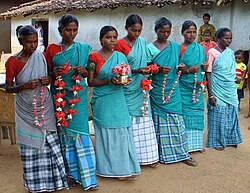
| image_caption = Santals in traditional dress celebrating ''[[Baha parab]]'' | | image_caption = Santals in traditional dress celebrating ''[[Baha parab]]'' | ||
| pop = {{circa|7. | | pop = {{circa|7.5 million}} | ||
| popplace = | | total_year = 2011 | ||
| region1 = {{Flag|India}}<br/>{{spaces| | | popplace = {{flag|India}}{{*}}{{flag|Bangladesh}}{{*}}{{flag|Nepal}} | ||
| pop1 = <br/>2, | | region1 = {{Flag|India}}:<br />{{spaces|7}}[[Jharkhand]] | ||
| region2 = {{spaces| | | pop1 = <br />2,754,723<ref name="census">{{Cite web|url=http://www.censusindia.gov.in/2011census/PCA/ST.html|title=A-11 Individual Scheduled Tribe Primary Census Abstract Data and its Appendix|website=censusindia.gov.in|publisher=Office of the Registrar General & Census Commissioner, India|access-date=18 November 2017}}</ref> | ||
| pop2 = 2,512,331<ref name="census" | | region2 = {{spaces|7}}[[West Bengal]] | ||
| region3 = {{spaces| | | pop2 = 2,512,331<ref name="census"/> | ||
| pop3 = 894,764<ref name="census" | | region3 = {{spaces|7}}[[Odisha]] | ||
| region4 = {{spaces| | | pop3 = 894,764<ref name="census"/> | ||
| pop4 = 406,076<ref name="census" | | region4 = {{spaces|7}}[[Bihar]] | ||
| region5 = {{spaces| | | pop4 = 406,076<ref name="census"/> | ||
| pop5 = 213,139<ref>{{Cite web|url=http://www.censusindia.gov.in/2011census/C-16/DDW-C16-STMT-MDDS-1800.XLSX |title=C-16 Population By Mother Tongue|publisher=Office of the Registrar General & Census Commissioner, India | | region5 = {{spaces|7}}[[Assam]] | ||
| region6 = {{ | | pop5 = 213,139<ref>{{Cite web|url=http://www.censusindia.gov.in/2011census/C-16/DDW-C16-STMT-MDDS-1800.XLSX |title=C-16 Population By Mother Tongue|website=censusindia.gov.in|publisher=Office of the Registrar General & Census Commissioner, India|access-date=3 November 2019}}</ref> | ||
| pop6 = | | region6 = {{spaces|7}} [[Tripura]] | ||
| ref6 = <ref | | pop6 = 2,913 | ||
| | | ref6 = <ref>{{cite web|title=A-11 Appendix: District wise scheduled tribe population (Appendix), Tripura - 2011 |url=https://censusindia.gov.in/nada/index.php/catalog/43015/download/46683/ST-16-PCA-A11-APPENDIX.xlsx |website=censusindia.gov.in |publisher=Office of the Registrar General & Census Commissioner, India}}</ref> | ||
| | | region7 = {{flag|Bangladesh}} | ||
| | | pop7 = 129,049 (2021) | ||
| languages = [[Santali language|Santali | | ref7 = <ref>{{Cite web|url=http://bbs.portal.gov.bd/sites/default/files/files/bbs.portal.gov.bd/page/b343a8b4_956b_45ca_872f_4cf9b2f1a6e0/2022-07-28-14-31-b21f81d1c15171f1770c661020381666.pdf|title=Table 1.4 Ethnic Population by Group and Sex|year=2021|publisher=Bangladesh Bureau of Statistics|page=34|language=bn}}</ref> | ||
| religions = '''Majority'''<br/>[[File:Om.svg|15px]] [[Hinduism]] | | region8 = {{flag|Nepal}} | ||
| related = [[Munda people|Mundas]]{{•}}[[Ho people|Hos]]{{•}}[[Juang people|Juangs]]{{•}}[[Kharia people|Kharias]]{{•}}[[Savara people|Savaras]]{{•}}[[Korku people| | | pop8 = 51,735 | ||
| ref8 = <ref>{{Cite journal|title=National Population and Housing Census 2011: Social Characteristics Tables|url=https://cbs.gov.np/wp-content/upLoads/2018/12/Volume05Part02.pdf|journal=Nepal Census|via=Government of Nepal|archive-date=14 March 2023|access-date=4 March 2021|archive-url=https://web.archive.org/web/20230314170005/https://cbs.gov.np/wp-content/upLoads/2018/12/Volume05Part02.pdf|url-status=dead}}</ref> | |||
| languages = [[Santali language|Santali]] | |||
| religions = '''Majority'''<br />[[File:Om.svg|15px]] [[Hinduism]]<ref name="censusindia.gov.in">{{cite web |title=ST-14 Scheduled Tribe Population By Religious Community - Jharkhand |url=https://censusindia.gov.in/nada/index.php/catalog/11908/download/15021/ST-20-00-014-DDW-2011.XLS |website=census.gov.in |access-date=3 November 2019}}</ref><br />'''Minority'''<br />Folk religions ([[Sari Dharam]], [[Sarnaism|Sarna Dharam]])<br />[[File:Star and Crescent.svg|15px]] [[Islam]]<br /> [[File:Christian cross.svg|12px]] [[Christianity]], [[File:Dharma Wheel (2).svg|16px]] [[Buddhism]], Others<ref name="censusindia.gov.in"/> | |||
| related = [[Munda people|Mundas]]{{•}}[[Ho people|Hos]]{{•}}[[Juang people|Juangs]]{{•}}[[Kharia people|Kharias]]{{•}}[[Savara people|Savaras]]{{•}}[[Korku people|Korkus]]{{•}}[[Bhumij people|Bhumijs]] | |||
}} | }} | ||
{{Infobox ethnonym|root=ᱥᱟᱱᱛᱟᱲ Santal|person=Santal|people=ᱥᱟᱱᱛᱟᱲ ᱦᱚᱲ|language=[[Santali language|Santali]]|country={{Flag|India}}, {{Flag|Bangladesh}} and {{Flag|Nepal}}}} | |||
The '''Santal''' or '''Santhal''' | The '''Santal''' (or '''Santhal''') are an [[Austroasiatic languages|Austroasiatic]]-speaking [[Munda peoples|Munda]] ethnic group of the [[Indian subcontinent]].<ref name="Bangladesh">{{Cite web|url=http://www3.ntu.edu.sg/home/cfcavallaro/Pdf%20files/Cavallaro%20and%20Rahman%202009.pdf|title=The Santals of Bangladesh|last1=Cavallaro|first1=Francesco|last2=Rahman|first2=Tania|website=ntu.edu.sg|access-date=17 November 2017|publisher=Nayang Technical University|archive-url=https://web.archive.org/web/20161109161200/http://www3.ntu.edu.sg/home/cfcavallaro/Pdf%20files/Cavallaro%20and%20Rahman%202009.pdf|archive-date=9 November 2016}}</ref> They constitute the largest tribal community in the Indian states of [[Jharkhand]] and [[West Bengal]], and are also present in [[Odisha]], [[Bihar]], [[Assam]], and [[Tripura]]. They are the largest ethnic minority in northern Bangladesh's [[Rajshahi Division]] and [[Rangpur Division]]. They have a sizeable population in [[Nepal]]. The Santals speak [[Santali language|Santali]], the most widely spoken language of the [[Munda languages|Munda subfamily]] of [[Austroasiatic languages]]. | ||
== Etymology == | == Etymology == | ||
Santal is most likely derived from | Santal is most likely derived from an exonym. The term refers to inhabitants of {{lang|bn|Saont}} in erstwhile [[Silda, West Bengal|Silda]] in [[Midnapore|Medinapore]] region in West Bengal.<ref group="upper-alpha">{{harvnb|Schulte-Droesch|p=3|2018}}</ref><ref>{{Cite book|title=Census 1961, west bengal-district handbook, Midnapore|publisher=The superintendent, government printing, West Bengal|url=http://lsi.gov.in:8081/jspui/bitstream/123456789/5131/1/22153_1961_MID.pdf|year=1966|pages=58|archive-url=https://web.archive.org/web/20210902221642/http://lsi.gov.in:8081/jspui/bitstream/123456789/5131/1/22153_1961_MID.pdf|archive-date=2 September 2021}}</ref> The Sanskrit word ''Samant'' or Bengali ''Saont'' means plain land.<ref>{{Cite book|title=Encyclopaedia of Scheduled Tribes in Jharkhand|publisher=Gyan Publishing House|url=https://books.google.com/books?id=W5dVaq4_cLoC&pg=PA213|year=2010|pages=213|isbn=9788178351216}}</ref> Their ethnonym is {{lang|sat|Hor Hopon}} ("child of human").<ref group="upper-alpha">{{harvnb|Somers|p=5|1979}}</ref> | ||
==History== | ==History== | ||
=== Origins === | === Origins === | ||
According to linguist [[Paul Sidwell]], [[Austro-Asiatic language]] speakers probably arrived on coast of [[Odisha]] from [[Mainland Southeast Asia|Indochina]] about | According to linguist [[Paul Sidwell]], [[Austro-Asiatic language]] speakers probably arrived on the coast of [[Odisha]] from [[Mainland Southeast Asia|Indochina]] about 4,000–3,500 years ago ({{circa|2000|1500}} BCE).<ref>{{cite web |url=https://www.academia.edu/36689736 |title=Austroasiatic Studies: state of the art in 2018. Presentation at the Graduate Institute of Linguistics, National Tsing Hua University, Taiwan, 22 May 2018. |last=Sidwell |first=Paul |date=2018 |archive-url=https://web.archive.org/web/20180522203539/http://www.academia.edu/36689736/Austroasiatic_Studies_state_of_the_art_in_2018 |archive-date=22 May 2018}}</ref><ref>{{cite journal |last1=Rau |first1=Felix |last2=Sidwell |first2=Paul |title=The Munda Maritime Hypothesis |date=12 September 2019 |url=https://core.ac.uk/download/pdf/228160282.pdf |journal=Journal of the Southeast Asian Linguistics Society |volume=12 |issue=2 |issn=1836-6821 |hdl=10524/52454 |pages=35–57 }}</ref> The Austroasiatic speakers spread from Southeast Asia and mixed extensively with local Indian populations. | ||
Due to the lack of significant archaeological records, the original homeland of the | Due to the lack of significant archaeological records, the original homeland of the Santhals is not known with certainty. The folklore of the Santhals claims they came from {{lang|sat|Hihiri}}, which scholars have identified as Ahuri in [[Hazaribagh district]].<ref name=":0">{{Cite journal |last=Karua |first=Subhash Chandra |date=2006 |title=The Santals of Mayurbhanj — a Study on Their Original Homeland |url=https://www.jstor.org/stable/44147979 |journal=Proceedings of the Indian History Congress |volume=67 |pages=592–599 |jstor=44147979 |issn=2249-1937}}</ref> From there, they claim, they were pushed onto [[Chhota Nagpur Plateau]], then to [[Jhalda]], [[Patkum estate|Patkum]] and finally Saont, where they settled for good.<ref group="upper-alpha">{{harvnb|Sen|p=14|1997}}</ref> According to Dalton, where they were renamed to Santal from cluster name Kharwar.<ref>{{Cite book |last=Lister |first=E. |url=http://www.indianculture.gov.in/gazettes/bihar-and-orissa-district-gazetteers-hazaribagh-0 |title=Bihar and Orissa District Gazetteers: Hazaribagh |year=1917 |pages=54 |language=en |access-date=29 January 2023}}</ref><ref name=":0" /> This legend, which has been cited by several scholars, has been used as evidence that the Santals once had a significant presence in [[Hazaribagh district|Hazaribagh]]. Colonial scholar Colonel [[Edward Tuite Dalton|Dalton]] claimed in Chai there was a fort formerly occupied by a Santal raja who was forced to flee when the [[Delhi Sultanate]] invaded the territory.<ref group="upper-alpha">{{harvnb|Sen|p=15|1997}}</ref> | ||
=== British | === British Era === | ||
[[File:The People Of India 1868 Sonthals.jpg|thumb|right|200px|Santhals in [[British Raj|British India]], 1868]] | [[File:The People Of India 1868 Sonthals.jpg|thumb|right|200px|Santhals in [[British Raj|British India]], 1868]] | ||
In the latter half of the 18th century, the Santals entered the historical record in 1795 when they are recorded as "Soontars. | In the latter half of the 18th century, the Santals entered the historical record in 1795 when they are recorded as "Soontars".<ref>{{Cite web |date=20 December 2024 |title=Interrogating Temporal and Spatial Demarcations in History Writing {{!}} Economic and Political Weekly |url=https://www.epw.in/journal/2024/51/special-articles/interrogating-temporal-and-spatial-demarcations.html |access-date=29 December 2024 |website=www.epw.in |language=en}}</ref> During the [[Great Bengal famine of 1770|Bengal Famine of 1770]], the drier western and southwestern parts of Bengal, especially the [[Jungle Mahals]] region, were some of the worst-hit areas and were significantly depopulated. This depopulation resulted in a significant loss of revenue for the [[East India Company]]. Therefore, when the [[Permanent Settlement]] was enacted in 1790, the Company looked for agriculturalists to clear the lands.<ref name=Sen1997 group="upper-alpha">{{harvnb|Sen|p=19|1997}}</ref> British officials turned their attention to Santals, who were ready to clear the forest for the practice of settled agriculture. In 1832, a large number of area of the Raj Mahal hills demarcated as [[Damin-i-koh]]. Santal from [[Cuttack]], [[Dhalbhum]], [[Birbhum]], [[Manbhum]], [[Hazaribagh]] migrated and started cultivating these lands as peasants <ref name="auto">{{Cite journal|last=Jha|first=Amar Nath|year=2009|journal=Proceedings of the Indian History Congress|volume=70|pages=185–196|issn=2249-1937|jstor=44147668|title=Locating the Ancient History of Santal Parganas}}</ref><ref name=Sen1997 group="upper-alpha"/> sponsored by landowners and the British who were desperate for labour.<ref name="auto" /><ref name="Equations2007">{{Cite book|url=https://books.google.com/books?id=9T3zYvKVF98C&q=santhal&pg=PA57|title=This is Our Homeland: A Collection of Essays on the Betrayal of Adivasi|year=2007|location=Banglaore|publisher=Equations|oclc=180852396|access-date= 26 August 2019}}</ref><ref name="Malik2016">{{Cite book|last1=Malik|first1=Malti |year=2016 |title=Saraswati History of India |url=https://books.google.com/books?id=bMg-DAAAQBAJ&q=santhal+revolt&pg=PA329 |publisher=New Saraswati House |isbn=978-81-7335-498-4 |access-date=26 August 2019}}</ref><ref group="upper-alpha">{{harvnb|Sen|p=20|1997}}</ref> Under British direction, Santals took loans from non-Santal moneylenders to buy iron tools, seed grain and oxen as individuals and families, rather than groups as was their custom for working the land.<ref group="upper-alpha">{{harvnb|Somers|p=43|1979}}</ref> | ||
When they arrived in [[Damin-i-koh]], the British provided no protection for the Santals against the preexisting [[Mal Paharia people|Mal Paharias]], who were known raiders of the plains areas and had only recently been partially "pacified. | When they arrived in [[Damin-i-koh]] (present day [[Santhal Pargana Division|Santal Pargana]]), the British provided no protection for the Santals against the preexisting [[Mal Paharia people|Mal Paharias]], who were against destruction of forest, were known raiders of the plains areas and had only recently been partially "pacified". Eventually, the Santals, with their better technology and ability to match the Paharia's guerrilla attacks, managed to drive them out. They clear the forest tracts and started cultivation in these areas. Their settlement took place between the 1830s and 1850s: in 1830, the area was home to only 3,000 Santals, but by the 1850s, 83,000 Santals had settled in the land and had turned it into paddy fields. This resulted in a 22 times increase in Company revenue from the area.<ref group="upper-alpha">{{harvnb|Somers|p=31|1979}}</ref> | ||
However, as they became more agricultural, the Santals were [[Economic exploitation|exploited]] by the zamindars. Unlike the Santals, the British valued individual competition instead of cooperation, and had a rigid system of laws very different from the relatively relaxed norms of the village council, the highest form of government most Santals knew. Mahajans from Bengal and Baniyas from Bihar began selling goods from elsewhere, and many Santals, seeing them as exotic, were tricked into | However, as they became more agricultural, the Santals were [[Economic exploitation|exploited]] by the [[zamindars]]. Unlike the Santals, the British valued individual competition instead of cooperation, and had a rigid system of laws very different from the relatively relaxed norms of the village council, the highest form of government most Santals knew. [[Mahajans]] from Bengal and [[Bania (caste)|Baniyas]] from Bihar began selling goods from elsewhere, and many Santals, seeing them as exotic, were tricked into [[debt]] to buy them, usually with a [[mortgage]] on their land. When the Santals were unable to pay the [[moneylenders]] back, they became owners of the land and the Santals became dispossessed [[landless]] peasants. The Baniya merchants and other outsiders also began to treat Santals as outcastes in a [[Brahminical]] system.<ref group="upper-alpha">{{harvnb|Somers|p=46|1979}}</ref><ref group="upper-alpha">{{harvnb|Sen|1997|p=21}}</ref> | ||
Eventually, these acts of exploitation, combined with British tax policies and [[Corruption|corrupt]] tax collectors, deteriorated to the point where Santals grew discontented. In 1855, they revolted in the [[Santhal rebellion|Santal rebellion]], better known as the {{lang|sat|Santal Hul}}. 30,000 Santals, led by [[Sidhu and Kanhu Murmu]], attacked the zamindars and other outsiders ({{lang|sat|dikkus}}) who had made their lives so miserable, as well as the British authorities. Eventually, around 10,000 [[Presidency armies|British troops]] managed to suppress the rebellion. Although the rebellion's impact was largely overshadowed by that of the [[Indian Rebellion of 1857]], the impact of the Santhal Rebellion lives on as a turning point in Santhal pride and identity. This was reaffirmed, over a century and a half later with the creation of the | Eventually, these acts of [[Exploitation of natural resources|exploitation]], combined with British tax policies and [[Corruption|corrupt]] tax collectors, deteriorated to the point where Santals grew discontented. In 1855, they revolted in the [[Santhal rebellion|Santal rebellion]], better known as the {{lang|sat|Santal Hul}}. 30,000 Santals, led by [[Sidhu and Kanhu Murmu]], attacked the zamindars and other outsiders ({{lang|sat|dikkus}}) who had made their lives so miserable, as well as the British authorities. Eventually, around 10,000 [[Presidency armies|British troops]] managed to suppress the rebellion. Although the rebellion's impact was largely overshadowed by that of the [[Indian Rebellion of 1857]], the impact of the Santhal Rebellion lives on as a turning point in Santhal pride and identity. This was reaffirmed, over a century and a half later with the creation of the tribal province in the [[India|Republic of India]], [[Jharkhand]].<ref name="auto" /><ref name="Equations2007" /><ref name="Malik2016" /> Following the rebellion, the British satisfied all Santhal demands, due to their importance as a tax-paying group. The British created a 5000 km<sup>2</sup> area, called [[Santhal Pargana division|Santal Parganas]], where the normal procedures of British India did not apply. Administration of the community was primarily made the responsibility of the village headman, or pradhan, who was also given the power to collect taxes. It was made illegal for Santals to transfer land to non-Santals, allowing them to have legal rights over their land.<ref name=":2">{{harvnb|Somers|1979|p=}}</ref> | ||
After the [[ | After the [[British Crown]] formally took control over India in 1858, the Santals continued their system of government and traditions. Newly established Christian missions brought education, and many Santals moved to the tea plantations in [[Assam]], [[North Bengal]], where they still remain today. However, most continued with their old life, but were still not prosperous. In addition, secular education did not become widespread until after Indian independence.<ref group="upper-alpha">{{harvnb|Somers|1979|p=53}}</ref> | ||
In the late 19th century, many Santals migrated from the Santal Parganas to the districts of Bihar and North Bengal such as Purnia, Malda and Dinajpur. The Santals still faced retaliation after the Santal Hul and were invited by zamindars to cultivate many parts of north Bengal, which had become scrubland, land which the Santals specialised in farming.<ref>{{Cite journal|last=Sarkar|first=Ashim Kumar|year=2016|title=Forest, Land Use, and Water: A Study of the Santal Adivasi World of Colonial Maldah, 1900-1947|url=http://inet.vidyasagar.ac.in:8080/jspui/bitstream/123456789/1852/1/3%20Forest%2C%20Land%20Use%2C%20and%20Water.pdf|journal=Vidyasagar University Journal of History|volume=4|pages=29–40|archive-date=23 April 2024|access-date=24 November 2021|archive-url=https://web.archive.org/web/20240423031337/http://inet.vidyasagar.ac.in:8080/jspui/bitstream/123456789/1852/1/3%20Forest,%20Land%20Use,%20and%20Water.pdf|url-status=dead}}</ref> By the 1930s, their numbers in this region the Santals had become two lakh. Most were settled on wasteland where the rent was cheaper than the more fertile wet lands. However they faced heavy taxation from the zamindars, and were oppressed by moneylenders, upper castes, and the bureaucracy in general. In 1924, several Santal sardars, influenced by Gandhian ideology and led by Jitu Sardar, began to lead agitations against the oppressive double system of elite Bengalis and British government. Santals stopped paying rent to the zamindars, beat up revenue inspectors, and led agitations against the moneylenders. In 1928, the Santals stopped paying the chaukidari tax and led protests in Thakurgaon in 1929. In 1932, several Santals attempted to organise their own state with Jitu Sardar as head, initially based on Gandhi's Ram Rajya but quickly criticised Gandhi when he did not help them. In 1933, a British commissioner was appointed to look into the grievances of Santals of North Bengal.{{citation needed|date=December 2021}} | |||
=== Post-independence === | === Post-independence === | ||
After independence, the Santals were made one of the [[Scheduled Tribes]]. After Jharkhand was carved out of Bihar in 2000, the [[Santhal Pargana division|Santal Parganas]] was made a separate division of the state.<ref name=":2" /> | The Santal community, like the others of the region, was split between West Bengal in India and East Bengal in Pakistan during Partition. After independence, the Santals were made one of the [[Scheduled Tribes]] in India. In East Pakistan, there were some regions in the west where Santals were still in significant numbers. There and in neighbouring West Bengal, the Santals provided significant support to the [[Tebhaga movement]]. After the Pakistani military crushed the uprising and burned many Santal homes, many fled across the border to Malda in India.<ref>{{Cite journal |last=Panjabi |first=Kavita |year=2010 |title='Otiter Jed' or Times of Revolution: Ila Mitra, the Santals and Tebhaga Movement |url=https://www.jstor.org/stable/25741971|journal=Economic and Political Weekly|volume=45|issue=33|pages=53–59|jstor=25741971|issn=0012-9976}}</ref> | ||
In northern [[West Bengal]], tribal peasants participated in [[Naxalbari uprising]] led by a Santal communist leader [[Jangal Santhal]]. The impoverishment has led to the [[Guevarist]] inspired [[Naxalite]] [[insurgency]] in what is often termed as the [[Red Corridor]].<ref>{{Cite web|title=Legendary Leader Jangal Santhal|url=http://cpiml.org/feature/legendary-leader-jangal-santhal/|website=Communist Party of India (Marxist-Leninist)|access-date=10 November 2021}}</ref> | |||
After [[Jharkhand]] was carved out of [[Bihar]] in 2000, the [[Santhal Pargana division|Santal Parganas]] was made a separate division of the state.<ref name=":2" /> These Santals have also agitated for recognition of their traditions in the census as a separate religion, [[Sarnaism|''sarna dharam'']], for which Jharkhand assembly passed a resolution in 2020. Many still face poverty and exploitation, and in Bangladesh, theft of their lands is common. Although spread out over a large area, they now consider the Santal Parganas as their cultural heartland.<ref group="upper-alpha">{{harvnb|Schulte-Droesch|pp=6–7|2018}}</ref> | |||
== Society == | == Society == | ||
The base of Santal society is a division between " | The base of Santal society is a division between "sibling" ({{lang|sat|boeha}}) and "guest" ({{lang|sat|pera}}), a divide found in many other [[tribal]] societies of central and eastern India. Children of the same father (sometimes grandfather), known as {{lang|sat|nije boeha}}, often live next to each other and own adjacent pieces of land. Those in the closest form of brotherhood, called {{lang|sat|mit orak hor}} ("people of one house") in Singhbhum, cannot marry each other and propitiate the same deity, since the house refers to a common ancestor from which all the families are believed to descend. Only {{lang|sat|mit orak hor}} marriages are severely stigmatised. Another brotherhood is membership of a clan, which are exogamous.<ref group="upper-alpha">{{harvnb|Schulte-Droesch|p=99|2018}}</ref> The last form of brotherhood is {{lang|sat|phul}}, a ritual friendship with members of other ethnic groups. Children of {{lang|sat|phul}} brothers consider themselves as brothers, and they attend each other's main lifecycle events, such as weddings or funerals, as {{lang|sat|pera}}. They also give help in times of hardship.<ref group="upper-alpha">{{harvnb|Schulte-Droesch|pp=99–100|2018}}</ref> | ||
Those who do not have brotherhood are referred to as {{lang|sat|pera}}, or guests. Members of other communities, especially those not speaking Santali, are excluded from this grouping, except for communities such as the [[Karmakar]], [[Mahali]] or [[Lohar]], who are enmeshed in Santal society. Those with this relationship can marry, and attend major festivals as guests. People related by marriage, although {{lang|sat|pera}}, have special roles in life-cycle events. Women perform special welcome rituals for {{lang|sat|pera}} when they visit. Those related by marriage can have one of two relationships. They can be {{lang|sat|bala}}, a relationship exemplified by the couple's parents, or {{lang|sat|sangat}}, between cross-siblings of a couple.{{ | Those who do not have brotherhood are referred to as {{lang|sat|pera}}, or guests. Members of other communities, especially those not speaking Santali, are excluded from this grouping, except for communities such as the [[Karmakar]], [[Mahali]] or [[Lohar (caste)|Lohar]] of their locality, who are enmeshed in Santal society. Those with this relationship can marry, and attend major festivals as guests. People related by marriage, although {{lang|sat|pera}}, have special roles in life-cycle events. Women perform special welcome rituals for {{lang|sat|pera}} when they visit. Those related by marriage can have one of two relationships. They can be {{lang|sat|bala}}, a relationship exemplified by the couple's parents, or {{lang|sat|sangat}}, between cross-siblings of a couple.<ref group="upper-alpha">{{harvnb|Schulte-Droesch|p=100|2018}}</ref> | ||
Santal | [[File:Santal people Jharkhand India.jpg|thumb|Santal women]] | ||
The | Santal society has much less stratification and is more [[egalitarian]] than adjacent [[Caste|caste Hindu]] society, but still has some status differences. The most important marker of a person when interacting with others in Santal society is their standing as {{lang|sat|marang}} ("senior") or {{lang|sat|hudin}} ("junior"). This standing is evaluated by relation: for example, if someone is greeting their father's elder brother's son, they would be the junior irrespective of age. Similarly, when someone greets their elder brother's wife, the wife would be {{lang|sat|marang}}. However, for strangers or guests with no clear kin connections, the question of {{lang|sat|marang}} or {{lang|sat|hudin}} is decided by age.<ref group="upper-alpha">{{harvnb|Schulte-Droesch|p=102|2018}}</ref> The ritual greeting ({{lang|sat|god}} in Santali) of someone is given much importance and is done in the courtyard of a house when a {{lang|sat|pera}} visits. The greeting differs by gender, and whether the person is junior or senior to the one being greeted. The greeting rituals given by a {{lang|sat|hudin}} involve an "offering" ({{lang|sat|dobok' johar}}) of respect, while a {{lang|sat|marang}} "receives" this respect.<ref group="upper-alpha">{{harvnb|Somers|p=59|1979}}</ref> This greeting should not be done hastily, and correct practice of it is encouraged in children from a young age.<ref group="upper-alpha">{{harvnb|Schulte-Droesch|p=103|2018}}</ref> However the {{lang|sat|hudin}}-{{lang|sat|marang}} distinction does not apply to {{lang|sat|phul}} or {{lang|sat|bala}}, who instead greet each other as if greeting a {{lang|sat|marang}}.<ref group="upper-alpha">{{harvnb|Schulte-Droesch|p=104|2018}}</ref> | ||
The Santals have another social organisation important for rituals, called {{lang|sat|khunti}}, or {{lang|sat|gusti}} in south Chota Nagpur.{{Efn|The term comes from the [[Bengali language|Bengali]] {{lang| | The Santals also have [[totem]]istic [[clans]], known as {{lang|sat|pari}}.<ref group="upper-alpha">{{harvnb|Somers|p=58|1979}}</ref> These 12 clans are divided into two ranks: 7 senior and 5 junior. The senior clans are believed to originate from the 7 sons and daughters of the first man and woman, and in order of seniority they are: {{lang|sat|[[Hansda]]}} (goose), {{lang|sat|[[Murmu]]}} ([[Nilgai]]), {{lang|sat|[[Marandi]]}} (''[[Ischaemum rugosum]]''), {{lang|sat|[[Kisku]]}} (kingfisher), {{lang|sat|Soren}} ([[Pleiades]]), {{lang|sat|[[Hembram]]}} ([[betel palm]]) and {{lang|sat|[[Tudu (disambiguation)|Tudu]]}} (owl).<ref group="upper-alpha">{{harvnb|Schulte-Droesch|p=109|2018}}</ref> The junior clans are Baskey or Baske (stale rice), {{lang|sat|Besra}} ([[Besra|falcon]]), Chorey or Chonre (lizard), Pauria or Pawria (pigeon) and Bediya. Members of a senior clan do not marry members of a junior clan, and there are some forbidden marriages as well, such as between Marandi and Kisku. In addition, Besras are sometimes treated differently due to their perceived low status, but other than the context of marriage, they play no role in social life. The clans also avoid harming their clan totem, lest evil befall them.<ref group="upper-alpha">{{harvnb|Schulte-Droesch|pp=110–111|2018}}</ref> | ||
The Santals have another social organisation important for rituals, called {{lang|sat|khunti}}, or {{lang|sat|gusti}} in south Chota Nagpur.{{Efn|The term comes from the [[Bengali language|Bengali]] {{lang|bn|goshti}}, meaning clans. It seems likely that the nearby Santals of Singhbhum borrowed the word.}} The term refers to descendants of a common ancestor, no more than a few generations back, that live nearby. The {{lang|sat|khunti}} is identified by some distinguishing feature of the ancestor, such as {{lang|sat|poeta}}, people who wear a thread on their chest in worship. In many cases, all the people of a {{lang|sat|gusti}} live in their ancestral village, but some members may have migrated to neighbouring villages.<ref group="upper-alpha">{{harvnb|Schulte-Droesch|p=117|2018}}</ref> | |||
== Culture == | |||
=== Festivals === | |||
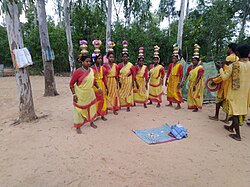
[[Sohrai]] is the principal festival of Santal community. Besides that [[Baha parab|Baha]], [[Karam (festival)|Karam]], [[Dashain]], Sakrat, Mahmore, Rundo and Magsim are important festivals. They traditionally accompany many of their dances during these festivals with two drums: the Tamak‘ and the Tumdak’. | |||
[[File:Dasai Dance at the streets of Purulia district 05.JPG|left|thumb|A traditional Dasai dance in [[Purulia district]], [[West Bengal]]]] | |||
[[File:Numin din do̠ sohrai 'Northern Santali Sohrai folk song'.webm|thumb| A tradional Sohrai Song, sung by Paulina Mardi, Donyson Mardi and Pushtina Mardi.]] | |||
[[File:Tamak and Tumdak 01.jpg|thumb|Tamak (r.) and Tumdak (l.) - typical drums of the Santhal people, photographed in a village in [[Dinajpur District, Bangladesh|Dinajpur district]], [[Bangladesh]].]] | |||
[[File:Santali Lungi Panchi Dance West Bengal.jpg|thumb|[[Lungi Panchi Dance]] of Santal in [[Birbhum]], West Bengal]] | |||
[[Chadar Badar]], a form of [[puppetry]] known also as Santal puppetry, is a folk show involving wooden puppets placed in a small cage which acts as the stage.<ref name="Chadar Badar">{{cite news | url=http://www.telegraphindia.com/1110107/jsp/jharkhand/story_13400270.jsp | archive-url=https://web.archive.org/web/20110506151043/http://www.telegraphindia.com/1110107/jsp/jharkhand/story_13400270.jsp | url-status=dead | archive-date=6 May 2011 | title=Chadar Badar | work=The Telegraph |year=2015 | access-date=22 March 2015}}</ref> | |||
Local affairs are handled by a [[village council]], led by a ''{{lang|sat|manjhi}}''.<ref name="Winston2004">{{Cite book |editor1-last=Winston |editor1-first=Robert |editor2-last=Wilson |editor2-first=Don E. |year=2004 |title=Human |publisher=[[Dorling Kindersley]] |pages=440 |isbn=0-7566-0520-2}}</ref> | |||
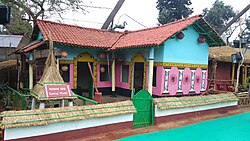
The walls of traditional Santal homes are ornamented with carved designs of animals, hunting scenes, dancing scenes, and [[geometric patterns]]. Santal bridal palanquins are also finely carved.<ref name="Winston2004" /> | |||
[[File:Santal House at ' State Tribal Fair-2020 ' Bhubaneswar,India.jpg|thumb|Santal house at 2020 Odisha Tribal fair, [[Bhubaneswar]]]] | |||
=== Marriage === | |||
There are seven kinds of marriage recognised in the Santal community, each with its own degree of social acceptance. The most elaborate kind of marriage is the {{lang|sat|hapramko bapla}}, or ancestor's marriage, but the most widely practised is {{lang|sat|kesimek'}}. In this form of marriage, a boy and girl who wish to marry decide to go to the groom's house and stay there a while. When the girl's family are made aware of their situation, the {{lang|sat|jog majhi}} of the girl's village arrives at the house of the headman of the boy's village to discover the couple's intentions. The couple are summoned to the village headman and the bride is asked whether she wishes to set a date for {{lang|sat|kesimek'}}. If she replies 'no', the boy's family will have to pay a small fine to the {{lang|sat|jog majhi}} of the girl's village, who would take the girl back to her father. If she assents, the boy's family is consulted for the best day for the {{lang|sat|kesimek'}}.<ref group="upper-alpha">{{harvnb|Somers|p=23|1979}}</ref> The bride and groom are not bound by any obligation to marry.<ref name=Somers197929 group="upper-alpha">{{harvnb|Somers|p=29|1979}}</ref> During this time, the {{lang|sat|jog majhi}} stays in the village to give all the information he can to the bride's father: both in determining what would be a good bride price to demand and whether the marriage might end in a short time.<ref name=Somers197929 group="upper-alpha"/> | |||
On the day of the {{lang|sat|kesimek'}} ceremony, a group of men from the bride's village, including the {{lang|sat|jog majhi}}, headman, village elders, and the bride's father and some relations, arrives at the bride's village. They are seated at the headman's house with respect and organised by {{lang|sat|marang}} or {{lang|sat|hudin}} status. Meanwhile, the groom's family gathers to discuss the bride price the groom's father should pay. The two parties then meet and the fathers negotiate the [[bride price]] to be paid. The groom is first asked whether he wishes the marriage to continue. As a symbolic [[marriage contract]], the [[groom]]'s father gives a small amount of cash and gives {{lang|sat|handi}} (rice-beer) to the guests. The negotiations for bride-price continue between the fathers exclusively until an amount is reached. Although this is nowadays in cash, livestock or other goods are not uncommon. The bride price is generally light and it is seen wrong to stop two young people from marrying because of a disagreement about bride price.<ref group="upper-alpha">{{harvnb|Somers|p=28|1979}}</ref> After an agreement is reached, celebrations ensue and festive drinking continues into the night.<ref name=Somers1979-25 group="upper-alpha">{{harvnb|Somers|p=25|1979}}</ref> | |||
A short time afterwards, a relative of the groom along with the {{lang|sat|jog majhi}} of the [[groom]]'s village hand over the bride price to the [[bride]]'s family.<ref name=Somers1979-25 group="upper-alpha"/> Afterwards the couple arrive in the bride's natal village. The bride arriving first carrying a pot with white clay, the symbol of a woman returning to her natal village as a guest. The bride greets her mother first and neighbours are invited to share {{lang|sat|handi}} reserved for {{lang|sat|pera}} ({{lang|sat|pera hor handi}}), while getting acquainted with the husband.<ref name=Somers1979-25 group="upper-alpha"/> When the couple leaves the bride's village, the bride pays her respects to the headman in his courtyard. At the {{lang|sat|Majhi Than}}, the bride thanks the headman for all he has done and gives a symbolic gift. The headman then blesses the couple and wishes the bride strength, good luck and many strong sons. The couple then leaves for the groom's village to start their new life.<ref group="upper-alpha">{{harvnb|Somers|p=26|1979}}</ref> | |||
Marriages done by {{lang|sat|kesimek'}} involve very little ritual: Santal society has clearly defined roles for marriage, and the choice of the couple is respected. Decisions by the families are done in a spirit of consensus rather than adversarially, and marriage is seen just as important for the entire village as for the couple.<ref name=Somers197929 group="upper-alpha"/> | |||
[[File:163 Museu de la Música, dhodro banam, violins indis.jpg|thumb|{{lang|sat|Dhodro banam}} musical instruments]] | |||
== Religion == | == Religion == | ||
{{Pie chart| | {{Pie chart | ||
|caption=Religion among Santal people of Bihar, West Bengal, Jharkhand, Odisha and Tripura<ref name=ST-14/><ref name=ST-14A/> | |||
|thumb=right | |||
|value1=63.15 | |||
|label1=[[Hinduism]] | |||
|color1=orange | |||
|value2=23 | |||
|label2=[[Sarnaism]] | |||
|color2=maroon | |||
|value3=7.28 | |||
|label3=[[Sari Dharam]] | |||
|color3=green | |||
|value4=5.45 | |||
|label4=[[Christianity]] | |||
|color4=dodgerblue | |||
|other = yes | |||
|other-color=grey | |||
}} | |||
The Santal are granted [[Scheduled Tribe]] status in five states: [[Bihar]], [[West Bengal]], [[Jharkhand]], [[Odisha]], and [[Tripura]], where they account for a total population of 6,570,807 according to the [[2011 census of India|2011 Census of India]]. Of this population, 63.15% are reported as [[Hinduism|Hindu]], 23% as [[Sarnaism|Sarna]], 7.28% as [[Sari Dharam]] (all in West Bengal), and 5.46% as [[Christians|Christian]].<ref name=ST-14>{{multiref2|{{cite web|title=ST-14 Scheduled Tribe Population By Religious Community|url=https://censusindia.gov.in/2011census/SCST-Series/ST14.html|access-date=3 November 2019|website=census.gov.in |url-status=dead |archive-url=https://web.archive.org/web/20191114034625/https://censusindia.gov.in/2011census/SCST-Series/ST14.html |archive-date=14 November 2019}} | |||
|{{cite web|title=ST-14: Scheduled tribe population by religious community (State/UT level), Bihar - 2011 |url=https://censusindia.gov.in/nada/index.php/catalog/11898/download/15011/ST-10-00-014-DDW-2011.XLS |publisher=Office of the Registrar General & Census Commissioner, India}} | |||
|{{cite web|title=ST-14: Scheduled tribe population by religious community (State/UT level), West Bengal - 2011 |url=https://censusindia.gov.in/nada/index.php/catalog/11907/download/15020/ST-19-00-014-DDW-2011.XLS |publisher=Office of the Registrar General & Census Commissioner, India}} | |||
|{{cite web|title=ST-14: Scheduled tribe population by religious community (State/UT level), Jharkhand - 2011 |url=https://censusindia.gov.in/nada/index.php/catalog/11908/download/15021/ST-20-00-014-DDW-2011.XLS |publisher=Office of the Registrar General & Census Commissioner, India}} | |||
|{{cite web|title=ST-14: Scheduled tribe population by religious community (State/UT level), Odisha - 2011 |url=https://censusindia.gov.in/nada/index.php/catalog/11909/download/15022/ST-21-00-014-DDW-2011.XLS |publisher=Office of the Registrar General & Census Commissioner, India}} | |||
|{{cite web|title=ST-14: Scheduled tribe population by religious community (State/UT level), Tripura - 2011 |url=https://censusindia.gov.in/nada/index.php/catalog/11904/download/15017/ST-16-00-014-DDW-2011.XLS |publisher=Office of the Registrar General & Census Commissioner, India}}}}</ref><ref name=ST-14A>{{multiref2|{{Cite web|title=ST-14 A: Scheduled tribe population by religious community (State/UT level), Bihar - 2011 |url=https://censusindia.gov.in/nada/index.php/catalog/12513/download/15626/ST-10-00-014A-DDW-2011.XLS |publisher=Office of the Registrar General & Census Commissioner, India |access-date=25 October 2023}} | |||
|{{Cite web|title=ST-14 A: Scheduled tribe population by religious community (State/UT level), West Bengal - 2011 |url=https://censusindia.gov.in/nada/index.php/catalog/12522/download/15635/ST-19-00-014A-DDW-2011.XLS |publisher=Office of the Registrar General & Census Commissioner, India |access-date=25 October 2023}} | |||
|{{Cite web|title=ST-14 A: Scheduled tribe population by religious community (State/UT level), Jharkhand - 2011 |url=https://censusindia.gov.in/nada/index.php/catalog/12523/download/15636/ST-20-00-014A-DDW-2011.XLS |publisher=Office of the Registrar General & Census Commissioner, India |access-date=25 October 2023}} | |||
|{{Cite web|title=ST-14 A: Scheduled tribe population by religious community (State/UT level), Odisha - 2011 |url=https://censusindia.gov.in/nada/index.php/catalog/12524/download/15637/ST-21-00-014A-DDW-2011.XLS |publisher=Office of the Registrar General & Census Commissioner, India |access-date=25 October 2023}} | |||
}}</ref> Other minor religious affiliations include Bidin (27,602), [[Muslims|Muslim]] (13,014), Santal (4,771), Sumra Sandhi (2,059), Sarvdharm (1,625), [[Buddhism|Buddhist]] (1,121), Adi Bassi (1,100), [[Sikhism|Sikh]] (987), Kharwar (385), Sant (356), Saran (352), Jain (348), Achinthar (273), Sarin (185), Marangboro (167), Saranath (157), Seran (125), Adi (84), and Alchichi (78). Additionally, 102 were [[Atheism|''Atheist'']], 331 were believers of ''[[Tribal religions in India|Tribal religion]]'', 1,123 followed other unclassified religions, and 16,974 did not state any religious affiliation.<ref name=ST-14/><ref name=ST-14A/> | |||
According to the [[doctrine]] of Sari Dharam (a religion based on truths), the Santals are broadly divided into three categories: ''Um-hor'', followers of Christianity; ''Saka-hor'', followers of Hinduism; and ''Bonga-hor'', followers of Sari Dharam. While Sari Dharam is predominantly observed in West Bengal, Santals in other states commonly identify their religious practices under the framework of Sarna Dharam, an umbrella term for tribal religions.<ref name=":4">{{Cite book |last=Orans |first=Martin |url=https://books.google.com/books?id=W5MBAAAAMAAJ |title=The Santal: A Tribe in Search of a Great Tradition |date=1965 |publisher=Wayne State University Press |isbn=978-0-8143-1256-8 |language=en}}</ref> Historically, the Santals practised their [[Indigenous religion|autonomous religious beliefs]] without assigning specific nomenclature to their faith. From the [[Census of India prior to independence|beginning of census operations in India]], they mobilised into various [[New religious movement|religious-political movements]], identifying under names such as ''Santal'', ''[[Adivasi|Adibasi]]'', ''[[Jaherthan|Jaher]]'', ''[[Sohrai]]'', ''Sari'', and ''Sarna'', to distinguish themselves from the prevalent religions of India, such as Hinduism and Christianity. Although, those beliefs denomination were administratively clubbed together as [[Animism]] in the colonial census.<ref>{{Cite book |first=Pradeep |last=Chattopadhyay |chapter=Post Colonial Struggle for Language and Culture Rights: The Santal Narrative |others=National Seminar on Tribal Unrest, State Policy and Empowerment in Contemporary India (2012 : Indirā Gāndhī Rāshṭrīya Mānava Saṅgrahālaya) |url=https://archive.org/details/dissentdiscrimin0000nati |editor-first=K.K |editor-last=Mishra |editor-first2=N.K. |editor-last2=Das|title=Dissent, discrimination and dispossession : tribal movements in contemporary India |date=2014 |publisher=Bhopal, M.P. : IGRMS; New Delhi : Manohar |isbn=978-93-5098-043-9}}</ref> Post-independence, the census publishes macro-level ''de facto'' data, specifically for the scheduled communities; thus, there has been a tendency toward revivalism and unification of diverse religious identities among them, with many Santals aligning under the banners of Sarna Dharma, except for the Santals of West Bengal. They regarded it as having more political motives than religious ones and adhered to their own developed religion, named Sari Dharma, based on their ancestral ethics, values, and beliefs. In fact, in the 1961 census, except for Hinduism, most Santals identified their religion by their own ethnic identity, ''Santhal'', while others identified with various beliefs, including Sari and Sarna Dharma. Later, in the 1971 census, the Santhal religion was replaced by Sarna Dharma, a religious identity that only a few Santals had identified with in previous censuses, and the shift was primarily attributed to the Jharkhand statehood movement. However, while all those terms differ in nomenclature from a religio-political perspective, in practice, they reflect a synthesis of ancestral autonomous beliefs and elements of dominant religions like Hinduism and Christianity.<ref name=":4" /><ref>{{cite book | title=Christians and Missionaries in India | chapter=Christian Missionaries and Orientalist Discourse: Illustrated by Materials on the Santals after 1855 |author=Peter B. Andersen |author2=Susanne Foss| publisher=Routledge | date=11 January 2013 | isbn=978-0-203-06108-4 | doi=10.4324/9780203061084-12 | page=295-314}}</ref> | |||
In the religious beliefs of Santals, the core of reverence falls on a court of [[Spirit (vital essence)|spirits]] ({{lang|sat|bonga}}), who handle different aspects of the world and who are placated with prayers and offerings.<ref name=":1">{{cite encyclopedia|title=India: a country study|publisher=[[Federal Research Division]], [[Library of Congress]]|location=Washington, D.C.|url=https://www.loc.gov/item/96019266/|last=Heitzman|first=James|year=1996|editor-last=Heitzman|editor-first=James|edition=5th|pages=168–169|isbn=0-8444-0833-6|oclc=34598209|editor-last2=Worden|editor-first2=Robert L.|entry=Tribal Religions}}{{PD-notice}}</ref> These benevolent spirits operate at the village, household, ancestor, and sub-clan level, along with evil spirits that cause disease and can inhabit village boundaries, mountains, water, tigers, and the forest.<ref name=":1" /> The {{lang|sat|bonga}} are intermediaries between {{lang|sat|noa puri}} (visible world) and {{lang|sat|hana puri}} (the invisible reality), the abode of a Creator.{{Citation needed|date=September 2021}} This creator is variously called ''[[Marang Buru]]'' (Supreme Deity or literally The Great Mountain) or {{lang|sat|Thakur Jiu}} (life giver), and is the "cause of all causes," making the Santal religion, in a deep sense, [[monotheistic]] as well as pantheistic.<ref>{{Cite thesis|title=Living on the Edge: The Predicament of a Rural Indigenous Santal Community in Bangladesh|url=https://tspace.library.utoronto.ca/handle/1807/26415|date=28 February 2011|degree=Doctor of Education|language=en-ca|first=Mrinal Kanti|last=Debnath}}</ref><ref group="upper-alpha">{{harvnb|Hembrom|p=36|1996}}</ref> | |||
There are several ranks of {{lang|sat|bongas}}: the most important are associated intimately with [[Marang Buru]] and are worshipped by all Santals. These include {{lang|sat|Marang Buru bonga}}, {{lang|sat|Jaher Era bonga}} and {{lang|sat|Gosae Era}}. Other {{lang|sat|bongas}}, who are held to be less powerful, are the spirits of important people of the village who have since been deified. There is also another class of {{lang|sat|bongas}} who are feared as bringers of evil. These spirits are not placated by a [[priest]] but by a [[medicine-man]] called {{lang|sat|ojha}}. In the present-day, belief in these malignant {{lang|sat|bongas}} is eroding due to the penetration of modern medical science. The lack of a separate name for malignant {{lang|sat|bongas}} caused many early colonial scholars to present Santal religion as wholly focused on the appeasement of evil spirits or as representing bongas as exclusively harmful.<ref group="upper-alpha">{{harvnb|Hembrom|p=38|1996}}</ref> However {{lang|sat|bonga}} in itself simply means a supernatural force in the world and has no specific connotation with good or evil. Moreover, these bongas do not refer to specific objects but to the invisible force that governs or is associated with those objects.{{sfn|Hembrom|p=40|1996|ps="... it simply signifies invisible supernatural forces or powers and can very well be understood equivalent to the English word 'spirit'."}} | |||
The Santal creation story holds that originally the world was water, and Marang Buru and some lesser deities were the only inhabitants. When some spirits requested permission to make humans, Marang Buru asked {{lang|sat|Malan Budhi}} to create the human bodies. When she had finally succeeded, she was told by Marang Buru to use the human spirits that were high on the rafters of his hut. She could not reach the human spirit, and took the bird spirit instead. When Marang Buru integrated the spirits with the bodies, they flew away and asked for a place to build a nest. Marang Buru could not get anyone else to bring land to the surface, and so the tortoise volunteered and pushed the Earth onto his back. The birds then gave birth to a boy and a girl called {{lang|sat|Pilchu Haram}} and {{lang|sat|Pilchu Budhi}}. These two had seven sons and seven daughters, but the couple soon had a quarrel and separated. Pilchu Haram and his sons became great hunters, and on a time came upon the daughters, who had become maidens and were unrecognisable. They became introduced and made love. Looking for his sons, Pilchu Haram discovered an old woman and asked for fire, and upon talking to her more, he discovered his wife and reconciled with her. Another version tells how Pilchu Budhi was in fact in tears at her daughters' disappearance, but Marang Buru reassured her that they were all safe and brought her to reconcile with her husband. When their sons found out they had married their sisters, they were very angry and would have killed their parents if Marang Buru had not hidden them in a cave, where they stayed for the rest of their days. The children of these seven couples became the progenitors of the Santal clans.<ref>{{Cite book |last=Bradley-Birt |first=Francis Bradley |year=1910 |title=Chota nagpur : a little-known province of Empire |url=https://babel.hathitrust.org/cgi/pt?id=umn.31951001684102n&seq=11 |edition=2nd |publisher=Smith, Elder, & Co.}}</ref> | |||
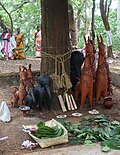
A characteristic feature of a Santal village is a [[sacred grove]] (known as {{lang|sat|[[Jaherthan|Jaher]]}})<ref group="upper-alpha">{{harvnb|Schulte-Droesch|p=187|2018}}</ref><ref group="upper-alpha">{{harvnb|Hembrom|p=41|1996}}</ref> on the edge of the village where many spirits live and where a series of annual festivals take place.<ref name=":1" /> This grove is set aside in the founding of the village and left undisturbed except at times of festival. Inside is set a series of natural (uncut) stones which represent the bongas, but are not substitutes except during festival.<ref group="upper-alpha">{{harvnb|Hembrom|p=42|1996}}</ref> The {{lang|sat|Majhi Than}}, a raised [[tumulus|mound]] of earth covered with a thatched roof outside the headman's house, is where the Majhi's ancestors' spirits live. During the summer, a jug of water is placed there so the spirits can drink. Here the most important decisions of the village are made, including judgements.<ref>{{cite book |last1=Somers |first1=George E. |title=The Dynamics of Santal Traditions in a Peasant Society |date=December 1985 |publisher=Abhinav Publications |isbn=978-0-8364-1516-2 |page=147 |language=en}}</ref><ref>{{cite book |last1=Commons |first1=Great Britain Parliament House of |title=Sessional Papers |date=1904 |publisher=H.M. Stationery Office |page=417 |language=en}}</ref><ref>{{cite book |last1=Man |first1=Edward G. |title=Sonthalia and the Sonthals |date=1989 |publisher=Mittal Publications |page=87 |language=en}}</ref> | |||
[[ | |||
=== | [[File:ᱡᱟᱷᱮᱨ ᱛᱷᱟᱱ.jpg|thumb|[[Jaherthan|Jaher]], the holy place of Santal]] | ||
[[File:JAAHER garh.jpg|left|thumb|258x258px|People performing rituals in Jaher, [[Mayurbhanj district]], Odisha]] | |||
A yearly round of rituals connected with the agricultural cycle, along with life-cycle rituals for birth, marriage and burial at death, involves petitions to the spirits and offerings that include the sacrifice of animals, usually birds.<ref name=":1" /> Religious leaders are male specialists in medical cures who practice divination and witchcraft (the socio-historic meaning of the term, used here, refers to the ritual practice of magic and is not pejorative).<ref name=":1" /> Similar beliefs are common among other [[tribes]] on the [[Chota Nagpur Plateau|Chota Nagpur]] Plateau like the [[Kharia people|Kharia]], [[Munda people|Munda]], and [[Oraon people|Oraon]].<ref name=":1" /> | |||
Smaller and more isolated tribes often demonstrate less articulated classification systems of the spiritual hierarchy described as [[animism]] or a generalised worship of spiritual energies connected with locations, activities, and social groups.<ref name=":1" /> Religious concepts are intricately entwined with ideas about nature and interaction with local ecological systems.<ref name=":1" /> As in Santal religion, religious specialists are drawn from the village or family and serve a wide range of spiritual functions that focus on placating potentially dangerous spirits and co-ordinating rituals.<ref name=":1" /> | |||
== Politics == | |||
=== Schedule Tribe status === | |||
{{See also|Tea-garden community of Assam}} | |||
The Santhal people are constitutionally designated as [[Scheduled Tribes]] only in [[Scheduled Areas|Fifth Schedule areas]], such as Bihar, Jharkhand, West Bengal, Odisha, and Tripura. While the Santals, who migrated from Fifth Schedule areas to [[Scheduled Areas|Sixth Schedule areas]], specifically to Assam as tea garden labourers during the [[British Raj]], are not considered Scheduled Tribes.<ref>{{Cite news |title=ST demand by Santhal union |url=https://www.telegraphindia.com/north-east/st-demand-by-santhal-union/cid/1398802 |access-date=25 August 2022 |work=The Telegraph}}</ref><ref>{{Cite news |date=21 July 2022 |title=Droupadi Murmu's election rekindles hope among Santals in Assam seeking Scheduled Tribe status |url=https://www.deccanherald.com/national/east-and-northeast/droupadi-murmus-election-rekindles-hope-among-santals-in-assam-seeking-scheduled-tribe-status-1128819.html |access-date=25 August 2022 |work=Deccan Herald |language=en}}</ref> Instead, they are classified as [[Other Backward Class]] in Assam, and the remaining population living in other states is considered part of the [[General Caste|general population]].<ref>{{Cite web |title=Central List of OBCs for the State of Assam |url=http://ncbc.nic.in/Writereaddata/cl/assam.pdf |website=ncbc.nic.in}}</ref> The inclusion in Schedule Tribe list have been opposed by respective states and tribal activists organisation following Sixth Scheduled autonomy, such as the Coordination Committee of Tribal Organisations of Assam (CCTOA). The organisation feared up that granting Scheduled Tribe status to the Santal and other 40 migrated tribal communities will squeeze up the benefits of [[natives]], the "original tribal people" of the state.<ref>{{Cite journal |last1=Sarmah |first1=Jayanta Krishna |last2=Hazarika |first2=Joyjit |date=5 June 2015 |title=Politics of Scheduled Tribe Status in Assam |url=https://www.epw.in/journal/2020/14/commentary/politics-scheduled-tribe-status-assam.html |journal=Economic and Political Weekly |language=en |volume=55 |issue=14 |pages=7–8}}</ref><ref>{{cite report| title= The report of the advisory committee on the revision of the list of Scheduled Castes and Scheduled Tribes|url=https://tribal.nic.in/downloads/Statistics/OtherReport/LokurCommitteeReport.pdf |publisher=Department of Social Security, GOI|pages=18–19}}</ref> | |||
=== Religion status === | |||
{{Main|Sarnaism}} | |||
{{See also|Hinduism|Tribal religions in India}} | |||
{{Expand section|date=August 2022}} | |||
The Santhal people believe in [[nature worship]], and their place of worship is in [[sacred grove]]s known as [[Jaherthan|''Jaher'']] and [[Sarna (place)|''Sarna'']], in contrast to Hindu places of worship in [[temple]]s. They also perform [[animal sacrifice]]s to honour their gods and accept flesh, including [[beef]] and [[pork]], practices that are generally prohibited in [[Hinduism]].<ref name=":3">{{cite news|last1=Bisoee |first1=Animesh |title=Brave show of support for arrested Santhal |url=https://www.telegraphindia.com/jharkhand/brave-show-of-support-for-arrested-santhal/cid/1691348 |access-date=31 May 2019 |work=[[The Telegraph (Kolkata)|The Telegraph]] |date=28 May 2019 |language=en}}</ref> Thus they consider themselves believers of [[Sari Dharam|Sari]] and [[Sarna (religion)|Sarna religion]] rather than Hinduism. Although there is overlap of ideology, belief, culture and practices in between Sarnasim and Hinduism.<ref>{{Cite web |title=Sarna Dharam Code: Of Adivasi identity and eco-nationalism |url=https://www.downtoearth.org.in/news/governance/sarna-dharam-code-of-adivasi-identity-and-eco-nationalism-74569 |access-date=25 August 2022 |website=www.downtoearth.org.in |date=9 December 2020 |language=en}}</ref><ref>{{Cite news |last=Lakshman |first=Abhinay |date=22 July 2022 |title=Being Sarna: a fight to define tribal identity in Jharkhand |language=en-IN |work=The Hindu |url=https://www.thehindu.com/news/national/other-states/being-sarna-a-fight-to-define-tribal-identity-in-jharkhand/article65670776.ece |access-date=25 August 2022 |issn=0971-751X}}</ref> | |||
==Notable people== | |||
{{Main|Category:Santali people}} | |||
{{More citations needed section|date=March 2022}} | |||
<!--🛑 Only add if the person is highly notable and has an article in English Wikipedia. Arrange entries alphabetically by LAST NAME--> | |||
=== | ===Administrative officials=== | ||
[[ | *[[G. C. Murmu]], [[Comptroller and Auditor General of India#List of Comptroller and Auditors General of India|14th CAG of India]] and first [[Lieutenant governor]] of [[Jammu and Kashmir (union territory)]]<ref>{{cite news |last1=Das |first1=Anand ST |title='A Tribal Boy Got a Big Opportunity': GC Murmu's Mother Elated over His Appointment as J&K's L-G |url=https://www.news18.com/news/india/a-tribal-boy-got-a-big-opportunity-gc-murmus-mother-elated-on-his-appointment-as-jks-l-g-2370675.html |access-date=19 February 2020 |work=News18 |date=1 November 2019}}</ref> | ||
[[ | |||
[[ | ===Entertainment=== | ||
*[[Rathin Kisku]], [[Baul]] singer.<ref>{{cite news |title=Baul international |url=https://www.telegraphindia.com/west-bengal/baul-international/cid/1006346 |access-date=26 March 2020 |work=The Telegraph |date=18 November 2007 |language=en}}</ref> | |||
===Freedom Fighter=== | |||
*[[Sidhu and Kanhu Murmu]], leader of [[Santhal rebellion]].<ref>{{cite book|last=Sailendra Nath Sen|title=An Advanced History of Modern India|date=2010|publisher=Macmillan|isbn=9780230328853|page=120|url=https://books.google.com/books?id=bXWiACEwPR8C&pg=PA1876 }}</ref> | |||
===Literature=== | |||
[[ | *[[Turia Chand Baskey]], Santali writer | ||
*[[Damayanti Beshra]], Santali writer | |||
*[[Shyam Sundar Besra]], Santali writer | |||
*[[Rupchand Hansda]], writer | |||
*[[Arjun Charan Hembram]], writer | |||
*[[Sarada Prasad Kisku]], writer from Purulia | |||
*[[Joba Murmu]], writer | |||
*[[Raghunath Murmu]], Inventor of [[Ol Chiki script]]. He is also known as ''Olguru''. | |||
*[[Sadhu Ramchand Murmu]], Santali Poet, known as ''Kabiguru''. | |||
*[[Hansda Sowvendra Shekhar]], writer | |||
*[[Kherwal Soren]], writer | |||
== | ===Politician=== | ||
*[[Birbaha Hansda]], Santali-language actress and politician, [[Cabinet Minister|Forest Minister]], [[Government of West Bengal]]<ref>{{cite news |last1=Das |first1=Madhuparna |title=Santhali actress Birbaha Hansda to fight West Bengal polls |url=https://economictimes.indiatimes.com/news/politics-and-nation/santhali-actress-birbaha-hansda-to-fight-west-bengal-polls/articleshow/51654930.cms?from=mdr |access-date=8 January 2020 |work=The Economic Times |date=2 April 2016}}</ref> | |||
*[[Birbaha Hansda]], Santali-language actress and politician<ref>{{cite news |last1=Das |first1=Madhuparna |title=Santhali actress Birbaha Hansda to fight West Bengal polls |url=https://economictimes.indiatimes.com/news/politics-and-nation/santhali-actress-birbaha-hansda-to-fight-west-bengal-polls/articleshow/51654930.cms?from=mdr |access-date=8 January 2020 |work=The Economic Times |date=2 April 2016}}</ref> | *[[Babulal Marandi]], first [[List of chief ministers of Jharkhand|chief minister of Jharkhand]]<ref>{{Cite news|url=https://aajtak.intoday.in/story/babulal-marandi-jharkhand-lok-sabha-elections-2019-bjp-jharkhand-vikas-morcha-pm-narendra-modi-santhal-1-1072441.html|title=जिस BJP को दिलाई थी करिश्माई जीत, बाबूलाल मरांडी का उसी से हुआ मोहभंग|website=aajtak.intoday|date=1 April 2019}}</ref> | ||
*[[ | *[[Droupadi Murmu]], 15th [[president of India]], former [[governor of Jharkhand]], former minister, [[Government of Odisha]].<ref>{{cite news |title=Draupadi Murmu, to be the first president to be born after Independence |url=https://www.thestatesman.com/india/draupadi-murmu-first-president-india-born-independence-1503092340.html |access-date=22 July 2022 |work=The Statesman |date=21 July 2022}}</ref><ref>{{cite news |title=Draupadi Murmu: All you need to know about India's 15th President |url=https://www.timesnownews.com/mirror-now/in-focus/draupadi-murmu-all-you-need-to-know-about-indias-15th-president-article-93037434 |access-date=22 July 2022 |work=TimesNow |date=22 July 2022}}</ref> | ||
*[[Khagen Murmu]] an Indian politician and a [[Member of Parliament]] from [[Maldaha Uttar (Lok Sabha constituency)]], West Bengal.<ref>{{cite news |title=40 Years In CPM And Now A BJP MP, This Man Embodies Left's Demise |url=https://www.huffingtonpost.in/entry/cpm-bjp-mamata-modi-west-bengal_in_5cf525b3e4b0e8085e3d7671 |access-date=20 August 2020 |work=HuffPost India |date=4 June 2019 |language=en}}</ref> | |||
*[[Salkhan Murmu]], Indian socio-political activist, former MP from Mayurbhanj{{Citation needed|date=July 2024}} | |||
*[[ | *[[Hemant Soren]], [[List of chief ministers of Jharkhand|Chief Minister of Jharkhand]]<ref name="Sorenfamily" /> | ||
*[[ | *[[Mohan Charan Majhi]], [[Chief Minister of Odisha]] | ||
*[[ | *[[Shibu Soren]], former chief minister of Jharkhand and founder of [[Jharkhand Mukti Morcha]]. He is also known as ''Disomguru''.<ref name="Sorenfamily">{{Cite web|title=Shibu Soren|url=https://www.britannica.com/biography/Shibu-Soren|access-date=3 February 2020|website=Encyclopædia Britannica}}</ref> | ||
*[[Uma Saren]], Politician, former MP from [[Jhargram (Lok Sabha constituency)|Jhargram]]<ref name="ET">{{cite news |title=32 newly elected under-35 MPs & what they intend to do for their constituencies |url=https://economictimes.indiatimes.com/news/politics-and-nation/32-newly-elected-under-35-mps-what-they-intend-to-do-for-their-constituencies/articleshow/35569860.cms |newspaper=[[The Economic Times]] |access-date=14 March 2019 |date=25 May 2014|last1=Seetharaman |first1=G. |last2=Balasubramanyam |first2=K. R. }}</ref> | *[[Uma Saren]], Politician, former MP from [[Jhargram (Lok Sabha constituency)|Jhargram]]<ref name="ET">{{cite news |title=32 newly elected under-35 MPs & what they intend to do for their constituencies |url=https://economictimes.indiatimes.com/news/politics-and-nation/32-newly-elected-under-35-mps-what-they-intend-to-do-for-their-constituencies/articleshow/35569860.cms |newspaper=[[The Economic Times]] |access-date=14 March 2019 |date=25 May 2014|last1=Seetharaman |first1=G. |last2=Balasubramanyam |first2=K. R. }}</ref> | ||
*[[ | |||
*[[ | ===Science and technology=== | ||
*[[ | *[[Naresh Chandra Murmu]], chief scientist and director of [[Central Mechanical Engineering Research Institute]], [[Durgapur]], West-Bengal, India.{{Citation needed|date=July 2024}} | ||
===Sports=== | |||
*[[Purnima Hembram]], Athlete<ref>{{Cite web|url=http://www.adivasiresurgence.com/purnima-hembram-santhal-tribe-bags-pentathlon-gold-india-asian-indoor-meet/|title=Purnima Hembram of Santhal tribe bags pentathlon gold for India at Asian indoor meet – Adivasi Resurgence|website=www.adivasiresurgence.com|date=20 September 2017|language=en-US|access-date=7 August 2022|archive-date=21 September 2017|archive-url=https://web.archive.org/web/20170921192632/http://www.adivasiresurgence.com/purnima-hembram-santhal-tribe-bags-pentathlon-gold-india-asian-indoor-meet/|url-status=dead}}</ref> | |||
*[[Rafayel Tudu]], football player<ref>{{Cite web|url=https://www.offsidebangladesh.com/%E0%A6%B0%E0%A6%BE%E0%A6%AB%E0%A6%BE%E0%A6%AF%E0%A6%BC%E0%A7%87%E0%A6%B2-%E0%A6%9F%E0%A7%81%E0%A6%A1%E0%A7%81-%E0%A6%97%E0%A7%8B%E0%A6%B2%E0%A6%95%E0%A6%BF%E0%A6%AA%E0%A6%BE%E0%A6%B0-%E0%A6%A5/?fbclid=IwAR28f9btLTSfoMCHk8mjM5MSnzp_HiHnLw_PmF_oMEFrr-j2EAzpx7RdKbY_aem_AZq2i7F2D6Fn_bF6G-vezc1M-2P3_S9t7WyDaL156I8G-Cuvg5U4UHlUyJKZGSL-rIzBKTnlnKHZxlZXMbnt3ny1|script-title=bn:রাফায়েল টুডু : গোলকিপার থেকে বিসিএলের শীর্ষ গোলদাতা!|trans-title=Rafael Tudu: BCL top scorer from goalkeeper!|language=bn|date=11 April 2024|access-date=12 April 2024|website=OffsideBangladesh|archive-date=12 April 2024|archive-url=https://web.archive.org/web/20240412111207/https://www.offsidebangladesh.com/%E0%A6%B0%E0%A6%BE%E0%A6%AB%E0%A6%BE%E0%A6%AF%E0%A6%BC%E0%A7%87%E0%A6%B2-%E0%A6%9F%E0%A7%81%E0%A6%A1%E0%A7%81-%E0%A6%97%E0%A7%8B%E0%A6%B2%E0%A6%95%E0%A6%BF%E0%A6%AA%E0%A6%BE%E0%A6%B0-%E0%A6%A5/|url-status=live}}</ref> | |||
*[[Shanti Mardi]], football player<ref>{{cite news |title=গ্রামের মেয়ে থেকে জাতীয় তারকা শান্তি মার্ডি |url=https://dhakamail.com/country/242050 |work=Dhaka Mail |language=bn |date=19 July 2025 |access-date=19 January 2026}}</ref> | |||
== References == | == References == | ||
{{ | ===Footnotes=== | ||
{{reflist|group=lower-alpha}} | |||
=== Citations === | |||
{{reflist|2|group=upper-alpha}} | |||
=== Sources === | |||
{{Reflist}} | {{Reflist}} | ||
=== Bibliography === | === Bibliography === | ||
{{refbegin}} | {{refbegin}} | ||
* {{Cite book|last=Schulte-Droesch|first=Lea | * {{Cite book|last=Schulte-Droesch|first=Lea |title=Making place through ritual : land, environment and region among the Santal of Central India|year=2018|isbn=978-3-11-053973-8|oclc=1054397811}} | ||
* {{Cite book|last=Somers|first=George E.|title=The dynamics of Santal traditions in a peasant society|date=1979|publisher=Schenkman Pub. Co|oclc=5668202}} | * {{Cite book|last=Somers|first=George E.|title=The dynamics of Santal traditions in a peasant society|date=1979|publisher=Schenkman Pub. Co|oclc=5668202}} | ||
* {{Cite book|last=Sen|first=Suchibrata | * {{Cite book|last=Sen|first=Suchibrata|title=The Santals, crises of identity and integration|date=1997|publisher=Ratna Prakashan|isbn=81-85709-51-3|oclc=40418077}} | ||
* {{Cite book|last=Hembrom|first=Timotheas | * {{Cite book|last=Hembrom|first=Timotheas|title=The Santals : anthropological-theological reflections on Santali & biblical creation traditions|date=1996|publisher=Punthi Pustak|isbn=81-86791-00-0|edition=1|location=Calcutta|oclc=35742627}} | ||
{{refend}} | {{refend}} | ||
== | == Further reading == | ||
{{refbegin}} | |||
* [[Paul Olaf Bodding|Bodding, P. O]]. Santal Folk Tales. Cambridge, Massachusetts: H. Aschehoug; Harvard University Press, 1925. | * [[Paul Olaf Bodding|Bodding, P. O]]. Santal Folk Tales (3 volumes). Cambridge, Massachusetts: H. Aschehoug; Harvard University Press, 1925. | ||
* [[Paul Olaf Bodding|Bodding, P. O]]. Santal Riddles and Witchcraft among the Santals. Oslo: A. W. Brøggers, 1940. | * [[Paul Olaf Bodding|Bodding, P. O]]. Santal Riddles and Witchcraft among the Santals. Oslo: A. W. Brøggers, 1940. | ||
* [[Paul Olaf Bodding|Bodding, P. O]]. A Santal Dictionary (5 volumes), 1933–36 Oslo: | * [[Paul Olaf Bodding|Bodding, P. O]]. A Santal Dictionary (5 volumes), 1933–36 Oslo: J. Dybwad, 1929. | ||
* [[Paul Olaf Bodding|Bodding, P. O]]. Materials for a Santali Grammar I, Dumka 1922 | * [[Paul Olaf Bodding|Bodding, P. O]]. Materials for a Santali Grammar I, Dumka 1922. | ||
* [[Paul Olaf Bodding|Bodding, P. O]]. Studies in Santal Medicine and Connected Folklore (3 volumes), 1925–40 | * [[Paul Olaf Bodding|Bodding, P. O]]. Studies in Santal Medicine and Connected Folklore (3 volumes), 1925–40 | ||
* Bompas, Cecil Henry, and [[Paul Olaf Bodding|Bodding, P. O]]. Folklore of the Santal Parganas. London: D. Nutt, 1909. [https://www.gutenberg.org/ebooks/11938 Full text at Project Gutenberg]. | * Bompas, Cecil Henry, and [[Paul Olaf Bodding|Bodding, P. O]]. Folklore of the Santal Parganas. London: D. Nutt, 1909. [https://www.gutenberg.org/ebooks/11938 Full text at Project Gutenberg]. | ||
* Chakrabarti, Dr. Byomkes, A Comparative Study of Santali and Bengali, KP Bagchi, Calcutta, 1994 | * Chakrabarti, Dr. Byomkes, A Comparative Study of Santali and Bengali, KP Bagchi, Calcutta, 1994 | ||
* Culshaw, W. J. Tribal Heritage; a Study of the Santals. London: Lutterworth Press, 1949. | * Culshaw, W. J. Tribal Heritage; a Study of the Santals. London: Lutterworth Press, 1949. | ||
* | * {{cite book |title=The Santals |last=Mukherjea |first=Charulal |location=Calcutta |publisher=A. Mukherjee & Co. Pr. Ltd. |date=1939}} | ||
* Orans, Martin. "The Santal; a Tribe in Search of a Great Tradition." Based on thesis, University of Chicago., Wayne State University Press, 1965. | * Orans, Martin. "The Santal; a Tribe in Search of a Great Tradition." Based on thesis, University of Chicago., Wayne State University Press, 1965. | ||
* Prasad, Onkar. Santal Music: A Study in Pattern and Process of Cultural Persistence, Tribal Studies of India Series; T 115. New Delhi: Inter-India Publications, 1985. | * Prasad, Onkar. Santal Music: A Study in Pattern and Process of Cultural Persistence, Tribal Studies of India Series; T 115. New Delhi: Inter-India Publications, 1985. | ||
* Roy Chaudhury, Indu. Folk Tales of the Santals. 1st ed. Folk Tales of India Series, 13. New Delhi: Sterling Publishers, 1973. | * Roy Chaudhury, Indu. ''Folk Tales of the Santals''. 1st ed. Folk Tales of India Series, 13. New Delhi: Sterling Publishers, 1973. | ||
* Troisi, J. The Santals: A Classified and Annotated Bibliography. New Delhi: Manohar Book Service, 1976. | * Troisi, J. The Santals: A Classified and Annotated Bibliography. New Delhi: Manohar Book Service, 1976. | ||
* ———. Tribal Religion: Religious Beliefs and Practices among the Santals. New Delhi: Manohar, 2000. | * ———. Tribal Religion: Religious Beliefs and Practices among the Santals. New Delhi: Manohar, 2000. | ||
{{refend}} | |||
== External links == | == External links == | ||
{{Commons category|Santal}} | {{Commons category|Santal people}} | ||
{{NIE Poster|Santals}} | {{NIE Poster|Santals}} | ||
* {{cite web | title=Locating and digitising early Santali periodicals published between 1890 and 1975 in Eastern India | date=2021 |url=https://eap.bl.uk/project/EAP1300 | doi=10.15130/EAP1300 | last1=Soren | first1=Rahi }} | |||
* [http://www.saontalvoice.org/about_saontal_community.html Saontal Voice in Bangladesh] | * [http://www.saontalvoice.org/about_saontal_community.html Saontal Voice in Bangladesh] | ||
* [http://livelystories.com/2013/06/14/santhal-rebellion-part-i-the-begining/ Santal Rebellion] | * [http://livelystories.com/2013/06/14/santhal-rebellion-part-i-the-begining/ Santal Rebellion] | ||
| Line 168: | Line 269: | ||
[[Category:Santhal| ]] | [[Category:Santhal| ]] | ||
[[Category:Ethnic groups in Bangladesh]] | [[Category:Ethnic groups in Bangladesh]] | ||
[[Category:Indigenous peoples of South Asia]] | [[Category:Indigenous peoples of South Asia]] | ||
[[Category:Adivasi]] | [[Category:Adivasi]] | ||
[[Category:Ethnic groups in Nepal]] | |||
[[Category:Social groups of Bihar]] | [[Category:Social groups of Bihar]] | ||
[[Category:Social groups of Jharkhand]] | [[Category:Social groups of Jharkhand]] | ||
Revision as of 06:07, 12 March 2026
Hoṛku | |
|---|---|
 Santals in traditional dress celebrating Baha parab | |
| Total population | |
| c. 7.5 million (2011) | |
| Regions with significant populations | |
 India • India •  Bangladesh • Bangladesh •  Nepal Nepal | |
| India: Jharkhand | 2,754,723[1] |
| West Bengal | 2,512,331[1] |
| Odisha | 894,764[1] |
| Bihar | 406,076[1] |
| Assam | 213,139[2] |
| Tripura | 2,913[3] |
| Bangladesh | 129,049 (2021)[4] |
| Nepal | 51,735[5] |
| Languages | |
| Santali | |
| Religion | |
Majority Hinduism[6] Hinduism[6]Minority Folk religions (Sari Dharam, Sarna Dharam)  Islam Islam Christianity, Christianity, .svg) Buddhism, Others[6] Buddhism, Others[6] | |
| Related ethnic groups | |
| Mundas • Hos • Juangs • Kharias • Savaras • Korkus • Bhumijs | |
| ᱥᱟᱱᱛᱟᱲ Santal | |
|---|---|
| Person | Santal |
| People | ᱥᱟᱱᱛᱟᱲ ᱦᱚᱲ |
| Language | Santali |
| Country | India, Bangladesh and Nepal |
The Santal (or Santhal) are an Austroasiatic-speaking Munda ethnic group of the Indian subcontinent.[7] They constitute the largest tribal community in the Indian states of Jharkhand and West Bengal, and are also present in Odisha, Bihar, Assam, and Tripura. They are the largest ethnic minority in northern Bangladesh's Rajshahi Division and Rangpur Division. They have a sizeable population in Nepal. The Santals speak Santali, the most widely spoken language of the Munda subfamily of Austroasiatic languages.
Etymology
Santal is most likely derived from an exonym. The term refers to inhabitants of Saont in erstwhile Silda in Medinapore region in West Bengal.[upper-alpha 1][8] The Sanskrit word Samant or Bengali Saont means plain land.[9] Their ethnonym is Hor Hopon ("child of human").[upper-alpha 2]
History
Origins
According to linguist Paul Sidwell, Austro-Asiatic language speakers probably arrived on the coast of Odisha from Indochina about 4,000–3,500 years ago (c. 2000 – c. 1500 BCE).[10][11] The Austroasiatic speakers spread from Southeast Asia and mixed extensively with local Indian populations.
Due to the lack of significant archaeological records, the original homeland of the Santhals is not known with certainty. The folklore of the Santhals claims they came from Hihiri, which scholars have identified as Ahuri in Hazaribagh district.[12] From there, they claim, they were pushed onto Chhota Nagpur Plateau, then to Jhalda, Patkum and finally Saont, where they settled for good.[upper-alpha 3] According to Dalton, where they were renamed to Santal from cluster name Kharwar.[13][12] This legend, which has been cited by several scholars, has been used as evidence that the Santals once had a significant presence in Hazaribagh. Colonial scholar Colonel Dalton claimed in Chai there was a fort formerly occupied by a Santal raja who was forced to flee when the Delhi Sultanate invaded the territory.[upper-alpha 4]
British Era

In the latter half of the 18th century, the Santals entered the historical record in 1795 when they are recorded as "Soontars".[14] During the Bengal Famine of 1770, the drier western and southwestern parts of Bengal, especially the Jungle Mahals region, were some of the worst-hit areas and were significantly depopulated. This depopulation resulted in a significant loss of revenue for the East India Company. Therefore, when the Permanent Settlement was enacted in 1790, the Company looked for agriculturalists to clear the lands.[upper-alpha 5] British officials turned their attention to Santals, who were ready to clear the forest for the practice of settled agriculture. In 1832, a large number of area of the Raj Mahal hills demarcated as Damin-i-koh. Santal from Cuttack, Dhalbhum, Birbhum, Manbhum, Hazaribagh migrated and started cultivating these lands as peasants [15][upper-alpha 5] sponsored by landowners and the British who were desperate for labour.[15][16][17][upper-alpha 6] Under British direction, Santals took loans from non-Santal moneylenders to buy iron tools, seed grain and oxen as individuals and families, rather than groups as was their custom for working the land.[upper-alpha 7]
When they arrived in Damin-i-koh (present day Santal Pargana), the British provided no protection for the Santals against the preexisting Mal Paharias, who were against destruction of forest, were known raiders of the plains areas and had only recently been partially "pacified". Eventually, the Santals, with their better technology and ability to match the Paharia's guerrilla attacks, managed to drive them out. They clear the forest tracts and started cultivation in these areas. Their settlement took place between the 1830s and 1850s: in 1830, the area was home to only 3,000 Santals, but by the 1850s, 83,000 Santals had settled in the land and had turned it into paddy fields. This resulted in a 22 times increase in Company revenue from the area.[upper-alpha 8]
However, as they became more agricultural, the Santals were exploited by the zamindars. Unlike the Santals, the British valued individual competition instead of cooperation, and had a rigid system of laws very different from the relatively relaxed norms of the village council, the highest form of government most Santals knew. Mahajans from Bengal and Baniyas from Bihar began selling goods from elsewhere, and many Santals, seeing them as exotic, were tricked into debt to buy them, usually with a mortgage on their land. When the Santals were unable to pay the moneylenders back, they became owners of the land and the Santals became dispossessed landless peasants. The Baniya merchants and other outsiders also began to treat Santals as outcastes in a Brahminical system.[upper-alpha 9][upper-alpha 10]
Eventually, these acts of exploitation, combined with British tax policies and corrupt tax collectors, deteriorated to the point where Santals grew discontented. In 1855, they revolted in the Santal rebellion, better known as the Santal Hul. 30,000 Santals, led by Sidhu and Kanhu Murmu, attacked the zamindars and other outsiders (dikkus) who had made their lives so miserable, as well as the British authorities. Eventually, around 10,000 British troops managed to suppress the rebellion. Although the rebellion's impact was largely overshadowed by that of the Indian Rebellion of 1857, the impact of the Santhal Rebellion lives on as a turning point in Santhal pride and identity. This was reaffirmed, over a century and a half later with the creation of the tribal province in the Republic of India, Jharkhand.[15][16][17] Following the rebellion, the British satisfied all Santhal demands, due to their importance as a tax-paying group. The British created a 5000 km2 area, called Santal Parganas, where the normal procedures of British India did not apply. Administration of the community was primarily made the responsibility of the village headman, or pradhan, who was also given the power to collect taxes. It was made illegal for Santals to transfer land to non-Santals, allowing them to have legal rights over their land.[18]
After the British Crown formally took control over India in 1858, the Santals continued their system of government and traditions. Newly established Christian missions brought education, and many Santals moved to the tea plantations in Assam, North Bengal, where they still remain today. However, most continued with their old life, but were still not prosperous. In addition, secular education did not become widespread until after Indian independence.[upper-alpha 11]
In the late 19th century, many Santals migrated from the Santal Parganas to the districts of Bihar and North Bengal such as Purnia, Malda and Dinajpur. The Santals still faced retaliation after the Santal Hul and were invited by zamindars to cultivate many parts of north Bengal, which had become scrubland, land which the Santals specialised in farming.[19] By the 1930s, their numbers in this region the Santals had become two lakh. Most were settled on wasteland where the rent was cheaper than the more fertile wet lands. However they faced heavy taxation from the zamindars, and were oppressed by moneylenders, upper castes, and the bureaucracy in general. In 1924, several Santal sardars, influenced by Gandhian ideology and led by Jitu Sardar, began to lead agitations against the oppressive double system of elite Bengalis and British government. Santals stopped paying rent to the zamindars, beat up revenue inspectors, and led agitations against the moneylenders. In 1928, the Santals stopped paying the chaukidari tax and led protests in Thakurgaon in 1929. In 1932, several Santals attempted to organise their own state with Jitu Sardar as head, initially based on Gandhi's Ram Rajya but quickly criticised Gandhi when he did not help them. In 1933, a British commissioner was appointed to look into the grievances of Santals of North Bengal.[citation needed]
Post-independence
The Santal community, like the others of the region, was split between West Bengal in India and East Bengal in Pakistan during Partition. After independence, the Santals were made one of the Scheduled Tribes in India. In East Pakistan, there were some regions in the west where Santals were still in significant numbers. There and in neighbouring West Bengal, the Santals provided significant support to the Tebhaga movement. After the Pakistani military crushed the uprising and burned many Santal homes, many fled across the border to Malda in India.[20]
In northern West Bengal, tribal peasants participated in Naxalbari uprising led by a Santal communist leader Jangal Santhal. The impoverishment has led to the Guevarist inspired Naxalite insurgency in what is often termed as the Red Corridor.[21]
After Jharkhand was carved out of Bihar in 2000, the Santal Parganas was made a separate division of the state.[18] These Santals have also agitated for recognition of their traditions in the census as a separate religion, sarna dharam, for which Jharkhand assembly passed a resolution in 2020. Many still face poverty and exploitation, and in Bangladesh, theft of their lands is common. Although spread out over a large area, they now consider the Santal Parganas as their cultural heartland.[upper-alpha 12]
Society
The base of Santal society is a division between "sibling" (boeha) and "guest" (pera), a divide found in many other tribal societies of central and eastern India. Children of the same father (sometimes grandfather), known as nije boeha, often live next to each other and own adjacent pieces of land. Those in the closest form of brotherhood, called mit orak hor ("people of one house") in Singhbhum, cannot marry each other and propitiate the same deity, since the house refers to a common ancestor from which all the families are believed to descend. Only mit orak hor marriages are severely stigmatised. Another brotherhood is membership of a clan, which are exogamous.[upper-alpha 13] The last form of brotherhood is phul, a ritual friendship with members of other ethnic groups. Children of phul brothers consider themselves as brothers, and they attend each other's main lifecycle events, such as weddings or funerals, as pera. They also give help in times of hardship.[upper-alpha 14]
Those who do not have brotherhood are referred to as pera, or guests. Members of other communities, especially those not speaking Santali, are excluded from this grouping, except for communities such as the Karmakar, Mahali or Lohar of their locality, who are enmeshed in Santal society. Those with this relationship can marry, and attend major festivals as guests. People related by marriage, although pera, have special roles in life-cycle events. Women perform special welcome rituals for pera when they visit. Those related by marriage can have one of two relationships. They can be bala, a relationship exemplified by the couple's parents, or sangat, between cross-siblings of a couple.[upper-alpha 15]

Santal society has much less stratification and is more egalitarian than adjacent caste Hindu society, but still has some status differences. The most important marker of a person when interacting with others in Santal society is their standing as marang ("senior") or hudin ("junior"). This standing is evaluated by relation: for example, if someone is greeting their father's elder brother's son, they would be the junior irrespective of age. Similarly, when someone greets their elder brother's wife, the wife would be marang. However, for strangers or guests with no clear kin connections, the question of marang or hudin is decided by age.[upper-alpha 16] The ritual greeting (god in Santali) of someone is given much importance and is done in the courtyard of a house when a pera visits. The greeting differs by gender, and whether the person is junior or senior to the one being greeted. The greeting rituals given by a hudin involve an "offering" (dobok' johar) of respect, while a marang "receives" this respect.[upper-alpha 17] This greeting should not be done hastily, and correct practice of it is encouraged in children from a young age.[upper-alpha 18] However the hudin-marang distinction does not apply to phul or bala, who instead greet each other as if greeting a marang.[upper-alpha 19]
The Santals also have totemistic clans, known as pari.[upper-alpha 20] These 12 clans are divided into two ranks: 7 senior and 5 junior. The senior clans are believed to originate from the 7 sons and daughters of the first man and woman, and in order of seniority they are: Hansda (goose), Murmu (Nilgai), Marandi (Ischaemum rugosum), Kisku (kingfisher), Soren (Pleiades), Hembram (betel palm) and Tudu (owl).[upper-alpha 21] The junior clans are Baskey or Baske (stale rice), Besra (falcon), Chorey or Chonre (lizard), Pauria or Pawria (pigeon) and Bediya. Members of a senior clan do not marry members of a junior clan, and there are some forbidden marriages as well, such as between Marandi and Kisku. In addition, Besras are sometimes treated differently due to their perceived low status, but other than the context of marriage, they play no role in social life. The clans also avoid harming their clan totem, lest evil befall them.[upper-alpha 22]
The Santals have another social organisation important for rituals, called khunti, or gusti in south Chota Nagpur.[lower-alpha 1] The term refers to descendants of a common ancestor, no more than a few generations back, that live nearby. The khunti is identified by some distinguishing feature of the ancestor, such as poeta, people who wear a thread on their chest in worship. In many cases, all the people of a gusti live in their ancestral village, but some members may have migrated to neighbouring villages.[upper-alpha 23]
Culture
Festivals
Sohrai is the principal festival of Santal community. Besides that Baha, Karam, Dashain, Sakrat, Mahmore, Rundo and Magsim are important festivals. They traditionally accompany many of their dances during these festivals with two drums: the Tamak‘ and the Tumdak’.


Chadar Badar, a form of puppetry known also as Santal puppetry, is a folk show involving wooden puppets placed in a small cage which acts as the stage.[22]
Local affairs are handled by a village council, led by a manjhi.[23]
The walls of traditional Santal homes are ornamented with carved designs of animals, hunting scenes, dancing scenes, and geometric patterns. Santal bridal palanquins are also finely carved.[23]

Marriage
There are seven kinds of marriage recognised in the Santal community, each with its own degree of social acceptance. The most elaborate kind of marriage is the hapramko bapla, or ancestor's marriage, but the most widely practised is kesimek'. In this form of marriage, a boy and girl who wish to marry decide to go to the groom's house and stay there a while. When the girl's family are made aware of their situation, the jog majhi of the girl's village arrives at the house of the headman of the boy's village to discover the couple's intentions. The couple are summoned to the village headman and the bride is asked whether she wishes to set a date for kesimek'. If she replies 'no', the boy's family will have to pay a small fine to the jog majhi of the girl's village, who would take the girl back to her father. If she assents, the boy's family is consulted for the best day for the kesimek'.[upper-alpha 24] The bride and groom are not bound by any obligation to marry.[upper-alpha 25] During this time, the jog majhi stays in the village to give all the information he can to the bride's father: both in determining what would be a good bride price to demand and whether the marriage might end in a short time.[upper-alpha 25]
On the day of the kesimek' ceremony, a group of men from the bride's village, including the jog majhi, headman, village elders, and the bride's father and some relations, arrives at the bride's village. They are seated at the headman's house with respect and organised by marang or hudin status. Meanwhile, the groom's family gathers to discuss the bride price the groom's father should pay. The two parties then meet and the fathers negotiate the bride price to be paid. The groom is first asked whether he wishes the marriage to continue. As a symbolic marriage contract, the groom's father gives a small amount of cash and gives handi (rice-beer) to the guests. The negotiations for bride-price continue between the fathers exclusively until an amount is reached. Although this is nowadays in cash, livestock or other goods are not uncommon. The bride price is generally light and it is seen wrong to stop two young people from marrying because of a disagreement about bride price.[upper-alpha 26] After an agreement is reached, celebrations ensue and festive drinking continues into the night.[upper-alpha 27]
A short time afterwards, a relative of the groom along with the jog majhi of the groom's village hand over the bride price to the bride's family.[upper-alpha 27] Afterwards the couple arrive in the bride's natal village. The bride arriving first carrying a pot with white clay, the symbol of a woman returning to her natal village as a guest. The bride greets her mother first and neighbours are invited to share handi reserved for pera (pera hor handi), while getting acquainted with the husband.[upper-alpha 27] When the couple leaves the bride's village, the bride pays her respects to the headman in his courtyard. At the Majhi Than, the bride thanks the headman for all he has done and gives a symbolic gift. The headman then blesses the couple and wishes the bride strength, good luck and many strong sons. The couple then leaves for the groom's village to start their new life.[upper-alpha 28]
Marriages done by kesimek' involve very little ritual: Santal society has clearly defined roles for marriage, and the choice of the couple is respected. Decisions by the families are done in a spirit of consensus rather than adversarially, and marriage is seen just as important for the entire village as for the couple.[upper-alpha 25]

Religion
- Hinduism (63.1%)
- Sarnaism (23.0%)
- Sari Dharam (7.28%)
- Christianity (5.45%)
- Other (1.12%)
The Santal are granted Scheduled Tribe status in five states: Bihar, West Bengal, Jharkhand, Odisha, and Tripura, where they account for a total population of 6,570,807 according to the 2011 Census of India. Of this population, 63.15% are reported as Hindu, 23% as Sarna, 7.28% as Sari Dharam (all in West Bengal), and 5.46% as Christian.[24][25] Other minor religious affiliations include Bidin (27,602), Muslim (13,014), Santal (4,771), Sumra Sandhi (2,059), Sarvdharm (1,625), Buddhist (1,121), Adi Bassi (1,100), Sikh (987), Kharwar (385), Sant (356), Saran (352), Jain (348), Achinthar (273), Sarin (185), Marangboro (167), Saranath (157), Seran (125), Adi (84), and Alchichi (78). Additionally, 102 were Atheist, 331 were believers of Tribal religion, 1,123 followed other unclassified religions, and 16,974 did not state any religious affiliation.[24][25]
According to the doctrine of Sari Dharam (a religion based on truths), the Santals are broadly divided into three categories: Um-hor, followers of Christianity; Saka-hor, followers of Hinduism; and Bonga-hor, followers of Sari Dharam. While Sari Dharam is predominantly observed in West Bengal, Santals in other states commonly identify their religious practices under the framework of Sarna Dharam, an umbrella term for tribal religions.[26] Historically, the Santals practised their autonomous religious beliefs without assigning specific nomenclature to their faith. From the beginning of census operations in India, they mobilised into various religious-political movements, identifying under names such as Santal, Adibasi, Jaher, Sohrai, Sari, and Sarna, to distinguish themselves from the prevalent religions of India, such as Hinduism and Christianity. Although, those beliefs denomination were administratively clubbed together as Animism in the colonial census.[27] Post-independence, the census publishes macro-level de facto data, specifically for the scheduled communities; thus, there has been a tendency toward revivalism and unification of diverse religious identities among them, with many Santals aligning under the banners of Sarna Dharma, except for the Santals of West Bengal. They regarded it as having more political motives than religious ones and adhered to their own developed religion, named Sari Dharma, based on their ancestral ethics, values, and beliefs. In fact, in the 1961 census, except for Hinduism, most Santals identified their religion by their own ethnic identity, Santhal, while others identified with various beliefs, including Sari and Sarna Dharma. Later, in the 1971 census, the Santhal religion was replaced by Sarna Dharma, a religious identity that only a few Santals had identified with in previous censuses, and the shift was primarily attributed to the Jharkhand statehood movement. However, while all those terms differ in nomenclature from a religio-political perspective, in practice, they reflect a synthesis of ancestral autonomous beliefs and elements of dominant religions like Hinduism and Christianity.[26][28]
In the religious beliefs of Santals, the core of reverence falls on a court of spirits (bonga), who handle different aspects of the world and who are placated with prayers and offerings.[29] These benevolent spirits operate at the village, household, ancestor, and sub-clan level, along with evil spirits that cause disease and can inhabit village boundaries, mountains, water, tigers, and the forest.[29] The bonga are intermediaries between noa puri (visible world) and hana puri (the invisible reality), the abode of a Creator.[citation needed] This creator is variously called Marang Buru (Supreme Deity or literally The Great Mountain) or Thakur Jiu (life giver), and is the "cause of all causes," making the Santal religion, in a deep sense, monotheistic as well as pantheistic.[30][upper-alpha 29]
There are several ranks of bongas: the most important are associated intimately with Marang Buru and are worshipped by all Santals. These include Marang Buru bonga, Jaher Era bonga and Gosae Era. Other bongas, who are held to be less powerful, are the spirits of important people of the village who have since been deified. There is also another class of bongas who are feared as bringers of evil. These spirits are not placated by a priest but by a medicine-man called ojha. In the present-day, belief in these malignant bongas is eroding due to the penetration of modern medical science. The lack of a separate name for malignant bongas caused many early colonial scholars to present Santal religion as wholly focused on the appeasement of evil spirits or as representing bongas as exclusively harmful.[upper-alpha 30] However bonga in itself simply means a supernatural force in the world and has no specific connotation with good or evil. Moreover, these bongas do not refer to specific objects but to the invisible force that governs or is associated with those objects.[31]
The Santal creation story holds that originally the world was water, and Marang Buru and some lesser deities were the only inhabitants. When some spirits requested permission to make humans, Marang Buru asked Malan Budhi to create the human bodies. When she had finally succeeded, she was told by Marang Buru to use the human spirits that were high on the rafters of his hut. She could not reach the human spirit, and took the bird spirit instead. When Marang Buru integrated the spirits with the bodies, they flew away and asked for a place to build a nest. Marang Buru could not get anyone else to bring land to the surface, and so the tortoise volunteered and pushed the Earth onto his back. The birds then gave birth to a boy and a girl called Pilchu Haram and Pilchu Budhi. These two had seven sons and seven daughters, but the couple soon had a quarrel and separated. Pilchu Haram and his sons became great hunters, and on a time came upon the daughters, who had become maidens and were unrecognisable. They became introduced and made love. Looking for his sons, Pilchu Haram discovered an old woman and asked for fire, and upon talking to her more, he discovered his wife and reconciled with her. Another version tells how Pilchu Budhi was in fact in tears at her daughters' disappearance, but Marang Buru reassured her that they were all safe and brought her to reconcile with her husband. When their sons found out they had married their sisters, they were very angry and would have killed their parents if Marang Buru had not hidden them in a cave, where they stayed for the rest of their days. The children of these seven couples became the progenitors of the Santal clans.[32]
A characteristic feature of a Santal village is a sacred grove (known as Jaher)[upper-alpha 31][upper-alpha 32] on the edge of the village where many spirits live and where a series of annual festivals take place.[29] This grove is set aside in the founding of the village and left undisturbed except at times of festival. Inside is set a series of natural (uncut) stones which represent the bongas, but are not substitutes except during festival.[upper-alpha 33] The Majhi Than, a raised mound of earth covered with a thatched roof outside the headman's house, is where the Majhi's ancestors' spirits live. During the summer, a jug of water is placed there so the spirits can drink. Here the most important decisions of the village are made, including judgements.[33][34][35]


A yearly round of rituals connected with the agricultural cycle, along with life-cycle rituals for birth, marriage and burial at death, involves petitions to the spirits and offerings that include the sacrifice of animals, usually birds.[29] Religious leaders are male specialists in medical cures who practice divination and witchcraft (the socio-historic meaning of the term, used here, refers to the ritual practice of magic and is not pejorative).[29] Similar beliefs are common among other tribes on the Chota Nagpur Plateau like the Kharia, Munda, and Oraon.[29]
Smaller and more isolated tribes often demonstrate less articulated classification systems of the spiritual hierarchy described as animism or a generalised worship of spiritual energies connected with locations, activities, and social groups.[29] Religious concepts are intricately entwined with ideas about nature and interaction with local ecological systems.[29] As in Santal religion, religious specialists are drawn from the village or family and serve a wide range of spiritual functions that focus on placating potentially dangerous spirits and co-ordinating rituals.[29]
Politics
Schedule Tribe status
The Santhal people are constitutionally designated as Scheduled Tribes only in Fifth Schedule areas, such as Bihar, Jharkhand, West Bengal, Odisha, and Tripura. While the Santals, who migrated from Fifth Schedule areas to Sixth Schedule areas, specifically to Assam as tea garden labourers during the British Raj, are not considered Scheduled Tribes.[36][37] Instead, they are classified as Other Backward Class in Assam, and the remaining population living in other states is considered part of the general population.[38] The inclusion in Schedule Tribe list have been opposed by respective states and tribal activists organisation following Sixth Scheduled autonomy, such as the Coordination Committee of Tribal Organisations of Assam (CCTOA). The organisation feared up that granting Scheduled Tribe status to the Santal and other 40 migrated tribal communities will squeeze up the benefits of natives, the "original tribal people" of the state.[39][40]
Religion status
![[icon]](/wiki/File:Wiki_letter_w_cropped.svg) | This section needs expansion. You can help by adding to it. (August 2022) |
The Santhal people believe in nature worship, and their place of worship is in sacred groves known as Jaher and Sarna, in contrast to Hindu places of worship in temples. They also perform animal sacrifices to honour their gods and accept flesh, including beef and pork, practices that are generally prohibited in Hinduism.[41] Thus they consider themselves believers of Sari and Sarna religion rather than Hinduism. Although there is overlap of ideology, belief, culture and practices in between Sarnasim and Hinduism.[42][43]
Notable people
 | This section needs more citations. (March 2022) |
Administrative officials
- G. C. Murmu, 14th CAG of India and first Lieutenant governor of Jammu and Kashmir (union territory)[44]
Entertainment
- Rathin Kisku, Baul singer.[45]
Freedom Fighter
- Sidhu and Kanhu Murmu, leader of Santhal rebellion.[46]
Literature
- Turia Chand Baskey, Santali writer
- Damayanti Beshra, Santali writer
- Shyam Sundar Besra, Santali writer
- Rupchand Hansda, writer
- Arjun Charan Hembram, writer
- Sarada Prasad Kisku, writer from Purulia
- Joba Murmu, writer
- Raghunath Murmu, Inventor of Ol Chiki script. He is also known as Olguru.
- Sadhu Ramchand Murmu, Santali Poet, known as Kabiguru.
- Hansda Sowvendra Shekhar, writer
- Kherwal Soren, writer
Politician
- Birbaha Hansda, Santali-language actress and politician, Forest Minister, Government of West Bengal[47]
- Babulal Marandi, first chief minister of Jharkhand[48]
- Droupadi Murmu, 15th president of India, former governor of Jharkhand, former minister, Government of Odisha.[49][50]
- Khagen Murmu an Indian politician and a Member of Parliament from Maldaha Uttar (Lok Sabha constituency), West Bengal.[51]
- Salkhan Murmu, Indian socio-political activist, former MP from Mayurbhanj[citation needed]
- Hemant Soren, Chief Minister of Jharkhand[52]
- Mohan Charan Majhi, Chief Minister of Odisha
- Shibu Soren, former chief minister of Jharkhand and founder of Jharkhand Mukti Morcha. He is also known as Disomguru.[52]
- Uma Saren, Politician, former MP from Jhargram[53]
Science and technology
- Naresh Chandra Murmu, chief scientist and director of Central Mechanical Engineering Research Institute, Durgapur, West-Bengal, India.[citation needed]
Sports
- Purnima Hembram, Athlete[54]
- Rafayel Tudu, football player[55]
- Shanti Mardi, football player[56]
References
Footnotes
Citations
- ↑ Schulte-Droesch 2018, p. 3
- ↑ Somers 1979, p. 5
- ↑ Sen 1997, p. 14
- ↑ Sen 1997, p. 15
- ↑ 5.0 5.1 Sen 1997, p. 19
- ↑ Sen 1997, p. 20
- ↑ Somers 1979, p. 43
- ↑ Somers 1979, p. 31
- ↑ Somers 1979, p. 46
- ↑ Sen 1997, p. 21
- ↑ Somers 1979, p. 53
- ↑ Schulte-Droesch 2018, pp. 6–7
- ↑ Schulte-Droesch 2018, p. 99
- ↑ Schulte-Droesch 2018, pp. 99–100
- ↑ Schulte-Droesch 2018, p. 100
- ↑ Schulte-Droesch 2018, p. 102
- ↑ Somers 1979, p. 59
- ↑ Schulte-Droesch 2018, p. 103
- ↑ Schulte-Droesch 2018, p. 104
- ↑ Somers 1979, p. 58
- ↑ Schulte-Droesch 2018, p. 109
- ↑ Schulte-Droesch 2018, pp. 110–111
- ↑ Schulte-Droesch 2018, p. 117
- ↑ Somers 1979, p. 23
- ↑ 25.0 25.1 25.2 Somers 1979, p. 29
- ↑ Somers 1979, p. 28
- ↑ 27.0 27.1 27.2 Somers 1979, p. 25
- ↑ Somers 1979, p. 26
- ↑ Hembrom 1996, p. 36
- ↑ Hembrom 1996, p. 38
- ↑ Schulte-Droesch 2018, p. 187
- ↑ Hembrom 1996, p. 41
- ↑ Hembrom 1996, p. 42
Sources
- ↑ 1.0 1.1 1.2 1.3 "A-11 Individual Scheduled Tribe Primary Census Abstract Data and its Appendix". censusindia.gov.in. Office of the Registrar General & Census Commissioner, India. Retrieved 18 November 2017.
- ↑ "C-16 Population By Mother Tongue". censusindia.gov.in. Office of the Registrar General & Census Commissioner, India. Retrieved 3 November 2019.
- ↑ "A-11 Appendix: District wise scheduled tribe population (Appendix), Tripura - 2011". censusindia.gov.in. Office of the Registrar General & Census Commissioner, India.
- ↑ "Table 1.4 Ethnic Population by Group and Sex" (PDF) (in Bengali). Bangladesh Bureau of Statistics. 2021. p. 34.
- ↑ "National Population and Housing Census 2011: Social Characteristics Tables" (PDF). Nepal Census. Archived from the original (PDF) on 14 March 2023. Retrieved 4 March 2021 – via Government of Nepal.
- ↑ 6.0 6.1 "ST-14 Scheduled Tribe Population By Religious Community - Jharkhand". census.gov.in. Retrieved 3 November 2019.
- ↑ Cavallaro, Francesco; Rahman, Tania. "The Santals of Bangladesh" (PDF). ntu.edu.sg. Nayang Technical University. Archived from the original (PDF) on 9 November 2016. Retrieved 17 November 2017.
- ↑ Census 1961, west bengal-district handbook, Midnapore (PDF). The superintendent, government printing, West Bengal. 1966. p. 58. Archived from the original (PDF) on 2 September 2021.
- ↑ Encyclopaedia of Scheduled Tribes in Jharkhand. Gyan Publishing House. 2010. p. 213. ISBN 9788178351216.
- ↑ Sidwell, Paul (2018). "Austroasiatic Studies: state of the art in 2018. Presentation at the Graduate Institute of Linguistics, National Tsing Hua University, Taiwan, 22 May 2018". Archived from the original on 22 May 2018.
- ↑ Rau, Felix; Sidwell, Paul (12 September 2019). "The Munda Maritime Hypothesis" (PDF). Journal of the Southeast Asian Linguistics Society. 12 (2): 35–57. hdl:10524/52454. ISSN 1836-6821.
- ↑ 12.0 12.1 Karua, Subhash Chandra (2006). "The Santals of Mayurbhanj — a Study on Their Original Homeland". Proceedings of the Indian History Congress. 67: 592–599. ISSN 2249-1937. JSTOR 44147979.
- ↑ Lister, E. (1917). Bihar and Orissa District Gazetteers: Hazaribagh. p. 54. Retrieved 29 January 2023.
- ↑ "Interrogating Temporal and Spatial Demarcations in History Writing | Economic and Political Weekly". www.epw.in. 20 December 2024. Retrieved 29 December 2024.
- ↑ 15.0 15.1 15.2 Jha, Amar Nath (2009). "Locating the Ancient History of Santal Parganas". Proceedings of the Indian History Congress. 70: 185–196. ISSN 2249-1937. JSTOR 44147668.
- ↑ 16.0 16.1 This is Our Homeland: A Collection of Essays on the Betrayal of Adivasi. Banglaore: Equations. 2007. OCLC 180852396. Retrieved 26 August 2019.
- ↑ 17.0 17.1 Malik, Malti (2016). Saraswati History of India. New Saraswati House. ISBN 978-81-7335-498-4. Retrieved 26 August 2019.
- ↑ 18.0 18.1 Somers 1979
- ↑ Sarkar, Ashim Kumar (2016). "Forest, Land Use, and Water: A Study of the Santal Adivasi World of Colonial Maldah, 1900-1947" (PDF). Vidyasagar University Journal of History. 4: 29–40. Archived from the original (PDF) on 23 April 2024. Retrieved 24 November 2021.
- ↑ Panjabi, Kavita (2010). "'Otiter Jed' or Times of Revolution: Ila Mitra, the Santals and Tebhaga Movement". Economic and Political Weekly. 45 (33): 53–59. ISSN 0012-9976. JSTOR 25741971.
- ↑ "Legendary Leader Jangal Santhal". Communist Party of India (Marxist-Leninist). Retrieved 10 November 2021.
- ↑ "Chadar Badar". The Telegraph. 2015. Archived from the original on 6 May 2011. Retrieved 22 March 2015.
- ↑ 23.0 23.1 Winston, Robert; Wilson, Don E., eds. (2004). Human. Dorling Kindersley. p. 440. ISBN 0-7566-0520-2.
- ↑ 24.0 24.1 24.2 Template:Multiref2
- ↑ 25.0 25.1 25.2 Template:Multiref2
- ↑ 26.0 26.1 Orans, Martin (1965). The Santal: A Tribe in Search of a Great Tradition. Wayne State University Press. ISBN 978-0-8143-1256-8.
- ↑ Chattopadhyay, Pradeep (2014). "Post Colonial Struggle for Language and Culture Rights: The Santal Narrative". In Mishra, K.K; Das, N.K. (eds.). Dissent, discrimination and dispossession : tribal movements in contemporary India. National Seminar on Tribal Unrest, State Policy and Empowerment in Contemporary India (2012 : Indirā Gāndhī Rāshṭrīya Mānava Saṅgrahālaya). Bhopal, M.P. : IGRMS; New Delhi : Manohar. ISBN 978-93-5098-043-9.
- ↑ Peter B. Andersen; Susanne Foss (11 January 2013). "Christian Missionaries and Orientalist Discourse: Illustrated by Materials on the Santals after 1855". Christians and Missionaries in India. Routledge. p. 295-314. doi:10.4324/9780203061084-12. ISBN 978-0-203-06108-4.
- ↑ 29.0 29.1 29.2 29.3 29.4 29.5 29.6 29.7 29.8 Heitzman, James (1996). "Tribal Religions". In Heitzman, James; Worden, Robert L. (eds.). India: a country study (5th ed.). Washington, D.C.: Federal Research Division, Library of Congress. pp. 168–169. ISBN 0-8444-0833-6. OCLC 34598209.
 This article incorporates text from this source, which is in the public domain.
- ↑ Debnath, Mrinal Kanti (28 February 2011). Living on the Edge: The Predicament of a Rural Indigenous Santal Community in Bangladesh (Doctor of Education thesis).
- ↑ Hembrom 1996, p. 40"... it simply signifies invisible supernatural forces or powers and can very well be understood equivalent to the English word 'spirit'."
- ↑ Bradley-Birt, Francis Bradley (1910). Chota nagpur : a little-known province of Empire (2nd ed.). Smith, Elder, & Co.
- ↑ Somers, George E. (December 1985). The Dynamics of Santal Traditions in a Peasant Society. Abhinav Publications. p. 147. ISBN 978-0-8364-1516-2.
- ↑ Commons, Great Britain Parliament House of (1904). Sessional Papers. H.M. Stationery Office. p. 417.
- ↑ Man, Edward G. (1989). Sonthalia and the Sonthals. Mittal Publications. p. 87.
- ↑ "ST demand by Santhal union". The Telegraph. Retrieved 25 August 2022.
- ↑ "Droupadi Murmu's election rekindles hope among Santals in Assam seeking Scheduled Tribe status". Deccan Herald. 21 July 2022. Retrieved 25 August 2022.
- ↑ "Central List of OBCs for the State of Assam" (PDF). ncbc.nic.in.
- ↑ Sarmah, Jayanta Krishna; Hazarika, Joyjit (5 June 2015). "Politics of Scheduled Tribe Status in Assam". Economic and Political Weekly. 55 (14): 7–8.
- ↑ The report of the advisory committee on the revision of the list of Scheduled Castes and Scheduled Tribes (PDF) (Report). Department of Social Security, GOI. pp. 18–19.
- ↑ Bisoee, Animesh (28 May 2019). "Brave show of support for arrested Santhal". The Telegraph. Retrieved 31 May 2019.
- ↑ "Sarna Dharam Code: Of Adivasi identity and eco-nationalism". www.downtoearth.org.in. 9 December 2020. Retrieved 25 August 2022.
- ↑ Lakshman, Abhinay (22 July 2022). "Being Sarna: a fight to define tribal identity in Jharkhand". The Hindu. ISSN 0971-751X. Retrieved 25 August 2022.
- ↑ Das, Anand ST (1 November 2019). "'A Tribal Boy Got a Big Opportunity': GC Murmu's Mother Elated over His Appointment as J&K's L-G". News18. Retrieved 19 February 2020.
- ↑ "Baul international". The Telegraph. 18 November 2007. Retrieved 26 March 2020.
- ↑ Sailendra Nath Sen (2010). An Advanced History of Modern India. Macmillan. p. 120. ISBN 9780230328853.
- ↑ Das, Madhuparna (2 April 2016). "Santhali actress Birbaha Hansda to fight West Bengal polls". The Economic Times. Retrieved 8 January 2020.
- ↑ "जिस BJP को दिलाई थी करिश्माई जीत, बाबूलाल मरांडी का उसी से हुआ मोहभंग". aajtak.intoday. 1 April 2019.
- ↑ "Draupadi Murmu, to be the first president to be born after Independence". The Statesman. 21 July 2022. Retrieved 22 July 2022.
- ↑ "Draupadi Murmu: All you need to know about India's 15th President". TimesNow. 22 July 2022. Retrieved 22 July 2022.
- ↑ "40 Years In CPM And Now A BJP MP, This Man Embodies Left's Demise". HuffPost India. 4 June 2019. Retrieved 20 August 2020.
- ↑ 52.0 52.1 "Shibu Soren". Encyclopædia Britannica. Retrieved 3 February 2020.
- ↑ Seetharaman, G.; Balasubramanyam, K. R. (25 May 2014). "32 newly elected under-35 MPs & what they intend to do for their constituencies". The Economic Times. Retrieved 14 March 2019.
- ↑ "Purnima Hembram of Santhal tribe bags pentathlon gold for India at Asian indoor meet – Adivasi Resurgence". www.adivasiresurgence.com. 20 September 2017. Archived from the original on 21 September 2017. Retrieved 7 August 2022.
- ↑ রাফায়েল টুডু : গোলকিপার থেকে বিসিএলের শীর্ষ গোলদাতা! [Rafael Tudu: BCL top scorer from goalkeeper!]. OffsideBangladesh (in Bengali). 11 April 2024. Archived from the original on 12 April 2024. Retrieved 12 April 2024.
- ↑ "গ্রামের মেয়ে থেকে জাতীয় তারকা শান্তি মার্ডি". Dhaka Mail (in Bengali). 19 July 2025. Retrieved 19 January 2026.
Bibliography
- Schulte-Droesch, Lea (2018). Making place through ritual : land, environment and region among the Santal of Central India. ISBN 978-3-11-053973-8. OCLC 1054397811.
- Somers, George E. (1979). The dynamics of Santal traditions in a peasant society. Schenkman Pub. Co. OCLC 5668202.
- Sen, Suchibrata (1997). The Santals, crises of identity and integration. Ratna Prakashan. ISBN 81-85709-51-3. OCLC 40418077.
- Hembrom, Timotheas (1996). The Santals : anthropological-theological reflections on Santali & biblical creation traditions (1 ed.). Calcutta: Punthi Pustak. ISBN 81-86791-00-0. OCLC 35742627.
Further reading
- Bodding, P. O. Santal Folk Tales (3 volumes). Cambridge, Massachusetts: H. Aschehoug; Harvard University Press, 1925.
- Bodding, P. O. Santal Riddles and Witchcraft among the Santals. Oslo: A. W. Brøggers, 1940.
- Bodding, P. O. A Santal Dictionary (5 volumes), 1933–36 Oslo: J. Dybwad, 1929.
- Bodding, P. O. Materials for a Santali Grammar I, Dumka 1922.
- Bodding, P. O. Studies in Santal Medicine and Connected Folklore (3 volumes), 1925–40
- Bompas, Cecil Henry, and Bodding, P. O. Folklore of the Santal Parganas. London: D. Nutt, 1909. Full text at Project Gutenberg.
- Chakrabarti, Dr. Byomkes, A Comparative Study of Santali and Bengali, KP Bagchi, Calcutta, 1994
- Culshaw, W. J. Tribal Heritage; a Study of the Santals. London: Lutterworth Press, 1949.
- Mukherjea, Charulal (1939). The Santals. Calcutta: A. Mukherjee & Co. Pr. Ltd.
- Orans, Martin. "The Santal; a Tribe in Search of a Great Tradition." Based on thesis, University of Chicago., Wayne State University Press, 1965.
- Prasad, Onkar. Santal Music: A Study in Pattern and Process of Cultural Persistence, Tribal Studies of India Series; T 115. New Delhi: Inter-India Publications, 1985.
- Roy Chaudhury, Indu. Folk Tales of the Santals. 1st ed. Folk Tales of India Series, 13. New Delhi: Sterling Publishers, 1973.
- Troisi, J. The Santals: A Classified and Annotated Bibliography. New Delhi: Manohar Book Service, 1976.
- ———. Tribal Religion: Religious Beliefs and Practices among the Santals. New Delhi: Manohar, 2000.
External links
- Soren, Rahi (2021). "Locating and digitising early Santali periodicals published between 1890 and 1975 in Eastern India". doi:10.15130/EAP1300.
- Saontal Voice in Bangladesh
- Santal Rebellion
- Santal Dance
- Boro Baski: Santal worries
- Santal culture on Daricha Foundation website (Kolkata)
Template:Ethnic groups in Bangladesh Template:Ethnic groups in Nepal

- Pages using the JsonConfig extension
- Articles needing additional references from March 2022
- Santhal
- Ethnic groups in Bangladesh
- Indigenous peoples of South Asia
- Adivasi
- Ethnic groups in Nepal
- Social groups of Bihar
- Social groups of Jharkhand
- Social groups of Odisha
- Social groups of West Bengal
- Schools of Indian painting
- Scheduled Tribes of Odisha