{{About|the Indian garment|other uses|Sari (disambiguation)}}
{{Redirect|Saris||Saris (disambiguation)}}
{{Redirect|Saris||Saris (disambiguation)}}
{{Use British English|date=September 2012}}
{{Use British English|date=September 2012}}
{{Use dmy dates|date=November 2020}}
{{Use dmy dates|date=November 2020}}
[[File:Women and Child in Saree.jpg|thumb|Traditional [[Maharashtra|Maharashtrian]] sari.]]
[[File:Maharani Vijaya Raje Scindia of Gwalior, ca.1940.jpg|thumb|[[Maharani]] [[Vijaya Raje Scindia]] of [[Kingdom of Gwalior|Gwalior]] dressed in sari, {{Circa|1940}}]]
A '''sari''' (sometimes also '''shari''' or [[Hunterian transliteration|misspelled]] as '''saree''')<ref group="note">The name of the garment in various [[Languages of South Asia|regional languages]] include:
A '''sari''' ({{ipa|hi|saːɽiː|lang}}, {{ipa|bn|ʃaɽiː|lang}}, {{ipa|ta|saːɾi|lang}}; also called '''sharee''', '''saree'''<ref>* {{cite encyclopedia |title=sari ''also'' saree |encyclopedia=The American Heritage Dictionary of the English Language |year=2022 |url=https://www.ahdictionary.com/word/search.html?q=sari |access-date=}}
* {{cite encyclopedia |title=sari (''also'' saree) |encyclopedia=Lexico.com |year=2022 |url=https://www.lexico.com/definition/sari |access-date= |archive-date=14 August 2022 |archive-url=https://web.archive.org/web/20220814004218/https://www.lexico.com/definition/sari |url-status=dead}}</ref> or '''sadi''')<ref group="note">The name of the garment in various [[Languages of South Asia|regional languages]] include:
* {{lang-ur|ساڑى|sāṛī|translit-std=ISO}}</ref> is a [[Women|women's]] [[Clothing|garment]] from the [[Indian subcontinent]]<ref>{{cite book|last=Lynton|first=Linda|title=The Sari|year=1995|publisher=Harry N. Abrams, Incorporated|location=New York|isbn=978-0-8109-4461-9}}</ref> that consists of an unstitched [[drapery|drape]] varying from {{convert|4.5|to|9|yards|abbr=off}} in length<ref>{{cite book|last=Boulanger|first=Chantal|title=Saris: An Illustrated Guide to the Indian Art of Draping|year=1997|publisher=Shakti Press International|location=New York|isbn=978-0-9661496-1-6}}</ref> and {{convert|600|to|1200|mm|abbr=off}} in breadth<ref>{{cite book|last=Boulanger|first=Chantal|title=Saris: An Illustrated Guide to the Indian Art of Draping|year=1997|publisher=Shakti Press International|location=New York|page=6}}</ref> that is typically wrapped around the waist, with one end draped over the shoulder, partly baring the [[midriff]].<ref name="alkazi">Alkazi, Roshan (1983) "Ancient Indian costume", Art Heritage</ref><ref name="Boulanger" /><ref name="Ghurye">Ghurye (1951) "Indian costume", Popular book depot (Bombay); (Includes rare photographs of 19th century Namboothiri and nair women in ancient sari with bare upper torso)</ref> It is traditionally worn in the countries of [[India]], [[Pakistan]], [[Bangladesh]], [[Sri Lanka]] and [[Nepal]]. There are various styles of sari manufacture and draping, the most common being the [[#Nivi|Nivi]] style.<ref name=":0">{{Cite book|last=Boulanger|first=Chantal|url=https://books.google.com/books?id=_1pEAAAAYAAJ|title=Saris: an illustrated guide to the Indian art of draping|date=1997|publisher=Shakti Press International|pages=55|isbn=9780966149616|language=en|quote=Women of Andhra Pradesh claim that the modern sari is their own traditional drape . . . this claim is probably true.}}</ref><ref name="Linda Lynton 1995">Linda Lynton(1995), The Sari: Styles, Patterns, History, Technique {{ISBN|978-0-8109-4461-9}}, page 187; Quote: ''It is in the Karnataka (Mysore) and western Maharashtran area that the nivi style is believed to have originated.''.</ref> The sari is worn with a fitted [[bodice]] commonly called a [[choli]] ({{transl|inc|hunterian|ravike}} or {{transl|inc|hunterian|kuppasa}} in southern India, and {{transl|ne|hunterian|cholo}} in Nepal) and a [[petticoat]] called {{transl|hi|hunterian|[[ghagra choli|ghagra]]}}, {{transl|mr|hunterian|parkar}}, or {{transl|ta|hunterian|ul-pavadai}}.<ref name="Vijay Singh Katiyar">{{cite book|last1=Katiyar|first1=Vijai Singh|title=Indian saris : traditions, perspectives, design|date=2009|publisher=Wisdom Tree in association with National Institute of Design, Ahmedabad|location=New Delhi|isbn=9788183281225|pages=211|url=https://books.google.com/books?id=8RjgPQAACAAJ|access-date=31 October 2015}}</ref> It remains fashionable in the Indian Subcontinent today.<ref name="hinduismtoday">{{cite web |title=Sari, Always in Vogue |url=https://www.hinduismtoday.com/modules/smartsection/item.php?itemid=4605 |archive-url=https://web.archive.org/web/20120531095310/https://www.hinduismtoday.com/modules/smartsection/item.php?itemid=4605 |archive-date=2012-05-31 |access-date=2018-03-09 |publisher=[[Hinduism Today]]}}</ref> [[File:A Traditional Bengali Attire- Saree draped in the Bengali way.jpg|thumb|Sari is worn in Bengal using the Aat Puroure draping style.]]
* {{langx|ur|ساڑى|sāṛī|translit-std=ISO|engvar=gb}}</ref> is a [[draped garment|draped cloth]]<ref>{{cite book |url=https://books.google.com/books?id=_1pEAAAAYAAJ |title=Saris: An Illustrated Guide to the Indian Art of Draping |date=1997 |publisher=Shakti Press International |isbn=978-0-9661496-1-6}}</ref> and women's garment in the [[Indian subcontinent]].<ref>{{cite book |last=Lynton |first=Linda |title=The Sari |year=1995 |publisher=Harry N. Abrams, Incorporated |location=New York |isbn=978-0-8109-4461-9}}</ref> It consists of an un-stitched stretch of [[woven fabric]] arranged over the body as a dress, with one end attached to the waist, while the other end rests over one shoulder as a [[stole (shawl)|stole]],<ref>{{cite web |url=https://jdinstituteoffashiontechnology.com/history-of-sari-and-draping-styles/ |archive-url=https://web.archive.org/web/20210508081154/https://jdinstituteoffashiontechnology.com/history-of-sari-and-draping-styles/ |archive-date=8 May 2021 |title=History of Sari and Draping Styles | JD Institute of Fashion Technology}}</ref><ref>{{cite book |url=https://books.google.com/books?id=0O9je9dECH8C&q=sari&pg=PA121 |title=Thai Art with Indian Influences |isbn=9788170170907 |last1=Jermsawatdi |first1=Promsak |year=1979 |publisher=Abhinav Publications}}</ref> sometimes baring a part of the [[midriff]].<ref name="alkazi">Alkazi, Roshan (1983) "Ancient Indian costume", Art Heritage</ref><ref name="Boulanger" /><ref name="Ghurye">Ghurye (1951) "Indian costume", Popular book depot (Bombay); (Includes rare photographs of 19th century Namboothiri and nair women in ancient sari with bare upper torso)</ref> It may vary from 4.5 to 9 yards (4.1 to 8.2 metres) in length,<ref>{{cite book |last=Boulanger |first=Chantal |title=Saris: An Illustrated Guide to the Indian Art of Draping |year=1997 |publisher=Shakti Press International |location=New York |isbn=978-0-9661496-1-6}}</ref> and 24 to 47 inches (60 to 120 centimetres) in breadth,<ref>{{cite book |last=Boulanger |first=Chantal |title=Saris: An Illustrated Guide to the Indian Art of Draping |year=1997 |publisher=Shakti Press International |location=New York |page=6}}</ref> and is a form of [[ethnic clothing]] in [[Clothing in India|India]], [[Clothing in Bangladesh|Bangladesh]], [[Clothing in Sri Lanka|Sri Lanka]], [[Clothing in Nepal|Nepal]], and [[Clothing in Pakistan|Pakistan]]. There are various names and styles of sari manufacture and draping, the most common being the [[#Nivi|Nivi]] style.<ref name=":0">{{Cite book |last=Boulanger |first=Chantal |url=https://books.google.com/books?id=_1pEAAAAYAAJ |title=Saris: an illustrated guide to the Indian art of draping |date=1997 |publisher=Shakti Press International |pages=55 |isbn=9780966149616 |language=en |quote=Women of Andhra Pradesh claim that the modern sari is their own traditional drape . . . this claim is probably true.}}</ref><ref name="Linda Lynton 1995">Linda Lynton(1995), The Sari: Styles, Patterns, History, Technique {{ISBN|978-0-8109-4461-9}}, page 187; Quote: ''It is in the Karnataka (Mysore) and western Maharashtran area that the nivi style is believed to have originated.''.</ref> The sari is worn with a fitted [[bodice]] also called a [[choli]] ({{transliteration|inc|hunterian|ravike}} or {{transliteration|inc|hunterian|kuppasa}} in southern India, choli in northern India, and {{transliteration|ne|hunterian|cholo}} in Nepal) and a [[petticoat]] called {{transliteration|hi|hunterian|[[Ghagra choli|ghagra]]}}, {{transliteration|mr|hunterian|parkar}}, or {{transliteration|ta|hunterian|ul-pavadai}}.<ref name="Vijay Singh Katiyar">{{cite book |last1=Katiyar |first1=Vijai Singh |title=Indian saris : traditions, perspectives, design |date=2009 |publisher=Wisdom Tree in association with National Institute of Design, Ahmedabad |location=New Delhi |isbn=9788183281225 |pages=211 |url=https://books.google.com/books?id=8RjgPQAACAAJ |access-date=31 October 2015}}</ref> It remains fashionable in the Indian subcontinent and is also considered formal attire in the countries of the region.<ref name="hinduismtoday">{{cite web |title=Sari, Always in Vogue |url=https://www.hinduismtoday.com/modules/smartsection/item.php?itemid=4605 |archive-url=https://web.archive.org/web/20120531095310/https://www.hinduismtoday.com/modules/smartsection/item.php?itemid=4605 |archive-date=2012-05-31 |access-date=2018-03-09 |publisher=[[Hinduism Today]]}}</ref>
== Etymology ==
== Etymology ==
The [[Hindustani language|Hindustani]] word {{transl|hi|ISO|sāṛī}} ({{lang|hi|साड़ी}}, {{lang|ur|ساڑی}}),<ref name="Annandale1892">{{cite book |last1=Annandale |first1=Charles |title=The Imperial Dictionary and Encyclopedia of Knowledge Unabridged |date=1892 |publisher=Belford Publishing Company |page=792 |language=en}}</ref> described in [[Sanskrit]] {{lang|sa|शाटी}} {{transl|sa|ISO|śāṭī}}<ref name="Oxford University Press">{{cite book |title=The Oxford Hindi-English Dictionary |editor=R. S. McGregor |editor-link=R. S. McGregor |year=1997 |publisher=Oxford University Press |isbn=978-0-19-864339-5 |page=1003}}</ref> which means 'strip of cloth'<ref name="Monier-Williams 1995 1063">{{cite book |title=A Sanskrit-English Dictionary |last=Monier-Williams |first=Monier |author-link=Monier Monier-Williams |year=1995 |publisher=Motilal Banarsidass |location=Delhi |isbn=978-81-208-0065-6 |page=1063 |url=http://www.sanskrit-lexicon.uni-koeln.de/monier/index.html |access-date=4 July 2010}}</ref> and {{lang|pi|शाडी}} {{transl|pi|ISO|śāḍī}} or {{lang|pi|साडी}} {{transl|pi|ISO|sāḍī}} in [[Pali]], and which evolved to {{transl|inc|ISO|sāṛī}} in modern Indian languages.<ref name="Kapoor 2002 6422 pg no. starts from 6130">{{Cite book| last = Kapoor| first = Subodh| title = The Indian encyclopaedia: biographical, historical, religious, administrative, ethnological, commercial and scientific. Reunion-Satya Yauvana, Volume 20| publisher = Genesis Publishing Pvt Ltd| year = 2002| page = 6422 (pg no. starts from 6130)| url = https://books.google.com/books?id=Ieypjy0k2TsC&pg=PA6422|quote= The etymology of the word sari is from the Sanskrit 'sati', which means strip of cloth. This evolved into the Prakriti 'sadi', and was later anglicised into sari|isbn = 978-81-7755-257-7}}</ref> The word {{transl|sa|ISO|śāṭika}} is mentioned as describing women's attire in ancient India in [[Sanskrit]] literature and Buddhist literature called [[Jatakas]].<ref name="Sachidanand">Sachidanand, Sahay (1975) Indian costume, coiffure, and ornament. Chapter 2 'Female Dress', Munshiram Manoharlal publishers Pvt Ltd. pp 31–55</ref> This could be equivalent to the modern day sari.<ref name="Sachidanand"/> The term for female [[bodice]], the {{transl|hi|hunterian|choli}} evolved from ancient {{transl|sa|ISO|stanapaṭṭa}}.<ref name="Prachya Pratibha p.121">Prachya Pratibha, 1978 "Prachya Pratibha, Volume 6", p.121</ref><ref name="Agam Kala Prakashan p.118">Agam Kala Prakashan, 1991 "Costume, coiffure, and ornaments in the temple sculpture of northern Andhra", p.118</ref> ''[[Rajatarangini]]'', a tenth-century literary work by [[Kalhana]], states that the choli from the Deccan was introduced under the royal order in Kashmir.<ref name="Vijay Singh Katiyar"/>
The [[Hindi]] word {{transliteration|hi|ISO|sāṛī}} ({{lang|hi|साड़ी}}),<ref name="Annandale1892">{{cite book |last1=Annandale |first1=Charles |title=The Imperial Dictionary and Encyclopedia of Knowledge Unabridged |date=1892 |publisher=Belford Publishing Company |page=792 |language=en}}</ref> described in [[Sanskrit]] {{transliteration|sa|ISO|śāṭī}}<ref name="Oxford University Press">{{cite book |title=The Oxford Hindi-English Dictionary |editor=R. S. McGregor |editor-link=R. S. McGregor |year=1997 |publisher=Oxford University Press |isbn=978-0-19-864339-5 |page=1003}}</ref> which means 'strip of cloth'<ref name="Monier-Williams 1995 1063">{{cite book |title=A Sanskrit-English Dictionary |last=Monier-Williams |first=Monier |author-link=Monier Monier-Williams |year=1995 |publisher=Motilal Banarsidass |location=Delhi |isbn=978-81-208-0065-6 |page=1063 |url=http://www.sanskrit-lexicon.uni-koeln.de/monier/index.html |access-date=4 July 2010}}</ref> and {{lang|pi|शाडी}} {{transliteration|pi|ISO|śāḍī}} or {{lang|pi|साडी}} {{transliteration|pi|ISO|sāḍī}} in [[Pali]], ಸೀರೆ or ''sīre'' in [[Kannada]], and which evolved to {{transliteration|inc|ISO|sāṛī}} in modern Indian languages.<ref name="Kapoor 2002 6422 pg no. starts from 6130">{{Cite book |last=Kapoor |first=Subodh |title=The Indian encyclopaedia: biographical, historical, religious, administrative, ethnological, commercial and scientific. Reunion-Satya Yauvana, Volume 20 |publisher=Genesis Publishing Pvt Ltd |year=2002 |page=6422 (pg no. starts from 6130) |url=https://books.google.com/books?id=Ieypjy0k2TsC&pg=PA6422 |quote=The etymology of the word sari is from the Sanskrit 'sati', which means strip of cloth. This evolved into the Prakriti 'sadi', and was later anglicised into sari |isbn=978-81-7755-257-7}}</ref> The word {{transliteration|sa|ISO|śāṭika}} is mentioned as describing women's [[dharmic]] attire in [[Sanskrit]] literature and Buddhist literature called the [[Jatakas]].<ref name="Sachidanand">Sachidanand, Sahay (1975) Indian costume, coiffure, and ornament. Chapter 2 'Female Dress', Munshiram Manoharlal publishers Pvt Ltd. pp 31–55</ref> This could be equivalent to the modern day sari.<ref name="Sachidanand"/> The term for the female [[bodice]], the {{transliteration|hi|hunterian|[[choli]]}}, evolved from the ancient {{transliteration|sa|ISO|stanapaṭṭa}}.<ref name="Prachya Pratibha p.121">Prachya Pratibha, 1978 "Prachya Pratibha, Volume 6", p.121</ref><ref name="Agam Kala Prakashan p.118">Agam Kala Prakashan, 1991 "Costume, coiffure, and ornaments in the temple sculpture of northern Andhra", p.118</ref> ''[[Rajatarangini]]'', a tenth-century literary work by [[Kalhana]], states that the choli from the Deccan was introduced under the royal order in [[Kashmir]].<ref name="Vijay Singh Katiyar"/>
The petticoat is called {{transl|hi|hunterian|sari}} ({{lang|hi|साड़ी}}, {{lang|ur|ساڑی}}) in [[Hindi-Urdu]],<ref name="Annandale1892"/> {{transl|mr|hunterian|parkar}} ({{lang|mr|परकर}}) in [[Marathi language|Marathi]], {{transl|ta|hunterian|ulpavadai}} ({{lang|ta|உள்பாவாடை}}) in [[Tamil language|Tamil]] ({{transl|inc|hunterian|pavada}} in other parts of South India: {{lang-ml|പാവാട|pāvāṭa|translit-std=ISO}}, {{lang-te|పావడ|pāvaḍa|translit-std=ISO}}, {{lang-kn|ಪಾವುಡೆ|pāvuḍe|translit-std=ISO}}), {{transl|inc|ISO|sāẏā}} ({{lang|be|সায়া}}) in [[Bengali language|Bengali]] and eastern India, and {{transl|inc|ISO|sāya}} ({{lang|si|සාය}}) in [[Sinhala language|Sinhalese]]. Apart from the standard "petticoat", it may also be called "inner skirt"<ref>{{cite web|url=http://stylish.in/blog/wear-saree-perfectly/|title=How to wear saree perfectly - Glowpink|date=26 March 2015|url-status=dead|archive-url=https://web.archive.org/web/20151120005715/http://stylish.in/blog/wear-saree-perfectly/|archive-date=20 November 2015}}</ref> or an inskirt.
The petticoat is called {{transliteration|hi|hunterian|sāyā}} ({{lang|hi|साया}}) in [[Hindi]],<ref name="Annandale1892" /> {{transliteration|mr|hunterian|parkar}} ({{lang|mr|परकर}}) in [[Marathi language|Marathi]], {{transliteration|ta|hunterian|ul pavadai}} ({{lang|ta|உள் பாவாடை}}, ''"inner womens' clothing"'') in [[Tamil language|Tamil]] ({{transliteration|inc|hunterian|pavada}} in other parts of South India: {{langx|ml|പാവാട|pāvāḍa|translit-std=ISO|engvar=gb}}, {{langx|te|పావడ|pāvaḍa|translit-std=ISO|engvar=gb}}, {{langx|kn|ಪಾವುಡೆ|pāvuḍe|translit-std=ISO|engvar=gb}}), {{transliteration|inc|ISO|sāẏā}} ({{lang|be|সায়া}}) in [[Bengali language|Bengali]] and eastern India, and {{transliteration|inc|ISO|sāya}} ({{lang|si|සාය}}) in [[Sinhala language|Sinhalese]]. Apart from the standard "petticoat", it may also be called an "inner skirt"<ref>{{cite web |url=http://stylish.in/blog/wear-saree-perfectly/ |title=How to wear saree perfectly – Glowpink |date=26 March 2015 |url-status=dead |archive-url=https://web.archive.org/web/20151120005715/http://stylish.in/blog/wear-saree-perfectly/ |archive-date=20 November 2015}}</ref> or an inskirt.
==Origins and history==
==Origins and history==
Line 35:
Line 37:
| width = 180
| width = 180
| image1 = टेराकोटा यक्षिणी.jpg
| image1 = टेराकोटा यक्षिणी.jpg
| caption1 = Terracotta figurine in Sari-like drape, 200-100 BCE from [[Bengal]].
| caption1 = 2nd century BCE terracotta figurine in a sari-like drape, [[Bengal region|Bengal]].
| image2 = Green Tara. Sumtsek hall at Alci monastery, Ladakh, ca. 11th century.jpg
| image2 = Green Tara. Sumtsek hall at Alci monastery, Ladakh, ca. 11th century.jpg
| caption2 = [[Tara (Buddhism)|Tara]] depicted in ancient ''three-piece'' attire, c. 11th century CE.
| caption2 = [[Tara (Buddhism)|Tara]] depicted in ancient ''three-piece'' attire, c. 11th century CE.
| image3 = Lady being offered wine, Deccan, 1600 AD.jpg
| image3 = A Lady Enjoying Her Drink.jpg
| caption3 = Lady being offered wine, Deccan, 1600 CE.
| caption3 = Lady enjoying her drink, Deccan, c. 1630 CE. [[Chhatrapati Shivaji Maharaj Vastu Sangrahalaya]]
}}
}}
History of Sari-like drapery is traced back to the [[Indus Valley Civilisation]], which flourished during 2800–1800 BCE around the northwestern part of the [[South Asia]].<ref name="Boulanger" /><ref name="Ghurye"/> [[Cotton]] was first cultivated and woven in Indian subcontinent around 5th millennium BCE.<ref>Stein, Burton (1998). ''A History of India''. Blackwell Publishing. {{ISBN|0-631-20546-2}}, p. 47</ref> Dyes used during this period are still in use, particularly [[indigo]], [[lac]], [[Rubia cordifolia|red madder]] and [[turmeric]].<ref name="Harrapa">{{cite web|title=What did the Indus people wear and what material were their clothes made of? |url=http://a.harappa.com/content/what-did-indus-people-wear-and-what-material-were-their-clothes-made |publisher=Harappa.com |access-date=26 December 2015}}</ref> [[Silk]] was woven around 2450 BCE and 2000 BCE.<ref name=nat>{{cite journal |last=Abbott |first=Phill |title=Rethinking silk's origins : Nature News |journal=Nature |volume=457 |issue=7232 |pages=945 |doi-access=free |doi=10.1038/457945a |pmid=19238684 |date=19 February 2009}}</ref><ref>{{Cite journal |last1=Good |first1=I.L. |last2=Kenoyer |first2=J.M.| last3=Meadow |first3=R.H. |title=New evidence for early silk in the Indus civilization |journal=Archaeometry |volume=50 |page=457 |year=2009 |doi=10.1111/j.1475-4754.2008.00454.x |issue=3 |url=https://dash.harvard.edu/bitstream/1/14117751/1/287832.pdf }}</ref>
The history of sari-like drapery can be traced back to ancient India, 2800–1800 BCE, around the northwestern part of the [[Indian subcontinent]].<ref name="Boulanger" /><ref name="Ghurye"/> Cotton was first cultivated and woven on the Indian subcontinent around the 5th millennium BCE.<ref>Stein, Burton (1998). ''A History of India''. Blackwell Publishing. {{ISBN|0-631-20546-2}}, p. 47</ref> Dyes used during this period are still in use, particularly [[indigo]], [[Lac (resin)|lac]], [[Rubia cordifolia|red madder]], and [[turmeric]].<ref name="Harrapa">{{cite web |title=What did the Indus people wear and what material were their clothes made of? |url=http://a.harappa.com/content/what-did-indus-people-wear-and-what-material-were-their-clothes-made |publisher=Harappa.com |access-date=26 December 2015}}</ref> Silk was woven around 2450 BCE and 2000 BCE.<ref name=nat>{{cite journal |last=Abbott |first=Phill |title=Rethinking silk's origins : Nature News |journal=Nature |volume=457 |issue=7232 |pages=945 |doi-access=free |doi=10.1038/457945a |pmid=19238684 |date=19 February 2009}}</ref><ref>{{Cite journal |last1=Good |first1=I.L. |last2=Kenoyer |first2=J.M. |last3=Meadow |first3=R.H. |title=New evidence for early silk in the Indus civilization |journal=Archaeometry |volume=50 |page=457 |year=2009 |doi=10.1111/j.1475-4754.2008.00454.x |issue=3 |bibcode=2009Archa..51..457G |url=https://dash.harvard.edu/bitstream/1/14117751/1/287832.pdf}}</ref>
The word ''sari'' evolved from {{transl|sa|ISO|śāṭikā}} ({{lang-sa|शाटिका}}) mentioned in earliest Hindu literature as women's attire.<ref name="Sachidanand"/><ref name=Mohapatra>Mohapatra, R. P. (1992) "Fashion styles of ancient India", B. R. Publishing corporation, {{ISBN|81-7018-723-0}}</ref> The sari or {{transl|sa|ISO|śāṭikā}} evolved from a three-piece ensemble comprising the [[Antariya|{{transl|sa|ISO|antarīya}}]], the lower garment; the [[Uttariya|{{transl|sa|ISO|uttarīya}}]]; a veil worn over the shoulder or the head; and the {{transl|sa|ISO|[[stanapatta]]}}, a chestband. This ensemble is mentioned in [[Sanskrit]] literature and Buddhist [[Pali]] literature during the 6th century BCE.<ref>{{cite book|url=https://books.google.com/books?id=QO2BAAAAMAAJ&q=Stanapatta|page=35|title=Fashion Styles of Ancient India: A Study of Kalinga from Earliest Times to Sixteenth Century Ad|first=Ramesh |last=Prasad Mohapatra|publisher=B.R. Publishing Corporation|year=1992|isbn=9788170187233}}</ref> This complete three-piece dress was known as {{transl|sa|hunterian|[[poshak]]}}, generic term for costume.<ref>{{cite book| url=https://books.google.com/books?id=nckSAQAAIAAJ| page=84|title=Costume, textiles and jewellery of India: traditions in Rajasthan|first=Vandana|last=Bhandari|publisher=Mercury Books|year=2005|isbn=9780811810845}}</ref> Ancient [[antariya]] closely resembled the ''dhoti'' wrap in the "fishtail" version which was passed through legs, covered the legs loosely and then flowed into a long, decorative pleats at front of the legs.<ref name="alkazi" /><ref>Linda Lynton (1995) "The Sari: Styles, Patterns, History, Techniques.", p.170</ref><ref>Prof. Dipak Sharma (2012) "SOUVENIR of 2nd International Science Congress (ISC-2012).", p.282</ref> It further evolved into ''Bhairnivasani'' skirt, today known as ''[[gagra choli|ghagri]]'' and ''lehenga''.<ref>J. Correia-Afonso, (1984) "Indica, Volume 21, Issue 2", p.126</ref> [[Uttariya]] was a shawl-like veil worn over the shoulder or head, it evolved into what is known today known as [[dupatta]] and [[ghoonghat]].<ref>Chintaman Vinayak Vaidya, (2001) "Epic India : India as Described in the Mahabharata and the Ramayana", p.144</ref> Likewise, the {{transl|sa|ISO|stanapaṭṭa}} evolved into the ''choli'' by the 1st century CE.<ref name="Prachya Pratibha p.121"/><ref name="Agam Kala Prakashan p.118"/><ref>Roshen Alkazi, 1996 "Ancient Indian Costume", p.48</ref><ref>{{cite book |last1=Levick |first1=Melba |last2=Crites |first2=Mitchell |last3=Nanji |first3=Ameeta |date=2008 |title=IndiaColor: Spirit, Tradition, and Style |url=https://books.google.com/books?id=dApCPMobDlAC |publisher=Chronicle Books |page=47 |isbn=978-0-8118-5316-3}}</ref>
The word ''sari'' evolved from {{transliteration|sa|ISO|śāṭikā}} ({{langx|sa|शाटिका}}) is mentioned in early Hindu literature as women's attire.<ref name=Mohapatra>Mohapatra, R. P. (1992) "Fashion styles of ancient India", B. R. Publishing corporation, {{ISBN|81-7018-723-0}}</ref><ref name="Sachidanand"/> The sari, or {{transliteration|sa|ISO|śāṭikā}}, evolved from a three-piece ensemble comprising the [[Antariya|{{transliteration|sa|ISO|antarīya}}]], the lower garment; the [[Uttariya|{{transliteration|sa|ISO|uttarīya}}]], a veil worn over the shoulder or the head; and the {{transliteration|sa|ISO|[[stanapatta]]}}, a chestband. This ensemble is mentioned in [[Sanskrit]] literature and Buddhist [[Pali]] literature during the 6th century BCE.<ref>{{cite book |url=https://books.google.com/books?id=QO2BAAAAMAAJ&q=Stanapatta |page=35 |title=Fashion Styles of Ancient India: A Study of Kalinga from Earliest Times to Sixteenth Century Ad |first=Ramesh |last=Prasad Mohapatra |publisher=B.R. Publishing Corporation |year=1992 |isbn=9788170187233}}</ref>
The ancient [[Sanskrit]] work, ''Kadambari'' by [[Banabhatta]] and ancient [[Tamil language|Tamil]] poetry, such as the ''[[Silappadhikaram]]'', describes women in exquisite [[drapery]] or sari.<ref name="Vijay Singh Katiyar"/><ref name="Parthasarathy">{{cite book |last=Parthasarathy |first=R. |year=1993 |title=The Tale of an Anklet: An Epic of South India – The Cilappatikaram of Ilanko Atikal, Translations from the Asian Classics |publisher=Columbia Univ. Press |location=New York |isbn=978-0-231-07849-8 }}</ref><ref>Emma Tarlo (1996) "Clothing Matters: Dress and Identity in India.", p.154</ref><ref>Govind Sadashiv Ghurye (1951) "Indian Costume.", p.154</ref> In ancient India, although women wore saris that bared the midriff, the [[Dharmasastra]] writers stated that women should be dressed such that the navel would never become visible.<ref name="google1">[https://books.google.com/books?id=NH1qr33kfXAC Encyclopedia of Indian Women Through the Ages: Ancient India – Simmi Jain].</ref><ref>{{cite book|last=Anant Sadashiv Altekar|title=The Position of Women in Hindu Civilization, From Prehistoric Times to the Present Day|year=1956|publisher=Motilal Banarsidass Publ|isbn=9788120803244|page=380|url=https://books.google.com/books?id=VYG4K0yYHQgC&pg=PA282}}</ref> By which for some time the navel exposure became a taboo and the navel was concealed.<ref name="Boulanger" /><ref>{{cite book|url=https://books.google.com/books?id=DoY-tEMgJ8UC&pg=PA434|title=Folkways: A Study of Mores, Manners, Customs and Morals|first=William Graham|last=Sumner|date=1 September 2007|publisher=Cosimo, Inc.|access-date=13 January 2017|via=Google Books|isbn=9781602067585}}</ref><ref>Linda Lynton, Sanjay K. Singh (2002) "The Sari: Styles, Patterns, History, Techniques.", p.40</ref> In ancient Indian tradition and the [[Natya Shastra]] (an ancient Indian treatise describing ancient dance and costumes), the [[navel]] of the Supreme Being is considered to be the source of life and creativity, hence the midriff is to be left bare by the sari.<ref name="Bharata">Bharata (1967). The Natyashastra [Dramaturgy], 2 vols., 2nd. ed. Trans. by Manomohan Ghosh. Calcutta: Manisha Granthalaya</ref><ref name="BeckB">{{cite journal |last=Beck |first=Brenda |year=1976 |title=The Symbolic Merger of Body, Space, and Cosmos in Hindu Tamil Nadu |journal=[[Contributions to Indian Sociology]] |volume=10 |issue=2 |pages=213–243 |doi=10.1177/006996677601000202 |s2cid=143220583 }}</ref>
The ancient [[antariya]] closely resembled the ''dhoti'' wrap in the "fishtail" version, which was passed through the legs, covered the legs loosely, and then flowed into long, decorative pleats at the front of the legs.<ref name="alkazi" /><ref>Linda Lynton (1995) "The Sari: Styles, Patterns, History, Techniques.", p.170</ref><ref>Dipak Sharma (2012) "SOUVENIR of 2nd International Science Congress (ISC-2012).", p.282</ref> It further evolved into the ''Bhairnivasani'' skirt, today known as the ''[[gagra choli|ghagri]]'' and ''lehenga''.<ref>J. Correia-Afonso, (1984) "Indica, Volume 21, Issue 2", p.126</ref> [[Uttariya]] was a shawl-like veil worn over the shoulder or head. It evolved into what is known today known as the [[dupatta]] and [[ghoonghat]].<ref>Chintaman Vinayak Vaidya, (2001) "Epic India : India as Described in the Mahabharata and the Ramayana", p.144</ref> Likewise, the {{transliteration|sa|ISO|stanapaṭṭa}} evolved into the ''[[choli]]'' by the 1st century CE.<ref name="Prachya Pratibha p.121" /><ref name="Agam Kala Prakashan p.118" /><ref>Roshen Alkazi, 1996 "Ancient Indian Costume", p.48</ref><ref>{{cite book |last1=Levick |first1=Melba |last2=Crites |first2=Mitchell |last3=Nanji |first3=Ameeta |date=2008 |title=IndiaColor: Spirit, Tradition, and Style |url=https://books.google.com/books?id=dApCPMobDlAC |publisher=Chronicle Books |page=47 |isbn=978-0-8118-5316-3}}</ref>
It is generally accepted that wrapped sari-like garments for lower body and sometimes shawls or scarf like garment called 'uttariya' for upper body, have been worn by Indian women for a long time, and that they have been worn in their current form for hundreds of years. In ancient couture the lower garment was called '[[Nivi (garment)|nivi]]' or 'nivi bandha', while the upper body was mostly left bare.<ref name="Sachidanand"/> The works of [[Kālidāsa|Kalidasa]] mention the {{transl|sa|ISO|kūrpāsaka}}, a form of tight fitting breast band that simply covered the breasts.<ref name="Sachidanand"/> It was also sometimes referred to as an {{transl|sa|ISO|uttarāsaṅga}} or [[Stanapatta|{{transl|sa|ISO|stanapaṭṭa}}]].<ref name="Sachidanand"/>
The 7th century [[Sanskrit]] work ''Kadambari'' by [[Banabhatta]] and ancient [[Tamil language|Tamil]] poetry, such as the ''[[Cilappatikaram]]'', describe women in exquisite [[drapery]] or saris.<ref name="Vijay Singh Katiyar"/><ref name="Parthasarathy">{{cite book |last=Parthasarathy |first=R. |year=1993 |title=The Tale of an Anklet: An Epic of South India – The Cilappatikaram of Ilanko Atikal, Translations from the Asian Classics |publisher=Columbia Univ. Press |location=New York |isbn=978-0-231-07849-8}}</ref><ref>Emma Tarlo (1996) "Clothing Matters: Dress and Identity in India.", p.154</ref><ref>Govind Sadashiv Ghurye (1951) "Indian Costume.", p.154</ref> In ancient India, although women wore saris that bared the navel, the [[Dharmasastra]] writers stated that women should be dressed such that the navel would never become visible, which may have led to a taboo on exposure of the midriff at some times and places.<ref name="google1">[https://books.google.com/books?id=NH1qr33kfXAC Encyclopedia of Indian Women Through the Ages: Ancient India – Simmi Jain].</ref><ref>{{cite book |last=Anant Sadashiv Altekar |title=The Position of Women in Hindu Civilization, From Prehistoric Times to the Present Day |year=1987 |orig-year=First published 1938 |edition=2nd |publisher=Motilal Banarsidass Publ |isbn=9788120803244 |page=380 |url=https://books.google.com/books?id=VYG4K0yYHQgC&pg=PA282}}</ref><ref name="Boulanger" /><ref>Linda Lynton, Sanjay K. Singh (2002) "The Sari: Styles, Patterns, History, Techniques.", p.40</ref>
Poetic references from works like [[Silappadikaram]] indicate that during the [[Sangam period]] in ancient Tamil Nadu in southern India, a single piece of clothing served as both lower garment and head covering, leaving the midriff completely uncovered.<ref name="Parthasarathy"/> Similar styles of the sari are recorded paintings by [[Raja Ravi Varma]] in Kerala.<ref name="Miller"/> Numerous sources say that everyday costume in ancient India until recent times in [[Kerala]] consisted of a pleated dhoti or ([[sarong]]) wrap, combined with a breast band called {{transl|sa|ISO|kūrpāsaka}} or {{transl|sa|ISO|stanapaṭṭa}} and occasionally a wrap called {{transl|sa|ISO|uttarīya}} that could at times be used to cover the upper body or head.<ref name="Sachidanand"/> The two-piece Kerala mundum neryathum (mundu, a dhoti or sarong, neryath, a shawl, in [[Malayalam language|Malayalam]]) is a survival of ancient clothing styles. The one-piece sari in Kerala is derived from neighbouring Tamil Nadu or Deccan during medieval period based on its appearance on various temple murals in medieval Kerala.<ref name="Boulanger"/><ref name="Ghurye"/><ref>Wall paintings in North Kerala, India: 1000 years of temple art, Albrecht Frenz, Ke. Ke Mārār, page 93</ref><ref name= Mukulika>Miller, Daniel & Banerjee, Mukulika; (2004) "The Sari", Lustre press / Roli books</ref>
It is generally accepted that wrapped sari-like garments for the lower body and sometimes shawls or scarf like garments called 'uttariya' for the upper body, have been worn by Indian women for a long time, and that they have been worn in their current form for hundreds of years. In ancient couture, the lower garment was called '[[Nivi (garment)|nivi]]' or 'nivi bandha', while the upper body was mostly left bare.<ref name="Sachidanand"/> The works of [[Kālidāsa|Kalidasa]] mention the {{transliteration|sa|ISO|kūrpāsaka}}, a form of tight fitting breast band that simply covered the breasts.<ref name="Sachidanand"/> It was also sometimes referred to as an {{transliteration|sa|ISO|uttarāsaṅga}} or [[Stanapatta|{{transliteration|sa|ISO|stanapaṭṭa}}]].<ref name="Sachidanand"/>
Early [[Sanskrit]] literature has a wide vocabulary of terms for the [[ghoonghat|veiling]] used by women, such as ''Avagunthana'' (oguntheti/oguṇthikā), meaning cloak-veil, ''Uttariya'' meaning shoulder-veil, ''Mukha-pata'' meaning face-veil and ''Sirovas-tra'' meaning head-veil.<ref name="Govind Sadashiv Ghurye 1951 p.236">Govind Sadashiv Ghurye (1951) "Indian Costume.", p.236</ref> In the ''Pratimānātaka'', a play by Bhāsa describes in context of ''Avagunthana'' veil that "''ladies may be seen without any blame (for the parties concerned) in a religious session, in marriage festivities, during a calamity and in a forest''".<ref name="Govind Sadashiv Ghurye 1951 p.236"/> The same sentiment is more generically expressed in later [[Sanskrit]] literature.<ref name="Sulochana Ayyar 1987 p.152">Sulochana Ayyar (1987) "Costumes and Ornaments as Depicted in the Sculptures of Gwalior Museum.", p.152</ref> [[Śūdraka]], the author of [[Mṛcchakatika]] set in fifth century BCE says that the ''Avagaunthaha'' was not used by women everyday and at every time. He says that a married lady was expected to put on a veil while moving in the public.<ref name="Sulochana Ayyar 1987 p.152"/> This may indicate that it was not necessary for unmarried females to put on a veil.<ref name="Sulochana Ayyar 1987 p.152"/> This form of veiling by married women is still prevalent in Hindi-speaking areas, and is known as ''[[ghoonghat]]'' where the loose end of a sari is pulled over the head to act as a facial veil.<ref>Kusumanjali Prakashan, 1993 "The Natyasastra tradition and ancient Indian society", p.63</ref>
Poetic references from works like ''Cilappatikaram'' indicate that during the [[Sangam period]] in ancient Tamil Nadu in southern India, a single piece of clothing served as both lower garment and head covering, leaving the midriff completely uncovered.<ref name="Parthasarathy"/> Similar styles of the sari are recorded in paintings by [[Raja Ravi Varma]] in Kerala.<ref name="Miller"/> Numerous sources say that everyday costume in ancient India until recent times in [[Kerala]] consisted of a pleated dhoti or ([[sarong]]) wrap, combined with a breast band called {{transliteration|sa|ISO|kūrpāsaka}} or {{transliteration|sa|ISO|stanapaṭṭa}} and occasionally a wrap called {{transliteration|sa|ISO|uttarīya}} that could at times be used to cover the upper body or head.<ref name="Sachidanand"/> The two-piece Kerala mundum neryathum (mundu, a dhoti or sarong, and neryath, a shawl, in [[Malayalam language|Malayalam]]) is a survival of ancient clothing styles. The one-piece sari in Kerala is derived from neighbouring Tamil Nadu or Deccan during the medieval period based on its appearance on various temple murals in medieval Kerala.<ref>Wall paintings in North Kerala, India: 1000 years of temple art, Albrecht Frenz, Ke. Ke Mārār, page 93</ref><ref name="Boulanger"/><ref name="Ghurye"/><ref name= Mukulika>Miller, Daniel & Banerjee, Mukulika; (2004) "The Sari", Lustre press / Roli books</ref>
Based on sculptures and paintings, tight bodices or ''[[choli]]s'' are believed have evolved between the 2nd century BCE to 6th century CE in various regional styles.<ref name="Vijay Singh Katiyar 24">{{cite book |last=Katiyar |first=Vijay Singh. |year=2009|title=Indian Saris – Traditions – Perspective – Design |publisher=Wisdom Tree in association with National Institute of Design |location=New Delhi, Ahmedabad – India |isbn=978-81-8328-122-5|page=24}}</ref> Early ''cholis'' were front covering tied at the back; this style was more common in parts of ancient northern India. This ancient form of bodice or choli are still common in the state of [[Rajasthan]] today.<ref>{{cite book|url=https://books.google.com/books?id=4_Rl5c_v1-kC |title=India: past & present - Prakash Chander – Google Books |access-date=13 November 2011|isbn=9788176484558 |last1=Chander |first1=Prakash |year=2003 }}</ref> Varies styles of decorative traditional embroidery like gota patti, mochi, pakko, kharak, suf, kathi, phulkari and gamthi are done on ''cholis''.<ref>{{cite book|url=https://books.google.com/books?id=FULrAAAAMAAJ|page=93|title=Indian embroidery Fashion|first=Rosemary Crill|last= Victoria and Albert Museum|publisher=V&A Publications|year=1999|isbn=9781851773107}}</ref> In Southern parts of India, choli is known as ''ravikie'' which is tied at the front instead of back, kasuti is traditional form of embroidery used for cholis in this region.<ref name="hist">History of Kasuti is mentioned by {{cite news|author=Govind D. Belgaumkar and Anil Kumar Sastry|url=http://www.hindu.com/2006/10/27/stories/2006102714680200.htm|archive-url=https://web.archive.org/web/20070210153012/http://www.hindu.com/2006/10/27/stories/2006102714680200.htm|url-status=dead|archive-date=10 February 2007|title=Unique symbols of Karnataka |access-date=22 April 2007|location=Chennai, India|work=[[The Hindu]]|date=27 October 2006}}</ref> In Nepal, choli is known as ''cholo'' or ''chaubandi cholo'' and is traditionally tied at the front.<ref>Indra Majupuria (2007) "Nepalese Women: A Vivid Account of the Status and Role of Nepalese Women in the Total Spectrum of Life, Religious, Social, Economic, Political, and Legal.", p.291</ref>
Early [[Sanskrit]] literature has a wide vocabulary of terms for the [[ghoonghat|veiling]] used by women, such as ''Avagunthana'' (oguntheti/oguṇthikā), meaning cloak-veil; ''Uttariya'', meaning shoulder-veil; ''Mukha-pata'', meaning face-veil; and ''Sirovas-tra'', meaning head-veil.<ref name="Govind Sadashiv Ghurye 1951 p.236">Govind Sadashiv Ghurye (1951) "Indian Costume.", p.236</ref>
Red is most favoured colour for [[wedding sari]]s and are traditional garment choice for brides in Indian culture.<ref>Ava Laboy Capo (2013) "Wedding Traditions from Around the World.", p.18</ref> Women traditionally wore various types of regional [[handloom sari]]s made of silk, cotton, ikkat, block-print, embroidery and tie-dye textiles. Most sought after [[brocade]] silk saris are Banasari, Kanchipuram, Gadwal, Paithani, Mysore, Uppada, Bagalpuri, Balchuri, Maheshwari, Chanderi, Mekhela, Ghicha, Narayan pet and Eri etc. are traditionally worn for festive and formal occasions.<ref>{{cite news |title=Saree saga: Draped for elegance, growth too |url=http://economictimes.indiatimes.com/ET-Cetera/Saree-saga-Draped-for-elegance-growth/articleshow/4360580.cms |newspaper=[[The Economic Times]] |location=Mumbai |date=5 April 2009}}</ref> Silk [[Ikat]] and cotton saris known as Patola, Pochampally, Bomkai, Khandua, Sambalpuri, Gadwal, Berhampuri, Bargarh, Jamdani, Tant, Mangalagiri, Guntur, Narayan pet, Chanderi, Maheshwari, Nuapatn, Tussar, Ilkal, Kotpad and Manipuri were worn for both festive and everyday attire.<ref>Jay Narayan Vyas, Textile Review, 2007 "Indian Textiles 2015: Comprehensive Forecast on Indian Textiles Industry in 2015 with an Exhaustive Buyer's Guide for Textile Machinery", p.126</ref> [[Tie-dye]]d and [[Woodblock printing|block-print]] saris known as Bandhani, Leheria/Leheriya, Bagru, Ajrakh, Sungudi, Kota Dabu/Dabu print, Bagh and Kalamkari were traditionally worn during monsoon season.<ref>
In the ''Pratimānātaka'', a play by Bhāsa. it is described in the context of ''Avagunthana'' veil that "''ladies may be seen without any blame (for the parties concerned) in a religious session, in marriage festivities, during a calamity and in a forest''".<ref name="Govind Sadashiv Ghurye 1951 p.236" /> The same sentiment is more generically expressed in later [[Sanskrit]] literature.<ref name="Sulochana Ayyar 1987 p.152">Sulochana Ayyar (1987) "Costumes and Ornaments as Depicted in the Sculptures of Gwalior Museum.", p.152</ref> [[Śūdraka]], the author of [[Mṛcchakatika]], set in the fifth century BCE, says that the ''Avagaunthaha'' was not used by women every day and at every time. He says that a married lady was expected to put on a veil while moving in public.<ref name="Sulochana Ayyar 1987 p.152" /> This may indicate that it was not necessary for unmarried females to put on a veil.<ref name="Sulochana Ayyar 1987 p.152" /> This form of veiling by married women is still prevalent in Hindi-speaking areas, and is known as ''[[ghoonghat]]'' where the loose end of a sari is pulled over the head to act as a facial veil.<ref>Kusumanjali Prakashan, 1993 "The Natyasastra tradition and ancient Indian society", p.63</ref>
Based on sculptures and paintings, tight bodices, or ''[[choli]]s'', are believed to have evolved between the 2nd century BCE and 6th century CE in various regional styles.<ref name="Vijay Singh Katiyar 24">{{cite book |last=Katiyar |first=Vijay Singh. |year=2009 |title=Indian Saris – Traditions – Perspective – Design |publisher=Wisdom Tree in association with National Institute of Design |location=New Delhi, Ahmedabad – India |isbn=978-81-8328-122-5 |page=24}}</ref> Early ''cholis'' were front coverings tied at the back; this style was more common in parts of ancient northern India. This ancient form of bodice, or choli, is still common in the state of [[Rajasthan]] today.<ref>{{cite book |url=https://books.google.com/books?id=4_Rl5c_v1-kC |title=India: past & present – Prakash Chander – Google Books |access-date=13 November 2011 |isbn=9788176484558 |last1=Chander |first1=Prakash |year=2003 |publisher=APH}}</ref> Various styles of decorative traditional embroidery like gota patti, mochi, pakko, kharak, suf, kathi, phulkari and gamthi are done on ''cholis''.<ref>{{cite book |url=https://books.google.com/books?id=FULrAAAAMAAJ |page=93 |title=Indian embroidery Fashion |first=Rosemary Crill |last=Victoria and Albert Museum |publisher=V&A Publications |year=1999 |isbn=9781851773107}}</ref> In southern parts of India, choli is known as ''ravikie'', which is tied at the front instead of the back, kasuti is a traditional form of embroidery used for cholis in this region.<ref name="hist">History of Kasuti is mentioned by {{cite news |author=Govind D. Belgaumkar and Anil Kumar Sastry |url=http://www.hindu.com/2006/10/27/stories/2006102714680200.htm |archive-url=https://web.archive.org/web/20070210153012/http://www.hindu.com/2006/10/27/stories/2006102714680200.htm |url-status=dead |archive-date=10 February 2007 |title=Unique symbols of Karnataka |access-date=22 April 2007 |location=Chennai, India |work=[[The Hindu]] |date=27 October 2006}}</ref> In Nepal, choli is known as ''cholo'' or ''chaubandi cholo'' and is traditionally tied at the front.<ref>Indra Majupuria (2007) "Nepalese Women: A Vivid Account of the Status and Role of Nepalese Women in the Total Spectrum of Life, Religious, Social, Economic, Political, and Legal.", p.291</ref>
|page=28
{{multiple image
|title=Memory on Cloth: Shibori Now
| align = right
|first=Yoshiko Iwamoto|last=Wada
| total_width = 260
|publisher=Kodansha International
| image1 = Sari from India, Uttar Pradesh, Banaras, Honolulu Museum of Art 5375.1.JPG
|year=2002
| alt1 =
|isbn=9784770027771
| caption1 = 20th century Handloom [[silk]] sari from [[Uttar Pradesh]]. Honolulu Museum of Art.
}}</ref> [[Gota (embroidery)|Gota Patti]] is popular form of traditional [[embroidery]] used on saris for formal occasions, various other types of traditional folk embroidery such mochi, pakko, kharak, suf, kathi, phulkari and gamthi are also commonly used for both informal and formal occasion.<ref name="wedding">{{cite web|url= https://hackthefashion.com/best-blouse-designs-right-from-the-designer-walls/ |title=Embroidery on Indian wedding wear | Gota work |publisher=Marrymeweddings.in |date=24 November 2011 |access-date=1 January 2014}}</ref><ref>Anne Morrell (1995) "The Techniques of Indian Embroidery.", p.68</ref> Today, modern fabrics like polyester, [[Georgette (fabric)|georgette]] and charmeuse are also commonly used.<ref>{{cite web |title=Indian Bridal Wear Trends 2014, Photos & Review |url=http://vivahplanners.in/indian-bridal-wear-trends-2014/ |website=Vivah Planners |archive-url=https://web.archive.org/web/20140714193451/http://vivahplanners.in/indian-bridal-wear-trends-2014/ |archive-date=14 July 2014 |access-date=4 July 2014 |quote=At times, even use of different fabrics like crêpe, Georgette, tissue and satin are used.}}</ref><ref>{{cite book|url=https://books.google.com/books?id=63seBQAAQBAJ|page=19|title=Indian Fashion: Tradition, Innovation, Style|first=Arti|last= Sandhu|publisher=bloomsbury|year=2015|isbn=978-18478-8780-1}}</ref><ref>{{cite book|url=https://books.google.com/books?id=PqluPgAACAAJ&q=indian+fashion|page=136|title=Contemporary Indian Fashion|first=Federico|last= Rocca|publisher=Damiani|year=2009|isbn=9788862081009}}</ref>
| image2 = Sari MET DP165253.jpg
| alt2 =
| caption2 = Early 19th century [[woollen]] sari from [[Jammu and Kashmir (princely state)|Kashmir]]. Metropolitan Museum of Art.
}}
Red is the most favoured colour for [[wedding sari]]s, which are the traditional garment choice for brides in [[Hindu wedding]]s.<ref>Ava Laboy Capo (2013) "Wedding Traditions from Around the World.", p.18</ref> Women traditionally wore various types of regional [[handloom sari]]s made of silk, cotton, ikkat, block-print, [[Ilkal sari]], embroidery, and tie-dye textiles. The most sought after [[brocade]] silk saris are Banasari, Kanchipuram (sometimes also Kanchipuram or [[Kanjivaram Sari|Kanjivaram]]), Gadwal, Paithani, Mysore, Uppada, Bagalpuri, Balchuri, Maheshwari, Chanderi, Mekhela, Ghicha, Narayan pet and Eri etc. are traditionally worn for festive and formal occasions.<ref>{{cite news |title=Saree saga: Draped for elegance, growth too |url=http://economictimes.indiatimes.com/ET-Cetera/Saree-saga-Draped-for-elegance-growth/articleshow/4360580.cms |newspaper=[[The Economic Times]] |location=Mumbai |date=5 April 2009}}</ref>
Silk [[Ikat]] and cotton saris known as Patola, Pochampally, Bomkai, Khandua, Sambalpuri, Gadwal, Berhampuri, Bargarh, Jamdani, Tant, Mangalagiri, Guntur, Narayan pet, Chanderi, Maheshwari, Nuapatn, Tussar, Ilkal, Kotpad and Manipuri were worn for both festive and everyday attire.<ref>Jay Narayan Vyas, Textile Review, 2007 "Indian Textiles 2015: Comprehensive Forecast on Indian Textiles Industry in 2015 with an Exhaustive Buyer's Guide for Textile Machinery", p.126</ref> [[Tie-dye]]d and [[Woodblock printing|block-print]] saris known as Bandhani, Leheria/Leheriya, Bagru, Ajrakh, Sungudi, Kota Dabu/Dabu print, Bagh and Kalamkari were traditionally worn during monsoon season.<ref>{{cite book |url=https://books.google.com/books?id=6hCMBfLTPZwC&pg=PA28 |page=28 |title=Memory on Cloth: Shibori Now |first=Yoshiko Iwamoto |last=Wada |publisher=Kodansha International |year=2002 |isbn=9784770027771}}</ref>
[[Gota (embroidery)|Gota Patti]] is a popular form of traditional [[embroidery]] used on saris for formal occasions; various other types of traditional folk embroidery, such as mochi, pakko, kharak, suf, kathi, phulkari, and gamthi, are also commonly used for both informal and formal occasions.<ref name="wedding">{{cite web |url=https://hackthefashion.com/best-blouse-designs-right-from-the-designer-walls/ |archive-url=https://web.archive.org/web/20190702022434/https://hackthefashion.com/best-blouse-designs-right-from-the-designer-walls/ |url-status=usurped |archive-date=2 July 2019 |title=Embroidery on Indian wedding wear | Gota work |publisher=Marrymeweddings.in |date=24 November 2011 |access-date=1 January 2014}}</ref><ref>Anne Morrell (1995) "The Techniques of Indian Embroidery.", p.68</ref> Today, modern fabrics like polyester, [[Georgette (fabric)|georgette]], and charmeuse are also commonly used.<ref>{{cite web |title=Indian Bridal Wear Trends 2014, Photos & Review |url=http://vivahplanners.in/indian-bridal-wear-trends-2014/ |website=Vivah Planners |archive-url=https://web.archive.org/web/20140714193451/http://vivahplanners.in/indian-bridal-wear-trends-2014/ |archive-date=14 July 2014 |access-date=4 July 2014 |quote=At times, even use of different fabrics like crêpe, Georgette, tissue and satin are used.}}</ref><ref>{{cite book |url=https://books.google.com/books?id=63seBQAAQBAJ |page=19 |title=Indian Fashion: Tradition, Innovation, Style |first=Arti |last=Sandhu |publisher=bloomsbury |year=2015 |isbn=978-18478-8780-1}}</ref><ref>{{cite book |url=https://books.google.com/books?id=PqluPgAACAAJ&q=indian+fashion |page=136 |title=Contemporary Indian Fashion |first=Federico |last=Rocca |publisher=Damiani |year=2009 |isbn=9788862081009}}</ref>
==Styles of draping==
==Styles of draping==
[[File:Styles of Sari.jpg|right|240px|thumb|1928 illustration of different styles of sari, [[gagra choli]] & [[shalwar kameez]] worn by women in India. ]]
[[File:Styles of Sari.jpg|right|thumb|1928 illustration of different styles of sari, [[gagra choli]] and [[shalwar kameez]] worn by women of South Asia]]
There are more than 80 recorded ways to wear a sari.<ref>{{cite web|last=Anita Rao Kashi|title=How to Wear a Sari in India|url=http://www.worldhum.com/features/how-to/wear_a_sari_20071025/|publisher=World Hum|access-date=18 March 2012}}</ref> The most common style is for the sari to be wrapped around the waist, with the loose end of the drape to be worn over the shoulder, baring the midriff.<ref>{{cite web|url=https://nidhishekhawat.hatenablog.com/entry/2020/02/13/170702|title=The History of Indian Sarees - Hatena Blog|work=nidhishekhawat.hatenablog.com|access-date=20 March 2020}}</ref> However, the sari can be draped in several different styles, though some styles do require a sari of a particular length or form. [[Ṛta Kapur Chishti]], a sari [[historian]] and recognised [[textile]] scholar, has documented 108 ways of wearing a sari in her book, 'Saris: Tradition and Beyond'. The book documents the sari drapes across fourteen states of [[Gujarat]], [[Maharashtra]], [[Goa]], [[Karnataka]], [[Kerala]], [[Tamil Nadu]], [[Andhra Pradesh]], [[Odisha]], [[West Bengal]], [[Jharkhand]], [[Bihar]], [[Chhattisgarh]], [[Madhya Pradesh]], and [[Uttar Pradesh]].<ref>{{Cite book|url=https://books.google.com/books?id=M6PgPwAACAAJ&q=saris+of+india+++rta+kapur|title=Saris of India: Tradition and Beyond|last1=Chishti|first1=R̥ta Kapur|last2=Singh|first2=Martand|date=2010|publisher=Roli Books, Lustre Press|isbn=9788174363749|language=en}}</ref> The French cultural [[Anthropology|anthropologist]] and sari researcher [[Chantal Boulanger]] categorised sari drapes in the following families:<ref name="Boulanger">Boulanger, Chantal; (1997) ''Saris: An Illustrated Guide to the Indian Art of Draping'', Shakti Press International, New York.</ref>
There are more than 80 recorded ways to wear a sari.<ref>{{cite web |last=Anita Rao Kashi |title=How to Wear a Sari in India |url=http://www.worldhum.com/features/how-to/wear_a_sari_20071025/ |publisher=World Hum |access-date=18 March 2012}}</ref> The most common style is for the sari to be wrapped around the waist, with the loose end of the drape to be worn over the shoulder, exposing the navel.<ref>{{cite web |url=https://nidhishekhawat.hatenablog.com/entry/2020/02/13/170702 |title=The History of Indian Sarees – Hatena Blog |work=nidhishekhawat.hatenablog.com |date=13 February 2020 |access-date=20 March 2020}}</ref> However, the sari can be draped in several different styles, though some styles do require a sari of a particular length or form. [[Ṛta Kapur Chishti]], a sari historian and recognised textile scholar, has documented 108 ways of wearing a sari in her book, 'Saris: Tradition and Beyond'. The book documents the sari drapes across fourteen states: [[Gujarat]], [[Maharashtra]], [[Goa]], [[Karnataka]], [[Kerala]], [[Tamil Nadu]], [[Andhra Pradesh]], [[Odisha]], [[West Bengal]], [[Jharkhand]], [[Bihar]], [[Chhattisgarh]], [[Madhya Pradesh]], [[Telangana]], and [[Uttar Pradesh]].<ref>{{Cite book |url=https://books.google.com/books?id=M6PgPwAACAAJ&q=saris+of+india+++rta+kapur |title=Saris of India: Tradition and Beyond |last1=Chishti |first1=R̥ta Kapur |last2=Singh |first2=Martand |date=2010 |publisher=Roli Books, Lustre Press |isbn=9788174363749 |language=en}}</ref> The Sari Series,<ref>{{Cite news |date=2018-03-31 |title=Sari story: How its 108 wearing styles represent India, its people – and their many mutinies |url=https://www.firstpost.com/living/sari-story-how-its-108-wearing-styles-represent-india-its-people-and-their-many-mutinies-4412991.html |access-date=2020-09-28 |work=Firstpost}}</ref> a non-profit project created in 2017, is a digital anthology<ref>{{Cite magazine |last1=Ap |first1=Tiffany |date=2017-10-12 |title=Styling the Sari: New Anthology Broadens Sartorial Reach of Indian Garment |url=https://wwd.com/fashion-news/textiles/sari-india-drapes-border-fall-malika-kashyap-the-sari-series-10949571/ |access-date=2020-09-28 |magazine=Women's Wear Daily |language=en}}</ref> documenting India's regional sari drapes, providing over 80 short films on how to drape the various styles.
The Sari Series,<ref>{{Cite web|date=2018-03-31|title=Sari story: How its 108 wearing styles represent India, its people – and their many mutinies - Life News , Firstpost|url=https://www.firstpost.com/living/sari-story-how-its-108-wearing-styles-represent-india-its-people-and-their-many-mutinies-4412991.html|access-date=2020-09-28|website=Firstpost}}</ref> a non-profit project created in 2017 is a digital anthology<ref>{{Cite web|last1=Ap|first1=Tiffany|date=2017-10-12|title=Styling the Sari: New Anthology Broadens Sartorial Reach of Indian Garment|url=https://wwd.com/fashion-news/textiles/sari-india-drapes-border-fall-malika-kashyap-the-sari-series-10949571/|access-date=2020-09-28|website=Women's Wear Daily|language=en}}</ref> documenting India's regional sari drapes providing over 80 short films on how-to-drape the various styles.
The French cultural [[Anthropology|anthropologist]] and sari researcher [[Chantal Boulanger]] categorised sari drapes into the following families:<ref name="Boulanger">Boulanger, Chantal; (1997) ''Saris: An Illustrated Guide to the Indian Art of Draping'', Shakti Press International, New York.</ref>
* [[Nivi sari]] – styles originally worn in Deccan region; besides the modern nivi, there is also the ''kaccha nivi'', where the pleats are passed through the legs and tucked into the waist at the back. This allows free movement while covering the legs.
* Nivi sari – style originally worn in the Deccan region; besides the modern nivi, there is also the ''Nauvari'', ''kaccha'', or ''kasta nivi'', where the pleats are passed through the legs and tucked in at the back. This allows free movement while covering the legs.
* [[Tant sari|Bengali]] and [[Odia people|Odia]] style is worn without any pleats.<ref>{{cite web |url= http://www.eslarrenterprise.co.in/blog/ladies-fashion-garments/sarees/regional-styles-of-wearing-a-sari-by-indian-women/|title= Regional Styles of Wearing A Sari By Indian Women}}</ref> Traditionally the Bengali style is worn without pleats where the sari is wrapped around in an anti-clockwise direction around the waist and then a second time from the other direction. The loose end is a lot longer and that goes around the body over the left shoulder. There is enough cloth left to cover the head as well. The modern style of wearing a sari originates from the Tagore family. [[Jnanadanandini Devi]], the wife of [[Rabindranath Tagore]]'s elder brother [[Satyendranath Tagore|Satyendranath]] came up with a different way to wear the sari after her stay in Bombay. This required a chemise or jacket (old name for blouse) and petticoat to be worn under the sari and made it possible for women to come out of the secluded women's quarters ([[purdah]]) in this attire.
* [[Bihar]], [[Uttar Pradesh]], [[Gujarati people|Gujarati]], [[Rajasthani language|Rajasthani]] – It is worn similar to the nivi style but with the loose end of sari, ''aanchal'' or ''pallu'', placed in the front; therefore, this style is known as ''sidha anchal'' or ''sidha pallu or sojha paala.'' After tucking in the pleats similar to the nivi style, the loose end is taken from the back, draped across the right shoulder, and pulled across to be secured in the back. This style is also worn by [[Punjabi Hindus]] and [[Sindhi Hindus]].
* [[Gujarati people|Gujarati]]/[[Rajasthani language|Rajasthani]] – after tucking in the pleats similar to the nivi style, the loose end is taken from the back, draped across the right shoulder, and pulled across to be secured in the back
* [[Tant sari|Bengali]] and [[Odia people|Odia]] style is worn with a single box-pleat.<ref>{{cite web |url=http://www.eslarrenterprise.co.in/blog/ladies-fashion-garments/sarees/regional-styles-of-wearing-a-sari-by-indian-women/ |title=Regional Styles of Wearing A Sari By Indian Women}}</ref> Traditionally the Bengali style is worn with a single box pleat where the sari is wrapped around in an anti-clockwise direction around the waist and then a second time from the other direction. The loose end is a lot longer, and that goes around the body over the left shoulder. There is enough cloth left to cover the head as well. The [[Jnanadanandini Devi|Brahmika]] sari was introduced to Bengal by [[Jnanadanandini Devi]] after her tour in Bombay in 1870. Jnanadanandini improvised upon the sari style worn by Parsi and Gujarati women, which came to be known as Brahmika style.<ref>Embroidered Tales of India's Parsi Community https://www.outlookindia.com/outlooktraveller/explore/story/70644/did-you-know-about-the-parsi-gara</ref>
* [[Himachal Pradesh|Himalayan]] - Kulluvi Pattu is traditional form of woolen sari worn in Himachal Pradesh, similar variation is also worn in Uttarakhand.
* [[Himachal Pradesh|Himalayan]] – Kulluvi Pattu is traditional form of woollen sari worn in Himachal Pradesh, similar variation is also worn in [[Uttarakhand]].
* [[Nepal]]i: Nepal has many different varieties of draping sari, today the most common is the Nivi drape. The Bhojpuri and Awadhi speaking community wears the sari sedha pallu like the Gujrati drape. The Mithila community has its own traditional Maithili drapes like the madhubani and purniea drapes but today those are rare and most sari is worn with the pallu in the front or the nivi style.<ref name="nivi style">{{cite web|url= https://www.youtube.com/watch?v=tSk8gQwKzto |archive-url=https://ghostarchive.org/varchive/youtube/20211212/tSk8gQwKzto| archive-date=2021-12-12 |url-status=live|title=Nivi Style Saree Draping |publisher=Indian Wedding Saree |date=10 April 2018 |access-date=16 January 2019}}{{cbignore}}</ref> The women of the Rajbanshi communities traditionally wear their sari with no choli and tied below the neck like a towel but today only old women wear it in that style and the nivi and the Bengali drapes are more popular today. The traditional Newari sari drape is, folding the sari till it is below knee length and then wearing it like a nivi sari but the pallu is not worn across the chest and instead is tied around the waist and leaving it so it drops from waist to the knee, instead the pallu or a shawl is tied across the chest, by wrapping it from the right hip and back and is thrown over the shoulders. Saris are worn with blouse that are thicker and are tied several times across the front. The Nivi drape was popularized in Nepal by the [[Shah dynasty|Shah]] royals and the [[Rana dynasty|Ranas]].
* Nepali: Nepal has different varieties of draping sari, today the most common is the Nivi drape. The traditional Newari sari drape is, folding the sari till it is below knee length and then wearing it like a nivi sari but the pallu is not worn across the chest and instead is tied around the waist and leaving it so it drops from waist to the knee, instead the pallu or a shawl is tied across the chest, by wrapping it from the right hip and back and is thrown over the shoulders. Saris are worn with blouse that are thicker and are tied several times across the front. The Bhojpuri, Maithil and Awadhi speaking community wears the sari sojha palla like the Gujarati drape. The women of the Rajbanshi communities traditionally wear their sari with no choli and tied below the neck like a towel but today only old women wear it in that style and the nivi and the Bengali drapes are more popular today. The Nivi drape was popularised in Nepal by the [[Shah dynasty|Shah]] royals and the [[Rana dynasty|Ranas]].
* [[Nav-vari]]: this drape is very similar to that of the male Maharashtrian [[dhoti]], though there are many regional and societal variations. The style worn by [[Brahmin]] women differs from that of the [[Maratha]]s. The style also differs from community to community. This style is popular in [[Maharashtra]] and [[Goa]]. Nowadays this style has become very famous through Indian cinema and is trending in Maharashtrian weddings.
* [[Kasta sari|Nauvari]] and [[Kasta sari|Kasta]]: this drape is worn similar to ancient form of navi sari worn in ''"Kacche"'' style where pleats in the front are tucked in the back, though there are many regional and societal variations. The style worn by [[Brahmin]] women differs from that of the [[Maratha]]s. The style also differs from community to community. This style is popular in [[Maharashtra]] and [[Goa]].
* [[Madisar]] – this drape is typical of Iyengar/Iyer Brahmin ladies from Tamil Nadu. Traditional Madisar is worn using 9 yards sari.<ref>{{cite web |url=http://tamilnadu.com/fashion/madisar-pudavai.html |title=Madisar Pudavai|publisher=Tamilnadu.com|date=5 February 2013}}</ref> The Parsi ‘gara’ is a quintessence of embroidery, art and history, and it has a Chinese link
* [[Madisar]] – this drape is typical of Iyengar/Iyer Brahmin ladies from Tamil Nadu. Traditional Madisar is worn using 9 yards sari.<ref>{{cite web |url=http://tamilnadu.com/fashion/madisar-pudavai.html |title=Madisar Pudavai |publisher=Tamilnadu.com |date=5 February 2013}}</ref>
* Pin Kosuvam - this is the traditional Tamil Nadu style
* The [[Parsi]] 'gara' is worn by Zoroastrian women in Gujarat in India and Sindh in Pakistan, it is worn similar to ''sidha pallu'', it unique compared to traditional sari due to its Chinese style embroidery.
* [[Jnanadanandini Devi|Brahmika]] sari with introduced to Bengal by [[Jnanadanandini Devi]] after her tour in Bombay in 1870. Jnanadanandini improvised upon the sari style worn by Parsi and Gujarati women, which came to be known as Brahmika style.<ref>Embroidered Tales of India's Parsi Community https://www.outlookindia.com/outlooktraveller/explore/story/70644/did-you-know-about-the-parsi-gara</ref>
* Pin Kosuvam – this is the traditional Tamil Nadu style
* [[Kodagu district|Kodagu]] style – this drape is confined to ladies hailing from the [[Kodagu]] district of [[Karnataka]]. In this style, the pleats are created in the rear, instead of the front. The loose end of the sari is draped back-to-front over the right shoulder, and is pinned to the rest of the sari.
* [[Kodagu district|Kodagu]] style – this drape is confined to ladies hailing from the [[Kodagu]] district of [[Karnataka]]. In this style, the pleats are created in the rear, instead of the front. The loose end of the sari is draped back-to-front over the right shoulder, and is pinned to the rest of the sari.
* ''Gobbe Seere'' – This style is worn by women in the [[Malenadu|Malnad]] or Sahyadri and central region of Karnataka. It is worn with 18 molas sari with three-four rounds at the waist and a knot after crisscrossing over shoulders.
* ''Gobbe Seere'' – This style is worn by women in the [[Malenadu|Malnad]] or Sahyadri and central region of Karnataka. It is worn with 18 molas sari with three-four rounds at the waist and a knot after crisscrossing over shoulders.
* [[Kerala sari]] style – the two-piece sari, or [[Kerala sari|Mundum Neryathum]], worn in [[Kerala]]. Usually made of unbleached cotton and decorated with gold or coloured stripes and/or borders. Also the [[Kerala sari]], a sort of mundum neryathum.
* [[Karnataka]] – In Karnataka, apart from traditional Nivi sari, sari is also worn in ''"Karnataka Kacche"'' drape, kacche drape which shows nivi drape in front and kacche in back, there are Four kacche styles known in Karnataka – "''Hora kacche''", "''Melgacche''" ,"''Vala kacche''" or "''Olagacche''" and "'' Hale Kacche''".
* Tribal indigenous styles – often secured by tying them firmly across the chest, covering the breasts.
* [[Kerala sari]] style – the two-piece sari, or [[Kerala sari|Mundum Neryathum]], worn in [[Kerala]]. Usually made of unbleached cotton and decorated with gold or coloured stripes and/or borders.
* Kunbi style or ''denthli'': Goan Kunbis and Gauda, and those of them who have migrated to other states use this way of draping sari or ''kappad'', this form of draping is created by tying a knot in the fabric below the shoulder and a strip of cloth which crossed the left shoulder was fasten on the back.<ref name=kunbi>{{cite news |last=Sikka |first=Raghav |title=Wendell Rodricks showcase |url=http://www.hindustantimes.com/fashion-and-trends/wendell-rodricks-showcases-colours-of-goa/story-q4v0nmamOOwfkDDitMq6tK.html |newspaper=Hindustan Times |location=New Delhi |access-date=25 December 2015}}</ref>
* Kunbi style or ''denthli'': Goan Kunbis and Gauda, and those of them who have migrated to other states use this way of draping sari or ''kappad'', this form of draping is created by tying a knot in the fabric below the shoulder and a strip of cloth which crossed the left shoulder was fasten on the back.<ref name=kunbi>{{cite news |last=Sikka |first=Raghav |title=Wendell Rodricks showcase |url=http://www.hindustantimes.com/fashion-and-trends/wendell-rodricks-showcases-colours-of-goa/story-q4v0nmamOOwfkDDitMq6tK.html |newspaper=Hindustan Times |location=New Delhi |access-date=25 December 2015}}</ref>
* Riha-Mekhela, Kokalmora, Chador/Murot Mora Gamusa - This style worn in [[Assam]] is a wrap around style cloth similar to other wrap-around from other parts of South-East Asia and is actually very different in origin from the Mainland Indian sari. It is originally a four-set of separate garments (quite dissimilar to the sari as it is a single cloth) known ''Riha-Mekhela, Kokalmora, Chador/Murot Mora Gamusa''. The bottom portion, draped from the waist downwards is called ''Mekhela''. The ''Riha'' or ''Methoni'' is wrapped and often secured by tying them firmly across the chest, covering the breasts originally but now it is sometimes replaced by the influence of immigrant Mainland Indian styles which is traditionally incorrect. The ''Kokalmora'' was used originally to tie the ''Mekhela'' around the waist and keep it firm.
* Riha-Mekhela, Kokalmora, Chador/Murot Mora Gamusa – This style worn in [[Assam]] is a wrap around style cloth similar to other Southeast Asian garments. it is originally a four-set of separate garments known ''Riha-Mekhela'', ''Kokalmora'', ''Chador'' or ''Murot Mora Gamusa''. The bottom portion, draped from the waist downwards is called ''Mekhela''. The ''Riha'' or ''Methoni'' is wrapped and often secured by tying them firmly across the chest, covering the breasts originally but now it is sometimes replaced by blouse from mainland India. The ''Kokalmora'' was used originally to tie the ''Mekhela'' around the waist and keep it firm.
* ''Innaphi'' and 'Phanek'' - This style of clothing worn in [[Manipur]] is also worn with three-set garment known as ''Innaphi'' Viel, ''Phanek'' lower wrap and long sleeved ''choli''. It is somewhat similar to the style of clothing worn in Assam.
* ''Innaphi'' and ''Phanek'' – This style of clothing worn in [[Manipur]] is also worn with three-set garment known as ''Innaphi'' Viel, ''Phanek'' lower wrap and long sleeved ''choli''. It is somewhat similar to the style of clothing worn in Assam.
* Jainsem - It is a Khasi style of clothing worn in [[Meghalaya|Khasi]] which is made up of several pieces of cloth, giving the body a cylindrical shape.
* Jainsem – It is a Khasi style of clothing worn in [[Meghalaya|Khasi]] which is made up of several pieces of cloth, giving the body a cylindrical shape.
=== Historic photographs and regional styles ===
=== Historic photographs and regional styles ===
<gallery>
<gallery>
File:Shri Lakshmi Lustrated by Elephants (Gaja-Lakshmi) LACMA M.85.62 (cropped).jpg|Lakshmi depicted in ancient variation of sari, 1st century BCE
File:Shri Lakshmi Lustrated by Elephants (Gaja-Lakshmi) LACMA M.85.62 (cropped).jpg|Plaque of goddess Lakshmi dressed in ancient sari, 1st century BCE
File:MET h1 1990.281.jpg|Plaque with female figure dressed in ancient variation of sari, 1st century BCE
File:Female figure holding a fan, Kausambi, terracotta, 200 BCE.jpg|Female figure dressed in ancient form of sari, 200 BCE
File:Female figure, Kausambi, Uttar Pradesh,1st century BCE.jpg|Female figure dressed in early form of sari, 1st century BCE
File:Female figure with a hand-fan, Kausambi, Uttar Pradesh, 1st century BCE.jpg|Female figure dressed in early form of sari, 1st century BCE
File:(Detail) Rear Side - Stupa 1 - Sanchi Hill 2013-02-21 4484-4487.jpg|Women dressed in ancient form of sari, 1st century BCE
File:Ajanta Paintings.jpg|Women in ''choli'' (blouse) and antariya {{circa|320 CE}}, [[Gupta Empire]]
File:Ajanta Paintings.jpg|Women in ''choli'' (blouse) and antariya {{circa|320 CE}}, [[Gupta Empire]]
File:Detail of a leaf with the birth of mahavira.jpg|[[Kalpasutra (Jain)|Kalpasutra]] manuscript {{circa|1375 CE}}
File:Detail of a leaf with the birth of mahavira.jpg|[[Kalpa Sūtra]] manuscript {{circa|1375 CE}}
File:Green Tara. Sumtsek hall at Alci monastery, Ladakh, ca. 11th century.jpg|[[Green Tara]] depicted with sari, {{circa|11th century CE}}
File:Detail from Kalpa Sutra Manuscript, c.1375–1400.jpg|Dancing women depicted in three-piece attire, Kalpa Sutra manuscript 1375 CE
File:Lovers in graden, Deccan, 1600 CE.jpg|Woman dressed in sari, deccan, ca. 1600
File:Praying woman, detail from Kalpa Sutra Manuscript, c.1375–1400.jpg|Women dressed in sari, Kalpa sutra manuscript, ca 1375 CE
File:Women in Garden, Deccan, 1565 CE.jpg|Women dressed in sari, deccan, ca. 1565
File:Details from cotton tapestry, ca.1640-50 (3).jpg|Women dressed in sari, deccan, {{ca|1640–50}}
File:Flames of unrequited passion arise from Mahji as she mourns for her lost beloved. Deccan, c. 1600.jpg|thumb|Women dressed in sari, ca. 1600
File:Flames of unrequited passion arise from Mahji as she mourns for her lost beloved. Deccan, c. 1600.jpg|Women dressed in sari, c.1600s
File:Malla-queen of Bhaktapur.jpg|Bronze portrait of Malla queen, 1696-1722 CE, Nepal
File:Gujrati Sari.jpg|Girl in Gujarati sari; in this style, the loose end is worn on the front
File:Gujrati Sari.jpg|Girl in Gujarati sari; in this style, the loose end is worn on the front
File:Tamil Sari.jpg|Woman in Tamil sari; in this style, the loose end is wrapped around the waist
File:Tamil Sari.jpg|Woman in Tamil sari; in this style, the loose end is wrapped around the waist
File:Bengali Sari.jpg|Girl in Bengali sari; in this style sari is worn without any pleats
File:Bengali Sari.jpg|Girl in Bengali sari; in this style sari is worn without any pleats
File:Ceylon India 1880.jpg|Kandyan [[Sinhalese people|Sinhalese]] lady wearing a traditional Kandyan sari ({{transl|si|osaria}})
File:Jnanadanandini_Devi.JPG|[[Jnanadanandini Devi]] styling the Bengali drape with British-style blouse with lace collar
File:Girl standing in a veranda wearing a Pochampalli sari.jpg|Girl in nivi [[Pochampally sari|Pochampally]] ikat sari, 1895 CE
File:Hermann Linde - Girl standing in a veranda wearing a Pochampalli sari (ca.1895).jpg|Girl in [[Pochampally sari|Pochampally]] Ikkat sari worn in Nivi style, 1895 CE
File:Marathi Women.jpg|Women in [[Kasta sari|Nauvari sari]]
File:Marathi Women.jpg|Woman in [[Kasta sari|Nauvari sari]]
File:Mysore Women.jpg|Women in Mysore sari
File:Tanjore sadir temple dancer Gnyana seated - L’Ancien musee des colonies, Fedor Jagor, ca. 1850.jpg|Tamil dancer dressed in sari, {{ca|1850}}
File: karnataka kacche drape.jpg|thumb|Women depicted in Melgacche drape, from Karnataka {{transl|kn|hunterian|kacche}} , [[Kannada]] manuscript 16th{{ndash}}17th century
File:Hale Kacche sari(ಹಳೆಕಚ್ಚೆ ಸೀರೆ).jpg|thumb|Sari draping style of Karnataka, Hale Kacche sari/ಹಳೆಕಚ್ಚೆ ಸೀರೆ.
Image:Telugu Lady.jpg|Woman in Nivi sari & [[vaddanam]]
File:Newar bride 1941.jpg|Newar bride and two women in sari, 1941
</gallery>
</gallery>
==={{anchor|Nivi}}Nivi style===
==={{anchor|Nivi}}Nivi style===
[[File:Women entertaining couple, Deccan, 1591 CE.jpg|thumb|left|Women dressed in nivi sari entertaining couple, Deccan, 1591 CE]]
{{Main|Nivi (garment)}}
[[File:Maharani Ourmilla Of Jubbal.jpg|thumb|200px|right|Maharani Ourmilla Devi of Jubbal in modern style of Nivi sari, 1935.]]
[[File:Women entertaining couple, Deccan, 1591 CE.jpg|thumb|Women dressed in nivi sari entertaining couple, Deccan, 1591 CE]]
The Nivi is the most common style of sari worn today. It originated in the Deccan region.<ref name=":0"/><ref name="Linda Lynton 1995"/> In the Deccan region, the Nivi existed in two styles, a style similar to modern Nivi and the second style worn with front pleats of Nivi tucked in the back.<ref name="Sachidanand"/>
The Nivi in most common style of sari worn today, which originated in Deccan region.<ref name=":0"/><ref name="Linda Lynton 1995"/> In the Deccan region the Nivi existed in two styles, a style similar to modern Nivi and the second style worn with front pleats of Nivi tucked in the back.<ref name="Sachidanand"/>
The increased interactions during colonial era saw most women from royal families come out of [[purdah]] in the 1900s. This necessitated a change of dress. Maharani [[Indira Devi]] of Cooch Behar popularised the [[chiffon (fabric)|chiffon]] sari. She was widowed early in life and followed the convention of abandoning her richly woven Baroda shalus in favour of the unadorned [[mourning]] white as per tradition. Characteristically, she transformed her "[[mourning]]" clothes into high fashion. She had saris woven in France to her personal specifications, in white chiffon, and introduced the silk chiffon sari to the royal fashion repertoire.<ref name="A story of sartorial amalgamation">{{cite journal |last=Kumar |first=Rita |date=May 2008 |title=A story of sartorial amalgamation |url=http://www.india-seminar.com/2008/585/585_ritu_kumar.htm/ |journal=Seminar |issue=585 |archive-url=https://web.archive.org/web/20080914135018/http://www.india-seminar.com/2008/585/585_ritu_kumar.htm |archive-date=14 September 2008}}</ref>
The increased interactions during the colonial era saw most women from royal families come out of [[purdah]] in the 1900s. This necessitated a change of dress. Maharani [[Indira Devi]] of Cooch Behar popularised the [[chiffon (fabric)|chiffon]] sari. She was widowed early in life and followed the convention of abandoning her richly woven Baroda shalus in favour of the unadorned [[mourning]] white as per tradition. Characteristically, she transformed her "[[mourning]]" clothes into high fashion. She had saris woven in France to her personal specifications, in white chiffon, and introduced the silk chiffon sari to the royal fashion repertoire.<ref name="A story of sartorial amalgamation">{{cite journal |last=Kumar |first=Rita |date=May 2008 |title= A story of sartorial amalgamation |url= http://www.india-seminar.com/2008/585/585_ritu_kumar.htm/ |journal=Seminar |issue=585 |archive-url=https://web.archive.org/web/20080914135018/http://www.india-seminar.com/2008/585/585_ritu_kumar.htm |archive-date=14 September 2008}}</ref>
Under colonial rule, the [[petticoat]] was adopted, along with Victorian styles of puffed-sleeved blouses, which was commonly seen among the elites in [[Bombay presidency]] and [[Bengal#Colonial era (1757–1947)|Bengal presidency]].<ref>Marriage and Modernity: Family Values in Colonial, page 47, Rochona Majumdar 2009</ref><ref>{{Cite web |url=https://process.arts.ac.uk/sites/default/files/toolika-gupta-effect-of-british-raj-on-indian-costume.pdf |last=Gupta |first=Toolika |year=2011 |title=The Effect of British Raj on Indian Costume |website=Process Arts |access-date=22 March 2019 |archive-date=6 August 2020 |archive-url=https://web.archive.org/web/20200806232459/https://process.arts.ac.uk/sites/default/files/toolika-gupta-effect-of-british-raj-on-indian-costume.pdf |url-status=dead}}</ref> Nivi drape starts with one end of the sari tucked into the [[waistband]] of the [[petticoat]], usually a plain [[skirt]]. The cloth is wrapped around the lower body once, then hand-gathered into even pleats below the navel. The pleats are tucked into the waistband of the petticoat.<ref name="Dongerkerry">Dongerkerry, Kamala, S. (1959) ''The Indian sari''. New Delhi.</ref> They create a graceful, decorative effect which poets have likened to the petals of a flower.<ref name="Dongerkerry"/> After one more turn around the waist, the loose end is draped over the shoulder.<ref name="Dongerkerry"/> The loose end is called the ''aanchal'', ''pallu'', ''pallav'', ''seragu'', or ''paita'' depending on the language. It is draped diagonally in front of the torso. It is worn across the right hip to over the left shoulder, partly baring the midriff.<ref name="Dongerkerry"/> The navel can be revealed or concealed by the wearer by adjusting the ''pallu'', depending on the social setting. The long end of the ''pallu'' hanging from the back of the shoulder is often intricately decorated. The ''pallu'' may be hanging freely, tucked in at the waist, used to cover the head, or used to cover the neck, by draping it across the right shoulder as well. Some Nivi styles are worn with the ''pallu'' draped from the back towards the front, coming from the back over the right shoulder with one corner tucked by the left hip, covering the torso/waist. The Nivi sari was popularised through the paintings of [[Raja Ravi Varma]].<ref name="Miller">Miller, Daniel & Banerjee, Mukulika, ''The Sari'' (2004), Lustre press / Roli books.</ref> In one of his paintings, the Indian subcontinent was shown as a mother wearing a flowing Nivi sari.<ref name="Miller"/> The ornaments sometimes worn in the midriff region on top of a sari are [[waist chain]]s. They are sometimes worn as a part of bridal jewellery.<ref>{{cite book |url=https://books.google.com/books?id=FOoCAAAAMBAJ&q=sari+chains&pg=PA127 |title=Indianapolis Monthly – Jun 2004 |access-date=13 November 2011 |last1=Communications |first1=Emmis |date=June 2004}}</ref><ref>{{Cite news |url=https://www.craftsvilla.com/blog/traditional-saree-draping-styles-from-different-regions-of-india/ |title=18 Traditional Saree Draping Styles From Different Parts of India |date=25 January 2017 |work=The Ethnic Soul |access-date=2018-10-30}}</ref>
Under colonial rule, [[petticoat]] was adopted, along with Victorian styles of puffed-sleeved blouses, which was commonly seen among the elites in [[Bombay presidency]] and [[Bengal#Colonial era (1757–1947)|Bengal presidency]].<ref>Marriage and Modernity: Family Values in Colonial, page 47, Rochona Majumdar 2009</ref><ref>{{Cite web |url=https://process.arts.ac.uk/sites/default/files/toolika-gupta-effect-of-british-raj-on-indian-costume.pdf |last=Gupta |first=Toolika |year=2011 |title=The Effect of British Raj on Indian Costume |website=Process Arts}}</ref> Nivi drape starts with one end of the sari tucked into the [[waistband]] of the [[petticoat]], usually a plain [[skirt]]. The cloth is wrapped around the lower body once, then hand-gathered into even pleats below the navel. The pleats are tucked into the waistband of the petticoat.<ref name="Dongerkerry">Dongerkerry, Kamala, S. (1959) ''The Indian sari''. New Delhi.</ref> They create a graceful, decorative effect which poets have likened to the petals of a flower.<ref name="Dongerkerry"/> After one more turn around the waist, the loose end is draped over the shoulder.<ref name="Dongerkerry"/> The loose end is called the ''aanchal'', ''pallu'', ''pallav'', ''seragu'', or ''paita'' depending on the language. It is draped diagonally in front of the torso. It is worn across the right hip to over the left shoulder, partly baring the midriff.<ref name="Dongerkerry"/> The navel can be revealed or concealed by the wearer by adjusting the ''pallu'', depending on the social setting. The long end of the ''pallu'' hanging from the back of the shoulder is often intricately decorated. The ''pallu'' may be hanging freely, tucked in at the waist, used to cover the head, or used to cover the neck, by draping it across the right shoulder as well. Some Nivi styles are worn with the ''pallu'' draped from the back towards the front, coming from the back over the right shoulder with one corner tucked by the left hip, covering the torso/waist. The Nivi sari was popularised through the paintings of [[Raja Ravi Varma]].<ref name="Miller">Miller, Daniel & Banerjee, Mukulika, ''The Sari'' (2004), Lustre press / Roli books.</ref> In one of his paintings, the Indian subcontinent was shown as a mother wearing a flowing Nivi sari.<ref name="Miller"/> The ornaments generally accepted by the Hindu culture that can be worn in the midriff region are the [[waist chain]]s. They are considered to be a part of bridal jewellery.<ref>{{cite book|url=https://books.google.com/books?id=FOoCAAAAMBAJ&q=sari+chains&pg=PA127 |title=Indianapolis Monthly – Jun 2004 |access-date=13 November 2011|last1=Communications |first1=Emmis |date=June 2004 }}</ref><ref>{{Cite news|url=https://www.craftsvilla.com/blog/traditional-saree-draping-styles-from-different-regions-of-india/|title=18 Traditional Saree Draping Styles From Different Parts of India|date=25 January 2017|work=The Ethnic Soul|access-date=2018-10-30}}</ref>
==Professional style of draping==
==Professional style of draping==
[[File:An Oberoi Hotel employee doing Namaste, New Delhi.jpg|thumb|A female [[Concierge|hotel staff]] member wearing a sari as a uniform]]
{{Further|Mauryan Empire|Kushan Empire|Huna people|Buddhism in Kashmir|Karkota Empire|Rajatarangini}}
Because of the harsh extremes in temperature on the Indian subcontinent, the sari fills a practical role as well as a decorative one. It is not only warming in winter and cooling in summer, but its loose-fitting tailoring is preferred by women who must be free to move as their duties require. For this reason,{{citation needed|date=December 2018}} it is the uniform of [[Biman Bangladesh Airlines]] and [[Air India]] uniform for [[Flight attendant|air hostesses]].<ref name="Air India">{{cite web| url = http://deeplythinking.wordpress.com/2011/06/15/air-india-sare| title = Air India| date = 15 June 2011}}</ref><ref>{{cite news |last1=Sarah Murray |date=15 March 2005 |title=How haute couture went on to even greater heights |work=Financial Times |page=4 |quote=The nationality of the airline company is often also reflected in the designs of the cabin crew uniforms, such as ... the saris of Air India.}}</ref> An air hostess-style sari is draped in similar manner to a traditional sari, but most of the pleats are pinned to keep them in place.<ref>{{cite web|url=http://sareez.wordpress.com/2011/02/20/handy-tips-to-wear-a-saree-air-hostess-style/ |title=Handy tips to wear a saree 'Air-hostess' style! |publisher=Sareez.wordpress.com |access-date=13 November 2011|date=20 February 2011}}</ref> [[Bangladeshis|Bangladeshi]] female newsreaders and anchors also drape their sari in this particular style.
{{multiple image
|perrow = 2
Saris are worn as uniforms by the female [[Concierge|hotel staff]] of many five-star luxury hotels in [[India]], [[Sri Lanka]], and [[Bangladesh]] as the symbol of [[Indian culture|Indian]], [[Sri Lankan culture|Sri Lankan]], and [[Culture of Bangladesh|Bangladeshi culture]], respectively.<ref>{{cite web|url=http://www.rediff.com/money/2008/apr/17taj.htm |title=Now Banarasi sarees for Taj staff |work=Rediff.com |access-date=13 November 2011}}</ref>
|total_width = 400
[[File:Mike Pompeo with Sheikh Hasina in New York - 2018 (44057292035).jpg|thumb|Prime Minister of Bangladesh [[Sheikh Hasina]] in an Ivory gold [[Jamdani]] sari]]
|image1 = An Oberoi Hotel employee doing Namaste, New Delhi.jpg
|caption1 = A female [[Concierge|hotel staff]] member wearing a sari as a uniform
Similarly, the female politicians of all three countries wear the sari in a professional manner. [[Bangladeshis|Bangladeshi]] politicians usually wear saris with long sleeve blouse while covering their midriff. Some politicians pair up saris with [[hijab]]s or [[shawl]]s for more coverage.
|image2 = Mike Pompeo with Sheikh Hasina in New York - 2018 (44057292035).jpg
|caption2 = Former Prime Minister of Bangladesh [[Sheikh Hasina]] in an ivory and gold [[jamdani]] sari
}}
Saris are worn as uniforms by the female [[Concierge|hotel staff]] of many five-star luxury hotels in [[India]], [[Sri Lanka]], and [[Bangladesh]] as the symbol of [[Indian culture|Indian]], [[Sri Lankan culture|Sri Lankan]], and [[Culture of Bangladesh|Bangladeshi culture]], respectively.<ref>{{cite web |url=http://www.rediff.com/money/2008/apr/17taj.htm |title=Now Banarasi sarees for Taj staff |publisher=Rediff.com |access-date=13 November 2011}}</ref> It also used by the [[Flight attendant|air hostesses]] of [[Air India]] as uniform.<ref>{{cite news |last1=Sarah Murray |date=15 March 2005 |title=How haute couture went on to even greater heights |work=Financial Times |page=4 |quote=The nationality of the airline company is often also reflected in the designs of the cabin crew uniforms, such as ... the saris of Air India.}}</ref> Similarly, the female politicians of all three countries wear the sari in a professional manner. [[Bangladeshis|Bangladeshi]] politicians usually wear saris with long sleeve blouse while covering their midriff. Some politicians pair up saris with [[hijab]]s or [[shawl]]s for more coverage.
The women of the [[Nehru–Gandhi family]] like [[Indira Gandhi]] and [[Sonia Gandhi]] have worn a special blouse for the campaign trail which is longer than usual and is tucked in to prevent any midriff showing while waving to the crowds. Stylist [[Prasad Bidapa]] has to say, "I think Sonia Gandhi is the country's most stylish politician. But that's because she's inherited the best collection of saris from her mother-in-law. I'm also happy that she supports the Indian handloom industry with her selection." [[Bharatiya Janata Party|BJP]] politician [[Sushma Swaraj]] maintains her prim housewife look with a pinned-up ''pallu'' while general secretary of [[All India Anna Dravida Munnetra Kazhagam|AIADMK]] [[Jayalalithaa]] wears her saris like a suit of armour.<ref>{{cite news|last=Akanksha Swarup & Soni Sangwan |title=Sari secrets of politicians! |url=http://indiatoday.intoday.in/story/Sari+secrets+of+politicians!/1/37857.html |access-date=20 March 2012 |newspaper=India Today|date=20 April 2009 |url-status=dead |archive-url=https://web.archive.org/web/20111024134946/http://indiatoday.intoday.in/story/Sari+secrets+of+politicians!/1/37857.html |archive-date=24 October 2011 }}</ref>
The women of the [[Nehru–Gandhi family]] like [[Indira Gandhi]] and [[Sonia Gandhi]] have worn a special blouse for the campaign trail which is longer than usual and is tucked in to prevent any midriff showing while waving to the crowds. Stylist [[Prasad Bidapa]] has to say, "I think Sonia Gandhi is the country's most stylish politician. But that's because she's inherited the best collection of saris from her mother-in-law. I'm also happy that she supports the Indian handloom industry with her selection."<ref>{{cite news |last=Akanksha Swarup & Soni Sangwan |title=Sari secrets of politicians! |url=https://www.indiatoday.in/election-news/poll-allure/story/sari-secrets-of-politicians-45023-2009-04-19 |access-date=20 March 2012 |newspaper=India Today |date=20 April 2009 |url-status=live |archive-url=https://web.archive.org/web/20111024134946/http://indiatoday.intoday.in/story/Sari+secrets+of+politicians!/1/37857.html |archive-date=24 October 2011}}</ref>
Most female MPs in the Sri Lankan [[Parliament of Sri Lanka|Parliament]] wear a Kandyan osari. This includes prominent women in politics, the [[List of elected and appointed female heads of state and government|first female premier]] in the world, [[Sirimavo Bandaranaike]] and [[President of Sri Lanka|President]] [[Chandrika Kumaratunga|Chandrika Bandaranaike Kumaratunga]]. Contemporary examples include [[Pavithra Wanniarachchi]], the sitting health minister in [[Cabinet of Sri Lanka|Cabinet]]. The adoption of the sari is not exclusive to Sinhalese politicians; [[Sri Lankan Moors|Muslim]] MP [[Ferial Ashraff]] combined a hijab with her sari while in Parliament.
Most female MPs in the Sri Lankan [[Parliament of Sri Lanka|Parliament]] wear a Kandyan osari. This includes prominent women in politics, the [[List of elected and appointed female heads of state and government|first female premier]] in the world, [[Sirimavo Bandaranaike]] and President [[Chandrika Kumaratunga|Chandrika Bandaranaike Kumaratunga]]. Contemporary examples include [[Pavithra Wanniarachchi]], the sitting health minister in [[Cabinet of Sri Lanka|Cabinet]]. The adoption of the sari is not exclusive to Sinhalese politicians; [[Sri Lankan Moors|Muslim]] MP [[Ferial Ashraff]] combined a hijab with her sari while in Parliament.
==Bangladesh==
==Saris in various countries==
[[File:জামদানী শাড়ী.jpg|thumb|Sari on display in Bangladesh, [[Jamdani]] is popular handloom in Bengal region.]]
Sari is the national wear of [[Bangladeshi]] women. All girls and married women used to wear sari as their regular clothes but nowadays most working women choose to wear [[shalwar kameez]] or western outfits instead.
However, almost all women wear sari as an on formal event and social gatherings. Women of certain occupation such as teachers wear sari to their workplace. Young girls also wear it on special occasions.
===Bangladesh===
[[File:Bride of Bangladesh (06).jpg|thumb|upright|Bangladeshi bridal handloom sari]]
Sari is the national attire for [[women in Bangladesh]], Although [[Jamdani|Dhakai Jamdani]] (hand made sari) is worldwide known and most famous to all women who wear sari but there are also many variety of saris in Bangladesh. There are many regional variations of them in both silk and cotton.
Sari is the national attire for [[women in Bangladesh]], Although [[Jamdani|Dhakai Jamdani]] (hand made sari) is worldwide known and most famous to all women who wear sari but there are also many variety of saris in Bangladesh. There are many regional variations of them in both silk and cotton. e.g.- Cotton sari, [[Dhakai]] [[Banarasi sari]], [[Rajshahi silk]], [[Tangail sari]], [[Tant sari]], [[Tassar silk]] sari, [[Manipur]]i sari and Katan sari are the most popular in Bangladesh.
There are many regional variations of saris in both silk and cotton. e.g., [[Dhakai]] [[Banarasi sari]], [[Rajshahi silk]], [[Tangail sari]], [[Tant sari]], [[Tassar silk]] sari, [[Manipur]]i sari and Katan sari.
Sari is considered as a dress code in news channels, educational institutions, workplaces and formal events etc. of Bangladesh and the uniform of the air hostesses of [[Biman Bangladesh Airlines]].
The sari is reserved as the dress of choice for important occasions and events.
In 2013, the traditional art of weaving jamdani was declared a [[UNESCO]] [[Masterpieces of the Oral and Intangible Heritage of Humanity|Intangible Cultural Heritage of Humanity]].
In 2013, the traditional art of weaving jamdani was declared a [[UNESCO]] [[Masterpieces of the Oral and Intangible Heritage of Humanity|Intangible Cultural Heritage of Humanity]].
In 2016, Bangladesh received [[geographical indication]] (GI) status for [[Jamdani]] sari.<ref>{{Cite news |url=https://www.thedailystar.net/country/jamdani-sari-gets-gi-registration-certificate-1316203 |title=Jamdani Sari gets GI registration certificate |work=[[The Daily Star (Bangladesh)|The Daily Star]]|date=17 November 2016}}</ref>
In 2016, Bangladesh received [[geographical indication]] (GI) status for [[Jamdani]] sari.<ref>{{Cite web|url=https://www.thedailystar.net/country/jamdani-sari-gets-gi-registration-certificate-1316203|title=Jamdani Sari gets GI registration certificate|work=The Daily Star}}</ref>
===Sri Lanka===
[[File:Ceylon India 1880.jpg|thumb|upright|Kandyan [[Sinhalese people|Sinhalese]] lady wearing a traditional Kandyan sari ({{transliteration|si|osaria}})]]
==Sri Lanka==
Sri Lankan women wear saris in many styles. Two ways of draping the sari are popular and tend to dominate: the Indian style (classic nivi drape) and the Kandyan style (or {{transliteration|si|Osariya}} in Sinhala). The Kandyan style is generally more popular in the hill country region of Kandy from which the style gets its name. Though local preferences play a role, most women decide on style depending on personal preference or what is perceived to be most flattering for their figure.
Sri Lankan women wear saris in many styles. Two ways of draping the sari are popular and tend to dominate: the Indian style (classic nivi drape) and the Kandyan style (or {{transl|si|Osariya}} in Sinhala). The Kandyan style is generally more popular in the hill country region of Kandy from which the style gets its name. Though local preferences play a role, most women decide on style depending on personal preference or what is perceived to be most flattering for their figure.
The traditional Kandyan (Osariya) style consists of a full blouse which covers the midriff completely and is partially tucked in at the front. However, the modern intermingling of styles has led to most wearers exposing the navel. The final tail of the sari is neatly pleated rather than free-flowing. This is rather similar to the pleated rosette used in the ''Pin Kosuvam'' style noted earlier in the article.
The traditional Kandyan (Osariya) style consists of a full blouse which covers the midriff completely and is partially tucked in at the front. However, the modern intermingling of styles has led to most wearers baring the midriff. The final tail of the sari is neatly pleated rather than free-flowing. This is rather similar to the pleated rosette used in the ''Pin Kosuvam'' style noted earlier in the article.
The Kandyan style is considered the national dress of Sinhalese women. It is the uniform of the air hostesses of [[SriLankan Airlines]].
The Kandyan style is considered the national dress of Sinhalese women. It is the uniform of the air hostesses of [[SriLankan Airlines]].
During the 1960s, the mini sari known as 'hipster' sari created a wrinkle in Sri Lankan fashion, since it was worn below the navel and barely above the line of prosecution for indecent exposure. The conservative people described the 'hipster' as "''an absolute travesty of a beautiful costume almost a desecration''" and "''a hideous and purposeless garment''".<ref>{{cite news|title=Minisaree causes uproar in Ceylon|url=https://news.google.com/newspapers?id=0uRGAAAAIBAJ&pg=3053,1859967&dq=navel+saree&hl=en|access-date=13 March 2012|newspaper=Gadsden Times|date=11 July 1969}}</ref><ref>{{cite news|title=Eastern Miniskirt causes considerable uproar|url=https://news.google.com/newspapers?nid=1955&dat=19690706&id=-sgtAAAAIBAJ&pg=6108,2596939|access-date=13 March 2012|newspaper=Reading Eagle|date=6 July 1969}}</ref>
During the 1960s, the mini sari known as 'hipster' sari created a wrinkle in Sri Lankan fashion, since it was worn below the navel and barely above the line of prosecution for indecent exposure. The conservative people described the 'hipster' as "''an absolute travesty of a beautiful costume almost a desecration''" and "''a hideous and purposeless garment''".<ref>{{cite news |title=Minisaree causes uproar in Ceylon |url=https://news.google.com/newspapers?id=0uRGAAAAIBAJ&pg=3053,1859967&dq=navel+saree&hl=en |access-date=13 March 2012 |newspaper= [[The Gadsden Times]]|date=11 July 1969}}</ref><ref>{{cite news |title=Eastern Miniskirt causes considerable uproar |url=https://news.google.com/newspapers?nid=1955&dat=19690706&id=-sgtAAAAIBAJ&pg=6108,2596939 |access-date=13 March 2012 |newspaper=[[Reading Eagle]]|date=6 July 1969}}</ref>
==Nepal==
===Nepal===
[[File:Teej.jpg|thumb|upright|Nepal women in sari during festival of [[Teej]]]]
The sari is the most commonly worn women's clothing in [[Nepal]] where a special style of sari draping is called ''haku patasihh''. The sari is draped around the waist and a shawl is worn covering the upper half of the sari, which is used in place of a ''pallu''.
The sari is the most commonly worn women's clothing in [[Nepal]] where a special style of sari draping is called ''haku patasihh''. The sari is draped around the waist and a shawl is worn covering the upper half of the sari, which is used in place of a ''pallu''.
[[File:Teej.jpg|thumb|Nepal women in sari during festival of [[Teej]]]]
==Pakistan==
===Pakistan===
In Pakistan, the saris are still popular and worn on special occasions. The [[Shalwar kameez]], however, is worn throughout the country on a daily basis. The sari nevertheless remains a popular garment among the middle and upper class for many formal functions. Saris can be seen worn commonly in metropolitan cities such as Karachi and Islamabad and are worn regularly for weddings and other business types of functions. Saris are also worn by many [[Muslim]] women in Sindh to show their status or to enhance their beauty.
[[File:BushraAnsariLuxStyleAwards.jpg|thumb|upright| Pakistani actress [[Bushra Ansari]] in a sari at [[Lux Style Awards]]]]
<ref name="Asia Times — Sari">{{cite web|url = http://www.atimes.com/atimes/South_Asia/IB23Df03.html|archive-url = https://web.archive.org/web/20070225124011/http://atimes.com/atimes/South_Asia/IB23Df03.html|url-status = unfit|archive-date = 25 February 2007| title = Bollywood, saris and a bombed train |work = Asia Times|access-date = 31 August 2007}}</ref> The sari is worn as daily wear by [[Hinduism in Pakistan|Pakistani Hindus]], by elderly Muslim women who were used to wearing it in [[partition of India|pre-partition India]]<ref name="The Hindu — Sari">{{cite news|url = http://www.hindu.com/thehindu/mag/2004/10/24/stories/2004102400380300.htm|archive-url = https://web.archive.org/web/20050408033403/http://www.hindu.com/thehindu/mag/2004/10/24/stories/2004102400380300.htm|url-status = dead|archive-date = 8 April 2005| title = The spread of the salwar|access-date = 31 August 2007|location=Chennai, India|work = [[The Hindu]]|date=24 October 2004}}</ref> and by some of the new generation who have reintroduced the interest in saris.
In Pakistan, the saris are still popular and worn on special occasions. The [[Shalwar kameez]], however, is worn throughout the country on a daily basis. The sari nevertheless remains a popular garment among the middle and upper class for many formal functions. Saris can be seen worn commonly in metropolitan cities such as Karachi and Islamabad and are worn regularly for weddings and other business types of functions. Saris are also worn by many [[Muslim]] women in Sindh to show their status or to enhance their beauty. [[Phulkari]], [[Kota doria]], [[banarasi]], [[Ajrak]] are the most worn.
<ref name="Asia Times — Sari">{{cite news |url=http://www.atimes.com/atimes/South_Asia/IB23Df03.html |archive-url=https://web.archive.org/web/20070225124011/http://atimes.com/atimes/South_Asia/IB23Df03.html |url-status=unfit |archive-date=25 February 2007 |title=Bollywood, saris and a bombed train |work=[[Asia Times]]|access-date=31 August 2007}}</ref> The sari is worn as daily wear by [[Hinduism in Pakistan|Pakistani Hindus]], by elderly Muslim women who were used to wearing it in [[partition of India|pre-partition India]]<ref name="The Hindu — Sari">{{cite news |url=http://www.hindu.com/thehindu/mag/2004/10/24/stories/2004102400380300.htm |archive-url=https://web.archive.org/web/20050408033403/http://www.hindu.com/thehindu/mag/2004/10/24/stories/2004102400380300.htm |url-status=dead |archive-date=8 April 2005 |title=The spread of the salwar |access-date=31 August 2007 |location=Chennai, India |work=[[The Hindu]] |date=24 October 2004}}</ref> and by some of the new generation who have reintroduced the interest in saris.<ref>{{cite news|title=How the saree is bringing Pakistan back into its fold|url=https://www.indiatoday.in/sunday-special/story/saree-sari-bringing-pakistan-women-into-its-fold-pubg-love-affair-india-pasoori-dancer-2403817-2023-07-09|date=10 July 2023|work=[[India Today]]}}</ref>
Black Sari Day, is a celebration of [[Iqbal Bano]] a woman who fought in a Black sari in Lahore against Zia. She sang [[Hum Dekhenge]]. Although this event is to bring family closer and to enjoy the day of Iqbal Bano.
==Similarities with other Asian clothing==
==Similarities with other Asian clothing==
While the sari is typical to traditional wear for women in the Indian subcontinent, clothing worn by women in [[Southeast Asia]]n countries like [[Myanmar]], [[Malaysia]], the [[Philippines]], [[Cambodia]], [[Thailand]] and [[Laos]] resemble it, where a long rectangular piece of cloth is draped around the body. These are different from the sari as they are wrapped around the lower-half of body as a skirt, worn with a shirt/blouse and resemble a [[sarong]], as seen in the Burmese {{lang|my|[[longyi]]}} ({{Lang-my-name-MLCTS |MY=လုံချည် |MLCTS=lum hkyany }}; {{IPA-my|lòʊɰ̃dʑì|IPA}}), Filipino {{lang|ceb|[[malong]]}} and {{lang|tg|[[tapis (Philippine clothing)|tapis]]}}, Laotian {{lang|lo-Latn|[[xout lao]]}} ({{Lang-lo|ຊຸດລາວ}}; {{IPA-lo|sut.láːw|IPA}}), Laotian and Thai {{lang|lo-Latn|[[suea pat]]}} ({{Lang-lo|ເສື້ອປັດ}}; {{IPA-lo|sɯ̏a.pát|pron}}) and {{lang|lo-Latn|[[sinh (clothing)|sinh]]}} ({{Lang-lo|ສິ້ນ}}, {{IPA-lo|sȉn|IPA}}; {{Lang-th|ซิ่น}}, {{RTGS|''sin''}}, {{IPA-th|sîn|IPA}}), Cambodian {{lang|km-Latn|[[sbai]]}} ({{lang-km|ស្បៃ}}) and ''[[sampot]]'' ({{lang-km|សំពត់}}, {{lang|km-Latn|saṃbát}}, {{IPA-km|sɑmpʊət|IPA}}) and Timorese {{lang|tet|[[tais]]}}. Saris, worn predominantly in the Indian subcontinent are usually draped with one end of the cloth fastened around the waist, and the other end placed over the shoulder baring the midriff.<ref name="alkazi"/><ref name="Boulanger"/><ref name="Ghurye"/>
While the sari is typical traditional wear for women in the Indian subcontinent, clothing worn by women in Southeast Asian countries like [[Myanmar]], [[Malaysia]], [[Indonesia]], the [[Philippines]], [[Cambodia]], [[Thailand]] and [[Laos]] resemble it, where a long rectangular piece of cloth is draped around the body. These are different from the sari as they are wrapped around the lower-half of body as a skirt, worn with a shirt/blouse and resemble a [[sarong]], as seen in the Burmese {{lang|my|[[longyi]]}} ({{Lang-my-name-MLCTS |MY=လုံချည် |MLCTS=lum hkyany }}; {{IPA|my|lòʊɰ̃dʑì|IPA}}), Filipino {{lang|ceb|[[malong]]}} and {{lang|tg|[[tapis (Philippine clothing)|tapis]]}}, Laotian {{lang|lo-Latn|[[xout lao]]}} ({{Langx|lo|ຊຸດລາວ}}; {{IPA|lo|sut.láːw|IPA}}), Laotian and Thai {{lang|lo-Latn|[[suea pat]]}} ({{Langx|lo|ເສື້ອປັດ}}; {{IPA|lo|sɯ̏a.pát|pron}}) and {{lang|lo-Latn|[[sinh (clothing)|sinh]]}} ({{Langx|lo|ສິ້ນ}}, {{IPA|lo|sȉn|IPA}}; {{Langx|th|ซิ่น}}, {{RTGS|''sin''}}, {{IPA|th|sîn|IPA}}), Cambodian {{lang|km-Latn|[[sbai]]}} ({{langx|km|ស្បៃ}}) and ''[[sampot]]'' ({{langx|km|សំពត់}}, {{lang|km-Latn|saṃbát}}, {{IPA|km|sɑmpʊət|IPA}}) and Timorese {{lang|tet|[[tais]]}}. Saris, worn predominantly in the Indian subcontinent are usually draped with one end of the cloth fastened around the waist, and the other end placed over the shoulder exposing the midriff.<ref name="alkazi"/><ref name="Boulanger"/><ref name="Ghurye"/>
==Ornamentation and decorative accessories==
==Ornamentation and decorative accessories==
[[File:Whitechapel dresses 1.jpg|thumb|200px|Display of traditional saris with [[Gota (embroidery)|gota patti]] embroidery for festive occasions at clothing store.]]
[[File:Whitechapel dresses 1.jpg|thumb|upright|Display of traditional saris with [[Gota (embroidery)|gota patti]] embroidery for festive occasions at clothing store]]
Saris are woven with one plain end (the end that is concealed inside the wrap), two long decorative borders running the length of the sari, and a one to three-foot section at the other end which continues and elaborates the length-wise decoration. This end is called the ''pallu''; it is the part thrown over the shoulder in the nivi style of draping.
Saris are woven with one plain end (the end that is concealed inside the wrap), two long decorative borders running the length of the sari, and a one to three-foot section at the other end which continues and elaborates the length-wise decoration. This end is called the ''pallu''; it is the part thrown over the shoulder in the nivi style of draping.
Line 177:
Line 193:
Simple hand-woven villagers' saris are often decorated with checks or stripes woven into the cloth. Inexpensive saris were also decorated with [[block printing]] using carved wooden blocks and vegetable dyes, or [[tie-dye]]ing, known in India as ''bhandani'' work.
Simple hand-woven villagers' saris are often decorated with checks or stripes woven into the cloth. Inexpensive saris were also decorated with [[block printing]] using carved wooden blocks and vegetable dyes, or [[tie-dye]]ing, known in India as ''bhandani'' work.
More expensive saris had elaborate geometric, floral, or figurative ornaments or brocades created on the [[Loom#Handloom|loom]], as part of the fabric. Sometimes warp and weft threads were tie-dyed and then woven, creating ''[[ikat]]'' patterns. Sometimes threads of different colours were woven into the base fabric in patterns; an ornamented border, an elaborate ''pallu'', and often, small repeated accents in the cloth itself. These accents are called ''buttis'' or ''bhuttis'' (spellings vary). For fancy saris, these patterns could be woven with [[Gold thread|gold or silver thread]], which is called ''[[zari]]'' work.
More expensive saris had elaborate geometric, floral, or figurative ornaments or brocades created on the [[Loom#handloom|loom]], as part of the fabric. Sometimes warp and weft threads were tie-dyed and then woven, creating ''[[ikat]]'' patterns. Sometimes threads of different colours were woven into the base fabric in patterns; an ornamented border, an elaborate ''pallu'', and often, small repeated accents in the cloth itself. These accents are called ''butti'' or ''bhutti'' (spellings vary). For fancy saris, these patterns could be woven with [[Gold thread|gold or silver thread]], which is called ''[[zari]]'' work.
[[File:WLA haa Gold belt Tamil Oddiyanam 3.jpg|thumb|200px|''Vaddanam'' or ''Kamarband'' is type of sari belt used to keep complex drapes in place.]]
[[File:WLA haa Gold belt Tamil Oddiyanam 3.jpg|thumb|upright|A ''vaddanam'' or ''kamarband'' is a type of sari belt used to keep complex drapes in place.]]
Sometimes the saris were further decorated, after weaving, with various sorts of embroidery. ''Resham'' work is embroidery done with coloured silk thread. ''[[Zardozi]]'' embroidery uses gold and silver thread, and sometimes pearls and [[Gemstone|precious stones]]. Cheap modern versions of ''zardozi'' use synthetic metallic thread and imitation stones, such as fake pearls and [[Swarovski]] crystals.
Sometimes the saris were further decorated, after weaving, with various sorts of embroidery. ''Resham'' work is embroidery done with coloured silk thread. ''[[Zardozi]]'' embroidery uses gold and silver thread, and sometimes pearls and [[Gemstone|precious stones]]. Cheap modern versions of ''zardozi'' use synthetic metallic thread and imitation stones, such as fake pearls and [[Swarovski]] crystals.
In modern times, saris are increasingly woven on mechanical looms and made of artificial fibres, such as [[polyester]], nylon, or [[rayon]], which do not require starching or [[ironing]]. They are printed by machine, or woven in simple patterns made with ''floats'' across the back of the sari. This can create an elaborate appearance on the front, while looking ugly on the back. The ''punchra'' work is imitated with inexpensive machine-made tassel trim. Fashion designer [[Aaditya Sharma]] declared, "I can drape a sari in 54 different styles".<ref>{{cite news|last=Davina Raisinghani|title=Sari, it's a wrap|url=http://www.khaleejtimes.com/article/20090112/ARTICLE/301129953/1057|access-date=20 March 2012|newspaper=Khaleej Times Online|date=12 January 2009}}</ref>
In modern times, saris are increasingly woven on mechanical looms and made of artificial fibres, such as [[polyester]], nylon, or [[rayon]], which do not require starching or [[ironing]]. They are printed by machine, or woven in simple patterns made with ''floats'' across the back of the sari. This can create an elaborate appearance on the front, while looking ugly on the back. The ''punchra'' work is imitated with inexpensive machine-made tassel trim. Fashion designer [[Shaina NC]] declared, "I can drape a sari in 54 different styles".<ref>{{cite news |last=Davina Raisinghani |title=Sari, it's a wrap |url=http://www.khaleejtimes.com/article/20090112/ARTICLE/301129953/1057 |access-date=20 March 2012 |newspaper=Khaleej Times Online |date=12 January 2009}}</ref>
Hand-woven, hand-decorated saris are naturally much more expensive than the machine imitations. While the overall market for handweaving has plummeted (leading to much distress among Indian handweavers), [[weaving|hand-woven]] saris are still popular for weddings and other grand social occasions.
Hand-woven, hand-decorated saris are naturally much more expensive than the machine imitations. While the overall market for handweaving has plummeted (leading to much distress among Indian handweavers), [[weaving|hand-woven]] saris are still popular for weddings and other grand social occasions.
==Saris outside the Indian subcontinent==
==Saris outside the Indian subcontinent==
[[File:Aishwarya bachchan.jpg|thumb|upright|200px|[[Aishwarya Bachchan|Aishwarya Rai]] in a sari at the London premiere of her film ''[[Raavan]]''.]]
[[File:Aishwarya bachchan.jpg|thumb|upright|[[Aishwarya Rai Bachchan|Aishwarya Rai]] in a sari at the London premiere of her film ''[[Raavan (2010 film)|Raavan]]'']]The traditional sari made an impact in the United States during the 1970s. Eugene Novack who ran the New York store, Royal Sari House commented that he had initially been selling mainly to Indian women in the New York area. However, many American business women and housewives soon became his customers, favouring styles resembling western attire such as gowns. He also said that men appeared intrigued by the fragility and the femininity it confers on the wearer.<ref>{{cite news |title=Sari is coming trend in USA |url=https://news.google.com/newspapers?id=tFcpAAAAIBAJ&pg=1193,261378&dq=midriff+saree&hl=en |access-date=20 March 2012 |newspaper=The Hour |date=4 January 1977}}</ref> Newcomers to the sari report that it is comfortable to wear, requiring no girdles or stockings and that the flowing garb feels so feminine with unusual grace.<ref>{{cite news |last=Helen Hennessy |title=Indian Sari is Exotic Style |url=https://news.google.com/newspapers?id=xNxUAAAAIBAJ&pg=7026,3745850&dq=midriff+sari&hl=en |access-date=20 March 2012 |newspaper=The Leader-Post |date=20 April 1965}}</ref><ref>{{cite news |last=Helen Hennessy |title=Stylish Set Only Six Yards Away From Sari Fashions. |url=https://news.google.com/newspapers?id=PDtWAAAAIBAJ&pg=6702,4336524&dq=midriff+sari&hl=en |access-date=20 March 2012 |newspaper=Eugene Register-Guard |date=22 April 1965}}</ref>
The traditional sari made an impact in the United States during the 1970s. Eugene Novack who ran the New York store, Royal Sari House told that he had been selling it mainly to the Indian women in New York area but later many American business women and housewives became his customers who preferred their saris to resemble the full gown of the western world. He also said that men appeared intrigued by the fragility and the femininity it confers on the wearer.<ref>{{cite news|title=Sari is coming trend in USA|url=https://news.google.com/newspapers?id=tFcpAAAAIBAJ&pg=1193,261378&dq=midriff+saree&hl=en|access-date=20 March 2012|newspaper=The Hour|date=4 January 1977}}</ref> Newcomers to the sari report that it is comfortable to wear, requiring no girdles or stockings and that the flowing garb feels so feminine with unusual grace.<ref>{{cite news|last=Helen Hennessy|title=Indian Sari is Exotic Style|url=https://news.google.com/newspapers?id=xNxUAAAAIBAJ&pg=7026,3745850&dq=midriff+sari&hl=en|access-date=20 March 2012|newspaper=The Leader-Post|date=20 April 1965}}</ref><ref>{{cite news|last=Helen Hennessy|title=Stylish Set Only Six Yards Away From Sari Fashions. |url=https://news.google.com/newspapers?id=PDtWAAAAIBAJ&pg=6702,4336524&dq=midriff+sari&hl=en|access-date=20 March 2012|newspaper=Eugene Register-Guard|date=22 April 1965}}</ref>
The sari has gained its popularity internationally because of the growth of Indian fashion trends globally. Many [[Bollywood]] celebrities, like [[Aishwarya Rai]],<ref>{{cite web| url=http://www.indianexpress.com/news/ravans-starstudded-premiere-in-london/634901/ |title="Ravan's star-studded premiere in London," ''The Indian Express'' |work=The Indian Express |location=India |date=17 June 2010 |access-date=13 November 2011}}</ref><ref>{{cite news|title=Indian threads: When Bollywood celebrities went ethnic at Cannes|url=http://indianexpress.com/photos/lifestyle-gallery/aishwarya-rai-sonam-kapoor-vidya-balan-in-sari-lehenga-cannes-fashion-2793867/|access-date=4 June 2016|work=Th Indian Express}}</ref> have worn it at international events representing [[Culture of India|India's cultural heritage]]. In 2010, Bollywood actress [[Deepika Padukone]] wanted to represent her country at an international event, wearing the national costume. On her very first red carpet appearance at the [[Cannes Film Festival|Cannes International Film Festival]], she stepped out on the red carpet in a [[Rohit Bal]] sari.<ref>{{cite news|agency=Press Trust of India |url=http://www.thehindu.com/life-and-style/fashion/article430034.ece |title="Deepika walks Cannes red carpet in saree," ''The Hindu'' |work=The Hindu |location=India |date=14 May 2010 |access-date=13 November 2011}}</ref><ref>{{cite web |url=http://movies.ndtv.com/movie_story.aspx?from=bottomrelated&ID=ENTEN20100141422&Keyword=bollywood |title=Deepika always wanted to wear saree at international do |publisher=Movies.ndtv.com |access-date=13 November 2011 |url-status=dead |archive-url=https://web.archive.org/web/20120504223240/http://movies.ndtv.com/movie_story.aspx?from=bottomrelated&ID=ENTEN20100141422&Keyword=bollywood |archive-date=4 May 2012}}</ref>
The sari has gained its popularity internationally because of the growth of Indian fashion trends globally. Many [[Bollywood]] celebrities, like [[Aishwarya Rai]],<ref>{{cite news |url=http://www.indianexpress.com/news/ravans-starstudded-premiere-in-london/634901/ |title="Ravan's star-studded premiere in London," ''The Indian Express'' |work=The Indian Express |location=India |date=17 June 2010 |access-date=13 November 2011}}</ref><ref>{{cite news |title=Indian threads: When Bollywood celebrities went ethnic at Cannes |url=http://indianexpress.com/photos/lifestyle-gallery/aishwarya-rai-sonam-kapoor-vidya-balan-in-sari-lehenga-cannes-fashion-2793867/ |access-date=4 June 2016 |work=Th Indian Express}}</ref> have worn it at international events representing [[Culture of India|India's cultural heritage]]. In 2010, Bollywood actress [[Deepika Padukone]] wanted to represent her country at an international event, wearing the national costume. On her first red carpet appearance at the [[Cannes Film Festival|Cannes International Film Festival]], she stepped out on the red carpet in a [[Rohit Bal]] sari.<ref>{{cite news |agency=Press Trust of India |url=http://www.thehindu.com/life-and-style/fashion/article430034.ece |title="Deepika walks Cannes red carpet in saree," ''The Hindu'' |work=The Hindu |location=India |date=14 May 2010 |access-date=13 November 2011}}</ref><ref>{{cite news |url=http://movies.ndtv.com/movie_story.aspx?from=bottomrelated&ID=ENTEN20100141422&Keyword=bollywood |title=Deepika always wanted to wear saree at international do |publisher=Movies.ndtv.com |access-date=13 November 2011 |url-status=dead |archive-url=https://web.archive.org/web/20120504223240/http://movies.ndtv.com/movie_story.aspx?from=bottomrelated&ID=ENTEN20100141422&Keyword=bollywood |archive-date=4 May 2012}}</ref>
Many foreign celebrities have worn traditional sari attire designed by Indian [[fashion designer]]s.<ref>{{cite web|title=Saree – Re-emerging as the Fashion Icon of Indian Youth!| url=http://www.forimmediaterelease.net/pm/11289.html|website=forimmediaterelease.net| access-date=7 February 2015}}</ref> American actress [[Pamela Anderson]] made a surprise guest appearance on [[Bigg Boss]], the Indian version of [[Big Brother (TV series)|Big Brother]], dressed in a sari that was specially designed for her by Mumbai-based fashion designer Ashley Rebello.<ref>{{cite news|url=http://www.hollywoodreporter.com/news/pamela-anderson-indian-makeover-tv-47221 |title="Pamela Anderson Gets Indian Makeover for TV Turn," ''The Hollywood Reporter'' |work=The Hollywood Reporter |date=19 November 2010 |access-date=13 November 2011 |first=Nyay |last=Bhushan}}</ref> [[Ashley Judd]] donned a purple sari at the [[Kate Roberts (YouthAIDS)|YouthAIDS]] Benefit Gala in November 2007 at the Ritz Carlton in Mclean, Virginia.<ref>{{cite news |url=http://www.indiatimes.com/photostory/5347302.cms |title=Firang babes in saree-Ashley Judd |work=The Times of India |access-date=13 November 2011 |url-status=dead |archive-url=https://web.archive.org/web/20101224081446/http://www.indiatimes.com/photostory/5347302.cms |archive-date=24 December 2010 }}</ref><ref>{{cite news |title=Around the world in 9 yards |url=http://www.hindustantimes.com/photos-news/Photos-Fashion/hollywoodactorsinsari/Article4-733596.aspx |newspaper=Hindustan Times |location=India |archive-url=https://web.archive.org/web/20111226222012/http://www.hindustantimes.com/photos-news/Photos-Fashion/hollywoodactorsinsari/Article4-733596.aspx |archive-date=26 December 2011 |access-date=13 November 2011}}</ref><ref>{{cite web|url=http://www.tmz.com/2007/11/05/ashley-judd-is-so-very-sari/ |title=Ashley Judd Is So Very Sari |publisher=TMZ |date=28 May 2007 |access-date=13 November 2011}}</ref> There was an Indian flavour to the red carpet at the annual Fashion Rocks concert in New York, with designer Rocky S walking the ramp along with Jessica, Ashley, Nicole, Kimberly and Melody – the [[Pussycat Dolls]] – dressed in saris.<ref>{{cite news|url=http://articles.timesofindia.indiatimes.com/2008-09-12/designers/27922725_1_saree-indian-designer-indian-fashion |archive-url=https://web.archive.org/web/20111128144111/http://articles.timesofindia.indiatimes.com/2008-09-12/designers/27922725_1_saree-indian-designer-indian-fashion |url-status=dead |archive-date=28 November 2011 |title=Saree jahan se achha, ''The Times of India'' |date=12 September 2008 |work=[[The Times of India]] |access-date=13 November 2011}}</ref> in 2014, American singer [[Selena Gomez]] was seen in a sari for an [[UNICEF]] charity event at Nepal.<ref>{{cite news|title=Spotted: Selena Gomez shows off her sexy curves in a sari|url=http://indiatoday.intoday.in/story/selena-gomez-looks-hot-in-sari-in-nepal-unicef/1/363405.html|access-date=4 June 2016|work=India Today|date=24 May 2014}}</ref>
Many foreign celebrities have worn traditional sari attire designed by Indian fashion designers.<ref>{{cite web |title=Saree – Re-emerging as the Fashion Icon of Indian Youth! |url=http://www.forimmediaterelease.net/pm/11289.html |website=forimmediaterelease.net |access-date=7 February 2015}}</ref> American actress [[Pamela Anderson]] made a surprise guest appearance on [[Bigg Boss]], the Indian version of [[Big Brother (TV series)|Big Brother]], dressed in a sari that was specially designed for her by Mumbai-based fashion designer Ashley Rebello.<ref>{{cite news |url=http://www.hollywoodreporter.com/news/pamela-anderson-indian-makeover-tv-47221 |title="Pamela Anderson Gets Indian Makeover for TV Turn," ''The Hollywood Reporter'' |work=The Hollywood Reporter |date=19 November 2010 |access-date=13 November 2011 |first=Nyay |last=Bhushan}}</ref> [[Ashley Judd]] donned a purple sari at the [[Kate Roberts (YouthAIDS)|YouthAIDS]] Benefit Gala in November 2007 at the Ritz Carlton in Mclean, Virginia.<ref>{{cite news |url=http://www.indiatimes.com/photostory/5347302.cms |title=Firang babes in saree-Ashley Judd |work=The Times of India |access-date=13 November 2011 |url-status=dead |archive-url=https://web.archive.org/web/20101224081446/http://www.indiatimes.com/photostory/5347302.cms |archive-date=24 December 2010}}</ref><ref>{{cite news |title=Around the world in 9 yards |url=http://www.hindustantimes.com/photos-news/Photos-Fashion/hollywoodactorsinsari/Article4-733596.aspx |newspaper=Hindustan Times |location=India |archive-url=https://web.archive.org/web/20111226222012/http://www.hindustantimes.com/photos-news/Photos-Fashion/hollywoodactorsinsari/Article4-733596.aspx |archive-date=26 December 2011 |access-date=13 November 2011}}</ref><ref>{{cite web |url=http://www.tmz.com/2007/11/05/ashley-judd-is-so-very-sari/ |title=Ashley Judd Is So Very Sari |publisher=TMZ |date=28 May 2007 |access-date=13 November 2011}}</ref> There was an Indian flavour to the red carpet at the annual Fashion Rocks concert in New York, with designer Rocky S walking the ramp along with Jessica, Ashley, Nicole, Kimberly and Melody – the [[Pussycat Dolls]] – dressed in saris.<ref>{{cite news |url=https://timesofindia.indiatimes.com/life-style/fashion/designers/Saree-jahan-se-achha/articleshow/3455205.cms |archive-url=https://web.archive.org/web/20111128144111/http://articles.timesofindia.indiatimes.com/2008-09-12/designers/27922725_1_saree-indian-designer-indian-fashion |url-status=live |archive-date=28 November 2011 |title=Saree jahan se achha, ''The Times of India'' |date=12 September 2008 |work=[[The Times of India]] |access-date=13 November 2011}}</ref> in 2014, American singer [[Selena Gomez]] was seen in a sari for a [[UNICEF]] charity event at Nepal.<ref>{{cite news |title=Spotted: Selena Gomez shows off her sexy curves in a sari |url=https://www.indiatoday.in/movies/story/selena-gomez-looks-hot-in-sari-in-nepal-unicef-194223-2014-05-24 |access-date=4 June 2016 |work=India Today |date=24 May 2014}}</ref>
In the [[United States]], the sari has recently become politicised with the digital-movement, "Sari, Not Sorry". [[Tanya Rawal-Jindia]], a gender studies professor at [[University of California, Riverside|UC Riverside]], initiated this anti-xenophobia fashion-campaign on Instagram.<ref>{{Cite web|url=https://www.bustle.com/articles/132028-professor-tanya-rawal-launches-sareenotsorry-campaign-to-fight-xenophobia-with-fashion|title=Twitter Campaign #SareeNotSorry Fights Xenophobia|website=Bustle|language=en|access-date=2019-08-01}}</ref><ref>{{Cite web|url=https://www.theadvocate.com/baton_rouge/entertainment_life/article_daee4dd0-23a7-11e7-a733-8b52c0899497.html|title='Saree Not Sorry' campaign aims to break down cultural walls|last=[email protected]|first=PAM BORDELON {{!}}|website=The Advocate|language=en|access-date=2019-08-01}}</ref><ref>{{Cite web|url=https://www.mic.com/articles/128225/sareenotsorry-movement-is-taking-a-beautiful-stand-against-xenophobia|title=The #SareeNotSorry Movement Is Taking a Beautiful Stand Against Xenophobia|website=Mic|language=en|access-date=2019-08-01}}</ref><ref>{{Cite web|url=https://www.indiawest.com/news/global_indian/professor-tanya-rawal-s-sareenotsorry-campaign-uses-fashion-to-fight/article_dc5780fc-a99f-11e5-9b94-e73ef585c2ff.html|title=Professor Tanya Rawal's #SareeNotSorry Campaign Uses Fashion to Fight Racism|last=West|first=REENA RATHORE, India|website=India West|language=en|access-date=2019-08-01}}</ref>
In the United States, the sari has recently become politicised with the digital-movement, "Sari, Not Sorry". [[Tanya Rawal-Jindia]], a gender studies professor at [[University of California, Riverside|UC Riverside]], initiated this anti-[[xenophobia]] fashion-campaign on Instagram.<ref>{{Cite web |url=https://www.bustle.com/articles/132028-professor-tanya-rawal-launches-sareenotsorry-campaign-to-fight-xenophobia-with-fashion |title=Twitter Campaign #SareeNotSorry Fights Xenophobia |website=Bustle |date=27 December 2015 |language=en |access-date=2019-08-01}}</ref><ref>{{Cite news |url=https://www.theadvocate.com/baton_rouge/entertainment_life/article_daee4dd0-23a7-11e7-a733-8b52c0899497.html |title='Saree Not Sorry' campaign aims to break down cultural walls |last=Bordelon |first=Pam |work=The Advocate |date=29 April 2017 |language=en |access-date=2019-08-01}}</ref><ref>{{Cite web |url=https://www.mic.com/articles/128225/sareenotsorry-movement-is-taking-a-beautiful-stand-against-xenophobia |title=The #SareeNotSorry Movement Is Taking a Beautiful Stand Against Xenophobia |website=Mic |date=11 November 2015 |language=en |access-date=2019-08-01}}</ref><ref>{{Cite web |url=https://www.indiawest.com/news/global_indian/professor-tanya-rawal-s-sareenotsorry-campaign-uses-fashion-to-fight/article_dc5780fc-a99f-11e5-9b94-e73ef585c2ff.html |title=Professor Tanya Rawal's #SareeNotSorry Campaign Uses Fashion to Fight Racism |first=Reena |last=Rathore |website=India West |language=en |access-date=2019-08-01 |archive-date=1 August 2019 |archive-url=https://web.archive.org/web/20190801201054/https://www.indiawest.com/news/global_indian/professor-tanya-rawal-s-sareenotsorry-campaign-uses-fashion-to-fight/article_dc5780fc-a99f-11e5-9b94-e73ef585c2ff.html |url-status=dead}}</ref>
While an international image of the modern style sari may have been popularised by airline [[flight attendants]], each region in the [[Indian subcontinent]] has developed, over the centuries, its own unique sari style. Following are other well-known varieties, distinct on the basis of fabric, weaving style, or motif, in the Indian subcontinent
While an international image of the modern style sari may have been popularised by airline [[flight attendant]]s, each region in the [[Indian subcontinent]] has developed, over the centuries, its own unique sari style. Following are other well-known varieties, distinct on the basis of fabric, weaving style, or motif, in the Indian subcontinent.
==Handloom and textiles==
==Handloom and textiles==
Line 202:
Line 217:
===Northern and Central styles===
===Northern and Central styles===
[[File:'Sari' from Varanasi (north-central India), silk and gold-wrapped silk yarn with supplementary weft brocade.jpg|thumb|200px|right|Banarasi sari]]
[[File:'Sari' from Varanasi (north-central India), silk and gold-wrapped silk yarn with supplementary weft brocade.jpg|thumb|upright|Banarasi sari]]
* [[Banarasi sari|Banarasi]] – [[Uttar Pradesh]]
* [[Banarasi sari|Banarasi]] – [[Uttar Pradesh]]
* [[Shalu (sari)|Shalu]] – Uttar Pradesh
* [[Shalu (sari)|Shalu]] – Uttar Pradesh
* Tanchoi – Uttar Pradesh
* Tanchoi – Uttar Pradesh
* Pattu - Himachal Pradesh
* Pattu – [[Himachal Pradesh]]
* [[Chanderi sari]]<ref>{{cite web |title=History of Chanderi sarees |url=http://chanderi.net/HistoryofChanderisarees.php |website=Bunkar Virasat Sanrkshan Sanstha [Weaver Heritage Conservancy] |publisher=Albira |archive-url=https://web.archive.org/web/20110925032035/http://chanderi.net/HistoryofChanderisarees.php |archive-date=25 September 2011}}</ref> – [[Madhya Pradesh]]
* [[Chanderi sari]]<ref>{{cite web |title=History of Chanderi sarees |url=http://chanderi.net/HistoryofChanderisarees.php |website=Bunkar Virasat Sanrkshan Sanstha [Weaver Heritage Conservancy] |publisher=Albira |url-status=usurped |archive-url=https://web.archive.org/web/20110925032035/http://chanderi.net/HistoryofChanderisarees.php |archive-date=25 September 2011}}</ref> – [[Madhya Pradesh]]
* Maheshwari – [[Maheshwar]], Madhya Pradesh
* Maheshwari – [[Maheshwar]], Madhya Pradesh
* [[Kosa silk]] – [[Chhattisgarh]]
* [[Kosa silk]] – [[Chhattisgarh]]
* Dhokra silk – Madhya Pradesh
* Dhokra silk – Madhya Pradesh
* Tussar silk- Bhagalpur, Bihar
* Aari Kashida- Bihar
* Zari Chhaapa- Bihar
* Baavan Booti weave- Bihar
* Madhubani sari- Mithila, Bihar
* Sujni sari- Bihar
* Pindna cotton sari- Jharkhand
===Eastern styles===
===Eastern styles===
[[File:Bengal_saris_on_display.jpg|thumb|200px|[[Tant sari]] for daily wear in [[Bangladesh]]]]
[[File:Bengal_saris_on_display.jpg|thumb|upright|[[Tant sari]] for daily wear in [[Bangladesh]]]]
[[File:Sambalpuri sari DSC 0496.JPG|thumb|200px|right|Sambalpuri sari]]
[[File:Sambalpuri sari DSC 0496.JPG|thumb|upright|Sambalpuri sari]]
[[File:Blue jamdani.JPG|thumb|200px|right|[[Jamdani]] sari of [[Bangladesh]].]]
[[File:Blue jamdani.JPG|thumb|upright|[[Jamdani]] sari of [[Bangladesh]]]]
[[File:Folded sari in purple and magenta shot-silk with gold pattern, 1970.jpg|thumb|200px|Silk sari from India (1970, Collection of [[Peloponnesian Folklore Foundation|PFF]], [[Nauplio]]).]]
[[File:Folded sari in purple and magenta shot-silk with gold pattern, 1970.jpg|thumb|upright|Silk sari from India (1970, Collection of [[Peloponnesian Folklore Foundation|PFF]], [[Nauplio]])]]
* [[Tant sari]] – throughout [[Bangladesh]] and [[West Bengal]]
[[File:Bomkai3.jpg|thumb|upright|Bomkai silk sari of Odisha]]
* [[Tant sari]] – throughout [[Bangladesh]] and [[West Bengal]]
* [[Baluchari sari]] – Bishnupur, West Bengal
* [[Baluchari sari]] – Bishnupur, West Bengal
* [[Kantha|Kaantha sari]] – throughout Bengal
* [[Kantha|Kaantha sari]] – throughout Bengal
* Garode / Korial – Murshidabad, West Bengal
* [[Garad Saree|Garode]] / [[Korial Saree|Korial]] – Murshidabad, West Bengal
* Shantipuri cotton – [[Shantipur]], [[Phulia]], West Bengal
* [[Shantipuri sari|Shantipuri cotton]] – [[Shantipur]], [[Phulia]], West Bengal
* [[Dharmavaram, Anantapur district|Dharmavaram]] silk sari – Andhra Pradesh
* [[Dharmavaram, Anantapur district|Dharmavaram]] silk sari – Andhra Pradesh
* Chettinad saris – Tamil Nadu
* Chettinad saris – Tamil Nadu
* Kumbakonam – Tamil Nadu
* [[Thirubuvanam Silk Sarees|Thirubuvanam]], Kumbakonam – Tamil Nadu
* Thirubuvanam – Tamil Nadu
* Coimbatore cotton – Tamil Nadu
* Coimbatore cotton – Tamil Nadu
* [[Salem silk]] – Tamil Nadu
* [[Salem silk]] – Tamil Nadu
* Chinnalampattu or Sungudi – Tamil Nadu
* Chinnalampattu or Sungudi – Tamil Nadu
* [[Kandangi]] – Tamil Nadu
* [[Kandangi]] sarees – from Chettinad region in Tamil Nadu
* [[Madurai Sungudi]] sarees - Tamil Nadu
* Rasipuram silk saris – Tamil Nadu
* Rasipuram silk saris – Tamil Nadu
* [[Koorai]] – Tamil Nadu
* [[File:Koorai silk saree 6.jpg|thumb|upright|Koorai silk saree [[Mayiladuthurai]] [[Tamil Nadu]]]] [[Koorai|Koorai silk saree]], Mayiladuthurai – Tamil Nadu
* Arni silk sari – Tamil Nadu
* Arni silk sari – Tamil Nadu
* [[Chennai]] – Tamil Nadu
* [[Chennai]] – Tamil Nadu
Line 299:
Line 328:
* [[Balarampuram#Weaving|Balarampuram]] – Kerala
* [[Balarampuram#Weaving|Balarampuram]] – Kerala
* [[Mundum Neriyathum]] – Kerala
* [[Mundum Neriyathum]] – Kerala
* Mayilati silk – Kerala
* Mayilati silk – Kerala
* Kannur cotton – Kerala
* Kannur cotton – Kerala
* Kalpathi silk saris – Kerala
* Kalpathi silk saris – Kerala
* Maradaka silk – Kerala
* Maradaka silk – Kerala
* Samudrikapuram silk and cotton – Kerala
* Samudrikapuram silk and cotton – Kerala
* Kasargod – Kerala
* Kasargod – Kerala
* [[Pochampally sari]] or Puttapaka sari – [[Telangana]]<ref>[https://web.archive.org/web/20071102040912/http://www.hindu.com/2005/12/28/stories/2005122805151800.htm GI registration: Pochampally sarees set the trend], ''[[The Hindu]]'', 28 December 2005.</ref>
* [[Pochampally sari]] or Puttapaka sari – [[Telangana]]<ref>[https://web.archive.org/web/20071102040912/http://www.hindu.com/2005/12/28/stories/2005122805151800.htm GI registration: Pochampally sarees set the trend], ''[[The Hindu]]'', 28 December 2005.</ref>
* [[Gadwal sari]] – Telangana
* [[Gadwal sari]] – Telangana
* Narayanpet – Telangana
* [[Narayanpet]] – Telangana
==Images==
==Images==
Line 314:
Line 343:
File:Woman's Wedding Sari LACMA M.71.37.2 (2 of 2).jpg|19th century example of weft-resist dye (patola) or double Ikat
File:Woman's Wedding Sari LACMA M.71.37.2 (2 of 2).jpg|19th century example of weft-resist dye (patola) or double Ikat
File:A silk saree loom in Kumbakonam, Tamil Nadu.jpg|A silk sari loom in Kumbakonam, Tamil Nadu
File:A silk saree loom in Kumbakonam, Tamil Nadu.jpg|A silk sari loom in Kumbakonam, Tamil Nadu
File:Raja Ravi Varma, Galaxy of Musicians.jpg|''Galaxy of Musicians'' by [[Raja Ravi Varma]] depicting women in various styles of sari.
File:Raja Ravi Varma, Galaxy of Musicians.jpg|''Galaxy of Musicians'' by [[Raja Ravi Varma]] depicting women in various styles of sari
File:Silk Sari Weaving at Kanchipuram, Tamil Nadu.jpg|Silk weaving at Kanchipuram, Tamil Nadu
File:Silk Sari Weaving at Kanchipuram, Tamil Nadu.jpg|Silk weaving at Kanchipuram, Tamil Nadu
File:Textile printing blocks at the Horniman Museum 1.jpg|Wooden printing-blocks used for block-print saris.
File:Textile printing blocks at the Horniman Museum 1.jpg|Wooden printing-blocks used for block-print saris
File:India - Colours - Fine silk thread 2 (2576645773).jpg|Dyed silk yarns for sari.
File:India - Colours - Fine silk thread 2 (2576645773).jpg|Dyed silk yarns for sari
File:Kanchi Silk.jpg|Handloom Kanchivaram silk sari
File:India - Varanasi loom - 0987.jpg|Handloom in Varanasi, Uttar Pradesh.
File:India - Varanasi loom - 0987.jpg|Handloom in Varanasi, Uttar Pradesh
File:India - Varanasi loom - 0985.jpg|Handloom in Varanasi
File:India - Varanasi loom - 0985.jpg|Handloom in Varanasi
File:Saree draping.jpg
File:Saree draping.jpg|A classic drape sari
File:Silk saree on the making at Kanchipuram (7642281054).jpg|Weaving at work in Kanchipuram
File:Silk saree on the making at Kanchipuram (7642281054).jpg|Weaving at work in Kanchipuram
File:Colours of India - Silk yarn waiting to be made into saris.jpg|Dyed silk yarns for weaving saris.
File:Colours of India - Silk yarn waiting to be made into saris.jpg|Dyed silk yarns for weaving saris
File:Loom to weave patola.jpg|Double-Ikat handloom for Patola sari in Gujarat.
File:Loom to weave patola.jpg|Double-Ikat handloom for Patola sari in Gujarat
File:Description- Textile artists demonstrate double ikat weaving at the 2002 Smithsonian Folklife Festival featuring The Silk Road. (2548928970).jpg|Double ikat (Patola) weaving
File:Description- Textile artists demonstrate double ikat weaving at the 2002 Smithsonian Folklife Festival featuring The Silk Road. (2548928970).jpg|Double ikat (Patola) weaving
File:Making of Jamdani-10.jpg|Weaving Jamdani sari in handloom, Bangladesh.
File:Making of Jamdani-10.jpg|Weaving Jamdani sari in handloom, Bangladesh
File:Making of Jamdani-9.jpg|Weavers at work in Bangladesh.
File:Making of Jamdani-9.jpg|Weavers at work in Bangladesh
File:Bangladeshi children wearing sari at Pohela Boishakh celebration (01).jpg|Child wearing sari in Bangladesh.
File:Bangladeshi children wearing sari at Pohela Boishakh celebration (01).jpg|Child wearing sari in Bangladesh
File:Coorgi Dress Doll.jpg|Style of sari worn in [[Coorg]].
File:Coorgi Dress Doll.jpg|Style of sari worn in [[Coorg]]
File:Dhaka Weaving Center, Nepal (10692229944).jpg|Handloom weaver at work.
File:Dhaka Weaving Center, Nepal (10692229944).jpg|Handloom weaver at work
File:Devadasi 1920s.JPG|Devadasis from Goa.
File:Devadasi 1920s.JPG|Devadasis from Goa
File:Sinhalese Girl Wearing A Traditional Kandyan Saree (Osaria)-1.jpg|Sinhalese woman wearing a traditional [[Kandy]]an sari ({{transl|si|osaria}}).
File:Sinhalese Girl Wearing A Traditional Kandyan Saree (Osaria)-1.jpg|Sinhalese woman wearing a traditional [[Kandy]]an sari ({{transliteration|si|osaria}})
File:Weaving machine, Kanchipuram, Tamil Nadu (7642250402).jpg|Weaving saris in Kancipuram.
File:Weaving machine, Kanchipuram, Tamil Nadu (7642250402).jpg|Weaving saris in Kancipuram
File:Kanchipuram sarees (7642285396).jpg|Display of handloom saris.
File:Kanchipuram sarees (7642285396).jpg|Display of handloom saris
File:Bride of Bangladesh (06).jpg|Bangladeshi bridal handloom sari.
File:North Karnataka saree draping style.png|Picture shows sari draping style of North Karnataka by Raja Ravi Varma
File:North Karnataka saree draping style.png|Picture shows sari draping style of North Karnataka by Raja Ravi Varma.
File:Bangladeshi bride in Jamdani sari.jpg|Bride in traditional Bengali sari
File:Bangladeshi bride in Jamdani sari.jpg|Bride in traditional Bengali sari
File:Karnataka kacche drape 1.jpg|Woman in Karnataka kacche drape by Raja Ravi Varma.
File:Karnataka kacche drape 1.jpg|Woman in Karnataka kacche drape by Raja Ravi Varma
File:Hillarydipumoni.jpg|Education Minister of [[Bangladesh]] Dr.[[Dipu Moni]] wearing sari with [[Hillary Clinton]]
File:Hillarydipumoni.jpg|Education Minister of [[Bangladesh]] Dr.[[Dipu Moni]] wearing sari with [[Hillary Clinton]]
File:Russia-Bangladeshi talks Moscow 2013-01-15 05.jpeg|Bangladeshi Prime Minister [[Sheikh Hasina]] in a [[Rajshahi silk]] sari at the [[Moscow Kremlin]] in 2013
File:Russia-Bangladeshi talks Moscow 2013-01-15 05.jpeg|Bangladeshi Prime Minister [[Sheikh Hasina]] in a [[Rajshahi silk]] sari at the [[Moscow Kremlin]]
File:Women in Karnataka wearing Kodagu style sari.jpg|Women in Karnataka wearing Kodagu style sari
File:A Traditional Bengali Attire- Saree draped in the Bengali way.jpg|Sari is worn in Bengal using the Aat Poure draping style.
File:Sari 2.jpg|Sari in modern India
File:Maithil Saree Style in Kanyadan Maithili movie.jpg|Maithil sari style in Kanyadan Maithili movie
File:Maharani Vijaya Raje Scindia of Gwalior, ca.1940.jpg|Maharani Vijaya Raje Scindia of Gwalior, ca.1940
File:Monica Bedi at the 8th Aap Ki Awaz Media Excellence Awards.jpg|[[Monica Bedi]], an Indian actress in sari
File:Maharani Ourmilla Of Jubbal.jpg|Maharani Ourmilla Devi of Jubbal in modern style of Nivi sari, 1935
</gallery>
</gallery>
==See also==
==See also==
{{Portal|Asia|Fashion}}
{{Div col |colwidth=15em}}
{{Div col |colwidth=15em}}
* [[Clothing in India]]
* [[Dhoti]]
* [[Ghagra choli]]
* [[Ghagra choli]]
* [[Indian clothing]]
* [[Gharara]]
* [[Indian wedding clothes]]
* [[Indian wedding clothes]]
* [[Lehenga]]
* [[Lehenga-style sari]]
* [[Lehenga-style sari]]
* [[Sari cancer]]
* [[Sarong]]
* [[Shalwar kameez]]
* [[Shalwar kameez]]
* [[Sari cancer]]
{{Div col end}}
{{Div col end}}
==Notes==
==Notes==
<references group="note"/>
<references group="note"/>
<ref>{{cite news |title=The history of sari: The nine yard wonder |url=https://timesofindia.indiatimes.com/life-style/fashion/buzz/the-history-of-sari-the-nine-yard-wonder/articleshow/70277974.cms |work=The Times of India |agency=TNN |access-date=18 July 2019}}</ref>
==References==
==References==
{{reflist}}
{{reflist}}
'''Bibliography'''
=== Bibliography ===
* Ambrose, Kay (1950) ''Classical Dances and Costumes of India''. London: A. & C. Black.
* Ambrose, Kay (1950). ''Classical Dances and Costumes of India''. London: A. & C. Black.
* Craddock, Norma (1994) ''Anthills, Split Mothers, and Sacrifice: Conceptions of Female Power in the Mariyamman Tradition''. Dissertation, University of California, Berkeley.
* Craddock, Norma (1994). [https://www.proquest.com/openview/b373945867eefc318ae37afc865db234/1?pq-origsite=gscholar&cbl=18750&diss=y ''Anthills, Split Mothers, and Sacrifice: Conceptions of Female Power in the Mariyamman Tradition'']. Ph.D. thesis. University of California, Berkeley. {{OCLC|892822985}}. UMI number 9529271.
* Lynton, Linda (1995). ''The Sari: Styles, Patterns, History, Technique''. New York: Thames & Hudson.
* {{Cite news |title=The history of sari: The nine yard wonder |url=https://timesofindia.indiatimes.com/life-style/fashion/buzz/the-history-of-sari-the-nine-yard-wonder/articleshow/70277974.cms |work=The Times of India |agency=TNN |access-date=18 July 2019}}
==External links==
==External links==
{{Commons category|Saris}}
{{Commons category|Saris}}
*{{Banglapedia}}
* {{Banglapedia}}
<!---NO COMMERCIAL LINKS PLEASE-->
<!-- NO COMMERCIAL LINKS PLEASE -->
* [https://web.archive.org/web/20050408033403/http://www.hindu.com/thehindu/mag/2004/10/24/stories/2004102400380300.htm Sari vs. salwar kameez on the subcontinent]
* [https://web.archive.org/web/20050408033403/http://www.hindu.com/thehindu/mag/2004/10/24/stories/2004102400380300.htm Sari vs. salwar kameez on the subcontinent]
* [http://www.dailynews.lk/2005/03/12/fea07.htm Indian sari falls from grace as urban women adopt Western styles]
<!-- NO COMMERCIAL LINKS PLEASE -->
{{Sari}}
{{Sari}}
{{Clothing in South Asia}}
{{Clothing in South Asia}}
{{Sri Lankan clothing}}
{{Folk costume}}
{{Folk costume}}
{{Silk fibre}}
{{Silk fibre}}
Line 381:
Line 422:
[[Category:Saris| ]]
[[Category:Saris| ]]
[[Category:Dresses]]
[[Category:Dresses]]
[[Category:History of Asian clothing]]
[[Category:History of fashion]]
[[Category:Indian clothing]]
[[Category:Indian clothing]]
[[Category:Muhajir culture]]
[[Category:Bangladeshi clothing]]
[[Category:Nepalese clothing]]
[[Category:Nepalese clothing]]
[[Category:Bangladeshi clothing]]
[[Category:Pakistani clothing]]
[[Category:Pakistani clothing]]
[[Category:History of Asian clothing]]
[[Category:History of fashion]]
[[Category:Sri Lankan clothing]]
[[Category:Sri Lankan clothing]]
<!---NO COMMERCIAL LINKS PLEASE-->
Latest revision as of 05:12, 9 May 2026
Woman's draped garment of the Indian subcontinent
This article is about the Indian garment. For other uses, see Sari (disambiguation).
A sari (Hindi:[saːɽiː], Bengali:[ʃaɽiː], Tamil:[saːɾi]; also called sharee, saree[1] or sadi)[note 1] is a draped cloth[2] and women's garment in the Indian subcontinent.[3] It consists of an un-stitched stretch of woven fabric arranged over the body as a dress, with one end attached to the waist, while the other end rests over one shoulder as a stole,[4][5] sometimes baring a part of the midriff.[6][7][8] It may vary from 4.5 to 9 yards (4.1 to 8.2 metres) in length,[9] and 24 to 47 inches (60 to 120 centimetres) in breadth,[10] and is a form of ethnic clothing in India, Bangladesh, Sri Lanka, Nepal, and Pakistan. There are various names and styles of sari manufacture and draping, the most common being the Nivi style.[11][12] The sari is worn with a fitted bodice also called a choli (ravike or kuppasa in southern India, choli in northern India, and cholo in Nepal) and a petticoat called ghagra, parkar, or ul-pavadai.[13] It remains fashionable in the Indian subcontinent and is also considered formal attire in the countries of the region.[14]
The Hindi word sāṛī (साड़ी),[15] described in Sanskritśāṭī[16] which means 'strip of cloth'[17] and शाडीśāḍī or साडीsāḍī in Pali, ಸೀರೆ or sīre in Kannada, and which evolved to sāṛī in modern Indian languages.[18] The word śāṭika is mentioned as describing women's dharmic attire in Sanskrit literature and Buddhist literature called the Jatakas.[19] This could be equivalent to the modern day sari.[19] The term for the female bodice, the choli, evolved from the ancient stanapaṭṭa.[20][21]Rajatarangini, a tenth-century literary work by Kalhana, states that the choli from the Deccan was introduced under the royal order in Kashmir.[13]
The petticoat is called sāyā (साया) in Hindi,[15]parkar (परकर) in Marathi, ul pavadai (உள் பாவாடை, "inner womens' clothing") in Tamil (pavada in other parts of South India: Malayalam: പാവാട, romanised: pāvāḍa, Telugu: పావడ, romanised: pāvaḍa, Kannada: ಪಾವುಡೆ, romanised: pāvuḍe), sāẏā (সায়া) in Bengali and eastern India, and sāya (සාය) in Sinhalese. Apart from the standard "petticoat", it may also be called an "inner skirt"[22] or an inskirt.
The history of sari-like drapery can be traced back to ancient India, 2800–1800 BCE, around the northwestern part of the Indian subcontinent.[7][8] Cotton was first cultivated and woven on the Indian subcontinent around the 5th millennium BCE.[23] Dyes used during this period are still in use, particularly indigo, lac, red madder, and turmeric.[24] Silk was woven around 2450 BCE and 2000 BCE.[25][26]
The word sari evolved from śāṭikā (Sanskrit: शाटिका) is mentioned in early Hindu literature as women's attire.[27][19] The sari, or śāṭikā, evolved from a three-piece ensemble comprising the antarīya, the lower garment; the uttarīya, a veil worn over the shoulder or the head; and the stanapatta, a chestband. This ensemble is mentioned in Sanskrit literature and Buddhist Pali literature during the 6th century BCE.[28]
The ancient antariya closely resembled the dhoti wrap in the "fishtail" version, which was passed through the legs, covered the legs loosely, and then flowed into long, decorative pleats at the front of the legs.[6][29][30] It further evolved into the Bhairnivasani skirt, today known as the ghagri and lehenga.[31]Uttariya was a shawl-like veil worn over the shoulder or head. It evolved into what is known today known as the dupatta and ghoonghat.[32] Likewise, the stanapaṭṭa evolved into the choli by the 1st century CE.[20][21][33][34]
The 7th century Sanskrit work Kadambari by Banabhatta and ancient Tamil poetry, such as the Cilappatikaram, describe women in exquisite drapery or saris.[13][35][36][37] In ancient India, although women wore saris that bared the navel, the Dharmasastra writers stated that women should be dressed such that the navel would never become visible, which may have led to a taboo on exposure of the midriff at some times and places.[38][39][7][40]
It is generally accepted that wrapped sari-like garments for the lower body and sometimes shawls or scarf like garments called 'uttariya' for the upper body, have been worn by Indian women for a long time, and that they have been worn in their current form for hundreds of years. In ancient couture, the lower garment was called 'nivi' or 'nivi bandha', while the upper body was mostly left bare.[19] The works of Kalidasa mention the kūrpāsaka, a form of tight fitting breast band that simply covered the breasts.[19] It was also sometimes referred to as an uttarāsaṅga or stanapaṭṭa.[19]
Poetic references from works like Cilappatikaram indicate that during the Sangam period in ancient Tamil Nadu in southern India, a single piece of clothing served as both lower garment and head covering, leaving the midriff completely uncovered.[35] Similar styles of the sari are recorded in paintings by Raja Ravi Varma in Kerala.[41] Numerous sources say that everyday costume in ancient India until recent times in Kerala consisted of a pleated dhoti or (sarong) wrap, combined with a breast band called kūrpāsaka or stanapaṭṭa and occasionally a wrap called uttarīya that could at times be used to cover the upper body or head.[19] The two-piece Kerala mundum neryathum (mundu, a dhoti or sarong, and neryath, a shawl, in Malayalam) is a survival of ancient clothing styles. The one-piece sari in Kerala is derived from neighbouring Tamil Nadu or Deccan during the medieval period based on its appearance on various temple murals in medieval Kerala.[42][7][8][43]
Early Sanskrit literature has a wide vocabulary of terms for the veiling used by women, such as Avagunthana (oguntheti/oguṇthikā), meaning cloak-veil; Uttariya, meaning shoulder-veil; Mukha-pata, meaning face-veil; and Sirovas-tra, meaning head-veil.[44]
In the Pratimānātaka, a play by Bhāsa. it is described in the context of Avagunthana veil that "ladies may be seen without any blame (for the parties concerned) in a religious session, in marriage festivities, during a calamity and in a forest".[44] The same sentiment is more generically expressed in later Sanskrit literature.[45]Śūdraka, the author of Mṛcchakatika, set in the fifth century BCE, says that the Avagaunthaha was not used by women every day and at every time. He says that a married lady was expected to put on a veil while moving in public.[45] This may indicate that it was not necessary for unmarried females to put on a veil.[45] This form of veiling by married women is still prevalent in Hindi-speaking areas, and is known as ghoonghat where the loose end of a sari is pulled over the head to act as a facial veil.[46]
Based on sculptures and paintings, tight bodices, or cholis, are believed to have evolved between the 2nd century BCE and 6th century CE in various regional styles.[47] Early cholis were front coverings tied at the back; this style was more common in parts of ancient northern India. This ancient form of bodice, or choli, is still common in the state of Rajasthan today.[48] Various styles of decorative traditional embroidery like gota patti, mochi, pakko, kharak, suf, kathi, phulkari and gamthi are done on cholis.[49] In southern parts of India, choli is known as ravikie, which is tied at the front instead of the back, kasuti is a traditional form of embroidery used for cholis in this region.[50] In Nepal, choli is known as cholo or chaubandi cholo and is traditionally tied at the front.[51]
20th century Handloom silk sari from Uttar Pradesh. Honolulu Museum of Art.
Early 19th century woollen sari from Kashmir. Metropolitan Museum of Art.
Red is the most favoured colour for wedding saris, which are the traditional garment choice for brides in Hindu weddings.[52] Women traditionally wore various types of regional handloom saris made of silk, cotton, ikkat, block-print, Ilkal sari, embroidery, and tie-dye textiles. The most sought after brocade silk saris are Banasari, Kanchipuram (sometimes also Kanchipuram or Kanjivaram), Gadwal, Paithani, Mysore, Uppada, Bagalpuri, Balchuri, Maheshwari, Chanderi, Mekhela, Ghicha, Narayan pet and Eri etc. are traditionally worn for festive and formal occasions.[53]
Silk Ikat and cotton saris known as Patola, Pochampally, Bomkai, Khandua, Sambalpuri, Gadwal, Berhampuri, Bargarh, Jamdani, Tant, Mangalagiri, Guntur, Narayan pet, Chanderi, Maheshwari, Nuapatn, Tussar, Ilkal, Kotpad and Manipuri were worn for both festive and everyday attire.[54]Tie-dyed and block-print saris known as Bandhani, Leheria/Leheriya, Bagru, Ajrakh, Sungudi, Kota Dabu/Dabu print, Bagh and Kalamkari were traditionally worn during monsoon season.[55]
Gota Patti is a popular form of traditional embroidery used on saris for formal occasions; various other types of traditional folk embroidery, such as mochi, pakko, kharak, suf, kathi, phulkari, and gamthi, are also commonly used for both informal and formal occasions.[56][57] Today, modern fabrics like polyester, georgette, and charmeuse are also commonly used.[58][59][60]
1928 illustration of different styles of sari, gagra choli and shalwar kameez worn by women of South Asia
There are more than 80 recorded ways to wear a sari.[61] The most common style is for the sari to be wrapped around the waist, with the loose end of the drape to be worn over the shoulder, exposing the navel.[62] However, the sari can be draped in several different styles, though some styles do require a sari of a particular length or form. Ṛta Kapur Chishti, a sari historian and recognised textile scholar, has documented 108 ways of wearing a sari in her book, 'Saris: Tradition and Beyond'. The book documents the sari drapes across fourteen states: Gujarat, Maharashtra, Goa, Karnataka, Kerala, Tamil Nadu, Andhra Pradesh, Odisha, West Bengal, Jharkhand, Bihar, Chhattisgarh, Madhya Pradesh, Telangana, and Uttar Pradesh.[63] The Sari Series,[64] a non-profit project created in 2017, is a digital anthology[65] documenting India's regional sari drapes, providing over 80 short films on how to drape the various styles.
Nivi sari – style originally worn in the Deccan region; besides the modern nivi, there is also the Nauvari, kaccha, or kasta nivi, where the pleats are passed through the legs and tucked in at the back. This allows free movement while covering the legs.
Bihar, Uttar Pradesh, Gujarati, Rajasthani – It is worn similar to the nivi style but with the loose end of sari, aanchal or pallu, placed in the front; therefore, this style is known as sidha anchal or sidha pallu or sojha paala. After tucking in the pleats similar to the nivi style, the loose end is taken from the back, draped across the right shoulder, and pulled across to be secured in the back. This style is also worn by Punjabi Hindus and Sindhi Hindus.
Bengali and Odia style is worn with a single box-pleat.[66] Traditionally the Bengali style is worn with a single box pleat where the sari is wrapped around in an anti-clockwise direction around the waist and then a second time from the other direction. The loose end is a lot longer, and that goes around the body over the left shoulder. There is enough cloth left to cover the head as well. The Brahmika sari was introduced to Bengal by Jnanadanandini Devi after her tour in Bombay in 1870. Jnanadanandini improvised upon the sari style worn by Parsi and Gujarati women, which came to be known as Brahmika style.[67]
Himalayan – Kulluvi Pattu is traditional form of woollen sari worn in Himachal Pradesh, similar variation is also worn in Uttarakhand.
Nepali: Nepal has different varieties of draping sari, today the most common is the Nivi drape. The traditional Newari sari drape is, folding the sari till it is below knee length and then wearing it like a nivi sari but the pallu is not worn across the chest and instead is tied around the waist and leaving it so it drops from waist to the knee, instead the pallu or a shawl is tied across the chest, by wrapping it from the right hip and back and is thrown over the shoulders. Saris are worn with blouse that are thicker and are tied several times across the front. The Bhojpuri, Maithil and Awadhi speaking community wears the sari sojha palla like the Gujarati drape. The women of the Rajbanshi communities traditionally wear their sari with no choli and tied below the neck like a towel but today only old women wear it in that style and the nivi and the Bengali drapes are more popular today. The Nivi drape was popularised in Nepal by the Shah royals and the Ranas.
Nauvari and Kasta: this drape is worn similar to ancient form of navi sari worn in "Kacche" style where pleats in the front are tucked in the back, though there are many regional and societal variations. The style worn by Brahmin women differs from that of the Marathas. The style also differs from community to community. This style is popular in Maharashtra and Goa.
Madisar – this drape is typical of Iyengar/Iyer Brahmin ladies from Tamil Nadu. Traditional Madisar is worn using 9 yards sari.[68]
The Parsi 'gara' is worn by Zoroastrian women in Gujarat in India and Sindh in Pakistan, it is worn similar to sidha pallu, it unique compared to traditional sari due to its Chinese style embroidery.
Pin Kosuvam – this is the traditional Tamil Nadu style
Kodagu style – this drape is confined to ladies hailing from the Kodagu district of Karnataka. In this style, the pleats are created in the rear, instead of the front. The loose end of the sari is draped back-to-front over the right shoulder, and is pinned to the rest of the sari.
Gobbe Seere – This style is worn by women in the Malnad or Sahyadri and central region of Karnataka. It is worn with 18 molas sari with three-four rounds at the waist and a knot after crisscrossing over shoulders.
Karnataka – In Karnataka, apart from traditional Nivi sari, sari is also worn in "Karnataka Kacche" drape, kacche drape which shows nivi drape in front and kacche in back, there are Four kacche styles known in Karnataka – "Hora kacche", "Melgacche" ,"Vala kacche" or "Olagacche" and " Hale Kacche".
Kerala sari style – the two-piece sari, or Mundum Neryathum, worn in Kerala. Usually made of unbleached cotton and decorated with gold or coloured stripes and/or borders.
Kunbi style or denthli: Goan Kunbis and Gauda, and those of them who have migrated to other states use this way of draping sari or kappad, this form of draping is created by tying a knot in the fabric below the shoulder and a strip of cloth which crossed the left shoulder was fasten on the back.[69]
Riha-Mekhela, Kokalmora, Chador/Murot Mora Gamusa – This style worn in Assam is a wrap around style cloth similar to other Southeast Asian garments. it is originally a four-set of separate garments known Riha-Mekhela, Kokalmora, Chador or Murot Mora Gamusa. The bottom portion, draped from the waist downwards is called Mekhela. The Riha or Methoni is wrapped and often secured by tying them firmly across the chest, covering the breasts originally but now it is sometimes replaced by blouse from mainland India. The Kokalmora was used originally to tie the Mekhela around the waist and keep it firm.
Innaphi and Phanek – This style of clothing worn in Manipur is also worn with three-set garment known as Innaphi Viel, Phanek lower wrap and long sleeved choli. It is somewhat similar to the style of clothing worn in Assam.
Jainsem – It is a Khasi style of clothing worn in Khasi which is made up of several pieces of cloth, giving the body a cylindrical shape.
Historic photographs and regional styles[edit | edit source]
Plaque of goddess Lakshmi dressed in ancient sari, 1st century BCE
Plaque with female figure dressed in ancient variation of sari, 1st century BCE
Female figure dressed in ancient form of sari, 200 BCE
Female figure dressed in early form of sari, 1st century BCE
Female figure dressed in early form of sari, 1st century BCE
Women dressed in ancient form of sari, 1st century BCE
Women in choli (blouse) and antariya c. 320 CE, Gupta Empire
Women dressed in nivi sari entertaining couple, Deccan, 1591 CE
The Nivi is the most common style of sari worn today. It originated in the Deccan region.[11][12] In the Deccan region, the Nivi existed in two styles, a style similar to modern Nivi and the second style worn with front pleats of Nivi tucked in the back.[19]
The increased interactions during colonial era saw most women from royal families come out of purdah in the 1900s. This necessitated a change of dress. Maharani Indira Devi of Cooch Behar popularised the chiffon sari. She was widowed early in life and followed the convention of abandoning her richly woven Baroda shalus in favour of the unadorned mourning white as per tradition. Characteristically, she transformed her "mourning" clothes into high fashion. She had saris woven in France to her personal specifications, in white chiffon, and introduced the silk chiffon sari to the royal fashion repertoire.[70]
Under colonial rule, the petticoat was adopted, along with Victorian styles of puffed-sleeved blouses, which was commonly seen among the elites in Bombay presidency and Bengal presidency.[71][72] Nivi drape starts with one end of the sari tucked into the waistband of the petticoat, usually a plain skirt. The cloth is wrapped around the lower body once, then hand-gathered into even pleats below the navel. The pleats are tucked into the waistband of the petticoat.[73] They create a graceful, decorative effect which poets have likened to the petals of a flower.[73] After one more turn around the waist, the loose end is draped over the shoulder.[73] The loose end is called the aanchal, pallu, pallav, seragu, or paita depending on the language. It is draped diagonally in front of the torso. It is worn across the right hip to over the left shoulder, partly baring the midriff.[73] The navel can be revealed or concealed by the wearer by adjusting the pallu, depending on the social setting. The long end of the pallu hanging from the back of the shoulder is often intricately decorated. The pallu may be hanging freely, tucked in at the waist, used to cover the head, or used to cover the neck, by draping it across the right shoulder as well. Some Nivi styles are worn with the pallu draped from the back towards the front, coming from the back over the right shoulder with one corner tucked by the left hip, covering the torso/waist. The Nivi sari was popularised through the paintings of Raja Ravi Varma.[41] In one of his paintings, the Indian subcontinent was shown as a mother wearing a flowing Nivi sari.[41] The ornaments sometimes worn in the midriff region on top of a sari are waist chains. They are sometimes worn as a part of bridal jewellery.[74][75]
A female hotel staff member wearing a sari as a uniform
Former Prime Minister of Bangladesh Sheikh Hasina in an ivory and gold jamdani sari
Saris are worn as uniforms by the female hotel staff of many five-star luxury hotels in India, Sri Lanka, and Bangladesh as the symbol of Indian, Sri Lankan, and Bangladeshi culture, respectively.[76] It also used by the air hostesses of Air India as uniform.[77] Similarly, the female politicians of all three countries wear the sari in a professional manner. Bangladeshi politicians usually wear saris with long sleeve blouse while covering their midriff. Some politicians pair up saris with hijabs or shawls for more coverage.
The women of the Nehru–Gandhi family like Indira Gandhi and Sonia Gandhi have worn a special blouse for the campaign trail which is longer than usual and is tucked in to prevent any midriff showing while waving to the crowds. Stylist Prasad Bidapa has to say, "I think Sonia Gandhi is the country's most stylish politician. But that's because she's inherited the best collection of saris from her mother-in-law. I'm also happy that she supports the Indian handloom industry with her selection."[78]
Sari is the national attire for women in Bangladesh, Although Dhakai Jamdani (hand made sari) is worldwide known and most famous to all women who wear sari but there are also many variety of saris in Bangladesh. There are many regional variations of them in both silk and cotton.
Kandyan Sinhalese lady wearing a traditional Kandyan sari (osaria)
Sri Lankan women wear saris in many styles. Two ways of draping the sari are popular and tend to dominate: the Indian style (classic nivi drape) and the Kandyan style (or Osariya in Sinhala). The Kandyan style is generally more popular in the hill country region of Kandy from which the style gets its name. Though local preferences play a role, most women decide on style depending on personal preference or what is perceived to be most flattering for their figure.
The traditional Kandyan (Osariya) style consists of a full blouse which covers the midriff completely and is partially tucked in at the front. However, the modern intermingling of styles has led to most wearers exposing the navel. The final tail of the sari is neatly pleated rather than free-flowing. This is rather similar to the pleated rosette used in the Pin Kosuvam style noted earlier in the article.
The Kandyan style is considered the national dress of Sinhalese women. It is the uniform of the air hostesses of SriLankan Airlines.
During the 1960s, the mini sari known as 'hipster' sari created a wrinkle in Sri Lankan fashion, since it was worn below the navel and barely above the line of prosecution for indecent exposure. The conservative people described the 'hipster' as "an absolute travesty of a beautiful costume almost a desecration" and "a hideous and purposeless garment".[80][81]
The sari is the most commonly worn women's clothing in Nepal where a special style of sari draping is called haku patasihh. The sari is draped around the waist and a shawl is worn covering the upper half of the sari, which is used in place of a pallu.
In Pakistan, the saris are still popular and worn on special occasions. The Shalwar kameez, however, is worn throughout the country on a daily basis. The sari nevertheless remains a popular garment among the middle and upper class for many formal functions. Saris can be seen worn commonly in metropolitan cities such as Karachi and Islamabad and are worn regularly for weddings and other business types of functions. Saris are also worn by many Muslim women in Sindh to show their status or to enhance their beauty. Phulkari, Kota doria, banarasi, Ajrak are the most worn.
[82] The sari is worn as daily wear by Pakistani Hindus, by elderly Muslim women who were used to wearing it in pre-partition India[83] and by some of the new generation who have reintroduced the interest in saris.[84]
Black Sari Day, is a celebration of Iqbal Bano a woman who fought in a Black sari in Lahore against Zia. She sang Hum Dekhenge. Although this event is to bring family closer and to enjoy the day of Iqbal Bano.
While the sari is typical traditional wear for women in the Indian subcontinent, clothing worn by women in Southeast Asian countries like Myanmar, Malaysia, Indonesia, the Philippines, Cambodia, Thailand and Laos resemble it, where a long rectangular piece of cloth is draped around the body. These are different from the sari as they are wrapped around the lower-half of body as a skirt, worn with a shirt/blouse and resemble a sarong, as seen in the Burmese longyi (Burmese: လုံချည်, MLCTS: lum hkyany; IPA:[lòʊɰ̃dʑì]), Filipino malong and tapis, Laotian xout lao (Lao: ຊຸດລາວ; IPA:[sut.láːw]), Laotian and Thai suea pat (Lao: ເສື້ອປັດ; pronounced[sɯ̏a.pát]) and sinh (Lao: ສິ້ນ, IPA:[sȉn]; Thai: ซิ่น, RTGS: sin, IPA:[sîn]), Cambodian sbai (Khmer: ស្បៃ) and sampot (Khmer: សំពត់, saṃbát, IPA:[sɑmpʊət]) and Timorese tais. Saris, worn predominantly in the Indian subcontinent are usually draped with one end of the cloth fastened around the waist, and the other end placed over the shoulder exposing the midriff.[6][7][8]
Ornamentation and decorative accessories[edit | edit source]
Display of traditional saris with gota patti embroidery for festive occasions at clothing store
Saris are woven with one plain end (the end that is concealed inside the wrap), two long decorative borders running the length of the sari, and a one to three-foot section at the other end which continues and elaborates the length-wise decoration. This end is called the pallu; it is the part thrown over the shoulder in the nivi style of draping.
In past times, saris were woven of silk or cotton. The rich could afford finely woven, diaphanous silk saris that, according to folklore, could be passed through a finger ring. The poor wore coarsely woven cotton saris. All saris were handwoven and represented a considerable investment of time or money.
Simple hand-woven villagers' saris are often decorated with checks or stripes woven into the cloth. Inexpensive saris were also decorated with block printing using carved wooden blocks and vegetable dyes, or tie-dyeing, known in India as bhandani work.
More expensive saris had elaborate geometric, floral, or figurative ornaments or brocades created on the loom, as part of the fabric. Sometimes warp and weft threads were tie-dyed and then woven, creating ikat patterns. Sometimes threads of different colours were woven into the base fabric in patterns; an ornamented border, an elaborate pallu, and often, small repeated accents in the cloth itself. These accents are called butti or bhutti (spellings vary). For fancy saris, these patterns could be woven with gold or silver thread, which is called zari work.
A vaddanam or kamarband is a type of sari belt used to keep complex drapes in place.
Sometimes the saris were further decorated, after weaving, with various sorts of embroidery. Resham work is embroidery done with coloured silk thread. Zardozi embroidery uses gold and silver thread, and sometimes pearls and precious stones. Cheap modern versions of zardozi use synthetic metallic thread and imitation stones, such as fake pearls and Swarovski crystals.
In modern times, saris are increasingly woven on mechanical looms and made of artificial fibres, such as polyester, nylon, or rayon, which do not require starching or ironing. They are printed by machine, or woven in simple patterns made with floats across the back of the sari. This can create an elaborate appearance on the front, while looking ugly on the back. The punchra work is imitated with inexpensive machine-made tassel trim. Fashion designer Shaina NC declared, "I can drape a sari in 54 different styles".[85]
Hand-woven, hand-decorated saris are naturally much more expensive than the machine imitations. While the overall market for handweaving has plummeted (leading to much distress among Indian handweavers), hand-woven saris are still popular for weddings and other grand social occasions.
The traditional sari made an impact in the United States during the 1970s. Eugene Novack who ran the New York store, Royal Sari House commented that he had initially been selling mainly to Indian women in the New York area. However, many American business women and housewives soon became his customers, favouring styles resembling western attire such as gowns. He also said that men appeared intrigued by the fragility and the femininity it confers on the wearer.[86] Newcomers to the sari report that it is comfortable to wear, requiring no girdles or stockings and that the flowing garb feels so feminine with unusual grace.[87][88]
The sari has gained its popularity internationally because of the growth of Indian fashion trends globally. Many Bollywood celebrities, like Aishwarya Rai,[89][90] have worn it at international events representing India's cultural heritage. In 2010, Bollywood actress Deepika Padukone wanted to represent her country at an international event, wearing the national costume. On her first red carpet appearance at the Cannes International Film Festival, she stepped out on the red carpet in a Rohit Bal sari.[91][92]
Many foreign celebrities have worn traditional sari attire designed by Indian fashion designers.[93] American actress Pamela Anderson made a surprise guest appearance on Bigg Boss, the Indian version of Big Brother, dressed in a sari that was specially designed for her by Mumbai-based fashion designer Ashley Rebello.[94]Ashley Judd donned a purple sari at the YouthAIDS Benefit Gala in November 2007 at the Ritz Carlton in Mclean, Virginia.[95][96][97] There was an Indian flavour to the red carpet at the annual Fashion Rocks concert in New York, with designer Rocky S walking the ramp along with Jessica, Ashley, Nicole, Kimberly and Melody – the Pussycat Dolls – dressed in saris.[98] in 2014, American singer Selena Gomez was seen in a sari for a UNICEF charity event at Nepal.[99]
In the United States, the sari has recently become politicised with the digital-movement, "Sari, Not Sorry". Tanya Rawal-Jindia, a gender studies professor at UC Riverside, initiated this anti-xenophobia fashion-campaign on Instagram.[100][101][102][103]
While an international image of the modern style sari may have been popularised by airline flight attendants, each region in the Indian subcontinent has developed, over the centuries, its own unique sari style. Following are other well-known varieties, distinct on the basis of fabric, weaving style, or motif, in the Indian subcontinent.
Handloom sari weaving is one of India's cottage industries.[104] The handloom weaving process requires several stages in order to produce the final product. Traditionally the processes of dyeing (during the yarn, fabric, or garment stage), warping, sizing, attaching the warp, weft winding and weaving were done by weavers and local specialists around weaving towns and villages.
↑ 6.06.16.2Alkazi, Roshan (1983) "Ancient Indian costume", Art Heritage
↑ 7.07.17.27.37.47.5Boulanger, Chantal; (1997) Saris: An Illustrated Guide to the Indian Art of Draping, Shakti Press International, New York.
↑ 8.08.18.28.3Ghurye (1951) "Indian costume", Popular book depot (Bombay); (Includes rare photographs of 19th century Namboothiri and nair women in ancient sari with bare upper torso)
↑Boulanger, Chantal (1997). Saris: An Illustrated Guide to the Indian Art of Draping. New York: Shakti Press International. ISBN978-0-9661496-1-6.
↑Boulanger, Chantal (1997). Saris: An Illustrated Guide to the Indian Art of Draping. New York: Shakti Press International. p. 6.
↑ 12.012.1Linda Lynton(1995), The Sari: Styles, Patterns, History, Technique ISBN978-0-8109-4461-9, page 187; Quote: It is in the Karnataka (Mysore) and western Maharashtran area that the nivi style is believed to have originated..
↑ 35.035.1Parthasarathy, R. (1993). The Tale of an Anklet: An Epic of South India – The Cilappatikaram of Ilanko Atikal, Translations from the Asian Classics. New York: Columbia Univ. Press. ISBN978-0-231-07849-8.
↑Emma Tarlo (1996) "Clothing Matters: Dress and Identity in India.", p.154
↑ 45.045.145.2Sulochana Ayyar (1987) "Costumes and Ornaments as Depicted in the Sculptures of Gwalior Museum.", p.152
↑Kusumanjali Prakashan, 1993 "The Natyasastra tradition and ancient Indian society", p.63
↑Katiyar, Vijay Singh. (2009). Indian Saris – Traditions – Perspective – Design. New Delhi, Ahmedabad – India: Wisdom Tree in association with National Institute of Design. p. 24. ISBN978-81-8328-122-5.
↑History of Kasuti is mentioned by Govind D. Belgaumkar and Anil Kumar Sastry (27 October 2006). "Unique symbols of Karnataka". The Hindu. Chennai, India. Archived from the original on 10 February 2007. Retrieved 22 April 2007.
↑Indra Majupuria (2007) "Nepalese Women: A Vivid Account of the Status and Role of Nepalese Women in the Total Spectrum of Life, Religious, Social, Economic, Political, and Legal.", p.291
↑Ava Laboy Capo (2013) "Wedding Traditions from Around the World.", p.18
↑Jay Narayan Vyas, Textile Review, 2007 "Indian Textiles 2015: Comprehensive Forecast on Indian Textiles Industry in 2015 with an Exhaustive Buyer's Guide for Textile Machinery", p.126
↑Sarah Murray (15 March 2005). "How haute couture went on to even greater heights". Financial Times. p. 4. The nationality of the airline company is often also reflected in the designs of the cabin crew uniforms, such as ... the saris of Air India.
↑Akanksha Swarup & Soni Sangwan (20 April 2009). "Sari secrets of politicians!". India Today. Archived from the original on 24 October 2011. Retrieved 20 March 2012.
↑"History of Chanderi sarees". Bunkar Virasat Sanrkshan Sanstha [Weaver Heritage Conservancy]. Albira. Archived from the original on 25 September 2011.


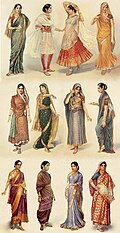


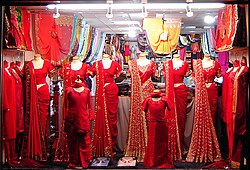


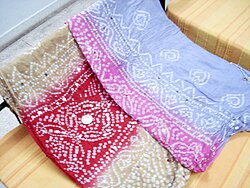


 Plaque of goddess Lakshmi dressed in ancient sari, 1st century BCE
 Plaque with female figure dressed in ancient variation of sari, 1st century BCE
 Female figure dressed in ancient form of sari, 200 BCE
 Female figure dressed in early form of sari, 1st century BCE
 Female figure dressed in early form of sari, 1st century BCE
 Women dressed in ancient form of sari, 1st century BCE
 Women in choli (blouse) and antariya c. 320 CE, Gupta Empire
 Kalpa Sūtra manuscript c. 1375 CE
 Dancing women depicted in three-piece attire, Kalpa Sutra manuscript 1375 CE
 Women dressed in sari, Kalpa sutra manuscript, ca 1375 CE
 Women dressed in sari, deccan, Template:Ca
 Women dressed in sari, c.1600s
 Bronze portrait of Malla queen, 1696-1722 CE, Nepal
 Girl in Gujarati sari; in this style, the loose end is worn on the front
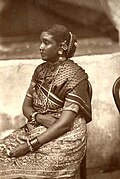 Woman in Tamil sari; in this style, the loose end is wrapped around the waist
 Girl in Bengali sari; in this style sari is worn without any pleats
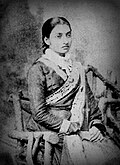 Jnanadanandini Devi styling the Bengali drape with British-style blouse with lace collar
 Girl in Pochampally Ikkat sari worn in Nivi style, 1895 CE
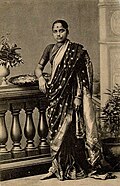 Woman in Nauvari sari
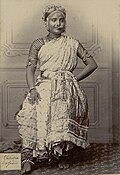 Tamil dancer dressed in sari, Template:Ca
_LACMA_M.85.62_(cropped).jpg)


_Rear_Side_-_Stupa_1_-_Sanchi_Hill_2013-02-21_4484-4487.jpg)


.jpg)


.jpg)


.jpg)
.jpg)


,_silk_and_gold-wrapped_silk_yarn_with_supplementary_weft_brocade.jpg)


 19th century example of weft-resist dye (patola) or double Ikat
 A silk sari loom in Kumbakonam, Tamil Nadu
 Galaxy of Musicians by Raja Ravi Varma depicting women in various styles of sari
 Silk weaving at Kanchipuram, Tamil Nadu
 Wooden printing-blocks used for block-print saris
 Dyed silk yarns for sari
 Handloom Kanchivaram silk sari
 Handloom in Varanasi, Uttar Pradesh
 Handloom in Varanasi
 A classic drape sari
 Weaving at work in Kanchipuram
 Dyed silk yarns for weaving saris
 Double-Ikat handloom for Patola sari in Gujarat
 Double ikat (Patola) weaving
 Weaving Jamdani sari in handloom, Bangladesh
 Weavers at work in Bangladesh
 Child wearing sari in Bangladesh
 Style of sari worn in Coorg
 Handloom weaver at work
 Devadasis from Goa
 Sinhalese woman wearing a traditional Kandyan sari (osaria)
 Weaving saris in Kancipuram
 Display of handloom saris
 Picture shows sari draping style of North Karnataka by Raja Ravi Varma
 Bride in traditional Bengali sari
 Woman in Karnataka kacche drape by Raja Ravi Varma

 Women in Karnataka wearing Kodagu style sari
 Sari is worn in Bengal using the Aat Poure draping style.
 Sari in modern India
 Maithil sari style in Kanyadan Maithili movie
 Monica Bedi, an Indian actress in sari
 Maharani Ourmilla Devi of Jubbal in modern style of Nivi sari, 1935
.jpg)


.jpg)


.jpg)


.jpg)


.jpg)

.jpg)

-1.jpg)
.jpg)
.jpg)


