






No edit summary |
No edit summary |
||
| Line 1: | Line 1: | ||
{{Short description|India's first solar observation mission}} | {{Short description|India's first solar observation mission}} | ||
{{copy edit|date=September 2023}} | |||
{{Use Indian English|date=September 2021}} | {{Use Indian English|date=September 2021}} | ||
{{Use dmy dates|date=June 2019}} | {{Use dmy dates|date=June 2019}} | ||
| Line 8: | Line 9: | ||
| image_size = 300px | | image_size = 300px | ||
| mission_type = [[Solar observation]] | | mission_type = [[Solar observation]] | ||
| operator = [[ | | operator = [[ISRO]] | ||
| COSPAR_ID = | | COSPAR_ID = | ||
| SATCAT = | | SATCAT = | ||
| website = {{URL|https://www.isro.gov.in/Aditya_L1.html}} | | website = {{URL|https://www.isro.gov.in/Aditya_L1.html}} | ||
| mission_duration = 5.2 years (planned)<ref name="CurrSci_113_04">{{Cite journal |last1=Somasundaram |first1=Seetha |last2=Megala |first2=S. |date=25 August 2017 |title=Aditya-L1 mission |url=http://www.currentscience.ac.in/Volumes/113/04/0610.pdf |url-status=dead |journal=Current Science |volume=113 |issue=4 |page=610 |bibcode=2017CSci..113..610S |doi=10.18520/cs/v113/i04/610-612 |archive-url=https://web.archive.org/web/20170825061326/http://www.currentscience.ac.in/Volumes/113/04/0610.pdf |archive-date=25 August 2017 |access-date=25 August 2017}}</ref> <br/>{{time interval|September | | mission_duration = 5.2 years (planned)<ref name="CurrSci_113_04">{{Cite journal |last1=Somasundaram |first1=Seetha |last2=Megala |first2=S. |date=25 August 2017 |title=Aditya-L1 mission |url=http://www.currentscience.ac.in/Volumes/113/04/0610.pdf |url-status=dead |journal=Current Science |volume=113 |issue=4 |page=610 |bibcode=2017CSci..113..610S |doi=10.18520/cs/v113/i04/610-612 |archive-url=https://web.archive.org/web/20170825061326/http://www.currentscience.ac.in/Volumes/113/04/0610.pdf |archive-date=25 August 2017 |access-date=25 August 2017}}</ref> <br/>{{time interval|2 September 2023|show=ymd}} (elapsed) | ||
| spacecraft = | | spacecraft = PSLV-XL/C-57 | ||
| spacecraft_type = | | spacecraft_type = [[PSLV]] | ||
| spacecraft_bus = [[I-1K]] {{ | | spacecraft_bus = [[I-1K]]<ref name="SFI_20160903">{{Cite website |url=https://www.spaceflightinsider.com/organizations/isro/indias-first-solar-mission-to-be-launched-in-2019-20/ |title=India’s first solar mission to be launched in 2019–20 |date=4 February 2016 |publisher=Space Flight Insider |first=Tomas |last=Nowakowski |access-date=3 September 2023}}</ref> | ||
| manufacturer = [[ | | manufacturer = [[ISRO]]{{\}}[[Inter-University Centre for Astronomy and Astrophysics|IUCAA]]{{\}}[[Indian Institute of Astrophysics|IIA]] | ||
| launch_mass = {{cvt|1475|kg}}<ref name="CII_20210915">{{Cite AV media |url=https://www.youtube.com/watch?v=XoIdCVfNbfY&t=7656s |title=International Space Conference and Exhibition – DAY 3 |date=15 September 2021 |type=video |publisher=Confederation of Indian Industry |time=2:07:36–2:08:38 |access-date=18 September 2021 |via=YouTube}}</ref> | | launch_mass = {{cvt|1475|kg}}<ref name="CII_20210915">{{Cite AV media |url=https://www.youtube.com/watch?v=XoIdCVfNbfY&t=7656s |title=International Space Conference and Exhibition – DAY 3 |date=15 September 2021 |type=video |publisher=Confederation of Indian Industry |time=2:07:36–2:08:38 |access-date=18 September 2021 |via=YouTube}}</ref> | ||
| payload_mass = {{cvt|244|kg}}<ref name="CurrSci_113_04" /> | | payload_mass = {{cvt|244|kg}}<ref name="CurrSci_113_04" /> | ||
| dimensions = | | dimensions = | ||
| power = <!-- [[watt]]s --> | | power = <!-- [[watt]]s --> | ||
| launch_date = {{start-date|2 September 2023}}, 11:50 IST (06:20 UTC) <ref name="it-20230824">{{Cite web |date=28 August 2023 |title=Moon mission done, ISRO aims for the Sun with Aditya-L1 launch on September 2 |url=https://indianexpress.com/article/technology/science/isros-solar-mission-aditya-l1-to-be-launched-on-september-2-says-space-agency-8913266/ |access-date=28 August 2023 |website=[[The Indian Express]] |archive-date=28 August 2023 |archive-url=https://web.archive.org/web/20230828120712/https://indianexpress.com/article/technology/science/isros-solar-mission-aditya-l1-to-be-launched-on-september-2-says-space-agency-8913266/ |url-status=live }}</ref><ref name="launch">{{Cite web |url=https://www.bbc.com/news/world-asia-india-66643805 |title=Aditya-L1: India launches its first mission to Sun |date=2 September 2023 |access-date=2 September 2023 |first=Geeta |last=Pandey |website=[[BBC News]] }}</ref> | | launch_date = {{start-date|2 September 2023}}, 11:50 IST (06:20 UTC)<ref name="it-20230824">{{Cite web |date=28 August 2023 |title=Moon mission done, ISRO aims for the Sun with Aditya-L1 launch on September 2 |url=https://indianexpress.com/article/technology/science/isros-solar-mission-aditya-l1-to-be-launched-on-september-2-says-space-agency-8913266/ |access-date=28 August 2023 |website=[[The Indian Express]] |archive-date=28 August 2023 |archive-url=https://web.archive.org/web/20230828120712/https://indianexpress.com/article/technology/science/isros-solar-mission-aditya-l1-to-be-launched-on-september-2-says-space-agency-8913266/ |url-status=live }}</ref><ref name="launch">{{Cite web |url=https://www.bbc.com/news/world-asia-india-66643805 |title=Aditya-L1: India launches its first mission to Sun |date=2 September 2023 |access-date=2 September 2023 |first=Geeta |last=Pandey |website=[[BBC News]] }}</ref> | ||
| launch_rocket = [[Polar Satellite Launch Vehicle|PSLV-XL]] | | launch_rocket = [[Polar Satellite Launch Vehicle#PSLV-XL|PSLV-XL]] | ||
| launch_site = [[Satish Dhawan Space Centre]] | | launch_site = [[Satish Dhawan Space Centre]] | ||
| launch_contractor = [[ISRO]] | |||
|launch_contractor = [[ | |||
| orbit_reference = [[Lagrange point#L1|Sun–Earth L<sub>1</sub>]] | | orbit_reference = [[Lagrange point#L1|Sun–Earth L<sub>1</sub>]] | ||
| orbit_regime = [[Halo orbit]] | | orbit_regime = [[Halo orbit]] | ||
| Line 31: | Line 31: | ||
| orbit_apoapsis = | | orbit_apoapsis = | ||
| orbit_inclination = | | orbit_inclination = | ||
| orbit_epoch = January 2024 (planned) | |||
| orbit_period = 177.86 days<ref name="COPUOS_62">{{Cite web |last=Sreekumar |first=P. |date=19 June 2019 |title=Indian Space Science & Exploration : Global Perspective |url=http://www.unoosa.org/documents/pdf/copuos/2019/copuos2019tech32E.pdf |access-date=30 June 2019 |publisher=UNOOSA |page=8 |archive-date=30 June 2019 |archive-url=https://web.archive.org/web/20190630051004/http://www.unoosa.org/documents/pdf/copuos/2019/copuos2019tech32E.pdf |url-status=live }}</ref> | | orbit_period = 177.86 days<ref name="COPUOS_62">{{Cite web |last=Sreekumar |first=P. |date=19 June 2019 |title=Indian Space Science & Exploration : Global Perspective |url=http://www.unoosa.org/documents/pdf/copuos/2019/copuos2019tech32E.pdf |access-date=30 June 2019 |publisher=UNOOSA |page=8 |archive-date=30 June 2019 |archive-url=https://web.archive.org/web/20190630051004/http://www.unoosa.org/documents/pdf/copuos/2019/copuos2019tech32E.pdf |url-status=live }}</ref> | ||
| apsis = gee | | apsis = gee | ||
| Line 41: | Line 42: | ||
| acronym6 = HEL1OS | name6 = High Energy L1 Orbiting X-ray Spectrometer | | acronym6 = HEL1OS | name6 = High Energy L1 Orbiting X-ray Spectrometer | ||
| acronym7 = Magnetometer | name7 = Magnetometer | | acronym7 = Magnetometer | name7 = Magnetometer | ||
}} | |||
| insignia = Aditya-L1 logo.png | |||
| insignia_size = | |||
| insignia_caption = Mission Insignia | |||
}} | }} | ||
'''Aditya-L1''' ( | '''Aditya-L1''' (from [[Sanskrit]]: ''[[Surya|Aditya]]'', "Sun") is a [[coronagraph]]y spacecraft to study the [[Sun#Atmosphere|solar atmosphere]], designed and developed by the [[ISRO|Indian Space Research Organisation]] (ISRO) and various other Indian research institutes.<ref name="CurrSci_113_04" /> It will be inserted at about 1.5 million km from Earth in a [[halo orbit]] around the [[Lagrange point|L1 Lagrange point]] between the [[Earth]] and the [[Sun]] where it will study the solar atmosphere, [[Solar storm|solar magnetic storms,]] and their impact on the environment around the Earth.<ref>{{Cite web |title=Aditya – L1 First Indian mission to study the Sun |url=http://www.isro.gov.in/aditya-l1-first-indian-mission-to-study-sun |url-status=dead |archive-url=https://web.archive.org/web/20180303041833/https://www.isro.gov.in/aditya-l1-first-indian-mission-to-study-sun |archive-date=3 March 2018 |access-date=1 June 2017 |publisher=ISRO}}</ref> | ||
It is the first Indian mission dedicated to observing the Sun | It is the first Indian mission dedicated to observing the Sun. [[Nigar Shaji]] is the project's director.<ref>{{Cite web |date=2 September 2023 |title=Meet The Project Director Of Ambitious Mission Aditya-L1 {{!}} Nigar Shaji from Tamil Nadu |url=https://www.timesnownews.com/videos/times-now/india/meet-the-project-director-of-ambitious-mission-aditya-l1-nigar-shaji-from-tamil-nadu-video-103302519 |access-date=2 September 2023 |website=TimesNow |language=en}}</ref><ref>{{Cite web |title=ISROs Aditya-L1 Solar Mission: Nigar Shaji Addresses After Successful Launch Of First Sun Mission |url=https://zeenews.india.com/video/news/isros-aditya-l1-solar-mission-nigar-shaji-addresses-after-successful-launch-of-first-sun-mission-2656810.html |access-date=2 September 2023 |website=Zee News |language=en}}</ref><ref name="nie_20230902_projectdirector">{{Cite web |title=Meet Nigar Shaji from TN's Tenkasi, Aditya-L1 mission project director |url=https://www.newindianexpress.com/states/tamil-nadu/2023/sep/02/meet-nigar-shaji-from-tns-tenkasi-aditya-l1-mission-project-director-2610872.html |access-date=2 September 2023 |website=The New Indian Express |archive-url=https://web.archive.org/web/20230902155211/https://www.newindianexpress.com/states/tamil-nadu/2023/sep/02/meet-nigar-shaji-from-tns-tenkasi-aditya-l1-mission-project-director-2610872.html |archive-date=2 September 2023 |url-status=live }}</ref><ref name="ndtv_20230902_projectdirector">{{Cite web |title=Meet Nigar Shaji, The Project Director Of India's First Sun Mission: 5 Points |url=https://www.ndtv.com/india-news/5-points-about-nigar-shaji-project-director-of-india-s-maiden-solar-mission-4352495 |access-date=2 September 2023 |website=NDTV.com |archive-url=https://web.archive.org/web/20230902180138/https://www.ndtv.com/india-news/5-points-about-nigar-shaji-project-director-of-india-s-maiden-solar-mission-4352495 |archive-date=2 September 2023 |url-status=live }}</ref> It was launched aboard the [[Polar Satellite Launch Vehicle|PSLV]] C57 at 11:50 [[India Standard Time|IST]] on 2nd September 2023,<ref name="twitter_20230901_isro_launchannounce">{{Cite tweet |author=ISRO |author-link=ISRO |user=isro |number=1697506899242217921 |title=PSLV-C57/Aditya-L1 Mission: The 23-hour 40-minute countdown leading to the launch at 11:50 Hrs. IST on September 2, 2023, has commended today at 12:10 Hrs. The launch can be watched LIVE on ISRO Website https://isro.gov.in Facebook https://facebook.com/ISRO YouTube https://youtube.com/watch?v=_IcgGYZTXQw… DD National TV channel from 11:20 Hrs. IST |date=1 September 2023}}</ref><ref name="it-20230824"/><ref name="launch" /> ten days after the successful landing of ISRO's [[moon]] mission, [[Chandrayaan-3|Chandrayaan 3]]. It successfully achieved its intended orbit nearly an hour later, and separated from the [[Polar Satellite Launch Vehicle#Fourth stage (PS4)|fourth stage]] at 12:57 IST.<ref name="it_20230902_liveblog">{{Cite web |title=Aditya L1 Mission: Aditya L1 Launch LIVE Updates: Aditya L1 spacecraft successfully separated from PSLV rocket, now en route to Sun-Earth L1 point. ISRO says mission accomplished |date=2 September 2023 |url=https://economictimes.indiatimes.com/news/newsblogs/aditya-l1-live-news-updates-isro-first-solar-mission-launch-02-september-2023/liveblog/103297403.cms |access-date=2 September 2023 |website=The Economic Times |language=en |archive-url=https://web.archive.org/web/20230903115715/https://economictimes.indiatimes.com/news/newsblogs/aditya-l1-live-news-updates-isro-first-solar-mission-launch-02-september-2023/liveblog/103297403.cms |archive-date=3 September 2023 |url-status=live }}</ref> | ||
== Mission objectives == | == Mission objectives == | ||
''Aditya-L1''{{'s}} main science objectives are: | |||
* | * Observations of the dynamics of the Sun's [[chromosphere]] and [[Stellar corona|corona]] | ||
* | ** Studies of chromospheric and coronal heating, the physics of [[Solar spicule|partially ionised]] [[Plasma (physics)|plasma]], of [[coronal mass ejection]]s (CMEs) and their origins, of the coronal [[Stellar magnetic field|magnetic field]] and [[heat transfer]] mechanisms, and [[Solar flare|flare]] exchanges | ||
* Observation of the physical particle environment around its position | |||
* Determination of the sequence of processes in multiple layers below the corona that lead to solar eruptions | |||
* Drivers for [[space weather]], and the origin, composition and dynamics of [[solar wind]]<ref>{{Cite web |title=ADITYA-L1 |url=https://www.isro.gov.in/Aditya_L1.html |access-date=29 August 2023 |website=www.isro.gov.in |archive-date=3 August 2023 |archive-url=https://web.archive.org/web/20230803035925/https://www.isro.gov.in/Aditya_L1.html |url-status=live }}</ref> | |||
* | |||
* | |||
* Drivers for space weather | |||
== History == | == History == | ||
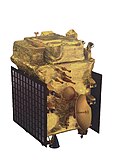
[[File:Aditya L1.jpg|thumb|Aditya-L1 in stowed configuration]] | [[File:Aditya L1.jpg|thumb|Aditya-L1 in stowed configuration]] | ||
Aditya was conceptualised in January 2008 by the Advisory Committee for Space | Aditya was conceptualised in January 2008 by the Advisory Committee for Space Sciences (ADCOS).<ref>{{Cite web |title=SAC Industry Portal |url=https://www.sac.gov.in/SAC_Industry_Portal/programme_hsp.html |access-date=2023-09-03 |website=www.sac.gov.in |publisher=Space Applications Center, Government of India}}</ref><ref>{{Cite web |date=2023-08-14 |editor-last=Teotia |editor-first=Riya |title=ISRO shares first images of Aditya-L1 satellite ahead of India's first-ever mission to study the Sun |url=https://www.wionews.com/india-news/isro-share-first-images-of-aditya-l1-satellite-ahead-of-indias-first-ever-mission-to-study-the-sun-625203 |access-date=2023-09-03 |website=WION |language=en-us}}</ref> It was initially envisaged as a small {{cvt|400|kg}} satellite in a [[Low Earth orbit|Low Earth Orbit]] (800 km) with a [[coronagraph]] to study the [[solar corona]]. An experimental budget of {{INR|3 crore}} was allocated for the financial year 2016–2017.<ref name="2016-17_budget">{{Cite press release |title=Notes on Demands for Grants, 2016–2017 |publisher=Department of Space |url=http://indiabudget.nic.in/ub2016-17/eb/sbe84.pdf |access-date=9 September 2016 |url-status=dead |archive-url=https://web.archive.org/web/20160917064145/http://indiabudget.nic.in/ub2016-17/eb/sbe84.pdf |archive-date=17 September 2016}}</ref><ref>{{Cite news |title=Aditya gets ready to gaze at the sun |work=The Hindu |url=http://www.thehindu.com/todays-paper/tp-national/aditya-gets-ready-to-gaze-at-the-sun/article8212387.ece |access-date=25 August 2017 |archive-date=26 August 2017 |archive-url=https://web.archive.org/web/20170826033106/http://www.thehindu.com/todays-paper/tp-national/aditya-gets-ready-to-gaze-at-the-sun/article8212387.ece |url-status=live }}</ref><ref>{{Cite news |last=Gandhi |first=Divya |date=13 January 2008 |title=ISRO planning to launch satellite to study the sun |work=The Hindu |url=http://www.thehindu.com/todays-paper/ISRO-planning-to-launch-satellite-to-study-the-sun/article15143000.ece |access-date=26 August 2017 |archive-date=15 September 2018 |archive-url=https://web.archive.org/web/20180915091339/https://www.thehindu.com/todays-paper/ISRO-planning-to-launch-satellite-to-study-the-sun/article15143000.ece |url-status=live }}</ref> The scope of the mission has since been expanded and it is now planned to be a comprehensive solar and space environment observatory to be placed at [[Lagrange point]] L1,<ref>{{Cite news |last=Desikan |first=Shubashree |date=15 November 2015 |title=The sun shines on India's Aditya |work=The Hindu |url=http://www.thehindu.com/opinion/the-sun-shines-on-indias-aditya/article7878625.ece |access-date=12 August 2018 |archive-date=13 March 2018 |archive-url=https://web.archive.org/web/20180313004843/http://www.thehindu.com/opinion/the-sun-shines-on-indias-aditya/article7878625.ece |url-status=live }}</ref> hence the mission was renamed "Aditya-L1". {{As of|2019|7|df=}}, the mission has an allocated cost of {{INR|378 crores}} excluding launch costs.<ref name="launch" /> | ||
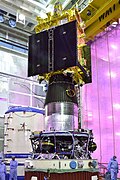
[[File:Aditya-L1 spacecraft.jpg|thumb|left|Aditya L1 in deployed configuration]] | [[File:Aditya-L1 spacecraft.jpg|thumb|left|Aditya L1 in deployed configuration]] | ||
==Name== | |||
"Aditya" is named after [[Surya]] and the [[Adityas]], the revered Hindu deities representing the Sun. The "L1" designation denotes [[Lagrange point|Lagrange point 1]], signifying the precise location situated between the Sun and Earth where the spacecraft is set to embark.<ref name="launch"></ref> | |||
== Overview == | == Overview == | ||
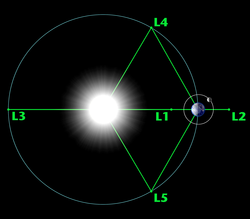
[[File:Lagrange-better.png|thumb|upright=1.0|right|[[Lagrange point]]s in the Sun–Earth system (not to scale) – a small object at any one of the five points will hold its relative position.]] | [[File:Lagrange-better.png|thumb|upright=1.0|right|[[Lagrange point]]s in the Sun–Earth system (not to scale) – a small object at any one of the five points will hold its relative position.]] | ||
The Aditya-L1 mission will take around 109 Earth days after launch<ref>{{Cite web |date=14 February 2020 |title=Department Of Space, Annual Report 2019–2020 |url=https://www.isro.gov.in/sites/default/files/flipping_book/annual_report_2019-20_english/files/assets/common/downloads/Annual%20Report%202019-20%20(English).pdf |url-status=live |archive-url=https://web.archive.org/web/20211007125322/https://www.isro.gov.in/sites/default/files/flipping_book/annual_report_2019-20_english/files/assets/common/downloads/Annual%20Report%202019-20%20(English).pdf |archive-date=7 October 2021 |access-date=25 October 2021}}</ref> to reach the [[halo orbit]] around the [[Lagrange point|L1 point]], which is about {{cvt|1500000|km}} from Earth. The spacecraft | The Aditya-L1 mission will take around 109 Earth days after launch<ref>{{Cite web |date=14 February 2020 |title=Department Of Space, Annual Report 2019–2020 |url=https://www.isro.gov.in/sites/default/files/flipping_book/annual_report_2019-20_english/files/assets/common/downloads/Annual%20Report%202019-20%20(English).pdf |url-status=live |archive-url=https://web.archive.org/web/20211007125322/https://www.isro.gov.in/sites/default/files/flipping_book/annual_report_2019-20_english/files/assets/common/downloads/Annual%20Report%202019-20%20(English).pdf |archive-date=7 October 2021 |access-date=25 October 2021}}</ref> to reach the [[halo orbit]] around the [[Lagrange point|L1 point]], which is about {{cvt|1500000|km}} from Earth. The spacecraft is planned to remain in the halo orbit for its mission duration while being maintained at a [[Orbital station-keeping|stationkeeping]] [[Delta-v|Δv]] of 0.2–4 m/s per year.<ref>{{Cite journal |last=Muralidharan |first=Vivek |url=https://docs.lib.purdue.edu/open_access_theses/1310/ |title=Orbit Maintenance Strategies for Sun-Earth/Moon Libration Point Missions: Parameter Selection for Target Point and Cauchy-Green Tensor Approaches |journal=Open Access Theses |publisher=M.S. Thesis, Purdue University |year=2017 |location=West Lafayette, Indiana, United States |pages=183–194}}</ref> The {{cvt|1500|kg}} satellite carries seven science payloads with diverse objectives, including instruments to measure [[Coronal heating problem|coronal heating]], [[solar wind]] acceleration, coronal magnetometry, origin and monitoring of [[Ultraviolet|near-UV]] [[Solar irradiance|solar radiation]] (which drives Earth's upper atmospheric dynamics and global climate), coupling of the solar photosphere to the chromosphere and corona, in-situ characterisations of the space environment around Earth by measuring energetic particle fluxes and magnetic fields of the solar wind, and [[Solar storm|solar magnetic storms]].<ref name="CurrSci_113_04" /> | ||
Aditya-L1 will | Aditya-L1 will provide observations of the sun's [[photosphere]], [[chromosphere]] and [[solar corona|corona]]. In addition, an instrument will study the [[solar energetic particles]]' [[flux]] reaching the L1 orbit, while a [[magnetometer]] payload will measure the variation in [[Sun#Magnetic field|magnetic field]] strength at the halo orbit around L1. These payloads have to be placed outside the interference from the Earth's magnetic field and hence could not have been useful in the low Earth orbit as proposed in the original Aditya mission concept.<ref>{{Cite web |title=Aditya-L1 First Indian mission to study the Sun |url=https://www.isro.gov.in/aditya-l1-first-indian-mission-to-study-sun |url-status=dead |archive-url=https://web.archive.org/web/20191210161048/https://www.isro.gov.in/aditya-l1-first-indian-mission-to-study-sun |archive-date=10 December 2019 |access-date=19 June 2019 |website=isro.gov.in}}</ref> | ||
One of the major unsolved | One of the major unsolved problems in the field of [[solar physics]] is that the upper atmosphere of the Sun has a temperature of {{cvt|1000000|K|C F}} whereas the lower atmosphere is just {{cvt|6000|K|C F}}. In addition, it is not understood exactly how the Sun's radiation affects the dynamics of the Earth's atmosphere on a shorter as well as a longer time scale. The mission will obtain near-simultaneous images of the different layers of the Sun's atmosphere, which will reveal the ways in which energy is channeled and transferred from one layer to another. Thus, the Aditya-L1 mission will enable a comprehensive understanding of the dynamical processes of the Sun and address some of the outstanding problems in solar physics and [[heliophysics]]. | ||
== Payloads == | == Payloads == | ||
The instruments of Aditya-L1 are tuned to observe the solar atmosphere mainly the chromosphere and corona. In-situ instruments will observe the local environment at [[Lagrange point|L1]]. There are | The instruments of Aditya-L1 are tuned to observe the solar atmosphere, mainly the chromosphere and corona. In-situ instruments will observe the local environment at [[Lagrange point|L1]]. There are seven [[payloads]] on-board, with four for remote sensing of the Sun and three for in-situ observation. The payloads have been developed by different laboratories in the country with close collaborations of various ISRO centres.<ref name="ISRO ADITYA-L1">{{Cite web |title=ISRO ADITYA-L1 |url=https://www.isro.gov.in/Aditya_L1.html}}</ref> | ||
{| class="wikitable" | {| class="wikitable" | ||
! | !Type | ||
!Sl.No | !Sl.No | ||
!Payload | !Payload | ||
!Capability | !Capability | ||
!Laboratories | |||
|- | |- | ||
| rowspan="4" |Remote Sensing | | rowspan="4" |Remote Sensing Payloads | ||
|1 | |1 | ||
|Visible Emission Line [[Coronagraph]] | |Visible Emission Line [[Coronagraph]] (VELC) | ||
|[[Stellar corona|Corona]]/Imaging and [[spectroscopy]] | |||
|[[Stellar corona|Corona]]/Imaging | |[[Indian Institute of Astrophysics]], [[Bangalore]] | ||
|- | |- | ||
|2 | |2 | ||
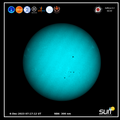
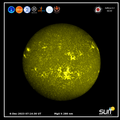
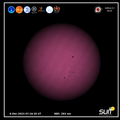
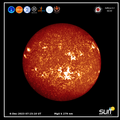
|Solar Ultraviolet Imaging Telescope (SUIT) | |Solar Ultraviolet Imaging Telescope (SUIT) | ||
|[[Photosphere]] and [[ | |[[Photosphere]] and [[chromosphere]] imaging- narrow and broadband | ||
|[[Inter-University Centre for Astronomy and Astrophysics|Inter University Centre for Astronomy & Astrophysics]], [[Pune]] | |||
|- | |- | ||
|3 | |3 | ||
|Solar Low Energy X-ray [[Spectrometer]] (SoLEXS) | |Solar Low Energy X-ray [[Spectrometer]] (SoLEXS) | ||
|Soft X-ray [[spectrometer]]: Sun-as-a-star observation | |Soft X-ray [[spectrometer]]: Sun-as-a-star observation | ||
| rowspan="2" |[[U R Rao Satellite Centre]], [[Bangalore]] | |||
|- | |- | ||
|4 | |4 | ||
| Line 104: | Line 109: | ||
|Hard X-ray [[spectrometer]]: Sun-as-a-star observation | |Hard X-ray [[spectrometer]]: Sun-as-a-star observation | ||
|- | |- | ||
| rowspan="3" |In-situ | | rowspan="3" |In-situ Payloads | ||
|5 | |5 | ||
|Aditya Solar wind Particle Experiment(ASPEX) | |Aditya Solar wind Particle Experiment (ASPEX) | ||
|[[Solar wind]]/Particle | |[[Solar wind]]/Particle analyzer [[protons]] and heavier ions with directions | ||
|[[Physical Research Laboratory]], [[Ahmedabad]] | |||
|- | |- | ||
|6 | |6 | ||
|[[Plasma (physics)|Plasma]] Analyser Package For Aditya (PAPA) | |[[Plasma (physics)|Plasma]] Analyser Package For Aditya (PAPA) | ||
|[[Solar wind]]/Particle Analyzer [[Electrons]] | |[[Solar wind]]/Particle Analyzer [[Electrons]] and Heavier Ions with directions | ||
|Space Physics Laboratory, [[Vikram Sarabhai Space Centre]], [[Thiruvananthapuram]] | |||
|- | |- | ||
|7 | |7 | ||
|Advanced Tri-axial [[High Resolution]] Digital [[Magnetometer]]s | |Advanced Tri-axial [[High Resolution]] Digital [[Magnetometer]]s | ||
|[[In-situ]] | |[[In-situ]] magnetic field (Bx, By and Bz). | ||
|[[Laboratory for Electro-Optics Systems|Laboratory for Electro Optics Systems]], [[Bangalore]] | |||
|} | |} | ||
=== | == Launch == | ||
The | [[File:Flight Sequence.pdf|thumb|Flight Sequence of PSLV-C57]] | ||
On September 2, 2023, at 11:50 [[Indian Standard Time|IST]], the [[Polar Satellite Launch Vehicle]] (PSLV-C57) accomplished a successful launch of the ''Aditya-L1'' from the [[Second Launch Pad]] of the [[Satish Dhawan Space Centre]] (SDSC) located in [[Sriharikota]]. | |||
The ''Aditya-L1'', following a flight duration of 63 minutes and 20 seconds, achieved a successful [[Orbit injection|injection]] into an [[elliptical orbit]] around the Earth at 12:54 [[Indian Standard Time|IST]].<ref>{{Cite web |title=PSLV-C57 / ADITYA-L1 Mission - Press Release |url=https://www.isro.gov.in/PSLVC57_AdityaL1_PressRelease.html |access-date=2023-09-03 |website=www.isro.gov.in}}</ref> | |||
The ''Aditya-L1'' is scheduled to undergo a series of four Earth-bound [[Orbital maneuver|orbital manoeuvres]] prior to its injection to a transfer orbit towards the L1 [[Lagrange point]]. It is projected to reach its designated orbit at the L1 point approximately 127 days after its launch.<ref name="isro_20230902_adityal1">{{Cite web |title=PSLV-C57/ADITYA-L1 Mission |url=https://www.isro.gov.in/PSLVC57_AdityaL1_PressRelease.html |access-date=2 September 2023 |website=www.isro.gov.in |archive-url=https://web.archive.org/web/20230903112819/https://www.isro.gov.in/PSLVC57_AdityaL1_PressRelease.html |archive-date=3 September 2023 |url-status=live }}</ref> | |||
== Orbit raising burns == | |||
===First orbit raising burn=== | |||
On 3 September 2023 the ''Aditya-L1'' performed its first Earth-bound maneuver, raising its orbit to a {{Cvt|245|km}} into {{Cvt|22,459|km}} orbit.<ref>{{cite tweet|title=Aditya L1|user=isro|number=1698224462821544411|date=3 September 2023|access-date=3 September 2023}}</ref> | |||
===Second orbit raising burn=== | |||
On 5 September ''Aditya L1'' raised its orbit to a {{Cvt|282|km}} into {{Cvt|40,225|km}} orbit. | |||
{| class="wikitable" | {| class="wikitable" | ||
|+ | |+Mission stages and maneuvers | ||
! | !Stage and Sequence | ||
! | !Date/Time | ||
! | !Time (IST) | ||
!Periapsis | |||
!Apoapsis | |||
!Orbital Period | |||
!{{Refh}} | |||
|- | |||
|Earth Orbit Insertion | |||
|2 September 2023 | |||
|12:54 p.m | |||
|{{Cvt|235|km}} | |||
|{{Cvt|19500|km}} | |||
| | |||
|<ref>{{Cite tweet|number=1697874341604835828|user=isro|title=The launch of Aditya-L1 by PSLV-C57 is accomplished successfully. The vehicle has placed the satellite precisely into its intended orbit. India’s first solar observatory has begun its journey to the destination of Sun-Earth L1 point.|date=2023-09-02|author=ISRO|df=dmy}}</ref> | |||
|- | |- | ||
|1 | |Earth Bound Maneuver 1 | ||
| | |3 September 2023 | ||
|11:40 a.m. | |||
| | |{{Cvt|245|km}} | ||
|{{Cvt|22,459|km}} | |||
| | |||
|<ref name="ebn2">{{Cite tweet|number=1698224462821544411|user=isro|title=The satellite is healthy and operating nominally. The first Earth-bound maneuvre (EBN#1) is performed successfully from ISTRAC, Bengaluru. The new orbit attained is 245km x 22459 km. The next maneuvre (EBN#2) is scheduled for September 5, 2023, around 03:00 Hrs. IST|date=2023-09-03|author=ISRO|df=dmy}}</ref> | |||
|- | |- | ||
|2 | |Earth Bound Maneuver 2 | ||
| | |5 September 2023 | ||
| | |3:00 a.m | ||
|{{Cvt|282|km}} | |||
|{{Cvt|40225|km}} | |||
| | |||
|<ref name="ebn3">{{Cite tweet |user=isro |number=1698810887614992515 |title=Aditya-L1 Mission: The second Earth-bound maneuvre (EBN#2) is performed successfully from ISTRAC, Bengaluru. ISTRAC/ISRO's ground stations at Mauritius, Bengaluru and Port Blair tracked the satellite during this operation. The new orbit attained is 282 km x 40225 km. The next maneuvre (EBN#3) is scheduled for September 10, 2023, around 02:30 Hrs. IST |df=dmy |author=ISRO |author-link=ISRO}}</ref> | |||
|- | |- | ||
|3 | |Earth Bound Maneuver 3 | ||
| | |10 September 2023 | ||
| | |2:30 am | ||
| | |||
| | |||
| | |||
|<ref name="ebn3" /> | |||
|- | |- | ||
|4 | |Earth Bound Maneuver 4 | ||
| | | | ||
| | | | ||
| | |||
| | |||
| | |||
| | |||
|- | |- | ||
|5 | |Earth Bound Maneuver 5 | ||
| | | | ||
| | |||
| | | | ||
| | |||
| | |||
| | |||
|- | |- | ||
| | |Trans-Lagrangian 1 Injection | ||
| | | | ||
| | | | ||
| | |||
| | |||
| | |||
| | |||
|} | |} | ||
==Team== | |||
* [[Nigar Shaji]] - Project director | |||
* [[Sankarasubramanian. K|Sankarasubramanian K]] - Principal scientist of the mission<ref>{{Cite web |title=Educational qualification of scientists behind ISRO's solar mission, Aditya L-1 |url=https://www.dnaindia.com/education/report-educational-qualification-of-scientists-behind-aditya-l-1-mission-chandrayaan-3-s-somanath-iit-iisc-bengaluru-3058363 |access-date=2023-09-04 |website=DNA India |language=en}}</ref> | |||
== See also == | == See also == | ||
{{Portal|Spaceflight}} | {{Portal|Spaceflight}} | ||
| Line 177: | Line 222: | ||
{{Sun spacecraft|state=collapsed}} | {{Sun spacecraft|state=collapsed}} | ||
{{Space observatories}} | |||
{{Indian space programme}} | {{Indian space programme}} | ||
{{Indian spacecraft}} | {{Indian spacecraft}} | ||
{{ | {{Orbital launches in 2023}} | ||
[[Category:Satellites of India]] | [[Category:Satellites of India]] | ||
Revision as of 21:38, 5 September 2023
 | This article may require copy editing for grammar, style, cohesion, tone, or spelling. (September 2023) |
 Aditya-L1 in deployed configuration | |||||||||||||||||
| Mission type | Solar observation | ||||||||||||||||
|---|---|---|---|---|---|---|---|---|---|---|---|---|---|---|---|---|---|
| Operator | ISRO | ||||||||||||||||
| COSPAR ID | {{#property:P247}} | ||||||||||||||||
| Website | www | ||||||||||||||||
| Mission duration | 5.2 years (planned)[1] 3 years, 1 month and 18 days (elapsed) | ||||||||||||||||
| Spacecraft properties | |||||||||||||||||
| Spacecraft | PSLV-XL/C-57 | ||||||||||||||||
| Spacecraft type | PSLV | ||||||||||||||||
| Bus | I-1K[2] | ||||||||||||||||
| Manufacturer | ISRO / IUCAA / IIA | ||||||||||||||||
| Launch mass | 1,475 kg (3,252 lb)[3] | ||||||||||||||||
| Payload mass | 244 kg (538 lb)[1] | ||||||||||||||||
| Start of mission | |||||||||||||||||
| Launch date | 2 September 2023, 11:50 IST (06:20 UTC)[4][5] | ||||||||||||||||
| Rocket | PSLV-XL | ||||||||||||||||
| Launch site | Satish Dhawan Space Centre | ||||||||||||||||
| Contractor | ISRO | ||||||||||||||||
| Orbital parameters | |||||||||||||||||
| Reference system | Sun–Earth L1 | ||||||||||||||||
| Regime | Halo orbit | ||||||||||||||||
| Period | 177.86 days[6] | ||||||||||||||||
| Epoch | January 2024 (planned) | ||||||||||||||||
| |||||||||||||||||
 Mission Insignia | |||||||||||||||||
Aditya-L1 (from Sanskrit: Aditya, "Sun") is a coronagraphy spacecraft to study the solar atmosphere, designed and developed by the Indian Space Research Organisation (ISRO) and various other Indian research institutes.[1] It will be inserted at about 1.5 million km from Earth in a halo orbit around the L1 Lagrange point between the Earth and the Sun where it will study the solar atmosphere, solar magnetic storms, and their impact on the environment around the Earth.[7]
It is the first Indian mission dedicated to observing the Sun. Nigar Shaji is the project's director.[8][9][10][11] It was launched aboard the PSLV C57 at 11:50 IST on 2nd September 2023,[12][4][5] ten days after the successful landing of ISRO's moon mission, Chandrayaan 3. It successfully achieved its intended orbit nearly an hour later, and separated from the fourth stage at 12:57 IST.[13]
Mission objectives
Aditya-L1's main science objectives are:
- Observations of the dynamics of the Sun's chromosphere and corona
- Studies of chromospheric and coronal heating, the physics of partially ionised plasma, of coronal mass ejections (CMEs) and their origins, of the coronal magnetic field and heat transfer mechanisms, and flare exchanges
- Observation of the physical particle environment around its position
- Determination of the sequence of processes in multiple layers below the corona that lead to solar eruptions
- Drivers for space weather, and the origin, composition and dynamics of solar wind[14]
History

Aditya was conceptualised in January 2008 by the Advisory Committee for Space Sciences (ADCOS).[15][16] It was initially envisaged as a small 400 kg (880 lb) satellite in a Low Earth Orbit (800 km) with a coronagraph to study the solar corona. An experimental budget of ₹3 crore was allocated for the financial year 2016–2017.[17][18][19] The scope of the mission has since been expanded and it is now planned to be a comprehensive solar and space environment observatory to be placed at Lagrange point L1,[20] hence the mission was renamed "Aditya-L1". As of July 2019[update], the mission has an allocated cost of ₹378 crores excluding launch costs.[5]

Name
"Aditya" is named after Surya and the Adityas, the revered Hindu deities representing the Sun. The "L1" designation denotes Lagrange point 1, signifying the precise location situated between the Sun and Earth where the spacecraft is set to embark.[5]
Overview

The Aditya-L1 mission will take around 109 Earth days after launch[21] to reach the halo orbit around the L1 point, which is about 1,500,000 km (930,000 mi) from Earth. The spacecraft is planned to remain in the halo orbit for its mission duration while being maintained at a stationkeeping Δv of 0.2–4 m/s per year.[22] The 1,500 kg (3,300 lb) satellite carries seven science payloads with diverse objectives, including instruments to measure coronal heating, solar wind acceleration, coronal magnetometry, origin and monitoring of near-UV solar radiation (which drives Earth's upper atmospheric dynamics and global climate), coupling of the solar photosphere to the chromosphere and corona, in-situ characterisations of the space environment around Earth by measuring energetic particle fluxes and magnetic fields of the solar wind, and solar magnetic storms.[1]
Aditya-L1 will provide observations of the sun's photosphere, chromosphere and corona. In addition, an instrument will study the solar energetic particles' flux reaching the L1 orbit, while a magnetometer payload will measure the variation in magnetic field strength at the halo orbit around L1. These payloads have to be placed outside the interference from the Earth's magnetic field and hence could not have been useful in the low Earth orbit as proposed in the original Aditya mission concept.[23]
One of the major unsolved problems in the field of solar physics is that the upper atmosphere of the Sun has a temperature of 1,000,000 K (1,000,000 °C; 1,800,000 °F) whereas the lower atmosphere is just 6,000 K (5,730 °C; 10,340 °F). In addition, it is not understood exactly how the Sun's radiation affects the dynamics of the Earth's atmosphere on a shorter as well as a longer time scale. The mission will obtain near-simultaneous images of the different layers of the Sun's atmosphere, which will reveal the ways in which energy is channeled and transferred from one layer to another. Thus, the Aditya-L1 mission will enable a comprehensive understanding of the dynamical processes of the Sun and address some of the outstanding problems in solar physics and heliophysics.
Payloads
The instruments of Aditya-L1 are tuned to observe the solar atmosphere, mainly the chromosphere and corona. In-situ instruments will observe the local environment at L1. There are seven payloads on-board, with four for remote sensing of the Sun and three for in-situ observation. The payloads have been developed by different laboratories in the country with close collaborations of various ISRO centres.[24]
| Type | Sl.No | Payload | Capability | Laboratories |
|---|---|---|---|---|
| Remote Sensing Payloads | 1 | Visible Emission Line Coronagraph (VELC) | Corona/Imaging and spectroscopy | Indian Institute of Astrophysics, Bangalore |
| 2 | Solar Ultraviolet Imaging Telescope (SUIT) | Photosphere and chromosphere imaging- narrow and broadband | Inter University Centre for Astronomy & Astrophysics, Pune | |
| 3 | Solar Low Energy X-ray Spectrometer (SoLEXS) | Soft X-ray spectrometer: Sun-as-a-star observation | U R Rao Satellite Centre, Bangalore | |
| 4 | High Energy L1 Orbiting X-ray Spectrometer(HEL1OS) | Hard X-ray spectrometer: Sun-as-a-star observation | ||
| In-situ Payloads | 5 | Aditya Solar wind Particle Experiment (ASPEX) | Solar wind/Particle analyzer protons and heavier ions with directions | Physical Research Laboratory, Ahmedabad |
| 6 | Plasma Analyser Package For Aditya (PAPA) | Solar wind/Particle Analyzer Electrons and Heavier Ions with directions | Space Physics Laboratory, Vikram Sarabhai Space Centre, Thiruvananthapuram | |
| 7 | Advanced Tri-axial High Resolution Digital Magnetometers | In-situ magnetic field (Bx, By and Bz). | Laboratory for Electro Optics Systems, Bangalore |
Launch
On September 2, 2023, at 11:50 IST, the Polar Satellite Launch Vehicle (PSLV-C57) accomplished a successful launch of the Aditya-L1 from the Second Launch Pad of the Satish Dhawan Space Centre (SDSC) located in Sriharikota.
The Aditya-L1, following a flight duration of 63 minutes and 20 seconds, achieved a successful injection into an elliptical orbit around the Earth at 12:54 IST.[25]
The Aditya-L1 is scheduled to undergo a series of four Earth-bound orbital manoeuvres prior to its injection to a transfer orbit towards the L1 Lagrange point. It is projected to reach its designated orbit at the L1 point approximately 127 days after its launch.[26]
Orbit raising burns
First orbit raising burn
On 3 September 2023 the Aditya-L1 performed its first Earth-bound maneuver, raising its orbit to a 245 km (152 mi) into 22,459 km (13,955 mi) orbit.[27]
Second orbit raising burn
On 5 September Aditya L1 raised its orbit to a 282 km (175 mi) into 40,225 km (24,995 mi) orbit.
| Stage and Sequence | Date/Time | Time (IST) | Periapsis | Apoapsis | Orbital Period | Ref. |
|---|---|---|---|---|---|---|
| Earth Orbit Insertion | 2 September 2023 | 12:54 p.m | 235 km (146 mi) | 19,500 km (12,100 mi) | [28] | |
| Earth Bound Maneuver 1 | 3 September 2023 | 11:40 a.m. | 245 km (152 mi) | 22,459 km (13,955 mi) | [29] | |
| Earth Bound Maneuver 2 | 5 September 2023 | 3:00 a.m | 282 km (175 mi) | 40,225 km (24,995 mi) | [30] | |
| Earth Bound Maneuver 3 | 10 September 2023 | 2:30 am | [30] | |||
| Earth Bound Maneuver 4 | ||||||
| Earth Bound Maneuver 5 | ||||||
| Trans-Lagrangian 1 Injection |
Team
- Nigar Shaji - Project director
- Sankarasubramanian K - Principal scientist of the mission[31]
See also
References
- ↑ 1.0 1.1 1.2 1.3 Somasundaram, Seetha; Megala, S. (25 August 2017). "Aditya-L1 mission" (PDF). Current Science. 113 (4): 610. Bibcode:2017CSci..113..610S. doi:10.18520/cs/v113/i04/610-612. Archived from the original (PDF) on 25 August 2017. Retrieved 25 August 2017.
- ↑ Template:Cite website
- ↑ International Space Conference and Exhibition – DAY 3 (video). Confederation of Indian Industry. 15 September 2021. Event occurs at 2:07:36–2:08:38. Retrieved 18 September 2021 – via YouTube.
- ↑ 4.0 4.1 "Moon mission done, ISRO aims for the Sun with Aditya-L1 launch on September 2". The Indian Express. 28 August 2023. Archived from the original on 28 August 2023. Retrieved 28 August 2023.
- ↑ 5.0 5.1 5.2 5.3 Pandey, Geeta (2 September 2023). "Aditya-L1: India launches its first mission to Sun". BBC News. Retrieved 2 September 2023.
- ↑ Sreekumar, P. (19 June 2019). "Indian Space Science & Exploration : Global Perspective" (PDF). UNOOSA. p. 8. Archived (PDF) from the original on 30 June 2019. Retrieved 30 June 2019.
- ↑ "Aditya – L1 First Indian mission to study the Sun". ISRO. Archived from the original on 3 March 2018. Retrieved 1 June 2017.
- ↑ "Meet The Project Director Of Ambitious Mission Aditya-L1 | Nigar Shaji from Tamil Nadu". TimesNow. 2 September 2023. Retrieved 2 September 2023.
- ↑ "ISROs Aditya-L1 Solar Mission: Nigar Shaji Addresses After Successful Launch Of First Sun Mission". Zee News. Retrieved 2 September 2023.
- ↑ "Meet Nigar Shaji from TN's Tenkasi, Aditya-L1 mission project director". The New Indian Express. Archived from the original on 2 September 2023. Retrieved 2 September 2023.
- ↑ "Meet Nigar Shaji, The Project Director Of India's First Sun Mission: 5 Points". NDTV.com. Archived from the original on 2 September 2023. Retrieved 2 September 2023.
- ↑ ISRO [@isro] (1 September 2023). "PSLV-C57/Aditya-L1 Mission: The 23-hour 40-minute countdown leading to the launch at 11:50 Hrs. IST on September 2, 2023, has commended today at 12:10 Hrs. The launch can be watched LIVE on ISRO Website isro.gov.in Facebook facebook.com/ISRO YouTube youtube.com/watch?v=_IcgGYZTXQw… DD National TV channel from 11:20 Hrs. IST" (Tweet) – via Twitter.
- ↑ "Aditya L1 Mission: Aditya L1 Launch LIVE Updates: Aditya L1 spacecraft successfully separated from PSLV rocket, now en route to Sun-Earth L1 point. ISRO says mission accomplished". The Economic Times. 2 September 2023. Archived from the original on 3 September 2023. Retrieved 2 September 2023.
- ↑ "ADITYA-L1". www.isro.gov.in. Archived from the original on 3 August 2023. Retrieved 29 August 2023.
- ↑ "SAC Industry Portal". www.sac.gov.in. Space Applications Center, Government of India. Retrieved 3 September 2023.
- ↑ Teotia, Riya, ed. (14 August 2023). "ISRO shares first images of Aditya-L1 satellite ahead of India's first-ever mission to study the Sun". WION. Retrieved 3 September 2023.
- ↑ "Notes on Demands for Grants, 2016–2017" (PDF) (Press release). Department of Space. Archived from the original (PDF) on 17 September 2016. Retrieved 9 September 2016.
- ↑ "Aditya gets ready to gaze at the sun". The Hindu. Archived from the original on 26 August 2017. Retrieved 25 August 2017.
- ↑ Gandhi, Divya (13 January 2008). "ISRO planning to launch satellite to study the sun". The Hindu. Archived from the original on 15 September 2018. Retrieved 26 August 2017.
- ↑ Desikan, Shubashree (15 November 2015). "The sun shines on India's Aditya". The Hindu. Archived from the original on 13 March 2018. Retrieved 12 August 2018.
- ↑ "Department Of Space, Annual Report 2019–2020" (PDF). 14 February 2020. Archived (PDF) from the original on 7 October 2021. Retrieved 25 October 2021.
- ↑ Muralidharan, Vivek (2017). "Orbit Maintenance Strategies for Sun-Earth/Moon Libration Point Missions: Parameter Selection for Target Point and Cauchy-Green Tensor Approaches". Open Access Theses. West Lafayette, Indiana, United States: M.S. Thesis, Purdue University: 183–194.
- ↑ "Aditya-L1 First Indian mission to study the Sun". isro.gov.in. Archived from the original on 10 December 2019. Retrieved 19 June 2019.
- ↑ "ISRO ADITYA-L1".
- ↑ "PSLV-C57 / ADITYA-L1 Mission - Press Release". www.isro.gov.in. Retrieved 3 September 2023.
- ↑ "PSLV-C57/ADITYA-L1 Mission". www.isro.gov.in. Archived from the original on 3 September 2023. Retrieved 2 September 2023.
- ↑ @isro (3 September 2023). "Aditya L1" (Tweet). Retrieved 3 September 2023 – via Twitter.
- ↑ ISRO [@isro] (2 September 2023). "The launch of Aditya-L1 by PSLV-C57 is accomplished successfully. The vehicle has placed the satellite precisely into its intended orbit. India's first solar observatory has begun its journey to the destination of Sun-Earth L1 point" (Tweet) – via Twitter.
- ↑ ISRO [@isro] (3 September 2023). "The satellite is healthy and operating nominally. The first Earth-bound maneuvre (EBN#1) is performed successfully from ISTRAC, Bengaluru. The new orbit attained is 245km x 22459 km. The next maneuvre (EBN#2) is scheduled for September 5, 2023, around 03:00 Hrs. IST" (Tweet) – via Twitter.
- ↑ 30.0 30.1 ISRO [@isro] (5 September 2023). "Aditya-L1 Mission: The second Earth-bound maneuvre (EBN#2) is performed successfully from ISTRAC, Bengaluru. ISTRAC/ISRO's ground stations at Mauritius, Bengaluru and Port Blair tracked the satellite during this operation. The new orbit attained is 282 km x 40225 km. The next maneuvre (EBN#3) is scheduled for September 10, 2023, around 02:30 Hrs. IST" (Tweet) – via Twitter.
- ↑ "Educational qualification of scientists behind ISRO's solar mission, Aditya L-1". DNA India. Retrieved 4 September 2023.
External links
| Current | (since 1997) (since 2022) (since 2021) (since 2015) (since 2006) (since 2013) (since 2018) (since 1995) (since 2010) (since 2020) (since 2006) (since 1994) |   |
|---|---|---|
| Past |
| |
| Planned | (2023) (2024) (2024) (2024) (2025) (2025) (2025) (2020s) | |
| Proposed | ||
| Cancelled | ||
| Lost | ||
| Sun-Earth | ||


| Satellites |
|  | ||||||||||
|---|---|---|---|---|---|---|---|---|---|---|---|---|
| Space probes |
| |||||||||||
| Human spaceflight | ||||||||||||
| ||||||||||||